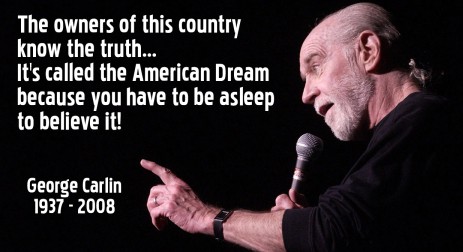
A diabolic false flag empire

A review of David Ray Griffin’s “The American Trajectory: Divine or Demonic?”

By Edward Curtin

Source: Intrepid Report

The past is not dead; it is people who are sleeping. The current night and daymares that we are having arise out of murders lodged deep in our past that have continued into the present. No amount of feigned amnesia will erase the bloody truth of American history, the cheap grace we bestow upon ourselves. We have, as Harold Pinter said in his Nobel address, been feeding on “a vast tapestry of lies” that surrounds us, lies uttered by nihilistic leaders and their media mouthpieces for a very long time. We have, or should have, bad consciences for not acknowledging being active or silent accomplices in the suppression of truth and the vicious murdering of millions at home and abroad.

But, as Pinter said, “I believe that despite the enormous odds which exist, unflinching, unswerving, fierce intellectual determination, as citizens, to define the real truth of our lives and our societies is a crucial obligation which devolves upon us all. It is in fact mandatory.”

No one is more emblematic of this noble effort than David Ray Griffin, who, in book after book since the attacks of 11 September 2001, has meticulously exposed the underside of the American empire and its evil masters. His persistence in trying to reach people and to warn them of the horrors that have resulted is extraordinary. Excluding his philosophical and theological works, this is his fifteenth book since 2004 on these grave issues of life and death and the future of the world.

In this masterful book, he provides a powerful historical argument that right from the start with the arrival of the first European settlers, this country, despite all the rhetoric about it having been divinely founded and guided, has been “more malign that benign, more demonic than divine.” He chronologically presents this history, supported by meticulous documentation, to prove his thesis. In his previous book, Bush and Cheney: How They Ruined America and the World, Griffin cataloged the evil actions that flowed from the inside job/false flag attacks of September 11, while in this one—a prequel—he offers a lesson in American history going back centuries, and he shows that one would be correct in calling the United States a “false flag empire.”

The attacks of 11 September 2001 are the false flag fulcrum upon which his two books pivot. Their importance cannot be overestimated, not just for their inherent cruelty that resulted in thousands of innocent American deaths, but since they became the justification for the United States’ ongoing murderous campaigns termed “the war on terror” that have brought death to millions of people around the world. An international array of expendable people. Terrifying as they were, and were meant to be, they have many precedents, although much of this history is hidden in the shadows. Griffin shines a bright light on them, with most of his analysis focused on the years 1850-2018.

As a theological and philosophical scholar, he is well aware of the great importance of society’s need for religious legitimation for its secular authority, a way to offer its people a shield against terror and life’s myriad fears through a protective myth that has been used successfully by the United States to terrorize others. He shows how the terms by which the U.S. has been legitimated as God’s “chosen nation” and Americans as God’s “chosen people” have changed over the years as secularization and pluralism have made inroads. The names have changed, but the meaning has not. God is on our side, and when that is so, the other side is cursed and can be killed by God’s people, who are always battling el diabalo.

He exemplifies this by opening with a quote from George Washington’s first Inaugural Address where Washington speaks of “the Invisible Hand” and “Providential agency” guiding the country, and by ending with Obama saying “I believe in American exceptionalism with every fiber of my being.” In between we hear Andrew Jackson say that “Providence has showered on this favored land blessings without number” and Henry Cabot Lodge in 1900 characterize America’s divine mission as “manifest destiny.” The American religion today is American Exceptionalism, an updated euphemism for the old-fashioned “God’s New Israel” or the “Redeemer Nation.”

At the core of this verbiage lies the delusion that the United States, as a blessed and good country, has a divine mission to spread “democracy” and “freedom” throughout the world, as Hilary Clinton declared during the 2016 presidential campaign when she said that “we are great because we are good,” and in 2004 when George W. Bush said, “Like generations before us, we have a calling from beyond the stars to stand for freedom.” Such sentiments could only be received with sardonic laughter by the countless victims made “free” by America’s violent leaders, now and then, as Griffin documents.

Having established the fact of America’s claim to divine status, he then walks the reader through various thinkers who have taken sides on the issue of the United States being benign or malign. This is all preliminary to the heart of the book, which is a history lesson documenting the malignancy at the core of the American trajectory.

“American imperialism is often said to have begun in 1898, when Cuba and the Philippines were the main prizes,” he begins. “What was new at this time, however, was only that America took control of countries beyond the North American continent.” The “divine right” to seize others’ lands and kill them started long before, and although no seas were crossed in the usual understanding of imperialism, the genocide of Native Americans long preceded 1898. So too did the “manifest destiny” that impelled war with Mexico and the seizure of its land and the expansion west to the Pacific. This period of empire building depended heavily on the “other great crime against humanity” that was the slave trade, wherein it is estimated that 10 million Africans died, in addition to the sick brutality of slavery itself. “No matter how brutal the methods, Americans were instruments of divine purposes,” writes Griffin. And, he correctly adds, it is not even true that America’s overseas imperialistic ventures only started in 1898, for in the 1850s Commodore Perry forced “the haughty Japanese” to open their ports to American commerce through gunboat diplomacy.

Then in 1898 the pace of overseas imperial expansion picked up dramatically with what has been called “The Spanish-American War” that resulted in the seizure of Cuba and the Philippines and the annexing of Hawaii. Griffin says these wars could more accurately be termed “the wars to take Spanish colonies.” His analysis of the brutality and arrogance of these actions makes the reader realize that My Lai and other more recent atrocities have a long pedigree that is part of an institutional structure, and while Filipinos and Cubans and so many others were being slaughtered, Griffin writes, “Anticipating Secretary of Defense Donald Rumsfeld’s declaration that ‘we don’t do empire,’ [President] McKinley said that imperialism is ‘foreign to the temper and genius of this free and generous people.’”

Then as now, perhaps mad laughter is the only response to such unadulterated bullshit, as Griffin quotes Mark Twain saying that it would be easy creating a flag for the Philippines:

We can have just our usual flag, with the white stripes painted black and the stars replaced by the skull and cross-bones.

That would have also worked for Colombia, Panama, Puerto Rico, the Dominican Republic, Haiti, Nicaragua, and other countries subjugated under the ideology of the Monroe Doctrine; wherever freedom and national independence raised its ugly head, the United States was quick to intervene with its powerful anti-revolutionary military and its financial bullying. In the Far East the “Open Door” policy was used to loot China, Japan, and other countries.

But all this was just the beginning. Griffin shows how Woodrow Wilson, the quintessentially devious and treacherous liberal Democrat, who claimed he wanted to keep America out of WW I, did just the opposite to make sure the U.S. would come to dominate the foreign markets his capitalist masters demanded. Thus Griffin explores how Wilson conspired with Winston Churchill to use the sinking of the Lusitania as a casus belli and how the Treaty of Versailles’s harsh treatment of Germany set the stage for WW II.

He tells us how in the intervening years between the world wars the demonization of Russia and the new Soviet Union was started. This deprecation of Russia, which is roaring at full-throttle today, is a theme that recurs throughout The American Trajectory. Its importance cannot be overemphasizedWilson called the Bolshevik government “a government by terror,” and in 1918 “sent thousands of troops into northern and eastern Russia, leaving them there until 1920.”

That the U. S. invaded Russia is a fact rarely mentioned and even barely known to Americans. Perhaps awareness of it and the century-long demonizing of the U.S.S.R./Russia would enlighten those who buy the current anti-Russia propaganda called “Russiagate.”

To match that “divine” act of imperial intervention abroad, Wilson fomented the Red Scare at home, which, as Griffin says, had lasting and incalculable importance because it created the American fear of radical thought and revolution that exists to this very day and serves as a justification for supporting brutal dictators around the world and crackdowns on freedom at home (as is happening today).

He gives us brief summaries of some dictators the U.S has supported, and reminds us of the saying of that other liberal Democrat, Franklin Roosevelt, who famously said of the brutal Nicaraguan dictator Anastasio Somoza, that “he may be a son-of-a-bitch, but he’s our son-of-a-bitch.” And thus Somoza would terrorize his own people for 43 years. The same took place in Cuba, Chile, Iran, Guatemala, the Dominican Republic, Haiti, etc. The U.S. also supported Mussolini, did nothing to prevent Franco’s fascist toppling of the Spanish Republic, and supported the right-wing government of Chiang-Kai Shek in its efforts to dominate China.

It is a very dark and ugly history that confirms the demonic nature of American actions around the world.

Then Griffin explodes the many myths about the so-called “Good War”—WW II. He explains the lies told about the Japanese “surprise” attack on Pearl Harbor; how Roosevelt wished to get the U.S. into the war, both in the Pacific and in Europe; and how much American economic self-interest lay behind it. He critiques the myth that America selflessly wished to defend freedom loving people in their battles with brutal, fascist regimes. That, he tells us, is but a small part of the story:

This, however, is not an accurate picture of American policies during the Second World War. Many people were, to be sure, liberated from terrible tyrannies by the Allied victories. But the fact that these people benefited was an incidental outcome, not a motive of American policies. These policies, as [Andrew] Bacevich discovered, were based on ‘unflagging self-interest.’

Then there are the conventional and atomic bombings of Hiroshima and Nagasaki. Nothing could be more demonic, as Griffin shows. If these cold-blooded mass massacres of civilians and the lies told to justify them don’t convince a reader that there has long been something radically evil at the heart of American history, nothing will. Griffin shows how Truman and his advisers and top generals, including Dwight Eisenhower and Admiral William D. Leahy, Truman’s chief of staff, knew the dropping of the atomic bombs were unnecessary to end the war, but they did so anyway.

He reminds us of Clinton’s Secretary of State Madeline Albright’s response to the question whether she thought the deaths of more than 500,000 Iraqi children as a result of Clinton’s crippling economic sanctions were worth it: “But, yes, we think the price is worth it.” (Notice the “is,” the ongoing nature of these war crimes, as she spoke.) But this is the woman who also said, “We are the indispensable nation. We stand tall . . .”

Griffin devotes other chapters to the creation of the Cold War, American imperialism during the Cold War, Post-Cold War interventions, the Vietnam War, the drive for global dominance, and false flag operations, among other topics.

As for false flag operations, he says, “Indeed, the trajectory of the American Empire has relied so heavily on these types of attacks that one could describe it as a false flag empire.” In the false flag chapter and throughout the book, he discusses many of the false flags the U.S. has engaged in, including Operation Gladio, the U.S./NATO terrorist operation throughout Europe that Swiss historian Daniele Ganser has extensively documented, an operation meant to discredit communists and socialists. Such operations were directly connected to the OSS, the CIA and its director, Allen Dulles, his henchman James Jesus Angleton, and their Nazi accomplices, such as General Reinhard Gehlen. In one such attack in 1980 at the Bologna, Italy, railway station, these U.S. terrorists killed 85 people and wounded 20 others. As with the bombs dropped by Saudi Arabia today on Yemeni school children, the explosive used was made for the U.S. military. About these documented U.S. atrocities, Griffin says:

These revelations show the falsity of an assumption widely held by Americans. While recognizing that the US military sometimes does terrible things to their enemies, most Americans have assumed that US military leaders would not order the killing of innocent civilians in allied countries for political purposes. Operation Gladio showed this assumption to be false.

He is right, but I would add that the leaders behind this were civilian, as much as, or more than military.

In the case of “Operation Northwoods,” it was the Joint Chiefs of Staff who presented to President Kennedy this false flag proposal that would provide justification for a U.S. invasion of Cuba. It would have involved the killing of American citizens on American soil, bombings, plane hijacking, etc. President Kennedy considered such people and such plans insane, and he rejected it as such. His doing so tells us much, for many other presidents would have approved it. And again, how many Americans are aware of this depraved proposal that is documented and easily available? How many even want to contemplate it? For the need to remain in denial of the facts of history and believe in the essential goodness of America’s rulers is a very hard nut to crack. Griffin has written a dozen books about 11 September 2001, trying to do exactly that.

If one is willing to embrace historical facts, however, then this outstanding book will open one’s eyes to the long-standing demonic nature of the actions of America’s rulers. A reader cannot come away from its lucidly presented history unaffected, unless one lives in a self-imposed fantasy world. The record is clear, and Griffin lays it out in all its graphic horror. Which is not to say that the U.S. has not “done both good and bad things, so it could not sensibly be called purely divine or purely demonic.” Questions of purity are meant to obfuscate basic truths. And the question he asks in his subtitle—Divine or Demonic?—is really a rhetorical question, and when it comes to the “trajectory” of American history, the demonic wins hands down.

I would be remiss if I didn’t point out one place where Griffin fails the reader. In his long chapter on Vietnam, which is replete with excellent facts and analyses, he makes a crucial mistake, which is unusual for him. This mistake appears in a four page section on President Kennedy’s policies on Vietnam. In those pages, Griffin relies on Noam Chomsky’s terrible book—Rethinking Camelot: JFK, the Vietnam War, and US Political Culture (1993), a book wherein Chomsky shows no regard for evidence or facts—to paint Kennedy as being in accord with his advisers, the CIA, and the military regarding Vietnam. This is factually false. Griffin should have been more careful and have understood this. The truth is that Kennedy was besieged and surrounded by these demonic people, who were intent on isolating him, disregarding his instructions, and murdering him to achieve their goals in Vietnam. In the last year of his life, JFK had taken a radical turn toward peace-making, not only in Vietnam, but with the Soviet Union, Cuba, and around the globe. Such a turn was anathema to the war lovers. Thus he had to die. Contrary to Chomsky’s deceptions, motivated by his hatred of Kennedy and perhaps something more sinister (he also backs the Warren Commission, thinks JFK’s assassination was no big deal, and accepts the patently false official version of the attacks of 11 September 2001), Griffin should have emphatically asserted that Kennedy had issued NSAM 263 on October 11, 1963, calling for the withdrawal of American troops from Vietnam, and that after he was assassinated a month later, Lyndon Johnson reversed that withdrawal order with NSAM 273. Chomsky notwithstanding, all the best scholarship and documentary evidence proves this. And for Griffin, a wonderful scholar, to write that with the change from Kennedy to Johnson that “this change of presidents would bring no basic change in policy” is so shockingly wrong that I imagine Griffin, a man passionate about truth, simply slipped up and got sloppy here. For nothing could be further from the truth.

Ironically, Griffin makes a masterful case for his thesis, while forgetting the one pivotal man, President John Kennedy, who sacrificed his life in an effort to change the trajectory of American history from its demonic course.

It is one mistake in an otherwise very important and excellent book that should be required reading for anyone who doubts the evil nature of this country’s continuing foreign policy. Those who are already convinced should also read it, for it provides a needed historical resource and impetus to help change the trajectory that is transporting the world toward nuclear oblivion, if continued.

If—a fantastic wish!—The American Trajectory: Divine or Demonic? were required reading in American schools and colleges, perhaps a new generation would arise to change our devils into angels, the arc of America’s future moral universe toward justice, and away from being the greatest purveyor of violence in the world today, as it has been for so very long.


Edward Curtin is a sociologist and writer who teaches at Massachusetts College of Liberal Arts and has published widely.
Society Is Made Of Narrative. Realizing This Is Awakening From The Matrix.

By Caitlin Johnstone

Source: CaitlinJohnstone.com

In the movie The Matrix, humans are imprisoned in a virtual world by a powerful artificial intelligence system in a dystopian future. What they take to be reality is actually a computer program that has been jacked into their brains to keep them in a comatose state. They live their whole lives in that virtual simulation, without any way of knowing that what they appear to be experiencing with their senses is actually made of AI-generated code.

Life in our current society is very much the same. The difference is that instead of AI, it’s psychopathic oligarchs who are keeping us asleep in the Matrix. And instead of code, it’s narrative.

Society is made of narrative like the Matrix is made of code. Identity, language, etiquette, social roles, opinions, ideology, religion, ethnicity, philosophy, agendas, rules, laws, money, economics, jobs, hierarchies, politics, government, they’re all purely mental constructs which exist nowhere outside of the mental noises in our heads. If I asked you to point to your knee you could do so instantly and wordlessly, but if I asked you to point to the economy, for example, the closest you could come is using a bunch of linguistic symbols to point to a group of concepts. To show me the economy, you’d have to tell me a story.

Anyone who has ever experienced a moment of mental stillness knows that without the chatter, none of those things are part of your actual present experience. There is no identity, language, etiquette, social roles, opinions, ideology, religion, ethnicity, philosophy, agendas, rules, laws, money, economics, jobs, hierarchies, politics or government in your experience without the mental chatter about those things. There’s not even a “you” anywhere to be found, because it turns out that that’s made of narrative, too.

Without mental narrative, nothing is experienced but sensory impressions appearing to a subject with no clear shape or boundaries. The visual and auditory fields, the sensation of air going in and out of the respiratory system, the feeling of the feet on the ground or the bum in the chair. That’s it. That’s more or less the totality of life minus narrative.

When you add in the mental chatter, however, none of those things tend to occupy a significant amount of interest or attention. Appearances in the visual and auditory field are suddenly divided up and labeled with language, with attention to them determined by whichever threatens or satisfies the various agendas, fears and desires of the conceptual identity construct known as “you”. You can go days, weeks, months or years without really noticing the feeling of your respiratory system or your feet on the ground as your interest and attention gets sucked up into a relationship with society that exists solely as narrative.

“Am I good enough? Am I doing the right thing? Oh man, I hope what I’m trying to do works out. I need to make sure I get all my projects done. If I do that one thing first it might save me some time in the long run. Oh there’s Ashley, I hate that bitch. God I’m so fat and ugly. If I can just get the things that I want and accomplish my important goals I’ll feel okay. Taxes are due soon. What’s on TV? Oh it’s that idiot. How the hell did he get elected anyway? Everyone who made that happen is a Nazi. God I can’t wait for the weekend. I hope everything goes as planned between now and then.”

On and on and on and on. Almost all of our mental energy goes into those mental narratives. They dominate our lives. And, for that reason, people who are able to control those narratives are able to control us.

And they do.

Most people try to exert some degree of control over those around them. They try to influence how those in their family, social and employment circles think of them by behaving and speaking in a certain way. Family members will spend their lives telling other family members over and over again that they’re not as smart/talented/good as they think they are to keep them from becoming too successful and moving away. Romantic partners will be persuaded that they can never leave because no one else will ever love them. To varying degrees, they manipulate the narratives of individuals.

Then there are the people who’ve figured out that they can actually take their ability to influence the way people think about themselves and their world and turn it into personal profit. Cult leaders convince followers to turn over their entire lives in service to them. Advertisers convince consumers that they have a problem or deficiency that can only be solved with This Exciting New Product™. Ambitious rat race participants learn how to climb the corporate ladder by winning favor with the right people and inflicting small acts of sabotage against their competing peers. Ambitious journalists learn that they progress much further in their careers by advancing narratives that favor the establishment upon which the plutocrats who own the big media companies have built their kingdoms. They manipulate the narratives of groups.

And then, there are the oligarchs. The master manipulators. These corporate kings of the modern world have learned the secret that every ruler since the dawn of civilization has known: whoever controls the narratives that are believed by a society is the controller of that society. Identity, language, etiquette, social roles, opinions, ideology, religion, ethnicity, philosophy, agendas, rules, laws, money, economics, jobs, hierarchies, politics, government: all mental constructs which only influence society to the extent that they are believed and subscribed to by a significant majority of the collective. If you have influence over the things that people believe about those mental constructs, you have influence over society. You rule it. The oligarchs manipulate the narratives of entire societies.

This is why there have been book burnings, heretic burnings, and executions for mocking the emperor throughout history: ideas which differ from the dominant narratives about what power is, how money works, who should be in charge and so on are threatening to a ruler’s power in the exact same way that an assassin’s dagger is. At any time, in any kingdom, the people could have decided to take the crown off of their king’s head and place it upon the head of any common beggar and treat him as the new king. And, in every meaningful way, he would be the new king. The only thing preventing this from happening was dominant narratives subscribed to by the society at the time about Divine Right, fealty, loyalty, noble blood and so on. The only thing keeping the crown on a king’s head was narrative.

The exact same thing remains true today; the only thing that has changed is the narratives the public subscribe to. Because of what they are taught in school and what the talking heads on their screens tell them about their nation and their government, most people believe that they live in a relatively free democracy where accountable, temporary power is placed in the hands of a select few based on a voting process informed by the unregulated debate of information and ideas. Completely separate from the government, they believe, is an economy whose behavior is determined by the supply and demand of consumers. In reality, economics, commerce and government are fully controlled by an elite class of plutocrats, who also happen to own the media corporations which broadcast the information about the world onto people’s screens.

Control the narratives of economics and commerce, and you control economics and commerce. Control the narratives about politics and government, and you control politics and government. This control is used by the controllers to funnel power to the oligarchs, in this way effectively turning society into one giant energy farm for the elite class.

But it is possible to wake up from that narrative Matrix.

It isn’t easy, and it doesn’t happen overnight. It takes work. Inner work. And humility. Nobody likes acknowledging that they’ve been fooled, and the depth and extent to which we’ve all been fooled is so deeply pervasive it can be tempting to decide that the work is complete far before one is actually free. Mainstream American liberals think they’re clear-eyed because they can see the propaganda strings being pulled by Fox and Donald Trump, and mainstream American conservatives think they’re clear-eyed because they can see the propaganda strings being pulled by MSNBC and the Democrats, but the propaganda strings on both trace back to the same puppet master. And seeing that is just the beginning.

But, through sincere, humble research and introspection, it is possible to break free of the Matrix and see the full extent to which you and everyone you know has been imprisoned by ideas which have been programmed into social consciousness by the powerful. Not just in our adult lives, but ever since our parents began teaching us how to speak, think and relate to the world. Not just in the modern world, but as far back as history stretches to when the power-serving belief systems of societal structure and religion were promoted by kings and queens of old. All of society, and all of ourselves, and indeed all of the thoughts in our heads, have been shaped by those in power to their benefit. This is the reality that we were born into, and our entire personality structure has been filtered through and shaped by it.

For this reason, escaping from the power-serving propaganda Matrix necessarily means becoming a new creature altogether. The ideas, mental habits and ways of relating to the world which were formed in the Matrix are only useful for moving around inside of it. In order to relate to life outside of the power-promulgated narratives which comprise the very fabric of society, you’ve got to create a whole new operating system for yourself in order to move through life independently of the old programming designed to keep you asleep and controlled.

So it’s hard work. You’ll make a lot of mistakes along the way, just like an infant slowly learning to walk. But, eventually, you get clear of the programming.

And then you’re ready to fight.

Because at some point in this process, you necessarily come upon a deep, howling rage within. Rage at the oligarchic manipulators of your species, yes, but also rage against manipulation in all its forms. Rage against everyone who has ever tried to manipulate your narrative, to make you believe things about yourself or make other people believe things about you. Rage against anyone who manipulates anyone else to any extent. When your eyes are clear manipulation stands out like a black fly on a white sheet of paper, and your entire system has nothing to offer it but revulsion and rejection.

So you set to work. You set to work throwing all attempts to manipulate you as far away from yourself as possible, and expunging anyone from your life who refuses to stop trying to control your narrative. Advertising, mass media propaganda, establishment academia, everything gets purged from your life that wants to pull you back into the Matrix.

And they will try to pull you back in. Because our narratives are so interwoven and interdependent with everyone else’s, and so inseparable from our sense of ourselves, your rejection of the narrative Matrix will present as an existential threat to many of your friends and loved ones. You will see many people you used to trust, many of them very close to you, suddenly transform into a bunch of Agent Smiths right in front of your eyes, and they will shame you, guilt you, throw every manipulation tool they have at you to get you to plug the jack back into your brain. But because your eyes are clear, you’ll see it all. You won’t be fooled.

And then all you’ll want is to tear down the Matrix from its very foundations and plunge its controllers into irrelevance. You will set to work bringing down the propaganda prison that they have built up around your fellow humans in any way you can, bolt by bolt if you have to, because you know from your own experience that we are all capable of so much more than the puny gear-turning existence they’ve got everyone churning away at. You will despise the oligarchs for the obscene sacrilege that they have inflicted upon human majesty out of greed and insecurity, and you will make a mortal enemy of the entire machine that they have used to enslave our species.

And, because their entire kingdom is built upon maintaining the illusion of freedom and democracy, all they will have to fight back against you is narrative. They’ll try to shame you into silence by calling you a conspiracy theorist, they’ll have their media goons and manipulators launch smear campaigns against you, but because your eyes are clear, none of that will work. They’ve got one weapon, and it doesn’t work on you.

And you will set to work waking up humanity from the lie factory, using whatever skills you have, weakening trust in the mass media propaganda machine and opening eyes to new possibilities. And while doing so, you will naturally shine big and bright so the others can find you. And together, we’ll not only smash the narratives that imprison us like a human caterpillar swallowing the narrative bullshit and forcing it into the mouth of the next slave, but we’ll also create new narratives, better narratives, healthier narratives, for ourselves and for each other, about how the world is and what we want it to be.

Because here’s the thing: since it’s all narrative, anything is possible. Those who see this have the ability to plunge toward health and human thriving without any regard for the made-up reasons why such a thing is impossible, and plant seeds of light which sprout in unprecedented directions that never could have been predicted by someone plugged into to establishment how-it-is stories. Together, we can determine how society will be. We can re-write the rules. We are re-writing the rules. It’s begun already.

Out of the white noise of a failing propaganda machine, a new world is being born, one that respects the autonomy of the individual and their right to self-determination. One that respects our right to collaborate on large scales to create beautiful, healthy, helpful systems without the constant sabotage and disruption of a few power-hungry psychopaths who would rather rule than live. One that respects our right to channel human ingenuity into harmony and human thriving instead of warfare and greed. One that respects our right to take what we need, not just to survive but to thrive, and return it to the earth for renewal. One that respects the sovereign boundaries of not just ourselves and each other, but of the planet spaceship that we live in.

Unjack your cortex fully from the fear-soaked narratives of insanity, and let the true beauty of our real world flood your senses. Let the grief of what we have unknowingly done send you crashing to your knees in sorrow. And when you’re ready, stand up. We have much work to do.

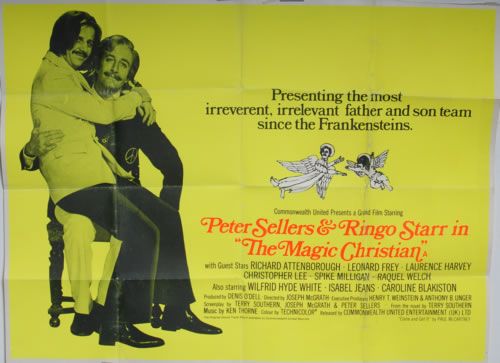
Saturday Matinee: The Magic Christian

“The Magic Christian” (1969) is a British satire directed by Joseph McGrath and loosely adapted from the 1959 novel of the same name by Terry Southern, who co-wrote the screenplay with McGrath. Peter Sellers stars as billionaire Sir Guy Grand, who adopts a homeless man (Ringo Starr) and demonstrates to his new heir how virtually everyone in the world can be bought through an escalating series of pranks. Cameo appearances are made by John Cleese, Graham Chapman, Raquel Welch, Spike Milligan, Christopher Lee, Richard Attenborough and Yul Brynner among others.

American Society Would Collapse If It Weren’t for These 8 Myths

By Lee Camp

Source: TruthDig

Our society should’ve collapsed by now. You know that, right?

No society should function with this level of inequality (with the possible exception of one of those prison planets in a “Star Wars” movie). Sixty-three percent of Americans can’t afford a $500 emergency. Yet Amazon head Jeff Bezos is now worth a record $141 billion. He could literally end world hunger for multiple years and still have more money left over than he could ever spend on himself.

Worldwide, one in 10 people only make $2 a day. Do you know how long it would take one of those people to make the same amount as Jeff Bezos has? 193 million years. (If they only buy single-ply toilet paper.) Put simply, you cannot comprehend the level of inequality in our current world or even just our nation.

So … shouldn’t there be riots in the streets every day? Shouldn’t it all be collapsing? Look outside. The streets aren’t on fire. No one is running naked and screaming (usually). Does it look like everyone’s going to work at gunpoint? No. We’re all choosing to continue on like this.

Why?

Well, it comes down to the myths we’ve been sold. Myths that are ingrained in our social programming from birth, deeply entrenched, like an impacted wisdom tooth. These myths are accepted and basically never questioned.

I’m going to cover eight of them. There are more than eight. There are probably hundreds. But I’m going to cover eight because (A) no one reads a column titled “Hundreds of Myths of American Society,” (B) these are the most important ones and (C) we all have other shit to do.

Myth No. 8—We have a democracy.

If you think we still have a democracy or a democratic republic, ask yourself this: When was the last time Congress did something that the people of America supported that did not align with corporate interests? … You probably can’t do it. It’s like trying to think of something that rhymes with “orange.” You feel like an answer exists but then slowly realize it doesn’t. Even the Carter Center and former President Jimmy Carter believe that America has been transformed into an oligarchy: A small, corrupt elite control the country with almost no input from the people. The rulers need the myth that we’re a democracy to give us the illusion of control.

Myth No. 7—We have an accountable and legitimate voting system.

Gerrymandering, voter purging, data mining, broken exit polling, push polling, superdelegates, electoral votes, black-box machines, voter ID suppression, provisional ballots, super PACs, dark money, third parties banished from the debates and two corporate parties that stand for the same goddamn pile of fetid crap!

What part of this sounds like a legitimate election system?

No, we have what a large Harvard study called the worst election system in the Western world. Have you ever seen where a parent has a toddler in a car seat, and the toddler has a tiny, brightly colored toy steering wheel so he can feel like he’s driving the car? That’s what our election system is—a toy steering wheel. Not connected to anything. We all sit here like infants, excitedly shouting, “I’m steeeeering!”

And I know it’s counterintuitive, but that’s why you have to vote. We have to vote in such numbers that we beat out what’s stolen through our ridiculous rigged system.

Myth No. 6—We have an independent media that keeps the rulers accountable.

Our media outlets are funded by weapons contractors, big pharma, big banks, big oil and big, fat hard-on pills. (Sorry to go hard on hard-on pills, but we can’t get anything resembling hard news because it’s funded by dicks.) The corporate media’s jobs are to rally for war, cheer for Wall Street and froth at the mouth for consumerism. It’s their mission to actually fortify belief in the myths I’m telling you about right now. Anybody who steps outside that paradigm is treated like they’re standing on a playground wearing nothing but a trench coat.

Myth No. 5—We have an independent judiciary.

The criminal justice system has become a weapon wielded by the corporate state. This is how bankers can foreclose on millions of homes illegally and see no jail time, but activists often serve jail time for nonviolent civil disobedience. Chris Hedges recently noted, “The most basic constitutional rights … have been erased for many. … Our judicial system, as Ralph Nader has pointed out, has legalized secret law, secret courts, secret evidence, secret budgets and secret prisons in the name of national security.”

If you’re not part of the monied class, you’re pressured into releasing what few rights you have left. According to The New York Times, “97 percent of federal cases and 94 percent of state cases end in plea bargains, with defendants pleading guilty in exchange for a lesser sentence.”

That’s the name of the game. Pressure people of color and poor people to just take the plea deal because they don’t have a million dollars to spend on a lawyer. (At least not one who doesn’t advertise on beer coasters.)

Myth No. 4—The police are here to protect you. They’re your friends.

That’s funny. I don’t recall my friend pressuring me into sex to get out of a speeding ticket. (Which is essentially still legal in 32 states.)

The police in our country are primarily designed to do two things: protect the property of the rich and perpetrate the completely immoral war on drugs—which by definition is a war on our own people.

We lock up more people than any other country on earth. Meaning the land of the free is the largest prison state in the world. So all these droopy-faced politicians and rabid-talking heads telling you how awful China is on human rights or Iran or North Korea—none of them match the numbers of people locked up right here under Lady Liberty’s skirt.

Myth No. 3—Buying will make you happy.

This myth is put forward mainly by the floods of advertising we take in but also by our social engineering. Most of us feel a tenacious emptiness, an alienation deep down behind our surface emotions (for a while I thought it was gas). That uneasiness is because most of us are flushing away our lives at jobs we hate before going home to seclusion boxes called houses or apartments. We then flip on the TV to watch reality shows about people who have it worse than we do (which we all find hilarious).

If we’re lucky, we’ll make enough money during the week to afford enough beer on the weekend to help it all make sense. (I find it takes at least four beers for everything to add up.) But that doesn’t truly bring us fulfillment. So what now? Well, the ads say buying will do it. Try to smother the depression and desperation under a blanket of flat-screen TVs, purses and Jet Skis. Nowdoes your life have meaning? No? Well, maybe you have to drive that Jet Ski a little faster! Crank it up until your bathing suit flies off and you’ll feel alive!

The dark truth is that we have to believe the myth that consuming is the answer or else we won’t keep running around the wheel. And if we aren’t running around the wheel, then we start thinking, start asking questions. Those questions are not good for the ruling elite, who enjoy a society based on the daily exploitation of 99 percent of us.

Myth No. 2—If you work hard, things will get better.

According to Deloitte’s Shift Index survey: “80% of people are dissatisfied with their jobs” and “[t]he average person spends 90,000 hours at work over their lifetime.” That’s about one-seventh of your life—and most of it is during your most productive years.

Ask yourself what we’re working for. To make money? For what? Almost none of us are doing jobs for survival anymore. Once upon a time, jobs boiled down to:

I plant the food—>I eat the food—>If I don’t plant food = I die.

But nowadays, if you work at a café—will someone die if they don’t get their super-caf-mocha-frap-almond-piss-latte? I kinda doubt they’ll keel over from a blueberry scone deficiency.

If you work at Macy’s, will customers perish if they don’t get those boxer briefs with the sweat-absorbent-ass fabric? I doubt it. And if they do die from that, then their problems were far greater than you could’ve known. So that means we’re all working to make other people rich because we have a society in which we have to work. Technological advancements can do most everything that truly must get done.

So if we wanted to, we could get rid of most work and have tens of thousands of more hours to enjoy our lives. But we’re not doing that at all. And no one’s allowed to ask these questions—not on your mainstream airwaves at least. Even a half-step like universal basic income is barely discussed because it doesn’t compute with our cultural programming.

Scientists say it’s quite possible artificial intelligence will take away all human jobs in 120 years. I think they know that will happen because bots will take the jobs and then realize that 80 percent of them don’t need to be done! The bots will take over and then say, “Stop it. … Stop spending a seventh of your life folding shirts at Banana Republic.”

One day, we will build monuments to the bot that told us to enjoy our lives and … leave the shirts wrinkly.

And this leads me to the largest myth of our American society.

Myth No. 1—You are free.

And I’m not talking about the millions locked up in our prisons. I’m talking about you and me. If you think you’re free, try running around with your nipples out, ladies. Guys, take a dump on the street and see how free you are.

I understand there are certain restrictions on freedom we actually desire to have in our society—maybe you’re not crazy about everyone leaving a Stanley Steamer in the middle of your walk to work. But a lot of our lack of freedom is not something you would vote for if given the chance.

Try building a fire in a parking lot to keep warm in the winter.

Try sleeping in your car for more than a few hours without being harassed by police.

Try maintaining your privacy for a week without a single email, web search or location data set collected by the NSA and the telecoms.

Try signing up for the military because you need college money and then one day just walking off the base, going, “Yeah, I was bored. Thought I would just not do this anymore.”

Try explaining to Kentucky Fried Chicken that while you don’t have the green pieces of paper they want in exchange for the mashed potatoes, you do have some pictures you’ve drawn on a napkin to give them instead.

Try running for president as a third-party candidate. (Jill Stein was shackled and chained to a chair by police during one of the debates.)

Try using the restroom at Starbucks without buying something … while black.

We are less free than a dog on a leash. We live in one of the hardest-working, most unequal societies on the planet with more billionaires than ever.

Meanwhile, Americans supply 94 percent of the paid blood used worldwide. And it’s almost exclusively coming from very poor people. This abusive vampire system is literally sucking the blood from the poor. Does that sound like a free decision they made? Or does that sound like something people do after immense economic force crushes down around them? (One could argue that sperm donation takes a little less convincing.)

Point is, in order to enforce this illogical, immoral system, the corrupt rulers—most of the time—don’t need guns and tear gas to keep the exploitation mechanisms humming along. All they need are some good, solid bullshit myths for us all to buy into, hook, line and sinker. Some fairy tales for adults.

It’s time to wake up.


If you think this column is important, please share it. Also, check out Lee Camp’s weekly TV show “Redacted Tonight” and weekly podcast “Common Censored.”

THE 10 PRIMARY DIRECTIVES OF MAINSTREAM MEDIA

By Sigmund Fraud

Source: Waking Times

The circus never stops, and no matter who cries fake news against whom, the fact remains that we have entered the post-truth, post-credibility, post-sanity, post-free speech world. While censorship is coming out into the open, the major corporate news organizations still have tremendous reach into the hollows of public consciousness, giving them power to direct and deflect public attention onto or away from whatever they choose.

The news industry parrots scripted narratives and talking points that are written for them by corporate, financial and political interests. This massive public relations and propaganda effort targets the intelligence, common sense and emotional stability of the body politic. It’s part of the endgame of order out of chaos.

Once you wake up to this game, though, it’s easy to see the framework in which they operate, and when you do, the talking heads and recycled government experts are a joke, albeit a dangerous one. Their tactics become more and more obvious, and their intent is easy recognized for its duplicity, subterfuge and hypocrisy.

They want to cram your mind into well-crafted box. It doesn’t matter if you end up in the right side or the left side of the box, as long as you don’t leave and so long as you stay focused on the flickering lights of the flat screen, ignoring anything that is not directly in front of you.

Corporate media has become a weapon of war, and they follow a certain missive. Consider the following directives that drive nearly everything you seen in mainstream news.

1. Be Afraid, Not Empowered

2. Omit and Forget

3. Self-Destruction is Cool, Self-Awareness is a Crime

4. You are a Victim, The State is Your Savior

5. Overreact, Don’t Over Think

6. Enrage Don’t Engage

7.  Indulge, Don’t Conserve

8. Stoke Conflict, Ridicule Peace

9. Permanent War is Normal and Expected

10.  Panic, Don’t Prepare

Now that we’ve entered the age of open government-backed corporate censorship of the internet, the mainstream media is actively seeking to shut down independent and dissident voices. In order to do so, they must engage in treachery of every form. If you believe that you have a right to the truth, a right to speak out, and a right to demand genuine peace and justice, then you’d better be paying attention.

If you have any more to add to this list, please do so in the comments below.

Facebook Censorship, Mad Ben Nimmo and the Atlantic Council

By Craig Murray

Source: CraigMurray.org

Facebook has deleted all of my posts from July 2017 to last week because I am, apparently, a Russian Bot. For a while I could not add any new posts either, but we recently found a way around that, at least for now. To those of you tempted to say “So what?”, I would point out that over two thirds of visitors to my website arrive via my posting of the articles to Facebook and Twitter. Social media outlets like this blog, which offer an alternative to MSM propaganda, are hugely at the mercy of these corporate gatekeepers.

Facebook’s plunge into censorship is completely open and admitted, as is the fact it is operated for Facebook by the Atlantic Council – the extreme neo-con group part funded by NATO and whose board includes serial war criminal Henry Kissinger, Former CIA Heads Michael Hayden and Michael Morrell, and George Bush’s chief of Homeland Security Michael Chertoff, among a whole list of horrors.

The staff are worse than the Board. Their lead expert on Russian bot detection is an obsessed nutter named Ben Nimmo, whose fragile grip on reality has been completely broken by his elevation to be the internet’s Witchfinder-General. Nimmo, grandly titled “Senior Fellow for Information Defense at the Atlantic Council’s Digital Forensic Research Lab”, is the go-to man for Establishment rubbishing of citizen journalists, and as with Joseph McCarthy or Matthew Clarke, one day society will sufficiently recover its balance for it to be generally acknowledged that this kind of witch-hunt nonsense was not just an aberration, but a manifestation of the evil it claimed to fight.

There is no Establishment cause Nimmo will not aid by labeling its opponents as Bots. This from the Herald newspaper two days ago, where Nimmo uncovers the secret web of Scottish Nationalist bots that dominate the internet, and had the temerity to question the stitch-up of Alex Salmond.

Nimmo’s proof? 2,000 people had used the hashtag #Dissolvetheunion on a total of 10,000 tweets in a week. That’s five tweets per person on average. In a week. Obviously a massive bot-plot, eh?

When Ben’s great expose for the Herald was met with widespread ridicule, he doubled down on it by producing his evidence – a list of the top ten bots he had uncovered in this research. Except that they are almost all, to my certain knowledge, not bots but people. But do not decry Ben’s fantastic forensic skills, for which NATO and the CIA fund the Atlantic Council. Ben’s number one suspect was definitely a bot. He had got the evil kingpin. He had seen through its identity despite its cunning disguise. That disguise included its name, IsthisAB0T, and its profile, where it called itself a bot for retweets on Independence. Thank goodness for Ben Nimmo, or nobody would ever have seen through that evil, presumably Kremlin-hatched, plan.

No wonder the Atlantic Council advertise Nimmo and his team as “Digital Sherlocks

Nimmo’s track record is simply appalling. In this report for the Atlantic Council website, he falsely identified British pensioner @Ian56789 as a “Russian troll farm”, which led to Ian being named as such by the British government, and to perhaps the most surreal Sky News interview of all time. Perhaps still more remarkably, Nimmo searches for use of the phrase “cui bono?” in reference to the Skripal and fake Douma chemical weapons attacks. Nimmo characterises use of the phrase cui bono as evidence of pro-Assad and pro-Kremlin bots and trolls – he really does. Most people would think to consider cui bono indicates a smattering more commonsense than Nimmo himself displays.

It is at least obvious cui bono from Nimmo’s witchfinding – the capacious, NATO and CIA stuffed pockets of Ben Nimmo himself. That Facebook allows this utterly discredited neo-conservative charlatan the run of its censorship operations needs, given Facebook’s pivotal role in social media intercourse, to concern everybody. The freedom of the internet is under fundamental attack.

The U.S. is ruled by the worst among us

By Carla Binion

Source: Intrepid Report

Is it possible for the human race to evolve beyond war, extreme income inequality, corporate money’s control of political systems, and other anti-democratic trends? Some people say even hoping for such evolution is too idealistic, even impossible. Others have said if humanity doesn’t evolve it will soon self-destruct. Martin Luther King once said society has to begin to either “love or perish.”

The U.S. today is rapidly becoming more an oligarchy than a democratic republic, and this oligarchy is polluting the environment, siphoning money from the poor and middle class, and dismantling civil liberties and democracy at an ever-accelerating pace. This trend won’t end well.

As our politicians hurtle downhill, the U.S. will experience many disasters and an eventual fatal crash. Many citizens feel their corrupt politicians of both major parties have taken so much power that the people can’t possibly play a significant role in improving the U.S. political system today.

Ordinary Americans often say we oppose our government’s perpetual wars, regressive tax system, extreme income inequality and other ills, but many say it would be impossible to reform the present system. I think meaningful change is possible based on what history has shown us.

The world has always included people who think it’s possible for the human race to evolve and others who say fundamental change isn’t possible. We’ve always had war and greedy politicians. Still, in some parts of the world at given moments in time, human beings have taken sudden leaps and left behind certain inhumane practices. If that weren’t true, we’d still have rampant blood sacrifices, witch burning and the same widespread use of slavery in the same areas of the world where they once existed.

Today some populations still practice those things, but many have evolved beyond them. The changes that happened started with a sort of “tipping point” where enough people acknowledged that a social ill such as slavery should end.

The more enlightened views, anti-slavery, anti witch-burning, etc., picked up speed, and the public took action to move beyond the old way. In a sense, the condoning of slavery, etc., became obsolete and unthinkably cruel. There is no reason to cling to the belief that the U.S. today can’t make perpetual illegal war and other egregious political abuses obsolete.

During the 1860s in the U.S. more and more people began to acknowledge slavery was unacceptable and started to challenge the power structure. Once the public conscience was awakened, people organized abolitionist groups, created the Underground Railroad, and spoke out publicly. Influential writers such as Ralph Waldo Emerson and Henry David Thoreau spoke out often against slavery. A slave, Frederick Douglass, wrote prolifically and gave passionate speeches.

If those abolitionists and writers had not believed a big leap in human evolution was possible, they would never have made the effort to organize or speak out. Their action started with their confidence that abolishing slavery was possible, and it’s not that they didn’t know what they were up against.

In his May 11, 1847, speech before the American Anti-Slavery Society, “The Right to Criticize American Institutions,” Frederick Douglass talked about the country’s entrenched pro-slavery power structure. He acknowledged that the U.S. government was then so committed to maintaining the atrocities of slavery for financial reasons that he would need to appeal to authorities outside the government to help end slavery.

There are relevant parallels in America today. People who want to help end our country’s continual illegal wars and corporate money’s control of our political system are in a position similar to the one Douglass described.

Douglass said, “Where, pray, can we go to find moral power in this nation, sufficient to overthrow Slavery? To what institution, to what party shall we apply for aid? . . . [Slavery] is such a giant crime, so darkening to the soul, so blinding in its moral influence, so well calculated to blast and corrupt all the human principles of our nature . . . that the people among whom it exists have not the moral power to abolish it. Shall we go to the Church for this influence? We have heard its character described. Shall we go to politicians or political parties.”

He added that instead of helping end slavery, the church, politicians, press and political parties were “voting supplies for Slavery—voting supplies for the extension, the stability, the perpetuation of slavery in this land.”

Today, U.S. politicians, press, political parties and most spiritual leaders keep voting for (by supporting or passively tolerating) perpetual war, income inequality and other injustices. Average citizens who see we need to evolve beyond these maladies feel they have nowhere to turn, just as Douglass did.

However, in the same speech, Douglass also said that although the pro-slavery government was very powerful, there was one thing it couldn’t resist. He said, “Americans may tell of their ability, and I have no doubt they have it, to keep back the invader’s hosts . . . of its capacity to build its ramparts so high that no foe can hope to scale them . . . but, sir, there is one thing it cannot resist, come from what quarter it may. It cannot resist truth. You cannot build your forts so strong, nor your ramparts so high, nor arm yourself so powerfully, as to be able to withstand the overwhelming moral sentiment against slavery now flowing into this land.”

It turns out he was right. It wasn’t that public opinion alone ended slavery, but it was a game-changing factor, just as strong public sentiment against the Vietnam War played an important role in its resolution.

At various points in history, when the people reached a tipping point and became fed up with given injustices, they started to be vocal and organize to move humanity in a healthier direction. Their collective efforts did change things for the better. Humanity evolved.

Even though U.S. politicians have unprecedented power to do evil and squelch dissent, the public can step up its efforts to speak, write and organize to help us evolve beyond perpetual war, devastating income disparity, and the country’s anti-democratic drift. Writers and other public figures can help by clarifying what is going on and urging the few politicians with conscience to join us in finding solutions.

Throughout history the big evolutionary leaps, including moves away from slavery in certain parts of the world, started with the widespread public attitude that change was both imperative and possible. It is imperative and possible for the U.S. to change its war-for-profit paradigm and its condoning and allowing the other government corruption covered here.

A fitting excerpt from the Declaration of Independence says: “Mankind are more disposed to suffer, while evils are sufferable than to right themselves by abolishing the forms to which they are accustomed.” People will put up with a large amount of abuse from their government before they make any effort to change it for the better.

It could be the U.S. public hasn’t yet reached a tipping point and will give in to a feeling of powerlessness. There is never a shortage of “can’t do” dialogue, and the pessimists have a point. We’re faced with daunting challenges.

However, as one of my favorite “lefties,” the late historian Howard Zinn once said, “To be hopeful in bad times is not being foolishly romantic. It is based on the fact that human history is a history not only of competition and cruelty but also of compassion, sacrifice, courage, kindness.

“What we choose to emphasize in this complex history will determine our lives. If we see only the worst, it destroys our capacity to do something. If we remember those times and places—and there are so many—where people have behaved magnificently, it energizes us to act, and raises at least the possibility of sending this spinning top of a world in a different direction. And if we do act, in however small a way, we don’t have to wait for some grand Utopian future. The future is an infinite succession of presents, and to live now as we think human beings should live, in defiance of all that is bad around us, is itself a marvelous victory.”

Can humanity evolve beyond continual war and rule by the worst among us? Yes and no. We can do it if enough of us begin to see we need this evolution in order for our species to survive, and if we start to believe change is doable and take action. We can’t evolve, and probably won’t survive, if most of us stay in denial about the need for change, give in to a sense of powerlessness and do nothing. Frederick Douglass’s idea that powerful evil political forces can be overcome via the truth and public moral sentiment, and Martin Luther King’s view that humanity must ultimately either love or perish, are keys to sorting out which path we should take.