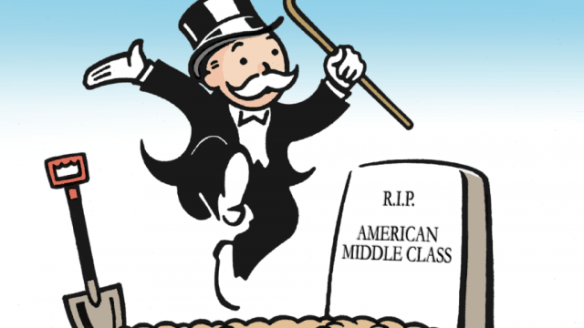
America is Disneyland

By Chris Kanthan

Source: Activist Post

Disneyland is the Happiest Place on Earth! Millions of families visit the theme park every year to enjoy the magical place of rides, spectacular shows and cheerful cartoon figures. Everything is clean, perfect and joyful. Unless … you realize that Cinderella might actually be homeless. That’s right, 10% of Disneyland’s employees are actually homeless, many more are on food stamps, and 75% struggle to make ends meet.

Does this ring familiar? Think of America. Behind the façade of being the greatest country on Earth with the largest GDP and the wealthiest billionaires, there are tens of millions of Americans who are left behind just like Disney’s employees.

This neo-feudalistic model isn’t isolated to Disney or Walmart, it’s systemic. For example, the bus driver at Apple – which has $280 billion in cash – is forced to sleep in a van because he can’t afford the Silicon Valley rent; Facebook’s cafeteria workers live in a garage; and thousands of American Airlines’ employees are forced to depend on food stamps.

America is being eaten alive by corporate greed; and Disneyland has been taken over by Scrooge.

Let’s look at some Disney Inc. statistics.

Total profit per year: $9 billion

Total employees: 200,000

Notice that the profit reflects what’s left after all the expenses, including the salaries, have been paid. So, in a utopian world, the Disney management will do the math ($9 billion / 200,000 = $45,000) and send a check for $45K to every employee, Mickey included. That kind of profit-sharing would really make Disneyland the happiest place on Earth. Does that happen? No way!

Does Cinderella get a check for perhaps $20K, $10K, $5K or even $1K? Nope, nope, nope, nope. Cinderella gets nada, zero, zilch. She should be content with the $12/hour salary and must smile happily for the kids.

In Disneyland, Cinderella never gets to meet her prince.

Disney’s CEO gets paid $46 million a year, which translates to $23,000 an hour. Imagine Disney’s CEO coming to work on Jan 2nd. He wishes a few people “happy new year,” orders coffee, sits on his desk, makes a few phone calls … and he has already made more money than what Ariel would make during the rest of the year.

Of course, the CEO should get paid more, but does he deserve a salary that’s equivalent to 2,000 Disney employees? If the CEO doesn’t show up for work for a day, Disneyland will continue running. If 2,000 employees take a day off, the park would be shut down.

In the 1960s, the CEO-to-worker salary ratio was 25. Today it’s often 600 or more, sometimes even more than 1000 (for example, at Walmart). Much of the executive compensation comes in the form of stock options and bonuses based on stock performance. In a rational and unrigged world, the CEOs would increase their revenues and profits to get bonuses. Not anymore.

Now, the CEOs simply use a no-brainer solution to boost the stock prices – it’s called stock buybacks or share repurchases. This involves a firm using corporate profits (or even borrowed money) to buy its own stocks. BTW, this used to be illegal until the 1980s.

Since 2007, US corporations have spent trillions of dollars on stock buybacks. In 2018 alone, they will spend $800 billion on this financial engineering tool (which has also led to a massive stock market bubble). They won’t use the billions to hire Americans, boost wages or innovate new products. Instead, the CEOs will buy yachts and tell you that Chinese or Mexicans stole your jobs.

Do the low-wage employees of Disneyland get any shares or stock options? A silly question, indeed.

Thus we have a situation where American employers ruthlessly exploit American workers. This isn’t a good model for a country. China and Mexico don’t make us poor; predatory capitalism does.

Paying good wages to hardworking employees is not socialism or communism. Henry Ford understood this when he more than doubled the wages of his workers in 1914.

However, hundred years later, maximizing profit has become a fundamentalist dogma. You can imagine a conversation among the factory-farming executives:

Guy #1: Why the heck are these chickens roaming out in the farms? We would save so much money if we lock them up in cages.

Guy #2: Brilliant idea! Let’s lock up five chickens in a cage. We will save more. More is always better.

Guy #3: I really don’t understand why we feed them expensive salads and healthy stuff. Let’s feed them cheap GMO corn and GMO soy from my friends at Monsanto.

Guy #4: Experts tell me that if we give them caffeine and anti-depressants, the chickens will stay awake longer, eat more, and get fatter.

Guy #5: And when they get sick, load them up with antibiotics and steroids.

Guy #5: These stupid chickens are also so small. Let’s drug them with some growth hormones. I am getting a lot of pressure from the private equity funds about profits per chicken.

Apart from being inhumane and psychopathic, this system forgets or ignores the fact that we have to eat these chickens. Sick chicken = sick people. Call it Karma or “revenge of the chickens.”

Similarly, poor workers = poor country. And you can imagine a similar conversation among corporate executives regarding workers – “cut their wages and benefits”, “make them work overtime”, “hire part-time employees rather than full-time” and so on.

You can’t grow the economy if American workers don’t get paid enough, especially by profitable multi-billion dollar corporations. 2/3rd of our GDP is based on consumer spending. It’s no wonder that in the last ten years, the US economy cumulatively grew only by a dismal 35%. Compare that to China, which grew by an astounding 200% during that same period.

And it’s not a coincidence that China’s average wages have more than doubled in the same period:

The solution for low wages primarily lies in the hands of corporate elites. Labor unions are almost non-existent in the private sector these days; and the government doesn’t have much control over corporate America – in fact, corporations control the U.S. political system. Free market doesn’t have to translate to cancerous greed and extreme exploitation. Free market also means that corporations are free to share their profits with their employees. Finally, free market can and must also incorporate patriotism, responsibility to the society and strategies for sustainable prosperity.


Chris Kanthan is the author of a new book, Deconstructing the Syrian War. Chris lives in the San Francisco Bay Area, has traveled to 35 countries, and writes about world affairs, politics, economy and health. His other book is Deconstructing Monsanto. Follow him on Twitter: @GMOChannel


Convenient Tales About Riches Within Reach

By Sam Pizzigati

Source: OpEdNews.com

The world at large knew virtually nada about Sylvia Bloom for 96 years. Then she died in 2016. Now, just a little too late, Sylvia Bloom is getting her belated — yet richly deserved — 15 minutes of worldwide fame.

The New York Times has just published a heart-warming story of the caring, upright life Sylvia Bloom lived, and the remarkable — and hidden — fortune she quietly accumulated over the course of her 67-year career as a Manhattan legal secretary.

That fortune totaled, in the end, over $9 million. The bulk of that wealth, the Times account reveals, is going — per Bloom’s wishes — to help students from poor families advance their educations.

None of Bloom’s surviving relatives or law firm colleagues or fellow volunteers at the Henry Street Settlement, the social services agency set to get $6.24 million from her bequest, had any idea that their unassuming loved one and friend had saved anything remotely close to multiple millions.

Counting Pennies

Bloom lived frugally all her life in Brooklyn and commuted, by subway, to her job. The “high life” never interested her in the least. She led a simple existence. She counted her pennies. In the end, she put them all to good use.

Stories like Bloom’s have been popping up regularly over recent years. Leonard Gigowski, a Wisconsin shopkeeper, died three years ago at age 90, and left behind a “secret $13 million fortune” that’s currently funding scholarships. Grace Groner passed away in 2010 at age 100. She spent most of her life in a one-bedroom Illinois home, shopped at thrift stores, and left $9 million for her alma mater.

Convenient Tales

Our popular culture can’t seem to get enough of these life-affirming tales of modest multi-millionaire seniors. These stories make us feel good. They also, unfortunately, reinforce a message that our society’s richest — and their cheerleaders — find enormously convenient.

You don’t have to be money-hungry, commit vile acts or have remarkable talents to become wealthy, the tellers of all these stories of hidden millions suggest. You just have to be frugal; almost anybody, in other words, can become rich.

And if you don’t happen to become rich, the media coverage of these stories not so subtly hints, just look in the mirror for the reason why. You, too, could have resisted temptation and counted your pennies.

You, too, could have built a huge personal fortune. Shame on you. You chose not to.

The Millionaire Next Door

A couple of decades ago, two academic researchers — Thomas Stanley and William Danko — made themselves not insignificant personal fortunes by wrapping up that same theme in reams of statistics. Their 1996 book, The Millionaire Next Door, has so far sold over 4 million copies.

That thrifty fellow down the block with a six-year-old Ford, The Millionaire Next Door related, could well be worth millions. And those millions, the book stressed, all begin with frugality.

Conservative pundits have always loved this basic frugality-pays thesis. Stanley and Danko, the argument goes, have served up the ultimate secret to getting rich. “Hardly any” of the self-made rich the pair profiled in The Millionaire Next Door, as one commentator noted a few years ago, “had expensive tastes.” Instead, these millionaires avoided “new homes and expensive clothes” and “often invested 15 to 20 percent of their net income.”

Any of us could follow that lead, this analyst would add, so long as we understand “that building wealth takes discipline, sacrifice, and hard work.”

Reaping Rewards

But if “discipline, sacrifice, and hard work” build wealth, why do so many millions of disciplined, sacrificing, and hard-working Americans today have so little of it? Why is the “millionaire next door” — especially for our millennial generation — becoming a vanishing species?

Sylvia Bloom’s life offers some clues. Yes, Bloom lived frugally, sacrificed, and worked hard. But she also matured in a society — mid-20th century America — that endeavored to help disciplined, sacrificing, and hard-working people.

That help came in many different forms. Sylvia Bloom attended Hunter College, part of a system of free public higher education in New York City. She and her husband, a firefighter and later teacher, lived in a rent-controlled apartment. She commuted, for just a few dimes per day, on the world’s most extensive public transit system.

Sylvia Bloom’s young adult counterparts today? They confront a totally different reality. The sky-high costs of attending college have turned 21st-century young adults into life-long debtors. To find an affordable place to live, they squeeze into tiny apartments close to their jobs or plop themselves in distant exurbs, fighting traffic jams all the way to work — if not paying big bucks daily for scarce transit options.

Austerity Trumps Frugality

These millennials aren’t living the frugal life. They’re living the austere life — and not by choice. Our elected leaders have thrust this austerity upon them, with decades of public policies that have rewarded the rich with tax cuts at every turn and whittled away public services at every opportunity.

If Sylvia Bloom had been born a millennial, she’d be pinching pennies today to pay off her college debts. She’d be looking forward to years of hard work and sacrifice, with no hope of ever saving up enough to become a significant invester.

In her actual life, Sylvia Bloom had the good fortune to live her early adult years in a society much more caring than ours. She cared back — and chose to devote her own financial good fortune to helping others to the same support that so helped her.

Sylvia Bloom’s life does indeed offer up inspiration. Let’s not let our rich turn that life into a rationalization for their riches.

Why Fear and Self-hatred Destroy Human Sharing and Solidarity

Photo by Adam Dean

By Robert J. Burrowes

As our world spirals deeper into an abyss from which it is becoming increasingly difficult to extricate ourselves, some very prominent activists have lamented the lack of human solidarity in the face of the ongoing genocide of the Rohingya. See ‘The Rohingya tragedy shows human solidarity is a lie’ and ‘Wrongs of rights activism around Rohingyas’.

While I share the genuine concern of the Yemeni Nobel peace laureate Tawakkol Karman and Burmese dissident and scholar Dr Maung Zarni, and have offered my own way forward for responding powerfully to the ongoing genocide of the Rohingya – see ‘A Nonviolent Strategy to Defeat Genocide’ – in my view the lack of solidarity they mention is utterly pervasive and readily evident in our lacklustre official and personal responses to the many ongoing crises in which humanity finds itself.

To mention just the most obvious: Every day governments spend $US2 billion on weapons and warfare while a billion people lack the basic resources to live a decent life (and more than 100,000 of these people starve to death). Every day millions of people live under dictatorship, occupation or suffer the impacts of military invasion. Every day another 28,800 people are forcibly displaced from their home. Every day another 200 species of life are driven to extinction. And every day our biosphere is driven one step closer to making human life (and perhaps all life) on Earth impossible. See ‘Killing the Biosphere to Fast-track Human Extinction’.

It is not as if any of this information is unavailable. Just as many people and major international organizations are well aware of the plight of the Rohingya, it is also the case that many people and these organizations are well aware of the state of our world in other respects. And still virtually nothing meaningful happens (although there are tokenistic responses to some of these crises).

Hence, it is a straightforward observation that human solidarity is notably absent in virtually any attempt to tackle the major issues of our time. And the Rohingya are just one manifestation of this problem.

Given that I have long observed this phenomenon both personally and politically, and it concerns me as well, I would like to explain psychologically why the lack of sharing and solidarity is such a pervasive problem and suggest what we can do about it.

In order to feel concern for those who are suffering, and to want to act in solidarity to alleviate their suffering, it is necessary to experience certain feelings such as sympathy, empathy, compassion, love and (personal) power. Moreover, it is necessary that these feelings are not suppressed or overwhelmed by fear and, equally importantly, not overwhelmed by a feeling of (unconscious) self-hatred. If someone is scared and full of unconscious self-hatred, then they can have little interest in sharing their own resources or acting in solidarity with those who need help. And this applies whether the adversely impacted individual is a close relative or friend, or someone on the other side of the world.

So why is fear in this context so important? Simply because fear grotesquely distorts perception and behaviour. Let me explain why and how.

If an individual is (consciously or unconsciously) frightened that one or more of their vital needs will not be met, they will be unable to share resources or to act in solidarity with others, whatever the circumstances. In virtually all cases where an individual experiences this fear, the needs that the individual fears will not be met are emotional ones (including the needs for listening, understanding and love). However, the fearful individual is never aware of these deep emotional needs and of the functional ways of having these needs met which, admittedly, is not easy to do given that listening, understanding and love are not readily available from others who have themselves been denied these needs.

Moreover, because the emotional needs are ‘hidden’ from the individual, the individual (particularly one who lives in a materialist culture) often projects that the need they want met is, in fact, a material need.

This projection occurs because children who are crying, angry or frightened are often scared into not expressing their feelings and offered material items – such as a toy or food – to distract them instead. The distractive items become addictive drugs. This is why most violence is overtly directed at gaining control of material, rather than emotional, resources. The material resource becomes a dysfunctional and quite inadequate replacement for satisfaction of the emotional need. And, because the material resource cannot ‘work’ to meet an emotional need, the individual is most likely to keep using direct and/or structural violence to gain control of more material resources in an unconscious and utterly futile attempt to meet unidentified emotional needs.

This is the reason why people such as the Rothschild family, Jeff Bezos, Bill Gates, Warren Buffett, Amancio Ortega, Mark Zuckerberg, Carlos Slim, the Walton family and the Koch brothers as well as the world’s other billionaires and millionaires seek material wealth, and are willing to do so by taking advantage of structures of exploitation held in place by the US military. They are certainly wealthy in the material sense; unfortunately, they are utterly terrified (and full of self-hatred) and each of them justly deserves the appellation ‘poor little rich boy’ (or girl).

If this was not the case, their conscience, their compassion, their empathy, their sympathy and, indeed, their love would compel them to use or disperse their wealth in ways that would alleviate world poverty and nurture restoration of the ancient, just and ecologically sustainable economy: local self-reliance. See ‘The Flame Tree Project to Save Life on Earth’.

Of course, it is not just the billionaires and millionaires of the corporate elite who have suffered this fate.

Those intellectuals in universities and think tanks who accept payment to ‘justify’ (or simply participate in without question) the worldwide system of violence and exploitation, those politicians, bureaucrats and ordinary businesspeople who accept payment to manage it, those judges and lawyers who accept payment to act as its legal (but immoral) guardians, those media editors and journalists who accept payment to obscure the truth, as well as the many middle and working class people who accept payment to perform other roles to defend it (such as those in the military, police, prison and education systems), are either emotionally void or just too frightened to resist violence and exploitation, in one or more of its many manifestations.

Moreover, governments that use military violence to gain control of material resources are simply governments composed of many individuals with this dysfunctionality, which is very common in industrialized countries that promote materialism. Thus, cultures that unconsciously allow and encourage this dysfunctional projection (that an emotional need is met by material acquisition) are the most violent both domestically and internationally. This also explains why industrialized (material) countries use military violence to maintain political and economic structures that allow ongoing exploitation of non-industrialized countries in Africa, Asia and Central/South America.

But, equally importantly, many ‘ordinary’ people are just too scared to share (more than a token of) what they have and to act in solidarity with those who suffer whether through military or other violence, exploitation, persecution, oppression or occupation. Of course, it takes courage to resist this violent world order. But underlying courage is a sense of responsibility towards one’s fellow beings (human and otherwise) and the future.

As noted above, however, fear is not the only problem. Two primary outcomes of fear are self-hatred and powerlessness. Here is how it happens.

When each of us is a child, if our parents, teachers and/or the other adults around us are frightened by a feeling – such as sadness, anger or fear – that we are expressing, then they will use a variety of techniques to stop us expressing this feeling. They might, for example, comfort us to stop us crying, scare us out of expressing our anger (particularly at them) and reassure us so that we do not feel afraid.

Tragically, however, responses such as these have the outcome of scaring us into unconsciously suppressing our awareness of how we feel when, of course, evolutionary pressures generated emotional responses (some pleasant, some less so) to events in our life in order to help guide us into behaving appropriately at any given moment. And this suppression of how we feel is disastrous if we want children to grow up behaving functionally. This is more fully explained in Why Violence?’ and Fearless Psychology and Fearful Psychology: Principles and Practice.

So where does self-hatred fit into all of this? Well, if a child is angry in response to some violence to which they are being subjected (usually, of course, in an attempt to control their behavior), then they will attempt to defend themselves against this violence in an effort to persevere with their original intention.

However, if the child is then terrorized into submission by a parent or other adult (by being threatened with or experiencing some form of violence, often given the inaccurate label of ‘punishment’) the child will be compelled to unconsciously suppress their awareness of the original feelings, including anger, that were generating their behavior.

Unfortunately, there is a heavy cost to this suppression because each child is genetically programmed to follow their own self-will (manifesting through such mental functions as thoughts, feelings and conscience) rather than to obey the will of another (whether it be parent, teacher, religious figure or anyone else).

Hence, if a child is successfully terrorized into not behaving in accordance with their own self-will, they will experience a strong feeling of self-hatred precisely because they have submitted, out of fear, to the will of another.

Conscious self-hatred is an intensely unpleasant feeling to experience, however, and because the child is systematically terrorized out of expressing and acting on most of their feelings (which is why 100% of children go to school wherever school is available and compulsory: children are not given freedom of choice) the feeling of self-hatred is suppressed along with these many other feelings. Having learned to do this, subsequent opportunities for this self-hatred to be felt are progressively more easily suppressed.

An unconscious feeling does not ‘go away’ however; it is unconsciously projected elsewhere. Suppressed self-hatred is always unconsciously projected as hatred of someone else, some other group (usually of another sex, race, religion or class) and/or something else, often in imitation of the violent parent/adult (because imitation will be given ‘permission’ by the violent parent/adult). And this inevitably leads to destructive behaviors towards that individual, group and/or the ‘something else’ (including the Earth’s environment).

But, and this is important to recognize, this destructive behaviour might simply manifest as inaction: doing nothing in response to someone else’s (or the Earth’s) obvious need.

So the unconscious fear and self-hatred are projected as fear of and hatred for living beings as well as the Earth, and manifests as behavior that is destructive, often by inaction, of themselves, others and the planet.

The tragic reality is that it takes very little violence to terrorize a child and this is why a substantial proportion of the human population is consumed by their own fear and self-hatred, and feels powerless as a result. Consider the people immediately around you: many spend most of their time, consciously or unconsciously, abusing themselves, others and/or the environment, and doing nothing in response to the plight of our world.

So what can we do?

Given existing parenting practice, fear and self-hatred are not easily avoided although they are not necessarily all-consuming. But to be free of them completely requires just one thing: the fearlessness to love oneself truly. What does this mean?

To love yourself truly, you must always courageously act out your own self-will, whatever the consequences. This requires you to feel all of your emotional responses – fear, sadness, anger, pain, joy, love … – to events, including impediments, in your life. See ‘Feelings First’. It is only when you do this that you can behave with awareness: a synthesis of all of the feedback that your various mental functions give you and the judgments that arise, in an integrated way, from this feedback. See ‘Human Intelligence or Human Awareness?’

At first glance loving yourself and acting out your own self-will might sound selfish. But it is not. Self-love is true love. The individual who does not truly love themself cannot love another. Nor will they feel such emotional responses as compassion, empathy and sympathy. Hence, this individual will not seek mutually beneficial outcomes in tackling conflict, will not seek distributive justice in resource allocation, will not value ecological sustainability and will not act in solidarity with those who are suffering. It is this individual, who is terrified, self-hating and powerless, who will act selfishly.

In addition to courageously acting out your own self-will, you might also consider making ‘My Promise to Children’.

And if you love yourself enough to be part of the struggle to end the violence and exploitation of those who are full of fear and self-hatred, you might like to consider signing the online pledge of ‘The People’s Charter to Create a Nonviolent World’ and/or using sound nonviolent strategy for your campaign or liberation struggle. See Nonviolent Campaign Strategy or Nonviolent Defense/Liberation Strategy.

Those who are terrified and self-hating never will.


Biodata: Robert J. Burrowes has a lifetime commitment to understanding and ending human violence. He has done extensive research since 1966 in an effort to understand why human beings are violent and has been a nonviolent activist since 1981. He is the author of ‘Why Violence?’ His email address is flametree@riseup.net and his website is here.

Websites:
Nonviolence Charter
Flame Tree Project to Save Life on Earth
‘Why Violence?’
Feelings First
Nonviolent Campaign Strategy
Nonviolent Defense/Liberation Strategy
Anita: Songs of Nonviolence
Robert Burrowes
Global Nonviolence Network

Freedom Rider: Oligarch Jeff Bezos

By Margaret Kimberley

Source: Intrepid Report

Amazon CEO Jeff Bezos has a net worth of $105 billion and is the richest man in the world. But he is not just the richest man at this moment in history. He is the richest person who has ever lived. As of 2017 he and seven other billionaires had a collective net worth equal to that of the poorest 3.6 billion people on earth.

These figures have been in the news of late but without much useful analysis. The corporate media refuse to state what is obvious. Namely that inequality is worse around the world precisely because these super rich people demand it.

While pundits and politicians go on breathlessly about oligarchs in Russia, they seldom take a look at the wealthiest in their own backyard and the control they exert over the lives of millions of people. When Amazon announced it would choose a site for its new headquarters, cities across the country began a furious race to the bottom. Amazon is not alone in the thievery department. Major corporations like Walmart always request and receive public property and public funds in order to do business.

Some 235 cities have put themselves in the running for this dubious venture. Chicago is willing to give Amazon $1.3 billion in payroll taxes that prospective employees would ordinarily pay that city. If Chicago wins this booby prize, Amazon employees would pay taxes to their employer and not to the government. This is truly cutting out the middle man and makes real the rule of, by, and for the wealthiest.

The potential for public outrage isn’t lost on unprincipled politicians. Some cities now refuse to reveal how much they plan to give away. But the news to date is disheartening with Boston offering $75 million while Houston is willing to part with $268 million. Amazon says it will hire 50,000 people but their business model already pays employees so little that many of them qualify for public assistance, despite being employed.

The United States is as much of an oligarchy as countries it usually disparages but it is far more dishonest about its true nature. All talk of democracy is a lie as the rich get richer, by an additional $1 trillion in 2017, and wield more and more power over the lives of everyone else.

The Bezos juggernaut is not restricted to theft of public money. He is also the sole owner of the Washington Post, one of the most influential newspapers in the country. Bezos owns a newspaper that is an organ of the ruling elite and he also has a $600 million contract to provide the Central Intelligence Agency with cloud computing services.

The Washington Post was the force behind Propaganda or Not, an effort to destroy left wing voices like those at Black Agenda Report. Under the guise of fighting Russia and so-called fake news, the Bezos owned Post began the censorship campaign that has put the left’s presence on the Internet in such jeopardy.

Politicians outdo one another giving away public resources to the richest man on the planet who also owns a major newspaper and services the surveillance state. If it can be said that any one person rules the world, Bezos would be obvious choice. No one in Chicago, Boston, Houston or any of the other cities giving away the store ever voted for Jeff Bezos. All talk of democracy is a sham as long as the richest people take from the rest of humanity.

The effort to make government an irrelevance is thoroughly bipartisan. Republicans and Democrats alike are willing to turn over government coffers to Bezos and his ilk and the rights of the people be damned.

Whoever wins this tarnished brass ring ought to be consigned to political defeat. The mayor, aldermen, city council members or whoever else brings disaster to their locality should be punished for aiding and abetting the theft. If these cities can give to the richest man who ever lived, they can surely use public money to help their residents right now. But they will never do that because they are all bought off and compromised. They are either cynical or afraid to go against the real rulers of the country.

Bezos may look like the villain in a James Bond movie but there is nothing funny about him. He is deadly serious and so are his intentions. In a Bezos run world, every worker will be impoverished, every level of government will subsidize corporations, and anyone who speaks out will be discredited and under surveillance.

The last thing any city needs is a new Amazon headquarters. We need an end to billionaire rule in this country and around the world. That will be the salvation of the people, not more sweatshops run by wealthy people who steal from everyone else.


Margaret Kimberley’s Freedom Rider column appears weekly in BAR, and is widely reprinted elsewhere. She maintains a frequently updated blog as well as at freedomrider.blogspot.com. Ms. Kimberley lives in New York City, and can be reached via e-Mail at Margaret.Kimberley(at)BlackAgendaReport.com.

One nation under plutocracy

By Jack Balkwill

Source: Intrepid Report

Americans are brought up believing a fairy tale in which there is somehow democracy in their governance. But the late, great, Leonard Cohen exposed the system’s dirty little secret, “Everybody knows that the dice are loaded, everybody rolls with their fingers crossed.”

Even at the start of the nation, the first Chief Justice John Jay admitted the “democracy” hoax upon which the Supreme Court is built when he conceded, “The people who own the country ought to govern it.” Justices have ruled that way throughout the centuries following, with government serving a privileged ruling class.

The United States has the largest number of billionaires of any country, with 536. They live here because it is the best place to live for a greedy bastard. It was billionaire Leona Helmsley who let the cat out of the bag that “Only the little people pay taxes.”

Grand Prince Billy Gates has his “Foundation,” to ensure that he not even think about paying taxes. What inconvenience if he were to contribute anything for the massive government services he uses to increase his fortune.

It takes oceans of sweat and rivers of blood to make a billionaire. This is the dark secret of the pyramid scheme known as capitalism. Those “little people” who do the sweating and bleeding are not full partners in the sharing of the wealth they produce.

Many of us work from the time we are born to the time we die in order to satisfy the few who control nearly all of the capital.

Increasingly, everything we do benefits the super rich. If our child gets sick or injured, the wealthy may benefit from investments in health insurance, Big Pharma, and private hospitals. If we go to prison, they get paid for it, as many prisons are now privatized. If we die, they increasingly own the funeral parlors (although their corporations often retain the old family names).

The rich profit when we eat, clothe ourselves, enjoy shelter, pay taxes, watch a movie or work (taking the lion’s share of what we produce). They seem to know how far they can push us—that to charge us for breathing might encourage the erection of guillotines (but they have considered buying up all the drinking water).

Michael Parenti once pointed out that the top one-fourth of one percent own more than the entire bottom 99% in the USA.

An old friend once remarked to me “I can’t understand why they don’t have it all.” Well, of course they are not trying to take it all. The more lucid of them are aware they must leave a few crumbs to placate the riffraff.

The biggest scam within this biggest scam is that which euphemistically passes as “national defense.” It does not defend 99% of us, most of us would prefer not to have the wars or 800+ military bases located abroad. We are, however, required to pay for it all, since we are the “little people” so scorned by the likes of Mrs. Helmsley.

Stealth bombers, Minuteman missiles, and Trident submarines are not made for defense, they are made to profit wealthy investors. Most of the profit goes to the wealthiest investors. CEOs of the corporations that make them get 7-figure salaries at the taxpayer’s expense. These weapons are made to deliver nuclear warheads, and the current national push for war with Russia and China is to “justify” making similar profit machines. Americans are told nuclear weapons have something to do with “defense,” but when I asked retired Admiral Gene LaRocque if we had enough nuclear weapons for our defense he replied “You cannot defend someone with a nuclear weapon.”

LaRocque told me he entered the Navy in the 1930s and in those days sailors made much of their own equipment, including weapons. Since nobody profited, they didn’t make weapons they didn’t need. That system, of course, would be called “socialism” today and is no longer allowed. “Defense” is now for the purpose of enriching the rich as priority one.

And the troops are deployed around the world to protect the interests of the billionaires, including foreign billionaires who own stock in the corporations that finance our elections, and therefore have far more political sway in the USA than do average citizens. Our government works for transnational billionaires, not the American people.

The most important part of the scam of capitalism is absolute control of the mass media. No hole may be left unplugged. Every one of the corporate-paid journalists is kept on their knees, a tight liplock on the derrieres of the elite at all times, slobbering and smooching. Not one of the bastards so much as tugs at their leash for fear of a pink slip.

I cringe whenever I hear a corporate media talking head speak of “American democracy.” It is a propaganda term. Often, I am “corrected” by someone when I say this, told that, “No, we don’t have a democracy, we have a republic.”

But a republic is a form of government in which the population is represented, and the American people, aside from the very rich, are not represented, hence, we have a plutocracy.

It should be obvious to the public, who only need open their eyes. We must maintain the largest prison system on earth for American capitalism to function, even as we call it “The Land of the Free.” We are the only industrialized nation on earth where thousands die each year for a lack of medical care, because we don’t have a medical care system, but a system that rewards the rich when people get sick or injured.

Those who are both poor and mentally ill are often left to sleep in our streets, eating out of garbage cans similarly to a third-world existence in the richest nation on earth.

I have often called the system “plutocratic oligarchy,” because the plutocrats don’t usually run the government (President Trump, however, has pretty much set it up that way for his administration with a cabinet filled with fellow billionaires).

Normally, transnational corporations rent the Members of Congress and presidents by financing their election campaigns. These CEOs then, with allegiance to nothing beyond greed, decide who will run the country. But the CEOs in turn work for the wealthy, who own the lion’s share of the investments, so in a back-handed way the rich do always run things, however remotely.

Members of Congress, some of the most corrupt people on the planet, then line up with the corporate media talking heads and begin kissing butt for the money they will need to stay in office. Most of their time in office is spent begging for money, there is little time for much else. The servile bastards soon find out that the best way to do this is to sell out the American people, and those who best sell out the people get buried in campaign money.

Oxfam earlier this year pointed out eight billionaires own as much as the bottom half of humanity, that being 3.75 billion people. Because we have billionaires, we have millions starving to death unnecessarily. There is enough food in the world to feed everyone, but a lot of it rots in warehouses while seeking a price that would please the billionaires.

The super rich want more money, at any cost, and obviously don’t care how many die from unsafe workplaces, unsafe products or a poisoned environment.

It was one of our wealthy slave-owning founders who described the elites who rule today. Thomas Jefferson said “Merchants have no country. The mere spot they stand on does not constitute so strong an attachment as that from which they draw their gains.”

Jefferson always struck me as being the maverick among the ruling class who formed our plutocracy. He told a truth we don’t see in the mainstream press today, where all of this is covered up like the location of President Kennedy’s brain.


Jack Balkwill has been published from the little read Rectangle, magazine of the English Honor Society, to the (then) millions of readers USA Today and many progressive publications/web sites such as Z Magazine, In These Times, Counterpunch, This Can’t Be Happening, Intrepid Report, and Dissident Voice. He is author of “An Attack on the National Security State,” about peace activists in prison.

Now Just Five Men Own Almost as Much Wealth as Half the World’s Population

By Paul Buchheit

Source: CommonDreams

Last year it was 8 men, then down to 6, and now almost 5.

While Americans fixate on Trump, the super-rich are absconding with our wealth, and the plague of inequality continues to grow. An analysis of 2016 data found that the poorest five deciles of the world population own about $410 billion in total wealth. As of 06/08/17, the world’s richest five men owned over $400 billion in wealth. Thus, on average, each man owns nearly as much as 750 million people.

Why Do We Let a Few People Shift Great Portions of the World’s Wealth to Themselves? 

Most of the super-super-rich are Americans. We the American people created the Internet, developed and funded Artificial Intelligence, and built a massive transportation infrastructure, yet we let just a few individuals take almost all the credit, along with hundreds of billions of dollars.

Defenders of the out-of-control wealth gap insist that all is OK, because, after all, America is a ‘meritocracy’ in which the super-wealthy have ‘earned’ all they have. They heed the words of Warren Buffett: “The genius of the American economy, our emphasis on a meritocracy and a market system and a rule of law has enabled generation after generation to live better than their parents did.”

But it’s not a meritocracy. Children are no longer living better than their parents did. In the eight years since the recession the Wilshire Total Market valuation has more than TRIPLED, rising from a little over $8 trillion to nearly $25 trillion. The great majority of it has gone to the very richest Americans. In 2016 alone, the richest 1% effectively shifted nearly $4 trillion in wealth away from the rest of the nation to themselves, with nearly half of the wealth transfer ($1.94 trillion) coming from the nation’s poorest 90%—the middle and lower classes. That’s over $17,000 in housing and savings per lower-to-middle-class household lost to the super-rich.

A meritocracy? Bill Gates, Mark Zuckerberg, and Jeff Bezos have done little that wouldn’t have happened anyway. ALL modern U.S. technology started with—and to a great extent continues with—our tax dollars and our research institutes and our subsidies to corporations.

Why Do We Let Unqualified Rich People Tell Us How To Live? Especially Bill Gates! 

In 1975, at the age of 20, Bill Gates founded Microsoft with high school buddy Paul Allen. At the time Gary Kildall’s CP/M operating system was the industry standard. Even Gates’ company used it. But Kildall was an innovator, not a businessman, and when IBM came calling for an OS for the new IBM PC, his delays drove the big mainframe company to Gates. Even though the newly established Microsoft company couldn’t fill IBM’s needs, Gates and Allen saw an opportunity, and so they hurriedly bought the rights to another local company’s OS — which was based on Kildall’s CP/M system. Kildall wanted to sue, but intellectual property law for software had not yet been established. Kildall was a maker who got taken.

So Bill Gates took from others to become the richest man in the world. And now, because of his great wealth and the meritocracy myth, MANY PEOPLE LOOK TO HIM FOR SOLUTIONS IN VITAL AREAS OF HUMAN NEED, such as education and global food production.

—Gates on Education: He has promoted galvanic skin response monitors to measure the biological reactions of students, and the videotaping of teachers to evaluate their performances. About schools he said, “The best results have come in cities where the mayor is in charge of the school system. So you have one executive, and the school board isn’t as powerful.”

—Gates on Africa: With investments in or deals with MonsantoCargill, and Merck, Gates has demonstrated his preference for corporate control over poor countries deemed unable to help themselves. But no problem—according to Gates, “By 2035, there will be almost no poor countries left in the world.”

Warren Buffett: Demanding To Be Taxed at a Higher Rate (As Long As His Own Company Doesn’t Have To Pay) 

Warren Buffett has advocated for higher taxes on the rich and a reasonable estate tax. But his company Berkshire Hathaway has used “hypothetical amounts” to ‘pay’ its taxes while actually deferring $77 billion in real taxes.

Jeff Bezos: $50 Billion in Less Than Two Years, and Fighting Taxes All the Way 

Since the end of 2015 Jeff Bezos has accumulated enough wealth to cover the entire $50 billion U.S. housing budget, which serves five million Americans. Bezos, who has profited greatly from the Internet and the infrastructure built up over many years by many people with many of our tax dollars, has used tax havens and high-priced lobbyists to avoid the taxes owed by his company.

Mark Zuckerberg (6th Richest in World, 4th Richest in America) 

While Zuckerberg was developing his version of social networking at Harvard, Columbia University students Adam Goldberg and Wayne Ting built a system called Campus Network, which was much more sophisticated than the early versions of Facebook. But Zuckerberg had the Harvard name and better financial support. It was also alleged that Zuckerberg hacked into competitors’ computers to compromise user data.

Now with his billions he has created a ‘charitable’ foundation, which in reality is a tax-exempt limited liability company, leaving him free to make political donations or sell his holdings, all without paying taxes.

Everything has fallen into place for young Zuckerberg. Nothing left to do but run for president.

The False Promise of Philanthropy 

Many super-rich individuals have pledged the majority of their fortunes to philanthropic causes. That’s very generous, if they keep their promises. But that’s not really the point.

American billionaires all made their money because of the research and innovation and infrastructure that make up the foundation of our modern technologies. They have taken credit, along with their massive fortunes, for successes that derive from society rather than from a few individuals. It should not be any one person’s decision about the proper use of that wealth. Instead a significant portion of annual national wealth gains should be promised to education, housing, health research, and infrastructure. That is what Americans and their parents and grandparents have earned after a half-century of hard work and productivity.

Luddism and Economic Ideology

ludd1

Source: the HipCrime Vocab

Smithsonian Magazine has a very good feature on the Luddites, well worth a read. There are many elements you just don’t read in many economic histories; for example, the 40-hour work week was not brought down from the mountaintop by Moses and inscribed in stone tablets, despite what you may have heard elsewhere:

At the turn of 1800, the textile industry in the United Kingdom was an economic juggernaut that employed the vast majority of workers in the North. Working from home, weavers produced stockings using frames, while cotton-spinners created yarn. “Croppers” would take large sheets of woven wool fabric and trim the rough surface off, making it smooth to the touch.

These workers had great control over when and how they worked—and plenty of leisure. “The year was chequered with holidays, wakes, and fairs; it was not one dull round of labor,” as the stocking-maker William Gardiner noted gaily at the time. Indeed, some “seldom worked more than three days a week.” Not only was the weekend a holiday, but they took Monday off too, celebrating it as a drunken “St. Monday.”

Croppers in particular were a force to be reckoned with. They were well-off—their pay was three times that of stocking-makers—and their work required them to pass heavy cropping tools across the wool, making them muscular, brawny men who were fiercely independent. In the textile world, the croppers were, as one observer noted at the time, “notoriously the least manageable of any persons employed.”

The introduction of machinery in cloth manufacture did not make these people’s lives better. In fact, it made them a lot worse:

“They [the merchant class] were obsessed with keeping their factories going, so they were introducing machines wherever they might help,” says Jenny Uglow, a historian and author of In These Times: Living in Britain Through Napoleon’s Wars, 1793-1815.

The workers were livid. Factory work was miserable, with brutal 14-hour days that left workers—as one doctor noted—“stunted, enfeebled, and depraved.” Stocking-weavers were particularly incensed at the move toward cut-ups. It produced stockings of such low quality that they were “pregnant with the seeds of its own destruction,” as one hosier put it: Pretty soon people wouldn’t buy any stockings if they were this shoddy. Poverty rose as wages plummeted.

Yes, you read that right- the introduction of “labor-saving” technology made the amount these people worked increase dramatically. It also made their work much, much more unpleasant. It transferred control to a smaller circle of wealthy people and took it away from the workers themselves. It made the rich richer, increased poverty, and tore society apart.

But more technology is always good, right?

And since history is written by the victors, “Luddite” is a term now inextricably wound up with the knee-jerk rejection of new technology. But the Luddites weren’t opposed to new technology at all! What they were fighting against was the economic conditions that took away their autonomy and turned them into mendicants in their own country:

The workers tried bargaining. They weren’t opposed to machinery, they said, if the profits from increased productivity were shared. The croppers suggested taxing cloth to make a fund for those unemployed by machines. Others argued that industrialists should introduce machinery more gradually, to allow workers more time to adapt to new trades.

The plight of the unemployed workers even attracted the attention of Charlotte Brontë, who wrote them into her novel Shirley. “The throes of a sort of moral earthquake,” she noted, “were felt heaving under the hills of the northern counties.”

[…]

At heart, the fight was not really about technology. The Luddites were happy to use machinery—indeed, weavers had used smaller frames for decades. What galled them was the new logic of industrial capitalism, where the productivity gains from new technology enriched only the machines’ owners and weren’t shared with the workers.

In fact, the Luddites actually spared the machines that were used by employers who treated workers fairly. Funny how you never hear that in most popular descriptions of the Luddite revolt:

The Luddites were often careful to spare employers who they felt dealt fairly. During one attack, Luddites broke into a house and destroyed four frames—but left two intact after determining that their owner hadn’t lowered wages for his weavers. (Some masters began posting signs on their machines, hoping to avoid destruction: “This Frame Is Making Full Fashioned Work, at the Full Price.”)

Unlike today, labor actually fought back against these attempts to destroy their way of life:

As a form of economic protest, machine-breaking wasn’t new. There were probably 35 examples of it in the previous 100 years, as the author Kirkpatrick Sale found in his seminal history Rebels Against the Future. But the Luddites, well-organized and tactical, brought a ruthless efficiency to the technique: Barely a few days went by without another attack, and they were soon breaking at least 175 machines per month. Within months they had destroyed probably 800, worth £25,000—the equivalent of $1.97 million, today.

Rather than the “natural course” of free-market economics, once again it was government intervention, including brutal state violence, that made modern capitalism possible:

Parliament was now fully awakened, and began a ferocious crackdown. In March 1812, politicians passed a law that handed out the death penalty for anyone “destroying or injuring any Stocking or Lace Frames, or other Machines or Engines used in the Framework knitted Manufactory.” Meanwhile, London flooded the Luddite counties with 14,000 soldiers.

By winter of 1812, the government was winning. Informants and sleuthing finally tracked down the identities of a few dozen Luddites. Over a span of 15 months, 24 Luddites were hanged publicly, often after hasty trials, including a 16-year-old who cried out to his mother on the gallows, “thinking that she had the power to save him.” Another two dozen were sent to prison and 51 were sentenced to be shipped off to Australia.

But wait, isn’t capitalism all about “freedom and liberty?” Freedom and liberty for some, I guess.

The problem, then as now, was not technology itself, but the economic relations that it unfolded against. What I found most interesting is that even back then, the emerging pseudoscience of economics was used to justify the harsh treatment of the workers and the bottomless greed of capitalists, in particular the “sacred text” of modern Neoclassical economics, Adam Smith’s The Wealth of Nations:

For the Luddites, “there was the concept of a ‘fair profit,’” says Adrian Randall, the author of Before the Luddites. In the past, the master would take a fair profit, but now he adds, “the industrial capitalist is someone who is seeking more and more of their share of the profit that they’re making.” Workers thought wages should be protected with minimum-wage laws. Industrialists didn’t: They’d been reading up on laissez-faire economic theory in Adam Smith’s The Wealth of Nations, published a few decades earlier.

“The writings of Dr. Adam Smith have altered the opinion, of the polished part of society,” as the author of a minimum wage proposal at the time noted. Now, the wealthy believed that attempting to regulate wages “would be as absurd as an attempt to regulate the winds.”

It seems as though nothing’s really changed. Using economic “science” to justify social inequality and private ownership goes back to the very beginnings of the Market.

When Robots Take All of Our Jobs, Remember the Luddites (Smithsonian Magazine). Smithsonian wrote about this before, see also: What the Luddites Really Fought Against

As the above history shows, there is nothing “natural” or normal about extreme busyness and brutally long working hours. It is entirely an artificial creation:

A nice post at the HBR blog…describes how being busy is now celebrated as a symbol of high status. This is not natural. Marshall Sahlins has shown that in hunter-gather societies (which were the human condition for nine-tenths of our existence) people typically worked for only around 20 hours a week. In pre-industrial societies, work was task-oriented; people did as much as necessary and then stopped. Max Weber wrote:

“Man does not “by nature” wish to earn more and more money, but simply to live as he is accustomed to live and to earn as much as is necessary for that purpose. Wherever modern capitalism has begun its work of increasing the productivity of human labour by increasing its intensity, it has encountered the immensely stubborn resistance of this leading trait of pre-capitalistic labour. (The Protestant Ethic and the Spirit of Capitalism, p24”

The backward-bending supply curve of labour was normal.

E.P. Thompson has described how pre-industrial working hours were irregular, with Mondays usually taken as holidays. He, and writers such as Sidney Pollard and Stephen Marglin, have shown how the working day as we know it was imposed by ruthless discipline, reinforced by Christian moralists. (There’s a clue in the title of Weber’s book). Marglin quotes Andrew Ure, author of The Philosophy of Manufacturers in 1835:

The main difficulty [faced by Richard Arkwright] did not, to my apprehension, lie so much in the invention of a proper mechanism for drawing out and twisting cotton into a continuous thread, as in…training human beings to renounce their desultory habits of work and to identify themselves with the unvarying regularity of the complex automation. To devise and administer a successful code of factory discipline, suited to the necessities of factory diligence, was the Herculean enterprise, the noble achievement of Arkwright…It required, in fact, a man of a Napoleon nerve and ambition to subdue the refractory tempers of workpeople accustomed to irregular paroxysms of diligence.”

Today, though, such external discipline is no longer so necessary because many of us – more so in the UK and US than elsewhere – have internalized the capitalist imperative that we work long hours, …Which just vindicates a point made by Bertrand Russell back in 1932:

“The conception of duty, speaking historically, has been a means used by the holders of power to induce others to live for the interests of their masters rather than for their own.”

Against busyness (Stumbling and Mumbling)

Honestly, the five-day workweek is outmoded and ridiculous. It’s more of a babysitting operation for adults than anything else. It’s a silly as arguing that we need over two decades of formal education in order to do our jobs.

I was reminded of this over the holidays. In the U.S. we get virtually no time off from our jobs, unlike most other countries (East Asia might be an exception). But Christmas/New Year’s is a rare exception, and we have several four-day weeks in a row (without pay for some of us, of course). Those weeks are so much more pleasant, and I would even say productive, than the rest of the year. Every year at this time I think to myself, “Why isn’t every week a four-day workweek?” Some places do have such an arrangement, but they justify it by four long, ten-hour days. I don’t know about you, but towards the end of ten hours in a row of “work” I doubt anyone’s accomplishing much of anything. Is 32 hours a week really not enough to keep society functioning in the twenty-first century?

Not only that, but many people use whatever little vacation they do have in order to take the whole time period at the end of the year off. This is typical in Europe, but rarer here. In any case, while going to work I noticed that there was hardly any traffic. The roads were empty. There were plenty of seats on the bus. The streets and sidewalks were empty. There was no waiting in the restaurants and cafes. There was plenty of room for everything. There was a laid-back feeling everywhere. It was so pleasant. I couldn’t help but think to myself, “why isn’t every week like this?” If more people could stay home and work less, it very well could be. Instead we’re trapped on a treadmill. Working less would actually pay dividends in terms of reduced traffic, less crowding, less pollution, and better health outcomes due to less stress and more time to exercise.

There’s also a simple logic problem at work here. If we say the 40-hour week is inviolable and set-in-stone for the rest of time, and we do not wish to increase the problem of unemployment, then literally no labor-saving technology will ever save labor! We might as well dispense with the creation of any labor-saving technology, since by the above logic, it cannot save labor. You could equivocate and say that it frees us from doing “lower” level work and allows us to do “higher” level work, as when ditch diggers become factory workers, or something. That may have been a valid argument a hundred years ago, but in an age when most of us are low-paid service workers or useless paper-pushers, it’s pretty hard to make that case with any seriousness anymore.

***

I often refer to economics as a religion, with its practitioners as priests. So it’s interesting to read that in other contexts. This is from Chris Dillow’s blog, where the above passage about work was taken:

The social power, i.e. the multiplied productive force”, wrote Marx, appears to people “not as their own united power but as an alien force existing outside them, of the origin and end of which they are ignorant, which they thus cannot control.”

I was reminded of this by a fine passage in The Econocracy in which the authors show that “the economy” in the sense we now know it is a relatively recent invention and that economists claim to be experts capable of understanding this alien force:

“As increasing areas of political and social life are colonized by economic language and logic, the vast majority of citizens face the struggle of making informed democratic choices in a language they have never been taught. (p19)”

This leads to the sort of alienation which Marx described. This is summed up by respondents to a You Gov survey cited by Earle, Moran and Ward-Perkins, who said; “Economics is out of my hands so there is no point discussing it.”

In one important sense such an attitude is absurd. Every time you decide what to buy, or how much to save, or what job to do or how long to work, economics is in your hands and you are making an economic decision.

This suggests to me two different conceptions of what economics is. In one conception – that of Earle, Moran and Ward-Perkins – economists claim to be a priestly elite who understand “the economy”. As Alasdair MacIntyre said, such a claim functions as a demand for power and wealth:

“Civil servants and managers alike [he might have added economists-CD] justify themselves and their claims to authority, power and money by invoking their own competence as scientific managers (After Virtue, p 86).”

There is, though, a second conception of what economists should do. Rather than exploit alienation for their own advantage, we should help people mitigate it…

Economists in an alienated society (Stumbling and Mumbling)

This makes a point I often refer to – this depiction of “The Economy” as some of “natural” force that we have no control over, subject to its own inexorable logic. We saw above how the writings of Adam Smith provided the ideological justification for the wealthy merchants to screw over the workers. It cemented the perception that the economy was just a natural force with its own internal logic that could no more be regulated than could the wind or the tides. And over the course of several hundred years, we have intentionally designed our politcal institutions such that government cannot “interfere” in the “natural workings” of the economy. Doing so would only make all of us worse off, or so goes the argument.

There is a telling passage in this column by Noah Smith:

…Even now, when economic models have become far more complex than anything in [Milton] Friedman’s time, economists still go back to Friedman’s theory as a mental touchstone — a fundamental intuition that guides the way they make their models. My first macroeconomics professor believed in it deeply and instinctively, and would even bring it up in department seminars.

Unfortunately, intuition based on incorrect theories can lead us astray. Economists have known for a while that this theory doesn’t fit the facts. When people get a windfall, they tend to spend some of it immediately. So economists have tried to patch up Friedman’s theory, using a couple of plausible fixes….

Milton Friedman’s Cherished Theory Is Laid to Rest (Bloomberg)

Yes, you read that right, economists knew for a long time that a particular theory did not accord with the observed facts, but they didn’t discard it because it was necessary for the complex mathematical models that they use to supposedly describe reality. Rather, instead of discarding it, they tried to “patch it up,” because it told them what they wanted to hear. Note how his economics professor “believed deeply” in the theory, much as how people believe in the Good Book.

Nice “science” you got there.

That methodology ought to tell you everything you need to know about economic “science.” One wonders how many other approaches economists take that such thinking applies to.

Friedman was, of course, the author of “Capitalism and Freedom,” which as we saw above, is quite an ironic title. Friedman’s skill was coming up with ideas that the rich wanted hear, and then coming up with the requisite economic “logic” to justify them, from deregulation, to privatization, to globalization, to the elimination of minimum wages and suppression of unions. His most famous idea was that the sole purpose of a firm is to make money for its shareholders, and all other responsibilities were ‘unethical.’ The resulting “libertarian” economics was promoted tirelessly, including a series on PBS, by wealthy organizations and right-wing think-tanks with bottomless funding, as it still is today (along with its even more extreme cousin, “Austrian” economics). One thing the Luddites did not have to contend with was the power of the media to shape society, one reason why such revolts would be unthinkable today (along with the panopticon police states constructed by capitalist regimes beginning with Great Britain— “freedom” indeed!).

Smith himself has written about what he calls 101-ism:

We all know basically what 101ism says. Markets are efficient. Firms are competitive. Partial-equilibrium supply and demand describes most things. Demand curves slope down and supply curves slope up. Only one curve shifts at a time. No curve is particularly inelastic or elastic; all are somewhere in the middle (straight lines with slopes of 1 and -1 on a blackboard). Etc.

Note that 101 classes don’t necessarily teach that these things are true! I would guess that most do not. Almost all 101 classes teach about elasticity, and give examples with perfectly elastic and perfectly inelastic supply and demand curves. Most teach about market failures and monopolies. Most at least mention general equilibrium.

But for some reason, people seem to come away from 101 classes thinking that the cases that are the easiest to draw on the board are – God only knows why – the benchmark cases.

101ism (Noahpinion)

But the best criticism I’ve read lately is from James Kwak who has written an entire book on the subject: Economism: Bad Economics and the Rise of Inequality. He’s written several posts on the topic, but this post is a good introduction to the concept. Basically, he argues that modern economics allows policies that benefit the rich at the expense of the rest of society to masquerade as objective “scientific” truths thanks to the misapplication of economic ideology. As we saw above ,that goes back to very beginnings of “free market” economics in the nineteenth century:

In policy debates and public relations campaigns…what you are … likely to hear is that a minimum wage must increase unemployment—because that’s what the model says. This conviction that the world must behave the way it does on the blackboard is what I call economism. This style of thinking is influential because it is clear and logical, reducing complex issues to simple, pseudo-mathematical axioms. But it is not simply an innocent mistake made by inattentive undergraduates. Economism is Economics 101 transformed into an ideology—an ideology that is particularly persuasive because it poses as a neutral means of understanding the world.

In the case of low-skilled labor, it’s clear who benefits from a low minimum wage: the restaurant and hotel industries. In their PR campaigns, however, these corporations can hardly come out and say they like their labor as cheap as possible. Instead, armed with the logic of supply and demand, they argue that raising the minimum wage will only increase unemployment and poverty. Similarly, megabanks argue that regulating derivatives will starve the real economy of capital; multinational manufacturing companies argue that new trade agreements will benefit everyone; and the wealthy argue that lower taxes will increase savings and investment, unleashing economic growth.

In each case, economism allows a private interest to pretend that its preferred policies will really benefit society as a whole.The usual result is to increase inequality or to legitimize the widening gulf between rich and poor in contemporary society.

Economics 101, Economism, and Our New Gilded Age (The Baseline Scenario)

All of the above reinforces a couple of points I often like to make:

1.) Capitalism was a creation of government from day one. There is nothing “natural” or “free” about markets.

2.) It is sustained by a particular ideology which poses as a science but is anything but.

These is no fundamental reason we need to work 40 hours a week. There is no reason we have to go into debt just to get a job. There is no benefit to the extreme wealth inequality; it’s not due to any sort of “merit.” And on and on. Economic “logic” is destroying society along with the natural world and preventing any adaptive response to these crises. But its power over the hearts and minds of society seems to be unassailable, at least until it all falls apart.

Disposable Americans: The Numbers are Growing

middle-class

By Paul Buchheit

Source: Information Clearing House

As often noted in the passionate writings of Henry Giroux, poor Americans are becoming increasingly ‘disposable’ in our winner-take-all society. After 35 years of wealth distribution to the super-rich, inequality has forced much of the middle class towards the bottom, to near-poverty levels, and to a state of helplessness in which they find themselves being blamed for their own misfortunes.

The evidence keeps accumulating: income and wealth — and health — are declining for middle-class America. As wealth at the top grows, the super-rich feel they have little need for the rest of society.

Income Plummets for the Middle Class

According to Pew Research, in 1970 three of every ten income dollars went to upper-income households. Now five of every ten dollars goes to them.

The Social Security Administration reports that over half of Americans make less than $30,000 per year. That’s less than an appropriate average living wage of $16.87 per hour, as calculated by Alliance for a Just Society.

Wealth Collapses for Half of Us

Numerous sources report that half or more of American families have virtually no savings, and would have to borrow money or sell possessions to cover an emergency expense. Between half and two-thirds of Americans have less than $1,000.

For every $100 owned by a middle-class household in 2001, that household now has just $72.

Not surprisingly, race plays a role in the diminishing of middle America. According to Pew Research, the typical black family has only enough liquid savings to last five days, compared to 12 days for the typical Hispanic household, and 30 days for a white household.

Our Deteriorating Health

In a disgraceful display of high-level disregard for vital health issues, House Republicans are attempting to cut back on lunches for over 3 million kids.

The evidence for the health-related disposability of poor Americans comes from a new study that finds nearly a 15 year difference in life expectancy for 40-year-olds among the richest 1% and poorest 1% (10 years for women). Much of the disparity has arisen in just the past 15 years.

It’s not hard to understand the dramatic decline in life expectancy, as numerous studies have documented the health problems resulting from the inequality-driven levels of stress and worry and anger that make Americans much less optimistic about the future. The growing disparities mean that our children will likely see less opportunities for their own futures.

It May Be Getting Worse

The sense derived from all this is that half of America is severely financially burdened, at risk of falling deeper into debt.

It may be more than half. The Wall Street Journal recently reported on a JP Morgan study’s conclusion that “the bottom 80% of households by income lack sufficient savings to cover the type of volatility observed in income and spending.” Fewer than one in three 25- to 34-year-olds live in their own homes, a 20 percent drop in just the past 15 years.

It may be even worse for renters. The number of families spending more than half their incomes on rent — the ‘severely’ cost-burdened renters — has increased by a stunning 50 percent in just ten years. Billionaire Steve Schwarzman, whose company Blackstone has been buying up tens of thousands of homes at rock-bottom prices and then renting them back while waiting out the housing market, finds the growing anger among voters “astonishing.”

What’s astonishing is the disregard that many of the super-rich have for struggling Americans.


Paul Buchheit is a college teacher, an active member of US Uncut Chicago, founder and developer of social justice and educational websites (UsAgainstGreed.org, PayUpNow.org, RappingHistory.org), and the editor and main author of “American Wars: Illusions and Realities” (Clarity Press). He can be reached at paul@UsAgainstGreed.org.