
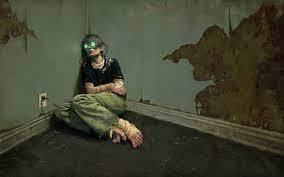
Virtual Beauty, Virtual Freedom, Virtual Love: Is the Metaverse Our Future?

By Robert J. Burrowes

When is the last time you were outside in the morning to experience a glorious dawn? Or sat watching the sun set across the ocean horizon?

How do you feel when you touch the skin of someone you love? A grandparent, parent, lover or child?

Have you ever seen a spider’s web full of morning dew, or after the rain, when the sun is shining through the droplets in the web to reveal the flashing diamonds, sapphires, rubies and emeralds hidden within?

Have you ever stood in a natural environment – a beach, desert, rainforest… – far from a city and noticed that strange and subtle feeling of freedom tremor through your body?

Have you ever marveled at the breath of wind that cools your face on a hot Summer’s day? Or been intoxicated by the smell of blossom in Spring?

Have you gaped in wonder at the birth of new life: a chick pecking out of its shell, a seed germinating or a baby being born?

Or paused to ponder the sheer magic of being alive yourself?

Or do you find life in the real physical world too constricting, painful, frightening and demanding: something from which you seek to escape, with some distraction or another (work, television, sport, a novel, a drug…), as often as you can?

Well, very soon now, we are promised, you will be able to escape reality far more effectively than those primitive means of distraction made possible previously. And far more effectively than even the outcomes promised in those dystopian novels.

So the fundamental questions we must ask ourselves are simple: Do you want real life, with all of the pains, sorrows, fear and fury that go along with beauty, freedom and love? Or do you believe what they tell us and want everything unpleasant to go away? Permanently. And to live in delusion thereafter, given synthetic versions of all of the pleasant feelings and experiences described above?

Remember the dialogue between the Savage and Mustapha Mond during the closing stages of Aldous Huxley’s dystopian novel Brave New World?

‘But I don’t want comfort. I want God, I want poetry, I want real danger, I want freedom, I want goodness. I want sin.’

‘In fact,’ said Mustapha Mond, ‘you’re claiming the right to be unhappy.’

‘All right then,’ said the Savage defiantly, ‘I’m claiming the right to be unhappy.’

‘Not to mention the right to grow old and ugly and impotent; the right to have syphilis and cancer; the right to have too little to eat; the right to be lousy; the right to live in constant apprehension of what may
happen to-morrow; the right to catch typhoid; the right to be tortured by unspeakable pains of every kind.’

There was a long silence.

‘I claim them all,’ said the Savage at last.

Well, after nearly one hundred years, the dystopian future described by Huxley is almost upon us and, if we are to defeat it, we need a lot more ‘savages’ willing to forego the promised ‘comforts’.

Because if those who see themselves as our global masters get their way, we are about to enter a virtual world that will become more complete by the day and from which there will be no escape.

The Metaverse

Based on many years of effort, the World Economic Forum (WEF) has recently launched its plan to create our new all-digital world, called the ‘metaverse’. See ‘Defining and Building the Metaverse’.

So if you find natural phenomena – ranging from rainforests, beaches and weather variations to ill-health, danger and unhappiness – annoying, you will soon be able to escape them, compliments of the metaverse. Or so we are promised. And you won’t be troubled by anything resembling what might be called ‘free will’ either. You will be content to do as you are told, even more than you are content to do already. See ‘Terrified of Freedom: Why Most Human Beings are Embracing the Global Elite’s Technotyranny’.

After all, your mind will no longer be your own. And while the usual descriptions, written by elite agents, fail to mention it, a quick flash of metaverse-induced fear will make sure that you comply, whatever you are required to do. The point is this: You won’t be escaping all of those unpleasant feelings after all. They can just be used to control you more directly, to fulfill an elite-determined purpose. But that is a fact they are not advertising.

In their iconic hit song ‘In the Year 2525’, written in 1964 by Rick Evans and later recorded by he and Denny Zager to become a No.1. hit around the world in 1969, Evans captured key elements of what is already upon us somewhat ahead of the schedule mapped out in the song.

[Chorus 2]
In the year 3535
Ain’t gonna need to tell the truth, tell no lies
Everything you think, do, and say
Is in the pills you took today

[Chorus 3]
In the year 4545
Ain’t gonna need your teeth, won’t need your eyes
You won’t find a thing to chew
Nobody’s gonna look at you

[Chorus 4]
In the year 5555
Your arms are hanging limp at your sides
Your legs got nothing to do
Some machine’s doing that for you

[Chorus 5]
In the year 6565
Ain’t gonna need no husband, won’t need no wife
You’ll pick your sons, pick your daughters too
From the bottom of a long glass tube
Whoa-oh-oh

So what is the Metaverse?

According to the WEF: ‘The metaverse is a future persistent and interconnected virtual environment where social and economic elements mirror reality. Users can interact with it and each other simultaneously across devices and immersive technologies while engaging with digital assets and property.’ See ‘Defining and Building the Metaverse’.

Moreover, ‘if technologists are right that 2022 will separate thinkers from builders, then last years’ technical advances will produce this year’s first steps towards making the metaverse a reality….

‘But from the perspective of the human experience, one development stands out above all others: extended reality (XR) technologies. These include virtual reality (VR), augmented reality (AR), and brain-computer interfaces (BCI), which together position themselves as the next computing platforms in their own right.’

Nevertheless, it is clear that a precise definition of the term ‘metaverse’ (for a start: is it a product, service, place or moment in time?), upon which there is broad agreement even among those who routinely use the term, is yet to emerge. See ‘3 technologies that will shape the future of the metaverse – and the human experience’.

Having written that, here is one definition elaborated in the article above that reveals just how far some of those heavily involved in this work have become disconnected from any sense of themselves and, hence, reality: ‘Specifically, the metaverse is the moment at which our digital lives – our online identities, experiences, relationships, and assets – become more meaningful to us than our physical lives.’ The original quotation can be read here: ‘Spheres of Self: Performativity and Parasociality in the Metaverse’.

And, as Cathy Li describes it, the metaverse is ‘most useful as a lens through which to view ongoing digital transformation. The belief is that virtual worlds, incorporating connected devices, blockchain and other tech, will be so commonplace that the metaverse will become an extension of reality itself.’ See ‘Who will govern the metaverse?

Let me reiterate two points from the paragraphs immediately above: ‘our digital lives… become more meaningful to us than our physical lives.’ And ‘the metaverse will become an extension of reality itself.’

Really?

While statements such as these reveal the breathtaking level of insanity that underpins this entire enterprise – see ‘The Global Elite is Insane Revisited’ – it does not mean that we are not under enormous threat. Just as vast arsenals of nuclear weapons, by some insane ‘logic’, are supposed to provide us with ‘security’ while actually threatening the existence of all life on Earth, the metaverse is part of a substantial package of measures that will reduce human life to one not worth living.

Why? Well, as noted by authors such as Tom Valovic: The metaverse is one element in the path to implementing technocratic governance over all of humanity.

‘As Planet Earth and our physical world continue to experience massive biospheric degradation and disruption, the elites that are now in many cases pulling the strings of governance at the country level are heading for the exit doors. Elon Musk and Jeff Bezos are exploring the realm of space and Musk has a Mars mission planned. Globally oriented elites… looked out for themselves which is what they do best….

‘Paralleling the notion of space flight as a form of existential escapism is the metaverse. So what if our cities are crumbling, infrastructures falling apart, and the biosphere is seriously degrading? So what if our wasteful consumer-driven lifestyle has created unprecedented levels of pollution so extensive that it’s now the number one cause of health problems globally? No problem… we’ll just kick back and don our Meta headsets (or worse get a brain implant) and escape into an artificially fabricated world that lets us turn our back on the massive ecological and environmental problems we now face.’ See ‘Why We Should Reject Mark Zuckerberg’s Dehumanizing Vision of a “Metaverse”’.

‘Education’ in the Metaverse

Of course, the metaverse is deeply interwoven with other components of their plan, such as those in relation to what they call ‘education’, which is more accurately described as the process by which young transhuman slaves are programmed to perform their function in the technocratic economy that is being imposed upon us. Of course, ‘education’ sounds better than ‘virtual programming of young transhuman slaves’ so, in the interests of not raising obvious concerns, the word ‘education’ has been used.

As noted by Dr. Michael Nevradakis, discussions on this subject at the recent gathering of the World Economic Forum emphasized the importance of virtual reality (VR) and artificial intelligence (AI) technologies with participants touting the purported educational and economic benefits that would derive from use of these technologies in the classroom by helping, according to Dr. Ali Saeed Bin Harmal Al Dhaheri & Dr. Mohamad Ali Hamade, to ‘increase accessibility, enhance quality and improve the affordability of education globally’. See ‘Experiential learning and VR will reshape the future of education’.

However, as Nevradakis also noted, these discussions had ‘little to say about the need to protect children’s data or digital identities – or, for that matter, providing the types of early-life experiences children require as part of their socialization.’ See ‘Future of Education? WEF’s Vision – Heavy on Virtual Reality and AI Technologies, Light on Privacy Concerns’.

Of course, there is no need for concern about the ‘early-life experiences’ of those young transhumans who are being programmed for decades of servitude prior to being terminated when they are no longer functional.

Beyond claimed educational and economic benefits, however, some authors argue that digitalizing education can play a role in easing pressures on the environment and climate. How so? Nevradakis again: ‘Indeed, the WEF said the use of “textbooks, notebooks and pencils as critical learning tools” is on the way out, due to “environmental pressures and COP26 goals (from the 2021 United Nations Climate Change Conference),” which “will drive the digitalizing of education streams.”’ See ‘Future of Education? WEF’s Vision – Heavy on Virtual Reality and AI Technologies, Light on Privacy Concerns’

But it is clearly delusional to suggest that the use of textbooks, notebooks and pencils has greater adverse impact on the environment and climate than the environmental cost and climate impact of producing sophisticated technology for each student. And despite claims of ‘improved affordability’ it is equally delusional to ignore the economic and social cost, for example, to the child ‘laborers’ in the Congo working in appalling conditions to extract strategic minerals to produce this technology. See ‘Humanity’s “Dirty Little Secret”: Starving, Enslaving, Raping, Torturing and Killing our Children’.

Besides, as touched on below, education is already a monstrous experience, destroying the Selfhood of the child so that they become submissively obedient. Removing the bulk of education’s remaining social component by technologizing it can only make it even worse.

Babies in the Metaverse

Then again, maybe ‘children’ will no longer be put through school. It simply won’t be necessary because children, for transhuman slaves at least, will no longer exist.

By 2070, the metaverse will offer you virtual babies, ‘environmentally-friendly digital children’, according to UK artificial intelligence (AI) expert Catriona Campbell. ‘Parents will see and interact with their offspring through next-generation AR [augmented reality] glasses and haptic gloves.’ The latter devices enable users to experience ‘a realistic sense of touch when handling virtual or holographic objects’. As a bonus, these children take up no space, cost nothing to feed and remain healthy, if that is what you want, for as long as they are programmed to ‘live’. A subscription might cost as little as $25 each month.

And if this seems like a monumental leap out of reality to you, Campbell also believes that ‘within 50 years technology will have advanced to such an extent that babies which exist in the metaverse are indistinct from those in the real world…. As the metaverse evolves, I can see virtual children becoming an accepted and fully embraced part of society in much of the developed world.’ See ‘“Virtual babies” who grow up in real time will be commonplace by 2070, expert predicts’.

That’s right, Campbell is claiming that ‘within 50 years… babies which exist in the metaverse are indistinct from those in the real world’! Pause a moment. How does that sound to you?

Just in case you cannot wait, you are welcome to start using early versions now. See, for example, Virtual Baby, Adopt a Virtual Baby and My Virtual Child.

Oh, and by the way, you won’t be having sex either, whether for reproductive purposes or otherwise. You will prefer virtual sex. See ‘Sex And Pornography Aim To Strike Gold In The Metaverse’.

Critiquing the Metaverse

Beyond the criticisms already noted above, there are a great many other criticisms of the metaverse and the role it will play in the overall elite program being implemented under what the WEF calls its ‘Great Reset’. This comprehensive program will transform human society and human life for those people left alive after the eugenics component has been fully implemented. See ‘The Final Battle for Humanity: It is “Now or Never” in the Long War Against Homo Sapiens’.

If you like, you can read a little more about what the masters of this metaverse intend for us, as well as critiques of it, by authors such as these.

Derrick Broze: While some people ‘may not intend for The Metaverse to become an all encompassing reality that supersedes physical reality, for the Zuckerbergs, Microsofts, and WEFs of the world, that is exactly what they intend for The Metaverse…. For the billionaire class and their puppet organizations, such as the WEF and the United Nations, the Metaverse offers up the potential to commandeer all life into digital prisons where the people can be charged for services and products in the digital realm…. With the people of the world safely tucked into their digital beds, the Technocrats could complete their total takeover of natural resources, the economy, and humanity itself.’ See ‘The Great Narrative And The Metaverse, Part 2: Will The Metaverse End Human Freedom?

Dr. Michael Nevradakis: ‘Who will govern the “metaverse”?… According to the WEF, “real-world governance models” represent one possible option for metaverse governance. However, far from referring to constitutionally defined institutions of governance, with checks and balances, the WEF cites Facebook’s “Oversight Board” as an example of such a “real-world governance model.”’ See ‘WEF Launches “Metaverse” Initiative, Predicts Digital Lives Will Become “More Meaningful to Us Than Our Physical Lives”’.

But an earlier World Economic Forum report from its Global Redesign Initiative was more blunt: ‘The report postulates that a globalized world is best managed by a coalition of multinational corporations, governments (including through the UN system) and select civil society organizations (CSOs).’ See Sustainable Development Goals and Human Rights p. 209, citing ‘Everybody’s Business: Strengthening International Cooperation in a More Interdependent World’.

So if you believe that you and I are destined to have a say in the metaverse that is unfolding, you would be wise to keep investigating. Elite proposals are invariably very distant from the type of governance models usually considered by ‘ordinary’ people in a multiplicity of contexts, where the emphasis is on facilitating widespread grassroots participation, not rule by technocrats.

You can read considerably more about what our technocratic overlords have in mind – including the existing trade in such things as virtual real estate, virtual clothing and virtual art – and what is wrong with it, in the articles on the metaverse published by Patrick Wood on ‘Technocracy News & Trends’: ‘Metaverse’. And there is more in articles such as these: ‘The Top 10 Creepiest and Most Dystopian Things Pushed by the World Economic Forum (WEF)’ and ‘How Our Lives Could Soon Look”: The World Economic Forum Posts An Insane Dystopian Video’.

And here’s another simple issue to ponder. Remember how I mentioned above that a quick flash of metaverse-induced fear would ensure that you complied with an elite-determined directive, how does the idea of eating bugs, processed sewage and human flesh appeal? Well, given that your mind will no longer be your own, what appeals now, or doesn’t, will be irrelevant once the metaverse is determining how you perceive things. See ‘Canadian Company Pledges To Produce TWO BILLION BUGS Per Year For Human Consumption’ and ‘Will You Eat Cultured Meat Grown From Human Cells?’

You will eat ‘Soylent Green’ because that is what the program tells you.

So why are people embracing the Metaverse?

In a recent article in which he described taking his son to watch a film through 3D glasses, Charles Eisenstein noted ‘The on-screen reality was so vivid, stimulating and intense that it made the real world seem boring by comparison.’ See ‘Transhumanism and the Metaverse’.

How can this happen?

Because we terrorize our children into submissive obedience, devoid of the unique and powerful individual Self they were gifted by evolution at birth. See ‘Why Violence?’,‘Fearless Psychology and Fearful Psychology: Principles and Practice’and ‘Do We Want School or Education?’ Why? Essentially to keep them performing tasks that bore them senseless throughout their school and working life.

Fundamentally, this terrorization works because it compels our children into suppressing awareness of how they feel. As a result, only the most intense experiences register emotionally: The capacity to experience a subtle feeling has been lost. And without this capacity, they cannot develop into the powerful, courageous Self-willed individuals that evolution intended. They are human relics. Ready and willing to be turned into a transhuman slave in the unconscious hope they will be finally able to experience, in the metaverse, what was taken from them in the real world as a child.

But they won’t get that experience, even in the metaverse. It is not what the elite has in mind for us.

Resisting the Metaverse

Of course, the metaverse is just one feature of the Global Elite agenda that is being imposed upon us. And it is not enough to resist individual features of the ‘Great Reset’ program. We must strategically resist its most fundamental elements so that the entire agenda is defeated.

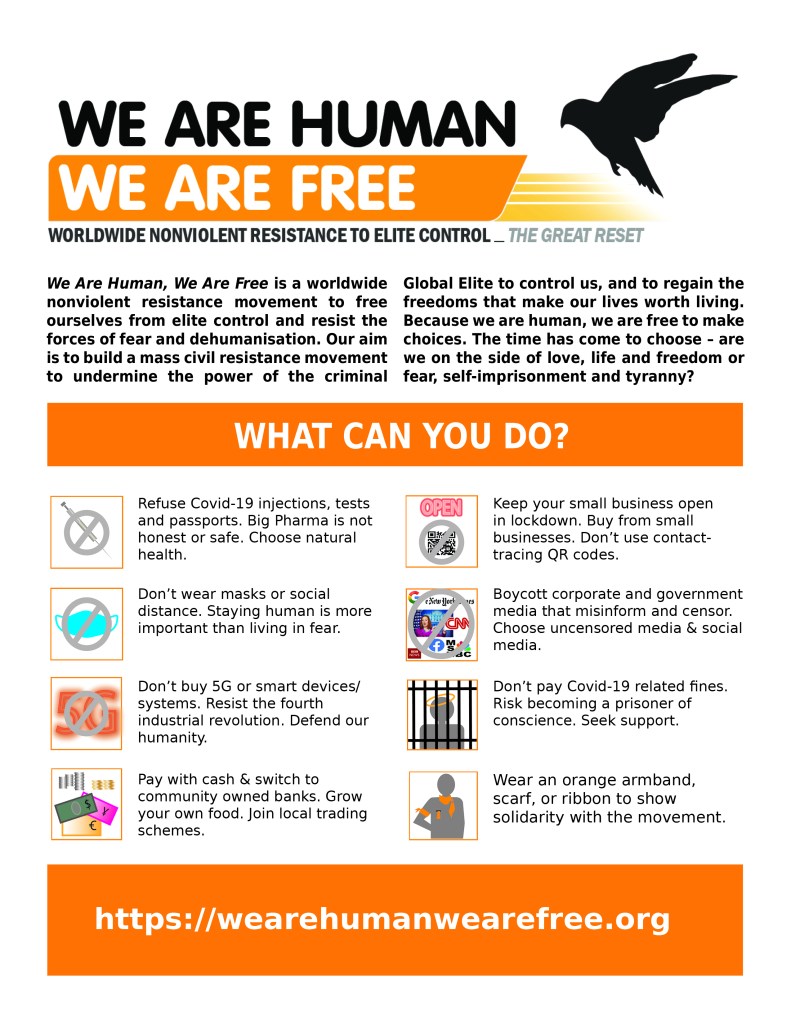
If you are inclined to join those strategically resisting the ‘Great Reset’ and its related agendas, you are welcome to participate in the ‘We Are Human, We Are Free’  campaign which identifies a list of 30 strategic goals for doing so.

In addition and more simply, you can download a one-page flyer that identifies a short series of crucial nonviolent actions that anyone can take. This flyer, now available in 17 languages (Czech, Danish, Dutch, English, Finnish, French, German, Greek, Hebrew, Hungarian, Italian, Polish, Romanian, Russian, Serbian, Spanish & Slovak) with more languages in the pipeline, can be downloaded from here: ‘The 7 Days Campaign to Resist the Great Reset’.

If strategically resisting the ‘Great Reset’ (and related agendas) appeals to you, consider joining the ‘We Are Human, We Are Free’ Telegram group (with a link accessible from the website).

And if you want a child who is powerfully able to perceive the dysfunctional lure of the metaverse, and is able to join you in resisting it, consider making ‘My Promise to Children’.

CONCLUSION

So, for just a little longer, the choice is yours.

You can live your life with all its challenges and problems, joys and achievements. Or you can live the virtual life that someone else programmed for you, including whatever comes with it that they didn’t tell you about.

In short, like Neo in the film ‘The Matrix’, you have a choice. You can choose the Blue Pill and proceed to live in a synthesized, fictional, computer-generated world. Or you take the Red Pill and, in this case, join the fight with those of us determined to defend the real world and avert descent into the metaverse.

But you must make that choice while you still have free will.

So you must make that choice soon.

Biodata: Robert J. Burrowes has a lifetime commitment to understanding and ending human violence. He has done extensive research since 1966 in an effort to understand why human beings are violent and has been a nonviolent activist since 1981. He is the author of ‘Why Violence?’ His email address is flametree@riseup.net and his website is here.
The Cult of Globalism: The Great Reset and its ‘Final Solution’ for Useless People

By Timothy Alexander Guzman

Source: Silent Crow News

The idea of the Great Reset derives from the New World Order which is still alive in the minds of the establishment or who we can call the globalists from people like Henry Kissinger to the current US president, Joe Biden.  Of course there are many others on the top levels of the pyramid whose ideas range from establishing a police state, to implanting microchips the day we are born to track and trace us, to depopulating the planet.  I know it all sounds insane but that’s what the globalists have planned for us for a very long time.  Klaus Schwab’s protégé, Yuval Noah Harari, is an Israeli born intellectual who authored a popular bestseller titled ‘Sapiens: A Brief History of Humankind’ and is also a professor of history at the Hebrew University of Jerusalem.  Harari once asked a disturbing question, “what to do with all these useless people?”  Harari is an intelligent man, there is no doubt about that, but his intelligence has led him to the level of insanity.  Harari is an influential member of the World Economic Forum (WEF) who supports the idea of creating a dystopian society managed by a handful of globalists who will rule over every human being on earth from the day they are born.  According to Harari, planet earth is overpopulated:    

Again, I think the biggest question in maybe in economics and politics of the coming decades will be what to do with all these useless people? The problem is more boredom and how what to do with them and how will they find some sense of meaning in life, when they are basically meaningless, worthless?

My best guess, at present is a combination of drugs and computer games as a solution for [most]. It’s already happening…In under different titles, different headings you see more and more people spending more and more time or solving the inner problems with the drugs and computer games both legal drugs and illegal drugs…

They also want people to stay home connected to the Metaverse world, a virtual reality simulation and at the same time get them addicted to all sorts of drugs.  The kind of world they are trying to create for us is pure lunacy.  Wired, a monthly magazine describes the metaverses as a combination of the digital and physical worlds that creates a virtual reality as in the Hollywood film, ‘Ready Player One,’ The article ‘What is the Metaverse, Exactly?’  answers that question, “Broadly speaking, the technologies companies refer to when they talk about “the metaverse” can include virtual reality—characterized by persistent virtual worlds that continue to exist even when you’re not playing—as well as augmented reality that combines aspects of the digital and physical worlds.”                              

Many other Hollywood films that are based on virtual reality in the future includes Jumanji, Source Code, The Matrix, Total Recall, Inception, and many others.  The globalists want you to believe that a dystopic society is in the works for us, but no worries, you will be completely happy at least according to Klaus Schwab.  In my opinion, the notion that the human species will be living their lives through virtual reality is far-fetched, it’s an illusion that will take decades even centuries to accomplish and that would only happen if we allowed it to happen.  Harari is saying that under a scientific, technocratic world order, the state will be your sole provider for everything, so basically, he says that families are not needed in this new world they are creating for us, in other words, having a family will be a thing of the past:

After millions of years of evolution suddenly within 200 years the family and the intimate community break, that they collapse most of the roles filled by the family for thousands and tens of thousands of years are transferred very quickly to new networks provided by the state and the market, you don’t need children, you can have a pension fund, you don’t need somebody to take care of you, you don’t need neighbors and sisters or brothers to take care of you if you’re sick, the state takes care of you, the states provide you with police, with education, with help with everything

Listen to Harari’s own words in this video:


The World in Crisis: A Stakeholder Economy, the Green Agenda and Covid-19    

Rahm Emanuel worked for US presidents Bill Clinton and Barack Obama under various titles, but one quote he will always be remembered for was when he said “you never let a serious crisis go to waste. And what I mean by that it’s an opportunity to do things you think you could not do before.” That is exactly what happened under the Covid-19 global health emergency.  Klaus Schwab, who is the original founder, and executive chairman of the WEF published an article that outlines three basic components of the Great Reset titled Now is the Time for a ‘Great Reset, in the first component, they would help steer or “improve coordination (for example, in tax, regulatory, and fiscal policy), upgrade trade arrangements, and create the conditions for a “stakeholder economy.”  How would this work? There are more than 195 countries in the world meaning that all these countries would have to establish a “unified” tax, regulatory and fiscal policy, all in sync, all with the same laws and that would be impossible even if they tried because all countries have different tax systems, different economies and cultures and that will not change because of a handful of globalists with outlandish ideas of a unified financial system they want to control for their own benefit.  It’s a ridicules idea.  In fact, more countries today are more open to imposing less taxes and regulations to attract foreign investments to grow their economies, so the WEF ‘s recommendations will never work, in fact its dead-on arrival. 

Then there is the looming financial crisis that can ultimately force the world into a Federal Reserve Bank “Digital Currency” known as central bank digital currencies (CBDCs) that will be tracked by the government on how you spend your money.  What can go wrong with this idea?  If in any case, you are not politically aligned with a particular party or refuse an experimental injection, then the government may block your transactions.  In other words, they can literally control when and how you spend your money and that is something most people will not accept.  An article published by Stefan Gleason who is an investor, political strategist, and grassroots activist wrote an interesting analysis last year for fxstreet.com titled ‘The Great Reset is Coming for the Currency’ asks what will be the next major issue for a Global Reset? “As the Great Reset proceeds from globalist think tanks and technology billionaires to allied media elites, governments, schools, and Woke corporations, what will be “reset” next?  The next reset will most likely take place in the financial sector as “Supporters of the World Economic Forum’s all-encompassing Great Reset agenda are eyeing BIG changes for the global monetary system.”  Biden’s Treasury Secretary and former Federal Reserve Chair, Janet Yellen wants to end the use of various cryptocurrencies and have the International Monetary Fund (IMF) issue CBDC’s.  “Yellen derided Bitcoin as “an extremely inefficient way to conduct transactions” because “the amount of energy consumed in processing those transactions is staggering.”  Gleason says that Yellen and her colleagues are planning to have the public use digitized tokens issued by the central bank.  The bottom line is that “They just want to make sure those digits are issued and controlled by governments and central banks.” 

The best way to avoid the Federal Reserve bank’s control over your finances is to own gold, silver, and other safe-haven assets.  “Anyone who is concerned about the prospect of being herded into a new digital currency regime should make it a high priority to own tangible money that exists outside the financial system.”  Gleason makes the case for owning gold and silver, “No technology or government mandate can change the fact that gold and silver have universally recognized, inflation-resistant value.”  At some point, the public will reject the Federal Reserve and its ‘digital currency’ if they can avoid it.  However, the best way to bypass CBDC’s in the future is to buy gold, silver, and other metals that that can maintain value and become resistant to inflationary pressures.  An important note to consider is that all US silver coins that were produced before 1964 were minted with 90% silver and 10% copper, so keep an eye on your pocket-change just in case you come across some silver coins with value. 

The second component “would ensure that investments advance shared goals, such as equality and sustainability. Here, the large-scale spending programs that many governments are implementing represent a major opportunity for progress.”  Which means that governments will be required to print an unlimited money supply to support their agenda that will eventually lead to inflationary pressures which can devastate their respective economies.  “Here, the large-scale spending programs that many governments are implementing represent a major opportunity for progress. The European Commission, for one, has unveiled plans for a €750 billion ($826 billion) recovery fund. The US, China, and Japan also have ambitious economic-stimulus plans.”  They are pushing for an expensive Green Agenda which is part of Joe Biden’s Build Back Better plan to reduce greenhouse gas emissions that will change how the world operates when it comes to using traditional energy resources such as coal, oil, and natural gas:

Rather than using these funds, as well as investments from private entities and pension funds, to fill cracks in the old system, we should use them to create a new one that is more resilient, equitable, and sustainable in the long run. This means, for example, building “green” urban infrastructure and creating incentives for industries to improve their track record on environmental, social, and governance (ESG) metrics

Last year, Forbes magazine published Why Biden’s Climate Agenda Is Falling Apart’ which does explain how the Green Agenda is an expensive and unreliable scheme:

The vast majority of human beings want high rather than low economic growth, and so politicians ultimately choose policies that make energy cheap, not expensive.

And the limitations of weather-dependent renewables are more visible than ever. If California’s large wind energy project is built, it will provide less than half of the energy of California’s Diablo Canyon nuclear plant Newsom is planning to close in 2025, and it will be unreliable. During the heatwave-driven blackouts last summer, there was little wind in California or other Western states, meaning we can’t count on wind energy when we need it most. 

In other words, the Democrats’ climate change and renewable energy agenda is rapidly falling apart, and the reasons have far more to do with physics than with politics

Schwab proposes that the third component is basically the innovations that will lead to centralized control of the world’s health policies by the World Health Organization (WHO) However, the innovations began the moment  WHO officials declared a global Public Health Emergency more than 2 years ago.  Schwab mentioned the ‘Fourth Industrial Revolution’ which is described on the World Economic Forum’s website as a new system that “shapes new policies and strategies in areas such as artificial intelligence, blockchain and digital assets, the internet of things or autonomous vehicles, and enables agile implementation and iteration via its fast-growing network of national and sub-national centres.” Regarding Covid-19 or any other declared public health emergency in the future, the new system will be able “to support the public good, especially by addressing health and social challenges. During the COVID-19 crisis, companies, universities, and others have joined forces to develop diagnostics, therapeutics, and possible vaccines; establish testing centers; create mechanisms for tracing infections; and deliver telemedicine.”

However, there was a unified response put forward by a several nations including Brazil, India, Russia, China, Iran, South Africa, Malaysia and the practically the entire continent of Africa that rejected a pandemic treaty developed by the World Health Organization.  They all agreed that the treaty would allow authorities from the WHO to gain control of their health policies bypassing their rights as sovereign nations.  As the spirit of Tanzania’s late President, John Magufuli lives on, Reuters published the positive move on behalf of the African continent Africa objects to U.S. push to reform health rules at WHO assembly regarding Africa’s 47 nations who rejected the treaty “African countries raised an objection on Tuesday to a U.S.-led proposal to reform the International Health Regulations (IHR), a move delegates say might prevent passage at the World Health Organization’s annual assembly.”  The treaty brought forward by the WHO and the US government was technically defeated which is a positive outcome considering what’s at stake:

If Africa continues to withhold support, it could block one of the only concrete reforms expected from the meeting, fraying hopes that members will unite on reforms to strengthen the U.N. health agency’s rules as it seeks a central role for itself in global health policy.

The IHR set out WHO members’ legally binding obligations around outbreaks. The United States has proposed 13 IHR reforms which seek to authorise the deployment of expert teams to contamination sites and the creation of a new compliance committee to monitor implementation of the rules.

But the African group expressed reservations about even this narrow change, saying all reforms should be tackled together as part of a “holistic package” at a later stage

Western powers along with top level WHO officials will try to persuade or blackmail sovereign nations who originally rejected the IHR treaty to reverse their decision with a new modified version in hopes of centralized control of any future pandemic, but the current decision made by those nations who rejected the treaty is welcoming news indeed.   

Just imagine the concept of a group of mostly unelected bureaucrats with the power to oversee a centralized control grid to rule over a global pandemic is Orwellian, in fact, the Great Reset kind of reminds me of the 1973 classic Hollywood film, Soylent Green with Charlton Heston based on the 1966 science fiction novel ‘Make Room! Make Room! by Harry Harrison based on a dystopian society.  The story is about a police investigation into the murder of a wealthy businessman while the world is experiencing a slow death from “greenhouse gases” that produced a variety of problems for humanity including overpopulation, pollution, poverty, crime, and the concept of enforced euthanasia by the state. 

Soylent Green is an example of what a deranged group of globalists or in this case, government bureaucrats would do to humanity if we did nothing to stop them.  In the film, Detective Thorn (played by Charlton Heston) warned his colleague Chief Hatcher (Brock Peters) “The ocean’s dying! Plankton’s dying! It’s people – Soylent Green is made out of people! They’re making our food out of people! Next thing they’ll be breeding us like cattle for food! You’ve gotta tell them, you’ve gotta tell them!” Although Soylent Green is obviously fictional, it’s a metaphor on how far globalists will be willing to go so that their agenda of world control and depopulation can succeed.  In the film, the state strongly encouraged and even facilitated suicide which turned the people into food for the remaining population.  It sounds insane but reading about the agenda of the Great Reset of you ‘owning nothing and being happy is the start of something more sinister in our future.  I am not saying that they will try to turn people into food in the future, but they are certainly trying to push forward other outrages solutions to feed the world such as the possibility of people eating insects to survive.  I wish this was a joke, but it’s not. 

Globalists are calling for the world’s population to be completely vaccinated with their Covid-19 experimental injections, in other words, they want total control over the world’s healthcare policies to enforce the use of facemasks and endless vaccination schemes through government-imposed mandates on the population although Covid-19 experimental injections are injuring and even killing thousands of people around the world.  Globalist plotters began their plan of action to implement their vaccine mandates as soon as the Public Health Emergency was announced, but there were governments who rejected the idea from the start.  On December 3rd, 2020, Brazil’s Minister of Foreign Affairs Ernesto Araujo clearly rejected the World Economic Forum’s Great Reset agenda by addressing the United Nations (UN) special session on COVID-19 by saying that “Those who dislike freedom always try to benefit from moments of crisis to preach the curtailing of freedom. Let’s not fall for that trap” In his conclusion, Araujo clearly states what is Brazil’s position on the idea of the Great Reset:

Fundamental freedoms are not an ideology. Human dignity requires freedom as much as it requires health and economic opportunities.  Those who dislike freedom always try to benefit from moments of crisis to preach the curtailing of freedom. Let’s not fall for that trap.  Totalitarian social control is not the remedy for any crisis. Let’s not make democracy and freedom one more victim of COVID-19

Is the World Ready to Embrace the Great Reset?  

In the geopolitical spectrum, globalists are set on punishing sovereign countries who do not obey a rules-based order under the Great Reset agenda in partnership with the US-NATO alliance leading the world to some form of conflict or regime change against Russia, China, Iran, Belarus, Syria, Venezuela, Nicaragua, Cuba, and any other nation who wants to remain sovereign at all costs. There are many who are vehemently opposed to such an idea, for example, on January 27th, 2021, Russian President Vladimir Putin spoke at the World Economic Forum (WEF) and basically rejected the idea of the Great Reset and gave a reasonable idea of humanity working together to achieve a prosperous future for all with “calls for inclusive growth and for creating decent standards of living for everyone are regularly made at various international forums. This is how it should be, and this is an absolutely correct view of our joint efforts” and that “It is clear that the world cannot continue creating an economy that will only benefit a million people, or even the golden billion. This is a destructive precept. This model is unbalanced by default.” Putin’s perception of the Great Reset or a unipolar world order is correct because it is destined for failure since the world is a complex place where nations have distinct cultures and history.  Putin questions how nations would respond to a Great Reset with a rules-based order run by an elite group of psychopaths that expect a harmonious transition from all nations who are willing to comply:

We are open to the broadest international cooperation, while achieving our national goals, and we are confident that cooperation on matters of the global socioeconomic agenda would have a positive influence on the overall atmosphere in global affairs, and that interdependence in addressing acute current problems would also increase mutual trust which is particularly important and particularly topical today.

Obviously, the era linked with attempts to build a centralized and unipolar world order has ended. To be honest, this era did not even begin. A mere attempt was made in this direction, but this, too, is now history. The essence of this monopoly ran counter to our civilization’s cultural and historical diversity.

The reality is such that really different development centers with their distinctive models, political systems and public institutions have taken shape in the world. Today, it is very important to create mechanisms for harmonizing their interests to prevent the diversity and natural competition of the development poles from triggering anarchy and a series of protracted conflicts

The rejection of the Great Reset and its associated global institutions and industries such as the WHO, NATO and Big Pharma is a step in the right direction and the globalists are in panic.  Brazil, Russia, the continent of Africa and others are proving that the Great Reset or that century’s old idea of a New World Order has become a failed project.  Some people might disagree with my analysis because many are pessimistic about their future because they believe that a Great Reset is inevitable, that there is no escape from it because it seems that things are getting out of control with ongoing wars, coming food shortages and a growing danger of a global medical tyranny.  However, I do believe that we are in the early stages of a great awakening, not a rules-based order managed by a group of globalists despite the endless propaganda on how the Great Reset will make the planet a better place for all of us.   

People and certain governments are awakening to the fact that a group of globalists are working against them on every level, and they are starting to fight back.  We do not want to be ruled by a centralized power telling us what to do or how to think.  The concept of the Great Reset has failed in many ways, but there is still work to do. 

Never give up, never allow a group of influential globalists whether they are billionaires or bankers, government bureaucrats or special interest groups, resist this ideology of a unipolar world order.  We can win this war, there is still time, I believe that we will prevail if we just don’t comply with their goal of them trying to control us, the useless people.  

The Metaverse Is Big Brother in Disguise: Freedom Meted Out by Technological Tyrants

By By John W. Whitehead & Nisha Whitehead

Source: The Rutherford Institute

The term metaverse, like the term meritocracy, was coined in a sci fi dystopia novel written as cautionary tale. Then techies took metaverse, and technocrats took meritocracy, and enthusiastically adopted what was meant to inspire horror.”—Antonio García Martínez

Welcome to the Matrix (i.e. the metaverse), where reality is virtual, freedom is only as free as one’s technological overlords allow, and artificial intelligence is slowly rendering humanity unnecessary, inferior and obsolete.

Mark Zuckerberg, the CEO of Facebook, sees this digital universe—the metaverse—as the next step in our evolutionary transformation from a human-driven society to a technological one.

Yet while Zuckerberg’s vision for this digital frontier has been met with a certain degree of skepticism, the truth—as journalist Antonio García Martínez concludes—is that we’re already living in the metaverse.

The metaverse is, in turn, a dystopian meritocracy, where freedom is a conditional construct based on one’s worthiness and compliance.

In a meritocracy, rights are privileges, afforded to those who have earned them. There can be no tolerance for independence or individuality in a meritocracy, where political correctness is formalized, legalized and institutionalized. Likewise, there can be no true freedom when the ability to express oneself, move about, engage in commerce and function in society is predicated on the extent to which you’re willing to “fit in.”

We are almost at that stage now.

Consider that in our present virtue-signaling world where fascism disguises itself as tolerance, the only way to enjoy even a semblance of freedom is by opting to voluntarily censor yourself, comply, conform and march in lockstep with whatever prevailing views dominate.

Fail to do so—by daring to espouse “dangerous” ideas or support unpopular political movements—and you will find yourself shut out of commerce, employment, and society: Facebook will ban you, Twitter will shut you down, Instagram will de-platform you, and your employer will issue ultimatums that force you to choose between your so-called freedoms and economic survival.

This is exactly how Corporate America plans to groom us for a world in which “we the people” are unthinking, unresistant, slavishly obedient automatons in bondage to a Deep State policed by computer algorithms.

Science fiction has become fact.

Twenty-some years after the Wachowskis’ iconic film, The Matrix, introduced us to a futuristic world in which humans exist in a computer-simulated non-reality powered by authoritarian machines—a world where the choice between existing in a denial-ridden virtual dream-state or facing up to the harsh, difficult realities of life comes down to a blue pill or a red pill—we stand at the precipice of a technologically-dominated matrix of our own making.

We are living the prequel to The Matrix with each passing day, falling further under the spell of technologically-driven virtual communities, virtual realities and virtual conveniences managed by artificially intelligent machines that are on a fast track to replacing human beings and eventually dominating every aspect of our lives.

In The Matrixcomputer programmer Thomas Anderson a.k.a. hacker Neo is wakened from a virtual slumber by Morpheus, a freedom fighter seeking to liberate humanity from a lifelong hibernation state imposed by hyper-advanced artificial intelligence machines that rely on humans as an organic power source. With their minds plugged into a perfectly crafted virtual reality, few humans ever realize they are living in an artificial dream world.

Neo is given a choice: to take the red pill, wake up and join the resistance, or take the blue pill, remain asleep and serve as fodder for the powers-that-be.

Most people opt for the blue pill.

In our case, the blue pill—a one-way ticket to a life sentence in an electronic concentration camp—has been honey-coated to hide the bitter aftertaste, sold to us in the name of expediency and delivered by way of blazingly fast Internet, cell phone signals that never drop a call, thermostats that keep us at the perfect temperature without our having to raise a finger, and entertainment that can be simultaneously streamed to our TVs, tablets and cell phones.

Yet we are not merely in thrall with these technologies that were intended to make our lives easier. We have become enslaved by them.

Look around you. Everywhere you turn, people are so addicted to their internet-connected screen devices—smart phones, tablets, computers, televisions—that they can go for hours at a time submerged in a virtual world where human interaction is filtered through the medium of technology.

This is not freedom. This is not even progress.

This is technological tyranny and iron-fisted control delivered by way of the surveillance state, corporate giants such as Google and Facebook, and government spy agencies such as the National Security Agency.

So consumed are we with availing ourselves of all the latest technologies that we have spared barely a thought for the ramifications of our heedless, headlong stumble towards a world in which our abject reliance on internet-connected gadgets and gizmos is grooming us for a future in which freedom is an illusion.

Yet it’s not just freedom that hangs in the balance. Humanity itself is on the line.

If ever Americans find themselves in bondage to technological tyrants, we will have only ourselves to blame for having forged the chains through our own lassitude, laziness and abject reliance on internet-connected gadgets and gizmos that render us wholly irrelevant.

Indeed, we’re fast approaching Philip K. Dick’s vision of the future as depicted in the film Minority Report. There, police agencies apprehend criminals before they can commit a crime, driverless cars populate the highways, and a person’s biometrics are constantly scanned and used to track their movements, target them for advertising, and keep them under perpetual surveillance.

Cue the dawning of the Age of the Internet of Things (IoT), in which internet-connected “things” monitor your home, your health and your habits in order to keep your pantry stocked, your utilities regulated and your life under control and relatively worry-free.

The key word here, however, is control.

In the not-too-distant future, “just about every device you have—and even products like chairs, that you don’t normally expect to see technology in—will be connected and talking to each other.”

By the end of 2018, “there were an estimated 22 billion internet of things connected devices in use around the world… Forecasts suggest that by 2030 around 50 billion of these IoT devices will be in use around the world, creating a massive web of interconnected devices spanning everything from smartphones to kitchen appliances.”

As the technologies powering these devices have become increasingly sophisticated, they have also become increasingly widespread, encompassing everything from toothbrushes and lightbulbs to cars, smart meters and medical equipment.

It is estimated that 127 new IoT devices are connected to the web every second.

This “connected” industry has become the next big societal transformation, right up there with the Industrial Revolution, a watershed moment in technology and culture.

Between driverless cars that completely lacking a steering wheel, accelerator, or brake pedal, and smart pills embedded with computer chips, sensors, cameras and robots, we are poised to outpace the imaginations of science fiction writers such as Philip K. Dick and Isaac Asimov. (By the way, there is no such thing as a driverless car. Someone or something will be driving, but it won’t be you.)

These Internet-connected techno gadgets include smart light bulbs that discourage burglars by making your house look occupied, smart thermostats that regulate the temperature of your home based on your activities, and smart doorbells that let you see who is at your front door without leaving the comfort of your couch.

Nest, Google’s suite of smart home products, has been at the forefront of the “connected” industry, with such technologically savvy conveniences as a smart lock that tells your thermostat who is home, what temperatures they like, and when your home is unoccupied; a home phone service system that interacts with your connected devices to “learn when you come and go” and alert you if your kids don’t come home; and a sleep system that will monitor when you fall asleep, when you wake up, and keep the house noises and temperature in a sleep-conducive state.

The aim of these internet-connected devices, as Nest proclaims, is to make “your house a more thoughtful and conscious home.” For example, your car can signal ahead that you’re on your way home, while Hue lights can flash on and off to get your attention if Nest Protect senses something’s wrong. Your coffeemaker, relying on data from fitness and sleep sensors, will brew a stronger pot of coffee for you if you’ve had a restless night.

Yet given the speed and trajectory at which these technologies are developing, it won’t be long before these devices are operating entirely independent of their human creators, which poses a whole new set of worries. As technology expert Nicholas Carr notes, “As soon as you allow robots, or software programs, to act freely in the world, they’re going to run up against ethically fraught situations and face hard choices that can’t be resolved through statistical models. That will be true of self-driving cars, self-flying drones, and battlefield robots, just as it’s already true, on a lesser scale, with automated vacuum cleaners and lawnmowers.”

For instance, just as the robotic vacuum, Roomba, “makes no distinction between a dust bunny and an insect,” weaponized drones will be incapable of distinguishing between a fleeing criminal and someone merely jogging down a street. For that matter, how do you defend yourself against a robotic cop—such as the Atlas android being developed by the Pentagon—that has been programmed to respond to any perceived threat with violence?

Moreover, it’s not just our homes and personal devices that are being reordered and reimagined in this connected age: it’s our workplaces, our health systems, our government, our bodies and our innermost thoughts that are being plugged into a matrix over which we have no real control.

It is expected that by 2030, we will all experience The Internet of Senses (IoS), enabled by Artificial Intelligence (AI), Virtual Reality (VR), Augmented Reality (AR), 5G, and automation. The Internet of Senses relies on connected technology interacting with our senses of sight, sound, taste, smell, and touch by way of the brain as the user interface. As journalist Susan Fourtane explains:

Many predict that by 2030, the lines between thinking and doing will blur. Fifty-nine percent of consumers believe that we will be able to see map routes on VR glasses by simply thinking of a destination… By 2030, technology is set to respond to our thoughts, and even share them with others… Using the brain as an interface could mean the end of keyboards, mice, game controllers, and ultimately user interfaces for any digital device. The user needs to only think about the commands, and they will just happen. Smartphones could even function without touch screens.

In other words, the IoS will rely on technology being able to access and act on your thoughts.

Fourtane outlines several trends related to the IoS that are expected to become a reality by 2030:

1: Thoughts become action: using the brain as the interface, for example, users will be able to see map routes on VR glasses by simply thinking of a destination.

2: Sounds will become an extension of the devised virtual reality: users could mimic anyone’s voice realistically enough to fool even family members.

3: Real food will become secondary to imagined tastes. A sensory device for your mouth could digitally enhance anything you eat, so that any food can taste like your favorite treat.

4: Smells will become a projection of this virtual reality so that virtual visits, to forests or the countryside for instance, would include experiencing all the natural smells of those places.

5: Total touch: Smartphones with screens will convey the shape and texture of the digital icons and buttons they are pressing.

6: Merged reality: VR game worlds will become indistinguishable from physical reality by 2030.

This is the metaverse, wrapped up in the siren-song of convenience and sold to us as the secret to success, entertainment and happiness.

It’s a false promise, a wicked trap to snare us, with a single objective: total control.

George Orwell understood this.

Orwell’s masterpiece, 1984, portrays a global society of total control in which people are not allowed to have thoughts that in any way disagree with the corporate state. There is no personal freedom, and advanced technology has become the driving force behind a surveillance-driven society. Snitches and cameras are everywhere. And people are subject to the Thought Police, who deal with anyone guilty of thought crimes. The government, or “Party,” is headed by Big Brother, who appears on posters everywhere with the words: “Big Brother is watching you.”

As I make clear in my book Battlefield America: The War on the American People and in its fictional counterpart The Erik Blair Diaries, total control over every aspect of our lives, right down to our inner thoughts, is the objective of any totalitarian regime.

The Metaverse is just Big Brother in disguise.

Are We Living Haunted Lives?

By Kingsley L. Dennis

Source: Waking Times

‘Fear has many eyes
And can see things underground’
~Cervantes, Don Quixote

The world as we know it has gone from being flat to round; from being the center of the universe to the center of the solar system; from being animistic and supernatural to raw in tooth and claw; from being particle-atomic to wavy-quantum. And now we are disappearing into the digital domains of virtual-augmented spaces and false information, bombarded with the spectacle and the image. And somewhere in the midst of all this is the human soul, still largely wrapped and unopened. If there’s a crime here then it is that we’ve allowed ourselves to become haunted – to live haunted lives that lack significance and meaning.

The ‘objects’ or values that we have attempted to live by, or that we pursue, – such as power, truth, understanding, dreams, work, love, and the rest – have all seemingly vanished into some warped, elusive reality where the presence of these things no longer tangibly exist. However, the doubt, uncertainty, and pain of their absence – or ‘fake presence’ – are indeed real enough to affect us deeply. We seek the already disappeared and stalk their substitutes.

We are now close to the stage where we end up just acting out our fantasies upon the phantasmal theatre of our lives and thinking it is reality. This theatre, or screen, of fantasies and the fantastical is like the cave wall in Plato’s allegory where the flickering shadows that move across are taken to be the real. In an updating of Plato’s famous allegory we no longer have shadows projected upon the cave wall; they are now projected upon the green screens that form the back-drop for computer-generated imagery (CGI) that adorn our movies, television programs, and video games.

Whole societies, notably in the technologically-advanced western world, are arranging for our lives to be enacted amidst a scenery backdrop of events and issues artificially projected for us as CGI onto a fake canvas. Within this encroaching visual world, full of misinformation that influences our worldview, we are made to believe in a different kind of reality. It is a reality that is uncertain and insecure, and that requires for us to hold deep obedience to our state institutions to protect us. And within this projection of reality, meanings are provided for us as ready-made meals. In other words, full of too much salt, saturated fats, and laziness.

These socially manufactured meanings are provided as a substitute for the genuine lack. Of these choices offered we often take our pick, as consumers in a marketplace. It may be career, wealth, fame, achievement, or a combination of these and more. Yet the manufactured consent in our sense of meaning, no matter how thoroughly pursued and potentially obtained, is still not genuine. And like the ready-made meal, it soon leaves us with a continued hunger. The illusion of meaning is a vital illusion, yet it still remains an illusion. We may say then that the world we have come to know is a great spectacle of illusion and play; of movement, distraction, simulation, and excess. Yet rather than critically confronting the illusions and distractions we are cleverly persuaded to indulge in them.

The world we share now is also shared with our collective doubts, fears, anger, and frustrations. And these new emotions upon the global stage are blurring our picture of the world and its future. Whilst there are many of us who are excited and genuinely inspired by this increased complexity and diversity there has been a cultural backlash, in the western nations especially, to cover this up with a sheen of simplicity through generic news, bland reporting, and excruciatingly trivial entertainment. This clash of the complex with the simple is creating an odd reality where things just don’t feel right anymore.

We are participants on a ride through the flippant and the flimsy, the significant and the necessary, as we are expected to find our foothold – our human soul – in a world seemingly on the verge of insanity. In such a world, Disneyland may seem to some as the greatest of sanctuaries; whilst to rest of us it stands as a superficial sign of our times.

Most of us do not have the capacity to verify the truth claims of the mainstream media and yet we are more than willing it accept the veracity of their claims. We suspend our own disbelief by trusting in others, especially when it comes to authority and experts. In other words, we have been conditioned to respect the positions of authority and ‘the expert,’ often without critical thought.

And this is the context which frames the telling of his-story and also our-stories. The singer-songwriter Lou Reed once sang, ‘Don’t believe anything you hear and only half of what you see.’ Documentary film-maker Adam Curtis discusses this phenomenon of how the mainstream media projects a simplified, fake reality in his film HyperNormalization (2016). The term hypernormaliztion was taken from an account of life in the Soviet Union during the twenty years before it collapsed. In this account everyone knew the system was failing but they couldn’t envision any alternative and so everyone is resigned to maintaining the pretence of a functioning society. Over time this delusion is accepted as real, an effect termed as hypernormalization. In other words, when the fake is finally accepted as the real then we are living in a hypernormalized state. Does this sound familiar?

The question is – does Reality ever take place?

Our bodies of authority, our mainstream media channels, and our centers of learning – that is, a majority of our significant institutions – have turned, or are in the process of turning, into advertising gimmicks. They peddle publicity and propaganda as endless programs stuck on a loop. They serve to produce the appearance of reality; yet they fail to represent a sense of reality. And this fundamental difference has produced a feeling of living haunted lives. We wander as ghosts in liminal zones, hungry for meaning.

In this sense of loss we no longer seem to know, or distinguish, between oppositions. Almost all of our value systems are based on relative terms – good, bad, my history, your history, etc. Often, the values we take to be ‘our values’ were inculcated in us depending upon which culture we happened to be born into. It is true there are some values more universally shared – such as thou shalt not kill – but the majority of them are culturally relative. Take for instance, sex before marriage – good or bad? Same-sex partnerships? Freedom of religious speech? Eating pork? Eating rats? Democrats or Republicans? Labour or Conservative? Which is good and which is bad? In the case of political parties it is neither – they are false oppositions. More than that, they are also distractions. When you’re arguing (sorry, debating) over political parties you are not observing the system behind them that created this false lack of choice in the first place. False oppositions plague our haunted hinterland. We don’t see this if we are the aimless ghosts, or the walking dead. It’s not pleasant – it’s eerie. And we are in eerie times.

Modernity in its current form is haunted by a sense of loss; of not knowing where it is heading. There are a great many aspects of our age that are in disruption and dislocation. All forms of stability are in question; old and incumbent patterns and models are in dispute; and too many people are experiencing moods of despair and anguish. It is as if our human civilization has come loose from its moorings and is now adrift upon the waters of uncertainty, insignificance, and the loss of meaning.

And so it seems that our civilization is careering dangerously close to some kind of blind spot where we no longer can tell what is true or false anymore. Truth is replaced by a fake substitute and the false becomes a parody of the truth. They are the haunted spaces where the mist drifts by. It’s like a Zen joke. It’s the same as a voice whispering in the darkness saying there is no such thing as a voice whispering in the darkness. They couldn’t have written a better riddle if they had tried.

So what went wrong? Where did it all go? What is it, in fact?

A profound sense of unease has crept into many of us, and also into our social systems, our cultures, our art, our news, and into the very collective soul of humanity. It is an eeriness; an uncertain disquiet – almost an unsettling foreboding. Something has come loose, and we’re not sure what it is. Further still, most of us are fairly certain that those institutions supposedly ‘looking after our best interests’, or running the show – whether they be governmental bodies, financial elites, or shadowy organizations and cabals – are not really in control or are sure either. It feels as if something is amiss, and we just can’t quite put our finger on it. Welcome to our haunted modernity.

We have disarray over a consensus concerning climate chaos, stock market panics and economic crashes, offshore tax evasions and leaked documents, political scandals, pandemic threats and contested vaccines, state and terrorist violence, congenital anxiety and existential fear – a whole cauldron of terror, dread, disquiet, nervousness, angst, and what-the-hell-is-going-on collective confusion is bubbling both under and over in many of our societies.

We have been infiltrated with a virus and it is infecting not only our bodies but our very minds. It’s a pure mind-bending virus and it’s playing havoc with our insecurities and indulging in our sense of lostness. The Spanish have a phrase for this state – “de perdidos al río” – and it roughly translates as from lost to the river. It may not make complete literal sense in English but that’s just it; you can get the sense of it and its vagueness is exactly where we are – from lost to the river!

In such ‘haunted lives’ we can easily become accustomed to metaphysical anguish as just another pain. It is like a pulled muscle or a sprained ankle; something unpleasant and yet we continue to move around with it. In the end we learn how to direct and project this metaphysical anguish onto other things – we choose intoxicating entertainment, sports, and other cultural pastimes and diversions. Angst just becomes a factor that appears to come as a default setting with our species. There is the danger that we become accepting of the ghostly flimsiness to life, which ends up being hypernormalized so that the sense of absence of something real becomes the new reality. There is the dangerous potential here for a state of indifference to emerge and seep into our cultures, which then becomes an ennui-creep into the world until…oh, well, what does it matter anyway?

During these years of disarray and turbulence it is essential that we create meaning for ourselves, otherwise the ‘distant algorithmic’ universe that runs the life around us will create a deep sense of alienation. In a world of scrambled code and big data, transcendence will seem another chimera not within grasp or even real. Or, at worse, the very notion of transcendence will seem the delirium of unstable minds – for those people not able to ‘get real’ with the world of Now.

In this instance, transcendence will appear as a form of spiritual autism. And yet the notion of going beyond ourselves, of developing our capacities for higher perception, are the saving grace inherent within our human species. We are incomplete, and this haunts us, and yet it should also give us meaning and a higher aim in life in knowing that there is further to go. In knowing that there are tools within us for creating, shaping, and cultivating these finer faculties. In being haunted we are also being reminded of what is lacking and this urge should compel us to find a solution within ourselves. We are in fact being ‘haunted into remembrance.’

However, for many of us a haunted modernity offers us a conditioned life where there is little or no space for transcendence. In such social and cultural hauntings there are no navigable locations. We have stepped into an unsouling from the wilderness. We are compelled to walk on.

Escapism as Spiritual Journey

mobile-marketing-coming-to-virtual-reality

By rahkyt

Source: Sacred Space in Time

People are racing to leave this world.

Seriously.

There are virtual reality worlds you can immerse yourself in, there are fantasy role-playing worlds too. One, you can put on a headset or stare at a screen to enjoy and the other you play on boards with pieces with your friends. Both, you can lose yourself in for hours out of the day.
Or, you can go the spiritual route.

Become a New Ager, a Wiccan, a Pagan or Luciferian and learn how to astral travel or experience OOBEs. You can visit the Fae or the Reptilian and Mantis peoples; you can communicate with Galactic Councils, you may even be a member of one! You can experience your past lives and leave this one behind, living in the energy streams and the cocoon of coalescing consciousness they call the Alternative Community.

Some People are doing what they can to leave this world behind. Or should I say, some aspects of it. To voluntarily give up your grounding in Gaia is a serious thing.

People say they’re alien, ain’t from here, feel alienated from other types of humans, feel closer to machines and dream of transhumanistic transformations to our world, where the virtual will become the real world and biomechanical implants are the norm rather than the exception.

All I’m saying, is be careful what you wish for. For real.

Allow your imagination to soar free for a while and envision the consequences of your leaving this world, and the people that you don’t like, behind. What checking out of the necessity of saving the world in favor of dreaming fantasies about a future world will mean.

The manifestation of whatever the active (yin) and passive (yang) states co-create will reflect these simultaneous forms of grounding and soaring, vibratory rates of simpatico energetically supporting and releasing souls into their destinies sans plan. Or, seemingly so, at least.

It all looks crazy from this vantage point. If you gotta go join your star family, peace and well being to you. Best of luck. But if you feel your destiny is here on earth, with us mere earthlings of all persuasions and potentialities, we welcome you to join the fight. The Light against the Dark. My name is Mark. Welcome.

Ah…if only it were so simple. But shades of grey reign, as the world seems to be headed down the track in the face of an oncoming freight train, carrying Nazis and Fascists, Epidemics and comet strikes, nuclear waste and dead ocean life.

Maybe the escapists have it right.

Well, whatever the case may be, the world is splitting in twain. Two groups, one seeking the spiritual flow, the other immersed in the world we know.

Which side do you come down on? Dreaming of bringing heaven to earth and making man into gods or getting ready for the Ascension and the New Rebirth? Is Jesus coming to get you? The Maitreya singing siren songs? Or does Deus ex Machina call, luring you down into computerized depths, never to return to the meat haven of Gaia’s bowels?

Whatever folks choose, is what they will experience. Guarantee it. So better choose right. Might not have another chance, past tonight.

Saturday Matinee: VR Short Double Feature

“Uncanny Valley” (2015, dir. Federico Heller) uses a documentary format and virtual reality scenarios to depict a frightening world in which damaged individuals rely on VR as a means to escape their depressing social reality while being used by the state.

“Hyper-Reality” (2016, dir. Keiichi Matsuda) depicts an average day in the life of a struggling precariat woman, that is, until she’s gang stalked by virtual and physical predators.

Pokémon and the Age of Augmented Hyper-Surreality

maxresdefault

By Luther Blissett

Imagine walking to a park in a fairly average medium-sized city on a warm Summer day. There you see groups, pairs and individuals of different ages and races slowly milling about, some with dogs, some with baby carriages. Approaching closer, you realize nearly everyone in the park other than yourself is staring intently at their phone, occasionally tapping and swiping the screen. It seems odd, though not completely out of the ordinary in this day and age. Then, off in the distance at the far end of the park, someone shouts what sounds like a word in an alien language or dialect triggering a crowd to rapidly swarm towards the general area; most speed-walking or jogging but all aiming their phones at the same destination. Soon everyone in the vicinity of the park (except yourself a few vagrants and junkies of a less tech-savvy sort) surges towards the center of the swarm of over a hundred participants as if sucked into a vortex. As quickly as it started, the crowd disperses and an “normalcy” resumes, albeit temporarily since the pattern repeats continuously at half hour to one hour intervals throughout different areas of the park.

This dream-like scenario is an outsider’s description of a Pokémon Go session on a typical Summer weekend at Bellevue Downtown Park. The crowd might have been slightly larger than usual due to the balmy weather, but numerous videos posted on YouTube indicate such occurrences aren’t completely anomalous.

An example:

Still, the relative newness and novelty of the experience doesn’t make it feel any less like being in a dystopian narrative such as a Philip K. Dick novel or an episode of Charlie Brooker’s “Black Mirror”. However, the sense of social displacement and alienation for non-gamers is dampened by nearly a decade of collective exposure to increasingly advanced internet-enabled cellphones whose ubiquity and usage has steadily increased over the years.

Prior to the release of Pokémon Go more people have been spending increasing hours using smartphones for talking, texting, email, news, entertainment and social media, selfies, etc. In the context of modern industrial society it’s almost an aberration to be without a device, or to not be heavily reliant on one. What sets Pokémon Go apart is its ability to simulate a fusion of material and virtual worlds by depicting through phone screens digital sprites superimposed on real-time images of physical environments to its users.

Just as shamans would use entheogens to peer behind the veil of reality, augmented reality allows users to perceive additional veils over reality. This is not necessarily a bad thing because there’s potential for “digital veils” to assist us in seeing what certain interests might prefer to keep hidden. For example, what if everyone could literally see the interests orchestrating a politician’s rise to power? What if we could walk into any store and instantly know which products were made by war-profiteers, polluters, and/or sweatshop owners? Would people want to know? How much of an impact would it have on decisions and actions in the context of a media environment inundated with heavily financed government/corporate PR and marketing? Of course, even without augmented reality the virtual realm affects the “real world”, most notably with the economic dominance of the tech industry as well as the social, political and economic havoc wreaked by hackers; but rarely is such influence immediately manifested as when crowds swarm newly spawned Pokémon sprites.

In many ways, Pokémon Go was the ideal vehicle to bring augmented reality to the masses. Many apps have utilized it for different purposes such as navigating, translating, finding dates, viewing celestial objects, narrating self-guided tours, weather forecasting, image enhancement, etc., but only Pokémon was able to use the technology to bring a fictional universe closer to life by creating a cross-generational craze. Alfie Brown of ROAR Magazine, characterized virtual Pokémon as the perfect example of what Jacques Lacan called the objet petit a, a fetishized yet ephemeral and unobtainable object of desire, a key concept behind consumerist neoliberalism’s push towards cheap, chronically obsolete, ephemeral and now digital goods and services.

But what makes Pokémon creatures so desirable? In regard to children, they seem naturally drawn towards cute and brightly colored cartoon characters. The mechanics of the game taps into natural tendencies to collect things and to display one’s collection to others (a phenomenon South Park astutely critiqued on episodes lampooning World of Warcraft and “freemiums”). In consumer societies children and adults are prone to feeling prestige and power from the size and perceived value of their collections; however, children are mostly limited in terms of the acquisitive power: video games elicit a rare opportunity to gain more prestige and power than adults have in real life.

As for older folks, there’s a variety of additional interconnected factors. For teens and young adults, peer pressure alone might be enough to hook some people, but the mainstreaming of geek culture no doubt plays a part, making fandom, quirkiness and technological obsession more accepted and valued. The transition to adulthood also happens to be a time when there’s increased pressure to establish one’s sense of identity, become more independent and to succeed academically and professionally. Games are a means of escape from such pressures (as real life opportunities for economic advancement continue to dwindle) while at the same time functioning as structured activities for social interaction and, more broadly, to build communities. For adults, reasons may include all of those previously mentioned in addition to fascination with technology, bonding with younger friends and family, the feeling of being part of a global phenomena, or nostalgia for the original Pokémon games, for example.

Returning to Pokémon Go’s more dystopian aspects, the game has been used as a tool by the unscrupulous for crimes such as robbery and sexual assault. Though crowds created by Pokémon Go spawning areas or “gyms” (locations where players battle each other in teams to increase their avatars’ abilities) have been a benefit to some local businesses, residential neighbors in some cases view game players as unwanted loiterers invading their privacy. There have also been news reports of video game battles escalating to physical brawls and innocent gamers being racially profiled as suspicious threats.

As with most online tools, there’s a risk of the app and users being exploited for surveillance, social control, to extract money and personal data, etc. Modern media literacy requires an understanding of how businesses benefit from our use of game and service apps (especially “free” ones) and how intentional or unknowing misuse of collected data could serve government/corporate/criminal interests. Augmented reality games are an exciting new media with potential to be used in novel and fun ways, but we should be vigilant of its potential to influence beliefs as well as decisions regarding how we spend time and resources.

Pokémon Go is at the forefront of the increasing power of tech companies such as Google and Niantic (the software developer behind Pokémon Go) to control and use information to manipulate the masses. Such power in itself is disturbing, but more sensational examples might include news reports of car accidents caused by drivers mindlessly following Google Maps off the road or colliding into other cars while playing Pokémon Go. Such cases may seem absurd but they prompt a number of important questions. Why do some prioritize and trust mediated information over their own senses? As online personas increase in perceived importance, at what lengths will people go to sustain it and would it be at the expense of others things (such as personal safety)? Are we becoming addicted to cognitive “skinner boxes” with our needs perpetually triggered and gratified by apps? In an increasingly hyperreal world in which the boundary between the real and virtual becomes more permeable, what new hazards await?

David Cronenberg’s Videodrome Was a Technology Prophecy

videodrome_one_sheet_movie_poster_l

Editor’s note: Since today marks director David Cronenberg’s 73rd birthday, it’s a good time to appreciate one of his greatest and most notorious works. Though my favorite of his remains the distinctly PKD-like eXistenZ, a close runner up is the cult classic Videodrome, which the following analysis reappraises in the context of contemporary social media-fixated culture.

By Nathan Jurgenson

Source: Omni Reboot

David Cronenberg’s vision of technology as the “new flesh” in Videodrome isn’t so shocking anymore.

Videodrome is the best movie ever made about Facebook.

What felt “vaguely futuristic” about it in 1983 is prescient today: technology and media are ever more intimate, personal, embodied, an interpenetration that David Cronenberg’s film graphically explores.
Videodrome offers a long-needed correction to how we collectively view and talk about technology. As the anti-Matrix, Videodrome understood that media is not some separate space, but something which burrows into mind and flesh. The present has a funny habit of catching up with David Cronenberg.
Still, Videodrome is deeply of its time and place. It’s set in Toronto, where Cronenberg was born and studied at the same time as University of Toronto superstar media theorist Marshall McLuhan, who coined the phrase “the medium is the message.” Beyond McLuhan’s reputation, Toronto was also known as a wired city; among other things, it was an early adopter of cable television.
In suit, Videodrome follows a Toronto cable television president, Max Renn (James Woods). He becomes involved with a radio psychiatrist named Nikki Brand (Debbie Harry, of Blondie fame), who reminds us of popular criticisms of television culture: we want to be stimulated until we’re desensitized, becoming (at best) apolitical zombies and (at worst) amoral monsters. Television signal saturates this film. The satellite dishes, screens, playback devices, and general aesthetics of analogue video are on glorious, geeked-out display. Although Videodrome’s operating metaphor is television, this film can be understood as being a fable about media in general. And what seemed possible with television in 1983 seems obvious today with social media.
Over the course of the film, Max comes to know a “media prophet” named Professor Brian O’Blivion—an obvious homage to Marshall McLuhan. O’Blivion builds a “Cathode Ray Mission,” named after the television set component which shoots electrons and creates images. The Cathode Ray Mission gives the destitute a chance to watch television in order to “patch them back into the world’s mixing board,” akin to McLuhan’s notion of media creating a “global village,” premised on the idea that media and technology, together, form the social fabric. O’Blivion goes on to monologue, “The television screen is the retina of the mind’s eye. Therefore, the television screen is part of the physical structure of the brain. Therefore, whatever appears on the television screen appears as raw experience for those who watch it. Therefore, television is reality; and reality is less than television.”
This is Videodrome’s philosophy. It’s the opposite of The Matrix’s reading of Baudrillard’s theories of simulation, and it goes completely against the common understanding of the Web as “virtual,” of the so-called “offline” as “real.” O’blivion would agree when I claim that “it is wrong to say ‘IRL’ to mean offline: Facebook is real life.”
This logic—that the Web is some other place we visit, a “cyber” space, something “virtual” and hence unreal—is what I call “digital dualism” and I think it’s dead wrong. Instead, we need a far more synthetic understanding of technology and society, media and bodies, physicality and information as perpetually enmeshed and co-determining. If The Matrix is the film of digital dualism, Videodrome is its synthetic and augmented opponent.
As P.J. Rey illustrates, fictional Web-spatiality is the favorite digital dualist plot device. Yet more than fiction books and films, what has come to dominate much of our cultural mythology around the Web is the idea that we are trading “real” communication for something simply mechanical: that real friendship, sex, thinking, and whatever else lazy op-ed writers can imagine are being replaced by merely simulated experiences. The non-coincidental byproduct of inventing the notion of a “cyber” space is the simultaneous invention of “the real,” the “IRL,” the offline space that is more human, deep, and true. Where The Matrix’s green lines of code or Neal Stephenson’s 3D Metaverse may have been the sci-fi milieu of the 1990s, the idea of a natural “offline” world is today’s preferred fiction.
Alternatively, what makes Videodrome, and Cronenberg’s oeuvre in general, so useful for understanding social media is their fundamental assumption that there is nothing “natural” about the body. Cronenberg’s trademark flavor of body-horror is highly posthuman: boundaries are pushed and queered, first through medical technologies in Shivers , Rabid , The Brood , and Scanners , then through media technology in Videodrome  and eXistenZ , then, most notoriously, in The Fly, where the human and animal merge. If The Matrix is René Descartes, Videodrome is Donna Haraway.
Cronenberg’s characters are consistent with Haraway’s theory of the cyborg: not the half-robot with the shifty laser eye, but you and me. In the film, the goal is never to remove the videodrome signal that is augmenting the body, but to reprogram it. To direct it. As Haraway famously wrote, “I’d rather be a cyborg than a goddess.” “Natural” was never a real option anyways.
Max Renn is especially good at finding the real in the so-called “virtual” because he is equally good at seeing virtuality in the “real.” From the beginning, he understands that much of everyday life is a massive media event devoid of meaning. The old flesh is tired, used up, and toxic. The world is filled with a suffering assuaged only by glowing television screens. As the film progresses, the real and unreal blur, making each seem hyperbolic: hallucinations become tangible, while the tangible drips with a surrealism that’s gritty, jumpy, dirty, erotic, and violent—closer to Spring Breakers than The Wizard of Oz. As such, Cronenberg’s universe is always a little sticky: an unease which begs the nightmares to come true, so that we at least know what’s real.
Videodrome’s depiction of techno-body synthesis is, to be sure, intense; Cronenberg has the unusual talent of making violent, disgusting, and erotic things seem even more so. The technology is veiny and lubed. It breaths and moans; after watching the film, I want to cut my phone open just to see if it will bleed. Fittingly, the film was originally titled “Network of Blood,” which is precisely how we should understand social media, as a technology not just of wires and circuits, but of bodies and politics. There’s nothing anti-human about technology: the smartphone that you rub and take to bed is a technology of flesh. Information penetrates the body in increasingly more intimate ways.
This synthesis of the physical and the digital is mirrored in the film’s soundtrack, too. In his book on Videodrome’s production, Tim Lucas calls Howard Shore’s score “bio-electronic” because it was written, programmed into a synthesizer, and played back on a computer in a recording studio while live strings played along. Early in the film, the score is mostly those strings, but as time passes the electronic synthesizers creep up in the mix, forming the bio-electronic synthesis.
The most fitting example of techno-human union in Videodrome is the famous scene of Max inserting his head into a breathing, moaning, begging video screen; somewhere between erotic and hilarious, media and humanity coalesce. There isn’t a person and then an avatar, a real world and then an Internet. They’re merged. As theorists like Katherine Hayles have long taught, technology, society, and the self have always been intertwined. Videodrome knows this, and it shows us with that headfirst dive into the screen—to say nothing of media being inserted directly into a vaginal opening in Max’s stomach, or the gun growing into his hand.

Thirty years after its release, Videodrome remains the most powerful fictional representation of technology-self synthesis. This merger wasn’t invented with the Internet, or even television. Humans and technology have always been co-implicated. We often forget this when talking about the Web, selling ourselves instead a naive picture of defined “virtual” spaces which somehow lack the components of “real” reality. This is why The Matrix and “cyberspace” have long outworn their welcome as a frame for understanding the Internet. It should be of no surprise that body horror is as useful for understanding social media as cyberpunk.