
America Has Always Been a Dystopia

Too many of us just haven’t been paying attention

By Bryan Merchant

Source: OneZero

“Trump’s American dystopia has reached a new and ominous cliff,” warns a CNN opinion headline. “The last two and a half months in America have felt like the opening montage in a dystopian film about a nation come undone,” writes New York Times columnist Michele Goldberg, in describing the images of militarized police storming U.S. cities to put down protests in the days following George Floyd’s murder, which came on the heels of two months of pandemic, panic, and widespread economic collapse. A very popular post published elsewhere on Medium was titled, bluntly, “America is a Dystopia.”

There is a lot of dystopia talk getting tossed around right now, for reasons that probably seem obvious. Those images we’ve all spent hours staring at on Twitter and cable TV — the military vehicles patrolling suburban streets, the lines of tactical vested officers cordoned around the Lincoln Memorial, the scenes of tear gas blurring flames as masked protesters clash with armed police — match up reasonably well with the aesthetics and broad strokes of a genre that we’ve spent the last 10 years staring at on Netflix and the other channels on cable TV.

But this is not “Trump’s American dystopia.” It is the continued, if inflamed, dystopian state of play as it has laid for centuries. The montage of horrors did not begin only a few months ago or when a cohort of privileged observers suddenly became aghast at the SWAT howitzers and brutal policing tactics when they were seen on suburban streets.

Years of toothless and profitable pop culture dystopias have primed consumers to ignore race, helping to obscure the fact that the real dystopia arrived long ago.

If we wanted to get pithy about it, we might say that the 2010s were the dystopia decade, a period that saw both the rise of dystopia as a reliably profitable and uniform entertainment format in mass culture and what appeared to be the IRL manifestation of the images and tropes the genre broadcast by decade’s end. The Hunger Games rose to dominate box offices and spawned a follow-on flotilla of similarly shaped YA dystopian fare. Black Mirror mainstreamed a visual mode of bleak cynicism about technology, and critical darlings like Ex MachinaHer, and Mad Max: Fury Road made apocalypses brought about by artificial intelligence and climate change palatable for the intelligentsia. Meanwhile, Blade Runner, RoboCop, Starship Troopers, and Children of Men became frequent touchstones. Partly because they are good films that offered prescient cultural and political commentary, and partly because their visuals provide handy fodder for comparative screen-grabbing on social media while we’re watching high-tech police forces brutalize popular uprisings, climate change-fueled wildfires spread across cityscapes, and A.I. take on alarming new dimensions, like being racist.

As a result, comparing America to a dystopia has become something of a national pastime; a recurring op-ed framework, a subgenre of Twitter commentary — especially during crisis points and moments of mass upheaval.

But what are we actually talking about when we talk about “dystopia”? Gesturing towards a vague constellation of injustices set to the color palette of a “gritty” summer blockbuster and declaring it dystopian won’t cut it — for dystopia to be useful as a cautionary tool for avoiding bad futures, we need to understand exactly what the ingredients setting a society on the road to ruin are. As it stands, much of the modern dystopian discourse seems content to position dystopia as something that is bad, with an air of futurity. To quote Daniel Mallory Ortberg’s famous mocking of Black Mirror: “What if phones, but too much.” What if high-tech cops, what if sea level rise, etc.

“The adjective dystopian implies fearful futures where chaos and ruin prevail,” writes Gregory Claeys, a historian and professor at Royal Holloway, University of London, and author of Dystopia: A Natural History. Though in a historical and literary sense, he says, dystopia most commonly describes “a regime defined by extreme coercion, inequality, imprisonment, and slavery.”

Because its most popular touchstones are science fiction, modern dystopia discourse tends to fixate on profit- or warfare-accelerating technologies — digital surveillance, facial recognition, automation software, drones, technologized weapons — and their capacity to serve the wealthy and powerful in a time of ecological collapse, health crises, and/or widening inequality. Our current moment fits the bill. The coronavirus, mass unemployment, and police brutality against a racial justice uprising are unfolding to the backdrop of SpaceX rocket launches and tech billionaires like Amazon’s Jeff Bezos rapidly expanding their wealth.

When I noted on Twitter that the SpaceX launch was sending astronauts on a for-profit trip into space as a surge of protests swept the country, it struck a chord. Many responded by comparing the events to Elysium, the 2013 Neill Blomkamp film about a future where the poor toil and swelter on Earth while the wealthy live in luxury in a space station that orbits above the Terran rabble.

Others pointed to the great Gil Scott Heron song, “Whitey’s On the Moon.” The musician and poet released it in 1970, one year after the NASA moon landing, which was itself one year after Dr. Martin Luther King, Jr.’s assassination provoked a mass nationwide uprising, perhaps the last at a scale comparable to the one we’re seeing today.

Some of the lyrics:

A rat done bit my sister Nell.

(with Whitey on the moon)

Her face and arms began to swell.

(and Whitey’s on the moon)

I can’t pay no doctor bill.

(but Whitey’s on the moon)

Ten years from now I’ll be payin’ still.

(while Whitey’s on the moon)

That song was recorded a half-century ago, yet the plight remains the same. It was the same in 1993, when Octavia Butler, in her own magisterial dystopia, Parable of the Sower, set in a mostly Black community in Southern California in the apocalyptic 2020s, described the news of the death of a Mars explorer as eliciting the following reaction: “People here in the neighborhood are saying she had no business going to Mars, anyway. All that money wasted on another crazy space trip when so many people here on earth can’t afford water, food, or shelter.”

Billionaires can afford to send payloads into orbit, to explore space for science and for profit, but we cannot afford to provide health care to the poor or even basic racial equality. That’s what too many of us are missing when we talk about dystopia.

As comparatively radical as a dystopia like Elysium (or, say, Snowpiercer) is — in terms of summer blockbusters, anyway — its critique is limited to class. It glosses over race. It’s Matt Damon versus Sharlto Copley and Jodi Foster and the other white orbital techno-authoritarians. Take a scan through any of the most popular dystopian cinema products of the last decade or so, and you’ll find the same thing; matters of race are omitted almost entirely from the big screen eschatologies. Not only are the genre’s prime exports — Hunger Games, Divergent, Blade Runner, Elysium, RoboCop, the list goes on — written and directed by white people, the protagonists, actors, and even antagonists are nearly uniformly white. And despite many of these being imagined, written, and made in a nation whose founding arrangement was the most dystopian system conceivable, race is never even a component of the conversation in mainstream dystopian cinema, much less what the uprisings are predicated upon. Even the Handmaid’s Tale, which exploded in the wake of Trump’s misogyny-lined ascendency to the presidency, relegates any matter of racial politics deep into the background.

Angelica Jade Bastién points all this out in “Why Don’t Dystopias Know How to Talk About Race?”, where she explains how this in effect allows white viewers to cosplay as the oppressed, without actually interrogating in any meaningful way what oppression might actually entail or who gets oppressed and why.

“Race is relegated to inspiration, coloring the towering cityscapes of these worlds, while the white characters toil under the hardships that Brown and Black people experience acutely in real life,” Bastién writes. “In this way, dystopias become less fascinating thought experiments or vital warnings than escapades in which white people can take on the constraints of what it means to be the other.”

And in so doing, these popular dystopias appropriate the other’s struggles while conveniently ignoring the actual roots of said struggle. I do still think there’s utility in dystopias and trying to heed their warnings, but only if we recognize what’s being warned against, and only, especially, if we manage to understand that many of the looming “dystopias” perceived by more affluent entertainment consumers have been the realities of plenty of communities who have faced deep inequalities, technologized surveillance, and state oppression for generations already.

There’s a tweet that’s gone viral a number of times over the dystopian decade, each time in slightly different variation. Its most recent iteration came just this January, before the pandemic and the uprising came to dominate dystopia discourse:

https://twitter.com/ElleOnWords/status/1218693768339251200

White dystopia fanboys like me, pundits, columnists, and social media users need to get this through our skulls. To invert a notorious quote attributed to William Gibson, the dystopia has always been here; it just hasn’t been evenly distributed.

The “dystopia” lens too often fixes conditions like those — heavily policed communities, invasive surveillance, state oppression — in the future, and it glosses over the realities of the present and the long histories of oppression of Black communities and bodies, plenty of which was technologically abetted. The writer Anthony Walton noted in a 1999 Atlantic piece, “Technology Versus African Americans,” that from “the caravel to the cotton gin, technological innovation has made things worse for Blacks.” Western technologies, he writes, formed the infrastructure that gave rise to Black slavery:

Arab and African slave traders exchanged their human chattels for textiles, metals, and firearms, all products of Western technological wizardry, and those same slavers used guns, vastly superior to African weapons of the time, in wars of conquest against those tribes whose members they wished to capture… The slave wars and trade were only the first of many encounters with Western technology to prove disastrous for people of African descent. In the United States, as in South America and the Caribbean, the slaves were themselves the technology that allowed Europeans to master the wilderness.

What better fits Claeys description of dystopia — “a regime defined by extreme coercion, inequality, imprisonment, and slavery” — than actual chattel slavery? America was founded as a dystopia.

Yet for white and affluent consumers, the constant generation of novel and fantastic apocalyptic scenarios serves to extend the horizon for the arrival of the hellish conditions contained in dystopia — if oppression is a nebulous but ever-approaching threat, it’s perpetually obscured, lifted away into a sub-fictional ether. It needs not be interrogated, not now, anyway. Which is how power prefers it.

That’s the other thing about dystopia: In many of its guises, it’s a plainly conservative enterprise. The most influential dystopia of the 21st century, I would argue, is not 1984, but Atlas Shrugged, which alone is responsible for a generation of greed-is-good Republican policymaking. The 600,000-page book, which I have (regrettably) read, positions a handful of great white men and women as the only thing keeping society together and inveighs against the millions of working-class “moochers” with a barely veiled racist subtext. (Its author was also openly racist.) Many dystopias are less flagrant but similarly conservative: They highlight the fear that we might all end up like the poor unwashed masses if we are not careful to uphold the social order, not the fear that the poor might never be liberated. And that, in fact, includes the ur-dystopia.

“Visions of the apocalypse are at least as old as 1000 B.C.,” according to the dystopian historian Claeys. “The triumph of chaos over order defined the Egyptian ‘Prophecies of Neferti’ foretold the complete breakdown of society.” In it, the “great no longer rule the land,’ the ‘slaves will be exalted.’” The first dystopia, in other words, was a cautionary tale for the haves against sliding into the world of the have-nots. It’s hard not to shake that vibe from a lot of the Twitter commentariat, pointing at the protests from afar, going “man it’s so dystopian” and moving on to whatever the central animating conflict is in their own personal heroic narratives.

There are still useful deployments of dystopian language — it can certainly be effective shorthand for “this is fucked in a new way, pay attention.” A good example is this series of viral tweets that chronicle a day of peaceful protest where demonstrators were in turn greeted with the creepy electrified visage of Gov. Andrew Cuomo on a towering billboard, beaming down the newly instated curfew. A couple hours later, many protesters would be beaten.

And dystopias can still jolt the politically uninvolved to wake up — this podcaster even pointed to Elysium as an entry point into radical politics. But the surfeit of commentary that amounts to “wow, this is like Blade Runner send tweet” needs an upgrade. White viewers like me need to rethink and reevaluate what it means to watch and read popular dystopian fiction, how those products are shaping our perspectives and critiques of the futures and what they’re missing. And many more Black voices clearly need to be added to the mainstream canon and the broader discussion — there’s tons of great Black dystopian fiction; Dhalgren by Samuel Delany, Who Fears Death by Nnedi Okorafor, Zone One by Colson Whitehead, pretty much anything by Ishmael Reed. Who Fears Death is in development for a TV series, which is a start, but these voices need to be better foregrounded and made central to modern dystopia discourse.

A lack of diversity has been a problem in science fiction since the genre’s inception, and it persists. When I went to the Nebulas, a high-profile sci-fi awards conference last year, attendees were overwhelmingly white. The fact that Octavia Butler’s magisterial Parable of the Sower — a dystopia that actually and skillfully manages to interrogate climate change, total economic collapse, privatization, and racist oppression — is somehow not a film or a limited series yet is as scathing an indictment of Hollywood’s insistence on whitewashing dystopias as anything. The book absolutely rips.

This is not to disparage anyone who feels like they’re living in a certain kind of almost-future hell. The number of people who genuinely experience the world as an impending or current dystopia is almost certainly rising in tandem with trends of still-increasing inequality. A decade of jobless recovery ended in 2019 with the highest levels of income inequality in 50 years, and record numbers of people of all backgrounds, even whites, are sliding into poverty and despair, and our encounters with climate change, technological surveillance, conservatism’s hard drift toward authoritarianism, and all of the above being increasingly mediated through digital devices. Our current socioeconomic system is now ideally structured to be a dystopian protagonist generator. It is rewarding elites with unprecedented wealth and luxury, equipping the agents of the state with increasingly advanced weapons and technology, exacerbating ecological collapse, and positioning us all to experience the devastation alone, blinking into a screen, hoping for tiny units of validation from a pithy comment or two about the state of the morass on social media. It is us versus [gestures wildly] all of that, out there.

Which makes it all the more imperative that white fans, pundits, and observers stop ignoring what it has historically meant to experience actual dystopian conditions. It means acknowledging and working to improve the material conditions for those who are surviving the current iteration, and not glibly waving off dystopia as some always-approaching, faceless Empire without zeroing in on the nation’s institutional prejudices, its targets for violence, its specific hatreds. It means we have to stop LARPing in appropriated fictions. It means understanding that this has always been a dystopia — and that those who have always resisted it are at the center of the story.
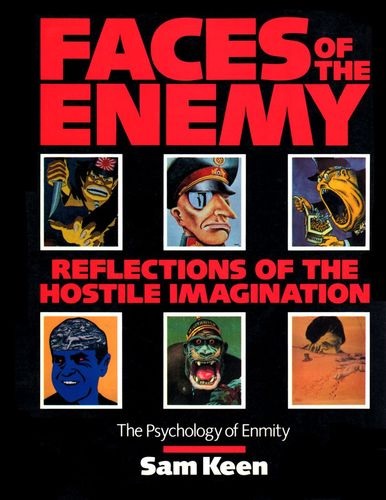
Saturday Matinee: Faces of the Enemy

Description from California Newsreel:

As relevant today as when it was first released, Faces of the Enemy follows social psychologist Sam Keen as he unmasks how individuals and nations dehumanize their enemies to justify the inhumanity of war.

Using archival news footage, public service announcements, and editorial cartoons, Keen unveils the same frightening pattern in conflict after conflict – World War II, the Vietnam War, the Cold War, Islamic and Christian Fundamentalism – and prefigures the current War on Terrorism. First we identify ourselves as victims. Then we blame, demonize and finally dehumanize our adversaries, rationalizing our murder of other human beings.

Faces of the Enemy contends that before a drop of blood is spilled we must ‘think each other to death.’ It is a story replayed on the nightly news, in Islamic Fundamentalists’ characterization of the West as the ‘Great Satan’ and our own stereotyping of Muslims as terrorists. In a revealing examination of the images and iconography of war Keen interviews the nation’s leading editorial cartoonists. They discuss how they use an almost universal language of stereotypes and prejudices to tap into readers’ most visceral emotions.

In a chilling example of the psychological roots of enmity, we meet David Rice, an unemployed welder now an inmate on Death Row. Influenced by far-right propaganda, Rice decided communism was responsible for his personal problems. He bludgeoned to death a family of four whom he (mistakenly) thought were communists. He remains without remorse regarding them as ‘collateral damage’ in a war against the Evil Empire. The Christian Fundamentalist leaders who inspired Rice are only too happy to explain that they are in a holy war against communists and any non-believers.

By contrast, William Broyles, a Viet Nam veteran and author, returned after the war to personalize the individuals who had been his enemies’ to humanize the abstractions. He explains how racist terms and images can be used to turn human beings into monsters. These epithets and images extend the circumstances of war into terrible brutality. But he also explains how we can move beyond these dehumanizing thoughts and seek out the humanity of others.

Psychologists Robert Lifton and Steven Kull explain how war and artificial enemies provide people with the moral and mental certainties they crave, giving them a sense of purpose in a sometimes-ambiguous world. Mythologist Joseph Campbell, providing a note of hope, suggests that underneath the mask of the enemy we ultimately recognize ourselves. This, Campbell further contends, may be the origin of compassion, brotherhood and altruism, in other words the inverse of war.


Watch the full film on Kanopy.

The Forgotten Past Will Always be Repeated

By Robert Fantina

Source: CounterPunch

“Those who cannot remember the past are condemned to repeat it.” So said George Santayana.

It is difficult today to look at many, many situations in the world and not see some of the worst events in history being repeated, especially as they relate to racism and genocide. Has the world forgotten Nazi atrocities against Jews, Gypsies, intellectuals and others? Do we not remember the horrific U.S. bombing of two Japanese cities? Are Churchill’s colonial atrocities no longer worth considering?

We will review some of the most egregious events unfolding in front of us today.

Israel: This racist, apartheid state, which, for over 70 years has brutally oppressed the Palestinian people, this year declared itself the nation-state of the Jewish people, and only the Jewish people. Yet 25% of people who live within the borders of the Zionist entity are not Jewish. And despite marginalizing fully one-quarter of its residents, and relegating them to second-class citizen status, government spokespeople have the nerve to proclaim Israel as a democracy.

And what international outrage does this bring? Despite flagrant and constant violations of international law, not to mention common human decency, most of the countries of the world either ignore it all, or issue gentle rebukes, at best. And the world’s media seldom reports on it.

Myanmar: For several years now, the repression and expulsion of the Rohingya people has been ongoing government policy. A United Nations study of August 2018 found evidence of widespread violations of human rights. As of that date, nearly three-quarters of a million Rohingya people have had to flee their homeland due to the brutal persecution they have experienced. The U.N. study stated that military abuses of the Rohingyas “undoubtedly amount to the gravest crimes under international law.” Yet, like Israel’s brutal oppression of the Palestinians, this gets little press in North America.

India: Earlier this year, the government of India revoked Article 370 in the constitution that allowed occupied Kashmir some limited autonomy. Since that time, tens of thousands of Indian troops have stormed into Kashmir, communications with the outside world have been cut, and news media personal are forbidden from entering. The death toll from this recent repression is unknown. Government officials have publicly announced plans to colonize Kashmir using the same model of land confiscation and illegal settlement construction that Israel has used for decades against Palestine. Again, one listens in vain for international opposition to these crimes against humanity.

Additionally, India has now passed a law easing the path for citizenship for many refugees, but making immigration by Muslims more difficult. This has caused widespread protest demonstration throughout India, which are being met with police violence.

Saudi Arabia: That nation’s brutal onslaught against the people of Yemen continues, with the Yemeni death toll in the thousands and constantly rising. A bill passed by the U.S. Congress to prevent the U.S. from selling more weaponry to Saudi Arabia (the largest buyer of weapons from the U.S.) for use in Yemen was vetoed by President Donald Trump, thus enabling the continued slaughter of the Yemenis.

United States: Undergirding all this is the United States. That nation provides huge amounts of financial support to apartheid Israel, as well as protecting it from the legitimate consequences of its action on the international stage. Government spokespeople talk of ‘monitoring’ the situation in Myanmar, and have been mainly silent about India.

But the U.S. remains busy: its decades-long sanctions against Cuba remain. Following some easing of restrictions during the administration of President Barack Obama, Trump has re-issued them all. His sanctions against Iran, in violation of the Joint Comprehensive Plan of Action (JCPOA) and international law are causing great hardship for the people there. The U.S. supports the overthrow of the governments of Venezuela, issuing cruel sanctions against that country, and Syria, going so far as to actually arm, equip and train anti-government terrorist groups in the country, where, due largely to U.S. interference, hundreds of thousands of people have died, and hundreds of thousands more have been injured and left homeless. U.S. brutality toward the Yemenis has been mentioned above. The U.S. was involved in the recent overthrow of the Bolivian government.

Yet as recently as this week, U.S. Secretary of State Mike Pompeo proclaimed that the U.S. supports the right of people everywhere to self-determination. He said this when announcing additional sanctions against Iran, the irony of it certainly being lost on him and Trump. Self-determination is all well and good in the eyes of the U.S. government, as long as certain conditions are met: the form of government the people select must not be socialist; it must be a government that will do the U.S.’s bidding; it must not be a government that thinks its country’s natural resources are its own; it must not question or oppose Israel in any way, and it must not put its people before U.S. corporate profits. It must, in all ways and at all times, be willing to do its part to satisfy the U.S.’s geo-political goals.

As we look at the results of forgetting, or not learning from, history, we should ask an important question: When similar behaviors, perpetrated by German, Italian and English leaders happened before, what was the result? Additional questions arise: Did Germany succeed in annexing its neighbors? Were Italy and England successful in achieving their political goals? No, the result of such behaviors was a war whose devastation exceeded anything that can be imagined. And it brought the United States into its role as a super-power, which has been detrimental for much of the world.

The U.S. has never been interested in human rights or international law. Those in power in that country have only coveted riches, and have been, and are, willing to obtain them in any way possible, regardless of how much blood must flow. And that blood can be of innocent men, women and children in a far-off country, or of its own citizens who it sends to war. It will attempt, however futilely, to order the world to its liking. And as people protest, all possible efforts will be made to crush them.

One thing the U.S. and many other nations have failed to learn is that people will only be able to tolerate the thwarting of their legitimate aspirations for a limited amount of time: they will not allow it to go on forever. Working to genuinely assist them will make more friends and allies, and ultimately be far more beneficial for the world than opposing them and oppressing them ever will.

Until the U.S. and other powerful nations learn this vital lesson, the suffering they cause will be unending.

It’s really very simple

By Dmitry Orlov

Source: Club Orlov

There are times when a loud cry of “The emperor has no clothes!” can be most copacetic. And so, let me point out something quite simple, yet very important.

The old world order, to which we became accustomed over the course of the 1990s and the 2000s, its crises and its problems detailed in numerous authoritative publications on both sides of the Atlantic—it is no more. It is not out sick and it is not on vacation. It is deceased. It has passed on, gone to meet its maker, bought the farm, kicked the bucket and joined the choir invisible. It is an ex-world order.

If we rewind back to the early 1980s, we can easily remember how the USSR was still running half of Europe and exerting major influence on a sizable chunk of the world. World socialist revolution was still sputtering along, with pro-Soviet regimes coming in to power here and there in different parts of the globe, the chorus of their leaders’ official pronouncements sounding more or less in unison. The leaders made their pilgrimages to Moscow as if it were Mecca, and they sent their promising young people there to learn how to do things the Soviet way. Soviet technology continued to make impressive advances: in the mid-1980s the Soviets launched into orbit a miracle of technology—the space station Mir, while Vega space probes were being dispatched to study Venus.

But alongside all of this business-as-usual the rules and principles according which the “red” half of the globe operated were already in an advanced state of decay, and a completely different system was starting to emerge both at the center and along the periphery. Seven years later the USSR collapsed and the world order was transformed, but many people simply couldn’t believe in the reality of this change. In the early 1990s many political scientists were self-assuredly claiming that what is happening is the realization of a clever Kremlin plan to modernize the Soviet system and that, after a quick rebranding, it will again start taking over the world. People like to talk about what they think they can understand, never mind whether it still exists.

And what do we see today? The realm that self-identifies itself as “The West” is still claiming to be leading economically, technologically, and to be dominant militarily, but it has suffered a moral defeat, and, strictly as a consequence of this moral defeat, a profound ideological defeat as well.

It’s simple.

1. How can they talk of the inviolability of private property while confiscating the savings of depositors in Cypriot banks?

2. How can they talk of safeguarding the territorial integrity of countries while destroying, in turn, Yugoslavia, Iraq, Libya, Syria and Ukraine?

3. How can they talk of free enterprise and then sign contracts to build ships but refuse to deliver them because of pressure from Washington, as happened with Mistral ships which Russia ordered from France?

4. How can they talk of democracy and then use naked threats against the premier of Greece—the birthplace of European democracy—forcing him to ignore the unprofitable results of the Greek national referendum?

5. How can they talk about fighting racism while in the US they are constantly shooting mass quantities of unarmed Negros, all the while forbidding people to call them Negros.

6. How can they accuse the Serbs of genocide while refusing to acknowledge what they did to supposedly “independent” Kosovo, which has been turned into a European criminal enclave specializing in the production and distribution of narcotics?

7. How can they claim to oppose extremism and terrorism while training, arming and financing ISIS and the Ukrainian Neo-nazis?

8. How can they talk about justice while the US maintains the largest prison population in the history of the world and has executed many people subsequently discovered to have been innocent?

9. How can they talk about freedom of religion after the US federal government exterminated the Branch Davidians in Waco, Texas, and then imprisoned the survivors, even though the government’s allegations against the sect have subsequently been proven to be false?

10. How can they accuse others of corruption after the colossal financial embarrassment of 2008, in the run-up to which obvious financial bubbles that were ready to bust were assigned the highest ratings?

What has happened is the worst thing that could have possibly happened: in full view of the entire world, “Western values” have been demonstrated to be null and void.

If you think that these are just some specific examples of difficulties or mistakes that could potentially be overcome in some dim and foggy future, then you are wrong: this is all of the “Western values” worth mentioning, and they have all been invalidated by observation. Note the past tense: they already have been invalidated. Are there any “Western values” left intact? Oh yes, just one: the rights of sexual minorities. But it is not possible to maintain Western civilization on the strength of gay marriage alone.

Is it any wonder then that the rest of the world is trying to put as much distance between itself and the morally bankrupt “West” as it possibly can, as quickly as it can? China is working on developing its own model, Russia is striving for self-sufficiency and independence from Western imports and finance, and even Latin America, once considered the backyard of the US, is increasingly going its own separate way.

The ranks of the fools who are still buying the West’s story are shrinking, while the ranks of the rebels are growing. There is the truth-teller Edward Snowden, who was forced to flee to Moscow to avoid persecution back home. There are European parliamentarians who recently broke ranks and visited Crimea. There are French and German military men who are volunteering to defend Eastern Ukraine against Western attack. There are the many European businessmen who came to the Economics Forum in St. Petersburg to sign trade deals with Russia, never mind what their politicians think of that.

On the other side, the rapidly emerging new world order was recently on display in Ufa, capital of the majority-Moslem Republic of Bashkortostan in Southern Urals, Russian Federation. Leaders of more than half the world’s population came there to sign deals, integrate their economies, and coordinate security arrangements. India and Pakistan set their differences aside and walked in through the door at the same time; Iran is next. “The West” was not represented there.

Now that all Western values (other than the rights of sexual minorities) have been shown to be cynical exercises in hypocrisy, there is no path back. You see, it is a matter of reputation, and a reputation is something that one can lose exactly once. There is a path forward, but it is very frightening. There is the loss of control: Western institutions can no longer control the situation throughout much of the world, including, in due course, on their own territory. There is the abandonment of the Western narrative: Western pontificators, pundits and “thought leaders” will find that their talking points have been snatched away and will be reduced to either babbling apologetically or lapsing into embarrassed silence. Finally, there is the loss of identity: it is not possible, for the non-delusional, to identify with something (“The West”) that no longer exists.

But the most frightening thing of all is this: behind a morally bankrupt civilization there are morally bankrupt people—lots and lots of them. Their own children, who will be forced to make their way in the world—however it turns out to be—will be as disrespectful of them as they were of their own vaunted civilizational values.

When the state is unjust, citizens may use justifiable violence

By Jason Brennan

Source: aeon

If you see police choking someone to death – such as Eric Garner, the 43-year-old black horticulturalist wrestled down on the streets of New York City in 2014 – you might choose to pepper-spray them and flee. You might even save an innocent life. But what ethical considerations justify such dangerous heroics? (After all, the cops might arrest or kill you.) More important: do we have the right to defend ourselves and others from government injustice when government agents are following an unjust law? I think the answer is yes. But that view needs defending. Under what circumstances might active self-defense, including possible violence, be justified, as opposed to the passive resistance of civil disobedience that Americans generally applaud?

Civil disobedience is a public act that aims to create social or legal change. Think of Henry David Thoreau’s arrest in 1846 for refusing to pay taxes to fund the colonial exploits of the United States, or Martin Luther King Jr courting the ire of the authorities in 1963 to shame white America into respecting black civil rights. In such cases, disobedient citizens visibly break the law and accept punishment, so as to draw attention to a cause. But justifiable resistance need not have a civic character. It need not aim at changing the law, reforming dysfunctional institutions or replacing bad leaders. Sometimes, it is simply about stopping an immediate injustice­. If you stop a mugging, you are trying to stop that mugging in that moment, not trying to end muggings everywhere. Indeed, had you pepper-sprayed the police officer Daniel Pantaleo while he choked Eric Garner, you’d have been trying to save Garner, not reform US policing.

Generally, we agree that it’s wrong to lie, cheat, steal, deceive, manipulate, destroy property or attack people. But few of us think that the prohibitions against such actions are absolute. Commonsense morality holds that such actions are permissible in self-defense or in defense of others (even if the law doesn’t always agree). You may lie to the murderer at the door. You may smash the windows of the would-be kidnapper’s car. You may kill the would-be rapist.

Here’s a philosophical exercise. Imagine a situation in which a civilian commits an injustice, the kind against which you believe it is permissible to use deception, subterfuge or violence to defend yourself or others. For instance, imagine your friend makes an improper stop at a red light, and his dad, in anger, yanks him out of the car, beats the hell out of him, and continues to strike the back of his skull even after your friend lies subdued and prostrate. May you use violence, if it’s necessary to stop the father? Now imagine the same scene, except this time the attacker is a police officer in Ohio, and the victim is Richard Hubbard III, who in 2017 experienced just such an attack as described. Does that change things? Must you let the police officer possibly kill Hubbard rather than intervene?

Most people answer yes, believing that we are forbidden from stopping government agents who violate our rights. I find this puzzling. On this view, my neighbours can eliminate our right of self-defense and our rights to defend others by granting someone an office or passing a bad law. On this view, our rights to life, liberty, due process and security of person can disappear by political fiat – or even when a cop has a bad day. In When All Else Fails: The Ethics of Resistance to State Injustice (2019), I argue instead that we may act defensively against government agents under the same conditions in which we may act defensively against civilians. In my view, civilian and government agents are on a par, and we have identical rights of self-defense (and defense of others) against both. We should presume, by default, that government agents have no special immunity against self-defense, unless we can discover good reason to think otherwise. But it turns out that the leading arguments for special immunity are weak.

Some people say we may not defend ourselves against government injustice because governments and their agents have ‘authority’. (By definition, a government has authority over you if, and only if, it can oblige you to obey by fiat: you have to do what it says because it says so.) But the authority argument doesn’t work. It’s one thing to say that you have a duty to pay your taxes, show up for jury duty, or follow the speed limit. It is quite another to show that you are specifically bound to allow a government and its agents to use excessive violence and ignore your rights to due process. A central idea in liberalism is that whatever authority governments have is limited.

Others say that we should resist government injustice, but only through peaceful methods. Indeed, we should, but that doesn’t differentiate between self-defense against civilians or government. The common-law doctrine of self-defense is always governed by a necessity proviso: you may lie or use violence only if necessary, that is, only if peaceful actions are not as effective. But peaceful methods often fail to stop wrongdoing. Eric Garner peacefully complained: ‘I can’t breathe,’ until he drew his last breath.

Another argument is that we shouldn’t act as vigilantes. But invoking this point here misunderstands the antivigilante principle, which says that when there exists a workable public system of justice, you should defer to public agents trying, in good faith, to administer justice. So if cops attempt to stop a mugging, you shouldn’t insert yourself. But if they ignore or can’t stop a mugging, you may intervene. If the police themselves are the muggers – as in unjust civil forfeiture – the antivigilante principle does not forbid you from defending yourself. It insists you defer to more competent government agents when they administer justice, not that you must let them commit injustice.

Some people find my thesis too dangerous. They claim that it’s hard to know exactly when self-defense is justified; that people make mistakes, resisting when they should not. Perhaps. But that’s true of self-defense against civilians, too. No one says we lack a right of self-defense against each other because applying the principle is hard. Rather, some moral principles are hard to apply.

However, this objection gets the problem exactly backwards. In real life, people are too deferential and conformist in the face of government authority. They are all-too-willing to electrocute experimental subjects, gas Jews or bomb civilians when ordered to, and reluctant to stand up to political injustice. If anything, the dangerous thesis – the thesis that most people will mistakenly misapply – is that we should defer to government agents when they seem to act unjustly. Remember, self-defense against the state is about stopping an immediate injustice, not fixing broken rules.

Of course, strategic nonviolence is usually the most effective way to induce lasting social change. But we should not assume that strategic nonviolence of the sort that King practiced always works alone. Two recent books – Charles Cobb Jr’s This Nonviolent Stuff’ll Get You Killed (2014) and Akinyele Omowale Umoja’s We Will Shoot Back (2013) – show that the later ‘nonviolent’ phase of US civil rights activism succeeded (in so far as it has) only because, in earlier phases, black people armed themselves and shot back in self-defense. Once murderous mobs and white police learned that black people would fight back, they turned to less violent forms of oppression, and black people in turn began using nonviolent tactics. Defensive subterfuge, deceit and violence are rarely first resorts, but that doesn’t mean they are never justified.


Jason Brennan is associate professor of strategy, economics, ethics and public policy at Georgetown University. He is the author, together with Peter Jaworski, of Markets Without Limits (2015), and his latest book is When All Else Fails: The Ethics of Resistance to State Injustice (2019).

America Is on the Brink of a Nervous Breakdown

By John W. Whitehead

Source: The Rutherford Institute

“As nightfall does not come at once, neither does oppression. In both instances, there is a twilight when everything remains seemingly unchanged. And it is in such twilight that we all must be most aware of change in the air – however slight – lest we become unwitting victims of the darkness.” ― Supreme Court Justice William O. Douglas

Yet another shooting.

Yet another smear of ugliness, hatred and violence.

Yet another ratcheting up of the calls for the government to clamp down on the citizenry by imposing more costly security measures without any real benefit, more militarized police, more surveillance, more widespread mental health screening of the general population, more threat assessments and behavioral sensing warnings, more gun control measures, more surveillance cameras with facial recognition capabilities, more “See Something, Say Something” programs aimed at turning Americans into snitches and spies, more metal detectors and whole-body imaging devices at so-called soft targets, more roaming squads of militarized police empowered to do more stop-and-frisk searches, more fusion centers to centralize and disseminate information to law enforcement agencies, and more government monitoring of what Americans say and do, where they go, what they buy and how they spend their time.

All of these measures play into the government’s hands.

All of these measures add up to more government power, less real security and far less freedom.

As we have learned the hard way, the phantom promise of safety in exchange for restricted or regulated liberty is a false, misguided doctrine that has no basis in the truth.

Things are falling apart.

When things start to fall apart or implode, ask yourself: who stands to benefit?

In most cases, it’s the government that stands to benefit by amassing greater powers at the citizenry’s expense.

Unfortunately, the government’s answer to civil unrest and societal violence, as always, will lead us further down the road we’ve travelled since 9/11 towards totalitarianism and away from freedom.

With alarming regularity, the nation is being subjected to a spate of violence that not only terrorizes the public but also destabilizes the country’s fragile ecosystem, and gives the government greater justifications to crack down, lock down, and institute even more authoritarian policies for the so-called sake of national security without many objections from the citizenry.

Clearly, America is being pushed to the brink of a national nervous breakdown.

This breakdown—triggered by polarizing circus politics, media-fed mass hysteria, racism, classism, xenophobia, militarization and militainment (the selling of war and violence as entertainment), a sense of hopelessness and powerlessness in the face of growing government corruption and brutality, and a growing economic divide that has much of the population struggling to get by—is manifesting itself in madness, mayhem and an utter disregard for the very principles and liberties that have kept us out of the clutches of totalitarianism for so long.

Yet there is a method to this madness.

Remember, authoritarian regimes begin with incremental steps. Overcriminalization, surveillance of innocent citizens, imprisonment for nonviolent—victimless—crimes, etc. Bit by bit, the citizenry finds its freedoms being curtailed and undermined for the sake of national security. And slowly the populace begins to submit.

No one speaks up for those being targeted.

No one resists these minor acts of oppression.

No one recognizes the indoctrination into tyranny for what it is.

Historically this failure to speak truth to power has resulted in whole populations being conditioned to tolerate unspoken cruelty toward their fellow human beings, a bystander syndrome in which people remain silent and disengaged—mere onlookers—in the face of abject horrors and injustice.

Time has insulated us from the violence perpetrated by past regimes in their pursuit of power: the crucifixion and slaughter of innocents by the Romans, the torture of the Inquisition, the atrocities of the Nazis, the butchery of the Fascists, the bloodshed by the Communists, and the cold-blooded war machines run by the military industrial complex.

We can disassociate from such violence.

We can convince ourselves that we are somehow different from the victims of government abuse.

We can continue to spout empty campaign rhetoric about how great America is, despite the evidence to the contrary.

We can avoid responsibility for holding the government accountable.

We can zip our lips and bind our hands and shut our eyes.

In other words, we can continue to exist in a state of denial.

Whatever we do or don’t do, it won’t change the facts: the nation is imploding, and our republic is being pushed ever closer to martial law.

As Vann R. Newkirk II writes for the Atlantic:

Trumpism demands that violence be solved by local militarization: increased security at schools, the arming of teachers, and now, the adoption of guns in places intended quite literally to be sanctuaries from the scourges of the world. Taken altogether, what Trumpism seems to intend is the creation—or perhaps the expansion—of the machinery of a police state

In facing what appears to be a rising tide of violence—a tide that Trump himself elevates and encourages—the prescription of arms merely capitulates to the demands of that bloodshed. The purpose of political violence and terrorism is not necessarily to eliminate or even always to create body counts, but to disempower people, to spread the contagion of fear, to splinter communities into self-preserving bunkers, and to invalidate the very idea that a common destiny is even possible. Mandates to arm people accelerate this process. They inherently promote the idea that society cannot reduce the global level of harm, and promote the authoritarian impulses of people seeking order.

Where Newkirk misses the point is by placing the blame squarely on the Trump Administration.

This shift towards totalitarianism and martial law started long before Trump, set in motion by powers-that-be that see the government as a means to an end: power and profit.

As Paul Craig Roberts, former Assistant Secretary of the Treasury, recognized years ago, “Adolf Hitler is alive and well in the United States, and he is fast rising to power.”

Roberts was not comparing Trump to Hitler, as so many today are wont to do.

Rather, he was comparing the American Police State to the Nazi Third Reich, which is a far more apt comparison.

After all, U.S. government agencies—the FBI, CIA and the military—have fully embraced many of the Nazi’s well-honed policing tactics and have used them repeatedly against American citizens for years now.

Indeed, with every passing day, the United States government borrows yet another leaf from Nazi Germany’s playbook: Secret police. Secret courts. Secret government agencies. Surveillance. Censorship. Intimidation. Harassment. Torture. Brutality. Widespread corruption. Entrapment. Indoctrination. Indefinite detention.

These are not tactics used by constitutional republics, where the rule of law and the rights of the citizenry reign supreme. Rather, they are the hallmarks of authoritarian regimes, where the only law that counts comes in the form of heavy-handed, unilateral dictates from a supreme ruler who uses a secret police to control the populace.

The empowerment of the Gestapo, Germany’s secret police, tracked with the rise of the Nazi regime in much the same way that the rise of the American police state corresponds to the decline of freedom in America.

How did the Gestapo become the terror of the Third Reich?

It did so by creating a sophisticated surveillance and law enforcement system that relied for its success on the cooperation of the military, the police, the intelligence community, neighborhood watchdogs, government workers for the post office and railroads, ordinary civil servants, and a nation of snitches inclined to report “rumors, deviant behavior, or even just loose talk.”

In other words, ordinary citizens working with government agents helped create the monster that became Nazi Germany. Writing for the New York Times, Barry Ewen paints a particularly chilling portrait of how an entire nation becomes complicit in its own downfall by looking the other way:

In what may be his most provocative statement, [author Eric A.] Johnson says that ‘‘most Germans may not even have realized until very late in the war, if ever, that they were living in a vile dictatorship.’’ This is not to say that they were unaware of the Holocaust; Johnson demonstrates that millions of Germans must have known at least some of the truth. But, he concludes, ‘‘a tacit Faustian bargain was struck between the regime and the citizenry.’’ The government looked the other way when petty crimes were being committed. Ordinary Germans looked the other way when Jews were being rounded up and murdered; they abetted one of the greatest crimes of the 20th century not through active collaboration but through passivity, denial and indifference.

Much like the German people, “we the people” have become passive, polarized, gullible, easily manipulated, and lacking in critical thinking skills.  Distracted by entertainment spectacles, politics and screen devices, we too are complicit, silent partners in creating a police state similar to the terror practiced by former regimes.

Can the Fourth Reich happen here?

It’s already happening right under our noses. Much like the German people, “we the people” are all too inclined to “look the other way.”

In our state of passivity, denial and indifference, here are some of the looming problems we’re ignoring:

Our government is massively in debt. Currently, the national debt is somewhere in the vicinity of $21 trillion. Approximately half of our debt is owned by foreign countries, namely China, Japan and Saudi Arabia.

Our education system is abysmal. Despite the fact that we spend more than most of the world on education, we rank 36th in the world when it comes to math, reading and science, far below most of our Asian counterparts. Even so, we continue to insist on standardized programs such as Common Core, which teach students to be test-takers rather than thinkers.

Our homes provide little protection against government intrusions. Police agencies, already empowered to crash through your door if they suspect you’re up to no good, now have radar devices that allow them to “see” through the walls of our homes.

Our prisons, housing the largest number of inmates in the world and still growing, have become money-making enterprises for private corporations that rely on the inmates for cheap labor.

We are no longer a representative republic. The U.S. has become a corporate oligarchy. As a recent academic survey indicates, our elected officials, especially those in the nation’s capital, represent the interests of the rich and powerful rather than the average citizen.

We’ve got the most expensive, least effective health care system in the world compared to other western, industrialized nations.

The air pollution levels are dangerously high for almost half of the U.S. population, putting Americans at greater risk of premature death, aggravated asthma, difficulty breathing and future cardiovascular problems.

Despite outlandish amounts of money being spent on the nation’s “infrastructure,” there are more than 63,000 bridges—one out of every 10 bridges in the country—in urgent need of repair. Some of these bridges are used 250 million times a day by trucks, school buses, passenger cars and other vehicles.

Americans know little to nothing about their rights or how the government is supposed to operate. This includes educators and politicians. For example, 27 percent of elected officials cannot name even one right or freedom guaranteed by the First Amendment, while 54 percent do not know the Constitution gives Congress the power to declare war.

Nearly one out of every three American children live in poverty, ranking us among the worst in the developed world.

Patrolled by police, our schools have become little more than quasi-prisons in which kids as young as age 4 are being handcuffed for “acting up,” subjected to body searches and lockdowns, and suspended for childish behavior.

We’re no longer innocent until proven guilty.  In our present surveillance state, that burden of proof has now been shifted so that we are all suspects to be spied on, searched, scanned, frisked, monitored, tracked and treated as if we’re potentially guilty of some wrongdoing.

Parents, no longer viewed as having an inherent right to raise their children as they see fit, are increasingly being arrested for letting their kids walk to the playground alone, or play outside alone. Similarly, parents who challenge a doctor’s finding or request a second opinion regarding their children’s health care needs are being charged with medical child abuse and, in a growing number of cases, losing custody of their children to the government.

Private property means little at a time when SWAT teams and other government agents can invade your home, break down your doors, kill your dog, wound or kill you, damage your furnishings and terrorize your family. Likewise, if government officials can fine and arrest you for growing vegetables in your front yard, praying with friends in your living room, installing solar panels on your roof, and raising chickens in your backyard, you’re no longer the owner of your property.

Court rulings undermining the Fourth Amendment and justifying invasive strip searches have left us powerless against police empowered to forcefully draw our blood, forcibly take our DNA, strip search us, and probe us intimately. Accounts are on the rise of individuals—men and women alike—being subjected to what is essentially government-sanctioned rape by police in the course of “routine” traffic stops.

Americans can no longer rely on the courts to mete out justice. The courts were established to intervene and protect the people against the government and its agents when they overstep their bounds. Yet the courts increasingly march in lockstep with the police state, while concerning themselves primarily with advancing the government’s agenda, no matter how unjust or unconstitutional.

Americans have no protection against police abuse. It is no longer unusual to hear about incidents in which police shoot unarmed individuals first and ask questions later. What is increasingly common, however, is the news that the officers involved in these incidents get off with little more than a slap on the hands.

If there is any absolute maxim by which the federal government seems to operate, it is that the American taxpayer always gets ripped off. This is true, whether you’re talking about taxpayers being forced to fund high-priced weaponry that will be used against us, endless wars that do little for our safety or our freedoms, or bloated government agencies such as the National Security Agency with its secret budgets, covert agendas and clandestine activities. Rubbing salt in the wound, even monetary awards in lawsuits against government officials who are found guilty of wrongdoing are paid with taxpayer funds.

Americans are powerless in the face of militarized police. In early America, government agents were not permitted to enter one’s home without permission or in a deceitful manner. And citizens could resist arrest when a police officer tried to restrain them without proper justification or a warrant. Daring to dispute a warrant with a police official today who is armed with high-tech military weapons would be nothing short of suicidal. Moreover, as police forces across the country continue to be transformed into extensions of the military, Americans are finding their once-peaceful communities transformed into military outposts, complete with tanks, weaponry, and other equipment designed for the battlefield.

Now these are not problems that you can just throw money at, as most politicians are inclined to do.

These are problems that will continue to plague our nation—and be conveniently ignored by politicians—unless and until Americans wake up to the fact that we’re the only ones who can change things.

We’re caught in a vicious cycle right now between terror and fear and distraction and hate and partisan politics and an inescapable longing for a time when life was simpler and people were kinder and the government was less of a monster.

Our prolonged exposure to the American police state is not helping.

As always, the solution to most problems must start locally, in our homes, in our neighborhoods, and in our communities.

We’ve got to refrain from the toxic us vs. them rhetoric that is consuming the nation.

We’ve got to work harder to build bridges, instead of burning them to the ground.

We’ve got to learn to stop bottling up dissent and disagreeable ideas and learn how to work through our disagreements without violence.

We’ve got to de-militarize our police and lower the levels of violence here and abroad, whether it’s violence we export to other countries, violence we glorify in entertainment, or violence we revel in when it’s leveled at our so-called enemies, politically or otherwise.

For starters, we’ll need to actually pay attention to what’s going on around us, and I don’t mean by turning on the TV news. That will get you nowhere. It’s a mere distraction from what is really going on. In other words, if you’re watching, that means you’re not doing. It’s time to get active.

Pay attention to what your local city councils are enacting.

Pay attention to what your school officials are teaching and not teaching.

Pay attention to whom your elected officials are giving access and currying favor.

Most of all, stop acting like it really matters whether you vote for a Republican or Democrat, because in the grand scheme of things, it really doesn’t.

While you’re at it, start acting like citizens who expect the government to work for them, rather than the other way around. While that bloated beast called the federal government may not listen to you without a great deal of activism and effort brought to bear, you can have a great—and more immediate—impact on your local governing bodies.

This will mean gathering together with your friends and neighbors and, for example, forcing your local city council to start opposing state and federal programs that are ripping you off. And if need be, your local city council can refuse to abide by the dictates that continue to flow from Washington, DC. In other words, nullify everything the government does that is illegitimate, egregious or blatantly unconstitutional.

Finally, remember that when you strip away all of the things that serve to divide us, we’re no different underneath: we all bleed red, and we all suffer when violence becomes the government’s calling card.

As I make clear in my book Battlefield America: The War on the American People, the oppression and injustice—be it in the form of shootings, surveillance, fines, asset forfeiture, prison terms, roadside searches, and so on—will come to all of us eventually unless we do something to stop it now.

Unless we can learn to live together as brothers and sisters and fellow citizens, we will perish as tools and prisoners of the American police state.

Martial Law By Other Means: Corporate Strangulation of Dissent

By Glen Ford

Source: Black Agenda Report

The ‘hate speech’ trick, in practice, rewards Black people’s occupiers and abusers (the police) and renders voices of protest illegitimate and mute.”

The people that rule the United States are in the third year of a frenzy to blame Russia and its “trolls,” “dupes,” and witting or unwitting “colluders” – including a sitting president – for racial conflicts, eroding respect for public institutions and a general social breakdown in the nation. “We are at war!” they scream, incessantly, in a thousand well-placed voices. The relentless barrage of war-talk crowds out all other subjects in the corporate media — the Omnipresent Voice of Oligarchy — including the actual wars waged all across the globe by the U.S. and its shrinking gaggle of allies.

By now, 65 percent of Americans — if asked — tell pollsters they think Russia “interfered” in the 2016 elections. According to an NBC/Wall Street Journal poll  released late last month, 41 percent believe that whatever the Russians did had some effect on the election, and 30 percent think Hillary Clinton would be president if the Russians had not interfered.

“The relentless barrage of war-talk crowds out all other subjects in the corporate media — including the actual wars.”

People don’t volunteer these opinions; the question is presented by the pollsters and respondents select an answer among the multiple choices offered. However, a Gallup poll , taken during the same period, that allowed respondents to offer their own list of problems besetting the nation showed that less than one percent thought “the ongoing situation with Russia was the top issue.” Immigration was the top problem on people’s minds (22 percent), followed by dissatisfaction with the U.S. government (19 percent), and racism (7 percent). Concerns over “unifying the country,” “lack of respect for each other,” “the economy in general,” “health care,” and the catch-all, “ethics/morality/religious/family decline” rank in the even lower single digits – but almost nobody considers Russia to be a top problem.

Apparently, Americans don’t yet believe that anything like a “Pearl Harbor” has occurred, despite the Herculean efforts of the corporate media, the Democratic Party, old school Republicans, and the National Security State (Spookland). Undeterred, these fevered fomenters of hysteria insist that Russia’s “war” against the United States — aided by a “fifth column” composed of left-wing and right-wing web sites — must be answered by putting the nation on martial footing, through further curbs on freedom of speech and association at home, and relentless pursuit of full spectrum military dominance over all potential adversaries and competitors abroad.

Less than one percent thought ‘the ongoing situation with Russia was the top issue.’”

The oligarch-declared state of war requires that there be one set of “truths” and a common worldview to unite the nation at this time of peril — whether the people perceive such a peril, or not. If there is insufficient public resolve to respond to the “threat” from Moscow and their partners in Beijing, then that is blamed on Kremlin-disseminated disinformation designed to confuse Americans or cause them to lose faith in U.S. institutions, and to fight among themselves – to “hate” each other — thus requiring more censorship.

It is the ruling class that is in panic, and using Russia as an all-purpose foil. The U.S. is in terminal decline, and has already been economically surpassed by China, based on “purchasing power parity,” the standard of measurement preferred even by the U.S dominated International Monetary Fund. According to an analysis by business columnist Noah Smith in Bloomberg , “not only is China already the world’s largest economy, the gap between it and the U.S. can be expected to grow even wider.” Dean Baker , co-director of the Center for Economic and Policy Studies, says “China’s economy is already 25 percent larger than the U.S. economy and is on a path to be almost twice as large in a decade.”

The era of U.S. economic dominance has already ended, and the Potemkin façade of American economic supremacy is only maintained by the U.S. dollar’s artificial status as the main international reserve currency – from which pedestal it will ultimately be toppled, and the imperial era will be over. But this is an historical verdict that the U.S. rulers cannot accept. Having lost the economic capacity to lord over the planet, they must now rely on their military — a terror machine more expensive than most of the rest of the world’s militaries, combined — in a “generational,” twilight battle to preserve the empire. The Lords of Capital cannot imagine a world in which they are not on top. They have chosen permanent, “infinite” war.

Not only is China already the world’s largest economy, the gap between it and the U.S. can be expected to grow even wider.”

On the home front, the ruling class policy is eternal austerity, dictated by the requirements of capitalism at this stage in its decline. It is a horrifically destructive process of corporate consolidation (the big get bigger, devouring each other and everyone else) and the shrinking of the public sphere, through public sector starvation and privation. The job market is restructured, with more and more workers becoming “casual” or “contracted” — the “gig” economy — and millions of others (especially Blacks) made permanently redundant and disposable.

A regime of permanent war and austerity — the fate that both corporate parties plan for us — requires the manufacture and perpetual maintenance of war hysteria, and the methodical suppression of popular demands for economic rescue of the affected classes. It demands Russiagate and the snuffing out of radical dissent. This is not about Hillary Clinton, although she was the presidential choice of the great bulk of the ruling class because she could be trusted to pursue permanent war and austerity. It’s about preserving and serving the oligarchy under capitalism in terminal decline.

“A regime of permanent war and austerity requires the manufacture and perpetual maintenance of war hysteria, and the methodical suppression of popular demands for economic rescue of the affected classes.”

A similar process is underway in Europe, where the welfare state is besieged by the ruling bankers and corporate chiefs. Some leftish pundits describe the corporate parties’ lashing out at “the left and the right” as an offensive of “the center” — but that’s nonsense. In both the U.S. and Europe, the corporate governments are to the right of the public; they don’t represent some political “center” — they represent only their corporate selves. The corporate leaders of the Democratic Party are positioned way to the right of Democratic voters, and also rightward of the general American pubic on most key economic issues. They are carrying out their corporate duties to preserve and maintain austerity and war.

This compels them to make a spectacle of Russiagate, and to ensure that the show never ends, but takes on new forms of hysteria. And it requires that internet-based dissent be brought to heal, as Hillary would say — even at the cost of billions to one of the top oligarchs, Facebook’s Mark Zuckerberg, who has been mercilessly bludgeoned by his fellow corporatists. Facebook’s political tampering with its algorithms to marginalize left-wing sites like BAR cannot help but suggest that the company also puts its fingers on the scales of the algorithms whose results Facebook sells to advertisers. But Zuckerberg no doubt understands that the purge of “left and right” sites is in the best interest of his class, and has accepted to forgo some profits.

“The corporate leaders of the Democratic Party are positioned way to the right of Democratic voters, and also rightward of the general American pubic on most key economic issues.”

Facebook, Apple, Google, YouTube and Spotify all came down  on right-winger Alex Jones and his Infowars, this week, in what appeared to be a coordinated purge. Although the corporate media have long accused Jones of spreading “disinformation,” he was not purged for telling non-truths. Apple announced that “it does not tolerate hate speech.” Facebook said “false news” was not the issue, but that Jones had violated its policies by “glorifying violence” and “using dehumanizing language to describe people who are transgender, Muslims and immigrants.”

When it comes to “hate,” the high tech oligarchs rely heavily on the Southern Poverty Law Center (SPLC), the Morris Dees – Richard Cohen  legal outfit in Montgomery, Alabama. The Center has a special animus towards Black nationalists, to whom it dedicates a whole page  on its web site. “Most forms of black nationalism are strongly anti-white and anti-Semitic,” the SPLC declares, as if its white, Jewish leadership are expert in the Black American polity. In addition to naming Min. Louis Farrakhan and every Nation of Islam mosque, the site lists a slew of “Black Nationalist Hate Groups,” including book stores, the Black Riders Liberation Party and all its affiliates, various Black Israelites, both halves of the split New Black Panther Party, and the Revolutionary Black Panther Party, as well as the Nuwaubian Nation of Moors. We can assume that these groups’ internet sites and Facebook presence are marked for special attention and future purging.

The Southern Poverty Law Center has a special animus towards Black nationalists.”

But, many more Blacks will be caught up in the “hate speech” net that the high tech monopolists have deployed. Anyone that has gone to protests against killer cops has shouted words that could be deemed hate speech — because we do hate killer cops, and we do hate their armed occupation of our communities, and we have every right to say so among ourselves or to shout it to the world. Black people — and especially Black activists — must be most zealous in defense of free speech, knowing that our speech will be the first to be curtailed and outlawed.

We can expect no defense of Black speech rights from the Black misleadership class, which has always opted to cut off Black lips in order to silence a few white racists’ mouths. In the early Seventies, the Congressional Black Caucus and the Atlanta NAACP tried to get the Federal Communications Commission to ban campaign ads by J.B. Stoner, the arch-racist candidate for one of Georgia’s seats in the U.S. Senate. I argued loudly against attempting to create a “hate speech” standard for the public airwaves, warning that among the first victims of such a standard would be Min. Farrakhan, whose weekly radio program was aired on over 100 Black-oriented radio programs.

“Black people — and especially Black activists — must be most zealous in defense of free speech, knowing that our speech will be the first to be curtailed and outlawed.”

The FCC ruled in J.B. Stoner’s favor in 1972, but it was a good day for Black political speech, too. In the same way, the high tech monopolists’ assault on right-winger Alex Jones under a “hate speech” standard is bad news for Black political speech, and for radical speech. “Hate speech” is a trap. A few months ago, all but eleven members of the Congressional Black Caucus voted to make any assault on police a “hate crime,” thereby giving police the status of a protected class. The “hate speech” trick, in practice, rewards Black people’s occupiers and abusers (the police) and renders voices of protest illegitimate and mute.

We will need every energizing expletive in our vocabularies to mobilize our folks against the racist repression that must accompany the rulers’ plans for permanent austerity and war. We need to hate them very deeply for what they are trying to do to humanity, and to express that hatred at the top of our lungs and in every forum possible.


BAR executive editor Glen Ford can be contacted at Glen.Ford@BlackAgendaReport.com.

Russiagate is a Ruling Class Diversion

By Glen Ford

Source: Black Agenda Report

“Trump supporters see themselves as a distinct and independent force in the nation — the saviors of America, in their diseased minds — and they now hate the Democratic Party in a far deeper way than before.”

So this is what we can look forward to in the long twilight of a shrinking U.S. empire: the shrieks of a delirious ruling class, concocting endless diversions from the central reality of late-stage capitalism’s inability to offer the people anything but widening wars and deepening austerity. The Lords of Capital have led us to a dark yet insanely cacophonous realm, a throbbing madhouse din. “Traitor!” scream the minions of corporate communications, calling for the blood of the corporate government’s orange-branded CEO — a no longer exceptional spectacle for the self-proclaimed exceptional nation.

Donald Trump is, indeed, a kind of traitor to the Washington Consensus, a hyper-militarized capitalist utopia of corporate dominated global supply chains that doubled the international wage-slave workforce in the last two decades of the 20th century and herded these desperate billions into a race to the bottom. The leadership of both corporate parties conspired to force U.S. workers into the global meat-grinder. Democrat Bill Clinton inflicted NAFTA on his party’s wage-earning base and, two decades later, Democrat Barack Obama tried, but failed, to pass the even more devastating Trans Pacific Partnership corporate trade and governance bill. Donald Trump captured the Republican Party by feeding its base the overt racist rhetoric they crave, rather than the more polite “dog whistle” menu cultivated by White Man’s Party politicians since Richard Nixon. With the indispensable assistance of Democrat-oriented corporate media and the Democratic National Committee — both of which saw Trump as the most easily beatable Republican — Trump trounced the entire GOP presidential wanna-be menagerie to seize the reins of half the electoral duopoly, and carried a majority of white voters – including white women — in the general election.

“Global supply chains doubled the international wage-slave workforce in the last two decades of the 20thcentury and herded these desperate billions into a race to the bottom.”

It was not Trump’s flaming racism that made him a traitor to his class and to the empire. One of the U.S. duopoly parties has always played the role of White Man’s Party, with white supremacy as its organizing principle. Were it not for endemic, fervent, nationwide white racism, the most reactionary wing of the U.S. ruling class would have no effective electoral base. Trump simply serves up a stronger brew of white supremacist elixir for the good ole boys and girls. His heresy – precipitating the crisis in ruling class politics — was to rhetorically oppose “free trade” and U.S. “regime change” policies, and to call for normalizing relations with Russia. “Free trade” — a euphemism for the unfettered ability of the ruling class to move money and jobs wherever it chooses on the planet – and the “exceptional” right of U.S. imperialism to remove and replace sovereign governments at will, are the pillars of the Washington Consensus. Donald Trump became anathema to the Lords of Capital and their servants in the national security “deep state,” who crowded into Hillary Clinton’s Democratic tent, where Russiagate was invented out of whole cloth.

Again, racism was not Trump’s unpardonable sin, although it plays into the strategies of the (financial and high tech) ruling class sectors at the helm of the Democratic Party, whose own electoral organizing principle is an anemic anti-racism, a phony politics of “inclusion” that welcomes representatives of minority populations to help enforce the race-to-the-bottom and to join in the general capitalist plunder. Trump’s howling racism was what made Democrats believe he was the ideal candidate for a trouncing by Hillary Clinton, who could be counted on to escalate Barack Obama’s general military offensive and to aggressively pursue TPP and other corporate governance arrangements. (Only fools believed Clinton’s late switch, opposing TPP.) When Clinton lost, the ruling class panicked and resolved to bring down the Orange Menace no matter the cost to U.S. institutions and to the appearance of stability in the very bosom of the empire. The rolling coup was begun.

“Trump’s heresy – precipitating the crisis in ruling class politics — was to rhetorically oppose ‘free trade’ and U.S. ‘regime change’ policies, and to call for normalizing relations with Russia.”

Black folks think the crisis is about race. It is – and it isn’t. If the ruling class, including those that fund and run the Democratic Party, were really concerned about Black people’s rights, they would have challenged Trump’s election victory based on blatant Black voter suppression in key Midwest states. As Greg Palast pointed out, the Republican “Crosscheck” scheme fraudulently and illegally purged 449,000 disproportionately Black voters from the rolls in Michigan, alone — about 40 times larger than Trump’s 10,700-vote margin of victory. Yet, Hillary Clinton and the Democrats only reluctantly joined in Green Party candidate Jill Stein’s recount action, and the first words out of Black Congressman John Lewis’s mouth when the polls closed in November were “Russia…Russia…Russia.” Republicans have been stealing elections through Black voter suppression in broad daylight since 2000, but only one Democratic senator and one congresswoman — California’s Barbara Boxer and Ohio Rep. Stephanie Tubbs Jones, in 2004 – have in this century challenged the thefts . Black voter suppression has been part of the gentlemen’s agreement between the two corporate parties. Rich white people do not plunge the system into crisis for the sake of Black voting rights, or any Black rights at all, including the right to life. But the Lords of Capital will roll the dice on the fate of all humanity to preserve and expand their global dominion and the military machine that is their only remaining advantage. Their survival as a class is at stake. Trump must go because he cannot be depended on to preserve the Washington Consensus — the imperial project.

Republicans have been stealing elections through Black voter suppression in broad daylight since 2000.”

Trump’s racism did factor into the ruling class decision to oust him from the White House, but not in the way that most people believe. Donald Trump proved that his white base is more enthusiastic to support a candidate that affirms white supremacist “values” (yes, that’s what they value most) than they are about maintaining an aggressive military posture everywhere in the world. They did not blink or budge when Trump denigrated NATO, opposed regime change and U.S. efforts at “nation-building” (a euphemism for prolonged military occupation of other peoples), and called for better relations with Russia. These same voters were presumed to be the most militaristic cohort in the nation, dependable fodder to elect fire-breathing war hawks. But clearly, Trump’s base — composed of a majority of whites – cares more about white supremacy in the U.S. than waging endless wars abroad. And, they either hate “free trade,” or don’t care enough about it either way to abandon their White Man’s President.

The national security state, the military industrial complex and the oligarchs whose interests the empire defends were forced to confront the reality, that their presumed prime constituency was not nearly as gung-ho for war as previously assumed. How, then, to continue the “generational” War on Terror (war of imperial conquest)? Answer: Make Russia a clear and present danger, aided and abetted by “useful idiots” (like BAR), domestically.

Trump still retains the support of his white majority. Most importantly, these white supremacists feel affirmed, as “a people,” by his presence, and what they perceive as Trump’s loyalty to them. They are feeling “Great Again.” And they are reveling in their national strength, as a bloc. That’s why they seem unmovable. This re-energized, aggressively white supremacist, intensely self-aware White Man’s Party will assert its permanent, militant and very large presence in the U.S. political spectrum, no matter what happens to Donald Trump. Other politicians, with billions to spend, will appeal to this majority bloc of whites, after Trump leaves the scene. They see themselves as a distinct and independent force in the nation — the saviors of America, in their diseased minds — and they now hate the Democratic Party in a far deeper way than before, when it was perceived as too concerned with Blacks and other “minorities.” Hillary Clinton turned a new chapter when she called Trump voters “deplorables” — a kind of white trash, but connoting moral degeneracy, transcending financial condition. The “witch-hunt” against Trump is perceived as an elite mob out to lynch the “deplorables” — or, at the least, to decertify them as decent Americans.

“This re-energized, aggressively white supremacist, intensely self-aware White Man’s Party will assert its permanent, militant and very large presence in the U.S. political spectrum, no matter what happens to Donald Trump.”

The Democrats can forget about ever getting back most of these self-aware white supremacist voters, but the establishment corporate Republicans that Trump crushed in winning the GOP nomination will not win back his followers’ allegiance unless they become more like Trump, i.e. more blatantly white supremacist. Which is decidedly not the corporate way, in the 21st century. Thus, corporate America, wedded as it is to a “diversity” doctrine that means little to the masses of Black people but is a red flag to the White Man’s Party “deplorables,” will be forced to identify more publicly with the Democrats, or pretend to be apolitical.

The Trump phenomena — and the resultant ruling class hysteria — has stolen the corporations’ option to pose as “non-partisan” actors in U.S. politics. They are forced deeper into the Democratic camp, creating further contradictions for the “inclusive” party, which must ultimately answer to a more clearly defined — and also more self-aware – constituency of the “left,” most broadly speaking, if it is to preserve the duopoly. This other half of the country, slightly bigger than Trump’s white majority base, is composed of a minority of whites, virtually all Blacks, and large majorities of Latinos and other minorities. It is way to the left of the Democratic Party and roiling with economic demands that the Lords of Capital will not, and cannot, fulfill while keeping on the path of a global race-to-the-bottom and deepening austerity, enforced by endless wars.

“Corporate America, wedded as it is to a ‘diversity’ doctrine that means little to the masses of Black people but is a red flag to the White Man’s Party ‘deplorables,’ will be forced to identify more publicly with the Democrats.”

Therefore, there must be Russiagate hysteria — or some other fictitious obsession — primarily to divert the attentions of the “left” half of the electorate, most of which is broadly social democratic (the Black component is the most left-leaning, and peace-oriented). If the duopoly were to collapse, and the various cohorts of the U.S. political spectrum were reorganized along ideological lines, the two biggest parties would be the Trumpist White Man’s party and a social democratic party with a platform to the left of 2016 Bernie Sanders, with the (rightwing) Democrats and establishment Republicans coming together in an avowedly “centrist” party, the smallest of the three. Space would also be created for more radical and libertarian politics.

The ruling class is determined to prevent such a scenario from occurring, and thus needs a permanent, all-consuming diversion. But the Russiagate hysteria — or something else like it — cannot be maintained indefinitely; U.S. political structures cannot withstand such an institutional assault by the ruling class, itself.

The Lords of Capital are caught in the contradiction. To save the corporate state, they are besieging the corporate state, with no vision or timetable for the outcome.


BAR executive editor Glen Ford can be contacted at Glen.Ford@BlackAgendaReport.com