What You May Not Know About Today’s Economic War

By Phil Butler

Source: New Eastern Outlook

Many people believe the world is spiraling in a downward freefall toward Armageddon. At the same time billions on Earth feel the sting of crippling poverty, sanctions, and austerity imposed by the elites – the numbers of billionaires have risen geometrically. And so have those billionaire’s profits. It’s time we took a closer look at where we stand as of 2018, if we are to be left anything at all to cling to. From the steppes of Russia to the ancient lands of the Minoans, economic terror now reigns.

When I left Germany for Greece several months ago, the common belief there was that the “lazy Greeks” were part of the cause of Deutsche banker discomfort. My neighbors in Germany’s oldest city of Trier honestly believe the bailout of Greece is because Greeks unwilling to work hard. The bitter irony of this believe lies in the fact the average German would melt under the workload of the average citizen here in Heraklion on Crete. As an American what I witnessed in Germany can only be considered a “part-time” employment state. But here in Greece the average person works seven days a week, and usually at more than one job. This microeconomic perception is one that has been implanted by state and corporate controlled media in Germany. There’s a very good reason for this, which I will now explain.

A New Secret Economic Weapon – Organized Failures

The International Monetary Fund, the German and American bankers, the globalist elites who control financial systems in the so-called “west” – they’ve been on a mission since 2008. The “meltdown” of markets when Barack Obama first took office as American president was not some random and chaotic economic mistake. Wall Street and the global markets were turned upside down on purpose. In his book “Secret Weapon”, the CEO of Freeman Global Holdings and a New York Times bestselling author Kevin Freeman presents a persuasive chain of evidence pointing to the fact the crash of September 2008 was the result of a deliberate and well-prepared act of sabotage. Even though the author blames competing governments like China and Iran for what he terms “economic terrorism”, his proofs and theories are correct in so far as the “meltdown” being on purpose. The fact Freeman is founder and chairman of the NSIC Institute, and a Senior Fellow of the Center for Security Policy suggests his work may be a double dealing by the financial community to obscure the real perpetrators. But for my report it’s more important to follow the trail of financial chaos to our financial reality.

Freeman is not alone in his suggestion the economic crisis was a conspiracy. The financial disaster of 2008 costs Americans nearly $20 trillion dollars, as framed in this Forbes piece by investment banker and former Forbes editor, Robert Lenzner. In the report the financial guru inadvertently points the finger at Goldman Sachs and Citigroup, claiming the Greenspan Treasury allowed them to “master their own appetite for profits,” which in turn led to the various collapses that forced the American people to bail out the banks. Lenzner, to his great credit, goes on to describe the lurking dangers for total collapse we still face. But what about Greece, the rest of Eastern Europe, the Germans and the rest of the indebted world? Who can we blame for destroying the futures of a billion people? When I’m done your come to realize the Nazis never lost World War II. Read on.

Win-Win or Lose-Lose for Ukraine

Ukraine was turned into a “scorched Earth” when Hitler’s operation Barbarossa threatened Russia. When the armies commanded by Joseph Stalin during the German Army’s invasion of the Soviet Union in the Second World War destroyed crops and goods in their path, the invaders found nothing to fuel their advance. Today Ukraine is laid waste by an economic Barbarossa where the Russians had no opportunity to defend the steppes. Some will remember Vice President Joe Biden’s son taking a position to reap Ukrainian energy benefits. Other readers may recall when a Franklin Templton investment fund, one controlled by the Rothschild bankers, bought up 20% of Ukraine’s debts at junk bond prices. You see, the US orchestrated situation in Ukraine is not simply about events on the Maidan and the ongoing war in the Donbass as a byproduct of the geopolitics of the United States seeking to cut off Ukraine from Russia. Agri-giant Monsanto and other GMO companies had targeted Ukraine long before the events on Maidan Square, and the fact Ukraine is a Central hub in the supply of Russian gas to Europe cannot be under-stressed. Where foreign profiteering in Ukraine is concerned, this story on my blog tells of an Oakland Institute report where more than 1.6 million hectares of land in Ukraine went under the control of foreign-based corporations. This quote from the report makes my case for economic terrorism by the west for me:

“International financial institutions swooped in on the heels of the political upheaval in Ukraine to deregulate and throw open the nation’s vast agricultural sector to foreign corporations….Monsanto, Cargill, and DuPont, and how corporations are taking over all aspects of Ukraine’s agricultural system.”

These stories were more than two years ago. Today we see the catastrophic effects of the Euromaidan far from the battle front and the Donbass region’s pro-Russian separatists.

When I first learned that the forests in the Ukrainian Carpathians were being chopped to the ground back in 2016, the impending ecological disaster perpetrated by these globalist blood suckers hit home hard. This Counterpunch story tells the tale of a brand of liberty and democracy no Ukrainian can afford. Despite the aerial photos and other proofs Ukraine’s forests were being stolen from under the people, the Lviv Regional Forestry and Hunting Agency denied all such reports in customary Eastern European mafia form. The fact is, the Petro Poroshenko assisted in selling out Carpathian forests. Ecologists now predict an ecological Armageddon for western Ukraine. These photos from Censor.net prove the disaster in progress. This RT story on the firesale by the Poroshenko regime of 22 out of 34 state assets being put up for sale at a 60 percent discount leads us into the Greece situation, where the legacy of a people is up for grabs.

Those lazy Greeks! Funny, I just walked around the corner to the bakery here in Heraklion to get a coffee from the same lady I get coffee from every day. She was there Christmas, and I am sure she’ll be there behind the counter New Year’s Eve and New Year’s Day. The shopkeeper across the street, he sees Alexis Tsipras on TV and shoves an open hand toward Greece’s Prime Minister shouting; “Malaka!”, which can only be translated coldly as “jerk-off”. Also in the hotel lobby, at the donut house in the city center, and at each-and-every shop along Heraklion’s many retail districts, Greece officials are all Malakas (in ancient Greek – mentally ill) or worse. I’ll bet most Germans don’t know or care to know that the VAT in Greece is now 24%, and that the average shopkeeper pays 37% – 45% in income tax on top of the VAT for the goods they purchase. As crazy as it sounds though, Cretans are still especially friendly toward foreigners like me. If they only know what the German and American bankers did to them.

The Greece Fire Sale – A Tsipras Sellout

I just made a report about the great Greek sellout of privatization on my travel news site Argophilia Travel News this morning. Researching it prompted me to do this piece for NEO. The long and short of the Greek economic crash that was assisted by none other than Goldman Sachs, is that the same privatization the globalists had in store for Russia during the Yeltsin years is being exacted on Greeks. The latest sellout by Tsipras, who swore he’d end privatization, the Germans and Americans snapping up the Thessaloniki Port and the future of LNG shipments to Europe through Greece. I found it interesting that one of the principals in this sale, South Europe Gateway Thessaloniki (SEFT) Limited Director, Alexander von Mellenthin Has a distinguished German name. I’m not certain, but I believe he is a close relative of both General of the artillery, Horst Alexander, Alfred Paul von Mellenthin, and his brother, Major General Friedrich Wilhelm von Mellenthin, who served as Hitler’s chief of staff of the XXXXVIII Panzer Corps in the occupied Soviet Union, including the Battle of Kursk, the Battle of Kiev, and the spring 1944 retreat through the western Ukraine. The term “irony” will simply not do if Mellenthin is the son or grandson of a key Nazi general. Financial Blitzkrieg, Financial Armageddon, and the Fourth Reich finalizing the rape of Greece! Wow.

Regardless of whether or not the kin of old Nazis are expanding the Fourth Reich or not, the fact the European Commission, the International Monetary Fund and the European Central Bank have insisted on Greek and other privatization schemes as a condition for much-needed loans for bailouts is a smoking gun held by the same elites who always fuel wars. The fallacy of the “lazy Greek” lives on because of those who would reap the vast financial rewards of yet another deconstructed economy. It’s no coincidence that the Greek privatization plan’s administrator — the Hellenic Republic Asset Development Fund (TAIPED) — so closely resembles Germany’s Treuhandanstalt, or the agency charged with the privatization of East Germany’s state-owned enterprises following unification. Few readers will recall Treuhandanstalt being accused of turning over to West German big business hundreds of billions of Deutsche Marks in national property for little or nothing. And, though a number of Treuhandanstalt managers were ultimately indicted for corruption and embezzlement, this brand of pillaging has escalated in the Greece situation. There was even a plan back in 2014 to convert much of Greece’s protected coastal areas into “composite tourist villages,” a move which would essentially privatize every inch of valuable Greek seaside. Former Greek Finance Minister, Yanis Varoufakis called the Treuhandanstalt-like plan for Greece “an abomination” in this Huff Post piece. Varoufakis, who resigned on principle from the Tsipras administration, goes on to frame the Greek debt debauchery, describing the real IMF scheme:

“The plan is politically toxic, because the fund, though domiciled in Greece, will effectively be managed by the troika. It is also financially noxious, because the proceeds will go toward servicing what even the IMF now admits is an unpayable debt. And it fails economically, because it wastes a wonderful opportunity to create homegrown investments to help counter the recessionary impact…”

Yanis Varoufakis proposed to the Germans and the Rothschild bankers of Luxembourg and Frankfurt a Greek plan for repayment of the staggering debt the Goldman Sachs bankers helped usher into Greece. But the IMF and the new Reich refused, of course. His plan was for Greece to cooperate via its own newly formed central holding company for some Greek assets. The IMF and the banksters would have nothing of it, they needed complete control of what, and for how much Greece was to be auctioned off. Tsipras betrayed his country, and the only decent politician the Greeks have had in decades stepped down.

Seeking Happiness Beyond Neo-Liberal Consumerism

(Photo by Chris Hondros/Getty Images)

By Graham Peebles

Source: Dissident Voice

Irrespective of nationality, religion, race, or gender; whether stinking rich, desperately poor, or somewhere in between, happiness is the one thing everyone is seeking – consciously or not.

The architects of the socio-economic system in which we live have devised a system that promises to satisfy this yearning. But instead of building a society at ease with itself, full of peaceful, happy people, collective discontent is fed, resulting in a range of mental health issues, and in some cases, suicide.

Happiness, according to the duplicitous devotees of Neo-Liberalism, is to be found in the homogenous shopping centers of the world, the sterile holiday resorts and brash casinos. In things, in products and services that stimulate and excite: Happiness in this perverse paradigm has been replaced by pleasure, love exchanged for desire, choice substituted for freedom.

Echoes of happiness

Happiness that lasts is what we yearn for, not a transient state in which one feels the tingle of happiness for a moment or so, only to see it evaporate as the source of our happiness loses its appeal, or is exhausted — the holiday comes to an end, a relationship breaks up, the gamble doesn’t pay off, a new I-Phone or handbag hits the high street making the old one redundant etc., etc. We sense that a state of lasting happiness is possible but know not where it is or how to find it. The mistake commonly made, and one we are constantly encouraged to make, is to search for happiness within the sensory world where all experiences, pleasant or unpleasant, are facile and transient. The inevitable consequence of such shallow encounters with happiness is discontent and frustration.

Despite being repeatedly confronted with disappointment, instead of refraining from this never-ending quest, the searcher becomes increasingly desperate; a new relationship may be sought, a change of job or new home, more shopping outings, dinners planned, alcohol and drugs taken and so on into the darker reaches of sensory satisfaction and hedonistic indulgence.

Of course, it is important to enjoy life, and, yes, something resembling happiness is experienced on these excursions, but it is a happiness dependent on something, other people, and on certain elements being in place: take these away and the “happiness” very quickly evaporates. Such happiness is a mere echo of ‘True Happiness’, and one that carries with it conflict, fear and anxiety; this taste of happiness, functioning via the desire principle and the medium of the senses is relentlessly stoked by the exponents of neo-liberal idealism.

The success of their divisive project; i.e., profitability, growth, development, progress, call it what you will, is totally contingent on consumerism and the act of consuming relies on, and is the result of, perpetual desire. To their utter shame, despite having a responsibility to create the conditions in which ‘True Happiness’, can be experienced, most, if not all governments collude with corporate man/woman to promote the unhealthy, materialistic values that are the source of unhappiness.

Desire is constantly agitated through advertising, television, film and print media; fantastical, sentimental, idealized images, of not just where happiness lies, but what love looks like, are pumped around the world every minute of every day. The aim of this extravagant pantomime is to manipulate people into believing they need the stuff that the corporate-state is selling in order to be happy. But happiness cannot be found within the world of sensations, pleasure yes, but not happiness, and pleasure will never fill the internal void that exists and is perpetuated through this movement into materiality. Pleasure is not happiness, nor does it bring lasting happiness, at best it creates a false sense of relief from unhappiness and inner conflict, a momentary escape before dissatisfaction and desire bubble up again.

Cycles of discontent

Nothing but discontent is to be found within this endless cycle of desire, temporary satisfaction, and continued longing. It is an insatiable, inherently painful pattern that moves the ‘Seeker of Happiness’ further and further away from the treasure he or she is searching for, creating disharmony and conflict, for the individual and society. Add to this polluted landscape competition and inequality and a cocktail of division and chaos emerges: Competition between individuals and nations separates and divides, working against humanity’s natural inclination towards cooperation, sharing and tolerance; qualities that were crucial in the survival of early man.

Competition fosters ideas of superiority and inferiority, and together with conformity, an image of ‘success’ and ‘failure’, of beauty, and what it means to be a man or a woman, particularly a young man or young, is projected and thrust into the minds of everyone from birth. One of the effects of this is the tendency towards comparison, leading to personal dissatisfaction (with myriad symptoms from self-harming to addiction and depression), and the desire, or pressure, to conform to the presented ideal.

At the root of these interconnected patterns of discontent and misery, lies desire. Desire not just for pleasure, but desire for things to be other than they are; it is this constant movement of desire that creates unhappiness and deep dissatisfaction. If desire is the obstacle to happiness, then all desire needs to be negated, including the desire for happiness. Perhaps the question to be addressed then is not what will bring lasting happiness, but how to be free of unhappiness and discontent.

In ancient Greece, where life was hard and happiness was widely believed to be reserved for those rare individuals whom the Gods favoured, Socrates (470 BC – 399 BC) proposed that happiness could be attained by everyone by controlling their hedonistic desires, turning their attention towards the soul and by living a moral life. His view finds its root in the teachings of the Buddha, who, almost 100 years earlier had made clear in the Second Noble Truth, that far from bringing happiness, desire is, in fact, the cause of all suffering, and further, that freedom from suffering and unhappiness is brought about when desire is overcome.

True Happiness is an aspect of our natural self. It will not be found within the world of pleasure and material satisfaction, comfort and indulgence. It is an inherent part of who and what we are, and in principle at least, the possibility of unshakable happiness exists for everyone, everywhere, irrespective of circumstances.

Perpetual Prosperity And The ‘Strategy of Tension’

By Graham Vanbergen

Source: TruePublica

Marco Rubio, the American politician, attorney and former Speaker of the Florida House of Representatives once said; “Every nation on the Earth that embraces market economics and the free enterprise system is pulling millions of its people out of poverty. The free enterprise system creates prosperity, not denies it.”

Statements such as these are common amongst politicians, especially wealthy ones who hold wealth driven values. But one man’s prosperity is another man’s misery in a world blighted by an economic model that demands eternal growth.

The only one constant that sits well with this model is that world population continues to increase, but even that is tailing off. Global population currently sits at 7.5 billion and rising at a rate of 80 million per year. The rate of population increase was 2.19 percent at its peak in 1963, which has now halved.

Concerns of the Fourth Industrial Revolution fusing the physical, digital and biological worlds, and impacting all disciplines, economies and industries emanate from the corporations who now see their future declining revenue potential being rescued through reduced reliance on human labour.

Get Briefed, Get Weekly Intelligence Reports – Essential Weekend Reading – Safe Subscribe

Subscribe!

To keep prosperity on a perpetual upward trajectory in the backdrop of a continually shrinking and less well off consumer base, the most politically influential now work in concert with the corporate behemoths – the new rulers of the world.

The strategies adopted to keep the ball rolling over the last few decades centre around a financial architecture that requires drastic anti-democratic political support. As Noam Chomsky warns “The very design of neoliberal principles is a direct attack on democracy.

One does not have to look far to see these principles at work. Trillions of desperately needed taxes to support a decaying system of civil society are illegally offshored by household named corporations and individuals. Unfortunately, this form of extreme neoliberalism still isn’t enough to keep the ball rolling.

Naomi Klein’s 2007 book ‘Shock Doctrine, the rise of Disaster Capitalism’ exploded the myth that the global free market triumphed democratically. Klein highlights how the “puppet strings behind the world-changing crises and wars of the last four decades is the real story of how America’s “free market” policies came to dominate the world, through the exploitation of disaster-shocked people and countries.”

Then, one year later, Klein’s prognosis saw the 2008 financial crisis offering up more disaster shocked peoples at the global level as neoliberalism wriggled free from the remnants of regulation to reach a new pinnacle for the few and a created an even greater crisis of daily life for the hundreds of millions left behind.

This erroneous ideology delivered little more than world economic stagnation, crippling austerity, peak inequality, a global environmental crisis, the slowest economic recovery in history and monumental debt of every country it infected. This was no mistake, no unforeseen event, that we were told stunned our leaders and their captains.

The problem always existed that extreme wealth was never going to come from a global post-war peace through globalisation – so a ‘strategy of tension’, an Anglo/American innovation, was invented to keep the exploitation model alive.

The actual definition of this strategy is that “Western governments during the Cold War used tactics that aimed to divide, manipulate and control public opinion using fear, propaganda, disinformation, psychological warfare, agents provocateurs, and terrorist actions in order to achieve their strategic aims.

Amongst many, one of those aims was financial domination.

During the closing days of the Cold War, the UK, US and other western governments along with the secret services colluded to engineer terrorist attacks inside Western Europe, to be blamed on Russia. This is now so well documented it needs no elaboration here (1).

However, the objective was always clear. By mobilising public opinion against left-wing parties (and their policies) and legitimising war, capitalism was to be forever invigorated. Ultimately though, this required the denying of national independence movements, mainly in the third world, to fund new forms of Western wealth.

The Cold War, stoked and fuelled by a deliberate strategy of tension gave us ‘Red Russia’ and the potential for nuclear Armageddon. When that ran its course, imaginary foes such as Saddam Hussein and Gaddafi were invented. The war on terror was used as a means to an end. Today, Red Russia is back on the agenda once again.

Dr Nafeez Ahmed, the award winning investigative journalist wrote about this Strategy of Tension:

The immense fear and chaos generated by the impact of this phenomenon throughout Western Europe was instrumental in legitimising the interventionist policies of the Anglo-American alliance throughout the Cold War period. The number of people killed across the third world as a consequence of this militarisation process is shocking, its implications genuinely difficult to absorb.” (2)

Ahmed goes on to say that 12 to 15 million people since WW2 have been sacrificed for this strategy with many millions more suffering as their economies were destroyed and denied the right to restructure whilst Western corporations made fortunes at their ultimate expense.

Dr Daniele Ganser, a Swiss historian who specialises in contemporary history, international politics, covert warfare, resource wars and geo-strategy confirms that this strategy is very much alive and in use to this day.

“What you may have, if you translate our experience from the Cold War to the current day situation, is that a strategy of tension is still being implemented, but this time against Muslims,” Ganser says. “We all know that the west is dependent upon oil, and a pretext is needed to develop more operations in Iran, Iraq etc. We can’t just go there and invade them, so we have to have this idea that they’re trying to kill us, then it’s possible, or at least imaginable that a strategy of tension in which the Muslims are playing the role that the communists played in the Cold War, is happening.”

The result is that the world is facing a new desperate multi-faceted game of thrones – as it morphs into something even more destructive.

Conflict and change is now the new norm. Global peace and domestic security is fading as the world order spirals out of control. This engineered spiral is going to prove to be a disaster for everyone, in what looks a lot like a coming global collapse on every front.

Civil society is now shrouded in a cycle of fear, terrorism, surveillance and experiencing a perpetual loss of rights and liberties as the world order disintegrates.

Today, we are now unable to make reasonable predictions of our near future as war, lawlessness, terrorism and now threats of nuclear annihilation become ever more real.

Even hope is diminishing. People of the West are now so afraid they want to stop perceived threats from foreigners, they want them expelled. Manufactured geo-political tensions have created a migration of people in the 21st century even greater than mankind’s greatest tragedy – the last world war. This is no mistake, no unforeseen event either.

China was once the greatest economic power on earth, followed by India, Britain and then America. Not once has the continent of Africa produced a global GDP exceeding 5% in its history, with 16% of the world’s population.

Having deprived this entire continent any possible chance of progression, a migrant surge is now destabilising the very regions responsible for pillaging it.

Alongside all of these pressures, environmental collapse seems inevitable when extreme capitalism sees natural catastrophic events such as the oil industry viewing melting ice caps as nothing more than an investment opportunity.

America is still fighting wars in the Middle East, threatening China, Iran, Korea, India, and even the European Union. The EU is breaking down into four distinct regions as the fifty-year unity project is visibly disintegrating. Is this just a fight for dwindling resources or something else?

Total global debt is now $227 trillion – or 327 percent of global GDP and something like 45 percent higher than the 2008 apex of the financial meltdown.

The Bank of International Settlements urged just two months ago that policymakers need to press on with rate rises notwithstanding the financial market turbulence it will cause.

The world’s six largest pension saving systems – the US, UK, Japan, Netherlands, Canada and Australia – are expected to reach a $224 trillion gap by 2050, a new study by the World Economic Forum shows. Implosion is its only obvious trajectory as there is nowhere near than amount of money anywhere in the world to plug such a gap as that (3).

Total US household debt surged by $460 billion last year, the sharpest one-year rise ever, with an eye-watering $13 trillion outstanding (4). Britain’s household debt is rising at 10 percent per year, five times the rate of earnings growth and has just surpassed the 2008 level of debt as households struggle to keep afloat (5).

The World Economic Forum has also determined that unemployment, an energy price shock, fiscal crisis, failure of national governance and profound social instability makes up the top five global risks to economic performance (6).

To rid the world of its debt’s, kick-start the world economy and take advantage of the shifting global chess board, some believe conflict is the only consequential route left. NATO’s threats to Russia supported by mass media hysteria only adds to the WEF global risks list.

We have a lot to be fearful of. The fact that any combination of the risk list could happen at the same time in today’s world is no longer the conspiratorial thinking of doom-mongers but the architecture of a strategy that the world has seen before.

Public intellectual Tariq Ali wrote a warning in his 2010 book “The Obama Syndrome: Surrender at Home, War Abroad:

This is the permanent tension that lies at the heart of a capitalist democracy and is exacerbated in times of crisis. In order to ensure the survival of the richest, it is democracy that has to be heavily regulated rather than capitalism.”

Seven years after Ali’s book we are experiencing a never-ending relay of crisis after crisis; democracy under threat, capitalism out of control and the very real threat of facing another human catastrophe.

In his sobering analysis, Professor Ugo Bardi, a professor in Physical Chemistry at the University of Florence and president of the Association for the Study of Peak Oil (ASPO), dissects historical statistics on war to unpick the patterns of the violence of the past. He warns that statistical data suggests we are on the brink of heading into another round of major wars resulting, potentially, in mass deaths on a scale that could rival what we have seen in the early 20th century. This is confirmation indeed that a ‘Strategy of Tension’, controlled or not, is heading towards its ultimate apogee. At this juncture, it is reasonable to conclude we are all in trouble.


(1) Operation Gladio (see Post war creation) https://en.wikipedia.org/wiki/Operation_Gladio

(2) Nafeez Ahmed – Strategy of Tension: http://www.nafeezahmed.com/2007/05/strategy-of-tension.html

( 3 ) Global pension funding gap: https://www.weforum.org/press/2017/05/global-pension-timebomb-funding-gap-set-to-dwarf-world-gdp/

(4) US household debt: https://www.wsws.org/en/articles/2017/02/20/debt-f20.html

(5) UK household debt: http://www.telegraph.co.uk/business/2017/07/31/growing-risk-uk-household-debts-warns-moodys-amid-lending-boom/

(6) World Economic Forum – Global Risks: http://reports.weforum.org/global-risks-2017/global-risks-of-highest-concern-for-doing-business-2017/

Newsletter: From Neoliberal Injustice To Economic Democracy

By Kevin Zeese and Margaret Flowers

Source: Dissident Voice

The work to transform society involves two parallel paths: resisting harmful systems and institutions and creating new systems and institutions to replace them. Our focus in this article is on positive work that people are doing to change current systems in ways that reduce the wealth divide, meet basic needs, ensure sustainability, create economic and racial justice and provide people with greater control over their lives.

When we and others organized the Occupation of Washington, DC in 2011, we subtitled the encampment ‘Stop the Machine, Create a New World’, to highlight both aspects of movement tasks — resistance and creation. One Popular Resistance project, It’s Our Economy, reports on economic democracy and new forms of ownership and economic development.

Throughout US history, resistance movements have coincided with the growth of economic democracy alternatives such as worker cooperatives, mutual aid and credit unions. John Curl writes about this parallel path in “For All the People,” which we summarized in “Cooperatives and Community Work are Part of American DNA.”

Mahatma Gandhi’s program of nonviolent resistance, satyagraha, had two components: obstructive resistance and constructive programs. Gandhi promoted Swaraj, a form of “self-rule” that would bring independence not just from the British Empire but also from the state through building community-based systems of self-sufficiency. He envisioned economic democracy at the village level. With his approach, economics is tied to ethics and justice — an economy that hurts the moral well-being of an individual or nation is immoral and business and industry should be measured not by shareholder profit but by their impact on people and community.

Today, we suffer from an Empire Economy. We can use Swaraj to break free from it. Many people are working to build a new economy and many cities are putting in place examples of economic democracy. One city attempting an overall transformation is Cooperation Jackson in Jackson, Mississippi.

Economic Democracy in response to neoliberalism

In his new book, Out of the Wreckage: A New Politics for an Age of Crisis, George Monbiot argues that a toxic ideology of greed and self–interest resulting in extreme competition and individualism rules the current economic and political culture. It is built on a misrepresentation of human nature. Evolutionary biology and psychology show that humans are actually supreme altruists and cooperators.  Monbiot argues that the economy and government can be radically reorganized from the bottom up, enabling people to take back control and overthrow the forces that have thwarted human ambitions for a more just and equal society.

In an interview with Mark Karlin, Monbiot describes how neolibealism arose over decades, beginning in the 1930s and 40s with John Maynard Keynes, Friedrich Hayek and others, and is now losing steam, as ideologies do. Monbiot says we need a new “Restoration Story.”

We are in the midst of writing that new story as people experience the injustice of the current system with economic and racial inequality, destruction of the environment and never ending wars. Indeed, we are further ahead in creating the new Restoration Story than we realize.

Cooperatives

New research from the University of Wisconsin–Madison’s Center for Cooperatives (UWCC) has found there are 39,594 cooperatives in the United States, excluding the housing sector, and there are 7 million employer businesses that remain “potential co-op candidates.” These cooperatives account for more than $3 trillion in assets, more than $500 billion in annual revenue and sustain nearly two million jobs. This May, the Office of Management and Budget approved including coop questions in the Economic Census so that next year the US should have more accurate figures. The massive growth of cooperatives impacts many segments of the economy including banking, food, energy, transit and housing among others.

In cooperatives, workers or consumers decide directly how their business operate and work together to achieve their goals; it is a culture change from the competitive extreme capitalist view dominated by self-interest.

In Energy Democracy: Advancing Equity in Clean Energy Solutions, editors Denise Fairchild and Al Weinrub describe energy cooperatives that are creating a new model for how we organize the production and distribution of energy, which is decentralized, multi-racial and multi-class.

Lyn Benander of Co-op Power, a network of many cooperatives in New England and New York, writes that they transform not just energy but also their communities:

First, people come together across class and race to make change in their community by using their power as investors, workers, consumers, and citizens ready to take action together. Then, they work together to build community-owned enterprises with local capital and local jobs to serve local energy needs. It’s a proven strategy for making a real difference.

In Lancaster, CA, the mayor has turned the town into a solar energy capital where they produce power not just for themselves, but also to sell to other cities. They are also moving to create manufacturing jobs in electric buses, which more cities are buying, and energy storage. Research finds that rooftop solar and net-metering programs reduce electricity prices for all utility customers, not just those with solar panels. The rapid growth of rooftop solar is creating well-paying jobs at a rate that’s 17 times faster than the total U.S. economy. Rooftop solar, built on existing structures, such as homes and schools, puts energy choices in the hands of customers rather than centralized monopolies, thereby democratizing energy.

Including housing cooperatives would greatly increase the number of cooperatives. According to the National Association of Housing Cooperatives, “Housing cooperatives offer the more than one million families who live in them several benefits such as: a collective and democratic ownership structure, limited liability, lower costs and non-profit status.”  Residents of a mobile home park in Massachusetts decided to create a housing cooperative to put the residents in charge of the community when the owner planned to sell it.

Related to this are community land trusts. A section of land is owned in a trust run as a non-profit that represents the interests of local residents and businesses. Although the land is owned by the trust, buildings can be bought and sold. The trust lowers prices and can prevent gentrification.

Universal Basic Income

Another tool gaining greater traction is a universal basic income.  James King writes in People’s Policy Project that “. . . a universal basic income (UBI) – a cash payment made to every person in the country with no strings attached – is becoming increasingly popular in experimental policy circles. . . payments  [would be] large enough to guarantee a minimum standard of living to every person independent of work. In the US, that would be roughly $12,000 per person based on the poverty line.”

The wealth divide has become so extreme in the United States that nearly half of all people are living in poverty. A small UBI would provide peace of mind, financial security and the possibility of saving money and building some wealth. A report by the Roosevelt Institute, this week, found that a conservative analysis of the impact of a UBI of $1,000 per month would grow the economy by 12.56 percent after an eight-year implementation, this translates to a total growth of $2.48 trillion.

Public Finance

Another major area of economic democracy is the finance sector. At the end of 2016 there were 2,479 credit unions with assets under 20 million dollars in the United States. Members who bank in credit unions are part of a cooperative bank where the members vote for the board and participate in other decisions.

Another economic democracy approach is a public bank where a city, state or even the national government creates a bank using public dollars such as taxes and fee revenues. Public banks save millions of dollars that are usually paid in fees to Wall Street banks, and the savings can be used to fund projects such as infrastructure, transit, housing, healthcare and education, among other social needs. Public banks can also partner with community banks or credit unions to fund local projects. This could help to offset one of the negative impacts of Dodd-Frank, which has been a reduction in community banks. In testimony, the Secretary of Treasury, Stephen Munchin, said we could “end up in a world where we have four big banks in this country.”

North Dakota is the only state with a public bank, and it has the most diverse, locally-owned banking system in the country. Stacey Mitchell writes that “North Dakota has six times as many locally owned financial institutions per person as the rest of the nation. And these local banks and credit unions control a resounding 83 percent of deposits in the state, more than twice the 30 percent market share such banks have nationally.” Public banking campaigns are making progress in many parts of the country, among them are Oakland, Los Angeles, Philadelphia, Santa Fe, and other areas.

Mutual Aid

When crises occur, no matter what their cause, people can work together cooperatively and outside of slow and unresponsive state systems to meet their needs. This is happening in Athens, Greece, which has been wracked by financial crisis and austerity for years. People have formed “networks of resistance” that meet in community assemblies organized around needs of the community, such as health care and food. They started with time banks as a base for a new non-consumer society.

Similar efforts are underway in Puerto Rico following the devastation of Hurricane Maria. A group called El Llamado is coordinating more than 20 mutual aid efforts, and providing political education and support for self-organizing at the same time.

As George Monbiot describes it, this is consistent with the truth about what human beings are:

We survived despite being weaker and slower than both our potential predators and most of our prey. We did so through developing, to an extraordinary degree, a capacity for mutual aid. As it was essential to our survival, this urge to cooperate was hard-wired into our brains through natural selection.

As we face more crises, whether in lack of access to health care, education, housing, food or economic and climate disasters, let’s remember that we have the capacity to meet our needs collectively.  In fact, every day, people are putting in place a new economic democracy that allows people to participate based on economic and racial justice as well as real democracy. As these alternatives are put in place, they may become dominant in our economy, communities and politics and bring real democracy and security to our lives.


Kevin Zeese and Margaret Flowers are co-directors of Popular Resistance. Read other articles by Kevin Zeese and Margaret Flowers.

RT America Torched In Witch Hunt ’17

By Chris Hedges

Source: Popular Resistance

In one of the most horrendous blows to press freedom since the anti-communist witch hunts of the 1950s, the U.S. Department of Justice has forced the news broadcaster RT America to file under the Foreign Agents Registration Act (FARA).

The assault on RT America, on which I host the show “On Contact,” has nothing to do with the dissemination of Russian propaganda. It is driven by RT America’s decision to provide a platform to critics of American capitalism and imperialism, critics who lambast a system of government that can no longer be called democratic. And it is accompanied by the installation of algorithms by Google, Facebook and Twitter that divert readers away from left-wing, progressive and anti-war websites, including Truthdig. The World Socialist Web Site has seen its search traffic from Google fall by 74 percent since April. Google, in a further blow, this month removed RT from its list of “preferred” channels on YouTube. Twitter has blocked all advertising by the channel.

Put the censorship campaigns together and the message is clear: Left-wing critics, already marginalized by the state, must be silenced.

It would seem, given how we are locked out of the corporate media and public broadcasting, that the assault is overkill. But the ideology that sustains the corporate state, the “free market” and neoliberalism has lost all credibility. The corporate state has no counterargument to its critics. The nakedness of corporate greed, exploitation and repression is transparent across the political spectrum. The ideological fortress erected by corporate power and sustained by its courtiers in the press and academia has collapsed. All it has left is a crude censorship.

Complicit in this censorship is a bankrupt liberal class. The institutions tasked with defending press freedom—including the ACLU, Human Rights Watch, the Committee to Protect Journalists and PEN—along with major news outlets such as The New York Times, have served as the corporate state’s useful idiots. Only a handful of journalists, including Truthdig Editor in Chief Robert Scheer, grasp and decry the very real danger before us.

The charge that RT and these left-wing sites disseminate “foreign propaganda” is the beginning, not the end, of a broad campaign against press freedom. Once this precedent of state censorship is normalized, far more tepid and compliant media outlets will be targeted. Max Blumenthal wrote two good pieces on AlterNet about the puppet masters behind the censorship campaign. [Click here and here.]

The venom of the state toward its critics was displayed in a report by the Director of National Intelligence (DNI), “Assessing Russian Activities and Intentions in Recent U.S. Elections,” issued Jan. 6. In the report, seven pages were specifically directed at RT America, much of the language focused on the journalist Abby Martin. Martin became one of the best-known critics of the corporate state during the Occupy movement. Her show on RT, “Breaking the Set,” which had been off the air for nearly two years when the report was published—a glaring error for an intelligence community awash in budgets of tens of billions of dollars—was denounced as a disseminator of “radical discontent.” The report complained that RT gave airtime to third-party candidate debates. The document attacked RT hosts for asserting that the two-party system does not represent the views of at least one-third of the population and is a sham. It excoriated the network for covering Black Lives Matter, Occupy Wall Street and fracking.

The report charged:

RT’s reports often characterize the United States as a “surveillance state” and allege widespread infringements of civil liberties, police brutality, and drone use.

RT has also focused on criticism of the US economic system, US currency policy, alleged Wall Street greed, and the US national debt. Some of RT’s hosts have compared the United States to Imperial Rome and have predicted that government corruption and “corporate greed” will lead to US financial collapse.

The “Alice in Wonderland” quality of the report would be laughable if it was not so ominous. The United States, in fact, is a surveillance state. Civil liberties have been eviscerated. Police brutality is endemic. Our drone wars have made us state terrorists. The economic structure serves the wealthiest corporations and oligarchs. Wall Street is run by a criminal class. Our debt is unsustainable, especially once the dollar is no longer the world’s reserve currency, and like all decaying empires we are headed for collapse. The DNI report clarifies what the ruling elites fear—not fake news but the truth. And the truth is that the elites have destroyed the country and are traitors to democracy.

The DNI report was followed by a congressional hearing on “Extremist Content and Russian Disinformation Online,” held Oct. 31. Executives of Facebook, Twitter and Google were grilled about their roles in distributing fake news and extremist content that in the words of Republican Sen. Chuck Grassley included “spread[ing] stories about abuse of black Americans by law enforcement.” The executives promised to double down on their censorship, and they did so.

The ruling elites are desperately trying to shift the focus away from the cause of the political insurgencies on the left and the right: extreme social inequality. It is for this reason that critics who highlight and explore the roots and causes of social inequality must be discredited or silenced. If social inequality is accepted as the driving force behind the decay of the American state and the mounting rage of much of the population, then the structures that profit from this inequality will come under assault. All the elites have left is to paint their critics as “agents of a foreign power.”

The United States increasingly resembles a totalitarian state. Our anemic democracy is on life support. A reasoned debate about social inequality or the crimes and misjudgments of empire is becoming impossible. This presages a frightening future. There will be many “good” Americans who, when the history of this moment is recorded, will be responsible. And one day, to their surprise, they too will be victims.


Blade Runner And The Synthetic Panopticon

Truth Is Always An Open Question

By James Curcio

Source: Modern Mythology

This Is Only A Model

We are living in alternate realities. In one reality people see Trump’s incessant lying, and no one in power seeming to doing anything to stop it. Others see him as battling the deep state. Some see Brexit as a blind idiot kamikaze mission, while others see it as fighting back the evils of globalism. These are not equivalent claims, but they are both claims, narratives that claim to represent the way things are, and that’s what I’d like to examine here.

“All things are subject to interpretation, whichever interpretation prevails is a function of power and not truth.” — Nietzsche

Note that this aphorism doesn’t say “there is no truth,” nor does it question whether we all ultimately inhabit a single reality, only that whichever interpretation of the truth prevails is a function of power. Truth relies on an accurate or corresponding representation of reality. In this sense, we can talk of them singularly. But we only have our narratives and experiences with which to evaluate what that is.

And what is power? That demands at least an article in itself, but a popular 1984 quote lays the heart of what it’s purpose is: more of itself.

We know what no one ever seizes power with the intention of relinquishing it. Power is not a means; it is an end. One does not establish a dictatorship in order to safeguard a revolution; one makes the revolution in order to establish the dictatorship. The object of persecution is persecution. The object of torture is torture. The object of power is power.

This interpretation of social dynamics doesn’t contest the legitimacy of the scientific method, iteratively approaching closer approximations of truth (a model) distilled from reality, through experimentation. In fact, this premise was presented by Stephen Hawking and Leonard Mlodinow in their 2010 book, The Grand Design.

Model-dependent realism is a view of scientific inquiry that focuses on the role of scientific models of phenomena. It claims reality should be interpreted based upon these models, and where several models overlap in describing a particular subject, multiple, equally valid, realities exist. It claims that it is meaningless to talk about the “true reality” of a model as we can never be absolutely certain of anything. The only meaningful thing is the usefulness of the model.

However, social dynamics aren’t exactly like physics, either. Not being able to recognize the difference between the ideal (an appeal for rationality, consistent methodology, and balance), vs. how people actually engage with interpreting it is a serious problem. And got to catch up. Fast.

In other words, the appeal for truth — whether CNN’s recent “this is an apple” advertisement, or Fox New’s old “fair and balanced” — itself enters into the marketplace of ideas. Or perhaps a more apt metaphor is a battlefield, especially when we consider the amount of capital, technology and labor that states, corporations, and billionaires can throw at furthering their personal agendas.

Cognitive biases, innate responses like tribalism, the myopia of fear, etc. are all being leveraged via media, all around us, all the time. This includes all forms of media, since it’s all digital narrative building of a collective sort. Myth making, even. That’s the real point, and it seems to be drowned out across the spectrum. We’re all too familiar now with the ideas of dis/information wars, but all of them are fundamentally a contest over who gets to define the narrative. If we recognize that this is fundamentally about power, do we also recognize that it operates on dynamics that have absolutely nothing to do with our dearly held moral values?

An assumption some may draw from this is that vested interests have distorted reality; therefore there is no reality. However, that obviously isn’t quite right, either. What obscures clear thinking on this is that reality essentially has two meanings: the “state of things as they are”, which makes no assurances of what that state is, and the question of if things exist at all. The first poses an epistemological framework, the latter, an ontological one.

The former we might consider the social-linguistic definition. That shouldn’t be conflated with the absolute existence of a thing. No, it can only speak to the identity and meaning that we apply to what we’re given.


The Hierarchy of Reality

This may seem like a tangent, but consider the Turing test:

The Turing test, developed by Alan Turing in 1950, is a test of a machine’s ability to exhibit intelligent behavior equivalent to, or indistinguishable from, that of a human. Turing proposed that a human evaluator would judge natural language conversations between a human and a machine designed to generate human-like responses. … If the evaluator cannot reliably tell the machine from the human, the machine is said to have passed the test.

In other words, the appearance of sentience is all we ever get. An AI that behaves as if conscious is, from the outside, precisely the same as a conscious agent. If we appear to be having a conversation, then so we are. But does that prove we’re real in some definitive sense? No. Again, we are being presented with the social-linguistic layer of reality, that speaks to perceptions.

The relevance here to society is to be found within Blade Runner, which of course takes a great deal of inspiration in its core mythos from the problems posed by the Turing test. The world presented there is a hierarchy of power based on perceived degree of reality.

There is, within this, the implications of Benthamite Utilitarianism, and Foucault’s later elaboration on those ideas: that we may consider the world based on externalities that are socially determined rather than based on our internal experience. This seems in some sense precisely the opposite of “lived experience,” which seeks to situate our internal experience as the center of our concerns.

This directly enters into Blade Runner 2049, for instance, Joi, who seems the lowest on the hierarchy of reality, is seen as a pure surface, and all but K seem to question whether she has any lived experience at all. Mariette observes to K, “Oh I see, you don’t like real girls,” and later to Joi, “I‘ve been inside you. Not so much there as you think.”

Of course, this question is always open, one must always be judged “sufficiently real.”

Another example of this dilemma can be found in a current medical crisis. As many Americans know, we have something of an opiate epidemic in the United States. Although there is no end of debate over why this is the case, for doctors concerned about liability and patients concerned about being in pain for the rest of their lives, much of the politics boils away.

The problem comes down to the nature of pain itself. We may exhibit external signs of pain, but some patients will present with those more or less, for various cultural, personal, and even biological reasons. So the appearance of pain or lack of it is little use, when trying to determine whether a patient is “drug seeking.” Even if we test the biological response of different patients who are experiencing pain, we find that it is very difficult to tell. This is especially true with those who experience chronic pain. For instance, blood pressure often rises when you’re in pain, but higher blood pressure isn’t proof, and one must also ask what the baseline is. All of this calls to mind the lie-detector style tests used in the first Blade Runner movie to assess the reality of the subject, from the outside in.

Patient reporting was seen as the golden standard for pain level diagnosis during the years that doctors were ostensibly over-prescribing. But this too is no better than asking a Replicant whether they’re “real” or not. What we’re left with is a dependence on trust of people’s own stories about their lived experience, but of course, people can also lie. It comes down to a matter of faith and trust, and those are commonly in short supply.

This outside-in valuation is also the basis for what has recently come to be called — with some contention — neoliberal capitalism.

… it [Utilitarianism] presupposes a very concrete theory of nature as well as human nature: an understanding of human beings not as unique, irreplaceable beings — as neighbors, friends, or members of a community oriented toward justice and fairness — but rather as nameless, faceless, calculating, hedonistic, atomistic units. Alongside of this it understands nature and the natural world of plants, animals, trees, oceans and mountains not as intrinsic goods in themselves, but merely as ‘things’ that have only human use-value.

This gives us a clue to understanding why utilitarianism is so attractive to a modern bureaucratized, consumerist culture that is prepared to uphold profit maximization over human health, environmental safety, clean water and nutritious food. In other words, utilitarianism is widely embraced precisely because it replaces the living, breathing, emotional and experiencing human being with the human as pleasure or profit maximizing machine; it prizes the quick technical fix over the difficult task of understanding the human condition; it valorizes thoughtless calculation over thoughtful ethical discernment and practical wisdom. — CounterPunch

So Blade Runner presents an acceleration of the myths many of us already apply to the world around us, one which is deeply suspicious of our ability to find singular truth, or maybe more aptly, to avoid inflicting our power fantasies, needs and fears upon one another, forever.


The Authority of Authorship

When we engage with narratives online, in the press, in the media, we need to remain constantly aware that it is presenting a view of the world, and it is a view which in many ways is likely to be self-serving. There is, at the same time, an invisible architecture at work underneath the ways the world is re-presented to us, and this composes one of the fundamental anxieties that Baudrillard presented in Simulacra and Simulation. We cannot always discern even our own motives, or the reasons why we feel that one thing is more true than another when truly sufficient evidence has not been provided. Because interpretations of truth are malleable. And there has never been a mass-surveillance, mass-behavioral and linguistic analysis machine like the Internet.

It is easy for us to apply this sort of cynicism towards our presumptive ideological enemies, but will always remain more difficult to apply that same consideration to narratives that immediately go, “ah, this seems true!” Again, truth is always a claim, which must be proven — and never finally.

All authority that seeks to stop this process and say “put no others before me” are plays at power. Even within our own minds and hearts this is true.

We mustn’t forget that.

Revolutionary Terror: Mark Steven’s ‘Splatter Capital’

By Michael Grasso

Source: We Are the Mutants

Splatter Capital: The Political Economy of Gore Films
By Mark Steven
Repeater Books, 2017

“Splatter confirms and redoubles our very worst fears. It reminds us of what capital is doing to all of us, all of the time—of how predators are consuming our life-substances; of how we are gravely vulnerable against the machinery of production and the matrices of exchange; and of how, as participants of an internecine conflict, our lives are always already precarious.”

—from the Introduction to Splatter Capital

Political readings or interpretations of horror films are nothing new. But in Mark Steven’s 2017 study, Splatter Capital, an explicit connection is made between the bloody gore of what Steven terms “splatter” horror films and the dehumanizing, mutilative forces of global capitalism. Moreover, Steven posits the artistic motivation behind splatter horror as an explicit repudiation of this system: “It is politically committed and its commitment tends toward the anti-capitalist left.” In splatter films, Steven tells us, the images of gory dismemberment do double duty. They both offer a clear metaphor for capitalism’s cruelty, and act as a cathartic revenge in which the bloody legacy of capitalist exploitation is often visited upon its perpetrators and profiteers among the bourgeoisie.

Some definitions are in order here, given that Steven’s schema of genres—“splatter,” “slasher,” “extreme horror”—draws distinctions that might not be apparent even to horror fans. Splatter horror, according to Steven, is all about the violence that can be visited upon the human body and all the abjection that follows. It is machinery tearing apart flesh, blood, and guts: the moment a human body becomes meat. It differs from the personalized and often sexualized “hunt” of the slasher flick. The protagonist in a slasher movie is an individual (often female) resisting violent death at the hands of another individual (often male). In victory against Jason, Freddy, or Michael Myers, this protagonist, in Steven’s words, “restores a social order, which is all too regularly white, middle-class, and suburban.” Splatter horror not only expands the horizons of mutilation and violence allowable in a horror film but systematizes it. The splatter enemy is an implacable, impersonal force, full of shock and awe; its grudge is not personal, but instead overwhelming, inescapable, and, most importantly, class-based.

The language of violence and horror has been with Marxist thought from the beginning. Steven gives us a good précis of Marx’s use of explicitly Gothic (along with bloody and cannibalistic) imagery throughout his works, as well as a splatter-tastic explanation of the exploitation behind surplus value, using an imaginary case study in the manufacturing of chainsaws and knives. The October Revolution in Russia is viewed as a reaction to the inhuman mechanized slaughter of the first World War; Eisenstein’s early filmic paeans to the necessity of revolution such as Strike (1925) demonstrate, thanks to Eisenstein’s pioneering use of montage, capitalism’s role as butcher. Steven also discusses avowed leftist filmmakers from outside the Soviet Union such as Godard, Makavejev, and Pasolini—specifically their use of gore to embody the cruelty of the ruling classes.

As we enter the world of Hollywood film in Chapter Three, Steven examines splatter film as a specifically American reaction to the constant churning crisis of capitalism. Specifically, Steven looks at the two peaks of gore-flecked horror—the mid ’60s through the early ’80s, and the post-Cold War “torture porn” trend of the early ’00s—as expressions of two very important economic and political shifts. The first splatter peak in the ’70s is seen as a clear reaction to the slow, inexorable widening of neoliberal and globalist postindustrial economics and its impact on the American industrial worker. (The aftermath of this trend continues into the 1980s with the evaporation of industry and the establishment of a new information-and-finance-based economy.) The splatter/torture porn trend of the ’00s and beyond is a reaction to the crises of capitalism under a new world order of neocolonialist conflict: the War on Terror, the final disestablishment of the Western industrial base in favor of cheap labor in the developing world, and the new interconnected, networked world’s rulership by speculative capital in the form of the finance sector.

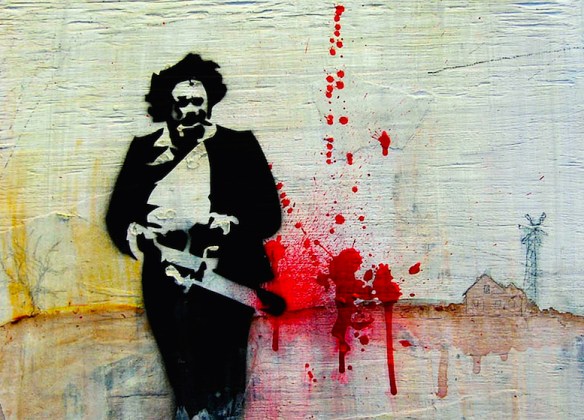
Steven cites too many splatter movies to cover in this review, but central to his thesis is the seminal 1974 Tobe Hooper film, The Texas Chain Saw Massacre. The death of local industry leads Leatherface and family to keep their slaughterhouse traditions alive by carving up and eating young people. These young people, Steven is quick to point out, are only here at all because they were unable to get gas for their car (thanks to the first of two 1970s oil crises). American decline is everywhere; betrayal by global economic forces are central to the trap that’s being laid by the cannibals. (Of course, the carnage of the Vietnam War can’t be overlooked here either, given the visual language of ambush, capture, and torture; Hooper himself has cited this in subsequent interviews.) Steven notes that the victims in The Texas Chain Saw Massacre are representative of a bourgeoisie who don’t know how the sausage is made. It’s important and vital, Steven says, that the cannibalistic side of splatter involves the bourgeoisie being forced to eat members of their own class. It’s Burroughs’s famous “naked lunch“: “the frozen moment when everyone sees what is at the end of every fork.”

As the neoliberal takeover of the world economy begins in earnest in the 1980s, as complex and largely ephemeral systems of mass media and finance take the place of the visceral, grinding monomania of industrial capitalism, splatter horror follows suit. Steven’s analysis of David Cronenberg’s Videodrome (1983) is especially sharp, examining the links between the body horror of the film and the Deleuzian body without organs. Max Renn’s body becomes an endlessly modular media node, able to accommodate video cassettes, to generate and fuse with phallic weapons (used to assassinate and destroy the media forces who’ve made him this way), to mesh and mold and mix with the hard plastic edges of media technology. By the end of the film, Renn is a weapon reprogrammed and re-trained on the very media-industrial complex that made him. More body horror: the cult classic Society (1989) and its shocking conclusion posits the ruling class as a cancerous monster, an amorphous leviathan straight out of a Gilded Age political cartoon, eating and fucking and vomiting, red in tooth and claw and pseudopod. Barriers between bodies break down; the system begins swallowing up all alternate possibilities.

By the time the Cold War is finished, the era of post-9/11 eternal war, of Abu Ghraib and Guantanamo, led to the popular new splatter sub-genre of “torture porn.” Steven identifies the genre’s distinguishing aesthetic feature: the indisputable, systematic, and worldwide victory of capitalism and the hypnotic Spectacle that accompanies it. In this era, there are no longer any alternatives. Everyone, rich and poor, is trapped in the system, and the system reintegrates torture into a worldwide video spectacle. This is embodied in both the global conspiracies of the wealthy in Roth’s Hostel series and in the Jigsaw Killer’s industrially-themed Rube Goldberg devices in the Saw franchise—devices of dismemberment explicitly linked to moral quandaries reminiscent of capitalism’s impossible everyday Hobson’s choices for the working class. The system will go on consuming you, whether you’re unlucky enough to be a splatter film’s victim, or “lucky” enough to wield the power to splatter (for example, Hostel: Part II‘s reversal of fate on the ultra-wealthy hunters, or the Jigsaw Killer’s death from cancer in Saw III—ultimately due to… a lack of health insurance).

Possibly the most intriguing aspect of this already very good book is Steven’s interspersing of personal anecdotes on when and where he discovered some of his favorite horror and genre films. By placing his personal and psychological experience of splatter films front and center, and linking it to his personal growth and increasing political maturity, he demonstrates the personal impact of the political, and the necessity of personal epiphany, mediated by culture, to achieve political awareness. Splatter Capital ultimately is not a book for the already-convinced and committed leftist, the Marxian thinker already well-versed in theory. (Another of Splatter Capital‘s very strong points is how Steven largely eschews jargon and obscurantism for an approachable tone and topic that laypeople can dive into easily.) It is for the fans of these films who’ve always wondered about the ineluctable appeal of visceral, shocking violence on screen, and perhaps why it all feels so strangely familiar.

Financialization, precarity and reactionary authoritarianism

By increasing global competition, the precariousness wrought by financialization has laid the foundations for reactionary authoritarianism around the world.

By Max Haiven

Source: ROAR

Financialization: Fictitious Capital in Popular Culture and Everyday Life, released last month in paperback from Palgrave Macmillan. The book argues that financialization is not just the increasing power and authority of speculative capital over the global economy, but also the way the it seems into and is reflected in politics, social institutions and the realm of cultural meaning.

This section comes at the end of a chapter on the ways financialization both drives onward and depends on the increasing precariousness of workers, putting us into global competition with one another and also infecting our sense of value and success. Haiven argues that this situation produces a tendency towards reactionary authoritarianism based on a “forgetting” and a loathing of our shared human condition of precariousness. He concludes by asking us to consider other models for thinking about debt and precarity that stress radical interdependence.

It is followed by a brief authors’ note reflecting on the piece four years since it was first penned in 2013.


Precarious fear and loathing

Today precariousness is the norm, not the exception. Our current precarious moment, one dominated by market and financial forces and manifesting itself as a violent form of hyper-neoliberal austerity (which is producing ever more and deeper economic precariousness), is only one particularly pernicious manifestation of an underlying ontological condition. It is worse than many such manifestations precisely because it is so successful in privatizing precariousness through the logic of individualism and competition.

We come to blame ourselves, rather than the system, for our precariousness, in part because, unlike some rigid caste-based system or a slave society, we are (most of us) legally and technically free to escape precariousness (though, ironically, to escape by embracing precarity, by using every skill, talent and asset we might possess to leverage ourselves into fabled prosperity). It is a system that works by promising that we can, each of us, alone, escape our existential condition of precariousness by getting rich, by obeying the system’s axiomatic dictates and playing our role.

The constant barrage of images and tales of the lifestyles of the rich and famous, of celebrities and of others who have “made it” do not exist (as they did in a previous era) to show us the right social order and the natural superiority of certain sorts of people. Rather, these ubiquitous dream-images promise each of us a life without precariousness or, more accurately (if we think about the cinematic depictions of the Wall Street predator) a life where precariousness is mastered and leveraged.

This helps explain the virulent disdain that grows and grows towards the poor, the refugee, the  (almost always racialized) populations deemed to be “at risk.” To the extent that we succeed in leveraging ourselves out of the total liquidation of our lives by building up a life of financial prosperity and (the illusion of) security, we are compelled to close ourselves off to what Judith Butler, drawing on the work of Emmanuel Levinas, calls the “face” of the other: the empathetic image of existential suffering. In fact, to the extent participation in financialization has come afford us the privilege of forgetting our inherent shared condition of precariousness, we come to loathe the face of precarity, loathe the way it calls us back into a fellow precarious human body.

The colors of risk

As a result, we should not expect that the almost universal adoption of the free market will lead to any sort of peace or cosmopolitanism in the world, as neoliberal thinkers like Fredrich Hayek or Francis Fukayama believed. Nor should we assume that the financialized age of austerity will prompt such a wave of popular discontent that radical social transformation is inevitable. To the extent that we are made more and more precarious, we brew an existential anger, a self-loathing that can easily be displaced onto convenient others.

Ironically, it is not easily displaced onto the architects and beneficiaries of financialized capitalism, but instead gravitates towards the more precarious, the more abject: they who call us back into the shared precarious what Marx called our “species being,” our shared precarious condition as imaginative cooperative animals dependent on one another for joy and survival. While this may or may not manifest itself in the form of new nationalisms, it will manifest itself in the form of hatred towards the homeless, towards refugees, towards welfare recipients and towards others.

It is vital to note that, in North America and Europe, and in different ways elsewhere, this precarious vitriol cannot be separated from the history of race and racism. Older modes of racial enslavement, apartheid and segregation served the same function, similarly allowing those read as “white” to posit a superior form of humanity which both occluded a shared precariousness and elevated the material wealth and security of whites at the expense of immiserated, exploited and impoverished non-whites (in different ways, in different times and places).

Indeed, earlier moments of capitalism explicitly mobilized whiteness and its real and perceived benefits vis-a-vis precariousness to divide workers along color lines, a condition that fed, and was fed by, the existential precariousness of non-whites who, as second-class citizens, slaves, migrant laborers or perpetual “outsiders,” were not afforded the same personal safety or security (neither de jure nor de facto).

The current reigning assumption is that we have entered a “post-racial” moment, that racism is merely a marginal anachronism, and that racialized people face no systemic barriers to achieving a non-precarious life like “everyone else” — in other words, they are as free to enter the market as anyone else, and the market does not “see” race. The opposite is, in fact, the case: racism and racial inequality towards non-white people persist and, in some ways, are even worse thanks to the mechanisms of financialized market which also works to make those inequalities functionally invisible.

Banking on resentment

On another level, we might speculate that precariousness, in both image and concept, is already racialized, that our understandings of what it means to be precarious, and the negative associations with which this term resonates, are already coded as non-white and call up a legacy and a present of racialized images of abjection, destitution, subservience and shiftlessness. Indeed, we might ask to what extent political systems in the West base their legitimacy on the invisiblized darkness of precariousness. The politically expedient citation of the disappearance of “hard-working Americans” and “the middle class” (both of which are imagined as white) into a dark miasma of economic depression is indelibly associated with popular depictions of ghettos and menial racialized workers.

Suffice it for now to say that we can certainly see these trends as played out in largely white backlash movements which have arisen to confront non-white peoples’ or groups’ claims to social and economic justice. From anti-Muslim organizing in Western Europe (framed in terms of defending a white national heritage and white workers), to anti-Black “whitelash” in the United States (from the Detroit Riots to Rodney King to Trevon Martin), to the anti-Indigenous vitriol in my home country of Canada, these seemingly spontaneous “social movements” speak not only to the politics of ignorance and fear, but also to the socio-economic conditions of precariousness, as well as the perceived failure of the state to live up to its promises to prevent precariousness for white people, all coupled with a history that locates precariousness along the axes of race and racialization.

This deeper existential and ontological crisis and anger is joined by another: the crisis of the middle class. Those professional or semi-professional workers who have been taught to expect middle-class incomes and job security are quickly finding themselves disposable in a vast pool of precarious workers, leading highly indebted, precarious lives with little hope for reprieve. In the coming years, increasingly fascistic political powers will gain ground by offering hollow promises to rebuild the middle class and to end precarity, through neocolonial geopolitical adventure or by creating or maintaining localized under-classes of hyper-precarious migrant or abject workers.

The cult of risk management

What would a politics look like that promised not to end but to embrace precariousness, not as an inescapable economic “reality” (which is what our current system of financialized austerity pledges) but as a socio-ontological sine qua non?

The answer is yet to be determined. But, ironically, an answer may be emerging out of the financialized paradigm that has driven precariousness to a new level of universality and acuity. The speculative ethos that animates financialization is one intimately and irreducibly acquainted with the ontological realities of precariousness. “Risk” and “risk management” are, underneath all their trappings of quantitative and scientistic rigour, mythological constructs for engaging with, navigating through and manipulating the cultural fabric of precariousness. Investments are, at a certain abstract level, attempts to leverage precarious life into more advantageous out- comes.

Finance, as a broad sphere of activities, is a mechanism by which individuals and society at-large seek to gain agency over the precariousness and contingency of the future. It is a particularly perverse mechanism, and one whose logic and mechanisms are either occluded from sight, or so complex, rapid or vast to be fully grasped, even by their primary engineers and agents in hedge funds and investment banks. Yet finance reproduces itself by cultivating and mobilizing the energies, creativity and hope of almost everyone in their attempts to thwart or diminish precarity, and aggregates all these individual and institutional actions into a system which, tragically, only drives greater and greater precariousness.

Generative debts?

The silver lining is perhaps this: what financialization reveals is the inherent futurity of precariousness. The word itself derives from the Latin prex or prayer, with strong connotations of begging or soliciting: yearning for future outcomes, throwing oneself on the mercy of fate or divine provenance. What our financialized moment might reveal is that our shared precariousness, which is the condition both of disastrous authoritarianism (including the disorganized and diffuse totalitarianism of finance capital itself) and of solidarity, does not only emerge from our shared material and ontological conditions; it is also a horizon of shared futurity. That is, precariousness carries encrypted within it a shared relationship with the future.

In this sense, nascent anti-debt organizing in the United States and elsewhere bears a great deal of potential. As Richard Dienst, David Graeber and Andrew Ross all affirm, the politics of debt, if they are to be a radical challenge to the financialized empire, cannot simply be a demand for some libertarian fantasy of complete individual freedom. Rather, they must embrace a broader, more capacious concept of the ontological wealth of social bonds that make life possible, that render all of us precariously reliant on one another. In this sense, they, each in their own way, encourage us to envision an expanded notion of (non-monetary) debt beyond as a grounds for crafting and building common futures through the entanglement of our social relationships.

Likewise, Angela Mitropoulos insists on the importance of moving beyond the limited concepts of financial debt and “debt servitude,” which depend upon and exalt the ideal of the individuated (white, masculine) self, the esteemed, contract-making personage at the heart of Western liberal political and economic philosophy and law. She notes that behind today’s politics of debt there reside the unacknowledged debts germane to the worlds of social reproduction and affective labor on which we all rely, which today are increasingly commodified in the so-called service sector. Indeed, the growth of precarious, feminized service-based labor over the past few decades cannot be separated from the rise of debt as a means to discipline workers and extract surplus value. Beyond the hollow promise of an ideal state of freedom from all obligations, radical potentialities might emerge from the affirmation and recognition of shared interdependency, of the shared need for what today is misrecognized as “service.” As she puts it:

The question it seems to me is not whether our debts can be erased, but what the lines of indebtedness are, how debt is defined, whether it takes the form of a financial obligation or some other consideration of relational inter-dependence, of the forms of life that the routine accounting of debts lets flourish or those that it obscures behind propositions of a seemingly more natural order of individuation, dependence, and obligation.

Beyond the colonial bond?

Glen Coulthard articulates a radical Indigenous reenvisioning of obligation that goes well beyond the Western philosophical canon:

Consider the following example from my people, the Dene Nations of what is now the Northwest Territories, Canada. In the Yellowknives Dene (or Weledeh) dialect of Dogrib, land (or dè) is translated in relational terms as that which encompasses not only the land (understood here as material), but also people and ani- mals, rocks and trees, lakes and rivers, and so on. Seen in this light, we are as much a part of the land as any other element. Furthermore, within this system of relations human beings are not the only constituent believed to embody spirit or agency. Ethically, this meant that humans held certain obligations to the land, animals, plants, and lakes in much the same way that we hold obligations to other people. And if these obligations were met, then the land, animals, plants and lakes would reciprocate and meet their obligations to humans, thus ensuring the survival and well-being of all over time.

Coulthard’s articulation of a broader field of grounded land-based obligation, reciprocity and care demonstrates the radical potentialities that might emerge from a reconsideration of the bonds of debt and the conditions of shared precarity, were we open to re-envision their meanings beyond the hollow promises of security proffered by capital and the state.


Since the publication of Cultures of Financialization I have felt unhappily vindicated in my suspicion that financialization would give right to revanchist authoritarianism. But were I to approach the topic of this excerpt again, I would take more care to locate the origins of the loathing of precariousness within the specific histories of anti-Black racism. I would approach this by making more explicit the origins of finance capital in the trans-Atlantic slave trade and slave economies in the Americas. I would follow this tendency through to the present-day ways that anti-Black racism and white-supremacy, as the template and operating condition of all forms of modern racism, is manifested again and again in the machinations of the financial empire, from the continued neocolonial pillage of Africa to the racialized dimension of the sub-prime loan crisis which led to the single largest theft of Black family wealth since Reconstruction.

Were I to approach this topic again I would also stress more centrally the ways in which settler colonialism destroys and denigrates a cooperative relationship with land, most horrifically by seeking the systematic elimination of autonomous Indigenous presence and power on land. I would seek to understand (as I have elsewhere) how settler colonialism has always been a financialized project, and how financialization has, historically and in the present, been enabled by settler colonialism.

I think that only with these in mind can we seek to understand how financialization has given rise not only to new forms of authoritarianism that promise (white people) respite from the precarity financialization has created, but which are fundamentally based on the acceleration and intensification of white supremacy and settler colonialism.

Finally, were I to approach this chapter again I would caution myself against a conclusion that could appear to call for a kind of new universalist embrace of shared precarity. I would have concerned myself with the way such a universalism, while noble in a certain abstract sense, can work to erase precisely the continued centrality of (anti-Black) racism and settler colonialism. Instead, I would have stressed that overcoming financialized precarity and these systems of oppression and exploitation will be based not only on high-minded virtues but meaningful relationships of militant solidarity and the collective invention of new forms of power, new institutions of care and new frames and practices of revolutionary thought and action.