Pro-Israel Buttigieg backer Seth Klarman is top funder of group behind Iowa’s disastrous voting app

Behind the app that delayed Iowa’s voting results is a dark money operation funded by anti-Sanders billionaires. Its top donor, Seth Klarman, is a Buttigieg backer who has dumped money into pro-settler Israel lobby groups.

By Max Blumenthal

Source: The Grayzone

At the time of publication, twelve hours after voting in the Democratic Party’s Iowa caucuses ended, the results have not been announced. The delay in reporting is the result of a failed app developed by a company appropriately named Shadow Inc.

This firm was staffed by Hillary Clinton and Barack Obama campaign veterans and created by a Democratic dark money nonprofit backed by hedge fund billionaires including Seth Klarman. A prolific funder of pro-settler Israel lobby organizations, Klarman has also contributed directly to Pete Buttigieg’s campaign.

The delay in the vote reporting denied a victory speech to Sen. Bernie Sanders, the presumptive winner of the opening contest in the Democratic presidential primary. Though not one exit poll indicated that Buttigieg would have won, the South Bend, Indiana mayor took to Twitter to confidently proclaim himself the victor.

The bizarre scenario was made possible by a mysterious voting app whose origins had been kept secret by Democratic National Committee officials. For hours, it was unclear who created the failed technology, or how it wound up in the hands of Iowa party officials.

Though a dark money Democratic operation turned out to be the source of the disastrous app, suspicion initially centered on former Hillary Clinton campaign manager Robby Mook and his Russiagate-related elections integrity initiative.

Leveraging Russia hysteria into lucrative election opportunities

While Iowa Democratic Party Chairman Troy Price refused to say who was behind the failed app, he told NPR that he “worked with the national party’s cybersecurity team and Harvard University’s Defending Digital Democracy project…” Price did not offer details on his collaboration with the Harvard group, however.

The New York Times reported that this same outfit had teamed up with Iowa Democrats to run a “drill of worst-case scenarios” and possible foreign threats, but was also vague on details.

Robby Mook, the former campaign manager for Hillary Clinton’s failed 2016 presidential campaign, was the co-founder of Defending Digital Democracy. His initiative arose out of the national freakout over Russian meddling that he and his former boss helped stir when they blamed their loss on Russian interference. Mook’s new outfit pledged to “protect from hackers and propaganda attacks.” 

He founded the organization with help from Matt Rhoades, a former campaign manager for Republican Mitt Romney whose public relations company was sued by a Silicon Valley investor after it branded him “an agent of the Russian government” and “a friend of Russian President, Vladimir Putin.” Rhoades’ firm had been contracted by a business rival to destroy the investor’s reputation.

As outrage grew over the delay in Iowa caucus results, Mook publicly denied any role in designing the notorious app.

Hours later, journalist Lee Fang reported that a previously unknown tech outfit called Shadow Inc. had contracted with the Iowa Democratic Party to create the failed technology. The firm was comprised of former staffers for Obama, Clinton and the tech industry, and had been paid for services by the Buttigieg campaign.

FEC filings show the Iowa Democratic party and Buttigieg campaign paid Shadow Inc.

An Israel lobby moneyman’s path to Mayor Pete’s wine cave

Shadow Inc. was launched by a major Democratic dark money nonprofit called Acronym, which also gave birth to a $7.7 million Super PAC known as Pacronym.

According to Sludge, Pacronym’s largest donor is Seth Klarman. A billionaire hedge funder, Klarman also happens to be a top donor to Buttigieg and Amy Klobuchar.

Though he has attracted some attention for his role in the campaign, Klarman’s prolific funding of the pro-settler Israel lobby and Islamophobic initiatives has gone almost entirely unmentioned.

Seth Klarman is the founder of the Boston-based Baupost Group hedge fund and a longtime donor to corporate Republican candidates. After Donald Trump called for forgiving Puerto Rico’s debt, Klarman – the owner of $911 million of the island’s bonds – flipped and began funding Trump’s opponents.

The billionaire’s crusade against Trump ultimately led him to Mayor Pete’s wine cave.

By the end of 2019, Klarman had donated $5600 to Buttigieg and pumped money into the campaigns of Amy Klobuchar, Cory Booker and Kamala Harris as well.

The billionaire’s support centrist candidates appears to be not only by his own financial interests, but  by his deep and abiding ideological commitment to Israel and its expansionist project.

As I reported for Mondoweiss, Klarman has been a top funder for major Israel lobby outfits, including those that support the expansion of illegal settlements and Islamophobic initiatives.

Klarman was the principal funder of The Israel Project, the recently disbanded Israeli government-linked propaganda organization that lobbied against the Iran nuclear deal and backed the Israeli settlement enterprise.

Klarman has heaped hundreds of thousands of dollars on the Middle East Media Research Institute (MEMRI) and the American Jewish Committee. And he funded The David Project, which was established to suppress Palestine solidarity organizing on campuses across the US and battled to block the establishment of a Muslim community center in Boston.

Through his support for the Friends of Ir David Inc, Klarman directly involved himself in the Israeli settlement enterprise, assisting the US-based tax exempt arm of the organization that oversaw a wave of Palestinian expulsions in the occupied East Jerusalem neighborhood of Silwan.

Other pro-Israel groups reaping the benefits of Klarman’s generosity include Birthright Israel, the AIPAC-founded Washington Institute for Near East Policy, and the Foundation for the Defense of Democracies (FDD), a neoconservative think tank that helped devise Trump’s “maximum pressure” campaign of economic warfare on Iran.

Klarman is the owner of the Times of Israel, an Israeli media outlet that once published a call for Palestinian genocide. (The op-ed was ultimately removed following public backlash).

In recent weeks, Buttigieg has sought to distinguish himself from Sanders on the issue of Israel-Palestine. During a testy exchange this January with a self-proclaimed Jewish supporter of Palestinian human rights, the South Bend mayor backtracked on a previous pledge to withhold military aid to Israel if it annexed parts of the West Bank.

Another recipient of Klarman’s funding, Amy Klobuchar, has taken a strongly pro-Israel line, vowing to support Trump’s relocation of the US embassy from Tel Aviv to Jerusalem.

Battling Bernie with hedge fund money and sexism claims

Like Klarman, Donald Sussman is a hedge funder who has channeled his fortune into Pacronym. He has given $1 million to the Super PAC and was also top donor to Clinton in 2016.

Sussman’s Paloma Partners operates through a series of offshore shell companies, and received tens of millions of dollars in the 2009 federal bailout of the banking industry.

His daughter, Democratic operative Emily Tisch Sussman, declared on MSNBC in September that “if you still support Sanders over Warren, it’s kind of showing your sexism.”

https://twitter.com/ibrahimpols/status/1177719744096559110

As Democratic elites like the Sussmans braced for a Bernie Sanders triumph in Iowa, a mysterious piece of technology spun out by a group they supported delayed the vote results, preventing Sanders from delivering a victory speech. And the politician many of them supported, Pete Buttigieg, exploited the moment to declare himself the winner. In such a strange scenario, the conspiracy theories write themselves.

The Long Arm of the Law

On the rise of the global “good cop”

By Lyle Jeremy Rubin

Source: The Baffler

Badges without Borders: How Global Counterinsurgency Transformed American Policing by Stuart Schrader. University of California Press, 416 pages.

Always beware what everyone is saying but no one is talking about. It is often in these spaces of euphemism that the black magic of ideology casts its spell. George Orwell famously warned of how such language, what he called “question-begging” and “sheer cloudy vagueness,” becomes necessary “if one wants to name things without calling up mental pictures of them.” Every now or then a cliché bears some real wisdom and staying power, and Orwell’s counsel happens to be one. Take, for example, what has been said by various Democrats in the wake of the Trump administration’s assassination of Qassim Soleimani. Much of it has been encouraging for anyone interested in avoiding another full-scale bloodbath, but much has also begged additional questions or further clouded the semiotic landscape.

Consider the words of Senator Tammy Duckworth, who told MSNBC’s Andrea Mitchell that the fallout from the assassination is “what the Iranians wanted. They want this. They want Americans pushed out of Iraq. They want greater influence in the Middle East. And they got exactly what they wanted.” The interview began with Duckworth insisting that the American people are not safer now—that, in fact, we’re in more danger. The senator would go on to plead an identical case on The Rachel Maddow Show, and her Democratic colleagues hit similar notes about the cost of “security” and “stability” elsewhere.

I would be the last to deny that the assassination has encouraged more needless violence and tragedy, as we’ve already seen with the accidental downing of a Ukrainian airliner carrying 176 people, or the fatal stampeding of at least fifty people at Soleimani’s funeral. But it is worth asking what U.S. involvement in Iraq Duckworth and her fellows are implicitly supporting, never mind what broader vision of U.S. influence in the region they’re defending. What mental pictures are being obscured by their language?

A short answer to these questions can be found in a January 9 posting on Foreign Policy’s website, co-written by two senior fellows at the Middle East Institute, a reputable think tank known for producing bien pensant foreign policy opinion on the Chevron or United Arab Emirates dime, among others. The authors urge more “defense institution-building,” specifically a 60 percent increase in funding for programs like the Ministry of Defense Advisors and Defense Institute of International Legal Studies, venues where U.S. troops would continue to “actively mentor, advise, and train” Iraqi soldiers. The article focuses on military support, but it is likely these upgrades would be accompanied by a U.S. civilian police presence. Advisors to the bipartisan Task Force on Extremism in Fragile States have long pushed for increased police mentorship in countries like Iraq or Afghanistan, including the repeal of Section 660, an obscure law that constricts the ability of the U.S. government to train police forces abroad.

Section 660, as it happens, was introduced in 1975, and was designed to prevent the kinds of human rights abuses that plagued mentorship programs in Latin America throughout the Cold War. This brings us to the longer answer to the question about what mental pictures are hidden by Duckworth’s verbiage. It is an answer that Stuart Schrader explores in his recent work of scholarship, Badges Without Borders: How Global Counterinsurgency Transformed American Policing.

Badges Without Borders tells the story of America’s post-WWII “global transit of police ideas and personnel.” Its critical framework is indebted to a rich legacy of thought centering on the racist underbelly of the international economic order, what Cedric Robinson called “racial capitalism.” It’s a legacy that can be traced from the oratory and writings of the Black Panther Party to the contemporary investigations of social theorists like abolitionist Ruth Wilson Gilmore—one that continues to expose the connections between the military-industrial complex and the carceral state.

Throughout Badges Without Borders, Schrader seeks to combine this critical tradition with concrete, bureaucratic, fact. Joining a small but formidable band of painstaking researchers like Naomi Murakawa and Elizabeth Hinton, Schrader has dug up or parsed an imposing sum of transcripts, recordings, videos, correspondences, and other ephemera on modern policing within and without the United States. His chief task has been untangling a congeries of alphabet-soup agencies invested in the surveillance, disciplining, and all-too-frequent termination of nonwhite subversives, guerillas, or “criminals” across national borders, the most central being the Office of Public Safety (OPS). Along the way, a crucial leitmotif comes to the fore.

In the course of demonstrating why postwar anticommunist counterinsurgency efforts against postcolonial populations in the global South coincided with the suppression of black and brown communities and protestors across the United States, Schrader advances a theory of an “imperialism without imperialists” and a “racism without racists.” It is not that Bull “Look at ‘em run” Connors or Donald “We’re keeping the oil” Trumps haven’t existed. It’s that, until recently, they’ve been demoted to junior partners in a still shared (if publicly disavowed) project of maintaining fundamental—and fundamentally racialized—power relations across the globe. Their more refined associates, adept at communicating in the tongue of a race-blind, value-neutral social science, a procedural legalism, or even a soft but shallow humanitarianism and anti-racism, have taken the reins of the imperialist enterprise. It is the story of these more outwardly sympathetic but insidious figures, these good cops, that distinguishes Badges Without Borders.

Understanding the rise of the “good cops” requires understanding their origins. The “grandfather” of police professionalization in the United States, August Vollmer, served as a soldier in the Philippine-American war at the turn of the century. The notion that anything worthwhile about law enforcement could be learned from a brutal war of occupation that claimed hundreds of thousands of indigenous lives is itself dark foreshadowing. But what’s notable about Vollmer is his liberal pretensions: he envisioned a modern police officer who functioned as a key agent in the social uplift and economic development of downtrodden communities. Police would be responsible for keeping the peace, of course, but much of that chore could be achieved by introducing newfangled accessories like the bicycle-based patrol or the teletype. That these seemingly benign novelties were intended to ensure an environment compatible with the most stringent of regimes—Vollmer advised the Cuban dictator Gerardo Machado y Morales, for example—came as an afterthought.

Vollmer’s most influential protégé, Orlando W. Wilson, spent more time emphasizing this latter part of his policing theory. As police chief of Wichita, Kansas and Fullerton, California and, later, police commissioner of Chicago, Wilson pushed for a militarized chain of command, code of conduct, division of labor, and demeanor, attributes he saw as solutions to the corruption and ethnic patronage of local precincts. Like Vollmer, he supported technical innovations such as the police car patrol, two-way radio, and crime laboratory. It was a commitment to scaling up his model of policing to the international arena, however, that would leave its most lasting mark. “It looks like the name of Wilson will go down in Arabic annals with the name of Lawrence,” his fellow reformer Theo E. Hall quipped after an Arabic translation of Wilson’s textbook, Police Administration, was disseminated in Iraq and Saudi Arabia.

But if there was one man most responsible for globalizing American policing, it was Kansas City wunderkind and architect of President Kennedy’s Office of Public Safety, Byron Engle. Vollmer was no doubt inspired by his grunt work in the occupied Philippines, and the same could be said for Wilson’s military stint in occupied Germany, but it was Engle, a veteran of occupied Japan, who thought the hardest about forging a world occupied by U.S.-minted police. If Vollmer saw the occupation of the Philippines as a humane improvement on the brutishness of the Spanish empire, and Wilson saw the occupation of Germany as a vindication of liberal governance over illiberal tyranny, Engle saw the occupation of Japan as a blueprint for an internationally integrated future—one defined by a combination of centralized, Washington-derived funding and training, and decentralized discretion.

Schrader describes Engle’s program as “locally grounded, because police had to patrol a beat.” But it was also

forever expansionary, ever seeking the next nation in need of development and modernization, the next imperiled by radicalism. It sought the nooks and crannies of villages or growing metropolises where subversion and crime, or some novel configuration in combination of the two rooted, germinated, and blossomed.

As Schrader reminds his reader, this project ignored the hellscapes lurking behind this kind of “development” and “modernization,” which guaranteed not only a chronically unemployed or underemployed criminal class but a constant stream of radical reactions. Engle, a Democrat for most of his career (he rounded out his life an NRA-affiliated Republican) whose worldview was nevertheless shaped by a slew of affiliations with the FBI and CIA, could never bring himself to consider, in Schrader’s words, “the decentralized despotism of policing that for African Americans in particular amounted to thousands of everyday micro-fascisms.”

Lest one think the phrase “everyday micro-fascisms” is overblown, consider that numerous ex-Nazi policeman and soldiers became not only intelligence assets for the United States, but public safety trainers in places like South Vietnam and Nicaragua. Prior collaborators with the Japanese empire remained in the U.S.-administered Korean police force, while the Korean police were encouraged to retain the same anti-left posture they had assumed under the Japanese. This posture was encouraged worldwide, and not just by supposedly forward-minded, post-racial, police-intellectuals. Many liberal Cold Warriors tolerated right-wing authoritarians while opposing their leftist oppositions, whom they saw as a graver threat to liberal capitalist stability. This Faustian bargain helped lay the ideological and material groundwork for the mass disappearances and murders of leftists throughout Latin America, specifically in Guatemala, where Engle’s OPS was directly implicated. It was this very implication that led, after considerable leftist agitation at home, to Section 660 in 1975.

Whether WASPy mavericks like Vollmer, Wilson, and Engle, or progressive Jewish outsiders like Robert Komer—the man behind the pacification campaign in Vietnam—or Arnold Sagalyn—the counterinsurgency expert who established the blueprint for Lyndon Johnson’s War on Crime—the personalities chronicled in Badges Without Borders appear sincere in their devotion to what they saw as a post-racial politics of universal freedom and prosperity. This devotion manifested itself in myriad ways, from the promotion of “nonlethal weapons” to the championing of Title IX of the Foreign Assistance Act, the stipulation that demands democratic participation in the development and poverty reduction of all assisted nations. But given the men’s refusal to see that the institutions to which they had pledged their allegiance were responsible for perpetuating systemic modes of domination, they couldn’t predict where their favored reforms would lead—that CS (or CN and CR) gas, for instance, embraced by Lyndon Johnson in case “the Negroes started moving in [on] the White House,” would mark a mere addition to the extant repertoire of racist violence. The excessive use of such gas against peaceful protestors drove dissidents underground, only exacerbating racial turmoil. Police ended up killing more civilians after gas was introduced on American streets, since rather than using gas as replacement for violence, they deployed it as a supplement, mimicking tactics used in Vietnam.

The pattern moved in both directions. The first major implementation of CS in South Vietnam happened in 1966, and in a deliberate nod to anti-black subjugation, its perpetrators named it Operation Birmingham. As Schrader recounts, by 1969,

13,736,000 pounds of CS had been dropped on South Vietnam, an amount equivalent to a blanketing layer 80,000 square miles in size: 14,000 square miles more than the country’s total territory. Additionally, CS would have been used repeatedly in some areas and combined with defoliants. It leached into soil and ground water. The United States effectively tear-gassed the entire country, and then some.

As for Title IX, its developmentalist fruits were often consumed by the very national security state intended to protect them. The U.S. Agency for International Development (USAID), for example, trained local Guatemalans, many of them schoolteachers, in leadership programs. According to a study of this period, up to two-thirds of its trainees were murdered by the Guatemalan security apparatus. “They were killed because they were agitators in terms of the powers that be,” the study concluded. “In terms of development, they were the ideal change agent . . . but that was the kiss of death for them.”

Mission creep, threat inflation, profit incentives, preexisting cultures of bigotry and cruelty, and the perceived need to manage the increasingly tumultuous blowback produced by decades of capitalist exploitation and neo-colonialist dispossession—all of these factors have conspired to build the monstrous infrastructures of surveillance and social control the United States exports across the world today. But so has modern liberalism’s failure to anticipate the natural trajectory of its own initiatives—that is to say, its failure to acknowledge the all-encompassing power relations of racial capital in which it has always been embedded. As Schrader writes, the “order police on American streets have created, the order OPS would propagate by proxy abroad, the order the War on Crime facilitated is the order of capital, the order of white supremacy, the order of empire.”

It is also, by its nature, an escalatory order. In the past twenty years alone, America’s wars in the Greater Middle East have claimed 800,000 lives or more directly through violence, and several times that number (at least another 1.6 million) indirectly, through disease, homelessness, forced migration, and the countless other fates borne from armed conflict. Those who have survived in the half-dozen or so countries reshaped by imperial American war, countries like Somalia, Pakistan, Yemen, and Syria, now trudge on inside transnational police states, amid killer robots buzzing from above, paid skeins of unaccountable mercenaries, secret prisons and detention camps, onerous and hazardous checkpoints, and other mundane but vicious routines. In Afghanistan, many must also count their blessings against CIA-trained death squads, a confirmed reality only a handful of journalists and politicians in the United States seem at all concerned about.

In Badges Without Borders, Schrader limns how this nightmare grew up alongside a parallel despotism stateside, one that has disproportionately targeted a not unrelated population of nonwhite disposables. He also shows how this ruthlessness within and without U.S. borders has been propelled forward by a need to oversee the expansion of U.S.-led capitalism while containing the unwanted secondary effects of its exploitation and violence. To be sure, the governments of countries like Russia, China, and yes, Iran, have oppressive workings of their own that are an affront to anyone dedicated to social justice and peace, and public officials like Senator Duckworth are right to be suspicious of their machinations. But to accept U.S. “influence” in the Middle East, or anywhere else for that matter, as a benign or preferable given, is to repeat the same fateful errors of the good cops profiled in Badges Without Borders.

Now, those good cops seem to be everywhere. Democrats have been fond of elevating prosecutors and district attorneys for some time now, and especially fond of rallying behind FBI and CIA figures in recent years. Many of the lawyers in Obama’s administration responsible for providing a thin legal or ethical veneer to its ugliest features, from the drone war to the surveillance leviathan, are now happy household names, former U.S. Attorney General Eric Holder foremost among them. (Holder, it should be noted, oversaw the implementation of “Operation Ceasefire” in the 1990s, which has been described as “basically stop-and-frisk of cars.”) Otherwise excellent broadcast journalists like Chris Hayes still feel a need to conduct softball interviews with unrepentant boosters of America’s imperialist footprint, like former soldier and Congressman Max Rose or Samantha Power, the latter of whom has barely been held to account for helping to turn Libya into a latter-day slave market.

On the other hand, there’s the launch of the well-funded anti-militarist think tank Quincy Institute, with one of the most eloquent critics of Pax Americana, Andrew Bacevich, at its helm. There’s Bernie Sanders and his millions of enthusiastic, anti-war supporters, many of whom are eager to start fighting for a more democratically organized world. There’s the Movement for Black Lives, which has not only widely publicized evils of police brutality and mass incarceration but connected these evils to America’s encroachments across the planet. And there’s the reemergence, in recent public discourse, of Congresswoman Barbara Lee, the only Congressperson to vote against the original Authorization for Use of Military Force Against Terrorists (AUMF) in 2001. These are all promising signs of an incipient anti-imperialist awakening, but as with the coming climate crisis, we are running out of time.

Passing the Point of No Return, A World War is Upon Us

By Timothy Alexander Guzman

Source: Silent Crow News

War is inevitable. More innocent people will be murdered, maimed, raped or sold into slavery. War is indescribable, a nightmare, yet those who are currently in power, the establishment or what some like to call “the elite” are on Trump’s team leading the world into another war In the Middle East that can go nuclear. Trump has not drained the swamp, in fact he has filled his administration with war hawks, bankers, Zionists and the Neoconservatives (Neocons) who are all inter-connected to various corporations and special interests. It was reported by NBC news that Trump had actually approved the assassination of Iranian General Qassem Soleimani several months ago “President Donald Trump authorized the killing of Iranian Gen. Qassem Soleimani seven months ago if Iran’s increased aggression resulted in the death of an American, according to five current and former senior administration officials. The presidential directive in June came with the condition that Trump would have final signoff on any specific operation to kill Soleimani, officials said.” Trump’s decision to assassinate Iranian General Qasem Soleimani, a popular figure among Muslims and Christians who fought against ISIS, Al-Nusra and other terrorist organizations in Syria and Iraq was the powder keg that has exploded in the Middle East and now there is no turning back. Real terrorists were actually celebrating the death of Soleimani. RT news reported that “the weekly Islamic State (IS, formerly ISIS/ISIL) newspaper Al-Naba portrayed Soleimani’s death as an act of god in support of its cause, and Muslims in general, according to BBC Monitoring.” What was interesting was that “an editorial in the jihadi paper was careful not to credit the US or even mention Soleimani by name.” My guess is that terrorists know the rules, never rat on your friends! However, it’s also noteworthy to consider that the strike could lead ISIS and the other terrorist organizations to regroup as “the paper also reported on the US and its allies suspending operations against IS as an opportunity for the group’s resurgence, according to BBC journalist Mina Al-Lami.” The world will once again see a new push into Syria by ISIS and other terrorist groups with US and Israeli support in an effort to remove Syrian President, Bashar Al-Assad. That is why Russian President Vladimir Putin went to Syria for talks with President Assad as reported by RT news:

The two leaders were briefed on the military situation in Syria, including the northwestern province of Idlib, occupied by militants linked to Al-Qaeda. Assad thanked Putin and Russia for their support in restoring peace in Syria. Russian troops have been assisting the Syrian army since September 2015 in battling various terrorist groups, including Islamic State (IS, formerly ISIS)

All anti-US and anti-Israel movements from Lebanon to Iran and all the way to central Asia with Afghanistan and Pakistan are now united for one cause, and that is to end US presence in the Middle East by targeting all US bases, embassies and other installations.

I could just imagine what world leaders are thinking at this point, especially those who are in some form of conflict with Washington including Russia, China, Syria, Lebanon, Venezuela, Cuba, Nicaragua, Argentina, the Palestinians, Pakistan, past and re-emerging former Latin American presidents Lula de Silva of Brazil and Evo Morales of Bolivia, leaders from political, social and Indigenous movements including those within the US and occupied territories must be saying to themselves: What will America do to us? Would they drone strike me if I don’t obey them? The Trump regime has stepped-up its economic wars with sanctions that has caused mass suffering among populations in the Middle East with Iran and Syria as their targets and in Latin America with Venezuela and don’t forget that 59 year embargo on Cuba that Trump has kept going, so Trump is already a war president. Trump is a typical example of what you would call a “Chicken hawk” a term particularly used in the US which is defined by Wikipedia as “a person who strongly supports war or other military action yet who actively avoids or avoided military service when of age.” Newsweek magazine reported that “In all, Trump secured five deferments from the Vietnam War draft, four of which were because he was still studying at college. The fifth and final deferment was granted on medical grounds after a doctor signed Trump off as having bone spurs in his heels.” The article also claimed the following:

The daughters of the late podiatrist in question, Dr. Larry Braunstein, told The New York Times that their father did it as a favor to Fred Trump, the president’s father, who owned the building in which the doctor had an office. They said the suggestion from their father in his oft-told story was that Trump did not have a foot problem that should have disqualified him from the Vietnam troop drafts, and it was not clear if the podiatrist had ever examined him

I do not know if the claims made by Newsweek or The New York Times who have credibility issues are true or not, but if Dr. Larry Braunstein did do Trump’s father a favor, then it should be of no surprise because many wealthy people especially those in the East Coast of the United States did have the right connections to pull the strings to prevent their children from getting drafted into the Vietnam war. However, Trump has committed young men and women who mostly come from poor families to the coming war effort against Iran. Not only will US forces be fighting another war for oil and other natural resources, they will be fighting for Israel. Trump decisions concerning Israel has made his close friend and ally, Prime Minister Benjamin Netanyahu very happy because Israel needs Iran and Syria to become another Iraq. US troops will be used for the protection and expansion of Israel who will become a powerful player in the Middle East with nuclear weapons. One thing is certain, the Muslim world is not going to except that under any circumstances.

Prepare Now, The War Has Begun

A report by the Financial Times on December 27th, 2019 ‘Russia, China and Iran Launch Gulf of Oman War Games’:

Russia, China and Iran launched their first joint naval exercises in the Gulf of Oman on Friday in a direct challenge to US influence in the Middle East. The move reflects growing co-operation between the US’s two main rivals and the Islamic republic, which is under sanctions imposed by Washington. 

“The most important achievement of these drills . . . is this message that the Islamic republic of Iran cannot be isolated,” vice-admiral Gholamreza Tahani, a deputy naval commander, said. “These exercises show that relations between Iran, Russia and China have reached a new high level while this trend will continue in the coming years” 

After Trump’s reckless strike against Soleimani, Russia and China quickly condemned the actions. It was reported by RT news that “Moscow considers the operation “an adventurous move that will lead to an escalation of tension throughout the region.” China’s response was similar. CNBC reported that Chinese Foreign Minister Wang Yi had said that “China opposes the use of force in international relations” and that “Military means will lead nowhere. Maximum pressure won’t work either. China urges the U.S. to seek resolutions through dialogue instead of abusing force.” China will be monitoring the crisis very closely “China will continue to uphold an objective and just position and play a constructive role in safeguarding peace and security in the Gulf region of the Middle East.“ Trump and the neoconservatives have now escalated tensions in the Middle East and in almost every region in the world with economic sanctions, failed coup attempts on Venezuela’s President Nicolas Maduro and the other coup that succeeded in Bolivia. The Trump regime also managed to instigate a trade war with China while funding protests in Hong Kong to create instability in Asia and the list goes on.

A new resistance has become a reality in the Middle East that will eventually force US troops out of the region. Expect more anti-war protests to grow substantially across the world as the US and its allies become more aggressive. The US economy is also collapsing, putting its own national security at risk with a $22 trillion in debt because let’s face it, when the US economy collapses, all of the debt bubbles will pop and all hell will break out across the US. However, Trump proudly tweeted that “The United States just spent Two Trillion Dollars on Military Equipment. We are the biggest and by far the BEST in the World! If Iran attacks an American Base, or any American, we will be sending some of that brand new beautiful equipment their way…and without hesitation!” There is a new neoconservative movement within the Trump White House driving foreign policy in the Middle East with Secretary of State Mike Pompeo and Vice-President Mike Pence leading the charge thus bringing back the memories of the Bush Neocons.  Let’s go back to an interesting Christian Science Monitor article from 2003 which can also be found on Global Research that describes what the Neocons believe in. The article ‘Neocon 101: What do Neoconservatives Believe?’ said the following:

What does a neoconservative dream world look like? Neocons envision a world in which the United States is the unchallenged superpower, immune to threats. They believe that the US has a responsibility to act as a “benevolent global hegemon.” In this capacity, the US would maintain an empire of sorts by helping to create democratic, economically liberal governments in place of “failed states” or oppressive regimes they deem threatening to the US or its interests. In the neocon dream world the entire Middle East would be democratized in the belief that this would eliminate a prime breeding ground for terrorists. This approach, they claim, is not only best for the US; it is best for the world. In their view, the world can only achieve peace through strong US leadership backed with credible force, not weak treaties to be disrespected by tyrants.  

Any regime that is outwardly hostile to the US and could pose a threat would be confronted aggressively, not “appeased” or merely contained. The US military would be reconfigured around the world to allow for greater flexibility and quicker deployment to hot spots in the Middle East, as well as Central and Southeast Asia. The US would spend more on defense, particularly for high-tech, precision weaponry that could be used in preemptive strikes. It would work through multilateral institutions such as the United Nations when possible, but must never be constrained from acting in its best interests whenever necessary

In an important note, neoconservative ideology is not limited to the Republicans. Glenn Greenwald of The Intercept published a report in 2017 titled ‘With New D.C. Policy Group, Dems Continue to Rehabilitate and Unify With Bush-Era Neocons’ pointed out that “one of the most under-discussed yet consequential changes in the American political landscape is the reunion between the Democratic Party and the country’s most extreme and discredited neocons.” The report continued:

A newly formed and, by all appearances, well-funded national security advocacy group, devoted to more hawkish U.S. policies toward Russia and other adversaries, provides the most vivid evidence yet of this alliance. Calling itself the Alliance for Securing Democracy, the group describes itself as “a bipartisan, transatlantic initiative” that “will develop comprehensive strategies to defend against, deter, and raise the costs on Russian and other state actors’ efforts to undermine democracy and democratic institutions,” and also “will work to publicly document and expose Vladimir Putin’s ongoing efforts to subvert democracy in the United States and Europe.” 

It is, in fact, the ultimate union of mainstream Democratic foreign policy officials and the world’s most militant, and militaristic, neocons. The group is led by two longtime Washington foreign policy hands, one from the establishment Democratic wing and the other a key figure among leading GOP neocons. 

The Democrat, Laura Rosenberger, served as a foreign policy adviser for Hillary Clinton’s 2016 presidential campaign and chief of staff to two Obama national security officials. The Republican is Jamie Fly, who spent the last four years as counselor for foreign and national security affairs to one of the Senate’s most hawkish members, Marco Rubio; prior to that, he served in various capacities in the Bush Pentagon and National Security Council 

The neocons are back in the White House, reminiscent of the Bush regime, so another war is on the table. Be prepared, for the worst is yet to come.


Come Home, America: Stop Policing the Globe and Put an End to Wars-Without-End

By Jon W. Whitehead

Source: The Rutherford Institute

“Let us resolve that never again will we send the precious young blood of this country to die trying to prop up a corrupt military dictatorship abroad. This is also the time to turn away from excessive preoccupation overseas to the rebuilding of our own nation. America must be restored to a proper role in the world. But we can do that only through the recovery of confidence in ourselves…. together we will call America home to the ideals that nourished us from the beginning. From secrecy and deception in high places; come home, America. From military spending so wasteful that it weakens our nation; come home, America.”—George S. McGovern, former Senator and presidential candidate

I agree wholeheartedly with George S. McGovern, a former Senator and presidential candidate who opposed the Vietnam War, about one thing: I’m sick of old men dreaming up wars for young men to die in.

It’s time to bring our troops home.

Bring them home from Somalia, Afghanistan, Iraq and Syria. Bring them home from Germany, South Korea and Japan. Bring them home from Saudi Arabia, Jordan and Oman. Bring them home from Niger, Chad and Mali. Bring them home from Turkey, the Philippines, and northern Australia.

That’s not what’s going to happen, of course.

The U.S. military reportedly has more than 1.3 million men and women on active duty, with more than 200,000 of them stationed overseas in nearly every country in the world. Those numbers are likely significantly higher in keeping with the Pentagon’s policy of not fully disclosing where and how many troops are deployed for the sake of “operational security and denying the enemy any advantage.” As investigative journalist David Vine explains, “Although few Americans realize it, the United States likely has more bases in foreign lands than any other people, nation, or empire in history.”

Don’t fall for the propaganda, though: America’s military forces aren’t being deployed abroad to protect our freedoms here at home. Rather, they’re being used to guard oil fields, build foreign infrastructure and protect the financial interests of the corporate elite. In fact, the United States military spends about $81 billion a year just to protect oil supplies around the world.

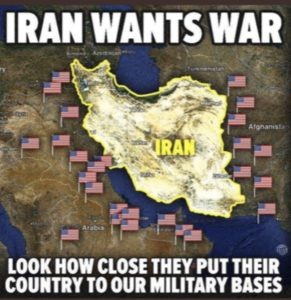
The reach of America’s military empire includes close to 800 bases in as many as 160 countries, operated at a cost of more than $156 billion annually. As Vine reports, “Even US military resorts and recreation areas in places like the Bavarian Alps and Seoul, South Korea, are bases of a kind. Worldwide, the military runs more than 170 golf courses.”

This is how a military empire occupies the globe.

Already, American military servicepeople are being deployed to far-flung places in the Middle East and elsewhere in anticipation of the war drums being sounded over Iran.

This Iran crisis, salivated over by the neocons since prior to the Iraq War and manufactured by war hawks who want to jumpstart the next world war, has been a long time coming.

Donald Trump, Barack Obama, George W. Bush, Bill Clinton: they all have done their part to ensure that the military industrial complex can continue to get rich at taxpayer expense.

Take President Trump, for instance.

Despite numerous campaign promises to stop America’s “endless wars,” once elected, Trump has done a complete about-face, deploying greater numbers of troops to the Middle East, ramping up the war rhetoric, and padding the pockets of defense contractors. Indeed, Trump is even refusing to withdraw U.S. troops from Iraq in the face of a request from the Iraqi government for us to leave.

Obama was no different: he also pledged—if elected—to bring the troops home from Iraq and Afghanistan and reduce America’s oversized, and overly costly, military footprint in the world. Of course, that didn’t happen.

Yet while the rationale may keep changing for why American military forces are policing the globe, these wars abroad (in Iraq, Afghanistan, Pakistan, Syria, Yemen and now Iran) aren’t making America—or the rest of the world—any safer, are certainly not making America great again, and are undeniably digging the U.S. deeper into debt.

War spending is bankrupting America.

Although the U.S. constitutes only 5% of the world’s population, America boasts almost 50% of the world’s total military expenditure, spending more on the military than the next 19 biggest spending nations combined.

In fact, the Pentagon spends more on war than all 50 states combined spend on health, education, welfare, and safety.

The American military-industrial complex has erected an empire unsurpassed in history in its breadth and scope, one dedicated to conducting perpetual warfare throughout the earth.

Since 2001, the U.S. government has spent more than $4.7 trillion waging its endless wars.

Having been co-opted by greedy defense contractors, corrupt politicians and incompetent government officials, America’s expanding military empire is bleeding the country dry at a rate of more than $32 million per hour.

In fact, the U.S. government has spent more money every five seconds in Iraq than the average American earns in a year.

Future wars and military exercises waged around the globe are expected to push the total bill upwards of $12 trillion by 2053.

Talk about fiscally irresponsible: the U.S. government is spending money it doesn’t have on a military empire it can’t afford.

As investigative journalist Uri Friedman puts it, for more than 15 years now, the United States has been fighting terrorism with a credit card, “essentially bankrolling the wars with debt, in the form of purchases of U.S. Treasury bonds by U.S.-based entities like pension funds and state and local governments, and by countries like China and Japan.”

War is not cheap, but it becomes outrageously costly when you factor in government incompetence, fraud, and greedy contractors. Indeed, a leading accounting firm concluded that one of the Pentagon’s largest agencies “can’t account for hundreds of millions of dollars’ worth of spending.”

Unfortunately, the outlook isn’t much better for the spending that can be tracked.

A government audit found that defense contractor Boeing has been massively overcharging taxpayers for mundane parts, resulting in tens of millions of dollars in overspending. As the report noted, the American taxpayer paid:

$71 for a metal pin that should cost just 4 cents; $644.75 for a small gear smaller than a dime that sells for $12.51: more than a 5,100 percent increase in price. $1,678.61 for another tiny part, also smaller than a dime, that could have been bought within DoD for $7.71: a 21,000 percent increase. $71.01 for a straight, thin metal pin that DoD had on hand, unused by the tens of thousands, for 4 cents: an increase of over 177,000 percent.

That price gouging has become an accepted form of corruption within the American military empire is a sad statement on how little control “we the people” have over our runaway government.

Mind you, this isn’t just corrupt behavior. It’s deadly, downright immoral behavior.

Americans have thus far allowed themselves to be spoon-fed a steady diet of pro-war propaganda that keeps them content to wave flags with patriotic fervor and less inclined to look too closely at the mounting body counts, the ruined lives, the ravaged countries, the blowback arising from ill-advised targeted-drone killings and bombing campaigns in foreign lands, or the transformation of our own homeland into a warzone.

That needs to change.

The U.S. government is not making the world any safer. It’s making the world more dangerous. It is estimated that the U.S. military drops a bomb somewhere in the world every 12 minutes. Since 9/11, the United States government has directly contributed to the deaths of around 500,000 human beings. Every one of those deaths was paid for with taxpayer funds.

The U.S. government is not making America any safer. It’s exposing American citizens to alarming levels of blowback, a CIA term referring to the unintended consequences of the U.S. government’s international activities. Chalmers Johnson, a former CIA consultant, repeatedly warned that America’s use of its military to gain power over the global economy would result in devastating blowback.

The 9/11 attacks were blowback. The Boston Marathon Bombing was blowback. The attempted Times Square bomber was blowback. The Fort Hood shooter, a major in the U.S. Army, was blowback.

The assassination of Iranian General Qasem Soleimani by a U.S. military drone strike will, I fear, spur yet more blowback against the American people.

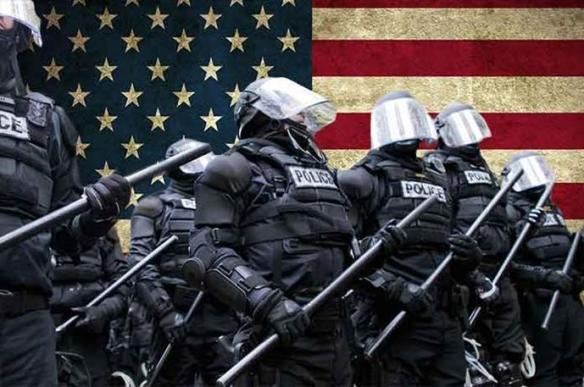
The war hawks’ militarization of America—bringing home the spoils of war (the military tanks, grenade launchers, Kevlar helmets, assault rifles, gas masks, ammunition, battering rams, night vision binoculars, etc.) and handing them over to local police, thereby turning America into a battlefield—is also blowback.

James Madison was right: “No nation could preserve its freedom in the midst of continual warfare.” As Madison explained, “Of all the enemies to public liberty war is, perhaps, the most to be dreaded because it comprises and develops the germ of every other. War is the parent of armies; from these proceed debts and taxes… known instruments for bringing the many under the domination of the few.”

We are seeing this play out before our eyes.

The government is destabilizing the economy, destroying the national infrastructure through neglect and a lack of resources, and turning taxpayer dollars into blood money with its endless wars, drone strikes and mounting death tolls.

Clearly, our national priorities are in desperate need of an overhauling.

At the height of its power, even the mighty Roman Empire could not stare down a collapsing economy and a burgeoning military. Prolonged periods of war and false economic prosperity largely led to its demise. As historian Chalmers Johnson predicts:

The fate of previous democratic empires suggests that such a conflict is unsustainable and will be resolved in one of two ways. Rome attempted to keep its empire and lost its democracy. Britain chose to remain democratic and in the process let go its empire. Intentionally or not, the people of the United States already are well embarked upon the course of non-democratic empire.

This is the “unwarranted influence, whether sought or unsought, by the military-industrial complex” that President Dwight Eisenhower warned us more than 50 years ago not to let endanger our liberties or democratic processes.

Eisenhower, who served as Supreme Commander of the Allied forces in Europe during World War II, was alarmed by the rise of the profit-driven war machine that emerged following the war—one that, in order to perpetuate itself, would have to keep waging war.

We failed to heed his warning.

As I make clear in my book Battlefield America: The War on the American People, there’s not much time left before we reach the zero hour.

It’s time to stop policing the globe, end these wars-without-end, and bring the troops home before it’s too late.

Another Stupid War

By Michael Krieger

Source: Liberty Blitzkrieg

All I wanted to do this week was work on part 2 of my localism series, but circumstances quickly got the best of me. The assassination of Iran’s top general Qassem Soleimani was an event of such historical significance, I feel obligated to detail my thoughts on what it means and how things unfold from here, especially given how much of a role geopolitics and questions of empire have played in my writings.

First off, we need to understand the U.S. is now at war with Iran. It’s an undeclared, insane and unconstitutional war, but it is war nonetheless. There is no world in which one government intentionally assassinates the top general of another government and that not be warfare. You can argue the U.S. and Iran were already engaged in low-level proxy wars, and that’s a fair assessment, but you can’t say we aren’t currently in a far more serious a state of war. We are.

Soleimani was not only a powerful general, he was a popular figure within Iran. Unlike other blows the U.S. and Iran have inflicted upon one another, this cannot be walked back. There’s no deescalation from here, only escalation. Even if you want to pretend this didn’t happen and turn back the clock, it’s impossible. This is a major event of historical proportions and should be seen as such. Everything has been turned up a notch.

Before discussing what happens next and the big picture implications, it’s worth pointing out the incredible number of blatant lies and overall clownishness that emerged from U.S. officials in the assassination’s aftermath. It started with claims from Trump that Soleimani was plotting imminent attacks on Americans and was caught in the act. Mass media did its job and uncritically parroted this line, which was quickly exposed as a complete falsehood.

It’s incredibly telling that CNN would swallow this fact-free claim with total credulity within weeks of discovering the extent of the lies told about Syrian chemical attacks and the Afghanistan war. Meanwhile, when a reporter asked a state department official for some clarification on what sorts of attacks were imminent, this is what transpired.

Naturally, we learned soon after from the Iraqi PM himself that Soleimani was in Iraq as part of a diplomatic effort to de-escalate tensions. In other words, he was apparently lured to Baghdad under false pretenses so he’d be a sitting duck for a U.S. strike. Never let the truth get in the way of a good story.

As you’d expect, some of the most ridiculous propaganda came from Mike Pompeo, a man who genuinely loves deception and considers it his craft.. For example:

Then there’s what actually happened.

https://twitter.com/sonofnariman/status/1213792565075550208

Moving on to the really big question: what does this assassination mean for the future role of the U.S. in the Middle East and American global hegemony generally? A few important things have already occurred. For starters, the Iraqi parliament passed a resolution calling for U.S. troops to leave. Even more important are the comments and actions of Muqtada al-Sadr.

Unmentioned in the above tweet, but extremely significant, is the fact al-Sadr has been a vocal critic of both the American and Iranian presence in Iraq. He doesn’t want either country meddling in the affairs of Iraqis, but the Soleimani assassination clearly pushed him to focus on the U.S. presence. This is a very big deal and ensures Iraq will be far more dangerous for U.S. troops than it already was. 

Going forward, Iran’s response will be influenced to a great degree by what’s already transpired. There are three things worth noting. First, although many Trump supporters are cheering the assassination, Americans are certainly nowhere near united on this, with many including myself viewing it as a gigantic strategic blunder. Second, it ratcheted up anti-American sentiment in Iraq to a huge degree without Iran having to do anything, as highlighted above. Third, hardliners within Iran have been given an enormous gift. With one drone strike, the situation went from grumblings and protests on the ground to a scene where any sort of dissent in the air has been extinguished for the time being.

Iranian leadership will see these developments as important victories in their own right and will likely craft a response taking stock of this much improved position. This means a total focus on making the experience of American troops in the region untenable, which will be far easier to achieve now.

If that’s right, you can expect less shock and awe in the near-term, and more consolidation of the various parties that were on the fence but have since shifted to a more anti-American stance following Soleimani’s death. Iran will start with the easy pickings, which consists of consolidating its stronger position in Iraq and making dissidents feel shameful at home. That said, Iran will have to publicly respond with some sort of a counterattack, but that event will be carefully considered with Iran’s primary objective in mind — getting U.S. troops out of the region.

This means no attacks on U.S. or European soil, and no attacks targeting civilians either. Such a move would be as strategically counterproductive as Assad gassing Syrian cities after he was winning the war (which is why many of us doubted the narrative) since it would merely inflame American public opinion and give an excuse to attack Iran in Iran. There is no way Iranian leadership is that stupid, so any such attack must be treated with the utmost skepticism.

It’s impossible to know exactly what will happen in the short-term, but in the much bigger picture I have a strong view of what this means. The assassination of Soleimani kicks off the beginning of the final chapter in the decline of U.S. imperial dominance. It will likely play out over the course of the first part of this decade (2020-2025), and by the time it’s over it’ll be undeniable that the U.S. is no longer the global hegemon it once was. The world at that stage will be unmistakably multi-polar.

The signs are everywhere.

This is not a time for despair, as there can be a huge silver lining to all of this. A singular focus on imperial hegemony has been terrible for most Americans. It has made us weak, it has destroyed the middle class, and it has entrenched a small subset of sociopaths into positions of total, unaccountable power.

The energy and spirit of the American people have been pushed aside and smothered so a bunch of defense contractors, politicians and finance criminals can play a game of RISK at the public’s expense. The transition is likely to be quite traumatic and fraught with danger, but empire has been a curse and has hollowed out the country. Shaking off empire at least gives us a shot at a revival.


America Escalates its “Democratic” Oil War in the Near East

By Michael Hudson

Source: CounterPunch

The mainstream media are carefully sidestepping the method behind America’s seeming madness in assassinating Islamic Revolutionary Guard general Qassim Suleimani to start the New Year. The logic behind the assassination was a long-standing application of U.S. global policy, not just a personality quirk of Donald Trump’s impulsive action. His assassination of Iranian military leader Suleimani was indeed a unilateral act of war in violation of international law, but it was a logical step in a long-standing U.S. strategy. It was explicitly authorized by the Senate in the funding bill for the Pentagon that it passed last year.

The assassination was intended to escalate America’s presence in Iraq to keep control of the region’s oil reserves, and to back Saudi Arabia’s Wahabi troops (Isis, Al Quaeda in Iraq, Al Nusra and other divisions of what are actually America’s foreign legion), to support U.S. control of Near Eastern oil as a buttress of the U.S. dollar. That remains the key to understanding this policy, and why it is in the process of escalating, not dying down.

I sat in on discussions of this policy as it was formulated nearly fifty years ago when I worked at the Hudson Institute and attended meetings at the White House, met with generals at various armed forces think tanks and with diplomats at the United Nations. My role was as a balance-of-payments economist, having specialized for a decade at Chase Manhattan, Arthur Andersen and oil companies in the oil industry and military spending. These were two of the three main dynamics of American foreign policy and diplomacy. (The third concern was how to wage war in a democracy where voters rejected the draft in the wake of the Vietnam War.)

The media and public discussion have diverted attention from this strategy by floundering speculation that President Trump did it, except to counter the (non-)threat of impeachment with a wag-the-dog attack, or to back Israeli lebensraum drives, or simply to surrender the White House to the neocon hate-Iran syndrome. The actual context for the neocon’s action was the balance of payments, and the role of oil and energy as a long-term lever of American diplomacy.

The balance of payments dimension

The major deficit in the U.S. balance of payments has long been military spending abroad. The entire payments deficit, beginning with the Korean War in 1950-51 and extending through the Vietnam War of the 1960s, was responsible for forcing the dollar off gold in 1971. The problem facing America’s military strategists was how to continue supporting the 800 U.S. military bases around the world and allied troop support without losing America’s financial leverage.

The solution turned out to be to replace gold with U.S. Treasury securities (IOUs) as the basis of foreign central bank reserves. After 1971, foreign central banks had little option for what to do with their continuing dollar inflows except to recycle them to the U.S. economy by buying U.S. Treasury securities. The effect of U.S. foreign military spending thus did not undercut the dollar’s exchange rate, and did not even force the Treasury and Federal Reserve to raise interest rates to attract foreign exchange to offset the dollar outflows on military accounts. In fact, U.S. foreign military spending helped finance the domestic U.S. federal budget deficit.

Saudi Arabia and other Near Eastern OPEC countries quickly became a buttress of the dollar. After these countries quadrupled the price of oil (in retaliation for the United States quadrupling the price of its grain exports, a mainstay of the U.S. trade balance), U.S. banks were swamped with an inflow of  foreign deposits – which were lent out to Third World countries in an explosion of bad loans that blew up in 1972 with Mexico’s insolvency. This destroyed Third World government credit for a decade, forcing it into dependence on the United States via the IMF and World Bank.

To top matters, of course, what Saudi Arabia does not save in dollarized assets with its oil-export earnings is spent on buying hundreds of billion of dollars of U.S. arms exports. This locks them into dependence on U.S. supply of replacement parts and repairs, and enables the United States to turn off Saudi military hardware at any point of time, in the event that the Saudis may try to act independently of U.S. foreign policy.

So maintaining the dollar as the world’s reserve currency became a mainstay of U.S. military spending. Foreign countries would not have to pay the Pentagon directly for this spending. They simply finance the U.S. Treasury and U.S. banking system.

Fear of this development was a major reason why the United States moved against Libya, whose foreign reserves were held in gold, not dollars, and which was urging other African countries to follow suit in order to free themselves from “Dollar Diplomacy.” Hillary and Obama invaded, grabbed their gold supplies (we still have no idea who ended up with these billions of dollars worth of gold) and destroyed Libya’s government, its public education system, its public infrastructure and other non-neoliberal policies.

The great threat to this is dedollarization as China, Russia and other countries seek to avoid recycling dollars. Without the dollar’s function as the vehicle for world saving – in effect, without the Pentagon’s role in creating the Treasury debt that is the vehicle for world central bank reserves – the U.S. would find itself constrained militarily and hence diplomatically constrained, as it was under the gold exchange standard.

That is the same strategy that the U.S. has followed in Syria and Iraq. Iran was threatening this dollarization strategy and its buttress in U.S. oil diplomacy.

The oil industry as buttress of the U.S. balance of payments and foreign diplomacy

The trade balance is buttressed by oil and farm surpluses. Oil is the key, because it is imported by U.S. companies at almost no balance-of-payments cost (the payments end up in the oil industry’s head offices here as profits and payments to management), while profits on U.S. oil company sales to other countries are remitted to the United States (via offshore tax-avoidance centers, mainly Liberia and Panama for many years). And as noted above, OPEC countries have been told to keep their official reserves in the form of U.S. securities (stocks and bonds as well as Treasury IOUs, but not direct purchase of U.S. companies being deemed economically important). Financially, OPEC countries are client slates of the Dollar Area.

America’s attempt to maintain this buttress explains U.S. opposition to any foreign government steps to reverse global warming and the extreme weather caused by the world’s U.S.-sponsored dependence on oil. Any such moves by Europe and other countries would reduce dependence on U.S. oil sales, and hence on the U.S’s ability to control the global oil spigot as a means of control and coercion. These are viewed as hostile acts.

Oil also explains U.S. opposition to Russian oil exports via Nordstream. U.S. strategists want to treat energy as a U.S. national monopoly. Other countries can benefit in the way that Saudi Arabia has done – by sending their surpluses to the U.S. economy – but not to support their own economic growth and diplomacy. Control of oil thus implies support for continued global warming as an inherent part of U.S. strategy.

How a “democratic” nation can wage international war and terrorism

The Vietnam War showed that modern democracies cannot field armies for any major military conflict, because this would require a draft of its citizens. That would lead any government attempting such a draft to be voted out of power. And without troops, it is not possible to invade a country to take it over.

The corollary of this perception is that democracies have only two choices when it comes to military strategy: They can only wage airpower, bombing opponents; or they can create a foreign legion, that is, hire mercenaries or back foreign governments that provide this military service.

Here once again Saudi Arabia plays a critical role, through its control of Wahabi Sunnis which motivates terrorist jihadis willing to sabotage, bomb, assassinate, blow up and otherwise fight any target designated as an enemy of “Islam,” the euphemism for Saudi Arabia acting as a U.S. client state. (Religion really is not the key; I know of no ISIS or similar Wahabi attack on Israeli targets.) The United States needs the Saudis to supply or finance Wahabi crazies. So in addition to playing a key role in the U.S. balance of payments by recycling its oil-export earnings into U.S. stocks, bonds and other investments, Saudi Arabia provides manpower by supporting the Wahabi members of America’s foreign legion, ISIS and Al-Nusra/Al-Qaeda. Terrorism has become the “democratic” mode of today U.S. military policy.

What makes America’s oil war in the Near East “democratic” is that this is the only kind of war a democracy can fight – an air war, followed by a vicious terrorist army that makes up for the fact that no democracy can field its own army in today’s world. The corollary is that, terrorism has become the “democratic” mode of warfare.

From the U.S. vantage point, what is a “democracy”? In today’s Orwellian vocabulary, it means any country supporting U.S. foreign policy. Bolivia and Honduras have become “democracies” since their coups, along with Brazil. Chile under Pinochet was a Chicago-style free market democracy. So was Iran under the Shah, and Russia under Yeltsin – but not since it elected Vladimir Putin president, any more than is China under President Xi.

The antonym to “democracy” is “terrorist.” That simply means a nation willing to fight to become independent from U.S. neoliberal democracy. It does not include America’s proxy armies.

Iran’s role as U.S. nemesis

What stands in the way of U.S. dollarization, oil and military strategy? Obviously, Russia and China have been targeted as long-term strategic enemies for seeking their own independent economic policies and diplomacy. But next to them, Iran has been in America’s gun sights for nearly seventy years.

America’s hatred of Iran is starts with its attempt to control its own oil production, exports and earnings. It goes back to 1953, when Mossadegh was overthrown because he wanted domestic sovereignty over Anglo-Persian oil. The CIA-MI6 coup replaced him with the pliant Shah, who imposed a police state to prevent Iranian independence from U.S. policy. The only physical places free from the police were the mosques. That made the Islamic Republic the path of least resistance to overthrowing the Shah and re-asserting Iranian sovereignty.

The United States came to terms with OPEC oil independence by 1974, but the antagonism toward Iran extends to demographic and religious considerations. Iranian support of its Shi’ite population and those of Iraq and other countries – emphasizing support for the poor and for quasi-socialist policies instead of neoliberalism – has made it the main religious rival to Saudi Arabia’s Sunni sectarianism and its role as America’s Wahabi foreign legion.

America opposed General Suleimani above all because he was fighting against ISIS and other U.S.-backed terrorists in their attempt to break up Syria and replace Assad’s regime with a set of U.S.-compliant local leaders – the old British “divide and conquer” ploy. On occasion, Suleimani had cooperated with U.S. troops in fighting ISIS groups that got “out of line” – meaning the U.S. party line. But every indication is that he was in Iraq to work with that government seeking to regain control of the oil fields that President Trump has bragged so loudly about grabbing.

Already in early 2018, President Trump asked Iraq to reimburse America for the cost of “saving its democracy” by bombing the remainder of Saddam’s economy. The reimbursement was to take the form of Iraqi Oil. More recently, in 2019, President Trump asked, why not simply grab Iraqi oil. The giant oil field has become the prize of the Bush-Cheney post 9-11 Oil War. “‘It was a very run-of-the-mill, low-key, meeting in general,” a source who was in the room told Axios.’ And then right at the end, Trump says something to the effect of, he gets a little smirk on his face and he says, ‘So what are we going to do about the oil?’”

Trump’s idea that America should “get something” out of its military expenditure in destroying the Iraqi and Syrian economies simply reflects U.S. policy.

In late October, 2019, The New York Times reported that: “In recent days, Mr. Trump has settled on Syria’s oil reserves as a new rationale for appearing to reverse course and deploy hundreds of additional troops to the war-ravaged country. He has declared that the United States has “secured” oil fields in the country’s chaotic northeast and suggested that the seizure of the country’s main natural resource justifies America further extending its military presence there. ‘We have taken it and secured it,’ Mr. Trump said of Syria’s oil during remarks at the White House on Sunday, after announcing the killing of the Islamic State leader, Abu Bakr al-Baghdadi.” A CIA official reminded the journalist that taking Iraq’s oil was a Trump campaign pledge.

That explains the invasion of Iraq for oil in 2003, and again this year, as President Trump has said: “Why don’t we simply take their oil?” It also explains the Obama-Hillary attack on Libya – not only for its oil, but for investing its foreign reserves in gold instead of recycling its oil surplus revenue to the U.S. Treasury – and of course, for promoting a secular socialist state.

It explains why U.S. neocons feared Suleimani’s plan to help Iraq assert control of its oil and withstand the terrorist attacks supported by U.S. and Saudi Arabia. That is what made his assassination an immediate drive.

American politicians have discredited themselves by starting off their condemnation of Trump by saying, as Elizabeth Warren did, how “bad” a person Suleimani was, how he had killed U.S. troops by masterminding the Iraqi defense of roadside bombing and other policies trying to repel the U.S. invasion to grab its oil. She was simply parroting the U.S. media’s depiction of Suleimani as a monster, diverting attention from the policy issue that explains why he was assassinated now.

The counter-strategy to U.S. oil, dollar and global-warming diplomacy

This strategy will continue, until foreign countries reject it. If Europe and other regions fail to do so, they will suffer the consequences of this U.S. strategy in the form of a rising U.S.-sponsored war via terrorism, the flow of refugees, and accelerated global warming (and extreme weather).

Russia, China and its allies already have been leading the way to dedollarization as a means to contain the balance-of-payments buttress of U.S. global military policy. But everyone now is speculating over what Iran’s response should be.

The pretense – or more accurately, the diversion – by the U.S. news media over the weekend has been to depict the United States as being under imminent attack. Mayor de Blasio has positioned policemen at conspicuous key intersections to let us know how imminent Iranian terrorism is – as if it were Iran, not Saudi Arabia that mounted 9/11, and as if Iran in fact has taken any forceful action against the United States. The media and talking heads on television have saturated the air waves with warnings of Islamic terrorism. Television anchors are suggesting just where the attacks are most likely to occur.

The message is that the assassination of General Soleimani was to protect us. As Donald Trump and various military spokesmen have said, he had killed Americans – and now they must be planning an enormous attack that will injure and kill many more innocent Americans. That stance has become America’s posture in the world: weak and threatened, requiring a strong defense – in the form of a strong offense.

But what is Iran’s actual interest? If it is indeed to undercut U.S. dollar and oil strategy, the first policy must be to get U.S. military forces out of the Near East, including U.S. occupation of its oil fields. It turns out that President Trump’s rash act has acted as a catalyst, bringing about just the opposite of what he wanted. On January 5 the Iraqi parliament met to insist that the United States leave. General Suleimani was an invited guest, not an Iranian invader. It is U.S. troops that are in Iraq in violation of international law. If they leave, Trump and the neocons lose control of oil – and also of their ability to interfere with Iranian-Iraqi-Syrian-Lebanese mutual defense.

Beyond Iraq looms Saudi Arabia. It has become the Great Satan, the supporter of Wahabi extremism, the terrorist legion of U.S. mercenary armies fighting to maintain control of Near Eastern oil and foreign exchange reserves, the cause of the great exodus of refugees to Turkey, Europe and wherever else it can flee from the arms and money provided by the U.S. backers of Isis, Al Qaeda in Iraq and their allied Saudi Wahabi legions.

The logical ideal, in principle, would be to destroy Saudi power. That power lies in its oil fields. They already have fallen under attack by modest Yemeni bombs. If U.S. neocons seriously threaten Iran, its response would be the wholesale bombing and destruction of Saudi oil fields, along with those of Kuwait and allied Near Eastern oil sheikhdoms. It would end the Saudi support for Wahabi terrorists, as well as for the U.S. dollar.

Such an act no doubt would be coordinated with a call for the Palestinian and other foreign workers in Saudi Arabia to rise up and drive out the monarchy and its thousands of family retainers.

Beyond Saudi Arabia, Iran and other advocates of a multilateral diplomatic break with U.S. neoliberal and neocon unilateralism should bring pressure on Europe to withdraw from NATO, inasmuch as that organization functions mainly as a U.S.-centric military tool of American dollar and oil diplomacy and hence opposing the climate change and military confrontation policies that threaten to make Europe part of the U.S. maelstrom.

Finally, what can U.S. anti-war opponents do to resist the neocon attempt to destroy any part of the world that resists U.S. neoliberal autocracy? This has been the most disappointing response over the weekend. They are flailing. It has not been helpful for Warren, Buttigieg and others to accuse Trump of acting rashly without thinking through the consequences of his actions. That approach shies away from recognizing that his action did indeed have a rationale—to draw a line in the sand, to say that yes, America WILL go to war, will fight Iran, will do anything at all to defend its control of Near Eastern oil and to dictate OPEC central bank policy, to defend its ISIS legions as if any opposition to this policy is an attack on the United States itself.

I can understand the emotional response of yet new calls for impeachment of Donald Trump. But that is an obvious non-starter, partly because it has been so obviously a partisan move by the Democratic Party. More important is the false and self-serving accusation that President Trump has overstepped his constitutional limit by committing an act of war against Iran by assassinating Soleimani.

Congress endorsed the assassination of Soleimani as ordered by Trump (and his neocon advisor, Secretary of State Pompeo) and is fully as guilty as he is for having approved the Pentagon’s budget. This is due to the Senate’s removal of the amendment to the 2019 National Defense Authorization Act where Bernie Sanders, Tom Udall and Ro Khanna inserted an amendment in the House of Representatives version, explicitly not authorizing the Pentagon to wage war against Iran or assassinate its officials. When this budget was sent to the Senate, the White House and Pentagon (a.k.a. the military-industrial complex and neoconservatives) removed that constraint. That was a red flag announcing that the Pentagon and White House did indeed intend to wage war against Iran and/or assassinate its officials. Congress lacked the courage to argue this point at the forefront of public discussion.

Conclusion

First came the 9/11 attack (Sept 2001).

In the wake of this, Congress passed the 2002 Authorization Act. This authorized the President to move against Al Qaeda.

Fast forward to today: Suleimani and Iran were fighting AGANST Al Qaeda and its offshoot, ISIS/Daesh. Saudi Arabia had asked Suleimani (with U.S. approval) to help negotiate a peace, whereby the Saudi’s would stop backing ISIS. It was an official mission invited by Iraq to negotiate peace between Saudi Arabia, Iran and Iraq.

This infuriated the United States, which wanted a permanent warfare there as an excuse to occupy Iraq and prevent a Shi’ite Crescent linking Iran, Iraq, Syria and Lebanon, which incidentally would serve as part of China’s Belt and Road initiative. So it killed Suleimani to prevent the peace negotiation.

The implication is that the US wants a PERMANENT occupation of Iraq, which is needed to secure the US grab of Iraq’s oil and Syria’s oil, as well as to prevent any non-U.S. oil transit.

The question is, how to get the world’s politicians – U.S., European and Asians – to see how America’s all-or-nothing policy is threatening new waves of war, refugees, extreme weather and the disruption of the oil trade in the Strait of Hormuz. Ultimately, the aim is to ensure neoliberal dollarization is imposed on all countries to subsidize US imperial hegemony.

It is a sign of how little power exists in the United Nations that no countries are calling for a new Nurenberg-style war crimes trial following the assassination, no threat to withdraw from NATO or even to avoid holding reserves in the form of money lent to the U.S. Treasury to fund America’s military budget.


Notes.

[1] https://www.axios.com/trump-to-iraqi-pm-how-about-that-oil-1a31cbfa-f20c-4767-8d18-d518ed9a6543.html. The article adds: “In the March meeting, the Iraqi prime minister replied, ‘What do you mean?’ according to the source in the room. And Trump’s like, ‘Well, we did a lot, we did a lot over there, we spent trillions over there, and a lot of people have been talking about the oil.’”

[2] Michael Crowly, “‘Keep the Oil’: Trump Revives Charged Slogan for new Syria Troop Mission,” The New York Times, October 26, 2019. . The article adds: “‘I said keep the oil,’ Mr. Trump recounted. ‘If they are going into Iraq, keep the oil. They never did. They never did.’”

The Twilight of Liberty: the State Destroys Alternative Media

By Kurt Nimmo

Source: Another Day in the Empire

It should be obvious by now what the plan is for Julian Assange—psychological torture resulting in either a total breakdown or an untimely death, the latter supported by the psychopaths who claim they are our leaders. This psychological torture was noted, with standard corporate media disinterest, by Nils Melzer, an internationally recognized expert on torture treatment.

“Unless the UK urgently changes course and alleviates his inhumane situation, Mr. Assange’s continued exposure to arbitrariness and abuse may soon end up costing his life,” Melzer, UN special rapporteur on torture and other cruel, inhuman or degrading treatment, said in a statement last week.

Melzer demanded “that London immediately take measures to protect Assange’s health and dignity… However, what we have seen from the UK Government is outright contempt for Mr. Assange’s rights and integrity… Despite the medical urgency of my appeal, and the seriousness of the alleged violations, the UK has not undertaken any measures of investigation, prevention and redress required under international law.”

In America, the UK, and much of Europe, the financial elite and its political class consider truth-telling a cardinal sin, a crime punishable by death—not by lethal injection, but slowly and sadistically under a torture system tweaked by the CIA and put into action in rendition dungeons scattered around the world.

An article at Strategic Culture Foundation summarizes:

Assange has provided vital information to the international public which demonstrates systematic corruption by Washington and its allies. For telling the truth, he is now being persecuted, just as his whistleblowing colleagues, Chelsea Manning and Edward Snowden are. Manning has been repeatedly imprisoned in the US, while Snowden has had to seek asylum in Russia for fear of being summarily incarcerated as a “traitor” if he returns to the US.

In fact, all of us, those who look beyond the headlines and ferret out the truth, are half a dozen steps away from suffering Julian Assange’s fate.

The national security state and its political class plan to kill Assange, keep Chelsea Manning in prison and find a way to return Snowden to the US for a show trial and life behind bars (or execution).

It must, however, first salt the earth where truth is harvested. Thousands of blogs, similar to this one, and websites contradicting and disassembling approved narratives, will be targeted for extinction.

The Mueller investigation did not result in dethroning Donald Trump. The Clinton-DNC attack on a duly elected president, however, resulted in millions of easily duped Americans believing Russia somehow meddled in the 2016 election and will do it again in 2020.

According to corporate entities in “partnership” with the state (the true nature of fascism), Russia is not alone in its supposed hatred of democracy and the self-proclaimed exceptional nation-state.

“There is an undeclared war that Russia and China are waging against the United States and the West,” Jim Sciutto,  CNN’s chief national security correspondent and co-anchor of CNN Newsroom, told the Poynter Fellowship in Journalism Speaker Series in October. “China and Russia, over the last 10 years, have done a remarkably good job at this.”

This alleged manipulation of American voters, according to the state and its corporate propaganda media, is assisted by Russian agents and a countless number of mindless dupes unaware of Vladimir Putin’s desire to destroy America.

In 2016, Max Blumenthal wrote:

A shady website that claims “Russia is Manipulating US Opinion Through Online Propaganda” has compiled a blacklist of websites its anonymous authors accuse of pushing fake news and Russian propaganda. The blacklist includes over 200 outlets, from the right-wing Drudge Report and Russian government-funded Russia Today, to Wikileaks and an array of marginal conspiracy and far-right sites. The blacklist also includes some of the flagship publications of the progressive left, including Truthdig, Counterpunch, Truthout, Naked Capitalism, and the Black Agenda Report, a leftist African-American opinion hub that is critical of the liberal black political establishment.

“You can see in the current atmosphere, where anti-Russia hysteria has spread like typhoid, how readily-accepted such a notion would be by many. The reds are under our beds and the Russkies have taken over our airwaves,” wrote Daniel McAdams of The Ron Paul Institute for Peace & Prosperity wrote in 2017.

The Washington Post, owned by billionaire Jeff Bezos, rolled out the red carpet for the shadowy group, PropOrNot, and its baseless fact-devoid accusations of alternative media treason and complicity with Russia.

Bezos is working closely with the CIA on a $600 million internet-cloud deal to get the NSA, DoD, the National Reconnaissance Office, the National Geospatial-Intelligence Agency, and other government snoop-and-subvert operations interconnected.

The Alliance for Securing Democracy’s Hamilton 68 effort to destroy alternative media also has roots in the 2016 election loss of Hillary Clinton. Hamilton 68 is a project supported by the US State Department, the German Marshall Fund, and NATO. Neocon William Kristol and DNC operative John Podesta sit on its advisory board. The organization leans heavily on the Russian collusion fairy tale, thus lending to the conclusion alternative media is a Trojan horse that will help the “New Hitler” Putin destroy democracy.

I certainly don’t have a crystal ball to gaze into and read the future. However, it seems rather obvious what the outcome of all this feverish work to demonize truth-tellers and install gatekeepers on the internet will be.

First, high visibility “fake news” websites will feel the heat. This is already well underway with the persecution of Alex Jones for the crime of questioning Sandy Hook and promoting the Pizzagate conspiracy theory. Lawsuits aimed at Jones are intended to drive his operation into bankruptcy and hold him criminally responsible for questioning official narratives.

The takeaway here—questioning official narratives and positing counter-narratives is a risky business and you are advised not to engage in treasonous behavior with Russian agents if you value your freedom, ability to earn a living, and want to stay off a government terror list.

Second, the concerted effort to sanitize social media of heretical political expression is moving along at a fairly robust clip. Numerous activists and alternative websites and individuals—including the above mentioned McAdams—have been scrubbed since Hillary Clinton declared war on freedom of political expression, which she fallaciously and absurdly chalked up to malfeasance by Russia and the misbehavior of Deplorables.

Third, there will be “meddling by Russia” in the 2020 election regardless of the winner of the presidential teleprompter reader sweepstakes. This will be considered a national emergency and the floodgates will fly open to suffuse the population with scary stories of democracy lost to the autocrat Putin. Radical measures to stem the tide of subversion will be put forward and turned into law by the political class.

I have no idea what the outcome of this will be except to say many of us will be prevented from posting counter-narratives and unearthing hidden truths—historical, political, and economic. Earlier this year the FBI designated alternative media commentary as domestic terrorism.

“The FBI assesses these conspiracy theories very likely will emerge, spread, and evolve in the modern information marketplace, occasionally driving both groups and individual extremists to carry out criminal or violent acts,” the document states. It also goes on to say the FBI believes conspiracy theory-driven extremists are likely to increase during the 2020 presidential election cycle.

The FBI’s not talking about flat-earthers and UFOologists. It is targeting alternative media. The historical record—ignored by the propaganda media—of the FBI’s COINTELPRO operation to destroy political movements in the 1960s and 70s should be revisited. It is paradigmatic of the state and its subversion of opposition. For the FBI, terror is truth unshackled.

Again, I have no idea what will happen, but considering the emphasis placed on the destruction of the First Amendment—along with the Second and Fifth—and the manufactured hysteria of insidious Russian (and Chinese) subversion, and the credulity (or indifference) of the American people, it now appears the alternative media is in danger of extinction, at least on the internet.

Russian Assets and Realignment as the Dems Morph into Neocons

By Renée Parsons

Source: OffGuardian

As you may have figured out by now, Hillary Clinton, warped by her own self aggrandizement of entitlement, did Tulsi Gabbard and her Presidential campaign against interventionist wars a huge incidental favor.

While the Democrats continue to splinter and spiral out of control on the eve of what promises to be a transformative national election, the Grand Inquisitor seized an opportunity to allege that Gabbard (and Jill Stein) are “Russian assets” and “Putin puppets”.

Since Tulsi is a Major in the US Army Reserves and holds the highest security clearance available, the term ‘asset,’ which is associated with being an agent of a foreign power, carries a level of national security significance.

Believing herself untouchable and immune from any genuine criticism or objective analysis after having successfully evaded prosecution from the nation’s top law enforcement agencies,  HRC went off the deep end dragging the Democratic party further into the ditch.

She is a favorite of the Russians.  That’s assuming that Jill Stein will give it up which she might not because she is also a Russian asset.”

Clinton’s historic pronouncement came in the mistaken belief that publicly humiliating Gabbard would intimidate the Aloha Girl to silence and seek refuge on her surfboard – but that is not how it has played out.

An unexpected bonus proved once again that political strategy has never been Clinton’s strong suit as her malicious comments have brought the anti-war alt left with the libertarian alt-right together in Gabbard’s defense.  With HRC’s injudicious taunts, the glimmer of an emerging political realignment, one that has been at odds with both the Dem and Republican establishments, has surfaced – probably not exactly what HRC intended.

In response to having received a burst of unprecedented support, Gabbard is about to assure her place on the November debate stage and continues to solidify her credibility as a critic of a corrupt bipartisan political establishment and its endless wars.

If they falsely portray me as a traitor, they can do it to anyone.  Don’t be afraid. Join me in speaking truth to power to take back the Democrat Party and country from the corrupt elite.”

It is noteworthy that HRCs accusation was to the only candidate who stands in direct opposition to the Queen Bee’s history for the war machine and all of its bells and whistles.  As if to call attention to the contradiction, the entire fiasco has acknowledged what was never meant to be acknowledged: that one little known Congresswoman from Hawaii would dare to publicly confront the omnipotent HRC with her own demons and malfeasance; thereby elevating the one candidacy that represents a threat to the military industrial complex and its globalist order.

It is no coincidence that the corporate media operates in lockstep as an offensive October 12th  NY Times article was immediately followed by a CNN commentary  as well as other media sycophants, all tagging Gabbard as a Russian asset.

Contrary to Journalism 101 on how professional media should conduct themselves, there has been no evidence, no facts, no supporting documentation as they characteristically rely on innuendo and disinformation.

At the last Dem debate and during the kerfuffle with Clinton, Tulsi has stepped up and showed herself to be a candidate the country has been waiting for.  With a powerful inner grit, she did not hesitate to take the Times and CNN publicly to task and then in response called HRC out as a warmonger and dared her to enter the 2020 fray.

There lies a deep truth within Gabbard’s response especially identifying Clinton as the “personification of the rot that has sickened the Democratic Party.

During Clinton’s term as Secretary of State which is little more than a Glorified Global Hustler for the US military industrial complex, the Democratic Party lost its soul, morphing as nefarious neocons in pursuit of raw political and economic power that emanates from a policy of unfettered regime change and interventionist wars.

As Democrats embraced the neocons with no objection to the unrestrained violence, increased military budgets, indiscriminate selling of weapons to bomb a civilian population, then why should the party’s grassroots object to the Tuesday morning assassination list or drone attacks on civilians or creating war in four countries living in peace in 2008?

As the party faithful allow themselves to dismiss all the suffering, the death and destruction wrought by US-made weapons as if Amazon and Google toys were an acceptable trade, they lost their conscience and their connection to the basic essence of humanity’s need for peace, love and compassion.

The latest example of the Party’s devotion to war is their opposition to the withdrawal of US troops from Syria as they created the phony debate that the Kurds were worth more American blood or resources.  The Dems have always been more pro-war than they have been given credit for with WWI, WWII, the Korean War and Vietnam all initiated and/or expanded under Democrat Presidents.

With no substantiation from the mindless meanderings of a seriously disoriented woman, it is now clear that Clinton’s derangement syndrome of unresolved guilt and denial led the Democratic party to its irrational embrace of Russiagate as the justification for her 2016 loss.

In other words, it was Russiagate that protected HRC’s fragile self-esteem from the necessary introspection as Americans were pitted against one another, dividing the nation in a deliberate disruption of civil society in a more acrimonious manner than any time since the 1860’s.  The country has paid a bitter, unnecessary price for a divisive strategy due to Clinton’s refusal to personally accept responsibility for her own failings.

HRC’s most egregious war crimes as Secretary of State include assigning Victoria Nuland to conduct the overthrow of a democratically elected President in Ukraine in 2014 and the ensuing violence and civil war in the Donbass as well as her joyous rapture cackling at the death of Libyan President Qaddafi in 2011. The now infamous video “We came, we saw, he died” showed her to be more than just your average war criminal but a Monster who experiences an aberrant thrill at death and destruction.

Since June, TPTB have done their darnedest to deny Tulsi a spot on the debate stage rigging the qualifying requirements as best they could.  Making it near impossible for the polling firms, which rely on campaign season and their economic connection with the DNC to call the shots in a fair and equitable manner.

As the early primary states loom ahead, the last thing TPTB need is a powerful pro-peace voice resonating with the American public. The message seems clear:  talk of peace is verboten and equates with being a Russia asset and anyone with pacifist tendencies will be publicly chastised and condemned for being a tool of the Kremlin.

None of that has stopped Tulsi Gabbard.


Renee Parsons has been a member of the ACLU’s Florida State Board of Directors and president of the ACLU Treasure Coast Chapter. She has been an elected public official in Colorado, an environmental lobbyist with Friends of the Earth and staff member of the US House of Representatives in Washington DC. She can be found on Twitter @reneedove31