

A Bonfire of the Vanities

By Alastair Crooke

Source: Strategic Culture Foundation

Hubris consists in believing that a contrived narrative can, in and of itself, bring victory. It is a fantasy that has swept through the West – most emphatically since the 17th century. Recently, the Daily Telegraph published a ridiculous nine minute video purporting to show that ‘narratives win wars’, and that set-backs in the battlespace are incidentals: What matters is to have a thread of unitary narrative articulated, both vertically and horizontally, throughout the spectrum – from the special forces’ soldier in the field through to the pinnacle of the political apex.

The gist of it is that ‘we’ (the West) have compelling a narrative, whilst Russia’s is ‘clunky’ – ‘Us winning therefore, is inevitable’.

It is easy to scoff, but nonetheless we can recognise in it a certain substance (even if that substance is an invention). Narrative is now how western élites imagine the world. Whether it is the pandemic emergency, the climate or Ukraine ‘emergencies’ – all are re-defined as ‘wars’. All are ‘wars’ that are to be fought with a unitary imposed narrative of ‘winning’, against which all contrarian opinion is forbidden.

The obvious flaw to this hubris is that it requires you to be at war with reality. At first, the public are confused, but as the lies proliferate, and lie is layered upon lie, the narrative separates further and further from touched reality, even as mists of dishonesty continue to swathe themselves loosely around it. Public scepticism sets in. Narratives about the ‘why’ of inflation; whether the economy be healthy or not; or why we must go to war with Russia, begin to fray.

Western élites have ‘bet their shirts’ on maximum control of ‘media platforms’, absolute messaging conformity and ruthless repression of protest as their blueprint for a continued hold in power.

Yet, against the odds, the MSM is losing its hold over the U.S. audience. Polls show growing distrust of the U.S. MSM. When Tucker Carlson’s first ‘anti-message’ Twitter show appeared, the noise of tectonic plates grinding against each other was unmissable, as more than 100 million (one in three) Americans listened to iconoclasm.

The weakness to this new ‘liberal’ authoritarianism is that its key narrative myths can get busted. One just has; slowly, people begin to speak reality.

Ukraine: How do you win an unwinnable war? Well, the élite answer has been through narrative. By insisting against reality that Ukraine is winning, and Russia is ‘cracking’. But such hubris eventually is busted by facts on the ground. Even the western ruling classes can see their demand for a successful Ukrainian offensive has flopped. At the end, military facts are more powerful than political waffle: One side is destroyed, its many dead become the tragic ‘agency’ to upending dogma.

“We will be in a position to extend an invitation to Ukraine to join the Alliance when Allies agree and conditions are met … [however] unless Ukraine wins this war, there’s no membership issue to be discussed at all” – Jens Stoltenberg’s statement at Vilnius. Thus, after urging Kiev to throw more (hundreds of thousands) of its men into the jaws of death to justify NATO membership, the latter turns its back on its protégé. It was, after all, an unwinnable war from the beginning.

The hubris, at one level, lay in NATO’s pitting of its alleged ‘superior’ military doctrine and weapons versus that of a deprecated, Soviet-style, hide-bound, Russian military rigidity – and ‘incompetence’.

But military facts on the ground have exposed the western doctrine as hubris – with Ukrainian forces decimated, and its NATO weaponry lying in smoking ruins. It was NATO that insisted on re-enacting the Battle of 73 Easting (from the Iraqi desert, but now translated into Ukraine).

In Iraq, the ‘armoured fist’ punched easily into Iraqi tank formations: It was indeed a thrusting ‘fist’ that knocked the Iraqi opposition ‘for six’. But, as the U.S. commander at that tank battle (Colonel Macgregor), frankly admits, its outcome against a de-motivated opposition largely was fortuitous.

Nonetheless ‘73 Easting’ is a NATO myth, turned into the general doctrine for the Ukrainian forces – a doctrine structured around Iraq’s unique circumstance.

The hubris – in line with the Daily Telegraph video – however, ascends vertically to impose the unitary narrative of a coming western ‘win’ onto the Russian political sphere too. It is an old, old story that Russia is military weak, politically fragile, and prone to fissure. Conor Gallagher has shown with ample quotes that it was exactly the same story in World War 2, reflecting a similar western underestimation of Russia – combined with a gross overestimation of their own capabilities.

The fundamental problem with ‘delusion’ is that the exit from it (if it occurs at all) moves at a much slower pace than events. The mismatch can define future outcomes.

It may be in the Team Biden interest now to oversee an orderly NATO withdrawal from Ukraine – such that it avoids becoming another Kabul debacle.

For that to happen, Team Biden needs Russia to accept a ceasefire. And here lies the (the largely overlooked) flaw to that strategy: It simply is not in the Russian interest to ‘freeze’ the situation. Again, the assumption that Putin would ‘jump’ at the western offer of a ceasefire is hubristic thinking: The two adversaries are not frozen in the basic meaning of the term – as in a conflict in which neither side has been able to prevail over the other, and are stuck.

Put simply, whereas Ukraine structurally hovers at the brink of implosion, Russia, by contrast, is fully plenipotent: It has large, fresh forces; it dominates the airspace; and has near domination of the electromagnetic airspace. But the more fundamental objection to a ceasefire is that Moscow wants the present Kiev collective gone, and NATO’s weapons off the battle field.

So, here is the rub: Biden has an election, and so it would suit the Democratic campaign needs to have an ‘orderly wind-down’. The Ukraine war has exposed too many wider American logistic deficiencies. But Russia has its’ interests, too.

Europe is the party most trapped by ‘delusion’ – starting from the point at which they threw themselves unreservedly into the Biden ‘camp’. The Ukraine narrative broke at Vilnius. But the amour propre of certain EU leaders puts them at war with reality. They want to continue to feed Ukraine into the grinder – to persist in the fantasy of ‘total win’: “There is no other way than a total win – and to get rid of Putin … We have to take all risks for that. No compromise is possible, no compromise”.

The EU Political Class have made so many disastrous decisions in deference to U.S. strategy – decisions that go directly against Europeans’ own economic and security interests – that they are very afraid.

If the reaction of some of these leaders seems disproportionate and unrealistic (“There is no other way than a total win – and to get rid of Putin”) – it is because this ‘war’ touches on a deeper motivations. It reflects existential fears of an unravelling of the western meta-narrative that will take down both its hegemony, and the western financial structure with it.

The western meta-narrative “from Plato to NATO, is one of superior ideas and practices whose origins lie in ancient Greece, and have since been refined, extended, and transmitted down the ages (through the Renaissance, the scientific revolution and other supposedly uniquely western developments), so that we in the west today are the lucky inheritors of a superior cultural DNA”.

This is what the narrators of the Daily Telegraph video probably had at the back of their minds when they insist that ‘Our narrative wins wars’. Their hubris resides in the implicit presumption: that the West somehow always wins – is destined to prevail – because it is the recipient of this privileged genealogy.

Of course, outside of general understanding, it is accepted that notions of ‘a coherent West’ has been invented, repurposed and put to use in different times and places. In her new book, The West, classical archaeologist Naoíse Mac Sweeney takes issue with the ‘master myth’ by pointing out that it was only “with the expansion of European overseas imperialism over the seventeenth century, that a more coherent idea of the West began to emerge – one being deployed as a conceptual tool to draw the distinction between the type of people who could legitimately be colonised, and those who could legitimately be colonizers”.

With the invention of the West came the invention of Western history – an elevated and exclusive lineage that provided an historical justification for the Western domination. According to the English jurist and philosopher Francis Bacon, there were only three periods of learning and civilization in human history: “one among the Greeks, the second among the Romans, and the last among us, that is to say, the nations of Western Europe”.

The deeper fear of western political leaders therefore – complicit in the knowledge that the ‘Narrative’ is a fiction that we tell ourselves, despite knowing that it is factually false – is that our era has been made increasingly and dangerously contingent on this meta-myth.

They quake, not just at a ‘Russia empowered’, but rather at the prospect the new multi-polar order led by Putin and Xi that is sweeping the globe will tear down the myth of Western Civilisation.

THE ESTABLISHMENT OF MASS PSYCHOLOGY & FALSE SOLIDARITY

View of crowd covering ears

By Kingsley L. Dennis

Source: Waking Times

It is always necessary to critically question our assumptions and the information that informs our social behaviour. In this light, I intend to cast a glance over current social manifestations regarding how the pandemic has been redefining our social patterns and relations. I will also be examining these patterns from the perspectives of mass psychology, mental intoxication, and a reprogrammed solidarity. According to Prof. Mattias Desmet,[i] the four conditions that allow mass formation – popularly referred to as crowd psychology – to emerge are: a lack of social bonds; people experiencing life as meaningless or senseless; free-floating anxiety; and free-floating frustration and aggression. In recent years, going back decades, these conditions have been building up within our modern societies. As I mentioned in a previous essay,[ii] social anxiety and psychological suffering were already growing exponentially even before the pandemic outbreak of 2020. The foundations for establishing a mass psychology were existent in many, if not most, of our industrialized societies and cultures before the traumatic experience of the current pandemic. At such junctures of psychological vulnerability, a shift of attachment – that is, a transference of identification – can be achieved rapidly. What has likely occurred within the past 18 months has been a widescale process of reprogrammed solidarity.

Prof. Mattias Desmet believes the world has experienced a huge, global ritual that has established a new form (a recalibrated form) of social bonding. Desmet also states that this newly arrived mass psychology is a manner of compensation for many years of extreme individualism where people felt they needed to seek out new and different collective bonds of solidarity. This new solidarity frees people from their prior isolationism and atomization. It is a socially programmed and managed method of social re-gathering. And it is being accomplished on a worldwide scale. Also, it is being brought into being through a form of ritual. Rituals are not only for religious or sacred circumstances. By definition, a ritual is ‘a sequence of activities involving gestures, words, actions, or objects, performed according to a set sequence.’[iii] That is, they are a range of actions performed according to a prescribed order. And that ‘prescribed order’ can come through agreement or imposition – or a mixture of both. Participation in rituals also develop a degree of loyalty to the group/grouping through adherence to and the performing of acts that support the main narratives. These acts of obedience (behaviour sets) can be regarded as rituals, similar to how more familiar religious rituals are performed to denote loyalty to a specific religious faith. When social acts are performed through an emotional attachment of ritual, a form of ‘hypnotic allegiance’ is established that is then extremely hard to break away from. This can then lead to a form of misplaced ethics that can cause people to engage in acts of self-sacrifice in order to uphold what they have been led to believe is their ethical position. People caught up within the mass hypnosis are made to sincerely believe that the mainstream narratives are correct and that they are right to be following and supporting them – even when the evidence points to the contrary. In other words, such people strongly believe in the moral rightness of their position, and this gives them a more powerful sense of solidarity and justification. Similarly, during the Crusades each side felt they were doing ‘God’s work’ by engaging in mass slaughter. What we see here is a condition of misplaced ethics.

People swept up within a mass or crowd psychology tend to protect and maintain it whether consciously or unconsciously. This is why they are most likely to reject any contrary information when it is presented to them; or will reject even the chance for such information to be presented. This amounts to a state of mild induced hypnosis which has shifted from an external identification to a self-maintained state. That is, people engage in the process of their own induced hypnosis. This may sound implausible to some people, yet we need to observe the conditions that were present to allow such states of hypnosis. Part reason for this is that many of the people who accepted the slippage into the formation of a mass psychology were already experiencing psychological discontent. This could come from perceiving a lack of life purpose and meaning; a dislike of their jobs; general restlessness and anxiety; and similar issues related with their previous life status. In such cases, the way to break the hypnosis is not by trying to persuade such people to return to their ‘old normal’ ways, which they were not happy with previously, but by searching out ways to alleviate the source of their psychological discontent. And this suggests a radical transformation in our social and cultural systems and ways of living. Furthermore, it points to a shift away from increasing materialism, automation, and technological dependency into a path that celebrates more the beauty and meaning in being human.

Mass Hypnosis of Solidarity

Persons susceptible to mass psychology are less likely to be responsive or sensitive to rational argument and debate. It is because they did not fall into line with the main narrative through reasoning but rather through a form of ‘mental intoxication’ that triggered a transference of social bonding to the newly established mass solidarity. Such triggers are generally most effective when they are presented through emotional states – these are often based upon fear; (in)securities; and mortality. When such fear-related triggers are heightened and expanded through widescale media coverage, then most, if not all, alternative narratives are discredited, discarded, and ignored. When within such heightened emotional states, cognitive decisions become overruled by inter-personal circumstances. Importantly, the state-supported narrative (the new consensus) gives people an object to connect their anxiety with. They have a mental representation of what is the cause of their anxiety. Their previous condition of free-floating anxiety has now become anchored, and people feel they are then better able to control their frustrations. To take away their belief in the dominantly imposed narrative would confront the person with their initial unease and psychological discontent. For this reason, it is difficult to break or stop such collective psychological formations once they have been established. Once the psychological patterning and emotional identification has been constructed it is then difficult to deconstruct – a significant collective solidarity has been established that imprints the mass mind.

Another factor that strengthens the mass psychology is that the imposed mainstream narratives appear to speak in one collective voice. They are clearer in what they represent and appear to come from a place of unified agreement (i.e., all state actors and state-affiliated actors are showing public agreement). It is important that there is no public disagreement on the narratives. This sense of external clarity further strengthens the issue as a ritualistic act – a hypnotic formation. The other voices that speak out against the dominant imposed narratives are not regarded or seen as coherent because they speak in many, varied voices. This is usually because they come from many and varied sources that have liberty to say things in different ways. Yet this seeming lack of narrative coherency is weaker at confronting or opposing the hypnotic collective. Those people who remain uncertain and not yet fully decided are then more liable to choose the ‘crowd narrative’ because the mass storyline falsely appears as more solid. Those people caught within the mass programming believe themselves to be expressing their own opinions when in fact there has been a clever sleight-of-hand in that they have been provided with a set of pre-formed ‘opinion bundles’ that they can then put forward as their own. Such people are therefore not expressing personal opinions arrived at through individual critical questioning but rather conditioned ‘thought bundles’ provided through the programming techniques built into the establishment of the psychological collective mass. The mass hypnosis of solidarity comes with a pre-prepared collection of opinion sets for bulk dispersal. However entrenched this situation appears, there is always the possibility for counteracting the collective hypnosis.

Regathering our Unity

It is important that those people who see, perceive, and understand the contradictions and falsity in the mass narratives continue to speak out. Hypnosis can be lessened or weakened through continual exposure to rational information, even when that information opposes the narratives of the mass psychology.

The first step in countering the mass psychosis is to disconnect people’s anxiety from the ‘object’ that people were persuaded to transfer their identification to. This can be understandably difficult when the mainstream media is not at your availability but is working to maintain the hypnotic imprinting of the mass narratives. One way, however, that works to make this disconnect is by presenting a scenario – an ‘object threat’ – that may be greater than the one used in the original collective imprinting. For example, if people realized that the current ‘health crisis’ could lead to a condition of totalitarianism, then this realization could be sufficient to awaken people from their hypnosis as they still have the cognitive capacity to grasp that the social condition of totalitarianism is a graver threat than a biological agent with low mortality rate.

The real issues, and the one that creates a fertile ground for inducing a mass psychology in the first place, is the lack of social bonding in our societies and a perceived lack of meaning. This perceived lack of meaning and purpose in everyday life is what produces the feeling of ‘free-floating’ anxiety. The danger here is that a populace under the sway of mass psychology – mass induced hypnosis – is more likely to support or go along with a totalitarian regime that maintains this mass hypnosis. This was one of the reasons why Germany’s National Socialism (the Nazi regime) was so successful in its aims.

The people who were less susceptible to hypnosis of mass psychology tended to be those who disagreed with the ideology behind it or had more experience in using critical analysis of social phenomena, and/or were more aware of the processes of social conditioning and the uses of mainstream propaganda. They were much more capable of spotting from the onset how the narratives of the mass psychology were treating people as mere biological units to be moved around the board. The question that now needs to be asked is: how can those people who stand apart from the mass hypnosis be able to unify? Those who can speak out against the mass hypnosis need to connect together. And their advantage is that they are unified through an understanding whilst remaining diverse in their backgrounds, belief structures, identities, etc. Such people can find cohesion in perspectives whilst remaining as diverse and independent individuals. This diversity and individual independence bring greater strength than a collective mass that has been unified through the programming of a false solidarity.

It is important that those people with perceptive cognition recognize that a global ritual has been set into motion that has as its goal the ‘retraining’ of the populace into welcoming upon them a new civilizational model. The willing compliance to adopt this new model of order, at the local, regional, national and global level, will sever humanity from its own biological and constitutional roots. In order to move forward as human beings, we will likely need to reject certain materialistic futures offered to us. These offers will come with promises of comfort and convenience; yet they will hide an underbelly of human disconnect and the loss of the human spirit. If a deal is made with the devil, then we can be sure that our souls will be collected without delay. And the great truth that gives humanity its strength is that the human soul and spirit can never be taken without our willing compliance. In that, by denying them our willing compliance we strengthen our unity by default. The unity established through conscious awareness is always greater energetically than the perceived unity through unconscious programming. If the fewer are aware, and conscious of what is being attempted by the mass hypnosis, then this shall energetically give us a stronger unity. And the way to break the mass hypnosis is by aligning with a greater truth that shall gradually resynch and recalibrate the energetic vibration of the collective.

Why We’re Blind to the System Destroying Us

By Jonathan Cook

Source: Information Clearing House

I rarely use this blog to tell readers what they should believe. Rather I try to indicate why it might be wise to distrust, at least without very good evidence, what those in power tell us we should believe.

We have well-known sayings about power: “Knowledge is power”, and “Power tends to corrupt, while absolute power tends to corrupt absolutely.” These aphorisms resonate because they say something true about how we experience the world. People who have power – even very limited power they hold on licence from someone else – tend to abuse it, sometimes subtly and unconsciously, and sometimes overtly and wilfully.

If we are reasonably self-aware, we can sense the tendency in ourselves to exploit to our advantage whatever power we enjoy, whether it is in our dealings with a spouse, our children, a friend, an employee, or just by the general use of our status to get ahead.

This isn’t usually done maliciously or even consciously. By definition, the hardest thing to recognise are our own psychological, emotional and mental blind spots – and the biggest, at least for those born with class, gender or race privileges, is realising that these too are forms of power.

Nonetheless, these are all minor forms of power compared to the power wielded collectively by the structures that dominate our societies: the financial sector, the corporations, the media, the political class, and the security services.

But strangely most of us are much readier to concede the corrupting influence of the relatively small power of individuals than we are the rottenness of vastly more powerful institutions and structures. We blame the school teacher or the politician for abusing his or her power, while showing a reluctance to do the same about either the education or political systems in which they have to operate.

Similarly, we are happier identifying the excessive personal power of a Rupert Murdoch than we are the immense power of the corporate empire behind him and on which his personal wealth and success depend.

And beyond this, we struggle most of all to detect the structural and ideological framework underpinning or cohering all these discrete examples of power.

Narrative control

It is relatively easy to understand that your line manager is abusing his power, because he has so little of it. His power is visible to you because it relates only to you and the small group of people around you.

It is a little harder, but not too difficult, to identify the abusive policies of your firm – the low pay, cuts in overtime, attacks on union representation.

It is more difficult to see the corrupt power of large institutions, aside occasionally from the corruption of senior figures within those institutions, such as a Robert Maxwell or a Richard Nixon.

But it is all but impossible to appreciate the corrupt nature of the entire system. And the reason is right there in those aphorisms: absolute power depends on absolute control over knowledge, which in turn necessitates absolute corruption. If that were not the case, we wouldn’t be dealing with serious power – as should be obvious, if we pause to think about it.

Real power in our societies derives from that which is necessarily hard to see – structures, ideology and narratives – not individuals. Any Murdoch or Trump can be felled, though being loyal acolytes of the power-system they rarely are, should they threaten the necessary maintenance of power by these interconnected institutions, these structures.

The current neoliberal elite who effectively rule the planet have reached as close to absolute power as any elite in human history. And because they have near-absolute power, they have a near-absolute control of the official narratives about our societies and our “enemies”, those who stand in their way to global domination.

No questions about Skripals

One needs only to look at the narrative about the two men, caught on CCTV cameras, who have recently been accused by our political and media class of using a chemical agent to try to murder Sergei Skripal and his daughter Yulia back in March.

I don’t claim to know whether Alexander Petrov and Ruslan Boshirov work for the Russian security services, or whether they were dispatched by Vladimir Putin on a mission to Salisbury to kill the Skripals.

What is clear, however, is that the British intelligence services have been feeding the British corporate media a self-serving, drip-drip narrative from the outset – and that the media have shown precisely no interest at any point in testing any part of this narrative or even questioning it. They have been entirely passive, which means their readers – us – have been entirely passive too.

That there are questions about the narrative to be raised is obvious if you turn away from the compliant corporate media and seek out the views of an independent-minded, one-time insider such as Craig Murray.

A former British ambassador, Murray is asking questions that may prove to be pertinent or not. But at this stage, when all we have to rely on is what the intelligence services are selectively providing, these kinds of doubts should be driving the inquiries of any serious journalist covering the story. But as is so often the case, not only are these questions not being raised or investigated, but anyone like Murray who thinks critically – who assumes that the powerful will seek to promote their interests and avoid accountability – is instantly dismissed as a conspiracy theorist or in Putin’s pocket.

That is no meaningful kind of critique. Many of the questions that have been raised – like why there are so many gaps in the CCTV record of the movements of both the Skripals and the two assumed assassins – could be answered if there was an interest in doing so. The evasion and the smears simply suggest that power intends to remain unaccountable, that it is keeping itself concealed, that the narrative is more important than the truth.

And that is reason enough to move from questioning the narrative to distrusting it.

Ripples on a lake

Journalists typically have a passive relationship to power, in stark contrast to their image as tenacious watchdog. But more fundamental than control over narrative is the ideology that guides these narratives.  Ideology ensures the power-system is invisible not only to us, those who are abused and exploited by it, but also to those who benefit from it.

It is precisely because power resides in structures and ideology, rather than individuals, that it is so hard to see. And the power-structures themselves are made yet more difficult to identify because the narratives created about our societies are designed to conceal those structures and ideology – where real power resides – by focusing instead on individuals.

That is why our newspapers and TV shows are full of stories about personalities – celebrities, royalty, criminals, politicians. They are made visible so that we do not notice the ideological structures we live inside that are supposed to remain invisible.

News and entertainment are the ripples on a lake, not the lake itself. But the ripples could not exist without the lake that forms and shapes them.

Up against the screen

If this sounds like hyperbole, let’s stand back from our particular ideological system – neoliberalism – and consider earlier ideological systems in the hope that they offer some perspective. At the moment, we are like someone standing right up against an IMAX screen, so close that we cannot see that there is a screen or even guess that there is a complete picture. All we see are moving colours and pixels. Maybe we can briefly infer a mouth, the wheel of a vehicle, a gun.

Before neoliberalism there were other systems of rule. There was, for example, feudalism that appropriated a communal resource – land – exclusively for an aristocracy. It exploited the masses by forcing them to toil on the land for a pittance to generate the wealth that supported castles, a clergy, manor houses, art collections and armies. For several centuries the power of this tiny elite went largely unquestioned.

But then a class of entrepreneurs emerged, challenging the landed artistocracy with a new means of industrialised production. They built factories and took advantage of scales of economy that slightly widened the circle of privilege, creating a middle class. That elite, and the middle-class that enjoyed crumbs from their master’s table, lived off the exploitation of children in work houses and the labour of a new urban poor in slum housing.

These eras were systematically corrupt, enabling the elites of those times to extend and entrench their power. Each elite produced justifications to placate the masses who were being exploited, to brainwash them into believing the system existed as part of a natural order or even for their benefit. The aristocracy relied on a divine right of kings, the capitalist class on the guiding hand of the free market and bogus claims of equality of opportunity.

In another hundred years, if we still exist as a species, our system will look no less corrupt – probably more so – than its predecessors.

Neoliberalism, late-stage capitalism, plutocratic rule by corporations – whatever you wish to call it – has allowed a tiny elite to stash away more wealth and accrue more power than any feudal monarch could ever have dreamt of. And because of the global reach of this elite, its corruption is more endemic, more complete, more destructive than any ever known to mankind.

A foreign policy elite can destroy the world several times over with nuclear weapons. A globalised corporate elite is filling the oceans with the debris from our consumption, chopping down the forest-lungs of our planet for palm-oil plantations so we can satisfy our craving for biscuits and cake. And our media and intelligence services are jointly crafting a narrative of bogeymen and James Bond villains – both in Hollywood movies, and in our news programmes – to make us fearful and pliable.

Assumptions of inevitability

Most of us abuse our own small-power thoughtlessly, even self-righteously. We tell ourselves that we gave the kids a “good spanking” because they were naughty, rather than because we established with them early on a power relationship that confusingly taught them that the use of force and coercion came with a parental stamp of approval.

Those in greater power – from minions in the media to executives of major corporations – are no different. They are as incapable of questioning the ideology and the narrative – how inevitable and “right” our neoliberal system is – as the rest of us. But they play a vital part in maintaining and entrenching that system nonetheless.

David Cromwell and David Edwards of Media Lens have provided two analogies – in the context of the media – that help explain how it is possible for individuals and groups to assist and enforce systems of power without having any conscious intention to do so, and without being aware that they are contributing to something harmful. Without, in short, being aware that they are conspiring in the system.

The first:

When a shoal of fish instantly changes direction, it looks for all the world as though the movement was synchronised by some guiding hand. Journalists – all trained and selected for obedience by media all seeking to maximise profits within state-capitalist society – tend to respond to events in the same way.

The second:

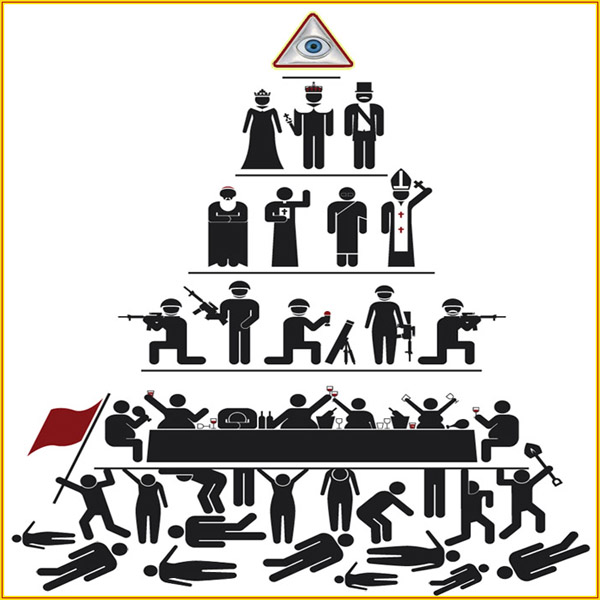
Place a square wooden framework on a flat surface and pour into it a stream of ball bearings, marbles, or other round objects. Some of the balls may bounce out, but many will form a layer within the wooden framework; others will then find a place atop this first layer. In this way, the flow of ball bearings steadily builds new layers that inevitably produce a pyramid-style shape. This experiment is used to demonstrate how near-perfect crystalline structures such as snowflakes arise in nature without conscious design.

The system – whether feudalism, capitalism, neoliberalism – emerges out of the real-world circumstances of those seeking power most ruthlessly. In a time when the key resource was land, a class emerged justifying why it should have exclusive rights to control that land and the labour needed to make it productive. When industrial processes developed, a class emerged demanding that it had proprietary rights to those processes and to the labour needed to make them productive.

Our place in the pyramid

In these situations, we need to draw on something like Darwin’s evolutionary “survival of the fittest” principle. Those few who are most hungry for power, those with least empathy, will rise to the top of the pyramid, finding themselves best-placed to exploit the people below. They will rationalise this exploitation as a divine right, or as evidence of their inherently superior skills, or as proof of the efficiency of the market.

And below them, like the layers of ball bearings, will be those who can help them maintain and expand their power: those who have the skills, education and socialisation to increase profits and sell brands.

All of this should be obvious, even non-controversial. It fits what we experience of our small-power lives. Does bigger power operate differently? After all, if those at the top of the power-pyramid were not hungry for power, even psychopathic in its pursuit, if they were caring and humane, worried primarily about the wellbeing of their workforce and the planet, they would be social workers and environmental activists, not CEOs of media empires and arms manufacturers.

And yet, base your political thinking on what should be truisms, articulate a worldview that distrusts those with the most power because they are the most capable of – and committed to – misusing it, and you will be derided. You will be called a conspiracy theorist, dismissed as deluded. You will be accused of wearing a tinfoil hat, of sour grapes, of being anti-American, a social warrior, paranoid, an Israel-hater or anti-semitic, pro-Putin, pro-Assad, a Marxist.

None of this should surprise us either. Because power – not just the people in the system, but the system itself – will use whatever tools it has to protect itself. It is easier to deride critics as unhinged, especially when you control the media, the politicians and the education system, than it is to provide a counter-argument.

In fact, it is vital to prevent any argument or real debate from taking place. Because the moment we think about the arguments, weigh them, use our critical faculties, there is a real danger that the scales will fall from our eyes. There is a real threat that we will move back from the screen, and see the whole picture.

Can we see the complete picture of the Skripal poisoning in Salisbury; or the US election that led to Trump being declared president; or the revolution in Ukraine; or the causes and trajectory of fighting in Syria, and before it Libya and Iraq; or the campaign to discredit Jeremy Corbyn as leader of the Labour party; or the true implications of the banking crisis a decade ago?

Profit, not ethics

Just as a feudal elite was driven not by ethics but by the pursuit of power and wealth through the control of land; just as early capitalists were driven not by ethics but by the pursuit of power and wealth through the control of mechanisation; so neoliberalism is driven not by ethics but the pursuit of power and wealth through the control of the planet.

The only truth we can know is that the western power-elite is determined to finish the task of making its power fully global, expanding it from near-absolute to absolute. It cares nothing for you or your grand-children. It is a cold-calculating system, not a friend or neighbour. It lives for the instant gratification of wealth accumulation, not concern about the planet’s fate tomorrow.

And because of that it is structurally bound to undermine or discredit anyone, any group, any state that stands in the way of achieving its absolute dominion.

If that is not the thought we hold uppermost in our minds as we listen to a politician, read a newspaper, watch a film or TV show, absorb an ad, or engage on social media, then we are sleepwalking into a future the most powerful, the most ruthless, the least caring have designed for us.

Step back, and take a look at the whole screen. And decide whether this is really the future you wish for your grand-children.