
Pop Culture Has Become an Oligopoly

By Adam Mastroianni

Source: Experimental History

You may have noticed that every popular movie these days is a remake, reboot, sequel, spinoff, or cinematic universe expansion. In 2021, only one of the ten top-grossing films––the Ryan Reynolds vehicle Free Guy––was an original. There were only two originals in 2020’s top 10, and none at all in 2019.

People blame this trend on greedy movie studios or dumb moviegoers or competition from Netflix or humanity running out of ideas. Some say it’s a sign of the end of movies. Others claim there’s nothing new about this at all.

Some of these explanations are flat-out wrong; others may contain a nugget of truth. But all of them are incomplete, because this isn’t just happening in movies. In every corner of pop culture––movies, TV, music, books, and video games––a smaller and smaller cartel of superstars is claiming a larger and larger share of the market. What used to be winners-take-some has grown into winners-take-most and is now verging on winners-take-all. The (very silly) word for this oligopoly, like a monopoly but with a few players instead of just one.

I’m inherently skeptical of big claims about historical shifts. I recently published a paper showing that people overestimate how much public opinion has changed over the past 50 years, so naturally I’m on the lookout for similar biases here. But this shift is not an illusion. It’s big, it’s been going on for decades, and it’s happening everywhere you look. So let’s get to the bottom of it.

(Data and code available here.)

Movies 

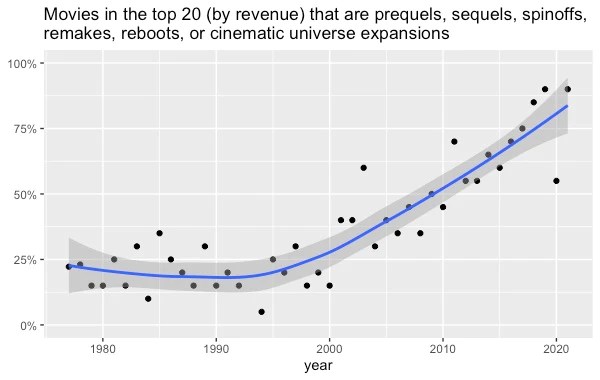
At the top of the box office charts, original films have gone extinct. 

I looked at the 20 top-grossing movies going all the way back to 1977 (source), and I coded whether each was part of what film scholars call a “multiplicity”—sequels, prequels, franchises, spin-offs, cinematic universe expansions, etc. This required some judgment calls. Lots of movies are based on books and TV shows, but I only counted them as multiplicities if they were related to a previous movie. So 1990’s Teenage Mutant Ninja Turtles doesn’t get coded as a multiplicity, but 1991’s Teenage Mutant Ninja Turtles II: The Secret of the Ooze does, and so does the 2014 Teenage Mutant Ninja Turtles remake. I also probably missed a few multiplicities, especially in earlier decades, since sometimes it’s not obvious that a movie has some connection to an earlier movie.

Regardless, the shift is gigantic. Until the year 2000, about 25% of top-grossing movies were prequels, sequels, spinoffs, remakes, reboots, or cinematic universe expansions. Since 2010, it’s been over 50% ever year. In recent years, it’s been close to 100%.
Original movies just aren’t popular anymore, if they even get made in the first place.

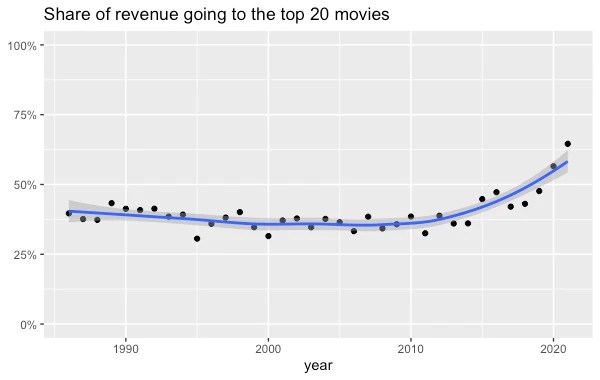
Top movies have also recently started taking a larger chunk of the market. I extracted the revenue of the top 20 movies and divided it by the total revenue of the top 200 movies, going all the way back to 1986 (source). The top 20 movies captured about 40% of all revenue until 2015, when they started gobbling up even more.
Television

Thanks to cable and streaming, there’s way more stuff on TV today than there was 50 years ago. So it would make sense if a few shows ruled the early decades of TV, and now new shows constantly displace each other at the top of the viewership charts.

Instead, the opposite has happened. I pulled the top 30 most-viewed TV shows from 1950 to 2019 (source) and found that fewer and fewer franchises rule a larger and larger share of the airwaves. In fact, since 2000, about a third of the top 30 most-viewed shows are either spinoffs of other shows in the top 30 (e.g., CSI and CSI: Miami) or multiple broadcasts of the same show (e.g., American Idol on Monday and American Idol on Wednesday). 
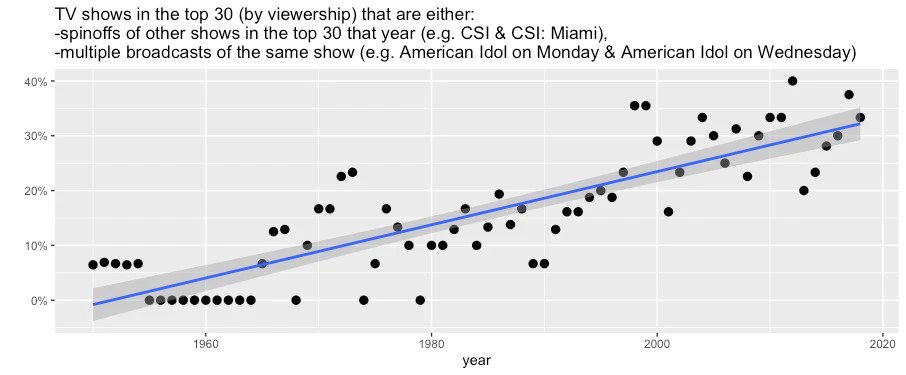
Two caveats to this data. First, I’m probably slightly undercounting multiplicities from earlier decades, where the connections between shows might be harder for a modern viewer like me to understand––maybe one guy hosted multiple different shows, for example. And second, the Nielsen ratings I’m using only recently started accurately measuring viewership on streaming platforms. But even in 2019, only 14% of viewing time was spent on streaming, so this data isn’t missing much.

Music

It used to be that a few hitmakers ruled the charts––The Beatles, The Eagles, Michael Jackson––while today it’s a free-for-all, right?

Nope. A data scientist named Azhad Syed has done the analysis, and he finds that the number of artists on the Billboard Hot 100 has been decreasing for decades.
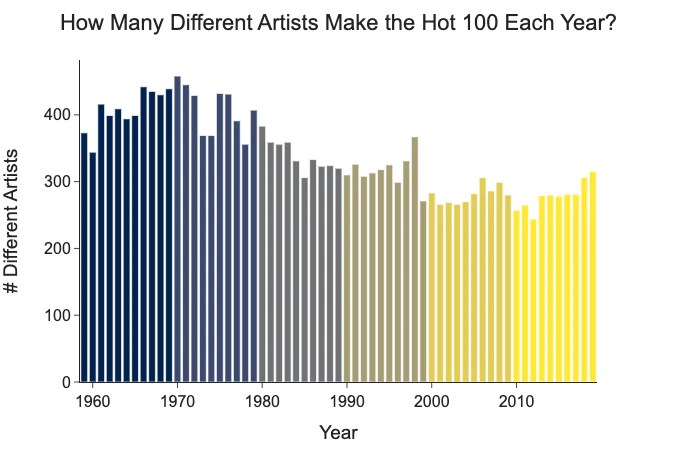
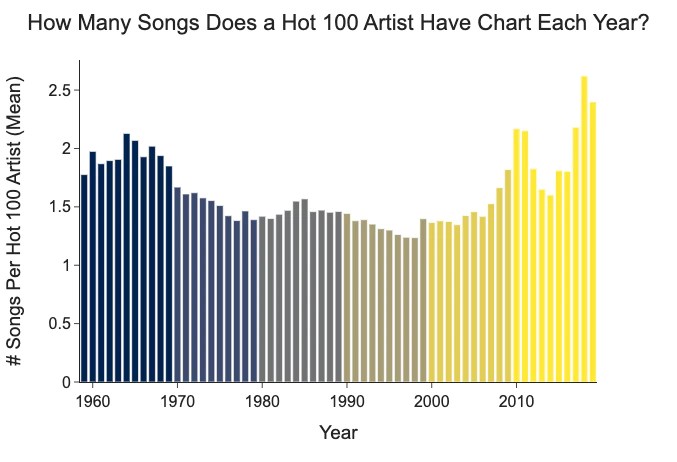
And since 2000, the number of hits per artist on the Hot 100 has been increasing. 
(Azhad says he’s looking for a job––you should hire him!)

A smaller group of artists tops the charts, and they produce more of the chart-toppers. Music, too, has become an oligopoly.

Books

Literature feels like a different world than movies, TV, and music, and yet the trend is the same.

Using LiteraryHub’s list of the top 10 bestselling books for every year from 1919 to 2017, I found that the oligopoly has come to book publishing as well. There are a couple ways we can look at this. First, we can look at the percentage of repeat authors in the top 10––that is, the number of books in the top 10 that were written by an author with another book in the top 10.
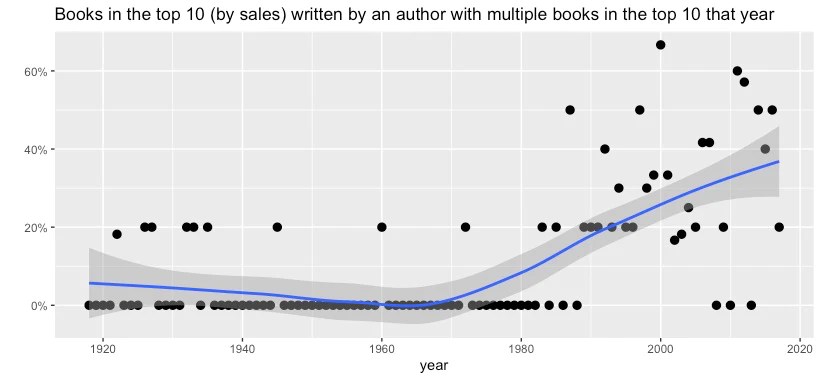
It used to be pretty rare for one author to have multiple books in the top 10 in the same year. Since 1990, it’s happened almost every year. No author ever had three top 10 books in one year until Danielle Steel did it 1998. In 2011, John Grisham, Kathryn Stockett, and Stieg Larsson all had two chart-topping books each.

We can also look at the percentage of authors in the top 10 were already famous––say, they had a top 10 book within the past 10 years. That has increased over time, too. 
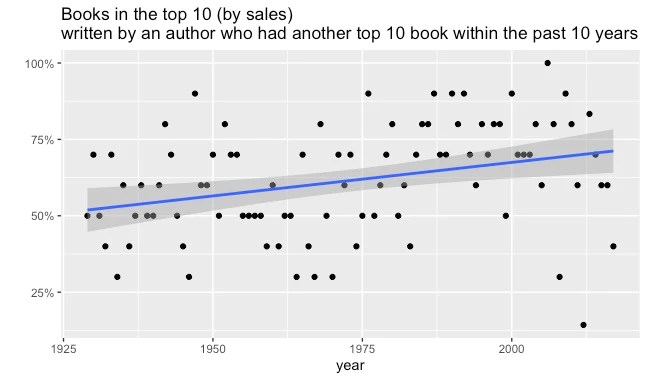
In the 1950s, a little over half of the authors in the top 10 had been there before. These days, it’s closer to 75%.

Video games

I tracked down the top 20 bestselling video games for each year from 1995 to 2021 (sources: 1234567) and coded whether each belongs to a preexisting video game franchise. (Some games, like Harry Potter and the Sorcerer’s Stone, belong to franchises outside of video games. For these, I coded the first installment as originals and any subsequent installments as franchise games.)

The oligopoly rules video games too:
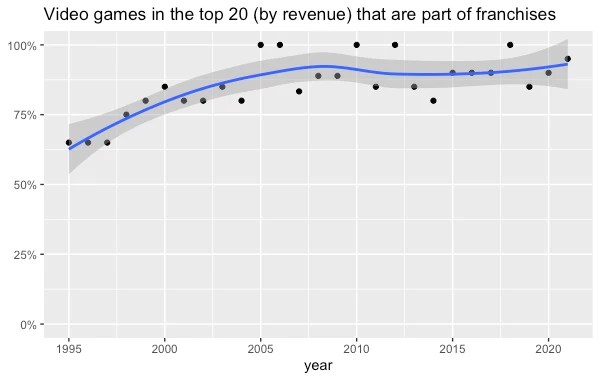
In the late 1990s, 75% or less of bestselling video games were franchise installments. Since 2005, it’s been above 75% every year, and sometimes it’s 100%. At the top of the charts, it’s all Mario, Zelda, Call of Duty, and Grand Theft Auto.

Why is this happening?

Any explanation for the rise of the pop oligopoly has to answer two questions: why have producers started producing more of the same thing, and why are consumers consuming it? I think the answers to the first question are invasionconsolidation, and innovation. I think the answer to the second question is proliferation.

Invasion

Software and the internet have made it easier than ever to create and publish content. Most of the stuff that random amateurs make is crap and nobody looks at it, but a tiny proportion gets really successful. This might make media giants choose to produce and promote stuff that independent weirdos never could, like an Avengers movie. This can’t explain why oligopolization started decades ago––YouTube only launched in 2005, for example, and most Americans didn’t have broadband until 2007––but it might explain why it’s accelerated and stuck around.

Consolidation

Big things like to eat, defeat, and outcompete smaller things. So over time, big things should get bigger and small things should die off. Indeed, movie studiosmusic labelsTV stations, and publishers of books and video games have all consolidated. Maybe it’s inevitable that major producers of culture will suck up or destroy everybody else, leaving nothing but superstars and blockbusters. Indeed, maybe cultural oligopoly is merely a transition state before we reach cultural monopoly.

Innovation

You may think there’s nothing left to discover in art forms as old as literature and music, and that they simply iterate as fashions change. But it took humans thousands of years to figure out how to create the illusion of depth in paintings. Novelists used to think that sentences had to be long and complicated until Hemingway came along, wrote some snappy prose, and changed everything. Even very old art forms, then, may have secrets left to discover. Maybe the biggest players in culture discovered some innovations that won them a permanent, first-mover chunk of market share. I can think of a few:

  • In books: lightning-quick plots and chapter-ending cliffhangers. Nobody thinks The Da Vinci Code is high literature, but it’s a book that really really wants you to read it. And a lot of people did!
  • In music: sampling. Musicians seem to sample more often these days. Now we not only remake songs; we franchise them too.
  • In movies, TV, and video games: cinematic universes. Studios have finally figured out that once audiences fall in love with fictional worlds, they want to spend lots of time in them. Marvel, DC, and Star Wars are the most famous, but there are also smaller universe expansions like Better Call Saul and El Camino from Breaking Bad and The Many Saints of Newark from The Sopranos. Video game developers have understood this for even longer, which is why Mario does everything from playing tennis to driving go-karts to, you know, being a piece of paper.

Proliferation

Invasion, consolidation, and innovation can, I think, explain the pop oligopoly from the supply side. But all three require a willing audience. So why might people be more open to experiencing the same thing over and over again?

As options multiply, choosing gets harder. You can’t possibly evaluate everything, so you start relying on cues like “this movie has Tom Hanks in it” or “I liked Red Dead Redemption, so I’ll probably like Red Dead Redemption II,” which makes you less and less likely to pick something unfamiliar. 

Another way to think about it: more opportunities means higher opportunity costs, which could lead to lower risk tolerance. When the only way to watch a movie is to go pick one of the seven playing at your local AMC, you might take a chance on something new. But when you’ve got a million movies to pick from, picking a safe, familiar option seems more sensible than gambling on an original.

This could be happening across all of culture at once. Movies don’t just compete with other movies. They compete with every other way of spending your time, and those ways are both infinite and increasing. There are now 60,000 free books on Project Gutenberg, Spotify says it has 78 million songs and 4 million podcast episodes, and humanity uploads 500 hours of video to YouTube every minute. So uh, yeah, the Tom Hanks movie sounds good.

What do we do about it?

Some may think that the rise of the pop oligopoly means the decline of quality. But the oligopoly can still make art: Red Dead Redemption II is a terrific game, “Blinding Lights” is a great song, and Toy Story 4 is a pretty good movie. And when you look back at popular stuff from a generation ago, there was plenty of dreck. We’ve forgotten the pulpy Westerns and insipid romances that made the bestseller lists while books like The Great GatsbyBrave New World, and Animal Farm did not. American Idol is not so different from the televised talent shows of the 1950s. Popular culture has always been a mix of the brilliant and the banal, and nothing I’ve shown you suggests that the ratio has changed.

The problem isn’t that the mean has decreased. It’s that the variance has shrunk. Movies, TV, music, books, and video games should expand our consciousness, jumpstart our imaginations, and introduce us to new worlds and stories and feelings. They should alienate us sometimes, or make us mad, or make us think. But they can’t do any of that if they only feed us sequels and spinoffs. It’s like eating macaroni and cheese every single night forever: it may be comfortable, but eventually you’re going to get scurvy. 

We haven’t fully reckoned with what the cultural oligopoly might be doing to us. How much does it stunt our imaginations to play the same video games we were playing 30 years ago? What message does it send that one of the most popular songs in the 2010s was about how a 1970s rock star was really cool? How much does it dull our ambitions to watch 2021’s The Matrix: Resurrections, where the most interesting scene is just Neo watching the original Matrix from 1999? How inspiring is it to watch tiny variations on the same police procedurals and reality shows year after year? My parents grew up with the first Star Wars movie, which had the audacity to create an entire universe. My niece and nephews are growing up with the ninth Star Wars movie, which aspires to move merchandise. Subsisting entirely on cultural comfort food cannot make us thoughtful, creative, or courageous.

Fortunately, there’s a cure for our cultural anemia. While the top of the charts has been oligopolized, the bottom remains a vibrant anarchy. There are weird books and funky movies and bangers from across the sea. Two of the most interesting video games of the past decade put you in the role of an immigration officer and an insurance claims adjuster. Every strange thing, wonderful and terrible, is available to you, but they’ll die out if you don’t nourish them with your attention. Finding them takes some foraging and digging, and then you’ll have to stomach some very odd, unfamiliar flavors. That’s good. Learning to like unfamiliar things is one of the noblest human pursuits; it builds our empathy for unfamiliar people. And it kindles that delicate, precious fire inside us––without it, we might as well be algorithms. Humankind does not live on bread alone, nor can our spirits long survive on a diet of reruns.


HOW HYPNOTISTS (AND MASS MEDIA) HACK YOUR MIND TO CONTROL YOUR BEHAVIOR

By Dylan Charles

Source: Waking Times

I’m a committed advocate of freedom, personal liberty, pharmaceutical free health, bodily autonomy, and free-thinking, which, apparently, puts me at odds with the majority. As shocking as it is, these basic standards of a good life, which have governed humans for centuries, are suddenly being portrayed as selfish and even dangerous.

How does an individual come to view personal sovereignty as a detriment to themselves and to society, especially when that society is so obviously sick and dysfunctional? How does one come to see their own body as a threat to the world at large, and a playground for experimental science?

People ask me these questions all the time, and the best way to explain what’s happening is to look at how mind control, social engineering, propaganda, and hypnosis affect the mind and steer the individual away from individualistic and self-governing behavior. The hysteria so prevalent today only makes sense when you recognize that most people are truly not thinking for themselves, but are instead programmed to run scripts and programs that have been prepared for mass consumption.

By looking at how hypnotism works, for example, you can begin to understand what’s really happening today, and more importantly you can begin to understand how your own life is affected by the environment we’re in.

Here’s a look at how hypnosis (and mass media) hack your mind to control your behavior.

First of all, let’s acknowledge the power of hypnosis. Therapeutic hypnosis is widely used clinically for the management of pain, depression, anxiety, stress, phobias, and habit disorders, such as smoking.

Stage hypnotists are well-known for inducing some extraordinarily illogical and ridiculous behavior in their subjects. In a matter of minutes, an accomplished stage hypnotists can get complete strangers to do absurd things like believe their hands are glued together, forget their own name, lose the ability to drink water, to be unable to see a person or object right in front of their face, to jump up and yell something bizarre when they hear a code word, and on and on.

Hypnotism is real, and anyone is susceptible to it, in varying degrees. In the following clip, hypontist Keith Barry explains what it takes to hypnotize a person… any person. He explains that a subject needs to be intelligent, as a key requirement for hypnotism is the ability to focus on the imagery, speech and commands of the hypnotist. He gives us a simple exercise to show that certain people can be more or less susceptible to hypnosis.

YouTuber Derek Banas explains the process of how to hypnotize someone. Firstly, you must hold the belief that hypnosis is real and that it will work, then you must build a rapport with the subject, have them place their full attention on you, completely focusing at all levels on one thing. When their attention is completely focused, the subject is ready to be led into trance, which involves giving repeated simple commands and suggestions, until they are told to close their eyes and fully relax.

There are variations of this, including different techniques, although the process is essentially uniform.

You act with authority and confidence. You direct all of their attention on to one thing, You repeatedly tell the subject that they are being hypnotized. You lead them into trance with repetitive language and directives, while directing the movements of their eyes.

As the subject undergoes this process they are making a series of micro-agreements along the way, essentially giving the hypnotist deeper access to consent. The attention is focused along with repetitive and downwards inflecting suggestions while their eyes are trained on a specific object, like a swinging watch, for example. Doing this brings the subjects brainwaves closer and closer to an alpha state, the most hypnotic brainwave state.

The confidence and rapport of the hypnotist serves to bypass what is known as the critical factor, which is considered the gateway between the conscious and subconscious mind. It is believed that 95+% of our behavior is governed by the subconscious mind, and bypassing the critical factor moves the subject from analytical thinking toward emotional and unconscious thinking, forgoing logic and reason. Essentially, the subject’s nervous system is either overloaded, or made to completely relax, and high emotions such as lust or fear are the most effective emotional energies to bypass the critical factor. A hypnotist does this by presenting with authority and certainty, thereby giving the subject the freedom to relax into a subconscious or automatic mode of behavior.

The physical signs of hypnosis include dilated pupils, relaxed breathing, eyes wanting to close, skin flushes and other subtle physiological signs. When a person is deep in an alpha brainwave state, a hypnotic state, their conscious, rational mind is effectively switched off, and they become incredibly open to suggestion, making it possible to implant ideas and behaviors into them, which the subject will adopt without critical thinking.

Hypnotherapist Marc Marshall explains this in more detail and in the context of our global situation, discussing how the amygdala is also hijacked to bypass the critical factor, taking over a person’s fight or flight responses.

“Let me pull back the curtain a bit on how this process works and show you what has happened and is continuing to happen in this current emergency. Many of you have witnessed what hypnotists call an instant or shock induction. These are the dramatic inductions that many stage and street hypnotists use to induce a trance state (hypnosis) in their volunteers. It literally takes just a few seconds for this to happen. What the hypnotist typically does is cause a firing of that portion of the brain known as the amygdala. We literally hijack the amygdala which is responsible for the “fight/flight/freeze” mechanism of our bodies. It is in this split second of time, that the subconscious mind is looking for a program that will provide an appropriate response. Nancy Moyer, MD., describes it as When stress makes you feel strong anger, aggression, or fear, the fight-or-flight response is activated. … It happens when a situation causes your amygdala to hijack control of your response to stress. The amygdala disables the frontal lobes and activates the fight-or-flight response.” It is this most basic of instinctual responses that is responsible for our survival as a species. It is caused by the release of cortisol, a powerful stress hormone.

There are several extremely critical parts of this phenomena of amygdala hijack that are the essence of what I am seeing and which concerns me. As stated above, the amygdala disables the frontal lobe of our brains. The frontal lobe is the part of the brain that controls important cognitive skills in humans, such as emotional expression, problem solving, memory, language, judgment, and sexual behaviors. It is, in essence, the “control panel” of our personality and our ability to communicate. We lose our ability to make rational judgements, our stress increases and dramatic physical changes take place in our bodies. Most importantly, we become and remain highly suggestible in this highly aroused state. Our subconscious minds are seeking to find that “program” that will free us from this threat and we take that cue from the perceived leaders.” ~Marc Marshall

That’s a short synopsis of how a hypnotist brings someone into a suggestive trance, and here’s an excellent video of this process, and a demonstration of what a hypnotist can influence a person to unconsciously do.

The keys to the process of inducing hypnosis are the projection of confidence and authority, capturing the full attention of the subject, using repeated trance inducing language and repeated suggestions, bypassing the critical factor, and inducing an alpha brainwave trance.

Confidence, authority, repetition, suggestion and trance induction.

Now, back to how mass media uses this very skillset to induce mass hypnosis and generate widespread unconscious and controllable behavior.

Firstly, the primary medium for blasting non-stop cable news into your brain is TV. Television itself is well-known to rapidly induce alpha brain wave states in the viewer, bringing them into a hypnotic trance automatically, typically affecting the function of the frontal lobe within an astonishing 90 seconds, and bypassing critical thinking.

“If you’ve ever experienced a mind fog after watching television, you’re not alone.

The brain has four modes that it operates in, and four brain wave patterns. Delta is when you’re deep asleep, Theta is when you’re in light sleep, Alpha is awake but relaxed, it’s the mode of thinking that you are in when you’re in the most heightened state of suggestibility, and then there’s Beta, the highest functioning mode like when you’re reading a book or you’re having a very stimulating conversation.” ~Pseudology: The Art of Lying

This presentation explains this in greater detail.

Furthermore, the graphic design elements commonly used in news presentations serves the purpose of capturing one’s full attention and jarring the nervous system into an overloaded state. Think about the various moving parts and messages the screen at any given moment during a regular broadcast. While the anchor is speaking about one thing, you’ll see side-scrolling text at the bottom talking about an entirely different issue, with evolving background graphics, typically emphasizing the colors red and blue, which are subconsciously regarded as the colors of authority and trust.

Also, they commonly use swirling spheres and circles, graphics are used much in the same way that hypnotist uses a watch or a pen as a point of eye fixation to capture the full attention of the viewer.

Here’s a perfect example:

Now, if you look at marketing in general, it is a confidence game. That is, marketers will attempt to sell you anything at all while pretending it is the most amazing and life-changing thing ever. TV infomercials come to mind.

Mass media is a confidence game (con-game), meaning that the anchors, reporters, experts and pundits are adept at presenting any information with absolute and total confidence. Colin Powell did this when he showed up at the UN with a vial of white powder and told everyone in the room that Saddam Hussein was going to kill everyone. It’s difficult to disbelieve someone who presents with such confidence, and psychopaths are the best at this, and know to exploit their victims’ trust by over exaggerating confidence.

The top news anchors will never let their confidence down, and they’re marketed in such a way as to manufacture rapport with the audience. They’re seen in heart-warming town hall segments relating to the common man, out in nature celebrating life, and out on the town kissing babies. Here’s everyone’s favorite, Anderson Cooper, being portrayed as a humanitarian. Such a likable guy!

Finally there is the detail of suggesting and commanding the viewer to believe or to do certain things. In hypnosis, when the critical factor is bypassed, it allows access to the subconscious mind where what are known as ‘pillars of belief’ are implanted. Below the rational, critical thinking part of the mind is a deep sea of beliefs which govern most behavior. Once a subject is in an induced trance, the news repeats ideas, suggestions and beliefs, ad nauseam until the viewer basically becomes a parrot and information repeater. You see these people everywhere today.

Final Thoughts

More than ever before, those of you who believe in freedom, as I do, are called to gather your strength, sovereignty and power to stand up for these timeless moral values. It is of critical importance to recognize that the world has been deliberately lulled into a hypnotic state and fed beliefs and ideas about how things should be or how we should address crisis.

If you understand what is happening, and if you understand how all of this plays a role in shaping your own life, beliefs, and behaviors, you’r better equipped to take back control of your life.

ACCORDING TO THE FATHER OF PROPAGANDA AN INVISIBLE GOVERNMENT CONTROLS OUR MINDS WITH A THOUGHT PRISON

By Sigmund Fraud

Source: Waking Times

“Who are the men who without our realizing it, give us our ideas, tell us whom to admire and whom to despise, what to believe about the ownership of public utilities, about the tariff, about the price of rubber, about the Dawes Plan, about immigration; who tell us how our houses should be designed, what furniture we should put in them, what menus we should serve on our table, what kind of shirts we must wear, what sports we should indulge in, what plays we should see, what charities we should support, what pictures we should admire, what slang we should affect, what jokes we should laugh at?” ~ Edward Bernays, Propaganda

Authored by Edward Bernays and published in 1928, the book Propaganda still holds its position as the gold standard for influencing and manipulating public behavior. Drawing on his expertise in psychology while using the language of manipulation, Bernays pioneered social engineering via mass media, and his work lives on in the distorted, statist, consumer world we have today.

But who are the ones behind the curtain telling us what to think by directing our attention onto the things which serve interests?

Interestingly, chapter III of Propaganda is titled, ‘The New Propagandists, and is devoted to explaining why the controls for mass manipulation are so closely guarded by a relatively tiny elite who sit in the shadows, out of the public eye, choosing what we are to see and to think, even controlling the politicians we elect to represent us.

If we set out to make a list of the men and women who, because of their position in public life, might fairly be called the molders of public opinion we could quickly arrive at an extended list of persons mentioned in “Who’s Who…”

Such a list would comprise several thousand persons. But it is well known that many of these leaders are themselves led, sometimes by persons whose names are known to few.

Such persons typify in the public mind the type of ruler associated with the phrase invisible government.

An invisible government of corporate titans and behind the scenes influencers who’s mark on culture cannot be understated today. Bernays continues:

The invisible government tends to be concentrated in the hands of the few because of the expense of manipulating the social machinery which controls the opinions and habits of the masses.

The public relations counsel, then, is the agent who, working with modern media communication and the group formation of society, brings an idea to the consciousness of the public. But he is a great deal more than that. He is concerned with courses of action, doctrines, systems and opinions, and the securing of public support for them.

Ultimately, the goal of this type of mass-produced, pop-culture propaganda is to weaken the individual’s ability to think critically, thereby creating an environment where many people look to one another for approval, always second-guessing their own faculties. When this happens, the strength of the collective group begins to take form and multiply, and ideas can be implanted into the popular culture, taking root in the form of widespread conformist behavior.

Thinking critically means making reasoned judgments that are logical and well thought out. It is a way of thinking in which one doesn’t simply accept all arguments and conclusions to which one is exposed without questioning the arguments and conclusions. It requires curiosity, skepticism and humility. People who use critical thinking are the ones who say things such as, “How do you know that?” “Is this conclusion based on evidence or gut feelings?” and “Are there alternative possibilities when given new pieces of information?””  [Source]

Final Thoughts

The takeaway here is that not much has changed in 100 years of corporate/statist American culture, other than the technical capacity to scale this ever upward. Our lives are still heavily influenced by the likes of the described by Bernays. There is one advantage we do have now, however, as technology has given us greater access to the truth and we are now free to split from the matrix psychologically by understanding what it is and how it influences our lives. If we choose to do so, that is, if we choose to take the red pill.

In order to understand your life and your mission here on earth in the short time you have, it is imperative to learn to see the thought prison that has been built around you, and to actively circumnavigate it. Free-thinking is being stamped out by the propagandists, but our human tendency is to crave freedom, and with the aid of truth, we are more powerful than the control matrix and the invisible government.

YouTube Financially Deplatforms Swath Of Indie Media Accounts

By Caitlin Johnstone

Source: CaitlinJohnstone.com

The Google-owned video sharing platform YouTube has demonetized numerous independent media accounts, a jarring escalation in the steadily intensifying campaign against alternative news outlets online.

Progressive commentators Graham ElwoodThe Progressive SoapboxThe Convo CouchFranc AnalysisHannah Reloaded and Cyberdemon531 have all received notifications from YouTube that their videos are no longer permitted to earn money through the platform’s various monetization features, as has Ford Fischer, a respected freelancer who films US political demonstrations. No explanation has been offered for this decision beyond the vague claim that “your channel is not in line with our YouTube Partner Program policies” due to “harmful content”.

Like all large online platforms, YouTube’s appeals process is notoriously opaque and unaccountable. These accounts could remain demonetized for months, or forever, without any clear explanation at all. Ford Fischer, who has been in this situation before, said on Twitter that his account was left demonetized for seven months before YouTube reversed its decision.

“Last time you demonetized my channel, I spoke out for seven months. I didn’t delete a single piece of content. You admitted you were wrong. I forgive you. Please don’t do this again,” Fischer tweeted.

“No superchats, no ad revenue, no YouTube premium money,” tweeted Elwood, who also said “I have a call with my lawyers later today.”

“You guys have destroyed my channel without legit explanation as to why,” tweeted Jamarl Thomas of Progressive Soapbox. “No videos are given – and frankly there is literally zero ‘harmful’ content on my channel. This is a radically bad error that needs to be corrected.”

The Convo Couch’s Jonathan Mayorca tweeted the notification he received from YouTube which gave the reason as “Harmful content: Content that focuses on controversial issues and that is harmful to viewers,” saying no specific video or subject was named. Nobody receiving these notifications appears to have any idea what is meant by “harmful” or “controversial” or why YouTube is mentioning them in the same breath as though these two things are connected or synonymous in some way.

YouTube has been providing template responses saying “We recommend making the needed changes to your content and reapply in 30 days” while refusing to specify what the “needed changes” even are.

Speaking for myself, I can say with absolute certainty that I would not be able to create content at anywhere near the pace I do were I not making enough money from it to do it full time. Life is far too demanding with far too much else going on for me to be able to maintain anything like daily output; being financially deplatformed and having to get another job would force me down to an essay a week in my spare time, if that. Anyone who works in independent media full time knows this, and so do the powerful people who are steadily ratcheting up the campaign to silence anyone who hasn’t passed through the gatekeepers of the plutocratic media.

Financial deplatforming is censorship. People were given an opportunity to devote themselves to the vocation of creating media outside the gatekeeping apparatus of billionaire news institutions, which is arguably the single most important vocation anyone can give themselves to in our world right now, and they built their lives around their ability to do this. Now it’s being ripped away from them; their literal jobs are being taken away. They were offered a reason to think they’d be able to make a living doing very important work, and then they were sucker punched with what amounts to political censorship.

This has been a continually escalating trend for years. The general population is herded onto huge monopolistic social media platforms offering democratization of information where your voice can be heard, and then those platforms proceed to censor an increasing amount of political speech in increasing coordination with the US government.

https://twitter.com/FordFischer/status/1357055942446223360

If the democratization of information online is successfully reversed and the mass media gatekeepers are again the sole authorities on what’s real and true, people will be locked into forming their ideas on how to think, act and vote based on what they are told by the same plutocratic media institutions which have been deceiving them into every war and manipulating them into accepting the status quo for generations.

If the door is locked to the possibility of a grassroots information rebellion against the narrative hegemony of our rulers, we will remain doomed to continue along the same ecocidal, omnicidal trajectory these bastards have us on until it reaches its inevitable conclusion. This must be resisted.

Abnormalize The Status Quo

By Caitlin Johnstone

Source: CaitlinJohnstone.com

If we’d been living in a healthy society and then suddenly had this society’s sick, insane status quo thrust upon us by powerful people, we’d have all been out in the streets making life very hard for those powerful people in an instant.

We are in the same situation now. We are having a wildly insane status quo thrust upon us by the powerful and for the benefit of the powerful. Only difference is we’re not all out in the streets, and instead of thrusting this horrible situation upon us suddenly, they’ve been doing it this entire time.

Which is precisely why we’re not out in the streets. We were born into this mess, so we assume it’s normal and that things are supposed to be this way. But it isn’t, and they aren’t.

What is normal is health. Health is the normal default condition. If you wake up with a fever and stabbing pain in your abdomen you don’t say “Ah well I guess that’s normal now, you can’t expect to just not have a fever and stabbing abdominal pain,” you recognize that there’s an urgent problem and you take action to fix it.

Even if you’d been sick your entire life, you would understand that your situation is not normal. You would understand that the basic default condition is health, but some dysfunction in your specific system has deprived you of that normal state of being.

In order for us to begin pushing back on the dysfunction of our current system, we need to begin looking at it in the same way. We need to clearly come to see how spectacularly divergent it is from the basic default condition of health. How sick it is. How abnormal it is.

We need to see clearly that health is normal and sickness is abnormal, whether you’re talking about an individual or a society.

It’s not normal for a civilization to be dominated by plutocrats and secretive government agencies and to only get offered the choice between two authoritarian corporate warmongers in a pretend election to a position of leadership that is almost entirely fake.

It’s not normal for there to be enough wealth to feed and care for everyone and yet instead have people with unfathomable amounts of money while others die of lack.

It’s not normal for a globe-spanning empire to dominate our species with endless military violence and starvation sanctions for the sole purpose of maintaining and expanding the unipolar hegemony of a few sociopathic manipulators.

It’s not normal for us to be destroying our ecosystem in order to grow an economy that is ultimately an imaginary construction in our minds instead of learning to collaborate harmoniously with that ecosystem.

It’s not normal for us all to be competing against each other at the expense of the entire world instead of collaborating with each other for the good of the entire world.

We need to get crystal clear that these things are not normal, because our entire society is completely saturated with skilful manipulations telling us that they are.

I write a lot about the more egregious, incendiary lies that the mass media have notoriously promulgated like WMDs in Iraq, Russiagate, the imaginary Labour antisemitism crisis etc. But the most destructive lies the mass media tell us are not the ones that stand out the most in our collective memory. The most damaging lies they tell us are the little ones they tell us many times every single day by way of spin, omission, half-truth and distortion in order to give us the impression that this status quo is normal and inescapable.

You see it in the way they talk about politicians who stand even a tiny bit outside the warmongering oligarchic beltway consensus like they are radical extremists. You see it in the way they’ll focus on protests in Belarus or Hong Kong while ignoring them in Bolivia or France. You see it in the way they ignore Yemen when it’s the single most horrific thing happening on our planet right now. You see it in all the sitcoms and movies where debt and low wages and other symptoms of status quo dysfunction are almost never a featured concern.

You see it in innumerable other ways, day in and day out, and they add up. They add up for someone who was born into a gravely dysfunctional system and has never known anything resembling health to compare it to. They’re like someone who has always been sick, who has also never known or heard about anyone who is healthy.

You can tell me we’ve never had a healthy society since the dawn of civilization all you want. All you are telling me is that we have always been sick. Being sick all your life doesn’t mean health isn’t normal or that health shouldn’t be urgently sought; if anything it means it should be sought more urgently.

It is not human nature to be this sick, and anyone who tells you it is is lying. Anyone who tells you it’s human nature to be greedy, violent, domineering and abusive isn’t telling you about humanity’s nature, they’re telling you about their own nature. And it’s probably a bad idea to turn your back on them.

We can have health. We can have normality. But just as you won’t return to health by pretending that your fever and abdominal pains are normal, we can’t create a healthy society as long as we allow ourselves to be manipulated into the belief that our backwards, insane status quo is what normality looks like.

So abnormalize the status quo. Abnormalize it every chance you get. Abnormalize it by holding a clear idea in your mind of what a healthy society would look like, then point out all the bizarre deviations from that vision at every opportunity. Remind people that this is crazy. Assure them that it doesn’t have to be this way. That the only thing keeping it this way is the fact that the powerful keep pouring vast troves of wealth into manipulating us into thinking that we should.

Help people see what health is so that they can see what sickness is. Interrupt conversations about which flavor of sickness would be preferable this election season to point to what real health would look like. Disrupt all attempts to normalize our status quo, and use whatever reach you have to help abnormalize it.

As Long As Mass Media Propaganda Exists, Democracy Is A Sham

By Caitlin Johnstone

Source: CaitlinJohnstone.com

A new Reuters/Ipsos poll has reportedly found that a majority of Americans believe the completely discredited narrative that the Russian government paid Taliban-linked fighters to kill the occupying forces of the US and its allies in Afghanistan.

“A majority of Americans believe that Russia paid the Taliban to kill U.S. soldiers in Afghanistan last year amid negotiations to end the war, and more than half want to respond with new economic sanctions against Moscow, according to a Reuters/Ipsos poll released on Wednesday,” Reuters reports.

“Overall, 60% of Americans said they found reports of Russian bounties on American soldiers to be ‘very’ or ‘somewhat’ believable, while 21% said they were not credible and the rest were unsure,” says Reuters.

https://twitter.com/Reuters/status/1280831503879016448

Those 21 percent are objectively correct: the story is not credible, and it’s not even close. Gareth Porter shows in The Grayzone how the “Bountygate” narrative is so utterly baseless that even US intelligence agencies have dismissed it, Joe Lauria of Consortium News explains how it doesn’t make any sense on its face, and FAIR’s Alan MacLeod breaks down the appalling journalistic malpractice that went into circulating this incredibly thinly sourced story to the mainstream public.

The story advances no solid facts or verified information. What it does advance is pre-existing imperialist agendas like remaining in Afghanistan, killing the last of the remaining nuclear deals with Moscow, and manufacturing public support for new Russia sanctions.

And yet a majority of people believed it, and still believe it. The narrative that Russia paid Taliban fighters to kill occupying forces is now regarded as an established fact in many key circles, despite being backed by literally zero facts.

If people were as objective and adept at critical thinking as we tend to believe we are, the mass media’s unconscionable facilitation of a brazen cold war psyop would by itself have killed off all public trust in the institution of mass news reporting. But people are not as objective and adept at critical thinking as we tend to believe we are. People have many cognitive biases which distort our ability to objectively process information and understand events, including one which causes us to believe something is true just because they’ve heard it said multiple times. This makes us easily susceptible to mass media propaganda, where our encounters with daily news headlines can shape our perception of what’s going on in the world regardless of whether or not those headlines are backed by actual facts.

https://twitter.com/GarethPorter/status/1280966373129281536

This latest poll is a perfect example of how the plutocrat-owned media manipulate public opinion in the interest of establishment agendas using brazen propaganda campaigns, but it is just the most recent example. Over and over and over again we see public perception of what’s going on distorted by lies inserted into their minds by the corporate news media, like when half a year after the invasion of Iraq seven in ten Americans believed Saddam Hussein was responsible for the 9/11 attacks. All it took to trick them into believing this and supporting the invasion was repeatedly mentioning 9/11 and Saddam in the same breath, despite there never being any evidence whatsoever for any such thing.

This kind of manipulation is not rare, it is ubiquitous and ongoing. Every single day the plutocratic media are putting ideas in people’s minds which favor the establishment upon which said plutocrats have built their kingdoms, normalizing the insane status quo and manufacturing support for agendas which bolster it. This is not some delusional conspiracy theory, it’s a well-documented fact to which many mainstream journalists have testified.

As long as this remains the case in our society, democracy cannot exist in any meaningful way. As long as a loose alliance of plutocrats and government operatives are able to consistently manipulate the way a critical mass of people think and vote, then you cannot rightly say that the people are in charge of the fate of their nation. If the majority is consistently in alignment with the plutocrats whose outsized media influence enables them to dominate the public narrative, then voting necessarily reflects the will of those plutocrats, not the people.

Even if you changed everything else that is wrong with the current system, nothing would change if the plutocratic class retained its ability to manipulate the way people think and vote. You can fix America’s garbage election integrity, end gerrymandering, even get money out of politics, but as long as the plutocratic class is still using its wealth to manipulate public thought in support of its interests, people would keep voting the way they’re manipulated to vote.

Manipulation is a key ingredient in any long-term abusive relationship, because people don’t tend to stay in abusive situations unless they are manipulated into doing so. This is true whether you’re talking about romantic partnerships, governments, or globe-spanning power structures. We don’t use the power of our numbers to end this abusive relationship where we are at the whim of crushing austerity, exploitative neoliberalism, endless war and rapacious ecocide, because we’re being manipulated into staying.

And, just like with any other abusive relationship, there comes a time to leave before it’s too late. That time is now. We can begin by expanding awareness of what’s really going on, both inwardly in ourselves and outwardly by sharing truthful information with others. In so doing, we stand a chance at making ourselves impossible to propagandize effectively and using our strength in numbers to force real change.

How To Defeat The Empire

By Caitlin Johnstone

Source: CaitlinJohnstone.com

One of the biggest and most consistent challenges of my young career so far has been finding ways to talk about solutions to our predicament in a way that people will truly hear. I talk about these solutions constantly, and some readers definitely get it, but others will see me going on and on about a grassroots revolution against the establishment narrative control machine and then say “Okay, but what do we do?” or “You talk about problems but never offer any solutions!”

Part of the difficulty is that I don’t talk much about the old attempts at solutions we’ve already tried that people have been conditioned to listen for. I don’t endorse politicians, I don’t advocate starting a new political party, I don’t support violent revolution, I don’t say that capitalism contains the seeds of its own destruction and the proletariat will inevitably rise up against the bourgeoisie, and in general I don’t put much stock in the idea that our political systems are in and of themselves sufficient for addressing our biggest problems in any meaningful way.

What I do advocate, over and over and over again in as many different ways as I can come up with, is a decentralized guerrilla psywar against the institutions which enable the powerful to manipulate the way ordinary people think, act and vote.

I talk about narrative and propaganda all the time because they are the root of all our problems. As long as the plutocrat-controlled media are able to manufacture consent for the status quo upon which those plutocrats built their respective empires, there will never be the possibility of a successful revolution. People will never rebel against a system while they’re being successfully propagandized not to. It will never, ever happen.

Most people who want drastic systematic changes to the way power operates in our society utterly fail to take this into account. Most of them are aware to some extent that establishment propaganda is happening, but they fail to fully appreciate its effects, its power, and the fact that it’s continually getting more and more sophisticated. They continue to talk about the need for a particular political movement, for this or that new government policy, or even for a full-fledged revolution, without ever turning and squarely focusing on the elephant in the room that none of these things will ever happen as long as most people are successfully propagandized into being uninterested in making them happen.

It’s like trying to light a fire without first finding a solution to the problem that you’re standing under pouring rain. Certainly we can all agree that a fire is sorely needed because it’s cold and wet and miserable out here, but we’re never going to get one going while the kindling is getting soaked and we can’t even get a match lit. The first order of business must necessarily be to find a way to protect our fire-starting area from the downpour of establishment propaganda.

A decentralized guerrilla psywar against the propaganda machine is the best solution to this problem.

By psywar I mean a grassroots psychological war against the establishment propaganda machine with the goal of weakening public trust in pro-empire narratives. People only believe sources of information that they trust, and propaganda cannot operate without belief. Right now trust in the mass media is at an all-time low while our ability to network and share information is at an all-time high. Our psywar is fought with the goal of using our unprecedented ability to circulate information to continue to kill public trust in the mass media, not with lies and propaganda, but with truth. If we can expose journalistic malpractice and the glaring plot holes in establishment narratives about things like war, Julian Assange, Russia etc, we will make the mass media look less trustworthy.

By decentralized I mean we should each take responsibility for weakening public trust in the propaganda machine in our own way, rather than depending on centralized groups and organizations. The more centralized an operation is, the easier it is for establishment manipulators to infiltrate and undermine it. This doesn’t mean that organizing is bad, it just means a successful grassroots psywar won’t depend on it. If we’re each watching for opportunities to weaken public trust in the official narrative makers on our own personal time and in our own unique way using videos, blogs, tweets, art, paper literature, conversations and demonstrations, we’ll be far more effective.

By guerrilla I mean constantly attacking different fronts in different ways, never staying with the same line of attack for long enough to allow the propagandists to develop a counter-narrative. If they build up particularly strong armor around one area, put it aside and expose their lies on an entirely different front. The propagandists are lying constantly, so there is never any shortage of soft targets. The only consistency should be in attacking the propaganda machine as visibly as possible.

As far as how to go about that attack, my best answer is that I’m leading by example here. I’m only ever doing the thing that I advocate, so if you want to know what I think we should all do, just watch what I do. I’m only ever using my own unique set of skills, knowledge and assets to attack the narrative control engine at whatever points I perceive to be the most vulnerable on a given day.

So do what I do, but keep in mind that each individual must sort out the particulars for themselves. We’ve each got our own strengths and abilities that we bring to the psywar: some of us are funny, some are artistic, some are really good at putting together information and presenting it in a particular format, some are good at finding and boosting other people’s high-quality attacks. Everyone brings something to the table. The important thing is to do whatever will draw the most public interest and attention to what you’re doing. Don’t shy away from speaking loud and shining bright.

It isn’t necessary to come up with your own complete How It Is narrative of exactly what is happening in our world right now; with the current degree of disinformation and government opacity that’s too difficult to do with any degree of completion anyway. All you need to do is wake people up in as many ways as possible to the fact that they’re being manipulated and deceived. Every newly opened pair of eyes makes a difference, and anything you can do to help facilitate that is energy well spent.

Without an effective propaganda machine, the empire cannot rule. Once we’ve crippled public trust in that machine, we’ll exist in a very different world already, and the next step will present itself from there. Until then, the attack on establishment propaganda should be our foremost priority.

Humans Are Creating Their Own Narratives

By Michael Krieger

Source: Liberty Blitzkrieg

Somewhere between the arrest of Jeffrey Epstein and his extremely suspicious death in a Department of Justice operated prison, the public learned that an FBI intelligence bulletin published by the bureau’s Phoenix field office mentioned for the first time that conspiracy theories pose a domestic terrorism threat. This was followed up last week by a Bloomberg article discussing a new project by the U.S. military (DARPA) to identify fake news and disinformation.

We learned:

Fake news and social media posts are such a threat to U.S. security that the Defense Department is launching a project to repel “large-scale, automated disinformation attacks,” as the top Republican in Congress blocks efforts to protect the integrity of elections.

The Defense Advanced Research Projects Agency wants custom software that can unearth fakes hidden among more than 500,000 stories, photos, videos and audio clips. If successful, the system after four years of trials may expand to detect malicious intent and prevent viral fake news from polarizing society.

Recall that after the 2016 election, focus was on social media companies and we saw tremendous pressure placed on these platforms by national security state politicians and distressed Democrats to “do something” about the supposed fake news epidemic. Fast forward three years and it’s now apparently the U.S. military’s job to police human content on the internet. This is the sort of natural regression a society will witness so long as it puts up with incremental censorship and the demonization of any thought which goes against the official narrative.

Before we dissect what’s really going on, allow me to point out the glaringly obvious, which is that politicians, pundits, mass media and the U.S. military don’t actually care about the societal harm of fake news or conspiracy theories. We know this based on how the media sold government lies in order to advocate for the Iraq war, and how many of the biggest proponents of that blatant war crime have gone on to spectacularly lucrative careers in subsequent years. There were zero consequences, proving the point that this has nothing to do with the dangers of fake news or conspiracy theories, and everything to do with protecting the establishment grip on narrative creation and propagation.

The above tweet summarizes what’s really going on. It’s a provable fact that the harm caused by some crazy person reacting to viral “fake news” on social media doesn’t compare with the destruction and criminality perpetrated by oligarchs like Jeffrey Epstein, or governments which destroy entire countries and murder millions without flinching. It’s the extremely wealthy and powerful, as a consequence of their societal status and influence, who are in a position to do the most harm. This isn’t debatable, yet the U.S. military and media don’t seem particularly bothered by this sort of thing. What really keeps them up at night is a realization that the powerless masses of humanity are suddenly talking to one another across borders and coming to their own conclusions about how the world works. You’re supposed to be told what to think, not to think for yourself.

This is what the power structure’s really worried about. It’s terrified that billions of people are now in direct, instantaneous communication with one another and thinking independently about world events. The mass media’s freakout over the election of Donald Trump was never rooted in concerns about the man and his specific policies. What really bothered them was his election proved they no longer matter. Enough people simply ignored the media’s instructions to suck it up and go vote for Hillary Clinton. This repudiation and loss of control was devastating and terrifying for U.S. media personalities and their bosses.

At this point, it’s important to note that what’s happening is exactly what you’d expect after half the people on earth come online and start talking to one another in the midst of an oligarch-fueled epidemic of gangsterism masquerading as democratic government. The advent of the internet created the conditions for cross-border, near instantaneous, peer-to-peer human communication for the first time in history.

We’re still in the very early stages of discovering what it means to live in such a world, but what you’d expect to emerge is precisely what we’ve seen. We see countless streams of diverse narratives emerging to explain what’s happening around us and how power really operates. Humans are no longer accepting the narratives force-fed to them via mass media channels, and are instead talking directly to one another and creating their own narratives. This is exactly how it should be.

Meanwhile, into this increasingly disruptive environment comes the Epstein affair, which I consider another major inflection point in the public’s increased and justified cynicism about the establishment. While the mass media swallows the increasingly clownish official story hook, line and sinker, the public simply isn’t buying it according to recent polls. The most recent one from Emerson College showed that more people think he was murdered than think he committed suicide.

Alternative narratives are openly, and often successfully, competing with the spoon-fed narratives of mass media. Increased numbers are coming to understand that those who craft official narratives (government, mass media, billionaires) have their own interests, and those interests are typically not aligned with the interests of most people. There’s no reason to trust anything mass media or government says, because both groups are dominated by proven liars and war mongers. This obviously doesn’t mean you should believe everything you read online, but we must maintain perspective. Fake news from powerless citizens doesn’t compete with fake news from the government when it comes to disastrous consequences, yet the focus is always centered on the former and never the latter.

There’s a reason the U.S. military is suddenly talking about fighting fake news and disinformation, and the reason is the power structure is terrified of humans talking to each other and coming to their own conclusions. Moreover, this isn’t limited to an interpretation of world events. The emergence and success of Bitcoin represents a global movement of humans propagating an alternative narrative about money, how it could and how it should work. The longer human beings are allowed to freely talk to one another, the more likely they are to reject official narratives and shape society in a more sane manner. This represents an existential threat to the power structure. And they know it.

It’s also why CNN anchor Chris Cuomo instructed his viewers to not pay attention to those who were closest to Jeffrey Epstein.

Now the good news. I think the cat’s already out of the bag. People aren’t going back to simply swallowing official narratives regurgitated by some television mannequin with makeup and an expensive suit who’s being paid by a billionaire. This doesn’t mean there won’t be a fight; in fact, we’re already in it.

Going forward, I suspect the narrative managers will more aggressively label anyone who doesn’t toe the official line as somehow linked to or sympathetic with foreign governments. They won’t offer any proof, but they’ll claim it authoritatively. This will become an increasingly potent weapon as governments begin to more intensely scapegoat foreign nations as the root of all our problems. We’ve already seen this since the 2016 election, but I expect it to increase in frequency and force.

As such, it’s going to be increasingly important for all of us to retain control of our minds and emotions as much as possible. We must never forget the importance of critical thinking, and must adamantly defend the right of humans to talk to one another freely and come to our own conclusions. We must never forget how preposterous it is to assume media giants owned by billionaires have any interest in telling us the truth about anything.

So keep writing, keep talking, keep thinking and never lose sight of the big picture. We have the power to create our own narratives, and with it, a much better future for generations to come.