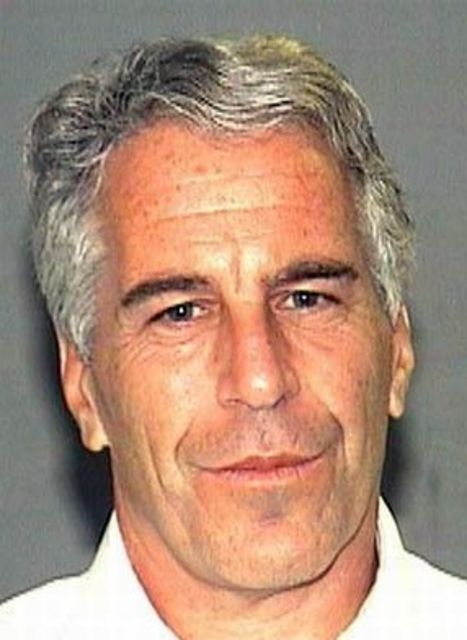
Why is the New York Times still trying to sweep the Epstein case under the rug?

By Patrick Martin

Source: WSWS.org

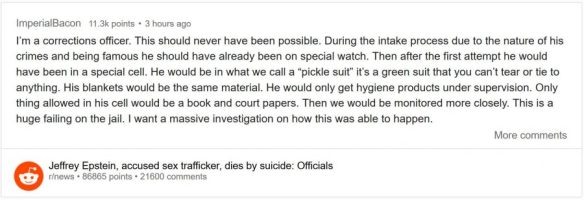
A prominent article published in the Washington Post Thursday exposes the systematic violation of prison rules governing the detention of multimillionaire sex trafficker Jeffrey Epstein during the period immediately preceding his death on August 10.

Reporter Devlin Barrett writes: “At least eight Bureau of Prisons staffers knew that strict instructions had been given not to leave multimillionaire sex offender Jeffrey Epstein alone in his cell, yet the order was apparently ignored in the 24 hours leading up to his death, according to people familiar with the matter.”

His report continues: “The fact that so many prison officials were aware of the directive—not just low-level correctional officers, but supervisors and managers—has alarmed investigators assessing what so far appears to be a stunning failure to follow instructions, these people said.”

This language is quite extraordinary, suggesting that Post reporters have reason to believe that the security failure has no legitimate explanation, and may have been the result of concerted action to leave Epstein exposed and vulnerable.

The report continues, “Investigators suspect that at least some of these individuals also knew Epstein had been left alone in a cell before he died, and they are working to determine the extent of such knowledge …”

In other words, numerous prison officials, including some in authority, were aware that Epstein—on suicide watch from July 23 to July 29—was alone in a cell, in violation of rules governing at-risk prisoners. (Other press accounts claim that his cellmate was granted bail on Friday, August 9, and released from custody, leaving Epstein by himself.)

Epstein was found dead in his cell the following morning, at 6:30 a.m. on Saturday, August 10. During that night, the two guards assigned to check in on him every 30 minutes did not do so. Both were said to have been asleep for some or all of that night, rather than standing watch.

The two guards reportedly falsified the logs to show that they had checked on Epstein as required, but these logs were contradicted by video evidence from a surveillance camera monitoring the hallway outside his cell.

Investigators from the FBI and the inspector-general of the Department of Justice have taken possession of the videotapes, but have released no information about what they show, including whether there were any unauthorized visitors to Epstein’s cell the night he died.

The Post report suggests misconduct on a scale so staggering that it leaves little doubt that Epstein was either murdered or allowed to commit suicide, with the former far more likely. It defies belief that so many Bureau of Prisons employees, including managers and supervisors, could have each independently decided to ignore the rules for handling the most notorious prisoner then in federal custody.

Epstein had been arrested July 6 at Teterboro Airport in New Jersey, and was being held on sex-trafficking charges that carried a possible sentence of 45 years in prison. The nature of the charges, combined with his vast wealth and his connections in high places—including to Donald Trump, Bill Clinton, Prince Andrew of England, and Saudi Crown Prince Mohammed bin Salman—ensured maximum television and tabloid publicity for the case.

Many powerful people feared exposure if Epstein were brought to trial, and there is ample evidence that he was preparing an aggressive and highly publicized defense rather than attempting a plea bargain that would have swept the case under the rug. Epstein was meeting with his lawyers for as many as 12 hours a day, and they have described his demeanor as anything but downcast or suicidal. (Epstein denied that he had attempted suicide July 23, claiming he was the victim of an assault by a cellmate).

Under these circumstances, the real question is why the bulk of the American media, spearheaded by the New York Times, has chosen to swallow the claim of “suicide” and denounced any questioning of the official verdict as a “conspiracy theory.” Epstein was killed in downtown Manhattan, only a few miles from Times Square. But most of the reports exposing new evidence in the case have come in the pages of the Washington Post, while the Times has published lengthy reports—such as a front-page account in its edition of Sunday, August 19—which could be summed up as “nothing to see here, move along please.”

It is worth recalling that when Epstein was first arrested, the Times editorialized against making a political issue out of his kid-glove treatment during his first sex-crimes prosecution in 2008. The editorial urged congressional Democrats to stay away from Epstein, although the US Attorney who had recommended a token 13-month sentence in 2008—with six days out of seven on work-release to run his financial empire—was Alex Acosta, chosen by Trump as his secretary of labor.

While the Times warned Democrats that they would be making a martyr of Acosta by examining his conduct in the Epstein case, Acosta was actually forced to resign only a week after the publication of the editorial. Far from fearing that targeting Acosta was too ambitious, the Times editorial board seems rather to have feared that Epstein, followed by Acosta, would become the first two dominoes in a chain that would implicate others perhaps too close for comfort.


Related Articles:

Why is the media dismissing questions about Jeffrey Epstein’s death as “conspiracy theories”?
[13 August 2019]

The case of Jeffrey Epstein and the depravity of America’s financial elite
[13 July 2019]

Politics Jeffrey Epstein Found Dead In Apparent Suicide Hours After Documents Released — FBI Investigation Launched (Updated)

By Tyler Durden

Source: Activist Post

Update: The FBI is opening an investigation into Epstein’s death according to media reports.

And according to NBC News correspondent Tom Winter, Epstein was not on suicide watch when he was found in his cell.

“He was, however, housed in his own cell without other inmates.”

Jeffrey Epstein has died after having reportedly committed suicide in his jail cell, according to multiple news reports, after a gurney carrying what is believed to be Epstein was seen wheeled out of the Manhattan Correctional Center around 7:30 a.m., according to the New York Post.

The 66-year-old Epstein was was previously placed on suicide watch after he was found “nearly unconscious” inside his cell with ‘marks on his neck,’ according to a Post report from late July. Investigators questioned former Orange County police officer Nicholas Tartaglione, suspected of killing four men in a cocaine distribution conspiracy, in connection with the incident. The former cop claimed to have not seen anything nor touched Epstein.

Needless to say, today’s news is highly suspicious.

As the Wall Street Journal‘s Ted Mann notes, “Even the time of day in this story is shocking. The first check-in on a prisoner who had already attempted suicide once was not until 7:30 a.m.?”

https://twitter.com/QTRResearch/status/1160180202196131842

The apparent suicide comes just hours after a massive trove of documents was unsealed in a case linked to Epstein, in which one of his victims said she was forced to perform sex acts with high-profile individuals, including former Maine Sen. George Mitchell (D), former New Mexico Gov. Bill Richardson (D), money manager Glenn Dubin and MIT professor Marvin Minsky.

Virginia Giuffre, now an adult, says she was also sent to modeling executive Jean Luc Brunel and the late MIT scientist Marvin Minsky, according to parts of a 2016 deposition she gave. The testimony by Giuffre, who claims she was a “sex slave” for Epstein from 2000 to 2002, expands on her previous allegations, in court filings and tabloids, that she was forced to have sex with the U.K.’s Prince Andrew and Harvard University law professor Alan Dershowitz. Both men have strenuously denied those allegations. –Bloomberg

He was arrested on July 6 at Teterboro Airport in New Jersey on charges of sex-trafficking minors and subsequently denied bail.

Meanwhile, Epstein’s personal pilots had been subpoenaed by federal prosecutors in Manhattan last month, which could be used to corroborate accounts from Epstein’s accusers, as well as his travels and associates.

A conveniently timed sale

While prosecutors claimed that Epstein owns two private jets, the registered sex offender’s attorneys said in a court filing earlier this month that he owns one private jet, and “sold the other jet in June 2019.” Considering that he was arrested after returning from Paris in his Gulfstream G550, per Bloomberg, it suggests that Epstein sold his infamous and evidence-rich Boeing 272-200 known as the “Lolita Express” weeks before his arrest.

According to flight logs, former President Bill Clinton flew on the “Lolita Express” a total of 27 times. “Many of those times Clinton had his Secret Service with him and many times he did not,” according to investigative journalist Conchita Sarnoff – who first revealed the former president’s extensive flights on Epstein’s “lolita express” in a 2010 Daily Beast exposé.

Clinton claimed in a July statement that he only took “a total of four trips on Jeffrey Epstein’s airplane” in 2002 and 2003, and that Secret Service accompanied him at all times – which Sarnoff told Fox News was a total lie.

“I know from the pilot logs and these are pilot logs that you know were written by different pilots and at different times that Clinton went, he was a guest of Epstein’s 27 times,” said Sarnoff.

“It would not be surprising to find that some of these flight logs…were likely designed to hide evidence of criminal activity—or perhaps later cleansed of such evidence,” wrote the lawyers for some of Epstein’s accusers in a 2015 court filing.

Investigators may be interested in asking Mr. Epstein’s pilots whether they witnessed any efforts by Mr. Epstein to interfere with law enforcement, according to legal experts. In recent court filings, prosecutors have accused Mr. Epstein of tampering with witnesses, an allegation that Mr. Epstein’s lawyers denied in court.

Federal prosecutors in Miami and Mr. Epstein’s lawyers in 2007 negotiated over the possibility of Mr. Epstein pleading guilty to obstruction of justice, including for an incident involving one of his pilots, according to emails that became public in civil lawsuits. –Wall Street Journal

Meanwhile, prosecutors confirmed in filings that there are “uncharged individuals” in Epstein’s case – which has just gone away.

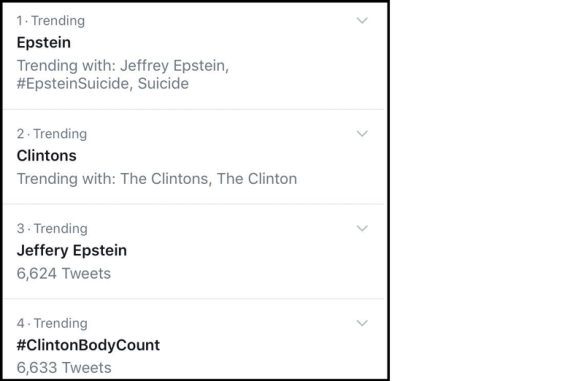
And look what’s trending:

https://twitter.com/H_2_Ohhh/status/1160186977259524096

Just be careful with those assumptions, citizen.

When the state is unjust, citizens may use justifiable violence

By Jason Brennan

Source: aeon

If you see police choking someone to death – such as Eric Garner, the 43-year-old black horticulturalist wrestled down on the streets of New York City in 2014 – you might choose to pepper-spray them and flee. You might even save an innocent life. But what ethical considerations justify such dangerous heroics? (After all, the cops might arrest or kill you.) More important: do we have the right to defend ourselves and others from government injustice when government agents are following an unjust law? I think the answer is yes. But that view needs defending. Under what circumstances might active self-defense, including possible violence, be justified, as opposed to the passive resistance of civil disobedience that Americans generally applaud?

Civil disobedience is a public act that aims to create social or legal change. Think of Henry David Thoreau’s arrest in 1846 for refusing to pay taxes to fund the colonial exploits of the United States, or Martin Luther King Jr courting the ire of the authorities in 1963 to shame white America into respecting black civil rights. In such cases, disobedient citizens visibly break the law and accept punishment, so as to draw attention to a cause. But justifiable resistance need not have a civic character. It need not aim at changing the law, reforming dysfunctional institutions or replacing bad leaders. Sometimes, it is simply about stopping an immediate injustice­. If you stop a mugging, you are trying to stop that mugging in that moment, not trying to end muggings everywhere. Indeed, had you pepper-sprayed the police officer Daniel Pantaleo while he choked Eric Garner, you’d have been trying to save Garner, not reform US policing.

Generally, we agree that it’s wrong to lie, cheat, steal, deceive, manipulate, destroy property or attack people. But few of us think that the prohibitions against such actions are absolute. Commonsense morality holds that such actions are permissible in self-defense or in defense of others (even if the law doesn’t always agree). You may lie to the murderer at the door. You may smash the windows of the would-be kidnapper’s car. You may kill the would-be rapist.

Here’s a philosophical exercise. Imagine a situation in which a civilian commits an injustice, the kind against which you believe it is permissible to use deception, subterfuge or violence to defend yourself or others. For instance, imagine your friend makes an improper stop at a red light, and his dad, in anger, yanks him out of the car, beats the hell out of him, and continues to strike the back of his skull even after your friend lies subdued and prostrate. May you use violence, if it’s necessary to stop the father? Now imagine the same scene, except this time the attacker is a police officer in Ohio, and the victim is Richard Hubbard III, who in 2017 experienced just such an attack as described. Does that change things? Must you let the police officer possibly kill Hubbard rather than intervene?

Most people answer yes, believing that we are forbidden from stopping government agents who violate our rights. I find this puzzling. On this view, my neighbours can eliminate our right of self-defense and our rights to defend others by granting someone an office or passing a bad law. On this view, our rights to life, liberty, due process and security of person can disappear by political fiat – or even when a cop has a bad day. In When All Else Fails: The Ethics of Resistance to State Injustice (2019), I argue instead that we may act defensively against government agents under the same conditions in which we may act defensively against civilians. In my view, civilian and government agents are on a par, and we have identical rights of self-defense (and defense of others) against both. We should presume, by default, that government agents have no special immunity against self-defense, unless we can discover good reason to think otherwise. But it turns out that the leading arguments for special immunity are weak.

Some people say we may not defend ourselves against government injustice because governments and their agents have ‘authority’. (By definition, a government has authority over you if, and only if, it can oblige you to obey by fiat: you have to do what it says because it says so.) But the authority argument doesn’t work. It’s one thing to say that you have a duty to pay your taxes, show up for jury duty, or follow the speed limit. It is quite another to show that you are specifically bound to allow a government and its agents to use excessive violence and ignore your rights to due process. A central idea in liberalism is that whatever authority governments have is limited.

Others say that we should resist government injustice, but only through peaceful methods. Indeed, we should, but that doesn’t differentiate between self-defense against civilians or government. The common-law doctrine of self-defense is always governed by a necessity proviso: you may lie or use violence only if necessary, that is, only if peaceful actions are not as effective. But peaceful methods often fail to stop wrongdoing. Eric Garner peacefully complained: ‘I can’t breathe,’ until he drew his last breath.

Another argument is that we shouldn’t act as vigilantes. But invoking this point here misunderstands the antivigilante principle, which says that when there exists a workable public system of justice, you should defer to public agents trying, in good faith, to administer justice. So if cops attempt to stop a mugging, you shouldn’t insert yourself. But if they ignore or can’t stop a mugging, you may intervene. If the police themselves are the muggers – as in unjust civil forfeiture – the antivigilante principle does not forbid you from defending yourself. It insists you defer to more competent government agents when they administer justice, not that you must let them commit injustice.

Some people find my thesis too dangerous. They claim that it’s hard to know exactly when self-defense is justified; that people make mistakes, resisting when they should not. Perhaps. But that’s true of self-defense against civilians, too. No one says we lack a right of self-defense against each other because applying the principle is hard. Rather, some moral principles are hard to apply.

However, this objection gets the problem exactly backwards. In real life, people are too deferential and conformist in the face of government authority. They are all-too-willing to electrocute experimental subjects, gas Jews or bomb civilians when ordered to, and reluctant to stand up to political injustice. If anything, the dangerous thesis – the thesis that most people will mistakenly misapply – is that we should defer to government agents when they seem to act unjustly. Remember, self-defense against the state is about stopping an immediate injustice, not fixing broken rules.

Of course, strategic nonviolence is usually the most effective way to induce lasting social change. But we should not assume that strategic nonviolence of the sort that King practiced always works alone. Two recent books – Charles Cobb Jr’s This Nonviolent Stuff’ll Get You Killed (2014) and Akinyele Omowale Umoja’s We Will Shoot Back (2013) – show that the later ‘nonviolent’ phase of US civil rights activism succeeded (in so far as it has) only because, in earlier phases, black people armed themselves and shot back in self-defense. Once murderous mobs and white police learned that black people would fight back, they turned to less violent forms of oppression, and black people in turn began using nonviolent tactics. Defensive subterfuge, deceit and violence are rarely first resorts, but that doesn’t mean they are never justified.


Jason Brennan is associate professor of strategy, economics, ethics and public policy at Georgetown University. He is the author, together with Peter Jaworski, of Markets Without Limits (2015), and his latest book is When All Else Fails: The Ethics of Resistance to State Injustice (2019).

Kafka Warned Us

By

Source: CounterPunch

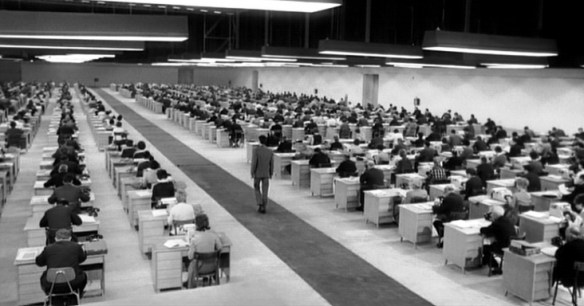
Kafka’s The Trial can be read in retrospect as a prelude to the Twentieth/Twenty-First century. Although probably not written as prophecy, Kafka’s short unfinished book nevertheless provides a road map to the terrors of the current Surveillance State.

As readers of CounterPunch are all too familiar, modern man, as a single individual, is at the mercy of the modern state and those who, lurking in semi-secrecy, direct it.

Kafka’s The Trial superbly conveys the unease of our current existential situation.

Early one morning, The Trial’s main protagonist, Joseph K, awakes to find that, totally unexpectedly, he has been arrested. Throughout the book he endeavors to find the reason for his arrest without any definite success.

However, what he does discover is a vast semi-secret bureaucracy/organizaton whose inner workings and outward displays of power and decision making remain opaque at best.

Initally, Joseph K, believes that he lives in a “Rechtsstaat” (a state where the rule of law is respected) and thus where it is expected that all civilized norms and laws are upheld.

Yet, he soon comes to see that he has lived in a state of fundamental error and illusion about the true nature of his existence.

What appeared to him as a well ordered and just state is, all of a sudden, revealed to be a capricious omnipotent octopus capable of strangling (in this case literally) anyone deemed to be, for whatever reason, expendable.

All law is suspended or, at least, made a mockery of. All that remains are the inner, turgid demands of power.

Joseph K. is convinced of his innocence. But his conviction is no match for the monolithic power that stands against him. He is eventually crushed, if not by his enemy’s repetitive legal machinations, then by his fatalistic far-reaching administrative power.

In the end, the “Organization” which Joseph K has confronted is almighty and can be controlled by neither appeals to law, logic, or custom. In this, modern man is in a similar situation.

He stands, at any moment, beneath the mercy of a gigantic machinery that, if it wills, can almost casually set into motion his utter annihilation. The devastation and erasure of ones past, present, and future self is an ever-present possible function of the modern state. Advances in technology and organization make such a function all the more easier.

How to combat this greatest threat to humankind’s liberty will make the difference of whether or not future generations live in a world of securely grounded freedom or if they will succumb “like a dog” to the increasingly totalitarian powers of what we call today: the Surveillance State.

Five Ways America Is Like a Third-World Country

Some+of+the+90,000+abandoned+and+derelict+homes+of+Detroit

By Nathan Wellman

Source: U.S. Uncut

The United States of America is possibly the wealthiest nation in the history of the world. However, many third-world countries actually surpass America in many of the most vital gauges for measuring human development.

Here are five of the most jaw-droppingly unforgivable ways in which America is lagging behind the rest of the world:

1. America’s criminal justice system is broken

The U.S. represents only 5% of the world’s population, but this one country comprises 25% of the world’s prison population. According to the NAACP, a disproportionate 58% of America’s prisoners are African-American or Hispanic despite these demographics only adding up to about 30% of the U.S. population.

The only nation that imprisons a greater percentage of its citizens than America is North Korea. The U.S. jails 716 people for every 100,000 Americans, according to the International Center for Prison Studies. That’s nearly twice as many as Russia (484 prisoners per 100,000), and far more than Iran (284) or China (121). For context, the U.S. only jailed around 100-200 people per 100,000 citizens in the 1970s, and the incarcerated rate is only getting worse today, even as crime rates fall. A staggering 60% of prisoners are in jail for nonviolent drug charges.

Inside prison, about 600 victims are raped every day, according to an estimate from the Justice Department. An in-depth DOJ investigation found that of the approximate 217,000 prisoners raped each year, 17,000 were juveniles.

2. Gun Violence is an epidemic

America has 20 times more murders when compared to the average rate of the developed world. Even terrorism-plagued Iraq has half the murder rate of the U.S. Over half of the deadliest mass shootings from the last 50 years happened in America, and 79% of those shooters got ahold of their guns legally. Some American cities, particularly New Orleans and Detroit, even surpass many Latin American countries, which suffer from some of the highest gun violence rates in the world.

3. Healthcare costs too much and delivers too little

America is the only developed country that does not ensure healthcare to all of its citizens. Even in the wake of the Affordable Care Act, millions of poverty-stricken Americans have no medical insurance because Republican governors have refused to expand Medicaid, even though the federal government is paying the cost and the simple measure would actually save money for their states.

Life expectancy in many American counties is lower than Nicaragua, Algeria, or Bangladesh. The U.S. is unusual among developed countries in that Americans die in the tens of thousands as a direct result of a lack of health insurance. America also spends twice the percentage of our GDP on healthcare than the average wealthy country for these substandard results.

America also suffers from the highest infant mortality and teen pregnancy rate in the developed world.

4. Inequality is rampant

Researchers have shown that economic inequality directly correlates to public distrust in government representatives, as well as a decrease in health and well-being.

Unfortunately, the U.S. has the worst rates of income inequality in the world, according to the 2015 Global Wealth Report conducted by Allianz. The wealthiest one percent of Americans own nearly half of the nation’s wealth invested in stocks and mutual funds, and the overall gap between rich and poor has only grown since the recession, with almost all income gains going to the top 1% since 2009.

Despite the idea of America being a meritocracy, those born in the poorest 20% of the American population have less than a 3% chance of making it to the top quintile.

5. Infrastructure is crumbling

America is quite literally falling apart.

One study concludes that the U.S. needs to invest $3.6 trillion into infrastructure over the next six years. One out of every nine American bridges (66,405 bridges) have been labeled “structurally deficient.”

Water runs through dilapidated wooden pipes in certain parts of South Dakota, Alaska, and Pennsylvania. Some of Detroit’s sewer lines still used today were originally constructed in the mid-1800s.

A whopping 45% of Americans have no access to public transit, and the construction of the infamously still-incomplete Second Avenue subway line in New York City has been hit with delays dating all the way back to World War II.


America certainly has and continues to achieve greatness in many ways. But if we want to truly earn our oft-proclaimed slogan of “Greatest Country in the World,” these fatal flaws in our system must be acknowledged and addressed. Otherwise, the emperor will continue to parade about with no clothes, and we run the risk of being completely surpassed by a world marveling at our oblivious nakedness.

Punishment is Violent and Counterproductive

stpp

By Robert J. Burrowes

Punishment is a popular pastime for humans. Parents punish children. Teachers punish students. Employers punish workers. Courts punish lawbreakers. People punish each other. Governments punish ‘enemies’. And, according to some, God punishes evildoers.

What is ‘punishment’? Punishment is the infliction of violence as revenge on a person who is judged to have behaved inappropriately. It is a key word we use when we want to obscure from ourselves that we are being violent.

The violence inflicted as punishment can take many forms, depending on the context. It might involve inflicting physical injury and/or pain, withdrawal of approval or love, confinement/imprisonment, a financial penalty, dismissal, withdrawal of rights/privileges, denial of promised rewards, an order to perform a service, banishment, torture or death, among others.

Given the human preoccupation with punishment, it is perhaps surprising that this behaviour is not subjected to more widespread scrutiny. Mind you, I can think of many human behaviours that get less scrutiny than would be useful.

Anyway, because I am committed to facilitating functional human behaviour, I want to explain why using violence to ‘punish’ people is highly dysfunctional and virtually guarantees an outcome opposite to that intended.

Punishment is usually inflicted by someone who makes a judgment that another person has behaved ‘badly’ or ‘wrongly’. At its most basic, disobedience (that is, failure to comply with elite imposed norms) is often judged in this way, whether by parents, teachers, religious figures, lawmakers or national governments.

But is obedience functional or even appropriate?

Consider this. In order to behave optimally, the human organism requires that all mental functions – feelings, thoughts, memory, conscience, sensory perception (sight, sound, touch, smell, taste), truth register, intuition… – must be developed and readily involved, without interference, in our life. If this happens, then all of these individual functions will play an integrated role in determining our behaviour in any given circumstance. This is a very sophisticated mental apparatus that has evolved over billions of years and if it was allowed to function without interference in each individual, human beings would indeed be highly functional.

So where does obedience fit into all of this? It doesn’t. A child is genetically programmed to seek to meet their own needs, not obey the will of another. And they will behave functionally in endeavouring to meet these needs unless terrorized out of doing so. Moreover, they will learn to meet their own needs, by acting individually in some circumstances and by cooperating with others when appropriate, if their social environment models this.

However, if a child is terrorized into being obedient – including by being punished when they are not – then the child will have no choice but to suppress their awareness of the innate mental capacities that evolved over billions of years to guide their behaviour until they have ‘learned’ what they must do to avoid being punished. For a fuller explanation of this, see ‘Why Violence?’ and ‘Fearless Psychology and Fearful Psychology: Principles and
Practice’.

Unfortunately, as you can probably readily perceive, this process of terrorizing a child into suppressing their awareness of what they want to do so that they do what someone else directs is highly problematical. And it leads to a virtually infinite variety of dysfunctional
behaviours, even for those who appear to have been successfully ‘socialized’ into performing effectively in their society. This is readily illustrated.

Perhaps the central problem of terrorizing individuals into obedience of conventions, commands, rules and the law is that once the individual has been so terrorized, it is virtually impossible for them to change their behaviour because they are now terrified of doing so. If the obedient behaviours were functional in the circumstances then, apart from the obviously enormous damage suffered by the individual, there would be no other adverse social or environmental consequences.

Unfortunately, when all humans have been terrorized into behaving dysfunctionally on a routine basis (in the Western context, for example, by engaging in over-consumption) then changing their behaviour, even in the direction of functionality, is now unconsciously associated with the fear of violence (in the form of punishment) and so desirable behavioural change (in the direction of reduced consumption, for example) is much more difficult. It is not just that many Western humans are reluctant to reduce their consumption in line with environmental (including climatic) imperatives, they are unconsciously terrified of
doing so.

By now you might be able to see the wider ramifications of using violence and threats of violence to force children into being obedient. Apart from terrorizing each child into suppressing their awareness of their innate mental capacities, we create individuals whose entire (unconscious) ‘understanding’ of human existence is limited to the notion that violence, mislabeled ‘punishment’, drives socialization and society.

As just one result, for example, most people consider punishment to be appropriate in the context of the legal system: they expect courts to inflict legally-sanctioned violence on those ‘guilty’ of disobeying the law. As in the case of the punishment of children, how many people ask ‘Does violence restore functional behaviour? Or does it simply inflict violence as revenge? What do we really want to achieve? And how will we achieve that?’

Fundamentally, the flaw with violence as punishment is that violence terrifies people. And you cannot terrorize someone into behaving functionally. At very best, you can terrorize someone into changing their behaviour in an extremely limited context and/or for an extremely limited period of time. But if you want functional and lasting change in an individual’s behaviour, then considerable emotional healing will be necessary. This will allow the suppressed fear, anger, sadness and other feelings resulting from childhood terrorization to safely resurface and be expressed so that the individual can perceive their own needs and identify ways of fulfilling them (which does not mean that they will be obedient). For an explanation of what is required, see ‘Nisteling: The Art of Deep Listening’ which is referenced in ‘My Promise to Children‘.

So next time you hear a political leader or corporate executive advocating or using violence (such as war, the curtailment of civil liberties, an economically exploitative and/or ecologically destructive initiative), remember that you are observing a highly dysfunctionalized individual. Moreover, this dysfunctional individual is a logical product of our society’s unrelenting use of violence, much of it in the form of what is euphemistically called ‘punishment’, against our children in the delusional belief that it will give us obedience and hence social control.

Or next time you hear a public official, judge, terrorist or police officer promising ‘justice’ (that is, retribution), remember that you are listening to an emotionally damaged individual who suffered enormous violence as a child and internalized the delusional message that ‘punishment works’.

You might also ponder how bad it could be if we didn’t require obedience and use punishment to get it, but loved and nurtured children, by listening to them deeply, to become the unique, enormously loving and powerful individuals for which evolution genetically programmed them.

I am well aware that what I am suggesting will take an enormous amount of societal rethinking and a profound reallocation of resources away from violent and highly profitable police, legal, prison and military systems. But, as I wrote above, I am committed to facilitating functional human behaviour. I can also think of some useful ways that we could allocate the resources if we didn’t waste them on violence.

If you share this commitment and working towards this world appeals to you too, then you are welcome to consider participating in the fifteen-year strategy outlined in ‘The Flame Tree Project to Save Life on Earth‘ and to consider signing the online pledge of ‘The People’s Charter to Create a Nonviolent World‘.

Punishment can sometimes appear to get you the outcome you want in the short term. The cost is that it always moves you further away from any desirable outcome in the long run.


Biodata: Robert J. Burrowes has a lifetime commitment to understanding and ending human violence. He has done extensive research since 1966 in an effort to understand why human beings are violent and has been a nonviolent activist since 1981. He is the author of ‘Why Violence?‘ His email address is flametree@riseup.netand his website is at http://robertjburrowes.wordpress.com

Robert J. Burrowes
P.O. Box 68
Daylesford
Victoria 3460
Australia
Email: flametree@riseup.net

Websites:
Nonviolence Charter
Flame Tree Project to Save Life on Earth
‘Why Violence?’
Nonviolent Campaign Strategy
Nonviolent Defense/Liberation Strategy
Anita: Songs of Nonviolence
Robert Burrowes
Global Nonviolence Network

#ACAB: Why the Institution of Policing Makes All Cops Bastards

police-state-founders-warning

By PM Beers

Source: AntiMedia

All cops are bastards because all cops, if ordered to, will enforce laws that oppress poor people.

Many people would like to believe that there are good cops and bad cops. I’m going to explain why this is simply not true. When we are children, we are ingrained with the belief that police officers are good people who want to help us. Children are taught that if they need help, they should ask a police officer. These early beliefs are so deeply ingrained that it is very hard to shake them off. For me, it took over two years to finally understand the concept of ACAB—all cops really ARE bastards, even if they believe themselves to be good people.

When you learn the history of policing, you will better understand the need to dismantle the inherently racist institution. When we were new to the anti-police brutality movement, we all thought there were good cops and bad cops. As with most binary thinking, this is incorrect. All cops are indeed bastards as they blindly enforce laws which were written to oppress poor people, such as laws against feeding the homeless. The primary role of the first police departments was to catch runaway slaves. Racism is ingrained in policing. Racism is the root cause of police brutality.

There are no good cops. Laws and ethics are not the same thing. Laws don’t prevent crime from happening—people having their needs met does. One cannot be a good person and enforce unjust laws.

Someone once asked me, “But how is the statement ‘ALL cops are bastards’ any different from ‘ALL priests are pedophiles,’ or ‘All women are lousy drivers?’“ Another friend replied,  “Nobody is born a cop. Joining that institution is a choice. It’s more akin to saying ‘all KKK are bastards.” Priests are not required to molest children, but cops are required to follow orders which oppress poor people and target people of color.

Every cop must obey orders without question. They are required to enforce unethical laws or risk losing a job that provides them with a comfortable income if they refuse. In the rare occasion that a cop does blow the whistle on an injustice, the thin blue line is immediately invoked and the seemingly well-intentioned cops are ostracized by their peers, almost always neutralizing their intentions.

Some cops think they are actually good people. Of course, they have to think they are good to rationalize what they are doing since in our society, one’s occupation is one’s identity.

We all know that many cops have done horrible things. They have abused their power, murdered people, and attempted to cover up those murders with lies. I’m not going to talk about those obvious injustices that we are already so aware of. I’m going to talk about more subtle ways that cops do unethical things under the color of law. The job of the police is not to protect people but to protect corporate assets.

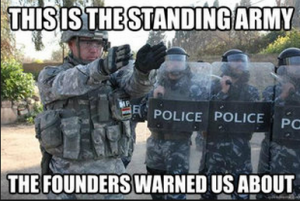
When a person becomes a police officer, their job is to enforce the laws. Not all laws are good. Police are unthinking, unquestioning robots protecting a corrupt, unjust state. They simply do as they are told without question. The institution of policing is inherently corrupt because they enforce laws which have nothing to do with ethics and everything to do with serving corporate interests.

If your job requires you to do unethical things and you continue to do that job for a paycheck, you have sold out and can no longer consider yourself an ethical person.  Every cop has sold their soul for a middle class income. Their price is low.

But wait…what about that one cop who bought groceries for a mom who stole food for her kids?

Yes, that cop did a good thing. That doesn’t erase the unethical things the cop does or would do if given the order. I like to call these types of news stories #copaganda because they are often played by mainstream media to try to get us to think that cops are good people, when in reality, the news stations want to appease police departments so that they can keep access to information for their news stories. TV news folks do unethical things for money, as well, and that’s a whole other rant for another day. If cops did these kinds of things on a daily basis, they wouldn’t be newsworthy. Cops are not as lovely as the TV would have us think they are.

When protests are held, police say they are there to make sure no one gets hurt. Yet on most occasions, they are the ones hurting protesters with batons, “less lethal” bullets, and tear gas.  Sometimes, undercover cops are placed into crowds and are sometimes suspected by protesters of being the ones agitating the police. They use actions, such as throwing bottles, in order to give the police an excuse to become violent with the protesters.

Police have to enforce other unjust laws, like the criminalization of the medical use a cannabis. Smoking cannabis harms no one and is a victimless crime. Is it even a crime at all? Filling up jails with pot smokers only has negative consequences on society, as taxpayers are burdened and people prosecuted for drug offenses often have a difficult time finding employment after being released from prison. Children also suffer under the burden of having one less parent to care for them. This lack of need fulfillment leads to more crime as children mature.

Further, according to the LAPD, all cars are now under investigation. License plate scanners mounted on police cars and on light poles track drivers all over Los Angeles. The ACLU and the Electronic Frontier Foundation are currently suing the LAPD to find out how the technology is being used.  There is no probable cause to collect such data, making this practice a violation of our civil rights.

Police enforce unjust laws that harass and criminalize people who have no home. Sleep is a primary human need like air, food, and water. Is it ethically permissible to wake someone up at six AM because the only place they can afford to sleep is the sidewalk? Would a good cop do that?

In the summer of 2012, I participated in a sleepful protest in downtown Los Angeles in support of rights for people who didn’t have homes. Every morning, Officer Massey would come honk his horn to wake us up at 6 AM.  He was baffled at why I would scream at him every morning. He thought he was a good cop. He had no clue that waking up unhoused people at 6 AM is an unethical thing to do. In his mind, he was just doing his job—just following orders. Officer Massey tried his best to be polite, but what he was doing was still wrong. Is he going to quit his job?  What other job is he even qualified to do that can  still provide him such a comfortable middle-class income?  He is not going to quit his job. Instead, he will rationalize in his mind that he is a good cop. He never once kicked an unhoused person, so isn’t he lovely?

The police are an inherently violent institution where force is used to extort money from poor people and property is stolen. The racism and bias against the oppressed and poor is pervasive. The entire institution is so corrupt and violent that participating in it makes one corrupt and violent by silent consent. It is impossible to be a good person and participate in violence and oppression.

For example, a person unable to pay $150 for a car registration will have that car stolen from them with the assistance of the police. The car will then be held for ransom. If the person who was too poor to pay the $150 can’t pay the ransom, then the car, which has a value of thousands of dollars, will be sold and the state will profit off of the backs of the poor. Anyone willingly accepting money from such an institution that extorts poor people is by default not a good person.

People want to believe they are good without challenging their false beliefs. There are no good cops. Ethical and legal are completely separate things—therefore, there are no good cops as they are required to enforce unethical laws.

Are there decent individuals that become cops? Of course. However, the institution of policing means police officers, by default, are oppressors by occupation—meaning there truly are no good active-duty cops.

What is the alternative to policing? Community policing by the people who live in the community is a viable solution. Further, the situation will be improved by legalizing victimless crimes, making sure everyone’s needs are met, and reducing income inequality.

A conscious cop would think about quitting, realize they are not qualified for any other job that pays anything even close to what they currently get, and would quickly adjust their thinking back into justifying what they are doing.

All cops oppress poor people and are therefore evil. All cops make threats of death and are therefore evil.

Dismantling the institution of policing does not mean anarchy in the context of chaos. The word “anarchy” is a beautiful thing when used in certain contexts where people understand what the word actually means.  For me, anarchy means equality, horizontalism, and no false authority. Communities can and should police themselves.


This article (#ACAB: Why the Institution of Policing Makes All Cops Bastards) is free and open source. You have permission to republish this article under a Creative Commons license with attribution to the author and theAntiMedia.org. Tune in! Anti-Media Radio airs Monday through Friday @ 11pm Eastern/8pm Pacific. Help us fix our typos:edits@theantimedia.org.

PM Beers joined Anti-Media as an independent journalist in April of 2014. Her topics of interest include mental illness, neurology, quantum physics, Tourette’s, Autism, compassionate parenting, horizontal democracy, activism, and art. Born in Long Beach, California, she currently resides in Los Angeles, California. Learn more about Beers here!

Why ‘I Have Nothing to Hide’ Is the Wrong Way to Think About Surveillance

verizon-we-can-hear-you-now

A common defense of mass surveillance used by apologists is “if you have nothing to hide, why worry?” Nevermind that there’s many things that are perfectly legal that we might not “hide” but choose not to reveal indiscriminately (ie. credit card numbers, medical records, nakedness, etc.), we may in fact have something to hide but not even know it. As noted by Moxie Marlinspike of Wired.com:

If the federal government can’t even count how many laws there are, what chance does an individual have of being certain that they are not acting in violation of one of them?

For instance, did you know that it is a federal crime to be in possession of a lobster under a certain size? It doesn’t matter if you bought it at a grocery store, if someone else gave it to you, if it’s dead or alive, if you found it after it died of natural causes, or even if you killed it while acting in self defense. You can go to jail because of a lobster.

If the federal government had access to every email you’ve ever written and every phone call you’ve ever made, it’s almost certain that they could find something you’ve done which violates a provision in the 27,000 pages of federal statues or 10,000 administrative regulations. You probably do have something to hide, you just don’t know it yet.

He also makes a compelling argument for why we should have something to hide:

Over the past year, there have been a number of headline-grabbing legal changes in the U.S., such as the legalization of marijuana in Colorado and Washington, as well as the legalization of same-sex marriage in a growing number of U.S. states.

As a majority of people in these states apparently favor these changes, advocates for the U.S. democratic process cite these legal victories as examples of how the system can provide real freedoms to those who engage with it through lawful means. And it’s true, the bills did pass.

What’s often overlooked, however, is that these legal victories would probably not have been possible without the ability to break the law.

The state of Minnesota, for instance, legalized same-sex marriage this year, but sodomy laws had effectively made homosexuality itself completely illegal in that state until 2001. Likewise, before the recent changes making marijuana legal for personal use in Washington and Colorado, it was obviously not legal for personal use.

Imagine if there were an alternate dystopian reality where law enforcement was 100% effective, such that any potential law offenders knew they would be immediately identified, apprehended, and jailed. If perfect law enforcement had been a reality in Minnesota, Colorado, and Washington since their founding in the 1850s, it seems quite unlikely that these recent changes would have ever come to pass. How could people have decided that marijuana should be legal, if nobody had ever used it? How could states decide that same sex marriage should be permitted, if nobody had ever seen or participated in a same sex relationship?

…We can only desire based on what we know. It is our present experience of what we are and are not able to do that largely determines our sense for what is possible. This is why same sex relationships, in violation of sodomy laws, were a necessary precondition for the legalization of same sex marriage. This is also why those maintaining positions of power will always encourage the freedom to talk about ideas, but never to act.

Read the full article here: http://www.wired.com/opinion/2013/06/why-i-have-nothing-to-hide-is-the-wrong-way-to-think-about-surveillance/

The East German STASI regime also put their citizens under mass surveillance allegedly for their own good. The information collected was used as leverage by authorities to force informants to betray friends, neighbors and family members.  Trust throughout the society crumbled and eventually the government itself crumbled.