What Julian Assange’s Arrest Tells Us About Our World

By Arjun Walla

Source: Collective Evolution

John Kiriakou, a CIA-anti-torture whistle-blower recently tweeted, “a fair trial in the Eastern District of Virginia, under Judge Leonie Brinkema, is utterly impossible. They don’t call the EDVA the ‘Espionage Court for nothing.’”

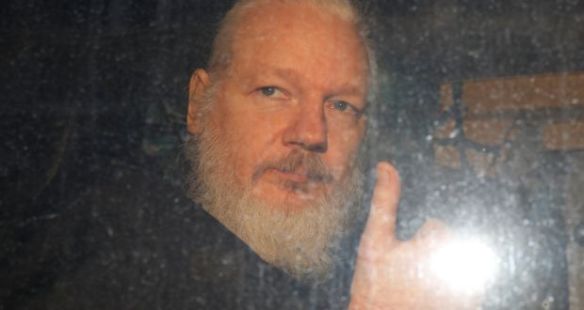
And it’s true. Julian Assange was just arrested and dragged out of the Ecuadorian Embassy in relation to an extradition warrant from the US that was issued in December of 2017 for conspiracy with Chelsea Manning in early 2010. To expect that he will receive a fair trial is a bit of a dream.

The New York Times is reporting:

“The United States has charged WikiLeaks founder Julian Assange of conspiring to hack a computer as part of the 2010 release of reams of secret American documents, according to an indictment unsealed Thursday, putting him just one flight away from being in American custody after years of seclusion in the Ecuadorean embassy in London.”

Regardless of what the headlines are reading, the world knows why the hunt for Julian Assange has been ongoing for so long, and it’s because he leaked secrets and exposed those who keep them. He exposed the lies, corruption and deceit that represents the backbone of the Western military alliance and the American empire. He exposed, in the words of John F. Hylan, former Mayor of New York City, the “real menace of Republic”, the “invisible government, which like a giant octopus sprawls its slimy legs over our cities, states and nation.” He exposes the ones “who virtually run the United States government for their own selfish purposes.” (source)(source)

JFK warned the citizenry about “an announced need for increased security” that would be “seized upon by those anxious to expand its meaning to the very limits of official censorship and concealment.” Today, this is known as “national security,” and it’s a term used to justify unethical and enormous amounts of secrecy that do not protect the public, but protect those in power and their corporate, financial and political interests.

This is exactly what is being pinned on Julian Assange. And it’s done so under the guise of “national security.” As public relations professional Edward Bernays, who had many political clients, wrote:

The conscious and intelligent manipulation of the organized habits and opinions of the masses is an important element in the democratic society. Those who manipulate this unseen mechanism of society constitute an invisible government which is the true ruling power of our country. We are governed, our minds molded, our tastes formed, our ideas suggested, largely by men we have never heard of.  (Propaganda, 1928)

Transparency Doesn’t Favor The Powerful

Transparency is what Julian Assange was all about, and the American empire, more so the global empire, has been desperate to keep its secrets and prosecute anyone or anything that threatens this transparency. That’s what this is all about. And they proved this with Chelsea Manning.

It’s not just people like Assange who are being demonized and hunted, it’s alternative media as well. The war on ‘fake news’ that has been happening for the last little while has had alternative media outlets presenting credible information and sources deemed as ‘fake.’ Any media outlet who even questions a controversial issue has been made out to be ‘wrong’ or ‘fake.’

Fake news watchdog NewsGuard aims to hold independent media accountable for their stories. Funded by Clinton donors and big pharma, with ties to the CFR, NewsGuard seems to have a clear agenda in favour of mainstream media. You can read more about that here.

The current vaccine discussion is another great example. Those who are currently concerned with vaccine safety are being completely shut down and silenced. Meanwhile, those who support vaccinations do not even address the concerns that are being made by people raising concerns, and instead are resorting to finger pointing, ridicule and name calling. The latest example would be the world’s leading expert on aluminum toxicology, professor Christopher Exley, who has been completely shut down with regards to his research efforts. You can read more about that here.

The mainstream media has so much control over the minds of the masses that they can actually convince a large chunk of the citizenry that this war on ‘fake news’ is completely justified, and the arrest of Julian Assange is completely justified, but is it truly? Are we asking the right questions? Or simply believing what we are told?

Again, national security is not being threatened here, what’s being threatened, and has been threatened here as a result of Julian Assange and multiple alternative media networks, is the ability for the global elite to control human consciousness. Quite simply, exposing the truth is a huge threat to the global elite and their heightened national security state that rivals what George Orwell wrote in 1984, the stripping of our rights and freedoms, and the justification to impose more measures on the populace under the guise of national security.

Truth Is The Culprit

Truth and free press threaten the ability of the global elite to create problems and at the same time propose the solution. Some of the biggest leaks WikiLeaks has made were detailing the connection between supposed terrorist organizations like Al-Qaeda and ISIS to the western military alliance, more specifically the US government. We saw arms deals and the funding/support of terrorist organizations that the US claimed to be fighting against. This is a great example of funding and creating a problem in order to justify heightened national security measures back home, to protect people from ‘the war on terror’ and justify their infiltration of another country for ulterior motives.

Look at William Binney, he’s a former high ranking intelligence official with the National Security Agency (NSA), and is one of the highest placed intelligence officials to ever blow the whistle on insider NSA ‘knowings.’ He made headlines when he resigned in 2001 after 9/11, having worked more than thirty years for the agency. He was a leading code-breaker against the Soviet Union during the Cold War, and was repelled by the United States’ massive surveillance programs.

Binney hasn’t stopped, one of the highest-level whistleblowers to ever come out of the NSA. He is now saying:

“At least 80% of fibre optic cables globally go via the US, this is no accident and allows the US to view all communication coming in. At least 80% of all audio calls, not just metadata, are recorded and stored in the US. The NSA lies about what it stores. The ultimate goal of the NSA is total population control.” (source)

Again, this is exactly why the hunt for Julian Assange has gone on like it has, as well as the crackdown on non mainstream journalism.

One final thing to address, those that feel this is all part of ‘the plan’ within the Q community, while it may be possible that his extradition could lead to his ultimate exoneration, the evidence does not yet seem to point to that. We should still be open, question and ultimately still discuss how this is an opportunity for us to wake up to truth.

The Takeaway

We’re at a point where anything the global elite, Shadow Government or Deep State does to silence anything that threatens their interest, will simply wake up more and more people as to what’s really going on. It’s exactly like 9/11, that tragic event woke up millions and millions of people around the world to deception they otherwise knew nothing about. Every move they make, like extraditing Julian Assange, simply makes it more obvious that they are trying to block the truth, and protect their own interests.

Below is a video from CE founder Joe Martino going in a little deeper and explaining what we can expect from all of this now.

Does it really make sense that we’re taking journalists, that we’re taking people and putting them in jail for bringing forward a story that is important for humanity to see, does this really make sense? – Joe Martino


Related Video:


Assange arrest: The turning point is here—don’t let them win

Will we wait until they come for us because our homes are built atop resources they wish to plunder, because we shared information online they found objectionable, because we dared to question why madmen are in control of our country and much of the world?

By Whitney Webb

Source: Intrepid Report

LONDON—Yesterday morning, the London-based branch of Empire made good on its threat and boldly moved to begin dismantling the vestiges of democracy and press freedom that still remain, vestiges that have allowed people throughout the Western world to pretend that their government and politicians still respect their rights and the rule of law.

Julian Assange, the man who has helped expose a litany of crimes and the in-your-face corruption of the world’s most powerful people and governments, was pulled from the embassy of the country where he not only holds citizenship but had been granted asylum. The dangerous precedents Assange’s arrest has set—not just for journalism, but also for national sovereignty and international law—are staggering.

With Assange now in U.K. custody, his fate will mirror our own, as Assange’s fate and that of journalists around the world, as well as the public itself, are increasingly intertwined. After all, those who are after Assange and seek to rob him of his freedom—the U.S. Empire, the “deep state,” the shadow government, the global elite, etc.—are after our freedom as well.

If we remain silent as they jail, extradite, torture or even kill this man, we may expect a similar fate for ourselves. It will not come tomorrow. It will not come next week. It could be years away. But make no mistake, the global empire, whose core is the U.S. government, will now be empowered to charge and imprison anyone it deems a threat to its operations.

Those operations, including those that Assange helped to expose, often involve the mass murder of innocent civilians—untold numbers of children among them—in order to loot the resources of other sovereign nations. They also often involve the installation of puppet governments by either covert (e.g., election “meddling”) or overt (e.g., regime-change wars) means.

Those responsible for the most egregious violations of international law, for war crimes, for the slaughter of innocent life, are not imprisoned, degraded or tortured—they are rewarded and promoted. As we have seen today—and in recent weeks, particularly following Chelsea Manning’s imprisonment—those who seek to expose these crimes are the ones who are threatened, tortured and punished.

Like it or not, we are all already a part of this war

The world has known for years that Assange would meet this fate. Little was done. Now, the turning point is here. Will we continue to escape into the false realities of television, cinema, video games, and whatever we use to distract us and numb our pain while the actual world in which we live devolves into a technocratic, imperial dictatorship? Will we continue to ignore the obvious threats to our lives and our children’s lives because confronting these threats is uncomfortable and often difficult?

Will we wait until they come for us because our homes are built atop resources they wish to plunder, because we shared information online they found objectionable, because we dared to question why madmen are in control of our country and much of the world?

Such an eventuality may seem laughable to some, but those days are not far away and are already here for many people around the world, even in the West. Assange’s arrest is the first shot of a war to which all of us, like it or not, have already been drafted because it is a war for the very world in which we live—a war for our society, our planet, our livelihood, our right to self-determination. You can try to escape to the ends of the Earth, thousands of miles away from “the West” (as I myself did), only to find that there is no country anywhere in the world that is not currently under siege.

Never before in history has the global oligarchy been more powerful. The concentration of power and wealth in the hands of the few is unprecedented, worse even than in the Gilded Age or the final days of the Roman Empire. These people do not plan to cede any of this power to you. They do not want you to have control over your own lives. To them, we are already slaves. And those who are silent, especially now, are sending a signal to the elites that they embrace that servitude.

The revolution will not be televised and the war will not be won on social media

For too long, actions in defense of Assange, and more broadly in protest of Empire, have been focused in the virtual realm—that is, on the Internet and social media. While the Internet and social media are important tools for sharing information, their use for that end is being suppressed like never before and it will not be long before social media is entirely censored and devoid of dissent. If we wait until that day comes, and put all our eggs in the social media basket, we will have shot ourselves in the foot and it could well be a fatal blow.

We can no longer run from the world, escape into our remaining comforts—particularly those online—while the world burns. Assange may be the first journalist to be arrested and extradited under these circumstances, but he will not be the last. What we do now will determine how far they go.

The U.S. and its allies are prepping for several wars, many of them against countries much larger than Iraq, and such wars could make Iraq and Afghanistan look like skirmishes by comparison. The people behind Assange’s arrest and perpetual imperial wars do not care about your tweets or Facebook posts. They want your focus to remain on the virtual world and away from the real one over which they are consolidating their control.

Now is the time to resist. Now is the time to insist. Now is the time to take to the streets, to talk to your neighbors, family and co-workers of the dangers facing us all. Your voice and your actions matter. The longer we wait, the worse things will become. The turning point is here. Don’t let them win.


Whitney Webb is a MintPress News journalist based in Chile. She has contributed to several independent media outlets including Global Research, EcoWatch, the Ron Paul Institute and 21st Century Wire, among others. She has made several radio and television appearances and is the 2019 winner of the Serena Shim Award for Uncompromised Integrity in Journalism.

Banishing Truth

By Chris Hedges

Source: TruthDig

The investigative reporter Seymour Hersh, in his memoir “Reporter,” describes a moment when as a young reporter he overheard a Chicago cop admit to murdering an African-American man. The murdered man had been falsely described by police as a robbery suspect who had been shot while trying to avoid arrest. Hersh frantically called his editor to ask what to do.

“The editor urged me to do nothing,” he writes. “It would be my word versus that of all the cops involved, and all would accuse me of lying. The message was clear: I did not have a story. But of course I did.” He describes himself as “full of despair at my weakness and the weakness of a profession that dealt so easily with compromise and self-censorship.”

Hersh, the greatest investigative reporter of his generation, uncovered the U.S. military’s chemical weapons program, which used thousands of soldiers and volunteers, including pacifists from the Seventh-day Adventist Church, as unwitting human guinea pigs to measure the impact of biological agents including tularemia, yellow fever, Rift Valley fever and the plague. He broke the story of the My Lai massacre. He exposed Henry Kissinger’s wiretapping of his closest aides at the National Security Council (NSC) and journalists, the CIA’s funding of violent extremist groups to overthrow the Chilean President Salvador Allende, the CIA’s spying on domestic dissidents within the United States, the sadistic torture practices at the Abu Ghraib prison in Iraq by American soldiers and contractors and the lies told by the Obama administration about the raid that killed Osama bin Laden. Yet he begins his memoir by the candid admission, familiar to any reporter, that there are crimes and events committed by the powerful you never write about, at least if you want to keep your job. One of his laments in the book is his decision not to follow up on a report he received that disgraced President Richard Nixon had hit his wife, Pat, and she had ended up in an emergency room in California.

Reporters embedded with military units in Iraq and Afghanistan routinely witness atrocities and often war crimes committed by the U.S. military, yet they know that access is dependent on keeping quiet. This collusion between the press and the powerful is a fundamental feature of journalism, one that even someone as courageous as Hersh, at least a few times, was forced to accept. And yet, there comes a time when reporters, at least the good ones, decide to sacrifice their careers to tell the truth. Hersh, relentlessly chronicling the crimes of the late empire, including the widespread use of torture, indiscriminate military strikes on civilian targets and targeted assassinations, has for this reason been virtually blacklisted in the American media. And the loss of his voice—he used to work for The New York Times and later The New Yorker—is evidence that the press, always flawed, has now been neutered by corporate power. Hersh’s memoir is as much about his remarkable career as it is about the death of investigative journalism and the transformation of news into a national reality television show that subsists on gossip, invective, officially approved narratives and leaks and entertainment.

Investigative journalism depends not only on reporters such as Hersh, but as importantly on men and women inside the systems of power who have the moral courage to expose lies and make public crimes. Writing off any institution, no matter how nefarious the activity, as filled with the irredeemable is a mistake. “There are many officers, including generals and admirals, who understood that the oath of office they took was a commitment to uphold and defend the Constitution and not the President, or an immediate superior,” he writes. “They deserve my respect and got it. Want to be a good military reporter? Find those officers.” One of the heroes in Hersh’s book is Ron Ridenhour, who served in a combat unit in Vietnam and who initiated the army’s investigation into the My Lai massacre and generously helped Hersh track down eyewitnesses and participants.

The government’s wholesale surveillance, however, has crippled the ability of those with a conscience, such as Chelsea Manning or Edward Snowden, to expose the crimes of state and remain undetected. The Obama administration charged eight people under the Espionage Act of leaking to the media—Thomas Drake, Shamai Leibowitz, Stephen Kim, Chelsea Manning, Donald Sachtleben, Jeffrey Sterling, John Kiriakou and Edward Snowden—effectively ending the vital connection between investigative reporters and sources inside the government.

This government persecution has, by default, left the exposure of government lies, fraud and crimes to hackers. And this is the reason hackers, and those who publish their material such as Julian Assange at WikiLeaks, are relentlessly persecuted. The goal of the corporate state is to hermetically seal their activities, especially those that violate the law, from outside oversight or observation. And this goal is very far advanced.

Hersh notes throughout his memoir that, like all good reporters, he constantly battled his editors and fellow reporters as much as he did the government or corporations. There is a species of reporter you can see on most cable news programs and on the floor of the newsrooms at papers such as The New York Times who make their living as courtiers to the powerful. They will, at times, critique the excesses of power but never the virtues of the systems of power, including corporate capitalism or the motivations of the ruling elites. They detest reporters, like Hersh, whose reporting exposes their collusion.

The Bertrand Russell War Crimes Tribunal was held in 1967 in Europe during the Vietnam War. It included the testimony of three American soldiers who spoke of watching soldiers and Marines routinely pump indiscriminate rounds of ammunition into villages with no regard for civilian casualties. Most of the American press dismissed the findings of the tribunal.  The Times foreign affairs columnist, C.L. Sulzberger, launched a venomous attack against the Noble Prize-winning philosopher and mathematician, who was then 94 years old. Sulzberger, a member of the family that owned the paper, wrote that Russell had “outlived his own conscious idea and become clay in unscrupulous hands.” The tribunal, Sulzberger went on, “cannot fairly be laid at the door of the wasted peer whose bodily endurance outpaced his brain.”

Hersh, however, tipped off by the testimony at the tribunal, eventually uncovered the My Lai massacre. But no publication would touch it. Magazines such as Life and Look turned down the story. “I was devastated, and frightened by the extent of self-censorship I was encountering in my profession,” Hersh writes. He finally published the story with the obscure, anti-war Dispatch News Service. Major publications, including The New York Times, along with Newsweek and Time, ignored the report. Hersh kept digging. More lurid facts about the massacre came to light.  It became too big to dismiss, as hard as the mainstream media initially tried, and Hersh was awarded the 1970 Pulitzer Prize for International Reporting. The only officer convicted of the war crime, which left 106 men, women and children dead, was Lt. William Calley, who spent three months and 13 days in prison.

Papers like the New York Times pride themselves on their special access to the powerful, even if that access turns them into a public relations arm of the elites. This desire for access—which news organizations feel gives them prestige and an inside seat, although the information they are fed is usually lies or half-truths—pits conscientious reporters like Hersh against most editors and reporters in the newsroom. Hersh, who at the time was working for the Times, describes sitting across from another reporter, Bernard Gwertzman, who was covering Henry Kissinger and the NSC.

“There was a near-daily ritual involving Bernie that stunned me,” Hersh writes. “On far too many afternoons around 5:00, Max Frankel’s secretary would approach Bernie and tell him that Max [the Times’ bureau chief in Washington] was at that moment on the phone with ‘Henry’ and the call would soon he switched to him. Sure enough, in a few moments Bernie would avidly begin scratching notes as he listened to Kissinger—he listened far more than he talked—and the result was a foreign policy story that invariably led the paper the next morning, with quotes from an unnamed senior government official. After a week or two of observing the process, I asked the always affable and straightforward Bernie if he ever checked what Henry was telling him with Bill Rogers, the secretary of state, or Mel Laird at the Pentagon. “Oh no,’ he said. ‘If I did that, Henry wouldn’t speak to us.’”

The Washington Post broke the Watergate story, in which operatives for the Nixon White House in June 1972 broke into the Democratic National Committee headquarters in the Watergate office complex in Washington while Hersh was at the Times. Kissinger’s assurances—Hersh writes that Kissinger “lied the way most people breathed”—that it was not an event of consequence saw the top editors at The New York Times initially ignore it. The paper, however, finally embarrassed by the revelations in The Washington Post, threw Hersh onto the story, although the paper’s executive editor, Abe Rosenthal, called Hersh with a mixture of affection and wariness “my little commie.”

Hersh left the paper after a massive expose he and Jeff Gerth wrote about the corporation Gulf and Western, which carried out fraud, abuse, tax avoidance and had connections with the mob, was rewritten by cautious and timid editors. Charles Bluhdorn, the CEO of Gulf and Western, socialized with the publisher Arthur “Punch” Sulzberger. Bluhdorn used his connections at the paper to discredit Hersh and Gerth, as well as bombard the paper with accusatory letters and menacing phone calls. When Hersh filed his 15,000-word expose, the business editor, John Lee, and “his ass-kissing coterie of moronic editors,” perhaps fearful of being sued, neutered it. It was one thing, Hersh found, to go up against a public institution. It was something else to take on a private institution. He would never again work regularly for a newspaper.

“The experience was frustrating and enervating,” he writes. “Writing about corporate America had sapped my energy, disappointed the editors, and unnerved me. There would be no check on corporate America, I feared: Greed had won out. The ugly fight with Gulf and Western had rattled the publisher and the editors to the point that the editors who ran the business pages had been allowed to vitiate and undercut the good work Jeff and I had done. … The courage the Times had shown in confronting the wrath of a president and an attorney general in the crisis over the Pentagon Papers in 1971 was nowhere to be seen when confronted by a gaggle of corporate con men. …”

His reporting, however, continued to relentlessly expose the falsifications in official narratives. The Navy intelligence official, Jonathan Pollard, for example, had been caught spying for Israel in 1985 and given a life sentence. Hersh found that Pollard primarily stole documents on how the United States spied on the Soviet Union. The Israeli government, Hersh suspected, “was trading Pollard’s information to Moscow in exchange for the emigration of Soviet Jews with skills and expertise needed by Israel.” Pollard was released, after heavy Israeli pressure, in 2015 and now lives in Israel.

The later part of Hersh’s career is the most distressing. He was writing for The New Yorker when Barack Obama was elected president. David Remnick, the magazine’s editor, socialized with Obama and was apparently wary of offending the president. When Hersh exposed the fictitious narrative spun out by the Obama administration about the killing of Bin Laden, the magazine killed the story, running instead a report about the raid, provided by the administration, from the point of view of one of the SEALs who was on the mission. Hersh resigned. He published the account of the raid in the London Review of Books, the beginning of his current exile to foreign publications. When we most urgently need Hersh and good investigative reporters like him, they have largely disappeared. A democracy, at best, tolerates them. A failed democracy, like ours, banishes them, and when it does, it kills its press.

Truth Is What We Hide, Self-Serving Cover Stories Are What We Sell

By Charles Hugh Smith

Source: Of Two Minds

The fact that lies and cover stories are now the official norm only makes us love our servitude with greater devotion.

We can summarize the current era in one sentence: truth is what we hide, self-serving cover stories are what we sell. Jean-Claude Juncker’s famous quote captures the essence of the era: “When it becomes serious, you have to lie.”

And when does it become serious? When the hidden facts of the matter might be revealed to the general public. Given the regularity of vast troves of well-hidden data being made public by whistleblowers and white-hat hackers, it’s basically serious all the time now, and hence the official default everywhere is: truth is what we hide, self-serving cover stories are what we sell.

The self-serving cover stories always tout the nobility of the elite issuing the PR: we in the Federal Reserve saved civilization by saving the Too Big To Fail Banks (barf); we in the corporate media do investigative reporting without bias (barf); we in central government only lie to protect you from unpleasant realities–it’s for your own good (barf); we in the NSA, CIA and FBI only lie because it’s our job to lie, and so on.

Three recent essays speak to the degradation of data and factual records in favor of self-serving cover stories and corrosive political correctness.

Why we stopped trusting elites (The Guardian)

“It’s not just that isolated individuals are unmasked as corrupt or self-interested (something that is as old as politics), but that the establishment itself starts to appear deceitful and dubious. The distinctive scandals of the 21st century are a combination of some very basic and timeless moral failings (greed and dishonesty) with technologies of exposure that expose malpractice on an unprecedented scale, and with far more dramatic results.

Perhaps the most important feature of all these revelations was that they were definitely scandals, and not merely failures: they involved deliberate efforts to defraud or mislead. Several involved sustained cover-ups, delaying the moment of truth for as long as possible.

(The selective coverage) “generated a sense of a media class who were adept at exposing others, but equally expert at concealing the truth of their own behaviours.

Several of the defining scandals of the past decade have been on a scale so vast that they exceed any individual’s responsibility. The Edward Snowden revelations of 2013, the Panama Papers leak of 2015 and the HSBC files (revealing organised tax evasion) all involved the release of tens of thousands or even millions of documents. Paper-based bureaucracies never faced threats to their legitimacy on this scale.”

From the Late Founder and Editor Robert Parry of the Consortium for Independent Journalism (via John S.P.)

When I was a young reporter, I was taught that there were almost always two sides to a story and often more. I was expected to seek out those alternative views, not dismiss them or pretend they didn’t exist. I also realized that finding the truth often required digging beneath the surface and not just picking up the convenient explanation sitting out in the open.

But the major Western news outlets began to see journalism differently. It became their strange duty to shut down questioning of the Official Story, even when the Official Story had major holes and made little sense, even when the evidence went in a different direction and serious analysts were disputing the groupthink.

Looking back over the past two decades, I wish I could say that the media trend that we detected in the mid-1990s had been reversed. But, if anything, it’s grown worse. The major Western news outlets now conflate the discrete difficulties from made-up “fake news” and baseless “conspiracy theories” with responsible dissenting analyses. All get thrown into the same pot and subjected to disdain and ridicule.

In academia, censorship and conformity have become the norm (Globe and Mail)

In truth, facts today are deemed controversial if they deviate from accepted narratives, and professors must self-censor out of fear of being condemned and losing their jobs.

Based on conversations I’ve had with colleagues still working in academia and from what I can tell about recent cases of censorship, the antagonism is primarily from left-leaning colleagues attacking other liberals.

These instances are indicative of a larger, worrisome trend – instead of debating contentious ideas, those in opposition to them throw words ending in “-phobic” around, shutting the conversation down and pretending they don’t exist.

For those who say ideas that denigrate members of society shouldn’t be entertained, silencing the debate doesn’t make hateful beliefs go away. In many cases, it isn’t controversial findings that pose a threat; the threat comes from the possibility that others will use these facts to justify discrimination. But it’s important that we distinguish between an idea and the researcher putting forth that idea, and the potential for bad behaviour.

With academics avoiding entire areas of research as a result, knowledge currently being produced is constrained, replaced by beliefs that are pleasant-sounding but biased, or downright nonsensical. The recent “grievance studies” investigation, led by academics Peter Boghossian, James Lindsay and Helen Pluckrose, laid bare how bad the problem has become. The trio managed to get seven fake papers (but oh-so politically correct and hence “good to go”–CHS) accepted in high-ranking humanities journals.

In a consumerist-based culture accustomed to 24/7 selling of one self-serving story or another, the fact that lies and cover stories are now the official norm only makes us love our servitude with greater devotion. I’ve noticed a new twist on self-serving propaganda: an alternative opinion isn’t debated, it’s debunked, as if questioning the official narrative is by definition a “conspiracy theory” that can be “debunked” by repeating the official self-serving cover story enough times.


Of related interest:

Global Crisis: the Convergence of Marx, Orwell and Kafka (July 25, 2012)

Are You Loving Your Servitude Yet? (July 25, 2012)

Orwell and Kafka Do America (March 24, 2015)

The Ghosts of 1968 (February 14, 2018)


How the American Media Was Destroyed

By Paul Craig Roberts

Source: PaulCraigRoberts.org

In my September 24 column, “Truth Is Evaporating Before Our Eyes,” https://www.paulcraigroberts.org/2018/09/24/truth-is-evaporating-before-our-eyes/ I used the destruction of the CBS news team that broke the Abu Ghraib story and the story of President George W. Bush’s non-performance of his Texas Air Force National Guard duties to demonstrate how accusations alone could destroy a Peabody Award winning, 26 year veteran producer of CBS News, Mary Mapes, and the established news anchor Dan Rather.

I have many times written that it was President Bill Clinton who destroyed the independent US media when he permitted 90 percent of the US media to be concentrated in six mega-corporations that were in the entertainment and other businesses and not in the news business. This unprecedented concentration of media was against all American tradition and destroyed the reliance that our Founding Fathers placed on a free press to keep government accountable to the people.

Until I read Mary Mapes book, Truth and Duty (St. Martin’s Press, 2005), I was unaware of how this monopolization of the media in violation of the Sherman Anti-trust Act and American tradition had proceeded to destroy honest reporting.

Here is what happened. The Texas Air National Guard was a place the elite placed their sons to avoid the Vietnam War draft. Copies of documents written by Lt. Col. Jerry B. Killian describing George W. Bush’s ability to jump the large waiting list hoping to avoid the war, Bush’s non-compliance with National Guard requirements and Bush’s unauthorized departure to another state were given to CBS. The CBS team worked for many months to confirm or discredit the documents. The information in the documents proved to be consistent with the interviews of people acquainted with George W. Bush’s time in the Texas National Guard.

It was a carefully prepared story, not a rushed one, and it fits all the information we now have of Bush’s non-performance.

The problem for the CBS news team, which might not have been realized at the time, was that the documents were copies, not originals that experts could authenicate as real beyond question. Therefore, although the documents were consistent with the testimony of others, no expert could validate the documents as they could originals.

The Republicans seized on this chink in the armor to turn the issue away from the truthfulness of the CBS 60 Minutes report to whether or not the copies were fakes.

CBS had two other problems. One was that Viacom, its owner, was not in the news business, but in the lobbying business in Washington wanting to enrich the company with legislative perks and regulatory permissions. Truthful news from CBS, exposing US torture in the face of the Bush regime’s denials and showing that Bush was too privileged to be held accountable by the Texas National Guard, was damaging Viacom’s highly paid lobbying effort.

When the right-wing bloggers took after CBS, the Viacom executives saw how to get rid of the troublesome CBS news team. Viacom executives refused to support their reporters and convened a kangeroo count consisting of Republicans to “investigate” the 60 Minutes story of Bush’s failure to comply with his obligations to the Texas National Guard.

Viacom wanted to get rid of the independent news constraint on its lobbying success, but Mary Mapes and her lawyers thought truth meant something and would prevail. Therefore, she subjected herself to the destructive process of watching the orchestrated destruction of her career and her integrity.

CBS’ other problem was that, with or without justification, CBS and Dan Rather were regarded in conservative Republican circles as liberal, a designation equivalent to a communist. For millions of Americans the controversy was about liberal CBS trying to harm George W. Bush and leave us exposed to Muslim Terrorism. In right-wing minds, Bush was trying to protect America from Muslim terrorists who blew up the World Trade Center and the Pentagon, and CBS was trying to smear President Bush.

Mary Mapes, Dan Rather, and the CBS news team were too focused on news to take into account the dangerous situation in which they were operating. Therefore, they walked into a trap that served Dick Cheney’s Middle Eastern wars, which served Halliburton and Israel, and into a trap that served conservative hatred of “liberal” news.

Why didn’t the American media defend CBS’ careful reporting? The answer is that this was a time when TV news media was dying. The Internet was taking over. The rest of the media saw in the demise of CBS a chance to gain that market and have a longer life.

So the rest of the media took up the fake news that 60 Minutes had presented a report based on fake documents. The media did not realize that they were signing their own death warants. Neither did the right-wing bloggers that the Republicans had sicced on CBS. Today, these bloggers are themselves shut off from being able to express any truth.

Truth in America is being exterminated, and the destruction of CBS news was the starting point. As Mary Mapes reports in her book, as soon as Viacom was entirely rid of 60 Minutes with the firing of the entire staff, on the very next day Viacom held a triumphant annual investor meeting. Chairman Sumner Redstone was awarded a a $56 million paycheck for 2004. Chief operating officers, Les Moonves and Tom Freston “each pocketed a whoopping fifty-two million for the year.”

And the CBS news team went without mortgage, car, or health insurance payments.

Mapes writes: “Just a few years ago, this kind of corporate executive largesse was unheard of. Now, these media Masters of the Universe have taken over the public airwares and they have one obligation: making a profit.” Ever a larger one, which requires protecting the government and the corporate advertisers from investigative reporting.

The consequence today is that the American media is totally unreliable. No reader can rely on any report, not even on a New York Times obituary.

Why We’re Blind to the System Destroying Us

By Jonathan Cook

Source: Information Clearing House

I rarely use this blog to tell readers what they should believe. Rather I try to indicate why it might be wise to distrust, at least without very good evidence, what those in power tell us we should believe.

We have well-known sayings about power: “Knowledge is power”, and “Power tends to corrupt, while absolute power tends to corrupt absolutely.” These aphorisms resonate because they say something true about how we experience the world. People who have power – even very limited power they hold on licence from someone else – tend to abuse it, sometimes subtly and unconsciously, and sometimes overtly and wilfully.

If we are reasonably self-aware, we can sense the tendency in ourselves to exploit to our advantage whatever power we enjoy, whether it is in our dealings with a spouse, our children, a friend, an employee, or just by the general use of our status to get ahead.

This isn’t usually done maliciously or even consciously. By definition, the hardest thing to recognise are our own psychological, emotional and mental blind spots – and the biggest, at least for those born with class, gender or race privileges, is realising that these too are forms of power.

Nonetheless, these are all minor forms of power compared to the power wielded collectively by the structures that dominate our societies: the financial sector, the corporations, the media, the political class, and the security services.

But strangely most of us are much readier to concede the corrupting influence of the relatively small power of individuals than we are the rottenness of vastly more powerful institutions and structures. We blame the school teacher or the politician for abusing his or her power, while showing a reluctance to do the same about either the education or political systems in which they have to operate.

Similarly, we are happier identifying the excessive personal power of a Rupert Murdoch than we are the immense power of the corporate empire behind him and on which his personal wealth and success depend.

And beyond this, we struggle most of all to detect the structural and ideological framework underpinning or cohering all these discrete examples of power.

Narrative control

It is relatively easy to understand that your line manager is abusing his power, because he has so little of it. His power is visible to you because it relates only to you and the small group of people around you.

It is a little harder, but not too difficult, to identify the abusive policies of your firm – the low pay, cuts in overtime, attacks on union representation.

It is more difficult to see the corrupt power of large institutions, aside occasionally from the corruption of senior figures within those institutions, such as a Robert Maxwell or a Richard Nixon.

But it is all but impossible to appreciate the corrupt nature of the entire system. And the reason is right there in those aphorisms: absolute power depends on absolute control over knowledge, which in turn necessitates absolute corruption. If that were not the case, we wouldn’t be dealing with serious power – as should be obvious, if we pause to think about it.

Real power in our societies derives from that which is necessarily hard to see – structures, ideology and narratives – not individuals. Any Murdoch or Trump can be felled, though being loyal acolytes of the power-system they rarely are, should they threaten the necessary maintenance of power by these interconnected institutions, these structures.

The current neoliberal elite who effectively rule the planet have reached as close to absolute power as any elite in human history. And because they have near-absolute power, they have a near-absolute control of the official narratives about our societies and our “enemies”, those who stand in their way to global domination.

No questions about Skripals

One needs only to look at the narrative about the two men, caught on CCTV cameras, who have recently been accused by our political and media class of using a chemical agent to try to murder Sergei Skripal and his daughter Yulia back in March.

I don’t claim to know whether Alexander Petrov and Ruslan Boshirov work for the Russian security services, or whether they were dispatched by Vladimir Putin on a mission to Salisbury to kill the Skripals.

What is clear, however, is that the British intelligence services have been feeding the British corporate media a self-serving, drip-drip narrative from the outset – and that the media have shown precisely no interest at any point in testing any part of this narrative or even questioning it. They have been entirely passive, which means their readers – us – have been entirely passive too.

That there are questions about the narrative to be raised is obvious if you turn away from the compliant corporate media and seek out the views of an independent-minded, one-time insider such as Craig Murray.

A former British ambassador, Murray is asking questions that may prove to be pertinent or not. But at this stage, when all we have to rely on is what the intelligence services are selectively providing, these kinds of doubts should be driving the inquiries of any serious journalist covering the story. But as is so often the case, not only are these questions not being raised or investigated, but anyone like Murray who thinks critically – who assumes that the powerful will seek to promote their interests and avoid accountability – is instantly dismissed as a conspiracy theorist or in Putin’s pocket.

That is no meaningful kind of critique. Many of the questions that have been raised – like why there are so many gaps in the CCTV record of the movements of both the Skripals and the two assumed assassins – could be answered if there was an interest in doing so. The evasion and the smears simply suggest that power intends to remain unaccountable, that it is keeping itself concealed, that the narrative is more important than the truth.

And that is reason enough to move from questioning the narrative to distrusting it.

Ripples on a lake

Journalists typically have a passive relationship to power, in stark contrast to their image as tenacious watchdog. But more fundamental than control over narrative is the ideology that guides these narratives.  Ideology ensures the power-system is invisible not only to us, those who are abused and exploited by it, but also to those who benefit from it.

It is precisely because power resides in structures and ideology, rather than individuals, that it is so hard to see. And the power-structures themselves are made yet more difficult to identify because the narratives created about our societies are designed to conceal those structures and ideology – where real power resides – by focusing instead on individuals.

That is why our newspapers and TV shows are full of stories about personalities – celebrities, royalty, criminals, politicians. They are made visible so that we do not notice the ideological structures we live inside that are supposed to remain invisible.

News and entertainment are the ripples on a lake, not the lake itself. But the ripples could not exist without the lake that forms and shapes them.

Up against the screen

If this sounds like hyperbole, let’s stand back from our particular ideological system – neoliberalism – and consider earlier ideological systems in the hope that they offer some perspective. At the moment, we are like someone standing right up against an IMAX screen, so close that we cannot see that there is a screen or even guess that there is a complete picture. All we see are moving colours and pixels. Maybe we can briefly infer a mouth, the wheel of a vehicle, a gun.

Before neoliberalism there were other systems of rule. There was, for example, feudalism that appropriated a communal resource – land – exclusively for an aristocracy. It exploited the masses by forcing them to toil on the land for a pittance to generate the wealth that supported castles, a clergy, manor houses, art collections and armies. For several centuries the power of this tiny elite went largely unquestioned.

But then a class of entrepreneurs emerged, challenging the landed artistocracy with a new means of industrialised production. They built factories and took advantage of scales of economy that slightly widened the circle of privilege, creating a middle class. That elite, and the middle-class that enjoyed crumbs from their master’s table, lived off the exploitation of children in work houses and the labour of a new urban poor in slum housing.

These eras were systematically corrupt, enabling the elites of those times to extend and entrench their power. Each elite produced justifications to placate the masses who were being exploited, to brainwash them into believing the system existed as part of a natural order or even for their benefit. The aristocracy relied on a divine right of kings, the capitalist class on the guiding hand of the free market and bogus claims of equality of opportunity.

In another hundred years, if we still exist as a species, our system will look no less corrupt – probably more so – than its predecessors.

Neoliberalism, late-stage capitalism, plutocratic rule by corporations – whatever you wish to call it – has allowed a tiny elite to stash away more wealth and accrue more power than any feudal monarch could ever have dreamt of. And because of the global reach of this elite, its corruption is more endemic, more complete, more destructive than any ever known to mankind.

A foreign policy elite can destroy the world several times over with nuclear weapons. A globalised corporate elite is filling the oceans with the debris from our consumption, chopping down the forest-lungs of our planet for palm-oil plantations so we can satisfy our craving for biscuits and cake. And our media and intelligence services are jointly crafting a narrative of bogeymen and James Bond villains – both in Hollywood movies, and in our news programmes – to make us fearful and pliable.

Assumptions of inevitability

Most of us abuse our own small-power thoughtlessly, even self-righteously. We tell ourselves that we gave the kids a “good spanking” because they were naughty, rather than because we established with them early on a power relationship that confusingly taught them that the use of force and coercion came with a parental stamp of approval.

Those in greater power – from minions in the media to executives of major corporations – are no different. They are as incapable of questioning the ideology and the narrative – how inevitable and “right” our neoliberal system is – as the rest of us. But they play a vital part in maintaining and entrenching that system nonetheless.

David Cromwell and David Edwards of Media Lens have provided two analogies – in the context of the media – that help explain how it is possible for individuals and groups to assist and enforce systems of power without having any conscious intention to do so, and without being aware that they are contributing to something harmful. Without, in short, being aware that they are conspiring in the system.

The first:

When a shoal of fish instantly changes direction, it looks for all the world as though the movement was synchronised by some guiding hand. Journalists – all trained and selected for obedience by media all seeking to maximise profits within state-capitalist society – tend to respond to events in the same way.

The second:

Place a square wooden framework on a flat surface and pour into it a stream of ball bearings, marbles, or other round objects. Some of the balls may bounce out, but many will form a layer within the wooden framework; others will then find a place atop this first layer. In this way, the flow of ball bearings steadily builds new layers that inevitably produce a pyramid-style shape. This experiment is used to demonstrate how near-perfect crystalline structures such as snowflakes arise in nature without conscious design.

The system – whether feudalism, capitalism, neoliberalism – emerges out of the real-world circumstances of those seeking power most ruthlessly. In a time when the key resource was land, a class emerged justifying why it should have exclusive rights to control that land and the labour needed to make it productive. When industrial processes developed, a class emerged demanding that it had proprietary rights to those processes and to the labour needed to make them productive.

Our place in the pyramid

In these situations, we need to draw on something like Darwin’s evolutionary “survival of the fittest” principle. Those few who are most hungry for power, those with least empathy, will rise to the top of the pyramid, finding themselves best-placed to exploit the people below. They will rationalise this exploitation as a divine right, or as evidence of their inherently superior skills, or as proof of the efficiency of the market.

And below them, like the layers of ball bearings, will be those who can help them maintain and expand their power: those who have the skills, education and socialisation to increase profits and sell brands.

All of this should be obvious, even non-controversial. It fits what we experience of our small-power lives. Does bigger power operate differently? After all, if those at the top of the power-pyramid were not hungry for power, even psychopathic in its pursuit, if they were caring and humane, worried primarily about the wellbeing of their workforce and the planet, they would be social workers and environmental activists, not CEOs of media empires and arms manufacturers.

And yet, base your political thinking on what should be truisms, articulate a worldview that distrusts those with the most power because they are the most capable of – and committed to – misusing it, and you will be derided. You will be called a conspiracy theorist, dismissed as deluded. You will be accused of wearing a tinfoil hat, of sour grapes, of being anti-American, a social warrior, paranoid, an Israel-hater or anti-semitic, pro-Putin, pro-Assad, a Marxist.

None of this should surprise us either. Because power – not just the people in the system, but the system itself – will use whatever tools it has to protect itself. It is easier to deride critics as unhinged, especially when you control the media, the politicians and the education system, than it is to provide a counter-argument.

In fact, it is vital to prevent any argument or real debate from taking place. Because the moment we think about the arguments, weigh them, use our critical faculties, there is a real danger that the scales will fall from our eyes. There is a real threat that we will move back from the screen, and see the whole picture.

Can we see the complete picture of the Skripal poisoning in Salisbury; or the US election that led to Trump being declared president; or the revolution in Ukraine; or the causes and trajectory of fighting in Syria, and before it Libya and Iraq; or the campaign to discredit Jeremy Corbyn as leader of the Labour party; or the true implications of the banking crisis a decade ago?

Profit, not ethics

Just as a feudal elite was driven not by ethics but by the pursuit of power and wealth through the control of land; just as early capitalists were driven not by ethics but by the pursuit of power and wealth through the control of mechanisation; so neoliberalism is driven not by ethics but the pursuit of power and wealth through the control of the planet.

The only truth we can know is that the western power-elite is determined to finish the task of making its power fully global, expanding it from near-absolute to absolute. It cares nothing for you or your grand-children. It is a cold-calculating system, not a friend or neighbour. It lives for the instant gratification of wealth accumulation, not concern about the planet’s fate tomorrow.

And because of that it is structurally bound to undermine or discredit anyone, any group, any state that stands in the way of achieving its absolute dominion.

If that is not the thought we hold uppermost in our minds as we listen to a politician, read a newspaper, watch a film or TV show, absorb an ad, or engage on social media, then we are sleepwalking into a future the most powerful, the most ruthless, the least caring have designed for us.

Step back, and take a look at the whole screen. And decide whether this is really the future you wish for your grand-children.
 

The Battle for Our Minds

By Patrick Lawrence

Source: Consortium News

After reading The New York Times piece “The Plot to Subvert an Election” I put the paper down with a single question.

Why, after two years of allegations, indictments, and claims to proof of this, that, and the other did the newspaper of record—well, once the newspaper of record—see any need to publish such a piece? My answer is simple: The orthodox account of Russia-gate has not taken hold: It has failed in its effort to establish a consensus of certainty among Americans. My conclusion matches this observation: The orthodox narrative is never going to achieve this objective. There are too many holes in it.

“The information age is actually a media age,” John Pilger, the noted British–Australian journalist, remarked during a symposium four years ago, when the Ukraine crisis was at its peak. “We have war by media; censorship by media; demonology by media; retribution by media; diversion by media—a surreal assembly line of obedient clichés and false assumptions.” Pilger revisited the theme in a piece last week on Consortium News, arguing that once-tolerated, dissenting opinion has in recent years “regressed into a metaphoric underground.”

There are battlefields in Syria, Ukraine, Yemen, and elsewhere, but perhaps the most consequential battle now being fought is for our minds.

Those who dispense with honest intellectual inquiry, healthy skepticism of all media, and an insistence that assertions require supporting evidence should not win this war. The Times piece by Scott Shane and Mark Mazzetti—two of the paper’s top-tier reporters—is a case in point: If the Russia-gate narrative were so widely accepted as their report purports, there would have been no need to publish such a piece at this late date.

Many orthodox narratives are widely accepted however among a public that is not always paying attention. The public too often participates in the manufactured consent. Usually it take years for the truth to be widely understood. Sometimes it comes when the U.S. admits it decades later, such as the role of the CIA in the coups in Iran and Chile. Other times it comes through admissions by former U.S. officials, such as former Defense Secretary Robert McNamara about the Vietnam War.

Even Recent Narratives are Fraying

There are more recent examples of official narratives quickly fraying if not starting to fall apart, though Establishment media continues to push them.

For instance, there are serious doubts about who was responsible for alleged chemical weapons attacks in Syria. The most significant was in Eastern Ghouta in August 2013 followed by attacks in Khan Sheikhoun (April 2017) and Douma (April 2018).

The corporate media accounts of each of these attacks have been countered with persuasive evidence against the prevailing view that the government of Bashar al–Assad was to blame. It has been provided journalists (Seymour Hersh ), a scientist (Theodore Postol ), and on-the-ground correspondents and local witnesses. These reports are subject to further verification. But by no means do official narratives stand without challenge.

There is also the case of Malaysian Flight MH–17, shot down over Ukrainian territory in June 2014. The official report, issued a year later, concluded that the plane was downed by Ukrainian rebels using a Russian-supplied missile. The report was faulty from the first: Investigators never visited the site , some evidence was based on a report produced by Bellingcat , an open-source web site affiliated with the vigorously anti–Russian Atlantic Council, and Ukraine was given the right to approve the report before it was issued.

Last week the Russian military disclosed evidence that serial numbers found in the debris at the MH–17 crash site indicate the missile that downed the plane was produced at a Soviet military-production plant in 1986 owned by Ukraine. Let us see further verification of this evidence (although I seriously doubt any Western correspondent will seek any). The official report of 2015 noted the serial numbers, so we know they are authentic, but it did not use them to trace the missile’s provenance.

There is also the seriously muddled case of the poisoning of the Skripals in Britain.  Why hasn’t the Western media dug into this story rather than accept at face value the pronouncements of the British government?

A month ago I lamented the damage Russia-gate has done to many of our most important institutions, the press not least among them. What is the corporate media thinking? That once President Trump is dumped, all will return to normal and professional standards will be restored? One can also argue the reverse: that adversarial journalism has returned to the White House beat largely out of personal animus towards Trump and that it will disappear again once a more “normal” president is in office.

As Pilger put it, “This is a seismic shift, with journalists policing the new ‘groupthink,’ as [Robert] Parry called it, dispensing myths and distractions, pursuing its enemies.”

In other words, Establishment journalism has shifted far afield from its traditional ideals of non-partisan, objective reporting and is instead vying for your mind to enlist it in its agenda to promote American interests abroad or one party or the other at home.

We can’t let them get away with it. Our minds are our own.

Ken Burns’ Vietnam War: An Object Lesson in the Failures of the Objective Lens

By Reed Richardson

Source: FAIR

If journalism resigns itself to being a “first draft of history,” Ken Burns’ popular PBS documentaries, written by Lynn Novick, have increasingly aspired to—and achieved—a coveted status as popular historical canon. This has, in part, been accomplished by Burns’ choice of cozily American subject matter—jazz, baseball, the Brooklyn Bridge—as well as the calming effect that time and distance provide when it comes to more difficult, inflammatory topics like the Civil War. His success is a rare, fraught feat.

But how would Burns’ earnest, middlebrow glosses on American history, forever panning slowly across sepia-tinted photos, treat a more contemporaneous, contentious event like the Vietnam War? The answer can be found in a 10-part, 18-hour opus that for the first time ventures outside Burns’ previous editorial and narrative comfort zones. The Cold War lead-up, decade-plus of intense air and ground combat, and subsequent years of national shame/guilt over the war affected the second half of our 20th century like nothing else.

Teasing out a coherent, honest through-line of such a momentous, highly charged topic is ambitious, to say the least, and Burns rises to the challenge in many ways. Most notable among them: a dedicated effort to include the voices and experiences of the Vietnamese who suffered and/or fought Americans, to create a much more complete, insightful portrait of the war. But in the striving to present all sides and simply lay out the facts for the viewer, Burns nonetheless pulls his punches when it comes to assigning blame and culpability for the disastrous war. As a result, he has produced a sometimes daring, sometimes schmaltzy, richly detailed yet ultimately flawed film about the tragedy and horrors that the United States brought upon itself and inflicted upon Southeast Asia.

As a Washington Post article (9/18/17) on all the behind-the-scenes detective work that went into the film makes clear, Burns and Novick did an incredible amount of research and original reporting. However, the narrative shortcomings of the documentary mirror many of the same journalistic sins one finds in the corporate media’s coverage of the far-off wars of today. Much like the mainstream press, Burns suffers from inherent biases about objectivity that affect his storytelling.

In an insightful New Yorker profile (9/4/17) of Burns by Ian Parker, one can see the tendrils of the filmmaker’s can’t-we-find-a-consensus editorial viewpoint that longs for inviolable truths sure to exist somewhere in between the ideological extremes:

Burns frequently—almost hourly—says, “Sometimes a thing and the opposite of a thing are true at the same time,” paraphrasing a remark made by Wynton Marsalis, in Jazz. Burns uses the line less to acknowledge historical uncertainty than to advertise inclusiveness: a desire to guide all but the most sectarian or jaded viewers through an obstacle course of their own biases. He is not disengaged from his material, but his sense of a subject, and his sense of an audience’s reaction to that subject, seem to be fused. He once said, “I want to bring everybody in.”

Later in that story, Burns betrays more of this tendency for false equivalence when he makes a prediction about the bifurcated political reaction his documentary would receive. Sounding very much like a put-upon, but archly centrist editorial page editor, he makes clear that he sees angering both the right and the left simultaneously as an occupational hazard, if not a proxy for having arrived closest to the truth:

After The Vietnam War, I’ll have to lie low. A lot of people will think I’m a Commie pinko, and a lot of people will think I’m a right-wing nutcase, and that’s sort of the way it goes.

While this suggests little capacity on the part of Burns to engage in past criticisms of his work—chief among them, his tendency to overindulge in hokey American splendor-ism—that’s not to say there aren’t stark departures from his oeuvre in The Vietnam War. In just the first few minutes of the first episode, “Deja Vu,” over a squawling original Trent Reznor score, Burns literally pushes the audience backwards by spooling iconic footage of the war—and protests of it—in reverse. It’s a disorienting, but shrewd gambit; a recognition of all the baggage the Vietnam War still carries in the American psyche.

Right after this jarring sequence, though, the old Burns reappears. We see languid, gauzy shots of the Vietnam Memorial in Washington, DC, overlaid with Bob Dylan’s “Hard Rain’s Gonna Fall” and former US senator and Vietnam veteran Max Cleland talking philosophically about the tragedy of suffering and surviving war. As presented, Cleland’s connection to the war is inexplicably vague—he’s only identified on-screen by his name and “Army”—and, though he is a triple amputee because of wounds suffered from a grenade blast in Vietnam, he is filmed only in close up, as if Burns still wants to ease his audience into the full violence wrought by the war. (Burns repeats this ambiguous decontextualization of his interview subjects throughout the documentary.) Then, the film’s narration, once again voiced by longtime actor Peter Coyote, offers up what journalism would call the “nut graf,” the defining leitmotif of the 17 hours and 55 minutes yet to come.

America’s involvement in Vietnam began in secrecy. It ended 30 years later in failure, witnessed by the entire world. It was begun in good faith by decent people out of fateful misunderstandings, American overconfidence and Cold War miscalculation. And it was prolonged because it seemed easier to muddle through than admit that it had been caused by tragic decisions made by five American presidents belonging to both political parties.

There is a lot to unpack in this short passage, but it is accurate in its summation of Burns’ narrative focus throughout his film: that is, long on personal perspectives and documentary evidence of the chronological evolution, but short on broader conclusions about American foreign policy, or any real condemnation of the indescribable cruelty and dishonesty among policymakers who orchestrated it. In one telling anecdote, Burns confided to the New Yorker that his team debated saying “ended in defeat” in this section, but nevertheless chose “failure” instead.

Likewise, the film’s “begun in good faith by decent people” line doesn’t merely land like a false note, it deafens like a discordant symphony. As Veterans for Peace pointed out, Burns’ own documentary refutes this claim. Nearly every episode in the film offers up myriad examples of our elected officials, the military, or CIA willfully lying to the public (or each other) about the US’s involvement in Vietnam, often for personal or political gain.

Nor can you overlook the passive construction of the language, which helps to strip agency from the war’s cheerleaders. Burns’ equivocations here represent stunning intellectual cop-outs, pure and simple, and throw doubt on all that follows.

Relevant to such a compromised take is how Burns and Novick get funding for their projects. Less than a quarter of their money is provided by government sources; the rest comes from charities and the private sector. So perhaps it’s foolish to believe any Ken Burns documentary—partly paid for by the likes of David Koch and Bank of America, among other sponsors—would offer up a polemicized indictment of US politicians and war policy.

By all accounts, Burns and Novick maintain full editorial independence, but their funding pipeline for future projects also greatly depends upon the continued generosity of those same nonprofit and corporate benefactors, who don’t ordinarily court highly controversial filmmakers. As a result of this ongoing relationship, there’s an unseen, but unmistakable gravitational pull that serves to keeps the pair from wandering too far afield from conventional wisdom. Just like Bank of America, in other words, Ken Burns has a brand to protect.

To stay safely within the bounds of convention, Burns and Novick spend a great deal of their time “in-country,” so to speak, on a simple, universal theme: War is hell. And their ability to convey the visceral fear and pathos of battle at the human level is remarkable and poignant: “In war, nobody wins or loses. There is only destruction. Only those who have never fought like to argue about who won or lost,” says Bao Ninh, a North Vietnamese soldier Burns interviews. (Bao is no random grunt—he is also the author of The Sorrow of War, a novel of a soldier’s anguish—but, again, Burns identifies him only as “North Vietnamese Army.”)

When paired with the blunt, chilling lessons that combat taught US Marine Karl Marlantes, the combination has a powerful effect. “One of the things I learned in the war is that we’re not the top species on the planet because we’re nice,” recounts Marlantes about a firefight from 1969. “People talk a lot about how well the military turns kids into killing machines and stuff, and I’ll always argue that it’s just finishing school.”

Feeding this seething killing machine on the American side was a wide-open, virulent streak of racism, which Burns, to his credit, delves into (finally) in the fifth episode. (A Washington Post podcast interview with Burns—9/22/17—delves further into this aspect of the war.) Still, the film can never quite make the leap between the countless tragedies on the tactical level and strategic policies that enabled them and then quickly metastasized.

The most famous battlefield atrocity, the 1968 My Lai massacre, which was mostly covered up and pinned on one Lt. William Calley, again shows Burns putting his directorial thumb on the scale. Rather than call the massacre “murder,” as it was originally described by Novick, Burns switched the script to read that “the killing of civilians has happened in every war.” While true, this statement is so banal that it is meaningless, and serves to inoculate My Lai and all the other atrocities committed in the war of their conscience-shocking power. In effect, the film’s stance is normalizing war crimes. And Burns all but confesses to this in a bizarre admission to the New Yorker: “‘Killing’ was the better word, [Burns] said, ‘even though My Lai ismurder.’”

These distinctions without differences betray a corrupted objectivity, one that can’t really reckon with the fact that the wanton destruction and unceasing, lawless violence seen at My Lai was more the rule than the exception. Perpetrating atrocities was, in fact, standard operating procedure for entire units on the US and Vietnamese sides throughout the war, not merely the work of a few deranged individuals. One academic who studies democide (murder by government) conservatively estimates North Vietnam killed 216,000 non-combatants between 1954 and 1975. (The Vietnamese government had been silent about the film until this week, when it issued a boilerplate response. But Vietnamese citizens have been able to watch a version of the documentary with Vietnamese subtitles on PBS online.)

To cite but one specific example of this lawless killing by the US military, the “Tiger Force” recon platoon of the 1/327th Infantry Regiment, 101st Airborne Division, committed a “wave of terror” in Vietnam’s Central Highlands in 1967. This bloodthirsty campaign was detailed in a 2003 series by the Toledo Blade (10/19/03). But for a more exhaustively comprehensive look at the tsunami of illegal killing by the US across the entire theater, you’re better off reading Nick Turse’s damning account: Kill Anything That Moves: The Real American War in Vietnam. As an American Conservative (7/30/13) book review of Turse’s book makes clear:

The relentless violence against civilians was more than the activity of a few sociopaths: It was policy. This was a war fought along Fordist principles—Robert McNamara had gone to the Department of Defense straight from the helm of the auto giant—and the slaughter was industrial in scale. Victory over the Viet Cong was to be achieved by quantifiable “kill ratios,” to reach that elusive tipping point where the insurgency could no longer replenish its troops. This approach hard-wired incentives to secure a high “body count” down the chain of command, with the result that US soldiers often shot civilians dead to pad their tallies and thereby move up the ranks.

Turse sent copies of his book to Burns’ team, and it is listed as a source in the show’s online bibliography. But while episodes two and three of Burns’ series do take time to cite McNamara’s chilling preference for quantifying enemy deaths as success (i.e., the infamous “body counts”), the film still fails to connect all the dots as to how this high-level political and military mindset—also propelled by racism—set the conditions for consistent, everyday atrocities, versus mere military operations, by combat units. (Thomas Bass’s highly critical essay covering the entire 18-hour documentary—Mekong Review, 8–10/17—discusses this.)

Ironically, Burns and Novick’s compromised framing also echoes much of the jingoistic reporting of the war as it was happening, which the film does an admirable job of debunking. Most TV media coverage of the early years of ever-expanding war, Burns notes, was almost willfully obtuse, invoking World War II newsreels that portrayed the war in terms that were “enthusiastic, unquestioning, good guys fighting and defeating bad guys.” At one point, Burns features a Marine, Roger Harris, telling his mother in 1967 that “she shouldn’t believe what she sees in the newspaper, what she sees on television, because we’re losing the war.”

There were a few, notable exceptions, however. While Vietnam was still fighting French colonial rule, on-the-ground reporters like Seymour Topping, the local Associated Press correspondent in Saigon, were warning that Western imperialist intentions in the country were doomed to fail. In 1951, Topping said as much to a young congressmember from Massachusetts, John F. Kennedy, who was visiting the nation for the first time.

Once the US began sending advisers, and then combat troops, in the early 1960s, Burns points to a handful of reporters—Neil Sheehan (who was an adviser to the documentary), the New York Times’ David Halberstam and Malcolm Browne of the AP—who dared to buck the party line. After spending time in the field, the film notes, they “were beginning to see that from the Vietnamese countryside, things looked very different than they did from the press offices in Washington or Saigon.”

But even intrepid reporters committed to telling the truth about the war were susceptible to creeping American bias. Sheehan, who had fought in Korea, acknowledges that he found riding along in US helicopters on an South Vietnamese Army air assault raid “absolutely thrilling.” Similarly, Joe Galloway, a UPI reporter who filed countless battlefield reports during the war, says in the film:

You can’t just be a neutral witness to something like war.… It’s not something you can stand back and be neutral and objective, and all of those things that we try to be as reporters, journalists and photographers. It doesn’t work that way.

Not coincidentally, when Galloway recounts a landmark 1965 battle in the Ia Drang Valley, where the Air Cavalry unit he was with faced a massive, frontal attack by the Viet Cong, he notably lapses into the first-person plural: “We had two things going for us. We had a great commander and great soldiers and we had air and artillery support out the yin-yang.” That Galloway later co-authored a New York Times bestselling book about the battle with its US commander, Lt. Gen. Hal Moore, and was later awarded a Bronze Star by the US Army for helping rescue a wounded soldier during that battle, goes unmentioned by Burns.

It’s this blindspot—the failure to see that one is adopting the point of view of one’s subjects—that ultimately dooms the film’s potential. Which is a tragedy, since the US is currently failing to learn the the same painful, sunk-costs lessons of Vietnam with its bipartisan, Groundhog Day war policy in Afghanistan. As Drake University political science professor, David Skidmore, noted in his review of the film (Military Times, 9/17/17):

Now Trump has also reneged from previous pledges to disengage from Afghanistan…the histories of US military involvements in Vietnam and Afghanistan should serve as warnings to future presidents who might be tempted to again jump onto the treadmill of perpetual war.

Burns has said he wants his film to act at as “some sort of vaccination” to war, to “get you immune to the disunion that it has sponsored.” But by denying the role and agency of the people who lied us into the Vietnam War, and then kept lying to keep us from leaving, his film misdiagnoses the real problem.

Looking for an invading sickness or outside cause for the mayhem and destruction our country unleashed upon Vietnam, and itself, is a dodge. In the end, the answer to the fundamental question about the Vietnam War, “Why?,” cannot be found in any clinical or objective analysis—no matter how many hours of documentary footage you have—that stubbornly avoids placing blame where it is so richly due.