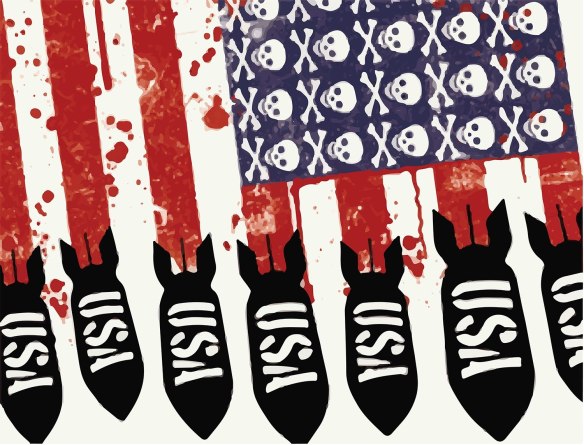
How Globalists Plan To Use Technology And Poverty To Enslave The Masses

By Brandon Smith

Source: Alt-Market.com

Tyranny is often seen as a sudden and inexplicable development in a society; the product of a singular despot that rockets to power for a limited window of time due to public fear or stupidity. This is one of the great lies of the modern era.

The truth is that for at least the past century almost every historically despised “tyrant” was merely a puppet of a larger managerial cabal, and the construction of each totalitarian state was accomplished slowly and quietly over the course of decades by those same financial elitists. From the Bolsheviks, to Hitler and the Third Reich, to Mao Zedong, to most tin-pot dictators across the Middle East and Africa, there has always been an organized group of money men and think tanks fueling the careers of the worst politicians and military juntas of the epoch.

The rise of a tyrannical system takes extensive time, planning and staging. Human beings do not simply jump right into the arms of a dystopian nightmare regime impulsively at a moment’s notice. We have been told by popular media that this is how it works; that during hard economic or social conditions men with charismatic personalities and evil intentions suddenly rise to the surface and take power by promising a better world in exchange for public fealty. But where did those economic and social crises come from to begin with? Were they a natural consequence of the era, or were they deliberately engineered?

The reality is that people must be psychologically conditioned to trade freedom for the illusion of safety. Sometimes this takes generations.  Every attempt at a totalitarian framework inevitably elicits a rebellion. Therefore, the most successful tyranny would be one that the public DEMANDS. They have to think it is their idea, otherwise they will eventually fight it.

Globalist financiers and power addicts need something more than mere military might or bureaucratic force to obtain their ideal slave society. They need 4th Generation warfare tactics. They need to con the masses into accepting their own servitude.

There are two tools that make this outcome possible: The first is controlled economic decline, the second is the integration of a technological gulag into every aspect of public life.

Economic Weapons Of Mass Distraction

It is no coincidence that dictatorial governments gain prominence as the global economy suffers; it is extremely difficult for people to remain vigilant to tyranny when they are completely distracted by their own survival. This is why my focus as an analyst has always been primarily on economics and solutions to fiscal disaster; it all begins and ends with the economy. If the public can be prepped to develop their own alternative economic systems before a crisis occurs, then they will be less distracted by the chaos and more apt to notice when the globalists offer tyranny as a fix-all.

Without alternative markets at the local level there is no redundancy, no protection from a crash. With most people dependent on the existing system for their livelihoods, the economy becomes a very useful weapon for the globalists.

Holding the economy hostage creates numerous advantages. Through deflationary pressure wages can be kept low while higher paying jobs disappear. Manufacturing can be phased out or outsourced overseas, as in the U.S. Small business ownership becomes difficult as taxes generally rise while financial conditions decline.

Through inflationary or stagflationary pressures, low wages and the inadequate job market are combined with exploding prices. This makes survival for many people untenable without government aid.

In this environment, the working public becomes reliant on the service sector, which provides no useful skill sets. Soon, you have entire generations of people with no production abilities whatsoever. They become drones working in meaningless office and retail jobs squandering away their days knowing that they are accomplishing nothing beyond a meager paycheck.

The lack of a greater purpose or mission in life and the nagging realization that the average person has no productive capacity creates a palpable atmosphere of desperation. They do not own their own work, and they have nothing much to show for their labor; nothing to point at and say, “I built that.” The public gets to the point that they may even welcome an economic collapse simply to escape the drudgery.

This is where movements to support totalitarianism come from — the subset of citizens that are fed up with fighting against the economy and have no sense of independence. These people do not know how to solve their own problems, they are always looking for someone else to do it for them. The globalists are happy to suggest their own predetermined solutions to the public once the financial structure hits a point of maximum pain.

However, after the economy is repaired in exchange for the submission of the citizenry, people might still decide one day that the trade was unfair. Thus, a deterrent is needed to keep them in line.

The Technological Fish Tank

It is important to understand that there is no major country in the western OR eastern world that is not building a digital control grid, and this helps to support my position that eastern nations are just as subservient to globalist demands as western nations. All the geopolitical drama surrounding events like the trade war, the Syrian war or various elections, etc.; none of this matters in the end. When determining if the strings of a particular government are being pulled by the globalist cabal, all you have to do is look at how quickly they are implementing oppressive systems that serve globalist interests.

For example, India’s government has been hitting the news feeds lately as their supreme court recently ruled that the controversial Aadhaar biometric program is legal. In a nation of 1.3 billion people, around 1 billion have already been biometrically profiled in a national database. This data can include fingerprints, iris scans and face scans.

I have heard it argued that India is a rather odd place to experiment with such a database, considering 60% of the population is under the poverty line and most people barely have basic amenities. But I would point out that this is why it is a PERFECT place for the globalists to start cataloging the world population on larger scale.

Again, financial desperation and a lack of productions skills tends to produce subservience. Hundreds of millions of poverty stricken people in India’s sprawling urban sewers are voluntarily giving up their biometric data in exchange for government aid programs.

For the people not anchored down by the poor economy India has instituted other measures, including requiring anyone accessing government services, opening a bank account or signing up for a mobile phone service also give up their biometrics to the government.  In nations not yet impoverished at India’s level, more subversive measures have been instituted for surveillance of the population. Data is simply taken rather than traded.

In Russia, Vladimir Putin has put the Yarovaya laws he signed in 2016 into effect. All digital data from phone conversations to emails is now recorded and stored by telecoms for government access for a minimum of six months, this includes Facebook and Twitter posts. The 2014 bloggers law also requires any blogger with over 3,000 followers be put on government file and they cannot remain anonymous. Any business operating a public Wi-Fi network is required by law to identify users by ID, which is also stored for at least six months.

Russia’s FISA-style surveillance grid is vast, yet, many people in the liberty movement seem to ignore this reality with misplaced Putin-worship. As I have noted in numerous articles, Russia is heavily influenced by international financiers.

Goldman Sachs and JP Morgan are the largest investment banks in the country. Their central bank works closely with the IMF and the BIS. The Kremlin has in the past called for a global currency controlled by the IMF. And Putin even admits in his own biography First Person that he has been friends with New World Order salesman Henry Kissinger since before he became president of Russia. In a latest show of how globalist Russia really is, the Russian Foreign Minister recently criticized the U.S. in a speech to the U.N. general assembly over its “attacks” on the “international order,” including undermining the World Trade Organization and global climate change agreements.

With the above in mind, it should come as no surprise to anyone that Russia is playing right along with globalist efforts to identify and track every single living person. It should also come as no surprise that Donald Trump, surrounded by globalists within his own cabinet, is continuing and expanding FISA surveillance under his administration.

At the beginning of 2018 Trump signed a bill renewing the National Security Agency’s warrantless FISA mass surveillance of the American population. Leading Democrats happily supported the action. Despite all of Trump’s rhetoric against FISA recently, it was Trump that made FISA’s continuation possible.

Major social media companies are cooperating wholeheartedly with mass surveillance efforts as they share personal data with governments around the world regularly.  Facebook alone saw an increase in government requests for data of over 33% in 2017, and the nature of most of this data sharing is not open to public scrutiny.

This is one reason why I’m rather bewildered by the recent conservative fury over social media discrimination – it’s as if personal liberty activists are being tricked with reverse psychology to DEMAND unhindered participation in media sites that spy on them.  Why does anyone still want to sign up for these websites?

But where is this all going? How does the combination of poverty and digital surveillance translate to tyranny? I believe China’s “social credit” program is the answer.  The system is based on the idea of “maintaining trust”, but whose trust?  Well, the government’s trust, of course.  Trust is measured using a social credit score that is tracked over a citizen’s life.  Punished behaviors include anything from smoking in a no smoking area to publishing internet content that the powers-that-be disapprove of.

China is representative of the end game for the globalist ideal for civilization. With mass economic struggle leading to dependency on government welfare programs and employment opportunities, few citizens can afford to be “blacklisted.” China’s social credit system creates an environment in which any and every action on the part of citizens is tracked and then “rated” for acceptance or consequence. This includes how people express attitudes toward the government itself. Obviously, this is the ultimate control mechanism, very similar to the Cheka established by Lenin and Stalin in Russia after the Bolshevik Revolution, but on a massive digital scale.

This is why mass surveillance is evil, regardless of whether someone is breaking the laws or not. It gives government the power to dictate and mold behavior by inspiring self-censorship rather than holding people directly at gun point. It is tyranny enforced in a less obvious way; a prison in which the prisoners maintain the locks and the chains and the bars.  Individuals do not dare do anything outside of collective norms for fear that it could be interpreted as socially negative. Punishment might include loss of access to the economy itself, and when most people are living from paycheck to paycheck, this could mean death.


The Coming Collapse

By Chris Hedges

Source: Occupy.com

The Trump administration did not rise, prima facie, like Venus on a half shell from the sea. Donald Trump is the result of a long process of political, cultural and social decay. He is a product of our failed democracy. The longer we perpetuate the fiction that we live in a functioning democracy, that Trump and the political mutations around him are somehow an aberrant deviation that can be vanquished in the next election, the more we will hurtle toward tyranny. The problem is not Trump. It is a political system, dominated by corporate power and the mandarins of the two major political parties, in which we don’t count. We will wrest back political control by dismantling the corporate state, and this means massive and sustained civil disobedience, like that demonstrated by teachers around the country this year. If we do not stand up we will enter a new dark age.

The Democratic Party, which helped build our system of inverted totalitarianism, is once again held up by many on the left as the savior. Yet the party steadfastly refuses to address the social inequality that led to the election of Trump and the insurgency by Bernie Sanders. It is deaf, dumb and blind to the very real economic suffering that plagues over half the country. It will not fight to pay workers a living wage. It will not defy the pharmaceutical and insurance industries to provide Medicare for all. It will not curb the voracious appetite of the military that is disemboweling the country and promoting the prosecution of futile and costly foreign wars.

It will not restore our lost civil liberties, including the right to privacy, freedom from government surveillance, and due process. It will not get corporate and dark money out of politics. It will not demilitarize our police and reform a prison system that has 25 percent of the world’s prisoners although the United States has only 5 percent of the world’s population. It plays to the margins, especially in election seasons, refusing to address substantive political and social problems and instead focusing on narrow cultural issues like gay rights, abortion and gun control in our peculiar species of anti-politics.

This is a doomed tactic, but one that is understandable. The leadership of the party, the Clintons, Nancy Pelosi, Chuck Schumer, Tom Perez, are creations of corporate America. In an open and democratic political process, one not dominated by party elites and corporate money, these people would not hold political power. They know this. They would rather implode the entire system than give up their positions of privilege. And that, I fear, is what will happen. The idea that the Democratic Party is in any way a bulwark against despotism defies the last three decades of its political activity. It is the guarantor of despotism.

Trump has tapped into the hatred that huge segments of the American public have for a political and economic system that has betrayed them. He may be inept, degenerate, dishonest and a narcissist, but he adeptly ridicules the system they despise. His cruel and demeaning taunts directed at government agencies, laws and the established elites resonate with people for whom these agencies, laws and elites have become hostile forces. And for many who see no shift in the political landscape to alleviate their suffering, Trump’s cruelty and invective are at least cathartic.

Trump, like all despots, has no ethical core. He chooses his allies and appointees based on their personal loyalty and fawning obsequiousness to him. He will sell anyone out. He is corrupt, amassing money for himself—he made $40 million from his Washington, D.C., hotel alone last year—and his corporate allies. He is dismantling government institutions that once provided some regulation and oversight. He is an enemy of the open society. This makes him dangerous. His turbocharged assault on the last vestiges of democratic institutions and norms means there will soon be nothing, even in name, to protect us from corporate totalitarianism.

But the warnings from the architects of our failed democracy against creeping fascism, Madeleine Albright among them, are risible. They show how disconnected the elites have become from the zeitgeist. None of these elites have credibility. They built the edifice of lies, deceit and corporate pillage that made Trump possible. And the more Trump demeans these elites, and the more they cry out like Cassandras, the more he salvages his disastrous presidency and enables the kleptocrats pillaging the country as it swiftly disintegrates.

The press is one of the principal pillars of Trump’s despotism. It chatters endlessly like 18th-century courtiers at the court of Versailles about the foibles of the monarch while the peasants lack bread. It drones on and on and on about empty topics such as Russian meddling and a payoff to a porn actress that have nothing to do with the daily hell that, for many, defines life in America. It refuses to critique or investigate the abuses by corporate power, which has destroyed our democracy and economy and orchestrated the largest transfer of wealth upward in American history.

The corporate press is a decayed relic that, in exchange for money and access, committed cultural suicide. And when Trump attacks it over “fake news,” he expresses, once again, the deep hatred of all those the press ignores. The press worships the idol of Mammon as slavishly as Trump does. It loves the reality-show presidency. The press, especially the cable news shows, keeps the lights on and the cameras rolling so viewers will be glued to a 21st-century version of “The Cabinet of Dr. Caligari.” It is good for ratings. It is good for profits. But it accelerates the decline.

All this will soon be compounded by financial collapse. Wall Street banks have been handed $16 trillion in bailouts and other subsidies by the Federal Reserve and Congress at nearly zero percent interest since the 2008 financial collapse. They have used this money, as well as the money saved through the huge tax cuts imposed last year, to buy back their own stock, raising the compensation and bonuses of their managers and thrusting the society deeper into untenable debt peonage. Sheldon Adelson’s casino operations alone got a $670 million tax break under the 2017 legislation. The ratio of CEO to worker pay now averages 339 to 1, with the highest gap approaching 5,000 to 1.

This circular use of money to make and hoard money is what Karl Marx called “fictitious capital.” The steady increase in public debt, corporate debt, credit card debt and student loan debt will ultimately lead, as Nomi Prins writes, to “a tipping point—when money coming in to furnish that debt, or available to borrow, simply won’t cover the interest payments. Then debt bubbles will pop, beginning with higher yielding bonds.”

An economy reliant on debt for its growth causes our interest rate to jump to 28 percent when we are late on a credit card payment. It is why our wages are stagnant or have declined in real terms—if we earned a sustainable income we would not have to borrow money to survive. It is why a university education, houses, medical bills and utilities cost so much. The system is designed so we can never free ourselves from debt.

However, the next financial crash, as Prins points out in her book “Collusion: How Central Bankers Rigged the World,” won’t be like the last one. This is because, as she says, “there is no Plan B.” Interest rates can’t go any lower. There has been no growth in the real economy. The next time, there will be no way out. Once the economy crashes and the rage across the country explodes into a firestorm, the political freaks will appear, ones that will make Trump look sagacious and benign.

And so, to quote Vladimir Lenin, what must be done?

We must invest our energy in building parallel, popular institutions to protect ourselves and to pit power against power. These parallel institutions, including unions, community development organizations, local currencies, alternative political parties and food cooperatives, will have to be constructed town by town. The elites in a time of distress will retreat to their gated compounds and leave us to fend for ourselves. Basic services, from garbage collection to public transportation, food distribution and health care, will collapse. Massive unemployment and underemployment, triggering social unrest, will be dealt with not through government job creation but the brutality of militarized police and a complete suspension of civil liberties.

Critics of the system, already pushed to the margins, will be silenced and attacked as enemies of the state. The last vestiges of labor unions will be targeted for abolition, a process that will soon be accelerated given the expected ruling in a case before the Supreme Court that will cripple the ability of public-sector unions to represent workers. The dollar will stop being the world’s reserve currency, causing a steep devaluation. Banks will close. Global warming will extract heavier and heavier costs, especially on the coastal populations, farming and the infrastructure, costs that the depleted state will be unable to address. The corporate press, like the ruling elites, will go from burlesque to absurdism, its rhetoric so patently fictitious it will, as in all totalitarian states, be unmoored from reality. The media outlets will all sound as fatuous as Trump. And, to quote W.H. Auden, “the little children will die in the streets.”

As a foreign correspondent I covered collapsed societies, including the former Yugoslavia. It is impossible for any doomed population to grasp how fragile the decayed financial, social and political system is on the eve of implosion. All the harbingers of collapse are visible: crumbling infrastructure; chronic underemployment and unemployment; the indiscriminate use of lethal force by police; political paralysis and stagnation; an economy built on the scaffolding of debt; nihilistic mass shootings in schools, universities, workplaces, malls, concert venues and movie theaters; opioid overdoses that kill some 64,000 people a year; an epidemic of suicides; unsustainable military expansion; gambling as a desperate tool of economic development and government revenue; the capture of power by a tiny, corrupt clique; censorship; the physical diminishing of public institutions ranging from schools and libraries to courts and medical facilities; the incessant bombardment by electronic hallucinations to divert us from the depressing sight that has become America and keep us trapped in illusions. We suffer the usual pathologies of impending death. I would be happy to be wrong. But I have seen this before. I know the warning signs. All I can say is get ready.

Is the U.S. Government Evil? You Tell Me

By John W. Whitehead

Source: The Rutherford Institute

“The greatest evil is not now done … in concentration camps and labour camps. In those we see its final result. But it is conceived and ordered (moved, seconded, carried, and minuted) in clean, carpeted, warmed and well-lighted offices, by quiet men with white collars and cut fingernails and smooth-shaven cheeks who do not need to raise their voices. Hence, naturally enough, my symbol for Hell is something like the bureaucracy of a police state or the office of a thoroughly nasty business concern.” ― C.S. Lewis, The Screwtape Letters

Is the U.S. government evil?

You tell me.

This is a government that treats its citizens like faceless statistics and economic units to be bought, sold, bartered, traded, tracked, tortured, and eventually eliminated once they’ve outgrown their usefulness.

This is a government that treats human beings like lab rats to be caged, branded, experimented upon, and then discarded and left to suffer from the after-effects.

This is a government that repeatedly lies, cheats, steals, spies, kills, maims, enslaves, breaks the laws, overreaches its authority, and abuses its power at almost every turn.

This is a government that wages wars for profit, jails its own people for profit, and then turns a blind eye and a deaf ear while its henchmen rape and kill and pillage.

No, this is not a government that can be trusted to do what is right or moral or humane or honorable but instead seems to gravitate towards corruption, malevolence, misconduct, greed, cruelty, brutality and injustice.

This is not a government you should trust with your life, your loved ones, your livelihood or your freedoms.

This is the face of evil, disguised as a democracy, sold to the people as an institution that has their best interests at heart.

Don’t fall for the lie.

The government has never had our best interests at heart.

Endless wars. The government didn’t have our best interests at heart when it propelled us into endless oil-fueled wars and military occupations in the Middle East that wreaked havoc on our economy, stretched thin our military resources and subjected us to horrific blowback.

A police state. There is no way the government had our best interests at heart when it passed laws subjecting us to all manner of invasive searches and surveillance, censoring our speech and stifling our expression, rendering us anti-government extremists for daring to disagree with its dictates, locking us up for criticizing government policies on social media, encouraging Americans to spy and snitch on their fellow citizens, and allowing government agents to grope, strip, search, taser, shoot and kill us.

Battlefield America. Certainly the government did not have our best interests at heart when it turned America into a battlefield, transforming law enforcement agencies into extensions of the military, conducting military drills on domestic soil, distributing “free” military equipment and weaponry to local police, and desensitizing Americans to the menace of the police state with active shooter drills, color-coded terror alerts, and randomly conducted security checkpoints at “soft” targets such as shopping malls and sports arenas.

School-to-prison pipeline. It would be a reach to suggest that the government had our best interests at heart when it locked down the schools, installing metal detectors and surveillance cameras, adopting zero tolerance policies that punish childish behavior as harshly as criminal actions, and teaching our young people that they have no rights, that being force-fed facts is education rather than indoctrination, that they are not to question governmental authority, that they must meekly accept a life of censorship, round-the-clock surveillance, roadside blood draws, SWAT team raids and other indignities.

Secret human experimentation. One would also be hard-pressed to suggest that the American government had our best interests at heart when it conducted secret experiments on an unsuspecting populace—citizens and noncitizens alike—making healthy people sick by spraying them with chemicals, injecting them with infectious diseases and exposing them to airborne toxins. The government reasoned that it was legitimate (and cheaper) to experiment on people who did not have full rights in society such as prisoners, mental patients, and poor blacks.

As the Associated Press reports, “The late 1940s and 1950s saw huge growth in the U.S. pharmaceutical and health care industries, accompanied by a boom in prisoner experiments funded by both the government and corporations. By the 1960s, at least half the states allowed prisoners to be used as medical guinea pigs … because they were cheaper than chimpanzees.”

In Alabama, for example, 600 black men with syphilis were allowed to suffer without proper medical treatment so that the government could study the natural progression of untreated syphilis. In California, older prisoners were implanted with testicles from livestock and executed convicts so the government could test their virility.

In Connecticut, mental patients were injected with hepatitis so the government could study the disease. In Maryland, sleeping prisoners had a pandemic flu virus sprayed up their noses so the government could monitor their symptoms. In Georgia, two dozen “volunteering” prison inmates had gonorrhea bacteria pumped directly into their urinary tracts through the penis so the government could work on a cure.

In Michigan, male patients at an insane asylum were exposed to the flu so the government could experiment with a flu vaccine. In Minnesota, 11 public service employee “volunteers” were injected with malaria, then starved for five days, so the government could study the impact.

In New York, prisoners at a reformatory prison were split into two groups to determine how a deadly stomach virus was spread: the first group was made to swallow an unfiltered stool suspension, while the second group merely breathed in germs sprayed into the air. In Staten Island, children with mental retardation were given hepatitis orally and by injection to see if they could then be cured.

Unfortunately, these incidents are just the tip of the iceberg when it comes to the atrocities the government has inflicted on an unsuspecting populace in the name of secret experimentation.

For instance, there was the U.S. military’s secret race-based testing of mustard gas on more than 60,000 enlisted men (African-Americans, Japanese-Americans, Hispanics, etc.). As NPR reports, “All of the World War II experiments with mustard gas were done in secret and weren’t recorded on the subjects’ official military records. Most do not have proof of what they went through. They received no follow-up health care or monitoring of any kind. And they were sworn to secrecy about the tests under threat of dishonorable discharge and military prison time, leaving some unable to receive adequate medical treatment for their injuries, because they couldn’t tell doctors what happened to them.”

And then there was the CIA’s Cold War-era program, MKULTRA, in which the government began secretly experimenting on hundreds of unsuspecting American civilians and military personnel by dosing them with LSD, some having the hallucinogenic drug secretly slipped into their drinks, so that the government could explore its uses in brainwashing and controlling targets. The CIA spent nearly $20 million on its MKULTRA program, reportedly as a means of programming people to carry out assassinations and, to a lesser degree, inducing anxieties and erasing memories, before it was supposedly shut down.

Similarly, the top-secret Montauk Project, the inspiration for the hit Netflix series Stranger Things, allegedly was working to develop mind-control techniques that would then be tested out on locals in a nearby village, triggering crime waves or causing teenagers to congregate.

Sounds like the stuff of conspiracy theorists, I know, but the government’s track record of treating Americans like lab rats has been well-documented, including its attempts to expose whole communities to various toxins as part of its efforts to develop lethal biological weapons and study their impact and delivery methods on unsuspecting populations.

In 1949, for instance, the government sprayed bacteria into the Pentagon’s air handling system, then the world’s largest office building. In 1950, special ops forces sprayed bacteria from Navy ships off the coast of Norfolk and San Francisco, in the latter case exposing all of the city’s 800,000 residents.

In 1953, government operatives staged “mock” anthrax attacks on St. Louis, Minneapolis, and Winnipeg using generators placed on top of cars. Local governments were reportedly told that “‘invisible smokescreen[s]’ were being deployed to mask the city on enemy radar.” Later experiments covered territory as wide-ranging as Ohio to Texas and Michigan to Kansas.

In 1965, the government’s experiments in bioterror took aim at Washington’s National Airport, followed by a 1966 experiment in which army scientists exposed a million subway NYC passengers to airborne bacteria that causes food poisoning.

Now one might argue that this is all ancient history and that the government today is different from the government of yesteryear, but has the U.S. government really changed?

Ask yourself: Has the government become any more humane, any more respectful of the rights of the citizenry? Has it become any more transparent or willing to abide by the rule of law? Has it become any more truthful about its activities? Has it become any more cognizant of its appointed role as a guardian of our rights?

Or, having mastered the Orwellian art of Doublespeak and followed the Huxleyan blueprint for distraction and diversion, has the government simply gotten craftier and more conniving, better able to hide its nefarious acts and dastardly experiments under layers of secrecy, legalism and obfuscations?

Consider this: after revelations about the government’s experiments spanning the 20th century spawned outrage, the government began looking for human guinea pigs in other countries, where “clinical trials could be done more cheaply and with fewer rules.”

In Guatemala, prisoners and patients at a mental hospital were infected with syphilis, “apparently to test whether penicillin could prevent some sexually transmitted disease.” More recently, U.S.-funded doctors “failed to give the AIDS drug AZT to all the HIV-infected pregnant women in a study in Uganda even though it would have protected their newborns.” Meanwhile, in Nigeria, children with meningitis were used to test an antibiotic named Trovan. Eleven children died and many others were left disabled.

What kind of government perpetrates such horrific acts on human beings, whether or not they are American citizens?

Is there any difference between a government mindset that justifies experimenting on prisoners because they’re “cheaper than chimpanzees” and a government that sanctions jailhouse strip searches of individuals charged with minor infractions simply because it’s easier on a jail warden’s workload?

John Lennon was right: “We’re being run by maniacs for maniacal ends.”

Unfortunately, the more things change, the more they stay the same.

Just recently, for example, a Fusion Center in Washington State (a Dept. of Homeland Security-linked data collection clearinghouse that shares information between state, local and federal agencies) inadvertently released records on remote mind control tactics (the use of “psycho-electronic” weapons to control people from a distance or subject them to varying degrees of pain).

Mind you, there is no clear evidence to suggest that these particular documents were created by a government agency. Then again, the government—no stranger to diabolical deeds or shady experiments carried out an unsuspecting populace—has done it before.

After all, this is a government that has become almost indistinguishable from the evil it claims to be fighting, whether that evil takes the form of terrorism, torture, drug traffickingsex trafficking, murder, violence, theft, pornography, scientific experimentations or some other diabolical means of inflicting pain, suffering and servitude on humanity.

For too long now, the American people have been persuaded to barter their freedoms for phantom promises of security and, in the process, have rationalized turning a blind eye to all manner of government wrongdoing—asset forfeiture schemes, corruption, surveillance, endless wars, SWAT team raids, militarized police, profit-driven private prisons, and so on—because they were the so-called lesser of two evils.

No matter how you rationalize it, the lesser of two evils is still evil.

There’s a scene in The Third Man, Carol Reed’s influential 1949 film starring Joseph Cotten and Orson Welles in which a rogue war profiteer (Harry Lime) views human carnage with a callous indifference, unconcerned that the diluted penicillin he’s been trafficking underground has resulted in the tortured deaths of young children.

Challenged by his old friend Holly Martins to consider the consequences of his actions, Lime responds, “In these days, old man, nobody thinks in terms of human beings. Governments don’t, so why should we?”

“Have you ever seen any of your victims?” asks Martins.

“Victims?” responds Lime, as he looks down from the top of a Ferris wheel onto a populace reduced to mere dots on the ground. “Look down there. Tell me. Would you really feel any pity if one of those dots stopped moving forever? If I offered you twenty thousand pounds for every dot that stopped, would you really, old man, tell me to keep my money, or would you calculate how many dots you could afford to spare?”

Lime’s callous indifference is no different from the U.S. government’s calculating cost-benefit analyses.

In the eyes of the government, “we the people” are chump change.

So why do Americans keep believing the government has their best interests at heart?

Why do Americans keep trusting the government?

Why do Americans pretend not to know what is so obvious to anyone with eyes and ears and a conscience?

As Carl Sagan recognized, “If we’ve been bamboozled long enough, we tend to reject any evidence of the bamboozle. We’re no longer interested in finding out the truth. The bamboozle has captured us. It’s simply too painful to acknowledge, even to ourselves, that we’ve been taken. Once you give a charlatan power over you, you almost never get it back.”

We should never have trusted the government in the first place.

That’s why the Founders came up with a Bill of Rights. They recognized that without binding legal protections affirming the rights of the people, the newly instituted American government would be no better than the old British despot.

It was Thomas Jefferson who warned, “In questions of power then, let no more be heard of confidence in man, but bind him down from mischief by the chains of the Constitution.”

Unfortunately, we didn’t heed the warning.

As I make clear in my book Battlefield America: The War on the American Peoplethe government has ripped the Constitution to shreds and left us powerless in the face of its power grabs, greed and brutality.

So how do you fight back?

How do you fight injustice? How do you push back against tyranny? How do you vanquish evil?

You don’t fight it by hiding your head in the sand.

Stop being apathetic. Stop being neutral. Stop being accomplices.

Start recognizing evil and injustice and tyranny for what they are. Demand government transparency. Vote with your feet (i.e., engage in activism, not just politics). Refuse to play politics with your principles. Don’t settle for the lesser of two evils.

As British statesman Edmund Burke warned, “The only thing necessary for the triumph of evil is for good men [and women] to do nothing.”

It’s time for good men and women to do something. And soon.

America: The Country That Never Was!

By thnkfryrslf

Source: Axis of Logic

The ideal country. Democratic and Free. The greatest country in the world, because they’re exceptional.

Saves citizens of other countries from tyrannical governments by slaying the tyrants and bringing democracy and staying to make sure that democracy is implemented, no matter how long it takes. Always doing right by those citizens in need.

A beacon of liberty to the rest of the world. Saved the world by winning the 2nd world war. Its citizens always patriotically supporting the troops. The richest country on earth. All citizens are equal under the law. Economically, presents to its citizens every opportunity to succeed. A culture of endless opportunities.

Constantly reforming education for its people. Good God-fearing moral people, supported by a God-fearing, moral government. A benevolent people, whose benevolent government shows benevolence to the rest of the world. Respecting the freedom and sovereignty of all nations.

Generous loans given to poorer countries.

Good supportive and caring neighbour to its northern and southern neighbours.

Always warning its public and the rest of the world who the enemy of their stability and peace is and that this country of exceptional people will always defend them.

Admirer of those self-made creators of wealth. They are the true rugged individuals. Showing in Hollywood movies the heroism of their noble military. Accepting all races of people, it being one of their highest values.

An engaged citizenry always challenging its government to do better. Freedom of speech exercised by all, because they are a government of the people and by the people.

Citizens love of their country runs deep, shown by not having a need to travel much to other lesser countries. The MSM always helping the people to understand politics domestically and globally and how their government is constantly practicing democratic values at home and abroad.

The envy of the world for their wealth and freedom. A country who historically fought a civil war to abolish slavery and succeeded. A country that was essentially built by Europeans. A country whose heroic history is taught as an inspiration.

America, a brutal and savage killer, posing as a liberator and keeper of peace, is the country that does exist.

The Cost of Resistance


(Museum of the Revolution, León, Nicaragua)

By Chris Hedges

Source: TruthDig

Resistance entails suffering. It requires self-sacrifice. It accepts that we may be destroyed. It is not rational. It is not about the pursuit of happiness. It is about the pursuit of freedom. Resistance accepts that even if we fail, there is an inner freedom that comes with defiance, and perhaps this is the only freedom, and true happiness, we will ever know. To resist evil is the highest achievement of human life. It is the supreme act of love. It is to carry the cross, as the theologian James Cone reminds us, and to be acutely aware that what we are carrying is also what we will die upon.

Most of those who resist—Sitting Bull, Emma Goldman, Malcolm X and Martin Luther King Jr.—are defeated, at least in the cold calculation of the powerful. The final, and perhaps most important quality of resistance, as Cone writes, is that it “inverts the world’s value system.” Hope rises up out of defeat. Those who resist stand, regardless of the cost, with the crucified. This is their magnificence and their power.

The seductive inducements to conformity—money, fame, prizes, generous grants, huge book contracts, hefty lecture fees, important academic and political positions and a public platform—are scorned by those who resist. The rebel does not define success the way the elites define success. Those who resist refuse to kneel before the idols of mass culture and the power elites. They are not trying to get rich. They do not want to be part of the inner circle of the powerful. They accept that when you stand with the oppressed you get treated like the oppressed.

The inversion of the world’s value system makes freedom possible. Those who resist are free not because they have attained many things or high positions, but because they have so few needs. They sever the shackles used to keep most people enslaved. And this is why the elites fear them. The elites can crush them physically, but they cannot buy them off.

The power elites attempt to discredit those who resist. They force them to struggle to make an income. They push them to the margins of society. They write them out of the official narrative. They deny them the symbols of status. They use the compliant liberal class to paint them as unreasonable and utopian.

Resistance is not, fundamentally, political. It is cultural. It is about finding meaning and expression in the transcendent and the incongruities of life. Music, poetry, theater and art sustain resistance by giving expression to the nobility of rebellion against the overwhelming forces, what the ancient Greeks called fortuna, which can never ultimately be overcome. Art celebrates the freedom and dignity of those who defy malignant evil. Victory is not inevitable, or at least not victory as defined by the powerful. Yet in every act of rebellion we are free. It was the raw honesty of the blues, spirituals and work chants that made it possible for African-Americans to endure.

Power is a poison. It does not matter who wields it. The rebel, for this reason, is an eternal heretic. He or she will never fit into any system. The rebel stands with the powerless. There will always be powerless people. There will always be injustice. The rebel will always be an outsider.

Resistance requires eternal vigilance. The moment the powerful are no longer frightened, the moment the glare of the people is diverted and movements let down their guard, the moment the ruling elites are able to use propaganda and censorship to hide their aims, the gains made by resisters roll backward. We have been steadily stripped of everything that organized working men and women—who rose up in defiance and were purged, demonized and killed by the capitalist elites—achieved with the New Deal. The victories of African-Americans, who paid with their bodies and blood in making possible the Great Society and ending legal segregation, also have been reversed.

The corporate state makes no pretense of addressing social inequality or white supremacy. It practices only the politics of vengeance. It uses coercion, fear, violence, police terror and mass incarceration as social control. Our cells of resistance have to be rebuilt from scratch.

The corporate state, however, is in trouble. It has no credibility. All the promises of the “free market,” globalization and trickle-down economics have been exposed as a lie, an empty ideology used to satiate greed. The elites have no counterargument to their anti-capitalist and anti-imperialist critics. The attempt to blame the electoral insurgencies in the United States’ two ruling political parties on Russian interference, rather than massive social inequality—the worst in the industrialized world—is a desperate ploy. The courtiers in the corporate press are working feverishly, day and night, to distract us from reality. The moment the elites are forced to acknowledge social inequality as the root of our discontent is the moment they are forced to acknowledge their role in orchestrating this inequality. This terrifies them.

The U.S. government, subservient to corporate power, has become a burlesque. The last vestiges of the rule of law are evaporating. The kleptocrats are pillaging and looting like barbarian hordes. Programs instituted to protect the common good—public education, welfare and environmental regulations—are being dismantled. The bloated military, sucking the marrow out of the nation, is unassailable. Poverty is a nightmare for half the population. Poor people of color are gunned down with impunity in the streets. Our prison system, the world’s largest, is filled with the destitute. And presiding over the chaos and the dysfunction is a political P.T. Barnum, a president who, while we are being fleeced, offers up one bizarre distraction after another, much like Barnum’s Feejee mermaid—the head and torso of a monkey sewed to the back half of a fish.

There is no shortage of artists, intellectuals and writers, from Martin Buber and George Orwell to James Baldwin, who warned us that this dystopian era was fast approaching. But in our Disneyfied world of intoxicating and endless images, cult of the self and willful illiteracy, we did not listen. We will pay for our negligence.

Søren Kierkegaard argued that it was the separation of intellect from emotion, from empathy, that doomed Western civilization. The “soul” has no role in a technocratic society. The communal has been shattered. The concept of the common good has been obliterated. Greed is celebrated. The individual is a god. The celluloid image is reality. The artistic and intellectual forces that make transcendence and the communal possible are belittled or ignored. The basest lusts are celebrated as forms of identity and self-expression. Progress is defined exclusively by technological and material advancement. This creates a collective despair and anxiety that feeds and is fed by glitter, noise and false promises of consumer-culture idols. The despair grows ever-worse, but we never acknowledge our existential dread. As Kierkegaard understood, “the specific character of despair is precisely this: it is unaware of being despair.”

Those who resist are relentlessly self-critical. They ask the hard questions that mass culture, which promises an unachievable eternal youth, fame and financial success, deflects us from asking. What does it mean to be born? What does it mean to live? What does it mean to die? How do we live a life of meaning? What is justice? What is truth? What is beauty? What does our past say about our present? How do we defy radical evil?

We are in the grip of what Kierkegaard called “sickness unto death”—the numbing of the soul by despair that leads to moral and physical debasement. Those who are ruled by rational abstractions and an aloof intellectualism, Kierkegaard argued, are as depraved as those who succumb to hedonism, cravings for power, violence and predatory sexuality. We achieve salvation when we accept the impediments of the body and the soul, the limitations of being human, yet despite these limitations seek to do good. This burning honesty, which means we always exist on the cusp of despair, leaves us, in Kierkegaard’s words, in “fear and trembling.” We struggle not to be brutes while acknowledging we can never be angels. We must act and then ask for forgiveness. We must be able to see our own face in the face of the oppressor.

The theologian Paul Tillich did not use the word “sin” to mean an act of immorality. He, like Kierkegaard, defined sin as estrangement. For Tillich, it was our deepest existential dilemma. Sin was our separation from the forces that give us ultimate meaning and purpose in life. This separation fosters the alienation, anxiety, meaninglessness and despair that are preyed upon by mass culture. As long as we fold ourselves inward, embrace a perverted hyper-individualism that is defined by selfishness and narcissism, we will never overcome this estrangement. We will be separated from ourselves, from others and from the sacred.

Resistance is not only about battling the forces of darkness. It is about becoming a whole and complete human being. It is about overcoming estrangement. It is about the capacity to love. It is about honoring the sacred. It is about dignity. It is about sacrifice. It is about courage. It is about being free. Resistance is the pinnacle of human existence.

Reviving the Spirit of Existential Rebellion in a World of Propaganda, Lies, and Self Deception

By Edward Curtin

Source: Dissident Voice

Search for nothing anymore, nothing except truth.
Be very still and try to get at the truth.
And the first question to ask yourself is:
How great a liar am I?
— D. H. Lawrence, Search For Truth

Like existential freedom, honesty and truth-seeking demand a perpetually renewed commitment. No one ever fully arrives, and all of us are blown off course on the journey.  Even when we think we have reached our destination, we are often startled by the enigma of arrival, and must set sail again.  We are all in the same boat. The search for truth is a process, an experiment, an essay – a trying without end.

Yet surely it is not an exaggeration to say that most people are liars and self-deceivers.  Honesty, while touted as a virtue, is practiced far less than it is praised.  There is almost nothing that people are less honest about than their attitudes toward honesty.  Few think of themselves as dishonest, and even to hint that someone is so is received as a great insult that usually elicits an angry response.  So most people follow the advice of the character Jean-Baptiste Clamence from Albert Camus’ The Fall: “Promise to tell the truth and then lie as best you can.”  In that way you satisfy your own and others’ secret desires for deception and play-acting, and other people will love you for it.

However, it is widely accepted that political leaders and the mass media lie and dissemble regularly, which, of course, they do. That is their job in an oligarchy.  Today we are subjected to almost total, unrelenting media and government propaganda. Depending on their political leanings, people direct their anger toward politicians of parties they oppose and media they believe slant their coverage to favor the opposition.  Trump is a liar.  No, Obama is a liar.  And Hillary Clinton.  No, Fox News. Ridiculous! – it’s CNN or NBC.  And so on and so forth in this theatre of the absurd that plays out within a megaplex of mainstream media (MSM) propaganda, where there are many shows but one producer, whose overall aim is to engineer the consent of all who enter while setting the different audiences against each other.  It is a very successful charade that evokes name-calling from all quarters.

In other words, for many people their opponents lie, as do other people, but not them. This is as true in personal as well as public life. Here the personal and the political converge, despite protestations to the contrary.

Sartre and Bad Faith

Lying and dissembling are ubiquitous.  Being lied to by the MSM is mirrored in people’s personal lives.  People lie and want to be deceived. They choose to play dumb, to avoid a confrontation with truth.  They want to be nice (Latin, nescire, not to know, to be ignorant) and to be liked.  They want to tuck themselves into a safe social and cultural framework where they imagine they will be safe. They choose to live in what Jean Paul Sartre called bad faith (mauvaise foi).  He put it as follows:

In bad faith it is from myself that I am hiding the truth. But with this “lie” to myself, the one to whom the lie is told and the one who lies are one and the same person, which means  that I must know in my capacity as deceiver the truth which is hidden from me in my capacity as the one deceived.

Such bad faith allows people to fabricate a second act of bad faith: that they are not responsible for their ignorance of the truths behind the government’s and corporate media’s lies and propaganda, even as the shades of the prison house ominously close around us and the world edges toward global death that could arrive in an instant with nuclear war or limp along for years of increasing suffering.

Those of us who write about the U.S.-led demented wars and provocations around the world and the complementary death of democracy at home are constantly flabbergasted and discouraged by the willed ignorance of so many Americans.  For while the mainstream media does the bidding of the power elite, there is ample alternative news and analyses available on the internet from fine journalists and writers committed to truth, not propaganda. There is actually far too much truth available, which poses another problem. But it doesn’t take a genius to learn how to research important issues and to learn how to distinguish between bogus and genuine information.  It takes a bit of effort, and, more importantly, the desire to compare multiple, opposing viewpoints and untangle the webs the Web weaves.  We are awash in information (and disinformation) and both good and bad reporting, but it is still available to the caring inquirer.

The problem is the will to know.  But why, why the refusal to investigate and question; why the indifference? Stupidity?  Okay, there is that.  Ignorance?  That too.  Willful ignorance, ditto.  Laziness, indeed. Careerism and ideology?  For certain.  Upton Sinclair put it mildly when he said, “It is difficult to get a man to understand something, when his salary depends on not understanding it.” Difficult?  No, it’s almost impossible.

But then there are many very intelligent people who have nothing to lose and yet adamantly refuse to entertain alternative possibilities to the reigning orthodoxies that have them in their grip.

As do many others, I know many such people who will yes me to death and then never fully research issues. They will remain in limbo or else wink to themselves that what may be true couldn’t be true.  They close down. This is a great dilemma and frustration faced by those who seek to convince people to take an active part in understanding what is really going on in the world today, especially as the United States wages war across the globe, threatens Russia and China, among others, as it expands and modernizes its nuclear weapons capabilities.

Jacques Ellul on Propaganda

The French sociologist, Jacques Ellul, has argued  convincingly that modern propaganda in a technological mass society is more complicated than the state and media lying and deceiving the population.  He argues that propaganda meets certain needs of modern people and therefore the process of deceit is reciprocal.  The modern person feels lost, powerless, and empty. Ellul says, “He realizes that he depends on decisions over which he has no control, and that realization drives him to despair.”  But he can’t live in despair; desires that life be meaningful; and wants to feel he lives in a world that makes sense.  He wants to participate and have opinions that suggest he grasps the flow of events.  He doesn’t so much want information, but value judgments and preconceived positions that provide him with a framework for living.  Ellul wrote the following in 1965 in his classic book Propaganda:

The majority prefers expressing stupidities to not expressing any opinion: this gives them the feeling of participation.  For they need simple thoughts, elementary explanations, a ‘key’ that will permit them to take a position, and even readymade opinions….The man who keeps himself informed needs a framework….the more complicated the problems are, the more simple the explanations must be; the more fragmented the canvas, the simpler the pattern; the more difficult the question, the more all-embracing the solution; the more menacing the reduction of his own worth, the greater the need for boosting his ego.  All this propaganda – and only propaganda – can give him.

Another way of saying this is that people want to be provided with myths to direct them to the “truth.”  But such so-called truth has been preconceived within the overarching myth provided by propaganda, and while it satisfies people’s emotional need for coherence, it also allows them to think of themselves as free individuals arriving at their own conclusions, which is a basic function of good propaganda.  In today’s mass technological society, it is essential that people be convinced that they are free-thinking individuals acting in good faith. Then they can feel good about themselves as they lie and act in bad faith.

The Spirit of Existential Rebellion 

In the wake of World War II and the complete shattering of any illusion about the human capacity for evil, there arose in Western Europe, particularly in France and Germany a “philosophy” called existentialism. More an attitude towards life rather than a formal philosophy, and with its roots going back at least as far as Kierkegaard and Nietzsche in the 19th century, existentialism emphasized individual freedom, authenticity, personal responsibility, and the need to confront the unimaginable horrors of World War II and the absurd situation in which human beings had created nuclear weapons that could obliterate the planet in a flash, as the United States had used to incinerate Hiroshima and Nagasaki.  How to respond to the birth of global state nuclear terrorism became a task for the existential imagination.

The traditional belief that an all-powerful God could bring the world to an end had now been replaced by the idolatry of nuclear madmen who had hubristically violated the limits that the Greeks had long ago warned us not to exceed by making themselves into gods. Having unleashed the Furies, these false gods have created a world in which the droning sound of nuclear intercontinental missiles haunts the secret nightmares of the world. We have been living with this unspeakable and unspoken truth for more than seventy years.

Opposition to the nuclear standoff and its accompanying proxy wars has waxed and waned over the years. Dissident minorities and sometimes many millions across the globe have mobilized to oppose not only nuclear weapons but the war makers who have waged continuous wars of aggression throughout the world and have created the national-security warfare state, seemingly intent on world destruction.

However, today the sound of silence fills the empty streets, as passivity has overtaken those who oppose the growing nuclear threat and the ongoing U.S.- led wars throughout the world. The spirit of resistance has gone to sleep. The German writer Karl Kraus understood this in the days of Hitler’s rise during the 1930s when he said, “The real end of the world is the destruction of the spirit; the other kind depends on the insignificant attempt to see whether after such destruction the world can go on.”

We need to somehow resurrect the spirit of resistance that will bring together millions of people across the world who oppose the death dealers. I think it is time to recall the power and possibility implicit in the spirit of existential thought.

The existential emphasis on individual responsibility and authentic truth telling in the works of various writers, including Jean Paul Sartre, Simone de Beauvoir, Gabriel Marcel, and Albert Camus (who didn’t consider himself an existentialist but whose work emphasized many of the same themes), inspired large numbers of people in the late’ 50s into the mid-to-late ’60s, including the international anti-nuclear movement and young American anti-war activists. Contrary to popular understanding, existentialism is not about navel gazing and hopelessness, but is about responding freely and authentically to the situations people find themselves in, which today, is the end- time that is a time when the fate of the world lies in the hands of nuclear madmen.

But by the end of the 1960s this existential spirit of rebellion started to dissipate. Academic gibberish replaced this rebellious spirit with the introduction of ideas, such as post structuralism, leading eventually to postmodernist nonsense that not only refuted the need for personal responsibility, but eliminated the person altogether. By 1999 a leading exponent of postmodern rhetoric, Jean Baudrillard, was dismissing everything the existentialists emphasized. He said, “No one needs this kind of ‘existential garb’ any more. Who cares about freedom, bad faith, and authenticity today?”

If such words were just the ranting of an intellectual lost in a fantasy world of abstractions, that would be one thing. But they are a form of propaganda echoed throughout western societies, particularly the United States, through the repeated emphases over the decades that people are not free but are the products of biological brain processes, etc. Deterministic memes have become dominant in cultural mind control. Such postmodern abstractions have denied everything that makes possible the fight against nuclear annihilation and the warfare states’ domination of western Europe and NATO, led by the United States.

The self is an illusion. Freedom is an illusion. Responsibility is an illusion. Guilt is an illusion. Everything is an illusion. A kaleidoscopic mad world in which no on exists and nothing really matters. This deterministic and nihilistic message has become the main current in western cultural propaganda since the late 1960s and has reached a crescendo in the present day. It is responsible for the growth of passivity and denial that dominates contemporary public consciousness. It underlies the refusal of so many otherwise intelligent people to engage themselves in the search for truth that would lead to their joining forces with others to create a mass anti-war movement.

While many people think of existentialism as only an atheistic approach to existence, this is incorrect. There are atheist and agnostic existentialists, yes, but existentialism’s core emphases have deep roots in the various religious traditions, such as Judaism and Christianity, etc. That is because freedom, authenticity, truth telling, and social responsibility, while often buried within the institutional structures of these faiths, lie at their core. So if we are going to resurrect the spirit of rebellion necessary to transform today’s world, we need to renew the virtues that the existentialists emphasize.

The first step in this process is to ask with D.H.Lawrence the question, “How great a liar am I?”

Anti-war activist and author of the indispensable book JFK and the Unspeakable: Why He Died and Why It Matters, James Douglass, made an intriguing suggestion in another book, Lightning East To West, when he said:

The exact opposite of the H bomb’s destructive purpose, but psychic equivalent of its energy, is the Kingdom of Reality which would be the final victory of Truth in history –a force of truth and love powerful enough to fuse billions of individual psyches into a global realization of essential oneness. There is no reason why the same psyche which, when turned outward, was able to create the condition for a self-acting force of over 100 million degrees of heat, thus realizing an inconceivable thermonuclear fusion, cannot someday turn sufficiently inward to create the condition for an equally inconceivable (but nature balancing) fusion in its own psychic or spiritual reality. An end-time can also be a beginning. Gandhi said: ‘When the practice of the law becomes universal, God will reign on the earth as God does in heaven. Earth and heaven are in us. We know the earth, and we are strangers to the heaven within us.

While Gandhi’s words are couched in religious language, their meaning can resonate with secular-minded people as well. These words speak to the power implicit in the human spirit as a whole. That power begins and builds when people of all persuasions are convinced that they must freely pursue the truth at all costs. As the poet Theodore Roethke wrote, “In a dark time, the eye begins to see.”

In these very dark times – these end- times created by nuclear weapons – seeing the truth is dependent on the will to truth, and the will to truth only arises when people believe they are free to alter the circumstances in which they find themselves. This belief in freedom is at the core of all existential thought and is why we need to resurrect it today.

Live Free or Die: The Psychology of Rebellion & Dissent

By Gary ‘Z’ McGee

Source: Waking Times

“I rebel—therefore we exist.” ~Albert Camus, The Rebel

Dissent is a tricky subject. The need to rebel against atrocity is deeply ingrained in the human condition. Even if most of us don’t act on it, the impulse is still there, churning our guts with disgust, getting our hearts pumping, moving us to spit curse words in lathered fury and shout in angry defiance. The problem is that most of us don’t know what to do with this powerful and sometimes overwhelming energy.

Most of us were raised in violent societies that use violence to keep the culture churning in a diabolical conquer-control-consume-repeat cycle. So, most of us tend to use violence to channel our deep and powerful need for dissent, thus perpetuating more violence. When the culture is jamming violence down our throat as a solution to its problems, are we really that surprised when our acts of rebellion turn out to be violent? Something’s got to give if we want to break this cycle of violence deeply imbedded in our culture.

In his book, The Rebel: An Essay on Man in Revolt, Albert Camus wrote about the “true rebel.”The true rebel is in revolt against oppression, violence, slavery and tyranny for the sake of others through constructive and life-affirming action. The true rebel protests out of love, so that others may be free. Intent is everything. True rebellion, Camus argues, is an act motivated but concerned with the common good rather than by self-interest. The rebel in revolt out of selfishness, greed, or need for power, eventually becomes a tyrant. The rebel in revolt for the sake of others, becomes a hero.

Whether you are alt-right or alt-left, republican’t or democan’t, voluntarist or anarchist, if you are seeking power over others for your own selfish and greedy ends, your revolution means fuck-all. You’re just another would-be-tyrant getting churned out of the meat-mill of violence begetting violence. It doesn’t matter how noble or important you think your cause is; if you need to use violence to persuade others to follow it, your cause is fundamentally flawed and immoral. Acting violently in a violent culture only perpetuates violence. Similarly, acting immorally in an immoral society just perpetuates immorality. Unhealthy acts beget unhealthy acts. Like Gandhi said, “An eye for an eye makes the whole world blind.”

Lest we all go blind, we must rebel so that others may freely exist. This requires our dissent to be based in freedom for everyone, even those we don’t agree with. A kind of metamorality arises from this kind of thinking, like Joshua Greene writes about in his book, Moral Tribes. But, and here’s the rub, any freedom which seeks to violate the nonaggression principle must not be tolerated. Violence is where the line must be drawn. As someone once said, “Your freedom to swing your fist ends an inch from my nose” (unknown). In such cases, self-defense is paramount. As Gandhi also advised, “When there is only a choice between cowardice and violence, I would advise violence.”

A true rebel doesn’t seek out rebellion for the sake of rebellion, or just as an excuse to act out violently. No. A true rebel passionately seeks a healthy environment (physically, culturally, and psychologically) and they rebel against anything that stands in the way of that healthy environment. As Camus said, “Rebellion, though apparently negative, since it creates nothing, is profoundly positive in that it reveals the part of man which must always be defended.” And that’s what it comes down to: self-defense, self-preservation, and survival. Not just personal survival, but the survival of the species.

That’s where life-affirming action comes in. When our rebellion is life-affirming, freedom-affirming, and based on nonviolence, it is healthy (heroic). When our rebellion is life-denying, freedom-denying, and based on violence, it is unhealthy (tyrannical). The hero is free, and uses that freedom with the soul intent to free others. The tyrant (or would be tyrant) is also free, but uses that freedom with the soul intent to rule others. We escape tyranny when we seek to free others through our own freedom. Liberty coincides with heroism when we’re able to go from asking, ‘free from what?’ to asking, ‘free for what?’

At the end of the day, the history of our culture of violence is only fruitful through a vigilant rebellion against it. This means a vigilant rebellion against oppression, hate, violence, and slavery of all kinds. Those who dedicate themselves to this culture of violence dedicate themselves to nothing and, in turn, are nothing. But those who dedicate themselves to life, freedom, and health, despite the culture of violence, dedicate themselves to survival and reap from it the harvest that sows its seed in the progressive evolution of our species.

A species hellbent on violence against itself is unhealthy and eventually destroys itself. A species determined to be healthy only ever uses violence as a last resort in self-defense and for the preservation of the species itself. From the former, the defiant tyrant juts his ugly head, declaring himself free at the expense of the freedom of others. From the latter, the defiant hero rises up, denying the tyrant’s violent oppression, and affirming freedom through the freedom of us all. That’s what Camus meant when he wrote: “I rebel –therefore we exist.”

Don’t Just Give Thanks. Pay It Forward One Act of Kindness at a Time

By John W. Whitehead

Source: The Rutherford Institute

“As we express our gratitude, we must never forget that the highest appreciation is not to utter words, but to live by them.”—John F. Kennedy

It’s been a hard, heart-wrenching, stomach-churning kind of year filled with violence and ill will.

It’s been a year of hotheads and blowhards and killing sprees and bloodshed and takedowns.

It’s been a year in which tyranny took a step forward and freedom got knocked down a few notches.

It’s been a year with an abundance of bad news and a shortage of good news.

It’s been a year of too much hate and too little kindness.

Now we find ourselves approaching that time of year when, as George Washington and Abraham Lincoln proclaimed, we’re supposed to give thanks as a nation and as individuals for our safety and our freedoms.

It’s not an easy undertaking.

How do you give thanks for freedoms that are constantly being eroded? How do you express gratitude for one’s safety when the perils posed by the American police state grow more treacherous by the day? How do you come together as a nation in thanksgiving when the powers-that-be continue to polarize and divide us into warring factions?

It’s not going to happen overnight. Or with one turkey dinner. Or with one day of thanksgiving.

Thinking good thoughts, being grateful, counting your blessings and adopting a glass-half-full mindset are fine and good, but don’t stop there.

This world requires doers, men and women (and children) who will put those good thoughts into action.

It says a lot (and nothing good) about the state of our world and the meanness that seems to have taken center stage that we now have a day (World Kindness Day) devoted to making the world more collectively human in thoughts and actions. The idea for the day started after a college president in Japan was mugged in a public place and nobody helped him.

Unfortunately, you hear about these kinds of incidents too often.

A 15-year-old girl was gang raped in a schoolyard during a homecoming dance. As many as 20 people witnessed the assault over the course of two and a half hours. No one intervened to stop it.

A 28-year-old woman was stabbed, raped and murdered outside her apartment early in the morning. Thirty-eight bystanders witnessed the attack and failed to intervene. The woman, Kitty Genovese, died from her wounds at the locked doorway to her apartment building.

A 58-year-old man waded into chest-deep water in the San Francisco Bay in an apparent suicide attempt. For an hour, Raymond Zack stood in the shallow water while 75 onlookers watched. Police and firefighters were called in but failed to intervene, citing budget cuts, a lack of training in water rescue, fear for their safety and a lack of proper equipment. The man eventually passed out and later died of hypothermia. Eventually, an onlooker volunteered to bring the body back to the beach.

A homeless man intervened to save a woman from a knife-wielding attacker. He saved the woman but was stabbed repeatedly in the process. As The Guardian reports, “For more than an hour he lay dying in a pool of his own blood as dozens walked by. Some paused to stare, others leaned in close. One even shook his body and then left, while someone else recorded a video of the entire proceeding.”

This is how evil prevails: when good men and women do nothing.

By doing nothing, the onlookers become as guilty as the perpetrator.

“If I were to remain silent, I’d be guilty of complicity,” declared Albert Einstein.

It works the same whether you’re talking about kids watching bullies torment a fellow student on a playground, bystanders watching someone dying on a sidewalk, or citizens remaining silent in the face of government atrocities.

There’s a term for this phenomenon where people stand by, watch and do nothing—even when there is no risk to their safety—while some horrific act takes place (someone is mugged or raped or bullied or left to die): it’s called the bystander effect.

Psychological researchers John Darley and Bibb Latane mounted a series of experiments to discover why people respond with apathy or indifference instead of intervening.

Their findings speak volumes about the state of our nation and why “we the people” continue to suffer such blatant abuses by the police state.

According to Darley and Latane, there are two critical factors that contribute to this moral lassitude.

First, there’s the problem of pluralistic ignorance in which individuals in a group look to others to determine how to respond. As Melissa Burkley explains in Psychology Today, “Pluralistic ignorance describes a situation where a majority of group members privately believe one thing, but assume (incorrectly) that most others believe the opposite.”

Second, there’s the problem of “diffusion of responsibility,” which is compounded by pluralistic ignorance. Basically, this means that the more people who witness a catastrophic event, the less likely any one person will do anything because each thinks someone else will take responsibility. In other words, no one acts to intervene or help because each person is waiting for someone else to do so.

Now the temptation is to label the bystanders as terrible people, monsters even.

Yet as Mahzarin Banaji, professor of psychology at Harvard University points out, “These are not monsters. These are us. This is all of us. This is not about a few monsters. This is about everybody. It says something very difficult to us. It says that perhaps had we been standing there, we ourselves, if we were not better educated about this particular effect and what it does to us, we may fall prey to it ourselves.”

Historically, this bystander syndrome in which people remain silent and disengaged—mere onlookers—in the face of abject horrors and injustice has resulted in whole populations being conditioned to tolerate unspoken cruelty toward their fellow human beings: the crucifixion and slaughter of innocents by the Romans, the torture of the Inquisition, the atrocities of the Nazis, the butchery of the Fascists, the bloodshed by the Communists, and the cold-blooded war machines run by the military industrial complex.

So what can you do about this bystander effect?

Be a hero, suggests psychologist Philip Zimbardo.

Each of us has an inner hero we can draw upon in an emergency,” Zimbardo concluded. “If you think there is even a possibility that someone needs help, act on it. You may save a life. You are the modern version of the Good Samaritan that makes the world a better place for all of us.”

Zimbardo is the psychologist who carried out the Stanford Prison Experiment which studied the impact of perceived power and authority on middleclass students who were assigned to act as prisoners and prison guards. The experiment revealed that power does indeed corrupt (the appointed guards became increasingly abusive), and those who were relegated to being prisoners acted increasingly “submissive and depersonalized, taking the abuse and saying little in protest.”

What is the antidote to group think and the bystander effect?

Be an individual. Listen to your inner voice. Take responsibility.

“If you find yourself in an ambiguous situation, resist the urge to look to others and go with your gut instinct,” says Burkley. “If you think there is even a possibility that someone is in need, act on it. At worst, you will embarrass yourself for a few minutes, but at best, you will save a life.”

“Even if people recognize that they are witnessing a crime, they may still fail to intervene if they do not take personal responsibility for helping the victim,” writes Burkley. “The problem is that the more bystanders there are, the less responsible each individual feels.”

In other words, recognize injustice. Don’t turn away from suffering.

Refuse to remain silent. Take a stand. Speak up. Speak out.

This is what Zimbardo refers to as “the power of one.” All it takes is one person breaking away from the fold to change the dynamics of a situation. “Once any one helps, then in seconds others will join in because a new social norm emerges: Do Something Helpful.”

“I swore never to be silent whenever and wherever human beings endure suffering and humiliation,” stated Holocaust Elie Wiesel in his Nobel Peace Prize acceptance speech in 1986. “We must always take sides. Neutrality helps the oppressor, never the victim. Silence encourages the tormentor, never the tormented. Sometimes we must interfere. When human lives are endangered, when human dignity is in jeopardy, national borders and sensitivities become irrelevant. Wherever men or women are persecuted because of their race, religion, or political views, that place must – at that moment – become the center of the universe.”

Unfortunately, as I make clear in my book Battlefield America: The War on the American People, too many Americans have opted to remain silent when it really matters while instead taking a stand over politics rather than human suffering.

That needs to change.

I don’t believe we’re inherently monsters. We just need to be more conscientious and engaged and helpful.

The Good Samaritans of this world don’t always get recognized, but they’re doing their part to push back against the darkness.

For instance, earlier this year in Florida, a family of six—four adults and two young boys—were swept out to sea by a powerful rip current in Panama City Beach. There was no lifeguard on duty. The police were standing by, waiting for a rescue boat. And the few people who had tried to help ended up stranded, as well.

Those on shore grouped together and formed a human chain. What started with five volunteers grew to 15, then 80 people, some of whom couldn’t swim.

One by one, they linked hands and stretched as far as their chain would go. The strongest of the volunteers swam out beyond the chain and began passing the stranded victims of the rip current down the chain.

One by one, they rescued those in trouble and pulled each other in.

There’s a moral here for what needs to happen in this country if we only can band together and prevail against the riptides that threaten to overwhelm us.

Here’s what I suggest.

Instead of just giving thanks this holiday season with words that are too soon forgotten, why not put your gratitude into action with deeds that spread a little kindness, lighten someone’s burden, and brighten some dark corner?

I’m not just talking about volunteering at a soup kitchen or making a donation to a charity that does good work, although those are fine things, too.

What I’m suggesting is something that everyone can do no matter how tight our budgets or how crowded our schedules.

Pay your blessings forward.

Engage in acts of kindness. Smile more. Fight less.

Focus on the things that unite instead of that which divides. Be a hero, whether or not anyone ever notices.

Do your part to push back against the meanness of our culture with conscious compassion and humanity. Moods are contagious, the good and the bad. They can be passed from person to person. So can the actions associated with those moods, the good and the bad.

Even holding the door for someone or giving up your seat on a crowded train are acts of benevolence that, magnified by other such acts, can spark a movement.

Imagine a world in which we all lived in peace.

John Lennon tried to imagine such a world in which there was nothing to kill or die for, no greed or hunger. He was a beautiful dreamer whose life ended with an assassin’s bullet on December 8, 1980.

Still, that doesn’t mean the dream has to die, too.

There’s something to be said for working to make that dream a reality. As Lennon reminded his listeners, “War is over, if you want it.”

The choice is ours, if we want it.