America’s Death March

By Chris Hedges

Source: Mint Press News

The terminal decline of the United States will not be solved by elections. The political rot and depravity will continue to eat away at the soul of the nation, spawning what anthropologists call crisis cults — movements led by demagogues that prey on an unbearable psychological and financial distress. These crisis cults, already well established among followers of the Christian Right and Donald Trump, peddle magical thinking and an infantilism that promises — in exchange for all autonomy — prosperity, a return to a mythical past, order and security. The dark yearnings among the white working class for vengeance and moral renewal through violence, the unchecked greed and corruption of the corporate oligarchs and billionaires who manage our failed democracy, which has already instituted wholesale government surveillance and revoked most civil liberties, are part of the twisted pathologies that infect all civilizations sputtering towards oblivion. I witnessed the deaths of other nations during the collapse of the communist regimes in Eastern Europe and later in the former Yugoslavia. I have smelled this stench before.

The removal of Trump from office will only exacerbate the lust for racist violence he incites and the intoxicating elixir of white nationalism. The ruling elites, who first built a mafia economy and then built a mafia state, will continue under Biden, as they did under Trump, Barack Obama, George W. Bush, Bill Clinton and Ronald Reagan, to wantonly pillage and loot. The militarized police will not stop their lethal rampages in poor neighborhoods. The endless wars will not end. The bloated military budget will not be reduced. The world’s largest prison population will remain a stain upon the country. The manufacturing jobs shipped overseas will not return and the social inequality will grow. The for-profit health care system will gouge the public and price millions more out of the health care system. The language of hate and bigotry will be normalized as the primary form of communication. Internal enemies, including Muslims, immigrants and dissidents, will be defamed and attacked. The hypermasculinity that compensates for feelings of impotence will intensify. It will direct its venom towards women and all who fail to conform to rigid male stereotypes, especially artists, LGBTQ people and intellectuals. Lies, conspiracy theories, trivia and fake news — what Hannah Arendt called “nihilistic relativism” — will still dominate the airwaves and social media, mocking verifiable fact and truth. The ecocide, which presages the extinction of the human species and most other life forms, will barrel unabated towards its apocalyptic conclusion.

“We run heedlessly into the abyss after putting something in front of us to stop us seeing it,” Pascal wrote.

The worse it gets — and it will get worse as the pandemic hits us in wave after deadly wave with an estimated 300,000 Americans dead by December and possibly 400,000 by January — the more desperate the nation will become. Tens of millions of people will be thrown into destitution, evicted from their homes and abandoned. Social collapse, as Peter Drucker observed in Weimar Germany in the 1930s, brings with it a loss of faith in ruling institutions and ruling ideologies. With no apparent answers or solutions to mounting chaos and catastrophe — and Biden and the Democratic Party have already precluded the kind of New Deal programs and assault on oligarchic power that saved us during the Great Depression — demagogues and charlatans need only denounce all institutions, all politicians, and all political and social conventions while conjuring up hosts of phantom enemies. Drucker saw that Nazism succeeded not because people believed in its fantastic promises, but in spite of them. Nazi absurdities, he pointed out, had been “witnessed by a hostile press, a hostile radio, a hostile cinema, a hostile church, and a hostile government which untiringly pointed out the Nazi lies, the Nazi inconsistency, the unattainability of their promises, and the dangers and folly of their course.” Nobody, he noted, “would have been a Nazi if rational belief in the Nazi promises had been a prerequisite.” The poet, playwright and socialist revolutionary Ernst Toller, who was forced into exile and stripped of his citizenship when the Nazis took power in 1933, wrote much the same in his autobiography: “The people are tired of reason, tired of thought and reflection. They ask, what has reason done in the last few years, what good have insights and knowledge done us.” After Toller committed suicide in 1939, W.H. Auden in his poem “In Memory of Ernst Toller” wrote:

We are lived by powers we pretend to understand:
They arrange our loves; it is they who direct at the end
The enemy bullet, the sickness, or even our hand.

The poor, the vulnerable, those who are not white or not Christian, those who are undocumented or who do not mindlessly repeat the cant of a perverted Christian nationalism, will be offered up in a crisis to the god of death, a familiar form of human sacrifice that plagues sick societies. Once these enemies are purged from the nation, we are promised, America will recover its lost glory, except that once one enemy is obliterated another takes its place. Crisis cults require a steady escalation of conflict. This is what made the war in the former Yugoslavia inevitable. Once one stage of conflict reaches a crescendo it loses its efficacy. It must be replaced by ever more brutal and deadly confrontations. The intoxication and addiction to greater and greater levels of violence to purge the society of evil led to genocide in Germany and the former Yugoslavia. We are not immune. It is what Ernst Jünger called a “feast of death.”

These crisis cults are, as Drucker understood, irrational and schizophrenic. They have no coherent ideology. They turn morality upside down. They appeal exclusively to emotions. Burlesque and celebrity culture become politics. Depravity becomes morality. Atrocities and murder become heroism. Crime and fraud become justice. Greed and nepotism become civic virtues. What these cults stand for today, they condemn tomorrow. At the height of the reign of terror on May 6, 1794 during the French Revolution, Maximilien Robespierre announced that the Committee for Public Safety now recognized the existence of God. The French revolutionaries, fanatical atheists who had desecrated churches and confiscated church property, murdered hundreds of priests and forced another 30,000 into exile, instantly reversed themselves to send to the guillotine those who disparaged religion. In the end, exhausted by the moral confusion and internal contradictions, these crisis cults yearn for self-annihilation.

The French sociologist Emile Durkheim in his classic book “On Suicide” found that when social bonds are shattered, when a population no longer feels it has a place or meaning in a society, personal and collective acts of self-destruction proliferate. Societies are held together by a web of social bonds that give individuals a sense of being part of a collective and engaged in a project larger than the self. This collective expresses itself through rituals, such as elections and democratic participation or an appeal to patriotism, and shared national beliefs. The bonds provide meaning, a sense of purpose, status and dignity. They offer psychological protection from impending mortality and the meaninglessness that comes with being isolated and alone. The breaking of these bonds plunges individuals into deep psychological distress. Durkheim called this state of hopelessness and despair anomie, which he defined as “ruleless-ness.”

Ruleless-ness means the norms that govern a society and create a sense of organic solidarity no longer function. The belief, for example, that if we work hard, obey the law and get a good education we can achieve stable employment, social status and mobility along with financial security becomes a lie. The old rules, imperfect and often untrue for poor people of color, nevertheless were not a complete fiction in the United States. They offered some Americans — especially those from the white working and middle class — modest social and economic advancement. The disintegration of these bonds has unleashed a widespread malaise Durkheim would have recognized. The self-destructive pathologies that plague the United States — opioid addiction, gambling, suicide, sexual sadism, hate groups and mass shootings — are products of this anomie. So is our political dysfunction. My book, “America: The Farewell Tour,” is an examination of these pathologies and the widespread anomie that defines American society.

The economic structures, even before the pandemic, were reconfigured to mock faith in a meritocracy and the belief that hard work leads to a productive and valued role in society. American productivity, as The New York Times pointed out, has increased 77 percent since 1973 but hourly pay has grown only 12 percent. If the federal minimum wage was attached to productivity, the newspaper wrote, it would be more than $20 an hour now, not $7.25. Some 41.7 million workers, a third of the workforce, earn less than $12 an hour, and most of them do not have access to employer-sponsored health insurance. A decade after the 2008 financial meltdown, the Times wrote, the average middle class family’s net worth is more than $40,000 below what it was in 2007. The net worth of black families is down 40 percent, and for Latino families the figure has dropped 46 percent. Some four million evictions are filed each year. One in four tenant households spends about half its pretax income on rent. Each night some 200,000 people sleep in their cars, on streets or under bridges. And these stark figures represent the good times Biden and the Democratic Party leaders promise to restore. Now, with real unemployment probably close to 20 percent — the official figure of 10 percent excludes those furloughed or those who have stopped looking for work — some 40 million people are at risk of being evicted by the end of the year. An estimated 27 million people are expected to lose their health insurance. Banks are stockpiling reserves of cash to cope with the expected wave of bankruptcies and defaults on mortgages, student loans, car loans, personal loans and credit card debt. The ruleless-ness and anomie that defines the lives of tens of millions of Americans was orchestrated by the two ruling parties in the service of a corporate oligarchy. If we do not address this anomie, if we do not restore the social bonds shattered by predatory corporate capitalism, the decay will accelerate.
This dark human pathology is as old as civilization itself, repeated in varying forms in the twilight of ancient Greece and Rome, the finale of the Ottoman and Austro-Hungarian empires, revolutionary France, the Weimar Republic and the former Yugoslavia.

The social inequality that characterizes all states and civilizations seized by a tiny and corrupt cabal — in our case corporate — leads to an inchoate desire by huge segments of the population to destroy. The ethnic nationalists Slobodan Milošević, Franjo Tudjman, Radovan Karadžić and Alija Izetbegović in the former Yugoslavia assumed power in a similar period of economic chaos and political stagnation. Yugoslavs by 1991 were suffering from widespread unemployment and had seen their real incomes reduced by half from what they had been a generation before. These nationalist demagogues sanctified their followers as righteous victims stalked by an array of elusive enemies. They spoke in the language of vengeance and violence, leading, as it always does, to actual violence. They trafficked in historical myth, deifying the past exploits of their race or ethnicity in a perverse kind of ancestor worship, a mechanism to give to those who suffered from anomie, who had lost their identity, dignity and self-worth, a new, glorious identity as part of a master race. When I walked through Montgomery, Alabama, a city where half of the population is African-American, with the civil rights attorney Bryan Stevenson a few years ago, he pointed out the numerous Confederate memorials, noting that most had been put up in the last decade. “This,” I told him, “is exactly what happened in Yugoslavia.”

A hyper-nationalism always infects a dying civilization. It feeds the collective self-worship. This hyper-nationalism celebrates the supposedly unique virtues of the race or the national group. It strips all who are outside the closed circle of worth and humanity. The world instantly becomes understandable, a black and white tableau of them and us. These tragic moments in history see people fall into collective insanity. They suspend thought, especially self-critical thought. None of this is going away in November, in fact it will get worse.

Joe Biden, a shallow, political hack devoid of fixed beliefs or intellectual depth, is an expression of the nostalgia of a ruling class that yearns to return to the pantomime of democracy. They want to restore the decorum and civic religion that makes the presidency a form of monarchy and sacralizes the organs of state power. Donald Trump’s vulgarity and ineptitude is an embarrassment to the architects of empire. He has ripped back the veil that covered our failed democracy. But no matter how hard the elites try this veil cannot be restored. The mask is off. The façade is gone. Biden cannot bring it back.

Political, economic and social dysfunction define the American empire. Our staggering inability to contain the pandemic, which now infects over 5 million Americans, and the failure to cope with the economic fallout the pandemic has caused, has exposed the American capitalist model as bankrupt. It has freed the world, dominated by the United States for seven decades, to look at other social and political systems that serve the common good rather than corporate greed. The diminished stature of the United States, even among our European allies, brings with it the hope for new forms of government and new forms of power.

It is up to us to abolish the American kleptocracy. It is up to us to mount sustained acts of mass civil disobedience to bring down the empire. It poisons the world as it poisons us. If we mobilize to build an open society, we hold out the possibility of beating back these crisis cults as well as slowing and disrupting the march towards ecocide. This requires us to acknowledge, like those protesting in the streets of Beirut, that our kleptocracy, like Lebanon’s, is incapable of being salvaged. The American system of inverted totalitarianism, as the political philosopher Sheldon Wolin called it, must be eradicated if we are to wrest back our democracy and save ourselves from mass extinction. We need to echo the chants by the crowds in Lebanon calling for the wholesale removal of its ruling class — kulyan-yani-kulyan — everyone means everyone.
COVID19, The Great Reset & The New Normal

By Derrick Broze

Source: Activist Post

Clearly, 2020 has been unlike any previous year in the last century or so. The world is currently battling against an infodemic of propaganda spewing from the corporate media and official health authorities. Yes, people are sick and dying. However, the statistics make it clear that COVID-19 simply does not warrant a total lockdown of the planet and further destruction of the economy. 

Regardless, nations around the world are using COVID-19 as an opportunity to grab more surveillance and police state powers, institute mask and vaccine mandates, accelerate the push towards a completely digital world, enact more corporate bailouts, and generally, extreme control and involvement in citizens lives. The sheer magnitude of the COVID-19 operation is unparalleled, with the most recent similar event being the attacks of September 11, 2001. As with the 9/11 attacks, the predator class is using COVID-19 as the excuse to push plans and agendas which predate the spread of the novel coronavirus.

Even so, the COVID-19 operation is unlike any other event to take place in modern history because the results of this event are affecting people in every single nation on the planet and will continue to for years to come. Also, unlike 9/11 – which took place over the course of one morning – the COVID-19 operation is taking place daily for months on end. The effects of this constant bombardment with fear and panic are taking a toll on the hearts and minds of free people all around the world. Quite simply, the people are ready for this to end and they will do almost anything to achieve this goal. It is within this space of fear and uncertainty which the predator class has now begun to insert themselves, ready to present the “solution” to our ills.

The Great Reset

As every student of power and deception knows, the easiest way to achieve victory over your opponent is to guide them to a predetermined destination which benefits your agenda. If you can do this while convincing your opponent that they are consciously making their own choices and the path is for their own good – well, you are all but guaranteed success. I believe the evidence indicates this is the strategy we are seeing unfold during the COVID-19 operation.

The predetermined path we are being led down is known as “The Great Reset” and was announced in early June by the World Economic Forum. Regular readers will remember that on October 18, 2019, the Bill and Melinda Gates Foundation partnered with the Johns Hopkins Center for Health Security and the WEF on a high-level pandemic exercise known as Event 201. Event 201 simulated how the world would respond to a coronavirus pandemic which swept around the planet. The simulation imagined 65 million people dying, mass lock downs, quarantines, censorship of alternative viewpoints under the guise of fighting “disinformation,” and even floated the idea of arresting people who question the pandemic narrative.

The launch of The Great Reset was supported by Klaus Schwab, the founder and executive chairman of the World Economic Forum; England’s Prince Charles; Antonio Guterres, Secretary-General of the UN; and Kristalina Georgieva of the International Monetary Fund. The kick-off was truly an international event with the participation of Ma Jun, the chairman of the Green Finance Committee at the China Society for Finance and Banking and a member of the Monetary Policy Committee of the People’s Bank of China. The event was also supported by Bernard Looney, CEO of BP; Ajay Banga, CEO of Mastercard; and Bradford Smith, president of Microsoft.

During the launch of The Great ResetPrince Charles stated that humanity cannot waste time because we need to put nature at the heart of how we operate.” UN Secretary-General Guterres called for “more equal, inclusive and sustainable economies and societies” that can face pandemics, climate change, and other global challenges.

In an opinion piece published in The Globe and Mail, Klaus Schwab provided more details on the goals of The Great Reset (emphasis added):

COVID-19 lockdowns may be gradually easing, but anxiety about the world’s social and economic prospects is only intensifying. There is good reason to worry: a sharp economic downturn has already begun, and we could be facing the worst depression since the 1930s. But, while this outcome is likely, it is not unavoidable.

To achieve a better outcome, the world must act jointly and swiftly to revamp all aspects of our societies and economies, from education to social contracts and working conditions. Every country, from the United States to China, must participate, and every industry, from oil and gas to tech, must be transformed. In short, we need a “Great Reset” of capitalism.

Schwab goes on to describe several crises facing humanity, including rising government debt, unemployment, and increasing social unrest. Combined with COVID-19, these crises will leave the world less sustainable, less equal and more fragile. “We must build entirely new foundations for our economic and social systems,” Schwab writes. He details the 3 main components of TGR agenda, specifically fairer market outcomes, investments in “equality and sustainability,” and harnessing the innovations of the Fourth Industrial Revolution.

When it comes to producing “fairer market outcomes,” Schwab calls for governments to improve coordination in tax, regulatory, and fiscal policy. He also calls for upgrading trade agreements and moving towards a “stakeholder economy.” When he speaks of equality and sustainability, Schwab means that current and future government stimulus and relief packages should be used to create a new system that is “more resilient, equitable and sustainable.”  He also calls for more “green” urban infrastructure and incentivizing industries to improve their environmental record.

Finally, Schwab calls for utilizing the innovations of “the Fourth Industrial Revolution” to support public good. The 4IR is another pet project of Schwab which was first announced in December 2015. To put it simply, the 4IR is the digital panopticon of the future, where digital surveillance is omnipresent and humanity uses digital technology to alter and, hopefully, improve our lives. Sometimes known as “The Internet of Things,” this world will be powered by 5G and 6G technology.

“Ubiquitous, mobile supercomputing. Intelligent robots. Self-driving cars. Neuro-technological brain enhancements. Genetic editing. The evidence of dramatic change is all around us and it’s happening at exponential speed,” Schwab wrote for the announcement of the 4IR.

Of course, for Schwab and other globalists, the 4IR also lends itself towards more central planning and top-down control. The goal is a track and trace society where all transactions are logged, every person has a digital ID that can be tracked, and social malcontents are locked out of society via social credit scores.

In fact, much of this call for a Great Reset is already playing out. For example, Mastercard and the Bill and Melinda Gates Foundation-funded GAVI recently announced a partnership with AI-powered “identity authentication” company, Trust Stamp. As MintPress News reported, “The program, which was first launched in late 2018, will see Trust Stamp’s digital identity platform integrated into the GAVI-Mastercard “Wellness Pass,” a digital vaccination record and identity system that is also linked to Mastercard’s click-to-play system that powered by its AI and machine learning technology called NuData.

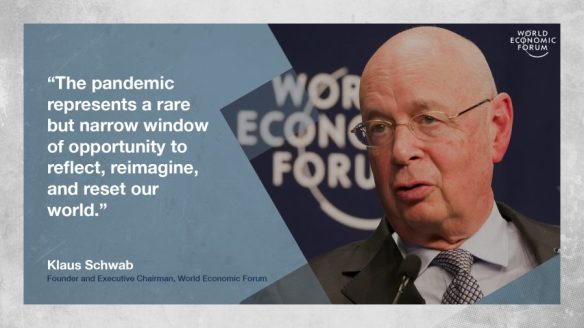
This is why astute readers are skeptical when they hear Schwab say, “the pandemic represents a rare but narrow window of opportunity to reflect, reimagine, and reset our world to create a healthier, more equitable and more prosperous future.”

Who exactly is Schwab speaking to when he speaks of a more prosperous future? How long has this Great Reset been in the works? The answers to these questions can help us understand the true goals of this agenda.

As researcher Brandon Smith reportedChristine Lagardeformer head of the IMF, discussed a global reset as far back as 2014. “The reset is often mentioned in the same breath as ideas like “the New Multilateralism” or “the Multipolar World Order” or “the New World Order.” All of these phrases mean essentially the same thing,” Smith writes.

Smith correctly notes that the Great Reset is not a response to the pandemic, but rather, “the global reset as implemented by central banks and the BIS/IMF is the cause of the collapse. The collapse is a tool, a flamethrower burning a great hole in the forest to make way for the foundations of the globalist Ziggurat to be built.”

New Normal, Same World Order

In early July, Schwab and French author Thierry Malleret released a book outlining the vision of The Great Reset. The book, Covid-19: The Great Reset, explores what the post-pandemic world might look like. “Will there be enough collective will to take advantage of this unprecedented opportunity to reimagine our world, in a bid to make it a better and more resilient one as it emerges on the other side of this crisis?,” Schwab and Malleret pondered at the release of the book. The two men believe COVID-19 triggered “momentous changes and magnified the fault lines that already beset our economies and societies.” They also predict that falling oil prices and a freeze in tourism could lead to a wave of massive anti-government demonstrations.

“One path will take us to a better world: more inclusive, more equitable and more respectful of Mother Nature. The other will take us to a world that resembles the one we just left behind – but worse and constantly dogged by nasty surprises,” the authors argue.

In the book, Schwab expands upon the initial announcement of The Great Reset. Once again he calls for the 4th Industrial Revolution and the digitalization of everything, powered by 5G technology. However, Schwab goes even further in his book, calling for rethinking the “social contract” society has with governments.

Schwab also calls for a nature based or green economy. In January 2020, the WEF released their report, Nature Risk Rising: Why the Crisis Engulfing Nature Matters for Business and the Economy, as part of their New Nature Economy series of reports. The report is “the first of a series of New Nature Economy reports, prepared through the Nature Action Agenda, a platform that aims to encourage a movement of businesses, governments, civil society, academics, innovators and youth to disrupt business-as-usual approaches.”

A second report, The Future of Nature and Business, was released in July. Once again, the WEF states that COVID-19 presents an “opportunity, to change the way we eat, live, grow, build and power our lives to achieve a carbon-neutral, ‘nature-positive’ economy and halt biodiversity loss by 2030. Business as usual is no longer an option.

In a companion report, the WEF provides some detail on what it means to change the way we eat. Another set of policy measures that would stimulate more resource-efficient food systems entail directing stimulus packages towards R&D to support the diversification away from diets based on resource intensive animal proteins, and towards four main categories of alternatives – aquatic, plant-based, insect-based and laboratory-cultured,” the report states. This push for alternatives to animal proteins has coincided with a rise in laboratory created fake meat, including products funded by the Bill and Melinda Gates Foundation. 

Interestingly, the companion report also calls for “corporate bailout packages for the meat sector” which “could accelerate these developments.” Coincidentally, because of COVID-19, the Trump administration awarded $15.5 billion in relief aid for the meat and dairy industry. Once again, the predictions and declarations of these global institutions appear to play out in reality as perfect as any scripted TV show.

The calls for a Great Reset greatly mimic previous programs and initiatives put forward by other globalist organizations, including the United Nations. Researcher F. William Engdahl provided much-needed clarity in a recent piece on the announcement of The Great Reset. Engdahl notes that, “the declaration by the World Economic Forum to make a Great Reset is to all indications a thinly-veiled attempt to advance the Agenda 2030 “sustainable” dystopian model, a global “Green New Deal” in the wake of the covid19 pandemic measures. Their close ties with Gates Foundation projects, with the WHO, and with the UN suggest we may soon face a far more sinister world after the covid19 pandemic fades.”

Strategic Intelligence, Strategic Partners, and Event 201

In March, the WEF launched the COVID Action Platform which is essentially a call for global government in response to COVID-19. The answer, WEF believes, is to have greater global cooperation, move away from the nation-state, and tackle the world’s problems as one international community.

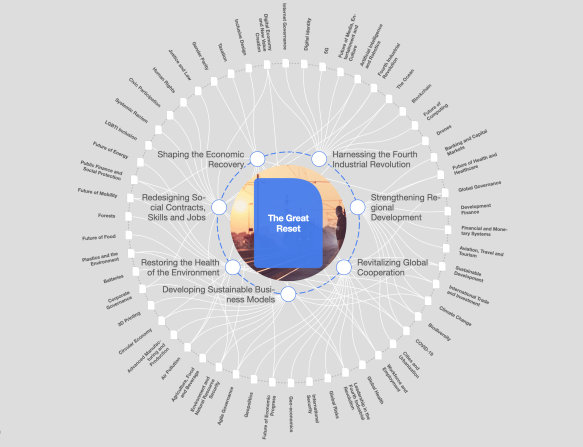
Along with the launch of the Action Platform, the WEF released an impressive graphic as part of their “Strategic Intelligence” platform, which outlines the wide ranging ways their plans will effect and shape the world of the 21st century and beyond. From the media’s role in the pandemic to finding a vaccine, the graphic attempts to provide details on this centrally planned future being promoted by the WEF. I encourage all readers to spend an evening going down the rabbit hole that is the COVID Action Platform for a better understanding of where we are headed.

With the launch of The Great Reset, the WEF also launched a Strategic Intelligence graphic detailing how their plans will unfold. The Great Reset graphic details how everything from drones, blockchain, the future of energy, LGBTI inclusion, and 3D printing will play a role in the New Normal. Once again, I encourage readers to take a dive into this graphic to gain clarity on what the WEF and their partners have planned for the coming decade.

The WEF promotes itself as the “International Organization for Public-Private Cooperation.” They partner with a variety of private companies, philanthropic outlets, and governments to achieve their goals. Researcher Steven Guinness recently outlined how the WEF partners with various institutions to accomplish their stated aims and how the Strategic Intelligence platform is “co-curated with leading topic experts from academia, think tanks, and international organizations.”

“‘Co-curators‘ are perhaps the most important aspect to consider here, given that they have the ability to ‘share their expertise with the Forum’s extensive network of members, partners and constituents, as well as a growing public audience,’” Guinness writes. “It is safe to assume then that when co-curators speak, members and partners of the World Economic Forum listen. This in part is how the WEF’s agenda takes shape.”

As Guinness notes, the co-curators of the Strategic Intelligence road map of the globalist vision include Harvard university, the Massachusetts Institute of Technology, Imperial College London, Oxford University, Yale and the European Council on Foreign Relations. Several of these institutions continue to play an influential role in shaping the narrative around COVID-19.

The WEF’s highest level of partnership is known as Strategic Partners. There are only 100 international companies listed as Strategic Partners. Each partner receives an invitation if they have “alignment with forum values.” These partners “shape the future through extensive contribution to developing and implementing Forum projects and championing public-private dialogue.”

The WEF’s Strategic Partners include Johnson & Johnson, and the Bill and Melinda Gates Foundation. Bill Gates is also a long time “Agenda Contributor” for the WEF.  As mentioned above, the Bill and Melinda Gates Foundation partnered with the Johns Hopkins Center for Health Security and the WEF on the Event 201 pandemic exercise in October 2019. Johnson & Johnson were also partners in the exercise.

As TLAV has previously documented, the Bill and Melinda Gates Foundation operates in a similar fashion to the WEF: their publicly stated goals mask a global control agenda. Thus, it should come as no surprise that Klaus Schwab, founder of the WEF, is a former attendee and member of the Steering Committee for the secretive Bilderberg Group.

The WEF itself is akin to a more public Bilderberg Group which brings together around 3,000 business leaders, international political leaders, economists, celebrities, and journalists for a five day conference to discuss global issues. The WEF meets every January in Davos, Switzerland, to discuss their agenda. The elitism of the WEF has resulted in Schwab and his cohorts being nicknamed The Davos Class.

In January 2021 the theme of the WEF meeting will be “The Great Reset.” It’s important that we keep an eye on the WEF and their push for the Great Reset as we draw closer to election 2020 and a potential Dark Winter. Klaus Schwab, Bill Gates, and their ilk are determined to present themselves as the saviors of humanity. They are using the COVID-19 panic as an opportunity to push their agenda while selling it as the cure to our problems.

This predator class attempts to mask their true intentions with flowery language designed to lull the waking masses back to sleep. To be clear, our world is absolutely, without a doubt existing in an unsustainable paradigm. We do have growing income inequality, police violence, failing healthcare systems, and insufficient food production systems. These problems were apparent before COVID-19 and the fragility of these systems has indeed become more obvious in recent months. However, these psychopaths would prefer if we allowed them to stay in the driver’s seat as they careen us into a future of technocratic control and the end of individual liberty.

While Schwab and Gates would prefer that the people of the world submit to their vision, we must stand against this push for centralization of power and technology. The Great Reset is coming, and perhaps, it should come. We have many issues facing our species that need to be addressed. However, central planning, surveillance, and loss of individual liberty is not the answer. The answer is decentralization, opting out en masse, non-compliance, and non-participation in the systems which have brought us to this predicament.

We, as free people, must decide what path we intend to take. Will we stand by and allow the predators to seize control of all resources and power for the coming generations? Or, will we finally break free from their violent systems and initiate a Great Reset which benefits the people, from bottom to top?

The answer depends on you.

Question Everything, Come To Your Own Conclusions.

The Ultimate Divide and Conquer

By Russ Bangs

Source: Off-Guardian

It has frequently been observed that terror can rule absolutely only over people who are isolated against each other and that therefore one of the primary concerns of tyrannical government is to bring this isolation about. Isolation may be the beginning of terror; it certainly is its most fertile ground; it always is its result. This isolation is, as it were, pretotalitarian; its hallmark is impotence insofar as power always comes from people acting together, acting in concert; isolated people are powerless by definition.”
Hannah Arendt, The Origins of Totalitarianism

Western civilization, led by the US government and media, has embarked upon a campaign of mass psychological terrorism designed to cover for the collapsing economy, set up a new pretext for Wall Street’s ongoing plunder expedition, radically escalate the police state, deeply traumatize people into submission to total social conformity, and radically aggravate the anti-social, anti-human atomization of the people.

The pretext for this abomination is an epidemic which objectively is comparable to the seasonal flu and is caused by the same kind of Coronavirus we’ve endured so long without totalitarian rampages and mass insanity.

The global evidence is converging on the facts: This flu is somewhat more contagious than the norm and is especially dangerous for those who are aged and already in poor health from pre-existing maladies. It is not especially dangerous for the rest of the population.

The whole concept of “lockdowns” is exactly upside down, exactly the wrong way any sane society would respond to this circumstance.

It’s the vulnerable who should be shielded while nature takes its course among the general population, who should go about life as usual. Dominionist-technocratic rigidity can’t prevent an epidemic from cycling through the population in spite of the delusions of that religion, especially since Western societies began their measures far too late anyway.

So it’s best to let herd immunity develop as fast as it naturally will, at which time the virus recedes from lack of hosts (and is likely to mutate in a milder direction along the way). This is the only way to bring a safer environment for all including the most vulnerable.

The fact that most societies have rejected the sane, scientific route in favor of doomed-to-fail attempts at a forcible violent segregation and sterilization is proof that governments aren’t concerned with the public health (as if we didn’t know that already from a thousand policies of poisoning the environment while gutting the health care system), but are very ardent to use this crisis they artificially generated in order radically to escalate their police state power toward totalitarian goals.

The whole concept of self-isolation and anti-social “distancing” is radically anti-human. We evolved over millions of years to be social creatures living in tight-knit groups. Although modern societies ideologically and socioeconomically work to massify and atomize people, nevertheless almost all of us still seek close human companionship in our lives.

(I suspect most of the internet police-state-mongers are not only fascists at heart but are confirmed misanthropic loners who couldn’t care less about human closeness.)

This terror campaign seeks to blast to pieces any remaining human closeness, which means any remaining humanity as such, the better to isolate individual atoms for subjection to total domination. Arendt wrote profoundly on this goal of totalitarian governments, though even she didn’t envision a state-driven cult of the literal physical repulsion of every atom from every other atom.

So far the people are submitting completely to a terror campaign dedicated to the total eradication of whatever community was left in the world, and especially whatever community was starting to be rebuilt.

Some dream of this terror campaign somehow bringing about a magical collective transformation. They don’t explain how that is supposed to happen when everyone’s so terrorized they’re desperate to detach physically from their own shadows, let alone physically come together with other people. But any kind of political or social action, any kind of movement-building, requires close person-to-person contact.

It seems that for most erstwhile self-alleged dissidents, the fact that social media is no substitute for face-to-face organizing and group action, a fact hitherto universally acknowledged by these dissidents, is another truth suddenly to be jettisoned replaced by its complete antithesis.

Thus the terror campaign is a virus causing those it infects to abdicate all activism and all prospect for all future activism, for as long as they remain insane with the fever of this propaganda terror.

Far more profoundly and evoking despair, the terror campaign is a virus causing those it infects to fear and loathe all human contact, all companionship, all closeness, all things which ever made us human in the first place. Prior totalitarian regimes sought this lack of contact and trust through networks of informers.

These networks are part of today’s terror campaign as well, encouraged from above and spontaneously arising from below as a result of the feeling of terror as well as the exercise of prior petty-evil intentions on the part of petty-evil individuals.

But today’s totalitarian potential is far worse than this. Now the regimes aspiring to total domination have terrorized and brainwashed the vast majority of people into an automatic physical distrust of all other people. One no longer fears that someone is an informer, but fears the very existence of another human being.

Any kind of human relations, from personal friendship and romance to friendly social gatherings and clubs to social and cultural movements become impossible under such circumstances. This threatens to be the end of the very concept of shared humanity, to be replaced by an anthill of slave atoms with no consciousness beyond fear and the most animal concern for food and shelter, which already is allowed or denied in the same way experimenters do with lab rats.

And the more people fear and loathe the literal physical existence of all other people, the more the situation becomes ripe for every epidemic of murder, from the spiking rate of domestic violence and killings to incipient lynch mobs to pogroms to Nazi-style extermination campaigns.

This is the system’s end goal. It’s the logical end where every trend of today leads. All of it is trumped up over an epidemic which objectively is a flu season somewhat rougher than average.

Why do the people want to surrender and throw away all reality and future prospect of shared humanity, happiness, freedom, well-being, over so little? Is this really a terminal totalitarian death cult, the globe as one massive Jonestown?

So far it seems this is what the majority wants. If they don’t really want this consummation of universal death in spirit, emotion and body, they’d better snap out of their terror-induced mental delirium fast, before it’s too late.

Why We Need Dystopian Fiction Now More Than Ever

By August Cole and P.W. Singer

Source: Slate

It hits you every so often.

When you when you tug on a face mask to go pick up food for your family.

When you witness the powerless suffer casual violence by a man with a sneer.

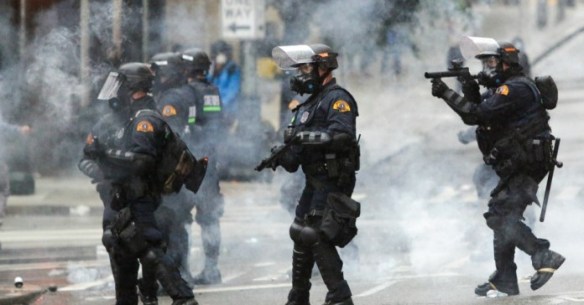
When you see riot police surround the Lincoln Memorial and protesters snatched off the streets by masked soldiers in unmarked cars.

And when you realize that it is all being watched by an unblinking eye of A.I. surveillance.

At times, it feels like we are living in a real-world version of dystopia. The strange outcome, though, is that it means we need dystopian fiction now more than ever, to help us sort and even make it through it.

You’d think with everything going on, now would be the last time to escape to a world of darkness. And yet books, including those of awful imagined worlds, are in deep demand.
Some of it has been a return to old classics. In a period of disease and lockdowns lasting for weeks, booksellers report the seeming irony that Albert Camus’ The Plague and Gabriel García Márquez’s One Hundred Years of Solitude have seen renewed demand. And some of it has been escaping into new worlds, as with Divergent author Veronica Roth taking readers into another post-apocalypse with her new novel Chosen Ones. People have even been willing to enter imagined worlds that seem not too far away, such as Lawrence Wright’s best-selling pandemic thriller The End of October.

Yet the value of the genre is as much in education as entertainment. It can elucidate dangers, serving the role of warning and even preparation. Think of the recent resonance of Margaret Atwood’s 1985 Handmaid’s Tale and its 2020 sequel The Testaments or the revival of interest in It Can’t Happen Here by Sinclair Lewis in 1935. These are finely written works, not as indulgences, but as a pure expression of the idea that to be forewarned is to be forearmed. Even Susan Collins’ Hunger Games prequel, The Ballad of Songbirds and Snakes, might be interpreted in that light, showing how authoritarian rule can originate through the manipulations of an ambitious striver.

Our personal corner of this dark market is the meld of imagination with research. For our book Burn-In: A Novel of the Real Robotic Revolution, we chose the setting of not a far-off imagined world like Panem or Gilead, but Washington, D.C., just around the corner. What happens as Silicon Valley’s visions of utopia hits our real, and very divided, country? What plays out in politics, business, and even family life as our economy is rewired by AI and automation? Yet to make our scenario more haunting, we back up everything that happens in it with 27 pages of endnotes.

When the scarier elements from an imagined world come to life in the real one, however, there is no gleeful “I told you so.” When the novel coronavirus accelerated the more widespread roll out of the robots, remote work, job automation, and AI surveillance projected in our book, we certainly weren’t happy. All it meant was that all the tough dilemmas that our characters face would come quicker for all of us. What was perhaps most disturbing of the last few weeks, though, were when some of the most dystopian scenes we had painted of a future Washington, D.C., also came true, from our book’s scene of riot police deployed around the Lincoln Memorial to the militarized fence thrown up around the White House being put exactly where we had it in Burn-In.

Yet what makes dystopian fiction different is that its creators are oddly optimists at heart, as we are. These works are not about prediction, but prevention. The stories warn of just how far things can go if action isn’t taken, wrapped in a package that is far more impactful than a white paper or PowerPoint. Indeed, research shows that narrative, the oldest communication technology of all, holds more sway over both the public and policymakers than even the “most canonical academic sources.” Our minds can’t help but connect to the “synthetic environment” that our fictional heroes and villains experience, living part of our lives through theirs, even if imagined.

Most importantly, though, the dark worlds are only the setting. The stories are really about the agency of the people in them. And that is perhaps the true value of the dystopian fiction. These stories are not about what those characters experience so much as how they act. At the heart of every story of darkness is a story of perseverance.

As we face our own difficult journeys through the reality of 2020, it is perhaps that lesson which is most important of all.

America Has Always Been a Dystopia

Too many of us just haven’t been paying attention

By Bryan Merchant

Source: OneZero

“Trump’s American dystopia has reached a new and ominous cliff,” warns a CNN opinion headline. “The last two and a half months in America have felt like the opening montage in a dystopian film about a nation come undone,” writes New York Times columnist Michele Goldberg, in describing the images of militarized police storming U.S. cities to put down protests in the days following George Floyd’s murder, which came on the heels of two months of pandemic, panic, and widespread economic collapse. A very popular post published elsewhere on Medium was titled, bluntly, “America is a Dystopia.”

There is a lot of dystopia talk getting tossed around right now, for reasons that probably seem obvious. Those images we’ve all spent hours staring at on Twitter and cable TV — the military vehicles patrolling suburban streets, the lines of tactical vested officers cordoned around the Lincoln Memorial, the scenes of tear gas blurring flames as masked protesters clash with armed police — match up reasonably well with the aesthetics and broad strokes of a genre that we’ve spent the last 10 years staring at on Netflix and the other channels on cable TV.

But this is not “Trump’s American dystopia.” It is the continued, if inflamed, dystopian state of play as it has laid for centuries. The montage of horrors did not begin only a few months ago or when a cohort of privileged observers suddenly became aghast at the SWAT howitzers and brutal policing tactics when they were seen on suburban streets.

Years of toothless and profitable pop culture dystopias have primed consumers to ignore race, helping to obscure the fact that the real dystopia arrived long ago.

If we wanted to get pithy about it, we might say that the 2010s were the dystopia decade, a period that saw both the rise of dystopia as a reliably profitable and uniform entertainment format in mass culture and what appeared to be the IRL manifestation of the images and tropes the genre broadcast by decade’s end. The Hunger Games rose to dominate box offices and spawned a follow-on flotilla of similarly shaped YA dystopian fare. Black Mirror mainstreamed a visual mode of bleak cynicism about technology, and critical darlings like Ex MachinaHer, and Mad Max: Fury Road made apocalypses brought about by artificial intelligence and climate change palatable for the intelligentsia. Meanwhile, Blade Runner, RoboCop, Starship Troopers, and Children of Men became frequent touchstones. Partly because they are good films that offered prescient cultural and political commentary, and partly because their visuals provide handy fodder for comparative screen-grabbing on social media while we’re watching high-tech police forces brutalize popular uprisings, climate change-fueled wildfires spread across cityscapes, and A.I. take on alarming new dimensions, like being racist.

As a result, comparing America to a dystopia has become something of a national pastime; a recurring op-ed framework, a subgenre of Twitter commentary — especially during crisis points and moments of mass upheaval.

But what are we actually talking about when we talk about “dystopia”? Gesturing towards a vague constellation of injustices set to the color palette of a “gritty” summer blockbuster and declaring it dystopian won’t cut it — for dystopia to be useful as a cautionary tool for avoiding bad futures, we need to understand exactly what the ingredients setting a society on the road to ruin are. As it stands, much of the modern dystopian discourse seems content to position dystopia as something that is bad, with an air of futurity. To quote Daniel Mallory Ortberg’s famous mocking of Black Mirror: “What if phones, but too much.” What if high-tech cops, what if sea level rise, etc.

“The adjective dystopian implies fearful futures where chaos and ruin prevail,” writes Gregory Claeys, a historian and professor at Royal Holloway, University of London, and author of Dystopia: A Natural History. Though in a historical and literary sense, he says, dystopia most commonly describes “a regime defined by extreme coercion, inequality, imprisonment, and slavery.”

Because its most popular touchstones are science fiction, modern dystopia discourse tends to fixate on profit- or warfare-accelerating technologies — digital surveillance, facial recognition, automation software, drones, technologized weapons — and their capacity to serve the wealthy and powerful in a time of ecological collapse, health crises, and/or widening inequality. Our current moment fits the bill. The coronavirus, mass unemployment, and police brutality against a racial justice uprising are unfolding to the backdrop of SpaceX rocket launches and tech billionaires like Amazon’s Jeff Bezos rapidly expanding their wealth.

When I noted on Twitter that the SpaceX launch was sending astronauts on a for-profit trip into space as a surge of protests swept the country, it struck a chord. Many responded by comparing the events to Elysium, the 2013 Neill Blomkamp film about a future where the poor toil and swelter on Earth while the wealthy live in luxury in a space station that orbits above the Terran rabble.

Others pointed to the great Gil Scott Heron song, “Whitey’s On the Moon.” The musician and poet released it in 1970, one year after the NASA moon landing, which was itself one year after Dr. Martin Luther King, Jr.’s assassination provoked a mass nationwide uprising, perhaps the last at a scale comparable to the one we’re seeing today.

Some of the lyrics:

A rat done bit my sister Nell.

(with Whitey on the moon)

Her face and arms began to swell.

(and Whitey’s on the moon)

I can’t pay no doctor bill.

(but Whitey’s on the moon)

Ten years from now I’ll be payin’ still.

(while Whitey’s on the moon)

That song was recorded a half-century ago, yet the plight remains the same. It was the same in 1993, when Octavia Butler, in her own magisterial dystopia, Parable of the Sower, set in a mostly Black community in Southern California in the apocalyptic 2020s, described the news of the death of a Mars explorer as eliciting the following reaction: “People here in the neighborhood are saying she had no business going to Mars, anyway. All that money wasted on another crazy space trip when so many people here on earth can’t afford water, food, or shelter.”

Billionaires can afford to send payloads into orbit, to explore space for science and for profit, but we cannot afford to provide health care to the poor or even basic racial equality. That’s what too many of us are missing when we talk about dystopia.

As comparatively radical as a dystopia like Elysium (or, say, Snowpiercer) is — in terms of summer blockbusters, anyway — its critique is limited to class. It glosses over race. It’s Matt Damon versus Sharlto Copley and Jodi Foster and the other white orbital techno-authoritarians. Take a scan through any of the most popular dystopian cinema products of the last decade or so, and you’ll find the same thing; matters of race are omitted almost entirely from the big screen eschatologies. Not only are the genre’s prime exports — Hunger Games, Divergent, Blade Runner, Elysium, RoboCop, the list goes on — written and directed by white people, the protagonists, actors, and even antagonists are nearly uniformly white. And despite many of these being imagined, written, and made in a nation whose founding arrangement was the most dystopian system conceivable, race is never even a component of the conversation in mainstream dystopian cinema, much less what the uprisings are predicated upon. Even the Handmaid’s Tale, which exploded in the wake of Trump’s misogyny-lined ascendency to the presidency, relegates any matter of racial politics deep into the background.

Angelica Jade Bastién points all this out in “Why Don’t Dystopias Know How to Talk About Race?”, where she explains how this in effect allows white viewers to cosplay as the oppressed, without actually interrogating in any meaningful way what oppression might actually entail or who gets oppressed and why.

“Race is relegated to inspiration, coloring the towering cityscapes of these worlds, while the white characters toil under the hardships that Brown and Black people experience acutely in real life,” Bastién writes. “In this way, dystopias become less fascinating thought experiments or vital warnings than escapades in which white people can take on the constraints of what it means to be the other.”

And in so doing, these popular dystopias appropriate the other’s struggles while conveniently ignoring the actual roots of said struggle. I do still think there’s utility in dystopias and trying to heed their warnings, but only if we recognize what’s being warned against, and only, especially, if we manage to understand that many of the looming “dystopias” perceived by more affluent entertainment consumers have been the realities of plenty of communities who have faced deep inequalities, technologized surveillance, and state oppression for generations already.

There’s a tweet that’s gone viral a number of times over the dystopian decade, each time in slightly different variation. Its most recent iteration came just this January, before the pandemic and the uprising came to dominate dystopia discourse:

https://twitter.com/ElleOnWords/status/1218693768339251200

White dystopia fanboys like me, pundits, columnists, and social media users need to get this through our skulls. To invert a notorious quote attributed to William Gibson, the dystopia has always been here; it just hasn’t been evenly distributed.

The “dystopia” lens too often fixes conditions like those — heavily policed communities, invasive surveillance, state oppression — in the future, and it glosses over the realities of the present and the long histories of oppression of Black communities and bodies, plenty of which was technologically abetted. The writer Anthony Walton noted in a 1999 Atlantic piece, “Technology Versus African Americans,” that from “the caravel to the cotton gin, technological innovation has made things worse for Blacks.” Western technologies, he writes, formed the infrastructure that gave rise to Black slavery:

Arab and African slave traders exchanged their human chattels for textiles, metals, and firearms, all products of Western technological wizardry, and those same slavers used guns, vastly superior to African weapons of the time, in wars of conquest against those tribes whose members they wished to capture… The slave wars and trade were only the first of many encounters with Western technology to prove disastrous for people of African descent. In the United States, as in South America and the Caribbean, the slaves were themselves the technology that allowed Europeans to master the wilderness.

What better fits Claeys description of dystopia — “a regime defined by extreme coercion, inequality, imprisonment, and slavery” — than actual chattel slavery? America was founded as a dystopia.

Yet for white and affluent consumers, the constant generation of novel and fantastic apocalyptic scenarios serves to extend the horizon for the arrival of the hellish conditions contained in dystopia — if oppression is a nebulous but ever-approaching threat, it’s perpetually obscured, lifted away into a sub-fictional ether. It needs not be interrogated, not now, anyway. Which is how power prefers it.

That’s the other thing about dystopia: In many of its guises, it’s a plainly conservative enterprise. The most influential dystopia of the 21st century, I would argue, is not 1984, but Atlas Shrugged, which alone is responsible for a generation of greed-is-good Republican policymaking. The 600,000-page book, which I have (regrettably) read, positions a handful of great white men and women as the only thing keeping society together and inveighs against the millions of working-class “moochers” with a barely veiled racist subtext. (Its author was also openly racist.) Many dystopias are less flagrant but similarly conservative: They highlight the fear that we might all end up like the poor unwashed masses if we are not careful to uphold the social order, not the fear that the poor might never be liberated. And that, in fact, includes the ur-dystopia.

“Visions of the apocalypse are at least as old as 1000 B.C.,” according to the dystopian historian Claeys. “The triumph of chaos over order defined the Egyptian ‘Prophecies of Neferti’ foretold the complete breakdown of society.” In it, the “great no longer rule the land,’ the ‘slaves will be exalted.’” The first dystopia, in other words, was a cautionary tale for the haves against sliding into the world of the have-nots. It’s hard not to shake that vibe from a lot of the Twitter commentariat, pointing at the protests from afar, going “man it’s so dystopian” and moving on to whatever the central animating conflict is in their own personal heroic narratives.

There are still useful deployments of dystopian language — it can certainly be effective shorthand for “this is fucked in a new way, pay attention.” A good example is this series of viral tweets that chronicle a day of peaceful protest where demonstrators were in turn greeted with the creepy electrified visage of Gov. Andrew Cuomo on a towering billboard, beaming down the newly instated curfew. A couple hours later, many protesters would be beaten.

And dystopias can still jolt the politically uninvolved to wake up — this podcaster even pointed to Elysium as an entry point into radical politics. But the surfeit of commentary that amounts to “wow, this is like Blade Runner send tweet” needs an upgrade. White viewers like me need to rethink and reevaluate what it means to watch and read popular dystopian fiction, how those products are shaping our perspectives and critiques of the futures and what they’re missing. And many more Black voices clearly need to be added to the mainstream canon and the broader discussion — there’s tons of great Black dystopian fiction; Dhalgren by Samuel Delany, Who Fears Death by Nnedi Okorafor, Zone One by Colson Whitehead, pretty much anything by Ishmael Reed. Who Fears Death is in development for a TV series, which is a start, but these voices need to be better foregrounded and made central to modern dystopia discourse.

A lack of diversity has been a problem in science fiction since the genre’s inception, and it persists. When I went to the Nebulas, a high-profile sci-fi awards conference last year, attendees were overwhelmingly white. The fact that Octavia Butler’s magisterial Parable of the Sower — a dystopia that actually and skillfully manages to interrogate climate change, total economic collapse, privatization, and racist oppression — is somehow not a film or a limited series yet is as scathing an indictment of Hollywood’s insistence on whitewashing dystopias as anything. The book absolutely rips.

This is not to disparage anyone who feels like they’re living in a certain kind of almost-future hell. The number of people who genuinely experience the world as an impending or current dystopia is almost certainly rising in tandem with trends of still-increasing inequality. A decade of jobless recovery ended in 2019 with the highest levels of income inequality in 50 years, and record numbers of people of all backgrounds, even whites, are sliding into poverty and despair, and our encounters with climate change, technological surveillance, conservatism’s hard drift toward authoritarianism, and all of the above being increasingly mediated through digital devices. Our current socioeconomic system is now ideally structured to be a dystopian protagonist generator. It is rewarding elites with unprecedented wealth and luxury, equipping the agents of the state with increasingly advanced weapons and technology, exacerbating ecological collapse, and positioning us all to experience the devastation alone, blinking into a screen, hoping for tiny units of validation from a pithy comment or two about the state of the morass on social media. It is us versus [gestures wildly] all of that, out there.

Which makes it all the more imperative that white fans, pundits, and observers stop ignoring what it has historically meant to experience actual dystopian conditions. It means acknowledging and working to improve the material conditions for those who are surviving the current iteration, and not glibly waving off dystopia as some always-approaching, faceless Empire without zeroing in on the nation’s institutional prejudices, its targets for violence, its specific hatreds. It means we have to stop LARPing in appropriated fictions. It means understanding that this has always been a dystopia — and that those who have always resisted it are at the center of the story.

The War On Reality

By Wayne Janis

Source: OpEdNews

Permanent Record by Edward Snowden, (Publisher Metropolitan Books, an imprint of Henry Holt and Company). is recommended to anyone wishing to understand the world in which we live.

The most dangerous war currently being fought is the “war on reality”. Of course this was Orwell’s greatest fear as expressed in 1984 – that reality itself would be appropriated, manipulated and obliterated at will by powerful forces. His original title for 1984 was “The Last Man In Europe” – i.e., the last man connected to reality.

We live in a world in which spurious realities are being manufactured by the media, by governments, by big corporations, by religious groups, political groups, all of which are filtered through major media conglomerates that are attached to the globalist ether (let’s call it the “globalist cloud”). This globalist cloud is controlled and manipulated by a globalist Intelligence Community for political/economic/social purposes.

The bombardment of pseudo-realities will produce inauthentic humans very quickly, spurious humans as fake as the data pressing at them from all sides. We need to detach the now essential and probably irrevocable social media matrix from this globalist ether and reign it in to do the good work of humanity at large. Net neutrality is one major initiative that must be pursued and won.

Net neutrality is the concept that all traffic on the Internet should be given equal treatment by Internet providers with little to no censorship, manipulation, interference, prioritization, discrimination or preference given based on usercontentwebsiteplatformapplication, type of equipment, source address, destination address, or method of communication. Any rules of conduct must be determined democratically and implemented equally.

In addition the globalist cloud has misappropriated, stored, monetized and misused the entirety of our personal digital data for corporate profit and social control. We will only reclaim our privacy by exerting the highest level political pressure.

“Ultimately, saying that you don’t care about privacy because you have nothing to hide is no different from saying you don’t care about freedom of speech because you have nothing to say. Or that you don’t care about freedom of the press because you don’t like to read…Just because this or that freedom might not have meaning to you today doesn’t mean that it doesn’t or won’t have meaning tomorrow, to you, or to your neighbor or to the crowds of principled dissidents I was following on my phone who were protesting halfway across the planet, hoping to gain just a fraction of the freedoms that my country was busily dismantling.” – Snowden, Edward. Permanent Record (p. 208-209). Henry Holt and Co.. Kindle Edition.

And we, the people, need a powerful reality motto. I have found no better one than:

Reality is that which, when you stop believing in it, doesn’t go away..Philip K. Dick

Only the courage and implacable resistance of authentic human beings to powerful corruptors of truth and reality will save us from a world much like that depicted in 1984. It is unknown whether there are enough such authentic human beings or whether the battle can be won no matter the number.

As Reinhold Niebuhr said, it takes a “sublime madness of the soul” to fight against the “malignant powers of the world”.

And Chris Hedges:

“There is nothing that’s going to rationally justify it. You can know that everything around you points to the fact that your struggle for justice, maybe your entire life, has been futile. But this knowledge doesn’t invalidate what you’ve done.”– Hedges, Chris. Unspeakable: Talks with David Talbot about the Most Forbidden Topics in America . Skyhorse Publishing. Kindle Edition.

People like Julian Assange, Edward Snowden, Chelsea Manning, Daniel Ellsberg, Chris Hedges, John Kiriakou and others are examples of these brave and implacable martyrs who have paid the price for what is at its core a battle for the soul of humanity.

Historically, Galileo is a martyr in the war on reality even though his trial ended with an abjuration which allowed him to avoid execution and remain under house arrest for life. But I personally like the raw testicularity of Bruno Giordano (PC police be damned). He defended his astronomical beliefs to the end and refused to recant his rejection of certain dogmas of the Catholic Church. Knowing he would be burned at the stake (he was first hung naked upside down in a public square in Rome) he made a disdainful gesture to the judges and said:

“You pronounce this sentence against me with greater fear than I receive it.”

Four Reasons Civilization Won’t Decline: It Will Collapse

By Craig Collins

Source: CounterPunch

As modern civilization’s shelf life expires, more scholars have turned their attention to the decline and fall of civilizations past.  Their studies have generated rival explanations of why societies collapse and civilizations die.  Meanwhile, a lucrative market has emerged for post-apocalyptic novels, movies, TV shows, and video games for those who enjoy the vicarious thrill of dark, futuristic disaster and mayhem from the comfort of their cozy couch.  Of course, surviving the real thing will become a much different story.

The latent fear that civilization is living on borrowed time has also spawned a counter-market of “happily ever after” optimists who desperately cling to their belief in endless progress.  Popular Pollyannas, like cognitive psychologist Steven Pinker, provide this anxious crowd with soothing assurances that the titanic ship of progress is unsinkable.  Pinker’s publications have made him the high priest of progress.[1] While civilization circles the drain, his ardent audiences find comfort in lectures and books brimming with cherry-picked evidence to prove that life is better than ever, and will surely keep improving.  Yet, when questioned, Pinker himself admits, “It’s incorrect to extrapolate that the fact that we’ve made progress is a prediction that we’re guaranteed to make progress.”[2]

Pinker’s rosy statistics cleverly disguise the fatal flaw in his argument.  The progress of the past was built by sacrificing the future—and the future is upon us.  All the happy facts he cites about living standards, life expectancy, and economic growth are the product of an industrial civilization that has pillaged and polluted the planet to produce temporary progress for a growing middle class—and enormous profits and power for a tiny elite.

Not everyone who understands that progress has been purchased at the expense of the future thinks that civilization’s collapse will be abrupt and bitter.  Scholars of ancient societies, like Jared Diamond and John Michael Greer, accurately point out that abrupt collapse is a rare historical phenomenon.  In The Long Descent, Greer assures his readers that, “The same pattern repeats over and over again in history.  Gradual disintegration, not sudden catastrophic collapse, is the way civilizations end.”  Greer estimates that it takes, on average, about 250 years for civilizations to decline and fall, and he finds no reason why modern civilization shouldn’t follow this “usual timeline.”[3]

But Greer’s assumption is built on shaky ground because industrial civilization differs from all past civilizations in four crucial ways.  And every one of them may accelerate and intensify the coming collapse while increasing the difficulty of recovery.

Difference #1:  Unlike all previous civilizations, modern industrial civilization is powered by an exceptionally rich, NON-renewable, and irreplaceable energy source—fossil fuels.  This unique energy base predisposes industrial civilization to a short, meteoric lifespan of unprecedented boom and drastic bust.  Megacities, globalized production, industrial agriculture, and a human population approaching 8 billion are all historically exceptional—and unsustainable—without fossil fuels.  Today, the rich easily exploited oilfields and coalmines of the past are mostly depleted.  And, while there are energy alternatives, there are no realistic replacements that can deliver the abundant net energy fossil fuels once provided.[4]  Our complex, expansive, high-speed civilization owes its brief lifespan to this one-time, rapidly dwindling energy bonanza.

Difference #2:  Unlike past civilizations, the economy of industrial society is capitalist.  Production for profit is its prime directive and driving force.  The unprecedented surplus energy supplied by fossil fuels has generated exceptional growth and enormous profits over the past two centuries.  But in the coming decades, these historic windfalls of abundant energy, constant growth, and rising profits will vanish.

However, unless it is abolished, capitalism will not disappear when boom turns to bust.  Instead, energy-starved, growth-less capitalism will turn catabolic.  Catabolismrefers to the condition whereby a living thing devours itself.  As profitable sources of production dry up, capitalism will be compelled to turn a profit by consuming the social assets it once created.  By cannibalizing itself, the profit motive will exacerbate industrial society’s dramatic decline.

Catabolic capitalism will profit from scarcity, crisis, disaster, and conflict.  Warfare, resource hoarding, ecological disaster, and pandemic diseases will become the big profit makers.  Capital will flow toward lucrative ventures like cybercrime, predatory lending, and financial fraud; bribery, corruption, and racketeering; weapons, drugs, and human trafficking.  Once disintegration and destruction become the primary source of profit, catabolic capitalism will rampage down the road to ruin, gorging itself on one self-inflicted disaster after another.[5]

Difference #3:  Unlike past societies, industrial civilization isn’t Roman, Chinese, Egyptian, Aztec, or Mayan.  Modern civilization is HUMAN, PLANETARY, and ECOCIDAL.  Pre-industrial civilizations depleted their topsoil, felled their forests, and polluted their rivers.  But the harm was far more temporary and geographically limited. Once market incentives harnessed the colossal power of fossil fuels to exploit nature, the dire results were planetary.  Two centuries of fossil fuel combustion have saturated the biosphere with climate-altering carbon that will continue wreaking havoc for generations to come.  The damage to Earth’s living systems—the circulation and chemical composition of the atmosphere and the ocean; the stability of the hydrological and biogeochemical cycles; and the biodiversity of the entire planet—is essentially permanent.

Humans have become the most invasive species ever known.  Although we are a mere .01 percent of the planet’s biomass, our domesticated crops and livestock dominate life on Earth.  In terms of total biomass, 96 percent of all the mammals on Earth are livestock; only 4 percent are wild mammals.  Seventy percent of all birds are domesticated poultry, only 30 percent are wild.  About half the Earth’s wild animals are thought to have been lost in just the last 50 years.[6]  Scientists estimate that half of all remaining species will be extinct by the end of the century.[7] There are no more unspoiled ecosystems or new frontiers where people can escape the damage they’ve caused and recover from collapse.

Difference #4:  Human civilization’s collective capacity to confront its mounting crises is crippled by a fragmented political system of antagonistic nations ruled by corrupt elites who care more about power and wealth than people and the planet.  Humanity faces a perfect storm of converging global calamities.  Intersecting tribulations like climate chaos, rampant extinction, food and freshwater scarcity, poverty, extreme inequality, and the rise of global pandemics are rapidly eroding the foundations of modern life.

Yet, this fractious and fractured political system makes organizing and mounting a cooperative response nearly impossible.  And, the more catabolic industrial capitalism becomes, the greater the danger that hostile rulers will fan the flames of nationalism and go to war over scarce resources.  Of course, warfare is not new.  But modern warfare is so devastating, destructive, and toxic that little would remain in its aftermath.  This would be the final nail in civilization’s coffin.

Rising From the Ruins?

How people respond to the collapse of industrial civilization will determine how bad things get and what will replace it. The challenges are monumental.  They will force us to question our identities, our values, and our loyalties like no other experience in our history.  Who are we?  Are we, first and foremost, human beings struggling to raise our families, strengthen our communities, and coexist with the other inhabitants of Earth?  Or do our primary loyalties belong to our nation, our culture, our race, our ideology, or our religion?  Can we put the survival of our species and our planet first, or will we allow ourselves to become hopelessly divided along national, cultural, racial, religious, or party lines?

The eventual outcome of this great implosion is up for grabs.  Will we overcome denial and despair; kick our addiction to petroleum; and pull together to break the grip of corporate power over our lives?  Can we foster genuine democracy, harness renewable energy, reweave our communities, re-learn forgotten skills, and heal the wounds we’ve inflicted on the Earth?  Or will fear and prejudice drive us into hostile camps, fighting over the dwindling resources of a degraded planet?  The stakes could not be higher.

Notes.

[1] His books include: The Better Angels of Our Nature and Enlightenment Now: The Case for Reason, Science, Humanism, and Progress.

[2] King, Darryn. “Steven Pinker on the Past, Present, and Future of Optimism” (OneZero, Jan 10, 2019) https://onezero.medium.com/steven-pinker-on-the-past-present-and-future-of-optimism-f362398c604b

[3] Greer, John Michael.  The Long Descent (New Society Publishers, 2008): 29.

[4] Heinberg, Richard. The End Of Growth. (New Society, 2011): 117.

[5] For more on catabolic capitalism see: Collins, Craig. “Catabolism: Capitalism’s Frightening Future,”CounterPunch (Nov. 1, 2018). https://www.counterpunch.org/2018/11/01/catabolism-capitalisms-frightening-future/

[6] Carrington, Damian. “New Study: Humans Just 0.01% Of All Life But Have Destroyed 83% Of Wild Mammals,” The Guardian (May 21, 2018). https://www.theguardian.com/environment/2018/may/21/human-race-just-001-of-all-life-but-has-destroyed-over-80-of-wild-mammals-study

[7] Ceballos, Ehrlich, Barnosky, Garcia, Pringle & Palmer. “Accelerated Modern Human-Induced Species Losses: Entering The 6th Mass Extinction,” Science Advances. (June 19, 2015). http://advances.sciencemag.org/content/1/5/e1400253

The Giant Virus in the Room: Corporate Vaccine Makers Need More Pandemics, to Grow

By Dady Chery

Source: News Junkie Post

As drug makers prepare to make a killing on supposed vaccines against COVID-19, it is important, particularly for those who consider vaccines to be a wise investment today, or those whose retirement savings might get invested in such vaccines without their knowledge, to reflect on the fact that corporations are themselves viruses that can only make money for their investors by growing. The way they will grow is by making more vaccines for yet more pandemics. The new pandemics might come of their own accord, or they might get a little nudge.

A road map from those in the shadows

The public has lately been assaulted with relentless announcements about this or that supposed vaccine going into phase I or II clinical trial and the promise that vaccines — if we would only let enough different ones get developed sufficiently rapidly and without oversight — will free us from masks and social distancing. According to an American Enterprise Institute “road map” by people that include former FDA commissioners Scott Gottlieb and Mark McClellan, social distancing restrictions will only be lifted when tools to mitigate the risk of disease – including a vaccine — become available. There you have it. If you should ever want to stop cowering with a mask on your face, shake hands with a new acquaintance, dance with friends and strangers, blow a kiss or flirt more outrageously with somebody, you’ll need to get a vaccination license. The people who have mandated this aren’t even currently in government. They are private individuals who have retreated to think tanks from which to issue their decrees.

The global threat to health isn’t a coronavirus

The public health departments of cities, states, or countries have not been those to call for vaccines. Instead, global public health appears to have been hijacked by a supposed non-profit foundation called the Coalition for Epidemic Preparedness Innovation (CEPI), with the Orwellian motto, “New vaccines for a safer world.” One might well ask: “safer for whom?” CEPI was hatched in a one-hour discussion on the sidelines of Davos 2016 between Bill Gates, Wellcome Trust Foundation Director Jeremy Farrar, the CEOs of six major vaccine manufacturers (Glaxo Smith Kline, Merck, Johnson & Johnson, Sanofi, Takeda, and Pfizer), the Prime Minister of Norway, and supposedly 15 other individuals.

Representatives of Germany, India, and Japan are supposed to have attended that meeting, although Prime Minister Angela Merkel had declined the invitation that year, Indian Prime Minister Narendra Modi was not there, nor was any Japanese head of state. The goal of this cabal, in which elected heads of states are obviously subordinate to Bill Gates and Big Pharma, is not merely to make vaccines and lots of money, but also to deregulate vaccine manufacture on a global scale and control the world by controlling global public health. In this scenario, the United Nations’ WHO, which receives 75 percent of its funds from big pharmaceutical companies and the Bill & Melinda Gates Foundation, is merely the arm of CEPI that will tie vaccine adoption by developing countries to various kinds of Western aid. The WHO Director General, Tedros Adhanon, began to enjoy the Gates Foundation’s generosity when he was a Minister of Health in Ethiopia who embraced the foundation’s agenda. The WHO Assistant Director General, Bruce Aylward, who may be the real power in the organization, previously worked for Gates’ supposed polio eradication program. Make no mistake: CEPI intends to be to global health what the WTO is to global trade.

The agenda is military, and it is global

CEPI has already raised over $750 M: a sum that commands a lot of influence. It is well entwined with the militaries of various countries. For example CEPI’s CEO, Richard Hatchett, was the Director for Biodefense Policy on the White House Homeland Security Council in 2005-2006, Associate Director for Radiation Countermeasures Research and Emergency Preparedness at NIAID in 2005-2011; and Chief Medical Officer and Deputy Director of the Biomedical Advanced Research and Development Authority (BARDA) in 2011-2016. BARDA is a division of the Office of the Assistant Secretary for Preparedness and Response. Several CEPI-financed vaccine projects enjoy support from BARDA, the U.S. Department of Defense Advanced Research Projects Agency (DARPA), or the U.S. Military HIV Research Program.

In January 2020, CEPI announced that it would finance three consortiums to develop vaccines against COVID-19. Its alliance with these consortiums, however, predates this announcement in several cases. For example, as far back as April 2018, CEPI provided $56 M to a company called Inovio to get vaccine candidates against the SARS-Cov-2 relative, MERS-CoV, to Phase II trials; Inovio’s main collaborator is the Chinese company, Beijing Advaccine Technology. In January 2019, CEPI provided $10.6 M to a consortium involving the University of Queensland and public/private sector partners in Australia, the US, and Asia to develop a new approach called “molecular clamp” for designing vaccines. In Dec 2019, CEPI gave $8.4 M to Imperial College London, UK, to test an RNA vaccine in animals and also get it to Phase II trials. The researchers at Imperial College boast about the fact that they began to test their vaccine against SARS-CoV-2 in animals in February 2020! Recall that the SARS-CoV-2 genome sequence only became known on January 10, 2020. In this context, it is also interesting that Imperial College is the home of the fear mongering and disgraced Neil Ferguson, with the too pretty and too married social merging mistress.

The FDA’s vaccine fast track

The road to FDA approval has been smoothed for CEPI’s partners and, unsurprisingly, they have been first to move their putative vaccines to clinical trials. As a rule, the FDA has put the projects of CEPI’s pet companies on a “fast-track” designation, which allows them to be green-lighted to the next phase before they have even completed the preceding one. Consider for example the biotechnology company, Moderna. It has received an undefined sum from CEPI, plus around $483 M from BARDA, as well as funds from DARPA. The appeal of this company to pencil and paper want-to-be-scientists, like Bill Gates and various military types, is that its approach, or “platform,” for vaccine manufacturing could potentially be used to make many other vaccines. But this approach is also potentially dangerous, because it involves the introduction of viral mRNA into cells, and this alone might start an adverse immune reaction. The viral mRNA is then supposed to direct production of the SARS-CoV-2 spike protein on the surface of the vaccinated person’s cells for some undefined period of time. This kind of vaccine was not even tested in animals before Moderna was allowed to begin its phase I trial in mid-March with 45 healthy human volunteers. Even more extraordinary, six weeks later the company filed for permission to go on to a phase II trial with 600 volunteers. Its application was approved, even though the phase I trial requires months of follow up that are not yet done. The company’s stock has skyrocketed as it has made one promise after another of accelerated schedules and massive scale up of its vaccine production.

Inovio is on a similar trajectory. The phase I trials on its putative SARS-CoV-2 vaccine started on April 3. The company is injecting people with milligram amounts of DNA and then zapping them with a proprietary device, to get the DNA into their cells. It has not defined how the DNA carrying the spike protein information will be guided to the nucleus. If the DNA stays elsewhere in the cells, where it does not belong, it might be mistaken for a virus and start an adverse immune response. If it goes to the nucleus, it may integrate into the cells’ DNA in random places, potentially causing cancers.

The mainstream takes dictation

The mainstream media, which is as lazy as it is scientifically illiterate, has contented itself with the republication of gee-whiz, oh-wow press releases, and the publication of reports sometimes explicitly written by the vaccine manufacturers or their partner foundations. Such reports also appear, not as full-length peer-reviewed articles, but as short commentaries in the summary and editorial pages of serious science journals like Science and Nature. The association of those planted reports with prestigious journals gives them, not only a veneer of credibility but also an automatic amplification by popular science magazines. The reports have generally focused on the marvelous promise of the supposed vaccines and their inevitable manufacture in massive quantities. In fact, 18 years after the original SARS-CoV, which is the closest relative of the COVID-19 agent, no vaccine has successfully been developed against that virus, and many of these so-called new vaccine efforts are actually recycled failed SARS-CoV or MERS-CoV projects.

The real state of knowledge about the immune system

What the news media do not say, and probably could not say with any confidence, is that the mammalian immune system is still poorly understood. Had most media people attended a BIO101 class, there would be great skepticism in the news about the sudden proliferation of newfangled vaccines and the massive human experiment being organized to test them.

The following is a quote from a scholarly review published in Nature Immunology in December 2014:

“The only currently licensed and generally available vaccines against respiratory viruses are for influenza virus, and even these are suboptimal. The paucity of vaccines is due in part to the only limited understanding of immune responses that can provide protection against respiratory viral infection: in many cases, even fundamental correlates of protection have yet to be accurately defined, and the most appropriate antigens to which vaccines should be targeted remain unknown. Animal models are generally imperfect guides to human disease, and the populations at highest risk of severe infections (i.e., young children and elderly adults) are the most difficult to study. In addition, vaccines are often less effective in those with immature or senescent immune systems.”

The next quote is from a commentary on a peer-reviewed article published on May 13, 2020 in Nature 581: 316.

“This discovery elevates TASL to membership of an exclusive circle of… adaptor proteins… of which the other members are TRIF, MAVS, and STING. These four proteins together control the type I interferon response induced by nucleic-acid sensing, a picture that has now been completed with the discovery of TASL as the missing… adaptor of TLR7, TLR8 and TLR9 signaling.”

My translation: only this week, one of the four major players in the early human immune response was discovered! It is a newly characterized protein called TASL that becomes activated when an infected cell senses the presence of genetic material from a virus in a cellular compartment where it should not be. This helps to explain an important part of the immune response that until now has baffled scientists.

The early fight against an infection: a situation that can escalate

A reasonable analogy to a viral infection might be a Columbine-like threat, where a band of murderous fascists take over a high school. Let us say, for good measure, that this particular group wears a specific and recognizable kind of uniform and tattoo. The high school itself is automatically set up to detect the invasion and to call 911. Cells in the lung do the equivalent with proteins called Toll Like Receptors (TLR). These proteins sound the alarm when they recognize genetic material, like DNA or viral RNA, in compartments outside of the nucleus, where it is not supposed to be: a situation that indicates presence of a pathogen. In the cells, some of these compartments are called endosomes or endolysosomes. In our high school, the first responders would be the local police. In the lungs, which do contain their own local immune cells, this would be called the interferon or antiviral response. If this response is successful, as it often is in healthy people, nothing more needs to be done: end of story.

But suppose some of the fascists manage to evade the police and take over several other schools in the same area. The police might then call in SWAT teams with snipers, machine guns, and tear gas grenades; or even police units with bomb robots. The innate, or local, immune system has the equivalent of all of these. It involves SOS signals to the adaptor proteins noted in the above quotation, and the permission from each one for the next step in the escalation. The bomb robots in this case, would be analogous to an inflammation response that destroys not only the viruses but also much of the lung. Obviously, you would want to exhaust every option before using bomb robots in schools that have a few crazies and a lot of students. But suppose the crazies manage to block the police communication to the SWAT teams, then what do you do? Coronaviruses, including the agent of COVID-19, i.e. SARS-CoV-2, can achieve an analogous block of communication during exceptionally heavy initial infections, or infections of the elderly and people with other medical conditions like diabetes, respiratory problems, or cardiovascular disease. What I have just described, with a minimum of immunology jargon, is called the initial innate immune response. In this context, innate means local, i.e. in the lungs.

Vaccines are not the answer

The serum antibodies we all know about are produced as part of a later response, called the adaptive immune response. It happens in those who manage to keep intact and functional a sophisticated route of communication during the attack. The resulting counterattack is not only broad but also specifically tailored to neutralize the invading virus. Furthermore, we maintain a memory of the response. This would be the equivalent of an FBI database with detailed descriptions of the crazies and their tattoos so that they might immediately be recognized, should they appear again in months to years. The only problem is: they can change uniforms and tattoos. All vaccines are based on inducing this later response, which is supposed to prime an individual to resist an attack. But vaccines, however sophisticated the supposed approach or platform, are almost always designed to recognize only a single feature of the invading pathogen. As if one learns to recognize a tattoo on a fascist and nothing more. But suppose the tattoo is removed or changed? In the case of SARS-CoV-2, the target is the spike protein, or sometimes a piece of it. It so happens that the spike protein is also the most variable part of the virus.

Antibody-Dependent Enhancement of disease: A bon entendeur, salut!

A massive human experiment is underway to test potential vaccines. Nearly everything that can be put into a human will be injected into those volunteers who are more terrified of COVID-19 than the vaccine makers or the military. Their menu will include: the inactivated SARS-CoV-2; mutated, or attenuated, versions of SARS-CoV-2 (intra-nasally); SARS-CoV-2’s spike protein; pieces of the spike protein, large and small; harmless bacteria that have been redesigned to make the spike protein; harmless viruses that have been redesigned to make the spike protein; virus-like particles that can present the spike protein on their surface; circular DNA that codes for the spike protein; linear DNA that codes for the spike protein or part of it; mRNA that codes for the spike protein; modified mRNAs; and even an RNA that codes for the spike protein as well as another protein that will make more of the RNA and spike protein, ad infinitum. As a rule, the manufacturers have not even disclosed which exact version of the spike protein they plan to use for the vaccination attempts. Indeed, some companies have disclosed nothing but their intent to conduct clinical trials.

One possible result of attempted vaccinations against SARS-CoV-2 that should give anyone pause is an Antibody-Dependent Enhancement (ADE) of disease. In other words, it is possible that attempted vaccinations might prime a previously healthy person for a life-threatening inflammation response on the next encounter with a coronavirus. So far, the only company that reports even having checked for ADE is Sinovac Biotech, a Chinese company that is collaborating with a US partner on an inactivated SARS-CoV-2 vaccine. The phenomenon of ADE is well established as a possible outcome of attempted vaccination against viruses. A famous instance was a late 1960s vaccine trial in children using inactivated Respiratory Syncytial Virus (RSV), which resulted, not only in a failure to protect but also in 2 deaths, and a severe respiratory disease in 80 percent of the children that required hospitalization on their subsequent exposure to the virus. ADE has been observed in mice and other animals supposedly immunized against SARS-CoV with an inactivated virus. Recall that SARS-CoV is the closest relative of SARS-CoV-2. Therefore, compared to the supposedly vaccinated people, it is highly possible that the unvaccinated or never previously exposed individuals will fare better in a subsequent coronavirus outbreak.

Hydroxychloroquine bites back

The new adaptor protein, called TASL, described for the first time this week, was discovered to bind to another protein called Solute Carrier 15A4 (SLC15A4). SLC15A4 has long been known to be necessary for lupus and other autoimmune diseases. Now we know that the reason for this is probably because the TASL-SLC15A4 interaction is the path that leads to inflammation. Remember the robot-bomb option in the previous section? That’s the one! As it happens, the reason hydroxychoroquine (HC) has worked for decades against lupus disease is because HC is known to interfere with inflammation, but the details were unknown. SLC15A4 is also important for maintaining the acidity of the endosome, which HC is known to de-acidify to some degree. The antibiotic azithromycin has also been reported to reduce the acidity of endosomes, thus compounding this effect of HC. As a result, when the virus goes to the endosome to develop, it finds that this compartment is insufficiently acidic; it gets stuck there and is ultimately destroyed. So hydroxychloroquine, an inexpensive and long-used drug, counters coronavirus infections in two crucial and quite general ways: it damages the virus and also keeps the immune response from going dangerously overboard. Given the connection of SLC15A4 to lupus disease, it is astonishing that the authors of the new paper did not test HC’s effect on their system containing TASL. But much is open to revision when one wants to publish in Nature. That piece of the puzzle will surely materialize. But timing is everything, and it’s no wonder that the vaccine makers are in such a rush.

For the record

The biggest populations of human subjects for vaccine trials have in the past been brown and black children from countries like India, Bangladesh, Vietnam, Mexico, and Haiti. The scale of the current project is so massive, however, that even the citizens of Western countries must be preyed upon. In this regard, it certainly helps to keep everyone terrified. The biggest market for vaccines used to be the US Army, but that may change. Besides, a cowed and sick general public should be far more manageable, as climate change events exacerbate stressors like displacement and hunger. The greater the number of epidemics and vaccine-associated diseases, the greater the boon will be for pharmaceutical companies, and the faster they will grow. I write for the record. Those of you who participate in this enterprise or invest in it can no longer say that you did not know what was being done. The rest of you on the sidelines can still change this dystopian future, but the window of opportunity is narrowing fast.

Editor’s Notes: Dr. Dady Chery is an Associate Professor of Biology, Co-Editor-In-Chief of News Junkie Post, and the author of We Have Dared to Be Free: Haiti’s Struggle Against Occupation.