Forbidden Questions? 24 Key Issues That Neither the Washington Elite Nor the Media Consider Worth Their Bother

By Andrew J. Bacevich

Source: TomDispatch.com

Donald Trump’s election has elicited impassioned affirmations of a renewed commitment to unvarnished truth-telling from the prestige media.  The common theme:  you know you can’t trust him, but trust us to keep dogging him on your behalf.  The New York Times has even unveiled a portentous new promotional slogan: “The truth is now more important than ever.” For its part, the Washington Post grimly warns that “democracy dies in darkness,” and is offering itself as a source of illumination now that the rotund figure of the 45th president has produced the political equivalent of a total eclipse of the sun. Meanwhile, National Public Radio fundraising campaigns are sounding an increasingly panicky note: give, listener, lest you be personally responsible for the demise of the Republic that we are bravely fighting to save from extinction.

If only it were so.  How wonderful it would be if President Trump’s ascendancy had coincided with a revival of hard-hitting, deep-dive, no-holds-barred American journalism.  Alas, that’s hardly the case.  True, the big media outlets are demonstrating both energy and enterprise in exposing the ineptitude, inconsistency, and dubious ethical standards, as well as outright lies and fake news, that are already emerging as Trump era signatures.  That said, pointing out that the president has (again) uttered a falsehood, claimed credit for a nonexistent achievement, or abandoned some position to which he had previously sworn fealty requires something less than the sleuthing talents of a Sherlock Holmes.  As for beating up on poor Sean Spicer for his latest sequence of gaffes — well, that’s more akin to sadism than reporting.

Apart from a commendable determination to discomfit Trump and members of his inner circle (select military figures excepted, at least for now), journalism remains pretty much what it was prior to November 8th of last year: personalities built up only to be torn down; fads and novelties discovered, celebrated, then mocked; “extraordinary” stories of ordinary people granted 15 seconds of fame only to once again be consigned to oblivion — all served with a side dish of that day’s quota of suffering, devastation, and carnage.  These remain journalism’s stock-in-trade.  As practiced in the United States, with certain honorable (and hence unprofitable) exceptions, journalism remains superficial, voyeuristic, and governed by the attention span of a two year old.

As a result, all those editors, reporters, columnists, and talking heads who characterize their labors as “now more important than ever” ill-serve the public they profess to inform and enlighten.  Rather than clearing the air, they befog it further.  If anything, the media’s current obsession with Donald Trump — his every utterance or tweet treated as “breaking news!” — just provides one additional excuse for highlighting trivia, while slighting issues that deserve far more attention than they currently receive.

To illustrate the point, let me cite some examples of national security issues that presently receive short shrift or are ignored altogether by those parts of the Fourth Estate said to help set the nation’s political agenda. To put it another way: Hey, Big Media, here are two dozen matters to which you’re not giving faintly adequate thought and attention.

1. Accomplishing the “mission”: Since the immediate aftermath of World War II, the United States has been committed to defending key allies in Europe and East Asia.  Not long thereafter, U.S. security guarantees were extended to the Middle East as well.  Under what circumstances can Americans expect nations in these regions to assume responsibility for managing their own affairs?  To put it another way, when (if ever) might U.S. forces actually come home?  And if it is incumbent upon the United States to police vast swaths of the planet in perpetuity, how should momentous changes in the international order — the rise of China, for example, or accelerating climate change — affect the U.S. approach to doing so?

2. American military supremacy: The United States military is undoubtedly the world’s finest.  It’s also far and away the most generously funded, with policymakers offering U.S. troops no shortage of opportunities to practice their craft.  So why doesn’t this great military ever win anything?  Or put another way, why in recent decades have those forces been unable to accomplish Washington’s stated wartime objectives?  Why has the now 15-year-old war on terror failed to result in even a single real success anywhere in the Greater Middle East?  Could it be that we’ve taken the wrong approach?  What should we be doing differently?

3. America’s empire of bases: The U.S. military today garrisons the planet in a fashion without historical precedent.  Successive administrations, regardless of party, justify and perpetuate this policy by insisting that positioning U.S. forces in distant lands fosters peace, stability, and security.  In the present century, however, perpetuating this practice has visibly had the opposite effect.  In the eyes of many of those called upon to “host” American bases, the permanent presence of such forces smacks of occupation.  They resist.  Why should U.S. policymakers expect otherwise?

4. Supporting the troops: In present-day America, expressing reverence for those who serve in uniform is something akin to a religious obligation.  Everyone professes to cherish America’s “warriors.”  Yet such bountiful, if superficial, expressions of regard camouflage a growing gap between those who serve and those who applaud from the sidelines. Our present-day military system, based on the misnamed All-Volunteer Force, is neither democratic nor effective.  Why has discussion and debate about its deficiencies not found a place among the nation’s political priorities? 

5. Prerogatives of the commander-in-chief: Are there any military actions that the president of the United States may not order on his own authority?  If so, what are they?  Bit by bit, decade by decade, Congress has abdicated its assigned role in authorizing war. Today, it merely rubberstamps what presidents decide to do (or simply stays mum).  Who does this deference to an imperial presidency benefit?  Have U.S. policies thereby become more prudent, enlightened, and successful?

6. Assassin-in-chief: A policy of assassination, secretly implemented under the aegis of the CIA during the early Cold War, yielded few substantive successes.  When the secrets were revealed, however, the U.S. government suffered considerable embarrassment, so much so that presidents foreswore politically motivated murder. After 9/11, however, Washington returned to the assassination business in a big way and on a global scale, using drones.  Today, the only secret is the sequence of names on the current presidential hit list, euphemistically known as the White House “disposition matrix.” But does assassination actually advance U.S. interests (or does it merely recruit replacements for the terrorists it liquidates)?  How can we measure its costs, whether direct or indirect?  What dangers and vulnerabilities does this practice invite?

7. The war formerly known as the “Global War on Terrorism”: What precisely is Washington’s present strategy for defeating violent jihadism?  What sequence of planned actions or steps is expected to yield success? If no such strategy exists, why is that the case?  How is it that the absence of strategy — not to mention an agreed upon definition of “success” — doesn’t even qualify for discussion here?

8. The campaign formerly known as Operation Enduring Freedom: The conflict commonly referred to as the Afghanistan War is now the longest in U.S. history — having lasted longer than the Civil War, World War I, and World War II combined. What is the Pentagon’s plan for concluding that conflict?  When might Americans expect it to end?  On what terms?

9. The Gulf: Americans once believed that their prosperity and way of life depended on having assured access to Persian Gulf oil.  Today, that is no longer the case.  The United States is once more an oil exporter. Available and accessible reserves of oil and natural gas in North America are far greater than was once believed. Yet the assumption that the Persian Gulf still qualifies as crucial to American national security persists in Washington. Why?

10. Hyping terrorism: Each year terrorist attacks kill far fewer Americans than do auto accidents, drug overdoses, or even lightning strikes.  Yet in the allocation of government resources, preventing terrorist attacks takes precedence over preventing all three of the others combined. Why is that?

11. Deaths that matter and deaths that don’t: Why do terrorist attacks that kill a handful of Europeans command infinitely more American attention than do terrorist attacks that kill far larger numbers of Arabs? A terrorist attack that kills citizens of France or Belgium elicits from the United States heartfelt expressions of sympathy and solidarity.  A terrorist attack that kills Egyptians or Iraqis elicits shrugs.  Why the difference?  To what extent does race provide the answer to that question?

12. Israeli nukes: What purpose is served by indulging the pretense that Israel does not have nuclear weapons?

13. Peace in the Holy Land: What purpose is served by indulging illusions that a “two-state solution” offers a plausible resolution to the Israeli-Palestinian conflict?  As remorselessly as white settlers once encroached upon territory inhabited by Native American tribes, Israeli settlers expand their presence in the occupied territories year by year.  As they do, the likelihood of creating a viable Palestinian state becomes ever more improbable. To pretend otherwise is the equivalent of thinking that one day President Trump might prefer the rusticity of Camp David to the glitz of Mar-a-Lago.

14. Merchandizing death: When it comes to arms sales, there is no need to Make America Great Again.  The U.S. ranks number one by a comfortable margin, with long-time allies Saudi Arabia and Israel leading recipients of those arms.  Each year, the Saudis (per capita gross domestic product $20,000) purchase hundreds of millions of dollars of U.S. weapons.  Israel (per capita gross domestic product $38,000) gets several billion dollars worth of such weaponry annually courtesy of the American taxpayer.  If the Saudis pay for U.S. arms, why shouldn’t the Israelis? They can certainly afford to do so.

15. Our friends the Saudis (I): Fifteen of the 19 hijackers on September 11, 2001, were Saudis.  What does that fact signify?

16. Our friends the Saudis (II): If indeed Saudi Arabia and Iran are competing to determine which nation will enjoy the upper hand in the Persian Gulf, why should the United States favor Saudi Arabia?  In what sense do Saudi values align more closely with American values than do Iranian ones?

17. Our friends the Pakistanis: Pakistan behaves like a rogue state.  It is a nuclear weapons proliferator.  It supports the Taliban.  For years, it provided sanctuary to Osama bin Laden.  Yet U.S. policymakers treat Pakistan as if it were an ally.  Why?  In what ways do U.S. and Pakistani interests or values coincide?  If there are none, why not say so?

18. Free-loading Europeans: Why can’t Europe, “whole and free,” its population and economy considerably larger than Russia’s, defend itself?  It’s altogether commendable that U.S. policymakers should express support for Polish independence and root for the Baltic republics.  But how does it make sense for the United States to care more about the wellbeing of people living in Eastern Europe than do people living in Western Europe?

19. The mother of all “special relationships”: The United States and the United Kingdom have a “special relationship” dating from the days of Franklin Roosevelt and Winston Churchill.  Apart from keeping the Public Broadcasting Service supplied with costume dramas and stories featuring eccentric detectives, what is the rationale for that partnership today?  Why should U.S. relations with Great Britain, a fading power, be any more “special” than its relations with a rising power like India?  Why should the bonds connecting Americans and Britons be any more intimate than those connecting Americans and Mexicans?  Why does a republic now approaching the 241st anniversary of its independence still need a “mother country”?

20. The old nuclear disarmament razzmatazz: American presidents routinely cite their hope for the worldwide elimination of nuclear weapons.  Yet the U.S. maintains nuclear strike forces on full alert, has embarked on a costly and comprehensive trillion-dollar modernization of its nuclear arsenal, and even refuses to adopt a no-first-use posture when it comes to nuclear war.  The truth is that the United States will consider surrendering its nukes only after every other nation on the planet has done so first.  How does American nuclear hypocrisy affect the prospects for global nuclear disarmament or even simply for the non-proliferation of such weaponry?

21. Double standards (I): American policymakers take it for granted that their country’s sphere of influence is global, which, in turn, provides the rationale for the deployment of U.S. military forces to scores of countries.  Yet when it comes to nations like China, Russia, or Iran, Washington takes the position that spheres of influence are obsolete and a concept that should no longer be applicable to the practice of statecraft.  So Chinese, Russian, and Iranian forces should remain where they belong — in China, Russia, and Iran.  To stray beyond that constitutes a provocation, as well as a threat to global peace and order.  Why should these other nations play by American rules?  Why shouldn’t similar rules apply to the United States?

22. Double standards (II): Washington claims that it supports and upholds international law.  Yet when international law gets in the way of what American policymakers want to do, they disregard it.  They start wars, violate the sovereignty of other nations, and authorize agents of the United States to kidnap, imprison, torture, and kill.  They do these things with impunity, only forced to reverse their actions on the rare occasions when U.S. courts find them illegal.  Why should other powers treat international norms as sacrosanct since the United States does so only when convenient? 

23. Double standards (III): The United States condemns the indiscriminate killing of civilians in wartime.  Yet over the last three-quarters of a century, it killed civilians regularly and often on a massive scale.  By what logic, since the 1940s, has the killing of Germans, Japanese, Koreans, Vietnamese, Laotians, Cambodians, Afghans, and others by U.S. air power been any less reprehensible than the Syrian government’s use of “barrel bombs” to kill Syrians today?  On what basis should Americans accept Pentagon claims that, when civilians are killed these days by U.S. forces, the acts are invariably accidental, whereas Syrian forces kill civilians intentionally and out of malice?  Why exclude incompetence or the fog of war as explanations?  And why, for instance, does the United States regularly gloss over or ignore altogether the noncombatants that Saudi forces (with U.S. assistance) are routinely killing in Yemen?

24. Moral obligations: When confronted with some egregious violation of human rights, members of the chattering classes frequently express an urge for the United States to “do something.”  Holocaust analogies sprout like dandelions.  Newspaper columnists recycle copy first used when Cambodians were slaughtering other Cambodians en masse or whenever Hutus and Tutsis went at it.  Proponents of action — typically advocating military intervention — argue that the United States has a moral obligation to aid those victimized by injustice or cruelty anywhere on Earth.  But what determines the pecking order of such moral obligations?  Which comes first, a responsibility to redress the crimes of others or a responsibility to redress crimes committed by Americans?  Who has a greater claim to U.S. assistance, Syrians suffering today under the boot of Bashar al-Assad or Iraqis, their country shattered by the U.S. invasion of 2003?  Where do the Vietnamese fit into the queue?  How about the Filipinos, brutally denied independence and forcibly incorporated into an American empire as the nineteenth century ended?  Or African-Americans, whose ancestors were imported as slaves?  Or, for that matter, dispossessed and disinherited Native Americans?  Is there a statute of limitations that applies to moral obligations?  And if not, shouldn’t those who have waited longest for justice or reparations receive priority attention?

Let me suggest that any one of these two dozen issues — none seriously covered, discussed, or debated in the American media or in the political mainstream — bears more directly on the wellbeing of the United States and our prospects for avoiding global conflict than anything Donald Trump may have said or done during his first 100 days as president.  Collectively, they define the core of the national security challenges that presently confront this country, even as they languish on the periphery of American politics.

How much damage Donald Trump’s presidency wreaks before it ends remains to be seen.  Yet he himself is a transient phenomenon.  To allow his pratfalls and shenanigans to divert attention from matters sure to persist when he finally departs the stage is to make a grievous error.  It may well be that, as the Times insists, the truth is now more important than ever.  If so, finding the truth requires looking in the right places and asking the right questions.


Andrew J. Bacevich, a TomDispatch regular, is the author of America’s War for the Greater Middle East: A Military History, now out in paperback. His next book will be an interpretive history of the United States from the end of the Cold War to the election of Donald Trump.

DISMISSED: Trump Fires Scandal Plagued FBI Director James Comey – What Does It Mean?

Image (from Land Destroyer Report): The FBI has an impressive portfolio of intentionally created, then foiled terror plots. Its methods include allowing suspects to handle both real and inoperable weapons and explosives. These methods allow the FBI to switch entrapment cases “live” at any moment simply by switching out duds and arrests with real explosives and successful attacks. Because the FBI uses “informants,” when attacks go live, these confidential assets can be blamed, obfuscating the FBI’s involvement.

By Shawn Helton

Source: 21st Century Wire

US President Donald Trump has accepted a recommendation to ‘dismiss’ FBI director James Comey. Was this a reprisal for the suddenly widened Russia-gate probe into the White House or was there something else at play within the operations of the deep state?

Comey was at the center of a political controversy over much of the last year during the US presidential election cycle in 2016, and well into 2017. Throughout 2016, the former FBI director opened, closed and reopened (only to close again) a probe into Hillary Clinton, her email server and looking into accusations leveled at the Clinton Foundation, while also entertaining a dubious Russian probe into the Trump administration alleged ‘connections to Russia’ that helped mine various stories, including a so-called ‘dossier‘ regarding the newly elected president in early 2017.

In recent years, there have been many highly questionable actions under Comey’s leadership at the FBI, such as the Orlando nightclub shooting incident – who’s main suspect was previously interviewed by the FBI, as well as a highly questionable ‘ISIS inspired’ shooting event in Garland, Texas linked to an FBI informant case run out of Phoenix, Arizona, and the federal agency’s dramatic encroachment on public privacy following a suspicious San Bernardino mass shooting.  These are only just a few examples…

Grabien News highlights a list of scandals that were either attached to Comey or perpetuated under his watch:

“Here are 10 of Comey’s biggest embarrassments at the FBI:

1. Before he bombed the Boston Marathon, the FBI interviewed Tamerlan Tsarnaev but let him go. Russia sent the Obama Administration a second warning, but the FBI opted against investigating him again.

2. Shortly after the NSA scandal exploded in 2013, the FBI was exposed conducting its own data mining on innocent Americans; the agency, Bloomberg reported, retains that material for decades (even if no wrongdoing is found).

3. The FBI had possession of emails sent by Nidal Hasan saying he wanted to kill his fellow soldiers to protect the Taliban — but didn’t intervene, leading many critics to argue the tragedy that resulted in the death of 31 Americans at Fort Hood could have been prevented. 

4. During the Obama Administration, the FBI claimed that two private jets were being used primarily for counterterrorism, when in fact they were mostly being used for Eric Holder and Robert Mueller’s business and personal travel. 

5. When the FBI demanded Apple create a “backdoor” that would allow law enforcement agencies to unlock the cell phones of various suspects, the company refused, sparking a battle between the feds and America’s biggest tech company. What makes this incident indicative of Comey’s questionable management of the agency is that a) The FBI jumped the gun, as they were indeed ultimately able to crack the San Bernardino terrorist’s phone, and b) Almost every other major national security figure sided with Apple (from former CIA Director General Petraeus to former CIA Director James Woolsey to former director of the NSA, General Michael Hayden), warning that such a “crack” would inevitably wind up in the wrong hands.

6. In 2015, the FBI conducted a controversial raid on a Texas political meeting, finger printing, photographing, and seizing phones from attendees (some in the group believe in restoring Texas as an independent constitutional republic).

7. During its investigation into Hillary Clinton’s mishandling of classified material, the FBI made an unusual deal in which Clinton aides were both given immunity and allowed to destroy their laptops. 

8. The father of the radical Islamist who detonated a backpack bomb in New York City in 2016 alerted the FBI to his son’s radicalization. The FBI, however, cleared Ahmad Khan Rahami after a brief interview. 

9. The FBI also investigated the terrorist who killed 49 people and wounded 53 more at the Pulse Nightclub in Orlando, Fla. Despite a more than 10-month investigation of Omar Mateen — during which Mateen admitting lying to agents — the FBI opted against pressing further and closed its case. 

10. CBS recently reported that when two terrorists sought to kill Americans attending the “Draw Muhammad” event in Garland, Texas, the FBI not only had an understanding an attack was coming, but actually had an undercover agent traveling with the Islamists, Elton Simpson and Nadir Soofi. The FBI has refused to comment on why the agent on the scene did not intervene during the attack.”

It’s important to remember that Comey is not the only FBI director who bears responsibility for the controversial aspects of 2013’s Boston Bombing. Under FBI director Robert Mueller “Tamerlan Tsarnaev came to the attention of the FBI on at least two occasions” prior to allegedly being involved in what many researchers have described as a false flag terror event in Boston. A questionable event that has arguably been used as a pretext to further clamp down on individual rights in the US.

We should also be reminded that the FBI has been routinely caught foiling their very own ‘terror plots’ over the past several years.

In recent years, the investigative tactics of various intelligence agencies have come into question, none perhaps more dubious then the Newburgh FBI sting that involved entrapping four men to participate in a fabricated event created by the bureau. Here’s a 2011 passage from The Guardian describing how an FBI informant named Shahed Hussain coerced four others into a fake terror plot:

“The “Newburgh Four” now languish in jail. Hussain does not. For Hussain was a fake. In fact, Hussain worked for the FBI as an informant trawling mosques in hope of picking up radicals.

Yet far from being active militants, the four men he attracted were impoverished individuals struggling with Newburgh’s grim epidemic of crack, drug crime and poverty. One had mental issues so severe his apartment contained bottles of his own urine. He also believed Florida was a foreign country.

Hussain offered the men huge financial inducements to carry out the plot – including $250,000 to one man – and free holidays and expensive cars.

As defence lawyers poured through the evidence, the Newburgh Four came to represent the most extreme form of a controversial FBI policy to use invented terrorist plots to lure targets. “There has been no case as egregious as this. It is unique in the incentive the government provided. A quarter million dollars?” said Professor Karen Greenberg, a terrorism expert at Fordham University.”

The reputation of the FBI has suffered greatly in the recent past as well as over the past couple of decades. Incidentally, the FBI is on record as ‘handling’ Emad A. Salem, a former Egyptian army officer who was a prized undercover operative thrust into confidential informant status and person who played a key role in the 1993 WTC bombing.

All of this has happened under the watchful eye of the FBI…

Over last summer, 21WIRE observed some curious connections between the Clinton Foundation and FBI director James Comey, as well as his questionable handling of other cases related to the Clinton family. Here’s the following passage to consider in light of the new information related to the Clinton investigation:

“Many will also be unaware that before Comey was installed by the Obama Administration as FBI Director, he was on the board of Director at HSBC Bank – a bank implicated in international money laundering, including the laundering of billions on behalf of international drugs and narcotics trafficking cartels.Forbes also points out where Comey was also at the key choke-point during the case involving dodgy auditor KPMG which followed on by the HSBC criminal case:

“If Comey, and his boss Attorney General Alberto Gonzalez, had made a different decision about KPMG back in 2005, KPMG would not have been around to miss all the illegal acts HSBC and Standard Chartered SCBFF +% were committing on its watch. Bloomberg reported in 2007 that back in June of 2005, Comey was the man thrust into the position of deciding whether KPMG would live or die for its criminal tax shelter violations.”

Is this just a surface effort by the White House to clean the slate for an agency perpetually embroiled in controversy?

More from RT below…

Trump fires FBI Director James Comey

RT

President Donald Trump has fired FBI Director James Comey at the recommendation of US Attorney General Jeff Sessions and Deputy Attorney General Rod Rosenstein, according to a White House announcement.

“The FBI is one of our Nation’s most cherished and respected institutions and today will mark a new beginning for our crown jewel of law enforcement,” said President Trump.

“While I greatly appreciate you informing me, on three separate occasions, that I am not under investigation, I nevertheless concur with the judgment of the Department of Justice that you are not able to effectively lead the Bureau,” Trump told Comey in a letter.

The letter announcing the termination was hand-delivered to FBI headquarters by Keith Schiller, a Trump security aide, according to several reports citing a White House official.

A search for a new permanent FBI Director will begin immediately.

The firing of Comey comes days after he testified to Congress on investigations into alleged Russian meddling in the 2016 US election.

RT continues here

How to get rid the bastards before they murder us all

march_of_tyranny

By Jack Balkwill

Source: Intrepid Report

If most Americans knew what was happening in our extremely corrupt government, there would be a bloody riot, and most of the Democrats and Republicans would be slaughtered with as little mercy as they’ve shown the American public.

Through their actions, Democrats and Republicans have caused the deaths of millions from unsafe products, unsafe workplaces, lack of minimal health care, unnecessary wars, and other malfeasance resulting from their serving the vile capitalists who finance their elections.

True, a fourth of the electorate vote Democrat, and another fourth Republican, because they see no other hope. Delusions of “lesser evils” lead them to line up, lambs to the slaughter, hoping that the stinking pile of dung for whom they vote will enable less horror than the other stinking pile of dung.

Half of the electorate routinely do not vote, understanding that, in our system, decent candidates are not allowed air time by the corporate-viewpoint media, nor allowed the mountains of cash given to the Democrats and Republicans with which to purchase additional media exposure for deceitful campaign ads.

If a candidate of the people did find a way to be recognized, he or she would not be allowed into the controlled debates. Ballot access is another way the establishment blocks democracy from breaking out in the Land of the Free. The ruling plutocratic oligarchs have pretty much covered all the bases to snuff out any hope for an iota of democracy.

In many of our elections, far more than half of eligible voters do not cast ballots. Propaganda control by mainstream media tell us this is because those who do not cast votes are satisfied, when anybody with an IQ higher than their shoe size knows it’s a lie. “Let’s see now,” these potential voters ponder, should I vote for the guy who’ll stick a knife in my left hand, or the one who will put an ice pick through my right foot?

I’ve watched for decade after decade as young people voted for “lesser evil” scum, saying they will do better next time. Next time they do the same thing. The system is evil itself, if anything is evil, encouraging the hopeless to vote for scumbags with the hope to stop other scumbags from winning.

It is a part of American capitalism, where everything of importance is controlled and nobody is supposed to notice that it only works for the capitalists—those few who control most of the capital. American capitalism is so badly broken that it requires the world’s largest prison system to make it barely chug along. It requires thousands dying for a lack of health care each year, higher numbers than in any industrialized nation. It requires the highest homelessness and hunger among major industrialized nations.

And the corporate media, fawning lap dogs that they are, never notice any of it. If a corporate-paid journalist did, they would soon find themselves to be among the unemployed. Capitalism loves unemployment because it draws down wages, allowing the capitalists to increase their profits, the only thing that works in capitalism. That is why our submissive government lies about unemployment figures constantly, always giving the numbers as half or less than half of the true misery index.

When people begin to minimally get jobs, the Federal Reserve raises interest rates to increase unemployment and maintain the wealth disparity. As the poor are wiped out by the millions, no billionaire is allowed to lose a penny in the rigged system.

The problem in doing something about it is that the doors have just about all been shut by corrupt laws. There are groups of voters who have more right to be upset than others, but they are locked out of the system to prevent an outbreak of democracy.

For example, in most states convicted felons are not allowed to vote, even though they have officially “paid for their crime.” These people are ripe for voting for a people’s party, and the establishment knows it, so bars them. Unemployed, they may have sold some pot to feed their kids, the only real shot there is for many at the bottom of an economy in which more illegal drugs are sold than in any other nation.

And I’ve tried for decades to change the law in Virginia so that homeless people can vote. Long ago I was feeding homeless people on the street, spooning out grits in freezing cold, watching people with ice around their faces crawl out from doorways where they slept and thinking, “What if I could bring registration forms, get them to sign up and encourage them to vote for the Greens?”

I even found a legislator, a Black woman named Mary Christian, to sponsor me to speak before the Constitution Committee of the House of Delegates, the oldest legislature in North America, and ask that they allow homeless people to vote. To make a long story short, I failed in that attempt.

Didn’t know that homeless people can’t vote? Check your state and you will probably find it’s near impossible there as well. In Virginia, if you are caught with a false address on your registration, you are subject to a year in jail and a $10,000 fine. If you are homeless, and you register as living in the building whose doorway you slept in last night, chances are you won’t be there the next night after a cop tells you to move along.

The establishment knows who could be trouble, and has already enacted laws to make democratic participation hell for millions of Americans.

Most Americans live in ignorance of almost anything of importance to them, knowing only the myths given to them by the corporate media. That is what makes it so difficult to organize them—their heads are filled with propaganda. “But if I don’t vote for Hitler, Satan will get in. . . .”

So, in my entire life of trying to find ways to disrupt the system and make it work for the people, I always come back to the one thing that holds promise, and that is to find a way to get information to the masses around the corporate-viewpoint media. It is that mainstream media which keeps the masses ignorant and in thrall.

I hate to agree with Donald Trump, but he’s right that the mainstream media is the enemy of the people. They have been all my 72 years, but it is getting worse.

Once there were big dreamers in our government who came up with National Public Radio and the Public Broadcasting System, which were a great idea. The idea was to allow opinions around the corporate media, so that the public could get a second opinion.

But good ideas soon hit a meat grinder in our system. The scum who run the country had their bought-and-paid-for politicians cut funding, forcing NPR and PBS to take more and more corporate money, until they became a clone of ABC, NBC, CBS, CNN, FOX, etc.

If we had one TV channel of our own, we could destroy the entire house of cards. Years ago I wrote about it and it appears we need a Social Justice Network more than ever today. The thing the establishment fears most is information and democracy, and a Social Justice Network could bring us both, by opening the eyes of the public to the scam that keeps a boot on their backs. Ignorant people are controlled people.


Jack Balkwill has been published from the little read Rectangle, magazine of the English Honor Society, to the (then) millions of readers USA Today and many progressive publications/web sites such as Z Magazine, In These Times, Counterpunch, This Can’t Be Happening, Intrepid Report, and Dissident Voice. He is author of “An Attack on the National Security State,” about peace activists in prison.

Hastening the Downfall of the Neocons

By L’Ordre

Source: Dissident Voice

Neocons, whose name fits almost every mainstream politician and commentator, say America is destined to rule the world through violence, intimidation and the belief in its own moral superiority. Unfortunately, despite losing wars, their variant of fascism evades condemnation and trial thus far.

It is saddening to see politicians responsible for maintaining our catastrophic, failed foreign policies in the United States and the United Kingdom continue to evade justice since their illegal invasion of Iraq in 2003. Such neocons, including Tony Blair in Britain, have even been taken back from the sewer and polished by the press for us, almost as if they had not committed war crimes and bathed in the blood of innocent people.

For the press to present Tony Blair’s face to us, let alone allow him to assert his judgments and advise us, after he lied to us all and bloodied his hands with the children of Iraq, is an assault on human intelligence and dignity. For any journalist to present George W. Bush in a fond way because he isn’t Donald Trump is a disgusting attack on the memory of the women he massacred and the welfare of the children he orphaned.

A madness driven by the bizarre US Presidential Election of 2016 has overtaken much of the political left, who are realigning themselves to be primarily anti-Donald Trump and generally favorable towards anyone else. This has driven them into openly siding with Hillary Clinton and even George Soros, proclaiming that the CIA, the billionaire world elite and the reactionary warmongers of 2003 are now heroes of progressivism because of their opposition to Donald Trump.

What the strange theater of the Election has succeeded in doing was to twist minds and fragment the political left, not only in the United States but across the West. Many on the so-called center left are convinced the only thing to do with left wing activism over the next decade is to oppose Donald Trump, and that means they want to even support nationalist, neoliberal and neoconservative authority figures and even deep state thugs who might want to assassinate and overthrow the foolish President.

In truth, what Donald Trump represents is the same for the world as Hillary Clinton, Tony Blair and George W. Bush. Anyone freshly aligned against Donald Trump and the “alt right”, who now looks back in adoration at the murderers Barack Obama and George W. Bush, has been deceived and led on like a donkey. These war criminals are all identical, as far as world human welfare is concerned. They have no goal other than to position the United States as the moral chieftain over humanity, held up by the chauvinists on one side and the cowards terrified of America’s military strength on the other. According to one approach, people in either category must be named and shamed endlessly until their evil views are exposed and met with as much revulsion as Nazism.

The troubling reality, something few American readers are likely to accept here, is that the United States cannot be fixed. The same can be declared about the Western political system in its entirety, meaning all the other supposedly “exceptional” countries bragging at the top of all the lists of free and democratic states.

When modern democratic republics were new, their purity was thwarted by acts of betrayal. We were told the values of the French Revolution, the American Revolution and the transition away from absolute monarchy in Britain had prevailed. In fact, such attempts to form true republics were all corrupted, sabotaged and kept from completion by reactionaries within years of taking place, and only the ideals remained alive in desperate hearts. What was intended in the French Revolution, in taking the ax to the root of power, was kept from completion by the Thermidorian Reaction. In the centuries following such betrayals, we inherited this parody we see, a hollow shape of splendor cut from the vilest corruption, lies and moral sewage. This shape is what people are today mistaking for “democracy”, while it is used as an excuse to wage crusades and massacre other nations when we are told they are inferior.

One might strike back against the arguments made here by accusing me of being too forceful in deciding what is best for Americans without being one of them, but not one shred of any argument here is concerned with the future of the American people. The American people have shown too little regard for anyone else in their short but violent history to be the concern of the rest of the world. The only thing that should matter to us is neutering this destructive regime and ending the unprecedented evil it now embodies. As the only country to have used nuclear weapons, no crime is too great for Americans to commit. No injury to America’s interests could mean anything other than saving civilians from the regime’s endless war of terror.

What happens in the United States is not the concern of Americans foremost, but the concern of others. The US has committed global crimes and invaded the lives of everybody in the world, leaving the entire world with a supreme responsibility to stop the destructive aggressor. The fate of the United States must be decided by non-Americans first and by Americans second, because it has imposed itself so egregiously on the rest of the world. If the rest of humanity were to choose that this destructive regime should be destroyed, no attempt by Americans to appeal against justice can be allowed.

Mass murder will be the hobby of every Western government until there is a punishment for the neocon mentality. Since the neocons are invaders, they should be punished according to whatever laws exist in the land they helped invade. Neocons should be subjected to native justice, because to use our Western laws in punishing those of us who invaded oppressed nations would only be another arrogant policy against the oppressed.

The future contains great peril for the neocons. America’s behavior has proven it will never voluntarily give up its criminal designs, and will have to be physically defeated or rendered much weaker before it can be brought to justice. Until that day arrives, everything that immobilizes the American political system, confounds their deranged politics further, or leaves America vulnerable to foreign threats will be part of the regime’s collapse. For those who doubt this collapse, see the history of prior empires, and be aware that surviving longer only increases the horror and violence to descend on them in the end. It means less suffering to collapse now than later

The Dance of Death

By Chris Hedges

Source: OpEdNews.com

The ruling corporate elites no longer seek to build. They seek to destroy. They are agents of death. They crave the unimpeded power to cannibalize the country and pollute and degrade the ecosystem to feed an insatiable lust for wealth, power and hedonism. Wars and military “virtues” are celebrated. Intelligence, empathy and the common good are banished. Culture is degraded to patriotic kitsch. Education is designed only to instill technical proficiency to serve the poisonous engine of corporate capitalism.

Historical amnesia shuts us off from the past, the present and the future. Those branded as unproductive or redundant are discarded and left to struggle in poverty or locked away in cages. State repression is indiscriminate and brutal. And, presiding over the tawdry Grand Guignol is a deranged ringmaster tweeting absurdities from the White House.

The graveyard of world empires — Sumerian, Egyptian, Greek, Roman, Mayan, Khmer, Ottoman and Austro-Hungarian — followed the same trajectory of moral and physical collapse. Those who rule at the end of empire are psychopaths, imbeciles, narcissists and deviants, the equivalents of the depraved Roman emperors Caligula, Nero, Tiberius and Commodus. The ecosystem that sustains the empire is degraded and exhausted. Economic growth, concentrated in the hands of corrupt elites, is dependent on a crippling debt peonage imposed on the population. The bloated ruling class of oligarchs, priests, courtiers, mandarins, eunuchs, professional warriors, financial speculators and corporate managers sucks the marrow out of society as its members retreat into privileged enclaves.

The elites’ myopic response to the looming collapse of the natural world and the civilization is to make subservient populations work harder for less, squander capital in grandiose projects such as pyramids, palaces, border walls and fracking, and wage war. President Trump’s decision to increase military spending by $54 billion and take the needed funds out of the flesh of domestic programs typifies the behavior of terminally ill civilizations. When the Roman Empire fell, it was trying to sustain an army of half a million soldiers that had become a parasitic drain on state resources.

The complex bureaucratic mechanisms that are created by all civilizations ultimately doom them. The difference now, as Joseph Tainter points out in “The Collapse of Complex Societies,” is that “collapse, if and when it comes again, will this time be global. No longer can any individual nation collapse. World civilization will disintegrate as a whole.”

Civilizations in decline, despite the palpable signs of decay around them, remain fixated on restoring their “greatness.” Their illusions condemn them. They cannot see that the forces that gave rise to modern civilization, namely technology, industrial violence and fossil fuels, are the same forces that are extinguishing it. Their leaders are trained only to serve the system, slavishly worshiping the old gods long after these gods begin to demand millions of sacrificial victims.

“Hope drives us to invent new fixes for old messes, which in turn create even more dangerous messes,” Ronald Wright writes in “A Short History of Progress.” “Hope elects the politician with the biggest empty promise; and as any stockbroker or lottery seller knows, most of us will take a slim hope over prudent and predictable frugality. Hope, like greed, fuels the engine of capitalism.”

The Trump appointees — Steve Bannon, Jeff Sessions, Rex Tillerson, Steve Mnuchin, Betsy DeVos, Wilbur Ross, Rick Perry, Alex Acosta and others — do not advocate innovation or reform. They are Pavlovian dogs that salivate before piles of money. They are hard-wired to steal from the poor and loot federal budgets. Their single-minded obsession with personal enrichment drives them to dismantle any institution or abolish any law or regulation that gets in the way of their greed. Capitalism, Karl Marx wrote, is “a machine for demolishing limits.” There is no internal sense of proportion or scale. Once all external impediments are lifted, global capitalism ruthlessly commodifies human beings and the natural world to extract profit until exhaustion or collapse. And when the last moments of a civilization arrive, the degenerate edifices of power appear to crumble overnight.

Sigmund Freud wrote that societies, along with individuals, are driven by two primary instincts. One is the instinct for life, Eros, the quest to love, nurture, protect and preserve. The second is the death instinct. The death instinct, called Thanatos by post-Freudians, is driven by fear, hatred and violence. It seeks the dissolution of all living things, including our own beings. One of these two forces, Freud wrote, is always ascendant. Societies in decline enthusiastically embrace the death instinct, as Freud observed in “Civilization and Its Discontents,” written on the eve of the rise of European fascism and World War II.

“It is in sadism, where the death instinct twists the erotic aim in its own sense and yet at the same time fully satisfies the erotic urge, that we succeed in obtaining the clearest insight into its nature and its relation to Eros,” Freud wrote. “But even where it emerges without any sexual purpose, in the blindest fury of destructiveness, we cannot fail to recognize that the satisfaction of the instinct is accompanied by an extraordinary high degree of narcissistic enjoyment, owing to its presenting the ego with a fulfillment of the latter’s old wishes for omnipotence.”

The lust for death, as Freud understood, is not, at first, morbid. It is exciting and seductive. I saw this in the wars I covered. A god-like power and adrenaline-driven fury, even euphoria, sweep over armed units and ethnic or religious groups given the license to destroy anything and anyone around them. Ernst Juenger captured this “monstrous desire for annihilation” in his World War I memoir, “Storm of Steel.”

A population alienated and beset by despair and hopelessness finds empowerment and pleasure in an orgy of annihilation that soon morphs into self-annihilation. It has no interest in nurturing a world that has betrayed it and thwarted its dreams. It seeks to eradicate this world and replace it with a mythical landscape. It turns against institutions, as well as ethnic and religious groups, that are scapegoated for its misery. It plunders diminishing natural resources with abandon. It is seduced by the fantastic promises of demagogues and the magical solutions characteristic of the Christian right or what anthropologists call “crisis cults.”

Norman Cohn, in “The Pursuit of the Millennium: Revolutionary Messianism in Medieval and Reformation Europe and Its Bearing on Modern Totalitarian Movements,” draws a link between that turbulent period and our own. Millennial movements are a peculiar, collective psychological response to profound societal despair. They recur throughout human history. We are not immune.

“These movements have varied in tone from the most violent aggressiveness to the mildest pacifism and in aim from the most ethereal spirituality to the most earth-bound materialism; there is no counting the possible ways of imagining the Millennium and the route to it,” Cohen wrote. “But similarities can present themselves as well as differences; and the more carefully one compares the outbreaks of militant social chiliasm during the later Middle Ages with modern totalitarian movements the more remarkable the similarities appear. The old symbols and the old slogans have indeed disappeared, to be replaced by new ones; but the structure of the basic phantasies seems to have changed scarcely at all.”

These movements, Cohen wrote, offered “a coherent social myth which was capable of taking entire possession of those who believed in it. It explained their suffering, it promised them recompense, it held their anxieties at bay, it gave them an illusion of security — even while it drove them, held together by a common enthusiasm, on a quest which was always vain and often suicidal.

“So it came about that multitudes of people acted out with fierce energy a shared phantasy which though delusional yet brought them such intense emotional relief that they could live only through it and were perfectly willing to die for it. It is a phenomenon which was to recur many times between the eleventh century and the sixteenth century, now in one area, now in another, and which, despite the obvious differences in cultural context and in scale, is not irrelevant to the growth of totalitarian movements, with their messianic leaders, their millennial mirages and their demon-scapegoats, in the present century.”

The severance of a society from reality, as ours has been severed from collective recognition of the severity of climate change and the fatal consequences of empire and deindustrialization, leaves it without the intellectual and institutional mechanisms to confront its impending mortality.

It exists in a state of self-induced hypnosis and self-delusion. It seeks momentary euphoria and meaning in tawdry entertainment and acts of violence and destruction, including against people who are demonized and blamed for society’s demise. It hastens its self-immolation while holding up the supposed inevitability of a glorious national resurgence. Idiots and charlatans, the handmaidens of death, lure us into the abyss.


Are Globalists Losing Ground?

Source: News Junkie Post

Death might be the ultimate equalizer, but in the case of David Rockefeller, considerable wealth brought unacceptable privilege and made  survival to illness obscene by any moral or even medical ethics standards. On August 24, 2016, David Rockefeller received his 7th heart transplant which made him, besides being the grandson of the United States’ richest man and first billionaire, the worldwide record holder for number of heart transplants. Coincidentally, musician Chuck Berry passed away a couple of days before David Rockefeller. While Chuck Berry’s lust for life will be a legacy of pure joy for generations to come, not only on earth but even far in the cosmos, David Rockefeller’s refusal to let life take its natural course came from greed and a lust for power. Rockefeller was the ultimate symptom of the sickness of our world, where quantity matters, and quality does not.

Even though Rockefeller was a key figure and, in many regards, one of the founding fathers of the globalist world order project, the speculations that his death is a major blow to the financial elite is a pie in the sky. The self-proclaimed Masters of the Universe of Wall Street are as arrogant as ever, all of them young crocodiles ready to feast on the carcasses of the old ones. Despite Rockefeller’s passing, the giant Hydra of the globalist swamp still thrives: one of the many heads was lost, a few will grow to take its place. This notion that a board matters more than an organ or an individual is, after all, part of the precept of the globalist doctrine, which David Rockefeller helped to structure in the early 1950s. Setting up networks, groups, or councils of his elite peers was always the Rockefellers’ philosophy, and it became the redoubtable strength of the one-world-order project.

Like all prominent members of  the  globalist syndicate, David Rockefeller had nothing but contempt for the common mortal. Machiavellian plans to manipulate the public opinion, like one would mold a slab of clay, came easily to him. “We are on the verge of a global transformation. All we need is the right major crisis and the nations will accept the New World Order,” said David Rockefeller on September 14, 1994 at a United Nations meeting. Seven years later, almost to the day, the right major crisis would occur in New York City at the World Trade Center.

Under David Rockefeller as CEO, Chase Bank grew through a network of correspondent banks, including some in the former Soviet Union and in China in the early 1970s. Chase reached a network of about 50,000 banks, and it is the largest financial consortium in the world. As a key player in the globalist order, Rockefeller was instrumental in setting up the Chase International Advisory Committee (IAC) in the early 1960s. He was the IAC Chairman until 1999. The IAC was renamed International Council, after Chase’s merger with JP Morgan, and by 2005 included 25 members of the global elite from 20 different countries. This exclusive financial club has included Henry Kissinger, Riley Bechtel, George Shultz, Gianni Agnelli, John Loudon (CEO of Shell), David Packard, Henry Ford II, and current chairman Tony Blair. Ultimate oligarch globalist David Rockefeller was also the driving force behind the creation of the Bilderberg group, where he served for decades as gatekeeper, being the only member of the advisory board. It is through those various channels and groups of people that David Rockefeller quietly but efficiently influenced not only United States domestic and foreign policies but also world affairs.

Rockefeller has been a behind-the-scene adviser of every US president since Dwight Eisenhower. Needless to say, his half-a-century friendship with Henry Kissinger was highly beneficial for both in world affairs. The two men met in 1954, and at first the patronage of Rockefeller was critical to Kissinger’s rise as a top policy adviser. To David Rockefeller’s credit, he was always upfront about his globalist agenda. “Some even believe we are part of a secret cabal working against the best interest of the United States, characterizing my family and me as ‘Internationalists’, and of conspiring with others around the world to build a more integrated global political and economic structure: one world, if you will. If that’s the charge, I stand guilty and I am proud of it,” wrote David Rockefeller in his memoirs.

Just like relatively newcomer George Soros, Rockefeller was extremely media savvy, and few news outlets dared to cross the billionaire, who, despite his relatively modest fortune of 3 billion, which is suspected to be highly under-reported, had a lot more sway and political power than his high-tech billionaire colleagues reported to be vastly richer. Rockefeller was a major force personally in the corridors of international power since the early 50s and, through his family network, for more than a century. In the globalist Orwellian construct, David Rockefeller had seniority, not only in age but also in influence, over Henry Kissinger and George Soros. Some fringe anti-globalist conspiracy theorists have recently claimed that George Soros doesn’t really exist and is another persona invented by David Rockefeller. This is nonsense, of course, and just as counterproductive as the characterization of globalists such as Soros, Rockefeller, and Kissinger as anti-Christ blood sucking vultures by Christian fundamentalists who support Trump. As a matter of fact, this type of lunacy is detrimental to valid rational critiques in the fight against a world order that, if successful in its final takeover still in progress, would enslave most humans for the benefit of a few thousand worldwide. This is what we are dealing with here: a prosaic fight for freedom and decent survival for all, not some chimeras extracted from fairy tales.

David Rockefeller was not Satan, but he was, just like his colleague and globalist partner-in-crime George Soros, a consummate kingmaker and puppet master. As such, Rockefeller played a big role in Bill Clinton’s rise to power. In 1991, when Clinton was Governor of Arkansas, Rockefeller invited him to the secretive Bilderberg group meeting, which took place that year in Baden-Baden, Germany. It was there that Rockefeller made the statement: “We are grateful to The Washington Post, The New York Times, Time Magazine and other great publications whose directors have attended our meetings and respected their promises of discretion for almost forty years. It would have been impossible for us to develop our plan for the world if we had been subjected to the lights of publicity during those years. But the world is now more sophisticated and prepared towards a world government. The supranational sovereignty of an intellectual elite and world bankers is preferable to the national auto-determination practiced in past centuries.” During the 26 years since David Rockefeller gave this speech, the lead globalists, their giant corporations, especially those of the military-industrial complex, as well as their obedient political helpers worldwide have worked hard to implement their plan to dismantle national sovereignty.

The BREXIT vote in the United Kingdom and election of Trump in the US were a reaction against the looming monstrosity of a world government dominated by a rarefied oligarchy, but at this juncture the globalists are alive and kicking, as the anti-establishment drain-the-swamp rhetoric seems to be not much more than a flash in a pan. Personality issues, spying rumors, accusations of collusion with a foreign government, and the threat of a so-called deep state are amplified by news outlets, fake and real. It is hard to tell the difference. These supposed issues have fostered a climate of fear and paranoia and been a distraction from real policy issues. Despite a Republican majority in the Congress, the Trump administration has so far essentially ruled by executive orders, some of which have been almost immediately challenged by courts. Level of wealth, rather than competence at a specific job, seems to be the criterion for being hired in the Trump administration. Judging by the facts alone, America Empire Inc. might have a new CEO, but the same people appear to be in control of the board, and if he were still alive, David Rockefeller’s voice would be heard on this. President Donald Trump’s budget proposal tells the story accurately: while most areas of the meager American social safety net could experience a cut, the Pentagon budget would increase by 10 percent. Mr. Trump has always been about money and business. As such, he understands that the military-industrial complex should remain the core division of America Empire Inc. So much for draining the swamp.


Gilbert Mercier is the author of The Orwellian Empire. Composite one by David Blackwell; cartoons four and six Frits Ahlefeldt; composite five by Tom Blackwell; photograph eight by Paolo Di Tommaso; and photograph nine Zach Korb. Part of this article was published as an interview with Sputnik.

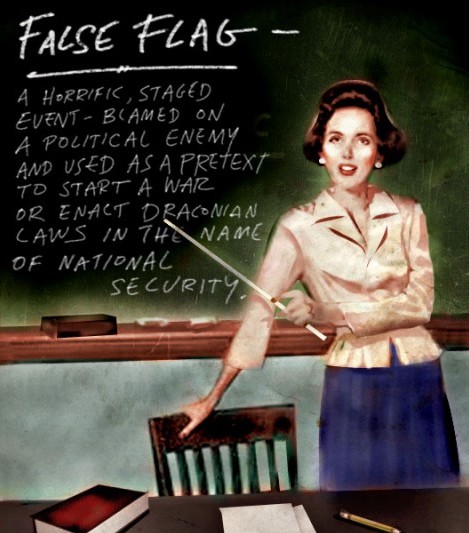
‘False flag,’ another weapon in the US arsenal

By Dave Alpert

Source: Intrepid Report

Now hear this . . . Noam Chomsky, respected intellect and political guru of the “left,” a man that ridiculed and denounced the efforts of the 9/11 Truth Movement, has joined the ranks of the conspiracy theorists.

On Monday, March 27, Noam, in an interview, as reported by AlterNet, stated that Donald Trump could stage a “false flag” terror attack in order to consolidate his power.

Trump’s administration is currently on thin ice. Not only does he not have the support of Democrats, but members of his own party have been distancing themselves from him. It also should be noted that Trump’s standing amongst the voters, according to poll numbers, is at an historic low.

George W. Bush’s Secretary of the Treasury, from January 2001 to December 2002, Paul O’Neill, revealed in his book, “The Price of Loyalty,” published in 2004, that the war in Iraq was planned from the first National Security Council meeting, soon after the administration took office. At the first cabinet meeting of the new Bush administration, O’Neill observed that the debate was not “should we attack Iraq?” but rather “how do we go about attacking Iraq?”

It was and is clear that the Bush administration needed to gather popular support for an invasion of Iraq through an event that would guarantee such support. Fortunately, along came 9/11, a perfect example of how a “false flag” event is organized and implemented.

Predictably, the people rallied behind the Bush administration’s stated desire to hold the guilty parties accountable and pursue retribution. Bush was given carte blanche powers to fulfill his promise to find and destroy those responsible for the savage attack on US soil.

Trump knows that people are losing faith in his presidency and, according to Chomsky, will look to scapegoat someone or some group in order to draw our attention away from his failings and, as the G.W. Bush administration did, mobilize support. Trump has already identified those he is likely to scapegoat, the vulnerable, the immigrants, the Muslims, the terrorists, etc.

Chomsky states, “I think that we shouldn’t put aside the possibility that there would be some kind of staged or alleged terrorist act, which can change the country instantly.” WOW, he really said that?

The first and crucial step in a planned false flag event is for the government initiating the action to prime the public by demonizing the target, the country or group that will be scapegoated and assume the blame for the event, and creating fear and anger among the populace. For that, Trump has a fairly large group of possible scapegoats if, in fact, Chomsky’s projections get played out. As mentioned above, there are, of course, Muslims as well as extremists from any of the immigrant groups coming from countries that the US has decimated or from our Mexican neighbors to the South, as well as any group that can conveniently be labeled “terrorists.”

Immediately after the event, there is a comprehensive narrative and a convenient, ready-made culprit is identified by officials. With the help of law enforcement and the media, the narrative is repeated often enough to convince the public of its accuracy. Not only is the official explanation not questioned by the media, their responsibility is to ensure that no alternative views of the event in question are heard. In fact, the media often actively denounce and mobilize against alternative theories regarding the events in question. Most often they marginalize the people who raise questions about the official version, labeling them as “conspiracy nuts.”

Coincidently, it should be noted, if you believe in coincidences, a large percentage of major domestic or international terror attacks have involved simultaneous “training drills.” This list includes, but is not limited to, the infamous NORAD drills of 9/11, the 7/7 London Bombings, the 2011 Norway shooting, the Aurora shooting, and the Boston Marathon.

These training drills serve to confuse respondents to the “terror” attack. During the 9/11 attack, a military officer could be heard, when he was informed, asking “Is this real time?” At the time of the attacks, several military exercises were in progress and were a factor in immobilizing and confusing respondents. Is this another coincidence?

So, the question still hangs out there, unanswered, “Why now, Mr. Chomsky?” Why project the possible false flag operation orchestrated by the Trump people, while ignoring the overwhelming real evidence demonstrating that 9/11 was a false flag event?

The answer to that question may be in Chomsky’s personal feelings about Trump, the man. Chomsky has called Trump a “con man” who will drag civilization “down to the utter depths of barbarism.”

Yet, Mr. Chomsky, despite the events of the past century, when various US presidents have played the role of “con men” and have dragged civilization down to a deadly and destructive level of barbarism, has decided to vent his anger and frustration at Trump, who I’m certain will also continue his assignment to drag the world into a state of savagery. After all, world domination and making America great again is not for sissies.

Yet, he and many other so-called leftists abandoned the 9/11 Truth Movement, made up of people who did not accept the government’s mythological version of that day and were seeking truth.

During the past 16 years, millions of people were either killed, mutilated, or displaced from their homes as a result of 9/11. Where have these “progressive” voices been during this time? Now he’s going to speak out . . . screw him!!!

From Russia, with Panic

Cozy bears, unsourced hacks—and a Silicon Valley shakedown

By Yasha Levine

Source: The Baffler

The Russians hacked America.

After Donald Trump’s surprise victory in November, these four words reverberated across the nation. Democratic Party insiders, liberal pundits, economists, members of Congress, spies, Hollywood celebrities, and neocons of every stripe and classification level—all these worthy souls reeled in horror at the horribly compromised new American electoral order. In unison, the centers of responsible opinion concurred that Vladimir Putin carried off a brazen and successful plan to throw the most important election in the most powerful democracy in the world to a candidate of his choosing.

It seemed like a plotline from a vintage James Bond film. From his Moscow lair, Vladimir Putin struck up an alliance with Julian Assange to mount a massive cyber-offensive to discredit Hillary Clinton and her retinue of loyal Democratic Party operatives in the eyes of the American public.

The plot was full of twists and turns and hair-raising tangents, including tales of Russian-American retiree-agents sunning in Miami while collecting payoffs from Russia’s impoverished pension system. But the central ruse, it appears, was to enter the email server of the Democratic National Committee and then tap into the Gmail account belonging to John Podesta, founder of the Center for American Progress and premier D.C. Democratic insider.

As the long 2016 general election campaign unwound, WikiLeaks released a steady stream of embarrassing revelations from the DNC—though the disclosures were no more compromising than what you’d find in the correspondence of any mid-sized private-sector company: dumb boardroom gossip, petty press intrigues, and sleazy attempts to undermine a well-placed executive rival (namely Bernie Sanders). Truly, it would have been astonishing to learn that the DNC went about its business in any other way. But the sheer fact of the data breach was dispositive in the eyes of Democratic operatives and their many defenders in the liberal press. After all, WikiLeaks also reportedly collected data from the Republican National Committee, and did nothing with it. Clearly this was cyber-espionage of the most sophisticated variety.

On the Trump side of the ledger, things were murkier. Trump’s political advisers indeed had ties to Russia and Ukraine—but this was hardly surprising given the authoritarian-friendly lobbying climate within Washington. During the campaign the GOP nominee was disinclined to say anything critical about Putin. Indeed, breaking with decades of Republican tradition, Trump openly praised the Russian leader as a powerful, charismatic figure who got things done. But since the candidate also refused to disclose his tax returns, a commercial alliance with the Russian autocrat was necessarily a matter of conjecture. That didn’t stop theories from running wild, culminating in January with the titillating report from BuzzFeed that U.S. intelligence agencies believed that Putin had compromising footage of Trump cavorting with prostitutes at a Moscow hotel previously patronized by Barack and Michelle Obama. Not only was the Yank stooge defiling the very room where the first couple had stayed, but he allegedly had his rented amorous companions urinate in the bed. Behold, virtuous American republic, the degradation Vladimir Putin has in store for you!

Taking the Piss

The dossier published by BuzzFeed had been circulating for a while; on closer inspection, it appeared to be repurposed opposition research from the doomed Jeb Bush campaign. Its author was a former British intelligence operative apparently overeager to market salacious speculation. By the end of this latest lurid installment of the Russian hacking saga, no one knew anything more than they had when the heavy-breathing allegations first began to make their way through the political press. Nevertheless, the Obama White House had expelled Russian diplomats and expanded sanctions against Putin’s regime, while the FBI continued to investigate reported contacts between Trump campaign officials and Russian intelligence operatives during the campaign.

This latter development doesn’t exactly inspire confidence. As allegations of Russian responsibility for the DNC hack flew fast and furious, we learned that the FBI never actually carried out an independent investigation of the claims. Instead, agency officials carelessly signed off on the findings of CrowdStrike, a private cybersecurity firm retained by the Democratic National Committee. Far from establishing an airtight case for Russian espionage, CrowdStrike made a point of telling its DNC clients what it already knew they wanted to hear: after a cursory probe, it pronounced the Russians the culprits. Mainstream press outlets, primed for any faint whiff of great-power scandal and poorly versed in online threat detection, likewise treated the CrowdStrike report as all but incontrovertible.

Other intelligence players haven’t fared much better. The Director of National Intelligence produced a risible account of an alleged Russian disinformation campaign to disrupt the 2016 presidential process, which hinged on such revelations as the state-sponsored TV news outlet Russia Today airing uncomplimentary reports on the Clinton campaign and reporting critically on the controversial U.S. oil-industry practice of fracking as a diabolical plot to expand the market for Russian natural gas exports. In a frustratingly vague statement to Congress on the report, then-DNI director James Clapper hinted at deeper and more definitive findings that proved serious and rampant Russian interference in America’s presidential balloting—but insisted that all this underlying proof must remain classified. For observers of the D.C. intelligence scene, Clapper’s performance harkened back to his role in touting definitive proof of the imminent threat of Saddam Hussein’s WMD arsenal in the run-up to the U.S. invasion of Iraq.

It’s been easy, amid the accusations and counteraccusations, to lose sight of the underlying seriousness of the charges. If the hacking claims are true, we are looking at a truly dangerous crisis that puts America’s democratic system at risk.

The gravity of the allegation calls for a calm, measured, meticulously documented inquiry—pretty much the opposite of what we’ve seen so far. The level of wild assertion has gotten to the point that some of the most respected pro-Western voices in Russia’s opposition have expressed alarm. As much as they despise Putin, they don’t buy the bungled investigations. “In the real world outside of soap operas and spy novels . . . any conclusions concerning the hackers’ identity, motives and goals need to be based on solid, demonstrable evidence,” wrote Leonid Bershidsky. “At this point, it’s inadequate. This is particularly unfortunate given that the DNC hacks were among the defining events of the raging propaganda wars of 2016.”

The lack of credible evidence, the opaque nature of cyber attacks, the partisan squabbles and smears, and the national-security fearmongering have all made this particular scandal very difficult to navigate. It may be years before we find out what really happened. Meanwhile, I’d like to tell a cautionary tale. It’s a story about the last time American and European cyber experts accused Russia of launching an attack against another country—and nearly provoked a war with a nuclear power. The moral of the tale is that cyberwarfare is a fraught and high-stakes theater of conflict, in which the uncertain nature of cyber-attack attribution can be exploited to support any politicized version of events that one chooses.

All Georgians Now

On August 8, 2008, war broke out between Georgia and Russia. Backed up by heavy artillery, truck-mounted Grad rockets, and tanks, Georgia launched a surprise invasion of South Ossetia, a tiny mountainous breakaway republic on its northern flank that had been at the center of a long-simmering regional territorial dispute. A prolonged artillery barrage reduced parts of Tskhinvali, South Ossetia’s capital, to rubble. Civilians were given no warning—those not killed in the initial assault hid in basements or fled on foot. A Russian peacekeeping force, which had been stationed in South Ossetia under an Organization for Security and Cooperation in Europe agreement since 1992, was targeted in the attack. By the end of the first day, Georgian troops were on the verge of taking the whole city.

Mikheil Saakashvili, Georgia’s charismatic nationalist president, had campaigned on a nationalistic platform, promising to reabsorb the country’s breakaway regions. His initial success did not last long. Russian jets pounded Georgian military command posts and communications, while Russian troops streamed into South Ossetia. By the end of day two, the tide had turned: Georgian forces began retreating. By day five, Russian forces had control over South Ossetia and huge swaths of northern Georgia. Tanks and infantry entered several northern towns and moved around unimpeded just an hour away from Tbilisi, Georgia’s capital, where euphoria and jubilation turned to sickly fear. News footage showed Saakashvili cowering as Russian jets flew overhead. He appeared on television nervously chewing his tie, prompting the BBC to ask wryly: “The Georgian president chews over his next move. Is he weaker or stronger than before?”

Weaker, definitely. But in the war’s aftermath, Russia and Georgia were each determined to claim victim status. Russia pointed out that Georgia had started the war; Georgia blamed Russia for launching a full-scale invasion. President Saakashvili appealed to the United States, hoping it would intervene militarily on Georgia’s behalf.

The Bush White House was firmly aligned with Georgia. For years, Georgia had been an important neocon project in a grander scheme to peel away former Soviet Republics from Moscow’s influence. American NGOs and soft-power outfits like USAID backed Saakashvili’s rise to power during the country’s “Rose Revolution.” Since 2004, the Bush administration had lavished military aid on Saakashvili’s government, outfitted its army, and trained its soldiers. John McCain and Hillary Clinton jointly nominated Saakashvili for the Nobel Peace Prize in 2005. Support for Georgia was bipartisan and continued right up to Georgia’s attack on South Ossetia; more than a thousand American troops held a joint exercise with Georgia near the South Ossetian border in July.

As a complement to the Georgia PR offensive, the Bush White House continued to hammer away at its stable of anti-Putin talking points. For years, the United States had portrayed Vladimir Putin as a strongman leader bent on world domination. The invasion of Georgia seemed to confirm the official narrative: Russia would stop at nothing to crush the democratic aspirations of its neighbors.

It was a dangerous moment. Vice president Dick Cheney pushed for directly engaging the Russians in “limited military options”—including aerial bombardment to seal the Roki Tunnel linking North Ossetia and South Ossetia that was being used to transport reinforcements. Luckily, president George W. Bush, who had a street in Tbilisi named after him, wavered, sensibly fearing a real war with Russia.

The episode occurred during a U.S. presidential election. Senator John McCain used the conflict to showcase his hawkish foreign policy bona fides, arguing that America needed to intervene to protect Georgia’s budding democratic society from the authoritarian Putin. Claiming that “today, we are all Georgians,” McCain called for NATO forces to be deployed against Russia, which would have triggered a war with a nuclear power.

I was in Moscow at the time, reporting on the war. Those who had covered the region understood that Georgia was no innocent. The ethnic conflict between Ossetians and Georgians has old, festering roots—indeed, Georgia’s invasion of South Ossetia was centuries in the making. The Ossetians consider the territory of South Ossetia to be native lands they have occupied for centuries, while Georgians view Ossetians as relatively recent interlopers. When South Ossetia declared its independence after the breakup of the Soviet Union, Georgia’s ultra-nationalistic first president attempted to quash the independence movement by force. After a short war, South Ossetia stood its ground—and Georgia and South Ossetia squared off in an uneasy peace administered by Russian, Georgian, and South Ossetian peacekeepers. Two-thirds of the breakaway republic were ethnic Ossetians. They feared Georgia and favored Russia as a military bulwark. Russia handed out Russian passports to South Ossetians and provided military protection, making the territory a de facto member of the Russian Federation.

Seasoned observers of the region’s tangled geopolitics understood that Russia shared amply in the blame but that the fault lay primarily with President Saakashvili. When he came to power, he took on the mantle of a medieval Georgian king who had unified the country. “Today Georgia is split and humiliated. We should unite to restore Georgia’s territorial integrity. Georgia has existed and will exist. Georgia will become a united strong country,” he declared in 2004. With deteriorating political support at home, Saakashvili was itching for a popular war. Skirmishes increased along Georgia’s border with Abkhazia and South Ossetia; finally, Georgia fired the first shot.

Suddenly, America found itself at the edge of a precipice: a war over a complex sectarian conflict in a remote part of the world. American policymakers wanted a simple explanation, and conveniently, they were offered one: cyber-aggression.

The Sites Go Out in Georgia

When war broke out, a slew of Georgian websites came under attack. The Central Bank of Georgia was hacked, according to Russian reports. Its internal networks were not penetrated, but the hackers tinkered with the homepage to give the Georgian unit of currency, the lari, a less than favorable exchange rate, forcing the government to issue an order that suspended all electronic banking services. Georgia’s Ministry of Foreign Affairs was hacked, its homepage replaced with a slideshow depicting Mikhail Saakashvili as Hitler. “And he will suffer the same fate,” read an ominous message beside it.

A Russian-language forum called “Stop Georgia” suddenly came online, hosted in, of all places, the United States. Against a green camouflage-inspired background, its creators decried Georgia’s propaganda war against Russia. “We, as representatives of the Russian hacker-underground, will not tolerate provocations from Georgia.” The forum was crude and looked like it had been put together in a few hours. Its primary function was to distribute a simple, easily available program permitting anyone with a computer and an internet connection to become part of a denial-of-service attack swarm. The forum conveniently provided a list of Georgian target websites and helped organize and direct the cyber-mob action.

Georgian officials proclaimed these cyber attacks a strategic maneuver by the Russian military designed to take out the country’s communication system, facilitating the Russians’ armed invasion. The coordinated nature of the attacks, they insisted, showed that Russia had planned the invasion long in advance. “The opening shots of the Russian invasion of Georgia were fired over the Internet, proving Russian online aggression predated Georgian actions,” declared an official report by the Georgian government. The government called the people behind the attack “cyber terrorists.”

Cybersecurity experts came out of the woodwork to confirm and expand on Georgia’s allegations. Some implicated a shadowy cybercrime group from St. Petersburg that analysts had dubbed the “Russian Business Network” and linked it to the FSB, Russia’s secret police. Others claimed that Nashi, a Kremlin-backed young nationalist group, was involved. American military officials weighed in, agreeing that Russia had used cyber attacks to confuse and disorient the Georgian government. “The Russians just shot down the government command nets so they could cover their incursion,” Michael Wynne, former U.S. Air Force Secretary, told the AP on August 13.

One hack in particular became a sort of poster action for the sinister Russian cyber-offensive and conveniently doubled as a warning signal for greater Russian-authored threats ahead. In July, just after secretary of state Condoleezza Rice had visited Georgia and reaffirmed America’s support for the country’s desire to exit Russia’s sphere of influence, President Saakashvili’s site had been taken down by a stream of junk requests with a string of text that read: “win+love+in+Rusia.”

What did it all mean? The war had barely ended, but John Markoff, longtime technology reporter for the New York Times, offered an answer: “As it turns out, the July attack may have been a dress rehearsal for an all-out cyberwar once the shooting started between Georgia and Russia. According to Internet technical experts, it was the first time a known cyber attack had coincided with a shooting war.” Other journalists chimed in as well: the Wall Street Journal, CNN, the Washington Post. The consensus, according to cyber experts, was that Russia was indeed behind the attacks—and the rhetoric was getting more and more belligerent.

And so, within the space of a news cycle or two, internet analysts turned into warmongers and cyber-hawks, comparing rudimentary internet attacks to atomic weapons. “These attacks in effect had the same effect that a military attack would have. That suddenly means that in cyberspace anyone can build an A-bomb,” Rafal Rohozinski, a respected cyber analyst with Citizen Lab, told the Washington Post. The Financial Times concurred: “The crisis in Georgia has not only stoked fears of a belligerent Russia. It has also served as a reminder that a new style of warfare—potentially as devastating as those that terrified previous generations—is almost upon us: cyberwar.”

That’s right: defacing a government website with a repetitive string of crude slogans was now the twenty-first-century equivalent of a nuclear first strike. The hysteria sloshed around and spilled over into fears that America was defenseless against similar attacks from Russia. “It’s a grave concern be the same thing could happen here in America,” CNN host John Roberts exclaimed.

Point, Click, Panic

I began investigating the cyberwar as soon as it erupted. I knew something about the way computers, websites, and the internet worked, having spent two years studying computer science at UC Berkeley, and I had serious doubts about the cyber dimension of the Russia-Georgia War. The hacks and attacks all seemed rather crude and for the most part targeted non-critical cyber portals: ceremonial government websites, several news sites, the public-facing website of a central bank. This was hardly the ruinous infrastructure offensive that cybersecurity experts were warning people about. As I got deeper into the story—interrogating my contacts in Moscow, traveling to Georgia, interviewing hackers, politicians, and cyber experts in Europe, Russia, and the United States—the cyberwar battle cries sounded more and more like ideologically manufactured hysteria.

To be sure, the assaults were troubling. Hacks against Georgian websites took place, they were in some way connected to the war, and Russia’s cyber criminal world had ties to the country’s security establishment. But it was an enormous—and dangerous—leap to interpret these attacks as a pre-planned Russian intelligence operation, possibly justifying an American military response. What’s more, it seemed clear that most of the people doing the investigating were working backward. They started from the premise that Russia started the war and then proceeded to show that the cyber attacks were an element of this premeditated invasion.

Living in Moscow, I saw a striking split-screen effect taking hold around the Georgia crisis. America was freaking out about the danger of Russian cyber attacks, while people I talked to in Russia mocked the hysteria. Looking at my reporting notes from that time, I can’t find a single Russian source who took it seriously. Nikita Kislitsin, former editor of Russia’s Hacker magazine, laughed at Western cybersecurity experts who suggested that the Georgian attacks were the entering wedge of a sophisticated plan for complete Russian takeover, explaining that hackers can have all sorts of unconventional motives for taking part in a political web war. One regular contributor to his magazine’s how-to break-in section, for example, had hacked into a few Georgian sites just so he had something to write—and brag—about. Kris Kaspersky, a well-known Russian hacker and security expert, also ridiculed the notion that the Georgia hacks were hatched as part of a military intelligence campaign. “A prepubescent kid could have carried out the attacks,” Kaspersky told me. “A well-funded organization like the FSB can pull off much more effective Web site attacks.” Bringing down a few rinky-dink government and newspaper websites is a far cry from network warfare, Kaspersky argued. Indeed, it was at least as plausible that the hacks could have been self-inflicted: “In these kinds of conflicts, you have to look at who benefits,” he said. “If I was Georgia, I would attack myself.”

The Fog of the Data Log

There was a second, underreported side to the conflict: the cyber attacks went in both directions.

Even before the war broke out in August, South Ossetian websites came under attack. A few days before the shelling of South Ossetia began, someone skillfully broke into the website of the Republic’s television station, replacing news items on the number of Georgian troops killed in a shootout with South Ossetian troops with ones that claimed Russian mercenary fighters were among the casualties. As Georgian tanks rolled across the border, other South Ossetian news sites—some of which were hosted in Moscow—came under cyber attack. The website of South Ossetia’s Ministry of Information, a clearinghouse for South Ossetian news, buckled under a denial-of-service attack. At the same time, Russian news sites—including the Kremlin-funded Russia Today—were hit and suffered downtime during the war.

If you squinted at the conflict and looked at it from Russia’s and South Ossetia’s perspective, you could use the cyber attacks to prove the opposite of what Georgia and Western cyber experts were claiming: the cyber attacks proved that Georgia had planned its military invasion. And that was exactly what the South Ossetians were telling me. “They hoped that a media blackout of the atrocities they were committing against a civilian population would reduce resistance to the invasion, both locally and globally,” Yuri Beteyev, the founder and editor in chief of OsInform, South Ossetia’s only news agency, told me. He had been in Tskhinvali when Georgia’s heavy artillery rolled into town.

I traveled to Tbilisi, looking for evidence of the alleged Russian attack. I had scheduled interviews with newspapers, government agencies, and internet service providers. They all made grand claims about Russian cyber attacks, all of them short on specific evidence. Caucasus Online, one of Georgia’s largest ISPs, claimed the attacks started the day before the military action—which served in the company’s view as undeniable proof that the Russian government was coordinating them. But ISP officials could not provide any supporting data, and when I requested a sample of their logs from that day, company spokesmen claimed the data had been deleted.

I was shown a former Soviet government compound in the center of Tbilisi. The building was a modernist fortress: a slab of granite and concrete perched at the top of a steep hill. The seventh floor housed Georgia’s National Security Council, the coordinating body for the country’s military and intelligence agencies. In this ultrasecure location, Georgian officials spun a series of talking points about how the cyberwar proved Russian aggression. “For a small country like ours, information is the most powerful tool with which you can protect yourself. The Russians knew this,” Security Council director Alexander Lomaia told me. “One day, we find out that we are cut off from the world. All major websites—including government and media—were attacked. Their aim was to limit our ability to electronically communicate, and they succeeded.”

But Georgia is a poor, largely rural country with low internet connectivity outside the capital. Its level of cyber-activity ranked below that of countries like Nigeria, Bangladesh, Bolivia, and El Salvador. You could hardly launch a real cyber attack if you wanted too, since few Georgians outside Tbilisi used the internet at all, let alone for anything important. It was all hype and bluster—and very superficial.

Indeed, as in Moscow, critical journalists and techies in Georgia dismissed much of the hype. Yes, there were cyber attacks. Yes, they could have been directed by the Russian government. But they were so amateur and inconsequential that they had little effect. Their biggest contribution, in fact, was to bolster Georgian counter-propaganda claims, as each little hack was taken up by the Georgian government and broadcast as proof of Russian aggression. One journalist told me his colleagues had cheered news of Georgia-based cyber attacks against Russia. “A wave of jubilation spread through the forum when they managed to take down Russia Today for a few hours.” Patriotic hackers doing their part to fight Russia? This is exactly what cyber experts accused Russian security services of orchestrating against Georgia as part of the military invasion.

Following the Money

By the time I left Georgia in October, the cyberwar story was no longer obsessing political leaders and media producers in the West. Congress had voted to bail out Wall Street. The Georgia-Russia War dropped out of America’s collective memory almost as quickly as it had appeared, eclipsed by a scarier and much more direct threat to America: the meltdown of our financial system and the threat of a new Great Depression.

A year later, a European Union commission issued a detailed report that showed just how empty all the talk about cyber attacks and premeditated Russian war really was. The report put the blame for starting the war squarely on Georgia. But by then the Georgia-Russia War was ancient news. No one cared, and the report barely got a mention in the press. But Silicon Valley noticed.

While the financial industry was teetering on the brink of oblivion, another industry was being born: the cybersecurity complex. By now it is a multibillion-dollar boondoggle, employing shoddy forensic techniques and politicized investigations. But it is highly profitable. The boom has been driven by the grim leaky reality of our digital world. Not a month goes by without some huge corporation or government agency getting hacked, its data splattered across the internet or siphoned off for the exclusive use of scammers, corporate spies, and intelligence agencies.

Cybersecurity firms have stepped up to the challenge. They’ve attracted funding from the biggest and most powerful venture capital houses: Sequoia, Google Capital, and the like. Not surprisingly, the CIA’s in-house VC outfit, In-Q-Tel, has been a leading investor in this space. All these firms position themselves as objective forensic investigators, patiently sifting through the evidence to find the guilty party and then figuring out how to defend against it. They have been involved with diagnosing and attributing big hacks for shamefaced clients like Target, J.P. Morgan, and Sony Pictures. Investors and intelligence agencies sing the praises of the critical services these outfits offer in an online environment teeming with hostile threats.

But in private conversations, as well as little-noticed public discussions, security professionals take a dimmer view of the cybersecurity complex. And the more I’ve looked at the hysteria surrounding Russia’s supposed hacking of our elections, the more I’ve come to see it as a case study of everything wrong and dangerous about the cyber-attribution business.

Fancy Bears, Cozy Bears—Oh My!

Take CrowdStrike, the hottest cybersecurity firm operating today. Based in Irvine, California, CrowdStrike was launched in 2012 by two veterans of the cyber-attribution business: George Kurtz and Dmitri Alperovitch. Both previously worked for McAfee, an antivirus-turned-massive-cybersecurity firm now partially owned by Intel. But Kurtz and Alperovitch saw a market opportunity for a new boutique type of cyber-defense outfit and decided to strike out on their own. They also brought on board Shawn Henry, a top FBI official who had been in charge of running the agency’s worldwide cyber investigations.

CrowdStrike positioned itself as a next-generation full-service cybersecurity firm. Company officials argued that cybersecurity was no longer just about defense—there was too much data and too many ways of getting at it to protect everything all the time. You had to know your attacker. “Knowing their capabilities, objectives, and the way they go about executing on them is the missing piece of the puzzle in today’s defensive security technologies,” wrote CrowdStrike cofounder George Kurtz. “By identifying the adversary . . . we can hit them where it counts.”

CrowdStrike hit the big time in 2015 with a $100 million infusion from Google Capital (now Capital G), Google’s first-ever investment in a cybersecurity company. It was good timing, because CrowdStrike was about to be catapulted into the front ranks of cyber-threat assessors. Sometime in April or May, CrowdStrike got a call from the Democratic National Committee to investigate a possible intrusion into their servers. The company’s investigators worked with surprising efficiency. As one DNC insider explained to the New York Times, the company was able to make a definite attribution within a day. There was no doubt, CrowdStrike told its DNC clients—the Russian government did it.

The results of CrowdStrike’s investigation were first broken by the Washington Post and then followed up in greater detail by CrowdStrike itself. In a post entitled “Bears in the Midst,” Dmitri Alperovitch attributed the hack to two distinct and very nefarious “Russian espionage” groups: Cozy Bear and Fancy Bear, among the most sophisticated cyber-operators CrowdStrike had ever come across. “In fact, our team considers them some of the best adversaries out of all the numerous nation-state, criminal and hacktivist/terrorist groups we encounter on a daily basis,” he wrote. “Their tradecraft is superb, operational security second to none and the extensive usage of ‘living-off-the-land’ techniques enables them to easily bypass many security solutions they encounter.”

These cyberspooks were allegedly behind a string of recent attacks on American corporations and think tanks, as well as recent penetrations of the unclassified networks of the State Department, the White House, and the U.S. Joint Chiefs of Staff. According to CrowdStrike, Cozy Bear was most likely the FSB, while Fancy Bear was linked to the “GRU, Russia’s premier military intelligence service.”

Here, the cyber experts were telling us, was conclusive evidence that both the FSB and the GRU targeted the central apparatus of the Democratic Party. CrowdStrike’s findings didn’t just cause a sensation; they carpet-bombed the news cycle. Reports that Vladimir Putin had tried to hack America’s democratic process raced around the world, making newspaper front pages and setting off nonstop cable news chatter.

The story got even hotter after a hacker who called himself Guccifer 2.0 suddenly appeared. He took credit for the DNC hack, called CrowdStrike’s investigation a fraud, and began leaking select documents pilfered from the DNC—including a spreadsheet containing names and addresses of the DNC’s biggest donors. The story finally started going nuclear when WikiLeaks somehow got hold of the entire DNC email archive and began dribbling the data out to the public.

A Terrible System

CrowdStrike stuck to its guns, and other cybersecurity firms and experts likewise clamored to confirm its findings: Russia was behind the attack. Most journalists took these security savants at their word, not bothering to investigate or vet their forensic methods or look at the way CrowdStrike arrived at its conclusions. And how could they? They were the experts. If you couldn’t trust CrowdStrike and company, who could you trust?

Unfortunately, there were big problems with CrowdStrike’s account. For one thing, the names of the two Russian espionage groups that CrowdStrike supposedly caught, Cozy Bear and Fancy Bear, were a fiction. Cozy Bear and Fancy Bear are what cyber monitors call “Advanced Persistent Threats,” or APTs. When investigators analyze an intrusion, they look at the tools and methods that the hackers used to get inside: source code, language settings, compiler times, time zones, IP settings, and so on. They then compare all these things against a database of previously recorded hacks that is shared among cyber professionals. If the attack fits an old profile, they assign it to an existing APT. If they find something new, they create a group and give it an official name (say, APT911) and then a cooler moniker they can throw around in their reports (say, TrumpDump).

CrowdStrike followed the protocols for existing APTs. Its investigation of DNC servers turned up two known threat actor groups: APT28 and APT29. Depending on the cybersecurity firm doing the analysis, these two APTs have been called by all sorts of names: Pawn Storm, Sofacy, Sednit, CozyCar, The Dukes, CozyDuke, Office Monkeys. Neither of them has ever been linked by any cybersecurity firm to the Russian government with certainty. Some firms have tried—most notably FireEye, CrowdStrike’s bigger and wealthier competitor. But FireEye’s evidence was ridiculously thin and inferential—in nearly any other industry, it would have been an embarrassment. Consider, for example, FireEye’s report on APT29:

We suspect the Russian government sponsors the group because of the organizations it targets and the data it steals. Additionally, APT29 appeared to cease operations on Russian holidays, and their work hours seem to align with the UTC +3 time zone, which contains cities such as Moscow and St. Petersburg.

Or consider FireEye’s report on APT28—which, among other things, attributes this attack group to a Russian intelligence unit active in Russia’s “invasion of Georgia,” an invasion that we know never took place.

They compile malware samples with Russian language settings during working hours consistent with the time zone of Russia’s major cities, including Moscow and St. Petersburg.While we don’t have pictures of a building, personas to reveal, or a government agency to name, what we do have is evidence of long-standing, focused operations that indicate a government sponsor—specifically, a government based in Moscow.

So, FireEye knows that these two APTs are run by the Russian government because a few language settings are in Russian and because of the telltale timestamps on the hackers’ activity? First off, what kind of hacker—especially a sophisticated Russian spy hacker—keeps to standard 9-to-5 working hours and observes official state holidays? Second, just what other locations are in Moscow’s time zone and full of Russians? Let’s see: Israel, Belarus, Estonia, Latvia, Moldova, Romania, Lithuania, Ukraine. If non-Russian-speaking countries are included (after all, language settings could easily be switched as a decoy tactic), that list grows longer still: Greece, Finland, Turkey, Jordan, Lebanon, Syria, Iraq, Saudi Arabia, Somalia, Yemen, Ethiopia, Kenya—the countries go on and on.

The flimsiness of this evidence didn’t stop CrowdStrike. Its analysts matched some of the tools and methods used in the DNC hack to APT28 and APT29, slapped a couple of Russian-sounding names with “bear” in them on their report, and claimed that the FSB and GRU did it. And most journalists covering this beat ate it all up without gagging.

“You don’t know there is anybody there. It’s not like it’s a club and everyone has a membership card that says Fancy Bear on it. It’s just a made-up name for a group of attacks and techniques and technical indicators associated with these attacks,” author and cybersecurity expert Jeffrey Carr told me. “There is rarely if ever any confirmation that these groups even exist or that the claim was proven as correct.”

Carr has been in the industry a long time. During the Russia-Georgia war, he led an open-source intelligence effort—backed by Palantir—in an attempt to attribute and understand the actors behind the cyberwar. I read his reports on the conflict back then and, even though I disagreed with some of his conclusions, I found his analysis nuanced and informative. His findings at the time tracked with those of the general cybersecurity industry and bent toward implicating the Russian government in the cyber attacks on Georgia. But these days Carr has broken with the cyberworld consensus:

Any time a cyber attack occurs nowadays you have cybersecurity companies looking back and seeing a historical record and seeing assignments on responsibility and attribution and they just keep plowing ahead. Whether they are right or wrong, nobody knows, and probably will never know. That’s how it works. It’s a terrible system.

This is forensic science in reverse: first you decide on the guilty party, then you find the evidence that confirms your belief.

Not for Attribution

Over time, bad evidence was piled on top of unsubstantiated claims and giant inductive leaps of logic to the point that, if you tried to figure out what was actually happening, you’d lose all sense of direction.

Matt Tait, a former GCHQ analyst and founder of Capital Alpha Security who blogs under the influential Twitter handle @pwnallthethings, found a Word document pilfered from the DNC and leaked by Guccifer 2.0. As he examined its data signatures, he discovered that it had been edited by Felix Edmundovich—a.k.a. Felix Dzerzhinsky, founder of the Cheka. To him, it was proof that Guccifer 2.0 was part of the same Russian intelligence operation. He really believed that the super sophisticated spy group trying to hide its Russian ties would register its Microsoft Word processor in the name of the leader of the infamously brutal Soviet security service.

Meanwhile, Thomas Rid, a cyber expert based in London, drew a straight line from the DNC hacks to the attempted hacking of the Germans and TV5 to attacks on Georgia and Baltic States—even though on closer inspection none of those efforts had been linked to the Russian government.

John Podesta’s Gmail account was hacked with a rudimentary spear-phishing attack that tricked him into entering his password with a fake Google login page. His emails ended up on WikiLeaks, too. All sorts of people linked this to Russian military intelligence, with no concrete evidence to speak of.

Sensing its moment had arrived, CrowdStrike went into frenetic PR mode. The company released a series of cyber-attribution reports illustrated with sexy communist robots wearing fur hats, using visual marketing techniques in lieu of solid evidence.

After Donald Trump won the presidency, all these outlandish claims were accepted as unassailable truth. The “hacking” of the 2016 presidential election was the ultimate damning conclusion that cybersecurity experts were now working backward from. Just as Georgia’s compromised net infrastructure provided conclusive proof of Russia’s concerted plan to invade Georgia, Trump’s improbably successful presidential run demonstrated that Russian subterfuge, rather than the collapse of American political institutions, had elected a dangerous outsider president.

Watching this new round of cyber-attribution hysteria, I got a queasy feeling. Even Dmitri Alperovitch’s name sounded familiar. I looked through my notes and remembered why: he was one of the minor online voices supporting the idea that the cyber attacks against Georgia were some kind of Russian plot. Back then, he was in charge of intelligence analysis at Secure Computing Corporation, a cybersecurity company that also made censorship tools used by countries like Saudi Arabia. He was now not only running his own big shop, but also playing a central role in a dangerous geopolitical game.

In other words, the election-hacking panic was a stateside extension of the battle first joined on the ISP frontiers of the Georgia-Russia war. Impressionable journalists and Democratic party hacks who ignore this background do so at their peril—and ours.