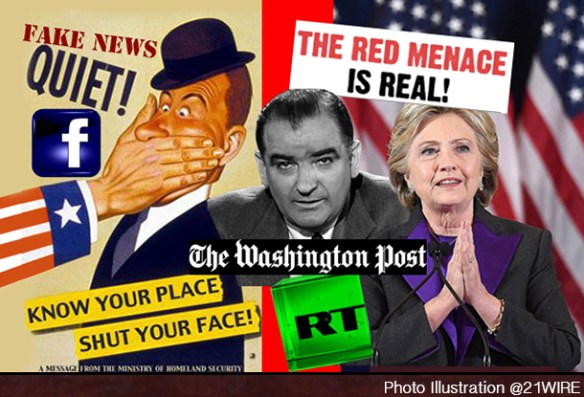
Email Hacking Was ‘Pearl Harbor,’ Helsinki Presidency’s ‘New Low’: Welcome to the United States of Amnesia

By Jim Naureckas and Janine Jackson

Source: FAIR 

The media maelstrom around the Helsinki meeting between Donald Trump and Vladimir Putin obscures at least one point of view: that it’s possible to believe that Russia intervened in the 2016 election on behalf of Trump without thinking that this is remotely comparable to Pearl Harbor, as Politico (7/16/18) declared, or “the worst attack on America since 9/11,” as a Washington Postheadline (2/18/18) claimed earlier this year.

Not saying it doesn’t make it less true that both Russia and the United States frequently interfere in other countries’ elections—the US somewhat more frequently, according to a database of electoral interventions maintained by a political scientist at Carnegie Mellon. That’s a lot of Pearl Harbors.

In 1996, Time magazine published a cover story (7/15/96) headlined “Yanks to the Rescue: The Secret Story of How American Advisers Helped Yeltsin Win.” Russian President Boris Yeltsin, you may recall, embraced the idea pushed by Western advisors that what the Russian economy needed was “shock therapy,” a policy that resulted in the country losing about a third of its GDP. Yeltsin also created the model for the authoritarian post-Soviet Russia we have today, notably when he called out the military to shell the Russian parliament—just one of many examples that make clear that the difference between US and Russian electoral interference is not that “we” intervene on the side of democracy.

What justified concern there could be is undermined rather than served by airily ahistorical claims like that of a Washington Post op-ed by Garry Kasparov (7/17/18): “The Helsinki Summit Marks a New Low in the History of the US Presidency.” Suffice to say there are millions who disagree that Trump failing to acknowledge that he had Russian help in getting elected is worse than Bush Jr. invading Iraq, Reagan arming death squads in Central America, worse than Nixon bombing Cambodia, or Truman dropping atomic bombs on civilians, or FDR rounding up Japanese-Americans or, well,  worse than the deliberate separation of children from their families at the southern border. A conversation without that perspective is hardly worth having. Should we talk about electoral interference? Sure. But we don’t have to be led by media who are outraged at Moscow doing things that never bothered them when they were done by Washington—“It’s different cuz it’s us” is not really a moral principle—or whose concern about “foreign” interference in US elections is orders of magnitude greater than that around the interference represented by anti-black and anti-poor voter suppression, inaccessible polling places or partisan gerrymandering.

Climb Down From the Summit of Hostile Propaganda

Public reactions to an open letter from academics, journalists and politicians asking for co-existence with Russia show many Americans don’t buy the media’s bellicose spin, as Norman Solomon explains.

By Norman Solomon

Source: Consortium News

Throughout the day before the summit in Helsinki, the lead story on the New York Times home page stayed the same: “Just by Meeting With Trump, Putin Comes Out Ahead.” The Sunday headline was in harmony with the tone of U.S. news coverage overall. As for media commentary, the Washington Post was in the dominant groove as it editorialized that Russia’s President Vladimir Putin is “an implacably hostile foreign adversary.”

Contempt for diplomacy with Russia is now extreme. Mainline U.S. journalists and top Democrats often bait President Trump in zero-sum terms. No doubt Hillary Clinton thought she was sending out an applause line in her tweet Sunday night: “Question for President Trump as he meets Putin: Do you know which team you play for?”

A bellicose stance toward Russia has become so routine and widespread that we might not give it a second thought — and that makes it all the more hazardous. After President George W. Bush declared “You’re either with us or against us,” many Americans gradually realized what was wrong with a Manichean view of the world. Such an outlook is even more dangerous today.

Since early 2017, the U.S. mass media have laid it on thick with the rough political equivalent of a painting technique known as chiaroscuro — “the use of strong contrasts between light and dark, usually bold contrasts affecting a whole composition,” in the words of Wikipedia. The Russiagate frenzy is largely about punching up contrasts between the United States (angelic and victimized) and Russia (sinister and victimizer).

Countless stories with selective facts are being told that way. But other selectively fact-based stories could also be told to portray the United States as a sinister victimizer and Russia as an angelic victim. Those governments and their conformist media outlets are relentless in telling it either way. As the great journalist I.F. Stone observed long ago, “All governments lie, and nothing they say should be believed.” In other words: don’t trust, verify.

Often the biggest lies involve what remains unsaid. For instance, U.S. media rarely mention such key matters as the promise-breaking huge expansion of NATO to Russia’s borders since the fall of the Berlin Wall, or the brazen U.S. intervention in Russia’s pivotal 1996 presidential election, or the U.S. government’s 2002 withdrawal from the Anti-Ballistic Missile Treaty, or the more than 800 U.S. military bases overseas — in contrast to Russia’s nine.

An Open Letter for Sanity

For human survival on this planet, an overarching truth appears in an open letter published last week by The Nation magazine: “No political advantage, real or imagined, could possibly compensate for the consequences if even a fraction of U.S. and Russian arsenals were to be utilized in a thermonuclear exchange. The tacit pretense that the worsening of U.S.-Russian relations does not worsen the odds of survival for the next generations is profoundly false.”

The initial 26 signers of the open letter — “Common Ground: For Secure Elections and True National Security” — included Pentagon Papers whistleblower Daniel Ellsberg, writer and feminist organizer Gloria Steinem, former UN ambassador Gov. Bill Richardson, political analyst Noam Chomsky, former covert CIA operations officer Valerie Plame, activist leader Rev. Dr. William Barber II, filmmaker Michael Moore, former Nixon White House counsel John Dean, Russia scholar Stephen F. Cohen, former U.S. ambassador to the USSR Jack F. Matlock Jr., Pulitzer Prize-winning writers Alice Walker and Viet Thanh Nguyen, The Nation editor Katrina vanden Heuvel, former senator Adlai Stevenson III, and former longtime House Armed Services Committee member Patricia Schroeder. (I was also one of the initial signers.)

Since its release five days ago, the open letter has gained support from a petition already signed by 30,000 people. The petition campaign aims to amplify the call for protecting the digital infrastructure of the electoral process that is now “vulnerable to would-be hackers based anywhere” — and for taking “concrete steps… to ease tensions between the nuclear superpowers.”

We need a major shift in the U.S. approach toward Russia. Clearly the needed shift won’t be initiated by the Republican or Democratic leaders in Congress; it must come from Americans who make their voices heard. The lives — and even existence — of future generations are at stake in the relationship between Washington and Moscow.

Many of the petition’s grassroots signers have posted comments along with their names. Here are a few of my favorites:

*  From Nevada: “We all share the same planet! We better learn how to do it safely or face the consequences of blowing ourselves up!”

*  From New Mexico: “The earth will not survive a nuclear war. The weapons we have today are able to cause much more destruction than those of previous eras. We must find a way to common ground.”

*  From Massachusetts: “It is imperative that we take steps to protect the sanctity of our elections and to prevent nuclear war anywhere on the earth.”

*  From Kentucky: “Secure elections are a fundamental part of a democratic system. But this could become meaningless in the event of thermonuclear war.”

*  From California: “There is only madness and hubris in talk of belligerence toward others, especially when we have such dangerous weapons and human error has almost led to our annihilation already more than once in the past half-century.”

Yet a wide array of media outlets, notably the “Russiagate”-obsessed network MSNBC, keeps egging on progressives to climb toward peaks of anti-Russian jingoism. The line of march is often in virtual lockstep with GOP hyper-hawks like Senators John McCain and Lindsey Graham. The incessant drumbeat is in sync with what Martin Luther King Jr. called “the madness of militarism.”

Meanwhile, as Dr. King said, “We still have a choice today: nonviolent co-existence or violent co-annihilation.


Norman Solomon is the coordinator of the online activist group RootsAction.org and the executive director of the Institute for Public Accuracy. He is the author of a dozen books including “War Made Easy: How Presidents and Pundits Keep Spinning Us to Death.”

The Con of Diversity

By Chris Hedges

Source: OpEdNews.com

In 1970, when black students occupied the dean’s office at Harvard Divinity School to protest against the absence of African-American scholars on the school’s faculty, the white administration was forced to respond and interview black candidates. It asked James Cone, the greatest theologian of his generation, to come to Cambridge, Mass., for a meeting. But the white power structure had no intention of offering Cone a job. To be black, in its eyes, was bad enough. To be black, brilliant and fiercely independent was unpalatable. And so the job was given to a pliable African-American candidate who had never written a book, a condition that would remain unchanged for the more than three decades he taught at Harvard.

Harvard got what it wanted. Mediocrity in the name of diversity. It was a classic example of how the white power structure plays people of color. It decides whom to promote and whom to silence. When then-Maj. Colin Powell helped cover up the 1968 massacre of some 500 civilians at My Lai in Vietnam he was assured a glittering career in the Army. When Barack Obama proved obedient to the Chicago political machine, Wall Street and the Democratic Party establishment he was promoted to the U.S. Senate and the presidency.

Diversity in the hands of the white power elites — political and corporate — is an advertising gimmick. A new face, a brand, gets pushed out front, accompanied by the lavish financial rewards that come with serving the white power structure, as long as the game is played. There is no shortage of women (Hillary Clinton, Nancy Pelosi and Donna Brazile), Latinos (Tom Perez and Marco Rubio) or blacks (Vernon Jordan, Clarence Thomas and Ben Carson) who sell their souls for a taste of power.

Ta-Nehisi Coates in his book “We Were Eight Years in Power: An American Tragedy” writes that “Barack Obama is directly responsible for the rise of a crop of black writers and journalists who achieved prominence during his two terms.” But this was true only for those black writers like Coates and Michael Eric Dyson who were obsequious cheerleaders for Obama. If, like Cornel West, you were black and criticized Obama you were isolated and attacked by Obama surrogates as a race traitor.

“For those who didn’t support Obama it was the lonely time,” said Glen Ford, the executive editor of the Black Agenda Report, when we spoke recently. “It’s like A.D. and B.C. Before Obama time, my politics reflected that of a black commentator, probably within a respectable black political spectrum. I’m looking at a fax, ‘NAACP September 8, 2007. NAACP regional leader.’ I got this after giving a keynote speech in Little Rock, Ark., in commemoration of the events in Little Rock in ’57. You see what I’m saying? I could do that, even as late as 2007. Then Obama happened. It was a wonderful time for people who endorsed Obama. If you didn’t endorse Obama, you were verboten in the community. All of a sudden you were ostracized.”

The absence of genuine political content in our national discourse has degraded it to one between racists and people who don’t want to be identified as racists. The only winners in this self-destructive cat fight are corporations such as Goldman Sachs, whose interests no American can vote against, along with elite institutions dedicated to perpetuating the plutocracy. Drew G. Faust, the first woman president of Harvard University, whose appointment represented a triumph for diversity, upon her retirement was appointed to the board of Goldman Sachs, a role for which she will receive compensation totaling over half a million dollars a year. A new and “diverse” group of Democratic Party candidates, over half of whom have been recruited from the military, the CIA, the National Security Council and the State Department, is hoping to rise to political power based on the old con.

“It’s an insult to the organized movements of people these institutions claim to want to include,” Ford said. “These institutions write the script. It’s their drama. They choose the actors, whatever black, brown, yellow, red faces they want.

“I don’t think a black left should be investing any political capital or energy into getting Barack Obamas into a Harvard,” Ford said, “or believing it can transform Harvard or any of these ruling-class universities from the inside out, any more than it can transform the Democratic Party from the inside out.”

Ford points out that “diversity” has been substituted by the white power elites for “affirmative action.” And, he argues, diversity and affirmative action are radically different. The replacement of affirmative action with diversity, he says, effectively “negates African-American history as a legal basis for redress.”

Once the Supreme Court in its 1978 Bakke decision outlawed “quotas” for racial minorities, ruling institutions were freed from having to establish affirmative action programs that would have guaranteed a space for those traditionally excluded. The Trump administration’s recent reversal of an Obama-era policy that called on universities to consider race as a factor in admissions is an attempt to eradicate even diversity. President Trump and his racist enablers, including Education Secretary Betsy DeVos, are resegregating America.

“You do not take a man who for years has been hobbled by chains, liberate him, bring him to the starting line of a race, saying, ‘You are free to compete with all the others,’ and still justly believe you have been completely fair …” President Lyndon Johnson said in 1965 to the graduating class of Howard University. “This is the next and more profound stage of the battle for civil rights. We seek not just freedom but opportunity — not just legal equity but human ability — not just equality as a right and a theory, but equality as a fact and as a result.”

Johnson’s call, along with that of Martin Luther King Jr., was swiftly sabotaged by white, liberal elites, who divorced racial justice from economic justice. White liberals could live with laws prohibiting desegregation but not with giving up some of their financial and social privilege.

“White liberals are not seeking justice,” Ford said. “They’re seeking absolution. Anything that absolves them of responsibility for what this society has done, they welcome it. They’re hungry for it.

“The legal, as well as moral, basis for affirmative action lay in the culpability of the United States and all of its layers of government in the enslavement and Jim Crow ‘hobbling’ of African-Americans — a unique history of oppression of a specific people that requires institutional redress,” Ford has written. “Otherwise, the legacies of these crimes will reproduce themselves, in mutating forms, into infinity. Once the specificity of the Black American grievance was abandoned, affirmative action became a general catch-all of various historical wrongs. Stripped of its core, affirmative action morphed into ‘diversity,’ a vessel for various aggrieved groups that was politically versatile (and especially useful to the emerging Black deal makers of electoral and corporate politics), but no longer rooted in Black realities. The affirmative action of Dr. King and President Johnson was a species of reparations, a form of redress for specific and eminently documentable harms done to African Americans, as a people. It was understood as a social debt owed to a defined class.”

“‘Diversity,'” Ford wrote, “recognizes no such debt to a particular people, or to any people at all. Rather, its legal basis is the ‘compelling interest’ of public institutions in a diversified student body (or faculty).”

Diversity does not force the white power structure to address racial injustice or produce results within the black underclass. This feint to diversity was abetted, Ford points out, by black elitists who found positions for themselves in the power structure in exchange for walking away from the poor and marginalized.

Ford calls these black elitists “representationalists” who “want to see some black people represented in all sectors of leadership, in all sectors of society. They want black scientists. They want black movie stars. They want black scholars at Harvard. They want blacks on Wall Street. But it’s just representation. That’s it.”

The plague of diversity lies at the core of our political dysfunction. The Democratic Party embraces it. Donald Trump’s Republican Party repudiates it. But as a policy it is a diversion. Diversity has done little to ameliorate the suffering of the black underclass. Most blacks are worse off than when King marched in Selma. African-Americans have lost over half of their wealth since the financial collapse of 2008 because of falling home-ownership rates and job loss. They have the highest rate of poverty at 27.4 percent, followed by Hispanics at 26.6 percent and whites at 9.9 percent. And 45.8 percent of black children under six live in poverty, compared with 14.5 percent of white children in that age group. Forty percent of the nation’s homeless are African-Americans although blacks make up only 13 percent of our population. African-Americans are incarcerated at more than five times the rate of whites.

Diversity does not halt the stripping away of our civil liberties, the assault on our ecosystem or the punishing effects of mandated austerity and deindustrialization. It does not confront imperialism. Diversity is part of the mechanics of colonialism. A genuine revolutionary, Patrice Lumumba, was replaced with the pliant and corrupt Mobutu Sese Seko. Both were black. But one fought the colonial tyrants and the other served them. A political agenda built solely around “diversity” is a smokescreen for injustice.

The victory by Alexandria Ocasio-Cortez over the powerful Democratic Rep. Joe Crowley in a Democratic primary in Brooklyn last month is not a victory for diversity, although Ocasio-Cortez is a woman of color. It is a victory of political substance over the empty rhetoric of the Democratic Party. Ocasio-Cortez defied the party establishment as an avowed member of the Democratic Socialists of America. She could not even get a pre-election endorsement from Bernie Sanders, her mentor. She calls for Medicare for all, the abolishment of ICE, a federal jobs program and an end to the wars in the Middle East and has denounced Israel’s massacre of unarmed Palestinians. She stands for something. And it is only when we stand for something, including reparations for African-Americans, that we have a chance to dismantle corporate tyranny.

“I’ve always felt, in the early ’60s when I was just a kid, that the silent partner, sometimes reluctant although still a partner, in the civil rights movement were the corporations who wanted a unified market,” Ford said. “Jim Crow was a big anomaly in terms of creating a more unified market in the United States. You can’t have an Atlanta skyline, with its magnificent elevators, with Jim Crow. Not only would Atlanta not be an international city, it couldn’t be a national city with Jim Crow. The corporate forces wanted to break down Jim Crow and explicit color discrimination. It standardized the market. This is what capitalists do. The Democratic Party is not behaving any differently than the corporations over the past 50 years.

“I’m not worried by the Trump phenomenon,” Ford said. “That doesn’t scare me. It’s disconcerting. But it doesn’t scare me. I’m far more afraid of the space that it gives to the corporatists. It’s to their advantage. Trump defines the white man’s party’s space. It’s big. It’s no joke. It can win presidential elections. It can win again. It needs money from corporate Republicans, but it doesn’t need anything else from them. The white man’s party more clearly defines the space the Democrats claim. It’s everybody who is not an overt racist.

“I don’t think Trump will ever beat Obama’s records in terms of deportation,” Ford went on. “We should be fighting U.S. immigration policy. But that isn’t Trump. We should be organizing against Amazon taking over a whole city. But that isn’t Trump. Will Trump’s next pick for the Supreme Court be different from any pick that a Republican would make? In fact, because he’s crazy, he might f*ck up and make a bad pick for himself. He ain’t deep enough to pick the worst guy. He hasn’t read the Federalist Papers.”


The Coming Collapse

By Chris Hedges

Source: Occupy.com

The Trump administration did not rise, prima facie, like Venus on a half shell from the sea. Donald Trump is the result of a long process of political, cultural and social decay. He is a product of our failed democracy. The longer we perpetuate the fiction that we live in a functioning democracy, that Trump and the political mutations around him are somehow an aberrant deviation that can be vanquished in the next election, the more we will hurtle toward tyranny. The problem is not Trump. It is a political system, dominated by corporate power and the mandarins of the two major political parties, in which we don’t count. We will wrest back political control by dismantling the corporate state, and this means massive and sustained civil disobedience, like that demonstrated by teachers around the country this year. If we do not stand up we will enter a new dark age.

The Democratic Party, which helped build our system of inverted totalitarianism, is once again held up by many on the left as the savior. Yet the party steadfastly refuses to address the social inequality that led to the election of Trump and the insurgency by Bernie Sanders. It is deaf, dumb and blind to the very real economic suffering that plagues over half the country. It will not fight to pay workers a living wage. It will not defy the pharmaceutical and insurance industries to provide Medicare for all. It will not curb the voracious appetite of the military that is disemboweling the country and promoting the prosecution of futile and costly foreign wars.

It will not restore our lost civil liberties, including the right to privacy, freedom from government surveillance, and due process. It will not get corporate and dark money out of politics. It will not demilitarize our police and reform a prison system that has 25 percent of the world’s prisoners although the United States has only 5 percent of the world’s population. It plays to the margins, especially in election seasons, refusing to address substantive political and social problems and instead focusing on narrow cultural issues like gay rights, abortion and gun control in our peculiar species of anti-politics.

This is a doomed tactic, but one that is understandable. The leadership of the party, the Clintons, Nancy Pelosi, Chuck Schumer, Tom Perez, are creations of corporate America. In an open and democratic political process, one not dominated by party elites and corporate money, these people would not hold political power. They know this. They would rather implode the entire system than give up their positions of privilege. And that, I fear, is what will happen. The idea that the Democratic Party is in any way a bulwark against despotism defies the last three decades of its political activity. It is the guarantor of despotism.

Trump has tapped into the hatred that huge segments of the American public have for a political and economic system that has betrayed them. He may be inept, degenerate, dishonest and a narcissist, but he adeptly ridicules the system they despise. His cruel and demeaning taunts directed at government agencies, laws and the established elites resonate with people for whom these agencies, laws and elites have become hostile forces. And for many who see no shift in the political landscape to alleviate their suffering, Trump’s cruelty and invective are at least cathartic.

Trump, like all despots, has no ethical core. He chooses his allies and appointees based on their personal loyalty and fawning obsequiousness to him. He will sell anyone out. He is corrupt, amassing money for himself—he made $40 million from his Washington, D.C., hotel alone last year—and his corporate allies. He is dismantling government institutions that once provided some regulation and oversight. He is an enemy of the open society. This makes him dangerous. His turbocharged assault on the last vestiges of democratic institutions and norms means there will soon be nothing, even in name, to protect us from corporate totalitarianism.

But the warnings from the architects of our failed democracy against creeping fascism, Madeleine Albright among them, are risible. They show how disconnected the elites have become from the zeitgeist. None of these elites have credibility. They built the edifice of lies, deceit and corporate pillage that made Trump possible. And the more Trump demeans these elites, and the more they cry out like Cassandras, the more he salvages his disastrous presidency and enables the kleptocrats pillaging the country as it swiftly disintegrates.

The press is one of the principal pillars of Trump’s despotism. It chatters endlessly like 18th-century courtiers at the court of Versailles about the foibles of the monarch while the peasants lack bread. It drones on and on and on about empty topics such as Russian meddling and a payoff to a porn actress that have nothing to do with the daily hell that, for many, defines life in America. It refuses to critique or investigate the abuses by corporate power, which has destroyed our democracy and economy and orchestrated the largest transfer of wealth upward in American history.

The corporate press is a decayed relic that, in exchange for money and access, committed cultural suicide. And when Trump attacks it over “fake news,” he expresses, once again, the deep hatred of all those the press ignores. The press worships the idol of Mammon as slavishly as Trump does. It loves the reality-show presidency. The press, especially the cable news shows, keeps the lights on and the cameras rolling so viewers will be glued to a 21st-century version of “The Cabinet of Dr. Caligari.” It is good for ratings. It is good for profits. But it accelerates the decline.

All this will soon be compounded by financial collapse. Wall Street banks have been handed $16 trillion in bailouts and other subsidies by the Federal Reserve and Congress at nearly zero percent interest since the 2008 financial collapse. They have used this money, as well as the money saved through the huge tax cuts imposed last year, to buy back their own stock, raising the compensation and bonuses of their managers and thrusting the society deeper into untenable debt peonage. Sheldon Adelson’s casino operations alone got a $670 million tax break under the 2017 legislation. The ratio of CEO to worker pay now averages 339 to 1, with the highest gap approaching 5,000 to 1.

This circular use of money to make and hoard money is what Karl Marx called “fictitious capital.” The steady increase in public debt, corporate debt, credit card debt and student loan debt will ultimately lead, as Nomi Prins writes, to “a tipping point—when money coming in to furnish that debt, or available to borrow, simply won’t cover the interest payments. Then debt bubbles will pop, beginning with higher yielding bonds.”

An economy reliant on debt for its growth causes our interest rate to jump to 28 percent when we are late on a credit card payment. It is why our wages are stagnant or have declined in real terms—if we earned a sustainable income we would not have to borrow money to survive. It is why a university education, houses, medical bills and utilities cost so much. The system is designed so we can never free ourselves from debt.

However, the next financial crash, as Prins points out in her book “Collusion: How Central Bankers Rigged the World,” won’t be like the last one. This is because, as she says, “there is no Plan B.” Interest rates can’t go any lower. There has been no growth in the real economy. The next time, there will be no way out. Once the economy crashes and the rage across the country explodes into a firestorm, the political freaks will appear, ones that will make Trump look sagacious and benign.

And so, to quote Vladimir Lenin, what must be done?

We must invest our energy in building parallel, popular institutions to protect ourselves and to pit power against power. These parallel institutions, including unions, community development organizations, local currencies, alternative political parties and food cooperatives, will have to be constructed town by town. The elites in a time of distress will retreat to their gated compounds and leave us to fend for ourselves. Basic services, from garbage collection to public transportation, food distribution and health care, will collapse. Massive unemployment and underemployment, triggering social unrest, will be dealt with not through government job creation but the brutality of militarized police and a complete suspension of civil liberties.

Critics of the system, already pushed to the margins, will be silenced and attacked as enemies of the state. The last vestiges of labor unions will be targeted for abolition, a process that will soon be accelerated given the expected ruling in a case before the Supreme Court that will cripple the ability of public-sector unions to represent workers. The dollar will stop being the world’s reserve currency, causing a steep devaluation. Banks will close. Global warming will extract heavier and heavier costs, especially on the coastal populations, farming and the infrastructure, costs that the depleted state will be unable to address. The corporate press, like the ruling elites, will go from burlesque to absurdism, its rhetoric so patently fictitious it will, as in all totalitarian states, be unmoored from reality. The media outlets will all sound as fatuous as Trump. And, to quote W.H. Auden, “the little children will die in the streets.”

As a foreign correspondent I covered collapsed societies, including the former Yugoslavia. It is impossible for any doomed population to grasp how fragile the decayed financial, social and political system is on the eve of implosion. All the harbingers of collapse are visible: crumbling infrastructure; chronic underemployment and unemployment; the indiscriminate use of lethal force by police; political paralysis and stagnation; an economy built on the scaffolding of debt; nihilistic mass shootings in schools, universities, workplaces, malls, concert venues and movie theaters; opioid overdoses that kill some 64,000 people a year; an epidemic of suicides; unsustainable military expansion; gambling as a desperate tool of economic development and government revenue; the capture of power by a tiny, corrupt clique; censorship; the physical diminishing of public institutions ranging from schools and libraries to courts and medical facilities; the incessant bombardment by electronic hallucinations to divert us from the depressing sight that has become America and keep us trapped in illusions. We suffer the usual pathologies of impending death. I would be happy to be wrong. But I have seen this before. I know the warning signs. All I can say is get ready.

The Global Pivot Away From America

By Graham Vanbergen

Source: TruePublica

There was a day when the world realised they’d had enough of America. It wasn’t when America turned it back on the Herculean effort to sign the world up to the Paris Climate Agreement or TTIP or America’s continuous support for Israel’s murderous actions in Gaza or various other deals that took years to iron out and negotiate that have since been trashed. It was a moment we knew was going to happen but least expected to prove so important.

This was a deal that took the combined effort of the European Union, the United Kingdom, Germany, France, China and Russia. It took twelve years to negotiate. America was a key player and the deal signed, sealed and delivered on October 18th 2015. It was the Iran nuclear deal.

That landmark agreement stopped the escalation of nuclear weapons programs, not just in Iran, but actually in the Mid-East more widely.

With no evidence from any source of Iran breaching its nuclear deal, Iran now has many trading partners. However, America was not one of them. Rightly, the Iranians did not trust their old foe. And so it came to pass that Donald Trump withdrew from the deal, as expected last month.

Palpable European anger to protect the deal and keep it on track spawned a completely new global confidence to move in the same direction. The EU had prepared banking and trading systems to support EU companies doing business with Iran. China was committed having signed a huge joint oil pipeline deal and then launched the petroyuan. Russia has many reasons to protect this deal – obviously and also trades not USDs but Rubles and through a bartering system. Then India announced a few days ago a trade deal with Iran, again bypassing USDs. Then EU diplomats, working on a collaborative agreement in Cuba since 2016 announce that deal to be done and dusted just a few days ago. Last week, 14 African countries announced their intention to switch from USDs to China’s Yuan. All have dumped trading predominantly in US dollars for one reason or another.

On the 10th May, the EU declared that America had just become Europe’s number one threat to its economy.

The EU Commissioner for Economic Affairs, Pierre Moscovici warned Trump’s protectionism represented a “dangerous nexus.”

To that end, the European Union continues to retract from the USA. EuActiv reports that: “The EU and China announced on Friday (1 June) that they would expand trade and investment cooperation amid the global trade dispute triggered by US tariffs.”

Wang Yi, state councillor and minister of foreign affairs of China confirms: “In the context of growing uncertainties in the world, it is even more important for China and the EU to deepen our strategic partnership.”

What has really happened here is a global pivot. Leaders are striking whilst ‘the iron is hot’. Wang’s visit to Brussels, in the framework of the annual EU-China high-level strategic dialogue, came hot on the heels of US President Donald Trump’s confirmation of additional tariffs against Europe and other nations’ steel and aluminium exports. Trump has, to all intents, ended up galvanising other world leaders into real action.

This pivotal moment may take some time to be made fully functional, maybe decades.

In the meantime, China’s One Belt One Road or Belt Road Initiative (BRI) costing nearly $1trillion is well underway and cannot be ignored. A modern Silk Road that links China, Russia, Europe and Africa in trading routes across land and sea.

Foreign minister Wang Yi has described the initiative as a “symphony of all relevant parties”.

Beijing believes it will kick start “a new era of globalisation”.

One party not included in this symphony is America.

According to the global consultancy McKinsey, the BRI has the potential to massively overshadow the US’ post-war Marshall reconstruction plan, involving about 65% of the world’s population, one-third of its GDP and helping to move about a quarter of all its goods and services.

The ‘belt’ is a series of overland corridors connecting China with Europe, via Central Asia and the Middle East.

One year ago last May, China hoped to put some meat on the bones at an international forum in Beijing but the initiative was greeted with a mix of excitement and suspicion. Beijing saw 28 heads of state and government leaders but German Chancellor Angela Merkel turned down an invitation as did US president Donald Trump.

Today, that initiative now looks like a go. Europe has all but given China the green light. Merkel included.

America has just proven itself to be the new bogeyman on the international geopolitical block. It is headed up by an unstable administration whose warped worldview, beset with paranoia sees nothing but enemies hiding in the dark. It wants a destabilised world because that’s what America does best and profits from most. In the meantime, everyone else just wants to trade, get on and make some money.

Still Waiting for Evidence of a Russian Hack

More than two years after the allegation of Russian hacking of the 2016 U.S. presidential election was first made, conclusive proof is still lacking and may never be produced, says Ray McGovern.

By Ray McGovern

Source: Consortium News

If you are wondering why so little is heard these days of accusations that Russia hacked into the U.S. election in 2016, it could be because those charges could not withstand close scrutiny. It could also be because special counsel Robert Mueller appears to have never bothered to investigate what was once the central alleged crime in Russia-gate as no one associated with WikiLeaks has ever been questioned by his team.

Veteran Intelligence Professionals for Sanity — including two “alumni” who were former National Security Agency technical directors — have long since concluded that Julian Assange did not acquire what he called the “emails related to Hillary Clinton” via a “hack” by the Russians or anyone else. They found, rather, that he got them from someone with physical access to Democratic National Committee computers who copied the material onto an external storage device — probably a thumb drive. In December 2016 VIPS explained this in some detail in an open Memorandum to President Barack Obama.

On January 18, 2017 President Obama admitted that the “conclusions” of U.S. intelligence regarding how the alleged Russian hacking got to WikiLeaks were “inconclusive.” Even the vapid FBI/CIA/NSA “Intelligence Community Assessment of Russian Activities and Intentions in Recent U.S. Elections” of January 6, 2017, which tried to blame Russian President Vladimir Putin for election interference, contained no direct evidence of Russian involvement.  That did not prevent the “handpicked” authors of that poor excuse for intelligence analysis from expressing “high confidence” that Russian intelligence “relayed material it acquired from the Democratic National Committee … to WikiLeaks.”  Handpicked analysts, of course, say what they are handpicked to say.

Never mind. The FBI/CIA/NSA “assessment” became bible truth for partisans like Rep. Adam Schiff (D-CA), ranking member of the House Intelligence Committee, who was among the first off the blocks to blame Russia for interfering to help Trump.  It simply could not have been that Hillary Clinton was quite capable of snatching defeat out of victory all by herself.  No, it had to have been the Russians.

Five days into the Trump presidency, I had a chance to challenge Schiff personally on the gaping disconnect between the Russians and WikiLeaks. Schiff still “can’t share the evidence” with me … or with anyone else, because it does not exist.

WikiLeaks

It was on June 12, 2016, just six weeks before the Democratic National Convention, that Assange announced the pending publication of “emails related to Hillary Clinton,” throwing the Clinton campaign into panic mode, since the emails would document strong bias in favor of Clinton and successful attempts to sabotage the campaign of Bernie Sanders.  When the emails were published on July 22, just three days before the convention began, the campaign decided to create what I call a Magnificent Diversion, drawing attention away from the substance of the emails by blaming Russia for their release.

Clinton’s PR chief Jennifer Palmieri later admitted that she golf-carted around to various media outlets at the convention with instructions “to get the press to focus on something even we found difficult to process: the prospect that Russia had not only hacked and stolen emails from the DNC, but that it had done so to help Donald Trump and hurt Hillary Clinton.”  The diversion worked like a charm.  Mainstream media kept shouting “The Russians did it,” and gave little, if any, play to the DNC skullduggery revealed in the emails themselves. And like Brer’ Fox, Bernie didn’t say nothin’.

Meanwhile, highly sophisticated technical experts, were hard at work fabricating “forensic facts” to “prove” the Russians did it.  Here’s how it played out:

June 12, 2016: Assange announces that WikiLeaks is about to publish “emails related to Hillary Clinton.”

June 14, 2016: DNC contractor CrowdStrike, (with a dubious professional record and multiple conflicts of interest) announces that malware has been found on the DNC server and claims there is evidence it was injected by Russians.

June 15, 2016: “Guccifer 2.0” affirms the DNC statement; claims responsibility for the “hack;” claims to be a WikiLeaks source; and posts a document that the forensics show was synthetically tainted with “Russian fingerprints.”

The June 12, 14, & 15 timing was hardly coincidence. Rather, it was the start of a pre-emptive move to associate Russia with anything WikiLeaks might have been about to publish and to “show” that it came from a Russian hack.

Enter Independent Investigators

A year ago independent cyber-investigators completed the kind of forensic work that, for reasons best known to then-FBI Director James Comey, neither he nor the “handpicked analysts” who wrote the Jan. 6, 2017 assessment bothered to do.  The independent investigators found verifiable evidence from metadata found in the record of an alleged Russian hack of July 5, 2016 showing that the “hack” that day of the DNC by Guccifer 2.0 was not a hack, by Russia or anyone else.

Rather it originated with a copy (onto an external storage device – a thumb drive, for example) by an insider — the same process used by the DNC insider/leaker before June 12, 2016 for an altogether different purpose. (Once the metadata was found and the “fluid dynamics” principle of physics applied, this was not difficult to disprove the validity of the claim that Russia was responsible.)

One of these independent investigators publishing under the name of The Forensicator on May 31 published new evidence that the Guccifer 2.0 persona uploaded a document from the West Coast of the United States, and not from Russia.

In our July 24, 2017 Memorandum to President Donald Trump we stated, “We do not know who or what the murky Guccifer 2.0 is. You may wish to ask the FBI.”

Our July 24 Memorandum continued: “Mr. President, the disclosure described below may be related. Even if it is not, it is something we think you should be made aware of in this general connection. On March 7, 2017, WikiLeaks began to publish a trove of original CIA documents that WikiLeaks labeled ‘Vault 7.’ WikiLeaks said it got the trove from a current or former CIA contractor and described it as comparable in scale and significance to the information Edward Snowden gave to reporters in 2013.

“No one has challenged the authenticity of the original documents of Vault 7, which disclosed a vast array of cyber warfare tools developed, probably with help from NSA, by CIA’s Engineering Development Group. That Group was part of the sprawling CIA Directorate of Digital Innovation – a growth industry established by John Brennan in 2015. [ (VIPS warned President Obama of some of the dangers of that basic CIA reorganization at the time.]

Marbled

“Scarcely imaginable digital tools – that can take control of your car and make it race over 100 mph, for example, or can enable remote spying through a TV – were described and duly reported in the New York Times and other media throughout March. But the Vault 7, part 3 release on March 31 that exposed the “Marble Framework” program apparently was judged too delicate to qualify as ‘news fit to print’ and was kept out of the Times at the time, and has never been mentioned since.

“The Washington Post’s Ellen Nakashima, it seems, ‘did not get the memo’ in time. Her March 31 article bore the catching (and accurate) headline: ‘WikiLeaks’ latest release of CIA cyber-tools could blow the cover on agency hacking operations.’

“The WikiLeaks release indicated that Marble was designed for flexible and easy-to-use ‘obfuscation,’ and that Marble source code includes a “de-obfuscator” to reverse CIA text obfuscation.

“More important, the CIA reportedly used Marble during 2016. In her Washington Post report, Nakashima left that out, but did include another significant point made by WikiLeaks; namely, that the obfuscation tool could be used to conduct a ‘forensic attribution double game’ or false-flag operation because it included test samples in Chinese, Russian, Korean, Arabic and Farsi.”

A few weeks later William Binney, a former NSA technical director, and I commented on Vault 7 Marble, and were able to get a shortened op-ed version published in The Baltimore Sun.

The CIA’s reaction to the WikiLeaks disclosure of the Marble Framework tool was neuralgic. Then Director Mike Pompeo lashed out two weeks later, calling Assange and his associates “demons,” and insisting; “It’s time to call out WikiLeaks for what it really is, a non-state hostile intelligence service, often abetted by state actors like Russia.”

Our July 24 Memorandum continued:  “Mr. President, we do not know if CIA’s Marble Framework, or tools like it, played some kind of role in the campaign to blame Russia for hacking the DNC. Nor do we know how candid the denizens of CIA’s Digital Innovation Directorate have been with you and with Director Pompeo. These are areas that might profit from early White House review.  [ President Trump then directed Pompeo to invite Binney, one of the authors of the July 24, 2017 VIPS Memorandum to the President, to discuss all this.  Binney and Pompeo spent an hour together at CIA Headquarters on October 24, 2017, during which Binney briefed Pompeo with his customary straightforwardness. ]

“We also do not know if you have discussed cyber issues in any detail with President Putin. In his interview with NBC’s Megyn Kelly he seemed quite willing – perhaps even eager – to address issues related to the kind of cyber tools revealed in the Vault 7 disclosures, if only to indicate he has been briefed on them. Putin pointed out that today’s technology enables hacking to be ‘masked and camouflaged to an extent that no one can understand the origin’ [of the hack] … And, vice versa, it is possible to set up any entity or any individual that everyone will think that they are the exact source of that attack.

“‘Hackers may be anywhere,’ he said. ‘There may be hackers, by the way, in the United States who very craftily and professionally passed the buck to Russia. Can’t you imagine such a scenario? … I can.’

New attention has been drawn to these issues after I discussed them in a widely published 16-minute interview last Friday.

In view of the highly politicized environment surrounding these issues, I believe I must append here the same notice that VIPS felt compelled to add to our key Memorandum of July 24, 2017:

“Full Disclosure: Over recent decades the ethos of our intelligence profession has eroded in the public mind to the point that agenda-free analysis is deemed well nigh impossible. Thus, we add this disclaimer, which applies to everything we in VIPS say and do: We have no political agenda; our sole purpose is to spread truth around and, when necessary, hold to account our former intelligence colleagues.

“We speak and write without fear or favor. Consequently, any resemblance between what we say and what presidents, politicians and pundits say is purely coincidental.” The fact we find it is necessary to include that reminder speaks volumes about these highly politicized times.

The World Will Not Mourn the Decline of U.S. Hegemony

By Paul Street

Source: Consortium News

There are good reasons to bemoan the presence of the childish, racist, sexist and ecocidal, right-wing plutocrat Donald Trump in the White House. One complaint about Trump that should be held at arm’s-length by anyone on the left, however, is the charge that Trump is contributing to the decline of U.S. global power—to the erosion of the United States’ superpower status and the emergence of a more multipolar world.

This criticism of Trump comes from different elite corners. Last October, the leading neoconservative foreign policy intellectual and former George W. Bush administration adviser Eliot Cohen wrote an Atlantic magazine essay titled “How Trump Is Ending the American Era.” Cohen recounted numerous ways in which Trump had reduced “America’s standing and ability to influence global affairs.” He worried that Trump’s presidency would leave “America’s position in the world stunted” and an “America lacking confidence” on the global stage.

But it isn’t just the right wing that writes and speaks in such terms about how Trump is contributing to the decline of U.S. hegemony. A recent Time magazine reflection by the liberal commentator Karl Vick (who wrote in strongly supportive terms about the giant January 2017 Women’s March against Trump) frets that that Trump’s “America First” and authoritarian views have the world “looking for leadership elsewhere.”

“Could this be it?” Vick asks. “Might the American Century actually clock out at just 72 years, from 1945 to 2017? No longer than Louis XIV ruled France? Only 36 months more than the Soviet Union lasted, after all that bother?”

I recently reviewed a manuscript on the rise of Trump written by a left-liberal American sociologist. Near the end of this forthcoming and mostly excellent and instructive volume, the author finds it “worrisome” that other nations see the U.S. “abdicating its role as the world’s leading policeman” under Trump—and that, “given what we have seen so far from the [Trump] administration, U.S. hegemony appears to be on shakier ground than it has been in a long time.”

I’ll leave aside the matter of whether Trump is, in fact, speeding the decline of U.S. global power (he undoubtedly is) and how he’s doing that, to focus instead on a very different question: What would be so awful about the end of “the American Era”—the seven-plus decades of U.S. global economic and related military supremacy between 1945 and the present? Why should the world mourn the “premature” end of the “American Century”?

What Would the Rest of the World Say?

It would be interesting to see a reliable opinion poll on how the politically cognizant portion of the 94 percent of humanity that lives outside the U.S. would feel about the end of U.S. global dominance. My guess is that Uncle Sam’s weakening would be just fine with most Earth residents who pay attention to world events.

According to a global survey of 66,000 people conducted across 68 countries by the Worldwide Independent Network of Market Research (WINMR) and Gallup International at the end of 2013, Earth’s people see the United States as the leading threat to peace on the planet. The U.S. was voted top threat by a wide margin.

There is nothing surprising about that vote for anyone who honestly examines the history of “U.S. foreign affairs,” to use a common elite euphemism for American imperialism. Still, by far and away world history’s most extensive empire, the U.S. has at least 800 military bases spread across more than 80 foreign countries and “troops or other military personnel in about 160

foreign countries and territories.” The U.S. accounts for more than 40 percent of the planet’s military spending and has more than 5,500 strategic nuclear weapons, enough to blow the world up 5 to 50 times over. Last year it increased its “defense” (military empire) spending, which was already three times higher than China’s, and nine times higher than Russia’s.

Think it’s all in place to ensure peace and democracy the world over, in accord with the standard boilerplate rhetoric of U.S. presidents, diplomats and senators?

Do you know any other good jokes?

Pentagon study released last summer laments the emergence of a planet on which the U.S. no longer controls events. Titled “At Our Own Peril: DoD Risk Assessment in a Post-Primary World,” the study warns that competing powers “seek a new distribution of power and authority commensurate with their emergence as legitimate rivals to U.S. dominance” in an increasingly multipolar world. China, Russia and smaller players like Iran and North Korea have dared to “engage,” the Pentagon study reports, “in a deliberate program to demonstrate the limits of U.S. authority, reach influence and impact.” What chutzpah! This is a problem, the report argues, because the endangered U.S.-managed world order was “favorable” to the interests of U.S. and allied U.S. states and U.S.-based transnational corporations.

Any serious efforts to redesign the international status quo so that it favors any other states or people is portrayed in the report as a threat to U.S. interests. To prevent any terrible drifts of the world system away from U.S. control, the report argues, the U.S. and its imperial partners (chiefly its European NATO partners) must maintain and expand “unimpeded access to the air, sea, space, cyberspace, and the electromagnetic spectrum in order to underwrite their security and prosperity.” The report recommends a significant expansion of U.S. military power. The U.S. must maintain “military advantage” over all other states and actors to “preserve maximum freedom of action” and thereby “allow U.S. decision-makers the opportunity to dictate or hold significant sway over outcomes in international disputes,” with the “implied promise of unacceptable consequences” for those who defy U.S. wishes.

“America First” is an understatement here. The underlying premise is that Uncle Sam owns the world and reserves the right to bomb the hell out of anyone who doesn’t agree with that (to quote President George H.W. Bush after the first Gulf War in 1991: “What we say goes.”

Investment Not Democracy

It’s nothing new. From the start, the “American Century” had nothing to do with advancing democracy. As numerous key U.S. planning documents reveal over and over, the goal of that policy was to maintain and, if necessary, install governments that “favor[ed] private investment of domestic and foreign capital, production for export, and the right to bring profits out of the country,” according to Noam Chomsky. Given the United States’ remarkable possession of half the world’s capital after World War II, Washington elites had no doubt that U.S. investors and corporations would profit the most. Internally, the basic selfish national and imperial objectives were openly and candidly discussed. As the “liberal” and “dovish” imperialist, top State Department planner, and key Cold War architect George F. Kennan explained in “Policy Planning Study 23,” a critical 1948 document:

We have about 50% of the world’s wealth, but only 6.3% of its population. … In this situation, we cannot fail to be the object of envy and resentment. Our real task in the coming period is to devise a pattern of relationships which will permit us to maintain this position of disparity. … To do so, we will have to dispense with all sentimentality and day-dreaming; and our attention will have to be concentrated everywhere on our immediate national objectives. … We should cease to talk about vague and … unreal objectives such as human rights, the raising of the living standards, and democratization. The day is not far off when we are going to have to deal in straight power concepts. The less we are then hampered by idealistic slogans, the better.

The harsh necessity of abandoning “human rights” and other “sentimental” and “unreal objectives” was especially pressing in the global South, what used to be known as the Third World. Washington assigned the vast “undeveloped” periphery of the world capitalist system—Africa, Latin America, Southeast Asia and the energy-rich and thus strategically hyper-significant Middle East—a less than flattering role. It was to “fulfill its major function as a source of raw materials and a market” (actual State Department language) for the great industrial (capitalist) nations (excluding socialist Russia and its satellites, and notwithstanding the recent epic racist-fascist rampages of industrial Germany and Japan). It was to be exploited both for the benefit of U.S. corporations/investors and for the reconstruction of Europe and Japan as prosperous U.S. trading and investment partners organized on capitalist principles and hostile to the Soviet bloc.

“Democracy” was fine as a slogan and benevolent, idealistic-sounding mission statement when it came to marketing this imperialist U.S. policy at home and abroad. Since most people in the “third” or “developing” world had no interest in neocolonial subordination to the rich nations and subscribed to what U.S. intelligence officials considered the heretical “idea that government has direct responsibility for the welfare of its people” (what U.S. planners called “communism”), Washington’s real-life commitment to popular governance abroad was strictly qualified, to say the least.

“Democracy” was suitable to the U.S. as long as its outcomes comported with the interests of U.S. investors/corporations and related U.S. geopolitical objectives. Democracy had to be abandoned, undermined and/or crushed when it threatened those investors/corporations and the broader imperatives of business rule to any significant degree. As President Richard Nixon’s coldblooded national security adviser Henry Kissinger explained in June 1970, three years before the U.S. sponsored a bloody fascist coup that overthrew Chile’s democratically elected socialist president, Salvador Allende: “I don’t see why we need to stand by and watch a country go Communist because of the irresponsibility of its own people.”

The U.S.-sponsored coup government that murdered Allende would kill tens of thousands of real and alleged leftists with Washington’s approval. The Yankee superpower sent some of its leading neoliberal economists and policy advisers to help the blood-soaked Pinochet regime turn Chile into a “free market” model and to help Chile write capitalist oligarchy into its national constitution.

“Since 1945, by deed and by example,” the great Australian author, commentator and filmmaker John Pilger wrote nearly nine years ago, “the U.S. has overthrown 50 governments, including democracies, crushed some 30 liberation movements and supported tyrannies from Egypt to Guatemala (see William Blum’s histories). Bombing is apple pie.” Along the way, Washington has crassly interfered in elections in dozens of “sovereign” nations, something curious to note in light of current liberal U.S. outrage over real or alleged Russian interference in “our” supposedly democratic electoral process in 2016. Uncle Sam also has bombed civilians in 30 countries, attempted to assassinate foreign leaders and deployed chemical and biological weapons.

If we “consider only Latin America since the 1950s,” writes the sociologist Howard Waitzkin:

[T]he United States has used direct military invasion or has supported military coups to overthrow elected governments in Guatemala, the Dominican Republic, Chile, Haiti, Grenada, and Panama. In addition, the United States has intervened with military action to suppress revolutionary movements in El Salvador, Nicaragua, and Bolivia. More recently … the United States has spent tax dollars to finance and help organize opposition groups and media in Honduras, Paraguay, and Brazil, leading to congressional impeachments of democratically elected presidents. Hillary Clinton presided over these efforts as Secretary of State in the Obama administration, which pursued the same pattern of destabilization in Venezuela, Ecuador, Argentina, Chile, and Bolivia.

Death Count: In the Millions

The death count resulting from “American Era” U.S. foreign policy runs well into the many millions, including possibly as many as 5 million Indochinese killed by Uncle Sam and his agents and allies between 1962 and 1975. The flat-out barbarism of the American war on Vietnam is widely documented on record. The infamous My Lai massacre of March 16, 1968, when U.S. Army soldiers slaughtered more than 350 unarmed civilians—including terrified women holding babies in their arms—in South Vietnam was no isolated incident in the U.S. “crucifixion of Southeast Asia” (Noam Chomsky’s phrase at the time). U.S. Army Col. Oran Henderson, who was charged with covering up the massacre, candidly told reporters that “every unit of brigade size has its My Lai hidden somewhere.”

It is difficult, sometimes, to wrap one’s mind around the extent of the savagery the U.S. has unleashed on the world to advance and maintain its global supremacy. In the early 1950s, the Harry Truman administration responded to an early challenge to U.S. power in Northern Korea with a practically genocidal three-year bombing campaign that was described in soul-numbing terms by the Washington Post years ago:

The bombing was long, leisurely and merciless, even by the assessment of America’s own leaders. ‘Over a period of three years or so, we killed off—what—20 percent of the population,’ Air Force Gen. Curtis LeMay, head of the Strategic Air Command during the Korean War, told the Office of Air Force History in 1984. Dean Rusk, a supporter of the war and later Secretary of State, said the United States bombed ‘everything that moved in North Korea, every brick standing on top of another.’ After running low on urban targets, U.S. bombers destroyed hydroelectric and irrigation dams in the later stages of the war, flooding farmland and destroying crops … [T]he U.S. dropped 635,000 tons of explosives on North Korea, including 32,557 tons of napalm, an incendiary liquid that can clear forested areas and cause devastating burns to human skin.

Gee, why does North Korea fear and hate us?

This ferocious bombardment, which killed 2 million or more civilians, began five years after Truman arch-criminally and unnecessarily ordered the atom bombing of hundreds of thousands pf civilians in Hiroshima and Nagasaki to warn the Soviet Union to stay out of Japan and Western Europe.

Some benevolent “world policeman.”

The ferocity of U.S. foreign policy in the “America Era” did not always require direct U.S. military intervention. Take Indonesia and Chile, for two examples from the “Golden Age” height of the “American Century.” In Indonesia, the U.S.-backed dictator Suharto killed millions of his subjects, targeting communist sympathizers, ethnic Chinese and alleged leftists. A senior CIA operations officer in the 1960s later described Suharto’s 1965-66 U.S.-assisted coup as s “the model operation” for the U.S.-backed coup that eliminated the democratically elected president of Chile, Salvador Allende, seven years later. “The CIA forged a document purporting to reveal a leftist plot to murder Chilean military leaders,” the officer wrote, “[just like] what happened in Indonesia in 1965.”

As Pilger noted 10 years ago, “the U.S. embassy in Jakarta supplied Suharto with a ‘zap list’ of Indonesian Communist party members and crossed off the names when they were killed or captured. … The deal was that Indonesia under Suharto would offer up what Richard Nixon had called ‘the richest hoard of natural resources, the greatest prize in south-east Asia.’ ”

“No single American action in the period after 1945,” wrote the historian Gabriel Kolko, “was as bloodthirsty as its role in Indonesia, for it tried to initiate [Suharto’s] massacre.”

Two years and three months after the Chilean coup, Suharto received a green light from Kissinger and the Gerald Ford White House to invade the small island nation of East Timor. With Washington’s approval and backing, Indonesia carried out genocidal massacres and mass rapes and killed at least 100,000 of the island’s residents.

Mideast Savagery

Among the countless episodes of mass-murderous U.S. savagery in the oil-rich Middle East over the last generation, few can match for the barbarous ferocity of the “Highway of Death,” where the “global policeman’s” forces massacred tens of thousands of surrendered Iraqi troops retreating from Kuwait on Feb. 26 and 27, 1991. Journalist Joyce Chediac testified that:

U.S. planes trapped the long convoys by disabling vehicles in the front, and at the rear, and then pounded the resulting traffic jams for hours. ‘It was like shooting fish in a barrel,’ said one U.S. pilot. On the sixty miles of coastal highway, Iraqi military units sit in gruesome repose, scorched skeletons of vehicles and men alike, black and awful under the sun … for 60 miles every vehicle was strafed or bombed, every windshield is shattered, every tank is burned, every truck is riddled with shell fragments. No survivors are known or likely. … ‘Even in Vietnam I didn’t see anything like this. It’s pathetic,’ said Major Bob Nugent, an Army intelligence officer. … U.S. pilots took whatever bombs happened to be close to the flight deck, from cluster bombs to 500-pound bombs. … U.S. forces continued to drop bombs on the convoys until all humans were killed. So many jets swarmed over the inland road that it created an aerial traffic jam, and combat air controllers feared midair collisions. … The victims were not offering resistance. … [I]t was simply a one-sided massacre of tens of thousands of people who had no ability to fight back or defend.

The victims’ crime was having been conscripted into an army controlled by a dictator perceived as a threat to U.S. control of Middle Eastern oil. President George H.W. Bush welcomed the so-called Persian Gulf War as an opportunity to demonstrate America’s unrivaled power and new freedom of action in the post-Cold War world, where the Soviet Union could no longer deter Washington. Bush also heralded the “war” (really a one-sided imperial assault) as marking the end of the “Vietnam Syndrome,” the reigning political culture’s curious term for U.S. citizens’ reluctance to commit U.S. troops to murderous imperial mayhem.

As Chomsky observed in 1992, reflecting on U.S. efforts to maximize suffering in Vietnam by blocking economic and humanitarian assistance to the nation it had devastated: “No degree of cruelty is too great for Washington sadists.”

But Uncle Sam was only getting warmed up building his Iraqi body count in early 1991. Five years later, Bill Clinton’s U.S. Secretary of State Madeline Albright told CBS News’ Leslie Stahl that the death of 500,000 Iraqi children due to U.S.-led economic sanctions imposed after the first “Persian Gulf War” (a curious term for a one-sided U.S. assault) was a “price … worth paying” for the advancement of inherently noble U.S. goals.

“The United States,” Secretary Albright explained three years later, “is good. We try to do our best everywhere.”

In the years following the collapse of the counter-hegemonic Soviet empire, however, American neoliberal intellectuals like Thomas Friedman—an advocate of the criminal U.S. bombing of Serbia—felt free to openly state that the real purpose of U.S. foreign policy was to underwrite the profits of U.S.-centered global capitalism. “The hidden hand of the market,” Friedman famously wrote in The New York Times Magazine in March 1999, as U.S. bombs and missiles exploded in Serbia, “will never work without a hidden fist. McDonald’s cannot flourish without McDonnell Douglas, the designer of the F-15. And the hidden fist that keeps the world safe for Silicon Valley’s technologies to flourish is called the U.S. Army, Air Force, Navy and Marine Corps.”

In a foreign policy speech Sen. Barack Obama gave to the Chicago Council of Global Affairs on the eve of announcing his candidacy for the U.S. presidency in the fall of 2006, Obama had the audacity to say the following in support of his claim that U.S. citizens supported “victory” in Iraq: “The American people have been extraordinarily resolved. They have seen their sons and daughters killed or wounded in the streets of Fallujah.”

It was a spine-chilling selection of locales. In 2004, the ill-fated city was the site of colossal U.S. war atrocities, crimes including the indiscriminate murder of thousands of civilians, the targeting even of ambulances and hospitals, and the practical leveling of an entire city by the U.S. military in April and November. By one account, “Incoherent Empire,” Michael Mann wrote:

The U.S. launched two bursts of ferocious assault on the city, in April and November of 2004 … [using] devastating firepower from a distance which minimizes U.S. casualties. In April … military commanders claimed to have precisely targeted … insurgent forces, yet the local hospitals reported that many or most of the casualties were civilians, often women, children, and the elderly… [reflecting an] intention to kill civilians generally. … In November … [U.S.] aerial assault destroyed the only hospital in insurgent territory to ensure that this time no one would be able to document civilian casualties. U.S. forces then went through the city, virtually destroying it. Afterwards, Fallujah looked like the city of Grozny in Chechnya after Putin’s Russian troops had razed it to the ground.

The “global policeman’s” deployment of radioactive ordnance (depleted uranium) in Fallujah created an epidemic of infant mortality, birth defects, leukemia and cancer there.

‘Bug-Splat’

Fallujah was just one especially graphic episode in a broader arch-criminal invasion that led to the premature deaths of at least 1 million Iraqi civilians and left Iraq as what Tom Engelhardt called “a disaster zone on a catastrophic scale hard to match in recent memory.” It reflected the same callous mindset behind the Pentagon’s early computer program name for ordinary Iraqis certain to be killed in the 2003 invasion: “bug-splat.” America’s petro-imperial occupation led to the death of as many as one million Iraqi “bugs” (human beings). According to the respected journalist Nir Rosen in December 2007, “Iraq has been killed. … [T]he American occupation has been more disastrous than that of the Mongols who sacked Baghdad in the thirteenth century.”

As the Senate is poised to confirm an alleged torturer as CIA director it is important to remember that along with death in Iraq came ruthless and racist torture. In an essay titled “I Helped Create ISIS,” Vincent Emanuele, a former U.S. Marine, recalled his enlistment in an operation that gave him nightmares more than a decade later:

I think about the hundreds of prisoners we took captive and tortured in makeshift detention facilities. … I vividly remember the marines telling me about punching, slapping, kicking, elbowing, kneeing and head-butting Iraqis. I remember the tales of sexual torture: forcing Iraqi men to perform sexual acts on each other while marines held knives against their testicles, sometimes sodomizing them with batons. … [T]hose of us in infantry units … round[ed] up Iraqis during night raids, zip-tying their hands, black-bagging their heads and throwing them in the back of HUMVEEs and trucks while their wives and kids collapsed to their knees and wailed. … Some of them would hold hands while marines would butt-stroke the prisoners in the face. … [W]hen they were released, we would drive them from the FOB (Forward Operating Base) to the middle of the desert and release them several miles from their homes. … After we cut their zip-ties and took the black bags off their heads, several of our more deranged marines would fire rounds from their AR-15s into their air or ground, scaring the recently released captives. Always for laughs. Most Iraqis would run, still crying from their long ordeal.

The award-winning journalist Seymour Hersh told the ACLU about the existence of classified Pentagon evidence files containing films of U.S-“global policeman” soldiers sodomizing Iraqi boys in front of their mothers behind the walls of the notorious Abu Ghraib prison. “You haven’t begun to see [all the] … evil, horrible things done [by U.S. soldiers] to children of women prisoners, as the cameras run,” Hersh told an audience in Chicago in the summer of 2014.

It isn’t just Iraq where Washington has wreaked sheer mass murderous havoc in the Middle East, always a region of prime strategic significance to the U.S. thanks to its massive petroleum resources. In a recent Truthdig reflection on Syria, historian Dan Lazare reminds us that:

[Syrian President Assad’s] Baathist crimes pale in comparison to those of the U.S., which since the 1970s has invested trillions in militarizing the Persian Gulf and arming the ultra-reactionary petro-monarchies that are now tearing the region apart. The U.S. has provided Saudi Arabia with crucial assistance in its war on Yemen, it has cheered on the Saudi blockade of Qatar, and it has stood by while the Saudis and United Arab Emirates send in troops to crush democratic protests in neighboring Bahrain. In Syria, Washington has worked hand in glove with Riyadh to organize and finance a Wahhabist holy war that has reduced a once thriving country to ruin.

Chomsky has called Barack Obama’s targeted drone assassination program “the most extensive global terrorism campaign the world has yet seen.” The program “officially is aimed at killing people who the administration believes might someday intend to harm the U.S. and killing anyone else who happens to be nearby.” As Chomsky adds, “It is also a terrorism generating campaign—that is well understood by people in high places. When you murder somebody in a Yemen village, and maybe a couple of other people who are standing there, the chances are pretty high that others will want to take revenge.”

The Last, Best Hope

“We lead the world,” presidential candidate Obama explained, “in battling immediate evils and promoting the ultimate good. … America is the last, best hope of earth.”

Obama elaborated in his first inaugural address. “Our security,” the president said, “emanates from the justness of our cause; the force of our example; the tempering qualities of humility and restraint”—a fascinating commentary on Fallujah, Hiroshima, the U.S. crucifixion of Southeast Asia, the “Highway of Death” and more.

Within less than half a year of his inauguration and his lauded Cairo speech, Obama’s rapidly accumulating record of atrocities in the Muslim world would include the bombing of the Afghan village of Bola Boluk. Ninety-three of the dead villagers torn apart by U.S. explosives in Bola Boluk were children. “In a phone call played on a loudspeaker on Wednesday to outraged members of the Afghan Parliament,” The New York Times reported, “the governor of Farah Province … said that as many as 130 civilians had been killed.” According to one Afghan legislator and eyewitness, “the villagers bought two tractor trailers full of pieces of human bodies to his office to prove the casualties that had occurred. Everyone at the governor’s cried, watching that shocking scene.” The administration refused to issue an apology or to acknowledge the “global policeman’s” responsibility.

By telling and sickening contrast, Obama had just offered a full apology and fired a White House official because that official had scared New Yorkers with an ill-advised Air Force One photo-shoot flyover of Manhattan that reminded people of 9/11. The disparity was extraordinary: Frightening New Yorkers led to a full presidential apology and the discharge of a White House staffer. Killing more than 100 Afghan civilians did not require any apology.

Reflecting on such atrocities the following December, an Afghan villager was moved to comment as follows: “Peace prize? He’s a killer. … Obama has only brought war to our country.” The man spoke from the village of Armal, where a crowd of 100 gathered around the bodies of 12 people, one family from a single home. The 12 were killed, witnesses reported, by U.S. Special Forces during a late-night raid.

Obama was only warming up his “killer” powers. He would join with France and other NATO powers in the imperial decimation of Libya, which killed more than 25,000 civilians and unleashed mass carnage in North Africa. The U.S.-led assault on Libya was a disaster for black Africans and sparked the biggest refugee crisis since World War II.

Two years before the war on Libya, the Obama administration helped install a murderous right-wing coup regime in Honduras. Thousands of civilians and activists have been murdered by that regime.

The clumsy and stupid Trump has taken the imperial baton from the elegant and silver-tongued “imperial grandmaster” Obama, keeping the superpower’s vast global military machine set on kill. As Newsweek reported last fall, in a news item that went far below the national news radar screen in the age of the endless insane Trump clown show:

According to research from the nonprofit monitoring group Airwars … through the first seven months of the Trump administration, coalition air strikes have killed between 2,800 and 4,500 civilians. … Researchers also point to another stunning trend—the ‘frequent killing of entire families in likely coalition airstrikes.’ In May, for example, such actions led to the deaths of at least 57 women and 52 children in Iraq and Syria. … In Afghanistan, the U.N. reports a 67 percent increase in civilian deaths from U.S. airstrikes in the first six months of 2017 compared to the first half of 2016.

That Trump murders with less sophistication, outward moral restraint and credible claim to embody enlightened Western values and multilateral commitment than Obama did is perhaps preferable to some degree. It is better for empire to be exposed in its full and ugly nakedness, to speed its overdue demise.

The U.S. is not just the top menace only to peace on Earth. It is also the leading threat to personal privacy (as was made clearer than ever by the Edward Snowden revelations), to democracy (the U.S. funds and equips repressive regimes around the world) and to a livable global natural environment (thanks in no small part to its role as headquarters of global greenhouse gassing and petro-capitalist climate denial).

The world can be forgiven, perhaps, if it does not join Eliot Cohen and Karl Vick in bemoaning the end of the “American Era,” whatever Trump’s contribution to that decline, which was well underway before he entered the Oval Office.

Ordinary Americans, too, can find reasons to welcome the decline of the American empire. As Chomsky noted in the late 1960s: “The costs of empire are in general distributed over the society as a whole, while its profits revert to a few within.”

The Pentagon system functions as a great form of domestic corporate welfare for high-tech “defense” (empire) firms like Lockheed Martin, Boeing and Raytheon—this while it steals trillions of dollars that might otherwise meet social and environmental needs at home and abroad. It is a significant mode of upward wealth distribution within “the homeland.”

The biggest costs have fallen on the many millions killed and maimed by the U.S. military and allied and proxy forces in the last seven decades and before. The victims include the many U.S. military veterans who have killed themselves, many of them haunted by their own participation in sadistic attacks and torture on defenseless people at the distant command of sociopathic imperial masters determined to enforce U.S. hegemony by any and all means deemed necessary.

The Pentagon Budget as Corporate Welfare for Weapons Makers

By William Hartung (with introduction by TomDispatch)

Source: TomDispatch.com

What company gets the most money from the U.S. government? The answer: the weapons maker Lockheed Martin. As the Washington Post recently reported, of its $51 billion in sales in 2017, Lockheed took in $35.2 billion from the government, or close to what the Trump administration is proposing for the 2019 State Department budget. And which company is in second place when it comes to raking in the taxpayer dollars? The answer: Boeing with a mere $26.5 billion. And mind you, that’s before the good times even truly begin to roll, as TomDispatch regular and weapons industry expert William Hartung makes clear today in a deep dive into the (ir)realities of the Pentagon budget.  When it comes to the Department of Defense, though, perhaps we should retire the term “budget” altogether, given its connotation of restraint. Can’t we find another word entirely? Like the Pentagon cornucopia?

Sometimes, it’s hard to believe that perfectly sober reportage about Pentagon funding issues isn’t satire in the style of the New Yorker’s Andy Borowitz.  Take, for instance, a recent report in the Washington Examiner that Army Secretary Mark Esper and other Pentagon officials are now urging Congress to release them from a September 30th deadline for fully dispersing their operation and maintenance funds (about 40% of the department’s budget).  In translation, they’re telling Congress that they have more money than even they can spend in the time allotted.

It’s hard to be forced to spend vast sums in a rush when, for instance, you’re launching a nuclear arms “race” of one by “modernizing” what’s already the most advanced arsenal on the planet over the next 30 years for a mere trillion-plus dollars (a sum that, given the history of Pentagon budgeting, is sure to rise precipitously).  In that context, let Hartung usher you into the wondrous world of what, in the age of The Donald, might be thought of (with alliteration in mind) as the Plutocratic Pentagon. Tom

How the Pentagon Devours the Budget
Normalizing Budgetary Bloat
By William D. Hartung

Imagine for a moment a scheme in which American taxpayers were taken to the cleaners to the tune of hundreds of billions of dollars and there was barely a hint of criticism or outrage.  Imagine as well that the White House and a majority of the politicians in Washington, no matter the party, acquiesced in the arrangement.  In fact, the annual quest to boost Pentagon spending into the stratosphere regularly follows that very scenario, assisted by predictions of imminent doom from industry-funded hawks with a vested interest in increased military outlays.

Most Americans are probably aware that the Pentagon spends a lot of money, but it’s unlikely they grasp just how huge those sums really are.  All too often, astonishingly lavish military budgets are treated as if they were part of the natural order, like death or taxes.

The figures contained in the recent budget deal that kept Congress open, as well as in President Trump’s budget proposal for 2019, are a case in point: $700 billion for the Pentagon and related programs in 2018 and $716 billion the following year.  Remarkably, such numbers far exceeded even the Pentagon’s own expansive expectations.  According to Donald Trump, admittedly not the most reliable source in all cases, Secretary of Defense Jim Mattis reportedly said, “Wow, I can’t believe we got everything we wanted” — a rare admission from the head of an organization whose only response to virtually any budget proposal is to ask for more.

The public reaction to such staggering Pentagon budget hikes was muted, to put it mildly. Unlike last year’s tax giveaway to the rich, throwing near-record amounts of tax dollars at the Department of Defense generated no visible public outrage.  Yet those tax cuts and Pentagon increases are closely related.  The Trump administration’s pairing of the two mimics the failed approach of President Ronald Reagan in the 1980s — only more so.  It’s a phenomenon I’ve termed “Reaganomics on steroids.”  Reagan’s approach yielded oceans of red ink and a severe weakening of the social safety net.  It also provoked such a strong pushback that he later backtracked by raising taxes and set the stage for sharp reductions in nuclear weapons.

Donald Trump’s retrograde policies on immigration, women’s rights, racial justice, LGBT rights, and economic inequality have spawned an impressive and growing resistance.  It remains to be seen whether his generous treatment of the Pentagon at the expense of basic human needs will spur a similar backlash.

Of course, it’s hard to even get a bead on what’s being lavished on the Pentagon when much of the media coverage failed to drive home just how enormous these sums actually are. A rare exception was an Associated Press story headlined “Congress, Trump Give the Pentagon a Budget the Likes of Which It Has Never Seen.” This was certainly far closer to the truth than claims like that of Mackenzie Eaglen of the conservative American Enterprise Institute, which over the years has housed such uber-hawks as Dick Cheney and John Bolton.  She described the new budget as a “modest year-on-year increase.” If that’s the case, one shudders to think what an immodest increase might look like.

The Pentagon Wins Big

So let’s look at the money.

Though the Pentagon’s budget was already through the roof, it will get an extra $165 billion over the next two years, thanks to the congressional budget deal reached earlier this month.  To put that figure in context, it was tens of billions of dollars more than Donald Trump had asked for last spring to  “rebuild” the U.S. military (as he put it).  It even exceeded the figures, already higher than Trump’s, Congress had agreed to last December.  It brings total spending on the Pentagon and related programs for nuclear weapons to levels higher than those reached during the Korean and Vietnam wars in the 1950s and 1960s, or even at the height of Ronald Reagan’s vaunted military buildup of the 1980s. Only in two years of Barack Obama’s presidency, when there were roughly 150,000 U.S. troops in Iraq and Afghanistan, or about seven times current levels of personnel deployed there, was spending higher.

Ben Freeman of the Center for International Policy put the new Pentagon budget numbers in perspective when he pointed out that just the approximately $80 billion annual increase in the department’s top line between 2017 and 2019 will be double the current budget of the State Department; higher than the gross domestic products of more than 100 countries; and larger than the entire military budget of any country in the world, except China’s.

Democrats signed on to that congressional budget as part of a deal to blunt some of the most egregious Trump administration cuts proposed last spring.  The administration, for example, kept the State Department’s budget from being radically slashed and it reauthorized the imperiled Children’s Health Insurance Program (CHIP) for another 10 years.  In the process, however, the Democrats also threw millions of young immigrants under the bus by dropping an insistence that any new budget protect the Deferred Action for Childhood Arrivals, or “Dreamers,” program.  Meanwhile, the majority of Republican fiscal conservatives were thrilled to sign off on a Pentagon increase that, combined with the Trump tax cut for the rich, funds ballooning deficits as far as the eye can see — a total of $7.7 trillion worth of them over the next decade.

While domestic spending fared better in the recent congressional budget deal than it would have if Trump’s draconian plan for 2018 had been enacted, it still lags far behind what Congress is investing in the Pentagon.  And calculations by the National Priorities Project indicate that the Department of Defense is slated to be an even bigger winner in Trump’s 2019 budget blueprint. Its share of the discretionary budget, which includes virtually everything the government does other than programs like Medicare and Social Security, will mushroom to a once-unimaginable 61 cents on the dollar, a hefty boost from the already startling 54 cents on the dollar in the final year of the Obama administration.

The skewed priorities in Trump’s latest budget proposal are fueled in part by the administration’s decision to embrace the Pentagon increases Congress agreed to last month, while tossing that body’s latest decisions on non-military spending out the window.  Although Congress is likely to rein in the administration’s most extreme proposals, the figures are stark indeed — a proposed cut of $120 billion in the domestic spending levels both parties agreed to. The biggest reductions include a 41% cut in funding for diplomacy and foreign aid; a 36% cut in funding for energy and the environment; and a 35% cut in housing and community development.  And that’s just the beginning.  The Trump administration is also preparing to launch full-scale assaults on food stamps, Medicaid, and Medicare.  It’s war on everything except the U.S. military.

Corporate Welfare

The recent budget plans have brought joy to the hearts of one group of needy Americans: the top executives of major weapons contractors like Lockheed Martin, Boeing, Northrop Grumman, Raytheon, and General Dynamics. They expect a bonanza from the skyrocketing Pentagon expenditures. Don’t be surprised if the CEOs of these five firms give themselves nice salary boosts, something to truly justify their work, rather than the paltry $96 million they drew as a group in 2016 (the most recent year for which full statistics are available).

And keep in mind that, like all other U.S.-based corporations, those military-industrial behemoths will benefit richly from the Trump administration’s slashing of the corporate tax rate.  According to one respected industry analyst, a good portion of this windfall will go towards bonuses and increased dividends for company shareholders rather than investments in new and better ways to defend the United States.  In short, in the Trump era, Lockheed Martin and its cohorts are guaranteed to make money coming and going.

Items that snagged billions in new funding in Trump’s proposed 2019 budget included Lockheed Martin’s overpriced, underperforming F-35 aircraft, at $10.6 billion; Boeing’s F-18 “Super Hornet,” which was in the process of being phased out by the Obama administration but is now written in for $2.4 billion; Northrop Grumman’s B-21 nuclear bomber at $2.3 billion; General Dynamics’ Ohio-class ballistic missile submarine at $3.9 billion; and $12 billion for an array of missile-defense programs that will redound to the benefit of… you guessed it: Lockheed Martin, Raytheon, and Boeing, among other companies.  These are just a few of the dozens of weapons programs that will be feeding the bottom lines of such companies in the next two years and beyond.  For programs still in their early stages, like that new bomber and the new ballistic missile submarine, their banner budgetary years are yet to come.

In explaining the flood of funding that enables a company like Lockheed Martin to reap $35 billion per year in government dollars, defense analyst Richard Aboulafia of the Teal Group noted that “diplomacy is out; air strikes are in… In this sort of environment, it’s tough to keep a lid on costs. If demand goes up, prices don’t generally come down. And, of course, it’s virtually impossible to kill stuff. You don’t have to make any kind of tough choices when there’s such a rising tide.”

Pentagon Pork Versus Human Security

Loren Thompson is a consultant to many of those weapons contractors.  His think tank, the Lexington Institute, also gets contributions from the arms industry.  He caught the spirit of the moment when he praised the administration’s puffed-up Pentagon proposal for using the Defense Department budget as a jobs creator in key states, including the crucial swing state of Ohio, which helped propel Donald Trump to victory in 2016.  Thompson was particularly pleased with a plan to ramp up General Dynamics’s production of M-1 tanks in Lima, Ohio, in a factory whose production line the Army had tried to put on hold just a few years ago because it was already drowning in tanks and had no conceivable use for more of them.

Thompson argues that the new tanks are needed to keep up with Russia’s production of armored vehicles, a dubious assertion with a decidedly Cold War flavor to it.  His claim is backed up, of course, by the administration’s new National Security Strategy, which targets Russia and China as the most formidable threats to the United States.  Never mind that the likely challenges posed by these two powers — cyberattacks in the Russian case and economic expansion in the Chinese one — have nothing to do with how many tanks the U.S. Army possesses.

Trump wants to create jobs, jobs, jobs he can point to, and pumping up the military-industrial complex must seem like the path of least resistance to that end in present-day Washington.  Under the circumstances, what does it matter that virtually any other form of spending would create more jobs and not saddle Americans with weaponry we don’t need?

If past performance offers any indication, none of the new money slated to pour into the Pentagon will make anyone safer.  As Todd Harrison of the Center for Strategic and International Studies has noted, there is a danger that the Pentagon will just get “fatter not stronger” as its worst spending habits are reinforced by a new gusher of dollars that relieves its planners of making any reasonably hard choices at all.

The list of wasteful expenditures is already staggeringly long and early projections are that bureaucratic waste at the Pentagon will amount to $125 billion over the next five years.  Among other things, the Defense Department already employs a shadow work force of more than 600,000 private contractors whose responsibilities overlap significantly with work already being done by government employees.  Meanwhile, sloppy buying practices regularly result in stories like the recent ones on the Pentagon’s Defense Logistics Agency losing track of how it spent $800 million and how two American commands were unable to account for $500 million meant for the war on drugs in the Greater Middle East and Africa.

Add to this the $1.5 trillion slated to be spent on F-35s that the nonpartisan Project on Government Oversight has noted may never be ready for combat and the unnecessary “modernization” of the U.S. nuclear arsenal, including a new generation of nuclear-armed bombers, submarines, and missiles at a minimum cost of $1.2 trillion over the next three decades.  In other words, a large part of the Pentagon’s new funding will do much to fuel good times in the military-industrial complex but little to help the troops or defend the country.

Most important of all, this flood of new funding, which could crush a generation of Americans under a mountain of debt, will make it easier to sustain the seemingly endless seven wars that the United States is fighting in Afghanistan, Pakistan, Syria, Iraq, Libya, Somalia, and Yemen.  So call this one of the worst investments in history, ensuring as it does failed wars to the horizon.

It would be a welcome change in twenty-first-century America if the reckless decision to throw yet more unbelievable sums of money at a Pentagon already vastly overfunded sparked a serious discussion about America’s hyper-militarized foreign policy.  A national debate about such matters in the run-up to the 2018 and 2020 elections could determine whether it continues to be business-as-usual at the Pentagon or whether the largest agency in the federal government is finally reined in and relegated to an appropriately defensive posture.


William D. Hartung, a TomDispatch regular, is the director of the Arms and Security Project at the Center for International Policy and the author of Prophets of War: Lockheed Martin and the Making of the Military-Industrial Complex.