Russiagate is a Ruling Class Diversion

By Glen Ford

Source: Black Agenda Report

“Trump supporters see themselves as a distinct and independent force in the nation — the saviors of America, in their diseased minds — and they now hate the Democratic Party in a far deeper way than before.”

So this is what we can look forward to in the long twilight of a shrinking U.S. empire: the shrieks of a delirious ruling class, concocting endless diversions from the central reality of late-stage capitalism’s inability to offer the people anything but widening wars and deepening austerity. The Lords of Capital have led us to a dark yet insanely cacophonous realm, a throbbing madhouse din. “Traitor!” scream the minions of corporate communications, calling for the blood of the corporate government’s orange-branded CEO — a no longer exceptional spectacle for the self-proclaimed exceptional nation.

Donald Trump is, indeed, a kind of traitor to the Washington Consensus, a hyper-militarized capitalist utopia of corporate dominated global supply chains that doubled the international wage-slave workforce in the last two decades of the 20th century and herded these desperate billions into a race to the bottom. The leadership of both corporate parties conspired to force U.S. workers into the global meat-grinder. Democrat Bill Clinton inflicted NAFTA on his party’s wage-earning base and, two decades later, Democrat Barack Obama tried, but failed, to pass the even more devastating Trans Pacific Partnership corporate trade and governance bill. Donald Trump captured the Republican Party by feeding its base the overt racist rhetoric they crave, rather than the more polite “dog whistle” menu cultivated by White Man’s Party politicians since Richard Nixon. With the indispensable assistance of Democrat-oriented corporate media and the Democratic National Committee — both of which saw Trump as the most easily beatable Republican — Trump trounced the entire GOP presidential wanna-be menagerie to seize the reins of half the electoral duopoly, and carried a majority of white voters – including white women — in the general election.

“Global supply chains doubled the international wage-slave workforce in the last two decades of the 20thcentury and herded these desperate billions into a race to the bottom.”

It was not Trump’s flaming racism that made him a traitor to his class and to the empire. One of the U.S. duopoly parties has always played the role of White Man’s Party, with white supremacy as its organizing principle. Were it not for endemic, fervent, nationwide white racism, the most reactionary wing of the U.S. ruling class would have no effective electoral base. Trump simply serves up a stronger brew of white supremacist elixir for the good ole boys and girls. His heresy – precipitating the crisis in ruling class politics — was to rhetorically oppose “free trade” and U.S. “regime change” policies, and to call for normalizing relations with Russia. “Free trade” — a euphemism for the unfettered ability of the ruling class to move money and jobs wherever it chooses on the planet – and the “exceptional” right of U.S. imperialism to remove and replace sovereign governments at will, are the pillars of the Washington Consensus. Donald Trump became anathema to the Lords of Capital and their servants in the national security “deep state,” who crowded into Hillary Clinton’s Democratic tent, where Russiagate was invented out of whole cloth.

Again, racism was not Trump’s unpardonable sin, although it plays into the strategies of the (financial and high tech) ruling class sectors at the helm of the Democratic Party, whose own electoral organizing principle is an anemic anti-racism, a phony politics of “inclusion” that welcomes representatives of minority populations to help enforce the race-to-the-bottom and to join in the general capitalist plunder. Trump’s howling racism was what made Democrats believe he was the ideal candidate for a trouncing by Hillary Clinton, who could be counted on to escalate Barack Obama’s general military offensive and to aggressively pursue TPP and other corporate governance arrangements. (Only fools believed Clinton’s late switch, opposing TPP.) When Clinton lost, the ruling class panicked and resolved to bring down the Orange Menace no matter the cost to U.S. institutions and to the appearance of stability in the very bosom of the empire. The rolling coup was begun.

“Trump’s heresy – precipitating the crisis in ruling class politics — was to rhetorically oppose ‘free trade’ and U.S. ‘regime change’ policies, and to call for normalizing relations with Russia.”

Black folks think the crisis is about race. It is – and it isn’t. If the ruling class, including those that fund and run the Democratic Party, were really concerned about Black people’s rights, they would have challenged Trump’s election victory based on blatant Black voter suppression in key Midwest states. As Greg Palast pointed out, the Republican “Crosscheck” scheme fraudulently and illegally purged 449,000 disproportionately Black voters from the rolls in Michigan, alone — about 40 times larger than Trump’s 10,700-vote margin of victory. Yet, Hillary Clinton and the Democrats only reluctantly joined in Green Party candidate Jill Stein’s recount action, and the first words out of Black Congressman John Lewis’s mouth when the polls closed in November were “Russia…Russia…Russia.” Republicans have been stealing elections through Black voter suppression in broad daylight since 2000, but only one Democratic senator and one congresswoman — California’s Barbara Boxer and Ohio Rep. Stephanie Tubbs Jones, in 2004 – have in this century challenged the thefts . Black voter suppression has been part of the gentlemen’s agreement between the two corporate parties. Rich white people do not plunge the system into crisis for the sake of Black voting rights, or any Black rights at all, including the right to life. But the Lords of Capital will roll the dice on the fate of all humanity to preserve and expand their global dominion and the military machine that is their only remaining advantage. Their survival as a class is at stake. Trump must go because he cannot be depended on to preserve the Washington Consensus — the imperial project.

Republicans have been stealing elections through Black voter suppression in broad daylight since 2000.”

Trump’s racism did factor into the ruling class decision to oust him from the White House, but not in the way that most people believe. Donald Trump proved that his white base is more enthusiastic to support a candidate that affirms white supremacist “values” (yes, that’s what they value most) than they are about maintaining an aggressive military posture everywhere in the world. They did not blink or budge when Trump denigrated NATO, opposed regime change and U.S. efforts at “nation-building” (a euphemism for prolonged military occupation of other peoples), and called for better relations with Russia. These same voters were presumed to be the most militaristic cohort in the nation, dependable fodder to elect fire-breathing war hawks. But clearly, Trump’s base — composed of a majority of whites – cares more about white supremacy in the U.S. than waging endless wars abroad. And, they either hate “free trade,” or don’t care enough about it either way to abandon their White Man’s President.

The national security state, the military industrial complex and the oligarchs whose interests the empire defends were forced to confront the reality, that their presumed prime constituency was not nearly as gung-ho for war as previously assumed. How, then, to continue the “generational” War on Terror (war of imperial conquest)? Answer: Make Russia a clear and present danger, aided and abetted by “useful idiots” (like BAR), domestically.

Trump still retains the support of his white majority. Most importantly, these white supremacists feel affirmed, as “a people,” by his presence, and what they perceive as Trump’s loyalty to them. They are feeling “Great Again.” And they are reveling in their national strength, as a bloc. That’s why they seem unmovable. This re-energized, aggressively white supremacist, intensely self-aware White Man’s Party will assert its permanent, militant and very large presence in the U.S. political spectrum, no matter what happens to Donald Trump. Other politicians, with billions to spend, will appeal to this majority bloc of whites, after Trump leaves the scene. They see themselves as a distinct and independent force in the nation — the saviors of America, in their diseased minds — and they now hate the Democratic Party in a far deeper way than before, when it was perceived as too concerned with Blacks and other “minorities.” Hillary Clinton turned a new chapter when she called Trump voters “deplorables” — a kind of white trash, but connoting moral degeneracy, transcending financial condition. The “witch-hunt” against Trump is perceived as an elite mob out to lynch the “deplorables” — or, at the least, to decertify them as decent Americans.

“This re-energized, aggressively white supremacist, intensely self-aware White Man’s Party will assert its permanent, militant and very large presence in the U.S. political spectrum, no matter what happens to Donald Trump.”

The Democrats can forget about ever getting back most of these self-aware white supremacist voters, but the establishment corporate Republicans that Trump crushed in winning the GOP nomination will not win back his followers’ allegiance unless they become more like Trump, i.e. more blatantly white supremacist. Which is decidedly not the corporate way, in the 21st century. Thus, corporate America, wedded as it is to a “diversity” doctrine that means little to the masses of Black people but is a red flag to the White Man’s Party “deplorables,” will be forced to identify more publicly with the Democrats, or pretend to be apolitical.

The Trump phenomena — and the resultant ruling class hysteria — has stolen the corporations’ option to pose as “non-partisan” actors in U.S. politics. They are forced deeper into the Democratic camp, creating further contradictions for the “inclusive” party, which must ultimately answer to a more clearly defined — and also more self-aware – constituency of the “left,” most broadly speaking, if it is to preserve the duopoly. This other half of the country, slightly bigger than Trump’s white majority base, is composed of a minority of whites, virtually all Blacks, and large majorities of Latinos and other minorities. It is way to the left of the Democratic Party and roiling with economic demands that the Lords of Capital will not, and cannot, fulfill while keeping on the path of a global race-to-the-bottom and deepening austerity, enforced by endless wars.

“Corporate America, wedded as it is to a ‘diversity’ doctrine that means little to the masses of Black people but is a red flag to the White Man’s Party ‘deplorables,’ will be forced to identify more publicly with the Democrats.”

Therefore, there must be Russiagate hysteria — or some other fictitious obsession — primarily to divert the attentions of the “left” half of the electorate, most of which is broadly social democratic (the Black component is the most left-leaning, and peace-oriented). If the duopoly were to collapse, and the various cohorts of the U.S. political spectrum were reorganized along ideological lines, the two biggest parties would be the Trumpist White Man’s party and a social democratic party with a platform to the left of 2016 Bernie Sanders, with the (rightwing) Democrats and establishment Republicans coming together in an avowedly “centrist” party, the smallest of the three. Space would also be created for more radical and libertarian politics.

The ruling class is determined to prevent such a scenario from occurring, and thus needs a permanent, all-consuming diversion. But the Russiagate hysteria — or something else like it — cannot be maintained indefinitely; U.S. political structures cannot withstand such an institutional assault by the ruling class, itself.

The Lords of Capital are caught in the contradiction. To save the corporate state, they are besieging the corporate state, with no vision or timetable for the outcome.


BAR executive editor Glen Ford can be contacted at Glen.Ford@BlackAgendaReport.com

The Con of Diversity

By Chris Hedges

Source: OpEdNews.com

In 1970, when black students occupied the dean’s office at Harvard Divinity School to protest against the absence of African-American scholars on the school’s faculty, the white administration was forced to respond and interview black candidates. It asked James Cone, the greatest theologian of his generation, to come to Cambridge, Mass., for a meeting. But the white power structure had no intention of offering Cone a job. To be black, in its eyes, was bad enough. To be black, brilliant and fiercely independent was unpalatable. And so the job was given to a pliable African-American candidate who had never written a book, a condition that would remain unchanged for the more than three decades he taught at Harvard.

Harvard got what it wanted. Mediocrity in the name of diversity. It was a classic example of how the white power structure plays people of color. It decides whom to promote and whom to silence. When then-Maj. Colin Powell helped cover up the 1968 massacre of some 500 civilians at My Lai in Vietnam he was assured a glittering career in the Army. When Barack Obama proved obedient to the Chicago political machine, Wall Street and the Democratic Party establishment he was promoted to the U.S. Senate and the presidency.

Diversity in the hands of the white power elites — political and corporate — is an advertising gimmick. A new face, a brand, gets pushed out front, accompanied by the lavish financial rewards that come with serving the white power structure, as long as the game is played. There is no shortage of women (Hillary Clinton, Nancy Pelosi and Donna Brazile), Latinos (Tom Perez and Marco Rubio) or blacks (Vernon Jordan, Clarence Thomas and Ben Carson) who sell their souls for a taste of power.

Ta-Nehisi Coates in his book “We Were Eight Years in Power: An American Tragedy” writes that “Barack Obama is directly responsible for the rise of a crop of black writers and journalists who achieved prominence during his two terms.” But this was true only for those black writers like Coates and Michael Eric Dyson who were obsequious cheerleaders for Obama. If, like Cornel West, you were black and criticized Obama you were isolated and attacked by Obama surrogates as a race traitor.

“For those who didn’t support Obama it was the lonely time,” said Glen Ford, the executive editor of the Black Agenda Report, when we spoke recently. “It’s like A.D. and B.C. Before Obama time, my politics reflected that of a black commentator, probably within a respectable black political spectrum. I’m looking at a fax, ‘NAACP September 8, 2007. NAACP regional leader.’ I got this after giving a keynote speech in Little Rock, Ark., in commemoration of the events in Little Rock in ’57. You see what I’m saying? I could do that, even as late as 2007. Then Obama happened. It was a wonderful time for people who endorsed Obama. If you didn’t endorse Obama, you were verboten in the community. All of a sudden you were ostracized.”

The absence of genuine political content in our national discourse has degraded it to one between racists and people who don’t want to be identified as racists. The only winners in this self-destructive cat fight are corporations such as Goldman Sachs, whose interests no American can vote against, along with elite institutions dedicated to perpetuating the plutocracy. Drew G. Faust, the first woman president of Harvard University, whose appointment represented a triumph for diversity, upon her retirement was appointed to the board of Goldman Sachs, a role for which she will receive compensation totaling over half a million dollars a year. A new and “diverse” group of Democratic Party candidates, over half of whom have been recruited from the military, the CIA, the National Security Council and the State Department, is hoping to rise to political power based on the old con.

“It’s an insult to the organized movements of people these institutions claim to want to include,” Ford said. “These institutions write the script. It’s their drama. They choose the actors, whatever black, brown, yellow, red faces they want.

“I don’t think a black left should be investing any political capital or energy into getting Barack Obamas into a Harvard,” Ford said, “or believing it can transform Harvard or any of these ruling-class universities from the inside out, any more than it can transform the Democratic Party from the inside out.”

Ford points out that “diversity” has been substituted by the white power elites for “affirmative action.” And, he argues, diversity and affirmative action are radically different. The replacement of affirmative action with diversity, he says, effectively “negates African-American history as a legal basis for redress.”

Once the Supreme Court in its 1978 Bakke decision outlawed “quotas” for racial minorities, ruling institutions were freed from having to establish affirmative action programs that would have guaranteed a space for those traditionally excluded. The Trump administration’s recent reversal of an Obama-era policy that called on universities to consider race as a factor in admissions is an attempt to eradicate even diversity. President Trump and his racist enablers, including Education Secretary Betsy DeVos, are resegregating America.

“You do not take a man who for years has been hobbled by chains, liberate him, bring him to the starting line of a race, saying, ‘You are free to compete with all the others,’ and still justly believe you have been completely fair …” President Lyndon Johnson said in 1965 to the graduating class of Howard University. “This is the next and more profound stage of the battle for civil rights. We seek not just freedom but opportunity — not just legal equity but human ability — not just equality as a right and a theory, but equality as a fact and as a result.”

Johnson’s call, along with that of Martin Luther King Jr., was swiftly sabotaged by white, liberal elites, who divorced racial justice from economic justice. White liberals could live with laws prohibiting desegregation but not with giving up some of their financial and social privilege.

“White liberals are not seeking justice,” Ford said. “They’re seeking absolution. Anything that absolves them of responsibility for what this society has done, they welcome it. They’re hungry for it.

“The legal, as well as moral, basis for affirmative action lay in the culpability of the United States and all of its layers of government in the enslavement and Jim Crow ‘hobbling’ of African-Americans — a unique history of oppression of a specific people that requires institutional redress,” Ford has written. “Otherwise, the legacies of these crimes will reproduce themselves, in mutating forms, into infinity. Once the specificity of the Black American grievance was abandoned, affirmative action became a general catch-all of various historical wrongs. Stripped of its core, affirmative action morphed into ‘diversity,’ a vessel for various aggrieved groups that was politically versatile (and especially useful to the emerging Black deal makers of electoral and corporate politics), but no longer rooted in Black realities. The affirmative action of Dr. King and President Johnson was a species of reparations, a form of redress for specific and eminently documentable harms done to African Americans, as a people. It was understood as a social debt owed to a defined class.”

“‘Diversity,'” Ford wrote, “recognizes no such debt to a particular people, or to any people at all. Rather, its legal basis is the ‘compelling interest’ of public institutions in a diversified student body (or faculty).”

Diversity does not force the white power structure to address racial injustice or produce results within the black underclass. This feint to diversity was abetted, Ford points out, by black elitists who found positions for themselves in the power structure in exchange for walking away from the poor and marginalized.

Ford calls these black elitists “representationalists” who “want to see some black people represented in all sectors of leadership, in all sectors of society. They want black scientists. They want black movie stars. They want black scholars at Harvard. They want blacks on Wall Street. But it’s just representation. That’s it.”

The plague of diversity lies at the core of our political dysfunction. The Democratic Party embraces it. Donald Trump’s Republican Party repudiates it. But as a policy it is a diversion. Diversity has done little to ameliorate the suffering of the black underclass. Most blacks are worse off than when King marched in Selma. African-Americans have lost over half of their wealth since the financial collapse of 2008 because of falling home-ownership rates and job loss. They have the highest rate of poverty at 27.4 percent, followed by Hispanics at 26.6 percent and whites at 9.9 percent. And 45.8 percent of black children under six live in poverty, compared with 14.5 percent of white children in that age group. Forty percent of the nation’s homeless are African-Americans although blacks make up only 13 percent of our population. African-Americans are incarcerated at more than five times the rate of whites.

Diversity does not halt the stripping away of our civil liberties, the assault on our ecosystem or the punishing effects of mandated austerity and deindustrialization. It does not confront imperialism. Diversity is part of the mechanics of colonialism. A genuine revolutionary, Patrice Lumumba, was replaced with the pliant and corrupt Mobutu Sese Seko. Both were black. But one fought the colonial tyrants and the other served them. A political agenda built solely around “diversity” is a smokescreen for injustice.

The victory by Alexandria Ocasio-Cortez over the powerful Democratic Rep. Joe Crowley in a Democratic primary in Brooklyn last month is not a victory for diversity, although Ocasio-Cortez is a woman of color. It is a victory of political substance over the empty rhetoric of the Democratic Party. Ocasio-Cortez defied the party establishment as an avowed member of the Democratic Socialists of America. She could not even get a pre-election endorsement from Bernie Sanders, her mentor. She calls for Medicare for all, the abolishment of ICE, a federal jobs program and an end to the wars in the Middle East and has denounced Israel’s massacre of unarmed Palestinians. She stands for something. And it is only when we stand for something, including reparations for African-Americans, that we have a chance to dismantle corporate tyranny.

“I’ve always felt, in the early ’60s when I was just a kid, that the silent partner, sometimes reluctant although still a partner, in the civil rights movement were the corporations who wanted a unified market,” Ford said. “Jim Crow was a big anomaly in terms of creating a more unified market in the United States. You can’t have an Atlanta skyline, with its magnificent elevators, with Jim Crow. Not only would Atlanta not be an international city, it couldn’t be a national city with Jim Crow. The corporate forces wanted to break down Jim Crow and explicit color discrimination. It standardized the market. This is what capitalists do. The Democratic Party is not behaving any differently than the corporations over the past 50 years.

“I’m not worried by the Trump phenomenon,” Ford said. “That doesn’t scare me. It’s disconcerting. But it doesn’t scare me. I’m far more afraid of the space that it gives to the corporatists. It’s to their advantage. Trump defines the white man’s party’s space. It’s big. It’s no joke. It can win presidential elections. It can win again. It needs money from corporate Republicans, but it doesn’t need anything else from them. The white man’s party more clearly defines the space the Democrats claim. It’s everybody who is not an overt racist.

“I don’t think Trump will ever beat Obama’s records in terms of deportation,” Ford went on. “We should be fighting U.S. immigration policy. But that isn’t Trump. We should be organizing against Amazon taking over a whole city. But that isn’t Trump. Will Trump’s next pick for the Supreme Court be different from any pick that a Republican would make? In fact, because he’s crazy, he might f*ck up and make a bad pick for himself. He ain’t deep enough to pick the worst guy. He hasn’t read the Federalist Papers.”


The ‘Values,’ ‘Vision,’ and ‘Democracy’ of an Inauthentic Opposition

Average Americans, whose economic survival is threatened, have no political party to represent them, including deceptive Democrats who claim to be their champions and blame others when their deception fails, says Paul Street.

By Paul Street

Source: Consortium News

Never underestimate the capacity of the United States’ Inauthentic Opposition Party, the corporate Democrats, for self-congratulatory delusion and the externalization of blame.

Look, for example, at the Democratic National Committee’s (DNC) recently filed 66-page lawsuit against Russia, WikiLeaks, and the 2016 Donald Trump campaign. The document accuses Russia of “mount[ing] a brazen attack on the American democracy,” “destabilize[ing] the U.S. political environment” on Trump’s (and Russia’s) behalf, and “interfering with our democracy….”

“The [RussiaGate] conspiracy,” the DNC Complaint says, “undermined and distorted the DNC’s ability to communicate the [Democratic] party’s values and vision to the American electorate” and “sowed discord within the Democratic Party at a time when party unity was essential…”

Yes, Russia, like numerous other nations living under the global shadow of the American Superpower, may well have tried to have some surreptitious say in 2016 U.S. presidential election. (Why wouldn’t the Kremlin have done that, given the very real and grave threats Washington and its Western NATO allies have posed for many years to post-Soviet-era Russian security and peace in Eastern Europe?)

Still, charging Russia with interfering with US-“American democracy” is like me accusing the Washington Capital’s star left winger Alex Ovechkin of interfering with my potential career as a National Hockey League player (I’m middle aged and can’t skate backwards). The U.S. doesn’t have a functioning democracy to undermine, as numerous careful studies (see this,this,this,this,this,this,this,this, and this) have shown.

We have, rather, a corporate and financial oligarchy, an open plutocracy. U.S.-Americans get to vote, yes, but the nation’s “unelected dictatorship of money” reigns nonetheless in the United States, where, as leading liberal political scientists Benjamin Page (Northwestern) and Marin Gilens (Princeton) find, “government policy…reflects the wishes of those with money, not the wishes of the millions of ordinary citizens who turn out every two years to choose among the preapproved, money-vetted candidates for federal office.”

Our Own Oligarchs

Russia and WikiLeaks “destabilized the U.S. political environment”? Gee, how about the 20 top oligarchic U.S. mega-donors who invested more than $500 million combined in disclosed campaign contributions (we can only guess at how much “dark,” that is undisclosed, money they gave) to candidates and political organizations in the 2016 election cycle? The 20 largest organizational donors also gave a total of more than $500 million. The foremost plutocratic election investors included hard right-wing billionaires like casino owner Sheldon Adelson ($83 million disclosed to Republicans and right-wing groups), hedge-fund manager Paul Singer ($26 million to Republicans and the right), hedge fund manager Robert Mercer ($26 million) and packaging mogul Richard Uihlein ($24 million).

How about the multi-billionaire Trump’s own real estate fortune, which combined with the remarkable free attention the corporate media oligopoly granted him to help catapult the orange-tinted fake-populist beast past his more traditional Republican primary opponents? And what about the savagely unequal distribution of wealth and income in Barack Obama’s America, so extreme in the wake of the Great Recession that Hillary’s primary campaign rival Bernie Sanders could credibly report that the top tenth of the upper U.S.1% possessed nearly as much wealth as the nation’s bottom 90%? Such extreme disparity helped doom establishment, Wall Street- and Goldman Sachs-embroiled candidates like Jeb Bush, Marco Rubio, and Mrs. Clinton in 2016. Russia and WikiLeaks did not create that deep, politically- and neoliberal-policy-generated socioeconomic imbalance.

Double Vision

And just what were the Democratic Party “values and vision” that Russia, Trump, and WikiLeaks supposedly prevented the DNC and the Clinton team from articulating in 2016? As the distinguished political scientist and money-politics expert Thomas Ferguson and his colleagues Paul Jorgensen and Jie Chen noted in an important study released three months ago, the Clinton campaign “emphasized candidate and personal issues and avoided policy discussions to a degree without precedent in any previous election for which measurements exist….it deliberately deemphasized issues in favor of concentrating on what the campaign regarded as [Donald] Trump’s obvious personal weaknesses as a candidate.” Strangely enough, the Twitter-addicted reality television star Trump had a lot more to say about policy than the former First Lady, U.S. Senator, and Secretary of State Hillary Clinton, a wonkish Yale Law graduate.

The Democrats “values and vision” in 2016 amounted pretty much to the accurate but hardly inspiring or mass-mobilizing notion that Donald Trump was an awful person who was unqualified for the White House. Clinton ran almost completely on candidate character and quality. This was a blunder of historic proportions, given Clinton’s own highly problematic character brand. Any campaign needs a reasonably strong policy platform to stand on in case of candidate difficulties.

By Ferguson, Jorgenson, and Chen’s account, Hillary’s peculiar policy silence was about U.S. oligarchs’ campaign money. Thanks to candidate Trump’s bizarre nature and his declared isolationism and nationalism, Clinton achieved remarkable campaign finance success with normally Republican-affiliated capitalist sectors less disposed to abide the standard, progressive-sounding policy rhetoric of Democratic Party candidates than their more liberal counterparts.

One ironic but “fateful consequence” of her curious connection to conservative business interests was her “strategic silence about most important matters of public policy. … Misgivings of major contributors who worried that the Clinton campaign message lacked real attractions for ordinary Americans were rebuffed. The campaign,” Ferguson, Jorgenson, and Chen wrote, “sought to capitalize on the angst within business by vigorously courting the doubtful and undecideds there, not in the electorate.”

Other Clinton mistakes included failing to purchase television ads in Michigan, failing to set foot in Wisconsin after the Democratic National Convention, and getting caught telling wealthy New York City campaign donors that Trump’s white supporters were “a basket of” racist, sexist, nativist, and homophobic “deplorables.” This last misstep was a Freudian slip of the neoliberal variety. It reflected and advanced the corporate Democrats’ longstanding alienation of and from the nation’s rural and industrial and ex-industrial “heartland.”

Fake Progressives

As left historian Nancy Fraser noted after Trump was elected, the Democrats, since at least the Bill Clinton administration, had joined outwardly progressive forces like feminism, antiracism, multiculturalism, and LGBTQ rights to “financial capitalism.” This imparted liberal “charisma” and “gloss” to “policies that …devastated…what were once middle-class lives” by wiping out manufacturing, weakening unions, slashing wages, and increasing the “precarity of work.”

To make matters worse, Fraser rightly added, the “progressive neoliberal” blue-and digital-zone Democrats “compounded” the “injury of deindustrialization” with “the insult of progressive moralism,” which rips red-and analog-zone whites as culturally retrograde (recall candidate Obama’s problematic 2008 reflection on how rural and small-town whites “cling to religion and guns”) and yet privileged by the simple color of their skin.

Such insults from elite, uber-professional class neo-liberals like Obama (Harvard Law) and the Clintons (Yale Law) would sting less in the nation’s “flyover zones” if the those uttering them had not spent their sixteen years in the White House governing blatantly in accord with the wishes of Wall Street, Silicon Valley, and the leading multinational corporations. Like Bill Clinton’s two terms, the Obama years were richly consistent with Sheldon Wolin’s early 2008 description of the Democrats as an “inauthentic opposition” whose dutiful embrace of “centrist precepts” meant they would do nothing to “substantially revers[e] the drift rightwards” or “significantly alter the direction of society.”

The fake-“progressive” Obama presidency opened with the expansion of Washington’s epic bailout of the very parasitic financial elites who recklessly sparked the Great Recession (this with no remotely concomitant expansion of federal assistance to the majority middle- and working-class victims), the abandonment of campaign pledges to restore workers’ right to organize (through the immediately forgotten Employee Free Choice Act), and the kicking of Single Payer health care advocates to the curb as Obama worked with the big drug and insurance syndicates to craft a corporatist, profit-friendly health insurance reform. Obama’s second term ended with him doggedly (if unsuccessfully) championing the arch-authoritarian global-corporatist Trans Pacific Partnership.

This Goldman Sachs and Citigroup-directed policy record was no small part of what demobilized the Democrats’ mass electoral base in ways that “destabilized the U.S. political environment” to the benefit of the reactionary populist Trump, whose Mercer family-backed proto-fascistic strategist and Svengali Steve Bannon was smartly attuned to the Democrats’ elitist class problem.

There was a major 2016 presidential candidate who ran with genuinely progressive “values and vision” – Bernie Sanders. The most remarkable finding in Ferguson, Jorgenson, and Chen’s study is that the self-declared “democratic socialist” Sanders came tantalizingly close to winning the Democratic presidential nomination with no support from Big Business. The small-donor Sanders campaign was “without precedent in American politics not just since the New Deal, but across virtually the whole of American history … a major presidential candidate waging a strong, highly competitive campaign whose support from big business was essentially zero.”

Sanders was foiled by the big-money candidate Clinton’s advance control of the Democratic National Committee and convention delegates. Under a formal funding arrangement it worked up with the Democratic National Committee (DNC) in late September of 2015, the depressing “lying neoliberal warmonger” Hillary’s campaign was granted advance control of all the DNC’s “strategic decisions.” The Democratic Party’s presidential caucuses and primaries were rigged against Sanders in ugly ways that provoked a different lawsuit last year – a class-action suit against the DNC on behalf of Sanders’ supporters. The complaint was dismissed by a federal judge who ruled on the side of DNC lawyers by agreeing that the DNC was within its rights to violate their party’s charter and bylaws by selecting its candidate in advance of the primaries.

How was that for the noble “values and vision” that “American democracy” inspires atop the not-so leftmost of the nation’s two major and electorally viable political parties?

Under Cover of Russia-gate

That’s what “sowed discord within the Democratic Party at a time when party unity was essential…” Russia didn’t do it. Neither did WikiLeaks or the Trump campaign. The Clinton campaign and the Democratic Party establishment – themselves funded by major U.S. oligarchs like San Francisco hedge-fund billionaire Tom Steyer– did that on their own.

Could Sanders – the most popular politician in the U.S. (something rarely reported in a “mainstream” corporate media that could barely cover his giant campaign rallies even as it obsessed over Trump’s every bizarre Tweet) – have defeated the orange-tinted beast in the general election? Perhaps, though much of the oligarchic funding Hillary got would have gone to Trump if “socialist” Bernie had been the Democratic nominee. It is unlikely that Sanders could have accomplished much as president in a nation long controlled by the capitalist oligarchy in numerous ways that go far beyond campaign finance alone.

Meanwhile, under the cover of RussiaGate, the still-dismal and dollar-drenched corporate-imperial Democrats seem content to continue tilting to the center-right, purging Sanders-style progressives from the party’s leadership and citing the party’s special election victories (Doug Jones and Conor Lamb) against deeply flawed and Trump-backed Republicans in two bright-red voting districts (the state of Alabama and a fading Pennsylvania canton) as proof that tepid neoliberal centrism is still (even after Hillary’s stunning defeat) the way to go.

Along the way, the Inauthentic Opposition’s candidate roster for the upcoming Congressional mid-term election is loaded with an extraordinary number of contenders with U.S. military and intelligence backgrounds, consistent with Congressional Democrats repeated votes to give massive military and surveillance-state funds and power to a president they consider (accurately enough) unbalanced and dangerous.

The trick, the neoliberal “CIA Democrats” think, is to run conservative, Wall Street-backed imperial and National Security State veterans who pretend (see Eric Draitser’s recent piece on “How Clintonites Are Manufacturing Faux Progressive Congressional Campaigns”) to be aligned with majority-progressive left-of-center policy sentiments and values. It’s still very much their party.

Whatever happens during the next biennial electoral extravaganza, “the crucial fact” remains, in Wolin’s words nine years ago, “that for the poor, minorities, the working class and anti-corporatists there is no opposition party working on their behalf” in the United States – the self-declared homeland and headquarters of global democracy.


Paul Street is an independent radical-democratic policy researcher, journalist, historian, author and speaker based in Iowa City, Iowa, and Chicago, Illinois.  He is the author of seven books. His latest is They Rule: The 1% v. Democracy (Paradigm, 2014)

Russia and the War Party

By Carl Boggs

Source: CounterPunch

The steady deterioration of American political discourse seems to have reached its lowest ebb in historical memory, visible in the rightward shift of both Democrats and Republicans.  One sign is the frenzied Democratic assault on Republicans from the right, especially in foreign policy.  Another is the resounding silence on the most crucial problems facing humanity: threat of catastrophic war, nuclear arms race, ecological crisis, health-care debacle, the worsening miseries of global capitalism.   Tabloid-style spectacles have increasingly filled media space.  Still another sign is the intensifying anti-Russia hysteria promoted by unhinged liberals in Congress and the corporate media, reminiscent of the worst McCarthyism.

Another example of this descent into absurdity is the book Russian Roulette, by liberals Michael Isikoff and David Corn – Beltway writers whose shrill anti-Russian crusade has received highest accolades by the New York Times and such promoters of the permanent warfare state as Rachel Maddow (whose gushing endorsement is on the back cover).  The subtitle – “The Inside Story of Putin’s War on America and the Election of Donald Trump” – reveals the political obsession of Democrats (and plenty of Republicans) for the past eighteen months, to the exclusion of most everything else.   More than anything, the volume illustrates the staggering level of ignorance in the U.S. about Russian history and politics, crude propaganda easily displacing coherent analysis.  (A more general – and devastating – review of Russian Routlette by Paul Street appeared earlier in CP.)

Russian Roulette is filled with 300 pages of meticulous detail – Trump’s (actual, planned, or failed) business dealings in Russia, endless goings and comings of shady characters and “operatives”, electronic transactions across the great divide, a litany of speeches, conferences, dinners and other activities, computer hacking and trolling schemes, breathless tales of lurid behavior, Russians clandestinely entering the U.S., reports on secret files, and of course the menacing specter of Russian “oligarchs”.  All this is believed to demonstrate Putin’s ruthless war against America, his supreme goal being to “destroy our democracy”, instill chaos, and neutralize U.S. as well as European geopolitical power.  As we have been ritually informed by CNN and kindred venues, cyber warfare (for now) is the Russians’ preeminent mode of combat – and it has been so devastatingly effective as to paralyze normal American politics.  It was cyber warfare, moreover, that delivered the 2016 presidential election to the Russia-loving Trump.

Trump, it turns out, was guilty of the most grievous sin: he went so far as to mention the possibility of cooperative relations with Russia, the idea being to help fight terrorism and better manage the nuclear threat. His other crime was to question the neocon/Democratic/Clintonite agenda of regime change in Syria – an agenda (still alive) that could bring military confrontation with a nuclear state. Trump’s fanciful hope meant that he had to be a willing “stooge” of Putin and his nefarious plots.

It turns out that the myriad claims, charges, and allegations set forth by Isikoff and Corn amount to little of substance – surely nothing to prove that Putin has been conducting warfare against the U.S., or that Russians had decisively influenced the 2016 presidential election.  Evidence that Trump conspired in any way with Putin or his imagined assemblage of henchmen, former KGB agents, cyberwarriors, and oligarchs is similarly lacking.   Yet, for the authors the only way Hillary Clinton could have lost the presidency that was rightfully hers was because the Russians intervened, with help from the treacherous Wikileaks, the authors writing: “Never before had a president’s election been so closely linked to the intervention of a foreign power.”

According to Isikoff and Corn, the scheming Russians managed to infiltrate party machinery, elections, and the Internet, deploying squads of cyberwarriors from the notorious Internet Research Agency and other sites.  They also placed ads in Facebook and other social-media sites.  How many American voters were even exposed to such fare, much less swayed by it, cannot be established, but vague popular awareness of this Russian skullduggery did not appear until the Mueller investigation called attention to it more than a year after the election.  No one denies the actuality of Russian trolling and hacking enterprises. The problem for the authors here is that such operations are so universally practiced as to be rather commonplace, while it has yet to be shown they can alter election outcomes in the U.S.. Moreover, in this area of intelligence work (as in so many others) the U.S. has long been unchallenged world champion.

The authors describe Putin as an “autocratic, repressive, and dangerous Russian leader” who routinely kills his political enemies and crushes dissent.  Such oversimplified descriptions of Putin and the Russian scene in general are set forth as established truths, no discussion or evidence needed.  Why a duly-elected leader (with 76 percent of the vote earlier this year) can be so ritually dismissed as a ruthless tyrant Isikoff and Corn never get around to explaining.  Were election irregularities or illegalities reported?   Were voters threatened or coerced?   Is Putin any more authoritarian than the vast majority of leaders around the world?  Would Netanyahu in Israel, Macron in France, or Merkel in Germany (all elected by much slimmer margins) be described as simple despots?

As for Trump, Russian Roulette seeks to demonstrate that the candidate and then president somehow “aided and abetted Moscow’s attack on American democracy.” That’s right: the White House served as a willing, secret accomplice in Putin’s criminal schemes.  So many Trump associates –Paul Manafort, General Michael Flynn, Carter Page, et. al. – had indeed previously traveled to Russia, talked and dined with Russians, and (gasp) seemed to want something of a cordial relationship with business and other interests there.  (Why this should have been shocking is hard to fathom, since in 2016 and 2017 the Russian Federation was still an integral part of the global capitalist economy and the U.S. has been doing plenty of business there since the early 1990s.)

The authors’ unfounded generalizations are based mainly on three sources, most crucially the all-important (but phony) Christopher Steele “dossier” that was said to implicate Trump in a variety of offenses and scandals that even Isikoff and Corn admit is comprised of “sensational and uncorroborated claims” – that is, fake news.  They argue, further, that Putin hacked DNC communications and passed along damning emails to Wikileaks, but investigation (by William Binney and others) suggests they were more likelyleaked than hacked; Julian Assange firmly denies that the files (never viewed by the FBI) came from any state actor.  The establishment media paid little attention to the damning content of these emails, so their impact on the election in any case could not have amounted to much.  Even the Mueller Committee report earlier this year, which indicted 13 Russian trolls and hackers, conceded they had no appreciable impact on the 2016 election results.

In Russian Roulette the authors seem infatuated with the American “intelligence community” – purported last word on the question of Russian interference — writing confidently but misleadingly: “The intelligence community has identified Moscow as the culprit in the hacks of Democrats in October [2016].”  One cannot help wondering what sort of “community” Isikoff and Corn have in mind.

By “intelligence community” do they include the NSA, an agency that has been spying on Americans and the world with impunity for years while a spokesperson (James Clapper) lied about it before Congress?  Could they be referring to the CIA, active for decades in clandestine and illegal operations such as unwarranted surveillance, sabotage, torture, drone strikes on civilians, and regime change (by military force, not just computer meddling) in Vietnam, Iran, Guatemala, Chile, Yugoslavia, Iraq, Libya, Ukraine, and too many other countries to list here, all aided and abetted by flagrant lies and cover-ups?  Perhaps they have in mind the FBI, an agency long dedicated to destroying popular movements (Civil Rights, anti-war, etc.) through COINTELPRO and other illegal operations.  Or the DEA (Drug Enforcement Administration), which for decades has squandered hundreds of billions of dollars on a futile but disastrous and racist War on Drugs, filling jails with people targeted, harassed, jailed, and ruined for the crime of using banned substances?

Can Isikoff and Corn actually take seriously the murky claims of the most Orwellian surveillance apparatus in history?  Do they believe that this “community” is subject to any meaningful oversight and accountability?  Their remarkably clueless account – basic to virtually every narrative in Russian Roulette – reveals an astonishing disconnect from postwar American (and world) history.

The central Isikoff/Corn thesis is not only devoid of factual support but is totally inverted: the present state of affairs is exactly the opposite of what they argue.  There has been no “Putin’s war on America”, but rather sustained U.S. (and NATO) warfare against Russia – political, economic, ideological, military – since 2000, if not earlier.  The Russians occupy the other, targetedend of the power spectrum, obvious to any serious observer.  Who has invoked harsh and repeated economic sanctions on whom?  Who has militarily encircled and targeted whom?  Who has deployed nuclear weapons at whose border?  Who has financed and orchestrated a hostile coup adjacent to whose territory?  Who has carried out non-stop ideological hysteria against whom?

In the world as it now exists, it is worth asking whether Russia could plausibly assume the role of imperial aggressor in its dealings with the world’s leading superpower?   Consider that in 2017 the total Russian GDP as barely 1.5 trillion dollars, roughly one-twelfth that of the U.S. ($19.5 trillion) and not even one-tenth that of the European Union ($14 trillion).  Military spending breaks down accordingly: nearly one trillion for the U.S. and $250 billion for NATO compared to $61 billion for Russia.  As for intelligence operations, the imbalance worsens – a budget of six billion dollars for the FSB and military GRU combined, compared to $75 billion for Washington not counting another $45 billion for the DEA and DHS (Department of Homeland Security) in tandem.

In fact Russia, despite its nuclear prowess, does not have the leverage and resources to threaten American (much less broader Western) geopolitical objectives – the real “threat” coming from the stubborn fact of Russian independence that was squelched during the Clintonite 1990s, when Washington used its power to reduce post-Soviet Russia to puppet status under Boris Yeltsin.   During the Yeltsin period the U.S. was never content with simple “meddling” in Russian affairs: it propped up a weak president, dismantled the public infrastructure, coddled an emergent stratum of oligarchs, and then spent $2.5 billion to sway the 1996 election in favor of a weak and unpopular Yeltsin.  Only with Putin’s emergence in 1999 did the nation regain a semblance of independence, restoring economic and political sovereignty, much to the disgust of Western ruling interests.

American intrusion into domestic Russian affairs is never explored by Isikoff and Corn, as it would undermine their one-sided tract. Nor do the authors have much to say about the post-Soviet eastward march of NATO, which allowed the U.S. and its allies to partially encircle Russia with both nuclear and conventional forces. The opening salvo of this strangulation gambit was President Bill Clinton’s “humanitarian” war against Serbia ending with the 1999 U.S./NATO bombings.   This was followed by President George W. Bush’s decision to scrap the crucial ABM Treaty with Russia in 2002 before invading Iraq in 2003.  CIA and State Department efforts to orchestrate regime change in Ukraine, ultimately achieved in 2014, came soon thereafter.

The ongoing Western campaign of economic warfare, media propaganda, and military provocations directed at Russia has only served to bolster Putin’s legitimacy, as shown by his overwhelming support in the 2018 election.  Yet Isikoff and Corn can write: “He [Putin] was a Russian nationalist to the core.  He wanted to extend Russian power. . . [as] an autocrat in the long tradition of Russian strongmen and had little interest in joining the club of Western liberal democracies – or winning its approval.”  Given the rampant imperial behavior of Washington and its European partners, Putin would have to be certifiably insane to respond in a manner that would permit further Western encroachments.

It is the expansionist U.S./NATO alliance that has maliciously targeted Russia, not the other way around.  Putin is surely a nationalist, but why not?  That just means he will fight for Russian national integrity against Western efforts to isolate and destabilize the country.  Any cyberwarfare activities launched by the Russians will appear to the rational observer as quite intelligible, a proven method to gain information about the plans of a vastly superior adversary overflowing with anti-Russia venom.

Like other Russia-bashing ideologues, Isikoff and Corn see terrible “oligarchs” everywhere, all naturally cozy with Putin. We have references to “Putin and his oligarch friends,” as if large-scale business interests could somehow have nothing to do with government.  They note that payments to IRA trolls “were being made through a holding company owned by Yevgeny Prigozhin, a Russian oligarch and restaurateur close to the Russian president and known as ‘Putin’s chef”.”  Along with this disturbing revelation we are told that a “clique of [oligarchic] hardliners was able to outgun Russian moderates – a group including Yury Kovalchuk, billionaire owner of Rossiya bank and friend of the president “known as Putin’s banker”.  It would be a mistake to overlook the infamous Aras Agalarov, a real-estate mogul identified as “Putin;s Builder”.  Left out was any reference to “Putin’s Gardener”.

The authors deftly uncover a clique of diabolical oligarchs colluding with Putin to launch attacks on the West.  It might be useful to clarify the meaning of “oligarch”. One generally held definition is that they are exceedingly wealthy and powerful business and financial elites – the same interests that Washington zealously supported in Russia during the 1990s. These would be aligned with the very corporate and banking interests that dominate the global capitalist system, everywhere seeming to enjoy close relations with their governments.  American oligarchs (multibillionaires) in fact far outnumber their Russian counterparts – 565 to 96 – and possess many times the wealth and influence.  Further, if Washington really despises oligarchs, why did it install billionaire Petro Poroshenko as Ukraine ruler after the 2014 coup?

For Isikoff and Corn, Hillary Clinton might have been a terribly flawed candidate, but her loss nonetheless would not have occurred in the absence of “Putin’s underhanded intervention”.  No one questions whether Russian trolls and hackers were active in 2016 – or that Facebook ads were placed – but no evidence of their actual effectiveness has been presented, much less their capacity to determine an election outcome.

As they righteously celebrate the virtues of multiculturalism, diversity, and tolerance, liberal Democrats – now more than ever a neocon party of war – have come to embrace just the opposite: fierce hostility against other nations and cultures, smug provincialism, a recycled McCarthyism that spews hatred at even the slightest dissent from super-patriotic orthodoxy.  They pretend victim status when they are the ones targeting, attacking, smearing, and warmongering.

Worse yet, to satisfy their narrow political agendas they are perfectly ready to risk military confrontation with a nuclear power – a conflict that could lead to unprecedented global catastrophe.  Nowhere in this parochial text do the authors express the slightest concern for the horrors that might result from years of U.S./European hostility toward Russia.  Despite an unlevel economic and political playing-field, it is worth remembering that in nuclear matters Russia has rough parity with the West.  This might deter the neocons of both parties or it might not, the sad reality being is that liberal Democrats exemplified by Isikoff and Corn have little to offer the world beyond continuous war shrouded in a flimsy, desperate identity politics.


Carl Boggs is the author of The Hollywood War Machine, with Tom Pollard (second edition, forthcoming), and Drugs, Power, and Politics, both published by Paradigm.     


NYT: Don’t Be Progressive, Be a ‘Liberal’

By Jim Naureckas

Source: FAIR

A New York Times op-ed by political scientist (and former Bob Kerrey aide) Greg Weiner (7/13/18) may well be the New York Times–iest op-ed ever.

Its ostensible subject is why Democrats should call themselves “liberals” and not “progressives.” But in making that case, it hits most of the main points of the New York Times‘ ideology—one that has guided the paper since the late 19th century.

First and foremost, it’s a defense of the status quo. “The basic premise of liberal politics,” Weiner writes, “is the capacity of government to do good, especially in ameliorating economic ills.” But not too much good, mind you:  “A liberal can believe that government can do more good or less,” he stresses. Weiner draws a contrast with progressives: “Where liberalism seeks to ameliorate economic ills, progressivism’s goal is to eradicate them.”

So Lyndon Johnson’s Great Society is cited negatively as an example of “a progressive effort to remake society by eradicating poverty’s causes”—in the process supporting  “community action” and  financing the “political activism”—presented without explanation as a self-evident evil.  The explanation, presumably, is that the poor should remain passive as they remain poor, gratefully accepting the handouts that “alleviate” their plight, as “cutting checks,” as Weiner puts it, is “something government does competently.”

Coupled with this anxiety about “eradicating poverty’s causes” is the confident assurance that the truth is always somewhere in the middle. “Unlike liberalism, progressivism is intrinsically opposed to conservation,” Weiner warns:

Nothing structurally impedes compromise between conservatives, who hold that the accumulated wisdom of tradition is a better guide than the hypercharged rationality of the present, and liberals, because both philosophies exist on a spectrum.

Conservatives make better partners for liberals than progressives, because “one can debate how much to conserve.” But you can’t debate how much to progress, apparently: “Progressivism is inherently hostile to moderation because progress is an unmitigated good.”

In other words: Equality and justice, sure, but let’s not rush into things, is the “liberal’s” advice. He endorses “policies [that] develop gradually and command wide consensus—at least under normal circumstances.” (Progressives have an unnerving desire to “depress the accelerator.”)

Something that doesn’t change is the right wing of the left’s attraction to redbaiting. Weiner praises “the Cold War liberal who stood for social amelioration and against Soviet Communism,” a figure who “was often maligned by progressives.” Without coming out and accusing progressives of Stalinism, he describes progressives’ response to critics as “a passive-aggressive form of re-education,” one that “supersedes the rights of its opponents.” The example he gives of this is the “progressive indifference to the rights of those who oppose progressive policies in areas like sexual liberation”—an odd arena to cite, since the main “rights” that opponents of “sexual liberation” have demanded in recent years are the “right” of small businesses to discriminate against gay customers and the “right” to check the chromosome status of people who use public restrooms.


You can send a message to the New York Times at letters@nytimes.com  (Twitter:@NYTimes). Please remember that respectful communication is the most effective.

Freedom Rider: Russiagate and the surveillance duopoly

By Margaret Kimberley

Source: Intrepid Report

Republican and Democratic Party dueling over Russiagate provides us with a teachable moment. It should teach us to disrespect and discredit the law enforcement system as it exists in this country. We must oppose the surveillance state altogether and we should not be tricked by duopoly theatrics into thinking that either of the evil twins are acting in our interests.

Local cops plant drugs and weapons in order to arrest and convict anyone they want. They kill an average of three people every single day. Cash bail keeps the poor in jail not because they are necessarily dangerous, but because they are poor. Those are just some facts in the litany of oppression used by law enforcement against mostly poor, black people. But there is another order of wrong doing that engulfs the whole world.

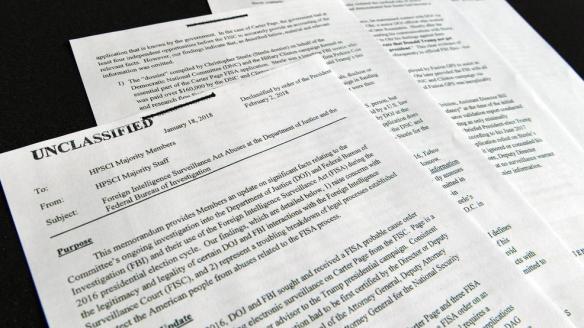
The Foreign Intelligence Surveillance Act (FISA) created a system which determines when the federal government may spy on anyone suspected of acting on behalf of a foreign agent. FISA set up a rubber stamp kangaroo court with only a handful of warrants being rejected in the forty year history of this law.

FISA authority was used to keep Donald Trump campaign adviser Carter Page under surveillance in 2016. Republicans claim that the warrant was granted as a result of the Christopher Steele opposition research dossier that was paid for by Hillary Clinton’s campaign. No one knows if this assertion is true, but the fight over declassifying the memo predictably turned into political theater. Republicans said the memo would end the suspicion of Trump collusion with the Russian government and Democrats asserted that the system would fall apart if the memo was ever declassified and released.

If Republicans are correct the FISA warrant was problematic and the case for collusion is tainted. Democrats now make the case for declassifying their own memo and continuing the foolish spectacle of irrelevance. Despite the drama, both assertions are beside the point. The larger and more important issue is that the American justice system is decidedly unjust.

Prosecutors are among the worst criminals in this country. From small towns to federal courthouses they wield power that few can circumvent. Rich people need not worry because they exist in a bubble with laws of their own making. Public officials bow down to them and happily violate statutes in order to keep them happy. It is all rotten and the case for and against Trump is an opportunity to discuss how few rights we have and how the system is rigged against all but the apex predators at the top of the food chain.

Instead of making the case for tearing up this monstrosity, otherwise intelligent people are pointing fingers and choosing one disreputable side over the other. Every Republican voted to extend the FISA program. They were joined by Democrats like Congressman Adam Schiff, who leads the case for collusion, and who has made a name for himself by stoking the Russiagate fire. Schiff cried the loudest against releasing the Republican memo and claimed that declassification would pose a threat to the nation. When he had the chance to do something for the judicial system he joined with the people he allegedly opposes and supported continuing the FISA travesty. Our individual rights are obviously of little concern to Schiff. Then again he is a former prosecutor so little can be expected of him in this regard.

Russiagate is a sinkhole of political confusion and that is precisely why it was created. It began with Hillary Clinton’s campaign, a lackluster effort meant to continue the neo-liberal agenda, make war, and do little else. She had nothing to offer voters and hung her hat on making Trump look like “Putin’s puppet.” Had she done a minimal effort there would have been no need for pay offs to British spies or whipped up Russophobia. The entire Democratic Party was complicit in the debacle and they welcomed a tale of collusion in order to deflect the blame they so richly deserved.

The sorry spectacle continues as Republicans are equally determined to keep Trump in office and make their dreams of kleptocracy and diminished governmental authority a reality. Democrats are looking to explain away a string of electoral failures and maintain the illusion of being the inclusive party when they are merely shadows of the hard right Republicans.

Let all the memos be released. There should be no sanctity bestowed upon government secrets. They are a ruse meant to cover up for worldwide gangsterism. Defending the FBI, CIA, NSA or any of the other “intelligence community” agencies is to be a dupe of the highest order. Police in Baltimore and other cities may plant drugs and weapons on suspects, but the mega-killers lie about weapons in entire nations and cause death and suffering on a mass scale.

Sooner or later Russiagate will play out. Whatever the result, this country will still be the one that locks up more of its people than any other. It will still be a threat to world peace. When the wheels of injustice grind on, only fools will have chosen between the two corrupt parties.


Margaret Kimberley’s Freedom Rider column appears weekly in BAR, and is widely reprinted elsewhere. She maintains a frequently updated blog as well as at freedomrider.blogspot.com. Ms. Kimberley lives in New York City, and can be reached via e-Mail at Margaret.Kimberley(at)BlackAgendaReport.com.

Biggest Nunes Memo Revelations Have Little To Do With Its Content

By Caitlin Johnstone

Source: Consortium News

It’s fitting that the ever-tightening repetitive loops of America’s increasingly schizophrenic partisan warfare finally hit peak shrillness and skyrocketed into a white noise singularity on Groundhog Day. Right now, we’re right about at the part of the movie where Bill Murray is driving over a cliff in a pickup truck with a large rodent behind the wheel.

If you only just started paying attention to U.S. politics in 2017 what I’m about to tell you will blow your mind, so you might want to sit down for this: believe it or not, there was once a time when both of America’s mainstream political parties weren’t screeching every single day that there was news about to break any minute now which would obliterate the other party forever. No Russiagate, no Nunes memo, no Rachel Maddow red yarn graphs, no Sean Hannity “tick tock,” no nothing. People screaming that the end is nigh and it’s all about to come crashing down were relegated to street corners and the occasional Infowars appearance, not practicing mainstream political punditry for multimillion dollar salaries on MSNBC and Fox News.

I’m not saying it’s a bad thing that Americans are starting to look critically at the power dynamics in their country, but the partisan filters they’ve pulled over their eyes are causing mass confusion and delusion. Now everyone who questions the CIA is a Russian agent and the term “deep state” suddenly means “literally anyone who doesn’t like Donald Trump.” Your take on the contents of the Nunes memo will put you in one of two radically different political dimensions depending on which mainstream cult you’ve subscribed to, and it will cause you to completely miss the point of the entire ordeal.

The part of the memo that has everyone talking today reads as follows: “Furthermore, Deputy Director McCabe testified before the Committee in December 2017 that no surveillance warrant would have been sought from the FISC without the Steele dossier information.”

This refers to a surveillance warrant requested by the FBI’s then-Deputy Director Andrew McCabe from the Foreign Intelligence Surveillance Court seeking permission to spy on the communications of Carter Page, a member of the 2016 Trump campaign. The controversy revolves around the claim that this surveillance warrant would never have even been requested if not for the clearly biased, Clinton-funded, and error-riddled Christopher Steele dossier which is acknowledged even by its former MI6 author to be 10 to 30 percent inaccurate.

Combine that with the fact that this has never been made clear to the public, and baby you’ve got yourself a scandal. The FBI knowingly using extremely tainted evidence from one presidential campaign to get permission to spy on another would indeed be a very big deal.

There are some problems with the “BOOM! Bigger than Watergate!” exclamations that pro-Trump partisans have been parading around about this, however. The first is that the memo is only an internal communication between Republican congressmen; it’s not a sworn testimony or legal transcript or anything legally binding. It’s basically just some Republican ideas about what happened. The assertions made therein are reportedly being hotly contested by Democrats with knowledge of the situation, which is in turn being disputed by Republicans.

Another thing putting a damper on the GOP’s “KABOOM!” parade is the fact that the memo’s contents are not even entirely new; CNN reported way back in April of last year that sources had informed them that the Steele dossier had been used to get a FISA warrant on the Trump campaign. Additionally, even if every single allegation in the memo is true, the revelations are still arguably far less earth shattering than the Edward Snowden revelations of 2013 exposing the NSA’s sprawling domestic espionage network, so the expectation that these less significant new revelations would cause a radical transformation in U.S. politics when the Snowden revelations did not seems highly unrealistic.

Nonetheless, there have been some extremely important revelations as a result of this memo; they just haven’t come from the contents of the memo itself. In the same way that cybersecurity analysts observe the metadata underlying hacked files rather than the contents of the files themselves, political analysts have been pointing out that a lot can be learned about the political establishment by looking at its response to the possibility of the memo’s release.

“Memo is clearly not a blockbuster. We can tell so by reading it. Which makes Dems’ frantic efforts to prevent anyone from reading it seem even more bizarre,” observed TYT’s Michael Tracey. “Veracity of memo’s claims aside, we were told that its release would undermine the rule of law. So, just checking: is the rule of law still in tact?” he added later.

“Now it is clear to all,” WikiLeaks’ Julian Assange tweeted. “The claims about how the ‘Nunes’ memo would destroy ‘national security’ were lies. Classification stickers are used by bureaucrats trying to obtain ‘political security’ for their cronies.”

“One effect of the memo – it’s an example of how extensively we overclassify information,” wrote National Review’s David French. “I’m highly dubious that any information disclosed threatens national security in any way, shape, or form. I’d be willing to bet the Dem response is similarly harmless. Release it.”

Indeed, both the FBI and high-profile Democrats have been claiming that the memo’s unredacted release would pose a national security threat, with California Congressman (and virulent Russiagater) Eric Swalwell going so far to call it “brainwashing.” A CNN panelist wandered completely off the paddock and suggested that yesterday may have been America’s last day as a democracy. Why were they all flipping out so hysterically over a release of information that plainly poses no threat to the American people?

In addition to Assange’s assertion that government secrecy has far less to do with national security than political security (a claim he has made before which seems to be proving correct time and time again), there’s the jarring question posed by Republican Congressman Thomas Massie: “who made the decision to withhold evidence of FISA abuse until after Congress voted to renew FISA program?”

Whoa, Nelly. Hang on. What is he talking about?

It would be understandable if you were unaware of the debate over the reauthorization of FISA surveillance which resulted in unconditional bipartisan approval last month – the mainstream media barely touched it. In point of fact, though, the very surveillance practices alleged to have been abused in this hotly controversial memo are the same which was waved through by both the House and the Senate, and by the very same people promoting the memo in many cases.

The McCabe testimony was in December. FISA was renewed in January. Why is all this just coming out now? If the Republicans truly believed that McCabe said what the memo claims he said, why wasn’t the public informed before their elected representatives renewed the intelligence community’s dangerously intrusive surveillance approval? Was this information simply forgotten about until after those Orwellian powers had been secured?

Of course not. Don’t be an idiot.

This makes the kicking, screaming, wailing and gnashing of teeth by the political establishment make a lot more sense, doesn’t it? Now suddenly we’re looking at a he-said, she-said partisan battle over an issue which can only be resolved with greater and greater transparency of more and more government documents, and we can all see where that’s headed. In their rush to win a partisan battle and shield their president from the ongoing Russiagate conspiracy theory, the Republicans may have exposed too much of the establishment foundation upon which both parties are built.

The term “deep state” does not mean “Democrats and Never-Trumpers” as Republican pundits would have you believe, nor does the term refer to any kind of weird, unverifiable conspiracy theory. The deep state is in fact not a conspiracy theory at all, but simply a concept used in political analysis for discussing the undeniable fact that unelected power structures exist in America, and that they tend to form alliances and work together in some sense.

There is no denying the fact that plutocrats, intelligence agencies, defense agencies and the mass media are both powerful and unelected, and there is no denying the fact that there are many convoluted and often conflicting alliances between them. All that can be debated is the manner and extent to which this is happening.

The deep state is America’s permanent government, the U.S. power structures that Americans don’t elect. These power structures plainly have a vested interest in keeping America’s Orwellian surveillance structures in place, as evidenced by the intelligence community’s menacingly urgent demand for FISA renewal back in December. If there’s any thread to be pulled that really could make waves in the way Official Washington (hat tip to the late Robert Parry) operates, it is in the plot holes between the bipartisan scramble toward unconditional surveillance renewal and the highly partisan battle over exposing the abuse of those very powers.

If we’re going to see a gap in the bars of our cages, that’s a great place to keep our eyes trained, so keep watching. Watch what happens in a partisan war where both parties have a simultaneous interest in revealing as little of the game as possible and exposing the other party. Things could get very interesting.

Gaius Publius: Defining Neoliberalism

By Yves Smith

Source: Naked Capitalism

For years I’ve been using the term “neoliberalism” (or sometimes neo-liberalism*) and I’m always uncomfortable, since it sounds so academic. So I usually add one-phrase definitions and move on. For example, this from a recent piece on Puerto Rico:

If neoliberalism is the belief that the proper role of government is to enrich the rich — in Democratic circles they call it “wealth creation” to hide the recipients; Republicans are much more blatant — then the “shock doctrine” is its action plan.

That’s sounds pretty blunt, but it’s a true statement, even among academics. See this great interview (start at about 6:15) with Professor Philip Miroski of the University of Notre Dame on how modern neoliberals have come to see the role of government in society. It’s weedy but excellent.

I want to offer our readers a better description of neoliberalism though, yet not get into too many weeds. So consider these excerpts from a longer Guardian essay by the British writer George Monbiot. (My thanks to Naked Capitalism commenter nonclassical for the link and the idea for this piece.)

Neoliberalism — The Invisible Water the West Is Swimming In

We’ll start with Monbiot’s brief intro, just to set the scope of the problem:

Imagine if the people of the Soviet Union had never heard of communism. The ideology that dominates our lives has, for most of us, no name. Mention it in conversation and you’ll be rewarded with a shrug. Even if your listeners have heard the term before, they will struggle to define it. Neoliberalism: do you know what it is?

Ask people to define “neoliberalism,” even if they’ve heard of it, and almost no one can. Yet the comparison of our governing ideology to that of the Soviet Union’s is a good one — like “communism,” or the Soviet Union’s version of it, neoliberalism defines and controls almost everything our government does, no matter which party is in office.

The Birth of Neoliberalism

What is neoliberalism and where did it come from? Monbiot writes:

The term neoliberalism was coined at a meeting in Paris in 1938. Among the delegates were two men who came to define the ideology, Ludwig von Mises and Friedrich Hayek. Both exiles from Austria, they saw social democracy, exemplified by Franklin Roosevelt’s New Deal and the gradual development of Britain’s welfare state, as manifestations of a collectivism that occupied the same spectrum as nazism and communism.

Neoliberalism is an explicit reaction to Franklin Roosevelt and the welfare state, which by a quirk of history was called “liberalism” at the time, even though, in the nineteenth century, “liberalism” had roughly the same meaning that “neoliberalism” has today. In other words, “FDR liberalism” is in many ways the opposite of classical “liberalism,” which meant “liberty (freedom) from government,” and a quirk of history has confused these terms.

Back to Monbiot and Hayek:

In The Road to Serfdom, published in 1944, Hayek argued that government planning, by crushing individualism, would lead inexorably to totalitarian control. Like Mises’s book Bureaucracy, The Road to Serfdom was widely read. It came to the attention of some very wealthy people, who saw in the philosophy an opportunity to free themselves from regulation and tax. When, in 1947, Hayek founded the first organisation that would spread the doctrine of neoliberalism – the Mont Pelerin Society – it was supported financially by millionaires and their foundations.

With their help, he began to create what Daniel Stedman Jones describes in Masters of the Universe as “a kind of neoliberal international” [a term modeled on “the Communist International]: a transatlantic network of academics, businessmen, journalists and activists. The movement’s rich backers funded a series of thinktanks which would refine and promote the ideology. Among them were the American Enterprise Institute, the Heritage Foundation, the Cato Institute, the Institute of Economic Affairs, the Centre for Policy Studies and the Adam Smith Institute. They also financed academic positions and departments, particularly at the universities of Chicago and Virginia.

As it evolved, neoliberalism became more strident. Hayek’s view that governments should regulate competition to prevent monopolies from forming gave way – among American apostles such as Milton Friedman – to the belief that monopoly power could be seen as a reward for efficiency.

Note the mention of Milton Friedman above. Neoliberalism is a bipartisan ideology, not just a Clintonist-Obamist one.

Democrats, Republicans and Neoliberalism

As Monbiot explains, for a while neoliberalism “lost its name” and was more or less a fringe ideology in a world still dominated by the ideas of John Maynard Keynes and Keynesian economics. When neoliberalism later came back strong in the Republican Party, it wasn’t called “neoliberalism” but “Milton Friedman free market conservativism,” or something similar.

Only when Bill Clinton and his Democratic Party allies adopted it in the 1980s did the term “neoliberal” re-emerge in public discourse.

[I]n the 1970s, when Keynesian policies began to fall apart and economic crises struck on both sides of the Atlantic, neoliberal ideas began to enter the mainstream. As Friedman remarked, “when the time came that you had to change … there was an alternative ready there to be picked up”. With the help of sympathetic journalists and political advisers, elements of neoliberalism, especially its prescriptions for monetary policy, were adopted by Jimmy Carter’s administration in the US and Jim Callaghan’s government in Britain.

After Margaret Thatcher and Ronald Reagan took power, the rest of the package soon followed: massive tax cuts for the rich, the crushing of trade unions, deregulation, privatisation, outsourcing and competition in public services. Through the IMF, the World Bank, the Maastricht treaty and the World Trade Organisation, neoliberal policies were imposed – often without democratic consent – on much of the world. Most remarkable was its adoption among parties that once belonged to the left: Labour and the Democrats, for example. [emphasis added]

Note the role of Jimmy Carter and start of deregulation in the late 1970s. For that reason, many consider Jimmy Carter to be the “proto-neoliberal,” both for the nation and the Democratic Party.

Neoliberalism — “Just Deserts” for Predators and Prey

What makes “neoliberalism” or “free market conservatism” such a radical — and destructive — ideology? It reduces all human activity to economic competition. It creates and glorifies, in other words, a world of predators and prey, a world like the one we live in as today:

Neoliberalism sees competition as the defining characteristic of human relations. It redefines citizens as consumers, whose democratic choices are best exercised by buying and selling, a process that rewards merit and punishes inefficiency. It maintains that “the market” delivers benefits that could never be achieved by planning.

In a world where competition is right and good, a world in which the “market” is the defining metaphor for human activity, all social ties are broken, the individual is an atom left to survive as an individual only, the strongest relentlessly consume the weakest — and that’s as it should be. (It’s easy to imagine how the apex predators of our social order would be attracted to this, and insist on it with force.

Thus the bipartisan world we live in today. Under a neoliberal regime, everyone gets what they deserve. Big fish deserve their meal. Little fish deserve their death. And government sets the table for the feast.

The Role of Government in a Neoliberal World

Since for neoliberals, the “market” is the source of all that is good in human interaction, non-interference in “the market” is rule one for government.

Over time that has changed, however, as winners have grown more successful and their control of government more absolute. The proper role of government in today’s neoliberal regime is not merely to allow the market to operate for the benefit of wealth-holders; it’s to make sure the market operates for the benefit of wealth-holders.

In other words, the role of government is to intervene in the market on behalf of wealth-holders, or, as I put it more colloquially, to proactively enrich the rich. The interview with Professor Mirowski, as I noted above, makes that same point, but from an academic standpoint.

From this it should be also clear that until we free ourselves of rule by neoliberals and the pain and misery they create, we’ll always be victims to the predatory giants — the very very wealthy and the corporations they use as power-extenders — those, in other words, who want merely to own everything else in the world.

This means we need to free ourselves from neoliberals in both parties, not just the ones in current seats of power. But that idea seems to have been excised from most discussions these days. Fair warning though. If the Age of Trump ends with the Restoration of Mainstream Democrats, we’ll have won almost nothing at all.

____________

* I sometimes spell “neo-liberalism” with the hyphen to suggest the following connection: Neo-liberalism is “new liberalism,” and has the same relationship to FDR liberalism as New Labour has to Labour — the two are exactly opposite.