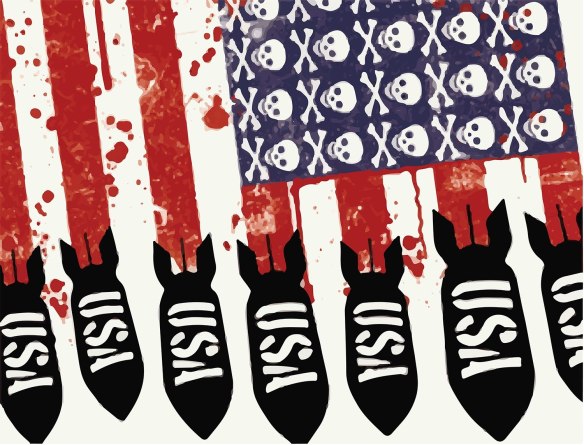
Why America’s Major News-Media Must Change Their Thinking

By Eric Zuesse

Source: Strategic Culture Foundation

America’s ‘news’-media possess the mentality that characterizes a dictatorship, not a democracy. This will be documented in the linked-to empirical data which will be subsequently discussed. But, first, here is what will be documented by those data, and which will make sense of these data:

In a democracy, the public perceive their country to be improving, in accord with that nation’s values and priorities. Consequently, they trust their government, and especially they approve of the job-performance of their nation’s leader. In a dictatorship, they don’t. In a dictatorship, the government doesn’t really represent them, at all. It represents the rulers, typically a national oligarchy, an aristocracy of the richest 0.1% or even of only the richest 0.01%. No matter how much the government ‘represents’ the public in law (or “on paper”), it’s not representing them in reality; and, so, the public don’t trust their government, and the public’s job-rating of their national leader, the head-of-state, is poor, perhaps even more disapproval than approval. So, whereas in a democracy, the public widely approve of both the government and the head-of-state; in a dictatorship, they don’t.

In a dictatorship, the ‘news’-media hide reality from the public, in order to serve the government — not the public. But the quality of government that the regime delivers to its public cannot be hidden as the lies continually pile up, and as the promises remain unfulfilled, and as the public find that despite all of the rosy promises, things are no better than before, or are even becoming worse. Trust in such a government falls, no matter how much the government lies and its media hide the fact that it has been lying. Though a ‘democratic’ election might not retain in power the same leaders, it retains in power the same regime (be it the richest 0.1%, or the richest 0.01%, or The Party, or whatever the dictatorship happens to be). That’s because it’s a dictatorship: it represents the same elite of power-holding insiders, no matter what. It does not represent the public. That elite — whatever it is — is referred to as the “Deep State,” and the same Deep State can control more than one country, in which case there is an empire, which nominally is headed by the head-of-state of its leading country (this used to be called an “Emperor”), but which actually consists of an alliance between the aristocracies within all these countries; and, sometimes, the nominal leading country is actually being led, in its foreign policies, by wealthier aristocrats in the supposedly vassal nations. But no empire can be a democracy, because the residents in no country want to be governed by any foreign power: the public, in every land, want their nation to be free — they want democracy, no dictatorship at all, especially no dictatorship from abroad.

In order for the elite to change, a revolution is required, even if it’s only to a different elite, instead of to a democracy. So, if there is no revolution, then certainly it’s the same dictatorship as before. The elite has changed (and this happens at least as often as generations change), but the dictatorship has not. And in order to change from a dictatorship to a democracy, a revolution also is required, but it will have to be a revolution that totally removes from power the elite (and all their agents) who had been ruling. If this elite had been the nation’s billionaires and its centi-millionaires who had also been billionaire-class donors to political campaigns (such as has been proven to be the case in the United States), then those people, who until the revolution had been behind the scenes producing the bad government, need to be dispossessed of their assets, because their assets were being used as their weapons against the public, and those weapons need (if there is to be a democracy) to be transferred to the public as represented by the new and authentically democratic government. If instead the elite had been a party, then all of those individuals need to be banned from every sort of political activity in the future. But, in either case, there will need to be a new constitution, and a consequent new body of laws, because the old order (the dictatorship) no longer reigns — it’s no longer in force after a revolution. That’s what “revolution” means. It doesn’t necessarily mean “democratic,” but sometimes it does produce a democracy where there wasn’t one before. The idea that every revolution is democratic is ridiculous, though it’s often assumed in ‘news’-reports. In fact, coups (which the U.S. Government specializes in like no other) often are a revolution that replaces a democracy by a dictatorship (such as the U.S. Government did to Ukraine in 2014, for example, and most famously before that, did to Iran in 1953). (Any country that perpetrates a coup anywhere is a dictatorship over the residents there, just the same as is the case when any invasion and occupation of a country are perpetrated upon a country. The imposed stooges are stooges, just the same. No country that imposes coups and/or invasions/occupations upon any government that has not posed an existential threat against the residents of that perpetrating country, supports democracy; to the exact contrary, that country unjustifiably imposes dictatorships; it spreads its own dictatorship, which is of the imperialistic type, and any government that spreads its dictatorship is evil and needs to be replaced — revolution is certainly justified there.)

This is how to identify which countries are democracies, and which ones are not: In a democracy, the public are served by the government, and thus are experiencing improvement in their lives and consequently approve of the job-performance of their head-of-state, and they trust the government. But in a dictatorship, none of these things is true.

In 2014, a Japanese international marketing-research firm polled citizens in each of ten countries asking whether they approve or disapprove of the job-performance of their nation’s head-of-state, and Harvard then provided an English-translated version online for a few years, then eliminated that translation from its website; but, fortunately, the translation had been web-archived and so is permanent here (with no information however regarding methodology or sampling); and it shows the following percentages who approved of the job-performance of their President or other head-of-state in each of the given countries, at that time:

China (Xi)          90%

Russia (Putin)      87%

India (Modi)        86%

South Africa (Zuma) 70%

Germany (Merkel)    67%

Brazil (Roussef)    63%

U.S. (Obama)        62%

Japan (Abe)         60%

UK (Cameron)        55%

France (Hollande)   48%

In January 2018, the global PR firm Edelman came out with the latest in their annual series of scientifically polled surveys in more than two dozen countries throughout the world, tapping into, actually, some of the major criteria within each nation indicating whether or not the given nation is more toward the dictatorship model, or more toward the democracy model. The 2018 Edelman Trust Barometer survey showed that “Trust in Government” (scored and ranked on page 39) was 44% in Russia, and is only 33% in the United States. Trust in Government is the highest in China: 84%. The U.S. and Russia are the nuclear super-powers; and the U.S. and China are the two economic super-powers; so, these are the world’s three leading powers; and, on that single measure of whether or not a country is democratic, China is the global leader (#1 of 28), Russia is in the middle (#13 of 28), and U.S. ranks at the bottom of the three, and near the bottom of the entire lot (#21 of 28). (#28 of 28 is South Africa, which, thus — clearly in retrospect — had a failed revolution when it transitioned out of its apartheid dictatorship. That’s just a fact, which cannot reasonably be denied, given this extreme finding. Though the nation’s leader, Zuma, was, according to the 2014 Japanese study, widely approved by South Africans, his Government was overwhelmingly distrusted. This distrust indicates that the public don’t believe that the head-of-state actually represents the Government. If the head-of-state doesn’t represent the Government, the country cannot possibly be a democracy: the leader might represent the people, but the Government doesn’t.)

When the government is trusted but the head-of-state is not, or vice-versa, there cannot be a functioning democracy. In other words: if either the head-of-state, or the Government, is widely distrusted, there’s a dictatorship at that time, and the only real question regarding it, is: What type of dictatorship is this?

These figures — the numbers reported here — contradict the ordinary propaganda; and, so, Edelman’s trust-barometer on each nation’s ‘news’-media (which are scored and ranked on page 40) might also be considered, because the natural question now is whether unreliable news-media might have caused this counter-intuitive (in Western countries) rank-order. However, a major reason why this media-trust-question is actually of only dubious relevance to whether or not the given nation is a democracy, is that to assume that it is, presumes that trust in the government can be that easily manipulated — it actually can’t. Media and PR can’t do that; they can’t achieve it. Here is a widespread misconception: Trust in government results not from the media but from a government’s having fulfilled its promises, and from the public’s experiencing and seeing all around themselves that they clearly have been fulfilled; and lying ‘news’-media can’t cover-up that reality, which is constantly and directly being experienced by the public.

However, even if trust in the ‘news’-media isn’t really such a thing as might be commonly hypothesized regarding trust in the government, here are those Edelman findings regarding the media, for whatever they’re worth regarding the question of democracy-versus-dictatorship: Trust in Media is the highest, #1, in China, 71%; and is 42% in #15 U.S.; and is 35% in #20 Russia. (A July 2017 Marist poll however found that only 30% of Americans trust the media. That’s a stunning 12% lower than the Edelman survey found.) In other words: Chinese people experience that what they encounter in their news-media becomes borne-out in retrospect as having been true, but only half of that percentage of Russians experience this; and U.S. scores nearer to Russia than to China on this matter. (Interestingly, Turkey, which scores #7 on trust-in-government, scores #28 on trust-in-media. Evidently, Turks find that their government delivers well on its promises, but that their ‘news’-media often deceive them. A contrast this extreme within the Edelman findings is unique. Turkey is a special case, regarding this.)

I have elsewhere reported regarding other key findings in that 2018 Edelman study.

According to all of these empirical findings, the United States is clearly not more of a democracy than it is a dictatorship. This particular finding from these studies has already been overwhelmingly (and even more so) confirmed in the world’s only in-depth empirical scientific study of whether or not a given country is or is not a “democracy”: This study (the classic Gilens and Page study) found, incontrovertibly, that the U.S. is a dictatorship — specifically an aristocracy, otherwise commonly called an “oligarchy,” and that it’s specifically a dictatorship by the richest, against the public.

Consequently, whenever the U.S. Government argues that it intends to “spread democracy” (such as it claims in regards to Syria, and to Ukraine), it is most-flagrantly lying — and any ‘news’-medium that reports such a claim without documenting (such as by linking to this article) its clear and already-proven falsehood (which is more fully documented here than has yet been done anywhere, since the Gilens and Page study is here being further proven by these international data), is no real ‘news’-medium at all, but is, instead, a propaganda-vehicle for the U.S. Government, a propaganda-arm of a dictatorship — a nation that has been overwhelmingly proven to be a dictatorship, not a democracy.

America’s Descent Into Despotism: Finding Our Source of Power Within

By Nozomi Hayase

Source: The Indicter

The United States is in a major upheaval. Trump’s cabinet shake-up moves the country into an alarming direction. From the nomination of torturer Gina Haspel as the head of the Central Intelligence Agency to Mike Pompeo, former CIA Director and a vocal opponent of the nuclear deal with Iran as new secretary of state, his selection exposes the White House’s dangerous kill instincts.

An ultimatum came with the president’s appointment of John Bolton, the former American ambassador to the United Nations as his 3rd national security advisor. Bolton,  who served in the George W. Bush administration is notorious for his hawkishness, with a great zeal for military action against Iran and North Korea. This rearranging of the deck chairs in the sinking empire signals the great calamity of foreign policy ahead with potential threats of war.

In this seeming free-fall toward despotism, what can ordinary people do? Tackling corruption of our political system and averting a doomed future requires us to truly understand the problems we are facing. The crisis of representation didn’t just arise with Trump, the new commander in chief. A glimpse of it was shown during the 2008 financial meltdown, which was covered up swiftly by bank bailouts and politics of ‘hope and change’. The truth is that seeds for dystopia have been inside this country all along. The roots of the issues that are now emerging in Trump’s America go back to the very beginning of this nation.

In its modern formation, the United States inspired the world with its torch of liberty and equality. At the same time, this beacon of light had its darkness within. From the onset, America contained internal contradictions manifested as the founder’s hypocrisy and the violation of its own ideals with genocide of natives, slavery of blacks and suppression of women. The Founding Fathers of the United States brought a victory of rejecting the power of the King’s monarchy and pioneered a path for one’s own self-determination. The concept of “a government of laws, not of men” was groundbreaking at that time. Yet without reconciling its own shadow, this nation of law failed to fully shield the republic from the tyranny of the Old World.

Supremacy of reason

The unredeemed darkness found in America’s troubled past was a force inside Western civilization that tries to define history, subjugating other perspectives to its single vision. Europe, with its ethos of separation and objectivity set out to conquer the world, spreading its influence across many continents. This domineering power of reason found its new front of exploration in the New World.

America, driven by the monotheistic goal of Manifest Destiny, expanded its territory with brutality. It swallowed what is edible, assimilating immigrants one by one to its conception of what is civil, while spitting out those that it considered impalatable, relegating them into three-fifths of a person or exterminating them from the earth altogether as savages.

This maddened head centricity was manifested in the structure of a new government. Sheldon Wolin, author of Democracy Inc noted how the framers of the Constitution created a so-called managed democracy, a system that favored elite rule and that “the American political system was not born a democracy, but born with a bias against democracy” (2008, p. 228).

The intellectual elites regarded the democratic majority rule as an irrational force and they feared the tyranny of popular majorities. While the faculty of reason positioned itself as a supreme force, a potential to account its autocratic power was found inside America.

The sovereign power of We the People

Expressed in the preamble of the Constitution “We the People” was faith in the wisdom of ordinary people to govern themselves. This was an intention to shift from the model of government that acts as authority of their lives to one that places power in the hands of ordinary people. In this government established under the rule of the people, the source of legitimacy was not derived from a god or king, but was meant to come from people themselves.

This arrangement of governance was not granted from above. It was first demanded by those who opposed the ratification of the 1787 Constitution that lacked the guarantee of individual liberties. The proponents of the Bill of Rights articulated essential parts of the sovereign power of We the People as a freedom of expression; freedom of speech, religion, assembly and the right to petition the government for a redress of grievances. By building upon First Amendment rights, further efforts emerged from below. From abolitionists’ defiance and the women’s suffrage movement to civil rights and free speech movements, people’s determination for individual autonomy persisted.

Assault on this power of ordinary people intensified with the rise of corporate power in the ‘60s. Manifest Destiny is now carried out with Nike’s slogan of “just do it”. With limited liability and having no human beings in charge, the abstraction of the head inside transnational corporations took flight from the communal ground, plundering their way into the globe, without ever having to take responsibility for the consequences of their actions. Giant corporations became a sponsor for this managed democracy, gaining control over media to manipulate public perception, keeping American voters in hostage with the lesser of the two evils charade politics.

WikiLeaks, the rise of cryptographic direct action

In the political winter of the post-911 war on terror, as fear and apathy spread around the globe, a new civic force surfaced online. The waves of whistleblowers began shedding light on the collaborative secrecy of elites that deceive and manipulate the public behind a façade of democracy.

WikiLeaks, with its motto of “privacy for the weak and transparency for the powerful”, opened a floodgate of a free flow of information. This world’s first global Fourth Estate embodies the philosophy of cypherpunks– a loosely tied group of online privacy advocates who saw the potential of cryptography to shift the balance of power between individuals and the state. With the idea that cryptography is the “ultimate form of non-violent direct action” (2012, p. 5), WikiLeaks founder and editor in chief Julian Assange built the system of scientific journalism that would give everyday people around the world tools to combat military might and confront the madness of fallen reason that censors free speech.

The invention of the anonymous drop box was truly revolutionary. It enabled anyone to send information securely without a trace of his or her identity. Through the robust decentralized infrastructure built around this game changing technology, WikiLeaks was able to provide unprecedented source protection in the history of journalism. Here, the organization that derived its source of inspiration in American founding ideas, freed the First Amendment that had been captured through a corporate monopoly and co-optation of the media, making it available to people all around the world.

It is through WikiLeaks’ adamant commitment to the principle of free press that former U.S. Army intelligence analyst and whistleblower Chelsea Manning was able to exercise uncompromising free speech and engage in the American tradition of civil disobedience. Manning, whom the late attorney and President Emeritus of the Center for Constitutional Rights, Michael Ratner described as the “conscience of our nation”, let the American public see the US imperialism in action in the Middle East.

In her request for a presidential pardon, Manning stated her commitment to the ideal of America, saying how she was willing to pay the price if it would make this country be “truly conceived in liberty and dedicated to the proposition that all women and men are created equal.” Through her non-violent cryptographic direct action, she helped America find its conscience.

One individual’s act of courage brought another. Inspired by Manning, Edward Snowden came forward to inform people about the NSA’s mass surveillance. In one of the addresses he made, Snowden also described his act as a public service and connected it with Dr. King’s non-violent civil disobedience. Through his whistleblowing, the former NSA contractor defended individual privacy as fundamental civil rights for all people and tried to preserve the world where people can share creativity, love and friendship freely without every conversation and interaction being monitored and recorded.

Whistleblowers and their faith in ordinary people

From WikiLeaks disruptions to Snowden revelations, courageous act of truth-tellers renewed the faith in the wisdom of ordinary people to govern themselves. Both Manning and Snowden believed in the public’s right to know and held a view that when people are informed, they can make changes and determine their own destiny.

Faith is different than mere belief. It is not about one blindly trusting or passively accepting something. Faith is an active will that requires one to choose out of themselves to believe in something. When established media and trusted institutions failed, Manning chose to put her trust in the journalistic organization that was little known at that time. When the government’s internal mechanisms of accountability were broken, combined with the betrayal of Obama’s campaign promises and his war on whistleblowers, Snowden turned to American journalists whom he could trust by his own judgment of the integrity of their work. They placed faith not in political leaders or authority but in fellow men and women.

It is to this faith in the ability for the wise and knowledgeable public to govern themselves that fearless journalism responded. WikiLeaks, the publisher of last resort kept its promise to the source by publishing full archives with maximum political impact and bringing information back to the historical record. Through honoring Snowden’s wishes, journalists Glenn Greenwald, Laura Poitras and Barton Gellman broke the story of NSA surveillance and led the Guardian’s independent journalism, making the established media fulfill its duty. In the aftermath of Snowden’s disclosures, when this young whistleblower was stranded in Hong Kong, WikiLeaks demonstrated its extraordinary source protection with journalist Sarah Harrison risking her own liberty to help Snowden attain asylum.

With this faith given by peers, citizens around the world who have been distrusted by their own governments and made powerless began to claim their own power. By recognizing that someone believed in them and sacrificed their lives so that they can be free, they were able to believe in their own ability to protect those they love and preserve rights that they cherish. The will to respond to this faith in one another awakened love for one’s neighbor. This made it possible for ordinary people to carry out extraordinary acts, to choose paths that do not lead to financial success, fame and security, but one of scourging, persecution and punishment.

Manning was sentenced to prison for 35 years, initially being held in a cage in Kuwait and then being put in a tiny cell in solitary confinement. Snowden remains in exile, being called for execution by the president and his new nominee for the secretary of state, Mike Pompeo. WikiLeaks has been declared an enemy of the state by the most powerful government in the world, being subjected to legal and extra-legal pressure. Unconstitutional secret U.S. Grand Jury investigation against WikiLeaks and its staff continues, keeping its founder in long years of arbitrary detention in the Ecuadorian embassy in London in violation of the UN ruling. Now, threats of a free press increase with Trump’s Department of Justice stating the arrest of the Assange is a “priority” and the former CIA chief calling the whistleblowing site a “hostile intelligence service”.

Bitcoin, Innovation without Permission

Contagious courage lit by people’s faith created a fellowship that can withstand the state violence. It began to shift the balance of power, replacing the source of legitimacy from trusted institutions to ordinary people’s trust in one another. As the network of resistance grew, new attacks emerged. Following the release of U.S. diplomatic cables in 2010, WikiLeaks faced the unlawful financial blockade imposed by Bank of America, VISA, MasterCard, PayPal and Western Union. When this economic sanction starved the whistleblowing site, destroying 95% of their revenue, the flow of autonomy that helped the organization circumvent economic censorship came from fellow cypherpunks.

Bitcoin, as a peer-to-peer electronic cash was the holy grail of cypherpunks. With its defining feature of censorship resistance and permissionlessness, Bitcoin makes free speech an app that can be distributed across borders and used by anyone regardless of nationality, religion, race, gender or economic status. Here, imagination from computer science redeemed the reason that lost its connection to the heart, by synthesizing bits of isolated knowledge that had created separation and injustice, transforming them into a higher order of unification.

Networks of equal peers emerging around this invention opened up a new avenue of dissent in a form of decentralization. Adam Back, notable cryptographer whose work was cited in the Bitcoin white paper, described cypherpunks as “a state of mind” and explained its philosophy of “writing code” as a “proactive approach to societal change by doing: building and deploying tech – rather than by lobbying politicians or asking permission.”

This path toward decentralization was first taken by the creator of this technology. The anonymity of Satoshi Nakamoto represents the power of ordinary people. Through an act of publishing the white paper under a pseudonymous name and making the protocol open source, the mysterious author gave up ownership and simultaneously gave users control of the software, making it possible for each individual to use it as a tool to govern themselves.

What is enshrined in a piece of mathematics is wisdom of ordinary people that understands that man is corruptible, as well as perfectible and recognizes the security holes inherent in the existing model of governance that requires trust in third parties. It is the wisdom of history that teaches us how the best way to secure the system is not to have levers of control in the first place through which power concentrates, leading to despotism. With a consensus algorithm placed as a foundation, laws can be built that is more immune to man’s fallen nature. With this, idea of a government of laws, not of men can be truly realized. Governance of We the People now becomes possible, where rules of law are validated by consensus of ordinary people as opposed to elected officials having power over them.

Andreas Antonopoulos, a technologist and one of the respected figures in Bitcoin, in his talk titled “Courage to Innovate”, captured new enthusiasm and passion ignited around this technology in a phrase “innovation without permission” and connected it with civil disobedience. He reminded the audience how “almost every important innovation in history starts out being illegal or unregulated” and interesting technology started out with people who forgot to ask permission. Describing technology’s core invention as a platform to scale trust, Antonopoulos described how this is a system that makes it possible for people to make social decisions without hierarchy, whether it is government bureaucracy, corporations or any other institution. This system Antonopoulos characterized as “rules without rulers” is being built by people around the world without central coordination.

Claiming our revolutionary spirit

Our Founding Fathers, no matter how imperfect they were, brought us ideas conceived in a revolutionary spirit. The genius of the Constitution is that it makes fundamental laws and principles of government amendable. The highest law of the land preserved space for people to not accept authority imposed on them and even to revolt against it when it is necessary, by giving ordinary people means to change rules. America indeed was founded on rebelliousness and distrust of their own government, demonstrated in the Declaration that reads “whenever any Form of Government becomes destructive… it is the Right of the People to alter or to abolish it, and institute a new Government…”

The government brought by our forebears not only allowed dissent, but depended on our rebellion. The realization of the Constitution as the fulfillment of ideals in the Declaration required individuals with a strong and independent mind. It demanded people to develop moral courage to defend these ideals against special interests of single groups or nations and any adversarial forces that try to deny them.

From the civil rights movement to whistleblowers at the frontier of digital liberation, we have seen the awakening of revolutionary spirit in people’s courageous civic action upholding the ideals of this country. The networks from below expands, converging together to build a new global civil society. Bitcoin developers around the world put their knowledge and skills together, making improvement proposals and fixing bugs, striving to meet the demands of all users.

Innovation without permission is enlivening entrepreneurship. Instead of waiting for problems to be solved by politicians or corporate CEOs, working class began to have faith in their ability to make changes, finding strength and resources within themselves. Around this currency, a new economy is now being bootstrapped, with startups and new businesses hiring people and providing them with skills and knowledge, while many other industries are stagnating.

Solutions to the crisis of representation are within us. Ordinary people, through freely associating with one another, can now give birth to the rule of a real democracy, securing Life, Liberty and the pursuit of Happiness for all.

America: The Country That Never Was!

By thnkfryrslf

Source: Axis of Logic

The ideal country. Democratic and Free. The greatest country in the world, because they’re exceptional.

Saves citizens of other countries from tyrannical governments by slaying the tyrants and bringing democracy and staying to make sure that democracy is implemented, no matter how long it takes. Always doing right by those citizens in need.

A beacon of liberty to the rest of the world. Saved the world by winning the 2nd world war. Its citizens always patriotically supporting the troops. The richest country on earth. All citizens are equal under the law. Economically, presents to its citizens every opportunity to succeed. A culture of endless opportunities.

Constantly reforming education for its people. Good God-fearing moral people, supported by a God-fearing, moral government. A benevolent people, whose benevolent government shows benevolence to the rest of the world. Respecting the freedom and sovereignty of all nations.

Generous loans given to poorer countries.

Good supportive and caring neighbour to its northern and southern neighbours.

Always warning its public and the rest of the world who the enemy of their stability and peace is and that this country of exceptional people will always defend them.

Admirer of those self-made creators of wealth. They are the true rugged individuals. Showing in Hollywood movies the heroism of their noble military. Accepting all races of people, it being one of their highest values.

An engaged citizenry always challenging its government to do better. Freedom of speech exercised by all, because they are a government of the people and by the people.

Citizens love of their country runs deep, shown by not having a need to travel much to other lesser countries. The MSM always helping the people to understand politics domestically and globally and how their government is constantly practicing democratic values at home and abroad.

The envy of the world for their wealth and freedom. A country who historically fought a civil war to abolish slavery and succeeded. A country that was essentially built by Europeans. A country whose heroic history is taught as an inspiration.

America, a brutal and savage killer, posing as a liberator and keeper of peace, is the country that does exist.

Time To Make Life Hard For The Rich

By Hamilton Nolan

Source: Splinter

It is time for polite, respectable, rational people to start saying what has become painfully obvious: It is time to stop respecting the rich, and start stealing from them. In earnest.

Inequality is eating America alive. It has been growing for decades. To say that “the American dream is dead” is no longer a poetic exaggeration—it is an accurate description of 40 years of wage stagnation and declining economic mobility that has produced a generation that cannot expect to live better than their parents did. Not because of devastating war or plague, but because of a very specific set of rules governing a very specific economic system that encourages the accumulation of great wealth among a tiny portion of the population, to the detriment of the vast majority of people. Our political and business leaders have chosen to embrace a system that favors capital over labor. A system in which the more you already have, the more you make, and the less you have, the harder it is to build wealth. It is a system designed to increase inequality. It is functioning exactly as designed. And now, it is about to get worse.

How long are people supposed to tolerate being smacked in the face? By the rich? Who already have more than enough? It is not as though the fact that inequality is a crisis is a fact that snuck up on anyone. Economists have seen the trend for decades, and the general public has been well aware of it since at least the financial crisis. Obama called it “the defining challenge of our time.” Thomas Piketty became a rock star by writing a very dry book about it. It’s not an underground thing. It is well known and well understood by the people in control of the institutions with the power to change it. The response to this dire situation by the Republican Party, which a wholly owned subsidiary of the American capital-holding class, has been to pass a tax bill that will horribly exacerbate economic inequality in this country. It is a considered decision to make a bad situation worse. It is a deliberate choice—during a time when the rich already have too much—to take from the poor in order to give the rich (including members of Congress and the President) more. That is not a metaphor. That is the reality. That is what the Republican party is about to accomplish on behalf of the donor class, calling it “middle class tax relief” in the face of mathematical proof to the contrary. Even to my cynical ass, the sheer fuck you-ness of this action towards the majority of the country is breathtaking. This is not just a failure to solve a severe problem; it is the expenditure of vast amounts of political capital to make the severe problem worse so that a tiny handful of people will get wealthier than anyone needs to be.

Ideally, in a democracy, elected leaders reflecting the interests of the people would pass taxes and regulations to reverse the growing inequality here. For that to happen, we would need to end gerrymandering and reform campaign finance and probably abolish the Senate and the Electoral College, and that’s just for starters. It is not imminent, in other words. Our broken political system, which is designed to reward money with political power, is actually moving in the opposite direction of a solution. Who is suffering because of this? Most Americans. Certainly the bottom 50% are acutely suffering—money that would have been in their paychecks has been instead funneled upwards into the pockets of the rich. Every desperate family that has found themselves coming up short for rent or food or medicine, every American who has downgraded her dreams and aspirations because they became financially implausible, has been directly harmed by the political and economic class war perpetuated by the rich, even if they cannot see the perpetrators with their own eyes. I think that people have been more than patient in the face of this slow-moving crisis. In 2009, when the markets crashed and millions were laid off, nobody rioted and kidnapped the financiers and burned their homes. The outcome of that lack of direct action is the situation we find ourselves in today.

Violence against people is morally wrong and a bad way to solve problems. But capital is different. One thing that would help to create the political environment conducive to solving the inequality problem would be to make the cost of accumulating all that capital too high to be worth it. In other words, to create a downside to being too rich. I have personally stood in a room full of hedge fund titans and billionaire investors warning one another explicitly that inequality must be addressed lest the U.S. become a place like Latin America, where rich people are forced to live behind walls, surrounded by armed guards, because of the very real risks from the rage of the poor. Rich people in this country do not want to live like that. If they see that they must stop being so greedy in order to enjoy their own freedom, they will stop being so greedy. Those conditions have to be created by people who want justice.

Our situation is absurd. Not since the Gilded Age has it been more clear that a few people have too much. Furthermore, the people with too much are investing in political clout to give themselves more. It’s just wrong. If the government won’t help, we have to help ourselves. Sticking up a billionaire on the street for $100 is not going to do it. But one can imagine other ways that angry Americans might express their dissatisfaction with our current division of wealth: A large-scale online attack against the holdings of the very rich; yachts sunk in harbors; unoccupied vacation homes in the Hamptons mysteriously burned to the ground. Sotheby’s auctions swarmed by vandals, Art Basel attacked by spraypaint-wielding mobs, protests on the doorsteps of right-wing think tanks, venomous words directed at millionaires as they dine in fancy restaurants. People have a right to life and safety, but property does not. A life spent screwing the little people so that you can acquire lots of stuff loses its allure when you know that all that stuff will be smashed to pieces by angry little people. It is not hard to put together a list of those who should be targeted—Forbes publishes it every year. Likewise, public campaign finance records give us a pretty good idea of exactly who is funding the politicians who are perpetuating this economic war on behalf of the rich.

It is nice to imagine a grand, well-targeted computer hack that would neatly transfer billions of dollars out of the accounts of, say, the Walton family and into a charity account that would disburse the money to the poor in untraceable ways. That seems far-fetched. Realistically, what people can do now is to start thinking about ways to make it uncomfortable to be too rich. Socially uncomfortable and otherwise. When the accumulation of great wealth ceases to be a praiseworthy endeavor and instead becomes viewed as a sick, greedy pastime whose only reward is the hatred of your fellow citizens and the inability to live comfortably without fear of your excessive property being destroyed, rich people will rethink their goals. Until then, inequality will keep rising, and everything, for most people, will continue to slowly, slowly get worse.

The Age of Ego

By Dan Corjescu

Source: CounterPunch

Hegel’s conception of history taught us that the meaning of history was the liberation of the individual through his or her recognition as a fully autonomous rational person.

Indeed, since the French Revolution, the Age of the Individual has expanded apace even if not always in a straight line.

Today, more than ever, our politics, economics, culture, and society are all, at least nominally, directed at the well being and full recognition of each and everyone of us.

If this is so, then why are so many people still frustrated and unhappy in their daily life?

In part, this state of affairs might be due to our neglecting of the second part of the Hegelian equation: the individual’s place and relationship to others mediated by the State.

The State, according to Hegel, is the representation of universal rationality. Put in another way, the state is the structure which allows individuals to be recognized as full individuals through their participation in it. Each and every individual has a role to play within the state. The fulfillment of that role satisfies our need for recognizing one another and the constant realization that we are not and cannot be just for ourselves but for each other.

A culture, such as ours, which celebrates the socially untethered individual is propagating a fundamental lie. Individuals cannot be fully realized without the cooperation of all other individuals; an essential activity which, in the modern world, is mediated by the state.

Yet, what is the state in the modern world? What has it become? Is it a universalist, rationalist tool for the realization of the greater good?

Certainly not.

Today, the modern state is a tool of elites to ensure their total domination and power over all other classes and groups. It does not matter if the state calls itself “democratic” or a “one party state”. In effect, all states today are “one party” states controlled by their respective elites who are often tied to one another transnationally. We are, all of us, under the thumb of a new global elite who dictates the nature of our social being. “Global Empire” is not an all too fanciful term for the present situation.

And like the Roman Empire before it, it is not a coincidence that many people are turning spiritually inward toward personalistic philosophies of self-help and care. Ironically, even the philosophy of ancient Stoicism is making somewhat of a comeback.

None of this is surprising.

The individual cannot be truly satisfied if he or she is not a participating and consequent member of a polity; of a state. The elites of this world have carefully and calculatedly castrated our social and economic potentialities to do so.

The root of our gnawing unhappiness in our brave new world is simply this: consequential inter-personal participation in the sphere of the political has been vanishing for decades. The ability to effect collective change from below has been diminishing. True collectivity has been consistently denied.

The disassociation of the individual from the polity; in effect the non-existence anywhere of true democracy has led to a hollowing out of the human personality. It is only in concrete social action that we materialize fully as human beings. It is as members of a community who are able to truly guide that community that we find a deep human purpose.

Once again, recalling Hegel and the Greeks before him, it is not enough to exist as economic man symbolically feigning electoral freedom every two or four years ; one must directly participate in the polis.

Killing the Biosphere to Fast-track Human Extinction

By Robert J. Burrowes

Several years ago in Cameroon, a country in West Africa, a Western Black Rhinoceros was killed. It was the last of its kind on Earth.

Hence, the Western Black Rhinoceros, the largest subspecies of rhinoceros which had lived for millions of years and was the second largest land mammal on Earth, no longer exists.

But while you have probably heard of the Western Black Rhinoceros, and may even have known of its extinction, did you know that on the same day that it became extinct, another 200 species of life on Earth also became extinct?

This is because the sixth mass extinction event in Earth’s history is now accelerating at an unprecedented rate with 200 species of plants, birds, animals, fish, amphibians, insects and reptiles being driven to extinction on a daily basis. And the odds are high that you have never even heard of any of them. For example, have you heard of the Christmas Island Pipistrelle, recently declared extinct? See ‘Christmas Island Pipistrelle declared extinct by IUCN’.

Apart from the 200 species extinctions each day however, and just to emphasize the catastrophic extent of this crisis, myriad local populations of many species are driven to extinction daily and millions of individual lifeforms are also killed. See ‘Biological annihilation via the ongoing sixth mass extinction signaled by vertebrate population losses and declines’.

For a taste of the vast literature on this subject touching only on impacts in relation to insects, see ‘Death and Extinction of the Bees’, ‘Insectageddon: farming is more catastrophic than climate breakdown’ and ‘“Decimated”: Germany’s birds disappear as insect abundance plummets 76%’.

Is anything being done to end this omnicide (the destruction of all life)?

Not really, although there is plenty of rhetoric and limited action in some contexts as all bar a few committed individuals and organizations ignore this onslaught while even fewer take action that addresses the underlying cause and/or fundamental drivers of this killing. Unfortunately, most effort is still wasted on lobbying elites.

For example, in the latest example of the foolishness of lobbying elites to take action in our struggle to defend Earth’s biosphere, the European Union has again just renewed Monsanto’s licence to keep poisoning (and otherwise destroying) our world – see ‘German vote swings EU decision on 5-year glyphosate renewal’ – despite the already overwhelming evidence of the catastrophic consequences of doing so. See, for example, ‘Killing Us Softly – Glyphosate Herbicide or Genocide?’ and GM Food Crops Illegally Growing in India: The Criminal Plan to Change the Genetic Core of the Nation’s Food System’.

Of course, massive poisoning of the biosphere is only one way to destroy it and while elites and their agents drive most of this destruction they nevertheless often rely on our complicity. To itemize just a few of these many techniques for destroying our biosphere in most of which we are complicit, consider the following. We destroy rainforests – see Cycles of Wealth in Brazil’s Amazon: Gold, Lumber, Cattle and Now, Energy’ – we contaminate and privatize the fresh water – see Groundwater drunk by BILLIONS of people may be contaminated by radioactive material spread across the world by nuclear testing in the 1950s’ and ‘Nestlé CEO Denies That Water is an Essential Human Right’ – we overfish and pollute the oceans – see New UN report finds marine debris harming more than 800 species, costing countries millions’ – we eat meat despite the devastating impact of animal agriculture on Earth’s biosphere – see ‘The True Environmental Cost of Eating Meat’ – we destroy the soil – see ‘Only 60 Years of Farming Left If Soil Degradation Continues’ – and we use our cars and air travel (along with our meat-eating) as key weapons in our destruction of Earth’s atmosphere and climate with atmospheric carbon dioxide, methane and nitrous oxide levels all breaking new records in 2016. See ‘Greenhouse Gas Bulletin’.

But if you think that is bad enough, did you know about the out-of-control methane releases into the atmosphere that we have triggered – see ‘7,000 underground gas bubbles poised to “explode” in Arctic’ and ‘Release of Arctic Methane “May Be Apocalyptic,” Study Warns’ – and did you know that scientists at the University of Leicester warn that we are destroying the Earth’s oxygen? See ‘Global warming disaster could suffocate life on planet Earth, research shows’ and ‘The Extinction Event Gains Momentum’.

In addition, relying on our ignorance and our complicity, elites kill vast areas of Earth’s biosphere through war and other military violence (without even considering the unique, and possibly life-ending, devastation if the recently and repeatedly threatened nuclear war eventuates) – see, for example, the Toxic Remnants of War Project and the film ‘Scarred Lands & Wounded Lives’ – subject it to uncontrolled releases of radioactive contamination – see Fukushima Radiation Has Contaminated The Entire Pacific Ocean And It’s Going To Get Worse’ – and use geoengineering to wage war on its climate, environment and ultimately ourselves. See, for example, ‘Engineered Climate Cataclysm: Hurricane Harvey’, ‘Planetary Weapons and Military Weather Modification: Chemtrails, Atmospheric Geoengineering and Environmental Warfare’, ‘Chemtrails: Aerosol and Electromagnetic Weapons in the Age of Nuclear War’ and ‘The Ultimate Weapon of Mass Destruction: “Owning the Weather” for Military Use’.

Of course, all of this is done at immediate cost to human beings, particularly indigenous peoples – see, for example, Five ways climate change harms indigenous people’ –  and those who are in the worst position to resist – see Global Poverty: How the Rich Eat the Poor and the World: The Big Lies’ – but elites know they can ignore our lobbying and occasional, tokenistic and disorganized protests while relying on the fear and powerlessness of most of us to ensure that we do nothing strategic to fight back.

And given the unrelenting criminal onslaught of the insane global elite – see ‘The Global Elite is Insane’  – directed against Earth’s biosphere, together with the elite’s many sycophantic academic, bureaucratic, business, legal, media, military, political and scientific servants who deny science and threaten human survival in the interests of short-term personal privilege, corporate profit and social control, it is long past time when those of us who are genuinely concerned should be developing and implementing a strategy that recognises the elite and its many agents as opponents to be resisted with a careful and powerful strategy.

So, in essence, the problem is this: Human beings are destroying the biosphere and driving countless lifeforms, including ourselves, to extinction. And there is little strategic resistance to this onslaught.

There is, of course, an explanation for this and this explanation needs to be understood if we are to implement a strategy to successfully halt our omnicidal assault on Earth’s biosphere in time to save ourselves and as many other species as possible in a viable ecological setting.

This is because if you want to solve a problem or resolve a conflict, then it is imperative to know and act on the truth. Otherwise you are simply acting on a delusion and whatever you do can have no desirable outcome for yourself, others, the Earth or its multitude of creatures. Of course, most people are content to live in delusion: it averts the need to courageously, intelligently and conscientiously analyse what is truly happening and respond to it powerfully. In short: it makes life ‘easier’ (that is, less frightening) even if problems keep recurring and conflicts are suppressed, to flare up periodically, rather than resolved.

And, of course, this is how elites want it. They do not want powerful individuals or organizations interfering with their scheme to (now rapidly) consolidate their militarized control over the world’s populations and resources.

This is why, for example, elites love ‘democracy’: it ensures disempowerment of the population. How so? you might ask. The fundamental flaw of democracy is that people have been deceived into surrendering their personal power to act responsibly – in relation to the important social, political, economic, environment and climate issues of the day – to elected ‘representatives’ in government who then fearfully represent the elites who actually control them (whether through financial incentives, electoral support or other means), assuming they aren’t members of the elite themselves and simply represent elite priorities out of shared interest (as does Donald Trump).

And because we delegate responsibility to those powerless politicians who fearfully (or out of shared interest) act in response to elite bidding, the best scientific information in relation to the state of the Earth is simply ignored or rejected while conservative ‘scientific warnings’ advocating ‘strategies’ that must fail are widely circulated. See, for example, ‘World Scientists’ Warning to Humanity: A Second Notice’.

So this widespread failure to respond thoughtfully and powerfully is a fundamental reason that we are killing the biosphere and destroying life on Earth. Too few humans are willing to accept personal responsibility to understand why the violence is occurring and to participate in a carefully designed strategy to avert our own extinction, let alone save countless other species from premature entry into the fossil record. It is easier to leave responsibility to others. See ‘The Delusion “I Am Not Responsible”’.

And, clearly, time is running out, unless you are gullible enough to believe the elite-sponsored delusion that promotes inaction, and maximizes corporate profits in the meantime, because we are supposed to have until ‘the end of the century’. Far from it, however. As some courageous scientists, invariably denied access to mainstream news outlets, explain it: near-term human extinction is now the most likely outcome.

One of these scientists is Professor Guy McPherson who offers compelling evidence that human beings will be extinct by 2030. For a summary of the evidence of this, which emphasizes the usually neglected synergistic impacts of many of these destructive trends (some of which are noted above) and cites many references, listen to the lecture by Professor McPherson on ‘Climate Collapse and Near Term Human Extinction’.

Why 2030? Because, according to McPherson, the ‘perfect storm’ of environmental assaults that we are now inflicting on the Earth, including the 28 self-reinforcing climate feedback loops that have already been triggered, is so far beyond the Earth’s capacity to absorb, that there will be an ongoing succession of terminal breakdowns of key ecological systems and processes – that is, habitat loss – over the next decade that it will precipitate the demise of homo sapiens sapiens.

In relation to the climate alone, another scientist, Professor Kevin Anderson, who is Deputy Director of the UK’s premier climate modelling institution, the Tyndall Centre for Climate Change Research, has warned that emissions are now out of control and we are heading for a world that is 6 degrees hotter; he pointed out that even the International Energy Agency, and conservative organisations like it, are warning that we are on track for a 4 degree increase (on the pre-industrial level) by 2040. He also accused too many climate scientists of keeping quiet about the unrealistic assessments put out by governments. See ‘What They Won’t Tell You About Climate Catastrophe’.

So be wary of putting any credence on ‘official’ explanations, targets and ‘action-plans’ in relation to the climate that are approved by large gatherings, whether governmental or scientific. Few people have the courage to tell the truth when it guarantees unpopularity and can readily manifest as career-extinction and social and scientific marginalization.

As an aside, it is perhaps worth mentioning that most people have long forgotten that a decade ago (when the global temperature was .8 degrees above the pre-industrial level) it had been suggested that a decrease in global temperature to not more than .5 degrees above the pre-industrial level was actually necessary to achieve a safe climate, with the Arctic intact (although there was no clear feasible method for humans to reduce the global temperature to this level with any speed). Sadly we have made little progress in the past decade apart from to keep raising the ‘acceptable’ limit (whether to 2 degrees or ‘only’ 1.5). Most humans love to delude themselves to avoid dealing with the truth.

Hence, for those of us committed to responding powerfully to this crisis, the fundamental question is this: Why, precisely, are human beings destroying life on Earth? Without an accurate answer to this question, any strategy to address this crisis must be based on either guesswork or ideology.

So let us briefly consider some possible answers to this question.

Some people argue that it is genetic: human beings are innately violent and, hence, destructive behaviors towards themselves, others and the Earth are ‘built-in’ to the human organism; for that reason, violence cannot be prevented or controlled and humans must endlessly destroy.

However, any argument that human beings are genetically-predisposed to inflict violence is easily refuted by the overwhelming evidence of human cooperation throughout the millennia and there are endless examples, ranging from the interpersonal to the international, of humans cooperating to resolve conflict without violence, even when these conflicts involve complex issues and powerful vested interests. There are also plentiful examples of humans, particularly indigenous communities, living in harmony with, rather than destroying, nature.

Other analysts argue that human violence and destructiveness are manifestations of political, economic and/or social structures – such as patriarchy, capitalism and the state, depending on the perspective – and while I agree that (massive) structural violence actually occurs, I do not believe that these structures, by themselves, constitute an adequate explanation of the cause of violence.

This is simply because any structural explanation cannot account for violence in all contexts (including the violence that led to creation of the structure in the first place) or explain why it doesn’t happen in some contexts where a particular perspective indicates that it should.

So is there another plausible explanation for human violence? And can we do anything about it? Let me offer an explanation and a way forward that also takes advantage of the insights of those traditions that have critiqued structural violence in its many forms.

I have been researching why human beings are violent since 1966 and the evidence has convinced me that the origin of all human violence is the violence inflicted by adults on children under the guise of what sociologists call ‘socialization’. This violence takes many forms – what I call ‘visible’, ‘invisible’ and ‘utterly invisible’ violence – and it creates enormously damaged individuals who then personally inflict violence on themselves, those around them (including their own children) and the Earth, while creating, participating in, defending and/or benefiting from structures of violence and exploitation. For a full explanation of this point, see Why Violence?’ and Fearless Psychology and Fearful Psychology: Principles and Practice.

Hence, in my view, the evidence is overwhelming that if we want to end human violence, whether inflicted on ourselves, others or the Earth, then the central feature of our strategy must be to end adult violence against children. See ‘My Promise to Children’. I claim that this must be ‘the central feature of our strategy’ for the simple reason that each damaged child grows up to become a willing and active perpetrator of violence when, if they were not so damaged, they would be powerful agents of peace, justice and sustainability committed to resisting violence and exploitation in all contexts until it is eliminated.

This profound evolutionary inheritance – to be an individual of integrity who consciously chooses and lives out their own unique, powerful and nonviolent life path – has been denied to virtually all of us because humans endlessly terrorize their children into mindless obedience and social conformity, leaving them powerless to access and live out their conscience.

And this makes it very easy for elites: By then using a combination of our existing fear, indoctrination (via the education system, corporate media and religion) and intimidation (via the police, legal and prison systems), sometimes sweetened with a few toys and trinkets, national elites maintain social control and maximize corporate profits by coercing the rest of us to waste our lives doing meaningless work, in denial of our Selfhood, in the corporate-controlled economy.

As I implied above, however, we need not be content with just working to end violence against children. We can also work to end all other manifestations of violence – including violence against women, indigenous peoples, people of color, Islamic and working class people, and violence against the Earth – but recognize that if we tackle this violence without simultaneously tackling violence at its source, we fundamentally undermine our effort to tackle these other manifestations of violence too.

Moreover, tackling structural violence (such as capitalism) by using direct violence cannot work either. Because violence always feeds off fear it will always proliferate and remanifest, whether as direct, structural, cultural or ecological violence, however beneficial any short-term outcome may appear.

Importantly then, apart from understanding and addressing the fundamental cause of this crisis, we must implement a comprehensive strategy that takes into account and addresses each and every component of it. There is no point working to achieve a single objective that might address one problem no matter how important that particular problem might be. The crisis is too far advanced to settle for piecemeal action.

Hence, if you wish to tackle all of this violence simultaneously, you might consider joining those participating in the comprehensive strategy simply explained in The Flame Tree Project to Save Life on Earth. If you wish to tackle violence in a particular context, direct, structural or otherwise, consider using the strategic approach outlined in Nonviolent Campaign Strategy or Nonviolent Defense/Liberation Strategy.

And if you would like to publicly commit yourself to participate in the effort to end all human violence, you can do so by signing the online pledge of The Peoples Charter to Create a Nonviolent World.

Killing the biosphere is the most effective way to destroy life on Earth because it destroys the ecological foundation – the vast array of incredibly diverse and interrelated habitats – on which organisms depend for their survival. And we are now very good at this killing which is why averting human extinction is already going to be extraordinarily difficult.

Hence, unless and until you make a conscious personal decision to participate strategically in the struggle to save life on Earth, you will be one of those individuals who kills the biosphere as a byproduct of living without awareness and commitment: A person who simply over-consumes their way to extinction.

So next time you ponder the fate of humanity, which is inextricably tied to the fate of the Earth, it might be worth considering the unparalleled beauty of what Earth has generated. See, for example, Two White Giraffes Seen in Kenyan Conservation Area’.

And as you do this, ask yourself how hard you are willing to fight to save life on Earth.


Biodata: Robert J. Burrowes has a lifetime commitment to understanding and ending human violence. He has done extensive research since 1966 in an effort to understand why human beings are violent and has been a nonviolent activist since 1981. He is the author of Why Violence? His email address is flametree@riseup.net and his website is here.


Robert J. Burrowes
P.O. Box 68
Daylesford
Victoria 3460
Australia

Email: flametree@riseup.net

Websites:

https://thepeoplesnonviolencecharter.wordpress.com/ (Nonviolence Charter) https://tinyurl.com/flametree (Flame Tree Project to Save Life on Earth) https://tinyurl.com/whyviolence (‘Why Violence?’) https://feelingsfirstblog.wordpress.com/ (Feelings First) https://nonviolentstrategy.wordpress.com/ (Nonviolent Campaign Strategy) https://nonviolentliberationstrategy.wordpress.com/ (Nonviolent Defense/Liberation Strategy) https://anitamckone.wordpress.com (Anita: Songs of Nonviolence) https://robertjburrowes.wordpress.com/ (Robert) https://globalnonviolencenetwork.wordpress.com/ (Global Nonviolence Network)

Newsletter: From Neoliberal Injustice To Economic Democracy

By Kevin Zeese and Margaret Flowers

Source: Dissident Voice

The work to transform society involves two parallel paths: resisting harmful systems and institutions and creating new systems and institutions to replace them. Our focus in this article is on positive work that people are doing to change current systems in ways that reduce the wealth divide, meet basic needs, ensure sustainability, create economic and racial justice and provide people with greater control over their lives.

When we and others organized the Occupation of Washington, DC in 2011, we subtitled the encampment ‘Stop the Machine, Create a New World’, to highlight both aspects of movement tasks — resistance and creation. One Popular Resistance project, It’s Our Economy, reports on economic democracy and new forms of ownership and economic development.

Throughout US history, resistance movements have coincided with the growth of economic democracy alternatives such as worker cooperatives, mutual aid and credit unions. John Curl writes about this parallel path in “For All the People,” which we summarized in “Cooperatives and Community Work are Part of American DNA.”

Mahatma Gandhi’s program of nonviolent resistance, satyagraha, had two components: obstructive resistance and constructive programs. Gandhi promoted Swaraj, a form of “self-rule” that would bring independence not just from the British Empire but also from the state through building community-based systems of self-sufficiency. He envisioned economic democracy at the village level. With his approach, economics is tied to ethics and justice — an economy that hurts the moral well-being of an individual or nation is immoral and business and industry should be measured not by shareholder profit but by their impact on people and community.

Today, we suffer from an Empire Economy. We can use Swaraj to break free from it. Many people are working to build a new economy and many cities are putting in place examples of economic democracy. One city attempting an overall transformation is Cooperation Jackson in Jackson, Mississippi.

Economic Democracy in response to neoliberalism

In his new book, Out of the Wreckage: A New Politics for an Age of Crisis, George Monbiot argues that a toxic ideology of greed and self–interest resulting in extreme competition and individualism rules the current economic and political culture. It is built on a misrepresentation of human nature. Evolutionary biology and psychology show that humans are actually supreme altruists and cooperators.  Monbiot argues that the economy and government can be radically reorganized from the bottom up, enabling people to take back control and overthrow the forces that have thwarted human ambitions for a more just and equal society.

In an interview with Mark Karlin, Monbiot describes how neolibealism arose over decades, beginning in the 1930s and 40s with John Maynard Keynes, Friedrich Hayek and others, and is now losing steam, as ideologies do. Monbiot says we need a new “Restoration Story.”

We are in the midst of writing that new story as people experience the injustice of the current system with economic and racial inequality, destruction of the environment and never ending wars. Indeed, we are further ahead in creating the new Restoration Story than we realize.

Cooperatives

New research from the University of Wisconsin–Madison’s Center for Cooperatives (UWCC) has found there are 39,594 cooperatives in the United States, excluding the housing sector, and there are 7 million employer businesses that remain “potential co-op candidates.” These cooperatives account for more than $3 trillion in assets, more than $500 billion in annual revenue and sustain nearly two million jobs. This May, the Office of Management and Budget approved including coop questions in the Economic Census so that next year the US should have more accurate figures. The massive growth of cooperatives impacts many segments of the economy including banking, food, energy, transit and housing among others.

In cooperatives, workers or consumers decide directly how their business operate and work together to achieve their goals; it is a culture change from the competitive extreme capitalist view dominated by self-interest.

In Energy Democracy: Advancing Equity in Clean Energy Solutions, editors Denise Fairchild and Al Weinrub describe energy cooperatives that are creating a new model for how we organize the production and distribution of energy, which is decentralized, multi-racial and multi-class.

Lyn Benander of Co-op Power, a network of many cooperatives in New England and New York, writes that they transform not just energy but also their communities:

First, people come together across class and race to make change in their community by using their power as investors, workers, consumers, and citizens ready to take action together. Then, they work together to build community-owned enterprises with local capital and local jobs to serve local energy needs. It’s a proven strategy for making a real difference.

In Lancaster, CA, the mayor has turned the town into a solar energy capital where they produce power not just for themselves, but also to sell to other cities. They are also moving to create manufacturing jobs in electric buses, which more cities are buying, and energy storage. Research finds that rooftop solar and net-metering programs reduce electricity prices for all utility customers, not just those with solar panels. The rapid growth of rooftop solar is creating well-paying jobs at a rate that’s 17 times faster than the total U.S. economy. Rooftop solar, built on existing structures, such as homes and schools, puts energy choices in the hands of customers rather than centralized monopolies, thereby democratizing energy.

Including housing cooperatives would greatly increase the number of cooperatives. According to the National Association of Housing Cooperatives, “Housing cooperatives offer the more than one million families who live in them several benefits such as: a collective and democratic ownership structure, limited liability, lower costs and non-profit status.”  Residents of a mobile home park in Massachusetts decided to create a housing cooperative to put the residents in charge of the community when the owner planned to sell it.

Related to this are community land trusts. A section of land is owned in a trust run as a non-profit that represents the interests of local residents and businesses. Although the land is owned by the trust, buildings can be bought and sold. The trust lowers prices and can prevent gentrification.

Universal Basic Income

Another tool gaining greater traction is a universal basic income.  James King writes in People’s Policy Project that “. . . a universal basic income (UBI) – a cash payment made to every person in the country with no strings attached – is becoming increasingly popular in experimental policy circles. . . payments  [would be] large enough to guarantee a minimum standard of living to every person independent of work. In the US, that would be roughly $12,000 per person based on the poverty line.”

The wealth divide has become so extreme in the United States that nearly half of all people are living in poverty. A small UBI would provide peace of mind, financial security and the possibility of saving money and building some wealth. A report by the Roosevelt Institute, this week, found that a conservative analysis of the impact of a UBI of $1,000 per month would grow the economy by 12.56 percent after an eight-year implementation, this translates to a total growth of $2.48 trillion.

Public Finance

Another major area of economic democracy is the finance sector. At the end of 2016 there were 2,479 credit unions with assets under 20 million dollars in the United States. Members who bank in credit unions are part of a cooperative bank where the members vote for the board and participate in other decisions.

Another economic democracy approach is a public bank where a city, state or even the national government creates a bank using public dollars such as taxes and fee revenues. Public banks save millions of dollars that are usually paid in fees to Wall Street banks, and the savings can be used to fund projects such as infrastructure, transit, housing, healthcare and education, among other social needs. Public banks can also partner with community banks or credit unions to fund local projects. This could help to offset one of the negative impacts of Dodd-Frank, which has been a reduction in community banks. In testimony, the Secretary of Treasury, Stephen Munchin, said we could “end up in a world where we have four big banks in this country.”

North Dakota is the only state with a public bank, and it has the most diverse, locally-owned banking system in the country. Stacey Mitchell writes that “North Dakota has six times as many locally owned financial institutions per person as the rest of the nation. And these local banks and credit unions control a resounding 83 percent of deposits in the state, more than twice the 30 percent market share such banks have nationally.” Public banking campaigns are making progress in many parts of the country, among them are Oakland, Los Angeles, Philadelphia, Santa Fe, and other areas.

Mutual Aid

When crises occur, no matter what their cause, people can work together cooperatively and outside of slow and unresponsive state systems to meet their needs. This is happening in Athens, Greece, which has been wracked by financial crisis and austerity for years. People have formed “networks of resistance” that meet in community assemblies organized around needs of the community, such as health care and food. They started with time banks as a base for a new non-consumer society.

Similar efforts are underway in Puerto Rico following the devastation of Hurricane Maria. A group called El Llamado is coordinating more than 20 mutual aid efforts, and providing political education and support for self-organizing at the same time.

As George Monbiot describes it, this is consistent with the truth about what human beings are:

We survived despite being weaker and slower than both our potential predators and most of our prey. We did so through developing, to an extraordinary degree, a capacity for mutual aid. As it was essential to our survival, this urge to cooperate was hard-wired into our brains through natural selection.

As we face more crises, whether in lack of access to health care, education, housing, food or economic and climate disasters, let’s remember that we have the capacity to meet our needs collectively.  In fact, every day, people are putting in place a new economic democracy that allows people to participate based on economic and racial justice as well as real democracy. As these alternatives are put in place, they may become dominant in our economy, communities and politics and bring real democracy and security to our lives.


Kevin Zeese and Margaret Flowers are co-directors of Popular Resistance. Read other articles by Kevin Zeese and Margaret Flowers.

The Danger Of Patriotism

By Bob Livingston

Source: Alt-Market.com

My friends, it is frightening how simple we are and how easily we are manipulated simply because we are intellectually lazy.

The U.S. establishment has confused cause and effect by and through a flag-waving mania in America. “Patriotism” throughout history has covered a multitude of mischief. We are seeing it now!

Phony patriotism is strong leverage against a population ignorant of the ways of treason by its own government. I also have no doubt that U.S. history is full of wars “for democracy” killing millions under the propaganda of patriotism with the majority support of the people and the full support of all but a small cadre of “elected representatives” — who are paid by the federal government, incidentally. In addition the millions of foreign dead, these wars have left hundreds of thousands of American military members dead or maimed physically and/or emotionally.

The whole world knows about the U.S. military industrial complex war machine and its pursuit of profits. But Americans tend to turn a blind eye.

When George Washington said “government is force,” he meant that government is force against its own people.

Since by definition government is force, then it follows that government will use any ruse imaginable to increase its power. Increased use of government force or power could backfire unless skillfully handled and justified in the public mind. Therefore governments rarely take action unless accompanied by skillful propaganda.

The brouhaha over certain NFL players’ refusal to stand for the playing of the Star Spangled Banner has erupted anew. The reaction of most Americans — who claim to believe in the Constitution and Bill of Rights — is that this expression cannot be tolerated… it is un-American… it is “unpatriotic.”

But is it? Or is it not the most American of all things to resist and rebel against what we perceive as tyranny and its symbols?

If we deny one — whether through intimidation and threats, monetary sanctions or government force — his rights, are we not creating a situation where rights are just privileges that can be denied on a whim? If we support police power to invade our homes and wallets and steal our property just because government has made it “legal,” are we not again conceding that rights are merely privileges?

You cannot say, “I believe in the 1st Amendment, but…; I believe in the 2nd Amendment, but…; I believe in the 4th Amendment, but…” There is no but.

And if that government making “legal” the assaults on our liberty is represented by a symbol, shouldn’t we conclude that that symbol is a symbol of tyranny? I wrote about the phony patriotism of flag worship when the Colin Kaepernick stir occurred last year. In light of the new kerfuffle over NFL players refusing to stand, and comments to some of our columns on preserving liberty of late, I felt it was time to run it again. Here it is:

The American golden calf

As a young boy, I enjoyed my family’s bantam chickens that laid very small eggs and hatched very small chicks. Theirs was a small and miniature world.

One day one of my bantams started sitting on eggs to hatch its chicks. Something happened to her eggs but she continued to sit, so I decided to put a duck egg under her. Duck eggs are at least three times bigger than bantam eggs and take a few days longer to hatch, but she dutifully sat on the egg several days longer. She hatched the duckling and, as you can imagine, it thought that his world was normal and that the bantam hen was his mother.

The duckling eventually grew into a full sized mallard duck, probably five or six times the size of its bantam mother. The full-grown duck would follow its hen mother around as would normal chicks. It was a funny sight to watch.

But I remember thinking, even as a small boy, that the duck’s entire reality was that the bantam hen was his mother and that was the way the world worked. He had no need to consider anything else.

This is the world of the American people today. Their perceptions of reality control them and they who control their perceptions control the American people.

Our perception of America has always been that she is the mother country and ordained by God, good and just and a beacon of freedom. This is hammered into our psyches from our early days.

From pre-school up, we are taught to worship the state. I don’t know if it is still done, but in the public (non)education system, for many years, schoolchildren across the South — and elsewhere, I suppose — recited the Pledge of Allegiance each morning. Political rallies and government meetings are still often begun with a recitation of the pledge.

People say it with patriotic fervor, with their hands placed dutifully on their hearts.

Sporting events, political rallies and other public venues are often kicked off with the playing and/or singing of the Star Spangled Banner. Before the song begins, people are instructed to rise, men to remove their hats,and people place their hands over their hearts. They don’t realize its value as a propaganda tool.

We have come to equate the flag, the pledge and the national anthem with patriotism, and patriotism with government, country and support for government, support for foreign wars and veterans. Anything less is “un-American.”

Beyond its patriot fervor is the almost religious fervor and religious symbolism of the American people’s actions when the pledge and the national anthem begin: the ritual standing, removal of hats, placing of hands and rote recitation. In the book of Daniel, Israelites Hananiah, Mishael and Azariah (Shadrach, Meshach and Abednego) refused to worship the golden image of Nebuchadnezzar contrary to the king’s decree. The king ordered them to be thrown into the furnace after it was turned up to seven times its normal temperature.

NFL player Colin Kaepernick created a stir last week when he refused to stand for the national anthem. He was not subsequently ordered into the furnace by the king, but he was burned symbolically by many football fans who torched their jerseys. Americans fumed that he should “leave” America if he can’t support the flag and that he had disrespected the flag, the nation and veterans.

What are we saying when we say that someone “disrespected the flag,”  “disrespected the country,” “disrespected the veterans” if he chooses to not stand for the national anthem? What is the flag but a piece of cloth? By the reaction to Kaepernick, it seems it has become more of a golden calf to represent mother country or the god of government.

Our mother has become a witch. Yes, same symbols, same flag, same pledge of allegiance, but a decadent spirit controlling the perceptions of the American people, keeping them on the animal farm (controlling their perceptions) long enough to impoverish and enslave them.

Time and gradualism can change a system all the way from human liberty to slavery (the animal farm) over a few generations without anyone being aware except a very few, those who ask questions.

“America, love it or leave it,” is a tired canard. One cannot leave it except at great cost. Recall that in 1860-1861 11 states attempted to “leave it” in order to preserve their liberty and rights as sovereign states. They were branded as “insurrectionists” and attacked by the War Party and the result was their economic and social destruction, subjugation and the deaths of some 850,000 people (the equivalent of about 8.5 million people today). When one talks of secession today he’s branded as a racist, crazy or a radical and told secession is “illegal.”

One can love his country but hate his government and its actions. I love America but not the people who control America and its government. I love America, but its rulers are alien to individual freedom, its government now anathema to liberty.

If the flag is symbolic of government and that government lies at every turn, enslaves its people, steals from their labor, passes laws that are an execration to their Christian faith, takes from them their liberty, mandates the murder of 1 million babies a year, imports tens of thousands of immigrants to replace American workers and drive down wages, and that makes war on other countries that have not threatened us, why should any acknowledge its presence with more than a sneer?

Wars are not for patriotism and “democracy,” as we are propagandized. And our freedom has not been threatened by outside forces in 200 years. Wars are to kill; i.e., mass ritual murder. Additionally, big business and globalist banksters in league with Satan reap massive profits for the killing and sacrifice of young men (lambs) on all sides of combat.

If the flag is symbolic of the Constitution, that Constitution died long ago — destroyed by a crony railroad lawyer and mercantilist who made war on a sovereign people to benefit monied interests.

If the flag is symbolic of freedom, that freedom no longer exists — stolen long ago by crony corporations and globalist banksters and unaccountable oligarchical black-robed satanists and idol worshippers who usurped their authority created laws out of thin air under the guise of “interpreting the Constitution” a dictate not granted them under the original document.

The phony form of patriotism instilled within the population is strong leverage against independent thinking, keeping people ignorant of the treason by our own government.

America today is a more advanced state of fascism than World War II Germany and Italy. Fascism never identifies itself as totalitarianism. It always calls itself democracy.

Democracy is the politically correct word and cover term for modern American fascism.

American fascism has all the attributes and trappings of benevolent totalitarianism. No, benevolent totalitarianism is not an oxymoron.

The word benevolent in this instance means that the general perception of the population of the American system is that it is benevolent. This is only to say that modern America is full-blown fascism with a pretty face. It is every bit as deadly to human liberty as any tyranny in history and I would add far more sinister because of its propaganda sophistication.

Any regime that can spin tons of fiat paper money with printing presses or electronically is a slave system regardless of what it calls itself or regardless of the general population’s perception of it.

Our mother has been transformed into a witch no matter how much we love her.