Thoughts About Mind, Consciousness, & Humanity’s Origin

Can understanding the nature of Mind, consciousness and the ET phenomenon lead us to an expanded understanding of our origins?

By Tom Bunzel

Source: The Pulse

As a fan of Eckhart Tolle I’ve always liked his description of Consciousness (or ‘Being’ which seems his preference) as “No Thing.”

This separates “Being” from the world of form, and puts it into the area of what Tesla called “nonmaterial reality.”

I’ve generally thought of this reality as (an) Infinite Mind (again as opposed to “God”) to take out the anthropomorphic bias which seems to permeate organized religion. Political Christianity and some other groups seem to relish an angry and vengeful God to keep the parishioners paying. But when you step away from beliefs that are easily debunked you are still left with a fact.

We seem to be thinking.

Of course, it was Descartes who famously equated thought with Being, which has led to all sorts of issues that Eckhart Tolle describes well in his work.  When we identify with only our thoughts, we have narrowed our focus and reduced reality to labels. 

But the reality of thought persists.  What is it?

Is Thought Electricity in the Brain?

Neuroscientists seem to have identified the presence of thoughts in the brain through various instruments that can pick up electrical signals in parts of the brain and between synapses.

But so far, I don’t believe they can “download” these signals and decode them.

When we observe our thoughts, we can see that they seem to be comprised of “words”.  In fact, I’ve had the experience of thinking in languages other than English (my native language is German) and of course, the thoughts come as words – sometimes in cogent sentences or perhaps just one word. 

So, I was musing, what about ancient humans? Did they need to form a sentence in their brains to warn them that a lion might be in the bushes?

If you’ve ever experienced trauma, you know the answer – our limbic system activates, putting us in “fight or flight” well before any thought ever happens. 

I would suggest that a primal, lower frequency of Mind operates in our limbic system, before thought and language.

So, when did we start thinking in “words”?

According to my AI friend,

“scholars believe it [language] originated at least 100,000 years ago during the Middle Stone Age. The development of language is linked to the increased complexity of human culture and cognition.”

Maybe a tribe of hunter-gatherers developed a sound for “lion” and it became a warning cry.  Then perhaps “big” lion or “many lions”.

We know that our ancients memorialized beasts in petroglyphs of various kinds to communicate but the next big breakthrough was when the words, sentences and thus concepts were able to be preserved.

Writing Was the Big Game Changer

AI tells us that

“Writing systems were invented independently by different civilizations thousands of years ago as a means of recording information. The earliest writing emerged around 3,500-3,000 BCE in Mesopotamia and Egypt. Chinese writing developed around 1,200 BCE.”

So now I will do what they do on Ancient Aliens, which is take a speculative leap based on the foregoing.

It intrigues me that the cultures that seemed to “create” writing all have a version of the Prometheus myth – crediting the “Gods” with giving them the gift of higher knowledge.

To connect this to the beginning of writing seems to make sense, as we have precisely these myths in Mesopotamia (Annunaki) and Egypt. 

And it seems clear that with the onset of the written word (and mathematical notations) great leaps in human progress came almost in quantum intervals.  We got the printing press and eventually our modern technology.

We might speculate that it is likely that Mind has been with us forever, but that thought evolved and expanded dramatically with the beginning of writing – and that writing could easily be seen as a gift that transformed human civilization.   

There May Have Been Consequences for Teaching Humanity

It is also very plausible that any entity that conveyed such a gift to humanity may well have angered other entities that wanted to keep humans in check. 

Cuneiform tablets from the Sumerians describe how one “God” Enki created humans in the image of the Annunaki and gave them knowledge – but most of the humans were wiped out by his rival Enil in the great flood.  We now have evidence in the geological record that such a flood happened about 12,000 years ago.

But just this little thought experiment can vastly expand our sense of our place in the cosmos along with providing a much-needed dose of humility.

What if we did not simply “evolve” with natural selection but received assistance in an area we are now beginning to understand – genetics?  This would indicate a profound connection to the cosmos in a way that is disregarded by our current society.

It is also worth noting, as my AI explains,

“There is evidence that around 250,000-300,000 years ago there were some key genetic changes in early humans that contributed to increased brain size and advanced cognitive abilities compared to other primates.” 

Where these came from or how they came about is still a mystery.

And now that it seems apparent that some visitation by “entities” from the sky is not likely fiction but a reality, it may help to broaden our understanding of Nature and how we got here.

My AI friend makes another statement which I think is exactly backwards:

“Some key developments that enabled writing include the evolution of symbolic thought, the invention of systems of counting, and the emergence of urban civilization needing record-keeping.”

Clearly, it was first language, and then writing and math that led to this evolution of our brains, not the other way around.  Our original brains would have needed to expand to accommodate our first language which took us beyond the limbic system to labeling, and ultimately writing which led us to sharing ideas and thinking “symbolically” – using groups of letters as words and then sentences to convey increasingly complex concepts.

My own experience with neuroplasticity confirms that new uses for the brain expand its capacity, creating new pathways and neural networks. People who keep learning seem less susceptible to dementia.

Opening to the possibility that our evolution was “jump started” by extraterrestrials changes the narrative from chance and natural selection to a more profound connection to the universe in areas that our current science has mostly yet to penetrate. (Nonmaterial reality).

A Clue that Space Is Not Empty

But technology in particular seems to point us in the right direction – it was the offspring of the printing press – the computer – which eventually led us to a huge breakthrough in our awareness of the nonmaterial or seeming empty space as being potentially much much more.

When we developed WiFi suddenly the information encoded in words, thoughts and sentences could travel through space. So who knows what other information or Mind stuff has been around us all along?

Because Mind is everywhere and at the heart of Nature.

Just Seeing Through The Propaganda Isn’t Enough — We’ve Got To Open Our Hearts As Well

Humanity doesn’t just need to escape from the mental prison of imperial indoctrination. It needs to escape from the heart prison as well.

By Caitlin Johnstone

Source: CaitlinJohnstone.com.au

Humanity doesn’t just need to escape from the mental prison of imperial indoctrination. It needs to escape from the heart prison as well.

I’m always talking here about the need to fight empire propaganda to help the public awaken to the fact that everything we’ve been trained to believe about the world is a lie, because that insight taking root in sufficient numbers would be the first step toward the revolutionary changes our world so desperately needs.

But large numbers of people opening their eyes to the reality of mass-scale psychological manipulation by the powerful would by itself be insufficient, because people need not only to see the truth — they also need to care. 

Realizing the depravity and immense human suffering the US-centralized empire is responsible for creates an opportunity to respond to this insight with horror and begin resisting it — but it is only an opportunity. At that juncture it’s still possible for someone to realize that we’re not being told the truth about what’s happening in the world, but decide to play along with the lies anyway, either because the existing world order has made them wealthy, or because they are too indoctrinated with support for western power structures, or because they ideologically support Israel, or because they’re afraid of the changes and upheaval that would come with an overturning of the status quo, or because they are intellectually and morally lazy, or some other selfish reason.

Realizing that you’ve been indoctrinated into accepting a pernicious status quo unlocks an important door within yourself, but just because that door is opened doesn’t mean you have to walk through it. Walking through it requires another kind of awakening — an awakening of the heart.

Really no amount of knowledge or intellectual insight will ever set us free as a species in and of itself. You could upload the sum total of human knowledge into the brain of everyone on earth — including even government secrets that aren’t public knowledge — but unless this is accompanied by a collective opening of the heart, it wouldn’t make any difference. Unless people can find it within themselves to care deeply about the horrific things our rulers have been doing to our fellow human beings, no amount of knowledge about those things will catalyze real change.

And there are plenty of people who know but don’t care. The most powerful government agencies in the world are run by people who know terrible secrets about our ruling power structures that we ordinary members of the public are not allowed to know, but because their loyalty is to the empire and not to humanity, they don’t care about the moral implications of what they know or the human suffering the empire is responsible for.

So the demand of this moment in history is not just to understand, but to care. Not just to know what’s wrong with the world, but to feel it. Not just to awaken on the level of the head, but to awaken on the level of the heart as well. Not just to value our own personal understanding, but to value humanity as a whole.

Knowledge of the truth can lead to a profound compassion for the victims of the globe-spanning power structure which rules over us and a determination to oppose its cruelty — that’s why said power structure pours so much energy into keeping everyone propagandized. But it doesn’t necessarily need to lead to such compassion. The light of truth can stop its expansion at the gates of the heart, unless there’s some willingness from somewhere deep inside us to throw those gates open.

Ultimately humanity just needs to wake up, on every level. We need to liberate ourselves from the shackles of propaganda. We need to liberate ourselves from the shackles on our hearts. We need to liberate ourselves from the shackles of the ego. We need to liberate ourselves from the shackles of the dualistic perspective which obfuscates the oneness of all of reality from our vision. 

That’s what’s being asked of us at this juncture. To wake all the way up and become a conscious species. That’s the only way we’ll ever be able to move about on this planet in a healthy and harmonious way. 

And we’ll either rise to the occasion or we won’t. We’ll either wake up, or we’ll destroy ourselves. I believe we have the freedom as a species to go either way.

A Low-Trust Society Is an Impoverished Society

By Charles Hugh Smith

Source: Of Two Minds

The sole remaining reservoirs of trust in American life are personal networks, local enterprises and local institutions.

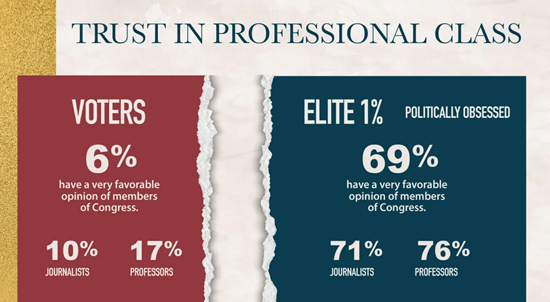
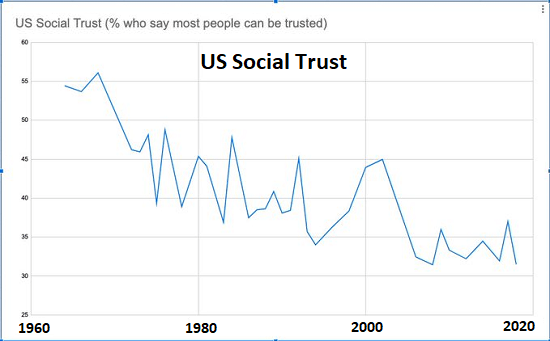
It’s not exactly news that social trust has declined significantly in the United States. Surveys find that public trust in institutions and the professional classes that dominate those institutions has cratered. (see chart below) Social trust–our confidence that other people are trustworthy–has also fallen to multi-decade lows.

This was not the case in decades past. Americans maintained high levels of trust in their institutions, government and fellow citizens. The decline in social trust is across the entire spectrum: our trust in institutions, professional elites and our fellow Americans has declined precipitously.

The causes of this decay of social trust can be debated endlessly, but several factors are obvious:

1. Institutions forfeited the trust of the citizenry by withholding / editing realities to serve the interests of hidden agendas and insiders’ careers. The Vietnam War was pursued on fabrications, as was the second Gulf War to topple Saddam. Watergate eroded trust on multiple levels, as did the Church Committee’s investigation of America’s security agencies’ domestic spying / over-reach.

2. The managerial / professional elites at the top of the nation’s institutions no longer put the citizenry’s interests above their own. The public’s trust has eroded as institutions are primarily viewed as vehicles for self-enrichment and career advancement: healthcare CEOs pay themselves millions, higher education is bloated with layers of non-teaching administration, defense contractors and the Pentagon have greased the revolving door to the benefit of incumbents and insiders, and so on, in an endless parade of self-serving cloaked with smirking PR claims of “serving the public.”

The shift from a high-trust society to a low-trust society is consequential economically, politically and socially. Low-trust societies have stagnant economies, as nobody trusts anyone they don’t know personally or through personally trusted networks, and nobody trust institutions to function effectively or fulfill their stated mission to serve the public good.

Faced with incompetent, unaccountable, corrupt bureaucracies and a culture overflowing with scams, frauds, imposters and get-rich-quick schemes, people give up and drop out. Rather than start a business and accept all the risks just to get dumped on or ripped off, they don’t even try to start a business. Given the financial insecurity that is now the norm, they decide not to get married or have children.

The vast trading networks of the Roman Empire were based on personal trusted networks and trust in Rome’s functionaries / institutions. The owners of trading ships dealt with trusted captains and merchants, who then paid duties to Roman functionaries in Alexandria and other major trading ports.

In other words, tightly bound personal trusted networks work well as long as the state institutions that bind the entire economy are trusted as fair and reliable–not perfect, of course, but efficient and “good enough.”

But when public institutions are viewed as unfair, unreliable, corrupt or incompetent, the entire economy decays. Even personal trusted networks cannot survive in an economy of unfair, unreliable, corrupt or incompetent state bureaucracies and private institutions.

The American economy is now dominated by enormous privately owned and managed monopolies and cartels that are the private-sector equivalent of self-serving state bureaucracies. Big Tech, Big Pharma, Big Healthcare, Big Ag, Big Finance, etc., are even worse than state bureaucracies because there are no legal requirements for transparency or recourse. Try getting a response from a Big Tech corporation when you’ve been shadow-banned or sent to Digital Siberia.

The sole remaining reservoirs of trust in American life are personal networks, local enterprises and local institutions. These are not guaranteed, of course; in many locales, even these reservoirs have been drained. But in other locales, enterprises and institutions such as the county water utility, the local newspaper, the local community college, etc. continue to earn the trust of the public by performing the services they exist to provide effectively and at a reasonable cost.

The larger the institution and the greater its wealth and power, the lower the social trust–for good reasons. The greater the influence of the managerial elites, the greater the disconnect from the everyday experiences of the citizenry and customers, and the more extreme the self-serving PR.

Sure, I trust Big Tech, Big Pharma, Big Healthcare, Big Finance–to rip me off, profiteer, send me obfuscating bills, jack up junk fees, make it impossible to contact them, and send me to Digital Siberia if I complain.

The divide between the elites and the commoners should prompt us to examine the low-trust path we’re sliding down:

In a society in which everything is phony, low quality or fraudulent, you’re taking a chance trusting anyone you don’t know personally–and even that can be risky now that self-aggrandizing flim-flam is the last remaining path to financial security for non-elites.

A low-trust society is an impoverished society, economically stagnant and socially threadbare. That’s where we are now, and the more fragmented, greedy, self-serving, desperate and deranged we become, the lower the odds that we’ll find the means to rebuild trust.

Sadly, we already know that anyone claiming to “rebuild trust” is spouting PR designed to mask self-enrichment. We also know that the vast army of well-paid flacks, factotums, enforcers, happy-story apologists, lackeys, toadies and sell-out minions are declaring “everything’s great!”

Just mumble, “Uh, sure” and continue to Tune in (to degrowth), drop out (of hyper-consumerism and debt-serfdom) and turn on (to self-reliance and relocalizing capital and agency).

Why People Don’t Want To ‘Work’ Anymore

It’s not that people are lazy, there’s something much deeper going on that requires better questions.

By Joe Martino

Source: The Pulse

Last time I wrote about the increasing mental health crisis happening around the world. I didn’t write it to bring about negativity but more so to bring awareness to the reality of our current moment. Awareness is the first step toward any change.

That piece coupled with a video I did the other day on a collectively felt sense of meaninglessness, I believe these two subjects go hand in hand.

Tied in with both of those subjects is the decade-over-decade increase in the difficulty of surviving financially in our modern world.

More and more younger people have been struggling to buy a home and make ends meet due to the high cost of living and stagnating wages. For many, affording necessities in life has become difficult despite working 40-60 hours per week.

This reality recently drove a viral TikTok video that highlights the frustration younger generations feel and the misconceptions associated with their position.

Before you watch it, conversations I have with people about this issue don’t just exist in the Gen Z and Millenial age group. I’ve spoken to people in their 50s and 60s who have also become completely disenfranchised about the state of work.

Also, Quiet Quitting is a trend on the rise. Simply put, people are going to work and doing the bare minimum to stay employed at greater and greater rates. Gallup estimates that in the US 50% of employees have Quiet Quit and that it’s an increasing crisis. In Japan, 94% of employees report being disengaged at work.

Perhaps unsurprisingly, Gallup blames the trend on poor management. This is where humans really have to start waking up and thinking bigger in my opinion, more on this shortly.

Alright, let’s get to the video.

She makes many good points, and if we take her words to heart, clearly she isn’t lazy and trying to ‘not work.’ She is passionate about her work but sees the gap between salary and the reality of living a comfortable life. She also sees the value in work… just not like how it is today.

Not surprisingly, many have agreed with her while many have attacked her. Let’s explore why she might feel this way about life and work. (Note: There is an element that sometimes people can judge, hate, and avoid work so much that it’s a self sabotage situation, I talk about that here.)

  1. She and the generation she represents, even people like her from other generations, are just lazy or may even grow out of this idea.
  2. She’s lying about enjoying her job and if she were to quit and do something she likes she’d find just enough satisfaction to not care about the fact that she can’t afford to do anything beyond eat, have shelter, and enjoy a few things.
  3. Maybe she’s just permanently unhappy and therefore no matter what she does, she will find a way to frame it as negative and bad.
  4. From a position of common sense and orienting to our current environment, this girl realizes the losing game she is part of and is making the observation that this isn’t a reasonable game to play.

As an extension to number 4, the fact that multiple generations of people not only realize how rigged the game is, don’t want to play the game AND are saying something about it provides an evolutionary pressure for society to address it.

The key is, can we listen vs. sitting in judgment?

Oddly, reaction videos are all the craze on YouTube these days. When people make videos like hers or when something happens, creators turn on their cameras and watch the video while simultaneously reacting to it.

Usually, creators reacting to videos like this from Gen Z’ers are well off themselves or conservatives. Their career often stems around having a ‘hot take,’ creating polarity, and leaning into drama so their content can get a lot of views and thus pay their bills.

Sadly, this dynamic in content creation is often missed by the user, not realizing that the host of the video says what they say primarily because they know it will make them money even if it’s not entirely what they think.

Further, we never get to the bottom of what people bring forth because we are skipping the step of coming to the table in good faith and empathizing with each other’s position. Instead, we get a culture stuck in a debating/debunking/warring mindset. Good luck getting good faith conversation to go viral when most out there are focused on hi-jacking your attention.

Sensing Beyond The Surface

Sensing Beyond The Surface

  1. ‘Working’ is Important – Being part of something, contributing to something, living in a community and having a role, all add meaning and purpose to life.

    Being a creative, productive person is a necessity for human well-being, even if only for a few hours a day. No one is saying let’s sit around and do nothing all day. But should we have to work 40 or 50 hours a week to simply survive? No, that is the result of poor system design. We have advanced our technology incredibly to provide the necessities of life yet we work more than we ever have. Doesn’t something seem wrong there?
    Our cultural idea of needing to work 40 hours a week for most of our lives ‘just to be a contributor’ is rather warped. Many cultures have thrived working a few hours a day, yet look at us – working constantly yet experiencing mental illness, poor health, and meaninglessness at massive rates.
    It would benefit us to have a deeper look at WHY our society is currently producing results no one wants all while destroying our environment and people. Too many discussions about this topic think small and are limited to lazy questions from system protectors or political ideologies. This won’t get us to the root of the issue and why people feel the way they do.
  2. Cost of Living is Too High, But Why? – I’m 36, when my parents were my age one worked a mid-level job in corporate and the other a grocery store. They made enough to buy a fairly big house near Toronto, pay off the mortgage by 40 and raise two kids. These days, they’d need to make $100,000+ each just to buy the same house, and forget about paying off the mortgage by 40. Even when interest rates were 22% back then, things were a lot easier.

    Often, when I talk about mortgage rates with older generations, and how it is becoming hard to afford homes, they say “Back in my day rates were 18% – 22%.” The sense that people aren’t listening to what is being said is palatable. We’re not thinking clearly. In 1945 a US citizen dedicated on average 25% of his salary to pay rent/mortgage. In 2019 it was 47%. It’s higher now. And of course in that time interest rates have come down dramatically. Plain and simple, the cost of living has risen incredibly and wages didn’t climb at anywhere near the same rate.

    This is a losing game, and only set to get worse given the path we’re on. That said, this is what anyone should expect in a system driven by fractional reserve banking. When we understand the design of our system, we understand this isn’t about one political view or another, it’s about bad system design. We have to think deeper.
  3. Evolutionary Pressure – As our society declines more and more, younger people who look ahead to their future see something undesirable. The life their parents lived is no longer possible and they see the game is rigged. They aren’t lazy, they are demoralized.
    A left hemisphere reductionist and othering view, who sees humans as cogs in a system might say “Nah, people are lazy. Grow up. Things are fine.” Yet when we take a step back and include a sense of something sacred, our entire perspective changes. Why are we seeing life and merely working to uphold a rigged economy? Is this really all we are capable of? Why are we always trying to protect societal design producing results we don’t like? Do we realize we made all this up and it can be different?
    Sure, there are aspects of younger generations that I think are immature too, we’ve all been through it, but at the same time, younger people are not buying the rigged game and thus are not dying to play it. They are right. They are smart to speak up.
    And to tie things back to meaninglessness and mental health issues, I think we’re seeing now how this all ties into our current moment. People don’t thrive playing a losing game where basic needs are gated behind 100 foot walls.

    Movements toward system redesign have been around for many many decades. It’s not a new idea to discuss how rigged, limiting, and problematic our existing societal design is, but more people are waking up to it now.
    When I spoke about this stuff in 2009 and 2010, most people laughed at me thinking I was nuts. Now, they mostly agree with me. We’re on fertile ground for something new. For a while, we’ll likely live feeling and sensing the possibility of a new society while living in the old. Feeling that we’re not sure we quite belong to a visible society entirely.
    This is the Metacrisis. This is the shift in consciousness as I’ve always called it. It’s an evolutionary pressure that begs us to look deeper than political ideology and hot takes on why someone we don’t agree with is wrong. It begs us to re-taste the sacred. To examine what it means to be human and why we’re here.
    I believe the speed at which it unfolds is intimately connected to the quality of our attention, consciousness and state of being. The more capacity we have to steward a better world, the more it will unfold.
    Change starts within.

Why Journalism is Going Extinct

By Peter Van Buren

Source: We Meant Well

Is journalism going extinct? asks The Atlantic in an article of roughly the same name. The numbers are deadly: the grimmest news was from the Los Angeles Times, the biggest newspaper outside of the east coast. The paper announced it was cutting 115 people, more than 20 percent of its newsroom. In June of last year the Times previously dropped 74 people from its newsroom. Some 2,900 newspapers closed or merged since 2005. Sports Illustrated is in trouble. The Washington Post, NBC News, ABC News, CNN, NPR, ViceVox, and BuzzFeed, among others, have shed hundreds of journalists over the past year, including the author of the Atlantic article himself. Job losses among print, digital, and broadcast-news organizations grew by nearly 50 percent during 2023.

The reason for all this professional carnage according to the article? Something something the Internet something something digital advertising revenues blah blah social media.

One proposed solution calls for “direct and muscular government intervention” and legislation forcing Facebook and others to pay for “news” they feature off sources such as the New York Times. Yet, as journalist Glenn Greenwald asked rhetorically, “Will there ever come a moment when liberal journalists who work for corporate outlets, and who are being completely consumed by layoffs and financial failures and audience indifference, ask whether there’s anything they’ve done to contribute to the profession’s failure?”

The answer of course is no, no one is going to ask but Glenn. Somewhere along the way (we’ll tag it as the beginning of the first Trump campaign of the modern era) journalism lost all pretext of objectivity and decided to devote itself fully toward advocacy. It is clear now the public wants accurate reporting, not advocacy, but never you mind, the media elites on each coast know better what you need. As long as the MSM traffics in falsehoods people will disappear from their audiences.

Let’s look at one almost silly example: did Donald Trump says people should drink bleach to kill off Covid?

No, Donald Trump did not suggest that people should drink bleach to kill off Covid. However, during a White House briefing in April 2020, Trump did make comments about the potential use of disinfectants and ultraviolet light to treat the virus. His remarks were widely criticized because they seemed to suggest the possibility of injecting or ingesting disinfectants, which would be extremely harmful. The media, however, would not be stopped, making the bleach thing into a meme, handing it off to Late Night, then picking it up again throughout the 2020 presidential campaign.

Twelve months after the supposed statement, to keep things alive, Politico wrote “One year ago today, President Donald Trump took to the White House briefing room and encouraged his top health officials to study the injection of bleach into the human body as a means of fighting Covid. It was a watershed moment, soon to become iconic in the annals of presidential briefings. It arguably changed the course of political history.” “For me, it was the craziest and most surreal moment I had ever witnessed in a presidential press conference,” said ABC’s chief Washington correspondent.

A year after the “fact” it is bad enough the media could not accurately report what was said but how about some four years later, twice in recent New York Times articles, on January 24 and on January 29, 2024 (“oblivious or worse, peddling bleach as a quack cure.”)

The thing is Trump never said people should drink or inject bleach; knowing what he said is as easy as listening to what he said. Here it is in its entirety: “So, supposing we hit the body with a tremendous — whether it’s ultraviolet or just very powerful light — and I think you said that that hasn’t been checked, but you’re going to test it. And then I said, supposing you brought the light inside the body, which you can do either through the skin or in some other way, and I think you said you’re going to test that, too. It sounds interesting. And then I see the disinfectant, where it knocks it out in a minute. One minute. And is there a way we can do something like that, by injection inside or almost a cleaning. Because you see it gets in the lungs, and it does a tremendous number on the lungs. So it would be interesting to check that.” It was obvious Trump was talking via example, hypothetically in that hyperbolic style of his. It takes a selfish media mind to roll all that into an admonishment to the suffering American people to drink a poisonous substance but that’s what happened. Even four years later.

There are so many other example which persist in the media as untruths, exaggerations, or something evil done by other presidents but uniquely ascribed to Trump. Think that he wrenched children from their parents at the border into concentration camps, that he denounced fallen soldiers as suckers, and that he incited a bloody insurrection to overturn an election, and still peddles the Big Lie to the point where he is supposedly Constitutionally ineligible to run for president.

Journalism is at a crossroads at best (it may have already crossed into the abyss.) The old models of reader -supported or advertising-supported media no longer are sturdy and seem still to apply only to a few giants like the New York Times. Americans’ trust in the mass media’s reporting matches its lowest point in Gallup’s trend line, largely because of Democrats’ decreased trust (the Republicans were lost an election or two ago, see Russiagate, though independents still lead the two parties in lost trust.) Just 7 percent of Americans have “a great deal” of trust and confidence in the media, and 27 percent have “a fair amount.”

Meanwhile, 28 percent of U.S. adults say they do not have very much confidence and 39 percent have none at all in newspapers, TV, and radio. Social media is still the least trustworthy sector, while simultaneously being one of the most read/seen. The declines for the MSM have been steady since peaking in 1977 at about 70 percent trust levels. It has gotten worse since Trump but you can’t blame it all on him. It’s the media’s own fault.

The loss of trust is because of a perception the MSM is biased. Some 78 percent of conservatives think the mass media is biased, as compared with 44 percent of liberals and 50 percent of moderates. Only about 36 percent view mass media reporting as “just about right”. A September 2014 Gallup poll found that a plurality of Americans believe the media is “too liberal.”

Half of Americans in a recent survey indicated they believe national news organizations intend to mislead, misinform or persuade the public to adopt a particular point of view through their reporting. The survey goes beyond others that have shown a low level of trust in the media to the startling point where many believe there is an intent to deceive. Asked whether they agreed with the statement that national news organizations do not intend to mislead, 50 percent said they disagreed. Only 25 percent agreed.

The pattern is pretty clear: as long as the MSM is a significant source of misinformation never mind out-and-out lies, the people’s trust in it will continue to fall. We’ve reached a breaking point where many people believe the media intends to deceive. That distrust is entirely a self-own by the media, and finds itself expressed in the most direct terms. People literally are not buying what the MSM is selling.

Just Keep Bringing Awareness To The Depravity Of The Empire In As Many Ways As Possible

You never know what could be the one thing that snaps somebody’s eyes open.

By Caitlin Johnstone

Source: CaitlinJohnstone.com.au

At this point in history the most effective way for westerners to fight the empire and build support for revolutionary change is to undermine public support for western status quo systems and institutions. One does this by using every means at their disposal to help people see that the power structures which rule over us don’t serve our interests, and that they are in fact profoundly evil and destructive.

It takes a flash of insight for a westerner to be able to really see the perniciousness of the US-centralized empire in all its blood-soaked glory. This is because westerners spend their entire lives marinating in empire propaganda from childhood, which has normalized and manufactured their consent for the murderous, exploitative and oppressive power structure we live under. The current status quo is all they’ve ever known, and the idea that something better might be possible is alien to them.

Teachers of spiritual enlightenment point students to the truth of their being in as many ways as possible in an effort to facilitate a flash of insight into reality. The reason they do that rather than saying the same words over and over again from day to day is because everyone’s mind is unique and ever-changing, and what knocks things home for one student one day will just be useless noise to another student who will later pop open at something completely different. The receptivity to insight varies from person to person.

Similarly, a westerner who’s been swimming in empire propaganda their whole life won’t have their moment of insight into the depraved nature of the empire until something lands for them that they are personally receptive to. Someone who isn’t receptive to words about the exploitative and ecocidal nature of global capitalism may be receptive to the threat of rapidly expanding censorship, surveillance, police militarization and other authoritarian measures. Someone who is unbothered by the empire’s nuclear brinkmanship with Russia and looming war with China may have their heart broken and their worldview changed when shown what is happening in Gaza.

What triggers the opening of one pair of eyes may not be what triggers another. A kickboxer doesn’t throw only overhand rights because that happened to be what scored a knockout in his last bout, he throws a diverse array of strikes in varied combinations at all levels to overwhelm the defenses of his opponent and land a fight-ending blow. When fighting the empire, one needs to bring the same approach.

Look for fresh opportunities to show westerners that the mass media are deceiving and propagandizing them to get them questioning their assumptions about what they’ve been told about the world. Look for fresh opportunities to show them evidence that the US war machine is the most murderous and destructive force on this planet. Look for fresh opportunities to show them how status quo systems create a far less beneficial society and a far less healthy world than what we could have under different systems. You never know what could be the one thing that snaps somebody’s eyes open.

Nothing you do on this front is wasted effort. All positive changes in human behavior at any level are always preceded by an expansion of awareness, so anything you can do to help bring awareness to the reality of our situation is energy well spent. Any effort you make to shove human consciousness toward the light of truth in even the tiniest way has a beneficial effect on our species.

So use whatever tools you can to make that happen. Have conversations, attend demonstrations, put up signs and stickers, write, tweet, make podcasts, make videos — whatever you find effective for you. Just make sure you’re coming at this thing from as many angles as possible, because diversifying your attacks on the mind control machine is the best way to get through its defenses.

Quantum Physics And Buddhism – Carlo Rovelli Encounters Nāgārjuna

By David Edwards

Source: Media Lens

Carlo Rovelli is a renowned Italian theoretical physicist and writer who has made important contributions to the physics of space and time. He is currently a Distinguished Visiting Research Chair at the Perimeter Institute, and a core member of Canada’s Rotman Institute of Philosophy of Western University, working mainly in the field of quantum gravity. His short book, Seven Brief Lessons on Physics (2014), has been translated into 41 languages and has sold over one million copies worldwide.

In his 2021 book, Helgoland – The Strange and Beautiful Story of Quantum Physics, Rovelli describes a surprising epiphany in his efforts to understand the mysteries of quantum physics:

‘In my own attempts to make sense of quanta for myself, I have wandered among the texts of philosophers in search of a conceptual basis for understanding the strange picture of the world provided by this incredible theory. In doing so, I have found many fine suggestions and acute criticisms, but nothing wholly convincing.

‘Until one day I came across a work that left me amazed.’ (Rovelli, Penguin, e-book version, 2021, p.72)

Remarkably, the book in question is a key 3rd century text of Buddhist metaphysics, The Fundamental Verses of the Middle Way, by the enlightened mystic Nāgārjuna. Rovelli writes:

‘The central thesis of Nāgārjuna’s book is simply that there is nothing that exists in itself, independently from something else. The resonance with quantum physics is immediate. Obviously, Nāgārjuna knew nothing, and could not have imagined anything, about quanta – that is not the point. The point is that philosophers offer original ways of rethinking the world…’. (p.73)

Rovelli is wrong to describe Nāgārjuna as a ‘philosopher’; he was a mystic. Philosophers seek solutions through thought; mystics seek solutions by transcending thought. If Nāgārjuna was engaged in ‘rethinking the world’, it was in the cause of a truth that can be experienced only when thinking is paused. Rovelli writes:

‘The illusoriness of the world, its samsara, is a general theme of Buddhism; to recognise this is to reach nirvana, liberation and beatitude.’

Here Rovelli is placing the cart before the horse: ‘liberation and beatitude’ are not reached by recognising ‘the illusoriness of the world’; rather, the illusoriness of the way we see the world is recognised as the endpoint of a process of liberation and beatitude.

This process is meditation. The fact that Rovelli does not mention the words ‘meditation’, ‘meditator’, or ‘meditate’ in his book, indicates he is currently limited to an intellectual understanding of nirvana and of the path (which is no-path) by which it is attained. In Buddhism, the ‘wisdom’ aspect of ‘the path’ – intellectually exploring the illusoriness of phenomena – is supported by the ‘method’ aspect of meditation. Together, these are the two ‘wings’ on which the bird of enlightenment takes flight.

In fact, the Buddha did not say the world is an ‘illusion’; he said that the world does not exist in the way it appears to exist to us; that our deep-seated belief that the world is made up of independently existing objects is an illusion. There are many Zen and other stories in which masters tweak students’ noses, or hit them over the head, asking: ‘Is that an illusion?’

Rovelli does a good job of explaining how apparently concrete objects vanish on close inspection. We naturally imagine that a chair, for example, exists as a single object, a unit. In fact, what we call ‘a chair’ is made up of a seat, legs, a back rest and so on. None of the legs is ‘a chair’; nor is the seat; nor is the back rest. None of the parts that make up a chair is ‘the chair’. It turns out that the unitary chair, which seemed so solid, is a mere label applied to a set of parts.

But to say the chair is made of parts is also misleading, because it suggests that the parts, at least, are solid, unitary objects. Alas, the parts also disappear on close inspection. Thus, the seat might be made up of a wooden frame with a cushion in the middle – neither of these are ‘a seat’. And, of course, all such objects are made of atoms. An ‘atom’ is also a collection: of neutrons, protons, electrons and sub-atomic particles. None of these is ‘an atom’. An ‘atom’ is also a mere label applied to a collection. Everywhere we reach out for solid ‘things’ that disappear into thin air that is also just a label.

Why should any of this concern me as an obviously solid, unitary self? If someone shouts abuse at me – it’s happened once or twice on twitter.com – I feel as if I’ve been impacted by an insulting barb. Apparently a solid entity, ‘me’, has been hit. Otherwise, why would I feel pain?  

But when I search for a dart board-like entity that has been struck, I find that none of my body parts, none of my thoughts and none of my emotions are a unitary self called ‘me’. This presumed unit is also a mere label. But how can an insulting barb wound a label, a mere idea? Shouldn’t it pass right through? The answer is that it hurts because we believe deeply in a solid self that doesn’t actually exist. We are therefore co-authors of the insult, the pain.

So, is everything really just a collection of mental labels? Is nothing real? Consider dreams: on one level, they are clearly illusions. But they are real as illusions. To be more precise, the awareness that perceives an illusion or dream is real – awareness is required for the dream to be experienced.

Indeed, even if the whole world is a dream, the awareness that perceives the dream is real. And, as discussed, nirvana is not reached merely by intellectually recognising ‘the illusoriness of the world’; it is discovered when the true nature of this awareness, of being, is experienced. But how might that happen?

Nothingness’ Is Not Empty

Just as physical objects – chairs, planets, stars – appear in external space, sense perceptions, thoughts and emotions appear in the internal space of awareness. The thoughts, ideas and memories that make up our idea of ‘me’ are all ‘objects’ in this inner space. We think we’re ‘the voice in our head’, but we’re actually the ‘space’, the witness of ‘the voice’.

What is the fundamental nature of this awareness? We know from experience that when angry thoughts and emotions appear in awareness, we suffer. Likewise, when fearful, anxious and jealous thoughts appear. Many of us imagine that awareness without any thoughts, like external space, would be a blank, empty nothingness.

According to the Upanishads, the ancient scriptures of Hinduism dating back to 800 years BC, this is not the case at all. The Upanishads argue that both the internal space of awareness and external space are manifestations of Brahman, the formless, changeless source of all material forms:

‘We should consider that in the inner world Brahman is consciousness; and we should consider that in the outer world Brahman is space.’ (Juan Mascaró trans., The Upanishads, Penguin, 1965, p.115)

This is significant and, in fact, testable, because Brahman is said to be in the nature of awareness and bliss. In other words, consciousness – even the consciousness waiting at a rainy bus stop on a chilly winter’s morning – is in the nature of bliss. But if that’s true, why are we conscious beings so miserable at the bus stop and in so many other situations? The answer is that man and woman were born free but are everywhere in chains of thought.

What we in the West mis-label ‘meditation’ (which actually suggests its exact opposite, thinking) is the art of uncovering the fundamental nature of awareness by reducing and eventually dropping the thought by which it is obscured.

Anyone can relax in a comfortable chair for an hour paying attention to whatever feelings are present in the heart area and lower belly. Naturally, thoughts will blaze away. This is exactly as it should be and is not in any way wrong. Instead of following these chains of thought as usual: ‘He was so patronising… and she didn’t defend me at all… What I should have said is…’ Instead of riding this train of thought, we try to notice the thoughts and return to feeling.

This goes on and on: we’re managing to focus attention on feeling, we suddenly start riding thought, suddenly realise what we’re doing and return to feeling. If we do this consistently, on a daily basis, one day, after about 40-45 minutes, the mind grows weary of generating thoughts that aren’t being properly appreciated and starts to lose momentum.

Less thoughts are now appearing, and we may have a subtle sense that we are sailing in calmer waters. Following this, actual gaps can start to appear in the thought stream allowing us to focus with clarity on feelings in the heart and lower belly. These gaps – moments of awareness unclouded by thought – are experienced as tiny, golden sparks of love, bliss and peace. This is a revolutionary moment – it is quite astonishing that, having been half-asleep and chaotically distracted, we are suddenly happier sitting doing nothing than we have been in years and decades.

The arising of these sparks is often heralded by unusually generous thoughts; we suddenly have an impulse to be kind to someone in some way, even to an enemy. This is a sure sign that something odd is happening. These sparks then deepen and intensify and may endure for hours or days. Initially, though, they are vulnerable to intense mental activity – a post-meditation Twitterspat will rapidly extinguish them. Enlightened mystics, by contrast, live in a state of permanent ecstasy and love. Lao Tzu, author of the Tao Te Ching, said:

‘The Tao [love and bliss] doesn’t come and go.

It is always present everywhere,

just like the sky.

If your mind is clouded,

you won’t see it,

but that doesn’t mean

it isn’t there.

All misery is created

by the activity of the mind.

Can you let go of words and ideas,

attitudes, and expectations?

If so, then the Tao will loom into view.

Can you be still and look inside?

If so, then you will see that the truth

is always available, always responsive.’ (Lao Tzu, Brian Browne Walker trans., Hua Hu Ching – The Unknown Teachings of Lao Tzu, e-book, St Martin’s Press, 2012, p.39)

Be still and look inside – it is as simple as that. But it is advice that has been ignored by most people for millennia.

Rovelli concludes:

‘But Nāgārjuna’s emptiness also nourishes an ethical stance that clears the sky of the endless disquietude: to understand that we do not exist as autonomous entities helps us free ourselves from attachments and suffering. Precisely because of its impermanence, because of the absence of any absolute, the now has meaning and is precious.’

Yes, intellectually reflecting on our lack of solidity and impermanence can help dissolve the perceived importance of our attachments. But what reduces our attachments and self-importance to nothing, if only temporarily at first, is the dazzling love and bliss that arise in meditation. The ‘now’ isn’t just precious because it is impermanent; it is precious because the experience of the ‘now’ unobscured by thought is overflowing with ecstasy and love that make all worldly attachments seem trivial. The Indian mystic Osho said:

‘When ego [thought] is not, love comes as a perfume – as a flowering of your heart… With this attitude, when the mind is completely unmoving, something of the divine will lure you; you will have glimpses.

‘Once you know the bliss of such glimpses, you will know the nonsense, the absurdity, and the absolutely unnecessary misery of ambition. Then the mind stops by itself. It becomes completely still, silent, nonachieving.’

The American mystic Robert Adams said:

‘I felt a love, a compassion, a humility, all at the same time. That was truly indescribable. It wasn’t a love that you’re aware of. Think of something that you really love, or someone that you really love with all your heart. Multiply this by a jillion million trillion, and you’ll understand what I’m talking about.’ (Adams, Silence of the Heart – Dialogues With Robert Adams, Acropolis Books, 1999, pp.9-10)

Rovelli continues:

‘For me as a human being, Nāgārjuna teaches the serenity, the lightness and the shining beauty of the world: we are nothing but images of reality. Reality, including ourselves, is nothing but a thin and fragile veil, beyond which… there is nothing.’ (p.75)

One can sense the anxiety in these words. Rovelli perceives ‘the shining beauty of the world’, but it is a cold, austere beauty because it appears to him to be a ‘thin and fragile veil’, beyond which lies ‘nothing’. But we have already agreed that ‘there is nothing that exists in itself, independently from something else everything is interdependent’. Indeed so, we are there as the witness of ‘nothing’. (p.73). Osho explained:

‘In English there is no word to translate the Buddhist word shunyata. In that “nothingness” … it is not empty, it is full of your witness, full of your witnessing, full of the light of your witness.’

We are not brains in jars or ivory towers. This paradoxically full ‘nothing’ is not a mere concept for Rovelli to ponder intellectually; it is an existential challenge for him to face and feel. Jiddu Krishnamurti put it well:

‘We have all had the experience of tremendous loneliness, where books, religion, everything is gone and we are tremendously, inwardly, lonely, empty. Most of us can’t face that emptiness, that loneliness, and we run away from it. Dependence is one of the things we run to, depend on, because we can’t stand being alone with ourselves. We must have the radio or books or talking, incessant chatter about this and that, about art and culture. So we come to that point when we know there is this extraordinary sense of self-isolation.

‘We may have a very good job, work furiously, write books, but inwardly there is this tremendous vacuum. We want to fill that and dependence is one of the ways. We use dependence, amusement, church work, religions, drink, women [or men], a dozen things to fill it up, cover it up. If we see that it is absolutely futile to try to cover it up, completely futile, not verbally, not with conviction and therefore agreement and determination, but if we see the total absurdity of it, then we are faced with a fact…. Why don’t I face the fact and see what happens?

‘The problem now arises of the observer and the observed. The observer says, “I am empty; I don’t like it” and runs away from it. The observer says, “I am different from the emptiness.” But the observer is the emptiness; it is not emptiness seen by an observer. The observer is the observed. There is a tremendous revolution in thinking, in feeling, when that takes place.’ (Krishnamurti, The Book of Life, HarperSanFrancisco, 1995, p.84)

The crucial point about this ‘nothingness’, then, is that we are standing here as witnesses; it is a witnessed nothing. The witness is not a thing – it is no-thing – but it is existent, real. And it is anything but ‘thin and fragile’. It turns out that the observer is the observed: it is the fundamental nature of the universe and it is in the nature of consciousness, love and bliss.

How remarkable: the next step for quantum physics, for Rovelli himself, is to recognise the ‘nothingness’ within; to see how we stuff it with knowledge; and to experiment in dropping that knowledge, in dropping all thought, in the cause of facing that abyss.

Such a confrontation could herald a revolution in human consciousness: a union of physics and mysticism, of science and love.

IN THY BODY DO I DWELL (THE PHYSICAL CONSTRUCT AS HOST)

By Kingsley Dennis

Source: Waking Times

The body is coming back into sight as a site for experimentation and as a target for a type of quasi-transcendence. Within the inverted world of the lesser reality, the physical body has always been recognized as the vehicle through which life is experienced. In other words, it is our avatar whilst in this realm. As such, it has always been a site of contestation.

In some religious circles, the body is seen as a material distraction from the Divine and its influence was seen as needing to be repressed and subjugated (which may include certain physical deprivations, including self-harm). Various religio-spiritual perspectives have regarded the physical body as an obstacle, a barrier, to a sense of the sacred. The other extreme is that the body is regarded as the ideal vehicle for experiencing the sensual and sensuous – it is a vessel for indulgence and decadent experience. Still, there has been no consensus reached over how to regard the vehicle of the human physical body.

In my earlier book – Hijacking Reality – I noted how recent narratives are trying to place the human body as a site of weakness. That is, the body is open and vulnerable to disease and infection; it succumbs to aging and exhaustion; it disallows the human being from the full range of experiences. In this light, narratives of transhumanism are attempting to gain ground as a way of offering an alternative to the ‘weak body.’ These, as I had discussed, are attempts to drive the human experience deeper into materialism and a technocratic agenda for a digital-hybridization program within our societies.

The Inversion is steering ever forward into deeper and deeper realms of materialism. It is utilizing a narrative of quasi-transcendence through embedding deeper into the myth of technological salvation. The lines are not so much being drawn but being blurred. American writer Philip K. Dick, famous for his science fiction books that question the nature and validity of reality, spoke about the blurring of boundaries between body and environment in his 1972 speech “The Android and the Human” –

“Our environment, and I mean our man-made world of machines, artificial constructs, computers, electronic systems, interlinking homeostatic components—all of this is in fact beginning more and more to possess what the earnest psychologists fear the primitive sees in his environment: animation. In a very real sense our environment is becoming alive, or at least quasi-alive, and in ways specifically and fundamentally analogous to ourselves.1″

This quasi-aliveness of the environment that Dick speaks about is the animating stage where relations between the human body and the material world begin to blur (and merge). Much of Western spiritual-mystical practice is interpreted as a somatically-felt experience. The body is the instrument that receives and grounds the experience, whether it be in terms of the ‘great flash,’ ‘illuminating light,’ or the ‘bodily rush.’ The body is the human instrument for receiving, transforming, and sometimes transferring, energies. There are many ‘bodies’ in spiritual-mystic traditions, including the etheric, the astral, the ecstatic, the subtle, the higher, and others; the physical, material body is recognized as the densest of them all. Also, it is the ‘easy target’ since it resides fully within the material world and is open to social engineering and influence.

The body in history has always been a site of focus. It has helped define the experience of self/other and the outer/inner and has been regarded as the material vessel for the spiritual impulse. Perhaps for this reason, many societies around the world have, at one time or another, attempted to suppress the power and expression of the human body. It could be that the controlling agencies within the inverted world regard the balanced, correctly functioning human body as a portal for appropriately navigating the perceptive wavelengths of reality. Many of the mystical traditions placed a strong emphasis on the purification of the human body; on it being free from toxins and corruptive influences. In this way, the physical vessel was said to receive the ‘illuminations,’ or the ‘mercy’ of the sacred, divine impulse.

The body acts as an antenna for the nourishing inspirations/energies for the soul. What better way to block these illuminations than to corrupt the body’s purity through a polluting environment – socially, psychologically, and biologically. As such, the body has always been a site for the convergence of power and control. This body-power relationship has been a major theme in the work of French philosopher Michel Foucault. Foucault has deconstructed, in his critical history of modernity, how the body has been fought over as a site of power. The physical body is also regarded as a location of resistance against the establishment powers. It is a fixed place where an individual can be located, found, and held accountable. And now that our physical movements are continually tracked through the digital infosphere, there is even less chance to escape the eye of authoritative surveillance. If we cannot escape from our bodies then, it would appear, we are forever within the system.

The human body has always been accepted as a unit within the social matrix. This has also been expanded to define bodies in terms of social institutions: we have the body politic, the social body, the scientific body, the medical body, the body of an organization, etc. The once sacred site of the body, which was the vessel for somatic spiritual experiences, has been adopted, or co-opted, into a social construction of bodies that belong under control and subjugation of external authorities. In Gnostic terms, the body’s site of power has been referred to as those of the ‘sleepers’ and the ‘wakers.’ Sleepers are those whose inner self has yet to break through the layers of the body’s social conditioning.

The somatic spiritual experience has been seen as a threat to hierarchical societies because it exists beyond their bounds of power. This is one reason why ecstatic experiences, whether through spiritual or other means, have been suppressed, outlawed, and discredited by orthodox religions and mainstream institutions alike. Ecstatic experiences that can break down the thinking patterns and conditioning structures of the Inversion are alarming for institutions of socio-political power. How can you control, regulate, and discipline a body, energy, or experience that has no physical location? Such intangible forces, such as the power of baraka, are positively infectious and beyond bounds.[i] As cultural historian Morris Berman notes:

“The goal of the Church (any church) is to obtain a monopoly on this vibratory experience, to channel it into its own symbol system, when the truth is that the somatic response is not the exclusive property of any given religious leader or particular set of symbols. 2″

In recent times, there has been an increasing focus on what is termed the innate consciousness of the body, and which has been revealed through such techniques as muscle testing. It is innate because it is inborn (born in and of the body), and it is instinctual. Somatic consciousness then is another word for our intuitive intelligence. It is an intelligence that can be communicated through the body, and it is this which threatens those that seek to control the dreaming mind of humanity. However, the matrix of reality is not a clean-cut realm.

We exist in an anthropological environment where nature and culture cannot be neatly divided. The physical realm is a fusion of the real/imagined, and where subject/object is blurred. Yet now, this hybridity is being further enforced and coalesced through genetic engineering, implants, augmented reality, and the sciences of nanotechnology, biotechnology, and information technology (including artificial intelligence). The Inversion is attempting to gain our willing compliance through offering a form of transcendence that goes beyond the body and the bodily senses.

The Galactic Gaze

The dreaming mind has always been tempted and awed by the stars beyond. There is perhaps no living person who has not gazed up into the night firmament and wondered about the cosmos out there. And perhaps, there have been those persons who upon gazing up wondered whether they were not living within some kind of bubble. The dreamer’s world has often been depicted as a bubble reality, most notably by the Renaissance alchemists, as in this well-known engraving:

The Philosopher’s Stone lies outside of the realm of the Inversion; it can only be grasped by one who has exited from the dreamer’s reality bubble (or perceptual prison). For most people, the spiralling star tapestry of the cosmos is the first step of the beyond. Reason enough, then, for this to have become the new destination for the modern pioneers within the lesser reality.

The break from the body begins at an early age through social conditioning. To some extent, all individuals have to relinquish some of the contact they have with the innate intelligence of the body (including the body of the natural world) by being incorporated into the ‘social body.’ And as the social body becomes increasingly enmeshed within the digitized landscape, this alienation from the body will only likewise increase. Modern culture’s love affair with decadence, and the rise of sexualization and drug indulgence, all contribute to a desensitization of the body – even when the body is the medium of experience, such as in sexual experiences. As noted, this is a targeting of the ‘pure body’ so as to corrupt its potential for deciphering deeper layers within the Inversion. The body-medium for the life experience is also viewed by transhumanists as a hindrance upon the evolutionary journey toward an ‘immortal society’ that is destined for the stars.

This view is more keenly taken by mostly western and ‘elite’ types who have begun to feed themselves upon a modern cosmic-religious mythic consciousness. This is what Jasun Horsley refers to as a ‘Galactic religion,’ which seeks transcendence/ascension by leaving the planet and colonizing others. It is a ‘rich geek’ religion based on accelerating technologies and pushed by the major tech-titan companies. As Horsley notes, rather than ascension, it is the reverse: ‘It has to do with dissociation, the attempt of the traumatized psyche to split off from the body and float off into fantasy land, beyond the reach of reality and all the pain it entails. Bodies frozen on ice, souls lost in space, free, free from the terrible travails of the body.’3 In such contexts as these, and more, there is a trauma being experienced through the physical body. Trauma can be related to dysfunctional energy being trapped within the body, causing discomfort and disease. In an attempt to escape the body of the planet we are being forced to ‘techno-transcend’ the limitations of the biological human body.

To travel into the stars, we are told, requires us to upload our consciousness into machinic devices and/or ethereal cloudscapes. In a bid to escape the confines of a depleting ‘prison planet’ we are being asked to put our faith – and our consciousness – into a new techno-prison. Yet who shall be the new guards? This could entail the trauma of a new birth – re-enacting the prongs of the biological birth passage yet through entry into yet another realm of the Inversion. There seems to be no genuine exit of the dreaming mind through consciousness upload – only a leap into another programmable maze, yet this time perhaps with less benevolent programmers.

In the western psyche there appears to be an ongoing splintering between ‘inner space’ exploration and ‘outer space’ exploration. The techno-dream of space colonization is the new favoured trend whilst the inner space research of the psyche is promoted as a dangerous and trickster landscape. Outer space is the new undiscovered realm that offers hope against the twilight of the body (including the body of the earth). And yet such ‘Galactic pioneers’ seem driven less by a unified perception and more by forces arising within their splintered psyches that they have failed to integrate. These are the subconscious forces that grasp at survival, at any cost, and would willingly walk over the bodies of others to secure their own survival. Leaving the planetary body is only for the ‘lucky’ few, whilst the rest must remain grounded – or with their minds in cloudscape orbit. The trick of the Inversion is that there are endless doors to keep walking through, yet no exit to awaken out of. By walking out of one dreamworld into another we may think we are free, yet we remain imprisoned within the dream still. Or worse, we unknowingly become our very own prison guards.

No rockets will ever create enough thrust to take us where we truly need to go, for awakening from the gravity of the Inversion is an inner-space journey. It is the colonizing of the quiet kind – of ourselves. By striving to attain the orbital Overview Effect we are missing the real point, which is the ‘Inner view’ from within ourselves.

The Body as the Holy Host

The Inversion – our inverted world reality construct – is unsure what to make of the human physical body. Is it our saviour – our holy host? –  or a danger to our own progress and a threat to the agenda of others? As I have written previously,[ii] the narratives of a new biopower have brought to the fore a medical-political establishment within many of our societies worldwide. The biology of control is now a major player within the current realm of lived experience. There is now a noticeable rush to gain a political-corporate control over the access, use, and sovereignty of the human body. In a very real sense, it is the individual’s last line of physical defence. Each individual is a conscious entity (a spiritual essence) that is operating within this material realm through the vehicle of the physical body. As such, we are uniting with a biological partner. We are a merged being: as it is said, a union of flesh and spirit. Whilst the spirit – the essential being – is immortal, it has to abide in its physical incarnation by the biological limitations of the bodily host. Because of this crucial fact, external control agendas are determined to not only gain power over the outer aspects of the body (it’s freedoms, utility, mobility, etc.,) but also, via interventions, to have control over its internal functioning (DNA code, intra-communication, and more).

The human body functions upon many varied levels and acts as many things – including as a receiver, filter, and transmitter of energies and information. It is only the false, manipulated narrative that posits the human body as a ‘biohazard.’ By using this designation, external agencies of authority can seek to further contain and control the movement of the body as well as gaining internal access through chemical and pharmaceutical interventions. These possibilities were foreseen by many, not least by the social philosopher and author Aldous Huxley. Even as far back as the 1950s, Huxley envisaged the encroachment of scientism to gain increasing intervention into the human body:

Meanwhile pharmacology, biochemistry and neurology are on the march, and we can be quite certain that, in the course of the next few years, new and better chemical methods for increasing suggestibility and lowering psychological resistance will be discovered. Like everything else, these discoveries may be used well or badly. They may help the psychiatrist in his battle against mental illness, or they may help the dictator in his battle against freedom.4

And yet, this is still a viewpoint based on the material and physical sciences. It does not represent a deeper, spiritual perspective. This was to be provided by the Austrian philosopher and proponent of spiritual science, Rudolf Steiner. In talks given during September-October 1917, Steiner had the presence of vision to discuss the later potential interventions and influence over the human body. He said that: ‘Taking a “sound point of view,” people will invent a vaccine to influence the organism as early as possible, preferably as soon as it is born, so that this human body never even gets the idea that there is a soul and a spirit.’5

Clearly, this shows that the human physical body is a site of target in an attempt to curb or block reception of spiritual forces. Through what may appear to be a ‘sound point of view,’ a range of socio-cultural narratives will be created and propagated, according to Steiner, that will push an agenda of increased medical intervention. And these medically backed ideas have the aim ‘to find a vaccine that will drive all inclination towards spirituality out of people’s souls when they are still very young, and this will happen in a roundabout way through the living body.’6 Humanity has arrived at that time now, if we observe current events and their related consequences. We are now at a time within the 21st century where we are witnessing the transmutation of living beings – and bodies. The human being has arrived at a threshold previously unknown to it, and there are forces compelling the human to step over and through it. It is a threshold that will recode environments and bodies. The threshold is the point where a genetic deterritorialization process can begin, and from which we may witness the emergence of a new organism different from the current one. It is a threshold of recombination and recodification; a new assemblage that represents yet another phase within the Inversion. From here on, we are biologically vulnerable to an encroaching machinic impulse that, by its very nature, will morph bodily combinations into machinic connections.

Our bodies are reaching an exhaustion point. The crises we now face across the body of the earth is from a collapse of the individual, social, and psychological body. Already, the social mind is in trauma, and the body is showing this illness or dis-ease. The Inversion has made sure that the biological and psychological dimension has coalesced. The ripple of a bodily trauma is being felt across the planetary membrane as people are forced to unnaturally detach from the physical world around them. New physical arrangements of dislocation (lockdowns) and social avoidance are becoming established practices within our societies. These unnatural ordinances are creating cognitive and bodily dissonance. Bio-traumas have arisen that are affecting our sensibilities. New bodily phobias have been set in motion. This is the newly inverted threshold – a threshold of deterritorialization that has enforced a changing perception of the body. We are sensing alterations in human bodily awareness and receptivity. There is a deprivation too. The body is being pulled back from its natural organic terrain. It is being made to retreat from physical presence and away from the reassuring touch. It is as if the body is being reconfigured to devolve away from the sensual and into a new digitally articulated sensate. This bodily aliveness is being substituted by decomposition and the fear of decay and deterioration.

In the modern age, death has replaced sex as the modern taboo. The sanitized environment of the hospital has replaced the home as the place for passing away. The experience of death and dying has become detached from community life with the effect that emotion and closeness has been replaced by medical management. The dying body has become inverted into a thing of disgust and embarrassment. Death has now become something shameful – a forbidden process. Death is a modern scandal. Modern life has internalized the rejection of death, and we are coded to cringe at the thought of bodily deterioration. Death is a loser. To die is to lose, to fail. There is no room for failure within the deepening layers of machinic materialism and computational competition. Death can be replaced by tech-assisted immortality in the new ‘posthuman future.’ Alternatively, the body can be transcended through transhumanism so that death no longer haunts the halls of the physical flesh. These are the new imaginings in the realm of machinic desire. Humanity is on the threshold of venturing into an Inversion of codified imagination and upturned desires. Desire has overtaken pleasure, and it is the social sphere within the Inversion that creates and sustains this desirous torment and torture of the unattainable. And within the unattainable, greater forms of external control must be endorsed to compensate. For this reasoning, current forces have begun to establish new pathways of control over life processes. And this, by intent and not coincidence, aligns with the rise of the machinic impulse. The question that now needs to be asked is whether the machine impulse is evolutionary or devolutionary in terms of human life upon this planet.

References

Dick, Philip K. (1995) The Shifting Realities of Philip K. Dick: Selected Literary and Philosophical Writings (ed. Lawrence Sutin). New York: Vintage Books, p183

Berman, Morris (1990) Coming to Our Senses: Body and Spirit in the Hidden History of the West. New York: HarperCollins, 146.

Horsley, J. (2018). Prisoner of Infinity: UFOs, Social Engineering, and the Psychology of Fragmentation. London, Aeon Books, p189

Huxley, A. (1959). Brave New World Revisited. London, Chatto & Windus, p107-8

Steiner, Rudolf (2008) The Fall of the Spirits of Darkness. Forest Row: Rudolf Steiner Press, p85

Steiner, Rudolf (2008) The Fall of the Spirits of Darkness. Forest Row: Rudolf Steiner Press, p199-200

[i] Baraka, a prominent concept in Islamic mysticism, refers to a flow of grace and spiritual power that can be transmitted.

[ii] Hijacking Reality: The Reprogramming & Reorganization of Human Life