A spiritual war is upon us and the individual is challenged to maintain integrity in a sea of greed, egotism, terror and fear. With no clear path toward spiritual evolution, so many of us floundering and losing ourselves to addiction, despair and self-destruction.
When in the past ordinary religions might have served to offer a pathway toward spiritual awakening based upon the experiences of their ancient sages, today, the best they seem to offer is communal support. Far too often, though, modern religions are mired in greed, scandal, pedophilia and outright terrorism. Religions are failing to provide the help one needs to spiritually thrive in this insane world.
“Spirit can hardly be found in noisy, crowded churches and temples. Even where the teachings of the past sages have been established they have been spoiled by the insensitive trend of the times.
The spirit of the world’s religions died long ago and left most temples and churches merely empty shells.
These places continue as superficial social conventions and can only supply their devotees with shallow activities, psychological games of shadow playing, and hypnosis, all of which have absolutely nothing to do with spiritual reality.
This is the faith of today’s world, and most of their achievements are not the true answer.” ~ Taoist Master Hua Ching Ni
What then, is spiritual reality? And what does it look like in a world governed by fear, distracted by materialism, and kept in conflict by egotism? It’s really quite straightforward, says Master Ni, who refers to it as the “plain, simple truth of your life,’ which is best understood as the profoundly important concept of inner peace.
“The first spiritual goal of Taoism is the restoration and realization of one’s own well-balanced being, and then one’s spiritual evolution.
The highest goal of life is to combine oneself with the spiritual energy of the universe. There is one way to eliminate all wonder, bewilderment and confusion and that is to have inner peace.
The primary method or principle for personal cultivation is to keep peace within oneself and maintain normalcy in one’s environment; thus you can dwell with the spiritual energy and the spiritual energy dwells within you.” ~ Taoist Master Hua Ching Ni
Comparing the teachings of ordinary religions to true personal spiritual cultivation, Master Ni notes that undeveloped human beings follow and devote themselves to belief systems, deities and spiritual figureheads. In contrast, individuals seeking genuine spiritual evolution understand these systems for what they are: illusions and traps.
“People mistake religious emotionalism and hypnosis for spiritual reality.
Often in history religious emotion has been exalted as truth itself. This gave birth to all kinds of religious prejudice and persecution. Religious mobs have carried out the mischief caused by the hot-blooded in the forceful image of a spiritual sovereign. This has not the slightest connection with spiritual reality. It is the manifestation of the impure, heavy, bloody energy of undeveloped human beings before having completed their spiritual evolution.
Many people are fooled by their own ignorance or that of others. And in their ignorance they fool others too. People like this have no hope of reaching the spiritual realm. They will have no chance to touch the real spiritual life. So, before you commit yourself to any religion, you should develop the mental ability to discern what is religious emotion and what is the spiritual truth. One is the right way to follow, and the other is only a psychological pitfall and trap. This is very important for a seeker of truth on the spiritual path.” ~ Taoist Master Hua Ching Ni
Generating this type of spiritual emotionalism has become a profitable art form. Take note of the costumes worn by Catholic Cardinals and deference to the Pope in his symbolic Mitre hat. Islamic fundamentalists and ISIS do the same when they emote fear and terror by parading captives in front of religious soldiers clad in all black robes with faces covered, armed with rifles and sabres. Using symbolic imagery as tools of dominance and control, as Master Ni points out, has absolutely nothing to do with true spiritual reality.
What would the world look like if individuals first placed their own spiritual development ahead of their desire to change the world in accordance with their beliefs about spirituality and feelings religious emotionalism? What if individuals were instead offered a plan of genuine spiritual cultivation, a path that led to actual inner peace?
“The spiritual process itself is a process of the evolution of the human spirit.” ~ Taoist Master Hua Ching Ni
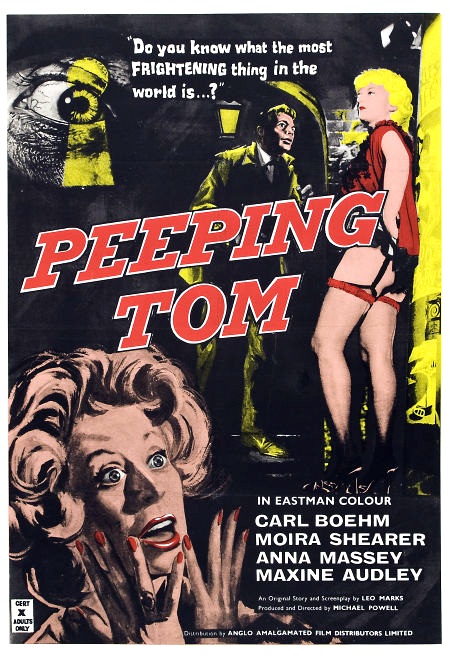
The movies make us into voyeurs. We sit in the dark, watching other people’s lives. It is the bargain the cinema strikes with us, although most films are too well-behaved to mention it.
Michael Powell‘s “Peeping Tom,” a 1960 movie about a man who filmed his victims as they died, broke the rules and crossed the line. It was so loathed on its first release that it was pulled from theaters, and effectively ended the career of one of Britain’s greatest directors.
Why did critics and the public hate it so? I think because it didn’t allow the audience to lurk anonymously in the dark, but implicated us in the voyeurism of the title character.
Martin Scorsese once said that this movie, and Federico Fellini’s “8 1/2,” contain all that can be said about directing. The Fellini film is about the world of deals and scripts and show biz, and the Powell is about the deep psychological process at work when a filmmaker tells his actors to do as he commands, while he stands in the shadows and watches.
Scorsese is Powell’s most famous admirer. As a child, he studied the films of “the Archers”–the team of director Powell and writer Emric Pressburger. Scorsese haunted the late show screenings of their films, drinking in Powell’s bold images and confident, unexpected story development.
It is a movie about looking. Its central character is a focus puller at a British movie studio; his job is to tend the camera, as an acolyte might assist at the mass. His secret life involves filming women with a camera that has a knife concealed in its tripod; as they realize their fate, he films their faces, and watches the footage over and over in the darkness of his rooms. He is working on a “documentary,” he tells people, and only in the film’s final shot do we realize it is not only about his crimes, but about his death. He does not spare himself the fate of his victims.
This man, named Mark Lewis, has been made into a pitiful monster by his own upbringing. When Helen (Anna Massey), the friendly girl who lives downstairs, shows an interest in his work, he shows her films taken by his father. Films of Mark as a little boy, awakened in the night by a flashlight in his eyes. Films of his father dropping lizards onto his bedclothes as he slept.
Tapes of his frightened cries. Mark’s father, a psychologist specializing in the subject of fear, used his son for his experiments. When a police psychologist learns the story, he muses, “He has his father’s eyes … ”
There is more. We see little Mark filmed beside his mother’s dead body. Six weeks later, another film, as his father remarries. (Wheels within wheels: The father is played by Michael Powell. Mark’s childhood home is the London house where Powell was reared, and Mark as a child is played by Powell’s son.) At the wedding, Mark’s father gives him a camera as a present.
For Mark, the areas of sex, pain, fear and filmmaking are connected. He identifies with his camera so much that when Helen kisses him, he responds by kissing the lens of his camera. When a policeman handles Mark’s camera, Mark’s hands and eyes restlessly mirror the officer’s moves, as if Mark’s body yearns for the camera and is governed by it. When Helen tries to decide whether she should wear a piece of jewelry on the shoulder or at the neckline, Mark’s hands touch his own body in the same places, as if he is a camera, recording her gestures.
Powell originally thought to cast Laurence Harvey in the lead, but he settled instead on Karl Boehm, an Austrian actor with such a slight accent in English that it sounds more like diffidence. Boehm was blond, handsome, soft and tentative; Powell was interested to learn that his new star was the son of the famous symphony conductor. He might know something of overbearing fathers.
Boehm’s performance creates a vicious killer, who is shy and wounded. The movie despises him, yet sympathizes with him. He is a very lonely man.
He lives upstairs in a rooming house. The first room is conventional, with a table, a bed, a kitchen area. The second room is like a mad scientist’s laboratory, with cameras and film equipment, a laboratory, a screening area, obscure equipment hanging from the ceiling.
Helen is startled when he reveals that the house is his childhood home, and he is the landlord: “You? But you walk around as if you can’t afford the rent.” Helen lives with her mother (Maxine Audley), who is alcoholic and blind, and listens to Mark’s footsteps. When Helen tells her mother they’re going out together, her mother says, “I don’t trust a man who walks so softly.” Later Mark surprises the mother inside his inner room, and she cuts right to the heart of his secret: “I visit this room every night. The blind always visit the rooms they live under. What am I seeing, Mark?”
Powell’s film was released just months before “Psycho” (1960), another shocking film by a British director. Hitchcock’s film arguably had even more depraved subject matter than Powell’s, and yet it was a boost for his career, perhaps because audiences expected the macabre from Hitchcock but Powell was more identified with elegant and stylized films.
There is a major sequence in “Peeping Tom” that Hitchcock might have envied. After hours at the film studio, Mark persuades an extra (Moira Shearer) to stay behind so he can film her dancing. She is almost giddy to have her own solo shots, and dances around a set and even into a big blue trunk. The next day, the body is discovered inside the trunk–while Mark, unseen, films the discovery.
The film’s visual strategies implicate the audience in Mark’s voyeurism. The opening shot is through Mark’s viewfinder. Later, we see the same footage in Mark’s screening room, in a remarkable shot from behind Mark’s head. As the camera pulls back, the image on the screen moves in for a closeup, so the face of the victim effectively remains the same size as Mark’s head shrinks. In one shot, Powell shows us a member of the audience being diminished by the power of the cinematic vision. Other movies let us enjoy voyeurism; this one extracts a price.
Powell (1905-1990) was a director who loved rich colors, and “Peeping Tom” is shot in a saturated Technicolor with shots such as one where a victim’s body under a bright red blanket stands out against the gray street. He was a virtuoso of camera use, and in “Peeping Tom” the basic strategy is to always suggest that we are not just seeing, but looking. His film is a masterpiece precisely because it doesn’t let us off the hook, like all of those silly teenage slasher movies do. We cannot laugh and keep our distance: We are forced to acknowledge that we watch, horrified but fascinated.
“Peeping Tom” essentially finished Powell’s career, although he made more films. By the late 1970s, however, Scorsese was sponsoring revivals and restorations, and joined Powell on the audio commentary tracks of several laser discs. Indeed, Powell and Scorsese’s editor, Thelma Schoonmaker, fell in love and married, and she assisted him in writing the most remarkable directorial autobiographies, A Life in Movies and Million-Dollar Movie.
Catastrophic events that send the world into turmoil happen on ‘just another day’. The atom bomb that exploded over Hiroshima took place while thousands of ordinary folk were just going about their everyday business on ‘just another day’.
A missile attack on a neighbourhood in Gaza or a drone attack on unsuspecting civilians in Afghanistan: death and destruction come like a bolt from the blue as people shop at the local market or take their kids to school on ‘just another day’.
Will it be ‘just another day’ when the next nuclear bomb is exploded in anger, an ordinary day when people are just going about their daily business? By then it might be too late to do anything, too late to act to try to prevent an unfolding global catastrophe on a scale never before witnessed by humans.
Yet so many appear too apathetic and wrapped up in a world of gadgets, technology, shopping malls, millionaire sports players and big-time sports events to think that such a thing could be imminent.
Are they so preoccupied with the machinations of their own lives in cotton-wool cocooned societies to think that what is happening in Syria or Iraq is just too boring to follow or that it doesn’t really concern them or it is ‘not my problem’?
Do they think they are untouchable, that only death, war and violence happens in faraway places?
Could any of us even contemplate that on some not-too-distant day a series of European cities could be laid waste within a matter of minutes? It isn’t worth thinking about. Or is it.
The US (and the West’s) foreign policy is being driven on the basis of fake morality and duplicity. Millions lie dead in Iraq, Afghanistan, Syria and Libya as a result of US-led imperialism, and nuclear-armed Russia is constantly demonised simply because it will not acquiesce to Washington and serve as a vassal state.
And now, as the US continues to stir up tensions with Iran and as China warns neighbouring countries about allowing US nuclear missiles aimed at it on their territories, much of the Western public and media remain oblivious to the dangers of conflict escalation and the biggest immediate threat to all life on Earth: nuclear war.
The threat of mass murder
Some fell to the ground and their stomachs already expanded full, burst and organs fell out. Others had skin falling off them and others still were carrying limbs. And one in particular was carrying their eyeballs in their hand.”
In response to a question from MP George Kereven, the then British PM Theresa May said without hesitation that, if necessary, she would authorise the use of a nuclear weapon that would kill hundreds of thousands of innocent men, women and children. May also implied that those wishing to scrap Britain’s nuclear weapons are siding with the nation’s enemies.
Politicians like May read from a script devised by elite interests. This transnational capitalist class dictates global economic policies and decides on who lives and who dies and which wars are fought and inflicted on which people.
The mainstream narrative tends to depict individuals who belong to this class as ‘wealth creators’. In reality, however, these ‘high flyers’ have stolen ordinary people’s wealth, stashed it away in tax havens, bankrupted economies and have imposed a form of globalisation that results in devastating destruction and war for those who attempt to remain independent or structurally adjusted violence via privatisation and economic neo-liberalism for millions in countries that have acquiesced.
While ordinary folk across the world have been subjected to policies that have resulted in oppression, poverty and conflict, this is all passed off by politicians and the mainstream media as the way things must be.
The agritech sector poisons our food and agriculture. Madelaine Albright says it was worth it to have killed half a million kids in Iraq to secure energy resources for rich corporations and extend the wider geopolitical goals of ‘corporate America’. The welfare state is dismantled and austerity is imposed on millions. The rich increase their already enormous wealth.
Powerful corporations corrupt government machinery and colonise every aspect of life for profit. Environmental destruction and ecological devastation continue apace.
And nuclear weapons hang over humanity like the sword of Damocles.
The public is supposed to back this status quo in support of what? Austerity, powerlessness, imperialism, propping up the US dollar and a moribund system. For whom? Occidental Petroleum, Soros, Murdoch, Rothschild, BP, JP Morgan, Boeing and the rest of the elite and their corporations whose policies are devised in think tanks and handed to politicians to sell to a largely ignorant public: those who swallow the lie about some ‘war on terror’ or Washington as the world’s policeman, protecting life and liberty.
Rejecting hegemonic thought
Many believe nuclear weapons are a necessary evil and fall into line with hegemonic thinking about humanity being inherently conflictual, competitive and war-like.
Such tendencies do of course exist, but they do not exist in a vacuum. They are fuelled by capitalism and imperialism and played upon by politicians, the media and elite interests who seek to scare the population into accepting a ‘necessary’ status quo.
Co-operation and equality are as much a part of any arbitrary aspect of ‘human nature’ as any other defined characteristic. These values are, however, sidelined by a system of capitalism that is inherently conflict-ridden and expansionist.
Much of humanity has been convinced to accept the potential for instant nuclear Armageddon hanging over its collective head as a given, as a ‘deterrent’. However, the reality is that these weapons exist to protect elite, imperialist interests or to pressure others to cave into their demands.
If the 20th century has shown us anything, it is these interests are adept at gathering the masses under notions of flag, god and country to justify their slaughter.
To prevent us all shuddering with the fear of the threat of instant nuclear destruction on a daily basis, it’s a case of don’t worry, be happy, forget about it and watch TV.
It was the late academic Rick Roderick who highlighted that modern society trivialises issues that are of ultimate importance: they eventually become banal or ‘matter of fact’ to the population.
People are spun the notion that nuclear-backed militarism and neoliberalism and its structural violence are necessary for securing peace, defeating terror, creating prosperity or promoting ‘growth’. The ultimate banality is to accept this pack of lies and to believe there is no alternative, to acquiesce or just switch off to it all.
Many people evade responsibility, of course, simply by believing and acting as if someone else, perhaps even ‘the government’, is ‘properly’ responsible. Undoubtedly, however, the most widespread ways of evading responsibility are to deny any responsibility for military violence while paying the taxes to finance it, denying any responsibility for adverse environmental and climate impacts while making no effort to reduce consumption, denying any responsibility for the exploitation of other people while buying the cheap products produced by their exploited (and sometimes slave) labour, denying any responsibility for the exploitation of animals despite eating and/or otherwise consuming a range of animal products, and denying any part in inflicting violence, especially on children, without understanding the many forms this violence can take.”
Burrowes concludes by saying that ultimately, we evade responsibility by ignoring the existence of a problem. The evasion of responsibility, acquiescence and acceptance are, of course, part of the conditioning process.
The ‘problem’ encompasses not only ongoing militarism, but the structural violence of neoliberal capitalism, aided and abetted by the World Bank, IMF and the WTO. It’s a type of violence that is steady, lingering and a daily fact of life under globalised capitalism.
Of course, oppression and conflict have been a feature throughout history and have taken place under various economic and political systems. Indeed, in his various articles, Burrowes goes deep into the psychology and causes of violence.
But there is potentially a different path for humanity.
In 1990, the late British MP Tony Benn gave a speech in parliament (above) that indicated the kind of values that such a route might look like.
Benn spoke about having been on a crowded train, where people had been tapping away on calculators and not interacting or making eye contact with one another. It represented what Britain had apparently become under Thatcherism: excessively individualistic, materialistic, narcissistic and atomised.
The train broke down. As time went by, people began to talk with one another, offer snacks and share stories. Benn said it wasn’t too long before that train had been turned into a socialist train of self-help, communality and comradeship.
Despite the damaging policies and ideology of Thatcherism, these features had survived her tenure, were deeply embedded and never too far from the surface.
For Tony Benn, what had been witnessed aboard that train was an aspect of ‘human nature’ that is too often suppressed, devalued and, when used as a basis for political change, regarded as a threat to ruling interests.
It is an aspect that draws on notions of unity, solidarity, common purpose, self-help and finds its ultimate expression in the vibrancy of community, the collective ownership of productive resources and co-operation.
The type of values far removed from the destructive, divisive ones of imperialism and capitalism which key politicians and the corporate media protect and promote.
Some 2.7 billion dollars per day. That’s how much the U.S. government will spend next year to prop up the military and the more than 800 bases it maintains in over 70 countries. All in the name of national security. And despite that staggering figure, a majority of Americans feel that the wars in Iraq and Afghanistan were not even worth fighting, and they certainly have not made America safer.
That money is more than enough to pay for four years of college for every college student in this country, to fund food stamps and other social safety nets that help our most vulnerable, and to fund programs that would cut fossil-fuel emissions by 40 percent by 2035.
Despite this, there has been an utter failure by both the media and grassroots activists to address the growing waste and greed of the military-industrial complex.
An estimated 4 million people just took part in worldwide climate strikes that put the issue of climate breakdown at the forefront of the media conversation. Missing from this conversation, however, is an analysis of the role militarism and empire plays in driving the chaos. The U.S. military is the world’s largest polluter and emits more carbon dioxide than a hundred countries combined.
You see, America does not have a budget problem, it has a priorities problem; until we demand that our leaders prioritize our needs over those of corporations and those who profit off of war, our politicians will continue to pilfer taxpayer dollars by the trillions to fund forever wars that support building the largest empire history has seen.
Today, Donald Trump is the ugly face of the American Empire, and recently declared the country to be “locked and loaded” and ready to confront the Islamic Republic of Iran. And with conflicts in Iraq, Afghanistan and Syria (to mention only a few) ongoing, it feels like the cycle of war may never end.
The anti-war movement in the U.S., so strong under George W. Bush’s presidency, was effectively disarmed by his successor. Barack Obama put a friendly face on U.S. imperialism and, with the help of Hillary Clinton as his secretary of state, even managed to convince many so-called liberals and progressives to support devastating regime-change operations in Libya, Syria and Ukraine on humanitarian grounds. These interventions unleashed al-Qaeda and ISIS onto the Middle East and neo-Nazi rule on Russia’s borders. Obama expanded America’s wars, dropping over 25,000 bombs targeting seven different countries: Afghanistan, Iraq, Syria, Libya, Yemen, Somalia and Pakistan. He expanded drone wars, earning the nickname “Drone King,” and expanded U.S. bases across Africa under the guise of fighting the War on Terror.
While the Democratic Party and establishment-left mourned Obama’s exit from the White House, warning of a new era of fascism under President Trump, hundreds of thousands of outraged Americans took to the streets in protests against the new Republican president’s racism, misogyny, and xenophobia. This outrage gave birth to the Women’s March. But as these protests swelled, one couldn’t help wondering why there wasn’t any mobilization remotely on this scale in the previous eight years during Obama’s presidency?
This question crossed the mind of Cindy Sheehan, a longtime anti-war activist nicknamed “Peace Mom,” who contacted the organizers of the Women’s March — since one of the movement’s stated goals was to end violence against women — and asked them to make peace a central focus of the march.
But the response of a key organizer of the march showed just how little war and peace was a priority to establishment liberals: “I appreciate that war is your issue Cindy, but the Women’s March will never address the war issue as long as women aren’t free.”
Sheehan rejected the notion that women could be “free” without addressing war and empire. She countered the dismissive comment of the march organizer by stating that divorcing peace activism from women’s issues “ignored the voices of the [millions] of women of the world who are being bombed and oppressed by U.S. military occupation.”
It was clear that the anti-war movement needed to be reborn again, and who better than Sheehan herself could fit the bill?
Cindy grew up in California, where her father worked for the Lockheed corporation. A turning point in her life came in April 2004 after her son Casey was killed while on active service with the U.S. military in Iraq. She gained national attention after she staged an extended protest outside George W. Bush’s ranch in Crawford, Texas, demanding to meet him.
Since then she has tirelessly campaigned against war and violence abroad, being described as the “Rosa Parks of the peace movement.” Throughout her activism, she has taken a nonpartisan stance in speaking truth to power, calling out George W. Bush as the biggest terrorist in the world, but also traveling to Norway to protest Barack Obama’s Nobel Peace Prize. In 2012 she was the vice-presidential nominee of the Peace and Freedom Party.
Today, Cindy is the chief organizer of the upcoming Rage Against the War Machine protests in Washington, scheduled to take place on October 11.
Mnar Muhawesh is founder, CEO and editor in chief of MintPress News, and is also a regular speaker on responsible journalism, sexism, neoconservativism within the media and journalism start-ups.
Grossly widening inequalities of income and wealth cannot be separated from grossly widening inequalities of political power in America. This corruption must end.
3. Stop corporations from receiving any tax deduction for executive pay unless the percent raise received by top executives matches the percent raise received by average employees.
Grossly widening inequalities of income and wealth cannot be separated from grossly widening inequalities of political power in America. This corruption must end.
On an practically daily basis, representatives of the present political élite of Washington and US media voice accusations of Russia, China and some other countries which allegedly try “to interfere” with the internal affairs of the US. At the same time, Washington does not mention that the budget-financed US National Endowment for Democracy (NED) has been officially operating for 35 years already, as well as other organisations of the kind, whose objective is to influence the policy of other countries. One of the NED founders, Allen Weinstein, said: “Much of what we are doing today used to be done in secret by the CIA 25 years ago.”
Over the recent decades, against the backdrop of the comprehensive propaganda campaign conducted by Washington within the country and abroad about the alleged “advantages of the American democracy,” the American élites adopted the idea of a certain special role of the US, a sort of American Messianism, of its right to interfere in any matters and countries worldwide with impunity.
According to the research of the American Carnegie Mellon University, from the end of World War II to 2000, the US interfered with elections in 45 countries of the world at least 80 times, which does not include the organisation of military coups and color revolutions.
The American website AlterNet, found at least 80 cases of local and regional conflicts (since 1953) in which Washington participated. AlterNet also notes that, historically, about a half of all revolutions organized with the US failed, and success was never a sure-fire thing.
In the modern history, the majority of instances of US intervention in the politics of other states fell on the Cold War period. Back then, Washington actively sought to strengthen its geopolitical positions on the international scene, regularly trying to secure a pro-American government in this or that country. Since, in the wake of World War II, the list of European players was generally finalized, the states of Asia, Africa and South America became the usual arena of the US activities.
At the same time, the political activities of the US Administration often closely intertwined with the US economic interests, a desire to receive control over transport corridors, natural minerals, first of all oil and gas. Washington always sought to disguise its true purposes by the propaganda trends relevant at the time, like prevention of “a spread of communist ideas in Asia and Latin America,” or “Islamic radicalization of the Middle Eastern states.”
The containment mechanisms of the UN or international condemnation did not always prove an effective barrier to the attempts of the White House to change the political map of the world. And a considerable number of the countries, in pursuit of “the American benefits” in the form of military, economic or other aid, very quickly oriented their political course following the US lead, becoming de facto silent puppets in the expansionist world game of the US.
The actions of Washington are not only tolerated by certain European countries, but also the European Union as a whole, whose political leadership lost independence from the actions of Washington a long time ago. “The agreements and doctrines which are the cornerstone of the EU and the NATO, oblige Europeans to participate in all military enterprises of the US,” the Austrian Contra Magazin reports.
Showing utter defiance to the independent policy of other states, representatives of the current US political élite of the USA actively seek to interfere with the internal affairs of many countries of the world.
In response to Donald Trump’s tweets about the anti-government protests in France in December 2018, the French Minister of Europe and Foreign Affairs Jean-Yves Le Drian was forced to officially urge the US President not to interfere with the domestic policy of France.
It is known that the former president of Ukraine Petro Poroshenko resorted to the help of the US lobbyist organisations more than once, trying to get the favor of Washington. Now it turned out that his successor Volodymyr Zelensky used this experience as well. It became known after the US lobbyist company Signal Group Consulting LLC published a report on the work in favor of the president of Ukraine Volodymyr Zelensky, which was revealed by the Ukrainian office of Voice of America, referring to a number of documents.
On a practically regular basis, international media publishes statements about the instances of open intervention, which is unseemly for US Ambassadors, in the affairs of other sovereign states.
Thus, in November 2018, Poland saw a political demarche of the US Ambassador in Warsaw Georgette Mosbacher for her criticism of the freedom of media after she sent a letter to the Prime Minister of Poland Mateusz Morawiecki in which she explained what is and what is not appropriate for the ministers of the Polish government to say to the Polish TV channel TVN.
In February, the US Ambassador to Moldova Dereck J. Hogan actively participated in the internal political process in the country, which clearly showed attempts to interfere with the pre-election situation in this country.
In June, the representative of the Georgian Orthodox Church (GOC), archpriest David Isakadze accused the acting US Ambassador to Georgia Elizabeth Rood of attempts to aggravate the situation in Georgia.
Everybody knows about the scandalous activities of the US Ambassador in Berlin Richard Grenell who, as of January this year, began to send threats to the representatives of the German business community because of their actions in cooperation with Russia. In March, he criticized the policy of the German Ministry of Finance. And, on August 1, in his speech, he dared criticize the government of the Chancellor Angela Merkel for their unwillingness to join the naval mission in the Strait of Hormuz. Such behavior, inadmissible for a diplomatic representative and concerning the state institutions and the policy of Germany as though it were not the leading European state, but a vassal territory of the US, was met with indignation in the German political business community. It also forced the Vice Chairman of the Free Democratic Party of Germany (FDP) Wolfgang Kubicki to urge the Foreign Minister Heiko Maas to banish the US Ambassador R. Grenell from the country.
The former US Ambassador in Moscow Michael McFaul admitted in the memoirs that the US had wanted a change of the power in Moscow and tried to depose Vladimir Putin. According to Der Spiegel, Americans trained activists of the liberal opposition and paid millions to the civil organisations which, in McFaul’s own words, could not be politically neutral.
Today, Washington continues to use the same methods seeking to influence the domestic policy of Russia by publishing on the Twitter webpage of the US Department of State Bureau of Consular Affairs on August 2 detailed information on the places, meeting time and route of an unauthorized rally in Moscow. The head of the Russian MFA Department for Information Issues Ilya Timokhov directly specified the other day that such call relaying was the most relevant and scandalous example of the US Department of State’s intervention in the internal affairs of Russia: “… it is nothing other than propaganda of the rally organizers since it keeps the Russian language text with an appeal to rally.”
Here, only a small number of examples of outright intervention of the US authorities and institutions in the internal affairs of Russia and other states were given. Certainly, one could give a great many examples of the sort, as well as the informal tools used by Washington in order to influence other states in a way that would be favorable for the US by imposing American style democracy on other countries. In particular, such tools include not only the US intelligence agencies, which are aimed specifically at these objectives, but also numerous western non-profit organisations and religious sects. You will learn more about those in the future materials of the NEO.
Middle East Eye‘s Ian Cobain has published an exclusive titled “Twitter executive for Middle East is British Army ‘psyops’ soldier”, exposing the fact that Twitter’s senior editorial executive for Europe, the Middle East and Africa also works for an actual, literal propaganda unit in the British military called the 77th Brigade. Which is mighty interesting, considering the fact that Twitter constantly suspends accounts from non-empire-aligned nations based on the allegation that they are engaging in propaganda.
“The senior Twitter executive with editorial responsibility for the Middle East is also a part-time officer in the British Army’s psychological warfare unit,” Cobain writes. “Gordon MacMillan, who joined the social media company’s UK office six years ago, has for several years also served with the 77th Brigade, a unit formed in 2015 in order to develop ‘non-lethal’ ways of waging war. The 77th Brigade uses social media platforms such as Twitter, Instagram and Facebook, as well as podcasts, data analysis and audience research to wage what the head of the UK military, General Nick Carter, describes as ‘information warfare’.”
MacMillan’s presence in a government psyops unit was not a secret; until Middle East Eye began raising questions on the matter, it was right there on his LinkedIn profile. This is not something that anyone considering him for promotion was likely to have been unaware of. According to his (now-edited) LinkedIn page, MacMillan has been in his current position as Head of Editorial EMEA since July 2016. According to Middle East Eye, MacMillan was already a captain in the 77th Brigade by the end of 2016. His current rank there is being hidden behind a wall of government secrecy.
When questioned by Middle East Eye about MacMillan’s work in the British Army’s online propaganda program, Twitter hilariously responded, “Twitter is an open, neutral and rigorously independent platform. We actively encourage all our employees to pursue external interests in line with our commitment to healthy corporate social responsibility, and we will continue to do so.”
That’s very nice of Twitter, isn’t it? They encourage their employees to pursue wholesome external interests, whether that be tennis, volunteering at a soup kitchen, or moonlighting at a military program explicitly devoted to online psychological warfare. You know, just everyday socially responsible pastime stuff.
The fact that Twitter not only employs known propagandists but actively promotes them to executive positions is a very large and inconvenient plot hole in their “open, neutral and rigorously independent platform” story. Especially since, as I documented recently, the mass purges of foreign Twitter accounts we’ve been seeing more and more of lately always exclusively target governments and groups which are not in alignment with the interests of the US-centralized power alliance of which the UK is a part. We’ve seen mass suspensions of accounts from Cuba, China, Russia, Iran, Venezuela, and the Catalan independence movement on allegations of “coordinated influence operations” and “covert, manipulative behaviors”, yet Twitter currently employs a high-level executive for whom coordinated influence operations and covert, manipulative behaviors on behalf of the British government are a known vocation.
Have You Noticed How Social Media Purges Always Align With The US Empire?
"There is no legitimate reason to go on pretending that these plutocratic Silicon Valley institutions are meaningfully separate from the US government."https://t.co/Jdsj1JMWPB
This is just one more item on the ever-growing mountain of evidence that these giant, immensely influential social media platforms we’ve all been herded into are nothing other than state propaganda for the digital age. True, they operate in a way which disregards the official lines that are drawn between government power and corporate power and the lines that are drawn between nations, but then, so do our rulers. We are living in a globe-spanning corporate oligarchic empire, and these government-aligned Silicon Valley giants are a major part of that empire’s propaganda engine.
The real power of that empire and that oligarchy lies in their invisibile and unacknowledged nature. Officially we all live in separate, sovereign nations run by democratically elected officials; unofficially we live in a massive transnational empire ruled by a loose alliance of plutocrats and opaque government agencies where military propagandists are employed by social media monopolies to manipulate public narratives. The official mask exists only on the level of narrative, while the unofficial reality is what’s actually happening. Yet whenever you try to publicly discuss the threat that is being posed by oligarchic narrative control online, you get told by establishment loyalists and libertarians that Twitter is just a simple private business running things in a way that is entirely separate from government censorship and state propaganda.
All we clear-eyed rebels can do is keep documenting the evidence of what’s going on and pointing to it as loudly as we can. So once again for the people in the back: Twitter employs literal government propagandists as high-level executives while purging accounts from unabsorbed governments for circulating unauthorized narratives. This is a fact. Remember it.