Minority Report (2002) Esoteric Analysis

By Jay Dyer

Source: Jay’s Analysis

Spielberg’s Minority Report is now an important film to revisit.  Based on the short story by visionary science fiction author Phillip K. Dick, Spielberg’s film version implements an important number of predictive programming elements not found in Dick.  Both are worth a look, but the film is important for JaysAnalysis, since now 13 years later, we are actually seeing the implementation of the total technocratic takeover, including pre-crime tracking systems.

Although the film and the short story present the precognition as a metaphysical mystery by telepathic individuals who can see into the aether, the real pre-crime systems are based on A.I. and the digitizing of all records under total information awareness.  And as I’ve said, this was DARPA’s plan for the Internet all along.

In fact, a good friend of mine worked for a few years digitizing mass medical records, and while most are aware of Google’s attempts to digitize all books, most do not know why.  I’ve warned for several years now the end goal of all this digitization is not for “efficiency” and trendy techy cool iWatches to monitor heart rates and location.  The ultimate goal is total mind control, loss of free will and the complete rewrite of all past reality.

Consider, for example, the power the system will wield with the ability to “delete” all past versions of literature – religious texts, Shakespeare, 1984, nothing will be sacred and unable to be “revised.”  Remember that in 2009 Amazon erased Orwell’s 1984.  Your own past may even be deleted, subject to revision or altered to make you the next villain!  All this is revealed in detail in Minority Report.  Thus, while the public adopts “Kindles,” print itself is assigned the doom of the kindled fire – like Farenheit 451, as Richard Grove has said.

Minority Report’s setting is a 2055 dystopic D.C., where Agent John Anderton (Tom Cruise) is framed for two murders from within his own PreCrime Corporation ranks by the CEO, Lamar Burgess (Max Von Sydow). (Note: The existing system appears to be a merger of private and government sectors.)   I’m sure most readers have seen the film, so I’ll spare you detailed plot recaps and hit the highlights for the sake of our purposes.

The film’s PreCrime alerts a private corporation to a predetermined murder event ahead of time, giving the Agents of the corporation time to save victims.  Hailed as a perfect system, the infallibility of PreCrime has made D.C. the safest city in the world, with no murders for several years.  As a result, the PreCrime test requires a total surveillance society, something akin to complete panopticism.  In fact, the advertising in D.C. is user specific, targeting pedestrian’s personal desires based on retina scans – and all travel requires retinal scanning and mass microchipping.

We are now on the verge of the implementation of retinal scanning, as the U.S. military has engaged in retinal scanning in occupied territories for several years now.  It is important to understand that the action of the military abroad are often a test ground for the implementation of such surveillance and tracking technology at “home.”  In October 2010, the Guardian reported of U.S. troops stationed in Afghanistan:

“With each iris and fingertip scanned, the device gave the operator a steadily rising percentage chance that the goat herder was on an electronic “watch list” of suspects. Although it never reached 100%, it was enough for the man to be taken to the nearest US outpost for interrogation.

Since the Guardian witnessed that incident, which occurred near the southern city of Kandahar earlier this year, US soldiers have been dramatically increasing the vast database of biometric information collected from Afghans living in the most war-torn parts of southern and eastern Afghanistan. The US army now has information on 800,000 people, while another database developed by the country’s interior ministry has records on 250,000 people.”

Wired Magazine reported millions were the goal.  The goal is not millions, but the entire globe, where any and all information is now currency for “big data.”  This is exactly the world Minority Report foresaw, and for those curious about Phillip K. Dick, whispers are his foresight was due to being well-connected with the Silicon Valley elites.  This is how Ubik foresaw the “Internet of Things” I’ve written about many times, and probably in part why Dick went insane (or was targeted).  Slate writes of Ubik:

“Samsung, the world’s largest manufacturer of televisions, tells customers in its privacy policy that “personal or other sensitive” conversations “will be among the data captured and transmitted to a third party” through the TV’s voice-recognition software. Welcome to the Internet of Things.

Sci-fi great Philip K. Dick warned us about this decades ago. In his classic 1969 novel Ubik, the characters have to negotiate the way they move and how they communicate with inanimate objects that monitor them, lock them out, and force payments.”

Just as the predictive algorithm in Asimov’s Foundation was able to track mass movements, so now the same algorithmic tracking is in place across the “web of things” that are capable of being recorded and tracked – and that’s most things.  The Pentagon has a virtual “you” in a realtime 3D interface that updates its data consistently from everything done on the web.  The Register reported in 2009 about this simulated warfare and predictive software:

“Defense analysts can understand the repercussions of their proposed recommendations for policy options or military actions by interacting with a virtual world environment,” write the researchers.

“They can propose a policy option and walk skeptical commanders through a virtual world where the commander can literally ‘see’ how things might play out. This process gives the commander a view of the most likely strengths and weaknesses of any particular course of action.”

It’s not telepathic Samantha Morton’s in a tub of goo, it’s Google and DARPA developing highly advanced technology along the lines of what William Binney exposed, as a former NSA employee.  Think here of War Games (1983), where the A.I. bot was able to war game future scenarios of global thermonuclear war, but thankfully Ferris Bueller was there to save us.  If this was displayed in 1983 in pop culture, imagine how far that technology has come 30 years later.  Lest anyone think the “precrime” is merely for security and weekend Xbox enjoyment, recall what I wrote two years back:

“Capitalism, communism, nationalism, 401ks, blah blah blah, all of these things are basically obsolete. Why?  Because of the nature of the real secret high-tech and plans for mega SmartCities that are to come.  You see, you think you are getting ahead and climbing the scum social ladder, and you aren’t even aware that the CEO of IBM Ginni Rommety gives lectures about SmartCities where everything you do will be rationed, tracked and traced by the central supercomputers, with pre-crime determining whether you are guilty of crimethink.  So everything you are trusting in is already obsolete.  You think I’m exaggerating?  On the contrary, you and your children’s futures are determined (you don’t have a future), and if you are allowed to live past the great culling, you will essentially be boxed into a giant WalmartTargetGameStopUniversity City that will literally be run by a supercomputer. Watch for yourself:”

And lest anyone think PreCrime is a thing of the future, consider that it has been used for two years in the U.K.  The New Scientist and 21stCenturyWire report:

“That’s the hope of police in the US, who have begun using advanced software to analyse crime data in conjunction with emails, text messages, chat files and CCTV recordings acquired by law enforcement. The system, developed by Wynyard, a firm based in Auckland, New Zealand, could even look at social media in real time in an attempt to predict where the gang might strike next.

“We’re trying to get to the source of the mastermind behind the criminal activity, that’s why we’re setting up a database so everybody can provide the necessary information and help us get higher up the chain,” says Craig Blanton of the Marion County Sheriff’s Office in Indiana. Because Felony Lane Gang members move from state to state to stay one step ahead, the centralised database is primed to aggregate historical information on the group and search for patterns in their movements, Blanton says.

“We know where they’ve been, where they are currently and where they may go in the future,” he says. “I think had we not taken on this challenge, we along with the other 110 impacted agencies would be doing our own thing without better knowledge of how this group operates.”

It’s not the only system that police forces have at their disposal. PredPol, which was developed by mathematician George Mohler at Santa Clara University in California, has been widely adopted in the US and the UK. The software analyses recorded crimes based on date, place and category of offence. It then generates daily suggestions for locations that should be patrolled by officers, depending on where it calculates criminal activity is most likely to occur.”

Returning to the film, an interesting tidbit occurs about three times that I noticed.  Any time Anderton or his fellow Agents access the “Temple,” the holding site of the telepathic PreCogs, the sound made is distinctly the iPhone power on sound.  The first iPod premiered in 2001, so I’m assuming it’s the same sound for turning on, but readers can correct me.  I find it curious if not, since the sound would likely be chosen for a reason. This puts the infamous 1984 Apple ad in a new, ominous light.

If you’ve seen the important Spike Jonze film, Her, you’ll see why.  In Her, lead character Theodore (Joaquin Phoenix) falls in love with an iOS – his operating system.  The iOS of his future is an intelligent software system with capability for learning (like the A.I. in War Games), and ultimately transcends its own limitations.

I bring this up because Minority Report is distinctly dominated by eye imagery.  While seemingly insignificant, it is my opinion that Siri and Apple in particular are crucial in the implementation of the coming new order.  Apple ads have contained a distinctly esoteric and significant cultural referent.  This is not to say Microsoft or any of the other tech giants are insignificant, on the contrary, I believe they are all arms of one entity and the appearance of competition is largely illusory.

There is only one military industrial complex, and DARPA and Google and Apple and Microsoft are all its children.  The façade of competition is enough to advance the technology by the tech nerds that serve it, but in the end, it all serves the same system.  My point here is that the iPhone is much more than an iPhone. It is actually an EYEphone, functioning as the eye of Sauron himself, as A.I. reconnaissance before the takeover.

I have mentioned before the whispers are the iPhone of the next few years will contain a Siri that communicates with you like a personal assistant.  I have finally found an article on this here, which describes it directly in connection to Her, like I said here.  “Viv” will do the following:

“On the other hand, not only will Viv recognize disparate requests, she will also be able to put them together. Basically, Viv is Siri with the ability to learn. The project is being kept heavily under wraps, but the guys at Viv have hinted that they’re working towards creating a “global brain,” a shared source of artificial intelligence that’s as readily accessible as heat or electricity.  It’s unclear how soon a breakthrough of this magnitude can happen. But if this team made Siri, you can bet their next project is going to blow the tech world to pieces.”

In order to endear the public to that idea, a prototype Siri had to be offered.  While this may be a rumor, it will eventually come.  And the dystopic scenario presented in Her will meet the nightmare of Minority Report.  For now, it all seems harmless (though we are seeing a generation of youth destroyed by screens and pads – Steve Jobs didn’t let his own kids play with an iPad!), but the end goal I assure is nefarious.

The dominant ideology of these tech giants is pure and total dysgenics (not eugenics).  In order for the total rewrite to come, the existing structure must be destroyed.  The “old way” of doing things will be scapegoated as the technocracy replaces it, offering utopia and salvation, but the synthetic rewrite is a Trojan horse.  Humanity will be enslaved in the same virtual Matrix Anderton is enslaved in, in the film.

The film’s tag line, which pops up numerous times in the story, is about running.  “Everybody runs,” and John spends most of the film on the run from the very system he operated.  The film asks the question multiple times, “Can you see?” and when we think of this on a deeper level in terms of predictive programming, I think we are intended to look beyond the immediate narrative.  There are also numerous hat tips to Blade Runner, where again the “running” imagery comes to the fore.  Can we run from the panopticon?  Do we have eyes to see the iEYES that are “infallibly” surveilling us perpetually?

Corporate America Is an Anti-Social Black Plague: Negative Network Effects Run Amok

By Charles Hugh Smith

Source: Of Two Minds

The anti-social carnage unleashed by Corporate America’s “lock-in” / negative network effects has no real limits.

Here’s the U.S.economy in a nutshell: Corporate America is an anti-social Black Plague, gorging on cartel-monopoly profits reaped from negative network effects running amok, enriching the few at the expense of the many and concentrating political power in the hands of the most rapacious, anti-democratic corporate sociopaths.

Let’s start with network effects: the conventional definition is “When a network effect is present, the value of a product or service increases according to the number of others using it.”

So for example, when telephone service was only available to a few users, its value was limited. As more people obtained telephone service, the value of the network increased to both its owners and to users, who could reach more people and conduct commerce more easily as a result of having telephone service.

In the conventional analysis, negative network effects occur from “congestion,” i.e. the network is adding new users so quickly that “more users make a product less valuable.”

But this superficial analysis misses the fatally anti-social consequences of corporate negative network effects, a dynamic described by analyst Simons Chase in this essay. Here is an excerpt:

Even the most imaginative and far-reaching narratives about non-obvious economic fragility and off balance sheet risks are mere rants without constructive ideas about causes and solutions.

Consider network effects, the popular economic construct applied to market concentration and increasing returns for strategies pursued by some leading tech companies. This dynamic economic agent is also known as demand side economies of scale.

W. Brian Arthur, the economist credited with first developing the theory, described the condition of increasing returns as a game of strategic positioning and building up a user base to the point where ‘lock in’ of dominant players occurs. Companies able to tap network effects have been rewarded with huge valuations and highly defensible businesses.

But what about negative network effects? What if the same dynamic applies to the U.S.’s pay-to-play political industry where the government promotes or approves of something through a policy, subsidy or financial guarantee due to private sector influence.

Benefits accrue only to the purchaser of the network effects, and consumers, induced by the false signal of large network size, ultimately suffer from asymmetric risk and experience what I’m calling a loss of intangible net worth for each additional member after the ‘bandwagon’ wares off.

If this were the case, then you would see companies experience rapid revenue growth (out of line with traditional asset leverage models), executives accumulating huge fortunes and political campaign coffers swelling.

But the most striking feature would be the anti-social outcomes, the ones not available without the instant critical mass of government-supported network effects, the ones that, at scale, monetize a society’s intangible net worth.

Some products tied to these metrics include: prescriptions drugs, junk food targeting children, mortgages, diplomas, and social media. The list of industries that are likely to have gained through the purchasing of network effects in D.C. maps closely to the decay that is visible in U.S. society.

The loss of intangible capital and other manifestations of non-obvious economic fragility (to use Simons’ apt phrase) is the subject of my latest book, Will You Be Richer or Poorer? Profit, Power and A.I. in a Traumatized World, in which I catalog the anti-social consequences of negative network effects and other forces eroding our nation’s intangible capital.

Consider Facebook, a classic case of negative network effects running amok, creating immensely anti-social consequences while reaping billions in profits: Facebook isn’t free speech, it’s algorithmic amplification optimized for outrage (TechCrunch.com).

The full social cost of social media’s negative network effects are difficult to tally, but studies have found that loneliness and alienation are correlated to how many hours a day individuals spend on social media. (An Internet search brings up dozens of reports such as NPR’s Feeling Lonely? Too Much Time On Social Media May Be Why.)

Facebook is trying to leverage its social media “lock-in” to issue its own global currency and both Facebook and Google are trying to offer banking services without any of the pesky regulations imposed on legitimate banks. (Will $10 million in lobbying do the trick? How about $100 million? We’ve got billions to “invest” in corrupting and controlling public agencies and political power.)

Once Corporate America locks in cartel-monopoly power, i.e. you have to use our services and products, the corporate sociopaths use their billions in market cap and profits to buy the sociopaths in government. Pay-to-play is the real political machinery; “democracy” is the PR fig-leaf to mask the private sector “lock-in” (monopoly) and the public-sector “lock-in” (regulatory influence, anti-competitive barriers to entry, the legalization of corporate fraud, cooking the books, embezzlement, etc.)

Consider Boeing, an effective monopoly which used $12 billion in profits to buy back its own shares and “invested” millions in buying political influence so it could minimize public-sector oversight.

Rather than spend the $12 billion designing a new safe aircraft, Boeing cobbled together a fatally flawed design dependent on software, as described in The Case Against Boeing (The New Yorker) to maximize the profitability of its “lock-in”.

Google is running amok on so many levels, it’s difficult to keep track of its anti-social “let’s be evil, it’s so incredibly profitable” agenda: Google’s Secret ‘Project Nightingale’ Gathers Personal Health Data on Millions of Americans (Wall Street Journal). The goal, of course, is to reap more billions in profits for insiders and corporate sociopaths.

The anti-social carnage unleashed by Corporate America’s “lock-in” / negative network effects has no real limits. Consider the essentially limitless private and social damage caused by Big Tech: Child Abusers Run Rampant as Tech Companies Look the Other Way (New York Times).

Then there’s the opioid epidemic, whose casualties run into the hundreds of thousands, an epidemic that was entirely a creature of Corporate America seeking to maximize “lock-in” profits by buying regulatory approval and pushing false claims that the corporate products were safe and non-addictive.

Note the media sources of these reports: these are the top tier of American journalism, not some easily dismissed alt-media source.

What does this tell us? It tells us the anti-social consequences are now so extreme and so apparent that the corporate media cannot ignore them. Once Corporate America locks-in market, financial and political power, it acts as a virulent Black Plague on the social order, legitimate democracy, and an entire spectrum of intangible social capital including the rule of law.

As Simons put it: “The ethical dimension underpinning the whole system is this: what’s moral is what’s legal and what’s legal is for sale.” Where does this Black Plague pathology take us? To a collapse of the status quo which enabled it, cheered it, and so richly rewarded it.

Our Vanishing World: Birds

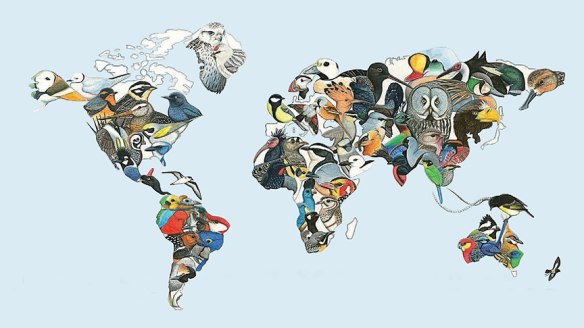
Illustration by Luke Seitz

By Robert J. Burrowes

At the beginning of the nineteenth century, it is estimated that the total number of passenger pigeons in the United States was about three billion birds. The bird was immensely abundant, as illustrated by this passage written by the famous ornithologist, naturalist and painter John James Audubon:

‘I dismounted, seated myself on an eminence, and began to mark with my pencil, making a dot for every flock that passed. In a short time finding the task which I had undertaken impracticable, as the birds poured in countless multitudes, I rose, and counting the dots then put down, found that 163 had been made in twenty-one minutes. I traveled on, and still met more the farther I proceeded. The air was literally filled with Pigeons; the light of noon-day was obscured as by an eclipse, the dung fell in spots, not unlike melting flakes of snow; and the continued buzz of wings had a tendency to lull my senses to repose… Before sunset I reached Louisville, distance from Hardensburgh fifty-five miles. The Pigeons were still passing in undiminished numbers, and continued to do so for three days in succession.’ See ‘Passenger Pigeon’.

So numerous was this bird that, in the nineteenth century, the passenger pigeon was one of the most abundant birds on Earth.

In 1914 it was extinct.

While new settlements kept reducing the bird’s habitat, more importantly, it was literally hunted from the sky. Shot for its meat.

So I have two questions for you? When is the last time that you saw a flock of birds so vast that ‘the light of noon-day was obscured as by an eclipse’? And when did you last see a flock of just 20 birds?

Sobering to ponder, isn’t it?

The origin of birds

Birds evolved from small carnivorous dinosaurs of the Late Jurassic and in the 65 million years since the extinction of the rest of the dinosaurs, this ancestral lineage diversified into the major groups of birds alive today. See ‘The origin of birds’.

Because they did not exist during the first five mass extinction events on Earth, birds have been spared the widespread extinctions suffered by those species that did exist in earlier eras.

Extinctions of birds in prehistory and history

Nevertheless, the fossil record tells us of the existence of prehistoric birds that became extinct before the Late Quaternary (that is, the past half to one million years) and thus occurred in the absence of significant human interference – see ‘List of fossil bird genera’ – while various sources tell us of both prehistoric and historic bird species, including flightless megafauna birds, that became extinct between 40,000 BCE and 1500 AD and ‘was coincident with the expansion of Homo sapiens beyond Africa and Eurasia, and in most cases, anthropogenic factors played a crucial part in their extinction, be it through hunting, introduced predators or habitat alteration’. See ‘List of Late Quaternary prehistoric bird species’.

Of course, there is an even wider range of evidence of bird extinctions since 1500. See ‘List of recently extinct bird species’. Most notably perhaps, given the symbolism it has since acquired, the dodo, a flightless bird of Mauritius, was driven to extinction by 1681 but not before it was carefully drawn. See ‘Dodo’.

How many bird species are there on Earth now?

While one recent estimate – see ‘Scaling laws predict global microbial diversity’ – indicates that Earth may be the home to one trillion species (the vast bulk of which are microorganisms such as bacteria, archaea and microscopic fungi), of which only an estimated 8.7 million species fall into the usual and simpler categories of plants, birds, animals, fish, amphibians, insects and reptiles, the most recent research conducted by George F. Barrowclough, Joel Cracraft, John Klicka and Robert M. Zink and published in 2016 indicated that there are just 18,043 species of birds worldwide. See ‘How Many Kinds of Birds Are There and Why Does It Matter?’

Somewhat controversially – see ‘New Study Doubles the World’s Number of Bird Species By Redefining “Species”’ – this figure is nearly twice as many as previously thought because the study focused on ‘hidden’ avian diversity: birds that look similar to one another or were thought to interbreed but are actually different species. In any case, whether there are just 10,000 species of birds, 11,000+ as estimated by the recognized international authority BirdLife International – see ‘Introducing the IUCN Red List’ – or even18,000, just like other species of life on Earth, birds are now under siege in a way they have never been before.

Killing birds in the late twentieth and early twenty-first centuries

More than 100 years have passed since the passenger pigeon became extinct. However, while one might have hoped that humans had become more adept at nurturing populations of birds, the reality is that we are continuing to drive bird populations to extinction. Moreover, we are now doing this with breathtaking efficiency, slaughtering birds by the millions in ever-shortening timeframes.

As a result, the fate of the passenger pigeon has been replicated many times over with a vast number of bird species passing through the International Union for Conservation of Nature’s eight preliminary categories – Not Evaluated, Data Deficient, Least Concern, Near Threatened, Vulnerable, Endangered, Critically Endangered, Extinct in the Wild – before reaching the ninth and final category: Extinct. See ‘IUCN Red List Categories and Criteria’. At the moment, the ‘IUCN Red List of Threatened Species’ identifies 14% of remaining bird species as ‘threatened with extinction’. Also see ‘Introducing the IUCN Red List’.

Of course, this ongoing assault on birds is well documented in the scientific literature, along with descriptions of long-standing causes as well as those that are more recent.

In recently published research on the status of birds in North America, Dr. Kenneth V. Rosenberg led an international team of scientists from seven institutions in analyzing the population trends of 529 bird species on the North American continent. Their study quantified, for the first time, the total decline in bird populations in the continental U.S. and Canada: a loss of 2.9 billion breeding adult birds, with devastating losses among birds in every biome, since 1970. Moreover, their research revealed that ‘declines are not restricted to rare and threatened species – those once considered common and widespread are also diminished’. See ‘Decline of the North American avifauna’ and ‘Vanishing: More Than 1 in 4 Birds Has Disappeared in the Last 50 Years’.

Like scholars researching dramatic declines and extinctions of other species, such as insects, Rosenberg and his colleagues stress that their results have ‘major implications for ecosystem integrity, the conservation of wildlife more broadly, and policies associated with the protection of birds and native ecosystems on which they depend’. While species extinctions ‘have defined the global biodiversity crisis’, extinction ‘begins with loss in abundance of individuals that can result in compositional and functional changes of ecosystems’. Hence, the staggering loss of bird abundance ‘signals an urgent need to address threats to avert future avifaunal collapse and associated loss of ecosystem integrity, function, and services’. See ‘Decline of the North American avifauna’.

In more blunt language ‘the most comprehensive inventory ever done for North American birds, points to ecosystems in disarray because of habitat loss and other factors that have yet to be pinned down’. See ‘Billions of North American birds have vanished’. And, yet more bluntly: ‘The scale of loss portrayed in the [Rosenberg et.al.] study is unlike anything recorded in modern natural history.’ See ‘Vanishing: More Than 1 in 4 Birds Has Disappeared in the Last 50 Years’.

Even more importantly, however, pointing out that the study results ‘transcend the world of birds’, Rosenberg explained that ‘These bird losses are a strong signal that our human-altered landscapes are losing their ability to support birdlife’ and ‘that is an indicator of a coming collapse of the overall environment.’ See ‘Vanishing: More Than 1 in 4 Birds Has Disappeared in the Last 50 Years’.

Is North America alone in its decimation of bird populations? Far from it. Other research and data have revealed that ‘farmland birds in Europe have declined by over 50 per cent collectively in the last 30 or 40 years’ according to Professor Richard Gregory, head of species monitoring and research at the Royal Society for the Protection of Birds (RSPB) in the UK where, according to Martin Harper, director of conservation at the RSPB, ‘Our beleaguered farmland birds have declined by 56 per cent between 1970 and 2015 along with declines in other wildlife linked to changes in agricultural practices, including the use of pesticides’.

And, Professor Romain Julliard, a conservation biologist at France’s National Museum of Natural History, confessed his ‘shock’ when the latest research revealed that France has lost one-third of its birds in the past 15 years in what is being labeled a ‘dramatic collapse’ and ‘ecological catastrophe’ particularly because the decline has accelerated dramatically in recent years. See ‘“Shocking” decline in birds across Europe due to pesticide use, say scientists’.

In Germany, bird populations are vanishing with scientists using words like ‘decimated’ and ‘collapse’ to describe the enormity of the problem. In a recent study of government data, the German environmental organization Nature And Biodiversity Conservation Union (NABU) estimated ‘that more than 25 million birds [15% of the country’s total bird population] disappeared from Germany over the past 12 years’. See ‘Über zwölf Millionen Vogelbrutpaare weniger in Deutschland’, ‘Insect and bird populations declining dramatically in Germany’ and ‘“Decimated”: Germany’s birds disappear as insect abundance plummets 76%’. But why?

While habitat destruction and other factors played roles, scientists have also long linked pesticide use to insect decline – a reasonable assumption given that killing insects is the purpose of pesticides – and research clearly demonstrates that pesticides are killing more than target insects. For instance, a 2008 study demonstrated low but persistent levels of a common neonicotinoid pesticide in aquatic ecosystems can kill off or reduce the growth of insects (such as mosquitoes) that have an acquatic phase. See ‘Acute and Chronic Toxicity of Imidacloprid to the Aquatic Invertebrates Chironomus tentans and Hyalella azteca under Constant- and Pulse-Exposure Conditions’ and ‘“Decimated”: Germany’s birds disappear as insect abundance plummets 76%’.

In essence, the problem is that killing the insects is tantamount to killing the birds that feed on them.

Another recent study came to the same conclusion. The study, conducted in the Lake Constance area in southern Germany, found that the population of six of the most common birds had ‘declined massively’. According to Hans-Guenther Bauer of the Max Planck Institute for Behavioral Biology: ‘These are truly shocking figures, especially when you consider that the decline in birds began decades before our first data collection in 1980.’ Why is it happening? According to Bauer, a key reason for the decline is the loss of food. ‘This confirms what we have long suspected. The death of insects caused by humans has a massive impact on our birds.’ To stem the tide of losses, scientists are calling for a rethink in agricultural and forestry policy including ‘drastic restrictions on insecticides and herbicides in agriculture, forestry, public areas and private gardens’ and significantly less fertilization. See ‘Scientists fear “collapse” of bird populations in Germany’.

As is the case elsewhere around the world, birds in Africa also face a wide variety of threats, the most significant of which are habitat fragmentation, degradation and destruction as well as direct impacts including hunting and trapping (mainly for meat and trafficking). See ‘Multiple threats are driving threatened birds towards extinction in Africa’.

But nowhere is safe with the killing of migratory birds in China – see Market trade is fuelling the killing of migratory birds in Northern China – and various factors adversely impacting penguins in Antarctica – see ‘Climate-driven reductions in krill abundance have caused Adélie penguin declines’ – just two more of many examples that could be cited.

Illegal hunting and trapping of birds

According to Birdlife International, the organization responsible for monitoring the welfare of birds for the IUCN’s Red List, ‘The illegal killing and taking of wild birds remains a major threat on a global scale’ with recent examples including the illegal poisoning of vultures in Sub-Saharan Africa, the illegal shooting of raptors in Europe and North America, the illegal trapping of passerines (perching birds) in Asia and the illegal capture for the bird trade in South America.

For example, based on extensive research over many years in relation to bird killing during migratory flights across the Mediterranean and through Northern and Central Europe and the Caucasus, BirdLife International has compiled a series of reports. These reports document massive illegal killing of birds, often in ways that constitute torture, and totaling in excess of 25 million birds annually, including birds of species that are threatened with extinction. For recent reports, see ‘The Killing 2.0: A View to a Kill’, ‘Assessing the scope and scale of illegal killing and taking of birds in the Mediterranean, and establishing a basis for systematic monitoring’ and ‘Review of illegal killing and taking of birds in Northern and Central Europe and the Caucasus’. For a more detailed scientific report on this issue, see ‘Preliminary assessment of the scope and scale of illegal killing and taking of birds in the Mediterranean’.

But if you would simply prefer to be revolted, then watch BirdLife’s one minute video: Help us STOP illegal #birdkilling’. Or read a straightforward account of how ‘innocent’ human behaviours can be deadly for birds, in this case by ‘vacuuming’ millions of sleeping birds into oblivion each year during olive harvesting at night. See ‘Millions of Birds Killed by Nighttime Harvesting in Mediterranean’.

Unfortunately, if you think the descriptions and video of birdkilling above are bad, you won’t be impressed with the sheer insanity that militarized humans can display: ‘The Farmagusta area of Cyprus comes out as the worst place for illegally killing birds in the Mediterranean, while the British Territory in Cyprus is also affected, with the Dhekelia UK military base seeing hundreds of thousands of birds killed each autumn. The Ministry of Defence has started a programme to remove illegally planted trees and shrubs in the area, which trappers use for cover and to lure birds in.’ See ‘Millions of Birds Killed in the Mediterranean’. So, instead of ordering soldiers to stop shooting birds while using a combination of education and law enforcement measures to prevent civilians doing so, they removed ‘illegally planted trees and shrubs’!

Wild Bird trafficking

Another major killer of birds is the wildlife trade. Birds are often killed as a ‘byproduct’ of the trade in exotic birds, most of which is illegal, but which is a multi-billion dollar a year industry along with human, weapons, currency and drug trafficking. Equally importantly, however, once traded, birds no longer form part of their original habitat and hence they are lost as contributing and breeding members of that ecosystem. According to the Convention on International Trade in Endangered Species of Wild Fauna and Flora (CITES), species listed in Appendix I of the Convention are considered to be threatened with extinction and are not allowed to be traded commercially. There are currently 161 bird species on Appendix I. However, birds included on Appendix II are allowed to enter international trade ‘under specific controlled circumstances’; there are 1,300 bird species on this appendix. See ‘Wild Bird Trade and CITES’ and ‘CITES Appendices I, II and III’.

In theory, state parties are obliged to develop national legislation effectively implementing the obligations of the Convention including setting sustainable quotas for Appendix II species. But I am sure that you can imagine how well this regime works given the incredibly profitable wildlife trafficking industry, in which birds are a crucial component. In fact, ‘one third (3,337) of living bird species [that is, 2,000 species more than those that are “legal”] have been recorded as traded internationally for the pet trade and other purposes’. Of these species, 266 (that is, 8% of those internationally traded) are considered globally threatened. See ‘The Red List Index for internationally traded bird species shows their deterioration in status’.

And if the domestic trade in birds is taken into account as well, then ‘Nearly 4,000 bird species involving several million individuals annually are subject to domestic or international trade with finches, weavers, parrots and raptors being some of the most heavily affected groups.’ See ‘Wild Bird Trade and CITES’.

For a candid account of bird trafficking at its origin which describes the fate of macaw chicks being stolen from their forest nests in Ecuador, see ‘Wildlife Trafficking’.

Seabirds

In relation to seabirds, one recent study found that the global population of these birds declined by 70% between 1950 and 2010 as a result of a multiplicity of threats. These threats included ‘entanglement in fishing gear, overfishing of food sources, climate change, pollution, disturbance, direct exploitation, development, energy production, and introduced species (predators such as rats and cats introduced to breeding islands that were historically free of land-based predators)’. See ‘Population Trend of the World’s Monitored Seabirds, 1950-2010’.

Another study concluded just recently, was ‘the first objective quantitative assessment of the threats to all 359 species of seabirds’ and identified the main threats to their survival while outlining priority actions for their conservation. Using the standardized ‘Threats Classification Scheme’ developed for the IUCN Red List to objectively assess threats to each species, a team of ten scientists identified the top three threats to seabirds – in terms of number of species affected and average impact – to be as follows: invasive alien species (particularly rats and cats) which affected 165 species across all of the most threatened groups; bycatch in fisheries which ‘only’ affected 100 species but with the greatest average impact; and the climate catastrophe which affected 96 species. ‘Overfishing, hunting/trapping and disturbance were also identified as major threats to seabirds.’ The study emphasized that 70% of seabirds, especially those that are globally threatened, face multiple threats. For the three most threatened groups of seabirds – albatrosses, petrels and penguins – it is essential to tackle both terrestrial and marine threats to reverse declines. See ‘Threats to seabirds: A global assessment’.

In addition, however, another problem that has been getting insufficient attention is the result of the expanding impacts of the rapidly increasing levels of ocean acidification, ocean warming, ocean carbon flows and ocean plastics. Taken in isolation each of these changes clearly has negative consequences for the ocean. All these shifts taken together, however, result in a rapid and serious decline in ocean health and this, in turn, adversely impacts all species dependent on the ocean, including seabirds. Moreover, on top of these problems is the issue of oxygen availability given that oxygen in the air or water is of paramount importance to most living organisms. As the recently released report ‘Ocean deoxygenation: Everyone’s problem. Causes, impacts, consequences and solutions’ describes in some detail, oxygen levels are currently declining across the ocean.

But to graphically illustrate just one of the threats to seabirds, consider the impact of our chronic overfishing which is depleting the oceans of fish. In November 2019, thousands of short-tailed shearwater birds migrating from Alaska were washed up dead on Sydney’s iconic beaches in Australia. Moreover, thousands more shearwaters died out at sea in clear confirmation of the incredible fish shortages in the Pacific Ocean. After spending the summer in Alaska, the shearwaters were migrating back to southern Australia to breed: a 14,000km trip over the Pacific that requires the birds to be at full strength.

Unfortunately, vast numbers died due to lack of food because the krill and other fish they feed on have vanished. But if you think the problem only occurred along or at the end of their journey, in fact there had been ‘a series of catastrophic die-offs’ before and shortly after the birds departed to head south with thousands of shearwaters (along with puffins, murres and auklets too) lying dead from starvation on the beaches of Alaska and on Russia’s Chukotka Peninsula back in mid-year as well. The overall ‘large die-off’ pattern has been repeating since 2015 with little knowledge of the full extent of the crisis because millions of the birds ‘die at sea’. See ‘Fish all gone!… Millions of small sea birds died since 2015’.

Tragically though, as touched on above, an ocean emptied of fish is not the only hazard that seabirds have no choice but to attempt to navigate. An ocean full of plastic – with concentrations up to 580,000 pieces per square kilometer – is also deceiving many seabirds into attempting to eat pieces of plastic and this only complicates efforts by seabirds to get adequate nutrition. See ‘Threat of plastic pollution to seabirds is global, pervasive, and increasing’ and ‘Nearly Every Seabird on Earth Is Eating Plastic’. This is graphically illustrated in this photo of a dead albatross – see ‘Laysan Albatrosses’ Plastic Problem’ – although, tragically, plastic is not the only non-food item that is consumed by and is killing these majestic birds, with an abandoned US military base on Midway Atoll – where 65% of the global albatross population breeds – playing a vital role too. See ‘Study shows lead-based paint is poisoning albatross chicks at Midway Atoll National Wildlife Refuge’.

But why do seabirds eat plastic instead of correctly identifying food? Well, one recent research project provided ‘the first evidence that, in addition to looking like food, plastic debris may also confuse seabirds that hunt by smell’. See ‘Marine plastic debris emits a keystone infochemical for olfactory foraging seabirds’ and ‘The oceans are full of plastic, but why do seabirds eat it?’

Other threats to birds

Another threat faced by birds in the nuclear age is the outcome of the radioactive contamination of the Earth in many places. For example, while there are ‘severe reductions in species richness and density’ in the regions surrounding the sites of the Chernobyl and Fukushima nuclear catastrophes, surviving birds display a wide range of deformities and dysfunctionalities, notably including impaired brain development as reflected by head volume with its negative implications for cognitive ability and hence viability. See Chernobyl Birds Have Smaller Brains’ and ‘Bird populations near Fukushima are more diminished than expected’.

Yet another threat to birds is posed by the deployment of 5G. ‘Typical effects of radiation from cellular communication antennas on resident, breeding, and migratory birds [include] site abandonment, feather deformation, locomotion problems, weight loss, weakness, reduced survivorship and death.’ Moreover, it can ‘blot out a bird’s perception of the earth’s field, causing the bird to fly in the wrong direction, and also disrupt a bird’s internal clock based on the sun’s changing position’. See ‘5G to Kill the Birds, Bees and Your Loved Ones?’ and ‘Western Insanity and 5G Electromagnetic Radiation’.

Finally, without elaboration, vast numbers of birds are also killed each year by warfare and other military activities – see, for example, ‘The impact of the 1991 Gulf War oil spill on bird populations in the northern Arabian Gulf – a review’ – by industrial activity and accidents – see, for example, ‘Effects of the Exxon Valdez Oil Spill on Birds: Comparisons of Pre- and Post-spill Surveys in Prince William Sound, Alaska’ – by road and air traffic, the spread of certain avian diseases to previously unaffected species – see ‘Avian diseases are spreading to impact hitherto unaffected populations’ – wind turbines, cats, windows and communication towers, with 7 million birds losing their lives each year in the United States alone to the ‘web-like traps of wire and metal’ used for communication. See ‘Communication Towers Are Death Traps for Threatened Bird Species’. Other birds are now being killed in response to conflict generated between birds. See ‘Climate Change Leading to Fatal Bird Conflicts’. And, of course, ‘domesticated’ birds such as chickens and turkeys are farmed and consumed in prodigiously huge quantities, including for Christmas.

Sadly, too, millions of birds of many species are imprisoned in cages as ‘pets’ denied the freedom that all humans crave for themselves.

So, in essence, if you were a bird, here is a survival strategy that should work. Only live in a habitat that will not be impacted, in any way, by human beings and their activities. That is, don’t live on Earth.

Saving the birds

Given the vast range of threats posed to birdlife by humans – see a straightforward summary of ‘The greatest threats facing Important Bird & Biodiversity Areas today’ which doesn’t mention all threats and those that are emerging – it is clearly going to take a monumental effort on many fronts to contain the killing of birds and avert the ongoing extinction of bird species on Earth.

And, unless you are naive enough to believe that elite-controlled governments or international organizations and processes are going to do something that is actually effective – see ‘The Global Elite is Insane Revisited’ – then it is up to us to make the difference. Of course, we can do a few things that are specific to saving birds but the bulk of what must happen is really about saving the biosphere (which includes birds) generally. The biosphere is, after all, one deeply-interconnected living entity.

This is why, according to some biologists, laws that focus on the protection of rare species miss the big picture. Joel Cracraft, for example, argues that ‘We’re losing the battle because we’re fighting over single endangered species’. Species protection tends to focus on charismatic species – beautiful birds and mammals – and doesn’t value rare ecosystems or collections of species. See ‘New Study Doubles the World’s Number of Bird Species By Redefining “Species”’. Nor does it value the biosphere as a whole.

Still, some superlative efforts have been made on behalf of birds. For example, you can read some inspirational success stories by BirdLife International: ‘10 vital bird habitats saved through conservation action’.

And for one man’s initiative 120 years ago that is having ongoing impact, see ‘How one man changed a Christmas tradition forever – to save birds’.

So you can, of course, support the efforts of Birdlife International and the local, national and other organizations like it. See Welcome to BirdLife’s Globally Threatened Bird Forums’ and, for example, ‘Stop Wildlife Trafficking’.

Separately from initiatives that focus specifically on birds, if you wish to fight powerfully to save Earth’s biosphere consider joining those participating in The Flame Tree Project to Save Life on Earth which outlines a simple program to systematically reduce your consumption and increase your local self-reliance over a period of years. Among many other beneficial environmental outcomes, this will reduce the ongoing destruction of bird habitat to produce the products we all consume.

But given the fear-driven violent parenting and education models that drive all violence in our world and which, among a multitude of other adverse outcomes, generates the addiction of most people in industrialized countries to the over-consumption that is destroying Earth’s biosphere – see ‘Love Denied: The Psychology of Materialism, Violence and War’ – then consider addressing this directly starting with yourself – see ‘Putting Feelings First’ – and by reviewing your relationship with children. See ‘My Promise to Children’ and ‘Nisteling: The Art of Deep Listening’. For fuller explanations, see Why Violence?’ and Fearless Psychology and Fearful Psychology: Principles and Practice.

If you wish to campaign strategically to defend birds against particular threats, such as the climate catastrophe, military violence or the deployment of 5G, for example, consider joining those campaigning to halt these and other threats as well. See Nonviolent Campaign Strategy which already includes a comprehensive list of strategic goals necessary to achieve these outcomes in two key contexts in ‘Strategic Aims’.

But, whatever you do, don’t fall into the trap of fearfully begging elites to act on your behalf as, for example, the antiwar and climate movements are doing (with climate ‘activists’ marginalized at the latest COP25 gathering in Madrid). If we do not focus our efforts on engaging all people who are powerful enough to do so to respond strategically, then we will fail. And our failure will not only be the result of the elite refusing to take the requisite action despite your entreaties but also because the elite, as a group, is powerless to make sufficient difference: only a massive response from the wider population can produce the outcome we now need. For explanations of this, see ‘Why Activists Fail’, ‘The Global Climate Movement is Failing: Why?’ and ‘The War to End War 100 Years On: An Evaluation and Reorientation of our Resistance to War’.

Moreover, in those cases where corrupt or even electorally unresponsive governments are leading the destruction of the biosphere – by supporting, sponsoring and/or engaging in environmentally destructive practices – it might be necessary to remove these governments as part of the effort. See Nonviolent Defense/Liberation Strategy.

You might also consider joining the global network of people resisting violence in all contexts, including against the biosphere, by signing the online pledge of The Peoples Charter to Create a Nonviolent World.

Or, if none of the above options appeal or they seem too complicated, consider committing to:

The Earth Pledge

Out of love for the Earth and all of its creatures, and my respect for their needs, from this day onwards I pledge that:

  1. I will listen deeply to children (see explanation above)
  2. I will not travel by plane
  3. I will not travel by car
  4. I will not eat meat and fish
  5. I will only eat organically/biodynamically grown food
  6. I will minimize the amount of fresh water I use, including by minimizing my ownership and use of electronic devices
  7. I will not buy rainforest timber
  8. I will not buy or use single-use plastic, such as bags, bottles, containers, cups and straws
  9. I will not use banks, superannuation (pension) funds or insurance companies that provide any service to corporations involved in fossil fuels, nuclear power and/or weapons
  10. I will not accept employment from, or invest in, any organization that supports or participates in the exploitation of fellow human beings or profits from killing and/or destruction of the biosphere
  11. I will not get news from the corporate media (mainstream newspapers, television, radio, Google, Facebook, Twitter…)
  12. I will make the effort to learn a skill, such as food gardening or sewing, that makes me more self-reliant
  13. I will gently encourage my family and friends to consider signing this pledge.

Do all these options sound unpalatable? Prefer something requiring less commitment? You can, if you like, do as most sources suggest: nothing (or its many tokenistic equivalents). I admit that the options I offer are for those powerful enough to comprehend and act on the truth. Why? Because there is so little time left and I have no interest in deceiving people or treating them as unintelligent and powerless. See ‘Human Extinction by 2026? A Last Ditch Strategy to Fight for Human Survival’ and ‘Doomsday by 2021?’

Conclusion

Birds are being killed with ruthless efficiency by human beings and their activities all over the world. Obviously, this is an unmitigated tragedy for Earth’s birds, the biosphere as a whole and those humans who love life generally. But what are the practical implications of this ongoing bird killing for us?

Well just as the death of one canary in a coal mine warned miners about their dangerous environment, the mass death of birds is yet another warning that we are destroying the planetary biosphere.

However, in this case, we are not treating the canary’s death as a warning and, even if we were, it does not mean that we can escape because there is nowhere else to go.

In short, if we don’t save the birds, we won’t save ourselves.


Biodata: Robert J. Burrowes has a lifetime commitment to understanding and ending human violence. He has done extensive research since 1966 in an effort to understand why human beings are violent and has been a nonviolent activist since 1981. He is the author of Why Violence? His email address is flametree@riseup.net and his website is here.

The Hidden Utopia: Hobo Graffiti and Sixties Paranoia in ‘The Crying of Lot 49’

By Pepe Tesoro

Source: We Are the Mutants

Thomas Pynchon’s 1966 novel The Crying of Lot 49 is usually regarded as one of the best testimonies of Cold War paranoia and early psychedelic ’60s culture. Even though it is a keen and pointed exploration of the growing anxieties over the exponential post-war rise of mass media and market capitalism, the central conspiracy revealed in the novel doesn’t reproduce itself through the then-new and fascinating forces of radio waves or cathode rays. Quite the opposite: the kernel of the conspiracy in Pynchon’s novel lays precisely in a clandestine communication network sent through old-fashioned, conventional mail. This network itself possesses roots that go back as far as medieval nobility feuds, its presence identified with something as ancient and basic as graffiti. Fredric Jameson attributed the true effectiveness of the novel to this anomalous feature. “[T]he force of Pynchon’s narrative,” he writes in The Geopolitical Aesthetic: Cinema and Space in the World System, “draws not on the advanced or futuristic technology of the contemporary media so much as from their endowment with an archaic past.”

It would seem that in order to perform an adequate exploration of the psychological and social and political disruptions of an era’s newest and most cutting-edge technological developments, sometimes it is required to take one or two steps back, as if the reflection over contemporary objects would be better served through the examination of old and already familiar realities. The long history and deep cultural footprint of retro-futuristic aesthetics in Pynchon’s fictional universe seems to point in somewhat the same direction. But this odd narrative movement doesn’t just go backwards; it also, quite interestingly, usually goes downwards. That’s the case of the The Crying of the Lot 49, where the occult conspiracy that our poor protagonist, Oedipa Maas, struggles to unveil, doesn’t just rely on the old means of the mail. Its members are imagined as marginalized individuals living in between the remnants and scraps of industrial machinery, as if the life of the vagabond would be the only true escape from the madness of modern civilization. These elusive individuals, as imagined by Oedipa, seem to be:

…squatters who stretched canvas for lean-tos behind smiling billboards along all the highways, or slept in junkyards in the stripped shells of wrecked Plymouths, or even, daring, spent the night up some pole in a lineman’s tent like caterpillars, swung among a web of telephone wires, living in the very copper rigging and secular miracle of communication, untroubled by the dumb voltages flickering their miles, the night long, in the thousands of unheard messages.

This supposed conspiracy of the homeless and the outcast, not subtly named W.A.S.T.E., is then imagined as a hidden net that mimics modern global communication networks, and even lives as close as it can to those hardware channels. And precisely because of that, it stays totally untouched by modernity and is invisible to its gaze. The particular mixture of secrecy, homelessness, and clandestine communication systems in Oedipa’s imagination was not new at the time, and can be traced back to the life and especially the works of one Leon Ray Livingston.

Livingston, born in 1872, was probably the most notorious American hobo. “Hobo“ is actually a rather particular term in American cultural history; it doesn’t merely designate an individual who lacks a stable location or place for living, but it instead indicates a quite idiosyncratic American social character, determined by the country’s own history of geographical expansion and industrialization. The hobo was a homeless man that crossed the entire continent, from city to city, throughout the growing railroad’s network, surfing the new, blossoming industrial landscapes a job at a time. Throughout the years, the hobo came to be recreated by the national cultural imagination as a romantic figure, a mystical outsider, a mysterious and almost invisible inhabitant of the modern world’s new industrial features, constantly at the edge of society, always trying to avoid unwelcome company and harassing authorities. That popular image was mostly the work of Livingston.

Livingston was not just a hobo; he was also a popular author. Under the pen name of “A-No1,” he published a series of books that fictionalized the hobo lifestyle and basically created from scratch the romantic and enigmatic portrait just described. But probably the most fascinating and persistent myth that emerged from the A-No1 books was the existence of a secret hobo code, presented in unnoticed and almost invisible chalk or charcoal graffiti. This code, composed of cryptic, seemingly ordinary and almost-childish hieroglyphs and symbols, was supposedly used by traveling hobos to transmit messages to their colleagues, such as “Dangerous town,” “Safe place to spend the night,” or “Here lives a nice lady.” It is known and well-documented (mostly through the work of filmmaker Bill Daniel) that the practice of signing the side of wagons and rail post with their personal monikers was and still is a spread practice for hobos and railroad workers in America. But with respect to a secret code that transmitted useful messages from hobo to hobo, there is not much evidence that it actually existed. After all, why would the hobo, a supposedly elusive and off-the-grid character, want to make public their own secret means of communication? It is not unfair to assume that the publication of the hobo code was probably nothing more than a ploy to fabricate and maintain that same legendary elusiveness.

Either way, thanks to Leon Ray Livingston’s works, the hobo’s supposed secret code became a common emblem of the intriguing and puzzling (and pretty much fantastic) mysteries of industrial civilization’s own underground realities. It seemed at the same time spooky and exhilarating to imagine that the unstoppable machine of progress was leaving behind, in its own dark residue, a striving secret society of outcasts and ostracized rebels living an almost chivalrous adventure, having happily exchanged social status and at times mental health to be free of the oppressive commands of power. I think it goes without saying how popular this common narrative has stayed throughout the years in science fiction and, more generally, in popular culture. The mystic figure of the marginalized can be tracked from the charming and magical homeless lady in Frank Capra’s A Pocketful of Miracles, to the cyberpunk Martian mutant separatists in Total Recall, to the Lo-Teks in Johnny Mnemonic and the Nebuchadnezzar crew in The Matrix series, just to name a few. These cyberpunk re-imaginations fall under the myth of the “hidden utopia”: the assumption that the hopes of resistance against the conspiracy of modern civilization lays in a counter-conspiracy of the outcasts, the unlikely sub-inhabitants of its most obscure and remote corners.

This is exactly what is deployed by Pynchon in The Crying of the Lot 49. Or, at least, this is how a borderline-paranoid protagonist tends to imagine a seemingly active but always evasive conspiracy, as if the myth of the hidden utopia could be also a borderline-paranoid fantasy of those made anxious and disoriented by postmodern subjectivity. It’s also possible to observe the echo of the hobo graffiti’s legend in Pynchon’s book, as the W.A.S.T.E. logo, a simply drawn muted cornet, suspiciously similar to the purported signs of the hobo code, appears to have been placed all over the most seemingly mundane corners of Oedipa’s reality, such as on the walls of a public bathroom or on the edge of a sidewalk.

But the recovery and use by Pynchon of these older cultural cues is not an idealization of the hidden problems of the homeless and the marginalized. After all, any social articulation outside the limits of the community itself can easily turn into a contradiction, a fantasy, a paradox not allowed by the predominant culture. If the whole world has been conquered by malignant forces and crooked interests, the possibility of a constructive, non-nihilistic escape from this system literally lays outside of this world. That’s why Pynchon, as Oedipa, finds himself at a dead end, accepting that, if W.A.S.T.E. and its obscure conspirators were to exist, its own definition would prohibit the final revelation of its actual existence. That’s good for Pynchon, who playfully explores the literary potential of such contradiction, but it ain’t so good for Oedipa, who is still and forever trapped in modern society, and seems destined to always live on the epistemic edge of paranoia, unable to determine if everything she experiences is a convoluted prank by her ex-lover, if she has gone definitively crazy, or if W.A.S.T.E. is, in fact, real.

In a dream-like episode in the middle of the novella, Oedipa encounters an old ex-anarchist friend, Jesús Arrabal, who, torn apart by the demise of the emancipatory narrative, has to admit to her the metaphysical impossibility, or at least almost supernatural essence, of any revolutionary promise: “You know what a miracle is. Not what Bakunin said. But another world’s intrusion into this one.” Alien invasion? Religious intervention? Not quite, but similarly unlikely: the possibility that, under the all-mighty and ubiquitous forces of the Machinery and the cannibalistic and expanding logic of Capital, there could have formed a secret alliance of those who have been cast out of society, those who inhabit the obscure nooks of the dirt and the piles of garbage, under the colossal figure of the ominous constructions and highways. Like parasites in the wires of modern communication systems, these posited liberatory beings have been exiled in a land “invisible yet congruent with the cheered land [Oedipa] lived in,” barely but firmly surviving out of the realm of the living, right next to where we stand, but nevertheless unnoticed by the naked eye.

Social Media Censorship Reaches New Heights as Twitter Permanently Bans Dissent

Mnar Muhawesh speaks with journalist Daniel McAdams about being permanently banned from Twitter, social media censorship and more.

By Mnar Muhawesh

Source: Mint Press News

It’s an open secret. The deep state is working hand in hand with Silicon Valley social media giants like Twitter, Facebook and Google to control the flow of information. That includes suppressing, censoring and sometimes outright purging dissenting voices – all under the guise of fighting fake news and Russian propaganda.

Most recently, it was revealed that Twitter’s senior editorial executive for Europe, the Middle East and Africa is an active officer in the British Army’s 77th Brigade, a unit dedicated to online warfare and psychological operations.

In other words: he specializes in disseminating propaganda.

The news left many wondering how a member of the British Armed Forces secured such an influential job in the media.

The bombshell that one of the world’s most influential social networks is controlled in part by an active psychological warfare officer was not covered at all in the New York Times, CNN, CNBC, MSNBC or Fox News, who appear to have found the news unremarkable.

But for those paying attention and for those who have been following ’MintPress News’ extensive coverage of social media censorship, this revelation was merely another example of the increasing closeness between the deep state and the fourth estate.

Amazon owner, and world’s richest man, Jeff Bezos was paid $600 million by the CIA to develop software and media for the agency, that’s more than twice as much as Bezos bought the Washington Post for, and a move media critics warn spells the end of journalistic independence for the Post.

Meanwhile, Google has a very close relationship with the State Department, its former CEO Eric Schmidt’s book on technological imperialism was heartily endorsed by deep state warmongers like Henry Kissinger, Hillary Clinton and Tony Blair.

In their book titled, The New Digital Age: Reshaping the Future of People, Nations and Business, Eric Schmidt and fellow Google executive Jared Cohen wrote:

What Lockheed Martin was to the twentieth century…technology and cyber-security companies [like Google] will be to the twenty-first.”

Another social media giant partnering with the military-industrial complex is Facebook. The California-based company announced last year it was working closely with the neoconservative think tank, The Atlantic Council, which is largely funded by Saudi Arabia, Israel and weapons manufacturers to supposedly fight foreign “fake news.”

The Atlantic Council is a NATO offshoot and its board of directors reads like a rogue’s gallery of warmongers, including the notorious Henry Kissinger, Bush-era hawks like Condoleezza Rice, Colin Powell, James Baker, the former head of the Department of Homeland Security and author of the PATRIOT Act, Michael Chertoff, a number of former Army Generals including David Petraeus and Wesley Clark and former heads of the CIA Michael Hayden, Leon Panetta and Michael Morell.

39 percent of Americans, and similar numbers of people in other countries, get their news from Facebook, so when an organization like the Atlantic Council is controlling what the world sees in their Facebook news feeds, it can only be described as state censorship on a global level.

After working with the council, Facebook immediately began banning and removing accounts linked to media in official enemy states like Iran, Russia and Venezuela, ensuring the world would not be exposed to competing ideas and purging dissident voices under the guise of fighting “fake news” and “Russian bots.”

Meanwhile, the social media platform has been partnering with the U.S. and Israeli governments to silence Palestinian voices that show the reality of life under Israeli apartheid and occupation. The Israeli Justice Minister proudly revealed that Facebook complied with 95 percent of Israeli government requests to delete Palestinian pages. At the same time, Google deleted dozens of YouTube and blog accounts supposedly connected to the government of Iran.

In the last week alone, Twitter has purged several Palestinian news pages, including Quds News Network — without warning or explanation.

Electronic Intifada co-founder Ali Abunimah wrote, 

This alarming act of censorship is another indication of the complicity of major social media firms in Israel’s efforts to suppress news and information about its abuses of Palestinian rights.”

Alternative voices not welcome

The vast online purge of alternative voices has also been directed at internal “enemies.”

Publishers like Julian Assange and whistleblowers like Chelsea Manning are still being held in solitary confinement in conditions that international bodies and human rights groups call torture, for their crime of revealing the extent of the global surveillance network and the control over the media that Western governments have built.

As attempts to re-tighten the state and corporate grip over our means of communication increases, high-quality alternative media are being hit the hardest, as algorithm changes from the media monoliths have deranked, demoted, deleted and disincentivized outlets that question official narratives, leading to huge falls in traffic and revenue.

The message from social media giants is clear: independent and alternative voices are not welcome.

One causality in this propaganda war is Daniel McAdams, Executive Director of the Ron Paul Institute for Peace and Prosperity, a public advocacy group that argues that a non-interventionist foreign policy is crucial to securing a prosperous society at home. McAdams served as Senator Paul’s foreign affairs advisor between 2001 and 2012. Before that, he was a journalist and editor for the Budapest Sun and a human rights monitor across Eastern Europe.

McAdams, who spent much of his time on Twitter calling out the war machine supported by both parties, was recently permanently banned from the platform for so-called “hateful conduct.” His crime? Challenging Fox News anchor Sean Hannity over his hour-long segment claiming to be against the “deep state,” while simultaneously wearing a CIA lapel pin. In the exchange, McAdams called Hannity “retarded,” claiming he was becoming stupider every time he watched him.

Yes, despite that word and its derivatives having been used on Twitter over ten times in the previous minute, and often much more aggressively than McAdams used it – only McAdams fell victim to Twitter’s ban hammer. Something didn’t make sense about this ban. One only needs to read the replies under any of President Trump’s tweets to see far more hateful speech than what McAdams displayed to suspect foul play.

I spoke with McAdams about the ban and began by asking him if he accepts the premise of the ban, or if he believes something else was afoot.

The Need for a Greater Vision: Recognizing Reality

By Jennifer Ladd

Source: Resilience

Question Beliefs

We live in a culture that is embedded in unquestioned beliefs passing as truth. These beliefs are the source of our current crisis. We attempt to solve the problems of degradation of our environment and climate disruption, but we do not look at these core beliefs. We hold on to the idea that capitalism is the only right way to organize an economy, that democracy is essential to our freedom, that freedom itself is a core ingredient to our happiness. We believe corporate slogans such as “Progress is our most important product” (General Electric), and subscribe to the belief that technology will solve whatever problems we have, even the ones caused by technology.

Grasp the Scope of the Crisis

Most of us are unable to back away far enough to grasp the whole picture. We are like a tourist with a flashlight trying to get a view of a huge mural that covers a block-long wall. The news media can only focus our attention on a tiny fraction of the image at any one time. We read daily reports of record temperatures in the arctic, of ice sheets melting in the Antarctic, of floods, forest fires all over the world, political gridlock, and recession fears. We are deluged with information. Most of us have been touched directly by at least one aspect of the crisis. Today I am breathing the smoke of fires in British Columbia and Alaska hundreds of miles away. These are direct experiences, yet there are still those who deny that climate change is real or that it is a problem. And worse yet we do not have the political will or mechanism to respond. Many scientists clam we are beyond the tipping point. They say the damage done to the ecosystem is so great that further decline is assured, even if we drastically reduce our impact in the next 5 years.

We are confronting a confluence of issues – environmental degradation, climate disruption, political tension and economic instability – that create an unprecedented risk to future generations. Climate disruption is getting all the headlines, but talk to a fisherman anywhere on the coast and he will point to depleted fish stocks making it impossible to earn a living fishing. Some of that is due to climate, but over-fishing, water pollution and destruction of spawning grounds also play major roles. Agricultural runoff is creating large dead zones at the mouths of rivers, areas that used to be some of the most productive.

Insect populations are plummeting with some reports of 75% loss in the last 50 years1.Insects are the base of the food chain for many creatures. If they die off then we will all go. The cause is not simple but insecticides on farm land and habitat destruction are major factors.

Fresh water is another resource in critical decline. We have been pumping water from aquifers at rates that far exceed the rate of recharge. Worldwide, 40% of our food grown on irrigated land.2 Without irrigation we will face severe food shortages. In addition, much of the remaining irrigated land is dependent on snowpack that feeds reservoirs in the mountains. As the climate warms there is less snow and it melts sooner, reducing the amount of stored water available.

If we listen to the economic news we cannot help but be aware of the rapid increase in the US national debt. Politicians seem incapable of holding the debt in check, especially the Trump administration that established policies and tax cuts that have dramatically increased the debt at a time when the economy is doing relatively well and we should be reducing the debt. Despite the ignorance of some lawmakers, debt cannot continue to rise indefinitely. Many countries have tried that. In the end it leads to hyper inflation, and in extreme cases, a collapse of the government.

A more subtle and less talked about issue is that of resource depletion. True, Malthus warned the world of this 200 years ago during a time when energy resources in the form of wood were being depleted.Then we discovered coal, then oil, and the industrial revolution sparked a new level of development and environmental destruction on a level Malthus could never have foreseen. The issue is that while technology has kept the price of raw materials from increasing dramatically, metals like copper, and energy sources like oil and gas are finite. The deeper we have to mine or drill and the more complex the extraction process, the smaller the final product derived from the energy expended to get the material. When oil was first discovered it took roughly one barrel of oil’s worth of energy to extract 100 barrels. Now that one barrel might get us 10 barrels. The costs are multiplied throughout the system. In other words if it now takes 3 times as much energy to mine a ton of copper as it did 50 years ago, because the high quality and easily extracted ore are gone, and that energy is derived from oil which itself requires 10 times more energy to extract, then the two factors multiply the real cost of the copper. In our example it now “costs” the equivalent of 30 times more oil to produce a ton of copper. Again, we run into limits.

I am proposing that the solution is a radical redesign of our civilization based on a more sustainable model. To do that we need to examine the core beliefs of our society to see which ones are compatible with a new vision and which ones need to be abandoned. This requires that we face our fear of change, grieve for the losses, clear our nervous systems of intergenerational trauma that blinds us to seeing the reality of our time and open our hearts to living in connection. This cannot come about by any rational decision by a governing body. Those in power have a vested interest in keeping the current system alive as long as possible. Call it a form of corruption, but it is also simply a matter of self preservation. We can, however, make changes on a personal and local level. We can have working models established on a small scale that can replace systems on a national level as they fail. We either cling to the existing paradigm as it implodes, or we can place our attention and focus our energy on creating new systems that support life in harmony on the planet.

Look Below the Symptoms

A partial list of these beliefs was mentioned already – that our prosperity depends on capitalism, democracy, and progress through technology. Let’s go deeper to see how these structures of society evolved, and how they affect us today. The core belief that underlies our current civilization is the idea that we are separate from nature and superior to other creatures and even other races of human beings. It leads to a distrust of nature which shows up even in the fables we tell our children, which are filled with images of the dark and dangerous forest and the merciless ocean depths.

Another belief is that security consists of having enough food or money stored away to last through hard times. In itself the belief is true, but it becomes dysfunctional in a world of finite resources when each person is focused on maximizing their own resources without consideration for the whole. To justify our actions we convince ourselves that there are no limits, we can have it all and, through technology, everyone can be raised up to the lifestyle we enjoy in the USA.

We are embedded in the psychology of capitalism, and we live in a world shrouded in fear. The combination is lethal. Fear leads to contraction and thinking only of one’s own survival. Capitalism promotes the value of gathering resources for our own use and enjoyment. When capitalism is combined with the Puritan work ethic, it allows us to justify income inequality because of the unspoken belief that if we have more than our neighbor it is because we worked harder or smarter and therefore deserve the rewards. We may feel no obligation to share our good fortune because those who are less well off obviously did not work hard enough. The result is a society that is fundamentally adversarial, pitting the wealthy against the poor, those in power against those who would like to be in control.

That leads to us versus them thinking that pervades our culture and shows up on all levels, particularly in public arenas like politics. The two party system has devolved into two conflicting ideologies that feel irreconcilable. Each party has become more isolated and rigid in their doctrine to the point that many people only listen to information that supports their point of view or their party’s view. Where is the middle ground that allows for a cooperative solution? Problems that require dramatic solutions like climate disruption cannot be effectively addressed.

Capitalism has been the driving force behind the industrial age. It has brought us technology that was unimaginable 200 years ago.  The problem is that it is fundamentally incompatible with a sustainable world. The core precepts – private ownership of goods and land, a competitive market for labor and materials, emphasis on capital accumulation – lead to a society that is made up of a few wealthy “owners” and a large number of “workers”. The system is dependent on keeping the wages paid to labor low enough that the owners can produce products that are competitive in the market place. When labor unions were strong there was a balance of power, but the advent of free trade and multinational corporations has robbed labor unions of their bargaining power because of the availability of cheap labor in the developing world. The result is an ever increasing disparity of wealth between the owners and the workers, and an ever increasing number of workers at the lowest level of the economy. Until the last 10 years, this has been partly disguised by an overall improvement in living standards through technology, but when one compares the hours worked in 1950 to support a family, when one person’s income was adequate, compared to the present when both adults of the family have to work, it’s clear that the average working family has to work harder simply to pay for the necessities of life. Free time to enjoy life has evaporated. We do not account for that in the statistics of progress like GDP.

To facilitate the transactions of a capitalistic economy we invented money and a banking system to manage the creation of money. In our system, money is created by the banks in an equal amount to the loans they make. In other words the creation of money is dependent on the creation of debt. Debt, however, once created, tends to grow faster than the money supply because of the effect of compounding interest. Debt will tend to accumulate with those members of society that are unable to pay it off, and capital will accumulate to those who have wealth already and are free from debt. At first it works well, but as debt accumulates to the workers, they have less money to buy the goods produced by the owners and the economy goes into recession. Debt is reduced through bankruptcies and foreclosures. Capital is reduced by the downsizing and failure of businesses. Eventually a new cycle begins. Historically, the cycle often becomes extreme and outcome is revolution as the tension between the wealthy and the poor becomes intolerable.

Capitalism is a natural outgrowth of our survival instinct in disconnected world. If we do not feel supported by our fellow humans, by the natural world, and by a greater presence, then there is a level of insecurity that we continually try to appease by building protective shells around us. In modern times this translates into ownership of land, house, and enough money and other resources to allow us to feel secure. Unfortunately in the rush to acquire these items we have sold our soul to the banks which in effect own our homes and often our cars. We end up feeling even less secure because we now have even more to lose if the economy turns down and we lose our job. We crave a sense of control over our lives, but we can no longer hunt for our food or harvest it directly from the earth so even to eat we are dependent on a complex web of corporate-run systems of transportation and production that we do not control or even understand.

Healing the Wound Of Separation

In order to live in harmony with each other and with the earth we need to heal the core wound of separation from a close community, separation from the earth and the natural world, and separation from the spiritual ground from which all of this manifested world arises. Without resolving all three levels of separation we will continue to live in fear and grief, maybe depression. It is that core sense of not enough that drives the Euro-American addiction to doing, to trying to get somewhere or get something that we think will cure that sense of not enough. We invent better technology, more powerful machines to get us there faster, but the result is that we find out ever sooner that the goal we had set is not going to satisfy the sense of lack. We may accumulate more wealth at the expense of the community around us and defend that wealth with all our strength, but it does not bring us the security we seek.

In order to heal, let us acknowledge the true state of our own life and of the world. Let us fully feel the grief of the separation and fully feel the rage that lies hidden. We may have a sense of being betrayed by the society that we were taught to trust as a child. We accepted the promise of perpetual progress and came to expect that we should have a better life than our parents.

On a global level, can we feel the pain and destruction this has caused to the earth? Can we acknowledge and feel the horrors of genocide against the native population of this country and other colonized places in the world? Can we feel the full impact of enslaving millions of African natives to work our fields? The grief is immense. We have kept it suppressed for centuries, but it must be felt. Let us clear the intergenerational trauma so we can come into our hearts and truly feel the connection with the earth and with each other.

Only then, free from clinging to a failing system, in the hope of preserving the status quo, can we reconnect with source and make the leap to a new way of living. We do not have to invent better ways of living on this planet. There are models of aboriginal societies that have lived here for more than 10,000 years without destroying their environment or collapsing from internal dysfunction. They have evolved sophisticated systems of government and economic systems that allowed the wealth that was accumulated to be redistributed to those in need. They held their land in common for the benefit of the whole tribe. We have much to learn from their societies.

1. In 2017, scientists reported a decline of more than 75 percent in insect biomass across 63 nature areas in Germany between 1989 and 2016. https://www.scientificamerican.com/article/as-insect-populations-decline-scientists-are-trying-to-understand-why/

2 .http://www.fao.org/nr/water/aquastat/infographics/Irrigated_eng.pdf

The Ministry of Wiki-Truth

By C.J. Hopkins

Source: Dissident Voice

OK, here’s a silly one for you.

Have you ever wondered how all those Wikipedia articles get produced … you know, the ones you pull up on your phone to look up an actor, an author, or a recipe, or a historical or scientific fact? Unfortunately, one of the Consent Factory staff had an opportunity to find out recently.

Apparently, what happened was, someone (presumably one of my readers) tried to add a reference to one of my essays to Wikipedia’s Identity Politics page. The Ministry of Wiki-Truth objected, adamantly. A low-level edit war ensued. Once the Ministers had quashed the rebellion, one of them, “Grayfell,” immediately went to the CJ Hopkins Wikipedia article and started punitively “editing” its contents for “neutrality.”

Other Ministers soon joined in the fun. The list of my awards was summarily deleted. My debut novel, Zone 23, which I published under the Consent Factory’s literary imprint, Snoggsworthy, Swaine & Cormorant Paperbacks, was “edited” into a vanity publication that I “self-published,” probably in my mother’s basement. The “Snoggsworthy, Swaine & Cormorant” imprint (which every bookseller, library, and professional catalog recognizes) was disappeared so that my potential readers will be warned that I’m trying to trick them into buying a book that wasn’t published by a “real” (i.e., corporate) publisher, like the Penguin Group, or one of its … uh, imprints. References to my “political satire and commentary,” and to many of the alternative outlets that regularly repost my essays (like the outlet you’re probably reading this in) were also zapped, because they’re all “fake news” sites operated by Putin-Nazi agents.

Also, given my attempted book fraud, the Wikipedia Ministers immediately launched an investigation into whether I had possibly made up my entire career. Perhaps I had invented all the productions of my plays, and my awards, and even my existence itself. I assume they have contacted my “legitimate” publishers, Bloomsbury Publishing and Broadway Play Publishing, to verify that I haven’t somehow hacked their websites and faked my other books. If they haven’t … well, they should probably get on that.

This “editing” and pursuant investigation was overseen and approved by a senior member of the Ministry’s Arbitration Committee, Doug Weller, who is apparently a “Grandmaster Editor” or a “Lord High Togneme Vicarus” in Wiki-speak. (I kid you not … click the link.) Given Lord Weller’s supervision of the process, I think it’s probably safe to say that this was not just the work of a bunch of kids attempting to negatively impact my book sales because someone on the Internet pissed them off.

This brouhaha was brought to my attention by the Consent Factory’s in-house Wikipedia Liaison, King Ubu (or König Ubu in German). As his job title suggests, King Ubu’s duty is to periodically check my Wikipedia article and make sure that no one has posted anything false, defamatory, or just plain weird. Naturally, when he saw how the Ministers of Wiki-Truth were punitively “editing” my page for “neutrality,” he attempted to engage them. This did not go well. I won’t go through all the gory details, but, if you’re curious, they’re here on the CJ Hopkins “talk” page (which King Ubu reports that he has copied and archived, which I find a bit paranoid, but then, I’m not an IT guy).

Look, normally, I wouldn’t bore you with my personal affairs, but my case is just another example of how “reality” is manufactured these days. In the anti-establishment circles I move in, Wikipedia is notorious for this kind of stuff, which is unsurprising when you think about it. It’s a perfect platform for manufacturing reality, disseminating pro-establishment propaganda, and damaging people’s reputations, which is a rather popular tactic these days. The simple fact is, when you google anything, Wikipedia is usually the first link that comes up. Most people assume that what they read on the platform is basically factual and at least trying to be “objective” … which a lot of it is, but a lot of it isn’t.

If the name Philip Cross doesn’t ring any bells, you might want to have a look into his story before you go back to uncritically surfing Wikipedia. As of May 14, 2018 (when Five Filters published this article about him and his service at the Ministry of Wiki-Truth), he had been editing Wikipedia for five years straight, every day of the week, including Christmas. He (if Cross is an actual person, and not an intelligence agency PSYOP) specializes in maliciously “editing” articles regarding anti-war activists and other anti-establishment persons. The story is too long to recount here, but have a look at this other Five Filters article. If you’re interested, that’s a good place to start.

Or, if you don’t have time to do that, go ahead and use my case as an example. See, according to Ubu, the Ministry’s punitive “editing” of my article to make it more “neutral” began when this specific Minister (“Grayfell”) discovered (a) that I existed, and (b) that I am a leftist heretic. “Grayfell,” as it turns out, is extremely invested in maintaining a positive image of Antifa, whose Wikipedia article he actively edits, and whose honor and integrity he valiantly defends, not only from conservatives and neo-fascist bozos, but apparently also from nefarious leftist authors and political satirists like myself.

Which … OK, I probably deserve it, right? I have satirized identity politics. I have satirized Antifa. I have satirized liberals. I don’t forbid controversial outlets (or any other outlets for that matter) from republishing my political satire and commentary, even after I was instructed to do so by the Leftism Police at CounterPunch. Jesus, I even included a link to a Breitbart article in the preceding paragraph … don’t read it, of course, it’s all a bunch of lies, notwithstanding all the supporting evidence.

Chief among my leftist heresies, I haven’t insulted Trump nearly enough. I don’t believe he’s a “Russian asset” or the resurrection of Adolf Hitler. I believe he is the same narcissistic ass clown and self-absorbed con man he has always been. Much as I dislike the man, I’m not on board with the deep-state coup the Intelligence Community, the Democrats, and the rest of the neoliberal Resistance have been trying to stage since he won the election.

I’m not a big fan of Intelligence agencies, generally. I don’t care much for imperialism, not even when it’s global capitalist imperialism. I do not support the global capitalist ruling classes’ War on Populism, or believe in the official Putin-Nazi narrative that they and their servants in the corporate media have been disseminating for the last three years. I do not sing hymns to former FBI directors. I don’t believe that all conservatives are fascists, or that the working classes are all a bunch of racists, or that “America is under attack.

Let’s face it, I’m a terrible leftist.

So it’s probably good that “Grayfell” and his pals discovered me and are feverishly “correcting” my article, and God knows how many other articles that don’t conform to Wikipedia “policy,” or Philip Cross’ political preferences, or Antifa’s theory of “preemptive self-defense,” or whatever other non-ideological, totally objective editorial standards the “volunteer editors” at the Ministry of Wiki-Truth (who have nothing to do with the Intelligence Community, or Antifa, or any other entities like that) consensually decide to robotically adhere to.

How else are they going to keep their content “neutral,” “unbiased,” and “reliably sourced,” so that people can pull up Wikipedia on their phones and verify historical events (which really happened, exactly as they say they did), or scientific “facts” (which are indisputable) … or whether Oceania is at War with EastAsia, or Eurasia, or the Terrorists, or Russia?

Oh, and please don’t worry about my Wikipedia article. König Ubu assures me he has done all he could to restore it some semblance of accuracy, and that the Ministers have moved on to bigger fish. Of course, who knows what additional “edits” might suddenly become a top priority once “Grayfell” or Antifa gets wind of this piece.

The Tech Giants Are a Conduit for Fascism

By Michael Krieger

Source: Liberty Blitzkrieg

A second former Amazon employee would spark more controversy. Deap Ubhi, a former AWS employee who worked for Lynch, was tasked with gathering marketing information to make the case for a single cloud inside the DOD. Around the same time that he started working on JEDI, Ubhi began talking with AWS about rejoining the company. As his work on JEDI deepened, so did his job negotiations. Six days after he received a formal offer from Amazon, Ubhi recused himself from JEDI, fabricating a story that Amazon had expressed an interest in buying a startup company he owned. A contracting officer who investigated found enough evidence that Ubhi’s conduct violated conflict of interest rules to refer the matter to the inspector general, but concluded that his conduct did not corrupt the process. (Ubhi, who now works in AWS’ commercial division, declined comment through a company spokesperson.)

Ubhi worsened the impression by making ill-advised public statements while still employed by the DOD. In a tweet, he described himself as “once an Amazonian, always an Amazonian.”

– From the must read ProPublica expose: How Amazon and Silicon Valley Seduced the Pentagon

That U.S. tech giants are willing participants in facilitating mass government surveillance has been widely known for a while, particularly since whistleblower Edward Snowden risked his life and liberty to tell us about it six years ago. We also know what happens to executives who don’t play ball.

Perhaps the most high profile example relates to Joseph Nacchio, CEO of telecom company Qwest in the aftermath of 9/11. Courageously, he was the only executive who pushed back against government attempts to violate the civil liberties of his customers. A few years later, he was thrown in jail for insider trading and stayed locked up for four years. He claimed his incarceration was retaliation for not bending the knee to government, which seems likely.

Charges his defense team claimed were U.S. government retaliation for his refusal to give customer data to the National Security Agency in February, 2001. This defense was not admissible in court because the U.S. Department of Justice filed an in limine motion, which is often used in national security cases, to exclude information which may reveal state secrets. Information from the Classified Information Procedures Act hearings in Nacchio’s case was likewise ruled inadmissible

Fast forward to today, and the tech giants have willingly and enthusiastically transformed themselves into compliant organs of the national security state. Big tech executives have by and large embraced this extremely lucrative and powerful role rather than push back against it. There’s simply too much money at stake, and nobody wants to go to the big house like Joe Nacchio. There is no resistance.

Just yesterday, we learned that Twitter’s executive for the Middle East is an actual British Army ‘psyops’ soldier. Unfortunately, this is not a joke.

As reported by Middle East Eye:

The senior Twitter executive with editorial responsibility for the Middle East is also a part-time officer in the British Army’s psychological warfare unit, Middle East Eye has established.

Gordon MacMillan, who joined the social media company’s UK office six years ago, has for several years also served with the 77th Brigade, a unit formed in 2015 in order to develop “non-lethal” ways of waging war.

The 77th Brigade uses social media platforms such as Twitter, Instagram and Facebook, as well as podcasts, data analysis and audience research to wage what the head of the UK military, General Nick Carter, describes as “information warfare”.

Here’s how Twitter responded to the revelation…

Twitter would say only that “we actively encourage all our employees to pursue external interests.”

They don’t even care.

While that’s troubling enough, I want to focus your attention on a brilliant and extremely important piece published a couple of months ago at ProPublica, which many of you may have missed. It details the troubling and incestuous relationship between Amazon and Google executives with the Department of Defense. A relationship which virtually guarantees these CEOs immunity as long as they play ball. It’s impossible to read this piece and come away thinking these are “just private companies.” They demonstrably are not.

In the case of Amazon, a Pentagon whistleblower named Roma Laster grew uncomfortable with the cozy relationship Jeff Bezos had with DOD leaders.

We learn:

On Aug. 8, 2017, Roma Laster, a Pentagon employee responsible for policing conflicts of interest, emailed an urgent warning to the chief of staff of then-Secretary of Defense James Mattis. Several department employees had arranged for Jeff Bezos, the CEO of Amazon, to be sworn into an influential Pentagon advisory board despite the fact that, in the year since he’d been nominated, Bezos had never completed a required background check to obtain a security clearance.

Mattis was about to fly to the West Coast, where he would personally swear Bezos in at Amazon’s headquarters before moving on to meetings with executives from Google and Apple. Soon phone calls and emails began bouncing around the Pentagon. Security clearances are no trivial matter to defense officials; they exist to ensure that people with access to sensitive information aren’t, say, vulnerable to blackmail and don’t have conflicts of interest. Laster also contended that it was a “noteworthy exception” for Mattis to perform the ceremony. Secretaries of defense, she wrote, don’t hold swearing-in events…

The swearing-in was canceled only hours before it was scheduled to occur.

Bezos would’ve certainly been sworn into that board had Laster not had the courage to speak up. She later received her reward.

Laster did her best to enforce the rules. She would challenge the Pentagon’s cozy relationship not only with Bezos, but with Google’s Eric Schmidt, the chairman of the defense board that Bezos sought to join. The ultimate resolution? Laster was shunted aside. She was removed from the innovation board in November 2017 (but remains at the Defense Department). “Roma was removed because she insisted on them following the rules,” said a former DOD official knowledgeable about her situation.

Real whistleblowers are never celebrated by mass media and are always punished. That’s how you distinguish a real whistleblower from a fraud.

As mentioned above, Laster also called out and angered Eric Schmidt who, as chairman of Alphabet (Google, Youtube, etc), was trying to sell services to the Pentagon while at the same time serving as Chairman of the Department of Defense’s Innovation Board. That’s about as incestuous and corrupt as it gets.

Schmidt, the chairman of the innovation board, embraced the mission. In the spring and summer of 2016, he embarked, with fellow board members, on a series of visits to Pentagon operations around the world. Schmidt visited a submarine base in San Diego, an aircraft carrier off the coast of the United Arab Emirates and Creech Air Force Base, located deep in the Nevada desert near Area 51.

Inside the drone operations center at Creech, according to three people familiar with the trip, Schmidt observed video as a truck in a contested zone somewhere was surveilled by a Predator drone and annihilated. It was a mesmerizing display of the U.S. military’s lethal reach…

A little more than a year after Schmidt’s visit, Google won a $17 million subcontract in a project called Maven to help the military use image recognition software to identify drone targets — exactly the kind of function that Schmidt witnessed at Creech…

Schmidt’s influence, already strong under Carter, only grew when Mattis arrived as defense secretary. Schmidt’s travel privileges at the DOD, which required painstaking approval from the agency’s chief of staff for each stop of every trip, were suddenly unfettered after Schmidt requested carte blanche, according to three sources knowledgeable about the matter. Mattis granted him and the board permission to travel anywhere they wanted and to talk to anyone at the DOD on all but the most secret programs.

Such access is unheard-of for executives or directors of companies that sell to the government, say three current and former DOD officials, both to prevent opportunities for bribery or improper influence and to ensure that one company does not get advantages over others. “Mattis changed the rules of engagement and the muscularity of the innovation board went from zero to 60,” said a person who has served on Pentagon advisory boards. “There’s a lot of opportunity for mischief”…

Over the next months, Schmidt and two other board members with Google ties would continue flying all over the country, visiting Pentagon installations and meeting with DOD officials, sessions that no other company could attend. It’s hard to reconstruct what occurred in many of those meetings, since they were private. On one occasion, Schmidt quizzed a briefer about which cloud service provider was being used for a data project, according to a memo that Laster prepared after the briefing. When the briefer told him that Amazon handled the business, Schmidt asked if they’d considered other cloud providers. Laster’s memo flagged Schmidt’s inquiry as a “point of concern,” given that he was the chairman of a major cloud provider.

The DOD became unusually deferential to Schmidt. He preferred to travel on his personal jet, and he would ferry fellow board members with him. But that created a problem for his handlers: DOD employees are not permitted to ride on private planes. Still, the staff at the board didn’t want to inconvenience Schmidt by making him wait for his department support team to arrive on commercial flights. So, according to a source knowledgeable about the board’s spending, on at least one occasion the department requisitioned military aircraft at a cost of $25,000 an hour to transport its employees to meet Schmidt on his tour. (The DOD’s spokesperson said employees did this because “there were no commercial flights available.”)

Similar to the situation with Bezos, Roma Laster started asking questions, which angered master of the tech and military-industrial-complex universe Eric Schmidt.

Schmidt responded by threatening to go over her head to Mattis, according to her grievance. She was told to stand down and never again speak to Schmidt. According to the grievance, her boss told her, “Mr. Schmidt was a billionaire and would never accept pushback, warnings or limits.”

There’s so much more in this excellent article, but the key takeaway is the troubling extent of the existing merger between tech giants and the national security state. Disturbingly, this appears to have become even worse in the aftermath of the Snowden revelations, and the reasons why are clear. First, there are billions upon billions of dollars to be made. Second, nobody from the private sector ever gets punished for violating the civil liberties of the American public on behalf of the government and intelligence agencies. On the contrary, the only people who ever lose their freedoms and livelihoods are those who blow the whistle on government criminality (Thomas Drake, John Kiriakou, Chelsea Manning, Edward Snowden and Julian Assange, just to name a few).

Which brings up a very uncomfortable, yet fundamental question. How dangerous are tech giants that have near monopoly level power in core areas such as communications and online retail and also enjoy state sponsorship and the total immunity that comes with it? Add to the equation the enormous amount of money up for grabs provided you play ball with the national security state and you have a very precarious situation. This isn’t a hypothetical future dystopian scenario. It’s where we stand today. 

Facebook and Google are two companies with known ties to the national security state that together have enormous control over who, for all practical purposes, gets to speak in the modern online public square. Then consider that the tech giants represent a perfect vehicle for the national security state to censor or disappear from the conversation those deemed problematic to imperial narratives.

The U.S. government cannot explicitly restrict most kinds of speech, but tech giants can do whatever they please and don’t even need to provide a reasonable justification. This means any relationship between companies with this sort of online speech-policing power and the national security state is extremely dangerous. It’s a conduit for fascism.

Then there’s Amazon. A company that has a $600 million contract with the CIA, has used questionable practices in attempts to secure a $10 billion JEDI cloud deal with Pentagon, is aggressively marketing its facial recognition software to police departments across the country, and is coaching cops on how to obtain surveillance footage from its Ring doorbell camera without a warrant. But it gets even worse.

In light of recent public concerns around facial recognition, Bezos and his company are actively writing legislation for Congress on the issue.

We learn:

Amazon CEO Jeff Bezos says his company is developing a set of laws to regulate facial recognition technology that it plans to share with federal lawmakers.

In February, the company, which has faced escalating scrutiny over its controversial facial recognition tech, called Amazon Rekognition, published guidelines it said it hoped lawmakers would consider enacting. Now Amazon is taking another step, Bezos told reporters in a surprise appearance following Amazon’s annual Alexa gadget event in Seattle on Wednesday.

“Our public policy team is actually working on facial recognition regulations; it makes a lot of sense to regulate that,” Bezos said in response to a reporter’s question.

The idea is that Amazon will write its own draft of what it thinks federal legislation should look like, and it will then pitch lawmakers to adopt as much of it as possible…

In a statement, ACLU Northern CA Attorney Jacob Snow said:

“It’s a welcome sign that Amazon is finally acknowledging the dangers of face surveillance. But we’ve seen this playbook before. Once companies realize that people are demanding strong privacy protections, they sweep in, pushing weak rules that won’t protect consumer privacy and rights. Cities across the country are voting to ban face surveillance, while Amazon is pushing its surveillance tech deeper into communities.”

Meanwhile, Amazon is now using mafia tactics to pressure retailers who feel forced to use the platform given its dominance in online retail, to pay for advertising. It’s not just small brands under the gun, even large companies with high name recognition like Samsonite are being twisted via increasingly unethical practices.

Via Vox:

As Recode’s Jason Del Rey explored in his Land of the Giants podcast about the rise of Amazon, companies that sell on Amazon are increasingly having to pay to show up in search results — even when people are searching for their specific brands.

Case in point: the luggage brand Samsonite, which has to pay for sponsored ads in order to be the top result when you search “Samsonite” on Amazon.

As Samsonite’s Chief E-commerce Officer Charlie Cole told Del Rey, “Amazon is making money off your products, making money off your data by creating brands, and Amazon is making money off the privilege of being on their platform by selling you advertising to protect your brand.”

“It’s been a tough relationship,” he added.

Think about how completely insane that is, yet it’s also exactly what you’d expect to happen when one company comes to completely dominate a space as fundamental to the modern economy as online shopping.

Naturally, there’s more. It’s been well documented how Amazon uses its knowledge of product sales on its platform to then rip off existing brands by copying them and making its own version.

The more connected these tech giants are to the national security state, the more dangerous and unassailable they become. A destructive process which is already very much underway.

Centralized and unaccountable government power is alway an existential threat to human liberty, but centralized and unaccountable government power exercised via tech behemoths which aren’t restrained by the Constitution is even worse. This is the world being built around us, and we’d be wise to address it soon.