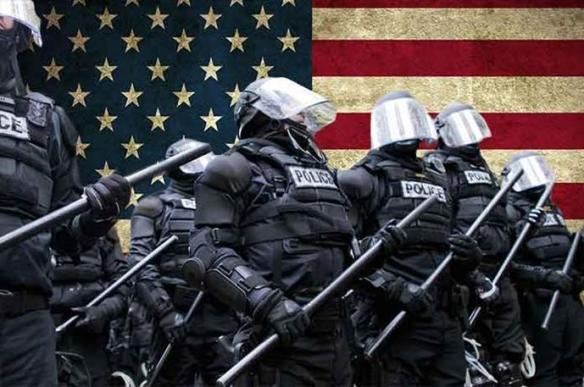
Detect, Deter and Annihilate: How the Police State Will Deal with a Coronavirus Outbreak

By John W. Whitehead

Source: The Rutherford Institute

“Fear is a primitive impulse, brainless as hunger, and because the aim of horror fiction is the production of the deepest kinds of fears, the genre tends to reinforce some remarkably uncivilized ideas about self-protection. In the current crop of zombie stories, the prevailing value for the beleaguered survivors is a sort of siege mentality, a vigilance so constant and unremitting that it’s indistinguishable from the purest paranoia.”— Terrence Rafferty, New York Times

What do zombies have to do with the U.S. government’s plans for dealing with a coronavirus outbreak?

Read on, and I’ll tell you.

The zombie narrative was popularized by the hit television series The Walking Dead, in which a small group of Americans attempt to survive in a zombie-ridden, post-apocalyptic world where they’re not only fighting off flesh-eating ghouls but cannibalistic humans.

For a while there, zombies could be found lurking around every corner: wreaking havoc at gun shows, battling corsets in movies such as Pride and Prejudice and Zombies, and running for their lives in 5K charity races.

Understandably, zombie fiction plays to our fears and paranoia, while allowing us to “envision how we and our own would thrive if everything went to hell and we lost all our societal supports.” Yet as journalist Syreeta McFadden points out, while dystopian stories used to reflect our anxieties, now they reflect our reality, mirroring how we as a nation view the world around us, how we as citizens view each other, and most of all how our government views us.

Indeed, the U.S. government has spent a lot of time and energy in recent years using zombies as the models for a variety of crisis scenarios not too dissimilar from what we are currently experiencing.

For instance, back in 2015, the Centers for Disease Control and Prevention put together a zombie apocalypse preparation kit “that details everything you would need to have on hand in the event the living dead showed up at your front door.” The CDC, in conjunction with the Dept. of Defense, even used zombies to put government agents through their paces in mock military drills.

Fear the Walking Dead—AMC’s spinoff of its popular Walking Dead series—drove this point home by dialing back the clock to when the zombie outbreak first appears and setting viewers down in the midst of societal unrest not unlike our own experiences of recent years (“a bunch of weird incidents, police protests, riots, and … rapid social entropy”). Then, as Forbes reports, “the military showed up and we fast-forwarded into an ad hoc police state with no glimpse at what was happening in the world around our main cast of hapless survivors.”

Forbes found Fear’s quick shift into a police state to be far-fetched, but anyone who has been paying attention in recent years knows that the groundwork was laid long ago for the government—i.e., the military—to intervene and lock down the nation in the event of a national disaster.

We’re seeing this play out now as the coronavirus contagion spreads.

What we have yet to experience (although it may only be a matter of time) is that the government through the imposition of martial law could pose a greater threat to our safety (and our freedoms) than any virus.

As the Atlantic noted about Fear the Walking Dead: “The villains aren’t the zombies, who rarely appear, but the U.S. military, who sweep into an L.A. suburb to quarantine the survivors. Zombies are, after all, a recognizable threat—but Fear plumbs drama and horror from the betrayal by institutions designed to keep people safe.”

Indeed, zombie fiction perfectly embodies the government’s paranoia about the citizenry as potential threats that need to be monitored, tracked, surveilled, sequestered, deterred, vanquished and rendered impotent.

Why else would the government feel the need to monitor our communications, track our movements, criminalize our every action, treat us like suspects, and strip us of any means of defense while equipping its own personnel with an amazing arsenal of weapons?

For years now, the government has been carrying out military training drills with zombies as the enemy. In 2011, the DOD created a 31-page instruction manual for how to protect America from a terrorist attack carried out by zombie forces. In 2012, the CDC released a guide for surviving a zombie plague. That was followed by training drills for members of the military, police officers and first responders.

As journalist Andrea Peyser reports:

Coinciding with Halloween 2012, a five-day national conference was put on by the HALO Corp. in San Diego for more than 1,000 first responders, military personnel and law enforcement types. It included workshops produced by a Hollywood-affiliated firm in…overcoming a zombie invasion. Actors were made up to look like flesh-chomping monsters. The Department of Homeland Security even paid the $1,000 entry fees for an unknown number of participants…

“Zombie disaster” drills were held in October 2012 and ’13 at California’s Sutter Roseville Medical Center. The exercises allowed medical center staff “to test response to a deadly infectious disease, a mass-casualty event, terrorism event and security procedures”…

[In October 2014], REI outdoor-gear stores in Soho and around the country are to hold free classes in zombie preparedness, which the stores have been providing for about three years.

The zombie exercises appeared to be kitschy and fun—government agents running around trying to put down a zombie rebellion—but what if the zombies in the exercises were us, the citizenry, viewed by those in power as mindless, voracious, zombie hordes?

Consider this: the government started playing around with the idea of using zombies as stand-ins for enemy combatants in its training drills right around the time the Army War College issued its 2008 report, warning that an economic crisis in the U.S. could lead to massive civil unrest that would require the military to intervene and restore order.

That same year, it was revealed that the government had amassed more than 8 million names of Americans considered a threat to national security, to be used “by the military in the event of a national catastrophe, a suspension of the Constitution or the imposition of martial law.” The program’s name, Main Core, refers to the fact that it contains “copies of the ‘main core’ or essence of each item of intelligence information on Americans produced by the FBI and the other agencies of the U.S. intelligence community.”

Also in 2008, the Pentagon launched the Minerva Initiative, a $75 million military-driven research project focused on studying social behavior in order to determine how best to cope with mass civil disobedience or uprisings. The Minerva Initiative has funded projects such as “Who Does Not Become a Terrorist, and Why?” which “conflates peaceful activists with ‘supporters of political violence’ who are different from terrorists only in that they do not embark on ‘armed militancy’ themselves.”

In 2009, the Dept. of Homeland Security issued its reports on Rightwing and Leftwing Extremism, in which the terms “extremist” and “terrorist” were used interchangeably to describe citizens they perceived to be disgruntled or anti-government.

Meanwhile, a government campaign was underway to spy on Americans’ mail, email and cell phone communications. News reports indicate that the U.S. Postal Service has handled more than 150,000 requests by federal and state law enforcement agencies to monitor Americans’ mail, in addition to photographing every piece of mail sent through the postal system.

Fast forward a few years more and local police were being transformed into extensions of the military, taught to view members of their community as suspects, trained to shoot first and ask questions later, and equipped with all of the technology and weaponry of a soldier on a battlefield.

The Obama administration then hired a domestic terrorism czar whose job is to focus on anti-government American “extremists” who have been designated a greater threat to America than ISIS or al Qaeda. As part of the government’s so-called war on right-wing extremism, the Obama administration agreed to partner with the United Nations to take part in its Strong Cities Network program, which is training local police agencies across America in how to identify, fight and prevent extremism.

Nothing has changed for the better under the Trump Administration.

Those who believe in and exercise their rights under the Constitution (namely, the right to speak freely, worship freely, associate with like-minded individuals who share their political views, criticize the government, own a weapon, demand a warrant before being questioned or searched, or any other activity viewed as potentially anti-government, racist, bigoted, anarchic or sovereign), continue to be promoted to the top of the government’s terrorism watch list.

“We the people” or, more appropriately, “we the zombies” are the enemy in the eyes of the government. This coronavirus merely ups the ante.

So when presented with the Defense Department’s battle plan for defeating an army of the walking dead, you might find yourself tempted to giggle over the fact that a taxpayer-funded government bureaucrat actually took the time to research and write about vegetarian zombies, evil magic zombies, chicken zombies, space zombies, bio-engineered weaponized zombies, radiation zombies, symbiant-induced zombies, and pathogenic zombies.

However, in an age of extreme government paranoia, this is no laughing matter.

The DOD’s strategy for dealing with a zombie uprising, outlined in “CONOP 8888,” is for all intents and purposes a training manual for the government in how to put down a citizen uprising or at least an uprising of individuals “infected” with a dangerous disease or dangerous ideas about freedom.

Rest assured that the tactics and difficulties outlined in the “fictional training scenario” are all too real, beginning with martial law.

As the DOD training manual states: “zombies [stand-ins for “we the people”] are horribly dangerous to all human life and zombie infections have the potential to seriously undermine national security and economic activities that sustain our way of life. Therefore having a population that is not composed of zombies or at risk from their malign influence is vital to U.S. and Allied national interests.”

So how does the military plan to put down a zombie (a.k.a. citizen) uprising?

The strategy manual outlines five phases necessary for a counter-offensive: shape, deter, seize initiative, dominate, stabilize and restore civil authority. Here are a few details:

Phase 0 (Shape): Conduct general zombie awareness training. Monitor increased threats (i.e., surveillance). Carry out military drills. Synchronize contingency plans between federal and state agencies. Anticipate and prepare for a breakdown in law and order.

Phase 1 (Deter): Recognize that zombies cannot be deterred or reasoned with. Carry out training drills to discourage other countries from developing or deploying attack zombies and publicly reinforce the government’s ability to combat a zombie threat. Initiate intelligence sharing between federal and state agencies. Assist the Dept. of Homeland Security in identifying or discouraging immigrants from areas where zombie-related diseases originate.

Phase 2 (Seize initiative): Recall all military personal to their duty stations. Fortify all military outposts. Deploy air and ground forces for at least 35 days. Carry out confidence-building measures with nuclear-armed peers such as Russia and China to ensure they do not misinterpret the government’s zombie countermeasures as preparations for war. Establish quarantine zones. Distribute explosion-resistant protective equipment. Place the military on red alert. Begin limited scale military operations to combat zombie threats. Carry out combat operations against zombie populations within the United States that were “previously” U.S. citizens.

Phase 3 (Dominate): Lock down all military bases for 30 days. Shelter all essential government personnel for at least 40 days. Equip all government agents with military protective gear. Issue orders for military to kill all non-human life on sight. Initiate bomber and missile strikes against targeted sources of zombie infection, including the infrastructure. Burn all zombie corpses. Deploy military to lock down the beaches and waterways.

Phase 4 (Stabilize): Send out recon teams to check for remaining threats and survey the status of basic services (water, power, sewage infrastructure, air, and lines of communication). Execute a counter-zombie ISR plan to ID holdout pockets of zombie resistance. Use all military resources to target any remaining regions of zombie holdouts and influence. Continue all actions from the Dominate phase.

Phase 5 (Restore civil authority): Deploy military personnel to assist any surviving civil authorities in disaster zones. Reconstitute combat capabilities at various military bases. Prepare to redeploy military forces to attack surviving zombie holdouts. Restore basic services in disaster areas.

Notice the similarities?

Surveillance. Military drills. Awareness training. Militarized police forces. Martial law.

As I point out in my book, Battlefield America: The War on the American People, if there is any lesson to be learned, it is simply this: whether the threat to national security comes in the form of imaginary zombies, actual terrorists, American citizens infected with the coronavirus, or disgruntled American citizens infected with dangerous ideas about freedom, the government’s response to such threats remains the same: detect, deter and annihilate.

Cyber Forces Manipulate Public Opinion

By Vladimir Platov

Source: New Eastern Outlook

The influence on public opinion is one of the primary functions of the information space, presented today not only by TV, radio and print media, but also by the Internet and social networks. Therefore, it isn’t surprising that the CIA is especially focused on obtaining control of the information field and seeks ways to influence it. Thus, in the middle of the last century, the agency began a large-scale secret operation named Mockingbird on the territory of the U.S. and abroad. Most of the documents related to said operation are still classified. The purpose of Operation Mockingbird was to secure the CIA’s control over the media and the information space in America and beyond by establishing an extensive network of agents in leading publications, news outlets, radio and television all around the world.

After numerous pieces of evidence of illegal CIA activities in the media, including those executed through Operation Mockingbird, a special working group called the Church Committee (named after Senator Frank Forrester Church III, a Democrat from Idaho) was established in 1975 in the U.S. Senate. The Commission was later transformed into the Senate’s Select Committee on Intelligence.

In 1976, the Committee even prepared a separate report detailing the CIA’s interference into the U.S. and foreign media in order to misinform the public. In particular, the report notes: “The CIA currently maintains a network of several hundred foreign individuals around the world who provide intelligence for the CIA and at times attempt to influence opinion through the use of covert propaganda. These individuals provide the CIA with direct access to a large number of newspapers and periodicals, scores of press services and news agencies, radio and television stations, commercial hook publishers, and other foreign media outlets.”

After investigations and hearings held by the U.S. Congress, it was decided to forbid the CIA to continue Operation Mockingbird. In 1976, George W. Bush, appointed director of the CIA, even announced the following new policy: “Effective immediately, the CIA will not enter into any paid or contractual relationship with any full‑time or part‑time news correspondent accredited by any U.S. news service, newspaper, periodical, radio or television network or station.” However, he added that the CIA will continue to ‘value’ voluntary cooperation with journalists, which is obviously always influenced by money.

Many experts are convinced that Operation Mockingbird has not been completely terminated and is being carried out not only through traditional media, but also in the cyberspace. The operation’s main targets in its current form are all those who speak against the policy of the White House. From here arise numerous anti-Russian and xenophobic campaigns of the U.S. special services, which preserve the CIA’s traditions of working not only with journalists, but also with social networks controlled by Washington.

A large-scale research “The Global Disinformation Order 2019: Global Inventory of Organised Social Media Manipulation” was carried out recently by Oxford University. It focuses on the ways public opinion is swayed by via the Internet and social networks. In the resulting report, the researchers showed that the number of countries where attempts of organized manipulation of public opinion with the help of social networks were detected has more than doubled since 2017. The authors registered 28 such countries back then, and the number went up to 48, then 70 in 2018 and 2019 respectively. 25 countries cooperate with private Internet companies to disseminate propaganda on the Internet.  The most popular among them is Facebook, and the second most popular platform for attempts at manipulation is Twitter. At the same time, the researchers found that 56 countries, in one way or another, have organized campaigns to misinform users of social networks. The leading perpetrators are the United States and the United Kingdom.

Today many countries possess special cyber forces, whose representatives use social networks to try and influence the opinion of Internet users from certain countries, different religions and political beliefs. Special attention is paid to such efforts in the Pentagon and American security services. Only Americans (ideally those who know the language of the country being manipulated) are involved in these activities. The CIA’s website even has a detailed description of the people who can apply for such jobs. In order to further impact the public, today the FBI is even trying to recruit Russians living in the United States through social networks (in particular, Facebook), as reported by CNN.

Anti-Russian sentiment of the main direction of Operation Mockingbird is evidenced by several media outlets which are independent from Washington. The same goals are pursued today by U.S. intelligence agencies. “The U.S. State Department considers the battle against state-run media from Russia, Iran and China one of its top priorities,” said Acting U.S. Deputy Secretary of State Heather Nauert in March 2018. That is why the U.S. budget for fiscal year 2019 includes $661 million meant to finance the BBG (Broadcasting Board of Governors), which is engaged in anti-Russian propaganda. The White House project for the budget of the U.S. government in 2021 entails the allocation of $700 million for the information war ‘against Russia’s destructive influence.’

Britain is not behind the United States in waging a hybrid war. A special unit in the British cyber forces is called JTRIG, and it is this unit’s ‘specialists’ who quite often carry out propagandistic cyber operations, which have recently most often been directed against Russia. Among these are the anti-Russian fuss around Skripal poisoning, groundless accusations of Russia’s alleged involvement in the crash of the Malaysian plane MH-17 over Donetsk, and accusations of Moscow’s aggressive actions in Syria. Such work is done using both the cyberspace, as well as media which are loyal to London. The 77th brigade of these troops is working specifically on Twitter. They actively attempt to undermine the users’ faith in their own beliefs, trying to convey ‘their thoughts’ by appealing to emotions. Further promotion of the propagandistic struggle against Russia, £18 million is going to be spent by the British government on ‘counteraction’ in Eastern Europe and on strengthening the ‘independent media’ in the Western Balkans. This was reported by the press service of the British Foreign Office.

NATO also has a cyber force, which includes over 13,000 military personnel. The organization is called CCDCEO and is located in Tallinn.

Governments have long used propaganda, but digital tools have made it more complex and effective. Over the past few years, intelligence agencies have mirrored the experience of activists in using social media to disseminate information and are now actively using these methods. Additionally, interactive tools, such as data analysis software, allow for adapting cyber warfare to be more effective against certain groups of people, maximizing its impact.

Slouching towards dystopia: the rise of surveillance capitalism and the death of privacy

Our lives and behaviour have been turned into profit for the Big Tech giants – and we meekly click “Accept”. How did we sleepwalk into a world without privacy?

By John Naughton

Source: New Statesman

Suppose you walk into a shop and the guard at the entrance records your name. Cameras on the ceiling track your every step in the store, log which items you looked at and which ones you ignored. After a while you notice that an employee is following you around, recording on a clipboard how much time you spend in each aisle. And after you’ve chosen an item and bring it to the cashier, she won’t complete the transaction until you reveal your identity, even if you’re paying cash.

Another scenario: a stranger is standing at the garden gate outside your house. You don’t know him or why he’s there. He could be a plain-clothes police officer, but there’s no way of knowing. He’s there 24/7 and behaves like a real busybody. He stops everybody who visits you and checks their identity. This includes taking their mobile phone and copying all its data on to a device he carries. He does the same for family members as they come and go. When the postman arrives, this stranger insists on opening your mail, or at any rate on noting down the names and addresses of your correspondents. He logs when you get up, how long it takes you to get dressed, when you have meals, when you leave for work and arrive at the office, when you get home and when you go to bed, as well as what you read. He is able to record all of your phone calls, texts, emails and the phone numbers of those with whom you exchange WhatsApp messages. And when you ask him what he thinks he’s doing, he just stares at you. If pressed, he says that if you have nothing to hide then you have nothing to fear. If really pressed, he may say that everything he does is for the protection of everyone.

A third scenario: you’re walking down the street when you’re accosted by a cheery, friendly guy. He runs a free photo-framing service – you just let him copy the images on your smartphone and he will tidy them up, frame them beautifully and put them into a gallery so that your friends and family can always see and admire them. And all for nothing! All you have to do is to agree to a simple contract. It’s 40 pages but it’s just typical legal boilerplate – the stuff that turns lawyers on. You can have a copy if you want. You make a quick scan of the contract. It says that of course you own your photographs but that, in exchange for the wonderful free framing service, you grant the chap “a non-exclusive, transferable, sub-licensable, royalty-free and worldwide licence to host, use, distribute, modify, copy, publicly perform or display, translate and create derivative works” of your photos. Oh, and also he can change, suspend, or discontinue the framing service at any time without notice, and may amend any of the agreement’s terms at his sole discretion by posting the revised terms on his website. Your continued use of the framing service after the effective date of the revised agreement constitutes your acceptance of its terms. And because you’re in a hurry and you need some pictures framed by this afternoon for your daughter’s birthday party, you sign on the dotted line.

All of these scenarios are conceivable in what we call real life. It doesn’t take a nanosecond’s reflection to conclude that if you found yourself in one of them you would deem it preposterous and intolerable. And yet they are all simple, if laboured, articulations of everyday occurrences in cyberspace. They describe accommodations that in real life would be totally unacceptable, but which in our digital lives we tolerate meekly and often without reflection.

The question is: how did we get here?

***

It’s a long story, but with hindsight the outlines are becoming clear. Technology comes into it, of course – but plays a smaller part than you might think. It’s more a story about human nature, about how capitalism has mutated to exploit digital technology, about the liberal democratic state and the social contract, and about governments that have been asleep at the wheel for several decades.

To start with the tech: digital is different from earlier general-purpose technologies in a number of significant ways. It has zero marginal costs, which means that once you have made the investment to create something it costs almost nothing to replicate it a billion times. It is subject to very powerful network effects – which mean that if your product becomes sufficiently popular then it becomes, effectively, impregnable. The original design axioms of the internet – no central ownership or control, and indifference to what it was used for so long as users conformed to its technical protocols – created an environment for what became known as “permissionless innovation”. And because every networked device had to be identified and logged, it was also a giant surveillance machine.

Since we humans are social animals, and the internet is a communications network, it is not surprising we adopted it so quickly once services such as email and web browsers had made it accessible to non-techies. But because providing those services involved expense – on servers, bandwidth, tech support, etc – people had to pay for them. (It may seem incredible now, but once upon a time having an email account cost money.) Then newspaper and magazine publishers began putting content on to web servers that could be freely accessed, and in 1996 Hotmail was launched (symbolically, on 4 July, Independence Day) – meaning that anyone could have email for free.

Hotmail quickly became ubiquitous. It became clear that if a business wanted to gain those powerful network effects, it had to Get Big Fast; and the best way to do that was to offer services that were free to use. The only thing that remained was finding a business model that could finance services growing at exponential rates and provide a decent return for investors.

That problem was still unsolved when Google launched its search engine in 1998. Usage of it grew exponentially because it was manifestly better than its competitors. One reason for its superiority was that it monitored very closely what users searched for and used this information to improve the algorithm. So the more that people used the engine, the better it got. But when the dot-com bubble burst in 2000, Google was still burning rather than making money and its two biggest venture capital investors, John Doerr of Kleiner Perkins and Michael Moritz of Sequoia Capital, started to lean on its founders, Larry Page and Sergey Brin, to find a business model.

Under that pressure they came up with one in 2001. They realised that the data created by their users’ searches could be used as raw material for algorithms that made informed guesses about what users might be interested in – predictions that could be useful to advertisers. In this way what was thought of as mere “data exhaust” became valuable “behavioural surplus” – information given by users that could be sold. Between that epiphany and Google’s initial public offering in 2004, the company’s revenues increased by over 3,000 per cent.

Thus was born a new business model that the American scholar Shoshana Zuboff later christened “surveillance capitalism”, which she defined as: “a new economic order that claims human experience as the raw material for hidden commercial practices of extraction, prediction and sales”. Having originated at Google, it was then conveyed to Facebook in 2008 when a senior Google executive, Sheryl Sandberg, joined the social media giant. So Sandberg became, as Zuboff puts it, the “Typhoid Mary” who helped disseminate surveillance capitalism.

***

The dynamic interactions between human nature and this toxic business model lie at the heart of what has happened with social media. The key commodity is data derived from close surveillance of everything that users do when they use these companies’ services. Therefore, the overwhelming priority for the algorithms that curate users’ social media feeds is to maximise “user engagement” – the time spent on them – and it turns out that misinformation, trolling, lies, hate-speech, extremism and other triggers of outrage seem to achieve that goal better than more innocuous stuff. Another engagement maximiser is clickbait – headlines that intrigue but leave out a key piece of information. (“She lied all her life. Guess what happened the one time she told the truth!”) In that sense, social media and many smartphone apps are essentially fuelled by dopamine – the chemical that ferries information between neurons in our brains, and is released when we do things that give us pleasure and satisfaction.

The bottom line is this: while social media users are essential for surveillance capitalism, they are not its paying customers: that role is reserved for advertisers. So the relationship of platform to user is essentially manipulative: he or she has to be encouraged to produce as much behavioural surplus as possible.

A key indicator of this asymmetry is the End User Licence Agreement (EULA) that users are required to accept before they can access the service. Most of these “contracts” consist of three coats of prime legal verbiage that no normal human being can understand, and so nobody reads them. To illustrate the point, in June 2014 the security firm F-Secure set up a free WiFi hotspot in the centre of London’s financial district. Buried in the EULA for this “free” service was a “Herod clause”: in exchange for the WiFi, “the recipient agreed to assign their first born child to us for the duration of eternity”. Six people accepted the terms.  In another experiment, a software firm put an offer of an award of $1,000 at the very end of its terms of service, just to see how many would read that far. Four months and 3,000 downloads later, just one person had claimed the offered sum.

Despite this, our legal systems accept the fact that most internet users click  “Accept” as confirmation of informed consent, which it clearly is not. It’s really passive acceptance of impotence. Such asymmetric contracts would be laughed out of court in real life but are still apparently sacrosanct in cyberspace.

According to the security guru Bruce Schneier of Harvard, “Surveillance is the business model of the internet.” But it’s also a central concern of modern states. When Edward Snowden broke cover in the summer of 2013 with his revelations of the extensiveness and scale of the surveillance capabilities and activities of the US and some other Western countries, the first question that came to mind was: is this a scandal or a crisis? Scandals happen all the time in democracies; they generate a great deal of heat and controversy, but after a while the media caravan moves on and nothing happens. Crises, on the other hand, do lead to substantive reform.

Snowden revealed that the US and its allies had been engaged in mass surveillance under inadequate democratic oversight. His disclosures provoked apparent soul-searching and anger in many Western democracies, but the degree of public concern varied from country to country. It was high in Germany, perhaps because so many Germans have recent memories of Stasi surveillance. In contrast, public opinion in Britain seemed relatively relaxed: opinion surveys at the time suggested that about two-thirds of the British public had confidence in the security services and were thus unruffled by Snowden. Nevertheless, there were three major inquiries into the revelations in the UK, and, ultimately, a new act of parliament – the Investigatory Powers Act 2016. This overhauled and in some ways strengthened judicial oversight of surveillance activities by the security services; but it also gave those services significant new powers  – for example in “equipment interference”  (legal cover to hack into targeted devices such as smartphones, domestic networks and “smart” devices such as thermostats). So, in the end, the impact of the Snowden revelations was that manifestly inadequate oversight provisions were replaced by slightly less inadequate ones. It was a scandal, not a crisis. Western states are still in the surveillance business; and their populations still seem comfortable with this.

There’s currently some concern about facial recognition, a genuinely intrusive surveillance technology. Machine-learning technology has become reasonably good at recognising faces in public places, and many state agencies and private companies are already deploying it. It means that people are being identified and tracked without their knowledge or consent. Protests against facial recognition are well-intentioned, but, as Harvard’s Bruce Schneier points out, banning it is the wrong way to oppose modern surveillance.

This is because facial recognition is just one identification tool among many enabled by digital technology. “People can be identified at a distance by their heartbeat or by their gait, using a laser-based system,” says Schneier. “Cameras are so good that they can read fingerprints and iris patterns from metres away. And even without any of these technologies, we can always be identified because our smartphones broadcast unique numbers called MAC addresses. Other things identify us as well: our phone numbers, our credit card numbers, the licence plates on our cars. China, for example, uses multiple identification technologies to support its surveillance state.”

The important point is that surveillance and our passive acceptance of it lies at the heart of the dystopia we are busily constructing. It doesn’t matter which technology is used to identify people: what matters is that we can be identified, and then correlated and tracked across everything we do. Mass surveillance is increasingly the norm. In countries such as China, a surveillance infrastructure is being built by the government for social control. In Western countries, led by the US, it’s being built by corporations in order to influence our buying behaviour, and is then used incidentally by governments.

What’s happened in the West, largely unnoticed by the citizenry, is a sea-change in the social contract between individuals and the state. Whereas once the deal was that we accepted some limitations on our freedom in exchange for security, now the state requires us to surrender most of our privacy in order to protect us. The (implicit and explicit) argument is that if we have nothing to hide there is nothing to fear. And people seem to accept that ludicrous trope. We have been slouching towards dystopia.

***

The most eerie thing about the last two decades is the quiescence with which people have accepted – and adapted to – revolutionary changes in their information environment and lives. We have seen half-educated tech titans proclaim mottos such as “Move fast and break things” – as Mark Zuckerberg did in the early years of Facebook – and then refuse to acknowledge responsibility when one of the things they may have helped to break is democracy.  (This is the same democracy, incidentally, that enforces the laws that protect their intellectual property, helped fund the technology that has enabled their fortunes and gives them immunity for the destructive nonsense that is disseminated by their platforms.) And we allow them to get away with it.

What can explain such indolent passivity? One obvious reason is that we really (and understandably) value some of the services that the tech industry has provided. There have been various attempts to attach a monetary value to them, but any conversation with a family that’s spread over different countries or continents is enough to convince one that being able to Skype or FaceTime a faraway loved one is a real boon. Or just think of the way that Google has become a memory prosthesis for humanity – or how educational non-profit organisations such as the Khan Academy can disseminate learning for free online.

We would really miss these services if they were one day to disappear, and this may be one reason why many politicians tip-toe round tech companies’ monopoly power. That the services are free at the point of use has undermined anti-trust thinking for decades: how do you prosecute a  monopoly that is not price-gouging its users? (The answer, in the case of social media, is that users are not customers;  the monopoly may well be extorting its actual customers – advertisers – but nobody seems to have inquired too deeply into that until recently.)

Another possible explanation is what one might call imaginative failure – most people simply cannot imagine the nature of the surveillance society that we are constructing, or the implications it might have for them and their grandchildren. There are only two cures for this failure: one is an existential crisis that brings home to people the catastrophic damage that technology could wreak. Imagine, for example, a more deadly strain of the coronavirus that rapidly causes a pandemic – but governments struggle to control it because official edicts are drowned out by malicious disinformation on social media. Would that make people think again about the legal immunity that social media companies enjoy from prosecution for content that they host on their servers?

The other antidote to imaginative failure is artistic creativity. It’s no accident that two of the most influential books of the last century were novels – Orwell’s Nineteen Eighty-Four (1949) and Aldous Huxley’s Brave New World (1932). The first imagined a world in which humans were controlled by fear engendered by comprehensive surveillance; the second portrayed one in which citizens were undone by addiction to pleasure – the dopamine strategy, if you like. The irony of digital technology is that it has given us both of these nightmares at once.

Whatever the explanation, everywhere at the moment one notices a feeling of impotence – a kind of learned helplessness. This is seen most vividly in the way people shrug their shoulders and click “Accept” on grotesquely skewed and manipulative  EULAs. They face a binary choice: accept the terms or go away. Hence what has become known as the “privacy paradox” – whenever researchers and opinion pollsters ask internet users if they value their privacy, they invariably respond with a  resounding “yes”. And yet they continue to use the services that undermine that beloved privacy.

It hasn’t helped that internet users have watched their governments do nothing about tech power for two decades. Surveillance capitalism was enabled because its practitioners operated in a lawless environment. It appropriated people’s data as a free resource and asserted its right to do so, much as previous variations of capitalism appropriated natural resources without legal restrictions. And now the industry claims as one of its prime proprietary assets the huge troves of that appropriated data that it possesses.

It is also relevant that tech companies have been free to acquire start-ups that threatened to become competitors without much, if any, scrutiny from competition authorities. In any rational universe, Google would not be permitted to own YouTube, and Facebook would have to divest itself of WhatsApp and Instagram. It’s even possible – as the French journalist  Frédéric Filloux has recently argued – that  Facebook believes its corporate interests are best served by the re-election of Donald Trump, which is why it’s not going to fact-check any political ads. As far as I can see, this state of affairs has not aroused even a squawk in the US.

When Benjamin Franklin emerged on the final day of deliberation from the Constitutional Convention of 1787, a woman asked him, “Well Doctor, what have we got, a republic or a monarchy?” To which Franklin replied, “A republic… if you can keep it.” The equivalent reply for our tech-dominated society would be: we have a democracy, if we can keep it.


Data governance and the new frontiers of resistance

The 21st century corporation is using algorithmic-based intelligence to accumulate data on a massive scale. Social movements need to grasp this change quickly.

By Anita Gurumurthy and Nandini Chami

Source: ROAR

Four centuries after the East India Company set the trend for corporate resource extraction, most of the world is now in the grip of unbridled corporate power. But corporate power is on the cusp of achieving “quantum supremacy” and social movements in the digital age need to understand this in order to shift gears in their struggles. The quantum shift here comes from “network-data” power; the ingredients that make up capitalism’s digital age recipe.

Contemporary capitalism is characterized by the accumulation of data-as-capital. Big Tech, as digital companies are collectively known, use the “platform” business model. This model provides a framework for interactions in the marketplace by connecting its many “nodes” — consumers, advertisers, service providers, producers, suppliers and even objects — that comprise the platform ecosystem, constantly harvesting their data and using algorithms to optimize interactions among them as a means to maximize profit.

The platform model emerged as a business proposition in the early 2000s when internet companies offering digital communication services began extracting user data from networked social interactions to generate valuable information for targeted advertising. It is estimated that by 2025, over 30 percent of global economic activity will be mediated by platform companies, an indication of the growing “platformization” of the real economy. In every economic sector, from agriculture to predictive manufacturing, retail commerce and even paid care work, the platform model is now an essential infrastructural layer.

Control over data-based intelligence gives platform owners a unique vantage point — the power to shape the nature of interactions among member nodes. Practices such as Amazon’s segmenting and hyper-targeting of consumers through price manipulation, Uber’s panoptic disciplining of its partner drivers, and TripAdvisor’s popularity ranking algorithm of listed properties, restaurants and hotels are all examples of how such platforms mediate economic transactions. The accumulation of data that feeds algorithmic optimization enables more intensified data extraction, in a self-propelling cycle that culminates in the platform’s totalizing control of entire economic ecosystems.

Amazon for instance, is no longer an online book store, and was perhaps never intended to be. With intimate knowledge about how the market works, Amazon is a market leader in anticipatory logistics and business analytics, providing both fulfillment and on-demand cloud-based computing services to third parties. Not only has it displaced traditional container-freight stations in port cities, it has begun to look increasingly like a shipping company. The dynamics of an intelligence economy have led to large swathes of economic activity being controlled by a handful of platform monopolies.

Studies suggest that in a matter of a couple of decades, platform monopolies have overtaken oil, automobile and financial corporations in market capitalization. Today, platform-based business models account for seven of the world’s top eight companies ranked by market capitalization. The pan-global platform corporation, with its DNA of data-based intelligence, has replaced the trans-national industrial corporation as the Leviathan of our times.

Enter the intelligent corporation

As the dominant form of economic organization in the capitalist world order, the corporation has always wielded power, not just in the market but also in political and socio-cultural realms. The rise of the “intelligent corporation” defined by the political economy of data capital has produced qualitative shifts in the exercise of corporate power, including the following.

From dominating the market to becoming the market

Like its predecessor, the intelligent corporation also aims at complete market domination. In platform-based capitalism, local business models based on intimate contextual knowledge are completely displaced by the data-based intermediation of marketplace and social transactions. It is by eliminating these disparate pockets of capital accumulation that platform owners maximize their profits.

The intelligent corporation also goes a step further, moving beyond “dominating the market” to “becoming the market.” Integrating across business lines, these companies both operate a platform and promote their own goods and services on it. This places them in direct competition with the businesses that use their infrastructure, and creates a conflict of interest. For example, Amazon uses its product marketplace data to consolidate its private labels, launching high-demand products at prices that undercut third-party sellers.

In this new strategy for acquiring market power, long-term market monopolization is privileged over the ability to break-even in the short run. The ecosystem that a platform seeks to capture has room only for one winner with the wherewithal to forgo immediate profits and invest in business integration — through aggressive acquisition — and systematic data-layer development. Other competitors are destined to fall by the wayside.

From cheap labor to freedom from labor

In the capitalist economy, the key contradiction is between capital and labor. Capital is in a perennial quest for freedom from labor through labor-substituting technological advances and territories to shift production to reduce labor costs. In the intelligence economy, capital seems to have come very close to realizing its primordial pursuit.

Using 360° surveillance, the intelligent corporation creates a self-optimizing ecosystem, manipulating each node, expanding its captive network, accumulating data capital and entrenching its dominance. It is able to achieve a global operational footprint with few assets and a minuscule employee base. Think Uber. Uber drivers are not considered to be employees in most places where the company runs its business. With a god’s eye view of the city and its roads, the customers and the driver, Uber takes over city transport, often without owning a single taxi. Passing off the liability to the driver, who must take a high-interest loan to acquire a vehicle to become Uber’s coveted “partner,” the corporation extracts from the driver more than just labor time.

In traditional labor-intensive manufacturing and services sectors, data capital is slowly but surely affecting far-reaching transformation. Projections show that automation based on artificial intelligence (AI) will eventually displace labor. It is estimated that over 40 percent of the global workforce will lose their jobs in AI-led disruption of manufacturing over the next 15–25 years. A limited number of high-paying jobs may open up for individuals with advanced skills in the development of data and AI technologies. But most of the labor force will end up in low-paid, personalized service work.

For countries in the Global South, the challenge will be especially pernicious. As rising wages erode the comparative advantage of labor in these economies, the shift to AI technology is likely to trigger a re-shoring trend whereby factories are relocated to richer countries that offer more sophisticated infrastructural support for deployment of AI systems. According to the World Bank, over two-thirds of the workforce in developing countries are likely to lose jobs. It is not clear how these changes will shift gender-based segmentation and gender hierarchies in labor markets. However, going by current trends, women seem to be the first to lose their jobs in this transition, with a reversal of both pay and status gains.

Planetary-scale time-space enclosure

Capturing previously non-commodified time and place has always been a central strategy of capitalist expansion. In the intelligence economy, we are witnessing a new phase of such “primitive accumulation” – through “data dispossession.” The expropriation of data from everyday social exchanges through the platform business model is comparable to the expropriation of natural resources for capitalist production in a previous age. The pervasive data extraction by platform companies has transformed data-mined social interaction into a factor of production, just as invaluable a resource as land for the creation of goods and services. The centralization of wealth and power today, derives from an unprecedented quality and scale of dispossession.

The dynamic of data dispossession is self-propelling. It is now well understood that platforms aggressively pursue a strategy of locking-in users, offering instant gratification in exchange for data and making it costly for them to leave a platform. The Chinese “super-platforms” WeChat and Meituan-Dianping combine news, entertainment, restaurant reviews, food delivery and ride-hailing, along with cross-cutting applications such as payment systems and digital wallets, demonstrating a “stickiness” that is almost addictive.

When participation in the platform on the platform owner’s terms becomes de facto the only choice for economic actors, data extractivism is normalized. Similar to the predatory practices of historical colonialism, the platform tactics of the intelligent corporation function as a neo-colonial project. The difference is that this time around, rather than European companies, the US and Chinese platform companies are in the driving seat.

A profoundly unsustainable exploitation of the natural world accompanies the rapid inroads of the intelligent corporation. Take the case of the vast ecological footprint of the online food-delivery sector. According to a 2018 study published in the science journal Resources, Conservation and Recycling, door-to-door fast-food delivery in China accounted for a nearly eightfold jump in packaging waste between 2015 and 2017, from 0.2 to 1.5 million tonnes. This has coincided with the exponential growth of the sector in the country, where the number of customers using food-delivery platforms has gone up from zero in 2009 to 406 million by the end of 2018! The intelligence economy is a veritable resource guzzler whose network data devices are expected to be consuming about one-fifth of global electricity by 2030 just to keep going.

The loss of self-determination for individuals and communities in these new intelligence-based modes of production reflects an asymmetry in power that was previously impossible. This is the route through which the brand-new corporation colonizes bodies and nature, takes control of production and social reproduction, and intensifies accumulation on a global scale.

The “deep corporate” and the death of the social contract

It is no secret that in the digital era, the deep state has had a makeover. Edward Snowden’s revelations and witness testimonies from China’s Uighur-dominated Xinjiang have exposed the dark workings of the contemporary military–industrial complex, the unholy nexus between Big Tech and the state. Trade justice activists have constantly pointed to the “hidden hand” of Silicon Valley and Chinese corporations using their governments to bat for their interests, reducing policy decisions to executive fiats for entrenching their power.

But what is only recently coming to light is the rise of the “deep corporate” — the extension of the Kraken-like tentacles of intelligent corporations into the heart of public life. The subsuming of social life by platform capitalism has distorted the political space thanks to the echo chambers of the automated public sphere. The contagion of mispropaganda and informational warfare in political campaigning has become impossible to contain in a public sphere determined by algorithmic filters. In this scenario, deliberative democracy itself is under the threat of extinction.

The social credit system being developed by China in partnership with eight tech companies takes the “corporatization” of governance to a whole new level. Access to benefits and citizens’ guaranteed rights are now predicated on behavioral scoring on the basis of online purchase history, financial transactions and social media connections on the partnering platforms. With the archetypal “good consumer” becoming the deserving citizen, citizenship is thus dislocated from political claims. The “deep corporate” acquires the formal authority to mediate the social contract.

Living with the intelligent corporation

We are living through a phase in capitalism that is marked by extreme market concentration, unprecedented inequality in wealth and the declining share of labor in global income; a state of affairs that has led even the IMF to express caution. It is no coincidence that this period of intensified economic injustice has coincided with the rise of platform capitalism and its real-world vehicle, the intelligent corporation.

What does living with the intelligent corporation mean?

What is new about this phase of capitalism that has spawned the intelligence economy is a deeply qualitative shift. Datafication and data capital transform the way capitalist “accumulation by dispossession” happens. “Intelligencification” makes plausible a planetary-scale colonization and commodification of everyday life by the new corporation in ways previously impossible. Both nature and caring bodies are trapped in a planetary enclosure insofar as everything and everybody can be turned into data.

It also feeds off and emboldens the financialization apparatus that runs the neoliberal economy. Through the perverse confluence of data and finance, the intelligent corporation universalizes and naturalizes its authority, destroying the marketplace of things and ideas.

Through data extractivism, the intelligent corporation ravages sociality, taking the ideological project of neoliberalism all the way to the expropriation of the political. This is a deep take-over, an “ontological encroachment” of human subjectivity.

Where does all this leave us?

As UNCTAD has highlighted, the pace of concentration of market power is extremely worrying. Consider this: Amazon’s profits-to-sales ratio increased from 10 percent in 2005 to 23 percent in 2015, while that of Alibaba increased in just four years from 10 percent in 2011 to 32 percent in 2015.

Policymakers across the world are struggling to reform their legacy laws to rein in the intelligent corporation. Even the domestic governments of powerful US and Chinese platform corporations are struggling to contain their excesses. The US Federal Trade Commission (FTC) is currently investigating Amazon and Facebook for abuse of market dominance while the US Justice Department is probing Google. The state of California is facing massive resistance from Uber and Lyft to its new regulation for labor rights of “gig” workers, with the two companies currently leading a $60 billion ballot initiative to extricate themselves from employer’s liability. In November 2019, the state administration for market regulation in China had to hold a meeting with Alibaba and other online retail platforms about their strong-arming of third-party vendors, in violation of existing regulations to curb anti-competitive conduct.

The loopholes of pre-digital taxation laws based on a physical presence in a given country have been effectively exploited by platform companies to escape tax liability, through profit shifting to low-tax jurisdictions. Similarly, when faced with liability for unfair market practices in overseas markets, it is very easy for platform companies to shift liability to their parent company outside the jurisdiction. For instance, Uber in South Africa resorted to the defense that its partner drivers were employees of the parent company headquartered in the Netherlands and not the South African subsidiary, in order to evade its liabilities under existing labor laws. The lack of binding international regulations governing cross-border data flows has also aided rampant data extractivism,

More recently, in the wake of malpractice lawsuits brought against Big Tech by their own employees; exposes about founding CEOs who have enjoyed a godly status; and public disenchantment with multiple revelations of clandestine data mining and algorithmic gaming, the early sheen seems to be wearing off. Google’s parent company Alphabet can no longer use its “Do the right thing” motto without irony. Facebook has been forced to switch to the “too big to fail” defense from the “protector and defender of the freedoms of the global community” line. Alibaba may not be able to proclaim its commitment to the development of small and medium enterprises in Africa for much longer. The façade has crumbled. And this rupture in the discursive hegemony of the intelligent corporation in which we are currently situated is the right moment to mount a collective challenge.

So, resist we must, so that the wealth of data and of networks can be appropriated and used to create a just and humane society. This means taking the intelligent corporation by the horns, and forging a movement that is able to grapple with the ethical–political boundaries of digital intelligence.

Taming the Leviathan and reclaiming the planet

Given the enormous economic and political clout of the modern corporation in the age of data, unshackling people and the planet from corporate power is an urgent task. Struggles against the extreme unfairness of the global trade and intellectual property regime by transnational social movements have shown the necessary connection between the agenda for development justice and the dismantling of corporate power.

Building alliances among movements has become a vital strategy in halting TNCs’ inexorable plunder. The trade justice movement against corporate globalization, the environment movement’s quest for sustainable development, feminist struggles to reclaim the body and the sphere of social reproduction from capital and workers’ struggle against the intensified squeeze on labor and the dismantling of social protection in neoliberal globalization are inspiring examples in this regard. Transnational civil society has painstakingly built alliances and solidarities across these movements to expose corporate excess, bringing pressure on the UN for a global binding treaty on TNCs’ human rights obligations in the face of near-insurmountable odds.

In the digital age, as corporate power assumes indomitable proportions — with tech CEOs carving out data dominions that they rule over — current frameworks of power analysis and action may not go very far. A concerted and coherent strategy is urgently needed in order to enable a more equitable distribution of the gains of data-based intelligence. The Digital Justice Manifesto released in November 2019 by the Just Net Coalition — through a process of strategic and sustained dialogue between digital rights, trade justice, feminist, environmental, labor and human rights groups and activists — outlines such a roadmap. As the Manifesto underlines, we need immediate action along three broad fronts to reclaim digital power from the intelligent corporation:

(a) Wrestling back ownership of our personal and collective data and intelligence by instituting an economic rights framework for data resources.

(b) Governing critical platform infrastructures as public utilities.

(c) Enforcing a local-to-global governance model for digital and data infrastructure that supports local economies and democratic self-determination of collectivities, preventing the enclosure of entire market and social ecosystems by a centralized intelligence. In other words, the governance of tech infrastructure must enable the flourishing of disparate local economies and make room for multiple platform models to function — co-operatives, social enterprises, public etc. — challenging the totalizing impetus of global intelligence capitalism.

Neoliberal globalization and financialization have led to profoundly unequal societies. The impunity of the TNC has been central to this dynamic. Social movements have placed several creative proposals to counter this: mandating charter renewal every five years overturning the principle of corporations’ perpetual legal existence; taxing stock trade on the basis of the holding period to contain excessive financial speculation; placing a cap on the individual assets of founders/CEOs and so on.

“Intelligencification” demands a new frontier for resistance. The power of the intelligent corporation must be contained through tactics small and big in political and cultural realms. A new wisdom about the governance of data must be explored for a truly emancipatory future for all.

Freedom Rider: The Internet Does Washington’s Dirty Work

By Margaret Kimberly

Source: Black Agenda Report

As long as the internet is in private hands it should be seen as a “frenemy” — a useful resource that can also be wielded as a weapon.

“Black people are routinely sent to “facebook jail” if their words anger racist white people.”

In its early days the internet seemed to be an undisputed good, a means of communication open to all. It was hoped that these new platforms would level the playing field and give smaller outlets like Black Agenda Report access to a worldwide audience. The internet has done that but it is also a weapon that is used against the left in this country and against nations and movements declared enemies by this government.

In the rush of enthusiasm one important fact was forgotten. The internet is in the hands of private corporations. They decide who gets service, where they get it and at what speed. The growth of social media only exacerbated the problems of corporate control.

This columnist uses Facebook and Twitter and other platforms by necessity. They are sources of information and important means of communication. But they are controlled by powerful corporate entities who work hand in hand with the government. Ultimately they decide who can be seen and who cannot.

“Private corporations decide who gets service, where they get it and at what speed.”

When the U.S. government speaks, Facebook and Twitter listen and then do as they are told. When foreign governments are declared adversaries their representatives and advocates are censored. In the past year, the Syrian government and the Venezuelan government have been temporarily blocked on Twitter. Sites such as Telesur have been repeatedly removed from Facebook. Numerous Palestinian advocacy sites have been removed from Facebook at the behest of the Israeli government.

Facebook decides if “community standards” have been violated and restrict anyone who violates their opaque rules. Black people are routinely sent to “facebook jail” if their words anger racist white people.

But the loss of access is not the biggest problem. When the United States government killed Iranian general Qassem Soleimani they also wanted to kill off his memory. Facebook posts which spoke of him in any favorable light were removed. Facebook isn’t alone in joining the governmental directive. The Iranian English language service, Presstv, was removed from Youtube, which is owned by Google. Years of reporting and interviews, including some given by this columnist, disappeared into the black hole of cyberspace. When the U.S. began ratcheting up its maximum pressure, the corporate sector went right along and Presstv was sent down the memory hole.

“Presstv was removed from Youtube, which is owned by Google.”

Censorship has gotten worse because of liberals, not conservatives, and they have used the Russiagate fraud to accelerate the deplatforming process. Immediately after the 2016 election we were told that the Russian government was responsible for Trump’s victory and that censorship was the only thing standing between us and living under the control of Vladimir Putin.

The infamous Proporornot  list declared that Black Agenda Report and other sites were under Russian influence. Ever since that list was published in late 2016 many left sites lost visibility on Google and other search engines.

Now Trump administration sanctions are impacting our ability to communicate in a variety of ways. Not only were references to Soleimani removed, but the use of the word “Iran” can result in censorship and the inability to complete financial transactions. The Grayzone project  reported that Paypal restricted donations from anyone who mentioned the word Iran.

It must be repeated that Trump has plenty of help from Democrats and liberals in this regard. Pleas for Facebook “fact checking” will result in more censorship of black people and of anyone who happens to voice opinions that run counter to the imperialist narrative.

“The use of the word “Iran” can result in censorship.”

Already Russia is being blamed for election interference, yet Russia is not the target. The left is the target and Democrats are leading the charge. Their goal is to narrow discourse and to make war propaganda acceptable. It is an irony and a contradiction that while Trump is falsely accused of being under Russian influence, his policy goals are furthered with help from liberals. U.S. imperialism is a thoroughly bipartisan project.

This collusion between the wings of the duopoly must be kept in mind during the farcical impeachment. The Democrats could have added the war crime of the Soleimani assassination to their articles of impeachment. But they are complicit in this regard and will mention nothing of substance. Instead they have only one flimsy charge that is a cynical get out the vote effort and a source of anti-Russian propaganda.

As long as the internet is in private hands it should be seen as a “frenemy,” a useful resource that can also be wielded as a weapon. These platforms cannot be trusted unless or until they are publicly regulated. In the meantime, our reliance on them comes at a price.

A Metaphysical Malaise?

By Kingsley L. Dennis

Source: Waking Times

‘The real tragedy of our time lies not so much in the unprecedented external events themselves as in the unprecedented ethical destitution and spiritual infirmity which they glaringly reveal.’

Paul Brunton

There is little doubt that we are living in an age of extreme contradictions where opposing trends appear to exist side by side. It is a time when individuals take greater care of their bodies and are obsessed by diet and health fads, while obesity is an epidemic. We live amidst a paradoxical combination of playfulness and fear, of fun and anxiety, of euphoria and unease. It has been said that ‘When a materialistic civilization becomes outwardly impressive but remains inwardly impoverished, when political relations become an elaborate façade for hiding the spiritually empty rooms behind them, menacing problems are sure to appear on every side.’This quote adequately describes our current situation and yet the author, Paul Brunton, published this in 1952.  However, it remains as starkly correct in its analysis for today as it was for his own time.

The current situation is that ‘menacing problems’ are indeed appearing on every side: political corruption and ineptitude; economic manipulations; national aggression and politically-motivated warfare; refugee crises; human torture and suffering; capitalist greed; corporate corruption; aggravated social unrest; religious and moral intolerance; increased displays of psychopathic behaviour (private individuals and authority figures); blatant propaganda; environmental degradation; ecological ignorance; spiritual destitution, and the rest.

The result is that many people have become ‘spiritually numbed’ by what they see occurring in the world, and feel that only a similar harsh, physical response can be effective. The words ‘mystical’ and ‘spiritual’ remain vague and ethereal. People have always depended on language to bring guidance and nourishment. Yet in this mental environment, words are but skeletal traces of the real flesh. The crisis of our times has clarified little and succeeds in confusing almost everything for the rest of us. There is nowhere to turn in public for finding the truth – seemingly little to believe in for the present and too much uncertainty for the future. The result of this is that many people have doubts that they don’t know how to deal with, and these are building up within their minds like a pathological infection.

An Absence of Meaning

In these current times there is a sense, a feeling, of something lacking or missing within many people’s lives. Unfortunately, this need has been met by the consumerist marketplace. There is a great deal of compensation for this lack through ‘quick fix’ guruism; that is, costly paid retreats, so-called spiritual counselling, and ‘life coaching’ mentorship. Yet these are like fast-food remedies for a deeper hunger. The real struggle today is rather between the material perspective on life and that of the inner, developmental state. Many of the events occurring in the world are manifestations of issues existing within ourselves. The anger and negativity we see so much of in the world is a projection from the collective interior state of humanity. We can manifest both the dream or the nightmare, and we share in its waking state. Being physically mature is not enough; we also need to be emotionally, intellectually, and inwardly mature.

Our cultures and societies are in disequilibrium because they seek to be governed by artificial laws that ignore the timeless wisdom that corresponds to human development. It is a dominant mentality that promotes a short-sighted, myopic worldview that is largely concerned only with physical gains and material power. It is a mentality that promotes fear, defence and attack – rather than a welcoming, embracing vision.

Our societies do not consider human purpose and the deeper meaning of human existence. They drive us to live by working; to enjoy through distractions; and to eventually die with debt and taxes. The world is governed not by fairness or equity, but by a lopsided arrangement of elite power. Conferences of peace are based on compromise and not compassion. Trade is based on strength rather than collaboration. Power and politics are at war with the world and do so beyond the reach of accountability. There is a resurgence of the illegitimate, surging through black markets, offshores, and dark networks. Dark pathways will always emerge and grow in the places where the light is flickering without focus or intent.

Today’s so-called modern cultures are increasingly fragmented, or like liquid streams, that can no longer be accurately identified or navigated by the old signs, symbols, and meanings. Modern life has, to some degree, started to dissolve in order to re-assemble. This may indeed be a part of the needed cathartic process that humanity has to pass through before circumstances will improve. A feature of the current times is that new ways of thinking and behaviour have not yet fully materialized into the present order of things. That which now constitutes ‘daily life’ is void of the questions of metaphysical meaning. Any notion of the developmental, or the metaphysical, is deemed outside of daily life, and people are continually programmed against such deeper truths. In other words, we should not let anything that is ‘other’ – otherworldly or transcendental – replace the responsibility of our social daily grind.

Human societies often make political declarations to promote what they decide to be ‘social happiness.’ Yet political institutions have no genuine models for this, for the dominant political mindset is overruled by a form of psychosis. Social ‘happiness’ is whatever fits into the particular dominant belief system of the age. And as can be seen, this dominant belief, or narrative, has been hijacked by a collective psychosis that I have termed the wounded mind. It appears that as a collective society we have no lasting image of happiness. As a consequence, personal lives are in danger of becoming now less about actual experience and more about the data trails left behind. We have entered another struggle – another social fray – where the battle is between the transparency of our private, inner lives and our public identity.

Identity & Self

These days people are being encouraged to expose their inner demons onto the public stage, especially online. The human shadow is wanting to come out and be revealed. According to Jung, the psychological ‘shadow’ is the underdeveloped and undesirable aspects of ourselves that we try to keep hidden away. And yet there are times when we are unable to hold it at bay, or unconsciously wish for it to manifest. Humanity possesses a tremendous imagination for doing good as well as evil, and this can be a finer line than is realized. As the aphorism states, the road to hell is paved with good intentions. Each person needs to exercise the capacity to detect and acknowledge those unconscious desires, feelings, and thoughts that exist within. American psychologist Rollo May once wrote – ‘Our age is one of transition, in which the normal channels for utilizing the daemonic are denied; and such ages tend to be times when the daemonic is expressed in its most destructive form’2

In short, we need to be extremely mindful in these times about what’s inside of us. Our minds – our thinking and consciousness – is a target and has been for a long time. In the last century this has become more evident, more public. We have become increasingly stuck in modern times within our stories around psychological need and a ‘loss of self.’ Perhaps what is needed is to acknowledge that some people are suffering from what is termed as ‘soul loss.’

People who experience ‘soul loss’ frequently have the feeling of being fragmented, not whole or completely ‘in’ themselves. They feel as if an essential part of them is missing. They may clinically be diagnosed as ‘dissociated.’ Depression is another symptom of soul loss. Soul loss can be associated with the traumas of modern life – fear, terror (warfare), incest or rape, domestic abuse. These are all the external stresses that modern life creates. Counselor and educator John Bradshaw uses the term toxic shame which he sees as a form of alienation from the self, causing it to be ‘otherated.’ In response, people may turn to external sources to fill this internal void.

Carl Jung also made a reference to soul loss in his psychological work. According to psychotherapist Robert Francis Johnson,

‘This loss of soul Jung speaks of is manifested in our culture by the crises we are all facing (increased drug use, violence, moral and emotional numbness) and our attempt to solve moral and spiritual questions by electing wounded leaders who promise economic answers.’3

It is interesting that Johnson refers to ‘wounded leaders’ here who seek our compliance through the language of greed (‘economic answers’). Similarly, prominent Jungian analyst Marie von Franz writes that

‘Soul loss can be observed today as a psychological phenomenon in the everyday lives of the human beings around us. Loss of soul appears in the form of a sudden onset of apathy and listlessness; the joy has gone out of life, initiative is crippled, one feels empty, everything seems pointless.’4

Is this not a description of what faces many people today? Apathy, listlessness, a feeling of a pointless, joyless life? There is clearly a toxic social problem, and we are clearly in need of a metaphysical response.

Where is the Metaphysical?

Any society or civilization that does not recognize the human as a developmental being will fall short in its accomplishments. We simply cannot allow ourselves to fall short – not in the long run, at least. Yet recognition of the human as a developmental being will not come from the world first; and definitely not from social-cultural-political institutions. It will first only come from the individual. And it is from here that genuine change must be nurtured. Now is a crucial time for managing our psychological, emotional, and physical states. We may be uncertain about the future, yet we have the technologies to radically transform our age into something unprecedented. We have both external technologies as well as what may be called ‘technologies of the soul.’ What we are, we transmit to others. We are compelled not only to be mindful, but crucially to be both sensible and soul-ful.

On a practical level, the number of people around the world who have been awoken by the current crises to seek greater inner development is not in the majority. It can be said that at present there exists a metaphysical malaise. Those people who aspire for inner self-development are still all too few. However, a majority was never needed. There is enough.

Humanity is now engaged in a profound moment along its species path. Whether it is recognized or not, we are each living and participating in a reality that exists upon profound metaphysical principles. That’s the bottom line. We can choose to participate in this metaphysical reality, consciously and willingly, or to drift through our lives unbeknown to the forces that impel us. Right now, it is about recognizing this choice, and whether to act upon it. It will not be easy, for all the obstacles that the psychosis-ridden governing systems will throw at us. And yet it must be a force of unwavering inner commitment and genuine self-trust. Each person must choose their freedom from within. The real site of freedom can only be within the inner self – and it is to this we must place our trust.

Human Extinction Now Imminent and Inevitable? A Report on the State of Planet Earth

By Robert J. Burrowes

There is a significant body of evidence that human extinction is now imminent; that is, it will occur within the next few years and possibly this year: 2020. There is also a significant body of evidence that human extinction is now inevitable; that is, it cannot be prevented no matter what we do.

There are at least four distinct paths to imminent (that is, within five years) human extinction: nuclear war (possibly started regionally), biodiversity collapse (already well advanced and teetering on the brink), the deployment of 5G (commenced recently) and the climate catastrophe. Needless to say, each of these four paths might unfold in a variety of ways.

In addition, it should be noted, there are other possible paths to extinction in the near term, particularly when considered in conjunction with the four threats just mentioned. These include the cascading impacts triggered by destruction of the Amazon rainforest (which is now imminent) particularly given its critical role in the global hydrological cycle, the rapidly spreading radioactive contamination of Earth, and geoengineering for military purposes (which has been going on for decades and continues).

Far worse, however, is the path to extinction that looms before us when we consider the impact of all seven of these paths in combination with the vast range of other threats noted below.

These interrelated threats have generated a shocking series of ‘points of no return’ (‘tipping points’) that we have already crossed, the mutually reinforcing set of negative feedback loops that we have already triggered (and which we will continue to trigger) which cannot be reversed in the short-term, as well as the ongoing synergistic impact of the various ‘extinction drivers’ (such as ongoing extinctions because dependent species have lost their resource species) we have set in motion and which cannot be halted irrespective of any remedial action we might take. Hence, taking into account all of the above factors, the prospects of averting human extinction are now remote, at best.

Why has this happened?

Because long-standing dysfunctional human behavior, which we have not even begun to recognize as the fundamental driver of this extinction crisis, let alone address, has now trapped us between a rock and a hard place.

On the one hand, we are trapped by our grotesquely dysfunctional parenting and education models that mass produce individuals who are terrified, self-hating and powerless (leaving them submissively obedient while unable to seek out and consider the evidence for themselves and take powerful action in response) and who, as a result of being terrorized during childhood, are now addicted to chronic over-consumption to suppress their awareness of their deep (and unconscious) emotional pain. See ‘Love Denied: The Psychology of Materialism, Violence and War’ and ‘Do We Want School or Education?’ with more detailed evidence in ‘Why Violence?’ and Fearless Psychology and Fearful Psychology: Principles and Practice’.

On the other hand, also as an outcome of our dysfunctional parenting and education models (as well as the political and economic systems these generate), we keep reproducing and remain trapped by the global elite, and its compliant international organizations (such as the United Nations), national governments and corporations, including its corporate media. This global elite is utterly insane (and, hence, devoid of such qualities as conscience, empathy, compassion and love) and intent on exploiting our desire to suppress awareness of our emotional pain by over-consuming in order to feed their insatiable desire for profit, power and privilege no matter the cost to humanity and Earth’s biosphere. See ‘The Global Elite is Insane Revisited’.

Hence, this article does two things.

First, in the hope of generating greater consideration of these two issues – imminence and inevitability of human extinction – I have presented in straightforward language and point form, a reasonable summary of the nature and extent of our predicament (which clearly indicates that we are on track for human extinction between now – January 2020 – and 2025), as well as citing the relevant scientific and/or other evidence that explains each problem in more detail.

And second, the article outlines a powerful series of actions and strategies that individuals as well as community groups, neighborhoods and action groups can take as part of a global effort to fight to avert human extinction even if, as mentioned above, it is now inevitable. See, for example, ‘Extinction Foretold, Extinction Ignored’ in which the ‘McPherson Paradox’, which explains one key reason why we are doomed to extinction, is explained.

The obvious question, which you might well ask me, is this: ‘If the overwhelming evidence that human extinction is now imminent and inevitable is incontrovertible, why are you suggesting that we “fight to avert human extinction”?’ And my answer is simply this: Because, as I have done for several decades, I am committed to trying to do this one key thing that feels worth doing. Moreover, I am also hopeful that a miracle or two might just occur if we humans commit ourselves fully to the effort. I am only too well aware that anything less than a full effort, as outlined below, will certainly fail. And we will virtually certainly fail anyway. But I would rather try, than give up. And you?

So, in noting the points below, each of which identifies one key way (or a set of related key ways) in which the Earth and its inhabitants were subjected to greater violence in 2019, it is painful to reflect that, as forecast this time last year and based on a clear understanding of the primary driver of human behavior – fear – that is generating this multifaceted crisis, 2019 was another year of vital opportunities lost when so much is at stake.

Because, in essence, whether psychologically, socially, politically, militarily, economically, financially, ecologically or in other ways, in 2019 humanity took more giant strides backwards while passing up endless opportunities to make a positive difference in our world.

Moreover, to highlight the dramatic nature of our failure, by the end of 2019, a substantial number of countries and regions of the world – notably including the Amazon basin, Australia, several countries in Central Africa, many European countries, Indonesia, Siberia and North America – had each experienced (and/or were still experiencing) a huge series of wildfires (or fires that were deliberately lit), many of them ‘out of wildfire season’ and breaking records for their ‘unprecedented’ destructive impact, demonstrating that the Earth is literally burning up. For just an overview, see NASA’s ‘Fire Information for Resource Management System’.

But this very visible symptom of our crisis masks a vast quantity of evidence, in many domains, that is virtually unknown but far more damaging.

One acknowledgment of this crisis in Earth’s biosphere was the fact that the Doomsday Clock of the Bulletin of the Atomic Scientists remains poised at just two minutes to midnight, the closest it has ever been to ‘doomsday’ (and equal to 1953 when the Soviet Union first exploded a thermonuclear weapon matching the US capacity and raising the spectre of nuclear war). See ‘It is now two minutes to midnight’.

This status reflects the perilous state of our world, particularly given the renewed threat of nuclear war and the ongoing climate catastrophe. It didn’t even mention the massive and unrelenting assault on the biosphere (apart from the climate) and the rapidly accelerating biodiversity crisis nor, of course, the ongoing monumental atrocities against fellow human beings.

So let me identify, very briefly, some of the more crucial backward steps humanity took during 2019 and, far too easily, unfortunately, forecast what will happen in 2020.

Some Key Lowlights of 2019

  1. The global elite, using key elite fora such as the Group of 30, the Trilateral Commission, the Bilderberg Group and the World Economic Forum, and despite much rhetoric to the contrary, continued to plan, generate and exacerbate the many ongoing wars, deepening exploitation within the global economy, climate and environmental destruction, and the killing and exploitation of fellow human beings in a multitude of contexts, in pursuit of greater elite profit, power and privilege. See, for example, ‘Who Is Really in Control of US Foreign Policy?’, Giants: The Global Power Elite and ‘The Global Elite is Insane Revisited’.
  2. International organizations (such as the United Nations, the World Bank and International Monetary Fund) and national governments and corporations used military forces, legal systems, police forces and prison systems – see ‘The Rule of Law: Unjust and Violent’ – around the world to serve the global elite by defending its interests against the bulk of the human population, including those individuals and organizations courageous enough to challenge elite profit, power and privilege who are being killed in record numbers. (See more in point 35 below.)
  3. $US1.8 trillion was officially spent worldwide on military weapons to kill fellow human beings and other lifeforms, and to destroy the biosphere. This is the highest official (because the figures are taken from ‘open sources’) annual military expenditure ever recorded and the second consecutive year in which an increase occurred. Apart from military spending, weapons transfers worldwide remained high and both the USA and Russia were ‘on a path of strategic nuclear renewal’. See ‘SIPRI Yearbook 2019: Armaments, Disarmament and International Security; Summary’.

However, as noted last year, so out-of-control is this spending that the United States government has now spent $US21trillion on its military in the past 20 years for which it cannot even account! That’s right, $US1trillion each year above the official US national budget for killing is ‘lost’. See Army General Fund Adjustments Not Adequately Documented or Supported, ‘Has Our Government Spent $21 Trillion Of Our Money Without Telling Us?’ and ‘The Pentagon Can’t Account for $21 Trillion (That’s Not a Typo)’.

There has been no progress reported in accounting for this ‘lost’ expenditure during the past year.

  1. Under the direction of the global elite (as explained above), the United States government and its NATO allies continued their perpetual war across the planet wreaking devastation on many countries and regions, particularly in the Middle East and Africa. See, for example, Towards a World War III Scenario: The Dangers of Nuclear War, Dirty Wars: The World is a Battlefield and ‘Understanding NATO, Ending War’.

As a result, whether in the US-sponsored and supplied Saudi Arabian war against Yemen which the UNHCR characterizes as the worst humanitarian disaster in the world – see ‘The Cost of Feeding Yemen as War Rages On’ – the result of the US use of depleted uranium on top of its other extraordinary military destruction of Iraq over the past 29 years – see ‘Depleted Uranium and Radioactive Contamination in Iraq: An Overview’ – or the complete dismemberment of Libya as a result of NATO’s bombing of that country and the subsequent assassination of its leader Muammar Gaddafi in 2011 – see ‘Endless War and Chaos in Libya’ – the United States and its NATO allies have continued their efforts to destroy entire countries (also including Afghanistan, among others), at staggering cost to their populations and environments, not because these countries posed a threat to security anywhere but in order to maintain geopolitical control and to facilitate the theft of their resources (mainly oil) at great profit to the global elite. See, for example, ‘Hillary Emails Reveal NATO Killed Gaddafi to Stop Libyan Creation of Gold-Backed Currency’.

Moreover, of course, the perpetually-profitable perpetual war, by definition, has no end. But it still isn’t quite acceptable to say, too publicly and loudly, that ‘The global elite has again used the United States military and its NATO allies to destroy Iraq/Afghanistan/Syria/… (or, as is now the case, to attack Iran) to make a profit’ so what can be passed off as an excuse must be manufactured and promulgated by the compliant corporate media. And, with a gullibly terrified human population disinclined to question authority, this isn’t a problem. The same unconvincing formula invariably works each time. For a fuller and insightful explanation of this point, see Edward Curtin’s article ‘The war hoax redux’.

Of course, Iran has long been in the crosshairs of the global elite because of its prodigious (and thus hugely profitable) oil reserves as well as the clear inclination of its leaders (both before and after the US-installed Shah) to make decisions in the interests of Iranians, including foreign policy decisions such as those related to defense and the role of nuclear weapons. Thus, the global elite ensured that the US Congress, via removal by the Senate of a provision ‘explicitly not authorizing the Pentagon to wage war against Iran or assassinate its officials’ in the recently passed National Defense Authorization Act, effectively ‘authorized’ President Trump to order the assassination of General Qassem Soleimani. See ‘America Escalates its “Democratic” Oil War in the Near East’. Soleimani was the head of Iran’s Quds Force, the foreign arm of the Islamic Revolution Guard Corps (IRGC), Iran’s elite military force. He was the key figure in the fight against terrorism in the Middle East, and his assassination was carried out in clear contempt of international law. See ‘Trump’s assassination of Soleimani: Five things to know’, ‘With Suleimani Assassination, Trump Is Doing the Bidding of Washington’s Most Vile Cabal’, ‘Why US assassinated General Qassem Soleimani’ and ‘US killing of Iran’s Qassem Soleimani “an act of war”’.

This assassination, of course, raises a heightened possibility of war – essentially, from the elite perspective, to achieve ‘regime change’ and capture control of Iran’s oil – in one or more guises possibly involving, as explained by Professor Michel Chossudovsky, the use of ‘tactical’ nuclear weapons, acts of political destabilization, confiscation of financial assets, extensive economic sanctions, electromagnetic and climatic warfare, environmental modification techniques, cyberwarfare as well as chemical and biological warfare. See ‘A Major Conventional War Against Iran Is an Impossibility. Crisis within the US Command Structure’ and ‘America, An Empire on its Last Leg: To be Kicked Out from the Middle East?’

Hence, much will depend on the Iranian response to the insanity of those attacking it, which will unfold as this article is being published. For further thoughtful analyses of this crisis, see ‘War With Iran’, ‘Iran vs. US – The Murder of General Qassem Suleimani’ and ‘On the Brink of War?’

  1. Not content with the devastating impact of the military violence it is inflicting already, during 2019 the global elite continued to plan how to cause more destruction in future. Key initiatives included ongoing work to employ advances in autonomous systems and artificial intelligence technologies that will undermine nuclear deterrence and increase the likelihood of nuclear escalation – see ‘A Stable Nuclear Future? The Impact of Autonomous Systems and Artificial Intelligence’ – and the decision in the United States to create a Space Force, a sixth branch of the US military forces, just two manifestations of this. See ‘The Very Bad Space Force Deal’ and ‘US Making Outer Space the Next Battle Zone – Karl Grossman’.

In its turn, the Russian government has developed and just deployed a hypersonic weapon that travels at Mach 27 and which makes the US missile defense installations in Europe ‘obsolete’. See ‘Avangard changes everything: What Russia’s hypersonic warhead deployment means for the global arms race’.

But other initiatives receiving renewed attention – ‘hypervelocity guns, particle beams and laser weapons onboard orbiting battle platforms with onboard nuclear reactors or “super” plutonium systems providing the power for the weapons’ – also enhance the threat that ‘Modern society would go dark’ in the words of Apollo astronaut Edgar Mitchell. Why? Because ‘any war in space would be the one and only. By destroying satellites in space massive amounts of space debris would be created that would cause a cascading effect and even the billion-dollar International Space Station would likely be broken into tiny bits. So much space junk would be created… that we’d never be able to get a rocket off the planet again because of the minefield of debris orbiting the Earth at 15,000 mph’. See ‘Trump Signs Measure Enabling Establishment of a U.S. Space Force’.

Of course, technological ‘advances’ in weaponry reflect retrograde steps in policy with the US Air Force Global Strike Command (AFGSC) – which includes 20 B-2 stealth bombers, 76 B-52 bombers and 450 Minuteman III intercontinental ballistic missiles together capable of delivering thousands of nuclear warheads – along with the U.S. Navy’s submarine-launched Trident ballistic missiles, are now ‘capable of extinguishing essentially all life on Earth within a matter of hours.’ See ‘The Air Force’s Global Strike Command Is Preparing For A Delivery Of New Nuclear Weapons’.

  1. Following the US withdrawal from the Anti-Ballistic Missile (ABM) treaty in 2002 and after withdrawing from the Joint Comprehensive Plan of Action (the ‘Iran nuclear deal’) and the Intermediate Nuclear Forces (INF) Treaty (which limited the deployment of intermediate range nuclear weapons) in 2018, the US government further and unilaterally signaled its intention to dismantle the little that remained of attempts during the Cold War and since that time to contain the threat of nuclear war by further acting in violation of the Outer Space Treaty of 1967 – see ‘Treaty on Principles Governing the Activities of States in the Exploration and Use of Outer Space, including the Moon and Other Celestial Bodies’ and ‘US Weaponizing Space in Bid to Launch Arms Race’ – as explained in the point above, and demonstrating its disinterest in extending New START: the sole remaining restraint on U.S.-Russian nuclear arsenals that caps deployed offensive strategic nuclear weapons to no more than 1,550 each. See ‘Russia says it’s already too late to replace new START treaty’ and ‘Global Zero Urges Trump to Accept Putin’s Offer on Nuclear Treaty’.

If you are in any doubt regarding the devastating consequences of nuclear war, you will find Professor Steven Starr’s thoughts – see ‘Nuclear Darkness, Global Climate Change and Nuclear Famine: The Deadly Consequences of Nuclear War’ – illuminating. In addition, the description by Lynn Eden in ‘City on Fire’ (based on her book Whole World on Fire: Organizations, Knowledge, and Nuclear Weapons Devastation) is compelling.

  1. Another substantial proportion of global private financial wealth – conservatively estimated by the Tax Justice Network in 2010 to already total between $US21 and $US32 trillion – has been invested virtually tax-free through the world’s still-expanding black hole of more than 80 ‘offshore’ tax havens (such as the City of London Corporation, Jersey, Guernsey, the Isle of Man, Bermuda, the Cayman Islands, Hong Kong, Nauru, St. Kitts, Antigua, Tortola, Switzerland, the Channel Islands, Monaco, Cyprus, Gibraltar and Liechtenstein). This is just financial wealth. Additionally, a large share of the real estate, yachts, racehorses, gold bricks and many other assets that count as non-financial wealth are also owned via offshore structures that make it impossible to identify their owners. See Tax Justice Network.

Tax havens are locations around the world where wealthy individuals, criminals and terrorists, as well as governments and government agencies (such as the CIA), banks, corporations, hedge funds, international organizations (such as the Vatican) and crime syndicates (such as the Mafia), can stash their money so that they can avoid laws, regulation and oversight and, very often, evade tax. See ‘Elite Banking at Your Expense: How Secretive Tax Havens are Used to Steal Your Money’.

Controlled by the global elite, Wall Street and other major banks manage this monstrous diversion of wealth under Government protection. ‘Their business is fraud and grand theft.’ Tax haven locations offer more than tax avoidance. ‘Almost anything goes on.’ It includes ‘bribery, illegal gambling, money laundering, human and sex trafficking, arms dealing, toxic waste dumping, conflict diamonds and endangered species trafficking, bootlegged software, and endless other lawless practices.’ See ‘Trillions Stashed in Offshore Tax Havens’.

  1. The world’s major corporations continued to inflict enormous ongoing violence (in a myriad of ways) in their pursuit of endless profit at the expense of living beings (human and otherwise) and Earth’s biosphere by producing and marketing a wide range of life-destroying products ranging from nuclear weapons and nuclear power to fossil fuels, junk food, pharmaceutical drugs (including health-destroying and sometimes life-destroying vaccinations: see, for example, ‘Vaxxed-Unvaxxed – The Science’), synthetic poisons and genetically mutilated organisms (GMOs).

These corporations include the following: weapons manufacturers, major banks and their ‘industry groups’ like the International Monetary Conference, asset management firms, investment companies, financial services companies, fossil fuel (coal, oil and gas) corporations, technology corporations, media corporations, major marketing and public relations corporations, agrochemical (pesticides, seeds, fertilizers) giants, pharmaceutical corporations (with their handmaidens in the medical and psychiatric industries: see ‘Defeating the Violence in Our Food and Medicine’ and ‘Defeating the Violence of Psychiatry’), biotechnology (genetic mutilation) corporations, mining corporations, nuclear power corporations, food multinationals and water corporations. You can see a list of the major corporations in this article: ‘The Global Elite is Insane Revisited’.

  1. More than two billion people continued to live under occupation, dictatorship or threat of genocidal assault often with the global elite sponsoring an oppressive national government or simply a local elite that exercises power irrespective of the government in office. See, for example, ‘500 Years is Long Enough! Human Depravity in the Congo’.
  2. 36,500,000 human beings (mainly in Africa, Asia and Central/South America) were starved to death in 2019.

Are we serious about ending these totally unnecessary deaths? Not even remotely, as thoughtfully explained by Professor George Kent in his article ‘Are We Serious About Ending Hunger?’

As Professor Kent notes: currently, around the world, ‘around 800 million people suffer from hunger’ and that ‘global efforts to end hunger have not been serious’: There has been ‘no substantial commitment of resources, no management group to control the process, no realistic timeline, and no means for mid-course corrections on the way to the goal. There [have been] no contracts with agencies that would work toward achievement of the goal…. hoping for the end of hunger won’t work. Hope is not a strategy.’ Moreover, ‘The UN system offers little more than vague aspirations.’

  1. 18,250,000 children were killed by adults in wars, by starving them to death, by denying them clean drinking water, and in a large variety of other ways.
  2. 8,000,000 children were trafficked into sexual slavery; executed in sacrificial killings after being kidnapped; bred to be sold as a ‘cash crop’ for sexual violation, to produce child pornography (‘kiddie porn’) and ‘snuff’ movies (in which children are killed during the filming); ritually tortured and murdered as well as raped by dogs trained for the purpose. See ‘Humanity’s “Dirty Little Secret”: Starving, Enslaving, Raping, Torturing and Killing our Children’.
  3. Hundreds of thousands of individuals were kidnapped or tricked into slavery, which now denies 46,000,000 human beings (more than at any time in human history) the right to live the life of their choice, condemning many individuals – especially women and children – to lives of sexual slavery, forced labor or as child soldiers. Needless to say, the global elite continues to expand this highly profitable business while its compliant governments do no more than mouth an occasional objection to the practice while doing nothing effective to actually end it, as was patently evident following disclosures about high-profile public figures during the year. See ‘The Global Slavery Index’. For one recent account of the life of a modern slave, see ‘My Family’s Slave’. And for an account of the involvement of public figures in sex slavery, see ‘Prince Andrew and Jeffrey Epstein: what you need to know’ and the other articles listed at the end of this one.
  4. Well over 100,000 people (particularly Falun Gong practitioners) in China, where an extensive state-controlled program is conducted, were subjected to forced organ removal for the trade in human organs. See Bloody Harvest and The Slaughter.
  5. 15,768,000 people were displaced by war, persecution or famine. There are now 70,800,000 people, more that half of whom are children and approximately 10,000,000 of whom are stateless, who have been forcibly displaced worldwide and remain precariously unsettled, usually in adverse circumstances. One person in the world is forcibly displaced every two seconds. See ‘Figures at a Glance’.
  6. Millions of people were made homeless in their own country as a result of war, persecution, ‘natural’ disasters (many of which, including hurricanes/cyclones and wildfires, were actually generated by dysfunctional human behavior rather than nature), internal conflict, poverty or as a result of elite-driven national economic policies. The last time a global survey was attempted – by the United Nations back in 2005 – an estimated 100 million people were homeless worldwide. In addition, as many as 1.6 billion people lack adequate housing (living in slums, for example). See ‘Global Homelessness Statistics’.
  7. Highlighting the unheralded biodiversity crisis on Earth, as a result of habitat destruction and degradation as well as a multitude of other threats, 73,000 species of life (plants, birds, animals, fish, amphibians, insects, reptiles and microbes) on Earth were driven to extinction with the worldwide loss of many of these species – and certainly including insects, birds, animals and fish – now at catastrophic levels. Tragically, many additional species are now trapped in a feedback loop which will inevitably precipitate their extinction as well because of the way in which ‘co-extinctions’, ‘localized extinctions’ and ‘extinction cascades’ work once initiated and as has already occurred in almost all ecosystem contexts. See the (so far) five-part series ‘Our Vanishing World’. Have you seen a flock of birds of any size recently? A butterfly?
  8. Separately from global species extinctions, Earth continued to experience ‘a huge episode of population declines and extirpations, which will have negative cascading consequences on ecosystem functioning and services vital to sustaining civilization. We describe this as a “biological annihilation” to highlight the current magnitude of Earth’s ongoing sixth major extinction event.’ Moreover, local population extinctions ‘are orders of magnitude more frequent than species extinctions. Population extinctions, however, are a prelude to species extinctions, so Earth’s sixth mass extinction episode has proceeded further than most assume.’ See ‘Biological annihilation via the ongoing sixth mass extinction signaled by vertebrate population losses and declines’ and ‘Our Vanishing World: Wildlife’.
  9. Wildlife trafficking, worth up to $20 billion in 2019, is pushing many endangered species to the brink of extinction. Illegal wildlife products include jewelry, traditional medicine, clothing, furniture, and souvenirs, as well as some exotic pets, most of which are sold to unaware/unconcerned consumers in the West although China is heavily implicated too. See, for example, Stop Wildlife Trafficking.
  10. 16,000,000 acres of pristine rainforest were cut or burnt down for purposes such as the following: acquiring timbers used in construction, clearing land to establish cattle farms so that many people can eat cheap hamburgers, clearing land to establish palm oil plantations so that many people can eat processed (including junk) foods based on this oil, clearing land to establish palm oil and soybean plantations so that some people can delude themselves that they are using a ‘green biofuel’ in their car (when, in fact, these fuels generate a far greater carbon footprint than fossil fuels), mining (much of it illegal) for a variety of minerals (such as gold, silver, copper, coltan, cassiterite and diamonds), and logging to produce woodchips so that some people can buy cheap paper, including cheap toilet paper. One outcome of this destruction is that 40,000 tropical tree species are now threatened with extinction. See ‘Our Vanishing World: Rainforests’, ‘Measuring the Daily Destruction of the World’s Rainforests’, ‘Estimating the global conservation status of more than 15,000 Amazonian tree species’ and ‘Half of Amazon Tree Species Face Extinction’.

Another outcome is that ‘the precious Amazon is teetering on the edge of functional destruction and, with it, so are we’. How long do we have? ‘The tipping point is here, it is now.’ Professor Thomas E. Lovejoy and his fellow researcher Carlos Nobre elaborate this point: ‘Bluntly put, the Amazon not only cannot withstand further deforestation but also now requires rebuilding as the underpinning base of the hydrological cycle if the Amazon is to continue to serve as a flywheel of continental climate for the planet and an essential part of the global carbon cycle.’ See ‘Amazon Tipping Point: Last Chance for Action’.

  1. Vast quantities of soil were washed away as we destroyed the rainforests, and enormous quantities of both inorganic constituents (such as heavy metals like cadmium, chromium, lead, mercury, nickel and zinc) and organic pollutants (particularly synthetic chemicals in the form of fertilizers, pesticides and herbicides) were dumped into the soil as well, thus reducing its nutrients and killing the microbes and earthworms within it. We also contaminated enormous quantities of soil with radioactive waste. See Soil-net, ‘Glyphosate effects on soil rhizosphere-associated bacterial communities’ and ‘Disposing of Nuclear Waste is a Challenge for Humanity’.

To briefly elaborate the evidence in relation to earthworms: Given ‘recent reports of critical declines of microbes, plants, insects and other invertebrates, birds and other vertebrates, the situation pertaining to neglected earthworms’ was evaluated in an extensive investigation recently undertaken by Robert J. Blakemore. His research demonstrated an 83.3 percent decline in earthworms in agrichemical farms – that is, those that use pesticides, herbicides and synthetic fertilizers – compared with farms utilizing organic methods. Why? Because ‘it is impossible to replace or artificially engineer the myriad beneficial processes and services freely provided by earthworms’ which includes extensive burrows in pastures enriched with soil organic matter that allow ingress of air & water and provide living space for other soil organisms. Moreover, given that ecological services overall have been given a median value of US$135 trillion per year, which is almost double the global economic GDP of around $75 trillion – see ‘Changes in the global value of ecosystem services’ and ‘Valuing nature and the hidden costs of biodiversity loss’ – Blakemore reaches an obvious conclusion: ‘Persistence with failing chemical agriculture makes neither ecological nor economic sense.’ See ‘Critical Decline of Earthworms from Organic Origins under Intensive, Humic SOM-Depleting Agriculture’.

Given that this multifaceted destruction of the soil fundamentally threatens the global grain supply, when the ability to grow, store and distribute grains at scale is a defining element of civilization, as Professor Guy McPherson eloquently explains it: ‘A significant decline in grain harvest will surely drive this version of civilization to the abyss and beyond.’ See ‘Seven Distinct Paths to Loss of Habitat for Humans’.

  1. Despite an extensive and ongoing coverup by the Japanese government and nuclear corporations, as well as the International Atomic Energy Agency (IAEA), vast amounts of radioactive waste were dumped into the biosphere from the TEPCO nuclear power plant at Fukushima in Japan including by discharge into the Pacific Ocean killing an incalculable number of fish and other marine organisms and indefinitely contaminating expanding areas of that ocean. See ‘Fukushima: A Nuclear War without a War: The Unspoken Crisis of Worldwide Nuclear Radiation’, ‘2019 Annual Report – Fukushima 8th Anniversary’, ‘Eight years after triple nuclear meltdown, Fukushima No. 1’s water woes show no signs of ebbing’ and ‘Fukushima’s Three Nuclear Meltdowns Are “Under Control” – That’s a Lie’.

But the challenges to be overcome in safely handling and, ultimately, safely storing the radiation hazards (such as the three melted nuclear reactors and the spent fuel rods) and the radioactive waste from the Fukushima disaster are monumental, as touched on in this article outlining the 40-year plan that the Japanese government hopes will delude us into believing will deal with the many components of this perpetual radioactive nightmare. See ‘Japan revises Fukushima cleanup plan, delays key steps’.

In addition, one critical legacy of the US military’s 67 secretive and lethal nuclear weapons tests on the Marshall Islands between 1946 and 1958 is the ‘eternally’ radioactive garbage left behind and now leaking into the Pacific Ocean. See ‘The Pentagon’s Disastrous Radioactive Waste Dump in the Drowning Marshall Islands is Leaking into the Pacific Ocean’.

Is other nuclear waste safely stored? Of course not! See, for example, ‘NRC admits San Onofre Holtec nuclear waste canisters are all damaged’, ‘USA’s Hanford nuclear site could suffer the same fate as Russia’s Mayak – or worse’ and, for a more comprehensive report, ‘The World Nuclear Waste Report 2019: Focus Europe’.

Of course, the Chernobyl nuclear catastrophe in 1986 continues to inflict extensive damage on the biosphere which you can learn more about from the research by Professor Kate Brown, author of Manual for Survival: A Chernobyl Guide to the Future‘Chernobyl Radiation Cover-Ups & Deadly Truth’, ‘UN and Western countries covered up the facts on the huge health toll of Chernobyl radiation’ and ‘Unreported Deaths, Child Cancer & Radioactive Meat: The Untold Story of Chernobyl’ – as well as the investigatory work of Alison Katz of Independent WHO: ‘Chernobyl Health Cover-Up, Lies by UN/WHO Exposed’.

  1. Human use of fossil fuels to power aircraft, shipping and vehicles as well as for industrial production and to generate electricity (among other purposes) released 10 billion metric tons (10 gigatons) of carbon dioxide into Earth’s biosphere, a 0.6% increase over 2018, with China’s monstrous CO2 emissions for 2019 totaling 2.6% greater than the previous year. See ‘Global Carbon Budget 2019’.

As one measure of their contempt for the utterly inadequate goals of the Paris climate agreement, and with government approval, ‘over 400 of the 746 companies on the Global Coal Exit List are still planning to expand their coal operations’. If built, these projects in 60 countries would add over 579 GW to the global coal plant fleet, an increase of almost 29%. See ‘Companies Driving the World’s Coal Expansion Revealed: NGOs Release New Global Coal Exit List for Finance Industry’ and ‘Proposed Coal Plants by Country’.

  1. 72 billion land animals (mainly chickens, ducks, pigs, rabbits, geese, turkeys, sheep, goats and beef cattle) were killed for food. In addition, between 37 and 120 billion fish were killed on commercial farms with another 2.7 trillion fish caught and killed in the wild. See ‘How Many Animals Are Killed for Food Every Day?’

Apart from that, more than 100 million animals were killed for laboratory purposes in the United States alone and there were other animal deaths in shelters, zoos and in blood sports. See ‘How Many Animals Are Killed Each Year?’

In addition, according to Humane Society International, about 100 million animals (particularly mink, foxes, raccoon dogs and rabbits) were bred and slaughtered in fur farms geared to supplying the fashion industry. In addition to farming, millions of wild animals were trapped and killed for fur, as were hundreds of thousands of seals. See ‘How Many Animals are Killed Each Year?’

  1. Farming of animals for human consumption released 7.1 gigatons of CO2-equivalent into Earth’s atmosphere; this represented 14.5 percent of all anthropogenic greenhouse gas emissions. About 44% of livestock emissions were in the form of methane (which was 44% of anthropogenic CH4 emissions), 29% as Nitrous Oxide (which was 53% of anthropogenic N2O emissions) and 27% as Carbon Dioxide (which was 5% of anthropogenic CO2 emissions). See ‘GHG Emissions by Livestock’.
  2. Human use of fossil fuels and farming of animals released more than 3.2 million metric tons of (CO2 equivalent) nitrous oxide (N2O) into Earth’s atmosphere. See ‘Nitrous oxide emissions’.
  3. Despite largely successful efforts by the elite-controlled IPCC to delude people into believing that the global mean temperature has increased by only 1.0 degree celsius, in fact, since the pre-industrial era (prior to 1750) greenhouse gas (GHG) emissions have already caused the global temperature to rise by about 1.73 degrees celsius. See ‘How much warmer is it now?’

Among a lengthy list of adverse outcomes, this has caused the melting of Arctic permafrost and undersea methane ice clathrates resulting in an incalculable quantity of methane being uncontrollably released into the atmosphere, including during 2019, with the quantity being released getting ever closer to ‘exploding’. See ‘Anomalies of methane in the atmosphere over the East Siberian shelf: Is there any sign of methane leakage from shallow shelf hydrates?’, ‘7,000 underground gas bubbles poised to “explode” in Arctic’, ‘Release of Arctic Methane “May Be Apocalyptic,” Study Warns’ and ‘Understanding the Permafrost-Hydrate System and Associated Methane Releases in the East Siberian Arctic Shelf’.

In fact, the methane threat is already so extreme that the forecast El Niño event for 2020 could be the catalyst to trigger huge methane releases from the Arctic Ocean precipitating human extinction this year. See ‘Very early warning signal for El Niño in 2020 with a 4 in 5 likelihood’ and ‘Extinction in 2020?’

  1. Glaciers and mountain ice fields – whether located in Greenland or other regions of the far north, the Himalaya, at the Equator, in southern latitudes or Antarctica – are all melting at unprecedented and accelerating rates, losing billions of tonnes of ice in 2019. For a discussion of the details and the implications of this, see ‘Our Vanishing World: Glaciers’.
  2. The ongoing destruction of Earth’s oceans continued unabated and accelerated in key areas.

An incalculable amount of agricultural poisons, fossil fuels and other wastes was discharged into the ocean, adversely impacting life at all ocean depths – see ‘Staggering level of toxic chemicals found in creatures at the bottom of the sea, scientists say’ – and generating ocean ‘dead zones’: regions that have too little oxygen to support marine organisms. See ‘Our Planet Is Exploding With Marine “Dead Zones”’.

In addition, however, another problem that has been getting insufficient attention is the result of the expanding impacts of the rapidly increasing levels of ocean acidification, ocean warming, ocean carbon flows and ocean plastics. Taken in isolation each of these changes clearly has negative consequences for the ocean. All these shifts taken together, however, result in a rapid and serious decline in ocean health and this, in turn, adversely impacts all species dependent on the ocean including fish, mammals and seabirds. Moreover, on top of these problems is the issue of oxygen availability given that oxygen in the air or water is of paramount importance to most living organisms. As the recently released report ‘Ocean deoxygenation: Everyone’s problem. Causes, impacts, consequences and solutions’ describes in some detail, oxygen levels are currently declining across the ocean, not just in ‘dead zones’.

And to elaborate the plastics problem briefly: at least 8 million metric tons of plastic, of which 236,000 tons were microplastics, was discharged into the ocean. So severe is the problem that there are now five massive patches of plastic in the oceans around the world covering large swaths of the ocean; the plastic patch between California and Hawaii is the size of the state of Texas. See ‘Plastic waste inputs from land into the ocean’ and ‘Plastics in the Ocean’.

  1. Earth’s fresh water and ground water was further depleted and contaminated.

The depletion is a primary outcome of the ongoing deforestation of the planet and is manifesting in several ways including as localized droughts, which are becoming increasingly common as a number of cities and regions around the world can attest. According to the World Resources Institute, half of the surface water in some countries – mainly in Central Asia and the Middle East – was depleted between 1984 and 2015, with agriculture using an average of 70% of the water. 36 countries are ‘extremely water-stressed’ and water is now a major factor in conflict in at least 45 countries. See ‘7 Graphics Explain the State of the World’s Water’.

Separately from depletion, fresh water was contaminated by bacteria, viruses and household chemicals from faulty septic systems; hazardous wastes from abandoned and uncontrolled hazardous waste sites (of which there are over 20,000 in the USA alone); leaks from landfill items such as car battery acid, paint and household cleaners; the pesticides, herbicides and other poisons used on farms and home gardens; radioactive waste from nuclear tests (some of it stored in glaciers that are now melting); and the chemical contamination caused by hydraulic fracturing (fracking) in search of shale gas, for which about 750 chemicals and components, some extremely toxic and carcinogenic like lead and benzene, have been used. See ‘Groundwater contamination’, ‘Groundwater drunk by BILLIONS of people may be contaminated by radioactive material spread across the world by nuclear testing in the 1950s’ and ‘Fracking chemicals’.

  1. The longstanding covert military use of geoengineering – spraying tens of millions of tons of highly toxic metals (including aluminium, barium and strontium) and toxic coal fly ash nanoparticulates (containing arsenic, chromium, thallium, chlorine, bromine, fluorine, iodine, mercury and radioactive elements) into the atmosphere from jet aircraft to weaponize the atmosphere and weather – in order to enhance elite control of human populations, continued unchecked. Geoengineering is systematically destroying Earth’s ozone layer – which blocks the deadly portion of solar radiation, UV-C and most UV-B, from reaching Earth’s surface – as well as adversely altering Earth’s weather patterns and polluting its air, water and soil at incredible cost to the health and well-being of living organisms and the biosphere. See ‘Geoengineering Watch’, including ‘Engineered Climate Cataclysm: Hurricane Harvey’.

For a discussion of the military implications of geoengineering, see ‘The Ultimate Weapon of Mass Destruction: “Owning the Weather” for Military Use’.

And for discussions of the research, and implications of it, by Dr. Dietrich Klinghardt and Dr. Stephenie Seneff (Senior Research Scientist at MIT), which considers damage to the biosphere and human health caused by the geoengineering release of a synthesized compound of nanonized aluminium and the poison glyphosate that creates a ‘supertoxin’ that is generating ‘a crisis of neurological diseases’, see ‘World-Renowned Doctor Addresses Climate Engineering Dangers’, Dr Stephenie Seneff, ‘Autism Explained: Synergistic Poisoning from Aluminum and Glyphosate’ and ‘Extinction is Stalking Humanity: The Threats to Human Survival Accumulate’.

  1. The incredibly destructive 5G technology, which a vast number of scientists (currently totaling more than 188,000 individuals and organizations from 203 nations and territories: see ‘International Appeal to Stop 5G on Earth and in Space’) are warning will have catastrophic consequences for life on Earth, is now being rapidly introduced without informed public consultation and despite ongoing protests around the world.

The following articles and videos will give you a solid understanding of key issues from the viewpoint of human and planetary well-being. See ‘5G Satellites: A Threat to all Life’, ‘5G Danger: 13 Reasons 5G Wireless Technology Will Be a Catastrophe for Humanity’, ‘5G Technology is Coming – Linked to Cancer, Heart Disease, Diabetes, Alzheimer’s, and Death’, ‘20,000 Satellites for 5G to be Launched Sending Focused Beams of Intense Microwave Radiation Over Entire Earth’, ‘Will 5G Cell Phone Technology Lead To Dramatic Population Reduction As Large Numbers Of Men Become Sterile?’, ‘The 5G Revolution: Millions of “Human Guinea Pigs” in Big Telecom’s Global Experiment’ and ‘5G Apocalypse – The Extinction Event’.

  1. As one outcome of our dysfunctional parenting model and political systems, fascism continued to rise around the world. See ‘The Psychology of Fascism’.
  2. Despite the belief that we have ‘the right to privacy’, privacy (in any sense of the word) was ongoingly eroded in 2019 and is now effectively non-existent, particularly thanks to Alphabet (owner of Google). Taken together, ‘Uber, Amazon, Facebook, eBay, Tinder, Apple, Lyft, Foursquare, Airbnb, Spotify, Instagram, Twitter, Angry Birds… have turned our computers and phones into bugs that are plugged in to a vast corporate-owned surveillance network. Where we go, what we do, what we talk about, who we talk to, and who we see – everything is recorded and, at some point, leveraged for value.’ Moreover, given Google’s integrated relationship with the US government, the US military, the CIA, and major US weapons manufacturers, there isn’t really anything you can do that isn’t known by those who want to know it. In essence, Google is ‘a powerful global corporation with its own political agenda and a mission to maximise profits for shareholders’ and it partly achieves this by expanding the surveillance programs of the national security state at the direction of the global elite. But Google isn’t alone and it isn’t just happening in the USA. See ‘Everybody’s Watching You: The Intercept’s 2019 Technology Coverage’, ‘Google’s Earth: How the Tech Giant Is Helping the State Spy on Us’, the articles by John W. Whitehead on ‘Surveillance’ and the documentary ‘The Modern Surveillance State’.
  3. The right to free speech, accurate information and conscience-based nonviolent activism was ongoingly eroded in 2019 as efforts, by governments and corporations particularly, to control speech, information and political action accelerated. Whether this took the form of censorship, restrictions on access or violent acts directed against those whose views or actions were seen as dangerous or wrong, Global Witness, Human Rights Watch and other organizations documented an endless series of setbacks for free speech and political activity in a wide variety of countries around the world with individuals and journalists imprisoned for telling the truth, nonviolent activists assaulted and killed, critics silenced by defamation laws or ‘disappearance’, and the closure of newspapers, television stations and the internet to prevent rapid promulgation of information, among other infringements. See, for example, ‘Free Speech’, ‘The supply chain of violence’, ‘Environmental activist murders double in 15 years’ and ‘Enemies of the State? How governments and businesses silence land and environmental defenders’.
  4. Believing that we know better than evolution, and following the birth in 2018 of the first gene-edited babies in China – see ‘Why we are not ready for genetically designed babies’ and ‘China’s Golem Babies: There is Another Agenda’ – in 2019, further human gene-editing was done as well as gene-editing experiments intended to explore possibilities for more complex gene-editing of humans. Why? According to the authors of one report: ‘To extend the frontier of genome editing and enable the radical redesign of mammalian genomes’ (emphasis added). This experiment allowed ‘for the simultaneous editing of >10,000 loci in human cells’. See ‘Enabling large-scale genome editing by reducing DNA nicking’.

Needless to say, at least some responsible scientists are well aware of the possibly horrific consequences of this technology in the hands of those without ethics and are calling for a moratorium of at least five years on heritable human gene editing to allow time ‘to engage in proactive, rather than reactive, discussions about the future of such technology’. Of course, despite the calls for caution, ‘some researchers are forging ahead’. See ‘NIH Director on Human Gene Editing: “We Must Never Allow Our Technology to Eclipse Our Humanity”’.

  1. Incalculable amounts of waste of every conceivable kind – including antibiotic waste, military waste, nuclear waste, nanowaste and genetically engineered organisms, including ‘gene drives’ (or ‘mutagenic chain reactions’) – were released into Earth’s biosphere, with an endless series of adverse consequences for life. See ‘Junk Planet: Is Earth the Largest Garbage Dump in the Universe?’

Not content to dump our junk on Earth, an incalculable amount of junk was also dumped in Space which already contains 100 trillion items of orbiting junk. See ‘Junk Planet: Is Earth the Largest Garbage Dump in the Universe?’ and ‘Space Junk: Tracking & Removing Orbital Debris’.

  1. Ongoing ‘visible’, ‘invisible’ and ‘utterly invisible’ violence against children – see Why Violence?’ and Fearless Psychology and Fearful Psychology: Principles and Practice’ – ensured that more people will grow up accepting (and quite powerless to challenge) our dysfunctional and violent world, as described above.
  2. The global elite’s corporate media, schooling and film/television industries continued to distract vast numbers of people from reality with an endless barrage of propaganda respectively labeled, depending on the context, ‘news’, ‘education’ and ‘entertainment’ ensuring that most people remain oblivious to our predicament, devoid of the capacities to investigate, comprehend and analyze this predicament as well as their own role in it, and to respond to this predicament powerfully. See, for example, ‘Media’s Deafening Silence on Latest from WikiLeaks about the Organisation for the Prohibition of Chemical Weapons Fake Douma Report Blaming Syria’, ‘Do We Want School or Education?’ and ‘The Most Important Free Press Stories of 2019’.
  3. Finally, as a direct outcome of these last two points but most tragically of all, virtually all of the individuals who self-identify as ‘activists’ continued to waste their time begging the global elite (or their agents) to fix one or other of our crises – starkly illustrated by those thousands of climate ‘activists’ who traveled to Madrid, mostly using fossil fuels, and then complained when the outcome was, predictably, pitiful: see the powerless civil society ‘Statement on COP25’ – despite the overwhelming evidence that the global elite will not take action to ‘fix’ any of these crises. See ‘Why Activists Fail’. And, for more detail in two key contexts, see ‘The Global Climate Movement is Failing: Why?’ and ‘The War to End War 100 Years On: An Evaluation and Reorientation of our Resistance to War’.

Moreover, even if it was inclined, the elite is now powerless to avert extinction given that, if we are to have any chance given the advanced nature of the crisis and the incredibly short timeframe, we must plan intelligently to mobilize a substantial proportion of the human population in a strategically-focused effort. Nothing else can work.

Highlights of 2019

But so that the picture is clear and ‘balanced’: were there any gains made against the onslaught outlined above, particularly given we were driven inexorably closer to extinction?

Considering the elite and its agents: Zero gains were made of which I am aware. I have found no record of official efforts during the year to plan for the development and implementation of a comprehensive, just and sustainable peace although there was plenty of rhetoric in some quarters, often by those without any actual power to make a difference.

Separately from this, there have been some minor activist gains: for example, some western banks and insurance companies are no longer financially supporting the expansion of the western weapons industry and the western coal industry, some superannuation (pension) funds have divested from weapons and fossil fuels, some rainforest groups have managed to save portions of Earth’s rainforest heritage, and activist groups continue to work on a variety of issues sometimes making modest gains.

In essence however, as you probably realize, many of the issues above are not even being tackled and, even when they are, activist efforts have been hampered by inadequate analysis of the forces driving conflicts and problems, limited vision (particularly unambitious aims such as those in relation to ending war and the climate catastrophe), and unsophisticated strategy (necessary to have profound impact against a deeply entrenched, highly organized and well-resourced opponent), with the endless lobbying of elite institutions, such as governments and corporations, despite this effort simply allowing the absorption and dissipation of our dissent, as is intended. As Mark Twain once noted: ‘If voting made a difference, they wouldn’t let us do it.’ Another problem was the failure to make the difficult decisions to model and promote necessary solutions that are ‘unpopular’.

Fundamentally, these ‘difficult decisions’ include the vital need to campaign for the human population, particularly in industrialized countries, to substantially reduce their consumption – by 80% – involving both energy and resources of every kind, while increasing our individual and community self-reliance, as the central feature of any strategy to curtail destruction of the environment and climate, to undermine capitalism and to eliminate the primary driver of war: violent resource acquisition from Middle Eastern and developing nations for the production of consumer goods for consumers in industrialized countries.

So here we stand at the brink of human extinction (with 200 species of life on Earth being driven to extinction daily) and most humans utterly oblivious to (or in denial of: see ‘The Psychology of Denial’) the desperate nature and timeframe of our plight. And the fundamental reason why this is the case is simple to identify: unconscious fear is making people, including activists, incapable of behaving sensibly in the crisis. Instead, people are doing what they were terrorized into doing as a child: obeying their parents, teachers, religious figures and, ultimately, the elite. Why? Because when the choice is between obedience on the one hand and punishment on the other, obedience almost invariably wins. And so now we obediently ask the elite, perhaps by lobbying one of their governments, to ‘fix’ things for us – to save the climate, to end war… – and meekly accept it when they ignore us or refuse. After all, that is what most parents and teachers do – ignore us or refuse us – and we have fearfully learned to ‘accept it’. Which is why the idea of behaving powerfully ourselves never really occurs to most people.

‘But I am not afraid’ you (or someone else) might say. Aren’t you? Your unconscious mind has had years to learn the tricks it needed when you were a child to survive the onslaught of the violent parenting and schooling you suffered – see Why Violence?’, Fearless Psychology and Fearful Psychology: Principles and Practice’ and ‘Do We Want School or Education?’ – among the many other possibilities of violence, including those of a structural nature, that you will have also suffered.

But your mind only learned these ‘tricks’ – such as the trick of suppressing awareness of your fear and hiding it behind the permitted and encouraged overconsumption: see ‘Love Denied: The Psychology of Materialism, Violence and War’ – at great cost to your functionality and it now diverts the attention from reality of most people so effectively that they cannot even pay attention to the obvious and imminent threats to human survival.

In any case, there is a simple test of whether or not you are afraid.

Responding Powerfully

If you feel able to act powerfully in response to this complex and multifaceted crisis, in a way that will have strategic impact, you are invited to join (but now using a substantially accelerated timeframe) those participating in ‘The Flame Tree Project to Save Life on Earth’, which outlines a simple plan for you to systematically reduce your consumption, by at least 80%, involving both energy and resources of every kind – water, household energy, transport fuels, metals, meat, paper and plastic – while dramatically expanding your individual and community self-reliance in 16 areas, so that all threats to the biosphere are effectively addressed.

If you are also interested in conducting or participating in a campaign to systematically address one of the issues identified above, you are welcome to consider acting strategically in the way that Mohandas K. Gandhi did. Whether you are engaged in a peace, climate, environment or social justice campaign, the 12-point strategic framework and principles are the same. See Nonviolent Campaign Strategy. And, for example, you can see a basic list of the strategic goals necessary to end war and halt the climate catastrophe in ‘Strategic Aims’.

If you want to know how to nonviolently defend against a foreign invading power or a political/military coup, to liberate your country from a dictatorship or a foreign occupation, or to defeat a genocidal assault, you will learn how to do so in ‘Nonviolent Defense/Liberation Strategy’.

If you are interested in nurturing children to live by their conscience and to gain the courage necessary to resist elite violence fearlessly, while living sustainably despite the entreaties of capitalism to over-consume, then you are welcome to make ‘My Promise to Children’.

To reiterate: capitalism, war and destruction of the biosphere are, fundamentally, outcomes of our dysfunctional parenting and education of children which distorts their intellectual and emotional capacities, destroys their conscience and courage, and actively teaches them to over-consume as compensation for having vital emotional needs denied. See ‘Love Denied: The Psychology of Materialism, Violence and War’.

This explains why Gandhi’s example, set more than 100 years ago, to minimize his own possessions and consumption as symbolized by his wearing of khadi, together with his observation ‘Earth provides enough for every person’s need, but not for every person’s greed.’ have never had the widespread impact that was needed to achieve some level of sustainability about the human presence on Earth. The dysfunctional emotional attachment to possessions and consumption is overwhelming for most people.

If your own intellectual and/or emotional functionality is the issue and you have the self-awareness to perceive that, and wish to access the conscience and courage that would enable you to act powerfully, try ‘Putting Feelings First’.

And if you want to be part of the worldwide movement committed to ending all of the violence identified above, consider signing the online pledge of ‘The People’s Charter to Create a Nonviolent World’.

In summary: if we do not rapidly, systematically and substantially reduce our consumption in several key areas and radically alter our parenting model, while resisting elite violence strategically on several fronts, Homo sapiens will enter Earth’s fossil record in 2020 or soon after. Given the fear, self-hatred and powerlessness that paralyses most humans, your choices in these regards are even more vital than you realize.

Or, if the options above seem too complicated, consider committing to:

The Earth Pledge

Out of love for the Earth and all of its creatures, and my respect for their needs, from this day onwards I pledge that:

  1. I will listen deeply to children (see explanation above)
  2. I will not travel by plane
  3. I will not travel by car
  4. I will not eat meat and fish
  5. I will only eat organically/biodynamically grown food
  6. I will minimize the amount of fresh water I use, including by minimizing my ownership and use of electronic devices
  7. I will not buy rainforest timber
  8. I will not buy or use single-use plastic, such as bags, bottles, containers, cups and straws
  9. I will not use banks, superannuation (pension) funds or insurance companies that provide any service to corporations involved in fossil fuels, nuclear power and/or weapons
  10. I will not accept employment from, or invest in, any organization that supports or participates in the exploitation of fellow human beings or profits from killing and/or destruction of the biosphere
  11. I will not get news from the corporate media (mainstream newspapers, television, radio, Google, Facebook, Twitter…)
  12. I will make the effort to learn a skill, such as food gardening or sewing, that makes me more self-reliant
  13. I will gently encourage my family and friends to consider signing this pledge.

Conclusion

Very soon now, the overwhelming evidence is that Homo sapiens will join other species that only exist as part of the fossil record. For other summaries of our predicament, see ‘Human Extinction by 2026? A Last Ditch Strategy to Fight for Human Survival’, ‘Doomsday by 2021?’ and ‘Extinction in 2020?’

Our chance of escaping this fate is now remote.

Which is why I am compelled to forecast the following: As is overwhelmingly demonstrated by any consideration of the historical evidence in relation to human behavior, fear will prevent the vast bulk of human beings considering the evidence offered above as well as that cited. Moreover, even among those who do consider it, few will have the capacity to act sensibly and powerfully in response, particularly given the comprehensive range of strategies in so many different contexts that are now necessary.

Hence, absent the intellectual and emotional capacities necessary to respond strategically to this complex and multifaceted crisis, human extinction will occur imminently.

Obviously, I hope I am wrong (and I will be doing everything I can to make it so).


Biodata: Robert J. Burrowes has a lifetime commitment to understanding and ending human violence. He has done extensive research since 1966 in an effort to understand why human beings are violent and has been a nonviolent activist since 1981. He is the author of ‘Why Violence?’ His email address is flametree@riseup.net and his website is here.


Nullify Government Tyranny: In 2020, Harness the Power of Your Discontent

By John W. Whitehead

Source: The Rutherford Institute

“The people have the power, all we have to do is awaken that power in the people. The people are unaware. They’re not educated to realize that they have power. The system is so geared that everyone believes the government will fix everything. We are the government.”—John Lennon

Twenty years into the 21st century, and what do we have to show for it?

Government corruption, tyranny and abuse have propelled us at warp speed towards a full-blown police state in which egregious surveillance, roadside strip searches, police shootings of unarmed citizens, censorship, retaliatory arrests, the criminalization of lawful activities, warmongering, indefinite detentions, SWAT team raids, asset forfeiture, police brutality, profit-driven prisons, and pay-to-play politicians have become the new normal.

Here’s just a small sampling of the laundry list of abuses—cruel, brutal, immoral, unconstitutional and unacceptable—that have been heaped upon us by the government over the past two decades.

The government failed to protect our lives, liberty and happiness. The predators of the police state wreaked havoc on our freedoms, our communities, and our lives. The government didn’t listen to the citizenry, refused to abide by the Constitution, and treated the citizenry as a source of funding and little else. Police officers shot unarmed citizens and their household pets. Government agents—including local police—were armed to the teeth and encouraged to act like soldiers on a battlefield. Bloated government agencies were allowed to fleece taxpayers. Government technicians spied on our emails and phone calls. And government contractors made a killing by waging endless wars abroad.

The American President became more imperial. Although the Constitution invests the President with very specific, limited powers, in recent years, American presidents (Trump, Obama, Bush, Clinton, etc.) claimed the power to completely and almost unilaterally alter the landscape of this country for good or for ill. The powers that have been amassed by each successive president through the negligence of Congress and the courts—powers which add up to a toolbox of terror for an imperial ruler—empower whomever occupies the Oval Office to act as a dictator, above the law and beyond any real accountability. The presidency itself has become an imperial one with permanent powers.

Militarized police became a power unto themselves, 911 calls turned deadly, and traffic stops took a turn for the worse. Lacking in transparency and accountability, protected by the courts and legislators, and rife with misconduct, America’s police forces became a growing menace to the citizenry and the rule of law. Despite concerns about the government’s steady transformation of local police into a standing military army, local police agencies acquired even more weaponry, training and equipment suited for the battlefield. Police officers were also given free range to pull anyone over for a variety of reasons and subject them to forced cavity searches, forced colonoscopies, forced blood draws, forced breath-alcohol tests, forced DNA extractions, forced eye scans, forced inclusion in biometric databases.

The courts failed to uphold justice. With every ruling handed down, it becomes more apparent that we live in an age of hollow justice, with government courts more concerned with protecting government agents than upholding the rights of “we the people.” This is true at all levels of the judiciary, but especially so in the highest court of the land, the U.S. Supreme Court, which is seemingly more concerned with establishing order and protecting government agents than with upholding the rights enshrined in the Constitution. A review of critical court rulings over the past two decades, including some ominous ones by the U.S. Supreme Court, reveals a startling and steady trend towards pro-police state rulings by an institution concerned more with establishing order and protecting the ruling class and government agents than with upholding the rights enshrined in the Constitution.

The Surveillance State rendered Americans vulnerable to threats from government spies, police, hackers and power failures. Thanks to the government’s ongoing efforts to build massive databases using emerging surveillance, DNA and biometrics technologies, Americans have become sitting ducks for hackers and government spies alike. Billions of people have been affected by data breaches and cyberattacks. On a daily basis, Americans have been made to relinquish the most intimate details of who we are—our biological makeup, our genetic blueprints, and our biometrics (facial characteristics and structure, fingerprints, iris scans, etc.)—in order to navigate an increasingly technologically-enabled world.

Mass shootings claimed more lives. Mass shootings have taken place in virtually every venue, including at churches, in nightclubs, on college campuses, on military bases, in elementary schools, in government offices, and at concerts. However, studies make clear that the government’s gun violence—inflicted on unarmed individuals by battlefield-trained SWAT teams, militarized police, and bureaucratic government agents trained to shoot first and ask questions later—poses a greater threat to the safety and security of the nation than any mass shooter.

Debtors’ prisons made a comeback. Not content to expand the police state’s power to search, strip, seize, raid, steal from, arrest and jail Americans for any infraction, no matter how insignificant, state courts were given the green light to resume their practice of jailing individuals who are unable to pay the hefty fines imposed by the American police state. These debtors’ prisons play right into the hands of the corporations that make a profit by jailing Americans. This is no longer a government “of the people, by the people, for the people.” It has become a government “of the rich, by the elite, for the corporations,” and its rise to power has been predicated on shackling the American taxpayer to a debtors’ prison guarded by a phalanx of politicians, bureaucrats and militarized police with no hope of parole and no chance for escape.

The cost of endless wars drove the nation deeper into debt. America’s war spending has already bankrupted the nation to the tune of more than $20 trillion dollars. Policing the globe and waging endless wars abroad hasn’t made America—or the rest of the world—any safer, but it has made the military industrial complex rich at taxpayer expense. Approximately 200,000 US troops are stationed in 177 countries throughout the world, including Africa, where troops reportedly carry out an average of 10 military exercises and engagements daily. Meanwhile, America’s infrastructure is falling apart. The interest on the money America has borrowed to wage its wars will cost an estimated $8 trillion.

“Show your papers” incidents skyrocketed. We are not supposed to be living in a “show me your papers” society. Despite this, the U.S. government has introduced measures allowing police and other law enforcement officials to stop individuals (citizens and noncitizens alike), demand they identify themselves, and subject them to patdowns, warrantless searches, and interrogations. These actions fly in the face of longstanding constitutional safeguards forbidding such police state tactics.

The government waged war on military veterans. The government has done a pitiful job of respecting the freedoms of military veterans and caring for their needs once out of uniform. Despite the fact that the U.S. boasts more than 20 million veterans who have served in World War II through the present day, the plight of veterans today is America’s badge of shame, with large numbers of veterans impoverished, unemployed, traumatized mentally and physically, struggling with depression, suicide, and marital stress, homeless, subjected to sub-par treatment at clinics and hospitals, left to molder while their paperwork piles up within Veterans Administration offices, and increasingly treated like criminals—targeted for surveillance, censorship, threatened with incarceration or involuntary commitment, labeled as extremists and/or mentally ill, and stripped of their Second Amendment rights—for daring to speak out against government misconduct.

Free speech was dealt one knock-out punch after another. Protest laws, free speech zones, bubble zones, trespass zones, anti-bullying legislation, zero tolerance policies, hate crime laws, shadow banning on the Internet, and a host of other legalistic maladies dreamed up by politicians and prosecutors (and championed by those who want to suppress speech with which they might disagree) conspired to corrode our core freedoms, purportedly for our own good. On paper—at least according to the U.S. Constitution—we are technically free to speak. In reality, however, we are only as free to speak as a government official—or corporate entities such as Facebook, Google or YouTube—may allow. The reasons for such censorship varied widely from political correctness, so-called safety concerns and bullying to national security and hate crimes but the end result remained the same: the complete eradication of free speech.

The government waged a renewed war on private property. The battle to protect our private property has become the final constitutional frontier, the last holdout against our freedoms being usurped. We no longer have any real property rights. That house you live in, the car you drive, the small (or not so small) acreage of land that has been passed down through your family or that you scrimped and saved to acquire, whatever money you manage to keep in your bank account after the government and its cronies have taken their first and second and third cut…none of it is safe from the government’s greedy grasp. At no point do you ever have any real ownership in anything other than the clothes on your back. Everything else can be seized by the government under one pretext or another (civil asset forfeiture, unpaid taxes, eminent domain, public interest, etc.).

Schools became even more like prisons. So-called school “safety” policies—which run the gamut from zero tolerance policies that punish all infractions harshly to surveillance cameras, metal detectors, random searches, drug-sniffing dogs, school-wide lockdowns, active-shooter drills and militarized police officers—have turned schools into prisons and young people into prisoners. From the moment a child enters one of the nation’s 98,000 public schools to the moment she graduates, she will be exposed to a steady diet of draconian zero tolerance policies that criminalize childish behavior, overreaching anti-bullying statutes that criminalize speech, school resource officers (police) tasked with disciplining and/or arresting so-called “disorderly” students, standardized testing that emphasizes rote answers over critical thinking, politically correct mindsets that teach young people to censor themselves and those around them, and extensive biometric and surveillance systems that, coupled with the rest, acclimate young people to a world in which they have no freedom of thought, speech or movement.

The Deep State took over. The American system of representative government was overthrown by the Deep State—a.k.a. the police state a.k.a. the military/corporate industrial complex—a profit-driven, militaristic corporate state bent on total control and global domination through the imposition of martial law here at home and by fomenting wars abroad. The “government of the people, by the people, for the people” has perished. In its place is a shadow government, a corporatized, militarized, entrenched bureaucracy that is fully operational and staffed by unelected officials who are, in essence, running the country and calling the shots in Washington DC, no matter who sits in the White House. Mind you, by “government,” I’m not referring to the highly partisan, two-party bureaucracy of the Republicans and Democrats. Rather, I’m referring to “government” with a capital “G,” the entrenched Deep State that is unaffected by elections, unaltered by populist movements, and has set itself beyond the reach of the law. This is the hidden face of a government that has no respect for the freedom of its citizenry. This shadow government, which “operates according to its own compass heading regardless of who is formally in power,” makes a mockery of elections and the entire concept of a representative government.

The takeaway: Everything the founders of this country feared has come to dominate in modern America. “We the people” have been saddled with a government that is no longer friendly to freedom and is working overtime to trample the Constitution underfoot and render the citizenry powerless in the face of the government’s power grabs, corruption and abusive tactics.

So how do you balance the scales of justice at a time when Americans are being tasered, tear-gassed, pepper-sprayed, hit with batons, shot with rubber bullets and real bullets, blasted with sound cannons, detained in cages and kennels, sicced by police dogs, arrested and jailed for challenging the government’s excesses, abuses and power-grabs?

No matter who sits in the White House, politics won’t fix a system that is broken beyond repair.

For that matter, protests and populist movements also haven’t done much to push back against an authoritarian regime that is deaf to our cries, dumb to our troubles, blind to our needs, and accountable to no one.

So how do you not only push back against the police state’s bureaucracy, corruption and cruelty but also launch a counterrevolution aimed at reclaiming control over the government using nonviolent means?

You start by changing the rules and engaging in some (nonviolent) guerilla tactics.

Take part in grassroots activism, which takes a trickle-up approach to governmental reform by implementing change at the local level (in other words, think nationally, but act locally).

And then, nullify everything the government does that flies in the face of the principles on which this nation was founded.

If there is any means left to us for thwarting the government in its relentless march towards outright dictatorship, it may rest with the power of juries and local governments to invalidate governmental laws, tactics and policies that are illegitimate, egregious or blatantly unconstitutional.

In an age in which government officials accused of wrongdoing—police officers, elected officials, etc.—are treated with general leniency, while the average citizen is prosecuted to the full extent of the law, nullification is a powerful reminder that, as the Constitution tells us, “we the people” are the government.

For too long we’ve allowed our so-called “representatives” to call the shots. Now it’s time to restore the citizenry to their rightful place in the republic: as the masters, not the servants.

Nullification is one way of doing so.

Various cities and states have been using this historic doctrine with mixed results on issues as wide ranging as gun control and healthcare to “claim freedom from federal laws they find onerous or wrongheaded.” Most recently, a growing number of communities—including more than a 100 counties, cities and towns in Virginia—have declared themselves to be Second Amendment sanctuaries and adopted resolutions opposing any “unconstitutional restrictions” on the right to keep and bear arms. It is mass movements such as these that the government fears most.

Indeed, any hope of freeing ourselves rests—as it always has—at the local level, with “we the people.” One of the most important contributions an individual citizen can make is to become actively involved in local community affairs, politics and legal battles. As the adage goes, “Think globally, act locally.”

America was meant to be primarily a system of local governments, which is a far cry from the colossal federal bureaucracy we have today. Yet if our freedoms are to be restored, understanding what is transpiring practically in your own backyard—in one’s home, neighborhood, school district, town council—and taking action at that local level must be the starting point.

Responding to unmet local needs and reacting to injustices is what grassroots activism is all about. Attend local city council meetings, speak up at town hall meetings, organize protests and letter-writing campaigns, employ “militant nonviolent resistance” and civil disobedience, which Martin Luther King Jr. used to great effect through the use of sit-ins, boycotts and marches.

Let’s not take the mistakes, carnage, toxicity and abuse of this past decade into 2020.

As long as we continue to allow callousness, cruelty, meanness, immorality, ignorance, hatred, intolerance, racism, militarism, materialism, meanness and injustice—magnified by an echo chamber of nasty tweets and government-sanctioned brutality—to trump justice, fairness and equality, there can be no hope of prevailing against the police state.

As I make clear in my book Battlefield America: The War on the American People, we could transform this nation if only Americans would work together to harness the power of their discontent and push back against the government’s overreach, excesses and abuse.