I’ve Been Banned From Facebook For Sharing An Article About False Flags

By Caitlin Johnstone

Source: OpEdNews.com

My personal Facebook account, which has the maximum 5,000 friends and an additional 5,000+ followers, has been blocked from posting for three days. My page hasn’t been blocked yet, but we’ll see; I shared the article there, too.

The reason given for this ban by the little pop-up boxes when I logged on just now was that a couple months ago I had shared an article about admitted false flag operations perpetrated by governments around the world. I don’t know what happened that made Facebook’s system decide to crack down on me now all of a sudden, but I do know I’ve been a bit naughtier than usual in my last couple of articles.

The article I got the banhammer for sharing is titled For Those Who Don’t ‘Believe’ In ‘Conspiracies’ Here Are 58 Admitted False Flag Attacks. According to the site’s ticker it has 50,667 shares as of this writing. It’s laden with hyperlinks for further reading, and lists only instances of false flag operations that insiders are on the record as having admitted to themselves. It’s a good compilation of important information. People should be allowed to share it.

The notifications say I can be permanently banned if I continue posting that sort of material. I’ve had that account since 2007.

So. Who wants to see my Barbra Streisand impression?

(Image by Caitlin Johnstone)

(Image by Caitlin Johnstone)

In a corporatist system of government, corporate censorship is state censorship. When there’s no meaningful space between corporate power and government power, it doesn’t make much difference whether the guy silencing your dissent is Mark Zuckerberg or Jeff Sessions. America most definitely has such a system.

If they’re going to get us locked down and propagandized into their vapid brain boxes, this will be how they’ll do it. Not by government censorship, but by corporate censorship. Government can’t make an overt attempt to stop a dissenting voice from speaking, but the corporations who own the venue of their speech can.

In a recent Senate Judiciary Committee hearing, plutocrat-sponsored senators spoke with top legal and security officials for Facebook, Twitter and Google in a very disturbing way about the need to silence dissenting voices.

Democratic Senator Mazie Hirono of Hawaii demanded that the companies adopt a “mission statement” declaring their commitment “to prevent the fomenting of discord.”

A former FBI agent Clint Watts kicked it up even further, saying, “Civil wars don’t start with gunshots, they start with words. America’s war with itself has already begun. We all must act now on the social media battlefield to quell information rebellions that can quickly lead to violent confrontations and easily transform us into the Divided States of America.”

“Stopping the false information artillery barrage landing on social media users comes only when those outlets distributing bogus stories are silenced”—“-silence the guns and the barrage will end,” he added.

This was on the Senate floor. Officials were speaking about the need to censor social media to prevent people from sharing dissenting ideas on the Senate floor.

World Socialist Web Site said of the hearing,

That such a statement could be made in a congressional hearing, entirely without objection, is an expression of the terminal decay of American democracy. There is no faction of the ruling class that maintains any commitment to basic democratic rights.

None of the Democrats in the committee raised any of the constitutional issues involved in asking massive technology companies to censor political speech on the Internet. Only one Republican raised concerns over censorship, but only to allege that Google had a liberal bias.

Former FBI agent says tech companies must “silence” sources of “rebellion”
US Congressional hearing: By Andre Damon 1 November 2017 Top legal and security officials for Facebook, Twitter and” www.wsws.org

I’ll admit right now that this really scares me. Ever the optimist, I’ve been reassuring my readers that the corporatocracy would never risk taking off the black hole sun mask of corporate cheerfulness and move into regular, overt totalitarianism. I’ve contended that they must remain covert in order to keep successfully manufacture consent.

But, here we are. Through a studious application of psy-ops they have their censorship and they have their consent. Remember, in the book “Fahrenheit 451” the public wasn’t unhappy about the book burnings. They cheered them on, and that’s what we have now. The herd is mindlessly clapping their approval at censorship and even volunteering to report naughty behavior like good little hall monitors for the oligarchy. I’m sure that even some of my close friends and family will silently approve of my banning and will meet my distress with the pursed lips of a church lady secretly pleased at my comeuppance.

I tried joining Gab when I saw this coming, but it’s really alt-righty there and the energy there is just gross. Finding a new social media outlet might not even matter anyway, since these creeps just target any place people gather in large numbers.

I don’t know. I always freak out a bit when the eye of corporate censorship focuses on me. I’ve recently been told by a number of people that they’ve been banned for sharing my articles, and now it’s hitting me.

I’m babbling. This is weird. I just really, really don’t want humanity to become what these people are trying to turn it into, you know? Help me make some noise about this stuff, please. Manipulators can’t do their job when there’s a big spotlight pointed at them.

______

Hey you, thanks for reading! My work is entirely reader-funded so if you enjoyed this piece please consider sharing it around, liking me on Facebook, following me on Twitter, and maybe throwing some money into my hat on Patreon or Paypal.

What Science Isn’t

The Cult of Lay-Positivism

By Equanimous Rex

Source: Modern Mythology

Science. Does the word bring images of space ships and high-tech equipment doing miraculous things? Wonder drugs and new solutions to old problems? Good, because this article isn’t a declaration that science is evil, or dead. Keep that shining gaze on the things that amaze you, and buckle up.

Never before has it been so easy as in the modern era to find something to fill a person’s God-Hole with. What’s a God-Hole, you ask? Well, put simply its a metaphor for the part of our psyche where religious surety and faithful fanaticism would have been reserved for Yahweh and his earthly cohorts, as was the case with generations and generations of many of our ancestors. These days you can’t walk three steps without crushing some cult or dealing with apologists for yet another embryonic subculture, and one of the most wide-spread and pervasive modern cults is that of the materialistpositivists.

You might not be familiar with the names but you’re definitely familiar with the faces, the words, the general attitudes of the MP’s. They tend to identify themselves by their atheism though their atheism is the least descriptive part of their belief system. Erroneously, MP’s have been in the spotlight for so long that nowadays people assume that if you are an atheist, you must fall in line and along trends of attitudes of this group, despite the fact that an atheist could be a Buddhist, LaVeyan Satanist, religious naturalist, believe in the supernatural, ghosts, psychic powers, or what have you, (since none of these things are theoi, or gods). MP’s on the other hand are intrinsically opposed to the study of or contemplation of seemingly paranormal or preternatural phenomena.

Likewise they have taken hold of the term “skeptic” and have become its face in mainstream discourse. These days all you have to do to be thought of as a skeptic is to, firstly, tell everyone quite loudly that you are one, and secondly, start engaging in specified, surgical doubt of only the belief systems and ideologies you are already antagonistic towards, while neglecting to perform the same upon anything you tacitly presume to be true. Engage in rampant polemics against your opponents and frequently craft apologetics for your own beliefs, use your inquisitiveness and doubt like a blade with which to carve out the proverbial flesh of those whom you despise ideologically. This is far from philosophical skepticism as it was originally intended, but as long as you tell people often enough you are a skeptic, you must be one.

The combination of a certain brand of materialism (philosophical monism, in which they deem all things that exist are material) and positivism (belief that everything that exists can be verified scientifically and anything that can’t be verified scientifically doesn’t exist) forms a unique cocktail, an anti-belief based upon a sense of superiority against all other beliefs. “You have beliefs. We have facts.” It is a potentially useful worldview, which many people use as a metric with which to quantify worthiness, but use is only the same as truth to the strictest of pragmatists.

Most proponents of MP eschew philosophy as navel-gazing aphorisms and platitudes, seeing the field as the decrepit grandfather of science. Given that they are mostly unaware of philosophy — due to their aversion — they don’t usually know that their beliefs fall squarely under philosophy, and they don’t usually seem to know that there are still to this day debates about the validity of their philosophical presuppositions.

Again, being critical of the philosophies of positivism and materialism is not being anti-science, though such a claim is inevitable should you question the sacrosanct nature of anything tangentially related to science or adjacent to science. Karl Popper — the guy who came up with the concept of falsifiability  — was a major opponent to positivism, for example. They’d probably say he was anti-science as well, though that is entirely inaccurate.

This isn’t a condemnation of (most) scientists. I’ve had the pleasure to meet a few over the years and I’ve always found them quite humble in terms of facing the mysterious of the universe. They were the least likely to make outrageous claims or swerve outside of their proverbial lanes. The problem lies mostly with what I’ve come to think of as “positivist laity”.

The “lay-person” is a concept found generally from religion, and refers to someone who is not a part of the clergy, who are not ordained or educated on the ‘inner mysteries’ of the religious order. They are deferential to the priests and clerics and put great faith in them but do not themselves have the same information, education or knowledge.

The materialist-positivist laity seems to consist of people who have no formal or informal education dealing with the scientific method(s) or in the fields of science. They often come from a Post-Christian background (at least in the United States) and are angry that they believed the literalism their parents or geographical region shoved down their throats. They end up seeing a few debunking videos, or those in which someone who is self-identified with atheism points out the inconsistencies of the Christian cosmological mythos. They start to notice that the explanations and descriptions of the world that scientists and science educators give are more functional, and are trusted to be provable, even though the concept of ‘proof’ is mathematical, not scientific.

Either way, for whatever reason, they come to replace Yahweh and his priests for their conception of Science and it’s own educated, inner-circle experts. Once again, not a critique of science nor atheism. Not even really a critique of materialist-positivism. We must focus on the issue at hand. Large swathes of lay-positivists are turning the concept of science into a cargo-cult religion, using it to fill in their empty God-Hole and clutching to their conception of a cohesive and explanatory world-story.

It was the jobs of priests for thousands upon thousands of years to give the simple folk a world-story, without such as story anxieties rise and existential doubt creeps in. The crafting and dissemination of a world-story has since been split up from between priests to spread into other areas and specialists such as philosophers, academics and of course, scientists.

Science isn’t a religion. Science isn’t a good many things. For example, science isn’t technology, which would probably shock quite a few lay-positivists. Humanity used and invented technology since as far back as we can find evidence for humans at all. We created aqueducts, agricultural technology, wartime technology, shipbuilding and navigational technology, calendars and time keeping technology, architectural technology, psychological techniques and so on and so forth, well before science was a twinkle in the eye of natural philosophy. People with no education on science or without any formal training to this day still invent new technology. So, next time someone points to a piece of technology and tries to conflate it with science, keep this in mind. One cannot simply anachronistically and retroactively claim for ‘science’ everything which works or is useful, though this does not prevent some from attempting such a thing.

Science is also not ethics. Nor can science tell you what to do with the information you glean from the universe via science. I’m sure people will disagree, but I’m also sure most of them are not scientists and/or do not have a clear understanding of the scientific method(s). Not every moment of clear-thinking and rationality is science, not every free-thought is evidence of science in the works. By trying to make it appear as though everything which makes sense and works is science, lay-positivists have before-the-fact designated everything that is not science as nonsensical and nonexistent.

Intuition and introspection are cast aside by positivism because they are not scientific, and I agree wholeheartedly that intuition can be flawed, rife with bias and misconceptions. But it’s a ‘don’t throw the baby out with the bathwater’ scenario. Don’t forget that most of us get up every day and manage to navigate this world without using the slightest bit of the scientific method. For instance, we’ve got inductive, deductive and abductive reasoning, none of which are isolated to scientific methods. You’ve got examples of people thought to be great scientists in bygone eras who never used an ounce of empiricism to figure out their great contributions. (Galileo, for example, used rational but non-empirical means to infer a heliocentric model).

Science isn’t a cult, a religion, or anything of the sort. But lay-positivism stands to become just that. People seeking to fill a God-Hole, to give their life a sense of meaning and to provide a cohesive world-story so that they do not feel they exist in a state of uncertainty and chaos. Nietzsche, Freud, Feuerbach, and many others have recognized this fact: the need for Gods is not so easily replaced as the Gods themselves are. If scientific findings are used with an ideological agenda to offer fragile humanity a security blanket against the cold, unpredictable unknown, misrepresented and misunderstood by those who have never even bothered to Google “scientific method” who are merely disenfranchised with their old Church, it very well stands that the word “science” will be appropriated akin to the terms “skepticism” and “atheism” to refer to specified, pigeon-holed belief systems, made sacred and subject to no criticism.

“Meet the old laity, same as the new laity.”

The War on Fake News

By Anthony Freda

Source: Cindy Sheehan’s Soapbox

As it becomes increasingly clear that yesterday’s conspiracy theories are today’s real news, the call to kill the messengers just gets more shrill and hysterical.

The attacks on free speech with high-tech censorship campaigns and old-fashioned hit pieces in the “War on Fake News” are massive and concerted.

The book burners are starting so many fires it’s impossible to stamp them all out.

What are the horrible thought crimes committed by the alternative press?

The new media has consistently exposed the lies and crimes of our corrupt and broken institutions.

Pioneers of alt media have passionately and convincingly made the case that The Patriot Act literally reversed the gains to human liberty codified in The Bill of Rights.

Independent media dismantled the lies that were presented as the pretexts to the invasion of Iraq. The same lies aggressively promoted by Bush, Hillary Clinton, CNN and The New York Times and that resulted in the death of a million people and global chaos. By contrast, how many people have died as a result of alternative media reports? The answer iszero.

The independent press interviewed NSA whistleblowers who accurately described how the U.S. government was illegally spying on its citizens and retaining our data, and how these whistleblowers were being persecuted by their own government for coming forward and refusing to break the law.

This was years before anyone heard of Edward Snowden.

Amazingly, there was very little interest in these bombshell allegations in the mainstream press.

It’s hard to believe now, but in those days, people who claimed the government was surveilling innocent citizens were dismissed as paranoid by the self-proclaimed arbiters of truth at the NYT and CNN.

Grassroots media detailed a decade ago how police forces all over America were becoming militarized and predicted that this dangerous trend would lead to racially charged conflict on the streets of the nation. What kooks!

We have also railed against; torture, needless wars, police brutality, government corruption, the two-party duopoly, the criminality of the banksters and the end of privacy.

Now the very same mainstream media hacks who promoted the lies that lead to war in Iraq and Syria and mindlessly regurgitate whichever talking point is uploaded onto their teleprompter are gleefully assassinating what they call “fake news” using edited tape and misleading hit-pieces.

While these discredited war cheerleaders lie about why our sons and daughters are sent to die, we are bravely exposing the fraudulent casus belli they traitorously and disgracefully promote.

While these corporate spokespeople work for the interests of the oil and drug companies and political forces that pay their salaries, we risk everything to expose the crimes and scams of these same broken institutions.

We have done a great public service by exposing the deceptive, psychological methods used by the ruling elite to warp historical narratives, manipulate patriotism and manufacture consent.

By helping people to recognize and suspend their belief in propaganda and therefore their own complicity in it, the alternative media is helping to create a public awareness to the tactics our enemies use to keep us divided, steal our rights and slaughter countless innocents all over the world.

I know it’s fun and easy to call us tin-foil-hat wearers, or whatever pejorative has been chosen for you today, but let’s be clear about whose dirty work some are doing. Ironically, many are using talking-points written by deep-state operatives to ridicule the idea that the deep-state exists at all!!

Alternative media is in direct competition with the mainstream media for revenue and the MSM want to control the information we are exposed to.

The MSM are waging a concerted demonization campaign aimed at destroying some of the dominant platforms exposing the lies and crimes of their corporate and deep-state masters and many are helping them do it.

The MSM is an enemy of the truth and of the people. Friends of mine have been accused of being Russian agents in The NYT because they simply told the truth about Clinton during the campaign.

The corporate press has gone from lying to the American people to lyingabout the American people.

Do we have the will and power to destroy our common enemy?

www.AnthonyFreda.com

It is no measure of health to be well adjusted to a profoundly sick society. -Jiddu Krishnamurti


The attack on “fake news” is really an attack on alternative media

As the author of an article labeled “pro-Russia propaganda,” I can testify that unorthodox views are under attack

By Dave Lindorff

Source: Salon.com

These are tough days to be a serious journalist. Report a story now, with your facts all lined up nicely, and you’re still likely to have it labeled “fake news” by anyone whose ox you’ve gored — and even by friends who don’t share your political perspective. For good measure, they’ll say you’ve based it on “alternative facts.”

Historians say the term “fake news” dates from the late 19th-century era of “yellow journalism,” but the term really took off in 2016, a little over a year ago, during Donald Trump’s run for the presidency. It described several different things, from fact-free, pro-Trump online media to sensationalistic and largely untrue stories whose only goal was eyeballs and dollars. During the primary season, Trump himself began labeling all mainstream media stories about him as “fake news.” The idea that there could be different truths, while dating at least back to the administration of President George W. Bush, when his consigliere Karl Rove claimed that the administration “made its own” reality, gained currency when Trump adviser Kellyanne Conway, caught making stuff up in a TV interview, claimed that she was relying on “alternative facts.”

That dodge would be fine, on its own. Most people are primed to believe that politicians lie — whatever party or persuasion they represent — so their attempts to deny it when called a conjurer of falsehoods posing tend to be recognized as such.

The corporate media — The New York Times, The Washington Post, the network news programs and even National Public Radio — have all responded to being called liars and “fake news” fabricators of by promoting themselves as “the reality-based community” (NPR), or claiming they are fighting the good fight against ignorance, as demonstrated by the Post’s new masthead slogan “Democracy dies in darkness.” The Times has stuck with its hoary “All the news that’s fit to print”slogan, but has added a page-three daily feature listing “noteworthy facts from today’s paper” and has taken to calling out Trump administration whoppers as “lies.”

Last December Congress passed a new law, promptly signed by then-President Barack Obama, that enacted an Orwellian amendment to the Defense Authorization Act of 2017. Called the Countering Disinformation and Propaganda Act, this measure tasks the State Department, in consultation with the Department of Defense, the director of national intelligence and an obscure government propaganda organization called the Broadcasting Board of Governors, to establish a “Center for Information Analysis and Response.” The job of this new center, funded by a $160 million, two-year budget allocation, would be to collect information on “foreign propaganda and disinformation efforts” and “proactively advance fact-based narratives that support United States allies and interests.”

What is “fake news”? The target keeps moving

This might all seem laughable, but as a journalist who has worked in this field for 45 years, in both mainstream newspapers and television and in the alternative media, and as a long-time freelancer who has written for publications as widely varied as Business Week, the Nation, the Village Voice and a collectively run news site called ThisCantBeHappening.net, I have watched as this obsession with “fake news” has turned into an attack on alternative news and alternative news organizations.

Last Nov. 24, The Washington Post published a McCarthyite-style front-page article declaring that some 200 news sites on the web were actually witting or unwitting “purveyors of pro-Russian propaganda.” The article, by Post National Security Reporter Craig Timberg, was based on the work of a shady outfit called PropOrNot, whose owner-organizers were kept anonymous by Timberg and whose source of funding was left unexplained. PropOrNot, Timberg wrote, had developed a list of sites which it had determined to be peddling “pro-Russia propaganda.”

For one of the sites on the list, the prominent left-wing journal Counterpunch, founded decades ago by former Village Voice and Nation columnist Alexander Cockburn, PropOrNot offered up two articles as justification for its designation. One of those articles was by me. It was a piece I’d actually written for ThisCantBeHappening, which had been republished with credit by Counterpunch. The reviewer, a retired military intelligence officer named Joel Harding (who I discovered is linked to Fort Belvoir outside Washington, home to the U.S. Army’s Information Operations Command, or INSCOM), labeled my article “absurdly pro-Russian propaganda.”

In fact, the article was a pretty straightforward report on the Sept. 29, 2016 findings by the joint Dutch-Australian investigation into the July 2014 shoot-down of a Malaysian jumbo passenger jet over Ukraine, which concluded that Russia was the culprit. I noted in the article that this investigation was not legitimate, because two nations — Russia and Ukraine — were known to possess the Buk missiles and launchers that had brought down the plane, but only one of them, Ukraine, was permitted to offer evidence. Russian offers of evidence in the case were repeatedly rebuffed. The report also failed to mention that the Ukrainian government had received veto power over any conclusions reached by the investigators.

Was my report “fake news” or propaganda? Not at all.

The fake news in this case has been what has been written and aired by virtually all of the U.S. media, including the Times, the Post and all the major networks, about that horrific tragedy. They all continue to state as fact that a Russian Buk missile downed that plane, though no honest investigation has been conducted. (Technically it is true that the Buk missiles are all “Russian,” in that they were all manufactured in Russia. Left unsaid is that Ukraine’s military had Buk launchers since their nation was part of the Soviet Union and continued to purchase them after independence.)

 Laziest form of media criticism

“Labeling news reports that you don’t like as ’fake news’ is the laziest form of media criticism,” says Jim Naureckas, editor of Fairness and Accuracy In Reporting, a New York-based journalism review. “It’s like putting your fingers in your ears and going ‘la la la’ really loudly. Both the government and the corporate media have reasons for not wanting the public to hear points of view that are threats to their power.”

While Kellyanne Conway claimed her right to offer “alternative facts” as a way to justify getting caught in a lie, there are also alternative facts which are real but don’t get reported in the corporate media. A classic example was in the run-up to the U.S. invasion of Iraq, when the entire corporate media reported as fact that Saddam Hussein had weapons of mass destruction and was attempting to develop a nuclear bomb.

There were plenty of alternative news organizations who quoted UN inspectors saying that none of that was true and there were no WMDs or WMD programs in Iraq, but they were simply blacked out by the corporate media like the Times, the Post and the major news networks.

These days another dubious story is that the Russians “hacked” the server of the Democratic National Committee. It may have happened that way, but in fact, the vast intelligence system the U.S. has constructed to monitor all domestic and foreign telecommunications has offered up no hard evidence of such a hack. National Security Agency whistleblower William Binney and retired CIA analyst Ray McGovern have suggested that some evidence indicates a DNC insider must have been involved.

There is certainly fake news all over the internet, and baseless conspiracies run rampant on both the left and the right. But all too often, articles like mine cited by PropOrNot (a genuine purveyor of fake news!) are being labeled as propaganda in what Naureckas says is simply “the use of irony as a defense mechanism” by news organizations that themselves are actually guilty of publishing really fake news, as the Post did with its PropOrNot blacklist “scoop.”

“What the government and the corporate media are trying to do, with the help of the big internet corporations,” argues Mickey Huff, director of the Project Censored organization in California, “is basically to shut down alternative news sites that question the media consensus position on issues.”

A wide threat to online media

That’s a threat to any online news organization, including this one, that depend upon equal access to the internet and to fast download speeds. Already, Huff charges, there are reports that Facebook is slowing down certain sites that have links on its platform, in a misguided response to charges that it sold ad space to Russian government-linked organizations accused of trying to influence last November’s presidential election.

An end to internet neutrality, the equal access to high-speed internet for surfing and downloading that has been guaranteed to all users — but that is now under attack by the Trump administration, its Federal Communications Commission and a Republican-led Congress — would make it that much easier for such a shutdown of alternative media to happen.

The real answer, of course, is for readers and viewers of all media, mainstream or alternative, to become critical consumers of news. This means not just looking at articles critically, including this one, but going to multiple sources for information on important issues. Relying on just the Times or the Post, or on Fox News or NPR, will leave you informationally malnourished — not just uninformed but misinformed. Even if you were to read both those papers and watch both those networks, you’d often be left with an incomplete version of the truth.

To get to the truth, we need to also check out alternative news sources, whether of the left, right or center — and we need to maintain the critical distinction between unpopular or unorthodox points of view and blatant lies or propaganda. Without such a distinction, and the freedom to make such decisions for ourselves, maintaining democracy will be impossible.

An Unreal Existence

By Richard Fernandez

Source: The Burning Platform

At the end of the 20th century people believed in the truth. While they had several truths, — liberalism, conservativism, classic Communism of the kind once espoused by Che Guevara and in places a naive form of apocalyptic Islam — at least each believed the world’s problems could be solved if their truth should triumph over the rest.

The clash of civilizations since September 11, 2001 has left every culture wounded and guilty in its own way. Western civilization, dominant through the modern era appears to be destroying itself in self-hatred, literally choosing extinction. “In 2015, all European Union countries had a sub-replacement fertility rate.” With the replacement fertility at 2.33, the average for the EU was 1.58. At the same time Islam was tearing itself apart in a global civil war while the United States was riven by discord.

No one seems to have the answers any more. Technological warfare only seems to increase entropy rather than reduce it. Yemen, Libya, Afghanistan are stories of one set of villains replacing another. So many Black Swans have appeared that they are no longer novelties. The old status quo faces the possibility that Brexit, Trump, Catalonia and the North Korean nuclear breakout far from being exceptions to the rule are harbingers of things to come.

What seems to have changed is our mental furniture though we don’t quite understand how it happened. Globalization has allowed drastic mutations that biologist Ernst Mayr notes often originates “in a relatively small and isolated population” to propagate very rapidly into a new normal. The new normal in Europe is depopulation, don’t ask how because the periphery can now become the center with surprising speed. The New York Times report that “major liberal donors, posing an insurgent challenge to some of the left’s most venerable institutions — and the Democratic Party itself” are no longer funding politicians like Hillary but the Resistance itself should come as no surprise.

“We’re in a disruptive period, and when we get through it, the progressive infrastructure landscape may look different,” said Gara LaMarche, president of the Democracy Alliance, a club of wealthy liberals who donate at least $200,000 a year to recommended groups.

The new variability is overwhelming the old political elite. As the World Wars and the Black Death demonstrated upheaval can produce wild mood swings in a populace. “The tremendous emotional shock [of the Black Death] … created a state of … depression and sometimes even panic” which turned people to fanaticism as others sought scapegoats for their troubles or lost themselves in a debauchery made famous by Poe’s Masque of the Red Death and the wild abandon of Weimar.

The underlying disruption is creating a similar volatility today. Currently we are obsessed with 71 genders but a nuclear or biological disaster can can flip decades of political correctness and deference to technology into their opposite. Considering all the freedoms and privacy the West has already given up to preserve the status quo the mantra “we can’t let it change us” is mockingly ironic. It is change, not changelessness which is characteristic of the present.

Perhaps the world is living through history’s first information epidemic and like the medievals who fell to unseen pathogens we can scarcely understand the catastrophe befalling us. Many are at a loss to explain entropy and anomie on a scale never seen before. But we cannot respond effectively to chaos without realizing the threat is not merely physical but an information corruption challenge.

At least Hillary’s call for more censorship on social media shows the old establishment is belatedly waking up to the informational nature of the threat without fully understanding it. “This is a new kind of Cold War — and it is just getting started,” Clinton said in a speech at Stanford University, using the language of 1945 to describe 2017.  Clinton seems to regard the machinery of manipulation per se as acceptable as long as it does not fall into the wrong hands and is probably counting on it to restore order.  She fails to see that manipulation itself — the Narrative — is the root problem and that the Narrative is likely to master her rather than the other way round.

Human sanity was long anchored in reality. Religions might have been flawed but they usually tried to explain things in the light of contemporary knowledge. Common people spent the greater part of their day in contact with society and family in a smartphone-free world that seems to be lost forever. They were innoculated against much craziness. That world had a self-centering property that is now missing.

Today we have live in an environment where whole populations are immersed in an ocean of deliberate lies. People can believe anything — and often do. The Narrative is malware corroding our sense of humanity and reality. Instead of increasing privacy so data miners cannot engage in the targeted lying which makes “fake news” so effective we decrease it the better to help the manipulators. We’ve reached the point where having real human networks instead of social ones is slightly suspicious. “Fear the man,” we are told when pondering Steven Paddock, “with no digital footprint.”

Perhaps humanity was better off with rival truths rather than rival lies. In retrospect the status quo got bitten by its own creation in 2016 after Putin wrested a surprising chunk of the Narrative from the Gatekeepers. But the politicians far from learning their lesson want the handlers to take a firmer grip on the snake instead of defanging it. It will bite them again and more venomously next time.

Carl Sagan’s Thoughts On The War on Drugs

cS8BmAg

Since today marks the birthday of the late Carl Sagan, we can remember a lesser-known aspect of his greatness by reading (or re-reading) the following 1969 essay he wrote under the pseudonym “Mr. X” published in 1971 in Lester Grinspoon’s “Marihuana Reconsidered”:

It all began about ten years ago. I had reached a considerably more relaxed period in my life – a time when I had come to feel that there was more to living than science, a time of awakening of my social consciousness and amiability, a time when I was open to new experiences. I had become friendly with a group of people who occasionally smoked cannabis, irregularly, but with evident pleasure. Initially I was unwilling to partake, but the apparent euphoria that cannabis produced and the fact that there was no physiological addiction to the plant eventually persuaded me to try. My initial experiences were entirely disappointing; there was no effect at all, and I began to entertain a variety of hypotheses about cannabis being a placebo which worked by expectation and hyperventilation rather than by chemistry. After about five or six unsuccessful attempts, however, it happened. I was lying on my back in a friend’s living room idly examining the pattern of shadows on the ceiling cast by a potted plant (not cannabis!). I suddenly realized that I was examining an intricately detailed miniature Volkswagen, distinctly outlined by the shadows. I was very skeptical at this perception, and tried to find inconsistencies between Volkswagens and what I viewed on the ceiling. But it was all there, down to hubcaps, license plate, chrome, and even the small handle used for opening the trunk. When I closed my eyes, I was stunned to find that there was a movie going on the inside of my eyelids. Flash . . . a simple country scene with red farmhouse, a blue sky, white clouds, yellow path meandering over green hills to the horizon. . . Flash . . . same scene, orange house, brown sky, red clouds, yellow path, violet fields . . . Flash . . . Flash . . . Flash. The flashes came about once a heartbeat. Each flash brought the same simple scene into view, but each time with a different set of colors . . . exquisitely deep hues, and astonishingly harmonious in their juxtaposition. Since then I have smoked occasionally and enjoyed it thoroughly. It amplifies torpid sensibilities and produces what to me are even more interesting effects, as I will explain shortly.

I can remember another early visual experience with cannabis, in which I viewed a candle flame and discovered in the heart of the flame, standing with magnificent indifference, the black-hatted and -cloaked Spanish gentleman who appears on the label of the Sandeman sherry bottle. Looking at fires when high, by the way, especially through one of those prism kaleidoscopes which image their surroundings, is an extraordinarily moving and beautiful experience.

I want to explain that at no time did I think these things ‘really’ were out there. I knew there was no Volkswagen on the ceiling and there was no Sandeman salamander man in the flame. I don’t feel any contradiction in these experiences. There’s a part of me making, creating the perceptions which in everyday life would be bizarre; there’s another part of me which is a kind of observer. About half of the pleasure comes from the observer-part appreciating the work of the creator-part. I smile, or sometimes even laugh out loud at the pictures on the insides of my eyelids. In this sense, I suppose cannabis is psychotomimetic, but I find none of the panic or terror that accompanies some psychoses. Possibly this is because I know it’s my own trip, and that I can come down rapidly any time I want to.

While my early perceptions were all visual, and curiously lacking in images of human beings, both of these items have changed over the intervening years. I find that today a single joint is enough to get me high. I test whether I’m high by closing my eyes and looking for the flashes. They come long before there are any alterations in my visual or other perceptions. I would guess this is a signal-to-noise problem, the visual noise level being very low with my eyes closed. Another interesting information-theoretical aspects is the prevalence – at least in my flashed images – of cartoons: just the outlines of figures, caricatures, not photographs. I think this is simply a matter of information compression; it would be impossible to grasp the total content of an image with the information content of an ordinary photograph, say 108 bits, in the fraction of a second which a flash occupies. And the flash experience is designed, if I may use that word, for instant appreciation. The artist and viewer are one. This is not to say that the images are not marvelously detailed and complex. I recently had an image in which two people were talking, and the words they were saying would form and disappear in yellow above their heads, at about a sentence per heartbeat. In this way it was possible to follow the conversation. At the same time an occasional word would appear in red letters among the yellows above their heads, perfectly in context with the conversation; but if one remembered these red words, they would enunciate a quite different set of statements, penetratingly critical of the conversation. The entire image set which I’ve outlined here, with I would say at least 100 yellow words and something like 10 red words, occurred in something under a minute.

The cannabis experience has greatly improved my appreciation for art, a subject which I had never much appreciated before. The understanding of the intent of the artist which I can achieve when high sometimes carries over to when I’m down. This is one of many human frontiers which cannabis has helped me traverse. There also have been some art-related insights – I don’t know whether they are true or false, but they were fun to formulate. For example, I have spent some time high looking at the work of the Belgian surrealist Yves Tanguey. Some years later, I emerged from a long swim in the Caribbean and sank exhausted onto a beach formed from the erosion of a nearby coral reef. In idly examining the arcuate pastel-colored coral fragments which made up the beach, I saw before me a vast Tanguey painting. Perhaps Tanguey visited such a beach in his childhood.

A very similar improvement in my appreciation of music has occurred with cannabis. For the first time I have been able to hear the separate parts of a three-part harmony and the richness of the counterpoint. I have since discovered that professional musicians can quite easily keep many separate parts going simultaneously in their heads, but this was the first time for me. Again, the learning experience when high has at least to some extent carried over when I’m down. The enjoyment of food is amplified; tastes and aromas emerge that for some reason we ordinarily seem to be too busy to notice. I am able to give my full attention to the sensation. A potato will have a texture, a body, and taste like that of other potatoes, but much more so. Cannabis also enhances the enjoyment of sex – on the one hand it gives an exquisite sensitivity, but on the other hand it postpones orgasm: in part by distracting me with the profusion of image passing before my eyes. The actual duration of orgasm seems to lengthen greatly, but this may be the usual experience of time expansion which comes with cannabis smoking.

I do not consider myself a religious person in the usual sense, but there is a religious aspect to some highs. The heightened sensitivity in all areas gives me a feeling of communion with my surroundings, both animate and inanimate. Sometimes a kind of existential perception of the absurd comes over me and I see with awful certainty the hypocrisies and posturing of myself and my fellow men. And at other times, there is a different sense of the absurd, a playful and whimsical awareness. Both of these senses of the absurd can be communicated, and some of the most rewarding highs I’ve had have been in sharing talk and perceptions and humor. Cannabis brings us an awareness that we spend a lifetime being trained to overlook and forget and put out of our minds. A sense of what the world is really like can be maddening; cannabis has brought me some feelings for what it is like to be crazy, and how we use that word ‘crazy’ to avoid thinking about things that are too painful for us. In the Soviet Union political dissidents are routinely placed in insane asylums. The same kind of thing, a little more subtle perhaps, occurs here: ‘did you hear what Lenny Bruce said yesterday? He must be crazy.’ When high on cannabis I discovered that there’s somebody inside in those people we call mad.

When I’m high I can penetrate into the past, recall childhood memories, friends, relatives, playthings, streets, smells, sounds, and tastes from a vanished era. I can reconstruct the actual occurrences in childhood events only half understood at the time. Many but not all my cannabis trips have somewhere in them a symbolism significant to me which I won’t attempt to describe here, a kind of mandala embossed on the high. Free-associating to this mandala, both visually and as plays on words, has produced a very rich array of insights.

There is a myth about such highs: the user has an illusion of great insight, but it does not survive scrutiny in the morning. I am convinced that this is an error, and that the devastating insights achieved when high are real insights; the main problem is putting these insights in a form acceptable to the quite different self that we are when we’re down the next day. Some of the hardest work I’ve ever done has been to put such insights down on tape or in writing. The problem is that ten even more interesting ideas or images have to be lost in the effort of recording one. It is easy to understand why someone might think it’s a waste of effort going to all that trouble to set the thought down, a kind of intrusion of the Protestant Ethic. But since I live almost all my life down I’ve made the effort – successfully, I think. Incidentally, I find that reasonably good insights can be remembered the next day, but only if some effort has been made to set them down another way. If I write the insight down or tell it to someone, then I can remember it with no assistance the following morning; but if I merely say to myself that I must make an effort to remember, I never do.

I find that most of the insights I achieve when high are into social issues, an area of creative scholarship very different from the one I am generally known for. I can remember one occasion, taking a shower with my wife while high, in which I had an idea on the origins and invalidities of racism in terms of gaussian distribution curves. It was a point obvious in a way, but rarely talked about. I drew the curves in soap on the shower wall, and went to write the idea down. One idea led to another, and at the end of about an hour of extremely hard work I found I had written eleven short essays on a wide range of social, political, philosophical, and human biological topics. Because of problems of space, I can’t go into the details of these essays, but from all external signs, such as public reactions and expert commentary, they seem to contain valid insights. I have used them in university commencement addresses, public lectures, and in my books.

But let me try to at least give the flavor of such an insight and its accompaniments. One night, high on cannabis, I was delving into my childhood, a little self-analysis, and making what seemed to me to be very good progress. I then paused and thought how extraordinary it was that Sigmund Freud, with no assistance from drugs, had been able to achieve his own remarkable self-analysis. But then it hit me like a thunderclap that this was wrong, that Freud had spent the decade before his self-analysis as an experimenter with and a proselytizer for cocaine; and it seemed to me very apparent that the genuine psychological insights that Freud brought to the world were at least in part derived from his drug experience. I have no idea whether this is in fact true, or whether the historians of Freud would agree with this interpretation, or even if such an idea has been published in the past, but it is an interesting hypothesis and one which passes first scrutiny in the world of the downs.

I can remember the night that I suddenly realized what it was like to be crazy, or nights when my feelings and perceptions were of a religious nature. I had a very accurate sense that these feelings and perceptions, written down casually, would not stand the usual critical scrutiny that is my stock in trade as a scientist. If I find in the morning a message from myself the night before informing me that there is a world around us which we barely sense, or that we can become one with the universe, or even that certain politicians are desperately frightened men, I may tend to disbelieve; but when I’m high I know about this disbelief. And so I have a tape in which I exhort myself to take such remarks seriously. I say ‘Listen closely, you sonofabitch of the morning! This stuff is real!’ I try to show that my mind is working clearly; I recall the name of a high school acquaintance I have not thought of in thirty years; I describe the color, typography, and format of a book in another room and these memories do pass critical scrutiny in the morning. I am convinced that there are genuine and valid levels of perception available with cannabis (and probably with other drugs) which are, through the defects of our society and our educational system, unavailable to us without such drugs. Such a remark applies not only to self-awareness and to intellectual pursuits, but also to perceptions of real people, a vastly enhanced sensitivity to facial expression, intonations, and choice of words which sometimes yields a rapport so close it’s as if two people are reading each other’s minds.

Cannabis enables nonmusicians to know a little about what it is like to be a musician, and nonartists to grasp the joys of art. But I am neither an artist nor a musician. What about my own scientific work? While I find a curious disinclination to think of my professional concerns when high – the attractive intellectual adventures always seem to be in every other area – I have made a conscious effort to think of a few particularly difficult current problems in my field when high. It works, at least to a degree. I find I can bring to bear, for example, a range of relevant experimental facts which appear to be mutually inconsistent. So far, so good. At least the recall works. Then in trying to conceive of a way of reconciling the disparate facts, I was able to come up with a very bizarre possibility, one that I’m sure I would never have thought of down. I’ve written a paper which mentions this idea in passing. I think it’s very unlikely to be true, but it has consequences which are experimentally testable, which is the hallmark of an acceptable theory.

I have mentioned that in the cannabis experience there is a part of your mind that remains a dispassionate observer, who is able to take you down in a hurry if need be. I have on a few occasions been forced to drive in heavy traffic when high. I’ve negotiated it with no difficult at all, though I did have some thoughts about the marvelous cherry-red color of traffic lights. I find that after the drive I’m not high at all. There are no flashes on the insides of my eyelids. If you’re high and your child is calling, you can respond about as capably as you usually do. I don’t advocate driving when high on cannabis, but I can tell you from personal experience that it certainly can be done. My high is always reflective, peaceable, intellectually exciting, and sociable, unlike most alcohol highs, and there is never a hangover. Through the years I find that slightly smaller amounts of cannabis suffice to produce the same degree of high, and in one movie theater recently I found I could get high just by inhaling the cannabis smoke which permeated the theater.

There is a very nice self-titering aspect to cannabis. Each puff is a very small dose; the time lag between inhaling a puff and sensing its effect is small; and there is no desire for more after the high is there. I think the ratio, R, of the time to sense the dose taken to the time required to take an excessive dose is an important quantity. R is very large for LSD (which I’ve never taken) and reasonably short for cannabis. Small values of R should be one measure of the safety of psychedelic drugs. When cannabis is legalized, I hope to see this ratio as one of he parameters printed on the pack. I hope that time isn’t too distant; the illegality of cannabis is outrageous, an impediment to full utilization of a drug which helps produce the serenity and insight, sensitivity and fellowship so desperately needed in this increasingly mad and dangerous world.

Blade Runner And The Synthetic Panopticon

Truth Is Always An Open Question

By James Curcio

Source: Modern Mythology

This Is Only A Model

We are living in alternate realities. In one reality people see Trump’s incessant lying, and no one in power seeming to doing anything to stop it. Others see him as battling the deep state. Some see Brexit as a blind idiot kamikaze mission, while others see it as fighting back the evils of globalism. These are not equivalent claims, but they are both claims, narratives that claim to represent the way things are, and that’s what I’d like to examine here.

“All things are subject to interpretation, whichever interpretation prevails is a function of power and not truth.” — Nietzsche

Note that this aphorism doesn’t say “there is no truth,” nor does it question whether we all ultimately inhabit a single reality, only that whichever interpretation of the truth prevails is a function of power. Truth relies on an accurate or corresponding representation of reality. In this sense, we can talk of them singularly. But we only have our narratives and experiences with which to evaluate what that is.

And what is power? That demands at least an article in itself, but a popular 1984 quote lays the heart of what it’s purpose is: more of itself.

We know what no one ever seizes power with the intention of relinquishing it. Power is not a means; it is an end. One does not establish a dictatorship in order to safeguard a revolution; one makes the revolution in order to establish the dictatorship. The object of persecution is persecution. The object of torture is torture. The object of power is power.

This interpretation of social dynamics doesn’t contest the legitimacy of the scientific method, iteratively approaching closer approximations of truth (a model) distilled from reality, through experimentation. In fact, this premise was presented by Stephen Hawking and Leonard Mlodinow in their 2010 book, The Grand Design.

Model-dependent realism is a view of scientific inquiry that focuses on the role of scientific models of phenomena. It claims reality should be interpreted based upon these models, and where several models overlap in describing a particular subject, multiple, equally valid, realities exist. It claims that it is meaningless to talk about the “true reality” of a model as we can never be absolutely certain of anything. The only meaningful thing is the usefulness of the model.

However, social dynamics aren’t exactly like physics, either. Not being able to recognize the difference between the ideal (an appeal for rationality, consistent methodology, and balance), vs. how people actually engage with interpreting it is a serious problem. And got to catch up. Fast.

In other words, the appeal for truth — whether CNN’s recent “this is an apple” advertisement, or Fox New’s old “fair and balanced” — itself enters into the marketplace of ideas. Or perhaps a more apt metaphor is a battlefield, especially when we consider the amount of capital, technology and labor that states, corporations, and billionaires can throw at furthering their personal agendas.

Cognitive biases, innate responses like tribalism, the myopia of fear, etc. are all being leveraged via media, all around us, all the time. This includes all forms of media, since it’s all digital narrative building of a collective sort. Myth making, even. That’s the real point, and it seems to be drowned out across the spectrum. We’re all too familiar now with the ideas of dis/information wars, but all of them are fundamentally a contest over who gets to define the narrative. If we recognize that this is fundamentally about power, do we also recognize that it operates on dynamics that have absolutely nothing to do with our dearly held moral values?

An assumption some may draw from this is that vested interests have distorted reality; therefore there is no reality. However, that obviously isn’t quite right, either. What obscures clear thinking on this is that reality essentially has two meanings: the “state of things as they are”, which makes no assurances of what that state is, and the question of if things exist at all. The first poses an epistemological framework, the latter, an ontological one.

The former we might consider the social-linguistic definition. That shouldn’t be conflated with the absolute existence of a thing. No, it can only speak to the identity and meaning that we apply to what we’re given.


The Hierarchy of Reality

This may seem like a tangent, but consider the Turing test:

The Turing test, developed by Alan Turing in 1950, is a test of a machine’s ability to exhibit intelligent behavior equivalent to, or indistinguishable from, that of a human. Turing proposed that a human evaluator would judge natural language conversations between a human and a machine designed to generate human-like responses. … If the evaluator cannot reliably tell the machine from the human, the machine is said to have passed the test.

In other words, the appearance of sentience is all we ever get. An AI that behaves as if conscious is, from the outside, precisely the same as a conscious agent. If we appear to be having a conversation, then so we are. But does that prove we’re real in some definitive sense? No. Again, we are being presented with the social-linguistic layer of reality, that speaks to perceptions.

The relevance here to society is to be found within Blade Runner, which of course takes a great deal of inspiration in its core mythos from the problems posed by the Turing test. The world presented there is a hierarchy of power based on perceived degree of reality.

There is, within this, the implications of Benthamite Utilitarianism, and Foucault’s later elaboration on those ideas: that we may consider the world based on externalities that are socially determined rather than based on our internal experience. This seems in some sense precisely the opposite of “lived experience,” which seeks to situate our internal experience as the center of our concerns.

This directly enters into Blade Runner 2049, for instance, Joi, who seems the lowest on the hierarchy of reality, is seen as a pure surface, and all but K seem to question whether she has any lived experience at all. Mariette observes to K, “Oh I see, you don’t like real girls,” and later to Joi, “I‘ve been inside you. Not so much there as you think.”

Of course, this question is always open, one must always be judged “sufficiently real.”

Another example of this dilemma can be found in a current medical crisis. As many Americans know, we have something of an opiate epidemic in the United States. Although there is no end of debate over why this is the case, for doctors concerned about liability and patients concerned about being in pain for the rest of their lives, much of the politics boils away.

The problem comes down to the nature of pain itself. We may exhibit external signs of pain, but some patients will present with those more or less, for various cultural, personal, and even biological reasons. So the appearance of pain or lack of it is little use, when trying to determine whether a patient is “drug seeking.” Even if we test the biological response of different patients who are experiencing pain, we find that it is very difficult to tell. This is especially true with those who experience chronic pain. For instance, blood pressure often rises when you’re in pain, but higher blood pressure isn’t proof, and one must also ask what the baseline is. All of this calls to mind the lie-detector style tests used in the first Blade Runner movie to assess the reality of the subject, from the outside in.

Patient reporting was seen as the golden standard for pain level diagnosis during the years that doctors were ostensibly over-prescribing. But this too is no better than asking a Replicant whether they’re “real” or not. What we’re left with is a dependence on trust of people’s own stories about their lived experience, but of course, people can also lie. It comes down to a matter of faith and trust, and those are commonly in short supply.

This outside-in valuation is also the basis for what has recently come to be called — with some contention — neoliberal capitalism.

… it [Utilitarianism] presupposes a very concrete theory of nature as well as human nature: an understanding of human beings not as unique, irreplaceable beings — as neighbors, friends, or members of a community oriented toward justice and fairness — but rather as nameless, faceless, calculating, hedonistic, atomistic units. Alongside of this it understands nature and the natural world of plants, animals, trees, oceans and mountains not as intrinsic goods in themselves, but merely as ‘things’ that have only human use-value.

This gives us a clue to understanding why utilitarianism is so attractive to a modern bureaucratized, consumerist culture that is prepared to uphold profit maximization over human health, environmental safety, clean water and nutritious food. In other words, utilitarianism is widely embraced precisely because it replaces the living, breathing, emotional and experiencing human being with the human as pleasure or profit maximizing machine; it prizes the quick technical fix over the difficult task of understanding the human condition; it valorizes thoughtless calculation over thoughtful ethical discernment and practical wisdom. — CounterPunch

So Blade Runner presents an acceleration of the myths many of us already apply to the world around us, one which is deeply suspicious of our ability to find singular truth, or maybe more aptly, to avoid inflicting our power fantasies, needs and fears upon one another, forever.


The Authority of Authorship

When we engage with narratives online, in the press, in the media, we need to remain constantly aware that it is presenting a view of the world, and it is a view which in many ways is likely to be self-serving. There is, at the same time, an invisible architecture at work underneath the ways the world is re-presented to us, and this composes one of the fundamental anxieties that Baudrillard presented in Simulacra and Simulation. We cannot always discern even our own motives, or the reasons why we feel that one thing is more true than another when truly sufficient evidence has not been provided. Because interpretations of truth are malleable. And there has never been a mass-surveillance, mass-behavioral and linguistic analysis machine like the Internet.

It is easy for us to apply this sort of cynicism towards our presumptive ideological enemies, but will always remain more difficult to apply that same consideration to narratives that immediately go, “ah, this seems true!” Again, truth is always a claim, which must be proven — and never finally.

All authority that seeks to stop this process and say “put no others before me” are plays at power. Even within our own minds and hearts this is true.

We mustn’t forget that.

Revolutionary Terror: Mark Steven’s ‘Splatter Capital’

By Michael Grasso

Source: We Are the Mutants

Splatter Capital: The Political Economy of Gore Films
By Mark Steven
Repeater Books, 2017

“Splatter confirms and redoubles our very worst fears. It reminds us of what capital is doing to all of us, all of the time—of how predators are consuming our life-substances; of how we are gravely vulnerable against the machinery of production and the matrices of exchange; and of how, as participants of an internecine conflict, our lives are always already precarious.”

—from the Introduction to Splatter Capital

Political readings or interpretations of horror films are nothing new. But in Mark Steven’s 2017 study, Splatter Capital, an explicit connection is made between the bloody gore of what Steven terms “splatter” horror films and the dehumanizing, mutilative forces of global capitalism. Moreover, Steven posits the artistic motivation behind splatter horror as an explicit repudiation of this system: “It is politically committed and its commitment tends toward the anti-capitalist left.” In splatter films, Steven tells us, the images of gory dismemberment do double duty. They both offer a clear metaphor for capitalism’s cruelty, and act as a cathartic revenge in which the bloody legacy of capitalist exploitation is often visited upon its perpetrators and profiteers among the bourgeoisie.

Some definitions are in order here, given that Steven’s schema of genres—“splatter,” “slasher,” “extreme horror”—draws distinctions that might not be apparent even to horror fans. Splatter horror, according to Steven, is all about the violence that can be visited upon the human body and all the abjection that follows. It is machinery tearing apart flesh, blood, and guts: the moment a human body becomes meat. It differs from the personalized and often sexualized “hunt” of the slasher flick. The protagonist in a slasher movie is an individual (often female) resisting violent death at the hands of another individual (often male). In victory against Jason, Freddy, or Michael Myers, this protagonist, in Steven’s words, “restores a social order, which is all too regularly white, middle-class, and suburban.” Splatter horror not only expands the horizons of mutilation and violence allowable in a horror film but systematizes it. The splatter enemy is an implacable, impersonal force, full of shock and awe; its grudge is not personal, but instead overwhelming, inescapable, and, most importantly, class-based.

The language of violence and horror has been with Marxist thought from the beginning. Steven gives us a good précis of Marx’s use of explicitly Gothic (along with bloody and cannibalistic) imagery throughout his works, as well as a splatter-tastic explanation of the exploitation behind surplus value, using an imaginary case study in the manufacturing of chainsaws and knives. The October Revolution in Russia is viewed as a reaction to the inhuman mechanized slaughter of the first World War; Eisenstein’s early filmic paeans to the necessity of revolution such as Strike (1925) demonstrate, thanks to Eisenstein’s pioneering use of montage, capitalism’s role as butcher. Steven also discusses avowed leftist filmmakers from outside the Soviet Union such as Godard, Makavejev, and Pasolini—specifically their use of gore to embody the cruelty of the ruling classes.

As we enter the world of Hollywood film in Chapter Three, Steven examines splatter film as a specifically American reaction to the constant churning crisis of capitalism. Specifically, Steven looks at the two peaks of gore-flecked horror—the mid ’60s through the early ’80s, and the post-Cold War “torture porn” trend of the early ’00s—as expressions of two very important economic and political shifts. The first splatter peak in the ’70s is seen as a clear reaction to the slow, inexorable widening of neoliberal and globalist postindustrial economics and its impact on the American industrial worker. (The aftermath of this trend continues into the 1980s with the evaporation of industry and the establishment of a new information-and-finance-based economy.) The splatter/torture porn trend of the ’00s and beyond is a reaction to the crises of capitalism under a new world order of neocolonialist conflict: the War on Terror, the final disestablishment of the Western industrial base in favor of cheap labor in the developing world, and the new interconnected, networked world’s rulership by speculative capital in the form of the finance sector.

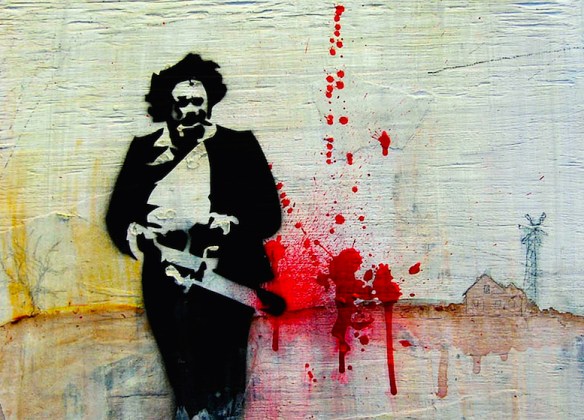
Steven cites too many splatter movies to cover in this review, but central to his thesis is the seminal 1974 Tobe Hooper film, The Texas Chain Saw Massacre. The death of local industry leads Leatherface and family to keep their slaughterhouse traditions alive by carving up and eating young people. These young people, Steven is quick to point out, are only here at all because they were unable to get gas for their car (thanks to the first of two 1970s oil crises). American decline is everywhere; betrayal by global economic forces are central to the trap that’s being laid by the cannibals. (Of course, the carnage of the Vietnam War can’t be overlooked here either, given the visual language of ambush, capture, and torture; Hooper himself has cited this in subsequent interviews.) Steven notes that the victims in The Texas Chain Saw Massacre are representative of a bourgeoisie who don’t know how the sausage is made. It’s important and vital, Steven says, that the cannibalistic side of splatter involves the bourgeoisie being forced to eat members of their own class. It’s Burroughs’s famous “naked lunch“: “the frozen moment when everyone sees what is at the end of every fork.”

As the neoliberal takeover of the world economy begins in earnest in the 1980s, as complex and largely ephemeral systems of mass media and finance take the place of the visceral, grinding monomania of industrial capitalism, splatter horror follows suit. Steven’s analysis of David Cronenberg’s Videodrome (1983) is especially sharp, examining the links between the body horror of the film and the Deleuzian body without organs. Max Renn’s body becomes an endlessly modular media node, able to accommodate video cassettes, to generate and fuse with phallic weapons (used to assassinate and destroy the media forces who’ve made him this way), to mesh and mold and mix with the hard plastic edges of media technology. By the end of the film, Renn is a weapon reprogrammed and re-trained on the very media-industrial complex that made him. More body horror: the cult classic Society (1989) and its shocking conclusion posits the ruling class as a cancerous monster, an amorphous leviathan straight out of a Gilded Age political cartoon, eating and fucking and vomiting, red in tooth and claw and pseudopod. Barriers between bodies break down; the system begins swallowing up all alternate possibilities.

By the time the Cold War is finished, the era of post-9/11 eternal war, of Abu Ghraib and Guantanamo, led to the popular new splatter sub-genre of “torture porn.” Steven identifies the genre’s distinguishing aesthetic feature: the indisputable, systematic, and worldwide victory of capitalism and the hypnotic Spectacle that accompanies it. In this era, there are no longer any alternatives. Everyone, rich and poor, is trapped in the system, and the system reintegrates torture into a worldwide video spectacle. This is embodied in both the global conspiracies of the wealthy in Roth’s Hostel series and in the Jigsaw Killer’s industrially-themed Rube Goldberg devices in the Saw franchise—devices of dismemberment explicitly linked to moral quandaries reminiscent of capitalism’s impossible everyday Hobson’s choices for the working class. The system will go on consuming you, whether you’re unlucky enough to be a splatter film’s victim, or “lucky” enough to wield the power to splatter (for example, Hostel: Part II‘s reversal of fate on the ultra-wealthy hunters, or the Jigsaw Killer’s death from cancer in Saw III—ultimately due to… a lack of health insurance).

Possibly the most intriguing aspect of this already very good book is Steven’s interspersing of personal anecdotes on when and where he discovered some of his favorite horror and genre films. By placing his personal and psychological experience of splatter films front and center, and linking it to his personal growth and increasing political maturity, he demonstrates the personal impact of the political, and the necessity of personal epiphany, mediated by culture, to achieve political awareness. Splatter Capital ultimately is not a book for the already-convinced and committed leftist, the Marxian thinker already well-versed in theory. (Another of Splatter Capital‘s very strong points is how Steven largely eschews jargon and obscurantism for an approachable tone and topic that laypeople can dive into easily.) It is for the fans of these films who’ve always wondered about the ineluctable appeal of visceral, shocking violence on screen, and perhaps why it all feels so strangely familiar.