Where is Neo When We Need Him — Paul Craig Roberts

images

By Paul Craig Roberts

Source: PaulCraigRoberts.org

In The Matrix in which Americans live, nothing is ever their fault. For example, the current decline in the US stock market is not because years of excessive liquidity supplied by the Federal Reserve have created a bubble so overblown that a mere six stocks, some of which have no earnings commiserate with their price, accounted for more than all of the gain in market capitalization in the S&P 500 prior to the current disruption.

In our Matrix existence, the stock market decline is not due to corporations using their profits, and even taking out loans, to repurchase their shares, thus creating an artificial demand for their equity shares.

The decline is not due to the latest monthly reporting of durable goods orders falling on a year-to-year basis for the sixth consecutive month.

The stock market decline is not due to a week economy in which after a decade of alleged economy recovery, new and existing home sales are still down by 63% and 23% from the peak in July 2005.

The stock market decline is not due to the collapse in real median family income and, thereby, consumer demand, resulting from two decades of offshoring middle class jobs and partially replacing them with minimum wage part-time Walmart jobs without benefits that do not provide sufficient income to form a household.

No, none of these facts can be blamed. The decline in the US stock market is the fault of China.

What did China do? China is accused of devaluing by a small amount its currency.

Why would a slight adjustment in the yuan’s exchange value to the dollar cause the US and European stock markets to decline?

It wouldn’t. But facts don’t matter to the presstitute media. They lie for a living.

Moreover, it was not a devaluation.

When China began the transition from communism to capitalism, China pegged its currency to the US dollar in order to demonstrate that its currency was as good as the world’s reserve currency. Over time China has allowed its currency to appreciate relative to the dollar. For example, in 2006 one US dollar was worth 8.1 Chinese yuan. Recently, prior to the alleged “devaluation” one US dollar was worth 6.1 or 6.2 yuan. After China’s adjustment to its floating peg, one US dollar is worth 6.4 yuan. Clearly, a change in the value of the yuan from 6.1 or 6.2 to the dollar to 6.4 to the dollar did not collapse the US and European stock markets.

Furthermore, the change in the range of the floating peg to the US dollar did not devalue China’s currency with regard to its non-US trading partners. What had happened, and what China corrected, is that as a result of the QE money printing policies currently underway by the Japanese and European central banks, the dollar appreciated against other currencies. As China’s yuan is pegged to the dollar, China’s currency appreciated with regard to its Asian and European trading partners. The appreciation of China’s currency (due to its peg to the US dollar) is not a good thing for Chinese exports during a time of struggling economies. China merely altered its peg to the dollar in order to eliminate the appreciation of its currency against its other trading partners.

Why did not the financial press tell us this? Is the Western financial press so incompetent that they do not know this? Yes.

Or is it simply that America itself cannot possibly be responsible for anything that goes wrong. That’s it. Who, us?! We are innocent! It was those damn Chinese!

Look, for example, at the hordes of refugees from America’s invasions and bombings of seven countries who are currently overrunning Europe. The huge inflows of peoples from America’s massive slaughter of populations in seven countries, enabled by the Europeans themselves, is causing political consternation in Europe and the revival of far-right political parties. Today, for example, neo-nazis shouted down German Chancellor Merkel, who tried to make a speech asking for compassion for refugees.

But, of course, Merkel herself is responsible for the refugee problem that is destabilizing Europe. Without Germany as Washington’s two-bit punk puppet state, a non-entity devoid of sovereignty, a non-country, a mere vassal, an outpost of the Empire, ruled from Washington, America could not be conducting the illegal wars that are producing the hordes of refugees that are over-taxing Europe’s ability to accept refugees and encouraging neo-nazi parties.

The corrupt European and American press present the refugee problem as if it has nothing whatsoever to do with America’s war crimes against seven countries. I mean, really, why should peoples flee countries when America is bringing them “freedom and democracy?”

Nowhere in the Western media other than a few alternative media websites is there an ounce of integrity. The Western media is a Ministry of Truth that operates full-time in support of the artificial existence that Westerners live inside The Matrix where Westerners exist without thought. Considering their inaptitude and inaction, Western peoples might as well not exist.

More is going to collapse on the brainwashed Western fools than mere stock values.

Don’t Worry – Everything is Not Under Control

dailyroutine

By Zen Gardner

Source: ZenGardner.com

What a farce. Telling everyone “everything is under control” is perhaps the most dulling and disempowering phrase ever uttered.

My fascination with language just keeps expanding. I love looking at expressions, words, colloquialisms, so-called “sayings” and the like with fresh awakened eyes. I can’t help it. The supposed, accepted and unconscious meanings of these imposed “expressions” are what direct our minds and turn our attention.

So much of what we’ve been handed down is contorted, manipulated and eventually nestled in the collective mindset to twist our hearts away from simple truth.

How many times has this expression been used to bring seeming comfort to someone; “Don’t worry, everything’s under control.” Really? What control? Who’s controlling what? And why?

So often this is used to imply some powerful force is behind everything directing what’s going on. Remind you of anything? Yes – religion, hierarchy, and social, political and economic so-called “controllers”. How debilitating can you get when it comes right down to it, playing on people’s insecurity and lack of conscious awareness?

“It’s under control” is comforting to people? It’s the picture of personal disempowerment!

External Control? Or Creative Freedom!

Sure, there is a wonderful creative Source we are all intrinsically part of, but it’s not “controlling” anything in a living, expanding Universe with beings of all sorts with free will and self determination in an alive multidimensional environment. If anything, this Creative impetus is tearing down control systems that attempt to foist themselves on its process, put there either by conscious intent or the manifestation of hardening mindsets in the social fabric.

Earth processes attest to this, as well as our spectacular expanding and ever changing Universe. Nature itself is alive with new sprouts of life in the animal, plant and mineral worlds, never mind other realms of existence.

Look at earthquakes and volcanoes, or the sun and astral influences. As much as some try to analyze or predict major events that affect earth that still brings no control, only a measure of preparedness on rare occasion. And that type of insecurity is good for us. It’s humbling and keeps us in check.

This process is what the awakening is all about!

While some earth changes may be exacerbated by human activity, the big stuff is way out of our control. Thankfully. That’s what makes life life, and also why the insane would-be captivators of humanity and its planet work so feverishly in their mad pursuits to try to control natural processes. Control is their yardstick and without it they have no temporal security or power, which to them equates some weird form of normalcy or equilibrium.

How upside down can you get.

Be it geoengineering our climate, genetically modifying the natural progression of life forms, or attempting to install artificial intelligence to run their soulless programs, these maniacs are desperate for control in every shape and form. Why? They cannot meld or harmonize with what’s natural since their psychopathic, demonic intentions have nothing to gain, all while the rest of us thrive on being part of the fantastic empowering natural processes of Creation Itself.

Therein lies the rub. Quite apparently we’re in a world of conflicts of interest. That’s our current playing field, if you will. Or won’t. It’s just the way it is.

Let Go Into Conscious Anarchy

I like the anarchy approach. Anarchy is an example of another twisted word. It’s doesn’t mean putting a society into deliberate chaotic destruction, it means living without hierarchical control mechanisms. Something most groomed humans are scared spitless of thanks to generations of social programming.

You mean to tell me if we didn’t have so-called “government” that everything would fall apart? Baloney. People are resourceful and essentially responsible, at least their inner nature is, that hasn’t been perverted by all of this programming to the contrary. That very dependence on external control systems is what the hierarchy is literally banking on which is why the repeated memes of fear of scarcity or personal security.

There’s plenty for everybody. All we need to do is work together locally and share with other communities in a range of sizes and distances. Real commerce in loving cooperation, not the regulated systems that have been foisted upon us. We’ve been weaned from personal responsibility into a system of statist dependence, like someone who’s stopped using their muscles and is dependent on some mass produced contraption for their mobility when there’s nothing wrong with them at all.

They just need to exercise their innate capabilities.

Just because people have become spiritually atrophied in large numbers doesn’t mean that’s the way it’s supposed to be. Exactly like waking up, it’s time to arise and use the magnificent body of capabilities we’ve all been given, and let go of these false crutches and systems of hierarchy and walk into life and live!

Epilogue

That false assurance that everything’s under control by external forces as if we individually have virtually none has got to go. Being comforting in times of stress and turmoil is one thing, but propping people up with some external dependence reinforcement is fundamentally wrong.

It’s time to be conscious – in our words, our thoughts and our actions.

It’s really not that difficult. The main thing you’ll confront is ignorant, unenlightened opposition from those who’ve grown deeply accustomed to this dependency programming, as if it’s some form of respect for the “great ones” who rule them.

It’s very deep and will take time to overcome for most. But remaining in that conscious space, no matter what ridicule or obstacles assail you, is the very solution we each are longing for.

It begins with each of us. Standing our ground and then moving forward in conscious, loving action.

Do it. Bravely. The time for humanity to arise is now.

Much love, be well, and fully empowered,

Zen

ZenGardner.com

Saturday Matinee: Future Shock

future-shock

Future Shock: Orson Welles Narrates a 1972 Film About the Perils of Technological Change

By Jonathan Crow

Source: Open Culture

The beginning of the 1972 documentary Future Shock, directed by Alex Grasshof, shows Orson Welles, bearded and chomping on a cigar, standing on an airport people mover. He turns to the camera and delivers a monologue in his trademark silken baritone. “In the course of my work, which has taken me to just about every corner of the globe, I see many aspects of a phenomenon which I’m just beginning to understand. Our modern technologies have changed the degree of sophistication beyond our wildest dreams. But this technology has exacted a pretty heavy price. We live in an age of anxiety and time of stress. And with all our sophistication, we are in fact the victims of our own technological strengths –- we are the victims of shock… a future shock.”

The documentary itself is wonderfully dated. From its bizarre opening montage; to its soundtrack, which lurches from early electronic music to jazz funk; to some endearing video special effects, which, for whatever reason, mostly centers around Orson Welles’s head, the film feels thoroughly rooted in the Nixon administration. Yet many of the ideas discussed in the movie are, if anything, more relevant now than in the 1970s. Watch it above.

The term “future shock” was invented in Alvin Toffler’s hugely bestselling book of the same name to describe the constant, bewildering barrage of new technologies and all the resulting societal changes those technologies bring about. Anyone who has struggled to comprehend a new, baffling and supposedly essential social media platform, anyone who has been driven to paralysis over the number of choices on Netflix, anyone who found their livelihood decimated because of a hot new app knows what “future shock” is.

Toffler (along with his wife and uncredited co-writer Heidi Toffler) argued that we are in the midst of a massive structural change from an industrial society to a post-industrial one – a society that boggles the mind with an overload of information and an overload of consumer choices. “Change,” as they wrote, “is the only constant.”

Along the way, the Tofflers managed to predict the collapse of America’s manufacturing sector, along with things like Prozac, temp jobs, the internet and the meteoric rise and fall of insta-celebs (Alex from Target, we hardly knew you.) Other predictions – underwater cities, paper clothes and being able to choose your own skin color – haven’t yet come to pass. Still, they had a surprisingly good track record considering these predictions were written over four decades ago.

The video ends with a plea from not Welles, but Toffler himself, who is seen addressing college students.

If we can recognize that industrialism is not the only possible form of technological society, if we can begin to think more imaginatively about the future, then we can prevent future shock and we can use technology itself to build a decent, democratic and humane society. […] We can no longer allow technology just to come roaring down at us. We must begin to say “No” to certain kinds of technology and begin to control technological change, because we have now reached the point at which technology is so powerful and so rapid that it may destroy us, unless we control it. But what is the most important is we simply do not accept everything; that we begin to make critical decisions about what kind of world we want and what kind of technology we want.


Related Content:

Isaac Asimov Predicts in 1964 What the World Will Look Like Today — in 2014

Arthur C. Clarke Predicts the Future in 1964 … And Kind of Nails It

Walter Cronkite Imagines the Home of the 21st Century … Back in 1967

The Internet Imagined in 1969

Marshall McLuhan Announces That The World is a Global Village

Jonathan Crow is a Los Angeles-based writer and filmmaker whose work has appeared in Yahoo!, The Hollywood Reporter, and other publications. You can follow him at @jonccrow. And check out his blog Veeptopus, featuring lots of pictures of badgers and even more pictures of vice presidents with octopuses on their heads.  The Veeptopus store is here.

The Nature of American Denial

409004_2544867183443_1306665339_32089606_585965628_n

By SARTRE

Source: Waking Times

At the core of self delusion is the inability and/or the unwillingness of facing reality. While psychological disorders can often explain abnormal behavior in individuals, the exegesis for deviant social attitudes and accompanying conduct is reserved for society. Or so we are told! But does this make sense to you? As long as you accept that reality does exist and that it can be understood, it follows that we have the right, the ability and the obligation to comprehend it and adjust our actions accordingly.

Most Americans view, of their own personal identity, is inculcated by the political culture. Delmar England, in his provocative work – Mind and Matters, The World in a Mirror – offers this valuable insights into our mutual and shared condition: “In human affairs, as surely as effect is preceded by action, action is preceded by belief, and belief is preceded by thought and conclusions.”

Applying this standard to politics Mr England depicts government is this fashion:

“For all the sidestepping, dance arounds, word games, and confused rhetoric, the term government is easily defined; not by subjective agreement, but by reference to objective reality and the actual entities involved. First, we know that there is no such thing as an infinite entity and that the term, government, necessarily denotes a relationship. The actual entities involved are human individuals. The base options of relationships between individuals are non-initiation of force and non-coercion, or initiation of force and coercion. It makes no difference how many different subjective labels are put upon the situation, the objective fact remains that at the root of it all, these are the only two options. The former is in recognition of the individual as a self-owned entity. The latter is based on the idea of an individual being the property of an “infinite entity”; which is the “justification” for rule by the individuals who hide behind the abstracts and exercise their will to dominate and control all others.”

“The subjective and arbitrary labels arbitrarily associated with government such as democracy, socialism, communism, etc. are purely for the purpose of self-delusion. Although form of implementation may vary and some versions start closer to ultimate self-destruction than other versions, the common and identifying objective content of each and every one is initiation of force and coercion. Millions may volunteer for such an anti-social system and play self-deluding word games for the sake of preferred self-image, but all the pretense in the world and “definitions by agreement” will not erase the truth about government, nor prevent the certain violent consequences of initiation of force and coercion.”

No doubt, this is a correct assessment. Virtually every society and country operates with the implied and universal acceptance that government is natural and ordained. The individual accepts force and coercion as a substitute for avoiding the risk and responsibility of personal Freedom. MindMatters concludes with this point:

“Rather than freedom being the highest value sought by most, it is their deepest and most abiding fear. So much so that they can’t even envision it.”

American denial has caused an epidemic dysfunctional confusion. The delusion that our own self identify is equivalent with the “collective will” of society; which, in turn is synonymous with the government and its policies, is a sociopathic sickness. The antisocial behavior of the STATE demonstrates all the characteristics of a profile of a sociopath. Apply the top five to the demeanor of government: Glibness/Superficial Charm – Manipulative and Conning – Grandiose Sense of SelfPathological Lying – Lack of Remorse, Shame or Guilt. We are all taught what we should believe about government; but only the fool, the liar or the delusional accepts that our – self-owned entity – benefits from the force and coercion that the State demands upon us.

Robert L. Kocher has compiled a body of works far too numerous, on this topic to cite sufficiently. We urge you to review and absorb the wisdom in his insights. Most of the lessons detail the last administration, but are completely relevant to the current regime. One essay, especially compliments the Delmar England conclusion. Mr Kocher writes in American Mental Health and Politics:

“If some of us are appalled, frightened, and even driven half crazy by the maddeningly and complacently silly or psychotic levels of denial, by the superficiality, by the abysmal immaturity, by the primitive level of personality structure, by the too-easily employed distorted rationalizations, by the lack of contact with basic reality that we deal with in our daily lives, hear in our college faculties, and see on TV and in high political office, we can nevertheless know that the reality of our perceptions is validated by mental health figures as well as those patients being seen in therapist’s offices.”

Currently, the national mood is absorbed in the illusion that Americans are at risk and that they are in danger from terrorists abroad. While reality demonstrates that enemies of America are plentiful, the disconnect that their veridical hatred is focused upon the U.S. Government and its policies, is concealed. Vast numbers of Americans feed their denial that they are the target of madmen; while they seek comfort in the fallacy that support for the WAR Party will make them safe. The force and coercion that the government imposes upon you, under the pretext that it is necessary and protective, diminishes your safety as it destroys your Liberty. The utter fraud of national security policy, seeks only to preserve the government, no matter how much harm it inflicts upon citizens.

So why do so many misguided flag-waving zealots rally to a jingoistic cause? Kocher provides the answer: “We now live in a society where many people no longer want or value freedom. Personal freedom and the responsibility that goes with it are abrasive intrusions or demands upon a crippled self-absorbed internal state.”

“American Denial” prevents the admission that U.S. policies only benefit the government. Their own personal delusional perceptions are interchangeable with a phony litmus test, judged by their support for State illusions. The thought of exercising the Freedom to think, criticize, condemn and resist is far too disconcerting to the sheeple. They view their own self worth as an adjunct of an abstract deception; while, the true motives of the government are to control society and all individuals, using force and coercion. Both England and Kocher have it right. The association between an individual and an infinite entity denotes a relationship; and the reluctance or unwillingness to exercise freedom and responsibility, allows the government to implement force and coercion.

“Eternal Vigilance” is no longer enough to preserve Liberty. Sound mental health, appreciation for your own self worth, trust in the integrity of reality and the courage to do battle with the forces that seek to delude your own dignity are all necessary to win this struggle. America is NOT the Government. When policies are dishonest they must be opposed. When officials are depraved they need to be removed. And when your neighbor demands your allegiance to a corrupt government, it is your duty to confront his delusion.

We can no longer afford to be silent in the face of “American Denial”.


About the Author

SARTRE is the mind behind BATR. org (Breaking All The Rules), which documents the steady decline of American exceptionalism.

Hawaii Sees 10 Fold Increase in Birth Defects After Becoming GM Corn Testing Ground

hawaiians_against_gmo_720_375

By Jay Syrmopoulos

Source: The Free Thought Project

Waimea, HI – Doctors are sounding the alarm after noticing a disturbing trend happening in Waimea, on the island of Kauai, Hawaii. Over the past five years, the number of severe heart malformations has risen to more than ten times the national rate, according to an analysis by local physicians.

Pediatrician Carla Nelson, after seeing four of these defects in three years, is extremely concerned with the severe health anomalies manifesting in the local population.

Nelson, as well as a number of other local doctors, find themselves at the center of a growing controversy about whether the substantial increase in severe illness and birth defects in Waimea stem from the main cash crop on four of the six islands, genetically modified corn, which has been altered to resist pesticide.

Hawaii has historically been used as a testing ground for almost all GMO corn grown in the United States. Over 90% of GMO corn grown in the mainland U.S. was first developed in Hawaii, with the island of Kauai having the largest area used.

According to a report in The Guardian:

In Kauai, chemical companies Dow, BASF, Syngenta and DuPont spray 17 times more pesticide per acre (mostly herbicides, along with insecticides and fungicides) than on ordinary cornfields in the US mainland, according to the most detailed study of the sector, by the Center for Food Safety.

That’s because they are precisely testing the strain’s resistance to herbicides that kill other plants. About a fourth of the total are called Restricted Use Pesticides because of their harmfulness. Just in Kauai, 18 tons – mostly atrazine, paraquat (both banned in Europe) and chlorpyrifos – were applied in 2012. The World Health Organization this year announced that glyphosate, sold as Roundup, the most common of the non-restricted herbicides, is “probably carcinogenic in humans”.

Waimea is a small town that lies directly downhill from the 12,000 acres of GMO test fields leased mainly from the state. Spraying takes place often, sometimes every couple of days. Residents have complained that when the wind blows downhill from the fields, the chemicals have caused headaches, vomiting, and stinging eyes.

“Your eyes and lungs hurt, you feel dizzy and nauseous. It’s awful,” local middle school special education teacher Howard Hurst told the Guardian. “Here, 10% of the students get special-ed services, but the state average is 6.3%,” he says. “It’s hard to think the pesticides don’t play a role.”

To add insult to injury, Dow AgraSciences’ main lobbyist in Honolulu, until recently, actually ran the main hospital in town. Although only 1,700ft away from a Syngenta field, the hospital has never done any research into the effects of pesticides on its patients.

Hawaiians have attempted to reign in the industrial chemical/farming machine on four separate occasions over the past two years. On August 9 an estimated 10,000 people marched through Honolulu’s main tourist district to protest the collusion of big business and state putting profits over citizens’ health.

“The turnout and the number of groups marching showed how many people are very frustrated with the situation,” native Hawaiian activist Walter Ritte said.

Hawaiians have also attempted to use a ballot initiative to force a moratorium on the planting of GMO crops, according to The Guardian:

In Maui County, which includes the islands of Maui and Molokai, both with large GMO corn fields, a group of residents calling themselves the Shaka Movement sidestepped the company-friendly council and launched a ballot initiative that called for a moratorium on all GMO farming until a full environmental impact statement is completed there.

The companies, primarily Monsanto, spent $7.2m on the campaign ($327.95 per “no” vote, reported to be the most expensive political campaign in Hawaii history) and still lost.

Again, they sued in federal court, and, a judge found that the Maui County initiative was preempted by federal law. Those rulings are also being appealed.

Even amidst strong public pressure, the chemical companies that grow the GMO corn have continued to refuse to disclose the chemicals they are using, as well as the specific amounts of each chemical being used. The industry and its political cronies have continually insisted that pesticides are safe.

“We have not seen any credible source of statistical health information to support the claims,” said Bennette Misalucha, executive director of Hawaii Crop Improvement Association in a written statement distributed by a publicist.

Nelson pointed out that American Academy of Pediatrics’ report, Pesticide Exposure in Children, found “an association between pesticides and adverse birth outcomes, including physical birth defects,” going on to note that local schools have twice been evacuated and kids sent to the hospital due to pesticide drift. “It’s hard to treat a child when you don’t know which chemical he’s been exposed to.”

Sidney Johnson, a pediatric surgeon at the Kapiolani Medical Center for Women and Children who oversees all children born in Hawaii with major birth defects says he’s noticed that the number of babies born here with their abdominal organs outside. This is a rare condition known as gastroschisis and has grown from three a year in the 1980s to about a dozen now, according to The Guardian.

Johnson and a team of medical students have been studying hospital records to determine if any of the parents of the infants with gastroschisis were residing near fields that were undergoing spraying during conception and early pregnancy.

“We have cleanest water and air in the world,” Johnson said. “You kind of wonder why this wasn’t done before,” he says. “Data from other states show there might be a link, and Hawaii might be the best place to prove it.”

It was recently revealed that these chemical companies, unlike farmers, are allowed to operate under an antiquated decades-old Environmental Protection Agency permit. This permit was grandfathered in from the days of sugar plantations when the amounts and toxicities were significantly lower, and which allowed for toxic chemicals to be discharged into water. Tellingly the state of Hawaii has asked for a federal exemption to allow these companies to continue to not comply with modern standards.

The ominous reality of collusion between these mega-corporations and the political class in Hawaii has seemingly left the citizens of the state with virtually no ability to safeguard their children’s health. We tread dangerously close to corporate fascism when profits are put above the health of the people.


Jay Syrmopoulos is an investigative journalist, free thinker, researcher, and ardent opponent of authoritarianism. He is currently a graduate student at University of Denver pursuing a masters in Global Affairs. Jay’s work has been published on BenSwann’s Truth in Media, Chris Hedges’s Truth-Out, AlterNet, InfoWars, MintPress News and many other sites. You can follow him on Twitter @sirmetropolis, on Facebook at Sir Metropolis and now on tsu.

Systemic Corruption Has Destroyed America

corruptPoliticalSystem2

Source: Washington’s Blog

Preface: There’s always been some corruption in the United States … but it’s never been this bad before.

The Cop Is On the Take

Government corruption has become rampant:

  • Senior SEC employees spent up to 8 hours a day surfing porn sites instead of cracking down on financial crimes
  • NSA spies pass around homemade sexual videos and pictures they’ve collected from spying on the American people
  • Investigators from the Treasury’s Office of the Inspector General found that some of the regulator’s employees surfed erotic websites, hired prostitutes and accepted gifts from bank executives … instead of actually working to help the economy
  • The Minerals Management Service – the regulator charged with overseeing BP and other oil companies to ensure that oil spills don’t occur – was riddled with “a culture of substance abuse and promiscuity”, which included “sex with industry contacts
  • Agents for the Drug Enforcement Agency had dozens of sex parties with prostitutes hired by the drug cartels they were supposed to stop (they also received money, gifts and weapons from drug cartel members)
  • The former chief accountant for the SEC says that Bernanke and Paulson broke the law and should be prosecuted
  • The government knew about mortgage fraud a long time ago. For example, the FBI warned of an “epidemic” of mortgage fraud in 2004. However, the FBI, DOJ and other government agencies then stood down and did nothing. See this and this. For example, the Federal Reserve turned its cheek and allowed massive fraud, and the SEC has repeatedly ignored accounting fraud (a whistleblower also “gift-wrapped and delivered” the Madoff scandal to the SEC, but they refused to take action). Indeed, Alan Greenspan took the position that fraud could never happen
  • Paulson and Bernanke falsely stated that the big banks receiving Tarp money were healthy, when they were not. The Treasury Secretary also falsely told Congress that the bailouts would be used to dispose of toxic assets … but then used the money for something else entirely
  • Congress has exempted itself from the healthcare rules it insists everyone else follow
  • Law enforcement also grabs massive amounts of people’s cash, cars and property … even when people aren’t CHARGED with – let alone convicted of – any crime
  • Private prisons are huge profit-making centers for giant companies, and private prison corporations obtain quotas from the government, where the government guarantees a certain number of prisoners at any given time
  • The government covered up the health risks to New Orleans residents associated with polluted water from hurricane Katrina, and FEMA covered up the cancer risk from the toxic trailers which it provided to refugees of the hurricane.  The Centers for Disease Control – the lead agency tasked with addressing disease in America – covered up lead poisoning in children in the Washington, D.C. area (the Centers for Disease Control has also been outed as receiving industry funding)
  • In response to new studies showing the substantial dangers of genetically modified foods, the government passed legislation more or less PUSHING IT onto our plates
  • The Bush White House worked hard to smear CIA officers, bloggers and anyone else who criticized the Iraq war
  • The FBI smeared top scientists who pointed out the numerous holes in its anthrax case. Indeed, the head of the FBI’s investigation agrees that corruption was rampant
  • The government has intentionally whipped up hysteria about terrorism for cynical political purposes.  For example, former Secretary of Homeland Security Tom Ridge admitted that he was pressured to raise terror alerts to help the president win reelection
  • When the American government got caught assassinating innocent civilians, it changed its definition of “enemy combatants” to include all young men – between the ages of say 15 and 35 – who happen to be in battle zones. When it got busted killing kids with drones, it changed the definition again to include kids as “enemy combatants”
  • The government treats journalists who report on government corruption as CRIMINALS OR TERRORISTS.  And it goes to great lengths to smear them. For example, when USA Today reporters busted the Pentagon for illegally targeting Americans with propaganda, the Pentagon launched a SMEAR CAMPAIGN against the reporters

The biggest companies own the D.C. politicians. Indeed, the head of the economics department at George Mason University has pointed out that it is unfair to call politicians “prostitutes”. They are in fact pimps … selling out the American people for a price.

Government regulators have become so corrupted and “captured” by those they regulate that Americans know that the cop is on the take. Institutional corruption is killing people’s trust in our government and our institutions.

Neither the Democratic or Republican parties represent the interests of the American people.  Elections have become nothing but scripted beauty contests, with both parties ignoring the desires of their own bases.

Indeed, America is no longer a democracy or republic … it’s officially an oligarchy. And the allowance of unlimited campaign spending allows the oligarchs to purchase politicians more directly than ever.

No wonder polls show that the American people say that the system is thoroughly corrupt.

Moreover, there are two systems of justice in Americaone for the big banks and other fatcats … and one for everyone else. Indeed, Americans have .

Big Corporations Are Also Thoroughly Corrupt

But the private sector is no better … for example, the big banks have literally turned into criminal syndicates engaged in systemic fraud.

Wall Street and giant corporations are literally manipulating every single market.

And the big corporations are cutting corners to make an extra penny … wreaking havoc with their carelessness. For example:

  • U.S. military contractors have pocketed huge sums of money earmarked for humanitarian and reconstruction aid. And see this (whistleblowers alerted the government about the looting of Iraq reconstruction funds, but nothing was done)
  • There is systemic corruption among drug companies, scientific journals, university medical departments, and medical groups which set the criteria for diagnosis and treatment

(Further examples here, here, here, here and here.)

We’ve Forgotten the Lessons of History

The real problem is that we need to learn a little history:

  • We’ve known for thousands of years that – when criminals are not punished – crime spreads
  • We’ve known for centuries that powerful people – unless held to account – will get together and steal from everyone else

Beyond Partisan Politics

Liberals and conservatives tend to blame our country’s problems on different factors … but they are all connected.

The real problem is the malignant, symbiotic relationship between big corporations and big government.


Wall Street Panic

panicked trader

By Mike Whitney

Source: Counterpunch

“Not only is the equity market at the second most overvalued point in U.S. history, it is also more leveraged against probable long-term corporate cash flows than at any previous point in history.”

— John P. Hussman, Ph.D. “Debt-Financed Buybacks Have Quietly Placed Investors On Margin“, Hussman Funds

“This year feels like the last days of Pompeii: everyone is wondering when the volcano will erupt.”

— Senior banker commenting to the Financial Times

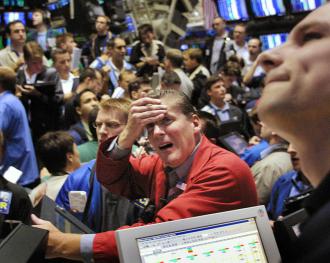
Last Friday’s stock market bloodbath was the worst one-day crash since 2008. The Dow Jones dropped 531 points, while the S&P 500 fell 64, and the tech-heavy Nasdaq slid 171. The Dow lost more than 1,000 points on the week dipping back into the red for the year. At the same time, commodities continued to get hammered with oil prices briefly dropping below the critical $40 per barrel mark. More tellingly, the market’s so called “fear gauge” (VIX) skyrocketed to a 2015 high indicating more volatility to come.  The VIX has remained at unusually low levels for a number of years as investors have grown more complacent figuring the Fed will intervene whenever stocks fall too far. But last week’s massacre cast doubts on  the Central Bank’s intentions. Will the Fed ride to the rescue again or not? To the vast majority of institutional investors, who now base their buying decisions on Fed policy rather than market fundamentals, that is the crucial question.

Ostensibly, last week’s selloff  was triggered by China’s unexpected decision to devalue its currency, the juan.   The announcement confirmed that the world’s second biggest economy is rapidly cooling off increasing the likelihood of a global slowdown. Over the last decade, China has accounted  “for a third of the expansion in the global economy,… almost double the contribution of the US and more than triple the impacts of Europe and Japan.” Fears of a slowdown were greatly intensified on Friday when a survey showed that manufacturing in China shrank at the fastest pace since the recession in 2009. That’s all it took to put the global markets into a nosedive. According to the World Socialist Web Site:

“The deceleration of growth in China, reflected in figures on production, exports and imports, business investment and producer prices, is fueling a near-collapse in so-called “emerging market” economies that depend on the Chinese market for exports of raw materials. The past week saw a further plunge in stock prices and currency rates in Russia, Turkey, Brazil, South Africa and other countries. These economies are being hit by a massive outflow of capital, placing in doubt their ability to meet debt obligations.”

(“Panic sell-off on world financial markets”, World Socialist Web Site)

While a correction was not entirely unexpected following a 6-year long bull market, the sudden drop in equities does have analysts rethinking the effectiveness of the Fed’s monetary policies which have had little impact on personal consumption, retail spending, wages, productivity, household income, or economic growth all of which remain weaker than they have been following any recession in the post war era.  For all intents and purposes, the plan to inflate asset prices by dropping rates to zero and injecting trillions in liquidity into the financial system has been an abject failure.   GDP continues to hover at an abysmal 1.5% while  signs of a strong, self sustaining recovery are nowhere to be seen. At the same time, government and corporate debt continue to balloon at a near-record pace draining capital  away from productive investments that could lay the groundwork for higher employment and stronger growth.

What’s so odd about last week’s market action is that the bad news on China put shares into a tailspin instead of sending them into the stratosphere which has been the pattern for the last four years. In fact, the reason volatility has stayed so low and investors have grown so complacent is because every announcement of bad economic data has been followed by cheery promises from the Fed to keep the easy-money sluicegates open until the storm passes.  That hasn’t been the case this time, in fact, Fed chair Janet Yellen hasn’t even scrapped the idea of jacking up rates some time in September which is almost unthinkable given last week’s market ructions.

Why? What’s changed?   Surely, Yellen isn’t going to sit back and let six years of stock market gains be wiped out in a few sessions, is she?  Or is there something we’re missing here that is beyond the Fed’s powers to change? Is that it?

My own feeling is that China is not the real issue. Yes, it is the catalyst for the selloff, but the real problem is in the credit markets where the spreads on high yield bonds continue to widen relative to US Treasuries.

What does that mean?

It means the price of capital is going up, and when the price of capital goes up, it costs more for businesses to borrow. And when it costs more for businesses to borrow, they reduce their borrowing, which decreases the demand for credit. And when the demand for credit decreases in a credit-based system, then there’s a corresponding slowdown in business investment which impacts stock prices and growth. And that is particularly significant now, since the bulk of corporate investment is being diverted into stock buybacks. Check out this excerpt from a post at Wall Street on Parade:

“According to data from Bloomberg, corporations have issued a stunning $9.3 trillion in bonds since the beginning of 2009. The major beneficiary of this debt binge has been the stock market rather than investment in modernizing the plant, equipment or new hires to make the company more competitive for the future. Bond proceeds frequently ended up buying back shares or boosting dividends, thus elevating the stock market on the back of heavier debt levels on corporate balance sheets.

Now, with commodity prices resuming their plunge and currency wars spreading, concerns of financial contagion are back in the markets and spreads on corporate bonds versus safer, more liquid instruments like U.S. Treasury notes, are widening in a fashion similar to the warning signs heading into the 2008 crash. The $2.2 trillion junk bond market (high-yield) as well as the investment grade market have seen spreads widen as outflows from Exchange Traded Funds (ETFs) and bond funds pick up steam.” (“Keep Your Eye on Junk Bonds: They’re Starting to Behave Like ‘08 “, Wall Street on Parade)

As you can see, the nation’s corporations don’t borrow at zero rates from the Fed. They borrow at market rates in the bond market, and those rates are gradually inching up. And while that hasn’t slowed the stock buyback craze so far,  the clock is quickly running out. We are fast approaching the point where debt servicing, shrinking revenues, too much leverage, and higher rates will no longer make stock repurchases a sensible option, at which point stocks are going to fall off a cliff. Here’s more from Andrew Ross Sorkin at the New York Times:

“Since 2004, companies have spent nearly $7 trillion purchasing their own stock — often at inflated prices, according to data from Mustafa Erdem Sakinc of the Academic-Industry Research Network. That amounts to about 54 percent of all profits from Standard & Poor’s 500-stock index companies between 2003 and 2012, according to William Lazonick, a professor of economics at the University of Massachusetts Lowell.”

You can see the game that’s being played here. Mom and Pop investors are getting fleeced again. They’ve been lending trillions of dollars to corporate CEOs (via bond purchases) who’ve taken the money, split it up among themselves and their wealthy shareholder buddies, (through buybacks and dividends neither of which add a thing to a company’s productive capacity) and made out like bandits.  This, in essence, is how stock buybacks work. Ordinary working people stick their life savings into bonds (because they were told “Stocks are risky, but bonds are safe”.) that offer a slightly better return than ultra-safe, low-yield government debt (US Treasuries) and, in doing so, provide lavish rewards for scheming executives who use it to shower themselves and their cutthroat shareholders with windfall profits that will never be repaid. When analysts talk about “liquidity issues” in the bond market, what they really mean is that they’ve already divvied up the money between themselves and you’ll be lucky if you ever see a dime of it back. Sound familiar?

Of course, it does. The same thing happened before the Crash of ’08. Now we are reaching the end of the credit cycle which could produce the same result. According to one analyst:

“There’s been worrying deterioration in the overall global demand picture with the continuation of EM (Emerging Markets) FX (Currency Markets) onslaught, deterioration in credit metrics with rising leverage in the US as well as outflows in credit funds in conjunction with significant widening in credit spreads…..The goldilocks period of “low rates volatility-stable carry trade environment of the last couple of years is likely coming to an end.”

(“Credit: Magical Thinking“, Macronomics)

In other words, the good times are behind us while hard times are just ahead. And while the end of the credit cycle doesn’t always signal a stock market crash, the massive buildup of leverage in unproductive financial assets like buybacks suggest that equities are in line for a serious whooping. Here’s more from Bloomberg:

“Credit traders have an uncanny knack for sounding alarm bells well before stocks realize there’s a problem. This time may be no different. Investors yanked $1.1 billion from U.S. investment-grade bond funds last week, the biggest withdrawal since 2013, according to data compiled by Wells Fargo & Co…..

“Credit is the warning signal that everyone’s been looking for,” said Jim Bianco, founder of Bianco Research LLC in Chicago. “That is something that’s been a very good leading indicator for the past 15 years.”

Bond buyers are less interested in piling into notes that yield a historically low 3.4 percent at a time when companies are increasingly using the proceeds for acquisitions, share buybacks and dividend payments. Also, the Federal Reserve is moving to raise interest rates for the first time since 2006, possibly as soon as next month, ending an era of unprecedented easy-money policies that have suppressed borrowing costs….

“Unlike the credit market, the equity market well into 2008 was very complacent about the subprime crisis that led to a full blown financial crisis,” the analysts wrote…..

So if you’re very excited about buying stocks right now, just beware of the credit traders out there who are sending some pretty big warning signs.”  (“U.S. Credit Traders Send Warning Signal to Rest of World Markets”, Bloomberg)

It’s worth noting that the above article was written on August 14, a week before the stock market blew up. But credit was “flashing red” long before stock traders ever took notice.

But that’s beside the point. Whether the troubles started with China or the credit markets, probably doesn’t matter. What matters is that the system about to be put-to-the-test once again because the appropriate safeguards haven’t been put in place, because bubbles are unwinding, and because the policymakers who were supposed to monitor and regulate the system decided that they were more interested in shifting  wealth to their voracious colleagues on Wall Street than building a strong foundation for a healthy economy. That’s why a simple correction could turn into something much worse.

NOTE: As of posting time, Sunday night, the Nikkei Index is down 710, Shanghai down 296, HSI down 1,031. US equity futures are all deep in the red

MIKE WHITNEY lives in Washington state. He is a contributor to Hopeless: Barack Obama and the Politics of Illusion (AK Press). Hopeless is also available in a Kindle edition. He can be reached at fergiewhitney@msn.com.

On the Meaning of “Middle Class” and the State of the Middle Class

and_wearing_shoes_middle_class_k_750725

By Dr. Nicholas Partyka

Source: The Hampton Institute

When politicians talk, one of the recurring themes about which they spew platitudes is the economy. It would be the subject of another essay to unpack what is meant by “the economy” when politicians and other capitalist elements use that term. This aside, in discussing the economy there is a phrase that politicians use with such alacrity that it has become trite. This phrase is, “middle class”. Politicians, pundits, and social commentators deploy this term in many contexts, but almost always appealing to its ubiquity of membership, critical role in democracy, and moral virtue in their speeches. These constant references to the middle class in the popular political discourse have rendered this term impenetrably vague. If we listen to politicians then one would be led to believe that most Americans are members of this middle class, whose health and prosperity the politicians never tire of proclaiming as their highest priority. Speeches are one thing, reality another. Let us interrogate this concept of the “middle class”, and see what to make of this notion that plays such a prominent role in American political discourse on the economy.

With an election year looming, and a Presidential election at that, with their seemingly always lengthening election cycle, the phrase “middle class” will only be heard more and more frequently from now until after November 2016. The President’s recent invocation of the phrase “middle class economics” is only the latest salvo between the two dominant capitalist political parties, as they try to position themselves in the public’s mind as the true defender of – the almost apotheosized- middle class. Candidates and their supporters will be arguing more and more vigorously about which party, or which policies, will do more to help this middle class. About the only thing that candidates from both parties will agree on is that the middle class is in trouble, and that economic policies should be designed which maximally promote the welfare of this class. The two major political parties in this country have divergent views about what kinds of policies best aid this alleged middle class. However, both parties are attempting to win votes by claiming to be champions of the middle class, a class with which a great many Americans still continue to identify themselves.

We’re going to explore two distinct, but interrelated questions in what follows. First, we’ll want to know, Who and how many, people are middle class? Second, we’ll want to ask, What does it mean to be middle class? The answers to these questions will likely have to be made relative to particular societies at particular times; though some generalization is possible. To begin we’ll look at what it has meant historically to be middle class. Then we’ll look more in depth into the meaning of being middle class in the contemporary American context. What we will find is a great deal more confusion and ambiguity about this notion of a “middle class”. So much so that we should start to wonder if this notion retains any usefulness.
The Middle Classes, Historically

For most of history being middle class simply meant occupying, however tenuously, a social status that was between that of a slave and that of a noble. Basically, the middle class was composed of everyone who was not technically a chattel slave, and lacking the noble pedigree of a true aristocrat. In most societies of the ancient world this simple definition would indeed make most people middle class. However, this understanding glosses over the highly variegated nature of socio-economic positions possible between technical chattel slavery and blue-blooded nobility. For instance, debt bondage and serfdom, both forms of un-free labour, would not cause one to be dropped from the middle class on this accounting. For example, in the ancient world slaves were often employed as overseers, that is in a management capacity. It would not have been uncommon for slave overseers to sometimes direct the labour of technically free men.

We can see in certain socio-political cleavages that splits have occurred in many contexts between the lower ranks of these middle classes and the higher elements of this class. Middle classes have struggled against entrenched aristocracy and nobility at many points in history for social advancement and political inclusion. However, almost always, in the critical moment, the higher elements of these middle classes would betray the interests of the lower elements, whose bodies, blood and ballots had been used to gain them inclusion. Marx would come to call these “higher elements” of the middle classes petit-bourgeoisie, signifying the much greater material, and indeed much more importantly, aspirational affinity with the bourgeoisie than the proletariat.

Two examples will suffice here. In ancient Greece we see the demos, or “the people” engaging in political struggle for inclusion in the political life of the polis. But who is this demos? First, Greeks used the word demos in two distinct ways. In one sense, we might call the wide sense, it meant the whole citizen body of city-state in general. In the narrow sense, on the other hand, the demos meant the ‘common people’, the ‘lower classes’, the aporoi, the propertyless. This group included a very wide range of socio-economic and political situations, and certainly contained an upper and lower group. The main cleavage within the ranks of the demos is between the better off elements and those struggling to get by. It goes without saying that slaves would not be counted among the demos. Those who are struggling are more, or in worst case entirely, dependent on others for their livelihood. The Greeks called Thetes and Banausoi. The former we might call day-labourers or wage earners, the latter we could translate loosely as artisans. These were the lowest two of Solon’s five social classes, and while not slaves, were subject to various kinds of forced labour. Though some artisans and merchants could be quite wealthy, most were not. Most merchants, as opposed to retailers, though were likely to be foreigners, and thus not eligible for citizenship.

When we focus on the internal political conflicts of the Greek polis of the Classical period (roughly the 5th and 4th centuries BC), what we see is a struggle over citizenship, that is over access to political participation in government. While the socio-economic and political realities of the ancient world are complex, in the main the conflicts were between an urban middle class of mainly artisans and middling farmers on the one hand, and the traditional land-owning oligarchy which monopolized political power on the other.[1] The political struggles over demokratia in this period revolved mainly around whether or not the banausoi and thetes should be given citizenship rights. Chiefly important among the rights of citizens were the right to vote in the Assembly, to hold public office, the serve as a juror in the dikasteria, to bring matters before the courts; at Athens in particular, citizens would be entitled to receive a share in any disbursement of the polis‘s dividends from the proceeds of the Laurium silver mines.

The demos was the main agent of social change in the ancient Greek polis, the traditional aristocracy certainly saw it this way. They saw “middle class” elements as being too politically ambitious, which is in part why they deploy the term pejoratively. By “middle class elements” the traditional aristocracy would have lumped together both very wealthy artisans, and much more humble enterprises, all of whom were united in not being aristocrats by blood lineage. Wealthy merchants and artisans might themselves employ slaves both for carrying out production, as well as the overseeing of this work, but they lacked the “best” kind of background. This made them unsuitable for political participation in the eyes of established elites. Smaller artisans and merchants, who didn’t have exorbitant wealth to recommend them, would have been thought only the more unsuited to political life.

All of the main institutions of Classical Greek demokratia were devices designed to help poor and working-class free men defend themselves from the depredations of their richer counterparts. Rule by majority vote in an Assembly, ekklesia, open to all citizens; freedom of speech, parrhesia, in the assembly; large popular courts of law, dikasteria, composed of fellow citizens; rule of law, isonomia, as passed by the Assembly and administered in the courts; the belief that political power should be scrutinized, subject to euthyna, are all practices that helped the aporoi defend their highly precarious social position from the predatory behavior of wealthy citizens. As one eminent scholar describes, “Since the majority of citizens everywhere owned little or no property, the propertied class complained that demokratia was the rule of demos in the narrower sense and in effect the domination of the poor over the rich.”[2]

In the ancient Greek polis political participation was usually restricted to those native adult men who could meet a certain property qualification. In the main, in order to be a citizen one had to possess enough wealth to afford to outfit themselves with the hoplite panopoly. This was the complete set of armaments associated with the heavy armed infantry. If one could afford to buy one’s own armor, and afford the leisure time to learn to fight as part of a phalanx formation, then one was considered worthy to participate in the political life of the polis. The idea being that if one was wealthy enough to afford the hoplite panopoly then one had enough of a stake in the success and survival of the polis to be entitled to a role in the government of the city-state. Those “old money” and nouveau riche aristocrats who were wealthy enough could afford to outfit themselves with horses as well as more ornate armor and weapons, and thus the traditional prestige associated with the cavalry. The question of democracy in the ancient Greek world, was thus a struggle over the inclusion of those who could not afford the traditional citizenship qualification based on the connection of wealth and military service, and who because they were not slaves could make legitimate claims to be entitled to such inclusion.

Renaissance Italy serves as another great example. In the rise of the classic northern Italian city-state podestaral form of communal government there was employed in the popular political discourse a term, the popolo. Loosely translated, it means the people. However, once again we’ll see that this notion of the people actually covers over a major divergence within between well-off members and working-class members. As one scholar claims, “When, therefore, the long and venomous struggle broke out between the popolo (the “people”) and the nobility, the popular movement drew its force and numbers from the middle classes, not from the poor, the day labourers, or the unskilled”.[3]

The political conflict in 13th century northern Italian city-states was, much like in the ancient Greek world, fundamentally about participation. Beginning in the 12th century, a political conflict between church and secular authorities saw the rise of communal governments in all the major Renaissance city-states in northern Italy. At the time, this form of government was identified with the self-government of local magnates and aristocrats instead of more alien authorities imposed by church leaders in Rome. In this early phase of commune government, “The nobility dominated the consulate, manipulated the general assembly, and ruled the city, except where the emperor successfully intervened, as at Vicenza, Siena, and Volterra, or where the political power of the Bishop persisted.”[4]

It was against this restricted form of government that the political forces of the popolo were arrayed in the 13th century. By organizing for combat against the military forces of the nobility, the popolo was able to seize power in the commune and change the structure of commune government, in that it was able to secure more participation for those in its ranks; or more correctly, some of those in its ranks. The popolo, much like the demos, was a class composed of better off artisans, tradesman, merchants, et cetera. It was a class of persons who had to work for a living, that is they had to do physical labour themselves to achieve their subsistence. These people were free, in that they were not slaves or serfs, but were not aristocrats, they did not possess the right kind of lineage. Political participation was at this time still restricted to those who did have the proper kind of aristocratic genealogy.

Much as in the case of the ancient Greek world, the main political cleavage in the Renaissance northern Italian city-state between the popolo and nobilitas largely concerned the way individuals made a living. Nobles owned large landed estates, and derived their wealth and status from being able to control the labour of others, i.e. vassals and serfs. Those who were not aristocrats could be wealthy, could own land, but typically had to work themselves. That is, the typical member of the popolo could not control the labour of others to the same extent that a noble could. The political conflicts of the 13th century were not simplistic conflicts between land owners and merchants, the reality was much more complicated than that.

Both popolo and nobilitas would be distinguished from a day-labourer in that they would be considered independent in the right sort of way, they would be considered the people who had real freedom. What distinguishes the position of the poorest classes is that they are dependent on others for their livelihood. Thus, for example, the serf is dependent on the lord, the tenant farmer on the land-owner, and the day-labourer on the employer who pays him. These kinds of people would have been considered not really free in the right way, especially politically. Though all God’s children would have been understood to be free, some were not considered free enough to be worthy of inclusion in government.

In what would become an unfortunate recurring tendency, once the leading – i.e. the wealthiest- elements in the “middle class”, the popolo, achieved inclusion in communal government, they allied with the old aristocracy and turned against the lower, more ‘middling’ elements in the popolo to suppress their continued agitations for further liberalization of political participation. Thus, as one scholar puts it,

“Up to about the middle of the thirteenth century, it was in the interest of bankers and -long-distance traders to batter the entrenched communal oligarchy with an eye to loosening the political monopoly of the old consular families, mostly of noble lineage… But after about 1250 or 1260, having fully achieved their aims and in fact now menaced by the political ambitions of the middle classes, they broke with the popolo, thereby dividing and undermining the popular movement”.[5]

With the erosion of nobility and its traditional privileges across Europe and North America from the 17th century onward, as well as the formal abolition of chattel slavery in these societies, this traditional understanding of middle classes is not sufficient for the world we inhabit. Being neither a slave nor a noble will not help many locate their social position in contemporary societies, when these societies do not formally legally recognize slavery or nobility. As capitalism remade societies across western Europe and North America in this same period, it reshaped the nature of the classes that composed those societies. Thus, a new way to understand what the middle-class is will be needed.
The Idea of the Middle Class in Post-WWII America

There are some who are reluctant to define the middle class using income measurements. The alternative proposed by many of these critics is a more aspirational definition based on consumption. This definition is based on both the level and the kind of consumption desired by individuals who aspire to be middle-class, ie. who desire to live what is deemed a middle-class lifestyle. Most of the essential features of this conception of the middle class are derived from the experience of Americans post WWII. The vast pool of purchasing power accumulated by US citizens during the war led in the post-war period to rising standards of living for a wide swath of the population. The patterns of consumption, the norms and values, of what we today consider definitional of the middle class in America were originated to a large extent in this period.

It was in this period that the idea of the “American Dream”, as it is currently understood, originates. This post-war vision of increasingly wealthy Americans achieving higher material standards of living is the well-spring of many of the elements of middle-class-ness that we take for granted. The conception of middle-class-ness as consisting of things like widespread home ownership, ownership of a motor vehicle or vehicles, stable long-term employment, ability to send children to college, take a family vacation, et cetera, was born during this era.

If we try to understand the middle class this way, we should investigate what the patterns of consumption for a middle-class individual, or family, today requires in terms of income, and how many Americans actually possess the financial means to afford this lifestyle. According to one recent report, it was estimated that a middle-class “American dream” lifestyle would cost $130,000 a year for a family of four.[6] The median income for individual income-earners in the US in 2013 was around $52,000, not even half of that estimated cost. According to a 2010 study by the Commerce Department only a family with two income-earners in the 75th percentile or above could afford the middle-class lifestyle described in the previous report. [7] According to data from a 2014 report by the Congressional Research Service only around 20% of American household could afford this price tag of a “middle-class” lifestyle.

If one takes only the items listed as “essential” in the report cited in the previous paragraph the total cost of a middle-class lifestyle, which is still above the current median income. This accounting clearly leaves out other important expenses, like taxes, that one will incur, as well as makes impossible any expenditure on important items like savings, and recreation. Now, of course food prices change, and fuel prices change, and these effect how wealthy consumers feel, as decreases in food and fuel costs can be transferred to increase consumption of “extras” like college savings for children, or family vacations. One should also note that this report categorized cell phone and internet expenditure as an “extra”. In today’s world these things are properly considered more akin to utilities, they are essentials for living.

Clearly, the level of income needed for achievement of a characteristically middle-class, or “American dream”, lifestyle is out of reach for a great many individuals and families. This is likely part of why the percentage of those identifying themselves as lower-class, or lower-middle class in recent surveys has increased.[8] Indeed, even a family with two income-earners, in the 25th percentile only has an income about equivalent to the median. Meanwhile, as of 2010, an individual income-earner in the 50th percentile only made around $25,000. The rising costs of college, the continued stagnation of wages – especially at the lowest ends of the labour market – as well as the reductions in employer-based pension and benefit programs for most workers have a contributed to making the mid-twentieth century American vision of middle-class existence more and more out of reach for large swaths of Americans.

The post-war American experience, if put in proper context, is the product of a historically unprecedented epoch. According to the research presented by Thomas Piketty in his book Capital in the Twenty-First Century, the middle part of the twentieth century was the only time in the last 300 years that his law of capital (r>g) was reversed.[9] This was a special period in which the growth rate exceeded the return to capital, and thus workers received increasing wages, and increasing purchasing power. It was in this historically unique period that the main expectations, norms, values, and status symbols of modern American “middle-class” lifestyle were born.

If we look the heyday of the American middle class in the 1950s and 1960s what we see is a transformation of American society born of a historical accident. Piketty’s research demonstrates that income inequality in the US basically plateaued over these decades, after decreasing sharply during the period from 1913-1945, that is the period of the World Wars and the Great Depression. What the French call “les trente glorieuses”, and others have called a pax Americana, was the direct result of the tumult of the wars and economic crises of the first half of the twentieth century. Workers in the western world generally experienced a boom, in that they experienced rising living standards, wages, and benefits. In Europe these benefits often took the form of national programs, while in America they were largely employer-based; healthcare and retirement are good examples. It was in this environment of rising levels of access to material consumption that the dominant aspects of the outlook of the middle class in America took shape.

Without the devastating effects of two world wars and an economic depression of immense scale, governments, especially in the US, would not have made the concessions that they did to workers, to organized labour in particular. The need to secure consistent, reliable production of vital war supplies, which might be disrupted by labour agitation, inclined the US government to enter the fray of industrial warfare on the side of workers during the First World War; at least to the extent required to ensure production for war. The Great Depression was an important cause of the establishment of the main pillars of the American welfare system in the 1930s. Labour unions achieved even greater privileges during the Second World War, as the leadership of organized labour organizations were increasingly co-opted by the corporate interests they were supposed to oppose. As a result of the need to take sometimes drastic measures to fight two wars and a titanic economic depression the US government enacted policies which resulted in a reduction in income inequality. This reduction in inequality combined with rising levels of material consumption, due to workers increased ability to bargain collectively with the support of the legal apparatus of the state, define this unprecedented period in economic history.
Middle Class Confusion

Clarification about the meaning of “middle class” is especially important because Americans seem to be confused about this notion of “middle class”, about who is in it, and what it means to be in it. It is a well-know and, much commented on, phenomenon in American political culture that almost everyone tends to perceive themselves as “middle-class”. What makes this fact interesting, and thus worthy of the decades of commentary and analysis it has received, is the startling economic inequality that coexists with this perception.

Though the rates of self-identification with being middle-class have varied over time, a healthy portion of Americans still identify as being middle class. Even now, after decades of erosion in the position of workers due to stagnating wages, reductions in benefits, cuts to social programs and education, increasing international competition, and the shifting of various kinds of work to the global south and other peripheral economies, as well as more recently the effects of the 2008 financial crisis, 44% of people surveyed in one recent survey self-identified as being middle-class. [10] Indeed this figure has fallen over the years of the Great Recession, self-identification as middle-class fell from 53% in 2008, to 49% in 2012, and then to 44% in 2014. Thus, even in bad times, as a great many people are still struggling, a great many people continue to perceive themselves as middle-class.

There is no one universally accepted way to define the middle-class. Perhaps this is part of the reason why politicians are able to make so much political hay with it. This is also part of how it is possible for a great many rather wealthy see themselves as middle-class at the same time as many of the working poor. It is also part of how many super-wealthy individuals come to perceive others less wealthy than themselves, though still obscenely wealthy, as ‘merely’ middle-class.[11] This lack of a consensus about a definition is certainly one of the reasons there is so much confusion about the middle-class, and who belongs to it, and how one belongs to it.

Conventionally, the middle is understood as everyone in the second, third, and fourth income quintiles. Basically, everyone who is not in the top-fifth or the bottom-fifth of income earners is defined as middle-class. In America today this definition of middle-class is roughly equivalent to those earning between $30,000 and $80,000 a year.[12] This is quite a large middle-class. One might think that it is rather too large. Indeed, how can one assimilate the experiences of an individual, or even more a family, living on $30,000 to one making $80,000? One could, I think quite properly, say that these two sets of experiences are so incommensurable materially as to make them awkward members of a common middle-class. Let us note in this connection that the federal government defines the poverty threshold for a family of four as a bit less than $24,000 a year. So, it would seem hard to think the experiences of family living on about 25% more than the poverty level would be anything like those of a family making more than two and a half times that amount.

That this conception is too wide to be very useful, and for the reasons I alluded to, is admitted by the fact that, at least colloquially, we have adopted the distinctions between ‘upper’ and ‘lower’ middle class. This distinction testifies to the difference in material position of individuals, or families, in the upper and lower ends of the middle. The lifestyle, the patterns of consumption, level of access to opportunity, and much else, varies so much between these groups that the distinction suggests itself, and is so patently apparent that no one questions its propriety.

Perhaps then we should narrow our definition of middle-class to only the third income quintile. This understanding of middle-class would include those making roughly $40,000 to $65,000. Even the top end of this range would still be half of what one estimate suggests a middle-class lifestyle would cost. Moreover, only about 15% of income earners would count as middle-class on this way of understanding the middle class. [13] This fact would certainly seem inconsistent with the widespread perception that the middle-class is the numerically largest class. Even if we expand back to our original range of $30-80,000, only about 40% of income earners would be middle-class. While this figure has the virtue of appearing to match up quite closely with the level of self-reported identification as being middle-class, it suffers from the vagueness we noted above. The upper limit of the 4th income quintile is north of $100,000. I do not think it is a stretch to say the material circumstances of a “middle-class” family making anywhere from the median to the upper limit has much in common with those families earning closer to the lower threshold of “middle class”.

By several ways of trying to understand the middle class we come up with results that fall short of matching our expectations and common perceptions. We seem to end up with either an unhelpfully expansive notion of the middle-class that encompasses individuals and families with greatly divergent material circumstances. Or, one ends up with a more precise statistical conception of the middle class, but wherein fewer persons are understood to be middle-class than commonly report being so in surveys. Part of explaining this confusion about the middle-class is the fact that Americans are either unaware or deeply confused about the nature of the distribution of wealth in this country. Many people report feeling like they are middle-class, but only as a result of ignorance or confusion about the nature of wealth inequality in America. Indeed, it would be crazy to deny that part of one’s perception of class position is the relative position of others. Were more Americans aware of the real nature of the distribution of wealth they would likely feel less middle-class, and more lower-class. According to the results of one recent research study, a representative sample of Americans reported thinking that the share of total income possessed by the middle class in America, i.e. the second through fourth income quintiles, was just north of 40%. Respondents also reported thinking the third income quintile alone possesses over 10% of total national wealth. In fact, the real share possessed by the first through fourth income quintiles combined is less than 20%, and the third quintile alone possesses closer to 5% than greater than the 10% that was reported.[14]

Another important aspect of the explanation for why there is so much confusion about the middle class is the confusion individuals face given their precarious position in the socio-economic hierarchy. Given how much inequality has risen over the last few decades there has been an increase in the perception that the post-war American middle-class lifestyle is out of reach for a great many hard-working people. Rising inequality combined with the effects of a calamitous financial crises, followed by years of recession, caused many to report falling in social class. The youngest cohort especially was hard hit, with now 49% reporting being in the lower or lower-middle class. It also caused many who identify as middle-class to feel this status increasingly precarious. Indeed, according to a Pew Research study from 2014 almost as many Americans reported being lower-class as middle-class, and the spread between the two was a mere 4%.[15]
The Working Class

We have seen now that this notion of the “middle class” is highly problematic. When we attempt a rational accounting of it, what we find is that our social reality confounds many of the expectations that most Americans have when they talk about the middle class. We find that though many Americans report in surveys that they are middle-class, the middle class is small, and shrinking. Once we distinguish upper from lower in the middle class, the true middle is really a small part of the income spectrum. One cannot get too far below the median income for one to be more lower class than middle class, nor can one get too far above without becoming upper-middle, or even elite. For instance, $100,000 in income would put one at the upper limit of the fourth income quintile, while an income at or above $150,000 would place one among the top 10% of income-earners. One cannot thus get too far beyond the $80,000 average income of the fourth income quintile without ending up less middle class than upper class.

If we judge belonging to the middle class as a function of ability to consume, then again we find that the traditional middle-class lifestyle ideal is increasingly out of reach for large swaths of the American population. What we see now is that we need a new way to think about class, about the socio-economic positions that people occupy and how these are best described. Getting a handle on what class one belongs to is important, especially in these election cycles, as appeals for votes are made to members of the various social classes that compose the electorate. How is one to know which kind of candidate or policy to vote for if one does not know what candidates or policies will advance their interests? And how is one to know what will advance one’s interests if one does know have an accurate understanding of their own socio-economic reality?

Rather than muddle on with this vague notion of a middle class, we should substitute a new understanding of class and class relations. This understanding of class should emphasize the role that working conditions play in determining socio-economic position, or class. This understanding will of course have much overlap with the dominant income-based understanding. For indeed, working conditions and wage rates are often highly correlated in market economies, that is, typically the lower the pay the worse the working conditions (in one form or another) and vice versa. When we take the kinds of jobs people work into account, the picture that emerges is one which demonstrates the importance of thinking in terms of a working class rather than a middle class. When we start putting working conditions in the forefront of our conception of social class we gain a much accurate, and explanatory conception of class.

One example that helps demonstrate this need for an understanding of class based on working conditions is the practice of “flex-time”. In the upper end of the labour market this concept is instantiated by programs that allow workers to do their work on their own schedule, freeing workers of the need to always be in the office during the traditional working day. This allows workers to achieve a better work-life balance, by having more flexibility with the time they need to devote to work. On the lower end of the labour market flex-time typically takes the form of on-call forms of scheduling. This is an extension of the logic of the “just-in-time” inventory management systems that have come to dominate manufacturing industries, and applied to the labour force of a variety of businesses, but especially retail firms. The idea, in both cases, is to only have as much as it needed of both on hand at any one time, so as to free up capital from unnecessary investment in extra stock or extra labour.
Conclusion

Have middle classes existed in history, yes. Did a middle class exist in the US during the middle part of the twentieth century, yes. However, in both cases these answers must be qualified, if the nuance of reality is not to be lost. Yet, in appending these qualifications we change the nature of the answers, and thus must come to see the original answer as importantly flawed. In both cases we find the reality of the middle class(es) does not match up with our modern expectations and perceptions about the middle class. In the first case, one might be subject to various forms of un-free labour despite still being technically not a slave, and thus free but by no means rich, or even independent. In the latter case, we find that this ideal of the middle class was quite restricted, and the alleged golden age of its reign was certainly not seen as such by the many marginalized groups of that era. We also see that its very existence occurs because of the confluence of historical circumstances that would be near impossible to re-create.

The idea of being “middle class” is also a source of confusion when compared to modern thinking about the middle class, and its role in society. Indeed, much of the meaning of being “middle class” has always involved poor people, those who work for wages for a living, aping the consumption trends of their ‘social betters’. Thus, even while during the classic 19th century hay-day of industrialization the middle class, ie. the petit bourgeoisie, was fairly small it nonetheless transmitted its social norms, consumption patterns, taste in art and décor, to those below them on the social ladder. It was not this middling class, but rather the working class, the proletariat, whose consumption, aping the middle class above them, drove the rise of a “middle class society”. This process of transmittal of social norms, values, and patterns of consumption is eloquently detailed by Thorsten Veblen in his Theory of the Leisure Class.

Today, this notion of the middle class, a remnant of the mid-century post-war Pax Americana, stands in the way of proper thinking about the role of class in society and the role of class in individuals’ lives. We need to be free of this notion if we’re going to able to correctly perceive how class works, and how it has changed. Remember that this notion of the middle class in post-war America was built on stable, long-term employment, with benefits, and pension plans, that paid enough to own a home, buy a car, household appliances, vacations, college educations, and more. In today’s economy these kinds of employment features of increasingly harder to come by for increasingly large segments of the labour market.

What one finds is that as automation increases, and as services increasingly dominate over production, more and more workers are forced into ever more precarious forms of employment. These tenuous relationships serve employers desire for flexibility, ie. ability to (re)move capital quickly, but increase burdens on working class people; especially on their time. Instead of thinking of themselves as “middle class”, these workers should more correctly perceive themselves to be part of what Guy Standing calls the Precariat[16]. The Precariat is already a class in-itself, but the ideology of the middle class in the US prevents it to a great extent from developing into a class for-itself. Opposed to this class is what Standing calls the Salariat, that is, the minority of a firms’ workers who are central to operations. These are core workers who typically earn a salary, have benefits, sick time, vacation days, and many of the other trappings of the fabled American middle class lifestyle.

Politicians will continue to talk in speeches, interviews, and the like about a middle class that supposedly exists in America, and how they will do the most to help it, typically by enacting the policies that will allow it to flourish. From what we have seen here working class people should no longer be duped into thinking that those politicians are addressing them. The rhetoric that dominates our politics simply does not match the reality of the contemporary economy, in particular the labour market. When we adopt a more appropriate view of class we see an economy characterized not by a broad-based and prosperous middle class, but rather by increasing inequality. We see a labour market where trends in job conditions and benefits very much resemble those in real wages. When we adopt a different view of class we see a very different answer to the question, Is there a middle class in America? No, not in a way that matches the mid-century American ideal.

Notes

[1] For a thorough analysis of the political and social conflict in the ancient Greek world see, G.E.M. de Ste. Croix’s The Class Struggle in the Ancient Greek World. 1981. Cornell University Press, 1998.

[2] De Ste. Croix 1998, 284

[3] Martines, Lauro. Power and Imagination; City-States in Renaissance Italy. 1979. Vintage Books, 1980; 40.

[4] Martines 1980, 29.

[5] Martines 1980, 61

[9] In Piketty’s equation (r) = after tax rate of return to capital, and (g) = the rate of growth of per capita income, a proxy for economic growth. For further information about Piketty’s research see my review of his book for The Hampton Institute.

[16] See his book, The Precariat: The New Dangerous Class. Bloomsbury Academic; 2011.