Commodifying Dissent: Media, the Arts and the Hope in Cooperatives

Empire-USA-déclin

By Yoav Litvin

Source: CounterPunch

In the latest onslaught of apocalyptic news updates: The European Union is in crisis after the BREXIT vote, endless wars continue to ravage Africa and the Middle East causing millions of refugees to flee for their lives, ISIS strikes again, this time slaughtering over one hundred and fifty innocent Iraqis in Baghdad, and man-made climate change is wreaking havoc, fueling the third major mass extinction of species on Earth.

Meanwhile, back in the halls of empire the theatrics of the electoral process, together with the usual seasonal sports spectacles are mesmerizing and distracting the vast majority of the American public from the pressing issues threatening society. Despair and hatred mar our streets, nightclubs, schools, churches and movie theaters. Greed has overtaken empathy and a few powerful individuals have squashed the collective. Whole communities have been ravaged by neoliberal agendas that imprison and impoverish, all in the name of the almighty greenback.

But it is just another day at the office for the 1%. They own the Executive, Legislative and Judicial branches of government. As Chris Hedges frequently stresses: “We’ve undergone a corporate coup d’etat in slow motion. And it’s over. We’ve lost, and they’ve won.”

The vast majority of media sources, the watchdogs meant to protect democracy and the people’s interests at all costs, have succumbed to the rule of profit, aka “ratings”. They have become de factopropaganda outlets meant to manufacture consent and sell us on the faux virtues of consumerism and the American dream.

The corporate-owned mainstream media has been complicit on many levels. It is business as usual when a major outlet like MSNBC casually interrupts US Congresswoman Jane Harman speaking about NSA mass surveillance to feature the “breaking news” of teen pop star Justin Bieber’s DUI arrest. News networks carry on for hours with mind-numbing repetition about Donald Trump’s racist and misogynist antics, while all but completely ignoring a massive sit-in led by Democracy Spring, a movement that champions an end to the corruption of big money in our politics. Pundits whose job is to cry wolf endlessly discuss ISIS and the “threat of radical Islam”, but thorough analyses of the continued crimes of capitalism and imperialism are taboo, not to mention any productive discussions about systemic alternatives.

In this climate of corrupted news outlets, media that are independent of corporate funding are crucial in providing the people accurate information about systems of power and control.

But historically, the media has not been the only watchdog for the people and against powerful interest groups. Artists and other creatives have often used their works to voice progressive ideals that rebel against widely held conceptions of gender, race and class. As such, artists have been among the first voices of dissent to be targeted by totalitarian and fascist regimes. In the American capitalist culture, artists fall prey to a system that monetizes and commodifies all walks of life, including health care and education. Many artists willfully sell out, becoming court jesters who contribute their art to the needs of empire, i.e. as propaganda. Now studied as a degree at schools for higher education, the bulk of arts have become part of an “art market” – a multi-billion dollar industry that is more about a lifestyle and an investment, than it is about progressive messages or a passion for a new and interesting aesthetic. In the current cynical era when replicas sell for $100,000, there is little room for political art that expresses genuine and independent notions that challenge systemic conventions.

There are exceptions. Some artists refuse to corrupt themselves and their art by adhering to the whims of the “art market”. Notably, since the late sixties, there has been a movement of graffiti and street artists who have claimed public space from private owners. Born in the Washington Heights neighborhood in New York City (arguably) and now a global phenomenon, graffiti and street art often empower disenfranchised communities by serving as a voice of dissent, and providing free, uncensored messages regardless of commercial constraints.

The pathology behind the hijacking of media and the arts by the lords of capital runs deeper than the mere criminality of the 1%. It lies at the roots of one of the fundamental American values- individualism, where the achievements of the lone genius are sanctified, and those of the collective are ignored or even vilified. Individualism divides and conquers, providing the promise of immense spoils for victors, while always blaming failure on individual inadequacies, not systemic ones.

The cult of individualism has been so deeply ingrained in the American psyche that it has degenerated the biological human affinity to empathize rather than disregard, collaborate rather than dominate and has stifled the desire to give without the expectation of immediate return. Individualism has made cooperation a waste of time. But the fact of the matter is that humans have evolved as a social species and naturally yearn for and need connection, affirmation, love and stimulation to survive, thrive and create.

The crises humanity faces leave no choice but to decommodify dissent, abandon notions of individuality at the expense of others, topple hierarchies, and unite around democratic cooperatives that promote community, democracy and solidarity. Returning ownership of dissent to the public is a crucial step towards revolutionizing the workspaceen route toward a truly free and just democratic society.

Yoav Litvin is a Doctor of Psychology/ Behavioral Neuroscience.

Dallas Shootings: White Supremacists Succeeded in Provoking Black Extremism

(Editor’s note: Though at this time it’s still too early too tell whether the shooting was in fact an act of black extremism and/or a more complex situation intended to appear that way, the author’s central argument, that the social chaos created by such events benefit a select few, remains valid.)

By Eclinik Learning

Source: Covert Geopolitics

Considered to be one of the worst in US police history, five police officers were shot dead and scores wounded by snipers, presumably as a retaliation to the blatant killings of two black men this week in Louisiana and Minnesota.

Initial reports said that the three snipers were not part of those who joined the Black Lives Matter rally where the shootings occurred.

This event has just raised the confrontation between the white police and the black community to a new level.

The existence of a well-organized group of white supremacists that are occupying positions of power and within the armed services of the government is at the root of all these perennial deadly and racially loaded confrontations.

The graphic video of the murder cannot be subjected to wild speculations because it shows beyond doubt of a cold blooded murders by police officers who happens to be white.

These fanatics are not just hurting black people but they are those same extremists who were aiming their pepper spray to black and white kids alike during those massive Occupy Movement rallies, in close coordination with those same mindless talkingheads who are still running the mainstream media today.

Their aim is to provoke racial, political, and cultural conflict wherever possible. It would be a complete waste of our time to try and change their trajectory considering that these extremists completely believe in their own superiority just by the virtue of the color of their skin.

A more drastic action, like removing them all from power, should be done. These people don’t respond positively to vocal street protests.

As far as this recent event is concern, there is now a very high probability that a counter-retaliation will occur against the black people. But we don’t think that it could reach the level of a full blown racial confrontation considering that a sizable number of the Americans know exactly who the real enemy is.

Who has benefited from this drastic shift of the national attention?

This event undoubtedly and effectively shifted the national conversation away from the FBI’s absolution of one Hillary Clinton for her “extremely careless” handling of state secrets via her personal email server, which in itself was just a mere diversion of more heinous crimes that the Clinton couple have to cover-up all these years.

It would not surprise us a bit if something bad will happen on the other side of the Atlantic to stop the fallout from the Chilcot Report indicating that Tony Blair was lying about everything that has to do with the invasion of Iraq.

Aside from these obvious motivations of escaping executive accountability by covering lies with more lies, and by putting the people of the world constantly on the edge, the endless appetite for gun control and mass surveillance lies at the very foundation of all these unprovoked police shootings and false flag operations.

Only this time, those who survived for a while begun to shoot back. The only problem is that the wrong police may have been the casualties.

It is therefore a lot wiser for those would-be snipers to set their sight directly on the Eye of the Pyramid.


Related Video:

Your Awakening Counts More Than Your Vote

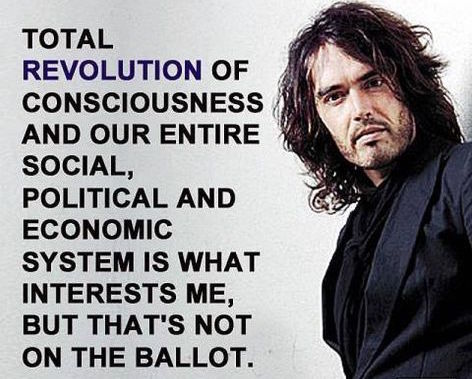
russell-brand-total-revolution-of-consciousness

By Dylan Charles

Source: Waking Times

We live in a world where illusions are held in higher esteem than verifiable truth. This is no accident, as the individual has for decades now been on the receiving end of social engineering programs, advanced political and corporate propaganda, fear programming and outright mind control.

The sum total of all this mass conditioning has been to convince otherwise good-natured and hard-working people to participate in their own enslavement and to willingly acquiesce to the ever-increasing rules, invasions of privacy, taxations, permissions and control schemes of a government and world elite who have long since left public interest in the dust.

The American dream is a mythic idea that was supposedly founded on the principle that public oversight of government is possible thanks to an electoral process which would give an informed citizenry the opportunity to replace undesirable politicians with better ones. Government itself, though, is a brutish and violent force that has time and again proven absolutely wild, reckless and untamable. It has never has obeyed its own laws, policies or regulations, and world history is a bloodstained chronicle of man’s failure to control himself when given power in the form of government.

Just as you cannot stop the tides from rising and falling, you cannot stop government from decaying into tyranny, especially so by following its very own rules and by participating in its token rituals.

This is truth, yet the illusion of so-called ‘democracy’ persists, seeming to grip people ever more feverishly with each passing election season. Even in the face of overt election fraud, party infighting, delegate rigging and widespread disenfranchisement. And so here we are again, facing the embarrassing spectacle of choosing between two undesirables when we all know the game is rigged.

For the powers the be, though, the repeating four-year cycle of presidential politics is the most effective device for keeping the masses high on the illusion of self-governance. It force feeds us on a regular schedule the false narrative that we the people can vote to reign in the power and corruption of the oligarchy of deep state, private and corporate influences that truly control the direction of this nation.

In this light, the purpose of national politics is not to perpetuate self-governance for the benefit of the common person, but rather to eat up personal energy and resources in order to suck the individual into a quagmire of false hope and endless patience with outrage after outrage. It is to make ineffectual action feel like action to the people being most screwed over by the corruption of the elite.

Sure, this may sound negative, cynical or apathetic to those who are over-invested emotionally in this game, but in order to move beyond the insanity of doing the same thing again and again while expecting different results, it’s imperative to be deadly honest about how this program works to enslave us, not to free us. Once we can think beyond the peer pressure, neighbor-hating, and mindless outrage that marks each election cycle, we make ourselves available to the possibility of real change. And real change always begins from within, and never forced from without.

There is no political leader who can make you stand fearlessly in this complex and dangerous world.There is no candidate that can give you the freedom that comes with a healthy mind and body. There is no political ruler who can manifest true and lasting happiness for you. There is no politician who can ensure that you enjoy the experience of your life everyday, under any and all circumstances. And there is no president that can empower you to be the best possible version of yourself so that you may give your best to others.

All of these qualities are vastly more critical to personal, community and planetary renewal than whichever new figurehead is selected to be the perceived front man of a morbidly corrupt American government.

The most effective way to change the world around you is to first focus on and create more value in yourself. This is why your awakening counts far more than your vote does. 

This Is Our Neoliberal Nightmare: Hillary Clinton, Donald Trump, and Why the Market and the Wealthy Win Every Time

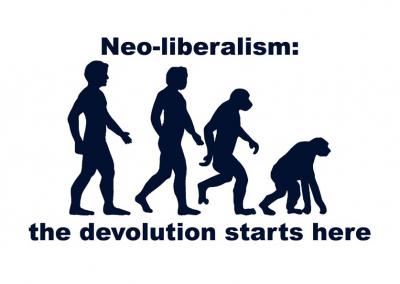
neo_liberalism_devolution_via_permanentculturenow.com_

The rage driving our politics stems from cruelty of capitalism. So why do we vote for those who worship the market?

By Anis Shivani

Source: AlterNet

Over the last fifteen years, editors often asked me not to mention the word “neoliberalism,” because I was told readers wouldn’t comprehend the “jargon.” This has begun to change recently, as the terminology has come into wider usage, though it remains shrouded in great mystery.

People throw the term around loosely, as they do with “fascism,” with the same confounding results. Imagine living under fascism or communism, or earlier, classical liberalism, and not being allowed to acknowledge that particular frame of reference to understand economic and social issues. Imagine living under Stalin and never using the communist framework but focusing only on personality clashes between his lieutenants, or likewise for Hitler or Mussolini or Mao or Franco and their ideological systems! But this curious silence, this looking away from ideology, is exactly what has been happening for a quarter century, since neoliberalism, already under way since the early 1970s, got turbocharged by the Democratic party under the Democratic Leadership Council (DLC) and Bill Clinton. We live under an ideology that has not been widely named or defined!

Absent the neoliberal framework, we simply cannot grasp what is good or bad for citizens under Cruz versus Trump, or Clinton versus Sanders, or Clinton versus Trump, away from the distraction of personalities. To what extent does each of them agree or disagree with neoliberalism? Are there important differences? How much is Sanders a deviation? Can we still rely on conventional distinctions like liberal versus conservative, or Democrat versus Republican, to understand what is going on? How do we grasp movements like the Tea Party, Occupy, and now the Trump and Sanders insurgencies?

Neoliberalism has been more successful than most past ideologies in redefining subjectivity, in making people alter their sense of themselves, their personhood, their identities, their hopes and expectations and dreams and idealizations. Classical liberalism was successful too, for two and a half centuries, in people’s self-definition, although communism and fascism succeeded less well in realizing the “new man.”

It cannot be emphasized enough that neoliberalism is not classical liberalism, or a return to a purer version of it, as is commonly misunderstood; it is a new thing, because the market, for one thing, is not at all free and untethered and dynamic in the sense that classical liberalism idealized it. Neoliberalism presumes a strong state, working only for the benefit of the wealthy, and as such it has little pretence to neutrality and universality, unlike the classical liberal state.

I would go so far as to say that neoliberalism is the final completion of capitalism’s long-nascent project, in that the desire to transform everything—every object, every living thing, every fact on the planet—in its image had not been realized to the same extent by any preceding ideology. Neoliberalism happens to be the ideology—unlike the three major forerunners in the last 250 years—that has the fortune of coinciding with technological change on a scale that makes its complete penetration into every realm of being a possibility for the first time in human history.

From the early 1930s, when the Great Depression threatened the classical liberal consensus (the idea that markets were self-regulating, and the state should play no more than a night-watchman role), until the early 1970s, when global instability including currency chaos unraveled it, the democratic world lived under the Keynesian paradigm: markets were understood to be inherently unstable, and the interventionist hand of government, in the form of countercyclical policy, was necessary to make capitalism work, otherwise the economy had a tendency to get out of whack and crash.

It’s an interesting question if it was the stagflation of the 1970s, following the unhitching of the United States from the gold standard and the arrival of the oil embargo, that brought on the neoliberal revolution, with Milton Friedman discrediting fiscal policy and advocating a by-the-numbers monetarist policy, or if it was neoliberalism itself, in the form of Friedmanite ideas that the Nixon administration was already pursuing, that made stagflation and the end of Keynesianism inevitable.

It should be said that neoliberalism thrives on prompting crisis after crisis, and has proven more adept than previous ideologies at exploiting these crises to its benefit, which then makes the situation worse, so that each succeeding crisis only erodes the power of the working class and makes the wealthy wealthier. There is a certain self-fulfilling aura to neoliberalism, couched in the jargon of economic orthodoxy, that has remained immune from political criticism, because of the dogma that was perpetuated—by Margaret Thatcher and her acolytes—that There Is No Alternative (TINA).

Neoliberalism is excused for the crises it repeatedly brings on—one can think of a regular cycle of debt and speculation-fueled emergencies in the last forty years, such as the developing country debt overhang of the 1970s, the savings and loan crisis of the 1980s, the Asian currency crisis of the 1990s, and the subprime mortgage crisis of the 2000s—better than any ideology I know of. This is partly because its very existence as ruling ideology is not even noted by the population at large, which continues to derive some residual benefits from the welfare state inaugurated by Keynesianism but has been led to believe by neoliberal ideologues to think of their reliance on government as worthy of provoking guilt, shame, and melancholy, rather than something to which they have legitimate claim.

It is not surprising to find neoliberal multiculturalists—comfortably established in the academy—likewise demonizing, or othering, not Muslims, Mexicans, or African Americans, but working-class whites (the quintessential Trump proletariat) who have a difficult time accepting the fluidity of self-definition that goes well with neoliberalism, something that we might call the market capitalization of the self.

George W. Bush’s useful function was to introduce necessary crisis into a system that had grown too stable for its own good; he injected desirable panic, which served as fuel to the fire of the neoliberal revolution. Trump is an apostate—at least until now—in desiring chaos on terms that do not sound neoliberal, which is unacceptable; hence Jeb Bush’s characterization of him as the “candidate of chaos.” Neoliberalism loves chaos, that has been its modus operandi since the early 1970s, but only the kind of chaos it can direct and control.

To go back to origins, the Great Depression only ended conclusively with the onset of the second world war, after which Keynesianism had the upper hand for thirty-five years. But just as the global institutions of Keynesianism, specifically the IMF and the World Bank, were being founded at the New Hampshire resort of Bretton Woods in 1944, the founders of the neoliberal revolution, namely Friedrich Hayek, Ludwig von Mises, Milton Friedman, and others were forming the Mount Pelerin Society (MPS) at the eponymous Swiss resort in 1947, creating the ideology which eventually defeated Keynesianism and gained the upper hand during the 1970s.

So what exactly is neoliberalism, and how is it different from classical liberalism, whose final manifestation came under Keynesianism?

Neoliberalism believes that markets are self-sufficient unto themselves, that they do not need regulation, and that they are the best guarantors of human welfare. Everything that promotes the market, i.e., privatization, deregulation, mobility of finance and capital, abandonment of government-provided social welfare, and the reconception of human beings as human capital, needs to be encouraged, while everything that supposedly diminishes the market, i.e., government services, regulation, restrictions on finance and capital, and conceptualization of human beings in transcendent terms, is to be discouraged.

When Hillary Clinton frequently retorts—in response to demands for reregulation of finance, for instance—that we have to abide by “the rule of law,” this reflects a particular understanding of the law, the law as embodying the sense of the market, the law after it has undergone a revolution of reinterpretation in purely economic terms. In this revolution of the law persons have no status compared to corporations, nation-states are on their way out, and everything in turn dissolves before the abstraction called the market.

One way to sum up neoliberalism is to say that everything—everything—is to be made over in the image of the market, including the state, civil society, and of course human beings. Democracy becomes reinterpreted as the market, and politics succumbs to neoliberal economic theory, so we are speaking of the end of democratic politics as we have known it for two and a half centuries. As the market becomes an abstraction, so does democracy, but the real playing field is somewhere else, in the realm of actual economic exchange—which isnot, however, the market. We may say that all exchange takes place on the neoliberal surface.

Neoliberalism is often described—and this creates a lot of confusion—as “market fundamentalism,” and while this may be true for neoliberal’s self-promotion and self-presentation, i.e., the market as the ultimate and only myth, as were the gods of the past, I would argue that in neoliberalism there is no such thing as the market as we have understood it from previous ideologies.

The neoliberal state—actually, to utter the word state seems insufficient here, I would claim that a new entity is being created, which is not the state as we have known it, but an existence that incorporates potentially all the states in the world and is something that exceeds their sum—is all-powerful, it seeks to leave no space for individual self-conception in the way that classical liberalism, and even communism and fascism to some degree, were willing to allow.

There are competing understandings of neoliberal globalization, when it comes to the question of whether the state is strong or weak compared to the primary agent of globalization, i.e., the corporation, but I am taking this logic further, I am suggesting that the issue is not how strong the state is in the service of neoliberalism, but whether there is anything left over beyond the new definition of the state. Another way to say it is that the state has become the market, the market has become the state, and therefore both have ceased to exist in the form we have classically understood them.

Of course the word hasn’t gotten around to the people yet, hence all the confusion about whether Hillary Clinton is more neoliberal than Barack Obama, or whether Donald Trump will be less neoliberal than Hillary Clinton. The project of neoliberalism—i.e., the redefinition of the state, the institutions of society, and the self—has come so far along that neoliberalism is almost beyond the need of individual entities to make or break its case. Its penetration has gone too deep, and none of the democratic figureheads that come forward can fundamentally question its efficacy.

I said almost. The reason why Bernie Sanders, self-declared democratic socialist, is so threatening to neoliberalism is that he has articulated a conception of the state, civil society, and the self that is not founded in the efficacy and rationality of the market. He does not believe—unlike Hillary Clinton—that the market can tackle climate change or income inequality or unfair health and education outcomes or racial injustice, all of which Clinton propagates. Clinton’s impending “victory” (whatever machinations were involved in engineering it) will only strengthen neoliberalism, as the force that couldn’t be defeated even when the movement was as large and transcendent as Sanders’s. Although Sanders doesn’t specify “neoliberalism” as the antagonist, his entire discourse presumes it.

Likewise, while Trump supporters want to take their rebellion in a fascist direction, their discomfort with the logic of the market is as pervasive as the Sanders camp, and is an advance, I believe, over the debt and unemployment melancholy of the Tea Party, the shame that was associated with that movement’s loss of identity as bourgeois capitalists in an age of neoliberal globalization. The Trump supporters, I believe, are no longer driven by shame, as was true of the Tea Party, and as has been true of the various dissenting movements within the Republican party, evangelical or otherwise, in the recent past. Rather, they have taken the shackles off and are ready for a no-holds barred “politically incorrect” fight with all others: they want to be “winners,” even at the cost of exterminating others, and that is not the neoliberal way, which doesn’t acknowledge that there can be winners and losers in the neoliberal hyperspace.

In the current election campaign, Hillary Clinton has been the most perfect embodiment of neoliberalism among all the candidates, she is almost its all-time ideal avatar, and I believe this explains, even if not articulated this way, the widespread discomfort among the populace toward her ascendancy. People can perceive that her ideology is founded on a conception of human beings striving relentlessly to become human capital (as her opening campaign commercialso overtly depicted), which means that those who fail to come within the purview of neoliberalism should be rigorously ostracized, punished, and excluded.

This is the dark side of neoliberalism’s ideological arm (a multiculturalism founded on human beings as capital), which is why this project has become increasingly associated with suppression of free speech and intolerance of those who refuse to go along with the kind of identity politics neoliberalism promotes.

And this explains why the 1990s saw the simultaneous and absolutely parallel rise, under the Clintons, of both neoliberal globalization and various regimes of neoliberal disciplining, such as the shaming and exclusion of former welfare recipients (every able-bodied person should be able to find work, therefore under TANF welfare was converted to a performance management system designed to enroll everyone in the workforce, even if it meant below-subsistence wages or the loss of parental responsibilities, all of it couched in the jargon of marketplace incentives).

The actual cost to the state of the AFDC program was minimal, but its symbolism was incalculable. The end of welfare went hand in hand with the disciplinary “crime bill” pushed by the Clintons, leading to an epidemic of mass incarceration. Neoliberalism, unlike classical liberalism, does not permit a fluidity of self-expression as an occasional participant in the market, and posits prison as the only available alternative for anyone not willing to conceive of themselves as being present fully and always in the market.

I believe that the generation of people—in their forties or older—supporting Hillary have already internalized neoliberal subjectivity, which they like to frame as realism or pragmatism, refusing for instance to accept that free college or health care are even theoretical possibilities. After all, they have maintained a measure of success in the past three or four decades after conceptualizing themselves as marketplace agents. Just as the Tea Party supporters found it intolerable that government should help irresponsible homeowners by bailing them out of unsustainable debt, the Clinton supporters hold essentially the same set of beliefs toward those who dare to think of themselves outside the discipline of the market.

I spoke of the myth of the market, as something that has no existence in reality, because none of the elements that would have to exist for a market to work are actually in place; this is even more true for neoliberalism than it was for the self-conscious annihilation of the market by communism, because at least in that system the market, surreptitiously, as in various Eastern European countries, kept making an appearance. But when the market takes neoliberal shape, i.e., the classical conceptions of the buyer and seller as free agents are gone, then radical inequality is the natural outcome. And inequality in the last four decades, as statistics for the U.S. and everywhere neoliberalism has made inroads prove beyond a doubt, has exploded, thereby invalidating neoliberalism’s greatest claim to legitimacy, that it brings about a general increase in welfare. So neoliberalism, to the extent that the inequality discourse has made itself manifest recently, must insist all the more vocally on forms of social recognition, what Clinton, for example, likes to call the “fall of barriers.”

Neoliberalism likes to focus on public debt—in the Clinton years debt reduction became a mania, though George W. Bush promptly spent all the accumulated surpluses on tax cuts for the wealthy and on wars of choice—rather than inequality, because the only way to address inequality is through a different understanding of public debt; inequality can only be addressed through higher taxation, which has by now been excluded from the realm of acceptable discourse—except when Sanders, Trump, or Jeremy Corbyn in England go off script.

So to recapitulate neoliberalism’s comprehensive success, let us note that we have gone from a liberal, Keynesian, welfare state to a neoliberal, market-compliant, disciplinary state.

Neoliberalism expects—and education at every level has been redesigned to promote this—that economic decision-making will be applied to all areas of life (parenthood, intimacy, sexuality, and identity in any of its forms), and that those who do not do so will be subject to discipline. Everyone must invest in their own future, and not pose a burden to the state or anyone else, otherwise they will be refused recognition as human beings.

This supposed economic “rationality” (though it is the greatest form of irrationality) applies to civil society as much as the state, so that none of the ideals of classical liberalism, or previous ideologies rooted in humanism, are valid any longer, the only value is the iteration of the market (as myth, not reality); in other words, neoliberalism, unlike the elevation of the individual in classical liberalism or the state in fascism or the collectivity in communism, has erected something, the market, that has no real existence, as the only god to serve! And it is just like a god, with an ethereal, unchallengeable, irrefutable, ubiquitous presence. Whatever in state policy does not serve market-conformity is to be banned and banished from memory (the secular scriptures are to be rewritten), which explains neoliberalism’s radical narrowing of public discourse, including the severance of identity politics from any class foundation.

Neoliberalism will continue to perpetuate reduced opportunity, because one of its characteristics—as in any system that wants to thrive on the world stage—is to constantly refine the field upon which the human subject can operate.

As such, those displaced workers who have suffered the most from the erosion of the old industries in the former manufacturing centers of the world are not even factors to contend with, they are invisible and cannot be part of the policy equation. To the extent that their actual presence is reckoned with, the economy can be said to have crashed; but the problem doesn’t arise because of the management of unemployment or underemployment statistics, unlike a housing crash which is palpable and cannot escape statistical definition.

The danger for neoliberalism—as is clear from the support of millions of displaced human beings for Trump—is that with each crisis neoliberalism sheds more workers, makes individuals and firms more “disciplined,” narrows the scope of opportunity even further. At times, the disciplining of the non-neoliberal other—as with the killing of Michael Brown or Eric Garner—explodes to surface consciousness in an unsavory way, so an expert manager like Clinton or Obama is required to tamp down the emotions of such unruly entities as Black Lives Matter which arise in response. If climate change, according to Clinton and her cohort, can and should have market solutions, then surely racial disparity, or police violence, should also have market solutions and no others; it is here that neoliberal multiculturalism, operating in the academy, is so insidious, because at the elite level it functions to validate market discourse, it does not step outside it.

The present breakdown of both major political parties can be explained by the frustration that has built up in the body politic over the past decade, because after the crash there was no sustained intellectual movement to question the myth of the market. The substitution of economic justice with identity politics is something Ralph Nader, Howard Dean, and now Bernie Sanders have contested in a humane manner, while the same process is at work, admittedly in an inhumane way, in the Trump phenomenon.

Thus, also, Hillary Clinton’s animus against free college education; that form of expansion of opportunity, which was a reality from the 1950s to the 1980s, cannot be allowed to return, human beings are supposed to invest in their own future earnings potential, they are not entitled to a transcendent experience without barriers manifesting in discipline and self-correction. Education, like everything else, including one’s own health, becomes an expensive consumer good, not a right, no longer an experience that might lead to a consciousness beyond the market but something that should be fully encapsulated by the market. If one is a capable market player, education as we have classically understood it becomes redundant.

Unlike the interregnum between 1945-1973, the rising tide—no matter the befuddlements Arthur Laffer and his fellow Reaganite ideologues proffered—does not lift all boats today, it is outside the logic of neoliberalism that it do so, so the idea of reforming neoliberalism, or what is often called “globalization with a human face,” is a rhetorical distraction. All of the policy innovations—interpreted as “socialism” by the Tea Partiers—offered by Barack Obama fall within the purview of neoliberalism, above all the Affordable Care Act, whose genesis was hatched in neoliberal think tanks decades ago.

It is important to note that neoliberal economic restructuring necessarily means social restructuring, i.e., a movement toward disciplinarity and away from liberalism; the disciplinarity can take a Bushian, Clintonian, or Trumpian form, but these are manifestations of the same tendency.

When wage growth is decoupled from economic growth (as it has been since Friedman and others inaugurated the revolution in the early 1970s), this means that the human subject is ripe for discipline. Furthermore, wage fairness cannot be rationally discussed (hence the obfuscation surrounding the $15 minimum wage orchestrated by Clinton and others) because the concept of the market has been disembedded from society; the market as abstraction, not a concrete reality, makes any notion of reform or restructuring impossible. Like the minimum wage, something like free child care also remains outside the bounds of discourse, because public policy cannot accommodate discussions that do not take the self-regulating market as unassailable myth.

What neoliberalism can accommodate is relentless tax cuts (Trump has already offered his huge tax cut plan, as Bush did as his first order of business), which only exacerbate the problem, leading to increasing concentrations of wealth. It has to be said, though, that Ted Cruz more comfortably fit the neoliberal paradigm, with his familiar calls for lower taxes along with reduced regulation and further limits on social welfare, whereas Trump shows, for now, some elements of apostasy. If neoliberalism were to get a Cruz, it would have no problem working with him, or rather, Cruz would have had no problem executing neoliberalism, beyond the surface dissimilarities from Hillary Clinton.

As Sanders has consistently noted, economic inequality leads to political inequality, which means that democracy, after a certain point, becomes only theoretical (viz. Citizens United and the electoral influence of such powerful entities as the Koch brothers). Both processes—economic inequality and political inequality—have accelerated after each downturn in the forty-five-year history of neoliberalism, therefore a downturn is always exciting, and even preordained, for a Bush, a Trump, or a Clinton. Again, economic inequality and political polarity (polarity is simply a manifestation of democracy having become dysfunctional) strongly correlate, and both have come to a head in this election.

Neoliberalism’s task, from this point on, is to mask and manage the increasing inequalities that are likely to befall humanity, especially as the planet reaches a crisis point in its health. In a way, George W. Bush threw a wrench—he was a perverted Keynesian in a way, believing in war to prime the pump, or inflating unsustainable bubbles, or spending exorbitantly on grandiose gestures—into the process of neoliberal globalization that was going very smoothly indeed under Bill Clinton and would likely have flourished under Al Gore as well. With Hillary Clinton, the movement will be toward further privatization of social welfare, “reforming” it along market principles, as has been true of every neoliberal avatar, whether it was Bill Clinton’s incentives to work in the performance management makeover of welfare, George Bush’s proposed private social security accounts, Mitt Romney’s proposed private health care accounts, or the school vouchers that tempt all of them from time to time.

What remains to be seen is the extent to which the millennial generation might be capable of thinking outside the neoliberal paradigm, i.e., they don’t just want more of what neoliberal promises to give them yet fails to deliver, but want things that neoliberalism does not or cannot promise. On this rests the near-term future of the neoliberal project.

Beyond Sanders himself, the key question is the ability of the millennial generation to conceive of themselves outside the neoliberal subjectivity they have been pushed to internalize. They have been encouraged to think of themselves as capital producers, turning their intellectuality into social media popularity for the benefit of capital, in the service of the same abstract market that has no place, no role, no definition beyond the fallen liberal calculus. Does the millennial generation believe, even about its most intimate core, that everything has been privatized?

I am not necessarily making a pessimistic prediction. I am merely outlining the strength of an opponent that has refused to be named for forty-five years, although it has been the ruling ideology that long! In defining neoliberalism, I have sought to distance myself from the distraction of personalities, and tried to expose the dark side of our politics which we can only see when we name and understand the ideology as such. We are up against a system that is so strong that it has survived, for the most part, the last crash, as citizens couldn’t get their heads around the idea of nationalizing banks or health care.

It is existentially imperative to ponder what happens beyond Sanders, because neoliberalism has its end-game in sight, letting inequality continue to escalate past the crash point (meaning the point where the economy works for most people), past any tolerable degradation of the planet (which is being reconceptualized in the shape of the market).

What, indeed, does happen beyond Sanders, because as we have seen Hillary Clinton is one of the founders of neoliberal globalization, one of its central historical figures (having accelerated the warehousing of the poor, the attack on trade unions, and the end of welfare and of regulatory prowess), while Trump is an authoritarian figure whose conceptions of the state and of human beings within the state are inconsistent with the surface frictionlessness neoliberalism desires? To go back to Hillary Clinton’s opening campaign commercial, to what extent will Americans continue to believe that the self must be entrepreneurially leveraged toward maximum market gains, molded into mobile human capital ever ready to serve the highest bidder?

As to whether a non-neoliberal globalization is possible and what that might look like on the international stage after a quarter-century of Clinton, Bush, and Obama—which is essentially the frustration Trump is tapping into—I’ll take that up in a follow-up essay, which will further clarify the differences between Sanders versus Clinton, and Trump versus Clinton.

I would suggest that it is not that globalization causes or has caused neoliberalism, but that neoliberalism has pushed a certain form of globalization that suits its interests. This is a crucial distinction, on which everything else hinges. The neoliberal market doesn’t actually exist; at the moment it is pure abstraction; what is actually filling up economic and political space can only be discussed when we step away from this abstraction, as Sanders has so ably done, and as the Occupy and Black Lives Matter movements tentatively set in motion.

 

Anis Shivani is the author of several books of fiction, poetry, and criticism, including, most recently, My Tranquil War and Other Poems. His novel Karachi Raj (HarperCollins/Fourth Estate) was released this summer. His next book is the poetry collection Whatever Speaks on Behalf of Hashish, out in October.

The Belated Downfall of Bill Clinton

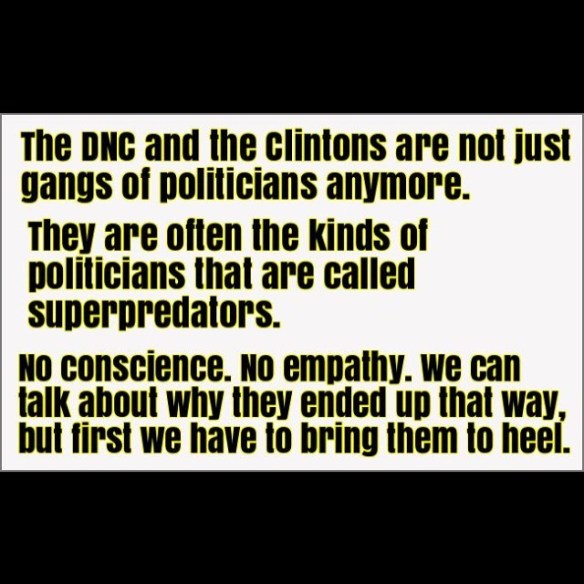
Bill-HIllary-Clinton-Corrupt

One of the unintended consequences of Hillary Clinton’s campaign has been the renewed and often revealing public appearances of Bill Clinton. His involvement in Hillary’s campaign has been a series of awkward events, from violating election campaigning laws back in March to his condescending treatment of Black Lives Matter protesters in April. Throughout May he was hounded on the campaign trail by criticism of corrupt practices of his foundation. In late May what what was supposed to be a routine campaign stop at a New Mexico diner escalated to a grueling 30 minute argument with Bernie Sanders supporter Josh Brody.

At another restaurant appearance in Los Angeles’s Watts neighborhhod last Saturday, Clinton had the misfortune of being there at the same time as 23 year old Sarra Tekola of Women of Color Speak Out, who did exactly that when she ambushed him by shouting “Hey Clinton, fuck you! My people are still in jail from your crime bill! Three strikes – you’re out, mandatory minimum, then you wanna take pictures with my people here? We’re still in jail for what you did!” (an inspiring moment documented by a widely viewed viral video).

The next two days while giving a speeches in Boyle Heights and Richmond, Clinton faced more heckling from Sanders supporters and on Monday he was also confronted with the news that his brother Roger, who on his last day in office Bill pardoned for cocaine dealing, was jailed for drunken driving.

Though it’s likely Hillary and Bill will be back in the White House (barring a surprise intervention of hackers/whistleblowers), their public image is unlikely to get any less loathsome and any illusions citizens may still hold regarding positive aspects of their legacy will continue to crumble. Angry disenfranchised voters of all stripes will never cease to hold them accountable for their misdeeds for the rest of their days.

The Electoral Farce: an Interview with John Stauber

13183292_1607929732854545_14393996_n

By

Source: Algérie Résistance

Mohsen Abdelmoumen: In your book coauthored with Sheldon Rampton “Toxic Sludge Is Good For You: Lies, Damn Lies and the Public Relations Industry”, you make a statement without concession on lobbying and democracy. In your opinion, can we evoke a democracy with a hegemony of lobbies? Do you not think that it is rather about a plutocracy?

John Stauber: That book, my first of six for the Center for Media and Democracy, is my tour de force. It exposes how modern propaganda is conducted in the United States by public relations (PR) professionals whose job is to protect the powerful and their corporate wealth from democracy.

The USA is indeed an oligarchy, a plutocracy, and the situation is much worse today than when I wrote my book in 1995.  The super-rich whose interests lie with Wall Street, the global corporations, and what Eisenhower called the military-industrial complex, own and control both the Democrat and the Republican parties and their candidates.  This shared monopoly prevents any anti-oligarchy party from emerging effectively to compete, under their rigged laws at the state level for establishing and funding national political parties.

The richest dump billions into both major Parties, their candidates and the election process, so if you are not a millionaire yourself or clearly supporting the policies of the wealthy, you have very little chance of success or of even being heard politically in the US.  The corporate media is the recipient of the lions share of this money which they get for selling the TV ads that the candidates and the special interest groups run; they are not interested in deeply criticizing or reforming a lucrative process that fills their own corporate coffers.  It’s a hell of a system, a total fraud on democracy, painted up to look like democracy.

In your opinion, is not the American presidential election a joke, when we know that the favourite candidate from the beginning is supported by Wall Street, Neocons, industrialists, AIPAC, etc.?  

Indeed the system that chooses and elects the American president is a farce, bought and paid for by the wealthy and the interests you mention.  This is why even in an election year as controversial as this one, most Americans will not vote.  The majority of Americans have lost faith in what has become a charade that betrays their interests.  The rise of both progressive populism via Bernie Sanders, and a nativist fascism via Trump and his takeover of the Republicans, screams loudly about just how foul and corrupt and simply weird the USA’s political system has become. There is a great, angry frustration with the political establishment, and many white voters especially are willing to cast a nihilistic vote for a racist, misogynist, narcissist who inherited his wealth and gained notoriety as a reality TV star.

Does not the election to the presidency of a militarist as Hillary Clinton constitute a threat to the world?

The election of either Clinton or Trump threatens the world simply because of the dominance of the American empire and their commitment to it.  Hillary is a proven militarist, which is why so many of the GOP neocons, who led what I call the Weapons of Mass Deception campaign that lied America into attacking Iraq, are choosing her over Trump.  They know she will fully fund and expand the American empire at all costs to the American taxpayers and people of the world who suffer under America’s militarism.  Hillary played an important role in the Iraq propaganda campaign led by Bush, Cheney and the neocons. Before naming her Secretary of State, Obama made it clear he would not investigate or hold anyone responsible for that grand and worsening bipartisan disaster.

Those who wrote the scenario of this presidential election are they not inspired by the French election of 2002, with Jean-Marie Le Pen and Jacques Chirac, both coming from the same system, where we saw the crushing victory of Chirac? Are we going to witness Clinton’s same landslide victory against Trump?

I don’t think that the nationalists who control the USA’s two party oligarchy are looking abroad for inspiration.  They are believers in American exceptionalism and empire, and write their own scripts as they go along, as the neocons did with their Project for the New American Century.  The rise of Trump within the Republican Party is a shocking phenomenon, because he defeated 15 others and the entire GOP establishment to seize the party for himself and his rabid reactionary grassroots voters.  No one in either party or the news media gave Trump any chance to win the nomination, but he did, while breaking about every rule thought to exist in American politics except one – have lots of money.  It is very possible that the smug attitude of the Democrats and the corporate media will backfire and that Clinton, who like Trump is disliked by a majority of voters, will lose to him.  It is certainly possible this year, when Trump has already accomplished the impossible.

Won’t Clinton’s victory in the presidential election be a victory of the oligarchy, the coronation of the plutocracy by democratic tools?

The oligarchy is already crowned, already firmly in control.  If Trump wins, they will begrudgingly accommodate one of their own class, however ignorant, narcissistic and offensive they find him.  But much of the Republican oligarchy, such as the neocons, the Koch brothers and the Bush family, have indicated they prefer Hillary.  In essence, the oligarchy wins no matter which party holds office, because the super rich own both parties. That is the brilliance of the bogus two-party system, it is really one oligarchy party with two wings, and both the Democrat and Republican wings support the military empire and the expansion of corporate power.

Doesn’t Bernie Sanders serve just as a kind of “trial horse” for Hillary Clinton? 

I have said since he announced as a Democrat that this is a movie we have seen many times before, where a Jesse Jackson, or a Jerry Brown, or a Howard Dean, excite the liberal base, borrow the rhetoric of revolutionary change, create a populist left momentum, and then capitulate to embrace the winning mainstream Democrat at their convention, appealing to followers to do the same.  Perhaps if Bernie Sanders had understood a year ago the level of excitement and support he would generate, he would have done things differently.  But ultimately he will prove a shepherd for the Democrats, a pied piper, rounding up the lost leftist sheep, and it should be especially easy this year with Trump as the Republican nominee opposed by everyone from him to the Kochs to the neocons to the Bush family.  But yes, soon the Feel The Bern movement will morph into the anti-fascist Anybody But Trump coalition.

We are witnessing a very poor debate whose only stake seems to be the replacement of a black president by a woman.  Is this not one more manipulation?

You are rather certain that Hillary will follow Obama, and while that is a good bet, the bizarre, unprecedented rise of Donald Trump might surprise everyone and land him in the White House.  Obama succeeded because he was anti-Bush and he was not in the Senate when Clinton cast her damaging vote to help Bush attack Iraq.  That gave him his greatest electoral edge, he could campaign as having been against the war on Iraq.  The fact that he was African American inspired many who were, as I was, quite happy to see that someone other than a rich white man could actually be elected president.  However, Obama has proved to be a massive fraud and a disappointment.   Even before his taking the oath of office, he made it clear that there would be no investigation of the propaganda and lies that led America to attack Iraq.  Biden, Kerry and Clinton, key players in his Administration, helped lead America into war.  Blame the neocons for it, but blame those Democrats too.

Hillary will certainly parlay being the first woman president into millions of votes, and she will be running against a misogynist.  But again, most American don’t even vote, and those that do are voting against the candidate they dislike most.  So all bets are off at this early stage as to whether a Black president will now give way to America’s first female president, or whether Trump will be America’s first Billionaire TV Star president.

As a writer and progressive journalist, what is the reason, in your opinion, for the powerlessness of the progressive movement in the US and in the world? 

Here in the United States the progressive movement has never been able to see that the Democratic Party is the enemy and the grand co-opter and destroyer of fundamental change.  Bernie Sanders says he is fighting for the soul of the Democratic Party, but it has no soul, it sold out to the super rich long ago.  Bill and Hillary Clinton put the final nail into its remnant of progressivism when in the 1980s they and their pro-corporate Democratic Leadership Council made their Party a model of Republicanism, opening it to corporate donations, serving corporate interests blatantly, and making it almost impossible for a candidate like Sanders to beat a rigged system and win the Democratic nomination.

I wrote a piece for CounterPunch in March, 2013, explaining how after the failure of Al Gore in 2000, a group of super rich Democrats called the Democracy Alliance arose to fund the sort of liberal front groups, lobbies and think tanks that the Republicans had developed over the previous two decades.  Hillary supporter George Soros and others in the DA, including some big unions, poured money into these organizations, and they collaborated with liberal lobbyists in DC as well as with the new « netroots » online force for the Democrats, MoveOn.  MoveOn played a crucial role in transforming the anti-war movement that arose during the Bush years into a movement to elect Democrats in 2006 – 2008, completely co-opting that energy and leaving the US peace movement impotent and irrelevant today.

The professional progressive movement is now wholly owned by the liberal oligarchs;  its leaders are bright, young and well rewarded, and there is absolutely no real desire to do anything but co-opt grassroots progressives into choosing Democrats over Republicans every two years.  The Feel The Bern movement shows that if Bernie Sanders had the courage to break with the Democrats and form a new party or run as a Green, 2016 is a rare year when he could have great success.  But instead he and the rest of these professional progressives stay within the Democratic Party, thinking that one day they will control it.  It’s a delusion and a failure of vision, but their own rewards and salaries are nice, and they live within their own echo chamber of liberal propaganda from The Nation to The New York Times that reinforces their failure to confront the liberal oligarchy in the name of being realistic.

You do not call for violent revolution. Do you think that it is possible to defeat the big capital, the Neocons, the military-industrial complex, with a peaceful revolution?

Nothing would please the US establishment more, or lead more quickly to a full police state supported by a majority of Americans, than some sort of left wing political violence.  We saw in the 1960s and 1970s how the FBI under Nixon and Hoover encouraged violent protests, planted provocateurs, infiltrated the anti-war, Black Power and other movements with thousands of paid FBI informers, and destroyed it.  The American Left never recovered and what was called the New Left died.  The American people are easily frightened and quick to give up liberties if it appears that armed extremists are threatening their safety.  Anyone advocating violent revolution for the United States is a lunatic or worse.

Your writings call for an awakening against lobbies and other capitalist and imperialist domination forces and we notice a derision and despair that call for a better world where all hopes are allowed. How do you explain this Gramscian dialectic?

I am not a hopeful person, I do not believe that revolution is likely, nor that a revolution would necessarily produce and sustain something better.  Humanity is deeply flawed, self-destructive, and seems doomed in this century by greed to poison itself and destroy the Earth’s biosphere with its love of corporate consumerism and the resulting toxins and wastes.  People everywhere show their willingness to follow nationalist or religious leaders into horrific wars with catastrophic results.  The likelihood of nuclear war stays high; it’s a large miracle there has not been a nuclear attack since Nagasaki, but the access to weapons of mass destruction continues to spread.  Under Obama, the US and NATO are pursuing a New Cold War against Russia and China that is insanely dangerous.

Can typical people organize together around the world from the ground up to create and sustain a revolutionary society that is just, democratic and peaceful, given the control that corporate capitalism has over our lives and minds and governments?  We are completely enveloped by the corporate propaganda system from the moment of our birth on, and it allows the oligarchy to control our minds and lives from cradle to grave, in seamless invisible fashion, via marketing, advertising and public relations, reinforced by the news media.  Few are able to admit and see this, which is why I organized PRWatch and CMD in 1993 and co-authored my six books.

The word “lie” often comes up in your writing. Do you think that the United States will survive to their lies, such as the war in Iraq?

The Cold War journalist Izzy Stone said,  “All governments are run by liars, nothing they say should be believed.”  This is also true of corporate government, the few hundred global companies that dominate the world’s economy and dictate to and through the world’s governments.  The United States is very adept at failing to admit, much less confront, its lies.  The myth of American Exceptionalism is embraced and promoted by the bipartisan oligarchy and the media, and so we see that there is no real examination of the horrendous crimes and blunders of the government, from the war of genocide waged on Vietnam, to the illegal and devastating attack on Iraq that has led to ISIS, to the massive economic failure of 2008 where no one was held accountable and the fundamental problems never repaired.  So, no, in both the short term and certainly the longer term, these lies and self-deceptions undermine and destroy the fabric of American society.  The rise of Trumpism is very much a result of the deceptions that have been foisted on Americans, but it is a reactionary and destructive response, of course, that again is based on this myth of exceptionalism and aims to make America again « great ».

You are the founder of the Center for Media and Democracy. What is the role of this center?  

I founded CMD in 1993 to publish my news magazine PRWatch revealing how the business of public relations functions to thwart democracy and maintain the power and control of the rich and their corporations.  I also wanted to show how western governments use PR to control their citizens, and how corporate media is an echo chamber for both corporate and government propaganda.  I ran CMD until 2009, but then stepped down, feeling that I had taken its mission as far as I could after co-authoring six books through the Center.   I am now pursuing more personal interests neglected for all my decades as an activist and author.  I am no longer writing books or running an organization, and glad of it.   CMD continues under new leadership, but it has become much like other US progressive think tanks, part of the Democratic Party’s liberal echo chamber.  It has done some important work since I left in confronting and exposing ALEC, a brilliant rightwing operation that allows corporations to draft and write laws at the state level in the United States. CMD’s web address is www.PRWatch.org.

Mad About Rigged Elections? Mainstream Media Says YOU Are the Problem

CiincRGVAAAPuJf

By Claire Bernish

Source: AntiMedia

Mainstream headlines constantly decry Bernie Sanders supporters for disrupting events in outrage, as if their protests and demonstrations somehow illustrate the devolution of the elections. But that focus by the corporate media utterly negates the consistent and continual reports of fraud and disenfranchisement fueling their ire.

And it’s getting ridiculous.

Newsweek, though far from alone, offered a prime example of the obfuscation of the election fraud and questionable campaign tactics by Hillary Clinton in its skewering of Sanders’ supporters.

Get Control, Senator Sanders, or Get Out,” Newsweek’s Kurt Eichenwald titled his op-ed — which thoroughly blasts the Vermont senator — as if he were somehow responsible for both the electoral chaos and the actions of an irate voting public.

“So, Senator Sanders,” Eichenwald writes [with emphasis added], “either get control of what is becoming your increasingly unhinged cult, or get out of the race. Whatever respect sane liberals had for you is rapidly dwindling, and the damage being inflicted on your reputation may be unfixable. If you can’t even manage the vicious thugs who act in your name, you can’t be trusted to run a convenience store, much less the country.”

Really?

Because what Eichenwald obviates most readily in his attack is the inability to understand why those protests might be occurring in the first place. Judging by the timing of his article, it’s likely Eichenwald wrote it after chaos broke out at the Nevada Democratic Convention on Saturday — chaos that transpired after the party took it upon itself to ignore thousands who rightly believed Sanders delegates had been excluded unfairly from the caucus proceedings.

Despite the call for a recount, party officials refused to follow necessary procedure and abruptly adjourned the convention, leaving thousands of voters in the lurch — and hotel security and local law enforcement to deal with the aftermath. When things seem suspicious, apparently Eichenwald feels voters should not only have no recourse, they should be happy about it.

“Sanders has increasingly signaled that he is in this race for Sanders,” he continues, “and day after day shows himself to be a whining crybaby with little interest in a broader movement.”

It would be nice if Eichenwald’s hit piece were as much a joke as it comes across, but clearly he’s missed the point — and the vast movement supporting not only Sanders, but electoral justice. Worse, he didn’t stop there:

“Signs are emerging that the Sanders campaign is transmogrifying into the type of movement through which tyrants are born.

“The ugly was on display” at the aforementioned Nevada convention, Eichenwald adds, “where Hillary Clinton won more delegates than Sanders.”

No kidding. That would be precisely the issue that “cult” expressed fury about — Clinton managed to put yet another state under her belt under highly questionable circumstances. In fact, suspect happenings at nearly every primary and caucus so far oddly favor the former secretary of state — and Nevada stood as further testament to why voters are practically up in arms over what appears to be electoral favoritism.

But Eichenwald wasn’t alone in overlooking those concerns — or in blatantly mischaracterizing both that bias and its consequential thwarting of the wishes of a hefty segment of the voting public.

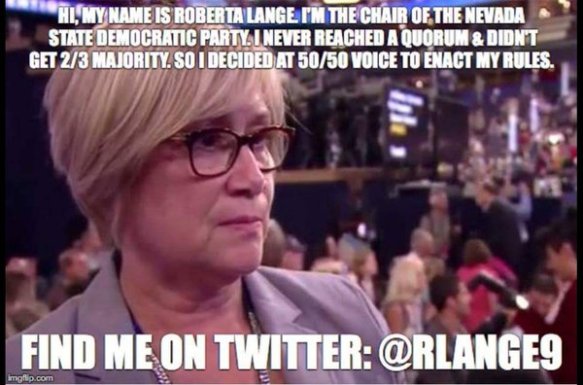
In the New York Times, Alan Rappeport also took the chance to strike at Sanders’ followers by citing Roberta Lange, Nevada State Democratic Party Chairwoman, who adjourned the convention early — earning the wrath of Nevada’s voters.

“‘It’s been vile,’ said Ms. Lange, who riled Sanders supporters by refusing their requests for rule changes at the event in Las Vegas,” Rappeport notes, adding, “The vicious response comes as millions of new voters, many of whom felt excluded by establishment politicians, have flocked to the insurgent campaigns of Mr. Sanders and Mr. Trump.”

Though he at least presented that aspect of the elections fairly, his description of what Lange actually did in Nevada misses the mark — that rules change had originally occurred prior to the convention, and Lange’s hasty and subjective decision on a contentious voice vote to permanently install the change arguably created the eruption of anger. But a number of Times staff have contributed sizeable amounts to Hillary’s campaign — and a Clinton family organization also donated $100,000 to the Times’ charitable organization the same year it endorsed her. Funny how bias thus peppers its reporting.

But the media roasting of Sanders and his supporters also appeared in the Sacramento Bee — where the editorial board also called the senator to task for the Nevada incident in lieu of calling out the controversial elections. According to the Bee,

“The episode had the reek of Trump rallies, where threats, insults, and sucker punches to defend the presumptive Republican nominee have been common. Yet looking back at the hundreds of Sanders supporters who descended on a Clinton rally in East Los Angeles earlier this month to intimidate her supporters, making one little girl cry, it now seems inevitable that the same kind of violent eruption would afflict those ‘feeling the Bern.’”

Seriously?

While the protest in L.A. certainly rattled Clinton supporters, violence didn’t pepper the event. One Sanders supporter — sporting a Free Hugs tee-shirt, no less — even assisted Clinton-supporting families with teary-eyed children in tow navigate through the crowd. While reports that someone ripped apart a young girl’s pro-Hillary sign might be valid, it would stand as the exception to what amounted to a boisterous demonstration over justifiable grievances. And, again, this obfuscation forgets entirely the need for demonstrations, which Hillary Clinton — in repeated lies, controversial policy proposals, and a campaign replete with fraud complaints — has clearly helped create.

Perhaps corporate, mainstream media — instead of targeting the symptom — should attempt to report its root cause.

Perhaps enormous swaths of voters being dropped from the rolls in New York; Clinton’s inexplicably astronomical luck in coin tosses in Iowa; inexcusably untrained elections volunteers and their equally inexcusable tendency allowing Clinton supporters to participate in caucuses without first being registered; or any number of other examples from the mountain of ever-growing evidence the elections are, indeed, rigged, are infinitely more deserving of headlines than hit pieces against those protesting such affronts to the American electoral process.

Or perhaps we should all just do as Eichenwald suggests — swallow our pride and our desire for a less corrupt and fairer system — and turn tail.

Or not. Because this system is rigged — and the corporate media helps pull the strings. But as long as independent media reports what the mainstream refuses, and as long as fraud inundates the 2016 election, there will be protests — regardless of whether or not Newsweek and the Times and the rest of their ilk ever grasp accuracy in reporting.

Welcome to 1984

1984

By Chris Hedges

Source: truthdig

The artifice of corporate totalitarianism has been exposed. The citizens, disgusted by the lies and manipulation, have turned on the political establishment. But the game is not over. Corporate power has within its arsenal potent forms of control. It will use them. As the pretense of democracy is unmasked, the naked fist of state repression takes its place. America is about—unless we act quickly—to get ugly.

“Our political system is decaying,” said Ralph Nader when I reached him by phone in Washington, D.C. “It’s on the way to gangrene. It’s reaching a critical mass of citizen revolt.”

This moment in American history is what Antonio Gramsci called the “interregnum”—the period when a discredited regime is collapsing but a new one has yet to take its place. There is no guarantee that what comes next will be better. But this space, which will close soon, offers citizens the final chance to embrace a new vision and a new direction.

This vision will only be obtained through mass acts of civic mobilization and civil disobedience across the country. Nader, who sees this period in American history as crucial, perhaps the last opportunity to save us from tyranny, is planning to rally the left for three days, from May 23 to May 26 at Constitution Hall in Washington, D.C., in what he is calling “Breaking Through Power” or “Citizen’s Revolutionary Week.” He is bringing to the capital scores of activists and community leaders to speak, organize and attempt to mobilize to halt our slide into despotism.

“The two parties can implode politically,” Nader said. “They can be divided by different candidates and super PACs. But this doesn’t implode their paymasters.”

“Elections have become off-limits to democracy,” he went on. “They have become off-limits to democracy’s fundamental civil community or civil society. When that happens, the very roots shrivel and dry up. Politics is now a sideshow. Politics does not bother corporate power. Whoever wins, they win. Both parties represent Wall Street over Main Street. Wall Street is embedded in the federal government.”

Donald Trump, like Hillary Clinton, has no plans to disrupt the corporate machinery, although Wall Street has rallied around Clinton because of her predictability and long service to the financial and military elites. What Trump has done, Nader points out, is channel “the racist, right-wing militants” within the electorate, embodied in large part by the white working poor, into the election process, perhaps for one last time.

Much of the left, Nader argues, especially with the Democratic Party’s blatant rigging of the primaries to deny Bernie Sanders the nomination, grasps that change will come only by building mass movements. This gives the left, at least until these protofascist forces also give up on the political process, a window of opportunity. If we do not seize it, he warns, we may be doomed.

He despairs over the collapse of the commercial media, now governed by the primacy of corporate profit.

“Trump’s campaign has enormous appeal to the commercial mass media,” Nader said. “He brought huge ratings during the debates. He taunted the networks. He said, ‘I’m boycotting this debate. It’s going to cost you profit.’ Has this ever happened before in American history? It shows you the decay, the commercialization of public elections.”

The impoverished national discourse, fostered by a commercial mass media that does not see serious political debate as profitable and focuses on the trivial, the salacious and the inane, has empowered showmen and con artists such as Trump.

“Trump speaks in a very plain language, at the third-grade level, according to some linguists,” Nader said. “He speaks like a father figure. He says, ‘I’ll get you jobs. I’ll bring back industry. I’ll bring back manufacturing. I’ll protect you from immigrants.’ The media never challenges him. He is not asked, ‘How are we going do all of this? What is step one? Step two? Is the White House going to ignore the Congress and the courts?’ He astonishes his audience. He amazes them with his bullying, his lying, his insults, like ‘Little Marco,’ the wall Mexico is going to pay for, no more entry in the country by Muslims—a quarter of the human race—until we figure it out. The media never catches up with him. He is always on the offensive. He is always news. The commercial media wants the circus. It gives them high ratings and high profit.”

The focus on info-entertainment has left not only left the public uninformed and easily manipulated but has locked out the voices that advocate genuine reform and change.

“The commercial media does not have time for citizen groups and citizen leaders who are really trying to make America great, whether by advancing health safety or economic well-being,” Nader bemoaned. “These groups are overwhelmed. They’re marginalized. They’re kept from nourishing the contents of national, state and local elections. Look at the Sunday news shows. No one can get on to demonstrate that the majority of the people want full Medicare for all with the free choice of doctors and hospitals, not only more efficient but more life-saving. There was a major press conference a few days ago at the National Press Club. The leading advocates of full Medicare for all, or single-payer, were there, Dr. Steffie Woolhandler and Dr. Sidney Wolfe, the heads of Physicians for a National Health Program. This is a group with about 15,000 physicians on board. Nobody came. There was a stringer for an indie media outlet and the corporate crime reporter. There are all kinds of major demonstrations, 1,300 arrests outside the Congress protesting the corruption of money in politics. Again no coverage, except a little on NPR and on ‘Democracy Now!’ ”

“The system is gamed,” he said. “The only way out of it is to mobilize the civil society.

“We are organizing the greatest gathering of accomplished citizen advocacy groups on the greatest number of redirections and reforms ever brought together in American history under one roof,” he said of his upcoming event. “The first day is called Breaking Through Power, How it Happens. We have 18 groups who have demonstrated it with tiny budgets for over three decades on issues such as road safety, removing hundreds of hazardous or ineffective pharmaceuticals from the market, changing food habits from junk food to nutrition and rescuing people from death row who were falsely convicted of homicides. What if we tripled the budgets and the staffs of these groups? Eighteen of these groups have a total budget that is less than what one of dozens of CEOs make in a year.”

Nader called on Sanders to join in the building of a nationwide civic mobilization. He said that while Clinton may borrow some of his rhetoric, she and the Democratic Party establishment would not incorporate Sander’s populist appeals against Wall Street into the party platform. If Sanders does not join a civic mobilization, Nader warned, there would be “a complete disintegration of his movement.”

Nader also said he was worried that Clinton’s high negativity ratings, along with potential scandals, including the possible release of her highly paid speeches to corporations such as Goldman Sachs, could see Trump win the presidency.

“I have her lecture contract with the Harry Walker lecture agency,” he said. “She had a clause in the contract with these business sponsors, which basically said the doors will be closed. There will be no press. You will pay $1,000 for a stenographer to give me, for my exclusive use, a stenographic record of what I said. You will pay me $5,000 a minute. She has it all. She can’t say, ‘We will look into it or we’ll see if we can find it.’ She has been dissembling. And her latest rant is, ‘I’ll release the transcripts if everyone else does.’ ‘Who is everybody else?’ as Bernie Sanders rebutted. He doesn’t give highly paid speeches behind closed doors to Wall Street firms, business executives or business trade groups. Trump doesn’t give quarter-of-a-million-dollar speeches behind closed doors to business. So by saying ‘I will release all of my transcripts if everyone else does,’ she makes a null and void assertion. This is characteristic of the Clintons’ dissembling and slipperiness. It’s transcripts for Hillary. It’s tax returns for Trump.”

While Nader supports the building of third parties, he cautions that these parties—he singles out the Green Party and the Libertarian Party—will go nowhere without mass mobilization to pressure the centers of power. He called on the left to reach out to the right in a joint campaign to dismantle the corporate state. Sanders could play a large role in this mobilization, Nader said, because “he is in the eye of the mass media. He is building this rumble from the people.”

“What does he have to lose?” Nader asked of Sanders. “He’s 74. He can lead this massive movement. I don’t think he wants to let go. His campaign has exceeded his expectations. He is enormously energized. If he leads the civic mobilization before the election, whom is he going to help? He’s going to help the Democratic Party, without having to go around being a one-line toady expressing his loyalty to Hillary. He is going to be undermining the Republican Party. He is going to be saying to the Democratic Party, ‘You better face up to the majoritarian crowds and their agenda, or you’re going to continue losing in these gerrymandered districts to the Republicans in Congress.’ These gerrymandered districts can be overcome with a shift of 10 percent of the vote. Once the rumble from the people gets underway, nothing can stop it. No one person can, of course, lead this. There has to be a groundswell, although Sanders can provide a focal point”

Nader said that a Clinton presidency would further enflame the right wing and push larger segments of the country toward extremism.

“We will get more quagmires abroad, more blowback, more slaughter around the world and more training of fighters against us who will be more skilled to bring their fight here,” he said of a Clinton presidency. “Budgets will be more screwed against civilian necessities. There will be more Wall Street speculation. She will be a handmaiden of the corporatists and the military industrial complex. There comes a time, in any society, where the rubber band snaps, where society can’t take it anymore.”