Being Our Experience

Seer

By Iam Saums with contributions from Zen Gardner

Source: ZenGardner.com

“Until we choose our own experience of life, we will never truly live.”

Common Thread:

There are over six billion unique interpretations of life in the three-dimensional construct we experience as reality.  Although human beings have the popular inclination to gravitate toward a common one to which we are bound, our true vision and nature is remarkably multiplicit.  We inevitably subject ourselves to inner and peripheral conditioning to toe the line of reality.  We become social echoes for an engineered existence that is distorted, elusive, obscure and unconscious.  Our desire for social amusement, comfort, identity, purpose and security significantly outweighs our quest to fulfill our being, creativity, destiny, love and truth.

Foundation of Illusion:

We are programmed to believe that our intelligence is the sole benefactor of our survival.  Our insatiable fascination with ourselves and our place in the world distracts us from all that is sacred.  Eventually, we exchange our passion to live with an addiction to buy.  Our genuine experiences that empower and enrich us are superseded by virtual events recorded on a sales receipt.  The measure of our fulfillment is in the quantity of our entertainment instead of the quality of our experience.  Society turns on a worthless dime, promising a wealth of abundance, happiness and meaning, though rarely ever delivers.

Wired for Reason:

We are multi-dimensional beings with eternal possibilities and infinite potential.  Our indoctrination into the complex principles and structures of the standard reality conditions, hypnotizes and manipulates us into the human imprisonment of instinct, reaction and survival.  We are akin to a clipper ship with unfastened sails, bouncing upon the social seas of happenstance.  Our body and brain is our hardware and our software is a two-dimensional program of instinct and intellect.  We are dependent upon and obliviously tethered to knowledge and logic, conditioned to be simulations in a paradigm of thought, threat and fear.

Playing the Angles:

All of us are brainwashed and spellbound by the multi-faceted filters of our own perceptions.  We are frequently presented with opportunities to choose how we behold our experience of life.  Most of us view the world through an elaborate tapestry of our analysis, fears, judgements, and wants.  Rarely do we observe the world as it truly is.  We see it the way we would like it to be.  We live from these personal fantasies and push the agendas of our positions in the pursuit of making the common reality ever more comfortable, compliant or convenient to our own desires.  We engage with an illusion of what is instead of its authenticity.

The World We Enable:

Our personal power is in our creativity, compassion, consciousness, love and transformation.  Yet, we express it most often with our drama, judgement, opinion and outrage.  It isn’t that we are purely oblivious to our truth and purpose.  We are products of the societal ethics to which we eagerly acquiesce.  It seems easier to abandon our own unique experience, existence and perception as an inauthentic and noble sacrifice instead of claiming and living the life only we were meant.  We are so powerful as human beings.  Yet, we commit to killing our lives everyday with our denial, disinterest, doubt and obedience to the enslavement of reality.

“Lay down your right.  Lay down your wrong.  Lay down the lie.  To which you belong.”

The Human God:

The human invention of God we accept and are expected to believe is primarily one of judgement, vengeance and wrath.  It is the fear beyond the myth that captivates our allegiance.  The intoxication of this false power seduces us into emulation and imitation.  Though we often fail to see the most glaring truth of this “divine” influence.  The raw power of our unattended ego imposes an experience and perception of cynicism, resignation and ridicule for anything that is not of our own clever design.  We adopt a defense of disapproval, drama, opinion and rumor rather than be present to the possibilities of acceptance, compassion and understanding.

Vital Signs:

The medical field identifies the vitality of our existence by taking our pulse, analyzing our response to stimuli, observing our breath in different areas of our body and listening to our heart.  When we meet these basic criteria, we are given a label of health and an acknowledgment of life.  Yet, the true measurement of living is found in our potential, expression and willingness to make a difference.  The true meaning of life is to serve others as much or more than ourselves for the sake of service.  When we choose to exercise this opportunity, we instantly transform our experience into one of community, purpose and possibility.

In Purpose:

Most of us live our lives in the absence of purpose.  We have a tendency to throw havoc to the wind and see what returns to us.  More often than not very little does, at least to our desire.  Unfortunately, purpose isn’t primarily exercised let alone existent in our society.  The very nature of reality does not support or sustain the extraordinary.  Our personal focus depends solely upon the what, how and why of our experience.  These are the crucial elements of our potential to empower our lives.  When we bring purpose to every facet of our experience, we express creativity, consciousness, enlightenment and transformation.

The Truth of False Power:

Each one of us has our own unique experience of life defined by our choices, the focus of our energy, the perception(s) we embrace and the destiny we fulfill.  There is no one else in this world that could or should degrade, discredit, judge or question the authenticity, intent, meaning, and worth of our experiences.  All who do simply endeavor to conceal or protect their own fears, inadequacies, insecurities and weaknesses.  We have been raised in a social environment of defense that is of great peril to the coincidental targets of our expression.  The force of the false power we project upon others ultimately diminishes the truth of our own.

Being Our Experience:

There is nothing more significant in our life than who we are being.  In a reality where being-ness has been swept under the proverbial rug of contemporary society, it is truly the only saving grace for the present and future of all.  Who we are being creates, expresses and sustains the quality of our commitment.  Our vision, empowerment, purpose and stand inspires how we truly live our lives.  Of us it requires our creativity, confidence, courage and trust to manifest our greatest experience.  Only through us will the power of our experience transcend the boundaries of reality and society and transform the world.

“The greatest experiences we will ever have are the ones we choose to create.”

Colin Wilson’s “The Outsider”

51el43rwbvl-_sy344_bo1204203200_

(Editor’s note: We’re sharing this article today to commemorate the third anniversary of Colin Wilson’s passing.)

By Gary Lachman

Source: Reality Sandwich

This is an excerpt from my new book, Beyond the Robot: The Life and Work of Colin Wilson. Wilson rose to global fame sixty years ago, when his first book, The Outsider, became a bestseller overnight and sparked the nascent counter culture into a sudden blaze. It thrust the twenty-four year old Wilson into celebrity, and inaugurated the brief craze for the Angry Young Men, a kind of British buttoned-down version of the Beat Generation. Wilson had little in common with his other Angries, who were focused mainly on social issues. Wilson’s concern was the lack of spiritual tension in the modern world, and he quickly became known as Britain’s “homegrown existentialist,” rivaling Sartre, Camus and others on the existential scene with his analysis of the modern predicament. Wilson’s path to success was bumpy. In the years before The Outsider he had worked at dozens of menial jobs, always moving on when he got bored. He survived a suicide attempt, hitchhiked across England and France, hob nobbed with bohemians in London and Paris, and slept rough on Hampstead Heath while writing by day in the British Museum. He died in 2013 at the age of 82.

Wilson’s success was short-lived, and soon after celebrating him the press and the critics, ever fickle, brought him down, the boy genius now persona non grata. Wilson went on to write an enormous number of books, over a remarkable range of subjects, from criminality and sex to the paranormal and mystical experience, as well as many novels, such as Ritual in the Dark, about a modern-day Jack the Ripper, and The Mind Parasites, a phenomenological science fiction thriller about alien psychic vampires in the mind…

This section introduces Wilson’s character of the Outsider, a person who has a hunger for meaning and purpose that the modern world cannot provide, and who must discover the “secret life” within him or face death, madness, or quiet despair.

In The Outsider Wilson made his first attempt at analysing a character he felt was peculiar to our age, a person with a pressing hunger for meaning and spiritual purpose in a world seemingly bent on denying him these. In the past, during the Middle Ages, such an individual could have found a home in the church, which was then the heart of life, and which provided a place, monasteries, where he could work toward his salvation – work, that is, to awaken the spiritual life within him, to grasping his purpose with an unwavering seriousness. That purpose was to become something greater than himself, to work against the laziness and complacency that keeps him second-rate and allows him to be satisfied with being “only human.”

But today, in our modern society, geared toward comfort and security and motivated by purely material aims, there is no place for such a person, and his spiritual seriousness is a liability. His or her desire to be something more than a happy, well-fed animal, puts him at odds with the world around him. This type is driven by needs that the people he knows do not understand. For him the world that they complacently accept is false. He sees “too deep and too much” and his awareness of the illusions that satisfy others brings him to despair. He is not at home in the world, his permanent sense of self-dissatisfaction does not allow him to be. This dissatisfaction cannot be met by any changes to the social or economic system, as Marxists like the theatre critic Kenneth Tynan, one of the Angry Young men, believed. “The question of freedom,” Wilson writes, “is not a social problem.” Only by the long, difficult, personal struggle to self-realization can the Outsider realize his goal. That realization, or actualization, as the psychologist Abraham Maslow, one of Wilson’s earliest readers, called it, requires an “intensity of will” and is fostered by anything that arouses one’s “will to more life.”

This path is difficult. The Outsider at first feels himself a kind of misfit, a “lone nutter,” and his dissonance from the Insiders, those content with the world of the second-rate, leads to neurosis. There must be something wrong with him, he believes, and he may try to “fit in.” Usually he fails, and winds up occupying an uncomfortable middle realm. He cannot accept the world and its triviality, but he is not strong enough to escape from it completely or to impose his own seriousness upon it. This may lead to nothing more than a life of quiet desperation, or the Outsider may smoulder with resentment at the insects around him, and lash out indiscriminately – as Wilson’s explorations of the “criminal” Outsider will show, this can have deadly results. But if he is lucky, there are moments of vision, when a sense of power and meaning comes to him and he sees that he is not a misfit, and that the hunger and dissatisfaction that drives him, and which drove the mystics and saints of the past, are more real than the newspapers, television, and mediocrity he abhors.

It is a vision of “a higher form of reality than he has so far known,” a glimpse of what Wilson calls “the secret life,” that sense of total affirmation that he had experienced more than once by now. But then the vision fades. The Outsider is back on earth and is left wondering what the vision was about and why he must return to the dreary treadmill. The Outsider examines the possibility of restoring the vision, of so strengthening one’s grasp on one’s sense of purpose that it is not weakened or confused by the banality of “life.”

Wilson’s notebooks were full of observations of such figures, of Outsiders who were not able to survive their clashes with the world and who succumbed to illness, suicide or madness, who were not quite strong enough to impose their vision on their contemporaries. What went wrong? Why did giants like Nietzsche, Nijinsky, Van Gogh, T. E. Lawrence, and others fail? To say they failed is not, of course, to diminish their greatness. But Nietzsche and Nijinsky went insane, Van Gogh shot himself, and Lawrence went into a kind of spiritual suicide, burying himself as a private in the RAF at the height of his fame. Why did so many poets and writers of the nineteenth century end in a kind of self-destruction? Shelley, Keats, Poe, Hölderlin, Schubert, Hoffman, Schiller, Kleist, Rimbaud, Verlaine, Lautreamont – this list of nineteenth century geniuses who either died young, went mad, killed themselves or succumbed to alcohol or drug addiction could go on.

Why did it happen? Could it have been prevented? All were infused with the Romantic vision that burst upon western consciousness in the late eighteenth century, the insight that informed the music of Beethoven and the poetry of Blake. This was the sense, lost in the modern age, that human beings are really gods, or at least are meant to be, if only they could overcome their laziness and timidity. The Outsider is an exploration of the psychological and spiritual stresses that these and other men of genius faced in the search for their true selves. “The Outsider,” Wilson tells us, “ is not sure who he is. He has found an ‘I’, but it is not his true ‘I’. His main business is to find his way back to himself.”


The Journey of a Psychedelic Marine

high-res-psymar-683x1024

The following is excerpted from Psychedelic Marine: A Transformational Journey from Afghanistan to the Amazon by Alex Seymour, published by Inner Traditions. This book follows Royal Marine Commando Alex Seymour as he copes with the extremes he’s experienced in the war through ayahuasca ceremonies in the Amazon.

By Alex Seymour

Source: Reality Sandwich


Force is temporary, consumes energy, moves from one location to another. Power is self-sustaining, permanent, stationery and invincible.
David R. Hawkins

We boarded the large motorized canoe that would take us all to where the riverbank met the jungle. The moon shone overhead, the water reflecting its brilliance like a mirror. The air temperature was a comfortable 75˚F. Ten minutes later the boatman killed the motor, and the canoe began to drift toward the riverbank. Waiting on shore to greet us was Alfredo, who prepared the ayahuasca, and his crew of four men, who had already cleared a space in the jungle for the ceremony and would act as a safety team.

We stepped ashore. Torches flicked on, and everyone trod off in single file into the jungle, each person walking quickly and staying close to the person in front. No one wanted to get left behind or stray off the freshly beaten path. We came to the clearing. A quick flick of the torch revealed it to be about twenty meters wide. Standing in the middle were eight tiny Shipibo women. None of these medicine or holy women was taller than five feet and most appeared to be quite old. None flinched as our torchlights passed over their faces, their eyes shining brightly in the swathes of light.

Torchlight was the only light. Insects buzzing, and occasional whispers from group members were the only sounds apart from the gentle footfall of people as they moved around, choosing a place to sit. Twenty thin mattresses had been laid out around the edge of the clearing. The Shipibo shamanas—all trained ayahuasqueros—sat in a row in the middle. César, an elderly man with a wide, beatific smile—the Shipibo master ayahuasquero—was seated on the ground at one end of the line of women. He nodded a welcome to each of us as we settled in.

The mood was somber. We all attended to our own needs, making ourselves comfortable as best we could, aware of the implications of where we were and what we were about to do. Most checked to ensure their torch, water, and other comfort items were close to hand.

Andreas called us all to rise from our mattresses and move toward the middle of the clearing and form a circle. He said “Argonauts . . . happiness is a choice! And know this: it’s also a skill, and with intention you can commit to making that choice and learning that skill.”

He instructed us to face north and hold our arms up toward the sky with hands outstretched. He began an incantation, his voice booming into the darkness: “To the eagle of the north, soar above us. Look out for us and guide us as we journey inside.”

He shuffled his bulk a quarter to the left, and we followed suit. “To the hummingbirds in the west, fly near and protect us, let your wings beat softly over us as we make this journey inside to peace.”

We turned south. “To the spirit of the Anaconda, encircle us with your protective strength as we seek love from the Divine Mother of the forest.”

Facing east. “To the spirit of the jaguar, give us your courage, your agility as we seek a connection to you and the spirit of the forest and of the Earth and the mighty river.”

Turning for the last time back to the center of the clearing, we lowered our arms, completing the calling in of the directions with a loud ho. This ritual would start the ceremony each night.

César began to sing very softly. Andreas called out names in groups of four, and we crept forward to receive a cup from one of the female ayahuasqueros. Each person stoically drank the foul-tasting brew, a few shuddered in disgust as the thick brown gloop made its way from mouth to throat to stomach. We crept back to our mattresses and prepared to journey. Andreas admonished us to remain sitting upright for the next twenty minutes to ensure the ayahuasca sank deep into our stomachs. César stopped singing, and we sat in silence, waiting for the brew to take effect.

Out of nowhere a long swathe of light snaked into my peripheral vision. OK, here we go . . . Within minutes phantasmagorical visions erupted volcanically in cataclysmic sensory overload. I watched multicolored geometrical shapes morph into organic sentient forms. As the visions came on in full force, I steadied myself. You’re grounded, you are sane.Despite the attempt to self-soothe, the sensations escalated to the completely otherworldly.

The eight tiny Shipibo women singing icaros were unbelievable! Their voices harmonized beautifully in layer upon layer of exquisite choral vibration. Each of them was singing an entirely different song, but it was woven into an aural tapestry, a giant sound-shawl gently laid over us. Alien, yet soothing. Pure South American genius.

The singing was the cue for us to lie down flat on our mats. A few people had already started purging into their buckets. I glanced up at the sky and the jungle canopy above. Wow! I could only see a chunk of sky filling one-third of my visual field. The rest was a mass of dark foliage. The jungle was dancing! This was my first session outdoors, and everywhere the branches, shrubs, and vines were bathed in neon light and were in motion in a primordial dance. Through the dancing canopy, stars were shining like I’d never seen light shine before. Luminescence from a thousand fireflies flickered on and off. Seeing them burst here and there, flashing one second, dark the next, it seemed Peter Pan’s Tinkerbell and her friends had come to visit. I extended my arms trying to grab them, like a child reaching for bubbles. Then I lay still, and they landed on my outstretched forearms, lights flickering on and off in concert. This couldn’t be happening! It was too magical!

The visual fireworks began to settle down, and I focused on my intention: show me how to trust. Overwhelmingly the thoughts were of my friend JJ. Over the next hour there wasn’t a minute that went by when I didn’t think of him. Here was that sense of the divine once again. I was feeling interconnected to everything, sensing how life on Earth was about us, the collective, not the individual. It’s our separation that’s causing our dis-ease and war. We are connected! My sense of ego diminished to something infinitesimally insignificant—to practically nothing—and it felt so good. For the first time in my life, I actually felt sensations emanating from my heart—emotions literally becoming heartfelt. Much of this energy was directed toward JJ. I sensed the pain from the catastrophe he had suffered in a way that was far more than empathy. JJ, I feel you—all the way from the Amazon. My God, our God, dear God, I feel you in my soul, brother. I felt comparable to a disciple and sensed that JJ was a true holy man. These were the extraordinarily peculiar thoughts that looped over and over for an hour. I got a sense that JJ had been born before and had been revered. It sounds insane, of course, but if you met him, you would know this was not an entirely insane thought.

My hands moved involuntarily, forming into a prayer position. An energy was controlling the actual physical position of my hands, so much so that when my hands moved away from one another, within a minute they mysteriously drew back together again in the prayer position, fingertips extended, touching lightly. Why did this always happen? I’m not religious but had an overwhelming sense that ayahuasca was teaching me something. JJ is a schoolteacher. I thought that he should come to the Amazon and drink. It was such a natural fit: the plant teacher and the schoolteacher. Together a formidable force for good. JJ come to the Amazon and drink ayahuasca. I recommend it 100 percent. I recommend it 1,000 percent. How ridiculous does that sound? But the same thought spilled over and over and over. I recommend it 1,000 percent. The words refused to go away.

The reverie was disturbed by queer noises coming from the people lying nearby. Until now everyone had remained disciplined and quiet. Occasionally, someone called out for Andreas, and he strode into the middle of the circle, his huge bulk silhouetted against ambient light from the moon and asked, “Who called me?”

When the person identified him- or herself, he went over and solved the problem. During the briefing on the ship, Andreas had told us that if someone appeared to be troubled or in need of assistance, we were to ignore them. He and his team would be on hand immediately to lend any assistance. He asked us to be selfish, to focus only on ourselves, to pay attention only to our intention. Hard as it might be, if someone needed assistance, we should not concern ourselves or take action—no matter how anguished the person seemed to be. “Do not help anyone!” he had explicitly commanded. Taking that instruction to heart had amplified the anticipation of what was to come.

But now exceptionally unusual noises were coming from a woman lying a few mattresses away. She was making a weirdahhh sound, more than a sigh, lasting as it did for five to ten seconds at a time. It started at a low pitch and rose higher and higher, or sometimes the reverse. Initially, rather than a woman in ecstasy, it sounded eerie. But it developed into much more than that—as if she were encountering an entity that possessed majesty so astounding that she was awed to a state where mere words were useless to express its magnificence. It was unnerving, the feeling you’d get from a wolf howling in the wild. She uttered occasional gasps of wonder, although she sounded simultaneously fearful and humbled in her rapture. At times it seemed as if she were on the cusp of either a scream or an uncontrollable laugh. I’d never heard anything like it. The noise must have been involuntary, because Andreas had instructed us to remain silent throughout the ceremony unless we needed his assistance. But as the ceremonies unfolded over the coming nights, this woman continued to make the same sounds.

In between my own intermittent gasps of wonder, introspection reigned. Understanding the significance of being able to detach my self from the ego was as insightful as learning the magnitude of the golden rule as a child. If only I could have parked my ego before now. It was infuriating that the solution to much of life’s angst had always been hidden in plain sight if only the veil could have been lifted. The fights I could have sidestepped, the conflicts and squabbles, the overwhelming enormity of self-inflicted suffering that could have been avoided didn’t bear thinking about. And with new comprehension I realized that it is entirely possible to cruise through life, from birth to death, and never even get out of the third gear of consciousness: asleep, awake, occasionally drunk. Repeat for eighty years. Die. There are men I know who will do this, of that there is no doubt. The unholy triumvirate of laws, beliefs, and culture will tragically exclude them from the psychedelic experience. A psychedelic encounter for many men would be like food to an anorexic—what could nourish them is denied, and denied by their own volition.

When the ceremony ended I lay there for a couple of minutes and watched the scene unfold as people rose up, shook themselves out of their introspection, and began talking. Robert, the heart surgeon, was near the foot of my mattress with Andreas, and I watched them embrace, two giants hugging. They held each other for a long while, an intimate moment. Andreas whispered in Robert’s ear. He listened intently for what seemed like an eternity, then slowly nodded and embraced Andreas again, only this time they placed their hands on each other’s upper arms and stared at each other in deep affection. Then they parted. I smiled, noticing a queue had formed behind Robert of other people who also wanted to thank Andreas. He asked us to thank César and the shamanas. We all clapped appreciatively, and they smiled rather shyly and nodded their heads in acknowledgment.

Back on board the ship, there was a celebratory atmosphere. Everyone seemed relieved that they’d gotten through the ceremony and were safe, sanity intact. Everyone I talked to was still very much feeling the aftereffects of the brew. People laughed, hugged, and kissed, inquiring, “So, how was it for you?”

I sat up on the top deck and shared a cigarette with Josh and Julian, the two young Americans. We were still feeling spaced out and woozy. I was thirsty and went to the dining room to grab a fruit juice. Glancing through the dining-room window, I saw Andreas sitting at the head of the long dining table on a high-backed chair reminiscent of a throne. He held a huge staff in his hand—a silent monarch. Two Australians—Phil and Trey—flanked him, sitting on each side, eyes closed, perhaps meditating. It was comically theatrical. I crashed into the room, breaking their trance. Andreas looked over, unfazed.

“Alex, how are you?” he asked, smiling warmly.

“Feeling supergood!” I gushed.

I got the juice, we said good night, and I trotted off to my cabin. Panos was still not back, and so I went over to the full-length mirror and stared at my reflection. My pupils were dilated. The beard—my first—longer than ever. Stripped to the waist, I could see ribs poking through. A pendulous crystal wrapped in a cross-section of ayahuasca vine hung on a leather cord around my neck. A castaway stared back at me—a grown-up Lord of the Flies survivor.

Panos returned, and we greeted each other like old friends. He looked deeply vulnerable as he described how he had developed what he referred to as a dark energy, a shadow, in his stomach area. He even had a specific name for this darkness—an Erebus, a kind of entity living in him. One of the reasons he had come on this trip was to try to manage his relationship with this Erebus. I surmised that Erebus were common to his part of Europe, a kind of ghoul that took up residence in certain unlucky people. He asked earnestly, “Do you have the same kind of thing where you come from?”

“I really don’t think so.”

Every night when he went to bed, he would liberally sprinkle Agua de Florida around him and tap his stomach with an eagle feather. While waiting to join the group back in Iquitos, he’d purchased the enormous feather, which was two feet long and six inches at its widest. He loved it, so much so that, before going to sleep each night, he gently waved it up and down, tapping the tip of the feather on his midriff, where the Erebus resided, furnishing himself the comfort he needed. The Agua de Florida is a sweet perfume often used by shamans and ayahuasqueros in ceremony to cleanse a person or environment of dark energy. It made our room stink.

Now, with this story of the Erebus, I understood that ritual—and that Panos was very superstitious. Sweet and gentle but plagued with doubts and conflicts exacerbated not only by his inability to see without glasses—to see things as they really are—but also by archaic beliefs about energies that could only be managed with rituals and potions. Then again, the shamans believed in and did the same thing. At the quantum level who really knows exactly what is happening?

In all the time we shared a room, Panos never once inquired about my life outside the Mythic Voyage: where I came from, who I was, if I had a family. I think he just enjoyed using his imagination.

I lay down and began to think about the war and the unorthodox possibility of how ayahuasca could help military men prepare for war and heal from war. If we could give modern combatants a sense of the possibility of an afterlife, as I had had with my very first experience with DMT, based on their own direct mystical experience and not something that was merely taught or dependent on faith, then this had to be worth exploring and a potential source of comfort. I lay there thinking that so much pain is endured by emotionally wounded troops. On returning to the US, more troops were committing suicide each year than were actually killed in Afghanistan. There are many men I know who have returned from serving in Iraq and Afghanistan who have suffered greatly, who are, at the very least, disillusioned. A friend of mine has serious post-traumatic stress disorder, is addicted to nicotine, and has been prescribed strong antidepressant medication for the last three years. Veterans like these are denied legal access to natural substances that can induce mystical states. Many feel misunderstood. Some go rogue and postal. Suicides are rife. Everyone loses. Surely, if a natural psychedelic could inspire me with such renewed optimism and faith in the value of life, then it could conceivably be of benefit to other veterans, too.

A totally unexpected gateway had opened in me to compassion, empathy, and a sense of everlasting life after death. The time for being culturally nudged into the seemingly blunt binary choice of being a religious believer or an atheist was over. This was a new alternative: spiritual. A new third way.

I drifted off to sleep feeling a genuine sense of forgiveness for my father and stepfathers. Once and for all, I had to just let that shit go.

Public School or Prison? Here Are 10 Ways It’s Hard To Tell

sprongg-700x466

By Alice Jones Webb

Source: The Mind Unleashed

Every weekday morning, from September through June, parents across the country get up earlier than they want to, rush like crazy, wrangle kids into appropriate clothing, and wait in exhausting drop-off lines to get their children to school on time. Why? Because punctuality is a virtue? Or because they are afraid of getting in trouble?

In big cities and small communities, the same routine is repeated with minor variations. Small children and near adult adolescents will spend the majority of their waking hours somewhere they would rather not be. But few people question the set-up. Parents send their kids to school with the best of intentions, wanting to produce happy, healthy, productive adults. Public school is supposed to be for their own good. Very few question its necessity and virtue. No one questions the fact that our country’s public schools are looking less and less like places of learning and more and more like places of detention (and I don’t mean The Breakfast Club type either).

When you stop and think about it (which few people actually do), our public schools have more in common with our prison system than any parent would care to admit. Most of us are products of the system and will defend its honor and integrity like sufferers of severe Stockholm Syndrome. So let me break it down into a list of glaring similarities that even those of us who went to public school can easily understand.

1. Both School and Prison Take Away Freedom. To get into prison, a person has to be convicted of a crime (although all of us know that prisons are full of people convicted of pretty bogus crimes… just stick with me). Children in school are only guilty of the crime of being children. Since school attendance is compulsory, children, much like criminal prisoners, don’t get to choose whether they get locked up for seven or more hours a day. They are forced to go to school by strict truancy laws until they are at least 16, at which point their youth has already been squandered inside constrictive cinder block walls.

2. Both School and Prison use Security as a Means of Control. Prisons and public schools both use metal detectors, surveillance cameras, police patrols, drug-sniffing dogs, and lock downs to create a facade of greater security. In most elementary schools, there is an emphasis on moving students from location to location in a rigidly ordered manner. The straight line of silent children walking with hands behind their backs look frighteningly like lines of prisoners. The strict codes of conduct used in the majority of schools, as well as the consistent use of handcuffs and pepper spray on unruly high school students, work together to condition young people to the cultural normalcy of over-policing.

Stay in line. Do as you’re told. Don’t make trouble. These are the messages we send to both our prisoners and our school children. But it’s okay. It’s for their own good.

3. Both Schools and Prisons Serve Undesirable Food. The cafeterias in public schools are scarily similar to prison cafeterias, often even sharing the same menus. Unappetizing, bland, processed meals with little nutritional value are the norm in both institutions. And bringing a lunch from home is banned in many school districts. Add in the armed security guards that patrol most public school lunch rooms and a casual observer might not be able to tell the difference.

4. Both Schools and Prisons Enforce Strict Dress Codes. Like prisons, some schools obligate their students to wear uniforms, limiting self-expression, and encouraging a herd mentality that makes control easier (for safety’s sake, of course). But even in schools without required uniforms, strict dress codes are generally in place. Failure to tuck in a shirt tail can land a student in detention. Donning a blouse that doesn’t adequately cover a girl’s shoulders could get her sent home. Sometimes the dress code guidelines are so arbitrary and so strictly detailed, it seems like they are in place just to get students in trouble. In 2008, Gonzales High School in Texas made the national news for requiring dress code violators to wear actual prison jumpsuits. It’s like officials want the students to seem like criminals. Perhaps it makes the policing of students at their own hands seem more justified.

5. Both Students and Prisoners are Tracked. Many prisons use electronic bracelets or other tracking devices to keep track of prisoners’ locations. Many schools are doing the same thing. ID badges with built-in RFID chips can track the location of a child wherever they are wearing it, and many schools require ID badges to be worn during school hours. Some schools have even started using fingerprints and iris scanners to keep track of their prisoners… I mean students.

6. Both Schools and Prisons Have Armed Guards. Often referred to as SROs (school resource officers), most school buildings are patrolled by armed police officers. They are generally uniformed and carry pepper spray, tasers, and batons that they can use on students should the need arise. These officers police hallways and lunchrooms, administer searches of children’s lockers and school bags, and man the TSA-style checkpoints at the entrances to the buildings our children enter to learn.

7. Both Schools And Prisons do not Allow Anger. Although anger is a justifiable emotion toward constrictive and oppressive political structures, neither students nor prisoners have the power to express their emotions. In prison, angry convicts are locked away in solitary confinement, their movements and small remaining freedoms restricted for safety’s sake. In public school, anger is interpreted as a failing of the individual rather than the system that creates it. There, anger is seen as “disruptive behavior” or “cognitive impairment” or a “social or learning disability”. Often the angry student is marginalized by placement in special education classes, enrolled in “alternative schools”, or medicated to control their disruptions, all of which are just differing forms of confinement.

8. Both Students and Prisoners are Forced to Work. The scene of the prison chain gang in striped clothing, hacking away at rocks and debris is one that most people have seen in old films. Today’s prisoner work force looks a little different, with prisoners wearing orange jumpsuits and doing highway clean-up minus the bulky steel chains. Students are often forced to work, too. Sometimes they are forced to work cleaning up school grounds as a disciplinary action. But in some school systems, volunteer work or “community service” is required each year for a passing grade. Interesting to note that “community service” is frequently doled out as punishment to citizens convicted of minor crimes, but our children are only guilty of being kids.

9. Both Schools and Prisons Follow Strict Schedules. A rigid schedule of walking, eating, learning, exercise, and bathroom use is followed in both institutions. It doesn’t matter when you have to pee, or need to stretch your legs, or want a breath of fresh air. Those things can only be done during allotted times defined by those in authority.

10. Both Schools and Prisons Have Zero-Tolerance Policies. Most public schools now have policies of zero-tolerance when it comes to violence, bullying, drug possession, etc. Interestingly, much of the verbiage in our schools’ disciplinary policies come straight from the nation’s “War on Drugs” (which is directly responsible for the vast majority of our country’s prisoners). Zero-tolerance policies require harsher penalties for sometimes minor classroom offenses and often result in law enforcement being called in to handle school disciplinary actions. The result has been what many refer to as the “School-to-prison pipeline”. The policies make criminals out of students, pushing kids out of the classroom and into the criminal justice system at alarming rates. At least the transition will be easy. Those school children have already spent the majority of their lives in a system that matches the penitentiary where they’ll be spending most of the rest of it.

With such dark and intimidating surroundings, focusing on learning becomes difficult. It’s no wonder most kids don’t want to go to school. When you’re treated like a prisoner, it’s easy to feel like one.

About the Author

Alice Jones Webb is a writer, homeschooling mother of four, black belt, autodidact, free-thinker, avid reader, obsessive recycler, closet goth, a bit of a rebel, but definitely not your typical soccer mom. You can usually find her buried under the laundry and also on Facebook, Twitter, and her blog, DifferentThanAverage.com, where she blogs about bucking the status quo.

Seeking the True Path

thelesseroftwoevils_e2e98a_4912688

Cartoon by Loren Fishman. See more of his work at https://humoresquecartoons.com

Robert J. Burrowes

One of the more subtle manifestations of the intimate link between
(unconscious) human emotions and behaviour is illustrated by the simple
concept of choice and how this is so often reduced to a dichotomy
between two bad options. In such circumstances, most people choose
whatever they consider to be ‘the lesser evil’.

But how often are there only two options, even if they appear ‘good’ and
‘bad’? Frankly, I cannot think of one circumstance in which my choices
are limited to two, however good or bad they appear to be.

Why does this belief in just two options arise?

When we are born, our evolutionary inheritance includes a phenomenally
powerful capacity to feel a complex range of emotions. However, because
what sociologists refer to as ‘socialization’ (a process by which babies
and children are supposedly taught the ways of their society) is
actually a process of terrorizing babies and children into suppressing
their awareness of these emotions so that they can be forced to conform
to societal ‘norms’ (no matter how dysfunctional), the disastrous
outcomes of ‘socialization’ are obscured. If you wish to read more about
the terrorization of children, you can do so in ‘Why Violence?‘ and
Fearless Psychology and Fearful Psychology: Principles and Practice‘.

This terrorizing of babies and children takes many forms but one of the
most common ways it occurs is through simply telling a child what they
must do under threat of punishment for non-compliance which all parents,
teachers, religious figures and other adults do routinely. This
imperative to obey will always run counter to the child’s own Self-will.
Why is this? Because every single human baby is genetically programmed
to follow their own Self-will, not to obey the will of another.

This individual Self-will is generated by the integrated sense of how to
behave in response to the mental and physical feedback – including
feelings, thoughts, memory, conscience, sensory perception (sight,
smell, sound, touch, taste), truth register, intuition… – which each
person receives and which their mind processes and integrates to
crystallise the precisely appropriate behaviour in any given
circumstance.

But once a child is routinely terrorized into submitting to the will of
another – no matter how benign either the person giving the instruction
or the instruction itself – they lose trust and faith in their own
capacity to decide on a course of action and undertake it powerfully.
They are now adrift without clear internal guidance and, as they grow
up, they are now readily vulnerable to the ‘persuasion’ of others
whether it be the opinion of someone else, the advice of an ‘expert’ or
the inanity of an advertisement for a commercial product.

Adrift from their own unique and powerful internal mental processor –
with its emotional, intellectual, sensory, intuitive, memory, conscience
and other components – they are the victim of their own fear of being
disobedient, wrong, in the minority, isolated … if they follow their own
Self-will.

Unconsciously, the child feels trapped. They are terrified to do what
they want without permission (which is routinely denied) but
unconsciously angry about this (because they have been scared out of
being openly angry at their parents and teachers) which usually
manifests as something powerless such as resentment.

What does the child do in this circumstance? Obey the parent/teacher or
attempt to follow their own Self-will and risk (and probably receive)
punishment for doing so? What is the ‘good’ option here? Or is the child
faced with a choice between two evils and must try to choose the
‘lesser’ one? In the words of Anita McKone: ‘It feels like you must
either put up with abuse or die.’

Routine abuse of the child in this manner by their parents, teachers and
other adults throughout their early life leaves virtually all adults
with an unconscious belief that life is a series of choices between
‘lesser evils’ with an occasional ‘good’ choice allowed in limited
circumstances. We might choose our meal, the color and style of our
clothing, what film to watch and other such trivia. But what of anything
important? No way!

Most people end up believing that there are only ever two choices on
anything that matters and neither is particularly desirable.
Unconsciously, they feel trapped and it makes no sense when they are
told that they have many options from which to choose. This is not their
experience and it just feels untrue. They will endlessly choose the
lesser evil of two bad options on virtually everything that matters in
their life and accept the trinket ‘goods’ they are allowed to choose,
such as the nature of their hairstyle.

Long before adulthood, the child accepts a lifepath of conformity to the
most mundane human existence imaginable: school, work, the occasional
holiday, illness and death. A life never lived.

In essence, the terrorized child, now an adult, never looks beyond the
choices given, even when both are ‘bad’ or one is trivially ‘good’.

Most people have no sense of their own Self-will in the profound sense,
no faith in where this Self-will might take them if followed and, if
they could/can feel it, no courage to do what their Self-will tells
them.

The tragedy of virtually every human life is that they never seek out
what was taken from them as a child: the Self-will that would guide them
unerringly to seek out and become everything they were born to be. They
are so full of fear, self-hatred and powerlessness as a result of the
violence they suffered as a child, that they endlessly settle for ‘the
lesser evil’ on anything important and settle for trinkets in the form
of ‘good’: the choice of ice-cream flavour, the color of their socks,
the novel to read, the holiday destination.

Is there a way out? Yes, but it requires you to feel your fear, anger,
sadness and other feelings at what has happened to you until you are
powerful enough to reject both/all ‘bad’ options and to refuse the
trinkets that parody ‘good’. And to ask ‘What do I want?’ It is only by
consciously and deliberately rejecting all ‘lesser evil’ options that
the magnificent array of incredible opportunities which you have never
contemplated/discovered will open before you to choose as you wish.

And that is why it is so difficult. You must have the courage to cut
off, without the option of turning back, all options that do not give
you what you need. This is because what matters is not whether you get
what you need in the short term, but whether you live your truth, no
matter how difficult this might be in the immediate sense.

It is the fear of burning all bridges that holds us back because, as a
child, we were too scared to walk out on those who told us, one way or
another, that we had no choice but to suffer their abuse or die.

But the more bridges you burn, the more magnificent will be the vista of
undreamt opportunities that will open before you. And you will wonder
why you never considered/saw them before. Imagine if everyone had the
courage to burn the bridges of fear and to set out on their own unique
path.

And to experience the sheer joy of living powerfully in every moment of
their life.

But our own personal effort does not need to exclude the possibility of
making it easier for others in future too. So if you would like to
participate in the ongoing effort to create a world in which living
powerfully is more possible for each of us, you are welcome to consider
signing the online pledge of ‘The People’s Charter to Create a Nonviolent World‘.

If people are not afraid of violence, they are genuinely free to seek
their true path.


Biodata: Robert J. Burrowes has a lifetime commitment to understanding and ending human violence. He has done extensive research since 1966 in an effort to understand why human beings are violent and has been a nonviolent activist since 1981. He is the author of ‘Why Violence?‘ His email address is flametree@riseup.netand his website is at http://robertjburrowes.wordpress.com

Robert J. Burrowes
P.O. Box 68
Daylesford
Victoria 3460
Australia
Email: flametree@riseup.net

Websites:
Nonviolence Charter
Flame Tree Project to Save Life on Earth
‘Why Violence?’
Nonviolent Campaign Strategy
Nonviolent Defense/Liberation Strategy
Anita: Songs of Nonviolence
Robert Burrowes
Global Nonviolence Network

Polarity and the Genetic Cellular Database

maxresdefault

By rahkyt

Source: Sacred Space in Time

We are not alone in this world. None of us. We are alone in this world. All of us. We are connected to each other. All of us. We are not connected to each other. None of us.

Each statement is true. Each is also, false.

This is the expression of polarity and has to do with perspective and scope. Where we each come from in engaging an issue. I cannot gauge your perspective nor can you gauge mine from a few simple conversations. It takes exploration at depth to truly understand where another is coming from.

We are each the sum total of our genetic cellular database. That is the collective totality of experience as encoded in our genes through the entirety of not only human history but all history of life. To make this idea relatable, consider your most recent ancestors. They are there. Here. With me. With you. Here. Now. Connected because they are a part of us. Their traumas and challenges are there. Here. Their joys and happiness are there. Here. Their sins and their transcendent impulses are there. Here.

Out thoughts are not all our own. We are collectives. Within us are smaller biological collectives with their own needs. Viruses and bacteria that have colonized different parts of our bodies and that communicate with us with electrical impulses that we interpret as imagery and claim as our own. Our sense of danger is often heavily influenced by these colonies as they react to perceived danger and thrill us in order to save themselves.

We are planets and universes unto ourselves.  Orbiting each other, pulled in by gravitational perturbations, repelled and attracted by magnetic flows of interpersonal energy. Our connections are quantum-based and sublime, mysterious and etheric energetics bind us in space, time and beyond. Consideration of this reality opens up fields of infinite potentiality and boundless creativity.

Reconciling these databases is one of the jobs of material incarnation. Equalizing the individual and the collective. Working through imbalances imprinted into genomes across centuries. Making the choices that our ancestors did not. Or reinforcing them with our own. Influencing our families, friends, communities and nations in manners most expressive of our internal, spiritual barometers.

Following our paths – regardless of whether they be dark or light – and manifesting our individual fate in the context of our collective destiny. All choices are valid. All happenings are “meant-to-be”.

All manifestations are necessary.

This reality offends the sensibilities of most but it is the world we live in. By dint of infinite human creativity we build material realities that attempt to modify or sublimate natural law in favor of human desire. Then we moan and complain when these institutions and mores are determined to be rife with corruption. In the attempt to create ‘more perfect unions’ it is forgotten that union within leads to union without. That until the inner landscape – the genetic cellular database – is reconciled, the outer landscape will remain chaotic and corrupt.

We are not our bodies. All of us. We are our bodies. None of us. We live for ourselves. None of us. We live for others. All of us.

Each statement is false. Each is also, true.

Punishment is Violent and Counterproductive

stpp

By Robert J. Burrowes

Punishment is a popular pastime for humans. Parents punish children. Teachers punish students. Employers punish workers. Courts punish lawbreakers. People punish each other. Governments punish ‘enemies’. And, according to some, God punishes evildoers.

What is ‘punishment’? Punishment is the infliction of violence as revenge on a person who is judged to have behaved inappropriately. It is a key word we use when we want to obscure from ourselves that we are being violent.

The violence inflicted as punishment can take many forms, depending on the context. It might involve inflicting physical injury and/or pain, withdrawal of approval or love, confinement/imprisonment, a financial penalty, dismissal, withdrawal of rights/privileges, denial of promised rewards, an order to perform a service, banishment, torture or death, among others.

Given the human preoccupation with punishment, it is perhaps surprising that this behaviour is not subjected to more widespread scrutiny. Mind you, I can think of many human behaviours that get less scrutiny than would be useful.

Anyway, because I am committed to facilitating functional human behaviour, I want to explain why using violence to ‘punish’ people is highly dysfunctional and virtually guarantees an outcome opposite to that intended.

Punishment is usually inflicted by someone who makes a judgment that another person has behaved ‘badly’ or ‘wrongly’. At its most basic, disobedience (that is, failure to comply with elite imposed norms) is often judged in this way, whether by parents, teachers, religious figures, lawmakers or national governments.

But is obedience functional or even appropriate?

Consider this. In order to behave optimally, the human organism requires that all mental functions – feelings, thoughts, memory, conscience, sensory perception (sight, sound, touch, smell, taste), truth register, intuition… – must be developed and readily involved, without interference, in our life. If this happens, then all of these individual functions will play an integrated role in determining our behaviour in any given circumstance. This is a very sophisticated mental apparatus that has evolved over billions of years and if it was allowed to function without interference in each individual, human beings would indeed be highly functional.

So where does obedience fit into all of this? It doesn’t. A child is genetically programmed to seek to meet their own needs, not obey the will of another. And they will behave functionally in endeavouring to meet these needs unless terrorized out of doing so. Moreover, they will learn to meet their own needs, by acting individually in some circumstances and by cooperating with others when appropriate, if their social environment models this.

However, if a child is terrorized into being obedient – including by being punished when they are not – then the child will have no choice but to suppress their awareness of the innate mental capacities that evolved over billions of years to guide their behaviour until they have ‘learned’ what they must do to avoid being punished. For a fuller explanation of this, see ‘Why Violence?’ and ‘Fearless Psychology and Fearful Psychology: Principles and
Practice’.

Unfortunately, as you can probably readily perceive, this process of terrorizing a child into suppressing their awareness of what they want to do so that they do what someone else directs is highly problematical. And it leads to a virtually infinite variety of dysfunctional
behaviours, even for those who appear to have been successfully ‘socialized’ into performing effectively in their society. This is readily illustrated.

Perhaps the central problem of terrorizing individuals into obedience of conventions, commands, rules and the law is that once the individual has been so terrorized, it is virtually impossible for them to change their behaviour because they are now terrified of doing so. If the obedient behaviours were functional in the circumstances then, apart from the obviously enormous damage suffered by the individual, there would be no other adverse social or environmental consequences.

Unfortunately, when all humans have been terrorized into behaving dysfunctionally on a routine basis (in the Western context, for example, by engaging in over-consumption) then changing their behaviour, even in the direction of functionality, is now unconsciously associated with the fear of violence (in the form of punishment) and so desirable behavioural change (in the direction of reduced consumption, for example) is much more difficult. It is not just that many Western humans are reluctant to reduce their consumption in line with environmental (including climatic) imperatives, they are unconsciously terrified of
doing so.

By now you might be able to see the wider ramifications of using violence and threats of violence to force children into being obedient. Apart from terrorizing each child into suppressing their awareness of their innate mental capacities, we create individuals whose entire (unconscious) ‘understanding’ of human existence is limited to the notion that violence, mislabeled ‘punishment’, drives socialization and society.

As just one result, for example, most people consider punishment to be appropriate in the context of the legal system: they expect courts to inflict legally-sanctioned violence on those ‘guilty’ of disobeying the law. As in the case of the punishment of children, how many people ask ‘Does violence restore functional behaviour? Or does it simply inflict violence as revenge? What do we really want to achieve? And how will we achieve that?’

Fundamentally, the flaw with violence as punishment is that violence terrifies people. And you cannot terrorize someone into behaving functionally. At very best, you can terrorize someone into changing their behaviour in an extremely limited context and/or for an extremely limited period of time. But if you want functional and lasting change in an individual’s behaviour, then considerable emotional healing will be necessary. This will allow the suppressed fear, anger, sadness and other feelings resulting from childhood terrorization to safely resurface and be expressed so that the individual can perceive their own needs and identify ways of fulfilling them (which does not mean that they will be obedient). For an explanation of what is required, see ‘Nisteling: The Art of Deep Listening’ which is referenced in ‘My Promise to Children‘.

So next time you hear a political leader or corporate executive advocating or using violence (such as war, the curtailment of civil liberties, an economically exploitative and/or ecologically destructive initiative), remember that you are observing a highly dysfunctionalized individual. Moreover, this dysfunctional individual is a logical product of our society’s unrelenting use of violence, much of it in the form of what is euphemistically called ‘punishment’, against our children in the delusional belief that it will give us obedience and hence social control.

Or next time you hear a public official, judge, terrorist or police officer promising ‘justice’ (that is, retribution), remember that you are listening to an emotionally damaged individual who suffered enormous violence as a child and internalized the delusional message that ‘punishment works’.

You might also ponder how bad it could be if we didn’t require obedience and use punishment to get it, but loved and nurtured children, by listening to them deeply, to become the unique, enormously loving and powerful individuals for which evolution genetically programmed them.

I am well aware that what I am suggesting will take an enormous amount of societal rethinking and a profound reallocation of resources away from violent and highly profitable police, legal, prison and military systems. But, as I wrote above, I am committed to facilitating functional human behaviour. I can also think of some useful ways that we could allocate the resources if we didn’t waste them on violence.

If you share this commitment and working towards this world appeals to you too, then you are welcome to consider participating in the fifteen-year strategy outlined in ‘The Flame Tree Project to Save Life on Earth‘ and to consider signing the online pledge of ‘The People’s Charter to Create a Nonviolent World‘.

Punishment can sometimes appear to get you the outcome you want in the short term. The cost is that it always moves you further away from any desirable outcome in the long run.


Biodata: Robert J. Burrowes has a lifetime commitment to understanding and ending human violence. He has done extensive research since 1966 in an effort to understand why human beings are violent and has been a nonviolent activist since 1981. He is the author of ‘Why Violence?‘ His email address is flametree@riseup.netand his website is at http://robertjburrowes.wordpress.com

Robert J. Burrowes
P.O. Box 68
Daylesford
Victoria 3460
Australia
Email: flametree@riseup.net

Websites:
Nonviolence Charter
Flame Tree Project to Save Life on Earth
‘Why Violence?’
Nonviolent Campaign Strategy
Nonviolent Defense/Liberation Strategy
Anita: Songs of Nonviolence
Robert Burrowes
Global Nonviolence Network

The world wide cage

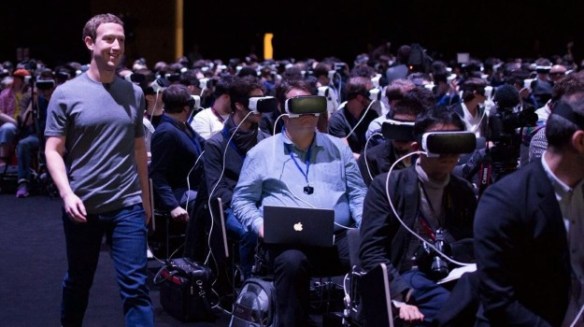
zuckerberg_VR_people-625x350

Technology promised to set us free. Instead it has trained us to withdraw from the world into distraction and dependency

By Nicholas Carr

Source: Aeon

It was a scene out of an Ambien nightmare: a jackal with the face of Mark Zuckerberg stood over a freshly killed zebra, gnawing at the animal’s innards. But I was not asleep. The vision arrived midday, triggered by the Facebook founder’s announcement – in spring 2011 – that ‘The only meat I’m eating is from animals I’ve killed myself.’ Zuckerberg had begun his new ‘personal challenge’, he told Fortune magazine, by boiling a lobster alive. Then he dispatched a chicken. Continuing up the food chain, he offed a pig and slit a goat’s throat. On a hunting expedition, he reportedly put a bullet in a bison. He was ‘learning a lot’, he said, ‘about sustainable living’.

I managed to delete the image of the jackal-man from my memory. What I couldn’t shake was a sense that in the young entrepreneur’s latest pastime lay a metaphor awaiting explication. If only I could bring it into focus, piece its parts together, I might gain what I had long sought: a deeper understanding of the strange times in which we live.

What did the predacious Zuckerberg represent? What meaning might the lobster’s reddened claw hold? And what of that bison, surely the most symbolically resonant of American fauna? I was on to something. At the least, I figured, I’d be able to squeeze a decent blog post out of the story.

The post never got written, but many others did. I’d taken up blogging early in 2005, just as it seemed everyone was talking about ‘the blogosphere’. I’d discovered, after a little digging on the domain registrar GoDaddy, that ‘roughtype.com’ was still available (an uncharacteristic oversight by pornographers), so I called my blog Rough Type. The name seemed to fit the provisional, serve-it-raw quality of online writing at the time.

Blogging has since been subsumed into journalism – it’s lost its personality – but back then it did feel like something new in the world, a literary frontier. The collectivist claptrap about ‘conversational media’ and ‘hive minds’ that came to surround the blogosphere missed the point. Blogs were crankily personal productions. They were diaries written in public, running commentaries on whatever the writer happened to be reading or watching or thinking about at the moment. As Andrew Sullivan, one of the form’s pioneers, put it: ‘You just say what the hell you want.’ The style suited the jitteriness of the web, that needy, oceanic churning. A blog was critical impressionism, or impressionistic criticism, and it had the immediacy of an argument in a bar. You hit the Publish button, and your post was out there on the world wide web, for everyone to see.

Or to ignore. Rough Type’s early readership was trifling, which, in retrospect, was a blessing. I started blogging without knowing what the hell I wanted to say. I was a mumbler in a loud bazaar. Then, in the summer of 2005, Web 2.0 arrived. The commercial internet, comatose since the dot-com crash of 2000, was up on its feet, wide-eyed and hungry. Sites such as MySpace, Flickr, LinkedIn and the recently launched Facebook were pulling money back into Silicon Valley. Nerds were getting rich again. But the fledgling social networks, together with the rapidly inflating blogosphere and the endlessly discussed Wikipedia, seemed to herald something bigger than another gold rush. They were, if you could trust the hype, the vanguard of a democratic revolution in media and communication – a revolution that would change society forever. A new age was dawning, with a sunrise worthy of the Hudson River School.

Rough Type had its subject.

The greatest of the United States’ homegrown religions – greater than Jehovah’s Witnesses, greater than the Church of Jesus Christ of Latter-Day Saints, greater even than Scientology – is the religion of technology. John Adolphus Etzler, a Pittsburgher, sounded the trumpet in his testament The Paradise Within the Reach of All Men (1833). By fulfilling its ‘mechanical purposes’, he wrote, the US would turn itself into a new Eden, a ‘state of superabundance’ where ‘there will be a continual feast, parties of pleasures, novelties, delights and instructive occupations’, not to mention ‘vegetables of infinite variety and appearance’.

Similar predictions proliferated throughout the 19th and 20th centuries, and in their visions of ‘technological majesty’, as the critic and historian Perry Miller wrote, we find the true American sublime. We might blow kisses to agrarians such as Jefferson and tree-huggers such as Thoreau, but we put our faith in Edison and Ford, Gates and Zuckerberg. It is the technologists who shall lead us.

Cyberspace, with its disembodied voices and ethereal avatars, seemed mystical from the start, its unearthly vastness a receptacle for the spiritual yearnings and tropes of the US. ‘What better way,’ wrote the philosopher Michael Heim in ‘The Erotic Ontology of Cyberspace’ (1991), ‘to emulate God’s knowledge than to generate a virtual world constituted by bits of information?’ In 1999, the year Google moved from a Menlo Park garage to a Palo Alto office, the Yale computer scientist David Gelernter wrote a manifesto predicting ‘the second coming of the computer’, replete with gauzy images of ‘cyberbodies drift[ing] in the computational cosmos’ and ‘beautifully laid-out collections of information, like immaculate giant gardens’.

The millenarian rhetoric swelled with the arrival of Web 2.0. ‘Behold,’ proclaimed Wired in an August 2005 cover story: we are entering a ‘new world’, powered not by God’s grace but by the web’s ‘electricity of participation’. It would be a paradise of our own making, ‘manufactured by users’. History’s databases would be erased, humankind rebooted. ‘You and I are alive at this moment.’

The revelation continues to this day, the technological paradise forever glittering on the horizon. Even money men have taken sidelines in starry-eyed futurism. In 2014, the venture capitalist Marc Andreessen sent out a rhapsodic series of tweets – he called it a ‘tweetstorm’ – announcing that computers and robots were about to liberate us all from ‘physical need constraints’. Echoing Etzler (and Karl Marx), he declared that ‘for the first time in history’ humankind would be able to express its full and true nature: ‘we will be whoever we want to be.’ And: ‘The main fields of human endeavour will be culture, arts, sciences, creativity, philosophy, experimentation, exploration, adventure.’ The only thing he left out was the vegetables.

Such prophesies might be dismissed as the prattle of overindulged rich guys, but for one thing: they’ve shaped public opinion. By spreading a utopian view of technology, a view that defines progress as essentially technological, they’ve encouraged people to switch off their critical faculties and give Silicon Valley entrepreneurs and financiers free rein in remaking culture to fit their commercial interests. If, after all, the technologists are creating a world of superabundance, a world without work or want, their interests must be indistinguishable from society’s. To stand in their way, or even to question their motives and tactics, would be self-defeating. It would serve only to delay the wonderful inevitable.

The Silicon Valley line has been given an academic imprimatur by theorists from universities and think tanks. Intellectuals spanning the political spectrum, from Randian right to Marxian left, have portrayed the computer network as a technology of emancipation. The virtual world, they argue, provides an escape from repressive social, corporate and governmental constraints; it frees people to exercise their volition and creativity unfettered, whether as entrepreneurs seeking riches in the marketplace or as volunteers engaged in ‘social production’ outside the marketplace. As the Harvard law professor Yochai Benkler wrote in his influential book The Wealth of Networks (2006):

This new freedom holds great practical promise: as a dimension of individual freedom; as a platform for better democratic participation; as a medium to foster a more critical and self-reflective culture; and, in an increasingly information-dependent global economy, as a mechanism to achieve improvements in human development everywhere.

Calling it a revolution, he said, is no exaggeration.

Benkler and his cohort had good intentions, but their assumptions were bad. They put too much stock in the early history of the web, when the system’s commercial and social structures were inchoate, its users a skewed sample of the population. They failed to appreciate how the network would funnel the energies of the people into a centrally administered, tightly monitored information system organised to enrich a small group of businesses and their owners.

The network would indeed generate a lot of wealth, but it would be wealth of the Adam Smith sort – and it would be concentrated in a few hands, not widely spread. The culture that emerged on the network, and that now extends deep into our lives and psyches, is characterised by frenetic production and consumption – smartphones have made media machines of us all – but little real empowerment and even less reflectiveness. It’s a culture of distraction and dependency. That’s not to deny the benefits of having easy access to an efficient, universal system of information exchange. It is to deny the mythology that shrouds the system. And it is to deny the assumption that the system, in order to provide its benefits, had to take its present form.

Late in his life, the economist John Kenneth Galbraith coined the term ‘innocent fraud’. He used it to describe a lie or a half-truth that, because it suits the needs or views of those in power, is presented as fact. After much repetition, the fiction becomes common wisdom. ‘It is innocent because most who employ it are without conscious guilt,’ Galbraith wrote in 1999. ‘It is fraud because it is quietly in the service of special interest.’ The idea of the computer network as an engine of liberation is an innocent fraud.

I love a good gizmo. When, as a teenager, I sat down at a computer for the first time – a bulging, monochromatic terminal connected to a two-ton mainframe processor – I was wonderstruck. As soon as affordable PCs came along, I surrounded myself with beige boxes, floppy disks and what used to be called ‘peripherals’. A computer, I found, was a tool of many uses but also a puzzle of many mysteries. The more time you spent figuring out how it worked, learning its language and logic, probing its limits, the more possibilities it opened. Like the best of tools, it invited and rewarded curiosity. And it was fun, head crashes and fatal errors notwithstanding.

In the early 1990s, I launched a browser for the first time and watched the gates of the web open. I was enthralled – so much territory, so few rules. But it didn’t take long for the carpetbaggers to arrive. The territory began to be subdivided, strip-malled and, as the monetary value of its data banks grew, strip-mined. My excitement remained, but it was tempered by wariness. I sensed that foreign agents were slipping into my computer through its connection to the web. What had been a tool under my own control was morphing into a medium under the control of others. The computer screen was becoming, as all mass media tend to become, an environment, a surrounding, an enclosure, at worst a cage. It seemed clear that those who controlled the omnipresent screen would, if given their way, control culture as well.

‘Computing is not about computers any more,’ wrote Nicholas Negroponte of the Massachusetts Institute of Technology in his bestseller Being Digital (1995). ‘It is about living.’ By the turn of the century, Silicon Valley was selling more than gadgets and software: it was selling an ideology. The creed was set in the tradition of US techno-utopianism, but with a digital twist. The Valley-ites were fierce materialists – what couldn’t be measured had no meaning – yet they loathed materiality. In their view, the problems of the world, from inefficiency and inequality to morbidity and mortality, emanated from the world’s physicality, from its embodiment in torpid, inflexible, decaying stuff. The panacea was virtuality – the reinvention and redemption of society in computer code. They would build us a new Eden not from atoms but from bits. All that is solid would melt into their network. We were expected to be grateful and, for the most part, we were.

Our craving for regeneration through virtuality is the latest expression of what Susan Sontag in On Photography (1977) described as ‘the American impatience with reality, the taste for activities whose instrumentality is a machine’. What we’ve always found hard to abide is that the world follows a script we didn’t write. We look to technology not only to manipulate nature but to possess it, to package it as a product that can be consumed by pressing a light switch or a gas pedal or a shutter button. We yearn to reprogram existence, and with the computer we have the best means yet. We would like to see this project as heroic, as a rebellion against the tyranny of an alien power. But it’s not that at all. It’s a project born of anxiety. Behind it lies a dread that the messy, atomic world will rebel against us. What Silicon Valley sells and we buy is not transcendence but withdrawal. The screen provides a refuge, a mediated world that is more predictable, more tractable, and above all safer than the recalcitrant world of things. We flock to the virtual because the real demands too much of us.

‘You and I are alive at this moment.’ That Wired story – under headline ‘We Are the Web’ – nagged at me as the excitement over the rebirth of the internet intensified through the fall of 2005. The article was an irritant but also an inspiration. During the first weekend of October, I sat at my Power Mac G5 and hacked out a response. On Monday morning, I posted the result on Rough Type – a short essay under the portentous title ‘The Amorality of Web 2.0’. To my surprise (and, I admit, delight), bloggers swarmed around the piece like phagocytes. Within days, it had been viewed by thousands and had sprouted a tail of comments.

So began my argument with – what should I call it? There are so many choices: the digital age, the information age, the internet age, the computer age, the connected age, the Google age, the emoji age, the cloud age, the smartphone age, the data age, the Facebook age, the robot age, the posthuman age. The more names we pin on it, the more vaporous it seems. If nothing else, it is an age geared to the talents of the brand manager. I’ll just call it Now.

It was through my argument with Now, an argument that has now careered through more than a thousand blog posts, that I arrived at my own revelation, if only a modest, terrestrial one. What I want from technology is not a new world. What I want from technology are tools for exploring and enjoying the world that is – the world that comes to us thick with ‘things counter, original, spare, strange’, as Gerard Manley Hopkins once described it. We might all live in Silicon Valley now, but we can still act and think as exiles. We can still aspire to be what Seamus Heaney, in his poem ‘Exposure’, called inner émigrés.

A dead bison. A billionaire with a gun. I guess the symbolism was pretty obvious all along.