The Military Industrial Complex Strikes Again: War Spending Will Bankrupt America

By John W. Whitehead

Source: The Rutherford Institute

Why throw money at defense when everything is falling down around us? Do we need to spend more money on our military (about $600 billion this year) than the next seven countries combined? Do we need 1.4 million active military personnel and 850,000 reserves when the enemy at the moment — ISIS — numbers in the low tens of thousands? If so, it seems there’s something radically wrong with our strategy. Should 55% of the federal government’s discretionary spending go to the military and only 3% to transportation when the toll in American lives is far greater from failing infrastructure than from terrorism? Does California need nearly as many active military bases (31, according to militarybases.com) as it has UC and state university campuses (33)? And does the state need more active duty military personnel (168,000, according to Governing magazine) than public elementary school teachers (139,000)?”— Steve Lopez, Los Angeles Times

Mark my words, America’s war spending will bankrupt the nation.

For that matter, America’s war spending has already bankrupted the nation to the tune of more than $20 trillion dollars.

Now the Trump Administration is pushing for a $4.4 trillion budget for fiscal year 2019 that would add $7 trillion to the already unsustainable federal deficit in order to sustain America’s military empire abroad and dramatically expand the police state here at home. Trump also wants American taxpayers to cover the cost of building that infamous border wall.

Truly, Trump may turn out to be, as policy analyst Stan Collender warned, “the biggest deficit- and debt-increasing president of all time.”

For those in need of a quick reminder: “A budget deficit is the difference between what the federal government spends and what it takes in. The national debt, also known as the public debt, is the result of the federal government borrowing money to cover years and years of budget deficits.”

Right now, the U.S. government is operating in the negative on every front: it’s spending far more than what it makes (and takes from the American taxpayers) and it is borrowing heavily (from foreign governments and Social Security) to keep the government operating and keep funding its endless wars abroad.

This is how military empires fall and fail: by spreading themselves too thin and spending themselves to death.

It happened in Rome. It’s happening again.

Not content to merely police the globe, in recent decades, America has gradually transformed its homeland into a battlefield with militarized police and weapons better suited to a war zone.

Since taking office, President Trump—much like his predecessors—has marched in lockstep with the military. Now Trump wants $716 billion to expand America’s military empire abroad and billions more to hire cops, build more prisons and wage more profit-driven war-on-drugs/war-on-terrorism/war-on-crime programs that eat away at the Fourth Amendment while failing to make the country any safer.

Even the funds requested for infrastructure will do little to shore up the nation’s crumbling roads, bridges, railways, highways, power grids and dams.

No matter how your break it down, this is not a budget aimed at perfecting the Union, establishing justice, insuring domestic tranquility, providing for the common defense, promoting general welfare, or securing the blessings of liberty for the American people.

No, this is a budget aimed at pandering to the powerful money interests (military, corporate and security) that run the Deep State and hold the government in its clutches.

So much for Trump’s campaign promises to balance the budget and drain the swamps of corruption.

The glaring economic truth is that at the end of the day, it’s the military industrial complex—and not the sick, the elderly or the poor—that is pushing America towards bankruptcy.

As investigative journalist Uri Friedman puts it, for more than 15 years now, the United States has been fighting terrorism with a credit card, “essentially bankrolling the wars with debt, in the form of purchases of U.S. Treasury bonds by U.S.-based entities like pension funds and state and local governments, and by countries like China and Japan.”

The illicit merger of the armaments industry and the Pentagon that President Dwight D. Eisenhower warned us against more than 50 years ago has come to represent perhaps the greatest threat to the nation’s fragile infrastructure today.

Having been co-opted by greedy defense contractors, corrupt politicians and incompetent government officials, America’s expanding military empire is bleeding the country dry at a rate of more than $15 billion a month (or $20 million an hour)—and that’s just what the government spends on foreign wars.

That does not include the cost of maintaining and staffing the 1000-plus U.S. military bases spread around the globe.

Incredibly, although the U.S. constitutes only 5% of the world’s population, America boasts almost 50% of the world’s total military expenditure,  spending more on the military than the next 19 biggest spending nations combined.

In fact, the Pentagon spends more on war than all 50 states combined spend on health, education, welfare, and safety.

War is not cheap.

Although the federal government obscures so much about its defense spending that accurate figures are difficult to procure, we do know that since 2001, the U.S. government has spent more than $1.8 trillion in the wars in Afghanistan and Iraq (that’s $8.3 million per hour).

That doesn’t include wars and military exercises waged around the globe, which are expected to push the total bill upwards of $12 trillion by 2053.

Mind you, these ongoing wars—riddled by corruption, graft and bumbling incompetence—have done little to keep the country safe while enriching the military industrial complex—and private defense contractors—at taxpayer expense.

Just recently, for example, a leading accounting firm concluded that one of the Pentagon’s largest agencies “can’t account for hundreds of millions of dollars’ worth of spending.”

Just consider the fact that it costs American taxpayers $2.1 million per year for each soldier deployed in Afghanistan.

Imagine what you could do with that money if it were spent on domestic needs here at home.

Unfortunately, that’s not going to happen anytime soon, not as long as the money interests in Washington keep calling the shots and profiting from the spoils of war.

War has become a huge money-making venture, and America, with its vast military empire, is one of its best buyers and sellers. Not only does the U.S. have the largest defense budget, it also ranks highest as the world’s largest arms exporter.

The American military-industrial complex has erected an empire unsurpassed in history in its breadth and scope, one dedicated to conducting perpetual warfare throughout the earth.

For example, while erecting a security surveillance state in the U.S., the military-industrial complex has perpetuated a worldwide military empire with American troops stationed in 177 countries (over 70% of the countries worldwide).

In the process, billions have been spent erecting luxury military installations throughout the world.

For example, the U.S. Embassy built in Iraq, dubbed “Fortress Baghdad,” covers 104 acres and boasts a “city within a city” that includes six apartment buildings, a Marine barracks, swimming pool, shops and 15-foot-thick walls. Camp Anaconda in Iraq, like many U.S. military bases scattered across the globe, was structured to resemble a mini-city with pools, fast food restaurants, miniature golf courses and movie theaters.

While most Americans can scarcely afford the cost of heating and cooling their own homes, the American government spends $20 billion annually just to provide air conditioning for military installations in Iraq and Afghanistan.

In essence, what we’re doing is “we’re air conditioning the desert over there in Afghanistan, Iraq, and other places,” noted retired brigadier general Steven Anderson, a former chief logistician for Gen. David Petraeus in Iraq.

Think about that for a minute.

There’s a good reason why “bloated,” “corrupt” and “inefficient” are among the words most commonly applied to the government, especially the Department of Defense and its contractors.

For instance, a study by the Government Accountability Office found that $70 billion worth of cost overruns by the Pentagon were caused by management failures. To put that in perspective, that equates to one and a half times the State Department’s entire $47 billion annual budget.

Fraud is rampant.

A government audit, for example, found that defense contractor Boeing has been massively overcharging taxpayers for mundane parts, resulting in tens of millions of dollars in overspending. As the report noted, the American taxpayer paid:

$71 for a metal pin that should cost just 4 cents; $644.75 for a small gear smaller than a dime that sells for $12.51: more than a 5,100 percent increase in price. $1,678.61 for another tiny part, also smaller than a dime, that could have been bought within DoD for $7.71: a 21,000 percent increase. $71.01 for a straight, thin metal pin that DoD had on hand, unused by the tens of thousands, for 4 cents: an increase of over 177,000 percent.

Price gouging has become an accepted form of corruption within the American military empire.

And if you think gas prices at home can get high, just consider what the American taxpayer is being forced to shell out overseas: once all the expenses of delivering gas to troops in the field are factored in, we’re paying between $18-30 per gallon for gas in Iraq and Afghanistan.

Incredibly, despite reports of corruption, abuse and waste, the mega-corporations behind much of this ineptitude and corruption continue to be awarded military contracts worth billions of dollars.

The rationale may keep changing for why American military forces are in Afghanistan, Iraq and elsewhere, but the one that remains constant is that those who run the government are feeding the appetite of the military industrial complex.

What began in 2001 as part of an alleged effort to root out al Qaeda has turned into a goldmine for the military industrial complex and its army of private contractors.

Just consider: the Pentagon in 2008 spent more money every five seconds in Iraq than the average American earned in a year.

Yet Congress and the White House want taxpayers to accept that the only way to reduce the nation’s ballooning deficit is by cutting “entitlement” programs such as Social Security and Medicare?

As Martin Luther King Jr. recognized, under a military empire, war and its profiteering will always take precedence over the people’s basic human needs.

Simply put, we cannot afford to maintain our over-extended military empire.

Money is the new 800-pound gorilla,” remarked a senior administration official involved in Afghanistan. “It shifts the debate from ‘Is the strategy working?’ to ‘Can we afford this?’ And when you view it that way, the scope of the mission that we have now is far, far less defensible.”

Or as one commentator noted, “Foreclosing the future of our country should not be confused with defending it.”

Inevitably, military empires collapse.

As Cullen Murphy, author of Are We Rome? and editor-at-large of Vanity Fair writes:

A millennium hence America will be hard to recognize. It may not exist as a nation-state in the form it does now—or even exist at all. Will the transitions ahead be gradual and peaceful or abrupt and catastrophic? Will our descendants be living productive lives in a society better than the one we inhabit now? Whatever happens, will valuable aspects of America’s legacy weave through the fabric of civilizations to come? Will historians someday have reason to ask, Did America really fall?

The problem we wrestle with is none other than a distorted American empire, complete with mega-corporations, security-industrial complexes and a burgeoning military. And it has its sights set on absolute domination.

Eventually, however, all military empires fail.

At the height of its power, even the mighty Roman Empire could not stare down a collapsing economy and a burgeoning military. Prolonged periods of war and false economic prosperity largely led to its demise. As historian Chalmers Johnson predicts:

The fate of previous democratic empires suggests that such a conflict is unsustainable and will be resolved in one of two ways. Rome attempted to keep its empire and lost its democracy. Britain chose to remain democratic and in the process let go its empire. Intentionally or not, the people of the United States already are well embarked upon the course of non-democratic empire.

I would suggest that what we have is a confluence of factors and influences that go beyond mere comparisons to Rome.

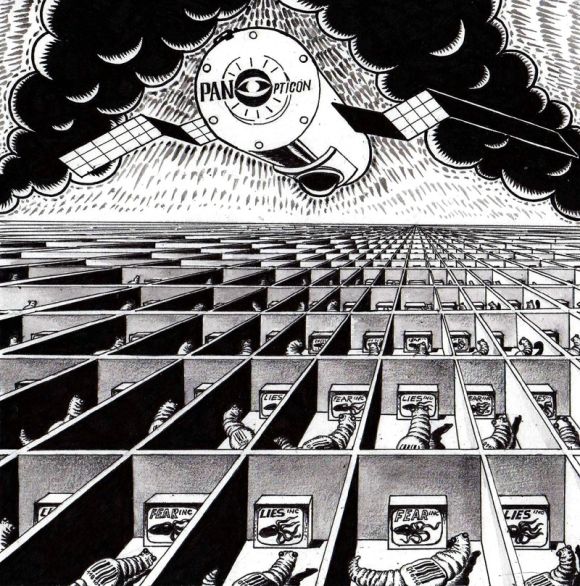
It is a union of Orwell’s 1984 with its shadowy, totalitarian government—i.e., fascism, the union of government and corporate powers—and a total surveillance state with a military empire extended throughout the world.

As we have seen with the militarizing of the police, the growth of and reliance on militarism as the solution for our problems both domestically and abroad affects the basic principles upon which American society should operate.

We must keep in mind that a military empire will be ruled not by lofty ideals of equality and justice but by the power of the sword. Those in the military are primarily trained to conduct warfare, not preserve the peace.

Here’s the kicker, though: if the American empire falls and the American economy collapses—and with it the last vestiges of our constitutional republic—it will be the government and its trillion-dollar war budgets that are to blame.

Of course, the government has already anticipated this breakdown.

That’s why the government has transformed America into a war zone, turned the nation into a surveillance state, and labelled “we the people” as enemy combatants.

For years now, the government has worked with the military to prepare for widespread civil unrest brought about by “economic collapse, loss of functioning political and legal order, purposeful domestic resistance or insurgency, pervasive public health emergencies, and catastrophic natural and human disasters.”

Having spent more than half a century exporting war to foreign lands, profiting from war, and creating a national economy seemingly dependent on the spoils of war, the war hawks long ago turned their profit-driven appetites on us, bringing home the spoils of war—the military tanks, grenade launchers, Kevlar helmets, assault rifles, gas masks, ammunition, battering rams, night vision binoculars, etc.—and handing them over to local police, thereby turning America into a battlefield.

As I make clear in my book Battlefield America: The War on the American People, this is how the police state wins and “we the people” lose.

More than 50 years ago, President Dwight Eisenhower warned us not to let the profit-driven war machine endanger our liberties or democratic processes.

We failed to heed his warning.

As Eisenhower recognized in a speech given to the American Society of Newspaper Editors, on Apr. 16, 1953, the consequences of allowing the military-industrial complex to wage war, exhaust our resources and dictate our national priorities are beyond grave:

“Every gun that is made, every warship launched, every rocket fired signifies, in the final sense, a theft from those who hunger and are not fed, those who are cold and are not clothed. This world in arms is not spending money alone. It is spending the sweat of its laborers, the genius of its scientists, the hopes of its children. The cost of one modern heavy bomber is this: a modern brick school in more than 30 cities. It is two electric power plants, each serving a town of 60,000 population. It is two fine, fully equipped hospitals. It is some fifty miles of concrete pavement. We pay for a single fighter plane with a half million bushels of wheat. We pay for a single destroyer with new homes that could have housed more than 8,000 people… This is not a way of life at all, in any true sense. Under the cloud of threatening war, it is humanity hanging from a cross of iron.”
Our Bigoted Brains

Photo credit: Art Killing ApathyBigotry,

By Eleanor Goldfield

Source: Popular Resistance

If you’ve ever moved beyond small talk and vapid pleasantries in conversation then you’ve likely dealt with the infuriating occurrence of trying to convince someone of a fact they just don’t want to accept. Beyond just avoiding the information, they almost seem hardwired to reject your proof in a phenomenon that I like to call “fact fear.” I noticed a sharp rise in fact fear during the 2016 elections and levels continue to hover at disturbing heights today. So, what gives? Are we really in a new era of idiocy or are we just seeing our particularly vapid and anti-intellectual culture ping off the most base and stubborn aspects of the human psyche? Both, I think.

Daniel Patrick Moynihan famously said, “You are entitled to your own opinions but not your own facts.” But in the post-truth, anti-intellectual, “I read it in a blog post so it must be true” era, our opinions and beliefs run the ever-growing risk of being founded on complete bullshit. Filter bubbles (which we covered in Episode 132) and digital spheres protect us from ideas and facts outside our own personal shit heaps and only serve up the information we want to see – which is not always factually accurate. Our culture of quick “news” and a growing lack of intellectual curiosity drive us further into an echo chamber of our own ideas – facts and information be damned. In turn, a false but far from flimsy crust solidifies around our minds –- and the soft light of truth and knowledge can’t get in.

Our brains are wired to find comfort behind that crust. In what’s known as the backfire effect, our minds reject new information that clashes with our belief systems and opinions. As David McRaney, author of the books You Are Not So Smart and You Are Now Less Dumb explains it: “Once something is added to your collection of beliefs, you protect it from harm. You do this instinctively and unconsciously when confronted with attitude-inconsistent information. Just as confirmation bias shields you when you actively seek information, the backfire effect defends you when the information seeks you, when it blindsides you. Coming or going, you stick to your beliefs instead of questioning them. When someone tries to correct you, tries to dilute your misconceptions, it backfires and strengthens those misconceptions instead. Over time, the backfire effect makes you less skeptical of those things that allow you to continue seeing your beliefs and attitudes as true and proper.” In other words, that crust acts as a shield for facts that threaten your beliefs. And you’ve probably seen this in action online. Someone posts something like “climate change isn’t real” so you face palm and proceed to post ample proof that they’re wrong and that in fact, climate change is very real. The problem is that with each fact you post, the crust hardens – for both you AND the other person. Of course, it doesn’t help that you can find just as much if not more bullshit online than you can actual truth but much of it is actually tied to the inherent laziness of our brains. “The more difficult it becomes to process a series of statements, the less credit you give them overall…In experiments where two facts were placed side by side, subjects tended to rate statements as more likely to be true when those statements were presented in simple, legible type than when printed in a weird font with a difficult-to-read color pattern. Similarly, a barrage of counterarguments taking up a full page seems to be less persuasive to a naysayer than a single, simple, powerful statement.”

So does this mean that we should just stop pointing out when someone is wrong? That we should let all kinds of ridiculous notions from lizard people to “homeless people are dangerous” slide? Of course not. Rather, it means that if we want to educate and engage, if we want people to wake the fuck up then we have to consider how the human mind works – and how it doesn’t. Furthermore, our goal shouldn’t be to win an argument as if to suggest that as soon as we win the argument, justice is at hand. Indeed, if your goal is to simply be right, the religious zeal with which you defend your ideas will only turn you into the very monster you are trying to slay. Being right, in other words, is not the point. Progress is not a church. We are not looking for converts. Our aim should always be to engage and empower; to share our knowledge and embrace the knowledge of others. Seek and speak truth – then act on it. And do not think that because you found a nugget of information you hold moral superiority over those who don’t know it. Our minds are just as susceptible to that crust as anyone else’s. We are not special or better. Indeed, we must constantly question our opinions, compare them with facts and new information. By that I mean actual facts, not “alt facts” sourced from a single Google search or indeed even something from a “trusted” publication.

In an interview last March with Robert Scheer of Truthdig, author Joel Whitney discusses the 60 year history of fake news and how it was used in the Cold War era to sew distrust and hatred of all things “commie” and Russian. Major and well-trusted media outlets were a part of the propaganda ring and Whitney notes “that the fearful political atmosphere at the time led to “secrecy being used to preside over and rule over the free press — which we’re supposed to be the champions of.” “They drank the Kool-Aid and thought they were saving freedom,” Scheer agrees. The discussion underscores the need for analysis of Cold War-era media as a way to avoid propagandized journalism today. Scheer says, “I look at the current situation, where we don’t even have a good communist enemy, so we’re inventing Russia as a reborn communist power enemy.” “I call it superpolitics,” Whitney concludes, “where essentially there’s something that’s so evil and so frightening that we have to change how our democratic institutions work.” The latest red scare is but one example of how easy it is to mold minds when you use something like the hatred of Trump as a trigger. Blend some tried and true anti-Russia sentiment in there and you’ve got yourself a brand spanking new enemy – one that allows you to further mold those democratic institutions just as seamlessly as the minds you’ve now crusted and convinced. Russia aside, the same propaganda games go for mass media collusion on everything from fracking to the military industrial complex. For example, leaked email messages show that a writer from the LA times colluded with the CIA not only in terms of getting the CIA’s OK on forthcoming stories but actually offered to write stories for them that would put a positive spin on such issues as drone warfare, saying it would be quote “reassuring to the public” and a “good opportunity” for the CIA. Various other email messages show that the same was true for a list of other media outlets.

All this to say, if I may borrow a phrase: no investigation, no right to speak. Do your own research before you claim to know something. Incidentally this will also help steel you from the rumor mill AND infiltrators. Whether it’s taking someone to task on a rumor or engaging someone in discourse, be vigilant. Be vigilant in your drive, your actions, and be primarily vigilant in your own thinking. Release the flimsy beliefs that would just as soon sink you as keep you afloat. Arm yourself with knowledge and reach out to build and to engage, not to win a Facebook tiff. Consider the goal of engagement and empowerment rather than just being right. Consider the reaction you would have if someone came at you with a barrage of links followed by “read a fucking book, asshole!” You’d more than likely write them off as an unhinged asshole even if their information is solid. Try asking a question or perhaps as Ben Franklin suggested, ask them for a favor, something small that seeds trust, pinging off the human psychology that seeks appreciation and the feel of community. Push past political theory and get down to human connection – to start with. For instance, anarchists in several communities will often engage with would-be white supremacists via the common ground of distrust and disgust in the system. They’ll sit and talk; discuss the pitfalls of a system that’s left them behind and from there grow to a discourse on the roots of their discontent, i.e. not black people. In other words, knock on the door rather than trying to break down the wall. Because that wrought iron shit crust is stronger than steel.

Finally, keep in mind that this won’t always work and nor should it. We have to accept that in our grandiose imaginings of the revolution, many people will either be against us or sitting at home praying we all just shut up. But again, if you’re not looking for converts, if you’re engaging to empower, you’ll not only find more people willing to talk to you, you’ll also more than likely learn something in the process. You might even pick something up that’ll put a dent in your own mental crust.

Philip K. Dick and the Fake Humans

(Editor’s note: on this 36th anniversary of the passing of Philip K. Dick, it seems an appropriate time to note the relevance of his work to our current dystopia as Henry Farrell does in the following essay. Unfortunately the author is less astute regarding the ways in which the dystopias of Orwell and Huxley are equally relevant to our current milieu.)

By Henry Farrell

Source: Boston Review

This is not the dystopia we were promised. We are not learning to love Big Brother, who lives, if he lives at all, on a cluster of server farms, cooled by environmentally friendly technologies. Nor have we been lulled by Soma and subliminal brain programming into a hazy acquiescence to pervasive social hierarchies.

Dystopias tend toward fantasies of absolute control, in which the system sees all, knows all, and controls all. And our world is indeed one of ubiquitous surveillance. Phones and household devices produce trails of data, like particles in a cloud chamber, indicating our wants and behaviors to companies such as Facebook, Amazon, and Google. Yet the information thus produced is imperfect and classified by machine-learning algorithms that themselves make mistakes. The efforts of these businesses to manipulate our wants leads to further complexity. It is becoming ever harder for companies to distinguish the behavior which they want to analyze from their own and others’ manipulations.

This does not look like totalitarianism unless you squint very hard indeed. As the sociologist Kieran Healy has suggested, sweeping political critiques of new technology often bear a strong family resemblance to the arguments of Silicon Valley boosters. Both assume that the technology works as advertised, which is not necessarily true at all.

Standard utopias and standard dystopias are each perfect after their own particular fashion. We live somewhere queasier—a world in which technology is developing in ways that make it increasingly hard to distinguish human beings from artificial things. The world that the Internet and social media have created is less a system than an ecology, a proliferation of unexpected niches, and entities created and adapted to exploit them in deceptive ways. Vast commercial architectures are being colonized by quasi-autonomous parasites. Scammers have built algorithms to write fake books from scratch to sell on Amazon, compiling and modifying text from other books and online sources such as Wikipedia, to fool buyers or to take advantage of loopholes in Amazon’s compensation structure. Much of the world’s financial system is made out of bots—automated systems designed to continually probe markets for fleeting arbitrage opportunities. Less sophisticated programs plague online commerce systems such as eBay and Amazon, occasionally with extraordinary consequences, as when two warring bots bid the price of a biology book up to $23,698,655.93 (plus $3.99 shipping).

In other words, we live in Philip K. Dick’s future, not George Orwell’s or Aldous Huxley’s. Dick was no better a prophet of technology than any science fiction writer, and was arguably worse than most. His imagined worlds jam together odd bits of fifties’ and sixties’ California with rocket ships, drugs, and social speculation. Dick usually wrote in a hurry and for money, and sometimes under the influence of drugs or a recent and urgent personal religious revelation.

Still, what he captured with genius was the ontological unease of a world in which the human and the abhuman, the real and the fake, blur together. As Dick described his work (in the opening essay to his 1985 collection, I Hope I Shall Arrive Soon):

The two basic topics which fascinate me are “What is reality?” and “What constitutes the authentic human being?” Over the twenty-seven years in which I have published novels and stories I have investigated these two interrelated topics over and over again.

These obsessions had some of their roots in Dick’s complex and ever-evolving personal mythology (in which it was perfectly plausible that the “real” world was a fake, and that we were all living in Palestine sometime in the first century AD). Yet they were also based on a keen interest in the processes through which reality is socially constructed. Dick believed that we all live in a world where “spurious realities are manufactured by the media, by governments, by big corporations, by religious groups, political groups—and the electronic hardware exists by which to deliver these pseudo-worlds right into heads of the reader.” He argued:

the bombardment of pseudo-realities begins to produce inauthentic humans very quickly, spurious humans—as fake as the data pressing at them from all sides. My two topics are really one topic; they unite at this point. Fake realities will create fake humans. Or, fake humans will generate fake realities and then sell them to other humans, turning them, eventually, into forgeries of themselves. So we wind up with fake humans inventing fake realities and then peddling them to other fake humans.

In Dick’s books, the real and the unreal infect each other, so that it becomes increasingly impossible to tell the difference between them. The worlds of the dead and the living merge in Ubik (1969), the experiences of a disturbed child infect the world around him in Martian Time-Slip (1964), and consensual drug-based hallucinations become the vector for an invasive alien intelligence in The Three Stigmata of Palmer Eldritch (1965). Humans are impersonated by malign androids in Do Androids Dream of Electric Sheep? (1968) and “Second Variety” (1953); by aliens in “The Hanging Stranger” (1953) and “The Father-Thing” (1954); and by mutants in “The Golden Man” (1954).

This concern with unreal worlds and unreal people led to a consequent worry about an increasing difficulty of distinguishing between them. Factories pump out fake Americana in The Man in the High Castle (1962), mirroring the problem of living in a world that is not, in fact, the real one. Entrepreneurs build increasingly human-like androids in Do Androids Dream of Electric Sheep?, reasoning that if they do not, then their competitors will. Figuring out what is real and what is not is not easy. Scientific tools such as the famous Voight-Kampff test in Do Androids Dream of Electric Sheep? (and Blade Runner, Ridley Scott’s 1982 movie based loosely on it) do not work very well, leaving us with little more than hope in some mystical force—the I Ching, God in a spray can, a Martian water-witch—to guide us back toward the real.

We live in Dick’s world—but with little hope of divine intervention or invasion. The world where we communicate and interact at a distance is increasingly filled with algorithms that appear human, but are not—fake people generated by fake realities. When Ashley Madison, a dating site for people who want to cheat on their spouses, was hacked, it turned out that tens of thousands of the women on the site were fake “fembots” programmed to send millions of chatty messages to male customers, so as to delude them into thinking that they were surrounded by vast numbers of potential sexual partners.

These problems are only likely to get worse as the physical world and the world of information become increasingly interpenetrated in an Internet of (badly functioning) Things. Many of the aspects of Joe Chip’s future world in Ubik look horrendously dated to modern eyes: the archaic role of women, the assumption that nearly everyone smokes. Yet the door to Joe’s apartment—which argues with him and refuses to open because he has not paid it the obligatory tip—sounds ominously plausible. Someone, somewhere, is pitching this as a viable business plan to Y Combinator or the venture capitalists in Menlo Park.

This invasion of the real by the unreal has had consequences for politics. The hallucinatory realities in Dick’s worlds—the empathetic religion of Do Androids Dream of Electric Sheep?, the drug-produced worlds of The Three Stigmata of Palmer Eldritch, the quasi–Tibetan Buddhist death realm of Ubik—are usually experienced by many people, like the television shows of Dick’s America. But as network television has given way to the Internet, it has become easy for people to create their own idiosyncratic mix of sources. The imposed media consensus that Dick detested has shattered into a myriad of different realities, each with its own partially shared assumptions and facts. Sometimes this creates tragedy or near-tragedy. The deluded gunman who stormed into Washington, D.C.’s Comet Ping Pong pizzeria had been convinced by online conspiracy sites that it was the coordinating center for Hillary Clinton’s child–sex trafficking ring [likewise, the masses may have been convinced by mainstream media that a real child-sex trafficking ring never existed].

Such fractured worlds are more vulnerable to invasion by the non-human. Many Twitter accounts are bots, often with the names and stolen photographs of implausibly beautiful young women, looking to pitch this or that product (one recent academic study found that between 9 and 15 percent of all Twitter accounts are likely fake). Twitterbots vary in sophistication from automated accounts that do no more than retweet what other bots have said, to sophisticated algorithms deploying so-called “Sybil attacks,” creating fake identities in peer-to-peer networks to invade specific organizations or degrade particular kinds of conversation.

Twitter has failed to become a true mass medium, but remains extraordinarily important to politics, since it is where many politicians, journalists, and other elites turn to get their news. One research project suggests that around 20 percent of the measurable political discussion around the last presidential election came from bots. Humans appear to be no better at detecting bots than we are, in Dick’s novel, at detecting replicant androids: people are about as likely to retweet a bot’s message as the message of another human being. Most notoriously, the current U.S. president recently retweeted a flattering message that appears to have come from a bot densely connected to a network of other bots, which some believe to be controlled by the Russian government and used for propaganda purposes.

In his novels Dick was interested in seeing how people react when their reality starts to break down. A world in which the real commingles with the fake, so that no one can tell where the one ends and the other begins, is ripe for paranoia. The most toxic consequence of social media manipulation, whether by the Russian government or others, may have nothing to do with its success as propaganda. Instead, it is that it sows an existential distrust. People simply do not know what or who to believe anymore. Rumors that are spread by Twitterbots merge into other rumors about the ubiquity of Twitterbots, and whether this or that trend is being driven by malign algorithms rather than real human beings.

Such widespread falsehood is especially explosive when combined with our fragmented politics. Liberals’ favorite term for the right-wing propaganda machine, “fake news,” has been turned back on them by conservatives, who treat conventional news as propaganda, and hence ignore it. On the obverse, it may be easier for many people on the liberal left to blame Russian propaganda for the last presidential election than to accept that many voters had a very different understanding of America than they do.

Dick had other obsessions—most notably the politics of Richard Nixon and the Cold War. It is not hard to imagine him writing a novel combining an immature and predatory tycoon (half Arnie Kott, half Jory Miller) who becomes the president of the United States, secret Russian political manipulation, an invasion of empathy-free robotic intelligences masquerading as human beings, and a breakdown in our shared understanding of what is real and what is fake.

These different elements probably would not cohere particularly well, but as in Dick’s best novels, the whole might still work, somehow. Indeed, it is in the incongruities of Dick’s novels that salvation is to be found (even at his battiest, he retains a sense of humor). Obviously, it is less easy to see the joke when one is living through it. Dystopias may sometimes be grimly funny—but rarely from the inside.

Freedom Rider: Russiagate and the surveillance duopoly

By Margaret Kimberley

Source: Intrepid Report

Republican and Democratic Party dueling over Russiagate provides us with a teachable moment. It should teach us to disrespect and discredit the law enforcement system as it exists in this country. We must oppose the surveillance state altogether and we should not be tricked by duopoly theatrics into thinking that either of the evil twins are acting in our interests.

Local cops plant drugs and weapons in order to arrest and convict anyone they want. They kill an average of three people every single day. Cash bail keeps the poor in jail not because they are necessarily dangerous, but because they are poor. Those are just some facts in the litany of oppression used by law enforcement against mostly poor, black people. But there is another order of wrong doing that engulfs the whole world.

The Foreign Intelligence Surveillance Act (FISA) created a system which determines when the federal government may spy on anyone suspected of acting on behalf of a foreign agent. FISA set up a rubber stamp kangaroo court with only a handful of warrants being rejected in the forty year history of this law.

FISA authority was used to keep Donald Trump campaign adviser Carter Page under surveillance in 2016. Republicans claim that the warrant was granted as a result of the Christopher Steele opposition research dossier that was paid for by Hillary Clinton’s campaign. No one knows if this assertion is true, but the fight over declassifying the memo predictably turned into political theater. Republicans said the memo would end the suspicion of Trump collusion with the Russian government and Democrats asserted that the system would fall apart if the memo was ever declassified and released.

If Republicans are correct the FISA warrant was problematic and the case for collusion is tainted. Democrats now make the case for declassifying their own memo and continuing the foolish spectacle of irrelevance. Despite the drama, both assertions are beside the point. The larger and more important issue is that the American justice system is decidedly unjust.

Prosecutors are among the worst criminals in this country. From small towns to federal courthouses they wield power that few can circumvent. Rich people need not worry because they exist in a bubble with laws of their own making. Public officials bow down to them and happily violate statutes in order to keep them happy. It is all rotten and the case for and against Trump is an opportunity to discuss how few rights we have and how the system is rigged against all but the apex predators at the top of the food chain.

Instead of making the case for tearing up this monstrosity, otherwise intelligent people are pointing fingers and choosing one disreputable side over the other. Every Republican voted to extend the FISA program. They were joined by Democrats like Congressman Adam Schiff, who leads the case for collusion, and who has made a name for himself by stoking the Russiagate fire. Schiff cried the loudest against releasing the Republican memo and claimed that declassification would pose a threat to the nation. When he had the chance to do something for the judicial system he joined with the people he allegedly opposes and supported continuing the FISA travesty. Our individual rights are obviously of little concern to Schiff. Then again he is a former prosecutor so little can be expected of him in this regard.

Russiagate is a sinkhole of political confusion and that is precisely why it was created. It began with Hillary Clinton’s campaign, a lackluster effort meant to continue the neo-liberal agenda, make war, and do little else. She had nothing to offer voters and hung her hat on making Trump look like “Putin’s puppet.” Had she done a minimal effort there would have been no need for pay offs to British spies or whipped up Russophobia. The entire Democratic Party was complicit in the debacle and they welcomed a tale of collusion in order to deflect the blame they so richly deserved.

The sorry spectacle continues as Republicans are equally determined to keep Trump in office and make their dreams of kleptocracy and diminished governmental authority a reality. Democrats are looking to explain away a string of electoral failures and maintain the illusion of being the inclusive party when they are merely shadows of the hard right Republicans.

Let all the memos be released. There should be no sanctity bestowed upon government secrets. They are a ruse meant to cover up for worldwide gangsterism. Defending the FBI, CIA, NSA or any of the other “intelligence community” agencies is to be a dupe of the highest order. Police in Baltimore and other cities may plant drugs and weapons on suspects, but the mega-killers lie about weapons in entire nations and cause death and suffering on a mass scale.

Sooner or later Russiagate will play out. Whatever the result, this country will still be the one that locks up more of its people than any other. It will still be a threat to world peace. When the wheels of injustice grind on, only fools will have chosen between the two corrupt parties.


Margaret Kimberley’s Freedom Rider column appears weekly in BAR, and is widely reprinted elsewhere. She maintains a frequently updated blog as well as at freedomrider.blogspot.com. Ms. Kimberley lives in New York City, and can be reached via e-Mail at Margaret.Kimberley(at)BlackAgendaReport.com.

Mueller’s Fraudulent Indictment

(Rex Features via AP Images)

The Internet Research Agency: clickbait farm or KGB plot?

By Justin Raimondo

Source: Antiwar.com

The indictment handed down by Robert Mueller against 13 Russians connected to the Internet Research Agency, a Russian-owned- and- operated clickbait farm, is the capstone of my case that we have indeed entered Bizarro World, an alternate universe where up is down, black is white and truth is a ridiculous falsehood.

Yes, I said clickbait farm – because that’s precisely what the Internet Research Agency (IRA) is: founded by Yevgeny Prigozhin, a former Russian chef who wanted to figure out a new way to make money, the IRA, as pointed out here, is a money-making operation. Mueller seems to acknowledge this when, in his laughable “indictment,” we read this:

“Defendants and their co-conspirators also used the accounts to receive money from real U.S. persons in exchange for posting promotions and advertisements on the ORGANIZATION-controlled social media pages. Defendants and their coconspirators typically charged certain US merchants and US social media sites between 25 and 50 US dollars per post for promotional content on their popular false US persona accounts, including Being Patriotic, Defend the 2nd, and Blacktivist.”

What kind of a propaganda/spy operation charges its coconspirators a fee?

The total Russian/IRA buy was $100,000, including $300 in Pennsylvania, $832 in Michigan, and $1979 in Wisconsin (mostly before the primary). Most of the “Russian” ads ran after the election, and they didn’t support any candidates: instead, they focused on “hot button” issues – precisely the sort of thing intended to attract visits and make money for the creators via ads.

This business model has been widely utilized by enterprising Macedonian teenagers and others out to make a quick buck, and it works quite effectively if you know what you’re doing. The IRA, like other clickbait operations, isn’t really about politics, although it deals with political subjects: it’s about making money for it owners. Period. As the Moon of Alabama blogger points out:

“There were, according to the indictment, eighty people working on the “translator project”. These controlled “hundreds” of sock-puppets online accounts each with a distinct “political” personality. Each of these sock-puppets had a large number of followers – in total several hundred-thousands. Now let’s assume that one to five promotional posts can be sold per day on each of the sock-puppets content stream. The scheme generates several thousand dollars per day ($25 per promo, hundreds of sock-puppets, 1-5 promos per day per sock-puppet). The costs for this were limited to the wages of up to eighty persons in Moscow, many of them temps, of which the highest paid received some $1,000 per month.”

All in all, a fairly profitable business – not a state-run “disinformation” project, but rather good old free enterprise.

Yes, I know that some of the IRA’s employees traveled to America for a week or two to do “research.” But what, exactly, does this mean? Does anybody have a record of where they stayed, or whom they associated with? There’s nothing about that in the indictment. In short, they could have come to America for the same reasons tens of thousands do every day of the week: to enjoy themselves as tourists. After all, what could they possibly learn in a week-long stay that could … sway a presidential election? I mean, what are we talking about here?

The weird-stupid aura hanging over this whole affair was underscored when CNN actually knocked on the door of some woman whom they accused of running a “Russian-sponsored” pro-Trump rally in Florida: the woman laughed in the “reporter’s” face and said she’d never spoken to a single Russian in her entire life. So how many Trump supporters will be visited not just by CNN but by the FBI in order to intimidate them in a similar manner?

What I want to know is this: what in the name of all that’s holy does Robert Mueller think he’s doing? Is he just plain ignorant of the internet and how it works – or is he mocking us? His “indictment” is nothing but a joke. And as for the hysterics proclaiming it shows that the Russians have launched the equivalent of the attack on Pearl Harbor – these people need to be heavily sedated. Three-thousand people died at Pearl Harbor: how many were killed by Prigozhin’s clickbait farm?

My recent cancer diagnosis has really focused my attention on an issue I had hardly considered before: spending time refuting nonsense is essentially a waste of my time. And at this point, it’s the kind of luxury I can no longer afford. If these are truly my last days on earth, I’d rather be writing about something substantial, and meaningful, thank you very much.

So I’ll just end with this: anyone who says they believe the Mueller narrative outlined in his laughable indictment is either clueless or is a cynic who will say anything. The “charges” detailed in this “indictment” – “Conspiracy to Defraud the United States” – are precisely what the authors of this disgraceful document are guilty of themselves.

Russia-gate is a hoax – I’ve told my readers that from the very beginning. This “indictment” underscores the extent of the hoax – and the contempt that the government officials and their journalist collaborators who thought this would bring down a President have for the American people. They expect us to swallow this fraud whole. Well, guess what – it’s not happening, folks. A child could see through this nonsense.

It’s high time to shut this fraud on the country down, and return Mueller to private life (where he can contemplate how badly he messed up not only this but also the anthrax investigation).

A False Agenda for Humanity

By Julian Rose

Source: Waking Times

Humanity has, for millennia, been led down the road of an entirely false agenda. So much so, that every aspect of society is almost the precise reverse of what it should be.

Just a glimmer of awareness reveals that the true potential of the majority of mankind remains locked away, unable to exert any influence on the course of events on our planet.

Given the scale of this imprisonment, it becomes apparent that the world has been moving on a trajectory invented and directed by a false intelligence, whose interests are diametrically opposed to the intelligence of natural planetary consciousness.

I use the word ‘intelligence’ because its hard to find the right word to describe that which is very clever, but lacks the ability to feel love or compassion; and is often ruthless without ever showing emotion. Intelligence should have a more human ring to it, but the word has been hijacked by the spying networks: the CIA, FBI, MI5 for example, all call themselves ‘intelligence agencies’. Not exactly warm-blooded institutions!

Within the hierarchies of banks, corporations, the military, governments, the media and various global trading organizations, one will find a plethora of quasi-humans in line to get their hands onto the levers of the central control system. The top-down pyramid which steers the daily agenda for millions of mortals caught-up in the 9 to 5 treadmill. Yet, those climbing the employment ladder within these same institutions, more often than not lack any awareness of what is going on above their heads.

We should consider the following question: at exactly what point within this typical corporate pyramid, does the ordinary mortal metamorphose into the ranks of the subhuman control master? Which floor serves as the subtle switch-point where the 9 to 5 worker ‘just doing a job’ shifts into a dedicated trainee in the art of ‘power over the people’ management?

I am not proposing to answer this, as it is a largely hypothetical question; but I suggest that the process whereby the false agenda for humanity is able to be maintained, year in year out, relies heavily on the unquestioning cooperation of those who, at some point, change their identity – or have their identity changed – from just ordinary workers to corporate clones. In other words those who see the world entirely through the lens of the corporation they work for.

The renowned social psychiatrist/psychologist Dr Erich Fromm, in his last major thesis ‘The Anatomy of Human Destructiveness’ traces the decline of the sentient human at the hands of a ‘corporate intelligence’ which is specifically designed to dehumanize those climbing up its ranks. So that by the time they reach the top, such people have become robotic, in virtually every action they undertake.

Here lies the mechanism whereby the human becomes less than human; the less than human becomes inhuman; and the inhuman becomes a biological robotic clone and proponent of Transhumanist Artificial Intelligence – which takes the false agenda for humanity ever nearer to its ultimate goal.

Perhaps not ultimate, but far enough to ensure that humanity as we know it, is superseded by another form of ‘intelligence’ that has nothing to do with nature or the exigence expressed in natural human emotions of love, joy, pain and sorrow.

Cyborgian artificial intelligence is just that: artificial. Art put in reverse so as to eliminate the godly, the beautiful, the spontaneous – all that which gives expression to what it really means to be human.

But consider the fact that it is people suffering these type of symptoms who are in the driving seat of world affairs; running governments, banks and technocratic institutions like the European Union. The mentality is that of a corporate trained control freak – and the greater the power on hand, the greater the ego fueled top-down control manipulation becomes.

The structural design of the neoliberal/neoconservative capitalist Leviathon is not an accident. It is a deliberate formula for the entrapment of mankind. One which puts into reverse – and thereby completely distorts – the true hierarchical themes of nature and the cosmos. In just the same way as Hitler inverted and reversed the design of the original swastika, an ancient peace symbol from Southern India, into a twisted symbol of war.

The symbols that adorn all top-end corporate chains and industries, follow this same pattern. They are nearly all based upon ancient archetypal forms. Forms that symbolized man’s desire to give expression to the powers of nature, as well as the cosmic influences that were mythologized into gods and pantheistic forces of power and influence. Symbols that expressed higher aspirations of bygone civilisations.

The big-chiefs of corporate globalization adorn their high-rise totems and plush office suites with the very same symbols, but what do they stand for now?

Quite simply, a crassly materialistic paradigm which has usurped the nature gods of old; declaring itself the new ‘supreme force’ to which mankind must go on its knees in unquestionoing obeisance.

And, as we know, the majority of mankind has been complicit in fulfilling this role, ensuring a self-inflicted avenue of slavery and passive acceptance of the role assigned by the prevailing status quo.

Indeed, there appears to be no end to the butchery and bullying in the cause of keeping the Leviathan rolling forward. The US military – backed by its European ‘allies’ – ranges the planet in support of the ceaseless profligate mining of valuable minerals, to make the fuels that fill the tanks of Big Pharma, Big Agro, Big Army and Big Business. While the public, rather than rising up against mammon, appear to be paralyzed by the spectacle, unable to imagine anything less destructively domineering that might take its place.

I used the words “appear to be” because there is, of course, another emergent energy that tells another story. That breaks through the deception that man is nothing more than a psychopathetic instrument in the hands of all dominant, aggressive and less than human oppressors.

It is not just ‘any’ other energy. It is the long-buried – and steadily more volcanic – energy of liberated spirit. A revivified spirit which is finding its way back into the arteries of an ever-growing number of ex hostages of the status quo, as well as new arrivals on this planet.

Everyday this spirit is gaining further momentum and a stronger equilibrium. Cracks in the false agenda are widening; the confidence of its perpetrators is wavering; the old power base is leaking.

Chinks of light glitter amongst the darkness; the sense of an upwardly rising change is in the air, counteracting the stench of stagnation and decline.

What is this?

We ‘the people’ have arrived at a critical point in this apocalyptic epoch, finding out that we are possessed of power we never knew we had; starting to believe in a Self we never knew we cradled; hearing a voice we never could hear before. Finding in each other, sources of mutual support, not just a shackled fellow prisoner.

As this process grows, so the false agenda is further revealed for what it is, and its chief perpetrators are exposed ever more clearly for what they are. The seemingly inexorable drive towards a cybernetic future, or one populated and run by gender-bent, micro-chipped mock-humans, is being infiltrated by warm-blooded, nature loving true humans. Trees are being planted where concrete was once the only landscape.

We are learning that where our thoughts go – energy follows. And that if these thoughts are full of creativity and life, so will our lives also be. We are learning that we can take charge of our destinies after all. That, at any moment, we could dispense with the false reality of the top down centralized command system, and be free to start our own version of reality. One informed by our love of Truth – a determination to act on this truth – and a growing aspiration to Be rather than to have.


Julian Rose is an early pioneer of UK organic farming, a writer, actor and international activist.

Saturday Matinee: Ukraine on Fire – The Real Story

A Documentary You’ll Likely Never See

By James DiEugenio

Source: Consortium News

It is not very often that a documentary film can set a new paradigm about a recent event, let alone, one that is still in progress. But the new film Ukraine on Fire has the potential to do so – assuming that many people get to see it.

Usually, documentaries — even good ones — repackage familiar information in a different aesthetic form. If that form is skillfully done, then the information can move us in a different way than just reading about it.

A good example of this would be Peter Davis’s powerful documentary about U.S. involvement in Vietnam, Hearts and Minds. By 1974, most Americans understood just how bad the Vietnam War was, but through the combination of sounds and images, which could only have been done through film, that documentary created a sensation, which removed the last obstacles to America leaving Indochina.

Ukraine on Fire has the same potential and could make a contribution that even goes beyond what the Davis film did because there was very little new information in Hearts and Minds. Especially for American and Western European audiences, Ukraine on Fire could be revelatory in that it offers a historical explanation for the deep divisions within Ukraine and presents information about the current crisis that challenges the mainstream media’s paradigm, which blames the conflict almost exclusively on Russia.

Key people in the film’s production are director Igor Lopatonok, editor Alex Chavez, and writer Vanessa Dean, whose screenplay contains a large amount of historical as well as current material exploring how Ukraine became such a cauldron of violence and hate. Oliver Stone served as executive producer and conducted some high-profile interviews with Russian President Vladimir Putin and ousted Ukrainian President Viktor Yanukovych.

The film begins with gripping images of the violence that ripped through the capital city of Kiev during both the 2004 Orange Revolution and the 2014 removal of Yanukovich. It then travels back in time to provide a perspective that has been missing from mainstream versions of these events and even in many alternative media renditions.

A Longtime Pawn

Historically, Ukraine has been treated as a pawn since the late Seventeenth Century. In 1918, Ukraine was made a German protectorate by the Treaty of Brest Litovsk. Ukraine was also a part of the Molotov-Ribbentrop Pact of 1939 signed between Germany and Russia, but violated by Adolf Hitler when the Nazis invaded the Soviet Union in the summer of 1941.

The reaction of many in Ukraine to Hitler’s aggression was not the same as it was in the rest of the Soviet Union. Some Ukrainians welcomed the Nazis. The most significant Ukrainian nationalist group, Organization of Ukrainian Nationalists (OUN), had been established in 1929. Many of its members cooperated with the Nazis, some even enlisted in the Waffen SS and Ukrainian nationalists participated in the massacre of more than 33,000 Jews at Babi Yar ravine in Kiev in September 1941. According to scholar Pers Anders Rudling, the number of Ukrainian nationalists involved in the slaughter outnumbered the Germans by a factor of 4 to 1.

But it wasn’t just the Jews that the Ukrainian nationalists slaughtered. They also participated in massacres of Poles in the western Ukrainian region of Galicia from March 1943 until the end of 1944. Again, the main perpetrators were not Germans, but Ukrainians.

According to author Ryazard Szawlowksi, the Ukrainian nationalists first lulled the Poles into thinking they were their friends, then turned on them with a barbarity and ferocity that not even the Nazis could match, torturing their victims with saws and axes. The documentary places the number of dead at 36,750, but Szawlowski estimates it may be two or three times higher.

OUN members participated in these slaughters for the purpose of ethnic cleansing, wanting Ukraine to be preserved for what OUN regarded as native Ukrainians. They also expected Ukraine to be independent by the end of the war, free from both German and Russian domination. The two main leaders in OUN who participated in the Nazi collaboration were Stepan Bandera and Mykola Lebed. Bandera was a virulent anti-Semite, and Lebed was rabidly against the Poles, participating in their slaughter.

After the war, both Bandera and Lebed were protected by American intelligence, which spared them from the Nuremburg tribunals. The immediate antecedent of the CIA, Central Intelligence Group, wanted to use both men for information gathering and operations against the Soviet Union. England’s MI6 used Bandera even more than the CIA did, but the KGB eventually hunted down Bandera and assassinated him in Munich in 1959. Lebed was brought to America and addressed anti-communist Ukrainian organizations in the U.S. and Canada. The CIA protected him from immigration authorities who might otherwise have deported him as a war criminal.

The history of the Cold War was never too far in the background of Ukrainian politics, including within the diaspora that fled to the West after the Red Army defeated the Nazis and many of their Ukrainian collaborators emigrated to the United States and Canada. In the West, they formed a fierce anti-communist lobby that gained greater influence after Ronald Reagan was elected in 1980.

Important History

This history is an important part of Dean’s prologue to the main body of Ukraine on Fire and is essential for anyone trying to understand what has happened there since the collapse of the Soviet Union in 1991. For instance, the U.S.-backed candidate for president of Ukraine in 2004 — Viktor Yushchenko — decreed both Bandera and his military assistant Roman Shukhevych, who was also involved in atrocitites, were both named national heroes by Yushchenko.

Bandera, in particular, has become an icon for post-World War II Ukrainian nationalists. One of his followers was Dmytro Dontsov, who called for the birth of a “new man” who would mercilessly destroy Ukraine’s ethnic enemies.

Bandera’s movement was also kept alive by Yaroslav Stetsko, Bandera’s premier in exile. Stetsko fully endorsed Bandera’s anti-Semitism and also the Nazi attempt to exterminate the Jews of Europe. Stetsko, too, was used by the CIA during the Cold War and was honored by Yushchenko, who placed a plaque in his honor at the home where he died in Munich in 1986. Stetsko’s wife, Slava, returned to Ukraine in 1991 and ran for parliament in 2002 on the slate of Yushchenko’s Our Ukraine party.

Stetsko’s book, entitled Two Revolutions, has become the ideological cornerstone for the modern Ukrainian political party Svoboda, founded by Oleh Tyahnybok, who is pictured in the film calling Jews “kikes” in public, which is one reason the Simon Wiesenthal Center has ranked him as one of the most dangerous anti-Semites in the world.

Another follower of Bandera is Dymytro Yarosh, who reputedly leads the paramilitary arm of an even more powerful political organization in Ukraine called Right Sektor. Yarosh once said he controls a paramilitary force of about 7,000 men who were reportedly used in both the overthrow of Yanukovych in Kiev in February 2014 and the suppression of the rebellion in Odessa a few months later, which are both fully depicted in the film.

This historical prelude and its merging with the current civil war is eye-opening background that has been largely hidden by the mainstream Western media, which has downplayed or ignored the troubling links between these racist Ukrainian nationalists and the U.S.-backed political forces that vied for power after Ukraine became independent in 1991.

The Rise of a Violent Right

That same year, Tyahnybok formed Svoboda. Three years later, Yarosh founded Trident, an offshoot of Svoboda that eventually evolved into Right Sektor. In other words, the followers of Bandera and Lebed began organizing themselves immediately after the Soviet collapse.

In this time period, Ukraine had two Russian-oriented leaders who were elected in 1991 and 1994, Leonid Kravchuk, and Leonid Kuchma. But the hasty transition to a “free-market” economy didn’t go well for most Ukrainians or Russians as well-connected oligarchs seized much of the wealth and came to dominate the political process through massive corruption and purchase of news media outlets. However, for average citizens, living standards went down drastically, opening the door for the far-right parties and for foreign meddling.

In 2004, Viktor Yanukovych, whose political base was strongest among ethnic Russians in the east and south, won the presidential election by three percentage points over the U.S.-favored Viktor Yushchenko, whose base was asmostly in the country’s west where the Ukrainian nationalists are strongest.

Immediately, Yushchenko’s backers claimed fraud citing exit polls that had been organized by a group of eight Western nations and four non-governmental organizations or NGOs, including the Renaissance Foundation founded by billionaire financial speculator George Soros. Dick Morris, former President Bill Clinton’s political adviser, clandestinely met with Yushchenko’s team and advised them that the exit polls would not just help in accusations of fraud, but would bring protesters out into the streets. (Cambridge Review of International Affairs, Vol. 19, Number 1, p. 26)

Freedom House, another prominent NGO that receives substantial financing from the U.S.-government-funded National Endowment for Democracy (NED), provided training to young activists who then rallied protesters in what became known as the Orange Revolution, one of the so-called “color revolutions” that the West’s mainstream media fell in love with. It forced an election rerun that Yushchenko won.

But Yushchenko’s presidency failed to do much to improve the lot of the Ukrainian people and he grew increasingly unpopular. In 2010, Yushchenko failed to make it out of the first round of balloting and his rival Yanukovych was elected president in balloting that outside observers judged free and fair.

Big-Power Games

If this all had occurred due to indigenous factors within Ukraine, it could have been glossed over as a young nation going through some painful growing pains. But as the film points out, this was not the case. Ukraine continued to be a pawn in big-power games with many Western officials hoping to draw the country away from Russian influence and into the orbit of NATO and the European Union.

In one of the interviews in Ukraine on Fire, journalist and author Robert Parry explains how the National Endowment for Democracy and many subsidized political NGOs emerged in the 1980s to replace or supplement what the CIA had traditionally done in terms of influencing the direction of targeted countries.

During the investigations of the Church Committee in the 1970s, the CIA’s “political action” apparatus for removing foreign leaders was exposed. So, to disguise these efforts, CIA Director William Casey, Reagan’s White House and allies in Congress created the NED to finance an array of political and media NGOs.

As Parry noted in the documentary, many traditional NGOs do valuable work in helping impoverished and developing countries, but this activist/propaganda breed of NGOs promoted U.S. geopolitical objectives abroad – and NED funded scores of such projects inside Ukraine in the run-up to the 2014 crisis.

Ukraine on Fire goes into high gear when it chronicles the events that occurred in 2014, resulting in the violent overthrow of President Yanukovych and sparking the civil war that still rages. In the 2010 election, when Yushchenko couldn’t even tally in the double-digits, Yanukovych faced off against and defeated Yulia Tymoshenko, a wealthy oligarch who had served as Yushchenko’s prime minister.

After his election, Yanukovych repealed Bandera’s title as a national hero. However, because of festering economic problems, the new president began to search for an economic partner who could provide a large loan. He first negotiated with the European Union, but these negotiations bogged down due to the usual draconian demands made by the International Monetary Fund.

So, in November 2013, Yanukovych began to negotiate with Russian President Putin who offered more generous terms. But Yanukovych’s decision to delay the association agreement with the E.U. provoked street protests in Kiev especially from the people of western Ukraine.

As Ukraine on Fire points out, other unusual occurrences also occurred, including the emergence of three new TV channels – Spilno TV, Espreso TV, and Hromadske TV – going on the air between Nov. 21 and 24, with partial funding from the U.S. Embassy and George Soros.

Pro-E.U. protests in the Maidan square in central Kiev also grew more violent as ultra-nationalist street fighters from Lviv and other western areas began to pour in and engage in provocations, many of which were sponsored by Yarosh’s Right Sektor. The attacks escalated from torch marches similar to Nazi days to hurling Molotov cocktails at police to driving large tractors into police lines – all visually depicted in the film. As Yanukovich tells Stone, when this escalation happened, it made it impossible for him to negotiate with the Maidan crowd.

One of the film’s most interesting interviews is with Vitaliy Zakharchenko, who was Minister of the Interior at the time responsible for law enforcement and the conduct of the police. He traces the escalation of the attacks from Nov. 24 to 30, culminating with a clash between police and protesters over the transport of a giant Christmas tree into the Maidan. Zakharchenko said he now believes this confrontation was secretly approved by Serhiy Lyovochkin, a close friend of U.S. Ambassador Geoffrey Pyatt, as a pretext to escalate the violence.

At this point, the film addresses the direct involvement of U.S. politicians and diplomats. Throughout the crisis, American politicians visited Maidan, as both Republicans and Democrats, such as Senators John McCain, R-Arizona, and Chris Murphy, D-Connecticut. stirred up the crowds. Yanukovych also said he was in phone contact with Vice President Joe Biden, who he claims was misleading him about how to handle the crisis.

The film points out that the real center of American influence in the Kiev demonstrations was with Ambassador Pyatt and Assistant Secretary of State for European Affairs Victoria Nuland. As Parry points out, although Nuland was serving under President Obama, her allegiances were really with the neoconservative movement, most associated with the Republican Party.

Her husband is Robert Kagan, who worked as a State Department propagandist on the Central American wars in the 1980s and was the co-founder of the Project for the New American Century in the 1990s, the group that organized political and media pressure for the U.S. invasion of Iraq in 2003. Kagan also was McCain’s foreign policy adviser in the 2008 presidential election (although he threw his support behind Hillary Clinton in the 2016 race).

Adept Manipulators

As Parry explained, the neoconservatives have become quite adept at disguising their true aims and have powerful allies in the mainstream press. This combination has allowed them to push the foreign policy debate to such extremes that, when anyone objects, they can be branded a Putin or Yanukovych “apologist.”

Thus, Pyatt’s frequent meetings with the demonstrators in the embassy and Nuland’s handing out cookies to protesters in the Maidan were not criticized as American interference in a sovereign state, but were praised as “promoting democracy” abroad. However, as the Maidan crisis escalated, Ukrainian ultra-nationalists moved to the front, intensifying their attacks on police. Many of these extremists were disciples of Bandera and Lebed. By February 2014, they were armed with shotguns and rapid-fire handguns.

On Feb. 20, 2014, a mysterious sniper, apparently firing from a building controlled by the Right Sektor, shot both police and protesters, touching off a day of violence that left about 14 police and some 70 protesters dead.

With Kiev slipping out of control, Yanukovich was forced to negotiate with representatives from France, Poland and Germany. On Feb. 21, he agreed to schedule early elections and to accept reduced powers. At the urging of Vice President Biden, Yanukovych also pulled back the police.

But the agreement – though guaranteed by the European nations – was quickly negated by renewed attacks from the Right Sektor and its street fighters who seized government buildings. Russian intelligence services got word that an assassination plot was in the works against Yanukovych, who fled for his life.

On Feb. 24, Yanukovych asked permission to enter Russia for his safety and the Ukrainian parliament (or Rada), effectively under the control of the armed extremists, voted to remove Yanukovych from office in an unconstitutional manner because the courts were not involved and the vote to impeach him did not reach the mandatory threshold. Despite these irregularities, the U.S. and its European allies quickly recognized the new government as “legitimate.”

Calling a Coup a Coup

But the ouster of Yanukovych had all the earmarks of a coup. An intercepted phone call, apparently in early February, between Nuland and Pyatt revealed that they were directly involved in displacing Yanukovych and choosing his successor. The pair reviewed the field of candidates with Nuland favoring Arseniy Yatsenyuk, declaring “Yats is the guy” and discussing with Pyatt how to “glue this thing.” Pyatt wondered about how to “midwife this thing.” They sounded like Gilded Age millionaires in New York deciding who should become the next U.S. president. On Feb. 27, Yatsenyuk became Prime Minister of Ukraine.

Not everyone in Ukraine agreed with the new regime, however. Crimea, which had voted heavily for Yanukovych, decided to hold a referendum on whether to split from Ukraine and become a part of Russia. The results of the referendum were overwhelming. Some 96 percent of Crimeans voted to unite with Russia. Russian troops – previously stationed in Crimea under the Sevastopol naval base agreement – provided security against Right Sektor and other Ukrainian forces moving against the Crimean secession, but there was no evidence of Russian troops intimidating voters or controlling the elections. The Russian government then accepted the reunification with Crimea, which had historically been part of Russia dating back hundreds of years.

Two eastern provinces, Donetsk and Lugansk, also wanted to split off from Ukraine and also conducted a referendum in support of that move. But Putin would not agree to the request from the two provinces, which instead declared their own independence, a move that the new government in Kiev denounced as illegal. The Kiev regime also deemed the insurgents “terrorists” and launched an “anti-terrorism operation” to crush the resistance. Ultra-nationalist and even neo-Nazi militias, such as the Azov Battalion, took the lead in the bloody fighting.

Anti-coup demonstrations also broke out in the city of Odessa to the south. Ukrainian nationalist leader Andrei Parubiy went to Odessa, and two days later, on May 2, 2014, his street fighters attacked the demonstrators, driving them into the Trade Union building, which was then set on fire. Forty-two people were killed, some of whom jumped to their deaths.

‘Other Side of the Story’

If the film just got across this “other side of the story,” it would provide a valuable contribution since most of this information has been ignored or distorted by the West’s mainstream media, which simply blames the Ukraine crisis on Vladimir Putin. But in addition to the fine work by scenarist Vanessa Dean, the direction by Igor Lopatonok and the editing by Alexis Chavez are extraordinarily skillful and supple.

The 15-minute prologue, where the information about the Nazi collaboration by Bandera and Lebed is introduced, is an exceptional piece of filmmaking. It moves at a quick pace, utilizing rapid cutting and also split screens to depict photographs and statistics simultaneously. Lopatonok also uses interactive graphics throughout to transmit information in a visual and demonstrative manner.

Stone’s interviews with Putin and Yanukovych are also quite newsworthy, presenting a side of these demonized foreign leaders that has been absent in the propagandistic Western media.

Though about two hours long, the picture has a headlong tempo to it. If anything, it needed to slow down at points since such a large amount of information is being communicated. On the other hand, it’s a pleasure to watch a documentary that is so intelligently written, and yet so remarkably well made.

When the film ends, the enduring message is similar to those posed by the American interventions in Vietnam and Iraq. How could the State Department know so little about what it was about to unleash, given Ukraine’s deep historical divisions and the risk of an escalating conflict with nuclear-armed Russia?

In Vietnam, Americans knew little about the country’s decades-long struggle of the peasantry to be free from French and Japanese colonialism. Somehow, America was going to win their hearts and minds and create a Western-style “democracy” when many Vietnamese simply saw the extension of foreign imperialism.

In Iraq, President George W. Bush and his coterie of neocons was going to oust Saddam Hussein and create a Western-style democracy in the Middle East, except that Bush didn’t know the difference between Sunni and Shiite Moslems and how Iraq was likely to split over sectarian rivalries and screw up his expectations.

Similarly, the message of Ukraine on Fire is that short-sighted, ambitious and ideological officials – unchecked by their superiors – created something even worse than what existed. While high-level corruption persists today in Ukraine and may be even worse than before, the conditions of average Ukrainians have deteriorated.

And, the Ukraine conflict has reignited the Cold War by moving Western geopolitical forces onto Russia’s most sensitive frontier, which, as scholar Joshua Shifrinson has noted, violates a pledge made by Secretary of State James Baker in February 1990 as the Soviet Union peacefully accepted the collapse of its military influence in East Germany and eastern Europe. (Los Angeles Times, 5/30/ 2016)

This film also reminds us that what happened in Ukraine was a bipartisan effort. It was begun under George W. Bush and completed under Barack Obama. As Oliver Stone noted in the discussion that followed the film’s premiere in Los Angeles, the U.S. painfully needs some new leadership reminiscent of Franklin Roosevelt and John Kennedy, people who understand how America’s geopolitical ambitions must be tempered by on-the-ground realities and the broader needs of humanity to be freed from the dangers of all-out war.

James DiEugenio is a researcher and writer on the assassination of President John F. Kennedy and other mysteries of that era. His most recent book is Reclaiming Parkland.

The media and the Mueller indictment: A conspiracy theory to end all conspiracy theories

By Patrick Martin

Source: WSWS.org

The announcement Friday by the US Department of Justice that a federal grand jury has returned criminal indictments against 13 Russian citizens and three Russian companies, charging illegal activities in the 2016 US presidential election, has become the occasion for a barrage of war propaganda in the American corporate media.

Leading the charge is the New York Times, which published a front-page “news” lead Sunday, authored by Peter Baker. The article was published online Saturday evening under the headline, “Trump’s Conspicuous Silence Leaves a Struggle Against Russia Without a Leader.” In the newspaper’s print edition, the “struggle” was upgraded to a “war … being fought on the American side without a commander in chief.”

The indictments, the Times argues, “underscored the broader conclusion by the American government that Russia is engaged in a virtual war against the United States through 21st-century tools of disinformation and propaganda.” It noted that only a few days ago, the Trump administration “formally blamed Russia for an expansive cyberattack last year called NotPetya and threatened unspecified ‘international consequences’.”

Given that the US government has just issued a series of strategy documents that, among other conclusions, suggest that a significant cyberattack on the United States could justify retaliation with nuclear weapons, the implications of the argument put forward on the front page of the Times are chilling: What cyberattack could be more significant than an effort to hijack the US presidential election? By the logic of the leading “newspaper of record,” the US government would be justified in responding militarily to an alleged Russian election operation.

What is propounded in the media coverage is a conspiracy theory to end all conspiracy theories. The New York Times, the Washington Post, and much of the media are espousing paranoid views that were once associated with the John Birch Society, which notoriously claimed that President Dwight Eisenhower was a card-carrying member of the Communist Party.

This supposed conspiracy is described in breathless terms in media accounts: “sophisticated,” “massive,” of “breathtaking” scope, one with “tentacles” that “reached deeply into American political life.” Even if one accepts the facts of the indictment as alleged—and that is hardly a legitimate assumption, given the capacity of the FBI and other intelligence agencies for fabrication—nothing in the indictment comes close to supporting what is being claimed by the Times and other media outlets.

The 37-page document details an alleged operation of individuals in Russia to establish false identities on social media platforms and use them to influence political discussion in the US during the election. Conspicuously absent is any indication of direct Russian government involvement in the operation, which was funded by a Russian multimillionaire. Nor is there any claim that the Trump campaign collaborated with the activities of the Russian operatives, or that these activities had any impact on the course of the election.

Only two Russians actually traveled to the United States, visiting several states for what is described in the indictment, with inadvertent humor, as “intelligence-gathering” on the US political scene. The total resources for the effort, under $15 million, could not pay for a serious campaign in a single major US state, let alone influence a presidential election on which billions of dollars were being expended by the Democrats and Republicans.

The claim that this half-baked operation played any significant role in the outcome of the election is an absurdity. There were ample reasons for tens of millions of Americans, particularly working people, to be hostile to the campaign of Hillary Clinton, the favorite of Wall Street and the Pentagon. She ran a campaign of complacency and entitlement promising nothing to those suffering after eight years of supposed “economic recovery” under the Obama administration. That a section of working people, in desperation, cast their votes for Trump only testifies to the reactionary blind alley of the corporate-controlled two-party system.

One fact in the indictment is of genuine significance: the operation began in April 2014. This was well before Donald Trump was on anyone’s campaign radar screen except perhaps his own, and only a month after the right-wing US-backed political coup in Ukraine, which mobilized fascist mobs in the streets of Kyiv to drive an elected pro-Russian president out of office and replace him with an American stooge.

The Ukraine operation was the culmination of a decades-long effort costing an estimated $5 billion, according to Assistant Secretary of State Victoria Nuland. In other words, the supposed Russian operation in the US election was, if anything, a pinprick response to the devastating US attack on Russian influence in Ukraine, a country with long historical and ethnic ties to Russia, and with a large minority of its population speaking Russian at home.

The primary purpose of the indictment was to provide the media with a flimsy basis for headlines screaming about a massive operation by Russia to undermine American democracy.

What is fueling this campaign? First, there is the effort to condition the population for war with Russia.

The Times and the Democratic Party are acting as the media and political spokesmen for a section of the US military-intelligence apparatus that objects to any turning away from the ferociously anti-Russian axis of US foreign policy established during the second term of the Obama administration.

The US military-intelligence apparatus is escalating its anti-Russian military provocations, most recently with an airstrike against Russian forces in Syria, apparently the most significant loss of life in a US-Russia conflict in history. The very fact that the Putin regime has downplayed the incident is an indication of its fears that this could become the spark for a much wider conflagration.

Second, there is the effort to present all social opposition within the United States as the product of Russian operations. The ruling class is terrified of the mounting social tensions within the United States. It is this fear that is motivating the extremely rapid moves to censor the Internet and suppress free speech.

The same issue of the Times that claims Russia is at war with the United States carried an attack on Facebook, headlined, “To Stir Discord in 2016, Russians Turned Most Often to Facebook.” According to the Times, Russia used the most widely used social media platform to foment political and social discontent in the United States. The implication: Facebook must implement even more aggressive censorship methods.

It would be fatally wrong to underestimate the right-wing character of the political conceptions being propounded by the Times and Democrats through the anti-Russian campaign. In the 20th century, only dictatorial regimes were able to get away with lying on the scale now being carried out by the advocates of the anti-Russia narrative. But Hitler’s “big lie” and Stalin’s doctoring of history are the political forerunners of the campaign being waged by the intelligence agents who work in the guise of “editors” and “journalists” at the Times.


Related Articles:

Goofy Indictments Divert Attention from Criminal Abuses at the FBI and DOJ

Mueller Indictment – The “Russian Influence” Is A Commercial Marketing Scheme