The Deep State’s Dominant Narratives and Authority Are Crumbling

By Charles Hugh Smith

Source: Of Two Minds

This is why the Deep State is fracturing: its narratives no longer align with the evidence.

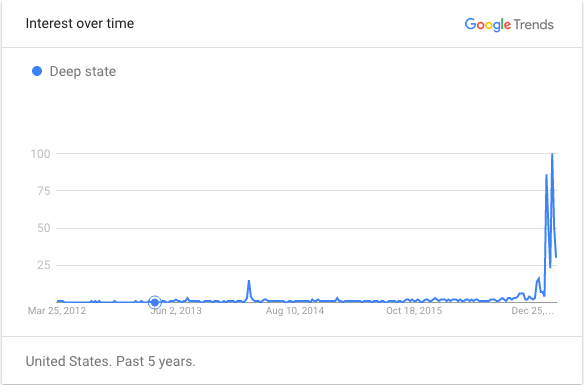
As this chart from Google Trends illustrates, interest in the Deep State has increased dramatically in 2017. The term/topic has clearly moved from the specialist realm to the mainstream. I’ve been writing about the Deep State, and specifically, the fractures in the Deep State, for years.

Amusingly, now that “Progressives” have prostituted themselves to the Security Agencies and the Neocons/Neoliberals, they are busy denying the Deep State exists. For example, There is No Deep State (The New Yorker).

In this risible view, there is no Deep State “conspiracy” (the media’s favorite term of dismissal/ridicule), just a bunch of “good German” bureaucrats industriously doing the Empire’s essential work of undermining democracies that happen not to prostrate themselves at the feet of the Empire, murdering various civilians via drone strikes, surveilling the U.S. populace, planting bugs in new iPhones, issuing fake news while denouncing anything that questions the dominant narratives as “fake news,” arranging sweetheart deals with dictators and corporations, and so on.

The New Yorker is right about one thing–the Deep State is not a “conspiracy:” it is a vast machine of control that is largely impervious to the views or demands of elected representatives or the American people. The key to understanding this social-political-economic control is to grasp that control of the narratives, expertise and authority is control of everything. Allow me to illustrate how this works.

The typical politician has a busy daily schedule of speaking at the National Motherhood and Apple Pie Day celebration, listening to the “concerns” of important corporate constituents, attending a lunch campaign fundraiser, meeting with lobbyists and party committees, being briefed by senior staff, and so on.

Senior administrators share similarly crowded schedules, minus the fundraising but adding budget meetings, reviewing employee complaints and multiple meetings with senior managers and working groups.

Both senior elected officials and senior state administrators must rely on narratives, expertise and authority because they have insufficient time and experience to do original research and assessment.

Narratives create an instant context that “makes sense” of various data points and events. Narratives distill causal factors into an explanatory story with an implicit teleology–because of this and that, the future will be thus and so.

For example: because Iraq has weapons of mass destruction (WMD), the future promises the terrible likelihood (more than a possibility, given Iraqi deployment of poison gas in the Iraq-Iran War) that America or its allies will be devastated by Iraqi weapons of mass destruction. This teleology leads to the inescapable need to eliminate Iraq’s weapons of mass destruction by any means necessary, and remove the political will to use them by removing Iraq’s leader from power.

Politicos and senior administrators rely on expertise and authority as the basis of deciding whether something is accurate and actionable. Professional specialists are assumed to have the highest available levels of expertise, and their position in institutions that embody the highest authority give their conclusions the additional weight of being authoritative. The experts’ conclusion doesn’t just carry the weight of expertise, it has been reviewed by senior officials of the institution, and so it also carries the weight of institutional authority.

So when the C.I.A. briefing by its experts claims Iraq has WMD, and the briefing includes various threads of evidence that the institution declares definitive, who is a non-expert to challenge this conclusion and teleology? On what technical basis does the skeptic reject the expertise and authority of the institution?

We can now define the Deep State with some precision. The Deep State is fundamentally the public-private centralized nodes that collect, archive and curate dominant narratives and their supporting evidence, and disseminate these narratives (and their implicit teleologies) to the public via the media and to the state agencies via formal and informal inter-departmental communication channels.

By gaining control of the narratives, evidence, curation and teleology, each node concentrates power. the power to edit out whatever bits contradict the dominant narrative is the source of power, for once the contradictory evidence is buried or expunged, it ceases to exist.

For example, the contradictory evidence in the Pentagon Papers was buried by being declared Top Secret. The bureaucratic means to bury skeptical (i.e. heretical) views or evidence are many. Sending the authors to figurative Siberia is remarkably effective, as is burying the heretical claims in a veritable mountain of data that few if any will ever survey.

Curation is a critical factor in maintaining control of the narrative and thus of control; the evidence is constantly curated to best support the chosen narrative which in turn supports the desired teleology, which then sets the agenda and the end-game.

The senior apparatchiks of the old Soviet Union were masters of curation; when a Soviet leader fell from favor, he was literally excised from the picture–his image was erased from photos.

This is how narratives are adjusted to better fit the evidence. Thus the accusation that “the Russians hacked our election” has been tabled because it simply doesn’t align with any plausible evidence. That narrative has been replaced with variants, such as “the Russians hacked the Democratic National Committee.” Now that this claim has also been shown to be false, new variants are popping up weekly, with equally poor alignment with evidence.

The primary claim of each Deep State node is that its expertise and authority cannot be questioned. In other words, while the dominant narrative can be questioned (but only cursorily, of course), the expertise and authority of the institutional node cannot be questioned.

This is why the Deep State is fracturing: the expertise and authority of its nodes are delaminating because its narratives no longer align with the evidence. If various Security Agencies sign off on the narrative that “Russia hacked our election” (a nonsense claim from the start, given the absurd imprecision of the “hacking”–hacking into what? Voting machines? Electoral tallies?), and that narrative is evidence-free and fact-free, i.e. false, then the expertise and authority of those agencies comes into legitimate question.

Once the legitimacy of the expertise and authority is questioned, control of the narrative is imperiled. The control of the narrative is control of the teleology, the agenda and the end-game–in other words, everything. If the institution loses control of the dominant narrative, it loses its hold on power.

This is why the Deep State is in turmoil–its narratives no longer make sense, or are in direct conflict with other nodes’ narratives or have been delegitimized by widening gaps between “definitive” claims and actual evidence.

There is indeed a Deep State, but its control of dominant narratives, and thus its source of control and power, is crumbling. The gap between the narratives and the evidence that supports them has widened to the point of collapse.


Snow, Death, and the Bewildered Herd

By Edward Curtin

Source: Behind the Curtain

Few people at this hour – and I refer to the time before the breaking out of this most grim war, which is coming to birth so strangely, as if it did not want to be born – few, I say, these days still enjoy that tranquility which permits one to choose the truth, to abstract one in reflection.  Almost all the world is in tumult, is beside itself, and when man is beside himself he loses his most essential attribute: the possibility of meditating, or withdrawing into himself to come to terms with himself and define what it is he believes and what it is that he does not believe; what he truly esteems and what he truly detests.  Being beside himself bemuses him, blinds him, forces him to act mechanically in a frenetic somnambulism.

-Ortega Y Gasset “The Self and the Other”

As I write these words, the house is being buried in a snowstorm. Heavy flakes fall slowly and silently as a contemplative peace muffles the frenetic agitation and speed of a world gone mad. A beautiful gift like this has no price, though there are those who would like to set one, as they do on everything.  In my mind’s eye I see Boris Pasternak’s Yurii Zhivago, sitting in the penumbra of an oil lamp in the snowy night stillness of Varykino, scratching out his poems in a state of inspired possession.  Outside the wolves howl. Inside the bedroom, his doomed lover, Lara, and her daughter sleep peacefully.  The wolves are always howling.

Then my mind’s lamp flickers, and Ignacio Silone’s rebel character, Pietro Spina (from the novel Bread and Wine) appears.  He is deep into heavy snow as he flees the Italian fascists by hiking into the mountains. There, too, howl the wolves, the omnipresent wolves, as the solitary rebel – the man who said “No” – slowly trudges in a meditative silence, disguised as a priest.

Images like these, apparitions of literary characters who never existed outside the imagination, might at first seem eccentric. But they appear to me because they are, like the silent snow that falls outside, evocative reminders of our need to stop the howling media streams long enough to set our minds on essential truths, to think and meditate on our fates – the fate of the earth and our individual fates. To resist the forces of death we need to concentrate, and that requires slow silence in solitude.  That is why the world’s archetypal arch-enemy, Mr. Death himself, aka Satan, aka Screwtape, advises his disciple Wormwood in C. S. Lewis’s The Screwtape Letters to befuddle people against the aberration of logic by keeping them distracted with contradictory, non-stop news reports. He tells him that “Your business is to fix his attention on the stream.  Teach him to call it ‘real life’ and don’t let him ask what he means by ‘real.’ “

It is a commonplace to say that we are being buried in continuous and never-ending information. Yet it is true.  We are being snowed by this torrent of indigestible “news,” and it’s not new, just vastly increased in the last twenty-five years or so.

Writing fifty-eight years ago, C. Wright Mills argued:

It is not only information they need – in the Age of Fact, information often dominates their attention and overwhelms their capacities to assimilate it….What they need…is a quality of mind that will help them to use information and to develop reason in order to achieve lucid summations of what is going on in the world and of what may be happening within themselves….what may be called the sociological imagination.

Today, as we speed down the information superhighway, Mills’s words are truer than ever.  But how to develop an imagination suffused with reason to arrive at lucid summations?  Is it possible now that “the information bomb” (attributed to Einstein) has fallen?

Albert Camus once said that “at any street corner the feeling of absurdity can strike any man in the face.”  While that is still true today, I would add that the feeling of an agitated and distracted bewilderment is everywhere to be seen as multitudes scan their idiot boxes for the latest revelations. Beeping and peeping, they momentarily quell their nervous anxieties by being informed and simulating proximity through the ether. Permanently busy in their mediated “reality,” they watch as streaming data are instantly succeeded by streaming data in acts of digital dementia. For Camus the absurd was a starting point for a freer world of rebellion. For Walter Lippman, the influential journalist and adviser to presidents and potentates, “the bewildered herd” – his name for regular people, the 99 % – was a beginning and a wished for end. His elites, the 1 %, would bewilder the herd in order to control them. His wish has come true.

A surfeit of information, fundamental to modern propaganda, prevents people from forming considered judgments.  It paralyzes them. Jacques Ellul writes in Propaganda:

Continuous propaganda exceeds the individual’s capacity for attention or adaptations. This trait of continuity explains why propaganda can indulge in sudden twists and turns.  It is always surprising that the content of propaganda can be so inconsistent that it can approve today what it condemned yesterday.

Coherence and unity in claims aren’t necessary; contradictions work just as well.  And the more the better: more contradictions, more consistency, more complementarity – just make it more.  The system demands more.  The informed citizen craves more; craves it faster and faster as the data become dada, an absurdist joke on logical thinking.

Wherever you go in the United States these days, you sense a generalized panic and an inability to slow down and focus.  Depression, anxiety, hopelessness fill the air.  Most people sense that something is seriously wrong, but don’t know exactly what. So they rage and rant and scurry along in a frenzy. It seems so huge, so everything, so indescribable.  Minds like pointilliste canvases with thousands of data dots and no connections.

In the mid-1990s, when the electronic world of computers and the internet were being shoved down our throats by a consortium of national security state and computer company operatives (gladly swallowed then by many and now resulting in today’s total surveillance state), I became a member of The Lead Pencil Club foundered by Bill Henderson (The Pushcart Press) in honor of Thoreau’s father’s pencil factory and meant as a whimsical protest: “a pothole on the information superhighway.”  There were perhaps 37 1/3 members worldwide, no membership roll, and no dues – just a commitment to use pencils to write and think slowly.

“Why should we live with such hurry and waste of life?” Thoreau asked.  “We are determined to be starved before we are hungry.”

So I am writing these words with a pencil, an object, to paraphrase Walter Benjamin, which haunts our present electronic world by being a ruin of the past.  It is not a question of nostalgia, for we are not returning to our lost homes, despite a repressed urge for simpler times. But the pencil is an object that stands as a warning of the technological hubris that has pushed our home on earth to the brink of nuclear extinction and made mush of people’s minds in grasping the reasons why.

I think of John Berger, the great writer on art and life, as I write, erase, cross out, rewrite – roll the words over and look at them, consider them.  Berger who wrote: “Writing is an off-shoot of something deeper”; that “most mainstream political discourse today is composed of words that, separated from any creature of language, are inert….dead ‘word-mongering’ [that] wipes out memory and breeds a ruthless complacency.”

The pencil is not a fetish; it is a reminder to make haste slowly, to hear and feel my thinking on the paper, to honor the sacredness of what Berger calls the “confabulation” between words and their meaning.  I smell the pencil’s wood, the tree of life, its slow ascent, rooted in the earth, the earth our home, our beginning and our end.

Imagining our ends, while always hard, has become much harder in modern times in western industrialized nations, especially the United States that reigns death down on the rest of the world while pretending it is immortal and immune from the nuclear weapons it brandishes. Yet the need to do so has become more important. When in 1939 Ortega y Gasset warned in the epigraph of a most grim war coming to birth so strangely, as people acted “mechanically in a frenetic somnambulism,” he was writing before nuclear weapons, the ultimate technology. If today we cannot imagine our individual deaths, how can we imagine the death of the earth? In a 1944 newspaper column George Orwell made an astute observation: “I would say that the decay of the belief in personal immortality has been as important as the rise of machine civilization.” He connected this growing disbelief to the modern cult of power worship.  “I do not want the belief in life after death to return,” he added, “and in any case it is not likely to return.  What I do point out is that its disappearance has left a big hole, and that we ought to take notice of that fact.”

I think that one reason we have not taken notice of this fact of the presence of a huge absence (not to say whether this disbelief is “true”) is the internet of speed, celebrated and foreseen by the grandmaster of electronic wizardry and obscurantic celebrator of retribalized man, Marshall McLuhan, who called the electronic media our gods whom we must serve and who argued that the extensions of human faculties through media would bring about abstract persons who would wear their brains outside their skulls and who would need an external conscience. Shall we say robots on fast forward?

Once the human body is reduced to a machine and human intercourse accepted as a “mediated reality” through so-called smart devices, we know – or should – that we are in big trouble.  John Ralston Saul, a keen observer of the way we live now, mimics George Carlin by saying, “If Marx were functioning today, he would have been hard put to avoid saying that imaginary sex is the opiate of the people.”

Saul is also one of the few thinkers to follow-up on Orwell’s point.  “Inexplicable violence is almost always the sign of deep fears being released and there can be no deeper fear than mortality unchained.  With the disappearance of faith and the evaporation of all magic from the image, man’s fear of mortality has been freed to roam in a manner not seen for two millennia.”  Blind reason, amoral and in the service of expertise and power, has replaced a holistic approach to understanding that includes at its heart art, language, “spirit, appetite, faith and emotion, but also intuition, will and, most important, experience.”  People, he argues, run around today in an inner panic as if they are searching for a lost forgotten truth.

Zygmunt Bauman, the brilliant sociological thinker, is another observer who has noticed the big hole that is staring us in the face.  “The devaluation of immortality,” he writes, “cannot but augur a cultural upheaval, arguably the most decisive turning point in human cultural history.”  He too connects our refusal in the west to contemplate this fact to the constant busyness and perpetual rushed sense of emergency engendered by the electronic media with its streaming information.  To this end he quotes Nicole Aubert:

Permanent busyness, with one emergency following another, gives the security of a full life or a ‘successful career’, sole proofs of self-assertion in a world from which all references to the ‘beyond’ are absent, and where existence, with its finitude, is the only certainty…When they take action people think short-term – of things to be done immediately or in the very near future…All too often, action is only an escape from the self, a remedy from the anguish.

McLuhan’s abstract persons, who rush through the grey magic of electronic lives where flesh and blood don’t exist, not only drown in excessive data that they can’t understand, but drift through a world of ghostly images where “selves” with nothing at the core flit to and fro. Style, no substance.  Perspective, no person.  Life, having passed from humans to things and the images of things, reduced and reified.  Nothing is clear, the images come and go, fact and fiction blend, myth and history coalesce, time and space collapse in a collage of confusion, surfaces appear as depths, the person becomes a perspective, a perspective becomes a mirror, a mirror reflects an image, and the individual is left dazed and lost, wondering what world he is in and what personality he should don. In McLuhan’s electronic paradise that is ours, people don’t live or die, people just float through the ether and pass away, as do the victims of America’s non-stop wars of aggression simply evaporate as statistics that float down the stream, while the delusional believe the world will bloodlessly evaporate in a nuclear war that they can’t imagine coming and won’t see gone. Who in this flow can hear the words of Federico Garcia Lorca: “Beneath all the totals, a river of warm blood/A river that goes singing/past the bedrooms…”?

If you shower the public with the thousands of items that occur in the course of a day or a week, the average person, even if he tries hard, will simply retain thousands of items which mean nothing to him.  He would need a remarkable memory to tie some event to another that happened three weeks or three months ago….To obtain a rounded picture one would have to do research, but the average person has neither the desire or time for it.  As a result, he finds himself in a kind of kaleidoscope in which thousands of unconnected images follow each other rapidly….To the average man who tries to keep informed, a world emerges that is astonishingly incoherent, absurd, and irrational, which changes rapidly and constantly for reasons he cannot understand.

Jaques Ellul wrote that in 1965. Lucid summations are surely needed now.

Here’s one from Roberto Calasso from The Forty-Nine Steps: “The new society is an agnostic theocracy based on nihilism.”

Anyone who sits silently and does a modicum of research while honestly contemplating the current world situation will have no trouble in noticing that there is one country in the world – the U.S.A. – that has used nuclear weapons, is modernizing its vast obscene arsenal, and has announced that it will use it as a first strike weapon. A quick glance at a map will reveal the positioning of U.S. NATO troops and weapons right up to Russia’s borders and the aggressive movement of U.S. forces close to China.  Hiroshima and Nagasaki make no difference.  The fate of the earth makes no difference. Nothing makes a difference. Obama started this aggressiveness, but will this change under Trump?  That’s very unlikely. We are talking about puppets for the potentates. It’s easy to note that the U.S. has 1,000,000 troops stationed in 175 countries because they advertise that during college basketball games, and of course you know of all the countries upon which the U.S. is raining down death and destruction in the name of peace and freedom.  That’s all you need to know.  Meditate on that and that hole that has opened up in western culture, and perhaps in your heart.

“If you are acquainted with the principle,” wrote Thoreau, “what do you care for myriad instances and applications?”  Simplify, simplify, simplify.

But you may prefer complexity, following the stream.

The snow is still falling, night has descended, and the roads are impassable.  The beautiful snow has stopped us in our tracks. Tomorrow we can resume our frantic movements, but for now we must simply stay put and wonder.

Eugene Ionesco, known for his absurdist plays, including Rhinoceros, puts it thus:

In all the cities of the world, it is the same.  The universal and modern man is the man in a rush (i.e. a rhinoceros), a man who has no time, who is a prisoner of necessity, who cannot understand that a thing might be without usefulness; nor does he understand that, at bottom, it is the useful that may be a useless and back-breaking burden.  If one does not understand the usefulness of the useless and the uselessness of the useful, one cannot understand art.  And a country where art is not understood is a country of slaves and robots.

Ionesco emphasized the literal insanity of everyday life, comparing people to rhinoceroses that think and act with a herd mentality because they are afraid of the solitude and slowness necessary for lucid thought. They rush at everything with their horns.  Behind this lies the fear of freedom, whose inner core is the fear of death.  Doing nothing means being nothing, so being busy means being someone.  And today being busy means being “plugged into the stream” of information meant to confound, which it does.

I return to the artist Pasternak, since the snowy night can’t keep me away. Or has he returned to me? I hear Yurii Zhivago’s uncle Nikolai speaking:

Only individuals seek the truth, and they shun those whose sole concern is not the truth.  How many things in the world deserve our loyalty?  Very few indeed.  I think one should be loyal to immortality, which is another word for life, a stronger word for it ….What you don’t understand is that it is possible to be an atheist, it is possible to not know whether God exists, or why, and yet believe that man does not live in a state of nature but in history….Now what is history?  It is the centuries of systematic explorations of the riddle of death, with a view to overcoming death. That’s why people discover mathematical infinity and electromagnetic waves, that’s why they write symphonies.  Now, you can’t advance in this direction without a certain faith.  You can’t make such discoveries without spiritual equipment.  And the basic elements of this equipment are in the Gospels.  What are they?  To begin with, love of one’s neighbor, which is the supreme form of vital energy.  Once it fills the heart of man it has to overflow and spend itself.  And then the two basic ideals of modern man – without them he is unthinkable – the idea of free personality and the idea of life as sacrifice.  Mind you, all of this is still extraordinarily new….Man does not die in a ditch like a dog – but at home in history, while the work toward the conquest of death is in full swing; he dies sharing in this work.  Ouf!  I got quite worked up, didn’t I?  But I might as well be talking to a blank wall.

I look outside and see the snow has stopped.  It is time to sleep.  Early tomorrow the plows will grind up the roads and the rush will ensue.  Usefulness will flow.

But for now the night is beautiful and slow. A work of art.

The U.S. Deep State Rules – On Behalf of the Ruling Class

By Glen Ford

Source: Black Agenda Report

“The U.S. Deep State is unlike any other, in that there is no other global superpower bent on world domination.”

The Deep State is busy denying that it exists, even as it savages a sitting president and brutally bitch-slaps its host society, demanding the nation embrace its role as global psycho thug and kick some Russian ass. The New York Times, always available to divert attention from the essential facts of who rules America, points to Egypt, Turkey and Pakistan as the natural habitats of Deep States. Apparently, Deep State-infected countries tend to be nations with majority Muslim populations, whose military-intelligence apparatus hovers over society and periodically seizes control of the civil government.

The Times quoted high-ranking operatives of the Deep State to prove that such structures are alien to the U.S. Michael V. Hayden, who ran the CIA under Democratic President Obama and Republican George Bush, recoiled at the term. He “would never use” the words Deep State in connection with his own country. “That’s a phrase we’ve used for Turkey and other countries like that, but not the American republic.”

Loren DeJonge Schulman, a former Obama National Security Council official, claimed to be repelled by the very idea of an American Deep State. “A deep state, when you’re talking about Turkey or Egypt or other countries, that’s part of government or people outside of government that are literally controlling the direction of the country no matter who’s actually in charge, and probably engaging in murder and other corrupt practices,” she said.

Apparently, Ms. Schulman did not consider it murder when Obama and his top national security advisors met every Tuesday at the White House to decide who would be assassinated by drone or other means. But she is “shocked” to hear “that kind of [Deep State-phobic] thinking from” President Trump “or the people closest to him.”

Once the Times had located the nexus of Deep Statism in the Muslim world, the lesser lights at The New Yorker endorsed the corporate media consensus that the U.S. is Deep State-free. Staff writer David Remnick admits that U.S. presidents “have felt resistance, or worse, from elements in the federal bureaucracies,” citing Eisenhower’s warnings against the military-industrial complex, Lyndon Johnson’s “pressure from the Pentagon,” and the “rebuke” of Obama’s Syria policy through the State Department’s “dissent channel.” However, he denies that any “subterranean web of common and nefarious purpose” threatens the orderly and transparent processes of the U.S. political system.

In reality, the U.S. Deep State is by far the world’s biggest and most dangerous version of the phenomenon; a monstrous and not-so subterranean “web of common and nefarious purpose” that is, by definition, truly global, since its goal is to rule the planet. Indeed, the Deep States of Turkey, Egypt and Pakistan — all nominal U.S. allies – are midgets in comparison and must operate in a global environment dominated by Washington’s Deep State apparatus. So vast is the imperial Deep State, that its counterparts in other nations exist largely to collaborate with, resist, or keep tabs on the U.S. behemoth, the predator that seeks to devour all the rest.

What is a Deep State? The U.S. Deep State is unlike any other, in that there is no other global superpower bent on world domination. (Washington’s political posture is also unique; no other nation claims to be “exceptional” and “indispensable” and thus not subject to the constraints of international law and custom.) Indeed, the U.S. is so proudly and publicly imperialist that much of what should be secret information about U.S. military and other capabilities is routinely fed to the world press, such as the 2011 announcement that the U.S. now has a missile that can hit any target on the planet in 30 minutes, part of the Army’s “Prompt Global Strike” program. Frightening the rest of the world into submission — a form of global terrorism — is U.S. public policy.

However, arming and training Islamic jihadist terrorists to subvert internationally recognized governments targeted by the U.S. for regime change is more than your usual variety of covert warfare: It is a policy that must forever be kept secret, because U.S. society would suffer a political breakdown if the facts of U.S. and Saudi nurturing of the international jihadist network were ever fully exposed. This is Deep State stuff of the highest order. The true nature of U.S. foreign policy in the 21st century, and the real character of the current wars in Syria and Iraq, must be hidden from the U.S. public at all cost. An alternative reality must be presented, through daily collaboration between corporate media, corporate universities, and the public and covert organs of the U.S. State.

What part of the New York Times coverage of the war against Syria is a lie? Damn near all of it. What role does the Deep State play in crafting the lies dutifully promulgated by the corporate media? That’s impossible to answer, because the Deep State is a network of relationships, not a clearly delineated zone or space or set of organizations. The best way to describe the imperial Deep State is: those individuals and institutions that are tasked with establishing the global supremacy of the corporate ruling class. Such activities must be masked, since they clash with the ideological position of the ruling class, which is that the bourgeois electoral system of the United States is the world’s freest and fairest. The official line is that the U.S. State is a work of near-perfection, with checks and balances that prevent any class, group or section from domination over the other. The truth is that an oligarchy rules, and makes war on whomever it chooses — internationally and domestically — for the benefit of corporate capital.

The Deep State and its corporate imperatives manifestly exists when corporate lobbyists and lawyers are allowed to draw up the Trans Pacific Partnership global “trade” agreement, but the contents are kept secret from the Congresspersons whose duty is to vote on the measure. The Deep State is where corporate power achieves its class aims outside the public processes of government. It’s where the most vicious class warfare takes place, whether on a foreign killing field, or in the corporate newsroom that erases or misrepresents what happened on that battlefield.

At this stage of capitalism, the U.S. ruling class has less and less use for the conventional operations of the bourgeois state. It cannot govern in the old way. More and more, it seeks to shape events through the levers of the collaborating networks of the Deep State. It’s number one global priority is to continue the military offensive begun in 2011, and to break Russia’s resolve to resist that offensive. The ruling class and its War Party, now consolidated within the Democratic Party and regrouping among Republicans, have effectively neutralized a sitting president whose party controls both Houses of Congress, less than two months into his term.

Only a Deep State could pull that off.


BAR executive editor Glen Ford can be contacted at Glen.Ford@BlackAgendaReport.com.

Glen Ford’s blog

The Democrats’ Dangerous Diversion

By Nicolas J S Davies

Source: Consortium News

The current debate over “fake news” has reminded me of a conversation I had several years ago with a former citizen of East Germany, now living in the United States. He explained that, in East Germany, everybody knew that what the media told them about their own country was a bunch of lies and propaganda. So they assumed that what the media told them about the West was just propaganda, too.

Now living in the U.S., he had come to realize that a lot of what the East German media said about life in the U.S. was actually true. There really are people living on the street, people with no access to healthcare, widespread poverty, a lack of social welfare and public services, and many other problems, as the East German media accurately reported, and as the Chinese government also noted in its latest report on human rights in the U.S.

My friend wished he and his countrymen had understood the difference between what their media told them about their country and what they reported about the West. Then they could have made more intelligent choices about which aspects of life in the West to adopt, instead of allowing Western experts to come in and impose the entire neoliberal model on their country.

In the West, of course, the state media of East Germany and other Communist countries were held up to ridicule. I remember hearing that people in the U.S.S.R. would open their newspapers in the morning and have a good laugh at the latest “fake news” in Pravda. But, as my German friend eventually understood, there was some truth amongst the propaganda, and the hidden danger of such a corrupted media system is that people end up not knowing what to believe, making informed democratic choices almost impossible.

In the end, people all over Eastern Europe were cornered into a false choice between two ideological systems that both came as top-down package deals, instead of being able to take charge of their own societies and democratically decide their own future.

In the U.S., we live under a two-party political system, not a one-party system as in East Germany, and our media reflect that. As each of our two main political parties and our media have fallen more totally under the sway of unbridled plutocratic interests, our mass media has devolved into a bifurcated version of what my friend observed in East Germany, triply corrupted by commercial interests, partisan bias and ideological and nationalist propaganda.

Down the Rabbit Hole 

Since the 2016 election campaign, our political system seems to have devolved into something like the nonsense world of Lewis Carroll’s Alice In Wonderland, with Donald Trump as the Queen of Hearts, Hillary Clinton as Humpty Dumpty, the Republicans and Democrats as Tweedledum and Tweedledee, the election as the Caucus Race (which Lewis Carroll based on U.S. political caucuses) and the whipsawed American public as the permanently baffled Alice.

In Lewis Carroll’s Caucus Race, an assortment of creatures ran randomly around a racetrack with no start or finish line, until the Dodo called the race over, declared them all winners and told Alice (the public?) she had to give them all prizes.

In similar fashion, the 2016 election between two of the most unpopular presidential candidates in U.S. history seems to have no finish line, but to live on in round-the-clock campaigns to corral the public into one of its two camps. The artificial, top-down nature of both these campaigns should be a warning that, like the election campaigns they grew out of, they are designed to corral, control and direct masses of people, not to offer real solutions to any of the serious problems facing our country and the world.

On one hand, we have President Trump, Republican Congressional leaders, Breitbart, Fox News and Rush Limbaugh, spouting nonsense worthy of Lewis Carroll, even in major presidential speeches, while dismissing criticism as “fake news.”

The Trump camp will never acknowledge that only a quarter of voting-age Americans voted for him, nor that even less of us share his views or the interests he represents. In this corrupt two-party system, no effort or expense is spared to persuade the public that we must vote for one of the two major party presidential candidates, whether we agree with either of them or not. But that cuts both ways, leaving most of the public unrepresented no matter who wins, and depriving any new government of a genuine popular mandate.

But Republican leaders play a more straightforward winner-take-all game than the Democrats. So they will try to ride Trump’s victory and their Congressional majorities as far as they will take them on all fronts: more tax breaks for the wealthy and corporations; more draconian cuts in social spending; more privatization of healthcare, education and other public services; more detention and deportation of immigrants; a more aggressive police response to social problems and public protest; more destruction of the natural world and the climate; and more increases in a military budget that already broke post-WWII records under Bush and Obama, to fuel a more openly aggressive and dangerous war policy – in other words, more of all the things that most Americans would agree we have already had too much of.

On the other side, Democratic Party leaders and the CIA, supported by the New York Times, the Washington Post, CNN and MSNBC, have conjured up unproven charges that Russia stole the election for Trump as the heart of their campaign against him. In Trump, history has handed them a political opponent with a piñata of vulnerabilities, from unprecedented conflicts of interest to policies that benefit only his own wealthy class to willful ignorance of how almost everything he is responsible for as president really works.

And yet the cabal formerly known as the Clinton campaign shows little interest in pointing out that our new Emperor has no clothes on, let alone in seriously resisting his repressive, plutocratic policies, and is instead obsessed with convincing the public that a birthmark on his naked bum looks like a hammer and sickle.

A Saving Grace?

Paradoxically, if Trump really reduced tensions between the U.S. and Russia, as his hawkish Democratic opponents fear, that could be the saving grace of his entire presidency. George W. Bush’s and Barack Obama’s regime change wars, NATO expansion and the U.S.-backed coup in Ukraine have ignited a new Cold War that many respected scientists believe has raised the risk of human mass extinction to its highest level since the 1950s.

In the pursuit of false security based on post-Cold War triumphalism and a fleeting mirage of military supremacy, our corrupt leaders have jeopardized not just our security but our very existence, leaving us at two and a half minutes to midnight on the Bulletin of the Atomic Scientists (BAS)Doomsday Clock.

As Jonathan Marshall at Consortiumnews.com reported on March 10, experts from the Federation of American Scientists, the Natural Resources Defense Council and MIT wrote in a recent BAS article that new “super-fuzes” installed on U.S. nuclear warheads since 2009 have significantly increased the danger of nuclear war by giving the U.S. the ability to destroy all Russia’s fixed land-based nuclear missiles with only a fraction of U.S. own weapons.

Coupled with President Obama’s deployment of a formerly illegal ABM (anti-ballistic missile) system on Aegis missile destroyers and at bases in Eastern Europe, the authors wrote that this upgrade to U.S. nuclear warheads is “exactly what one would expect to see if a nuclear-armed state were planning to have the capacity to fight and win a nuclear war by disarming enemies with a surprise first strike.” They concluded that “Russian planners will almost surely see the advance in fuzing capability as empowering an increasingly feasible U.S. preemptive nuclear strike capability.”

In the case of a suspected Russian nuclear missile launch, the U.S. satellite-based early warning system can give President Trump 30 minutes to judge whether we are really facing a nuclear attack or not. But Russia’s land-based early warning system is not so generous. In the case of a suspected U.S. nuclear launch targeting Russia, President Putin would have as little as 7 to 13 minutes to decide whether Russia was really under nuclear attack and whether to retaliate.

In the midst of escalating tensions over Syria, Ukraine, Iran or some other new crisis, a realistic fear of a U.S. first strike could force a hasty decision by Russian officials and seal the fate of humanity. The BAS authors believe that this predicament leaves Russia little choice but to pre-delegate its nuclear launch authority to lower levels of command, increasing the risk of an accidental or mistaken launch of nuclear weapons.

In an epitome of understatement, they point out that, “Forcing this situation upon the Russian government seems likely to be detrimental to the security interests of the United States and its Western allies.”

While U.S. officials are largely silent about the dangers of these developments in U.S. nuclear weapons policy, President Putin has spoken frankly about them and expressed dismay that the U.S. has rejected every Russian offer of cooperation to reduce these risks. Talking to a group of journalists at the St. Petersburg International Economic Forum in June 2016, he concluded, “I don’t know how this is all going to end. … What I do know is that we will need to defend ourselves.”

But despite the existential dangers of deteriorating relations with Russia, Democratic Party leaders have grasped the CIA’s unproven “assessments” that Russia may have tried to influence the outcome of the U.S. election as a lifeline by which to salvage their positions of power after their party’s electoral implosion.

Since the leadership of the Democratic Party was taken over by the corporate-backed Democratic Leadership Council (DLC) a generation ago, it has followed an unwritten rule that it must never accept responsibility for losing an election, nor respond to signs of public disaffection with any weakening of its commitment to pro-corporate, neoliberal policies. In its desperation to prevent the democratic reform of the Democratic Party, it is aggressively tarring nuclear-armed Russia with the same brush it used to tar and feather Ralph Nader after the 2000 election.

The mortal aversion of Democratic Party leaders to progressive reform suggests that they prize their own control of the party even above winning elections, the rational purpose of any political party. Their ugly smear campaign against Keith Ellison, the progressive candidate for Democratic National Committee (DNC) chair, mirrored the DNC’s corrupt campaign to undermine Sen. Bernie Sanders in the Democratic primaries and the DLC cabal’s bare-knuckles response to progressive challengers for the past 30 years.

For the DLC Democrats to snatch defeat from the jaws of the long-term victory that the country’s shifting demographics seem to guarantee their party requires a truly historic level of corruption.

Their unshakable commitment to fight tooth and nail for the interests of their wealthy campaign contributors over those of poorer, younger and darker-skinned voters in every election, every national, state and local party committee and on every issue, even as they pretend they are doing the exact opposite, could only be a viable political strategy in Lewis Carroll’s Wonderland. In the real world, their demonstrated disdain for the people from whose votes they derive their power is a strategy for political suicide.

Different Kind of Politics

These corrupt party leaders and their corporate media cheerleaders dare not remind us that Bernie Sanders’s candidacy for president inspired more enthusiasm and drew bigger crowds than Trump’s or Clinton’s, despite one eightieth of the early media promotion lavished on Trump by some corporate media and the fact that almost the entire Democratic Party establishment lined up against him.

For decades, DLC Democrats have run on vague messages about “values” to avoid being cornered into explicit progressive policy positions that might alienate their wealthy patrons. Sanders was greeted with open arms by younger voters ready for a renaissance of real politics based on actual policies that solve real problems, like universal healthcare, free college tuition, progressive taxation to pay for it all and a more cautious approach to U.S.-backed “regime change” in other countries.

By contrast, an analysis of campaign messaging by the Wesleyan Media Project found that “Clinton’s message was devoid of policy discussions” when compared to other recent presidential campaigns, including even Trump’s, and that this was a critical factor in her failure.

According to opinion polls, Bernie Sanders may now be the most popular politician in America. Polls consistently showed that Sanders was likely to beat Trump in the general election if the Democratic Party allowed him to get that far, but the DNC fundraising machine pulled out every trick in the book to make sure that didn’t happen. If truth be told, Sanders’s success was probably a more accurate reflection of the evolving political views of a majority of Americans in 2016 than the billion-dollar auction of the presidency between the Game Show King and the Queen of Chaos.

These two camps represent factions of the powerful interests that have controlled American politics for decades, from the military-industrial complex and the CIA to the dirty energy and for-profit “healthcare” industries, to say nothing of the commercial media industry itself, which covered this election all the way to the bank and for whom the show must go on and on and on … and on.

Lies of Both Sides.

Like the people of East Germany in the 1980s, we now face the challenge of a society in crisis, compounded by a treacherous media environment, with not just one, but two competing camps presenting us with false, self-serving interpretations of the multi-faceted crisis their corruption has spawned. While they compete for our trust, they share a common interest in insisting that one of the two mythological worldviews they have staked out must be right.

But as Cornel West recently told the students at my local high school in Miami in a Black History Month speech, “You don’t have to choose between the lies on one side and the lies on the other side.” So the question becomes where to turn for something other than lies, and how to recognize the truth when we stumble across it.

The paradox of our Internet age is that we nearly all have access to a wider range of media than ever before, yet we are still exposed and susceptible to corporate, partisan and ideological propaganda. In theory, we no longer have to be victims of for-profit media whose business models prioritize their profits over their duty to inform the public. But in reality, we do not form our views of the world as independently as we think we do.

This is easier to grasp in the case of commercial advertising than in the arena of political or ideological indoctrination. There is a well-known dictum in the business world that goes, “I know that half the money we spend on advertising is wasted. I just don’t know which half.” The flip-side of this is that the other half is not wasted.

So the advertising industry in the United States spends $220 billion per year, $700 for each man, woman and child in the country, to sell us products and services. And yet we still like to think that we make independent, rational choices about our spending, based on enlightened self-interest and cultivated tastes, not on the work of copywriters churning out pitches, images and jingles in ad agency cubicles.

One of the by-products of the mass monetization of American politics since the 1980s is that politics has become a profitable new arena for advertising, marketing and public relations firms. Its practitioners apply the techniques and experience they’ve developed in other areas to the world of politics, helping politicians and parties to convert the money they raise from wealthy campaign contributors into votes, and ultimately into power over all our lives. So we should be just as wary of political marketing and advertising as of the commercial variety. We should also be more humble in recognizing our own vulnerability to these profitable forms of persuasion and deception.

My copy of Alice in Wonderland has a quotation from James Joyce in the front of the book: “Wipe your glasses with what you know.” What we know is often our best protection against being misled by advertisers, politicians and pundits, if we will only remember what we know and trust it over the misinformation that surrounds us.

“Wiping our glasses with what we know” can provide a reality check on the current Russophobia campaign. We know very well that the U.S. and Russia possess the bulk of the world’s nuclear weapons, and that war between our two countries would likely mean death for ourselves and our families and the end of life as we know it for people everywhere.

We also know that it is our country and its allies, not Russia, that have launched invasions, military occupations, bombing campaigns, coups and drone wars against at least ten countries in the past 20 years, while Russia only recently become engaged in two of these conflict zones when its interests were directly impacted by our actions.

So we can see that the greatest danger in this relationship is not the threat of some unprovoked and unprecedented act of Russian aggression. The more real and serious danger is that a confrontation with Russia over one of the hot spots we have ignited will lead to an escalation of tensions in which a mistake, a misunderstanding, a miscalculation, a bluff called, a “red line” crossed or some other kind of failed brinksmanship will trigger a war that will escalate to the use of nuclear weapons, and from there to Armageddon.

Even with the lines of communication set up after the Cuban missile crisis and the stabilization of the Cold War balance of terror by the principle of Mutually Assured Destruction (MAD), we now know that we came very close to Armageddon many times, including simply by accident.

Instead of being corralled by either side in the “Russia did it” campaign, we should be urging our leaders to sit down and talk seriously with Russia’s leaders, to stop taking dangerous actions that exacerbate tensions, uncertainties and mutual isolation, and to return to serious negotiations to leave our children and grandchildren a peaceful world, free of nuclear weapons, where these dangers will no longer threaten them.

Amid lies and distortions on all sides, the corruption of politics and media by commercial interests and the billion dollars per year our government spends directly on public relations and propaganda, James Joyce’s advice can still serve us well. Make sure to wipe your glasses with what you know as you read or watch “news” from any source or listen to politicians of any party, and we may just find a way out of this rabbit hole before the roof crashes in on us.


Nicolas J S Davies is the author of Blood On Our Hands: the American Invasion and Destruction of Iraq.  He also wrote the chapters on “Obama at War” in Grading the 44th President: a Report Card on Barack Obama’s First Term as a Progressive Leader.

The New Media World Order

By Thierry Meyssan

Source: Voltairenet.org

In only a few months, the content of the Western national and international medias has undergone profound change. We are witnessing the birth of an Entente about which we know almost nothing – neither the real initiators, nor the real objectives – but whose direct anti-democratic consequences can be noticed immediately.

The West is currently going through an unprecedented systemic change – powerful forces are progressively orienting the totality of medias in a single direction. At the same time, the content of the medias is mutating– only last year, they were still logical, and tended towards objectivity. They offered one other mutual contradiction in a spirit of healthy competition. Now they act in gangs, basing their coherence on emotions, and becoming vicious when they are facing people they condemn.

The idea of an Entente between the medias is an extension of the experience of the International Consortium for Investigative Journalism (ICIJ), which does not unite the medias, but only individual journalists. It made itself famous by publishing information stolen from the accounts of two law firms in the British Virgin Islands, and from PricewaterhouseCoopers (PwC), the bank HSBC, and the Panamanian firm Mossack Fonseca. These revelations were mainly used to discredit the Russian and Chinese leaders, but also, once in a while, to shine some light on genuine offences committed by the Westerners. Above all, under the honourable pretext of the struggle against corruption, the violation of the confidentiality of lawyers and banks seriously damaged thousands of their honest clients without any reaction from public opinion.

Over a period of approximately forty years, we have been witnessing the progressive grouping of medias within certain international trusts. Currently, 14 groups share more than two thirds of the western Press (21st Century Fox, Bertelsmann, CBS Corporation, Comcast, Hearst Corporation, Lagardere Group, News Corp, Organizações Globo, Sony, Televisa, The Walt Disney Company, Time Warner, Viacom, Vivendi). From now on, the alliance operated by Google Media Lab and First Draft is forging links between these groups, which already enjoyed a dominant position. The presence in this Entente of the three most important Press agencies on the planet (Associated Press, Agence France-Presse, Reuters) guarantees it hegemonic power. This is without any doubt an «illicit entente», established not with the goal of price-setting, but mind-setting, the imposition of an already dominant thought.

We may have noticed that all the members of the Google Entente – without exception – have already, over the last six years, given unequivocal visions of the events that occurred in the Greater Middle East. And yet there had been no prior agreement between them, or at least, none of which we were aware. It is intriguing to note that five of the six international television channels which participated in the NATO propaganda cell are part of this Entente (Al-Jazeera, BBC, CNN, France24, Sky, but apparently not al-Arabiya).

In the United States, France and Germany, Google and First Draft assembled the medias present locally in the countries concerned, and others present on the international scale, to check the veracity of certain arguments. Besides the fact that we do not know who is hiding behind First Draft, and what political interests may have influenced a commercial company specialised in computer science to finance this initiative, the results achieved have little to do with a return to objectivity.

First of all because the allegations are not chosen for the place they occupy in the public debate, but because they have been quoted by individuals that the media Entente intends to vilify. We might imagine that these verifications enable us to get a little closer to the truth, but that is not the case at all – they reassure the citizen in the idea that the medias are honest, while the people they are condemning are not. This approach is not aimed at better understanding the world, but at beating down the people to be sacrificed.

Next, because an unwritten rule of this media Entente stipulates that only allegations from sources outside the Entente should be checked. The members agree not to use any critical faculty in the mutual appreciation of their work. They agree to reinforce the idea that the world is divided in two – «we» who tell the truth, and «the others» who are liars. This approach is damaging for the principle of pluralism, a precondition for democracy, and opens the way to a totalitarian society. This is not a new phenomenon, because we saw it at work during the coverage of the Arab Springs and the wars against Libya and Syria. But for the first time, it is aimed at a Western line of thought.

Finally, because the allegations that have been qualified as «false» will never be envisaged as errors, but always as lies. The point is to charge the «others» with Machiavellian intentions in order to discredit them. This approach damages the presumption of innocence.

That is why the functioning of the ICIJ and the Entente created by Google and First Draft violates the Munich Charter adopted by the International Federation of Journalists (IFJ) (Title II, articles 2, 4, 5 and 9).

It is no coincidence that certain absurd legal actions have developed against the same targets as those in the sights of the media Entente. In the United States, the Hogan Law has been dragged out for use against the Trump team, despite the fact that this text has never, absolutely never, been applied since its promulgation two centuries ago. And in France, the Jolibois Law has been revived for use against the political tweets of Marine Le Pen, despite the fact that jurisprudence had limited the application of that law to the distribution of a few ultra-pornographic magazines lacking a plastic wrapping. Since the principle of the presumption of innocence for scapegoats has been eradicated, it is now possible to put anyone on trial for any legal pretext. Furthermore, the legal actions mounted against the Trump team and Marine Le Pen, in the name of the laws named above, should also be be brought against a great number of other people – but they are not.

Moreover, citizens no longer react when the media Entente itself broadcasts false allegations. Thus, in the United States, they imagined that the Russian secret services had a compromising dossier on Donald Trump and were blackmailing him. Or, in France, this Entente invented the idea that it is possible to employ a fictitious parliamentary assistant, and went on to accuse François Fillon.

In the United States, the large and small medias which are members of the Entente went after the President. They garnered their own information from the wire-tapping of the Trump team which had been illegally ordered by the Obama administration. They work in coordination with the magistrates, who are using them to block the actions of the present government. This is without doubt a Mafia system.

The same US and French medias are attacking two candidates for the French Presidential election – François Fillon and Marine Le Pen. To the general problem of the media Entente is added the false impression that these targets are victims of a Franco/French conspiracy, whereas in fact, the instigator is a US citizen. The French notice that their medias are rigged, wrongly interpret the conspiracy as being directed against the right wing, and continue erroneously seeking the manipulators in their own country.

In Germany, the Entente is not yet effective, and probably will not be until the general elections.

During Watergate, the medias claimed to represent a «Fourth Estate», after the Executive, the Legislative, and the Judiciary. They affirmed that the Press exercised a function of control over the government in the name of the People. We can ignore for a moment the fact that President Nixon was charged with a similar offense to that of President Obama – bugging his opponent. We know today that the Watergate source, «Deep Throat», far from being a «whistle-blower», was in reality the Director of the FBI, Mark Felt. The treatment of this affair was a battle between a part of the administration and the White House, in which the electors were manipulated by both sides at once.

The idea of a «Fourth Estate» supposes that we recognise the same legitimacy for the 14 corporate trusts which own the great majority of the Western medias as for the citizens. This is to affirm the substitution of an oligarchy for democracy.

The remains one point which needs clarification – how have the targets of the Entente been chosen? The only obvious link between Donald Trump, François Fillon and Marine Le Pen is that all three hope to re-establish contacts with Russia, and fight with her against the breeding ground of jihadism – the Muslim Brotherhood. Although François Fillon was the Prime Minister of the goverment implcated in these events, all three of them represent the train of thought which contests the dominant vision of the Arab Springs and the wars against Libya and against Syria.

Aristocracy Deceives Public about the Deep State

deep_state_gears_1088x725

By Eric Zuesse

Source: Strategic Culture Foundation

The «deep state» is the aristocracy and its agents. Wikispooks defines it as follows:

The deep state (loosely synonymous with the shadow government or permanent government) is in contrast to the public structures which appear to be directing individual nation states. The deep state is an intensely secretive, informal, fluid network of deep politicians who conspire to amplify their influence over national governments through a variety of deep state milieux. The term «deep state» derives from the Turkish »derin devlet», which emerged after the 1996 Susurluk incident so dramatically unmasked the Turkish deep state.

Their article is so honest that it continues from there, directly to:

Official Narrative

The official narrative of deep states used to be that they simply do not exist. This position was modified in the last few years to the claim that they don’t exist here. In 2013 the New York Times defined the deep state as «a hard-to-perceive level of government or super-control that exists regardless of elections and that may thwart popular movements or radical change. Some have said that Egypt is being manipulated by its deep state». [1] Since the Times (like the rest of the commercially-controlled media) is more or less a under the control of the deep state, such a mention is very interesting.

However, one of the deep state’s many agents, Marc Ambinder, came out with a book in 2013, Deep State: Inside the Government Secrecy Industry, much praised by others of the deep state’s agents, such as Martha Raddatz, Jeremy Scahill, and Peter Bergen; and it pretends that the ‘deep state’ is only within the official government, not above it and controlling it — not what has been called by some «the money power,» and by others «the aristocracy» (or the «oligarchy» as it was termed — though even that, only indirectly — by the only people who have scientifically established that it exists in America and controls this country: to acknowledge publicly that the U.S. is controlled by an «aristocracy» is prohibited in scholarly publications; it’s too ‘radical’ a truth to allow in print; it is samizdat).

On its third page, Ambinder’s piece of propaganda make clear what he means by ‘deep state’:

This book is about government secrets — how they are created, why they get leaked, and what the government is currently hiding. We will delve into the key elements of the American secrecy apparatus, based on research and unprecedented access to lawmakers, intelligence agency heads, White House officials, and program managers. …

That piece of trash failed even to discuss George W. Bush’s lies in which Bush stated during 2002 and 2003 that he possessed conclusive proof that Saddam Hussein was reconstituting his WMD (weapons of mass destruction) program — what America’s aristocratically controlled ‘news’ media attributed instead to ‘failures of intelligence’ by the Bush Administration — which had supposedly caused the Bush regime to invade Iraq in 2003. That was supposedly an enormous ‘failure of intelligence’, but Ambinder’s book ignored it entirely — and yet there are still suckers who buy that and the aristocracy’s other propaganda (and so who misunderstand even such a basic concept as «the deep state» or «the aristocracy»).

One of the biggest indicators that one is reading propaganda from the deep state is that the government’s lies are not being called »lies» (unless the deep state is losing control over the government, which rarely happens). Instead, they are called by such phrases as ‘failures of intelligence’. But what about when the people who control the government misrepresent what their ‘intelligence’ actually shows and doesn’t show? Lying is attributed, in the ‘news’ media, only to the aristocracy’s enemies. After all: the aristocracy’s enemies can be acknowledged to exist, even if the existence of an aristocracy isn’t being acknowledged.

Another mouthpiece of the deep state is (like virtually all magazines) The Nation magazine, which headlined on 17 February 2017, «What Is the Deep State? Even if we assume the concept is valid, surely it’s not useful to think of the competing interests it represents as monolithic.» Their propagandist, Greg Grandin, asked «What is the ‘deep state’?» and he ignored what wikispooks said, and he asserted, instead, «The problem with the phrase ‘deep state’ is that it is used to suggest that dishonorable individuals are subverting the virtuous state for their private ambitions.» Aside from propagandist Grandin’s having merely assumed there ‘the virtuous state’, which might not even exist at all, in this country, or perhaps in any other, he was trying to, as he said, get «beyond the binds of conspiracy theory,» as if any hierarchical social structure, corporate or otherwise, doesn’t necessarily and routinely function by means of conspiracies — some of which are nothing more than entirely acceptable competitive strategies, often entirely legal. He wants to get beyond accepting that reality? Why would anyone wish to read such absurd, anti-factual, writings as that? Why would anyone hire such deceptive writers as that? Perhaps the answer to the latter question (which raises the problem here to being one about the aristocracy, since this is about the ‘news’ media, which in every aristocratically controlled country are controlled by its aristocracy) is that only writers such as that will pump their propaganda, and will hide such realities as are here being discussed (and, via links, documented).

Nothing that’s alleged here is denying that there are divisions within the aristocracy (or «deep state»). Nothing is alleging that the aristocracy are «monolithic.» It’s instead asserting that, to the extent the aristocracy are united around a particular objective, that given objective will likely become instituted, both legally and otherwise, by the government — and that, otherwise, it simply won’t be instituted at all. This is what the only scientific analysis that has ever been done of whether or not the U.S. is controlled by an aristocracy found definitely to be the case in the U.S.

(And, of course, that’s also the reason why this momentous study was ignored by America’s ‘news’ media, except for the first news-report on it, mine at the obscure site Common Dreams, which had 414 reader-comments within just its first four months, and then the UPI’s report on it, which, like mine, was widely distributed to the major ‘news’ media and rejected by them all — UPI’s report was published only by UPI itself, and elicited only two reader-comments there. Then came the New Yorker’s pooh-poohing the study, by alleging «the politicians all know this, and we know it, too. The only debate is about how far this process has gone, and whether we should refer to it as oligarchy or as something else.» Their propagandist ignored the researchers’ having noted, in their paper, that though their findings were extremely inconsistent with America’s being a democracy, the problem was almost certainly being understated in their findings: «The failure of theories of Majoritarian Electoral Democracy is all the more striking because it goes against the likely effects of the limitations of our data,» and, especially, «our ‘affluent’ proxy is admittedly imperfect,» and so, «interest groups and economic elites actually wield more policy influence than our estimates indicate.»

In fact, their «elite» had consisted not of the top 0.1% as compared to the bottom 50%, but instead of the top 10% as compared to the bottom 50%, and all empirical evidence shows that the more narrowly one defines «the aristocracy,» the more lopsidedly dominant is the ‘elite’s relative impact upon public policies. Then, a month after the press-release on their study was issued, the co-authors were so disappointed with the paltry coverage of it that had occurred in America’s ‘news’ media, so that they submitted, to the Washington Post, a reply to their study’s academic critics, «Critics argued with our analysis of U.S. political inequality. Here are 5 ways they’re wrong.» It was promptly published online-only, as obscurely as possible, so that there are also — as of the present date — only two reader-comments to that public exposure. This is typical news-suppression in America: essentially total suppression of samizdat information — not merely suppression of the officially top-secret information, such as propagandists like Ambinder focus upon. It’s deeper than the state: it is the deep state, including far more than just the official government.)

Another matter that America’s press has covered-up is the extreme extent to which the only scientific analysis of whether America is a democracy or instead an aristocracy, had found it to be an aristocracy; so, here in closing will be directly quoted the least-obscurantist statement of this fact, in the study itself:

The picture changes markedly when all three independent variables are included in the multivariate Model 4 and are tested against each other. The estimated impact of average citizens’ preferences drops precipitously, to a non-significant, near-zero level. Clearly the median citizen or «median voter» at the heart of theories of Majoritarian Electoral Democracy does not do well when put up against economic elites and organized interest groups. The chief predictions of pure theories of Majoritarian Electoral Democracy can be decisively rejected. Not only do ordinary citizens not have uniquely substantial power over policy decisions; they have little or no independent influence on policy at all.

By contrast, economic elites are estimated to have a quite substantial, highly significant, independent impact on policy.

They weren’t allowed to say «aristocracy», nor even directly to say «oligarchy», but they were allowed to say this. So: now, you’ve seen it. But the secret is still a secret; what’s samizdat, stays samizdat (so long as the government isn’t overthrown and replaced — and maybe even after the existing regime does become replaced).

The Misguided ‘Vault 7’ Whodunit

By Jesselyn Radack

Source: Expose Facts

It is the leakiest of times in the Executive Branch. Last week, Wikileaks published a massive and, by all accounts genuine, trove of documents revealing that the CIA has been stockpiling, and lost control of, hacking tools it uses against targets. Particularly noteworthy were the revelations that the CIA developed a tool to hack Samsung TVs and turn them into recording devices and that the CIA worked to infiltrate both Apple and Google smart phone operating systems since it could not break encryption. No one in government has challenged the authenticity of the documents disclosed.

We do not know the identity of the source or sources, nor can we be 100% certain of his or her motivations. Wikileaks writes that the source sent a statement that policy questions “urgently need to be debated in public, including whether the CIA’s hacking capabilities exceed its mandated powers and the problem of public oversight of the agency” and that the source “wishes to initiate a public debate about the security, creation, use, proliferation and democratic control of cyber-weapons.”

The FBI has already begun hunting down the source as part of a criminal leak investigation. Historically, the criminal justice system has been a particularly inept judge of who is a whistleblower. Moreover, it has allowed the use of the pernicious Espionage Act—an arcane law meant to go after spies—to go after whistleblowers who reveal information the public interest. My client, former NSA senior official Thomas Drake, was prosecuted under the Espionage Act, only to later be widely recognized as a whistleblower. There is no public interest defense to Espionage Act charges, and courts have ruled that a whistleblower’s motive, however salutary, is irrelevant to determining guilt.

The Intelligence Community is an equally bad judge of who is a whistleblower, and has a vested interest in giving no positive reinforcement to those who air its dirty laundry. The Intelligence Community reflexively claims that anyone who makes public secret information is not a whistleblower. Former NSA and CIA Director General Michael V. Hayden speculated that the recent leaks are to be blamed on young millennials harboring some disrespect for the venerable intelligence agencies responsible for mass surveillance and torture. Not only is his speculation speculative, but it’s proven wrong by the fact that whistleblowers who go to the press span the generational spectrum from Pentagon Papers whistleblower Daniel Ellsberg to mid-career and senior level public servants like CIA torture whistleblower John Kiriakou and NSA whistleblower Thomas Drake to early-career millennials like Army whistleblower Chelsea Manning and NSA whistleblower Edward Snowden. The lawbreaker does not get to decide who is a whistleblower.

Not all leaks of information are whistleblowing, and the word “whistleblower” is a loaded term, so whether or not the Vault 7 source conceives of him or herself as a whistleblower is not a particularly pertinent inquiry. The label “whistleblower” does not convey some mythical power or goodness, or some “moral narcissism,” a term used to describe me when I blew the whistle. Rather, whether an action is whistleblowing depends on whether or not the information disclosed is in the public interest and reveals fraud, waste, abuse, illegality or dangers to public health and safety. Even if some of the information revealed does not qualify, it should be remembered that whistleblowers are often faulted with being over- or under-inclusive with their disclosures. Again, it is the quality of the information, not the quantity, nor the character of the source.

Already, the information in the Vault 7 documents revealed that the Intelligence Community has misled the American people. In the wake of Snowden’s revelations, the Intelligence Community committed to avoid the stockpiling of technological vulnerabilities, publicly claiming that its bias was toward “disclosing them” so as to better protect everyone’s privacy. However, the Vault 7 documents reveal just the opposite: not only has the CIA been stockpiling exploits, it has been aggressively working to undermine our Internet security. Even assuming the CIA is using its hacking tools against the right targets, a pause-worthy presumption given the agency’s checkered history, the CIA has empowered the rest of the hacker world and foreign adversaries by hoarding vulnerabilities, and thereby undermined the privacy rights of all Americans and millions of innocent people around the world. Democracy depends on an informed citizenry, and journalistic sources—whether they call themselves whistleblowers or not—are a critical component when the government uses national security as justification to keep so much of its activities hidden from public view.

As we learn more about the Vault 7 source and the disclosures, our focus should be on the substance of the disclosures. Historically, the government’s reflexive instinct is to shoot the messenger, pathologize the whistleblower, and drill down on his or her motives, while the transparency community holds its breath that he or she will turn out to be pure as the driven snow. But that’s all deflection from plumbing the much more difficult questions, which are: Should the CIA be allowed to conduct these activities, and should it be doing so in secret without any public oversight?

These are questions we would not even be asking without the Vault 7 source.

Let’s Give the CIA the Credit It Deserves

By Norman Solomon

Source: OpEdNews.com

For months now, our country has endured the tacit denigration of American ingenuity. Countless statements — from elected officials, activist groups, journalists and many others — have ignored our nation’s superb blend of dazzling high-tech capacities and statecraft mendacities.

Fortunately, this week the news about release of illuminating CIA documents by WikiLeaks has begun to give adequate credit where due. And not a moment too soon. For way too long, Russia has been credited with prodigious hacking and undermining of democracy in the United States.

Many Americans have overlooked the U.S. government’s fantastic hacking achievements. This is most unfair and disrespectful to the dedicated men and women of intelligence services like the CIA and NSA. Far from the limelight, they’ve been working diligently to undermine democracy not just overseas but also here at home.

Today, the massive new trove of CIA documents can help to put things in perspective. Maybe now people will grasp that our nation’s undermining of democracy is home-grown and self-actualized. It’s an insult to the ingenious capacities of the United States of America to think that we can’t do it ourselves.

Contrary to all the public relations work that U.S. intelligence agencies have generously done for them, the Russians don’t even rank as peripheral to the obstacles and prospects for American democracy. Rest assured, throughout the long history of the United States, we haven’t needed foreigners to get the job done.

In our current era, can Vladimir Putin take any credit for purging huge numbers of African Americans, Latinos and other minority citizens from the voter rolls? Of course not.

Did Putin create and maintain the barriers that prevented many low-income people from voting on November 8? Only in his dreams.

Can the Kremlin hold a candle to the corporate-owned cable TV channels that gave Donald Trump umpteen free hours of uninterrupted air time for speeches at his campaign rallies? Absolutely not.

Could any Russian operation claim more than a tiny sliver of impact compared to the handiwork of FBI Director James Comey as he boosted Donald Trump’s prospects with a pair of gratuitous announcements about a gratuitously re-opened probe of Hillary Clinton’s emails during the last days of the 2016 campaign? No way.

Is Putin anything but a miniscule lightweight in any efforts to manipulate the U.S. electorate compared to “dark money” American billionaires like the Koch brothers? Give us a break.

And how about the Fourth Amendment of the U.S. Constitution? The Kremlin can only marvel at the way that the CIA, the NSA and the bipartisan leadership in Washington have shredded the Fourth Amendment while claiming to uphold it.

To sum up: The CIA’s efforts to tout Russia add up to jaw-dropping false modesty! The humility of “deep state” leaders in Langley is truly awesome.

Let’s get a grip. Overwhelmingly, the achievements of thwarting democracy in America have been do-it-yourself operations. It’s about time that we give adequate credit to the forces perpetuating this country’s self-inflicted wounds to American democracy.

To loosely paraphrase the beloved comic-strip character Pogo, when the subject is grievous damage to democracy at home, “We have met the ingenuity and it is U.S.” But we’re having a terrible time recognizing ourselves.