Time to Wake Up: the Neoliberal Order is Dying

By Jonathan Cook

Source: CounterPunch

In my recent essay, I argued that power in our societies resides in structure, ideology and narratives – supporting what we might loosely term our current “neoliberal order” – rather than in individuals. Significantly, our political and media classes, who are of course deeply embedded in this neoliberal structure, are key promoters of the very opposite idea: that individuals or like-minded groups of people hold power; that they should, at least in theory, be held accountable for the use and misuse of that power; and that meaningful change involves replacing these individuals rather than fundamentally altering the power-structure they operate within.

In other words, our political and media debates reduce to who should be held to account for problems in the economy, the health and education systems, or the conduct of a war. What is never discussed is whether flawed policies are the fleeting responsibility of individuals and political parties or symptoms of the current neoliberal malaise – manifestations of an ideology that necessarily has goals, such as the pursuit of maximised profit and endless economic growth, that are indifferent to other considerations, such as the damage being done to life on our planet.

The focus on individuals happens for a reason. It is designed to ensure that the structure and ideological foundations of our societies remain invisible to us, the public. The neoliberal order goes unquestioned – presumed, against the evidence of history, to be permanent, fixed, unchallengeable.

So deep is this misdirection that even efforts to talk about real power become treacherous. My words above and below might suggest that power is rather like a person, that it has intention and will, that maybe it likes to deceive or play tricks. But none of that is true either.

Big and little power

My difficulty conveying precisely what I mean, my need to resort to metaphor, reveals the limitations of language and the necessarily narrow ideological horizons it imposes on anyone who uses it. Intelligible language is not designed adequately to describe structure or power. It prefers to particularise, to humanise, to specify, to individualise in ways that make thinking in bigger, more critical ways near-impossible.

Language is on the side of those, like politicians and corporate journalists, who conceal structure, who deal in narratives of the small-power of individuals rather than of the big-power of structure and ideology. In what passes for news, the media offer a large stage for powerful individuals to fight elections, pass legislation, take over businesses, start wars, and a small stage for these same individuals to get their come-uppance, caught committing crimes, lying, having affairs, getting drunk, and more generally embarrassing themselves.

These minor narratives conceal the fact that such individuals are groomed before they ever gain access to power. Business leaders, senior politicians and agenda-setting journalists reach their positions after proving themselves over and over again – not consciously but through their unthinking compliance to the power-structure of our societies. They are selected through their performances in exams at school and university, through training programmes and indentures. They rise to the top because they are the most talented examples of those who are blind or submissive to power, those who can think most cleverly without thinking critically. Those who reliably deploy their skills where they are directed to do so.

Their large and small dramas constitute what we call public life, whether politics, world affairs or entertainment. To suggest that there are deeper processes at work, that the largest of these dramas is not really large enough for us to gain insight into how power operates, is to instantly be dismissed as paranoid, a fantasist, and – most damningly of all – a conspiracy theorist.

These terms also serve the deception. They are intended to stop all thought about real power. They are scare words used to prevent us, in a metaphor used in my previous post, from stepping back from the screen. They are there to force us to stand so close we see only the pixels, not the bigger picture.

Media makeover

The story of Britain’s Labour party is a case in point, and was illustrated even before Jeremy Corbyn became leader. Back in the 1990s Tony Blair reinvented the party as New Labour, jettisoning ideas of socialism and class war, and inventing instead a “Third Way”.

The idea that gained him access to power – personified in the media narrative of the time as his meeting with Rupert Murdoch on the mogul’s Hayman Island – was that New Labour would triangulate, find a middle way between the 1 per cent and the 99 per cent. The fact that the meeting took place with Murdoch rather than anyone else signalled something significant: that the power-structure needed a media makeover. It needed to be dressed in new garb.

In reality, Blair made Labour useful to power by re-styling the turbo-charged neoliberalism Margaret Thatcher’s Conservative party of the rich had unleashed. He made it look compatible with social democracy. Blair put a gentler, kinder mask on neoliberalism’s aggressive pursuit of planet-destroying power – much as Barack Obama would do in the United States a decade later, after the horrors of the Iraq invasion. Neither Blair nor Obama changed the substance of our economic and political systems, but they did make them look deceptively attractive by tinkering with social policy.

Were the neoliberal order laid bare – were the emperor to allow himself to be stripped of his clothes – no one apart from a small psychopathic elite would vote for neoliberalism’s maintenance. So power is forced to repeatedly reinvent itself. It is like the shape-shifting Mystique of the X-Men films, constantly altering its appearance to lull us into a false sense of security. Power’s goal is to keep looking like it has become something new, something innovative. Because the power-structure does not want change, it has to find front-men and women who can personify a transformation that is, in truth, entirely hollow.

Power can perform this stunt, as Blair did, by repackaging the same product – neoliberalism – in prettier ideological wrapping. Or it can, as has happened in the US of late, try a baser approach by adding a dash of identity politics. A black presidential candidate (Obama) can offer hope, and a woman candidate (Hillary Clinton) can cast herself as mother-saviour.

With this model in place, elections become an illusory contest between more transparent and more opaque iterations of neoliberal power. In failing the 99 per cent, Obama so woefully voided this strategy that large sections of voters turned their back on his intended successor, the new makeover candidate Hillary Clinton. They saw through the role-playing. They preferred, even if only reluctantly, the honest vulgarity of naked power represented by Trump over the pretensions of Clinton’s fakely compassionate politics.

Unstable politics

Despite its best efforts, neoliberalism is increasingly discredited in the eyes of large sections of the electorate in the US and UK. Its attempts at concealment have grown jaded, its strategy exhausted. It has reached the end-game, and that is why politics now looks so unstable. “Insurgency” candidates in different guises are prospering.

Neoliberal power is distinctive because it seeks absolute power, and can achieve that end only through global domination. Globalisation, the world as a plaything for a tiny elite to asset-strip, is both its means and its end. Insurgents are therefore those who seek to reverse the trend towards globalisation – or at least claim to. There are insurgents on both the left and right.

If neoliberalism has to choose, it typically prefers an insurgent on the right to the left. A Trump figure can usefully serve power too, because he dons the clothes of an insurgent while doing little to actually change the structure.

Nonetheless, Trump is a potential problem for the neoliberal order for two reasons.

First, unlike an Obama or a Clinton, he too clearly illuminates what is really at stake for power – wealth maximisation at any cost – and thereby risks unmasking the deception. And second, he is a retrograde step for the globalising power-structure.

Neoliberalism has dragged capitalism out its nineteenth-century dependency on nation-states into a twenty-first ideology that demands a global reach. Trump and other nativist leaders seek a return to a supposed golden era of state-based capitalism, one that prefers to send our children up chimneys if it prevents children from far-off lands arriving on our shores to do the same.

The neoliberal order prefers a Trump to a Bernie Sanders because the nativist insurgents are so much easier to tame. A Trump can be allowed to strut on his Twitter stage while the global power-structure constrains and undermines any promised moves that might threaten it. Trump the candidate was indifferent to Israel and wanted the US out of Syria. Trump the president has become Israel’s biggest cheerleader and has launched US missiles at Syria.

Faustian pacts

The current power-structure is much more frightened of a left insurgency of the kind represented by Corbyn in the UK. He and his supporters are trying to reverse the accommodations with power made by Blair. And that is why he finds himself relentlessly assaulted from every direction – from his political opponents; from his supposed political allies, including most of his own parliamentary party; and most especially from the state-corporate media, including its bogus left-liberal elements like the Guardian and the BBC.

The past three years of attacks on Corbyn are how power manifests itself, shows its hand, when it is losing. It is a strategy of last resort. A Blair or an Obama arrive in power having already made so many compromises behind the scenes that their original policies are largely toothless. They have made Faustian pacts as a condition for being granted access to power. This is variously described as pragmatism, moderation, realism. More accurately, it should be characterised as betrayal.

It does not stop when they reach high office. Obama made a series of early errors, thinking he would have room to manoeuvre in the Middle East. He made a speech in Cairo about a “New Beginning” for the region. A short time later he would help to snuff out the Egyptian Arab Spring that erupted close by, in Tahrir Square. Egypt’s military, long subsidised by Washington, were allowed to take back power.

Obama won the 2009 Nobel peace prize, before he had time to do anything, for his international diplomacy. And yet he stepped up the war on terror, oversaw the rapid expansion of a policy of extrajudicial assassinations by drone, and presided over the extension of the Iraq regime-change operation to Libya and Syria.

And he threatened penalties for Israel over its illegal settlements policy – a five-decade war crime that has gone completely unpunished by the international community. But in practice his inaction allowed Israel to entrench its settlements to the point where annexation of parts of the West Bank is now imminent.

Tame or destroy

Neoliberalism is now so entrenched, so rapacious that even a moderate socialist like Corbyn is seen as a major threat. And unlike a Blair, Obama or Trump, Corbyn is much harder to tame because he has a grassroots movement behind him and to which he is ultimately accountable.

In the US, the neoliberal wing of the Democratic party prevented the left-insurgent candidate, Bernie Sanders, from contesting the presidency by rigging the system to keep him off the ballot paper. In the UK, Corbyn got past those structural defences by accident. He scraped into the leadership race as the token “loony-left” candidate, indulged by the Labour party bureaucracy as a way to demonstrate that the election was inclusive and fair. He was never expected to win.

Once he was installed as leader, the power-structure had two choices: to tame him like Blair, or destroy him before he stood a chance of reaching high office. For those with short memories, it is worth recalling how those alternatives were weighed in Corbyn’s first months.

On the one hand, he was derided across the media for being shabbily dressed, for being unpatriotic, for threatening national security, for being sexist. This was the campaign to tame him. On the other, the Murdoch-owned Times newspaper, the house journal of the neoliberal elite, gave a platform to an anonymous army general to warn that the British military would never allow Corbyn to reach office. There would be an army-led coup before he ever got near 10 Downing Street.

In a sign of how ineffectual these power-structures now are, none of this made much difference to Corbyn’s fortunes with the public. A truly insurgent candidate cannot be damaged by attacks from the power-elite. That’s why he is where he is, after all.

So those wedded to the power-structure among his own MPs tried to wage a second leadership contest to unseat him. As a wave of new members signed up to bolster his ranks of supporters, and thereby turned the party into the largest in Europe, Labour party bureaucrats stripped as many as possible of their right to vote in the hope Corbyn could be made to lose. They failed again. He won with an even bigger majority.

Redefining words

It was in this context that the neoliberal order has had to play its most high-stakes card of all. It has accused Corbyn, a lifelong anti-racism activist, of being an anti-semite for supporting the Palestinian cause, for preferring Palestinian rights over brutal Israeli occupation. To make this charge plausible, words have had to be redefined: “anti-semitism” no longer means simply a hatred of Jews, but includes criticism of Israel; “Zionist” no longer refers to a political movement that prioritises the rights of Jews over the native Palestinian population, but supposedly stands as sinister code for all Jews. Corbyn’s own party has been forced under relentless pressure to adopt these malicious reformulations of meaning.

How anti-semitism is being weaponised, not to protect Jews but to protect the neoliberal order, was made starkly clear this week when Corbyn criticised the financial elite that brought the west to the brink of economic ruin a decade ago, and will soon do so again unless stringent new regulations are introduced. Useful idiots like Stephen Pollard, editor of the rightwing Jewish Chronicle, saw a chance to revive the anti-semitism canard once again, accusing Corbyn of secretly meaning “Jews” when he actually spoke of bankers. It is a logic intended to make the neoliberal elite untouchable, cloaking them in a security blanket relying on the anti-semitism taboo.

Almost the entire Westminister political class and the entire corporate media class, including the most prominent journalists in the left-liberal media, have reached the same preposterous conclusion about Corbyn. Whatever the evidence in front of their and our eyes, he is now roundly declared an anti-semite. Up is now down, and day is night.

High-stakes strategy

This strategy is high stakes and dangerous for two reasons.

First, it risks creating the very problem it claims to be defending against. By crying wolf continuously about Corbyn’s supposed anti-semitism without any tangible evidence for it, and by making an unfounded charge of anti-semitism the yardstick for judging Corbyn’s competence for office rather than any of his stated policies, the real anti-semite’s argument begins to sound more plausible.

In what could become self-fulfilling prophecy, the anti-semitic right’s long-standing ideas about Jewish cabals controlling the media and pulling levers behind the scenes could start to resonate with an increasingly disillusioned and frustrated public. The weaponising of anti-semitism by the neoliberal order to protect its power risks turning Jews into collateral damage. It makes them another small or bigger drama in the increasingly desperate attempt to create a narrative that deflects attention from the real power-structure.

And second, the effort to stitch together a narrative of Corbyn’s anti-semitism out of non-existent cloth is likely to encourage more and more people to take a step back from the screen so that those unintelligible pixels can more easily be discerned as a smoking gun. The very preposterousness of the allegations, and the fact that they are taken so seriously by a political and media class selected for their submissiveness to the neoliberal order, accelerates the process by which these opinion-formers discredit themselves. Their authority wanes by the day, and as a result their usefulness to the power-structure rapidly diminishes.

This is where we are now: in the final stages of a busted system that is clinging on to credibility by its fingernails. Sooner or later, its grip will be lost and it will plunge into the abyss. We will wonder how we ever fell for any of its deceptions.

In the meantime, we must get on with the urgent task of liberating our minds, of undoing the toxic mental and emotional training we were subjected to, of critiquing and deriding those whose job is to enforce the corrupt orthodoxy, and of replotting a course towards a future that saves the human species from impending extinction.

CEOs should have been the fall guys; why are they still heroes?

By Carl Rhodes

Source: aeon

On 15 September 2008, the giant financial services firm Lehman Brothers filed for bankruptcy, starting a chain reaction that saw the global economy spiralling toward total collapse. The global financial crisis that ensued revealed just how fragile and unstable the world economic order really was. If there was ever a time that neoliberal capitalism should have faced a legitimation crisis, this was it.

One only needs to think back to December 2008 when the then US president Barack Obama scolded the heads of the largest US auto firms for flying to Washington in private jets to ask for financial bailouts. As one Democratic Party representative added: ‘Couldn’t you all have downgraded to first class or jet-pooled or something to get here? It would have at least sent a message that you do get it.’

For a short time after the crash, those on the top of the corporate ladder seemed as powerless as those on the bottom. The failure demonstrated that neither chief executive officers (CEOs) nor their financial advisors had much of an idea of how the market worked or how to control it. All that was left for modern citizens was to brace themselves as a runaway global free market fell off the proverbial cliff. The CEO suddenly appeared like a fall guy for the crash rather than as a hero.

Fast-forward 10 years, and it’s hard to believe that the economic and political supremacy of the CEO could have even been put into radical question the way it was in 2008. CEOs never really lost their stride and, now more than ever, they are considered to be visionaries and idealised as leaders. Nor did they lose their corporate jets. Other than for a brief symbolic belt-tightening immediately after the crisis, CEOs were soon flying high again on company planes.

Today, business founders such as Elon Musk, Mark Zuckerberg or even Larry Fink epitomise a new class of celebrity CEOs, seen by so many as personal heroes who can save the world, and the same goes for the larger array of employee CEOs such as Jamie Dimon at JPMorgan Chase or Tim Cook at Apple. Yet all the while, CEOs participate in a world economy wracked by increasing inequality, as epitomised by the kind of obscene CEO remuneration that sees the likes of Amazon’s boss Jeff Bezos earning almost a million times that of the workers in his warehouses.

More ominously, millions of Americans voted for an ostentatiously super-rich CEO, electing Donald Trump as their president. In his acceptance speech, Trump praised his own business acumen as being key to his political success: ‘I’ve spent my entire life in business, looking at the untapped potential in projects and in people all over the world. That is now what I want to do for our country.’

The barely interrupted veneration of the CEO as a hero, marked most expressively by the Trump presidency, has brought us to a point today where CEOs are not just valued for their skills in business but have become role models in all walks of life. We now live in what we call a ‘CEO society’: a society where corporate leadership has become the model for transforming not just business, but all human activity, where everyone from politicians to jobseekers to even those seeking love are expected to imitate the qualities of the lionised corporate executive.

The contemporary adulation and admiration of CEOs raises the question of what enabled their continued idolisation, given what could well have been their fall from grace 10 years ago? At the time, many hoped that the sad devastation of the crisis might open the door for an economic and political paradigm shift that would usher in a fairer, more equal and just society. It’s not that this promise of change has not arrived, it’s that it seems farther away than ever.

After 2008, for a brief time, people clamoured for CEOs to be held accountable and be prosecuted. This was, not least, a practical matter. With jobs being lost, shop fronts being boarded up, and politicians crying austerity, what people wanted above all else was economic recovery. Yet with the world’s top executives in disgrace, who could lead such a dramatic economic revival?

What arose from peril was a novel fantasy of executive-led recovery that allowed the shattered reputation of the CEO to stage a prompt, if not miraculous, comeback. This played into an appealing crisis narrative. With such a narrative, all faith must be invested in the recuperation of an imaginary golden past that existed before the upheaval. Most recently, this has manifested in Brexit’s investment in the promise of a renewed British sovereignty, as well as in populist political rallying cries such as ‘Make America Great Again’.

These desires for recovery and return are of course perfectly understandable, and they clearly shed light on why ideologies of free-market heroism thrived again after crisis. But this still only scratches the surface of why CEOs continue to be idolised by so many. Whereas individual executives from Martin Shkreli of Turing Pharmaceuticals to Harvey Weinstein of Miramax might be reviled for their greed, corruption or abuse of power, the CEO – as an ideal – has been reinstated with a solid-gold allure.

The financial crisis pointed to a deep insecurity rested in the fear that it was futile for humans to control the economic world that we had created, and this reverberated with a more general fear that we lack agency more widely. Suddenly, people were pushed into facing the possibility that their lives were lost to the whims and unpredictable fate of a supernatural market. Where since the advent of the 20th century it had been righteously condemned that ‘money is the secular God of the world’, now it was feared that finance had become an even more reckless God, one who cared little for the humans who worshiped at his gilded altar.

The quick rehabilitation of the image of the CEO in the popular imagination was not just a practical matter of wanting to hold on to the material benefits afforded by neoliberal capitalism. It was a psychic measure needed to counteract the fear of dehumanisation at the hands of a runaway Frankenstein economy. In other words, we just wanted to pretend that someone was in control, even if all the facts and evidence were telling us that this wasn’t the case. Everything could be forgiven if hope could be returned.

The retention of the CEO myth was an assertion of the power of individuals to shape events and control their destiny. To achieve this meant holding on to the heroic character of the CEO such that people might regain a sense of control over their own lives too.

Maintaining faith in the CEO was less a matter of empirical fact and more a symptom of a human need to find something to believe in at the end of a hard-earned day; with the reality too hard to bear, the fantasy had to return. Held out was the promise that everyone could receive grace if only he accepted the modern CEO gospel. This is the very same faith that allows people to believe that the business acumen of an impetuous, loud-mouthed, misogynist bully is able to lead America to greatness. When Trump said that he would run the US like a business project, ‘under budget and ahead of schedule’, enough people believed him to pave his way to the White House.

CEOs represent the ability to be in control of a market that appears uncontrollable and uncaring of its profound human costs. This desire for control belies the reality for too many people of being on the wrong side of the rising tide of inequality, and of being subjected to the tyranny of a new singleminded political authoritarian intolerance. Let’s hope that with the next crisis we learn that we need to let go of the fantasy of the CEO.

Social Media Censorship Intensifies

By Kurt Nimmo

Source: Another Day in the Empire

Both the Free Thought Project and The Anti-Media lost their social media accounts in a coordinated attack today by Facebook and Twitter.

Facebook alone removed 559 pages and 251 accounts.

Facebook has unpublished our page

After 5 years of building fans Facebook has officially unpublished our page (3.1 million fans) so we can’t post on it anymore. This is truly an outrage and we are devastated. We will do everything we can to recover our page and fight back. pic.twitter.com/H3AmHTT8Qo

— Free Thought Project (@TFTPROJECT) October 11, 2018

Dan Dicks is another victim.

“The Press For Truth FaceBook Page with 350k followers has just been memory holed form the internet! 350k followers gone in the blink of an eye as we are right before our eyes witnessing the results of what happens when these big tech companies appoint themselves as the gatekeepers of political thought and opinion,” a headline story at Press For Truth reports today.

The midterm election is being used as an excuse to purge social media accounts and thus reduce traffic to websites on the target list.

First it was alt-right figures like Milo Yiannopoulos and Mike Cernovich who had their accounts pulled for behavior that is an every day occurrence by others on social media.

Then Alex Jones was taken down. This was a landmark event that served notice on other websites diverging from the establishment narrative and spreading dangerous “alternative facts.”

Now the effort has moved on the the next level of targets, those with moderate to high social media traffic and successful websites with growing viewership. Not millions like Jones, but a couple hundred thousand all the way down to tens of thousands.

Numbers are way down for sites banished from the corporate social media kingdom. Traffic is drying up and thus support.

This is precisely what the establishment and its political class have in mind. It has nothing to do with “inauthentic” content as they claim. It is a concerted effort to wipe out for good entire segments of the alternative media.

If Democrats take control of Congress next month, watch out. They will make it impossible for another Donald Trump to get elected with the help of social media.

They leveraged the patently absurd and widely discredited Russian influence scam. The accusation Trump somehow colluded with the Russians has been used to tarnish his supporters, conservatives in general, and other groups not part of the establishment engineered political arrangement.

Google, Facebook, Twitter, and others are building an algorithmic filter. It will not permit entire segments of the population to weigh in on political issues during federal elections.

That model, most recently tested in Brazil, will be used. If successful in November, it will be further implemented after the election.

The European model (not based on constitutional liberties) will be adopted. This is a collectivist arrangement where certain groups are protected by the government while individual Germans and Swedes are singled out and prosecuted for criticizing the arrangement on social media.

Finally, I believe somewhere down the line many of us will barred access to the internet if were appear on a government list similar to the malfunctioning no-fly list. This will be easy to implement. Pass a law forbidding ISPs from selling service to Americans espousing political ideas considered racist, homophobic, misogynistic, transphobic, etc., by the government.

In the current political climate, it’s easy to fall into one of these categories. Others will be memory holed simply due to their political philosophy, most notably conservatives and libertarians, but also nonviolent radical leftists and progressives opposed to the military-industrial-surveillance complex and neoliberal globalism.


What We Threw Away

By Patrick Armstrong

Source: Strategic Culture Foundation

Forty years ago I was quite impressed by the books of Jean François Revel in which he argued that The West was pretty much doomed because it was messy and indecisive. On the other hand, the communist world was decisive, centrally controlled, had a goal in mind and was patient and cunning in achieving that goal (the communisation of the planet, of course). They pushed on all fronts, where the West woke up and pulled itself together enough to push back, the communists recoiled, but the advance continued elsewhere. And so, bit by bit, the world became redder. These were, as I recall, the principal arguments of The Totalitarian Temptation (1977) and How Democracies Perish (1983). And there were plenty of other people bemoaning the fact that the inchoate Western democracies were frittering away valuable time.

And then, suddenly, the Warsaw Pact and the USSR fall apart and essentially took communism into the grave with them. The West was left standing. Still argumentative, inchoate, indecisive and all the rest of it but – and this is my point – still existing when the other was dead. And come to think of it, we’d outlasted that other stainless-steel perfection of centrally directed will and power, Nazi Germany. And there had been plenty of people in the 1930s who thought that, between communism and nazism, the West was doomed. This set me to thinking that Revel and the others had missed something in their analysis.

We outlived them. We survived, they didn’t. And that what I wondered about – there must be something in the West’s way of doing things that led to survival and something in the nazi or communist systems that led to death. I thought some more and the analogy that occurred to me is that there are many kinds of trees. Big ones, little ones, in-between sized ones. Some live in the wet, others in the dry, others half drowned by the sea and so on. There is in fact, a tree, or several trees, for almost any conceivable environmental condition. And therefore, there will always be trees. Why? Because instead of one Perfect Tree, there is a multitude of different trees. And of fishes, beetles, birds and so on. Nature is pluralistic: many many solutions for every imaginable situation and the ability to change to meet new challenges. Arnold Toynbee called this “challenge and response”; a society responds to a challenge: a good response and it survives to meet the next challenge, a bad response and it fades away.

Could this be the clue? Nazism and communism had One Big Answer for every question. That answer worked for a time until it met some questions it couldn’t answer and down it went. To grossly oversimplify things: the nazis loved force and they went to war with everybody, but you can’t win against everybody else, although you may do well for a while; a hammer and a sickle do not really mentally equip you for life in the later twentieth century; “a road to a blind alley” as Putin called it. Grossly simplified to be sure. If you prefer, ideological societies can only function inside the ontological assumptions of that ideology. But no ideology is any more than a small subset of boundless reality.

So what do we (or, sadly I have to ask, did we) have in the West? I think the three fundamental freedoms in the West are free speech, free politics and free enterprise. Looking at these through the lens of pluralism, they are pluralism of thought, pluralism of power and pluralism of action. Remember that the question I was trying to answer was why did the West survive? I wasn’t asking who’s better, more ideal, more moral; just why is one still around and the other two not? To me the answer was the same thing that allows us to be certain there will still be trees and beetles around in the future – pluralism: lots of different trees and beetles.

Take free speech or pluralism of thought. Everybody’s different, everybody has different ideas, insights, points of view. Let’s assume that, for some issue, mine is the winning idea today. But tomorrow you may have a better solution for the problem that appears tomorrow. If I suppressed you (“no man no problem”, as Stalin used to say) or otherwise prohibited your irrelevant (today) but relevant (tomorrow) idea, we would be in trouble tomorrow and less likely to survive until the next day. So, since we don’t know what tomorrow’s problems are, it’s best to let everybody think his thoughts because who can say whose ideas will be winners tomorrow? The same argument can be made for the other two pluralisms/freedoms. And so, by practising pluralism of thought, power and action, a society improves its chances of survival. That’s all: survival. But that was the question I asked myself in the first place.

So, to my mind, that was the great secret that communism’s fall had revealed – social or national survivability is best assured by pluralism of thought, power and action. So, in all humility, we should have understood that and proclaimed it. And, of course, the essence of pluralism is that you are free to be, and should be, yourself. All nations should be themselves: Russians should be Russian, Hungarians Hungarian and so on. Who can say who will have the next good idea? Who is so wise that he can direct his neighbour’s life? That to me was what should have been done and, had that been the message the West had preached, I think we’d all be better off today.

What instead? We had the fatuous proclaiming of “values”: we had ’em and they didn’t. All over the West stuffed shirts got up in parliaments to boast of “our values”. How we got them no one knew. Did God hand them out to some people but not to others? Russians, too lazy or shiftless or something, having missed the ceremony? Had they mysteriously grown in some national soil over long time? A relict of ancient Saxon customs that only their descendants could inherit? The product of centuries of learning? And what is a “value” anyway? A practical guide to action or a virtue that you either have or don’t? Was it something innate or something learned? Could they get these values? Could they be taught? But, whatever, we had ’em and they didn’t; we were virtuous, they weren’t. And there was another tiresome thing about this, especially when, as it often was, the values were given the adjective “European”. Franco, Hitler, Marx, Engels, Mussolini, Robespierre, Napoleon, Quisling and all the rest of them were Europeans. Every single one of them based his ideas and political views on sources deeply rooted in European thought and experience. And, for certain, had it not been for the Soviets and the Anglosphere, the “European values” Eurocrats and their flunkeys would have been boasting about today would have involved a lot more leather, jackboots and stiff-armed salutes. The whole enterprise resembled something from the movie Idiocracy: “Brawndo has what plants crave because plants crave what Brawndo has“. It was weirdly fascinating to watch.

Our “values” and our “virtue” entitled us to rule the world. We were licensed to do just about anything because we had “what plants crave”. And so triumphalist arrogance and complacent ignorance combined with the West’s monopoly of exportable brutal power. And so it went. An unexamined conceit, frighteningly widespread, became the justification, and cover, for less noble actions.

But some responses to challenges are not so successful and we must ask what has become of our boasted “values” today? Well, we’re still free to speak our minds. Not of course if it’s hate speech or fake news; who could defend that? And not, certainly, to offend anyone’s safe space. And you’d probably better not say anything in Russian. Political freedom? Not entirely gone I suppose, in those little corners not already bought up by lobbyists. And it would certainly be wrong to question anything said or done by “those brave men and women who put their life on the line for our safety”. Free enterprise of course still flourishes. In whatever tiny spaces a few gigantic and well-connected corporations have not yet got to.

Altogether, we can’t be very happy with the state of pluralism in the West. And if I’m correct that pluralism is the key to survival, how much longer do we have?

So who did win the Cold War in the end?

Why We’re Blind to the System Destroying Us

By Jonathan Cook

Source: Information Clearing House

I rarely use this blog to tell readers what they should believe. Rather I try to indicate why it might be wise to distrust, at least without very good evidence, what those in power tell us we should believe.

We have well-known sayings about power: “Knowledge is power”, and “Power tends to corrupt, while absolute power tends to corrupt absolutely.” These aphorisms resonate because they say something true about how we experience the world. People who have power – even very limited power they hold on licence from someone else – tend to abuse it, sometimes subtly and unconsciously, and sometimes overtly and wilfully.

If we are reasonably self-aware, we can sense the tendency in ourselves to exploit to our advantage whatever power we enjoy, whether it is in our dealings with a spouse, our children, a friend, an employee, or just by the general use of our status to get ahead.

This isn’t usually done maliciously or even consciously. By definition, the hardest thing to recognise are our own psychological, emotional and mental blind spots – and the biggest, at least for those born with class, gender or race privileges, is realising that these too are forms of power.

Nonetheless, these are all minor forms of power compared to the power wielded collectively by the structures that dominate our societies: the financial sector, the corporations, the media, the political class, and the security services.

But strangely most of us are much readier to concede the corrupting influence of the relatively small power of individuals than we are the rottenness of vastly more powerful institutions and structures. We blame the school teacher or the politician for abusing his or her power, while showing a reluctance to do the same about either the education or political systems in which they have to operate.

Similarly, we are happier identifying the excessive personal power of a Rupert Murdoch than we are the immense power of the corporate empire behind him and on which his personal wealth and success depend.

And beyond this, we struggle most of all to detect the structural and ideological framework underpinning or cohering all these discrete examples of power.

Narrative control

It is relatively easy to understand that your line manager is abusing his power, because he has so little of it. His power is visible to you because it relates only to you and the small group of people around you.

It is a little harder, but not too difficult, to identify the abusive policies of your firm – the low pay, cuts in overtime, attacks on union representation.

It is more difficult to see the corrupt power of large institutions, aside occasionally from the corruption of senior figures within those institutions, such as a Robert Maxwell or a Richard Nixon.

But it is all but impossible to appreciate the corrupt nature of the entire system. And the reason is right there in those aphorisms: absolute power depends on absolute control over knowledge, which in turn necessitates absolute corruption. If that were not the case, we wouldn’t be dealing with serious power – as should be obvious, if we pause to think about it.

Real power in our societies derives from that which is necessarily hard to see – structures, ideology and narratives – not individuals. Any Murdoch or Trump can be felled, though being loyal acolytes of the power-system they rarely are, should they threaten the necessary maintenance of power by these interconnected institutions, these structures.

The current neoliberal elite who effectively rule the planet have reached as close to absolute power as any elite in human history. And because they have near-absolute power, they have a near-absolute control of the official narratives about our societies and our “enemies”, those who stand in their way to global domination.

No questions about Skripals

One needs only to look at the narrative about the two men, caught on CCTV cameras, who have recently been accused by our political and media class of using a chemical agent to try to murder Sergei Skripal and his daughter Yulia back in March.

I don’t claim to know whether Alexander Petrov and Ruslan Boshirov work for the Russian security services, or whether they were dispatched by Vladimir Putin on a mission to Salisbury to kill the Skripals.

What is clear, however, is that the British intelligence services have been feeding the British corporate media a self-serving, drip-drip narrative from the outset – and that the media have shown precisely no interest at any point in testing any part of this narrative or even questioning it. They have been entirely passive, which means their readers – us – have been entirely passive too.

That there are questions about the narrative to be raised is obvious if you turn away from the compliant corporate media and seek out the views of an independent-minded, one-time insider such as Craig Murray.

A former British ambassador, Murray is asking questions that may prove to be pertinent or not. But at this stage, when all we have to rely on is what the intelligence services are selectively providing, these kinds of doubts should be driving the inquiries of any serious journalist covering the story. But as is so often the case, not only are these questions not being raised or investigated, but anyone like Murray who thinks critically – who assumes that the powerful will seek to promote their interests and avoid accountability – is instantly dismissed as a conspiracy theorist or in Putin’s pocket.

That is no meaningful kind of critique. Many of the questions that have been raised – like why there are so many gaps in the CCTV record of the movements of both the Skripals and the two assumed assassins – could be answered if there was an interest in doing so. The evasion and the smears simply suggest that power intends to remain unaccountable, that it is keeping itself concealed, that the narrative is more important than the truth.

And that is reason enough to move from questioning the narrative to distrusting it.

Ripples on a lake

Journalists typically have a passive relationship to power, in stark contrast to their image as tenacious watchdog. But more fundamental than control over narrative is the ideology that guides these narratives.  Ideology ensures the power-system is invisible not only to us, those who are abused and exploited by it, but also to those who benefit from it.

It is precisely because power resides in structures and ideology, rather than individuals, that it is so hard to see. And the power-structures themselves are made yet more difficult to identify because the narratives created about our societies are designed to conceal those structures and ideology – where real power resides – by focusing instead on individuals.

That is why our newspapers and TV shows are full of stories about personalities – celebrities, royalty, criminals, politicians. They are made visible so that we do not notice the ideological structures we live inside that are supposed to remain invisible.

News and entertainment are the ripples on a lake, not the lake itself. But the ripples could not exist without the lake that forms and shapes them.

Up against the screen

If this sounds like hyperbole, let’s stand back from our particular ideological system – neoliberalism – and consider earlier ideological systems in the hope that they offer some perspective. At the moment, we are like someone standing right up against an IMAX screen, so close that we cannot see that there is a screen or even guess that there is a complete picture. All we see are moving colours and pixels. Maybe we can briefly infer a mouth, the wheel of a vehicle, a gun.

Before neoliberalism there were other systems of rule. There was, for example, feudalism that appropriated a communal resource – land – exclusively for an aristocracy. It exploited the masses by forcing them to toil on the land for a pittance to generate the wealth that supported castles, a clergy, manor houses, art collections and armies. For several centuries the power of this tiny elite went largely unquestioned.

But then a class of entrepreneurs emerged, challenging the landed artistocracy with a new means of industrialised production. They built factories and took advantage of scales of economy that slightly widened the circle of privilege, creating a middle class. That elite, and the middle-class that enjoyed crumbs from their master’s table, lived off the exploitation of children in work houses and the labour of a new urban poor in slum housing.

These eras were systematically corrupt, enabling the elites of those times to extend and entrench their power. Each elite produced justifications to placate the masses who were being exploited, to brainwash them into believing the system existed as part of a natural order or even for their benefit. The aristocracy relied on a divine right of kings, the capitalist class on the guiding hand of the free market and bogus claims of equality of opportunity.

In another hundred years, if we still exist as a species, our system will look no less corrupt – probably more so – than its predecessors.

Neoliberalism, late-stage capitalism, plutocratic rule by corporations – whatever you wish to call it – has allowed a tiny elite to stash away more wealth and accrue more power than any feudal monarch could ever have dreamt of. And because of the global reach of this elite, its corruption is more endemic, more complete, more destructive than any ever known to mankind.

A foreign policy elite can destroy the world several times over with nuclear weapons. A globalised corporate elite is filling the oceans with the debris from our consumption, chopping down the forest-lungs of our planet for palm-oil plantations so we can satisfy our craving for biscuits and cake. And our media and intelligence services are jointly crafting a narrative of bogeymen and James Bond villains – both in Hollywood movies, and in our news programmes – to make us fearful and pliable.

Assumptions of inevitability

Most of us abuse our own small-power thoughtlessly, even self-righteously. We tell ourselves that we gave the kids a “good spanking” because they were naughty, rather than because we established with them early on a power relationship that confusingly taught them that the use of force and coercion came with a parental stamp of approval.

Those in greater power – from minions in the media to executives of major corporations – are no different. They are as incapable of questioning the ideology and the narrative – how inevitable and “right” our neoliberal system is – as the rest of us. But they play a vital part in maintaining and entrenching that system nonetheless.

David Cromwell and David Edwards of Media Lens have provided two analogies – in the context of the media – that help explain how it is possible for individuals and groups to assist and enforce systems of power without having any conscious intention to do so, and without being aware that they are contributing to something harmful. Without, in short, being aware that they are conspiring in the system.

The first:

When a shoal of fish instantly changes direction, it looks for all the world as though the movement was synchronised by some guiding hand. Journalists – all trained and selected for obedience by media all seeking to maximise profits within state-capitalist society – tend to respond to events in the same way.

The second:

Place a square wooden framework on a flat surface and pour into it a stream of ball bearings, marbles, or other round objects. Some of the balls may bounce out, but many will form a layer within the wooden framework; others will then find a place atop this first layer. In this way, the flow of ball bearings steadily builds new layers that inevitably produce a pyramid-style shape. This experiment is used to demonstrate how near-perfect crystalline structures such as snowflakes arise in nature without conscious design.

The system – whether feudalism, capitalism, neoliberalism – emerges out of the real-world circumstances of those seeking power most ruthlessly. In a time when the key resource was land, a class emerged justifying why it should have exclusive rights to control that land and the labour needed to make it productive. When industrial processes developed, a class emerged demanding that it had proprietary rights to those processes and to the labour needed to make them productive.

Our place in the pyramid

In these situations, we need to draw on something like Darwin’s evolutionary “survival of the fittest” principle. Those few who are most hungry for power, those with least empathy, will rise to the top of the pyramid, finding themselves best-placed to exploit the people below. They will rationalise this exploitation as a divine right, or as evidence of their inherently superior skills, or as proof of the efficiency of the market.

And below them, like the layers of ball bearings, will be those who can help them maintain and expand their power: those who have the skills, education and socialisation to increase profits and sell brands.

All of this should be obvious, even non-controversial. It fits what we experience of our small-power lives. Does bigger power operate differently? After all, if those at the top of the power-pyramid were not hungry for power, even psychopathic in its pursuit, if they were caring and humane, worried primarily about the wellbeing of their workforce and the planet, they would be social workers and environmental activists, not CEOs of media empires and arms manufacturers.

And yet, base your political thinking on what should be truisms, articulate a worldview that distrusts those with the most power because they are the most capable of – and committed to – misusing it, and you will be derided. You will be called a conspiracy theorist, dismissed as deluded. You will be accused of wearing a tinfoil hat, of sour grapes, of being anti-American, a social warrior, paranoid, an Israel-hater or anti-semitic, pro-Putin, pro-Assad, a Marxist.

None of this should surprise us either. Because power – not just the people in the system, but the system itself – will use whatever tools it has to protect itself. It is easier to deride critics as unhinged, especially when you control the media, the politicians and the education system, than it is to provide a counter-argument.

In fact, it is vital to prevent any argument or real debate from taking place. Because the moment we think about the arguments, weigh them, use our critical faculties, there is a real danger that the scales will fall from our eyes. There is a real threat that we will move back from the screen, and see the whole picture.

Can we see the complete picture of the Skripal poisoning in Salisbury; or the US election that led to Trump being declared president; or the revolution in Ukraine; or the causes and trajectory of fighting in Syria, and before it Libya and Iraq; or the campaign to discredit Jeremy Corbyn as leader of the Labour party; or the true implications of the banking crisis a decade ago?

Profit, not ethics

Just as a feudal elite was driven not by ethics but by the pursuit of power and wealth through the control of land; just as early capitalists were driven not by ethics but by the pursuit of power and wealth through the control of mechanisation; so neoliberalism is driven not by ethics but the pursuit of power and wealth through the control of the planet.

The only truth we can know is that the western power-elite is determined to finish the task of making its power fully global, expanding it from near-absolute to absolute. It cares nothing for you or your grand-children. It is a cold-calculating system, not a friend or neighbour. It lives for the instant gratification of wealth accumulation, not concern about the planet’s fate tomorrow.

And because of that it is structurally bound to undermine or discredit anyone, any group, any state that stands in the way of achieving its absolute dominion.

If that is not the thought we hold uppermost in our minds as we listen to a politician, read a newspaper, watch a film or TV show, absorb an ad, or engage on social media, then we are sleepwalking into a future the most powerful, the most ruthless, the least caring have designed for us.

Step back, and take a look at the whole screen. And decide whether this is really the future you wish for your grand-children.


The Richest Sociopath in the World

By John Rachel

Source: Dissident Voice

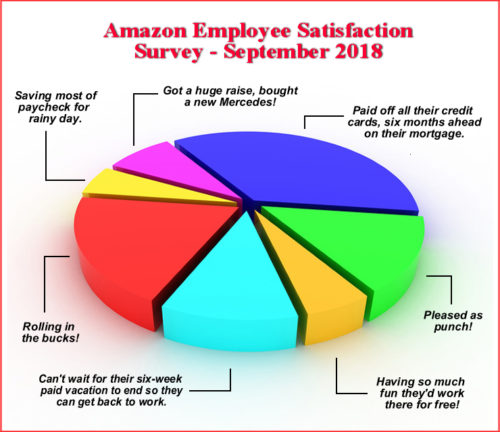
Obviously the above pie chart is a put-on. It is well-documented that working conditions for most employees of Amazon are  abysmaldehumanizing, bordering on abuse we normally associate with slavery.

Moreover, the median employee’s salary under Jeff Bezos’ imperial lordship is $28,446. No one working as a regular there has paid off their credit cards and is driving to work in a Mercedes. 

Jeff Bezos is referred to as The Richest Man in the World and his personal fortune, while growing by $191,000 each minute, is currently estimated at $168 billion.

So …

$28,446 vs. $168,000,000,000? While I can acknowledge the simple math, I find the contrast of such numbers on a gut level difficult to grasp.

To get a handle on such inequality, let’s try approaching it from different angles.

One way to put the disparity into perspective is to recognize it takes Bezos just under 9 seconds to earn what Amazon’s median worker does in an entire year.

Another is to recognize that for a worker to go through Jeff Bezos’ current personal fortune — and, of course, it continues mounting at accelerating levels as I write this — at his/her current median annual income of $28,446 per year, WOULD TAKE 5,905,927 YEARS! That’s close to 6 million years!

For Jeff Bezos himself to go through his current $168 billion, assuming his earnings stopped dead this very moment — which as you and I know they won’t — SPENDING $1,000,000 A DAY, would take NEARLY 460 years. Yes, even spending $1 million a day, in the year 2475 he’d still have plenty of cash, tens of million of dollars mad money. We can feel confident that he wouldn’t be foraging through the dumpster behind 7-11. 

Now, further consider that while the $28,446 median salary is above the national poverty line for a single individual if that person is the sole breadwinner for a family of four, it is marginally above it, which is why many Amazon employees must rely on government assistance to keep from starving.

As well as calculation, I did some speculation — a simple exercise in imagination.

Apparently Bezos’ wealth generating machine is raking it in so fast, he’s currently making $11.5 million per hour … every hour … 24 hours a day … seven days a week. $11,500,000 per hour! 

So here’s what I was picturing in my mind’s eye … 

If for 40 hours of the 168 hours in a week, Bezos were willing to scrape by on a mere $5,840,000 per hour, he could give every one of his 566,000 Amazon employees a $10 per hour raise. Of course, the remaining 128 hours in each week, Bezos could continue earning his normal $11.5 million per hour, not having to share any of it with the pathetic slobs who work for him.

Rhetorical question: Does Jeff Bezos have any concept of what that $10 per hour increase would mean to his employees? 

I’m not going to even suggest here I’m offering this for Bezos to entertain. There are so many advantages to him both as a putative member of the human race and the employer of over a half million workers — advantages that are so OBVIOUS — if they haven’t occurred to him up until now, then his brain functions in ways beyond my understanding. For one thing, he could point to his new fig leaf of “generosity” and ask people to stop calling him a selfish prick. Second, Amazon employees I’m sure would respond to his largesse with greater company loyalty and increased tolerance for his onerous working conditions. He’d still be the richest SOB on the block and could mock the pauperish Bill Gates and Warren Buffett as pitiable wannabees.

Consider …

The most poorly paid Amazon employee now makes $12 per hour. The $10 per hour raise I proposed would boost those $12 per hour workers right up there with Costco employees, who make an average of $21 per hour. And with the across-the-board $10 per hour increase, Bezos’ higher paid employees would be earning among the finest wages in the world provided by a major corporation. 

And by golly, there’s a plus side to the plus side …

Bezos’s bold and gracious gesture would result in a public relations coup of cosmic proportions! Amazon would no longer be demonized — well, not quite as much — by us bleeding-heart lefties as a capitalistic scourge and one-way ticket to Hell for the future of mankind, even if its environmental record is appalling and its business model generally the stuff of steroid-laced neo-feudalism.

Granted, Bezos would have to do some belt-tightening. He’d have to watch his pennies but could probably manage it, eh? Maybe he could skip a couple meals and do some of his own weeding at his estate. After all, after lavishing the $10 per hour raise on all of his employees, he’d only be pulling in $1,705,600,000 per week. I know I know! Like me you’re probably getting all teary-eyed for the poor guy.

Let me get to the extremely anti-climactic conclusion of this lament qua analysis.

Since nothing will change until the system itself changes, meaning the one in place now that creates, incentivizes, and lionizes the obscenely wealthy — reference current holder of the Office of President of the United States of America — I can only recommend this …

We have been labeling Jeff Bezos as ‘The Richest Man in the World’. Yet, quite honestly I don’t personally know any human, man or woman, who behaves like this gluttonous chunk of self-indulgent meat. It actually makes me nauseous to think we’re members of the same species.

Thus, from now on let’s use the correct terminology. Let’s call Jeff Bezos what he really is: the Richest Sociopath in the World.

We could probably order bumper stickers to help correct the record … from Amazon, of course.

A New World Order: Brought to you by the Global-Industrial Deep State

By John W. Whitehead

Source: Intrepid Report

“There are no nations. There are no peoples . . . There is only IBM and ITT and AT&T, and DuPont, Dow, Union Carbide and Exxon. Those are the nations of the world today. The world is a collage of corporations, inexorably determined by the immutable by-laws of business.”—Network (1976)

There are those who will tell you that any mention of a New World Order government—a power elite conspiring to rule the world—is the stuff of conspiracy theories.

I am not one of those skeptics.

What’s more, I wholeheartedly believe that one should always mistrust those in power, take alarm at the first encroachment on one’s liberties, and establish powerful constitutional checks against government mischief and abuse.

I can also attest to the fact that power corrupts, and absolute power corrupts absolutely.

I have studied enough of this country’s history—and world history—to know that governments (the U.S. government being no exception) are at times indistinguishable Civilfrom the evil they claim to be fighting, whether that evil takes the form of terrorism, torture, drug traffickingsex trafficking, murder, violence, theft, pornography, scientific experimentations or some other diabolical means of inflicting pain, suffering and servitude on humanity.

And I have lived long enough to see many so-called conspiracy theories turn into cold, hard fact.

Remember, people used to scoff at the notion of a Deep State (a.k.a. Shadow Government), doubt that fascism could ever take hold in America, and sneer at any suggestion that the United States was starting to resemble Nazi Germany in the years leading up to Hitler’s rise to power.

We’re beginning to know better, aren’t we?

The Deep State (“a national-security apparatus that holds sway even over the elected leaders notionally in charge of it”) is real.

We are already experiencing fascism, American-style.

Not with jackboots and salutes, as Robert Kagan of the Brookings Institution notes, “but with a television huckster, a phony billionaire, a textbook egomaniac ‘tapping into’ popular resentments and insecurities, and with an entire national political party—out of ambition or blind party loyalty, or simply out of fear—falling into line behind him.”

And the United States is increasingly following in Nazi Germany’s footsteps, at least in the years leading up to Hitler’s rise to power.

Given all that we know about the U.S. government—that it treats its citizens like faceless statistics and economic units to be bought, sold, bartered, traded, and tracked; that it repeatedly lies, cheats, steals, spies, kills, maims, enslaves, breaks the laws, overreaches its authority, and abuses its power at almost every turn; and that it wages wars for profit, jails its own people for profit, and has no qualms about spreading its reign of terror abroad—it is not a stretch to suggest that the government has been overtaken by global industrialists, a new world order, that do not have our best interests at heart.

Indeed, to anyone who’s been paying attention to the goings-on in the world, it is increasingly obvious that we’re already under a new world order, and it is being brought to you by the Global-Industrial Deep State, a powerful cabal made up of international government agencies and corporations.

It is as yet unclear whether the American Police State answers to the Global-Industrial Deep State, or whether the Global-Industrial Deep State merely empowers the American Police State. However, there is no denying the extent to which they are intricately and symbiotically enmeshed and interlocked.

This marriage of governmental and corporate interests is the very definition of fascism.

Where we go wrong is in underestimating the threat of fascism: it is no longer a national threat but has instead become a global menace.

Consider the extent to which our lives and liberties are impacted by this international convergence of governmental and profit-driven interests in the surveillance state, the military industrial complex, the private prison industry, the intelligence sector, the technology sector, the telecommunications sector, the transportation sector, and the pharmaceutical industry.

All of these sectors are dominated by mega-corporations operating on a global scale and working through government channels to increase their profit margins: Walmart, Alphabet (formerly Google), AT&T, Toyota, Apple, Exxon Mobil, Facebook, Lockheed Martin, Berkshire Hathaway, UnitedHealth Group, Samsung, Amazon, Verizon, Nissan, Boeing, Microsoft, Northrop Grumman, Citigroup . . . these are just a few of the global corporate giants whose profit-driven policies influence everything from legislative policies to economics to environmental issues to medical care.

The U.S. government’s deep-seated and, in many cases, top secret alliances with foreign nations and global corporations are redrawing the boundaries of our world (and our freedoms) and altering the playing field faster than we can keep up.

Global surveillance

Spearheaded by the National Security Agency (NSA), which has shown itself to care little for constitutional limits or privacy, the surveillance state has come to dominate our government and our lives.

Yet the government does not operate alone.

It cannot.

It requires an accomplice.

Thus, the increasingly complex security needs of our massive federal government, especially in the areas of defense, surveillance and data management, have been met within the corporate sector, which has shown itself to be a powerful ally that both depends on and feeds the growth of governmental bureaucracy.

Take AT&T, for instance. Through its vast telecommunications network that crisscrosses the globe, AT&T provides the U.S. government with the complex infrastructure it needs for its mass surveillance programs. According to The Intercept, “The NSA considers AT&T to be one of its most trusted partners and has lauded the company’s ‘extreme willingness to help.’ It is a collaboration that dates back decades. Little known, however, is that its scope is not restricted to AT&T’s customers. According to the NSA’s documents, it values AT&T not only because it ‘has access to information that transits the nation,’ but also because it maintains unique relationships with other phone and internet providers. The NSA exploits these relationships for surveillance purposes, commandeering AT&T’s massive infrastructure and using it as a platform to covertly tap into communications processed by other companies.”

Now magnify what the U.S. government is doing through AT&T on a global scale, and you have the “14 Eyes Program,” also referred to as the “SIGINT Seniors.” This global spy agency is made up of members from around the world (United States, United Kingdom, Australia, Canada, New Zealand, Denmark, France, Netherlands, Norway, Germany, Belgium, Italy, Sweden, Spain, Israel, Singapore, South Korea, Japan, India and all British Overseas Territories).

Surveillance is just the tip of the iceberg when it comes to these global alliances, however.

Global war profiteering

War has become a huge money-making venture, and America, with its vast military empire and its incestuous relationship with a host of international defense contractors, is one of its best buyers and sellers. In fact, as Reuters reports, “[President] Trump has gone further than any of his predecessors to act as a salesman for the U.S. defense industry.”

The American military-industrial complex has erected an empire unsurpassed in history in its breadth and scope, one dedicated to conducting perpetual warfare throughout the earth. For example, while erecting a security surveillance state in the U.S., the military-industrial complex has perpetuated a worldwide military empire with American troops stationed in 177 countries (over 70% of the countries worldwide).

Although the federal government obscures so much about its defense spending that accurate figures are difficult to procure, we do know that since 2001, the U.S. government has spent more than $1.8 trillion in the wars in Afghanistan and Iraq (that’s $8.3 million per hour). That doesn’t include wars and military exercises waged around the globe, which are expected to push the total bill upwards of $12 trillion by 2053.

The illicit merger of the global armaments industry and the Pentagon that President Dwight D. Eisenhower warned us against more than 50 years ago has come to represent perhaps the greatest threat to the nation’s fragile infrastructure today. America’s expanding military empire is bleeding the country dry at a rate of more than $15 billion a month (or $20 million an hour)—and that’s just what the government spends on foreign wars. That does not include the cost of maintaining and staffing the 1,000-plus U.S. military bases spread around the globe.

Incredibly, although the U.S. constitutes only 5% of the world’s population, America boasts almost 50% of the world’s total military expenditure,spending more on the military than the next 19 biggest spending nations combined. In fact, the Pentagon spends more on war than all 50 states combined spend on health, education, welfare, and safety. There’s a good reason why “bloated,” “corrupt” and “inefficient” are among the words most commonly applied to the government, especially the Department of Defense and its contractors. Price gouging has become an accepted form of corruption within the American military empire.

It’s not just the American economy that is being gouged, unfortunately.

Driven by a greedy defense sector, the American homeland has been transformed into a battlefield with militarized police and weapons better suited to a war zone. Trump, no different from his predecessors, has continued to expand America’s military empire abroad and domestically, calling on Congress to approve billions more to hire cops, build more prisons and wage more profit-driven war-on-drugs/war-on-terrorism/war-on-crime programs that pander to the powerful money interests (military, corporate and security) that run the Deep State and hold the government in its clutches.

Global policing

Glance at pictures of international police forces and you will have a hard time distinguishing between American police and those belonging to other nations. There’s a reason they all look alike, garbed in the militarized, weaponized uniform of a standing army.

There’s a reason why they act alike, too, and speak a common language of force.

For example, Israel—one of America’s closest international allies and one of the primary yearly recipients of more than $3 billion in U.S. foreign military aid—has been at the forefront of a little-publicized exchange program aimed at training American police to act as occupying forces in their communities. As The Intercept sums it up, American police are “essentially taking lessons from agencies that enforce military rule rather than civil law.”

Then you have the Strong Cities Network programFunded by the State Department, the U.S. government has partnered with the United Nations to fight violent extremism “in all of its forms and manifestations” in cities and communities across the world. Working with the UN, the federal government rolled out programs to train local police agencies across America in how to identify, fight and prevent extremism, as well as address intolerance within their communities, using all of the resources at their disposal. The cities included in the global network include New York City, Atlanta, Denver, Minneapolis, Paris, London, Montreal, Beirut and Oslo.

What this program is really all about, however, is community policing on a global scale.

Community policing, which relies on a “broken windows” theory of policing, calls for police to engage with the community in order to prevent local crime by interrupting or preventing minor offenses before they could snowball into bigger, more serious and perhaps violent crime.

It sounds like a good idea on paper, but the problem with the broken windows approach is that it has led to zero tolerance policing and stop-and-frisk practices among other harsh police tactics.

When applied to the Strong Cities Network program, the objective is ostensibly to prevent violent extremism by targeting its source: racism, bigotry, hatred, intolerance, etc. In other words, police—acting ostensibly as extensions of the United Nations—will identify, monitor and deter individuals who exhibit, express or engage in anything that could be construed as extremist.

Of course, the concern with the government’s anti-extremism program is that it will, in many cases, be utilized to render otherwise lawful, nonviolent activities as potentially extremist. Keep in mind that the government agencies involved in ferreting out American “extremists” will carry out their objectives—to identify and deter potential extremists—in concert with fusion centers (of which there are 78 nationwide, with partners in the private sector and globally), data collection agencies, behavioral scientists, corporations, social media, and community organizers and by relying on cutting-edge technology for surveillance, facial recognition, predictive policing, biometrics, and behavioral epigenetics (in which life experiences alter one’s genetic makeup).

This is pre-crime on an ideological scale and it’s been a long time coming.

Are you starting to get the picture now?

We’re the sitting ducks in the government’s crosshairs.

On almost every front, whether it’s the war on drugs, or the sale of weapons, or regulating immigration, or establishing prisons, or advancing technology, if there is a profit to be made and power to be amassed, you can bet that the government and its global partners have already struck a deal that puts the American people on the losing end of the bargain.

Unless we can put the brakes on this dramatic expansion, globalization and merger of governmental and corporate powers, we’re not going to recognize this country 20 years from now.

It’s taken less than a generation for our freedoms to be eroded and the police state structure to be erected, expanded and entrenched.

Rest assured that the U.S. government will not save us from the chains of the global police state.

The current or future occupant of the White House will not save us.

For that matter, anarchy, violence and incivility will not save us.

Unfortunately, the government’s divide and conquer tactics are working like a charm.

Despite the laundry list of grievances that should unite “we the people” in common cause against the government, the nation is more divided than ever by politics, by socio-economics, by race, by religion, and by every other distinction that serves to highlight our differences.

The real and manufactured events of recent years—the invasive surveillance, the extremism reports, the civil unrest, the protests, the shootings, the bombings, the military exercises and active shooter drills, the color-coded alerts and threat assessments, the fusion centers, the transformation of local police into extensions of the military, the distribution of military equipment and weapons to local police forces, the government databases containing the names of dissidents and potential troublemakers—have all conjoined to create an environment in which “we the people” are more divided, more distrustful, and fearful of each other.

What we have failed to realize is that in the eyes of the government, we’re all the same.

In other words, when it’s time for the government to crack down—and that time is coming—it won’t matter whether we voted Republican or Democrat, whether we marched on Washington or stayed home, or whether we spoke out against government misconduct and injustice or remained silent.

When the government and its Global-Industrial Deep State partners in the New World Order crack down, we’ll all suffer.

If there is to be any hope of freeing ourselves, it rests—as it always has—at the local level, with you and your fellow citizens taking part in grassroots activism, which takes a trickle-up approach to governmental reform by implementing change at the local level.

One of the most important contributions an individual citizen can make is to become actively involved in local community affairs, politics and legal battles. As the adage goes, “Think globally, act locally.”

America was meant to be primarily a system of local governments, which is a far cry from the colossal federal bureaucracy we have today. Yet if our freedoms are to be restored, understanding what is transpiring practically in your own backyard—in one’s home, neighborhood, school district, town council—and taking action at that local level must be the starting point.

Responding to unmet local needs and reacting to injustices is what grassroots activism is all about. Attend local city council meetings, speak up at town hall meetings, organize protests and letter-writing campaigns, employ “militant nonviolent resistance” and civil disobedience, which Martin Luther King Jr. used to great effect through the use of sit-ins, boycotts and marches.

And then, as I make clear in my book A Government of Wolves: The Emerging American Police State, if there is any means left to us for thwarting the government in its relentless march towards outright dictatorship, it may rest with the power of communities and local governments to invalidate governmental laws, tactics and policies that are illegitimate, egregious or blatantly unconstitutional.

Nullification works.

Nullify the court cases. Nullify the laws. Nullify everything the government does that flies in the face of the principles on which this nation was founded.

We could transform this nation if only Americans would work together to harness the power of their discontent.


Constitutional attorney and author John W. Whitehead is founder and president of The Rutherford Institute. His book A Government of Wolves: The Emerging American Police State is available online at www.amazon.com. Whitehead can be contacted at johnw@rutherford.org. Information about The Rutherford Institute is available at www.rutherford.org.

For Economic Truth Turn To Michael Hudson

By Paul Craig Roberts

Source: PaulCraigRoberts.org

Readers ask me how they can learn economics, what books to read, what university economics departments to trust. I receive so many requests that it is impossible to reply individually. Here is my answer.

There is only one way to learn economics, and that is to read Michael Hudson’s books. It is not an easy task. You will need a glossary of terms. In some of Hudson’s books, if memory serves, he provides a glossary, and his recent book “J Is for Junk Economics” defines the classical economic terms that he uses. You will also need patience, because Hudson sometimes forgets in his explanations that the rest of us don’t know what he knows.

The economics taught today is known as neoliberal. This economics differs fundamentally from classical economics that Hudson represents. For example, classical economics stresses taxing economic rent instead of labor and real investment, while neo-liberal economics does the opposite.

An economic rent is unearned income that accrues to an owner from an increase in value that he did nothing to produce. For example, a new road is built at public expense that opens land to development and raises its value, or a transportation system is constructed in a city that raises the value of nearby properties. These increases in values are economic rents. Classical economists would tax away the increase in values in order to pay for the road or transportation system.

Neoliberal economists redefined all income as earned. This enables the financial system to capitalize economic rents into mortgages that pay interest. The higher property values created by the road or transportation system boost the mortgage value of the properties. The financialization of the economy is the process of drawing income away from the purchases of goods and services into interest and fees to financial entities such as banks. Indebtedness and debt accumulate, drawing more income into their service until there is no purchasing power left to drive the economy.

For example, formerly in the US lenders would provide a home mortgage whose service required up to 25% of the family’s monthly income. That left 75% of the family’s income for other purchases. Today lenders will provide mortgages that eat up half of the monthly income in mortgage service, leaving only 50% of family income for other purchases. In other words, a financialized economy is one that diverts purchasing power away from productive enterprise into debt service.

Hudson shows that international trade and foreign debt also comprise a financialization process, only this time a country’s entire resources are capitalized into a mortgage. The West sells a country a development plan and a loan to pay for it. When the debt cannot be serviced, the country is forced to impose austerity on the population by cutbacks in education, health care, public support systems, and government employment and also to privatize public assets such as mineral rights, land, water systems and ports in order to raise the capital with which to pay off the loan. Effectively, the country passes into foreign ownership. This now happens even to European Community members such as Greece and Portugal.

Another defect of neoliberal economics is the doctrine’s denial that resources are finite and their exhaustion a heavy cost not born by those who exploit the resources. Many local and regional civilizations have collapsed from exhaustion of the surrounding resources. Entire books have been written about this, but it is not part of neoliberal economics. Supplement study of Hudson with study of ecological economists such as Herman Daly.

The neglect of external costs is a crippling failure of neoliberal economics. An external cost is a cost imposed on a party that does not share in the income from the activity that creates the cost. I recently wrote about the external costs of real estate speculators. https://www.paulcraigroberts.org/2018/04/26/capitalism-works-capitalists/ Fracking, mining, oil and gas exploration, pipelines, industries, manufacturing, waste disposal, and so on have heavy external costs associated with the activities.

Neoliberal economists treat external costs as a non-problem, because they theorize that the costs can be compensated, but they seldom are. Oil spills result in companies having to pay cleanup costs and compensation to those who suffered economically from the oil spill, but most external costs go unaddressed. If external costs had to be compensated, in many cases the costs would exceed the value of the projects. How, for example, do you compensate for a polluted river? If you think that is hard, how would the short-sighted destroyers of the Amazon rain forest go about compensating the rest of the world for the destruction of species and for the destructive climate changes that they are setting in motion? Herman Daly has pointed out that as Gross Domestic Product accounting does not take account of external costs and resource exhaustion, we have no idea if the value of output is greater than all of the costs associated with its production. The Soviet economy collapsed, because the value of outputs was less than the value of inputs.

Supply-side economics, with which I am associated, is not an alternative theory to neoliberal economics. Supply-side economics is a successful correction to neoliberal macroeconomic management. Keynesian demand management resulted in stagflation and worsening Phillips Curve trade-offs between employment and inflation. Supply-side economics cured stagflation by reversing the economic policy mix. I have told this story many times. You can find a concise explanation in my short book, “The Failure of Laissez Faire Capitalsim.” This book also offers insights into other failures of neoliberal economics and for that reason would serve as a background introduction to Hudson’s books.

I can make some suggestions, but the order in which you read Michael Hudson is up to you. “J is for Junk Economics” is a way to get information in short passages that will make you familiar with the terms of classical economic analysis. “Killing the Host” and “The Bubble and Beyond” will explain how an economy run to maximize debt is an economy that is self-destructing. “Super Imperialism” and “Trade, Development and Foreign Debt” will show you how dominant countries concentrate world economic power in their hands. “Debt and Economic Renewal in the Ancient Near East” is the story of how ancient economies dying from excessive debt renewed their lease on life via debt forgiveness.

Once you learn Hudson, you will know real economics, not the junk economics marketed by Nobel prize winners in economics, university economic departments, and Wall Street economists. Neoliberal economics is a shield for financialization, resource exhaustion, external costs, and capitalist exploitation.

Neoliberal economics is the world’s reigning economics. Russia is suffering much more from neoliberal economics than from Washington’s economic sanctions. China herself is overrun with US trained neoliberal economists whose policy advice is almost certain to put China on the same path to failure as all other neoliberal economies.

It is probably impossible to change anything for two main reasons. One is that so many greed-driven private economic activities are protected by neoliberal economics. So many exploitative institutions and laws are in place that to overturn them would require a more thorough revolution than Lenin’s. The other is that economists have their entire human capital invested in neoliberal economics. There is scant chance that they are going to start over with study of the classical economists.

Neoliberal economics is an essential part of The Matrix, the false reality in which Americans and Europeans live. Neoliberal economics permits an endless number of economic lies. For example, the US is said to be in a long economic recovery that began in June 2009, but the labor force participation rate has fallen continuously throughout the period of alleged recovery. In previous recoveries the participation rate has risen as people enter the work force to take advantage of the new jobs.

In April the unemployment rate is claimed to have fallen to 3.9 percent, but the participation rate fell also. Neoliberal economists explain away the contradiction by claiming that the falling participation rate is due to the retirement of the baby boom generation, but BLS jobs statistics indicate that those 55 and older account for a large percentage of the new jobs during the alleged recovery. This is the age class of people forced into the part time jobs available by the absence of interest income on their retirement savings. What is really happening is that the unemployment rate does not include discouraged workers, who have given up searching for jobs as there are none to be found. The true measure of the unemployment rate is the decline in the labor force participation rate, not a 3.9 percent rate concocted by not counting those millions of Americans who cannot find jobs. If the unemployment rate really was 3.9 percent, there would be labor shortages and rising wages, but wages are stagnant. These anomalies pass without comment from neoliberal economists.

The long expansion since June 2009 might simply be a statistical artifact due to the under-measurement of inflation, which inflates the GDP figure. Inflation is under-estimated, because goods and services that rise in price are taken out of the index and less costly substitutes are put in their place and because price increases are explained away as quality improvements. In other words, statistical manipulation produces the favorable picture required by The Matrix.

Since the financial collapse caused by the repeal of Glass-Steagall and by financial deregulation, the Federal Reserve has robbed tens of millions of American savers by driving real interest rates down to zero for the sole purpose of saving the “banks too big to fail” that financial deregulation created. A handful of banks has been provided with free money—in addition to the money that the Federal Reserve created in order to take the banks’ bad derivative investments off their hands—to put on deposit with the Fed from which to collect interest payments and with which to speculate and to drive up stock prices.

In other words, for a decade the economic policy of the United States has been run for the benefit of a few highly concentrated financial interests at the expense of the American people. The economic policy of the United States has been used to create economic rents for the mega-rich.

Neoliberal economists point out that during the 1950s the labor force participation rate was much lower than today and, thereby, they imply that the higher rates prior to the current “recovery” are an anomaly. Neoliberal economists have no historical knowledge as the past is of no interest to them. They do not even know the history of economic thought. Whether from ignorance or intentional deception, neoliberal economists ignore that the lower labor force participation rates of the 1950s reflect a time when married women were at home, not in the work force. In those halcyon days, one earner was all it took to sustain a family. I remember the days when the function of a married woman was to provide household services for the family.

But capitalists were not content to exploit only one member of a family. They wanted more, and by using economic policy to suppress pay while fomenting inflation, they drove married women into the work force, imposing huge external costs on the family, child-raising, relations between spouses, and on the children themselves. The divorce rate has exploded to 50 percent and single-parent households are common in America.

In effect, unleashed Capitalism has destroyed America. Privatization is now eating away Europe. Russia is on the same track as a result of its neoliberal brainwashing by American economists. China’s love of success and money could doom this rising Asian giant as well if the government opens China to foreign finance capital and privatizes public assets that end up in foreign hands.