
A Structural Reevaluation of the Collapse of World Trade Center 7 (Executive Summary)

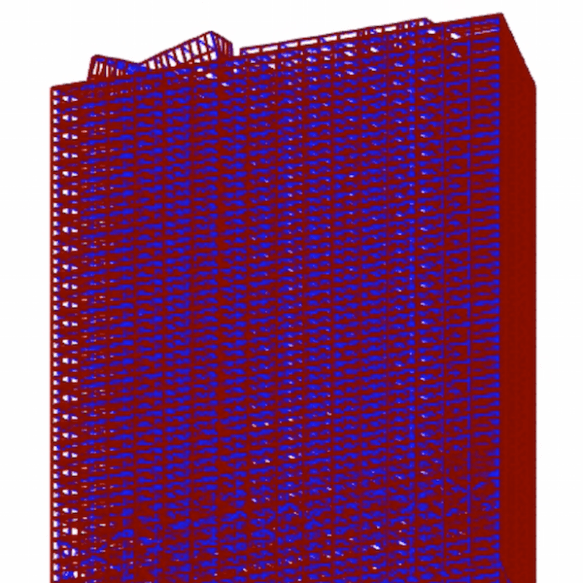
Figure 1 Finite element model of WTC 7 in SAP2000.

By Lead Researcher: J. Leroy Hulsey, Project Team: Feng Xiao (Associate Professor, Nanjing University of Science and Technology), Zhili Quan (Bridge Engineer, South Carolina Department of Transportation)

Source: Institute of Norther Engineering

This report presents the findings and conclusions of a four-year study of the collapse of World Trade Center Building 7 (WTC 7) — a 47-story building that suffered a total collapse at 5:20 PM on September 11, 2001, following the horrible events of that morning. This study was conducted by a three-person team of researchers at the University of Alaska Fairbanks (UAF) Department of Civil and Environmental Engineering with funding provided by Architects & Engineers for 9/11 Truth, Inc., a 501(c)(3) nonprofit organization whose purpose is to conduct research and educate the public about the World Trade Center building collapses on 9/11.

According to the National Institute of Standards and Technology (NIST) — an agency of the U.S. Department of Commerce that investigated the three building failures on 9/11 — the collapse of WTC 7 was the first known instance of the total collapse of a tall building primarily due to fires. However, many independent researchers have studied the collapse of WTC 7 and assembled a body of evidence that raises questions about the validity of NIST’s conclusions.

The objective of this study, therefore, was threefold: (1) Examine the structural response of WTC 7 to fire loads that may have occurred on September 11, 2001; (2) Rule out scenarios that could not have caused the observed collapse; and (3) Identify types of failures and their locations that may have caused the total collapse to occur as observed.

The UAF research team utilized three approaches for examining the structural response of WTC 7 to the conditions that may have occurred on September 11, 2001. First, we simulated the local structural response to fire loading that may have occurred below Floor 13, where most of the fires in WTC 7 are reported to have occurred. Second, we supplemented our own simulation by examining the collapse initiation hypothesis developed by NIST. We also reviewed the collapse initiation hypotheses advanced by private engineering firms whose studies were commissioned as part of litigation related to the collapse of WTC 7. Third, we simulated a number of scenarios within the overall structural system in order to determine what types of local failures and their locations may have caused the total collapse to occur as observed.

Fire Did Not Cause the Collapse of WTC 7

The principal conclusion of our study is that fire did not cause the collapse of WTC 7 on 9/11, contrary to the conclusions of NIST and private engineering firms that studied the collapse.

This conclusion is based upon a number of findings from our different analyses. Together, they show that fires could not have caused weakening or displacement of structural members capable of initiating any of the hypothetical local failures alleged to have triggered the total collapse of the building, nor could any local failures, even if they had occurred, have triggered a sequence of failures that would have resulted in the observed total collapse.

Near-Simultaneous Failure of Every Column Explains the Collapse

The secondary conclusion of our study is that the collapse of WTC 7 was a global failure involving the near-simultaneous failure of every column in the building.

This conclusion is based primarily upon the finding that the simultaneous failure of all core columns over 8 stories followed 1.3 seconds later by the simultaneous failure of all exterior columns over 8 stories produces almost exactly the behavior observed in videos of the collapse, whereas no other sequence of failures that we simulated produced the observed behavior. We cannot completely rule out the possibility that an alternative scenario may have caused the observed collapse; however, the near-simultaneous failure of every column is the only scenario we identified that was capable of producing the observed behavior.

Key Findings Upon Which the UAF Team’s Conclusions Are Based

Approach 1 Findings

•During our nonlinear connection study (Section 2.1.3.2), we discovered that NIST over-estimated the rigidity of the outside frame by not modeling its connections, essentially treating the exterior steel framing as thermally fixed, which caused all thermally-induced floor expansion to move away from the exterior. The exterior steel framing was actually flexible, while the stiffest area resistant to thermal movements, i.e., the point of zero thermal movement, was near the elevator shafts.

•Therefore, during our analysis of WTC 7’s response to fire loading (Section 2.6), we found the overall thermal movements at the A2001 base plate support near Column 79 were not sufficient to displace girder A2001 to the point that it walked off its seat (the initiating failure alleged by NIST). Whereas NIST asserted that the differential westward displacement of girder A2001 relative to Column 79 was 5.5 inches and later revised its calculation to 6.25 inches, we found that the westward displacement of girder A2001 relative to Column 79 would have been less than 1 inch under the fire conditions reported by NIST.

Approach 2 Findings

Under our second approach, we used a solid element model to evaluate the validity of NIST’s collapse initiation hypothesis, introducing a number of assumptions made by NIST that we considered to be invalid or, at best, questionable (Section 3.1). These assumptions included assuming the east exterior wall to be rigid and thermally fixed, assuming shear studs on several beams were broken due to differential thermal movement, assuming no shear studs were installed on girder A2001, and assuming that the bolts fastening girder A2001 to its seats at Columns 44 and 79 were broken (Section 3.1.1). Allowing for these overly generous assumptions, we found the following:

•When girder A2001 is heated to the temperatures assumed by NIST, it expands such that it becomes trapped behind the side plate on the western side of Column 79 as it is pushed to the west by thermally expanding floor beams. This prevents the girder’s web from traveling beyond the bearing seat, thus preventing the girder from walking off its seat (Section 3.2.1).

•NIST, by its own admission, did not include the partial height web stiffeners known to be on girder A2001. In addition to stiffening the web, these stiffeners significantly increase the bending resistance of the flange. In a subsequent analysis where we removed the side plate described in the previous analysis in order to allow for further westward travel of girder A2001, we found that the stresses in the girder flange and stiffener would not be sufficient to cause the flange to fail, thus preventing the girder from walking off its seat (Section 3.2.2).

•In a preliminary collapse initiation hypothesis, NIST posited that beam G3005 buckled because its thermal expansion was restrained by girder A2001. We found that this can happen only when the three lateral support beams S3007, G3007, and K3007 spanning from beam G3005 to the north exterior wall are not included in the model. While these short beams are observed in some of the figures in the NIST report, they are missing from the model(s) used in the thermal and structural analysis shown in the report (Section 3.2.3).

Separate from the NIST investigation, two studies of WTC 7’s collapse were commissioned by opposing sides in the lawsuit “Aegis Insurance Services, Inc. v. 7 World Trade Center Company, L.P.” Experts working in connection with engineering firms Ove Arup & Partners (Arup) and Guy Nordenson and Associates (Nordenson) were retained by the plaintiffs. The engineering firm Weidlinger Associates Inc. (Weidlinger) was retained by the defendants. After evaluating NIST’s collapse initiation hypothesis, we reviewed the Arup, Nordenson, and Weidlinger reports and found the following:

•Arup’s finite element analysis corroborates our finding that girder A2001 would become trapped behind the western side plate of Column 79. However, Arup’s analysis then goes on to contend that the five beams to the east of girder A2001 were heated enough to sag and pull the girder to the east and off of its seats. Putting aside whether this initiating mechanism is valid, we found that Nordenson incorrectly calculated the impact force of the falling girder by considering it as a point load, thus implying an infinite stiffness and no deflection. Calculating the impact force correctly, we found that it is only 34% of the 632,000 lb. force required to shear the girder bearing seat support welds at Floor 12. Therefore, the northeast corner of Floor 12 would not have collapsed if the Floor 13 girder came off its seat at Column 79, and a cascade of floor failures would not ensue.

•The Weidlinger report was prepared as a rebuttal to the Arup and Nordenson reports. Among its points of rebuttal, it corroborates our finding that the falling Floor 13 beam and girder assembly could not break through Floor 12. The Weidlinger report contends instead that Floors 9 and 10 were simultaneously heated to between 750° and 800°C in the exact same area of each floor, eventually causing those floors to fail and triggering a cascade of floor failures down to Floor 5. However, the details of the thermal analysis are not shown in the Weidlinger report, and the thermal analysis has not been made public. It is important to understand that steel structural members reaching temperatures of 750°C due to office fires can be considered extraordinary. Without any analysis provided to substantiate such temperatures, Weidlinger’s collapse initiation hypothesis must be viewed skeptically and can be assumed to have a very low probability of occurrence (Section 3.4.1).

Approach 3 Findings

Under our third approach, we simulated a number of hypothetical scenarios in order to determine what types of local failures and their locations may have caused the total collapse to occur as observed. Based upon a series of analyses, we found the following:

•Columns 79, 80, and 81 did not fail at the lower floors of the building, as asserted by NIST. In order to allow for the observed collapse of the east penthouse approximately 7 seconds prior to the collapse of the rest of the structure, these columns needed to have failed at the upper floors of the building all the way to the penthouse. Yet there were no documented fires above Floor 30. Therefore, fire did not cause the collapse of Columns 79, 80, and 81 nor the collapse of the east penthouse (Section 4.3).

•The hypothetical failure of Columns 79, 80, and 81 — the three easternmost core columns — would not trigger a horizontal progression of core column failures. Therefore, the hypotheses of NIST, Arup/Nordenson, and Weidlinger that the buckling of Column 79 could trigger a progressive collapse of the entire building are invalid, and the collapse of Columns 79, 80, and 81 high in the building was a separate and distinct event (Section 4.4). •Even if we assume the failure of Columns 79, 80, and 81 could lead to the failure of the next row of core columns, the hypothetical failure of Columns 76 to 81 would overload the exterior columns around the southeast of the building, rather than overloading the next row of core columns to the west, which would result in the building tipping to the southeast and not in a straight-down collapse (Section 4.4).

•The hypothetical simultaneous failure of all core columns (but not exterior columns) would cause the building to tip to the southwest rather than causing a straight-down collapse (Section 4.5).

•The simultaneous failure of all core columns over 8 stories followed 1.3 seconds later by the simultaneous failure of all exterior columns over 8 stories produces almost exactly the behavior observed in videos of the collapse. The collapse could have started at Floor 16 and below and produced the same behavior (Section 4.6).

It is our conclusion based upon these findings that the collapse of WTC 7 was a global failure involving the near-simultaneous failure of all columns in the building and not a progressive collapse involving the sequential failure of columns throughout the building.


Read the entire document here: http://ine.uaf.edu/media/222439/uaf_wtc7_draft_report_09-03-2019.pdf

Related videos and follow-up can be found at Architects & Engineers for 9/11 Truth: https://www.ae911truth.org/wtc7

Humans Are Creating Their Own Narratives

By Michael Krieger

Source: Liberty Blitzkrieg

Somewhere between the arrest of Jeffrey Epstein and his extremely suspicious death in a Department of Justice operated prison, the public learned that an FBI intelligence bulletin published by the bureau’s Phoenix field office mentioned for the first time that conspiracy theories pose a domestic terrorism threat. This was followed up last week by a Bloomberg article discussing a new project by the U.S. military (DARPA) to identify fake news and disinformation.

We learned:

Fake news and social media posts are such a threat to U.S. security that the Defense Department is launching a project to repel “large-scale, automated disinformation attacks,” as the top Republican in Congress blocks efforts to protect the integrity of elections.

The Defense Advanced Research Projects Agency wants custom software that can unearth fakes hidden among more than 500,000 stories, photos, videos and audio clips. If successful, the system after four years of trials may expand to detect malicious intent and prevent viral fake news from polarizing society.

Recall that after the 2016 election, focus was on social media companies and we saw tremendous pressure placed on these platforms by national security state politicians and distressed Democrats to “do something” about the supposed fake news epidemic. Fast forward three years and it’s now apparently the U.S. military’s job to police human content on the internet. This is the sort of natural regression a society will witness so long as it puts up with incremental censorship and the demonization of any thought which goes against the official narrative.

Before we dissect what’s really going on, allow me to point out the glaringly obvious, which is that politicians, pundits, mass media and the U.S. military don’t actually care about the societal harm of fake news or conspiracy theories. We know this based on how the media sold government lies in order to advocate for the Iraq war, and how many of the biggest proponents of that blatant war crime have gone on to spectacularly lucrative careers in subsequent years. There were zero consequences, proving the point that this has nothing to do with the dangers of fake news or conspiracy theories, and everything to do with protecting the establishment grip on narrative creation and propagation.

The above tweet summarizes what’s really going on. It’s a provable fact that the harm caused by some crazy person reacting to viral “fake news” on social media doesn’t compare with the destruction and criminality perpetrated by oligarchs like Jeffrey Epstein, or governments which destroy entire countries and murder millions without flinching. It’s the extremely wealthy and powerful, as a consequence of their societal status and influence, who are in a position to do the most harm. This isn’t debatable, yet the U.S. military and media don’t seem particularly bothered by this sort of thing. What really keeps them up at night is a realization that the powerless masses of humanity are suddenly talking to one another across borders and coming to their own conclusions about how the world works. You’re supposed to be told what to think, not to think for yourself.

This is what the power structure’s really worried about. It’s terrified that billions of people are now in direct, instantaneous communication with one another and thinking independently about world events. The mass media’s freakout over the election of Donald Trump was never rooted in concerns about the man and his specific policies. What really bothered them was his election proved they no longer matter. Enough people simply ignored the media’s instructions to suck it up and go vote for Hillary Clinton. This repudiation and loss of control was devastating and terrifying for U.S. media personalities and their bosses.

At this point, it’s important to note that what’s happening is exactly what you’d expect after half the people on earth come online and start talking to one another in the midst of an oligarch-fueled epidemic of gangsterism masquerading as democratic government. The advent of the internet created the conditions for cross-border, near instantaneous, peer-to-peer human communication for the first time in history.

We’re still in the very early stages of discovering what it means to live in such a world, but what you’d expect to emerge is precisely what we’ve seen. We see countless streams of diverse narratives emerging to explain what’s happening around us and how power really operates. Humans are no longer accepting the narratives force-fed to them via mass media channels, and are instead talking directly to one another and creating their own narratives. This is exactly how it should be.

Meanwhile, into this increasingly disruptive environment comes the Epstein affair, which I consider another major inflection point in the public’s increased and justified cynicism about the establishment. While the mass media swallows the increasingly clownish official story hook, line and sinker, the public simply isn’t buying it according to recent polls. The most recent one from Emerson College showed that more people think he was murdered than think he committed suicide.

Alternative narratives are openly, and often successfully, competing with the spoon-fed narratives of mass media. Increased numbers are coming to understand that those who craft official narratives (government, mass media, billionaires) have their own interests, and those interests are typically not aligned with the interests of most people. There’s no reason to trust anything mass media or government says, because both groups are dominated by proven liars and war mongers. This obviously doesn’t mean you should believe everything you read online, but we must maintain perspective. Fake news from powerless citizens doesn’t compete with fake news from the government when it comes to disastrous consequences, yet the focus is always centered on the former and never the latter.

There’s a reason the U.S. military is suddenly talking about fighting fake news and disinformation, and the reason is the power structure is terrified of humans talking to each other and coming to their own conclusions. Moreover, this isn’t limited to an interpretation of world events. The emergence and success of Bitcoin represents a global movement of humans propagating an alternative narrative about money, how it could and how it should work. The longer human beings are allowed to freely talk to one another, the more likely they are to reject official narratives and shape society in a more sane manner. This represents an existential threat to the power structure. And they know it.

It’s also why CNN anchor Chris Cuomo instructed his viewers to not pay attention to those who were closest to Jeffrey Epstein.

Now the good news. I think the cat’s already out of the bag. People aren’t going back to simply swallowing official narratives regurgitated by some television mannequin with makeup and an expensive suit who’s being paid by a billionaire. This doesn’t mean there won’t be a fight; in fact, we’re already in it.

Going forward, I suspect the narrative managers will more aggressively label anyone who doesn’t toe the official line as somehow linked to or sympathetic with foreign governments. They won’t offer any proof, but they’ll claim it authoritatively. This will become an increasingly potent weapon as governments begin to more intensely scapegoat foreign nations as the root of all our problems. We’ve already seen this since the 2016 election, but I expect it to increase in frequency and force.

As such, it’s going to be increasingly important for all of us to retain control of our minds and emotions as much as possible. We must never forget the importance of critical thinking, and must adamantly defend the right of humans to talk to one another freely and come to our own conclusions. We must never forget how preposterous it is to assume media giants owned by billionaires have any interest in telling us the truth about anything.

So keep writing, keep talking, keep thinking and never lose sight of the big picture. We have the power to create our own narratives, and with it, a much better future for generations to come.

NYT Propaganda War on Syria

By Stephen Lendman

Source: StephenLendman.com

On major issues mattering most, especially geopolitical ones, the NYT is a lying machine, a propaganda machine, an anti-truth telling operation, a virtual state-sponsored ministry of deception, masquerading as real news, information and opinion.

Whenever the US wages preemptive wars of aggression on nonbelligerent states threatening no one, or in their run-up, the Times cheerleads high crimes of war and against humanity instead of denouncing them.

It consistently and repeatedly blames victims of US aggression for high crimes committed against them — Syria one of numerous examples of its abandonment of journalism the way it should be for disinformation, Big Lies and fake news.

The Times falsely accused Syrian forces of attacking hospitals numerous times, a Pentagon terror-bombing specialty it ignores.

An earlier report turned truth on its head, claiming Syrian President “Assad attacks medical facilities to break the will of the people — and to destroy evidence of his war crimes” — a bald-faced Big Lie.

The Times calls US aggression on Syria “civil war.” There’s nothing remotely “civil” about it. US-supported cutthroat killer jihadists are referred to as “rebels.”

Most of their fighters are imported from scores of foreign countries, including Western ones — armed, funded and directed by the US and its imperial partners.

In its latest edition, the Times reported on what it called “a journey through shattered Syria” — ignoring mass slaughter, vast destruction, and widespread human misery caused by US-led aggression, along with using ISIS and other terrorists as proxy foot soldiers.

What’s vital to report, the Times consistently suppresses, substituting managed new misinformation and disinformation instead.

Why Assad’s government granted permission to the Times lying machine to visit the war-torn country was unexplained.

In the Damascus countryside, “there were few young men,” it reported.

Most youths are likely involved in defending their country against US-led aggression and jihadists it supports — what the self-styled newspaper of record suppresses.

Instead it claimed they “died in the war, (were) thrown in prison or scattered far beyond Syria’s borders.”

Many indeed died at the hands of US-supported jihadists or Pentagon terror-bombing. Claiming they were thrown in prison is a bald-faced Big Lie, a Times specialty about the war and all others the US wages.

Three Times propagandists visited Syria to see the devastation firsthand. Saying “infrastructure needs rebuilding” failed to explain its destruction by Pentagon-led terror-bombing and attacks by US-supported jihadists.

The Times lied claiming Assad “presided over the destruction.” It complained about not getting permission “to roam freely,” expressed angst as well that most Syrians met and spoken to expressed support for Assad.

In June 2014, he was overwhelmingly reelected president with an 89% majority — independent international monitors calling the process open, free and fair.

The Times and other Western media falsely claimed otherwise. Syrians want no one else leading them. They’re clearly hostile to the US, other Western, and Israeli interests.

The Jewish state is responsible for terror-bombing the country hundreds of times by its own admission — on the phony pretext of combatting an Iranian threat that doesn’t exist.

Syria and its people are struggling for the country’s soul, victimized by US-led aggression.

War in its 9th year continues with no end of it in prospect because both extremist right wings of the US war party oppose restoration of peace and stability to the country.

Instead of reporting accurately on what’s gone on and continues endlessly, including illegal US occupation of northern and southern Syrian territory — the Times falsely blames Assad for US high crimes committed against the country and its people.

The Varieties of Psychonautic Experience: Erik Davis’s ‘High Weirdness’

Art by Arik Roper

By Michael Grasso

Source: We Are the Mutants

High Weirdness: Drugs, Esoterica, and Visionary Experience in the Seventies
By Erik Davis
Strange Attractor Press/MIT Press, 2019

Two months ago, I devoured Erik Davis’s magisterial 2019 book High Weirdness: Drugs, Esoterica, and Visionary Experience in the Seventies the same weekend I got it, despite its 400-plus pages of sometimes dense, specialist prose. And for the past two months I have tried, in fits and starts, to gather together my thoughts on it—failing every single time. Sometimes it’s been for having far too much to say about the astonishing level of detail and philosophical depth contained within. Sometimes it’s been because the book’s presentation of the visionary mysticism of three Americans in the 1970s—ethnobotanist and psychonaut Terence McKenna, parapolitical trickster Robert Anton Wilson, and paranoid storyteller-mystic Philip K. Dick—has hit far too close to home for me personally, living in the late 2010s in a similarly agitated political (and mystical) state. In short, High Weirdness has seemed to me, sitting on my bookshelf, desk, or in my backpack, like some cursed magical grimoire out of Weird fiction—a Necronomicon or The King in Yellow, perhaps—and I became obsessed with its spiraling exploration of the unfathomable universe above and the depthless soul below. It has proven itself incapable of summary in any linear, rationalist way.

So let’s dispense with rationalism for the time being. In the spirit of High Weirdness, this review will try to weave an impressionistic, magical spell exploring the commonalities Davis unveils between the respective life’s work and esoteric, drug-aided explorations of McKenna, Wilson, and Dick: explorations that were an attempt to construct meaning out of a world that to these three men, in the aftermath of the cultural revelations and revolutions of the 1960s that challenged the supposed wisdom and goodness of American hegemony, suddenly offered nothing but nihilism, paranoia, and despair. These three men were all, in their own unique ways, magicians, shamans, and spiritualists who used the tools at their disposal—esoteric traditions from both East and West; the common detritus of 20th century Weird pop culture; technocratic research into the human mind, body, and soul; and, of course, psychedelic drugs—to forge some kind of new and desperately-needed mystical tradition in the midst of the dark triumph of the Western world’s rationalism.

A longtime aficionado of Weird America, Davis writes in the introduction to High Weirdness about his own early encounters with Philip K. Dick’s science fiction, the Church of the SubGenius, and other underground strains of the American esoteric in the aftermath of the ’60s and ’70s. As someone who came late in life to a postgraduate degree program (High Weirdness was Davis’s doctoral dissertation for Rice University’s Religion program, as part of a curriculum focus on Gnosticism, Esotericism, and Mysticism), I find it incredibly easy to identify with Davis’s desire to tug at the edges of his longtime association with and love for the Weird in a scholarly context. This book’s scholarly origins do not make High Weirdness unapproachable to the layperson, however. While Davis does delve deeply into philosophical and spiritual theorists and the context of American mysticism throughout the book, he provides succinct and germane summaries of this long history, translating the work of thinkers as diverse as early 20th century psychologist and student of religious and mystical experience William James to contemporary theorists such as Peter Sloterdijk and Mark Fisher. Davis’s introduction draws forth in great detail the long tradition of admitting the ineffable, the scientifically-inexplicable, into the creation of subjective, individual mystical experiences.

Primary among Davis’s foundational investigations, binding together all three men profiled in the book, is a full and thorough accounting of the question, “Why did these myriad mystical experiences all occur in the first half of the 1970s?” It’s a fairly common historical interpretation to look at the Nixon years in America as a hangover from the cultural revolution of the late 1960s, a retrenchment of Nixon’s “silent majority” of middle- and working-class whites vs. the perceived chaos of a militant student movement and identity-based politics among racial and sexual minorities. Davis admits that the general mystical seeking that went on in the early ’70s is a reaction to this revanchism. And while he quotes Robert Anton Wilson’s seeming affirmation of this idea—“The early 70s were the days when the survivors of the Sixties went a bit nuts”—his interest in the three individuals at the center of his study allows him to delve deeper, offering a more profound explanation of the politics and metaphysics of the era. In the immediate aftermath of the assassinations, the political and social chaos, and the election of Nixon in 1968, there was an increased tendency among the younger generation to seek alternatives to mass consumption culture, to engage in what leftist philosopher Herbert Marcuse would term “the Great Refusal.” All three of the figures Davis focuses on in this book, at some level or another, decided to opt out of what their upbringings and conformist America had planned for them, to various levels of harm to their livelihoods and physical and mental health. This refusal was part of an awareness of what a suburban middle-class life had excised from human experience: a sense of meaning-making, of a more profound spirituality detached from the streams of traditional mainline American religious life.

To find something new, the three men at the center of High Weirdness were forced to become bricoleurs—cobbling together a “bootstrap witchery,” in Davis’s words—from real-world occult traditions (both Eastern and Western); from the world of Cold War technocratic experimentation with cybernetics, neuroscience, psychedelics, and out-and-out parapsychology; and from midcentury American pop culture, including science fiction, fantasy, comic books, and pulp fiction. Davis intriguingly cites Dick’s invention of the term “kipple” in his 1968 novel Do Androids Dream of Electric Sheep? as a key concept in understanding how this detritus can be patched together and brought new life. Given Dick’s overall prescience in predicting our 21st century world of social atomization and disrepair, this seems a conceptual echo worth internalizing a half-century later. If the late 1960s represented a mini-cataclysm that showed a glimpse of what a world without the “Black Iron Prison” might look like, those who graduated to the 1970s—the ones who “went a bit nuts”—needed to figure out how to survive by utilizing the bits and scraps left behind after the sweeping turbulence blew through. In many ways, McKenna, Wilson, and Dick are all post-apocalyptic scavengers.

All three men used drugs extensively, although not necessarily as anthropotechnics specifically designed to achieve enlightenment (Davis notes that Dick in particular had preexisting psychological conditions that, in conjunction with his prodigious use of amphetamines in the 1960s, were likely one explanation for his profound and sudden breaks with consensus reality in the ’70s). But we should also recognize (as Davis does) that McKenna, Wilson, and Dick were also, in many ways, enormously privileged. As well-educated scions of white America, born between the Great Depression and the immediate aftermath of World War II, they had the luxury to experiment with spirituality, psychedelic drugs, and technology to various degrees while holding themselves consciously separate from the mainstream institutions that would eventually co-opt and recuperate many of these strains of spirituality and individual seeking into the larger Spectacle. As Davis cannily notes, “Perhaps no one can let themselves unravel into temporary madness like straight white men.” But these origins also help explain the expressly technocratic bent of many of their hopes (McKenna) and fears (Wilson and Dick). Like their close confederate in Weirdness, Thomas Pynchon (who spent his early adulthood working for defense contractor Boeing, an experience which allowed him a keener avenue to his literary critiques of 20th century America), all three men were adjacent to larger power structures that alternately thrilled and repelled them, and which also helped form their specific esoteric worldviews.

It would be a fool’s errand to try to summarize the seven central chapters of the book, which present in great detail Terence (and brother Dennis) McKenna’s mushroom-fueled experiences contacting a higher intelligence in La Chorrera, Colombia in 1971, Robert Anton Wilson’s LSD-and-sex-magick-induced contact with aliens from the star Sirius in 1973 and ’74 as detailed in his 1977 book Cosmic Trigger: The Final Secret of the Illuminati, and Philip K. Dick’s famous series of mystical transmissions and revelations in February and March of 1974, which influenced not only his fiction output for the final eight years of his life but also his colossal “Exegesis,” which sought to interpret these mystical revelations in a Christian and Gnostic context. Davis’s book is out there and I can only encourage you to buy a copy, read these chapters, and revel in their thrilling detail, exhilarating madness, and occasional absurdity. Time and time again, Davis, like a great composer of music, returns to his greater themes: the environment that created these men gave them the tools and technics to blaze a new trail out of the psychological morass of Cold War American culture. At the very least, I can present some individual anecdotes from each of the three men’s mystical experiences, as described by Davis, that should throw some illumination on how they explored their own psyches and the universe using drugs, preexisting religious/esoteric ritual, and the pop cultural clutter that had helped shape them.

Davis presents a chapter focusing on each man’s life leading up to his respective spiritual experiences, followed by a chapter (in the case of Philip K. Dick, two) on his mystical experience and his reactions to it. For Terence McKenna and his brother Dennis, their research into organic psychedelics such as the DMT-containing yagé (first popularized in the West in the Cold War period by William S. Burroughs), alternately known as oo-koo-hé or ayahuasca, led them to South America to find the source of these natural, indigenous entheogens. But at La Chorrera in Colombia they instead met the plentiful and formidable fungus Psilocybe cubensis. In their experiments with the mushroom, Terence and Dennis tuned into perceived resonances with long-dormant synchronicities within their family histories, their childhood love of science fiction, and with the larger universe. Eventually, Dennis, on a more than week-long trip on both mushrooms and ayahuasca, needed to be evacuated from the jungle, but not before he had acted as a “receiver” for cryptic hyper-verbal transmissions, the hallucinogens inside him a “vegetable television” tuned into an unseen frequency—a profound shamanic state that Terence encouraged. The language of technology, of cybernetics, of science is never far from the McKenna brothers’ paradigm of spirituality; the two boys who had spent their childhoods reading publications like Analog and Fate, who had spent their young adulthoods studying botany and science while deep in the works of Marshall McLuhan (arguably a fellow psychedelic mystic who, like the McKennas and Wilson, was steeped in a Catholic cultural tradition), used the language they knew to explain their outré experiences.

Wilson spent his 20s as an editor for Playboy magazine’s letters page and had thus been exposed to the screaming gamut of American political paranoia (while contributing to it in his own inimitable prankster style). He had used this parapolitical wilderness of mirrors, along with his interest in philosophical and magickal orientations such as libertarianism, Discordianism, and Crowleyian Thelema as fuel for both the Illuminatus! trilogy of books written with Robert Shea (published in 1975), and his more than year-long psychedelic-mystical experience in 1973 and 1974, during which he claimed to act as a receiver on an “interstellar ESP channel,” obtaining transmissions from the star Sirius. His experiences as detailed in Cosmic Trigger involve remaining in a prolonged shamanic state (what Wilson called the “Chapel Perilous,” a term redolent with the same sort of medievalism as the McKenna brothers’ belief that they would manifest the Philosopher’s Stone at La Chorrera), providing Wilson with a constant understanding of the universe’s playfully unnerving tendency towards coincidence and synchronicity. Needless to say, the experiences of one Dr. John C. Lilly, who was also around this precise time tuned into ostensible gnostic communications from a spiritual supercomputer, mesh effortlessly with Wilson’s (and Dick’s) experiences thematically; Wilson even used audiotapes of Lilly’s lectures on cognitive meta-programming to kick off his mystical trances. Ironically, it was UFO researcher and keen observer of California’s 1970s paranormal scene Jacques Vallée who helped to extract Wilson out of the Chapel Perilous—by retriggering his more mundane political paranoia, saying that UFOs and other similar phenomena were instruments of global control. In Davis’s memorable words, “Wilson did not escape the Chapel through psychiatric disenchantment but through an even weirder possibility.”

Philip K. Dick, who was a famous science fiction author at the dawn of the ’70s, had already been through his own drug-induced paranoias, political scrapes, and active Christian mystical seeking. Unlike McKenna and Wilson, Dick was a Protestant who had stayed in close contact with his spiritual side throughout adulthood. In his interpretation of his mystical 2-3-74 experience, Dick uses the language and epistemology of Gnostic mystical traditions two millennia old. Davis also notes that Dick used the plots of his own most overtly political and spiritual ’60s output to help him understand and interpret his transcendent experiences. Before he ever heard voices or received flashes of information from a pink laser beam or envisioned flashes of the Roman Empire overlapping with 1970s Orange County California, Dick’s 1960s novels, specifically The Three Stigmata of Palmer Eldritch (1965) and Ubik (1969), had explored the very nature of reality and admitted the possibility of a Gnostic universe run by unknowable, cruel demiurges. Even in these hostile universes, however, there exists a messenger of hope and mercy who seeks to destroy the illusion of existence and bring relief. These existing pieces of cultural and religious “kipple,” along with the parasocial aspects of Christian belief that were abroad in California at the time, such as the Jesus People movement (the source of the Ichthys fish sign that triggered the 2-3-74 experience), gave Dick the equipment he needed to make sense of the communications he received and the consoling realization that he was not alone, that he was instead part of an underground spiritual movement that acted as a modern-day emanation of the early Christian church.

After learning about these three figures’ shockingly similar experiences with drug-induced contact with beyond, the inevitable question emerges: what were all these messages, these transmissions from beyond, trying to convey? One common aspect of all three experiences is how cryptic they are (and how difficult and time-consuming it was for each of these men to interpret just what the messages were saying). It’s also a little sobering to discover through Davis’s accounts how personal all three experiences were, whether it’s Terence and Dennis’s private fraternal language during the La Chorrera experiment, or mysterious phone calls placed back in time to their mother in childhood, or a lost silver key that Dennis was able to, stage-magician-like, conjure just as they were discussing it, or the message Philip K. Dick received to take his son Christopher to the doctor for an inguinal hernia that could have proven fatal. But alongside these personal epiphanies, there is also always an undeniable larger social and political context, especially as both Wilson and Dick saw their journeys in 1973 and 1974 as a way to confront and deal with the intense paranoia around Watergate and the fall of Richard Nixon (in his chapter setting the scene of the ’70s, Davis calls Watergate “a mytho-poetic perversion of governance”). In every case, the message from beyond requires interpretation, meaning-making, and, in Davis’s terminology, “constructivism.” The reams of words spoken and written by all three men analyzing their respective mystical experiences are an essential part of the experience. And these personal revelations all are attempts by the three men to make sense of the chaos of both their personal lives and their existence in an oppressive 20th century technocratic society: to inject some sense of mystery into daily existence, even if it took the quasi-familiar and, yes, somewhat comforting form of transmissions from a mushroom television network or interstellar artificial intelligence.

Over the past nine months I’ve spent much of my own life completing (and recovering from the process of completing) a Master’s degree. My own academic work, focusing on nostalgia’s uses in binding together individuals and communities with their museums, tapped into my earliest memories of museum visits in the late 1970s, when free education was seemingly everywhere (and actually free), when it was democratic and diverse, when it was an essential component of a rapidly-disappearing belief in social cohesion. In a lot of ways, my work at We Are the Mutants over the past three years is the incantation of a spell meant to conjure something new and hopeful from the “kipple” of a childhood suffused in disposable pop culture, the paranormal and “bootstrap witchery,” and science-as-progress propaganda. At the same time, over the past three years the world has been at the constant, media-enabled beck and call of a figure ten times more Weird and apocalyptic and socially malignant than any of Philip K. Dick’s various Gnostic emanations of Richard Nixon.

Philip K. Dick believed he was living through a recapitulation of the Roman Empire, that time was meaningless when viewed from the perspective of an omniscient entity like VALIS. In the correspondences and synchronicities I have witnessed over the past few months—in the collapse of political order and the revelation of profound, endemic corruption behind the scenes of the ruling class—this sense of recurring history has sent me down a similar set of ecstatic and paranoid corridors as McKenna, Wilson, and Dick. The effort to find meaning in a world that once held some inherent structure in childhood but has become, in adulthood, a hollow facade—a metaphysical Potemkin village—is profoundly unmooring. But meaning is there, even if we need technics such as psychedelic drugs, cybernetics (Davis’s final chapter summarizing how the three men’s mystical explorations fed into the internet as we know it today is absolutely fascinating), and parapolitical activity to interpret it. On this, the 50th anniversary of the summer of 1969, commonly accepted as the moment the Sixties ended, with echoes of moon landings and Manson killings reverberating throughout the cultural theater, is it any wonder that the appeal of broken psychonauts trying to pick up the pieces of a shattered world would appeal to lost souls in 2019? High Weirdness as a mystical tome remains physically and psychically close to me now, and probably will for the remainder of my life; and if the topics detailed in this review intrigue you the way they do me, it will remain close to you as well.

NPR Mocks Cancer Survivor in Drumbeat of Syria Propaganda

Asma al-Assad, First Lady of Syria (from released Syrian Presidency Facebook page)

By Rick Sterling

Source: Dissident Voice

It may be a new low in propaganda. National Public Radio (NPR) used the news that Syrian First Lady Asma al-Assad had overcome breast cancer to mock her and continue the information war against Syria. They interviewed a Human Rights Watch staffer named Lama Fakih who is an American from Michigan now based in Beirut.

Do you believe Ms. Fakih in Beirut or do you believe people who live in Syria who say we are being lied to?  Lilly Martin is such a person. Although she is American from Fresno California, Lilly has lived in Syria for nearly 25 years. She is married to a Syrian and has two Syrian sons.  Dr. Nabil Antaki is another such person. He is a medical doctor in Aleppo, fluent in English and French as well as his native Arabic.

While NPR snorts about Asma al-Assad “sporting a chic blonde pixie cut”, Lilly Martin points out that she was recently bald while fighting for her life.

While Ms. Fakir in Beirut says that there is “quite a lot of anger” because Asma al-Assad has conquered cancer, Dr. Antaki says that Syrians are happy at the news.  Asma al-Assad is First Lady, mother to three children, and known for her compassion. Lilly Martin says that even while she battled cancer Mrs. al-Assad continued her charitable work.

While Ms. Fakih says that the “Assad government has been systematically targeting medical facilities and medical personnel”,  Dr. Antaki, who has remained in Aleppo throughout the conflict, says this is not true. While there are many western accusations that the Syrian government attacks hospitals, the evidence is remarkably thin.  One of the most highly publicized cases was regarding “Al Quds Hospital” in east Aleppo. In April 2016 there was a media blitz about this hospital having been destroyed by the Syrian Army. Following  the departure of the “rebels”, it was discovered that “Al Quds Hospital” was an unmarked portion of an apartment building, that it had NOT been bombed and was the LEAST damaged building in the area. It was determined that the nearby Nusra (Al Qaeda) headquarters and ammunition depot was the Syrian army target.  Accusations that “Al Quds Hospital” was bombed were false. It was a media stunt.

Ms. Fakih says that “Syrians have not been able to benefit from medical care in Syria since the beginning of the uprising in 2012”.   Lilly Martin simply says “This is factually untrue. The Syrian system of national hospitals, free services to the public, are in every area of Syria and have run continuously throughout the war.”  Dr. Antaki is an example; he is one of THOUSANDS of doctors working at HUNDREDS of hospitals throughout Syria. But you would never know it from NPR or Ms. Fakih.

It is true that there have been disruption and damage to many hospitals, as demonstrated in this jihadi assault on Al Kindi Hospital.  These are the “rebels” supported by Ms. Fakih and Human Rights Watch. They effectively supported them in east Aleppo until they were expelled from the city. Now Ms. Fakih and HRW are supporting the “rebels” in their last redoubt in Idlib.  There are countless videos demonstrating the cruelty and fanaticism of the “rebels”.  For example, the aftermath of the above assault on Kindi Hospital and the execution of the Syrian soldiers who defended the hospital.  Those who are cheerleading for the “rebels” and trying to prevent the Syrians reclaiming Idlib should look at the execution video to see what they are supporting.

The West has provided weapons and other support to the “rebels”. In parallel, there has been a campaign to whitewash the “rebels” and demonize the Syrian government.  On top of this, the USA has imposed crushing sanctions on Syria which make it difficult or impossible to get critical medicines and replacement parts for western medical equipment. Dr. Antaki says it took him 1.5 years to obtain a replacement part for a Japanese medical instrument.  I had my own experience with the draconian and inhumane sanctions. It took one year and endless hassle to send hearing aid batteries to help a deaf child in Syria.

This is one among hundreds of Syria “regime change” propaganda pieces broadcast on NPR. Behind a facade of authority and objectivity, there is bias and misinformation along with crocodile tears.  As Lilly Martin says, “While the Syrian government medical system has tried to meet all the needs of Syrian civilians during 8 years of armed conflict, still there are numerous cases where the needs were not met and Syrians have suffered, and that blame must be shouldered by every person who held a gun against Syria and their foreign supporters who have succeeded in bringing the Syrian people into the depths of destruction and despair.”

As to Asma al-Assad and her integrity, it is best to listen and judge for yourself.  At about 5:30 of the interview she speaks of the families of 100 thousand Syrian martyrs who died defending their country. “On a personal level, I am humbled by their determination, by their resilience, and by their love of Syria. They are my biggest source of strength and hope for the future.”

The sneers, misinformation, unverified accusations and de facto defense of Nusra/Al Qaeda by NPR and Lama Fakih stand in stark contrast.

Protecting Information Space from Facebook’s Tyranny

By Gunnar Olson

Source: Land Destroyer

The recent attack aimed at New Eastern Outlook (NEO) and several of its authors once again exposes the infinite hypocrisy of US and European interests including across their media and among their supposed human rights advocates.

It also exposes the severe threat that exists to the national security of nations around the globe who lack control over platforms including social media used by their citizens to exchange information.

This lack of control over a nation’s information space is quickly becoming as dangerous as being unable to control and protect a nation’s physical space/territory.

Facebook’s Tyranny  

NEO and at least one of its contributors had their Facebook and Twitter accounts deleted and were accused of “coordinated inauthentic behavior,” according to Facebook’s “newsroom.”

Their statement reads:

In the past week, we removed multiple Pages, Groups and accounts that were involved in coordinated inauthentic behavior on Facebook and Instagram.

It also reads:

We removed 12 Facebook accounts and 10 Facebook Pages for engaging in coordinated inauthentic behavior that originated in Thailand and focused primarily on Thailand and the US. The people behind this small network used fake accounts to create fictitious personas and run Pages, increase engagement, disseminate content, and also to drive people to off-platform blogs posing as news outlets. They also frequently shared divisive narratives and comments on topics including Thai politics, geopolitical issues like US-China relations, protests in Hong Kong, and criticism of democracy activists in Thailand. Although the people behind this activity attempted to conceal their identities, our review found that some of this activity was linked to an individual based in Thailand associated with New Eastern Outlook, a Russian government-funded journal based in Moscow.

In this single statement, Facebook reveals about itself that it, and it alone, decides what is and isn’t a “news outlet.”

Apparently the blogs the deleted Facebook pages linked to were “not” news outlets, though no criteria was provided by Facebook nor any evidence presented that these links did not meet whatever criteria Facebook used.

While Facebook claims that it did not delete the accounts based on their content, they contradicted themselves by clearly referring to the content in their statement as “divisive narratives and comments” which clearly challenged narratives and comments established by Western media organizations.

The statement first accuses the pages of “coordinated inauthentic behavior,” but then admits they were only able to link the pages to a single individual in Thailand. How does a single person “coordinate” with themselves? Again, Facebook doesn’t explain.

Finally, Facebook reveals that any association at all with Russia is apparently grounds for deletion despite nothing of the sort being included in their terms of service nor any specific explanation of this apparent policy made in their statement. New Eastern Outlook is indeed a Russian journal.

Other governments, especially the United States, fund journals and media platforms not only in the United States, but around the globe. Facebook and Twitter, for example, have not deleted the accounts of the virtual army of such journals and platforms funded by the US government funded and directed via the National Endowment for Democracy (NED).

NED-funded operations often operate well outside of the United States, while NEO is based in Russia’s capital, Moscow. NED-funded operations often don’t disclose their funding or affiliations.

Ironically, the accounts Facebook deleted in Thailand were proficient at exposing this funding to the public.

The bottom line here is that Facebook is a massive social media platform. It is also clearly very abusive, maintaining strict but arbitrary control over content on its networks, detached even from their own stated terms of service. It is a form of control that ultimately and clearly works in favor of special interests in Washington and against anyone Washington declares a villain.

Facebook would be bad enough as just a massive US social media platform, but the real problem arises considering its global reach.

Looking at Information Space as we do Physical Space 

A nation’s information space is a lot like its physical space (or territory). The people of a nation operate in it, conduct commerce, exchange information, report news, and carry out a growing number of other economically, socially and politically important activities there. It is not entirely unlike a nation’s physical space where people conduct these same sort of activities.

A nation’s physical space would never be surrendered to a foreign government or corporation to control and decide who can and cannot use it and how it is used. But this is precisely what many nations around the globe have done regarding their information space.

Facebook is essentially that; a foreign corporation controlling a nation’s information space rather than its physical space. Facebook does this in many nations around the globe, deciding who can and cannot use that information space and how that information space is used.

A US corporation just decided that a Thailand-based writer associated with a political journal in Moscow is not allowed to operate in Thailand’s information space. It made that decision for Thailand. It admits in its statement that it worked, not with the Thai government or Thai law enforcement, but with “local civil society organizations,” almost certainly referring to US NED and corporate foundation-funded organizations like Human Rights Watch. Again, this is a clear violation of Thailand’s sovereignty, however minor this particular case may have been.

If it is not a legal violation of Thai sovereignty and an intrusion into their internal affairs impacting people living within their borders, it was certainly a violation and intrusion in principle.

Protecting Information Space

Nations like China and Russia understand the importance of information space.

Both nations also understand the critical importance of protecting it. Both nations have created and ensured the monopoly of their own versions of Facebook as well as other social media platforms. They also have their own versions of “Google” as well as platforms hosting blogs, videos, e-commerce and other essential services that make up a nation’s modern information space.

There is room for debate regarding how this control over Chinese and Russian information space is managed by their respective governments, but it is a debate the people of China and Russia are able to have, however restrictive it may or may not be, with people, organizations, corporations and governments within their own country, not with an untouchable Silicon Valley CEO thousands of miles away.

China and Russia created these alternatives and exercises control over their information space almost as vigorously as they defend their physical territory, understanding that their sovereignty depends as much on keeping foreign influence from dominating that space as it does keeping invading forces from crossing their border.

Smaller nations like Thailand, the subject of Facebook’s most recent “removal” campaign would benefit greatly from creating their own alternatives to Facebook, alternatives created, administered, and serving their interests rather than Silicon Valley’s or Washington’s.

Thais, for instance, cannot have any meaningful debate regarding Facebook’s policies, terms of service or their apparently arbitrary decision made independently of both since ultimately Facebook is a foreign corporation that does not answer to either the Thai people or the Thai government.

For China and Russia, both nations adept at exporting arms to smaller nations affording them the ability to defend their physical territory, an opportunity exists to export the means for these smaller nations to likewise defend their information space.

By aiding these nations in pushing out abusive monopolies like Facebook, Beijing and Moscow will also benefit by watering down US control over global information space and the news and points of view US tech corporations “allow,” and providing more space for the sort criticism and scrutiny NEO and its authors were engaged in right before Facebook removed them.

The Real Big Brother

By Eric Zuesse

Source: Consortium News

Jeff Bezos is the owner of The Washington Post, which leads America’s news-media in their almost 100 percent support and promotion of neoconservatism, American imperialism and wars. This includes sanctions, coups, and military invasions against countries that America’s billionaires want to control but don’t yet control — such as Venezuela, Syria, Iran, Russia, Libya, and China.

These are aggressive wars against countries which have never aggressed against the United States. They are not, at all, defensive, but the exact opposite. It’s not necessarily endless war (even Hitler hadn’t planned that), but war until the entire planet has come under the control of the U.S. Government, a government that is itself controlled by America’s billionaires, the funders of neoconservatism and imperialism — in both major American political parties, think tanks, newspapers, TV networks, etcetera.

Bezos has been a crucial part of neoconservatism, ever since, at the June 6-9 2013 Bilderberg meeting, he arranged with Donald Graham, the Washington Post’s owner, to buy that newspaper, for $250 million. Bezos had already negotiated, in March of that same year, with the neoconservative CIA Director, John Brennan, for a  $600 million ten-year cloud computing contract that transformed Amazon corporation, from being a reliable money-loser, into a reliably profitable firm.

That caused Bezos’s net worth to soar even more (and at a sharper rate of rising) than it had been doing while it had been losing money. He became the most influential salesman not only for books, but for the CIA, and for such mega-corporations as Lockheed Martin. Imperialism has supercharged his wealth, but it didn’t alone cause it. Bezos might be the most ferociously gifted business-person on the planet.

Some of America’s billionaires don’t care about international conquest as much as he does, but all of them at least accept neoconservatism; none of them, for example, establishes and donates large sums to, anti-imperialistic organizations; none of America’s billionaires is determined to end the reign of neoconservatism, nor even to help the fight to end it, or at least to end its grip over the U.S. government. None. Not even a single one of them does.

Plutocrat Bezos at the Pentagon with then Defense Secretary Ash Carter, May 2016. (Wikimedia Commons)

But many of them establish and donate large sums to neoconservative organizations, or run neocon organs such as The Washington Post.  That’s the way billionaires are, at least in the United States. All of them are imperialists. They sponsor it; they promote it and hire people who do, and demote or get rid of people who don’t. Expanding an empire is extremely profitable for its aristocrats, and always has been, even before the Roman Empire.

Bezos wants to privatize everything around the world that can become privatized, such as education, highways, health care, and pensions. The more that billionaires control those things, the less that everyone else does; and preventing control by the public helps to protect billionaires against democracy that would increase their taxes and government regulations that would reduce their profits by increasing their corporations’ expenses. So, billionaires control the government in order to increase their takings from the public.

With the help of the war promotion of  The Washington Post, Bezos is one of the world’s top personal sellers to the U.S. military-industrial complex. He controls and is the biggest investor in Amazon corporation, whose Web Services division supplies all cloud-computing services to the Pentagon, CIA and NSA. (He’s leading the charge in the most advanced facial recognition technology too.)

In April there was a headline, “CIA Considering Cloud Contract Worth ‘Tens of Billions’,” which contract could soar Bezos’s personal wealth even higher into the stratosphere, especially if he wins all of it (as he previously did).

He also globally dominates, and is constantly increasing his control over the promotion and sale of books and films, because his Amazon is the world’s largest retailer (and now also one of the largest publishers, producers and distributors.) That, too, can have a huge impact upon politics and government, indirectly, by promoting the most neocon works helping to shape intellectual discourse (and voters’ votes) in the country.

Bezos is crushing millions of retailers by his unmatched brilliance at controlling one market after another as Amazon or as an essential middleman for — and often even a controller of — Amazon’s retail competitors.

He is a strong believer in “the free market”, which he has mastered perhaps better than anyone. This means that Bezos supports the unencumbered ability of billionaires, by means of their money, to control and eventually absorb all who are less powerful than they.

Because he is so enormously gifted himself at amassing wealth, he has thus-far been able to rise to the global top, as being one of the world’s most powerful individuals. The wealthiest of all is King Salman— the owner of Saudi Arabia, whose Aramco (the world’s largest oil company) is, alone, worth over a trillion dollars. (Forbes and Bloomberg exclude monarchs from their wealth-rankings.)

In fact, Bloomberg is even so fraudulent about it as to have headlined on Aug. 10, “The 25 wealthiest dynasties on the planet control $1.4 trillion” and violated their tradition by including on their list one monarch, King Salman, whom they ranked at #4 as owning only $100 million, a ludicrously low ‘estimate’, which brazenly excluded not just Aramco but any of the net worth of Saudi Arabia.

Bloomberg didn’t even try to justify their wacky methodology, but merely presumed the gullibility of their readers for its acceptance. That King, therefore, is at least seven times as rich as Bezos is. He might possibly be as powerful as Bezos is. The supreme heir is lots wealthier even than the supreme self-made billionaire or “entrepreneur” is.

Certainly, both men are among the giants who bestride the world in our era. And both men are libertarians — champions of the belief that property rights (of which, billionaires have so much) are the basis of all rights, and so they believe that the wealthiest people possess the most rights of all, and that the poorest people have the least, and that all persons whose net worths are negative (having more debts than assets) possess no rights except what richer people might donate to or otherwise grant to them, out of kindness or otherwise (such as familial connections).

This — privatization of everything — is what libertarianism is: a person’s worth is his or her “net worth” — nothing else. That belief is pure libertarianism. It’s a belief that many if not most billionaires hold. Billionaires are imperialistic because they seek to maximize the freedom of the super-rich, regardless of whether this means increasing their takings from, or ultimately impoverishing, everyone who isn’t super-rich. They have a coherent ideology. It’s based on wealth. The public instead believes in myths that billionaires enable to be promulgated.

Like any billionaire, Bezos hires and retains employees and other agents who do what he/she wants them to do. This is their direct power. But billionaires also possess enormous indirect power by means of their interdependencies upon one-another, as each large corporation is contractually involved with other corporations, especially with large ones such as they; and, so, whatever power any particular billionaire possesses is actually a shared power, along with the others. (An example was the deal Bezos made with Graham.)

Collectively, they network together, even with ones they might never even have met personally, but only through their representatives, and even with their own major economic competitors. This is collective power which billionaires possess in addition to their individual power as hirers of employees and other agents.

Whereas Winston Smith, in the prophetic allegorical novel 1984, asked his superior and torturer O’Brien, “Does Big Brother exist?”

“‘Of course he exists. The Party exists. Big Brother is the embodiment of the Party.’

‘Does he exist in the same way as I exist?’

‘You do not exist,’ said O’Brien.”

This collective power is embodied by Bezos as well as any billionaire does.  A few of the others may embody it too, such as Bill Gates, Warren Buffett, Larry Ellison, Mark Zuckerberg, Charles Koch, Sergey Brin, Michael Bloomberg, George Soros,  and Jack Dorsey.  They compete against each other, and therefore have different priorities for the U.S. government; but, all of them agree much more than they disagree in regards to what the Government “should” do (especially that the U.S. military should be expanded — at taxpayer’s expense, of course, not their own).

Basically, Big Brother, in the real world is remarkably coherent and unified — far more so than the public is — and this is one of the reasons why they control Government, bypassing the public.

Here is how all of this plays out, in terms of what Bezos’s agents have been doing:

His Amazon pays low to no federal taxes because the Federal Government has written the tax-laws to encourage companies to do the types of things that Bezos has always wanted Amazon to do.

The U.S. government consequently encourages mega-corporations through taxes and regulations to crush small firms by making it harder for them to grow. That somewhat locks-in the existing aristocracy to be less self-made (as Bezos himself was, but his children won’t be).

Elected politicians overwhelmingly support this because most of their campaign funds were donated by super-rich individuals and their employees and other agents. It’s a self-reinforcing system. Super-wealth controls the government, which (along with the super-wealthy and their corporations) controls the public, which reduces economic opportunity for them. The end-result is institutionally reinforced extreme wealth-inequality, becoming more extreme all the time.

The billionaires are the real Big Brothers. And Bezos is the biggest of them all.

Me, Me, Me – The Neurotic Satisfactions of the Selfie Generation

By Julian Rose

Source: Waking Times

We humans are rather curious creatures, I’ll admit. So many sides to our nature, so many colours to our emotions, so many journeys of our imaginations. But the question must arise, do we learn any more about these traits by making ourselves the perpetual object of our own fascination?

One would certainly assume so based upon the cult of the ‘selfie’ which rages around the world at this particular juncture of human evolution. I am tempted to say ‘devolution’, but going backwards would at least stand the chance of putting us in touch with something tangible, earthy even – whereas to live life as a virtual reality experience with one’s own photographic image as the central point of attraction – fails to provoke my sense of admiration for the human race.

The cult of the selfie has gone so far that reports are now emerging that addicts often put themselves in positions of real danger in order to get the perfect shot. A number have already died as a result of the dare-devil approach to getting the perfect selfie.

If I was to take a relaxed and laid-back view of all this, I might say, “OK, sure, we all need to get our kicks in some form or other, just let it be – let people have fun with their cameras on poles; apart from the excesses we hear about it’s pretty harmless fun isn’t it?”

It would be simple enough to go along with such a prognosis were it not for the fact that the whole thing is surely telling us something more than just what the crazy craze of the moment is. It is telling us something quite profound about an advanced preoccupation with superficiality per se. A kind of ego flattering sport whose popularity has presently reached the point of pandemic.

Is this just a kick-back against a sense of loneliness and sense of insignificance in a world that appears indifferent to the fate of the individual? Is it a wish to be noticed in an age of hyper inflated promotion of the engineered stars of stage, screen, video, social media et al? A range of elevated self-importance that runs from TV chef to porn star to political poser?

Whatever the cause, its ubiquitous nature is undeniable and has added yet more techno baggage to the 21st century tourist’s arsenal of seemingly indispensable smart gizmos. If one isn’t squinting into the illuminated screen of a smart phone while walking through a beautiful landscape, one is posing against the same background smiling cheesily for a selfie. While a discourse with nature herself, the source of all our deepest and most practical needs, is shunned. Left out of the picture, except to the extent that she forms the backdrop to the vanity inflated self.

Here lies a clue to this infliction. Modern day living has contrived to be a virtual reality form of existence, one which has alienated human beings from their roots. The ability to find a deep appreciation for beauty, quiet and the actual power of landscape has been smothered by an electro-smog of self satisfying surface pursuits; the sum total of which have formed a veritable barrier against true instincts, perceptions and genuinely life satisfying experiences.

This is a dangerous state of affairs, because we need these qualities to be at the forefront of our daily lives in order to gain/regain a true sense of equilibrium and balance. To find in ourselves that which gives us the courage and vision we need to negotiate and ultimately to vanquish the miasma of deceptions, twisted truths and outright lies legion at this time.

Those who feel the necessity to surround themselves with stimulants for the nourishment of their superficial selves cannot resist slavery to the controlling powers that be. Cannot resist becoming pawns to the carefully planned sales promotions that make such people feel they ‘must have’ the latest, most advance, most essential addition to the range. It is an addiction which includes uncritical acceptance of the disinformation that forms the great majority of what appears on mainstream television, newspapers, glossy journals and all channels of communication that maintain a wall of conscious-blocking visual and printed fake news and views 24/7.

It’s only a small step from here to open armed acceptance of life in a ‘Smart City’. A life where electromagnetic microwaves come with the very air you breathe. No choice. A place where ‘being monitored’ and ‘monitoring’ form a framework around the chief activities of the day – and no doubt night. A place designed and built for technology addicts, one might surmise. But actually a sinister prison camp for the imposition of a cyborgian programme of control.

It’s a place where no trees will be present because they interrupt the 5G signals which are the controlling motor of everything that happens in this arid world of concrete, glass and microwave radiation. Woe betide you if you should lose your personal chip which gives access to everything you need including your own self autonomous self driving car and the ability to unlock the front door of your home. In a smart city, should you lose or destroy your chip, permission will have to be sought from Big Brother to get back into your house, turn on the lights and open the refrigerator.

The ‘internet of everything’ which is to be the techno-hub of the 5G Smart City, ensures citizens cannot act outside the authority of the centralised computer master control.

Orwellian fantasy? No, already existing reality in its first stages.

But all this will, I presume be a source of frisson to those who willingly accept a fate controlled by anyone other than themselves. Who find such a techno-psychotic existence a direct extension of their fascination with all that comes under the word ‘superficial’. And that brings us full circle back to the exponents of narcissistic selfies, who roam the world camera triggered extension pods so as to photograph themselves against exotic backgrounds and famous works of architecture as though they were just empty cut-outs for a theatre set. After all, for selfie exponents, the only thing of real importance is themselves.

It is a remarkable seductive trait that leads to the entrapment of the spirit and soul of man. The master stroke in all this is that it all appears to be oh so normal – and those who do not conform are regarded with incredulity and relegated to the old pastures rare breeds museum for special research into their strange individualistic traits.

The rare breeds, however, turn out to have strong genes and resistant immune systems. They never abandoned nature in favour of the arid virtual 5G powered smartscape. Instead they organised resistance and were supported by energies that were not recognised or understood by adherents of the smartscape.

They kept alive the torch of justice and truth and they grew in number in spite of the dystopian landscape around them. They retained the collective name ‘humanity’ and the warm feelings that underpin that name – the state we call ‘human’. And in the course of time, they came to nurture back to health the planet that nourished them and to rescue those drowning in the narcissistic electro- magnetic soup of their naive choosing. They heeded the cries of desperation of these prisoners – to find a way back out of their oh so ordinary self-imposed toxic prison. It was only the irredeemable selfie who never made it back to real life. The rest experienced the flowering of a self they never knew existed. An unselfish self.

How successfully this unselfish self had been kept at bay by the distractions and fakery of the now defunct soulless smartscapes of yesteryear. As has been noted many times over the millennia, the only real learning is learning by experience.