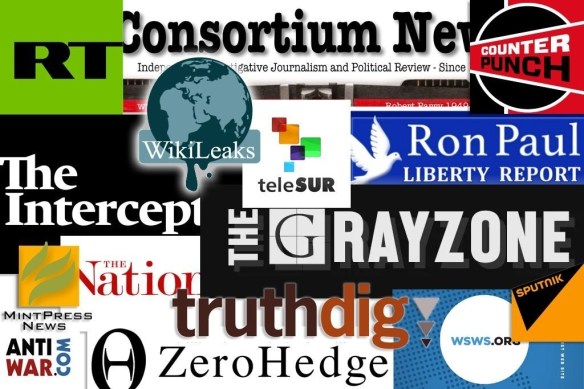
Attacking The Source: The Establishment Loyalist’s Favorite Online Tactic

By Caitlin Johnstone

Source: CaitlinJohnstone.com

If you’re skeptical of western power structures and you’ve ever engaged in online political debate for any length of time, the following has definitely happened to you.

You find yourself going back and forth with one of those high-confidence, low-information establishment types who’s promulgating a dubious mainstream narrative, whether that be about politics, war, Julian Assange, or whatever. At some point they make an assertion which you know to be false–publicly available information invalidates the claim they’re making.

“I’ve got them now!” you think to yourself, if you’re new to this sort of thing. Then you share a link to an article or video which makes a well-sourced, independently verifiable case for the point you are trying to make.

Then, the inevitable happens.

“LMAO! That outlet!” they scoff in response. “That outlet is propaganda/fake news/conspiracy theory trash!”

Or something to that effect. You’ll encounter this tactic over and over and over again if you continually engage in online political discourse with people who don’t agree with you. It doesn’t matter if you’re literally just linking to an interview featuring some public figure saying a thing you’d claimed they said. It doesn’t matter if you’re linking to a WikiLeaks publication of a verified authentic document. Unless you’re linking to CNN/Fox News (whichever fits the preferred ideology of the establishment loyalist you’re debating), they’ll bleat “fake news!” or “propaganda!” or “Russia!” as though that in and of itself magically invalidates the point you’re trying to make.

And of course it doesn’t. What they are doing is called attacking the source, also known as an ad hominem, and it’s a very basic logical fallacy.

Most people are familiar with the term “ad hominem”, but they usually think about it in terms of merely hurling verbal insults at people. What it actually means is attacking the source of the argument rather than attacking the argument itself in a way that avoids dealing with the question of whether or not the argument itself is true. It’s a logical fallacy because it’s used to deliberately obfuscate the goal of a logical conclusion to the debate.

“An ad hominem is more than just an insult,” explains David Ferrer for The Quad. “It’s an insult used as if it were an argument or evidence in support of a conclusion. Verbally attacking people proves nothing about the truth or falsity of their claims.”

This can take the form of saying “Claim X is false because the person making it is an idiot.” But it can also take the form of “Claim X is false because the person making it is a propagandist,” or “Claim X is false because the person making it is a conspiracy theorist.”

Someone being an idiot, a propagandist or a conspiracy theorist is irrelevant to the question of whether or not what they’re saying is true. In my last article debunking a spin job on the OPCW scandal by the narrative management firm Bellingcat, I pointed out that Bellingcat is funded by imperialist regime change operations like the National Endowment for Democracy, which was worth highlighting because it shows the readers where that organization is coming from. But if I’d left my argument there it would still be an ad hominem attack, because it wouldn’t address whether or not what Bellingcat wrote about the OPCW scandal is true. It would be a logical fallacy; proving that they are propagandists doesn’t prove that what they are saying in this particular instance is false.

What I had to do in order to actually refute Bellingcat’s spin job was show that they were making a bad argument using bad logic, which I did by highlighting the way they used pedantic wordplay to make it seem as though the explosive leaks which have been emerging from the OPCW’s investigation of an alleged chemical weapons attack in Douma, Syria were insignificant. I had to show how Bellingcat actually never came anywhere close to addressing the actual concerns about a leaked internal OPCW email, such as extremely low chlorinated organic chemical levels on the scene and patients’ symptoms not matching up with chlorine gas poisoning, as well as the fact that the OPCW investigators plainly don’t feel as though their concerns were met since they’re blowing the whistle on the organisation now.

And, for the record, Bellingcat’s lead trainer/researcher guy responded to my arguments by saying I’m a conspiracy theorist. I personally count that as a win.

The correct response to someone who attacks the outlet or individual you’re citing instead of attacking the actual argument being made is, “You’re attacking the source instead of the argument. That’s a logical fallacy, and it’s only ever employed by people who can’t attack the argument.”

The demand that you only ever use mainstream establishment media when arguing against establishment narratives is itself an inherently contradictory position, because establishment media by their very nature do not report facts against the establishment. It’s saying “You’re only allowed to criticise establishment power using outlets which never criticize establishment power.”

Good luck finding a compilation of Trump’s dangerous escalations against Moscow like the one I wrote the other day anywhere in the mainstream media, for example. Neither mainstream liberals nor mainstream conservatives are interested in promoting that narrative, so it simply doesn’t exist in the mainstream information bubble. Every item I listed in that article is independently verifiable and sourced from separate mainstream media reports, yet if you share that article in a debate with an establishment loyalist and they know who I am, nine times out of ten they’ll say something like “LOL Caitlin Johnstone?? She’s nuts!” With “nuts” of course meaning “Says things my TV doesn’t say”.

It’s possible to just click on all the hyperlinks in my article and share them separately to make your point, but you can also simply point out that they are committing a logical fallacy, and that they are doing so because they can’t actually attack the argument.

This will make them very upset, because for the last few years establishment loyalists have been told that it is perfectly normal and acceptable to attack the source instead of the argument. The mass hysteria about “fake news” and “Russian propaganda” has left consumers of mainstream media with the unquestioned assumption that if they ever so much as glance at an RT article their faces will begin to melt like that scene in Raiders of the Lost Ark. They’ve been trained to believe that it’s perfectly logical and acceptable to simply shriek “propaganda!” at a rational argument or well-sourced article which invalidates their position, or even to proactively go around calling people Russian agents who dissent from mainstream western power-serving narratives.

But it isn’t logical, and it isn’t acceptable. The best way to oppose their favorite logically fallacious tactic is to call it like it is, and let them deal with the cognitive dissonance that that brings up for them.

Of course some nuance is needed here. Remember that alternative media is just like anything else: there’s good and bad, even within the same outlet, so make sure what you’re sharing is solid and not just some schmuck making a baseless claim. You can’t just post a link to some Youtuber making an unsubstantiated assertion and then accuse the person you’re debating of attacking the source when they dismiss it. That which has been presented without evidence may be dismissed without evidence, and if the link you’re citing consists of nothing other than unproven assertions by someone they’ve got no reason to take at their word, they can rightly dismiss it.

If however the claims in the link you’re citing are logically coherent arguments or well-documented facts presented in a way that people can independently fact-check, it doesn’t matter if you’re citing CNN or Sputnik. The only advantage to using CNN when possible would be that it allows you to skip the part where they perform the online equivalent of putting their fingers in their ears and humming.

Don’t allow those who are still sleeping bully those who are not into silence. Insist on facts, evidence, and intellectually honest arguments, and if they refuse to provide them call it what it is: an admission that they have lost the debate.

The Ministry of Wiki-Truth

By C.J. Hopkins

Source: Dissident Voice

OK, here’s a silly one for you.

Have you ever wondered how all those Wikipedia articles get produced … you know, the ones you pull up on your phone to look up an actor, an author, or a recipe, or a historical or scientific fact? Unfortunately, one of the Consent Factory staff had an opportunity to find out recently.

Apparently, what happened was, someone (presumably one of my readers) tried to add a reference to one of my essays to Wikipedia’s Identity Politics page. The Ministry of Wiki-Truth objected, adamantly. A low-level edit war ensued. Once the Ministers had quashed the rebellion, one of them, “Grayfell,” immediately went to the CJ Hopkins Wikipedia article and started punitively “editing” its contents for “neutrality.”

Other Ministers soon joined in the fun. The list of my awards was summarily deleted. My debut novel, Zone 23, which I published under the Consent Factory’s literary imprint, Snoggsworthy, Swaine & Cormorant Paperbacks, was “edited” into a vanity publication that I “self-published,” probably in my mother’s basement. The “Snoggsworthy, Swaine & Cormorant” imprint (which every bookseller, library, and professional catalog recognizes) was disappeared so that my potential readers will be warned that I’m trying to trick them into buying a book that wasn’t published by a “real” (i.e., corporate) publisher, like the Penguin Group, or one of its … uh, imprints. References to my “political satire and commentary,” and to many of the alternative outlets that regularly repost my essays (like the outlet you’re probably reading this in) were also zapped, because they’re all “fake news” sites operated by Putin-Nazi agents.

Also, given my attempted book fraud, the Wikipedia Ministers immediately launched an investigation into whether I had possibly made up my entire career. Perhaps I had invented all the productions of my plays, and my awards, and even my existence itself. I assume they have contacted my “legitimate” publishers, Bloomsbury Publishing and Broadway Play Publishing, to verify that I haven’t somehow hacked their websites and faked my other books. If they haven’t … well, they should probably get on that.

This “editing” and pursuant investigation was overseen and approved by a senior member of the Ministry’s Arbitration Committee, Doug Weller, who is apparently a “Grandmaster Editor” or a “Lord High Togneme Vicarus” in Wiki-speak. (I kid you not … click the link.) Given Lord Weller’s supervision of the process, I think it’s probably safe to say that this was not just the work of a bunch of kids attempting to negatively impact my book sales because someone on the Internet pissed them off.

This brouhaha was brought to my attention by the Consent Factory’s in-house Wikipedia Liaison, King Ubu (or König Ubu in German). As his job title suggests, King Ubu’s duty is to periodically check my Wikipedia article and make sure that no one has posted anything false, defamatory, or just plain weird. Naturally, when he saw how the Ministers of Wiki-Truth were punitively “editing” my page for “neutrality,” he attempted to engage them. This did not go well. I won’t go through all the gory details, but, if you’re curious, they’re here on the CJ Hopkins “talk” page (which King Ubu reports that he has copied and archived, which I find a bit paranoid, but then, I’m not an IT guy).

Look, normally, I wouldn’t bore you with my personal affairs, but my case is just another example of how “reality” is manufactured these days. In the anti-establishment circles I move in, Wikipedia is notorious for this kind of stuff, which is unsurprising when you think about it. It’s a perfect platform for manufacturing reality, disseminating pro-establishment propaganda, and damaging people’s reputations, which is a rather popular tactic these days. The simple fact is, when you google anything, Wikipedia is usually the first link that comes up. Most people assume that what they read on the platform is basically factual and at least trying to be “objective” … which a lot of it is, but a lot of it isn’t.

If the name Philip Cross doesn’t ring any bells, you might want to have a look into his story before you go back to uncritically surfing Wikipedia. As of May 14, 2018 (when Five Filters published this article about him and his service at the Ministry of Wiki-Truth), he had been editing Wikipedia for five years straight, every day of the week, including Christmas. He (if Cross is an actual person, and not an intelligence agency PSYOP) specializes in maliciously “editing” articles regarding anti-war activists and other anti-establishment persons. The story is too long to recount here, but have a look at this other Five Filters article. If you’re interested, that’s a good place to start.

Or, if you don’t have time to do that, go ahead and use my case as an example. See, according to Ubu, the Ministry’s punitive “editing” of my article to make it more “neutral” began when this specific Minister (“Grayfell”) discovered (a) that I existed, and (b) that I am a leftist heretic. “Grayfell,” as it turns out, is extremely invested in maintaining a positive image of Antifa, whose Wikipedia article he actively edits, and whose honor and integrity he valiantly defends, not only from conservatives and neo-fascist bozos, but apparently also from nefarious leftist authors and political satirists like myself.

Which … OK, I probably deserve it, right? I have satirized identity politics. I have satirized Antifa. I have satirized liberals. I don’t forbid controversial outlets (or any other outlets for that matter) from republishing my political satire and commentary, even after I was instructed to do so by the Leftism Police at CounterPunch. Jesus, I even included a link to a Breitbart article in the preceding paragraph … don’t read it, of course, it’s all a bunch of lies, notwithstanding all the supporting evidence.

Chief among my leftist heresies, I haven’t insulted Trump nearly enough. I don’t believe he’s a “Russian asset” or the resurrection of Adolf Hitler. I believe he is the same narcissistic ass clown and self-absorbed con man he has always been. Much as I dislike the man, I’m not on board with the deep-state coup the Intelligence Community, the Democrats, and the rest of the neoliberal Resistance have been trying to stage since he won the election.

I’m not a big fan of Intelligence agencies, generally. I don’t care much for imperialism, not even when it’s global capitalist imperialism. I do not support the global capitalist ruling classes’ War on Populism, or believe in the official Putin-Nazi narrative that they and their servants in the corporate media have been disseminating for the last three years. I do not sing hymns to former FBI directors. I don’t believe that all conservatives are fascists, or that the working classes are all a bunch of racists, or that “America is under attack.

Let’s face it, I’m a terrible leftist.

So it’s probably good that “Grayfell” and his pals discovered me and are feverishly “correcting” my article, and God knows how many other articles that don’t conform to Wikipedia “policy,” or Philip Cross’ political preferences, or Antifa’s theory of “preemptive self-defense,” or whatever other non-ideological, totally objective editorial standards the “volunteer editors” at the Ministry of Wiki-Truth (who have nothing to do with the Intelligence Community, or Antifa, or any other entities like that) consensually decide to robotically adhere to.

How else are they going to keep their content “neutral,” “unbiased,” and “reliably sourced,” so that people can pull up Wikipedia on their phones and verify historical events (which really happened, exactly as they say they did), or scientific “facts” (which are indisputable) … or whether Oceania is at War with EastAsia, or Eurasia, or the Terrorists, or Russia?

Oh, and please don’t worry about my Wikipedia article. König Ubu assures me he has done all he could to restore it some semblance of accuracy, and that the Ministers have moved on to bigger fish. Of course, who knows what additional “edits” might suddenly become a top priority once “Grayfell” or Antifa gets wind of this piece.

The Tech Giants Are a Conduit for Fascism

By Michael Krieger

Source: Liberty Blitzkrieg

A second former Amazon employee would spark more controversy. Deap Ubhi, a former AWS employee who worked for Lynch, was tasked with gathering marketing information to make the case for a single cloud inside the DOD. Around the same time that he started working on JEDI, Ubhi began talking with AWS about rejoining the company. As his work on JEDI deepened, so did his job negotiations. Six days after he received a formal offer from Amazon, Ubhi recused himself from JEDI, fabricating a story that Amazon had expressed an interest in buying a startup company he owned. A contracting officer who investigated found enough evidence that Ubhi’s conduct violated conflict of interest rules to refer the matter to the inspector general, but concluded that his conduct did not corrupt the process. (Ubhi, who now works in AWS’ commercial division, declined comment through a company spokesperson.)

Ubhi worsened the impression by making ill-advised public statements while still employed by the DOD. In a tweet, he described himself as “once an Amazonian, always an Amazonian.”

– From the must read ProPublica expose: How Amazon and Silicon Valley Seduced the Pentagon

That U.S. tech giants are willing participants in facilitating mass government surveillance has been widely known for a while, particularly since whistleblower Edward Snowden risked his life and liberty to tell us about it six years ago. We also know what happens to executives who don’t play ball.

Perhaps the most high profile example relates to Joseph Nacchio, CEO of telecom company Qwest in the aftermath of 9/11. Courageously, he was the only executive who pushed back against government attempts to violate the civil liberties of his customers. A few years later, he was thrown in jail for insider trading and stayed locked up for four years. He claimed his incarceration was retaliation for not bending the knee to government, which seems likely.

Charges his defense team claimed were U.S. government retaliation for his refusal to give customer data to the National Security Agency in February, 2001. This defense was not admissible in court because the U.S. Department of Justice filed an in limine motion, which is often used in national security cases, to exclude information which may reveal state secrets. Information from the Classified Information Procedures Act hearings in Nacchio’s case was likewise ruled inadmissible

Fast forward to today, and the tech giants have willingly and enthusiastically transformed themselves into compliant organs of the national security state. Big tech executives have by and large embraced this extremely lucrative and powerful role rather than push back against it. There’s simply too much money at stake, and nobody wants to go to the big house like Joe Nacchio. There is no resistance.

Just yesterday, we learned that Twitter’s executive for the Middle East is an actual British Army ‘psyops’ soldier. Unfortunately, this is not a joke.

As reported by Middle East Eye:

The senior Twitter executive with editorial responsibility for the Middle East is also a part-time officer in the British Army’s psychological warfare unit, Middle East Eye has established.

Gordon MacMillan, who joined the social media company’s UK office six years ago, has for several years also served with the 77th Brigade, a unit formed in 2015 in order to develop “non-lethal” ways of waging war.

The 77th Brigade uses social media platforms such as Twitter, Instagram and Facebook, as well as podcasts, data analysis and audience research to wage what the head of the UK military, General Nick Carter, describes as “information warfare”.

Here’s how Twitter responded to the revelation…

Twitter would say only that “we actively encourage all our employees to pursue external interests.”

They don’t even care.

While that’s troubling enough, I want to focus your attention on a brilliant and extremely important piece published a couple of months ago at ProPublica, which many of you may have missed. It details the troubling and incestuous relationship between Amazon and Google executives with the Department of Defense. A relationship which virtually guarantees these CEOs immunity as long as they play ball. It’s impossible to read this piece and come away thinking these are “just private companies.” They demonstrably are not.

In the case of Amazon, a Pentagon whistleblower named Roma Laster grew uncomfortable with the cozy relationship Jeff Bezos had with DOD leaders.

We learn:

On Aug. 8, 2017, Roma Laster, a Pentagon employee responsible for policing conflicts of interest, emailed an urgent warning to the chief of staff of then-Secretary of Defense James Mattis. Several department employees had arranged for Jeff Bezos, the CEO of Amazon, to be sworn into an influential Pentagon advisory board despite the fact that, in the year since he’d been nominated, Bezos had never completed a required background check to obtain a security clearance.

Mattis was about to fly to the West Coast, where he would personally swear Bezos in at Amazon’s headquarters before moving on to meetings with executives from Google and Apple. Soon phone calls and emails began bouncing around the Pentagon. Security clearances are no trivial matter to defense officials; they exist to ensure that people with access to sensitive information aren’t, say, vulnerable to blackmail and don’t have conflicts of interest. Laster also contended that it was a “noteworthy exception” for Mattis to perform the ceremony. Secretaries of defense, she wrote, don’t hold swearing-in events…

The swearing-in was canceled only hours before it was scheduled to occur.

Bezos would’ve certainly been sworn into that board had Laster not had the courage to speak up. She later received her reward.

Laster did her best to enforce the rules. She would challenge the Pentagon’s cozy relationship not only with Bezos, but with Google’s Eric Schmidt, the chairman of the defense board that Bezos sought to join. The ultimate resolution? Laster was shunted aside. She was removed from the innovation board in November 2017 (but remains at the Defense Department). “Roma was removed because she insisted on them following the rules,” said a former DOD official knowledgeable about her situation.

Real whistleblowers are never celebrated by mass media and are always punished. That’s how you distinguish a real whistleblower from a fraud.

As mentioned above, Laster also called out and angered Eric Schmidt who, as chairman of Alphabet (Google, Youtube, etc), was trying to sell services to the Pentagon while at the same time serving as Chairman of the Department of Defense’s Innovation Board. That’s about as incestuous and corrupt as it gets.

Schmidt, the chairman of the innovation board, embraced the mission. In the spring and summer of 2016, he embarked, with fellow board members, on a series of visits to Pentagon operations around the world. Schmidt visited a submarine base in San Diego, an aircraft carrier off the coast of the United Arab Emirates and Creech Air Force Base, located deep in the Nevada desert near Area 51.

Inside the drone operations center at Creech, according to three people familiar with the trip, Schmidt observed video as a truck in a contested zone somewhere was surveilled by a Predator drone and annihilated. It was a mesmerizing display of the U.S. military’s lethal reach…

A little more than a year after Schmidt’s visit, Google won a $17 million subcontract in a project called Maven to help the military use image recognition software to identify drone targets — exactly the kind of function that Schmidt witnessed at Creech…

Schmidt’s influence, already strong under Carter, only grew when Mattis arrived as defense secretary. Schmidt’s travel privileges at the DOD, which required painstaking approval from the agency’s chief of staff for each stop of every trip, were suddenly unfettered after Schmidt requested carte blanche, according to three sources knowledgeable about the matter. Mattis granted him and the board permission to travel anywhere they wanted and to talk to anyone at the DOD on all but the most secret programs.

Such access is unheard-of for executives or directors of companies that sell to the government, say three current and former DOD officials, both to prevent opportunities for bribery or improper influence and to ensure that one company does not get advantages over others. “Mattis changed the rules of engagement and the muscularity of the innovation board went from zero to 60,” said a person who has served on Pentagon advisory boards. “There’s a lot of opportunity for mischief”…

Over the next months, Schmidt and two other board members with Google ties would continue flying all over the country, visiting Pentagon installations and meeting with DOD officials, sessions that no other company could attend. It’s hard to reconstruct what occurred in many of those meetings, since they were private. On one occasion, Schmidt quizzed a briefer about which cloud service provider was being used for a data project, according to a memo that Laster prepared after the briefing. When the briefer told him that Amazon handled the business, Schmidt asked if they’d considered other cloud providers. Laster’s memo flagged Schmidt’s inquiry as a “point of concern,” given that he was the chairman of a major cloud provider.

The DOD became unusually deferential to Schmidt. He preferred to travel on his personal jet, and he would ferry fellow board members with him. But that created a problem for his handlers: DOD employees are not permitted to ride on private planes. Still, the staff at the board didn’t want to inconvenience Schmidt by making him wait for his department support team to arrive on commercial flights. So, according to a source knowledgeable about the board’s spending, on at least one occasion the department requisitioned military aircraft at a cost of $25,000 an hour to transport its employees to meet Schmidt on his tour. (The DOD’s spokesperson said employees did this because “there were no commercial flights available.”)

Similar to the situation with Bezos, Roma Laster started asking questions, which angered master of the tech and military-industrial-complex universe Eric Schmidt.

Schmidt responded by threatening to go over her head to Mattis, according to her grievance. She was told to stand down and never again speak to Schmidt. According to the grievance, her boss told her, “Mr. Schmidt was a billionaire and would never accept pushback, warnings or limits.”

There’s so much more in this excellent article, but the key takeaway is the troubling extent of the existing merger between tech giants and the national security state. Disturbingly, this appears to have become even worse in the aftermath of the Snowden revelations, and the reasons why are clear. First, there are billions upon billions of dollars to be made. Second, nobody from the private sector ever gets punished for violating the civil liberties of the American public on behalf of the government and intelligence agencies. On the contrary, the only people who ever lose their freedoms and livelihoods are those who blow the whistle on government criminality (Thomas Drake, John Kiriakou, Chelsea Manning, Edward Snowden and Julian Assange, just to name a few).

Which brings up a very uncomfortable, yet fundamental question. How dangerous are tech giants that have near monopoly level power in core areas such as communications and online retail and also enjoy state sponsorship and the total immunity that comes with it? Add to the equation the enormous amount of money up for grabs provided you play ball with the national security state and you have a very precarious situation. This isn’t a hypothetical future dystopian scenario. It’s where we stand today. 

Facebook and Google are two companies with known ties to the national security state that together have enormous control over who, for all practical purposes, gets to speak in the modern online public square. Then consider that the tech giants represent a perfect vehicle for the national security state to censor or disappear from the conversation those deemed problematic to imperial narratives.

The U.S. government cannot explicitly restrict most kinds of speech, but tech giants can do whatever they please and don’t even need to provide a reasonable justification. This means any relationship between companies with this sort of online speech-policing power and the national security state is extremely dangerous. It’s a conduit for fascism.

Then there’s Amazon. A company that has a $600 million contract with the CIA, has used questionable practices in attempts to secure a $10 billion JEDI cloud deal with Pentagon, is aggressively marketing its facial recognition software to police departments across the country, and is coaching cops on how to obtain surveillance footage from its Ring doorbell camera without a warrant. But it gets even worse.

In light of recent public concerns around facial recognition, Bezos and his company are actively writing legislation for Congress on the issue.

We learn:

Amazon CEO Jeff Bezos says his company is developing a set of laws to regulate facial recognition technology that it plans to share with federal lawmakers.

In February, the company, which has faced escalating scrutiny over its controversial facial recognition tech, called Amazon Rekognition, published guidelines it said it hoped lawmakers would consider enacting. Now Amazon is taking another step, Bezos told reporters in a surprise appearance following Amazon’s annual Alexa gadget event in Seattle on Wednesday.

“Our public policy team is actually working on facial recognition regulations; it makes a lot of sense to regulate that,” Bezos said in response to a reporter’s question.

The idea is that Amazon will write its own draft of what it thinks federal legislation should look like, and it will then pitch lawmakers to adopt as much of it as possible…

In a statement, ACLU Northern CA Attorney Jacob Snow said:

“It’s a welcome sign that Amazon is finally acknowledging the dangers of face surveillance. But we’ve seen this playbook before. Once companies realize that people are demanding strong privacy protections, they sweep in, pushing weak rules that won’t protect consumer privacy and rights. Cities across the country are voting to ban face surveillance, while Amazon is pushing its surveillance tech deeper into communities.”

Meanwhile, Amazon is now using mafia tactics to pressure retailers who feel forced to use the platform given its dominance in online retail, to pay for advertising. It’s not just small brands under the gun, even large companies with high name recognition like Samsonite are being twisted via increasingly unethical practices.

Via Vox:

As Recode’s Jason Del Rey explored in his Land of the Giants podcast about the rise of Amazon, companies that sell on Amazon are increasingly having to pay to show up in search results — even when people are searching for their specific brands.

Case in point: the luggage brand Samsonite, which has to pay for sponsored ads in order to be the top result when you search “Samsonite” on Amazon.

As Samsonite’s Chief E-commerce Officer Charlie Cole told Del Rey, “Amazon is making money off your products, making money off your data by creating brands, and Amazon is making money off the privilege of being on their platform by selling you advertising to protect your brand.”

“It’s been a tough relationship,” he added.

Think about how completely insane that is, yet it’s also exactly what you’d expect to happen when one company comes to completely dominate a space as fundamental to the modern economy as online shopping.

Naturally, there’s more. It’s been well documented how Amazon uses its knowledge of product sales on its platform to then rip off existing brands by copying them and making its own version.

The more connected these tech giants are to the national security state, the more dangerous and unassailable they become. A destructive process which is already very much underway.

Centralized and unaccountable government power is alway an existential threat to human liberty, but centralized and unaccountable government power exercised via tech behemoths which aren’t restrained by the Constitution is even worse. This is the world being built around us, and we’d be wise to address it soon.

New OPCW Leak Further Vindicates Skeptics Of Establishment Syria Narrative

By Caitlin Johnstone

Source: CaitlinJohnstone.com

On the sixth of July last year, the Organisation for the Prohibition of Chemical Weapons (OPCW) released its interim report on its findings regarding an alleged poison gas attack in Douma, Syria in April 2018. The incident, which resulted in dozens of civilian casualties, was blamed on the Syrian government by the US, UK and France, who launched retaliatory airstrikes on multiple targets in that nation.

The interim report claimed that “various chlorinated organic chemicals were found” in different locations on the scene, but strangely said nothing about the levels at which those chemicals were found. The Moon of Alabama blog highlighted this suspicious exclusion on the day the report came out, noting that levels are absolutely essential in determining chemical weapons use when you’re talking about compounds which are found virtually everywhere at some level in any industrialized region.

“The preliminary OPCW report says nothing about the concentrations in which these substances were found,” MoA observed. “Without knowing the concentrations, which may be extremely low, one can not come to further conclusion.”

“The ‘various chlorinated organic chemicals’ are unsurprising,” MoA wrote. “Chlorine is widely used for water purification and cleaning and ‘chlorinated organic chemicals’ will be found in any household.”

A new addition to the body of leaks which have been hemorrhaging from the OPCW shows that such skepticism was indeed entirely warranted. A leaked email sent shortly before the interim report was published reveals that the chlorinated organic chemicals which OPCW investigators found on the scene were as low as one or two parts-per-billion, meaning, just as Moon of Alabama speculated last year, that they were found at trace quantities you’d expect to find in any industrialized area.

The leaked email, which has been published by WikiLeaks and several other outlets, was sent by an unnamed OPCW investigator to the OPCW’s then-cabinet chief Bob Fairweather, outright accusing OPCW leadership of misleading the public with the information it was omitting from the report it was drafting. Those who’ve been following this scandal closely may remember Fairweather as the man who journalist Jonathan Steele recently reported was responsible for calling investigators into his office to be intimidated by unknown officials from the United States government.

The email was sent to Fairweather on June 22nd, laden with pointed words and phrases like “misrepresents the facts”, “selectively omitting”, “highly misleading”, “disingenuous”, “inaccurate”, and “a major deviation from the original report.” Less than two weeks later, on July the fourth, the investigators were reportedly called into Fairweather’s office for a disturbing meeting with US officials which deeply rattled them.

“On July 4 there was another intervention,” Steele’s report reads. “Fairweather, the chef de cabinet, invited several members of the drafting team to his office. There they found three US officials who were cursorily introduced without making clear which US agencies they represented. The Americans told them emphatically that the Syrian regime had conducted a gas attack, and that the two cylinders found on the roof and upper floor of the building contained 170 kilograms of chlorine. The inspectors left Fairweather’s office, feeling that the invitation to the Americans to address them was unacceptable pressure and a violation of the OPCW’s declared principles of independence and impartiality.”

It’s worth noting at this time that the US government already has a known and established history of leveraging the ostensibly neutral and international OPCW to conform to its preexisting military agendas.

Fairweather’s intimidation ploy appears to have been a response to comments made in the email, and probably other similar internal objections made by other investigators at that time. The email reads as follows (transcript and parenthetical annotations made by Daily Mail):

Dear Bob,

I wish to express, as a member of the FFM (Fact Finding Mission) team that conducted the investigation into the alleged chemical attack in Douma on 7 April, my gravest concern at the redacted version of the FFM report, which I understand was at the behest of the ODG. (Office of the Director General). After reading this modified report, which incidentally no other team member who deployed into Douma has had the opportunity to do, I was struck by how much it misrepresents the facts. Many of the facts and observations outlined in the full version are inextricably interconnected and, by selectively omitting certain ones, an unintended bias has been introduced into the report, undermining its credibility. In other cases, some crucial facts that have remained in the redacted version have morphed into something quite different to what was initially drafted. If I may, I will outline some specific aspects to the redacted report that are particularly worrisome.

The statement in paragraph 8.3 of the final conclusions ‘The team has sufficient evidence at this time to determine that chlorine, or another reactive chlorine-containing chemical, was likely released from cylinders’, is highly misleading and not supported by the facts. The only evidence available at this moment is that some samples collected at Locations 2 and 4 were in contact with one or more chemicals that contain a reactive chlorine atom. Such chemicals could include molecular chlorine, phosgene, cyanogen chloride, hydrochloric acid, hydrogen chloride or sodium hypochlorite (the major ingredient of household chlorine-based bleach). Purposely singling out chlorine gas as one of the possibilities is disingenuous. It is also worth noting that the term ‘reactive chlorine-containing chemical’ used in the redacted report is, in fact, inaccurate. It actually describes a reactive chemical that contains chlorine which itself (the chlorine) is not necessarily reactive e.g. chlorophenol. The original report uses the more accurate term ‘a chemical containing reactive chlorine’.

The redacted report states that the gas was likely released from the cylinders (in Locations 2 and 4). The original report purposely emphasised the fact that, although the cylinders might have been the source of the suspected chemical release, there was insufficient evidence to affirm this. It is possible the error was simply a typo. This is a major deviation from the original report.

Paragraph 8.2 states that ‘based on the high levels of various chlorinated organic derivatives, […] detected in environmental samples’. Describing the levels as ‘high’ likely overstates the extent of levels of chlorinated organic derivatives detected. They were, in most cases, present only in parts per billion range, as low as 1-2 ppb, which is essentially trace quantities.

The original report discusses in detail the inconsistency between the victims’ symptoms, as reported by witnesses and seen in video recordings. Omitting this section of the report (including the Epidemiology which has been removed in its entirety) has a serious negative impact on the report as this section is inextricably linked to the chemical agent identified. It either supports or detracts from the confidence in the identity of any possible chemical. In this case the confidence in the identity of chlorine or any choking agent is drawn into question precisely because of the inconsistency with the reported and observed symptoms. The inconsistency was not only noted by the FFM team but strongly noted by three toxicologists with expertise in exposure to CW (Chemical Weapons) agents.

The original report has extensive sections regarding the placement of the cylinders at both locations as well as the relative damage caused to the impact points, compared to that caused to the cylinders suspected of being the sources of the toxic chemical. These sections are essentially absent from the redacted report. This information was important in assessing the likelihood of the ‘presence’ of toxic chemicals versus the ‘use’ of toxic chemicals.

A feature of this investigation and report was the robust and extensive scientific basis for sampling plans and analysing the data collected. A comprehensive bibliography of peer-reviewed scientific literature was attached to support and enhance the credibility of the work of the mission. This has unfortunately been omitted from the redacted report.

By singling out chlorine above other equally plausible substances containing reactive chlorine and presenting it as a fact in isolation creates, I believe, a level of partiality that would negatively impact on the perceived credibility of the report, and by extension that of the Organisation. I am requesting that the fact-finding report be released in its entirety as I fear that this redacted version no longer reflects the work of the team. The original report contains facts and observations that are all equally valid. The fact that inconsistencies are highlighted or observations not fully understood does not justify their omission. The inconsistencies and observations are based on the evidence and data collected. Further information in the future may help resolve them but the facts as they stand at present will not alter and need to be reported.

If the redacted version is to be released, I respectfully request to attach my differing observations, in accordance with the spirit of paragraph 62 of part II of the Verification Annex of the CWC.

Yours sincerely

The OPCW’s final report published March of this year continued the pattern of crucial omissions even more egregiously than the interim report.

“Regarding the alleged use of toxic chemicals as a weapon in Douma, the evaluation and analysis of all the above-referenced information gathered by the FFM provide reasonable grounds that the use of a toxic chemical as a weapon has taken place on 7 April 2018,” the final report claims. “This toxic chemical contained reactive chlorine. The toxic chemical was likely molecular chlorine.”

Again, the information complained about in the leaked email remained omitted.

The unfolding scandal about the US and its allies once again deceiving the world about yet another military intervention in yet another Middle Eastern nation is a major story, and hardly anyone’s been on top of it.

Back when I published an article about the first OPCW whistleblower this past May it was shared by actress Susan Sarandon on Twitter, who captioned it with the question, “This is really important. Why aren’t we talking about it?” Click on the tweet and read through the comments if you want to see the platoon of blue-checkmarked narrative managers who converged on her post telling her I’m a crazed conspiracy theorist who mustn’t be listened to. I got this story right, and everyone who’s been ignoring it or dismissing it has made an ass of themselves.

So congratulations to me. Congratulations to Moon of Alabama for getting this story right from day one. Congratulations to Piers Robinson, Tim Hayward, and the Working Group on Syria, Propaganda and Media who published the first OPCW leak back in May of this year in the face of numerous obnoxious smear pieces from the mainstream media. Congratulations to Jimmy Dore, Aaron Maté and the handful of other alternative media figures who’ve been keeping this story alive while all the “reputable” mainstream news outlets tried to let it die.

We were right, they were wrong. Maybe going forward people should listen to us a bit more and listen to them a bit less.

They Live, We Sleep: Beware the Growing Evil in Our Midst

By John W. Whitehead

Source: The Rutherford Institute

“You see them on the street. You watch them on TV. You might even vote for one this fall. You think they’re people just like you. You’re wrong. Dead wrong.” — They Live

We’re living in two worlds, you and I.

There’s the world we see (or are made to see) and then there’s the one we sense (and occasionally catch a glimpse of), the latter of which is a far cry from the propaganda-driven reality manufactured by the government and its corporate sponsors, including the media.

Indeed, what most Americans perceive as life in America—privileged, progressive and free—is a far cry from reality, where economic inequality is growing, real agendas and real power are buried beneath layers of Orwellian doublespeak and corporate obfuscation, and “freedom,” such that it is, is meted out in small, legalistic doses by militarized police armed to the teeth.

All is not as it seems.

This is the premise of John Carpenter’s film They Live, which was released more than 30 years ago, and remains unnervingly, chillingly appropriate for our modern age.

Best known for his horror film Halloween, which assumes that there is a form of evil so dark that it can’t be killed, Carpenter’s larger body of work is infused with a strong anti-authoritarian, anti-establishment, laconic bent that speaks to the filmmaker’s concerns about the unraveling of our society, particularly our government.

Time and again, Carpenter portrays the government working against its own citizens, a populace out of touch with reality, technology run amok, and a future more horrific than any horror film.

In Escape from New York, Carpenter presents fascism as the future of America.

In The Thing, a remake of the 1951 sci-fi classic of the same name, Carpenter presupposes that increasingly we are all becoming dehumanized.

In Christine, the film adaptation of Stephen King’s novel about a demon-possessed car, technology exhibits a will and consciousness of its own and goes on a murderous rampage.

In In the Mouth of Madness, Carpenter notes that evil grows when people lose “the ability to know the difference between reality and fantasy.”

And then there is Carpenter’s They Live, in which two migrant workers discover that the world is not as it seems. In fact, the population is actually being controlled and exploited by aliens working in partnership with an oligarchic elite. All the while, the populace—blissfully unaware of the real agenda at work in their lives—has been lulled into complacency, indoctrinated into compliance, bombarded with media distractions, and hypnotized by subliminal messages beamed out of television and various electronic devices, billboards and the like.

It is only when homeless drifter John Nada (played to the hilt by the late Roddy Piper) discovers a pair of doctored sunglasses—Hoffman lenses—that Nada sees what lies beneath the elite’s fabricated reality: control and bondage.

When viewed through the lens of truth, the elite, who appear human until stripped of their disguises, are shown to be monsters who have enslaved the citizenry in order to prey on them.

Likewise, billboards blare out hidden, authoritative messages: a bikini-clad woman in one ad is actually ordering viewers to “MARRY AND REPRODUCE.” Magazine racks scream “CONSUME” and “OBEY.” A wad of dollar bills in a vendor’s hand proclaims, “THIS IS YOUR GOD.”

When viewed through Nada’s Hoffman lenses, some of the other hidden messages being drummed into the people’s subconscious include: NO INDEPENDENT THOUGHT, CONFORM, SUBMIT, STAY ASLEEP, BUY, WATCH TV, NO IMAGINATION, and DO NOT QUESTION AUTHORITY.

This indoctrination campaign engineered by the elite in They Live is painfully familiar to anyone who has studied the decline of American culture.

A citizenry that does not think for themselves, obeys without question, is submissive, does not challenge authority, does not think outside the box, and is content to sit back and be entertained is a citizenry that can be easily controlled.

In this way, the subtle message of They Live provides an apt analogy of our own distorted vision of life in the American police state, what philosopher Slavoj Žižek refers to as dictatorship in democracy, “the invisible order which sustains your apparent freedom.”

We’re being fed a series of carefully contrived fictions that bear no resemblance to reality.

The powers-that-be want us to feel threatened by forces beyond our control (terrorists, shootersbombers).

They want us afraid and dependent on the government and its militarized armies for our safety and well-being.

They want us distrustful of each other, divided by our prejudices, and at each other’s throats.

Most of all, they want us to continue to march in lockstep with their dictates.

Tune out the government’s attempts to distract, divert and befuddle us and tune into what’s really going on in this country, and you’ll run headlong into an unmistakable, unpalatable truth: the moneyed elite who rule us view us as expendable resources to be used, abused and discarded.

In fact, a study conducted by Princeton and Northwestern University concluded that the U.S. government does not represent the majority of American citizens. Instead, the study found that the government is ruled by the rich and powerful, or the so-called “economic elite.” Moreover, the researchers concluded that policies enacted by this governmental elite nearly always favor special interests and lobbying groups.

In other words, we are being ruled by an oligarchy disguised as a democracy, and arguably on our way towards fascism—a form of government where private corporate interests rule, money calls the shots, and the people are seen as mere subjects to be controlled.

Not only do you have to be rich—or beholden to the rich—to get elected these days, but getting elected is also a surefire way to get rich. As CBS News reports, “Once in office, members of Congress enjoy access to connections and information they can use to increase their wealth, in ways that are unparalleled in the private sector. And once politicians leave office, their connections allow them to profit even further.”

In denouncing this blatant corruption of America’s political system, former president Jimmy Carter blasted the process of getting elected—to the White House, governor’s mansion, Congress or state legislatures—as “unlimited political bribery… a subversion of our political system as a payoff to major contributors, who want and expect, and sometimes get, favors for themselves after the election is over.”

Rest assured that when and if fascism finally takes hold in America, the basic forms of government will remain: Fascism will appear to be friendly. The legislators will be in session. There will be elections, and the news media will continue to cover the entertainment and political trivia. Consent of the governed, however, will no longer apply. Actual control will have finally passed to the oligarchic elite controlling the government behind the scenes.

Sound familiar?

Clearly, we are now ruled by an oligarchic elite of governmental and corporate interests.

We have moved into “corporatism” (favored by Benito Mussolini), which is a halfway point on the road to full-blown fascism.

Corporatism is where the few moneyed interests—not elected by the citizenry—rule over the many. In this way, it is not a democracy or a republican form of government, which is what the American government was established to be. It is a top-down form of government and one which has a terrifying history typified by the developments that occurred in totalitarian regimes of the past: police states where everyone is watched and spied on, rounded up for minor infractions by government agents, placed under police control, and placed in detention (a.k.a. concentration) camps.

For the final hammer of fascism to fall, it will require the most crucial ingredient: the majority of the people will have to agree that it’s not only expedient but necessary.

But why would a people agree to such an oppressive regime?

The answer is the same in every age: fear.

Fear makes people stupid.

Fear is the method most often used by politicians to increase the power of government. And, as most social commentators recognize, an atmosphere of fear permeates modern America: fear of terrorism, fear of the police, fear of our neighbors and so on.

The propaganda of fear has been used quite effectively by those who want to gain control, and it is working on the American populace.

Despite the fact that we are 17,600 times more likely to die from heart disease than from a terrorist attack; 11,000 times more likely to die from an airplane accident than from a terrorist plot involving an airplane; 1,048 times more likely to die from a car accident than a terrorist attack, and 8 times more likely to be killed by a police officer than by a terrorist , we have handed over control of our lives to government officials who treat us as a means to an end—the source of money and power.

As the Bearded Man in They Live warns, “They are dismantling the sleeping middle class. More and more people are becoming poor. We are their cattle. We are being bred for slavery.”

In this regard, we’re not so different from the oppressed citizens in They Live.

From the moment we are born until we die, we are indoctrinated into believing that those who rule us do it for our own good. The truth is far different.

Despite the truth staring us in the face, we have allowed ourselves to become fearful, controlled, pacified zombies.

We live in a perpetual state of denial, insulated from the painful reality of the American police state by wall-to-wall entertainment news and screen devices.

Most everyone keeps their heads down these days while staring zombie-like into an electronic screen, even when they’re crossing the street. Families sit in restaurants with their heads down, separated by their screen devices and unaware of what’s going on around them. Young people especially seem dominated by the devices they hold in their hands, oblivious to the fact that they can simply push a button, turn the thing off and walk away.

Indeed, there is no larger group activity than that connected with those who watch screens—that is, television, lap tops, personal computers, cell phones and so on. In fact, a Nielsen study reports that American screen viewing is at an all-time high. For example, the average American watches approximately 151 hours of television per month.

The question, of course, is what effect does such screen consumption have on one’s mind?

Psychologically it is similar to drug addiction. Researchers found that “almost immediately after turning on the TV, subjects reported feeling more relaxed, and because this occurs so quickly and the tension returns so rapidly after the TV is turned off, people are conditioned to associate TV viewing with a lack of tension.” Research also shows that regardless of the programming, viewers’ brain waves slow down, thus transforming them into a more passive, nonresistant state.

Historically, television has been used by those in authority to quiet discontent and pacify disruptive people. “Faced with severe overcrowding and limited budgets for rehabilitation and counseling, more and more prison officials are using TV to keep inmates quiet,” according to Newsweek.

Given that the majority of what Americans watch on television is provided through channels controlled by six mega corporations, what we watch is now controlled by a corporate elite and, if that elite needs to foster a particular viewpoint or pacify its viewers, it can do so on a large scale.

If we’re watching, we’re not doing.

The powers-that-be understand this. As television journalist Edward R. Murrow warned in a 1958 speech:

We are currently wealthy, fat, comfortable and complacent. We have currently a built-in allergy to unpleasant or disturbing information. Our mass media reflect this. But unless we get up off our fat surpluses and recognize that television in the main is being used to distract, delude, amuse, and insulate us, then television and those who finance it, those who look at it, and those who work at it, may see a totally different picture too late.

This brings me back to They Live, in which the real zombies are not the aliens calling the shots but the populace who are content to remain controlled.

When all is said and done, the world of They Live is not so different from our own. As one of the characters points out, “The poor and the underclass are growing. Racial justice and human rights are nonexistent. They have created a repressive society and we are their unwitting accomplices. Their intention to rule rests with the annihilation of consciousness. We have been lulled into a trance. They have made us indifferent to ourselves, to others. We are focused only on our own gain.”

We, too, are focused only on our own pleasures, prejudices and gains. Our poor and underclasses are also growing. Racial injustice is growing. Human rights is nearly nonexistent. We too have been lulled into a trance, indifferent to others.

Oblivious to what lies ahead, we’ve been manipulated into believing that if we continue to consume, obey, and have faith, things will work out. But that’s never been true of emerging regimes. And by the time we feel the hammer coming down upon us, it will be too late.

So where does that leave us?

The characters who populate Carpenter’s films provide some insight.

Underneath their machismo, they still believe in the ideals of liberty and equal opportunity. Their beliefs place them in constant opposition with the law and the establishment, but they are nonetheless freedom fighters.

When, for example, John Nada destroys the alien hyno-transmitter in They Live, he restores hope by delivering America a wake-up call for freedom.

That’s the key right there: we need to wake up.

Stop allowing yourselves to be easily distracted by pointless political spectacles and pay attention to what’s really going on in the country.

The real battle for control of this nation is not being waged between Republicans and Democrats in the ballot box.

As I make clear in my book Battlefield America: The War on the American People, the real battle for control of this nation is taking place on roadsides, in police cars, on witness stands, over phone lines, in government offices, in corporate offices, in public school hallways and classrooms, in parks and city council meetings, and in towns and cities across this country.

The real battle between freedom and tyranny is taking place right in front of our eyes, if we would only open them.

All the trappings of the American police state are now in plain sight.

Wake up, America.

If they live (the tyrants, the oppressors, the invaders, the overlords), it is only because “we the people” sleep.

Bolivia’s New Puppet Regime Wastes No Time Aligning With US Foreign Policy

By Caitlin Johnstone

Source: CaitlinJohnstone.com

The Washington-recognized interim government which just ascended to power via US-backed military coup in Bolivia is already shifting the nation’s foreign policy into alignment with the US-centralized empire, severing important ties with two governments which have resisted absorption into the imperial blob.

“Bolivia’s caretaker government isn’t wasting any time overhauling its foreign policy, announcing Friday that it will expel hundreds of Cuban officials and break ties with longtime ally Venezuela,” The Miami Herald reports. “In a series of statements, Bolivia’s new foreign minister, Karen Longaric, told local media that about 725 Cubans — including doctors and medical staff — would begin leaving Bolivia on Friday.”

“In that same interview she also said she’d be recalling Bolivia’s diplomatic staff from Venezuela,” Miami Herald adds. “Later, asked if she would maintain ties with Venezuelan leader Nicolás Maduro, she said, ‘Of course we’ll break diplomatic relations with the Maduro government.’”

Of course they will.

This news comes as no surprise to anyone who’s been paying attention. US foreign policy is essentially an endless war on disobedience, in which governments that refuse to bow to US interests are toppled by any means necessary and replaced by governments who will.

International affairs are much easier to understand once you stop thinking in terms of separate, sovereign nations and start thinking in terms of alliances and empire. What we are witnessing can best be described as a slow-motion third world war between what amounts to an unofficial globe-spanning empire centralized around the United States and its military on one side, and all the nations which have refused to be absorbed into this empire on the other. Nations which allow themselves to be absorbed are rewarded with the carrot of military and economic alliance with the empire, and nations which refuse are punished with the stick of invasions, sanctions, trade wars, and coups, with the ultimate goal being total unipolar global domination. The bigger the imperial blob grows, the stronger and more effective it becomes in undermining the interests of unabsorbed nations like Venezuela and Cuba.

Nothing takes precedence over this agenda of unipolar hegemony. As long as a nation remains loyal to the empire, it can fund terrorists, butcher Washington Post columnists, and create the worst humanitarian crisis in the world without fear of any retribution of any kind from the US-centralized empire. As a leaked State Department memo explained in 2017, so far as the empire is concerned human rights violations are nothing more than a strategic narrative control weapon with which to attack unabsorbed nations, and to be ignored when they are perpetrated by absorbed nations.

It should therefore also surprise no one that this same Washington-recognized government installed via US-backed military coup is now murdering demonstrators who object to it.

As of this writing there have been five protesters confirmed to have been killed by gunfire in Cochabamba, where security forces are cracking down on demonstrations with extreme aggression against majority-Indigenous demonstrations in support of the ousted president Evo Morales.

The narrative managers at The New York Times are reporting on the events in Cochabamba with the obnoxious insinuation that it may actually be Morales and Bolivia’s Indigenous population who are to blame for current tensions. Here are a couple of excerpts from NYT’s latest contribution to the narrative matrix titled “Ethnic Rifts in Bolivia Burst Into View With Fall of Evo Morales” (emphases mine):

Mr. Morales’s nearly 14 years in power represented a breakthrough for the three-quarters of Bolivians who are either of Indigenous descent or identify as members of Indigenous groups. But he also reinforced his base of support with explicit appeals to racial identity that many Bolivians found threatening and polarizing.

“Racism exists in Bolivia; it existed before Evo, and it will never disappear,” said Michelle Kieffer, an insurance broker, as she sipped a cappuccino in an upper-middle-class neighborhood of the country’s administrative capital, La Paz.

“While Evo started an important discussion,” she added, “he also manipulated the race issue, and that has caused disunity. And now people of different races look at each other with suspicion.”

Right. Gotcha. Maybe it’s the impoverished brown-skinned people who are in fact the real fascists, and not the literal Christian fascist coupmongers whose US-backed government takeover they are protesting. Thanks, NYT.

Morales won re-election by over ten percentage points last month, and his previously-elected term wasn’t scheduled to end until January. He was commanded to resign during a current term by the military despite fully acquiescing to demands for a new internationally supervised election. Now it’s being reported that the popular leftist party to which he belonged, MAS, may be banned by the Jeanine Añez-led interim government from participating in the next elections.

Despite all this the western mass media are continuing their cartoonishly ridiculous pattern of resisting the use of the word ‘coup’ when reporting on Bolivia, except to admonish people for using that word as in the case of recent narrative management pieces by The Washington Post, The Washington Examiner, and The Economist.

“Supporters of the coup in Bolivia can’t call it a coup,” US politician Lee Carter recently noted. “The US has a law preventing us from sending foreign aid to a new government if it was installed by a coup. So they come up with absurd claims that the military forcing Evo out somehow isn’t a coup.”

And the western mass media are falling right in line with the government forces in refusing to use this word, despite the ousting of a government by the military being exactly the thing that a coup is. This is because in a plutocracy, plutocrat-owned media is functionally the same as state media. Reporters for plutocratic media know what they are and are not permitted to say without being told, so they advance narratives which favor the status quo upon which their plutocrat employers have built their respective kingdoms. This is the status quo of the US-centralized empire, which just absorbed Bolivia and pivoted its foreign policy against the unabsorbed governments of Venezuela and Cuba.

Cyberpunk is Dead

By John Semley

Source: The Baffler

“It was an embarrasser; what did I want? I hadn’t thought that far ahead. Me, caught without a program!”
—Bruce Bethke, “Cyberpunk” (1983)

Held annually in a downtown L.A. convention center so massive and glassy that it served as a futurist backdrop for the 1993 sci-fi action film Demolition Man and as an intergalactic “Federal Transport Hub” in Paul Verhoeven’s 1997 space-fascism satire Starship Troopers, the Electronic Entertainment Expo, a.k.a. “E3,” is the trade show of the future. Sort of.

With “electronic entertainment” now surpassing both music and movies (and, indeed the total earnings of music and movies combined), the future of entertainment, or at least entertainment revenue, is the future of video games. Yet it’s a future that’s backward-looking, its gaze locked in the rearview as the medium propels forward.

Highlights of E3’s 2019 installment included more details around a long-gestating remake of the popular PlayStation 1-era role-playing game Final Fantasy VII, a fifth entry in the demon-shooting franchise Doom, a mobile remake of jokey kids side-scroller Commander Keen, and playable adaptations of monster-budget movie franchises like Star Wars and The Avengers. But no title at E3 2019 garnered as much attention as Cyberpunk 2077, the unveiling of which was met with a level of slavish mania one might reserve for a stadium rock concert, or the ceremonial reveal of an efficacious new antibiotic.

An extended trailer premiere worked to whet appetites. Skyscrapers stretched upward, slashed horizontally with long windows of light and decked out with corporate branding for companies called “DATA INC.” and “softsys.” There were rotating wreaths of bright neon billboards advertising near-futuristic gizmos and gee-gaws, and, at the street level, sketchy no-tell motels and cars of the flying, non-flying, and self-piloting variety. In a grimy, high-security bunker, a man with a buzzcut, his face embedded with microchips, traded blows with another, slightly larger man with a buzzcut, whose fists were robotically augmented like the cyborg Special Forces brawler Jax from Mortal Kombat. The trailer smashed to its title, and to wild applause from congregated gamers and industry types.

Then, to a chug-a-lug riff provided by Swedish straight-edge punkers Refused (recording under the nom de guerre SAMURAI) that sounded like the sonic equivalent of a can of Monster energy drink, an enormous freight-style door lifted, revealing, through a haze of pumped-out fog, a vaguely familiar silhouette: a tall, lean-muscular stalk, scraggly hair cut just above the shoulders. Over the PA system, in smoothly undulating, bass-heavy movie trailer tones, a canned voice announced: “Please welcome . . . Keanu Reeves.” Applause. Pitchy screams. Hysterics in the front row prostrating themselves in Wayne’s World “we’re not worthy!” fashion. “I gotta talk to ya about something!” Reeves roared through the din. Dutifully reading from a teleprompter, he plugged Cyberpunk 2077’s customizable characters and its “vast open world with a branching storyline,” set in “a metropolis of the future where body modification has become an obsession.”

More than just stumping for Cyberpunk 2077, Reeves lent his voice and likeness to the game as a non-playable character (NPC) named “Johnny Silverhand,” who is described in the accompanying press materials as a “legendary rockerboy.” A relative newbie to the world of blockbuster Xbox One games, Reeves told the audience at E3 that Cyberpunk piqued his interest because he’s “always drawn to fascinating stories.” The comment is a bit rich—OK, yes, this is a trade show pitch, but still—considering that such near-futuristic, bodily augmented, neon-bathed dystopias are hardly new ground for Reeves. His appearance in Cyberpunk 2077 serves more to lend the game some genre cred, given Reeves’s starring roles in canonical sci-fi films such as Johnny Mnemonic (1995) and the considerably more fantastic Matrix trilogy (1999-2003)—now quadrilogy; with an anticipated fourth installment announced just recently. Like many of E3 2019’s other top-shelf titles, Cyberpunk 2077 looked forward by reflecting back, conjuring its tech-noir scenario from the nostalgic ephemera of cyberpunk futures past.

This was hardly lost among all the uproar and excitement. Author William Gibson, a doyenne of sci-fi’s so-called “cyberpunk” subgenre, offered his own withering appraisal of Cyberpunk 2077, tweeting that the game was little more than a cloned Grand Theft Auto, “skinned-over with generic 80s retro-future” upholstery. “[B]ut hey,” Gibson added, a bit glibly, “that’s just me.” One would imagine that, at least in the burrows of cyberpunk fandom, Gibson’s criticism carries considerable weight.

After all, the author’s 1984 novel Neuromancer is a core text in cyberpunk literature. Gibson also wrote the screenplay for Johnny Mnemonic, adapted from one of his own short stories, which likewise developed the aesthetic and thematic template for the cyberpunk genre: future dystopias in which corporations rule, computer implants (often called “wetware”) permit access to expansive virtual spaces that unfold before the user like a walk-in World Wide Web, scrappy gangs of social misfits unite to hack the bad guys’ mainframes, and samurai swords proliferate, along with Yakuza heavies, neon signs advertising noodle bars in Kanji, and other fetish objects imported from Japanese pop culture. Gibson dissing Cyberpunk 2077 is a bit like Elvis Presley clawing out of his grave to disparage the likeness of an aspiring Elvis impersonator.

Gibson’s snark speaks to a deeper malaise that has beset cyberpunk. A formerly lively genre that once offered a clear, if goofy, vision of the future, its structures of control, and the oppositional forces undermining those authoritarian edifices, it has now been clouded by a kind of self-mythologizing nostalgia. This problem was diagnosed as early as 1991 by novelist Lewis Shiner, himself an early cyberpunk-lit affiliate.

“What cyberpunk had going for it,” Shiner wrote in a New York Times op-ed titled “Confessions of an Ex-Cyberpunk, “was the idea that technology did not have to be intimidating. Readers in their teens and 20’s responded powerfully to it. They were tired of hearing how their home computers were tempting them into crime, how a few hackers would undermine Western civilization. They wanted fiction that could speak to the sense of joy and power that computers gave them.”

That sense of joy had been replaced, in Shiner’s estimation, by “power fantasies” (think only of The Matrix, in which Reeves’s moonlighting hacker becomes a reality-bending god), which offer “the same dead-end thrills we get from video games and blockbuster movies” (enter, in due time, the video games and blockbuster movies). Where early cyberpunk offerings rooted through the scrap heap of genre, history, and futurist prognostication to cobble together a genre that felt vital and original, its modern iterations have recourse only to the canon of cyberpunk itself, smashing together tropes, clichés, and old-hat ideas that, echoing Gibson’s complaint, feel pathetically unoriginal.

As Refused (in their pre-computer game rock band iteration) put it on the intro to their 1998 record The Shape of Punk to Come: “They told me that the classics never go out of style, but . . . they do, they do.”

Blade Ran

The word was minted by author Bruce Bethke, who titled a 1980 short story about teenage hackers “Cyberpunk.” But cyberpunk’s origins can be fruitfully traced back to 1968, when Philip K. Dick published Do Androids Dream of Electric Sheep?, a novel that updated the speculative fiction of Isaac Asimov’s Robot series for the psychedelic era. It’s ostensibly a tale about a bounty hunter named Rick Deckard chasing rogue androids in a post-apocalyptic San Francisco circa 1992. But like Dick’s better stories, it used its ready-made pulp sci-fi premise to flick at bigger questions about the nature of sentience and empathy, playing to a readership whose conceptions of consciousness were expanding.

Ridley Scott brought Dick’s story to the big screen with a loose 1982 film adaptation, Blade Runner, which cast Harrison Ford as Deckard and pushed its drizzly setting ahead to 2019. With its higher order questions about what it means to think, to feel, and to be free—and about who, or what, is entitled to such conditions—Blade Runner effectively set a cyberpunk template: the billboards, the neon, the high-collared jackets, the implants, the distinctly Japanese-influenced mise-en-scène extrapolated from Japan’s 1980s-era economic dominance. It is said that William Gibson saw Blade Runner in theaters while writing Neuromancer and suffered something of a crisis of conscience. “I was afraid to watch Blade Runner,” Gibson told The Paris Review in 2011. “I was right to be afraid, because even the first few minutes were better.” Yet Gibson deepened the framework established by Blade Runner with a crucial invention that would come to define cyberpunk as much as drizzle and dumpsters and sky-high billboards. He added another dimension—literally.

Henry Case, Gibson establishes early on, “lived for the bodiless exultation of cyberspace.” As delineated in Neuromancer, cyberspace is an immersive, virtual dimension. It’s a fully realized realm of data—“bright lattices of logic unfolding across that colorless void”—which hackers can “jack into” using strapped-on electrodes. That the matrix is “bodiless” is a key concept, both of Neuromancer and of cyberpunk generally. It casts the Gibsonian idea of cyberspace against another of the genre’s hallmarks: the high-tech body mods flogged by Keanu Reeves during the Cyberpunk 2077 E3 demo.

Early in Neuromancer, Gibson describes these sorts of robotic, cyborg-like implants and augmentations. A bartender called Ratz has a “prosthetic arm jerking monotonously” that is “cased in grubby pink plastic.” The same bartender has implanted teeth: “a webwork of East European steel and brown decay.” Gibson’s intense, earthy descriptions of these body modifications cue the reader into the fundamental appeal of Neuromancer’s matrix, in which the body itself becomes utterly immaterial. Authors from Neal Stephenson (Snow Crash) to Ernest Cline (Ready Player One, which is like a dorkier Snow Crash, if such a thing is conceivable), further developed this idea of what theorist Fredric Jameson called “a whole parallel universe of the nonmaterial.”

As envisioned in Stephenson’s Snow Crash, circa 1992, this parallel universe takes shape less as some complex architecture of unfathomable data, and more as an immersive, massively multiplayer online role-playing game (MMORPG). Stephenson’s “Metaverse”—a “moving illustration drawn by [a] computer according to specifications coming down the fiber-optic cable”—is not a supplement to our real, three-dimensional world of physical bodies, but a substitute for it. Visitors navigate the Metaverse using virtual avatars, which are infinitely customizable. As Snow Crash’s hero-protagonist, Hiro Protagonist (the book, it should be noted, is something of a satire), describes it: “Your avatar can look any way you want it to . . . If you’re ugly, you can make your avatar beautiful. If you’ve just gotten out of bed, your avatar can still be wearing beautiful clothes and professionally applied makeup. You can look like a gorilla or a dragon or a giant talking penis in the Metaverse.”

Beyond Meatspatial Reasoning

The Metaverse seems to predict the wide-open, utopian optimism of the internet: that “sense of joy and power” Lewis Shiner was talking about. It echoes early 1990s blather about the promise of a World Wide Web free from corporate or government interests, where users could communicate with others across the globe, forge new identities in chat rooms, and sample from a smorgasbord of lo-res pornographic images. Key to this promise was, to some extent, forming new identities and relationships by leaving one’s physical form behind (or jacked into a computer terminal in a storage locker somewhere).

Liberated from such bulky earthly trappings, we’d be free to pursue grander, more consequential adventures inside what Gibson, in Neuromancer, calls “the nonspace of the mind.” Elsewhere in cyberpunk-lit, bodies are seen as impediments to the purer experience of virtuality. After a character in Cory Doctorow’s Down and Out in the Magic Kingdom unplugs from a bracingly real simulation immersing him in the life of Abraham Lincoln, he curses the limitations of “the stupid, blind eyes; the thick, deaf ears.” Or, as Case puts it in Neuromancer, the body is little more than “meat.”

In Stephenson’s Metaverse, virtual bodies don’t even obey the tedious laws of physics that govern our non-virtual world. In order to manage the high amount of pedestrian traffic within the Metaverse and prevent users from bumping around endlessly, the complicated computer programming permits avatars simply to pass through one another. “When things get this jammed together,” Hiro explains, “the computer simplifies things by drawing all of the avatars ghostly and translucent so you can see where you’re going.” Bodies—or their virtual representations—waft through one another, as if existing in the realm of pure spirit. There is an almost Romantic bent here (Neuromancer = “new romancer”). If the imagination, to the Romantics, opened up a gateway to deep spiritual truth, here technology serves much the same purpose. Philip K. Dick may have copped something of the 1960s psychedelic era’s ethos of expanding the mind to explore the radiant depths of the individual soul, spirit, or whatever, but cyberpunk pushed that ethos outside, creating a shared mental non-space accessible by anyone with the means—a kind of Virtual Commons, or what Gibson calls a “consensual hallucination.”

Yet outside this hallucination, bodies still persist. And in cyberpunk, the physical configurations of these bodies tend to express their own utopian dimension. Bruce Bethke claimed that “cyberpunk” resulted from a deliberate effort to “invent a new term that grokked the juxtaposition of punk attitudes and high technology.” Subsequent cyberpunk did something a bit different, not juxtaposing but dovetailing those “punk attitudes” with high-tech. (“Low-life, high-tech” is a kind of a cyberpunk mantra.) Neuromancer’s central heist narrative gathers a cast of characters—hacker Henry Case, a cybernetically augmented “Razorgirl” named Molly Millions, a drug-addled thief, a Rastafari pilot—that can be described as “ragtag.” The major cyberpunk blockbusters configure their anti-authoritarian blocs along similar lines.

In Paul Verhoeven’s cyberpunk-y action satire Total Recall, a mighty construction worker-cum-intergalactic-spy (Arnold Schwarzenegger) joins a Martian resistance led by sex workers, physically deformed “mutants,” little people, and others whose physical identities mirror their economic alienation and opposition to a menacing corporate-colonial overlord named Cohaagen.

In Johnny Mnemonic, Keanu Reeves’s businesslike “mnemonic courier” (someone who ferries information using computer implants embedded in the brain) is joined by a vixenish bodyguard (Dina Meyer’s Jane, herself a version of Neuromancer’s Molly Millions), a burly doctor (Henry Rollins), and a group of street urchin-like “Lo-Teks” engaged in an ongoing counterinsurgency against the mega-corporation Pharmakom. Both Mnemonic and Recall rely on cheap twists, in which a figure integral to the central intrigue turns out to be something ostensibly less- or other-than-human. Total Recall has Kuato, a half-formed clairvoyant mutant who appears as a tumorous growth wriggling in the abdomen of his brother. Even more ludicrously, Mnemonic’s climax reveals that the Lo-Teks’ leader is not the resourceful J-Bone (Ice-T), but rather Jones, a computer-augmented dolphin. In cyberpunk, the body’s status as “dead meat” to be transcended through computer hardware and neurological implantation offers a corollary sense of freedom.

The idea of the cybernetic body as a metaphor for the politicized human body was theorized in 1985, cyberpunk’s early days, by philosopher and biologist Donna Haraway. Dense and wildly eclectic, by turns exciting and exasperating, Haraway’s “Cyborg Manifesto” is situated as an ironic myth, designed to smash existing oppositions between science and nature, mind and body. Haraway was particularly interested in developing an imagistic alternative to the idea of the “Goddess,” so common to the feminism of the time. Where the Goddess was backward-looking in orientation, attempting to connect women to some prelapsarian, pre-patriarchal state of nature, the cyborg was a myth of the future, or at least of the present. “Cyborg imagery,” she writes, “can suggest a way out of the maze of dualisms in which we have explained our bodies and our tools to ourselves.” Part machine and part flesh, Haraway visualizes the cyborg as a being that threatens existing borders and assumes responsibility for building new ones.

Though they are not quite identical concepts, Haraway’s figure of the cyborg and the thematics of cyberpunk share much in common. A character like Gibson’s Molly Millions, for example, could be described as a cyborg, even if she is still essentially gendered as female (the gender binary was one of the many “dualisms” Haraway believed the cyborg could collapse). Cyborgs and cyberpunk are connected in their resistance to an old order, be it political and economic (as in Neuromancer, Johnny Mnemonic, etc.) or metaphysical (as in Haraway). The cyborg and the cyberpunk both dream of new futures, new social relationships, new bodies, and whole new categories of conceptions and ways of being.

The historical problem is that, for the most part, these new categories and these new relationships failed to materialize, as cyberpunk’s futures were usurped and commodified by the powers they had hoped to oppose.

Not Turning Japanese

In an introduction to the Penguin Galaxy hardcover reissue of Neuromancer, sci-fi-fantasy writer Neil Gaiman ponders precisely how the 1980s cyberpunk visions came to shape the future. “I wonder,” he writes, “to what extent William Gibson described a future, and how much he enabled it—how much the people who read and loved Neuromancer made the future crystallize around his vision.”

It’s a paradox that dogs most great sci-fi writers, whose powers for Kuato-style clairvoyance have always struck me as exaggerated. After all, it’s not as if, say, Gene Roddenberry literally saw into the future, observed voice-automated assistants of the Siri and Alexa variety, and then invented his starship’s speaking computers. It’s more that other people saw the Star Trek technology and went along inventing it. The same is true of Gibson’s matrix or Stephenson’s Metaverse, or the androids of Asimov and Dick. And the realization of many technologies envisioned by cyberpunk—including the whole concept of the internet, which now operates not as an escapist complement to reality, but an essential part of its fabric, like water or heat—has occurred not because of scrappy misfits and high-tech lowlifes tinkering in dingy basements, but because of gargantuan corporate entities. Or rather, the cyberpunks have become the corporate overlords, making the transition from the Lo-Teks to Pharmakom, from Kuato to Cohaagen. In the process, the genre and all its aspirations have been reduced to so much dead meat. This is what Shiner was reacting to when, in 1991, he renounced his cyberpunk affiliations, or when Bruce Bethke, who coined the term, began referring to “cyberpunk” as “the c-word.”

The commodification of the cool is a classic trick of capitalism, which has the frustrating ability to mutate faster than the forces that oppose it. Yet even this move toward commodification and corporatization is anticipated in much cyberpunk. “Power,” for Neuromancer’s Henry Case, “meant corporate power.” Gibson goes on: “Case had always taken it for granted that the real bosses, the kingpins in a given industry, would be both more and less than people.” For Case (and, it follows, Gibson, at least at the time of his writing), this power had “attained a kind of immortality” by evolving into an organism. Taking out one-or-another malicious CEO hardly matters when lines of substitutes are waiting in the wings to assume the role.

It’s here that cyberpunk critiques another kind of body. Not the ruddy human form that can be augmented and perfected by prosthetics and implants, but the economic body. Regarding the economy as a holistic organism—or a constituent part of one—is an idea that dates back at least as far as Adam Smith’s “invisible hand.” The rhetoric of contemporary economics is similarly biological. An edifying 2011 argument in Al Jazeera by Paul Rosenberg looked at the power of such symbolic conceptions of the economy. “The organic metaphor,” Rosenberg writes, “tells people to accept the economy as it is, to be passive, not to disturb it, to take a laissez faire attitude—leave it alone.”

This idea calls back to another of cyberpunk’s key aesthetic influences: the “body economic” of Japan in the 1980s. From the 2019 setting of 1982’s Blade Runner, to the conspicuous appearance of yakuza goons in Gibson’s stories, to Stephenson’s oddly anachronistic use of “Nipponese” in Snow Crash, cyberpunk’s speculative futures proceed from the economic ascendency of 1980s Japan, and the attendant anxiety that Japan would eventually eclipse America as an economic powerhouse. This idea, that Japan somehow is (or was) the future, has persisted all the way up to Cyberpunk 2077’s aesthetic template, and its foregrounding of villains like the shadowy Arasaka Corporation. It suggests that, even as it unfolds nearly sixty years from our future, the blockbuster video game is still obsessed with a vision of the future past.

Indeed, it’s telling that as the robust Japanese economy receded in the 1990s, its burly body giving up the proverbial ghost, that Japanese cinema became obsessed with avenging spirits channeled into the present by various technologies (a haunted video cassette in Hideo Nakata’s Ringu, the internet itself in Kiyoshi Kurosawa’s Kairo, etc.). But in the 1980s, Japan’s economic and technologic dominance seemed like a foregone conclusion. In a 2001 Time article, Gibson called Japan cyberpunk’s “de facto spiritual home.” He goes on:

I remember my first glimpse of Shibuya, when one of the young Tokyo journalists who had taken me there, his face drenched with the light of a thousand media-suns—all that towering, animated crawl of commercial information—said, “You see? You see? It is Blade Runner town.” And it was. It so evidently was.

Gibson’s analysis features one glaring mistake. His insistence that “modern Japan simply was cyberpunk” is tethered to its actual history as an economic and technological powerhouse circa the 1980s, and not from its own science-fictional preoccupations. “It was not that there was a cyberpunk movement in Japan or a native literature akin to cyberpunk,” he writes. Except there so evidently was.

The Rusting World

Even beyond the limp, Orwellian connotations, 1984 was an auspicious year for science-fiction. There was Neuromancer, yes. But 1984 also saw the first collected volume of Akira, a manga written and illustrated by Katsuhiro Otomo. Originally set, like Blade Runner, in 2019, Akira imagines a cyberpunk-y Neo-Tokyo, in which motorcycle-riding gangs do battle with oppressive government forces. Its 1988 anime adaptation was even more popular, in both Japan and the West. (The film’s trademark cherry red motorcycle has been repeatedly referenced in the grander cyberpunk canon, appearing in Steven Spielberg’s film adaptation of Ready Player One and, if pre-release hype is to believed, in Cyberpunk 2077 itself.) In 2018, the British Film Institute hailed Akira, accurately, as “a vital cornerstone of the cyberpunk genre.”

Japan has plenty of other, non-Akira cyberpunk touchstones. As a cinematic subgenre, Japanese cyberpunk feels less connected to the “cyber” and more to the spirit of “punk,” whether in the showcasing of actual Japanese punk rock bands (as in 1982’s Burst City) or the films’ own commitment to a rough-hewn, low-budget, underground aesthetic. Chief among the latter category of films is Shinya Tsukamoto’s Tetsuo: The Iron Man, which was shot on 16mm over a grueling year-and-a-half, mostly in and around Tetsuo actress and cinematographer Kei Fujiwara’s apartment, which also housed most of the film’s cast and crew.

Unlike the Western cyberpunk classics, Tsukamoto’s vision of human-machine hybridization is demonstrably more nightmarish. The film follows two characters, credited as the Salaryman (Tomorowo Taguchi) and the Guy (a.k.a. “The Metal Fetishist,” played by writer/director/producer/editor Tsukamoto himself), bound by horrifying mutations, which see their flesh and internal organs sprouting mechanical hardware.

In its own way, Tetsuo works as a cyberpunk-horror allegory for the Japanese economy. As the Salaryman and the Fetishist learn to accept the condition of their mechanization, they merge together, absorbing all the inorganic matter around them, growing enormously like a real-world computer virus or some terrifying industrial Katamari. Their mission resonates like a perverse inversion of Japan’s post-industrial promise. As Tsukamoto’s Fetishist puts it: “We can rust the whole world and scatter it into the dust of the universe.”

Like Haraway’s development of the cyborg as a metaphoric alternative to the New Age “goddess,” Tetsuo’s titular Iron Man can offer a similar corrective. If cyberpunk has become hopelessly obsessed with its own nostalgia, recycling all its 1980s bric-a-brac endlessly, then we need a new model. Far from the visions of Gibson, in which technology provides an outlet for a scrappy utopian impulse that jeopardizes larger corporate-political dystopias, Tetsuo is more pessimistic. It sees the body—both the individual physical body and the grander corpus of political economy—as being machine-like. Yet, as Rosenberg notes in his Al Jazeera analysis of economic rhetoric, it may be more useful to conceive of the economy not as a “body” or an organism but as a machine. The body metaphor is conservative, “with implications that tend toward passivity and acceptance of whatever ills there may be.” Machines, by contrast, can be fixed, greased, re-oriented. They are, unlike bodies, a thing separate from us, and so subject to our designs.

Cybernetic implants and cyborg technology are not some antidote to corporate hegemony. The human does not meld with technology to transcend the limitations of humanity. Rather, technology and machinery pose direct threats to precisely that condition. We cannot, in Tsukamoto’s film, hack our way to a better future, or technologically augment our way out of collective despair. Technology—and the mindless rush to reproduce it—are, to Tsukamoto, the very conditions of that despair. Even at thirty years old, Tetsuo offers a chilling vision not of the future, or of 1980s Japan, but of right now: a present where the liberating possibilities of technology have been turned inside-out; where hackers become CEOs whose platforms bespoil democracy; where automation offers not the promise of increased wealth and leisure time, but joblessness, desperation, and the wholesale redundancy of the human species; where the shared hallucination of the virtual feels less than consensual.

There’s nothing utopian about the model of cyberpunk developed in Tetsuo: The Iron Man. It is purely dystopian. But this defeatism offers clarity. And in denying the collaborative, collectivist, positive vision of a technological future in favor of a vision of identity-destroying, soul-obliterating horror, Tsukamoto’s stone-cold classic of Japanese cyberpunk invites us to imagine our own anti-authoritarian, anti-corporate arrangements. The enduring canon of American-style cyberpunk may have grown rusty. It has been caught, as Bethke put it in his genre-naming story, “without a program.” But the genre’s gnarlier, Japanese iterations have plenty to offer, embodying sci-fi’s dream of imagining a far-off future as a deep, salient critique of the present. It is only when we accept this cruel machinery of the present that we can freely contemplate how best to tinker with its future.

Left to peddle such a despairing vision in a packed-out L.A. convention center, even cyberpunk’s postmortem poster boy Keanu Reeves would be left with little to say but a resigned, bewildered, “Woah . . .”

Bolivia coup led by Christian fascist paramilitary leader and millionaire – with foreign support

Bolivian coup leader Luis Fernando Camacho is a far-right multi-millionaire who arose from fascist movements in the Santa Cruz region, where the US has encouraged separatism. He has courted support from Colombia, Brazil, and the Venezuelan opposition.

By Max Blumenthal and Ben Norton

Source: The Grayzone

When Luis Fernando Camacho stormed into Bolivia’s abandoned presidential palace in the hours after President Evo Morales’s sudden November 10 resignation, he revealed to the world a side of the country that stood at stark odds with the plurinational spirit its deposed socialist and Indigenous leader had put forward.

With a Bible in one hand and a national flag in the other, Camacho bowed his head in prayer above the presidential seal, fulfilling his vow to purge his country’s Native heritage from government and “return God to the burned palace.”

“Pachamama will never return to the palace,” he said, referring to the Andean Mother Earth spirit. “Bolivia belongs to Christ.”

Bolivia’s extreme right-wing opposition had overthrown leftist President Evo Morales that day, following demands by the country’s military leadership that he step down.

Virtually unknown outside his country, where he had never won a democratic election, Camacho stepped into the void. He is a powerful multi-millionaire named in the Panama Papers, and an ultra-conservative Christian fundamentalist groomed by a fascist paramilitary notorious for its racist violence, with a base in Bolivia’s wealthy separatist region of Santa Cruz.

Camacho hails from a family of corporate elites who have long profited from Bolivia’s plentiful natural gas reserves. And his family lost part of its wealth when Morales nationalized the country’s resources, in order to fund his vast social programs — which cut poverty by 42 percent and extreme poverty by 60 percent.

In the lead-up to the coup, Camacho met with leaders from right-wing governments in the region to discuss their plans to destabilize Morales. Two months before the putsch, he tweeted gratitude: “Thank you Colombia! Thank you Venezuela!” he exclaimed, tipping his hat to Juan Guaido’s coup operation. He also recognized the far-right government of Jair Bolsonaro, declaring, “Thank you Brazil!”

Camacho had spent years leading an overtly fascist separatist organization called the Unión Juvenil Cruceñista. The Grayzone edited the following clips from a promotional historical documentary that the group posted on its own social media accounts:

While Camacho and his far-right forces served as the muscle behind the coup, their political allies waited to reap the benefits.

The presidential candidate Bolivia’s opposition had fielded in the October election, Carlos Mesa, is a “pro-business” privatizer with extensive ties to Washington. US government cables published by WikiLeaks reveal that he regularly corresponded with American officials in their efforts to destabilize Morales.

Mesa is currently listed as an expert at the Inter-American Dialogue, a DC-based think tank funded by the US government’s soft-power arm USAID, various oil giants, and a host of multi-national corporations active in Latin America.

Evo Morales, a former farmer who rose to prominence in social movements before becoming the leader of the powerful grassroots political party Movement Toward Socialism (MAS), was Bolivia’s first Indigenous leader. Wildly popular in the country’s substantial Native and peasant communities, he won numerous elections and democratic referenda over a 13-year period, often in landslides.

On October 20, Morales won re-election by more than 600,000 votes, giving him just above the 10 percent margin needed to defeat opposition presidential candidate Mesa in the first round.

Experts who did a statistical analysis of Bolivia’s publicly available voting data found no evidence of irregularities or fraud. But the opposition claimed otherwise, and took to the streets in weeks of protests and riots.

The events that precipitated the resignation of Morales were indisputably violent. Right-wing opposition gangs attacked numerous elected politicians from the ruling leftist MAS party. They then ransacked the home of President Morales, while burning down the houses of several other top officials. The family members of some politicians were kidnapped and held hostage until they resigned. A female socialist mayor was publicly tortured by a mob.

Following the forced departure of Morales, coup leaders arrested the president and vice president of the government’s electoral body, and forced the organization’s other officials to resign. Camacho’s followers proceeded to burn Wiphala flags that symbolized the country’s Indigenous population and the plurinational vision of Morales.

The Organization of American States, a pro-US organization founded by Washington during the Cold War as an alliance of right-wing anti-communist countries in Latin America, helped rubber stamp the Bolivian coup. It called for new elections, claiming there were numerous irregularities in the October 20 vote, without citing any evidence. Then the OAS remained silent as Morales was overthrown by his military and his party’s officials were attacked and violently forced to resign.

The day after, the Donald Trump White House enthusiastically praised the coup, trumpeting it as a “significant moment for democracy,” and a “strong signal to the illegitimate regimes in Venezuela and Nicaragua.”

Emerging from the shadows to lead a violent far-right putsch

While Carlos Mesa timidly condemned the opposition’s violence, Camacho egged it on, ignoring calls for an international audit of the election and emphasizing his maximalist demand to purge all supporters of Morales from government. He was the true face of the opposition, concealed for months behind the moderate figure of Mesa.

A 40-year-old multi-millionaire businessman from the separatist stronghold of Santa Cruz, Camacho has never run for office. Like Venezuelan coup leader Juan Guaidó, whom more than 80 percent of Venezuelans had never heard of until the US government anointed him as supposed “president,” Camacho was an obscure figure until the coup attempt in Bolivia hit its stride.

He first created his Twitter account on May 27, 2019. For months, his tweets went ignored, generating no more than three or four retweets and likes. Before the election, Camacho did not have a Wikipedia article, and there were few media profiles on him in Spanish- or English-language media.

Camacho issued a call for a strike on July 9, posting videos on Twitter that got just over 20 views. The goal of the strike was to try to force the resignation of Bolivian government’s electoral organ the Supreme Electoral Tribunal (TSE). In other words, Camacho was pressuring the government’s electoral authorities to step down more than three months before the presidential election.

It was not until after the election that Camacho was thrust into the limelight and transformed into a celebrity by corporate media conglomerates like the local right-wing network Unitel, Telemundo, and CNN en Español.

All of a sudden, Camacho’s tweets calling for Morales to resign were lighting up with thousands of retweets. The coup machinery had been activated.

Mainstream outlets like the New York Times and Reuters followed by anointing the unelected Camacho as the “leader” of Bolivia’s opposition. But even as he lapped up international attention, key portions of the far-right activist’s background were omitted.

Left unmentioned were Camacho’s deep and well-established connections to Christian extremist paramilitaries notorious for racist violence and local business cartels, as well as the right-wing governments across the region.

It was in the fascist paramilitaries and separatist atmosphere of Santa Cruz where Camacho’s politics were formed, and where the ideological contours of the coup had been defined.

Cadre of a Francoist-style fascist paramilitary

Luis Fernando Camacho was groomed by the Unión Juvenil Cruceñista, or Santa Cruz Youth Union (UJC), a fascist paramilitary organization that has been linked to assassination plots against Morales. The group is notorious for assaulting leftists, Indigenous peasants, and journalists, all while espousing a deeply racist, homophobic ideology.

Since Morales entered office in 2006, the UJC has campaigned to separate from a country its members believed had been overtaken by a Satanic Indigenous mass.

The UJC is the Bolivian equivalent of Spain’s Falange, India’s Hindu supremacist RSS, and Ukraine’s neo-Nazi Azov battalion. Its symbol is a green cross that bears strong similarities to logos of fascist movements across the West.

And its members are known to launch into Nazi-style sieg heil salutes.

https://twitter.com/GrayzoneProject/status/1194137427474038784

Even the US embassy in Bolivia has described UJC members as “racist” and “militant,” noting that they “have frequently attacked pro-MAS/government people and installations.”

After journalist Benjamin Dangl visited with UJC members in 2007, he described them as the “brass knuckles” of the Santa Cruz separatist movement. “The Unión Juvenil has been known to beat and whip campesinos marching for gas nationalization, throw rocks at students organizing against autonomy, toss molotov cocktails at the state television station, and brutally assault members of the landless movement struggling against land monopolies,” Dangl wrote.

“When we have to defend our culture by force, we will,” a UJC leader told Dangl. “The defense of liberty is more important than life.”

Camacho was elected as vice president of the UJC in 2002, when he was just 23 years old. He left the organization two years later to build his family’s business empire and rise through the ranks of the Pro-Santa Cruz Committee. It was in that organization that he was taken under the wing of one of the separatist movement’s most powerful figures, a Bolivian-Croatian oligarch named Branko Marinkovic.

In August, Camacho tweeted a photo with his “great friend,” Marinkovic. This friendship was crucial to establishing the rightist activist’s credentials and forging the basis of the coup that would take form three months later.

Camacho’s Croatian godfather and separatist powerbroker

Branko Marinkovic is a major landowner who ramped up his support for the right-wing opposition after some of his land was nationalized by the Evo Morales government. As chairman of the Pro-Santa Cruz Committee, he oversaw the operations of the main engine of separatism in Bolivia.

In a 2008 letter to Marinkovic, the International Federation for Human Rights denounced the committee as an “actor and promoter of racism and violence in Bolivia.”

The human rights group added that it “condemn[ed] the attitude and secessionist, unionist and racist discourses as well as the calls for military disobedience of which the Pro-Santa Cruz Civic Committee for is one of the main promoters.”

In 2013, journalist Matt Kennard reported that the US government was working closely with the Pro-Santa Cruz Committee to encourage the balkanization of Bolivia and to undermine Morales. “What they [the US] put across was how they could strengthen channels of communication,” the vice president of the committee told Kennard. “The embassy said that they would help us in our communication work and they have a series of publications where they were putting forward their ideas.”

In a 2008 profile on Marinkovic, the New York Times acknowledged the extremist undercurrents of the Santa Cruz separatist movement the oligarch presided over. It described the area as “a bastion of openly xenophobic groups like the Bolivian Socialist Falange, whose hand-in-air salute draws inspiration from the fascist Falange of the former Spanish dictator Franco.”

The Bolivian Socialist Falange was a fascist group that provided safe haven to Nazi war criminal Klaus Barbie during the Cold War. A former Gestapo torture expert, Barbie was repurposed by the CIA through its Operation Condor program to help exterminate communism across the continent. (Despite its antiquated name, like the German National Socialists, this far-right extremist group was violently anti-leftist, committed to killing socialists.)

The Bolivian Falange came into power in 1971 when its leader, Gen. Hugo Banzer Suarez, ousted the leftist government of Gen. Juan Jose Torres Gonzales. The government of Gonzales had infuriated business leaders by nationalizing industries and antagonized Washington by ousting the Peace Corps, which it viewed as an instrument of CIA penetration. The Nixon administration immediately welcomed Banzer with open arms and courted him as a key bulwark against the spread of socialism in the region. (An especially ironic 1973 dispatch appears on Wikileaks showing Secretary of State Henry Kissinger thanking Banzer for congratulating him on his Nobel Peace Prize).

The movement’s putschist legacy persevered during the Morales era through organizations like the UJC and figures such as Marinkovic and Camacho.

The Times noted that Marinkovic also supported the activities of the UJC, describing the fascist group as “a quasi-independent arm of the committee led by Mr. Marinkovic.” A member of the UJC board told the US newspaper of record in an interview, “We will protect Branko with our own lives.”

Marinkovic has espoused the kind of Christian nationalist rhetoric familiar to the far-right organizations of Santa Cruz, calling, for instance, for a “crusade for the truth” and insisting that God is on his side.

The oligarch’s family hails from Croatia, where he has dual citizenship. Marinkovic has long been dogged by rumors that his family members were involved in the country’s powerful fascist Ustashe movement.

The Ustashe collaborated openly with Nazi German occupiers during World War Two. Their successors returned to power after Croatia declared independence from the former Yugoslavia – a former socialist country that was intentionally balkanized in a NATO war, much in the same way that Marinkovic hoped Bolivia would be.

Marinkovic denies that his family was part of the Ustashe. He claimed in an interview with the New York Times that his father fought against the Nazis.

But even some of his sympathizers are skeptical. A Balkan analyst from the private intelligence firm Stratfor, which works closely with the US government and is popularly known as the “shadow CIA,” produced a rough background profile on Marinkovic, speculating, “Still don’t know his full story, but I would bet a lot of $$$ that this dude’s parents are 1st gen (his name is too Slavic) and that they were Ustashe (read: Nazi) sympathizers fleeing Tito’s Communists after WWI.”

The Stratfor analyst excerpted a 2006 article by journalist Christian Parenti, who had visited Marinkovic at his ranch in Santa Cruz. Evo Morales’ “land reform could lead to civil war,” Marinkovic warned Parenti in the Texas-accented English he picked up while studying at the University of Texas.

Today, Marinkovic is an ardent supporter of Brazil’s far-right leader Jair Bolsonaro, whose only complaint about Chilean dictator Augusto Pinochet was that he “didn’t kill enough.”

Marinkovic is also a public admirer of Venezuela’s far-right opposition. “Todos somos Leopoldo” — “we are all Leopoldo,” he tweeted in support of Leopoldo López, who has been involved in numerous coup attempts against Venezuela’s elected leftist government.

While Marinkovic denied any role in armed militant activity in his interview with Parenti, he was accused in 2008 of playing a central role in an attempt to assassinate Morales and his Movement Toward Socialism party allies.

He told the New York Times less than two years before the plot developed, “If there is no legitimate international mediation in our crisis, there is going to be confrontation. And unfortunately, it is going to be bloody and painful for all Bolivians.”

An assassination plot links Bolivia’s right to international fascists

In April 2009, a special unit of the Bolivian security services barged into a luxury hotel room and cut down three men who were said to be involved in a plot to kill Evo Morales. Two others remained on the loose. Four of the alleged conspirators had Hungarian or Croatian roots and ties to rightist politics in eastern Europe, while another was a right-wing Irishman, Michael Dwyer, who had only arrived in Santa Cruz six months before.

The ringleader of the group was said to be a former leftist journalist named Eduardo Rosza-Flores who had turned to fascism and belonged to Opus Dei, the traditionalist Catholic cult that emerged under the dictatorship of Spain’s Francisco Franco. In fact, the codename Rosza-Flores assumed in the assassination plot was “Franco,” after the late Generalissimo.

During the 1990s, Rosza fought on behalf of the Croatian First International Platoon, or the PIV, in the war to separate from Yugoslavia. A Croatian journalist told Time that the “PIV was a notorious group: 95% of them had criminal histories, many were part of Nazi and fascist groups, from Germany to Ireland.”

By 2009, Rosza returned home to Bolivia to crusade on behalf of another separatist movement in Santa Cruz. And it was there that he was killed in a luxury hotel with no apparent source of income and a massive stockpile of guns.

The government later released photos of Rosza and a co-conspirator posing with their weapons. Publication of emails between the ringleader and Istvan Belovai, a former Hungarian military intelligence officer who served as a double agent for the CIA, cemented the perception that Washington had a hand in the operation.

Marinkovic was subsequently charged with providing $200,000 to the plotters. The Bolivian-Croatian oligarch initially fled to the United States, where he was given asylum, then relocated to Brazil, where he lives today. He denied any involvement in the plan to kill Morales.

As journalist Matt Kennard reported, there was another thread that tied the plot to the US: the alleged participation of an NGO leader named Hugo Achá Melgar.

“Rozsa didn’t come here by himself, they brought him,” the Bolivian government’s lead investigator told Kennard. “Hugo Achá Melgar brought him.”

The Human Rights Foundation destabilizes Bolivia

Achá was not just the head of any run-of-the-mill NGO. He had founded the Bolivian subsidiary of the Human Rights Foundation (HRF), an international right-wing outfit that is known for hosting a “school for revolution” for activists seeking regime change in states targeted by the US government.

HRF is run by Thor Halvorssen Jr., the son of the late Venezuelan oligarch and CIA asset Thor Halvorssen Hellum. The first cousin of the veteran Venezuelan coup plotter Leopoldo Lopez, Halvorssen was a former college Republican activist who crusaded against political correctness and other familiar right-wing hobgoblins.

After a brief career as a firebrand right-wing film producer, in which he oversaw a scandalous “anti-environmentalist” documentary financed by a mining corporation, Halvorssen rebranded as a promoter of liberalism and the enemy of global authoritarianism. He launched the HRF with grants from right-wing billionaires like Peter Thiel, conservative foundations, and NGOs including Amnesty International. The group has since been at the forefront of training activists for insurrectionary activity from Hong Kong to the Middle East to Latin America.

Though Achá was granted asylum in the US, the HRF has continued pushing regime change in Bolivia. As Wyatt Reed reported for The Grayzone, HRF “freedom fellow” Jhanisse Vaca Daza helped trigger the initial stage of the coup by blaming Morales for the Amazon fires that consumed parts of Bolivia in August, mobilizing international protests against him.

At the time, Daza posed as an “environmental activist” and student of non-violence who articulated her concerns in moderate-seeming calls for more international aid to Bolivia. Through her NGO, Rios de Pie, she helped launch the #SOSBolivia hashtag, which signaled the imminent foreign-backed regime-change operation.

Courting the regional right, prepping the coup

While HRF’s Daza rallied protests outside Bolivian embassies in Europe and the US, Fernando Camacho remained behind the scenes, lobbying right-wing governments in the region to bless the coming coup.

In May, Camacho met with Colombia’s far-right President Ivan Duque. Camacho was helping to spearhead regional efforts at undermining the legitimacy of Evo Morales’ presidency at the Inter-American Court of Human Rights, seeking to block his candidacy in the October election.

That same month, the rightist Bolivian agitator also met with Ernesto Araújo, the chancellor of Jair Bolsonaro’s ultra-conservative administration in Brazil. Through the meeting, Camacho successfully secured Bolsonaro’s backing for regime change in Bolivia.

This November 10, Araújo enthusiastically endorsed the ouster of Morales, declaring that “Brazil will support the democratic and constitutional transition” in the country.

Then in August, two months before Bolivia’s presidential election, Camacho held court with officials from Venezuela’s US-appointed coup regime. These included Gustavo Tarre, Guaido’s faux Venezuelan OAS ambassador, who formerly worked at the right-wing Center for Strategic and International Studies (CSIS) think tank in Washington.

After the meeting, Camacho tweeted gratitude to the Venezuelan coup-mongers, as well as to Colombia and Brazil.

Mesa and Camacho: a marriage of capitalist convenience

Back in Bolivia, Carlos Mesa occupied the spotlight as the opposition’s presidential candidate.

His erudite image and centrist policy proposals put him in a seemingly alternate political universe from fire-breathing rightists like Camacho and Marinkovic. For them, he was a convenient front man and acceptable candidate who promised to defend their economic interests.

“It might be that he is not my favorite, but I’m going to vote for him, because I don’t want Evo,” Marinkovic told a right-wing Argentine newspaper five days before the election.

Indeed, it was Camacho’s practical financial interests that appeared to have necessitated his support for Mesa.

The Camacho family has formed a natural gas cartel in Santa Cruz. As the Bolivian outlet Primera Linea reported, Luis Fernando Camacho’s father, Jose Luis, was the owner of a company called Sergas that distributed gas in the city; his uncle, Enrique, controlled Socre, the company that ran the local gas production facilities; and his cousin, Cristian, controls another local gas distributor called Controgas.

According to Primera Linea, the Camacho family was using the Pro-Santa Cruz Committee as a political weapon to install Carlos Mesa into power and ensure the restoration of their business empire.

Mesa has a well-documented history of advancing the goals of transnational companies at the expense of his own country’s population. The neoliberal politician and media personality served as vice president when the US-backed President Gonzalo “Goni” Sanchez de Lozada provoked mass protests with his 2003 plan to allow a consortium of multinational corporations to export the country’s natural gas to the US through a Chilean port.

Bolivia’s US-trained security forces met the ferocious protests with brutal repression. After presiding over the killing of 70 unarmed protesters, Sanchez de Lozada fled to Miami and was succeeded by Mesa.

By 2005, Mesa was also ousted by huge demonstrations spurred by his protection of privatized natural gas companies. With his demise, the election of Morales and the rise of the socialist and rural Indigenous movements behind him were just beyond the horizon.

US government cables released by WikiLeaks show that, after his ouster, Mesa continued regular correspondence with American officials. A 2008 memo from the US embassy in Bolivia revealed that Washington was conspiring with opposition politicians in the lead-up to the 2009 presidential election, hoping to undermine and ultimately unseat Morales.

The memo noted that Mesa had met with the chargé d’affaires of the US embassy, and had privately told them he planned to run for president. The cable recalled: “Mesa told us his party will be ideologically similar to a social democratic party and that he hoped to strengthen ties with the Democratic party. ‘We have nothing against the Republican party, and have in fact gotten support from IRI (International Republican Institute) in the past, but we think we share more ideology with the Democrats,’ he added.”

wikileaks bolivia carlos mesa

Today, Mesa serves as an in-house “expert” at the Inter-American Dialogue, a neoliberal Washington-based think tank focused on Latin America. One of the Dialogue’s top donors is the US Agency for International Development (USAID), the State Department subsidiary that was exposed in classified diplomatic cables published on Wikileaks for strategically directing millions of dollars to opposition groups including those “opposed to Evo Morales’ vision for indigenous communities.”

Other top funders of the Dialogue include oil titans like Chevron and ExxonMobil; Bechtel, which inspired the initial protests against the administration in which Mesa served; the Inter-American Development Bank, which has forcefully opposed Morales’ socialist-oriented policies; and the Organization of American States (OAS), which helped delegitimize the Morales’s re-election victory with dubious claims of irregular vote counts.

Finishing the job

When Carlos Mesa touched off nationwide protests in October by accusing the Evo Morales government of committing electoral fraud, the right-wing firebrand hailed by his followers as “Macho Camacho” emerged from the shadows. Behind him was the hardcore separatist shock force that he led in Santa Cruz.

Mesa faded into the distance as Camacho emerged as the authentic face of the coup, rallying his forces with the uncompromising rhetoric and fascist symbology that defined the Unión Juvenil Cruceñista paramilitary.

As he declared victory over Morales, Camacho exhorted his followers to “finish the job, let’s get the elections going, let’s start judging the government criminals, let’s put them in jail.”

Back in Washington, meanwhile, the Trump administration released an official statement celebrating Bolivia’s coup, declaring that “Morales’s departure preserves democracy.”