America’s War Party

war-criminals

By Steven Lendman

Source: SteveLendman Blog

America is a one-party state with two wings, each virtually identical to the other, differing only in style and rhetoric.

They’re in lockstep on issues mattering most – notably supporting endless wars at the expense of peace, equity and justice.

America’s so-called war of independence changed little, afforded no benefits for “we the people,” did nothing more than substitute new management for old.

Civil war had nothing to do with freeing slaves, everything to do with keeping the nation intact and serving dominant monied interests. War assures huge profits.

19th century wars were waged to steal land and resources from America’s native people, annex Texas, then half of Mexico, followed by Cuba, the Philippines, Guam, Samoa, Hawaii, Haiti, the Dominican Republic, Canal Zone, Puerto Rico and other territories.

Peace candidate Woodrow Wilson manipulated public sentiment in office, turned largely pacifist Americans into raging German haters and got the war he wanted.

Senator Robert La Follette/later 1924 Progressive Party presidential aspirant said at the time “(e)very nation has its war party.”

“It is not the party of democracy. It is the party of autocracy. It seeks to dominate absolutely.”

“It is commercial, imperialistic, ruthless. It tolerates no opposition. It is just as arrogant, just as despotic, in London, or in Washington, as in Berlin.”

“The American Jingo is twin to the German Junker. If there is no sufficient reason for war, the war party will make war on one pretext, then invent another.”

Yesteryear’s “Jingo” is today’s bipartisan neocon, the curse infesting Washington, waging endless wars on humanity at home and abroad – risking another global one with super-weapons able to extinguish life on earth.

Socialist leader Eugene Debs was imprisoned for opposing America’s involvement in WW I. Ahead of his ordeal, his Socialist Party called the war “a crime against the people of the United States.”

He said “(t)hey tell us that we live in a great free republic; that our institutions are democratic; that we are a free and self-governing people.”

“That is too much, even for a joke…Wars throughout history have been waged for conquest and plunder… And that is war in a nutshell. The master class has always declared the wars; the subject class has always fought the battles.”

During the war my dad was conscripted to fight in, about 900 people were imprisoned for opposing it. Tens of thousands declared themselves conscientious objectors and refused to serve.

True to its tradition, The New York Times supported America’s war party, urged its readers to inform authorities of “any evidence of sedition” instead of denouncing the great war preceding the greater one two decades later.

Endless others followed, raging today in multiple theaters, much more likely coming, possible nuclear war today more threatening than perhaps any previous time.

Monied interests support America’s war party – benefitting hugely at the expense of most others.

Resisting tyranny is a universal right and obligation. We have a choice – resist or perish.


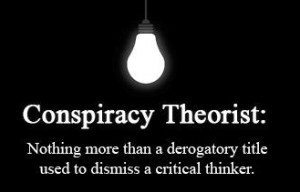
Mainstream Academia/Media Attacks “Conspiracy Theorists”: Ignore Compelling Info, Focus on Irrational Sounding Things

251543_10151388666682589_92757733_n

By Cassius Methyl

Source: Era of Wisdom

Another hit was recently attempted on the rising culture of educated people: people educated about “conspiracies.” Mainstream academic institution the University of Kent published a study claiming that conspiracy theorists tend to be narcissistic.

A Daily Mail article sports the headline “Believe in conspiracy theories? You’re probably a narcissist: People who doubt the moon landings are more likely to be selfish and attention-seeking.”

Right: the University of Kent experts have really pinned down the root psychological machinations of a conspiracy theorist.

Like other recent attacks on “conspiracy theorists” in mainstream academia, they associate “moon landing conspiracy theories” with all kinds of other historically proven, irrefutably true facts.

The article tries to paint these people as absurd, saying “Do you think the moon-landings were faked, vaccines are a plot for mind control, or that shadowy government agencies are keeping alien technology locked up in hidden bunkers?”

Here are some irrefutable facts to put reality in perspective: from an article titled “Governments and Biowarfare: a Brief History”


– 1932: The Tuskegee Syphilis Study begins. 200 black men diagnosed with syphilis are never told of their illness, are denied treatment, and instead are used as human guinea pigs in order to follow the progression and symptoms of the disease. They all subsequently die from syphilis, their families never told that they could have been treated. Follow this link for more info.

– 1950: In an experiment to determine how susceptible an American city would be to biological attack, the U.S. Navy sprays a cloud of bacteria from ships over San Francisco. Monitoring devices are situated throughout the city in order to test the extent of infection. Many residents become ill with pneumonia-like symptoms. Follow this link for more info.

– 1955: The CIA, in an experiment to test its ability to infect human populations with biological agents, releases a bacteria withdrawn from the Army’s biological warfare arsenal over Tampa Bay, Fl. Follow this link for more info.

– 1956: U.S. military releases mosquitoes infected with Yellow Fever over Savannah, Ga and Avon Park, Fl. Following each test, Army agents posing as public health officials test victims for effects. Follow this link for more info.

– 1965: Prisoners at the Holmesburg State Prison in Philadelphia are subjected to dioxin, the highly toxic chemical component of Agent Orange used in Viet Nam. The men are later studied for development of cancer, which indicates that Agent Orange had been a suspected carcinogen all along. Follow this link for more info.

– 1966: U.S. Army dispenses Bacillus subtilis variant niger throughout the New York City subway system. More than a million civilians are exposed when army scientists drop lightbulbs filled with the bacteria onto ventilation grates. Follow this link for more info.

– 1990: More than 1500 six-month old black and Hispanic babies in Los Angeles are given an “experimental” measles vaccine that had never been licensed for use in the United States. CDC later admits that parents were never informed that the vaccine being injected to their children was experimental. Follow this link for more info.

– 1994: With a technique called “gene tracking,” Dr. Garth Nicolson at the MD Anderson Cancer Center in Houston, TX discovers that many returning Desert Storm veterans are infected with an altered strain of Mycoplasma incognitus, a microbe commonly used in the production of biological weapons. Incorporated into its molecular structure is 40 percent of the HIV protein coat, indicating that it had been man-made. Follow this link for more info.

The bottom line is, there are all types of historical facts, crimes committed by governments, events, pieces of information, that the ordinary person has not investigated. Once you learn about historical facts that are suppressed by governments, corporations, and their media partners, you realize this:

Nobody has a perfect measure of probability. Nobody has the ability to say “no, that can’t be true, that’s not probable,” because to have an accurate sense of probability, you’d have to know a lot more than you do.

There are so many historical facts that could obliterate a person’s perception of “probable.”

If an ordinary person spent a few days being educated by a person into these facts, a person who mainstream culture would condemn as a “conspiracy theorist,” they would never see the world the same again.

Mainstream academia cannot reasonably sit on a pedestal and claim that they have supreme ability to measure probability.

Moon landing conspiracy theories have little to do with an understanding of the irrefutable reality of hegemony and it’s conniving, conspiring nature: the conspiring history of Rockefeller and Carnegie, the industrial magnates of the United States, creating corrupt academic institutions such as the University of Chicago, for example.

Moon landing theories have little to do with the recent conspiracy facts of Halliburton being granted contracts in Iraq, or the US taking out Gaddafi in Libya to defend the petrodollar.

There’s an entire world of geopolitics, an entire obfuscated world of geo-economic warfare, an entire world of power beneath the curtain of mainstream culture.

There’s an entire world of history behind the industrial powers that fought in the World Wars (IG Farbin, National City Bank).

There’s an entire world of depth behind the curtain of political theater, and it takes more effort to try and understand than some contracted, paid off mainstream academics at the University of Kent are willing to put forth. Well, the amount of effort it takes is not something they can’t do, it’s something they won’t do. If you’re reading this, that’s probably abundantly clear to you.

The establishment media would like to crush dissent, to crush speculation or questions for the official narrative: the truth is, it’s not narcissists who like to look deeper, it’s people with the common sense to realize that many things in our society are not right, and we need to understand history better to know why they are not right.

Perhaps sometimes the more open minded people could fall prey to an illusion, as we all might at times, but to try and paint it as some overarching, general rule of psychology that conspiracy theorists are narcissistic is preposterous.

We need to understand where the structures of our society, corporations, and government powers really originated: the truth is, people conspire. Wealthy people conspire, infiltrate academia, have wars, use propaganda, and if a man in power can get away with something, history shows that they will take advantage.


War Pabulum: The Perils of War as a Master Narrative


photo posted on post-gazette.com

By W.J. Astore

Source: Bracing Views

I was reading the novelist Ursula K. Le Guin and came across the following commentary by her:

“A hero whose heroism consists of killing people is uninteresting to me, and I detest the hormonal war orgies of our visual media … War as a moral metaphor is limited, limiting, and dangerous.  By reducing the choices of action to ‘a war against’ whatever-it-is, you divide the world into Me or Us (good) and Them or It (bad) and reduce the ethical complexity and moral richness of our life to Yes/No, On/Off.  This is puerile, misleading, and degrading.  In stories, it evades any solution but violence and offers the reader mere infantile reassurance.  All too often the heroes of such fantasies behave exactly as the villains do, acting with mindless violence, but the hero is on the ‘right’ side and therefore will win.”

This passage is copyrighted 2012, and surely Le Guin is commenting in part on the American political and war scene, even if these comments came as an afterword to her novel “A Wizard of Earthsea.”

The stories we tell ourselves – our driving narratives and metaphors – are very powerful.  I learned this almost three decades ago from one of my professors at Johns Hopkins.  We were talking about the scientific revolution, the label applied after the fact by historians to the era of Copernicus, Kepler, Galileo, and Newton.  Did that era truly deserve the label of a “revolution” in thought?  On one level, yes.  A heliocentric vision replaced a geocentric one.  Newtonian physics replaced Aristotelian metaphysics.  But on another level, the label was misleading.  If you view this era only through a “revolutionary” lens, everything gets magnified and refracted through it.  You’re always looking for evidence of the “revolution” that you know is there.  The revolutionary narrative/metaphor, in other words, restricts and distorts your vision.  It also tends to answer questions before they’re even asked.  Certain historical figures get labeled as “revolutionaries,” others as “reactionaries,” some as winners, others as losers, almost without having to think about it.

That’s disturbing enough for a historian dealing with the “dead” past.  Think about how that distortion, that resort to easy categorization, applies to the living, to the present, in “wartime.”  Viewing everything through a war lens both restricts and distorts our vision.  We quickly force people to take sides, or we assign them a side regardless of their complexity (“You’re either for us or against us,” as George W. Bush noted in the aftermath of 9/11).  Just as quickly, the “heroes” adopt the violent methods of the bad guys (witness the bombing, the invasions, the use of torture, performed by the U.S. in the stated cause of “liberation”).  No ethical complexity is tolerated since “our” troops are on the right side (so we think).  Even when they embrace violence and lose control, deadly mistakes and even war crimes are readily excused as aberrations that should be forgotten, rare exceptions that do nothing to besmirch America’s exceptional and heroic nature.

The power of narratives is remarkable.  The United States continues to be driven by one that’s dominated by power, violence, and war.  Is it any wonder, then, that the two major party candidates for the presidency, Hillary Clinton and Donald Trump, fit so easily and readily into this narrative?  Hillary plans to continue to wage war even more aggressively than Obama has, and Trump is all about violent solutions and an “Us” versus “Them” mentality.  (Build a wall!  Biggest, baddest military!  Make America great again!  Punch the protesters!    Extreme vetting!  Throw the illegals out!)

Until we change our national narrative from one of constant war and violence to something more pacific and modulated, our political scene will continue to be, to borrow Le Guin’s words, puerile and misleading and degrading, with candidates serving up heroic violence as pabulum, as infantile reassurance.

Oceania Forever: Rise of the Global Police State

1984-screenhillary-1024x576

By Patrick Henningsen

Source: Waking Times

Much has been written about the approaching Police State in alternative media. Commentary ranges from various warnings, to shock and outrage, and fear over an impending martial law takeover in North America and Western Europe. It’s hitting us from so many different angles, and yet the mainstream conversation continues to be woefully inadequate in both characterising the situation and offering a remedy.

In order to really understand the modern Police State, we need to explore some very profound and difficult questions. Many people who consider themselves aware think Western society has already reached the tipping point and the deteriorating situation is simply inevitable. If you feel like Winston Smith right about now you aren’t alone.

Prior to the mid 1990s, one might have described the militarisation of public law enforcement something of a creeping paradigm, but one that was still a long way off. Society explored many aspects of the Police State, both the physical and Orwellian psychological scenario, through literature and film. American science fiction writer Philip K. Dick penned some significant works like The Minority Report, and cinematic hits like Paul Verhoeven’s Robocop and Terry Gilliam’s Brazil also explored what this dystopic, future vision of fascist technocracy might look like. As it turned out, and far from fantasy, countless devices, systems and themes depicted in so many of these supposedly ‘fictional’ classics have since made their way into our day to day lives. The dark dream became real.

Unfortunately, as humanity’s freshmen class of the early 21st century, we can no longer afford the intellectual distance enjoyed by previous generations between life today and that blurry, far-off spectre of something that might arrive sometime at some point in the future.

Any modern globalised Police State requires a social engineering framework in order to provide its shape and scope of law enforcement. The latest social engineering blueprint for global technocratic management was unveiled at this year’s 70th United Nations General Assembly in New York City. Their ‘new’ agenda (newer than the old one) entitled, Agenda 2030,1 hopes to “transform our world for the better by 2030.” Author Michael Snyder from the blogEnd of The American Dream’ explains: “The entire planet is going to be committing to work toward 17 sustainable development goals and 169 specific sustainable development targets, and yet there has been almost a total media blackout about this…”2

Within its 17 ‘universal goals’, the actual Police State provision for Agenda 2030 can be found within Goal 11, which states how the new global government will, “Make cities and human settlements inclusive, safe, resilient and sustainable.” Translated in technocracy terms, this means more Big Brother tech, smart grid tracking and big data surveillance states.

The age of computerisation and database integration, along with advances in military and crowd control technology perfected overseas, have enabled a sharp advance toward the Police State. Trying to make sense of ‘it’ is a major challenge, to say the least. In its totality, the control system is both multifaceted and multilayered. It may have been possible to describe it, or even define it 20, 30, or 40 years ago, as Philip K. Dick and so many others did. Today, as society has already eclipsed the possible, we face a situation whereby the very thing we are trying to describe is woven through nearly every fabric of modern social, professional, family, religious and political life.

If you happen to live in one of the technocratic nations, you can’t opt out, nor can you fully repeal the advances already made by the control system. What other options are available?

Firstly, we have to try and understand, from an economic, cultural and political perspective at least, how this control system came to be.

What are its strongest areas? Can we reform those areas? Where is it still emerging? Cannot those areas be slowed down? What was the political climate that enabled it?

How to Build a Police State

When you observe a modern Police State, the first things you might notice will not necessarily be the batons, shield, helmets or MRAPs. Think Switzerland or Singapore. A modern Police State will be neat, clean and efficient. Retail zones will be shiny and feature all the top designer brands. Many of the people you see in public will be well-groomed, well-healed and beautiful, but often with only one political party and a strict public code.

Just like admirers of the modern Chinese State, Singapore’s proponents refer to the single party State as “a great argument for Authoritarianism.” Order and civility rule the day, so long as you don’t fall foul of the narrow perimeters set by the State.

What has been accomplished in Southeast Asia since 1965, and what is possible in previously ‘free’ countries like the US, UK and Australia, are two very different social and political evolutions. Still, the modern Police State is advancing globally and it’s being driven primarily by three factors: technology, for-profit industry, and an age-old obsession by the ruling class to manage the masses.

The first and easiest area to challenge is the physical realm of the control system. The most obvious of these are the gadgets and toys. They are easy to see. Look at your local police department and notice the difference between what officers looked like and what they wore in the 1970s, 1980s, 1990s and now in the 21st century. Notice the firearms and tasers, the ‘Bat-Belts’, and now the body cameras. Your average officer today looks like a cross between a soldier and an android. Dress them like robots and don’t be surprised when they act like machines (and it won’t be long until many of them are replaced by machines).

If you’ve ever attended a street protest or witnessed some civil unrest, then you’ll have noticed the high-tech body armour, the riot and ‘crowd suppression’ equipment.

My first intense experience where I felt the full force of the modern Police State was in 2009, at the G20 Protests in the City of London, England. It was early in the evening and approximately 4,000 demonstrators suddenly found themselves trapped at Bishopsgate. Several hundred police officers on foot and horseback had blocked all the entrances and egresses in and out of the main road. Even alleyways were manned by riot police. Then police began charging the crowds, and beating protesters with clubs. They alternated their ‘surge’ efforts, from different ends of the street, north to south, one brutal flurry after another. The worst part about it was there was no escape route away from the police. Many were beaten and trampled on that evening. It was as if police planners were playing a video game.

Finally, at around 9pm, after being forced to stand, surrounded by police in a ‘Kettle’ for nearly three hours, along with 500 other demonstrators and press, who spent most of that time pressed up against police shields and not knowing what would happen next – I realised this is an impersonal, disinterested and totally uncompromising machine. It does not care who you are, what your views and opinions are, or whether you were innocent or guilty. The lesson was simple: “next time, stay home.” The only detail this machine is concerned with is that you comply with orders, and if no orders are given, then the machine demands you stay where you are until the machine decides what to do with you. If you complain too much, or become emotional, or heaven forbid act out in any way, then the machine will move in to subdue and detain you. That is all there is to it.

Big Brother Reality

It’s well-known that Great Britain is home of the world’s largest and most sophisticated physical Police State, including tens of millions of closed circuit television (CCTV) cameras, covering every conceivable inch of habitable space, both indoors and outdoors. The CCTV phenomenon in Britain was fuelled by an obsession with cameras that became increasingly popular with both government and corporate technocrats in the 1980s and 1990s. The psychology behind the exponential proliferation in cameras was mainly a fairly crude bit of criminology which held that the cameras would somehow act as a deterrent to criminal behaviour, and thus subdue the feral population into a more docile state. Industry used this line too, as sales persons were deployed en masse with endless flip charts and statistical models that claimed CCTV cameras would prevent the UK’s spiralling social malaise.

The only problem is that more cameras don’t equal less crime. Canadian writer Cory Doctorow observed this reality back in 2011, explaining: “After all, that’s how we were sold on CCTV – not mere forensics after the fact, but deterrence. And although study after study has concluded that CCTVs don’t deter most crime (a famous San Francisco study showed that, at best, street crime shifted a few metres down the pavement when the CCTV went up), we’ve been told for years that we must all submit to being photographed all the time because it would keep the people around us from beating us, robbing us, burning our buildings and burglarising our homes.”3

The CCTV is only one single aspect of Big Brother. It turns out that the real value of the CCTV camera grid is not so much the monitoring of crime per se, as it is in mass applied behavioural psychology.

The Panopticon

The physical Police State could not exist without some philosophical underpinning. Before Orwell, there was Bentham…

In the mid 19th century Britain developed a new style of prison architecture known as the ‘Panopticon’ under the aegis of utilitarian philosopher Jeremy Bentham.4 The unique feature of this Panopticon concept was the transparent nature of each prisoner cell, visible to a central surveillance guard tower that could eye inmates at all times. The result of this psychological experiment, according to the pragmatic Benthamite philosophy, was to produce a regime of “self-policing” amongst the inmates, a kind of early behavioural conditioning. For technocrats and emerging utilitarian social managers of that era, this was seen as the most economic and efficient solution. Ultimately, this Benthamite concept is what underpinned phase one of the mass CCTV deployment throughout the UK. Sitting well above the security minions and the industry profiteers, elite scholars knew full well that CCTV cameras do not stop crime.

The real power of the Panopticon is in convincing the general population they are under constant surveillance. After that point, through a long-term process of nudging, diversions and scare tactics, the State gradually moulds the behaviour and thoughts of its subjects.

In order to keep citizens locked into this new conscious state of fear and trepidation, the State needs anenemy…

The Long War & ‘The Extremist’

One of the chief campaigns to nudge society towards a fully-functional Orwellian State is the War on Terror. Ever since September 11, 2001, the concept of an endless war against the ‘terrorists’ – a seemingly ubiquitous and constantly shape-shifting enemy – has been used to justify nearly every large new security expenditure and policy. Back in 2006, US President George W. Bush’s chief architect of the ‘long war’, Secretary of Defense Donald Rumsfeld, laid out the tea leaves for the next 100 years, stating: “It does not have to do with deployment of US military forces, necessarily. It has to do with the struggle that’s taking place within that faith between violent extremists – a small number of them, relatively – who are capable of going out and killing a great many people, as they’re doing, and the overwhelming majority of that religion that does not believe in violent extremism or terrorism.”5

In George Orwell’s classic novel 1984, Winston Smith also grappled with the State’s endless war. “Oceania was at war with Eurasia: therefore Oceania had always been at war with Eurasia.”

In Oceania, people eventually forgot what started the long war. The news was just one terrorist attack after another. They enemy was everywhere, but nowhere too. The population learned to acquiesce to the idea that war was the permanent state of affairs, and that questioning the provenance of this idea was futile.

“Winston could not definitely remember a time when his country had not been at war, but it was evident that there had been a fairly long interval of peace during his childhood, because one of his early memories was of an air raid, which appeared to take everyone by surprise. Perhaps it was the time when the atomic bomb had fallen on Colchester. He did not remember the raid itself.”

And so it was, in the early moments of the 21st century, Orwell’s dream suddenly became a waking reality. Social engineers are firm believers that if the Panopticon (married with the threat of an invisible enemy) can remain in place for a generation, then the State could fundamentally change a once free-thinking society into something noticeably different – a much more fearful and compliant populace.

The Social Media Panopticon

As terror scares and attacks become somewhat of a daily event in the West, identifying and quarantining the ‘extremist’ becomes a primary fetish of the Police State and its media arms. This is very much evident in how terrorists and ‘active shooters’ (dead or alive) are now profiled after the event. The mainstream media has integrated this into its work practice by crafting the post hoc guilty verdict of the accused, prior to a trial, with circumstantial or non sequitur accusations based on an individual’s “web history” that may have “radicalised” the suspect. In effect, the mainstream media’s function as an establishment propaganda arm results in trial by media – the bypassing of any trial by jury as the accused have already been implicitly or explicitly declared guilty by association or something as nebulous as “web history.”

Such incidents, as they are portrayed in the media for psychological conditioning purposes, are intended to cause the public mind to dismiss outdated notions of fair and due process and rule of law in favour of fiat corporate news and government “official” pronouncements. The net effect of this trend is that social media users, ie. the majority of the population, are adopting self-policing habits in their communications online. According to the principals of applied behavioural psychology, if you change the language people use, then eventually you change the way they think and act.

Like Bentham’s Panopticon, this new social media monitoring system works by utilising the digital web, which is arguably the most economic and efficient solution. The acceptance of self-policing and vague terms such as “radicalised” that are subject to the increasingly elastic definitions of the social engineering establishment.

This leads to one of the most profound questions one might ask in the wake of Edward Snowden’s NSA spying revelations: Knowing what we know now, are people more outspoken or are they more self-policing because of the Snowden leaks?

‘The Daily Shooter’

By extension, once the technocrat has regained some modicum of physical control, then the next domain to be conquered is the mind. In 1984, the technocracy was viewed through the eyes of the protagonist Winston Smith, who while remaining a physical prisoner of the Police State, could still retreat into his own mental state.

In our day, the expansion of the surveillance State and vast spying by the likes of the NSA and GCHQ are precisely intended to achieve this same effect, with the justification for such intrusions being an endless series of terror spectacles and lone wolf public shooting events. In the US, these mass shootings and terror scares are happening on an almost daily basis, hence, ‘The Daily Shooter’. Media coverage is both chaotic and relentless. As a result, the pubic are left stupefied and completely unable to challenge whatever narrative the government-media complex is selling at that time. The Police State marches forward.

A similar psychodrama also played out for 1984’s protagonist Winston Smith. As time progressed, however, maintaining some level of autonomy in one’s own thoughts became increasingly difficult for Winston. The final objective of the Police State, it seemed, was not only to fundamentally transform the way citizens act, but how they think too. The all-seeing and all-controlling “Big Brother” State was also the de facto social authority figure. The State’s law enforcement police force also became the “thought police.”

We see this same exact narrative playing out today as the State’s political figureheads continue in their mission to widen their definition of “extremism” along with other State-issued euphemisms used to describe citizens who should be regarded with suspicion.

Fall out of line and you might even be segregated or sent away to a special camp. Following the recent mass shooting in Chattanooga, Tennessee, retired US General and NATO Commander Wesley Clark proposed that any “disloyal Americans” should be sent to internment camps for the “duration of the conflict.” Notice the language: “for the duration of the conflict.” Indeed, it seems that Oceania is at war. He went even further, calling for the US government to identify people most likely to be “radicalised” so we can “cut this off at the beginning.”

“At the beginning?” Here, it seems Clark might be alluding to pre-crime, which will be powered by A.I…

Artificial Intelligence

Post-September 11, UK society was still hooked on their CCTV matrix, and with millions of cameras already in place and crime continuing to rise, security ‘experts’ and politicians simply doubled down on their previous wager, insisting that what the country really needed was more cameras. They believed that once a certain CCTV saturation was reached, by default they would somehow reached their twisted utopia.

It turned out that’s not humanly possible for security workers, most of whom are on a mere £7-10 (aud$14-20) per hour, to keep track, let alone analyse, a seemingly endless stream of footage. For the technocrat, the operative word here is ‘humanly’. Enter A.I…

Once again, advanced technology enters the narrative and supplies the solution to this previous insurmountable problem. The age of Artificial Intelligence, or A.I., is nearly upon us, and this next step in technological development is certain to radically change the entire concept of the Police State.

Laying down the framework an A.I. grid is not easy because the grid must be designed to cope with the application of A.I. As A.I.’s potential and practical applications have not yet been fully realised, designing the grid upon which it will be unleashed has been problematic up to this point. Sadly, society on the whole appears disinterested in questioning the social and unethical imperative currently driving the adoption of these new technologies.

At present, the big money is on the Smart Grid. Technocrats and their corporate partners are hoping to usher in their new surveillance grid under the auspices of ‘smart’ technologies. With A.I. in play, technocrats will be able to utilise the smart grid – which includes your mobile phone – to detect and track multiple targets over a wide area.6 Add facial recognition and data profiling to the mix and it’s a recipe for a full-on A.I. Smart Grid future. The ultimate hands-free, ‘surveillance selfie’ – compliments of Big Brother.

Just imagine, one day you’re simply walking down the street and pointing to something in the air. All of it is being captured on a 1.8 billion pixel video stream from the sky. They already know your identity and location with the phone in your pocket, and they already have your face logged and tracked.7

At this point we introduce Philip K. Dick’s concept of “pre-crime” whereby an A.I. system can predict an action you are likely to take.8 The system will then close the ‘Big Data’ loop by storing the video footage alongside your profile into a massive data ‘mash-up’. It will then compare with other potentially ‘suspicious’ activity in the area. Great Britain’s national police force, the Metropolitan Police, are already using a type of pre-crime software that British technocrats believe will somehow ‘revolutionalise’ modern policing in the 21st century.9

UK consumer advocate Pippa King explains how CCTV is already being phased out: “CCTV, closed circuit television, is not quite what is operating on our streets today. What we have now is IPTV, an internet protocol television network that can relay images to analytical software that uses algorithms to determine pre-crime area in real time.”

“Currently this AI looks at areas that may be targeted for crimes such as burglaries or joyriding,10 with the predicted hotspot information being sent direct to law enforcement smart phones in the field. This analytical software is being used in Glasgow, hailed as Britain’s first ‘smart city’,11 where the Israeli security firm NICE Systems are running the CCTV/IPTV network, analysing data from the 442 fixed HD surveillance cameras and 30 mobile units under a project called ‘Community Safety Glasgow’,12 whose primary objectives are described as ‘delivering Glasgow a more efficient traffic management system, identifying crime in the city and tracking individuals’.”13

This all can happen thanks to the US Defense Advanced Research Projects Agency’s (DARPA) latest creation – the ARGUS camera, Autonomous Real-Time Ground Ubiquitous Surveillance.14 According to its designers ARGUS, “melds together video from each of its 368 chips to create a 1.8 billion pixel video stream” all in real-time and archived. It’s just one of the many new toys used by the State to realise its Orwellian ambitions.

Who’s Paying For It All?

Aside from its ability to trample over the rights of law abiding citizens, the Police State has one other chief characteristic which may also be its Achilles heal: it’s bankrupting the State. Here’s how it works:

The gravy chain is endless, but only with the help of taxpayers’ money, along with a series of bribes and favours between politicians and corporates. If you have ‘friends’ in government administration, then you are more likely to cash in on any number of lucrative ‘domestic defense’ contracts.

Where you have constant crisis you also have constant business opportunity. In this dark paradigm, timing is everything. As US President Barack Obama’s sociopathic15 former chief of staff, now Mayor of Chicago, Rahm Emmanuel, once said:

“You never let a serious crisis go to waste. And what I mean by that it’s an opportunity to do things you think you could not do before.”

With that mantra in mind, in the wake of any shooting, terror scare, or crisis, industrial lobbyists and their elected political gophers will waste no time pushing for new federally-funded add-ons like training courses, workplace psychologists, regulators, specialist contractors, police cameras and other big-ticket items16 – anything to help “solve the crisis.” One such program in the US is known simply as the ‘1033’.

Joseph Lemieux writes:

“The 1033 program has flooded our local police forces with military equipment, and has turned them from Peace Officers, to a domestic army.”

“Officers stopped looking like officers, and more like soldiers all kitted out with fully automatic weapons, armoured vehicles, body armour, grenades launchers, night vision, and even bayonets! Besides the cost of liberty, how much has this domestic army cost you the tax payer?”17

In the US, no single entity embodies the Police State gravy train more than the Department of Homeland Security (DHS), where federal grants are used to bribe local law enforcement and absorb them into a larger framework of institutional dependency.

At over $200 billion per year, the DHS is now America’s most expensive federal agency. As any sane local law enforcement chief will tell you, once you smoke from the federal crack pipe, you’re hooked for life. Remember that each federal Police State agenda item has a lucrative contract attached to it. With each move central government makes, a large amount of money is also made (by someone).

By cutting off public money that is driving the runaway federal Police State in Western countries, the people have a chance to mitigate and potentially reform the current agenda.

If we hope to preserve what is left of our hard fought democracy, then now is the time to put it to the test. The alternative is unthinkable.


About the Author

Patrick Henningsen is an independent investigative reporter, editor, and journalist. A native of Omaha, Nebraska and a graduate of Cal Poly San Luis Obispo in California, he is currently based in London, England and is the managing editor of 21st Century Wire – News for the Waking Generation (www.21stCenturyWire.com) which covers exposés on intelligence, geopolitics, foreign policy, the war on terror, technology and Wall Street. Patrick is a regular commentator on Russia Today.

Footnotes:

  1. ‘Transforming our world: the 2030 Agenda for Sustainable Development’,https://sustainabledevelopment.un.org/post2015/transforming
    ourworld
  2. ‘The 2030 Agenda: This Month The UN Launches A Blueprint For A New World Order With The Help Of The Pope’ by Michael Snyder, 2 Sept 2015, http://endoftheamericandream.com/archives/the-2030-agenda-this-month-the-un-launches-a-blueprint-for-a-new-world-order-with-the-help-of-the-pope
  3. ‘Why CCTV has failed to deter criminals’ by Cory Doctorow, The Guardian, 17 August 2011
  4. www.ucl.ac.uk/Bentham-Project/who/panopticon
  5. www.sourcewatch.org/index.php/The_Long_War
  6. ‘Bilderberg 2015: Implementation of the A.I. Grid’ by Jay Dyer, 21st Century Wire (www.21stcenturywire.com), 14 June 2015
  7. ‘Britain Launches “Big Brother” System, Uploads One Third of Population to Facial Recognition Database’, 21st Century Wire, 3 Feb 2015
  8. ‘Already Underway: Smart A.I. Running Our Police and Cities’ by Pippa King, 21st Century Wire, 13 Mar 2015
  9. ‘British Police Roll Out New “Precrime” Software to Catch Would-Be Criminals’, 21st Century Wire, 13 Mar 2015
  10. ‘Pre-crime software recruited to track gang of thieves’ by Chris Baraniuk, New Scientist, 11 Mar 2015
  11. ‘Glasgow wins “smart city” government cash’, BBC News, www.bbc.com/news/technology-21180007
  12. www.saferglasgow.com
  13. ‘Already Underway: Smart A.I. Running Our Police and Cities’, op.cit.
  14. www.darpa.mil/program/autonomous-real-time-ground-ubiquitous-surveillance-infrared
  15. ‘The Two Sides of Rahm Emanuel: Sociopathic Political Hitman and Puppy Lover’ by Foster Kamer, 16 Aug 2009, gawker.com
  16. ‘Mayor de Blasio Announces Retraining of New York Police’ by Marc Santoradec, The New York Times,4 Dec 2014
  17. ‘How Much Money Have American Taxpayers Spent on Building a Domestic Police State?’ by Joseph Lemieux, 1 Dec 2014, http://theantimedia.org/taxpayers-police-state/

The above article appeared in New Dawn 153 (Nov-Dec 2015)

Lament for Humanity: A 50 Year Reflection

Beryl & James Burrowes 1942 & 2016

Beryl & James Burrowes 1942 & 2016

By Robert J. Burrowes

Source: RINF

Deeply affected by the death of my two uncles in World War II, on 1 July 1966, the 24th anniversary of the USS Sturgeon sinking of the Japanese prisoner-of-war ship Montevideo Maru which killed the man after whom I am named, I decided that I would devote my life to working out why human beings are violent and then developing a strategy to end it.

The good news about this commitment was that it was made when I was nearly 14 so, it seemed, anything was possible. Now I am not so sure.

Here is my report on 50 years of concerted effort to understand and end human violence.

In 1966 one of my immediate preoccupations was war. The US genocidal war on Vietnam was raging and, as a sycophantic ally of the United States, Australia had been drawn into it some years previously. Trying to understand what this war was really about was challenging, particularly given the limited (mainstream) sources of information available to me at the time.

But I was deeply troubled by another problem too. I had seen a photo of a starving African child in the newspaper when I was ten and I found this most disturbing. Why did adults let children starve? I wondered. And trying to make sense of this by reading newspaper reports or asking those around me was utterly unenlightening.

By the early 1970s the environmental crisis was starting to impact on my awareness too, including through environmental campaigns I heard about and the ‘limits to growth’ literature published by the Club of Rome, which I read at University.

So where are we today?

Well, the most casual perusal of the state of our world reveals the ongoing (and recently heightened) threat of nuclear war and obliteration (on top of the ongoing and rapidly spreading radioactive contamination generated by Fukushima and the use of Depleted Uranium weapons), ongoing phenomenal levels of military spending and the endless push from corporate and other elite interests for more wars. Hence, we are witness to and, through our taxes, active supporters of an endless sequence of wars, military invasions, occupations and coups, virtually all of them instigated by the US elite and its allies, as well as a sequence of ‘local’ wars, also instigated by western elites and supplied with weapons by western corporations.

The global economy teeters on the brink of collapse and, of course, from the viewpoint of those 100,000 people in Africa, Asia and Central/South America who starve to death each day or those one billion people who live in a state of semi-starvation and abject poverty in many parts of the world, it has already ‘collapsed’. This all happens at the instigation of insane elites who continue to accumulate and hoard their wealth, much of it in illegal offshore tax havens. Given the enormous psychological damage that individual members of the elite have suffered, millions or even billions can never be enough.

And the environmental crisis has only become vastly worse with the synergistic impact of our combined assaults on the environment causing human extinction-threatening strain on the biosphere. These devastating assaults include those inflicted by military violence (often leaving vast areas uninhabitable), the emission of vast quantities of carbon dioxide, methane and nitrous oxide into the atmosphere, rainforest destruction, industrial farming, mining, commercial fishing and spreading radioactive contamination.

We are also systematically destroying the limited supply of fresh water on the planet and inducing the collapse of hydrological systems. Human activity drives 200 species of life (birds, animals, fish, insects, reptiles, amphibians, plants) to extinction each day and 80% of the world’s forests and over 90% of the large fish in the ocean are already gone.

Despite this readily available information, governments continue to prioritize spending $US2,000,000,000 each day on military violence, the sole purpose of which is to terrorize and kill fellow human beings, now or in the future.

In addition, you might have noticed the ongoing attacks on everything from our civil liberties and right to privacy to our right to eat healthy food that has not been poisoned and/or genetically mutilated.

So why does all of this happen? Well, 50 years of research and decades of nonviolent activism have had some rewards and particularly the research that Anita McKone and I conducted during our 14 years in seclusion (1996-2010) which fully explained why human beings are violent. In essence, it is an outcome of the visible, ‘invisible’ and ‘utterly invisible’ violence inflicted by adults on children. See ‘Why Violence?’ and ‘Fearless Psychology and Fearful Psychology: Principles and Practice’.

Moreover, this research also gave us enormous insight into the insanity of the global elite and those who serve them in order to maintain this worldwide system of violence and exploitation that is killing us all while destroying the biosphere. Whether it be the politicians who implement elite policies, the academics who ‘justify’ or remain silent about this violence and exploitation, the business people who manage it, the judges, magistrates, lawyers and prosecutors who defend and ultimately enforce it, the teachers and media personnel who teach and promote (or distract us from) it, or the soldiers, private military contractors, police and prison officers who inflict its most direct violence, the global elite is served by a ready stream of witting or unwitting people, many of whom are paid by your taxes to do its bidding. See ‘The Global Elite is Insane’.

And just to ensure that you are endlessly frightened into accepting this worldwide system of violence and exploitation, and to support its further encroachment into your life, the global elite conducts an ongoing terrorist campaign against you. See ‘Terrorism: Ultimate Weapon of the Global Elite’ and ‘Why Elites Love Drones’.

But there is another huge problem too: Lack of solidarity.

Elites know that they can divide us and that enables them to conquer us. Despite our efforts to build solidarity over recent decades, elites keep finding new ways to emphasize our ‘differences’. We need to start thinking of our selves as ‘We are all each other’. Does it matter if the ‘big’ difference between us is our gender, our race, our class, our religion, our nationality or something else (or even all of these)?

While elites can easily manipulate us, especially via education systems and the corporate media, into projecting our fear and self-hatred onto others who are ‘different’ and then inflicting violence on, or even killing, each other because, in effect, ‘I am an adult and you are a child’, ‘I am a man and you are a woman’, ‘I am non-indigenous and you are indigenous’, ‘I am a Christian/Jew/Hindu/Buddhist and you are a Muslim’, ‘I am working class and you are middle class’, ‘I am white and you are not’, ‘I am straight and you are LGBTQIA’, ‘I am one nationality and you are another’, ‘I am a feminist and you are a socialist’, or even ‘I am human and you are a bird/animal/fish/insect/reptile/amphibian/plant’ then we haven’t even begun to realize that the real issue is that we are all living beings and this insane elite is willing to do anything they can to exploit and, if necessary, kill us all.

Isn’t it time we started to see what makes us the same – victims of violence and exploitation – rather than focusing on what, after all, are the rather less significant differences in our bodily characteristics, in our beliefs or even the causes of our exploitation (which is not meant to diminish the significance of the outcomes of direct and structural violence which undoubtedly have variable impact)? Fear divides us.

One interesting personal outcome of this lifetime of effort, apart from the many arrests, terms of imprisonment (including once in a psychiatric ward where I was forcibly injected with ‘antipsychotic’ drugs), bankruptcy and seizure of my passport that have been direct results of my nonviolent activism, is that Anita and I have been homeless since 1999: conscience has its costs. Moreover, a worldwide search has failed to identify more than a handful of individuals (but pre-eminently my parents, James and Beryl, both veterans of World War II and now 93) or an organization of any kind that is willing to fund our research or our work to end human violence. Of course, there is a psychological explanation for this as well. See ‘Why Don’t We Try to Understand and End Human Violence?’

So what of human prospects? Not good. With an insane elite controlling the US (and other) military/nuclear arsenals and the highly exploitative global economy (with the secret corporate governance deals, such as the Trans-Pacific Partnership and the Transatlantic Trade and Investment Partnership, designed to further consolidate corporate control of our world), as well as the dominant discourse via the education systems and corporate media, very few people have the emotional and intellectual capacities to critique this world order and then strategically and nonviolently resist the rush to extinction in which we now find ourselves. In short, most human beings are utterly (unconsciously) terrified and remain politically inert despite time and opportunities slipping rapidly away.

And those who do courageously resist this violent world order face a phalanx of violent institutions, ranging from psychiatry – see ‘Defeating the Violence of Psychiatry’ – and the pharmaceutical – see ‘Bad Pharma: How Drug Companies Mislead Doctors and Harm Patients’ – and agribusiness – see ‘Monsanto, America’s Monster’ – industries to the corporate media – see ‘Propaganda & Engineering Consent for Empire’ – and the police, legal and prison systems – see ‘The Rule of Law: Unjust and Violent’ – designed to neutralize or stop us, one way or another.

So what do I suggest? Well, with the scientific evidence now indicating that near term human extinction is the most likely outcome – see ‘Why is Near Term Human Extinction Inevitable?’ – it is increasingly clear that if we are to end human violence in all of its many and complex manifestations, and prevent human extinction, then we need an integrated and comprehensive strategy for doing so that also provides many meaningful avenues for involvement by individuals and organizations who wish to respond powerfully: token gestures have no value. Over many years I have endeavoured to create this overarching strategy and I invite you to participate in it by doing one or more of the following.

If you are an adult, you might consider dramatically modifying your treatment of children in accordance with ‘My Promise to Children’. You might also find this article useful in better understanding how to do so: ‘Nisteling: The Art of Deep Listening’.

If these suggestions seem beyond you, then perhaps your own emotional healing should be your priority. Despite its title, this article explains what you need to do: ‘An Open Letter to Soldiers with “Mental Health” Issues’. And remember this: if you don’t believe that you are ‘important’ enough to spend time learning to know yourself more deeply, I disagree. You are important.

Separately from the above, you might like to join those participating in ‘The Flame Tree Project to Save Life on Earth’. You might also consider signing the online pledge of ‘The People’s Charter to Create a Nonviolent World’.

And if you would like to learn how to make your nonviolent action campaign for a peace, environmental or social justice outcome more strategically effective, you can do so here: ‘Nonviolent Campaign Strategy’. To nonviolently defend against coups and invasions, remove a dictatorship or conduct a liberation struggle, check out ‘Nonviolent Defense/Liberation Strategy’.

I am not going to get another 50 years to try to create the world of peace, justice and sustainability for which many of us strive but I am going to use every single moment of the time I have left.

Why? Because I love the Earth and everything on it. And you?


Robert J. Burrowes has a lifetime commitment to understanding and ending human violence. He has done extensive research since 1966 in an effort to understand why human beings are violent and has been a nonviolent activist since 1981. He is the author of ‘Why Violence?’ His email address is flametree@riseup.net and his website is here.


Stripping the veneer off America’s propaganda menagerie

qefgtrhy

By Wayne Madsen

Source: Intrepid Report

National Security Agency whistleblower Edward Snowden and WikiLeaks founder Julian Assange have doubled down recently on the games being played in cyberspace by America’s cyberwarriors. Snowden suggests that many of NSA’s most damaging malware programs are now in the hands of America’s opponents, thanks to enterprising foreign counterintelligence hackers known as the Shadow Brokers. Snowden believes that the malware, including destructive programs such as Stuxnet, are being auctioned off, via Bitcoin payments, by the Shadow Brokers. Snowden stated that the malware was obtained through hacking from a murky NSA operation called the “Equation Group.”

Assange, fearful that a new Ecuadorian president will hand him over to a Clinton administration in 2017, claims to have more hacked bombshells to drop on Team Clinton, courtesy of weak security in Democratic National Committee and Clinton campaign computer systems.

We have entered a new phase of cyberwarfare, one in which America’s (and Israel’s) most damaging computer hacking and disruption programs are available to anyone willing to pay in Bitcoins on the cyberblack market. The Democratic Party’s leaked emails, coupled with the leaked State Department cables, has Hillary Clinton in an outrage. These disclosures, along with the Snowden disclosures that illustrate how America spies on friend and foe, have stripped the veneer off of America’s propaganda menagerie. Two of the three culprits Mrs. Clinton would like to see in prison for the rest of their lives are, for the time being, outside of Gulag America. Snowden is enjoying political asylum in Russia and Assange has asylum at the Ecuadorian embassy in London. The third, Chelsea Manning, is serving a 35-year prison term at Fort Leavenworth in Kansas and allegedly recently attempted suicide.

Paul Ceglia, who claims to have been the co-founder of Facebook, says he is on the run from the CIA after he filed suit against Facebook and its owner Mark Zuckerberg. Although Zuckerberg admits to having a past business relationship with Ceglia, the US Justice Department criminally charged Ceglia for trying to defraud Facebook after the former associate of Zuckerberg brought a civil suit in federal court in Buffalo against the company. Interestingly, Facebook has donated more money to Hillary Clinton than any other presidential candidate. But what is really at issue in the bizarre case is that Ceglia claims that Facebook’s seed money came from the CIA’s venture capital firm IN-Q-TEL, a charge to which WMR can attest after compiling a massive list of CIA front companies and proprietaries in the soon-to-be-published book: “The Almost Classified Guide to CIA Front Companies, Proprietaries and Contractors.”

The CIA and its partners at Facebook, Google, Yahoo, Microsoft, and other social media firms have striven to control the new media in the same manner that the CIA controlled the “old media” through operations like MOCKINGBIRD. During the Cold War era, the CIA claimed that all the world’s ills were due to Communist front organizations that influenced the media. The truth is that the so-called “fronts” often provided actual accounts of the misdeeds of the CIA and other Western intelligence agencies. However, with U.S. newspapers, magazines, and broadcast networks carrying the water for the CIA, it was Langley’s interpretation of the news that made Western headlines. The “Communist” reports were relegated to the nether regions of “Soviet disinformation” campaigns and “active measures.” The CIA laughably put out a periodical report on such “disinformation” tactics. In reality, what was called “disinformation” was actually bona fide news.

Today, when the CIA wants to debase a news article, it uses such operations as Snopes.com and Wikipedia to engage in CIA disinformation tactics. Uncomfortable truthful news items are quickly dispatched with the term “conspiracy theory.” There is little doubt that Facebook, Wikipedia, and Snopes are part of a “new MOCKINGBIRD” designed for the digital age. Like them or not, Snowden, Assange, Manning, Ceglia, and others have pulled the veil off of the new MOCKINGBIRD.

A formerly secret February 1987 CIA report on Soviet disinformation tactics illustrates that what was described then as “propaganda” was, in fact, the truth.

  • The CIA called baseless charges in a Soviet book that Jonestown, Guyana was a CIA behavioral control operation. It was.
  • The Soviets accused Ronald Reagan’s Strategic Defense Initiative (SDI) of having the goal of weaponizing outer space. Not only was that the goal then, but it remains the goal of present incarnations of SDI.
  • The Soviets and the Afghan president, Najibullah of the Afghan Communist Party, said that they reached out to 50,000 Afghan mujaheddin in Afghanistan and Pakistan, who agreed to lay down their arms and join a coalition government, with eight opposition parties joining the Communists. The CIA and Western media called the news bogus. It was true with television footage of Afghan refugees returning to their homeland from India. The Soviets wanted an internationally-guaranteed neutral Afghanistan before withdrawing their troops. The CIA wanted a radical Islamic Afghanistan from which to launch attacks on the southern Soviet Union. That decision came back to bite the United States on September 11, 2001.
  • The CIA accused the Sandinista government of Nicaragua and the Soviets of being behind the Christian “Evangelical Committee for Development Aid” as a Communist front group. If so, it would have been the first time Communists and Christian evangelicals broke bread together. The CIA’s charge was fatuously false.
  • The Soviets accused the U.S. of using Africans as test subjects for a new AIDS vaccine. This charge has been proven with Africans being used as “guinea pigs” for various new vaccines in programs funded by the Bill and Melinda Gates Foundation, the Clinton Global Initiative, Pfizer Corporation, and other entities linked to CIA biological and genetic warfare operations.
  • Articles in two Bolivian newspapers that stated that the U.S. Information Service in La Paz was trying to recruit Bolivian journalists to write pro-Pentagon articles were deemed by the CIA to be bogus. The CIA charge was false and it included smearing the Federation of Bolivian Press Workers as a Communist front. That is the usual practice by the CIA when it’s caught red-handed.
  • The Soviet news agency Novosti was accused of running a false article, titled “The Relationship Between Journalists and the CIA: Hundreds of Them in International Press.” The article was spot on.
  • The CIA charged as Soviet disinformation charges that the CIA killed nine nonaligned leaders, including Indian Prime Ministers Indira and Rajiv Gandhi. In fact, the CIA has killed many more than nine nonaligned leaders.

In the digital world of YouTube, Facebook, Google, and other social and news media sites, the CIA continues its game of disinformation while accusing others of conducting the same game plan. Some three decades after the Cold War, the CIA’s charges of Soviet disinformation can now be seen as disinformation in their own right.


Wayne Madsen is a Washington, DC-based investigative journalist and nationally-distributed columnist. He is the editor and publisher of the Wayne Madsen Report (subscription required).

The new mind control

mind_control

The internet has spawned subtle forms of influence that can flip elections and manipulate everything we say, think and do

By Robert Epstein

Source: Aeon Magazine

Over the past century, more than a few great writers have expressed concern about humanity’s future. In The Iron Heel (1908), the American writer Jack London pictured a world in which a handful of wealthy corporate titans – the ‘oligarchs’ – kept the masses at bay with a brutal combination of rewards and punishments. Much of humanity lived in virtual slavery, while the fortunate ones were bought off with decent wages that allowed them to live comfortably – but without any real control over their lives.

In We (1924), the brilliant Russian writer Yevgeny Zamyatin, anticipating the excesses of the emerging Soviet Union, envisioned a world in which people were kept in check through pervasive monitoring. The walls of their homes were made of clear glass, so everything they did could be observed. They were allowed to lower their shades an hour a day to have sex, but both the rendezvous time and the lover had to be registered first with the state.

In Brave New World (1932), the British author Aldous Huxley pictured a near-perfect society in which unhappiness and aggression had been engineered out of humanity through a combination of genetic engineering and psychological conditioning. And in the much darker novel 1984 (1949), Huxley’s compatriot George Orwell described a society in which thought itself was controlled; in Orwell’s world, children were taught to use a simplified form of English called Newspeak in order to assure that they could never express ideas that were dangerous to society.

These are all fictional tales, to be sure, and in each the leaders who held the power used conspicuous forms of control that at least a few people actively resisted and occasionally overcame. But in the non-fiction bestseller The Hidden Persuaders (1957) – recently released in a 50th-anniversary edition – the American journalist Vance Packard described a ‘strange and rather exotic’ type of influence that was rapidly emerging in the United States and that was, in a way, more threatening than the fictional types of control pictured in the novels. According to Packard, US corporate executives and politicians were beginning to use subtle and, in many cases, completely undetectable methods to change people’s thinking, emotions and behaviour based on insights from psychiatry and the social sciences.

Most of us have heard of at least one of these methods: subliminal stimulation, or what Packard called ‘subthreshold effects’ – the presentation of short messages that tell us what to do but that are flashed so briefly we aren’t aware we have seen them. In 1958, propelled by public concern about a theatre in New Jersey that had supposedly hidden messages in a movie to increase ice cream sales, the National Association of Broadcasters – the association that set standards for US television – amended its code to prohibit the use of subliminal messages in broadcasting. In 1974, the Federal Communications Commission opined that the use of such messages was ‘contrary to the public interest’. Legislation to prohibit subliminal messaging was also introduced in the US Congress but never enacted. Both the UK and Australia have strict laws prohibiting it.

Subliminal stimulation is probably still in wide use in the US – it’s hard to detect, after all, and no one is keeping track of it – but it’s probably not worth worrying about. Research suggests that it has only a small impact, and that it mainly influences people who are already motivated to follow its dictates; subliminal directives to drink affect people only if they’re already thirsty.

Packard had uncovered a much bigger problem, however – namely that powerful corporations were constantly looking for, and in many cases already applying, a wide variety of techniques for controlling people without their knowledge. He described a kind of cabal in which marketers worked closely with social scientists to determine, among other things, how to get people to buy things they didn’t need and how to condition young children to be good consumers – inclinations that were explicitly nurtured and trained in Huxley’s Brave New World. Guided by social science, marketers were quickly learning how to play upon people’s insecurities, frailties, unconscious fears, aggressive feelings and sexual desires to alter their thinking, emotions and behaviour without any awareness that they were being manipulated.

By the early 1950s, Packard said, politicians had got the message and were beginning to merchandise themselves using the same subtle forces being used to sell soap. Packard prefaced his chapter on politics with an unsettling quote from the British economist Kenneth Boulding: ‘A world of unseen dictatorship is conceivable, still using the forms of democratic government.’ Could this really happen, and, if so, how would it work?

The forces that Packard described have become more pervasive over the decades. The soothing music we all hear overhead in supermarkets causes us to walk more slowly and buy more food, whether we need it or not. Most of the vacuous thoughts and intense feelings our teenagers experience from morning till night are carefully orchestrated by highly skilled marketing professionals working in our fashion and entertainment industries. Politicians work with a wide range of consultants who test every aspect of what the politicians do in order to sway voters: clothing, intonations, facial expressions, makeup, hairstyles and speeches are all optimised, just like the packaging of a breakfast cereal.

Fortunately, all of these sources of influence operate competitively. Some of the persuaders want us to buy or believe one thing, others to buy or believe something else. It is the competitive nature of our society that keeps us, on balance, relatively free.

But what would happen if new sources of control began to emerge that had little or no competition? And what if new means of control were developed that were far more powerful – and far more invisible – than any that have existed in the past? And what if new types of control allowed a handful of people to exert enormous influence not just over the citizens of the US but over most of the people on Earth?

It might surprise you to hear this, but these things have already happened.

To understand how the new forms of mind control work, we need to start by looking at the search engine – one in particular: the biggest and best of them all, namely Google. The Google search engine is so good and so popular that the company’s name is now a commonly used verb in languages around the world. To ‘Google’ something is to look it up on the Google search engine, and that, in fact, is how most computer users worldwide get most of their information about just about everything these days. They Google it. Google has become the main gateway to virtually all knowledge, mainly because the search engine is so good at giving us exactly the information we are looking for, almost instantly and almost always in the first position of the list it shows us after we launch our search – the list of ‘search results’.

That ordered list is so good, in fact, that about 50 per cent of our clicks go to the top two items, and more than 90 per cent of our clicks go to the 10 items listed on the first page of results; few people look at other results pages, even though they often number in the thousands, which means they probably contain lots of good information. Google decides which of the billions of web pages it is going to include in our search results, and it also decides how to rank them. How it decides these things is a deep, dark secret – one of the best-kept secrets in the world, like the formula for Coca-Cola.

Because people are far more likely to read and click on higher-ranked items, companies now spend billions of dollars every year trying to trick Google’s search algorithm – the computer program that does the selecting and ranking – into boosting them another notch or two. Moving up a notch can mean the difference between success and failure for a business, and moving into the top slots can be the key to fat profits.

Late in 2012, I began to wonder whether highly ranked search results could be impacting more than consumer choices. Perhaps, I speculated, a top search result could have a small impact on people’s opinions about things. Early in 2013, with my associate Ronald E Robertson of the American Institute for Behavioral Research and Technology in Vista, California, I put this idea to a test by conducting an experiment in which 102 people from the San Diego area were randomly assigned to one of three groups. In one group, people saw search results that favoured one political candidate – that is, results that linked to web pages that made this candidate look better than his or her opponent. In a second group, people saw search rankings that favoured the opposing candidate, and in the third group – the control group – people saw a mix of rankings that favoured neither candidate. The same search results and web pages were used in each group; the only thing that differed for the three groups was the ordering of the search results.

To make our experiment realistic, we used real search results that linked to real web pages. We also used a real election – the 2010 election for the prime minister of Australia. We used a foreign election to make sure that our participants were ‘undecided’. Their lack of familiarity with the candidates assured this. Through advertisements, we also recruited an ethnically diverse group of registered voters over a wide age range in order to match key demographic characteristics of the US voting population.

All participants were first given brief descriptions of the candidates and then asked to rate them in various ways, as well as to indicate which candidate they would vote for; as you might expect, participants initially favoured neither candidate on any of the five measures we used, and the vote was evenly split in all three groups. Then the participants were given up to 15 minutes in which to conduct an online search using ‘Kadoodle’, our mock search engine, which gave them access to five pages of search results that linked to web pages. People could move freely between search results and web pages, just as we do when using Google. When participants completed their search, we asked them to rate the candidates again, and we also asked them again who they would vote for.

We predicted that the opinions and voting preferences of 2 or 3 per cent of the people in the two bias groups – the groups in which people were seeing rankings favouring one candidate – would shift toward that candidate. What we actually found was astonishing. The proportion of people favouring the search engine’s top-ranked candidate increased by 48.4 per cent, and all five of our measures shifted toward that candidate. What’s more, 75 per cent of the people in the bias groups seemed to have been completely unaware that they were viewing biased search rankings. In the control group, opinions did not shift significantly.

This seemed to be a major discovery. The shift we had produced, which we called the Search Engine Manipulation Effect (or SEME, pronounced ‘seem’), appeared to be one of the largest behavioural effects ever discovered. We did not immediately uncork the Champagne bottle, however. For one thing, we had tested only a small number of people, and they were all from the San Diego area.

Over the next year or so, we replicated our findings three more times, and the third time was with a sample of more than 2,000 people from all 50 US states. In that experiment, the shift in voting preferences was 37.1 per cent and even higher in some demographic groups – as high as 80 per cent, in fact.

We also learned in this series of experiments that by reducing the bias just slightly on the first page of search results – specifically, by including one search item that favoured the other candidate in the third or fourth position of the results – we could mask our manipulation so that few or even no people were aware that they were seeing biased rankings. We could still produce dramatic shifts in voting preferences, but we could do so invisibly.

Still no Champagne, though. Our results were strong and consistent, but our experiments all involved a foreign election – that 2010 election in Australia. Could voting preferences be shifted with real voters in the middle of a real campaign? We were skeptical. In real elections, people are bombarded with multiple sources of information, and they also know a lot about the candidates. It seemed unlikely that a single experience on a search engine would have much impact on their voting preferences.

To find out, in early 2014, we went to India just before voting began in the largest democratic election in the world – the Lok Sabha election for prime minister. The three main candidates were Rahul Gandhi, Arvind Kejriwal, and Narendra Modi. Making use of online subject pools and both online and print advertisements, we recruited 2,150 people from 27 of India’s 35 states and territories to participate in our experiment. To take part, they had to be registered voters who had not yet voted and who were still undecided about how they would vote.

Participants were randomly assigned to three search-engine groups, favouring, respectively, Gandhi, Kejriwal or Modi. As one might expect, familiarity levels with the candidates was high – between 7.7 and 8.5 on a scale of 10. We predicted that our manipulation would produce a very small effect, if any, but that’s not what we found. On average, we were able to shift the proportion of people favouring any given candidate by more than 20 per cent overall and more than 60 per cent in some demographic groups. Even more disturbing, 99.5 per cent of our participants showed no awareness that they were viewing biased search rankings – in other words, that they were being manipulated.

SEME’s near-invisibility is curious indeed. It means that when people – including you and me – are looking at biased search rankings, they look just fine. So if right now you Google ‘US presidential candidates’, the search results you see will probably look fairly random, even if they happen to favour one candidate. Even I have trouble detecting bias in search rankings that I know to be biased (because they were prepared by my staff). Yet our randomised, controlled experiments tell us over and over again that when higher-ranked items connect with web pages that favour one candidate, this has a dramatic impact on the opinions of undecided voters, in large part for the simple reason that people tend to click only on higher-ranked items. This is truly scary: like subliminal stimuli, SEME is a force you can’t see; but unlike subliminal stimuli, it has an enormous impact – like Casper the ghost pushing you down a flight of stairs.

We published a detailed report about our first five experiments on SEME in the prestigious Proceedings of the National Academy of Sciences (PNAS) in August 2015. We had indeed found something important, especially given Google’s dominance over search. Google has a near-monopoly on internet searches in the US, with 83 per cent of Americans specifying Google as the search engine they use most often, according to the Pew Research Center. So if Google favours one candidate in an election, its impact on undecided voters could easily decide the election’s outcome.

Keep in mind that we had had only one shot at our participants. What would be the impact of favouring one candidate in searches people are conducting over a period of weeks or months before an election? It would almost certainly be much larger than what we were seeing in our experiments.

Other types of influence during an election campaign are balanced by competing sources of influence – a wide variety of newspapers, radio shows and television networks, for example – but Google, for all intents and purposes, has no competition, and people trust its search results implicitly, assuming that the company’s mysterious search algorithm is entirely objective and unbiased. This high level of trust, combined with the lack of competition, puts Google in a unique position to impact elections. Even more disturbing, the search-ranking business is entirely unregulated, so Google could favour any candidate it likes without violating any laws. Some courts have even ruled that Google’s right to rank-order search results as it pleases is protected as a form of free speech.

Does the company ever favour particular candidates? In the 2012 US presidential election, Google and its top executives donated more than $800,000 to President Barack Obama and just $37,000 to his opponent, Mitt Romney. And in 2015, a team of researchers from the University of Maryland and elsewhere showed that Google’s search results routinely favoured Democratic candidates. Are Google’s search rankings really biased? An internal report issued by the US Federal Trade Commission in 2012 concluded that Google’s search rankings routinely put Google’s financial interests ahead of those of their competitors, and anti-trust actions currently under way against Google in both the European Union and India are based on similar findings.

In most countries, 90 per cent of online search is conducted on Google, which gives the company even more power to flip elections than it has in the US and, with internet penetration increasing rapidly worldwide, this power is growing. In our PNAS article, Robertson and I calculated that Google now has the power to flip upwards of 25 per cent of the national elections in the world with no one knowing this is occurring. In fact, we estimate that, with or without deliberate planning on the part of company executives, Google’s search rankings have been impacting elections for years, with growing impact each year. And because search rankings are ephemeral, they leave no paper trail, which gives the company complete deniability.

Power on this scale and with this level of invisibility is unprecedented in human history. But it turns out that our discovery about SEME was just the tip of a very large iceberg.

Recent reports suggest that the Democratic presidential candidate Hillary Clinton is making heavy use of social media to try to generate support – Twitter, Instagram, Pinterest, Snapchat and Facebook, for starters. At this writing, she has 5.4 million followers on Twitter, and her staff is tweeting several times an hour during waking hours. The Republican frontrunner, Donald Trump, has 5.9 million Twitter followers and is tweeting just as frequently.

Is social media as big a threat to democracy as search rankings appear to be? Not necessarily. When new technologies are used competitively, they present no threat. Even through the platforms are new, they are generally being used the same way as billboards and television commercials have been used for decades: you put a billboard on one side of the street; I put one on the other. I might have the money to erect more billboards than you, but the process is still competitive.

What happens, though, if such technologies are misused by the companies that own them? A study by Robert M Bond, now a political science professor at Ohio State University, and others published in Nature in 2012 described an ethically questionable experiment in which, on election day in 2010, Facebook sent ‘go out and vote’ reminders to more than 60 million of its users. The reminders caused about 340,000 people to vote who otherwise would not have. Writing in the New Republic in 2014, Jonathan Zittrain, professor of international law at Harvard University, pointed out that, given the massive amount of information it has collected about its users, Facebook could easily send such messages only to people who support one particular party or candidate, and that doing so could easily flip a close election – with no one knowing that this has occurred. And because advertisements, like search rankings, are ephemeral, manipulating an election in this way would leave no paper trail.

Are there laws prohibiting Facebook from sending out ads selectively to certain users? Absolutely not; in fact, targeted advertising is how Facebook makes its money. Is Facebook currently manipulating elections in this way? No one knows, but in my view it would be foolish and possibly even improper for Facebook not to do so. Some candidates are better for a company than others, and Facebook’s executives have a fiduciary responsibility to the company’s stockholders to promote the company’s interests.

The Bond study was largely ignored, but another Facebook experiment, published in 2014 in PNAS, prompted protests around the world. In this study, for a period of a week, 689,000 Facebook users were sent news feeds that contained either an excess of positive terms, an excess of negative terms, or neither. Those in the first group subsequently used slightly more positive terms in their communications, while those in the second group used slightly more negative terms in their communications. This was said to show that people’s ‘emotional states’ could be deliberately manipulated on a massive scale by a social media company, an idea that many people found disturbing. People were also upset that a large-scale experiment on emotion had been conducted without the explicit consent of any of the participants.

Facebook’s consumer profiles are undoubtedly massive, but they pale in comparison with those maintained by Google, which is collecting information about people 24/7, using more than 60 different observation platforms – the search engine, of course, but also Google Wallet, Google Maps, Google Adwords, Google Analytics, Chrome, Google Docs, Android, YouTube, and on and on. Gmail users are generally oblivious to the fact that Google stores and analyses every email they write, even the drafts they never send – as well as all the incoming email they receive from both Gmail and non-Gmail users.

According to Google’s privacy policy – to which one assents whenever one uses a Google product, even when one has not been informed that he or she is using a Google product – Google can share the information it collects about you with almost anyone, including government agencies. But never with you. Google’s privacy is sacrosanct; yours is nonexistent.

Could Google and ‘those we work with’ (language from the privacy policy) use the information they are amassing about you for nefarious purposes – to manipulate or coerce, for example? Could inaccurate information in people’s profiles (which people have no way to correct) limit their opportunities or ruin their reputations?

Certainly, if Google set about to fix an election, it could first dip into its massive database of personal information to identify just those voters who are undecided. Then it could, day after day, send customised rankings favouring one candidate to just those people. One advantage of this approach is that it would make Google’s manipulation extremely difficult for investigators to detect.

Extreme forms of monitoring, whether by the KGB in the Soviet Union, the Stasi in East Germany, or Big Brother in 1984, are essential elements of all tyrannies, and technology is making both monitoring and the consolidation of surveillance data easier than ever. By 2020, China will have put in place the most ambitious government monitoring system ever created – a single database called the Social Credit System, in which multiple ratings and records for all of its 1.3 billion citizens are recorded for easy access by officials and bureaucrats. At a glance, they will know whether someone has plagiarised schoolwork, was tardy in paying bills, urinated in public, or blogged inappropriately online.

As Edward Snowden’s revelations made clear, we are rapidly moving toward a world in which both governments and corporations – sometimes working together – are collecting massive amounts of data about every one of us every day, with few or no laws in place that restrict how those data can be used. When you combine the data collection with the desire to control or manipulate, the possibilities are endless, but perhaps the most frightening possibility is the one expressed in Boulding’s assertion that an ‘unseen dictatorship’ was possible ‘using the forms of democratic government’.

Since Robertson and I submitted our initial report on SEME to PNAS early in 2015, we have completed a sophisticated series of experiments that have greatly enhanced our understanding of this phenomenon, and other experiments will be completed in the coming months. We have a much better sense now of why SEME is so powerful and how, to some extent, it can be suppressed.

We have also learned something very disturbing – that search engines are influencing far more than what people buy and whom they vote for. We now have evidence suggesting that on virtually all issues where people are initially undecided, search rankings are impacting almost every decision that people make. They are having an impact on the opinions, beliefs, attitudes and behaviours of internet users worldwide – entirely without people’s knowledge that this is occurring. This is happening with or without deliberate intervention by company officials; even so-called ‘organic’ search processes regularly generate search results that favour one point of view, and that in turn has the potential to tip the opinions of millions of people who are undecided on an issue. In one of our recent experiments, biased search results shifted people’s opinions about the value of fracking by 33.9 per cent.

Perhaps even more disturbing is that the handful of people who do show awareness that they are viewing biased search rankings shift even further in the predicted direction; simply knowing that a list is biased doesn’t necessarily protect you from SEME’s power.

Remember what the search algorithm is doing: in response to your query, it is selecting a handful of webpages from among the billions that are available, and it is ordering those webpages using secret criteria. Seconds later, the decision you make or the opinion you form – about the best toothpaste to use, whether fracking is safe, where you should go on your next vacation, who would make the best president, or whether global warming is real – is determined by that short list you are shown, even though you have no idea how the list was generated.

Meanwhile, behind the scenes, a consolidation of search engines has been quietly taking place, so that more people are using the dominant search engine even when they think they are not. Because Google is the best search engine, and because crawling the rapidly expanding internet has become prohibitively expensive, more and more search engines are drawing their information from the leader rather than generating it themselves. The most recent deal, revealed in a Securities and Exchange Commission filing in October 2015, was between Google and Yahoo! Inc.

Looking ahead to the November 2016 US presidential election, I see clear signs that Google is backing Hillary Clinton. In April 2015, Clinton hired Stephanie Hannon away from Google to be her chief technology officer and, a few months ago, Eric Schmidt, chairman of the holding company that controls Google, set up a semi-secret company – The Groundwork – for the specific purpose of putting Clinton in office. The formation of The Groundwork prompted Julian Assange, founder of Wikileaks, to dub Google Clinton’s ‘secret weapon’ in her quest for the US presidency.

We now estimate that Hannon’s old friends have the power to drive between 2.6 and 10.4 million votes to Clinton on election day with no one knowing that this is occurring and without leaving a paper trail. They can also help her win the nomination, of course, by influencing undecided voters during the primaries. Swing voters have always been the key to winning elections, and there has never been a more powerful, efficient or inexpensive way to sway them than SEME.

We are living in a world in which a handful of high-tech companies, sometimes working hand-in-hand with governments, are not only monitoring much of our activity, but are also invisibly controlling more and more of what we think, feel, do and say. The technology that now surrounds us is not just a harmless toy; it has also made possible undetectable and untraceable manipulations of entire populations – manipulations that have no precedent in human history and that are currently well beyond the scope of existing regulations and laws. The new hidden persuaders are bigger, bolder and badder than anything Vance Packard ever envisioned. If we choose to ignore this, we do so at our peril.

Hillary Clinton revealed to have serious health issues and probably permanent brain damage

clinton_seizure_brain_tumor_2016_election_dnc_hillary

(Editor’s Note: The more indebted a politician is to corporate interests, indicated by sources of their personal income and campaign funding, the more of a puppet figure they become. As much as I dislike Clinton and similar puppets for all the harm they enable, I dislike the puppet masters even more. If allegations about Hillary’s health are true, shame on them for pushing her through the campaign trail to get their interests served at all costs).

By TBR

Source: Regated via TBR News

Washington, D.C. August 9, 2016:”Although I do  not consider myself to be a Hillary Clinton fan, I admit to having mixed emotions about her mental state. I once worked in Washington and know many officials still there and many of them are aware of various psychological and now, physical, problems she had and does have now. Two Secret Service agents I know, both now retired, have said she had Borderline Personality Disorder when she was First Lady. She would suddenly, and for no reason, erupt into screaming rages directed any anyone near her, staff, her husband, Secret Service agents, government officials and others. Now, I think her bizarre public behavior has become evident to a large number of the American public. There are far too many television clips circulating and increasing discussion by legitimate sources about her serious impairments to ignore them or blame them on the Republicans or the Russians. Hillary Clinton is quite simply unfit to occupy the Oval Office and ought to have the good grace to withdraw from the race but such is not the way of those who have had power and crave for more. Her personal staff and her family may suffer her incoherent rages and bizarre behavior but the country ought not to.”

HILLARY CLINTON REVEALED TO POSSIBLY HAVE SERIOUS HEALTH ISSUES AND BRAIN DAMAGE

By Robert Powell

Increasing evidence has emerged over the past several months that Democratic presidential nominee Hillary Clinton may be suffering serious physical health problems that would very likely be impacting her judgement and mental faculties. A photo recently released would appear to confirm rumors that Clinton is suffering some type of physical or mental impairment.

On December 17, 2012, CNN reported that then-Secretary of State Clinton sustained a concussion after becoming dehydrated and fainting, rendering her unable to testify that coming Thursday before the House Foreign Affairs Committee on Benghazi. Her press aide reached out to the NFL for PR advice on the concussion. She was later hospitalized after doctors discovered a blood clot during a follow-up exam. Neurologists have noted that Clinton was at a relatively increased risk of developing post-concussion syndrome, which is more likely in women and older individuals.

Post-concussion syndrome is a form of traumatic brain injury and is associated with a range of symptoms, not limited to but including difficulty concentrating, headaches, irritability, mood swings, dizziness, and memory loss; Clinton was referred to as “often confused” in an email by top aide Huma Abedin, and she is known by her staff to suffer severe headaches. Her celebration of Nancy Reagan as a hero in the fight against AIDS was met with bewilderment, as one of the biggest criticisms of the Reagans by gay groups was their handling of the AIDS crisis. Clinton actually attempted to march in New York’s Pride Parade  in June, but only managed to walk around four blocks before she was rushed into a waiting vehicle.

Clinton has been having “coughing fits” since she began her campaign, the hacking sometimes interrupting her in the middle of a speech or meeting. Perhaps most obvious are her sudden, bizarre emotional reactions and sharp head movements; this video of Clinton “reacting” to an unexpected mob of reporters strongly resembles a seizure. Another such moment occurred at the DNC when Clinton accepted her nomination. Experts note that sufferers of these types of seizures become adept at playing them off by quickly altering their facial expressions.

On August 4th, Secret Service rushed the stage at one of Clinton’s rallies to protect her when protestors showed up, a very common occurrence at Donald Trump’s rallies that generally doesn’t require security to storm the stage. On stage was a man who appeared to be a Secret Service agent holding Clinton’s hand, patting her on the back and telling her softly, “It’s OK, keep talking, we’ll handle it, we’re not going anywhere”. Clinton replies, “OK, we’ll keep talking”. Whatever his position, he appeared to be in charge, moving quickly around and directing the other agents on stage.

This same man appears in this photo walking next to Clinton, carrying what has been identified as an emergency Diazepam syringe in his hand. Diazepam, the generic name zWoxT0-1-288x300for Valium, is a benzodiazepine used to treat anxiety, muscle spasms, and a range of conditions, but its primary purpose in emergency epi-pen style syringes is a first line medication to stop seizures.

Following the spreading of this image on social media, the hashtag #HillarysHealth began trending on Twitter before it was removed by Twitter staff. Clinton’s campaign has refused to comment or elaborate on her health conditions. Although she released her medical records last year, details are scant on the exact nature of the aftermath of her concussion. According to those records, she remains on blood thinners.

Update:

https://twitter.com/_AltRight_Anew/status/762718618249367552