Suddenly West is Failing to Overthrow “Regimes”

By Andre Vltchek

Source: New Eastern Outlook

It used to be done regularly and it worked: The West identified a country as its enemy, unleashed its professional propaganda against it, then administered a series of sanctions, starving and murdering children, the elderly and other vulnerable groups. If the country did not collapse within months or just couple of years, the bombing would begin. And the nation, totally shaken, in pain, and in disarray, would collapse like a house of cards, once the first NATO boots hit its ground.

Such scenarios were re-enacted, again and again, from Yugoslavia to Iraq.

But suddenly, something significant has happened. This horrific lawlessness, this chaos stopped; was deterred.

The West keeps using the same tactics, it tries to terrorize independent-minded countries, to frighten people into submission, to overthrow what it defines as ‘regimes’, but its power, its monstrously destructive power, has all of a sudden become ineffective.

It hits, and the attacked nation shakes, screams, sheds blood, but keeps standing, keeps proudly erect.

What we are experiencing is a great moment in human history. Imperialism has not yet been defeated, but it is losing its global grip on power.

Now we have to clearly understand ‘Why?’, so we can continue our struggle, with even greater determination, with even greater effectiveness.

First of all, by now we know that the West cannot fight. It can spend trillions on ‘defense’, it can build nuclear bombs, ‘smart missiles’ and strategic warplanes. But it is too cowardly, too spoiled to risk the lives of its soldiers. It either kills remotely, or by using regional mercenaries. Whenever it becomes clear that the presence of its troops would be required, it backs up.

Secondly, it, the West, is totally horrified of the fact that there are now two super-powerful countries – China and Russia – which are unwilling to abandon their allies. Washington and London do all they can to smear Russia and to intimidate China. Russia is being provoked continuously: by propaganda, by military bases, sanctions and by new and newer bizarre mass media inventions that depict it as the villain in all imaginable circumstances. China has been provoked practically and insanely, ‘on all fronts’ – from Taiwan, Hong Kong, Tibet and the so-called ‘Uyghur Issue’, to trade.

Any strategy that could weaken these two countries, is applied. Yet, Russia and China do not crumble. They do not surrender. And they do not abandon their friends. Instead, they are building great railroads in Africa and Asia, they educate people from almost all poor and desperate countries, and stand by those who are being terrorized by both North America and Europe.

Thirdly, all the countries in the world are now clearly aware of what would happen to them, if they give up and get ‘liberated’ by the Western empire. Iraq, Honduras, Indonesia, Libya and Afghanistan, are the ‘best’ examples. Submitting themselves to the West, countries can only expect misery, absolute collapse and the ruthless extraction of their resources. The poorest country in Asia – Afghanistan – has totally collapsed under NATO occupation.

The suffering and pain of the Afghan and Iraqi people is very well known to the citizens of Iran and Venezuela. They are not giving up, because no matter how tough their life is under sanctions and the West-administered terror, they are well-aware of the fact that things could get worse, much worse, if their countries were to be occupied and governed by the Washington and London-injected maniacs.

And everyone knows the fate of the people living in Palestine or Golan Heights, places which have been overrun by the closest ally of the West in the Middle East, Israel.

Of course, there are other reasons why the West cannot get any of its adversaries to kneel.

One is – that the toughest ones are left. Russia, Cuba, China, North Korea (DPRK), Iran, Syria and Venezuela are not going to run away from the battlefield. These are the most determined nations on earth. These are the countries that have already lost thousands, millions, even tens of millions of their people, in the fight against Western imperialism and colonialism.

If one is following the latest attacks of the West carefully, the scenario is pathetic, almost grotesque: Washington and often the EU, too, are trying hard; they are hitting, they are spending billions of dollars, using the local mercenaries (or call it ‘local opposition’), and then they quickly withdraw after wretched but anticipated defeat. So far, Venezuela has survived. Syria survived. Iran survived. China is fighting horrible Western-backed subversions, but it is proudly surviving. Russia is standing tall.

This is a tremendous moment in human history. For the first time, Western imperialism is being not only defeated, but fully unveiled and humiliated. Many are now laughing at it, openly.

But we should not celebrate, yet. We should understand what and why this is happening, and then continue fighting. There are many, many battles ahead of us. But we are on the right track.

Let them try. We know how to fight. We know how to prevail. We have already fought fascism in many of its forms. We know what freedom is. Their ‘freedom’ is not our freedom. Their ‘liberty’ is not our liberty. What they call ‘democracy’ is not how we want our people to rule and to be ruled. Let them go away; we, our people, do not want them!

A Structural Reevaluation of the Collapse of World Trade Center 7 (Executive Summary)

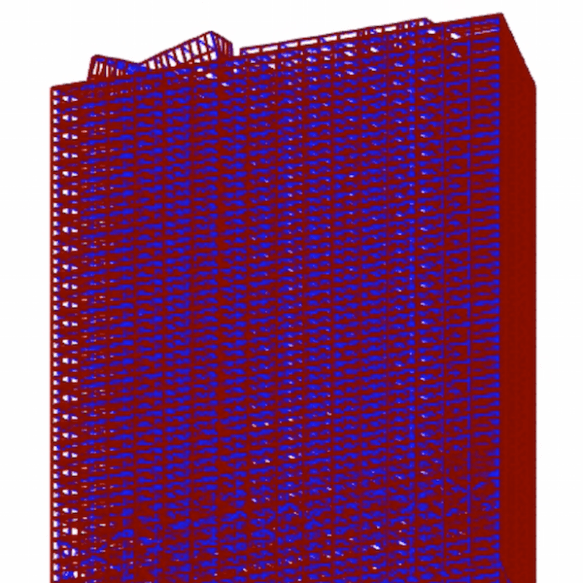
Figure 1 Finite element model of WTC 7 in SAP2000.

By Lead Researcher: J. Leroy Hulsey, Project Team: Feng Xiao (Associate Professor, Nanjing University of Science and Technology), Zhili Quan (Bridge Engineer, South Carolina Department of Transportation)

Source: Institute of Norther Engineering

This report presents the findings and conclusions of a four-year study of the collapse of World Trade Center Building 7 (WTC 7) — a 47-story building that suffered a total collapse at 5:20 PM on September 11, 2001, following the horrible events of that morning. This study was conducted by a three-person team of researchers at the University of Alaska Fairbanks (UAF) Department of Civil and Environmental Engineering with funding provided by Architects & Engineers for 9/11 Truth, Inc., a 501(c)(3) nonprofit organization whose purpose is to conduct research and educate the public about the World Trade Center building collapses on 9/11.

According to the National Institute of Standards and Technology (NIST) — an agency of the U.S. Department of Commerce that investigated the three building failures on 9/11 — the collapse of WTC 7 was the first known instance of the total collapse of a tall building primarily due to fires. However, many independent researchers have studied the collapse of WTC 7 and assembled a body of evidence that raises questions about the validity of NIST’s conclusions.

The objective of this study, therefore, was threefold: (1) Examine the structural response of WTC 7 to fire loads that may have occurred on September 11, 2001; (2) Rule out scenarios that could not have caused the observed collapse; and (3) Identify types of failures and their locations that may have caused the total collapse to occur as observed.

The UAF research team utilized three approaches for examining the structural response of WTC 7 to the conditions that may have occurred on September 11, 2001. First, we simulated the local structural response to fire loading that may have occurred below Floor 13, where most of the fires in WTC 7 are reported to have occurred. Second, we supplemented our own simulation by examining the collapse initiation hypothesis developed by NIST. We also reviewed the collapse initiation hypotheses advanced by private engineering firms whose studies were commissioned as part of litigation related to the collapse of WTC 7. Third, we simulated a number of scenarios within the overall structural system in order to determine what types of local failures and their locations may have caused the total collapse to occur as observed.

Fire Did Not Cause the Collapse of WTC 7

The principal conclusion of our study is that fire did not cause the collapse of WTC 7 on 9/11, contrary to the conclusions of NIST and private engineering firms that studied the collapse.

This conclusion is based upon a number of findings from our different analyses. Together, they show that fires could not have caused weakening or displacement of structural members capable of initiating any of the hypothetical local failures alleged to have triggered the total collapse of the building, nor could any local failures, even if they had occurred, have triggered a sequence of failures that would have resulted in the observed total collapse.

Near-Simultaneous Failure of Every Column Explains the Collapse

The secondary conclusion of our study is that the collapse of WTC 7 was a global failure involving the near-simultaneous failure of every column in the building.

This conclusion is based primarily upon the finding that the simultaneous failure of all core columns over 8 stories followed 1.3 seconds later by the simultaneous failure of all exterior columns over 8 stories produces almost exactly the behavior observed in videos of the collapse, whereas no other sequence of failures that we simulated produced the observed behavior. We cannot completely rule out the possibility that an alternative scenario may have caused the observed collapse; however, the near-simultaneous failure of every column is the only scenario we identified that was capable of producing the observed behavior.

Key Findings Upon Which the UAF Team’s Conclusions Are Based

Approach 1 Findings

•During our nonlinear connection study (Section 2.1.3.2), we discovered that NIST over-estimated the rigidity of the outside frame by not modeling its connections, essentially treating the exterior steel framing as thermally fixed, which caused all thermally-induced floor expansion to move away from the exterior. The exterior steel framing was actually flexible, while the stiffest area resistant to thermal movements, i.e., the point of zero thermal movement, was near the elevator shafts.

•Therefore, during our analysis of WTC 7’s response to fire loading (Section 2.6), we found the overall thermal movements at the A2001 base plate support near Column 79 were not sufficient to displace girder A2001 to the point that it walked off its seat (the initiating failure alleged by NIST). Whereas NIST asserted that the differential westward displacement of girder A2001 relative to Column 79 was 5.5 inches and later revised its calculation to 6.25 inches, we found that the westward displacement of girder A2001 relative to Column 79 would have been less than 1 inch under the fire conditions reported by NIST.

Approach 2 Findings

Under our second approach, we used a solid element model to evaluate the validity of NIST’s collapse initiation hypothesis, introducing a number of assumptions made by NIST that we considered to be invalid or, at best, questionable (Section 3.1). These assumptions included assuming the east exterior wall to be rigid and thermally fixed, assuming shear studs on several beams were broken due to differential thermal movement, assuming no shear studs were installed on girder A2001, and assuming that the bolts fastening girder A2001 to its seats at Columns 44 and 79 were broken (Section 3.1.1). Allowing for these overly generous assumptions, we found the following:

•When girder A2001 is heated to the temperatures assumed by NIST, it expands such that it becomes trapped behind the side plate on the western side of Column 79 as it is pushed to the west by thermally expanding floor beams. This prevents the girder’s web from traveling beyond the bearing seat, thus preventing the girder from walking off its seat (Section 3.2.1).

•NIST, by its own admission, did not include the partial height web stiffeners known to be on girder A2001. In addition to stiffening the web, these stiffeners significantly increase the bending resistance of the flange. In a subsequent analysis where we removed the side plate described in the previous analysis in order to allow for further westward travel of girder A2001, we found that the stresses in the girder flange and stiffener would not be sufficient to cause the flange to fail, thus preventing the girder from walking off its seat (Section 3.2.2).

•In a preliminary collapse initiation hypothesis, NIST posited that beam G3005 buckled because its thermal expansion was restrained by girder A2001. We found that this can happen only when the three lateral support beams S3007, G3007, and K3007 spanning from beam G3005 to the north exterior wall are not included in the model. While these short beams are observed in some of the figures in the NIST report, they are missing from the model(s) used in the thermal and structural analysis shown in the report (Section 3.2.3).

Separate from the NIST investigation, two studies of WTC 7’s collapse were commissioned by opposing sides in the lawsuit “Aegis Insurance Services, Inc. v. 7 World Trade Center Company, L.P.” Experts working in connection with engineering firms Ove Arup & Partners (Arup) and Guy Nordenson and Associates (Nordenson) were retained by the plaintiffs. The engineering firm Weidlinger Associates Inc. (Weidlinger) was retained by the defendants. After evaluating NIST’s collapse initiation hypothesis, we reviewed the Arup, Nordenson, and Weidlinger reports and found the following:

•Arup’s finite element analysis corroborates our finding that girder A2001 would become trapped behind the western side plate of Column 79. However, Arup’s analysis then goes on to contend that the five beams to the east of girder A2001 were heated enough to sag and pull the girder to the east and off of its seats. Putting aside whether this initiating mechanism is valid, we found that Nordenson incorrectly calculated the impact force of the falling girder by considering it as a point load, thus implying an infinite stiffness and no deflection. Calculating the impact force correctly, we found that it is only 34% of the 632,000 lb. force required to shear the girder bearing seat support welds at Floor 12. Therefore, the northeast corner of Floor 12 would not have collapsed if the Floor 13 girder came off its seat at Column 79, and a cascade of floor failures would not ensue.

•The Weidlinger report was prepared as a rebuttal to the Arup and Nordenson reports. Among its points of rebuttal, it corroborates our finding that the falling Floor 13 beam and girder assembly could not break through Floor 12. The Weidlinger report contends instead that Floors 9 and 10 were simultaneously heated to between 750° and 800°C in the exact same area of each floor, eventually causing those floors to fail and triggering a cascade of floor failures down to Floor 5. However, the details of the thermal analysis are not shown in the Weidlinger report, and the thermal analysis has not been made public. It is important to understand that steel structural members reaching temperatures of 750°C due to office fires can be considered extraordinary. Without any analysis provided to substantiate such temperatures, Weidlinger’s collapse initiation hypothesis must be viewed skeptically and can be assumed to have a very low probability of occurrence (Section 3.4.1).

Approach 3 Findings

Under our third approach, we simulated a number of hypothetical scenarios in order to determine what types of local failures and their locations may have caused the total collapse to occur as observed. Based upon a series of analyses, we found the following:

•Columns 79, 80, and 81 did not fail at the lower floors of the building, as asserted by NIST. In order to allow for the observed collapse of the east penthouse approximately 7 seconds prior to the collapse of the rest of the structure, these columns needed to have failed at the upper floors of the building all the way to the penthouse. Yet there were no documented fires above Floor 30. Therefore, fire did not cause the collapse of Columns 79, 80, and 81 nor the collapse of the east penthouse (Section 4.3).

•The hypothetical failure of Columns 79, 80, and 81 — the three easternmost core columns — would not trigger a horizontal progression of core column failures. Therefore, the hypotheses of NIST, Arup/Nordenson, and Weidlinger that the buckling of Column 79 could trigger a progressive collapse of the entire building are invalid, and the collapse of Columns 79, 80, and 81 high in the building was a separate and distinct event (Section 4.4). •Even if we assume the failure of Columns 79, 80, and 81 could lead to the failure of the next row of core columns, the hypothetical failure of Columns 76 to 81 would overload the exterior columns around the southeast of the building, rather than overloading the next row of core columns to the west, which would result in the building tipping to the southeast and not in a straight-down collapse (Section 4.4).

•The hypothetical simultaneous failure of all core columns (but not exterior columns) would cause the building to tip to the southwest rather than causing a straight-down collapse (Section 4.5).

•The simultaneous failure of all core columns over 8 stories followed 1.3 seconds later by the simultaneous failure of all exterior columns over 8 stories produces almost exactly the behavior observed in videos of the collapse. The collapse could have started at Floor 16 and below and produced the same behavior (Section 4.6).

It is our conclusion based upon these findings that the collapse of WTC 7 was a global failure involving the near-simultaneous failure of all columns in the building and not a progressive collapse involving the sequential failure of columns throughout the building.


Read the entire document here: http://ine.uaf.edu/media/222439/uaf_wtc7_draft_report_09-03-2019.pdf

Related videos and follow-up can be found at Architects & Engineers for 9/11 Truth: https://www.ae911truth.org/wtc7

The Varieties of Psychonautic Experience: Erik Davis’s ‘High Weirdness’

Art by Arik Roper

By Michael Grasso

Source: We Are the Mutants

High Weirdness: Drugs, Esoterica, and Visionary Experience in the Seventies
By Erik Davis
Strange Attractor Press/MIT Press, 2019

Two months ago, I devoured Erik Davis’s magisterial 2019 book High Weirdness: Drugs, Esoterica, and Visionary Experience in the Seventies the same weekend I got it, despite its 400-plus pages of sometimes dense, specialist prose. And for the past two months I have tried, in fits and starts, to gather together my thoughts on it—failing every single time. Sometimes it’s been for having far too much to say about the astonishing level of detail and philosophical depth contained within. Sometimes it’s been because the book’s presentation of the visionary mysticism of three Americans in the 1970s—ethnobotanist and psychonaut Terence McKenna, parapolitical trickster Robert Anton Wilson, and paranoid storyteller-mystic Philip K. Dick—has hit far too close to home for me personally, living in the late 2010s in a similarly agitated political (and mystical) state. In short, High Weirdness has seemed to me, sitting on my bookshelf, desk, or in my backpack, like some cursed magical grimoire out of Weird fiction—a Necronomicon or The King in Yellow, perhaps—and I became obsessed with its spiraling exploration of the unfathomable universe above and the depthless soul below. It has proven itself incapable of summary in any linear, rationalist way.

So let’s dispense with rationalism for the time being. In the spirit of High Weirdness, this review will try to weave an impressionistic, magical spell exploring the commonalities Davis unveils between the respective life’s work and esoteric, drug-aided explorations of McKenna, Wilson, and Dick: explorations that were an attempt to construct meaning out of a world that to these three men, in the aftermath of the cultural revelations and revolutions of the 1960s that challenged the supposed wisdom and goodness of American hegemony, suddenly offered nothing but nihilism, paranoia, and despair. These three men were all, in their own unique ways, magicians, shamans, and spiritualists who used the tools at their disposal—esoteric traditions from both East and West; the common detritus of 20th century Weird pop culture; technocratic research into the human mind, body, and soul; and, of course, psychedelic drugs—to forge some kind of new and desperately-needed mystical tradition in the midst of the dark triumph of the Western world’s rationalism.

A longtime aficionado of Weird America, Davis writes in the introduction to High Weirdness about his own early encounters with Philip K. Dick’s science fiction, the Church of the SubGenius, and other underground strains of the American esoteric in the aftermath of the ’60s and ’70s. As someone who came late in life to a postgraduate degree program (High Weirdness was Davis’s doctoral dissertation for Rice University’s Religion program, as part of a curriculum focus on Gnosticism, Esotericism, and Mysticism), I find it incredibly easy to identify with Davis’s desire to tug at the edges of his longtime association with and love for the Weird in a scholarly context. This book’s scholarly origins do not make High Weirdness unapproachable to the layperson, however. While Davis does delve deeply into philosophical and spiritual theorists and the context of American mysticism throughout the book, he provides succinct and germane summaries of this long history, translating the work of thinkers as diverse as early 20th century psychologist and student of religious and mystical experience William James to contemporary theorists such as Peter Sloterdijk and Mark Fisher. Davis’s introduction draws forth in great detail the long tradition of admitting the ineffable, the scientifically-inexplicable, into the creation of subjective, individual mystical experiences.

Primary among Davis’s foundational investigations, binding together all three men profiled in the book, is a full and thorough accounting of the question, “Why did these myriad mystical experiences all occur in the first half of the 1970s?” It’s a fairly common historical interpretation to look at the Nixon years in America as a hangover from the cultural revolution of the late 1960s, a retrenchment of Nixon’s “silent majority” of middle- and working-class whites vs. the perceived chaos of a militant student movement and identity-based politics among racial and sexual minorities. Davis admits that the general mystical seeking that went on in the early ’70s is a reaction to this revanchism. And while he quotes Robert Anton Wilson’s seeming affirmation of this idea—“The early 70s were the days when the survivors of the Sixties went a bit nuts”—his interest in the three individuals at the center of his study allows him to delve deeper, offering a more profound explanation of the politics and metaphysics of the era. In the immediate aftermath of the assassinations, the political and social chaos, and the election of Nixon in 1968, there was an increased tendency among the younger generation to seek alternatives to mass consumption culture, to engage in what leftist philosopher Herbert Marcuse would term “the Great Refusal.” All three of the figures Davis focuses on in this book, at some level or another, decided to opt out of what their upbringings and conformist America had planned for them, to various levels of harm to their livelihoods and physical and mental health. This refusal was part of an awareness of what a suburban middle-class life had excised from human experience: a sense of meaning-making, of a more profound spirituality detached from the streams of traditional mainline American religious life.

To find something new, the three men at the center of High Weirdness were forced to become bricoleurs—cobbling together a “bootstrap witchery,” in Davis’s words—from real-world occult traditions (both Eastern and Western); from the world of Cold War technocratic experimentation with cybernetics, neuroscience, psychedelics, and out-and-out parapsychology; and from midcentury American pop culture, including science fiction, fantasy, comic books, and pulp fiction. Davis intriguingly cites Dick’s invention of the term “kipple” in his 1968 novel Do Androids Dream of Electric Sheep? as a key concept in understanding how this detritus can be patched together and brought new life. Given Dick’s overall prescience in predicting our 21st century world of social atomization and disrepair, this seems a conceptual echo worth internalizing a half-century later. If the late 1960s represented a mini-cataclysm that showed a glimpse of what a world without the “Black Iron Prison” might look like, those who graduated to the 1970s—the ones who “went a bit nuts”—needed to figure out how to survive by utilizing the bits and scraps left behind after the sweeping turbulence blew through. In many ways, McKenna, Wilson, and Dick are all post-apocalyptic scavengers.

All three men used drugs extensively, although not necessarily as anthropotechnics specifically designed to achieve enlightenment (Davis notes that Dick in particular had preexisting psychological conditions that, in conjunction with his prodigious use of amphetamines in the 1960s, were likely one explanation for his profound and sudden breaks with consensus reality in the ’70s). But we should also recognize (as Davis does) that McKenna, Wilson, and Dick were also, in many ways, enormously privileged. As well-educated scions of white America, born between the Great Depression and the immediate aftermath of World War II, they had the luxury to experiment with spirituality, psychedelic drugs, and technology to various degrees while holding themselves consciously separate from the mainstream institutions that would eventually co-opt and recuperate many of these strains of spirituality and individual seeking into the larger Spectacle. As Davis cannily notes, “Perhaps no one can let themselves unravel into temporary madness like straight white men.” But these origins also help explain the expressly technocratic bent of many of their hopes (McKenna) and fears (Wilson and Dick). Like their close confederate in Weirdness, Thomas Pynchon (who spent his early adulthood working for defense contractor Boeing, an experience which allowed him a keener avenue to his literary critiques of 20th century America), all three men were adjacent to larger power structures that alternately thrilled and repelled them, and which also helped form their specific esoteric worldviews.

It would be a fool’s errand to try to summarize the seven central chapters of the book, which present in great detail Terence (and brother Dennis) McKenna’s mushroom-fueled experiences contacting a higher intelligence in La Chorrera, Colombia in 1971, Robert Anton Wilson’s LSD-and-sex-magick-induced contact with aliens from the star Sirius in 1973 and ’74 as detailed in his 1977 book Cosmic Trigger: The Final Secret of the Illuminati, and Philip K. Dick’s famous series of mystical transmissions and revelations in February and March of 1974, which influenced not only his fiction output for the final eight years of his life but also his colossal “Exegesis,” which sought to interpret these mystical revelations in a Christian and Gnostic context. Davis’s book is out there and I can only encourage you to buy a copy, read these chapters, and revel in their thrilling detail, exhilarating madness, and occasional absurdity. Time and time again, Davis, like a great composer of music, returns to his greater themes: the environment that created these men gave them the tools and technics to blaze a new trail out of the psychological morass of Cold War American culture. At the very least, I can present some individual anecdotes from each of the three men’s mystical experiences, as described by Davis, that should throw some illumination on how they explored their own psyches and the universe using drugs, preexisting religious/esoteric ritual, and the pop cultural clutter that had helped shape them.

Davis presents a chapter focusing on each man’s life leading up to his respective spiritual experiences, followed by a chapter (in the case of Philip K. Dick, two) on his mystical experience and his reactions to it. For Terence McKenna and his brother Dennis, their research into organic psychedelics such as the DMT-containing yagé (first popularized in the West in the Cold War period by William S. Burroughs), alternately known as oo-koo-hé or ayahuasca, led them to South America to find the source of these natural, indigenous entheogens. But at La Chorrera in Colombia they instead met the plentiful and formidable fungus Psilocybe cubensis. In their experiments with the mushroom, Terence and Dennis tuned into perceived resonances with long-dormant synchronicities within their family histories, their childhood love of science fiction, and with the larger universe. Eventually, Dennis, on a more than week-long trip on both mushrooms and ayahuasca, needed to be evacuated from the jungle, but not before he had acted as a “receiver” for cryptic hyper-verbal transmissions, the hallucinogens inside him a “vegetable television” tuned into an unseen frequency—a profound shamanic state that Terence encouraged. The language of technology, of cybernetics, of science is never far from the McKenna brothers’ paradigm of spirituality; the two boys who had spent their childhoods reading publications like Analog and Fate, who had spent their young adulthoods studying botany and science while deep in the works of Marshall McLuhan (arguably a fellow psychedelic mystic who, like the McKennas and Wilson, was steeped in a Catholic cultural tradition), used the language they knew to explain their outré experiences.

Wilson spent his 20s as an editor for Playboy magazine’s letters page and had thus been exposed to the screaming gamut of American political paranoia (while contributing to it in his own inimitable prankster style). He had used this parapolitical wilderness of mirrors, along with his interest in philosophical and magickal orientations such as libertarianism, Discordianism, and Crowleyian Thelema as fuel for both the Illuminatus! trilogy of books written with Robert Shea (published in 1975), and his more than year-long psychedelic-mystical experience in 1973 and 1974, during which he claimed to act as a receiver on an “interstellar ESP channel,” obtaining transmissions from the star Sirius. His experiences as detailed in Cosmic Trigger involve remaining in a prolonged shamanic state (what Wilson called the “Chapel Perilous,” a term redolent with the same sort of medievalism as the McKenna brothers’ belief that they would manifest the Philosopher’s Stone at La Chorrera), providing Wilson with a constant understanding of the universe’s playfully unnerving tendency towards coincidence and synchronicity. Needless to say, the experiences of one Dr. John C. Lilly, who was also around this precise time tuned into ostensible gnostic communications from a spiritual supercomputer, mesh effortlessly with Wilson’s (and Dick’s) experiences thematically; Wilson even used audiotapes of Lilly’s lectures on cognitive meta-programming to kick off his mystical trances. Ironically, it was UFO researcher and keen observer of California’s 1970s paranormal scene Jacques Vallée who helped to extract Wilson out of the Chapel Perilous—by retriggering his more mundane political paranoia, saying that UFOs and other similar phenomena were instruments of global control. In Davis’s memorable words, “Wilson did not escape the Chapel through psychiatric disenchantment but through an even weirder possibility.”

Philip K. Dick, who was a famous science fiction author at the dawn of the ’70s, had already been through his own drug-induced paranoias, political scrapes, and active Christian mystical seeking. Unlike McKenna and Wilson, Dick was a Protestant who had stayed in close contact with his spiritual side throughout adulthood. In his interpretation of his mystical 2-3-74 experience, Dick uses the language and epistemology of Gnostic mystical traditions two millennia old. Davis also notes that Dick used the plots of his own most overtly political and spiritual ’60s output to help him understand and interpret his transcendent experiences. Before he ever heard voices or received flashes of information from a pink laser beam or envisioned flashes of the Roman Empire overlapping with 1970s Orange County California, Dick’s 1960s novels, specifically The Three Stigmata of Palmer Eldritch (1965) and Ubik (1969), had explored the very nature of reality and admitted the possibility of a Gnostic universe run by unknowable, cruel demiurges. Even in these hostile universes, however, there exists a messenger of hope and mercy who seeks to destroy the illusion of existence and bring relief. These existing pieces of cultural and religious “kipple,” along with the parasocial aspects of Christian belief that were abroad in California at the time, such as the Jesus People movement (the source of the Ichthys fish sign that triggered the 2-3-74 experience), gave Dick the equipment he needed to make sense of the communications he received and the consoling realization that he was not alone, that he was instead part of an underground spiritual movement that acted as a modern-day emanation of the early Christian church.

After learning about these three figures’ shockingly similar experiences with drug-induced contact with beyond, the inevitable question emerges: what were all these messages, these transmissions from beyond, trying to convey? One common aspect of all three experiences is how cryptic they are (and how difficult and time-consuming it was for each of these men to interpret just what the messages were saying). It’s also a little sobering to discover through Davis’s accounts how personal all three experiences were, whether it’s Terence and Dennis’s private fraternal language during the La Chorrera experiment, or mysterious phone calls placed back in time to their mother in childhood, or a lost silver key that Dennis was able to, stage-magician-like, conjure just as they were discussing it, or the message Philip K. Dick received to take his son Christopher to the doctor for an inguinal hernia that could have proven fatal. But alongside these personal epiphanies, there is also always an undeniable larger social and political context, especially as both Wilson and Dick saw their journeys in 1973 and 1974 as a way to confront and deal with the intense paranoia around Watergate and the fall of Richard Nixon (in his chapter setting the scene of the ’70s, Davis calls Watergate “a mytho-poetic perversion of governance”). In every case, the message from beyond requires interpretation, meaning-making, and, in Davis’s terminology, “constructivism.” The reams of words spoken and written by all three men analyzing their respective mystical experiences are an essential part of the experience. And these personal revelations all are attempts by the three men to make sense of the chaos of both their personal lives and their existence in an oppressive 20th century technocratic society: to inject some sense of mystery into daily existence, even if it took the quasi-familiar and, yes, somewhat comforting form of transmissions from a mushroom television network or interstellar artificial intelligence.

Over the past nine months I’ve spent much of my own life completing (and recovering from the process of completing) a Master’s degree. My own academic work, focusing on nostalgia’s uses in binding together individuals and communities with their museums, tapped into my earliest memories of museum visits in the late 1970s, when free education was seemingly everywhere (and actually free), when it was democratic and diverse, when it was an essential component of a rapidly-disappearing belief in social cohesion. In a lot of ways, my work at We Are the Mutants over the past three years is the incantation of a spell meant to conjure something new and hopeful from the “kipple” of a childhood suffused in disposable pop culture, the paranormal and “bootstrap witchery,” and science-as-progress propaganda. At the same time, over the past three years the world has been at the constant, media-enabled beck and call of a figure ten times more Weird and apocalyptic and socially malignant than any of Philip K. Dick’s various Gnostic emanations of Richard Nixon.

Philip K. Dick believed he was living through a recapitulation of the Roman Empire, that time was meaningless when viewed from the perspective of an omniscient entity like VALIS. In the correspondences and synchronicities I have witnessed over the past few months—in the collapse of political order and the revelation of profound, endemic corruption behind the scenes of the ruling class—this sense of recurring history has sent me down a similar set of ecstatic and paranoid corridors as McKenna, Wilson, and Dick. The effort to find meaning in a world that once held some inherent structure in childhood but has become, in adulthood, a hollow facade—a metaphysical Potemkin village—is profoundly unmooring. But meaning is there, even if we need technics such as psychedelic drugs, cybernetics (Davis’s final chapter summarizing how the three men’s mystical explorations fed into the internet as we know it today is absolutely fascinating), and parapolitical activity to interpret it. On this, the 50th anniversary of the summer of 1969, commonly accepted as the moment the Sixties ended, with echoes of moon landings and Manson killings reverberating throughout the cultural theater, is it any wonder that the appeal of broken psychonauts trying to pick up the pieces of a shattered world would appeal to lost souls in 2019? High Weirdness as a mystical tome remains physically and psychically close to me now, and probably will for the remainder of my life; and if the topics detailed in this review intrigue you the way they do me, it will remain close to you as well.

Long Before Epstein: Sex Traffickers & Spy Agencies

By Elizabeth Vos

Source: Consortium News

The alleged use of sexual blackmail by spy agencies is hardly unique to the case of Jeffrey Epstein. Although the agencies involved as well as their alleged motivations and methods differ with each case, the crime of child trafficking with ties to intelligence agencies or those protected by them has been around for decades.

Some cases include the 1950s -1970s Kincora scandal and the 1981 Peter Hayman affair, both in the U.K.; and the Finders’ cult and the Franklin scandal in the U.S. in the late 1980s. Just as these cases did not end in convictions, the pedophile and accused child-trafficker Jeffrey Epstein remained at arms’ length for years.

“For almost two decades, for some nebulous reason, whether to do with ties to foreign intelligence, his billions of dollars, or his social connections, Epstein, whose alleged sexual sickness and horrific assaults on women without means or ability to protect themselves… remained untouchable,” journalist Vicky Ward wrote in The Daily Beast in July.

The protection of sex traffickers by intelligence agencies is especially interesting in the wake of  Epstein’s death. Like others, Epstein had long been purported to have links with spy agencies. Such allegations documented by Whitney Webb in her multi-part series were recently published in Mintpress News.

Webb states that Epstein was the current face of an extensive system of abuse with ties to both organized crime and intelligence interests. She told CNLive! that: “According to Nigel Rosser, a British journalist who wrote in the Evening Standard in 2001, Epstein apparently for much of the 1990s claimed that he used to work for the CIA.”

Vicky Ward, who wrote on Epstein for Vanity Fair before his first arrest, and claimed the magazine killed one of her pieces after Epstein intervened with editor Graydon Carter, said in a Tweet that one of Epstein’s clients was Adnan Khashoggi, an arms dealer who was pivotal in the Iran Contra scandal and was on the Mossad (the Israeli intelligence agency) payroll. This was also noted in a book “By Way of Deception” by former Mossad agent Victor Ostrovsky.

The Times of Israel reported that Epstein was an “active business partner with former prime minister Ehud Barak” until 2015, adding: “Barak formed a limited partnership company in Israel in 2015, called Sum (E.B.) to invest in a high-tech startup…. A large part of the money used by Sum to buy the start-up stock was supplied by Epstein.”

Webb wrote he “was a long-time friend of Barak, who has long-standing and deep ties to Israel’s intelligence community.” On the board of their company sat Pinchas Bukhris, a former commander of the IDF cyber unit 8200.

Epstein’s allegedly protected status was revealed by Alexander Acosta, the former U.S. attorney in Miami who gave Epstein an infamously lenient plea deal in 2007. Acosta, who was forced to resign as President Donald Trump’s labor secretary because of that deal,  reportedly said of the case: “I was told Epstein ‘belonged to intelligence’ and to leave it alone.”

Kincora Boy’s Home

Several cases in the unsavory history linking intelligence agencies and sex scandals put the allegations against Epstein in context. Among these was the U.K. Kincora Boy’s Home, where at least 29 boys were reported to have been targeted at the Belfast, Northern Ireland, facility from the mid-1950s until the late 1970s, until it was shut in 1980. It also involved the alleged protection of child sexual abusers at the home and among their clients.

The Irish Times wrote that “destitute boys were systematically sodomised by members of Kincora staff and were supplied for abuse to prominent figures in unionist politics. The abusers – among them MPs, councillors, leading Orangemen and other influential individuals – became potentially important intelligence assets.”

The Belfast Telegraph also quoted former Labour Party MP Ken Livingstone, who said: “MI5 weren’t just aware of child abuse at Kincora Boys’ Home – they were monitoring it. They were getting pictures of a judge in one case, politicians, a lot of the establishment of Northern Ireland going in and abusing these boys.”

Three staff were eventually convicted of sexually abusing minors, which included the housemaster William McGrath, a loyalist “Orangeman” and allegedly an MI5 agent, according to the Belfast Telegraph in July 2014.

Although the U.K.’s Historical Institutional Abuse inquiry ultimately found  “no credible evidence” to support the allegations, two former U.K. intelligence officers maintained their claim of MI5’s involvement: Brian Gemmell says he alerted MI5 to the abuse at Kincora and was told to stop his investigation; and a former army intelligence officer, Colin Wallace, “consistently claimed that MI5, RUC special branch and military intelligence knew about the abuse at Kincora and used it to blackmail the pedophile ring to spy on hardline loyalists,” according to The Guardian.

The Irish outlet, An Phoblacht, wrote: “The systematic abuse of young boys in the Home and the part played by the British intelligence organisations to keep the scandal under wraps ensured that one side of the murky world of Unionist paramilitarism and its links to the crown forces was kept out of the public domain for years.”

In the U.S., the New York State Select Committee On Crime in 1982  investigated nationwide networks of trafficking underage sex workers and producing child pornography. Dale Smith, a committee investigator, noted that call services using minors also profited from “sidelines,” besides the income from peddling prostitution.  Smith said they sold information “on the sexual proclivities of the clients to agents of foreign intelligence.” Presumably, this information could be used to blackmail those in positions of power. Smith added that one call service sold information to “British and Israeli intelligence.”

The Hayman Affair

Another U.K. scandal included allegations that Sir Peter Hayman,  a British diplomat and deputy director of MI6, was a member of the Pedophile Information Exchange (PIE).

Police discovered that two of the roughly dozen pedophiles in his circle had been writing to each other about their interest in “the extreme sexual torture and murder of children,” according to the The Daily Mail.

In 2015, The Guardian reported that former Prime Minister Margaret Thatcher had been “adamant that officials should not publicly name” Hayman, “even after she had been fully briefed on his activities….formerly secret papers released to the National Archives shows.”

Still, Hayman was unmasked as a subscriber to PIE in 1981 by M.P. Geoffrey Dickens, who also reportedly raised the national security risk of Hayman’s proclivities, implying they were a potential source of blackmail sought by intelligence agencies.

The British tabloid The Mirror reported that intelligence agencies, including the KGB and CIA, kept their own dossiers on U.K. establishment figures involved with PIE and the abuse of minors, to blackmail the targets in exchange for information.

Hayman was never charged for his association with PIE: The U.K. attorney general at the time, Sir Michael Havers, defended the decision and denied claims that Heyman was given special treatment.

Labour Party MP Barbara Castle allegedly gave a dossier she compiled on pedophiles in positions of power to U.K. journalist Don Hale in 1984 when he was editor of the Brury Messenger. Hale alleged that soon afterward, police from the “Special Branch, the division responsible for matters of national security,” raided his office and removed the Castle dossier. They then threatened him with a “D-notice,” which prevented him from publishing the story on the threat of up to 10 years in prison.

The Finders Cult

Another group accused of trafficking children, which had links to intelligence agencies, was the “Finders” cult. In 1987, The Washington Post reported that two members were arrested in connection with the alleged abuse of six children. Investigators found materials in Madison County, Virginia, which they said linked to a “commune called the Finders.”

Besides nude photographs of children, a Customs Service memo written by special agent Ramon Martinez refers to files “relating to the activities of the organization in different parts of the world, including “London, Germany, the Bahamas, Japan, Hong Kong, Malaysia, Africa, Costa Rica, and Europe.”

Martinez’s memo notes that a Finders’ telex ordered the purchase of two children in Hong Kong. Another expressed interest in “bank secrecy situations.” The memo also documents high-tech transfers to the U.K., numerous properties under the Finders’ control, the group’s interest in terrorism, explosives, and the evasion of law enforcement.

Martinez describes the swift end to his investigation. He wrote that on April 2, 1987, he arrived at the Metropolitan Police Department and was told that all the data was turned over to the State Department which, in turn, advised MPD that “all travel and use of passports by the holders was within the law and no action would be taken. Then he was told that the investigation into the Finders had become a CIA internal matter. The MPD report was classified, not available for review” and “No further action will be taken.”

Martinez was not the only person with unanswered questions. The U.S.News & World Report wrote that N. Carolina Rep. Charlie Rose (Dem.), chair of the House Administration Committee, and Florida’s Rep. Tom Lewis (Rep.) asked “Could our own government have something to do with this Finders organization and turned their backs on these children? That’s what the evidence points to,” says Lewis, adding that “I can tell you that we’ve got a lot of people scrambling, and that wouldn’t be happening if there was nothing here.”

The leniency shown by the State Department and the fact that the CIA would designate the investigation of the Finders group as “an internal matter” raises serious questions. What motive might have driven the CIA to associate with or protect a child abuse ring?

The Franklin Scandal

The Franklin Scandal erupted in 1988, centering on a child-trafficking ring operating in Omaha, Nebraska, by Lawrence E. King Jr., a former vice chairman of the National Black Republican Council: It was alleged that children were provided to politicians in Washington, D.C., and elsewhere, among other illegal activities.

The late former state Sen. John Decamp alleged in his book “The Franklin Coverup” that a special committee of the Nebraska Legislature launched a probe to investigate the affair, which involved King being indicted for embezzling money from the Franklin Credit Union. The committee hired former Lincoln, Nebraska, police officer Jerry Lowe, whose reports  suggested that King was involved in “guns and money transfers to Nicaragua,” and was linked with the CIA.

James Flanery, an investigative reporter at The World Herald who reported on the scandal,  told associates that King was “running guns and money into Nicaragua,” and that the CIA was heavily involved.”

Like many scandals before and since, the Franklin case ended with no prosecution of the perpetrators. However, Paul Bonacci, one of the alleged victims, was indicted for perjury. He had alleged that he was sexually abused as a minor in Nebraska and around the country where he was flown by Lawrence King.

In 1999, the Omaha World Herald reported Bonacci was awarded $1 million in damages due to his lawsuit against King and other alleged perpetrators. Decamp, who was Bonacci’s attorney, told the newspaper “Obviously, you don’t award $1 million if you don’t think he (Bonacci) was telling the truth.”

Given the history of child trafficking rings that were allegedly connected with or enjoyed the protection of intelligence services, it is possible that similar claims about Jeffrey Epstein are something the authorities, though unlikely, should investigate.

There Is No Normal

By James Howard Kunstler

Source: Kunstler.com

The wheel of time rolls forward, never retracing its path, but because it is a wheel, and we are riding in it, a persistent illusion persuades us that the landscape is recognizably the same, and that our doings within the regular turning of the seasons seem comfortably normal. There is no normal.

There is for us, at this moment in history, an especially harsh turning (so Strauss and Howe would say) as our journey takes the exit ramp out of the high energy era into the next reality of a long emergency. The human hive-mind senses that something is different, but at the same moment we’re unable to imagine changing all our exquisitely tuned arrangements — especially the thinking class in charge of all that, self-enchanted with pixeled fantasies. The dissonance over this is driving America crazy.

The wheel hit a deep pothole in 2008 turning onto the off-ramp and has been wobbling badly ever since. 2008 was a warning that going through the motions isn’t enough to sustain a sense of purpose, either nationally or for individuals trying to keep their lives together ever more desperately. The cultural memory of the confident years, when we seemed to know what we were doing, and where we were going, dogs us and mocks us.

The young adults feel all that most acutely. The pain prompts them to want to deconstruct that memory. “No, it didn’t happen that way,” they are saying. All those stories about the founding of this society — of those Great Men with their powdered hair-doos writing the national charter, and the remarkable experience of the past 200-odd years — are wrong! There was nothing wonderful about it. The whole thing was a swindle!

They are feeling the wheel’s turning most painfully, since they know they will see many more turnings in the years ahead, and the direction of the wheel is vectoring downward for them. The bottom-line is less of everything, not more. That is a new ethos here in America and it’s hardly comforting: Less income, fewer comforts, more literal hardships, fewer consolations for the universal difficulty of being alive. No wonder they are angry.

It’s this simple. We landed in the New World five hundred years ago. It was full of good things that human beings had barely begun to exploit, laid out like a banquet. There was plenty of good virgin soil for growing food, the best timber in the world, clean rivers and great lakes, ores full of iron, gold, and silver, and down deep a bonanza of coal and oil to drive the wheel through very flush times. The past century was particularly supercharged, the oil years.

Imagine living through the very start of all that, the blinding, fantastic newness of modernity! Look back at the stories and images around Teddy Roosevelt and his times, and the confidence of that era just astonishes you, An emergent cavalcade of wonders: electricity, telephones, railroads, subways, skyscrapers! And in a few more years movies, cars, airplanes, radio. Even the backstage wonders of the day were astonishments: household plumbing for all, running hot water, municipal water and sewer systems, refrigeration, tractors! It’s hard to conceive how much these developments changed the human experience of daily life.

Even the traumas of the 20th century’s world wars did not crush that sense of amazing progress, at least not in North America, spared the wars’ mighty wreckage. The post-war confidence of American society achieved a level of in-your-face laughable hubris — see the USA in your Chevrolet! — until John Kennedy was shot down, and after that the delirious moonshot euphoria steadily gave way to corrosive skepticism, anxiety, acrimony, and enmity. My generation, booming into adulthood, naively thought they could fix all that with Earth Day, tofu, and computers, and keep the great wheel rolling down into an even more glorious cybernetic nirvana.

Fakeout. That’s not where the wheel is going. We borrowed all we possibly could from the future to pretend that the system was still working, and now the future is at the door like a re-po man come to take away both the car and the house. The financial scene is an excellent analog to our collective psychology. Its workings depend on the simple faith that its workings work. So, it is easy to imagine what happens when that faith wavers.

We’re on the verge of a lot of things coming apart: supply lines, revenue streams, international agreements, political assumptions, promises to do this and that. We have no idea how to keep it together on the downside. We don’t even want to think about it. The best we can do for the moment is pretend that the downside doesn’t exist. And meanwhile, fight both for social justice and to make America great again, two seemingly noble ideas, both exercises in futility. The wheel is still turning and the change of season soon upon us. What will you do?

The Gulag of the Mind

By Charles Hugh Smith

Source: Of Two Minds

There are no physical barriers in the Gulag of the Mind–we imprison ourselves, and love our servitude. Indeed, we fear the world outside our internalized gulag, because we’ve absorbed the narrative that the gulag is secure and permanent.

We’ve also absorbed the understanding that escape will be punished. Dissent will quickly be suppressed or vilified, and the dissenter socially and economically marginalized.

In a peculiarly human pathology, we now believe the exact opposite of reality: our abuser is our savior, we’re getting wealthier when in fact we’re getting poorer, the government will always save us, even though the government is the problem, not the solution, and we’re entitled to all sorts of good things even as the entire system clings to a veneer of normalcy that is increasingly difficult to maintain.

We dare not realize the crises we’re about to face are novel, and the thinking of the past is worse than useless, as doing more of what’s failed is about to bear real consequences that cannot be papered over.

Michael Grant described this clinging to the past in his excellent account The Fall of the Roman Empire:

There was no room at all, in these ways of thinking, for the novel, apocalyptic situation which had now arisen, a situation which needed solutions as radical as itself. (The Status Quo) attitude is a complacent acceptance of things as they are, without a single new idea.

This acceptance was accompanied by greatly excessive optimism about the present and future. Even when the end was only sixty years away, and the Empire was already crumbling fast, Rutilius continued to address the spirit of Rome with the same supreme assurance.

This blind adherence to the ideas of the past ranks high among the principal causes of the downfall of Rome. If you were sufficiently lulled by these traditional fictions, there was no call to take any practical first-aid measures at all.

The Gulag of the Mind is constructed of both traditional fictions–that all the looming crises can be solved by repeating what worked in the past 50 years– and the new ones of virtual signaling–that publicly signaling our virtuous convictions is magically equivalent to actually solving problems, as if our problems are all nothing but a scarcity of virtuous convictions rather than real-world crises that will require immense fortitude and sacrifice to weather, much less resolve.

The Gulag of the Mind depends on technology–or more precisely, on a magical thinking faith that technology will always effortlessly save us: some new form of magic will manifest at the moment of need and we won’t have to change anything in our lifestyle or our corrupt power structure.

In the Gulag of the Mind, a perversion of justice passes for real justice: there are two sets of laws and two levels of enforcement: the wealthy and powerful escape justice while commoners are given life-crushing prison sentences for Drug Gulag offenses, and their vehicles and belongings are confiscated for being too poor to pay the state’s onerous penalties and fees.

Befuddled and blind, we wander toward the cliff without even seeing it, focusing on our little screens of entertainment and self-absorption. The bottom of the cliff beckons, and filled with the magical sense of security bestowed by the Gulag of the Mind, we imagine we can walk on air and escape unhurt.

Jeffrey Epstein Out in the Open

By Jon Rappoport

Source: NoMoreFakeNews.com

NOTE: This article concerns the reporting of Vicky Ward. I’m not automatically assuming her key point is factual, especially since it relies on an unnamed source, who is telling her about a private meeting which the source apparently did not attend. If, however, we assume the key point is accurate…

In my previous piece on Epstein, I cited two articles outside the mainstream, which make a case for Epstein acting as an agent for intelligence services—Mossad/CIA. Obviously, his work would have involved gathering blackmail evidence on powerful men, who had sex with his underage girls. The value of this evidence, to Epstein’s handlers, would be enormous as a means of controlling those men…

I realize many people aren’t satisfied unless they see something in print from a more mainstream source. So let’s try the Daily Beast (7/9/19) and writer Vicky Ward, who has had an extensive career as a reporter and editor (Vanity Fair, NY Post, HuffPost, etc.)

In her Daily Beast article, “Jeffrey Epstein’s Sick Story Played Out for Years in Plain Sight,” Ward attempts to shed light on a moment in time when a strange twist occurred in the Epstein saga. It involved Alexander Acosta.

Alexander Acosta served as Trump’s Labor Secretary from April 28, 2017, to July 19, 2019, when he resigned. In his former job, as US Attorney for the Southern District of Florida, Acosta made the shocking 2007-2008 sweetheart plea deal with Epstein, canceling any effort to convict him for sex trafficking of minors, and reducing the charge to solicitation of a 14-year-old girl. Epstein pled guilty and received a mild slap on the wrist.

Vicky Ward writes: “Epstein’s name, I was told, had been raised by the Trump transition team when Alexander Acosta, the former U.S. attorney in Miami who’d infamously cut Epstein a non-prosecution plea deal back in 2007, was being interviewed for the job of labor secretary…”

“’Is the Epstein case going to cause a problem [for confirmation hearings]?’ Acosta had been asked. Acosta had explained, breezily, apparently, that back in the day he’d had just one meeting on the Epstein case. He’d cut the non-prosecution deal with one of Epstein’s attorneys because he had ‘been told’ to back off, that Epstein was above his pay grade. ‘I was told Epstein “belonged to intelligence” and to leave it alone,’ he told his interviewers in the Trump transition, who evidently thought that was a sufficient answer and went ahead and hired Acosta. (The Labor Department had no comment when asked about this.)”

If all this is true, the word came down the line: Epstein had protection coming from intelligence agency players; and he, Acosta, dutifully knuckled under and made the phony plea deal with Epstein. In a blockbuster federal case for widespread sex trafficking. A case that was receiving wall to wall press coverage. But none of that mattered to Acosta, the hell with blowback, contrasted against the intelligence agency clout shielding Jeffrey Epstein.

If Vicky Ward’s source on this is correct, it’s quite possible it wasn’t just Acosta who was cowed and played ball with the higher power. The Trump transition team, who blithely accepted Acosta’s astonishing comment, also could have been following the same marching orders. The Trump team purposely chose Acosta for his new shiny job, as Labor Secretary, because they were told to reward him for his “outstanding work” in the Epstein case.

The transition team could have easily made a list of 20 people who could fill the role of Labor Secretary. But they picked out the man who gave astounding cover to Epstein.


Our Ruling Elites Have No Idea How Much We Want to See Them All in Prison Jumpsuits

By Charles Hugh Smith

Source: Of Two Minds

Even the most distracted, fragmented tribe of the peasantry eventually notices that they’re not in the top 1%, or the top 0.1%.

Let’s posit that America will confront a Great Crisis in the next decade. This is the presumption of The Fourth Turning, a 4-generational cycle of 80 years that correlates rather neatly with the Great Crises of the past: 1781 (Revolutionary War, constitutional crisis); 1861 (Civil War) and 1941 (World War II, global war).

What will be the next Great Crisis? Some anticipate another great-power war, others foresee another civil war, still others reckon a military coup is likely, and some view a collapse of the economy and U.S. dollar as inevitable.

While anything’s possible, I propose a novel crisis unlike any in the past, a Moral Crisis in which the people challenge the power of the nation’s corrupt Ruling Elites: not just elected officials, but the technocrats of the Deep State, the vested interests pillaging the nation, the New Overlords of Big Tech, the financier New Nobility, the Corporate Media and the self-serving state/corporate technocrat Nomenklatura who do the dirty work of the Ruling Elites.

Divide-and-Conquer has been the absurdly easy strategy of the Ruling Elites to fragment and disempower the citizenry. It’s child’s play for the Ruling Elites to ceaselessly promote a baker’s dozen of divisive issues via the corporate media, and then watch the resulting conflicts split the citizenry into fragmented camps which subdivide further with every new toxic injection.

The one issue that could unite the fragmented citizenry is moral revulsion: As the Epstein case promises to reveal, there is literally no limit on the excesses and exploitations of the privileged few in America, no limit on what our Ruling Elites can do with absolute impunity.

The Nobility of the feudal era had some reciprocal obligation to its serfs; our New Nobility has no obligation to anyone but themselves. It is painfully obvious that there are two sets of laws in America: bankers can rip off billions and never serve time, and members of the Protected Class who sexually exploit children get a wrist-slap, if that.

Here’s the sad reality: everybody in the Ruling Elites looked the other way: all the self-described “patriots” in the Intelligence services, all the technocrats in the Departments of Justice, State, etc., the Pentagon, and on and on. Everybody with any power knows the whole class of Ruling Elites is completely corrupt, by definition: to secure power in the U.S., you have to sell your soul to the Devil, one way or the other.

Like all Ruling Elites, America’s Elites are absolutely confident in their power: this is hubris taken to new heights.

That the citizenry could finally have enough of their corrupt, self-serving Overlords does not seem in the realm of possibility to the Protected Few. There’s always a way to lawyer-up and plea-bargain for a wrist-slap, a way to bend another “patriot” (barf), a way to offer a bribe cloaked as a plum position in a philanthro-capitalist NGO (non-governmental organization), and so on.

The possibility that moral outrage could spark a revolt seems improbable in such a distracted culture, but consider the chart below: even the most distracted, fragmented tribe of the peasantry eventually notices that they’re not in the top 1%, or the top 0.1%, and that the Ruling Elites have overseen an unprecedented concentration of wealth and power into the hands of the few at the expense of the many:

Our Ruling Elites have no idea how many of us already want to see them all in prison jumpsuits, and they also have no idea how fast the moral revulsion with their corrupt “leadership” might spread. Scanning the distracted, consumerist rabble from the great heights of their wealth and power, they reckon the capacity for moral outrage is limited, leaving them safe from any domestic crusade.

They also trust that the citizenry can be further fragmented, further distracted, and so they will continue to be invulnerable. Or worst case scenario, a few especially venal villains will need to be sacrificed, and then all will return to the bliss of Neofeudal exploitation.

But they may have misread the American citizenry, just as they’ve misread history.