Saturday Matinee: Population: 1

Home of the Grave: Rene Daalder’s ‘Population: 1’

By Eve Tushner

Source: We Are The Mutants

“It is my dubious privilege to confirm the fact that man never invented anything that he didn’t eventually put to use.” That’s how Tomata du Plenty (played by the punk singer of the same name) describes the nuclear apocalypse that has left him the eponymous sole survivor in Dutch writer-director Rene Daalder’s 1986 film Population: 1, and in the scrawny, wiry actor’s voice there’s as much delectation as warning. Population: 1 is a short film that feels sprawling: it clocks in at just over an hour but manages to be a science fiction dystopia, an embittered tour of American history, a series of music videos hitting several points on the art-punk spectrum—and an ironic, ambivalent love letter to the Bomb.

The movie’s atmosphere can be guessed just from the cast list, full of names like Helen Heaven, Gorilla Rose, Tequila Mockingbird, and El Duce. Even the normal-named people include Penelope “Avengers” Houston, Maila “Vampira” Nurmi, and—wait for it—a teenaged Beck. The movie emerged from a collaboration between Daalder and the Los Angeles punk band the Screamers (fronted by Tomata), whose live shows were intended to become a series of music videos. They became this instead.

The film opens in black and white with tape hiss and synth, a half-dressed woman running through debris amid signs reading POST MORTEM and LAST HOPE. This is Sheela (Sheela Edwards, who performed IRL with Tomata), film-Tomata’s love interest. She’s a broken-toothed beauty and a howling chanteuse, screaming “I’m so alone!” just before the atomic sunrise. As Sheela lies abandoned at the edge of a lake, we cut to color film of Tomata in an underground bunker, promising that what we’re about to see will be a “tribute to my country and [its] good, fearless people.” Our hero, scrawny to the point of being skeletal, rattles off a disjointed series of patriotic quotations: “Purple mountains’ majesty… by the dawn’s early light… corn as high as an elephant’s eye.” The music scatters hints of “Star Wars” and “Dixie.” Eagles, flags, vultures circling the prairie schooners—an entire American history course unfurls in self-aggrandizing, performatively dumb couplets like, “The land of the brave/Is now my grave.” All of these elements were chosen to explain how we ended up in this bunker, the last of the Yankees, at home at the end of the world.

There are generational resentments in Tomata’s rant: “But when it was my turn to run the show, they nuked the place and took it away,” the cry of someone who believes he deserved power. He’s not a trustworthy narrator. Population: 1 gets its American history from television: cowboys and Indians, buffalo dying for entertainment. This isn’t exactly a political film. If anything, it’s a spiritual indictment; it’s about “the American character,” and the TV images of naked women on display or a black man carrying a tray on his head are presented purely as symptoms of the spiritual disease of the white American soul. This isn’t Lizzie Borden’s Born in Flames, is what I’m saying. The movie replaces political theory and praxis with global thermonuclear contempt. Its hero is a stand-in for the resentful, defeated viewer: You’re probably just the kind of little cockroach, it says, who’d thrive in the nuclear dawn.

It’s a complicit movie, totally entertaining in its attacks on entertainment. As soon as we see the cameras watching Tomata in his hideout, the marathon dance competition on his TV (as soon as we see the TV, for that matter), we can guess that the film won’t spare arts and entertainment any more than it spares science, history, or consumer culture. Tomata capers around the bunker, chased by his appliances. He’s all alone and yet surrounded: by the people on the TV, by the cameras, by the dancing saxophone and hair dryer and shower head and electric toothbrush that hunt him through the bunker as he sings a paean to that most American ideal, “hard work to make a home sweet home.” This imagery of crowded domestic isolation could only be more contemporary if he addressed his hard-work song to Alexa. It’s a fantasy of servants who aren’t people (“Give your appliances the afternoon off,” he counsels, quoting a 1984 energy-conservation slogan from Southern California Edison). Tomata does his post-apocalyptic laundry in a home filled with “people” who are really projections of his own wants.

Population: 1 depicts America as a country defined by restless and relentless loneliness. This is why Hollywood became the entertainment capital of the world. Imagine Laura Ingalls Wilder as the prequel to 2015’s The Witch. Daalder’s film could’ve just as easily been titled “Little Bunker Under the Prairie.” And the movie enjoys the hell out of this violent, paranoid nation, a country whose laughter sounds like gunshots. There’s a carnivorous pleasure, a willingness to give us the very entertainment it condemns. It’s Savonarola cabaret.

Even the romance that shapes what passes for the movie’s plot is defined by entertainment and loneliness. Edwards is gorgeous in a stray-cat kind of way, and she can smolder as well as she can shriek. She takes her own American history tour through music, hitting the 1920s with a goth avant la lettre song called “Jazz Vampire” and the Depression with Rodgers and Hart’s taxi-dancer anthem “Ten Cents a Dance.” Tomata falls hard for her. “And then an idea struck me,” he reminisces, and the verb choice is apt: “The Punch and Judy show… escapist entertainment in which, for one fleeting moment, it would be me who took a beating from my own woman. I showed men that in weakness there lies strength, and encouraged women to show their teeth. And because of it, became the world’s favorite male role model.”

This whole episode is one of the places where Population: 1 is a lot smarter and twistier than it had to be. Nuclear apocalypse reveals both national and universal character, and here, one of the central human characteristics is a drive for self-immolating ecstasy. Sheela howls, “I wanna hurt!” as her man pleads in a cartoon swain’s voice, “I wanna love.” But their moth/flame romance is interrupted by World War II, and the movie returns to the more cliched tactic of playing “Smoke Gets in Your Eyes” over a montage of soldiers dying in flames. Still, the movie resists any political interpretation—any hope of an alternative—as we return to the devastated future. Tomata stumbles drunk through his bunker, holding a gun in one louche hand, at once underlining and undermining the film’s antiwar statement with slapstick. With the gun to his head, he muses, “But what is a man left alive to do but look himself in the eye and wonder where he got the power for so many things to go wrong?”

Sheela died in the atomic attacks, as we saw at the film’s beginning; Tomata was originally one of many survivors who retreated to an underground world ruled by fetishistic doctors and nurses in ’80s makeup. “We were a people who believed in fun, joy,” Tomata says, “yet here we were, knocked out of commission by a few man-made thunderclaps… We submitted to everything.” (A nice thing about nuclear war is that it makes your problems somebody else’s responsibility.) Tomata declares, “We never gave up on the pursuit of happiness, although the limits were many. For some reason, ecstasy always resulted in defeat and collapse.” He spits out recovery-culture slogans (“Easy Does It! One Day at a Time!”) while a sort of dance-riot plays out behind him. Huge swathes of the pop culture of the ’70s and ’80s tell the same story, of pleasure-seekers who discover that fun is bad. Those stories of chastening are themselves often both pleasurable and haunting, but Population: 1 denies itself the pleasures of being chastened; the defeat of fun is only prelude to the defeat of recovery.

The survivors mutate, of course, but for this movie the purpose of the mutations is to entertain us with their weirdness while also condemning us for being entertained: “They became the audience to their own midnight mutant movie,” Tomata says about his comrades, and about us. Life after war descends into a kind of Orgy on Dr. Moreau’s Island, and somehow Tomata ends up totally alone, “just as life starts with one individual sperm.” (That this isn’t how life starts—typically one does need an egg—is presumably part of the point.) With crazy eyes, in camo shorts and a Western shirt, Tomata declares his fealty to the American dream in lines laden with the movie’s heaviest sarcasm.

And then one last survivor bursts in on him! He isn’t alone! His lady love is dead, but perhaps there’s still companionship outside the television screen… Tomata shoots him. Capering and firing the gun, yelling more catchphrases (“A stitch in time. A tit for a tat. Jumpin’ Jehovah! … Long ago we would’ve been dead”), he shoots at the retreating camera and the rubble of the bunker closes him in. Roll credits.


A 2008 two-disc DVD release by Cult Epics includes an interview with Daalder, the usual trailers and stills, as well as many more music videos from the various performers involved with the movie, including previously unreleased material from the Screamers, Sheela Edwards solo, and Penelope Houston.
Saturday Matinee: Society

“A Matter of Good Breeding”: The Shape-Shifting Elite in Brian Yuzna’s ‘Society’

By Noah Berlatsky

Source: We Are the Mutants

The elite is an amorphous clotted blob of parasitic greed and hate. Its tendrils extend with slimy stealth into every orifice of society—which makes its precise outlines difficult to see. Are the elite contemptuous coastal liberals and academics? Are they hedge fund managers and tech billionaires? Are they infiltrating globalists or capitalist pigs? Are they your bosses? Or are they your neighbors sneering at your MCU films and your fast food diet? Or are they all of these people and more, gelatinously fusing into a suffocating, boundaryless mass, conspiring in the dank corners of the hierarchy to feed upon and absorb your labor and your soul?

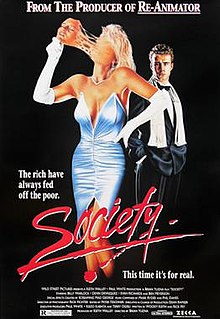
Brian Yuzna’s 1989 schlock horror film Society slides its moist appendages around the concept of the elite, queasily exposing its power and its vile plasticity. Squeezing into the paranoid horror genre at the very end of the Cold War, Society contorts itself away from the communist menace to focus on the evil assimilating rituals of a boneless capitalism. In doing so, though, it inadvertently shows how difficult it is, with the tropes of terror we have, to tell communism and capitalism apart. The two dissolve into a single two-headed, or multi-headed, or faceless mass, impossible to pin down or define, and therefore impossible to escape.

Society‘s protagonist is Bill Whitney (Billy Warlock), a wealthy Beverly Hills teen and star basketball player running for student body president. Everything seems to be going well for him. And yet, “If I scratch the surface, there’ll be something terrible underneath,” he tells his therapist, Dr. Cleveland (Ben Slack), just before biting into an apple and seeing it squirming with (hallucinatory?) maggots. The worm in Bill’s Garden of Eden is his family. His parents Nan (Connie Danese) and Jim (Charles Lucia) are much closer to his sister Jenny (Patrice Jennings) than they are to him. He suspects they don’t love him; he worries he is adopted. Soon, though, he has cause for even more serious alarm. His sister’s ex-boyfriend David Blanchard (Tim Bartell) secretly bugs Bill’s parents and sister; on the tape the three of them reveal that Jenny’s debutante coming out party is a bizarre incestuous group sex ritual. When Bill tries to share the evidence, the tape disappears, and Blanchard is killed in a car crash. The wooden acting and incoherent plot tremble between B-movie incompetence and sweat-drenched fever dream as the conspiracy begins to engulf everyone from Bill’s rival, Ted Ferguson (Ben Meyerson), to his new girlfriend Clarissa Carlyn (Devin DeVasquez), to his doctor, his parents, and the police.

In the film’s infamous conclusion, we learn that Bill was in fact adopted, and his parents and their friends are part of a shape-shifting species that devours humans in a bizarre group feeding sex ritual called the “shunt.” The last twenty minutes of the runtime are an oozy apocalypse courtesy of special effects guru Screaming Mad George: flesh dissolves, mouths turn into clotted rubbery tendrils, and Bill literally reaches up through Ted Ferguson’s anus to pull him inside out in a climactic battle, ending Ted’s life and Bill’s hopes of a Washington internship. Clarissa is so in love with Bill that she betrays her own species, and she, Bill, and Bill’s buddy Milo (Evan Richards) escape the clutches of the elite, whose members have to satisfy themselves with eating Blanchard, saved from his apparent death by car crash for an even more awful fate.

Society is a decadent, absurdly sodden and febrile extension of the body horror genre of the ‘70s and ‘80s, taking The Thing (1982), 1985’s Re-Animator (which Yuzna produced), The Blob (1988), and The Fly (1986), and adding even more K-Y Jelly and quivering sexual innuendo. It can also be seen, though, as a reversal of those late Cold War-era films, reaching through the back end to grab hold of the eye sockets from the inside to pull out the wet, pulsing innards. Just as the Berlin Wall was falling, Society revealed that the fear of the Soviets was fear of the wealthy elite all along.

***

Anti-communist paranoia in Cold War horror often centers on deindividuation and dehumanization. Ronald Reagan was channeling films like 1954’s Them!, with its giant, mindless insect invaders, when he described Communism as an “ant heap of totalitarianism.” The 1958 The Blob features a figurative Red menace: a clump of gelatin fallen from space that absorbs all those in its path, dissolving discrete persons into a single jelly-like mass. 1956’s Invasion of the Body Snatchers imagines alien seed pods falling to earth, from which gestate repulsively fibrous duplicates. They drain human appearance and personality when, in a metaphorical excess of failed vigilance, their targets fall asleep. “Love, desire, ambition, faith—without them life’s so simple,” a pod person explains to the horrified protagonists, sketching a vision of a world enervated by a lack of human warmth and capitalist moxy. Significantly, one of the first signs of the pod invasion is a dual leeching away of business initiative and consumerist impulses. Dr. Miles Binnell (Kevin McCarthy) first notices something awry when he sees an abandoned roadside vegetable stand. Later, when he takes Becky Driscoll (Dana Wynter) out to dinner, the restaurant is almost abandoned. Pod people neither sell nor buy; the hive mind, possessed of invisible tendrils, does not require an invisible hand.

Communism doesn’t just eat through commercial relationships in these films; it eats through domestic ones. Removing consumer desire also removes traditional sexual and romantic impulses, leaving behind monstrous abomination. Science-fiction author Jack L. Chalker neatly summarizes the anti-communist logic in his 1978 novel Exiles at the Well of Souls, in which humans have created Comworlds where “The individual meant nothing; humanity was a collective concept.” To advance that group good, the Comworlds retool sexual biology itself: “Some bred all-females, some retained two sexes, and some, like New Harmony, bred everyone as a bisexual. A couple had dispensed with all sexual characteristics entirely, depending on cloning.” In one of the most quietly ugly moments in Invasion of the Body Snatchers, a working mother prepares a pod for her own baby, noting in a monotone that soon it won’t cry. Plants replace wombs just as outsourced childcare replaces homemaking, and maternal feelings dissolve into a grey, ichorous, proto-feminist puddle.

The 1970s remake of Invasion of the Body Snatchers further teases out the bleakly kinky implications of mind-controlled interference in the reproductive process. Elizabeth Driscoll (Brooke Adams) falls asleep in a field, and, as her personality is sucked from her, her body cracks and crumbles like a rotten pumpkin. Nearby, she rises up in her new form, “born again into an untroubled world, free of anxiety, fear, hate”—and also free of clothes. Pod Elizabeth is completely nude, and the film’s stark gaze willfully conflates desire and terror. In fact, the terror is precisely that she is both fully available and completely unavailable, a desirable body in thrall to some inhuman mass will.

Society takes that body and molds it to different ends. The communist infiltration is replaced with a festering class divide. Good, upstanding businessmen, mothers, and citizens are not infected with an alien ideology. Instead, as the maniacal Dr. Cleveland explains, “No, we’re not from outer space or anything like that. We have been here as long as you have. It’s a matter of good breeding, really.” The parasitic infection is not foreign, but native. No one has been changed; rather, the paranoid revelation is that the evil ones were here all along, squatting wetly in those mansions, and sliding hideously into prestigious internships. No blob or pod or thing needs to take control of the judges, the police, the hospitals, and the student presidency. The blob/pod/thing is already here, salivating. “Didn’t you know, Billy boy, the rich have always sucked off low-class shit like you,” Ted Ferguson sneers, before rolling out an impossibly long tongue to sloppily lick his prey.

Ted’s tongue slides around various kinds of appetite; the rich are hungry not just for deviant power, but for deviant erotics. Just as communism in horror films disorders sexuality, so in Society the rich are marked as evil in large part because of their hypocritical flouting of family values. “We’re just one big happy family except for a little incest and psychosis,” Bill tells Dr. Cleveland nervously, and it’s truer than he knows. His parents and sister share improbably pliable group sex. In a polymorphously perverse primal scene, Bill walks in on them, discovering his mother lying back with her legs turned into arms, and sister Jenny’s head sprouting from her genitals. “If you have any Oedipal fantasies you’d like to indulge in, Billy, now’s the time,” Jenny shrieks gleefully—vapid ‘80s high-class party teen revealed as demonic sexual reprobate.

Billy does have uncomfortable fantasies. Earlier in the film, before he knows what he’s dealing with, he walks in on Jenny in the shower. What he sees is one of the strangest erotic images in film history: through the glazed glass, his sister is facing him from the waist up, her breasts clearly visible. But below the waist her butt is towards him. Bill is frozen in confusion and desire at the sexual grotesque, a literally twisted incestuous spectacle. This erotic narrative stasis is something of a motif in the film. The plot slows down to catch Bill’s wide-eyed reaction during the student president debate, when Clarissa in the audience opens her legs, foreshadowing Sharon Stone’s more explicit move in Basic Instinct (1992) a few years later. Bill similarly comes to a staring halt while watching his parents inspect a phallic, writhing slug in the garden—and then again on the beach, when he is crawling to try to recover some fallen suntan lotion stolen by a couple of mischievous kids. Clarissa, entering stage right, picks up the lotion, and, leaning over him, sprays his face, a move that mimes ejaculation in a phallic role reversal. Finally, when Bill actually has sex with Clarissa, the expression on his face is one of distress and horror as much as pleasure—perhaps because at the height of passion, her left hand slides down sensuously over her back and then down her right arm, as if it’s been cut loose from her body and has wandered off on its own.

The movie itself mirrors Bill’s conflicted gaze, simultaneously fascinated and sickened. The climax is a special effects money shot in multiple respects. The scene is exuberantly concupiscent, with group sex, incest, porn movie tongue kisses, and indeterminate bodily fluids all slickly fusing. The leader of the shunt, Judge Carter (David Wiley), mutters greedily about Blanchard’s beauty mark before devouring him with his mouth, and shoving his hand up his anus. Homosexuality is framed as the ultimate decadence—a terrifying embodiment of penetrative lust that makes you recoil, laugh, and feel things you don’t, or do, want to feel.

The shunt is the Communist blob, with joy added. Judge Carter, Ted, and Jenny all obviously love the shunt. “It’s so fun to see how far you can stretch,” one of Jenny’s fellow shunters tells her. “The hotter and wetter you get the more you can do. It’s great!” The wealthy elite should be opposed to the depersonalization of Communism, but instead they leap in, eager and willing. They’re the enthusiastic audience for all those Cold War films, cheering for the goopy appearance of the Blob.

If all those capitalist viewers loved consuming the Blob, was the Blob ever really a Red Menace in the first place? The problem with seeing Society as an inversion of Cold War anti-communist narratives is that those Cold War anti-communist narratives were often torso-twisted replicas of themselves anyway. The 1988 Blob, for example, replaces the invading goop from space with a biological weapon created by the U.S. government; the shapeless metaphor for communist invasion heaves and bulges and becomes a shapeless metaphor for capitalist invasion.

John Rieder, in 2017’s Science-Fiction and the Mass Culture Genre System, points out that the anti-communism of Invasion of the Body Snatchers can also be read as a terror of capitalism, alluding to the economic signifiers I mentioned earlier.

One of the first signs of the invasion is the closure of a small farmer’s produce stand. Later we see a restaurant losing its business. Finally a group of aliens conspires behind a Main Street-type storefront after one of them grimly turns the sign on the door from Open to Closed. What these emptying-out and closures signify is an economy bent entirely on the production and distribution of seed pods. The colonizing economy is not attuned to the local needs that a produce stand responds to, but rather focuses solely on the single-minded propagation and export of its one and only crop.

The machinations of the body-snatching elites hollow out the town of Santa Mira, just as the society feeds on Blanchard—or just as the vampire feeds in 1922’s Nosferatu. Bram Stoker’s decadent, parasitic aristocrat was robbing helpless victims of their will and individuality via debased, incestuous, homoerotic sexual rituals long before the Cold War seedpods split open. Anti-communism spawned anti-elitism, and anti-elitism spawned anti-communism. Rieder argues that the real danger of the pods is “monopolistic corporate capitalism,” not communism. But which take is the true reading is less important than the way anti-communism is an indistinguishably parasitic replication of anti-capitalism, and vice versa. The tropes of anti-elitism and of anti-communism are grown from one bloated pod. Both dissolve personality, virtue, ambition, love, and sex into a repulsive muck that lives only to eat and perversely reproduce.

Perhaps the best example of how radical and reactionary horror tropes sprout from one another is John Carpenter’s 1988 classic They Live. In the movie, John Nada (Roddy Piper), a virtuous, optimistic, working-class protagonist, discovers that cadaverous aliens are living among us, controlling us with television messages that turn us into obedient, consuming drones. The movie is widely considered a critique of Reagan-era neoliberalism, and it is that. But it’s also a story about the virtues of genocide. A white guy discovers aliens who don’t look like him living in his town, and his first impulse is to murder them. Foreign shape-shifting immigrants, like vampires, are a standard anti-Semitic stand-in for Jews, and They Live can be read as a fascist conspiracy theory, in which brave working Americans finally recognize their racial oppressors, and respond with righteous cleansing violence.

Actual neo-Nazis have in fact read the film in exactly this way. Director John Carpenter insists that this was not his intention, and there’s no reason to disbelieve him. But tropes, like pod people, have minds of their own. When a creator assembles signs that signal “anti-elitism,” those same signs exude a duplicate, indistinguishable signal that is “anti-communism” or its frequent partner on the right, “fascism.” This is certainly the case in Society, a film in which Judaism is as slippery as sexuality. David Blanchard, we’re repeatedly told, is not the right kind of boy to date Jenny. That’s in part, we learn, because he’s Jewish. After his car accident, he has an open casket funeral in a synagogue. The problem is that Jewish people don’t have open casket funerals. Blanchard, whose corpse is faked by the society, is, it turns out (and unbeknownst to the film creators), a fake simulacra of a Jew.

If Blanchard isn’t really a Jew, it follows that the group that rejects him is made up of fake gentiles. And indeed, the vampiric, endogamous, shape-shifting vampires of the society are a not-very-buried anti-Semitic caricature. “You’re a different race from us, a different species, a different class. You’re not one of us. You have to be born into society,” the creatures tell him. This is a statement about the insularity, privilege, and snobbishness of the hereditary rich. But it’s also a racialization of class that is uncomfortably congruent with anti-Semitism. When the rich are horned devils feeding on the blood of your progeny, that could mean they’re not the rich at all, but the usual scapegoat.

Society expresses its disgust for the elite through the visceral, loathsome, oily imagery of homophobia, anti-Semitism, and anti-leftism. Class critique in the popular imagination draws parasitically on the stigmatization of marginalized people, and on tropes of deindividuation and sexual disorder sucked up from anticommunism. This is in part why it’s been so easy for the right over the last half century and more to position itself as the defender of working people. We have built the rhetoric of anti-elitism and the rhetoric of fascism from the same putrid, writhing flesh. If we don’t find a better way to imagine resistance, and soon, society will consume us too.

Watch the full film on Kanopy here.

Saturday Matinee: The Dead Zone

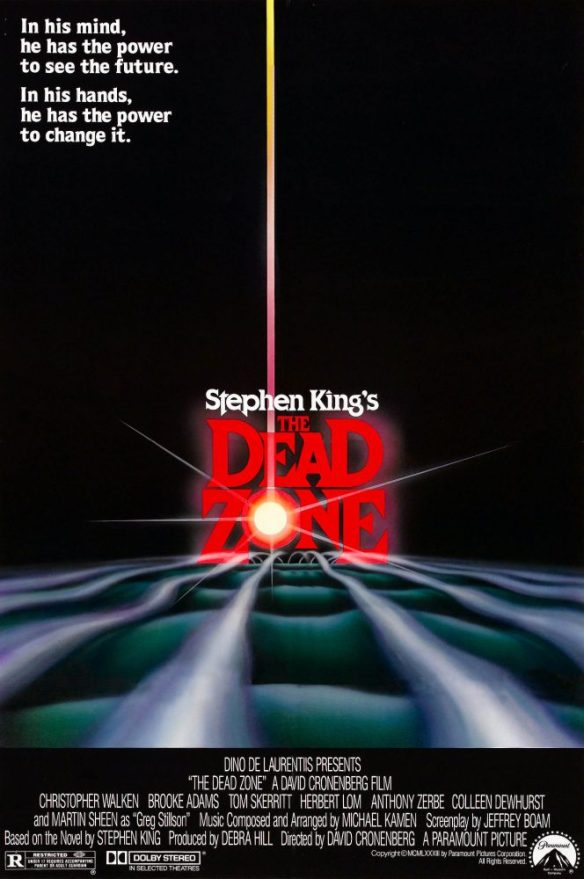
“The Dead Zone” (1983) is a horror/drama directed by David Cronenberg based on a novel by Stephen King. When Johnny Smith (Christopher Walken) awakens from a coma caused by a car accident, he finds that years have passed. Heartbroken that his girlfriend (Brooke Adams) has moved on, Johnny must also contend with new unsettling powers allowing him to see a person’s future with a mere touch. After shaking the hand of aspiring politician Greg Stillson (Martin Sheen), Johnny sees the impending danger presented by the candidate’s victory and resolves to prevent it.

Watch the full film on Crackle here.

Saturday Matinee: UkraineGate – Inconvenient Facts

Documentary Released Monday Sheds New Light on Ukrainegate

Source: Consortium News

A new documentary by Olivier Berruyer, editor of the website les-crises.fr, released in conjunction with Consortium News on Monday, sorts out the complicated scandal and the role Joe Biden played in it.

UkraineGate – Inconvenient Facts

Part One: “A Not So ‘Solid’ Prosecutor”

Watch the full episode here.

Saturday Matinee: Faces of the Enemy

Description from California Newsreel:

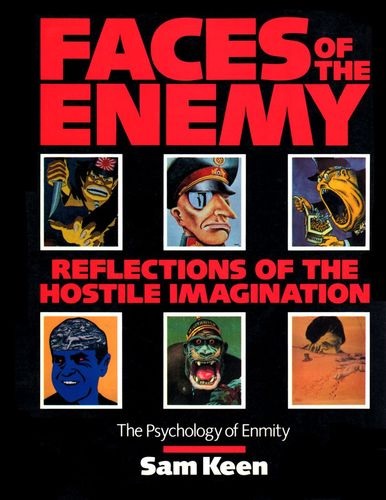
As relevant today as when it was first released, Faces of the Enemy follows social psychologist Sam Keen as he unmasks how individuals and nations dehumanize their enemies to justify the inhumanity of war.

Using archival news footage, public service announcements, and editorial cartoons, Keen unveils the same frightening pattern in conflict after conflict – World War II, the Vietnam War, the Cold War, Islamic and Christian Fundamentalism – and prefigures the current War on Terrorism. First we identify ourselves as victims. Then we blame, demonize and finally dehumanize our adversaries, rationalizing our murder of other human beings.

Faces of the Enemy contends that before a drop of blood is spilled we must ‘think each other to death.’ It is a story replayed on the nightly news, in Islamic Fundamentalists’ characterization of the West as the ‘Great Satan’ and our own stereotyping of Muslims as terrorists. In a revealing examination of the images and iconography of war Keen interviews the nation’s leading editorial cartoonists. They discuss how they use an almost universal language of stereotypes and prejudices to tap into readers’ most visceral emotions.

In a chilling example of the psychological roots of enmity, we meet David Rice, an unemployed welder now an inmate on Death Row. Influenced by far-right propaganda, Rice decided communism was responsible for his personal problems. He bludgeoned to death a family of four whom he (mistakenly) thought were communists. He remains without remorse regarding them as ‘collateral damage’ in a war against the Evil Empire. The Christian Fundamentalist leaders who inspired Rice are only too happy to explain that they are in a holy war against communists and any non-believers.

By contrast, William Broyles, a Viet Nam veteran and author, returned after the war to personalize the individuals who had been his enemies’ to humanize the abstractions. He explains how racist terms and images can be used to turn human beings into monsters. These epithets and images extend the circumstances of war into terrible brutality. But he also explains how we can move beyond these dehumanizing thoughts and seek out the humanity of others.

Psychologists Robert Lifton and Steven Kull explain how war and artificial enemies provide people with the moral and mental certainties they crave, giving them a sense of purpose in a sometimes-ambiguous world. Mythologist Joseph Campbell, providing a note of hope, suggests that underneath the mask of the enemy we ultimately recognize ourselves. This, Campbell further contends, may be the origin of compassion, brotherhood and altruism, in other words the inverse of war.


Watch the full film on Kanopy.

Saturday Matinee: The Corporation

MV5BMTQxMjMzMTczM15BMl5BanBnXkFtZTcwNzg5MzUyMQ@@._V1_SY317_CR4,0,214,317_AL_

Director Jennifer Abbott and Mark Achbar’s “The Corporation” (2003) is a comprehensively researched film exploring the history of corporations, how they operate and how they’ve come to attain so much political power. Related topics include the 1933 attempted corporate coup exposed by General Smedley Butler, the Fox news coverup of the dangers of Monsanto’s Bovine Growth Hormone, and the mass protests in Bolivia sparked by the attempted privatization of their water supply in 2000.

Saturday Matinee: Alternative 3

Related Article:

The Truth About Alternative 3 (An archived newsletter excerpt featuring a letter from Leslie Watkins, author of the novelization of the screenplay available here: https://archive.org/details/Alternative3-33rdAnniversaryEdition )

Minority Report (2002) Esoteric Analysis

By Jay Dyer

Source: Jay’s Analysis

Spielberg’s Minority Report is now an important film to revisit.  Based on the short story by visionary science fiction author Phillip K. Dick, Spielberg’s film version implements an important number of predictive programming elements not found in Dick.  Both are worth a look, but the film is important for JaysAnalysis, since now 13 years later, we are actually seeing the implementation of the total technocratic takeover, including pre-crime tracking systems.

Although the film and the short story present the precognition as a metaphysical mystery by telepathic individuals who can see into the aether, the real pre-crime systems are based on A.I. and the digitizing of all records under total information awareness.  And as I’ve said, this was DARPA’s plan for the Internet all along.

In fact, a good friend of mine worked for a few years digitizing mass medical records, and while most are aware of Google’s attempts to digitize all books, most do not know why.  I’ve warned for several years now the end goal of all this digitization is not for “efficiency” and trendy techy cool iWatches to monitor heart rates and location.  The ultimate goal is total mind control, loss of free will and the complete rewrite of all past reality.

Consider, for example, the power the system will wield with the ability to “delete” all past versions of literature – religious texts, Shakespeare, 1984, nothing will be sacred and unable to be “revised.”  Remember that in 2009 Amazon erased Orwell’s 1984.  Your own past may even be deleted, subject to revision or altered to make you the next villain!  All this is revealed in detail in Minority Report.  Thus, while the public adopts “Kindles,” print itself is assigned the doom of the kindled fire – like Farenheit 451, as Richard Grove has said.

Minority Report’s setting is a 2055 dystopic D.C., where Agent John Anderton (Tom Cruise) is framed for two murders from within his own PreCrime Corporation ranks by the CEO, Lamar Burgess (Max Von Sydow). (Note: The existing system appears to be a merger of private and government sectors.)   I’m sure most readers have seen the film, so I’ll spare you detailed plot recaps and hit the highlights for the sake of our purposes.

The film’s PreCrime alerts a private corporation to a predetermined murder event ahead of time, giving the Agents of the corporation time to save victims.  Hailed as a perfect system, the infallibility of PreCrime has made D.C. the safest city in the world, with no murders for several years.  As a result, the PreCrime test requires a total surveillance society, something akin to complete panopticism.  In fact, the advertising in D.C. is user specific, targeting pedestrian’s personal desires based on retina scans – and all travel requires retinal scanning and mass microchipping.

We are now on the verge of the implementation of retinal scanning, as the U.S. military has engaged in retinal scanning in occupied territories for several years now.  It is important to understand that the action of the military abroad are often a test ground for the implementation of such surveillance and tracking technology at “home.”  In October 2010, the Guardian reported of U.S. troops stationed in Afghanistan:

“With each iris and fingertip scanned, the device gave the operator a steadily rising percentage chance that the goat herder was on an electronic “watch list” of suspects. Although it never reached 100%, it was enough for the man to be taken to the nearest US outpost for interrogation.

Since the Guardian witnessed that incident, which occurred near the southern city of Kandahar earlier this year, US soldiers have been dramatically increasing the vast database of biometric information collected from Afghans living in the most war-torn parts of southern and eastern Afghanistan. The US army now has information on 800,000 people, while another database developed by the country’s interior ministry has records on 250,000 people.”

Wired Magazine reported millions were the goal.  The goal is not millions, but the entire globe, where any and all information is now currency for “big data.”  This is exactly the world Minority Report foresaw, and for those curious about Phillip K. Dick, whispers are his foresight was due to being well-connected with the Silicon Valley elites.  This is how Ubik foresaw the “Internet of Things” I’ve written about many times, and probably in part why Dick went insane (or was targeted).  Slate writes of Ubik:

“Samsung, the world’s largest manufacturer of televisions, tells customers in its privacy policy that “personal or other sensitive” conversations “will be among the data captured and transmitted to a third party” through the TV’s voice-recognition software. Welcome to the Internet of Things.

Sci-fi great Philip K. Dick warned us about this decades ago. In his classic 1969 novel Ubik, the characters have to negotiate the way they move and how they communicate with inanimate objects that monitor them, lock them out, and force payments.”

Just as the predictive algorithm in Asimov’s Foundation was able to track mass movements, so now the same algorithmic tracking is in place across the “web of things” that are capable of being recorded and tracked – and that’s most things.  The Pentagon has a virtual “you” in a realtime 3D interface that updates its data consistently from everything done on the web.  The Register reported in 2009 about this simulated warfare and predictive software:

“Defense analysts can understand the repercussions of their proposed recommendations for policy options or military actions by interacting with a virtual world environment,” write the researchers.

“They can propose a policy option and walk skeptical commanders through a virtual world where the commander can literally ‘see’ how things might play out. This process gives the commander a view of the most likely strengths and weaknesses of any particular course of action.”

It’s not telepathic Samantha Morton’s in a tub of goo, it’s Google and DARPA developing highly advanced technology along the lines of what William Binney exposed, as a former NSA employee.  Think here of War Games (1983), where the A.I. bot was able to war game future scenarios of global thermonuclear war, but thankfully Ferris Bueller was there to save us.  If this was displayed in 1983 in pop culture, imagine how far that technology has come 30 years later.  Lest anyone think the “precrime” is merely for security and weekend Xbox enjoyment, recall what I wrote two years back:

“Capitalism, communism, nationalism, 401ks, blah blah blah, all of these things are basically obsolete. Why?  Because of the nature of the real secret high-tech and plans for mega SmartCities that are to come.  You see, you think you are getting ahead and climbing the scum social ladder, and you aren’t even aware that the CEO of IBM Ginni Rommety gives lectures about SmartCities where everything you do will be rationed, tracked and traced by the central supercomputers, with pre-crime determining whether you are guilty of crimethink.  So everything you are trusting in is already obsolete.  You think I’m exaggerating?  On the contrary, you and your children’s futures are determined (you don’t have a future), and if you are allowed to live past the great culling, you will essentially be boxed into a giant WalmartTargetGameStopUniversity City that will literally be run by a supercomputer. Watch for yourself:”

And lest anyone think PreCrime is a thing of the future, consider that it has been used for two years in the U.K.  The New Scientist and 21stCenturyWire report:

“That’s the hope of police in the US, who have begun using advanced software to analyse crime data in conjunction with emails, text messages, chat files and CCTV recordings acquired by law enforcement. The system, developed by Wynyard, a firm based in Auckland, New Zealand, could even look at social media in real time in an attempt to predict where the gang might strike next.

“We’re trying to get to the source of the mastermind behind the criminal activity, that’s why we’re setting up a database so everybody can provide the necessary information and help us get higher up the chain,” says Craig Blanton of the Marion County Sheriff’s Office in Indiana. Because Felony Lane Gang members move from state to state to stay one step ahead, the centralised database is primed to aggregate historical information on the group and search for patterns in their movements, Blanton says.

“We know where they’ve been, where they are currently and where they may go in the future,” he says. “I think had we not taken on this challenge, we along with the other 110 impacted agencies would be doing our own thing without better knowledge of how this group operates.”

It’s not the only system that police forces have at their disposal. PredPol, which was developed by mathematician George Mohler at Santa Clara University in California, has been widely adopted in the US and the UK. The software analyses recorded crimes based on date, place and category of offence. It then generates daily suggestions for locations that should be patrolled by officers, depending on where it calculates criminal activity is most likely to occur.”

Returning to the film, an interesting tidbit occurs about three times that I noticed.  Any time Anderton or his fellow Agents access the “Temple,” the holding site of the telepathic PreCogs, the sound made is distinctly the iPhone power on sound.  The first iPod premiered in 2001, so I’m assuming it’s the same sound for turning on, but readers can correct me.  I find it curious if not, since the sound would likely be chosen for a reason. This puts the infamous 1984 Apple ad in a new, ominous light.

If you’ve seen the important Spike Jonze film, Her, you’ll see why.  In Her, lead character Theodore (Joaquin Phoenix) falls in love with an iOS – his operating system.  The iOS of his future is an intelligent software system with capability for learning (like the A.I. in War Games), and ultimately transcends its own limitations.

I bring this up because Minority Report is distinctly dominated by eye imagery.  While seemingly insignificant, it is my opinion that Siri and Apple in particular are crucial in the implementation of the coming new order.  Apple ads have contained a distinctly esoteric and significant cultural referent.  This is not to say Microsoft or any of the other tech giants are insignificant, on the contrary, I believe they are all arms of one entity and the appearance of competition is largely illusory.

There is only one military industrial complex, and DARPA and Google and Apple and Microsoft are all its children.  The façade of competition is enough to advance the technology by the tech nerds that serve it, but in the end, it all serves the same system.  My point here is that the iPhone is much more than an iPhone. It is actually an EYEphone, functioning as the eye of Sauron himself, as A.I. reconnaissance before the takeover.

I have mentioned before the whispers are the iPhone of the next few years will contain a Siri that communicates with you like a personal assistant.  I have finally found an article on this here, which describes it directly in connection to Her, like I said here.  “Viv” will do the following:

“On the other hand, not only will Viv recognize disparate requests, she will also be able to put them together. Basically, Viv is Siri with the ability to learn. The project is being kept heavily under wraps, but the guys at Viv have hinted that they’re working towards creating a “global brain,” a shared source of artificial intelligence that’s as readily accessible as heat or electricity.  It’s unclear how soon a breakthrough of this magnitude can happen. But if this team made Siri, you can bet their next project is going to blow the tech world to pieces.”

In order to endear the public to that idea, a prototype Siri had to be offered.  While this may be a rumor, it will eventually come.  And the dystopic scenario presented in Her will meet the nightmare of Minority Report.  For now, it all seems harmless (though we are seeing a generation of youth destroyed by screens and pads – Steve Jobs didn’t let his own kids play with an iPad!), but the end goal I assure is nefarious.

The dominant ideology of these tech giants is pure and total dysgenics (not eugenics).  In order for the total rewrite to come, the existing structure must be destroyed.  The “old way” of doing things will be scapegoated as the technocracy replaces it, offering utopia and salvation, but the synthetic rewrite is a Trojan horse.  Humanity will be enslaved in the same virtual Matrix Anderton is enslaved in, in the film.

The film’s tag line, which pops up numerous times in the story, is about running.  “Everybody runs,” and John spends most of the film on the run from the very system he operated.  The film asks the question multiple times, “Can you see?” and when we think of this on a deeper level in terms of predictive programming, I think we are intended to look beyond the immediate narrative.  There are also numerous hat tips to Blade Runner, where again the “running” imagery comes to the fore.  Can we run from the panopticon?  Do we have eyes to see the iEYES that are “infallibly” surveilling us perpetually?