James Curcio: How did you get involved in the Criterion edition of Game of Death?
Alan Canvan: Game of Death has been on my periphery since first viewing it in 1979. Over the years, like many fans, I attempted to decipher the rumors and evidence of existing footage that told more to the story than what we got in the 1978 film.
Following the release of the full footage in 2000, I began reflecting on the different presentations in relation to the source material. In truth, although those renditions have their merits, I felt that much of the symbolism and dramatic narrative associatedwith Lee’s work was lost in translation.
In the Winter of 2018 I fully committed to the project, and meticulously examined and refined the Game of Death sculpture for a period of 6 months. This garnered the attention of Antony Wong of the Asian American/Asian Research Institute in New York, and resulted in a film screening at AAARI in July, 2019. My good friend Matthew Polly, (author of the outstanding biography Bruce Lee: A Life), joined me for the post panel discussion, and we chatted about various thematic elements within the story. The feedback was extremely positive, but I continued to play with the footage until December of that year.
In the interim, Criterion approached Matthew to do film commentary for their then upcoming Bruce Lee box set, and producer Curtis Tsui learned about my edit. After seeing Redux, Curtis was impressed enough to ask me if he could include it as an extra feature on the Game of Death blu-ray disc.
I also need to cite composer John Barry’s incredible score as a crucial component to the Game of Death jigsaw, and I wouldn’t have considered doing Redux without it. Going back to the concept of storytelling, what I find particularly remarkable in his compositions is how they seem to sonically narrate the story. Barry creates a work of intimate beauty that is equally classical, ominous, melancholy and heroic.
Because of this, I’ve often wondered if he had access to the full footage when creating the compositions (as opposed to the 11 minute edit we got in the 1978 film). Suffice it to say that, either way, Game of Death is all the richer with his music as the driving force of the story.
JC: I’m sure a book could be written on this subject, but in brief, how does mythology relate to a martial arts film like Game of Death?
AC: Carl Jung, a progenitor of the way in which symbols and common myths pervade our thinking, stressed the idea that certain story devices are embedded in the brain — hence, mythologies from different cultures all over the world sharing a common language. These tales often involve death and rebirth.
Mythology, at its core, attempts to examine nature’s cyclical process with stories that often convey the death-rebirth archetype through symbols, and what takes place may not necessarily be happening in the actual world but in the inner world of the mind. He referred to this process as the return of the ego to the unconscious, a momentary death, with a subsequent re-emergence or rebirth. In comparative mythology, ego death is the second phase of Campbell’s description of “The Hero’s Journey”, where the hero returns to enrich the world with his revelations.
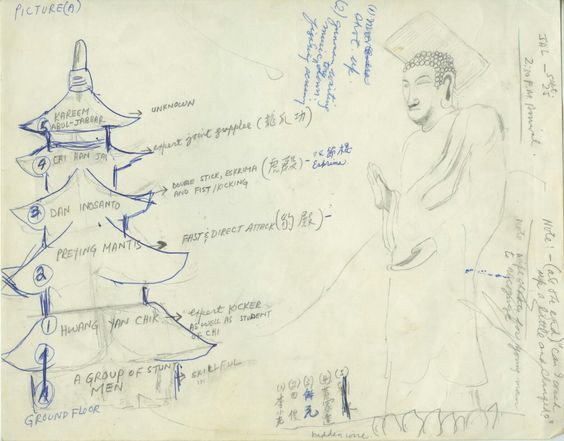
This specific arc is reflected in the pagoda sequence of Game of Death. The broader narrative sets up the protagonist to face different iterations of death, revealing early on that he is a retired martial arts champion who inadvertently killed an opponent in his last professional fight. Does this thematically tie into the climax? I believe so. Viewing the central theme being the death of the ego as a fundamental transformation of the psyche, the film’s title takes on a different meaning. The pagoda therefore stands in for the character’s emotional landscape, with the true mission being the conquest of his inner fear.
Though, according to the story treatment, his motivation was supposed to be fueled by his family being held hostage. This doesn’t quite gel with the philosophical underpinnings of the pagoda motif, which is partially why Bruce struggled with the script. In fact, a strong argument can be made that the footage itself works best as a mini movie focusing on the themes within the pagoda, as opposed to a feature length film bogged down by 50 minutes of exposition leading up to the big battle.
JC: Merging the symbolic and naturalistic elements of a story is often a struggle… that balance between “dream logic” and “waking logic.”
This leads into the next thing I wanted to talk to you about, actually… When did you realize myth played an important part in Bruce Lee’s art?
AC: Unconsciously, at a very young age. I saw my first photograph of him when I was around 7 years old, and began following him through magazines and ’stories’ long before seeing his movies. Game of Death, quite fittingly, was my introduction, and by then, he was the size of Mount Olympus to me.
Consciously, my mid to late teens is when I began making the connection between his cinema and classical mythology. At the time I was devouring the works of Homer, Sophocles, Shelley, Stevenson, Wilde, Burroughs and Poe. Adjunctly, I witnessed their heir apparents in the world of comic books — writers and artists who reinvented this stuff in a different, but equally powerful medium. An obvious example is the Biblical overtones that shape Superman’s origin. In the late 70’s and early 80’s comic book scribes Doug Moench and Frank Miller examined these tropes beautifully in their seminal works — Master of Kung Fu and Daredevil.
Bruce Lee was heavily influenced by comics in his youth, and, later, became a student of philosophy, but not quite in the way some folks believe.
JC: Can you explain what you mean by that?
AC: Bruce’s major in the University of Washington was Drama — not Philosophy, as has been reported. In his junior year, he took two Introductory Philosophy courses, which made up less than 10% of his classes. He may have considered changing his major before dropping out, but that doesn’t negate the fact that his understanding of philosophy at the time was rudimentary at best. He would later study numerous philosophies, selecting principles that could be applied to his martial training.
Over the last 30 years, the Lee Estate has relentlessly promoted the image of Bruce as a Philosopher, who not only developed his own brand philosophy, but lived and breathed it on a daily basis. This is inaccurate. To this day, they continue to release self-help books with titles such as Bruce Lee’s Wisdom for Daily Living which actually reproduce Bruce’s personal notes that paraphrase the work of Krishnamurti, Suzuki, Watts and countless others, in relation to combat. Because the sources aren’t cited, many believe these quotes to be his. I don’t believe the Estate’s intent was to plagiarize the work, but it’s obvious that those involved didn’t do their research. This plays a large part in Lee’s mythology and a contingent of fans not only buy this, but have an almost religious need to believe it.
Although Bruce studied and preached philosophy, he had considerable difficulty practicing it outside the realm of his martial arts training. He aspired to live by metaphysical principles that were fundamentally at odds with his ambitions: more than anything, Bruce wanted to be famous (and wealthy, by virtue of that). And he worked diligently at perfecting his talents to achieve this goal.
In the late 60’s, Tinsel Town had very little acting roles for Asians, and this allowed Lee to successfully build a “character” that would demand Hollywood’s attention. It didn’t happen overnight, and, in fact, took 6 years to achieve, but he was astute enough to realize he could parlay his passion for martial arts to the big screen and give the world something they had never seen before. It was a calling card to the industry that he coveted.
Consequently, he spent a great deal of time honing the image of “Bruce Lee” — the alpha and omega of everything martial — that he sought to present to the world. This went a long way in Hollywood’s perception of him, and he wowed stars and executives not only with his physical skills, but a packaged “philosophy” to boot, giving him the image of the ultimate Zen Sage/Warrior. Much of the philosophical musings he’s known for really took shape when he came in contact with Steve McQueen, James Coburn and Stirling Silliphant.
That’s not to say that he didn’t take philosophy seriously, but he was well aware of the marketing benefits in quoting Zen aphorisms. These guys became his students, and at the peak of the counter-culture movement, Lee reinvented himself as a Guru to the stars.
In fact, the “be water” speech that the world has come to identify as his mantra, was in fact written by Stirling Silliphant (for the character he created for Bruce in the Longstreet TV series).
Granted, it was inspired by Lee’s words over the course of many private lessons, but the poetry of the language is all Silliphant. In the Burton interview, Lee was asked to repeat the monologue and, over the years, that clip was used unsparingly by the Estate to promote Bruce as a real-deal philosopher.
So, to wrap up what I was saying earlier… in many ways, his ideas as a storyteller were the perfect union of both interests. It’s my opinion that the so-called “Greek Dichotomy” is more in line with the yin-yang symbol in that philosophy and mythology are intrinsically connected. They both attempt to answer universal questions and come up with similar answers… but one does it much more theatrically!
JC: Mythos and Logos could be likened to the yang and yin dynamic in some ways, for sure.
How did these insights influence your editorial decisions with Redux?
AC: I approached the footage as its own three-act structure, with each floor representing a thematic color: Yellow for the Hall of the Tiger, Red for the Hall of the Dragon and Black for the Hall of the Unknown. The Jungian symbolism was quite obvious to me and I chose to characterize this by giving each level its own distinct musical cue. Also, I linked the Inosanto and Jabbar characters with a recurring percussion that that we first hear when Bruce’s character sprints up the stairs.
A primary analysis of what the guardians personify:
Hall of the Tiger. Here, Inosanto is the undisputed Rhythm Man — he was, in fact, Lee’s inspiration for the Rhythm Man character in the unproduced Silent Flute — an excellent martial artist, who is crippled by his slavish devotion to the art. Dan’s character, in a way, could represent what Bruce was at an earlier stage in his evolution as a martial artist. There’s symbolic resonance in the way they circle and replicate one another’s physical movements in the nunchaku duel, figuratively becoming mirror images of each other. Also significant: Dan’s floor is the Hall of the Tiger, while Bruce’s character’s fighting moniker is the ‘Yellow Faced Tiger.’ A further parallel between them?
Hall of the Dragon. Jae here represents the Dragon, which is obviously the symbol commonly identified with Bruce. There’s a regality to his presence exemplified by the way he carries himself, in the way his hair is styled and the majestic gold trim of his Gi and belt. The Dragon’s claw is highlighted with a zoom close up of Ji’s hand poised like a claw ready to pounce. It’s also significant that Ji is a grappler, in that it highlights the metaphorical aspects of struggle. Interestingly, Lee’s character ends up defeating Ji by using his own grappling methods against him — right down to the back breaker employed to end the battle. Is it symbolic that Lee breaks the Dragon?
Hall of the Unknown. Here, Lee, the filmmaker, goes fully expressionistic, using Jabbar’s character to symbolize the physical manifestation of Bruce’s Shadow self. There’s a symmetry in their physical movements that echo one other, but more nuanced than in the battle with Inosanto. The character is an elemental force that matches Lee’s prowess and complete freedom in combat. The battle on this floor is less about a “physical reality” as it is a metaphorical struggle that represents the protagonist’s inner fear of death. Kareem’s physical appearance and surroundings emphasize this — a colossal figure with arachnid limbs that dwells in darkness. His physical reach is symbolic of the length one’s fears can have.
Also significant: the manner in which Kareem kills James Tien plays on James’ character running from and essentially being devoured by his fear. Lee’s character prevails only by confronting his own dark nature/fear of death, and he is symbolically reborn through the process.
JC: It can be difficult bridging the gap in public perception between ignorance towards mythic tropes, and a sort of paint-by-numbers approach — a common definition of myth that both gets at what captures our imagination and isn’t so generalized or generic that it blends everything under the same bland term can be challenging. Pretty soon it can be like, “this is a myth,” “that’s a myth”. Everything is a myth, and so what?
I encountered this a lot with fans of Joseph Campbell — he was a great popularizer, but he actually took the time to read the source material. I think from his message a lot of people took a sense of the universal monomyth too far, as if myths at their origin-point come out of a cookie-cutter mold — “this pantheon needs a trickster”, “better follow the heroic cycle with this plot”, etc. This is especially true as his ideas have permeated script-writing, and countless books and lectures now exist suggesting that everyone re-enact the same heroic cycle, since after all, there is only one.
Whereas Campbell himself was quite clear that, although commonalities form, arguably because of the commonality of our bodies and their range of possible experiences, the origin point of myth is never the result of a formula. Myths are maybe generic because of their mutual accessibility, but they’re contagious for containing something that breaks the old formula.
I noticed mythic tropes in some of Bruce Lee’s later film work, though I assumed — wrongly, I think now — that it was because of the pop cultural movement toward using mythic tropes to help sell a story. (Of course, Star Wars cashed in on that heavily in 77–78, but it didn’t begin there). I’m interested to hear more about his intentions, as I’m sure our readers will be.
AC: As you noted, the monomyth and its effect on modern mythology predates Star Wars, though I feel it wasn’t until Star Wars that we embraced it in our collective consciousness. Tangentially, over the years, I’ve had quite a few discussions with friends and colleagues on the huge influence I believe Bruce Lee to have had on George Lucas as a storyteller. When discussing Bruce Lee, the word “myth” really takes on a meta- aspect, in that his movie mythology simultaneously informed his cult of personality. This resulted in Bruce Lee, the man, being mythologized more than any other screen icon in the history of film. There are two primary reasons for this: He pioneered (and lived) a cinematic language that defined him as the emissary of all martial knowledge, and he died incredibly young and beautiful, assuming the form of a 20th century Dorian Gray.
In response to your question, though, in order to understand Bruce’s cinematic intention, one has to go back to the initial idea he had for what was to be his first martial art movie — a Hollywood production entitled The Silent Flute. This unrealized project was conceived by Bruce in collaboration with his two students, Academy Award winning screenwriter Stirling Silliphant, and actor James Coburn, and, in many ways, became the template for Lee’s personal brand of martial art films. It was a well that he would revisit often in the ensuing years, and it allowed him to cherry pick various hallmarks and integrate them into his other projects, eventually culminating in his solo treatment of the material, Southern Fist, Northern Leg (unproduced).
Game of Death, and more specifically the pagoda motif that comprised the second and third acts of the film, owes more than a passing nod to The Silent Flute’s thematic structure and subtext, with the pagoda representing the landscape of the human psyche, and the combat used as a vehicle for self-actualization, freedom and enlightenment.
JC: Another element of this that interests me is the idea of conveying a story with the body. We have a tradition of associating story with language — I’m not sure we need to trace it back to the european tradition, but there’s a definite association between story, narrative, and language — a sense that it’s fundamentally spoken or written down to be spoken later.
However, there’s a counter argument that every story begins in the body. Artaud has an interesting take on the alchemical possibilities of the body in motion (The Theater and Its Double). Artaud focused on Balinese dance, but there’s a similarly rich, mostly silent mythology contained in Noh, and it doesn’t end there.
What are your thoughts on this? Was this more akin to the direction Bruce was moving with his interest?
AC: The connection you make to Artaud is valid. Interestingly, Noh was highly influential on Chambara cinema, which in turn inspired much of Lee’s performance in Fist of Fury. In an interview conducted roughly a year before his passing, Bruce relayed his thoughts on the term “motion picture,” stressing that the word motion, by definition, suggests an absence of words (or, at the very least, minimal exposition).
Parenthetical to this, and something that’s rarely, if ever, examined, is Lee’s substitution for dialogue: the primordial war-cries he developed for film, both fierce and playful, contained their own implicit language, subliminally morphing and communicating a range of emotions underneath the surface.
A key aspect of Bruce’s brilliance lies in his ability to create intimate character studies of age-old archetypes within the dynamics of screen violence. His cinema is a meditation on the power of movement — a kinetic poetry, if you will — that not only illustrates action, but narrates rich, textured fables within the action.
Game of Death, though incomplete, is a preeminent example of Lee’s storytelling sensibilities. His camerawork takes a cinema verite approach to the combat, giving the viewer a voyeuristic sense of close proximity to the fights, but also underscoring the surreal elements within the compositions. Two examples that immediately come to mind are in the final battle against Kareem Abdul-Jabbar: the POV tracking shot of Lee strangling Jabbar that begins underneath the furniture, and tracks up as Jabbar lifts Lee into the air and slams him down into the couch, collapsing the structure; the slow pan camera glide that begins on Bruce’s face, struggling as he continues to choke Kareem out, and travels from right to left across Kareem’s arm, settling on the veins on the back of his hand. In these instances, the viewer witnesses an expressionistic representation of a central theme that governs many of Lee’s screen battles: the concept of spiritual rebirth attained through the rigors of combat, and violence, in and of itself, as a rite of passage.
These tropes are often neglected though — and that’s odd, considering the global impact he had on film. “Action Cinema” is often dismissed as a rudimentary form of escapism, but there’s a reason why we respond to it. At its best, it intuitively links us to a primal instinct that we hold vital as a species. As with literary mythology, no matter how preposterous the characters or situations seem, we unconsciously relate to the larger than life struggles that shape and reflect who we are and who we want to be. And that’s part of the appeal of mythology — it’s a platform that allows us to symbolically connect to our better selves.
JC: I think that latter point is worth exploring. The sense I get is that Bruce Lee’s “mythology” was very much based around the idea of myth as a route to self-improvement, creating heroic images that we can come to embody through a process of half-steps… and it can certainly play that role.
But there are countless examples of the other directions myth can lead people in — probably the most contrary form of this would be Adorno’s idea that myth was the primary vehicle that fascism employed for amplification. (In his work with Horkheimer in Dialectics of Enlightenment.)
What I’m getting at is that strange paradox implied in the transformative possibilities of screen violence, that it can lead us in the opposite direction that real violence quite often does. The very idea of martial arts itself also raises the question of the role of violence in self transformation. For my part, I think both of these formulations are correct in different ways, but I’m curious what your take is here…
AC: As it pertains to real violence, most martial artists often confuse the categories: 1. Martial Arts (traditional) 2. Combat Sports (MMA) 3. Reality Based Self Defense (traditional martial arts disguised in military or street clothes) and 4. Violent Encounters (chaotic attacks outside a controlled arena).
The first two require preparation and consent, the third confuses technical moves for tactical responses, and the fourth is a complete wildcard which can leave those involved dead. The mind navigates the body, and how one feels affects how they think and vice versa. Both affect movement. True martial training addresses one’s fears, and the transformational element resides in learning how to manage those fears through training.
On the big screen, violence is an extension of this — it can be catalytic to the emotional arc a character fulfills over the course of their journey. A filmmaker’s stylistic expression is equally important, as screen violence has the capability to elicit different reactions depending on the lens its filtered through. For example, a character shooting someone in Taxi Driver looks and feels very different, than Raiders of the Lost Ark. First Blood (the novel and the film) — explores the psychological ramifications of war on soldiers. In Way of the Dragon, Bruce Lee highlights the emotional aftermath of killing an opponent in battle and uses the fight to illustrate a rite of passage for both characters.
So, I believe it really comes down to the filmmaker’s intent — what are they attempting to say with the violence? Is there a point? Is there an aesthetic? These elements contribute significantly to a body of work.
Incidentally, I haven’t read Dialectics of Enlightenment in its entirety, but from what I have read, I can’t help but relate it to Frederic Wertham’s Seduction of the Innocent, a useless book that was published in 1954 warning that comic books were directly responsible for juvenile delinquency.
To answer your question, I don’t believe violent films are responsible for real world violence. There are significant psychological factors that come into play with that kind of response, including their interests, temperament, social environment, family history and personal experience.
JC: I tend to agree, although it’s complicated. There is a certain feedback between the fictional and real, for instance, real world gangsters are known to style themselves after the characters they see onscreen — the documentary The Act of Killing gives a poignant view of this — and there is ample evidence that media can be used to nudge people with fragile egos towards violent extremism. But the problem resides within the viewer. There’s absolutely no reason to believe that horror or action movies in general make people into mass-murderers, as if the “bad” is spread to the viewer as if by contagion. This moralistic approach to media studies is, among other things, incredibly reductive, and I think it mistakes the fundamental relationship between ethics and aesthetics, or the various roles that onscreen violence can actually play within the viewer.
This is something I’ve wrestled with a lot as an artist, I’m sure many do, and it came up again in writing / researching MASKS, a recent anthology that interrogates the role of a constructed persona in the life of an artist:
“We leave room for cruelty in art so that we might exorcise it from our lives. This demands actual engagement; it can’t be done by rote.” (Excerpt)
This theme also leads back with your earlier point about Bruce Lee as a constructed identity, or a brand. To some extent this is always the distorting effect of fame — everyone thinks they know you, but the person they know is a fabricated image. This may always be the case in public life, but it is accentuated by fame. We looked at Yukio Mishima and a number of other artists in this context, but in retrospect Bruce Lee would absolutely fit that mold as well.
Sometimes this role is foisted on the person, other times it’s the result of careful construction. But it can also become a trap, like a chrysalis-cocoon the artist has to repeatedly construct and then break free from. It’s interesting, also, that many of the figures who come to mind when it comes to this sort of “persona first” approach to art either died young, or obsessed over that sort of Dorian Grey concept, as Bowie did. By dying young, an artist might avoid some of this — this may have been a part of Mishima’s obsession with dying young and still in control of that image…
This idea of constant transformation so as to avoid becoming trapped in one’s own myth seems intrinsic in Bruce Lee’s ideology, “be like water” is a cliche now, but seems like sound advice in this regard.
AC: MASKS looks great, and seems right up my alley. In the excerpt, you make a wonderful point regarding the revealing and concealing aspect of art, and by extension, the artist. In each singular act, of course, there is an element of the other at play. As you state, this leads to the question of “what’s real, what’s fake?” No story is accurate, though many tell the truth.
In that respect, the highest art is really triumph over the loss of art. Bowie, I believe, was intuitively aware of this. Iggy Pop. Brando. And, to an extent, Bruce Lee.
As I mentioned previously, Bruce was extremely precise in developing the image that we’ve come to associate him with. In truth, he’d worked on “Bruce Lee” for quite a while in the US, honing his presence and stage act in martial art demos long before courting Hollywood. While the Bruce Lee chimera may be rooted in how he sought to present himself to the world, the bigger mythology began almost immediately after his passing. How did it happen? It was easy to do because the groundwork had been laid out. More importantly though, most of the western world knew next to nothing about his personal life. This allowed his wife, and later his daughter, to successfully pass him off as the character in Enter the Dragon.
Reveal/Conceal.
Was Lee self aware? He warned of the pitfalls in not distinguishing between self actualization and self image actualization, though he clearly fell in the latter category. I see him working so hard to put forth that distinct persona in the interview he did with Pierre Burton — “the word star really turns me off, because it’s an illusion” — but ultimately revealing the antithesis within the smaller beats of the discussion. Fame is an extremely seductive mistress — especially to anyone who craved it as much as Lee. As I mentioned before, part of the grand illusion lies in the myth that he was a philosopher and fighter (the two most common boxes he’s put in, neither of which are accurate).
What’s interesting to me though, is this persona was primarily built around how his characters fought on screen, rather than the actual roles themselves. Audiences often fail to realize that Bruce never once duplicated a character in any of his adult films, but to the masses his characters come across as interchangeable based on their shared physical characteristics (ie hairstyle, facial gestures, combat stances, and signature war cries). These trademarks then became the brand, and over the course of time, ended up eclipsing all nuance he gave to the roles. As a result, “Bruce Lee” hasn’t been truly recognized as an actor, rather he’s viewed as a martial athlete who just happened to make movies.
People forget that prior to his obsession with martial arts, Bruce’s first love was performing. In fact, I would argue that this passion exceeded his love for martial art. The Nureyev-like precision he brought to his fight scenes hearken back to his younger days as a cha-cha dancer, when he obsessively perfected not only the dance steps, but his presentation as a performer. Much of what made him so unique to cinema, (as opposed to other talented martial artists that would later do movies), was fueled by artistic impulses that were not necessarily related to his martial skill.
I realize that statement will ruffle a few feathers, but when you study his body of work — both as an actor and fight choreographer, it becomes increasingly apparent that a huge part of his iconic imagery came from his intuition of where to place the camera and how to specifically pose for the camera, similar to how bodybuilders spend a significant amount of time learning how to pose for the stage. Interestingly enough, Bruce once stated that he considered himself a martial artist first, and an actor second. Although he may have liked to believe so, evidence suggests otherwise.
If you study Lee’s history, including the 17 films he made as a youth in Hong Kong (from the age of six to eighteen) and particularly The Orphan (1960), a very different picture of Bruce Lee emerges. The reality is this: Bruce, an upper middle-class kid from a showbiz family, played a variety of roles throughout his vast acting career, many of which were not martial art heroes. It’s only in his posthumous existence as an icon and designated God of Martial Arts that his story is overlooked because a good portion of it doesn’t match the image that’s been popularized over the last 47 years. This is significant when attempting to distinguish the man from the myth.
Bruce Lee, the man, differed significantly from the screen characters he played. While there were aspects of his personality infused in them, overall, they bore little resemblance to who he was in real life. Of all of them, Game of Death’s Hai Tiencomes closest to Lee in terms of temperament and expression. The character is distinctly Western, both in speech and fashion, using American colloquialisms and slang, as well as choosing to wear a modern one piece tracksuit that reinforces his combative ideology.
Jeet Kune Do is truly American in spirit.