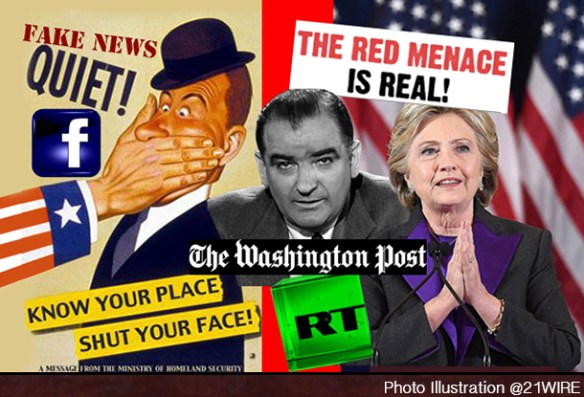
Still Waiting for Evidence of a Russian Hack

More than two years after the allegation of Russian hacking of the 2016 U.S. presidential election was first made, conclusive proof is still lacking and may never be produced, says Ray McGovern.

By Ray McGovern

Source: Consortium News

If you are wondering why so little is heard these days of accusations that Russia hacked into the U.S. election in 2016, it could be because those charges could not withstand close scrutiny. It could also be because special counsel Robert Mueller appears to have never bothered to investigate what was once the central alleged crime in Russia-gate as no one associated with WikiLeaks has ever been questioned by his team.

Veteran Intelligence Professionals for Sanity — including two “alumni” who were former National Security Agency technical directors — have long since concluded that Julian Assange did not acquire what he called the “emails related to Hillary Clinton” via a “hack” by the Russians or anyone else. They found, rather, that he got them from someone with physical access to Democratic National Committee computers who copied the material onto an external storage device — probably a thumb drive. In December 2016 VIPS explained this in some detail in an open Memorandum to President Barack Obama.

On January 18, 2017 President Obama admitted that the “conclusions” of U.S. intelligence regarding how the alleged Russian hacking got to WikiLeaks were “inconclusive.” Even the vapid FBI/CIA/NSA “Intelligence Community Assessment of Russian Activities and Intentions in Recent U.S. Elections” of January 6, 2017, which tried to blame Russian President Vladimir Putin for election interference, contained no direct evidence of Russian involvement.  That did not prevent the “handpicked” authors of that poor excuse for intelligence analysis from expressing “high confidence” that Russian intelligence “relayed material it acquired from the Democratic National Committee … to WikiLeaks.”  Handpicked analysts, of course, say what they are handpicked to say.

Never mind. The FBI/CIA/NSA “assessment” became bible truth for partisans like Rep. Adam Schiff (D-CA), ranking member of the House Intelligence Committee, who was among the first off the blocks to blame Russia for interfering to help Trump.  It simply could not have been that Hillary Clinton was quite capable of snatching defeat out of victory all by herself.  No, it had to have been the Russians.

Five days into the Trump presidency, I had a chance to challenge Schiff personally on the gaping disconnect between the Russians and WikiLeaks. Schiff still “can’t share the evidence” with me … or with anyone else, because it does not exist.

WikiLeaks

It was on June 12, 2016, just six weeks before the Democratic National Convention, that Assange announced the pending publication of “emails related to Hillary Clinton,” throwing the Clinton campaign into panic mode, since the emails would document strong bias in favor of Clinton and successful attempts to sabotage the campaign of Bernie Sanders.  When the emails were published on July 22, just three days before the convention began, the campaign decided to create what I call a Magnificent Diversion, drawing attention away from the substance of the emails by blaming Russia for their release.

Clinton’s PR chief Jennifer Palmieri later admitted that she golf-carted around to various media outlets at the convention with instructions “to get the press to focus on something even we found difficult to process: the prospect that Russia had not only hacked and stolen emails from the DNC, but that it had done so to help Donald Trump and hurt Hillary Clinton.”  The diversion worked like a charm.  Mainstream media kept shouting “The Russians did it,” and gave little, if any, play to the DNC skullduggery revealed in the emails themselves. And like Brer’ Fox, Bernie didn’t say nothin’.

Meanwhile, highly sophisticated technical experts, were hard at work fabricating “forensic facts” to “prove” the Russians did it.  Here’s how it played out:

June 12, 2016: Assange announces that WikiLeaks is about to publish “emails related to Hillary Clinton.”

June 14, 2016: DNC contractor CrowdStrike, (with a dubious professional record and multiple conflicts of interest) announces that malware has been found on the DNC server and claims there is evidence it was injected by Russians.

June 15, 2016: “Guccifer 2.0” affirms the DNC statement; claims responsibility for the “hack;” claims to be a WikiLeaks source; and posts a document that the forensics show was synthetically tainted with “Russian fingerprints.”

The June 12, 14, & 15 timing was hardly coincidence. Rather, it was the start of a pre-emptive move to associate Russia with anything WikiLeaks might have been about to publish and to “show” that it came from a Russian hack.

Enter Independent Investigators

A year ago independent cyber-investigators completed the kind of forensic work that, for reasons best known to then-FBI Director James Comey, neither he nor the “handpicked analysts” who wrote the Jan. 6, 2017 assessment bothered to do.  The independent investigators found verifiable evidence from metadata found in the record of an alleged Russian hack of July 5, 2016 showing that the “hack” that day of the DNC by Guccifer 2.0 was not a hack, by Russia or anyone else.

Rather it originated with a copy (onto an external storage device – a thumb drive, for example) by an insider — the same process used by the DNC insider/leaker before June 12, 2016 for an altogether different purpose. (Once the metadata was found and the “fluid dynamics” principle of physics applied, this was not difficult to disprove the validity of the claim that Russia was responsible.)

One of these independent investigators publishing under the name of The Forensicator on May 31 published new evidence that the Guccifer 2.0 persona uploaded a document from the West Coast of the United States, and not from Russia.

In our July 24, 2017 Memorandum to President Donald Trump we stated, “We do not know who or what the murky Guccifer 2.0 is. You may wish to ask the FBI.”

Our July 24 Memorandum continued: “Mr. President, the disclosure described below may be related. Even if it is not, it is something we think you should be made aware of in this general connection. On March 7, 2017, WikiLeaks began to publish a trove of original CIA documents that WikiLeaks labeled ‘Vault 7.’ WikiLeaks said it got the trove from a current or former CIA contractor and described it as comparable in scale and significance to the information Edward Snowden gave to reporters in 2013.

“No one has challenged the authenticity of the original documents of Vault 7, which disclosed a vast array of cyber warfare tools developed, probably with help from NSA, by CIA’s Engineering Development Group. That Group was part of the sprawling CIA Directorate of Digital Innovation – a growth industry established by John Brennan in 2015. [ (VIPS warned President Obama of some of the dangers of that basic CIA reorganization at the time.]

Marbled

“Scarcely imaginable digital tools – that can take control of your car and make it race over 100 mph, for example, or can enable remote spying through a TV – were described and duly reported in the New York Times and other media throughout March. But the Vault 7, part 3 release on March 31 that exposed the “Marble Framework” program apparently was judged too delicate to qualify as ‘news fit to print’ and was kept out of the Times at the time, and has never been mentioned since.

“The Washington Post’s Ellen Nakashima, it seems, ‘did not get the memo’ in time. Her March 31 article bore the catching (and accurate) headline: ‘WikiLeaks’ latest release of CIA cyber-tools could blow the cover on agency hacking operations.’

“The WikiLeaks release indicated that Marble was designed for flexible and easy-to-use ‘obfuscation,’ and that Marble source code includes a “de-obfuscator” to reverse CIA text obfuscation.

“More important, the CIA reportedly used Marble during 2016. In her Washington Post report, Nakashima left that out, but did include another significant point made by WikiLeaks; namely, that the obfuscation tool could be used to conduct a ‘forensic attribution double game’ or false-flag operation because it included test samples in Chinese, Russian, Korean, Arabic and Farsi.”

A few weeks later William Binney, a former NSA technical director, and I commented on Vault 7 Marble, and were able to get a shortened op-ed version published in The Baltimore Sun.

The CIA’s reaction to the WikiLeaks disclosure of the Marble Framework tool was neuralgic. Then Director Mike Pompeo lashed out two weeks later, calling Assange and his associates “demons,” and insisting; “It’s time to call out WikiLeaks for what it really is, a non-state hostile intelligence service, often abetted by state actors like Russia.”

Our July 24 Memorandum continued:  “Mr. President, we do not know if CIA’s Marble Framework, or tools like it, played some kind of role in the campaign to blame Russia for hacking the DNC. Nor do we know how candid the denizens of CIA’s Digital Innovation Directorate have been with you and with Director Pompeo. These are areas that might profit from early White House review.  [ President Trump then directed Pompeo to invite Binney, one of the authors of the July 24, 2017 VIPS Memorandum to the President, to discuss all this.  Binney and Pompeo spent an hour together at CIA Headquarters on October 24, 2017, during which Binney briefed Pompeo with his customary straightforwardness. ]

“We also do not know if you have discussed cyber issues in any detail with President Putin. In his interview with NBC’s Megyn Kelly he seemed quite willing – perhaps even eager – to address issues related to the kind of cyber tools revealed in the Vault 7 disclosures, if only to indicate he has been briefed on them. Putin pointed out that today’s technology enables hacking to be ‘masked and camouflaged to an extent that no one can understand the origin’ [of the hack] … And, vice versa, it is possible to set up any entity or any individual that everyone will think that they are the exact source of that attack.

“‘Hackers may be anywhere,’ he said. ‘There may be hackers, by the way, in the United States who very craftily and professionally passed the buck to Russia. Can’t you imagine such a scenario? … I can.’

New attention has been drawn to these issues after I discussed them in a widely published 16-minute interview last Friday.

In view of the highly politicized environment surrounding these issues, I believe I must append here the same notice that VIPS felt compelled to add to our key Memorandum of July 24, 2017:

“Full Disclosure: Over recent decades the ethos of our intelligence profession has eroded in the public mind to the point that agenda-free analysis is deemed well nigh impossible. Thus, we add this disclaimer, which applies to everything we in VIPS say and do: We have no political agenda; our sole purpose is to spread truth around and, when necessary, hold to account our former intelligence colleagues.

“We speak and write without fear or favor. Consequently, any resemblance between what we say and what presidents, politicians and pundits say is purely coincidental.” The fact we find it is necessary to include that reminder speaks volumes about these highly politicized times.

Saturday Matinee: Horns and Halos

Review by Underground Film Journal

Horns and Halos, which opened the 9th New York Underground Film Festival, is a documentary by married filmmakers Suki Hawley and Michael Galinsky about the intrigue surrounding the publication of the controversial book Fortunate Son, a biography of George W. Bush. The book was originally published by St. Martin’s Press in 1999, subsequently pulled off the bookstore shelves by them after controversy arose over a passage accusing Bush of being a convicted drug user and then re-published by a little artsy boutique outfit in New York City called Soft Skull Press.

What makes Horns and Halos a successful documentary is that the filmmakers did an excellent job of remaining amazingly unbiased towards the subject matter. While watching the movie, I got the impression that Bush supporters would dismiss everyone involved in the book’s publication as a complete wacko and reject any criticisms made against the president in the film; and that anti-Bush activists would find the issues brought up by the book to be damning evidence against him. Personally, I think the truth lies, as the saying goes, somewhere in-between.

The author of Fortunate Son is Arkansas author J.H. Hatfield who, despite appearing slightly off-kilter, seems like an intensely earnest man who just wanted to be taken as a serious author. Previous to his infamous work, Hatfield was the writer of unauthorized biographies of Ewan McGregor and Patrick Stewart, as well as guides to TV shows like Star Trek, Lost in Space and The X-Files.

The main focus of the film, however, is Sander Hicks, the garrulous and determined CEO of Soft Skull Press and re-publisher of “Fortunate Son.” It makes sense that Horns and Halos would spotlight Sander over Hatfield, though, since the movie seems like a very low-budget affair and Hawley, Galinsky and Hicks are all NYC residents while Hatfield lived all the way in Arkansas.

But what’s interesting about all four participants — the filmmakers and their subjects — is that they all seem to be people who have stumbled onto a subject that’s bigger than themselves. There’s a lot of information presented in and lurking around the fringes of Horns and Halos that I really think would have been better served by someone with a bigger budget, for example Michael Moore who can afford a team of researchers; travel freely around the country and also possibly have the balls to charge the White House and demand interviews with Bush and Karl Rove, whose name figures prominently in Hatfield’s research but whom the filmmakers don’t go into much detail on.

But that doesn’t mean that this film shouldn’t be seen and that Galinsky and Hawley’s approach isn’t entirely successful. The real winner of the movie, even though he isn’t in the film as much as I would have liked, is Hatfield. I think the film, at the very least, redeems his character, which got so maligned in the public forum that it eventually led him to commit suicide in 2001.

It is true that Hatfield was an ex-felon. He served five years in prison after being convicted of conspiracy to murder in 1988. But he also may have been a victim of a greedy publisher who forced him to include in his book the unsubstantiated rumor that Bush was convicted of cocaine possession in 1972.

The drug charge story is a complicated one and rather than me recount it here, a good overview of it is included in a new preface by Sander Hicks in Fortunate Son, which is also available to read on Soft Skull Press’s website. While the preface is interesting, it does make one or two slips, especially in not footnoting key passages, e.g. the statement, “[Bush] blurted out at a press conference that he hadn’t done drugs since 1974.” Little details like that can bug me and prevent me from agreeing with a story 100%. (Alas, since the writing of this review, Hicks’ preface is no longer available, but there is a new forward by Mark Crispin Miller.)

The same goes for all of Horns and Halos. I do think having a little bit more of Hatfield in the flick would have made things a lot more clearer, especially considering the scope of the subject. After the NYUFF screening of the film, Hicks and Galinsky did a brief Q&A session together (Hawley was absent as she had just given birth to a daughter) and I thought it really sad that Hatfield couldn’t be there to see the finished film and accept the applause from the audience that would have greeted him. I think he would have been the hit of the festival.

Most library system members can watch the full film on Kanopy.

The ‘Values,’ ‘Vision,’ and ‘Democracy’ of an Inauthentic Opposition

Average Americans, whose economic survival is threatened, have no political party to represent them, including deceptive Democrats who claim to be their champions and blame others when their deception fails, says Paul Street.

By Paul Street

Source: Consortium News

Never underestimate the capacity of the United States’ Inauthentic Opposition Party, the corporate Democrats, for self-congratulatory delusion and the externalization of blame.

Look, for example, at the Democratic National Committee’s (DNC) recently filed 66-page lawsuit against Russia, WikiLeaks, and the 2016 Donald Trump campaign. The document accuses Russia of “mount[ing] a brazen attack on the American democracy,” “destabilize[ing] the U.S. political environment” on Trump’s (and Russia’s) behalf, and “interfering with our democracy….”

“The [RussiaGate] conspiracy,” the DNC Complaint says, “undermined and distorted the DNC’s ability to communicate the [Democratic] party’s values and vision to the American electorate” and “sowed discord within the Democratic Party at a time when party unity was essential…”

Yes, Russia, like numerous other nations living under the global shadow of the American Superpower, may well have tried to have some surreptitious say in 2016 U.S. presidential election. (Why wouldn’t the Kremlin have done that, given the very real and grave threats Washington and its Western NATO allies have posed for many years to post-Soviet-era Russian security and peace in Eastern Europe?)

Still, charging Russia with interfering with US-“American democracy” is like me accusing the Washington Capital’s star left winger Alex Ovechkin of interfering with my potential career as a National Hockey League player (I’m middle aged and can’t skate backwards). The U.S. doesn’t have a functioning democracy to undermine, as numerous careful studies (see this,this,this,this,this,this,this,this, and this) have shown.

We have, rather, a corporate and financial oligarchy, an open plutocracy. U.S.-Americans get to vote, yes, but the nation’s “unelected dictatorship of money” reigns nonetheless in the United States, where, as leading liberal political scientists Benjamin Page (Northwestern) and Marin Gilens (Princeton) find, “government policy…reflects the wishes of those with money, not the wishes of the millions of ordinary citizens who turn out every two years to choose among the preapproved, money-vetted candidates for federal office.”

Our Own Oligarchs

Russia and WikiLeaks “destabilized the U.S. political environment”? Gee, how about the 20 top oligarchic U.S. mega-donors who invested more than $500 million combined in disclosed campaign contributions (we can only guess at how much “dark,” that is undisclosed, money they gave) to candidates and political organizations in the 2016 election cycle? The 20 largest organizational donors also gave a total of more than $500 million. The foremost plutocratic election investors included hard right-wing billionaires like casino owner Sheldon Adelson ($83 million disclosed to Republicans and right-wing groups), hedge-fund manager Paul Singer ($26 million to Republicans and the right), hedge fund manager Robert Mercer ($26 million) and packaging mogul Richard Uihlein ($24 million).

How about the multi-billionaire Trump’s own real estate fortune, which combined with the remarkable free attention the corporate media oligopoly granted him to help catapult the orange-tinted fake-populist beast past his more traditional Republican primary opponents? And what about the savagely unequal distribution of wealth and income in Barack Obama’s America, so extreme in the wake of the Great Recession that Hillary’s primary campaign rival Bernie Sanders could credibly report that the top tenth of the upper U.S.1% possessed nearly as much wealth as the nation’s bottom 90%? Such extreme disparity helped doom establishment, Wall Street- and Goldman Sachs-embroiled candidates like Jeb Bush, Marco Rubio, and Mrs. Clinton in 2016. Russia and WikiLeaks did not create that deep, politically- and neoliberal-policy-generated socioeconomic imbalance.

Double Vision

And just what were the Democratic Party “values and vision” that Russia, Trump, and WikiLeaks supposedly prevented the DNC and the Clinton team from articulating in 2016? As the distinguished political scientist and money-politics expert Thomas Ferguson and his colleagues Paul Jorgensen and Jie Chen noted in an important study released three months ago, the Clinton campaign “emphasized candidate and personal issues and avoided policy discussions to a degree without precedent in any previous election for which measurements exist….it deliberately deemphasized issues in favor of concentrating on what the campaign regarded as [Donald] Trump’s obvious personal weaknesses as a candidate.” Strangely enough, the Twitter-addicted reality television star Trump had a lot more to say about policy than the former First Lady, U.S. Senator, and Secretary of State Hillary Clinton, a wonkish Yale Law graduate.

The Democrats “values and vision” in 2016 amounted pretty much to the accurate but hardly inspiring or mass-mobilizing notion that Donald Trump was an awful person who was unqualified for the White House. Clinton ran almost completely on candidate character and quality. This was a blunder of historic proportions, given Clinton’s own highly problematic character brand. Any campaign needs a reasonably strong policy platform to stand on in case of candidate difficulties.

By Ferguson, Jorgenson, and Chen’s account, Hillary’s peculiar policy silence was about U.S. oligarchs’ campaign money. Thanks to candidate Trump’s bizarre nature and his declared isolationism and nationalism, Clinton achieved remarkable campaign finance success with normally Republican-affiliated capitalist sectors less disposed to abide the standard, progressive-sounding policy rhetoric of Democratic Party candidates than their more liberal counterparts.

One ironic but “fateful consequence” of her curious connection to conservative business interests was her “strategic silence about most important matters of public policy. … Misgivings of major contributors who worried that the Clinton campaign message lacked real attractions for ordinary Americans were rebuffed. The campaign,” Ferguson, Jorgenson, and Chen wrote, “sought to capitalize on the angst within business by vigorously courting the doubtful and undecideds there, not in the electorate.”

Other Clinton mistakes included failing to purchase television ads in Michigan, failing to set foot in Wisconsin after the Democratic National Convention, and getting caught telling wealthy New York City campaign donors that Trump’s white supporters were “a basket of” racist, sexist, nativist, and homophobic “deplorables.” This last misstep was a Freudian slip of the neoliberal variety. It reflected and advanced the corporate Democrats’ longstanding alienation of and from the nation’s rural and industrial and ex-industrial “heartland.”

Fake Progressives

As left historian Nancy Fraser noted after Trump was elected, the Democrats, since at least the Bill Clinton administration, had joined outwardly progressive forces like feminism, antiracism, multiculturalism, and LGBTQ rights to “financial capitalism.” This imparted liberal “charisma” and “gloss” to “policies that …devastated…what were once middle-class lives” by wiping out manufacturing, weakening unions, slashing wages, and increasing the “precarity of work.”

To make matters worse, Fraser rightly added, the “progressive neoliberal” blue-and digital-zone Democrats “compounded” the “injury of deindustrialization” with “the insult of progressive moralism,” which rips red-and analog-zone whites as culturally retrograde (recall candidate Obama’s problematic 2008 reflection on how rural and small-town whites “cling to religion and guns”) and yet privileged by the simple color of their skin.

Such insults from elite, uber-professional class neo-liberals like Obama (Harvard Law) and the Clintons (Yale Law) would sting less in the nation’s “flyover zones” if the those uttering them had not spent their sixteen years in the White House governing blatantly in accord with the wishes of Wall Street, Silicon Valley, and the leading multinational corporations. Like Bill Clinton’s two terms, the Obama years were richly consistent with Sheldon Wolin’s early 2008 description of the Democrats as an “inauthentic opposition” whose dutiful embrace of “centrist precepts” meant they would do nothing to “substantially revers[e] the drift rightwards” or “significantly alter the direction of society.”

The fake-“progressive” Obama presidency opened with the expansion of Washington’s epic bailout of the very parasitic financial elites who recklessly sparked the Great Recession (this with no remotely concomitant expansion of federal assistance to the majority middle- and working-class victims), the abandonment of campaign pledges to restore workers’ right to organize (through the immediately forgotten Employee Free Choice Act), and the kicking of Single Payer health care advocates to the curb as Obama worked with the big drug and insurance syndicates to craft a corporatist, profit-friendly health insurance reform. Obama’s second term ended with him doggedly (if unsuccessfully) championing the arch-authoritarian global-corporatist Trans Pacific Partnership.

This Goldman Sachs and Citigroup-directed policy record was no small part of what demobilized the Democrats’ mass electoral base in ways that “destabilized the U.S. political environment” to the benefit of the reactionary populist Trump, whose Mercer family-backed proto-fascistic strategist and Svengali Steve Bannon was smartly attuned to the Democrats’ elitist class problem.

There was a major 2016 presidential candidate who ran with genuinely progressive “values and vision” – Bernie Sanders. The most remarkable finding in Ferguson, Jorgenson, and Chen’s study is that the self-declared “democratic socialist” Sanders came tantalizingly close to winning the Democratic presidential nomination with no support from Big Business. The small-donor Sanders campaign was “without precedent in American politics not just since the New Deal, but across virtually the whole of American history … a major presidential candidate waging a strong, highly competitive campaign whose support from big business was essentially zero.”

Sanders was foiled by the big-money candidate Clinton’s advance control of the Democratic National Committee and convention delegates. Under a formal funding arrangement it worked up with the Democratic National Committee (DNC) in late September of 2015, the depressing “lying neoliberal warmonger” Hillary’s campaign was granted advance control of all the DNC’s “strategic decisions.” The Democratic Party’s presidential caucuses and primaries were rigged against Sanders in ugly ways that provoked a different lawsuit last year – a class-action suit against the DNC on behalf of Sanders’ supporters. The complaint was dismissed by a federal judge who ruled on the side of DNC lawyers by agreeing that the DNC was within its rights to violate their party’s charter and bylaws by selecting its candidate in advance of the primaries.

How was that for the noble “values and vision” that “American democracy” inspires atop the not-so leftmost of the nation’s two major and electorally viable political parties?

Under Cover of Russia-gate

That’s what “sowed discord within the Democratic Party at a time when party unity was essential…” Russia didn’t do it. Neither did WikiLeaks or the Trump campaign. The Clinton campaign and the Democratic Party establishment – themselves funded by major U.S. oligarchs like San Francisco hedge-fund billionaire Tom Steyer– did that on their own.

Could Sanders – the most popular politician in the U.S. (something rarely reported in a “mainstream” corporate media that could barely cover his giant campaign rallies even as it obsessed over Trump’s every bizarre Tweet) – have defeated the orange-tinted beast in the general election? Perhaps, though much of the oligarchic funding Hillary got would have gone to Trump if “socialist” Bernie had been the Democratic nominee. It is unlikely that Sanders could have accomplished much as president in a nation long controlled by the capitalist oligarchy in numerous ways that go far beyond campaign finance alone.

Meanwhile, under the cover of RussiaGate, the still-dismal and dollar-drenched corporate-imperial Democrats seem content to continue tilting to the center-right, purging Sanders-style progressives from the party’s leadership and citing the party’s special election victories (Doug Jones and Conor Lamb) against deeply flawed and Trump-backed Republicans in two bright-red voting districts (the state of Alabama and a fading Pennsylvania canton) as proof that tepid neoliberal centrism is still (even after Hillary’s stunning defeat) the way to go.

Along the way, the Inauthentic Opposition’s candidate roster for the upcoming Congressional mid-term election is loaded with an extraordinary number of contenders with U.S. military and intelligence backgrounds, consistent with Congressional Democrats repeated votes to give massive military and surveillance-state funds and power to a president they consider (accurately enough) unbalanced and dangerous.

The trick, the neoliberal “CIA Democrats” think, is to run conservative, Wall Street-backed imperial and National Security State veterans who pretend (see Eric Draitser’s recent piece on “How Clintonites Are Manufacturing Faux Progressive Congressional Campaigns”) to be aligned with majority-progressive left-of-center policy sentiments and values. It’s still very much their party.

Whatever happens during the next biennial electoral extravaganza, “the crucial fact” remains, in Wolin’s words nine years ago, “that for the poor, minorities, the working class and anti-corporatists there is no opposition party working on their behalf” in the United States – the self-declared homeland and headquarters of global democracy.


Paul Street is an independent radical-democratic policy researcher, journalist, historian, author and speaker based in Iowa City, Iowa, and Chicago, Illinois.  He is the author of seven books. His latest is They Rule: The 1% v. Democracy (Paradigm, 2014)

On the Criminal Referral of Comey, Clinton et al: Will the Constitution Hold and the Media Continue to Suppress the Story?

Ray McGovern reports on a major development in the Russia-gate story that has been ignored by corporate media: a criminal referral to the DOJ against Hillary Clinton, James Comey and others, exposing yet again how established media suppresses news it doesn’t like–about as egregious an example of unethical journalism as there is. 

By Ray McGovern

Source: Consortium News

Wednesday’s criminal referral by 11 House Republicans of former Secretary of State Hillary Clinton as well as several former and serving top FBI and Department of Justice (DOJ) officials is a giant step toward a Constitutional crisis.

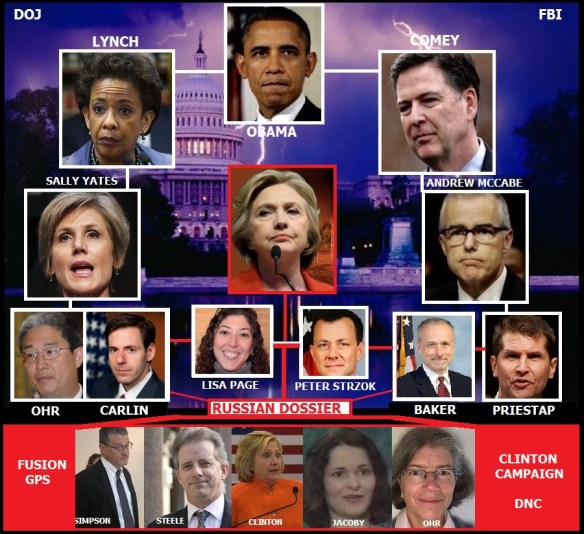
Named in the referral to the DOJ for possible violations of federal law are: Clinton, former FBI Director James Comey; former Attorney General Loretta Lynch; former Acting FBI Director Andrew McCabe; FBI Agent Peter Strzok; FBI Counsel Lisa Page; and those DOJ and FBI personnel “connected to” work on the “Steele Dossier,” including former Acting Attorney General Sally Yates and former Acting Deputy Attorney General Dana Boente.

With no attention from corporate media, the referral was sent to Attorney General Jeff Sessions, FBI Director Christopher Wray, and U.S. Attorney for the District of Utah John Huber.  Sessions appointed Huber months ago to assist DOJ Inspector General (IG) Michael Horowitz.  By most accounts, Horowitz is doing a thoroughly professional job.  As IG, however, Horowitz lacks the authority to prosecute; he needs a U.S. Attorney for that.  And this has to be disturbing to the alleged perps.

This is no law-school case-study exercise, no arcane disputation over the fine points of this or that law. Rather, as we say in the inner-city, “It has now hit the fan.”  Criminal referrals can lead to serious jail time.  Granted, the upper-crust luminaries criminally “referred” enjoy very powerful support.  And that will come especially from the mainstream media, which will find it hard to retool and switch from Russia-gate to the much more delicate and much less welcome “FBI-gate.”

As of this writing, a full day has gone by since the letter/referral was reported, with total silence so far from The New York Times and The Washington Post and other big media as they grapple with how to spin this major development. News of the criminal referral also slipped by Amy Goodman’s non-mainstream DemocracyNow!, as well as many alternative websites.

The 11 House members chose to include the following egalitarian observation in the first paragraph of the letter conveying the criminal referral: “Because we believe that those in positions of high authority should be treated the same as every other American, we want to be sure that the potential violations of law outlined below are vetted appropriately.” If this uncommon attitude is allowed to prevail at DOJ, it would, in effect, revoke the de facto “David Petraeus exemption” for the be-riboned, be-medaled, and well-heeled.

Stonewalling

Meanwhile, the patience of the chairmen of House committees investigating abuses at DOJ and the FBI is wearing thin at the slow-rolling they are encountering in response to requests for key documents from the FBI.  This in-your-face intransigence is all the more odd, since several committee members have already had access to the documents in question, and are hardly likely to forget the content of those they know about.  (Moreover, there seems to be a good chance that a patriotic whistleblower or two will tip them off to key documents being withheld.)

The DOJ IG, whose purview includes the FBI, has been cooperative in responding to committee requests for information, but those requests can hardly include documents of which the committees are unaware.

Putting aside his partisan motivations, House Intelligence Committee Chair Devin Nunes (R-CA) was unusually blunt two months ago in warning of legal consequences for officials who misled the Foreign Intelligence Surveillance Court in order to enable surveillance on Trump and his associates. Nunes’s words are likely to have sent chills down the spine of those with lots to hide: “If they need to be put on trial, we will put them on trial,” he said.”The reason Congress exists is to oversee these agencies that we created.”

Whether the House will succeed in overcoming the resistance of those criminally referred and their many accomplices and will prove able to exercise its Constitutional prerogative of oversight is, of course, another matter — a matter that matters.

And Nothing Matters More Than the Media

The media will be key to whether this Constitutional issue is resolved.  Largely because of Trump’s own well earned reputation for lying, most Americans are susceptible to slanted headlines like this recent one — “Trump escalates attacks on FBI …” — from an article in The Washington Post, commiserating with the treatment accorded fired-before-retired prevaricator McCabe and the FBI he (dis)served.

Nor is the Post above issuing transparently clever warnings — like this one in a lead article on March 17: “Some Trump allies say they worry he is playing with fire by taunting the FBI. ‘This is open, all-out war. And guess what? The FBI’s going to win,’ said one ally, who spoke on the condition of anonymity to be candid. ‘You can’t fight the FBI. They’re going to torch him.’” [sic]

Mind-Boggling Criminal Activity

What motivated the characters now criminally “referred” is clear enough from a wide variety of sources, including the text messages exchange between Strzok and Page.  Many, however, have been unable to understand how these law enforcement officials thought they could get away with taking such major liberties with the law.

None of the leaking, unmasking, surveillance, “opposition research,” or other activities directed against the Trump campaign can be properly understood, if one does not bear in mind that it was considered a sure thing that Secretary Clinton would become President, at which point illegal and extralegal activities undertaken to help her win would garner praise, not prison.  The activities were hardly considered high-risk, because candidate Clinton was sure to win.

But she lost.

Comey himself gives this away in the embarrassingly puerile book he has been hawking, “A Higher Loyalty” — which amounts to a pre-emptive move motivated mostly by loyalty-to-self, in order to obtain a Stay-Out-of-Jail card.  Hat tip to Matt Taibbi of Rolling Stone for a key observation, in his recent article, “James Comey, the Would-Be J. Edgar Hoover,” about what Taibbi deems the book’s most damning passage, where Comey discusses his decision to make public the re-opening of the Hillary Clinton email investigation.

Comey admits, “It is entirely possible that, because I was making decisions in an environment where Hillary Clinton was sure to be the next president, my concern about making her an illegitimate president by concealing the re-started investigation bore greater weight than it would have if the election appeared closer or if Donald Trump were ahead in the polls.”

The key point is not Comey’s tortured reasoning, but rather that Clinton was “sure to be the next president.”  This would, of course, confer automatic immunity on those now criminally referred to the Department of Justice.  Ah, the best laid plans of mice and men — even very tall men.  One wag claimed that the “Higher” in “A Higher Loyalty” refers simply to the very tall body that houses an outsized ego.

I think it can be said that readers of Consortiumnews.com may be unusually well equipped to understand the anatomy of FBI-gate as well as Russia-gate.  Listed below chronologically are several links that might be viewed as a kind of “whiteboard” to refresh memories.  You may wish to refer them to any friends who may still be confused.

2017

Russia-gate’s Mythical ‘Heroes’ June 6, 2017

The Democratic Money Behind Russia-gate Oct. 29, 2017

The Foundering Russia-gate ‘Scandal’ Dec. 13, 2017 

What Did Hillary Clinton Know? Dec. 25, 2017

2018

The FBI Hand Behind Russia-gate Jan. 11, 2018

Will Congress Face Down the Deep State? Jan. 30, 2018

Nunes Memo Reports Crimes at Top of FBI and DOJ Feb. 2, 2018

‘This is Nuts’: Liberals Launch ‘Largest Mobilization in History’ in Defense of Russiagate Probe Feb. 9, 2018

Nunes: FBI and DOJ Perps Could Be Put on Trial Feb. 19, 2018

‘Progressive’ Journalists Jump the Shark on Russia-gate March 7, 2018

Intel Committee Rejects Basic Underpinning of Russiagate March 14, 2018

McCabe: A War on (or in) the FBI? March 18, 2018

Former CIA Chief Brennan Running Scared March 19, 2018


Freedom Rider: Vladimir Putin and war propaganda

By Margaret Kimberley

Source: Intrepid Report

Vladimir Putin is blamed for everything that goes awry in Europe and the United States. In the United Kingdom his country was even blamed for bad weather as tabloid headlines screamed about icy Russian winds. The Brexit vote and Donald Trump’s Electoral College victory are said to be the result of Putin’s interference, even though the machinations of American oligarch Robert Mercer are most responsible for both outcomes.

When high level vitriol is shared by the corporate media and the American political duopoly and then repeated ad nauseum it is clear that the target will be subjected to more than mere slander. Such an attack carried out against a foreign leader is proof that the United States is ready for war by other means if not outright military conflict.

Russia has been a target ever since the fall of the Soviet Union in 1991. In its weakened state it was a victim of its own rapacious oligarch class and aside from having a nuclear arsenal was no match for its former rival. Bill Clinton openly dispatched operatives to meddle in the 1996 election and ensured that Boris Yeltsin kept the country ripe for plunder.

But in a supreme irony of history Yeltsin chose Vladimir Putin to succeed him. He took on the worst of the thieves and in so doing made himself an enemy of forces who hoped to pull his country apart. But he was not antagonistic to the United States. Libya might have been saved if Russia had used its United Nations Security Council veto against the no fly zone resolution in 2011. Only when the United States installed a fascist, anti-Russian government in Ukraine did Putin get the message that America should not be accommodated.

Putin stopped going along to get along but the American appetite for conquest is unstoppable. Syria is the place where Russia drew a line in the sand—and successfully, too. But the United States and NATO won’t admit defeat and continue the suffering of the Syrian people.

Now the drama surrounding the poisoning of former Russian spy Sergie Skripal in the U.K. has ensnared the Russian government. It is far-fetched to think that in the midst of an election campaign and the upcoming world soccer cup in Russia that Putin would decide to attack a former double agent he had allowed to go free eight years ago.

Prime Minister Theresa May is like her American counterparts: a liar and a violator of international law. The Organization for the Prohibition of Chemical Weapons (OPCW) has a process for nations to request information from one another and they are given 10 days to do so. Instead, May demanded that Russia prove the unprovable, that it wasn’t responsible, and that it do so in 24 hours. She declared that Russia was “likely” responsible and expelled 23 Russian diplomats from the country.

Labour party opposition leader Jeremy Corbyn was little better. He did say that the government should actually wait for proof of Russian involvement in Skripal’s poisoning but he also indulged in an anti-Russian screed as he vented against authoritarianism, oligarchs and human rights abuses. Saudi crown prince Mohammed bin Salman had just received a warm welcome in London from May, the royal family and the press. No one said a word about his genocide against the people of Yemen. But facts won’t get in the way of blatant war propaganda.

Putin has created a kind of madness on both sides of the ocean as politicians look for ever more bizarre ways to engage in Russophobia which is intended to damage his nation. Donald Trump’s appointment of Rex Tillerson as secretary of state was said to be influenced by Putin. Of course, everyone conveniently forgot that trope and now Tillerson’s dismissal is said to have been carried out on Putin’s orders.

Putin is even accused of being a racist. The Christopher Steele dossier, a creation of the Democratic Party and the ill-fated Hillary Clinton campaign, alleges that some on Putin’s staff used the “N-word ” in reference to Barack Obama. Any assertions in this dubious document are impossible to prove and it is unlikely that Steele’s second hand Russian sources reached into the Kremlin inner circle. This particular assertion comes from Michael Isikoff, a Steele partner in crime who dutifully leaked information which led to the granting of a FISA warrant and the Mueller investigation of Trump.

The creation of an all purpose villain is meant to cover up Democratic Party electoral failures, end the Trump presidency, and of course make the case for the American exceptionalism and interventions. Regime change, proxy wars, and imperial conquest are all very much a part of the anti-Putin hysteria.

But the Russophobes are playing a very dangerous game. The story of the poisoned man does not take place in a vacuum. While the public are distracted by a tall tale of Putin killing any Russian whoever died outside of that country, the very dangerous Syrian war continues. Lies about the Russian government should be taken very seriously. They are war propaganda and they are meant to get public support for military action against Russia and its allies.

The Skripal story is so murky that it will be difficult to ever determine culpability. But years of lies have had the desired effect. The public will believe anything about Putin and the Russian government no matter how ridiculous the charge. The American media are finally forced to report on the story of Robert Mercer’s Cambridge Analytica and the role it played in getting Trump an Electoral College victory. But the implications of a right-wing oligarch tipping the scales in our so-called democracy are ignored. Instead the New York Times reported on the Russian ancestry of a Cambridge Analytica staffer in a desperate effort to continue the dangerous charade.

Fifteen years ago this same government proclaimed that Iraq was the great danger and used the charge to make the case for war. Little has changed since. America excels at warfare and that is always preceded by propaganda.

In announcing new weapon developments Putin declared that mutually assured destruction (MAD) is not a thing of the past. If the U.S. and its allies were sane this would be a positive development. But they are not sane and every move and every charge brings the world closer to the precipice. The United States, not Russia, poses the greatest threat to peace and life on the planet. That must never be forgotten.


Margaret Kimberley’s Freedom Rider column appears weekly in BAR, and is widely reprinted elsewhere. She maintains a frequently updated blog as well as at freedomrider.blogspot.com. Ms. Kimberley lives in New York City, and can be reached via e-Mail at Margaret.Kimberley(at)BlackAgendaReport.com.

Philip K. Dick and the Fake Humans

(Editor’s note: on this 36th anniversary of the passing of Philip K. Dick, it seems an appropriate time to note the relevance of his work to our current dystopia as Henry Farrell does in the following essay. Unfortunately the author is less astute regarding the ways in which the dystopias of Orwell and Huxley are equally relevant to our current milieu.)

By Henry Farrell

Source: Boston Review

This is not the dystopia we were promised. We are not learning to love Big Brother, who lives, if he lives at all, on a cluster of server farms, cooled by environmentally friendly technologies. Nor have we been lulled by Soma and subliminal brain programming into a hazy acquiescence to pervasive social hierarchies.

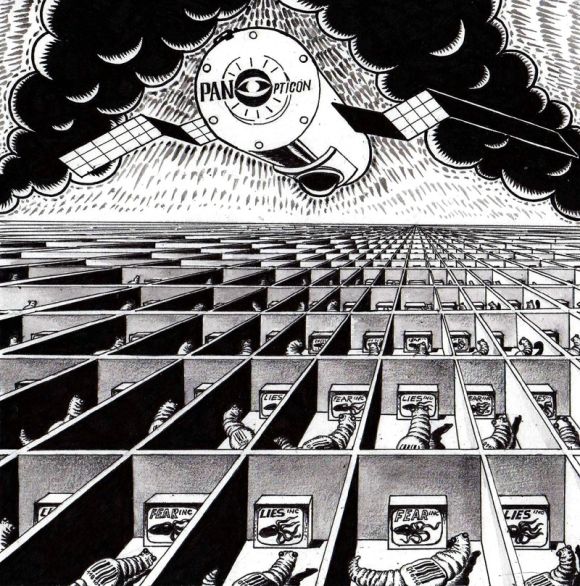
Dystopias tend toward fantasies of absolute control, in which the system sees all, knows all, and controls all. And our world is indeed one of ubiquitous surveillance. Phones and household devices produce trails of data, like particles in a cloud chamber, indicating our wants and behaviors to companies such as Facebook, Amazon, and Google. Yet the information thus produced is imperfect and classified by machine-learning algorithms that themselves make mistakes. The efforts of these businesses to manipulate our wants leads to further complexity. It is becoming ever harder for companies to distinguish the behavior which they want to analyze from their own and others’ manipulations.

This does not look like totalitarianism unless you squint very hard indeed. As the sociologist Kieran Healy has suggested, sweeping political critiques of new technology often bear a strong family resemblance to the arguments of Silicon Valley boosters. Both assume that the technology works as advertised, which is not necessarily true at all.

Standard utopias and standard dystopias are each perfect after their own particular fashion. We live somewhere queasier—a world in which technology is developing in ways that make it increasingly hard to distinguish human beings from artificial things. The world that the Internet and social media have created is less a system than an ecology, a proliferation of unexpected niches, and entities created and adapted to exploit them in deceptive ways. Vast commercial architectures are being colonized by quasi-autonomous parasites. Scammers have built algorithms to write fake books from scratch to sell on Amazon, compiling and modifying text from other books and online sources such as Wikipedia, to fool buyers or to take advantage of loopholes in Amazon’s compensation structure. Much of the world’s financial system is made out of bots—automated systems designed to continually probe markets for fleeting arbitrage opportunities. Less sophisticated programs plague online commerce systems such as eBay and Amazon, occasionally with extraordinary consequences, as when two warring bots bid the price of a biology book up to $23,698,655.93 (plus $3.99 shipping).

In other words, we live in Philip K. Dick’s future, not George Orwell’s or Aldous Huxley’s. Dick was no better a prophet of technology than any science fiction writer, and was arguably worse than most. His imagined worlds jam together odd bits of fifties’ and sixties’ California with rocket ships, drugs, and social speculation. Dick usually wrote in a hurry and for money, and sometimes under the influence of drugs or a recent and urgent personal religious revelation.

Still, what he captured with genius was the ontological unease of a world in which the human and the abhuman, the real and the fake, blur together. As Dick described his work (in the opening essay to his 1985 collection, I Hope I Shall Arrive Soon):

The two basic topics which fascinate me are “What is reality?” and “What constitutes the authentic human being?” Over the twenty-seven years in which I have published novels and stories I have investigated these two interrelated topics over and over again.

These obsessions had some of their roots in Dick’s complex and ever-evolving personal mythology (in which it was perfectly plausible that the “real” world was a fake, and that we were all living in Palestine sometime in the first century AD). Yet they were also based on a keen interest in the processes through which reality is socially constructed. Dick believed that we all live in a world where “spurious realities are manufactured by the media, by governments, by big corporations, by religious groups, political groups—and the electronic hardware exists by which to deliver these pseudo-worlds right into heads of the reader.” He argued:

the bombardment of pseudo-realities begins to produce inauthentic humans very quickly, spurious humans—as fake as the data pressing at them from all sides. My two topics are really one topic; they unite at this point. Fake realities will create fake humans. Or, fake humans will generate fake realities and then sell them to other humans, turning them, eventually, into forgeries of themselves. So we wind up with fake humans inventing fake realities and then peddling them to other fake humans.

In Dick’s books, the real and the unreal infect each other, so that it becomes increasingly impossible to tell the difference between them. The worlds of the dead and the living merge in Ubik (1969), the experiences of a disturbed child infect the world around him in Martian Time-Slip (1964), and consensual drug-based hallucinations become the vector for an invasive alien intelligence in The Three Stigmata of Palmer Eldritch (1965). Humans are impersonated by malign androids in Do Androids Dream of Electric Sheep? (1968) and “Second Variety” (1953); by aliens in “The Hanging Stranger” (1953) and “The Father-Thing” (1954); and by mutants in “The Golden Man” (1954).

This concern with unreal worlds and unreal people led to a consequent worry about an increasing difficulty of distinguishing between them. Factories pump out fake Americana in The Man in the High Castle (1962), mirroring the problem of living in a world that is not, in fact, the real one. Entrepreneurs build increasingly human-like androids in Do Androids Dream of Electric Sheep?, reasoning that if they do not, then their competitors will. Figuring out what is real and what is not is not easy. Scientific tools such as the famous Voight-Kampff test in Do Androids Dream of Electric Sheep? (and Blade Runner, Ridley Scott’s 1982 movie based loosely on it) do not work very well, leaving us with little more than hope in some mystical force—the I Ching, God in a spray can, a Martian water-witch—to guide us back toward the real.

We live in Dick’s world—but with little hope of divine intervention or invasion. The world where we communicate and interact at a distance is increasingly filled with algorithms that appear human, but are not—fake people generated by fake realities. When Ashley Madison, a dating site for people who want to cheat on their spouses, was hacked, it turned out that tens of thousands of the women on the site were fake “fembots” programmed to send millions of chatty messages to male customers, so as to delude them into thinking that they were surrounded by vast numbers of potential sexual partners.

These problems are only likely to get worse as the physical world and the world of information become increasingly interpenetrated in an Internet of (badly functioning) Things. Many of the aspects of Joe Chip’s future world in Ubik look horrendously dated to modern eyes: the archaic role of women, the assumption that nearly everyone smokes. Yet the door to Joe’s apartment—which argues with him and refuses to open because he has not paid it the obligatory tip—sounds ominously plausible. Someone, somewhere, is pitching this as a viable business plan to Y Combinator or the venture capitalists in Menlo Park.

This invasion of the real by the unreal has had consequences for politics. The hallucinatory realities in Dick’s worlds—the empathetic religion of Do Androids Dream of Electric Sheep?, the drug-produced worlds of The Three Stigmata of Palmer Eldritch, the quasi–Tibetan Buddhist death realm of Ubik—are usually experienced by many people, like the television shows of Dick’s America. But as network television has given way to the Internet, it has become easy for people to create their own idiosyncratic mix of sources. The imposed media consensus that Dick detested has shattered into a myriad of different realities, each with its own partially shared assumptions and facts. Sometimes this creates tragedy or near-tragedy. The deluded gunman who stormed into Washington, D.C.’s Comet Ping Pong pizzeria had been convinced by online conspiracy sites that it was the coordinating center for Hillary Clinton’s child–sex trafficking ring [likewise, the masses may have been convinced by mainstream media that a real child-sex trafficking ring never existed].

Such fractured worlds are more vulnerable to invasion by the non-human. Many Twitter accounts are bots, often with the names and stolen photographs of implausibly beautiful young women, looking to pitch this or that product (one recent academic study found that between 9 and 15 percent of all Twitter accounts are likely fake). Twitterbots vary in sophistication from automated accounts that do no more than retweet what other bots have said, to sophisticated algorithms deploying so-called “Sybil attacks,” creating fake identities in peer-to-peer networks to invade specific organizations or degrade particular kinds of conversation.

Twitter has failed to become a true mass medium, but remains extraordinarily important to politics, since it is where many politicians, journalists, and other elites turn to get their news. One research project suggests that around 20 percent of the measurable political discussion around the last presidential election came from bots. Humans appear to be no better at detecting bots than we are, in Dick’s novel, at detecting replicant androids: people are about as likely to retweet a bot’s message as the message of another human being. Most notoriously, the current U.S. president recently retweeted a flattering message that appears to have come from a bot densely connected to a network of other bots, which some believe to be controlled by the Russian government and used for propaganda purposes.

In his novels Dick was interested in seeing how people react when their reality starts to break down. A world in which the real commingles with the fake, so that no one can tell where the one ends and the other begins, is ripe for paranoia. The most toxic consequence of social media manipulation, whether by the Russian government or others, may have nothing to do with its success as propaganda. Instead, it is that it sows an existential distrust. People simply do not know what or who to believe anymore. Rumors that are spread by Twitterbots merge into other rumors about the ubiquity of Twitterbots, and whether this or that trend is being driven by malign algorithms rather than real human beings.

Such widespread falsehood is especially explosive when combined with our fragmented politics. Liberals’ favorite term for the right-wing propaganda machine, “fake news,” has been turned back on them by conservatives, who treat conventional news as propaganda, and hence ignore it. On the obverse, it may be easier for many people on the liberal left to blame Russian propaganda for the last presidential election than to accept that many voters had a very different understanding of America than they do.

Dick had other obsessions—most notably the politics of Richard Nixon and the Cold War. It is not hard to imagine him writing a novel combining an immature and predatory tycoon (half Arnie Kott, half Jory Miller) who becomes the president of the United States, secret Russian political manipulation, an invasion of empathy-free robotic intelligences masquerading as human beings, and a breakdown in our shared understanding of what is real and what is fake.

These different elements probably would not cohere particularly well, but as in Dick’s best novels, the whole might still work, somehow. Indeed, it is in the incongruities of Dick’s novels that salvation is to be found (even at his battiest, he retains a sense of humor). Obviously, it is less easy to see the joke when one is living through it. Dystopias may sometimes be grimly funny—but rarely from the inside.

Freedom Rider: Russiagate and the surveillance duopoly

By Margaret Kimberley

Source: Intrepid Report

Republican and Democratic Party dueling over Russiagate provides us with a teachable moment. It should teach us to disrespect and discredit the law enforcement system as it exists in this country. We must oppose the surveillance state altogether and we should not be tricked by duopoly theatrics into thinking that either of the evil twins are acting in our interests.

Local cops plant drugs and weapons in order to arrest and convict anyone they want. They kill an average of three people every single day. Cash bail keeps the poor in jail not because they are necessarily dangerous, but because they are poor. Those are just some facts in the litany of oppression used by law enforcement against mostly poor, black people. But there is another order of wrong doing that engulfs the whole world.

The Foreign Intelligence Surveillance Act (FISA) created a system which determines when the federal government may spy on anyone suspected of acting on behalf of a foreign agent. FISA set up a rubber stamp kangaroo court with only a handful of warrants being rejected in the forty year history of this law.

FISA authority was used to keep Donald Trump campaign adviser Carter Page under surveillance in 2016. Republicans claim that the warrant was granted as a result of the Christopher Steele opposition research dossier that was paid for by Hillary Clinton’s campaign. No one knows if this assertion is true, but the fight over declassifying the memo predictably turned into political theater. Republicans said the memo would end the suspicion of Trump collusion with the Russian government and Democrats asserted that the system would fall apart if the memo was ever declassified and released.

If Republicans are correct the FISA warrant was problematic and the case for collusion is tainted. Democrats now make the case for declassifying their own memo and continuing the foolish spectacle of irrelevance. Despite the drama, both assertions are beside the point. The larger and more important issue is that the American justice system is decidedly unjust.

Prosecutors are among the worst criminals in this country. From small towns to federal courthouses they wield power that few can circumvent. Rich people need not worry because they exist in a bubble with laws of their own making. Public officials bow down to them and happily violate statutes in order to keep them happy. It is all rotten and the case for and against Trump is an opportunity to discuss how few rights we have and how the system is rigged against all but the apex predators at the top of the food chain.

Instead of making the case for tearing up this monstrosity, otherwise intelligent people are pointing fingers and choosing one disreputable side over the other. Every Republican voted to extend the FISA program. They were joined by Democrats like Congressman Adam Schiff, who leads the case for collusion, and who has made a name for himself by stoking the Russiagate fire. Schiff cried the loudest against releasing the Republican memo and claimed that declassification would pose a threat to the nation. When he had the chance to do something for the judicial system he joined with the people he allegedly opposes and supported continuing the FISA travesty. Our individual rights are obviously of little concern to Schiff. Then again he is a former prosecutor so little can be expected of him in this regard.

Russiagate is a sinkhole of political confusion and that is precisely why it was created. It began with Hillary Clinton’s campaign, a lackluster effort meant to continue the neo-liberal agenda, make war, and do little else. She had nothing to offer voters and hung her hat on making Trump look like “Putin’s puppet.” Had she done a minimal effort there would have been no need for pay offs to British spies or whipped up Russophobia. The entire Democratic Party was complicit in the debacle and they welcomed a tale of collusion in order to deflect the blame they so richly deserved.

The sorry spectacle continues as Republicans are equally determined to keep Trump in office and make their dreams of kleptocracy and diminished governmental authority a reality. Democrats are looking to explain away a string of electoral failures and maintain the illusion of being the inclusive party when they are merely shadows of the hard right Republicans.

Let all the memos be released. There should be no sanctity bestowed upon government secrets. They are a ruse meant to cover up for worldwide gangsterism. Defending the FBI, CIA, NSA or any of the other “intelligence community” agencies is to be a dupe of the highest order. Police in Baltimore and other cities may plant drugs and weapons on suspects, but the mega-killers lie about weapons in entire nations and cause death and suffering on a mass scale.

Sooner or later Russiagate will play out. Whatever the result, this country will still be the one that locks up more of its people than any other. It will still be a threat to world peace. When the wheels of injustice grind on, only fools will have chosen between the two corrupt parties.


Margaret Kimberley’s Freedom Rider column appears weekly in BAR, and is widely reprinted elsewhere. She maintains a frequently updated blog as well as at freedomrider.blogspot.com. Ms. Kimberley lives in New York City, and can be reached via e-Mail at Margaret.Kimberley(at)BlackAgendaReport.com.

Mueller’s Fraudulent Indictment

(Rex Features via AP Images)

The Internet Research Agency: clickbait farm or KGB plot?

By Justin Raimondo

Source: Antiwar.com

The indictment handed down by Robert Mueller against 13 Russians connected to the Internet Research Agency, a Russian-owned- and- operated clickbait farm, is the capstone of my case that we have indeed entered Bizarro World, an alternate universe where up is down, black is white and truth is a ridiculous falsehood.

Yes, I said clickbait farm – because that’s precisely what the Internet Research Agency (IRA) is: founded by Yevgeny Prigozhin, a former Russian chef who wanted to figure out a new way to make money, the IRA, as pointed out here, is a money-making operation. Mueller seems to acknowledge this when, in his laughable “indictment,” we read this:

“Defendants and their co-conspirators also used the accounts to receive money from real U.S. persons in exchange for posting promotions and advertisements on the ORGANIZATION-controlled social media pages. Defendants and their coconspirators typically charged certain US merchants and US social media sites between 25 and 50 US dollars per post for promotional content on their popular false US persona accounts, including Being Patriotic, Defend the 2nd, and Blacktivist.”

What kind of a propaganda/spy operation charges its coconspirators a fee?

The total Russian/IRA buy was $100,000, including $300 in Pennsylvania, $832 in Michigan, and $1979 in Wisconsin (mostly before the primary). Most of the “Russian” ads ran after the election, and they didn’t support any candidates: instead, they focused on “hot button” issues – precisely the sort of thing intended to attract visits and make money for the creators via ads.

This business model has been widely utilized by enterprising Macedonian teenagers and others out to make a quick buck, and it works quite effectively if you know what you’re doing. The IRA, like other clickbait operations, isn’t really about politics, although it deals with political subjects: it’s about making money for it owners. Period. As the Moon of Alabama blogger points out:

“There were, according to the indictment, eighty people working on the “translator project”. These controlled “hundreds” of sock-puppets online accounts each with a distinct “political” personality. Each of these sock-puppets had a large number of followers – in total several hundred-thousands. Now let’s assume that one to five promotional posts can be sold per day on each of the sock-puppets content stream. The scheme generates several thousand dollars per day ($25 per promo, hundreds of sock-puppets, 1-5 promos per day per sock-puppet). The costs for this were limited to the wages of up to eighty persons in Moscow, many of them temps, of which the highest paid received some $1,000 per month.”

All in all, a fairly profitable business – not a state-run “disinformation” project, but rather good old free enterprise.

Yes, I know that some of the IRA’s employees traveled to America for a week or two to do “research.” But what, exactly, does this mean? Does anybody have a record of where they stayed, or whom they associated with? There’s nothing about that in the indictment. In short, they could have come to America for the same reasons tens of thousands do every day of the week: to enjoy themselves as tourists. After all, what could they possibly learn in a week-long stay that could … sway a presidential election? I mean, what are we talking about here?

The weird-stupid aura hanging over this whole affair was underscored when CNN actually knocked on the door of some woman whom they accused of running a “Russian-sponsored” pro-Trump rally in Florida: the woman laughed in the “reporter’s” face and said she’d never spoken to a single Russian in her entire life. So how many Trump supporters will be visited not just by CNN but by the FBI in order to intimidate them in a similar manner?

What I want to know is this: what in the name of all that’s holy does Robert Mueller think he’s doing? Is he just plain ignorant of the internet and how it works – or is he mocking us? His “indictment” is nothing but a joke. And as for the hysterics proclaiming it shows that the Russians have launched the equivalent of the attack on Pearl Harbor – these people need to be heavily sedated. Three-thousand people died at Pearl Harbor: how many were killed by Prigozhin’s clickbait farm?

My recent cancer diagnosis has really focused my attention on an issue I had hardly considered before: spending time refuting nonsense is essentially a waste of my time. And at this point, it’s the kind of luxury I can no longer afford. If these are truly my last days on earth, I’d rather be writing about something substantial, and meaningful, thank you very much.

So I’ll just end with this: anyone who says they believe the Mueller narrative outlined in his laughable indictment is either clueless or is a cynic who will say anything. The “charges” detailed in this “indictment” – “Conspiracy to Defraud the United States” – are precisely what the authors of this disgraceful document are guilty of themselves.

Russia-gate is a hoax – I’ve told my readers that from the very beginning. This “indictment” underscores the extent of the hoax – and the contempt that the government officials and their journalist collaborators who thought this would bring down a President have for the American people. They expect us to swallow this fraud whole. Well, guess what – it’s not happening, folks. A child could see through this nonsense.

It’s high time to shut this fraud on the country down, and return Mueller to private life (where he can contemplate how badly he messed up not only this but also the anthrax investigation).