The Economy Continues To Unravel Despite All Stimulus Measures

By Brandon Smith

Source: Alt-Market.com

Since the pandemic lockdowns were first implemented in the US I have been more concerned with the government and central bank response than the virus itself. As I have noted in past articles, the pandemic restrictions and subsequent economic and social crisis events they help to create will cause far more deaths than Covid-19 ever will. Not only that, but the actions of the Federal Reserve continue to con the American public into believing that there is some kind of “plan” to stop the crash that THEY engineered.

The only agenda of the Fed is to increase the pain in the long term; they have no intention of actually preventing any disaster.

This is evidenced in comments by voting members of the Fed, including Neel Kashkari who recently argued for the enforcement of hard lockdowns for at least six weeks in the US, all because the US savings rate was going up. Meaning, because Americans are saving more in order to protect themselves from economic fallout, Kashkari thinks we should be punished with an economic shutdown that would force us to spend whatever we have been able to save.

Do you see how that works?

Fed members and government officials demand hard lockdowns, depleting public savings and destroying small businesses. Then, the public has to beg the Fed and the government for more and more stimulus measures so that they can survive. The people and the system become dependent on a single point of support – fiat money creation and welfare. Yet, the evidence suggests that this strategy is failing to do much of anything except stall the inevitable for a very short time.

If the goal was really to reduce the pain of the pandemic as much as possible, then the strategy should be to keep the economy as open as possible and let the virus run its course.  By initiating lockdowns, all we are doing is extending the economic damage over the span of years instead of months.  We can deal with the comparatively minimal deaths associated with the virus; we cannot handle the disaster that is about to befall the financial system.

The small business sector appears to be the most fragile element of the economy right now. The PPP loans that were supposed to shore up small businesses failed miserably, with data showing only 13% to 19% of applicants getting a loan of any kind. Over 64% of small businesses that received a loan are also worried about being approved for loan forgiveness. In other words, of the few small business owners that got a PPP loan more than half do not have the ability to pay the loan back if they end up not qualifying for exemption.

This problem does not seem to be affecting the corporate sector, however. International companies are enjoying incredible cash infusions from the Fed through overnight loans as well as Fed stimulus propping up stock markets (at least for now). Tech companies in particular are enjoying a rush of investment as the assumption in the daytrading world is that the central bank will not allow these companies to fail.

Maybe they are right, but stock markets today DO NOT reflect the health of our system in any way. Stock tickers are a placebo, a Pavlovian trigger for the public, a tool to make people believe that the situation is improving merely because share values are going up. This is not the case.

Small businesses in the US account for around 50% of all employment and job creation. They are a vital part of the economy. Yet, government and central bank measures seem to have left them out in the cold to die.

To be sure, the $600 weekly unemployment enhancement created through the CARES Act passed in March did boost consumer spending, primarily on durable goods such as computers, TVs, cellphones, etc. Spending on services declined though, which is where the majority of small businesses make their money. And, considering the fact that most durable goods are manufactured overseas, this means that the majority of stimulus dollars that went to consumers did not go into the US economy, but foreign exporters like China.

Now, the unemployment enhancement has ended and its return is in question. It will be interesting to see if the boost to purchases of goods will continue without that extra $600 weekly stimulus. Consumer spending rose in July by 1.9%, but this was already a weak print compared to the increases during the previous two months.

Unemployment numbers have declined due to soft reopenings in numerous states, and at the very least some part time jobs appear to be returning, but nowhere near the level needed to erase the millions of jobs lost since February after the initial lockdowns began. If you count U-6 measurements and unemployed people who have been removed from the rolls for being jobless for too long, the REAL unemployment rate is closer to 30% of working age Americans. This is essentially Great Depression levels of joblessness.

US GDP has continued to decline by 32% according to the Bureau of Economic Analysis (despite statistical rigging by the Fed and government agencies), and while it’s possible that stimulus slowed the effects of GDP loss, there is no indication what the trillions of dollars created by the Fed have actually bought other than a few months of time and a massive bubble in the stock market.

The economy cannot survive extreme lockdown conditions for any length of time, let alone almost two more months. And, if you want to know what it means when elites in government and central banking call for a “hard lockdowns”, just look at Level 4 restrictions in places like Australia and New Zealand, where only one person can leave home at any given time, can only travel 3 miles from home and only for food and supplies, and anyone caught not wearing a mask is subject to arrest or a $10,000 fine.

This mother in Melbourne, Australia was arrested because of a Facebook post calling for protests over the lockdown restrictions.  She later had to take the post down and offered an apology, saying she did not know it was illegal to post such statements on social media:

Yeah, this kind of Orwellian response will do wonders for any economic recovery, and this is what Kashkari is calling for in the US.  It’s almost as if the Fed and certain politicians WANT a financial collapse in America…

The REAL solution is to stop the lockdown restrictions altogether. If the goal is truly to protect as many American lives as possible for the “greater good”, then the pandemic response must stop. Luckily, it seems that more and more people are beginning to see through the facade and are rejecting the restrictions. Even in Europe and Australia there have been some signs of protest and rebellion. The problem is that, at least in terms of the economy, it may be too late.

We have to consider the fact that once a large portion of the business sector (like small businesses) takes a massive hit like the one they have suffered over the past several months, many such businesses and jobs will simply not come back. There are many reasons for this, but primarily it’s a matter of debt. The average small business owner carries almost $200,000 in debt for 3-5 years before he reaches profitability or breaks even. This is assuming that there are no major economic catastrophes in that time.

With the pandemic, the riots, the restrictions, etc., businesses will have to take on much more debt with little guarantee of recovery in the next few years let alone the next few months.  Chapter 11 business bankruptcies in the US rose over 26% in the first half of 2020 alone.

Even if lockdown restrictions were completely eradicated tomorrow, a large number of businesses would go bankrupt anyway.  The “Retail Apocalypse” has been growing over the past decade, LONG before the coronavirus was on issue.  Thousands of businesses shut down last year and tens of thousands more are slated to close this year.   The virus and lockdowns simply accelerated the existing decline.

This is why large banks are cutting off loans to business owners and consumers right now; they know exactly where all this is headed.

Banks act as middlemen for the PPP loans financed by the Fed, yet those loans are not getting to most businesses. Banks have also cut credit card lending in the past few months, and general lending has crashed. All of this despite low interest rates for banks receiving stimulus injections from the Fed. Where is all of the money going? They are keeping it for themselves, buying up hard assets as well as propping up the stock market. As noted above, the elites have NO INTENTION of saving the economy, only themselves.

If the stimulus is not getting to the main-street economy then the only purpose it serves is to give the public a false sense of comfort.  The people who gain the most from the ongoing pandemic chaos are establishment elites that want severe restrictions on personal liberty.  Not to mention, the virus and lockdowns offer a convenient scapegoat for the financial crisis that was already brewing due to central bank mismanagement of stimulus, inflation and interest rates. The bottom line is, the banks do not want the crisis to end.  Why would they?  The longer the panic continues, the more they benefit.

Reporters Claim Facebook is Censoring Information on Julian Assange Case


“90% of my traffic has just been cut off by what seems to be a general algorithm command of some kind to downplay Assange.” “I think it is as simple as that.”

By Alan Macleod

Source: Mint Press News

Craig Murray, the former British ambassador to Uzbekistan and longtime confidant of Julian Assange, has been fastidiously reporting on the Australian publisher’s extradition hearing to the United States. Yet few people have been reading it. This, according to Murray, is because of a deliberate decision by online media giants to downplay or suppress discussion of the case. On his blog, Murray wrote that he usually receives around 50 percent of his readers from Twitter and 40 percent from Facebook links, but that has dropped to 3 percent and 9 percent, respectively during the hearing. While the February hearings sent around 200,000 readers to his site daily, now that figure is only 3,000.

To be plain that is very much less than my normal daily traffic from them just in ordinary times. It is the insidious nature of this censorship that is especially sinister – people believe they have successfully shared my articles on Twitter and Facebook, while those corporations hide from them that in fact it went into nobody’s timeline,” he added.

Asked about the situation by former New York Times reporter Chris Hedges, Murray explained that

Anybody who is at all radical or takes any view of anything that is outwith the official establishment view gets used to occasional shadow banning, but I have never seen anything on this scale before.”

“90% of my traffic has just been cut off by what seems to be a general algorithm command of some kind to downplay Assange,” he added. “I think it is as simple as that.”

There has been considerable public interest in the court proceedings, but very little mainstream attention given to them. To be fair, British authorities have made it inordinately difficult to cover the case, allowing only a small handful of journalists into the Old Bailey court system, where they can watch a live television link up but cannot bring in recording devices. An online stream can only be watched if one registers and signs in between exactly 9:30 and 9:40 a.m., and if they suffer even a momentary lapse in wifi connection, they are shut out of the session. The court system has also blocked human rights groups, including Amnesty International, from monitoring proceedings.

Still, considering the implications for the future of journalism, the lack of coverage might surprise some. The New York Times, the flagship outlet of American print media (and a Wikileaks partner) printed only two articles on the subject and has not mentioned Assange in over two weeks. Its broadcast journalism equivalent CNN, meanwhile, has not touched the issue at all.

Online media creators have, for many years, lived with the threat of algorithmic suppression or demonetization of content on sensitive or controversial issues. YouTube regularly cuts all advertising on videos on the Syrian Civil War, fracking, or other topics on which advertisers might not wish to promote scrutiny. Even airsoft and paintball enthusiasts have learned not to use words like “shoot” and “gun” in their titles, lest the platform demonetizes their content.

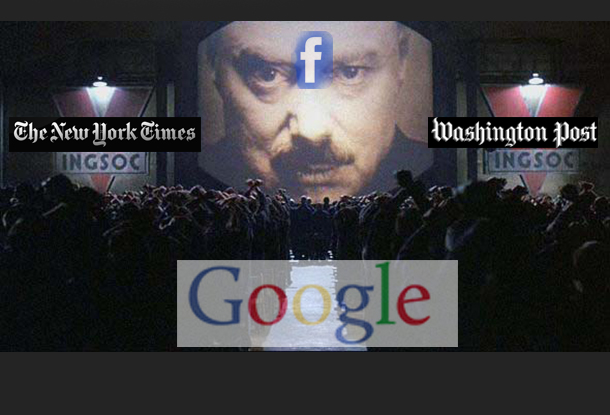
Perhaps more alarmingly, however, Silicon Valley tech giants are becoming increasingly closely intertwined with the state department, to the point where it is often difficult to tell where one ends, and another begins. “What Lockheed Martin was to the twentieth century…technology and cyber-security companies [like Google] will be to the twenty-first,” wrote Google executives Eric Schmidt and Jared Cohen in their book, “The New Digital Age: Reshaping the Future of People, Nations and Business.” For example, Facebook is now in a close partnership with the Atlantic Council, who essentially decides for them what content to promote in people’s news feeds and what content is discarded as fake news, misinformation, or low quality. The problem is that the Atlantic Council is a NATO cutout, and a government-funded organization whose board of directors is a who’s who of deep state officials, including virtually every living ex-C.I.A. director, Bush-era cabinet members like Condoleezza Rice and Colin Powell, and military generals like Wesley Clark and David Petraeus. Thus, an organization like this deciding what the world sees on their screens is barely one step removed from total government control of the flow of information.

The U.S. government also frequently directly interferes with content appearing on prominent social media. Earlier this year, Facebook announced that it would remove all comments or posts in praise of recently-slain Iranian General Qassem Soleimani from all its platforms. This was done to comply with the Trump administration’s designation of the Iranian Revolutionary Guard Corps (which Soleimani led) as a terrorist organization. The problem is that Soleimani was Iran’s most popular political figure, with an over 80 percent approval rating, and that Instagram is used by around one-third of the entire Iranian population. Thus, Iranians speaking in their local language were barred from sharing a majority opinion with their country folk because of a decision by Donald Trump.

The Middle East is a particularly contentious area of the world. Yet when news broke that the British Army’s online psychological operations brigade had managed to become a senior Twitter executive, responsible for Middle Eastern content, media largely ignored it, raising even more questions. Algorithm changes have also hammered independent alternative media outlets — often precisely the ones most likely to cover the Assange case — drastically reducing their search engine traffic flow.

Former C.I.A. chief Leon Panetta (an honorary director of the Atlantic Council) recently admitted that Assange is being prosecuted as a warning to journalists. “All you can do is hope that you can ultimately take action against those that were involved in revealing that information so you can send a message to others not to do the same thing,” he told a German documentary crew. While the message is being heard loud and clear by journalists, the public is far less aware that anything is going on, thanks, in part, to online suppression of news about the case. Judge Vanessa Baraitser is scheduled to pronounce judgment on the media “trial of the century” on January 4, after the U.S. presidential election. Murray will doubtless be there. But will anyone read what he has to say?

The End of Reality?

By Edward Curtin

Source: Behind the Curtain

In 1888,  the year before he went insane, Friedrich Nietzsche wrote the following in Twilight of the Idols:

We have got rid of the real world: what world is left?  The apparent world perhaps? … But no!  Along with the real world we’ve done away with the apparent world as well.

So, if you feel you also may be going insane in the present climate of digital screen life, where real is unreal but realer than real, the apparent is cryptic, and up is down, true is false, and what you see you don’t, it has a history.  One hundred and thirty-two years ago, Nietzsche added that “something extraordinarily nasty and evil is about to make its debut.”  We know it did, and the bloody butcher’s bench known as the twentieth century was the result. Nihilism stepped onto center stage and has been the star of the show ever since, straight through to 2020.  Roberto Calasso puts it this way in Literature and the Gods:

Here we are, announces Nietzsche, and it would be hard not to hear a mocking ring in his voice.  We thought we were living in a world where the fog had lifted, a disenchanted, ascertainable, verifiable world.  And instead everything has gone back to being a ‘fable’ again.  How are we to get our bearings … This is the paralysis, the peculiar uncertainty of modern times, a paralysis that all since have experienced.

Obviously, we haven’t gotten our bearings.  We are far more adrift today on a stormy electronic sea where the analogical circle of life has been replaced by the digital, and “truths” like numbers click into place continuously to lead us in wrong, algorithm-controlled directions. The trap is almost closed.

Of course, Nietzsche did not have the Internet, but he lived at the dawn of the electric era, when space-time transformations were occurring at a rapid pace.  Inventions such as photography, the phonograph, the telephone, electricity, etc. were contracting space and time and a disembodied “reality” was being born.  With today’s Internet and digital screen life, the baby is full-grown and completely disembodied.  It does nothing but look at its image that is looking back into a lifeless void, whose lost gaze can’t figure out what it’s seeing.

Take, for example, the phonograph, invented by Thomas Edison in 1878.  If you could record a person’s voice, and if that person died, were you then listening to the voice of a living person or one who was dead?  If the person whose voice was recorded was alive and was miles away, you had also compressed earthly space. The phonograph suppressed absence, conjured ghosts, and seemed to overcome time and death as it captured the flow of time in sound.  It allowed a disembodied human voice to inhabit a machine, an early example of downloading.

“Two ruling ambitions in modern technology,” writes John Durham Peters in his wonderful book, Speaking into the Air, “appear in the phonograph: the creation of artificial life and the conjuring of the dead.”

Many people started to hear voices, and these people were not called deluded. Soon, with the arrival of cinema, they would see ghosts as well.  Today, speaking ghosts are everywhere, hiding in hand-held devices. It’s Halloween all year round as we are surrounded by electronic zombies in a screen culture.

This technological annihilation of space and time that was happening at a frenetic pace was the material background to Nietzsche’s thought.  His philosophical and epistemological analyses emerged from German intellectual life of his time as well, where theologians and philosophers were discovering that knowledge was relative and had to be understood in situ, i.e., within its historical and social place or context.

Without going into abstruse philosophical issues here, suffice it to say, Nietzsche was suggesting that not only was God dead because people killed him, but that knowledge was a fiction that changed over time and was a human construction.  All knowledge, not just science, had to be taken “as if” it were true.  This was a consoling mental trick but falsely reassuring, for most people could not accept this, since “knowledge” was a protection racket from pain and insanity. It still is. In other words, not only had people murdered God, but they had slain absolutes as well. This left them in the lurch, not knowing if what they knew and believed were really true, or sort of true – maybe, perhaps. The worm of uncertainty had entered modern thought through modern thought.

While the average person did not delve into these revolutionary ideas, they did, through the inventions that were entering their lives, and the news about Darwin, science, religion, etc., realize, however vaguely, that something very strange and dramatic was under way. Life was passing from substance to shadow because of human ingenuity.

It is similar to what so many feel today: that reality and truth are moving beyond their grasp as technological forces that they voluntarily embrace push everyday life towards some spectral denouement.  An inhuman, trans-human, on-line electronic life where everything is a parody of everything that preceded it, like an Andy Warhol copy of a copy of a Campbell’s soup can with a canned mocking laugh track that keeps repeating itself.  All this follows from the nineteenth century relativization of knowledge, or what at least was taken as such, for to say all knowledge is relative is an absolute statement.  That contradiction goes to the heart of our present dilemma.

This old feeling of lostness is perhaps best summarized in a few lines from Mathew Arnold’s 19th century poem, “Dover Beach”:

The Sea of Faith
Was once, too, at the full, and round earth’s shore
Lay like the folds of a bright girdle furled.
But now I only hear
Its melancholy, long, withdrawing roar,
Retreating, to the breath
Of the night-wind, down the vast edges drear
And naked shingles of the world.

But that was then.  Today, the Joker’s sardonic laughter would suffice.

***

I am sitting outside as I write, sipping a glass of wine before dinner.  Although New England fall weather is approaching, a nasty mosquito is buzzing around my head.  I hear it.  I am in killer mode since these bastards love to bite me.  This is real life.  If I went into the house and connected to the Internet on the computer screen – news, social media, anything – I would be entering another dimension.  Screen life, not real life. The society of the spectacle. No real mosquitoes, no wine, no trees swaying in the evening breeze.

In his novel, The Sun Also Rises, written between Nietzsche’s time and now, Ernest Hemingway, a man who surely lived in the physical world, writes of how Robert Cohn, the boxing champion from Princeton University, wants Jake Barnes, the book’s protagonist, to take a trip with him to South America.  As they sit and talk in Paris, Barnes says no, and tells Cohn, “All countries look just like the moving pictures.”

Whether Hemingway was being ironic or not, or simply visionary, I don’t know.  For in the 1920s, before passports and widespread tourism, there were many places you could only see if you traveled to them and they would never appear in moving pictures, while today there is almost no place that is not available to view beforehand on the internet or television.  So why go anywhere if you’ve already seen it all on a screen? Why travel to nowhere or to where you have already been?  Déjà vu all over again, as Yogi Berra put it and everyone laughed.  Now the laugh is on us.

***

This is neither an argument nor a story.  It’s real.  I am trying to get my bearings in a disorienting situation. Call it a compass, a weather-vane, a prayer.  You can call me Al or Ishmael.  Call me crazy.  Perhaps this writing is just an “as if.”

***

About fifteen years ago, I was teaching at a college where most communication was done via email.  I was, as they say, out of the loop since I didn’t do email. I was often asked why I didn’t, and I would repeatedly reply, like Melville’s Bartleby, because “I prefer not to.”  Finally, in order to keep my job, I succumbed and with the laptop computer they provided me, I went “on-line.”  There were 6,954.7 emails in my in-box from the past three years.  In those three years, I had performed all my duties scrupulously and hadn’t missed a beat.  Someone showed me how to delete the emails, which I did without reading any, but I had entered the labyrinth. I went electronic.  My reality changed. I am still searching for Ariadne’s thread.

***

But I am not yet a machine and refuse the invitation to become one.  It’s a very insistent invitation, almost an order.  Neil Postman (Oh such a rich surname!) sums it up well in Technopoly: The Surrender of Culture to Technology:

The fundamental metaphorical message of the computer, in short, is that we are machines – thinking machines, to be sure, but machines nonetheless.  It is for this reason that the computer is the quintessential, incomparable, near perfect machine for Technopoly.  It subordinates the claims of our nature, our biology, our emotions, our spirituality.  The computer claims sovereignty over the whole range of human experience, and supports its claim by showing that it ‘thinks’ better than we can…John McCarthy, the inventor of the term ‘artificial intelligence’…claims that ‘even machines as simple as thermostats can be said to have beliefs…What is significant about this response is that it has redefined the meaning of the word ‘belief’ … rejects the view that humans have internal states of mind that are the foundation of belief and argues instead that ‘belief’ means only what someone or something does … rejects the idea that the mind is a biological phenomenon … In other words, what we have here is a case of metaphor gone mad.

Postman wrote that in 1992, before the computer and the internet became ubiquitous and longer before on-line living had become de rigueur – before it was being shoved down our throats as it is today under the cover of COVID-19.

There is little doubt that we are being pushed to embrace what Klaus Schwab, the Executive Chairman of the World Economic Forum (WEF), calls COVID-19:The Great Reset, that involves a total acceptance of the electronic, on-line life.  On-line learning, on-line news, on-line everything – only an idiot (from Greek, idiotes, a private person who pays not attention to public affairs) would fail to see what is being promoted.  And who controls the electronic life and internet?  Not you, not I, but the powers that be, the intelligence agencies and the power elites. Goodbye  body, goodbye blood – “I don’t think we should ever shake hands ever again, to be honest with you,” said Dr. Anthony Fauci, the director of the National Institute of Allergy and Infectious Diseases (NIAID) in support of human estrangement.

Peter Koenig, one of the most astute investigators of this propaganda effort, puts it this way:

The panacea of the future will be crowned by the Pearl of the Fourth Industrialization – Artificial intelligence (AI). It will be made possible by a 5G electromagnetic field, allowing the Internet of Things (IoT). Schwab and Malleret [Schwab’s co-author] won’t say, beware, there is opposition. 5G could still be blocked. The 5G existence and further development is necessary for surveillance and control of humanity, by digitizing everything, including human identity and money.

It will be so simple, no more cash, just electronic, digital money – that is way beyond the control of the owner, the truthful earner of the money, as it can be accessed by the Global Government and withheld and / or used for pressuring misbehaving citizens into obeying the norms imposed from above. You don’t behave according to our norms, no money to buy food, shelter and health services, we let you starve. No more travel. No more attending public events. You’ll be put gradually in your own solitary confinement. The dictatorial and tyrannical global commandeering by digital control of everything is the essence of the 4th Age of Industrialization – highly promoted by the WEF’s Great Reset.

***

Like everything, of course, this push to place life under the aegis of cyberspace has a history, one that deifies the machine and attempts to convince people that they too are machines without existential freedom.  Thus the ongoing meme pumped out for the past three decades has been that we are controlled by our brains and that the brain is a computer and vice versa. Brain research has received massive government funding. Drugs have been offered as the solution to every human problem. So-called diseases and disorders have been created through the Diagnostic and Statistical Manual of  Mental Disorders (DSM) and matched to pharmaceutical drugs (or the revers) for scandalous profits. And the mind has been reduced to a figment of deluded  imaginations. People are machines; that’s the story, marvelous machines.  They have no freedom.

If one wishes an example of techno-fascism, there is one from the art world. Back in the 1920s and 1930s there was an art movement known as Futurism.  Its leader proponent was an Italian Fascist, friend of Mussolini, Filippo Tommaso Marinetti.  The futurists claimed that all life revolves around the machine, that the machine was god, that it was beyond human control and had to be obeyed.  They extolled war and speed and claimed that humans were no more significant than stones.  Patriotism, militarism, strength, method, and the kingdom of experts were their blueprint for a corporate fascist state.  The human eye and mind would be re-educated to automatically obey the machine’s dictates.

Now we have cyberspace, digital machines, and the internet, an exponential extension of the machine world of the 1930s and the rise of Mussolini, Fascism, and Hitler.  That this online world is being pushed as the new and future normal by trans-national elite forces should not be surprising.  If human communication becomes primarily digitally controlled on-line and on screens, those who control the machines will have achieved the most powerful means of mind control ever invented. That will be MKULTRA on a vast scale.  Surveillance will be complete.

Yes, there are places on the internet where truth is and will be told, such as this site where you are reading this; but as we can see from today’s growing censorship across the web, those power elites and intelligence forces who  control the companies that do their bidding will narrow the options for dissenting voices. Such censorship starts slowly, and then when one looks again, it is a fait accompli. The frog in the pan of slowly heating cold water never realizes it is being killed until it is too late. Free speech is now being strangled. Censorship is widespread.

The purpose of so much internet propaganda is to confuse, obsess, depress, and then repress the population. The overlords accomplish this by the “peculiar linking together of opposites – knowledge with ignorance, cynicism with fanaticism – [which] is one of the chief distinguishing marks of Oceanic society,” writes Orwell in Nineteen Eighty-Four.  “The official ideology abounds with contradictions even where there is no practical reason for them.”  One look into one’s life will suffice to see how the overlords have set people against each other.  It’s a classic tactic.  Divide and conquer. Trump vs. Biden, Democrats vs. Republicans, whites vs. blacks, liberals vs. conservatives. Pure mind games. Contradictions every day to create social disorientation.  Orwell describes Doublethink as follows:

Doublethink means the power of holding two contradictory beliefs in one’s mind simultaneously, and accepting both of them.  The Party intellectual knows in which direction his memories must be altered; he therefore knows he is playing tricks with reality; but by the exercise of doublethink he also satisfies himself that reality is not violated.  The process has to be conscious, or it would not be carried out with sufficient precision, but it also has to be unconscious, or it would bring with it a feeling of falsity and hence of guilt…To tell deliberate lies while genuinely believing them, to forget any fact that has become inconvenient, and then, when it becomes necessary again, to draw it back from oblivion for just as long as it is needed, to deny the existence of objective reality and all the while to take account of the reality which one denies – all this is indispensably necessary…If one is to rule, and to continue ruling, one must be able to dislocate the sense of reality. [author’s emphasis]

Nietzsche said that along with the real world we have done away with the apparent as well.  Digital online life has accomplished that.  It has allowed the rulers – through the media who are the magicians who serve them – to create counterfeit news and doctored videos at will, to present diametrically opposed points of view within the same paragraph, and to push breaking news items so fast that no one half-way sane could keep up with their magic shows. Nietzsche obviously didn’t foresee this technology, but he sensed the madness that the relativity of knowledge and the technology of his day would usher in.

***

The popular 1990s term “Information Superhighway,” meaning the internet and all digital telecommunications, was the perfect term to describe this lunacy. Get on that highway and go as fast as you can while trying to catch the meaning of all the information flashing past you as you speed to nowhere.  For not only does censorship, propaganda, disinformation, mixed messages, and contradictions line the road you are traveling, but contextless information overload is so heavy that even if you were stopped in a traffic jam, there is too much information to comprehend.  And if you think this Superhighway is a freeway, think again, for the cost is high. No one puts out their hand and asks you to pay up; but the more you travel down this road you’ll notice you are missing a bit of flesh here and some blood there.  And without a speed pass, you are considered road kill.

To make matters much worse, they say we need 5G to go much faster.

Paul Virilio, who has devoted himself to the study of speed (dromology), puts it this way in Open Sky:

The speed of the new optoelectronic and electroacoustic milieu becomes the final void (the void of the quick), a vacuum that no longer depends on the interval between places or things and so on the world’s very extension, but on the interface of an instantaneous transmission of remote appearances, on a geographic and geometric retention in which all volume, all relief vanishes.

***

And yet I don’t have a simple answer to the internet dilemma. You are reading it on-line and I am posting it there.  It is very convenient and quick. And yet…and yet….

Can we just walk away from it?  Maybe.  Perhaps like those few who, in Ursula K. Le Guin’s excruciating story, “The Ones Who Walk Away From Omelas,” we may decide the price for our conveniences and so-called happiness is too high and that there are hidden victims that this techno-scientific “progress” creates beneath its veneer of efficiency.  Others, us, our children, all children, who are reaching out not for speed and machines, but for the human touch that the on-line propagandists hope to destroy.  In Le Guin’s story, the price nearly all the citizens of Omelas are willing to pay for their happiness and comfort is the imprisonment of a single child.  Perhaps we should consider what we are doing to all the world’s children and their futures.

My friend Gary recently sent me this letter.  I believe it sums up what many people feel. There is a vast hunger for reality and truth. The analog life. How to live it – the question hangs in the air as the artificial intelligence/digital controllers try to reduce us to machines.

Although apparently it isn’t clear if Twain ever said this, it’s still a great quote:  (“If you don’t read the newspaper, you’re uninformed.  If you do, you’re misinformed.”)  To which “amen” is the only appropriate response.

I continue to daily stay abreast of events through the web, and these days much of what passed for “progressive media” simply regurgitates the covid madness as if it had been delivered on stone tablets – rather than by the same MSM that lie to us daily about literally ANYTHING of any importance.

There are days I wonder “why” I continue to bother to follow the unfolding madness as if it made some “difference.”  I could certainly play guitar more, and I might even get it together to write a few pieces on the nature of our collective madness, for which I have studiously assembled copious notes.  I really don’t need any more information or examples – I think I have things covered on that front.

Instead I find myself daily doing the little dance we’re all familiar with – uncomfortable with being “uninformed” – yet at almost every turn finding myself being routinely – “misinformed” – and so having to sift through the endless debris to have any chance at developing any coherent understanding of the world.

So yes, I totally get the draw of just saying to hell with the internet.  After years of shifting through the endless propaganda operations our generation has been subject too, I have no doubt you and I see through most the nonsense for what it is before we even have the proof in hand.  Once the rose-colored glasses of ‘American exceptionalism’ are off, one can almost sense and see through the lies in real time even as they are being uttered.

Reading Gary’s words reminded me of those of the Trappist monk Thomas Merton’s definition of the Unspeakable:

It is the void that contradicts everything that is spoken even before the words are said, the void that gets into the language of public and official declarations at the very moment when they are pronounced, and makes them ring dead with the hollowness of the abyss.  It is the void out of which Eichmann drew the punctilious exactitude of his obedience…

Yes, real time, real life – as we do our little dances.

Can we do our little dances and preserve reality?  I’m not sure.

Eyewitness to the Agony of Julian Assange

By Timothy Erik Strom and John Pilger

Source: CounterPunch

John Pilger has watched Julian Assange’s extradition trial from the public gallery at London’s Old Bailey. He spoke with Timothy Erik Ström of Arena, Australia:

Q:  Having watched Julian Assange’s trial firsthand, can you describe the prevailing atmosphere in the court?

The prevailing atmosphere has been shocking. I say that without hesitation; I have sat in many courts and seldom known such a corruption of due process; this is due revenge. Putting aside the ritual associated with ‘British justice’, at times it has been evocative of a Stalinist show trial. One difference is that in the show trials, the defendant stood in the court proper. In the Assange trial, the defendant was caged behind thick glass, and had to crawl on his knees to a slit in the glass, overseen by his guard, to make contact with his lawyers. His message, whispered barely audibly through face masks, WAS then passed by post-it the length of the court to where his barristers were arguing the case against his extradition to an American hellhole.

Consider this daily routine of Julian Assange, an Australian on trial for truth-telling journalism. He was woken at five o’clock in his cell at Belmarsh prison in the bleak southern sprawl of London. The first time I saw Julian in Belmarsh, having passed through half an hour of ‘security’ checks, including a dog’s snout in my rear, I found a painfully thin figure sitting alone wearing a yellow armband. He had lost more than 10 kilos in a matter of months; his arms had no muscle. His first words were: ‘I think I am losing my mind’.

I tried to assure him he wasn’t. His resilience and courage are formidable, but there is a limit. That was more than a year ago. In the past three weeks, in the pre-dawn, he was strip-searched, shackled, and prepared for transport to the Central Criminal Court, the Old Bailey, in a truck that his partner, Stella Moris, described as an upended coffin. It  had one small window; he had to stand precariously to look out. The truck and its guards were operated by Serco, one of many politically connected companies that run much of Boris Johnson’s Britain.

The journey to the Old Bailey took at least an hour and a half. That’s a minimum of three hours being jolted through snail-like traffic every day. He was led into his narrow cage at the back of the court, then look up, blinking, trying to make out faces in the public gallery through the reflection of the glass. He saw the courtly figure of his dad, John Shipton, and me, and our fists went up. Through the glass, he reached out to touch fingers with Stella, who is a lawyer and seated in the body of the court.

We were here for the ultimate of what the philosopher Guy Debord called The Society of the Spectacle: a man fighting for his life. Yet his crime is to have performed an epic public service: revealing that which we have a right to know: the lies of our governments and the crimes they commit in our name. His creation of WikiLeaks and its failsafe protection of sources revolutionised journalism, restoring it to the vision of its idealists. Edmund Burke’s notion of free journalism as a fourth estate is now a fifth estate that shines a light on those who diminish the very meaning of democracy with their criminal secrecy. That’s why his punishment is so extreme.

The sheer bias in the courts I have sat in this year and last year, with Julian in the dock, blight any notion of British justice. When thuggish police dragged him from his asylum in the Ecuadorean embassy—look closely at the photo and you’ll see he is clutching a Gore Vidal book; Assange has a political humour similar to Vidal’s—a judge gave him an outrageous 50-week sentence in a maximum-security prison for mere bail infringement.

For months, he was denied exercise and held in solitary confinement disguised as ‘heath care’. He once told me he strode the length of his cell, back and forth, back and forth, for his own half-marathon. In the next cell, the occupant screamed through the night. At first he was denied his reading glasses, left behind in the embassy brutality. He was denied the legal documents with which to prepare his case, and access to the prison library and the use of a basic laptop. Books sent to him by a friend, the journalist Charles Glass, himself a survivor of hostage-taking in Beirut, were returned. He could not call his American lawyers. He has been constantly medicated by the prison authorities. When I asked him what they were giving him, he couldn’t say. The governor of Belmarsh has been awarded the Order of the British Empire.

At the Old Bailey, one of the expert medical witnesses, Dr Kate Humphrey, a clinical neuropsychologist at Imperial College, London, described the damage: Julian’s intellect had gone from ‘in the superior, or more likely very superior range’ to ‘significantly below’ this optimal level, to the point where he was struggling to absorb information and ‘perform in the low average range’.

This is what the United Nations Special Rapporteur on Torture, Professor Nils Melzer, calls ‘psychological torture’, the result of a gang-like ‘mobbing’ by governments and their media shills. Some of the expert medical evidence is so shocking I have no intention of repeating it here. Suffice to say that Assange is diagnosed with autism and Asperger’s syndrome and, according to Professor Michael Kopelman, one of the world’s leading neuropsychiatrists, he suffers from ‘suicidal preoccupations’ and is likely to find a way to take his life if he is extradited to America.

James Lewis QC, America’s British prosecutor, spent the best part of his cross-examination of Professor Kopelman dismissing mental illness and its dangers as ‘malingering’. I have never heard in a modern setting such a primitive view of human frailty and vulnerability.

My own view is that if Assange is freed, he is likely to recover a substantial part of his life. He has a loving partner, devoted friends and allies and the innate strength of a principled political prisoner. He also has a wicked sense of humour.

But that is a long way off. The moments of collusion between the judge— a Gothic-looking magistrate called Vanessa Baraitser, about whom little is known—and the prosecution acting for the Trump regime have been brazen. Until the last few days, defence arguments have been routinely dismissed. The lead prosecutor, James Lewis QC, ex SAS and currently Chief Justice of the Falklands, by and large gets what he wants, notably up to four hours to denigrate expert witnesses, while the defence’s examination is guillotined at half an hour. I have no doubt, had there been a jury, his freedom would be assured.

The dissident artist Ai Weiwei came to join us one morning in the public gallery. He noted that in China the judge’s decision would already have been made. This caused some dark ironic amusement. My companion in the gallery, the astute diarist and former British ambassador Craig Murray wrote:

I fear that all over London a very hard rain is now falling on those who for a lifetime have worked within institutions of liberal democracy that at least broadly and usually used to operate within the governance of their own professed principles. It has been clear to me from Day 1 that I am watching a charade unfold. It is not in the least a shock to me that Baraitser does not think anything beyond the written opening arguments has any effect. I have again and again reported to you that, where rulings have to be made, she has brought them into court pre-written, before hearing the arguments before her.

I strongly expect the final decision was made in this case even before opening arguments were received.

The plan of the US Government throughout has been to limit the information available to the public and limit the effective access to a wider public of what information is available. Thus we have seen the extreme restrictions on both physical and video access. A complicit mainstream media has ensured those of us who know what is happening are very few in the wider population.

There are few records of the proceedings. They are: Craig Murray’s personal blog, Binoy Kampmark on CounterPunch, Joe Lauria’s live reporting on Consortium News and the World Socialist Website. American journalist Kevin Gosztola’s blog, Shadowproof, funded mostly by himself, has reported more of the trial than the major US press and TV, including CNN, combined.

In Australia, Assange’s homeland, the ‘coverage’ follows a familiar formula set overseas. The London correspondent of the Sydney Morning Herald, Latika Bourke, wrote this recently:

The court heard Assange became depressed during the seven years he spent in the Ecuadorian embassy where he sought political asylum to escape extradition to Sweden to answer rape and sexual assault charges.

There were no ‘rape and sexual assault charges’ in Sweden. Bourke’s lazy falsehood is not uncommon. If the Assange trial is the political trial of the century, as I believe it is, its outcome will not only seal the fate of a journalist for doing his job but intimidate the very principles of free journalism and free speech. The absence of serious mainstream reporting of the proceedings is, at the very least, self-destructive. Journalists should ask: who is next?

How shaming it all is. A decade ago, the Guardian exploited Assange’s work, claimed its profit and prizes as well as a lucrative Hollywood deal, then turned on him with venom. Throughout the Old Bailey trial, two names have been cited by the prosecution, the Guardian’s David Leigh, now retired as ‘investigations editor’ and Luke Harding, the Russiaphobe and author of a fictional Guardian ‘scoop’ that claimed Trump adviser Paul Manafort and a group of Russians visited Assange in the Ecuadorean embassy. This never happened, and the Guardian has yet to apologise. The Harding and Leigh book on Assange—written behind their subject’s back—disclosed a secret password to a WikiLeaks file that Assange had entrusted to Leigh during the Guardian’s ‘partnership’. Why the defence has not called this pair is difficult to understand.

Assange is quoted in their book declaring during a dinner at a London restaurant that he didn’t care if informants named in the leaks were harmed. Neither Harding nor Leigh was at the dinner. John Goetz, an investigations reporter with Der Spiegel, was at the dinner and testified that Assange said nothing of the kind. Incredibly, Judge Baraitser stopped Goetz actually saying this in court.

However, the defence has succeeded in demonstrating the extent to which Assange sought to protect and redact names in the files released by WikiLeaks and that no credible evidence existed of individuals harmed by the leaks. The great whistle-blower Daniel Ellsberg said that Assange had personally redacted 15,000 files. The renowned New Zealand investigative journalist Nicky Hager, who worked with Assange on the Afghanistan and Iraq war leaks, described how Assange took ‘extraordinary precautions in redacting names of informants’.

Q: What are the implications of this trial’s verdict for journalism more broadly—is it an omen of things to come?

The ‘Assange effect’ is already being felt across the world. If they displease the regime in Washington, investigative journalists are liable to prosecution under the 1917 US Espionage Act; the precedent is stark. It doesn’t matter where you are. For Washington, other people’s nationality and sovereignty rarely mattered; now it does not exist. Britain has effectively surrendered its jurisdiction to Trump’s corrupt Department of Justice. In Australia, a National Security Information Act promises Kafkaesque trials for transgressors. The Australian Broadcasting Corporation has been raided by police and journalists’ computers taken away. The government has given unprecedented powers to intelligence officials, making journalistic whistle-blowing almost impossible. Prime Minister Scott Morrison says Assange ‘must face the music’. The perfidious cruelty of his statement is reinforced by its banality.

‘Evil’, wrote Hannah Arendt, ‘comes from a failure to think. It defies thought for as soon as thought tries to engage itself with evil and examine the premises and principles from which it originates, it is frustrated because it finds nothing there. That is the banality of evil’.

Q: Having followed the story of WikiLeaks closely for a decade, how has this eyewitness experience shifted your understanding of what’s at stake with Assange’s trial?

I have long been a critic of journalism as an echo of unaccountable power and a champion of those who are beacons. So, for me, the arrival of WikiLeaks was exciting; I admired the way Assange regarded the public with respect, that he was prepared to share his work with the ‘mainstream’ but not join their collusive club. This, and naked jealousy, made him enemies among the overpaid and undertalented, insecure in their pretensions of independence and impartiality.

I admired the moral dimension to WikiLeaks. Assange was rarely asked about this, yet much of his remarkable energy comes from a powerful moral sense that governments and other vested interests should not operate behind walls of secrecy. He is a democrat. He explained this in one of our first interviews at my home in 2010.

What is at stake for the rest of us has long been at stake: freedom to call authority to account, freedom to challenge, to call out hypocrisy, to dissent. The difference today is that the world’s imperial power, the United States, has never been as unsure of its metastatic authority as it is today. Like a flailing rogue, it is spinning us towards a world war if we allow it. Little of this menace is reflected in the media.

WikiLeaks, on the other hand, has allowed us to glimpse a rampant imperial march through whole societies—think of the carnage in Iraq, Afghanistan, Libya, Syria, Yemen, to name a few, the dispossession of 37 million people and the deaths of 12 million men, women and children in the ‘war on terror’—most of it behind a façade of deception.

Julian Assange is a threat to these recurring horrors—that’s why he is being persecuted, why a court of law has become an instrument of oppression, why he ought to be our collective conscience: why we all should be the threat.

The judge’s decision will be known on the 4th of January.

Why It is Likelier that the U.S. Government Had Alexei Navalny Poisoned

By Eric Zuesse

Source: Dissident Voice

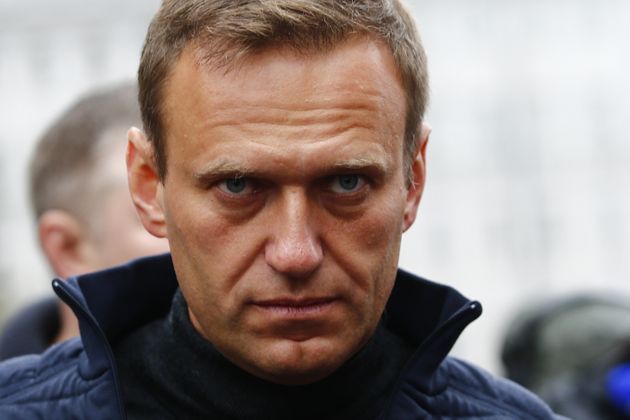
The poisoning of Alexei Navalny has created intensified support by pro-U.S., and especially pro-NATO, officials in the European Union, to block the nearly completed NordStream 2 natural-gas pipeline from Russia to Germany, and to import into the EU, instead, far costlier U.S. LNG, liquefied natural gas. A very real possibility thus now exists that the poisoning of Navalny will turn out to have been worth many billions of dollars to U.S. frackers, by causing the nearly-completed NordStream 2 to be turned to waste so that fracked U.S. LNG will sell in Europe. The present article will explore the relative likelihood that the poisoning of Navalny isn’t merely coincidentally perfectly timed in order to achieve that objective for the benefit of America’s gas-industry, but that it probably was actually planned and perpetrated in order to achieve this.

The idea that the Russian Government poisoned Alexei Navalny presumes such astounding stupidity on the part of Russia’s Government as to be exceedingly dubious, at best. Navalny, though he actually is favorably viewed by only around 2% of Russians (as indicated in polls there), is widely publicized in U.S.-and-allied media as having instead the highest support by the Russian people of anyone who might challenge Vladimir Putin for Russia’s leadership. It’s a lie, and always has been. Other politicians have far higher polled support in Russia. For example, whereas in the latest poll, published on September 5th, Navalny was one of four individuals who had 2%, Zhirinovsky had 5% and Zhirinovsky was the only person who had more than 2%, other than Putin, who had 56%. In the 2018 Presidential election, Zhirinovsky polled at 13.7%, Grudinin polled at 12.0%, and Putin polled at 72.6%. The actual election-outcome was Putin 76.69%, Grudinin 11.7%, and Zhirinovsky 5.65%. The idea that Putin would need to kill anyone in order to be leading Russia is so stupid and uninformed (and mis-informed) that it is beyond belief, though it is widely publicized in The West as being instead the reality. But what is true is that Navalny has been an immense propaganda-asset to the U.S. Government, and he now is especially so.

Even America’s CNN let slip, in a news-report on September 18th, regarding Navalny, that “his list of enemies is as long as it is powerful,” but they said nothing about whom those “enemies” might be. No one questions that Navalny claims to be an anti-corruption campaigner, and that this would generate enemies regardless of whether his accusations are truthful. The article on “Alexei Navalny” at Wikipedia, which is CIA-edited and written, and which blacklists (blocks from linking to) sites that aren’t CIA-approved, indicates that Navalny has accused numerous individuals of corruption, but not that any of those individuals is corrupt — and this is at a site (Wikipedia) which can reasonably be expected to link to documentation of any damning evidence that Navalny has come up with. But the article doesn’t link to any. The article does make clear that Navalny has been hoping to use these accusations in order to rise in Russian politics. It would be a dangerous way to rise in any nation’s politics, regardless of whether those accusations are true. The idea that Putin was behind this is insane. Is Putin so stupid as to poison the U.S. regime’s most-heavily propaganda-favored Russian precisely at the time when the EU is about to grant final approval to Russia’s vast (and virtually completed) NordStream 2 pipeline?

England’s Financial Times headlined on September 16, “Germany offered €1bn for gas terminals in exchange for US lifting NS2 sanctions,” and sub-headed “Deal, detailed in a letter by Olaf Scholz to Steven Mnuchin, predates the poisoning of Alexei Navalny.” They reported that “In the August 7 letter seen by the Financial Times, Mr Scholz said Germany would increase its financial support for LNG infrastructure and import capacities ‘by up to €1bn’ in exchange for the US ‘allow[ing] for the unhindered construction and operation of Nord Stream 2’,” and reported that:

The US has long opposed Nord Stream 2 and in December imposed sanctions against companies involved in its construction. That move prompted Swiss pipe-layer Allseas to suspend its work with just 6 per cent left to install. A group of US senators from across the political divide are pushing to extend those sanctions.

Criticism of the project has grown in Europe too, with opponents saying it will increase Europe’s dependence on Russian energy exports at a time of rising tensions with Moscow. In her State of the Union address on Wednesday, European Commission president Ursula von der Leyen said: “To those that advocate closer ties with Russia, I say that the poisoning of Alexei Navalny with an advanced chemical agent is not a one-off. This pattern is not changing — and no pipeline will change that.

The U.S. regime’s agent, von der Leyen, is doing her utmost to serve U.S. LNG marketers. Many other U.S.-regime agents also are.

On September 17th, America’s neoconservative (or pro-U.S.-empire) Newsweek bannered “Opinion: Open Letter: For the Sake of Transatlantic Security, Stop Nord Stream 2,” with 114 signatories of NATO-related U.S. and European officials, and published their argument that, “Over the past decade, the Government of the Russian Federation has engaged in a litany of malign activities aimed at upending liberal democratic norms across Europe and North America. The shocking poisoning of Russian opposition leader Alexei Navalny by a variant of the weapons-grade nerve agent Novichok shows that Moscow has not been deterred by Western actions and statements and refuses to reverse its destabilizing political adventurism at home and abroad.”

How blatant and scummy can a marketing campaign get?

The USA on the brink of civil war

In this article, the author seeks to draw our attention to a fact that is difficult for Westerners to conceive of: the American people are experiencing a crisis of civilization. They are so deeply divided that the presidential election is not just about electing a leader, but about determining what the country (empire or nation?) should be. Neither side is capable of accepting to lose, so much so that each could resort to violence to impose its point of view.

By Thierry Meyssan

Source: VoltaireNet.org

As the U.S. presidential election approaches, the country is divided into two camps that suspect each other of preparing a coup d’état. On one side are the Democrats and the non-party Republicans, and on the other are the Jacksonians, who have become the majority in the Republican Party without sharing its ideology.

Remember, already in November 2016, a media manipulation company headed by the master of Agit-Prop, David Brock, raised more than 100 million dollars to destroy the image of the President-elect before he was elected [1]. Since then, before he could do anything about it, the international press has portrayed the U.S. president as incapable and an enemy of the people. Some newspapers have even called for his assassination. For almost four years, his own administration has constantly denounced him as a traitor paid by Russia and the international press has violently criticized him.

Currently, another group, the Transition Integrity Project (TIP), is planning scenarios to overthrow him in the 2020 election, whether he loses it or wins it. The case has become national in scope since TIP founder Professor Rosa Brooks leaked a lengthy article in the Washington Post to which she is a regular contributor [2].

The TIP organized four role-playing games last June. It simulated various results to anticipate the reactions of the two candidates. All the participants were Democrats and Republicans (ideologically speaking, not “Republicans” in the sense of party membership), none of them Jacksonian. Unsurprisingly, all of these personalities believe that “the Trump administration has consistently undermined basic standards of democracy and the rule of law. It has adopted many corrupt and authoritarian practices. They therefore concluded that President Trump would attempt a coup d’état and imagined that it was their duty to pre-emptively devise a “democratic” coup d’état [3].

It is a characteristic of contemporary political thought to stand up for democracy, but to reject decisions that run counter to the interests of the ruling class. Indeed, TIP members readily admit that the US electoral system they defend is profoundly “anti-democratic”. The constitution does not attribute the presidential election to citizens, but to an electoral college of 538 people appointed by the governors. The participation of citizens, which was not foreseen at independence, has gradually become the norm in practice, but only as a guide for governors. Thus, in 2000, when George W. Bush was elected, the Florida Supreme Court recalled that it did not have to know the wishes of the citizens of Florida, but only those of the 27 voters appointed by their Florida governor.

Contrary to popular belief, the U.S. Constitution does not recognize popular sovereignty, but only the sovereignty of governors. Moreover, the Electoral College designed by Thomas Jefferson has not functioned properly since 1992: the elected candidate no longer has the majority of the wishes of the citizens in the states that tilt the election [4].

The TIP has highlighted just about everything that could happen in the three months between the election and the nomination. It acknowledges that it will be very difficult to determine the results given the use of absentee voting in times of epidemic. The TIP deliberately did not explore the possibility that the Democratic Party would announce Joe Biden’s election despite an undercount and that House Speaker Nancy Pelosi would swear him in before Donald Trump could be declared the loser. In such a case, there would be two rival presidents, which would mark the beginning of a Second Civil War.

This eventuality encourages some to consider seceding, to unilaterally proclaim the independence of their state. This is particularly true on the West Coast. To prevent this process of disintegration, some advocate dividing California in order to give more members of the Electoral College to its population. However, this solution is already a stance in the national conflict because it favours popular representation at the expense of the power of the governors.

In addition, last March I mentioned the temptation of a putschist coup by some military personnel, [5] to which several high-ranking officers later referred [6].

These different points of view attest to the deep crisis that the United States is going through. The “American empire” should have disintegrated after the dissolution of the Soviet Union. This did not happen. It should have reinvented itself with financial globalization. It did not. Each time, a conflict (the ethnic division of Yugoslavia, the attacks of September 11) came to rekindle the dying. It will no longer be possible to postpone the deadlines for much longer [7].


Translation
Roger Lagassé


[1] “The Clinton system to discredit Donald Trump”, by Thierry Meyssan, Translation Pete Kimberley, Zero Hedge (USA) , Voltaire Network, 28 February 2017.

[2] “What’s the worst that could happen? The election will likely spark violence — and a constitutional crisis”, The Washington Post, September 3, 2020.

[3Preventing a disrupted presidential election and transition, Transition Integrity Project, August 3, 2020.

[4Presidential elections and majority rule, Edward B. Foley, Oxford University Press, 2020.

[5] “Putchists in the Shadow of the Coronavirus”, by Thierry Meyssan, Translation Roger Lagassé, Voltaire Network, 31 March 2020.

[6] “The Pentagon against President Trump”, Voltaire Network, 12 June 2020. Do we risk a miltary coup?, by Colonel Richard H. Black, August 24, 2020.

[7] “United States – reformation or fracture?”, by Thierry Meyssan, Translation Pete Kimberley, Voltaire Network, 26 October 2016.

Trump’s Murder of Qassem Soleimani: Why We Must Stand Up to the Christianity of Brutality.

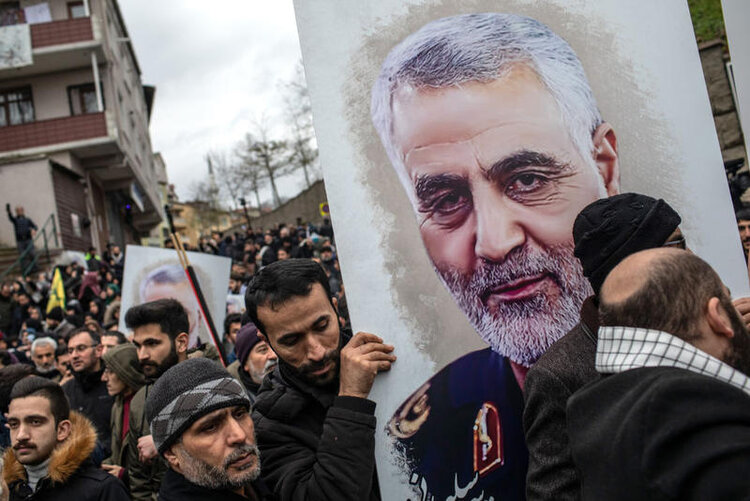
ISTANBUL, TURKEY – JANUARY 05: People hold posters showing the portrait of Iranian Revolutionary Guard Major General Qassem Soleimani and chant slogans during a protest outside the U.S. Consulate on January 05, 2020 in Istanbul, Turkey. Major General Qassem Soleimani, was killed by a U.S. drone strike outside the Baghdad Airport on January 3. Since the incident, tensions have risen across the Middle East. (Photo by Chris McGrath/Getty Images)

By Sander Hicks

Source: New York Megaphone

This is the investigation that prompted our publication to establish an online conference on Nonviolence, and the Legacy of Mahatma Gandhi, Oct. 2, 2020. It’s essential we understand how Pompeo and the GOP justify their violence in the name of Christianity. The future of nonviolence must stand apart from the “Christianity of Brutality.” That’s what Jesus would do.

Earlier this year, President Trump shocked the world by murdering a high-ranking Iranian government official. Pressured by Secretary Pompeo, Trump ordered the assassination of an Iranian general who enjoyed movie-star celebrity status in his home country, General Qassem Soleimani. The killing brought the world to the brink of a major new war. Among the many laws this act broke, it violated Iraqi sovereignty, as it took place in Iraq. It happened in the middle of the night on January 3rd, 2020, using an American MQ-6 Reaper drone.

Dexter Filkins, in the New Yorker, called the hit on Soleimani, “the most consequential act taken against the regime in Tehran in thirty years.” And that’s saying a lot, because the US has inflicted much suffering on Iran over time, from CIA coups, to pushing Iraq to kill a million Iranians in the “Iran-Iraq War,” to today’s harsh economic sanctions. Yet Iran has grown into an influential regional superpower able to stand toe-to-toe with US proxies, Israel and Saudi Arabia, to see through the hypocrisy and the posturing of the War on Terror.

Trump, earlier, wanted to re-open negotiations towards a new Nuclear Agreement with Iran. He was in contact with President Rhouhani. But killing the charismatic Soleimani shut down any chance of a new nuclear deal. Now the Iranians are free to develop their nuclear power capabilities, unhindered.

Trump was left to explain himself. How could the US President justify this attack?

Remember that one year ago, things were boiling over in Iraq/Iran. Various Iran-backed militias rioted in Baghdad and broke the windows at US consulates. An American contractor was killed and US officials feared another Benghazi, or a new Tehran-style Embassy hostage crisis like in 1979. The US Military and Trump responded by killing 25 Shi’a militia members. Pentagon top brass then offered killing Soleimani as an additional option but assumed Trump wouldn’t be so brash. That was like giving a pyromaniac teenager a set of matches and five gallons of gasoline.

Killing a foreign government official is illegal, according to US policy and international law. Trump, at first, asserted Soleimani had plans to target four U.S. embassies, a claim that his own Defense Secretary Esper was not able to substantiate.  It “seems to be totally made up,” said Congressman Justin Amash from Michigan.

On Twitter, Trump tried to give the last word by claiming that the US acted in self-defense because Soleimani posed an “imminent threat.” But Trump seemed unconvinced himself, as he tweeted that it “doesn’t really matter because of his horrible past.”

Ah, but it does matter.

Killing people is a crime, you see, and a lot of people think so. The US has written laws that restrain this kind of thing from coming out of the White House, as it does so much damage to the U.S.’s moral standing in the world. (If capitalism and imperialism haven’t mangled that reputation forever.)

Former DA Vincent Bugliosi, in his book The Prosecution of George W. Bush for Murder, showed that presidents could well go to prison for the extrajudicial killings and illegal wars they engage in. The Hague Convention of 1907 and the UN ban the killing of a foreign government official, outside of wartime. Even Thomas Jefferson, in a letter to James Madison, denounced “assassination, poison, perjury” as brutal statecraft, “held in just horror.”

In the wake of the killings of JFK and MLK and the targeted domestic killings of COINTEL-PRO, the US Congress convened the Church Committee and the House Select Committee on Assassinations in the mid and late ’70s. President Gerald Ford responded by issuing an executive order that has since become standard US policy. No US government employee “shall engage in, or conspire to engage in, political assassination.”

President Reagan affirmed and expanded this policy against assassination. But back at the Trump White House, the pressure to kill Soleimani came from evangelical Christian Secretary of State Mike Pompeo. CNN reported that White House insiders said Pompeo “was the one who made the case to take out Soleimani, it was him absolutely.” Pompeo also made a claim that Soleimani posed an “imminent threat,” but later backed off that claim, and instead explained that Soleimani had the “blood of American [soldiers]” on his hands from working with the Iraqi resistance.

At a loss for legal justification, Vice President Mike Pence stepped up with a “Hail Mary” kind of throw. He asserted that there may be a connection between Soleimani and “the 12 9/11 attackers.” (But Mike, there were 19 hijackers on 9/11.) Students of history will note that the NeoCon Right still invokes 9/11 when it’s desperate to justify a crime. 9/11 still has that power 20 years later. It’s like a myth that is eternal. If we allow it.


Who Was Qassem Soleimani

Millions of Iranians poured out into the streets for a three-day funeral in all top Iranian cities and towns. Hamed Ghashgavi in Tehran, told me, “General Soleimani, we know he was popular but none of us thought millions will mourn his death!”

Qassem Soleimani “had a command presence,” CIA Veteran John Maguire said. “He walked into the room and you could feel him.” Maguire had negotiated with Soleimani in Baghdad in 2004.

A native of the more tribal Southern Iranian province of Kerman, Soleimani was born in 1957. He fought at the front lines of the Iran/Iraq war, that nine-year slog fought with chemical weapon assaults, compliments of Iraq. The grinding agony, often in trenches, was compared to World War I. Inside Iran, the conflict is known as the “War of Holy Defense.” But the Reagan White House viewed the Iran/Iraq War as a chance to get aggressive and retaliate for the late 70’s hostage crisis. The US supported Iran‘s biggest rival, Saddam Hussein, as he invaded Iran. The USA gave Hussein several billions in economic aid and military training to help attack the nascent Islamic Republic.

The experience of Iraq invading Iran was deeply formative on young Soleimani, who lost many friends in the war. But Soleimani there became a legend known as “The Goat Burglar” for his talents at slipping behind enemy lines and coming back with live goats to feed his platoon. He regularly volunteered to fight at the front lines. He had a deep camaraderie with his fellows. Before battle, he would kiss each of them on the forehead and pray with them to be martyred.

From the end of the War, to 1997, Soleimani laid low, he didn’t get on well with President Rafsanjanhi. But sooner after that period, he rose to lead the elite “Quds” aka “Jerusalem” Force division of the Iranian Revolutionary Guard. His power grew, as did his closeness with Iranian Supreme Leader Ayatollah Khamenei. Gen. Petreaus once recalled that Soleimani told him, “You should know that I, Qassem Soleimani, control the policy for Iran with respect to Iraq, Lebanon, Gaza and Afghanistan.”

Soleimani as US Ally Against Terrorism

In the corporate US media, Soleimani’s death was brushed off. He was expendable. A “terrorist.”

But a deeper look past the demonization shows an interesting pattern. Soleimani had a history of working with the Americans. Every time he worked with the USA, it went well for the Americans. In the end, the USA just stabbed him in the back.

When 9/11 happened, the Bush/Cheney regime decided to target Afghanistan and its Taliban regime. Qassem Soleimani saw an opportunity to reduce terrorism in the land immediately to the east of Iran. Soleimani worked with the US attacking forces. He and Iranian diplomats shared intelligence with the US on Taliban positions. The Americans informed the Iranians about an al-Qa`ida agent hiding out in Mashhad in eastern Iran.  Soleimani was, “pleased with [the] cooperation,” and spoke at this time that “maybe it’s time to rethink our relationship with the Americans.”

It was not to be.

Bush and Cheney bowed to pressure from their Zionist wing and slapped the Iranians in the face with the “Axis of Evil” speech. It has been a long-standing policy of Israel to block any rapprochement between the US and Iran. Bush named Iran as a leading proponent of terrorism, despite its recent work against terrorism, with the Americans in Afghanistan. Soleimani felt betrayed.

Cut to 2014, and the US is back asking for Iran’s help, when US coalition forces are losing in Iraq. The jihadists were on the offensive, taking territory in Iraq, including the major city of Mosul. Iraq’s leading Shia cleric Ali al-Sistani, issued a call-to-arms to fight the Sunni extremists. Young Shia men volunteered by the thousands. Soleimani and his elite Quds Force helped organize them.

For the next three years, until 2017, Iran helped turn the tide there against ISIS and Al Nusra. On a number of occasions, Americans were hitting Islamic State targets from the air while General Soleimani directed ground forces against the militants.

At the same time, the US, Saudi Arabia, and Israel were working against Soleimani and Iran in Syria. The US had decided to work against the Ba’ath Arab Socialist, Bashar Assad, who sometimes enjoyed the support of Russia and Iran.

When Rep. Tulsi Gabbard (D-HI) flew to Syria in 2017, it was to better understand the Syrian civil war. She met Assad and top Syrian officials. In the street, Syrian citizens begged her to stop the US funding of ISIS. She returned to Congress and proposed HR 608, the Stop Arming Terrorists Act. Because at this point, the US was fighting ISIS in Iraq, but working with ISIS in Syria. On the ground in Tehran, in 2017 at the New Horizon conference, when I asked Saudis, Arabs, and other locals from the region, who is funding ISIS? People uniformly named either Saudi Arabia or the USA.

Pop Quiz. Name the only country that has consistently opposed the Islamic State and al-Qaeda?

The Answer? No, it’s not the USA. It’s Iran.

The History of the US/Iran Relationship: 

A Crash Course from 1953 to the Present

Iran is a regional superpower in a kind of local “cold war” against Saudi Arabia and Israel. There are a set of facts that no one should do without when trying to figure out the real history of the Iran/US relationship.  A deeper understanding of this history could begin to lay the groundwork to re-establish diplomatic ties, which have been suspended since the Islamic Revolution of 1979.

In 2000, even Madeline Albright recognized that the CIA’s brutal 1953 coup overthrew the democratically-elected progressive Iranian Prime Minister Mohammad Mossadegh, and replaced him with the fickle Iranian king, Reza Shah. With their SAVAK secret police, the Shahs repressed dissidents and communists, and so Islam became the legal method of resistance. When President Jimmy Carter allowed the ailing Shah to travel to the USA to receive healthcare, Ayatollah Khomeini called for a general strike in Iran and flew back to Iran from his exile in France. 98% of the population voted to replace the monarchy with the Islamic Republic, in a referendum vote.

Because of the US’s support of the Shah, the Islamic Revolution resulted in an unplanned take-over of the US embassy. 53 US hostages were kept for 444 days until they were released on the day of Ronald Reagan’s inauguration.

During the Iran/Iraq War, it’s worth noting that young Qassem Soleimani met the young Mahmoud Ahmadinejad, when both were fighting the Iraqi invasion. They would have a long, complicated relationship, as Adhmadinejad would go on to become elected President of Iran, from 2005 to 2013. His politics were “hardliner” compared to his successor, the more moderate Rouhani. Ahmadinejad may be most famous for his 2010 speech in front of the United Nations, in which he questioned the official story about 9/11.

Regarding 9/11/01, Iran was not involved, but US Allies were. The USA’s CIA Counterintelligence Database reports that two Mossad agents were among five Israelis arrested by NJ Police, on 9/11/01, for celebrating the attacks publicly, as they watched the World Trade Center burn. Held in custody for two months by FBI, Bush officials intervened and all five were released to go back to Israel. On Israeli television, they were celebrated as heroes.

15 of the 19 9/11 hijackers were Saudi, including two with ties to Saudi intelligence (Al Mihdhar and Al Hamzi). When Congress’s suppressed “28 Pages” of its own 9/11 Report were released in 2016, they documented Saudi funding of the 19 hijackers, from none other than US Ambassador from Saudi Arabia,  Prince Bandar bin Sultan (aka “Bandar Bush”). But even Bandar’s many appearances in the suppressed “28 Pages” have yet to prompt a grand jury investigation in US courts.

Later that month, in September 2001, General Wesley Clark, reported that a senior general inside the Pentagon told him, “Here’s the paper from the Office of the Secretary of Defense [Rumsfeld] outlining the strategy. We’re going to take out seven countries in five years.’ And he named them…ending with Iran.”

The Iraq War officially started in 2003 and phase one didn’t end until 2011. Similar to the 9/11 official story, the premise for the Iraq War was a loose set of assumptions and insinuations, not hard facts or evidence of Saddam Hussein’s weapons of mass destruction. Hussein’s overthrow and execution was another targeted killing on a grander scale, similar to that of Soleimani. The Bush/Cheney “War on Terror” was a colossal waste of money, even by the libertarian think tank Cato Institute. “A recent study…puts the cost of the War on Terror at roughly $5 trillion — a truly astonishing number. Even if one believes American efforts have made the nation marginally safer, the United States could have achieved far greater improvements in safety and security at far less cost through other means.”

In 2007, German news magazine Die Spiegel leaked that Vice President Dick Cheney had a secret plan to invade Iran next.

Barack Obama was elected as a symbol of hope and change, but his pick of Hillary Clinton as Secretary of State was tragic for Iran. Hillary Clinton removed the Iranian terrorist group MEK from the State Department’s “Terrorism Watch List” in 2012. The media crowed that the lobbyists had done it again, as MEK represents big money ex-patriate Iranians who would like to see violent regime change in Iran. MEK was once a bizarre culty Islamic splinter group, banished to Albania, and hated in Iran for backing Iraq in the Iran/Iraq War. But money changes everything, and now with lavish funding, these days the MEK throws huge gala events in DC and NYC and pays Rudy Giuliani and John Bolton to come speak.

After President Barack Obama jettisoned Hillary Clinton as Secretary of State, he did some ground-breaking work by working with moderate President Rouhani and signing the “Iran Nuclear Deal,” the JCPOA in 2015.

In 2017, with Trump in Office, Defense Secretary Jim Mattis and others routinely ignored the Trump White House’s multiple calls to pressure Iran militarily. Their belief was that Syria’s Assad had effectively won the Syrian civil war, thanks to Iran and Russia, and now the war on ISIS took priority. Mattis quit at the end of 2018 when Trump demanded US withdrawal from Syria.

In 2018, former Exxon CEO Rex Tillerson quit as Secretary of State, and Mike Pompeo succeeded him. Pompeo lost no time in focussing a target on his longtime nemesis, Qassem Soleimani. It started in April of 2019, with the shocking designation of Iran’s entire Revolutionary Guard (IRGC) as a “terrorist organization.” According to The Iran Agenda book by Reuters reporter Reese Erlich, the IRGC is a huge economic entity in Iran, and it controls about 10% of the entire Iranian economy. So declaring IRGC a terrorist organization would be like declaring Amazon a terrorist organization in the US.

But there were more than words in the declaration. The knives were coming out. “Bolton and Pompeo knew that that designation opened up the targeting aperture,” one former senior Trump administration official said.


War Powers

In 1973, Congress passed the War Powers Resolution. It requires the President to report to Congress whenever armed forces are introduced “into hostilities or into situations where imminent involvement in hostilities is clearly indicated,” and to terminate any hostilities after 60 days unless authorized by Congress.

But since 1973, Congress has done little to reclaim its constitutional responsibility to control the war machine. Professor Jack Goldsmith points out, “Our country has, quite self-consciously, given one person, the President, an enormous sprawling military and enormous discretion to use it in ways that can easily lead to a massive war.”

If there’s any one issue that may someday inspire a US Constitutional Convention, it may be the long history the USA has had with a “unitary executive” who abuses their powers to wage undeclared wars on smaller, weaker nations. Our system is running contrary to the spirit and the letter of the US Constitution. What happened in the Soleimani case is more than just the murder of one man. It shows that our current class of leadership, from Clinton to Trump, is so in love with violence, it crosses a line into contempt for the Constitution. The love of war is all.

What could possess their souls?


The Christianity of Brutality

The flaws of the American brand of evangelical Christianity led directly to Soleimani’s fiery death with nine others. The dominant religion in America birthed a bloody global trauma that caused the whole planet to smell the stench of World War III. However, any student of the New Testament will notice that Jesus actually stood against the nationalism and the exclusionary practices of the Jewish leadership. He called the Pharisees and Scribes, “vipers” and even worse, “lawyers.”

Jesus’s pivotal lesson about the Good Samaritan exposes the hypocrisy of the “purity” of the High Priests. They were so obsessed with purity, they wouldn’t help a man beaten up in the street. Their religion blinded them to the basic humanity in all of us. At a time of crisis, when we need something to unite us, religion could reveal an inner light within us all. The Good Samaritan story holds up the forgotten and hated people of our day.  The one who is hated most by society turns out to have the most heart. The outsider, the Samaritan ignores all the codes of the day and stops to care for the crushed and bloodied man. That’s the path. Actions of compassion and healing are the true way, not a religion of showiness, prestige, and power.

Mike Pompeo and the neoConservative Christians are super Pro-Israel, because their Christianity is based in the Old Testament, where God is oftentimes a violent, nationalistic force who favors his “Chosen People” in their many wars.  Pompeo has compared Trump to King Cyrus, and likes to dwell on the Book of Esther, in which the Jewish people commit genocide on the Iranians/Persians, killing over 5,000 in one fell swoop. (An event celebrated every year with the Jewish feast of Purim.)

The Old Testament also has eternal wisdom, great laws, and lessons in it, like “Thou Shalt Not Kill” from the Ten Commandments. The Wisdom literature, such as Psalms and Proverbs, show the universal conception of God, evolving into a more compassionate, loving vision over time. But to rely on the Old Testament as a true book of history is shaky ground. To base US Foreign Policy on it is ahistorical. Most of the Old Testament is war stories, in which genocide and exclusion are held up as ideals. A little-known fact is that some early Christians didn’t at first want to include the Old Testament in their Bible. They felt that the teachings of Christ were complete: be humble, be of service, make your life about truth, integrity, and nonviolence. These were so much more substantial than the old books, which had led directly to the superficial posturing of the Pharisees, and the “Simple Way” resistance of Jesus of Nazareth.

It seems that with the killing of Soleimani, something has hijacked the spirituality of a man like Mike Pompeo. He became a “born-again Christian” inside the super-powered pressure-cooker of West Point US Military Academy. It’s like someone only gave him half the story. The American right-wing wants the righteousness of religion without doing the real work of Jesus’s core command, “Love your enemies, and pray for those who persecute you.”

The story of the New Testament is really this: a young, passionate, former carpenter from the sticks, Jesus of Nazareth, picks up the oral traditions of  a “street rabbi.” Able to quote the prophets, see people’s problems, and inspire people to change, he becomes a traveling street preacher, able to talk about the love of God in a radical new way. He challenges the aristocracy of the high priests and denounces their rigidity and formalism. He gathers a wide range of people “from below.” He teaches and heals among the peasant and working classes (without excluding Roman soldiers). Drawing on the Wisdom literature, he expands and radicalizes his message, in a time in which occupied Palestine was seeking ways to resist the violence of the Roman Empire.  Influenced by the Zealots, and tempted by the lure of political power, Jesus ultimately rejected that path. He did consider it but rejected driving Rome out of Palestine with a sword. He even welcomed Pharisees at his gatherings and teaching sessions. His challenge to “love our enemies” was really a challenge to see that there is a light within all of us, including Americans, Israelis, and Iranians, and that it’s a common love of the truth. The historical Jesus never endorses killing people. He says we should “turn the other cheek” rather than retaliate with violence.

Essentially we have here an avatar, one of history’s most dynamic and radical figures, revered today in both Christianity, Buddhism, and Islam, because he opened up a new space of what is possible for humanity: living in a place of dialogue, a love for the Word, sharing, truth, eating together, healing each other, reveling in our common humanity, and working out problems without violence. That is the space of God.

The violent Christianity of Mike Pompeo feels about as authentic as his boss, Donald Trump, wielding a Bible like a weapon, as a vague warning to protestors and radicals fed up with racism and police brutality.

They need to look deeper, because 2000 years ago, Jesus would have been among those protestors. According to the book Rabbi Jesus by Bruce Chilton, when Jesus cleared the Temple in Jerusalem, he went in with an affinity group of 50-100 followers. It was an “Occupy the Temple” action, in which Jesus stood up to capitalism: the money-changers, animal-sellers, and merchants who had turned religion into a business. Jesus and crew literally pushed over the tables and set the doves free. It clarified Jesus’s work and became one of his last public acts of direct action.

In their zeal to make Christianity about violence and Old Testament rivalries against Iran, Pompeo and Trump totally miss the revolutionary spirituality of compassion for all beings and the essentially anti-capitalist message of Jesus. I am reminded of the young, rich kid who comes up to Jesus in the New Testament and says, “Hey, I have followed all the rules, but nothing is working for me!” So Jesus says, You must give up all your wealth, your power, your status, all you cling to, and get on the road with us, follow this path, be inside our movement, follow me. But the kid couldn’t do it because he was too attached: to luxury, to his self-concept, to his fragile and tender illusions, to a status quo of empire, class, and power.

It’s like that kid today is Mike Pompeo, and all the American Christians who do what he does. They want to follow Jesus, but can’t escape their formalism, their illusions, they can’t give up the habits of easy nationalism, their remote-control high tech violence, their sloganeering and stereotyping. Jesus says something truly radical – it’s not too late to turn around – give up all you have and follow me.

Instead the modern day Pharisees have been sending the FBI out to harass American activists.


Summer of 2019: FBI at My Front Door

I have been researching this article for six weeks, but I began to write the first draft on August 6, 2020. That date is actually the one year anniversary of the FBI visiting my home to stifle my international travel plans to advocate for peace with Iran. It seems that calling for peace has become something of a crime, in the time of Trump and Pompeo.

The FBI also visited such US dissidents as former Pentagon official Michael Malouf, and former US-Saudi diplomatic attaché Michael Springmann, and about fifteen others. What we all had in common was that we had previously attended the Iranian’s New Horizon conference, where dissidents from the USA and other countries were able to gather, share views, network, and brainstorm solutions to the problems of aggression, imperialism, and world peace.

When the FBI was at my house, they handed over a copy of a recent indictment of an American who had defected to Iran. But this situation had nothing to do with the New Horizon conference. The US Treasury, however, had sent the FBI to enforce their recent harsh economic sanctions against New Horizon. Four Iranians from New Horizon were sanctioned for hosting this  international think tank, a kind of “Davos of the Global South.”

The FBI home visit was a gross violation of my core rights to free speech, religion, and the right to peaceably assemble and tackle grievances. The Bill of Rights took a backseat to an obsession with killing. We had been planning to attend the next New Horizon in Beirut that Fall.

This was certainly a nadir for US activists, but shortly thereafter, there was a bit of a thaw, when in September 2019, President Trump fired his White House war-monger, John Bolton.  And then, the next month after that, the “mastermind” of the Trump White Houses’s sanctions on Iran, Sigal Pearl-Mandelker, resigned after being harassed by peace activists at a public event.


Against the Balance of Power, Towards the Balance of Peace

President Woodrow Wilson, once said, “Peace cannot…rest upon an armed balance of power.” Lasting peace, he maintained, required “not a balance of power, but a community of power; not organized rivalries, but an organized common peace.”

So instead of old religions, old rivalries, and old prejudices being given all of the power, what if the world could coalesce around a new vision, in which political assassination was banned, and just not required, because the balance of power was no longer based on violence.

The next step would be to map out a path to a place where we as one people on Earth can declare that war itself is simply out of date. How can we get to a place where we have outgrown it? The answer is to grow. We are close to being capable of global nonviolence. Gandhi said that the roots of nonviolence were already in the heart of all the world’s great religions.

The words of President Wilson ring true, “There is only one power to put behind the liberation of mankind, and that is…the power of the united moral forces of the world.”

“The power of the united moral forces of the world” is a power that peoples of all religions, and no religions, could get behind, support, and live.

Practical Proposals for Global Social Change

It’s time for a Truth and Reconciliation Conference around the murder of Qassem Soleimani. It will be a way to start to talk about the truth behind the “balance of power” and begin the healing among the peoples of the world.

So that’s why, this article is not just some investigative journalism about a criminal act, I have created a way for you to get involved, in an international dialogue, with Iranian and American activists, on Zoon, this Friday, on October 2, the International Day of NonViolence. From 4 PM to 9 PM, we will have political and spiritual speakers from Iran, and the USA, and other countries.

We will hold a global Truth and Reconciliation Conference, to talk about a global cultural shift, to change the entire system. We have a great bunch of speakers: everyone from Lt. Col. (Ret.) Lawrence Wilkerson, to radical priest Fr. John Dear, to Iranian film-maker Nader Talebzedeh.

Qassem Soleimani did not die in vain. He wanted to be a martyr. Now, let us work to have his death help to transform the world.

 

Come Celebrate Peace and Nonviolence, Celebrate Gandhi’s Birthday.

4PM – 9 PM Oct. 2 on Zoom. More Info:

https://www.newyorkmegaphone.com/oct-2-gandhi-nonviolence-day

The author of the article above wishes to acknowledge Porsché Mysticque Steele for her editorial work, and thanks also to C. Maupin for advice.

37 Tips For Navigating A Society That Is Full Of Propaganda And Manipulation

By Caitlin Johnstone

Source: Axis of Logic

For as long as there has been human language, humans have been using it to manipulate one another. The fact that it is possible to skillfully weave a collection of symbolic mouth noises together in such a way as to extract favors, concessions, votes and consent from other humans has made manipulation so common that it now pervades our society from top to bottom, from personal relationships between two people to international relationships between government agencies and the public.

This has made it very difficult to figure out what’s going on, both in our lives and in the world. Here are some tips for navigating this complex manipulation-laden landscape, whether that be the manipulations you may encounter in your small-scale personal interactions or the large-scale manipulations which impact the entire world:

1 — Understand the fact that humans are storytelling animals, and that whoever controls the stories controls the humans. Mental narrative dominates human consciousness; thought is essentially one continuous, churning monologue about the self and what it reckons is going on in its world, and that monologue is composed entirely of mental stories. These stories can and will be manipulated, on an individual scale by people we encounter and on a mass scale by skillful propagandists. We base our actions on our mental assessments of what’s going on in the world, and those mental assessments can be manipulated by narrative control.

2 — Be humble and open enough to know that you can be fooled. Your cognitive wiring is susceptible to the same hacks as everyone else, and manipulators of all sorts are always looking to exploit those vulnerabilities. It’s not shameful to be deceived, it’s shameful to deceive people. Don’t let shame and cognitive dissonance keep you compartmentalized away from considering the possibility that you’ve been duped in some way.

3 — Watch people’s behavior and ignore the stories they tell about their behavior. This applies to people in your life, to politicians, and to governments. Narratives can be easily manipulated and distorted in many different ways, while behavior itself, when examined with as much objectivity as possible, cannot be. Pay attention to behavior in this way and eventually you’ll start noticing a large gap between what some people’s actions say and what their words say. Those people are the manipulators. Distrust them.

4 — Be suspicious of people who keep telling you what they are and how they are, because they’re trying to manipulate your narrative about them. Be doubly suspicious of people who keep telling you what you are and how you are, because they’re trying to manipulate your narrative about you.

5 — Learn to see how trust and sympathy are used by manipulators to trick people into subscribing to their narratives about what’s going on. Every manipulator uses trust and/or sympathy as a primer for their manipulations, because if you don’t have trust or sympathy for them, you’re not going to mentally subscribe to their stories. This is true of mass media outlets, it’s true of State Department press releases which implore you to have sympathy for the people of Nation X, and it’s true of family members and coworkers. Once you’ve spotted a manipulator, your task is to kill off all of your sympathy for them and your trust in them, no matter how hard they start playing the victim to suck you back in.

6 — Be suspicious of anyone who refuses to articulate themselves clearly. Word salading is a tactic notoriously used by abusive narcissists, because it keeps the victim confused and unable to figure out what’s going on. If they can’t get a clear handle on what the manipulative abuser is saying, they can’t form their own solid position in relation to it, and the abuser knows this. Insist on lucid communication, and if it’s refused to you, remove trust and sympathy. Apply this to people in your life, to government officials, and to 8chan propaganda constructs.

7 — Familiarize yourself with cognitive biases, the glitches in human cognition which cause us to perceive things in a way that is not rational. Pay special attention to confirmation bias, the backfire effect, and the illusory truth effect. Humans have an annoying tendency to seek out cognitive ease in their information-gathering and avoid cognitive dissonance, rather than seeking out what’s true regardless of whether it brings us cognitive ease or dissonance. This means we tend to choose what we believe based on whether believing it is psychologically comfortable, rather than whether it’s solidly backed by facts and evidence. This is a weakness in our cognitive wiring, and manipulators can and do exploit it constantly. And, again, be humble enough to know that this means you.

8 — Trust your own understanding above anyone else’s. It might not be perfect, but it’s a damn sight better than letting your understanding be controlled by narrative managers and dopey partisan groupthink, or by literally anyone else in a narrative landscape that is saturated with propaganda and manipulation. You won’t get everything right, but betting on your own understanding is the very safest bet on the table. It can be intimidating to stand alone and sort out the true from the false by yourself on an instance-by-instance basis, but the alternative is giving someone else authority over your understanding of the world. Abdicating your responsibility to come to a clear understanding of what’s going on in your world is a shameful, cowardly thing to do. Be brave enough to insist that you are right until such time as you yourself come to your own understanding that you were wrong.

9 — Understand that propaganda is the single most overlooked and under-appreciated aspect of our society. Everyone’s constantly talking about what’s wrong with the world, but hardly any of those discussions are centered around the fact that the public been manipulated into supporting the creation and continuation of those problems by mass media propaganda. The fact that powerful people are constantly manipulating the way we think, act and vote should be at the forefront of everyone’s awareness, not relegated to occasional discussions in fringe circles.

10 — Respect the fact that the science of modern propaganda has been in research and development for over a century. Think of all the military advancements that have been made in the last century to get an idea of how sophisticated this science must now be. They are far, far ahead of us in terms of research and understanding of the methods of manipulating the human psyche toward ends which benefit the powerful. If you ever doubt that the narrative managers could be advanced and cunning enough to pull off a given manipulation, you can lay that particular doubt to rest. Don’t underestimate them.

11 — Understand that western mass media propaganda rarely consists of full, outright lies. At most, such outlets will credulously publish the things that are told to them by government agencies which lie all the time. More often, the deception comes in the form of distortions, half-truths, and omissions. Pay more attention to discrepancies in things that are covered versus things that aren’t, and to what they’re not saying.

12 — Put effort into developing a good news-sense, a sense for what’s newsworthy and what’s not. This takes time and practice, but it lets you see which newsworthy stories are going unreported by the mass media and which non-stories are being overblown to shape an establishment-friendly narrative. When you’ve got that nailed down, you’ll notice “Why are they acting like this is a news story?” and “Why is nobody reporting this??” stories all the time.

13 — Be patient and compassionate with yourself when it comes to developing your narrative navigating skills. Like literally any skill set, you’ll suck at it for a while. If you learn you’ve been wrong about something, just take in the new information, adjust appropriately, and keep plugging away. Don’t expect to have mastered this thing before you’ve had time to master it. Like anything else, if you put in the hours you’ll get good at it.

14 — Find reliable news reporters who have a good sense for navigating the narrative matrix, and keep track of them to orient yourself and stay on top of what’s going on. Use individual reporters, not outlets; no outlet is 100 percent solid, but some reporters are pretty close on some specific subjects. Click this hyperlink for an article on one way to do build a customized and reliable news stream. Click this hyperlink for a list of all my favorite news reporters on Twitter right now.

15 — Don’t let paranoia be your primary or only tool for navigating the narrative matrix. Some people’s only means of understanding the world is to become intensely suspicious of everything and everyone, which is about as useful as a compass which tells you that every direction is north. Spend time in conspiracy and media criticism circles and you’ll run into many such people. Rejecting everything as false leaves you with nothing as true. Find positive tools for learning what’s true.

16 — Hold your worldview loosely enough that you can change it at any time in the light of new information, but not so loosely that it can be slapped out of your head by someone telling you what to think in a confident, authoritative tone. As Carl Sagan once said, “It pays to keep an open mind, but not so open your brains fall out.”

17 — Speaking of confident, authoritative tones, be suspicious of confident, authoritative tones. It’s amazing how much traction people can get with a narrative just by posturing as though they know that what they’re saying is true, whether they’re an MSNBC pundit or a popular conspiracy Youtuber. So many people are just plain faking it, because it works. You run into this all the time in debates on online political forums; people come at you with a supremely confident posture, but if you push them to present their knowledge on the subject and the strength of their arguments, there’s not actually anything there. They’re just accustomed to people assuming they know what they’re talking about and leaving their claims unchallenged, and it completely throws them off when someone doesn’t buy their feigned confidence shtick.

18 — Be aware that sociopaths exist. There are people who, to varying degrees, do not care what happens to others, and these are the types of people who will use manipulation to get their way whenever it serves them. If you don’t care about truth or other people beyond the extent to which you can use them, then there’s no disincentive to manipulating.

19 — Be aware of projection, and be aware of the fact that it cuts both ways: unhealthy people tend to project their wickedness onto others, while healthy people tend to project their goodness. Don’t let your goodness trick you into thinking there aren’t monsters who will deceive and manipulate you, and don’t let sociopaths project their own sinister motives onto you by telling you how rotten you are. This mixes a lot of good people up, especially in their personal lives. Not everyone is good, and not everyone is truthful. See this clearly.

20 — Be suspicious of those who excessively advocate civility, rules and politeness. Manipulators thrive on rules and civility, because they know how to manipulate them. Someone who’s willing to color outside the lines and get angry at someone noxious even when they’re acting within the rules makes a manipulator very uncomfortable. Often times those telling you to calm down and behave yourself when you are rightfully upset are manipulators who have a vested interest in getting you to adhere to the rules set they’ve learned to operate within.

21 — Meditation, mindfulness, self-inquiry and other practices are powerful tools which can help you understand your own inner processes, which in turn helps you understand how manipulators can manipulate you, and how they manipulate others. Just be sure that you are using them for this purpose, not for escapism as most “spiritual” types do. You’re trying to become fully aware of what makes you tick mentally, emotionally and energetically; you’re not trying to become some vapid spiritual bliss bunny. The goal isn’t to feel better, the goal is to get better at feeling. Better at consciously experiencing your own inner world.

22 — Be relentlessly honest with yourself about your own inner narratives and the various ways you engage in manipulation. You can’t navigate your way through the narrative control matrix if you aren’t clear on your own role in it. Look inside and consciously take an inventory.

23 — Understand that truth doesn’t generally move in a way that is pleasing to the ego, i.e. in a way Hollywood scripts are written to appeal to. Any narrative that points to a Hollywood ending where the bad guy gets karate kicked into lava and the hero gets the girl is manufactured. Russiagate and QAnon are both perfect examples of an egoically pleasing narrative with the promise of a Hollywood ending, either by Trump and his cohorts being dragged off in chains or by the “white hats” overcoming the Deep State and throwing all the Democrats and Never-Trumpers in prison for pedophilia. Ain’t gonna happen, folks.

24 — Try to view the world with fresh eyes rather than with your tired old grown-up eyes which have taught you to see all this as normal. Hold an image in your mind of what a perfectly healthy and harmonious world would look like; the sharp contrast between this image and the world we have now allows you see through the campaign of the propagandists to normalize things like war, poverty, ecocide, and impotent electoral systems which keep seeing the same government behavior regardless of who people vote for. None of this is normal.

25 — Know that the truth has no political party, and neither do the social engineers. All political parties are used to manipulate the masses in various ways, and nuggets of truth can and do emerge from any of them. Thinking along partisan lines is guaranteed to give you a distorted view. Ignore the imaginary lines between the parties. You may be certain that your rulers do.

26 — Remain always aware of this simple dynamic: the people who become billionaires are generally the ones who are sociopathic enough to do whatever it takes to get ahead. This class has been able to buy up near-total narrative control via media ownership/influence, corporate lobbying, think tank funding, and campaign finance, and are thus able to manipulate the public into consenting to agendas which benefit nobody but plutocrats and their lackeys. This explains pretty much every major problem that we are facing right now.

27 — Understand that nations are pure narrative constructs; they only exist to the extent that people agree to pretend that they do. The narrative managers know this, and they exploit the fact that most of us don’t. Take Julian Assange, perfect example: he was pried out of the embassy and imprisoned by an extremely obvious collaboration between the US, UK, Sweden, Ecuador, and Australia, yet they each pretended that they were acting as separate, sovereign nations completely independently of one another. Sweden pretended it was deeply concerned about rape allegations, the UK pretended it was deeply concerned about a bail violation, Ecuador pretended it was deeply concerned about skateboarding and embassy cat hygiene, the US pretended it was deeply concerned about the particulars of the way Assange helped Chelsea Manning cover her tracks, Australia pretended it was too deeply concerned about honoring the sovereign affairs of these other countries to intervene on behalf of its citizen, and it all converged in a way that just so happened to look exactly the same as imprisoning a journalist for publishing facts. You see this same dynamic constantly, whether it’s with military interventions, trade deals, or narrative-shaping campaigns against non-aligned governments.

28 — Understand that war is the glue which holds the US-centralized empire together. Without the carrot of military/economic alliance and the stick of military/economic violence, the US-centralized empire would cease to exist. This is why war propaganda is constant and sometimes so forced that glaring plot holes become exposed; it’s so important that they need to force it through, even if they can’t get the narrative matrix around it constructed just right. If they ceased manufacturing consent for the empire’s relentless warmongering, people would lose all trust in government and media institutions, and those institutions would lose the ability to propagandize the public effectively. Without the ability to propagandize the public effectively, our rulers cannot rule.

29 — Remember that when it comes to foreign policy, the neocons are always wrong. They’ve been so remarkably consistent in this for so long that whenever there’s a question about any narrative involving hostilities between the US-centralized power alliance and any other nation, you can just look at what Bill Kristol, Max Boot and John Bolton are saying about it and believe the exact opposite. They’re actually a very helpful navigation tool in this way.

30 — Notice how the manipulators like to split the population in two and then get them arguing over how they should serve the establishment. Arguing over whether it’s better to vote Democrat or Republican, arguing over whether it’s better to increase hostilities with Iran and Venezuela or with Syria and Russia, over whether you should support the US president or the FBI, arguing over how internet censorship should happen and whom should be censored rather than if censorship should happen in the first place. The longer they can keep us arguing over the best way to lick the imperial boot, the longer they keep us from talking about whether we want to lick it at all.

31 — Watch out for appeals to emotion. It’s much easier to manipulate someone by appealing to their feely bits rather than their capacity for rational analysis, which is why any time they want to manufacture support for military interventionism you see pictures of dead children on news screens everywhere rather than a logical argument for the advantages of using military violence based on a thorough presentation of facts and evidence. You see the same strategy used in the guilt trips they lay on third-party voters; it’s all emotional hyperbole that crumbles under any fact-based analysis, but they use it because it works. They go after your heart strings to
circumvent your head.

32 — Pay attention to how much propaganda goes into maintaining the propaganda machine itself. This is done this because propaganda is just that central to the maintenance of dominant power structures. Much effort is spent building trust in establishment narrative management outlets while sowing distrust in sources of dissent. You’ll see entire propaganda campaigns built around accomplishing solely this.

33 — Make a practice of asking “Who benefits from this narrative I’m being sold?” and “Who benefits from this belief I have?” Who benefits from your hating China or the Latest Official Bad Guy? Who benefits from the belief that the status quo is acceptable? Keep asking this about the narratives coming to you, and about the beliefs you already hold in your head.

34 — Learn the art of perceiving life without the perceptual filter of narrative. Mentally “mute” the narrative soundtrack and watch where all the resources are going, where the weapons are moving to and coming from, who’s being killed and imprisoned etc, to get a clear picture of what’s going on in the world.

35 — Whenever the mass media begin declaring that some dastardly deed has been committed which requires immediate military action, your default assumption should be that they’re lying, because they’ve got an extensively documented history of doing so. After lying so consistently about such things so many times, the burden of proof is always on the western power structures who are making the claim, and that burden requires mountains of independently verifiable evidence to be met.

36 — Dismiss all Latest Official Bad Guy narratives. The only ones who benefit from you hating a foreign government are the powerful people who are targeting that government and seeking to manufacture support for future actions against it. Don’t be a pro bono CIA propagandist.

37 — Be acutely aware that the only reason the status quo is accepted as “normal”, and its defenders regarded as “moderate”, is because vast fortunes are poured into making it seem that way. If we could see the status quo of this world with fresh eyes, we’d scream in horror.