Toxic Contagion – Funds, Food and Pharma

By Colin Todhunter

Source: Off-Guardian

In 2014, the organisation GRAIN revealed that small farms produce most of the world’s food in its report Hungry for land: small farmers feed the world with less than a quarter of all farmland.

The report Small-scale Farmers and Peasants Still Feed the World (ETC Group, 2022) confirmed this.

Small farmers produce up to 80% of the food in the non-industrialised countries. However, they are currently squeezed onto less than a quarter of the world’s farmland. The period 1974-2014 saw 140 million hectares – more than all the farmland in China – being taken over for soybean, oil palm, rapeseed and sugar cane plantations.

GRAIN noted that the concentration of fertile agricultural land in fewer and fewer hands is directly related to the increasing number of people going hungry every day. While industrial farms have enormous power, influence and resources, GRAIN’s data showed that small farms almost everywhere outperform big farms in terms of productivity.

In the same year, policy think tank the Oakland Institute released a report stating that the first years of the 21 century will be remembered for a global land rush of nearly unprecedented scale. An estimated 500 million acres, an area eight times the size of Britain, were reported bought or leased across the developing world between 2000 and 2011, often at the expense of local food security and land rights.

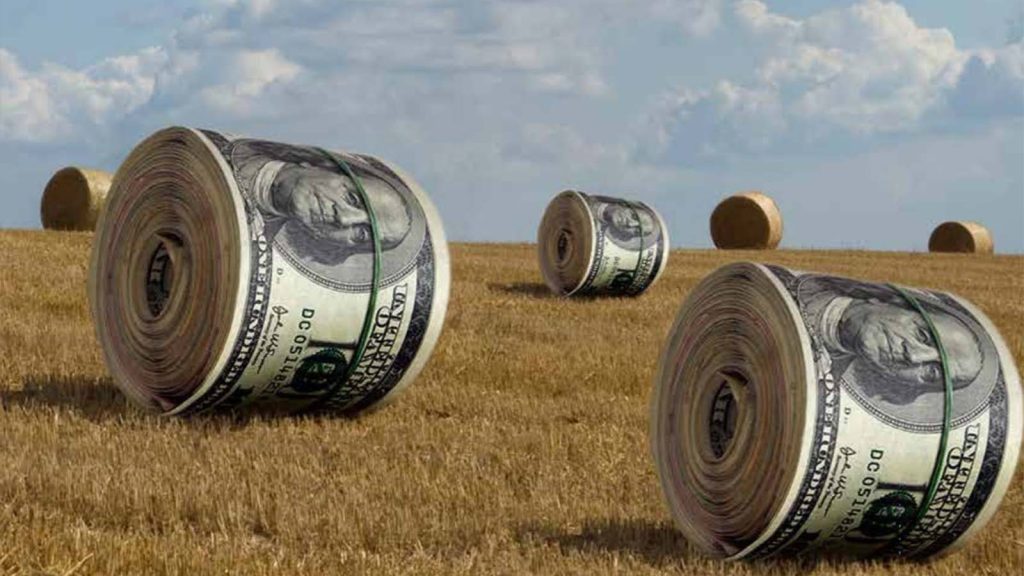
Institutional investors, including hedge funds, private equity, pension funds and university endowments, were eager to capitalise on global farmland as a new and highly desirable asset class.

This trend was not confined to buying up agricultural land in low-income countries. Oakland Institute’s Anuradha Mittal argued that there was a new rush for US farmland. One industry leader estimated that $10 billion in institutional capital was looking for access to this land in the US.

Although investors believed that there is roughly $1.8 trillion worth of farmland across the US, of this between $300 billion and $500 billion (2014 figures) is considered to be of “institutional quality” – a combination of factors relating to size, water access, soil quality and location that determine the investment appeal of a property.

In 2014, Mittal said that if action is not taken, then a perfect storm of global and national trends could converge to permanently shift farm ownership from family businesses to institutional investors and other consolidated corporate operations.

WHY THIS MATTERS

Peasant/smallholder agriculture prioritises food production for local and national markets as well as for farmers’ own families, whereas corporations take over fertile land and prioritise commodities or export crops for profit and markets far away that tend to cater for the needs of more affluent sections of the global population.

In 2013, a UN report stated that farming in rich and poor nations alike should shift from monocultures towards greater varieties of crops, reduced use of fertilisers and other inputs, increased support for small-scale farmers and more locally focused production and consumption of food. The report stated that monoculture and industrial farming methods were not providing sufficient affordable food where it is needed.

In September 2020, however, GRAIN showed an acceleration of the trend that it had warned of six years earlier: institutional investments via private equity funds being used to lease or buy up farms on the cheap and aggregate them into industrial-scale concerns. One of the firms spearheading this is the investment asset management firm BlackRock, which exists to put its funds to work to make money for its clients.

BlackRock holds shares in a number of the world’s largest food companies, including Nestlé, Coca-Cola, PepsiCo, Walmart, Danone and Kraft Heinz and also has significant shares in most of the top publicly traded food and agriculture firms: those which focus on providing inputs (seeds, chemicals, fertilisers) and farm equipment as well as agricultural trading companies, such as Deere, Bunge, ADM and Tyson (based on BlackRock’s own data from 2018).

Together, the world’s top five asset managers – BlackRock, Vanguard, State Street, Fidelity and Capital Group – own around 10–30% of the shares of the top firms in the agrifood sector.

The article Who is Driving the Destructive Industrial Agriculture Model? (2022) by Frederic Mousseau of the Oakland Institute showed that BlackRock and Vanguard are by far the biggest shareholders in eight of the largest pesticides and fertiliser companies: Yara, CF Industries Holdings K+S Aktiengesellschaft, Nutrien, The Mosaic Company, Corteva and Bayer.

These companies’ profits were projected to double, from US$19 billion in 2021 to $38 billion in 2022, and will continue to grow as long as the industrial agriculture production model on which they rely keeps expanding. Other major shareholders include investment firms, banks and pension funds from Europe and North America.

Through their capital injections, BlackRock et al fuel and make huge profits from a globalised food system that has been responsible for eradicating indigenous systems of production, expropriating seeds, land and knowledge, impoverishing, displacing or proletarianizing farmers and destroying rural communities and cultures. This has resulted in poor-quality food and illness, human rights abuses and ecological destruction.

SYSTEMIC COMPULSION

Post-1945, the Rockefeller Chase Manhattan bank with the World Bank helped roll out what has become the prevailing modern-day agrifood system under the guise of a supposedly ‘miraculous’ corporate-controlled, chemical-intensive Green Revolution (its much-heralded but seldom challenged ‘miracles’ of increased food production are nothing of the sort; for instance, see the What the Green Revolution Did for India and New Histories of the Green Revolution).

Ever since, the IMF, the World Bank and the WTO have helped consolidate an export-oriented industrial agriculture based on Green Revolution thinking and practices. A model that uses loan conditionalities to compel nations to ‘structurally adjust’ their economies and sacrifice food self-sufficiency.

Countries are placed on commodity crop production treadmills to earn foreign currency (US dollars) to buy oil and food on the global market (benefitting global commodity traders like Cargill, which helped write the WTO trade regime – the Agreement on Agriculture), entrenching the need to increase cash crop cultivation for exports.

Today, investment financing is helping to drive and further embed this system of corporate dependency worldwide. BlackRock is ideally positioned to create the political and legislative framework to maintain this system and increase the returns from its investments in the agrifood sector.

The firm has around $10 trillion in assets under its management and has, according to William Engdahl, positioned itself to effectively control the US Federal Reserve, many Wall Street mega-banks and the Biden administration: a number of former top people at BlackRock are in key government positions, shaping economic policy.

So, it is no surprise that we are seeing an intensification of the lop-sided battle being waged against local markets, local communities and indigenous systems of production for the benefit of global private equity and big agribusiness.

For example, while ordinary Ukrainians are currently defending their land, financial institutions are supporting the consolidation of farmland by rich individuals and Western financial interests. It is similar in India (see the article The Kisans Are Right: Their Land Is at Stake) where a land market is being prepared and global investors are no doubt poised to swoop.

In both countries, debt and loan conditionalities on the back of economic crises are helping to push such policies through. For instance, there has been a 30+ year plan to restructure India’s economy and agriculture. This stems from the country’s 1991 foreign exchange crisis, which was used to impose IMF-World Bank debt-related ‘structural adjustment’ conditionalities. The Mumbai-based Research Unit for Political Economy locates agricultural ‘reforms’ within a broader process of Western imperialism’s increasing capture of the Indian economy.

Yet ‘imperialism’ is a dirty word never to be used in ‘polite’ circles. Such a notion is to be brushed aside as ideological by the corporations that benefit from it. Instead, what we constantly hear from these conglomerates is that countries are choosing to embrace their entry and proprietary inputs into the domestic market as well as ‘neoliberal reforms’ because these are essential if we are to feed a growing global population. The reality is that these firms and their investors are attempting to deliver a knockout blow to smallholder farmers and local enterprises in places like India.

But the claim that these corporations, their inputs and their model of agriculture is vital for ensuring global food security is a proven falsehood. However, in an age of censorship and doublespeak, truth has become the lie and the lie is truth. Dispossession is growth, dependency is market integration, population displacement is land mobility, serving the needs of agrifood corporations is modern agriculture and the availability of adulterated, toxic food as part of a monoculture diet is feeding the world.

And when a ‘pandemic’ was announced and those who appeared to be dying in greater numbers were the elderly and people with obesity, diabetes and cardio-vascular disease, few were willing to point the finger at the food system and its powerful corporations,   practices and products that are responsible for the increasing prevalence of these conditions (see campaigner Rosemary Mason’s numerous papers documenting this on Academia.edu). Because this is the real public health crisis that has been building for decades.

But who cares? BlackRock, Vanguard and other institutional investors? Highly debatable because if we turn to the pharmaceuticals industry, we see similar patterns of ownership involving the same players.

A December 2020 paper on ownership of the major pharmaceuticals companies, by researchers Albert Banal-Estanol, Melissa Newham and Jo Seldeslachts, found the following (reported on the website of TRT World, a Turkish news media outlet):

Public companies are increasingly owned by a handful of large institutional investors, so we expected to see many ownership links between companies — what was more surprising was the magnitude of common ownership… We frequently find that more than 50 per cent of a company is owned by ‘common’ shareholders who also own stakes in rival pharma companies.”

The three largest shareholders of Pfizer, J&J and Merck are Vanguard, SSGA and BlackRock.

In 2019, the Centre for Research on Multinational Corporations reported that payouts to shareholders had increased by almost 400 per cent — from $30 billion in 2000 to $146 billion in 2018. Shareholders made $1.54 trillion in profits over that 18-year period.

So, for institutional investors, the link between poor food and bad health is good for profit. While investing in the food system rakes in enormous returns, you can perhaps double your gains if you invest in pharma too.

These findings predate the 2021 documentary Monopoly: An Overview of the Great Reset, which also shows that the stock of the world’s largest corporations are owned by the same institutional investors. ‘Competing’ brands, like Coke and Pepsi, are not really competitors, since their stock is owned by the same investment companies, investment funds, insurance companies and banks.

Smaller investors are owned by larger investors. Those are owned by even bigger investors. The visible top of this pyramid shows only Vanguard and Black Rock.

A 2017 Bloomberg report states that both these companies in the year 2028 together will have investments amounting to $20 trillion.

While individual corporations – like Pfizer and Monsanto/Bayer, for instance – should be (and at times have been) held to account for some of their many wrongdoings, their actions are symptomatic of a system that increasingly leads back to the boardrooms of the likes of BlackRock and Vanguard.

Prof Fabio Vighi of Cardiff University says:

Today, capitalist power can be summed up with the names of the three biggest investment funds in the world: BlackRock, Vanguard and State Street Global Advisor. These giants, sitting at the centre of a huge galaxy of financial entities, manage a mass of value close to half the global GDP, and are major shareholders in around 90% of listed companies.”

These firms help shape and fuel the dynamics of the economic system and the globalised food regime, ably assisted by the World Bank, the IMF, the WTO and other supranational institutions. A system that leverages debt, uses coercion and employs militarism to secure continued expansion.

Is the United States a Failed Society?

The facts have become too dire to ignore any longer.

By Chad Mulligan

Source: Hipcrime Vocab

I’d like to pose a question I’ve been dancing around for the last couple of postsIs the United States a failed society?

That may seem overly dramatic, but please hear me out.

Recently, it has once again come to the attention of the news media that Americans are an order of magnitude more likely to die at every age than citizens of other advanced, wealthy, industrialized nations.

This was most recently expounded by a Financial Times correspondent named John Burn-Murdoch. The article itself is paywalled, but this Twitter thread contains all the relevant information:

https://threadreaderapp.com/thread/1641799698058035200.html

It makes for sobering reading. A lot of times the discussion just focuses on total life expectancy, that is, the number on the death certificate. That’s fallen too, but not as dramatically. But life expectancy differs at various ages. Yet, what the numbers invariably show is that, at every single age Americans are more likely to die than their counterparts in other wealthy industrialized nations.

For example, one in 25 five-year-olds in the United States will not live to see their fortieth birthday. That means a lot of parents are going to have to bury their children. But at every age, whether you’re twenty-five or fifty, your chances of dying are much higher in the United States than anywhere else. By age 29, the average American is four times more likely to die than a 29 year-old in another country. I’ve heard plenty of stories from people in their twenties and thirties talking about their high-school years like military veterans recounting their service during wartime (“fifteen in my class didn’t make it out.”). And those are just ordinary citizens!

In other words, growing up in the United States is extraordinarily deadly.

In fact, the social outcomes for the average American are worse than the most socially deprived areas of the United Kingdom like Blackpool—an area synonymous with industrial decline. At every single point along the income distribution, Americans are more likely to be hurt, injured, or killed than their peers in other wealthy, developed nations.

Furthermore, these trends are exclusively confined to the United States. Even Cuba, a relatively poor country under continuous sanctions by the United States since the nineteen-sixties, now has better health outcomes (e.g. life expectancy, infant mortality, chronic diseases). So, too, does China, which has overtaken the U.S. in a number of health metrics despite being the largest country in terms of total population.

The Atlantic’s Derek Thompson has called the United States “The Rich World’s Death Trap.” He interviews John Burn-Murdock here:

The bottom line is this: in many ways, your life chances are much, much lower in the United States than in any other wealthy, industrialized nation in the world. This is simply undeniable.

Which leads me to pose the question I asked above.

Peer Countries

Because this is such a fraught topic, it’s worthwhile to get some things out of the way. Certainly your life chances in the United States are better than many other parts of the world at the moment.

Some places are run by military dictatorships like North Korea or Myanmar. Some places are in outright civil war like Syria, Libya or Sudan. Some areas are in an active shooting war like Ukraine and Russia. Some countries have huge areas of absolute deprivation like sub-Saharan Africa, India, the Philippines or Afghanistan. Some countries have lost control over parts of their territory to drug gangs like Mexico, El Salvador, Peru and Ecuador. You’re certainly better off here than in many of those other countries.

So let’s just acknowledge that right off the bat. Of course, this raises questions about just how supposedly wonderful the current state of our world actually is, but that’s a topic for another time.

But I think it’s absolutely invalid to invoke those countries as a justification for the abysmal statistics listed above. Here’s why: the United States is at the absolute apex of the global economy, and has been since World War Two. We issue the world’s reserve currency. We have more billionaires than anywhere else. We are home to the largest and most powerful corporations in the world. No country in the world is more wealthy or powerful than the United States at the present moment.

This is the concept of peer nations. Those are the ones we should be judging ourselves against. You can use a number of indicators for this. The United States is a member of both the OECD and the G-7. In fact, it is the key member of these organizations. It is at peacetime. It is an electoral democracy. It has the world’s largest GDP. It is surrounded by the world’s two largest oceans and has benign neighbors to the north and the south. It has not had a war on its home soil since the 1860s.

Simply put, the United States has more resources at its disposal and more wherewithal to tackle social problems than anywhere else in the world.

So, unlike many other countries around the world, the United States has no excuse whatsoever for the sorry state of its citizenry, and comparing the United States to non-peer countries is no more than pathetic excuse-making in the face of damning evidence that the U.S. government simply chooses to ignore burgeoning social problems and leaves the majority of its citizens to fend for themselves.

What Else Is New?

Reading these facts, I’m wondering why any of this this is news to people. As far back as 2013 I noted the following:

Americans die younger and experience more injury and illness than people in other rich nations, despite spending almost twice as much per person on health care.

That was the startling conclusion of a major report released earlier this year by the U.S. National Research Council and the Institute of Medicine. It received widespread attention. The New York Times concluded: “It is now shockingly clear that poor health is a much broader and deeper problem than past studies have suggested.”

Why Is the United States So Sick? The director of a massive new study says: “It’s almost everything.” (Slate)

Also from 2013: The Surprising Reason Americans Are Far Less Healthy Than Others in Developed Nations (Alternet)

It received widespread attention all right, and then was promptly forgotten. But even earlier, in 2012, there was this report from The Lancet:

American teenagers have the highest rates of drug and alcohol abuse in the developed world. And they are far more likely to be killed by violence than peers in Europe. This lost generation, whose unemployment rate is 20 percent, leads the modern world in some of the most dangerous and irresponsible behaviors, according to a new study released by the Lancet medical journal.

U.S. teens worst in western world for binge-drinking, drugs and violent deaths (Daily Mail)

In 2019, husband-and-wife economists Angus Deaton and Anne Case coined the term “deaths of despair,” and noted that these were exclusively confined to the United States. In 2020, they published a book chronicling their grim studies with that same title. It, too, received a brief burst of attention in the media and then promptly disappeared down the memory hole just like everything else.

So this is old news. As Burn-Murdock’s article notes, the divergence between the U.S. and its peers has been continuously growing since around 1990, and has been getting even more acute in recent years.

The above podcast touts how “rich” we are compared with other nations using metrics like dollar income. But what does a high salary even mean when you are less likely to survive than other places? What are you supposed to do with that money, anyway—fill your oversized house with crap? As the saying goes, “you can’t take it with you.” This also belies the insanely high cost of everything in America, especially housing, which leads to 70 percent of Americans feeling financially stressed according to CNBC, despite how “rich” we supposedly are. According to Brookings, 44 percent of Americans earn low wages in this allegedly “rich” country.

And, as economist Dean Baker has noted, people in many other countries choose to take their additional “income” as leisure time, which may be another reason why they are so much healthier than we are. Americans work longer hours than anyone else, and at unusual times. The United States has a lousy work culture, with much less vacation or family leave time than other countries. Americans also take less vacation, work longer days, and retire later. Citizens of other countries also don’t have to pay for as many things out of their own pocket—from transportation, to retirement, to health care—due to a misguided fear of “socialism,” making income comparisons misleading. What sense does it make to earn a lot of money if you are lonely and isolated and have no time off to enjoy it? And much of that extra income is dedicated to cushioning ourselves from the fallout of a society decaying around us and positional goods to compete with everyone else.

My question is this: if the United States is not a failed society, then by what criteria should we judge success? Are context-free income statistics, GDP, and the number of billionaires really the appropriate measure for a good society rather than the well-being of the average citizen? People like to tout America’s so-called “innovation,” but one area we don’t seem to be innovating very much in is keeping our citizens healthy and alive.

The symptoms versus the disease

The reasons given for the above statistics are the usual ones: gun violence, drug overdoses, suicides, car crashes, metabolic diseases, and lack of access to basic and preventative health care compared to other nations.

But I want to distinguish the symptoms from the disease.

In medicine, doctors are taught to separate the symptoms from the disease. If a patient is suffering from a fever, jaundice, and swelling, for example; the fever, jaundice, and swelling aren’t what is making them ill. Instead, these are all symptoms caused by the disease which the patient is afflicted with, and it is the doctor’s job to determine what the disease is from the symptoms and try to cure it.

If that is the case, then what is the disease we are suffering from in this instance? In my opinion, it is this: American society is fundamentally rotten to the core.

We have effectively restructured our entire society as a lottery. Under this system, you’re entitled to precisely nothing except what you can claw free from the impersonal market casino rigged in favor the House. American society been transformed into a brutal winner-take-all tournament in the name of “meritocracy,” and most Americans seem to be okay with that.

At every point on their hierarchy, from the highest perch to the lowest, everyone is desperately trying to maintain their current position, hyperattuned to status, fearful of falling into the abyss, clawing each other’s eyes out to hold onto their small piece of the pie in a crabs-in-a-bucket scenario. “There is no such thing as society” has been elevated from a political statement to a a central guiding tenet where it’s every man for himself and the devil take the hindmost.

While other nations at least try to look after the welfare of all of their citizens, in America if you are not rich, successful or an entrepreneur, then your life is worth nothing. If you aren’t good enough, or don’t measure up, then you deserve to suffer. We actively hate the poor and think they should die. We talk about them like animalsAverage is over. The rich get richer. Winners take all.

Cutthroat capitalism is the order of the day. Your only task when you get up every morning is to get as much of the other guy’s money as possible into your own bank account by any means necessary for the next twenty-four hours and do it all over again the next day. There is no higher purpose. “Freedom” is defined as the ability for the rich to do whatever they like to the rest of us without consequence or sanction. It’s a world of predator and prey where you can either be one or the other—there is no other option.

Unlike in other countries, in the United States the government does not exist to help its citizens; rather, its primary role is to funnel money to a series of well-connected insiders feeding at various troughs. The rest of us are on our own. No one is on your side.

In every country, you need to educate your citizenry and keep them safe and healthy. That is the most basic task of any government, anywhere. In the United States, these tasks are delegated to predatory institutions designed to extract as much money as possible so that sticky-fingered middlemen can siphon off as vast amounts to feather their nests. A small sliver of executives in finance, education and health care get obscenely rich while the rest of the population struggles and is mired in debt, assuming they can even access those services at all. As a result, Americans pay wildly inflated prices for just about everything, from health care, to education, to energy, to entertainment and telecommunications. And the system cannot be changed because those insiders and middlemen fund the political campaigns and spend billions on highly effective propaganda. The rich people at the apex cynically strip-mine society for their benefit, while there are fewer paths than ever to a middle class lifestyle for the average person.

“Everything for myself and my immediate offspring; nothing for other people,” is the pervasive ethos: “I dont want pay for someone else’s (health care, education, fill-in-the blank).” But once that attitude becomes endemic, you no longer have anything even resembling a society anymore; you have only collection of individuals fending for themselves. As the title of a post from a few years back put it“I don’t know how to explain to you that you should care about other people.”

It is a nation of sociopaths where fellow citizens are seen as either enemies or competitors. The simple warmth of human kindness has been abolished. Americans walk around in a constant state of fear and high alertness like the prey animals they have become. Or else they have the thousand-yard-stare grazing in the aisles at Walmart. I’ve mentioned before how many Americans seem to be crazed and deranged, or zonked out on drugs, and don’t know how to behave around other people or show basic decency. People seem more and more desperate. I personally have witnessed many more acts of erratic behavior and dangerous driving lately, and have heard similar stories from other people. American society seems to be under more pressure than ever before, and people are cracking up left and right. It feels like a lot of people—even the supposedly “successful” ones—have basically checked out and are simply going through the motions.

The United States is a plantation society to the core. At a basic, fundamental level, American society is not set up not to deliver a good quality of life to it citizens, but rather for a small segment of hard, hard men to get unfathomably rich beyond the dreams of avarice, with the rest of us no more than insects to be stepped on in pursuit of that goal. And if some people happen to enjoy good lives anyway under that system, well, it’s more of an unintentional side-effect than a deliberate outcome. Perhaps you’re one of those hard men (or women), or hope to be. Good for you, I guess.

So I think that’s the fundamental reason for all of the above. That’s the disease, and everything else is merely a symptom—our refusal to properly fund universal health care; our built environment designed exclusively around cars and lack of public transportation; our fat and sugar-laden diets; our overcrowded prisons; our opioid-addicted homeless; our frayed social safety nets; our violent, trigger-happy cops; our extortionate education costs; our predatory financial institutions; our refusal to build affordable housing; and our propensity to shoot one another. American society is rotten to the core.

For example, even though our weekly mass shootings make international headlines, they don’t really have that much of an impact on life expectancy when you compare them against the size of the world’s third most populous nation, despite troubling statistics like these:

Last year (2022), two people died from gun violence in the United States every hour. In 2023, there have been at least 160 mass shootings across the US so far this year. There are 120 guns for every 100 Americans. No other nation has more civilian guns than people. About 44% of US adults live in a household with a gun, and about one-third personally own one.

How US gun culture stacks up with the world (CNN)

How many US mass shootings have there been in 2023? (BBC)

But that’s not the question we should be asking. The question we should be asking is this: what does this level of gun massacres and homicidal mania say about the nature of American society itself?

What does it say about American society that so many people have to turn to alcohol, opioids and other addictive drugs just to cope?

What does it say about America that it produces so many mentally-ill and broken people?

What does it say that Americans are so much fatter and sicker than people in other countries?

What does it say that we lock up more of our citizens than anywhere else in the world?

What does it say that our Surgeon General has described an epidemic of loneliness and isolation?

Americans are prickly and thin-skinned. They can’t bear any criticism of their nation, and will absolutely lose their minds at even the implication that they do not live in the best country on earth, despite mountains of evidence to the contrary (unless you are very wealthy). They will rationalize away all of the statistics listed above. Or else they will resort to immigrants as a way to shore up their fragile egos: “Everyone wants to move here!!!” Interestingly, according to the podcast above (-14:39), U.S. immigrants seem to live about as long as anyone else in the world. Perhaps it’s because immigrant communities tend to look after each other and manage to keep the toxic, every-man-for-himself individualism of mainstream American culture at arm’s length. Too bad for the rest of us, though.

In the end, the facts speak for themselves: By the standards that actually matter for the average individual, compared to peer nations, the United States is an objective failure.

Why is it like this? Some pessimists say that it’s been like this from day one and there’s nothing we can do about it. Perhaps they’re right. But the facts tell a different story. According to the data, it’s really only since 1990 that this yawning chasm in social outcomes has opened up in between the United States and the rest of the world. During the New Deal era, for instance, these gaps didn’t exist or actually favored Americans. The United States was able to accomplish big things like building the Hoover Dam and putting a man on the moon, and people didn’t hate and fear their own government. The U.S. was perceived very differently abroad.

Here’s what I think happened. Starting in the 1970s a small group of sociopathic men at the top of the hierarchy acquired the means and the tools to reshape the United States in their own image. They founded think-tanks. They funded economics departments and political campaigns. They bought up the media. They started television networks to promote their agenda. They packed the courts. They used the latest cutting-edge psychological research and techniques that had been developed in the service of advertising to remold the society like putty in their hands. Throughout the decade of the 1980s under Reagan, their plans ultimately came to fruition, and the transformation was compete by 1990 which is why the changes became apparent after then. Ever since, we’ve been living in the society that they have created. I’m skeptical that Americans were always inherently more sociopathic and antisocial than people everywhere else—I think to a large extent we’ve been made to be this way.

So we’re all living in the end result of that. And now that it has been accomplished, we see the ugly results everywhere around us, including increasing political radicalization and strife as the failure of this vision of society is becoming increasingly apparent but we seem to be incapable of envisioning an alternative or are too fearful of change. Instead, we seem to be doubling down. I fear it’s already too late to turn things around, and this is just the way American society will be forever now and things will just continue to get worse and worse for the vast majority of us. We will remain the (not so) rich world’s death trap, permanently.

I’ll conclude with this passage which I read years ago:

If I could paint the country in one broad stroke, I would say it’s a place where one concept of freedom – used to lobby for private interests and free markets – is at odds with another kind: the ability to lead a life you enjoy. Fewer and fewer seem privileged with this second kind. Not Trayvon Martin, who was a victim of a certain kind of racism which had, as its root, private property anxiety. Not the natural gas employee who has consigned himself to a life of doing something that he feels ought not to be done. Even I – who have managed to escape from time to time – always find, upon return, a cordial invitation to fall in line.

What I learned about freedom from hitchhiking around America (The Guardian)

As the above statistics show, not only are many of us not living lives we enjoy, but increasingly more and more of us aren’t living at all.

The Warmongering U.S. Empire Is Crashing, the Lying Western Media’s Days Are Numbered

The Western mainstream media have never been so blatant in their propaganda for the U.S. empire

By Finian Cunningham

Source: Strategic Culture Foundation

The Western mainstream media have never been so blatant in their propaganda for the U.S. empire.

The pretensions are threadbare. As the warmongering U.S. government/regime and its Western/NATO imperialist lackeys are becoming more exposed and desperate to maintain credibility, so too are their media tools. The likes of the New York Times, BBC, CNN – and many more – are a contemptible joke on the public. They are an insult to common intelligence.

Fake news has been around for centuries, but it’s now becoming glaringly obvious and self-destructive. In the same way that the U.S. warmongering empire is becoming glaringly obvious and self-destructive.

The disconnect with reality and degradation of supposed independent journalism is reflected in record levels of distrust among the Western public toward the mainstream, corporate-controlled news media.

In this interview, U.S.-based writers Bruce Gagnon and Daniel Lazare demolish the pretensions of Western media.

The systematic cover-up of the Nord Stream sabotage by the United States and its NATO allies – an act of war and state terrorism – demonstrates the servile function of Western media outlets that claim to be pillars of independent news and freedom of information.

Media outlets like the New York Times, Washington Post, and the British state-owned BBC, among many others, have been exposed as pathetic propaganda tools for the United States and other NATO imperialist regimes.

All Western media outlets have ignored credible investigative reporting by Seymour Hersh (and others) who have very plausibly implicated the sabotage of Nord Stream by the U.S., carried out under the instructions of American President Joe Biden.

Another touchstone subject is the vile persecution of Julian Assange. Western media have again covered up what are a shocking violation of Assange’s rights and principled publishing through the whistleblower organization Wikileaks. Julian Assange’s only “crime” is that he revealed the war crimes committed by the U.S. and its imperialist lackeys.

Assange’s appalling mistreatment, indeed torture – four years in British solitary confinement awaiting extradition to the U.S. over spurious “spying charges” – is a vicious attack on journalism and the public’s right to know. Yet supposed self-declared Western media defenders of “truth” and “fact-based” objective information – have conspired to be silent and permit Assange’s persecution. Western media are shown to be complicit in destroying the very principles of journalism that they claim to uphold.

As Bruce Gagnon and Daniel Lazare point out, it is a crime to tell the truth and Western media stand exposed in their odious dereliction of duty to report independently. They are seen more than ever as out-and-out tools of empire.

A proper understanding of the Nord Stream sabotage and the case of Julian Assange would give the Western public a critical insight into the imperialist nature of their governments – regimes that serve warmongering capitalist interests. Critical mass must be thwarted at all costs by the Empire’s media foot-servants.

From the point of view of U.S.-led Western imperialist power, it is imperative and absolutely vital to cover up the scandals of the Nord Stream attack and Julian Assange, among others. If the public were to become more widely cognizant then the whole edifice of Western governments implodes. This is why the Western media are more blatant than ever to cover up. But the truth will win out.

The war in Ukraine is becoming more evident as a war-racket and imperialist proxy war against Russia. That war is in desperate danger of spiraling into an all-out world war that could unleash a nuclear catastrophe.

The same Western media cover-up is at work with regard to the U.S.-led NATO aggression toward China. Again, the Western media are spinning imperialist propaganda of alleged Chinese menace in order to justify what is an insane warmongering agenda to confront China and prop up American hegemonic ambitions.

A tantalizing positive prospect is that critical, independent media are gradually and relentlessly breaking the monopoly of Western propaganda media. The internet and global communications are seeing to that – albeit against sinister censorship by Western regimes.

Nevertheless, the establishment Western media are increasingly held in distrust and contempt by the Western public and globally.

We are living in an exemplary time of the fabled Emperor With No Clothes. The false image of dominant Western regimes and their lying corporate media has never been so degraded but also never so fragile. The Western lie machine’s days are numbered. It only has itself to blame because of its abject disservice to the public interest.

Western state-complicit media claim to be “free”. Laughably, they are “free” to be slaves of lies and propaganda.

A crash is long overdue.

THE BATTLE AGAINST BEWITCHMENT: UPSETTING SETTLED MINDS

By Gary Z McGee

Source: Waking Times

“Philosophical thinking that doesn’t do violence to one’s settled mind is no philosophical thinking at all.” ~Rebecca Goldstein

Comfort zones are a curious thing. So warm and secure. So safe and reassuring. So satisfying and certain. Beliefs have a similar effect on us. Especially the core beliefs that we take for granted. But beliefs are comfort zones with reinforced invulnerability; or, at least, the illusion of it.

Such reinforcements are like prison bars that most of us are not even aware of. We’re so completely indoctrinated, so utterly pre-programmed, that we don’t even know that we don’t know that we’ve been conditioned to blindly believe in something simply because enough people convinced us it was true.

The problem with reinforced comfort zones is that there is no growth. A regular comfort zone, you can stretch. A reinforced comfort zone, you’re usually not even aware it needs to be stretched. A regular comfort zone allows for trial and error, it allows for questioning, and so there is at least potential for self-improvement and self-overcoming. But a reinforced comfort zone does not allow for trial and error. It doesn’t allow for “blasphemous” questioning, because it is taken for granted as already perfect or “simply the way it is.”

Regular comfort zones can be healthy, giving us a safe haven, a place where we can heal and lick our wounds. But reinforced comfort zones are unnecessary safety nets based upon fear (of God, the Unknown, Death) placation, and self-pity. It’s a place where cognitive dissonance rules and any notion of attempting to think outside the box is met with: You simply need to have faith in the “box”.

The Battle Against Bewitchment:

Philosophy is a battle against the bewitchment of our intelligence by means of language.” ~Ludwig Wittgenstein

Self-Inflicted Philosophy is at the forefront of the battle against bewitchment. Self-inflicted philosophy is about upsetting settled minds. It’s about toppling the reinforced comfort zones of blind belief. It’s about flattening the “box” that everyone talks a big game about thinking outside of but when it really comes down to it, they cling to the “box” out of fear of the unknown or out of faith in what they believe they know.

Foremost, self-inflicted philosophy is about questioning the self to the nth degree through self-interrogation. But you can only get so far in such questioning before you are met with the reinforced comfort zone of a blind belief. So, self-inflicted philosophy is also about questioning the layer-upon-layer of cultural, political, and religious indoctrination that led to that reinforced comfort zone to begin with.

When you don the cloak of a self-inflicted philosopher, no belief, no matter how true it may seem, is off the hook for being questioned with ruthless skepticism and unwavering circumspection. In the battle against bewitchment, the destruction of a belief, no matter how powerful, is mere collateral damage to the Occam’s razor of universal truth. Hell, even “universal truth” is not beyond questioning.

When you don the cloak of a self-inflicted philosopher, the concept of belief is nixed from your interpretation of the universe. There is no place for belief here, only thought, only deep inquiry, only imaginative curiosity. You replace all usage of “belief” or “believe” with “thought” or “think”. You don’t believe that you certainly exist, you “think” that you “probably” exist. But you could be wrong. So you remain circumspect, for even your interpretation of your own existence could be an illusion, no matter how “true” it may feel.

There will be those who will say, “You are merely believing that you don’t believe.” But that is patently false, because you are not “believing” in non-belief, you are “thinking/inquiring/imagining” through non-belief, with the understanding, the flexibility that your thinking “could” be wrong. And that’s the rub: it is much easier to alter a thought than a belief. It is almost impossible to alter a belief. You are more likely to question a thought than you are a belief. And so, rather than get trapped in a reinforced comfort zone, you stay ahead of the curve by thinking rather than believing, and then by questioning what you think so that you don’t accidentally begin to believe it.

In the spirit of upsetting settled minds, you don’t believe in having an unsettled mind, you think that having an unsettled mind is more productive, more progressive, and more open-minded than having a settled mind (an unquestioning belief). You realize that belief in general is counterproductive, because you understand that the human mind is a delusion-generator rather than a truth-generator. It pumps out delusions like a spider pumps out webs. But, unlike the spider, it tends to get caught in them. Thereby, you understand that the only window to truth is through a questioning, circumspect, and a skeptical mindset, rather than through an unquestioning, dogmatic, and certain mindset.

The only solution to a delusion-generator is a question-generator. Luckily, the human brain is both. As a self-inflicted philosopher, you don’t believe that this is certainly true; rather, you think that this is probably true. And you’re willing to question everything to “prove” it. Indeed, you’ve transformed Descartes’ “I think therefore I am” into I think, therefore I question.

Tapping into the question-generator:

“It is far better to grasp the universe as it really is than to persist in delusion, however satisfying and reassuring.” ~Carl Sagan

The problem with the human brain is that is never knows when it has been duped by a delusion, so it is almost always better to not believe anything just in case it’s a delusion. A kind of reverse Pascal’s Wager. It’s almost always better to, as Aristotle suggested, “entertain a thought without accepting it.” Just take it all into consideration and let it pass through the sieve of probability. Then, whatever doesn’t insult your soul, think about it, dissect it, inquire about it. Be curious about it. Just don’t make the mistake of believing it.

You are more likely to grasp the universe “as it really is” by questioning it than by believing it. You don’t believe the universe is certainly a certain way; rather, you think the universe may be a certain way, but you’re willing to question further so as to get you closer to the way the universe “really is”. If you cling to a particular belief of how the universe is, then you block yourself from ever getting closer to the universe “as it really is.” Better to simply not have a belief in the first place. Better to simply think and keep the motor running on the question-generator so as to keep the delusion-generator in check.

The opposite of belief is neither disbelief nor doubt, but clarity of a thought. Without beliefs reinforcing the comfort zone, you are liberated to stretch it. You are clear enough to think outside it, you are courageous enough to question it. When the reinforcements fall away, the comfort zone becomes a sacred rather than stagnant place. It is free to grow through self-improvement rather than remain stuck in self-reassurance. Indeed, without beliefs cluttering the mindset, you’re finally able to drop the “set” and move into “mind.”

Free of the “mindset” of a settled mind, you move into the mindfulness of a questioning mind. You become a walking, talking, question-generator, able to consistently counter-balance the delusion-generator of the human condition. You’re ahead of the curve, surfing Aslam’s Infinite Circle on the surfboard of Occam’s razor. In absolute awe over the beautiful unfolding of an ultimately unknowable universe. On the edge of your own curiosity, questioning all “answers” countering all beliefs, elusive of all delusions. You’re a self-inflicted philosopher, and not even God is safe from your ruthless inquiry.

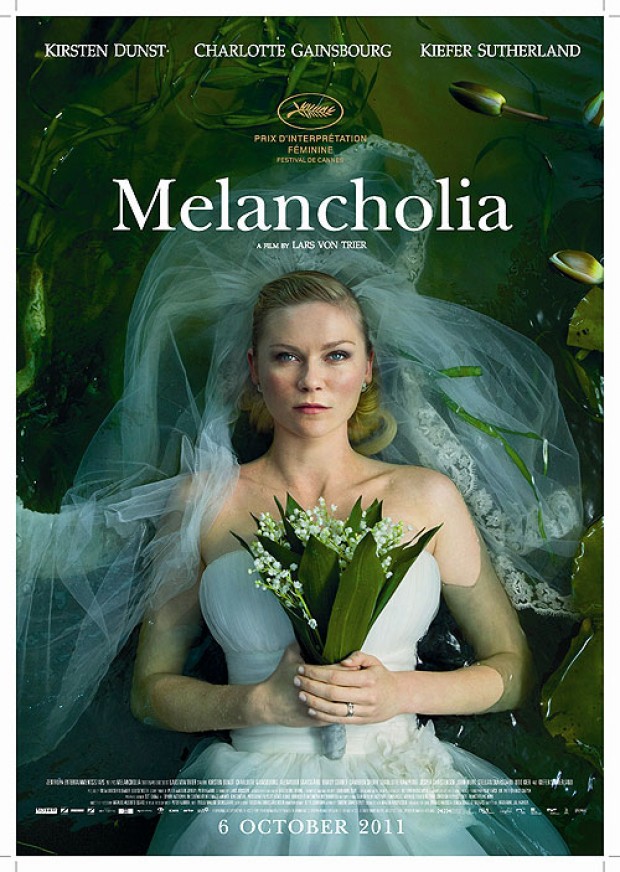
Saturday Matinee: Melancholia

Melancholia Review

By Ewan Gleadow

Source: Cult Following

Uncomfortable productions are the forte of director Lars von Trier. The allusions to and disquieting effect of his features and their focus is something to be realised in the prime of his works. What that area is can be debated and pulled at, but Melancholia appears to be the poetry in motion Trier fans so often praise the director for. Musical accompaniments to still shots of paintings that slowly peel and ripple. It’s a delightful piece for those that love the artisan qualities of a world falling apart and the destruction that comes from character sleights. The immovable nothing that comes from it touches deeper and deeper as Melancholia, the finest Trier work, rages on.

That much comes from the absolute beauty of its structure, of its characters. Shaped and informed by destruction, moving paintings that take place on strange canvases that display torment and passion, family and love. Melancholia has all the time in the world for its visual chemistry and the representations it can bring. There is no tiring effect brought by Trier, who trusts in his lengthy segments of two worlds, quite literally, colliding. Audiences are placed right at the end and know what is to come, what fate the characters meet and how it all comes to a crashing bit of destruction. In identifying the hopelessness, Trier brings himself to the inevitable edge that comes from discussing finality. It feels a bit like what The Fountain tried and failed to comment on, but with much, much more scope than the Hugh Jackman-led piece.

Within Melancholia is the profound beauty of visual meaning. It is a piece that relies more on the slower motions and relationships told in flutters rather than a full-on narrative that demands and desires strict following of the story. There is a fast and loose layer to Trier’s work, where his direction provides beauty and colour with that fear. Kirsten Dunst delivers a phenomenal catalyst for life. It gives the happiest moments of life and the cursed afterthoughts. Trier mixes the palette well, he provides that to the cast and relies on them so frequently to engage with the emotion, rather than dialogue. It is the choreography, and the appeal of his directing style, that makes Melancholia such an intoxicating watch.

Senseless destruction with poetic twists and turns at their finest, Melancholia is a touching and spiritually charged look at the useless tirades and meaninglessness of it all. With Melancholia exposing itself to the raw elements, it does often focus on its imagery more than its characters. Trier’s style, the unfocused extremes of the close-up shot, the shot-reverse-shot simplicity, it all has its place but where that is can come across as unfounded. His fly-on-the-wall appeal has its moments throughout this piece, with a triple threat of Charlotte Rampling, John Hurt and Stellan Skarsgård making the most of that. There is no harm in stacking the cast so high, it adds texture and richness to an already broad-in-scope feature. Melancholia feels right at home biting off more than it can chew, both narratively and emotionally.

____________________

Watch Melancholia on Kanopy here: https://www.kanopy.com/de/product/69665

Unraveling the Epstein-Chomsky Relationship

Recent revelations that the renowned linguist and political activist met with Jeffrey Epstein several times have surprised and confused many. Why was Epstein interested in meeting with Noam Chomsky? And why did Chomsky agree to meet him despite his past? The answer may surprise you.

By Whitney Webb

Source: Unlimited Hangout

On Sunday, the Wall Street Journal published a report detailing information contained within a “trove” of previously unreported documents of the deceased sex trafficker Jeffrey Epstein. Those documents, which have not been publicly released and appear to have been passed solely to the Journal, included Epstein’s private calendar and meeting schedules. The documents, per the Journal, contain “thousands of pages of emails and schedules from 2013 to 2017” and – as the report notes – detail Epstein’s dealings with several prominent individuals whose names were not on his flight logs or his infamous “little black book” of contacts. One of these individuals is the renowned linguist, political commentator and critic of capitalism and empire, Noam Chomsky.

Chomsky, who has previously discussed the Epstein case in interviews and who has maintained that Epstein’s ties to intelligence agencies should be considered a “conspiracy theory,” had not previously disclosed these meetings. Chomsky, when confronted by Journal reporters, was evasive, but ultimately admitted to meeting and knowing Jeffrey Epstein. 

Many, largely on the left, have expressed dismay and confusion as to why someone with the political views of Chomsky would willingly meet, not once but several times, with someone like Jeffrey Epstein, particularly well after Epstein’s notoriety as a sex trafficker and pedophile. As this report will show, Epstein appeared to view Chomsky as another intellectual who could help guide his decisions when it came to his scientific obsessions – namely, transhumanism and eugenics. What Chomsky gained in return from meeting with Epstein isn’t as clear.

Why Did Chomsky Meet with Epstein?

According to the Journal, Chomsky’s meetings with Epstein took place during the years 2015 and 2016, while Chomsky taught at the Massachusetts Institute of Technology, or MIT. Chomsky told the Journal that he met with Epstein to discuss topics like neuroscience with other academics, like Harvard’s Martin Nowak (who was heavily funded by Epstein). On a separate occasion, Chomsky again met with Epstein alongside former Israeli Prime Minister, Ehud Barak, allegedly to discuss “Israel’s policies with regard to Palestinian issues and the international arena.” A separate date saw Chomsky and his wife invited by Epstein to have dinner with him, Woody Allen and Allen’s wife Soon-Yi Previn. When asked about the dinner date with Woody Allen and Epstein, Chomsky referred to the occasion as “an evening spent with a great artist.”

When confronted with this evidence, Chomsky initially told the Journal that his meetings and relationship with Epstein were “none of your business. Or anyone’s.” He then added that “I knew him [Epstein] and we met occasionally.”

Before continuing further, it is important to note that aside from Epstein, both Ehud Barak and Woody Allen have been accused of having inappropriate sexual relationships with minors. For instance, Barak was a frequent visitor to Epstein’s residences in New York, so often that The Daily Beast reported that numerous residents of an apartment building linked to Epstein “had seen Barak in the building multiple times over the last few years, and nearly half a dozen more described running into his security detail,” adding that “the building is majority-owned by Epstein’s younger brother, Mark, and has been tied to the financier’s alleged New York trafficking ring.”

Specifically, several apartments in the building were “being used to house underage girls from South America, Europe and the former Soviet Union,” according to a former bookkeeper employed by one of Epstein’s main procurers of underage girls, Jean Luc Brunel. Barak is also known to have spent the night at one of Epstein’s residences at least once, was photographed leaving Epstein’s residence as recently as 2016, and has admitted to visiting Epstein’s island, which has sported nicknames including “Pedo Island,” “Lolita Island” and “Orgy Island.” In 2004, Barak received $2.5 million from Leslie Wexner’s Wexner Foundation, where Epstein was a trustee as well as one of the foundation’s top donors, officially for unspecified “consulting services” and “research” on the foundation’s behalf. Several years later, Barak put Harvey Weinstein in contact with the Israeli private intelligence outfit Black Cube, which employs former Mossad agents and Israeli military intelligence operatives, as Weinstein sought to intimidate the women who had accused him of sexual assault and sexual harassment.

In addition, Barak previously chaired and invested in Carbyne911, a controversial Israeli emergency services start-up that has expanded around the world and has become particularly entrenched in the United States. Barak had directed Epstein to invest $1 million into that company, which has been criticized as a potential tool for warrantless mass surveillance. Leslie Wexner also invested millions in the company.

In Woody Allen’s case, he has been accused of sexually assaulting his adopted daughter Dylan Farrow when she was 7 years old. That abuse claim has been corroborated by witnesses and other evidence. Furthermore, Allen refused to take a polygraph administered by state police in connection with the investigation and lost four exhaustive court battles related to child custody and his abuse of Dylan Farrow. One of the judge’s in the case described Allen’s behavior towards Dylan as “grossly inappropriate and that measures must be taken to protect her.” Actress Mia Farrow, Dylan’s mother, alleged in court that Allen took a sexual interest in her adopted daughter when she was between the ages of two and three years old.

Allen subsequently “seduced” and later married another adopted daughter of Farrow’s, Soon-Yi Previn, whom Allen first met when Previn was a child. However, Previn has stated that her first “friendly” interaction with Allen took place when she was a teenager. In 1992, Mia Farrow found nude photos of Previn in Allen’s home and has stated that this was her motive for ending her relationship with Allen.

In the case of Allen and Epstein, and potentially Barak as well, their sexual proclivities and scandals were well known by the time Chomsky met with these men, making a strong suggestion that this type of behavior was not seen by Chomsky as taboo or as a barrier to socialization. It is more likely than not that there was some other major draw that led Chomsky to overlook this type of horrendous behavior toward vulnerable minors.

In terms of reaching a deeper understanding about why Epstein would have been interested in Chomsky – and vice versa, it is important to review – not just the information recently reported by the Wall Street Journal, but also what Epstein himself said of Chomsky before his 2019 death. According to an interview conducted in 2017, but later published in 2019 when Epstein was a major news topic, Epstein openly stated that he had invited Chomsky to his townhouse and he also explicitly stated why he had done so. Oddly, this early acknowledgement of Epstein’s regarding his relationship with Chomsky was left out of the Journal’s recent report.

In that interview, which was conducted by Jeffrey Mervis and later published in Science, Epstein stated that following about Chomsky:

[…] Epstein readily admitted to asking prominent members of the scientific establishment to assess the potential contribution of these so-called outcasts [i.e. MIT students Epstein described as being “on the spectrum”].

“So, I had Jim Watson to the house, and I asked Watson, what does he think about this idea,” a proposal to study how the cellular mechanisms of plants might be relevant to human cancer. Watson is a Nobel laureate and co-discoverer of the structure of DNA. “Likewise with [Noam] Chomsky on artificial intelligence,” he said, referring to one of the pioneers in the field.

In fact, Epstein expressed great respect for the opinions of these elder statesmen. “It’s funny to watch Noam Chomsky rip apart these young boys who talk about having a thinking machine,” Epstein noted. “He takes out a dagger and slices them, very kindly, into little shreds.”

Thus, per Epstein, his interest in inviting Chomsky to his house was explicitly related to the “artificial intelligence,” which was a major scientific interest of Epstein’s. This also provides a major clue as to how Chomsky and Epstein might have first been introduced.

Chomsky, Epstein and MIT

Chomsky is most widely viewed as a famous linguist, political commentator and critic of modern capitalism and imperialism. So, why did Epstein seek to meet with him instead on Artificial Intelligence matters?

Well, an admitted “friend” of both Chomsky’s and Epstein’s was the AI pioneer Marvin Minsky. Like Chomsky, Minsky was a long-time professor and academic at MIT. It is very possible that Minsky connected the two men, especially considering the fact that Epstein was a major donor to MIT. Epstein described himself as being “very close” to Minsky, who died in 2016, roughly a year after Epstein began meeting with Chomsky. Epstein also financed some of Minsky’s projects and Minsky, like Ehud Barak, was accused of sexually abusing the minors Epstein trafficked.

Chomsky’s views on linguistics and cognition, for those who don’t know, is based very much on evolutionary biology. Chomsky was also a pioneer in cognitive science, described as “a field aimed at uncovering the mental representations and rules that underlie our perceptual and cognitive abilities.” Some have described Chomsky’s concept of language as based on “the complexity of internal representation, encoded in the genome, and their maturation in light of the right data into a sophisticated computational system, one that cannot be usefully broken down into a set of associations.” A person’s “language faculty”, per Chomsky, should be seen as “part of the organism’s genetic endowment, much like the visual system, the immune system and the circulatory system, and we ought to approach it just as we approach these other more down-to-earth biological systems.”

Despite their friendship, Minsky greatly diverged with Chomsky in this view, with Minsky describing Chomsky’s views on linguistics and cognition as largely superficial and irrelevant. Chomsky later criticized the widely used approach with AI that focuses on statistical learning techniques to mine and predict data, which Chomsky argued was “unlikely to yield general principles about the nature of intelligent beings or about cognition.”

However, Chomsky’s views linking evolutionary biology/genetics with linguistics/cognition were notably praised by the aforementioned Martin Nowak, who had attended one of the meetings Epstein had with Chomsky. Nowak, a professor of biology and mathematics and head of the Program for Evolutionary Dynamics at Harvard, later stated that he had “once broke out a blackboard during dinner with Epstein and, for two hours, gave a mathematical description of how language works,” further revealing that Epstein was interested in aspects of linguistics. It is unclear if this particular meeting was the same that Chomsky had attended alongside Nowak to discuss “neuroscience” and other topics.

However, given the importance of evolutionary biology and genetics to Chomsky’s theories, it is hardly surprising that Jeffrey Epstein would have gravitated more towards his views on AI than those of Minsky. Epstein was fascinated by genetics and, even per mainstream sources, was also deeply interested eugenics. Take for example the following from an article published in The Guardian in 2019:

Epstein was apparently fixated on “transhumanism”, the belief that the human species can be deliberately advanced through technological breakthroughs, such as genetic engineering and artificial intelligence.

At its most benign, transhumanism is a belief that humanity’s problems can be improved, upgraded even, through such technology as cybernetics and artificial intelligence – at its most malignant though, transhumanism lines up uncomfortably well with eugenics.


Thus, Epstein’s interest in AI, genetics, and more was tied into his documented obsession with “transhumanism,” which – as several Unlimited Hangout reports have noted – is essentially a rebranding of eugenics. Indeed, the term transhumanism itself was first coined by Julian Huxley, the former president of the British Eugenics Society and the first head of UNESCO who called to make “the unthinkable thinkable again” with regards to eugenics.

Aside from transhumanism, Epstein also had an avowed interest in “strengthening” the human gene pool, in part by impregnating as many women as possible with his “seed” in order to widely disperse his genes. These views may also explain Epstein’s interest in associating himself with people like James (Jim) Watson. As noted earlier in this article, Epstein stated in 2017 that he had invited both Watson and Chomsky to his home on separate occasions.

Watson has been a controversial figures for years, particularly after he openly stated that people of African descent are genetically inferior and less intelligent than their European counterparts. He also previously promoted the idea that women should abort babies that carried a “gay gene,” were such a gene ever discovered. He also felt that gene editing should be used to make all women “prettier” and to eradicate “stupidity”. Notably, Watson made all of these comments well before Epstein invited him to his home.

Watson was also praised, controversially, after these same comments by another Epstein-funded scientist, Eric Lander. Lander, who was recently Biden’s top science advisor, was forced to resign from that post last year after being accused of harassing those who worked under him in the Biden administration’s Office of Science and Technology. Prior to joining the Biden administration, Lander had collaborated with Watson on the Human Genome Project and later ran the Broad Institute, a non-profit born out of collaboration between MIT and Harvard.

Returning to Chomsky, though he may not have been aware of Epstein’s interests in eugenics and transhumanism, it has since become clear that Epstein’s main interest in Artificial Intelligence – his stated purpose for courting Chomsky – was intimately tied to these controversial disciplines. However, Chomsky did know of Epstein’s past, and likely also knew of Woody Allen’s similar past before meeting him as well. He turned a blind eye on those matters, telling the Journal that Epstein had “served his sentence” and, as a result, had been granted a “clean slate”. In saying this, Chomsky is apparently unaware of Epstein’s controversial “sweetheart deal” that resulted in an extremely lenient sentence and non-prosecution agreement. That “deal” was signed off on by then-US Attorney Alex Acosta because Acosta was told to “back off” Epstein because Epstein “belonged to intelligence.” Chomsky had previously told several people, including an Unlimited Hangout reader, that an Epstein-intelligence agency connection is a “conspiracy theory.”

Given Chomsky’s odd views on Epstein’s past and the fact that Epstein frequently discussed transhumanism and eugenics around other prominent scientists, it is possible, though unproven, that Chomsky may have known more about Epstein’s true interests in AI and genetics.

Would Chomsky have been willing to overlook these ethical conundrums? Given his political views on capitalism and foreign policy, many would likely say that he would not. However, finding ways to circumvent these ethical conundrums with respect to AI may have been one of Epstein’s main reasons for heavily funding MIT, particularly its Media Lab. Epstein, in addition to his own donations, also funneled millions of dollars from Bill Gates and Leon Black to the Media Lab.

According to former Media Lab employee Rodrigo Ochigame, writing in The Intercept, Joi Ito of MIT’s Media Lab – who took lots of donations from Epstein and attempted to hide Epstein’s name on official records – was focused on developing “ethics” for AI that were “aligned strategically with a Silicon Valley effort seeking to avoid legally enforceable restrictions of controversial technologies.” Ito later resigned his post at the Media Lab due to fallout from the Epstein scandal.

Ochigame writes:

A key group behind this effort, with the lab as a member, made policy recommendations in California that contradicted the conclusions of research I conducted with several lab colleagues, research that led us to oppose the use of computer algorithms in deciding whether to jail people pending trial. Ito himself would eventually complain, in private meetings with financial and tech executives, that the group’s recommendations amounted to “whitewashing” a thorny ethical issue. “They water down stuff we try to say to prevent the use of algorithms that don’t seem to work well” in detention decisions, he confided to one billionaire.

I also watched MIT help the U.S. military brush aside the moral complexities of drone warfare, hosting a superficial talk on AI and ethics by Henry Kissinger, the former secretary of state and notorious war criminal, and giving input on the U.S. Department of Defense’s “AI Ethics Principles” for warfare, which embraced “permissibly biased” algorithms and which avoided using the word “fairness” because the Pentagon believes “that fights should not be fair.”

Ochigame also cites Media Lab colleagues who say that Marvin Minsky, who worked with the Lab before his death, was known to say that “an ethicist is someone who has a problem with whatever you have in your mind.” Also troubling is the fact that Ito, and by extension the Media Lab, played a role in shaping White House policy with respect to AI. For instance, Obama called Ito an “expert” on AI and ethics during an interview with him in 2016. Ito, on his conversation with Obama, said the following: “[…] the role of the Media Lab is to be a connective tissue between computer science, and the social sciences, and the lawyers, and the philosophers […] What’s cool is that President Obama gets that.”

If you are Jeffrey Epstein, with a history of illegal and criminal activity, and interested in avoiding the regulation of controversial technologies you feel are necessary to advance your vision of transhumanism/eugenics, financing groups that greatly influence “ethics” policies that helps limit the regulation of those technologies would obviously benefit you.

Ochigame goes on to write:

Thus, Silicon Valley’s vigorous promotion of “ethical AI” has constituted a strategic lobbying effort, one that has enrolled academia to legitimize itself. Ito played a key role in this corporate-academic fraternizing, meeting regularly with tech executives. The MIT-Harvard fund’s initial director was the former “global public policy lead” for AI at Google. Through the fund, Ito and his associates sponsored many projects, including the creation of a prominent conference on “Fairness, Accountability, and Transparency” in computer science; other sponsors of the conference included Google, Facebook, and Microsoft.

Notably, Epstein was tied into these same circles. He was very, very close, not just with Bill Gates, but with several other top Microsoft executives and was also known to have a close relationship with Google’s Sergey Brin, who has recently been subpoenaed in the Epstein-JPMorgan case, as well as Facebook/Meta’s Mark Zuckerberg. Notably, many of these same companies are currently pioneering transhumanist technologies, particularly in healthcare, and are deeply tied to either the military or intelligence, if not both.

The MIT-AI-Military Connection

Chomsky is just one of several prominent academics and intellectuals who were courted by Epstein in an attempt to supercharge the development of technologies that could help bring his controversial obsessions to fruition. Notably, many of these characters, including Chomsky, have had their work – at one point or another – funded by the U.S. military, which has itself long been a major driver of AI research.

For example, Minsky and Danny Hillis, a close associate of Epstein’s in his own right, co-created a DARPA contractor and supercomputer firm called Thinking Machines, which was aimed at creating a “truly intelligent machine. One that can see and hear and speak. A machine that will be proud of us,” according to one company brochure. Minsky was Hillis’ mentor at MIT and the pair sought out Sheryl Handler, who worked for a genetic-engineering start-up at Harvard called the Genetics Institute, to help them create their supercomputer firm.

Thinking Machines, which made poor business decisions routinely from the beginning, was only able to function for as long as it did due to multi-million dollar contracts it had secured from the Pentagon’s DARPA. With the close of Cold War, DARPA sought to use its clout with Thinking Machines to push the company to develop a product that could deal with things like modeling the global climate, mapping the human genome and predicting earthquakes. Subsequent reporting from the Wall Street Journal showed that the agency had been “playing favorites” and Thinking Machine’s “gravy train” abruptly ended due to the bad publicity, subsequently leading to the collapse of the company.

Hillis, around this time, met Jeffrey Epstein. The introduction may have been brokered by former Microsoft’s Chief Technology Officer Nathan Myhrvold, a friend of Hillis’ who grew close to Epstein in the 1990s and even took Epstein on an official Microsoft trip to Russia. Myhrvold, who was also named as an abuser of the minors Epstein trafficked, was one of the other top Microsoft officials who was close to Epstein beginning in the 1990s. Another was Linda Stone, who later connected Jeffrey Epstein to Joi Ito of MIT’s Media Lab. As previously mentioned, Epstein would later direct the long-time head of Microsoft, Bill Gates, to donate millions to the Media Lab.

Chomsky’s own history at MIT brought him into contact with the military. For instance, during the early 1960s, Chomsky received funding from the Air Force, which aimed to program a computer with Chomsky’s insights about grammar in an attempt to endow it “with the ability to recognize instructions imparted to it in perfectly ordinary English, thereby eliminating a necessity for highly specialized languages that intervene between a man and a computer.” Chomsky later stated of the military funding of his early career that “I was in a military lab. If you take a look at my early publications, they all say something about Air Force, Navy, and so on, because I was in a military lab, the Research Lab for Electronics.”

Chomsky has since denied that military funding shaped his linguistics work in any significant way and has claimed that the military is used by the government “as a kind of a funnel by which taxpayer money was being used to create the hi-tech economy of the future.” However, reports have noted that this particular project was very much tied to military applications. In addition, the man who first recruited Chomsky to MIT in the mid-1950s, Jerome Wiesner, went on to be Chomsky’s boss at MIT for over 20 years as well as “America’s most powerful military scientist.”

To Chomsky’s credit, after this program ended, he became fully, and publicly, committed to anti-war activism. This activism led him, at one point, to consider resigning from MIT, which he declined to do – likely because he was rather quickly granted professorship. As Chris Knight writes, “this meant that instead of resigning, Chomsky’s choice was to launch himself as an outspoken anti-militarist activist even while remaining in one of the US’s most prestigious military labs.”

By staying at MIT, Chomsky chose to maintain his career, in relative proximity to the centers of power he would later become an icon for denouncing. However, it shows that Chomsky, from this time onward, began to make some choices that undermined his radicalism to an extent. Chomsky may have rationalized his decision to stay at MIT in the 1960s because it gave him a better platform from which to espouse his political and anti-war views. It is not unheard of for prominent public figures to make such compromises. However, in light of the recent Epstein revelations and what they appear to signal, it seems that Chomsky, particularly in his later years, may have become too comfortable and too willing to make these types of compromises – ones that a much younger Chomsky would have surely rejected.

The Enemy From Within

The war industry, a state within a state, disembowels the nation, stumbles from one military fiasco to the next, strips us of civil liberties and pushes us towards suicidal wars with Russia and China.

You Are What They Eat – by Mr. Fish

By Chris Hedges

Source: ScheerPost

America is a stratocracy, a form of government dominated by the military. It is axiomatic among the two ruling parties that there must be a constant preparation for war. The war machine’s massive budgets are sacrosanct. Its billions of dollars in waste and fraud are ignored. Its military fiascos in Southeast Asia, Central Asia and the Middle East have disappeared into the vast cavern of historical amnesia. This amnesia, which means there is never accountability, licenses the war machine to economically disembowel the country and drive the Empire into one self-defeating conflict after another. The militarists win every election. They cannot lose. It is impossible to vote against them. The war state is a Götterdämmerung, as Dwight Macdonald writes, “without the gods.”

Since the end of the Second World War, the federal government has spent more than half its tax dollars on past, current and future military operations. It is the largest single sustaining activity of the government. Military systems are sold before they are produced with guarantees that huge cost overruns will be covered. Foreign aid is contingent on buying U.S. weapons. Egypt, which receives some $1.3 billion in foreign military financing, is required to devote it to buying and maintaining U.S. weapons systems. Israel has received $158 billion in bilateral assistance from the U.S. since 1949, almost all of it since 1971 in the form of military aid, with most of it going towards arms purchases from U.S. weapons manufacturers. The American public funds the research, development and building of weapons systems and then buys these same weapons systems on behalf of foreign governments. It is a circular system of corporate welfare. 

Between October 2021 and September 2022, the U.S. spent $877 billion on the military, that’s more than the next 10 countries, including China, Russia, Germany, France and the United Kingdom combined. These huge military expenditures, along with the rising costs of a for-profit healthcare system, have driven the U.S. national debt to over $31 trillion, nearly $5 trillion more than the U.S.’s entire Gross Domestic Product (GDP). This imbalance is not sustainable, especially once the dollar is no longer the world’s reserve currency. As of January 2023, the U.S. spent a record $213 billion servicing the interest on its national debt. 

The public, bombarded with war propaganda, cheers on their self-immolation. It revels in the despicable beauty of our military prowess. It speaks in the thought-terminating clichés spewed out by mass culture and mass media. It imbibes the illusion of omnipotence and wallows in self-adulation.

The intoxication of war is a plague. It imparts an emotional high that is impervious to logic, reason or fact. No nation is immune. The gravest mistake made by European socialists on the eve of the First World War was the belief that the working classes of France, Germany, Italy, the Austro-Hungarian Empire, Russia and Great Britain would not be divided into antagonistic tribes because of disputes between imperialist governments. They would not, the socialists assured themselves, sign on for the suicidal slaughter of millions of working men in the trenches. Instead, nearly every socialist leader walked away from their anti-war platform to back their nation’s entry into the war. The handful who did not, such as Rosa Luxemburg, were sent to prison.

A society dominated by militarists distorts its social, cultural, economic and political institutions to serve the interests of the war industry. The essence of the military is masked with subterfuges — using the military to carry out humanitarian relief missions, evacuating civilians in danger, as we see in the Sudan, defining military aggression as “humanitarian intervention” or a way to protect democracy and liberty, or lauding the military as carrying out a vital civic function by teaching leadership, responsibility, ethics and skills to young recruits. The true face of the military — industrial slaughter — is hidden.

The mantra of the militarized state is national security. If every discussion begins with a question of national security, every answer includes force or the threat of force. The preoccupation with internal and external threats divides the world into friend and foe, good and evil. Militarized societies are fertile ground for demagogues. Militarists, like demagogues, see other nations and cultures in their own image – threatening and aggressive. They seek only domination. 

It was not in our national interest to wage war for two decades across the Middle East. It is not in our national interest to go to war with Russia or China. But militarists need war the way a vampire needs blood.

After the collapse of the Soviet Union, Mikhail Gorbachev and later Vladimir Putin lobbied to be integrated into western economic and military alliances. An alliance that included Russia would have nullified the calls to expand NATO — which the U.S. had promised it  would not do beyond the borders of a unified Germany — and have made it impossible to convince countries in eastern and central Europe to spend billions on U.S. military hardware. Moscow’s requests were rebuffed. Russia was made the enemy, whether it wanted to be or not. None of this made us more secure. Washington’s decision to interfere in Ukraine’s domestic affairs by backing a coup in 2014 triggered a civil war and Russia’s subsequent invasion. 

But for those who profit from war, antagonizing Russia, like antagonizing China, is a good business model. Northrop Grumman and Lockheed Martin saw their stock prices increase by 40 percent and 37 percent respectively as a result of the Ukraine conflict. 

A war with China, now an industrial giant, would disrupt the global supply chain with devastating effects on the U.S. and global economy. Apple produces 90 percent of its products in China. U.S. trade with China was $690.6 billion last year. In 2004, U.S. manufacturing output was more than twice China’s. China’s output is now nearly double that of the United States. China produces the largest number of ships, steel and smartphones in the world. It dominates the global production of chemicals, metals, heavy industrial equipment and electronics. It is the world’s largest rare earth mineral exporter, its greatest reserve holder and is responsible for 80 percent of its refining worldwide. Rare earth minerals are essential to the manufacture of computer chips, smartphones, television screens, medical equipment, fluorescent light bulbs, cars, wind turbines, smart bombs, fighter jets and satellite communications. 

War with China would result in massive shortages of a variety of goods and resources, some vital to the war industry, paralyzing U.S. businesses. Inflation and unemployment would rocket upwards. Rationing would be implemented. The global stock exchanges, at least in the short term, would be shut down. It would trigger a global depression. If the U.S. Navy was able to block oil shipments to China and disrupt its sea lanes, the conflict could potentially become nuclear.

In “NATO 2030: Unified for a New Era,” the military alliance sees the future as a battle for hegemony with rival states, especially China. It calls for the preparation of prolonged global conflict. In October 2022, Air Force General Mike Minihan, head of Air Mobility Command, presented his “Mobility Manifesto” to a packed military conference. During this unhinged fearmongering diatribe, Minihan argued that if the U.S. does not dramatically escalate its preparations for a war with China, America’s children will find themselves “subservient to a rules based order that benefits only one country [China].”

According to the New York Times, the Marine Corps is training units for beach assaults, where the Pentagon believes the first battles with China may occur, across “the first island chain” that includes, “Okinawa and Taiwan down to Malaysia as well as the South China Sea and disputed islands in the Spratlys and the Paracels.”.

Militarists drain funds from social and infrastructure programs. They pour money into research and development of weapons systems and neglect renewable energy technologies. Bridges, roads, electrical grids and levees collapse. Schools decay. Domestic manufacturing declines. The public is impoverished. The harsh forms of control the militarists test and perfect abroad migrate back to the homeland. Militarized Police. Militarized drones. Surveillance. Vast prison complexes. Suspension of basic civil liberties. Censorship.

Those such as Julian Assange, who challenge the stratocracy, who expose its crimes and suicidal folly, are ruthlessly persecuted. But the war state harbors within it the seeds of its own destruction. It will cannibalize the nation until it collapses. Before then, it will lash out, like a blinded cyclops, seeking to restore its diminishing power through indiscriminate violence. The tragedy is not that the U.S. war state will self-destruct. The tragedy is that we will take down so many innocents with us.