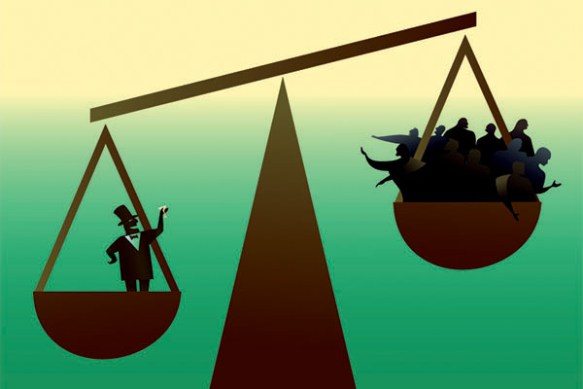
Survival of the Richest

All Are Equal, Except Those Who Aren’t

By Nomi Prins

Source: TomDispatch.com

Like a gilded coating that makes the dullest things glitter, today’s thin veneer of political populism covers a grotesque underbelly of growing inequality that’s hiding in plain sight. And this phenomenon of ever more concentrated wealth and power has both Newtonian and Darwinian components to it.

In terms of Newton’s first law of motion: those in power will remain in power unless acted upon by an external force. Those who are wealthy will only gain in wealth as long as nothing deflects them from their present course. As for Darwin, in the world of financial evolution, those with wealth or power will do what’s in their best interest to protect that wealth, even if it’s in no one else’s interest at all.

In George Orwell’s iconic 1945 novel, Animal Farm, the pigs who gain control in a rebellion against a human farmer eventually impose a dictatorship on the other animals on the basis of a single commandment: “All animals are equal, but some animals are more equal than others.” In terms of the American republic, the modern equivalent would be: “All citizens are equal, but the wealthy are so much more equal than anyone else (and plan to remain that way).”

Certainly, inequality is the economic great wall between those with power and those without it.

As the animals of Orwell’s farm grew ever less equal, so in the present moment in a country that still claims equal opportunity for its citizens, one in which three Americans now have as much wealth as the bottom half of society (160 million people), you could certainly say that we live in an increasingly Orwellian society. Or perhaps an increasingly Twainian one.

After all, Mark Twain and Charles Dudley Warner wrote a classic 1873 novel that put an unforgettable label on their moment and could do the same for ours. The Gilded Age: A Tale of Today depicted the greed and political corruption of post-Civil War America. Its title caught the spirit of what proved to be a long moment when the uber-rich came to dominate Washington and the rest of America. It was a period saturated with robber barons, professional grifters, and incomprehensibly wealthy banking magnates. (Anything sound familiar?) The main difference between that last century’s gilded moment and this one was that those robber barons built tangible things like railroads. Today’s equivalent crew of the mega-wealthy build remarkably intangible things like tech and electronic platforms, while a grifter of a president opts for the only new infrastructure in sight, a great wall to nowhere.

In Twain’s epoch, the U.S. was emerging from the Civil War. Opportunists were rising from the ashes of the nation’s battered soul. Land speculation, government lobbying, and shady deals soon converged to create an unequal society of the first order (at least until now). Soon after their novel came out, a series of recessions ravaged the country, followed by a 1907 financial panic in New York City caused by a speculator-led copper-market scam.

From the late 1890s on, the most powerful banker on the planet, J.P. Morgan, was called upon multiple times to bail out a country on the economic edge. In 1907, Treasury Secretary George Cortelyou provided him with $25 million in bailout money at the request of President Theodore Roosevelt to stabilize Wall Street and calm frantic citizens trying to withdraw their deposits from banks around the country. And this Morgan did — by helping his friends and their companies, while skimming money off the top himself. As for the most troubled banks holding the savings of ordinary people? Well, they folded. (Shades of the 2007-2008 meltdown and bailout anyone?)

The leading bankers who had received that bounty from the government went on to cause the Crash of 1929. Not surprisingly, much speculation and fraud preceded it. In those years, the novelist F. Scott Fitzgerald caught the era’s spirit of grotesque inequality in The Great Gatsby when one of his characters comments: “Let me tell you about the very rich. They are different from you and me.” The same could certainly be said of today when it comes to the gaping maw between the have-nots and have-a-lots.

Income vs. Wealth

To fully grasp the nature of inequality in our twenty-first-century gilded age, it’s important to understand the difference between wealth and income and what kinds of inequality stem from each. Simply put, income is how much money you make in terms of paid work or any return on investments or assets (or other things you own that have the potential to change in value). Wealth is simply the gross accumulation of those very assets and any return or appreciation on them. The more wealth you have, the easier it is to have a higher annual income.

Let’s break that down. If you earn $31,000 a year, the median salary for an individual in the United States today, your income would be that amount minus associated taxes (including federal, state, social security, and Medicare ones). On average, that means you would be left with about $26,000 before other expenses kicked in.

If your wealth is $1,000,000, however, and you put that into a savings account paying 2.25% interest, you could receive about $22,500 and, after taxes, be left with about $19,000, for doing nothing whatsoever.

To put all this in perspective, the top 1% of Americans now take home, on average, more than 40 times the incomes of the bottom 90%. And if you head for the top 0.1%, those figures only radically worsen. That tiny crew takes home more than 198 times the income of the bottom 90% percent. They also possess as much wealth as the nation’s bottom 90%. “Wealth,” as Adam Smith so classically noted almost two-and-a-half-centuries ago in The Wealth of Nations, “is power,” an adage that seldom, sadly, seems outdated.

A Case Study: Wealth, Inequality, and the Federal Reserve

Obviously, if you inherit wealth in this country, you’re instantly ahead of the game. In America, a third to nearly a half of all wealth is inherited rather than self-made. According to a New York Times investigation, for instance, President Donald Trump, from birth, received an estimated $413 million (in today’s dollars, that is) from his dear old dad and another $140 million (in today’s dollars) in loans. Not a bad way for a “businessman” to begin building the empire (of bankruptcies) that became the platform for a presidential campaign that oozed into actually running the country. Trump did it, in other words, the old-fashioned way — through inheritance.

In his megalomaniacal zeal to declare a national emergency at the southern border, that gilded millionaire-turned-billionaire-turned-president provides but one of many examples of a long record of abusing power. Unfortunately, in this country, few people consider record inequality (which is still growing) as another kind of abuse of power, another kind of great wall, in this case keeping not Central Americans but most U.S. citizens out.

The Federal Reserve, the country’s central bank that dictates the cost of money and that sustained Wall Street in the wake of the financial crisis of 2007-2008 (and since), has finally pointed out that such extreme levels of inequality are bad news for the rest of the country. As Fed Chairman Jerome Powell said at a town hall in Washington in early February, “We want prosperity to be widely shared. We need policies to make that happen.” Sadly, the Fed has largely contributed to increasing the systemic inequality now engrained in the financial and, by extension, political system. In a recent research paper, the Fed did, at least, underscore the consequences of inequality to the economy, showing that “income inequality can generate low aggregate demand, deflation pressure, excessive credit growth, and financial instability.”

In the wake of the global economic meltdown, however, the Fed took it upon itself to reduce the cost of money for big banks by chopping interest rates to zero (before eventually raising them to 2.5%) and buying $4.5 trillion in Treasury and mortgage bonds to lower it further. All this so that banks could ostensibly lend money more easily to Main Street and stimulate the economy. As Senator Bernie Sanders noted though, “The Federal Reserve provided more than $16 trillion in total financial assistance to some of the largest financial institutions and corporations in the United States and throughout the world… a clear case of socialism for the rich and rugged, you’re-on-your-own individualism for everyone else.”

The economy has been treading water ever since (especially compared to the stock market). Annual gross domestic product growth has not surpassed 3%in any year since the financial crisis, even as the level of the stock market tripled, grotesquely increasing the country’s inequality gap. None of this should have been surprising, since much of the excess money went straight to big banks, rich investors, and speculators.  They then used it to invest in the stock and bond markets, but not in things that would matter to all the Americans outside that great wall of wealth.

The question is: Why are inequality and a flawed economic system mutually reinforcing? As a starting point, those able to invest in a stock market buoyed by the Fed’s policies only increased their wealth exponentially. In contrast, those relying on the economy to sustain them via wages and other income got shafted. Most people aren’t, of course, invested in the stock market, or really in anything. They can’t afford to be. It’s important to remember that nearly 80% of the population lives paycheck to paycheck.

The net result: an acute post-financial-crisis increase in wealth inequality — on top of the income inequality that was global but especially true in the United States. The crew in the top 1% that doesn’t rely on salaries to increase their wealth prospered fabulously. They, after all, now own more than half of all national wealth invested in stocks and mutual funds, so a soaring stock market disproportionately helps them. It’s also why the Federal Reserve subsidy policies to Wall Street banks have only added to the extreme wealth of those extreme few.

The Ramifications of Inequality

The list of negatives resulting from such inequality is long indeed. As a start, the only thing the majority of Americans possess a greater proportion of than that top 1% is a mountain of debt.

The bottom 90% are the lucky owners of about three-quarters of the country’s household debt. Mortgages, auto loans, student loans, and credit-card debt are cumulatively at a record-high $13.5 trillion.

And that’s just to start down a slippery slope. As Inequality.org reports, wealth and income inequality impact “everything from life expectancy to infant mortality and obesity.” High economic inequality and poor health, for instance, go hand and hand, or put another way, inequality compromises the overall health of the country. According to academic findings, income inequality is, in the most literal sense, making Americans sick. As one study put it, “Diseased and impoverished economic infrastructures [help] lead to diseased or impoverished or unbalanced bodies or minds.”

Then there’s Social Security, established in 1935 as a federal supplement for those in need who have also paid into the system through a tax on their wages. Today, all workers contribute 6.2% of their annual earnings and employers pay the other 6.2% (up to a cap of $132,900) into the Social Security system. Those making far more than that, specifically millionaires and billionaires, don’t have to pay a dime more on a proportional basis. In practice, that means about 94% of American workers and their employers paid the full 12.4% of their annual earnings toward Social Security, while the other 6% paid an often significantly smaller fraction of their earnings.

According to his own claims about his 2016 income, for instance, President Trump “contributed a mere 0.002 percent of his income to Social Security in 2016.” That means it would take nearly 22,000 additional workers earning the median U.S. salary to make up for what he doesn’t have to pay. And the greater the income inequality in this country, the more money those who make less have to put into the Social Security system on a proportional basis. In recent years, a staggering $1.4 trillion could have gone into that system, if there were no arbitrary payroll cap favoring the wealthy.

Inequality: A Dilemma With Global Implications

America is great at minting millionaires. It has the highest concentration of them, globally speaking, at 41%. (Another 24% of that millionaires’ club can be found in Europe.) And the top 1% of U.S. citizens earn 40 times the national average and own about 38.6% of the country’s total wealth. The highest figure in any other developed country is “only” 28%.

However, while the U.S. boasts of epic levels of inequality, it’s also a global trend. Consider this: the world’s richest 1% own 45% of total wealth on this planet. In contrast, 64% of the population (with an average of $10,000 in wealth to their name) holds less than 2%. And to widen the inequality picture a bit more, the world’s richest 10%, those having at least $100,000 in assets, own 84% of total global wealth.

The billionaires’ club is where it’s really at, though. According to Oxfam, the richest 42 billionaires have a combined wealth equal to that of the poorest 50% of humanity. Rest assured, however, that in this gilded century there’s inequality even among billionaires. After all, the 10 richest among them possess $745 billion in total global wealth. The next 10 down the list possess a mere $451.5 billion, and why even bother tallying the next 10 when you get the picture?

Oxfam also recently reported that “the number of billionaires has almost doubled, with a new billionaire created every two days between 2017 and 2018. They have now more wealth than ever before while almost half of humanity have barely escaped extreme poverty, living on less than $5.50 a day.”

How Does It End?

In sum, the rich are only getting richer and it’s happening at a historic rate. Worse yet, over the past decade, there was an extra perk for the truly wealthy. They could bulk up on assets that had been devalued due to the financial crisis, while so many of their peers on the other side of that great wall of wealth were economically decimated by the 2007-2008 meltdown and have yet to fully recover.

What we’ve seen ever since is how money just keeps flowing upward through banks and massive speculation, while the economic lives of those not at the top of the financial food chain have largely remained stagnant or worse. The result is, of course, sweeping inequality of a kind that, in much of the last century, might have seemed inconceivable.

Eventually, we will all have to face the black cloud this throws over the entire economy. Real people in the real world, those not at the top, have experienced a decade of ever greater instability, while the inequality gap of this beyond-gilded age is sure to shape a truly messy world ahead. In other words, this can’t end well.


Nomi Prins, a former Wall Street executive, is a TomDispatch regular. Her latest book is Collusion: How Central Bankers Rigged the World (Nation Books). She is also the author of All the Presidents’ Bankers: The Hidden Alliances That Drive American Power and five other books. Special thanks go to researcher Craig Wilson for his superb work on this piece.

Elite Banking at Your Expense: How Secretive Tax Havens are Used to Steal Your Money

By Robert J. Burrowes

Tax havens are locations around the world where wealthy individuals, criminals and terrorists, as well as governments and government agencies (such as the CIA), banks, corporations, hedge funds, international organizations (such as the Vatican) and crime syndicates (such as the Mafia), can stash their money so that they can avoid regulation and oversight and, very often, evade tax. According to Nicholas Shaxson: ‘Tax havens are now at the heart of the global economy.’

Which is why, as he explains it: ‘The term “tax haven” is a bit of a misnomer, because such places aren’t just about tax. What they sell is escape: from the laws, rules and taxes of jurisdictions elsewhere, usually with secrecy as their prime offering.’ See ‘The tax haven in the heart of Britain’. A tax haven (or ‘secrecy jurisdiction’) then is a ‘place that seeks to attract business by offering politically stable facilities to help people or entities get around the rules, laws and regulations of jurisdictions elsewhere’. See Treasure Islands: Tax Havens and the Men Who Stole the World.

Tax havens are a vitally important part of the global infrastructure of corruption and criminality – see ‘Giant Leak of Offshore Financial Records Exposes Global Array of Crime and Corruption’ – that enables privileged individuals and their organizations to legally and illegally steal money from the rest of us, particularly those in developing countries, and to have the services of a vast network of accountants, bankers, lawyers and politicians (often from captured legislatures) to help them do it, and to ensure that they get away with it.

How many tax havens are there? Where are they? How much money do they have? Who uses them? Why? How do they work? Why does all this matter to us? And what can we do about them?

Tax Havens: how many and where are they?

In his book Treasure Islands: Tax Havens and the Men Who Stole the World, author and financial journalist Nicholas Shaxson identified about sixty ‘secrecy jurisdictions’ or ‘offshore groups’ around the world which he divided into four categories, as follows.

The most important category, by far, is those tax havens that form the spider’s network of havens centred on the City of London. It has three main layers: there are two inner rings – Britain’s Crown Dependencies of Jersey, Guernsey (which includes the sub-havens of Sark, Alderney and Brecqhou) and the Isle of Man, and its overseas territories such as the Cayman Islands, Bermuda, the British Virgin Islands and Gibralter – which are substantially controlled by Britain. The third layer is an outer ring with a more diverse array of havens, like Hong Kong, Singapore, the Bahamas, Dubai and Ireland, which are outside Britain’s direct control but have strong historical and current links to that country and the City of London (which I will discuss below). This network controls almost one half of all international bank assets.

The second category of tax havens is those in Europe notably including Switzerland, Luxembourg – see ‘Explore the Documents: Luxembourg Leaks Database’ – the Netherlands, Belgium and Austria, as well as microstates such as Liechtenstein and Monaco. While ‘Geneva bankers had sheltered the secret money of European elites since at least the eighteenth century’, the European havens ‘got going’ during World War I as governments raised taxes sharply to pay for the war.

The third category of tax havens is that focused on the United States. It has three tiers as well. At the federal level, the US government offers a range of tax exemptions, secrecy provisions and laws designed to attract foreign money. This means, for example, that US banks can legally accept proceeds from a range of crimes as long as the crimes are committed overseas. The second tier involves individual US states such as Florida (where Central/South American elites do their banking and the countries adversely impacted are prevented by US secrecy provisions from accessing relevant data, and where much Mob and drugs money is hidden too), Delaware, Nevada and Wyoming, where even terrorist money is protected by secrecy provisions. The third tier of the US network is the overseas satellites such as the American Virgin Islands, the Marshall Islands, Liberia and Panama, with the latter, according to Jeffrey Robinson, being ‘one of the filthiest money laundering sinks in the world’. See The Sink: Terror, Crime and Dirty Money in the Offshore World.

As Shaxson notes: ‘offshore finance has quietly been at the heart of Neoconservative schemes to project US power around the globe for years. Few people have noticed.’

The fourth category of tax havens identified by Shaxson includes those that do not fit in the categories above, such as Somalia and Uganda.

The (incomplete) list of tax havens on the website ‘Tax Havens of the World’ will give you some idea of where these secrecy jurisdictions are located but there are important omissions in this list, notably including the City of London Corporation.

For a brief look at 15 tax havens (again, notably excluding some of the most important) and some of the corporations that use them, see ‘What Are the World’s Best Tax Havens?’

And for a highly instructive and utterly sobering video documentary on British Tax Havens, see ‘The Spider’s Web: Britain’s Second Empire’. This documentary will inform you, among many more important things, that the building housing Her Majesty’s Revenue and Customs, the UK tax office, is owned by an offshore company in Bermuda!

To summarize the central aspect of the development of tax havens following World War II: ‘The British Establishment – an old boys network of privileged elites – had carved out a lucrative vehicle for themselves in the offshore world after the demise of Empire. They transformed themselves from administrators of Empire to financial handlers for the global elite and multinational corporations.’ See ‘The Spider’s Web: Britain’s Second Empire’.

Before concluding this section, it is worth emphasizing that, as Shaxson explains it, ‘the offshore world is not a bunch of independent states exercising their sovereign rights to set their laws and tax systems as they see fit. It is a set of networks of influence controlled by the world’s major powers, notably Britain and the United States. Each network is deeply interconnected with the others.’ He goes on: ‘The world’s most important tax havens are not exotic palm-fringed islands, as many people suppose, but some of the world’s most powerful countries.’ Shaxson quotes Marshall Langer, a prominent supporter of secrecy jurisdictions: ‘It does not surprise anyone when I tell them that the most important tax haven in the world is an island. They are surprised, however, when I tell them that … the island is Manhattan. Moreover, the second most-important tax haven … is located on an island. It is called the City of London.’

The City of London Corporation

What is the City of London Corporation, also known as the ‘Square Mile’? It is ‘a 1.22-square-mile slab of prime central London real estate that stretches from the Thames at Victoria Embankment, clockwise up through Fleet Street, the Barbican Centre, then to Liverpool Street in the north-east, then back down to the Thames just west of the Tower of London.’ See Treasure Islands: Tax Havens and the Men Who Stole the World.

According to Shaxson, the City of London Corporation, the ‘modern period’ of which dates from 1067 (yes, that is not a typing error), is ‘the local-government authority for the 1.2-square-mile slab of prime real estate in central London that is the City of London. The corporation is an ancient, semi-alien entity lodged inside the British nation state; a “prehistoric monster which had mysteriously survived into the modern world”, as a 19th-century would-be City reformer put it.’

Importantly, Shaxson explains, ‘the role of the City of London Corporation as a municipal authority is its least important attribute. This is a hugely resourced international offshore lobbying group pushing for international financial deregulation, tax-cutting and tax havenry around the world.’ Moreover, it is ‘the hub of a global network of tax havens sucking up offshore trillions from around the world and sending it, or the business of handling it, to London’. Notably, so powerful is the City of London that no sovereign or government of Britain in a thousand years has had the courage to seriously take it on and attempt to subject it to British government control. See ‘The tax haven in the heart of Britain’.

How much money is in Tax Havens?

So how much of the world’s wealth is stashed in tax havens around the globe? According to the Tax Justice Network in its 2012 report written by James S. Henry ‘The Price of Offshore Revisited: New Estimates for “Missing” Global Private Wealth, Income, Inequality, and Lost Taxes’: ‘A significant fraction of global private financial wealth – by our estimates, at least $21 to $32 trillion as of 2010 – has been invested virtually tax-free through the world’s still-expanding black hole of more than 80 “offshore” secrecy jurisdictions. We believe this range to be conservative…’ He goes on to emphasize that ‘this is just financial wealth. A big share of the real estate, yachts, racehorses, gold bricks – and many other things that count as non-financial wealth – are also owned via offshore structures where it is impossible to identify the owners’.

Henry also notes that given that Credit Suisse estimated global wealth in 2011 at $231 trillion, the amount of money in secrecy jurisdictions is conservatively estimated at 10% of global wealth.

But other figures do indeed suggest this estimate is low. Shaxson cites compelling evidence that ‘More than half of world trade passes, at least on paper, through tax havens. Over half of all banking assets and a third of foreign direct investment by multinational corporations, are routed offshore.’ Moreover, as long ago as 2008, the US Government Accountability Office reported that 83 of the 100 biggest corporations in the USA had subsidiaries in tax havens and the following year, using a broader definition, the Tax Justice Network discovered that ninety-nine of Europe’s hundred largest companies used offshore subsidiaries. And in each country, ‘the largest user by far was a bank’. See Treasure Islands: Tax Havens and the Men Who Stole the World.

In any case, the most recent estimate by the Tax Justice Network indicates ‘tax losses to profit shifting by multinational companies (a)pplying a methodology developed by researchers at the International Monetary Fund to an improved dataset… of around $500 billion a year’. See ‘New estimates reveal the extent of tax avoidance by multinationals’.

To reiterate then, on the understanding that these estimates are probably quite low, by 2010, between $US21 and $US32 trillion had been taken out of circulation so that it was beyond the laws, financial regulations and taxes that the rest of us cannot escape. But that figure has been added to by half a trillion dollars each year since, by moving more money into tax havens. And don’t forget: this figure does not include non-financial wealth. How many gold bricks, yachts, artworks and racehorses do you own and have stashed away somewhere free of scrutiny?

Who uses Tax Havens? And why?

As I mentioned above, tax havens are used by wealthy individuals (including businesspeople, sports and pop stars), criminals and terrorists, as well as governments (and their agencies), banks, corporations (such as Amazon and Google), international organizations and crime syndicates (such as the Medellin Cartel). While motives vary, in essence the lack of regulation and oversight, as well as tax evasion, are the reasons that individuals and organizations use them.

An individual might want to hide stolen wealth, to evade tax or cheat a divorced spouse out of their share of the family fortune. A bank, corporation, crime syndicate, international or terrorist organization might want to evade scrutiny of the source of their money and/or evade tax on windfall or even ongoing profits (legal and/or otherwise). A government might want to hide the ‘dirty money’ it uses to finance ‘black ops’ (that is, illegal and secret military violence such as that carried out by the CIA). But there are myriad explanations.

In John Christensen’s analysis of over 100 offshore clients of accounting firm Deloitte Touche he studied in Jersey, he found that the clients were engaging in insider trading, market rigging, failure to disclose conflicts of interest, weapons trading, illicit political donations, contract kickbacks, bribery, fraudulent invoicing, trade mispricing and tax evasion. See ‘The Spider’s Web: Britain’s Second Empire’.

Most people have heard of the money stashed away by corrupt dictators like Suharto in Indonesia, Ferdinand Marcos in the Philippines and Mobuto Sese Seko of Zaire (now Democratic Republic of the Congo) each of whom stole from the people of their country. However, they could only do this with the help of western enablers and ongoing elite resistance to developing country attempts to create a more transparent and fairer process for collecting tax on cross-border financial flows. As a result, Alex Cobham of the Tax Justice Network observes, worldwide, developing nations lose in excess of $1trillion per year in ‘capital flight’ and tax evasion to wealthy countries. See ‘The Spider’s Web: Britain’s Second Empire’.

But these more public examples, while terrible, tend to obscure two important facts. The amount stolen from sub-Saharan Africans, for example, between 1970 and 2008 was at least five times the total amount of their foreign debt during that period – see ‘The Spider’s Web: Britain’s Second Empire’ – and, by highlighting these examples, attention is drawn away from even worse and ongoing examples of such criminality by those corrupt/criminal individuals and organizations (including banks, accountancy and legal firms, corporations, international organizations, crime syndicates and governments) committed to using outright theft, fraud, money laundering and other devices to steal wealth from ordinary people all over the world.

So, for example, if one follows the money trails of various lucrative financial operations, some technically legal but immoral and others simply illegal, apart from the world’s major corporations, one quickly comes across the names of the major (and well known) banks and financial institutions (such as the Bank of England, Barclays, Goldman Sachs, JPMorgan Chase…), the ‘big four’ accountancy firms (Deloitte, Ernst & Young (EY), KPMG and PricewaterhouseCoopers), and elite lawyers (such as those in London’s ‘Magic Circle’, like Clifford Chance, Mourant du Feu & Jeune, and Slaughter and May). See, for example, Treasure Islands: Tax Havens and the Men Who Stole the World, ‘New estimates reveal the extent of tax avoidance by multinationals’ and ‘Looting with Putin’.

Apparently, like major corporations and crime syndicates, few banks, accountancy firms and lawyers have ethics policies that require them to follow the law and to exercise ‘due diligence’ (check out a client before signing a contract) so that they can steer clear of handling illegal and immoral profits, especially if they are monstrous.

In fact, according to a US Senate report, ‘virtually every major bank in the world – especially the biggest in North America and Europe – holds accounts for offshore banks and/or banks in suspect jurisdictions’. See The Sink: Terror, Crime and Dirty Money in the Offshore World.

As Eva Joly MEP, vice-chair of the Panama Papers Committee of the European Parliament, succinctly puts it: ‘Ordinary people are paying taxes. Rich people are not.’ See ‘The Spider’s Web: Britain’s Second Empire’.

The Vatican

But perhaps the example which best illustrates the moral depravity of those who use tax havens is the Vatican. In his carefully researched book Operation Gladio: The Unholy Alliance between the Vatican, the CIA and the Mafia author Paul L. Williams recounts the efforts of the CIA, former Nazis, the Sicilian/American Mafia, the Vatican and even Freemasonry to resist an anticipated postwar invasion of western Europe by those ‘Godless communists’ in the Soviet Union by establishing ‘stay-behind units’ (clandestine military and paramilitary units) throughout the countries of Europe (Belgium, Denmark, Italy, Netherlands, Norway, Portugal…) led by former Nazis and composed of ‘die-hard fascist fanatics’.

This alliance to fight the Cold War against the former Soviet Union and the rising tide of progressive governments in Europe and the rest of the world, particularly as the US war on Vietnam gathered pace, led, as Williams chillingly puts it, to ‘the toppling of governments, wholesale slaughter and financial devastation’ around the world. It was also, of course, the forerunner to its equivalent – Operation Condor – to resist, and destroy if possible, the spread of progressive movements, ranging from communism to liberation theology, throughout Central/South America.

While the Vatican played a number of unsavory roles in this alliance, including its facilitation of massive numbers of heroin addictions, its use of counterfeit securities, participation in false flag attacks that killed thousands and strings of gangland slayings, support of military juntas (that massacred tens of thousands) and the ‘purging’ of progressive priests (including Archbishop Óscar Romero of San Salvador and two Jesuit priests denounced by Fr. Jorge Mario Bergoglio, now Pope Francis, in Argentina: see ‘Who is Pope Francis? Jorge Mario Bergoglio and Argentina’s “Dirty War”’) while causing the financial destitution of thousands of families, one of its key ongoing functions, designed to maximize the Vatican’s power while highlighting its moral and spiritual bankruptcy, was to act as ‘God’s banker’ for many of these operations. See Operation Gladio: The Unholy Alliance between the Vatican, the CIA and the Mafia.

It did this, for example, by accepting Mafia/Medellin Cartel-collected drugs money (for a 15-20% cut) into the Vatican Bank (technically: Istituto per le Opere di Religione or Institute for the Works of Religion) and then laundering it through its shell companies – such as Cisalpine Overseas Bank, Astolfine SA, United Trading Corporation, Erin SA, Bellatrix SA, Belrose SA, Starfield SA and Nordeurop Establishment – in tax havens in the Bahamas, Liechtenstein, Luxembourg, Panama and Switzerland.

With the CIA providing services, such as the transport of Mafia/Medellin cocaine to drug dealers in the US, its share of the drug profits (cycled through its own CIA-controlled banks including Continental Illinois, Castle Bank & Trust, and Bank of Credit and Commerce International but eventually involving many of the most prestigious banks in the US, as the money was passed to the Vatican Bank) were used to finance key aspects of Operations Gladio and Condor with weapons also supplied by the CIA from NATO arsenals. But there was plenty of Vatican money in these Operations too.

As an aside, so devastating was the fallout from the ongoing exposure of the many aspects of Vatican corruption that, by the beginning of the twenty-first century, Roman Catholic membership was falling by 400,000 per year in the USA alone but the trend was even stronger in Europe with ‘magnificent churches and cathedrals’ becoming museums visited solely by tourists, parishes being boarded up, seminaries and convents closed, and parochial schools consolidated. And this was before the ‘plague of pedophilia’ had fully hit further decimating the Church’s tattered reputation. To this day, the Vatican Bank remains ‘one of the world’s leading laundries for dirty money’. See Operation Gladio: The Unholy Alliance between the Vatican, the CIA and the Mafia.

How do Tax Havens work?

Each tax haven offers its own unique combination of services. After all, it is a tough market competing for the world’s wealth and so each jurisdiction has developed its own set of services designed to maximize its attractiveness to potential clients. In essence, this means that there is some ongoing ‘competition’ to reduce regulatory and oversight requirements so that each tax haven can attract clientele. This has become so extreme that basic requirements of banking for those who do it legally, such as proof of identity, are not required in the offshore world. In fact, even your true name can be withheld if you wish. It is easier to avoid any risk of embarrassment from exposure this way.

As a result, virtually any jurisdiction will open an account (or as many accounts as you want) in whatever names you specify. Then, usually employing a variety of devices, ranging from secret bank accounts, nominee directors (usually locals who play no part in the organization bar give it their name) and structures such as shell companies (that exist on paper and perhaps a wall plaque somewhere, but nothing else) and trusts (which, unlike the legitimate version, appear to separate responsibility and control from the benefits of ownership but actually do not), to processes such as transfer pricing (a technique by which companies ‘shift paper profits into low-tax countries and costs into high-tax countries’ to minimize – or eliminate – tax payments) and often employing a convoluted process that rapidly shifts monies through several jurisdictions so that it becomes ‘untraceable’ (because authorities must get permission to access each jurisdiction in turn in any effort to trace the money), profits are effectively hidden and any accountability to authorities of any kind utterly eliminated. See Treasure Islands: Tax Havens and the Men Who Stole the World.

For one simple example of such a strategy, employing a technique known as the ‘double Irish, Dutch sandwich’ (which is legal), see Google shifted $23bn to tax haven Bermuda in 2017, filing shows. But you can read other examples here: ‘The tech giants will never pay their fair share of taxes – unless we make them’ and ‘7 Corporate Giants Accused of Evading Billions in Taxes’.

Why does the existence of Tax Havens matter to us?

Well, the simple answer to this question is that just a fraction of the money hidden in tax havens would feed, clothe, house and provide clean water, medical care and educational opportunities to everyone on Earth. It would eliminate the 100,000 deaths by starvation-related diseases each day. It would eliminate poverty and homelessness. And, as one byproduct of having these material needs met, it would facilitate the emergence of an informed, engaged and empowered human population to tackle the vast range of environmental, climate and military threats that currently threaten biosphere collapse and imminent human extinction. See ‘Human Extinction by 2026? A Last Ditch Strategy to Fight for Human Survival’.

As Professor Prem Sikka puts it more simply: Because of the penetration by financial services executives of the British state, including the Treasury ‘It deprives people of opportunities to have healthcare, education, security, justice and, ultimately, a fulfilling life.’ See ‘The Spider’s Web: Britain’s Second Empire’.

Fundamentally, then, tax havens and their secrecy are at the heart of those elite institutions and processes that functionally undermine democracy and give extraordinary power to certain anonymous individuals and their entities without accountability. See ‘The Spider’s Web: Britain’s Second Empire’.

Of course, the elites that control the tax haven networks are not about to let this change. Tax havens are simply too important as part of the global infrastructure for maintaining elite profit, power and privilege and for resisting grassroots efforts to bring peace, justice and ecological sanity to our world. And that is why they are protected by government legislation and legal systems, with an ‘army’ of accountants, auditors, bankers, businesspeople, lawyers and politicians ensuring that they remain protected.

So don’t forget: laws are designed to control and punish you, no matter how trivial your infringement: a parking fine, a littering offence, a petty theft. But if you have enough money, the law simply does not exist. And you can evade taxes legally and in the full knowledge that your vast profits (even from immorally-acquired wealth such as sex trafficking, gun-running, endangered species trafficking, conflict diamonds and drug trafficking) are ‘lawful’ and will escape regulation and oversight of any kind. See ‘The Rule of Law: Unjust and Violent’.

Let me give a personal example. I have been a war tax resister since 1983: I have a conscientious objection to paying taxes to the Australian government to deploy military forces in other countries to kill people in my name. So, instead of paying taxes to kill, for many years I donated the equivalent amount to organizations engaged in peace, development, environment and human rights work, and to ‘pay the rent’ for my use of indigenous land. As some of many outcomes to this conscientious and highly public resistance (garnering national media attention at times), in 1991 I was bankrupted, in 1992 I was convicted of contempt of court (for my conscientious refusal to cooperate with the bankruptcy trustee) and in 1993 my passport was seized. In 1999, I was advised that I will be ‘bankrupt forever’ because of my ongoing conscientious refusal to finance the killing.

In the same period, since 1983, trillions and trillions of dollars of tax have been illegally and secretly evaded as wealthy individuals and corporations, criminals and crime syndicates, international organizations and governments channel their incomes and profits through tax havens. Laws and legal systems throughout the world make this possible and, provided it is done correctly, it is quite straightforward to avoid any penalties for secretly evading payment of taxes or hiding money acquired through criminal activity. But the point, as you can see, is that tax evasion by wealthy individuals and corporations meant that many of these individuals and corporations didn’t pay taxes to kill people either. They just didn’t pay taxes at all.

Of course, their motive was personal gain, their way was legal, they incurred no penalty and, of course, they didn’t pay an equivalent amount to support peace and justice causes. More fundamentally, however, the trillions of dollars they took from the global economy were made by killing and exploiting people and the planet in a significant variety of other ways, ranging from sex trafficking, gun-running, conflict diamonds and trafficking in drugs and endangered species, to simply starving people to death at the rate of 100,000 people each day by managing the global economy, using tax havens as a primary tool, to extract maximum profit.

Richard Brooks documents how this legal exploitation occurs in another way in his book The Great Tax Robbery: How Britain Became a Tax Haven for Fat Cats and Big Business. The vast tax evasion by elites in Britain, including by diverting funds through tax havens, attracts just five prosecutions each year per £1 billion of evasion of direct taxes. In contrast, benefits fraud by those on unemployment and disability pensions attract 9,000 prosecutions each year per £1 billion of fraud. ‘So theft by the poor warrants the full force of the law’. But not theft by elites who write the law and largely control the political and legal processes in relation to it.

Hence, under the guise of ‘relationship taxing’ (that is, building a relationship between tax authorities and corporate executives and ‘tailoring’ tax payments to corporate wishes to the extent the law allows), corporations have long known that ‘If you don’t like the law… we’ll see what we can do’.

As is obvious from this example, attempts at government reform, including to defeat tax havens, in the direction of making elites financially and legally accountable, both nationally and internationally, for the responsibilities which the rest of us cannot escape, are invariably for show and, in any case, achieve zero of substance. For example, the attempt to ‘approve’ a blacklist of tax havens at the G20 gathering in 2009 was resisted by the Chinese premier on behalf of Chinese elites who, like other national elites keen to have political control but ‘judicial separation’ from their offshore centres, opposed the listing of notorious havens Hong Kong and Macau: see Treasure Islands: Tax Havens and the Men Who Stole the World. The global elite is clearly in control with national governments and international organizations powerlessly doing as instructed. So complete is this control, in fact, that Brooks notes that, in Britain, ‘Anti-tax avoidance laws had to be relaxed to accommodate companies’ tax avoidance schemes.’

Brooks concludes that ‘British taxation policy really had been so comprehensively captured by the world’s biggest corporations that screw-the-poor policies… could be written into the statute books at their whim, without a pang of conscience being felt anywhere in Whitehall.’ Clearly, however, his comment can be applied to virtually any government in the world.

So does it matter to you that these tax havens exist and do what they do?

What can be done about Tax Havens?

Authors such as Nicholas Shaxson and Richard Brooks suggest a raft of measures to correct the large number of ‘faults’ that facilitate the secrecy, protection from regulation and tax evasion that individuals, corporations, organizations, criminals and terrorists utilize in tax havens.

For Shaxson, these include financial reforms such as ‘blacklisting’ of tax havens so that their rogue state status is public knowledge; greater transparency, for example, through government sharing of information about the local income and assets of each other’s citizens and by requiring multinational corporate activities in each country to be made visible (rather than hidden behind ‘international’ figures); promoting the needs of developing countries which need their tax bases protected far more than they need aid or debt relief; confronting the British ‘spider’s web’ of tax havens by abolishing the City of London Corporation and submerging it into a unified and fully democratic London; taxing an entire multinational ‘group’ as a single unit and then allocating the appropriate amounts of its income out to the different jurisdictions in which it was earned and allow it to be taxed as each jurisdiction decides; onshore tax reform such as a land value tax (because land cannot be moved offshore and so tax on it must be paid locally), and by a direct distribution of mineral wealth in any country to each of its inhabitants (who can then be taxed); tackling the ‘enablers’ – the accountants, lawyers, individual bankers, businesspeople – and not just the clients, so that they go to jail; rethinking the meaning of ‘corporate responsibility’ (because corporations are given a wealth of capital in public infrastructure, an educated and healthy workforce… with which to work) so that corporations are transparent about their affairs and pay tax as part of their corporate responsibility; re-evaluating the meaning of corruption – insiders abusing the common good in secrecy and getting away with it and so worsening inequality and entrenching vested interests and unaccountable power – so that we see, more clearly, all of the actors and their activities; and changing the culture that fawns over people who abuse the system for personal gain. See Treasure Islands: Tax Havens and the Men Who Stole the World.

And some progress appears to be occurring along lines he suggests. For example, a version of automatic information exchange (AIE), by which governments make sure that essential information is made available to other jurisdictions as a matter of routine, has been discussed by the OECD and, while full of loopholes – see ‘Loophole USA: the vortex-shaped hole in global financial transparency’ – some commitments have been made. For the list of commitments as at November 2018, see ‘AEOI commitments’.

However, the USA has not made this commitment and while Switzerland, for example, finds this objectionable – see ‘The U.S. hasn’t signed the AEoI Agreement: Reciprocity demanded’ – the reality is that it makes little difference. For example, ICO Services, which specializes in the formation of offshore companies and offshore banking, will assist you to get around the AEoI requirement. Their website advertises that ‘asset holders need to start looking for alternative jurisdictions for protecting their assets. There are some reputable jurisdictions that are still outside the AEoI  – e.g. Cyprus  –  but U.S. states of Delaware and some others shouldn’t be dismissed.’

But if you want a more established name to help you take advantage of a tax haven in the USA, you really can’t go past Rothschild & Co. So, to check out what they are offering: ‘Here Is Rothschild’s Primer How To Launder Money In U.S. Real Estate And Avoid “Blacklists”’.

Moreover, the AEoI agreement ‘outlaws’ bank secrecy but not trust secrecy (which dates from the Crusades) on which the British model is based – ‘The Trust lies at the core of the British secrecy model’ – so it does not address the cornerstone of British tax haven secrecy and explains why the British were happy to see the Cayman Islands commit to the AEoI. In short: the British government would be happy to kill off bank secrecy so that they can capture a larger market share (based on Trust secrecy). See ‘The Spider’s Web: Britain’s Second Empire’.

Separately from this initiative, in 2018 the UK parliament enacted a new law requiring its overseas territories – including notorious tax havens like Bermuda, the Cayman Islands and the British Virgin Islands – to start disclosing the owners of corporations they register by 2020. In theory: ‘This could shut down a huge amount of offshore tax evasion and other financial crimes because individuals from anywhere in the world, including the United States, have long been able to set up secret corporations in these tax havens to stash their money.’ See ‘New UK Law May Shut Down the Biggest Tax Havens – Aside from the U.S.’

However, while the report pointed out that the new law obviously does not impact the USA (or, of course, Switzerland or …) and the easy rerouting options available if these havens are effectively (or even actually) shut down, it failed to mention that this initiative does not in any way address the City of London Corporation so the impact of this initiative must be very limited unless it is followed by some pretty drastic initiatives in Westminster, Washington, Bern and elsewhere.

In summary, while one cannot disagree with any of Shaxson’s fine suggestions or be displeased that public pressure has led to some effort being made by the OECD and the UK parliament to address elements of the tax haven scourge, the reality is that the extent of the changes necessary are not going to happen without enormous grassroots pressure, strategically applied, and they are very unlikely to happen as reforms of the existing capitalist system. This is simply because the global elite is solidly in control of the institutions and processes of global capitalism, including its compliant governments and international organizations, and will readily stymie any attempt at serious reform of tax havenry particularly given the number of major reforms needed and the number of nations in which these reforms must be enacted. To state two obvious examples: The City of London Corporation has not existed for 1,000 years because it has no defense. And the changes noted above have only made the US more attractive as a secrecy jurisdiction.

Meanwhile, with the aim of promoting ‘financial innovation’, Switzerland has recently made things easier for smaller financial technology companies thus making tax havenry more attractive to those who might not have otherwise considered it. See ‘Swiss watchdog to propose looser anti-money laundering rules for fintechs’.

So, given that most tax havens are protected by host government legislation and there is no international mechanism to control them, the tax haven industry generally is not under threat of being held to account in any significant way.

And, despite the more elaborate explanation offered above, there is a simple reason for this. Unofficially, of course, illegal money, laundered through tax havens, has become an essential and sometimes stabilizing element of the global financial system. See ‘Drug money saved banks in global crisis, claims UN advisor’.

So what can we do that will make a difference?

Given the deeply entrenched and long-standing nature of this problem, clearly it needs to be addressed at various levels.

Fundamentally, we can nurture our children so that we do not destroy their conscience. See ‘My Promise to Children’. Remember all of those corrupt/criminal accountants, bankers, businesspeople, priests and popes, lawyers and politicians that kept creeping up in the discussion above? The people who maintain the entire infrastructure that allows tax havens to exist and those who manage and profit from it too?

Do they care about you? Do they care about the people in Africa, Asia and Central/South America who starve as a result of the types of policies that allow tax havens to exist and function? Do they care about those driven into poverty and homelessness in modern industrial economies because vast sums are drained out of them and hidden in secrecy jurisdictions? Do they care about the people killed by the military and other violence from which they profit and then hide the proceeds to evade tax? Do they care about the Earth? Fundamentally, do they care about themselves?

Of course not! But this is only because they are extraordinarily psychologically damaged individuals. See ‘The Global Elite is Insane Revisited’ with a more complete explanation in Why Violence? and Fearless Psychology and Fearful Psychology: Principles and Practice.

If we inflict enormous violence on a child throughout their childhood to compel their obedience, how can we expect them to grow up to lead a life of integrity based on their conscience, courage, compassion, empathy and love? Those who use tax havens are truly ‘poor little rich boys’ (and girls). See ‘Love Denied: The Psychology of Materialism, Violence and War’ and ‘Why Set Up a Shell Company in Panama? The Psychology Driving Illicit Financial Flows’.

Beyond tackling the problem at its source however, we can also tackle manifestations of the problem but not by lobbying elites – and their political agents: there are no votes in it, in any case – to control this depravity for which they are well rewarded.

For a start we can boycott all of the major private banks in favor of those smaller or member-owned banks that have a serious commitment to peace, justice and ecological sustainability, or we can seek out equivalent institutions like credit unions. We can also create public banks based on ethical principles. See ‘What are Public Banks and How Do They Operate? An Introduction’.

We can boycott large corporations – like Amazon, Apple, Gap, Google, Ikea, Microsoft and Starbucks – that use tax havens. None of these corporations is a monopoly: there are alternatives which can be investigated and employed, assuming we can’t go without some version of the product or service they offer. Whenever you can, find a locally-owned outlet that offers a local product or service.

We can boycott the Catholic Church. God does not ask that you morally or financially support a corrupt organization that doesn’t understand or represent morality and spirituality. Remember, it was Jesus who threw the moneychangers out of the temple.

If our conscience speaks loudly enough, we can decline employment by any organization that is unethical, such as those that use tax havens.

We can refuse to gamble, refuse to buy the services of a sex worker (who might even be illegally trafficked into the work), refuse to buy the products of endangered species – see, for example, ‘Killing Elephants “for Pet Food” Condemned’ – and refuse to use illicit drugs. These products and services are virtually always offered by industries controlled by criminal organizations so by buying them you are only harming yourself and/or other people or species about whom you could choose to exercise a duty of care while also not contributing to the diversion of financial resources into tax havens.

We can encourage unions, with members who work for organizations using tax havens, to take a stand on the issue.

We can support existing organizations that work on the problem, preferably those that offer grassroots alternatives. The Tax Justice Network, an ‘activist think tank’, and its sister organization, the Global Alliance for Tax Justice, campaign for systemic change.

If we are genuinely ambitious, we can develop comprehensive nonviolent strategies to compel particular individuals and organizations to desist from using tax havens or even compel countries to close down tax havens. See Nonviolent Campaign Strategy. This can easily be part of a larger strategy to transform the global economy into one that satisfies human and ecological needs, particularly given the imminence of biosphere collapse, as noted above. See The Flame Tree Project to Save Life on Earth.

If violence and exploitation in all of their guises concern you, consider signing the online pledge of ‘The People’s Charter to Create a Nonviolent World’.

So here is a final question for you to consider: What might the world look like if all those trillions of dollars were being shared and spent where they are most needed?


Biodata: Robert J. Burrowes has a lifetime commitment to understanding and ending human violence. He has done extensive research since 1966 in an effort to understand why human beings are violent and has been a nonviolent activist since 1981. He is the author of Why Violence? His email address is flametree@riseup.net and his website is here.

Robert J. Burrowes
P.O. Box 68
Daylesford, Victoria 3460
Australia

Email: flametree@riseup.net

Websites:
Nonviolence Charter
Flame Tree Project to Save Life on Earth
‘Why Violence?’
Feelings First
Nonviolent Campaign Strategy
Nonviolent Defense/Liberation Strategy
Anita: Songs of Nonviolence
Robert Burrowes
Global Nonviolence Network

Government to Facebook Pipeline Reveals a Corrupt Mix of Social Media and the State

The next time someone tells you that “Facebook is a private company” ask them if they know about the dozens of government employees who fill its ranks.

By Matt Agorist

Source: The Free Thought Project

As the Free Thought Project has previously reported, the phrase “Facebook is a private company” is not accurate as they have formed a partnership with an insidious neoconservative “think tank” known as the Atlantic Council which is directly funded and made up of groups tied to the pharmaceutical industry, the military industrial complex, and even government itself. The Atlantic Council dictates to Facebook who is allowed on the platform and who is purged.

Because the Atlantic Council is funded in part by the United States government—and they are making decisions for Facebook—this negates the claim that the company is private. Since our six million followers and years of hard work were wiped off the platform during the October purge, TFTP has consistently reported on the Atlantic Council and their ties to the social media giant. This week, however, we’ve discovered something just as ominous—the government to Facebook pipeline and revolving door.

It is a telltale sign of a corrupt industry or company when they create a revolving door between themselves and the state. Just like Monsanto has former employees on the Supreme Court and Pharmaceutical industry insiders move back and fourth from the FDA to their companies, we found that Facebook is doing the same thing.

Below are just a few of corrupt connections we’ve discovered while digging through the list of current and former employees within Facebook.

Facebook’s Head of Cybersecurity Policy—aka, the man who doles out the ban hammer to anyone he wishes—is Nathaniel Gleicher. Before Gleicher was censoring people at Facebook, he prosecuted cybercrime at the U.S. Department of Justice, and served as Director for Cybersecurity Policy at the National Security Council (NSC) in the Obama White House.

While Facebook may have an interest in seeking out Gleicher’s expertise, this man is an outspoken advocate of tyranny.

After deleting the pages of hundreds of antiwar and pro-peace media and activist outlets in October, last month, Facebook made another giant move to silence. This time, they had no problem noting that they went after pages whose specific missions were “anti-corruption” or “protest” movements. And it was all headed up by Gleicher.

“Some of the Pages frequently posted about topics like anti-NATO sentiment, protest movements, and anti-corruption,” Gleicher wrote in a blog post. “We are constantly working to detect and stop this type of activity because we don’t want our services to be used to manipulate people.”

Seems totally legit, right?

The list goes on.

In 2017, as the Russian/Trump propaganda ramped up, Facebook hired Joel Benenson, a former top adviser to President Barack Obama and the chief strategist for Hillary Clinton’s failed 2016 presidential campaign, as a consultant.

While filling team Zuck with Obama and Clinton advisers, Facebook hired Aneesh Raman, a former Obama speechwriter who now heads up Facebook’s “economic impact programming.”

Highlighting the revolving door aspect of Facebook and the US government is Sarah Feinberg who left the Obama train in 2011 to join Facebook as the director of corporate and strategic communications. She then moved on after and went back to Obama in 2015 to act as the administrator of the Federal Railroad Administration (FRA).

David Recordon also highlights the revolving door between Facebook and the government. Recordon was the former Director of IT for Obama’s White House. He was also Engineering Director at Facebook prior to his role at the White House, and returned to the position after the 2016 election. He is currently Engineering Director for the Chan-Zuckerberg initiative.

Starting to see a pattern of political influence here? You should. But just in case you don’t, the list goes on.

Meredith Carden—who, you guessed, came from the Obama administration — joined the Facebook clan last year to be a part of Facebook’s “News Integrity Team.” Now, she’s battling fake news on the platform and as we’ve shown, there is a ridiculous amount of selective enforcement of these so-called “standards.”

In fact, there are dozens of former Obama staffers, advisers, and campaign associates who quite literally fill Facebook’s ranks. It is no wonder the platform has taken such a political shift over the past few years. David Ploufe, Josh W. Higgins, Lauryn Ogbechie, Danielle Cwirko-GodyckiSarah Pollack, Ben Forer, Bonnie Calvin, and Juliane Sun, are just some of the many Facebook execs hailing out of the Obama era White House.

But fret not right wingers, Facebook likes their neocons too.

Jamie Fly, who was a top adviser to neocon Florida Senator Marco Rubio and who started his career in US political circles as an adviser to the George W. Bush administration, actually took credit for the massive purge of peaceful antiwar pages that took place last October.

“They can invent stories that get repeated and spread through different sites. So we are just starting to push back. Just this last week Facebook began starting to take down sites. So this is just the beginning,” Fly said in December.

Fly backs up his words with the fact that he works with Facebook’s arm of the Atlantic Council to ensure those dangerous antiwar folks don’t keep pushing their propaganda of peace and community.

And yes, this list goes on.

Joel David Kaplan is Facebook’s vice president of global public policy. Prior to his major role within Facebook, Kaplan took the place of neocon extraordinaire Karl Rove as the White House Deputy Chief of Staff for George W. Bush. Before that, from 2001 to 2003 he was Special Assistant to the President for Policy within the White House Chief of Staff’s office. Then he served as Deputy Director of the Office of Management And Budget (OMB).

Myriah Jordan was a special policy assistant in the Bush White House, who was hired on as a policy manager for Facebook’s congressional relations team—aka, a lobbyist. Jordan has moved back and forth between the private sector and the US government multiple times over his career as he’s made millions greasing the skids of the state for his corrupt employers.

So there you have it. Facebook, who claims to be a private entity, is quite literally made up of and advised by dozens of members of government. We’re ready for a change, are you?

The Age of Tyrannical Surveillance: We’re Being Branded, Bought and Sold for Our Data

By John W. Whitehead

Source: The Rutherford Institute

“We know where you are. We know where you’ve been. We can more or less know what you’re thinking about… Your digital identity will live forever… because there’s no delete button.”—Former Google CEO Eric Schmidt

Uncle Sam wants you.

Correction: Big Brother wants you.

To be technically accurate, Big Brother—aided and abetted by his corporate partners in crime—wants your data.

That’s what we have been reduced to in the eyes of the government and Corporate America: data bits and economic units to be bought, bartered and sold to the highest bidder.

Those highest bidders include America’s political class and the politicians aspiring to get elected or re-elected. As the Los Angeles Times reports, “If you have been to a political rally, a town hall, or just fit a demographic a campaign is after, chances are good your movements are being tracked with unnerving accuracy by data vendors on the payroll of campaigns.”

Your phones, televisions and digital devices are selling you out to politicians who want your vote.

Have you shopped at Whole Foods? Tested out target practice at a gun range? Sipped coffee at Starbucks while surfing the web? Visited an abortion clinic? Watched FOX News or MSNBC? Played Candy Crush on your phone? Walked through a mall? Walked past a government building?

That’s all it takes for your data to be hoovered up, sold and used to target you.

This is the age of surveillance capitalism.

Incredibly, once you’ve been identified and tracked, data brokers can travel back in time, digitally speaking, to discover where you’ve been, who you’ve been with, what you’ve been doing, and what you’ve been reading, viewing, buying, etc.

Once you’ve been identified in this way, you can be tracked endlessly.

“Welcome to the new frontier of campaign tech — a loosely regulated world in which simply downloading a weather app or game, connecting to Wi-Fi at a coffee shop or powering up a home router can allow a data broker to monitor your movements with ease, then compile the location information and sell it to a political candidate who can use it to surround you with messages,” writes journalist Evan Halper.

No one is spared.

In this regard, we are all equals: equally suffering the indignity of having every shred of privacy stripped away and the most intimate details of one’s life turned into fodder for marketers and data profiteers.

This creepy new era of government/corporate spying—in which we’re being listened to, watched, tracked, followed, mapped, bought, sold and targeted—makes the NSA’s surveillance appear almost antiquated in comparison.

What’s worse, this for-profit surveillance capitalism scheme is made possible with our cooperation.

All those disclaimers you scroll though without reading them, the ones written in minute font, only to quickly click on the “Agree” button at the end so you can get to the next step—downloading software, opening up a social media account, adding a new app to your phone or computer—those signify your written consent to having your activities monitored, recorded and shared.

Think about it.

Every move you make is being monitored, mined for data, crunched, and tabulated in order to form a picture of who you are, what makes you tick, and how best to influence and/or control you.

On any given day, the average American going about his daily business will be monitored, surveilled, spied on and tracked in more than 20 different ways by both government and corporate eyes and ears. A byproduct of this new age in which we live, whether you’re walking through a store, driving your car, checking email, or talking to friends and family on the phone, you can be sure that some government agency is listening in and tracking your behavior.

With every smartphone we buy, every GPS device we install, every Twitter, Facebook, and Google account we open, every frequent buyer card we use for purchases—whether at the grocer’s, the yogurt shop, the airlines or the department store—and every credit and debit card we use to pay for our transactions, we’re helping Corporate America build a dossier for its government counterparts on who we know, what we think, how we spend our money, and how we spend our time.

The technology has advanced so far that marketers (political campaigns are among the worst offenders) can actually build “digital fences” around your homes, workplaces, friends and family’s homes and other places you visit in order to bombard you with specially crafted messages aimed at achieving a particular outcome.

If anyone else stalked us in this way—tailing us wherever we go, tapping into our calls, reading our correspondence, ferreting out our secrets, profiling and targeting us based on our interests and activities—we’d call the cops.

Unfortunately, the cops (equipped with Stingray devices and other Peeping Tom technologies) are also in on this particular scam.

It’s not just the surveillance and the buying and selling of your data that is worrisome.

The ramifications of a government—any government—having this much unregulated, unaccountable power to target, track, round up and detain its citizens is beyond chilling.

Imagine what a totalitarian regime such as Nazi Germany could have done with this kind of unadulterated power.

Imagine what the next police state to follow in Germany’s footsteps will do with this kind of power. Society is definitely rapidly moving in that direction.

We’ve made it so easy for the government to watch us.

Government eyes see your every move: what you read, how much you spend, where you go, with whom you interact, when you wake up in the morning, what you’re watching on television and reading on the internet.

Every move you make is being monitored, mined for data, crunched, and tabulated in order to form a picture of who you are, what makes you tick, and how best to control you when and if it becomes necessary to bring you in line.

If you’re an activist and you simply like or share this article on Facebook or retweet it on Twitter, you’re most likely flagging yourself as a potential renegade, revolutionary or anti-government extremist—a.k.a. terrorist.

Yet whether or not you like or share this particular article, simply by reading it or any other articles related to government wrongdoing, surveillance, police misconduct or civil liberties is enough to get you categorized as a particular kind of person with particular kinds of interests that reflect a particular kind of mindset that might just lead you to engage in a particular kinds of activities. The corporate state must watch and keep tabs on you if it is to keep you in line.

Chances are, as the Washington Post has reported, you have already been assigned a color-coded threat assessment score—green, yellow or red—so police are forewarned about your potential inclination to be a troublemaker depending on whether you’ve had a career in the military, posted a comment perceived as threatening on Facebook, suffer from a particular medical condition, or know someone who knows someone who might have committed a crime.

In other words, you might already be flagged as potentially anti-government in a government database somewhere—Main Core, for example—that identifies and tracks individuals (so they can be rounded up and detained in times of distress) who aren’t inclined to march in lockstep to the police state’s dictates.

The government has the know-how.

As The Intercept reported, the FBI, CIA, NSA and other government agencies are increasingly investing in and relying on corporate surveillance technologies that can mine constitutionally protected speech on social media platforms such as Facebook, Twitter and Instagram in order to identify potential extremists and predict who might engage in future acts of anti-government behavior.

It’s happening already in China.

Millions of Chinese individuals and businesses, blacklisted as “unworthy” based on social media credit scores that grade them based on whether they are “good” citizens, have now been banned from accessing financial markets, buying real estate or travelling by air or train. Among the activities that can get you labeled unworthy are taking reserved seats on trains or causing trouble in hospitals.

Get ready, because all signs point to China serving as the role model for our dystopian future.

When the government sees all and knows all and has an abundance of laws to render even the most seemingly upstanding citizen a criminal and lawbreaker, then the old adage that you’ve got nothing to worry about if you’ve got nothing to hide no longer applies.

Apart from the overt dangers posed by a government that feels justified and empowered to spy on its people and use its ever-expanding arsenal of weapons and technology to monitor and control them, there’s also the covert dangers associated with a government empowered to use these same technologies to influence behaviors en masse and control the populace.

In fact, it was President Obama who issued an executive order directing federal agencies to use “behavioral science” methods to minimize bureaucracy and influence the way people respond to government programs.

It’s a short hop, skip and a jump from a behavioral program that tries to influence how people respond to paperwork to a government program that tries to shape the public’s views about other, more consequential matters.

Add pre-crime programs into the mix with government agencies and corporations working in tandem to determine who is a potential danger and spin a sticky spider-web of threat assessments, behavioral sensing warnings, flagged “words,” and “suspicious” activity reports using automated eyes and ears, social media, behavior sensing software, and citizen spies, and you having the makings for a perfect dystopian nightmare.

This is the kind of oppressive pre-crime and pre-thought crime package foreshadowed by George Orwell, Aldous Huxley and Phillip K. Dick.

Remember, even the most well-intentioned government law or program can be—and has been—perverted, corrupted and used to advance illegitimate purposes once profit and power are added to the equation.

The war on terror, the war on drugs, the war on illegal immigration, asset forfeiture schemes, road safety schemes, school safety schemes, eminent domain: all of these programs started out as legitimate responses to pressing concerns and have since become weapons of compliance and control in the police state’s hands.

In the right (or wrong) hands, benevolent plans can easily be put to malevolent purposes.

Surveillance, digital stalking and the data mining of the American people—weapons of compliance and control in the government’s hands, especially when the government can listen in on your phone calls, monitor your driving habits, track your movements, scrutinize your purchases and peer through the walls of your home—add up to a society in which there’s little room for indiscretions, imperfections, or acts of independence.

This is the creepy, calculating yet diabolical genius of the American police state: the very technology we hailed as revolutionary and liberating has become our prison, jailer, probation officer, Big Brother and Father Knows Best all rolled into one.

It turns out that we are Soylent Green.

The 1973 film of the same name, starring Charlton Heston and Edward G. Robinson, is set in 2022 in an overpopulated, polluted, starving New York City whose inhabitants depend on synthetic foods manufactured by the Soylent Corporation for survival.

Heston plays a policeman investigating a murder, who discovers the grisly truth about the primary ingredient in the wafer, soylent green, which is the principal source of nourishment for a starved population. “It’s people. Soylent Green is made out of people,” declares Heston’s character. “They’re making our food out of people. Next thing they’ll be breeding us like cattle for food.”

Oh, how right he was.

Soylent Green is indeed people or, in our case, Soylent Green is our own personal data, repossessed, repackaged and used by corporations and the government to entrap us.

We, too, are being bred like cattle but not for food.

Rather, as I make clear in my book Battlefield America: The War on the American People, we’re being bred, branded, bought and sold for our data.

As the insidious partnership between the U.S. government and Corporate America grows more invasive and more subtle with every passing day, there’s virtually no way to opt out of these assaults on your digital privacy short of being a modern-day Luddite, completely disconnected from all technology.

Indeed, George Orwell’s description of the world of 1984 is as apt a description of today’s world as I’ve ever seen: “You had to live—did live, from habit that became instinct—in the assumption that every sound you made was overheard, and, except in darkness, every movement scrutinized.”

What we desperately lack and urgently need is an Electronic Bill of Rights that protects “we the people” from predatory surveillance and data-mining business practices.

Without constitutional protections in place to guard against encroachments on our rights in the electronic realm, it won’t be long before we find ourselves, much like Edward G. Robinson’s character in Soylent Green, looking back on the past with longing, back to an age where we could speak to whom we wanted, buy what we wanted, think what we wanted without those thoughts, words and activities being tracked, processed and stored by corporate giants such as Google, sold to government agencies such as the NSA and CIA, and used against us by militarized police with their army of futuristic technologies.

Banishing Truth

By Chris Hedges

Source: TruthDig

The investigative reporter Seymour Hersh, in his memoir “Reporter,” describes a moment when as a young reporter he overheard a Chicago cop admit to murdering an African-American man. The murdered man had been falsely described by police as a robbery suspect who had been shot while trying to avoid arrest. Hersh frantically called his editor to ask what to do.

“The editor urged me to do nothing,” he writes. “It would be my word versus that of all the cops involved, and all would accuse me of lying. The message was clear: I did not have a story. But of course I did.” He describes himself as “full of despair at my weakness and the weakness of a profession that dealt so easily with compromise and self-censorship.”

Hersh, the greatest investigative reporter of his generation, uncovered the U.S. military’s chemical weapons program, which used thousands of soldiers and volunteers, including pacifists from the Seventh-day Adventist Church, as unwitting human guinea pigs to measure the impact of biological agents including tularemia, yellow fever, Rift Valley fever and the plague. He broke the story of the My Lai massacre. He exposed Henry Kissinger’s wiretapping of his closest aides at the National Security Council (NSC) and journalists, the CIA’s funding of violent extremist groups to overthrow the Chilean President Salvador Allende, the CIA’s spying on domestic dissidents within the United States, the sadistic torture practices at the Abu Ghraib prison in Iraq by American soldiers and contractors and the lies told by the Obama administration about the raid that killed Osama bin Laden. Yet he begins his memoir by the candid admission, familiar to any reporter, that there are crimes and events committed by the powerful you never write about, at least if you want to keep your job. One of his laments in the book is his decision not to follow up on a report he received that disgraced President Richard Nixon had hit his wife, Pat, and she had ended up in an emergency room in California.

Reporters embedded with military units in Iraq and Afghanistan routinely witness atrocities and often war crimes committed by the U.S. military, yet they know that access is dependent on keeping quiet. This collusion between the press and the powerful is a fundamental feature of journalism, one that even someone as courageous as Hersh, at least a few times, was forced to accept. And yet, there comes a time when reporters, at least the good ones, decide to sacrifice their careers to tell the truth. Hersh, relentlessly chronicling the crimes of the late empire, including the widespread use of torture, indiscriminate military strikes on civilian targets and targeted assassinations, has for this reason been virtually blacklisted in the American media. And the loss of his voice—he used to work for The New York Times and later The New Yorker—is evidence that the press, always flawed, has now been neutered by corporate power. Hersh’s memoir is as much about his remarkable career as it is about the death of investigative journalism and the transformation of news into a national reality television show that subsists on gossip, invective, officially approved narratives and leaks and entertainment.

Investigative journalism depends not only on reporters such as Hersh, but as importantly on men and women inside the systems of power who have the moral courage to expose lies and make public crimes. Writing off any institution, no matter how nefarious the activity, as filled with the irredeemable is a mistake. “There are many officers, including generals and admirals, who understood that the oath of office they took was a commitment to uphold and defend the Constitution and not the President, or an immediate superior,” he writes. “They deserve my respect and got it. Want to be a good military reporter? Find those officers.” One of the heroes in Hersh’s book is Ron Ridenhour, who served in a combat unit in Vietnam and who initiated the army’s investigation into the My Lai massacre and generously helped Hersh track down eyewitnesses and participants.

The government’s wholesale surveillance, however, has crippled the ability of those with a conscience, such as Chelsea Manning or Edward Snowden, to expose the crimes of state and remain undetected. The Obama administration charged eight people under the Espionage Act of leaking to the media—Thomas Drake, Shamai Leibowitz, Stephen Kim, Chelsea Manning, Donald Sachtleben, Jeffrey Sterling, John Kiriakou and Edward Snowden—effectively ending the vital connection between investigative reporters and sources inside the government.

This government persecution has, by default, left the exposure of government lies, fraud and crimes to hackers. And this is the reason hackers, and those who publish their material such as Julian Assange at WikiLeaks, are relentlessly persecuted. The goal of the corporate state is to hermetically seal their activities, especially those that violate the law, from outside oversight or observation. And this goal is very far advanced.

Hersh notes throughout his memoir that, like all good reporters, he constantly battled his editors and fellow reporters as much as he did the government or corporations. There is a species of reporter you can see on most cable news programs and on the floor of the newsrooms at papers such as The New York Times who make their living as courtiers to the powerful. They will, at times, critique the excesses of power but never the virtues of the systems of power, including corporate capitalism or the motivations of the ruling elites. They detest reporters, like Hersh, whose reporting exposes their collusion.

The Bertrand Russell War Crimes Tribunal was held in 1967 in Europe during the Vietnam War. It included the testimony of three American soldiers who spoke of watching soldiers and Marines routinely pump indiscriminate rounds of ammunition into villages with no regard for civilian casualties. Most of the American press dismissed the findings of the tribunal.  The Times foreign affairs columnist, C.L. Sulzberger, launched a venomous attack against the Noble Prize-winning philosopher and mathematician, who was then 94 years old. Sulzberger, a member of the family that owned the paper, wrote that Russell had “outlived his own conscious idea and become clay in unscrupulous hands.” The tribunal, Sulzberger went on, “cannot fairly be laid at the door of the wasted peer whose bodily endurance outpaced his brain.”

Hersh, however, tipped off by the testimony at the tribunal, eventually uncovered the My Lai massacre. But no publication would touch it. Magazines such as Life and Look turned down the story. “I was devastated, and frightened by the extent of self-censorship I was encountering in my profession,” Hersh writes. He finally published the story with the obscure, anti-war Dispatch News Service. Major publications, including The New York Times, along with Newsweek and Time, ignored the report. Hersh kept digging. More lurid facts about the massacre came to light.  It became too big to dismiss, as hard as the mainstream media initially tried, and Hersh was awarded the 1970 Pulitzer Prize for International Reporting. The only officer convicted of the war crime, which left 106 men, women and children dead, was Lt. William Calley, who spent three months and 13 days in prison.

Papers like the New York Times pride themselves on their special access to the powerful, even if that access turns them into a public relations arm of the elites. This desire for access—which news organizations feel gives them prestige and an inside seat, although the information they are fed is usually lies or half-truths—pits conscientious reporters like Hersh against most editors and reporters in the newsroom. Hersh, who at the time was working for the Times, describes sitting across from another reporter, Bernard Gwertzman, who was covering Henry Kissinger and the NSC.

“There was a near-daily ritual involving Bernie that stunned me,” Hersh writes. “On far too many afternoons around 5:00, Max Frankel’s secretary would approach Bernie and tell him that Max [the Times’ bureau chief in Washington] was at that moment on the phone with ‘Henry’ and the call would soon he switched to him. Sure enough, in a few moments Bernie would avidly begin scratching notes as he listened to Kissinger—he listened far more than he talked—and the result was a foreign policy story that invariably led the paper the next morning, with quotes from an unnamed senior government official. After a week or two of observing the process, I asked the always affable and straightforward Bernie if he ever checked what Henry was telling him with Bill Rogers, the secretary of state, or Mel Laird at the Pentagon. “Oh no,’ he said. ‘If I did that, Henry wouldn’t speak to us.’”

The Washington Post broke the Watergate story, in which operatives for the Nixon White House in June 1972 broke into the Democratic National Committee headquarters in the Watergate office complex in Washington while Hersh was at the Times. Kissinger’s assurances—Hersh writes that Kissinger “lied the way most people breathed”—that it was not an event of consequence saw the top editors at The New York Times initially ignore it. The paper, however, finally embarrassed by the revelations in The Washington Post, threw Hersh onto the story, although the paper’s executive editor, Abe Rosenthal, called Hersh with a mixture of affection and wariness “my little commie.”

Hersh left the paper after a massive expose he and Jeff Gerth wrote about the corporation Gulf and Western, which carried out fraud, abuse, tax avoidance and had connections with the mob, was rewritten by cautious and timid editors. Charles Bluhdorn, the CEO of Gulf and Western, socialized with the publisher Arthur “Punch” Sulzberger. Bluhdorn used his connections at the paper to discredit Hersh and Gerth, as well as bombard the paper with accusatory letters and menacing phone calls. When Hersh filed his 15,000-word expose, the business editor, John Lee, and “his ass-kissing coterie of moronic editors,” perhaps fearful of being sued, neutered it. It was one thing, Hersh found, to go up against a public institution. It was something else to take on a private institution. He would never again work regularly for a newspaper.

“The experience was frustrating and enervating,” he writes. “Writing about corporate America had sapped my energy, disappointed the editors, and unnerved me. There would be no check on corporate America, I feared: Greed had won out. The ugly fight with Gulf and Western had rattled the publisher and the editors to the point that the editors who ran the business pages had been allowed to vitiate and undercut the good work Jeff and I had done. … The courage the Times had shown in confronting the wrath of a president and an attorney general in the crisis over the Pentagon Papers in 1971 was nowhere to be seen when confronted by a gaggle of corporate con men. …”

His reporting, however, continued to relentlessly expose the falsifications in official narratives. The Navy intelligence official, Jonathan Pollard, for example, had been caught spying for Israel in 1985 and given a life sentence. Hersh found that Pollard primarily stole documents on how the United States spied on the Soviet Union. The Israeli government, Hersh suspected, “was trading Pollard’s information to Moscow in exchange for the emigration of Soviet Jews with skills and expertise needed by Israel.” Pollard was released, after heavy Israeli pressure, in 2015 and now lives in Israel.

The later part of Hersh’s career is the most distressing. He was writing for The New Yorker when Barack Obama was elected president. David Remnick, the magazine’s editor, socialized with Obama and was apparently wary of offending the president. When Hersh exposed the fictitious narrative spun out by the Obama administration about the killing of Bin Laden, the magazine killed the story, running instead a report about the raid, provided by the administration, from the point of view of one of the SEALs who was on the mission. Hersh resigned. He published the account of the raid in the London Review of Books, the beginning of his current exile to foreign publications. When we most urgently need Hersh and good investigative reporters like him, they have largely disappeared. A democracy, at best, tolerates them. A failed democracy, like ours, banishes them, and when it does, it kills its press.

Death of Free Speech leads to Fascism

By Dmitry Orlov

Source: Club Orlov

Freedom of speech is rather important. If people do not feel free to express their thoughts, then all they can do is endlessly repeat what has been said before, creating an echo chamber which no new understandings can ever penetrate. What they repeat may have been a tissue of lies from the outset, or it may have been true or relevant once, but will become outdated and, essentially, as good as a lie.

Lies beget ignorance. Ignorance begets fear. Fear begets hatred. And hatred begets violence. The ability to speak our minds and to listen to others—even those who are said to be our enemies—is what separates us from wild beasts. Deprive us of this right, and sure as rain we degenerate into subhumans who claw at the ground, howl at the moon and gnaw on raw human flesh… or something like that.

The practice of free speech is quite a demanding art. Just being able to make intelligible sounds with your mouth or to poke at a keyboard in a way that pleases the spell-checker makes you no more an expert practitioner of free speech than does the ability to get up from your chair and walk to the bathroom make you a ballet dancer. Free speech encompasses the expression of fact and opinion. Facts cannot be fake, or you can stand accused of libel or of spreading disinformation. Opinion cannot be incendiary, or you can stand accused of undermining public order.

To be on the safe side, free speech should not contain performatives—speech acts that seek to alter the state of the world. Calls to action, unsolicited advice, coercion, intimidation, threats, personal categorizations and the like can all reasonably be banned without hurting the exercise of free speech at all. Demagoguery—attempts to manipulate public sentiment by exploiting popular desires, fears and prejudices—is rather unhelpful, although to some extent unavoidable. Some forms of free speech should be rightfully privileged over the rest: the literary arts (both fiction and nonfiction), cinematography, music, visual and performance arts are at the top; political slogans shouted over swine-toned music at an audience of sloppy drunks are definitely near the bottom.

The quality of society is directly proportional to the quality of its exercise of free speech, and to assure high quality some form of quality control is usually called for. Governments often have to backstop this need by legislating against certain forms of speech. The older standard against incendiary speech or speech that may cause a panic—shouting “Fire!” in a crowded theater—is justified as a matter of public safety. Newer standards against hate speech and discrimination are on shakier ground. They are essentially gag orders that drive the exercise of certain forms of speech underground, thereby making it harder to regulate and more dangerous. The expectation that banning “hate speech” will prevent hatred is unrealistic; nor is the expectation that haters can be compelled to do their hating in silence. Likewise, banning discriminatory speech can only suppress overt expressions of discrimination but not the behavior itself, making it more intractable, since nothing short of a lobotomy can prevent people from discriminating against those they find disagreeable.

Aside from government-provided backstops (which are blunt, inaccurate instruments) most of what provides for high-quality free speech is self-control and, to the extent that it is needed, self-censorship. Essentially, every negative form of free speech—disinformation, libel, demagoguery, manipulation, incendiary rhetoric, etc.—reduce the level of respect and trust between the speaker and the audience. Taken to an extreme, the concept of free speech itself becomes superfluous as everybody manifests their ignorance while spouting their worthless opinions without bothering to listen to anyone else—because everyone else is equally ignorant and their opinions are equally worthless and meaningless. The only thing that can prevent this backslide into worthlessness and meaninglessness is high standards of social adequacy.

But how can such high standards persist in a world of trolls and bots, of concocted false narratives endlessly blasted out at full volume, where a thought that is significantly longer than a tweet simply cannot be expressed? How can they be enforced if the modern value system requires tolerance, nondiscrimination and inclusiveness toward all—including the most miserable miscreants—lowering the price of admission to public discourse to zero? Surprisingly, it can, and it does persist: some writers find their readers and some performers find their audiences—somehow. Their numbers aren’t huge, but then, since quality is almost always inversely proportional to quantity, their small numbers don’t matter that much.

In fact, these numbers are so small that to ascribe any sort of significant agency to those who pay attention, or to those to whom they pay attention. The proper and essential function of free speech is not to somehow remake the world in one’s own image (you should consider yourself lucky if you can bring about a change in yourself, never mind make a difference in your own family or neighborhood). Its function is to keep you sane and grounded and to prevent you from cascading down through lies, ignorance, fear, hatred and violence, eventually degenerating into wild beasts who claw at the ground, howl at the moon and chew on each other…

The concocted false narratives endlessly blasted out at full volume make such work difficult. The narratives that are designed to generate a misplaced sense of agency are perhaps the most difficult veil to shred. No matter how many times I try to explain that the US is not a democracy and that it doesn’t matter who is president, these facts seem to just bounce off people’s heads. When I try to explain certain facts about technology—for instance, that wind and solar power unfortunately just don’t work and that the countries that pursue them are setting themselves up for economic disaster, but that for all of its dangers nuclear power does seem to have a very important future (although only in certain countries)—in response people demand to know whether or not I am “in favor” of nuclear power.

What a ridiculous question! That’s like you asking your flush toilet what it thinks of sewage treatment or your office chair whether it is in favor of a sedentary lifestyle. Just like the office chair and the toilet you and I, with respect to nuclear power, are not subjects but objects. If you are reading this, then you are willy-nilly in favor of nuclear power, because if the nuclear reactors were off your screen would be blank and you’d be sitting in the dark with the heat or the air conditioning not working. But that’s a false choice—simply because it isn’t on offer—any more than an office chair or a toilet can decide whether it wishes to be sat on or not.

And now there is another development that is making the exercise of free speech even more difficult: the phenomenon of “deplatforming.” Various companies, including Twitter, Facebook, PayPal, Patreon and various others, have taken it upon themselves to become arbiters of free speech and interpreters of the First Amendment. Their conceit is that their user base forms a “community” upon which they are entitled to impose “community standards.” In fact, they are privately owned for-profit companies and their clients are individuals or other companies, not communities. They may try to argue that they are publishers of some sort, and publishers are entitled to maintaining an editorial policy, but there is an unbridgeable gap between the editorial process and just typing some text and clicking “publish.” In fact, what they are attempting to do is perhaps best described as vigilante censorship. The most that they are entitled to do is refer their users for prosecution if there is reason to believe that their users have violated specific laws.

I became aware of this new “deplatforming” menace a couple of months ago, when some of my readers started abandoning Patreon after it deplatformed certain people. Prior to that my readership on Patreon had been growing nicely, but then the growth stalled. I’ll never know—and don’t really care—what was behind these decisions, since I don’t see them as legitimate. Typical parting comments from my readers were:

“You crossed the line with censorship and I cannot support this company.”

“I believe in freedom of speech. Censorship is not a virtue. Shame on you.”

“Patreon should not be a moral arbiter. You are supposed to be a payment platform.”

“This site cannot be trusted to support free speech.”

In short, Patreon’s censorship, which it disingenuously called “community standards,” was costing me money, and so I complained:

“Your editorial policy is costing me money. Since Patreon is just a paywalled blogging platform I don’t understand why you should have an editorial policy at all. If you find that your clients are violating state or federal laws you should refer them for prosecution; if not, I honestly do not understand what gives you the reason or the right, or the legal competence, to act as interpreters of the First Amendment.”

The answer I got back was rather terse: “…we do not disclose any details surrounding creator page removals…” First, that isn’t an answer to my question. Second, it shows a remarkable degree of contempt for any sort of fairness. Secret tribunals that result in “removals,” that are based on vague, private, arbitrary rules, that refuse to disclose the basis of their decisions, that cause financial losses but refuse acknowledge them or to compensate for them… doesn’t that sound just a tiny bit fascist?

And so I set up a SubscribeStar account where I publish all the same materials as on Patreon, and to which my readers have been gradually migrating. SubscribeStar is not quite as feature-rich as Patreon (yet) and it has been banned by PayPal (not a big loss; my readers seem to hate PayPal) but it does have the advantage of being honest: it is simply a blogging platform integrated with a paywall.

Meanwhile, the “deplatforming” has only grown worse. Most recently, CNN aired a public denunciation of RT (which it accused of being Russian), and based on this denunciation Facebook saw it fit to ban RT from Soapbox, Waste-Ed, Backthen as well shut down a personal project “In The Now” by the American journalist Anissa Naouai (because she works for RT). These were projects with millions of subscribers and billions of views. CNN’s denunciation was phrased as follows: these projects influence America’s young people! The bloody Russians are at it again, contaminating “our precious bodily fluids”!

None of this has anything at all to do with Russia, or the Russian government, or Putin personally. RT is government-financed, but so is BBC (which, it has now been admitted, lied about the fake chemical attacks in Syria’s Douma, causing Trump to unleash a volley of cruise missiles on Syria, most of which, luckily, the Syrians managed to shoot down). But while the British may lie as they wish (and provoke war crimes as a result) the Russians aren’t allowed to say anything at all—because they are Russian.

To understand the rationale behind this bout of Russophobia, it is important to understand that it has nothing to do with “containing Russia” or anything of the sort (that project has already failed). Instead, Russophobia neatly serves the internal political needs of the US and other Western countries. Two trends—the gradual suppression of free speech and the gradual dehumanization of Russians—go hand in hand. Free speech can be suppressed because of “Russian trolls” and election results can be manually rearranged as needed because of “Russian meddling.”

What makes such measures necessary? The West is experiencing an entire series of crises that is beginning to form the classical pattern defined by Lenin as the revolutionary situation: the elites can no longer rule as before while their subjects can no longer live as before. Western establishment (primarily its Deep State component) is forced to confront this problem. How can it preserve its power and maintain control, all without changing course or even swapping out it deeply unpopular public-facing figureheads? It has decided to deal with this crisis by suppressing the public will. Since such suppression is incompatible with maintaining the fiction of democratic governance, democracy has got to go. That’s where the Russians come in handy: if the voters don’t vote as programmed, then an entire election can be annulled because of “Russian meddling.” “Russian trolls” and Russian “fake news” are helpful too: they offer an excuse for suppressing free speech.

Having a phantom enemy is very helpful. First, there is nothing like the fear of an external enemy to force people to rally around their ruling elites. Second, since the enemy is a phantom, there is no danger of defeat in an actual war. But there is another danger: in the process of vilifying this phantom enemy, Russians as an ethnos are being progressively dehumanized. And the problem is that dehumanizing the enemy always results in degeneracy—not of the enemy, but of the dehumanizers themselves. Inevitably, it is the dehumanizers who end up running around on all fours, howling at the moon and having each other for dinner. Lies engender ignorance; ignorance engenders fear; fear engenders hatred; hatred engenders violence. At some point a horrific crime against Russians will take place, which will baptize both the Western elites and their Untermenschen in Russian blood, tying them together with bonds of criminal complicity. (This scenario has already been tested out in Eastern Ukraine.)

Before our eyes the most reactionary and the most chauvinistic and homicidal parts of Western financial elites are transforming Western “democracy” into a model terrorist dictatorship. But it is very hard to see what they could possibly hope to achieve other than the physical destruction of their own populations—if that can be considered an achievement. Perhaps their actual achievement will be in being able to carry out this destruction without having their own populations even notice that it is happening, lost as they are in a world of delusions fashioned out of false narratives endlessly blasted at them at high volume. We should feel lucky that a few voices are still able to pierce through the Bedlam, although we don’t know for how much longer. In the meantime, take a look around. This is what fascism looks like.

Cyberpunk is Now and No One Knows What to Do With It

By Pattern Theory

Source: Modern Mythology

Cyberpunk broke science fiction. Creeping in alongside the commercialization of the internet, it extrapolated the corruption and dysfunction of its present into a brutal and interconnected future that remained just a heartbeat away. Cyberpunk had an attitude that refused to be tamed, dressed in a style without comparison. Its resurgence shows that little has changed since its inception, and that’s left cyberpunk incapable of discussing our future.

Ghost in the Shell got the live-action treatment in 2017, a problematic remakeof the 1995 adaptation. Some praised its art direction for increasing the visual fidelity of retrofuture anime cityscapes, but the general consensus was that the story failed to apply care and consideration towards human brains and synthetic bodies like Mamoru Oshii had more than two decades before. A few months later came Blade Runner 2049, a sequel to the cyberpunk classic. Critics and fans praised it for high production values, sincere artistic effort, and meticulous direction. Yet something had gone wrong. Director Denis Villeneuve couldn’t shake the feeling that he was making a period movie, not one about the future.

Enough has changed since the 1980s that cyberpunk needs reinvention. New aesthetics. An expanded vocabulary. Code 46 managed this years ago. It rejects a fetish for all things Japanese and embraces China’s economic dominance. Conversations being in English and are soon peppered with Mandarin and Spanish. Life takes place at night to avoid dangerous, unfiltered sunlight. Corporations guide government decisions. Genetics determine freedom of movement and interaction. Climate refugees beg to leave their freeway pastures for the safety of cities.

Code 46 is cyberpunk as seen from 2003, a logical future that is now also outdated.

If Blade Runner established the look, Neuromancer defined cyberpunk’s voice. William Gibson’s debut novel was ahead of the curve by acknowledging the personal computer as a disruptive force when the Cold War was at its most threatening. “Lowlife and high tech” meant the Magnetic Dog Sisters headlining some creep joint across the street from a capsule hotel where console cowboys rip off zaibatsus with their Ono Sendai Cyberdeck. But Gibson’s view of the future would be incomplete without an absolute distrust of Reaganism:

“If I were to put together a truly essential thank-you list for the people who most made it possible for me to write my first six novels, I’d have to owe as much to Ronald Reagan as to Bill Gates or Lou Reed. Reagan’s presidency put the grit in my dystopia. His presidency was the fresh kitty litter I spread for utterly crucial traction on the icey driveway of uncharted futurity. His smile was the nightmare in my back pocket.” — William Gibson

“Fragments of a Hologram Rose” to Mona Lisa Overdrive is a decade of creative labor that was “tired of America-as-the-future, the world as a white monoculture.” The Sprawl is a cyberpunk trilogy where military superpowers failed and technology gave Japan leadership of the global village. Then Gibson wrote Virtual Light and readers witnessed extreme inequality shove the middle class into the gig economy as corporations schemed to profit off natural disasters with proprietary technology.

Gibson knew the sci-fi he didn’t care for would absorb cyberpunk and tame its “dissident influence”, so the genre could remain unchanged. “Punk” is the go-to suffix for emerging subgenres that want to appear subversive while posing a threat to nothing and no one. It’s how “hopepunk” becomes a thing. But to appreciate cyberpunk’s assimilation, look at how it’s presented sincerely.

CD Projekt Red (CDPR), known for the Witcher game series, has spent six years developing what’s arguably the most anticipated video game of the moment, Cyberpunk 2077. Like Gibson, Mike Pondsmith, creator the original “pen-n-paper” RPG, and collaborator on this adaptation of his work, has had his writing absorbed by mainstream sci-fi. CDPR could survive on that 31-year legacy, but they insist they’re taking their time with Cyberpunk 2077 to craft an experience with a distinct political identity that somehow allows players to remain apolitical. In a way this is reflective of CDPR’s reputation as a quality-driven business that’s pro-consumer, but has driven talent away by demanding they work excessive hours and promoting a hostile attitude towards unions. This crunch culture is a problem across the industry.

We’ll soon see how Cyberpunk 2077 developed. What we can infer from its design choices, like giving protagonist V a high-collar jacket seen on the cover of the 2nd edition game book from 1990, is that Cybperpunk 2077 will be familiar. Altered Carbon and Ready Player One share this problem. Altered Carbon is so derivative of first-wave cyberpunk it’s easy to forget its based on a novel from 2002. Ready Player One at least has the courtesy to be shameless in its love of pop culture, proud to proclaim that nothing is more celebrated today than our participation in media franchises without ever considering how that might be a problem.

What’s being suggested, intentionally or not, is that contemporary reality has avoided the machinations of the powerful at a time when technology is wondrous, amusing, and prolific. If only we were so lucky.

238 cities spent more than a year lobbying Amazon, one of two $1 trillion corporations in existence, for privilege of hosting their new office. In November it was announced that Amazon would expand to Crystal City, Virginia and Long Island City, Queens. Plenty of New Yorkers are incensedthat the world’s largest online marketplace will get $3 billion in subsidies, tax breaks, and grants to further disrupt a housing market that takes more from them than any city should allow. Some Amazon employees were so excited to relocate they made down payments on their new homes before the decision went public, telling real estate developers to get this corner of New York readyfor a few thousand transplants. But what of the people already there?

Long Island City is home to the Queensbridge Houses, the largest housing project in the US. Built in 1939, these two buildings are home to more then 6,000 people with an average income of $16,000. That’s far below the $54,000 for Queens residents overall. But neither group is anywhere near the average salary for the 25,000 employees Amazon will bring with them, which will exceed $150,000. How many of those positions will be filled by locals? How many will come from Queensbridge?

Over 800 languages are spoken in Queens, making it the most linguistically diverse place in the world. Those diverse speakers spend over 30% of their income on rent. They risk being priced out of their neighborhoods. Some will be forced out of the city. Has Governor Cuomo considered the threat this deal poses to people’s homes? Has Mayor de Blasio prepared for the inevitable drift to other boroughs once property values spike? Looking at Seattle and San Francisco, there’s no reason to expect local governments to be proactive. So New Yorkers have taken up the fight on their own.

Amazon boss Jeff Bezos toyed with these politicians. He floated the idea that any city could become the next Silicon Valley and they believed him. They begged for his recognition, handed over citizen data, and took part in the $100 billion ritual of subsidizing tech companies.

It was all for nothing. Crystal City is a 20-minute drive from Bezos’ house in Washington DC, where Amazon continues to increase its spending on lobbyists. That’ll seem like a long commute compared to the helicopter ride from Long Island City, the helipad for which is subsidized by the city, to Manhattan, the financial and advertising capital of the world, where Bezos owns four more houses.

The auction for Bezos’ favor was a farce. New York and Virginia give him regular access to people with decision-making power, invaluable data, and institutions that are are sure to expand his empire. These cities were always the only serious options.

Amazon’s plans read like the start of a corporate republic, a cyberpunk trope inspired by company towns. Employers were landlords, retailers, and even moral authorities to workforces too in debt to quit. Many had law enforcement and militias to call on in addition to the private security companies they hired to break labor strikes, investigate attempts at unionization, and maintain a sense of order that resulted in massacres like Ludlow, Colorado.

Amazon is known for labor abuses, monitoring, and tracking speed and efficiency in warehouses without bathroom breaks, where employees have collapsed from heat exhaustion. They sell unregulated facial recognition services to police departments, knowing it misidentifies subjects because of inherent design bias. Companies with a history of privacy abuses have unfettered access to their security devices. They control about half of all e-commerce in the US and, as Gizmodo’s Kashmir Hill found out, it is impossible to live our lives without encountering Amazon Web Services.

It doesn’t take a creative mind to imagine similar exposition being attributed to corporate villains like Cayman Global or Tai Yong Medical.

Rewarding corporations for their bad behavior is just one way the world resembles a fictive dystopia. We also have to face rapid ecological and institutional decay that fractionally adjusts our confidence in stability, feeding a persistent situational anxiety. That should make for broader and bolder conversations about the future, and a few artists have managed to do that.

Keiichi Matsuda is the designer and director behind Hyper-Reality, a short film that portrays augmented reality as a fever dream that influences consumption, and shows how freeing and frightening it is to be cut off from that network. Matsuda’s short film got him an invitation to the World Economic Forum in Davos to “speak truth to power.” What Matsuda witnessed were executives and billionaires pledging responsibility with t-shirts and sustainability, while simultaneously destroying the environment, as an audience of their peers and the press nodded and applauded “this brazen hypocrisy.” So Matsuda took a stanchion to his own installation.

Independence means Matsuda gets to decide how to talk about technology and capitalism, and how to separate his art and business. It also means smaller audiences and fewer productions.

Sam Esmail used a more visible platform to “bring cyberpunk to TV” with Mr. Robot. Like Gibson’s Pattern Recognition, it’s cyberpunk retooled for the present — post-cyberpunk. Esmail never hesitates to place our villains in Mr. Robot. Enron is an influence on logo designs and tactics of evil corps. Google, Verizon, and Facebook are called out for their complicity with the federal government in exposing customer data. AT&T’s Long Lines building, an NSA listening post since the 1970s, plays the role of a corporate data hub that reaches across the county. Even filming locations serve as commentary.

An anti-capitalist slant runs through Mr. Robot, exposing the American dream as a lie and our concept of meritocracy as a tool to protect the oligarchy, presenting hackers as in direct contact with a world of self-isolation and exploitation, those who dare to hope for a future affected by people rather than commerce. And Esmail somehow manages this without interference from NBC.

Blade Runner will get more life as an animeCowboy Bebop is joining Battle Angel Alita in live action. Altered Carbon is in the process of slipping into a new sleeve. There’s no shortage of revivals, remakes, and rehashing of cyberpunk’s past on the way. They’ll get bigger audiences than a short film about submitting to algorithms. More sites will discuss their pros and cons than a mobile tie-in that name-drops Peter Kropotkin and Maria Nikiforova. But in being descriptive and prescriptive, moving to the future and looking for sure footing in the accelerated present, Matsuda’s and Esmail’s work reminds us that cyberpunk needs to be more than just repeating what’s already been said about yuppies, Billy Idol, and the Apple IIc.

We live at a time where 3D printing is so accessible refugees can obtain prosthesis as part of basic aid. People forced to migrate because of an iceless arctic will rely on that assistance. Or we could lower temperatures and slow climate change by spraying the atmosphere with sulfate, an option that might disrupt advertising in low-orbit. Social credit systems are bringing oppressive governments together. Going cashless is altering our expectations of others. Young people earn so little they’re leveraging nude selfies to extend meager lines of credit. Productivity and constant notifications are enough to drive some into a locked room, away from anything with an internet connection. Deepfakes deny women privacy, compromise their identity, and obliterate any sense of safety in exchange for porn. Online communities are refining that same technology, making false video convincing, threatening our sense of reality. Researchers can keep our memories alive in chat bots distilled from social media, but the rich will outlive us all by transfusing bags of teenage blood purchased through PayPal.

In a world that increasingly feels like science fiction it’s important to remind ourselves that writing about the future is writing about the present. Artists worthy of an audience should be unable to look at the embarrassment of inspiration around them and refuse the chance to say something new.

Bust the Trust: Now is the Time to Break Up Amazon

By Andy Laties with additional reporting by Sander Hicks

Source: The New York Megaphone

Standing at the cash register at an Upper West Side independent bookstore I used to run, I once noted the frequent passage of cars painted all over with Amazon’s “And You’re Done” logo. These same-day delivery vehicles were Amazon’s way of pushing back against the resurgence of New York City independent bookselling in progress. Soon, the cars were joined by a Columbus Circle location of the Amazon Books chain. That brick-and-mortar store gave lie to Amazon’s long-standing rhetoric that physical bookstores were doomed.

I have competed with Amazon for twenty years. A couple years ago, we indies were finally winning. 2015 was a great year. More independent stores were opening than closing: Books Are Magic, Greenlight, Word Up, Stories, Archestratus Books & Foods, Astoria Bookshop and Quimby’s. New locations for Book Culture, McNally Jackson, WORD and Books of Wonder were in the works. That trend was mirrored nationally. While our numbers had fallen from 4,000 to 1,500, between 1995 and 2005, now we were pushing 2,000 bookstores again.

Why do indy bookstores matter so much? Well, here’s one way to put it, from the writer Ocean Vuong, “The way I see it, whenever someone walks into a bookstore, they are walking into the future of their cultural and intellectual life. A bookseller collaborates with who you are in order to show you a way forward towards more of yourself, a way you might not have known existed for you–but is still entirely your own. Amazon, with its algorithms, can only show you where you’ve been, can only give you the calcified mirror of your past. In a bookstore, you get a human being who is also a mapmaker of possibility.”


A PEOPLE’S HISTORY OF AMAZON

Amazon itself had started as a New York City project. But retailers don’t collect sales tax on out-of-state shipments. So when hedge fund boy wonder Jeff Bezos rounded up his one million in in start-up capital, he left New York City behind. He launched his company in the lightly-populated Washington State. Bezos planned a national mail-order operation that wouldn’t have to collect sales tax in any other state, especially populous New York and California. Thus, most customers would enjoy a six percent or more cost reduction on each sale.

We indie businesses fought together for twenty years to force Amazon to collect sales tax. And we won. I’m proud of what we fierce indies did to force Amazon to pay sales tax. These taxes fund public services like Medicaid and the local fire department. But Amazon had evolved during the battle, and like that strangling kudzu vine you thought you killed last Fall, it grew back even bigger in the Spring. Instead of dying, Amazon turned into that monster plant from Little Shop of Horrors.

After our victories at the state and national levels, there was no longer any reason for Bezos to base his company in Seattle. That’s one reason Amazon is expanding with a big new HQ2 planned for Crystal City, VA. They recently planned to come back to New York City, but chickened out due to the public criticisms about Amazon’s lucrative tax breaks.

Ten years ago, Amazon used to be an innovative book-seller online. Today, They work for CIA, NSA, they help do facial recognition for ICE. They are bidding to create a “new brain” for the Pentagon, in the little-known “JEDI” program. With Jeff Bezos’s ownership of the Washington Post, they are simultaneously powerful DC lobbyists, defense contractors, spies, and a leading DC media vehicle. Amazon is one juggernaut of unbridled corporate and war-making power.

Amazon developed its Amazon Web Services (AWS), the highly profitable, cloud-hosting division, out of the software and hardware infrastructure that runs its online retail operation. Recent headlines tell the tale of how Amazon monetized AWS. Technology Review reported, “Amazon is the Invisible Backbone Behind ICE’s Immigration Crackdown” And Business Insider let us know that “Amazon is Launching a ‘Secret’ Cloud Service for the CIA.” “‘Alexa, Drop a Bomb’: Amazon Wants in on US Warfare” reveals the plans between Amazon and the Pengaton, for the new JEDI program, as reported by Truthout.

The new Amazon wants to become a leading merchant of death, specializing in robotic drones, while moonlighting as web host for ICE and CIA. Its planned “Washington D.C. footprint” is just across the highway from the Pentagon. The failed effort to come into Queens was offering “twenty-five-thousand jobs.” But who can count how many jobs Amazon has killed, and how many retail stores have closed, due to Amazon artificially lowering prices? (A recent article in Yale Law School journal makes the case that Amazon might be on the road to being a monopoly, since it artificially lowers prices to kill competition.) Amazon promises to add jobs in NYC, but recently committed to making those jobs non-union. Workers at Amazon warehouses complain of onerous conditions at low wages, in which bathroom breaks are rare, and workers sometimes have to urinate into plastic bottles.

Amazon is super convenient. It’s true. But Amazon’s retail customers will feel angst and regret once they learn their dollars pay for robotic drone warfare and racial profiling of immigrants.

Recently, the American Booksellers Association reported that Amazon could be a monopoly. They control 75% of all online retail bookselling, the way that Standard Oil controlled the oil industry, before it was broken up as a monopoly, in 1911.

Let’s resist this new version of the Amazon monopoly. Amazon is an arms dealer and corporate spy. Let’s advocate that the Federal Trade Commission dismember the Amazon octopus. Let’s support a movement that is fired up to do “trust-busting.”

For our safety, it’s time to break up Amazon.


Andrew Laties is the author of Rebel Bookseller: Why Indie Businesses Stand for Everything You Want to Fight For, from Free Speech to Buying Local to Building Communities. He currently co-owns Book and Puppet Company, in Easton, Pennsylvania.