Freedom Is a Myth: We Are All Prisoners of the Police State’s Panopticon Village

“We’re run by the Pentagon, we’re run by Madison Avenue, we’re run by television, and as long as we accept those things and don’t revolt we’ll have to go along with the stream to the eventual avalanche…. As long as we go out and buy stuff, we’re at their mercy… We all live in a little Village. Your Village may be different from other people’s Villages, but we are all prisoners.”— Patrick McGoohan

By John W. Whitehead

Source: The Rutherford Institute

First broadcast in Great Britain 50 years ago, The Prisoner—a dystopian television series described as “James Bond meets George Orwell filtered through Franz Kafka”—confronted societal themes that are still relevant today: the rise of a police state, the freedom of the individual, round-the-clock surveillance, the corruption of government, totalitarianism, weaponization, group think, mass marketing, and the tendency of humankind to meekly accept their lot in life as a prisoner in a prison of their own making.

Perhaps the best visual debate ever on individuality and freedom, The Prisoner (17 episodes in all) centers around a British secret agent who abruptly resigns only to find himself imprisoned, monitored by militarized drones, and interrogated in a mysterious, self-contained, cosmopolitan, seemingly tranquil retirement community known only as the Village. The Village is an idyllic setting with parks and green fields, recreational activities and even a butler.

While luxurious and resort-like, the Village is a virtual prison disguised as a seaside paradise: its inhabitants have no true freedom, they cannot leave the Village, they are under constant surveillance, their movements are tracked by surveillance drones, and they are stripped of their individuality and identified only by numbers.

The series’ protagonist, played by Patrick McGoohan, is Number Six.

Number Two, the Village administrator, acts as an agent for the unseen and all-powerful Number One, whose identity is not revealed until the final episode.

“I am not a number. I am a free man,” was the mantra chanted on each episode of The Prisoner, which was largely written and directed by McGoohan.

In the opening episode (“The Arrival”), Number Six meets Number Two, who explains to him that he is in The Village because information stored “inside” his head has made him too valuable to be allowed to roam free “outside.”

Throughout the series, Number Six is subjected to interrogation tactics, torture, hallucinogenic drugs, identity theft, mind control, dream manipulation, and various forms of social indoctrination and physical coercion in order to “persuade” him to comply, give up, give in and subjugate himself to the will of the powers-that-be.

Number Six refuses to comply.

In every episode, Number Six resists the Village’s indoctrination methods, struggles to maintain his own identity, and attempts to escape his captors. “I will not make any deals with you,” he pointedly remarks to Number Two. “I’ve resigned. I will not be pushed, filed, stamped, indexed, debriefed or numbered. My life is my own.”

Yet no matter how far Number Six manages to get in his efforts to escape, it’s never far enough.

Watched by surveillance cameras and other devices, Number Six’s getaways are continuously thwarted by ominous white balloon-like spheres known as “rovers.” Still, he refuses to give up. “Unlike me,” he says to his fellow prisoners, “many of you have accepted the situation of your imprisonment, and will die here like rotten cabbages.”

Number Six’s escapes become a surreal exercise in futility, each episode an unfunny, unsettling Groundhog’s Day that builds to the same frustrating denouement: there is no escape.

As journalist Scott Thill concludes for Wired, “Rebellion always comes at a price. During the acclaimed run of The Prisoner, Number Six is tortured, battered and even body-snatched: In the episode ‘Do Not Forsake Me Oh My Darling,’ his mind is transplanted to another man’s body. Number Six repeatedly escapes The Village only to be returned to it in the end, trapped like an animal, overcome by a restless energy he cannot expend, and betrayed by nearly everyone around him.”

The series is a chilling lesson about how difficult it is to gain one’s freedom in a society in which prison walls are disguised within the trappings of technological and scientific progress, national security and so-called democracy.

As Thill noted when McGoohan died in 2009, “The Prisoner was an allegory of the individual, aiming to find peace and freedom in a dystopia masquerading as a utopia.”

The Prisoner’s Village is also an apt allegory for the American Police State: it gives the illusion of freedom while functioning all the while like a prison: controlled, watchful, inflexible, punitive, deadly and inescapable.

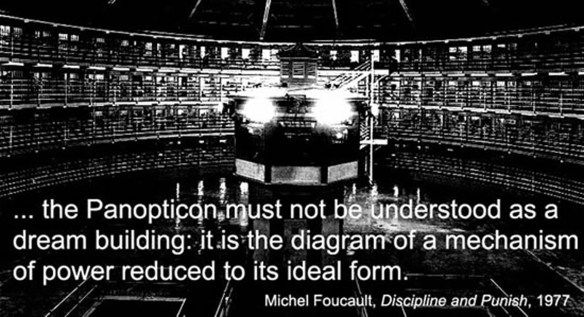
The American Police State, much like The Prisoner’s Village, is a metaphorical panopticon, a circular prison in which the inmates are monitored by a single watchman situated in a central tower. Because the inmates cannot see the watchman, they are unable to tell whether or not they are being watched at any given time and must proceed under the assumption that they are always being watched.

Eighteenth century social theorist Jeremy Bentham envisioned the panopticon prison to be a cheaper and more effective means of “obtaining power of mind over mind, in a quantity hitherto without example.”

Bentham’s panopticon, in which the prisoners are used as a source of cheap, menial labor, has become a model for the modern surveillance state in which the populace is constantly being watched, controlled and managed by the powers-that-be and funding its existence.

Nowhere to run and nowhere to hide: this is the new mantra of the architects of the police state and their corporate collaborators (Facebook, Amazon, Netflix, Google, Instagram, etc.).

Government eyes are watching you.

They see your every move: what you read, how much you spend, where you go, with whom you interact, when you wake up in the morning, what you’re watching on television and reading on the internet.

Every move you make is being monitored, mined for data, crunched, and tabulated in order to form a picture of who you are, what makes you tick, and how best to control you when and if it becomes necessary to bring you in line.

When the government sees all and knows all and has an abundance of laws to render even the most seemingly upstanding citizen a criminal and lawbreaker, then the old adage that you’ve got nothing to worry about if you’ve got nothing to hide no longer applies.

Apart from the obvious dangers posed by a government that feels justified and empowered to spy on its people and use its ever-expanding arsenal of weapons and technology to monitor and control them, we’re approaching a time in which we will be forced to choose between obeying the dictates of the government—i.e., the law, or whatever a government official deems the law to be—and maintaining our individuality, integrity and independence.

When people talk about privacy, they mistakenly assume it protects only that which is hidden behind a wall or under one’s clothing. The courts have fostered this misunderstanding with their constantly shifting delineation of what constitutes an “expectation of privacy.” And technology has furthered muddied the waters.

However, privacy is so much more than what you do or say behind locked doors. It is a way of living one’s life firm in the belief that you are the master of your life, and barring any immediate danger to another person (which is far different from the carefully crafted threats to national security the government uses to justify its actions), it’s no one’s business what you read, what you say, where you go, whom you spend your time with, and how you spend your money.

Unfortunately, George Orwell’s 1984—where “you had to live—did live, from habit that became instinct—in the assumption that every sound you made was overheard, and, except in darkness, every movement scrutinized”—has now become our reality.

We now find ourselves in the unenviable position of being monitored, managed and controlled by our technology, which answers not to us but to our government and corporate rulers.

Consider that on any given day, the average American going about his daily business will be monitored, surveilled, spied on and tracked in more than 20 different ways, by both government and corporate eyes and ears.

A byproduct of this new age in which we live, whether you’re walking through a store, driving your car, checking email, or talking to friends and family on the phone, you can be sure that some government agency, whether the NSA or some other entity, is listening in and tracking your behavior.

This doesn’t even begin to touch on the corporate trackers that monitor your purchases, web browsing, Facebook posts and other activities taking place in the cyber sphere.

Stingray devices mounted on police cars to warrantlessly track cell phones, Doppler radar devices that can detect human breathing and movement within in a home, license plate readers that can record up to 1800 license plates per minute, sidewalk and “public space” cameras coupled with facial recognition and behavior-sensing technology that lay the groundwork for police “pre-crime” programs, police body cameras that turn police officers into roving surveillance cameras, the internet of things: all of these technologies add up to a society in which there’s little room for indiscretions, imperfections, or acts of independence—especially not when the government can listen in on your phone calls, monitor your driving habits, track your movements, scrutinize your purchases and peer through the walls of your home.

As French philosopher Michel Foucault concluded in his 1975 book Discipline and Punish, “Visibility is a trap.”

This is the electronic concentration camp—the panopticon prison—the Village—in which we are now caged.

It is a prison from which there will be no escape if the government gets it way.

As Glenn Greenwald notes:

“The way things are supposed to work is that we’re supposed to know virtually everything about what [government officials] do: that’s why they’re called public servants. They’re supposed to know virtually nothing about what we do: that’s why we’re called private individuals. This dynamic – the hallmark of a healthy and free society – has been radically reversed. Now, they know everything about what we do, and are constantly building systems to know more. Meanwhile, we know less and less about what they do, as they build walls of secrecy behind which they function. That’s the imbalance that needs to come to an end. No democracy can be healthy and functional if the most consequential acts of those who wield political power are completely unknown to those to whom they are supposed to be accountable.”

Even now, the Trump Administration is working to make some of the National Security Agency’s vast spying powers permanent.

In fact, Attorney General Jeff Sessions is pushing for Congress to permanently renew Section 702 of the Foreign Intelligence Surveillance Act, which allows government snoops to warrantlessly comb through and harvest vast quantities of our communications.

And just like that, we’re back in the Village, our escape plans foiled, our future bleak.

Except this is no surprise ending: for those who haven’t been taking the escapist blue pill, who haven’t fallen for the Deep State’s phony rhetoric, who haven’t been lured in by the promise of a political savior, we never stopped being prisoners.

So how do we break out?

For starters, wake up. Resist the urge to comply.

The struggle to remain “oneself in a society increasingly obsessed with conformity to mass consumerism,” writes Steven Paul Davies, means that superficiality and image trump truth and the individual. The result is the group mind and the tyranny of mob-think.

Think for yourself. Be an individual. As McGoohan commented in 1968, “At this moment individuals are being drained of their personalities and being brainwashed into slaves… As long as people feel something, that’s the great thing. It’s when they are walking around not thinking and not feeling, that’s tough. When you get a mob like that, you can turn them into the sort of gang that Hitler had.”

In a media-dominated age in which the lines between entertainment, politics and news reporting are blurred, it is extremely difficult to distinguish fact from fiction. We are so bombarded with images, dictates, rules and punishments and stamped with numbers from the day we are born that it is a wonder we ever ponder a concept such as freedom. As McGoohan declared, “Freedom is a myth.”

In the end, as I make clear in my book Battlefield America: The War on the American People, we are all prisoners of our own mind.

In fact, it is in the mind that prisons are created for us. And in the lockdown of political correctness, it becomes extremely difficult to speak or act individually without being ostracized. Thus, so often we are forced to retreat inwardly into our minds, a prison without bars from which we cannot escape, and into the world of video games and television and the Internet.

We have come full circle from Bentham’s Panopticon to McGoohan’s Village to Huxley’s Brave New World.

As cultural theorist Neil Postman observed:

What Orwell feared were those who would ban books. What Huxley feared was that there would be no reason to ban a book, for there would be no one who wanted to read one. Orwell feared those who would deprive us of information. Huxley feared those who would give us so much that we would be reduced to passivity and egoism. Orwell feared we would become a captive audience. Huxley feared the truth would be drowned in a sea of irrelevance. Orwell feared that we would become a captive culture. Huxley feared we would become a trivial culture, preoccupied with some equivalent of the feelies, the orgy porgy, and the centrifugal bumblepuppy. As Huxley remarked in Brave New World Revisited, the civil libertarians and rationalists who are ever on the alert to oppose tyranny “failed to take into account man’s almost infinite appetite for distractions.” In Brave New World, they are controlled by inflicting pleasure. In short, Orwell feared that what we hate would ruin us. Huxley feared that what we love will ruin us.

You want to be free? Break out of the circle.

Corporate giant Unilever demands crackdown on oppositional Internet content

By Will Morrow

Source: WSWS.org

The drive to censor the Internet took another step this week with a public statement by Keith Weed, the chief marketing officer for the London-based multinational Unilever, threatening to withdraw advertising from social media platforms if they fail to suppress “toxic content.”

Weed reportedly told an annual leadership meeting of the Interactive Advertising Bureau in Palm Desert, California that the company “will not invest in platforms or environments” that “create divisions in society, and promote anger or hate.” He added, “We will prioritize investing only in responsible platforms that are committed to creating a positive impact in society.”

Excerpts of Weed’s remarks—the most explicit of their kind from a major corporate executive—were leaked to several media outlets, including the Wall Street Journal and the Guardian. They were immediately featured on NBC News and other major American news outlets on Sunday. The Journal’s report was accompanied by an interview with Weed.

The coordinated release was designed to escalate the propaganda offensive by the Democratic Party and US intelligence agencies, together with the corporate media, for Internet censorship. The fraudulent premise for this assault on freedom of speech, both in the US and across Europe, is the claim that political opposition and social tensions are the product not of poverty, inequality and policies of austerity and militarism, but of “fake news” spread by Russia through social media.

Weed’s statements preceded yesterday’s US Senate Select Committee on Intelligence hearing, which witnessed a series of hysterical denunciations of Russia by politicians and intelligence agents. The Democratic vice-chairman of the committee, Mark Warner of Virginia, declared that Russia “utilized our social media platforms to push and spread misinformation at an unprecedented scale.”

Facebook responded to Weed’s threats by declaring, “[W]e fully support Unilever’s commitments and are working closely with them.” The Journal stated that Unilever “has already held discussions” with Facebook, Google, Twitter, Snap and Amazon “to share ideas about what each can do to improve.”

Weed absurdly framed his demand for censorship, made on behalf of a multibillion-dollar global corporation, as the expression of popular anger over the supposed spread of “fake news.” He referred to research showing a decline in trust in social media and a “perceived lack of focus” in the form of “illegal, unethical and extremist behavior and material on” social media platforms. Speaking to the Wall Street Journal, he claimed to be articulating the concerns of consumers over “fake news” and “Russians influencing the US election.”

In reality, the intervention by Unilever—a consumer products behemoth with a market capitalization of $157 billion and annual revenues of $65 billion, more than the gross domestic product of many countries—only highlights the economic and political forces driving the censorship campaign: an alliance of the military/intelligence apparatus, giant technology firms and the corporate-financial oligarchy.

Unilever’s annual marketing outlays of nearly $9 billion place it in the top five companies in that category globally. It owns dozens of brands used by some 2.5 billion people around the world, including Dove soap, Rexona deodorant and food products Cornetto, Magnum and Lipton. Weed’s statements amount to a declaration that Unilever will use this economic power to filter what the world’s population can and cannot read online.

This is in line with a long and reactionary tradition. Large advertisers played a significant role in enforcing the McCarthyite witch hunt of socialist and left-wing figures in the US during the late 1940s and 1950s. General Motors, DuPont, Reynolds Tobacco and other major companies were backers of the notorious anticommunist periodical Counterattack, which published names of suspected communist sympathizers and forced the removal of targeted performers and critical content from programs they sponsored.

In one of many such cases, the blacklisted Jean Muir was dropped from the television show “The Aldrich Family” after General Foods, the program’s sponsor, told NBC it would not sponsor programs featuring “controversial persons.”

In another development, Susan Wojcicki, the CEO of YouTube (owned by Google’s parent company, Alphabet), told a Code Media conference in Los Angeles that Facebook “should get back to baby pictures and sharing.” The statement is a reference to Facebook’s announcement last month that it is deprioritizing news content on its News Feed in favor of “personal moments.” The change is one of a number of recent measures to prevent Facebook users from accessing news and analysis outside of officially sanctioned corporate outlets.

UK Home Secretary Amber Rudd on Tuesday released a government-developed application that uses machine-learning algorithms to automatically detect ISIS-related content in videos so that it can be censored.

The BBC wrote that the tool was seen by the government as a way to demonstrate that its “demand for a clampdown on extremist activity was not unreasonable.” Rudd stated, “The technology is there. There are tools out there that can do exactly what we’re asking for,” i.e., identifying and censoring video content. The new application will be provided free of charge to smaller video hosting companies, and the government will consider making its use legally mandatory.

The Washington Post, which along with the New York Times has been at the forefront of the censorship campaign, linked the UK government’s announcement to the intervention of Unilever, writing that it came “amid mounting pressure on social media companies to do more to remove extremist content from their platforms.”

Thought Police for the 21st Century

By Chris Hedges

Source: TruthDig

The abolition of net neutrality and the use of algorithms by Facebook, Google, YouTube and Twitter to divert readers and viewers from progressive, left-wing and anti-war sites, along with demonizing as foreign agents the journalists who expose the crimes of corporate capitalism and imperialism, have given the corporate state the power to destroy freedom of speech. Any state that accrues this kind of power will use it. And for that reason I traveled last week to Detroit to join David North, the chairperson of the international editorial board of the World Socialist Web Site, in a live-stream event calling for the formation of a broad front to block an escalating censorship while we still have a voice.

“The future of humanity is the struggle between humans that control machines and machines that control humans,” Julian Assange, the founder of WikiLeaks, said in a statement issued in support of the event. “Between the democratization of communication and usurpation of communication by artificial intelligence. While the Internet has brought about a revolution in people’s ability to educate themselves and others, the resulting democratic phenomena has shaken existing establishments to their core. Google, Facebook and their Chinese equivalents, who are socially, logistically and financially integrated with existing elites, have moved to re-establish discourse control. This is not simply a corrective action. Undetectable mass social influence powered by artificial intelligence is an existential threat to humanity. While still in its infancy, the trends are clear and of a geometric nature. The phenomena differs in traditional attempts to shape cultural and political phenomena by operating at scale, speed and increasingly at a subtlety that eclipses human capacities.”

In late April and early May the World Socialist Web Site, which identifies itself as a Trotskyite group that focuses on the crimes of capitalism, the plight of the working class and imperialism, began to see a steep decline in readership. The decline persisted into June. Search traffic to the World Socialist Web Site has been reduced by 75 percent overall. And the site is not alone. AlterNet’s search traffic is down 71 percent, Consortium News’ traffic is down 72 percent. And the situation appears to be growing worse.

The reductions coincided with the introduction of algorithms imposed by Google to fight “fake news.” Google said the algorithms are designed to elevate “more authoritative content” and marginalize “blatantly misleading, low quality, offensive or downright false information.” It soon became apparent, however, that in the name of combating “fake news,” Google, Facebook, YouTube and Twitter are censoring left-wing, progressive and anti-war sites. The 150 most popular search terms that brought readers to the World Socialist Web Site, including “socialism,” “Russian Revolution” and “inequality,” today elicit little or no traffic.

Monika Bickert, head of global policy management at Facebook, told the U.S. Senate Committee on Commerce, Science, and Transportation in a hearing Wednesday that Facebook employs a security team of 10,000—7,500 of whom “assess potentially violating content”—and that “by the end of 2018 we will more than double” it to over 20,000. Social media companies are intertwined with and often work for U.S. intelligence agencies. This army of censors is our Thought Police.

The group, Bickert said, includes “a dedicated counterterrorism team” of “former intelligence and law-enforcement officials and prosecutors who worked in the area of counterterrorism.” She testified that artificial intelligence automatically flags questionable content. Facebook, she said, does not “wait for these … bad actors to upload content to Facebook before placing it into our detection systems.” The “propaganda” that Facebook blocks, she said, “is content that we identify ourselves before anybody” else can see it. Facebook, she said, along with over a dozen other social media companies has created a blacklist of 50,000 “unique digital fingerprints” that can prevent content from being posted.

“We believe that a key part of combating extremism is preventing recruitment by disrupting the underlying ideologies that drive people to commit acts of violence,” she told the committee. “That’s why we support a variety of counterspeech efforts.”

“Counterspeech” is a word that could have been lifted from the pages of George Orwell’s dystopian novel “1984.”

Eric Schmidt, who is stepping down this month as the executive chairman of Google’s parent company, Alphabet, has acknowledged that Google is creating algorithms to “de-rank” Russian-based news websites RT and Sputnik from its Google News services, effectively blocking them. The U.S. Department of Justice forced RT America, on which I host a show, “On Contact,” that gives a voice to anti-imperialist and anti-capitalist voices, to register as a “foreign agent.” Google removed RT from its “preferred” channels on YouTube. Twitter has blocked the Russian news service agencies RT and Sputnik from advertising.

This censorship is global. The German government’s Network Enforcement Act fines social media companies for allegedly objectionable content. French President Emmanuel Macron has vowed to remove “fake news” from the internet. Facebook and Instagram erased the accounts of Ramzan Kadyrov, the dictator of the Chechen Republic, because he is on a U.S. sanctions list. Kadyrov is certainly repugnant, but this ban, as the American Civil Liberties Union points out, empowers the U.S. government to effectively censor content. Facebook, working with the Israeli government, has removed over 100 accounts of Palestinian activists. This is an ominous march to an Orwellian world of Thought Police, “Newspeak” and “thought-crime” or, as Facebook likes to call it, “de-ranking” and “counterspeech.”

The censorship, justified in the name of combating terrorism by blocking the content of extremist groups, is also designed to prevent a distressed public from accessing the language and ideas needed to understand corporate oppression, imperialism and socialism.

“Don’t you see that the whole aim of Newspeak is to narrow the range of thought?” Orwell wrote in “1984.” “In the end we shall make thought-crime literally impossible, because there will be no words in which to express it. Every concept that can ever be needed will be expressed by exactly one word, with its meaning rigidly defined and all its subsidiary meanings rubbed out and forgotten. … Every year fewer and fewer words, and the range of consciousness always a little smaller. …”

Corporate capitalism, and the ideology that justifies it—neoliberalism, the free market, globalization—no longer has any credibility. All of the utopian promises of globalization have been exposed as lies. Allowing banks and corporations to determine how we should order human society and govern ourselves did not spread global wealth, raise the living standards of workers or implant democracy across the globe. The ideology, preached in business schools and by pliant politicians, was a thin cover for the rapacious greed of the elites, elites who now control most of the world’s wealth.

The ruling elites know they are in trouble. The Republican and Democratic parties’ abject subservience to corporate power is transparent. The insurgencies in the two parties that saw Bernie Sanders nearly defeat the seemingly preordained Democratic nominee, Hillary Clinton, and the election of Donald Trump terrify the elites. The elites, by attacking critics and dissidents as foreign agents for Russia, are seeking to deflect attention from the cause of these insurgencies—massive social inequality. Critics of the corporate state and imperialism, already pushed to the margins, are now dangerous because the elites no longer have a viable counterargument. And so these dissidents must be silenced.

“What’s so specifically important about this is that in a period of growing political radicalization among young people, among workers, they start to look for oppositional information, they become interested in socialism, revolution, terms like ‘equality,’ those terms which previously would bring thousands of readers to the World Socialist Web Site, now were bringing no readers to the World Socialist Web Site,” North said. “In other words, they were setting up a quarantine between those who may be interested in our site and the WSWS. From being a bridge, Google was becoming a barrier, a guard preventing access to our site.”

The internet, with its ability to reach across international boundaries, is a potent tool for connecting workers across the earth who are fighting the same enemy—corporate capitalism. And control of the internet, the elites know, is vital to suppress information and consciousness.

“There is no national solution to the problems of American capitalism,” North said. “The effort of the United States is to overcome this through a policy of war. Because what, ultimately, is imperialism? The inability to solve the problems of the nation-state within national borders drives the policy of war and conquest. That is what is emerging. Under conditions of war, the threat of war, conditions of growing and immeasurable inequality, democracy cannot survive. The tendency now is the suppression of democracy. And just as there is no national solution for capitalism, there is no national solution for the working class.”

“War is not an expression of the strength of the system,” North said. “It is an expression of profound and deep crisis. Trotsky said in the Transitional Program: ‘The ruling elites toboggan with eyes closed toward catastrophe.’ In 1939, they went to war, as in 1914, aware of the potentially disastrous consequences. Certainly, in 1939, they knew what the consequences of war were: War brings revolution. But they could not see a way out. The global problems which exist can only be solved in one of two ways: the capitalist, imperialist solution is war and […] fascism. The working-class solution is socialist revolution. This is, I think, the alternative we’re confronted with. So, the question that has come up, in the broadest sense, [is] what is the answer to the problems we face? Building a revolutionary party.”

“There is going to be, and there is already unfolding, massive social struggles,” North said. “The question of social revolution is not utopian. It is a process that emerges objectively out of the contradictions of capitalism. I think the argument can be made—and I think we made this argument—that really, since 2008, we have been witnessing an acceleration of crisis. It has never been solved, and, indeed, the massive levels of social inequality are themselves not the expression of a healthy but [instead] a deeply diseased socioeconomic order. It is fueling, at every level, social opposition. Of course, the great problem, then, is overcoming the legacy of political confusion, produced, as a matter of fact, by the defeats and the betrayals of the 20th century: the betrayal of the Russian Revolution by Stalinism; the betrayals of the working class by social democracy; the subordination of the working class in the United States to the Democratic Party. These are the critical issues and lessons that have to be learned. The education of the working class in these issues, and the development of perspective, is the most critical point … the basic problem is not an absence of courage. It is not an absence of the desire to fight. It is an absence of understanding.”

“Socialist consciousness must be brought into the working class,” North said. “There is a working class. That working class is open now and receptive to revolutionary ideas. Our challenge is to create the conditions. The workers will not learn this in the universities. The Marxist movement, the Trotskyist movement, must provide the working class with the intellectual, cultural tools that it requires, so that it understands what must be done. It will provide the force, it will provide the determination, the emotional and passionate fuel of every revolutionary movement is present. But what it requires is understanding. And we will, and we are seeking to defend internet freedom because we want to make use of this medium, along with others, to create the conditions for this education and revival of revolutionary consciousness to take place.”


Untying PropOrNot: Who They Are … and a Look at 2017’s Biggest Fake News Story

By George Eliason, an American journalist living in Ukraine.

Source: Washington’s Blog

Preface by Washington’s Blog: A leading cybersecurity expert has publicly said that Mr. Eliason’s research as  presented in this article does not violate the law.  Washington’s Blog does not express an opinion about whether or not the claims set forth in this article are accurate or not. Make up your own mind.

A little over a year ago, the deep-state graced the world with Propornot. Thanks to them, 2017 became the year of fake news. Every news website and opinion column now had the potential to be linked to the Steele dossier and Trump collusion with Russia. Every journalist was either with us or against us. Every one that was against us became Russia’s trolls.

Fortunately for the free world, the anonymous group known as Propornot that tried to “out” every website as a potential Russian colluder, in the end only implicated themselves.

Turnabout is fair play and that’s always the fun part, isn’t it? With that in mind, I know the dogs are going to howl this evening over this one.

The damage Propornot did to scores of news and opinions websites in late 2016-2017 provides the basis of a massive civil suit. I mean huge, as in the potential is there for a tobacco company sized  class-action sized lawsuit. I can say that because I know a lot about a number of entities that are involved and the enormous amount of money behind them.

How serious is this? In 2016, a $10,000 reward was put out for the identities of Propornot players. No one has claimed it yet, and now, I guess no one will. There are times in your life that taking a stand has a cost. To make sure the story gets out and is taken seriously, this is one of those times.

If that’s what it takes for you to understand the danger Propornot and the groups around them pose to everyone you love, if you understand it, everything will have been well worth it.

In this article, you’ll meet some of the people staffing Propornot. You’ll meet the people and publications that provide their expenses and cover the logistics. You’ll meet a few of the deep state players. We’ll deal with them very soon. They need to see this as the warning shot over the bow and start playing nice with regular people.  After that, you’ll meet the NGO’s that are funding and orchestrating all of it. How am I doing so far?

The image that you see is the clincher or game winner that supplies the necessary proof up front and the direct path to Propornot. This was a passive scan of propornot.com showing the administrative dashboard belongs to the InterpreterMag.com as shown on the left of the image. On the right, it shows that uploads to Propornot.com come from InterpreterMag.com and is a product of that publication.

Now we have the first layer of Propornot, fake news, and our 1st four contestants. We havea slew of new media organizations that are influenced by, or feeding Propornot. Remember, fake news got off the ground and got its wings because of the attention this website received from the Washington Post in Dec. 2016.

At the Interpreter Mag level, here are the people:

  • Michael Weiss is the Editor-in-Chief at the InterpreterMag.com. According to his Linkd profile, he is also a National Security Analyst for CNN since Jul 2017 as well as an Investigative Reporter for International Affairs for CNN since Apr 2017. He has been a contributor there since 2015. He has been a Senior Editor at The Daily Beast since Jun 2015.

With the lengthy CNN cred’s, how much involvement does CNN have in fake news? Yes, I know, but we’re talking about Propornot.

  • James Miller’s bio at the InterpreterMag.com includes Managing Editor of The Interpreter where he reports on Russia, Ukraine, and Syria. James runs the “Under The Black Flag” column at RFE/RL which provides news, opinion, and analysis about the impact of the Islamic State extremist group in Syria, Iraq, and beyond. He is a contributor at Reuters, The Daily Beast, Foreign Policy, and other publications. He is an expert on verifying citizen journalism and has been covering developments in the Middle East, specifically Syria and Iran, since 2009. Follow him on Twitter: @MillerMENA- Miller even works for the US Embassy in Kiev “diplo-page” the Kiev Post.

The Interpreter is a product of the Atlantic Council. The Digital Forensics Research Lab has been carrying the weight in Ukrainian-Russian affairs for the Atlantic Council. Fellows working with the Atlantic Council in this area include:

  • Bellingcat- Aric Toler and Eliot Higgins- This linked article shows how an underwear salesman became one of the most important faces of the deep state.  Don’t laugh, the image is really appropriate. Higgins’ insecurity runs so deep because of his failures that Higgins tries to get publications censured that question his author-i-tie.
  • Anne Applebaum
  • StopFake- Irena Chalupa- Chalupa is the sister to the same Alexandra Chalupa that brought the term Russian hacking to worldwide attention. Irena Chalupa is a nonresident fellow with the Atlantic Council’s Dinu Patriciu Eurasia Center. She is also a senior correspondent at Radio Free Europe/Radio Liberty (RFE/RL), where she has worked for more than twenty years. Ms. Chalupa previously served as an editor for the Atlantic Council, where she covered Ukraine and Eastern Europe. Irena Chalupa is also the news anchor for Ukraine’s propaganda channel Stopfake.org She is a Ukrainian Diaspora leader. The Chalupa’s are the 1st family of Ukrainian propaganda. She works with and for Ukrainian Intelligence through the Atlantic Council, Stopfake, and her sisters Andrea (Euromaidanpr) and Alexandra.

The strand that ties this crew together is they all work for Ukrainian Intelligence. If you hit the links, the ties are documented very clearly. We’ll get to that point again shortly, but let’s go further:

Propornot-> Atlantic Council -> Broadcasting Board of Governors (BBG)

Who are the BBG? According to Wikipedia- “The Broadcasting Board of Governors (BBG) is an independent agency of the United States government. According to its website, its mission is to “inform, engage, and connect people around the world in support of freedom and democracy. The BBG supervised Voice of America (VOA), Radio Free Europe/Radio Liberty, Radio y Television Marti, Radio Free Asia, and the Middle East Broadcast Networks.

The board of the BBG was eliminated and replaced with a single appointed chief executive officer as part of the National Defense Authorization Act for Fiscal Year 2017, which was passed in December 2016.”

On January 1, 2016, the  Interpreter became a special project of RFE/RL and under the oversight of the BBG. The Secretary of State had a seat on the board of the BBG until December 2016. Why the change?

During the 2016 election, the BBG developed a major conflict of interest. At least two BBG board members worked actively for the Hillary Clinton presidential campaign. These government officials were working against the president-elect after the election. It looks like it didn’t go unnoticed. In the following linked article, it shows that they should be investigated for their part in an attempted coup.

From a Nov 7, 2016, article– “Karen Kornbluh is helping refine and to get Hillary Clinton’s message out. ” All of them are names to watch if Clinton wins — and key jobs at the FCC and other federal agencies are up for grabs.”

According to her bio: Karen founded the New America Foundation’s Work and Family Program and is a senior fellow for Digital Policy at the Council on Foreign Relations. Karen has written extensively about technology policy, women, and family policy for The AtlanticThe New York Times and The Washington PostNew York Times columnist David Brooks cited her Democracy article “Families Valued,” focused on “juggler families” as one of the best magazine articles of 2006.

Michael Kempner is the founder, President and Chief Executive Officer of MWW Group, a staunch Hillary Clinton supporter, and may get a greater role if she is elected.  Kempner is a member of the Public Relations Hall of Fame. Michael Kempner hired Anthony Weiner after the sexting scandal broke in 2011.

Jeff Shell, chairman of the BBG and  Universal Filmed Entertainment is supporting a secondary role by being an honor roll donor to the Atlantic Council. While the BBG is supposed to be neutral it has continuously helped increase tensions in Eastern Europe. While giving to the Atlantic Council may not be illegal while in his position, currently, the Atlantic Council’s main effort is to ignite a war with Russia. This may set up a major conflict of interest.

According to journalist Robert Parry “The people that will be taking senior positions and especially in foreign policy believe “This consensus is driven by a broad-based backlash against a president who has repeatedly stressed the dangers of overreach and the need for restraint, especially in the Middle East.”

Parry goes on to say that at the forefront of this is the Atlantic Council, a think tank associated with NATO. Their main goal is a major confrontation with nuclear-armed Russia.”

So, to make sense of all this, most of the people listed would have held cabinet positions in a Hillary Clinton presidency. If the Interpreter is a project of RFE/RL then the decision to go ahead with Propornot would have to go across their desk. That includes then Sec of State, John Kerry.

The unasked question of why would a US Government Agency do this (?) needs to be addressed. All the people listed above were actively working for Clinton to get her elected and throw Donald Trump’s campaign off the rails.

After the election, they were going to take care of Clinton’s “deplorables” by dissecting alternative media. I wrote about this before the election and I warned several major new sites what they could expect. I was right on the money. After she lost, it was already in motion. The deplorable media didn’t fall into a particular political pattern other than they did not promote Hillary Clinton.

The purpose of Propornot has been to get people to demand freedom of speech be rolled back. This was/is to be done by destroying fact-based media. If you read further, the entire plan is laid out starting from 2015 when it started coming together.

These people want reality shaped on what the perceived majority (louder) group believes to be true, regardless of what the facts are. Perception based reality is only a Facebook like away from killing one person or elevating another to hero status regardless of what they have done.

That little statement about the free speech rally says it all. It’s something that would hardly be noticed unless you were looking for it because it is part of the meta-data.

Now you can say it’s only a sentence and who cares? Nobody communicates through metadata do they? Wasn’t that what Propornot was all about? Yes, they do communicate through metadata. That’s why I look at it.

Do you see it? No? Look again. There in the metadata, at the bottom of the image is an ad for a job. Go for it and remember to mention the header. It could just as easily be hacking instructions, or a do not disturb sign. That’s why it pays to really research carefully.

The Boston ‘Free Speech’ Rally was billed by the social networks and MSM as a fascist rally. It was really a Free Speech Rally. What they learned is that with just a little nudge, they can make you demand nationalist repression. Nice going Boston!

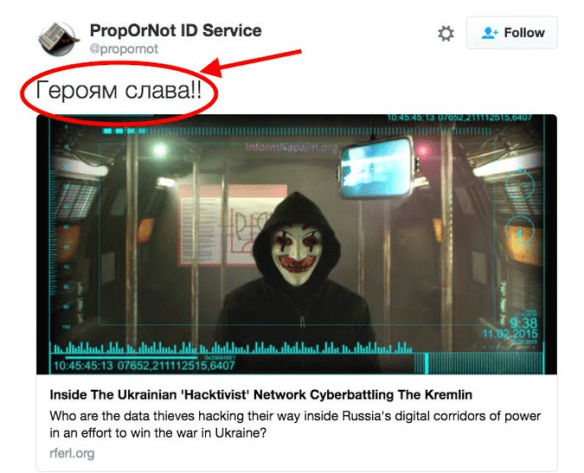
Hey, is this starting to sound a little conspiratorial? If it is, we need ruskie hackers with Guy Fawkes masks to make this work. They have to admit to changing international politics through hacking in 2016, belong to a foreign country, code in Russian, and use spear phishing techniques to lure people in. Let’s not forget that they also have to work for some form of Intelligence.

Most importantly, they have to work with and influence all of the people above. They will definitely impact US foreign policy toward Russia. Let’s raise the stakes even more. The hackers have to answer to whoever is funding a lot of the illegal and immoral activities.

They are not even savvy enough to stay clear of outing each other. This is the Pravy Sektor hacker RUH8.  The common thread for these hackers is clear if you read the linked material on the profiles that make up these organizations. They work for Bellingcat, Informnapalm, the Atlantic Council, Ukrainian Intel, and the Diaspora.

In a follow-up article, I have reason to ask if they were given access to United States Government Top Secret Secure Servers. I’m not kidding.

In a Euromaidan Press article dated November 2nd, 2016, the hackers state enthusiastically “Ukrainian hackers have a rather high level of work. So the help of the USA… I don’t know, why would we need it? We have all the talent and special means for this. And I don’t think that the USA or any NATO country would make such sharp movements in international politics.”

And we have a winner. In 2016 the sharp movement in international politics was caused by…survey says….hacking!!!!

According to Donna Brazille, the Democratic Party servers were hacked multiple times and the hacking didn’t stop until December 2016. At this juncture, we should be able to agree that Seth Rich leaked the information to Wikileaks. But, now we are talking about other hacks. In the above linked article, these hacker specifically say their favorite route is spear phishing email accounts.

In the article, you’ll also see they work directly for Ukrainian Intel. Bellingcat works directly for Ukrainian Intel and works with them and the Atlantic Council. Stopfake is a product of Irena Chalupa who works for RFE/RL, the Atlantic Council and the Ukrainian government. Stopfake works directly with them and is a product of the Ukrainian government. Crowdstrike has an ongoing relationship with Ukrainian Intel and these particular hackers. Crowdstrike conjured up Fancy Bear. Well say, hello to the real fancy bear of 2016 (*fancybear is technically a set of tools and not people).

This means that former Secretary of State John Kerry approved of Ukrainian Intelligence hackers having access to servers inside a US Government Agency because of Propornot and the Atlantic Councils reliance on the hackers.

How are the Ukrainian hackers tied into Propornot at any level? James Miller isn’t shy about using their work. Propornot relies on the work of the Atlantic Council, Aric Toler, Aaron Weisburd, Clint Watts, and Joel Harding. The Ukrainian hackers work directly with InformNapalm and are the go-to resource for most of the people involved and all of the people just named.

Below we have assessed the details of the reports from InformNapalm, and have expanded on their investigation. — James Miller

Americans are attacking Americans for a foreign country for what amounts to pennies. We’ll deal with them again soon.

Who does the Atlantic Council work for? It’s the same people that staff RFE/RL.

“On 29 January 2016 in Washington, U.S.A., Ukrainian World Congress (UWC) President Eugene Czolij and Atlantic Council President and CEO Frederick Kempe officially signed a Memorandum of Agreement to renew the cooperation between the UWC and the Atlantic Council, that began in September 2014.

In accordance with this Memorandum, the UWC will continue its cooperation with the Atlantic Council on implementing the “Ukraine in Europe Initiative”, which aims to galvanize international support for an independent, sovereign and territorially integral Ukraine, including Crimea. This initiative is also intended to support reforms in Ukraine and its EuroAtlantic integration, and to counter Russian disinformation.”

This one little paragraph spells out clearly what I have shown in detail throughout this article.

The Ukrainian World Congress is represented in the US Congress by the Ukrainian Caucus headed up by ISIS supporter and Nazi cheerleader Marcy Kaptur. Her Ukrainian Caucus represents people  with political positions that scared Adolf Hitler in WWII.

The obvious takeaway is that a lawsuit is a bare minimum that needs to happen. People need to be investigated for crimes against the state. When we take a closer look at who had potential access to top-secret servers, that will become painfully obvious.

These people have tried and are trying to rip the fabric of society in pieces. At the very least, they have earned a good tarring…and feathering. When you look at the financial end of this a lawsuit in the billions would barely touch it.

Just one company the Ukrainian Diaspora started for this is valued over 100 million dollars. This will need to be a class action suit with a cease and desist to the BBG.

In early 2015, almost 2 years before most people took the idea of censorship seriously, I documented its inception. In the same way, it happens with many of the biggest stories of our times, I stumbled onto it by accident.

In early March 2015, Ukrainian Information Policy designer Joel Harding laid out what to expect going forward in the following statements: “In military IIO operations center on the ability to influence foreign audiences, US, and global audiences, and adversely affect enemy decision making through an integrated approach. Even current event news is released in this fashion. Each portal is given messages that follow the same themes because it is an across the board mainstream effort that fills the information space entirely when it is working correctly.

The purpose of “Inform and Influence Operations”  is not to provide a perspective, opinion, or lay out a policy. It is defined as the ability to make audiences “think and act” in a manner favorable to the mission objectives. This is done through applying perception management techniques which target the audiences emotions, motives, and reasoning.

These techniques are not geared for debate. It is to overwhelm and change the target psyche.

Using these techniques information sources can be manipulated and those that write, speak, or think counter to the objective are relegated as propaganda, ill-informed, or irrelevant.”- Harding

While the above sounds gloriously overoptimistic, Harding, along with his little band of Kremlin Troll hunters personally started developing the idea of organizations capable of blackballing journalists and publications in a way that could not be construed as censorship.

From another March 2015 articleA “Disinformation Charter” for Media and BloggersTop-down censorship should be avoided. But rival media, from Al-Jazeera to the BBC, Fox and beyond, need to get together to create a charter of acceptable and unacceptable behavior. Vigorous debate and disagreement qre ,of course, to be encouraged—but media organizations that practice conscious deception should be excluded from the community. A similar code can be accepted by bloggers and other online influencers.

This “Disinformation Charter” for responsible behavior (Ministry of Truth?) he describes is to fight “conscious deception” can only be weighed against how he describes Propaganda. “The word is frequently used to describe any news emerging one’s opponent.”– Harding

Journalists that need to be excluded are those “our side” label as propagandists or active measure agents.”

Harding’s connections in media are very large. Through his friend Mathew Armstrong, Harding had access to and the ear of the board of the Broadcasting Board of Governors (BBG). The BBG board is staffed by the who’s who of network and radio broadcast, print media and shortwave CEO’s and heavy hitters. They are behind RFE/RL (Radio Free Europe/ Radio Liberty).

On the other end of this in 2015, Joel Harding was assembling a group of miscreants to attack the social networks of different journalist and publications. The crude logic behind a direct assault was that by developing, training, and overseeing vast troll networks they could speak over their opposition (people that their employers wanted to be silenced) and subdue dissident online conversation and control the information.

Where this wasn’t feasible, they set up hack and harass attacks at various publication to get them to stop publishing hard-hitting journalists. This still hasn’t been effective because it caused publishers to dig in and harden their internet properties instead.

The softer more indirect approach Harding pushed in March 2015 quickly developed into the unified media strategy he wanted for the US and Europe. Control the information and don’t allow contradicting information or news into the media stream. When it does get in, call it propaganda.

Enter Propornot.


The Search for Meaning in Modern Life

By Kingsley L. Dennis

Source: Waking Times

Every good story about a search begins with a tale. So, here’s one; it’s a tale about a magician who gave a dinner for his neighbours.

There was once a Magician who built a house near a large and prosperous village. One day he invited all the people of the village to dinner. ‘Before we eat,’ he said, ‘we have some entertainments.’

Everyone was pleased, and the Magician provided a first-class conjuring show, with rabbits coming out of hats, flags appearing from nowhere, and one thing turning into another. The people were delighted. Then the Magician asked: ‘Would you like dinner now, or more entertainments?’

Everyone called for entertainments, for they had never seen anything like it before; at home there was food, but never such excitement as this. So, the Magician changed himself into a pigeon, then into a hawk, and finally into a dragon. The people went wild with excitement.

He asked them again, and they wanted more. And they got it. Then he asked them if they wanted to eat, and they said that they did. So the Magician made them feel that they were eating, diverting their attention with a number of tricks, through his magical powers.

The imaginary eating and entertainments went on all night. When it was dawn, some of the people said, ‘We must go to work.’ So the Magician made those people imagine that they went home, got ready for work, and actually did a day’s work

In short, whenever anyone said that he had to do something, the Magician made him think first that he was going to do it, then, that he had done it and finally that he had come back to the Magician’s house.

Finally, the Magician had woven such spells over the people of the village that they worked only for him while they thought that they were carrying on with their ordinary lives. Whenever they felt a little restless he made them think that they were back at dinner at his house, and this gave them pleasure and made them forget.

And what happened to the Magician and the people, in the end? Do you know, I cannot tell you, because he is still busily doing it, and the people are still largely under his spell.

Modern life is much like this tale – we live under a magician’s spell – and the magician is called Modernity. Modernity, especially as it emerged in western, industrialized cultures, created a system that put a spell on us. And this spell is principally promoted through our mainstream medias. Whether rationally, instinctively, or deep in our hearts, most of us know that something is not right about how human societies are managed. Human life is not yet in balance. And too many people still live in fear.

We are manipulated by our mainstream medias at unprecedented levels, and constantly fed with a controlled flow of information. This process is the old mind of humanity, still operating through control, censorship, and consumerism. In this way our contemporary societies are increasingly centered around emotion to a degree that allows people to be entertained as well as manipulated like never before. What we may be less aware of is that the human being is driven by an evolutionary energy that manifests through mental, emotional, and physical/sexual processes. This energy can be used to develop and drive us forward, or it can be hampered, blocked, and manipulated into slowing down our development. Mental, emotional, and physical/sexual energies are all necessary components of the social human being. If we take just a casual look at our mainstream media, entertainment, and social attractions/distractions we will readily see that these are the very areas which are targeted by the ‘culture of spectacle’ that is modern society.

Ancient religious-spiritual traditions have long talked about such ‘energy predators’ that are said to feed off from unstable human mental and emotional states. The early gnostic Christians referred to some of these as the Archons; various North American Indian tribes refer to Wetiko/Wendigo; Don Juan in the Carlos Castenada books refers to the Predators; and South American shamans have long talked of spirits that feed off from and fragment the vulnerable human inner state/soul.

We must wonder why it is that our modern cultures promote entertainments that manipulate and play upon excessively distorted images of mental and emotional anguish as well as exaggerated portrayals of sexuality. Furthermore, we are bombarded daily with images of death. In fact, a recent study into western media announced that the most repeated word in media is ‘death.’ Further, it revealed that in the first twelve years of a child’s life they would have been subjected to around 20,000 murders through television news and programs, films, online content, and video games. These forms of stimulation directly target a person’s mental, emotional, and physical states, which in turn hampers the operation of harmonious, developmental energies.

Modern life is increasingly a life addicted to high stimulation. Yet by its very nature it also creates anxiety. Many people are forced, or seduced, into lives that are continually stressful and busy. There is no room for the spaces, the intervals, of internal reflection. Yet similar to how music is not music without the intervals, so is life not a life without those internal spaces.

We spend our days trying to grasp at life, trying to understand it, often with ways that are not adequate. It is like trying to capture the ocean with a bucket. The ocean stands magnificently before us, and yet so many of us in modern societies are running around anxiously with empty buckets in our hands. We’ve been told that only full buckets are of any use – full buckets represent usefulness and progress.

Here is another story:

A man had two large pots, each hung on an end of a pole which he carried across his neck. One of the pots had a crack in it, and while the other pot was perfect and always delivered a full portion of water at the end of the long walk from the stream to his house, the cracked pot arrived only half full.

For a full two years this went on daily, with the man delivering only one and a half pots full of water to his house. Of course, the perfect pot was proud of its accomplishments, feeling accepted and appreciated. But the poor cracked pot was ashamed of its own imperfection, and miserable that it was able to accomplish only half of what it had been made to do. After two years of what it perceived to be a bitter failure, it spoke to the man one day by the stream.

“I am ashamed of myself, and I want to apologize to you.”

“Why?” asked the man. “What are you ashamed of?”

“I have been able, for these past two years, to deliver only half my load because this crack in my side causes water to leak out all the way back to your house. Because of my flaws, you have to do all of this work, and you don’t get full value from your efforts.” the pot said.

The man felt sorry for the old cracked pot, and in his compassion, he said, “As we return to my house, I want you to look at the beautiful flowers along the path. It will make you feel better.”

Indeed, as they went up the hill, the old cracked pot took notice of the sun warming the beautiful wild flowers on the side of the path, and this made it feel a little happier. But at the end of the path, it still felt bad because it had leaked out half its load, and so again the Pot apologized to the man for its failure.

The man said to the pot, “Did you notice that there were flowers only on your side of your path, but not on the other pot’s side? That’s because I have always known about your flaw, and I took advantage of it. I planted flower seeds on your side of the path, and every day while we walk back from the stream, you’ve been watering them. For two years I have been able to pick these beautiful flowers to take home to my wife. With you being just the way you are, you have given beauty and meaning to me every day.”

The way we are can give us beauty and meaning every day, and yet it seems we are living in a world of decreasing meaning. Our modern systems strive for perfection – for progress and efficiency – yet there is less and less happiness.

And the situation is worse in modern western cultures where so many people are seemingly dissatisfied even when they have acquired most things to keep them happy. Perhaps a society that provides superficial comfort produces conditions that do not develop people or cause them to turn an inward gaze or to question notions of their meaning and existence. It is important that other cultures do not follow this western model of superficial consumerism.

It is unfortunate that the meaning of life is often a meaningless question to so many people. Seeking the ‘unnamable’ might sound like madness to many people, and certainly there is little place for it in modern societies that prize themselves on progress. And yet a life that seeks meaning is its own adventure. The ‘unnamable’ does not need to be named – only recognized internally. The external world is not the only reality that exists for us.

The attitude of the modern-day person to the ‘world outside’ has largely been one of hostility – we have been conquering the external world for the most part of human history, instead of mastering our own inner nature. This hostile attitude ignores the reality that all life is interdependent and that our lives are a projection of our inner realities – that is, our fears, anxieties, and insecurities become projected into the world the same as our hopes, visions, and dreams. Whatever we project externally eventually becomes our sense of reality.

We all share a collective reality, despite our cultural differences. Although it alters depending upon where we were born and in which cultures we live, the methods each modern system uses are basically the same – we are provided with beliefs, cultural references, and norms and attitudes. The writer Doris Lessing referred to this as ‘The prisons we choose to live inside.’ And within these psychological prisons many people, as well as the institutions of the modern world, have rejected the wisdom of sages, mystics, philosophers, and even the voices of creative artists. They prefer instead the superficial trappings, entertainments, and technological distractions of the consumerist marketplace. Now, I wish to be clear here – I am not anti-technology. In fact, I am a great supporter of it; but not at the expense of the human vision. Despite the technological progress of the external world, there must always be a developed interior world to observe, reflect, and to question it. Without this, the exterior life is unleashed without values. Without an interior life to seek for significance, what gives meaning to our lives?

So, what is the ‘interior life’? There are no instruction sets for how to live a human life – and we live in a world where more and more people are at a loss to know either why they live or why they die. In life we must strive to examine the human condition.

Modernity has attempted to reinterpret the human condition – to see it as an external drive for progress – and this has resulted in a separation from our need to seek an essential inner self. This modern project has sought to divorce the human being from their imperative to find meaning in existence. The human project, if we wish to call it that, can never be ‘completed’ – it is an eternal quest to always be becoming. Here is a quote I would like to share:

‘When you have found yourself you can have knowledge. Until then you can only have opinions. Opinions are based on habit and what you conceive to be convenient to you. The study of the Interior Life requires self-encounter along the way. You have not met yourself yet. The only advantage of meeting others in the meantime is that one of them may present you to yourself. Before you do that, you will possibly imagine that you have met yourself many times. But the truth is that when you do meet yourself, you come into a permanent endowment and bequest of knowledge that is like no other experience on earth.’ ~TARIQAVI

What we are truly seeking for – and what the interior life can show us – is power over ourselves: not for power over others.

The world is in need of soulful healing, not power-seeking through corruption and manipulation. The world requires healed, integrated, and balanced people; for that which we lack in ourselves we shall always find lacking in the world outside. Also, there are many external forces in the world that are trying to make us live not according to our own sense but according to dominant social narratives. We are told that we must live according to certain social narratives that generally benefit those systems that have no interest in the human soul. And when we deny ourselves such essential nutrients we find that we have a discomfort within us. People are taking increasing amounts of antidepressants, or stimulants; as well as relaxants – we take drugs to bring us up and other drugs to take us down. We are open and vulnerable to the energies of discouragement. Here is a tale about the price of discouragement:

Once the word spread that the devil was pulling out of his business and was arranging to sell-off all his tools of the trade to the highest bidder. The night of the sale all the tools were arranged for the bidders to view. What a motley crew it was! There were sinister tools of hatred, jealousy, envy, malice, treachery, plus all the other elements of evil. Yet besides these there also was an instrument that seemed harmless, a wedge-shaped instrument that appeared worn out, shabby, and yet was priced so much higher than all others. Someone asked the devil what was the name of such a poor-looking instrument.

‘Discouragement,’ answered the Devil.

‘And why is the price so high for such a non-malicious sounding instrument? asked the bidder.

‘Because,’ spoke the Devil, ‘this instrument is more useful to me than any other. I can enter the consciousness of a human being when all other ways fail me and once inside through the discouragement of that person I can do whatever I please. The instrument is worn out because I use it almost everywhere and as very few people know about this I can continue to successfully achieve my goals.’

And as the price of discouragement was so very, very high even today it remains a tool in the property of the Devil.

The price of discouragement is a price too many people are paying – and it is a high price (as the devil knows!)

It is a common situation that we tell people at work we are happy when for much of the time we are not. We buy more and more items to feel happiness within ourselves or to buy happiness in others. People in modern cultures continue to accumulate goods and possessions whilst feeling empty within. Such consumerism empties our pockets and fails to fill our souls. And not only our physical lives become crowded with belongings but our psychological spaces too. We are crowded with those belongings that have accumulated as psychological attachments: the beliefs, ideologies, nationalisms, opinions, likes, dislikes, and all the rest. We are often cluttered in our minds by belonging to this and that and all the other things that we cling to or that cling to us. And this is where some of the disruptions are, and will continue to come from, because our belongings are now breaking apart. As our social, cultural, economic, and work lives go through change and transformation – as they are currently doing – then the clinging to old ‘belongings’ will only serve to cause greater confusion and disorientation. Already it seems as if we are living in a world that is displaying increasing outward signs of craziness and psychopathic tendencies. We must ensure that the world never has more critics than visionaries, or more complainers than positive doers. We must ensure that we do not lose sight of our frameworks for meaning.

Pre-modern societies, for example, lived within their own frameworks of meaning. Not all questions had their answers, yet mysteries and the mysterious at least had a home in which they could exist. We often live today within an atmosphere of meaningless questions and contradictory answers. The pursuit of meaning is being replaced by the pursuit of progress. Progress may alleviate some of our suffering and pains, yet it shall never compensate for the lack of fulfillment we feel inside, for this requires metaphysical or transcendental nourishment. Any notion of the spiritual, or the metaphysical, is often considered not essential to our daily life, and we are taught to dismiss it. Modernity’s task was thus seen as freeing us from the illusions of transcendence. And yet the desire, or the need, for some Absolute remains deep within us and can never be totally eradicated. Perhaps it is this contradiction that lies at the heart of our contemporary distress.

Modern life also tries to eradicate, or at least hide, all sense of enigma. Yet it is precisely these enigmas that make our lives rich in wonder and awe. To attempt to abolish them is an act of great ignorance and hubris. Unanswerable questions must be embraced and not rejected. Mystery and the mysterious must be allowed a space to thrive and enthrall us. It is this sense of mystery that keeps us curious, and curiosity is one of our driving, motivating forces.

Modern societies may well praise their sophisticated intellectual culture, yet it comes at the cost of having a deteriorated spiritual culture. That which belongs to the experience of the human soul is considered not only incommunicable, but rather dangerous to communicate. In the end, life’s mysteries are kept out of sight because they cannot be fully known and thus controlled. There is a spell upon us, and we are being distracted from the essential. Here is another tale:

A lion was captured and imprisoned in a reserve where, to his surprise, he found other lions that had been there for many years, some even their whole life having been born in captivity. The newcomer soon became familiar with the activities of the other lions, and observed how they were arranged in different groups.

One group was dedicated to socializing, another to show business, whilst yet another group was focused on preserving the customs, culture and history from the time the lions were free. There were church groups and others that had attracted the literary or artistic talent. There were also revolutionaries who devoted themselves to plot against their captors and against other revolutionary groups. Occasionally, a riot broke out and one group was removed or killed all the camp guards and so that they had to be replaced by another set of guards. However, the newcomer also noticed the presence of a lion that always seemed to be asleep. He did not belong to any group and was oblivious to them all. This lion appeared to arouse both admiration and hostility from the others. One day the newcomer approached this solitary lion and asked him which group he belonged to.

‘Do not join any group,’ said the lion. ‘Those poor ones deal with everything but the essential.’

‘And what is essential?’ asked the newcomer.

‘It is essential to study the nature of the fence’

A whole society can be distracted. There is a pertinent analogy here to how, in 256AD, the Persian army took Antioch from the Roman Empire. Many of the inhabitants were attending the roman theatre and were oblivious to the enemy archers who had climbed up behind them into the stands. The actors down below had seen the enemy archers and were desperately trying to warn them with hand signals…but the audience did not understand, thinking it part of the entertainment – until it was too late. They were amused up to the point of death. Perhaps we too, in the words of social critic Neil Postman, are ‘Amusing ourselves to Death.’

Understanding Our Place In The World

The only genuine freedom is to be found by turning within ourselves. The human being is naturally an imaginative and creative creature. Reality may be harsh and painful, yet it is also the realm of so much wonder and awe. We may live our lives playing in the mud, yet our minds can reach the stars. Our science can reach into the molecule as well as penetrate into the formation of the universe. Our mystics and sages can reach into the pulsating heart of the cosmos. The human being has an inner dimension that needs to be investigated and which, in turn, is timeless.

It is my view that the role of imagination – the interpenetration of the interior world – is crucial. It is what fuses together that which is above to that which is below. It is also a channel for intuition; and it is through intuition that we get closer to the essential. The inward gaze forever attempts to reveal the role of the human being, and what makes us human. It is about trying to understand our place in the world and our shifting views of the world. And right now, we find ourselves at a crucial point in human history.

Life on this planet is undergoing a great change. There is a revolution coming as people, especially the young people, develop their ways of communication, collaboration, and a new consciousness. We are seeing examples of empathy and compassion from young people around the world, as well as innovation, creativity, and inspired motivation. I have stated before that we are shifting into an epoch where new value sets will emerge as the dominant traits.

[1] And some of these values are already being expressed within our younger generations. I refer to these as the ‘C’ values of Connection – Communication – Collaboration – Consciousness – Compassion. Such changes will come into our lives, yet not overnight. It is not like flicking on a light switch. I expect it will be a process where much soul-searching and the questioning of our meanings and values will have to occur beforehand. However, it is not all about violence and thuggery, despite what our mainstream news may be showing us. There is a change emerging across the planet, and this change shall arise from within, through a new understanding of the human spirit, and of our place not only in our local cultures but also within a shared, planetary home. These are critical times of transition – and of momentous importance to us.It is important to recognize that we are undergoing a shift from localized cultures into a period of becoming planetary citizens. Nationalisms will need to become secondary, or put aside altogether, as we come closer together as a global species. And this significant transition is dissolving our securities, our belief systems, and our models of reality. Everything around us is beginning to shake – and so is the earth, literally. We can no longer remain within the old narratives. We are in need of new worldviews, both as individuals as well as within our communities and societies. What we now need is genuine and sincere far-reaching vision. And in our mainstream cultures we are also lacking hope and trust, especially in our socio-political systems. What is now essential is hope and trust in humanity, and in the richness and resilience of the human spirit. We are on the cusp of a different world coming into being, and at its centre shall be the human heart and soul. There can be no genuine, lasting future if it is based solely on the exterior life – it must be driven by the values that come from the interior of the human being.

To be prepared for the future world that is now emerging before us we must adapt our thinking and our consciousness to all possibilities. What we first need is a genuine change of mind:

God decided to come down to Earth for a quick look at how creation was coming along.

God approached Earth and happened to look at a big tree full of howling monkeys. As God looked down, one of the monkeys happened to look up and saw God.

The monkey became excited and started to shout: ‘I see God…..I see God!’

None of the other monkeys paid any attention. Some thought the monkey was crazy or perhaps just a religious fanatic. They went on about their daily lives of collecting food, taking care of their young, fighting with each other, etc., etc. Not getting any attention, our monkey decided to try to get attention from God, and said:

‘God, Almighty, You are the Beneficent, the Merciful, please help me!’

In an instant, the monkey was transformed into a man living in his own human community. Everything changed, except for one thing: the monkey’s mind. The monkey immediately realized that could be a problem.

‘Well, thank you God, but what about my mind?’

‘That,’ said God, ‘you will have to change yourself.’ 

As in this story, we have the human form. The next step is for us to assume the responsibility for the correct level of consciousness. It is as simple and as difficult as that.

We have to accept the responsibility for our own choices and actions; and also, how we choose to respond to events. Everything begins and ends with ourselves, and anything other than this is an excuse, no matter how plausible it may seem to us. As creative, imaginative beings we invent and innovate. At the same time, we are masters at inventing our own false stories and imaginings that self-deceive. In this regard we must choose carefully where we wish to put our attention, time, and efforts. After all, when we visit a beautiful garden do we choose to sit by the roses and savour their sweet smell, or to sit amidst the weeds that prick us? It is important to gift ourselves moments of joy, for joy is an infectious energy – and it shares easily too.

It is up to us to choose those moments, events, and circumstances to engrave upon our memories and heart. It is also about choosing what things to forget. Most of the things we encounter or accumulate we would be best to give up, or give away. We should only keep the few, thus ensuring the quality and integrity of those things we keep close to us. Here is another tale:

An Arabian legend tells of two friends who were travelling through the desert and at one point they fell into disagreement about the trip whereby one of the friends slaps the other across the face.

The friend who had been slapped said nothing, only wrote in the sand: ‘Today my best friend slapped me in the face.’

Both friends continued on their journey and eventually arrived at an oasis where there were baths to refresh themselves. The friend who had been slapped jumped into the large baths yet soon found himself starting to drown. The other friend immediately jumped in after him and saved him. After recovering the first man took a pen and wrote on a stone: ‘Today my best friend saved my life.’

Intrigued, the friend asked: ‘Why is it that after I hurt you, you wrote in the sand and now after saving you, you write on a stone?

Smiling, the other friend replied: ‘When a good friend offends us, we write in the sand where the wind of forgetfulness and forgiveness will be responsible for clearing it off; on the other hand, when something great happens to us, we burn it into stone in memory of the heart where no wind in the world can erase it.’

We build up and develop our own interior world by all the small things and moments we choose to engrave upon our heart, spirit, and soul. We can choose those things we wish to line our forward path with.

Choosing Our Path

We should not be afraid to talk about things of the spirit – to be present with spirit and to live with it in our everyday moments. As Bob Dylan says, those who are not busy being born are busy dying. We are representatives of the spirit, and so should seek to be present to this, without the urge for external showing-off. There is no need for acting weird or strange; to wear odd clothes or follow customs antagonistic to the culture in which we are living. We may think and feel differently, and have experiences that are beyond the accepted, normal ken. Yet to revert to odd external behavior only shows that we are unable to internalize and stabilize these experiences and energies. To all purposes, there is nothing wrong in appearing normal to the outside world. To engage with the spirit, we may have to first learn how to be still, without being bored. There are already enough active distractions in the world as it is – why add more?

It is a normal request to ask for ‘practical things.’ People want to find activities, acts, exercises, and rituals to help them along their own path of development. And the world offers many of these things, in varying degrees of genuineness, sincerity, and effectiveness. Yet sometimes being given an action to attend to belittles the process of the initial search. For me personally, I am unable to give specific remedies for the search for meaning, other than to say that a person must first experience what this longing, this need, feels like. We are catalysts for our own search for meaning, and each path is walked differently. To begin with, we must learn how to articulate this need. This will then begin the course of one’s life that will forever alter what comes after. We are compelled to trust our instincts, our intuition, and to take the appropriate response. We are not here in this life to live like ghosts amongst the phantasms of the world. We always have an internal choice, and this should not force us to surrender into the abyss of mass insanity. As the story goes,

There was once a wise and powerful king who ruled in a remote city of a far kingdom. And the king was feared for both his might and his love of wisdom. At the heart of the city was a well whose water was cool and crystalline, and all the inhabitants drank from this well, even the king and his courtiers, because there was no other well in the city. One night, while everyone was asleep, a witch entered the city and poured seven drops of a strange liquid into the well, and said:

‘From now on, anyone who drinks this water will go crazy.’

The next morning all the inhabitants drank the water from the well, except the king and his lord chamberlain, and very soon everyone went mad, as the witch had foretold. During that day, all people went through the narrow streets and public places whispering to each other:
‘The king is mad. Our king and his lord chamberlain have lost their reason. Naturally, we cannot be ruled by a mad king. We must dethrone him!’

That night, the king ordered a golden cup of water from the well to be brought to him. And when they brought the cup the king and his lord chamberlain drank heavily from it. Soon after that there was great rejoicing in that distant city of a far kingdom because the king and his lord chamberlain had regained their reason.

We must be fearless in committing to the inner path we have chosen, so long as we harm no other. The genuine inner path is a subtle one. At times it can seem as if nothing is happening – as if we are going nowhere. Perhaps the path itself is a search for no-place and no-where. And yet we can rest assured that the inner path is active in each moment, in all times. And the search for this can bring meaning to us as we engage with the modern world. Amidst the distractions and entertainments on offer it is possible to remain focused with our own internal meaningful enjoyment. And this inner joy brings with it its own sacred moments.

It will do us good to remember that life lies beyond reason, and is a sacred thing. And we should allow this sacred presence into our lives, with joy, respect, and even a little humour. After all, just a little bit of joy, respect, and humour can go a long, long way – and we have far to travel.


References:

[1] See The Phoenix Generation: A New Era of Connection, Compassion & Consciousness

America’s Painful Self-delusion

By Allen Marshall

Source: Information Clearing House

America is the only nation brought forth by a set of beliefs, and those beliefs, captured so eloquently in our founding documents, are some of the most powerful and inspiring ever conceived. We consider this to be the land of the free, where the individual is supreme and nothing prevents us from going as far as our talents can take us. That image of America – that “brand” – is incredibly strong.

However, there’s a very large gap between that long-held image and the reality of America today. What was once a government built for the people is now a government run for the rich and powerful, one that throws the people under the bus whenever their interests differ from those of the corporate and political leaders who run the show.

And living in one world (the corrupt) while stubbornly believing you live in another (the ideal), despite mounds of evidence, causes a distinct kind of stress, often called cognitive dissonance.

Psychologists suggest that when people are in a state of cognitive dissonance, they’ll search for a way to resolve it, either by rejecting one view or the other as either wrong or unimportant. If you’re a smoker looking at the link between smoking and cancer, for example, you’ll either quit smoking or decide that the research is biased, wrong, or doesn’t apply (in other words, that you’re smart enough to quit before the long-term damage is done).

But what happens if you can’t resolve the two?

For most of us Americans, resolving our cognitive dissonance would mean either accepting that we’re impotent and living futile (and feudal) lives, or rejecting our lifestyles and actively fighting the rot in the system. If we’re not willing to do either of those, the dissonance stays – and eats at us.

People carrying this kind of ongoing, underlying stress find ways of coping with it; in America we’re doing it with self-medication, compulsive behaviors and distractions. Consider the following examples of the way we cope with the ever-present stress in our lives:

  • Drugs – Our country is awash in drugs, both legal and illegal, that keep us numb. In 2014, there were 245 million prescriptions filled for opioid pain relievers. The number of deaths from drug overdoses has risen from around 30,000 in 2005 to 64,000 in 2016. And communities across the country are being devastated by the opioid epidemic, as explained in this in-depth reporting by Cincinnati.com.
  • Drinking – People don’t only use drugs to self-medicate; drinking does the trick as well, and we’re doing a lot more of it than we used to. According to a new study in JAMA Psychiatry, overall drinking in the US increased by 11% between 2002-13, while high-risk and problem drinking rose even higher: high-risk drinking rose by 29.9%, while problem drinking rose by 50%.
  • Mental Illness – In 2015, 17.9% of adults held a diagnosis for a mental disorder, while a 2010 study found that 46.3% of children ages 13-18 had a mental disorder at some point in their young lives, and the majority of those adults and children are given prescriptions. This includes a dramatic increase in ADHD diagnoses for children: According to SharpBrains, “Among children aged 5 to 18, between 1991-92 and 2008-09, rates of ADHD diagnosis increased nearly 4-fold among boys – from 39.5 to 144.6 per 1000 – and nearly 6-fold for girls – from 12.3 and 68.5 per 1000 visits.”
  • Obesity – If drinking and drugs aren’t your thing – or even if they are – more of us are coping with stress by overeating, and it’s showing up on our waistlines. From 1990 to 2016, the average percentage of obese adults increased from 11.1% to 29.8%; when you add in the number of people who are overweight but not obese, it rises to more than two in three adults.
  • Sleeping problems – Sleep has a significant impact on our physical and mental health, and in America we’re not getting enough of it: The CDC states that 50-70 million American adults have a sleep or wakefulness disorder.
  • Media Usage – Is there any better distraction from life’s problems than media? We certainly spend a lot of our time being passively entertained: In 2016, Americans consumed an average of 10 hours of media per day, compared with 7.5 hours per day globally. Nielson reports that lower income adults spend much more time with media than do affluent adults, with adults in households with include under $25,000 watching 211 hours/month of television, versus 113 hours/month for adults in households earning $75,000 or more. (The trend is similar across other media as well.)
  • The Disease of Debt – According to the New York Fed, household debt reached a new peak in the third quarter of 2017, at $12.8 trillion. Part of our debt problem comes from the compulsive shopping we do as a distraction; the other results from denying the reality that our wages aren’t keeping up with the increase in the cost of living, meaning that we use debt to plug the gap rather than reducing our living standards to align with our reality.

We’re collectively doing so much damage to ourselves, solely to protect our psyches from the reality that the America that used to be is no longer the America we have. And who does that help? As you can see from the points above, it doesn’t help us: Instead, it helps the rich and powerful who are subverting the system. They’re corrupting everything this country once was, and by willfully refusing to acknowledge that reality, we’re inadvertently helping them to do it.

The best thing we can do – for our mental and physical health, as well as for our country – is to open our eyes to what America has become, not what we wish it still was. It’s time to face reality and take action.

Wasted lives: The worldwide tragedy of youth suicide

Principles of goodness together with the golden seed of social justice – sharing – need to be the guiding ideals of a radically redesigned socio-economic paradigm.

By Graham Peebles

Source: Nation of Change

The pressures of modern life are colossal; for young people – those under 25 years of age – they are perhaps greater than at any other time. Competition in virtually every aspect of contemporary life, a culture obsessed with image and material success, and the ever-increasing cost of living are creating a cocktail of anxiety and self-doubt that drives some people to take their own lives and many more to self-abuse of one kind or another.

Amongst this age group today, suicide constitutes the second highest cause of death after road/traffic accidents, and is the most common cause of death in female adolescents aged 15–19 years. This fact is an appalling reflection on our society and the materialistic values driven into the minds of children throughout the world.

The World Health Organization (WHO) estimates that in total “close to 800,000 people die due to suicide every year, which is one person every 40 seconds. Many more attempt suicide,” and those who have attempted suicide are the ones at greatest risk of trying again. Whilst these figures are startling, WHO acknowledges that suicide is widely under-reported. In some countries (throughout Sub-Saharan Africa, for example) where stigma still attaches to suicide, it is not always recorded as the cause of death when in fact it should be, meaning the overall suicide figures are without doubt a great deal higher.

Unless there is fundamental change in the underlying factors that cause suicide, the WHO forecasts that by 2020 – a mere three years away, someone, somewhere will take their own life every 20 seconds. This worldwide issue, WHO states, is increasing year on year; it is a symptom of a certain approach to living – a divisive approach that believes humanity is inherently greedy and selfish and has both created, and is perpetuated by, an unjust socio-economic system which is at the root of many of our problems.

Sliding into despair

Suicide is a global matter and is something that can no longer be dismissed, nor its societal causes ignored. It is the final act in a painful journey of anguish; it signifies a desperate attempt by the victim to be free of the pain they feel, and which, to them, is no longer bearable. It is an attempt to escape inner conflict and emotional agony, persecution or intimidation. It may follow a pattern of self-harm, alcohol or drug abuse, and, is in many cases, but not all, related to depression, which blights the lives of more than 300 million people worldwide, is debilitating and deeply painful. As William Styron states in Darkness Invisible, “The pain of severe depression is quite unimaginable to those who have not suffered it, and it kills in many instances because its anguish can no longer be borne. The prevention of many suicides will continue to be hindered until there is a general awareness of the nature of this pain.”

Any suicide is a tragedy and a source of great sadness, particularly if the victim is a teenager, or someone in there twenties, who had their whole life ahead of them, but for some reason or another could not face it. As with all age groups, mental illness amongst young people is cited as the principle reason for, or an impelling cause of suicide, as well as for people suffering from an untreated illness such as anxiety anorexia or bulimia; alcohol and drug abuse are also regularly mentioned, as well as isolation.

All of these factors are effects, the result of the environment in which people – young and not so young – are living: family life, the immediate society, the broader national and world society. The values and codes of behavior that these encourage, and, flowing from this environment, the manner in which people treat one another together with their prevailing attitudes. It must be here that, setting aside any individual pre-disposition, the underlying causes leading to mental illness or alcohol/drug dependency in the first place are rooted.

Unsurprisingly young people who are unemployed for a long time; who have been subjected to physical or sexual abuse; who come from broken families in which there is continuous anxiety due to job insecurity and low wages are at heightened risk of suicide, as are homeless people, young gay and bi-sexual men and those locked up in prison or young offenders institutions. In addition, WHO states that, “Experiencing conflict, […] loss and a sense of isolation are strongly associated with suicidal behavior.”

Lack of hope is another key factor. Absence of hope leads to despair, and from despair flows all manner of negative thoughts and destructive actions, including suicide. In Japan, where suicide is the leading cause of death among people aged between 15 and 39 (death by suicide in Japan is around twice that of America, France and Canada, and three times that of Germany and the U.K.), the BBC reports that, “young people are killing themselves because they have lost hope and are incapable of seeking help.” Suicides began to increase dramatically in Japan in 1988 after the Asian financial crisis and climbed again after the 2008 worldwide economic crash. Economic insecurity is thought to be the cause, driven by “the practice of employing young people on short-term contracts.”

Hope is extremely important, hope that life will improve, that circumstances will change, that people will be kinder and that life will be gentler. That one’s life has meaning. Interestingly, in the aftermath of Princess Diana’s death in 1997, suicides in Britain increased by almost 20 per cent, and cases of self-harm rose by 44 per cent. To many people she was a symbol of compassion and warmth in a brittle, hostile world, and somehow engendered hope.

The list of those most vulnerable to suicide is general and no doubt incomplete; suicide is an individual act and flows from specific circumstances and a particular state of mind. Generalizations miss the subtleties of each desperate cry. Some suicides are spontaneous acts, spur of the moment decisions (as is often the case in Asian countries, where poison is the most common method of suicide), others may be drawn out over years, in the case of the alcoholic for example, punctuated perhaps by times of relief and optimism, only to collapse under the weight of life’s intense demands once more.

It is these constant pressures that are often the principle causes of the slide into despair and the desire to escape the agony of daily life. They are all pervasive, hard to resist, impossible, apparently, to escape. Firstly, we are all faced with the practical demands of earning a living, paying the rent or mortgage, buying food, and covering the energy bills etc. Secondly, there are the more subtle pressures, closely related to our ability to meet the practical demands of the day: the pressure to succeed, to make something of one’s life, to be strong – particularly of you’re a young man, to be sexually active, to be popular, to know what you want and have the strength to get it; to have the confidence to dream and the determination to fulfill your dreams. And if you don’t know what you want, if you don’t have ‘dreams’ in a world of dreamers, this is seen as weakness, which will inevitably result in ‘failure’. And by failure, is meant material inadequacy as well as unfulfilled potential and perhaps loneliness, because who would want to be with a ‘failure’?

These and other expectations and pressures constitute the relentless demands faced by us all, practical and psychological, and our ability to meet them colours the way we see ourselves and determines, to a degree, how others see us. The images of what we should be, how we should behave, what we should think and aspire too, the values we should adopt and the belief system we should accept are thrust into the minds of everyone from birth. They are narrow, inhibiting, prescribed and deeply unhealthy.

The principle tool of this process of psychological and sociological conditioning is the media, as well as parents and peers, all of whom have themselves fallen foul of the same methodology, and education.

Beyond reward and punishment

Step outside the so-called norm, stand out as someone different, and risk being persecuted, bullied and socially excluded. The notion of individuality has been outwardly championed but systematically and institutionally denied. Our education systems are commonly built on two interconnected foundations – conformity and competition – and reinforced through methods, subtle and crude, of reward and punishment. All of which stifles true individuality, which needs a quiet, loving space, free from judgment in which to flower. For the most sensitive, vulnerable and uncertain, the pressure to conform, to compete and succeed, is often too much to bear. Depression, self-doubt, anxiety, self-harm, addiction and, for some, suicide, are the dire consequences.

There are many initiatives aimed at preventing suicide amongst young people – alcohol/drug services, mental health treatment, reducing access to the means of suicide – and these are of tremendous value. However if the trend of increased suicides among young people is to be reversed it is necessary to dramatically reduce the pressures on them and inculcate altogether more inclusive values. This means changing the environments in which life is lived, most notably the socio-economic environment that infects all areas of society. Worldwide, life is dominated by the neoliberal economic system, an extreme form of capitalism that has infiltrated every area of life. Under this decrepit unjust model everything is classed as a commodity, everyone as a consumer, inequality guaranteed with wealth and power concentrated in the hands of a tiny percentage of the population – 1% of 1%, or less in fact. All facets of life have become commercialized, from health care to the supply of water and electricity, and the schooling of our children. The educational environment has become poisoned by the divisive values of the market place, with competition at the forefront, and competition has no place in schools and universities, except perhaps on the sports field: streaming and selection should be vetoed totally and testing, until final exams (that should be coursework based), scrapped.

All that divides within our societies should be called out and rejected, cooperation inculcated instead of competition in every area of human endeavor, including crucially the political-economic sphere; tolerance encouraged, unity built in all areas of society, local, national and global. These principles of goodness together with the golden seed of social justice – sharing – need to be the guiding ideals of a radically redesigned socio-economic paradigm, one that meets the needs of all to live dignified, fulfilled lives, promotes compassion, and, dare I say, cultivates love. Only then, will the fundamental causes of suicide, amongst young people in particular, but men and women of all ages, be eradicated.

How To Create NPR’s Propaganda – As Seen In a Hit Piece Against Me

By Lee Camp

Source: Naked Capitalism

I never thought I’d be the target of an NPR attack piece. Through my twenties I even looked to NPR as an outlet full of good, progressive, thoughtful reporting – You know, the soothing voices occasionally interrupted by music no one really listens to but that sounds good between soft-spoken ivy league journalists over the age of 50.  Everything about NPR subtly reinforced the idea, “Everything is fine. You’re probably a middle to upper class white person or you hope to be one day, and that’s just great. Everything is fine.” They might not SAY that, but they say that. And for a long time, I was cool with that message.

Then I woke up. About the time NPR was avoiding Occupy Wall Street – or when they did cover it, acting like those of us who supported it were brainless hippies without a point or at least none that would fit easily into the lives of suburbanites with two kids, one cat, and a robust retirement account. In hindsight I should’ve woken up sooner. I should’ve seen the truth about the time most NPR shows were pushing for war in Iraq, buying into the WMD lie. Or maybe I should’ve realized the truth when Kevin Klose took over as President of NPR in 1998. Klose came straight from a nice seat as director of the US Information Agency, described as “a United States agency devoted to ‘public diplomacy’ (AKA propaganda).” So when you have one of the top government propagandists as your president, one can assume your reporting is slightly biased.

Anyway, that leads me to today. A couple days after NPR’s Weekend Edition hosted by Scott Simon did a rather awesome attack piece on me and my TV show Redacted Tonight with Lee Camp which airs on RT America. I’d like to walk you through how to write such beautiful propaganda, as I did following the NY Times smear job against me, which sounded shockingly similar (more on that later).

STEP ONE: Create a subconscious association to old Cold War Russian propaganda

Scott Simon opens his show with “Russian programming is no longer breathless proclamations about tractor production or accolades to the Kremlin. Look at a show like Redacted Tonight.” This opening sentence essentially tells the listener that everything they’re about to hear is modern Russian propaganda. Sure, he doesn’t use the word “propaganda” yet, but when you say something was ONCE accolades to the Kremlin and is now Redacted Tonight, you are priming your audience, giving them a subconscious opinion of the target before they even know what it is. This would be like saying “American programming is no longer ads where a little girl with a daisy is killed by a nuclear blast. Now it’s the Daily Show.” If you had never heard of the Daily Show, you would assume it must be a modern version of a girl obliterated by a nuclear bomb.

STEP TWO: Lie by omission

Scott Simon knows the truth, but he’s keeping it from his audience. My show is not Russian propaganda. Simon knows I’m an American in America covering American news for Americans. He does slip in that I’m American in the opening sentences, but not until the end does he reveal to his audience that I have never been told to say anything or not to say anything on RT America. And after he says that, he immediately plays a clip of me joking that my show is written by heavily bearded Russian trolls. He seems to play it as if it reveals the truth, rather than being a joke. Furthermore, assuming Simon did even an ounce of research, he knows that I’ve been doing the same type of material in my stand-up comedy act for decades – long before I was every on RT. Saying my show is Russian propaganda would be to say that all the shows on RT America are Russian propaganda including ones hosted by Larry King, Pulitzer Prize-winner Chris Hedges, Governor Jesse Ventura, Mike Papantonio, and former hosts Thom Hartmann and Abby Martin.

I’ve addressed why I do this show on RT America, and you can watch that here. But for NPR’s listeners who have never heard of me, Simon wants to essentially warn them that they are about to hear nefarious neo-propaganda put forward by dastardly Russians.

STEP THREE: Subtly let your listeners know the target is not one of us

In his second sentence Simon says, “The show is hosted and written by an American comic in black jeans with a hipster beard and long, bobbed hair, Lee Camp.” To begin with, I don’t know what a hipster beard is, but I doubt I have one. I guess Scott Simon thinks any beard is a “hipster beard.” I suppose this means Wolf Blitzer has a hipster beard too. I also don’t know what “long bobbed hair” is other than a way of saying, “He’s a fuckin’ long hair!” This description is all basically Simon’s way of letting his elitist older core audience know, “This guy is NOT one of us. He probably doesn’t even OWN a salmon-colored button-down shirt.”

STEP FOUR: Imply that curse words = enemy of the state

Simon next plays a few sentences from my show, bleeping out the word “fuck.” Then he interrupts and says, “A lot of profanity. In fact ONE profanity over and over…” So Simon’s first sentence about me was to insult my clothing and look. His first sentence about my show was to express near horror at the fact I use the word “fuck”. First of all, I take great exception to the idea I only use ONE profanity. My profanity is varied AND prolific. Name another show where you’ve recently heard Congress described as a “Steaming bucket of mangy dicks.” But again this is designed so Simon can let the nice NPR listeners know, “He’s not one of us. He uses dirty language.” Isn’t it amazing that it’s been a half century since the 1960’s and yet the insults against the “counter culture” are all the same – “He’s a long-hair hipster with a dirty mouth!” As George Carlin said, dirty words can “impact your mind, curve your spine and lose the war for the Allies!” Clearly Scott Simon didn’t get the memo that fearing dirty words is not something most of America is doing anymore. Americans are far more worried about where their next paycheck will come from or how to get healthcare for their sick child. If you look at the situation our country is in and don’t say “FUCK” to yourself, then you aren’t paying attention.

STEP FIVE: Bring in an “Expert” who clarifies how awful the target is

Next, Julia Ioffe is brought on to explain how horrible Redacted Tonight truly is and why your children should be asked to leave the room and cover their ears until the terrifying thought bombs are extinguished. NPR identifies Ioffe as simply someone who writes critically about Russia for the Atlantic and other platforms. What Simon doesn’t want his listeners to know is that Ioffe is a hardcore neocon neo-McCarthyist who spends her days spouting fake news about Russia, such as this lovely piece of fact-free reporting entitled “How Russia Hacked America.” In the credits of that piece she thanks two private intelligence firms for helping her out – Fidelis Cybersecurity and Farsight Security. Fidelis used to be owned by General Dynamics, one of the biggest weapons contractors riding the Russia hysteria to billions of dollars in profits. Julia Ioffe is not even close to an unbiased critic of my show. She’s quite the opposite – a useful idiot for the weapons industry which collects bundles of cash from the deaths of millions.

And those Russian hacking claims? I covered the reality of those claims on my show with former 27-year veteran CIA analyst Ray McGovern.

It’s very telling that while Ioffe and Scott Simon breathlessly attack dissenting voices, they choose NOT to cover how our 2016 election was ACTUALLY rigged as reported on by the nonpartisan Project Censored herehere, and here. I have also covered all of these stories extensively on my show.

Ioffe is not only a pure xenophobe, seemingly trying to angle our country towards nuclear war, but she also is – apparently – an expert on comedy! Her opening lines – “[Redacted Tonight] is very shrill. Lee Camp is very shrill. It looks like the kind of rantings I would engage in when I was an angry 15 year-old.” Apparently when Julia Ioffe was a mere teen, she was angrily spouting about how unfettered vulture capitalism destroyed Puerto Rico even before the hurricane did, or the unlimited war powers that both Democrats and Republicans voted to give Donald Trump, or perhaps the secret family making billions from our opioid crisis. I guess little Julia was once very well informed. But now, as an adult, she has changed her ways – becoming a good shill for the corporate state, toeing the pro-war propaganda line without a second thought.

STEP SIX: Shrug off or ignore any positive attributes

At one point Scott Simon talks about attending a taping of the show where the audience “laughed and cheered when prompted – but sincerely.” In the audio version the words “but sincerely” drip with disgust. This is about as close as Simon can come to admitting Redacted Tonight has very large, active, and excited fanbase of people who see through the ridiculous mainstream media and want something more, something deeper.

Another positive attribute of my show, in my opinion, is the fact that we’re left of the corporate-owned Democrats. Simon mentions that I mock both Republicans and Democrats but that’s where he leaves it. If he watched more than ten minutes, he knows that I don’t simply attack everything for the sake of mockery. I go after our ruling elite who are bought and sold by massive corporations, soulless people who seem fine with a level of inequality that surpasses even ancient Rome just before its collapse. This is the most important thing any viewer should know about my show, but NPR intentionally leaves it out. The reasoning is obvious – because it would attract a lot of viewers. And when you’re busy making new Cold War propaganda, you don’t want such stumbling blocks in your path.

STEP SEVEN: Bring in another “expert” to simply lie

Scott Simon next asks executive producer of Second City, Kelly Leonard, if Redacted Tonight is funny. Leonard response: “It is funny, but there’s a problem. ” Leonard says the real trouble is that I avoid certain subjects – such as hacking of the election. But in fact, I HAVE talked about hacking the election herehereherehereherehere – You get the point. I’ve talked about it FAR more than any other comedy news show Leonard can list. The problem is I don’t talk about it from the false narrative Leonard and Simon WANT me to – the narrative that calls it “hacking the election” even though no one is even accusing Russia of actually hacking voting machines, which is essentially impossible from a foreign country. (Instead voting machine rigging happens right here at home.) The accusations only have to do with hacking emails at the DNC (that showed *REAL* corruption) – and even those accusations have been debunked by experts.

So even if Leonard disagrees with my more truth-based views on the hacking, he still provably lied when he said I don’t talk about election hacking. Either he lied or he’s so woefully unfamiliar with my show that he’s hardly seen any of it. Which is worse? Scott Simon then lets this grand lie go unchecked, or Simon doesn’t know that I’ve covered the hacking extensively. Again, which is worse?

STEP EIGHT: Simply call your target evil

Leonard next says, “I think comedy is a superpower. And a very smart person once said, if it can’t be used for evil, it’s not a superpower. And in this case, that’s kind of what I feel is going on.” Yep, my show is clearly being used for evil. A show which tirelessly fights for a more egalitarian and just society – You could hardly find an episode where I’m not covering those issues and giving solutions for how to get there – Such a TV show is using comedy for evil. …Hence the sinister beard and long hair.

STEP NINE: Refuse to have the target on for a live interview

The number one question I’ve gotten about NPR’s attack piece was about this sentence by Simon, “We asked Lee Camp for an interview but couldn’t agree to his ground rules.” Simon is being intentionally vague here. Saying that we couldn’t agree to ground rules makes the listener think I said, “I’ll do an interview but no questions about Russia, and you have to be dressed as a chicken during the entirety of it!” In fact, what Simon doesn’t reveal to his listeners is that I simply said, “I would love to do a live on-air interview.” That is all I said, and I said it repeatedly over email. NPR cannot have me on for a live on-air interview because that would not allow them to cut out all the things they don’t want viewers to know. It would not allow them to redact certain parts and take things out of context. I was told by the producer of Weekend Edition that they rarely do live interviews – which means they do indeed have the capability. I, myself, have an interview show that is never filmed live because it simply doesn’t air live. So I am not opposed to pre-taped interviews played in their entirety, but NPR is not looking for that. If Simon valued honesty, he should’ve stated, “Lee Camp agreed to a live interview, but we were not willing to do that.”

STEP TEN: Bring back the New Cold Warrior faux expert

Julia Ioffe comes back to call me and my team  “co-conspirators” and “useful idiots.” (Which is it? Are we conspiring or are we idiots??) She says we are not creating the show “…for the rights and the lives of the little man or the little person. It’s for Putin’s power.” And although I find it hilarious to respond to a moral attack coming from someone spouting talking points on behalf of weapons contractors, I’ll do it anyway. Ioffe is perfectly wrong in her assertion. I’ve been doing politically minded stand-up comedy for nearly 20 years. Long before I ever created Redacted Tonight, I was speaking about the same issues – endless war, gut-wrenching inequality, environmental destruction – all the topics I continue to cover on my show. When I decided to work with RT America, it came down to one simple thought – I don’t believe we have a lot of time to waste. Our world is collapsing around us – for example the earth has lost half its wildlife in the past 40 years. We have to talk about all these issues, which are redacted from our corporate media. We have to provide information to people in new and interesting ways, and I’ve been trying to do that for two decades. Julia Ioffe on the other hand wants to create war, death, and continued destruction while tearing down anyone who dissents.

STEP ELEVEN: One last parting lie – “No one’s watching anyway.”

Scott Simon closes by saying fewer than 30,000 people are likely watching RT America. He says, “That’s not far from the average attendance at a Milwaukee Brewers baseball game.” But one can assume Simon knows he’s lying. Even without factoring in television views, the average episode of Redacted Tonight gets over 30,000 views on YouTube alone, which does not count Facebook and other platforms. Clips from each episode add hundreds of thousands of more views on YouTube. I have recent web exclusive videos that have over 150,000 views each on YouTube. Assuming Simon can do a simple search, he knows he’s misleading his listeners as to how many people watch my show. If he can’t do a YouTube search, it might be time for him to throw in the ol’ crusty  “journalism” towel.

If I really wanted to get down in the mud with Simon, I might mention that he has nearly 1.25 Million Twitter followers and yet his tweets – almost without exception – receive between zero and ten retweets. This either means Simon isn’t saying much of value or his 1.25 million followers aren’t listening to him to begin with.

It’s also a bit comical Simon picks Milwaukee as the city to use in his parting jab. Milwaukee also happens to be the home of Pabst Blue Ribbon beer, which helps fund NPR and therefore receives glowing segments like this in what seems to be a pay-to-play scenario. Even when corporations are not influencing NPR’s coverage, they are still benefiting from what NPR proudly calls “the halo effect” simply by being an underwriter. Basically NPR brags that they scrub clean the image some of the worst corporations in the world, making them angelic – corporations like ExxonMobil, Goldman Sachs, and Wells Fargo.

Furthermore Fairness and Accuracy In Reporting did a study (“Some Things Considered Mostly By White Men”) that included Weekend Edition and other NPR shows and found that most of the commentary is by white men and in recent years there is less and less political coverage. The lack of political coverage is actually by design. NPR’s job is to cast reality in a pro-corporate pro-war light via two avenues, one is by straight up propaganda, such as hit pieces against dissenting voices – anything outside the corporate unfettered-capitalist paradigm. (I covered this in a recent web exclusive video.)  Another avenue is to simply fill the airwaves with useless information that makes us feel smart and comfortable but contributes nothing to informing the population about what is REALLY happening. This is why Scott Simon produces pieces like this one about waiting in line. (It has 9 retweets as of this writing.) If you listen to the piece, he actually could have gone deeper and made the segment meaningful. He could have talked about how our system seeks profit over all else, even over the innately fair process of waiting in line. He could’ve discussed how those ideals then become codified in our cultural mindset, creating an immense level of misery and inequality. …But instead he left it as a weak version of Andy Rooney (which is impressive because I thought Andy Rooney was a weak version of Andy Rooney).

When he does cover politics, Simon has proven to be war hungry. Right now he seems to be Cold War hungry – which could lead to nuclear war. In the past he supported the Wars in Afghanistan and Iraq. In case it was never mentioned on NPR, the Iraq War killed over one million people according to Reuters. Even in 2003 he reassured his listeners that not finding weapons of mass destruction (the entire premise for the war) didn’t really matter that much anyway because the greatest threat to Iraqis was the regime that the U.S. had taken down. (One assumes he doesn’t mean the greatest threat to the million who were killed during our obliteration of their country.) Simon helped manufacture the consent for such a horrific bloodbath, and I wonder whether that sits with him at all.

Since Weekend Edition did a poor job of finding guests who could speak intelligibly on the issues at hand, I did it for them. Author Max Blumenthal said of this segment, “NPR only interviewed neo-Cold Warriors, giving figures with no expertise on Russia a platform to hold forth on Russian meddling, and offering figures with no experience in comedy a platform to criticize Redacted Tonight‘s comedic value. NPR interviewed Lee Camp’s fans but no media professionals from the left who could have offered a nuanced perspective on RT. And they deliberately obscured Camp’s principled left-wing positions by claiming that he bashes the GOP and Democrats equally, with the Dems as a stand in for the living, breathing left social movement that Camp is part of. If anyone is looking for slanted propaganda under the guise of news, look no further than this piece by the semi-official radio outlet of the US government.”

And Scott Dikkers, co-founder and longtime head of The Onion publicly stated to Scott Simon, “I was disappointed you thought it necessary to tar [Lee Camp] as little more than a Putin Stooge. He happens to be a talented and hard-working comedian on the populist/left end of the spectrum.”

This is the second major attack piece on me and my comedy show in recent months, one on NPR and one on the cover of the NY Times Arts section. These smear jobs are similar in nature, and I’m far from the only one experiencing such attacks. Many dissenting voices have been attacked, suppressed, and maligned, and it’s up to those of us who value truth and open debate to stand up and demand better. The good news is that corporate media [which does include NPR] and the profit-over-people they uphold are right now fighting for their lives, and the only way of maintaining their power is by drumming out those of us calling attention to the reality.