The Economic Cataclysm Ahead

By Charles Hugh Smith

Source: Of Two Minds

The economic storm hasn’t passed; the false calm is only the eye of the financial hurricane.

To understand the economic cataclysm ahead, do the math. Those expecting the Covid-19 pandemic to leave the U.S. economy untouched are implicitly making these preposterously unlikely claims:

1. China will resume full pre-pandemic production and shipping within the next two weeks.

2. Chinese consumers will resume borrowing and spending at pre-pandemic rates in a few weeks.

3. Every factory and every worker in China will resume full pre-pandemic production without any permanent closures or disruptions.

4. Corporate America’s just-in-time inventories will magically expand to cover weeks or months of supply chain disruption.

5. Not a single one of the thousands of people who flew direct from Wuhan to the U.S. in January is an asymptomatic carrier of the coronavirus who escaped detection at the airport.

6. Not a single one of the thousands of people who flew from China to the U.S. in February is an asymptomatic carrier of the coronavirus.

7. Not a single one of the thousands of people who are in self-quarantine broke the quarantine to go to Safeway for milk and eggs.

8. Not a single person who came down with Covid-19 after arriving in the U.S. feared being deported so they did not go to a hospital and are therefore unknown to authorities.

9. Even though U.S. officials have only tested a relative handful of the thousands of people who came from Covid-19 hotspots in China, they caught every single asymptomatic carrier.

10. Not a single asymptomatic carrier caught a flight from China to Southeast Asia and then promptly boarded a flight for the U.S.

I could go on but you get the picture: an extremely contagious pathogen that is spread by carriers who don’t know they have the virus to people who then infect others in a rapidly expanding circle has been completely controlled by U.S. authorities who haven’t tested or even tracked tens of thousands of potential carriers in the U.S.

These same authorities are quick to claim the risk of Covid-19 spreading in the U.S. is low even as the 14 infected people they put on a plane ended up infecting 25 passengers on the flight. These same authorities tried to transfer quarantined people to a rundown facility in Costa Mesa CA that was not suitable for quarantine, forcing the city to file a lawsuit to stop the transfer.

Do these actions instill unwavering confidence in the official U.S. response? You must be joking.

Do the math, people. The coronavirus is already in the U.S. but authorities have no way to track it due to its spread by asymptomatic carriers. People who don’t even know they have the virus are flying to intermediate airports outside China and then catching flights to the U.S.

None of the known characteristics of the virus support the confidence being projected by authorities. The tests are not reliable, few are being tested, carriers can’t be detected because they don’t have any symptoms, the virus is highly contagious, thousands of potential carriers continue to arrive in the U.S., etc. etc. etc.

The network of global travel remains intact. Removing a few nodes (Wuhan, etc.) does not reduce the entire network’s connectedness that enables the rapid and invisible spread of the virus.

Second, what authorities call over-reaction is simply prudent risk management. As I noted yesterday in How Many Cases of Covid-19 Will It Take For You to Decide Not to Frequent Public Places?, when an abstract pandemic becomes real, shelves are emptied and streets are deserted.

It doesn’t take thousands of cases to trigger a dramatic reduction in the willingness to mix with crowds of strangers. A relative handful of cases is enough to be consequential.

Many of the new jobs created in the U.S. economy over the past decade are in the food and beverage services sector, the sector that is immediately impacted when people decide to lower their risk by staying home rather than going out to crowded restaurants, theaters, bars, etc.

Many of these establishments are hanging on by a thread due to soaring rents, taxes, fees, healthcare and wages. Many of the employees are also hanging on by a thread, only making rent if they collect big tips.

Central banks can borrow money into existence but they can’t replace lost income. A significant percentage of America’s food and beverage establishments are financially precarious, and their exhausted owners are burned out by the stresses of keeping their business afloat as costs continue rising. The initial financial hit as people reduce their public exposure will be more than enough to cause many to close their doors forever.

As small businesses fold, local tax revenues crater, triggering fiscal crises in local government budgets dependent on ever-higher tax and fee revenues.

A significant percentage of America’s borrowers are financially precarious, one paycheck or unexpected expense away from defaulting on student loans, subprime auto loans, credit card payments, etc.

A significant percentage of America’s corporations are financially precarious, dependent on expanding debt and rising cash flow to service their expanding debt load. Any hit to their revenues will trigger defaults that will then unleash second-order effects in the global financial system.

The global economy is so dependent on speculative euphoria, leverage and debt that any external shock will tip it over the cliff. The U.S. economy is far more precarious than advertised as well.

The economic storm hasn’t passed; the false calm is only the eye of the financial hurricane.

Why this Draconian Response to COVID-19?

By Jeffrey A. Tucker

Source: Activist Post

Imagine if you are the organizer of a major arts and tech event that attracts a quarter-million attendees. One week out from the conference, the mayor cancels your event. Your event is not named specifically, just that all events involving more than 2,500 people are officially banned. He does this using emergency powers, justified in the name of containing a virus.

And that’s it. This is what happened to South by Southwest, one of the most important events in the world in Austin, Texas, which has thus far not reported a single case of COVID-19. Based on last year’s numbers, It’s the end for:

  • 73,716 conference attendees and 232,258 festival attendees;
  • 4,700 speakers
  • 4,331 media/press attendees
  • 2,124 sessions
  • 70,00 trade show attendees occupying 181,400 square feet of exhibit space
  • 351 official parties and events
  • 612 international acts
  • 1,964 performance acts

Local merchants are devastated. All hotel and flight reservations are lost. It’s a financial calamity for the city (last year brought half a billion dollars for local merchants) and for untold millions of people affected by the abrupt decision.

Draconian, to say the least.

Making matters worse, a vicious and completely false report published by Variety said that the festival was aching for the city to make the call so that the festival could collect insurance money. This turns out to be entirely wrong: South by Southwest had no insurance against infectious disease. It was a smear and response to mass frenzy. After all, a petition on Change.org signed by 55,000 people had demanded the cancellation.

The city acquiesced to the mob. A grand and glorious conference was destroyed – the first of many this season.

Italy now has 16 million people under quarantine, which is to say that they are prisoners.

Anyone living in Lombardy and 14 other central and northern provinces will need special permission to travel. Milan and Venice are both affected. Prime Minister Giuseppe Conte also announced the closure of schools, gyms, museums, nightclubs and other venues across the whole country. The measures, the most radical taken outside China, will last until 3 April.

Americans have been quarantined on cruise ships and then forced to pay for their later hospitalization. The government that quarantines you has zero intention to pay the costs associated with your care, to say nothing of the opportunity costs of missing work.

The press isn’t helping. The New York Times has cheered it all on, aggressively advocating that governments go Medieval on this one.

In six months, if we are in a recession, unemployment is up, financial markets are wrecked, and people are locked in their homes, we’ll wonder why the heck governments chose disease “containment” over disease mitigation. Then the conspiracy theorists get to work.

The containment strategy was never debated or discussed. For the first time in modern history, governments of the world have taken it upon themselves to control population flows in the hopes of stemming the spread of this disease – regardless of the cost and with scant evidence that this strategy will actually work.

More and more, the containment response is looking like global panic. What’s interesting, Psychology Today points out, is that your doctor is not panicking:

COVID-19 is a new virus in a well-known class of viruses. The coronaviruses are cold viruses. I’ve treated countless patients with coronaviruses over the years. In fact, we’ve been able to test for them on our respiratory panels for the entirety of my career.

We know how cold viruses work: They cause runny noses, sneezing, cough, and fever, and make us feel tired and achy. For almost all of us, they run their course without medication. And in the vulnerable, they can trigger a more severe illness like asthma or pneumonia.

Yes, this virus is different and worse than other coronaviruses, but it still looks very familiar. We know more about it than we don’t know.

Doctors know what to do with respiratory viruses. As a pediatrician, I take care of patients with hundreds of different viruses that behave similarly to this one. We take care of the kids at home and see them if the fever is prolonged, if they get dehydrated, or if they develop breathing difficulty. Then we treat those problems and support the child until they get better.

Meanwhile, the New England Journal of Medicine reports as follows:

On the basis of a case definition requiring a diagnosis of pneumonia, the currently reported case fatality rate is approximately 2%. In another article in the Journal, Guan et al. report mortality of 1.4% among 1,099 patients with laboratory-confirmed Covid-19; these patients had a wide spectrum of disease severity. If one assumes that the number of asymptomatic or minimally symptomatic cases is several times as high as the number of reported cases, the case fatality rate may be considerably less than 1%. This suggests that the overall clinical consequences of Covid-19 may ultimately be more akin to those of a severe seasonal influenza (which has a case fatality rate of approximately 0.1%) or a pandemic influenza (similar to those in 1957 and 1968) rather than a disease similar to SARS or MERS, which have had case fatality rates of 9 to 10% and 36%, respectively.

Slate’s piece on this topic offers more perspective:

This all suggests that COVID-19 is a relatively benign disease for most young people, and a potentially devastating one for the old and chronically ill, albeit not nearly as risky as reported. Given the low mortality rate among younger patients with coronavirus—zero in children 10 or younger among hundreds of cases in China, and 0.2-0.4 percent in most healthy nongeriatric adults (and this is still before accounting for what is likely to be a high number of undetected asymptomatic cases)—we need to divert our focus away from worrying about preventing systemic spread among healthy people—which is likely either inevitable, or out of our control—and commit most if not all of our resources toward protecting those truly at risk of developing critical illness and even death: everyone over 70, and people who are already at higher risk from this kind of virus.

Look, I’m obviously not in a position to comment on the medical aspects of this; I defer to the experts. But neither are medical professionals in a position to comment on the political response to this; mostly they have assiduously declined to do so.

Meanwhile, governments are willy-nilly making drastic decisions that profoundly affect the status of human freedom. Their decisions are going to affect our lives in profound ways. And there has thus far been no real debate on this. It’s just been presumed that containment of the spread rather than the care of the sick is the only way forward.

What’s more, we have governments all-too-willing to deploy their awesome powers to control human populations in direct response to mass public pressure based on fears that have so far not been justified by any available evidence. For this reason, we have every reason to be concerned.

Are we really ready to imprison the world, wreck financial markets, destroy countless jobs, and massively disrupt life as we know it, all to forestall some uncertain fate, even as we do know the right way to deal with the problem from a medical point of view? It’s at least worth debating.

Slouching towards dystopia: the rise of surveillance capitalism and the death of privacy

Our lives and behaviour have been turned into profit for the Big Tech giants – and we meekly click “Accept”. How did we sleepwalk into a world without privacy?

By John Naughton

Source: New Statesman

Suppose you walk into a shop and the guard at the entrance records your name. Cameras on the ceiling track your every step in the store, log which items you looked at and which ones you ignored. After a while you notice that an employee is following you around, recording on a clipboard how much time you spend in each aisle. And after you’ve chosen an item and bring it to the cashier, she won’t complete the transaction until you reveal your identity, even if you’re paying cash.

Another scenario: a stranger is standing at the garden gate outside your house. You don’t know him or why he’s there. He could be a plain-clothes police officer, but there’s no way of knowing. He’s there 24/7 and behaves like a real busybody. He stops everybody who visits you and checks their identity. This includes taking their mobile phone and copying all its data on to a device he carries. He does the same for family members as they come and go. When the postman arrives, this stranger insists on opening your mail, or at any rate on noting down the names and addresses of your correspondents. He logs when you get up, how long it takes you to get dressed, when you have meals, when you leave for work and arrive at the office, when you get home and when you go to bed, as well as what you read. He is able to record all of your phone calls, texts, emails and the phone numbers of those with whom you exchange WhatsApp messages. And when you ask him what he thinks he’s doing, he just stares at you. If pressed, he says that if you have nothing to hide then you have nothing to fear. If really pressed, he may say that everything he does is for the protection of everyone.

A third scenario: you’re walking down the street when you’re accosted by a cheery, friendly guy. He runs a free photo-framing service – you just let him copy the images on your smartphone and he will tidy them up, frame them beautifully and put them into a gallery so that your friends and family can always see and admire them. And all for nothing! All you have to do is to agree to a simple contract. It’s 40 pages but it’s just typical legal boilerplate – the stuff that turns lawyers on. You can have a copy if you want. You make a quick scan of the contract. It says that of course you own your photographs but that, in exchange for the wonderful free framing service, you grant the chap “a non-exclusive, transferable, sub-licensable, royalty-free and worldwide licence to host, use, distribute, modify, copy, publicly perform or display, translate and create derivative works” of your photos. Oh, and also he can change, suspend, or discontinue the framing service at any time without notice, and may amend any of the agreement’s terms at his sole discretion by posting the revised terms on his website. Your continued use of the framing service after the effective date of the revised agreement constitutes your acceptance of its terms. And because you’re in a hurry and you need some pictures framed by this afternoon for your daughter’s birthday party, you sign on the dotted line.

All of these scenarios are conceivable in what we call real life. It doesn’t take a nanosecond’s reflection to conclude that if you found yourself in one of them you would deem it preposterous and intolerable. And yet they are all simple, if laboured, articulations of everyday occurrences in cyberspace. They describe accommodations that in real life would be totally unacceptable, but which in our digital lives we tolerate meekly and often without reflection.

The question is: how did we get here?

***

It’s a long story, but with hindsight the outlines are becoming clear. Technology comes into it, of course – but plays a smaller part than you might think. It’s more a story about human nature, about how capitalism has mutated to exploit digital technology, about the liberal democratic state and the social contract, and about governments that have been asleep at the wheel for several decades.

To start with the tech: digital is different from earlier general-purpose technologies in a number of significant ways. It has zero marginal costs, which means that once you have made the investment to create something it costs almost nothing to replicate it a billion times. It is subject to very powerful network effects – which mean that if your product becomes sufficiently popular then it becomes, effectively, impregnable. The original design axioms of the internet – no central ownership or control, and indifference to what it was used for so long as users conformed to its technical protocols – created an environment for what became known as “permissionless innovation”. And because every networked device had to be identified and logged, it was also a giant surveillance machine.

Since we humans are social animals, and the internet is a communications network, it is not surprising we adopted it so quickly once services such as email and web browsers had made it accessible to non-techies. But because providing those services involved expense – on servers, bandwidth, tech support, etc – people had to pay for them. (It may seem incredible now, but once upon a time having an email account cost money.) Then newspaper and magazine publishers began putting content on to web servers that could be freely accessed, and in 1996 Hotmail was launched (symbolically, on 4 July, Independence Day) – meaning that anyone could have email for free.

Hotmail quickly became ubiquitous. It became clear that if a business wanted to gain those powerful network effects, it had to Get Big Fast; and the best way to do that was to offer services that were free to use. The only thing that remained was finding a business model that could finance services growing at exponential rates and provide a decent return for investors.

That problem was still unsolved when Google launched its search engine in 1998. Usage of it grew exponentially because it was manifestly better than its competitors. One reason for its superiority was that it monitored very closely what users searched for and used this information to improve the algorithm. So the more that people used the engine, the better it got. But when the dot-com bubble burst in 2000, Google was still burning rather than making money and its two biggest venture capital investors, John Doerr of Kleiner Perkins and Michael Moritz of Sequoia Capital, started to lean on its founders, Larry Page and Sergey Brin, to find a business model.

Under that pressure they came up with one in 2001. They realised that the data created by their users’ searches could be used as raw material for algorithms that made informed guesses about what users might be interested in – predictions that could be useful to advertisers. In this way what was thought of as mere “data exhaust” became valuable “behavioural surplus” – information given by users that could be sold. Between that epiphany and Google’s initial public offering in 2004, the company’s revenues increased by over 3,000 per cent.

Thus was born a new business model that the American scholar Shoshana Zuboff later christened “surveillance capitalism”, which she defined as: “a new economic order that claims human experience as the raw material for hidden commercial practices of extraction, prediction and sales”. Having originated at Google, it was then conveyed to Facebook in 2008 when a senior Google executive, Sheryl Sandberg, joined the social media giant. So Sandberg became, as Zuboff puts it, the “Typhoid Mary” who helped disseminate surveillance capitalism.

***

The dynamic interactions between human nature and this toxic business model lie at the heart of what has happened with social media. The key commodity is data derived from close surveillance of everything that users do when they use these companies’ services. Therefore, the overwhelming priority for the algorithms that curate users’ social media feeds is to maximise “user engagement” – the time spent on them – and it turns out that misinformation, trolling, lies, hate-speech, extremism and other triggers of outrage seem to achieve that goal better than more innocuous stuff. Another engagement maximiser is clickbait – headlines that intrigue but leave out a key piece of information. (“She lied all her life. Guess what happened the one time she told the truth!”) In that sense, social media and many smartphone apps are essentially fuelled by dopamine – the chemical that ferries information between neurons in our brains, and is released when we do things that give us pleasure and satisfaction.

The bottom line is this: while social media users are essential for surveillance capitalism, they are not its paying customers: that role is reserved for advertisers. So the relationship of platform to user is essentially manipulative: he or she has to be encouraged to produce as much behavioural surplus as possible.

A key indicator of this asymmetry is the End User Licence Agreement (EULA) that users are required to accept before they can access the service. Most of these “contracts” consist of three coats of prime legal verbiage that no normal human being can understand, and so nobody reads them. To illustrate the point, in June 2014 the security firm F-Secure set up a free WiFi hotspot in the centre of London’s financial district. Buried in the EULA for this “free” service was a “Herod clause”: in exchange for the WiFi, “the recipient agreed to assign their first born child to us for the duration of eternity”. Six people accepted the terms.  In another experiment, a software firm put an offer of an award of $1,000 at the very end of its terms of service, just to see how many would read that far. Four months and 3,000 downloads later, just one person had claimed the offered sum.

Despite this, our legal systems accept the fact that most internet users click  “Accept” as confirmation of informed consent, which it clearly is not. It’s really passive acceptance of impotence. Such asymmetric contracts would be laughed out of court in real life but are still apparently sacrosanct in cyberspace.

According to the security guru Bruce Schneier of Harvard, “Surveillance is the business model of the internet.” But it’s also a central concern of modern states. When Edward Snowden broke cover in the summer of 2013 with his revelations of the extensiveness and scale of the surveillance capabilities and activities of the US and some other Western countries, the first question that came to mind was: is this a scandal or a crisis? Scandals happen all the time in democracies; they generate a great deal of heat and controversy, but after a while the media caravan moves on and nothing happens. Crises, on the other hand, do lead to substantive reform.

Snowden revealed that the US and its allies had been engaged in mass surveillance under inadequate democratic oversight. His disclosures provoked apparent soul-searching and anger in many Western democracies, but the degree of public concern varied from country to country. It was high in Germany, perhaps because so many Germans have recent memories of Stasi surveillance. In contrast, public opinion in Britain seemed relatively relaxed: opinion surveys at the time suggested that about two-thirds of the British public had confidence in the security services and were thus unruffled by Snowden. Nevertheless, there were three major inquiries into the revelations in the UK, and, ultimately, a new act of parliament – the Investigatory Powers Act 2016. This overhauled and in some ways strengthened judicial oversight of surveillance activities by the security services; but it also gave those services significant new powers  – for example in “equipment interference”  (legal cover to hack into targeted devices such as smartphones, domestic networks and “smart” devices such as thermostats). So, in the end, the impact of the Snowden revelations was that manifestly inadequate oversight provisions were replaced by slightly less inadequate ones. It was a scandal, not a crisis. Western states are still in the surveillance business; and their populations still seem comfortable with this.

There’s currently some concern about facial recognition, a genuinely intrusive surveillance technology. Machine-learning technology has become reasonably good at recognising faces in public places, and many state agencies and private companies are already deploying it. It means that people are being identified and tracked without their knowledge or consent. Protests against facial recognition are well-intentioned, but, as Harvard’s Bruce Schneier points out, banning it is the wrong way to oppose modern surveillance.

This is because facial recognition is just one identification tool among many enabled by digital technology. “People can be identified at a distance by their heartbeat or by their gait, using a laser-based system,” says Schneier. “Cameras are so good that they can read fingerprints and iris patterns from metres away. And even without any of these technologies, we can always be identified because our smartphones broadcast unique numbers called MAC addresses. Other things identify us as well: our phone numbers, our credit card numbers, the licence plates on our cars. China, for example, uses multiple identification technologies to support its surveillance state.”

The important point is that surveillance and our passive acceptance of it lies at the heart of the dystopia we are busily constructing. It doesn’t matter which technology is used to identify people: what matters is that we can be identified, and then correlated and tracked across everything we do. Mass surveillance is increasingly the norm. In countries such as China, a surveillance infrastructure is being built by the government for social control. In Western countries, led by the US, it’s being built by corporations in order to influence our buying behaviour, and is then used incidentally by governments.

What’s happened in the West, largely unnoticed by the citizenry, is a sea-change in the social contract between individuals and the state. Whereas once the deal was that we accepted some limitations on our freedom in exchange for security, now the state requires us to surrender most of our privacy in order to protect us. The (implicit and explicit) argument is that if we have nothing to hide there is nothing to fear. And people seem to accept that ludicrous trope. We have been slouching towards dystopia.

***

The most eerie thing about the last two decades is the quiescence with which people have accepted – and adapted to – revolutionary changes in their information environment and lives. We have seen half-educated tech titans proclaim mottos such as “Move fast and break things” – as Mark Zuckerberg did in the early years of Facebook – and then refuse to acknowledge responsibility when one of the things they may have helped to break is democracy.  (This is the same democracy, incidentally, that enforces the laws that protect their intellectual property, helped fund the technology that has enabled their fortunes and gives them immunity for the destructive nonsense that is disseminated by their platforms.) And we allow them to get away with it.

What can explain such indolent passivity? One obvious reason is that we really (and understandably) value some of the services that the tech industry has provided. There have been various attempts to attach a monetary value to them, but any conversation with a family that’s spread over different countries or continents is enough to convince one that being able to Skype or FaceTime a faraway loved one is a real boon. Or just think of the way that Google has become a memory prosthesis for humanity – or how educational non-profit organisations such as the Khan Academy can disseminate learning for free online.

We would really miss these services if they were one day to disappear, and this may be one reason why many politicians tip-toe round tech companies’ monopoly power. That the services are free at the point of use has undermined anti-trust thinking for decades: how do you prosecute a  monopoly that is not price-gouging its users? (The answer, in the case of social media, is that users are not customers;  the monopoly may well be extorting its actual customers – advertisers – but nobody seems to have inquired too deeply into that until recently.)

Another possible explanation is what one might call imaginative failure – most people simply cannot imagine the nature of the surveillance society that we are constructing, or the implications it might have for them and their grandchildren. There are only two cures for this failure: one is an existential crisis that brings home to people the catastrophic damage that technology could wreak. Imagine, for example, a more deadly strain of the coronavirus that rapidly causes a pandemic – but governments struggle to control it because official edicts are drowned out by malicious disinformation on social media. Would that make people think again about the legal immunity that social media companies enjoy from prosecution for content that they host on their servers?

The other antidote to imaginative failure is artistic creativity. It’s no accident that two of the most influential books of the last century were novels – Orwell’s Nineteen Eighty-Four (1949) and Aldous Huxley’s Brave New World (1932). The first imagined a world in which humans were controlled by fear engendered by comprehensive surveillance; the second portrayed one in which citizens were undone by addiction to pleasure – the dopamine strategy, if you like. The irony of digital technology is that it has given us both of these nightmares at once.

Whatever the explanation, everywhere at the moment one notices a feeling of impotence – a kind of learned helplessness. This is seen most vividly in the way people shrug their shoulders and click “Accept” on grotesquely skewed and manipulative  EULAs. They face a binary choice: accept the terms or go away. Hence what has become known as the “privacy paradox” – whenever researchers and opinion pollsters ask internet users if they value their privacy, they invariably respond with a  resounding “yes”. And yet they continue to use the services that undermine that beloved privacy.

It hasn’t helped that internet users have watched their governments do nothing about tech power for two decades. Surveillance capitalism was enabled because its practitioners operated in a lawless environment. It appropriated people’s data as a free resource and asserted its right to do so, much as previous variations of capitalism appropriated natural resources without legal restrictions. And now the industry claims as one of its prime proprietary assets the huge troves of that appropriated data that it possesses.

It is also relevant that tech companies have been free to acquire start-ups that threatened to become competitors without much, if any, scrutiny from competition authorities. In any rational universe, Google would not be permitted to own YouTube, and Facebook would have to divest itself of WhatsApp and Instagram. It’s even possible – as the French journalist  Frédéric Filloux has recently argued – that  Facebook believes its corporate interests are best served by the re-election of Donald Trump, which is why it’s not going to fact-check any political ads. As far as I can see, this state of affairs has not aroused even a squawk in the US.

When Benjamin Franklin emerged on the final day of deliberation from the Constitutional Convention of 1787, a woman asked him, “Well Doctor, what have we got, a republic or a monarchy?” To which Franklin replied, “A republic… if you can keep it.” The equivalent reply for our tech-dominated society would be: we have a democracy, if we can keep it.


Assange Rips the Matrix

By Finian Cunningham

Source: Information Clearing House

The persecution of Julian Assange is one of those breakthrough moments when suddenly people realise that almost everything they have been told to believe is not true.

This week the Australian-born journalist and publisher has been subjected to a show trial in a British court with the threat of extradition to the United States looming. If he is extradited, the 48-year old is facing 175 years – a death sentence – in prison on wholly contrived espionage charges.

Assange is being persecuted for the sole and simple reason that he exposed war crimes and systematic corruption by the US government and its Western allies. His years of arbitrary detention and the torture endured over the past year while in solitary confinement in a British dungeon are a grim warning to all citizens. The warning is that their supposed democratic rights are non-existent as far as the powers in Washington and London are concerned. If you dare speak truth to power, then this fate will also be yours.

Thus, when it gets down to it, the harsh reality is that there is no such thing as democracy in the US or Britain. Elections and media are but window-dressing to hide the brutal truth that fundamental, basic democratic rights of free speech and due legal process are not inalienable principles, but rather are dispensable privileges whenever the powers-that-be ordain so.

Julian Assange’s incarceration and pillorying is like an inquisition from medieval times happening in the year 2020. He dared expose the rampant, systematic crimes of so-called authorities through his Wikileaks site. His blasphemy was to expose the charlatans and mass-killers who masquerade as pious leaders.

Those revelations showed the public that the pretensions of democracy and rule of law by the American and British governments are nothing but hypocritical, empty posturing. Assange’s courageous publishing work demonstrated how those governments have waged criminal wars and committed genocidal crimes; how they have made a mockery of international law and democratic rights. And for that heroic service to public truth and empowerment with the truth, Assange is being pilloried like a rebellious serf by overlords posing as “governments” and “judges”.

Assange’s show trial is also powerfully revealing of the real nature of Western so-called news media. Not one of the major US or British news outlets have given any coverage, let alone comment, regarding his week-long extradition trial.

A journalist and publisher is being whipsawed in the court as if he is a dangerous terrorist. He is denied elementary due process by being confined to a glass-cage dock, not able to communicate with his defence lawyers, unable to even hear what his accusers are claiming.

His extradition, to be determined at a future court hearing, seems like a foregone conclusion, such is the bias and hostility towards Assange from the presiding British judge, Vanessa Baraitser.

Given the international outcry from hundreds of doctors and UN representatives over Assange’s torture endured while in British custody, and given the grotesque abuse of legal process by the American and British so-called authorities, the case should be thrown out immediately – if there were any modicum of justice.

The vendetta against Assange tells us what kind of societies citizens (or rather subjects) are living under in the US and Britain. These states are oligarchies where “democratic rights” are strictly conditional on subjects not stepping out of line, such as criticising war crimes or illegal global spying.

Julian Assange has torn through the largely invisible matrix of propaganda and power that people really live under. The saccharin myths of “democracy” and “free speech” are shown for the ugly, putrid reality that they are. And the Western corporate-controlled media in their silence about what is going on are also condemned for the lying servile machines that they are.

We must not accept the fate being prepared for Assange as if it is inevitable or as if we are powerless to overthrow it. The first step towards freedom is truth, and thanks to Julian Assange, we have the power to be free. We know the tyrannical nature of the governments that presume to rule over us in our names. There must be a popular uprising in defence of Assange. Because no-one is free until he is.

A final note by way of testimony: anyone who has been enlightened by Wikileaks’ revelations over the past decade will know that the current escalation of conflict in Syria’s Idlib is due to NATO powers illegally occupying that country. They will know that NATO powers have for years covertly sponsored terror groups to carry out a criminal regime-change war. By contrast, anyone who relies on Western governments and mainstream media for “information” will have no idea whatsoever about what is really going in Syria. A wider war could erupt any day and those who are brainwashed by Western regimes and their media are impotent to stop it. The empowerment of citizens by Julian Assange and Wikileaks over the years is the difference between ending wars or fueling them.

The vendetta against Assange tells us what kind of societies citizens (or rather subjects) are living under in the US and Britain. These states are oligarchies where “democratic rights” are strictly conditional on subjects not stepping out of line, such as criticising war crimes or illegal global spying.

Julian Assange has torn through the largely invisible matrix of propaganda and power that people really live under. The saccharin myths of “democracy” and “free speech” are shown for the ugly, putrid reality that they are. And the Western corporate-controlled media in their silence about what is going on are also condemned for the lying servile machines that they are.

We must not accept the fate being prepared for Assange as if it is inevitable or as if we are powerless to overthrow it. The first step towards freedom is truth, and thanks to Julian Assange, we have the power to be free. We know the tyrannical nature of the governments that presume to rule over us in our names. There must be a popular uprising in defence of Assange. Because no-one is free until he is.

A final note by way of testimony: anyone who has been enlightened by Wikileaks’ revelations over the past decade will know that the current escalation of conflict in Syria’s Idlib is due to NATO powers illegally occupying that country. They will know that NATO powers have for years covertly sponsored terror groups to carry out a criminal regime-change war. By contrast, anyone who relies on Western governments and mainstream media for “information” will have no idea whatsoever about what is really going in Syria. A wider war could erupt any day and those who are brainwashed by Western regimes and their media are impotent to stop it. The empowerment of citizens by Julian Assange and Wikileaks over the years is the difference between ending wars or fueling them.

Healing the Self, Healing The World – Ruminations About Humanity & Awakening

By Bernhard Guenther

Source: Veil of Reality

Introduction

Life is becoming increasingly more complex. With the rise of the internet, we have access to more information than at any other time in recorded history. The information keeps increasing in a world that has become more and more unstable through economic meltdown, climate change, loss of privacy, and the inevitable corruption of government and authoritarian institutions. Despite these incredible technological advancements, most people in our world still live in poverty – and even in ‘developed’ countries, life has become a struggle, with many individuals facing great uncertainties regarding their future. The evolution of consciousness has not yet caught up with our technological progress.

Most people are living on autopilot, just trying to get by and ‘survive’. Technological progress has provided many solutions, but created even more problems. Collectively, we seem to be at a breaking point. These are challenging times, but every challenge and struggle provides an opportunity to help awaken us from the collective slumber.

The resulting struggle and friction is pushing many of us into questioning our world and our habitual ways of living. We seek answers and solutions for the world’s problems on both a collective and individual level.

Some people are more focused on externalized social activism, protesting and fighting injustice, asking for (or suggesting) new social systems designed for the “common good of all” and striving towards the creation of sustainable conscious communities. Others suggest that the answers lie within us, and that an internal transformation – on an individual level – is necessary before the “outer” can change.

However, before we can provide solutions, we need to ask ourselves what the “problem” actually is, and what we are dealing with when it comes to fundamental realities. What I’ve noticed over the years is that many well-meaning people ask for (or provide solutions to) the world’s issues without actually understanding what the deeper “problem” is, and hence most often wind up focusing on cutting the branches of a tree, instead of tackling the issues at their roots. Like the characters in Plato’s allegory of the cave, who are transfixed with the shadows cast on the wall, those well-meaning individuals who offer solutions that are generated from the same level of conscious awareness that consented to the creation of the problems in the first place aren’t offering any viable alternative at all. Put succinctly: providing premature solutions are part of the problem.

To counteract this fundamental misapprehension, I’ll be briefly outlining three big topics which, in a nutshell, I feel are realities that need to be addressed and brought to  awareness in order to help us collectively understand what we are dealing with on both a macro (global/collective) and micro (individual) level, as well as from the perspective of the evolution of consciousness. These points are based on my work, which is, in turn, derived from over twenty years of research and personal experiences. As a disclaimer, I do not claim to “know it all”, nor have I “figured it all out”. Obviously, there is also more to the “story” than what I’m going to address here. Ultimately, it’s about Truth, but seeking truth is a process which eventually goes beyond intellectual understanding (and the limitations of the mind and thought processes). Under each summation point, I provide links to my articles and essays, which explore these subjects in more depth.

Some of what I’ll be sharing delves deeply into psychology, esotericism, the occult (which simply means “hidden), and what some people may call “conspiracy”. On that note, oftentimes the term “conspiracy theorist” is used in mainstream/official culture as an ad hominem attack (a logical fallacy). When somebody says “this is just conspiracy theory” with a negative, condescending tone, it usually indicates an attempt to dismiss topics that may challenge those peoples’ beliefs. The socially-constructed “fact” that they are taboo and off-limits solidifies into people’s minds, subconsciously cutting off comprehension and further inquiry. Nobody wants to be called a “conspiracy theorist.” It’s like calling somebody a “wacko.”

This dismissive programming reflex is due to the fact that many people simply don’t understand the true meaning of the word “conspiracy”, which represents “a secret plan by a group to do something unlawful or harmful.” As historian Richard Dolan wrote:

“The very label [conspiracy] serves as an automatic dismissal, as though no one ever acts in secret. Let us bring some perspective and common sense to this issue. The United States comprises large organizations – corporations, bureaucracies, “interest groups,” and the like – which are conspiratorial by nature. That is, they are hierarchical, their important decisions are made in secret by a few key decision-makers, and they are not above lying about their activities. Such is the nature of organizational behavior.

“Conspiracy,” in this key sense, is a way of life around the globeWithin the world’s military and intelligence apparatuses, this tendency is magnified to the greatest extreme. Anyone who has lived in a repressive society knows that official manipulation of the truth occurs daily. But societies have their many and their few. In all times and all places, it is the few who rule, and the few who exert dominant influence over what we may call official culture. All elites take care to manipulate public information to maintain existing structures of power. It’s an old game.”

Most of what we see on the word stage, the records of our official history, and what we have been taught (via ‘approved’ education channels) – as well as the information we get through government and the mainstream media about various topics and issues, present and past – is disinformation and a distortion of what is really going on, and that is by design. Whether it involves acts of terrorism (which are most often false flag attacks based on the Hegelian Dialect – ‘problem-reaction-solution’ – that’s designed to create a calculated reaction from the public), political subterfuge, and countless other atrocities, the ‘official narrative’ is a carefully constructed illusion.

We have been fed lies for thousands of years, conditioned and programed with beliefs about history, religion, science, and humanity itself (including our origins), which many of us don’t question. We have been conditioned to accept social and political systems of “order” and “control” which we gladly consent to without any hesitation, hypnotized and mind controlled like victims in a global Stockholm Syndrome set-up.

As an ironic example of this situation, the very term “conspiracy theory” was itself designed and unleashed onto the general public of the United States by the CIA in the late 1960s as a Psychological Operation initiative to malign, minimize, and discredit those researchers who were examining the many questions surrounding the Kennedy assassination (amongst other crimes and manipulations).

Before we can truly “heal” or “transform” the world, ourselves, or even just help others in their everyday lives, we need to take a deep look within ourselves and confront our own social/cultural (as well all religious/scientific) conditioning and de-program ourselves from those “official culture” beliefs which have been ingrained into many of us since birth. This process requires both inner and outer discipline, sincere self-work, and external study. This process can bring up a lot of unpleasant reactivity, especially when we realize that truth is oftentimes stranger than fiction, and the direct opposite of what we have been told and taught.

Hence, we need to watch out for the trap of “cognitive dissonance”, and act with humility and radical self-honesty when confronting the lies we have been telling ourselves…lies that we’ve been living with for most of our lives. Oftentimes, issues like self-importance, social status, career, public image concerns, and what others think of us (should we dare to acknowledge information that goes literally against the status quo and what the masses believe) can inhibit the process of questioning the world as we know it. Truth is usually not good for business. It can also isolate us from friends and family, and create all kinds of strident opposition and personal attacks, which I have experienced myself.

Having said all that, there is definitely an “awakening” happening. I witness more and more people starting to see through the illusion of “appearances”, engaging in sincere self-work, and questioning official culture/history and consensus reality. I’ve seen an exponential rise in awareness – especially within the past few years – of the topics I’m going to address.

1. Are “we” all the same?

There is often this talk about “we” and the “human family”. But who are “we”, really, and are we truly all the same inside? Externally, we all share the same human body (regardless of gender, ethnicity, or color). However, internally, an individual’s “inner wiring” – with regards to experiencing emotions, compassion, empathy, love, having a conscience – is vastly different, and is dependent upon that individual’s expression of Being (soul embodiment).

While most humans have access (in varying degrees) to these qualities, they all require engagement in order to be developed consciously, which includes the working through of false beliefs, wounds, trauma and shadow aspects…facets of personality that we all have. Without true love, compassion, and empathy on an embodied level (defined as feeling, experiencing and living it) – and not just as an intellectual acknowledgment – any head-centric “solution” we try to impose on the world will fail, no matter how well-meaning the intention (and lofty the ideal) may be.

To assume that we are all the same and that everyone has access to this higher love (or any form of love) is self-deceiving at best, and we can see those kinds of assumptions being expressed in the oversimplified idea that “we are all one!”. This assumption is one of the big reasons why virtually any external revolution in human history has failed to bring about any fundamentally-positive benefit to the human species as a whole…the changes have, in fact, been merely superficial and fleeting.

We are all one, but we are not all the same. There seems to be some major blind spots and oversimplifications around the metaphysical idea of “we”. This has nothing to do with an “us vs. them” binary position, but rather, it involves understanding how complex humanity actually is – what we choose to believe in and wish for, and what we avoid looking at and confronting, both within and without.

The biggest illusion many people seem to have is the assumption that we all have the potential to awaken in this lifetime and have access to love, empathy, conscience and higher values. It is assumed that because we’re collectively connected and look like “humans”, we are all are “equal” and the same. Another assumption is that everyone who is not “aware” is just misguided and can be “fixed” or “healed”. While this is true for the majority of humans, it can also result in projecting one’s own higher qualities (conscience, emotional intelligence) onto others who don’t possess these “humane” qualities, especially people who hold positions of power.

There exists a type of human who has no connection to the higher centers of universal love/awareness by nature of a birth ‘defect’. He/she is simply not genetically wired to embody empathic kindness; while not being able to access these qualities in this lifetime, he/she still possesses the ability to emulate and mimic these higher characteristics quite well, and can even distract us from our personal evolution by sapping our energy and feeding off them.

This type of “human” is the psychopath (comprising about 6 % of humanity, most often found in positions of power), who is hiding behind a mask of sanity, creating misery and chaos which he/she “feeds of off”. It goes way beyond mere greed and the pursuit of power. Psychopaths have no neuro-biological capability to experience anything close to love, compassion and empathy.

It’s not a psychological disposition but a genetic one. This is a very misunderstood and ignored topic, especially since most psychopaths can appear as “normal” through their “mask of sanity“ deception. They are not necessarily criminals housed in prisons (nor the Hollywood version of the “crazy serial killer”), but can be CEO’s, politicians, spiritual leaders, husbands, wives, or the child or the neighbor next door. They can tell you exactly what you want to hear, and appear compassionate, empathetic and understanding…without meaning or feeling one bit of it. They’re also pathological liars who never feel any guilt or remorse.

Becoming aware of the topic of psychopathy and educating oneself and others about it is one of the most crucial and important actions we can undertake to make this world a better place. It’s one of the underlying reasons why our world is in the state it’s in: our governing systems are being designed by – and run by – psychopaths. It affects everyone, since our society has become “ponerized” (meaning that normal people – and society as a whole – have taken on pathological traits that are then seen as normal)…in other words, it is pathology normalized.

It ties in with the general atrophy of critical thinking skills, and thus the failure to recognize pathological individuals as they are. I’m not just talking about average mainstream public awareness, but especially with regards to spiritually-inclined people and “social justice warriors” who deny/ignore this topic (usually without having done any sincere research into it). It’s of no use to envision solutions and create new social systems that focus on environmental issues if this topic is not acknowledged and addressed, for the virus of psychopathy will destroy any conscious communities and utopian visions eventually. I’m not saying to avoid focusing on such solutions, but the illusion that ‘all humans are equal and the same’ needs to be shattered in order for true change to happen.

“One phenomenon all ponerogenic groups and associations have in common is the fact that their members lose (or have already lost) the capacity to perceive pathological individuals as such, interpreting their behavior in fascinated, heroic, or melodramatic ways. When the habits of subconscious selection and substitution of thought-data spread to the macrosocial level, a society tends to develop contempt for factual criticism and to humiliate anyone sounding an alarm.”

– Andrew M. Lobaczewski, Political Ponerology

“Too many people hold the idea that psychopaths are essentially killers or convicts. The general public hasn’t been educated to see beyond the social stereotypes to understand that psychopaths can be entrepreneurs, politicians, CEOs and other successful individuals who may never see the inside of a prison….Psychopaths have what it takes to defraud and bilk others: They are fast-talking, charming, self-assured, at ease in social situations, cool under pressure, unfazed by the possibility of being found out, and totally ruthless. The psychopath can actually put themselves inside your skin intellectually, not emotionally. They can tell what you’re thinking, in a sense, they can look at your body language, they listen to what you’re saying, but what they don’t really do is feel what you feel. What this allows them to do is to use the words to manipulate and con and interact with you, without the baggage of this ‘I really feel your pain’ ”

– Dr. Robert Hare, Without Conscience

More on that topic here:

2. Government and Authoritarianism

Government is the most basic set up of what I call the Matrix Control System. It is entirely based on belief, no different than a religious belief. Government grants a few people rights and powers that the average person doesn’t have, and we gladly give our power away to authority in a blind show of faith that the powers that be will take care of us and make the best decisions for their citizens. For an overview of the dangers and illogical/illusory beliefs surrounding government/statism, I recommend watching this short video by Larken Rose: Statism: The Most Dangerous Religion .

The first step to truly heal the world (and the self) is to step into our own embodied sovereignty and stop giving our power away to authoritarian institutions, be they political, scientific, religious or spiritual in nature.

On the most basic level, you can only attain a personal expression of sovereign identity and true freedom if you don’t follow any external authority, nor let any external authority tell you what you should or shouldn’t do. By that definition, as long as we believe in government, we cannot be fully sovereign. In the final analysis, we are “citizens” of the earth, not of nations based on imaginary borders and illusory systems of government/national identification. No matter who is in charge or what system is being implemented, there has never been (nor will there ever be) a government that can bring true freedom to the individual/communities of individuals. Political systems and governments are not broken and don’t need “fixing” (as many people proclaim) – they are designed explicitly to be a means of social control/social engineering, and always have been.

It doesn’t matter what candidate or party or ‘system’ people support (left, right, middle, independent, Democrat, Republican, Libertarian, Green, Progressive, Liberal, Conservative…whatever). These are all labels of identification based on an illusory idea, creating more division and separation between us.

However, we’ve been living under these political systems and governments for so long that we don’t even question them anymore, but accept them like a franchised international Stockholm Syndrome network, idealizing them whilst not seeing reality for what it is. We are so conditioned and programmed that we don’t even question the need of having “government” to begin with. Most people are afraid of the “chaos” that they believe would ensue if there were no government or authority to ‘lead’ them/“maintain control”, which is ultimately rooted in the fear of true freedom, taking responsibility and claiming our individual power, creativity and sovereignty.

It also shows how removed people are from nature, the Divine and the feminine aspect of consciousness. The belief in government is based on the isolated male aspect of consciousness that needs to control through rules, regulations, and punishment (if you don’t obey); it is disconnected from – and (unconsciously) afraid of – the Feminine frequency. For example, when you vote, you are literally giving permission to be ruled/governed. From a metaphysical perspective, it also keeps you enslaved via a choice made of your own free will (trap of agreement), regardless of your good-hearted intentions. Voting is like changing the tapestry in a prison cell, without ever breaking out of the prison…or (for most voters) not even realizing that one is in a prison at all.

More on that topic here:

3. Hyperdimensional Realities

In my work, I write and talk extensively about the Hyperdimensional Matrix Control System (HMCS), i.e. the non-physical occult (hidden) hostile forces and their mechanisms which aim to keep us spiritually asleep. To recap this phenomenon in a nutshell: humanity is not on the top of the “food chain”, and humanity is not in control of its sovereign decisions on a ‘macro’ scale. The idea of “free will” is, in many aspects, an illusion. Most of what we see on the world stage is manipulated and designed to create this “food” frequency of scarcity-fueled fear and reactivity (suffering, drama, fear, chaos, externally projected negative emotions (hate, anger, anxiety), worship, idolizing, superstition, wars, conflict on a global scale and via interpersonal fighting)…to keep humanity in a frequency prison, governed by forces who operate outside of our five-sensory perception.

We’ve been cut off from our full DNA potential (original genetic blueprint before “the Fall”), locked into limited five-sensory perception, ego-consciousness, physical survival mode and habitual indulgences, keeping us on a lower fear-based frequency and disconnected from the deeper wisdom of our bodies (our inner “technology”) and our divinity within, our own inner authority and emancipated selves.

These forces work through us/others (including through the elite/controllers on a 3-D level, whom they use as portals/puppets to carry out their agenda) and distract us by projecting the shadows of separation consciousness onto the wall/world stage (divide & conquer) and official culture. “Government” (or any belief in external authority) is also an “archonic” creation; the perfect foundation to keep people stuck in an endless loop of conflict with each other, ensuring that we remain disempowered so as to produce all the “loosh” they require to keep well-fed.

“There are beings in the spiritual realms for whom anxiety and fear emanating from human beings offer welcome food. When humans have no anxiety and fear, then these creatures starve. People not yet sufficiently convinced of this statement could understand it to be meant comparatively only. But for those who are familiar with this phenomenon, it is a reality. If fear and anxiety radiates from people and they break out in panic, then these creatures find welcome nutrition and they become more and more powerful. These beings are hostile towards humanity.

Everything that feeds on negative feelings, on anxiety, fear and superstition, despair or doubt, are in reality hostile forces in supersensible worlds, launching cruel attacks on human beings, while they are being fed. Therefore, it is above all necessary to begin with that the person who enters the spiritual world overcomes fear, feelings of helplessness, despair and anxiety. But these are exactly the feelings that belong to contemporary culture and materialism; because it estranges people from the spiritual world, it is especially suited to evoke hopelessness and fear of the unknown in people, thereby calling up the above mentioned hostile forces against them.”

– Rudolf Steiner [Source (German): Rudolf Steiner – Die Erkenntnis der Seele und des Geistes – Berlin, 1907]

However, this is a “concept” that is really hard for most people to grasp and accept, and is most often ridiculed and laughed off as “sci-fi”, “conspiracy nonsense” or “mental/psychological delusion” because it’s so far out their conditioned beliefs and view of life (a perspective that is inserted into our minds by the same “force”).  And yet, despite the cynical skepticism, all of the ancient mystery schools, true shamanic insights, and esoteric teachings (much of which have been suppressed and/or distorted over thousands of years for obvious reasons) have conveyed this truth for ‘the ones with eyes to see and ears to hear’, using their own language and symbolism, be it “The General Law” (Esoteric Christianity), Archons (Gnostics), “Lords of Destiny” (Hermeticism), Predator/Fliers – “The topic of all topics” (Shamanism, Castaneda), “The Evil Magician” (Gurdjieff), The Shaitans (Sufism), The Jinn (Arabian mythology), Wetiko (Native American Spirituality), Occult Hostile Forces (Sri Aurobindo & The Mother, The Integral Yoga), etc.

It is not a “fairy tale” nor “superstition”. Our entire (modern) civilization is heavily influenced by this “force” – an “alien” construct, so to speak- which we have been led to accept as arising from “human nature”… a condition wherein pathology has become normalized.

This Knowledge won’t be brought to us via TED, Oprah, The NY Bestseller list, mainstream “science” – let alone any politician – anytime soon. This is a deep and complex topic that challenges virtually everything we’ve ever believed in with regards to our history and human origin. From personal experience, many people tend to ridicule/judge – or have an “opinion” about – this topic without ever having sincerely researched it …and have also avoided delving into the sincere esoteric self-work required in order to perceive these forces directly, to “see the unseen” beyond appearances.

“[Look] at what happened in 1914 – or for that matter at all that is and has been happening in human history – the eye of the Yogin sees not only the outward events and persons and causes, but the enormous forces which precipitate them into action. If the men who fought were instruments in the hands of rulers and financiers, these in turn were mere puppets in the clutch of those hidden [hyperdimensional] forces.

When one is habituated to see the things behind, one is no longer prone to be touched by the outward aspects – or to expect any remedy from political, institutional or social changes; the only way out is through the descent of an [embodied] consciousness which is not the puppet of these forces but is greater than they are.”

– Sri Aurobindo, The Hidden Forces of Life – The Integral Yoga

More on that topic here:

Embodiment, Individuality and Conscious Evolution 

As we wake up to the “horror of the situation” (as Gurdjieff described it) and realize the madness of the world – with sleeping people “dreaming to be awake”, as well as our own sleep state and conditioning – it can feel like we’re caught in a prison, and that analogy is correct in many ways. As a result of this “shock”, it can be natural at first to feel like a victim and blame the powers-that-be (the global elite on a 3D level, or their hyperdimensional puppeteers) for our situation. However, getting caught up in blame and victimhood is essentially a dis-empowering state that feeds the matrix. While the whole set-up feels like being in a prison, from a higher perspective, life on earth is a “school” for the evolution of consciousness, and all there is are essentially soul lessons.

The most important aspect to healing the world and the self is essentially about consciously engaging in the process of awakening and embodiment, establishing a conscious relationship to the Divine and our spiritual selves. The question of “God” and the Divine is a topic on its own, however, I’m not referring to any kind of religious “god” outside ourselves. I’m not a religious person and don’t follow any organized religion, nor am I an atheist, since I also don’t follow the church of scientism (which, in turn, doesn’t mean I dismiss science as a whole). The corruption of science – and how it has itself transformed into a dogmatic belief system – is also a topic unto itself.

When we talk about healing the world and healing the self, we are ultimately talking about awakening to our true nature (beyond the constructs of personality we identify ourselves with) and accessing the many layers of our conscious evolutionary design. This cannot be undertaken (or even understood) by the intellect alone. It is also a highly unique process that is different for each person, based upon his/her level of Being (soul embodiment) and the inherent lessons they are here to process on an individual level. There are over seven billion people on this planet, all of whom embody vast differences in terms (and levels) of consciousness, with wildly-dissimilar lessons to take on-board.

Hence, rather than trying to look for external solutions as a starting point, the work to be done starts first and foremost within ourselves.

In our disembodied society (where most people live in their heads, disconnected from their bodies, their Being, nature, and their own wholeness), people are fragmented inside. They approach the world (and their personal lives) in a “rationalized”, analytical, head-centric way, trying to “fix” the world while essentially projecting their own fragmentation onto their unbalanced surroundings, which is a mirror of their head-body split.

Hence, peoples’ “solutions” usually perpetuate this disconnection, as we fight “shadows on the wall” and create even more problems and fragmentations with our head-centric approach, despite our well-meaning intentions (whether they involve the world or our personal lives). This is the most basic set of the Matrix Control System, with occult forces (working through their human puppets in power) keeping us caught up in head-centric/fear-based ego-consciousness, disconnected from the intelligence and “technology” of our body as a conscious transducer/vessel for Divine Force.

This also ties into the compulsory need to “do” and “act”. Whether it be in our own daily lives, or whether it involves the role of “activists”, we have all been caught up at one time or another with this phenomenon. It usually involves a pressing need to “fight the system” / promote new “social solutions” / identify with a political party, movement/vote for someone who has the “answers” and can “fix the system”, all of which ties into the need for “authority” to save us which is a mirror of our own “supervisor/authority” in the head, telling us what we should/shouldn’t do.

We will not have any significant “positive” effect on the world as long as we approach the “problems” in the world from a disembodied fragmented place (a place which we are most often not even aware of because the head-body split has become so normalized within both ourselves and our society…a normalization that is heavily re-enforced with the rise of technology and all its distractions).

Having been disconnected from our body and the feminine aspect of Being (and essentially, from our own intuitive guidance system), we are being tricked into looking outside of ourselves for guidance, thus becoming followers rather than embodied sovereign individuals who remain connected to our guidance from within.

For example, a TRULY embodied politician would cease to be a politician, and would not attempt to run for office (the term “head of the state” says it all) or engage in this silly game of poly-tics. He/she would realize the madness of it all – the need to control with power, authority, rules, laws and regulations, borders, national identifications – all of which result in more and more fragmentation. All political “by-products” of the isolated head-centric male aspect (the “tyrant” within) are fundamentally disconnected from (and afraid of) the Feminine aspect of Being… they are divorced from the essential-ness of Nature and the Divine. There is no such thing as “conscious politics” or a “conscious politician”. It’s an oxymoron.

As long as we are not embodied (soul growth, connected to the Divine) – as long as we remain disconnected from Being (our own wholeness and divine nature) – our “solutions” and “doing” will come from the internal tyrant (which we project outwardly). This tyrant is the rampant male consciousness that is disconnected from the female within us all, regardless of gender. It is a fragment of the Self that needs to have fixed answers, needs to control, tries to predict the future (caught in linear time and 3-D thinking); it cannot surrender to “the flow”, nor even perceive the mystery, wholeness and perplexity of life and reality as it unfolds.

There is also spiritual sovereignty: this involves not giving away our power to a religious/spiritual “authority” – be it the church or any of the world religions, along with any priests, gurus or deities. Yes, there are benevolent spiritual forces (expressions of the One/Divine) “out there” that help and guide us, and we are not alone – but true positive higher forces know that we have to do the work ourselves in order for us to ignite our own spiritual evolutionary journey. We need to learn our lessons and become truly sovereign – to actualize our own unique expression of embodied soul potential in inter-relationship with all that is.

Spiritual sovereignty should not be mistaken for “independence” (which is the illusion of the male aspect of consciousness), but relates to being an individualized embodied soul who exists as a unique expression of the Divine (not identified with the personality of who we “think” we are), surrendering to the flow of Life (Tao) and letting go of the illusion of control.

In order to have a true shift in consciousness, we need to transcend (not to be mistaken with denial/avoidance/) these old systems of control, rather than attempting to fix them; to achieve this goal, we are called to do the inner work involved in becoming truly embodied sovereign human beings. On a metaphysical level, this self-work has powerful effects on reality, as our gradual process of embodied being (not just through thoughts and emotions, as is proclaimed in the many distorted/superficial versions of New Age-y “You Create Your Own Reality” concepts) “co-creates a new existence” through the complimentary/parallel shift in arising frequency.

The old needs to “die” before the “new” can emerge. This outer process is no different from our own inner process when it comes to spiritual evolution, and it is not an easy process! It entails disillusionment, facing our shadows, and working through our wounds (which are most often unconscious, and which we have buffered up with addictions and modern-life distractions). It also entails embracing discomforting realizations; hence, most people avoid this effort and look outside for someone to “lead the way”, “fix it” or “save us”.

In other words, Being first, then Doing. The more we heal ourselves and work on ourselves, the more we are becoming aligned with Divine Will and a much bigger process from the viewpoint of the evolution of consciousness (which we have no control over, but need to surrender to). Then, out of this state of holistic Being, the “right” action, doing and “solutions” emerge – ones that are uniquely tuned to who we truly are as embodied Individuals. We stop fighting shadows on the wall, and cease projecting our own inner fragmentation on to the world.

This is not a call to embrace ignorance, nor to resort to becoming a “passive couch potato” (that would be ‘black or white’ fallacious thinking, another product of the head-centric tyrant within); it isn’t about escaping the world and retreating into a “cave”. On the contrary, this process will result in fully embracing and engaging with life on all levels. This process does not involve a denunciation of the intellect; rather, it’s about understanding its limitations, using it as a “tool” but not making it the “master”.

Essentially, this is about the sacred alchemical marriage of the male and female within, grounded in Being; a place from which both “answers” and “actions” arise that are not a product of pure analytical thought, but are in fact aligned with “Divine Will” and our INDIVIDUAL role and purpose. In this sacred marriage, doing and being become one, as there is no separation.

More on that topic here:

We are in the midst of a very powerful “Time of Transition”, as both the dark and the light are becoming more readily apprehended so as to allow us to transmute and integrate their energies. It holds tremendous potential for the collective to truly rise to a higher level of consciousness, and to heal ourselves and the world. It’s like a re-birth into a new world. But any birth (as any mother can attest) is challenging, painful, and beautiful, all at the same time.

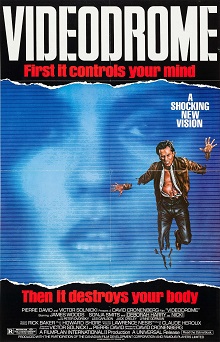
Saturday Matinee: Videodrome

“Videodrome” (1983) is a Canadian science fiction/body horror film written and directed by David Cronenberg. Set in Toronto during the early 1980s, it follows Max Renn (James Woods) the CEO of a small UHF television station who stumbles upon a broadcast signal featuring extreme violence and torture. Layers of deception and mind-control conspiracy unfold as he uncovers the signal’s source, and loses touch with reality in a series of increasingly bizarre and violent organic hallucinations.

Watch the full film here.

‘What More Do You Need to Know?’ Health Insurance Stocks Drive Wall Street Rebound on Biden Super Tuesday Wins

“Biden is the preferred candidate for the financial markets.”

By Eoin Higgins

Source: CommonDreams

Health insurance industry stocks surged Wednesday morning in the wake of former Vice President Joe Biden’s strong showing in the Democratic presidential primary’s Super Tuesday contests, opening up 600 points after traders appeared to bet the candidate’s resurgence would box out any chance of single-payer universal healthcare.

“What more do you need to know,” tweeted journalist Jack Mirkinson of the market’s spike.

Sanders has made Medicare for All a centerpiece of his campaign. The healthcare industry has poured millions in ad buys against Sanders after the Vermont senator won primaries in Iowa, New Hampshire, and Nevada.

“The industry has long seen Biden as their white knight,” said Dr. Adam Gaffney, the president of Physicians for a National Health Program and an outspoken Medicare for All advocate.

Biden on Tuesday won at least nine of the 14 states up for grabs to Sanders’ four. At press time, Maine was yet to be called, with Sanders and Biden locked in a razor-thin contest.

The market surge came after a rough week for the stock market, which at the end of February saw its biggest decline since the 2008 financial crisis after fears of the economic cost of a worldwide coronvirus pandemic increased.

Business commentators also made the connection between Sanders’ victories in the early primary states, particularly in Nevada, and the market’s poor performance last week.

On Fox Business February 28, billionaire Steve Forbes remarked that the weeklong drop was not only about fears of the coronavirus.

“There’s the political side,” Forbes said of the reason for the poor performance. “In the last week, week-and-a-half, the possibility of Bernie Sanders becoming president of the United States has increased, exponentially.”

According to the Washington Post:

Stocks of healthcare companies roared in response to Biden’s performance. Cigna was up more than 10 percent in morning trading, while UnitedHealth Group rose nearly 12 percent. Humana jumped 1.25 percent and Anthem soared nearly 14 percent.

Investor Ed Yardeni told the Post that Wednesday’s spike was a correction to earlier fears of what he called “Bernie Sanders’ socialist program.”

“The market’s sell-off last week on Sanders’ primary victories and rebound on Monday after Biden’s big win in South Carolina and this morning after Super Tuesday suggest that domestic U.S. politics may matter as much as the global health crisis on investors,” said Yardeni.

As Common Dreams reported, the results—which saw billionaire Michael Bloomberg and Sen. Elizabeth Warren (D-Mass.) coming in far behind the two frontrunners—transformed a once-crowded primary into a two-man race. Though Biden put up a good showing, exit polls from the contests showed a majority of Democratic voters backing the elimination of private insurance in favor of a government-run system guaranteeing healthcare for all.