Democracy vs. The Putin-Nazis

By CJ Hopkins

Source: Consent Factory

Back in January 2018, I wrote this piece about The War on Dissent, which, in case you haven’t noticed, is going gangbusters. As predicted, the global capitalist ruling classes have been using every weapon in their arsenal to marginalize, stigmatize, delegitimize, and otherwise eliminate any and all forms of dissent from neoliberal ideology, and in particular from their new official narrative … “Democracy versus The Putin-Nazis.”

For over two years, the corporate media have been pounding out an endless series of variations on this major theme, namely, that “democracy is under attack” by a conspiracy of Russians and neo-Nazis that magically materialized out of the ether during the Summer of 2016. The intelligence agencies, political elites, academia, celebrities, social media personalities, and other organs of the culture industry have been systematically reifying this official narrative through constant repetition. The Western masses have been inundated with innumerable articles, editorials, television news and talk show segments, books, social media posts, and various other forms of messaging whipping up hysteria over “Russians” and “fascists.” At this point, it is no longer just propaganda. It has become the new “truth.” It has become “reality.”

Becoming “reality” is, of course, the ultimate goal of every ideology. An ideology is just a system of ideas, and is thus fair game for critique and dissent. “Reality” is not fair game for dissent. It is not up for debate or challenge, not by “serious,” “legitimate” people. “Reality” is simply “the way it is.” It is axiomatic. It is apothegmatic. It’s not a belief or an interpretation. It is not subject to change or revision. It is the immortal, immutable Word of God … or whatever deity or deity-like concept the ruling classes and the masses they rule accept as the Final Arbiter of Truth. In our case, this would be Science, or Reason, rather than some supernatural being, but in terms of ideology there isn’t much difference. Every system of belief, regardless of its nature, ultimately depends on political power and power relations to enforce its beliefs, which is to say, to make them “real.”

OK, whenever I write about “reality” and “truth,” I get a few rather angry responses from folks who appear to think I’m denying the existence of objective reality. I’m not … for example, this chair I’m sitting on is absolutely part of objective reality, a physical object that actually exists. The screen you’re probably reading these words on is also part of objective reality. I am not saying there is no reality. What I’m saying is, “reality” is a concept, a concept invented and developed by people … a concept that serves a variety of purposes, some philosophical, some political. It’s the political purposes I’m interested in.

Think of “reality” as an ideological tool … a tool in the hands of those with the power to designate what is “real” and what isn’t. Doctors, teachers, politicians, police, scientists, priests, pundits, experts, parents — these are the enforcers of “reality.” The powerless do not get to decide what is “real.” Ask someone suffering from schizophrenia. Or … I’m sorry, is it bipolar disorder? Or oppositional defiant disorder? I can’t keep all these new disorders psychiatrists keep “discovering” straight.

Or ask a Palestinian living in Gaza. Or the mother of a Black kid the cops shot for no reason. Ask Julian Assange. Ask the families of all those “enemy combatants” Obama droned. Ask the “conspiracy theorists” on Twitter digitally screaming at anyone who will listen about what is and isn’t “the truth.” Each of them will give you their version of “reality,” and you and I may agree with some of them, and some of their beliefs may be supported with facts, but that will not make what they believe “reality.”

Power is what makes “reality” “reality.” Not facts. Not evidence. Not knowledge. Power.

Those in power, or aligned with those in power, or parroting the narratives of those in power, understand this (whether consciously or not). Those without power mostly do not, and thus we continue to “speak truth to power,” as if those in power gave a shit. They don’t. The powerful are not arguing with us. They are not attempting to win a debate about what is and isn’t “true,” or what did or didn’t “really” happen. They are declaring what did or didn’t happen. They are telling us what is and is not “reality,” and demonstrating what happens to those who disagree.

The “Democracy versus The Putin-Nazis” narrative is our new “reality,” whether we like it or not. It does not matter one iota that there is zero evidence to support this narrative, other than the claims of intelligence agencies, politicians, the corporate media, and other servants of the ruling classes. The Russians are “attacking democracy” because the ruling classes tell us they are. “Fascism is on the march again” because the ruling classes say it is. Anyone who disagrees is a “Putin-sympathizer,” a “Putin-apologist,” or “linked to Russia,” or “favored by Russia,” or an “anti-Semite,” or a “fascist apologist.”

Question the official narrative about the Gratuitously Baby Gassing Monster of Syria and you’re an Assad apologist, a Russian bot network, or a plagiarizing Red-Brown infiltrator. Criticize the corporate media for disseminating cheap McCarthyite smears, and you’re a Tulsi-stanning Hindu Nazi-apologist. God help you if you should appear on FOX, in which case you are a Nazi-legitimizer! A cursory check of the Internet today revealed that “far-right Facebook groups are spreading hate to millions in Europe” by means of some sort of hypnogenic content that just looking at it turns you into a Nazi. Our democracy-loving friends at The Atlantic Council are disappointed by Trump’s refusal to sign the “Christchurch Call,” a multilateral statement encouraging corporations to censor the Internet … and fascism is fashionable in Italy again!”

This post-Orwellian, neo-McCarthyite mass hysteria is not going to stop … not until the global capitalist ruling classes have suppressed the current “populist” insurgency and restored “normality” throughout the Western world. Until then, it’s going to be pretty much non-stop “Democracy versus the Putin-Nazis.”

So, unless you’re enjoying our new “reality,” or are willing to conform to it for some other reason, prepare to be smeared as “a Russia-loving, Putin-apologizing conspiracy theorist,” or a “fascism-enabling, Trump-loving Nazi,” or some other type of insidiously Slavic, white supremacist, mass-murder enthusiast. Things are only going to get uglier as the American election season ramps up. I mean, come on … you don’t really believe that the global capitalist ruling classes are going to let Trump serve a second term, do you?

Australian police chief links media raids to US-led “Five Eyes” spy network

By Mike Head

Source: WSWS.org

The Australian Federal Police (AFP) called a news conference on Thursday to justify its raids targeting journalists at two media organisations this week.

Police spent seven hours ransacking a News Corp political reporter’s home in Canberra on Tuesday, and eight hours poring over and seizing files at the Australian Broadcasting Corporation’s (ABC) Sydney headquarters on Wednesday.

In an extraordinary admission, the AFP’s acting commissioner Neil Gaughan blurted out that the real reason for the raids was to protect the information that the Australian police and intelligence agencies receive from their “Five Eyes” counterparts. Five Eyes is a top-level network of intelligence agencies dominated by the US that also includes Britain, Australia, Canada and New Zealand.

“The Australian government, or particularly the Australian enforcement and intelligence communities, rely on secret and top-secret information from our international partners, particularly our Five Eyes partners,” the police chief said. “If we can’t be seen to protect our own internal information, [then] we are concerned that the information flow to us dries up.”

Citing government demands for investigations into leaks of secret information, Gaughan said the AFP received “numerous referrals to us [of leaks] and to be honest we get too many. But the premise of investigating these matters is to ensure the international community knows that we take the leaking of information, sensitive information, seriously.”

In other words, the AFP is under pressure not just from Canberra, but from Washington, to ensure that information, including about criminal actions of governments and its agencies, is kept from public view. This takes place amid the Trump administration’s mounting threats of war against Iran and Venezuela, as well as its escalating confrontation with China.

The AFP search warrants related to leaked documents exposing war crimes perpetrated by the Special Air Service (SAS) in Afghanistan and plans to legalise domestic mass surveillance by the Australian Signals Directorate (ASD), which are both central to Five Eyes operations.

Gaughan’s remarkable declaration went virtually unreported throughout the establishment media in Australia and internationally. His admission vindicates the analysis made by the WSWS on Thursday:

“[I]t is inconceivable that the Australian government would have instigated and pursued the investigation of the ABC and Murdoch media journalists without the agreement, if not urging, of Washington. Both the SAS and the ASD surveillance agency are closely integrated into all the wars and war preparations of the US.”

Gaughan’s statement also underscores the warnings made by the WSWS that the persecution of WikiLeaks founder Julian Assange for exposing the war crimes, mass spying and regime-change operations of Washington and its allies, including Australia, is setting a precedent for the criminalisation of journalism.

By specifically targeting journalists, as well as whistleblowers, the Australian government is following the lead of the Trump administration. The US has charged Assange, a journalist and publisher, with multiple counts under the Espionage Act, for which he faces life imprisonment.

At his press conference, Gaughan refused to rule out laying charges against News Corp journalist Annika Smethurst or ABC reporters Dan Oakes and Sam Clark for publishing alleged “national security” secrets. Such charges against journalists would be without precedent in Australia since World Wars I and II.

In a pointed warning, Gaughan said “no sector of the community should be immune” from police investigations into alleged law-breaking. Gaughan said the police are probing the “publication” of documents marked “secret” and “top secret,” placing journalists and publishers squarely under threat of prosecutions.

The AFP is investigating breaches of the Crimes Act, which criminalises unauthorised disclosures by public servants, and also contains offences that apply to journalists. Journalists, as well as alleged leakers, can be jailed for up to seven years. Dating back to World War I, the legislation outlaws “receiving” information that “prejudices the security or defence” of Australia.

But, asked what was the harm of revealing wrongdoing by Australian troops or plans to extend spying laws, Gaughan said the substance of the reports was “irrelevant.” The mere disclosure of protected information was a crime. He bluntly stated: “The issue of whether or not the public has the right to know is really not an issue that comes into our investigation process.”

The Crimes Act provisions were recently replaced by even more far-reaching measures embedded in the “foreign interference” legislation that the Liberal-National government pushed through parliament at Washington’s urging late last year, supported by the Labor Party. The maximum penalties were increased to 10 years’ imprisonment. However, the new laws could not be applied to the current cases, because the alleged leaks occurred in July 2017 and April 2018.

Gaughan tried to refute accusations that the AFP was acting at the government’s behest. He denied that the police had waited until after the May 18 federal election to execute warrants and claimed no contact had been made with the government since the AFP informed Home Affairs Minister Peter Dutton when the investigations first began.

These claims fly in the face of the facts. The government itself instigated both AFP investigations, and the Labor Party fully supported it in doing so. And Dutton and other government ministers immediately defended the raids. When Prime Minister Scott Morrison was asked at a press conference if he was bothered by police raiding journalists’ homes, he replied: “It never troubles me that our laws are being upheld.”

Above all, as Gaughan himself revealed, the raids were mounted to satisfy the Five Eyes powers, which means the US above all. Successive governments, both Liberal-National and Labor, have committed Australia to be a key partner in this network as part of its military alliance with the United States.

The police raids are part of a global crackdown on freedom of speech, including in the US and other countries, such as France, where governments are taking the Trump administration’s repressive lead.

This assault is targeted directly at the basic right of the working class to know the crimes, war plans and conspiracies of the capitalist ruling elites and the state apparatuses they control. It is being mounted amid growing struggles by workers around the world against soaring social inequality and declining living and working conditions.

The Australian police chief’s open threats highlight the urgency of the worldwide campaign being waged by the WSWS and the Socialist Equality Parties for the defence of Julian Assange and the jailed whistleblower Chelsea Manning. Their plight is a test case in the struggle against the lurch toward war and dictatorial forms of rule.

Bezos Reveals His Ugly Vision For The World He’s Trying To Rule

By Caitlin Johnstone

Source: CaitlinJohnstone.com

“Guess what the best planet is in this solar system?” asked Amazon CEO Jeff Bezos at a recent media event on his Blue Origin space program.

“It’s easy to know the answer to that question,” he continued. “We’ve sent robotic probes like this one to all of the planets in our solar system. Now, some of them have been fly-bys, but we’ve examined them all. Earth is the best planet. It is not close. This one is really good.”

Bezos then went on to discuss his plan to ship humans off of the best planet in the solar system and send them to live in floating cylinders in space.

Bezos claimed that the growing human population and growing energy consumption will force us to make a choice between “stasis and rationing” and “dynamism and growth”, and claimed that the latter item in his dichotomy is possible only by moving humans off the planet.

“If we’re out in the solar system, we can have a trillion humans in the solar system, which means we’d have a thousand Mozarts and a thousand Einsteins,” Bezos said. “This would be an incredible civilization. What would this future look like? Where would a trillion humans live? Well it’s very interesting, someone named Gerry O’Neill, a physics professor, looked at this question very carefully and he asked a very precise question that nobody had ever asked before, and it was, ‘Is a planetary surface the best place for humans to expand into the solar system?’ And he and his students set to work on answering that question, and they came to a very surprising–for them–counterintuitive answer: No.”

Bezos went on to describe how the limited surface areas, distance, and gravitational forces of the other planets in our solar system make settling on those planets impractical and cost-prohibitive, while constructing giant space cylinders closer to Earth which can hold a million people is far more practical. These cylinders would spin to replicate Earth’s gravitational pull with centrifugal force.

Here are some illustrations Bezos used in his presentation to show us what these “O’Neill colonies” might look like:

“These are really pleasant places to live,” Bezos said. “Some of these O’Neill colonies might choose to replicate Earth cities. They might pick historical cities and mimic them in some way. There’d be whole new types of architecture. These are ideal climates. These are short-sleeve environments. This is Maui on its best day, no rain, no storms, no earthquakes.”

No rain? No weather? Just big, spinning cylinders floating monotonously in space? A trillion divided by a million is one million, which means that the best idea the richest man in the world can come up with for the future of our species is to fill our solar system with a million of these floating homogenized space malls.

“If we build this vision, these O’Neill colonies, where does it take us? What does it mean for Earth?” Bezos asked. “Earth ends up zoned, residential, and light industry. It’ll be a beautiful place to live, it’ll be a beautiful place to visit, it’ll be a beautiful place to go to college, and to do some light industry. But heavy industry, polluting industry, all the things that are damaging our planet, those will be done off Earth. We get to have both. We get to keep this unique gem of a planet, which is completely irreplaceable–there is no Plan B. We have to save this planet. And we shouldn’t give up a future of our grandchildren’s grandchildren of dynamism and growth. We can have both.”

Now, if you look at the behavior of Jeff Bezos, who exploits his employees and destroys his competitors, and who some experts say is trying to take over the underlying infrastructure of our entire economy, you can feel reasonably confident that this man has no intention of leaving “this unique gem of a planet”, nor of having the heirs to his empire leave either. When you see this Pentagon advisory board member and CIA contractor planning to ship humans off the Earth’s surface so the planet can thrive, you may be certain that he’s talking about other humans. The unworthy ones. The ones who weren’t sociopathic enough to climb the capitalist ladder by stepping on the backs of everyone else.

And make no mistake, when Bezos talks about saving the planet for “our grandchildren’s grandchildren”, he’s not just talking about his heirs, he’s talking about himself. Bezos has invested large amounts of wealth in biotech aimed at reversing the aging process and cracking the secret of immortality.

This is the sort of guiding wisdom that is controlling the fate of our species, everyone. The world’s most ambitious plutocrat envisions a world in which, rather than evolving beyond our destructive tendencies and learning to live in collaboration with each other and our environment, we are simply shipped off into space so that he can stretch out and enjoy our beautiful planet. That’s his best idea.

Our plutocratic overlords aren’t just sociopaths. They’re morons.

Bezos’ incredibly shallow vision for humanity reminds me of something Julian Assange said at a 2017 London festival via video link about the way Silicon Valley plutocrats are trying to become immortal by finding a way to upload their brains onto computers.

“I know from our sources deep inside those Silicon Valley institutions, they genuinely believe that they are going to produce artificial intelligences that are so powerful, relatively soon, that people will have their brains digitized, uploaded on these artificial intelligences, and live forever in a simulation, therefore will have eternal life,” Assange said. “It’s a religion for atheists. They’ll have eternal life, and given that you’re in a simulation, why not program the simulation to have endless drug and sex orgy parties all around you. It’s like the 72 virgins, but it’s like the Silicon Valley equivalent.”

I mean, damn. First of all, how stupid do you have to be to overlook the fact that science has virtually no understanding of consciousness and doesn’t even really know what it is? Even if these idiots find a way to upload their neurological patternings onto some AI’s virtual simulation, it’s not like they’d be there to experience it. It would just be a bunch of data running in a computer somewhere, mimicking the personality of a dead person and experienced by no one. People who believe that all there is to them is their dopey mental patterns have not spent any time whatsoever exploring what they are, and have no idea what it is to be human. The fact that anyone would think they could become immortal by digitizing their churning, repetitive personality patterns is crazy, and the fact that they’d want to is even crazier.

People who think this way should shut up and learn about life, not rule the world in a plutocratic system where money translates directly to political influence. People who think that humans can be happily unplugged from the ecosystemic context in which they evolved, the ecosystemic context of which they are an inseparable part, and people who think they can become immortal by uploading their wanky personalities onto a computer should shut the fuck up, spend some time alone with themselves, maybe try some psilocybin mushrooms, and learn a bit about what it means to be human. They certainly shouldn’t be calling the shots.

Earth is our home. It’s what we’re made for. The earth went through a lot to give you life. Sparks had to catch, oceans had to freeze, billions of cells had to survive endless disease, all of these amazing things had to happen just right to give you life. You belong here. You are as much a creation of the earth as the air you breathe. You may feel like a singular organism but you’re actually as much a singular organism as one of the many billions of organisms that make up your body. You and earth are one. And because you evolved on earth, you are perfectly adapted to earth and it is perfectly adapted to you. It yearns for your breath as you yearn for its breeze on your face.

We absolutely have the ability to transcend our unhealthy tendencies as a species which, when you really look at them, are merely creations of a mind that feels alone and separate and like it is in a constant fight for its life. If we just put down our mental swords for a hot second and learned to channel our creativity into the thriving of our society and our ecosystem instead of into killing and out-competing one another then we will be okay. The way out of this is the way towards health. For example, once women have been given back even the most basic rights of sexual sovereignty such as birth control and access to terminations as they have in most western countries, birth rates fall below replication levels. Women’s own internal bodily wisdom makes the problem of overpopulation moot if given half a chance just to make decisions on behalf of her own body.

Another example. People lament the lack of jobs due to AI and automation but we actually desperately need people to do less. We need a whole lot of people doing nothing, not using the roads every morning and evening, not producing widgets that no one needs and creating advertising campaigns to brainwash people into buying them anyway, just to have them end up in the ocean or leaching heavy metals into the earth. Having a whole lot of people doing nothing for more of their week would take the strain off of our health systems as the single biggest factor in disease is stress. Studies show that stress also shrinks your brain and lessens your creativity and innovation too, so all the punitive-minded libertarians out there who are worried that we won’t progress as a species if we start sharing resources around to people who aren’t doing things that traditionally made money because we’ll be too relaxed can chill too. We don’t need to crack the whip to get people to make beautiful innovations. Humans are at their best when feeling playful and relaxed. Nearly all the technological advances of the past came from people who had a lot of leisure time due to their privileged status. Releasing humans from 9 to 5 slavery would be the fastest way to slow our resource consumption and take pressure off of all our systems and would have the added benefit of making us smarter, funnier, more creative and more innovative too.

And for that matter, having every idea and innovation be required to make money is also killing us. We need the ability to fund things that will not make profit. How many times have you been in a conversation and someone’s come up with an idea that will solve a major environmental, energy or health problem and no one’s got excited because it will never get off the ground because it will never make money? Fully disappearing a problem never made anyone any money. Healthy people, for example, never spend a dime at the doctors. The way out of this is detaching human innovation from money and allowing solutions to flourish without the imposition of also having to turn a profit.

These are merely three things I can think of that will dramatically improve our collective ability to reverse this extinction event and all we have to do is get saner, stop punishing each other, start sharing and start collaborating. The only issue we have as humans is that a handful of highly competitive, highly sociopathic and yet incredibly mediocre people have all the power to build our future for us with virtually no input from anyone else. Because all the power in the form of all the money has been allowed to pool into the hands of those most willing to do whatever it takes to get it, we have just a few ruthless yet surprisingly dumb individuals calling the shots on the future of all living beings. The competitive mindset that gave rise to Jeff Bezos is the exact opposite of the kind of collaborative, harmonious mindset we’ll need if we’re going to overcome the challenges we face on the horizon.


Saturday Matinee: Zombies

The film Zombies is a journey between hope and dystopia in a hallucinated Kinshasa, from the culture of the hair salon to futuristic solitary clubbing, from the urban parade to the glory of a dictator in campaign (Papa Bollo) to modern western in the Takeshi Kitano style.

Baloji is a poet, composer-lyricist, scriptwriter, actor and performer, video artist and stylist. After the release of his album Hotel Impala (2008), his Congolese reinterpretation (Kinshasa Succursale, 2011) was awarded 4 stars by the world’s press (NYT, Guardian, El Pais, Les Inrocks..) and after more than 200 live shows all over the world, Baloji is back with a new EP. His music stands at the crossroads of African music, traditional and afro-american music (soul, funk, jazz) discovered through the culture of sampling and electronic music (trance, deep house) which has its roots in part in the region of Belgium where Baloji grew up. Baloji means “man of science” in Swahili, but during the colonial period that meaning shifted to “man of the occult sciences and sorcery”. By placing his resilience at the centre of his work, Baloji reconciles all these influences to enrich his projects.

https://vimeo.com/323788232

Zuck’s New Scam

Don’t buy into Facebook’s pivot to privacy

By Lizzie O’Shea

Source: The Baffler

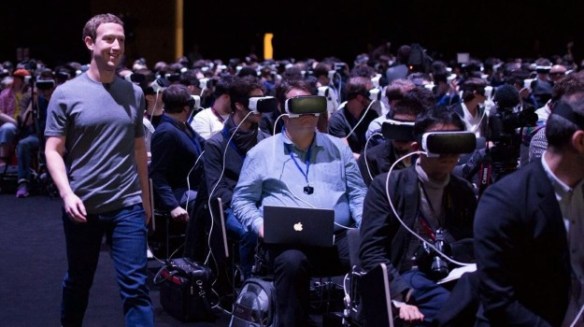
THE RHETORIC AT FACEBOOK—the largest social media platform in the world—is changing. In 2010, Mark Zuckerberg claimed that privacy was no longer a “social norm.” Today, the same man is asserting that “the future is private.” This was the buzz phrase at the company’s developer conference last month, F8, as the platform reoriented away from the newsfeed toward private chats, groups, and stories. Has Mark Zuckerberg been occupied by a parasitic fungus and become a zombie?

There is something stunning about this cultural shift in a corporation that holds such significant global power. It shows that when people speak up and agitate around privacy and data mining it can have a material effect. The idea that people don’t care about privacy, that they are willing to give it all away for the convenience of free services, has been debunked. Facebook specifically has been unable to ignore the waves of criticism it has experienced of late. The capitalist behemoths of the digital age often seem untouchable, and it is easy to forget that they operate in a social context. Like any powerful actor in society, Facebook is subject to the influence of organized people who will not shut up.

Nonetheless, it’s also important to be wary: savvy marketing is not the same as progress. The company is still fundamentally motivated by growth and profit. The presentations at F8 were focused on getting people onto Facebook-owned apps (including Instagram and WhatsApp) and building a sticky web around this engagement so they need never leave. You will shortly be able to buy things, find a date, even apply for a job—all directly through Facebook. Throughout these processes, Facebook will be able to grow its library of behavioral surplus, and in doing so, continue to expand its core business as the most effective and sophisticated supplier of advertising space in human history.

This context can help us better understand Zuckerberg’s privacy turn. Lest you feel uncomfortable about living more of your digital life through Facebook, they want to remind you that they are sufficiently forward thinking and benevolent to respect your privacy. As your adherence to the platform inches toward total, you can be sure the Facebook team is creating “a place where you are safe and supported.”

Well, sorry, Mark, your idea of privacy isn’t the same as mine. Privacy is too often framed in these discussions in highly superficial terms. It is about tinkering with the ways users engage with a platform as a matter of consumer choice. Mark wants you to be able to easily exclude people from seeing your messages and stories—unless that person happens to be him. This vision of privacy doesn’t hold any power because it does not challenge the definitive power framework for users of social media.

Privacy has necessarily become an expansive concept in the digital age, given the myriad ways in which technology occupies more of our personal spaces. To that end: the right to privacy includes the right to exist outside of the market. It is the right to enjoy spaces without feeling as though your presence is being used by marketers to predict your future.

In her recent book, Surveillance Capitalism, Shoshana Zuboff, writes about how these platform collect data and feed it into sophisticated algorithms, to be fabricated into prediction products that anticipate what you will do now, next, and later. Our participation becomes fodder for the “behavioral futures market,” and in turn, this has an influence on our psychology and sense of self. Private groups on Facebook might be slightly more comforting cyber spaces, but the essential topography remains the same. The fancy developer conferences and user products continue to be funded in a specific way. The logic of surveillance capitalism cannot be circumnavigated via a new company slogan. If anything, Zuckerberg’s privacy talk is an endorsement of this model. As Bernard Harcourt points out, “the watching works best not when it is internalized, but when it is absentmindedly forgotten.”

It need not be so: we can expropriate this moment. A better understanding of privacy will not be limited to design concepts generated by highly profitable social media platforms. It needs to encompass how privacy is an essential component of our agency as human beings. Agency, to be explored and expressed fully, requires that we have space outside the influence of capitalism—to have freedom from market forces seeking to manipulate our unconscious. Privacy demands that human emotions like shame, joy, guilt, and desire be explored without someone seeking to profit from the process without us noticing.

The unconscious exists as “neither individual nor collective,” writes the philosopher Mladen Dolar, but rather “precisely between the two, in the very establishment of the ties between an individual (becoming a subject) and a group to which s/he would belong.” In other words, there is a dialectic process at play between the social forces that shape us and our own personality. The baron capitalists of the data era seek to monetize this space—the right to privacy is the theoretical foundation for resistance. We need to elevate privacy to its full rhetorical potential, and recognize how it is both paradoxically individual and collective, and is defined not by consumer choice but agency. And privacy is therefore something that Facebook cannot offer—unless the company is prepared to change their entire business model.

More Police Raids As War On Journalism Escalates Worldwide

By Caitlin Johnstone

Source: CaitlinJohnstone.com

The Australian Federal Police have conducted two raids on journalists and seized documents in purportedly unrelated incidents in the span of just two days.

Yesterday the AFP raided the home of News Corp Australia journalist Annika Smethurst, seeking information related to her investigative report last year which exposed the fact that the Australian government has been discussing the possibility of giving itself unprecedented powers to spy on its own citizens. Today they raided the Sydney headquarters of the Australian Broadcasting Corp, seizing information related to a 2017 investigative report on possible war crimes committed by Australian forces in Afghanistan.

In a third, also ostensibly unrelated incident, another Australian reporter disclosed yesterday that the Department of Home Affairs has initiated an investigation of his reporting on a story about asylum seeker boats which could lead to an AFP criminal case, saying he’s being pressured to disclose his source.

“Why has AFP suddenly decided to carry out these two raids after the election?” tweeted Australian Sky News political editor David Speers during the Sydney raid. “Did new evidence really just emerge in both the Annika Smethurst and ABC stories?!”

Why indeed?

“If these raids unconnected, as AFP reportedly said, it’s an extraordinary coincidence,” tweeted The Conversation chief political correspondent Michelle Grattan. “AFP needs to explain ASAP the timing so long after the stories. It can’t be that inefficient! Must be some explanation – which makes the ‘unconnected’ claim even more odd.”

Odd indeed.

It is true that the AFP has formally denied that there was any connection between the two raids, and it is in fact difficult to imagine how the two could be connected apart from their sharing a common theme of exposing malfeasance that the government wanted kept secret. If it is true that they are unconnected, then what changed? What in the world could have changed to spark this sudden escalation of the Australian government’s assault on the free press?

Well, if as I suggested recently you don’t think in terms of separate, individual nations, it’s not hard to think of at least one thing that’s changed.

“The criminalization and crack down on national security journalism is spreading like a virus,” WikiLeaks tweeted today in response to the ABC raid. “The Assange precedent is already having effect. Journalists must unite and remember that courage is also contagious.”

“The arrest and espionage charges against Assange was just the beginning, as many in the media, even those who hate Assange, feared,”  tweeted Consortium News editor-in-chief Joe Lauria in response to the News Corp raid. “The home of a mainstream Australian journalist was raided Wed. morning by police because of a story she worked on.”

“Shameful news from Australia as the police raid journalists’ offices and homes,” tweeted legendary Australian journalist John Pilger. “One warrant allows them to ‘add, copy, delete or alter’ computer files at the ABC. The assault on Julian Assange was a clear warning to all of us: it was only the beginning.”

If you think about it, it would have been far less disturbing than the alternative if there were a connection between the two raids, because the alternative is vastly more sinister: that the Australian government’s attitude toward the free press has changed. And that it has perhaps done so, as Australia has been doing for decades, in alignment with the behavior of the rest of the US-centralized empire.

In an article for Consortium News titled “After Assange’s Espionage Act Indictment, Police Move Against More Journalists for Publishing Classified Material”, Joe Lauria reminds us that Australia is not the first nation within the western power alliance to see such an escalation since the paradigm-shifting imprisonment of Julian Assange in the UK.

“Police in Paris arrested two journalists who were covering Yellow Vest protests on April 20,” Lauria writes.  “One of the journalists, Alexis Kraland, said he was taken into custody after refusing to be searched and to turn his camera over to police at Gare du Nord train station. The largest journalism union in France demanded an explanation from police.”

“And on May 10 in San Francisco, police using sledgehammers to break down the door, raided the home of Bryan Carmody, a freelance journalist, to get him, while handcuffed, to reveal his source who leaked him a police report into the sudden death the city’s elected public defender,” Lauria added. “Police took away computers, cameras, mobile phones and notes.”

So we’re seeing a pattern already. You can choose to ignore it or dismiss it with a pleasant story, or you can acknowledge that we appear to be in the midst of a rapidly escalating shutdown of the free press in the western world.

There does not necessarily have to be any centrally-planned conspiracy behind this trend; it can simply be the natural result of an ailing empire seeing that it’s going to need a lot more war, lies and deception in order to keep from collapsing, and responding accordingly. Once the Assange line was crossed, it could simply have served as a precedent for the other governments within the empire to begin doing things they’d already wanted to do anyway.

https://twitter.com/AssangeMrs/status/1136169465026994176

Julian Assange is the dot of a question mark at the end of a historically important question which we are all being asked right now. That question reads as follows: Does humanity wish to create a society that is based on truth and holds power to account, or does it want the exact opposite?

So far, the general consensus answer to that question has been going somewhere along the lines of “We’re actually fine with a headlong plunge into Orwellian dystopia, thanks.” But as the implications of that answer become clearer and clearer, we may yet see some stirrings in the other direction before it is too late.

How GMO Seeds and Monsanto/Bayer’s “RoundUp” are Driving US Policy in Venezuela

Hugo Chavez and Luiz Inacio Lula da Silva visit a soy farm in El Tigre in Venezuela’s Anzoategui state, Oct. 30, 2009. Ariana Cubillos | AP

With Juan Guaidó’s parallel government attempting to take power with the backing of the U.S., it is telling that the top political donors of those in the U.S. most fervently pushing regime change in Venezuela have close ties to Monsanto and major financial stakes in Bayer.

By Whitney Webb

Source: MintPress News

As the political crisis in Venezuela has unfolded, much has been said about the Trump administration’s clear interest in the privatization and exploitation of Venezuela’s oil reserves, the largest in the world, by American oil giants like Chevron and ExxonMobil.

Yet the influence of another notorious American company, Monsanto — now a subsidiary of Bayer — has gone largely unmentioned.

While numerous other Latin American nations have become a “free for all” for the biotech company and its affiliates, Venezuela has been one of the few countries to fight Monsanto and other international agrochemical giants and win. However, since that victory — which was won under Chavista rule — the U.S.-backed Venezuelan opposition has been working to undo it.

Now, with Juan Guaidó’s parallel government attempting to take power with the backing of the U.S., it is telling that the top political donors of those in the U.S. most fervently pushing regime change in Venezuela have close ties to Monsanto and major financial stakes in Bayer.

In recent months, Monsanto’s most controversial and notorious product — the pesticide glyphosate, branded as Roundup, and linked to cancer in recent U.S. court rulings — has threatened Bayer’s financial future as never before, with a litany of new court cases barking at Bayer’s door. It appears that many of the forces in the U.S. now seeking to overthrow the Venezuelan government are hoping that a new Guaidó-led government will provide Bayer with a fresh, much-needed market for its agrochemicals and transgenic seeds, particularly those products that now face bans in countries all over the world, including once-defoliated and still-poisoned Vietnam.


U.S.-Backed Venezuelan opposition seeks to reverse Chavista seed law and GMO ban

In 2004, then-president of Venezuela, Hugo Chávez, surprised many when he announced the cancellation of Monsanto’s plans to plant 500,000 acres of Venezuelan agricultural land in genetically modified (GM) soybeans. The cancellation of Monsanto’s Venezuela contract led to what became an ad hoc ban on all GM seeds in the entire country, a move that was praised by local farmer groups and environmental activists. In contrast to anti-GM movements that have sprung up in other countries, Venezuela’s resistance to GM crops was based more on concerns about the country’s food sovereignty and protecting the livelihoods of farmers.

Although the ban has failed to keep GM products out of Venezuela — as Venezuela has long imported a majority of its food, much of it originating in countries that are among the world’s largest producers of genetically modified foods — one clear effect has been preventing companies like Monsanto and other major agrochemical and seed companies from gaining any significant foothold in the Venezuelan market.

In 2013, a new seed law was nearly passed that would have allowed GM seeds to be sold in Venezuela through a legal loophole. That law, which was authored by a member of the Chavista United Socialist Party of Venezuela (PSUV), was widely protested by farmers, indigenous activists, environmentalists, and eco-socialist groups, which led to the law’s transformation into what has been nicknamed the “People’s Seed Law.” That law, passed in 2015, went even farther than the original 2004 ban by banning not just GM seeds but several toxic agrochemicals, while also strengthening heirloom seed varieties through the creation of the National Seed Institute.

Soon after the new seed law was passed in 2015, the U.S.-backed Venezuelan opposition led by the Roundtable of Democratic Unity (MUD) — a group comprised of numerous U.S.-funded political parties, including Guaidó’s Popular Will — took control of the country’s National Assembly. Until Venezuela’s Supreme Court dissolved the assembly in 2017, the MUD-legislature attempted to repeal the seed law on several occasions. Those in favor of the repeal called the seed bill “anti-scientific” and damaging to the economy.

Despite the 2017 Supreme Court decision, the National Assembly has continued to meet, but the body holds no real power in the current Venezuelan government. However, if the current government is overthrown and Guaidó  — the “interim president” who is also president of the dissolved National Assembly — comes to power, it seems almost certain that the “People’s Seed Law” will be one of the first pieces of legislation on the chopping block.


The AEI axis

Some of the key figures and loudest voices supporting the efforts of the Trump administration to overthrow the Venezuelan government in the United States are well-connected to one particular think-tank, the American Enterprise Institute (AEI). For instance, John Bolton — now Trump’s national security advisor and a major player in the administration’s aggressive Venezuela policy — was a senior fellow at AEI until he became Trump’s top national security official. As national security adviser, Bolton advises the president on foreign policy and issues of national security while also advising both the Secretary of State and the Secretary of Defense. As of late, he has been pushing for military action in Venezuela, according to media reports.

Another key figure in Trump’s Venezuela policy — Elliott Abrams, the State Department’s Special Representative for Venezuela — has been regularly featured at AEI summits and as a guest on its panels and podcasts. According to Secretary of State Mike Pompeo, Abrams’ current role gives him the “responsibility for all things related to our efforts to restore democracy” in Venezuela. Other top figures in the administration, including Vice President Mike Pence and Secretary of State Mike Pompeo, were featured guests at the AEI’s “secretive” gathering in early March. As MintPress and other outlets have reported, Guaidó declared himself “interim president” of Venezuela at Pence’s behest. Pompeo is also intimately involved in directing Trump’s Venezuela policy as the president’s main adviser on foreign affairs.

Other connections to the Trump administration include Secretary of Education Betsy DeVos who was previously on AEI’s board of trustees.

AEI has long been a key part of the “neoconservative” establishment and employs well-known neoconservatives such as Fred Kagan — the architect of the Iraq “troop surge” — and Paul Wolfowitz, the architect of the Iraq War. Its connections to the George W. Bush administration were particularly notable and controversial, as more than 20 AEI employees were given top positions under Bush. Several of them, such as Bolton, have enjoyed new prominence in Trump’s administration.

Other key Bush officials joined the AEI soon after leaving their posts in the administration. One such was Roger Noriega, who was the U.S. representative to the Organization of American States (OAS) during the failed, U.S.-backed 2002 coup and went on to be assistant secretary of state for Western Hemisphere affairs from 2003 to 2005, where he was extremely influential in the administration’s policies towards Venezuela and Cuba.

Since leaving the Bush administration and promptly joining the AEI, Noriega has been instrumental in pushing claims that lack evidence but aim to paint Venezuela’s current President Nicolas Maduro-led government as a national security threat, such as claiming that Venezuela is helping Iran acquire nuclear weapons and hosts soldiers from Lebanon’s Hezbollah. He also lobbied Congress to support Venezuelan opposition leader Leopoldo López, Guaidó’s political mentor and leader of his political party, Popular Will.

Not only that, but Noreiga teamed up with Martin Rodil, a Venezuelan exile formerly employed by the IMF, and José Cardenas, who served in the Bush administration, to found Visión Américas, a private risk-assessment and lobbying firm that was hired to “support the efforts of the Honduran private sector to help consolidate the democratic transition in their country” after the U.S.-backed Honduran coup in 2009. In recent months, Noriega and his associates have been very focused on Venezuela, with Cardenas offering Trump public advice about how “to hasten Maduro’s exit,” while Rodil has publicly offered “to get you a deal” if you have dirt on Venezuela’s government.

While the AEI is best known for its hawkishness, it is also a promoter of big agricultural interests. Since 2000, It has hosted several conferences on the promise of “biotechnology” and genetically modified seeds and has heavily promoted the work of former Monsanto lobbyist Jon Entine, who was an AEI visiting fellow for several years. The AEI also has long-time connections to Dow Chemical.

The most likely reason for the AEI’s interest in promoting biotech, however, can be found in its links to Monsanto. In 2013, The Nation acquired a 2009 AEI document, obtained through a filing error and not intended for public disclosure, that revealed the think tank’s top donors. The form, known as the “schedule of contributors,” revealed that the AEI’s top two donors at the time were the Donors Capital Fund and billionaire Paul Singer.

The Donors Capital Fund, which remains a major contributor to the AEI, is linked to Monsanto interests through the vice chairman of its board, Kimberly O. Dennis, who is also currently a member of the AEI’s National Council. According to AEI, the National Council is composed of “business and community leaders from across the country who are committed to AEI’s success and serve as ambassadors for AEI, providing us with advice, insight, and guidance.”

Dennis is the long-time executive chairwoman of the Searle Freedom Trust, which was founded in 1988 by Daniel Searle after he oversaw the sale of his family pharmaceutical company — G.D. Searle and Company — to Monsanto in 1985 for $2.7 billion. The money Searle had made from that merger was used to fund the trust that now funds the AEI and other right-wing think tanks. Searle was also close to Donald Rumsfeld, who led G.D. Searle and Co. for years and was Secretary of Defense under Gerald Ford and George W. Bush. Searle was also a trustee of the Hudson Institute, which once employed Elliott Abrams.

After the family company — which gained notoriety for faking research about the safety of its sweetener, aspartame or NutraSweet — was sold to Monsanto, G.D. Searle executives close to Daniel Searle rose to prominence within the company. Robert Shapiro, who was G.D. Searle’s long-time attorney and head of its NutraSweet division, would go on to become Monsanto’s vice president, president and later CEO. Notably, Daniel Searle’s grandson, D. Gideon Searle, was an AEI trustee until relatively recently.


Why is a top to Marco Rubio increasing his stake in Bayer while others flee?

Yet, it is AEI’s top individual donor noted in the accidental “schedule of contributors” disclosure who is most telling about the private biotech interests guiding the Trump administration’s Venezuela policy. Paul Singer, the controversial billionaire hedge fund manager, has long been a major donor to neoconservative and Zionist causes — helping fund the Foreign Policy Initiative (FPI), the successor to the Project for a New American Century (PNAC); and the neoconservative and islamophobic Foundation for the Defense of Democracies (FDD), in addition to the AEI.

Singer is notably one of the top political donors to Senator Marco Rubio (R-FL) and has been intimately involved in the recent chaos in Venezuela. He has been called one of the architects of the administration’s current regime-change policy, and was the top donor to Rubio’s presidential campaign, as well as a key figure behind the controversial “dossier” on Donald Trump that was compiled by Fusion GPS. Indeed, Singer had been the first person to hire Fusion GPS to do “opposition research” on Trump. However, Singer has largely since evaded much scrutiny for his role in the dossier’s creation, likely because he became a key donor to Trump following his election win in 2016, giving $1 million to Trump’s inauguration fund.

Singer has a storied history in South America, though he has been relatively quiet about Venezuela. However, a long-time manager of Singer’s hedge fund, Jay Newman, recently told Bloomberg that a Guaidó-led government would recognize that foreign creditors “aren’t the enemy,” and hinted that Newman himself was weighing whether to join a growing “list of bond veterans [that have] already begun staking out positions, anticipating a $60 billion debt restructuring once the U.S.-backed Guaidó manages to oust President Nicolas Maduro and take control.” In addition, the Washington Free Beacon, which is largely funded by Singer, has been a vocal advocate for the Trump administration’s regime-change policy in Venezuela.

Beyond that, Singer’s Elliott Management Corporation gave Roger Noriega, the former assistant secretary of state for Western Hemisphere affairs under Bush, $60,000 in 2007 to lobby on the issue of sovereign debt and for “federal advocacy on behalf of U.S. investors in Latin America.” During the time Noriega was on Singer’s payroll, he wrote articles linking Argentina and Venezuela to Iran’s nonexistent nuclear program. At the time, Singer was aggressively pursuing the government of Argentina in an effort to obtain more money from the country’s prior default on its sovereign debt.

While Singer has been mum himself on Venezuela, he has been making business decisions that have raised eyebrows, such as significantly increasing his stake in Bayer. This move seems at odds with Bayer’s financial troubles, a direct result of the slew of court cases regarding the link between Monsanto’s glyphosate and cancer. The first ruling that signaled trouble for Monsanto and its new parent company Bayer took place last August, but Singer increased his stake in the company starting last December, even though it was already clear by then that Bayer’s financial troubles in relation to the glyphosate court cases were only beginning.

Since the year began, Bayer’s problems with the Monsanto merger have only worsened, with Bayer’s CEO recently stating that the lawsuits had “massively affected” the company’s stock prices and financial performance.


Forcing open a new market for RoundUp

Part of Singer’s interest in Bayer may relate to Venezuela, given that Juan Guaido’s “Plan País” to “rescue” the Venezuelan economy includes a focus on the country’s agricultural sector. Notably, prior to and under Chavismo, agricultural productivity and investment in the agricultural sector took a backseat to oil production, resulting in under 25 percent of Venezuelan land being used for agricultural purposes despite the fact that the nation has a wealth of arable land. The result has been that Venezuela needs to import much of its food from abroad, most of which originate in Colombia or the United States.

Under Chávez and his successor, Maduro, there has been a renewed focus on small-scale farming, food sovereignty and organic agriculture. However, if Maduro is ousted and Guaidó moves to implement his “Plan País,” the opposition’s coziness with foreign corporations, the interests of U.S. coup architects in Bayer/Monsanto, and the opposition’s past efforts to overturn the GM seed ban all suggest that a new market for Bayer/Monsanto products — particularly glyphosate — will open up.

South America has long been a key market for Monsanto and — as the company’s problems began to mount prior to the merger with Bayer — it became a lifeline for the company due to less stringent environmental and consumer regulations that many Western countries. In recent years, when South American governments have opened their countries to more “market-friendly” policies in their agricultural sectors, Monsanto has made millions.

For instance, when Brazil sought to expand biotechnology (i.e. GM seed) investment in 2012, Monsanto saw a 21% increase in its sales of GM corn seed alone, generating an additional $1 billion in profits for the company. A similar comeback scenario is needed more than every by Bayer/Monsanto, as Monsanto’s legal troubles saw the company’s profits plunge late last year.

With countries around the world now weighing glyphosate bans as a result of increased litigation over the chemical’s links to cancer, Bayer needs a new market for the chemical to avoid financial ruin. As Singer now has a significant stake in the company, he — along with the politicians and think tanks he funds — may see promise in the end of the anti-GM seed ban that a Guaidó-led government would bring.

Furthermore, given that Guaidó’s top adviser wants the Trump administration to have a direct role in governing Venezuela if Maduro is ousted, it seems likely that Singer would leverage his connections to keep Bayer/Monsanto afloat amid the growing controversy surrounding glyphosate. Such behavior on the part of Singer would hardly be surprising in light of the fact that international financial media have characterized him as a “ruthless opportunist” and “overly aggressive.”

Such an outcome would be in keeping with the increased profit margins for Monsanto and related companies that have followed its expansion into countries following U.S.-backed coups. For instance, after the U.S.-backed coup in Ukraine in 2014, the loans given to Ukraine by the International Monetary Fund and the World Bank forced the country to open up and expand the use of “biotechnology” and GM crops in its agricultural sector, and Monsanto, in particular, made millions as the prior government’s ban on GM seeds and their associated agrochemicals was reversed. If Maduro is ousted, a similar scenario is likely to play out in Venezuela, given that the Guaidó-led government made known its intention to borrow heavily from these institutions just days after Guaidó declared himself “interim president.”


Whitney Webb is a MintPress News journalist based in Chile. She has contributed to several independent media outlets including Global Research, EcoWatch, the Ron Paul Institute and 21st Century Wire, among others. She has made several radio and television appearances and is the 2019 winner of the Serena Shim Award for Uncompromised Integrity in Journalism.

Kieran Barr contributed to the research used in this report.