High Fives to Jimmy Dore for Laughing Russiagaters out of the Room

By John V. Walsh

Source: Dissident Voice

Jimmy Dore is a comic who has taken on Russiagate, a deadly serious matter.  He is one of those brave souls who count themselves as progressives but dared to call into question Russiagate.

There are those who will tell you that Trump is a despicable human; and so if Russiagate tarnished Trump, the argument goes, what did it matter whether it was true.  (The proposition that Trump is more monstrous than his predecessors, Obama, W or the Clintons is highly dubious to say the least – but that is a different topic.). There is, however, a very good reason why it does matter whether the charges making up Russiagate are true; for opposing Trump over his tax policies or stance on health care is quite a different matter from labeling him a Manchurian Candidate who colluded with Vlad Putin in 2016.  Russiagate put a US President in a position where he was unable to negotiate crucial issues with the other nuclear superpower.  To do so invited charges of being a Putin puppet, as evidenced by the howls that went up from the Establishment and most progressives over the Helsinki Summit.

What if the tensions between the US and Russia were to spin out of control in hot spots like Syria, where troops from the two nuclear superpowers pass within a whisker of one another, or Ukraine or even Venezuela?  To extract us from such a predicament, Putin and Trump would need to make concessions to one another, as Kennedy and Krushchev did successfully in the Cuban Missile Crisis.  But with the cloud of Russiagate hanging over his head Trump could make no such concession without being labelled a treasonous Putin puppet.  So Russiagate took away from Trump the ability to negotiate his way out of an existential threat should one emerge.  As such it should have been based on the highest levels of evidence.  In fact, it was not based on any hard evidence at all – there was none for the central charge of collusion.  And the Mueller investigation finally admitted this.  Given this, those who knowingly concocted Russiagate owe us all a great apology, for they committed the most serious of crimes by creating a situation that potentially threatened the existence of the American and Russian peoples – and perhaps all of humanity.

The absurdity of Russiagate and the absence of evidence for it was evident from the start.  But very few on the progressive side broke with the mainstream media and the Democratic Party political herd to say so.  That carried the risk of being shunned in progressive circles.  Or as one brave Russiagate dissident said under his breath, “I don’t have much social life any longer.”  That fact, in itself, is a sad commentary on what is called “progressivism” in the U.S.

Nevertheless, a handful of Russiagate debunkers emerged on the left, including Robert Parry and others at Consortium News, Aaron Maté now at The Nation, Pulitzer Prize winner Glenn Greenwald at the Intercept, Michael Tracey, Stephen F. Cohen of EastWestAccord.com, Ray McGovern of Veteran Intelligence Professionals for Sanity, Matt Taibi of Rolling Stone, Craig Murray and others. They deserve enormous credit for poring over the detritus that the media dumped on us 24/7 for over two years and refuting it, one noxious bit at a time.

A standout among these dissidents is Jimmy Dore, a nightclub comic with a YouTube show run out of his garage in Pasadena. Dore took on Russiagate just as he took on the Dem Establishment and backed Bernie in 2016, and as he now offers high praise for Tulsi Gabbard, the peace candidate for 2020.  Jimmy Dore made the exposure of Russiagate fun.

Dore enjoys raising a simple question in the wake of the Mueller report:  How did a “jagoff comedian,” as he calls himself, who claims on occasion to smoke marijuana when he gets out of bed in the morning, get Russiagate right when grads of the Columbia School of Journalism and pundits like Rhodes Scholar Rachel Maddow and David Corn got it so wrong?

Dore has the answer, taking Maddow as an example who earns $30,000 for every single show.  For that and the celebrity career that goes with it, she lies – simple as that.   Dore even allows that he might be willing to lie at $30,000 an hour. But, he laments, the invitation has not been forthcoming.  And what is true of Maddow and the other Cable “News” talking heads is just as true of the upscale propagandists who dump their extrusions into gilded receptacles like the NYT, WaPo, New Yorker, NPR.  In contrast to be a Jimmy Dore or any of the other truth tellers requires a considerable dose of courage, because swimming against the mainstream can be a career terminator as Chris Hedges once of the NYT and a number of others can testify.

One of Dore’s approaches is especially powerful.  He provides a quote from the mainstream media, an establishment journalist or a faux progressive, reads it and then tears it apart.  Dore likes to play down his intellect – a good comic shtick – but the precision of his takedowns tells another story.  The takedown is followed by invective that is as accurate as it is impassioned.  Dore’s invective for which he has considerable talent would turn Jeremiah green with envy. In this task he is usually aided by his fellow comic, the insightful Ron Placone and Dore’s wife Stefane Zamorano, who styles herself The Miserable Liberal.

It is very satisfying to watch Dore in action – and funny.  In fact, at the gym I watch Jimmy on my iPad to save me from looking up at the omnipresent fake news on CNN.  My cardiac health, as well as my mental health, over the past two years has depended on his show.  If Dore were a physician, he could bill me.

You can best appreciate the Jimmy Dore show by going to YouTube and watching an episode.  I recommend this one, “Mueller Report Drops! Aaron Maté Explains.”  Here Maté also names the names of the fake progressives who caved to the Establishment narrative and some of the heroes who did not.  Dore expresses his usual sympathy for Mate’ for having to live among journalists most of whom compromise themselves whereas Dore gets to dwell among comics.

For a dose of truth, sanity and fun – catch the Jimmy Dore Show.  Russiagate is behind us but Dore already has the bogus basis for war on Venezuela and Iran clearly in his sites – along with the 2020 election and its rich veins of hypocrisy to mine.

Recent Highlights From the Jimmy Dore Show


U.S. War Criminals, Conspiracy Theorists and the Mainstream Media vs. Julian Assange

By Timothy Alexander Guzman

Source: Silent Crow News

Julian Assange exposed U.S. war crimes, CIA spying capabilities, false flag cyber attacks and corruption within the Democratic Party and he’s the bad guy? Trump’s Justice department has decided to charge Julian Assange with “17 counts of violating the Espionage Act for his role in obtaining and publishing secret military and diplomatic documents in 2010, the Justice Department announced on Thursday, a novel case that raises profound First Amendment issues” according to The New York Times. The article ‘Assange Indicted Under Espionage Act, Raising First Amendment Issues’ does mention the fact that charging Assange under the Espionage Act sets the precedent to criminalize investigative journalism that is “related to obtaining, and in some cases publishing, state secrets to be criminal, the officials sought to minimize the implications for press freedoms.” However, The New York Times has become the judge and jury and says that Assange is a fugitive trying to avoid Sweden’s justice system for an alleged sexual assault charge and that he is a useful tool for the Russians in regards to interfering in U.S. elections:

The charges are the latest twist in a career in which Mr. Assange has morphed from a crusader for radical transparency to fugitive from a Swedish sexual assault investigation, to tool of Russia’s election interference, to criminal defendant in the United States.

Mr. Assange vaulted to global fame nearly a decade ago as a champion of openness about what governments secretly do. But with this indictment, he has become the target for a case that could open the door to criminalizing activities that are crucial to American investigative journalists who write about national security matters.

The case has nothing to do with Russia’s election interference in 2016, when Mr. Assange’s organization published Democratic emails stolen by Russia as part of its covert efforts to help elect President Trump. Instead, it focuses on Mr. Assange’s role in the leak of hundreds of thousands of State Department cables and military files by the former Army intelligence analyst Chelsea Manning

According to the head of the Justice Department’s National Security Division, John Demers, he said that “Some say that Assange is a journalist and that he should be immune from prosecution for these actions,” and that “The department takes seriously the role of journalists in our democracy and we thank you for it. It is not and has never been the department’s policy to target them for reporting.” But Mr. Assange, was “no journalist.”

Demers has accused Assange of collaborating with Chelsea Manning to steal classified information when he said that “No responsible actor, journalist or otherwise, would purposefully publish the names of individuals he or she knew to be confidential human sources in a war zone, exposing them to the gravest of dangers.”

The New York Times admits that they can be charged for doing what Wikileaks has done in the near future under the Espionage Act:

Notably, The New York Times, among many other news organizations, obtained precisely the same archives of documents from WikiLeaks, without authorization from the government — the act that most of the charges addressed. While The Times did take steps to withhold the names of informants in the subset of the files it published, it is not clear how that is legally different from publishing other classified information

Assange’s lawyer, Barry J. Pollack said that his client was charged for a crime, but according to Pollack, Assange is guilty “for encouraging sources to provide him truthful information and for publishing that information.” The New York Times also said that “the United States has asked Britain to extradite Mr. Assange, who is fighting the move, and the filing of the new charges clears the way for British courts to weigh whether it would be lawful to transfer custody of him to a place where he will face Espionage Act charges.” Britain will most likely extradite Assange to the U.S. since Britain is a close U.S. ally. The New York Times is sort of playing good cop, bad cop with the case of Julian Assange. They describe Assange as a fugitive who is avoiding Sweden’s sexual assault investigation to becoming a tool or a puppet for “Russia’s election interference” which is a joke, then they say that they can face the same charges as Wikileaks if they use the same tactics to obtain information. However, The New York Times and every other mainstream media outlet works for the U.S. government and are on the same page with the politicians as they shamefully and continuously discredit Assange. According to a report by FAIR (Fairness and Accuracy in Reporting) titled ‘Media Cheer Assange’s Arrest’ said that the media demonized Assange after his arrest:

A Washington Post editorial (4/11/19) claimed Assange was “no free-press hero” and insisted the arrest was “long overdue.” Likewise, the Wall Street Journal (4/11/19) demanded “accountability” for Assange, saying, “His targets always seem to be democratic institutions or governments.”

Other coverage was more condemnatory still. The View’s Meghan McCain (4/11/19) declared she hoped Assange “rots in hell.” Saturday Night Live’s Colin Jost (4/13/19) said it was “so satisfying to see an Internet troll get dragged out into the sunlight.” But it was perhaps the National Review (4/12/19) that expressed the most enthusiastic approval of Assange’s arrest, condemning him for his “anti-Americanism, his antisemitism and his raw personal corruption” and for harming the US with his “vile spite”

Trump and the CIA

The CIA is Trump’s wet dream, I know it sounds nasty but it was obvious from the start when Trump made his first visit as President of the United States to the CIA headquarters in Langley, Virginia and said “But I want to say that there is nobody that feels stronger about the intelligence community and the CIA than Donald Trump. There’s nobody.” Trump practically brown-nosed the CIA, and in doing so, the writing was on the wall to where the Trump-CIA relationship was going, that’s why Trump’s u-turn on Julian Assange’s arrest was not surprising and may I say, one of the most dishonest responses made by the president since the Obama and Bush years. Let’s remember during Trump’s campaign trail, it was reported that he mentioned Wikileaks more than 141 times until the day Assange was dragged out in handcuffs from the Ecuadorian embassy, and then Trump changed his tune when he was asked by the media about Assange’s arrest, and what was his response? “I know nothing about WikiLeaks.” Politicians from both sides of the aisle in Washington praised the arrest of Julian Assange especially Hillary Clinton who said Assange “has to answer for what he has done” according to The Guardian.

Trump’s entire administration wants Julian Assange and his Wikileaks organization to be permanently shut down including Trump’s advisor John Bolton who was exposed by Wikileaks when they released more than 800 files exposing his war crimes. Secretary of State and former CIA Director, Mike Pompeo is another war hawk neocon who wants Assange either dead or alive. Pompeo had called Julian Assange a “narcissist” who allegedly works hands in glove with Russia and that Assange depends on “the dirty work of others to make him famous.” During a speech at The Center for Strategic and International Studies(CSIS) back in 2017, Pompeo said that “It is time to call out WikiLeaks for what it really is: a non-state hostile intelligence service often abetted by state actors like Russia.” Pompeo said that the U.S. intelligence community (including the CIA) had already determined that Russia’s military intelligence service, the GRU used WikiLeaks to release hacked information from the DNC. But the reality is that the hacked emails came from a source who faced a serious risk according to Assange and that source was Seth Rich who was shot and killed in an affluent neighborhood in Washington, D.C. in the summer of 2016 in an apparent robbery that “failed” according to Seth Rich’s father, Joel during an interview with a local TV station KMTV. In 2016, Assange was interviewed on a Dutch television program Nieuwsuur, and said that they concerned about what happened to Seth Rich and were investigating the situation:

“We have to understand how high the stakes are in the US, and that our sources face serious risks. That’s why they come to us, so we can protect their anonymity. We are investigating what happened with Seth Rich. We think it is a concerning situation. There is not a conclusion yet; we are not willing to state a conclusion, but we are concerned about it. And more importantly, a variety of WikiLeaks sources are concerned when that kind of thing happens”

 Wikileaks offered a $20,000 reward for information leading to a conviction for the murder of Seth Rich.

Robert Mueller is a Conspiracy Theorist

The New York Times published an article based on the Mueller Report regarding the murder of Seth Rich ‘Seth Rich Was Not Source of Leaked D.N.C. Emails, Mueller Report Confirms’ claiming that Seth Rich was not the source of the Democratic National Committee’s (DNC) leaked emails proving that they were undermining the Bernie Sander’s campaign. The emails were first published by DCLeaks and then by WikiLeaks on July 22, 2016 right before the 2016 Democratic National Convention. According to The New York Times:

The special counsel’s report confirmed this week that Seth Rich, a young Democratic National Committee employee whose unsolved killing became grist for a right-wing conspiracy theory, was not the source of thousands of internal D.N.C. emails that WikiLeaks released during the 2016 presidential race, officially debunking a notion that had persisted without support for years

The report also said that “tucked amid hundreds of pages of the report’s main findings, the special counsel, Robert S. Mueller III, took aim at WikiLeaks and its founder, Julian Assange, for falsely implying that Mr. Rich was somehow involved in the dissemination of the emails, an act that aided President Trump’s campaign.” Mueller said that “WikiLeaks and Assange made several public statements apparently designed to obscure the source of the materials that WikiLeaks was releasing.” The report claims that WikiLeaks collaborated with the “true source of the leaked emails — Russian hackers — after Mr. Rich’s death.” The New York Times also said that “The theory linking Mr. Rich to the email leak took root in conservative circles and was cited by prominent conservatives like Newt Gingrich and right-wing commentators like Rush Limbaugh, Sean Hannity and Alex Jones of Infowars.” Mueller’s final statement regarding the murder of Seth Rich is just a diversion away from the truth and with Mueller’s help he can make it just go away, at least in the mainstream-media. The only people that can expose the truth regarding Seth Rich is Julian Assange and the Wikileaks organization. According to an nbcwashington.comarticle “The Mueller report says beginning in the summer of 2016 Julian Assange and WikiLeaks made statements about Rich falsely implying he leaked the stolen emails.” Last month, Vox.com published an article declaring that ‘The Seth Rich conspiracy theory needs to end now’ and falsely claimed that Assange knew that Seth Rich was not the source, because it was the Russians:

The report definitively disproved the notion that a Democratic National Committee staffer named Seth Rich was the source of leaked DNC documents later published by WikiLeaks, and that his July 2016 murder came as the result of his decision to leak those documents to WikiLeaks. This wasn’t true, although Trump associates like Jerome Corsi, Roger Stone, and countless others, have argued vehemently for years that it was. And WikiLeaks, and its founder Julian Assange, knew it

The Trump-Russia collusion hoax has been on air since Trump took office more than 2 years ago. MSNBC who was a cheerleader for the removal of Trump was humiliated after the Mueller Report revealed that Trump did not collude with Russia in the 2016 Presidential elections to defeat Hillary Clinton. Clinton lost the election because of Clinton, not Assange, the Russians or anyone else. Clinton was and still is despised by most people within the U.S. especially when she tried to undermine the other hypocrite, Bernie Sanders (who would be another puppet of the deep state if he were to win the 2020 U.S. elections)and she was exposed. Clinton and the DNC’s plan to undermine the Sander’s campaign was to secure her nomination. Wikileaks embarrassed the DNC and forced them to make an apology to Bernie Sanders and his supporters by saying “On behalf of everyone at the DNC, we want to offer a deep and sincere apology to Senator Sanders, his supporters, and the entire Democratic Party for the inexcusable remarks made over email” and that “These comments do not reflect the values of the DNC or our steadfast commitment to neutrality during the nominating process.” The Mueller report claims that the emails were allegedly stolen by hackers associated with Russian intelligence called Guccifer 2.0. In the summer of 2018, Robert Mueller indicted 12 Russian military intelligence agents called Fancy Bear who were allegedly responsible for the attack. Fancy Bear was supposedly behind Guccifer 2.0 who claimed they were responsible, but then again, it’s all a lie.

Vault 7: The CIA’s ‘Global Covert Hacking System’

One of the biggest news stories involving Wikileaks and the release of more than 8,761 documents under ‘Year Zero’, exposing the CIA and its global operations. It was the first part of a series of leaks that Wikileaks called ‘Vault 7’ a network that was inside the CIA’s Center for Cyber Intelligence based in Langley, Virginia that involves a “global covert hacking program,” including what Wikileaks describes as “weaponized exploits” used against such devices as “Apple’s iPhone, Google’s Android and Microsoft’s Windows and even Samsung TVs, which are turned into covert microphones.” The CIA bypassed encryption codes on messaging services such as WhatsApp and other phones devices. WikiLeaks said that government hackers can hack Android phones that basically collects “audio and message traffic before encryption is applied.” There are various parts of Vault 7 such as ‘Dark Matter’ that exposed the CIA’s hacking capabilities including Apple’s iPhones and Macs. Weeping Angel is another hacking tool that was developed by the CIA and the U.K.’s very own MI5 used to penetrate smart TVs to gather intelligence. Once the program is installed in smart T.V.s with a USB stick, it enabled those same televisions’ with built-in microphones and sometimes even video cameras to record while the television is turned off. Then the recorded data is either stored into the television’s memory or sent to the CIA through the internet. There are several other programs exposed under the ‘Year Zero’ global covert hacking program, but one other program stands out the most is what the CIA uses to conduct “false flag” cyber-attacks that has portrayed Russia in the past as the aggressor. Regarding the CIA’s Remote Devices Branch’s UMBRAGE group, which is a subdivision of the center’s Remote Development Branch (RDB), and according to Wikileaks’s source, the program “collects and maintains a substantial library of attack techniques” that were stolen from malware produced in other states including the Russian Federation. Wikileaks said the following:

With UMBRAGE and related projects the CIA cannot only increase its total number of attack types but also misdirect attribution by leaving behind the “fingerprints” of the groups that the attack techniques were stolen from. UMBRAGE components cover keyloggers, password collection, webcam capture, data destruction, persistence, privilege escalation, stealth, anti-virus (PSP) avoidance and survey techniques

Kim Dotcom commented on the Wikileaks revelations when he tweeted that the “CIA uses techniques to make cyber attacks look like they originated from enemy state. It turns DNC/Russia hack allegation by CIA into a JOKE.” Wired.com claimed that “Russian hacking deniers” were at an advantage in a 2017 article titled ‘WikiLeaks CIA Dump Gives Russian Hacking Deniers the Perfect Ammo’ and said that:

One nugget of particular interest to Trump supporters: a section titled “Umbrage” that details the CIA’s ability to impersonate cyber-attack techniques used by Russia and other nation states. In theory, that means the agency could have faked digital forensic fingerprints to make the Russians look guilty of hacking the Democratic National Committee

The CIA’s ability to hack smart TV’s, Smartphone’s and encrypted messaging applications and we must add to the fact that the CIA also has the capability to conduct cyber-attacks under the UMBRAGE group and make them appear it came from a foreign power is as Orwellian as one can get, it also carries very serious geopolitical implications. What is insane about the CIA’s UMBRAGE group is that according to Wikileaks, “With UMBRAGE and related projects the CIA cannot only increase its total number of attack types but also misdirect attribution by leaving behind the “fingerprints” of the groups that the attack techniques were stolen from.” In other words, the CIA could launch a malware attack that was originally developed by another country to intentionally “misdirect attribution” for the hack that would not be traced back to the CIA in any way. In 2017, CNN quoted the former CIA director James Woolsey as saying that “It’s often not foolproof to say who it is because it is possible and sometimes easy to hide your tracks,” he said. “There’s lots of tricks.” and he should know. “I think the Russians were in there, but it doesn’t mean other people weren’t, too,” Woolsey told CNN.

The CIA and the Persecution of Julian Assange 

When Julian Assange was arrested by British authorities, Wikileaks immediately released a statement on twitter mentioning the role of the CIA:

This man is a son, a father, a brother. He has won dozens of journalism awards. He’s been nominated for the Nobel Peace Prize every year since 2010. Powerful actors, including CIA, are engaged in a sophisticated effort to dehumanise, delegitimize and imprison him. #ProtectJulian

The arrest of Assange has sparked outrage and anger around the world. Assange is a hero to us all especially those in the alternative media. The mainstream-media, as we all know are based on conspiracy theories, fabrications and flat-out lies are celebrating the arrest of Assange. Perhaps, they are hoping to rebound after the ‘RussiaGate’ conspiracy theory hoax which backfired in their faces and since then, their viewership has completely collapsed.

Julian Assange will face a U.S. court if he is extradited. But rest assured, there will be those of us who will continue to speak out for Assange, and there will also be worldwide protests in coming months and years until Julian Assange is released from prison. There is hope because Assange has the truth on his side no matter what happens. If is imprisoned for life or god forbid executed at the behest of Washington and the CIA, Assange will become a Martyr. There will be many more people like Assange because the truth is like a virus to the establishment, and that’s why they want to destroy Wikileaks and the alternative media, but it’s too late, the truth is out and it will never be stopped. #ProtectJulian

HOW THE AMERICAN CULTURE OF CONVENIENCE IS KILLING US

TROY, OH – MAY 11: An employee restocks a shelf in the grocery section of a Wal-Mart Supercenter May 11, 2005 in Troy, Ohio. Wal-Mart, America’s largest retailer and the largest company in the world based on revenue, has evolved into a giant economic force for the U.S. economy. With growth, the company continues to weather criticism of low wages, anti-union policies as well as accusations that it has homogenized America’s retail economy and driven traditional stores and shops out of business. (Photo by Chris Hondros/Getty Images)

By Daisy Luther

Source: Waking Times

In the United States, we are lucky to have massive convenience at our fingertips. I was talking to one of the instructors for the urban survival course, who is from Sweden, on a car ride. He was blown away by some of the things I told him about the levels of convenience and comfort in the United States. Things I completely took for granted don’t even exist there. I thought some of you might be interested in hearing about some of the insights we discussed.

Before I left for the course, I was walking my dogs a mile or two every day with my dogs, but that was about it. I thought it was enough but I learned during the field exercises that it wasn’t even close to the physicality required during an SHTF situation. But I digress. Let’s get back to convenience.

A caveat before people respond indignantly and tell me about all the inconvenience with which they deal every day: this is an opinion piece. Obviously many people in America still work out hard and have manual jobs. But when two-thirds of American adults and 30% of American children are overweight or obese, you have to see that you are not in the majority.

And it’s the majority here that I’m discussing. Between a combination of low-quality food and extremely sedentary lifestyles, the majority are killing themselves with convenience.

The American Culture of Convenience

The first thing that struck me when I landed in the Balkans was how different their lifestyle is from ours in the United States. But the longer I’ve been here, the more obvious it has become.

In the United States, depending on where you live, everything is dropped in your lap.

Food can be quickly acquired by shouting your order into a microphone and driving around a building, all without you having to leave your car. And if you live in a larger town or city, with the advent of services like GrubHub and DoorDash, the food delivered to your home is no longer the domain of pizza chains. You can have your choice of practically any restaurant in town brought right to your door within 45 minutes.

But it isn’t just about food. Instacart offers pick-up services from a wide variety of stores, including places like chain grocers, Wal-Mart, and Target. All you have to do is drive up, let them know by phone that you’ve arrived, and pop your trunk. Poof. Your shopping is done. In some cities, you can even use services like Instacart to have these things brought to your door.

Amazon has brought us practically anything else we could want with two-day shipping, regardless of where you live in the country. Gone are the days of scouring half a dozen stores to locate the whatchamacallit you needed. A quick search on Amazon and One-Click ordering and it’s yours within 48 hours and you never moved off your comfy chair.

If you need to go somewhere you don’t even have to drive yourself or take public transit. Uber or Lyft will happily send somebody to pick you up and drive you anywhere you need to go for a reasonable price, and you can watch the approach of your driver from the convenience of your phone.

Entire billion dollar industries are evolving to make our lives more convenient and easy every single day. Imagine how stunned our hunter-gatherer ancestors would be to discover we don’t even have to leave the house to be clothed and fed in epic abundance.

We don’t walk much, either.

And speaking of drive-thrus and driving to the store to get your Instacart packages, we drive everywhere. Part of this is because of the way suburbia is developed. It’s rare to live in a neighborhood where you can walk to the market, the bakery, and the wine store. So instead of walking to get our goods, we drive there, dash in, and get back in our cars. Those in big cities probably walk far more than those in suburbia, and for those in the country, it depends if they actually have a place to walk and whether they’re taking care of a large property.

And if we’re not walking to run our errands, we’re not carrying stuff. We get as close as possible with our cars if heavy groceries need to be lugged in and we carry as little as we can if we’re heading somewhere. When you walk the dogs, you might take your phone and some poop bags but you’re generally not taking it as a training opportunity and strapping on a pack.

Then there are the stairs.

Even two-story buildings in the United States have elevators much of the time because everything, by law, has to be easily accessible to every person. (And no, I’m not saying that people in wheelchairs need to try to haul themselves up the stairs. I’m discussing a trend.) But it goes even further than that. Adding elevators to your home is a growing trend in both the United States and Canada. New home builders are including elevators in the original design of some homes.

On the other hand, in Europe, they don’t have elevators in many buildings with fewer than five floors. I walked up and down more stairs in the past month than I have in the past year at home combined, and I live in a three-story house.

And the list of conveniences that would blow the minds of people I met in the Balkans goes on.

It’s an agoraphobic’s paradise in the United States.

You can get all sorts of mobile services that come to your door – everything from hairstyling to dog grooming. Other people mow our lawns, clean our homes, service our vehicles, and take care of us in general. There are even people who hire others to walk their dogs. Some people definitely need help with physical tasks but able-bodied people should be able to do a little yard work, shouldn’t we? Especially if we’re preparing for some kind of apocalypse.

In many areas, things are perfectly level, the sidewalks are carefully maintained (because who wants to ask for trouble in our litigious society), and a slight incline is considered a “hill” that people avoid to make their dog walk a little easier.

You can get meal kits brought to your door with every single ingredient you need to make a gourmet meal, right down to the seasonings accurately doled out in little packages. You can have fresh fruits and vegetables dropped off at your door by your local CSA. You can get subscription services of all types with the delivery of things like cosmetics, fitness gear, food from exotic locales, wine, candy, home decor items, socks, and dog paraphernalia.

Looking at it from the perspective of the area where I’ve been spending time, it’s simply mind-boggling that all of these riches are brought to you at the click of a button.

And it’s killing us.

As I mentioned earlier in this article, the obesity rate in the United States is staggering. A lot of it is our food. Thanks to subsidization by the USDA, many of the foods that are cheap are highly processed with low-quality ingredients. The NY Times reports:

At a time when almost three-quarters of the country is overweight or obese, it comes as no surprise that junk foods are the largest source of calories in the American diet. Topping the list are grain-based desserts like cookies, doughnuts and granola bars. (Yes, granola bars are dessert.)

That’s according to data from the federal government, which says that breads, sugary drinks, pizza, pasta dishes and “dairy desserts” like ice cream are also among Americans’ top 10 sources of calories.

What do these foods have in common? They are largely the products of seven crops and farm foods — corn, soybeans, wheat, rice, sorghum, milk and meat — that are heavily subsidized by the federal government, ensuring that junk foods are cheap and plentiful, experts say.

Between 1995 and 2010, the government doled out $170 billion in agricultural subsidies to finance the production of these foods, the latter two in part through subsidies on feed grains. While many of these foods are not inherently unhealthy, only a small percentage of them are eaten as is. Most are used as feed for livestock, turned into biofuels or converted to cheap products and additives like corn sweeteners, industrial oils, processed meats and refined carbohydrates. (source)

And even when we try to clean up our diets, foods are genetically modified, produce is doused in pesticides, and it’s packaged in all sorts of hormone-disrupting material that leaches in when you heat it up.

But it’s not just the crappy food. A lot of folks in the United States just do not get off their butts. And – I hate to say it – but I’m talking to a lot of people in the survival and preparedness world. Sitting at a keyboard or phone typing all day while Netflix plays in the background is sedentary to a deadly degree. On average Americans sit for 8.2 hours per day and this does not include the average 7-ish hours a day we’re sleeping.  And when we’re not sitting, it doesn’t mean we’re doing things that are good for us. We spend a great deal of time standing in line and driving in our cars. And the trend toward inactivity is only increasing.

Meanwhile, obesity contributes to many diseases such as:

  • High blood glucose (sugar) or diabetes.
  • High blood pressure (hypertension).
  • High blood cholesterol and triglycerides (dyslipidemia, or high blood fats).
  • Heart attacks due to coronary heart disease, heart failure, and stroke.
  • Bone and joint problems, more weight puts pressure on the bones and joints. This can lead to osteoarthritis, a disease that causes joint pain and stiffness.
  • Stopping breathing during sleep (sleep apnea). This can cause daytime fatigue or sleepiness, poor attention, and problems at work.
  • Gallstones and liver problems.
  • Some cancers.

The National Institute of Health is incredibly concerned about the future of overweight, sedentary Americans.

More recent evidence points to differential roles for body fat distribution patterns, in addition to excess overall adiposity, in elevating risk of many major chronic diseases. The large numbers of children entering adulthood overweight, together with increased weight gain in adulthood, portend an enormous burden in terms of human suffering, lost productivity, and health care expenditure in the coming decades. (source)

And – since it’s the purview of this website – imagine if the SHTF and you were too overweight and sedentary to go out and acquire the supplies you need to survive. Imagine what will happen when your medication runs out and you have a preventable disease brought on by your sedentary lifestyle. Imagine how your family will feel watching you suffer.

You need to add more movement to your life.

Unless you are among the 23% of Americans who meet the national exercise guidelines, you need to add more movement to your life. I suspect that there are a lot of people who believe they are disabled because getting started on a movement program is hard. It really does hurt, I know. But there’s a very good chance as you begin to move more it will become far easier. Don’t give in to it if your doctor says, “Oh, you’re disabled” and hands you a sticker for your car unless you really, truly are. If there’s even a glimmer of doubt in your mind, try to move just a few more steps each day. Instead of using the scooter to shop, push a cart to give yourself something to lean on. You aren’t training for a marathon – 10 extra steps a day will add up if you keep on pushing. But, MOVE.

The best way to increase movement is to decrease convenience. I don’t mean that you need to suddenly become a hunter-gatherer but you need to get off your duff. (To get started, check out this article or Bug Out Boot Camp and of course, always contact your doctor before beginning an exercise program. Blah, blah, blah.)

You need to carry heavy things instead of getting them delivered. You need to climb the stairs instead of taking the elevator or escalator. You need to actually go inside the store to do your shopping instead of sitting in your car, waiting for stuff to get loaded into your trunk. Park at the back of the parking lot, or better yet, at a store further away. Quit ordering from Amazon and buy things locally so you can walk around the store. Look for the hills and walk up and down them instead of avoiding them. If you want to eat restaurant food, go to the dad-gum restaurant. Find a place to walk to every day – maybe the post office, a coffee shop, or the dog park – and make it part of your routine.

It’s not unusual in other parts of the world to walk 8, 10, or even more miles, every single day. You don’t need to start there but maybe you should strive to get there. Once you’re in your groove, it should only take an hour or so to walk 4 miles. Using your feet as transportation is one of the healthiest things you can do.


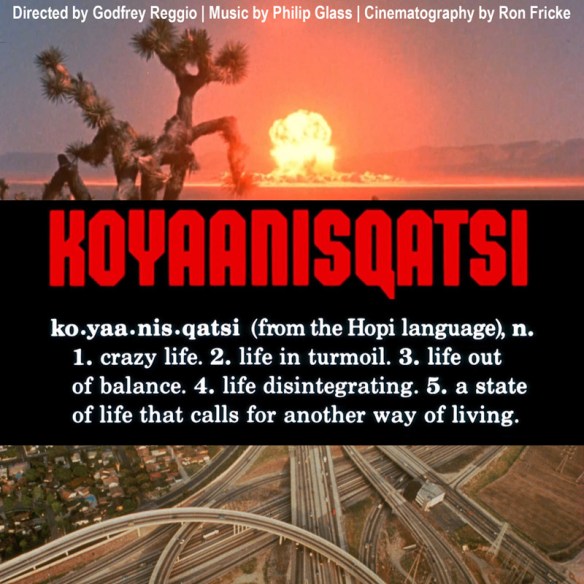
Saturday Matinee: Koyaanisqatsi

Young Life Out Of Balance: The Impact and Legacy of ‘Koyaanisqatsi’

By Michael Grasso

Source: We Are the Mutants

Throughout the latter half of the 1970s, ex-seminarian/political activist Godfrey Reggio and cinematographer Ron Fricke shot, assembled, and edited film footage from all over the United States—from the yawning chasms of southwestern American deserts to the teeming mechanized metropolises of New York and Los Angeles—creating a feature film that would speak to the overwhelming complexity of late 20th century life in the West. This film, Koyaanisqatsi, debuted at American film festivals in 1982 and quickly became an arthouse (and eventual home video) favorite. The frequently eerie score for the film, composed by Philip Glass, provides the only aural accompaniment for this 86-minute montage showing the collision of nature and technology, of mankind and the planet. The word koyaanisqatsi, Hopi for “corrupted life” or “life out of balance,” provided a mission statement for the film; while Reggio has been cagey about not wanting to either imply or explicitly provide any specific meaning for the film, both the title and the Hopi prophecies of doom sung over the film’s final act make Koyaanisqatsi‘s point of view more or less explicit: something is dreadfully and fundamentally wrong with the way the settler inhabitants of America and the industrialized world as a whole relate to both the planet and themselves.

Koyaanisqatsi arrived with much fanfare as part of the PBS “Great Performances” anthology series in March of 1985. Given my love of all things PBS, I was absolutely there to see it in one of its initial broadcasts or repeats in ’85 or ’86. I’d heard about it most likely due to the hype around the film’s arrival on broadcast television for the first time. I do remember watching it at night, alone, possibly while my parents were out or in bed. When I found Koyaanisqatsi on a streaming service this year, I realized that I hadn’t watched it in its entirety since I was 10 years old. As I watched, I found myself thinking about how 10-year-old Mike responded to these overwhelming images. The process of meaning-making for a 10-year-old kid watching a film containing a sophisticated symbolic critique of modern life fascinated me. I decided to watch Koyaanisqatsi in 2019 with a close eye towards the images and sounds that had stuck with me subconsciously in the intervening third of a century, the sequences that offered today’s me a direct connection to my younger self. In childhood I was surrounded by films, cartoons, and other educational programming that transmitted the profundity and complexity of human existence and the universe directly into my growing brain. What did Koyaanisqatsi‘s sensory bombardment, its sometimes overwhelming contrasting of nature and technology mean to me then? And how did that meaning change for me as an adult, now fully conscious of and conversant with the issues Reggio raises?

It’s absolutely the first 15 minutes of the film that I remember most vividly from childhood. It begins with the juxtaposition of ancient petroglyphs at Horseshoe Canyon in Utah against slow-motion, almost abstract closeups of the Apollo 11 launch in 1969. This kind of meaning-through-montage connected with me on an intimate level at the age of 10; this was precisely the kind of respect for the pageant of human “progress” that electronic media teachers such as Carl Sagan had inculcated in me in my early years. Sagan did not necessarily privilege the Western, “scientific” worldview in his works; understanding that the ancient astronomers of the American West were precisely as clever as their European and Asian counterparts was an important part of Sagan’s pedagogy. And in this sweeping montage of the natural environment of the American West, Reggio offers a simultaneously calming and stunning view of the untouched majesty of nature. This is the same “blank screen” of desert that would thrill Baudrillard during his sojourn in North America at about exactly the same time. Even on a relatively tiny 1980s television screen, these aerial shots were breathtaking; it wouldn’t be until I first saw an IMAX projection in 1987 when the Omni Theater opened at Boston’s Museum of Science that I felt something similarly awe-inspiring.

These images of nature and the elements—earth and clouds and crashing waves—soothe the viewer; Glass’s musical accompaniments for these sections are tellingly titled “Organic” and “Cloudscape.” But just as we are lulled into a sense of security and a naturally human sense of awe at the landscape, Reggio (and Glass) throw us violently out of our idyll, showing us what man has done to these landscapes. We see engineering on a massive scale: strip mining, power plants with huge cooling lakes, massive dam projects. Glass’s hectic, pulsing aria, titled “Resource,” says it all. Natural rhythms and flows are subsumed under black clouds of pollution from earth-moving equipment; natural landscapes carved by millions of years of river and wind are carved into regularly-repeating, Cartesian geometry. “Resource” is horrifying, punishing: every trumpet blast announces the coming of something horrible. Again I am reminded of Cosmos: Sagan opines in Episode 5, “Blues for a Red Planet,” where Sagan imagines how an alien species will be able to determine that an intelligent species inhabits Earth—by how we change and adjust our natural environment. To Sagan, this is a largely joyful sign of our ingenuity and a necessary contrast with the natural “canals” of Mars. To Reggio, these marks are a constant, painful scarring, and his depiction of them on-screen has an immediate and negative emotional impact on the viewer, even a young one. Pollution was, of course, something I’d been made aware of from an early age: not just from the constant bombardment of PSAs on television, but from the plumes rising from the smokestacks every time I’d cross the Tobin Bridge in the family station wagon to go into Boston.

For much of “Resource” we are denied the opportunity to see sky: despite the grandeur of the landscapes, the camera angles and editing completely remove the context of said landscape with its cycles with nature and climate. The only blue we are offered is the reflection of the sky in the slightly sinister pools of the power plants’ cooling waters. And it’s here that we start to see humans for the first time as well, first dwarfed by the enormity of the dams and power plants around them, then briefly a few individuals populating the background of a sequence in a metal foundry. These figures are the reason behind all the scarring and carving of industry. Here is mankind. The glowing metal of the foundry reminds us of the original technological myth: fire tamed by Promethean man.

And there Reggio brings forth the myth’s ultimate expression: nukes. Stock footage of nuclear explosions would not be a symbol that needed much in the way of interpreting for a 10-year-old still scared bone-deep of the prospect of nuclear war. In this section we begin to see how all of these technological “advances” impact humanity. We see beachgoers enjoying a hot sunny beach—but with a huge looming power plant behind them. We see the mighty Boeing 747 taxiing on a runway, another testament to human ingenuity—sheathed and shimmering in an uncanny petroleum haze. Highways and cloverleaf overpasses are shown, overflowing with traffic; new cars are lined up in a holding yard, soon juxtaposed with Soviet tanks, American fighter jets, ICBMs, and more Apollo footage. Production and consumption, the war machine, and the nuclear arms race: all part of the same insane global system. The film footage of cluster bomb blasts, de rigueur as a signifier of the American war machine since the days of Vietnam and thus intimately familiar to 1985 me from various expressions on television and in pop culture, have a new and shocking impact when shown as part of the unnatural system that digs resources from the ground and turns them into immediate, instant death.

For many, the segment near the center-point of the film where the viewer is treated to an aerial survey of the abandoned Pruitt-Igoe housing projects in St. Louis is the film’s most brutal and emotional. Bookended in Koyaanisqatsi by other images of the failure of social housing in the South Bronx, and very much of a piece with the worldwide midcentury penchant for Brutalist “urban renewal”, the tale of Pruitt-Igoe would be resolutely familiar to an adult in the early 1980s. For me at 10, a sheltered white kid who’d grown up entirely in the suburbs, the sequence’s eerie ruined majesty held complete mystery. What were these huge repeating buildings shaped like boxes? Why were they in such disrepair? And why were they being totally and completely annihilated with explosives in such a dramatic fashion? I was insulated through much of my youth (by express design of the white power structure, as it turns out) from the living and educational conditions of Black Americans in both my own home city of Boston and around the country. The wages of centuries of American apartheid were nothing but a vague unease at the periphery of my consciousness. The power demonstrated in both choosing to build and choosing to destroy these buildings, over a period of a mere three decades—little more than one human generation—was accurately and shockingly conveyed by the film, but its ultimate meaning was lost to me. As an adult, with all the context and knowledge present upon my re-viewing of the film, “Pruitt-Igoe” stands as a testament to midcentury liberalism’s best intentions, naturally sabotaged by the white violence inherent in American capitalism. This is the one sequence of Koyaanisqatsi that I look back on today and wish I’d had an adult—a wise, sensitive adult—to guide me through.

At the film’s halfway point, we really begin to see mass man. At first in slow motion, urban crowd “B-roll” shots of a type I would have been intimately familiar with from television in 1985, shot in slow-motion, cut with close-ups of individual human beings in front of vivid backgrounds: the whooshing of an urban subway, a military officer in front of a jet engine, a group of casino workers with the lights of Las Vegas flashing behind them. In a concerted way, these “portraits” arrest us as viewers after the sensory assault of the first 40 minutes of the film, getting us to begin seeing the individuals behind the mass movements and incomprehensible destruction we’ve seen so far. As an adult I find them almost unbearably poignant; I found myself wondering what happened to all these folks after Reggio and Fricke finished filming them. As a kid, their slightly outdated fashions (from the mid-to-late-’70s, by the looks of it) consigned them to the more recent past of the only context I could understand: sitcom reruns in syndication, that forever-lagging-behind-the-present that ensured I was in some ineffable way a nostalgic even at the age of 10.

“The Grid” is the section of Koyaanisqatsi where Reggio and Fricke first use time-lapse photography for, I would argue, its greatest achievement in film history. As much as we’ve been given a key to understanding the impact of technology and so-called progress on the natural world, this section, full of glittering cityscapes and the pulsating grid of traffic in Los Angeles at night, are heartbreakingly beautiful. The flow of traffic through midtown Manhattan, so expertly regulated by traffic lights, is yet somehow unnatural; these highway and street scenes, sped up, remind us (and certainly would have reminded the young me who’d grown up with educational programming) of microphotography of blood cells in arteries and capillaries, but somehow off: constantly halting and resolutely inorganic. In contrast, one of the film’s trademark shots (featured on the home video box and posters) of the moon’s movement through the sky as it is eclipsed by an office block is so sure in the lens of Fricke’s innovative time-lapse cameras, so machine-precise, far outstripping in elegance and power the stuttering processes of automobile and pedestrian traffic regulated by human-created technology.

Possibly the most homely, familiar, and comforting section of the film involves the juxtaposition of manufacturing, industry, and food processing with the crazy-quilt of consumption that completes industrial capitalism’s cycle. Hot dogs and Twinkies, blue jeans and televisions and automobiles roll off of assembly lines; as an adult in 2019 all I could think was “look at all those human workers!” There were so few robots in sight in each of these sequences, and the factory workers themselves looked so humble yet so proud. I also thought back to me at age 10, and how Mister Rogers’ Neighborhood would have primed me to look at these time-lapse sequences of production as something wondrous, something to be proud of. The flip side of all this production is seen in Koyaanisqatsi‘s views of Americans enjoying their leisure time: playing video games (I spotted Ms. Pac-Man, Q*bert, and Defender among many other video cabinets in the arcade sequence), bowling, going to the movies, visiting the mall food court, and especially watching television. The time-lapse photography zips through banks of televisions airing the prime-time advertisements and network news breaks of the kind I’m obsessed with and hunt down on YouTube in 2019. As a kid, this would have been the segment of the film that would’ve been the most immediate and identifiable to me. The people in these sections looked like me: they were suburban, not urban, dressed in casual clothes, not hats and suits and trenchcoats. They were young! There were younger kids sipping on milkshakes and having burgers with their families at the mall. These people were me. Did I understand how my consumption made me an accomplice to the black billowing smoke and scarred landscapes seen earlier in the film? At that age, I’m sure not.

Reggio always returns to people, not only to give the viewer (whether 10 years old or 43 years old) that sense of identification, a sense of their stakes in the modern “life out of balance,” but to return to the dignity of the individual human being. Reggio’s intellectual origins both in post-Vatican II Catholic conceptions of social justice and human dignity as well as Christian eco-anarchism demands this kind of attention to the individual humans behind these teeming visual landscapes. The final sequence is titled “Prophecies.” Glass’s musical accompaniment for this final sequence features a chorus singing three Hopi prophecies, interpreted by academic consultants Michael Lowatewama and Ekkehart Malotki, and translated on-screen at the end of the film. These prophecies are ones that would be familiar to anyone raised in the Western Christian tradition: tales of the death of the world thanks to mysterious poisons falling from the sky. As the choir chants these predictions of chaos and confusion, we see people wandering the streets, crushed by their surroundings: a homeless man gazing down at the change in his hand, a sick man put onto a litter by EMTs, someone in a hospital with a bloody wound resulting from an intravenous injection of fluids. The combination of Hopi prophecy on the soundtrack with the kind of lost people that Christ tried to minister to is devastatingly effective; even as a child, this section evoked pity and empathy in me rather than the disgust from seeing out of control pollution or technology. Bookending this is a lengthy sequence in slow-motion of an Atlas-Centaur rocket disaster, one of its thrusters tumbling back to earth slowly. The name of the star might have been Wormwood, but a year after this PBS airing, both a Challenger disaster and a nuclear disaster at another Wormwood half a world away would offer yet another Promethean lesson to both the U.S. and the Soviet Union.

I can’t remember exactly what I felt like immediately after viewing Koyaanisqatsi all those years ago, but its indelible images and sounds remained firmly in my subconscious all through my adolescence and adulthood. Now I’m middle-aged, the same age as all those scurrying New York City businessmen who seemed so weirdly uniform and alien to me as a kid. As I watch now, I of course am able to see that we are all lost in the life out of balance now. I wouldn’t call Reggio prophetic because anyone with eyes to see and ears to hear knew what was happening to us in the years since the end of the Second World War. And while art can absolutely point out injustice, fraud, exploitation, and abuse, it can very easily be used to recuperate these ideas into a more comfortable idea of the inevitability of “progress.” I don’t feel like any later misuse of Reggio’s praxis is his fault per se; whether or not he expressly provides meaning for us, his words and actions in the years following Koyaanisqatsi‘s release are clear and obvious.

I’ve never bothered to watch the two “Qatsi” sequels released in the years following the original. Their dual focuses were on life in the developing world and “life as war,” focusing on the modern world’s war with itself over technology. I’m not sure if they could achieve the mythic status and impact which Koyaanisqatsi had on my developing brain as a kid. Was 10 years old too young to consider these kinds of issues of modern life? I’m not sure. All I know is that I’m grateful I was given the opportunity to internalize these images and thoughts, to consider my place on a planet, both blessed and cursed by my surroundings, to ponder my role both as an individual and as part of a societal collective. While the televisual instruction of my childhood idols Sagan and Rogers may have in some small part normalized the mindset that brought us to this point (all while being steadfast advocates of social justice and peace, of course), Reggio’s camera, untouched by words, conveys the meaning of this life out of balance directly, resolutely, fearlesssly. A prophet Reggio himself may not be, but his filmic prophecy, and through it the prophecy of the Hopi, lives on.


Watch the full film on Kanopy here: https://www.kanopy.com/product/koyaanisqatsi


Freedom Rider: No Chemical Attacks in Syria

By Margaret Kimberly

Source: Black Agenda Report

The corporate media is concealing a leaked UN agency report that shows Syrian government innocence in an alleged chemical attack.

“Americans have been fed a steady diet of ‘Assad the butcher’ and any counter narrative is disappeared.”

The corporate media march in lock step with the United States and its allies around the world. They have a tacit agreement to exclude any information which might inconvenience pro-war, pro-interventionist narratives.

Claims of chemical weapons use by the Syrian government are but one example of this tactic. These improbable stories have been repeated with regularity ever since the United States and its allies began using jihadist proxies to overthrow the Syrian government in 2011. In 2013 we were told that president Assad waged a chemical weapons attack on the same day that United Nations weapons inspectors arrived in the country. It is an understatement to say that this scenario is unlikely to be true.

In 2018 the U.S. and its European allies repeated that they would take military action against Syria if there were any reports of chemical weapons use. Like clockwork, such an event was reported and a bombing campaign took place in April of that year.

Anyone with common sense should doubt these reports. Assad had no reason to do anything which guaranteed military attacks on his country. Furthermore, persons with credibility and expertise had already provided evidence that these claims are nothing but false flags meant to get public buy-in for aggression.

“Assad had no reason to do anything which guaranteed military attacks on his country.”

The claims and counter claims always merited serious scrutiny. But a leaked document from the Organization for the Prohibition of Chemical Weapons (OPCW) makes the case that even supposedly disinterested parties take the side of the U.S. and its allies if enough pressure is applied.

The leaked report makes clear that there were serious questions about the 2018 reports, even among OPCW staff. The New York Times and the rest of their partners in propaganda wanted to make the case for the once and future war and accused the Syrian government of dropping chlorine gas devices onto an apartment building. But the leaked document  shows that there were serious doubts expressed by the some of the expert investigators. “…there is a higher probability that both cylinders were manually placed at both locations rather than being delivered by aircraft.”

There are many dots to connect here and they point away from the “Assad is gassing his own people” tale. The OPCW was pressured into taking on the role of judge and jury and assigning blame, rather than merely reporting on its technical findings. The politicization of its work dove tailed nicely with charges of Syrian gas and Russian poisonings against former KGB operatives. As the old saying goes, there is no such thing as coincidence.

“The politicization of the OPCW’s work dove tailed nicely with charges of Syrian gas and Russian poisonings against former KGB operatives.”

The recently leaked documents ought to make for headlines around the world. Instead the story has been ignored by corporate media. Only those who are already interested in the topic or who are familiar with organizations such as the Working Group  on Syria, Propaganda and Media know anything about this news. It has been deliberately kept hidden so that the next call for an armed response will receive little or no opposition.

The U.S. Congress came very close to calling for a Syrian war in a May 20, 2019 letter signed by 70% of its members . The AIPAC inspired massive calls for president Trump to “stabilize” Syria, protect Israel and stop Russian and Iranian influence. The call was bipartisan and bicameral with 79 senators and 303 members of the house signing on to the call for imperialism. Presidential candidates Kamala Harris and Cory Booker are among those calling for the dangerous slippery slope. Congressional Black Caucus (CBC) chairwoman Karen Bass signed too as did Hakeem Jeffries, James Clyburn, and Elijah Cummings among others.

Americans have been fed a steady diet of “Assad the butcher” and any counter narrative is disappeared, just like the OPCW leak. It is a useful ploy to have around. Let us not forget that last year’s bombing resulted in praise from the so-called resistance crowd who think they are supporting a humanitarian action. When he next decides to protect the U.S. jihadist proxies the gas attack story will suddenly reappear. Revealing any doubts about its veracity will undermine the U.S. hegemonic project.

“Seventy-nine senators and 303 members of the house signing on to the call for imperialism.”

There is plenty of collusion in the United States and it isn’t between Trump and Russia. The love triangle involves the corporate media, both sides of the war party, and foreign ally puppet states. They all play nicely together in the sandbox when there is an evil deed to carry out. The public are mostly hapless dupes who give approval for destruction and carnage just like the state want them to.

We have been through this often enough to know when lies are being told. It wasn’t that long ago that Colin Powell went to the United Nations with a vial and a tall tale about WMD. The cast of characters changes but the story is the same. It is time to grow up and end useful idiocy.


Margaret Kimberley’s Freedom Rider column appears weekly in BAR, and is widely reprinted elsewhere. She maintains a frequently updated blog as well at http://freedomrider.blogspot.com . Ms. Kimberley lives in New York City, and can be reached via e-Mail at Margaret.Kimberley(at)BlackAgendaReport.com.

1% Politics and the New Gilded Age

By Rajan Menon

Source: Intrepid Report

Despair about the state of our politics pervades the political spectrum, from left to right. One source of it, the narrative of fairness offered in basic civics textbooks — we all have an equal opportunity to succeed if we work hard and play by the rules; citizens can truly shape our politics — no longer rings true to most Americans. Recent surveys indicate that substantial numbers of them believe that the economy and political system are both rigged. They also think that money has an outsized influence on politics. Ninety percent of Democrats hold this view, but so do 80 percent of Republicans. And careful studies confirm what the public believes.

None of this should be surprising given the stark economic inequality that now marks our society. The richest 1 percent of American households currently account for 40 percent of the country’s wealth, more than the bottom 90 percent of families possess. Worse yet, the top 0.1 percent has cornered about 20percent of it, up from 7 percent in the mid-1970s. By contrast, the share of the bottom 90 percent has since then fallen from 35 percent to 25 percent. To put such figures in a personal light, in 2017, three men — Jeff Bezos, Warren Buffett, and Bill Gates — possessed more wealth ($248.5 billion) than the bottom 50 percent of Americans.

Over the last four decades, economic disparities in the U.S. increased substantially and are now greater than those in other wealthy democracies. The political consequence has been that a tiny minority of extremely wealthy Americans wields disproportionate influence, leaving so many others feeling disempowered.

What Money Sounds Like

Two recent headline-producing scandals highlight money’s power in society and politics.

The first involved super-affluent parents who used their wealth to get their manifestly unqualified children into highly selective colleges and universities that previously had reputations (whatever the reality) for weighing the merits of applicants above their parents’ wealth or influence.

The second concerned Texas Senator Ted Cruz’s reported failure to reveal, as election laws require, more than $1 million in low-interest loans that he received for his 2012 Senate campaign. (For that lapse, the Federal Election Commission (FEC) fined Senator Cruz a modest $35,000.) The funds came from Citibank and Goldman Sachs, the latter his wife’s longtime employer. News of those undisclosed loans, which also cast doubt on Cruz’s claim that he had funded his campaign in part by liquidating the couple’s assets, only added to the sense that favoritism now suffuses the politics of a country that once prided itself on being the world’s model democracy. (Journalists covering the story couldn’t resist pointing out that the senator had often lambasted Wall Street’s “crony capitalism” and excessive political influence.)

The Cruz controversy is just one reflection of the coming of 1 percent politics and 1 percent elections to America at a moment when the first billionaire has been ensconced in the Oval Office for more than two years, posing as a populist no less.

Since the Supreme Court’s 2010 ruling in Citizens United v. Federal Election Commission, money has poured into politics as never before. That’s because the Court ruled that no limits could be placed on corporate and union spending aimed at boosting or attacking candidates running for political office. Doing so, the justices determined in a 5-4 vote, would be tantamount to restricting individuals’ right to free speech, protected by the First Amendment. Then came the Court’s 2014 McCutcheon v. Federal Election Commission decision (again 5-4), which only increased money’s influence in politics by removing the aggregate limit on an individual’s contribution to candidates and to national party committees.

In an age when money drives politics, even ex-presidents are cashing in. Fifteen years after Bill Clinton departed the White House, he and Hillary had amassed a net worth of $75 million — a 6,150percent increase in their wealth. Barack and Michelle Obama’s similarly soared from $1.3 million in 2000 to $40 million last year — and they’re just warming up. Key sources of these staggering increases include sky-high speaking fees (often paid by large corporations), including $153 million for the Clintons between February 2001 and May 2016. George W. Bush also made tens of millions of dollars in this fashion and, in 2017, Obama received $400,000 for a single speech to a Wall Street firm.

No wonder average Americans believe that the political class is disconnected from their day-to-day lives and that ours is, in practice, a democracy of the rich in which money counts (and counts and counts).

Cash for College

Now let’s turn to what those two recent scandals tell us about the nexus between wealth and power in America.

First, the school scam. Parents have long hired pricey tutors to coach their children for the college admissions tests, sometimes paying them hundreds of dollars an hour, even $1,500 for 90 minutes of high-class prep. They’ve also long tapped their exclusive social and political connections to gin up razzle-dazzle internships to embellish those college applications. Anyone who has spent as much time in academia as I have knows that this sort of thing has been going on for a long time. So has the practice of“legacy admissions” — access to elite schools especially for the kids of alumni of substantial means who are, or might prove to be, donors. The same is true of privileged access to elite schools for the kids of mega-donors. Consider, for instance, that $2.5 million donation Charles Kushner made to Harvard in 1998, not long before his son Jared applied. Some of the folks who ran Jared’s high school noted that he wasn’t exactly a whiz-bang student or someone with sky-high SAT scores, but — surprise! — he was accepted anyway.

What’s new about the recent revelations is that they show the extent to which today’s deep-pocketed helicopter parents have gone into overdrive, using brazen schemes to corrupt the college admissions process yet more. One unnamed parent spent a cool $6.5 million to ensure the right college admitted his or her child. Others paid hefty amounts to get their kids’ college admissions test scores falsified or even hired proxies to take the tests for them. Famous actors and financial titans made huge payments to university sports coaches, who then lied to admissions officers, claiming that the young applicants were champions they had recruited in sports like water polo, crew, or tennis. (The kids may have known how to swim, row, or play tennis, but star athletes they were not.)

Of course, as figures on the growing economic inequality in this country since the 1970s indicate, the overwhelming majority of Americans lack the connections or the cash to stack the deck in such ways, even assuming they would do so. Hence, the public outrage, even though parents generally understand that not every aspirant can get into a top school — there aren’t enough spots — just as many know that their children’s future happiness and sense of fulfillment won’t depend on whether they attend a prestigious college or university.

Still, the unfairness and chicanery highlighted by the admissions scandal proved galling, the more so as the growing crew of fat cats corrupting the admissions process doubtless also preach the gospel of American meritocracy. Worse, most of their kids will undoubtedly present their fancy degrees as proof that quality wins out in our society, never mind that their starting blocks were placed so far ahead of the competition.

To add insult to injury, the same parents and children may even portray admissions policies designed to help students who lack wealth or come from underrepresented communities as violations of the principles of equal opportunity and fairness, democracy’s bedrock. In reality, students from low-income families, or even those of modest means, are startlingly less likely to be admitted to top private universities than those from households in the top 10 percent. In fact, applicants from families in the top 1 percent are now 77 times more likely than in the bottom 20 percent to land in an elite college, and 38 of those schools admit more kids from families in that top percentage than from the bottom 60 percent.

Buying Politics (and Politicians), American-Style

Now, let’s return to the political version of the same — the world in which Ted Cruz swims so comfortably. There, too, money talks, which means that those wealthy enough to gain access to, and the attention of, lawmakers have huge advantages over others. If you want political influence, whether as a person or a corporation, having the wealth needed to make big campaign contributions — to individuals or groups — and to hire top-drawer lobbyists makes a world of difference.

Official data on the distribution of family income in the United States show that the overwhelming majority of Americans can’t play that game, which remains the preserve of a tiny super-rich minority. In 2015, even with taxes and government-provided benefits included, households in the lowest 20 percent accounted for only about 5 percent of total income. Their average income — not counting taxes and government-provided assistance — was only $20,000. The share of the bottom 50 percent — families making $61,372 or less — dropped from 20 percent to 12 percent between 1978 and 2015.  By contrast, families in the top 1 percent earned nearly 50 percent of total income, averaging $215,000 a year — and that’s only income, not wealth. The super-rich have plenty of the latter, those in the bottom 20 percent next to none.

Before we proceed, a couple of caveats about money and political clout. Money doesn’t always prevail. Candidates with more campaign funds aren’t guaranteed victory, though the time politicians spend raising cash leaves no doubt that they believe it makes a striking difference. In addition, money in politics doesn’t operate the way simple bribery does. The use of it in pursuit of political influence works more subtly, and often — in the new era opened by the Supreme Court — without the slightest need to violate the law.

Still, in Donald Trump’s America, who would claim that money doesn’t talk? If nothing else, from inaugural events — for Trump’s inaugural $107 million was raised from a host of wealthy donors with no limits on individual payments, 30 of which totaled $1 million or more — to gala fundraisers, big donors get numerous opportunities to schmooze with those whose campaigns they’ve helped bankroll. Yes, there’s a limit — currently $5,600 — on how much any individual can officially give to a single election campaign, but the ultra-wealthy can simply put their money into organizations formed solely to influence elections as well as into various party committees.

Individuals, companies, and organizations can, for instance, give money to political action committees (PACs) and Super PACs. Though bound by rules, both entities still have lots of leeway. PACs face no monetary limits on their independent efforts to shape elections, though they can’t accept corporate or union money or take more than $5,000 from individuals. They can provide up to $5,000 to individual election campaigns and $15,000 per party committee, but there’s no limit on what they can contribute in the aggregate. Super PACs have far more running room. They can rake in unlimited amounts from a variety of sources (as long as they’re not foreign) and, like PACs, can spend limitless sums to shape elections, providing they don’t give money directly to candidates’ campaigns.

Then there are the dark money groups, which can receive financial contributions from any source, American or foreign. Though their primary purpose is to push policies, not individual campaigns, they can engage in election-related work, provided that no more than half their funds are devoted to it. Though barred from donating to individual campaigns, they can pour unlimited money into Super PACs and, unlike PACs and Super PACs, don’t have to disclose who gave them the money or how much. Between 2008 and 2018, dark money groups spent $1 billion to influence elections.

In 2018, 2,395 Super PACs were working their magic in this country. They raised $1.6 billion and spent nearly $809 million. Nearly 78 percent of the money they received came from 100 donors. They, in turn, belonged to the wealthiest 1 percent, who provided 95 percent of what those Super PACs took in.

As the 2018 congressional elections kicked off, the four wealthiest Super PACs alone had $113.4 million on hand to support candidates they favored, thanks in substantial measure to business world donors. In that election cycle, 31 individuals ponied up more than $5 million apiece, while contributions from the top four among them ranged from almost $40 million to $123 million.

The upshot: if you’re running for office and advocate policies disliked by wealthy individuals or by companies and organizations with lots of cash to drop into politics, you know from the get-go that you now have a problem.

Wealth also influences political outcomes through the lobbying industry. Here again, there are rules, but even so, vast numbers of lobbyists and eye-popping amounts of lobbying money now are at the heart of the American political system. In 2018 alone, the 50 biggest lobbying outfits, largely representing big companies, business associations, and banks, spent $540 million, and the grand total for lobbying that year alone was $3.4 billion.

Nearly 350 of those lobbyists were former legislators from Congress. Officials departing from senior positions in the executive branch have also found artful ways to circumvent presidential directives that prohibit them from working as lobbyists for a certain number of years.

Do unions and public interest groups also lobby? Sure, but there’s no contest between them and corporations. Lee Drutman of the New America think tank notes that, for every dollar the former spent in 2015, corporate donors spent $34. Unsurprisingly, only one of the top 20 spenders on lobbying last year was a union or a public-interest organization.

The sums spent by individual companies to gain political influence can be breathtaking. Take now-embattled Boeing. It devoted $15 million to lobbying in 2018 — and that’s not counting its campaign contributions, using various channels. Those added another $8.4 million in the last two-and-a-half years. Yet Boeing only placed 11th among the top 20 corporate spenders on lobbying last year. Leading the pack: the U.S. Chamber of Commerce at $94.8 million.

Defenders of the status quo will warn that substantially reducing money’s role in American politics is sure to threaten democracy and civil liberties by ceding undue power to the state and, horror of horrors, putting us on the road to “socialism,” the right wing’s bogeyman du jour. This is ludicrous. Other democracies have taken strong steps to prevent economic inequality from subverting their politics and haven’t become less free as a result. Even those democracies that don’t limit political contributions have adopted measures to curb the power of money, including bans on television ads (a huge expense for candidates in American elections: $3 billion in 2018 alone just for access to local stations), free airtime to allow competitors to disseminate their messages, and public funds to ease the financial burden of election campaigns. Compared to other democracies, the United States appears to be in a league of its own when it comes to money’s prominence in politics.

Those who favor continuing business as usual like to point out that federal “matching funds” exist to help presidential candidates not be steamrolled by competitors who’ve raised mounds of money. Those funds, however, do no such thing because they come with stringent limits on total spending. Candidates who accept matching funds for a general election cannot accept contributions from individuals. Moreover, matching funds are capped at $20 million, which is a joke considering that Barack Obama and Mitt Romney spent a combined $1.2 billion in individual contributions alone during the 2012 presidential election. (Super PACs spent another $350 million to help Romney and $100 million to back Obama.)

A New American Tradition?

Rising income inequalitywage stagnation, and slowing social mobility hurt ordinary Americans economically, even as they confer massive social and political advantages on the mega-rich — and not just when it comes to college admissions and politics either.

Even the Economist, a publication that can’t be charged with sympathy for left-wing ideas, warned recently of the threat economic inequality poses to the political agency of American citizens. The magazine cited studies showing that, despite everything you’ve heard about the power of small donations in recent political campaigns, 1 percent of the population actually provides a quarter of all the money spent on politics by individuals and 80 percent of what the two major political parties raise. Thanks to their wealth, a minuscule economic elite as well as big corporations now shape policies, notably on taxation and expenditure, to their advantage on an unprecedented scale. Polls show that an overwhelming majority of Americans support stricter laws to prevent wealth from hijacking politics and want the Citizens United ruling overturned. But then just how much does the voice of the majority matter? Judging from the many failed efforts to pass such laws, not much.

Unrealistically Great Expectations

By Charles Hugh Smith

Source: Of Two Minds

Our expectations have continued ever higher even as the pie is shrinking..

Let’s see if we can tie together four social dynamics: the elite college admissions scandal, the decline in social mobility, the rising sense of entitlement and the unrealistically ‘great expectations’ of many Americans.

As many have noted, the nation’s financial and status rewards are increasingly flowing to the top 5%, what many call a winner-take-all or winner-take-most economy.

This is the primary source of widening wealth and income inequality: wealth and income are disproportionately accruing to the top slice of earners and owners of productive capital.

This concentration manifests in a broad-based decline in social mobility: it’s getting harder and harder to break into the narrow band (top 5%) who collects the lion’s share of the economy’s gains.

Historian Peter Turchin has identified the increasing burden of parasitic elites as one core cause of social and economic collapse. In Turchin’s reading, economies that can support a modest-sized class of parasitic elites buckle when the class of elites expecting a free pass to wealth and power expands faster than what the economy can support.

The same dynamic applies to productive elites: as I have often mentioned, graduating 1 millions STEM (science, technology, engineering, math) PhDs doesn’t magically guarantee 1 million jobs will be created for the graduates.

Such a costly and specialized education was once scarce, but now it’s relatively common, and this manifests in the tens of thousands of what I call academic ronin, i.e. PhDs without academic tenure or stable jobs in industry.

This glut is a global: I’ve known many people with PhDs from top universities in the developed world who have struggled to find a tenured professorship or a high-level research position anywhere in the world.

In other words, what was once a surefire ticket to status, security and superior pay is no longer surefire.

No wonder wealthy parents are so anxious to fast-track their non-superstar offspring by hook or by crook.

There is an even larger dynamic in play. As I explained here recently, the economic pie is shrinking, not just the pie of gains that can be distributed but the pie of opportunity.

Would parents and students be so anxious about their prospects if opportunities abounded for average students? The narrowing of opportunities to secure a stable career and livelihood is driving the frenzy to get into an elite university.

As everyone seeks an advantage, there’s a vast expansion of people with advanced diplomas: what was once relatively scarce (and thus valuable) is no longer scarce and therefore no longer very valuable.

The soaring cost of the middle-class membership basics–home ownership, healthcare and access to college–has drastically reduced the number of households who can afford these basics.

Two generations ago, just about any frugal working-class household with two wage-earners could save up a down payment for a modest home and later, save enough to put their children through the local state college.

Now, even two relatively well-paid wage earners in Left and Right Coast urban areas cannot afford to buy a house or put their kids through college. They are lucky to afford the rent, never mind buying a house.

As the number of upper-middle class slots declines, expectations have risen.This manifests in two ways: a rising sense of entitlement, which broadly speaking is the belief that the material security of middle class life should be available without great sacrifice.

The second manifestation is is higher expectations of material life in general: not only should we all have access to healthcare, college and home ownership, we also “deserve” to eat out every day, own luxury brand items, take resort vacations, and so on.

In a recent pre-recording conversation with a podcast host, we were talking about the number of average workers who think very little (apparently) of buying a $15 breakfast and/or a $20 lunch for themselves every day, plus an expensive coffee or beverage. This contrasts with the “old school” expectations which reserved lunches in restaurants for executives with expense accounts or The Boss. Everyone else filled a thermos with coffee at home and packed a brown bag lunch (or kau-kau tin in Hawaii).

From this perspective, $25 a day is $125 a week or $6,250 annually (a 50-week year). That’s $12,500 annually for a two wage-earner household. Five years of foregoing this luxury yields a nest egg of $62,500, a down payment for a $300,000 house, or the full cost of a four-year university education for two students who attend the local state university and who live at home.

(Sidebar note: a kind person gave us a $50 gift certificate to a popular casual-dining breakfast-lunch cafe. I reckoned we’d get a nice chunk of change after ordering two basic sandwiches and one beer. The $50 didn’t cover the three items, much less the tip. I nearly fell out of my chair. Over $50 for two sandwiches and a beer? And yet the place is jammed with people young and old, and I wondered: is everyone here earning $200,000+ annually, i.e. a top 5% income? If not, how can they afford such a costly luxury?)

As I noted earlier this month in the blog, the Federal Reserve’s obsession with generating a “wealth effect” by inflating bubbles in stocks and housing have enriched owners of capital at the expense of the young.

But even if we set aside the perverse and destructive impact of this disastrous policy, the economy is changing in structural ways. Scarcity value is becoming, well, scarcer. Global competition has reduced the scarcity value of education, ordinary labor and capital, and so the gains flowing to these has declined accordingly.

Yet our expectations have continued ever higher even as the pie is shrinking. Common sense suggests realigning expectations with a realistic appraisal of what’s possible and what sacrifices are necessary is a good first step.