Saturday Matinee: T2 Trainspotting

“T2 Trainspotting” (2017) is a a sequel to the cult classic Trainspotting. Both films are directed by Danny Boyle, written by John Hodge, and based on novels by Irvine Welsh. T2 stars the original cast, including leads Ewan McGregor, Ewen Bremner, Jonny Lee Miller, and Robert Carlyle and also includes film clips, music, and archive sound from the first film.

The film picks up 20 years after the events of the first film in which Mark Renton (Ewan McGregor) stole £16,000 in drug money from his friends and fled to Amsterdam. After suffering a heart attack in a gym, Mark finds himself in a mid-life crisis and decides to return to Edinburgh to make amends with his former friends. However, things don’t go as smoothly as planned.

Watch the full film here.

Resignation of Bolivia’s Evo Morales was no victory for democracy, but a US-sponsored coup

By Eva Bartlett

Source: RT.com

Evo Morales, an indigenous leader who bucked the IMF and condemned US imperialism, has been pressured by the military to resign after winning an election. Yet Washington calls this blatant coup in Bolivia a victory for democracy?

Morales was re-elected as Bolivia’s president on October 20. The coup-backing Organization of American States (OAS) wasn’t pleased and went ahead interfering in a sovereign nation – as the US itself does so well – issuing a report that the vote result wasn’t satisfactory to their desires.The heavy funding from the US surely has no influence on OAS policies…

In any case, on November 10, President Morales first announced a new election. Later that day, he announced his resignation, naming as reason the recent brutality of Bolivia’s right-wing opposition, including “kidnapping and mistreating” families of indigenous leaders and burning down the homes of public officials.

I resign from my position as president so that (Carlos) Mesa and (Luis Fernando) Camacho do not continue to persecute socialist leaders.

Morales was clear that his move was solely due to the violence incited opposition leaders. However, it soon became clear that this was a coup, not a resignation.

Former Brazilian president Dilma Rousseff tweeted her solidarity with the “legitimate president of Bolivia [Evo Morales] who was deposed by a military coup, had his house raided by the police and suffered an illegal arrest warrant. A very serious attack on democracy in Latin America and violence against the Bolivian people.” 

Another Brazilian ex-president, Lula, likewise declared the “stepping down” a coup. And even before the events of November 10, Argentina’s Cristina Kirchner foresaw there would be pressure to force Morales out of office, as did Venezuela’s President Nicolás Maduro.

As most readers know, this is not the first US-backed coup in Latin America. Washington’s history of meddling in sovereign nations stretching back many decades. But let’s look at how Bolivia changed under Morales’ leadership.

Poverty, unemployment and illiteracy all decreased significantly under Morales. In fact, according to a report by the Center for Economic and Policy Research (CEPR), Bolivia’s was the “fastest-growing” economy in South America, having “basically been stagnant for a quarter century prior to Morales becoming president in 2006.”

To do so, however, “the Bolivian government ended 20 years of IMF agreements in 2006,” the same CEPR report notes. Furthermore, expelling US military bases, threatening to close the US embassy in Bolivia, and nationalizing the oil and gas industries haven’t done much to put him in the good graces of ‘democracy-bringers’.

https://twitter.com/camilateleSUR/status/1193718218705264641

After all, with America’s lust to ‘democratize’ the world and steal precious resources in the process, nationalizing a country’s goods really mucks up Washington’s dirty plans. It doesn’t help that Bolivia has $2.3 billion worth of contracts to develop its lithium deposits with China, not the US.

Who benefits from Bolivia losing Morales as president? Not the Bolivian people, that’s for certain. In fact, some predict Bolivia’s future could be very dire under the rule of a US puppet.

https://twitter.com/O_Rich_/status/1193641286433161219

“My sin is being a union leader, indigenous. We are giving up so that my brothers do not continue to be kicked,” Morales said, when submitting his forced resignation.

This statement poignantly demonstrates the racism and utter lack of concern by the US for the people of Bolivia. Concerned citizens around the world are holding rallies in solidarity with Bolivia’s elected President and against yet another US-backed coup of a sovereign nation.

“He is now in hiding with his Indigenous Nation, and the death squads have issued an arrest warrant for him,” analyst Laith Marouf noted. “Know now that if they kill him claiming he resisted arrest, or that he committed suicide; that it was an assassination in the land that saw the assassination of Che Guevara.”

As events unfold in Bolivia, it’s important to keep in mind the possible frightening outcomes. Anything is possible when US imperial interests are at stake.

Our Vanishing World: Insects

By Robert J. Burrowes

About 12,000 years ago, late stone age humans precipitated the neolithic (agricultural) revolution that marked the start of the steady rise to civilization. Coincidentally, this occurred at the same time as the beginning of what is now known as the Holocene Epoch, the geological epoch in which humans still live.

However, since the industrial revolution commencing in about 1750, just 270 years ago, humans have been destroying Earth’s biosphere with such tremendous ferocity that the Earth we inherited at the beginning of the Holocene Epoch is vanishing before our eyes. And life is vanishing with it.

While this catastrophe first gained significant public attention with the publication of Rachel Carson’s book Silent Spring in 1962, efforts in response to her effort to raise the alarm, credited with inspiring the modern environmental movement, have paled in comparison to the ongoing human effort to silence Spring.

In fact, we are destroying the biosphere with such ruthless efficiency that the global extinction rate is now 200 species per day, with another million species ‘under threat’. Moreover, according to the recent Global Assessment Report on Biodiversity and Ecosystem Services researched and published by the Intergovernmental Science-Policy Platform on Biodiversity and Ecosystem Services (IPBES) – the scientific body which assesses the state of biodiversity and the ecosystem services this provides to society – ‘Nature is declining globally at rates unprecedented in human history.’

So severe is the crisis through which we are now living that the normally sober tone of scientific papers is vanishing too, with words such as ‘biological annihilation’, a ‘frightening assault on the foundations of human civilisation’ and the ‘sixth mass extinction’ event in Earth’s history are being used with increasing frequency. See, for example, ‘Biological annihilation via the ongoing sixth mass extinction signaled by vertebrate population losses and declines’.

So how extreme is the threat?

Well, despite the number of elite-controlled intergovernmental processes and corporate scientists paid to promulgate delusion about our timeframe, an increasing number of scientists are now warning that existing and accumulating evidence indicates that human extinction is likely to occur by 2026 (assuming that we can prevent nuclear war and prevent the deployment of 5G in the meantime). Unfortunately, too, the full extent of this unfolding catastrophe is readily masked if the many interrelated factors – emotional, political, economic, social, climatic, environmental, military, nuclear, geoengineering and electromagnetic – synergistically shaping this outcome are not each and all considered. See ‘Human Extinction by 2026? A Last Ditch Strategy to Fight for Human Survival’.

For example, it is poor science to measure climate impacts in isolation from the cascading impacts they generate ‘downstream’ (such as the adverse impact of temperature increases on insect populations in rainforests and what this means for the rainforest habitats they occupy) and to predict outcomes for humanity based on the climate impacts alone. If enough insects are gone – whether through destruction of habitat, extensive pesticide use, 5G electromagnetic radiation, climate impacts… or a combination of these and other factors – before we reach the critical climate ‘tipping point’, then human food chains will collapse rapidly followed by the human population whatever the state of the climate at the time.

However, rather than reiterate the comprehensive evidence in relation to the synergistic threats to human survival here, let me instead present the evidence only in relation to the decimation of the global insect population – variously given such labels as ‘insectageddon’ and ‘insect apocalypse’ in an attempt to convey the gravity of the crisis – including what is driving it and what it means.

The Importance of Insects

So how important are insects? According to one recent study conducted by Caspar A. Hallmann and eleven associates, insects are vital to ecosystem functioning:

‘Insects play a central role in a variety of processes, including pollination, herbivory and detrivory [an organism, such as a bacterium, fungus or insect, that feeds on dead plant or animal matter], nutrient cycling and providing a food source for higher trophic levels such as birds, mammals and amphibians. For example, 80% of wild plants are estimated to depend on insects for pollination, while 60% of birds rely on insects as a food source. The ecosystem services provided by wild insects have been estimated at $57 billion annually in the USA. Clearly, preserving insect abundance and diversity should constitute a prime conservation priority.’ See ‘More than 75 percent decline over 27 years in total flying insect biomass in protected areas’.

To underscore the importance of insects, in their study Bradford C. Lister & Andres Garcia simply note that ‘arthropods comprise over two-thirds of terrestrial species’. See ‘Climate-driven declines in arthropod abundance restructure a rainforest food web’. And, as Robert Hunziker observes: without insects ‘burrowing, forming new soil, aerating soil, pollinating food crops…’ and providing food for many bird species, the biosphere simply collapses. See ‘Insect Decimation Upstages Global Warming’.

However, despite their crucial role in maintaining the habitable biosphere, insects have been in decline for several decades. And the decline is accelerating.

The Decline of Insects

Any study of insect populations readily confirms their rapid decline. For example, in the recent study by Lister and Garcia, they note that ‘Arthropods, invertebrates including insects that have external skeletons, are declining at an alarming rate. While the tropics harbor the majority of arthropod species, little is known about trends in their abundance.’ Hence they compared arthropod biomass in Puerto Rico’s Luquillo rainforest with data taken by Lister back in 1976. They found that ‘biomass had fallen 10 to 60 times’ and their analyses revealed ‘synchronous declines in the lizards, frogs, and birds that eat arthropods’. Moreover, they noted, over the past 30 years forest temperatures have risen 2.0 °C and their study indicated that ‘climate warming is the driving force behind the collapse of the forest’s food web’. Ominously, they observe: ‘A number of studies indicate that tropical arthropods should be particularly vulnerable to climate warming. If these predictions are realized, climate warming may have a more profound impact on the functioning and diversity of tropical forests than currently anticipated.’ See ‘Climate-driven declines in arthropod abundance restructure a rainforest food web’ and ‘Insect collapse: “We are destroying our life support systems”’.

Why? Well although climate warming is disrupting the entire biosphere at an accelerating pace, the rate is generally slower in tropical habitats. Nevertheless, the evidence still clearly suggests that tropical ectotherms (organisms reliant on environmental heat sources) may be particularly vulnerable to the warming climate. Citing an earlier report based on research by Daniel H. Janzen – see ‘Why Mountain Passes are Higher in the Tropics’ – Lister and Garcia note that tropical species that evolved in comparatively aseasonal environments have ‘narrower thermal niches, reduced acclimation to temperature fluctuations, and exist at or near their thermal optima. Consequently, even small increments in temperature can precipitate sharp decreases in fitness and abundance. These predictions have been verified in a variety of tropical reptiles, amphibians, and invertebrates.’ See ‘Climate-driven declines in arthropod abundance restructure a rainforest food web’.

In another recent report ‘Worldwide decline of the entomofauna: A review of its drivers’, Francisco Sánchez-Bayo and Kris A.G. Wyckhuys present ‘a comprehensive review of 73 historical reports of insect declines from across the globe, and systematically assess the underlying drivers’. In essence, their research reveals ‘dramatic rates of decline’ with the main drivers being i) habitat loss and conversion to intensive agriculture and urbanization; ii) pollution, mainly by synthetic pesticides (glyphosate, neonicotinoids and others) and fertilisers; iii) biological factors, including pathogens and introduced species; and iv) the climate catastrophe. ‘The latter factor is particularly important in tropical regions, but only affects a minority of species in colder climes and mountain settings of temperate zones.’

Moreover, they note, the general studies of insect declines are ‘in line with previous reports on population declines among numerous insect taxa (i.e. butterflies, ground beetles, ladybirds, dragonflies, stoneflies and wild bees) in Europe and North America over the past decades. It appears that insect declines are substantially greater than those observed in birds or plants over the same time periods and this could trigger wide-ranging cascading effects within several of the world’s ecosystems.’

But perhaps the most alarming report is the one written following research conducted by Caspar A. Hallmann and his associates. Noting widespread concern about insect loss, they observe that ‘Loss of insect diversity and abundance is expected to provoke cascading effects on food webs and to jeopardize ecosystem services.’ Employing a standardized protocol to measure total insect biomass using Malaise traps, deployed over 27 years in 63 nature protection areas in Germany (with 96 unique location-year combinations) their analysis estimated ‘a seasonal decline of 76%, and mid-summer decline of 82% in flying insect biomass over the 27 years of study’. Moreover, the decline was apparent regardless of habitat type. ‘This yet unrecognized loss of insect biomass must be taken into account in evaluating declines in abundance of species depending on insects as a food source, and ecosystem functioning in the European landscape.’ See ‘More than 75 percent decline over 27 years in total flying insect biomass in protected areas’.

Just one cascading impact of the rapid decline of insects in Germany is the ‘decimation’ of the bird population. See ‘“Decimated”: Germany’s birds disappear as insect abundance plummets 76%’.

In summary, from the study by Sánchez-Bayo and Wyckhuys: More than 40 percent of the world’s insect species are on the fast track to extinction. See ‘Worldwide decline of the entomofauna: A review of its drivers’.

Why are insects declining?

In essence, apart from the causes of insect decline noted above, such as destruction of habitat, poisoning (using glyphosate, neonicotinoids and other pesticides) – see, for example, ‘Trump EPA OKs “Emergency” to Dump Bee-killing Pesticide on 16 Million Acres’ – and the climate catastrophe, insects are also adversely impacted by light – see ‘Light pollution a reason for insect decline’ – ingestion of plastic – see ‘Microplastic ingestion by riverine macroinvertebrates’ – wars, nuclear contamination – see, for example, ‘Fukushima butterflies highlight heavy cost of nuclear disaster’ – and will be further and horrifically impacted, along with all life on Earth, if 5G is deployed. For an earlier study identifying the existing problem of electromagnetic radiation on life, see ‘Bees, Birds and Mankind: Destroying Nature by “Electrosmog”’, but for recent updates on the extraordinary hazards of 5G to all life, see ‘5G and the Wireless Revolution: When Progress Becomes a Death Sentence’ and ‘Western Insanity and 5G Electromagnetic Radiation’.

In essence, without sufficient diversity and density of insects the existing biosphere will collapse and homo sapiens will join the fossil record. And we are rapidly approaching that particular tipping point.

Part of the problem is that far too much attention is being directed at the climate catastrophe while ignoring the vast evidence from other disciplines offering highly instructive research not only in relation to climate impacts but to other human behaviours that are negatively impacting ecosystem functioning.

This has a range of negative impacts, including that it deludes people into seeking outcomes that are hopelessly inadequate if we are to address the full extent of the crisis in our biosphere.

Is anything being done?

Not much. The elite’s corporations have enormous political power so have little trouble resisting efforts to contain their destruction of the biosphere, including of insect populations.

Hence, while scientists routinely offer fine suggestions, such as the following one, they are also routinely ignored.

‘A rethinking of current agricultural practices, in particular a serious reduction in pesticide usage and its substitution with more sustainable, ecologically-based practices, is urgently needed to slow or reverse current trends, allow the recovery of declining insect populations and safeguard the vital ecosystem services they provide. In addition, effective remediation technologies should be applied to clean polluted waters in both agricultural and urban environments.’ See ‘Worldwide decline of the entomofauna: A review of its drivers’.

But, to reiterate, it is corporations that have political power and that also control the media narrative; not scientists.

So what can we do?

Given that the insect apocalypse is deeply connected to other issues of critical importance to human survival, as always it is vital that this issue is addressed strategically from a holistic perspective. For that reason, we must approach the issue by addressing fundamental drivers but also several vital symptoms that arise from those drivers. Let me explain what I mean.

The fundamental question is this: Why are humans behaving in a way that destroys Earth’s biosphere? Surely, this is neither sensible nor even sane. And anyone capable of emotional engagement and rational thinking who seriously considers this behaviour must realize this. So why is it happening?

Fundamentally it is because our parenting and education models fail utterly to produce people of conscience, people who are emotionally functional and capable of critical analysis, people who care and who can plan and respond strategically.

Given the preoccupation of modern society with producing submissively obedient students, workers, soldiers, citizens (that is, taxpayers and voters) and consumers, the last thing society wants is powerful individuals who are each capable of searching their conscience, feeling their emotional response to events, thinking critically and behaving strategically in response. Hence our parenting and education models use a ruthless combination of visible, ‘invisible’ and ‘utterly invisible’ violence to ensure that our children become terrified, self-hating and powerless individuals like virtually all of the adults around them.

This multifaceted violence ensures that the adult who emerges from childhood and adolescence is suppressing awareness of an enormous amount of fear, pain and anger (among many other feelings) and must live in delusion to remain unaware of these suppressed feelings. This ensures that, as part of their delusion, people develop a strong sense that what they are doing already is functional and working (no matter how dysfunctional and ineffective it may actually be) while unconsciously suppressing awareness of any evidence that contradicts their delusion. See ‘Why Violence?’, ‘Fearless Psychology and Fearful Psychology: Principles and Practice’, ‘Do We Want School or Education?’ and ‘Love Denied: The Psychology of Materialism, Violence and War’.

So if we are going to address the fundamental driver of both the insect apocalypse and destruction of the biosphere generally, we must address this cause. For those adults powerful enough to do this, there is an explanation in ‘Putting Feelings First’. And for those adults committed to facilitating children’s efforts to realize their potential and become self-aware (rather than delusional), see ‘My Promise to Children’.

Beyond this cause, however, we must also resist, strategically, the insane elite corporations that are a key symptom of this crisis by manufacturing and marketing a vast range of insect (and life)-destroying products ranging from weapons (conventional and nuclear) and fossil fuels to products made by the destruction of habitat (including rainforests) and the poisoning of agricultural land (to grow the food that most people eat) while now planning the imminent worldwide deployment of 5G. See Nonviolent Campaign Strategy.

But we can also undermine this destruction, for example, by refusing to buy the products provided by the elite’s corporations (with the complicity of governments) that fight wars (to enrich weapons corporations) to steal fossil fuels (to enrich energy, aircraft and vehicle-manufacturing corporations) or those corporations that make profits by destroying rainforests or producing poisoned food, for example. We can do this by systematically reducing and altering our consumption pattern and becoming more locally self-reliant as outlined in ‘The Flame Tree Project to Save Life on Earth’ or, even more simply, by committing to The Earth Pledge (below). In a nutshell, for example, if we do not buy and eat poisoned food, corporations will stop poisoning our food and this will save vast numbers of insects (and many other life forms besides).

You can also consider joining those working to end violence in all contexts by signing the online pledge of ‘The People’s Charter to Create a Nonviolent World’.

The Earth Pledge

Out of love for the Earth and all of its creatures, and my respect for their needs, from this day onwards I pledge that:

  1. I will listen deeply to children (see explanation above)
  2. I will not travel by plane
  3. I will not travel by car
  4. I will not eat meat and fish
  5. I will only eat organically/biodynamically grown food
  6. I will minimize the amount of fresh water I use, including by minimizing my ownership and use of electronic devices
  7. I will not buy rainforest timber
  8. I will not buy or use single-use plastic, such as bags, bottles, containers, cups and straws
  9. I will not use banks, superannuation (pension) funds or insurance companies that provide any service to corporations involved in fossil fuels, nuclear power and/or weapons
  10. I will not accept employment from, or invest in, any organization that supports or participates in the exploitation of fellow human beings or profits from killing and/or destruction of the biosphere
  11. I will not get news from the corporate media (mainstream newspapers, television, radio, Google, Facebook, Twitter…)
  12. I will make the effort to learn a skill, such as food gardening or sewing, that makes me more self-reliant
  13. I will gently encourage my family and friends to consider signing this pledge.

Conclusion

In response to a range of synergistically impacting behaviours, homo sapiens is on the fast track to extinction. Just one critical and largely ignored variable in this rush to extinction is our decimation of the world insect population denying us an ever-expanding range of ecological services.

On this count alone, we have already crossed a dangerous tipping point that will cause increasing problems over time. Whether we can stop short of the ultimate tipping point depends on what you decide.


Biodata: Robert J. Burrowes has a lifetime commitment to understanding and ending human violence. He has done extensive research since 1966 in an effort to understand why human beings are violent and has been a nonviolent activist since 1981. He is the author of ‘Why Violence?’ His email address is flametree@riseup.net and his website is here.


 

Human Violence: Pervasive, Multi-dimensional and Extinction-threatening

By Robert J. Burrowes

Violence is pervasive throughout human society and it has a vast range of manifestations. Moreover, some of these manifestations – particularly the threat of nuclear war (which might start regionally), the climate catastrophe and the ongoing ecological devastation, as well as geoengineering and the deployment of 5G – threaten imminent human extinction if not contained. Separately from these extinction-threatening manifestations, however, violence occurs in a huge range of other contexts denying many people the freedom, human rights and opportunities necessary for a meaningful life. Moreover, human violence is now driving 200 species of life on Earth to extinction daily with another 1,000,000 species under threat.

For just a sample of the evidence in relation to the threats noted above see, for example, ‘Rapidly expanding nuclear arsenals in Pakistan and India portend regional and global catastrophe’, ‘Plan A’, ‘City on Fire’, ‘Human Extinction by 2026? A Last Ditch Strategy to Fight for Human Survival’, Geoengineering Watch, ‘International Appeal: Stop 5G on Earth and in Space’ and ‘5G and the Wireless Revolution: When Progress Becomes a Death Sentence’.

Given the expanding range of threats to human survival that require a strategic response if they are to be contained, is that possible?

Well, any candid assessment of the relevant scientific literature coupled with an understanding of the psychological, sociological, political, economic and military factors driving the violence, clearly indicates that the answer is ‘highly unlikely’. Particularly because so many people are so (unconsciously) terrified and incapable of responding powerfully.

However, this does not mean that many people are not trying and some of these people perceive the interrelated and synergistic nature of these threats and know that we must be addressing each of them strategically if humanity and an enormous number of other species are to have any meaningful chance of survival in a viable biosphere. These people range from ‘ordinary’ activists, who work passionately to end violence in one context or another, to globally prominent individuals doing the same. Let me tell you about some of them.

Ramesh Agrawal is a prominent social and environmental activist in India who has devoted many years to educating and organizing local village people, including adivasi communities, to defend their homes and lands from those corporations and governments that would deprive them of their rights, livelihoods, health and a clean environment for the sake of mining the abundant coal in the state of Chhattisgarh. However, because his ongoing efforts to access and share key information and his organization of Gandhian-inspired grassroots satyagrahas (nonviolent campaigns) have been so effective, he has also paid a high price for his activism, having been attacked on many occasions. In 2011, for example, he was arrested despite ill-health at the time and chained to a hospital bed. A year later he was shot in the leg, which required multiple operations. He still has difficulty walking with six metal rods inserted through his thigh.

The Jan Chetna (‘peoples’ awareness’) movement started by Ramesh has spread to several parts of Chhattisgarh as well as other states of India. For the latest account of his efforts including the recent ‘coal satyagrapha’ focused on coal blocks owned by state power companies but being developed and operated by Adani Enterprises, see ‘Thousands Hold “Coal Satyagraha”, Allege Manufacturing of Consent at Public Hearing’. For his nonviolent activism, Ramesh was awarded the Goldman Environmental Prize in 2014. See ‘Ramesh Agrawal: 2014 Goldman Prize Recipient Asia’ and ‘Chhattisgarh activist, Ramesh Agrawal, bags Goldman prize’.

In Ghana, the Women’s International League for Peace and Freedom (WILPF) continues its work under the leadership of President Dr. Ayo Ayoola-Amale, a certified mediator and peacebuilder. One recent activity was a two weeks training course on negotiation and mediation as a tool for conflict resolution for women in the Upper West region of Ghana, particularly three districts: Lawra, Nadowli and Lambussie. The training was aimed at providing local NGOs, community elders, administrators and others with the skills and knowledge to further improve their capacity in the work they do. In such courses, Ayo emphasizes the importance of trust, identity and relationship building issues, quoting Dr. Martin Luther King Jr.: ‘Life and history give eloquent testimony to the fact that conflicts are never resolved without trustful give and take on both sides.’

But Ayo has also conducted other courses, such as a three day workshop on peacemaking and mediation skills for the teachers and students at Okyereko Methodist Junior High School which taught skills such as communication (listening, speaking, silence), cooperation, trusting, empathy, responsibility, reconciliation and problem solving. Ayo also used her storytelling skills to convey an understanding of what it means to be a responsible person and how that puts us in charge of our lives. Through the storytelling she reveals some of the personal benefits that come from being honest, reliable, trustworthy and principled and how treating people with respect helps us get along with each other, avoid and resolve conflicts, and create a positive social climate. She told workshop participants that every choice they make helps define the kind of person they are choosing to be and their character is defined by what they do, not what they say or believe.

Professor René Wadlow, President of the Association of World Citizens headquartered in France, has been involved for decades in efforts to engage people in world events rather than leave these events to be mismanaged by elites with a vested interest in a particular outcome. In this article, for example, he reflects thoughtfully on the ‘Iran Crisis: Dangers and Opportunities’ by drawing attention to opportunities for citizen engagement through NGOs to influence how the conflict plays out. As he notes: ‘The dangers are real. We must make the most of the opportunities.’ René also continues to examine issues and throw light on subjects well outside the spotlight of the corporate media, such as conflicts in Africa. See, for example, his article ‘Sahel Instability Spreads’.

Since 2017 Dr Marthie Momberg in South Africa has been working with international colleagues to address Zionism amongst Christians. Along with a colleague from Kairos USA, Marthie offered, for example, a seminar entitled ‘Christianity and the Shifting of Perceptions on Zionism’ at Stellenbosch University’s Beyers Naudé Centre. ‘With some other colleagues we are also in the midst of a research project at this Centre to understand how to sensitise Christians on the nature of Zionism and how it serves as an important lens on so many other struggles in our world. I am also in the process of writing a number of scholarly articles on ethics and religion in the context of Israel and the Palestinian struggle.’

And while on Palestine, US activist journalist Abby Martin recently completed her debut feature film Gaza Fights for Freedom. Directed, written and narrated by Abby, the film had its origins while Abby was reporting in Palestine, where she was denied entry into Gaza by the Israeli government on the accusation she was a ‘propagandist’. Connecting with a team of journalists in Gaza to produce the film through the blockaded border, this collaboration shows you Gaza’s protest movement ‘like you’ve never seen it before’. Filmed during the height of the Great March Of Return protests, it features riveting footage of demonstrations ‘where 200 unarmed civilians have been killed by Israeli snipers since March 30, 2018’ and is a thorough indictment of the Israeli military for war crimes, and a stunning cinematic portrayal of the heroic resistance by Palestinians. You can watch a preview of the film here: Gaza Fights for Freedom (preview). And if you would like to buy or rent the film (and support Abby’s work) you can do so here: Gaza Fights for Freedom.

In Guatemala, Daniel Dalai continues his visionary work providing opportunities for girls to develop their leadership capacities at Earthgardens. If you haven’t previously been aware of their work, including in Bolivia and Nicaragua, you will find it fascinating to read how girls – including Carmen, Angelica, Reyna, Katiela, Yapanepet, Zenobia, Deysi, Rosalba, Charro, Katarina and Marleni – in this community each changed their society, often by forming ‘Eco-Teams’, with a remarkable variety of initiatives.

The Asia Institute ‘is the first truly pan-Asian think tank. A research institution that addresses global issues with a focus on Asia, The Asia Institute is committed to presenting a balanced perspective that takes into account the concerns of the entire region. The Asia Institute provides an objective space wherein a significant discussion on current trends in technology, international relations, the economy and the environment can be carried out.’ Focused on research, analysis and dialogue, and headed by president Emanuel Yi Pastreich, the Institute was originally founded in 2007 while Emanuel was working in Daejeon, Republic of (South) Korea. Emanuel writes extensively on culture, technology, the environment and international relations with a focus on Northeast Asia. He also serves as president of the Earth Management Institute, a global think tank dedicated to developing original approaches to global governance in this dangerous age. But for more on The Asia Institute, see the website above.

While the individuals and organizations mentioned above are just a sample of those directly involved, they are part of an expanding worldwide network in 105 countries committed to working to end human violence in all of its manifestations. Whatever the odds against it, they refuse to accept that violence cannot be ended, and each has chosen to focus on working to end one or more manifestations of violence, according to their particular circumstances and interests. If you would like to join these people, you are welcome to sign the online pledge of The Peoples Charter to Create a Nonviolent World.

If your own interest is campaigning on a peace, climate, environment or social justice issue, consider doing it strategically. See Nonviolent Campaign Strategy.

If your focus is a defense or liberation struggle being undertaken by a national group, consider enhancing its strategic impact. See Nonviolent Defense/Liberation Strategy.

If your preference is addressing the climate and environmental catastrophes systematically while working locally, consider participating in (and inviting others to participate in) The Flame Tree Project to Save Life on Earth.

If you would like to tackle violence at its source, consider revising your parenting in accordance with ‘My Promise to Children’. If you want the evidence to understand why this is so crucial, see Why Violence?’ and Fearless Psychology and Fearful Psychology: Principles and Practice.

If you are self aware enough to know that you are not dealing effectively with our deepening, multifaceted crisis, consider doing the personal healing necessary to do so. See ‘Putting Feelings First’.

Perhaps ending human violence is impossible. If that is true, then human extinction is inevitable and it will occur as a result of one cause or another. Moreover, it will happen in the near term. But every person who believes that human violence can be ended, and then takes strategic action to end it, is participating in the most important undertaking in human history: a last ditch strategy to fight for human survival.


Biodata: Robert J. Burrowes has a lifetime commitment to understanding and ending human violence. He has done extensive research since 1966 in an effort to understand why human beings are violent and has been a nonviolent activist since 1981. He is the author of Why Violence? His email address is flametree@riseup.net and his website is here.


Facebook and YouTube remove posts naming CIA impeachment whistleblower

By Kevin Reed

Source: WSWS.org

Multiple media sources reported on Friday that the social media platforms Facebook and YouTube were removing posts that identified by name the CIA whistleblower behind the Congressional impeachment inquiry of President Donald Trump.

In an email statement, Facebook said, “Any mention of the potential whistleblower’s name violates our coordinating harm policy, which prohibits content ‘outing of witness, informant or activist’,” adding, “We are removing any and all mentions of the potential whistleblower’s name and will revisit this decision should their name be widely published in the media or used by public figures in debate.”

CNN also reported that YouTube issued a statement saying that it was using a combination of artificial intelligence software and human monitors to find and delete videos with the name of the “Ukrainegate” whistleblower. “The removals, the spokesperson added, would affect the titles and descriptions of videos as well as the video’s actual content,” the CNN report said.

The World Socialist Web Site has independently confirmed that Facebook is deleting posts containing the name of alleged CIA whistleblower Eric Ciaramella.

Facebook’s claim that any content posted on its platform naming Ciaramella constitutes “outing” the whistleblower is absurd. The alleged identity of the career CIA analyst who filed a complaint regarding the July 25 phone call between President Trump and Ukrainian President Volodymyr Zelensky has been known since October 30 when the pro-Republican Real Clear Politics website published his name.

When his name was published by Real Clear Politics, the whistleblower’s attorneys—in typical CIA fashion—said they could “neither confirm nor deny” that Ciaramella was their client.

Ciaramella is a plausible candidate for being whistleblower, given his background as a registered Democrat and CIA analyst with expertise in Ukraine and Russia. He worked under both Obama National Security Advisor Susan Rice and Trump National Security Advisor H.R. McMaster. In mid-2017 he was sent back to the CIA amid accusations that he was leaking anti-Trump information to the media.

While Ciaramella’s name has been widely circulated by Republican political figures, right-wing news sites and former CIA analyst and Trump aide Fred Fleitz said, “everyone knows who he is,” the Democrats and their allies in the media at the New York Times, Washington Post and major television networks have not made his name public.

Even an article in the New York Times on Friday that reported on Facebook’s censoring of posts by the right-wing website Breitbart did not include Ciaramella’s name. By taking the step of scrubbing posts mentioning allegations that are widely shared and reported, Facebook and YouTube are now joining with these corporate media organizations and blocking the public from having access to important information.

The latest heavy-handed social media censorship—so obviously being carried out in the service of the Democratic Party impeachment inquiry and the CIA—actually helps the Trump administration, the Republican Party and the extreme right-wing political forces defending the White House, allowing them to adopt the false posture of advocating free flow of information, even as Trump continues to demonize the media as the “enemies of the people.”

The mass scrubbing of all social media content by Facebook and YouTube that mentions the name Eric Ciaramella is part of the broader censorship efforts by the technology monopolies, in collaboration with the intelligence state, and sets the stage for even more draconian attacks on freedom of expression.

This must be seen within the context of the drive by a substantial section of the ruling establishment for the social media platforms to “step up to the plate” and, as Hillary Clinton said last week, take down “false, deceptive or deliberately misleading content” or “pay a price.” Leading figures within the Democratic Party, including presidential candidate Elizabeth Warren, Congresswoman Alexandria Ocasio-Cortez and Congresswoman Rashida Tlaib, have been campaigning for social media censorship that will block what they call “untruthful statements.”

As explained on the World Socialist Web Site, the increasing calls for censorship on social media are part of a protracted campaign by the US intelligence apparatus, under conditions of a growing movement of the working class and young people and increasing interest and support for socialism, to suppress left-wing, antiwar and progressive political viewpoints.

Furthermore, the WSWS has pointed out that what is determined as “fake” or “real” is not to be decided by the government or giant tech monopolies: “All the dishonesty of the campaign for internet censorship is contained in the failure to answer, much less consider, one central question: Who is to determine what is true and what is false?”

The publication of the name of the CIA analyst who submitted his complaint memo to the heads of the House and Senate Intelligence Committees in August is not a crime. In fact, his identity is of substantial consequence, given that his complaint became the starting point of an effort to remove a sitting president through impeachment.

The Unraveling Quickens

By Charles Hugh Smith

Source: Of Two Minds

Even if we don’t measure the erosion of intangible capital, the social and political consequences of this impoverishment are manifesting in all sorts of ways.

The central thesis of my new book Will You Be Richer or Poorer? is the financial “wealth” we’ve supposedly gained (or at least a few of us have gained) in the past 20 years has masked the unraveling of our intangible capital: the resilience of our economy, our social capital, i.e. our ability to find common ground and solve real-world problems, our sense that the playing field, while not entirely level, is not two-tiered, and our sense of economic security–have all been shredded.

The unraveling of everything that actually matters is quickening. While every “news” outlet cheerleads the stock market (“The Dow soared today as investor optimism rose… blah blah blah”), our “leadership” and our media don’t even attempt to measure what’s unraveling, much less address the underlying causes.

The hope is that if we ignore what’s unraveling, it will magically go away. But that’s not how reality works.

The unraveling is gathering momentum because prices have been pushing higher while wages lag, feeding the rising precariousness and inequality of our economy. The connection between people losing ground and social disorder/disunity has been well established by historians such as Peter Turchin Ages of Discord and David Hackett Fischer The Great Wave: Price Revolutions and the Rhythm of History.

In our era, trust in the legitimacy of our institutions is unraveling because the statistics presented as “facts” are so clearly designed to support the status quo narrative that everything’s getting better every day in every way rather than the politically unwelcome reality that the bottom 95% are losing ground and whatever they do earn and own is increasingly at risk from forces outside their control.

Economic decay leads to social and political disorder / disunity. The sudden rise of vast homeless encampments is one manifestation of the social fabric unraveling. In the political realm, the insanity of accusing Democratic candidates of being “Russian agents” matches the hysterical destructiveness of the McCarthy era in the 1950s.

It all starts with economic decay, so let’s look at some charts. Here’s a chart of income inequality which helps drive wealth inequality.

Note that the only group that benefited from the past 20 years of speculative bubbles is the top 1%. The whole idea that inflating bubbles creates a “wealth effect” that “trickles down” is preposterous, as evidenced by the decline of the middle 60% of households while the speculators and owners of bubble-assets skimmed the vast majority of income gains.

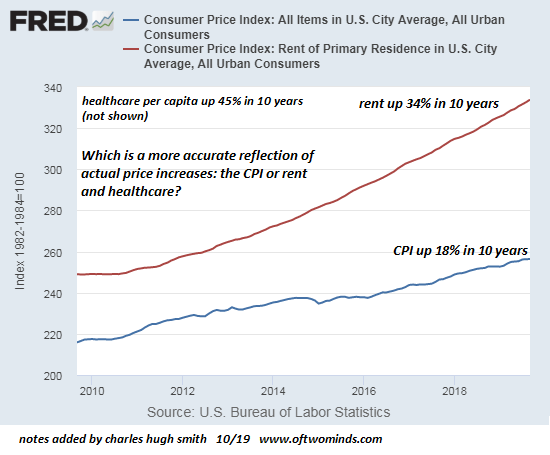
Meanwhile, we’re told inflation is less than 2% annually while rising costs have outpaced meager wage increases. What’s a more realistic measure of real-world inflation–the official Consumer Price Index (CPI) at 18% over ten years or rent and healthcare at 34% and 45%?

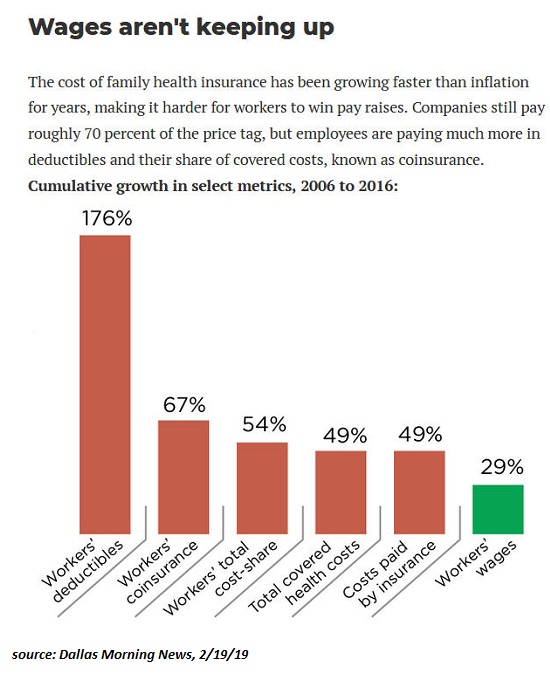
According to the Chapwood Index, real-world inflation in urban America is running 9% to 13% annually. This is more in line with reality than the bogus CPI, as evidenced by this chart of wages and healthcare costs:

Even if we don’t measure the erosion of intangible capital, the social and political consequences of this impoverishment are manifesting in all sorts of ways: large-scale social disorder is breaking out around the globe, and the political middle ground has completely vanished: no matter which way an issue is decided, one camp will refuse to accept the outcome.

The only way forward with any chance of success is to start by acknowledging the decay of our economy due to rampant financialization, legalized looting, the pathologies of “winner take most” speculation and the realities of a two-tiered system in which entrenched elites are “more equal” than the rest of us, economically, socially and politically. We have to accept the limits of technology to reverse the unraveling and assess the damage that’s already been done to our shared capital.

Acting as if the system is working just fine and the problem is perception/optics is accelerating the unraveling.

Automatons – Life Inside the Unreal Machine

By Kingsley L. Dennis

Source: Waking Times

ɔːˈtɒmət(ə)n/

noun

a moving mechanical device made in imitation of a human being.

a machine which performs a range of functions according to a predetermined set of coded instructions.

used in similes and comparisons to refer to a person who seems to act in a mechanical or unemotional way.

“Don’t you wish you were free, Lenina?”

“I don’t know what you mean. I am free. Free to have the most wonderful time. Everybody’s happy nowadays.”

He laughed. “Yes, ‘Everybody’s happy nowadays.’ We have been giving the children that at five. But wouldn’t you like to be free to be happy in some other way, Lenina? In your own way, for example; not in everybody else’s way.”

“I don’t know what you mean,” she repeated.

Aldous Huxley, Brave New World

Are we turning into a mass of unaware sleepwalkers? Our eyes are seemingly open and yet we are living as if asleep and the dream becomes our waking lives. It seems that more and more people, in the highly technologized nations at least, are in danger of succumbing to the epidemic of uniformity. People follow cycles of fashions and wear stupid clothes when they think it is the ‘in thing;’ and hyper-budget films take marketing to a whole new level forcing parents to rush out to buy the merchandise because their kids are screaming for it. And if one child in the class doesn’t have the latest toy like all their classmates then they are ostracized for this lack. Which means that poor mummy and daddy have to make sure they get their hands on these gadgets. Put the two items together – zombies and uniformity – and what do you get? Welcome to the phenomenon of Black Fridays, which have become the latest manifestation of national Zombie Days.

Unless you’ve been living in a cave somewhere (or living a normal, peaceful existence) then you will know what this event is – but let me remind you anyway of what a Black Friday is. It is a day when members of the public are infected with the ‘must buy’ and ‘act like an idiot’ virus that turns them into screaming, raging hordes banging on the doors of hyper-market retailers hours before they open. Many of these hordes sleep outside all night to get early entry. Then when the doors are finally opened they go rushing in fighting and screaming as if re-enacting a scene from Games of Thrones. Those that do survive the fisticuffs come away with trolleys full of boxes too big to carry. This display of cultural psychosis, generally named as idiocracy, is also a condition nurtured by societies based on high-consumption with even higher inequalities of wealth distribution. In other words, a culture conditioned to commodity accumulation will buy with fervour when things are cheap. This is because although conditioned to buy, they lack the financial means to satiate this desire. Many people suffer from a condition which psychologists have named as ‘miswanting,’ which means that we desire things we don’t like and like things we don’t desire. What this is really saying is that we tend to ‘want badly’ rather than having genuine need. What we are witnessing in these years is an epidemic of idiocracy and its propagating faster than post-war pregnancies. And yet we are programmed by our democratic societies to not think differently. In this respect, many people also suffer from a condition known as ‘confirmation bias.’

Confirmation bias is our conditioned tendency to pick and choose that information which confirms our pre-existing beliefs or ideas. Two people may be able to look at the same evidence and yet they will interpret it according to how it fits into and validates their own thinking. That’s why so many debates go nowhere as people generally don’t wish to be deviated away from those ideas they have invested so much time and effort in upholding. It’s too much of a shock to realize that what we thought was true, or valid, is not the case. To lose the safety and security of our ideas would be too much for many people. It is now well understood in psychology that we like to confirm our existing beliefs; after all, it makes us feel right!

Many of our online social media platforms are adhering to this principle by picking and choosing those items of news, events, etc that their algorithms have deemed we are most likely to want to see. As convenient as it may seem, it is unlikely to be in our best interests in the long term. The increasing automation of the world around us is set to establish a new ecology in our hyperreality. We will be forced to acknowledge that algorithms and intelligent software will soon, if it isn’t already, be running nearly everything in our daily lives. Historian Yuval Harari believes that ‘the twenty-first century will be dominated by algorithms. “Algorithm” is arguably the single most important concept in our world. If we want to understand our life and our future, we should make every effort to understand what an algorithm is.’1 Algorithms already follow our shopping habits, recommend products for us, pattern recognize our online behavior, help us drive our cars, fly our planes, trade our economies, coordinate our public transport, organize our energy distribution, and a lot, lot more that we are just not really aware of. One of the signs of living in a hyperreality is that we are surrounded by an invisible coded environment, written in languages we don’t understand, making our lives more abstracted from reality.

Modern societies are adapting to universal computing infrastructures that will usher in new arrangements and relations. Of course, these are only the early years, although there is already a lot of uncertainty and unpredictability. As it is said, industrialization didn’t turn us into machines and automation isn’t going to turn us into automatons. Which is more or less correct; after all, being human is not that simple. Yet there will be new dependencies and relations forming as algorithms continue to create and establish what can be called ‘pervasive assistance.’ Again, it is a question of being alert so that we don’t feel compelled just to give ourselves over to our algorithms. The last thing we want is for a bunch of psychologists trying to earn yet more money from a new disease of ‘algorithmic dependency syndrome’ or something similar.

It needs stating that by automating the world we also run the risk of being distanced from our own responsibilities. And this also implies, importantly, the responsibility we have to ourselves – to transcend our own limitations and to develop our human societies for the better. We should not forget that we are here to mature as a species and we should not allow the world of automation to distract us from this. Already literature and film have portrayed such possibilities. Examples are David Brin’s science-fiction novel Kiln People (2002 – also adapted into the film Surrogates, 2009), which clearly showed how automation may provide a smokescreen for people to disappear behind their surrogate substitutes.

Algorithms are the new signals that code an unseen territory all around us. In a world of rapidly increasing automation and digital identities we’ll have to keep our wits about us in order to retain what little of our identities we have left. We want to make sure that we don’t get lost in our emoji messages, our smilies of flirtation; or, even worse, loose our life in the ‘death cult’ of the selfies. Identities by their very nature are constructs; in fact, we can go so far as to call them fake. They are constructed from layers of ongoing conditioning which a person identifies with. This identity functions as a filter to interpret incoming perceptions. The limited degree of perceptions available to us almost guarantees that identities fall into a knowable range of archetypes. We would be wise to remember that who we are is not always the same as what we project. And yet some people on social media are unable to distinguish their public image from their personal identity, which starts to sound a bit scary. Philosopher Jean Baudrillard, not opposed to saying what he thought, stated it in another way:

We are in a social trance: vacant, withdrawn, lacking meaning in our own eyes. Abstracted, irresponsible, enervated. They have left us the optic nerve, but all the others have been disabled…All that is left is the mental screen of indifference, which matches the technical in-difference of the images.2

Baudrillard would probably be the first to agree that breathing is often a disguise to make us think that someone is alive. After all, don’t we breathe automatically without thinking about it?

We must not make the human spirit obsolete just because our technological elites are dreaming of a trans-human future. Speaking of such futures, inventor and futurist Ray Kurzweil predicts that in the 2030s human brains will be able to connect to the cloud and to use it just like we use cloud computing today. That is, we will be able to transfer emails and photos directly from the cloud to our brain as well as backing up our thoughts and memories. How will this futuristic scenario be possible? Well, Kurzweil says that nanobots – tiny robots constructed from DNA strands – will be swimming around in our brains. And the result? According to Kurzweil we’re going to be funnier, sexier, and better at expressing our loving sentiments. Well, that’s okay then – nanobot my brain up! Not only will being connected to the computing cloud make us sexier and funnier humans, it will even take us closer to our gods says Kurzweil – ‘So as we evolve, we become closer to God. Evolution is a spiritual process. There is beauty and love and creativity and intelligence in the world – it all comes from the neocortex. So we’re going to expand the brain’s neocortex and become more godlike.’It’s hard to argue with such a bargain – a few nanobots in our brain to become godlike? I can imagine a lot of people will be signing up for this. There may even be a hefty monthly charge for those wanting more than 15GB of back-up headspace. Personally, I prefer the headspace that’s ad infinitum and priceless. I hope I’m not in the minority.

Looking at the choices on offer so far it seems that there is the zombie option, which comes with add-on idiocracy (basic model), and the trans-human nanobot sexy-god upgrade (pricy). But then let’s not forget that in an automated world it may be the sentient robots that come out on top. Now, that would be an almost perfect demonstration of a simulation reality.

Life in Imitation

There are those who believe that self-awareness is going to be the end game of artificial intelligence – the explosive ‘wow factor’ that really throws everything into high gear. The new trend now is deep machine-learning to the point where machines will program not only themselves but also other machines. Cognitive computer scientists are attempting to recapture the essence of human consciousness in the hope of back-engineering this complexity into machine code. It’s a noble endeavor, if not at least for their persistence. The concern here is that if machines do finally achieve sentience then the next thing that we’ll need to roll out will be machine psychologists. Consciousness, after all, comes at a price. There is no free lunch when it comes to possessing a wide-awake brain. With conscious awareness comes responsibilities, such as values, ethics, morality, compassion, forgiveness, empathy, goodness, and good old-fashioned love. And I personally like the love part (gives me a squishy feeling every time).

It may not actually be the sentient robots we need to worry about; it’s the mindless ones we need to be cautious of (of course, we could say the same thing about ourselves). One of the methods used in training such robots is, in the words of their trainers, to provide them with enough ‘intrinsic motivation.’ Not only will this help the robots to learn their environments, it is also hoped that it will foster attention in them to acquire sufficient situational awareness. If I were to write a science-fiction scenario on this I would make it so that the sentient robots end up being more human than we are, and humans turn into their automated counterparts. Funny, maybe – but more so in the funny-bone hurting sort of way rather than the laugh-out-loud variety. Or perhaps it’s already been done. It appears that we are attempting to imbue our devices with qualities we are also striving to possess for ourselves. Humans are naturally vulnerable; it is part of our organic make-up. Whatever we create may inherit those vulnerabilities. However, this here is not a discussion on the pros and cons of smart machines and artificial intelligence (there are many more qualified discussions on that huge topic).

While we are creating, testing, worrying, or arguing over machines and their like we are taking our attention away from the center – ourselves. The trick of surviving in the ‘unreal machine’ of life is by becoming more human, the very antithesis of the robotic. Technology can assist us in interacting and participating to a better degree with our environments. The question, as always, is the uses to which such tools are put – and by whom. Such tools can help us realize our dreams, or they can entrap us in theirs. Algorithms, smart machines, intelligent infrastructure, and automated processes: these are all going to come about and be a part of our transforming world. And in many respects, they will make life more comfortable for us. Yet within this comfort zone we still need to strive and seek for our betterment. We should not allow an automated environment to deprive us of our responsibility, and need, to find meaning and significance in our world. Our technologies should force us to acknowledge our human qualities and to uplift them, and not to turn us into an imitation of them.

Another metaphor for the simulated ‘robotic’ creature is the golem. The golem legend speaks of a creature fashioned from clay, a Cabbalistic motif which has appeared frequently in literary and cinematic form (such as Frankenstein). The Cabbalistic automaton that is the golem, which means ‘unformed,’ has often been used to show the struggle between mechanical limitation and human feelings. This struggle depicts the tension that combines cogs and consciousness; the entrapment in matter and the spirit of redemption and liberation. This is a myth that speaks of the hubris in humanity fashioning its own creatures and ‘magically’ bestowing life upon them. It is the act of creating a ‘sacred machine’ from the parts and pieces of a material world and then to imbue them with human traits. And through this human likeness they are required to fulfil human chores and work as slaves. Sounds familiar? The Cabbalistic humanoid – the sentient robot – is forever doomed, almost like the divine nature of Man trapped within the confines and limitations of a material reality. They represent the conflict of being torn between a fixed fate and freedom.

Our material reality may be the ultimate unreal machine. We are the cogs, the clay golem, the imperfect creature fashioned by another. Our fears of automation may only be a reflection of our own automation. We struggle to express some form of release whilst unaware that the binds that mechanize us are forever tightening.

We have now shifted through the zombie-idiocracy model (basic), the trans-human nanobot sexy-god model (pricy), to arrive at the realization that it is us – and not our sentient robots – that are likely to be the automaton (tragic). And this is the biblical fall from grace; the disconnection from our god(s). We have come loose from Central Source and we have lost our way.

We are now living in the hyperreal realm where zombies, cyborgs, and golem robots all reside – but it is not the place for the genuine human. Things are going to have to change. Not only do we have to retain our humanity, we also must remain sane. With our continuing modern technologies, our augmented reality and bioengineering, the difference between fiction and reality will blur even further. And this blurring is likely to become more prominent as people increasingly try to reshape reality to fit around their own imaginative fictions. Staying sane, grounded, and balanced is going to be a very, very good option for the days to come.

We are going to be sharing our planetary space with the new smart machines. I am reminded of the Dr. Seuss book Horton Hears a Who! that has the refrain, ‘a person’s a person no matter how small.’ Size doesn’t count – but being human does. And staying human in these years will be the hard task allotted to us.