Freedom Rider: Dump the Democrats for Good

gettyimages-621673240

By Margaret Kimberly

Source: Black Agenda Report

“The Democrats were so entrenched in their corruption and self-dealing that they didn’t see the Bernie Sanders campaign for modest reform as the savior it might have been.”

This columnist did not see a Donald Trump victory coming. The degree of disgust directed at an awful candidate was more than I had predicted. Neither the corporate media, nor Wall Street nor the pundits nor the pollsters saw this coming either. Their defeat and proof of their uselessness is total. Those of us who rejected the elite consensus and didn’t support Hillary Clinton should be proud.

Black people are now in fear and in shock when we ought to be spoiling for a fight. All is not lost. Even the victory of the openly bigoted Trump poses an opportunity to right our political ship. Not the electoral ship, the political one. For decades black Americans have been voting for people who have done them wrong. Bill Clinton got rid of public assistance as a right, and undid regulations that kept Wall Street in check. He put black people in jail and yet black people didn’t turn on him until he and his wife tried to defeat Obama. But Obama gave us more of the same. Bailouts of Wall Street, interventions and death for people all over the world, and a beat down of black people who still loved him. Despite the fear of Republican victory we end up losing whenever a Democratic presidential candidate wins.

“Obama bailed out banks, insurance companies, Big Pharma and even Ukraine.”

Victory is ours if we dump the Democrat Party and their black misleaders. The Democrats were so entrenched in their corruption and self-dealing that they didn’t see the Bernie Sanders campaign for modest reform as the savior it might have been. Instead they marched in lock step with a woman who was heartily disliked. Sanders went along as the sheep dog who led his flock straight over the cliff. The Democrats inadvertently galvanized people who had stopped participating in the system and who want change from top to bottom.

One of our biggest problems lies not in facts but in perceptions. What did Democrats do for black people? The Democrats ship living wage jobs off shore in corrupt trade deals like NAFTA and TTP. They don’t prosecute killer cops or raise the minimum wage. Trump will be hard pressed to deport more people than Obama did. The list of treachery is very long.

When Donald Trump asked black people, “What have you got to lose?” his words were met with derision. But in reality he posed a good question. What do we have to show for years of Democratic votes? Obama bailed out banks, insurance companies, Big Pharma and even Ukraine. But he didn’t rebuild Detroit or New Orleans. The water in Flint, Michigan is still poisoned and the prisons are still full.

“There may be opportunity in this crisis if we dare to seize it.”

The outpouring of love for Barack Obama was purely symbolic. In state after state, black people who gave him victory in 2008 and 2012 stayed home. They loved seeing him and his wife dressed up at state dinners but they were never fully engaged in politics because that is not what Democrats want. The love was phony and void of any political intent. Donald Trump will be president because of that veneer of political activism.

As for white people who voted for Trump, of course many of them are racists. However they are not without valid complaints. They don’t want neoliberalism but black people don’t either. They don’t want wars around the world and neither do black people. We corrupt our own heritage of radicalism in favor of shallow symbolism. While we slept walk in foolish nostalgia for Obama and cried at the thought of him leaving office, white people kept their hatred of Hillary to themselves or lied to pollsters. They want America to be great again, great for them. White nostalgic yearnings are dangerous for black people, and we must be vigilant. But there may be opportunity in this crisis if we dare to seize it.

Republicans have been the white people’s party for nearly 50 years. Trump just made it more obvious. He didn’t tell us anything we didn’t already know. We don’t have to be the losers in this election. Let us remember what we have achieved in our history. Half of black Americans didn’t even have the right to vote in the 1960s yet made earth shattering progress in a short time. But we must understand the source of that progress. It came from struggle and daring to create the crises that always bring about change.

“The dread of redneck celebration should not be our primary motivation right now.”

Yes white people will strut for president Trump but that doesn’t mean we must submit as if we are in the Jim Crow days of old. We have ourselves to rely on and we can reclaim our history of fighting for self-determination. The dread of redneck celebration should not be our primary motivation right now. Before we quake in fear at white America we must send the scoundrels packing.

The black politicians and the Democratic National Committee and the civil rights organizations that don’t help the masses must all be kicked to the proverbial curb. The rejection must be complete and blame must be laid squarely at their feet.

Those of us who voted for the green party ticket of Jill Stein and Ajamu Baraka must stand firmly and proudly for our choice. We must strategize on building a progressive party to replace the Democrats who never help us. We must applaud Julian Assange and Wikileaks for exposing their corruption. There should be no back tracking on the fight to build left wing political power.

“We must strategize on building a progressive party to replace the Democrats who never help us.”

The black people who didn’t return to the polls shouldn’t be blamed either. Those individuals must have personal introspection that is meaningful and political. Their lack of enthusiasm speaks to Democratic Party and black misleadership incompetence. We should refrain from personal blame and help one another in this process as we fight for justice and peace.

The end of the duopoly is the first step in liberation. Staying with a party that literally did nothing was a slow and agonizing death. Sometimes shock therapy is needed to improve one’s condition. If we don’t take the necessary steps to free ourselves this election outcome will be a disaster. Instead, why not bring the disaster to the people who made it happen? The destruction of the Democratic Party and creation of a truly progressive political movement is the only hope for black America.

Why Okinawa Should Matter

2015051815015274208

By Richard Falk

Source: Foreign Policy Journal

Okinawa has been a mostly unhappy host of American military bases, and the issue has been prominent at times on the agenda of the Japanese peace movement.

When President Barack Obama visited Hiroshima in May of 2016, there was an effort to persuade him to put Okinawa on his travel itinerary, but as has happened frequently throughout the long tortured history of Okinawa, the request was ignored, and the people of the island were once more disappointed. In an important sense, Okinawa is the most shameful legacy of Japan’s defeat in World War II, exceeding even the sites of the atomic attacks by its daily reminders of a continued colonialist encroachment on Okinawan national dignity and wellbeing.

Actually, Okinawa is being victimized by overlapping exploitations with that of the United States reinforced and legitimized by mainland Japan. For the United States, Okinawa serves as a hub for its strategic military operations throughout the Pacific, with at least 14 separate military bases occupying about 20% of the island. Kadena Air Base was used for B-29 bombing missions during the Korean War more than a half century ago, and the island was used as a major staging area throughout the Vietnam War. It has also been used as a secret site for the deployment of as many as 1,000 nuclear warheads in defiance of Japanese declared no-nukes policy. Actually, in recent years Okinawa rarely receives global news coverage except when there occurs a sex crime by American servicemen that provokes local outrage and peaceful mass demonstrations followed by the strained apologies of local American military commanders.

Japan’s role in the misfortunes of Okinawa is more than one of a passive acceptance of the enduring side effects of its defeat and humiliation in World War II. After a series of military incursions, Japan finally conquered Okinawa and the Ryukyu island chain of which it is a part in 1879, and then imposed its rule in ways that suppressed the culture, traditions, and even the language of the native populations of the islands. What is virtually unknown in the West is that Okinawa was the scene of the culminating catastrophic land battle between the United States and Japan in the spring of 1945 that resulted in the death of an astounding one-third of the island’s civilian population of then 300,000 and its subsequent harsh military administration by the United States for the next 27 years until the island was finally turned back to Japan in 1972. Despite an estimated 60-80% of Okinawans being opposed to the U.S. bases, confirmed by the recent election of an anti-bases governor of prefecture, the government in Tokyo, currently headed by a dangerous militarist, Shinzo Abe, is comfortable with the status quo, which allows most of the unpopular continuing American military presence to be centered outside of mainland Japan, and hence no longer a serious political irritant within the country.

What the plight of Okinawans exemplifies is the tragic ordeal of a small island society, which because of its small population and size, entrapment within Japan, and geopolitical significance, failed to be included in the decolonizing agenda that was pursued around the world with such success in the last half of the 20th century. This tragic fate that has befallen Okinawa and its people results from being a ‘colony’ in a post-colonial era. Its smallness of current population (1.4 million) combined with its enclosure within Japanese sovereign statehood and its role in pursuing the Asian strategic interests of the United States, as well as joint military operations with Japan make it captive of a militarized world order that refuses to acknowledge the supposedly inalienable right of self-determination, an entitlement of all peoples according to common Article 1 of both human rights covenants. In this respect, Okinawa, from a global perspective, is a forgotten remnant of the colonial past, which means it is subjugated and irrelevant from the perspective of a state-centric world order. In this respect, it bears a kinship with such other forgotten peoples as those living in Kashmir, Chechnya, Xinjiang, Tibet, Hawaii, Puerto Rico, Palau, Marianas Islands, among many others.

There are other ways of being forgotten. I have for many years been concerned about the Palestinian ordeal, another geopolitical and historical casualty of Euro-American priorities and the colonialist legacy. Here, too, the indigenous population of Palestine has endured decades of suffering, denials of basic rights, and a dynamic of victimization initiated a century ago when the British Foreign Office issued the Balfour Declaration pledging support to the world Zionist movement for the establishment of a Jewish Homeland in historic Palestine, later placed under the tutorial role of the United Kingdom with the formal blessings of the League of Nations until the end of World War II. Instead of Japan playing the intermediate role as in Okinawa, it is Israel that pursues its own interests and teams with the United States and Europe as a strategic partner to carry forward its shared geopolitical goals throughout the Middle East and North Africa. Of course, there are crucial differences. Japan is constrained as a partner by its postwar peace constitution, which Abe is keen to circumvent and dilute, while Israel has become a military powerhouse in the region, enjoying a special relationship with the United States that includes the incredible assurance by Washington of a military capability capable of defeating any foreseeable combination of Arab adversaries. Also, unlike Okinawa, there are no American military bases in Israel. There is no need for them. Israel acts as an American surrogate, and sometimes even vice versa. Yet the result is the same—force projection unconnected with self-defense, but vital for upholding regional strategic interests that involve maintaining a visible military presence and offering allies in the region credible promises of protection.

When we raise questions about the future of Okinawa, we come face to face with the role and responsibility of global civil society. The Palestinian goals appear to remain more ambitious than those of the Okinawans, although such an impression could be misleading. The Palestinian movement is centered upon realizing the right of self-determination, which means at the very least an end to occupation and a diplomacy that achieves a comprehensive, sustainable, and just peace. For Okinawans, long integrated into the Japanese state, earlier dreams of independence seem to have faded, and the focus of political energy is currently devoted to the anti-bases campaign. Taking moral globalization seriously means conceiving of citizenship as borderless with respect to space and time, an overall identity I have described elsewhere under the label ‘citizen pilgrim,’ someone on a life journey to build a better future by addressing the injustices of the present wherever encountered.

In this respect, acting as citizen pilgrims means giving attention to injustices that the world as a whole treats as invisible except when an awkward incident of lethal abuse occurs. Okinawa has been effectively swept under the dual rugs of statism (Okinawa is part of the sovereign state of Japan) and geopolitics (Okinawa offers the United States indispensable military bases), and even the mainly Japanese peace movement may have grown fatigued and distracted, being currently preoccupied with its opposition to the revival of Japanese militarism under Abe’s leadership. Whether attention to the plight of Okinawa will give rise to false hopes is a concern, but the aspiration is to produce an empowering recognition throughout the world that for some peoples the struggle against colonialism remains a present reality rather than a heroic memory that can be annually celebrated as an independence day holiday. Until we in the United States stand in active solidarity with such victims of colonialist governance we will never know whether more can be done to improve prospects of their emancipation. This awareness and allegiance is the very least that we can do if we are to act in the spirit of a citizen pilgrimage.


This article was originally published at RichardFalk.Wordpress.com. An earlier version first appeared in the Japanese publication Ryukyu Shimpo.


Punishment is Violent and Counterproductive

stpp

By Robert J. Burrowes

Punishment is a popular pastime for humans. Parents punish children. Teachers punish students. Employers punish workers. Courts punish lawbreakers. People punish each other. Governments punish ‘enemies’. And, according to some, God punishes evildoers.

What is ‘punishment’? Punishment is the infliction of violence as revenge on a person who is judged to have behaved inappropriately. It is a key word we use when we want to obscure from ourselves that we are being violent.

The violence inflicted as punishment can take many forms, depending on the context. It might involve inflicting physical injury and/or pain, withdrawal of approval or love, confinement/imprisonment, a financial penalty, dismissal, withdrawal of rights/privileges, denial of promised rewards, an order to perform a service, banishment, torture or death, among others.

Given the human preoccupation with punishment, it is perhaps surprising that this behaviour is not subjected to more widespread scrutiny. Mind you, I can think of many human behaviours that get less scrutiny than would be useful.

Anyway, because I am committed to facilitating functional human behaviour, I want to explain why using violence to ‘punish’ people is highly dysfunctional and virtually guarantees an outcome opposite to that intended.

Punishment is usually inflicted by someone who makes a judgment that another person has behaved ‘badly’ or ‘wrongly’. At its most basic, disobedience (that is, failure to comply with elite imposed norms) is often judged in this way, whether by parents, teachers, religious figures, lawmakers or national governments.

But is obedience functional or even appropriate?

Consider this. In order to behave optimally, the human organism requires that all mental functions – feelings, thoughts, memory, conscience, sensory perception (sight, sound, touch, smell, taste), truth register, intuition… – must be developed and readily involved, without interference, in our life. If this happens, then all of these individual functions will play an integrated role in determining our behaviour in any given circumstance. This is a very sophisticated mental apparatus that has evolved over billions of years and if it was allowed to function without interference in each individual, human beings would indeed be highly functional.

So where does obedience fit into all of this? It doesn’t. A child is genetically programmed to seek to meet their own needs, not obey the will of another. And they will behave functionally in endeavouring to meet these needs unless terrorized out of doing so. Moreover, they will learn to meet their own needs, by acting individually in some circumstances and by cooperating with others when appropriate, if their social environment models this.

However, if a child is terrorized into being obedient – including by being punished when they are not – then the child will have no choice but to suppress their awareness of the innate mental capacities that evolved over billions of years to guide their behaviour until they have ‘learned’ what they must do to avoid being punished. For a fuller explanation of this, see ‘Why Violence?’ and ‘Fearless Psychology and Fearful Psychology: Principles and
Practice’.

Unfortunately, as you can probably readily perceive, this process of terrorizing a child into suppressing their awareness of what they want to do so that they do what someone else directs is highly problematical. And it leads to a virtually infinite variety of dysfunctional
behaviours, even for those who appear to have been successfully ‘socialized’ into performing effectively in their society. This is readily illustrated.

Perhaps the central problem of terrorizing individuals into obedience of conventions, commands, rules and the law is that once the individual has been so terrorized, it is virtually impossible for them to change their behaviour because they are now terrified of doing so. If the obedient behaviours were functional in the circumstances then, apart from the obviously enormous damage suffered by the individual, there would be no other adverse social or environmental consequences.

Unfortunately, when all humans have been terrorized into behaving dysfunctionally on a routine basis (in the Western context, for example, by engaging in over-consumption) then changing their behaviour, even in the direction of functionality, is now unconsciously associated with the fear of violence (in the form of punishment) and so desirable behavioural change (in the direction of reduced consumption, for example) is much more difficult. It is not just that many Western humans are reluctant to reduce their consumption in line with environmental (including climatic) imperatives, they are unconsciously terrified of
doing so.

By now you might be able to see the wider ramifications of using violence and threats of violence to force children into being obedient. Apart from terrorizing each child into suppressing their awareness of their innate mental capacities, we create individuals whose entire (unconscious) ‘understanding’ of human existence is limited to the notion that violence, mislabeled ‘punishment’, drives socialization and society.

As just one result, for example, most people consider punishment to be appropriate in the context of the legal system: they expect courts to inflict legally-sanctioned violence on those ‘guilty’ of disobeying the law. As in the case of the punishment of children, how many people ask ‘Does violence restore functional behaviour? Or does it simply inflict violence as revenge? What do we really want to achieve? And how will we achieve that?’

Fundamentally, the flaw with violence as punishment is that violence terrifies people. And you cannot terrorize someone into behaving functionally. At very best, you can terrorize someone into changing their behaviour in an extremely limited context and/or for an extremely limited period of time. But if you want functional and lasting change in an individual’s behaviour, then considerable emotional healing will be necessary. This will allow the suppressed fear, anger, sadness and other feelings resulting from childhood terrorization to safely resurface and be expressed so that the individual can perceive their own needs and identify ways of fulfilling them (which does not mean that they will be obedient). For an explanation of what is required, see ‘Nisteling: The Art of Deep Listening’ which is referenced in ‘My Promise to Children‘.

So next time you hear a political leader or corporate executive advocating or using violence (such as war, the curtailment of civil liberties, an economically exploitative and/or ecologically destructive initiative), remember that you are observing a highly dysfunctionalized individual. Moreover, this dysfunctional individual is a logical product of our society’s unrelenting use of violence, much of it in the form of what is euphemistically called ‘punishment’, against our children in the delusional belief that it will give us obedience and hence social control.

Or next time you hear a public official, judge, terrorist or police officer promising ‘justice’ (that is, retribution), remember that you are listening to an emotionally damaged individual who suffered enormous violence as a child and internalized the delusional message that ‘punishment works’.

You might also ponder how bad it could be if we didn’t require obedience and use punishment to get it, but loved and nurtured children, by listening to them deeply, to become the unique, enormously loving and powerful individuals for which evolution genetically programmed them.

I am well aware that what I am suggesting will take an enormous amount of societal rethinking and a profound reallocation of resources away from violent and highly profitable police, legal, prison and military systems. But, as I wrote above, I am committed to facilitating functional human behaviour. I can also think of some useful ways that we could allocate the resources if we didn’t waste them on violence.

If you share this commitment and working towards this world appeals to you too, then you are welcome to consider participating in the fifteen-year strategy outlined in ‘The Flame Tree Project to Save Life on Earth‘ and to consider signing the online pledge of ‘The People’s Charter to Create a Nonviolent World‘.

Punishment can sometimes appear to get you the outcome you want in the short term. The cost is that it always moves you further away from any desirable outcome in the long run.


Biodata: Robert J. Burrowes has a lifetime commitment to understanding and ending human violence. He has done extensive research since 1966 in an effort to understand why human beings are violent and has been a nonviolent activist since 1981. He is the author of ‘Why Violence?‘ His email address is flametree@riseup.netand his website is at http://robertjburrowes.wordpress.com

Robert J. Burrowes
P.O. Box 68
Daylesford
Victoria 3460
Australia
Email: flametree@riseup.net

Websites:
Nonviolence Charter
Flame Tree Project to Save Life on Earth
‘Why Violence?’
Nonviolent Campaign Strategy
Nonviolent Defense/Liberation Strategy
Anita: Songs of Nonviolence
Robert Burrowes
Global Nonviolence Network

The world wide cage

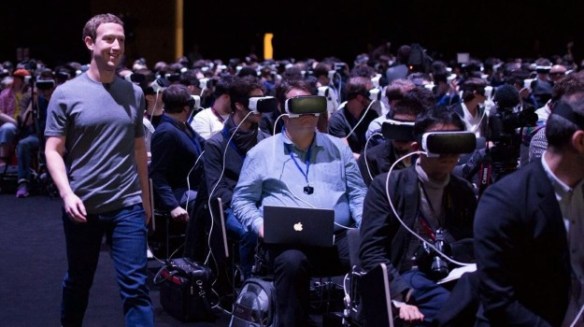
zuckerberg_VR_people-625x350

Technology promised to set us free. Instead it has trained us to withdraw from the world into distraction and dependency

By Nicholas Carr

Source: Aeon

It was a scene out of an Ambien nightmare: a jackal with the face of Mark Zuckerberg stood over a freshly killed zebra, gnawing at the animal’s innards. But I was not asleep. The vision arrived midday, triggered by the Facebook founder’s announcement – in spring 2011 – that ‘The only meat I’m eating is from animals I’ve killed myself.’ Zuckerberg had begun his new ‘personal challenge’, he told Fortune magazine, by boiling a lobster alive. Then he dispatched a chicken. Continuing up the food chain, he offed a pig and slit a goat’s throat. On a hunting expedition, he reportedly put a bullet in a bison. He was ‘learning a lot’, he said, ‘about sustainable living’.

I managed to delete the image of the jackal-man from my memory. What I couldn’t shake was a sense that in the young entrepreneur’s latest pastime lay a metaphor awaiting explication. If only I could bring it into focus, piece its parts together, I might gain what I had long sought: a deeper understanding of the strange times in which we live.

What did the predacious Zuckerberg represent? What meaning might the lobster’s reddened claw hold? And what of that bison, surely the most symbolically resonant of American fauna? I was on to something. At the least, I figured, I’d be able to squeeze a decent blog post out of the story.

The post never got written, but many others did. I’d taken up blogging early in 2005, just as it seemed everyone was talking about ‘the blogosphere’. I’d discovered, after a little digging on the domain registrar GoDaddy, that ‘roughtype.com’ was still available (an uncharacteristic oversight by pornographers), so I called my blog Rough Type. The name seemed to fit the provisional, serve-it-raw quality of online writing at the time.

Blogging has since been subsumed into journalism – it’s lost its personality – but back then it did feel like something new in the world, a literary frontier. The collectivist claptrap about ‘conversational media’ and ‘hive minds’ that came to surround the blogosphere missed the point. Blogs were crankily personal productions. They were diaries written in public, running commentaries on whatever the writer happened to be reading or watching or thinking about at the moment. As Andrew Sullivan, one of the form’s pioneers, put it: ‘You just say what the hell you want.’ The style suited the jitteriness of the web, that needy, oceanic churning. A blog was critical impressionism, or impressionistic criticism, and it had the immediacy of an argument in a bar. You hit the Publish button, and your post was out there on the world wide web, for everyone to see.

Or to ignore. Rough Type’s early readership was trifling, which, in retrospect, was a blessing. I started blogging without knowing what the hell I wanted to say. I was a mumbler in a loud bazaar. Then, in the summer of 2005, Web 2.0 arrived. The commercial internet, comatose since the dot-com crash of 2000, was up on its feet, wide-eyed and hungry. Sites such as MySpace, Flickr, LinkedIn and the recently launched Facebook were pulling money back into Silicon Valley. Nerds were getting rich again. But the fledgling social networks, together with the rapidly inflating blogosphere and the endlessly discussed Wikipedia, seemed to herald something bigger than another gold rush. They were, if you could trust the hype, the vanguard of a democratic revolution in media and communication – a revolution that would change society forever. A new age was dawning, with a sunrise worthy of the Hudson River School.

Rough Type had its subject.

The greatest of the United States’ homegrown religions – greater than Jehovah’s Witnesses, greater than the Church of Jesus Christ of Latter-Day Saints, greater even than Scientology – is the religion of technology. John Adolphus Etzler, a Pittsburgher, sounded the trumpet in his testament The Paradise Within the Reach of All Men (1833). By fulfilling its ‘mechanical purposes’, he wrote, the US would turn itself into a new Eden, a ‘state of superabundance’ where ‘there will be a continual feast, parties of pleasures, novelties, delights and instructive occupations’, not to mention ‘vegetables of infinite variety and appearance’.

Similar predictions proliferated throughout the 19th and 20th centuries, and in their visions of ‘technological majesty’, as the critic and historian Perry Miller wrote, we find the true American sublime. We might blow kisses to agrarians such as Jefferson and tree-huggers such as Thoreau, but we put our faith in Edison and Ford, Gates and Zuckerberg. It is the technologists who shall lead us.

Cyberspace, with its disembodied voices and ethereal avatars, seemed mystical from the start, its unearthly vastness a receptacle for the spiritual yearnings and tropes of the US. ‘What better way,’ wrote the philosopher Michael Heim in ‘The Erotic Ontology of Cyberspace’ (1991), ‘to emulate God’s knowledge than to generate a virtual world constituted by bits of information?’ In 1999, the year Google moved from a Menlo Park garage to a Palo Alto office, the Yale computer scientist David Gelernter wrote a manifesto predicting ‘the second coming of the computer’, replete with gauzy images of ‘cyberbodies drift[ing] in the computational cosmos’ and ‘beautifully laid-out collections of information, like immaculate giant gardens’.

The millenarian rhetoric swelled with the arrival of Web 2.0. ‘Behold,’ proclaimed Wired in an August 2005 cover story: we are entering a ‘new world’, powered not by God’s grace but by the web’s ‘electricity of participation’. It would be a paradise of our own making, ‘manufactured by users’. History’s databases would be erased, humankind rebooted. ‘You and I are alive at this moment.’

The revelation continues to this day, the technological paradise forever glittering on the horizon. Even money men have taken sidelines in starry-eyed futurism. In 2014, the venture capitalist Marc Andreessen sent out a rhapsodic series of tweets – he called it a ‘tweetstorm’ – announcing that computers and robots were about to liberate us all from ‘physical need constraints’. Echoing Etzler (and Karl Marx), he declared that ‘for the first time in history’ humankind would be able to express its full and true nature: ‘we will be whoever we want to be.’ And: ‘The main fields of human endeavour will be culture, arts, sciences, creativity, philosophy, experimentation, exploration, adventure.’ The only thing he left out was the vegetables.

Such prophesies might be dismissed as the prattle of overindulged rich guys, but for one thing: they’ve shaped public opinion. By spreading a utopian view of technology, a view that defines progress as essentially technological, they’ve encouraged people to switch off their critical faculties and give Silicon Valley entrepreneurs and financiers free rein in remaking culture to fit their commercial interests. If, after all, the technologists are creating a world of superabundance, a world without work or want, their interests must be indistinguishable from society’s. To stand in their way, or even to question their motives and tactics, would be self-defeating. It would serve only to delay the wonderful inevitable.

The Silicon Valley line has been given an academic imprimatur by theorists from universities and think tanks. Intellectuals spanning the political spectrum, from Randian right to Marxian left, have portrayed the computer network as a technology of emancipation. The virtual world, they argue, provides an escape from repressive social, corporate and governmental constraints; it frees people to exercise their volition and creativity unfettered, whether as entrepreneurs seeking riches in the marketplace or as volunteers engaged in ‘social production’ outside the marketplace. As the Harvard law professor Yochai Benkler wrote in his influential book The Wealth of Networks (2006):

This new freedom holds great practical promise: as a dimension of individual freedom; as a platform for better democratic participation; as a medium to foster a more critical and self-reflective culture; and, in an increasingly information-dependent global economy, as a mechanism to achieve improvements in human development everywhere.

Calling it a revolution, he said, is no exaggeration.

Benkler and his cohort had good intentions, but their assumptions were bad. They put too much stock in the early history of the web, when the system’s commercial and social structures were inchoate, its users a skewed sample of the population. They failed to appreciate how the network would funnel the energies of the people into a centrally administered, tightly monitored information system organised to enrich a small group of businesses and their owners.

The network would indeed generate a lot of wealth, but it would be wealth of the Adam Smith sort – and it would be concentrated in a few hands, not widely spread. The culture that emerged on the network, and that now extends deep into our lives and psyches, is characterised by frenetic production and consumption – smartphones have made media machines of us all – but little real empowerment and even less reflectiveness. It’s a culture of distraction and dependency. That’s not to deny the benefits of having easy access to an efficient, universal system of information exchange. It is to deny the mythology that shrouds the system. And it is to deny the assumption that the system, in order to provide its benefits, had to take its present form.

Late in his life, the economist John Kenneth Galbraith coined the term ‘innocent fraud’. He used it to describe a lie or a half-truth that, because it suits the needs or views of those in power, is presented as fact. After much repetition, the fiction becomes common wisdom. ‘It is innocent because most who employ it are without conscious guilt,’ Galbraith wrote in 1999. ‘It is fraud because it is quietly in the service of special interest.’ The idea of the computer network as an engine of liberation is an innocent fraud.

I love a good gizmo. When, as a teenager, I sat down at a computer for the first time – a bulging, monochromatic terminal connected to a two-ton mainframe processor – I was wonderstruck. As soon as affordable PCs came along, I surrounded myself with beige boxes, floppy disks and what used to be called ‘peripherals’. A computer, I found, was a tool of many uses but also a puzzle of many mysteries. The more time you spent figuring out how it worked, learning its language and logic, probing its limits, the more possibilities it opened. Like the best of tools, it invited and rewarded curiosity. And it was fun, head crashes and fatal errors notwithstanding.

In the early 1990s, I launched a browser for the first time and watched the gates of the web open. I was enthralled – so much territory, so few rules. But it didn’t take long for the carpetbaggers to arrive. The territory began to be subdivided, strip-malled and, as the monetary value of its data banks grew, strip-mined. My excitement remained, but it was tempered by wariness. I sensed that foreign agents were slipping into my computer through its connection to the web. What had been a tool under my own control was morphing into a medium under the control of others. The computer screen was becoming, as all mass media tend to become, an environment, a surrounding, an enclosure, at worst a cage. It seemed clear that those who controlled the omnipresent screen would, if given their way, control culture as well.

‘Computing is not about computers any more,’ wrote Nicholas Negroponte of the Massachusetts Institute of Technology in his bestseller Being Digital (1995). ‘It is about living.’ By the turn of the century, Silicon Valley was selling more than gadgets and software: it was selling an ideology. The creed was set in the tradition of US techno-utopianism, but with a digital twist. The Valley-ites were fierce materialists – what couldn’t be measured had no meaning – yet they loathed materiality. In their view, the problems of the world, from inefficiency and inequality to morbidity and mortality, emanated from the world’s physicality, from its embodiment in torpid, inflexible, decaying stuff. The panacea was virtuality – the reinvention and redemption of society in computer code. They would build us a new Eden not from atoms but from bits. All that is solid would melt into their network. We were expected to be grateful and, for the most part, we were.

Our craving for regeneration through virtuality is the latest expression of what Susan Sontag in On Photography (1977) described as ‘the American impatience with reality, the taste for activities whose instrumentality is a machine’. What we’ve always found hard to abide is that the world follows a script we didn’t write. We look to technology not only to manipulate nature but to possess it, to package it as a product that can be consumed by pressing a light switch or a gas pedal or a shutter button. We yearn to reprogram existence, and with the computer we have the best means yet. We would like to see this project as heroic, as a rebellion against the tyranny of an alien power. But it’s not that at all. It’s a project born of anxiety. Behind it lies a dread that the messy, atomic world will rebel against us. What Silicon Valley sells and we buy is not transcendence but withdrawal. The screen provides a refuge, a mediated world that is more predictable, more tractable, and above all safer than the recalcitrant world of things. We flock to the virtual because the real demands too much of us.

‘You and I are alive at this moment.’ That Wired story – under headline ‘We Are the Web’ – nagged at me as the excitement over the rebirth of the internet intensified through the fall of 2005. The article was an irritant but also an inspiration. During the first weekend of October, I sat at my Power Mac G5 and hacked out a response. On Monday morning, I posted the result on Rough Type – a short essay under the portentous title ‘The Amorality of Web 2.0’. To my surprise (and, I admit, delight), bloggers swarmed around the piece like phagocytes. Within days, it had been viewed by thousands and had sprouted a tail of comments.

So began my argument with – what should I call it? There are so many choices: the digital age, the information age, the internet age, the computer age, the connected age, the Google age, the emoji age, the cloud age, the smartphone age, the data age, the Facebook age, the robot age, the posthuman age. The more names we pin on it, the more vaporous it seems. If nothing else, it is an age geared to the talents of the brand manager. I’ll just call it Now.

It was through my argument with Now, an argument that has now careered through more than a thousand blog posts, that I arrived at my own revelation, if only a modest, terrestrial one. What I want from technology is not a new world. What I want from technology are tools for exploring and enjoying the world that is – the world that comes to us thick with ‘things counter, original, spare, strange’, as Gerard Manley Hopkins once described it. We might all live in Silicon Valley now, but we can still act and think as exiles. We can still aspire to be what Seamus Heaney, in his poem ‘Exposure’, called inner émigrés.

A dead bison. A billionaire with a gun. I guess the symbolism was pretty obvious all along.

Saturday Matinee: VR Short Double Feature

“Uncanny Valley” (2015, dir. Federico Heller) uses a documentary format and virtual reality scenarios to depict a frightening world in which damaged individuals rely on VR as a means to escape their depressing social reality while being used by the state.

“Hyper-Reality” (2016, dir. Keiichi Matsuda) depicts an average day in the life of a struggling precariat woman, that is, until she’s gang stalked by virtual and physical predators.

Who Lost: A Biased Media, Pundits, Pollsters, Political Parties, Warmongers, the Corporatocracy, Pay-to-Play Grifters, Neoliberals

1596525_630x354

Editor’s Note: While the parties mentioned may have lost in the short run, it’s likely they’ll soon regroup for future assaults on humanity and the planet.

By Charles Hugh Smith

Source: Of Two Minds

Fake Progressives are perfectly fine with soaring inequality and corrupt governance, as long as everyone’s public utterances are politically correct.

Sometimes who lost is more important than who won. Let’s review who lost the election:

1. Let’s start with the Corporatocracy, which expected to once again wield unlimited influence by funding political campaigns with millions of dollars in contributions and speaking fees.

2. A biased mainstream media. My mom-in-law was watching CBS all night, so that’s what we watched. All the pundits/anchors spoke in the hushed tones of a funeral. For two hours, the only images of campaign workers shown were the sad faces of Clinton supporters; not one image of jubilant Trump supporters was broadcast until Trump gave his acceptance speech.

When one of the talking heads noted that Hillary never generated the enthusiasm of the Sanders or Trump campaigns, his comment was followed by a stony silence. That he had given voice to a self-evident truth was not welcome.

3. Mainstream punditry: they got it wrong from the start and remained close-minded and arrogant in their postured superiority.

The punditry applied a double standard to Trump and Hillary. Trump’s speeches and ethically questionable history were judged by moral standards, and he was declared unfit.

Hillary’s actions, on the other hand, were judged by strictly legalistic standards: well, you can’t indict her, so she’s fit for office.

Dear punditry: you can’t use double standards to promote your biases and retain any shred of credibility.

4. Pollsters. Having rigged the polls via over-sampling and under-sampling, they were laughably wrong. Here is a typical headline from election night, from the New York Times: Trump Takes Florida, Closing In on a Stunning Upset.

Only the pollsters and the MSM were stunned.

5. Political parties. As my friend G.F.B. observed, both parties ran 20th century campaigns in the 21st century. Both parties lost for this reason; both are hopelessly out of touch with a rapidly changing America.

Democrats upset with losing should look at their party’s system of Super-Delegates that squelched Bernie Sander’s bid.

6. Warmongers. Many Americans are sick and tired of interventionist, globalist warmongering. The only possible way they could register their opposition to warmongering was to vote for Trump.

7. Pay-to-Play Grifters. Let the investigations, indictments, prosecutions and convictions begin as soon as Trump is sworn in.

8. Neoliberals. Globalization boils down to freeing mobile capital to rove the globe for opportunities to strip-mine cheap resources, assets and labor and then move on, leaving ruined communities behind.

9. Bonus loser: Fake Progressives. Fake Progressives are perfectly fine with soaring inequality and corrupt governance, as long as everyone’s public utterances are politically correct. So the oppressor class is acceptable as long as they speak respectfully while stepping on your neck.

Real Progressives see jobs and community as solutions, not welfare and central planning. Real Progressives see the eradication of warmongering Imperial pretensions and corrupt pay-to-play grifting as the essential projects of liberty and democracy.

The real Hunger Games: the Capitalist recipe to maximise profits while ‘having fun’

peacekeeper

By Sky Wanderer

Source: Investment Watch

Introduce a political economy upon the arbitrary axiom that Capitalism is the one and only economic system for mankind, and introduce a narcissistic moral philosophy that you as a Capitalist represent unsurpassable objective moral virtues.

You as a Capitalist hire politicians to implement policy as per your moral and economic philosophy and redefine ‘democracy’ as the political system to sustain Capitalism. Then from such position of self-established authority, abolish unions and all labour-representation, thus force your employees into a race-to-the-bottom contest to compete for jobs by accepting lower and lower wages.

Give decent jobs and benefits to only those who belong to your noble circles. For everyone else reintroduce slavery in the form of “workfare”. The goal is that you pay the lowest wages for jobs done by the fittest slaves, who will survive the contest. If you wish, you can call the contest “real Hunger Games”.

To speed up the process, extend the race-to-the-bottom into global scope so that you will have access to the cheapest and fittest labour everywhere on the planet. Never mind that your slaves will have to live out of a suitcase and every time when you lay them off and labour demand calls them elsewhere, they will have to relocate to yet another continent.

To further accelerate the process, make good use of your 3rd-world colonies, your Mideast colonising wars and your secretly sponsored mercenaries (ISIS). Via your “leftist” assistants, organise a massive refugee crisis to import the cheapest possible workforce via your war-refugees and economic migrants. These migrants are the fittest contestants who – glad just to escape your bombs – will worship you as their saviours and will work for you for literally zero payment. The migrants will not only boost your profits to sky-high levels but will rapidly pull down the overall wages of your domestic employees.

Meanwhile keep increasing the prices so your slaves can’t pay for food, energy, heat and shelter from their next-to-zero incomes. If some of them attempt to survive by taking bank-loans to acquire shelter, education and meet other basic needs, but they can’t repay the loans from their low incomes, you can just evict them from their homes via your banks.

When you made them homeless this way, make sure their ugly presence won’t spoil the beauty of your city. Install pretty anti-homeless spikes, so when they crush onto the pavement they will die, and you can just collect their bodies. To project your capitalist moral virtues into eternity, incorporate the beauty of your anti-homeless spikes into the modern concept of art and beauty.

Introduce private banking to enable yourself to creating new money when you wish. This way you can easily indebt the entire society, soon you can even purchase the whole planet.

Meanwhile dismantle public healthcare, so those of your slaves who are still alive but get sick, will die without treatment. Eliminate (privatise) all affordable public services, destroy the public sphere, abolish all public spaces and welfare benefits. To have a dandy excuse for such policy, make sure to keep the country in ever increasing debt by taking countless £ billions of government loans, and transfer the responsibility of these odious debts onto your slaves. Refer to these debts as the reason for the crisis, then refer to the crisis as the reason for these debts, then refer to the debts and the crisis as the reason for austerity and spending cuts. Then you can increase the public debt again and continue the same loop ad infinitum.

Make sure your very own mainstream media and academia would never reveal the truth that the never-ending crisis and mass-unemployment are due to your private banking and debt- and profit-mongering dysfunctional capitalist system, and keep the real disastrous indicators of the state of economy in secret.

Instead of admitting the truth, use the divide et impera strategy to make your victims blame themselves and one another. To increase the fun, produce reality shows where the still active part of your slaves will blame the disabled and the unemployed, meanwhile make the local poor blame the immigrant poor for the overall misery that you inflicted. Then establish offices where the local poor dressed as fancy clerks will evict the immigrant poor, meanwhile watch how all of them are begging for their lives until they give up and commit suicide.

Enjoy!