
We Are Being Smashed Politically, Economically, Medically and Technologically by the Elite’s ‘Great Reset’: Why? How Do We Fight Back Effectively?

By Robert J. Burrowes

Since the dawn of human civilization 5,000 years ago, ordinary people like you and me have been engaged in an endless struggle to resist efforts by elites, whether local, national, international or global, to assert complete control over us and the resources around us.

And for 5,000 years, with some wins and a great many losses, we have managed to stave off the worst.

Finally, in January 2020, the World Economic Forum launched its ‘Great Reset’: The final assault in the Elite’s long war against humankind and nature itself.

As we pass the third anniversary since this final battle was launched, it is well worth evaluating the progress of our resistance.

Is our resistance being effective? Are we succeeding?

Unfortunately, as is obvious from any serious evaluation, we are being smashed. Let me explain why.

[While they are not addressed in this article, I wish to acknowledge the range of other profound threats that pose a serious risk to any worthwhile human future, most notably the threat of nuclear war which arguably stands greater than at any previous time in human history.]

Evaluating Progress

Any strategy to resolve a conflict of this nature must begin with a sound analysis of what is happening:

Who is driving it (which answers the question ‘Who benefits?’) What do they intend? Why are they doing it? And how?

Only once these questions have been clearly answered is it possible to develop a strategy that will be adequate to the challenge posed by the threat.

So who is doing what?

Whatever we have been told by such organizations as the World Health Organization, national governments and the corporate media during the past three years, the most cursory investigation reveals that the World Economic Forum has been just behind the scenes effectively directing the response of governments to the threat supposedly posed by a ‘pathogenic virus’ labeled SARS-CoV-2.

However, any serious investigation will reveal that even the World Economic Forum is simply another ‘front’ for more powerful individuals and their organizations, which I call ‘the Global Elite’

– see ‘Historical Analysis of the Global Elite: Ransacking the World Economy Until “You’ll Own Nothing.”’

– and that no such thing as a ‘pathogenic virus’ has ever been isolated, including in the instance of SARS-CoV-2. See, for example, Christine Massey’s exhaustive attempts to identify a health or scientific institution anywhere in the world that has isolated the ‘virus’: ‘211 health/science institutions globally all failed to cite even 1 record of “SARS-COV-2” purification, by anyone, anywhere, ever’.

And if you want to watch or read other accounts carefully explaining why no ‘pathogenic virus’ has ever been isolated, here is a token sample of the extensive documentation of this point:

‘Dismantling the Virus Theory – The “measles virus” as an example’,

What Really Makes You Ill? Why everything you thought you knew about disease is wrong,

‘ZERO Evidence that COVID Fulfills Koch’s 4 Germ Theory Postulates – Dr. Andrew Kaufman & Sayer Ji’,

‘COVID-19: The virus does not exist – it is confirmed!’ and

‘Statement On Virus Isolation (SOVI)’.

In parallel with monumental efforts to convince us that we are living under enormous medical threat, and must submit to an onerous series of restrictions on our freedom, including multiple injections of a gene-altering bioweapon, a great deal has been going on that has been deliberately obscured from public view.

However, while information about this program is readily available to those who investigate – see, for example, the World Economic Forum’s ‘Great Reset’ – the reality is that few people have investigated because they were terrorized into believing the cover story: Their life was threatened by a ‘virus’.

But if we spend time investigating the material presented on the World Economic Forum’s ‘Great Reset’ website and reading critiques of it offered by well-informed researchers, one has no difficulty discovering that, on behalf of the Global Elite, the WEF is now implementing the Elite’s long-planned changes to 200 areas of human life.

To briefly elaborate just one set of changes being imposed as part of this program, consider the prospect of our technological imprisonment as transhuman slaves in ‘smart cities’.

What does this mean?

In essence: the Elite is rapidly building a complete technocracy based on surveillance and control technologies.

These technologies include (among many others) 5G, 6G, the Internet of Things (which will be connected to artificial intelligence [AI] programs that monitor the network of ‘smart’ devices you were deceived into implanting in your body and installing in your home),

geofencing (which will technologically confine you to five kilometres from where you live),

smart street poles and lights (which will gather data via facial recognition cameras and environmental sensors,

display digital signage and use speakers to instruct the immediate population how to behave), digital identity (which will be used to control your access to ‘approved’ activities),

central bank digital currencies (that will be used to control what you can buy,

how much of it and where),

surveillance and (3D) facial recognition cameras deployed in all public spaces (to monitor your movements and control your access), license plate readers, vehicle kill switches,

drones (used as aerial police), robots (including as a ‘deadly force option’) as well as autonomous and electromagnetic weapons. Beyond this, transhuman slaves will become ancilliary ‘workers’ in an increasingly robotized workforce.

To reiterate, these technologies will be used to monitor your every movement and completely control your behaviour, including by using the utterly transformed model of AI policing by drones and robots armed with electromagnetic weapons, as just touched upon.

In case it is not already obvious, this Elite-controlled technocratic prison will subvert human identity, human dignity, human volition, human privacy and human freedom.

Everything that makes human life worth living will be taken from you.

Why is the Elite doing this?

In brief, using a variety of means, this program based  on a reduction of a substantial proportion of the human population, as is now happening, imprison those left alive as transhuman slaves in technocratic ‘smart cities’, enclose the Commons forever and deliver all remaining wealth into Elite hands.

Hence, according to the WEF, by 2030 ‘You’ll Own Nothing. And You’ll Be Happy.

’ See ‘3.5 BILLION could be injured or killed by the jab. Are YOU ready?’,

‘Killing Off Humanity: How The Global Elite Is Using Eugenics And Transhumanism To Shape Our Future’,

‘Beware the Transhumanists: How “Being Human” Is Being Re-Engineered by the Elite’s Coup’ and ‘8 predictions for the world in 2030’.

And how is the Elite implementing this heinous program?

While the brief discussion above highlights the responsibility of the Global Elite for planning this program and then having it implemented through Elite agents including the World Economic Forum, relevant international organizations such as the WHO, national governments, pharmaceutical corporations and national medical associations, a critically important role has long been played by education systems, the corporate entertainment industry as well as the corporate media in ensuring that what most people regard as ‘knowledge’ and what most people believe is ‘true’ is always consistent with the Elite-promoted narrative.

See, for example, ‘Do We Want School or Education?’ and Propaganda.

Hence, in the current context, government media channels and most corporate newspapers, television and radio news programs as well as corporate social media giants have heavily promoted the Elite-driven narrative and routinely censored those telling the truth in exposing the Elite program.

See ‘WHO Labels Unvaccinated People a “Major Killing Force Globally”’ and ‘Propaganda Perpetuates the Pandemic and Censorship’.

As a result, while some people resisted the onerous restrictions on human freedom, few of these people understood the genuine threat that we faced from the elite plan concealed behind the ‘virus’/‘vaccine’ narrative. Consequently, most resistance has been focused on the wrong people, using ineffective means and with negligible understanding of what is taking place.

Hence, we are three years into this crisis that portends profound changes to human society, including the death of billions of people and the transhuman enslavement of virtually all those left alive, with only negligible progress in resisting this long-planned and sophisticated Elite program.

Let me elaborate.

We Are Being Smashed Politically

With the vast bulk of the human population trapped in the delusion that governments make the important decisions that shape our lives, virtually all effort to halt the substantial encroachments on our identity, dignity, volition, rights and freedom, including the injection mandates, has been directed at protest demonstrations, lobbying politicians (or voting for them) and petition-signing with those mobilized demanding that governments withdraw the restrictions and mandates.

This has meant that three years of efforts to mobilize people to resist have been misdirected and the resulting demonstrations, lobbying/voting and petitions have absorbed and dissipated the dissent, as those who truly govern intend.

As has been systematically documented, Elites of a local, regional, national, international and, most recently, global reach have controlled the political destiny of the population over which they exercised jurisdiction making the word ‘government’ a meaningless term. For a brief elaboration of this point, see

‘The Elite Coup to Kill or Enslave Us: Why Can’t Governments, Legal Actions and Protests Stop Them?’

Beyond this, however, since World War II there has been an ongoing series of developments to create global infrastructure that subverts any remaining national sovereignty while shifting power to the Global Elite.

Among many initiatives, for example, the Global Public-Private Partnership has been presented by Klaus Schwab and Peter Vanham, on behalf of the World Economic Forum.

See Stakeholder Capitalism: A Global Economy that Works for Progress, People and Planet summarized in ‘What is stakeholder capitalism?’

While this sanitized account obscures the threat it poses to humankind, Iain Davis and Whitney Webb have thoughtfully critiqued it

– see ‘Sustainable Debt Slavery’

– noting that even a 2016 UN Department of Economic and Social Affairs report

– see ‘Public-Private Partnerships and the 2030 Agenda for Sustainable Development: Fit for purpose?’

– also found it ‘unfit for purpose’.

So what is it? According to Davis, the Global Public-Private Partnership (G3P) is a worldwide network of stakeholder capitalists and their partners:

the Bank for International Settlements,

central banks, global (including media) corporations,

the ‘philanthropic’ foundations of multi-billionaires,

policy think tanks,

governments (and their agencies),

key non-governmental organizations and global charities,

selected academic and scientific institutions, labour unions and other chosen ‘thought leaders’. (You can see an instructive diagram in the article cited below.)

The G3P controls the world economy and global finance.

‘It sets world, national and local policy (via global governance) and then promotes those policies using the mainstream media’, typically distributes the policies through an intermediary such as the IMF, WHO or IPCC and uses governments to transform G3P global governance into hard policy, legislation and law at the national level. ‘In this way, the G3P controls many nations at once without having to resort to legislation.

This has the added advantage of making any legal challenge to the decisions made by the most senior partners in the G3P (an authoritarian hierarchy) extremely difficult.’ In short: global governance has already superseded the national sovereignty of states: ‘National governments had been relegated to creating the G3P’s enabling environment by taxing the public and increasing government borrowing debt.’ See ‘What Is the Global Public-Private Partnership?’

As Davis notes:

We are supposed to believe that a G3P-led system of global governance is beneficial for us and to accept that global corporations are committed to putting humanitarian and environmental causes before profit, when the conflict of interest is obvious. ‘Believing this requires a considerable degree of naïveté.’

Davis clearly perceives ‘an emergent global, corporate dictatorship that cares not one whit about truly stewarding the planet.

The G3P will determine the future state of global relations, the direction of national economies, the priorities of societies, the nature of business models and the management of a global commons. There is no opportunity for any of us to participate in either their project or the subsequent formation of policy.’ Davis goes on:

‘in theory, governments do not have to implement G3P policy, in reality they do. Global policies have been an increasing facet of our lives in the post-WW2 era…. It doesn’t matter who you elect, the policy trajectory is set at the global governance level. This is the dictatorial nature of the G3P and nothing could be less democratic.’

But, as explained previously and despite the claim by Davis of ‘an emergent global, corporate dictatorship’, this is just one of the more recent manifestations of national sovereignty being usurped by a Global Elite intent on removing even the delusion of any form of citizen engagement in policy determination and implementation. See ‘Historical Analysis of the Global Elite: Ransacking the World Economy Until “You’ll Own Nothing.”’

And just to highlight the impotence of Presidents and Prime Ministers, let alone lesser government figures, if a political leader steps out of line, they are simply removed or killed, with an extensive historical list of uncooperative political leaders removed or killed in coups – see ‘Overthrowing Other People’s Governments: The Master List of U.S. “Regime Changes”’ – and, in the current context, five assassinated so far. See ‘Five Presidents Who Opposed Covid Vaccines Have Conveniently Died, Been Replaced by Pro-Vaxxers’.

But, obviously, it doesn’t usually get to this. The Elite has a multitude of measures that enable it to control what most people like to believe are ‘democratic’ processes. For example, have you heard of the World Economic Forum’s ‘Young Global Leaders’ program in which the Forum indoctrinates carefully recruited young people to play their lifetime part in implementing Elite initiatives. You don’t get chosen for this program, or graduate from it, if you don’t have impeccable credentials. Just ask people as ‘diverse’ as President Emmanuel Macron, President Vladimir Putin and Prime Minister Justin Trudeau.

As WEF head Klaus Schwab boasted at Harvard University’s John F. Kennedy School of Government in 2017:

‘What we are very proud of, is that we penetrate the global cabinets of countries with our WEF Young Global Leaders… like Justin Trudeau.’ Watch ‘WEF’s Klaus Schwab Boasts of Young Global Leaders Penetration of Western Cabinets’.

But the YGL isn’t the only program of this nature. Have you heard of Schwarzman Scholars?

And if you think that we have legal redress to defend all those rights and freedoms supposedly guaranteed by a plethora of treaties, conventions, national constitutions and human rights laws, then you haven’t been paying attention while these have long been systematically ignored, if not simply wiped out. After all, legal systems exist to defend Elite power, profit and privilege, as the record demonstrates. See ‘The Rule of Law: Unjust and Violent’.

Next time you hear of a legal ruling that appears to favour ‘ordinary’ people, check back some months and years later to see if it survived the usual appeal processes and was ever actually implemented. And, if it was, did it actually change anything or simply lead to more of the same, as happens, for example, when a corporation is occasionally fined for some outrageous behaviour but absorbs the fine as a ‘cost of doing business’.

In summary, if you believe that international or national legal processes will hold the Global Elite (and not just the occasional scapegoated minion) to account, strike down vaccine mandates and a vast range of other violations of human rights, or even allow some of us to get some form of genuine compensation for the vast death, injury and damage inflicted historically or even just during the last three years, then I simply encourage you to read some history to see if you can find any evidence to support your belief.

We Are Being Smashed Economically

While many people have noted the damage done to the world economy by a series of measures supposedly carried out in response to the threat posed by the ‘virus’, ranging from lockdowns (which shuttered vast areas of the economy by disrupting all parts of the global supply chain and stopped most people from working) to vaccine mandates, the fact is that these measures were just the latest and most visible in a 5,000-year history of Elite action to secure and consolidate economic control, progressively enclose the Commons, enslave the human population in work to achieve Elite ends and capture all wealth, among other outcomes explained elsewhere in this article.

I have explained and illustrated this point at great length in this study: ‘Historical Analysis of the Global Elite: Ransacking the World Economy Until “You’ll Own Nothing.”’

But the essence of this report is simple: Building on millennia of effort, since the late C19th a small group of extraordinarily politically powerful and wealthy families, that I call the Global Elite, has accelerated previous efforts to create a global political, economic and legal infrastructure that facilitates the unending concentration of Elite power. This includes effective ownership and control of all key components of the economy including the banking, asset management, weapons, energy, technology, agrochemical, food, mining, pharmaceutical and media industries.

In this world order, neither international governmental organizations such as the United Nations nor national organizations such as governments have any significant say in what takes place. And you don’t either.

We Are Being Smashed Medically

As noted above, there is no documented scientific proof that any such thing as a ‘pathogenic virus’ has ever been isolated, including in the instance of SARS-CoV-2.

But underlying this fact is a very lengthy story about how many long-standing traditional natural healing methods that are very powerful and were used for millennia were systematically discredited and destroyed, as well as how a conflict of ideas about how to approach the maintenance of human health – characterised by the opposing views of Antoine Béchamp and Louis Pasteur in the C19th – culminated in the success of the latter’s ideas, because they enabled a rapid advance in the development of the centralized control desired by Elites, thus replacing long-standing and effective systems of health with one designed to attack human health and kill the patient or precipitate their (highly profitable) lifetime dependency on drugs.

Beyond this, however, ongoing strenuous efforts have consistently been made since the late C19th to control the health, medical and pharmaceutical information available to the public to ensure the suppression of effective treatments for various illnesses, including cancer – see Gerson Therapy – and thus ensure the profitability of the lethal medical, pharmaceutical, processed (including junk) food and confectionery industries, among others, as well as to endlessly consolidate the ever-tightening control over the human population exercised through medical means including through the latest manifestation of this effort, the Covid-19 scam.

However, like many subjects of this nature, much of the documentation in relation to this history has been carefully suppressed or eliminated, one way or another. Nevertheless you can read a sample of books that document it here:

Béchamp or Pasteur? A Lost Chapter in the History of Biology and Pasteur: Plagiarist, Impostor: The Germ Theory Exploded,

Medical Nemesis: The Expropriation of Health,

Murder by Injection: The Story of the Medical Conspiracy Against America and Death by Medicine;

check out the ‘Table Of Iatrogenic Deaths In The United States’; watch a reasonable summary of the disaster known as ‘modern medicine’ in ‘Rockefeller Medicine’ and watch Katherine Watt systematically outline the ‘authorization’ and illegalities of the Covid-19 measures in the USA. See ‘Katherine Watt presentation’.

In any case, as we discovered during the period supposedly marked by the Covid-19 ‘pandemic’ and, as noted above, despite the complete absence of any scientific evidence of the existence of any such thing as a ‘pathogenic virus’, including in the instance of SARS-CoV-2, we were nevertheless subjected to a wide range of measures that constituted martial law and violated a wide range of our human and constitutional rights.

In addition, just one of a host of ongoing measures is the World Health Organization’s current attempt to usurp national and individual sovereignty and capture full control of the human population through its ‘Pandemic Treaty’ and update of the International Health Regulations – see ‘Strengthening WHO preparedness for and response to health emergencies: Proposal for amendments to the International Health Regulations (2005)’ – which proposed the outright negation of a range of longstanding human rights, among other objectionable provisions, and has been critiqued by many authors. See, for example, ‘Amendments to WHO’s International Health Regulations: An Annotated Guide’‘“Pandemic Treaty” will hand WHO keys to global government’‘WHO Pandemic Treaty and the Banality of Evil’ and ‘The Top 100 REASONS to #StopTheTreaty, #StopTheAmendments, and #ExitTheWHO’.

Notably, for example, James Roguski characterized the proposed changes to the International Health Regulations as amounting to ‘medical martial law’ and, out of a list of 100 reasons he compiled for opposing the proposed changes, he highlighted ten that were particularly offensive. These included the facts that the proposed changes would alter the status of the WHO from an advisory body to one that made proclamations that are binding on governments; remove from Article 3 a provision requiring ‘respect for dignity, human rights and fundamental freedoms of people’; give the WHO the power to mandate medical examination, proof of prophylaxis, proof of vaccine, contact tracing, quarantine and treatment; institute an intrusive system of digital (or paper) health certificates; and greatly expand the WHO’s capacity to censor what they believe to be misinformation or disinformation, among many other onerous provisions. See ‘A World-Wide Call to Take Immediate and Massive Action’.

Given that these proposed changes to the draft Regulations violate long-standing laws, implemented following the Nuremberg trials of Nazi doctors – see ‘The Nuremberg Code, 1947’ – protecting people’s right to choose whether or not to seek the form of medical treatment of their choice, it is clear that the Elite interests that have exercised ever-deepening control of human society are intent on continuing to use the pharmaceutical and medical industries as key tools in their armory to kill off significant numbers of people and control those left alive.

As an aside, while Katherine Watt carefully details the ongoing militarization of public health since the 1960s and the use of US military ‘kill box’ planning and tactics in relation to Covid-19 – see ‘Kill Box: Multi-Service Tactics, Techniques and Procedures for Kill Box Planning and Employment’ – she attributes this approach to the ‘globalist central bankers’ realizing that pharmaceutical killing enabled a more credible ‘plausible deniability’ and more reliable basis for legal impunity, compared to some of its other measures – such as orchestrated wars, famines and financial crises – for killing off substantial human populations. See ‘Katherine Watt presentation’.

But, in fact, the Global Elite is well aware that there is no prospect of it being held accountable, legally or otherwise, just as its predecessor Elites have never been held accountable for their millennia-long rampage to kill off substantial human populations through wars, imperialism, colonialism, acts of genocide against indigenous and other peoples, the trans-Atlantic slave trade, precipitated famines, the functioning of capitalism, precipitation of depressions and other financial crises, as well as other measures. Why won’t the Global Elite be held accountable now? For the same reason Elites have never been held accountable, as illustrated above: A range of measures give it control over governments and legal systems, as well as control of the narrative (via ownership of the corporate media). See ‘Historical Analysis of the Global Elite: Ransacking the World Economy Until “You’ll Own Nothing.”’

And, just briefly on another initiative, Leo Hohmann has drawn attention to a new category added to the WHO’s International Classification of Diseases: a code specifically for those who are unvaxxed in relation to Covid-19 and another for those who have had inadequate booster shots. In short, your doctor will be required to advise your ‘disease’ if you have not been vaccinated.

See ‘EXCLUSIVE Special Report: Medical profession implements WHO digital diagnosis code for the unvaxxed’.

As the past three years have demonstrated, after more than a century of harm and killing on a prodigious scale, with ‘medical error’ ranking third on the list of causes of death in the USA, the pharmaceutical-medical complex has been let loose to wreak havoc on humanity. And it is not over yet. See ‘Who’s Driving the Pandemic Express?’ and watch the plan for the next ‘pandemic’, already available: ‘Catastrophic Contagion’.

So if you think the threat to our health from the pharmaceutical-medical industry is over, the reality is that we have simply had the first, ‘warm-up’ round of what must be a very long fight.

We Are Being Smashed Technologically

While most people embrace any new technology without question, the most casual investigation soon reveals that most technologies being made now can be used to surveil and control us and/or to harm or kill us outright. And given that this is the explicit intention behind ‘smart’ technologies, the long-planned and incredibly detailed Elite program to kill off many of us and build a technocracy in which we are permanently enslaved is proceeding at a breathtaking pace.

If you doubt this, have a look at the extensive range of videos and ‘Transformation Maps’ accessible from the World Economic Forum’s ‘Strategic Intelligence’ website.

Among the critically important technologies that are making this transhuman enslavement possible, the deployment of 5G, introduction of Digital Identity and the shift to Central Bank Digital Currencies (CBDCs) are vital and are being rapidly rolled out around the world as you read this article. As a matter of interest, were you consulted about any of this? Were you shown the extensive documentation of the dangers of the electromagnetic radiation from 5G? See ‘Deadly Rainbow: Will 5G Precipitate the Extinction of All Life on Earth?’

Were you informed that your Digital ID will make your freedom and privacy a thing of the past, especially when your social credit score has been determined? See ‘Digitizing Your Identity is the Fast-Track to Slavery: How Can You Defend Your Freedom?’ And have you been told that, based on your social credit score, the CBDCs will be used to control where you can spend your ‘money’, on what it can be spent and how much you can spend at any one time in any one place?

Beyond this, have you been consulted about the facial recognition (which record and store a 3D representation of your face) and surveillance cameras being installed everywhere?

With some 20 billion cameras already installed, there will be plenty to keep an eye on you, wherever you are.

And did you know these cameras will be linked to artificial intelligence that will be keeping exact track of your movements. Of course, your phone, other smart household devices, along with the license plate readers and vehicle kill switches will make sure that you are kept within the 5 kilometres you are allowed to travel from your home, once you are technologically imprisoned in one of the Elite’s ‘smart’  (Self-Monitoring, Analysis and Reporting Technology) cities. With geofencing, that is simple.

See ‘“SMART Cities” worldwide being converted into “open concentration camps,” says ex-Silicon Valley engineer turned whistleblower’ and

‘China’s Futuristic City Is a Test of Its Planning Power: Xiongan is a window into Xi Jinping’s ambitions’.

In his thoughtful article on ‘smart’ cities, technocracy expert Patrick Wood briefly explains why smart cities are central to Elite plans: Because cities don’t have the physical resources – the land which makes it possible to farm, mine resources, harvest timber and so on – found in rural areas, the technocrats devised a strategy to force people from rural to urban settings and then imprison them there. See ‘Day 9: Technocracy And Smart Cities’.

And remember when you gave a voice recording as biometric evidence that it was your bank account? How safe was that, do you think?  See

‘Neural Codec Language Models are Zero-Shot Text to Speech Synthesizers’,

‘VALL-E: Neural Codec Language Models are Zero-Shot Text to Speech Synthesizers’ and

‘Microsoft’s new AI can simulate anyone’s voice with 3 seconds of audio’.

While much more could be written about the technological hell that is being built around us, a little time reading about the Metaverse is well worth the effort if you want a clearer understanding of the technocratic dystopia in which we might soon live. See ‘Virtual Beauty, Virtual Freedom, Virtual Love: Is the Matrix Metaverse Our Future?’

If you still doubt the technological threat we face, the good news is that key Elite agents in this context are happy to spell it out. For example, consider reading this original World Government Summit report written in 2018 with Elite projections for 2071‘Government in 2071: Guidebook. Preparing for new frontiers’.

At the latest World Government Summit just held in Dubai from 13-15 February 2023, Klaus Schwab was his usual, straightforward self: ‘Our life 10 years from now will be completely different, very much affected, and who masters [fourth industrial revolution] technologies, in some way, will be the masters of the world’. He also warns that failure to master these advanced technologies could mean that people like you and me ‘escape our power’. Watch ‘Klaus Schwab Calls For Global Government To “Master” AI Technologies’.

So unless you see yourself in the category of those who will master and control these technologies, and hence the rest of us, you will not be one of the ‘masters of the world’. You can read another critique of the recent conference, outlining more of the horrors being planned for us, here:

‘World Government Summit: How the Merging of Humans and Technology Will Define the Next 50 Years’.

To summarize: Virtually all of us have been surrendering our personal data for decades and most of it is still stored on a government or corporate computer in a databank (referred to, misleadingly, as ‘the cloud’) where it can be accessed to determine your future social credit score (and everything that this score will, and will not, allow). Combined with the substantial range of technologies now available that are able to use this data in a multiplicity of ways, you will soon be imprisoned in a technocratic slave city, subject to the arbitrary rule of our ‘masters’, with escape virtually impossible.

In essence, we are endlessly being promised greater privacy, security and convenience. But all the evidence suggests that your data makes it very convenient for the Elite to invade your privacy and deny you security. And, of course, freedom simply won’t exist.

Why Fear Is Preventing Humanity from Resisting the Elite Program Strategically

As parents, teachers and religious figures, we are told we are responsible for socializing our children. In practice, as everyone unconsciously understands this, it means that we terrorize children into being submissively obedient.

How do we do this? We inflict an unending stream of violence – in three categories I have labeled ‘visible’, ‘invisible’ and ‘utterly invisible’ – on the children in our lives. The sophistication of this program of terrorizing children is obscured from public view because the bulk of the everyday violence we adults inflict is, literally, ‘invisible’ or even ‘utterly invisible’; that is, the behaviour is not perceived or acknowledged as violent even though that is how it is perceived by children who are on the receiving end of it. Moreover, it was perceived by us as violent when we were children but we were terrorized into suppressing our awareness of this reality. For a full explanation, see

‘Why Violence?’‘Fearless Psychology and Fearful Psychology: Principles and Practice’

and ‘Do We Want School or Education?’

So while other supposedly psychological explanations of what has transpired historically (the causes of war, imperialism, colonialism, genocide, slavery and a host of other heinous elements of human history) or even during the past three years, are routinely promulgated – see, for example, Mattias Desmet’s theory of ‘mass formation’:

‘The Psychology of Totalitarianism: From rationalism to mass formation – and towards Truth speech’ – any popularity they acquire is simply the result of the fact that they divert responsibility from us as individuals. After all, if we do not feel responsible for what is happening why should we do anything about it?

One needs courage to face the truth, and to respond to it powerfully, and courage is not an attribute that can be genuinely ascribed to many people.

It is difficult to investigate the truth when a childhood of being terrorized into obediently believing and doing what you are told stands in the way.

Hence, human history proceeds in a simple linear fashion: We use violence to terrorize children into submissive obedience while using more (particularly ‘invisible’ and ‘utterly invisible’) violence to force them to suppress awareness of that fact. The child grows up having unconsciously ‘learned’ to use violence to achieve many outcomes, but particularly how to use violence against their own children to make them obedient. So violence is endlessly recycled: wars and violence of all kinds – against ourselves, other people and nature in an infinite variety of ways and settings – repeat endlessly.

Because it is not the violence we end up being too terrorized to confront. It is our own fear. Again, see ‘Why Violence?’

So we are rapidly entering a world in which all of that terrorizing of children has left us with a world of submissively obedient adults who are doing what they are told by international agencies, their government and the corporate media: Get injected four, six, eight… times; remain ‘locked down’ or, soon, in your ‘smart’ city prison; submit your data for a digital ID and a social credit score; accept the surveillance and control technologies without question (although they will tell you it is for your convenience, privacy and security just as your parents told you obedience ‘was for your own good’ when you were a child), and accept the delusional symbols of ‘freedom’ represented by your ability to travel up to 5 kilometres from your home to do one of the approved activities and to wear a metaverse mask to delude yourself that you are in a place you would prefer to be.

Does this sound insane to you? Of course it is. Do you think the Elite is insane? Of course it is. See ‘The Global Elite is Insane Revisited’.

So while most people will fearfully delude themselves that ‘the worst is behind us’, those who are paying attention know that this fight has barely begun and that the Elite has a 50-year timeframe to impose their full program upon us, even if the worst will happen by 2030.

This means that if we are to survive not only the current onslaught but also maintain our commitment and capacity to sustain our struggle for years and, possibly, decades, we need to ensure that we are paying careful attention to our own emotional health and that of our family members and the people in our community too.

For adults generally, this means ‘Putting Feelings First’ and, when supporting others, using ‘Nisteling: The Art of Deep Listening’.

For parents and concerned adults, it means making ‘My Promise to Children’.

How Can We Resist Effectively?

A long-planned, vast range and parallel sequence of measures is being rapidly implemented to capture political, social, economic, medical and technological control of the human population. The intention is to kill off a substantial proportion of humanity and imprison those left alive as transhuman slaves in the Elite’s technocratic (surveillance and control) ‘smart’ cities, which will be policed by a range of current and emerging technologies.

And, as I have explained previously and above, because the Global Elite controls conventional political, economic, financial, technological, medical, educational, media and other important levers of society, the Elite has control of how events unfold while simultaneously giving it control of the narrative about what is taking place. As a result, the truth about the Elite plan is easily concealed. Consequently, effective resistance to this complex and sophisticated program requires a response based on a full understanding of the Elite’s deeper agenda and that is equally sophisticated.

This means that we cannot rely on any conventional channel, political, legal or otherwise.

It also means that those campaigns based on a disintegrated set of actions that lack strategic focus can achieve nothing, although they mislead those resisting into wasting their effort: a rapid path to disempowerment and disenchantment for those deceived by people deluding themselves that they understand strategy.

The only way we can defeat this long-planned, complex and multifaceted threat, is to mobilize sufficient people all over the world who are willing to nonviolently noncooperate with its foundational components, that is, those elements that make the entire Elite program possible.

So if you are interested in being strategic in your resistance to the ‘Great Reset’ and its related agendas, you are welcome to participate in the ‘We Are Human, We Are Free’ campaign which identifies a list of 30 strategic goals for doing so.

In addition and more simply, you can download the one-page flyer that identifies a short series of crucial nonviolent actions that anyone can take. This flyer, now available in 23 languages (Chinese, Croatian, Czech, Danish, Dutch, English, Finnish, French, German, Greek, Hebrew, Hungarian, Italian, Japanese, Malay, Polish, Portuguese, Romanian, Russian, Serbian, Spanish, Slovak and Turkish) with several more languages in the pipeline, can be downloaded from here: ‘One-page Flyer’.
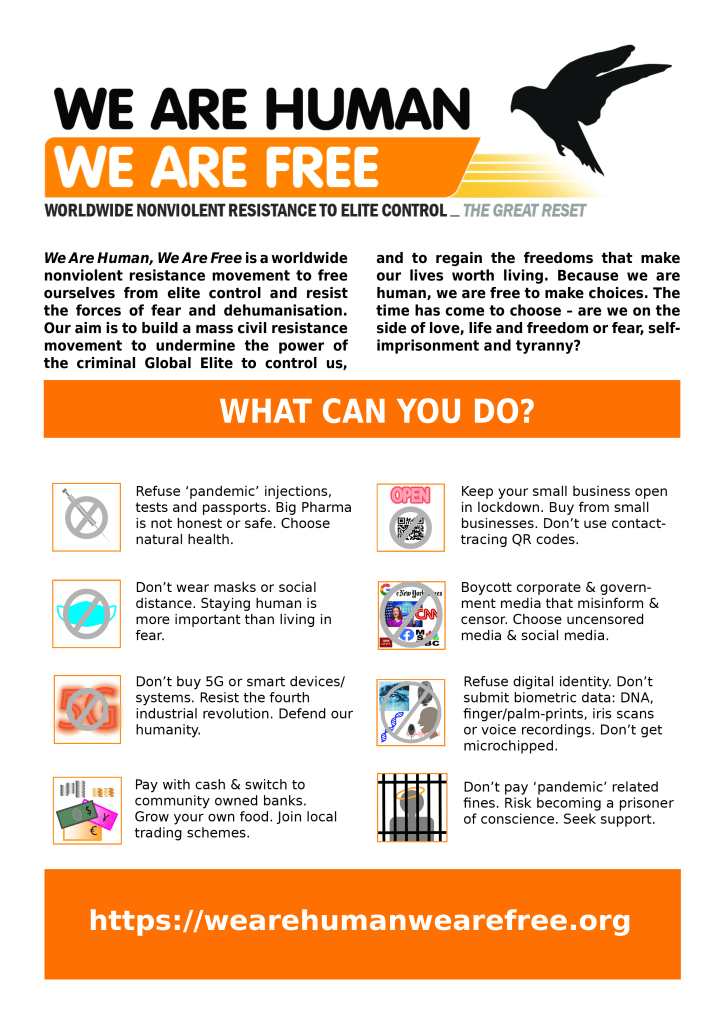
If this strategic resistance to the ‘Great Reset’ (and related agendas) appeals to you, consider joining the ‘We Are Human, We Are Free’ Telegram group (with a link accessible from the website).

And if you want to organize a mass mobilization, such as a rally, at least make sure that one or more of any team of organizers and/or speakers is responsible for inviting people to participate in this campaign and that some people at the event are designated to hand out the one-page flyer about the campaign.

If you like, you can also watch, share and/or organize to show, a short video about the campaign here: ‘We Are Human, We Are Free’ video.

In parallel with our resistance, we must create the political, economic and social structures that serve our needs, not those of the Elite. That is why long-standing efforts to encourage and support people to grow their own food – see ‘23 Reasons You Should Start a Garden in 2023’ – participate in local trading schemes (involving the exchange of knowledge, skills, services and products with or without a local medium of exchange) and develop structures for cooperation, governance, nonviolent defence and networking with other communities are so important.

Of course, indigenous peoples still have many of these capacities – lost to vast numbers of humans as civilization has expanded over the past five millennia – but many people are now engaged in renewed efforts to create local communities, such as ecovillages, and local trading schemes, including Community Exchange Systems. Obviously, we must initiate/expand these forms of individual and community engagement in city neighbourhoods too. And we must learn to defend them as well.

In addition, to reiterate, if you want to raise children who are powerfully able to investigate, analyze and act, you are welcome to make ‘My Promise to Children’.

Conclusion

We are currently living in the final phase of a 5,000 year effort to impose total control over the human population. There are many reasons why it has reached this point. Some key reasons are explained above. And despite the comfortable delusion that the most obvious and onerous restrictions that we have experienced over the past three years have temporarily receded, the fact remains that a vast range of political, economic, medical and technological measures are being implemented as you read these words and we have only just ended the first round of what must be, if we are to be successful, a protracted fight.

In essence, what we do between now and 2030 will determine the fate of humanity. If we can mobilize enough people to resist strategically, we will succeed. But there is little sign of that so far.

Understanding how power works in the world system as well as who, precisely, is driving what is happening, what they are doing, why, and how they are doing it are crucial prerequisites for developing an effective strategy to resist the current Elite program to kill off a substantial proportion of humanity, enslave those left alive in a technocratic prison, enclose the Commons forever and consolidate all wealth in Elite hands.

It is the failure to understand these crucial points that accounts for the ineffective ‘resistance’ that has characterized the past three years.

And this is complicated by the fact that fear makes most people unable to learn either from their own failed experience or to seriously investigate what is happening and how to resist it most effectively. So they fearfully repeat what is familiar, without even asking if it has worked in the past.

So each passing day we still witness fruitless attempts to convince one elite agent or another – a politician, a judge, a corporate media executive… – to take action that will turn the tide in our favour. But none of these individuals can help us.

The reality is simple: If we do not act strategically ourselves, and mobilize sufficient others to do so too, then human identity and freedom will be lost forever.

Biodata: Robert J. Burrowes has a lifetime commitment to understanding and ending human violence. He has done extensive research since 1966 in an effort to understand why human beings are violent and has been a nonviolent activist since 1981. He is the author of ‘Why Violence?’ http://tinyurl.com/whyviolence His email address is flametree@riseup.net and his website is here. http://robertjburrowes.wordpress.com
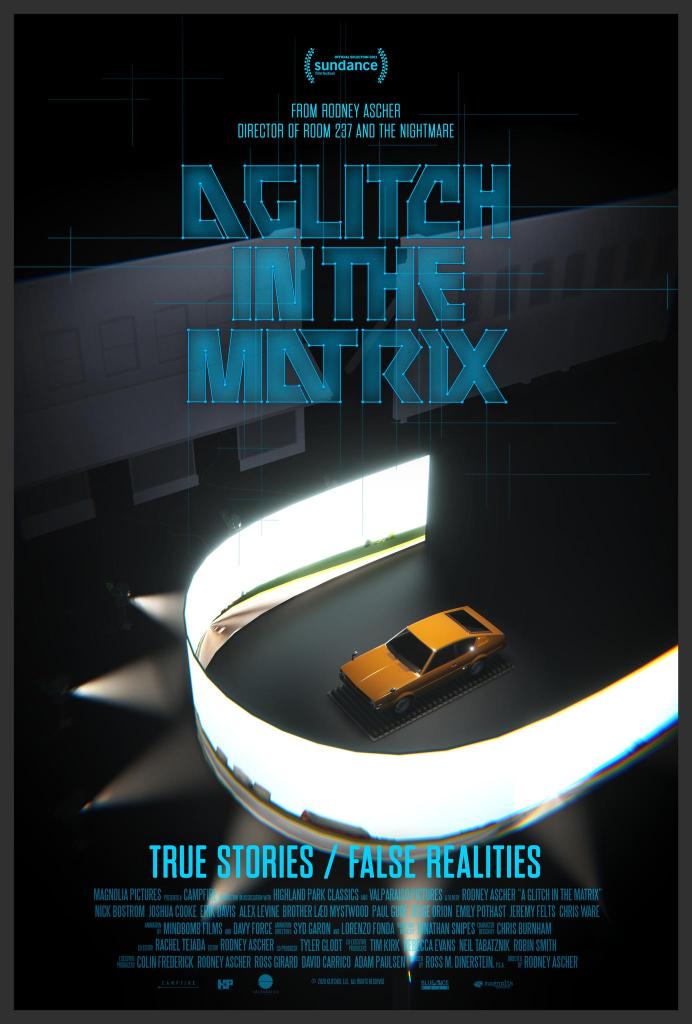

Saturday Matinee: A Glitch in the Matrix

Sundance 2021 Review: Rodney Ascher’s Hybrid Doc A GLITCH IN THE MATRIX Simulates Belief

By Martin Kudlac

Source: Screen Anarchy

It is sometimes an appropriate response to reality to go insane.”

Philip K. Dick

Sundance regular Rodney Ascher returns on the festival turf (virtually) with his The Nightmare (2015) follow-up, A Glitch in the Matrix. The title of Ascher´s newest documentary refers to a popular phrase usually reserved for déjà vu. The phrase has been widely popularized by Wachowski’s era-defining film The Matrix in 1999.

Similarly to Ascher’s 2012 documentary Room 237 that ponders strange theories and arcane interpretations of Kubrick’s take on The ShiningThe Matrix becomes frequently referenced material in his latest documentary.

A Glitch in the Matrix dives into the simulation theory (or the simulation hypothesis) that gained traction in academia, popular culture, and across mainstream media. The theory is rich and varied and extends far beyond the simple statement that “we are living in a simulation” and offers mind-warping food for thought.

While Ascher does not have the ambition to penetrate the obscure layers of the simulation theory in-depth, he captures the breadth of its implications spanning across popular culture, philosophy, religion, and psychology.

Curiously enough, A Glitch in the Matrix does not kick off with The Matrix nod but takes a more oddball albeit thoughtful detour. At the beginning of the Ascher´s documentary is the famous 1977 “Metz speech” by the visionary and paranoid author Philip K. Dick. Dick took a legion of his French fans by surprise when attending a science fiction convention. He proclaimed his books are actually not works of the imagination but his real-life experiences and that this is just one world out of many.

However, Dick is nowadays considered the prophet of the information age as his paranoid ramblings transmuted into visionary prophecies. The Exegesis of Philip K. Dick offers a more first-person perspective on the author´s unique perception of reality which is also referred to in the Ascher´s film.

The short clip of Metz speech serves as a pre-emptive rebuke to disprove the relevancy of the simulation hypothesis. It is a smart dramaturgic move on the director’s side heralding that the audience´s suspension of disbelief is not going to be strained that much. As the ground is prepared, Ascher drops the first interviewee (people interviewed on camera in the film are called “eyewitnesses”) revealing his belief in the simulation hypothesis and the circumstances that led to this assumption.

Ascher follows the similar approach from The Nightmare of respondents retelling their somewhat baffling experiences and explaining what they think The Matrix got right. No simulation theory deniers have been asked to raise the other side of the argument. However, that decision will prove unnecessary in the long-run as Ascher does not give a platform to kooky and deranged ideas and the theory will get anchored in less sensationalistic terms compared to mainstream media coverage.

Furthermore, the testimonies by “simulation believers” uncover motivations behind the process of adopting such eccentric beliefs as their worldview. Besides, the dramaturgy of “eyewitnesses” contributes to the film´s psychological thread that lands to a gut-punch denouement doubling as the film´s actual moral and a (true crime) warning.

Ascher builds on his previous works and A Glitch in the Matrix turns out to be a formalistic cross-over between Room 237 and The Nightmare. Talking heads, voice-over, and animated reenactments of (strange) experiences follow The Nightmare formula while obsessive deciphering of The Matrix is the tool of the trade brought from Room 237. The production value however exceeds the low-budget constraints of Room 237 which is basically a barebone desktop documentary wheras A Glitch in the Matrix happens to be an augmented desktop documentary.

After all, A Glitch in the Matrix is a doc for the big screens. The talking heads segments had been upgraded in a nerdy nod to the simulation theory and Cameron´s film Avatar. Each interviewee is represented as a custom-made animated videogame styled avatar and not necessarily for the purposes of anonymity.

The animation is further employed to illustrate their ideas, incidents, and encounters that led them to dispute the ontological reality. Besides, animated scenes are further employed to portray alternative scenarios to reality contemplating reasons why mankind may be imprisoned in a simulation.

The director continues to fine-tune the brand of an eerie, and in this case speculative, cinematic edutainment that appears to become his trademark. Wedged between journalism and popculture, the provocative and thought-provoking documentary introduces respectable authorities in their field as professor Nick Bostrom, the author of the paper Are You Living In a Computer Simulation?, and more surprisingly, a boundary-pushing cartoonist Chris Ware. However, less surprisingly, the poster child of simulation theory in the mainstream, the celebrity billionaire and PR stuntman Elon Musk, happens to make a presence on several occasions albeit outsourced from publicly available clips.

Alongside the Skype calls with eyewitnesses, the majority of the film is a patchwork of animation (one disturbingly immersive) and graphics by Mindbomb Films (Jodorowsky’s DuneHeaven’s Gate) made for the purposes of A Glitch in the Matrix, a host of clips either from video sharing platforms or other films and Google Earth. The director attuned the film´s style and approach to the motif of a mediated and virtual reality while the form of communication frequently memeficaton.

As Room 237 became gradually more about the semiotics of image and narrative than conspiracy theories Kubrick supposedly encoded into the film, the simulation theory in A Glitch in the Matrix acts as a concept on the intersection of two topics prevalent to current times – the impact of technological development on our understanding of the world and the mystery of human consciousness.

The development of technology heavily influences the direction of civilization and has a great impact on every possible sphere from social to language. The history of mankind is a history of technology and the current acceleration in the development of new-tech opens discussion about subjects considered before unthinkable (cue Philip K. Dick) and gives rise to new movements and philosophies such as transhumanism.

Technology can play a strong role also in religion (cue Philip K. Dick) which is one of the smaller fibers that run through A Glitch in the Matrix. More importantly, the current powerful influence of emerging tech, AI, machine learning, and the upcoming revolution with quantum computing is rewiring the way reality and the world is being formed and molded. And that is fodder for a plethora of underground prophecies and somber visions of the next stage of human (r)evolution.

Yet as the film does not fail to reiterate, the concept of our limited perception of reality and impossibility to truly experience objective reality is not a fresh discovery. The understanding that mankind is sentenced to not know the actual objective reality interweave throughout the history from Plato´s notorious parable of the cave or Cartesian notion of René Descartes both of which are acknowledged in the Ascher´s film.

They both point towards the dualism of mind (and consciousness imprisoned within) and outside reality and the impossibility to understand the objective reality from within our subjective minds which creates a fertile ground for ruminations on the intersection of philosophy and religion which the film addresses. Ultimately, A Glitch in the Matrix thematizes mankind´s timeless and Sisyphean struggle to fully comprehend consciousness, world, and reality surrounding it.

However, Glitch in the Matrix is not heavy on these theories as Ascher keeps them in the background as aftereffects of animated docu-narrative cyberpunk creepypastas disclosed by “eyewitnesses”. The director translates the interpretations (“experiences”) of simulation theory into a reflective entertainment of a speculative hybrid doc whote theme extends from the initial subject matter to envelope human condition.

After all, according to some neuroscientists, our brains are engines that hallucinate conscious reality for us.

Watch A Glitch in the Matrix on Kanopy here: https://www.kanopy.com/en/product/12951904

Welcome to Philip K. Dick’s dystopia

Nothing is private and no one is free

 (Credit: Alamy)

By David Samuels

Source: UnHerd

Philip K. Dick, whose novel Do Androids Dream of Electric Sheep? inspired the film Blade Runner, did not live to enjoy his Hollywood success. He died on March 2, 1982, three months before the film was released.

In the years since, the novelist once dismissed as a gutter pulp sci-fi weirdo has steadily climbed the ladder of posthumous literary reputation. The case for Dick’s genius has never rested on his dystopian vision of technology, which he shared in common with masters like HG Wells and Stanislaw Lem, and with hundreds of sci-fi writers since. Good science fiction — as opposed to fantasy novels set on other planets — is defined by a quasi-philosophical examination of interactions between men and machines and other products of modern science. It is part novel and part thought-experiment, centered on our idea of the human.

What made Dick a literary genius, then, was not any special talent for predicting hand-held personal devices or atom bombs the size of a shoe which might have led him to a job in Apple’s marketing department. His gift was for what might be called predictive psychology — how the altered worlds he imagined, whether futuristic or merely divergent from existing historical continuums, would feel to the people who inhabited them. Dick’s answer was, very often: “Not good.”

Dick’s dystopian-psychological approach marks him less as a conventional science fiction writer than as a member of the California anti-utopian school of the Sixties, whose best-known members include Robert Stone, Thomas Pynchon, Ken Kesey, Joan Didion and Hunter Thompson. Seen from this angle, Dick was perhaps the most powerfully and sweepingly paranoid of a group of writers whose stock-in-trade was conspiracy and paranoia, the hallmarks of a society marked — at that moment, and this one — by violent street crime, drug-induced psychosis, and visionary promises gone terribly wrong. Of his anti-utopian peers, Dick’s sci-fi genre background made him the only one who had any particular feel for the proposition that technology was inseparable from, and would therefore inevitably alter, our idea of the human.

Technology was and is perhaps the most Californian aspect of the American mythos. The idea that the universal constants of human nature were at war with the mutilating demands of technology-driven systems was a very Sixties Californian conceit, to which Dick’s fellow anti-utopians each adhered in their own way: In Kesey’s showdown between man and the castrating nanny-state; in Didion’s emphasis on the vanishing virtue of self-reliance; in Pynchon’s degenerate Ivy League Puritanism; in Thompson’s drug-addled primitivism; and in Stone’s Catholic idea of devotion to a God that might somehow salve the wounds of the survivors once the great American adventure goes bust.

What Dick saw, and what his fellow anti-utopians did not, was that human psychology and technology are not separate actors, and that whatever emerged from the other side of the future would be different to the human thing that entered it.

* * *

Seeing and describing how large numbers of people will perceive reality before anyone else does requires imagining states of consciousness that, in the moment, seem deeply strange. It is no accident that the greatest of works of speculative psychology were written by revolutionaries whose outlook was often bleak to the point of despair. The negative tone of these works often led future generations to describe their authors as conservatives, though artistically and psychologically speaking, they are radicals. Or rather, in their rejection of the dominant order, they are radicals and reactionaries at the same time.

The anti-utopian tradition emerged in earnest in 19th-century Russia. The Russian pioneers of the genre were superior to their rivals in England and elsewhere because the latter’s visions were constrained by attachments to a settled society, which one can argue never really existed in Russia — and because the ideas of revolution and violent reaction have always been so closely allied in the Russian psyche. Fyodor’s Dostoyevsky’s Notes From Underground struck many of its initial readers as a kind of artless mental vomit, before revealing itself as a Rosetta Stone for the century of Adolf Hitler and Lee Harvey Oswald. Yevgeny Zamyatin’s We is probably the greatest of at least a dozen weirdly prophetic novels written in the years immediately after the Bolshevik Revolution. In We, Zamyatin predicted what a surveillance society run by engineers would feel like to its inhabitants with a nauseating accuracy that did not become fully apparent until the rise of the modern tech surveillance complex.

The Dick novel that directly predicted our information-addicted, socially-networked 21st-century society, A Scanner Darkly, was both a prophecy of future psychological states and a half-veiled memoir of Dick’s own experiences in the California drug culture. Published in 1977, the book was a detective noir set in a druggy future in which large portions of the population appear to spend their lives scheming and snitching on each other to feed their addictions to a drug called Substance D — the “D” standing for Death, of course.

A Scanner Darkly, a reference to the line in Corinthians in which men at first see God “as in a glass, darkly”, is Dick’s rawest book and the one that reads least like science fiction. The book’s protagonist is simultaneously a narcotics agent known to his peers as Fred and a Substance D addict named Bob Arctor. Fred/Arctor lives in a house — his former marital abode — with two fellow addicts, and is in love with another addict named Donna, who comes to visit him there. Donna helps Arctor obtain Substance D, which he consumes, while Fred uses Donna to attempt to climb higher on the drug distribution ladder. At the end of the novel, Donna turns out to be a drug agent, who is spying on Bob Arctor.

What’s so striking about the book is not Dick’s heartfelt, if futuristically bent, portrayal of the evils of Sixties drug culture. For that, read Stone, who was a master of connecting the physical, mental and moral corruption of drug dealing and dependency, and the fantasies those pursuits inevitably engender to the deeper corruption of man’s nature.

What Dick uniquely captured was something else: The degenerative effects of the split-screen existence of a human brain ceaselessly spying on and doubting and implicating itself while at the same time being spied on by others, all of whom are embedded within machine systems that record everything for reasons that humans cannot understand. Over the course of this machine-and-chemical fed process of human self-contradiction and self-destruction, of which Fred/Arctor is only intermittently aware, we see his thoughts and perceptions being short-circuited and reduced to gibberish.

Drug-induced paranoia aside, the psychology of Dick’s addicts and narcs is as good a description as exists of the spreading incoherence of today’s information ecosystem, which none of us are able to fully see or understand. As a thought experiment, it doesn’t matter that Dick chose a drug rather than the stories we tell about ourselves and our world. It’s not the technology; it’s the psychology. What Dick saw was that the process of splitting ourselves in two — into subject and narc — was a brutal assault on the idea of being human and would make thoughts and communication impossible.

“What does a scanner see?” Arctor wonders, after examining the surveillance apparatus that has been planted, with his knowledge, in his own home. “I mean, really see? Into the head? Down into the heart? Does a passive infra-red holographic scanner like they used to use, or a cube-type holo-scanner like they use these days, the latest thing, see into me – into us – clearly or darkly? I hope it does, see clearly,” Arctor continues, “because I can’t any longer these days see into myself. I see only murk. Murk outside; murk inside. I hope, for everyone’s sake, the scanners do better.” They don’t.

* * *

Jeremy Bentham’s panopticon, which the English philosopher sketched out in a series of letters between 1786 and 1788 while visiting  the Mogilev district of the Russian Empire, was an architectural system of control in which all inmates of an institution could be made visible to a single guard. Bentham’s utopian-utilitarian idea was widely applied in Victorian England to a range of public and private spaces including prisons, asylums, hospitals, factories and even schools. The unique horror of the Benthamite set-up was not the power imbalance inherent in places like prisons and factories, whose existence is obvious to guards and prisoners alike. It was the attempt to eliminate privacy, which is a necessary precondition for being human.

Over the last decade, Bentham’s architecture of unfreedom has been replaced by the architecture of machines. This has created a new social reality where everyone is at once inmate and guard; a panopticon where nothing is private and no one is free. The invisible operations of the machines and programmes we use every day to buy books or food or communicate, which are linked to each other and to the surveillance operations of large government agencies in a single net, induces in most sentient beings a kind of free-floating paranoia of the type that destroys the inhabitants of A Scanner Darkly. On the one hand, everyone knows that everyone is being watched. On the other, it is necessary to deny that knowledge in order to appear to be functioning normally.

One of the most unpleasant characteristics of the weird split-screen mentality of our times is how people must routinely speak against themselves — deny what they see, hear, feel and believe  — in order to maintain the appearance of sanity. It is now routine, for example, to hear Americans on the Left and the Right deride their political opponents for believing in far-reaching conspiracy theories — while in the next breath revealing their own.

No doubt both sides are at least half right. During lockdowns, it became normal for public officials in Western countries to issue draconian edicts in the name of “science” for the supposed good of large numbers of people, only to violate those edicts themselves. The meaning of “science”, it turned out, had nothing to do with the “common good”, or with demonstrating a theory through evidence; it was “one rule for me and another for thee”.

The flagrant doublespeak that is nurtured in the surveillance societies of the West, which have sprung up around us unnoticed, is characteristic of totalitarian societies and mental asylums. The difference is that both totalitarian societies and asylums allow for nonthreatening zones of privacy in order to make life easier for the guards. What we live in today is something else, a set of mirrors into which we are encouraged to look so that our reflections can be distorted and then returned to us. As Bob Arctor puts it, reflecting on the words of Corinthians: “it is not through glass but reflected back by a glass. And that reflection that returns to you: it is you, it is your face, but it isn’t.”

Powerful people in Western societies have lately become convinced of their ability to accomplish great feats of moral and social engineering by controlling these mirrors, altering our reflections and selling them back to us, while undermining our ability to think coherently. The mirrors are not meant to help anyone think; they are systems of control. They are mechanisms of profit, which foster dependence. They are used to mete out punishment, and spy on us.

What’s alarming is that the people who delight in their mastery of these devices seem not to have thought very hard about the damage they are doing to the people who shoot up, a category that includes those who shoot up schools and malls. None of them seem to calculate what creating a miasma of nonsensical conspiracy theories will do to the psyches of their own children, who will inherit “the murk”. They appear to believe that people with minds that have been permanently broken by their gibberish machines will make the perfect workers on their farm. Let’s see how that turns out for them.

The Fourth Turn, Turn, Turn

By Charles Hugh Smith

Source: Of Two Minds

The cycles of The Fourth Turning, Fischer and Turchin are all in alignment at this point in history..

The 1997 book The Fourth Turning: An American Prophecy proposed a cyclical pattern of four 20-year generations which culminate in a national crisis every 80 years. The book identifies these dates as Fourth Turnings: 1781 (Revolutionary War), 1861 (Civil War) and 1941 (global war). add 80 years and voila, 2021.

I use the term Fourth Turning generically to describe an existential crisis that decisively changes the course of national identity and history.

In other words, we don’t have to accept the book’s theory of generational dynamics to accept an 80-year cycle. There are other causal dynamics in play that also tend to cycle: the credit (Kondratieff) cycle, for example.

While each of the previous existential crises were resolved positively, positive outcomes are not guaranteed: dissolution and collapse are also potential outcomes.

David Hackett Fischer’s book The Great Wave: Price Revolutions and the Rhythm of History proposes another cycle: humans expand their numbers and consumption until they’ve exploited and depleted all available resources.

As resources become scarce, societies and economies unravel as humans do not respond well to rising prices generated by scarcities.

The unraveling continues until consumption is realigned with the resources available. In the past this meant either a mass die-off that drastically reduced human numbers and consumption (for example, The Black Plague), a decline in fertility that slowly reduced population to fit resources, mass migration to locales with more resources or the discovery and exploitation of a new scalable energy source that enabled a new cycle of rising consumption.

The 14th century Black Death reduce Europe’s population by roughly 40%, enabling depleted forests to regrow and depleted agricultural land to restore fertility.

Once the human population regained its numbers and consumption in the 17th century, wood was once again under pressure as the key source of energy, shipbuilding, housing, etc.

The development of steam power and the technologies of mining enabled the exploitation of coal, which soon replaced wood as the primary energy source.

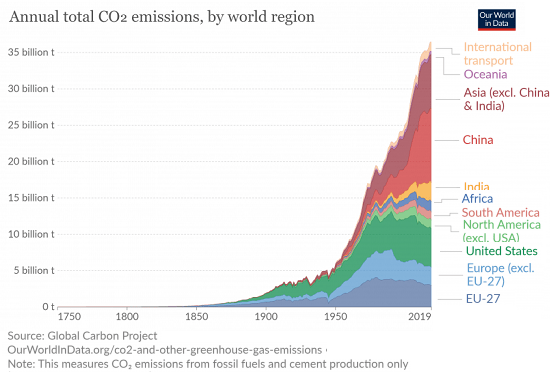
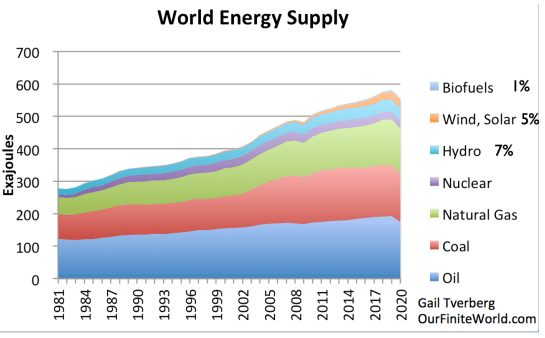
Oil and natural gas added to the energy humans could tap, followed (at a much more modest level) by nuclear power. Despite gargantuan investments, the recent push to develop solar and wind energy has yielded very modest results, as globally these sources provide about 5% of total energy consumption. (See chart below)

It’s self-evident that despite breezy claims of endless expansion of consumption, the global human population has now exceeded the resources available for practical extraction. Energy, fresh water, wild fisheries and fertile soils have all been exploited and the easy/cheap-to-extract resources have been depleted.

(The chart below of global CO2 emissions is a proxy for energy / resource consumption.)

So once again it’s crunch-time: either we proactively reduce consumption to align with available resources, or Nature will do it for us via scarcities.

Peter Turchin proposed another socio-economic cycle of 50 years in his book Ages of Discord: in the integrative stage, people find reasons to cooperate. In the disintegrative stage at the end of the cycle, people no longer find much common ground or reasons to cooperate. Political, social and financial extremes proliferate, culminating in a rolling crisis.

In Turchin’s analysis, the previous 50-year age of discord began around 1970, and the current era of discord began in 2020. Those who lived through the domestic terrorism, urban decay, stagflation and political/social/legal crises of the 1970s recall how inter-related crises dominated the decade.

In my analysis, the last period of discord in the 1970s was “saved” by the supergiant oil fields discovered in the 60s coming online in the late 1970s and early 1980s. That oil enabled a 40-year boom which is now ending, with no new scalable source of energy available to replace oil, much less enable an expansion of consumption.

In other words, the cycles of The Fourth Turning, Fischer and Turchin are all in alignment at this point in history. We have proliferating political, social and financial extremes and a forced transition to lower consumption to align with declining energy.

Turn, turn, turn. Right when we need to cooperate on transforming a high-consumption, bubble-dependent “waste is growth” Landfill Economy to declining consumption / Degrowth, we’re beset by discord and demographic pressures, as the promises made to the elderly back when it was expected that there would always be 5 workers per retiree cannot possibly be kept now that the worker-retiree ratio is 2-to-1 and there are no limits on healthcare spending for the elderly.

Humans are happy to expand their numbers and consumption and much less happy to consume less. They tend to start revolutions and wars in vain attempts to secure enough resources to maintain their profligate consumption and expansion.

Today’s extremes of wealth and income inequality are optimized to spark political discord and revolts. The wealthiest 20% will be able to pay higher prices, but the bottom 40% will not. The middle 40% will find their disposable income, i.e. their income left over after paying for essentials, will drop to near-zero.

When 80% of the populace are crunched financially, revolutions and the overthrow of governments follow.

As I’ve outlined in previous posts, global inequalities are widening as the Core exploits its built-in advantages at the expense of the vulnerable Periphery.

Core nations will be much better able to maintain their consumption at the expense of the Periphery nations, which will experience sharp declines in purchasing power and consumption.

Previous Fourth Turnings have been resolved one way or another within 5 to 7 years. If this Turning began in 2020, we can expect resolution by 2025 – 2027.

As I explained in my book Global Crisis, National Renewal, those nations that embrace Degrowth will manage the transition, while those that cling to the endless-expansion, bubble-dependent Waste Is Growth model will fail.

This is why I keep talking about making Plans A, B and C to preserve optionality and reduce financial commitments and consumption now rather than passively await crises over which we will have little direct control.

As I’ve endeavored to explain, those anticipating decades of time to adjust are overlooking the systemic fragilities of the current global financial/supply systems. Tightly bound systems of interconnected dependency chains have been optimized to work perfectly in an era of expansion. They’re not optimized to gradually adjust to contraction; they’re optimized to break and trigger domino-like breakdowns in interconnected chains.

We don’t control these macro-trends, we only control our response.

LIFE… IN REVERSAL

By Kingsley L. Dennis

Source: Waking Times

‘We must distinguish between real change and fictitious change. The change that comes from without, from externally imposed training and discipline, is fictitious…Real change comes from within, by conscious work intentionally performed by the being himself.’ ~J.G. Bennett 

It is increasingly difficult in these times to speak of ‘non-verifiable’ or unprovable matters, especially concerns of the spirit-consciousness, for too many people are inculcated with fixed beliefs and thinking patterns. This is itself a sign of social conditioning and of a certain ‘management of mind.’ We should not be surprised that this situation is rife throughout our societies and cultures and is becoming increasingly predominant. Social norms are persuading many people to prefer safety and security rather than the potential discomfort that comes from gaining new realizations and understanding.

An ex-officer of the Soviet secret police who defected to the West (Gregory Klimov), revealed that in the fields of Soviet psychological warfare (and social psychology) they utilized the principles of psychoanalysis. In this, they saw the phenomena of evil as a ‘complicated, complex social illness.’ The psychoanalysts within the KGB equated evil with illness, especially an illness of the human psyche. This perspective places demonic actors and events as ‘objective realities;’ i.e., as various forms of illness of ‘psyche and soul.’ As the Russian anthroposophist G.A. Bondarev writes: ‘The devils represents an involved and complex process of degeneracy or retrogression that in the main consists of three parts: sexual deviation, psychic illnesses and some physical deformities of the organism.

The number of humans already afflicted with this degeneration is legion.’1 Bondarev goes on to say that, based on certain social-psychological testing, the greatest degeneracy exists within the so-called elite of the world (as much as 75%). What this points to, concludes Bondarev, is a drastic decline of the human spirit. What it also tells us is that the phenomenon of ‘evil’ does not necessarily need to be personified or projected into certain personages as it represents an illness of the human psyche. We can recognize its presence operating within psychic imbalance and internal disconnect and detachment. And I would concur with Bondarev’s conclusion in that such psychic dis-ease represents an inner disconnect with the transcendental impulse. This disconnect, or splintering, from a sacred source has now come to signify the nature of the reversal that epitomizes much of contemporary life.

It is within this reversal that we see much of the negating, or counter-evolutionary, forces within humanity. And these forces have been dominating much of our everyday lives and continue to do so. I would suggest that it is our individual responsibility to recognize these forces, attempt to comprehend them, and to transform them into impulses that can work for humankind’s evolvement. In this, we need to come to grips with the presence and activity of those aspects that signify a psychic illness, or dis-ease, within life. Such aspects are a feature of existence as much as positive, developmental forces. They all act within the playground of attraction, repulsion, and the expression of energy. The Rosicrucians recognized these forces when they referred to the Deus Inversus – or the ‘Reversed God.’ This nature of reversal works on humanity through the spheres of imbalance and disharmony to counteract civilizational development. The Austrian mystic Rudolf Steiner was aware of the future impact of such forces when he stated that: ‘It is essential that the forces which manifest as evil if they appear at the wrong place must be taken in hand…in such a way that humanity can achieve something with these forces of evil that will be beneficial for the future of the whole of world evolution.’2 In this regard, it is important that the individual becomes aware of the metaphysical realm that lies beyond the threshold of normal, or every day, consciousness.

If we remain unawares to our own forces of spirit-consciousness, then we are more susceptible to the manipulations of such counter-developmental forces. Those readers familiar with my writings will know that I have attempted to draw attention to certain aspects of our consensus reality in order to gain greater clarity about how we may respond to the situation in a constructive way. I stand by what was written in the Gnostic Gospel of Philip: ‘For so long as the root of wickedness is hidden, it is strong. But when it is recognized, it is dissolved. When it is revealed, it perishes.’ Recognition, through heightened awareness and perception, brings more choice into play. The individual needs to be conscious of certain facts before they can manifest the correct intention and focus of will. What is needed is a culture of revelation – of ‘uncovering’ – rather than of cover up. It is through revelation that insight into the metaphysical foundation of life can be sustained within our increasingly materialistic societies. This access to metaphysical realities can never be wholly eradicated. Yet just a cursory glance at modern life indicates that there are attempts to deepen peoples’ immersion into deteriorating forms of dissonance and distraction. This can be seen as a form of reality deceit.

Reality Deceit

The great deceit that is coming upon us is the unveiling of a so-called ‘utopia’ based on the isolation of the human spirit-consciousness. This fake promise is wrapped up in tech-salvationist terms, heralding a false ideal future. The real dis-ease of the human condition is to be in a state of estrangement. That is, estranged and alienated from any metaphysical influence or nourishment. It is not that the metaphysical background to life must necessarily be obvious to us, or tangible in our daily lives – only that we are cognizant of its existence and continual influence. Yet once this sense of recognition (the act of aware cognition) is dissolved, a barren soulless life is the result. And yet, in most circumstances, people will not be cognizant of this loss – this lack of the transcendental impulse in their lives – for they will be entrained into a reality consisting of a physical-digital mesh that keeps them attached to their lower nature and desires. This deceit consists of a most heinous form of enslavement, for it shall both be a willing one as well as an ignorant one. The splintering of the human being from its metaphysical connection shall go almost unnoticed, and the transfer into a reality of limited consciousness will have been enacted quite skillfully. This sly route to a human condition of alienation, procured through the guise of technological advancement and progress, will be a coup against the creative spirit. And this shall be the reversal of the human reality – the reality deceit.

The almost imperceptible dangers are that we have been slipping into a reversed reality, constructed through a realm of fantasy and make-believe, which now fuels the crass and superficial culture industries that dominate modern life. Any notion of Higher Reality has been twisted into an artificial lesser reality that attempts to hinder, as far as is possible, the developmental impulse from penetrating. This arrangement has culminated in dissociating humankind not only from its natural, organic, carbon-based environment, but also from an inherent contact with its origin – Source consciousness. This increasing disembodiment is reflected in such forms as the techno-digital ecosystem, extended reality (the Metaverse), computerization (including algorithms), and artificial intelligence. For many people today, their digital devices have become their instruments of salvation. But this salvation, this divine deliverance, belongs to the Deus Inversus – and we should choose our gods carefully. We should be careful too, not to be pulled into the encroaching banalization of life. And we should be on the look-out for signs and signals.

If anyone wishes to see how ‘signals’ can operate within the reality deceit, then watch all the episodes in the recent Westworld TV series (2016-2022). In Season Four, the machinic android ‘hosts’ have taken control of the world using a bioengineered virus that infects humans over the course of a generation, turning them docile and susceptible to AI and ‘host’ control. Storylines and narratives are created in order to give people their roles and characters in life, which they passively follow believing them to be their own life stories. Humankind is managed through these manufactured ‘storylines’ (a.k.a. socio-cultural narratives) that are transmitted directly to the minds and lives of humans through a series of radio-sonic transmission signals via the global technological infrastructure…But then again, this is just a fantasy story after all.

The course of external events that inform our political, economic, and cultural systems are not arbitrary, coincidental or natural. The modern human has been subtly manipulated into disconnecting from, and even shunning, the guidance of higher impulses. We are being told that the human being alone is the sole and dominant driving force for the future. And by this, we are propelled ever further into the personality construct with the human ego at the wheel. We are standing at the threshold of adopting a glorified materialistic view of life and the world. The spell of this disease is working to over-materialize materialism in a very deliberate and nefarious way. There may be some discomfort in the unfoldment of awareness, yet this is part of the transmutation of the dis-ease.

Life ‘in reversal’ is working hard and fast on this intensifying of materialism. This deepening materialism not only denies the expansion of consciousness but is actively working to stagnate it. At the same time, we are moving through an impulse of increasing individual awareness against the backdrop of this over-materialization. Yet it is an awareness through the few, and not the many (yet). By recognizing that certain forces within the world are using processes of mass suggestion to introduce a simplification – or ‘dumbing down’ – of human consciousness, we can gain greater awareness over our condition and predicament. And in this awareness, we can gain a natural resistance and protection, as recognition allows a discernment to be made. It is this discernment to step away from the negating energies and frequencies of toxicity that can help a person to attune to a resonance of perceptive consciousness. By choosing where we place ourselves – our focus and attention – we can either take a step forward or stay where we are and stagnate. As always, the choice remains with us.

THE ELITES WHO ARE JUST SO OVER HUMANITY

The depth of anti-humanist sentiment related by Douglas Rushkoff in his latest book, Survival of the Richest, is harrowing and illuminating.

By Chris Barsanti

Source: PopMatters

Some things can be horrifying even if unsurprising. One such moment is the opening anecdote in Douglas Rushkoff’s Survival of the Richest: Escape Fantasies of the Tech Billionaires. In 2017, Rushkoff was paid an exorbitant fee to travel to a remote high-end resort where (he thought) he would do his usual thing: Talk about the future to investment bankers looking for a way to game the next trend.

What happened was far stranger. Rather than give a speech, Rushkoff sat at a conference room table with five fantastically rich guys from “the upper echelon of the tech investing and hedge fund world” and tried to answer their questions about how they could survive the impending apocalypse.

The scene is comical, in a Dr. Strangelove way. Assuming the world is racing toward an inevitable societal collapse they called “the Event”, the men thought it best to talk survival tactics with a self-described “Marxist media theorist” and professor at Queens/CUNY. Rather than acting like masters of the universe, they were nervous about being caught out when the Event came. They worried whether New Zealand or Alaska was the right location for their doomsday bunker; could their security guards keep the hungry mobs at bay; if an all-robot staff could be better. Rushkoff explains what seemed to lie behind these unnamed One Percenter preppers’ anxieties:

Taking their cue from Tesla founder Elon Musk colonizing Mars, Palantir’s Peter Thiel reversing the aging process, or artificial intelligence developers Sam Altman and Ray Kurzweil uploading their minds into supercomputers, they were preparing for a digital future that had less to do with making the world a better place than it did with transcending the human condition altogether. Their extreme wealth and privilege served only to make them obsessed with insulating themselves from the very real and present danger of climate change, rising sea levels, mass migrations, global pandemics, nativist panic, and resource depletion. For them, the future of technology is about only one thing: escape from the rest of us.– Douglass Rushkoff

Rushkoff calls this thinking “the Mindset”. He defines it as an “atheistic and materialistic scientism” that launders a desire for control and conquest through quasi-religious adherence to digital code and the power of the market. Expanding on his original article from 2018 (Medium)—which ironically led to his being swamped by requests from disaster-related industries to get in touch with the anonymous five they thought needed their services—Rushkoff spends the rest of Survival of the Richest explaining where the Mindset came from, how dangerous it is, and what he thinks should replace it.

Nothing that Rushkoff writes in this clipped, angry book should surprise most readers. Nobody who has spent any time tracking the pronouncements and feuds of the more futurist-minded tech elites would think many had a high opinion of or interest in improving the daily lot of carbon-based life forms. Though predictable and at times a bit too broadly defined, the depth of anti-humanist sentiment related by Rushkoff is still harrowing and illuminating.

The phenomenon of powerful men thinking themselves separate from the great unwashed and unbound by common morality is as old as human history. Although this of-the-moment book contains little context dating back more than three decades, Rushkoff does not try to claim everything about the Mindset is new. He points instead to how illogical power fantasies have merged with an Ayn Randian cult of the solitary hero and been nurtured by the Web’s seductive capacity for self-aggrandizing mythmaking. Given how much he may have contributed to those seductions, he is the right messenger.

Among the first public intellectuals to grapple seriously with the digital revolution as it washed over society in the 1990s, Rushkoff remains a go-to expert for Internet prognostication. Unlike many tech evangelizers, though, he later had second thoughts. Some of the more revealing sections in Survival of the Richest come from when the author turns his focus on himself.

Readers of a mindset will likely feel a certain wistfulness as Rushkoff writes about the early punk years of cyberspace. Just as underground music was bursting into the mainstream and indie bands were making real money, outlaw hackers were suddenly at the forefront of a technological revolution. In 1994, Rushkoff published two books: The GenX Reader, a heady anthology of alt-cultural tropes (part of the Slacker screenplay, Dan Clowes and Peter Bagge comics) that could already see the commodification of generational rebellion to come; and Cyberia, a quasi-utopian paean about the psychedelia-inspired confluence of programmers, Deadheads, libertarians, Wiccans, and ravers who seemed to be leading the nascent Web towards a consciousness- and freedom-expanding future. The 1996 “Declaration of Independence of Cyberspace,” announced ironically enough at the first ever World Economic Forum in Davos, proclaimed a borderless world where governments had no sovereignty.

Rushkoff looks back now with clearer eyes:

Deregulation sounded good at the time. We were just ravers and cyberpunks, paranoid about the government arresting us for drugs … We didn’t realize that banishing the government from the internet would create a free zone for corporate colonization. We hadn’t yet discovered that government and business balance each other out—a bit like fungus and bacteria. Get rid of one, and the other runs rampant.

In Rushkoff’s cultural history, the experimental tribal ethos of the Web’s heady early days was co-opted by business interests who saw a new frontier to monetize; less Mondo 2000, more AOL CD-ROMs. Online libertarianism seemed to evolve from a confederacy of rule-breaking rebels and pioneers to anger-prone grumps so dissatisfied with their fellow man that they started planning unintentionally funny “seasteading” ocean communities, taking their toys and leaving. Wealthy futurists imagine uploading themselves onto a cloud server, revealing a depressingly simplistic view of human consciousness and a grand view of themselves as transcendent immortals. As technology and behavioral science became more finely tooled at predicting consumer behavior, it also exacerbates hate and loneliness, assisting the all-too-easy COVID-19 pandemic pivot to increasingly tech-mediated relationships.

For the Mindset’s “tech titans and billionaire inventors”, per Rushkoff, there is no problem that technology cannot solve. And the problems are often human in form. Suppose that were true, and the world was spiraling towards a collapse (which the online tools superpowered by elites could be accelerating). In that case, the believers might wonder, why not use technology to scarper off to their Bond villain bunkers?

Rushkoff’s critique expands from what he calls this amoral “sociopathic” attitude toward the state of capitalism. Combining the digital-communitarian ethos of Cory Doctorow with the acerbic skepticism of Naomi Klein, Rushkoff does not trust that a more enlightened kind of capitalism can save the world. His argument against eternal economic growth has merit. But Rushkoff is on firmer ground when defining technological-sociological phenomena like the Mindset. That is not to say there is no case for a more sustainable economy, but Rushkoff breezes too quickly past the challenges resulting from that massive transition. Being necessary does not make a thing easy.

As with many jeremiads of this kind, Survival of the Richest loses some of its impact when delivering suggestions for how to push back (don’t give in to the inevitability of doom, buy local, fight for anti-monopoly laws). That is partly because it is difficult for them to seem equal to the magnitude of the problem. But for Rushkoff, the smallness of the solutions is part of the point: “We can still be individuals; we just need to define our sense of self a bit differently than the algorithms do.”

Digital Authoritarianism: AI Surveillance Signals the Death of Privacy

Illustration: Prathap Ravishankar

By John W. Whitehead & Nisha Whitehead

Source: The Rutherford Institute

“There are no private lives. This a most important aspect of modern life. One of the biggest transformations we have seen in our society is the diminution of the sphere of the private. We must reasonably now all regard the fact that there are no secrets and nothing is private. Everything is public.” ― Philip K. Dick

Nothing is private.

We teeter on the cusp of a cultural, technological and societal revolution the likes of which have never been seen before.

While the political Left and Right continue to make abortion the face of the debate over the right to privacy in America, the government and its corporate partners, aided by rapidly advancing technology, are reshaping the world into one in which there is no privacy at all.

Nothing that was once private is protected.

We have not even begun to register the fallout from the tsunami bearing down upon us in the form of AI (artificial intelligence) surveillance, and yet it is already re-orienting our world into one in which freedom is almost unrecognizable.

AI surveillance harnesses the power of artificial intelligence and widespread surveillance technology to do what the police state lacks the manpower and resources to do efficiently or effectively: be everywhere, watch everyone and everything, monitor, identify, catalogue, cross-check, cross-reference, and collude.

Everything that was once private is now up for grabs to the right buyer.

Governments and corporations alike have heedlessly adopted AI surveillance technologies without any care or concern for their long-term impact on the rights of the citizenry.

As a special report by the Carnegie Endowment for International Peace warns, “A growing number of states are deploying advanced AI surveillance tools to monitor, track, and surveil citizens to accomplish a range of policy objectives—some lawful, others that violate human rights, and many of which fall into a murky middle ground.”

Indeed, with every new AI surveillance technology that is adopted and deployed without any regard for privacy, Fourth Amendment rights and due process, the rights of the citizenry are being marginalized, undermined and eviscerated.

Cue the rise of digital authoritarianism.

Digital authoritarianism, as the Center for Strategic and International Studies cautions, involves the use of information technology to surveil, repress, and manipulate the populace, endangering human rights and civil liberties, and co-opting and corrupting the foundational principles of democratic and open societies, “including freedom of movement, the right to speak freely and express political dissent, and the right to personal privacy, online and off.”

The seeds of digital authoritarianism were planted in the wake of the 9/11 attacks, with the passage of the USA Patriot Act. A massive 342-page wish list of expanded powers for the FBI and CIA, the Patriot Act justified broader domestic surveillance, the logic being that if government agents knew more about each American, they could distinguish the terrorists from law-abiding citizens.

It sounded the death knell for the freedoms enshrined in the Bill of Rights, especially the Fourth Amendment, and normalized the government’s mass surveillance powers.

Writing for the New York Times, Jeffrey Rosen observed that “before Sept. 11, the idea that Americans would voluntarily agree to live their lives under the gaze of a network of biometric surveillance cameras, peering at them in government buildings, shopping malls, subways and stadiums, would have seemed unthinkable, a dystopian fantasy of a society that had surrendered privacy and anonymity.”

Who could have predicted that 50 years after George Orwell typed the final words to his dystopian novel 1984, “He loved Big Brother,” we would come to love Big Brother.

Yet that is exactly what has come to pass.

After 9/11, Rosen found that “people were happy to give up privacy without experiencing a corresponding increase in security. More concerned about feeling safe than actually being safe, they demanded the construction of vast technological architectures of surveillance even though the most empirical studies suggested that the proliferation of surveillance cameras had ‘no effect on violent crime’ or terrorism.”

In the decades following 9/11, a massive security-industrial complex arose that was fixated on militarization, surveillance, and repression.

Surveillance is the key.

We’re being watched everywhere we go. Speed cameras. Red light cameras. Police body cameras. Cameras on public transportation. Cameras in stores. Cameras on public utility poles. Cameras in cars. Cameras in hospitals and schools. Cameras in airports.

We’re being recorded at least 50 times a day.

It’s estimated that there are upwards of 85 million surveillance cameras in the U.S. alone, second only to China.

On any given day, the average American going about his daily business is monitored, surveilled, spied on and tracked in more than 20 different ways by both government and corporate eyes and ears.

Beware of what you say, what you read, what you write, where you go, and with whom you communicate, because it will all be recorded, stored and used against you eventually, at a time and place of the government’s choosing.

Yet it’s not just what we say, where we go and what we buy that is being tracked.

We’re being surveilled right down to our genes, thanks to a potent combination of hardware, software and data collection that scans our biometrics—our faces, irises, voices, genetics, microbiomes, scent, gait, heartbeat, breathing, behaviors—runs them through computer programs that can break the data down into unique “identifiers,” and then offers them up to the government and its corporate allies for their respective uses.

As one AI surveillance advocate proclaimed, “Surveillance is no longer only a watchful eye, but a predictive one as well.” For instance, Emotion AI, an emerging technology that is gaining in popularity, uses facial recognition technology “to analyze expressions based on a person’s faceprint to detect their internal emotions or feelings, motivations and attitudes.” China claims its AI surveillance can already read facial expressions and brain waves in order to determine the extent to which members of the public are grateful, obedient and willing to comply with the Communist Party.

This is the slippery slope that leads to the thought police.

The technology is already being used “by border guards to detect threats at border checkpoints, as an aid for detection and diagnosis of patients for mood disorders, to monitor classrooms for boredom or disruption, and to monitor human behavior during video calls.”

For all intents and purposes, we now have a fourth branch of government: the surveillance state.

This fourth branch came into being without any electoral mandate or constitutional referendum, and yet it possesses superpowers, above and beyond those of any other government agency save the military. It is all-knowing, all-seeing and all-powerful. It operates beyond the reach of the president, Congress and the courts, and it marches in lockstep with the corporate elite who really call the shots in Washington, DC.

The government’s “technotyranny” surveillance apparatus has become so entrenched and entangled with its police state apparatus that it’s hard to know anymore where law enforcement ends and surveillance begins.

The short answer: they have become one and the same entity. The police state has passed the baton to the surveillance state, which has shifted into high gear with the help of artificial intelligence technologies. The COVID-19 pandemic helped to further centralize digital power in the hands of the government at the expense of the citizenry’s privacy rights.

“From cameras that identify the faces of passersby to algorithms that keep tabs on public sentiment online, artificial intelligence (AI)-powered tools are opening new frontiers in state surveillance around the world.” So begins the Carnegie Endowment’s report on AI surveillance note. “Law enforcement, national security, criminal justice, and border management organizations in every region are relying on these technologies—which use statistical pattern recognition, machine learning, and big data analytics—to monitor citizens.”

In the hands of tyrants and benevolent dictators alike, AI surveillance is the ultimate means of repression and control, especially through the use of smart city/safe city platforms, facial recognition systems, and predictive policing. These technologies are also being used by violent extremist groups, as well as sex, child, drug, and arms traffickers for their own nefarious purposes.

China, the role model for our dystopian future, has been a major force in deploying AI surveillance on its own citizens, especially by way of its social credit systems, which it employs to identify, track and segregate its “good” citizens from the “bad.”

Social media credit scores assigned to Chinese individuals and businesses categorize them on whether or not they are worthy of being part of society. A real-name system—which requires people to use government-issued ID cards to buy mobile sims, obtain social media accounts, take a train, board a plane, or even buy groceries—coupled with social media credit scores ensures that those blacklisted as “unworthy” are banned from accessing financial markets, buying real estate or travelling by air or train. Among the activities that can get you labeled unworthy are taking reserved seats on trains or causing trouble in hospitals.

In much the same way that Chinese products have infiltrated almost every market worldwide and altered consumer dynamics, China is now exporting its “authoritarian tech” to governments worldwide ostensibly in an effort to spread its brand of totalitarianism worldwide. In fact, both China and the United States have led the way in supplying the rest of the world with AI surveillance, sometimes at a subsidized rate.

This is how totalitarianism conquers the world.

While countries with authoritarian regimes have been eager to adopt AI surveillance, as the Carnegie Endowment’s research makes clear, liberal democracies are also “aggressively using AI tools to police borders, apprehend potential criminals, monitor citizens for bad behavior, and pull out suspected terrorists from crowds.”

Moreover, it’s easy to see how the China model for internet control has been integrated into the American police state’s efforts to flush out so-called anti-government, domestic extremists.

According to journalist Adrian Shahbaz’s in-depth report, there are nine elements to the Chinese model of digital authoritarianism when it comes to censoring speech and targeting activists: 1) dissidents suffer from persistent cyber attacks and phishing; 2) social media, websites, and messaging apps are blocked; 3) posts that criticize government officials are removed; 4) mobile and internet access are revoked as punishment for activism; 5) paid commentators drown out government criticism; 6) new laws tighten regulations on online media; 7) citizens’ behavior monitored via AI and surveillance tools; 9) individuals regularly arrested for posts critical of the government; and 9) online activists are made to disappear.

You don’t even have to be a critic of the government to get snared in the web of digital censorship and AI surveillance.

The danger posed by the surveillance state applies equally to all of us: lawbreaker and law-abider alike.

When the government sees all and knows all and has an abundance of laws to render even the most seemingly upstanding citizen a criminal and lawbreaker, then the old adage that you’ve got nothing to worry about if you’ve got nothing to hide no longer applies.

As Orwell wrote in 1984, “You had to live—did live, from habit that became instinct—in the assumption that every sound you made was overheard, and, except in darkness, every movement scrutinized.”

In an age of too many laws, too many prisons, too many government spies, and too many corporations eager to make a fast buck at the expense of the American taxpayer, we are all guilty of some transgression or other.

No one is spared.

As Elise Thomas writes for Wired: “New surveillance tech means you’ll never be anonymous again.”

It won’t be long before we find ourselves looking back on the past with longing, back to an age where we could speak to whomever we wanted, buy whatever we wanted, think whatever we wanted, go wherever we wanted, feel whatever we wanted without those thoughts, words and activities being tracked, processed and stored by corporate giants, sold to government agencies, and used against us by militarized police with their army of futuristic technologies.

Tread cautiously: as I make clear in my book Battlefield America: The War on the American People and in its fictional counterpart The Erik Blair Diaries1984 has become an operation manual for the omnipresent, modern-day AI surveillance state.

Without constitutional protections in place to guard against encroachments on our rights when power, AI technology and militaristic governance converge, it won’t be long before Philip K. Dick’s rules for survival become our governing reality: “If, as it seems, we are in the process of becoming a totalitarian society in which the state apparatus is all-powerful, the ethics most important for the survival of the true, free, human individual would be: cheat, lie, evade, fake it, be elsewhere, forge documents, build improved electronic gadgets in your garage that’ll outwit the gadgets used by the authorities.”

Saturday Matinee: Lo and Behold

Lo and Behold, Reveries of the Connected World

A bold and multidimensional documentary about the glories and the drawbacks of the Internet.

By Frederic and Mary Ann Brussat

Source: Spirituality & Practice

Werner Herzog is an inimitable documentary filmmaker whose curiosity, wonder and awe for the mysteries and eccentricities of our world is unbounded. One of the hallmarks of his work is his unmistakable voice-overs (with a distinctive German accent) which serve as the narrative threads holding the materials together. Here are five of his most recent documentaries which illustrate the diversity of themes that interest him:

  • Cave of Forgotten Dreams: A 3-D tour of the Chauvet Cave which houses art that is 30,000 years old.
  • Encounters at the End of the World: A visually stunning documentary about the scientists, dreamers, adventurers, philosophers, and creatures of Antarctica.
  • Grizzly Man: A mesmerizing documentary about a young man obsessed with grizzly bears in the Alaskan wilderness.
  • Into the Abyss: A daring examination of capital punishment filled with small and humble human touches.
  • Wheel of Time: An exotic look at a Buddhist ritual held in Bodh Gay, India, and Graz, Austria in 2002 that attracted thousands of pilgrims.

In Lo and Behold, Reveries of the Connected World, Herzog tackles the complex, controversial, and mysterious Internet. He refers to this technological tool as “one of the greatest revolutions” in human history. This bold and multidimensional film is divided into 10 chapters:

  • The Early Days
  • The Glory of the Net
  • The Dark Side
  • Life without the Net
  • The End of the Net
  • Earthly Invaders
  • Internet on Mars
  • Artificial Intelligence
  • The Internet of Me
  • The Future

Here you will discover a breadth of material that ranges from the very serious to the extremely quirky and odd. Herzog begins with a terse history of the Internet’s beginnings at U.C.L.A. during the 1960s. Leonard Kleinrock, a professor of computer science, takes us into the “holy room” where the first Internet computer remains. He recalls his feelings when a message was transmitted from this computer to the Stanford Research Institute on October 29, 1969. Programmers were on the phone confirming that the login was happening. Stanford replied that they had received the “L” and the “o.” Then its computer crashed. So the first Internet message was “Lo.” This documentary chronicles what happened beyond that.

Danny Hillis, another scientist, reminisces about a time when all the users of this technology could be identified in one directory. Now, he states, the global directory would be 72 miles thick. Another statistic which stands out is: “Today, about 3.2 billion people use the internet around the world.” Herzog chimes in that CDs containing a single day’s worth of global data would stretch “to Mars and back.”

Here are some observations made in interviews with computer and robot specialists, hackers, technicians, programmers, gamers, and professors.

  • Elon Musk, the entrepreneur behind Telsa, is now interested in colonizing Mars; he also reflects on cyberwarfare or other earth catastrophes.
  • Kevin Mitnick, a legendary hacker, reveals the mayhem and the mischief that can take place by those who can get into large computer systems; cyberwarfare now puts smaller states on the same level as larger ones.
  • Joydeep Biswas, an engineer who has put together a robotic soccer team, shows how they work together and even reveals his favorite robot player.
  • Sebastian Thrun, an online-learning pioneer, notes that self-driving cars can all learn from the collective experiences of other cars and their mistakes, unlike human drivers.

Also included is an account of abusive cyber behavior ending with a mother calling the Internet “a work of the Devil” after pictures of her dead child were widely circulated online. Herzog talks with several persons who are sensitive to electromagnetic waves and get radiation sickness; they now live in an isolated area totally off the grid. A segment on video-game addicts reveals that many of them have completely stopped being present to the real world; some have developed blood clots in their legs after sitting so long at their computers. Astronomers explain that a large solar flare, which has not happened in many years, could disrupt Internet communication worldwide, affecting all the food supply, water and other systems supporting modern life.

In a telling scene, we see a group of Buddhist monks standing in front of a city skyline and the question is posed, “Have the monks stopped meditating?” We see that they are not bowing their heads in prayer or meditation. All of them are totally focused on their cell phones. Herzog quotes a startling statistic: There will be 31 billion devices connected to the Internet by 2020.

A famous New Yorker cartoon by Peter Steiner shows two dogs by a computer. The caption reads: “On the Internet, nobody knows you’re a dog.” It’s good for a laugh, and it’s also a reminder that Internet technology is raising many spiritual questions. Who are you? Where do you really live? And who are your companions? Don’t miss this thought-provoking documentary!