Did David Foster Wallace predict the future?

Our world is more dystopian than Infinite Jest

By Sarah Ditum

Source: UnHerd

Infinite Jest is frequently attention-repellent. David Foster Wallace’s brick-sized novel is physically challenging, an 800g book that forces you to flick back and forth to the errata. This is not optional. Major plot points hinge on throwaway glosses. 

I was a bratty, bookish 15-year-old when it was published in 1996. A 1,000-page-plus novel bloated with endnotes that have their own footnotes was an irresistible challenge. David Foster Wallace was not an obscurantist in his own literary taste — he taught Stephen King and Thomas Harris at Illinois state university — but Infinite Jest is a book at bloody-minded war with its own bookness. With its maddening excess of information that you must hold in your hand as best you can, it feels more like the internet.

As well as being attention-repellent, it is also sometimes just repellent. There are scenes of comedically extreme horror: a woman dying after the handbag that holds her artificial heart is snatched from her, a man dying in his own filth while obsessively watching reruns of M*A*S*H, a dog dragged behind a car until all that’s left is a leash, a collar and a “nubbin”. Before livestreamed mass shootings and animal cruelty for clicks, Wallace knew that the grisly and grotesque was what the public wanted.

He did not see the future. But he saw the forces shaping the future, and understood the ways they would deform people in turn. 

In an aside, Wallace writes about how, with the introduction of the “Teleputer” (what we would call a laptop), video calls enjoyed huge popularity, followed by dramatic decline. Users quickly discover that being seen is enormously anxiety-inducing, partly because it means you must visibly be paying attention to the other party at all times, partly because you must also pay attention to how you look when making a call.

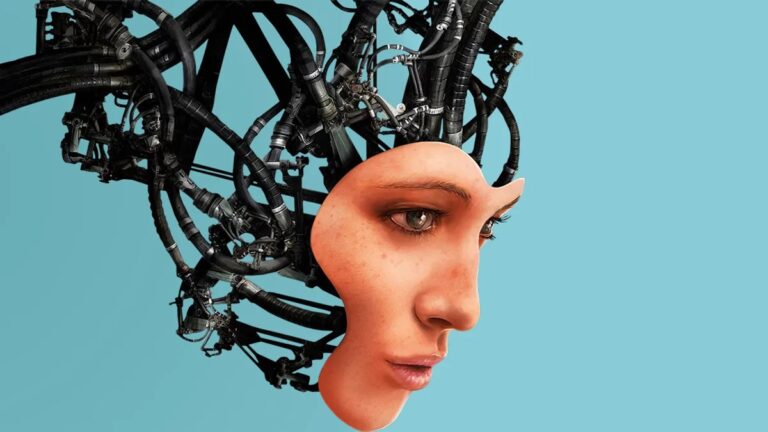
The answer to this anxiety is, first, “high definition masking” — a flattering composite of the user’s face digitally overlaid on the screen. Then comes actual masking — hyperreal rubber versions of the user’s face that can be quickly strapped on for calls. Eventually, in response to this “stressfully vain repulsion at their own videophonic appearance”, consumers revert to audio-only, which is now “culturally approved as a kind of chic integrity”. 

This divide between the real and the represented has been borne out by our experience of Zoom, Instagram and TikTok: filters are now so advanced that they can be applied to moving images, and you can digitally beautify yourself while livestreaming. Only instead of resorting to rubber masks, we remodel the flesh itself: “filter face” tweakments, intended to bring the human closer to the digital ideal, are on the rise. Wallace was right about the way pervasive exposure to our own image would break us. It’s just that the way we’ve responded is, somehow, even more dystopian than he imagined.

Infinite Jest’s near future is now our near past, and in 2008, Wallace killed himself after suffering decades of profound depression. By the middle of the next decade, his greatest novel had been recast as a byword for tedious white masculinity, the author himself cancelled. This was, at least in the biographical sense, deserved. In 1990, Wallace had met the poet Mary Karr. He was a resident in a halfway house, she was a volunteer, and he became obsessed with her. They dated, they broke up, then he assaulted and stalked her. In 2018, Karr tweeted that he had “tried to buy a gun. kicked me. climbed up the side of my house at night. followed my son age 5 home from school. had to change my number twice, and he still got it. months and months it went on.”

The novel includes multiple men in recovery steeping in the shame of their past violence, and it would be nice to imagine that this was Wallace examining his own conscience. On the other hand, it also includes a reciprocated love story between the large, lunkish, David-Foster-Wallace-ish character Don Gately, and the beautiful, idealised, Mary-Karr-ish Joelle van Dyne. Infinite Jest was, arguably, an implement of his ongoing harassment and should not be dishonestly mined for signs of redemption.

Still, it is a very contemporary thing to demand moral purity in artists: the kind of impulse that, perhaps, comes from seeking simplicity when far too much knowing is possible. “What do we do with the art of monstrous men?” asked Claire Dederer, as though to be an audience is inevitably to be an accomplice. Good art can be made by people who’ve done bad things, and perhaps only a monstrous man can faithfully portray the outlines of his own monstrosity. Reading is not an act of worship, although one of the problems for Infinite Jest is that certain male readers have treated it as such. 

And so, Infinite Jest has plummeted from literary touchstone to confirmed red flag. In a viral tweet from 2020 listing “Top 7 Warning Signs In a Man’s Bookshelf”, the first item was “A dog-eared copy of Infinite Jest”. The “dog-eared” was important: it was the act of having read it, rather than posing as someone who might read it, that sounded the klaxon.

But unread copies could be equally alarming: when the actor Jason Segal bought Infinite Jest in preparation for playing Wallace in a film, he recalled that the female bookseller rolled her eyes and said: “Every guy I’ve ever dated has an unread copy on his bookshelf.” Nicole Cliffe made it number four on her catalogue of “Books that Literally All White Men Own”. 

I have never run into a “DFW guy” — they’re probably more of an American campus thing. But I ran into the “Philip Roth guy” at university and recognise the type: clammy, proprietorial, forcing his literary taste on girls in lieu of forcing himself. That I had read Infinite Jest felt vaguely embarrassing. All that effort, and it turned out the most high-status option would have been to not read it and then be glibly dismissive. 

It’s perversely appropriate that Infinite Jest ended up holding such a key place in the vocabulary of this irony-bound strand of performative feminism, because irony was one of the things that Wallace was both appalled and fascinated by. In a 1993 essay, he writes that “irony and ridicule are entertaining and effective, and that at the same time they are agents of a great despair and stasis in US culture.”

Infinite Jest isn’t above irony, but it often pits itself against irony. “It’s like there’s some rule that real stuff can only get mentioned if everybody rolls their eyes or laughs in a way that isn’t happy,” thinks one character. Another feels an “aftertaste of shame after revealing passion of any belief and type when with Americans, as if he had made flatulence instead of had revealed belief” (the weird syntax is because this character is Quebecois). When sincerity is untenable, it becomes easier to engage with symbols than things. 

Over and again in the novel, the “real” gets displaced by the representation, like the rubber faces that can replace flesh ones on video calls. One of the centrepiece scenes of Infinite Jest features a geopolitical strategy game called Eschaton — a kind of Risk, but played by teenagers with balls and rackets to stand for missiles. The game comes violently undone when the players start hitting each other and the referee can’t work out how to distinguish between the territory and the map. As for the M*A*S*H-obsessive, “crucial distinctions had collapsed” between the fiction and the real.

And maybe this is connected to the novel’s weirdly well-informed interest in transsexuality. The gender ideology that makes front-page news now was a niche interest in the Nineties, confined mostly to academic papers and message boards for transitioners. Wallace’s inclusion of a young, effeminate, gay, “gender-dysphoric” character and a middle-aged, masculine, straight crossdresser suggests a hefty familiarity with the sexology literature long before any of this had crossed into the mainstream — it’s effectively a thumbnail sketch of the influential theory, developed by Ray Blanchard in the Eighties and Nineties, that male transsexuality divides into “two types”, the autogynephiliac and the homosexual.

But it also fits with the vision of an America where the signifiers that stand for “woman” hold more weight than the physical fact of femaleness. Gender as we experience it now — the idea of an “essence” or “true self” that renders the material body irrelevant — couldn’t have come to exist without the internet. Only when technology allowed people to present themselves as pure language, signifier unmoored from signified, did it become possible to believe that sex was malleable or unreal. Maybe transsexuality fascinated Wallace because he saw it as another way that humans confuse the symbol with the thing itself, the feminine with the female.

This summer, I started rereading Infinite Jest, mostly out of curiosity. It is, still, a very annoying book. But there’s something I didn’t understand about it in 1996 that I do now I’m older than Wallace was when he wrote it. He saw American culture as an exhausted force, trapped smirking in a hall of mirrors. And he saw that getting worse as screens extended their influence.

One of Wallace’s influences, Thomas Pynchon, wrote stories about the technology that made America possible: geographical surveys (Mason Dixon), the postal service (The Crying of Lot 49). Infinite Jest is about the technology that could undo a state: a kind of entertainment so compelling that it turns consumers utterly away from reality. It asks whether the real, or something like it, might be worth recovering. 

It is, still, a difficult book — and difficult in new ways. The wheedling presence of my phone is competition that Infinite Jest never had to contend with the first time around. The disturbing fact of Wallace’s own bad acts, too, was not available to me in the Nineties, and even if it had been it probably wouldn’t have struck me as a problem for the novel. But the difficulty is, and always has been, the point. Of course Infinite Jest could be shorter, lighter, less infuriating. But if it’s heavy, it’s because it’s weighing you back down in the physical world.

Restoring A World Out of Balance

Is our expansive evolution in technological advancement a wrong turn for humanity? Or has it evolved without our consciousness keeping up to steward it effectively?

By Tom Bunzel

Source: The Pulse

One of my first really disquieting insights about the planet and the pace of change came when I saw the film “World Out of Balance” or “Koyaanisqatsi” in the 1980’s.

The concept behind the film was that Nature has an exquisite balance between various forces, and that’s when I first thought about the likelihood of the existence of a higher intelligence.

The film was jarring because it showed dramatically, now 40 plus years ago, the havoc that was wreaked by technology not just on the environment, but how human technology was literally putting the world out of balance – a harmony that was naturally sustained prior to human intervention.

Computers Introduced Me to Rapid Change

At that time, I just getting interested in computer graphics and I encountered “Moore’s Law”, which refers to the observation made by Intel co-founder Gordon Moore in 1965 that the number of transistors on integrated circuits doubles approximately every two years.

That meant that processing power doubled in the same span of time, allowing graphics, for example, to go from color, to 3D, to 3D with texture mapping and other effects, and on and on.

One example of this was the original movie Jurassic Park, which was made with 3D models of dinosaurs having their wire frames “texture mapped” – covered with skin and then animated on a Silicon Graphics work station.  The processing power required to render these images quickly enough for a 30 frames per second film was staggering.

I just Googled the company.  As I suspected they are extinct like the dinosaurs; and the process I described above now happens on a phone, or on a website, and films are using artificial intelligence to fool audiences.

As I began writing about digital video and animation, and attended conferences, I found myself on a carousel of a continual need to adapt to change, and “upgrade” my system to keep up with the latest advancements.

It worked for me for a while and I enjoyed integrating solutions based on a creative understanding of what was coming out, but eventually, I realized that I could no longer keep up.

I had to take a break from the relentless pressure, which I did, and ended my tech writing career.

It was around that time I was reading Eckhart Tolle, and learning how the Ego, the voice in my head, always wants MORE.

The Continued Acceleration of Change

Moore’s law for integrated circuits was only the beginning, of course.  We now have the promise of quantum computing and the reality of artificial intelligence, which both have the potential to put the world as we knew it even more out of balance.

When we consider our human conditioning, the wider the gap between one’s childhood where one “learns the ropes” and perhaps conforms for one’s safety and one’s adulthood — when everything has changed creates intense discomfort relative to the gap in years.

For a dinosaur like me the continual need to “download the app” is stressful.  For my friends’ grandchildren it’s just part of being alive.

Peter Russell, in his new book “Forgiving Humanity” uses a sobering term – Exponential Change – as he describes how rapid changes in technology first affected agrarian culture, increased dramatically with the industrial revolution and accelerated again with the advent of computer technology and integrated circuits.

It’s Not You, It’s Exponential Change

He reaches a conclusion that is both profound and daunting:

“This doesn’t mean humankind has taken a wrong turn. Spiraling rates of development, with all their consequences, positive and negative, are the inevitable destiny of any intelligent, technologically-empowered species.”

So the fact that we have knocked the world out of its natural harmony is something that is part of evolution?  In essence, we are a part of nature that keeps pushing the envelope, but it can have dire consequences for a species that goes too far?

That is certainly what we are up against with respect to artificial intelligence, where the notion of exponential change in terms of brute intellectual capacity, is making many experts wary of consequences of an “intelligence” that vastly dwarfs human capabilities.

Consider the difference between exponential change versus simple, let us say, incremental change.  Exponential means that is multiplied by its current value, or the power of 2.  Anyone who has played with relationships like that in math knows how rapidly it can spin out of control.

Calculations of this order of magnitude quickly go beyond what the human brain can process.

And how does this expansion of potential knowledge affect consciousness today?

Peter Russell takes one of the driving forces of exponential change – AI – and discusses his new book by interviewing “his clone” in a fascinating video.

There is the possibility that with enough shocks or consequences that humanity may begin to glean that a purely intellectual approach to reality is the reason for our imbalance, and that knowledge itself, without wisdom or “being”, is fraught with peril.  Blind intellect alone creates conflict with a higher, natural intelligence which it ignores.

Russell uses the analogy of how a wheel that spins faster and faster will eventually come apart.

Taking a Cosmic Perspective – Collectively and Individually

In the video Russell’s “clone” suggests that a way for humanity to adapt, and actually align with the natural forces that have brought it to this point, is to begin to take a truly “cosmic perspective” and see our species in true proportion to the vast universe in which we now find ourselves.

Advances like the Webb Telescope have opened humanity’s eyes to a more accurate understanding of the vast scale of the universe we inhabit.  We now know that galaxies move in clusters of unimaginable proportions.

Russell points out that there are trillions of stars and life might have evolved to an intelligent level on some of these, and that perhaps such life has found itself at the point where we are many times in eternity.

We have to confront the stark reality that from such a perspective within the vastness of Nature, we are here for only a brief interval both as individuals – and indeed perhaps as a species.  

Russell suggests that such a perspective can make us more aware and grateful for our higher capabilities in areas beyond the intellect, such as art, culture, and probably philosophy.  Humanity needs to become more deeply human once again rather than purely mental, as the computers we use are just brute intellect.

A Shift Beyond Copernican Proportions

Such a “renaissance” would be like a new Copernican revolution.  Most of us have a perspective (in consciousness) that WE are the center of all existence. 

But from a “cosmic” perspective we must recognize that cannot be true; it must be an illusion.  We can begin by sensing the truth through our bodies that we are organic beings within dimensions of a vast organism (maybe like the microscopic organisms that exist in our gut and make our “lives” possible are organic beings within us) – and this recognition could serve to dampen both our hubris as a species as to how important we are (dominant on this planet), but also make this a cornerstone of a viable personal philosophy.

I don’t know if I will be here to witness it, but I sense that this shift is very much in line with current trends toward a more dramatic “Disclosure” of our place in the universe – revealing that several other interplanetary or interdimensional species have been here, communicated with humans and are still monitoring human affairs.

Harvard astronomer Avi Loeb, who gained prominence when he speculated that “Oumamoua” – the interstellar object spotted entering and leaving our solar system recently, showed that it was intelligently controlled.  He has since begun Galileo project to search for evidence of extraterrestrial intelligence.

All of this is finally putting to rest the misgivings of the famous Brookings memo that greatly contributed to the secrecy around UFOs – the memo speculated that if extraterrestrial life were a proven reality many social structures, religions and institutions would collapse.  Better to hush it up.

But of course, we are now witnessing the dissolution of many conditioned beliefs and the institutions that these flawed beliefs supported; among them our belief in our dominance as a species and our self-importance as individuals.

It would give me hope to see the shift completed with a deep comprehension of our connection to the universe both epigenetically and spiritually.

Julian Rose: ‘Humanity in Hypnotic Thrall to a Techno-Industrial God’

By Julian Rose

Source: 21st Century Wire

So here we are. For yes, this is where we are – if by ‘we’ one understands the current materialistically imprisoned post industrial world – driven on by the relentless force of globalisation.

Brussels, still a remarkably human city by today’s standards, has the misfortune of housing the European Union HQ, which is not a very human conglomerate. And what goes on in it is equally devoid of humanity. For it is about being ‘big, central and dominating’.

Big, central and dominating is the future of the planet if you subscribe to the techno-industrial mind’s two dimensional determinism. In the soothing words of Klaus Schwab and Yuval Noah Harari, it is to be an Information Technology/Artificial Intelligence future, in which Schwab tells us “we will have nothing and will be happy”.

The mobile phone tower and mast which tops the temple of techno-industrial prowess, is an ugly, spindly piece of steel which is an expression of dominance in its own right. The vast global infrastructure formed by these Saturnian steel structures carry with them a penetrating EMF amplified soup of toxicity.

It is this ‘network’ which acts as the gateway to the virtual reality world of those who depend on it for their ‘signals’. Signals that have an abstracted kind of dominance and pronounced tendency to thin the blood and blur the brain.

The majority of messages that come through this gateway concern how to get on in ‘the system’.

How to get from A to B faster; news faster; financial reports faster; connections with family and friends faster; everything faster.

Being permanently plugged-in to this hyper electromagnetic crossroads of life is said to be the only way to ‘stay in touch’, to be a participant in the mental matrix; to be part of ‘the programme’.

But already twenty years ago I decided to cut my ties with this programme. Dispensing with the mobile phone turned out to be an act of liberation, soon to be followed by the ousting of the TV.

Big Brother was consigned to the back seat and I saw that a life that belonged to myself still existed, all be it with the proviso that one prioritised one’s values with a solid dose of determination to be true to that which is ‘real’ in life.

Perhaps this is why I can see so clearly how those who continue to participate in the ‘programme’ are running blindly towards an uncompromisingly sheer cliff-face, and how their voracious demands on the natural environment are increasingly undermining her natural resilience.

I can see something particularly shocking – that this frenetic rush to the cliff face and the great consumption of finite resources it involves – has no other purpose than playing-out a quasi demonic fascination with ever more refined toys of distraction. Distraction from the real pulse of life.

Yet this techno-industrial suicide machine is staffed by humans who appear not to recognise that their joint mission is programmed to end in collapse.

On the contrary, they seem to think that by increasing the efficiency and speed of the means of travel, it will somehow consummate its own need to arrive at where it is headed for. Where or what that is – simply never gets asked.

However, the psychotic gods of insentient ‘progress’ who designed the programme have built into it a series of ‘events’ which reach a certain conclusion in something they call the Transhuman. A robotic state of computer connected and controlled brain power for those able to pay for it.

To pay for the right to be dehumanised and rendered devoid of the need – and indeed ability – to think. Freed from emotion and freed from a soul based link to one’s Creator.

Stations on the way to this dark point of human annulment are laid-out under the WEF creed known as ‘The Great Reset’. A ‘Reset’ from human to non human.

Here are some of stations along the Great Reset route to the Transhuman:

The cessation of food grown in soil and the manufacturing of synthetic food produced in laboratories (at least six of which are already in production).

The end of farming the land as we know it and the removal of redundant farmers and country dwellers into 5 and 6G controlled total surveillance ‘smart cities’.

Countryside and farm landscapes redesigned to accommodate ‘rewilding’ projects and gated access to designated ‘leisure sites’ for those who can afford access.

The end of bank notes and coinage, replaced by a centrally controlled digital currency whose availability will depend upon one’s ‘social credit’ a la China.

The confiscation of one’s assets and private property with the option to ‘rent’ aspects of them back from the corporate state that is to become the new owner.

‘Self-autonomous’ 5G guided transportation systems operating between major cities.

100% surveillance via satellite and ‘the internet of everything’ and the profligate use of algorithms to pick-up any signs of resistance in communications.

The repression of true spirituality in favour of a ‘one world religion’.

Deliberate blurring of sexual delineation ‘man/woman’ and the decline of normal sexual reproduction.

Sperm-counts further reduced due to de-vitaminised synthetic GMO foods, vaccinations and polluted air and water – population control.

Enforced ‘15 minute cities’ as centres of local authority control.

Designer gene-altered babies via laboratory cloning of DNA sequences and cell tissues.

The removal of certain words from the common language, particularly poetic and spiritual ones.

Real art reduced to pseudo art as an expression of the will of the state, including dark-side ritual.

‘Medical health’ seen as the sole domain of Big Pharma with natural medicine outlawed.

Further media/government control over the passing of public information.

There is more, much more. But this is enough to show the basic composition of the stations on the way to ‘Transhumanism’. The arrival point of which is said to be circa 2035.

Behind this in-your-face destruction of hard won human liberties is a vast global propaganda/indoctrination exercise already in existence for more than two decades and built around the now infamous ‘Zero carbon by 2045’ or ‘Net Zero’ in news-speak (Orwell).

When challenged by those still able to question the need for these deadly impositions, the answer is always the same “To save the world from Global Warming.”

This piece of acute brainwashing, initially devised at the Club of Rome in 1972, is key to the whole ‘programme’. As long as enough people buy into it for long enough, the slavery exercise will be irreversible. Based on the current rate of awakening, the discovery that anthropogenic Global Warming is a mega lie will likely be neutralised by the impositions already in place to prevent an uprising.

The techno-industrial god will then have served its purpose. Like the rocket booster that gets the capsule into orbit, it will have taken the majority of mankind over the brink into abject slavery to its hypnotic convenience culture, before imploding in on itself and taking much of humanity and nature’s life sustaining diversity with it.

BUT, all this can be avoided. It doesn’t have to happen. It won’t happen. Our lives do not depend upon adopting the smart technology of tomorrow, today. We won’t any longer be seduced by ‘convenience’ once we recognise it is leading to our self destruction, will we?

We will retain sufficient will-power to get shot of this addiction to the IT/AI life inhibiting distractions that make up the mind controlled road to Armageddon.

The only way to recognise just how diabolical is the trap that has been set for us – and that we have set for ourselves – is to get a grip on our sense of deeper purpose in this life. To make an unbreakable commitment to listen and respond to the call of our souls. The true self. And then pull this true self out of any association with the metaverse mincing machine.

Let no one in possession of a soul ever allow himself/herself to become processed into a sub human product of the techno-industrial behemoth. Stick with what’s solid, what’s real – and ditch the counterfeit virtual world that snares the unweary and turns once healthy minds into casualties of a blind rush to a dystopian digital nowhere land.

When Dissent Ends, Transhumanism Reigns And Digitization Rules, Humanity Will Cease To Be Human

By Gary Barnett

Source: GaryDBarnett.com

“The only thing worth globalizing is dissent.”

~  Arundhati Roy

Self-defense comes in many forms, but all defense of self begins and ends with dissent, non-compliance, disobedience, saying no to any and all rule, and never allowing aggression against mind and body; mental or physical. Without dissent, defense is not possible, because when voluntary compliance is the prevailing behavior, whether sought, desired, or not, all defense mechanisms are effectively disarmed. In other words, silence in the face of injustice, immorality, terror, or tyranny, creates a condition of weakness, submission, and irresponsibility, which are all the fodder of indifference. When you say nothing, when you do not say no, when you take no action against evil, you commit evil. By not speaking out, and by not responding, you have spoken loudly, and openly committed an act of cowardice. The ultimate blame lies not just with the aggressor in this circumstance, but also equally with he who hides and remains silent.

In “Beyond Good and Evil,” Friedrich Nietzsche wrote: “He who fights with monsters should be careful lest he thereby become a monster. And if thou gaze into an abyss, the abyss will also gaze into thee.” This is an accurate description of the phenomenon of becoming what one lives, so if you live in a state of indifference, ignoring the evil around you, accepting it in order to avoid conflict and responsibility, you become the evil you have chosen to ignore. The dark abyss in this circumstance, is created by your own inaction against it.

What we face as a society, is the most tremendous threat ever perceived or active in the history of mankind. Do you scoff at this seemingly ‘bold’ pronouncement? If so, you are already fooled, and a major contributor to the vast problems rampant in our world today. Instead of the State just singularly seeking war, the continuance of the bogus Federal Reserve System, isolated government corruption, communism, fascism, or any broad-based totalitarian assault on certain segments of society, we are all being bombarded from a thousand different directions at once with all these atrocities and many more, including attacks on our freedom and sovereignty, on our minds and bodies, and on every aspect of our being. Due to the colossal advances in technology, which in many more ways than not are being used against us in order to build a literal transhuman world run by technocratic means, we are facing what could be considered a technological Armageddon, where all control over humanity will be isolated in the hands of the most powerful few. To accept this, to treat it as normal or eminent, is a most fatal error, and one that could determine our fate in perpetuity.

When humanity ceases to exist in any natural form, when male and female become one, when transhumanism and mind control are inescapable realities, when perversion is commonly accepted, the presence of life that we have all known to be magical and a wonder, will have disappeared. The world being designed is not a world of love, hope, and dreams, it is a nightmare of horror, and those pursuing this downfall of man have already lost all human characteristics. They are monsters, so we must fight and defeat them without becoming monsters ourselves.

There is a reason that the children, beginning in infancy, are targeted by State indoctrination, drugs, chemicals, bioweapon injections masquerading as ‘vaccines,’  insane propaganda, distraction, gross perversion, and are pulled away from family mentally and physically throughout their lives. This, in and of itself, if allowed to continue, will guarantee mind destruction of multiple future generations, and that will secure a fully dumbed-down, compliant, and obedient proletariat mass in the future. At that point, total control by the technocrats over humanity will have been achieved.

While technology has the capability to accomplish many great things, in the hands of these monsters who seek universal control, it can also be used to destroy us. Many refer to this technological phenomenon as ‘artificial intelligence,’ (AI) but there is no such thing. This false terminology is being used against us, as machines are not intelligent, they are programmed by intelligence, or so it is believed. When man becomes a machine, real intelligence ends, and a programmed society of slaves is the result. AI is ‘defined’ as “perceiving, synthesizing, and inferring information–demonstrated by computers, as opposed to intelligence displayed by humans or other animals.” Intelligence is defined as the ability to learn, reason, and understand, so honest intelligence cannot be artificial, and machines are still machines. The transhuman digitization of man will mean the end of all traditional life as we know it.

The bulk of this society, has already succumbed to a digital world, and relies on what is falsely labeled ‘social media’ as parent, family, and friend, disregarding the natural state of personal communication, love, companionship, debate, and the grandeur of nature. At this point, the future is not owned by you, but is owned by your masters. All privacy has disappeared, and most all private and financial transactions are captured and data-based. Every aspect of life is now tracked, traced, used, surveilled, restricted, censored, taxed, and every activity imaginable requires licensure (paid permission slip) by the State. You are already a slave, whether you realize it or not.

The plot continues to thicken, as centrally-controlled digital currencies (CBDCs) are being rolled out around the world, which will allow for most every individual to be fully contained and regulated. This will lead to mass restrictions as to what you are allowed to do, where you may travel – if at all, what food you must eat, what medical care you may or may not receive, what State stipend you will be allotted, how much energy you will be permitted to use, and on, and on. Everything in your existence will depend on behavior modification; in other words, do as you are instructed by the State technocratic rulers, or lose everything, as your entire life will be technologically sanctioned.

It is imperative to understand that everything you think you know about technology, and technological advances, is likely at a minimum, 20 years behind. Every so-called new discovery and new technology recognized as such, are not new at all. What the military has now, and is working on today, is unknown to most all except the very few at the top of the pyramid of power. To understand and grasp this concept, should strike fear in the hearts of man. The internet, and therefore, the internet of things, was not discovered and implemented by some computer geek, but was designed and created by the military through the “Defense Advanced Research Projects Agency.” (DARPA) Getting to this terroristic time in our history was no accident, and was intentionally planned long ago. We have little time left to stop this totalitarian hell that has been created in order to destroy what we know as the human race.

Will you continue to sit on the sideline, keeping your eyes closed, your ears covered, and your mouth shut, or will you stand up and defend your freedom and life, and that of your family? The only solution, as I have often said, is through active dissent. Say no to the State, disobey, do not comply with any tyrannical order, and do so as individuals en masse. No one can do this for you, but it can and should be done by many independent freedom-minded individuals. Asking someone else for a solution for the masses as a collective, is worthless, and exposes apathy at a level that if practiced by the herd as it has been for so long, the end of humanity will surely be our destiny.

“Has there ever been a society which has died of dissent? Several have died of conformity in our lifetime.”

Transhumanism and the Philosophy of the Elites

By Danica Thiessen

Source: PANDA

In 2004, when Foreign Policy asked eminent scholar Francis Fukuyama to write an article answering the question, What is the world’s most dangerous idea?, he responded with a piece titled Transhumanism. Fukuyama argued that the transhumanist project will use biotechnology to modify life until humans lose something of their ‘essence’, or fundamental nature. Doing so will disrupt the very basis of natural law upon which, he believes, our liberal democracies are founded (Fukuyama, 2004). For Fukuyama, these losses lay unrecognised beneath a mountain of promise for a techno-scientific future of imaginative self-improvement. 

Currently, the Fourth Industrial Revolution, in which transhumanism plays a central guiding role, is shaping the policies of global corporations and political governance (Philbeck, 2018: 17). The converging technologies of this revolution are nanotechnology, biotechnology, information technology, cognitive sciences (NBIC), and artificial intelligence (Roco and Bainbridge, 2002). The political class and the new technology elite routinely tell us that ‘the age of AI has arrived’ (Kissinger et al., 2021). Simultaneously, modern humans have also become increasingly dependent on advanced technologies and the complex systems they enable. These changes have presented new challenges to old questions, namely: what does it mean to be human? And what future do we want for ourselves?

From the hype of super-intelligence to self-assembling nanobiology, the world can seem increasingly science-fictional. Contemporary technological society is “harder and harder to grasp”, is full of “disruptions…that move ever faster”, and is confronting us with “situations that seem outrageously beyond the scope of our understanding” (Schmeink, 2016: 18). 

This paper aims to further our critical engagement with an ideology that is emerging across influential sectors of society. With this aim in mind, I will make three essential arguments: Firstly, transhumanism is a movement based on a techno-scientific belief system that is striving towards the technological enhancement of biology and, in this regard, is self-consciously promoting bio-social engineering. Secondly, the technologies of transhumanism have the potential to bring tremendous financial and political gains to corporations and governments who are not incentivised to seek out nor address their potential dangers. Thirdly, the discontent towards transhumanism is diverse and comes overridingly from the threat to traditional values, nature-based ways of life, freedom, equality, and the loss of bodily autonomy to the will of those who operate these powerful systems. 

Much of the current scholarship on transhumanism focuses on the intellectual contribution of the movement, with minimal work assessing socio-political impacts. This neglect is worrying since, within the reality of global capitalism, transhumanism may be overridingly motivated by economic and political forces as it may be by ideology. Furthermore, perhaps only a minority of humans may be able to access certain NBIC technologies or utilise them for profits (McNamee and Edwards, 2006: 515).  Of course, the socio-economic ramifications may be culturally and politically disruptive in unanticipated ways. It is this overwrought relationship—of transhumanism, the global economy, profitable science, human nature, and traditional belief systems—that demand further critical examination.

Transhumanism: A brief history 

Transhumanism is a predominantly Anglo-American movement that has flourished since the 1980s in “American circles of science fiction fans” and with “computer experts and techno-geeks” (Manzocco, 2019: 36). Today, California’s Silicon Valley, with its culture of technological optimism and imaginative entrepreneurship, is the hub of transhumanist thought and innovation. Though scholars have noted that there is no single definition of transhumanism, the essence of transhumanist ideology is to use science and technology to re-design and re-shape the human condition away from randomness, imperfectability, and decay, towards order, perfectibility, and control (Bostrom, 2005: 14).

This ideology emerged in early 20th Century Britain. There is a clear continuity of ideas between current proponents of transhumanism and those who were writing before the Second World War of the potential of science to shape the trajectory of nature, while fostering international cooperation and governance. They included British scientists and thinkers such as Julian Huxley (credited with first using the word Transhumanism in the 1950s), his brother Aldous, and his grandfather Thomas Huxley, as well as their colleagues J.B.S. Haldane, H.G. Wells, J.D. Bernal, and Bertrand Russell. These influential thinkers and internationalists were writing and working on promoting political and scientific outlooks that would form the basis of a century of scientific transhumanist thought (Bostrom, 2005: 4-6; Bohan, 2019: 74-108). The subjects they explored still attract transhumanists today: behavioural conditioning, genetic control, technological augmentation, artificial foods and wombs, space travel, life extension, and total disease control. These and other themes circle around the assertion that nature, including human nature, operates optimally under scientific adjustment and management (Bohan, 2019: 99-100). 

Early transhumanists (or proto-transhumanists) viewed techno-scientific advancement as a cure for ‘primitive’ human nature (anger, violence, excess fertility), physical limitations (disease and possibly death), political ignorance, and international conflict. It was the Enlightenment ideal of mastery over nature, including human populations, that Aldous Huxley so aptly demonstrated in his dystopian novel, Brave New World. Huxley’s novel, written in 1931, illustrates a scientific dystopia where transhumanist aims (genetic engineering, anti-aging interventions, biotechnology and enhancement drugs) are used to manage society implicitly through pleasure rather than explicitly through force. Huxley’s depictions were based less on his prophetic abilities and more on his intimate knowledge of the possibilities of social engineering as discussed and promoted by the scientific minds with whom he mingled. His later essay, Over-population, surmises that his novel’s projections were “coming true much sooner than” anticipated (Huxley, 1960: 1). 

Notably, Aldous’s brother, Julian Huxley, also wrote about the ills of global overpopulation while promoting the genetic control (‘improvement’) of populations through eugenics (Hubback, 1989; Huxley, 1933). His 1957 essay, Transhumanism, claimed that man was the “managing director” of “evolution on this earth” (Huxley, 2015:12-13). He was very involved with Britain’s Eugenics Society for over three decades, serving as Vice-President and then President, as well as supporting “campaigns for voluntary sterilization…and for negative eugenics measures against persons carrying the scientific stigma of ‘mental defect’” (Weindling, 2012: 3). Julian Huxley was the first Director-General of UNESCO and founder of the World Wildlife Fund (Byk 2021: 141-142). In this role, he promoted the ideology of an international, scientifically-founded welfare state to further his aim of liberating “the concept of God from personality” because “religions as all human activities is always an unfinished work” (Byk, 2021:149), (Huxley, 1957:10). Julian Huxley’s work and writing envisioned an international social engineering project based on rational scientific management that promised to elevate humanity towards global peace (Sluga, 2010; Byke, 2021:146).

Philosophical and Spiritual Transhumanism: Towards a Technological Utopia

Transhumanism has a wide variety of interpretations, similar to how a major religion is expressed with a divergence of commitment, beliefs and motivations. In fact, many scholars consider transhumanism to be a novel, emerging religion with significant parallels to Christian eschatology (deGrey et al., 2022; O’Gieblyn, 2017). The vast majority of transhumanists do not accept a monotheistic ‘God’ or the moral restraints of traditional religions, but instead endow “technology with religious significance,” leading scholars to define it as “a secularist faith” (Tirosh-Samuelson, 2012: 710). 

While not all transhumanists partake in techno-spiritual views, transhumanists essentially view technology as the redemption for fallible biology. For some, these perspectives were inspired by the philosophical work of Pierre Teilhard de Chardin (1881-1955). Tielhard de Chardin was a palaeontologist and Jesuit who believed that a “worldwide network would be woven between all men about earth” and that a “God-like entity” would form from a future “conscious, collective, omniscient mind—the Omega Point” (Bohan, 2019:92). The concept of technological ‘transcendence’ has continued to be central to Transhumanism in conversations about the worldwide web, the Internet of Bodies, artificial intelligence, and the ‘Singularity’, which is the belief that human-machine intelligence will grow exponentially and reach a point where humanity will be thrust into a posthuman age (Bohan, 2019:96; Kurzweil, 2005). The belief that humans (or rather posthumans) can become immortal and ‘god-like’ in a future machine-dominated age—complete with astral travel and digital telepathic communication—is why, in its philosophical form, many scholars understand transhumanism as a techno-materialist religious movement. 

In an attempt to consolidate such a complex movement, transhumanist philosopher Nick Bostrom—current head of the Future of Humanity Institute at Oxford University, and transhumanism’s most legitimate academic—co-founded the World Transhumanist Association in 1998 (Bostrom, 2005:12-13). Out of this work, the Transhumanist Declaration was drafted. It consists of bold statements such as: Humanity will be radically changed by technology in the future. We foresee the feasibility of redesigning the human condition. The Declaration concludes with: Transhumanism advocates for the well-being of all sentience whether in artificial intellects, humans, posthumans, or non-human mammals. The Declaration makes it clear that transhumanism is an unprecedented social engineering project promoting the desirability of using “technology to push the boundaries of what it means to be human and to transcend our biological condition”, as described by Mark O’Connell, author of To Be a Machine (Mayor, 2018). 

Two American transhumanist philosophers who have worked, since the 1980s, to spread transhumanist ideas, are Max More and Natasha Vita-More. They are entrepreneurs in the cryonics industry, which deep-freezes human corpses (called ‘patients’) with the aim of future revival (McKibbin, 2019:184-185). Vita-More, in a recent interview, emphasised that the essence of transhumanism is, “a transition of being human-animal into becoming more mechanised using different devices and technologies to enhance humans into whatever they feel that they are.” This very Californian-esque promise of becoming ‘whatever you want to be’ could result in a more mechanised, or augmented, version of you. We already see the emergence of this new ‘becoming whoever you want’ phraseology in the popular acceptance of enhancement chemicals, biotechnology, and videogames. A pantheon of new technologies is on the horizon: exoskeletons, virtual reality, robotics, body-changing pharmaceuticals, remote-controlled nanotechnology, artificial foods, brain implants and synthetic organs. Adopting these technologies is a part of what Max More describes as becoming the Overhuman, otherwise known as the Posthuman: if you are Transhuman you are essentially a transitional human

In The Overman in the Transhuman, More attributes attitudes in transhumanism to Nietzsche’s philosophy, arguing that the overhuman is the “meaning-giving” concept meant to “replace the basically Christian worldview” of Nietzsche’s time (and, to a lesser extent, our times). More holds that the current “relevance of the posthuman” is that it ultimately gives meaning to scientifically-minded people” (More, 2010:2). In this influential paper, More asks the reader to “take seriously Nietzche’s determination to undertake ‘a revaluation of all values’” (More, 2010:3). Since a modern overhuman upgrade will depend on human gene editing and other biotechnology applications (such as Elon Musk’s Neuralink) becoming legally available, More’s call to ‘reevaluate values’ is understandable. Issues raised on both sides of the academic debate concern which values and traits would be genetically chosen, and to what extent human enhancement will be voluntary (Levin, 2018). 

While earlier Anglo-American eugenicists argued for the removal of anti-social genes by sterilisation, some modern transhumanist proponents have argued that moral bioenhancement, through selective gene editing, should become compulsory (Persson and Savulescu, 2008). Many notable transhumanists argue for procreative bioenhancement of offspring by the parents (Levin, 2018:38). Transhumanist advocates Ingmar Persson and Julian Savulescu believe moral enhancement should become obligatory like “education and water fluoridation,” since “those who should take them are least likely to be inclined” (Persson and Savulescu, 2008: 22). Transhumanist Niel Levy argues that “cognitive enhancement could be required,” much as vaccines currently are (Levy, 2013:38). Scholar Susan Levin writes that allowing a techno-scientific transhumanist vision to shape the “form that society takes” may lend itself to “socio-political requirements that would clash with…liberal democracy” (Levin, 2018:50). She also argues that when transhumanists use “public health analogies and reasoning” to “justify vigorous enhancement” they are putting into serious question their commitment to autonomy (Levin, 2018:48). In this way, the coercive vaccine mandates used during the Covid-19 pandemic can be interpreted as an early warning signal for how future bio-enhancements are likely to be accompanied by forceful moralistic and utilitarian arguments.

Ingmar Person, Julian Savulescu, and Niel Levy are prominent ethicists at the University of Oxford; all three advocate for mandatory genetic enhancement despite the trail of 20th century trauma wrought by grandiose social- and eugenic engineering projects. Does this suggest that a moral framework based on utilitarian arguments and flawed metaphysics remains fundamentally unchanged in public health governance since the last century? In his recent book God and Gaia: Science, Religion and Ethics on a Living Planet, scholar Michael Northcott argues that a growing “post-human agenda” has become central to policies around public health—referred to as “biosecurity”—which has very little to do with authentic “human health or health of the environment” (Northcott, 89). The consequences of this ideology became apparent during the recent mandating of the experimental gene-altering vaccines, and could represent what Northcott refers to as “automatism”. This is when we are culturally obligated to “use new technologies regardless of the possible consequences” because of a utilitarian ethic of the “managerial goal of efficiency” (Northcott, 2022: 114). To underestimate the suffering caused by one-size-fits-all public health measures is inadequate scholarship, yet despite this, only a minority of academics have openly questioned the use of coercive genetic therapy during the Covid-19 pandemic. 

A clash between individual rights and a movement that aims to “re-design the human condition” seems inevitable. In the words of transhumanist scholar Nick Bostrom, “human nature is a work-in-progress, a half-baked beginning that we can learn to remould in desirable ways” (Bostrom, 2005: 3). As the co-founder of the World Transhumanist Association, David Pearce said,

“…if we want to live in paradise, we will have to engineer it ourselves. If we want eternal life, then we’ll need to re-write our bug-ridden code and become god-like…only high-tech solutions can ever eradicate suffering from the living world”.DOEDE, 2009: 47

It is human nature that often comes into direct conflict with massive social engineering projects. Understanding transhumanism as a bio-social engineering project of unprecedented scale is a useful perspective in that it focuses the potential conflicts as value-based and ideological rather than as a direct result of specific scientific advances (Broudy and Arakaki, 2020). Furthermore, the term ‘social engineering’ is in itself inadequate, in that a utopia that aims to phase out Homo sapiens, while making way for the new, enhanced posthuman, is historically unprecedented (Bauman, 2010), and is possibly an energetic form of nihilism or an expression of ‘losing oneself’ to an intoxication with machine power, inspired by what scholars identify as “machine fetishism” (Geisen, 2018: 6). Yet, the surprising willingness to martyr one’s physical self to attain paradise has always been particular to our species (Pugh, 2017). 

Corporate Transhumanism: The Pursuit of Wealth and Power

In congruence with the scholarly work available, I have focused on the ideas of philosophical and academic transhumanists, but transhumanism is an ideology reaching far beyond discourse. Though under-discussed in the academic literature, the movement is advanced by corporate and political transhumanists, and transhumanist scientists. Massive corporate and state investment in NBIC technologies rely on specialised scientists working in the military, elite universities, and corporate laboratories to push the frontiers of reality with robotics, artificial intelligence and biotechnology (Mahnkopf, 2019: 11). These scientists are designing technologies with such potential that the world’s most powerful players, such as the Chinese Communist Party and the US Department of Defense (DOD), are deeply involved. In January 2023, Harvard University’s esteemed chemist Charles Leiber was on trial for lying to the DOD about his involvement with the Wuhan University of Technology over his work on “revolutionary nanomaterials.” In his Harvard laboratories, Leiber and his assistants have created nanoscale wires that can record electrical signals from neurons (Silver, 2022). Nanowire brain implants were designed by Leiber to “spy on and stimulate individual neurons” (Gibney, 2015:1). In an age where neurotechnology and mind-machine interfaces are changing the nature of warfare, the contested power-potential of transhumanist techno-science is quickly apparent (DeFranco, 2019).

The transhumanist vision for the future should not be viewed outside of the ‘technological arms race’ or a competitive, utilitarian mindset that informs business, war-making, and our cultural esteem of scientific research. This suggests that more research understanding corporate and political transhumanists is critical in analysing how this group is actively involved with determining humanity’s future. Political leaders with a sharp sense for power understand that machine intelligence and enhancement may determine the world’s winners and losers (Kissinger et al., 2021). As Vladimir Putin articulates: “Artificial Intelligence is the future, not only for Russia, but for all of humankind. It comes with colossal opportunities but also threats that are difficult to predict. Whoever becomes the leader in this sphere will become the ruler of the world” (Karpukhin, 2017). The elite fascination with transhumanist technologies concerns the potential power inherent in the technology itself—and in who creates and controls it. The influential historian and speaker, Yuval Noah Harari, expressed this view in his 2021 Davos Summit presentation where he said that technology “might allow human elites to do something even more radical than just build digital dictatorships. By hacking organisms, elites may gain the power to re-engineer the future of life itself. Because once you hack something, you can usually geo-engineer it.”

Harari is a frequently featured speaker at the World Economic Forum (WEF) and associated events. The WEF is currently acknowledged as one of the “most significant case studies of private authority with global impact” (Vincent and Dias-Trandade, 2021: 711). Criticised as being a “transnational elite club, with high media visibility” and a neoliberal “agenda-setting power,” the WEF can be understood as an “instrument for global geopolitical domination” (Vincent and Dias-Trandade, 2021: 711). At the very least, it is a forum where heads of state, CEOs of multi-billion-dollar companies, and academics who intelligently promote strategic values, are encouraged to collaborate and shape the global future. On WEF and other media collaborative platforms, Harari eloquently argues for humanity to “break out of the organic realms to the inorganic realm” with the creation of a new type of machine human so much more sophisticated than us that our current form will be more drastically different from it than “Neanderthals” or “chimpanzees” are from us today (BBC, 2016). Perhaps this epochal vision is received with welcome at the WEF because it boldly asserts a future dystopia for those who choose to ignore this high-tech revolution. It may act as a motivational warning to “acculturate” or “disappear.” 

Scholar Kasper Schiølin (2020) believes WEF agenda setting is accomplished through strategic political and corporate marketing and the discourse of “future essentialism” where the “fabrication of power” and of an inevitable global destiny is reinforced by “sociotechnical imaginaries” and “epochalism.” Future essentialism is the construct of narratives that use “historical analysis…speculative estimates…and hard statistics” to disseminate an idea of a “fixed and scripted…future” that can be “desirable if harnessed” but also “dangerous if humanity fails” to accept the vision. “Epocholism” is an attempt to capture “The Spirit of the Age” and promote a feeling that the current times are of unsurpassed historical significance. These strategies, Schiølin (2020:553) convincingly argues, are how the “WEF produces a moral-political universe around The Fourth Industrial Revolution (4IR).” Is it possible that these techniques can create a narrative of urgency, significance, and global opportunity that can persuade us (or our leaders) to participate in a transnational, transhumanist future?

Klaus Schwab is the founder of the WEF and the one responsible for conceptualising and promoting this revolution, which was announced in his 2016 book The Fourth Industrial Revolution. Schwab (2017) describes the 4IR as a social re-setting (named the ‘Great Reset’) enabled by “a range of new technologies that are fusing the physical, digital and biological worlds, impacting all disciplines, economies and industries, and even challenging ideas about what it means to be human.” Analyses of the 4IR conclude that the rate of technological change is supposed to “accelerate” and be “exponential”, covering the Internet of Things (IoT), AI, automation, genetic engineering of humans and natural biology, nanomedicine, smart cities (where sensors are embedded all over the environment), a sci-fi enabled military, and algorithms with political agency (Trauth-Goik, 2021: 3). 

Political scientist Klaus-Gerd Giesen convincingly argues that transhumanism is the “dominant ideology” of the 4IR, having become a “grand narrative” for politicians while “advancing the interests of multinational tech giants” (Geisen, 2018: 10). Giesen views this revolution as a “significant rupture in the evolution of capitalism” as well as the tradition of humanism, arguing that “transhumanist machinism” is “fundamentally anti-human—not least because the machine is by definition inhuman” (Geisen, 2018: 6). With global 5G networks, the Internet of Things and of Bodies, and the convergence of the NBIC technologies, the “body as market” (Geisen, 2018: 10), or what Céline Lafontaine defines as the corps-marché (Céline, 2014), is complete. The sheer mass of consumption will exponentially rise with marketable ‘smart’ products: “wearable tech, autonomous vehicles, biochips, bio sensors” and other new materials (Mahnkopf, 2019: 2). This is a materially focused future where consumer upgrades are baked into the system, so it’s no wonder that corporate monopolies such as Amazon, Apple, Facebook, Google, and Microsoft, the “new industrial kings” are actively promoting this revolution (Mahnkopf, 2019: 14).

In his book, Falter: Has the Human Game Begun to Play Itself Out?, the environmentalist Bill McKibben writes that, “the Silicon Valley tycoons are arguably the most powerful people on earth” (McKibben, 2019: 183). North American West Coast transhumanist visionaries are an avant-garde community of ultra-rich technologists, businesspeople and inventors who are idolised by the media and who collaborate extensively with the US State to advance their aims. Eric Schmidt illustrates the collaboration common between US State defence organs, academia, and giant technology corporations (Conger and Metz, 2020). With a net worth of $23 billion, Schmidt was the Executive Chairman of Google and is now the current Chairman of the National Security Commission on Artificial Intelligence (NSCAI) for the US Department of Defense, where he advised President Biden to reject a ban on AI-driven autonomous weapons (Shead, 2021). Schmidt believes that artificial intelligence will “govern society” and be “perfectly rational”, outdating and rendering useless human intuition and knowledge. As with most tech billionaires, Schmidt has set up a private charity, Schmidt Futures, and has so far donated a billion dollars towards his AI educational aims (Philanthropy News Digest, 2019). While he admits that he did not design Google to regulate ‘misinformation’ more effectively, censorship is increasing with the accelerated abilities of AI (working with humans) to moderate and remove content on the Internet (Desai, 2021).

Many of our most influential technologies come from programmes at the US Defense Advanced Research Projects Agency (DARPA). DARPA funds ‘blue sky’ technology research and is credited with inventing the Internet, GPS, virtual reality, and drones. The agency is now set on advancing human augmentation both in and off the battlefield, with the goal of mastering brain-computer neural-interfaces (Krishnan, 2016). Arati Prabhakar is the former head of DARPA, and Chief Science Advisor to President Biden. Prabhakar, like the prior head of DARPA, Regina Dugan, moves between working with technology companies in Silicon Valley and the US Department of Defense. Like most, she is enthusiastic about a transhumanist future of augmentation, and advocates for this as a matter of national security. And yet, she also admits that this “will bring surprises that we may not like. For generations we have thought about technologies that change our tools – but this is about technology that changes us.”  We already have ample evidence that our current technologies, particularly wireless devices and chemicals, are physically changing our human (and planetary) biology, but the aims of DARPA and the DoD are more ambitious and revolve around the complete mastery of evolution (including the human genome) and natural systems (including the human population) using technology (Carr, 2020). This is exemplified in the recent, far-reaching US Executive Order for Advancing Biotechnology, which states that “we need to develop genetic engineering technologies” to “write circuitry for cells and predictably program biology in the same way in which we write software and program computers.” The order states that this is to “help us achieve our societal goals.” These societal goals are central to what the White House identifies as the “bioeconomy” where “computing tools and artificial intelligence” will help us “unlock the power of biological data”, scale up production, and reduce “obstacles for commercialization” (Biden, 2022).

In March 2022 at the World Government Summit, Elon Musk, a self-identified transhumanist, and the world’s wealthiest individual, spoke bluntly from the podium. He announced that he sees the upcoming AI apocalypse as a human-extinction event. What is the solution? “We must all become cyborgs if we are to survive the inevitable robot uprising.” This may be marketing, since Musk’s Neuralink is poised to start human trials of brain implantable chips” (Neate, 2022). Radically enhanced human cognition should, Musk predicts, counterbalance the dangers posed by super-intelligent machines. If the richest man on earth prophesied a mass AI extermination event and an inevitable posthuman future from the platform of the World Government Summit, should we dismiss it as just another tech business strategy?

In her analysis of the 4IR, Birgit Mahnkopf (2019:2) writes that a “system of physical-to-digital technologies embodied in machines and equipment…would enable sensing, monitoring, and control of the entire economy.” This is occurring against a backdrop of increasing global inequality and centralisation of wealth. It is estimated that eight men own as much as half the monetary wealth of the other eight billion humans (The New York Times, 2017). Schwab and other elites understand the social and political implications of their technological ideology and the rules of the ‘winner-takes-all’ market economy that will continue to consolidate gains from disruptive technologies. Universal basic income and social credit systems (with a resource-based economy and central bank digital currencies, or CBDCs) are presented as solutions to managing popular resistance and social unrest. 

The WEF represents the fusion of transhumanist goals within global governance. As Schwab notes, the organisation has been very effective at ‘penetrating the cabinets’ of national governments. As Harvard scholar Kasper Schiølin (2020:549) astutely observes, the “4IR is justified as kings and emperors once justified their authority as divine and natural in uncertain times.” Hence, it may be that the potential problems from transhumanist ideologies come, not so much from the prospect of an AI take-over, but from the elites’ use of the culture and technologies of transhumanism. It may be that these risks overwhelm liberal democracies long before sentient AI does. 

The Discontents

Few intellectuals note the opposition to transhumanism better than the transhumanists themselves. Nick Bostrom writes that resistance comes from:

“Ancient notions of taboo; the Greek concept of hubris; the Romanticist view of nature; certain religious interpretations of the concept of human dignity and of a God-given natural order; Karl Marx’s analysis of technology under capitalism; various Continental philosophers’ critique of technology, technocracy, and the rationalistic mindset that accompanies modern technoscience; foes to the military industrial complex and multinational corporation; and objectors to the consumerist rat-race.”BOSTROM, 2005:18

Bostrom’s summary is a panorama of human expression, literature, thousands of years of culture, religion, philosophy and human meaning-making. Modern literature on philosophy, culture and technology, from Jacques Ellul, Jerry Mander, Neil Postman and Wendell Berry to Jürgan Habermas and Martin Heidegger, offer poignant critiques that are relevant to opposing transhumanist visions of the future, and remind us of the value of community, embodied wisdom, and traditions, and the effects of technological systems. The difference in writing styles is noteworthy: while pro-transhumanist writing tends to be utilitarian and have a tone of scientific authority, ‘bioconservatives’ will often use narrative, symbols, and a writing style considered traditionally beautiful in human culture. 

What is noticeable is that the opposition to transhumanism is broad, ill-defined and diverse. Nick Bostrom notes that “right-wing conservatives, left wing environmentalists and anti-globalists” are all pushing back against central transhumanist aims (Bostrom, 2005: 18). Firstly, there are the well-published intellectual and academic opponents that engage in a forceful scholarly debate with transhumanism over issues such as biotechnology, threats to liberal democracy, and scientific materialism (Leon Kass, 2000 and Francis Fukyama, 2003), and the environmental and social costs of transhumanism (Bill McKibbin, 2019). Also noteworthy are the bioethicists, George Annas, Lori Andrews and Rosario Isasi, who have advised making “inheritable genetic modification in humans a ‘crime against humanity’” (Annas, et al., 2002: 154-155). These scholars fear the posthuman potential for inequality and war, warning that, “the new species, or ‘posthuman’, will likely view the old ‘normal’ humans as inferior, even savages, and fit for slavery or slaughter…it is the predictable potential for genocide” (Annas, et al., 2002: 162).  The common factor amongst these academics is that they believe biological engineering (of humans) would be disruptive to values, rights, and equality, and would threaten liberal democracy itself. These men have been labelled bio-conservatives or, more dismissively, Neo-Luddites, for rejecting the legitimacy of a posthuman future (Agar, 2007:12).

The second group that is emerging as anti-transhumanist are the environmentalists, non-conformists, primitivists, and anarchists committed to Wild Nature with forceful anti-industrial sentiments. In North America, this includes elements of the Deep Green Movement (Bilek, 2021), represented by various writers, artists, activists, ecologists, organic farmers, herbalists and healers, forest-dwellers and hunter/gatherers, spiritualists, and various alternative people, off-grid or nomadic, who refuse to live within a mechanised, industrial system, and may intentionally attempt to sabotage it. As an eclectic group, they have significant influence over specific geographical areas, tend to identify with traditional local indigenous values, and deeply resent Western consumerist culture, war, global corporations, pollution, and industrial infrastructure (Tsolkas, 2015). Notably, some ecofeminists have written that biotechnology is a dangerous “extension of traditional patriarchal exploitation of women” in promoting the reshaping of natural human bodies (Bostrom, 2005: 18).

The third group that has rapidly developed increasing opposition to transhumanism is religious groups. Besides the Mennonite and Amish communities, who maintain ‘old world’ lifestyles across significant sections of the United States, there is a rising anti-transhumanist sentiment and increasing religious fervour amongst some Evangelical Christians across North America. The New York Times reported on the increasing politicisation of evangelical congregations, with defiant unifying songs that repeated, “We will not comply” in the chorus (Dias and Graham, 2022). The language these groups use to describe transhumanism is often symbolic, archetypal and apocalyptic, and understood as an epic battle between light and darkness. For example, speaker and writer, Thomas Horn, has been preaching about the dangers of transhumanism to Christian congregations for over a decade. His books have titles such as Pandemonium’s Engine: How the End of the Church Age, the Rise of Transhumanism, and the Coming of the Ubermensch (Overman) Herald Satan’s Imminent and Final Assault on the Creation of God. Suspicions of ‘Satanic technology’, and anti-transhumanist sentiments may have been a part of the reason why Evangelical Christians were the demographic most unlikely to cooperate with Covid vaccination mandates in the United States (Lovett, 2021; Porter, 2021).

The tragic situation in Ukraine suggests that ideologically-driven wars may increase with the growing animosity between religious and transhumanist world views, or this may be used in war propaganda. The Russian Orthodox Church, with well over one hundred million members, considers the invasion of Ukraine as a battle of light and darkness, with ‘Holy Russia’ fighting against an unholy NATO alliance (Klip and Pankhurst, 2022). The Church Patriarch, Kirill of Moscow, has taken a strong position against biotechnology—including “gene therapy”, “cloning” and “artificial life extension”—and views the Russian Orthodox Church as defending the traditional family against the liberalism of the West (Stepanova, 2022: 8). Addressing the leaders of Russia at the recent 24th World Russian People’s Council, the orthodox believer and philosopher Alexander Dugin proclaimed, “this war is not only a war of armies, of men…it is a war of Heaven against Hell…the Archangel Michael against the devil…the enemy came to us…in the face of LGBT, Transhumanism—that openly Satanic, anti-human civilization with which we are at war with today.” It may be that an influential number of religious Russians believe that they are not fighting against Ukraine at all, but rather rescuing it from the Satanic hold of the Transhumanist West (Siewers, 2020).

The fourth major group that is exhibiting overwhelming anti-establishment sentiments towards what is perceived as the ‘elites’ and their ‘transhumanist agenda’ are the politically and economically disenfranchised working classes and displaced farmers. Known in academic circles as ‘populists’ (Mazarella, 2019: 50), this group has recently displayed significant anger over extended ‘lockdowns’; losing the freedom to travel and to access decent healthcare (in the US); and experiencing unemployment and poverty. Their physically non-compliant behaviour, seen in mass demonstrations, notably across Europe and with the Canadian truckers, has been met with discursive and physical violence from increasingly irritated political leaders and media corporations. These ‘populists’ often reject transhumanism as an elitist ideology that they fear will lead to further loss of bodily autonomy, increased surveillance, political disempowerment, and a reduction of dignified employment to robots and automation (Mazarella, 2019: 130-134). These fears are not altogether unfounded since, according to the WEF, the 4IR is proposed to lead to significant worldwide job losses, perhaps up to 70% (Mahnkopf, 2019: 7). Steven Bannon, the instrumental ‘populist’ of Trump’s 2016 election force, uses religious polemics to rally resistance against what he sees as a rising transhuman globalist agenda. His popular show, the War Room, features broadcasts such as Descent into Hell: Transhumansim and the New Human Race. The outrage this group has towards 4IR transformations and transhumanism cannot be underestimated: within the US many working class families, though not all, also hold values of egalitarian weapons ownership, and their discourse exudes a willingness to engage in violent confrontation over threats to bodily autonomy (Sturm and Albretch, 2021: 130).

The United States’ most infamous anti-transhumanist/anti-technologist came, not from religious circles, but from within the radical environmental movement and academia. Theodore Kazcynski, a mathematical genius and professor at UC Berkeley, conducted an anti-technology terrorist campaign that spanned 17 years, killing three people and injuring 23 (Fleming, 2022). He blackmailed the FBI into publishing his 35,000-word thesis titled Industrial Society and its Future in the Washington Post and New York Times, which led to his capture. Since spending 25 years in solitary confinement, he has published volumes about how to conduct a revolution against the scientific elite. In one volume, The Anti-Tech Revolution: Why and How, he writes,

“The techies themselves insist that machines will soon surpass human intelligence and natural selection will favour systems that eliminate them (humans)—if not abruptly, then in a series of stages so that the risk of rebellion will be eliminated.”KAZCYNSKI, 2016: 79

Kazcynski reacted with terrorism to what he considered an existential threat posed by technology to humans and his greatest love, Wild Nature. His fear was a loss of freedom and masculine human nature, as well as the transformation of society into a controlled Brave New World, something he viewed as inevitable without a revolution (Moen, 2019: 3). In fact, it is arguable that the United States was already too similar to the Brave New World for Kazcynski, since he depicts “fighting industrial society” as “structurally similar to escaping a concentration camp” (Moen, 2019: 3).

Bill Joy, founder of Sun Technologies, authored an influential essay at the dawn of the 21st century, Why the Future Doesn’t Need Us, advocating for the relinquishment of developing “AI, nanotechnology and genetics because of the risks” (Joy, 2000). Interestingly, Joy argues for the legitimacy of Kazcynski’s logic about the threats of advanced technologies, despite Kazcynski having “gravely injured” one of his friends, a computer scientist, with a bomb. Parts of Kazcynski’s writing that shifted Joy’s views included the following: 

“The human race might easily permit itself to drift into a position of such dependence on machines that it would have no practical choice but to accept all of the machines’ decisions. As society and problems that face it become more and more complex and machines become more and more intelligent, people will let machines make more of their decisions for them…eventually a stage may be reached in which the decisions necessary to keep the system running will be so complex that human beings will be incapable of making them intelligently. At that stage, the machines will effectively be in control. People won’t be able to just turn the machines off, because they will be so dependent on them that turning them off would amount to suicide.”JOY, 2000: 48-49

This scenario is not too hard to imagine since it is quickly becoming our modern predicament. There is an implicit and explicit consensus in much transhumanist and anti-transhumanist thought, by Musk, Kazcynski, Joy and many others, that this phenomenon is leading, and will continue, to this logical end. The other scenario that Bill Joy quoted in his essay, again from Kazcynski, was:

“On the other hand, it is possible that human control over machines may be retained. In that case the average man may have control over certain private machines of his own…but control over large systems of machines will be in the hands of a tiny elite—just as it is today, but with two differences. Due to improved techniques the elite will have greater control over the masses; and because human work will no longer be necessary the masses will be ‘superfluous’, a useless burden on the system. If the elite is ruthless they may simply decide to exterminate the mass of humanity. Or if they are humane they may use propaganda or other psychological or biological techniques to reduce the birth rate until the mass of humanity becomes extinct, leaving the world to the elites.”JOY, 2000: 48-49

Interestingly, the scenarios do not seem mutually exclusive, at least for a time. 

Scholar Ole Martin Moen has noted similarities between Kazycinski, Nick Bostrom and Julian Savulescu in their projections of a future crisis (Moen, 2018: 5). Like Kazcinski, Bostrom has argued that transhumanist technologies expose humanity to a significant risk of eradication (Bostrom, 2019). Savulescu, also like Kazcyinski, argues in Unfit for the Future: The need for moral enhancement, that evolved human nature combined with transhumanist technologies will lead to catastrophic consequences (Persson and Savulescu, 2012). Kazcinski, who believed these outcomes were logical, reacted with violence because his highest ethic was one of authentic, uncontrolled freedom (Moen, 2018:5-6). His life is a warning that some human natures may be entirely incompatible with a techno-scientific future. In fact, the transhumanist vision of human extinction and a ‘posthuman’ future may actually promote anxiety and violence in some humans.

Conclusion

Martin Heidegger has warned that those who seek to use technology’s influence without realising the immense power that the technology has over them, are trapped into becoming extensions of machines rather than free actors. They are “framed like men with advanced computational devices into seeing all of reality as computational information” (Doede, 2009:49). For thousands of years, human existence and meaning-making has accumulated from “birth and death, flood and fire, sleep and waking, the motions of the winds, the cycles of the stars, the budding and falling of the leaves, the ebbing and flowing of the tides” (Powys, 1930: 73), and it seems fitting to question if our highly evolved human tissues and ‘natures’ are strengthened or undermined by advanced technology. Is it possible that human flourishing is encouraged by the ancient struggle with the limitations of our own animal natures, rather than by conforming to the constructs of complex technology? With transhumanism, who is in control and who benefits? 

It may be fair to say that transhumanism is a bio-social engineering project that ultimately concentrates power in machines, and humans who behave with machine-like characteristics. Large sections of the earth’s population, such as various religious groups, the working class, indigenous peoples, and other nature-based humans, may resent undemocratic announcements from forums like the WEF that, with the 4IR, industrialization is accelerating towards genetic engineering, robotic automation and virtual living. Furthermore, we may risk promoting an existential crisis and extreme reactions in those who dislike being told that the future belongs to the posthuman rather than to themselves and their offspring. It is a contested future and one that is entirely unwritten.  


References

Agar, N. (2007). Whereto transhumanism?: the literature reaches a critical mass. The Hastings Center Report37(3), 12-17.
Akhtar, R. (2022). Protests, neoliberalism and right-wing populism amongst farmers in India. The Journal of Peasant Studies, 1-21.
Annas, G. J., Andrews, L. B., & Isasi, R. M. (2002). Protecting the endangered human: toward an international treaty prohibiting cloning and inheritable alterations. American Journal of Law & Medicine28(2-3), 151-178.
Baumann, F. (2010). Humanism and transhumanism. The New Atlantis, 68-84.
BBC (2016) Yuval Noah Harari: “We are probably one of the last generations of Homo sapiens.” Available: https://www.bbc.com/news/av/uk-37171171
Bilek, J. (2021). The Gender Identity Industry, Transhumanism and Posthumanism. Deep Green Resistance News Service. Available: https://dgrnewsservice.org/resistance-culture/radical-feminism/the-gender-identity-industry-transhumanism-and-posthumanism/ 
Bohan, E. (2019). A history of transhumanism. Doctoral dissertation, Ph.D. thesis submitted for examination November 2018. Macquarie University.
Bostrom, N. (2005). A history of transhumanist thought. Journal of Evolution and Technology14(1).
Bostrom, N. (2005). Transhumanist values.  Journal of Philosophical Research30 (Supplement), 3-14.
Bostrom, N. (2019). The vulnerable world hypothesis. Global Policy10(4), 455-476.
Broudy, D., & Arakaki, M. (2020). Who wants to be a slave? The technocratic convergence of humans and data. Frontiers in Communication, 37.
Byk, C. (2021). Transhumanism: from Julian Huxley to UNESCO. Jahr: Europski časopis za bioetiku12(1), 141-162.
Carr, N. (2020). The shallows: What the Internet is doing to our brains. WW Norton & Company.
Céline, L. (2014). Le corps-marché. La marchandisation de la vie humaine à l’ère de la bioéconomie.
Conger, K., & Metz, C. (2020). ‘I Could Solve Most of Your Problems’: Eric Schmidt’s Pentagon Offensive. New York Times. Available: https://www.nytimes.com/2020/05/02/technology/eric-schmidt-pentagon-google.html 
DeFranco, J., DiEuliis, D., & Giordano, J. (2019). Redefining neuroweapons. Prism8(3), 48-63.
Desai, S. (2021). Misinformation is about to get so much worse. The Atlantic. Available: https://www.theatlantic.com/technology/archive/2021/09/eric-schmidt-artificial-intelligence-misinformation/620218/ 
deGrey, A., Bauman, W. A., Cannon, L., Checketts, L., Cole-Turner, R., Deane-Drummond, C., et al. (2022). Religious transhumanism and its critics. Rowman & Littlefield.
Dias, E., & Graham, R. (2022). The growing religious fervor in the American right: ‘This is a Jesus movement’. The New York Times. Available: https://www.nytimes.com/2022/04/06/us/christian-right-wing-politics.html 
Doede, B. (2009). Transhumanism, technology, and the future: Posthumanity emerging or sub-humanity descending?. Appraisal7(3).
Fleming, S. (2022). The Unabomber and the origins of anti-tech radicalism. Journal of Political Ideologies27(2), 207-225.
Fukuyama, F. (2003). Our posthuman future: Consequences of the biotechnology revolution. Farrar, Straus and Giroux.
Fukuyama, F. (2004). Transhumanism. Foreign policy, (144), 42-43.
Gibney, E. (2015). Injectable brain implant spies on individual neurons. Nature522(7555), 137-138.
Giesen, K. G. (2018). Transhumanism as the Dominant Ideology of the Fourth Industrial Revolution. Journal international de bioethique et d’ethique des sciences, (3), 189-203.
Hubback, D. (1989). Julian Huxley and eugenics. In Evolutionary Studies (pp. 194-206). Palgrave Macmillan, London.
Hughes, J. J. (2012). The politics of transhumanism and the techno‐millennial imagination, 1626–2030. Zygon®47(4), 757-776.
Huxley, A. (1960). Brave new world and brave new world revisited. Harper & Row, Publisher, Inc.
Huxley, J. (1933). What I Dare Think. Chatto & Windus.
Huxley, J. (1957). Religion Without Revelation.(New and Revised Edition.). Max Parrish.
Huxley, J. (2015). Transhumanism. Ethics in Progress6(1), 12-16.
Joy, B. (2000). Why the future doesn’t need us (Vol. 8, No. 4, pp. 47-75). San Francisco, CA: Wired.
Kaczynski, T. J. (2016). Anti-tech Revolution: Why and how. Fitch & Madison Publishers.
Karpukhin, S. (2017) Putin: Leader in artificial intelligence will rule the world. CNBC. Available: https://www.cnbc.com/2017/09/04/putin-leader-in-artificial-intelligence-will-rule-world.html 
Kass, L. R. (2000). Triumph or tragedy? The moral meaning of genetic technology. The American Journal of Jurisprudence45(1), 1-16.
Kass, L. R., & Kass, R. (2002). Human cloning and human dignity: the report of the president’s Council on Bioethics. Public Affairs.
Kardaras, N. (2016). Glow kids: How screen addiction is hijacking our kids—and how to break the trance. St. Martin’s Press.
Kilp, A., & Pankhurst, J. G. (2022). Soft, Sharp, and Evil Power: The Russian Orthodox Church in the Russian Invasion of Ukraine. Occasional Papers on Religion in Eastern Europe42(5), 2.
Kissinger, H. A., Schmidt, E., & Huttenlocher, D. (2021). The age of AI: and our human future. Hachette UK.
Krishnan, A. (2016). Military neuroscience and the coming age of neurowarfare. Taylor & Francis.
Kurzweil, Ray. (2005). The Singularity is Near. Penguin Books Ltd.
Levin, S. B. (2018). Creating a Higher Breed: Transhumanism and the Prophecy of Anglo-American Eugenics. In Reproductive Ethics II (pp. 37-58). Springer, Cham.
Levin, S. B. (2020). Posthuman Bliss?: The Failed Promise of Transhumanism. Oxford University Press.
Levy, N. (2013). There may be costs to failing to enhance, as well as to enhancing. The American Journal of Bioethics13(7), 38-39.
Lovett, I. (2021). White Evangelicals Resist COVID-19 Vaccine Most among Religious Groups. The Wall Street Journal. Available: https://www. wsj. com/articles/white-evangelicals-resist-COVID-19-vaccine-most-among-religious-groups-11627464, 601.
Mahnkopf, B. (2019). The ‘4th wave of industrial revolution’—a promise blind to social consequences, power and ecological impact in the era of ‘digital capitalism’. EuroMemo Group.
Mayor, S. (2018). Transhumanism: five minutes with… Mark O’Connell. British Medical Journal. (361:k2327).
Mazocco, R. (2019). Transhumanism—Engineering the Human Condition. Springer Praxis Books.
Mazzarella, W. (2019). The anthropology of populism: beyond the liberal settlement. Annual Review of Anthropology48(1), 45-60.
McKibben, B. (2019). Falter. Black Inc..
McNamee, M. J., & Edwards, S. D. (2006). Transhumanism, medical technology and slippery slopes. Journal of Medical Ethics32(9), 513-518.
Moen, O. M. (2018). The Unabomber’s ethics. Bioethics33(2), 223-229.
More, M. (2010). The overhuman in the transhuman. Journal of Evolution and Technology21(1), 1-4.
Neate, R. (2022) Elon Musk’s brain chip firm Neuralink lines up clinical trials in humans. The Guardian. Available: https://www.theguardian.com/technology/2022/jan/20/elon-musk-brain-chip-firm-neuralink-lines-up-clinical-trials-in-humans
Northcott, M. S. (2022). God and Gaia: Science, Religion and Ethics on a Living Planet. Taylor & Francis.
O’Gieblyn, M. (2017) God in the Machine: My strange journey into transhumanism. The Guardian. Available: https://www.theguardian.com/technology/2017/apr/18/god-in-the-machine-my-strange-journey-into-transhumanism 
Persson, I., & Savulescu, J. (2012). Unfit for the future: The need for moral enhancement. OUP Oxford.
Persson, I., & Savulescu, J. (2008). The perils of cognitive enhancement and the urgent imperative to enhance the moral character of humanity. Journal of Applied Philosophy25(3), 162-177.
Philbeck, T., & Davis, N. (2018). The fourth industrial revolution. Journal of International Affairs72(1), 17-22.
Philanthropy News Digest (2019). Schmidts Commit $1 Billion to Develop Talent for the Public Good. Available: https://philanthropynewsdigest.org/news/schmidts-commit-1-billion-to-develop-talent-for-the-public-good 
Porter, T. (2021) How the evangelical Christian right seeded the false, yet surprisingly resilient, theory that vaccines contain microchips. Business Insider. Available: https://www.businessinsider.com/how-evangelical-right-pushed-microchip-vaccine-conspiracy-theory-2021-9 
Powys, J.C. (1930). The Meaning of Culture. Jonathan Cape.
Roco, M. C., & Bainbridge, W. S. (2002). Converging technologies for improving human performance: Integrating from the nanoscale. Journal of Nanoparticle Research4(4), 281-295.
Schmeink, L. (2016). Dystopia, Science Fiction, Posthumanism, and Liquid Modernity. Biopunk Dystopias. Genetic Engineering, Society and Science Fiction. Liverpool: Liverpool University Press, 18-70.
Schiølin, K. (2020). Revolutionary dreams: Future essentialism and the sociotechnical imaginary of the fourth industrial revolution in Denmark. Social Studies of Science50(4), 542-566.
Shead, S. (2021) U.S. is ‘not prepared to defend or compete in the A.I. era,’ says expert group chaired by Eric Schmidt. CNBC. Available: https://www.cnbc.com/2021/03/02/us-not-prepared-to-defend-or-compete-in-ai-era-says-eric-schmidt-group.html 
Schwab, K. (2017). The fourth industrial revolution. Currency.
Siewers, A. K. (2020). Totalitarian transhumanism versus Christian theosis: From Russian Orthodoxy with love. Christian Bioethics: Non-Ecumenical Studies in Medical Morality26(3), 325-344.
Silver, A. (2022). What Charles Lieber’s conviction means for science. Nature601(7894), 493-494.
Sluga, G. (2010). UNESCO and the (one) world of Julian Huxley. Journal of World History, 393-418.
Stepanova, E. A. (2022). “Everything good against everything bad”: traditional values in the search for new Russian national idea. Zeitschrift für Religion, Gesellschaft und Politik, 1-22.
Sturm, T., & Albrecht, T. (2021). Constituent Covid-19 apocalypses: contagious conspiracism, 5G, and viral vaccinations. Anthropology & Medicine28(1), 122-139.
The New York Times (2017) World’s 8 Richest Men have as much Wealth as Bottom Half, Oxfam says. The New York Times. Available: https://www.nytimes.com/2017/01/16/world/eight-richest-wealth-oxfam.html  
Tirosh‐Samuelson, H. (2012). Transhumanism as a secularist faith. Zygon®47(4), 710-734.
Tolstoy, A., & McCaffray, E. (2015). Mind games: Alexander Dugin and Russia’s war of ideas. World Affairs, 25-30.
Trauth-Goik, A. (2021). Repudiating the fourth industrial revolution discourse: a new episteme of technological progress. World Futures77(1), 55-78.
Tsolkas, P. (2015). No system but the ecosystem: Earth first! and Anarchism. Available: https://anarchiststudies.org/no-system-but-the-ecosystem-earth-first-and-anarchism-by-panagioti-tsolkas-1/.
Vicente, P. N., & Dias-Trindade, S. (2021). Reframing sociotechnical imaginaries: The case of the Fourth Industrial Revolution. Public Understanding of Science30(6), 708-723.
Weindling, P. (2012). Julian Huxley and the continuity of eugenics in twentieth-century Britain. Journal of Modern European History10(4), 480-499.
Wells, H. G. (1940). The New World Order—Whether it is Attainable, How it can be Attained, and What Sort of World a World at Peace Will Have to Be. London: Seeker and Warburg.

America’s empire is bankrupt

The dollar is finally being dethroned

Credit: JOEL PETT

By John Michael Greer

Source: UnHerd

Let’s start with the basics. Roughly 5% of the human race currently live in the United States of America. That very small fraction of humanity, until quite recently, enjoyed about a third of the world’s energy resources and manufactured products and about a quarter of its raw materials. This didn’t happen because nobody else wanted these things, or because the US manufactured and sold something so enticing that the rest of the world eagerly handed over its wealth in exchange. It happened because, as the dominant nation, the US imposed unbalanced patterns of exchange on the rest of the world, and these funnelled a disproportionate share of the planet’s wealth to itself.

There’s nothing new about this sort of arrangement. In its day, the British Empire controlled an even larger share of the planet’s wealth, and the Spanish Empire played a comparable role further back. Before then, there were other empires, though limits to transport technologies meant that their reach wasn’t as large. Nor, by the way, was any of this an invention of people with light-coloured skin. Mighty empires flourished in Asia and Africa when the peoples of Europe lived in thatched-roofed mud huts. Empires rise whenever a nation becomes powerful enough to dominate other nations and drain them of wealth. They’ve thrived as far back as records go and they’ll doubtless thrive for as long as human civilisations exist.

America’s empire came into being in the wake of the collapse of the British Empire, during the fratricidal European wars of the early 20th century. Throughout those bitter years, the role of global hegemon was up for grabs, and by 1930 or so it was pretty clear that Germany, the Soviet Union or the US would end up taking the prize. In the usual way, two contenders joined forces to squeeze out the third, and then the victors went at each other, carving out competing spheres of influence until one collapsed. When the Soviet Union imploded in 1991, the US emerged as the last empire standing.

Francis Fukuyama insisted in a 1989 essay that having won the top slot, the US was destined to stay there forever. He was, of course, wrong, but then he was a Hegelian and couldn’t help it. (If a follower of Hegel tells you the sky is blue, go look.) The ascendancy of one empire guarantees that other aspirants for the same status will begin sharpening their knives. They’ll get to use them, too, because empires invariably wreck themselves: over time, the economic and social consequences of empire destroy the conditions that make empire possible. That can happen quickly or slowly, depending on the mechanism that each empire uses to extract wealth from its subject nations.

The mechanism the US used for this latter purpose was ingenious but even more short-term than most. In simple terms, the US imposed a series of arrangements on most other nations that guaranteed the lion’s share of international trade would use US dollars as the medium of exchange, and saw to it that an ever-expanding share of world economic activity required international trade. (That’s what all that gabble about “globalisation” meant in practice.) This allowed the US government to manufacture dollars out of thin air by way of gargantuan budget deficits, so that US interests could use those dollars to buy up vast amounts of the world’s wealth. Since the excess dollars got scooped up by overseas central banks and business firms, which needed them for their own foreign trade, inflation stayed under control while the wealthy classes in the US profited mightily.

The problem with this scheme is the same difficulty faced by all Ponzi schemes, which is that, sooner or later, you run out of suckers to draw in. This happened not long after the turn of the millennium, and along with other factors — notably the peaking of global conventional petroleum production — it led to the financial crisis of 2008-2010. Since 2010 the US has been lurching from one crisis to another. This is not accidental. The wealth pump that kept the US at the top of the global pyramid has been sputtering as a growing number of nations have found ways to keep a larger share of their own wealth by expanding their domestic markets and raising the kind of trade barriers the US used before 1945 to build its own economy. The one question left is how soon the pump will start to fail altogether.

When Russia launched its invasion of Ukraine in February 2022, the US and its allies responded not with military force but with punitive economic sanctions, which were expected to cripple the Russian economy and force Russia to its knees. Apparently, nobody in Washington considered the possibility that other nations with an interest in undercutting the US empire might have something to say about that. Of course, that’s what happened. China, which has the largest economy on Earth in purchasing-power terms, extended a middle finger in the direction of Washington and upped its imports of Russian oil, gas, grain and other products. So did India, currently the third-largest economy on Earth in the same terms; as did more than 100 other countries.

Then there’s Iran, which most Americans are impressively stupid about. Iran is the 17th largest nation in the world, more than twice the size of Texas and even more richly stocked with oil and natural gas. It’s also a booming industrial power. It has a thriving automobile industry, for example, and builds and launches its own orbital satellites. It’s been dealing with severe US sanctions since not long after the Shah fell in 1978, so it’s a safe bet that the Iranian government and industrial sector know every imaginable trick for getting around those sanctions.

Right after the start of the Ukraine war, Russia and Iran suddenly started inking trade deals to Iran’s great benefit. Clearly, one part of the quid pro quo was that the Iranians passed on their hard-earned knowledge about how to dodge sanctions to an attentive audience of Russian officials. With a little help from China, India and most of the rest of humanity, the total failure of the sanctions followed in short order. Today, the sanctions are hurting the US and Europe, not Russia, but the US leadership has wedged itself into a position from which it can’t back down. This may go a long way towards explaining why the Russian campaign in Ukraine has been so leisurely. The Russians have no reason to hurry. They know that time is not on the side of the US.

For many decades now, the threat of being cut out of international trade by US sanctions was the big stick Washington used to threaten unruly nations that weren’t small enough for a US invasion or fragile enough for a CIA-backed regime-change operation. Over the last year, that big stick turned out to be made of balsa wood and snapped off in Joe Biden’s hand. As a result, all over the world, nations that thought they had no choice but to use dollars in their foreign trade are switching over to their own currencies, or to the currencies of rising powers. The US dollar’s day as the global medium of exchange is thus ending.

It’s been interesting to watch economic pundits reacting to this. As you might expect, quite a few of them simply deny that it’s happening — after all, economic statistics from previous years don’t show it yet, Some others have pointed out that no other currency is ready to take on the dollar’s role; this is true, but irrelevant. When the British pound lost a similar role in the early years of the Great Depression, no other currency was ready to take on its role either. It wasn’t until 1970 or so that the US dollar finished settling into place as the currency of global trade. In the interval, international trade lurched along awkwardly using whatever currencies or commodity swaps the trading partners could settle on: that is to say, the same situation that’s taking shape around us in the free-for-all of global trade that will define the post-dollar era.

One of the interesting consequences of the shift now under way is a reversion to the mean of global wealth distribution. Until the era of European global empire, the economic heart of the world was in east and south Asia. India and China were the richest countries on the planet, and a glittering necklace of other wealthy states from Iran to Japan filled in the picture. To this day, most of the human population is found in the same part of the world. The great age of European conquest temporarily diverted much of that wealth to Europe, impoverishing Asia in the process. That condition began to break down with the collapse of European colonial empires in the decade following the Second World War, but some of the same arrangements were propped up by the US thereafter. Now those are coming apart, and Asia is rising. By next year, four of the five largest economies on the planet in terms of purchasing power parity will be Asian. The fifth is the US, and it may not be in that list for much longer.

In short, America is bankrupt. Our governments from the federal level down, our big corporations and a very large number of our well-off citizens have run up gargantuan debts, which can only be serviced given direct or indirect access to the flows of unearned wealth the US extracted from the rest of the planet. Those debts cannot be paid off, and many of them can’t even be serviced for much longer. The only options are defaulting on them or inflating them out of existence, and in either case, arrangements based on familiar levels of expenditure will no longer be possible. Since the arrangements in question include most of what counts as an ordinary lifestyle in today’s US, the impact of their dissolution will be severe.

In effect, the 5% of us in this country are going to have to go back to living the way we did before 1945. If we still had the factories, the trained workforce, the abundant natural resources and the thrifty habits we had back then, that would have been a wrenching transition but not a debacle. The difficulty, of course, is that we don’t have those things anymore. The factories were shut down in the offshoring craze of the Seventies and Eighties, when the imperial economy slammed into overdrive, and the trained workforce was handed over to malign neglect.

We’ve still got some of the natural resources, but nothing like what we once had. The thrifty habits? Those went whistling down the wind a long time ago. In the late stages of an empire, exploiting flows of unearned wealth from abroad is far more profitable than trying to produce wealth at home, and most people direct their efforts accordingly. That’s how you end up with the typical late-imperial economy, with a governing class that flaunts fantastic levels of paper wealth, a parasite class of hangers-on that thrive by catering to the very rich or staffing the baroque bureaucratic systems that permeate public and private life, and the vast majority of the population impoverished, sullen, and unwilling to lift a finger to save their soi-disant betters from the consequences of their own actions.

The good news is that there’s a solution to all this. The bad news is that it’s going to take a couple of decades of serious turmoil to get there. The solution is that the US economy will retool itself to produce earned wealth in the form of real goods and non-financial services. That’ll happen inevitably as the flows of unearned wealth falter, foreign goods become unaffordable to most Americans, and it becomes profitable to produce things here in the US again. The difficulty, of course, is that most of a century of economic and political choices meant to support our former imperial project are going to have to be undone.

The most obvious example? The metastatic bloat of government, corporate and non-profit managerial jobs in American life. That’s a sensible move in an age of empire, as it funnels money into the consumer economy, which provides what jobs exist for the impoverished classes. Public and private offices alike teem with legions of office workers whose labour contributes nothing to national prosperity but whose pay cheques prop up the consumer sector. That bubble is already losing air. It’s indicative that Elon Musk, after his takeover of Twitter, fired some 80% of that company’s staff; other huge internet combines are pruning their workforce in the same way, though not yet to the same degree.

The recent hullaballoo about artificial intelligence is helping to amplify the same trend. Behind the chatbots are programs called large language models (LLMs), which are very good at imitating the more predictable uses of human language. A very large number of office jobs these days spend most of their time producing texts that fall into that category: contracts, legal briefs, press releases, media stories and so on. Those jobs are going away. Computer coding is even more amenable to LLM production, so you can kiss a great many software jobs goodbye as well. Any other form of economic activity that involves assembling predictable sequences of symbols is facing the same crunch. A recent paper by Goldman Sachs estimates that something like 300 million jobs across the industrial world will be wholly or partly replaced by LLMs in the years immediately ahead.

Another technology with similar results is CGI image creation. Levi’s announced not long ago that all its future catalogues and advertising will use CGI images instead of highly-paid models and photographers. Expect the same thing to spread generally. Oh, and Hollywood’s next. We’re not too far from the point at which a program can harvest all the footage of Marilyn Monroe from her films, and use that to generate new Marilyn Monroe movies for a tiny fraction of what it costs to hire living actors, camera crews and the rest. The result will be a drastic decrease in high-paying jobs across a broad swathe of the economy.

The outcome of all this? Well, one lot of pundits will insist at the top of their lungs that nothing will change in any way that matters, and another lot will start shrieking that the apocalypse is upon us. Those are the only two options our collective imagination can process these days. Of course, neither of those things will actually happen.

What will happen instead is that the middle and upper-middle classes in the US, and in many other countries, will face the same kind of slow demolition that swept over the working classes of those same countries in the late 20th century. Layoffs, corporate bankruptcies, declining salaries and benefits, and the latest high-tech version of NO HELP WANTED signs will follow one another at irregular intervals. All the businesses that make money catering to these same classes will lose their incomes as well, a piece at a time. Communities will hollow out the way the factory towns of America’s Rust Belt and the English Midlands did half a century ago, but this time it will be the turn of upscale suburbs and fashionable urban neighbourhoods to collapse as the income streams that supported them disappear.

This is not going to be a fast process. The US dollar is losing its place as the universal medium of foreign trade, but it will still be used by some countries for years to come. The unravelling of the arrangements that direct unearned wealth to the US will go a little faster, but that will still take time. The collapse of the cubicle class and the gutting of the suburbs will unfold over decades. That’s the way changes of this kind play out.

As for what people can do in response this late in the game, I refer to a post I made on The Archdruid Report in 2012 titled “Collapse Now and Avoid the Rush”. In that post I pointed out that the unravelling of the American economy, and the broader project of industrial civilisation, was picking up speed around us, and those who wanted to get ready for it needed to start preparing soon by cutting their expenses, getting out of debt, and picking up the skills needed to produce goods and services for people rather than the corporate machine. I’m glad to say that some people did these things, but a great many others rolled their eyes, or made earnest resolutions to do something as soon as things were more convenient, which they never were.

Over the years that followed I repeated that warning and then moved on to other themes, since there really wasn’t much point to harping on about the approaching mess when the time to act had slipped away. Those who made preparations in time will weather the approaching mess as well as anyone can. Those who didn’t? The rush is here. I’m sorry to say that whatever you try, it’s likely that there’ll be plenty of other frantic people trying to do the same thing. You might still get lucky, but it’s going to be a hard row to hoe.

Mind you, I expect some people to take a different tack. In the months before a prediction of mine comes true, I reliably field a flurry of comments insisting that I’m too rigid and dogmatic in my views about the future, that I need to be more open-minded about alternative possibilities, that wonderful futures are still in reach, and so on. I got that in 2008 just before the real estate bubble started to go bust, as I’d predicted, and I also got it in 2010 just before the price of oil peaked and started to slide, as I’d also predicted, taking the peak oil movement with it. I’ve started to field the same sort of criticism once again.

We are dancing on the brink of a long slippery slope into an unwelcome new reality. I’d encourage readers in America and its close allies to brace themselves for a couple of decades of wrenching economic, social, and political turmoil. Those elsewhere will have an easier time of it, but it’s still going to be a wild ride before the rubble stops bouncing, and new social, economic, and political arrangements get patched together out of the wreckage.

The Loss Of Free Speech Was Predictable And Preventable

By Patrick Wood

Source: Technocracy News & Trends

As technology has disrupted key elements of society, Technocrats have taken advantage of the chaos to not only implement their own agenda but also to erect barriers to competition or resistance. If this had been recognized early enough, it could have been easily blocked. Now, the mere barriers have hardened into fortresses.⁃ TN Editor

The First Amendment is at a critical juncture. Recent congressional hearings on the Twitter Files brought the matter into full public view. Freedom of speech and of the press are hanging by a precarious thread. Do we want a future in which information flows freely, or one in which an information elite controls those flows “for our own good?” The choices we make over the next few years will determine which of those futures we get.

It’s tragic that we have let the problem reach this dangerous state. What heightens the tragedy, however, is that the war against America’s most cherished freedoms was predictable and preventable. If those of us who value freedom want to win, we’re going to need a strategy grounded in a clear understanding of what’s happening and why.

The Twitter Files story is shocking. Allegations that big tech and social media manipulate information have been around for as long as we’ve had tech and social media companies. Allegations of bias among the mainstream media are even older. In recent years, however, both the allegations and the supporting evidence have ratcheted upward to unprecedented levels.

When Elon Musk acquired Twitter, he opened his company’s internal archives to scrutiny. He assembled a team of journalists with a curious pedigree: registered Democrats with a distaste for Donald Trump and his supporters, whose track records skewed considerably left of center, and whose recent work has demonstrated deep concern about the politicization of journalism.

Musk gave them unfettered access. They found a deep, broad, and disturbing pattern of collaboration between big government and big tech designed to promote “official stories” on multiple issues, throttle competing theories and arguments, and sanction those who dared to question government propaganda.

When two of those journalists – Matt Taibbi and Michael Shellenberger – testified before Congress, their Democratic inquisitors sought to belittle their credentials, question their motives, and tar them as part of some Republican-funded, far-right conspiracy. The still-left-leaning journalists are trying to absorb their shock at the depths to which the formerly civil-libertarian left has fallen.

Far from shocking, however, that fall was predictable – and predicted. In 2001, amidst the public disgust with tech companies following the collapse of the dotcom bubble, I set out to make sense of life during the transition from the late industrial age to the early information age. I analyzed what I called the first four front-page stories of the information age: the dotcom bubble, the Microsoft antitrust trial, the rise of open-source software, and the Napster-driven wars over digital music. Contrary to popular opinion of the time, I believed that these stories were far from distinct. I saw them as four manifestations of a single underlying phenomenon. My goal was to understand that phenomenon.

I found it. It appeared most clearly in the digital music arena, but it ran through all four stories – and through much that has happened since. It appears just as clearly in today’s war on free speech. It involves an entirely predictable pattern of opportunity, action, and reaction.

The starting point is digitization and quantification. The Internet changed the economics of information. Throughout human history, information was scarce, hard to acquire, and expensive to process. Skilled professionals – spies, scholars, lawyers, accountants, clerics, doctors – could command a premium for their knowledge. When the Internet went public, anything that could be digitized and quantified suddenly flowed freely. Information was there for the asking. The premium shifted to filtering – the ability to discard unwanted information and arrange what remained.

Economic shifts generate massive opportunities for creative, entrepreneurial people and bring glorious benefits to millions of consumers. The Internet was no exception in this regard, and neither was the predictable backlash against it. Anything that benefits new businesses and empowers consumers is a warning shot across the bow of powerful incumbents who’d grown accustomed to serving those consumers in a predictable, profitable, manner.

In the music industry, anything that let individual consumers share digital music files reduced the revenues, profits, power, and control of record labels. Pre-digitization, these powerful incumbents determined what music got recorded and how it was packaged, distributed, presented, and priced. It was a comfortable business model that gave us the music industry “as we knew it.” The Internet undermined it entirely.

Powerful incumbents never fade quietly into the night when challenged. They fight, using whatever weapons they can muster. In our society, the most effective ways to undermine new technological and economic opportunities tend to lie in law, regulation, and public policy. The record labels fought – largely successfully – to apply and reinterpret existing laws and to change laws in ways favorable to their interests.

There’s the pattern: Technology creates opportunities. New businesses exploit those opportunities. Consumers benefit. Powerful incumbents fear their loss of control. Threatened incumbents seek allies in government. Government changes laws and regulations to protect incumbent interests. Media campaigns “educate” the public on the merits of the new policies. The new laws ensure that the next wave of technological change runs largely through the powerful incumbents, rather than against them.

By 2003, I had distilled this pattern, showed numerous ways that it had already unfolded, predicted that it would soon hit parts of our economy and our lives far more significant than the music industry, and suggested some ways that we might prepare ourselves for the coming battles.

It took another two years to get my analysis published. It went largely unnoticed. Twelve years later, then-Senator Ben Sasse described the ways that this pattern had forever disrupted the dynamics of employment. This, too, went largely unnoticed.

Today, we see that disruptive pattern threatening the most basic of our civil liberties. Its manifestation in the arenas of speech, propaganda, and censorship is clear. Consider how each step in the process I identified above has played out here:

Technology creates opportunities. The Internet opened entirely new vistas for the creation and exchange of ideas, information, theories, opinions, propaganda, and outright lies.

New businesses exploit those opportunities. The companies founded since 1995 that created and control the world’s most important conduits for information have joined the ranks of history’s most powerful entities.

Consumers benefit. The centrality of these communication systems to our lives (for better or for worse) proves that they confer real value.

Powerful incumbents fear their loss of control. The twin political shocks of 2016 – Brexit and Donald Trump – highlighted the extent to which official channels had lost control of the narrative. With the entirety of elite media, government, big business, and the intelligentsia aligned behind Remain and Hillary, the newly empowered masses understood – for the first time – that there were viable alternatives to the official story.

Threatened incumbents seek allies in government. A coalition of elite forces assembled quickly, laser-focused on stomping out the populist threat. Masses empowered to conduct their own analyses, draw their own conclusions, and share their opinions among themselves threatened the stability of the power structure “as we know it.”

Government changes laws and regulations to protect incumbent interests. Prior to Musk’s Twitter, the entirety of Silicon Valley committed itself to “protecting” the public from “disinformation,” roughly defined as anything that threatened to undermine an official, sanctioned narrative. Allies throughout the administrative state, Congress, and the Biden White House are working to embed those “protections” in law.

Media campaigns “educate” the public on the merits of the new policies. The same mainstream media that vilified Napster, Grokster, and Peer-to-Peer (P2P) file sharing is now working to turn public opinion against the evil purveyors of alleged “disinformation.”

Will the information age be an era of informed, empowered citizens – or an era of a dominant, information-controlling elite? Stay tuned. That’s the question we need to answer.

Don’t Bow Down to a Dictatorial Government. America Is a Prison Disguised as Paradise

By John & Nisha Whitehead

Source: The Rutherford Institute

“If all that Americans want is security, they can go to prison. They’ll have enough to eat, a bed and a roof over their heads. But if an American wants to preserve his dignity and his equality as a human being, he must not bow his neck to any dictatorial government.”— President Dwight D. Eisenhower

The government wants us to bow down to its dictates.

It wants us to buy into the fantasy that we are living the dream, when in fact, we are trapped in an endless nightmare of servitude and oppression.

Indeed, with every passing day, life in the American Police State increasingly resembles life in the dystopian television series The Prisoner.

First broadcast 55 years ago in the U.S., The Prisonerdescribed as “James Bond meets George Orwell filtered through Franz Kafka”—confronted societal themes that are still relevant today: the rise of a police state, the loss of freedom, round-the-clock surveillance, the corruption of government, totalitarianism, weaponization, group think, mass marketing, and the tendency of human beings to meekly accept their lot in life as prisoners in a prison of their own making.

Perhaps the best visual debate ever on individuality and freedom, The Prisoner centers around a British secret agent who abruptly resigns only to find himself imprisoned in a virtual prison disguised as a seaside paradise with parks and green fields, recreational activities and even a butler.

While luxurious, the Village’s inhabitants have no true freedom, they cannot leave the Village, they are under constant surveillance, all of their movements tracked by militarized drones, and stripped of their individuality so that they are identified only by numbers.

“I am not a number. I am a free man,” is the mantra chanted in each episode of The Prisoner, which was largely written and directed by Patrick McGoohan, who also played the title role of Number Six, the imprisoned government agent.

Throughout the series, Number Six is subjected to interrogation tactics, torture, hallucinogenic drugs, identity theft, mind control, dream manipulation, and various forms of social indoctrination and physical coercion in order to “persuade” him to comply, give up, give in and subjugate himself to the will of the powers-that-be.

Number Six refuses to comply.

In every episode, Number Six resists the Village’s indoctrination methods, struggles to maintain his own identity, and attempts to escape his captors. “I will not make any deals with you,” he pointedly remarks to Number Two, the Village administrator a.k.a. prison warden. “I’ve resigned. I will not be pushed, filed, stamped, indexed, debriefed or numbered. My life is my own.”

Yet no matter how far Number Six manages to get in his efforts to escape, it’s never far enough.

Watched by surveillance cameras and other devices, Number Six’s attempts to escape are continuously thwarted by ominous white balloon-like spheres known as “rovers.”

Still, he refuses to give up.

“Unlike me,” he says to his fellow prisoners, “many of you have accepted the situation of your imprisonment, and will die here like rotten cabbages.”

Number Six’s escapes become a surreal exercise in futility, each episode an unfunny, unsettling Groundhog’s Day that builds to the same frustrating denouement: there is no escape.

As journalist Scott Thill concludes for Wired, “Rebellion always comes at a price. During the acclaimed run of The Prisoner, Number Six is tortured, battered and even body-snatched: In the episode ‘Do Not Forsake Me Oh My Darling,’ his mind is transplanted to another man’s body. Number Six repeatedly escapes The Village only to be returned to it in the end, trapped like an animal, overcome by a restless energy he cannot expend, and betrayed by nearly everyone around him.”

The series is a chilling lesson about how difficult it is to gain one’s freedom in a society in which prison walls are disguised within the seemingly benevolent trappings of technological and scientific progress, national security and the need to guard against terrorists, pandemics, civil unrest, etc.

As Thill noted, “The Prisoner was an allegory of the individual, aiming to find peace and freedom in a dystopia masquerading as a utopia.”

The Prisoner’s Village is also an apt allegory for the American Police State, which is rapidly transitioning into a full-fledged Surveillance State: it gives the illusion of freedom while functioning all the while like a prison: controlled, watchful, inflexible, punitive, deadly and inescapable.

The American Surveillance State, much like The Prisoner’s Village, is a metaphorical panopticon, a circular prison in which the inmates are monitored by a single watchman situated in a central tower. Because the inmates cannot see the watchman, they are unable to tell whether or not they are being watched at any given time and must proceed under the assumption that they are always being watched.

Eighteenth century social theorist Jeremy Bentham envisioned the panopticon prison to be a cheaper and more effective means of “obtaining power of mind over mind, in a quantity hitherto without example.”

Bentham’s panopticon, in which the prisoners are used as a source of cheap, menial labor, has become a model for the modern surveillance state in which the populace is constantly being watched, controlled and managed by the powers-that-be while funding its existence.

Nowhere to run and nowhere to hide: this is the mantra of the architects of the Surveillance State and their corporate collaborators.

Government eyes are watching you.

They see your every move: what you read, how much you spend, where you go, with whom you interact, when you wake up in the morning, what you’re watching on television and reading on the internet.

Every move you make is being monitored, mined for data, crunched, and tabulated in order to amass a profile of who you are, what makes you tick, and how best to control you when and if it becomes necessary to bring you in line.

When the government sees all and knows all and has an abundance of laws to render even the most seemingly upstanding citizen a criminal and lawbreaker, then the old adage that you’ve got nothing to worry about if you’ve got nothing to hide no longer applies.

Apart from the obvious dangers posed by a government that feels justified and empowered to spy on its people and use its ever-expanding arsenal of weapons and technology to monitor and control them, we’re approaching a time in which we will be forced to choose between bowing down in obedience to the dictates of the government—i.e., the law, or whatever a government official deems the law to be—and maintaining our individuality, integrity and independence.

When people talk about privacy, they mistakenly assume it protects only that which is hidden behind a wall or under one’s clothing. The courts have fostered this misunderstanding with their constantly shifting delineation of what constitutes an “expectation of privacy.” And technology has furthered muddied the waters.

However, privacy is so much more than what you do or say behind locked doors. It is a way of living one’s life firm in the belief that you are the master of your life, and barring any immediate danger to another person (which is far different from the carefully crafted threats to national security the government uses to justify its actions), it’s no one’s business what you read, what you say, where you go, whom you spend your time with, and how you spend your money.

Unfortunately, George Orwell’s 1984—where “you had to live—did live, from habit that became instinct—in the assumption that every sound you made was overheard, and, except in darkness, every movement scrutinized”—has now become our reality.

We now find ourselves in the unenviable position of being monitored, managed, corralled and controlled by technologies that answer to government and corporate rulers.

Consider that on any given day, the average American going about his daily business will be monitored, surveilled, spied on and tracked in more than 20 different ways, by both government and corporate eyes and ears.

A byproduct of this new age in which we live, whether you’re walking through a store, driving your car, checking email, or talking to friends and family on the phone, you can be sure that some government agency is listening in and tracking your behavior.

This doesn’t even begin to touch on the corporate trackers that monitor your purchases, web browsing, Facebook posts and other activities taking place in the cyber sphere.

Stingray devices mounted on police cars to warrantlessly track cell phones, Doppler radar devices that can detect human breathing and movement within in a home, license plate readers that can record up to 1800 license plates per minutesidewalk and “public space” cameras coupled with facial recognition and behavior-sensing technology that lay the groundwork for police “pre-crime” programspolice body cameras that turn police officers into roving surveillance cameras, the internet of things: all of these technologies (and more) add up to a society in which there’s little room for indiscretions, imperfections, or acts of independence—especially not when the government can listen in on your phone calls, read your emails, monitor your driving habits, track your movements, scrutinize your purchases and peer through the walls of your home.

As French philosopher Michel Foucault concluded in his 1975 book Discipline and Punish, “Visibility is a trap.”

This is the electronic concentration camp—the panopticon prison—the Village—in which we are now caged.

It is a prison from which there will be no escape. Certainly not if the government and its corporate allies have anything to say about it.

As Glenn Greenwald notes:

“The way things are supposed to work is that we’re supposed to know virtually everything about what [government officials] do: that’s why they’re called public servants. They’re supposed to know virtually nothing about what we do: that’s why we’re called private individuals. This dynamic – the hallmark of a healthy and free society – has been radically reversed. Now, they know everything about what we do, and are constantly building systems to know more. Meanwhile, we know less and less about what they do, as they build walls of secrecy behind which they function. That’s the imbalance that needs to come to an end. No democracy can be healthy and functional if the most consequential acts of those who wield political power are completely unknown to those to whom they are supposed to be accountable.”

None of this will change, no matter which party controls Congress or the White House, because despite all of the work being done to help us buy into the fantasy that things will change if we just elect the right candidate, we’ll still be prisoners of the Village.

So how do you escape? For starters, resist the urge to conform to a group mind and the tyranny of mob-think as controlled by the Deep State.

Think for yourself. Be an individual.

As McGoohan commented in 1968, “At this moment individuals are being drained of their personalities and being brainwashed into slaves… As long as people feel something, that’s the great thing. It’s when they are walking around not thinking and not feeling, that’s tough. When you get a mob like that, you can turn them into the sort of gang that Hitler had.”

You want to be free? Remove the blindfold that blinds you to the Deep State’s con game, stop doping yourself with government propaganda, and break free of the political chokehold that has got you marching in lockstep with tyrants and dictators.

As I make clear in my book Battlefield America: The War on the American People and in its fictional counterpart The Erik Blair Diaries, until you come to terms with the fact that the government is the problem (no matter which party dominates), you’ll never stop being prisoners.