Surgical Totalitarianism

By Dan Corjescu

Source: Dissident Voice

You don’t have to control everything to be in total control.

In the modern world this seeming paradox is a systemic reality.

In the past, classic totalitarian governments sought to literally control every aspect of biopower.

As it turned out, this was a very inefficient and self-defeating way to maintain and increase scientific knowledge and technology, capital accumulation, and total effective power over the long term.

Modern totalitarian arrangements are far more culturally efficacious, superficially unobtrusive, stylistically democratic, and, most importantly, surgically precise.

In addition, modern totalitarian elites not only demand de facto control over society as such, but they also desire, as part of their inner ideological ethos, the exercise of that power to reproduce itself under maximum conditions of ease, pleasure, and comfort. Thus, the creation and maintenance of a consumerist society both materially and ideologically aids in the reproduction of neo-totalitarian power.

A consumerist society is to a large extent a self regulating mechanism for the constant pursuit of public spectacle and private stimulation. The senses and general life instincts are caught in a web of the pursuance of small pleasures. In this way, pleasure itself becomes an insidiously saccharine form of domination. Yet, from time to time, consumerist relations must be guided, reinforced, and given new goals and reflationary impetus from above.

The political structure in modern, surgical totalitarianism is set up in such a way as to give the appearance of active participation, psychological inclusion, and periodic mass mobilization. However, all consequential decision-making takes place behind this fraudulent structure and represents the true “commanding heights” of power. The political superstructure serves, at best, as perennial decoy and public delusion.

The modern “commanding heights” of power require massive amounts of data. It is through the acquisition, manipulation, and active forward interpretation of information that surgical totalitarianism is able to pick and choose its battles. At its most extreme, new “realities” are creatively and cynically constructed from its daily catch of strategic knowledge. The goal is always the same: distract, delude, deflate any possible challenge to the system through active suppression, co-optation (the preferred method), and, or, complete elimination.

In this way, any possible threats can be foreseen relatively far in advance and organizational strategies can be conceived for either their containment and/or elimination. The surgical nature of these methods allows for the relative negative freedom of civil society to generally evolve and reproduce itself in partial self-awareness in so far as it continues to demonstrate no substantive subversive tendencies to liquidate either the material reality and/or ideological superstructure of its own dependency on neo-totalitarian forms of power.

In the end, the system presents itself as perversely elegant, efficient, self-perpetuating, and, even, on a physical level, pleasant.

All bodily pleasures are on offer. Entertainment becomes incarceration. All is seemingly permitted while nothing is truly allowed. Power is diaphanous as it is all consuming. Critical dissent is tolerated because the mechanisms of mass blindness are secure.

It would be and has been a crucial mistake for Marxists of all kinds to think that capitalism is the root cause of the modern day pursuit of total power. On the contrary, surgical totalitarianism utilizes capitalism as just another source of power but not its ultimate ground. Power precedes capitalism. Hierarchy encodes the means and forces of production no matter what they are just as hierarchy projects a self-sustaining superstructure to deceive and deflect its potential challengers. Capitalism is but a modern day tool of hierarchical power. The real enemy is not capital but surreptitious hierarchy.

The true source of this state of affairs is the lust for control under any societal forms. Its origins are without doubt evolutionary. Aristotle famously defined human beings as “Zoon Politikon” or “social animal”. Yes, we are indeed social. But the “Zoon” or animal part of that equation warps that sociality into the insatiable desire to control and to dominate others. Ultimately, the Hobbesian origins of mankind from an age long state of “nastiness and brutishness” is, in part, to blame that man persists in being as a wolf to other men: Homo homini lupus est.

The Surrealism of the Information War

By Gilbert Mercier

Source: News Junkie Post

The flow of knowledge and information is commonly considered the main vector of humanity’s progress through history. One would think that in our era, which is rightly called the time of the information super-highway, the sheer mass of information available to all humans, anywhere at any given time, would have exponentially increased our understanding of our world and each other. This is, however, not the case. As a matter of fact, paradoxically, one can easily argue that an overload of information has made the majority of people not more but less knowledgeable, less critical, more isolated, and more alienated from themselves and each other. The control and manipulation of narrative in the era of the information war has created a universal malaise that reaches even basic human issues such as masculine-feminine identities.

Well-compensated propagandists package information and ideas like products for mass consumption. The advance of technology was supposed to free mankind; instead it has created invisible chains. The fact of being constantly wired is an assault on our free will and cognitive functions, which behavioral information warriors study and harvest, to put them in giant blenders where all comes out inoffensive and predictable. The goal is to turn the rich and diverse human experience into a tasteless and colorless intellectual mush, and then make it palatable with artificial additives. Foie gras is considered a French gastronomic delicacy. It is nevertheless a form of cultural perversity. In the process, the geese are force-fed, to provoke a cirrhosis of their liver. In many ways, the gatekeepers of mainstream information use the same force feeding technique with people’s brains.

Unless people tightly lock themselves mentally into the delusions of dogmas, either religious or ideological, and seek comfort in a universe of magical thinking, the truth is never an absolute. This being said, in order to allow an acceptable level of conviviality in human society, thinkers should seek truth in the subjective reality while knowing that the holy grail of pure truth is the ultimate lie. If one would be so naive or foolish enough to think he has found the absolute truth, looking at it would be like staring straight into the sun at midday, without shields and with eyes wide open, for a full hour. In the process, the believer of absolute truth would go blind.

For anyone who is neither blind nor fully color blind, the distinction between a red object and a green one is not only instantaneous but also unquestionable. The difference between green and red is not open to interpretation or debate. It is in the rare realm of tangible facts.

Staying in the field of the color spectrum: all hues of green in the natural world are a secondary color that can be obtained by mixing the primary colors yellow and blue. Green can be argued endlessly to contain more yellow than blue, or vice versa, as well as a fraction of black, white, or brown to alter the shades and tones. In nature or on an artist’s palette, there are countless shades of green and our perception of these shades, while it can be analyzed and quantified scientifically, is largely subjective.

Colors, just like words, have an emotional impact. Hospital walls and other medical facilities are often painted in light tones of greenish-blue, for their soothing effect on people. Bright red has the opposite impact. It is used to attract maximum attention either from traffic lights, bull fights or firetrucks. And so greens are the calming hues of nature and relaxation, whereas reds are synonymous with alarm, blood, excitement, and sometimes the anger and urgency of an adrenaline rush, as illustrated by the popular expression “seeing red.”

The near-infinite range of the color spectrum is similar to the countless narratives expressed by languages. In linguistics, words and their clumsy or astute associations are used to convey information or emotions. Like colors, words carry messages, fragments of information that impact people differently and cannot be objectively quantified. It’s all “in the eye of the beholder.”

One can make an analogy between the false notion of an absolute truth and the vanishing point in a perspective drawing. A vanishing point is an optical illusion, just like the concept of pure truth is a cognitive illusion. In our surreal predicament of fake-news for some, which are true-news for others, it is as if we have moved into an absurd and nightmarish three-dimensional drawing with a multitude of vanishing points designed by the generals of the global information wars.

The people who conduct the information war are numerous. They can be the global media moguls like Rupert Murdoch; the journalists employed by corporate entities or governments; the policymakers who build a considerable influence within countless so-called think-tanks; the elected politicians and their cohorts of advisers and lobbyists; the super-rich businessmen, philanthropists in their own eyes, such as Bill Gates, Jeff Bezos, Bob Mercer, George Soros and Pierre Omidyar, who want to impact world affairs; and even show-business celebrities. All have deep pockets and want maximum impact in the fight to shape the discourse and steer public opinion, often globally, in the directions that suit their specific needs.

Unless they are ideologues, the information warriors are mercenaries. Therefore it is money that shapes the global mainstream discourse in television, radio, newspapers and social media. Independent or dissident narratives are generally squashed by a lack of public exposure. The money talks and writes as the viewer-readers, hypnotized by a multitude of screens, become mere consumers to be sold, convinced, or subliminally seduced into a specific mindset. The job of the information warriors is to observe, condition, and predict behaviors. In this massive brainwash of the public, big money is at the same time the washing machine and laundry detergent.

Gates and Soros openly sponsor the prime fake-left publication, The Guardian; Bezos owns The Washington Post; and the Murdoch press empire’s crown jewel is Fox News. Other information warriors who claim to know the truth are on the fringe, at least in appearance. This is the case for media provocateur Alex Jones, who has claimed in court to be a performance artist, but who is nonetheless adulated by millions worldwide and treated like a Guru of truthful information. Jones runs, with his trademark manic energy, the raucous populist far-right conspiracy-theory laced Infowars. Mercer’s money gave birth to the populist far-right site Breitbart. Meanwhile Omidyar sponsors the soft-left, so-called progressive publication, The Intercept. All these lead information warriors want to take as many people as will follow them to their own vanishing points, on a journey towards their illusionary truth.

In their confusion and thirst for truth, people get caught like flies on tasty propaganda glue. The intricate labyrinths built by the information warriors prevent the real discourse, which should be about how to survive the imminent systemic collapse of global capitalism. It cannot be otherwise when global corporate imperialism itself controls the discourse worldwide. Hypnotized by a myriad of vanishing points, humans might be on a course to vanish.

The Age of Tyrannical Surveillance: We’re Being Branded, Bought and Sold for Our Data

By John W. Whitehead

Source: The Rutherford Institute

“We know where you are. We know where you’ve been. We can more or less know what you’re thinking about… Your digital identity will live forever… because there’s no delete button.”—Former Google CEO Eric Schmidt

Uncle Sam wants you.

Correction: Big Brother wants you.

To be technically accurate, Big Brother—aided and abetted by his corporate partners in crime—wants your data.

That’s what we have been reduced to in the eyes of the government and Corporate America: data bits and economic units to be bought, bartered and sold to the highest bidder.

Those highest bidders include America’s political class and the politicians aspiring to get elected or re-elected. As the Los Angeles Times reports, “If you have been to a political rally, a town hall, or just fit a demographic a campaign is after, chances are good your movements are being tracked with unnerving accuracy by data vendors on the payroll of campaigns.”

Your phones, televisions and digital devices are selling you out to politicians who want your vote.

Have you shopped at Whole Foods? Tested out target practice at a gun range? Sipped coffee at Starbucks while surfing the web? Visited an abortion clinic? Watched FOX News or MSNBC? Played Candy Crush on your phone? Walked through a mall? Walked past a government building?

That’s all it takes for your data to be hoovered up, sold and used to target you.

This is the age of surveillance capitalism.

Incredibly, once you’ve been identified and tracked, data brokers can travel back in time, digitally speaking, to discover where you’ve been, who you’ve been with, what you’ve been doing, and what you’ve been reading, viewing, buying, etc.

Once you’ve been identified in this way, you can be tracked endlessly.

“Welcome to the new frontier of campaign tech — a loosely regulated world in which simply downloading a weather app or game, connecting to Wi-Fi at a coffee shop or powering up a home router can allow a data broker to monitor your movements with ease, then compile the location information and sell it to a political candidate who can use it to surround you with messages,” writes journalist Evan Halper.

No one is spared.

In this regard, we are all equals: equally suffering the indignity of having every shred of privacy stripped away and the most intimate details of one’s life turned into fodder for marketers and data profiteers.

This creepy new era of government/corporate spying—in which we’re being listened to, watched, tracked, followed, mapped, bought, sold and targeted—makes the NSA’s surveillance appear almost antiquated in comparison.

What’s worse, this for-profit surveillance capitalism scheme is made possible with our cooperation.

All those disclaimers you scroll though without reading them, the ones written in minute font, only to quickly click on the “Agree” button at the end so you can get to the next step—downloading software, opening up a social media account, adding a new app to your phone or computer—those signify your written consent to having your activities monitored, recorded and shared.

Think about it.

Every move you make is being monitored, mined for data, crunched, and tabulated in order to form a picture of who you are, what makes you tick, and how best to influence and/or control you.

On any given day, the average American going about his daily business will be monitored, surveilled, spied on and tracked in more than 20 different ways by both government and corporate eyes and ears. A byproduct of this new age in which we live, whether you’re walking through a store, driving your car, checking email, or talking to friends and family on the phone, you can be sure that some government agency is listening in and tracking your behavior.

With every smartphone we buy, every GPS device we install, every Twitter, Facebook, and Google account we open, every frequent buyer card we use for purchases—whether at the grocer’s, the yogurt shop, the airlines or the department store—and every credit and debit card we use to pay for our transactions, we’re helping Corporate America build a dossier for its government counterparts on who we know, what we think, how we spend our money, and how we spend our time.

The technology has advanced so far that marketers (political campaigns are among the worst offenders) can actually build “digital fences” around your homes, workplaces, friends and family’s homes and other places you visit in order to bombard you with specially crafted messages aimed at achieving a particular outcome.

If anyone else stalked us in this way—tailing us wherever we go, tapping into our calls, reading our correspondence, ferreting out our secrets, profiling and targeting us based on our interests and activities—we’d call the cops.

Unfortunately, the cops (equipped with Stingray devices and other Peeping Tom technologies) are also in on this particular scam.

It’s not just the surveillance and the buying and selling of your data that is worrisome.

The ramifications of a government—any government—having this much unregulated, unaccountable power to target, track, round up and detain its citizens is beyond chilling.

Imagine what a totalitarian regime such as Nazi Germany could have done with this kind of unadulterated power.

Imagine what the next police state to follow in Germany’s footsteps will do with this kind of power. Society is definitely rapidly moving in that direction.

We’ve made it so easy for the government to watch us.

Government eyes see your every move: what you read, how much you spend, where you go, with whom you interact, when you wake up in the morning, what you’re watching on television and reading on the internet.

Every move you make is being monitored, mined for data, crunched, and tabulated in order to form a picture of who you are, what makes you tick, and how best to control you when and if it becomes necessary to bring you in line.

If you’re an activist and you simply like or share this article on Facebook or retweet it on Twitter, you’re most likely flagging yourself as a potential renegade, revolutionary or anti-government extremist—a.k.a. terrorist.

Yet whether or not you like or share this particular article, simply by reading it or any other articles related to government wrongdoing, surveillance, police misconduct or civil liberties is enough to get you categorized as a particular kind of person with particular kinds of interests that reflect a particular kind of mindset that might just lead you to engage in a particular kinds of activities. The corporate state must watch and keep tabs on you if it is to keep you in line.

Chances are, as the Washington Post has reported, you have already been assigned a color-coded threat assessment score—green, yellow or red—so police are forewarned about your potential inclination to be a troublemaker depending on whether you’ve had a career in the military, posted a comment perceived as threatening on Facebook, suffer from a particular medical condition, or know someone who knows someone who might have committed a crime.

In other words, you might already be flagged as potentially anti-government in a government database somewhere—Main Core, for example—that identifies and tracks individuals (so they can be rounded up and detained in times of distress) who aren’t inclined to march in lockstep to the police state’s dictates.

The government has the know-how.

As The Intercept reported, the FBI, CIA, NSA and other government agencies are increasingly investing in and relying on corporate surveillance technologies that can mine constitutionally protected speech on social media platforms such as Facebook, Twitter and Instagram in order to identify potential extremists and predict who might engage in future acts of anti-government behavior.

It’s happening already in China.

Millions of Chinese individuals and businesses, blacklisted as “unworthy” based on social media credit scores that grade them based on whether they are “good” citizens, have now been banned from accessing financial markets, buying real estate or travelling by air or train. Among the activities that can get you labeled unworthy are taking reserved seats on trains or causing trouble in hospitals.

Get ready, because all signs point to China serving as the role model for our dystopian future.

When the government sees all and knows all and has an abundance of laws to render even the most seemingly upstanding citizen a criminal and lawbreaker, then the old adage that you’ve got nothing to worry about if you’ve got nothing to hide no longer applies.

Apart from the overt dangers posed by a government that feels justified and empowered to spy on its people and use its ever-expanding arsenal of weapons and technology to monitor and control them, there’s also the covert dangers associated with a government empowered to use these same technologies to influence behaviors en masse and control the populace.

In fact, it was President Obama who issued an executive order directing federal agencies to use “behavioral science” methods to minimize bureaucracy and influence the way people respond to government programs.

It’s a short hop, skip and a jump from a behavioral program that tries to influence how people respond to paperwork to a government program that tries to shape the public’s views about other, more consequential matters.

Add pre-crime programs into the mix with government agencies and corporations working in tandem to determine who is a potential danger and spin a sticky spider-web of threat assessments, behavioral sensing warnings, flagged “words,” and “suspicious” activity reports using automated eyes and ears, social media, behavior sensing software, and citizen spies, and you having the makings for a perfect dystopian nightmare.

This is the kind of oppressive pre-crime and pre-thought crime package foreshadowed by George Orwell, Aldous Huxley and Phillip K. Dick.

Remember, even the most well-intentioned government law or program can be—and has been—perverted, corrupted and used to advance illegitimate purposes once profit and power are added to the equation.

The war on terror, the war on drugs, the war on illegal immigration, asset forfeiture schemes, road safety schemes, school safety schemes, eminent domain: all of these programs started out as legitimate responses to pressing concerns and have since become weapons of compliance and control in the police state’s hands.

In the right (or wrong) hands, benevolent plans can easily be put to malevolent purposes.

Surveillance, digital stalking and the data mining of the American people—weapons of compliance and control in the government’s hands, especially when the government can listen in on your phone calls, monitor your driving habits, track your movements, scrutinize your purchases and peer through the walls of your home—add up to a society in which there’s little room for indiscretions, imperfections, or acts of independence.

This is the creepy, calculating yet diabolical genius of the American police state: the very technology we hailed as revolutionary and liberating has become our prison, jailer, probation officer, Big Brother and Father Knows Best all rolled into one.

It turns out that we are Soylent Green.

The 1973 film of the same name, starring Charlton Heston and Edward G. Robinson, is set in 2022 in an overpopulated, polluted, starving New York City whose inhabitants depend on synthetic foods manufactured by the Soylent Corporation for survival.

Heston plays a policeman investigating a murder, who discovers the grisly truth about the primary ingredient in the wafer, soylent green, which is the principal source of nourishment for a starved population. “It’s people. Soylent Green is made out of people,” declares Heston’s character. “They’re making our food out of people. Next thing they’ll be breeding us like cattle for food.”

Oh, how right he was.

Soylent Green is indeed people or, in our case, Soylent Green is our own personal data, repossessed, repackaged and used by corporations and the government to entrap us.

We, too, are being bred like cattle but not for food.

Rather, as I make clear in my book Battlefield America: The War on the American People, we’re being bred, branded, bought and sold for our data.

As the insidious partnership between the U.S. government and Corporate America grows more invasive and more subtle with every passing day, there’s virtually no way to opt out of these assaults on your digital privacy short of being a modern-day Luddite, completely disconnected from all technology.

Indeed, George Orwell’s description of the world of 1984 is as apt a description of today’s world as I’ve ever seen: “You had to live—did live, from habit that became instinct—in the assumption that every sound you made was overheard, and, except in darkness, every movement scrutinized.”

What we desperately lack and urgently need is an Electronic Bill of Rights that protects “we the people” from predatory surveillance and data-mining business practices.

Without constitutional protections in place to guard against encroachments on our rights in the electronic realm, it won’t be long before we find ourselves, much like Edward G. Robinson’s character in Soylent Green, looking back on the past with longing, back to an age where we could speak to whom we wanted, buy what we wanted, think what we wanted without those thoughts, words and activities being tracked, processed and stored by corporate giants such as Google, sold to government agencies such as the NSA and CIA, and used against us by militarized police with their army of futuristic technologies.

Facebook Wants You to Know if You’re Getting Your News From the Wrong Government

By Jim Naureckas

Source: FAIR

There’s a famous polling experiment that asked people in the Cold War-era US:

Do you think the United States should let Communist newspaper reporters from other countries come in here and send back to their papers the news as they see it?

When this question was posed on its own, only 36 percent of respondents said yes. But a separate sample was first asked:

Do you think a Communist country like Russia should let American newspaper reporters come in and send back to America the news as they see it?

When the questions were asked together—reminding people that restrictions on press freedom could be placed on their own country’s journalists, as well as on those of an official enemy—support for allowing access to Communist reporters doubled to 73 percent. (Ninety percent said that US reporters should be allowed to report freely from Russia—suggesting that only a relatively narrow slice of the population openly subscribed to the principle of free speech for me but not for thee.)

I thought of this experiment when Rania Khalek (who’s written for FAIR) told me that the viral video company she works for, In the Now, was taken off Facebook because of its indirect connection to the Russian government. (A majority stake in In the Now’s parent company, Maffick Media, is owned by a subsidiary of RT—a Moscow-based media group that, although organized as a private entity, is funded by the Russian government.)

Facebook suspended the page of In the Now, along with three other pages run by Maffick—the current affairs channel Soapbox, the environment-oriented Waste-Ed and the history-focused BackThen—after the social media giant was asked about the RT-connected pages by CNN. CNN (2/18/19), in turn, reported it was tipped off to the In the Now/RT connection by the Alliance for Securing Democracy, a group based at US government–funded German Marshall Fund.

In the Now is back on Facebook again—after a ten-day suspension—and returned with this rather user-unfriendly description:

In the Now is a brand of Maffick which is owned and operated by Anissa Naouai and Ruptly GmbH, a subsidiary of RT.

That’s not particularly helpful if you want to know what In the Now does, of course, but disclosure is good, right? For the goose but not the gander, apparently: Among the US-funded institutions with Facebook pages are, well, the German Marshall Fund. Its description just reads, “Strengthening Transatlantic Cooperation.” Will that page be taken down until the Fund acknowledges where its money comes from?

How about the PBS NewsHour, also funded by the US government? No mention of that on Facebook: Just, “On air and online, the PBS NewsHour provides in-depth analysis of the issues that matter to you.”

NPR’s Facebook page seems to go out of its way to conceal the fact that it’s US government–supported, calling itself “a privately supported, not-for-profit membership organization.” Maybe the P stands for “Private”?

Even straightforward propaganda outlets of the US government don’t have to identify themselves as such on Facebook. Take Radio Free Europe/Radio Liberty, set up at the height of the Cold War to broadcast the US government’s version of reality behind the Iron Curtain—and still going strong almost 70 years later. Its “About” on Facebook reads:

Uncensored news. Responsible and open debate. Specialized coverage of Russia, Ukraine, Central Asia, Caucasus, Iran, Balkans, South Asia, Eastern Europe.

For those who go the extra mile and click on “See More” under “Who We Are,” you do get this misleading semi-acknowledgement:

RFE/RL is registered with the IRS as a private, nonprofit Sec. 501(c)3 corporation, and is funded by a grant from the US Congress through the United States Agency for Global Media (USAGM) as a private grantee. RFE/RL‘s editorial independence is protected by US law.

Yes, RFE/RL is organized as a private entity—just like RT is. But just as the head of RT is also the head of the Russian state international news agency, the head of RFE/RL is appointed by the head of the USAGM—a government official picked by the president. That’s a funny kind of “independence.”

The Facebook page of Voice of America, the US government’s main broadcast outlet, is even squirrelier. There doesn’t seem to be any acknowledgement at all that VoA is connected to the US government—just the slogan, “The news may be good or bad. We shall tell you the truth”; the claim that it has “the world’s most interesting stories”; and information on how you can “have the best of VoA News delivered directly to your inbox each day.”

If you’re thinking that Facebook—90 percent of whose customers are not in the United States—should treat Russian-backed outlets differently than US-backed outlets because the US supports peace and democracy, or doesn’t use social media to try to manipulate other nations…. Well, this is why it’s important to get your information from a variety of sources.

But it’s not just US outlets that get to conceal their government funding on Facebook. The BBC doesn’t mention that it’s controlled and funded by the British government—only that its “mission is to enrich your life. To inform, educate and entertain.”

At Al Jazeera English’s Facebook page, you learn, “We are the voice of the voiceless”—not that they are owned by the monarchy of Qatar.

Facebook needs to have one rule for whether government-funded outlets need to disclose their connections. And it needs to apply that rule consistently.


Cyberpunk is Now and No One Knows What to Do With It

By Pattern Theory

Source: Modern Mythology

Cyberpunk broke science fiction. Creeping in alongside the commercialization of the internet, it extrapolated the corruption and dysfunction of its present into a brutal and interconnected future that remained just a heartbeat away. Cyberpunk had an attitude that refused to be tamed, dressed in a style without comparison. Its resurgence shows that little has changed since its inception, and that’s left cyberpunk incapable of discussing our future.

Ghost in the Shell got the live-action treatment in 2017, a problematic remakeof the 1995 adaptation. Some praised its art direction for increasing the visual fidelity of retrofuture anime cityscapes, but the general consensus was that the story failed to apply care and consideration towards human brains and synthetic bodies like Mamoru Oshii had more than two decades before. A few months later came Blade Runner 2049, a sequel to the cyberpunk classic. Critics and fans praised it for high production values, sincere artistic effort, and meticulous direction. Yet something had gone wrong. Director Denis Villeneuve couldn’t shake the feeling that he was making a period movie, not one about the future.

Enough has changed since the 1980s that cyberpunk needs reinvention. New aesthetics. An expanded vocabulary. Code 46 managed this years ago. It rejects a fetish for all things Japanese and embraces China’s economic dominance. Conversations being in English and are soon peppered with Mandarin and Spanish. Life takes place at night to avoid dangerous, unfiltered sunlight. Corporations guide government decisions. Genetics determine freedom of movement and interaction. Climate refugees beg to leave their freeway pastures for the safety of cities.

Code 46 is cyberpunk as seen from 2003, a logical future that is now also outdated.

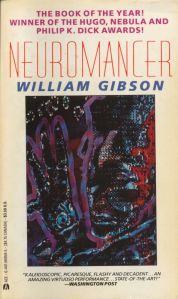
If Blade Runner established the look, Neuromancer defined cyberpunk’s voice. William Gibson’s debut novel was ahead of the curve by acknowledging the personal computer as a disruptive force when the Cold War was at its most threatening. “Lowlife and high tech” meant the Magnetic Dog Sisters headlining some creep joint across the street from a capsule hotel where console cowboys rip off zaibatsus with their Ono Sendai Cyberdeck. But Gibson’s view of the future would be incomplete without an absolute distrust of Reaganism:

“If I were to put together a truly essential thank-you list for the people who most made it possible for me to write my first six novels, I’d have to owe as much to Ronald Reagan as to Bill Gates or Lou Reed. Reagan’s presidency put the grit in my dystopia. His presidency was the fresh kitty litter I spread for utterly crucial traction on the icey driveway of uncharted futurity. His smile was the nightmare in my back pocket.” — William Gibson

“Fragments of a Hologram Rose” to Mona Lisa Overdrive is a decade of creative labor that was “tired of America-as-the-future, the world as a white monoculture.” The Sprawl is a cyberpunk trilogy where military superpowers failed and technology gave Japan leadership of the global village. Then Gibson wrote Virtual Light and readers witnessed extreme inequality shove the middle class into the gig economy as corporations schemed to profit off natural disasters with proprietary technology.

Gibson knew the sci-fi he didn’t care for would absorb cyberpunk and tame its “dissident influence”, so the genre could remain unchanged. “Punk” is the go-to suffix for emerging subgenres that want to appear subversive while posing a threat to nothing and no one. It’s how “hopepunk” becomes a thing. But to appreciate cyberpunk’s assimilation, look at how it’s presented sincerely.

CD Projekt Red (CDPR), known for the Witcher game series, has spent six years developing what’s arguably the most anticipated video game of the moment, Cyberpunk 2077. Like Gibson, Mike Pondsmith, creator the original “pen-n-paper” RPG, and collaborator on this adaptation of his work, has had his writing absorbed by mainstream sci-fi. CDPR could survive on that 31-year legacy, but they insist they’re taking their time with Cyberpunk 2077 to craft an experience with a distinct political identity that somehow allows players to remain apolitical. In a way this is reflective of CDPR’s reputation as a quality-driven business that’s pro-consumer, but has driven talent away by demanding they work excessive hours and promoting a hostile attitude towards unions. This crunch culture is a problem across the industry.

We’ll soon see how Cyberpunk 2077 developed. What we can infer from its design choices, like giving protagonist V a high-collar jacket seen on the cover of the 2nd edition game book from 1990, is that Cybperpunk 2077 will be familiar. Altered Carbon and Ready Player One share this problem. Altered Carbon is so derivative of first-wave cyberpunk it’s easy to forget its based on a novel from 2002. Ready Player One at least has the courtesy to be shameless in its love of pop culture, proud to proclaim that nothing is more celebrated today than our participation in media franchises without ever considering how that might be a problem.

What’s being suggested, intentionally or not, is that contemporary reality has avoided the machinations of the powerful at a time when technology is wondrous, amusing, and prolific. If only we were so lucky.

238 cities spent more than a year lobbying Amazon, one of two $1 trillion corporations in existence, for privilege of hosting their new office. In November it was announced that Amazon would expand to Crystal City, Virginia and Long Island City, Queens. Plenty of New Yorkers are incensedthat the world’s largest online marketplace will get $3 billion in subsidies, tax breaks, and grants to further disrupt a housing market that takes more from them than any city should allow. Some Amazon employees were so excited to relocate they made down payments on their new homes before the decision went public, telling real estate developers to get this corner of New York readyfor a few thousand transplants. But what of the people already there?

Long Island City is home to the Queensbridge Houses, the largest housing project in the US. Built in 1939, these two buildings are home to more then 6,000 people with an average income of $16,000. That’s far below the $54,000 for Queens residents overall. But neither group is anywhere near the average salary for the 25,000 employees Amazon will bring with them, which will exceed $150,000. How many of those positions will be filled by locals? How many will come from Queensbridge?

Over 800 languages are spoken in Queens, making it the most linguistically diverse place in the world. Those diverse speakers spend over 30% of their income on rent. They risk being priced out of their neighborhoods. Some will be forced out of the city. Has Governor Cuomo considered the threat this deal poses to people’s homes? Has Mayor de Blasio prepared for the inevitable drift to other boroughs once property values spike? Looking at Seattle and San Francisco, there’s no reason to expect local governments to be proactive. So New Yorkers have taken up the fight on their own.

Amazon boss Jeff Bezos toyed with these politicians. He floated the idea that any city could become the next Silicon Valley and they believed him. They begged for his recognition, handed over citizen data, and took part in the $100 billion ritual of subsidizing tech companies.

It was all for nothing. Crystal City is a 20-minute drive from Bezos’ house in Washington DC, where Amazon continues to increase its spending on lobbyists. That’ll seem like a long commute compared to the helicopter ride from Long Island City, the helipad for which is subsidized by the city, to Manhattan, the financial and advertising capital of the world, where Bezos owns four more houses.

The auction for Bezos’ favor was a farce. New York and Virginia give him regular access to people with decision-making power, invaluable data, and institutions that are are sure to expand his empire. These cities were always the only serious options.

Amazon’s plans read like the start of a corporate republic, a cyberpunk trope inspired by company towns. Employers were landlords, retailers, and even moral authorities to workforces too in debt to quit. Many had law enforcement and militias to call on in addition to the private security companies they hired to break labor strikes, investigate attempts at unionization, and maintain a sense of order that resulted in massacres like Ludlow, Colorado.

Amazon is known for labor abuses, monitoring, and tracking speed and efficiency in warehouses without bathroom breaks, where employees have collapsed from heat exhaustion. They sell unregulated facial recognition services to police departments, knowing it misidentifies subjects because of inherent design bias. Companies with a history of privacy abuses have unfettered access to their security devices. They control about half of all e-commerce in the US and, as Gizmodo’s Kashmir Hill found out, it is impossible to live our lives without encountering Amazon Web Services.

It doesn’t take a creative mind to imagine similar exposition being attributed to corporate villains like Cayman Global or Tai Yong Medical.

Rewarding corporations for their bad behavior is just one way the world resembles a fictive dystopia. We also have to face rapid ecological and institutional decay that fractionally adjusts our confidence in stability, feeding a persistent situational anxiety. That should make for broader and bolder conversations about the future, and a few artists have managed to do that.

Keiichi Matsuda is the designer and director behind Hyper-Reality, a short film that portrays augmented reality as a fever dream that influences consumption, and shows how freeing and frightening it is to be cut off from that network. Matsuda’s short film got him an invitation to the World Economic Forum in Davos to “speak truth to power.” What Matsuda witnessed were executives and billionaires pledging responsibility with t-shirts and sustainability, while simultaneously destroying the environment, as an audience of their peers and the press nodded and applauded “this brazen hypocrisy.” So Matsuda took a stanchion to his own installation.

Independence means Matsuda gets to decide how to talk about technology and capitalism, and how to separate his art and business. It also means smaller audiences and fewer productions.

Sam Esmail used a more visible platform to “bring cyberpunk to TV” with Mr. Robot. Like Gibson’s Pattern Recognition, it’s cyberpunk retooled for the present — post-cyberpunk. Esmail never hesitates to place our villains in Mr. Robot. Enron is an influence on logo designs and tactics of evil corps. Google, Verizon, and Facebook are called out for their complicity with the federal government in exposing customer data. AT&T’s Long Lines building, an NSA listening post since the 1970s, plays the role of a corporate data hub that reaches across the county. Even filming locations serve as commentary.

An anti-capitalist slant runs through Mr. Robot, exposing the American dream as a lie and our concept of meritocracy as a tool to protect the oligarchy, presenting hackers as in direct contact with a world of self-isolation and exploitation, those who dare to hope for a future affected by people rather than commerce. And Esmail somehow manages this without interference from NBC.

Blade Runner will get more life as an animeCowboy Bebop is joining Battle Angel Alita in live action. Altered Carbon is in the process of slipping into a new sleeve. There’s no shortage of revivals, remakes, and rehashing of cyberpunk’s past on the way. They’ll get bigger audiences than a short film about submitting to algorithms. More sites will discuss their pros and cons than a mobile tie-in that name-drops Peter Kropotkin and Maria Nikiforova. But in being descriptive and prescriptive, moving to the future and looking for sure footing in the accelerated present, Matsuda’s and Esmail’s work reminds us that cyberpunk needs to be more than just repeating what’s already been said about yuppies, Billy Idol, and the Apple IIc.

We live at a time where 3D printing is so accessible refugees can obtain prosthesis as part of basic aid. People forced to migrate because of an iceless arctic will rely on that assistance. Or we could lower temperatures and slow climate change by spraying the atmosphere with sulfate, an option that might disrupt advertising in low-orbit. Social credit systems are bringing oppressive governments together. Going cashless is altering our expectations of others. Young people earn so little they’re leveraging nude selfies to extend meager lines of credit. Productivity and constant notifications are enough to drive some into a locked room, away from anything with an internet connection. Deepfakes deny women privacy, compromise their identity, and obliterate any sense of safety in exchange for porn. Online communities are refining that same technology, making false video convincing, threatening our sense of reality. Researchers can keep our memories alive in chat bots distilled from social media, but the rich will outlive us all by transfusing bags of teenage blood purchased through PayPal.

In a world that increasingly feels like science fiction it’s important to remind ourselves that writing about the future is writing about the present. Artists worthy of an audience should be unable to look at the embarrassment of inspiration around them and refuse the chance to say something new.

Jacques Ellul: A Prophet for Our Tech-Saturated Times

Read his works to understand how we’ve been caught in technology’s nightmarish hold.

By Andrew Nikiforuk

Source: The Tyee

By now you have probably read about the so-called “tech backlash.”

Facebook and other social media have undermined what’s left of the illusion of democracy, while smartphones damage young brains and erode the nature of discourse in the family.

Meanwhile computers and other gadgets have diminished our attention spans along with our ever-failing connection to reality.

The Foundation for Responsible Robotics recently created a small stir by asking if “sexual intimacy with robots could lead to greater social isolation.”

What could possibly go wrong?

The average teenager now works about two hours of every day — for free — providing Facebook and other social media companies with all the data they need to engineer young people’s behaviour for bigger Internet profits.

Without shame, technical wonks now talk of building artificial scientists to resolve climate change, poverty and, yes, even fake news.

The media backlash against Silicon Valley and its peevish moguls, however, typically ends with nothing more radical than an earnest call for regulation or a break-up of Internet monopolies such as Facebook and Google.

The problem, however, is much graver, and it is telling that most of the backlash stories invariably omit any mention of technology’s greatest critic, Jacques Ellul.

The ascent of technology

Ellul, the Karl Marx of the 20th century, predicted the chaotic tyranny many of us now pretend is the good and determined life in technological society.

He wrote of technique, about which he meant more than just technology, machines and digital gadgets but rather “the totality of methods rationally arrived at and having absolute efficiency” in the economic, social and political affairs of civilization.

For Ellul, technique, an ensemble of machine-based means, included administrative systems, medical tools, propaganda (just another communication technique) and genetic engineering.

The list is endless because technique, or what most of us would just call technology, has become the artificial blood of modern civilization.

“Technique has taken substance,” wrote Ellul, and “it has become a reality in itself. It is no longer merely a means and an intermediary. It is an object in itself, an independent reality with which we must reckon.”

Just as Marx deftly outlined how capitalism threw up new social classes, political institutions and economic powers in the 19th century, Ellul charted the ascent of technology and its impact on politics, society and economics in the 20th.

My copy of Ellul’s The Technological Society has yellowed with age, but it remains one of the most important books I own. Why?

Because it explains the nightmarish hold technology has on every aspect of life, and also remains a guide to the perplexing determinism that technology imposes on life.

Until the 18th century, technical progress occurred slowly and with restraint. But with the Industrial Revolution it morphed into something overwhelming due in part to population, cheap energy sources and capitalism itself.

Since then it has engulfed Western civilization and become the globe’s greatest colonizing force.

“Technique encompasses the totality of present-day society,” wrote Ellul. “Man is caught like a fly in a bottle. His attempts at culture, freedom, and creative endeavour have become mere entries in technique’s filing cabinet.”

Ellul, a brilliant historian, wrote like a physician caught in the middle of a plague or physicist exposed to radioactivity. He parsed the dynamics of technology with a cold lucidity.

Yet you’ve probably never heard of the French legal scholar and sociologist despite all the recent media about the corrosive influence of Silicon Valley.

His relative obscurity has many roots. He didn’t hail from Paris, but rural Bordeaux. He didn’t come from French blue blood; he was a “meteque.”

He didn’t travel much, criticized politics of every stripe and was a radical Christian.

But in 1954, just a year before American scientists started working on artificial intelligence, Ellul wrote his monumental book, The Technological Society.

The dense and discursive work lays out in 500 pages how technique became for civilization what British colonialism was for parts of 19th-century Africa: a force of total domination.

In the book Ellul explains in bold and uncompromising terms how the logic of technological innovation conquered every aspect of human culture.

Ellul didn’t regard technology as inherently evil; he just recognized that it was a self-augmenting force that engineered the world on its terms.

Machines, whether mechanical or digital, aren’t interested in truth, beauty or justice. Their goal is to make the world a more efficient place for more machines.

Their proliferation combined with our growing dependence on their services inevitably led to an erosion of human freedom and unintended consequences in every sphere of life.

Ellul was one of the first to note that you couldn’t distinguish between bad and good effects of technology. There were just effects and all technologies were disruptive.

In other words, it doesn’t matter if a drone is delivering a bomb or book or merely spying on the neighbourhood, because technique operates outside of human morality: “Technique tolerates no judgment from without and accepts no limitations.”

Facebook’s mantra “move fast and break things” epitomizes the technological mindset.

But some former Facebook executives such as Chamath Palihapitiya belatedly realized they have engineered a force beyond their control. (“The short-term dopamine-driven feedback loops that we have created are destroying how society works,” Palihapitiya has said.)

That, argued Ellul, is what technology does. It disrupts and then disrupts again with unforeseen consequences, requiring more techniques to solve the problems created by latest innovations.

As Ellul noted back in 1954, “History shows that every technical application from its beginnings presents certain unforeseeable secondary effects which are more disastrous than the lack of the technique would have been.”

Ellul also defined the key characteristics of technology.

For starters, the world of technique imposes a rational and mechanical order on all things. It embraces artificiality and seeks to replace all natural systems with engineered ones.

In a technological society a dam performs better than a running river, a car takes the place of the pedestrians — and may even kill them — and a fish farm offers more “efficiencies” than a natural wild salmon migration.

There is more. Technique automatically reduces actions to the “one best way.” Technical progress is also self-augmenting: it is irreversible and builds with a geometric progression.

(Just count the number of gadgets telling you what to do or where to go or even what music to play.)

Technology is indivisible and universal because everywhere it goes it shows the same deterministic face with the same consequences. And it is autonomous.

By autonomous, Ellul meant that technology had become a determining force that “elicits and conditions social, political and economic change.”

The role of propaganda

The French critic was the first to note that technologies build upon each other and therefore centralize power and control.

New techniques for teaching, selling things or organizing political parties also required propaganda.

Here again Ellul saw the future.

He argued that propaganda had to become as natural as breathing air in a technological society, because it was essential that people adapt to the disruptions of a technological society.

“The passions it provokes — which exist in everybody — are amplified. The suppression of the critical faculty — man’s growing incapacity to distinguish truth from falsehood, the individual from the collectivity, action from talk, reality from statistics, and so on — is one of the most evident results of the technical power of propaganda.”

Faking the news may have been a common practice on Soviet radio during Ellul’s day, but it is now a global phenomenon leading us towards what Ellul called “a sham universe.”

We now know that algorithms control every aspect of digital life and have subjected almost aspect of human behaviour to greater control by techniques whether employed by the state or the marketplace.

But in 1954 Ellul saw the beast emerging in infant form.

Technology, he wrote, can’t put up with human values and “must necessarily don mathematical vestments. Everything in human life that does not lend itself to mathematical treatment must be excluded… Who is too blind to not see that a profound mutation is being advocated here.”

He, too, warned about the promise of leisure provided by the mechanization and automatization of work.

“Instead of being a vacuum representing a break with society,” our leisure time will be “literally stuffed with technical mechanisms of compensation and integration.”

Good citizens today now leave their screens at work only to be guided by robots in their cars that tell them the most efficient route to drive home.

At home another battery of screens awaits to deliver entertainments and distractions, including apps that might deliver a pizza to the door.

Stalin and Mao would be impressed — or perhaps disappointed — that so much social control could be exercised with such sophistication and so little bloodletting.

Ellul wasn’t just worried about the impact of a single gadget such as the television or the phone but “the phenomenon of technical convergence.”

He feared the impact of systems or complexes of techniques on human society and warned the result could only be “an operational totalitarianism.”

“Convergence,” he wrote, “is a completely spontaneous phenomenon, representing a normal stage in the evolution of technique.”

Social media, a web of behavioural and psychological systems, is just the latest example of convergence.

Here psychological techniques, surveillance techniques and propaganda have all merged to give the Russians and many other groups a golden opportunity to intervene in the political lives of 126 million North Americans.

Social media has achieved something novel, according to former Facebook engineer Sam Lessin.

For the first time ever a political candidate or party can “effectively talk to each individual voter privately in their own home and tell them exactly what they want to hear… in a way that can’t be tracked or audited.”

In China the authorities have gone one step further. Using the Internet the government can now track the movements of every citizen and rank their political trustworthiness based on their history of purchases and associations. It is, of course, a fantastic “counterterrorism” tool.

The Silicon Valley moguls and the digerati promised something less totalitarian. They swore that social media would help citizens fight bad governments and would connect all of us.

Facebook, vowed the pathologically adolescent Mark Zuckerberg, would help the Internet become “a force for peace in the world.”

But technology obeys its own rules and prefers “the psychology of tyranny.”

The digerati also promised that digital technologies would usher in a new era of decentralization and undo what mechanical technologies have already done: centralize everything into big companies, big boxes and big government.

Technology assuredly fragments human communities, but in the world of technique centralization remains the norm.

“The idea of effecting decentralization while maintaining technical progress is purely utopian,” wrote Ellul.

Towards ‘hypernormalization’

It is worth noting that the word “normal” didn’t come into currency until the 1940s along with technological society.

In many respects global society resembles the Soviet Union just prior to its collapse when “hypernormalization” ruled the day.

A recent documentary defined what hypernormalization did for Russia: it “became a society where everyone knew that what their leaders said was not real, because they could see with their own eyes that the economy was falling apart. But everybody had to play along and pretend that it was real because no one could imagine any alternative.”

In many respects technology has hypernormalized a technological society in which citizens exercise less and less control over their lives every day and can’t imagine anything different.

Throughout his life Ellul maintained that he was “neither by nature, nor doctrinally, a pessimist, nor have I pessimistic prejudices. I am concerned only with knowing whether things are so or not.”

He called a spade a spade, and did not sugarcoat his observations.

If you are growing more anxious about our hypernormalized existence and are wondering why you own a phone that tracks your every movement, then read The Technological Society.

Ellul believed that the first act of freedom a citizen can exercise is to recognize the necessity of understanding technique and its colonizing powers.

Resistance, which is never futile, can only begin by becoming aware and bearing witness to the totalitarian nature of technological society.

Ellul believed that Christians had a special duty to condemn the worship of technology, which has become society’s new religion.

To Ellul, resistance meant teaching people how to be conscious amphibians, with one foot in traditional human societies, and to purposefully choose which technologies to bring into their communities.

Only citizens who remain connected to traditional human societies can see, hear and understand the disquiet of the smartphone blitzkrieg or the Internet circus.

Children raised by screens and vaccinated only by technology will not have the capacity to resist, let alone understand, this world any more than someone born in space could appreciate what it means to walk in a forest.

Ellul warned that if each of us abdicates our human responsibilities and leads a trivial existence in a technological society, then we will betray freedom.

And what is freedom but the ability to overcome and transcend the dictates of necessity?

In 1954, Ellul appealed to all sleepers to awake.

Read him. He remains the most revolutionary, prophetic and dangerous voice of this or any century.

Two New Reports Point to Further US Decline & Higher Risk of War

By James ONeill

Source: New Eastern Outlook

Two recent reports from the United States strongly suggest the United States is planning a major war with Russia and China, but are far from certain that they could in fact succeed in such a war. The reports also provide insights into how the United States will meet the budgetary demands of such war preparations, but almost zero appreciation of the social and human costs of such policies.

The first of these reports is entitled “Providing for the Common Defence” (November 2018). It is the report prepared for the purpose of assessing the National Defence Strategy document released in early 2018.

It acknowledges that changes “at home and abroad are diminishing US military advantages,” and that this diminution of these “advantages” poses a threat to “vital United States interests.”

Geopolitical shifts in the regional power structures are “undermining deterrence of United States adversaries and confidence of United States allies, thus increasing the likelihood of military conflict”. Should such a conflict eventuate, the United States could “suffer unacceptably high casualties and a loss of major capital assets.”

The report says that “America is losing its advantage in key war fighting areas such as air and missile defence, cyber and space operations, anti-surface and anti- submarine warfare, long range ground-based fires, and electronic warfare”.

It further acknowledges that “America’s edge is diminishing or has disappeared in many key technologies that underpin US military superiority”.

Such frankness is not without precedent in US strategy papers and the implications of the above quotations are a probable reason why the report has received almost zero coverage in the western mainstream media.

Acknowledgements of technological deficiency and strategic disadvantage do not sit comfortably with the image of an all-powerful America willing and able to defeat any threat to its own global interests or those of its allies. The latter prefer the comfortable delusion of an omnipotent US “umbrella.”

The Commission’s strategy for addressing this perceived falling behind and consequent loss of military omnipotence is however itself fatally flawed. The proposed “solution” is to spend vastly greater sums of money at a rate of 3-5% above inflation.

That means that a significantly greater share of the federal budget would have to be devoted to military spending. The only way that could be achieved, given that the United States government already has a huge growing deficit ($22 trillion and counting) would have to come, the report acknowledges, by cuts to social spending such as pensions, Medicare and social security. The “trade-offs” the report acknowledges will be “difficult”, a statement that seriously under- estimates the social devastation that such cuts would bring about.

This argument is put forward in a society which already spends more on defence than that spent by the next eight national military budgets combined. United States national infrastructure, in everything from bridges to schools is already crumbling; and these proposals will only accelerate that downward trend.

It does not seem to occur to the report writers that the entire premise that the United States should maintain its attempt to control the world for the benefit of the United States is neither desirable nor wanted by the vast majority of the worlds nations as evidenced by multiple UN General Assembly resolutions.

The second report is issued by the United States Government Accountability Office (GAO) and is entitled: National Security: Long Range Emerging Threats Facing the United States as Identified by Federal Agencies (December 2018.) It has received even less publicity then the ‘Providing for the Common Defence’ document.

The probable reason for this mainstream media reticence is because the GAO report actually details where the United States is lagging in military capability viz a viz its two perceived principal rivals: Russia and China.

The fact of relative military weakness is not new. Andrei Martyanov in his book Losing Military Supremacy (2018) provided a detailed analysis of why Russian military technology was superior to the United States in several important fields. What Martyanov said about Russia applies with equal validity to Chinese technology.

Martyanov’s argument was dramatically illustrated by President Putin’s 1st March 2018 address to the Russian Parliament. The initial American reaction was to discount Putin’s claims, although within days the military industrial complex was demanding more funds to counteract the superiority of Russian weaponry outlined in Putin’s speech.

The GAO Report now provides an authoritative acknowledgement that Putin was not bluffing. Under the section of the report headed “Weapons” it has this to say:

Hypersonic weapons. China and Russia are pursuing hypersonic weapons because their speed, altitude, and maneuverability may defeat most missile defence systems, and they may be used to improve long range conventional and nuclear strike capabilities. There are no existing countermeasures.

Missiles. Adversaries are developing missile technology to attack the United States in novel ways and challenge US missile defence, including conventional and nuclear ICBMs, sea launched land attack missiles, and space based missiles that could orbit the earth.

Aircraft. China and Russia are developing new aircraft, including stealth aircraft, which could fly faster, carry advanced weapons, and achieve greater ranges. Such aircraft could force US aircraft to operate at further distances and put more US targets at risk.

There is more in the same vein. The only caveat to add to those points is the use of the conditional tense. The use of such words as “may” or “could” is redundant. That technology is already operational (www.thesaker.is 1 March 2018).

A number of commentators have argued that the technology gap between Russian and Chinese systems and that of United States is now measured in decades. There is no evidence to suggest this gap could be bridged in the foreseeable future. A more likely scenario is that the technological gap could widen.

Although there are powerful voices in the United States administration and ‘deep state’ generally sufficiently delusional and frankly crazy enough to believe that the United States could “win” a nuclear war with Russia and/or China, the GAO report should act as a constraint on their wilder ambitions.

History demonstrates that it is unwise to underestimate the extent to which the United States will go to maintain its self appointed role is the world’s dominant hegemon, (see Michael Pembroke’s Korea (2018). The reality is that the era of United States dominance is now well past.

Rather than risk a nuclear war that would wreak unimaginable losses upon all the world’s peoples, including for the first time the United States, the more likely scenario will be an intensification of what Andrei Korybko calls ‘hybrid warfare.’ A current illustration of this is the campaign being waged against Huawei, ostensibly because of the potential for Chinese cyber espionage but in reality to weaken and undermine China’s 2025 program for leadership in artificial intelligence, quantum information and other sophisticated technologies, and enforce America’s allies to buy their inferior products.

Proxy wars in the Middle East, Africa, Asia and Latin America are also likely to increase exponentially.

These two reports demonstrate that the United States has lost its previous technological and military superiority, but equally, that it is willing to go to extraordinary lengths to prevent any further erosion of its world wide role and its replacement by the two emerging countervailing superpowers, Russia and China. Whether or not that American determination will tip the world into a catastrophic nuclear exchange will be one of the major questions for 2019.

Hyperreality (or What Not There Isn’t to Believe?)

By Kingsley L. Dennis

Source: Waking Times

‘The attraction of the void is irresistible.’ ~Jean Baudrillard

If you feel like you are unsure of what is real and what is unreal then you are not alone. Our materialistic mode of life is accelerating and expanding so rapidly that it is saturating our modern cultures to the point of abstraction. Life in materially-privileged societies is increasingly shifting into a world of image and show. Many people today are living within their bubbles that are customized by all the digital conveniences tailored to individual needs. By being surrounded by conveniences that satisfy all our needs we are deliberately excluding so much else, including all of life’s serendipities.

Reality – whatever that is or was – has retreated behind a spectacle of make-believe that is playing at being the new, shimmering façade for the 21st century. One result of this is that things which once stood in opposition to one another are losing their meaning and becoming indistinguishable. That is, fixed identities that used to make life easy for us – us/them, friend/enemy, good/bad, and the rest – are now more like false realities. Life has shifted, or has been pushed, into a realm of invention that is being exploited ever more overtly by politicians, mainstream media, and their propaganda machinery. Out of this, a different sense of reality has emerged that succeeds in absorbing differences and contradictions and making them seem smooth rather than jagged. And the result is what I refer to as hyperreality.

The Hyperreality Pill

It is no longer the jagged pill we are forced to swallow, but the smooth pill we are willing to pop. And this smoothness is presented as succulent and easy to swallow. Our modern cultures want us to think that they are simple, smooth, and therefore require our willing obedience. As a consequence, many of us no longer know, or care in knowing, where the resistance is. And if we do feel the need to express resistance, we find ourselves at a loss of where it should be placed. The ‘smooth ideal’ is that society is managed so there can be no efficient resistance against it. This is what Herbert Marcuse once referred to as a ‘comfortable, smooth, reasonable, democratic unfreedom.’ The hyperreal evades any real contact. It is like being at the end of a phone call when waiting for the automated voice service. This evasive strategy of the hyperreal has succeeded in obscuring any site of resistance. It’s all so ‘real,’ and yet of course it is not.

The original notion of hyperreality (a term borrowed from semiotics and postmodern theory) is an inability of consciousness to distinguish reality from a simulation of reality, especially in technologically advanced societies. We are no longer faced with the threat of struggling with our shadows – we are now faced with the threat of our clones. This may be the radical illusion we are slipping into.

Yet the radical illusion of the world has been faced by all cultures. It has been described by mystics, symbolized by art, and struggled over by philosophers. The notion of illusion is not the main issue – rather, it is the medium through which it is conveyed. Or, more importantly, whether it is deliberately exaggerated and amplified. And how, by who – and why? Illusion is now perhaps our greatest industry, especially in western societies. Illusion is the consensus story we are told when growing up and which we all believe in. It’s the story that’s always been told because ‘that’s the way it’s always been.’ No wonder there is so much confusion, which is then fed by another great western industry – therapy.

Hyperreality plays a somewhat different game, with new rules and a different deck of cards. The paradox today is that those of us caught up in the game have no idea what the gameplay is. This is similar to a Jorge Luis Borges short story ‘The Lottery in Babylon’ where all activities in life are governed by the lottery; that is, by chance. And the lottery is run by ‘The Company,’ the rules of which not only are the rules of the game but become the rules of life. If that’s not confusing enough, then we need another hyperreality pill.

Please Sir, Can I Have Some More Hyperreality?

Hyperreality – the inability to distinguish the real from simulation – has become our new reality structure (perception set) and is constructed so that everyone believes in it and goes along with it. There is an underlying feeling that something is not quite right, yet our sense of reality often appears so extreme that it becomes ‘extra-plausible.’ It appears that strange walls of falsehood are being erected between the individual and what is real. The result is a distortion of how we see things. In other words, a perception distortion. To put it simply, hyperreality can be described as the normalization of delusion. When mass society adheres to a collective delusion we call it normal, or ‘reality,’ and if one person strays too far from this consensus thinking then we often label them as delusional, or unstable. It is as if we have been struck by on-coming car headlights and we are like dazed rabbits in the middle of the road. Better not sit around too long wagging our fluffy tails!

The hyperreal smoothes and soothes all contradictions. When once we thought we had ‘left’ politics and ‘right’ politics, these distinctions are now nullified. There is no more any ‘left’ or ‘right,’ only agendas that use varying means to acquire the same power. Any basis of truth has slipped into the sleek substitution – the simulation. Let me ask a question: Do we really think that the face of politics, for example, represents any vestige of truth? There is no more truth in politics than there is in someone wearing a laboratory coat in a television commercial trying to persuade us to buy a particular brand of detergent. There is persuasion and falsity that parades as an element of truth, yet it is a pure simulation. We have slipped into an age where the new ‘reality principle’ tells us that nothing is out of reach and that almost everything can be bought for a price. That is, the real is solid and exists as the flow of goods, services, desires, wants, pleasures, and an almost instant availability.

The question now is how far can the world go before yielding to a permanent state of hyperreality? Perhaps we are already in this state right now; after all, the hyperreal is contagious, like a chain reaction. In the hyperreal world the space of communications is condensed into the simultaneous now; marginal spaces on the periphery are now the hidden spaces where secrecy flows in offshore networks. Our networks of mobility and movement are fragmented into those that privilege some and exclude the many. Even the space above our heads is colonized by the satellites that spy on us. We have street views being watched and analyzed by Google. Our movement, speech, and text being spied on, processed, and interpreted by intelligent algorithms. We have injected a ‘smart-virus’ into the Earth in order to monitor all activity.

Our smooth digital flows allow – with precision and efficiency – for many aspects of our national and private economies to be shifted to the periphery where the secret networks operate. Only the hyperreal economies remain in the spotlight. There is now a global offshore world that moves in exclusive, mostly secretive networks. The phenomenon of offshoring has transformed peripheral and marginal places into central nodes. Offshored economies had mostly operated in the unseen shadows until the scandal of the Panama Papers in 2015. This massive leaking of documents led to political and celebrity scandals across the world, forcing many politicians to resign from their coveted positions. Presidents are now further pressed to release their tax returns to prove their legitimacy. Yet with the farce within the hyperreal, such players as US President Donald Trump can evade these processes with blatant deceptions. Offshored secrecy and surveillance are central to the functioning of contemporary societies.

Hyperreality is also about disappearance.

Please Sir, Can You Tell Me Where I Can Find Some Hyperreality?

Hyperreality is not only about speed and velocity; it is also about size – things are condensing into ever smaller spaces before disappearing altogether. Our urban habitats, information flows, financial transactions, have all shown increased density at the same time as velocity. Financial crashes today are more explosive because they affect so many more systems on a global level. They are dense in their complexity.

At the core of the condensed form what we once knew as the real begins to disappear. At the extremity of economics, the value of money disappears. At the extremity of warfare there is no real humanity, only insanity and immense sorrow, loss, and pain. At the extremity of sexuality there is no warmth only the pornography of lust and the commodity of desire. At the extremity of goodness there is the greed to do good. And even at the extremity of love there is no real love, but obsession and possession. Within these extremities we lose touch with anything that once came close to the real. We are in the slipstream of the hyperreal where the substitute replaces its former host. And the substitute is ‘always-on’ 24/7.

An ‘always-on’ hyperreal world also creates the illusion of mobility. Precisely because we can be connected throughout the world by the technologies in our pocket we are no longer required to move. We can be in the office while speaking with colleagues across the globe; or chatting with friends on another continent whilst remaining seated on our sofas. The contradiction here is that hypermobility creates its own sedentary life. This was explored in the sci-fi film Surrogates (2009) where people purchase remote-controlled humanoid robots to conduct their social life and affairs whilst the real person remains at home wired to their chair. Of course, everyone chooses a pretty or handsome humanoid to represent them (just like avatars in the online world) whilst their real bodies lie fat and underused in the unmoving chair.

We have yet little cultural experience to protect us from the invasion of simulation, artificiality, and the hyperreal. It has all happened too quickly for us and our senses have not fully adjusted. Some of us are struggling with aching bodies, restless sleep cycles, and tired eyes from all the screens in our lives. It is not motion sickness we are suffering from more and more but monitor sickness. One of the features of hyperreality is that communication occurs extremely rapidly, and we are bombarded with information almost constantly.

The hyperreal brings to the fore a convincing collection of disastrous non-events. Everything that is happening somehow gets reported, transmitted, and commented upon, creating an explosive babble of micro-impacts that dominate our superficial conversations. Then the next day they have disappeared into a black hole of amnesia and replaced by another twenty-four-hour dose of attention-topics. This hyperreal lifestyle creates a background noise; a seemingly endless low static buzz that infests our everyday spaces. It’s like the static we experience when changing radio channels, or when a digital television channel isn’t yet synchronized.

Many of us are living in a high-velocity, always-connected, post-historic world. For those people who are not yet attuned to this it is highly unpleasant. Things seemingly take place, but we are not quite sure. This is the dilemma. The hyperreal takes the wounded soul and Photoshops it into a caricature of its former self. It becomes glorified and falsely beautified into the less real, but with hyper-appeal. Events and issues are glossed over, making truths little more than quick sound-bites that flash before our eyes. Despite these absurdities we are still living in a world that is physically very real.

The Hyperreal in Overreaction and Overload

We ultra-react because we are continually under bombardment by a stream of information that keeps us in overload. We wish to know as much as possible about what is going on in our environment because this used to be an evolutionary survival strategy for our ancestors. Yet our distant ancestors didn’t have the Internet, smartphones, and a whole array of connected gadgets – they had clubs and hatchets. We’ve changed our rhythms, or rather our new technologically-pervasive environment has altered our rhythms, and we’ve not had sufficient time biologically, as well as psychologically, to adjust. We are waking up to a world in a new rhythm, with a new, faster speed and an altered resonance; and frankly for most of us it makes us feel as if we’re partially inebriated. The world is making our children respond to its hyperreal energy, and then subsequently we go about tranquilizing them. The rise of young schoolchildren in the modern world taking medications for ADHD (attention deficit hyperactivity disorder) is phenomenal. In such a world it becomes much harder to practice and maintain certain types of attention, such as contemplative, reflective, and introspective thought. We are accessing information, yet less so are we translating this information into rich, interior states or memories.

It is as if we are afraid to be bored. We may feel that being bored – or being boring – is a failure; that we have failed to make use of all the information and opportunities at our fingertips. Yet the brain is continually working hard to process all information and external impacts, and so we need to take time off to relax, recharge, and replenish. We need to retain our attentiveness instead of giving in to the lazy approach of digitally-offloading our attention. We cannot navigate our own path through life by GPS. At the same time, retaining attention should not require artificial, chemical inducers. Nor should it require copious amounts of fantasy masquerading as the real. Many highly developed cultures are already basking in the ‘Disneyfication’ effect where western commercial pursuits, practices, and values are promoted around the world as a panacea for all. Disneyfication gives us bigger, faster, and better entertainment that’s the same the world over – US mass culture values on the global stage. Disneyfication hides the ‘real’ places, yet paradoxically many people seem to prefer being in the imaginary. Perhaps its real function is to make us believe that the rest of society is imaginary and only that which resides within the walls of Disney is real. In the hyperreal the spectacle becomes the lived space of our social lives. Disney is colonizing our lives and that colonization becomes the new world map.

The Argentinean writer Jorge Luis Borges famously wrote of a great Empire that created a map that was so detailed it was as large as the Empire itself. The actual map grew and decayed as the Empire itself conquered or lost territory. When the Empire finally crumbled, all that remained was the map. This ‘imaginary map’ finally became the only remaining reality of the great Empire: a simulation of the once physical reality that has now been colonized by its own spectacle. This is where the Real loses its center and becomes origin-less.

The hyperreal too evades a sense of origin, which accounts for the rise in nostalgia, retro-revival, and people dressing up as superheroes. Star trek conventions, speaking Klingon, and entering a whole new universe meshes with the online worlds and their avatars. In the realm of the hyperreal the origin is origin-less, and real place is place-less. We are given new maps of celebration and celebrity that hide a commodity fetishism – yet where is the meaning? We crave for meaning.

The hyperreal incorporates everything within itself. There is no outer or inner within its realm. The only escape is a form of transcendence – a process or act of gnosis – that can see through the superficiality of the spectacle. This is the current dilemma – our systems are extending but not transcending themselves. Many of us are in this situation: we go for more of the same, only a little bit different. The answer lies in becoming beyond difference. Life has always been a sequence of events that we ascribe meaning too. When we experience this sequence in a reasonable enough form then we create our meanings. It is when this sequence of events and signs becomes asymmetrical, non-linear, or accelerated beyond our limits of standardized perception that we begin to lose our ability to ascribe significance to it. Hyperreality is the zone where this slippage occurs and meaning loses its anchorage. The result is that we feel we are being carried away from ourselves. We are being pulled into the flux and flow of this hyperreality and we lose sight of the ground. Not only the grounded-ness of place, but also our inner ground – that part of us which makes us feel human. It is the soulful part of us that we are losing.

In these hyperreal times we need to find a new balance and arrangement between things. Our old arrangements are shifting, and those things once in perceived stability and order are losing their moorings. We should remember that the ‘Real’ exists somewhere inside of us and keep this in mind as the world outside continues its head-long rush into a frenetic, whirlwind of chaotic events. In the end, we can only truly rely on our own good sense and intuition. As Václev Havel stated in one of his addresses, ‘Transcendence is the only real alternative to extinction.’

We must try to remain stable and as sane as possible as life accelerates into its own hyperreality. Otherwise we may not find our own center within the global maelstrom. The ride has only just begun.


About the Author

Kingsley L. Dennis is the author of The Phoenix Generation: A New Era of Connection, Compassion, and Consciousnessand The Sacred Revival: Magic, Mind & Meaning in a Technological Age, available at Amazon. Visit him on the web at http://www.kingsleydennis.com/.

References:

[1] Yates, Francis. The Rosicrucian Enlightenment. London: Routledge, 2001.

[2] Quoted in Noble, David F. The Religion of Technology: The Divinity of Man and the Spirit of Invention. London: Penguin, 1999, 134.

[3] Davis, Erik. Techgnosis: Myth, Magic and Mysticism in the Age of Information. New York: Three Rivers Press, 1998, 9.