“The Cost Of Sanity, In This Society, Is A Certain Level Of Alienation”

By Caitlin Johnstone

Source: CaitlinJohnstone.com

The late psychonaut/philosopher Terence McKenna once said “The cost of sanity, in this society, is a certain level of alienation,” and I think my regular readers will immediately and experientially understand exactly what he was talking about.

It’s not always easy to be on the outside of consensus reality. Our entire society, after all, has been built upon consensus–upon a shared agreement about what specific mouth sounds mean, on what money is and how it works, on how we should all behave toward each other in public spaces, and on what normal human behavior in general looks like.

We all share a learned agreement that we picked up from our culture in early childhood that it’s normal and acceptable to stand around with your hands in your pockets and babble about the weather to anyone who gets too close to you, for example, whereas it would be considered weird and disruptive to stand around slathered in Cheese Whiz shrieking the word “Poop!” But we could just as easily reverse that consensus on behavioral norms tomorrow, and as long as we all agreed to it we could do it without missing a beat.

In exactly the same way, there exists a general consensus about what’s going on in our world at the moment. There’s a general consensus that we live in the kind of society we were taught about in school: a free and democratic nation which maybe did some not so great things in the past, but is now a supremely virtuous beacon of light on this earth that kicked Hitler’s ass and then surfed into the present day on a wave of truth and sensible fiscal policy. There’s a general consensus that the news reporters on our screens paint us a more or less accurate picture of world affairs, that there are a lot of Bad Guys in our world with whom the Good Guys in our government are fighting, and that most of our nation’s problems are caused by the people in the other political party.

This consensus is grounded in delusion. It is insanity.

In reality, of course, we live in a world where our understanding of the world is constantly being deceitfully manipulated by oligarchic media propaganda and the utterances of oligarch-owned politicians. Where elections are mostly just a live action role-playing game which allows the rabble to pretend that they have some degree of influence over the things that their government does. Where our government routinely forms alliances with the worst Bad Guys on the planet while manufacturing consent to topple governments whose downfall would be utterly disastrous. Where our nation’s problems have almost nothing to do with half its population disagreeing with our personal ideology, and practically everything to do with the loose international alliance of plutocrats and government agencies who actually run things behind the facade of the comings and goings of official elected governments.

Sanity means seeing this as it is, rather than subscribing to the mass delusion of the consensus worldview. Which, as you probably already know, can make it difficult to relate to others in some ways. Conversations about politics often either get heated very rapidly when you challenge a tightly-held orthodoxy or dead-end in awkwardness. Friendships can end. Family relationships can be ruined. Collective narratives about you can be woven and circulated within your social circle which have nothing to do with how you actually see things.

And that’s just if you talk about your worldview. If you keep your views to yourself, as many do, that’s just another kind of alienation. It’s to stand outside of public political discourse completely, unable to participate out of fear of the backlash you’d receive from your friends, loved ones and acquaintances if you started talking about Trump as a symptom rather than the disease, or said that Corbyn is being targeted by a transparently bogus smear campaign, or said that Russia’s interventions in world affairs are clearly dwarfed by America’s by orders of magnitude. The specific heresies will vary depending upon the social circle, but the inability to voice them necessarily comes with the same sense of alienation.

But the alternative to that sense of alienation is to live a lie. It’s to climb back inside the distorted funhouse-mirror reality tunnel of the establishment narrative control matrix and plug yourself back into the same delusions that everyone else is living. Most of us couldn’t even do that if we wanted to. Even if we could the intense mental gymnastics we’d have to perform just to avoid the discomfort of cognitive dissonance would make it not worth the effort.

We close ourselves off from a full sense of participation in our society when we depart from the consensus worldview, but in closing that door we open so many more. Because, as it turns out, all that effort that people pour into staying on the same wavelength as everyone else closes them off to a vast spectrum of potential human experience. The allure of the mass delusion is that you need to devote yourself to being plugged into it in order to achieve what the mass delusion defines as “success”, but in so doing you lose the ability to leap down psychological and experiential rabbit holes of consciousness that those still jacked into the matrix can’t even imagine. And in so doing you open up the possibility for an immensely more fulfilling and enjoyable life that has really deeply explored the more intimate questions about what it means to be a human being on this planet.

Jiddu Krishnamurti once said, “It is no measure of health to be well-adjusted to a profoundly sick society.” And a profoundly sick society is indeed what we have here. The alienation which we experience is an alienation from something that isn’t worth belonging to anyway.

I began this essay with a quote from one of the celebrated thought leaders of the psychedelic movement, and I think the question of what we can do to cope with the alienation McKenna spoke of is best answered by ending with a quote from another such leader, Timothy Leary:

“Admit it. You aren’t like them. You’re not even close. You may occasionally dress yourself up as one of them, watch the same mindless television shows as they do, maybe even eat the same fast food sometimes. But it seems that the more you try to fit in, the more you feel like an outsider, watching the ‘normal people’ as they go about their automatic existences. For every time you say club passwords like ‘Have a nice day’ and ‘Weather’s awful today, eh?’, you yearn inside to say forbidden things like ‘Tell me something that makes you cry’ or ‘What do you think deja vu is for?’. Face it, you even want to talk to that girl in the elevator. But what if that girl in the elevator (and the balding man who walks past your cubicle at work) are thinking the same thing? Who knows what you might learn from taking a chance on conversation with a stranger? Everyone carries a piece of the puzzle. Nobody comes into your life by mere coincidence. Trust your instincts. Do the unexpected. Find the others.”

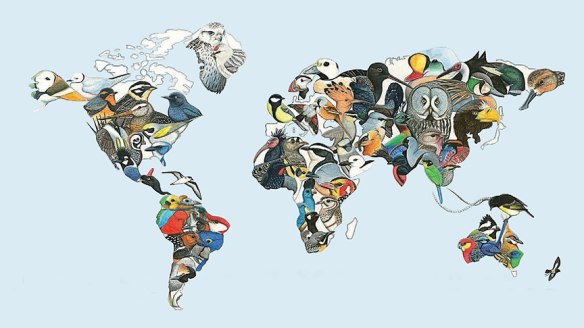
Our Vanishing World: Birds

Illustration by Luke Seitz

By Robert J. Burrowes

At the beginning of the nineteenth century, it is estimated that the total number of passenger pigeons in the United States was about three billion birds. The bird was immensely abundant, as illustrated by this passage written by the famous ornithologist, naturalist and painter John James Audubon:

‘I dismounted, seated myself on an eminence, and began to mark with my pencil, making a dot for every flock that passed. In a short time finding the task which I had undertaken impracticable, as the birds poured in countless multitudes, I rose, and counting the dots then put down, found that 163 had been made in twenty-one minutes. I traveled on, and still met more the farther I proceeded. The air was literally filled with Pigeons; the light of noon-day was obscured as by an eclipse, the dung fell in spots, not unlike melting flakes of snow; and the continued buzz of wings had a tendency to lull my senses to repose… Before sunset I reached Louisville, distance from Hardensburgh fifty-five miles. The Pigeons were still passing in undiminished numbers, and continued to do so for three days in succession.’ See ‘Passenger Pigeon’.

So numerous was this bird that, in the nineteenth century, the passenger pigeon was one of the most abundant birds on Earth.

In 1914 it was extinct.

While new settlements kept reducing the bird’s habitat, more importantly, it was literally hunted from the sky. Shot for its meat.

So I have two questions for you? When is the last time that you saw a flock of birds so vast that ‘the light of noon-day was obscured as by an eclipse’? And when did you last see a flock of just 20 birds?

Sobering to ponder, isn’t it?

The origin of birds

Birds evolved from small carnivorous dinosaurs of the Late Jurassic and in the 65 million years since the extinction of the rest of the dinosaurs, this ancestral lineage diversified into the major groups of birds alive today. See ‘The origin of birds’.

Because they did not exist during the first five mass extinction events on Earth, birds have been spared the widespread extinctions suffered by those species that did exist in earlier eras.

Extinctions of birds in prehistory and history

Nevertheless, the fossil record tells us of the existence of prehistoric birds that became extinct before the Late Quaternary (that is, the past half to one million years) and thus occurred in the absence of significant human interference – see ‘List of fossil bird genera’ – while various sources tell us of both prehistoric and historic bird species, including flightless megafauna birds, that became extinct between 40,000 BCE and 1500 AD and ‘was coincident with the expansion of Homo sapiens beyond Africa and Eurasia, and in most cases, anthropogenic factors played a crucial part in their extinction, be it through hunting, introduced predators or habitat alteration’. See ‘List of Late Quaternary prehistoric bird species’.

Of course, there is an even wider range of evidence of bird extinctions since 1500. See ‘List of recently extinct bird species’. Most notably perhaps, given the symbolism it has since acquired, the dodo, a flightless bird of Mauritius, was driven to extinction by 1681 but not before it was carefully drawn. See ‘Dodo’.

How many bird species are there on Earth now?

While one recent estimate – see ‘Scaling laws predict global microbial diversity’ – indicates that Earth may be the home to one trillion species (the vast bulk of which are microorganisms such as bacteria, archaea and microscopic fungi), of which only an estimated 8.7 million species fall into the usual and simpler categories of plants, birds, animals, fish, amphibians, insects and reptiles, the most recent research conducted by George F. Barrowclough, Joel Cracraft, John Klicka and Robert M. Zink and published in 2016 indicated that there are just 18,043 species of birds worldwide. See ‘How Many Kinds of Birds Are There and Why Does It Matter?’

Somewhat controversially – see ‘New Study Doubles the World’s Number of Bird Species By Redefining “Species”’ – this figure is nearly twice as many as previously thought because the study focused on ‘hidden’ avian diversity: birds that look similar to one another or were thought to interbreed but are actually different species. In any case, whether there are just 10,000 species of birds, 11,000+ as estimated by the recognized international authority BirdLife International – see ‘Introducing the IUCN Red List’ – or even18,000, just like other species of life on Earth, birds are now under siege in a way they have never been before.

Killing birds in the late twentieth and early twenty-first centuries

More than 100 years have passed since the passenger pigeon became extinct. However, while one might have hoped that humans had become more adept at nurturing populations of birds, the reality is that we are continuing to drive bird populations to extinction. Moreover, we are now doing this with breathtaking efficiency, slaughtering birds by the millions in ever-shortening timeframes.

As a result, the fate of the passenger pigeon has been replicated many times over with a vast number of bird species passing through the International Union for Conservation of Nature’s eight preliminary categories – Not Evaluated, Data Deficient, Least Concern, Near Threatened, Vulnerable, Endangered, Critically Endangered, Extinct in the Wild – before reaching the ninth and final category: Extinct. See ‘IUCN Red List Categories and Criteria’. At the moment, the ‘IUCN Red List of Threatened Species’ identifies 14% of remaining bird species as ‘threatened with extinction’. Also see ‘Introducing the IUCN Red List’.

Of course, this ongoing assault on birds is well documented in the scientific literature, along with descriptions of long-standing causes as well as those that are more recent.

In recently published research on the status of birds in North America, Dr. Kenneth V. Rosenberg led an international team of scientists from seven institutions in analyzing the population trends of 529 bird species on the North American continent. Their study quantified, for the first time, the total decline in bird populations in the continental U.S. and Canada: a loss of 2.9 billion breeding adult birds, with devastating losses among birds in every biome, since 1970. Moreover, their research revealed that ‘declines are not restricted to rare and threatened species – those once considered common and widespread are also diminished’. See ‘Decline of the North American avifauna’ and ‘Vanishing: More Than 1 in 4 Birds Has Disappeared in the Last 50 Years’.

Like scholars researching dramatic declines and extinctions of other species, such as insects, Rosenberg and his colleagues stress that their results have ‘major implications for ecosystem integrity, the conservation of wildlife more broadly, and policies associated with the protection of birds and native ecosystems on which they depend’. While species extinctions ‘have defined the global biodiversity crisis’, extinction ‘begins with loss in abundance of individuals that can result in compositional and functional changes of ecosystems’. Hence, the staggering loss of bird abundance ‘signals an urgent need to address threats to avert future avifaunal collapse and associated loss of ecosystem integrity, function, and services’. See ‘Decline of the North American avifauna’.

In more blunt language ‘the most comprehensive inventory ever done for North American birds, points to ecosystems in disarray because of habitat loss and other factors that have yet to be pinned down’. See ‘Billions of North American birds have vanished’. And, yet more bluntly: ‘The scale of loss portrayed in the [Rosenberg et.al.] study is unlike anything recorded in modern natural history.’ See ‘Vanishing: More Than 1 in 4 Birds Has Disappeared in the Last 50 Years’.

Even more importantly, however, pointing out that the study results ‘transcend the world of birds’, Rosenberg explained that ‘These bird losses are a strong signal that our human-altered landscapes are losing their ability to support birdlife’ and ‘that is an indicator of a coming collapse of the overall environment.’ See ‘Vanishing: More Than 1 in 4 Birds Has Disappeared in the Last 50 Years’.

Is North America alone in its decimation of bird populations? Far from it. Other research and data have revealed that ‘farmland birds in Europe have declined by over 50 per cent collectively in the last 30 or 40 years’ according to Professor Richard Gregory, head of species monitoring and research at the Royal Society for the Protection of Birds (RSPB) in the UK where, according to Martin Harper, director of conservation at the RSPB, ‘Our beleaguered farmland birds have declined by 56 per cent between 1970 and 2015 along with declines in other wildlife linked to changes in agricultural practices, including the use of pesticides’.

And, Professor Romain Julliard, a conservation biologist at France’s National Museum of Natural History, confessed his ‘shock’ when the latest research revealed that France has lost one-third of its birds in the past 15 years in what is being labeled a ‘dramatic collapse’ and ‘ecological catastrophe’ particularly because the decline has accelerated dramatically in recent years. See ‘“Shocking” decline in birds across Europe due to pesticide use, say scientists’.

In Germany, bird populations are vanishing with scientists using words like ‘decimated’ and ‘collapse’ to describe the enormity of the problem. In a recent study of government data, the German environmental organization Nature And Biodiversity Conservation Union (NABU) estimated ‘that more than 25 million birds [15% of the country’s total bird population] disappeared from Germany over the past 12 years’. See ‘Über zwölf Millionen Vogelbrutpaare weniger in Deutschland’, ‘Insect and bird populations declining dramatically in Germany’ and ‘“Decimated”: Germany’s birds disappear as insect abundance plummets 76%’. But why?

While habitat destruction and other factors played roles, scientists have also long linked pesticide use to insect decline – a reasonable assumption given that killing insects is the purpose of pesticides – and research clearly demonstrates that pesticides are killing more than target insects. For instance, a 2008 study demonstrated low but persistent levels of a common neonicotinoid pesticide in aquatic ecosystems can kill off or reduce the growth of insects (such as mosquitoes) that have an acquatic phase. See ‘Acute and Chronic Toxicity of Imidacloprid to the Aquatic Invertebrates Chironomus tentans and Hyalella azteca under Constant- and Pulse-Exposure Conditions’ and ‘“Decimated”: Germany’s birds disappear as insect abundance plummets 76%’.

In essence, the problem is that killing the insects is tantamount to killing the birds that feed on them.

Another recent study came to the same conclusion. The study, conducted in the Lake Constance area in southern Germany, found that the population of six of the most common birds had ‘declined massively’. According to Hans-Guenther Bauer of the Max Planck Institute for Behavioral Biology: ‘These are truly shocking figures, especially when you consider that the decline in birds began decades before our first data collection in 1980.’ Why is it happening? According to Bauer, a key reason for the decline is the loss of food. ‘This confirms what we have long suspected. The death of insects caused by humans has a massive impact on our birds.’ To stem the tide of losses, scientists are calling for a rethink in agricultural and forestry policy including ‘drastic restrictions on insecticides and herbicides in agriculture, forestry, public areas and private gardens’ and significantly less fertilization. See ‘Scientists fear “collapse” of bird populations in Germany’.

As is the case elsewhere around the world, birds in Africa also face a wide variety of threats, the most significant of which are habitat fragmentation, degradation and destruction as well as direct impacts including hunting and trapping (mainly for meat and trafficking). See ‘Multiple threats are driving threatened birds towards extinction in Africa’.

But nowhere is safe with the killing of migratory birds in China – see Market trade is fuelling the killing of migratory birds in Northern China – and various factors adversely impacting penguins in Antarctica – see ‘Climate-driven reductions in krill abundance have caused Adélie penguin declines’ – just two more of many examples that could be cited.

Illegal hunting and trapping of birds

According to Birdlife International, the organization responsible for monitoring the welfare of birds for the IUCN’s Red List, ‘The illegal killing and taking of wild birds remains a major threat on a global scale’ with recent examples including the illegal poisoning of vultures in Sub-Saharan Africa, the illegal shooting of raptors in Europe and North America, the illegal trapping of passerines (perching birds) in Asia and the illegal capture for the bird trade in South America.

For example, based on extensive research over many years in relation to bird killing during migratory flights across the Mediterranean and through Northern and Central Europe and the Caucasus, BirdLife International has compiled a series of reports. These reports document massive illegal killing of birds, often in ways that constitute torture, and totaling in excess of 25 million birds annually, including birds of species that are threatened with extinction. For recent reports, see ‘The Killing 2.0: A View to a Kill’, ‘Assessing the scope and scale of illegal killing and taking of birds in the Mediterranean, and establishing a basis for systematic monitoring’ and ‘Review of illegal killing and taking of birds in Northern and Central Europe and the Caucasus’. For a more detailed scientific report on this issue, see ‘Preliminary assessment of the scope and scale of illegal killing and taking of birds in the Mediterranean’.

But if you would simply prefer to be revolted, then watch BirdLife’s one minute video: Help us STOP illegal #birdkilling’. Or read a straightforward account of how ‘innocent’ human behaviours can be deadly for birds, in this case by ‘vacuuming’ millions of sleeping birds into oblivion each year during olive harvesting at night. See ‘Millions of Birds Killed by Nighttime Harvesting in Mediterranean’.

Unfortunately, if you think the descriptions and video of birdkilling above are bad, you won’t be impressed with the sheer insanity that militarized humans can display: ‘The Farmagusta area of Cyprus comes out as the worst place for illegally killing birds in the Mediterranean, while the British Territory in Cyprus is also affected, with the Dhekelia UK military base seeing hundreds of thousands of birds killed each autumn. The Ministry of Defence has started a programme to remove illegally planted trees and shrubs in the area, which trappers use for cover and to lure birds in.’ See ‘Millions of Birds Killed in the Mediterranean’. So, instead of ordering soldiers to stop shooting birds while using a combination of education and law enforcement measures to prevent civilians doing so, they removed ‘illegally planted trees and shrubs’!

Wild Bird trafficking

Another major killer of birds is the wildlife trade. Birds are often killed as a ‘byproduct’ of the trade in exotic birds, most of which is illegal, but which is a multi-billion dollar a year industry along with human, weapons, currency and drug trafficking. Equally importantly, however, once traded, birds no longer form part of their original habitat and hence they are lost as contributing and breeding members of that ecosystem. According to the Convention on International Trade in Endangered Species of Wild Fauna and Flora (CITES), species listed in Appendix I of the Convention are considered to be threatened with extinction and are not allowed to be traded commercially. There are currently 161 bird species on Appendix I. However, birds included on Appendix II are allowed to enter international trade ‘under specific controlled circumstances’; there are 1,300 bird species on this appendix. See ‘Wild Bird Trade and CITES’ and ‘CITES Appendices I, II and III’.

In theory, state parties are obliged to develop national legislation effectively implementing the obligations of the Convention including setting sustainable quotas for Appendix II species. But I am sure that you can imagine how well this regime works given the incredibly profitable wildlife trafficking industry, in which birds are a crucial component. In fact, ‘one third (3,337) of living bird species [that is, 2,000 species more than those that are “legal”] have been recorded as traded internationally for the pet trade and other purposes’. Of these species, 266 (that is, 8% of those internationally traded) are considered globally threatened. See ‘The Red List Index for internationally traded bird species shows their deterioration in status’.

And if the domestic trade in birds is taken into account as well, then ‘Nearly 4,000 bird species involving several million individuals annually are subject to domestic or international trade with finches, weavers, parrots and raptors being some of the most heavily affected groups.’ See ‘Wild Bird Trade and CITES’.

For a candid account of bird trafficking at its origin which describes the fate of macaw chicks being stolen from their forest nests in Ecuador, see ‘Wildlife Trafficking’.

Seabirds

In relation to seabirds, one recent study found that the global population of these birds declined by 70% between 1950 and 2010 as a result of a multiplicity of threats. These threats included ‘entanglement in fishing gear, overfishing of food sources, climate change, pollution, disturbance, direct exploitation, development, energy production, and introduced species (predators such as rats and cats introduced to breeding islands that were historically free of land-based predators)’. See ‘Population Trend of the World’s Monitored Seabirds, 1950-2010’.

Another study concluded just recently, was ‘the first objective quantitative assessment of the threats to all 359 species of seabirds’ and identified the main threats to their survival while outlining priority actions for their conservation. Using the standardized ‘Threats Classification Scheme’ developed for the IUCN Red List to objectively assess threats to each species, a team of ten scientists identified the top three threats to seabirds – in terms of number of species affected and average impact – to be as follows: invasive alien species (particularly rats and cats) which affected 165 species across all of the most threatened groups; bycatch in fisheries which ‘only’ affected 100 species but with the greatest average impact; and the climate catastrophe which affected 96 species. ‘Overfishing, hunting/trapping and disturbance were also identified as major threats to seabirds.’ The study emphasized that 70% of seabirds, especially those that are globally threatened, face multiple threats. For the three most threatened groups of seabirds – albatrosses, petrels and penguins – it is essential to tackle both terrestrial and marine threats to reverse declines. See ‘Threats to seabirds: A global assessment’.

In addition, however, another problem that has been getting insufficient attention is the result of the expanding impacts of the rapidly increasing levels of ocean acidification, ocean warming, ocean carbon flows and ocean plastics. Taken in isolation each of these changes clearly has negative consequences for the ocean. All these shifts taken together, however, result in a rapid and serious decline in ocean health and this, in turn, adversely impacts all species dependent on the ocean, including seabirds. Moreover, on top of these problems is the issue of oxygen availability given that oxygen in the air or water is of paramount importance to most living organisms. As the recently released report ‘Ocean deoxygenation: Everyone’s problem. Causes, impacts, consequences and solutions’ describes in some detail, oxygen levels are currently declining across the ocean.

But to graphically illustrate just one of the threats to seabirds, consider the impact of our chronic overfishing which is depleting the oceans of fish. In November 2019, thousands of short-tailed shearwater birds migrating from Alaska were washed up dead on Sydney’s iconic beaches in Australia. Moreover, thousands more shearwaters died out at sea in clear confirmation of the incredible fish shortages in the Pacific Ocean. After spending the summer in Alaska, the shearwaters were migrating back to southern Australia to breed: a 14,000km trip over the Pacific that requires the birds to be at full strength.

Unfortunately, vast numbers died due to lack of food because the krill and other fish they feed on have vanished. But if you think the problem only occurred along or at the end of their journey, in fact there had been ‘a series of catastrophic die-offs’ before and shortly after the birds departed to head south with thousands of shearwaters (along with puffins, murres and auklets too) lying dead from starvation on the beaches of Alaska and on Russia’s Chukotka Peninsula back in mid-year as well. The overall ‘large die-off’ pattern has been repeating since 2015 with little knowledge of the full extent of the crisis because millions of the birds ‘die at sea’. See ‘Fish all gone!… Millions of small sea birds died since 2015’.

Tragically though, as touched on above, an ocean emptied of fish is not the only hazard that seabirds have no choice but to attempt to navigate. An ocean full of plastic – with concentrations up to 580,000 pieces per square kilometer – is also deceiving many seabirds into attempting to eat pieces of plastic and this only complicates efforts by seabirds to get adequate nutrition. See ‘Threat of plastic pollution to seabirds is global, pervasive, and increasing’ and ‘Nearly Every Seabird on Earth Is Eating Plastic’. This is graphically illustrated in this photo of a dead albatross – see ‘Laysan Albatrosses’ Plastic Problem’ – although, tragically, plastic is not the only non-food item that is consumed by and is killing these majestic birds, with an abandoned US military base on Midway Atoll – where 65% of the global albatross population breeds – playing a vital role too. See ‘Study shows lead-based paint is poisoning albatross chicks at Midway Atoll National Wildlife Refuge’.

But why do seabirds eat plastic instead of correctly identifying food? Well, one recent research project provided ‘the first evidence that, in addition to looking like food, plastic debris may also confuse seabirds that hunt by smell’. See ‘Marine plastic debris emits a keystone infochemical for olfactory foraging seabirds’ and ‘The oceans are full of plastic, but why do seabirds eat it?’

Other threats to birds

Another threat faced by birds in the nuclear age is the outcome of the radioactive contamination of the Earth in many places. For example, while there are ‘severe reductions in species richness and density’ in the regions surrounding the sites of the Chernobyl and Fukushima nuclear catastrophes, surviving birds display a wide range of deformities and dysfunctionalities, notably including impaired brain development as reflected by head volume with its negative implications for cognitive ability and hence viability. See Chernobyl Birds Have Smaller Brains’ and ‘Bird populations near Fukushima are more diminished than expected’.

Yet another threat to birds is posed by the deployment of 5G. ‘Typical effects of radiation from cellular communication antennas on resident, breeding, and migratory birds [include] site abandonment, feather deformation, locomotion problems, weight loss, weakness, reduced survivorship and death.’ Moreover, it can ‘blot out a bird’s perception of the earth’s field, causing the bird to fly in the wrong direction, and also disrupt a bird’s internal clock based on the sun’s changing position’. See ‘5G to Kill the Birds, Bees and Your Loved Ones?’ and ‘Western Insanity and 5G Electromagnetic Radiation’.

Finally, without elaboration, vast numbers of birds are also killed each year by warfare and other military activities – see, for example, ‘The impact of the 1991 Gulf War oil spill on bird populations in the northern Arabian Gulf – a review’ – by industrial activity and accidents – see, for example, ‘Effects of the Exxon Valdez Oil Spill on Birds: Comparisons of Pre- and Post-spill Surveys in Prince William Sound, Alaska’ – by road and air traffic, the spread of certain avian diseases to previously unaffected species – see ‘Avian diseases are spreading to impact hitherto unaffected populations’ – wind turbines, cats, windows and communication towers, with 7 million birds losing their lives each year in the United States alone to the ‘web-like traps of wire and metal’ used for communication. See ‘Communication Towers Are Death Traps for Threatened Bird Species’. Other birds are now being killed in response to conflict generated between birds. See ‘Climate Change Leading to Fatal Bird Conflicts’. And, of course, ‘domesticated’ birds such as chickens and turkeys are farmed and consumed in prodigiously huge quantities, including for Christmas.

Sadly, too, millions of birds of many species are imprisoned in cages as ‘pets’ denied the freedom that all humans crave for themselves.

So, in essence, if you were a bird, here is a survival strategy that should work. Only live in a habitat that will not be impacted, in any way, by human beings and their activities. That is, don’t live on Earth.

Saving the birds

Given the vast range of threats posed to birdlife by humans – see a straightforward summary of ‘The greatest threats facing Important Bird & Biodiversity Areas today’ which doesn’t mention all threats and those that are emerging – it is clearly going to take a monumental effort on many fronts to contain the killing of birds and avert the ongoing extinction of bird species on Earth.

And, unless you are naive enough to believe that elite-controlled governments or international organizations and processes are going to do something that is actually effective – see ‘The Global Elite is Insane Revisited’ – then it is up to us to make the difference. Of course, we can do a few things that are specific to saving birds but the bulk of what must happen is really about saving the biosphere (which includes birds) generally. The biosphere is, after all, one deeply-interconnected living entity.

This is why, according to some biologists, laws that focus on the protection of rare species miss the big picture. Joel Cracraft, for example, argues that ‘We’re losing the battle because we’re fighting over single endangered species’. Species protection tends to focus on charismatic species – beautiful birds and mammals – and doesn’t value rare ecosystems or collections of species. See ‘New Study Doubles the World’s Number of Bird Species By Redefining “Species”’. Nor does it value the biosphere as a whole.

Still, some superlative efforts have been made on behalf of birds. For example, you can read some inspirational success stories by BirdLife International: ‘10 vital bird habitats saved through conservation action’.

And for one man’s initiative 120 years ago that is having ongoing impact, see ‘How one man changed a Christmas tradition forever – to save birds’.

So you can, of course, support the efforts of Birdlife International and the local, national and other organizations like it. See Welcome to BirdLife’s Globally Threatened Bird Forums’ and, for example, ‘Stop Wildlife Trafficking’.

Separately from initiatives that focus specifically on birds, if you wish to fight powerfully to save Earth’s biosphere consider joining those participating in The Flame Tree Project to Save Life on Earth which outlines a simple program to systematically reduce your consumption and increase your local self-reliance over a period of years. Among many other beneficial environmental outcomes, this will reduce the ongoing destruction of bird habitat to produce the products we all consume.

But given the fear-driven violent parenting and education models that drive all violence in our world and which, among a multitude of other adverse outcomes, generates the addiction of most people in industrialized countries to the over-consumption that is destroying Earth’s biosphere – see ‘Love Denied: The Psychology of Materialism, Violence and War’ – then consider addressing this directly starting with yourself – see ‘Putting Feelings First’ – and by reviewing your relationship with children. See ‘My Promise to Children’ and ‘Nisteling: The Art of Deep Listening’. For fuller explanations, see Why Violence?’ and Fearless Psychology and Fearful Psychology: Principles and Practice.

If you wish to campaign strategically to defend birds against particular threats, such as the climate catastrophe, military violence or the deployment of 5G, for example, consider joining those campaigning to halt these and other threats as well. See Nonviolent Campaign Strategy which already includes a comprehensive list of strategic goals necessary to achieve these outcomes in two key contexts in ‘Strategic Aims’.

But, whatever you do, don’t fall into the trap of fearfully begging elites to act on your behalf as, for example, the antiwar and climate movements are doing (with climate ‘activists’ marginalized at the latest COP25 gathering in Madrid). If we do not focus our efforts on engaging all people who are powerful enough to do so to respond strategically, then we will fail. And our failure will not only be the result of the elite refusing to take the requisite action despite your entreaties but also because the elite, as a group, is powerless to make sufficient difference: only a massive response from the wider population can produce the outcome we now need. For explanations of this, see ‘Why Activists Fail’, ‘The Global Climate Movement is Failing: Why?’ and ‘The War to End War 100 Years On: An Evaluation and Reorientation of our Resistance to War’.

Moreover, in those cases where corrupt or even electorally unresponsive governments are leading the destruction of the biosphere – by supporting, sponsoring and/or engaging in environmentally destructive practices – it might be necessary to remove these governments as part of the effort. See Nonviolent Defense/Liberation Strategy.

You might also consider joining the global network of people resisting violence in all contexts, including against the biosphere, by signing the online pledge of The Peoples Charter to Create a Nonviolent World.

Or, if none of the above options appeal or they seem too complicated, consider committing to:

The Earth Pledge

Out of love for the Earth and all of its creatures, and my respect for their needs, from this day onwards I pledge that:

  1. I will listen deeply to children (see explanation above)
  2. I will not travel by plane
  3. I will not travel by car
  4. I will not eat meat and fish
  5. I will only eat organically/biodynamically grown food
  6. I will minimize the amount of fresh water I use, including by minimizing my ownership and use of electronic devices
  7. I will not buy rainforest timber
  8. I will not buy or use single-use plastic, such as bags, bottles, containers, cups and straws
  9. I will not use banks, superannuation (pension) funds or insurance companies that provide any service to corporations involved in fossil fuels, nuclear power and/or weapons
  10. I will not accept employment from, or invest in, any organization that supports or participates in the exploitation of fellow human beings or profits from killing and/or destruction of the biosphere
  11. I will not get news from the corporate media (mainstream newspapers, television, radio, Google, Facebook, Twitter…)
  12. I will make the effort to learn a skill, such as food gardening or sewing, that makes me more self-reliant
  13. I will gently encourage my family and friends to consider signing this pledge.

Do all these options sound unpalatable? Prefer something requiring less commitment? You can, if you like, do as most sources suggest: nothing (or its many tokenistic equivalents). I admit that the options I offer are for those powerful enough to comprehend and act on the truth. Why? Because there is so little time left and I have no interest in deceiving people or treating them as unintelligent and powerless. See ‘Human Extinction by 2026? A Last Ditch Strategy to Fight for Human Survival’ and ‘Doomsday by 2021?’

Conclusion

Birds are being killed with ruthless efficiency by human beings and their activities all over the world. Obviously, this is an unmitigated tragedy for Earth’s birds, the biosphere as a whole and those humans who love life generally. But what are the practical implications of this ongoing bird killing for us?

Well just as the death of one canary in a coal mine warned miners about their dangerous environment, the mass death of birds is yet another warning that we are destroying the planetary biosphere.

However, in this case, we are not treating the canary’s death as a warning and, even if we were, it does not mean that we can escape because there is nowhere else to go.

In short, if we don’t save the birds, we won’t save ourselves.


Biodata: Robert J. Burrowes has a lifetime commitment to understanding and ending human violence. He has done extensive research since 1966 in an effort to understand why human beings are violent and has been a nonviolent activist since 1981. He is the author of Why Violence? His email address is flametree@riseup.net and his website is here.
The Hidden Utopia: Hobo Graffiti and Sixties Paranoia in ‘The Crying of Lot 49’

By Pepe Tesoro

Source: We Are the Mutants

Thomas Pynchon’s 1966 novel The Crying of Lot 49 is usually regarded as one of the best testimonies of Cold War paranoia and early psychedelic ’60s culture. Even though it is a keen and pointed exploration of the growing anxieties over the exponential post-war rise of mass media and market capitalism, the central conspiracy revealed in the novel doesn’t reproduce itself through the then-new and fascinating forces of radio waves or cathode rays. Quite the opposite: the kernel of the conspiracy in Pynchon’s novel lays precisely in a clandestine communication network sent through old-fashioned, conventional mail. This network itself possesses roots that go back as far as medieval nobility feuds, its presence identified with something as ancient and basic as graffiti. Fredric Jameson attributed the true effectiveness of the novel to this anomalous feature. “[T]he force of Pynchon’s narrative,” he writes in The Geopolitical Aesthetic: Cinema and Space in the World System, “draws not on the advanced or futuristic technology of the contemporary media so much as from their endowment with an archaic past.”

It would seem that in order to perform an adequate exploration of the psychological and social and political disruptions of an era’s newest and most cutting-edge technological developments, sometimes it is required to take one or two steps back, as if the reflection over contemporary objects would be better served through the examination of old and already familiar realities. The long history and deep cultural footprint of retro-futuristic aesthetics in Pynchon’s fictional universe seems to point in somewhat the same direction. But this odd narrative movement doesn’t just go backwards; it also, quite interestingly, usually goes downwards. That’s the case of the The Crying of the Lot 49, where the occult conspiracy that our poor protagonist, Oedipa Maas, struggles to unveil, doesn’t just rely on the old means of the mail. Its members are imagined as marginalized individuals living in between the remnants and scraps of industrial machinery, as if the life of the vagabond would be the only true escape from the madness of modern civilization. These elusive individuals, as imagined by Oedipa, seem to be:

…squatters who stretched canvas for lean-tos behind smiling billboards along all the highways, or slept in junkyards in the stripped shells of wrecked Plymouths, or even, daring, spent the night up some pole in a lineman’s tent like caterpillars, swung among a web of telephone wires, living in the very copper rigging and secular miracle of communication, untroubled by the dumb voltages flickering their miles, the night long, in the thousands of unheard messages.

This supposed conspiracy of the homeless and the outcast, not subtly named W.A.S.T.E., is then imagined as a hidden net that mimics modern global communication networks, and even lives as close as it can to those hardware channels. And precisely because of that, it stays totally untouched by modernity and is invisible to its gaze. The particular mixture of secrecy, homelessness, and clandestine communication systems in Oedipa’s imagination was not new at the time, and can be traced back to the life and especially the works of one Leon Ray Livingston.

Livingston, born in 1872, was probably the most notorious American hobo. “Hobo“ is actually a rather particular term in American cultural history; it doesn’t merely designate an individual who lacks a stable location or place for living, but it instead indicates a quite idiosyncratic American social character, determined by the country’s own history of geographical expansion and industrialization. The hobo was a homeless man that crossed the entire continent, from city to city, throughout the growing railroad’s network, surfing the new, blossoming industrial landscapes a job at a time. Throughout the years, the hobo came to be recreated by the national cultural imagination as a romantic figure, a mystical outsider, a mysterious and almost invisible inhabitant of the modern world’s new industrial features, constantly at the edge of society, always trying to avoid unwelcome company and harassing authorities. That popular image was mostly the work of Livingston.

Livingston was not just a hobo; he was also a popular author. Under the pen name of “A-No1,” he published a series of books that fictionalized the hobo lifestyle and basically created from scratch the romantic and enigmatic portrait just described. But probably the most fascinating and persistent myth that emerged from the A-No1 books was the existence of a secret hobo code, presented in unnoticed and almost invisible chalk or charcoal graffiti. This code, composed of cryptic, seemingly ordinary and almost-childish hieroglyphs and symbols, was supposedly used by traveling hobos to transmit messages to their colleagues, such as “Dangerous town,” “Safe place to spend the night,” or “Here lives a nice lady.” It is known and well-documented (mostly through the work of filmmaker Bill Daniel) that the practice of signing the side of wagons and rail post with their personal monikers was and still is a spread practice for hobos and railroad workers in America. But with respect to a secret code that transmitted useful messages from hobo to hobo, there is not much evidence that it actually existed. After all, why would the hobo, a supposedly elusive and off-the-grid character, want to make public their own secret means of communication? It is not unfair to assume that the publication of the hobo code was probably nothing more than a ploy to fabricate and maintain that same legendary elusiveness.

Either way, thanks to Leon Ray Livingston’s works, the hobo’s supposed secret code became a common emblem of the intriguing and puzzling (and pretty much fantastic) mysteries of industrial civilization’s own underground realities. It seemed at the same time spooky and exhilarating to imagine that the unstoppable machine of progress was leaving behind, in its own dark residue, a striving secret society of outcasts and ostracized rebels living an almost chivalrous adventure, having happily exchanged social status and at times mental health to be free of the oppressive commands of power. I think it goes without saying how popular this common narrative has stayed throughout the years in science fiction and, more generally, in popular culture. The mystic figure of the marginalized can be tracked from the charming and magical homeless lady in Frank Capra’s A Pocketful of Miracles, to the cyberpunk Martian mutant separatists in Total Recall, to the Lo-Teks in Johnny Mnemonic and the Nebuchadnezzar crew in The Matrix series, just to name a few. These cyberpunk re-imaginations fall under the myth of the “hidden utopia”: the assumption that the hopes of resistance against the conspiracy of modern civilization lays in a counter-conspiracy of the outcasts, the unlikely sub-inhabitants of its most obscure and remote corners.

This is exactly what is deployed by Pynchon in The Crying of the Lot 49. Or, at least, this is how a borderline-paranoid protagonist tends to imagine a seemingly active but always evasive conspiracy, as if the myth of the hidden utopia could be also a borderline-paranoid fantasy of those made anxious and disoriented by postmodern subjectivity. It’s also possible to observe the echo of the hobo graffiti’s legend in Pynchon’s book, as the W.A.S.T.E. logo, a simply drawn muted cornet, suspiciously similar to the purported signs of the hobo code, appears to have been placed all over the most seemingly mundane corners of Oedipa’s reality, such as on the walls of a public bathroom or on the edge of a sidewalk.

But the recovery and use by Pynchon of these older cultural cues is not an idealization of the hidden problems of the homeless and the marginalized. After all, any social articulation outside the limits of the community itself can easily turn into a contradiction, a fantasy, a paradox not allowed by the predominant culture. If the whole world has been conquered by malignant forces and crooked interests, the possibility of a constructive, non-nihilistic escape from this system literally lays outside of this world. That’s why Pynchon, as Oedipa, finds himself at a dead end, accepting that, if W.A.S.T.E. and its obscure conspirators were to exist, its own definition would prohibit the final revelation of its actual existence. That’s good for Pynchon, who playfully explores the literary potential of such contradiction, but it ain’t so good for Oedipa, who is still and forever trapped in modern society, and seems destined to always live on the epistemic edge of paranoia, unable to determine if everything she experiences is a convoluted prank by her ex-lover, if she has gone definitively crazy, or if W.A.S.T.E. is, in fact, real.

In a dream-like episode in the middle of the novella, Oedipa encounters an old ex-anarchist friend, Jesús Arrabal, who, torn apart by the demise of the emancipatory narrative, has to admit to her the metaphysical impossibility, or at least almost supernatural essence, of any revolutionary promise: “You know what a miracle is. Not what Bakunin said. But another world’s intrusion into this one.” Alien invasion? Religious intervention? Not quite, but similarly unlikely: the possibility that, under the all-mighty and ubiquitous forces of the Machinery and the cannibalistic and expanding logic of Capital, there could have formed a secret alliance of those who have been cast out of society, those who inhabit the obscure nooks of the dirt and the piles of garbage, under the colossal figure of the ominous constructions and highways. Like parasites in the wires of modern communication systems, these posited liberatory beings have been exiled in a land “invisible yet congruent with the cheered land [Oedipa] lived in,” barely but firmly surviving out of the realm of the living, right next to where we stand, but nevertheless unnoticed by the naked eye.

Our Vanishing World: Wildlife

By Robert J. Burrowes

Throughout its history, Earth has experienced five mass extinction events. See, for example, ‘Timeline Of Mass Extinction Events On Earth’. It is now experiencing the sixth.

  1. The Ordovician-Silurian Extinction, which occurred about 439 million years ago, wiped out 86% of life on Earth at the time. Most scientists believe that this mass extinction was precipitated by glaciation and falling sea levels (possibly a result of the Appalachian mountain range forming), catastrophically impacting animal life which lived largely in the ocean at the time.
  2. The Late Devonian Extinction happened about 364 million years ago and destroyed 75% of species on Earth. Possibly spread over hundreds of thousands of years, a sequence of events that depleted the oceans of oxygen and volcanic ash that cooled the Earth’s surface are believed to have driven the extinctions. It was to be 10 million years before vertebrates again appeared on land. ‘If the late Devonian extinction had not occurred, humans might not exist today.’
  3. The Permian-Triassic extinction, which occurred 251 million years ago, is considered the worst in all history because around 96% of species were lost. ‘The Great Dying’ was precipitated by an enormous volcanic eruption ‘that filled the air with carbon dioxide which fed different kinds of bacteria that began emitting large amounts of methane. The Earth warmed, and the oceans became acidic.’ Life today descended from the 4% of surviving species.
  4. The Triassic-Jurassic extinction happened between 214 million and 199 million years ago and, as in other mass extinctions, it is believed there were several phases of species loss. The blame has been placed on an asteroid impact, climate disruption and flood basalt eruptions. This extinction laid the path that allowed for the evolution of dinosaurs which later survived for about 135 million years.
  5. The Cretaceous-Paleogene extinction, best known of ‘the Big 5’ mass extinctions, occurred 65 million years ago, ending 76% of life on Earth including the dinosaurs. A combination of volcanic activity, asteroid impact, and climate disruption are blamed. This extinction period allowed for the evolution of mammals on land and sharks in the sea.
  6. The sixth mass extinction event in Earth’s history is the one that is being experienced now. Unlike earlier mass extinctions, which helped to pave the way for the evolution of Homo sapiens, the precipitating cause of this extinction event is Homo sapiens itself and, moreover, Homo sapiens is slated to be one of the species that becomes extinct.

Let me explain why this is so by touching on the diverse range of forces driving the extinctions, concepts such as ‘co-extinction’, ‘localized extinctions’ and ‘extinction cascades’, the ways in which extinction impacts are often ‘hidden’ in the short term, thus masking the true extent of the destruction, and the implications of all this for life on Earth, including Homo sapiens, in the near term.

But before I do this, consider this excerpt from the book Sapiens: A Brief History of Humankind written by Yuval Noah Harari, commenting on the expansion of ancient humans out of Africa:

‘If we combine the mass extinctions in Australia and America, and add the smaller-scale extinctions that took place as Homo sapiens spread over Afro-Asia – such as the extinction of all other human species – and the extinctions that occurred when ancient foragers settled remote islands such as Cuba, the inevitable conclusion is that the first wave of Sapiens colonisation was one of the biggest and swiftest ecological disasters to befall the animal kingdom. Hardest hit were the large furry creatures. At the time of the Cognitive Revolution [which Harari argues occurred during the period between 70,000 and 30,000 years ago and probably involved an internal restructuring of the Sapiens brain to facilitate learning, remembering, imagining and communicating while also, in the case of the earlier date, coinciding with the time when Sapiens bands started leaving Africa for the second time], the planet was home to about 200 genera of large terrestrial mammals weighing over fifty kilograms. At the time of the Agricultural Revolution [about 12,000 years ago], only about a hundred remained. Homo sapiens drove to extinction about half of the planet’s big beasts long before humans invented the wheel, writing or iron tools.

‘This ecological tragedy was restaged in miniature countless times after the Agricultural Revolution’ with mammoths, for example, vanishing from the Eurasian and North American landmasses by 10,000 years ago as Homo sapiens spread. Despite this, mammoths thrived until just 4,000 years ago on a few remote Arctic islands, most conspicuously Wrangel, then suddenly disappeared with the arrival of humans.

While there has been some debate about the full extent of the human impact compared to, say, climate and environmental changes including ice age peaks – see, for example, ‘What killed off the giant beasts – climate change or man?’ and ‘What Killed the Great Beasts of North America?’ – the archeological record provides compelling evidence of the role of Homo sapiens as, in Harari’s words, ‘an ecological serial killer’. There is further well-documented evidence in Professor Tim Flannery’s The Future Eaters: An Ecological History of the Australasian Lands and People an excerpt of which in relation to New Zealand, where the megafauna survived until Maoris arrived just 800 years ago and then rapidly vanished, can be read here: ‘The Future Eaters’.

And the onslaught has never ended as the inexorable encroachment of Homo sapiens to the remotest corners of the Earth (including virtually all of the thousands of islands of the Atlantic, Indian and Pacific Oceans) has inevitably led to the extinction of myriad local species including birds, insects and snails. In fact, following the Industrial Revolution about 270 years ago which enabled the development of killing technologies on a scale unheard of previously, the human assault on life on Earth has accelerated so effectively that 200 species of life are now driven to extinction daily.

Whatever other claims they might make about themselves, human beings are truly the masters of death.

So where do we stand today?

According to one recent report, the Earth is experiencing what could be described as ‘just the tip of an enormous extinction iceberg’. See ‘Co-extinctions annihilate planetary life during extreme environmental change’. ‘Just the tip?’, you might ask.

Extinction-causing Behaviours

The primary human behaviours that are modifying Earth’s biosphere, with catastrophic outcomes for many species, are readily apparent and well-described in the scientific literature: destruction of habitat (such as oceans, rainforests, grasslands, wetlands, mangroves, lakes and coral reefs) whether through military violence, radioactive contamination, industrial activities (including ecosystem destruction to build cities, roads and railroads but a vast range of other activities besides), chemical poisoning or other means; over-exploitation; biotic invasion and the effects of environmental modification, including climatic conditions, leading to temperature rise, more frequent droughts, ocean acidification and other impacts which so alter a locality’s environmental conditions that tolerance limits for inhabiting species are breached causing localized extinctions. Unfortunately, however, there are other, more complicated, mechanisms that can exacerbate species loss.

‘In particular, it is becoming increasingly evident how biotic interactions, in addition to permitting the emergence and maintenance of diversity, also build up complex networks through which the loss of one species can make more species disappear (a process known as ‘co-extinction’), and possibly bring entire systems to an unexpected, sudden regime shift, or even total collapse.’ In simple language, a species cannot survive without the resources (the other species) on which it depends for survival and the accelerating loss of species now threatens ‘total collapse’ of ‘entire systems’.

This is because resource and consumer interactions in natural systems (such as food webs) are organized in various hierarchical levels of complexity (including trophic levels), so the removal of resources can result in the cascading (bottom-up) extinction of several higher-level consumers.

Summarizing the findings of several studies based on simulated or real-world data, Dr. Giovanni Strona and Professor Corey J. A. Bradshaw explain why ‘we should expect most events of species loss to cause co-extinctions, as corroborated by the worrisome, unnatural rate at which populations and species are now disappearing, and which goes far beyond what one expects as a simple consequence of human endeavour. In fact, even the most resilient species will inevitably fall victim to the synergies among extinction drivers as extreme stresses drive biological communities to collapse. Furthermore, co-extinctions are often triggered well before the complete loss of an entire species, so that even oscillations in the population size of a species could result in the local disappearance of other species depending on the first. This makes it difficult to be optimistic about the future of species diversity in the ongoing trajectory of global change, let alone in the case of additional external, planetary-scale catastrophes.’

In an attempt to emphasize the importance of this phenomenon, Strona and Bradshaw note that ‘As our understanding of the importance of ecological interactions in shaping ecosystem identity advances, it is becoming clearer how the disappearance of consumers following the depletion of their resources – a process known as “co-extinction” – is more likely the major driver of biodiversity loss’ [emphasis added] and that ‘ecological dependencies amplify the direct effects of environmental change on the collapse of planetary diversity by up to ten times.’ See ‘Co-extinctions annihilate planetary life during extreme environmental change’.

In their own recently published scientific study ‘Biological annihilation via the ongoing sixth mass extinction signaled by vertebrate population losses and declines’ the authors Professors Gerardo Ceballos, Paul R. Ehrlich and Rodolfo Dirzo document another frequently ignored element in understanding the accelerating nature of species extinctions.

‘Earth’s sixth mass extinction is more severe than perceived when looking exclusively at species extinctions…. That conclusion is based on analyses of the numbers and degrees of range contraction … using a sample of 27,600 vertebrate species, and on a more detailed analysis documenting the population extinctions between 1900 and 2015 in 177 mammal species.’ Their research found that the rate of population loss in terrestrial vertebrates is ‘extremely high’, even in ‘species of low concern’.

In their sample, comprising nearly half of known vertebrate species, 32% (8,851 out of 27,600) are decreasing; that is, they have decreased in population size and range. In the 177 mammals for which they had detailed data, all had lost 30% or more of their geographic ranges and more than 40% of the species had experienced severe population declines. Their data revealed that ‘beyond global species extinctions Earth is experiencing a huge episode of population declines and extirpations, which will have negative cascading consequences on ecosystem functioning and services vital to sustaining civilization. We describe this as a “biological annihilation” to highlight the current magnitude of Earth’s ongoing sixth major extinction event.’

Illustrating the damage done by dramatically reducing the historic geographic range of a species, consider the lion. Panthera leo ‘was historically distributed over most of Africa, southern Europe, and the Middle East, all the way to northwestern India. It is now confined to scattered populations in sub-Saharan Africa and a remnant population in the Gir forest of India. The vast majority of lion populations are gone.’

Why is this happening? Ceballos, Ehrlich and Dirzo tell us: ‘In the last few decades, habitat loss, overexploitation, invasive organisms, pollution, toxification, and more recently climate disruption, as well as the interactions among these factors, have led to the catastrophic declines in both the numbers and sizes of populations of both common and rare vertebrate species.’

Further, however, the authors warn ‘But the true extent of this mass extinction has been underestimated, because of the emphasis on species extinction.’ This underestimate can be traced to overlooking the accelerating extinction of local populations of a species.

‘Population extinctions today are orders of magnitude more frequent than species extinctions. Population extinctions, however, are a prelude to species extinctions, so Earth’s sixth mass extinction episode has proceeded further than most assume.’ Moreover, and importantly from a narrow human perspective, the massive loss of local populations is already damaging the services ecosystems provide to civilization (which, of course, are given no value by government and corporate economists and accountants).

As Ceballos, Ehrlich and Dirzo remind us: ‘When considering this frightening assault on the foundations of human civilization, one must never forget that Earth’s capacity to support life, including human life, has been shaped by life itself.’ When public mention is made of the extinction crisis, it usually focuses on a few (probably iconic) animal species known to have gone extinct, while projecting many more in future. However, a glance at their maps presents a much more realistic picture: as much as 50% of the number of animal individuals that once shared Earth with us are already gone, as are billions of local populations.

Furthermore, they claim that their analysis is conservative given the increasing trajectories of those factors that drive extinction together with their synergistic impacts. ‘Future losses easily may amount to a further rapid defaunation of the globe and comparable losses in the diversity of plants, including the local (and eventually global) defaunation-driven coextinction of plants.’

They conclude with the chilling observation: ‘Thus, we emphasize that the sixth mass extinction is already here and the window for effective action is very short.’

Another recent study examined ‘Experimental Evidence for the Population-Dynamic Mechanisms Underlying Extinction Cascades of Carnivores’, and was undertaken by Dr. Dirk Sanders, Rachel Kehoe & Professor F.J. Frank van Veen who sought to understand ‘extinction cascades’. Noting that ‘Species extinction rates due to human activities are high’, they investigated and documented how ‘initial extinctions can trigger cascades of secondary extinctions, leading to further erosion of biodiversity.’ This occurs because the diversity of consumer species is maintained due to the positive indirect effects that these species have on each other by reducing competition among their respective resource species. That is, the loss of one carnivore species can lead to increased competition among prey, leading to extinctions of those carnivore species dependent on prey that loses this competition.

Another way of explaining this was offered by Dr. Jose M. Montoya: ‘Species do not go extinct one at a time. Instead… ecosystems change in a kind of chain reaction, just like in bowling. The impact of the ball knocks down one or two pins, but they hit other pins and this ultimately determines your score. Likewise, when in an ecosystem one species goes extinct many others may follow even if they are not directly affected by the initial disturbance. The complex combination of direct and indirect effects resulting from species interactions determines the fate of the remaining species. To predict the conditions under which extinctions beget further extinctions is a major scientific and societal challenge under the current biodiversity crisis…. Sanders and colleagues… show how and why initial extinctions of predators trigger cascades of secondary extinctions of the remaining predators.’ See ‘Ecology: Dynamics of Indirect Extinction’.

To fully grasp the extent of the crisis in our biosphere, we must look well beyond Earth’s climate: There are a great many variables adversely impacting life on Earth, many of which individually pose the threat of human extinction and which, synergistically, now virtually guarantee it absent an immediate and profound response. As reported in the recent Global Assessment Report on Biodiversity and Ecosystem Services researched and published by the Intergovernmental Science-Policy Platform on Biodiversity and Ecosystem Services (IPBES) – the scientific body which assesses the state of biodiversity and the ecosystem services this provides to society – ‘Nature is declining globally at rates unprecedented in human history. The IPBES Global Assessment ranks, for the first time at this scale, the 5 direct drivers of change in nature with the largest global impact. So what are the culprits behind nature’s destruction?’ Number 1. on the IPBES list is ‘Changes in land and sea use, like turning intact tropical forests into agricultural land’ but, as noted, there are four others. According to this report: one million species of life on Earth are threatened with extinction.

And in their latest assessment of 100,000 species, the International Union for the Conservation of Nature (IUCN) concluded that not one species had improved prospects of averting extinction since their previous ‘Red List’ report. See ‘News Release’ and ‘From over 100,000 species assessments in IUCN update, zero improvements.

Of course, separately from the systemic extinction drivers noted above, including the unmentioned destruction of Earth’s oceans through its absorption of carbon dioxide, pollution with everything from pesticides to plastic, and chronic overfishing which is pushing many ocean species to, or over, the brink of extinction as well, humans also engage in yet other activities that drive the rush to extinction. Hunting wildlife to kill it for trophies or pet food – see ‘Killing Elephants “for Pet Food” Condemned’ – and trafficking wildlife: a $10-20 billion-a-year industry involving illegal wildlife products such as jewelry, traditional ‘medicine’, clothing, furniture, and souvenirs, as well as exotic pets – see ‘Stop Wildlife Trafficking’ and ‘China must lead global effort against tiger trade’ – play vital roles as well.

In summary, the tragedy of human existence is that the Cognitive Revolution gave Homo sapiens the capacity to plan, organize and conduct an endless sequence of systematic massacres all over the planet but, assuming that we have the genetic capacity to do so, our parenting and education models since that time have ensured that we have been denied the emotional and intellectual capacities to fight, strategically, for our own survival. And the time we have left is now incredibly short.

So what can we do?

Given that the ongoing, systematic industrial-scale destruction of Earth’s wildlife has its origin in evolutionary events that took place some 70,000 years ago but which probably had psychological origins prior to this, it is clearly a crisis that is not about to be resolved quickly or easily.

‘Why the mention of psychology here?’ you might ask. Well, while many other factors have obviously played a part – for example, abundance of a species in a particular context might mean that the issue of killing its individual members for food does not even arise, at least initially – it is clear that, given the well-documented multifaceted crisis in which human beings now find themselves, only a grotesquely insufficient effort is being put into averting the now imminent extinction of our own species which critically requires us to dramatically stem (and soon halt) the tide of wildlife extinctions, among many other necessary responses. See, for example, ‘Human Extinction by 2026? A Last Ditch Strategy to Fight for Human Survival’ and ‘Doomsday by 2021?’

It is psychologically dysfunctional, to put it mildly, to participate in or condone by our silence and inaction, activities that will precipitate our own extinction, whether these are driven by the insane global elite – see ‘The Global Elite is Insane Revisited’ – or by our own dysfunctional overconsumption. See ‘Love Denied: The Psychology of Materialism, Violence and War’.

For that reason, after 70,000 years, we must finally ask ‘Why?’ so that we can address the fundamental drivers of our extinction-threatening behaviour as well the several vital symptoms that arise from those drivers. Let me explain what I mean.

The fundamental question is this: Why are humans behaving in a way that will precipitate our own extinction in the near term? Surely, this is neither sensible nor even sane. And anyone capable of emotional engagement and rational thinking who seriously considers this behaviour must realize this. So why is it happening?

Fundamentally it is because our parenting and education models since the Cognitive Revolution 70,000 years ago have failed utterly to produce people of conscience, people who are emotionally functional and capable of critical analysis, people who care and who can plan and respond to crises (or even problems) strategically. Despite this profound social shortcoming, some individuals have nevertheless emerged who have one or more of these qualities and they are inevitably ‘condemned’ to sound the alarm, in one way or another, and to try to mobilize an appropriate response to whatever crisis or problem confronts them at the time.

But, as is utterly obvious from the state of our world, those with these capacities have been rare and, more to the point, they have had few people with whom to work. This is graphically illustrated by the current failure to respond strategically to the ongoing climate catastrophe (with most effort focused on lobbying elite-controlled governments and international organizations), the elite-driven perpetual (and ongoing threat of nuclear) war as well as the other issues, such as the use of geoengineering and the deployment of 5G, that threaten human survival. See ‘The Global Climate Movement is Failing: Why?’, ‘The War to End War 100 Years On: An Evaluation and Reorientation of our Resistance to War’ and ‘Why Activists Fail’.

Given the preoccupation of modern society with producing submissively obedient students, workers, soldiers, citizens (that is, taxpayers and voters) and consumers, the last thing society wants is powerful individuals who are each capable of searching their conscience, feeling their emotional response to events, thinking critically and behaving strategically in response. Hence our parenting and education models use a ruthless combination of visible, ‘invisible’ and ‘utterly invisible’ violence to ensure that our children become terrified, self-hating and powerless individuals like virtually all of the adults around them.

This multifaceted violence ensures that the adult who emerges from childhood and adolescence is suppressing awareness of an enormous amount of fear, pain and anger (among many other feelings) and must live in delusion to remain unaware of these suppressed feelings. This, in turn, ensures that, as part of their delusion, people develop a strong sense that what they are doing already is functional and working (no matter how dysfunctional and ineffective it may actually be) while unconsciously suppressing awareness of any evidence that contradicts their delusion. See Why Violence?, Fearless Psychology and Fearful Psychology: Principles and Practice, ‘Do We Want School or Education?’ and ‘Love Denied: The Psychology of Materialism, Violence and War’.

So if we are going to address the fundamental driver of both the destruction of Earth’s wildlife and the biosphere generally, we must address this cause. For those adults powerful enough to do this, there is an explanation in Putting Feelings First’. And for those adults committed to facilitating children’s efforts to realize their potential and become self-aware (rather than delusional), see ‘My Promise to Children’ and ‘Nisteling: The Art of Deep Listening’.

Beyond this cause, however, we must also resist, strategically, the insane elite-controlled governments and corporations that are a key symptom of this crisis – see ‘The Global Elite is Insane Revisited’ – by manufacturing and marketing a vast range of wildlife (and life)-destroying products ranging from weapons (conventional and nuclear) and fossil fuels to products made by the destruction of habitat (including oceans, rainforests, grasslands, wetlands, mangroves, lakes and coral reefs) and the chemical poisoning of agricultural land (to grow the food that most people eat) while also using geoengineering and deploying 5G technology worldwide. See Nonviolent Campaign Strategy.

But we can also undermine this destruction, for example, by refusing to buy the products provided by the elite’s corporations (with the complicity of governments) that fight wars (to enrich weapons corporations) to steal fossil fuels (to enrich energy, aircraft and vehicle-manufacturing corporations) or those corporations that make profits by destroying habitats or producing poisoned food, for example. We can do this by systematically reducing and altering our consumption pattern and becoming more locally self-reliant as outlined in The Flame Tree Project to Save Life on Earth or, even more simply, by committing to The Earth Pledge (below).

In a nutshell, for example, if we do not travel by car or aircraft, NATO governments will have much less incentive to invade and occupy resource-rich countries to steal their resources and corporations will gain zero profit from destroying wildlife habitat as they endlessly seek to extract the resources necessary to manufacture and fuel these commodities thus saving vast numbers of animals (and many other life forms besides) and easing pressure on the biosphere generally.

You can also consider joining those working to end violence in all contexts by signing the online pledge of The Peoples Charter to Create a Nonviolent World.

The Earth Pledge

Out of love for the Earth and all of its creatures, and my respect for their needs, from this day onwards I pledge that:

  1. I will listen deeply to children (see explanation above)
  2. I will not travel by plane
  3. I will not travel by car
  4. I will not eat meat and fish
  5. I will only eat organically/biodynamically grown food
  6. I will minimize the amount of fresh water I use, including by minimizing my ownership and use of electronic devices
  7. I will not buy rainforest timber
  8. I will not buy or use single-use plastic, such as bags, bottles, containers, cups and straws
  9. I will not use banks, superannuation (pension) funds or insurance companies that provide any service to corporations involved in fossil fuels, nuclear power and/or weapons
  10. I will not accept employment from, or invest in, any organization that supports or participates in the exploitation of fellow human beings or profits from killing and/or destruction of the biosphere
  11. I will not get news from the corporate media (mainstream newspapers, television, radio, Google, Facebook, Twitter…)
  12. I will make the effort to learn a skill, such as food gardening or sewing, that makes me more self-reliant
  13. I will gently encourage my family and friends to consider signing this pledge.

Conclusion

Perhaps the key point to be learned from the evidence cited above is that just as we have triggered a series of self-reinforcing feedback loops that ‘lock in’ an ongoing deterioration of Earth’s climate which we are now virtually powerless to halt (if we were even trying to do so), we have also precipitated a biodiversity crisis that is self-reinforcing because the loss of each and every species has an impact on those species that are dependent on it, precipitating chains of events that make further extinctions inevitable. This is one of the ‘negative synergies’, for example, contributing to the Amazon rainforest’s rapid approach to the tipping point at which it will collapse. See ‘Amazon Tipping Point’.

Hence, we are approaching the final act of a tragedy that had its origins in the Cognitive Revolution some 70,000 years ago and which we have not been able to contain in any way. The earlier acts of this tragedy were the countless species of plants, birds, animals, fish, amphibians, insects and reptiles that Homo sapiens has driven to extinction.

Now, in the final act, we will drive to extinction 200 species today. 200 species tomorrow. 200 species the day after….

Until, one day very soon now, unless you and those you know are willing to commit yourselves wholly to the effort to avert this outcome, the human assault on life on Earth will reach its inevitable conclusion: the extinction of Homo sapiens.


Biodata: Robert J. Burrowes has a lifetime commitment to understanding and ending human violence. He has done extensive research since 1966 in an effort to understand why human beings are violent and has been a nonviolent activist since 1981. He is the author of Why Violence? His email address is flametree@riseup.net and his website is here.

They Live, We Sleep: Beware the Growing Evil in Our Midst

By John W. Whitehead

Source: The Rutherford Institute

“You see them on the street. You watch them on TV. You might even vote for one this fall. You think they’re people just like you. You’re wrong. Dead wrong.” — They Live

We’re living in two worlds, you and I.

There’s the world we see (or are made to see) and then there’s the one we sense (and occasionally catch a glimpse of), the latter of which is a far cry from the propaganda-driven reality manufactured by the government and its corporate sponsors, including the media.

Indeed, what most Americans perceive as life in America—privileged, progressive and free—is a far cry from reality, where economic inequality is growing, real agendas and real power are buried beneath layers of Orwellian doublespeak and corporate obfuscation, and “freedom,” such that it is, is meted out in small, legalistic doses by militarized police armed to the teeth.

All is not as it seems.

This is the premise of John Carpenter’s film They Live, which was released more than 30 years ago, and remains unnervingly, chillingly appropriate for our modern age.

Best known for his horror film Halloween, which assumes that there is a form of evil so dark that it can’t be killed, Carpenter’s larger body of work is infused with a strong anti-authoritarian, anti-establishment, laconic bent that speaks to the filmmaker’s concerns about the unraveling of our society, particularly our government.

Time and again, Carpenter portrays the government working against its own citizens, a populace out of touch with reality, technology run amok, and a future more horrific than any horror film.

In Escape from New York, Carpenter presents fascism as the future of America.

In The Thing, a remake of the 1951 sci-fi classic of the same name, Carpenter presupposes that increasingly we are all becoming dehumanized.

In Christine, the film adaptation of Stephen King’s novel about a demon-possessed car, technology exhibits a will and consciousness of its own and goes on a murderous rampage.

In In the Mouth of Madness, Carpenter notes that evil grows when people lose “the ability to know the difference between reality and fantasy.”

And then there is Carpenter’s They Live, in which two migrant workers discover that the world is not as it seems. In fact, the population is actually being controlled and exploited by aliens working in partnership with an oligarchic elite. All the while, the populace—blissfully unaware of the real agenda at work in their lives—has been lulled into complacency, indoctrinated into compliance, bombarded with media distractions, and hypnotized by subliminal messages beamed out of television and various electronic devices, billboards and the like.

It is only when homeless drifter John Nada (played to the hilt by the late Roddy Piper) discovers a pair of doctored sunglasses—Hoffman lenses—that Nada sees what lies beneath the elite’s fabricated reality: control and bondage.

When viewed through the lens of truth, the elite, who appear human until stripped of their disguises, are shown to be monsters who have enslaved the citizenry in order to prey on them.

Likewise, billboards blare out hidden, authoritative messages: a bikini-clad woman in one ad is actually ordering viewers to “MARRY AND REPRODUCE.” Magazine racks scream “CONSUME” and “OBEY.” A wad of dollar bills in a vendor’s hand proclaims, “THIS IS YOUR GOD.”

When viewed through Nada’s Hoffman lenses, some of the other hidden messages being drummed into the people’s subconscious include: NO INDEPENDENT THOUGHT, CONFORM, SUBMIT, STAY ASLEEP, BUY, WATCH TV, NO IMAGINATION, and DO NOT QUESTION AUTHORITY.

This indoctrination campaign engineered by the elite in They Live is painfully familiar to anyone who has studied the decline of American culture.

A citizenry that does not think for themselves, obeys without question, is submissive, does not challenge authority, does not think outside the box, and is content to sit back and be entertained is a citizenry that can be easily controlled.

In this way, the subtle message of They Live provides an apt analogy of our own distorted vision of life in the American police state, what philosopher Slavoj Žižek refers to as dictatorship in democracy, “the invisible order which sustains your apparent freedom.”

We’re being fed a series of carefully contrived fictions that bear no resemblance to reality.

The powers-that-be want us to feel threatened by forces beyond our control (terrorists, shootersbombers).

They want us afraid and dependent on the government and its militarized armies for our safety and well-being.

They want us distrustful of each other, divided by our prejudices, and at each other’s throats.

Most of all, they want us to continue to march in lockstep with their dictates.

Tune out the government’s attempts to distract, divert and befuddle us and tune into what’s really going on in this country, and you’ll run headlong into an unmistakable, unpalatable truth: the moneyed elite who rule us view us as expendable resources to be used, abused and discarded.

In fact, a study conducted by Princeton and Northwestern University concluded that the U.S. government does not represent the majority of American citizens. Instead, the study found that the government is ruled by the rich and powerful, or the so-called “economic elite.” Moreover, the researchers concluded that policies enacted by this governmental elite nearly always favor special interests and lobbying groups.

In other words, we are being ruled by an oligarchy disguised as a democracy, and arguably on our way towards fascism—a form of government where private corporate interests rule, money calls the shots, and the people are seen as mere subjects to be controlled.

Not only do you have to be rich—or beholden to the rich—to get elected these days, but getting elected is also a surefire way to get rich. As CBS News reports, “Once in office, members of Congress enjoy access to connections and information they can use to increase their wealth, in ways that are unparalleled in the private sector. And once politicians leave office, their connections allow them to profit even further.”

In denouncing this blatant corruption of America’s political system, former president Jimmy Carter blasted the process of getting elected—to the White House, governor’s mansion, Congress or state legislatures—as “unlimited political bribery… a subversion of our political system as a payoff to major contributors, who want and expect, and sometimes get, favors for themselves after the election is over.”

Rest assured that when and if fascism finally takes hold in America, the basic forms of government will remain: Fascism will appear to be friendly. The legislators will be in session. There will be elections, and the news media will continue to cover the entertainment and political trivia. Consent of the governed, however, will no longer apply. Actual control will have finally passed to the oligarchic elite controlling the government behind the scenes.

Sound familiar?

Clearly, we are now ruled by an oligarchic elite of governmental and corporate interests.

We have moved into “corporatism” (favored by Benito Mussolini), which is a halfway point on the road to full-blown fascism.

Corporatism is where the few moneyed interests—not elected by the citizenry—rule over the many. In this way, it is not a democracy or a republican form of government, which is what the American government was established to be. It is a top-down form of government and one which has a terrifying history typified by the developments that occurred in totalitarian regimes of the past: police states where everyone is watched and spied on, rounded up for minor infractions by government agents, placed under police control, and placed in detention (a.k.a. concentration) camps.

For the final hammer of fascism to fall, it will require the most crucial ingredient: the majority of the people will have to agree that it’s not only expedient but necessary.

But why would a people agree to such an oppressive regime?

The answer is the same in every age: fear.

Fear makes people stupid.

Fear is the method most often used by politicians to increase the power of government. And, as most social commentators recognize, an atmosphere of fear permeates modern America: fear of terrorism, fear of the police, fear of our neighbors and so on.

The propaganda of fear has been used quite effectively by those who want to gain control, and it is working on the American populace.

Despite the fact that we are 17,600 times more likely to die from heart disease than from a terrorist attack; 11,000 times more likely to die from an airplane accident than from a terrorist plot involving an airplane; 1,048 times more likely to die from a car accident than a terrorist attack, and 8 times more likely to be killed by a police officer than by a terrorist , we have handed over control of our lives to government officials who treat us as a means to an end—the source of money and power.

As the Bearded Man in They Live warns, “They are dismantling the sleeping middle class. More and more people are becoming poor. We are their cattle. We are being bred for slavery.”

In this regard, we’re not so different from the oppressed citizens in They Live.

From the moment we are born until we die, we are indoctrinated into believing that those who rule us do it for our own good. The truth is far different.

Despite the truth staring us in the face, we have allowed ourselves to become fearful, controlled, pacified zombies.

We live in a perpetual state of denial, insulated from the painful reality of the American police state by wall-to-wall entertainment news and screen devices.

Most everyone keeps their heads down these days while staring zombie-like into an electronic screen, even when they’re crossing the street. Families sit in restaurants with their heads down, separated by their screen devices and unaware of what’s going on around them. Young people especially seem dominated by the devices they hold in their hands, oblivious to the fact that they can simply push a button, turn the thing off and walk away.

Indeed, there is no larger group activity than that connected with those who watch screens—that is, television, lap tops, personal computers, cell phones and so on. In fact, a Nielsen study reports that American screen viewing is at an all-time high. For example, the average American watches approximately 151 hours of television per month.

The question, of course, is what effect does such screen consumption have on one’s mind?

Psychologically it is similar to drug addiction. Researchers found that “almost immediately after turning on the TV, subjects reported feeling more relaxed, and because this occurs so quickly and the tension returns so rapidly after the TV is turned off, people are conditioned to associate TV viewing with a lack of tension.” Research also shows that regardless of the programming, viewers’ brain waves slow down, thus transforming them into a more passive, nonresistant state.

Historically, television has been used by those in authority to quiet discontent and pacify disruptive people. “Faced with severe overcrowding and limited budgets for rehabilitation and counseling, more and more prison officials are using TV to keep inmates quiet,” according to Newsweek.

Given that the majority of what Americans watch on television is provided through channels controlled by six mega corporations, what we watch is now controlled by a corporate elite and, if that elite needs to foster a particular viewpoint or pacify its viewers, it can do so on a large scale.

If we’re watching, we’re not doing.

The powers-that-be understand this. As television journalist Edward R. Murrow warned in a 1958 speech:

We are currently wealthy, fat, comfortable and complacent. We have currently a built-in allergy to unpleasant or disturbing information. Our mass media reflect this. But unless we get up off our fat surpluses and recognize that television in the main is being used to distract, delude, amuse, and insulate us, then television and those who finance it, those who look at it, and those who work at it, may see a totally different picture too late.

This brings me back to They Live, in which the real zombies are not the aliens calling the shots but the populace who are content to remain controlled.

When all is said and done, the world of They Live is not so different from our own. As one of the characters points out, “The poor and the underclass are growing. Racial justice and human rights are nonexistent. They have created a repressive society and we are their unwitting accomplices. Their intention to rule rests with the annihilation of consciousness. We have been lulled into a trance. They have made us indifferent to ourselves, to others. We are focused only on our own gain.”

We, too, are focused only on our own pleasures, prejudices and gains. Our poor and underclasses are also growing. Racial injustice is growing. Human rights is nearly nonexistent. We too have been lulled into a trance, indifferent to others.

Oblivious to what lies ahead, we’ve been manipulated into believing that if we continue to consume, obey, and have faith, things will work out. But that’s never been true of emerging regimes. And by the time we feel the hammer coming down upon us, it will be too late.

So where does that leave us?

The characters who populate Carpenter’s films provide some insight.

Underneath their machismo, they still believe in the ideals of liberty and equal opportunity. Their beliefs place them in constant opposition with the law and the establishment, but they are nonetheless freedom fighters.

When, for example, John Nada destroys the alien hyno-transmitter in They Live, he restores hope by delivering America a wake-up call for freedom.

That’s the key right there: we need to wake up.

Stop allowing yourselves to be easily distracted by pointless political spectacles and pay attention to what’s really going on in the country.

The real battle for control of this nation is not being waged between Republicans and Democrats in the ballot box.

As I make clear in my book Battlefield America: The War on the American People, the real battle for control of this nation is taking place on roadsides, in police cars, on witness stands, over phone lines, in government offices, in corporate offices, in public school hallways and classrooms, in parks and city council meetings, and in towns and cities across this country.

The real battle between freedom and tyranny is taking place right in front of our eyes, if we would only open them.

All the trappings of the American police state are now in plain sight.

Wake up, America.

If they live (the tyrants, the oppressors, the invaders, the overlords), it is only because “we the people” sleep.

Now That We’ve Incentivized Sociopaths–Guess What Happens Next

By Charles Hugh Smith

Source: Of Two Minds

As long as central banks create and distribute trillions in conscience-free credit to conscience-free financiers and corporations, the incentives for sociopathy only increase.

“Sociopath” is a word we now encounter regularly in the mainstream media, but what does it mean? Here is a list of 16 traits, many of which are visible in lionized corporate and political leaders and entrepreneurs.

One key trait is a lack of moral responsibility or conscience; the sociopath feels no remorse if he/she takes advantage of people or exploits them.

Sociopaths are masters of superficial charm, intelligence and confidence, and adept at massaging or misrepresenting reality up to and including outright lying to persuade others or get their way.

Like all psychological syndromes (manic depression, autism, bipolar disorder, etc.), there is a wide spectrum of sociopathological traits, some of which may offer some adaptive benefits (and hence their continued presence in the human genome). In other words, an individual can have a few of the traits in greater or lesser proportions.

Thus the modern BBC Sherlock Holmes (played by Benedict Cumberbatch) describes himself as a “high-functioning sociopath” (though many contest this diagnosis of the original Holmes in Arthur Conan Doyle’s stories).

Anyone who has read Walter Isaacson’s biography of Steve Jobs can readily see manifestations of sociopathy in Jobs: his famous “reality distortion field,” his refusal to accept that he’d fathered a daughter, his lack of empathy, his wild emotional swings (from verbal abuse to weeping), his dietary extremes, his charm, so quickly turned on or off, his uneven parenting, and so on. His obsessive-compulsive behavior was also on full display. Yet Jobs is lauded and even worshiped as a genius and unparalleled entrepreneur. Was this the result of his sociopathological traits, or something that arose despite them?

The ledger of costs and benefits of Jobs’ output is weighted by the global benefits of the products he shepherded to market and the hundreds of billions of dollars in sales and net worth he generated for investors while the head of Apple. Though narcissistic in many ways (with the resulting negative effects on many of his intimates), Jobs was clearly focused on creating “insanely great” products that would benefit customers and users. Despite his sociopathological traits, there is no evidence he set out to deceive anyone with the objective of exploiting their good will or belief in his vision to skim billions of dollars from unwary investors.

But the ledgers of others manifesting sociopathy are far less beneficial, as the billions of dollars they generated were in essence a form of fraud.

The rise and fall of WeWork is a recent textbook example of sociopathy reaping enormous financial gains for the sociopaths without creating any actual value. There are plenty of media accounts of the founders’ excesses (including the goal of becoming the world’s first trillionaire), some of which we might have expected to raise flags in venture capitalists, board members, etc., but these traits were overlooked in the rush for all involved to garner billions of dollars in fees and net worth when WeWork went public.

This example (among many) illustrates that sociopathy is incentivized in our socio-political-economic system, and sociopathic “winners” are lionized as epitomes of ambitious success. (The entire charade of the stock market rising due to Federal Reserve-enabled stock buybacks is an institutionalized example of sociopathy.)

Correspondent Tom D. recently summarized the core dynamic and consequence of this systemic incentivization of sociopathy:

I’ve been a successful business owner, but I’m not a sociopath–I deliver value to my customers, my investors, and I don’t move forward if I see anyone being substantially hurt by my actions.

My peers and I look at organizations such as WeWorks, see the rewards reaped by the sociopathic leaders, and realize we are at a constitutional disadvantage working within such a system.

I could never conceive of taking a $700-900m payday at the expense of investors for whom I’ve generated no value whatsoever.

I simply could not do it.

If ‘out-sociopathing’ the sociopaths is what it takes to ‘succeed’ in todays business climate– I’ll fail.

So I don’t try.

From the sociopath’s standpoint, that’s probably a feature not a bug–one that helps keep effective competition out of the marketplace.

I wonder how much of civilizational decline is simply due to good people accepting their lot and opting out.

If the system incentivizes conscience-free sociopaths more than it incentivizes those creating real value, the system will eventually fall into the equivalent of Gresham’s law (“bad money drives out good money”): the con-men and fraudsters will drive out entrepreneurs with a conscience who create real value for customers, investors and society at large.

If we look at recent IPOs and compare them to the Apple IPO, it seems we’ve already reached that point. Apple went public as a highly profitable company. Uber, Lyft, Beyond Meat and WeWork (if their IPO fraud hadn’t been revealed) are all unprofitable, in some cases losing billions of dollars with little prospect for eventual profits.

Venture capital folks explain this by noting that the flood of central bank credit-money-creation has generated trillions of dollars of liquid capital seeking “the next big thing” that will “disrupt” existing models and therefore generate billions in profits.

This pinpoints one key source of the incentivization of sociopaths: central banks’ creation of trillions of dollars of conscience-free capital seeking a quick profit anywhere on the planet, by any means available.

Conscience-free capital is an easy mark for a conscience-free sociopath. It’s a marriage made in heaven, a perfect match.

Those with a conscience are essentially squeezed out of the system. The choice is binary: either play and lose or opt out.

I’ve written about “opting out” since 2009, since it was one of the few options available to commoners in the final decline of the Western Roman Empire. If we feel we’re at a systemic disadvantage, i.e. the system is rigged against us, opting out makes much more sense than sacrificing oneself in a fruitless battle to stay alive in a system that incentivizes amoral sociopaths.

If we consider what generates outsized success in our rapidly changing economy, we find a variety of factors supporting “winner take most” asymmetric gains. As economist Michael Spence has observed, those who develop new business models earn outsized gains because new forms of capital and labor that are scarce create the most value.

Many of these new business models disintermediate existing models, obsoleting entire layers of middlemen and management.

Netflix is a good example: the move from mailing CDs to streaming content obsoleted cable companies. Now Disney is disrupting Netflix by launching its own streaming service at $6.99 a month, offering content that cable subscribers had to pay $60+ a month to access via a “premium” cable add-on, most of which they didn’t even use.

In contrast, WeWork sold itself as a “tech innovator” when in fact it was simply a commercial real estate packager, leasing large spaces and chopping them up into small spaces with common areas and a few services.

How does our system incentivize sociopathy? By focusing exclusively on short-term gains reaped from IPOs (initial public offerings) and by blindly seeking “the next disruptor that will generate billions,” the system is easy prey for charming sociopaths who can tell a good (if not quite truthful) story.

The amoral sociopath with the story attracts amoral sociopaths in venture capital, banking and politics, as these fields are all focused on short-term, outsized, quickly skimmed gains, regardless of the consequences to investors or society at large.

What would change this incentivization of sociopathy? Ending the Federal Reserve’s delivery of trillions of dollars in conscience-free capital to sociopaths and limiting the VC-IPO flim-flam machine would be a start, but given Wall Street’s dependence on these profits and the millions the Street gives to political campaigns, this is politically unfeasible. Any such regulation that reaches Congress will be watered down or larded with loopholes.

There may be no way to excise the incentives for sociopathy, because the incentives all favor the sociopaths’ most fertile ground: the Federal Reserve’s money spigot of nearly free money for the most sociopathological financiers and corporations; amoral, conscience-free greed; the worship of short-term gains, regardless of consequences, and the extreme profitability of rigged games and The Big Con PR (“we’re only evil when it’s profitable, which is, well, all the time”.)

As long as central banks create and distribute trillions in conscience-free credit to conscience-free financiers and corporations, the incentives for sociopathy only increase, and the incentives for everyone else to opt out increase proportionately.

What happens next? The dead wood of sociopathy is ignited by a random lightning strike, and the entire financial system (and the economy it feeds) burns to the ground in an uncontrollable conflagration of blowback, consequence and karma.

Ending Violence, Exploitation, Ecological Destruction and War: Creating a Culture of Peace

By Robert J. Burrowes

The date 11 November is well known and commemorated in many parts of the world because it marks the Armistice ending World War I – ‘the Great War’ – in 1918.

In the evocative words used by Kurt Vonnegut Jr., an atheist humanist, in his novel Breakfast of Champions, the day is remembered thus:

‘When I was a boy … all the people of all the nations which fought in the First World War were silent during the eleventh minute of the eleventh hour of Armistice Day, which was the eleventh day of the eleventh month. It was at that minute in nineteen-hundred and eighteen, that millions upon millions of human beings stopped butchering one another. I have talked to old men who were on battlefields at that minute. They have told me in one way or another that the sudden silence was the Voice of God. So we still have among us some men who can remember when God spoke clearly to mankind.’

And what, exactly, did God (by whatever name: Allah, Krishna, Yahweh…) or the Gods say? we might ask. Well even those who profess little more than scant knowledge of religious texts that purport to represent the word of God might suggest that s/he simply breathed a (silent) sigh of relief that the insanity of mass warfare had ended. For now at least.

For those of us concerned with the struggle to create cultures of peace or, even, a world culture of peace, there are some fundamental questions to consider including the classic question discussed by two of humanity’s greats – Albert Einstein and Sigmund Freud – when they tackled the question Why War?’

Of course, as many people now understand it, peace entails far more than simply a state without military (including terrorist) violence and war. Beyond these forms of violence, many exponents of peace seek the end of other dimensions of what I call ‘visible’ violence, including:

  1. Direct violence that goes beyond military violence, such as ‘biological violence’ (that is, violence against the body) in the family home and as a result of violent crime as well as ‘physical violence’ (that is, constraints on movement). See ‘Violence, Peace, and Peace Research’.
  2. Institutional violence: socially endorsed violence including that inflicted by parents, teachers, police, legal and prison systems – see ‘Punishment is Violent and Counterproductive’ and ‘The Rule of Law: Unjust and Violent’ – and which now manifests in a myriad other forms with the emergence of the surveillance state that spies on and gathers endless data on individuals to build substantial personal profiles on each – linking many personal records including those related to health and financial matters with political activities and consumption patterns – in violation of any basic understanding of, or commitment to, human rights in their many political, economic, social, cultural and other forms.
  3. Structural violence which Mohandas K. Gandhi originally identified when making his observation that ‘exploitation is violence’ and Professor Johan Galtung – see ‘A Structural Theory of Imperialism’ and ‘Violence, Peace, and Peace Research’ – later elaborated as violence built into structures, such as capitalism and imperialism, that deprive some people of the opportunities to live full and meaningful lives and manifest, for example, as poverty, homelessness and the economic exploitation of people who live in Africa, Asia and Central/South America. And
  4. Ecological violence: those activities ranging from destruction of the climate and rainforests to the killing of insects and wildlife that constitute destruction of the biosphere.

Of course, these categories are not mutually exclusive but they serve to illustrate categories of violence not always recognized as such.

Apart from these forms of ‘visible’ violence Professor Johan Galtung also identified the importance of psychological violence – ‘lies, brainwashing, indoctrination of various kinds, threats, etc. that serve to decrease mental potentialities’ see ‘Violence, Peace, and Peace Research’ – and coined the term ‘cultural violence’ to describe ‘those aspects of culture, the symbolic sphere of our existence – exemplified by religion and ideology, language and art, empirical science and formal science (logic, mathematics) – that can be used to justify or legitimize direct or structural violence’. See ‘Cultural Violence’.

Beyond these and other categories of violence – including patriarchy and racism as specific manifestations of violence that are, arguably, simultaneously direct, structural and cultural – which stand between humanity and a culture of peace, there are two other categories of violence which I will argue it is necessary to end before we can make profound inroads in ending those mentioned above.

These two categories – which I have labeled ‘invisible’ violence and ‘utterly invisible’ violence – describe vitally important categories of violence which human adults inflict on children. Moreover, complemented by the ‘visible’ violence that adults inflict on children, it is this ‘invisible’ and ‘utterly invisible’ violence which destroys the unique human individual who was created during a nine-month gestation period and turns them into a ‘socially constructed delusional identity’ who submissively fulfils the extraordinarily limited expectations of their particular adult world and, with only rare exceptions, willingly participates in many if not all of the other forms of violence that torment our world and certainly includes inflicting invisible and utterly invisible violence on their own children. Which is why the cycle of violence goes on.

Why is this?

Because society is preoccupied with producing submissively obedient students, workers, soldiers, citizens (that is, taxpayers and voters) and consumers. Hence, the last thing society wants is powerful individuals who are each capable of searching their conscience, feeling their emotional response to events, thinking critically and behaving strategically in response. For that reason our parenting and education models use a ruthless combination of visible, ‘invisible’ and ‘utterly invisible’ violence to ensure that our children become terrified, self-hating and powerless individuals like virtually all of the adults around them.

How does this happen? What is this ‘invisible’ and ‘utterly invisible’ violence?

Perpetrators of violence learn their craft in childhood. If you inflict violence on a child, they learn to inflict violence on others. The political leaders who decide to wage war, the military leaders who plan and conduct it, as well as the soldiers, sailors and aircraft personnel who fight war each suffered violence as a child. The terrorist suffered violence as a child. The man who inflicts violence on his partner suffered violence as a child. The corporate executive who exploits working class people and/or those who live in Africa, Asia or Central/South America suffered violence as a child. The racist or religious bigot suffered violence as a child. The individual who perpetrates violence in the home, in the schoolyard or on the street suffered violence as a child. The individual who overconsumes, or even consumes certain products, and/or otherwise destroys the biosphere, suffered violence as a child.

If we want to end violence in all of its manifestations and create a culture of peace, locally and globally, then we must finally end our longest and greatest war: the adult war on children. And here is an additional incentive: if we do not tackle the fundamental cause of violence, then our combined and unrelenting efforts to tackle all of its other symptoms must ultimately fail. And extinction at our own hand is inevitable.

How can I claim that violence against children is the fundamental cause of all other violence? Consider this. There is universal acceptance that behaviour is shaped by childhood experience. If it was not, we would not put such effort into education and other efforts to socialize children to ‘fit into’ their society. And this is why many psychologists have argued that exposure to war toys and violent video games shapes attitudes and behaviours in relation to violence.

But it is far more complex than this and, strange though it may seem, it is not just the ‘visible’ violence (such as hitting, screaming at and sexually abusing) that we normally label ‘violence’ that causes the main damage, although this is extremely damaging. The largest component of damage arises from the ‘invisible’ and ‘utterly invisible’ violence that we adults unconsciously inflict on children during the ordinary course of the day. Tragically, the bulk of this violence occurs in the family home and at school. See ‘Why Violence?’ and ‘Fearless Psychology and Fearful Psychology: Principles and Practice’.

So what is ‘invisible’ violence? It is the ‘little things’ we do every day, partly because we are just ‘too busy’. For example, when we do not allow time to listen to, and value, a child’s thoughts and feelings, the child learns to not listen to themSelf thus destroying their internal communication system. When we do not let a child say what they want (or ignore them when they do), the child develops communication and behavioral dysfunctionalities as they keep trying to meet their own needs (which, as a basic survival strategy, they are genetically programmed to do).

When we blame, condemn, insult, mock, embarrass, shame, humiliate, taunt, goad, guilt-trip, deceive, lie to, bribe, blackmail, moralize with and/or judge a child, we both undermine their sense of Self-worth and teach them to blame, condemn, insult, mock, embarrass, shame, humiliate, taunt, goad, guilt-trip, deceive, lie, bribe, blackmail, moralize and/or judge.

The fundamental outcome of being bombarded throughout their childhood by this ‘invisible’ violence is that the child is utterly overwhelmed by feelings of fear, pain, anger and sadness (among many others). However, mothers, fathers, teachers, religious figures and other adults also actively interfere with the expression of these feelings and the behavioral responses that are naturally generated by them and it is this ‘utterly invisible’ violence that explains why the dysfunctional behavioral outcomes actually occur.

For example, by ignoring a child when they express their feelings, by comforting, reassuring or distracting a child when they express their feelings, by laughing at or ridiculing their feelings, by terrorizing a child into not expressing their feelings (for example, by screaming at them when they cry or get angry), and/or by violently controlling a behavior that is generated by their feelings (for example, by hitting them, restraining them or locking them into a room), the child has no choice but to unconsciously suppress their awareness of these feelings.

However, once a child has been terrorized into suppressing their awareness of their feelings (rather than being allowed to have their feelings and to act on them) the child has also unconsciously suppressed their awareness of the reality that caused these feelings. This has many outcomes that are disastrous for the individual, for society and for nature because the individual will now easily suppress their awareness of the feelings that would tell them how to act most functionally in any given circumstance and they will progressively acquire a phenomenal variety of dysfunctional behaviors, including some that are violent towards themself, others and/or the Earth.

From the above, it should also now be apparent that punishment should never be used. ‘Punishment’, of course, is one of the words we use to obscure our awareness of the fact that we are using violence. Violence, even when we label it ‘punishment’, scares children and adults alike and cannot elicit a functional behavioural response. See ‘Punishment is Violent and Counterproductive’.

If someone behaves dysfunctionally, they need to be listened to, deeply, so that they can start to become consciously aware of the feelings (which will always include fear and, often, terror) that drove the dysfunctional behaviour in the first place. They then need to feel and express these feelings (including any anger) in a safe way. Only then will behavioural change in the direction of functionality be possible. See ‘Nisteling: The Art of Deep Listening’.

‘But these adult behaviors you have described don’t seem that bad. Can the outcome be as disastrous as you claim?’ you might ask. The problem is that there are hundreds of these ‘ordinary’, everyday behaviors that destroy the Selfhood of the child. It is ‘death by a thousand cuts’ and most children simply do not survive as Self-aware individuals. And why do we do this? As mentioned above, we do it so that each child will fit into our model of ‘the perfect citizen’: that is, obedient and hardworking student, reliable and pliant employee/soldier, and submissive law-abiding citizen (that is, one who pays their taxes and votes and/or lobbies politicians).

Moreover, once we destroy the Selfhood of a child, it has many flow-on effects. For example, once you terrorize a child into accepting certain information about themself, other people or the state of the world, the child becomes unconsciously fearful of dealing with new information, especially if this information is contradictory to what they have been terrorized into believing. As a result, the child will unconsciously dismiss new information out of hand.

In short, the child has been terrorized in such a way that they are no longer capable of learning (or their learning capacity is seriously diminished by excluding any information that is not a simple extension of what they already ‘know’). If you imagine any of the bigots you know, you are imagining someone who is utterly terrified. But it’s not just the bigots; virtually all people are affected in this manner making them incapable of responding adequately to new (or even important) information. This is one explanation why some people are ‘climate deniers’, most people do nothing in response to the climate catastrophe and even those people who do take action usually do so ineffectively. See ‘The Global Climate Movement is Failing: Why?’

But the same can be said for those working to end war – see ‘The War to End War 100 Years On: An Evaluation and Reorientation of our Resistance to War’ – end the nuclear weapons race or engage in other struggles, including liberation struggles, that are vital parts of the global struggle to create a culture of peace. See ‘Why Activists Fail’.

To briefly reiterate this vital point (that each child has been terrorized in such a way that they are no longer capable of learning or their learning capacity is seriously diminished): The multifaceted violence inflicted throughout childhood and adolescence ensures that the adult who emerges is suppressing awareness of an enormous amount of fear, pain, sadness and anger (among many other feelings) and must live in delusion to remain unaware of these suppressed feelings. This ensures that, as part of their delusion, the individual develops a strong sense that what they are doing already is functional and working (no matter how dysfunctional and ineffective it may actually be) while unconsciously suppressing awareness of any evidence that contradicts their delusion. They do this because, unconsciously, people learn to identify obedience with ‘functional and working’ (because they do not get punished for being obedient). See Why Violence?, Fearless Psychology and Fearful Psychology: Principles and Practice, ‘Do We Want School or Education?’ and ‘Love Denied: The Psychology of Materialism, Violence and War’.

As an aside, if you want to read more evidence of humanity’s ‘love’ for our children and get a clearer sense of just how deeply violence is buried in human society, see ‘Humanity’s “Dirty Little Secret”: Starving, Enslaving, Raping, Torturing and Killing our Children’.

Just one horrific outcome of this violence against children is that our planet is run by a global elite that is completely insane. See ‘The Global Elite is Insane Revisited’. And this elite plays a key role in driving many of the more obvious manifestations of violence in our world.

Responding to Violence Strategically to Create a World Culture of Peace

However we define the many positive elements of a culture of peace – which will presumably include an inclusive philosophy of society, a cooperative set of social relations, nonviolent methods for dealing with conflict and sustainable patterns of matter-energy use while allowing universal human access to the resources necessary to maintain health and well-being, opportunities for meaningful political and economic engagement as well as cultural opportunities in art, literature and music among its many other forms, while engaging sustainably with the biosphere to enhance life-opportunities for all other species – this culture of peace can only be achieved if we respond strategically to the violence in our world.

And this means that we must address the fundamental cause of human violence because this drives violence in each and all of its other dimensions. For those adults powerful enough to do this, there is an explanation in ‘Putting Feelings First’. And for those adults committed to facilitating children’s efforts to realize their potential and become self-aware (rather than delusional), see ‘My Promise to Children’.

Creating a culture of peace, therefore, relies fundamentally on understanding the critical role of suppressed feelings (emotions) in shaping deep culture and generating conflicts, including violent conflicts, and then taking action that addresses this cause.

This includes the need to understand and deal effectively with those emotions that are being acted out dysfunctionally and/or being projected – see ‘The Psychology of Projection in Conflict’ – in a particular context, which is standard human behaviour in many situations. See ‘Nisteling: The Art of Deep Listening’. Otherwise, that most fundamental of emotions – fear – will continue to drive most cultural predispositions and conflicts in all contexts and make genuine resolution of conflicts virtually impossible. This is because it is only if people are not afraid that discussions about ideas in relation to making culture evolve as we plan (rather than unconsciously or as elites direct) and to resolve conflict nonviolently, become easily possible.

Fundamentally, our parenting and education models fail utterly to produce people of conscience, people who are emotionally functional, people who are capable of critical analysis, people who care and people who can plan and respond to violence strategically. As Professor Galtung noted just recently, ‘While we are busy exploring whether there is intelligent life on other planets, we might spend more time – and intelligence – exploring whether there is [intelligent life] on ours.’ See ‘United States vs Moby Dick’. The problem is that once we terrorize a child, the terrified adult who emerges from childhood behaves as guided by their (unconscious) fear, not by any intelligence they may possess. Again, this is routinely illustrated by the failure of even those who self-label as ‘activists’ to think, plan and act strategically. See ‘Why Activists Fail’.

Of course, we do not need to work on ending violence against children in isolation. We can campaign to end other manifestations of violence – such as war, nuclear weapons and power, economic exploitation, ecological violence in its many forms including geoengineering and the deployment of 5G, violence against women and indigenous peoples, occupations and dictatorships – at the same time. See Nonviolent Campaign Strategy and Nonviolent Defense/Liberation Strategy.

But if we work to end the many manifestations of violence while failing to address the fundamental cause then, ultimately, we must fail, even if we elongate our timeframe a little. See ‘Human Extinction by 2026? A Last Ditch Strategy to Fight for Human Survival’.

If you are also interested in working locally to reduce your consumption and become more self-reliant, in order to reduce your ecological violence, consider participating in The Flame Tree Project to Save Life on Earth.

Alternatively, if you want something simpler, consider committing to:

The Earth Pledge

Out of love for the Earth and all of its creatures, and my respect for their needs, from this day onwards I pledge that:

  1. I will listen deeply to children (see explanation above)
  2. I will not travel by plane
  3. I will not travel by car
  4. I will not eat meat and fish
  5. I will only eat organically/biodynamically grown food
  6. I will minimize the amount of fresh water I use, including by minimizing my ownership and use of electronic devices
  7. I will not buy rainforest timber
  8. I will not buy or use single-use plastic, such as bags, bottles, containers, cups and straws
  9. I will not use banks, superannuation (pension) funds or insurance companies that provide any service to corporations involved in fossil fuels, nuclear power and/or weapons
  10. I will not accept employment from, or invest in, any organization that supports or participates in the exploitation of fellow human beings or profits from killing and/or destruction of the biosphere
  11. I will not get news from the corporate media (mainstream newspapers, television, radio, Google, Facebook, Twitter…)
  12. I will make the effort to learn a skill, such as food gardening or sewing, that makes me more self-reliant
  13. I will gently encourage my family and friends to consider signing this pledge.

And you might wish to join the worldwide movement of people working to end all violence by signing the online pledge of The Peoples Charter to Create a Nonviolent World.

Conclusion

The foundation of our violent world is the unending visible, invisible and utterly invisible violence that human adults inflict on our children. For that reason, it does not matter what superstructure we build on top of this foundation. Whether we use capitalism (and ‘democracy’), socialism or any other political-economic-social model, tack on a New Green Deal or a Just Transition, while the violent foundation on which society is built – violence against children – remains unaddressed, a culture of peace cannot be created.

So we need to raise children in a culture that does not involve terrorizing them so that they end up perceiving violence as the primary way to address conflict because they are too scared to simply perceive the power of, and use, principled nonviolent options.

Hence, until our parenting and teaching models are radically altered, a culture of peace will remain an impossible dream. And human extinction in the near term is inevitable.


Biodata: Robert J. Burrowes has a lifetime commitment to understanding and ending human violence. He has done extensive research since 1966 in an effort to understand why human beings are violent and has been a nonviolent activist since 1981. He is the author of Why Violence? His email address is flametree@riseup.net and his website is here.


The Wounded Mind

By Kingsley L. Dennis

Source: Waking Times

There’s something fundamentally wrong with how the world is right now. Don’t you see it – feel it? We are a species with noble character, with a great spirit, and with a sacred soul. In our hearts we wish only for the betterment of all people; for love and justice and communion. And yet what we see going on in the world is nothing less than complete madness. We have to say it exactly as it is – there is a sickness going on and this pathogen is being perpetrated on a vast scale.

I propose the possibility for the existence of some kind of infection/invasion/contagion that produces a form of mental ‘madness’ that is so normalized within us that we hardly recognize its presence. That is, this ‘presence’ has embedded itself into our various forms of social conditioning (or perhaps even produces this conditioning) in order to veil its existence. This normalized madness then usurps genuine thinking patterns, with the result that when everyone shares the collective psychosis then the madness of the world appears to be a ‘normal feature’ of human civilization. And those people who are ‘awake’ to the genuine human spirit and mind are considered the crazies – the anomalies – as the following tale shows:

There was once a wise and powerful king who ruled in a remote city of a far kingdom. And the king was feared for both his might and his love of wisdom. At the heart of the city was a well whose water was cool and crystalline, and all the inhabitants drank from this well, even the king and his courtiers, because there was no other well in the city. One night, while everyone was asleep, a witch entered the city and poured seven drops of a strange liquid into the well, and said:

‘From now on, anyone who drinks this water will go crazy.’

The next morning all the inhabitants drank the water from the well, except the king and his lord chamberlain, and very soon everyone went mad, as the witch had foretold. During that day, all people went through the narrow streets and public places whispering to each other:
‘The king is mad. Our king and his lord chamberlain have lost their reason. Naturally, we cannot be ruled by a mad king. We must dethrone him!’

That night, the king ordered a golden cup of water from the well to be brought to him. And when they brought the cup the king and his lord chamberlain drank heavily from it. Soon after that there was great rejoicing in that distant city of a far kingdom because the king and his lord chamberlain had regained their reason.

The King and his love of wisdom (Genuine Mind) was corrupted by the poisonous drops of the witch’s liquid (virus/pathogen) that resulted in the mass epidemic of craziness (psychosis/Wounded Mind). This corrupted mind then became the dominant narrative that influenced social behavior. This Wounded Mind is like a contagion that infects.

Our collective ‘cultural mind’ is continually being shaped by dominant social-cultural narratives that normalize our mental and emotional behavioral patterns. These norms are then transferred into cultural myths that serve to transmit and reinforce these mass-minded belief systems. We end up validating our own corrupted thinking through unconscious affirmations. Once this seed of psychosis is planted then it aims to propagate and strengthen through diversions and manifestations that legitimate its own ‘logical’ existence. Like a mental cancer it ingratiates itself into our own neural pathways as an insider rather than an outsider so that we fail to notice its toxic presence. Yet there remains a niggling sense of something being ‘not-quite-right’ deep within any sensible/sensitive person.

This strange reality of ours becomes internalized so that we adapt to a form of ‘normality’ and anyone who speaks up or questions this ‘paradigm of normality’ is considered either odd, eccentric or, at worst, crazy. A more recent category for such people is now to be designated as a ‘conspiracy theorist’ which is a quick brush to dismiss people with ideas or thinking contrary to this ‘norm.’ And those people who appear to accept and encourage such norms are quickly brought ‘into the fold’ and supported in their career paths. The majority of those manifesting the Wounded Mind are not in psychiatric care but running most of our social, political, and financial institutions. Positions of great power necessitate their own specific mindset, one that is generally provided by the corrupted mind.

A Disturbance of Mind

The presence of the Wounded Mind is like a sickness of the soul, and it manifests as a disturbance in the collective unconscious. Just like any other virus or pathogen, it seeks to spread itself by infecting as many carriers as possible. Those people who carry the Wounded Mind (whether knowingly or not) act as transmitters and amplifiers for it, strengthening its frequency within the collective nonlocal field of consciousness. A collective possession is what we refer to as a psychic epidemic, or a disturbance in the field. Such disturbances can have varying affects upon people’s mental health and well-being.

People who suffer from a Wounded Mind may carry it as an ‘undefinable’ trauma within them, and it is common to turn to alcoholism or drug dependencies as a way of coping (or of escape). When a person feels stressed or traumatized they are like an open wound for further mental invasion. And it can be quite subtle at first as our modern societies have devised endless ways for our interference. We are distracted to look away from our own minds and thus miss the psycho-pathogen in action. As a person further integrates the Wounded Mind they may find themselves vulnerable to victimization; such as through social harassment and bullying (especially online nowadays), or as addicted-consumers of sexual deviancy, pornography, and socially-sanctioned extreme experiences. The monk Thomas Merton said that our modern societies suffer from a crisis of sanity:

‘The problems of the nations are the problems of mentally deranged people, but magnified a thousand times because they have the full-straight-faced approbation of a schizoid society, schizoid national structures, schizoid military and business complexes.’1

If all modern institutions are infected by a corrupted system of mental thinking patterns then, as Merton suggests, this instability will be amplified and made worse. Individual neuroses are given institutional sanction and support within a culture that has based its social norms upon such irrationalities. The irrational has broken through and implanted itself as the rational standard rule. It is perhaps little wonder that people can be so susceptible to this mental pathogen when it comes to us dressed up in sheep’s clothing. As is always the case, those people most vulnerable are usually those who are conditioned to authority and/or passivity. This trait, unfortunately, is one that is first implanted through compulsory schooling.

Likewise, people who are easily influenced by external opinions, and whom are prone to group-thinking, are amongst the first to give away their mental independence to external sources. The virus of the Wounded Mind preys upon such ‘group-think’ individuals as they are the mass open playing fields for psychic epidemics. The ‘mass mind’ of humanity helps in the transmission and proliferation of the psychic pathogen – the wounded mind. As the famous psychiatrist R.D. Laing once said – ‘The condition of alienation, of being asleep, of being unconscious, of being out of one’s mind, is the condition of the normal man…normal men have killed perhaps 100,000,000 of their fellow normal men in the last fifty years.’2 Conscious awareness is perhaps our greatest antidote.

If we are to see human history from a wider perspective then it is important we view major events, human actions, propaganda, social disturbances, power struggles, and the rest, from this standpoint of the wounded mind. The modern human mind has been formed from many traits that include greed, lust, ambition, materialism, insincerity, and a ‘split’ personality. In all, these are traits that mark a lack of authenticity. The Wounded Mind seeks to develop greater degrees of inauthenticity and lack of empathy within the individual. We can see such personalities walking across the world stage.

The peril of the Wounded Mind is that resistance may also help to spread it. That is, people who often start out resisting and fighting against this corrupted mindset often find themselves adopting it’s values in order to survive. It’s the ‘if you can’t beat them, join them’ type of thinking. And this cliché too is very likely to have been a product of the Wounded Mind intending to verify itself. It may seem that we are struggling to awaken against our very own spell of sleep.

Under the Pathogen Spell

It has often been said – by mystics, sages, and wisdom traditions – that humanity is collectively asleep. Our ignorance over our condition, and the absence of real knowledge, indicates we are asleep.  Similarly, the Gnostics viewed humanity as being ‘asleep’ under a trance – a form of material spell – that has severed us from contact with a genuine divine source. Instead, we are ruled by a false or ‘flawed god,’ a demiurge, that has malevolent intentions to keep us trapped within the material realms.

The more we breed this Wounded Mind within our societies and cultures the more people will behave and live like automatons. We will live within a tighter range of conditioned stimuli that programs specific opinions and thinking patterns that validate the pathogen. A person who is more conditioned to obedience is more susceptible to receive the mental virus. Perhaps this is why our modern societies are establishing rigid orders of control and obedience, such as when we travel, pass through airports, etc. It can be likened to a preparation for automated behavior as a requisite for an automated mind. The mystic George Gurdjieff wrote:

‘Contemporary culture requires automatons. And people are undoubtedly losing their acquired habits of independence and turning into automatons, into parts of machines…. Man is becoming a willing slave. He no longer needs chains. He begins to grow fond of his slavery, to be proud of it. And this is the most terrible thing that can happen to a man.’3

By adopting the mentality of the Wounded Mind, we participate in our own suppression and further the behavior of an automaton. We need to recognize that many of our incumbent social systems are set-up to corroborate and reinforce the consensus mind-set. Any genuine resistance cannot come from any ‘mass movement’ but only from those persons who can think and act independently.

It is important to recognize that the Wounded Mind is a field phenomenon, and that our own mind and thoughts do not exist securely guarded within our heads. Since we are all interconnected within the non-local field, we are all susceptible to the infection of this predatory virus. The first step we can take is to accept the possibility that the pathogen virus exists. The Gnostic text The Gospel of Philip says: ‘So long as the root of wickedness is hidden, it is strong. But when it is recognized, it is dissolved. When it is revealed, it perishes…’ The danger lies in our distraction.

We must guard against being diverted away from our authenticity and lured into the modern distractions of hedonistic pleasure-seeking, greed and materialism, and the running after shallow satisfactions. After all, this illusive psychosis offers false promises. Our modern cultures appear to want to prevent the majority of people from pursuing their own genuine developmental paths. This is no doubt because our capitalist-consumer based societies require a regular mass of workers and consumers whom live a regulated, predictable, and conformist life.

Yet it is now necessary to see the Wounded Mind for what it is – recognition and acknowledgement is key. If we cannot bring harmony and good sense to the world around us, then we should at least bring it upon ourselves. We are the wounded ones who can become our own wounded healers.