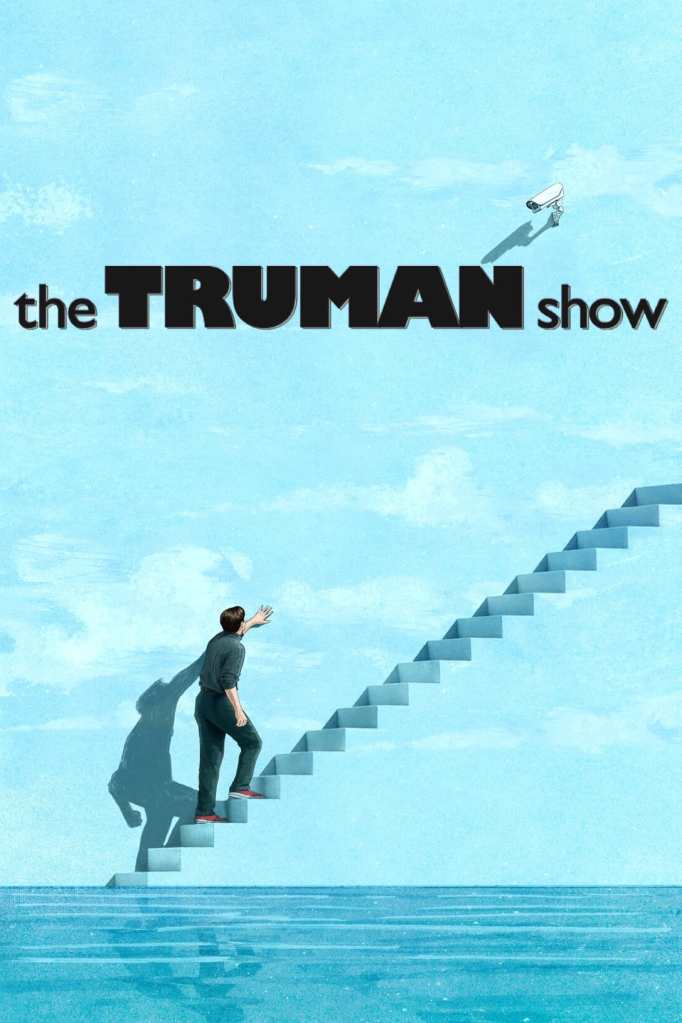
WE ARE TRAPPED IN A TRUMAN SHOW DIRECTED BY PSYCHOPATHS

“Whether in actual fact the policy of the boot-on-the-face can go on indefinitely seems doubtful. My own belief is that the ruling oligarchy will find less arduous and wasteful ways of governing and of satisfying its lust for power, and these ways will resemble those which I described in Brave New World. Within the next generation I believe that the world’s rulers will discover that infant conditioning and narco-hypnosis are more efficient, as instruments of government, than clubs and prisons, and that the lust for power can be just as completely satisfied by suggesting people into loving their servitude as by flogging and kicking them into obedience.” – Aldous Huxley – Letter to George Orwell about 1984 in 1949

“There will be, in the next generation or so, a pharmacological method of making people love their servitude, and producing dictatorship without tears, so to speak, producing a kind of painless concentration camp for entire societies, so that people will in fact have their liberties taken away from them, but will rather enjoy it, because they will be distracted from any desire to rebel by propaganda or brainwashing, or brainwashing enhanced by pharmacological methods. And this seems to be the final revolution” ― Aldous Huxley

When I step back from the day-to-day minutia and trivialities flooding my senses from all directions and media devices, it almost appears as if I’m living in a highly scripted reality TV program where the characters and plots are designed to create passions and reactions to support whatever narrative is being weaved by those directing the show. Huxley really did foresee the future as clearly and concisely as anyone could, decades before his dystopian vision came to fruition.

Orwell’s boot on the face vision is only now being initiated because a few too many critical thinkers have awoken from their pharmaceutically induced stupor and begun to question the plotline of this spectacle masquerading as our reality. The mass formation psychosis infecting the weak-minded masses; relentless mass propaganda designed to mislead, misinform, and brainwash a dumbed down and government indoctrinated populace; and complete control of the story line through media manipulation, regulation, and censorship of the truth; has run its course. As Charles Mackay stated 180 years ago, the masses go mad as a herd, but only regain their senses slowly, and one by one.

My recognition that the world seems to be scripted and directed by Machiavellian managers, working behind a dark shroud, representing an invisible governing authority, molding our minds, suggesting our ideas, dictating our tastes, and creating fear, triggered a recollection of the 1998 Jim Carrey movie – The Truman Show. The movie, directed by Peter Weir (Gallipoli, Witness, Dead Poet’s Society), had the surreal feel of Forest Gump, while beckoning the horrendous introduction of reality TV (Big Brother, Survivor), which poisons our shallow unserious society to this day. The plot of the movie focuses on individuality versus conformity, consumerism, voyeurism, reality versus manipulation, false narratives, the truth about the American Dream, and the dangers of surveillance in a technologically advanced society.

Truman Burbank is the unsuspecting star of The Truman Show, a reality television program filmed 24/7 through thousands of hidden cameras and broadcast to a worldwide audience. Christof, the show’s creator seeks to capture Truman’s authentic emotions and give audiences a relatable every man. Truman has been the unsuspecting star of the show since he was born 30 years prior. Truman’s hometown of Seahaven Island is a complete set built within an enormous dome, populated by crew members and actors who highlight the product placements that generate revenue for the show. The elaborate set allows Christof to control almost every aspect of Truman’s life, including the weather. The picture-perfect home, with picket fence and plastic people, is an attempt to convince Truman he is living the American Dream rather than in an inescapable dystopian techno-prison.

To prevent Truman from discovering his false reality, Christof manufactures scenarios that dissuade Truman’s desire for exploration, such as the “death” of his father in a sea storm to instill aquaphobia, and by constantly broadcasting and printing messages of the dangers of traveling and the virtues of staying home. One cannot but acknowledge the plotline to keep Truman under control, obedient, and locked down in his controlled environment, with no escape hatch visible, as exactly the plotline used by our overlords during the Covid scam. Using fear to regulate your subjects is a familiar theme used by those controlling the narrative and pulling the strings behind the scenes of our glorious democracy of dystopia.

The first task was to instill fear into the masses through fake videos, fake medical experts spewing fake “facts”, denying the reality masks, social distancing, and locking down the world did not stop a microscopic virus, while suppressing treatments which were clearly safe and effective (ivermectin, hydroxychloroquine) and forcing Fauci’s remdesivir and ventilators on patients – insuring their deaths. Truman’s life was built upon lies, deception, and fake narratives, controlled by a tyrannical director putting on a show to please his bosses and maximize profits. We are experiencing the same reality today.

Since March 2020 we have been trapped in a dystopian reality show based on lies, deception, and fake narratives about a weaponized virus created in a lab funded by Anthony Fauci and utilized to further the totalitarian Great Reset agenda of Schwab, Gates and their ilk, while maximizing the profits of Pfizer, TV networks and filling the pockets of politicians, shills, and apparatchiks willing to sellout the people of our country for thirty pieces of silver.

As the Truman Show approached its 30th anniversary, Truman began discovering unusual elements, such as a spotlight falling out of the sky in front of his house and a radio channel that precisely described his movements. He began to awaken to the fact he was nothing but a peculiarity trapped in a cage and constantly deterred from escaping at every turn, for the good of the show. He lived in a scripted world of conformity, where questioning the plot was not allowed, and the masses just played their parts.

This is exactly how a dictatorship without tears uses technology, pharmaceuticals, and psychological manipulation to convince the masses to love their servitude. This is the reality show we have been living in during this 21st Century dictatorship dystopia of dunces. But this psychological phenomenon is not new to mankind, as Plato described an ancient Truman Show analog in the 4th Century BC with his Allegory of the Cave. The nature of human beings has not changed across the trials and tribulations of history.

In the allegory, Plato describes a group of people who have lived chained in a cave all their lives, facing a blank wall. The people watch shadows projected on the wall from objects passing in front of a fire behind them and give names to these shadows. The shadows are the prisoners’ reality but are not an accurate representation of the real world. An enlightened man is like a prisoner who is freed from the cave and comes to understand the shadows on the wall are not reality.

The ignorant inmates do not desire to leave their prison/cave, for it is the only life they know, and they fear reality. The fire and the puppets, used to create shadows, are controlled by artists. Plato indicates the fire is also the political doctrine taught by a nation state. The artists use light and shadows to indoctrinate the masses with the dominant doctrines of the times. Few humans ever escape the cave. Most humans will remain at the bottom of the cave, with a small few elevated as major artists, to project the shadows keeping the masses disoriented, confused and fearful.

“Whereas the truth is that the State in which the rulers are most reluctant to govern is always the best and most quietly governed, and the State in which they are most eager, the worst.” ― Plato, The Allegory of the Cave

“Most people are not just comfortable in their ignorance, but hostile to anyone who points it out.” ― Plato, The Allegory of the Cave

The State is run by an eager group of psychopaths who are hell bent on destroying our civil society and common culture on behalf of globalists attempting to implement their Great Reset agenda, and enforcing it through technological surveillance, mind control through propaganda messaging, and strict management of the daily plot via mainstream media and social media censorship of the truth. As Plato contemplated twenty four centuries ago, most men will remain in their cave, believing shadows presented by their overlords is reality, never questioning their servitude or seeking the truth.

Never has this fact been truer than during this covid pandemic reality show directed by our Christof – mass murderer Anthony Fauci. The willful ignorance of the masses was assumed by the covid controllers who cast shadows of fear and death on the cave walls of the locked down extras in this well-orchestrated reality show. Using a purposefully misleading PCR test to vastly overestimate “cases”, paying hospitals to classify all deaths as covid, and having the propaganda professionals at CNN, MSNBC and Fox showing Covid Death Counters on their screens 24/7 to terrify the masses into compliance was the Covid Show.

Once the fear level was ramped to eleven on the control dial, the producers of this show introduced the miraculous Big Pharma vaccine antidote to save the day. Their script was so believable they were able to convince over 5 billion members of their captive audience to inject themselves with an untested, unproven genetic therapy, that didn’t prevent you from catching, transmitting, getting sick, being hospitalized, or dying from the Fauci funded Wuhan lab produced virus. But, as a dramatic twist to the tale, it seems the “vaccine” causes myocarditis, blood clots, infertility, miscarriages, heart attacks, cancer, and sudden death.

Despite the obvious dangers and failures of these “vaccines”, those bullied into getting jabbed became so comfortable in their ignorance, they were easily persuaded to hate the unjabbed and wish for their deaths. Orwell’s “Two Minutes of Hate” was extended for over a year and continues to this day. Rather than think critically and question why annual flu cases averaged 35 million per year prior to 2020 but dropped to near ZERO during the covid “emergency”, the cave dwellers lashed out in anger at anyone questioning the plot, because to admit they were duped would destroy their self-esteem and decrease their virtue signal credits.

The annual flu didn’t disappear. Covid was the annual flu, with a multi-billion-dollar marketing campaign. This wasn’t a pandemic, but an IQ test, and most people failed miserably. But the critical thinking unvaxxed are still considered the enemy of the state, especially since they have been proven right.

Whether we are trapped in an artificial world produced in a dome, cave, or our current technologically advanced surveillance propaganda state, the goal of those controlling our false reality is to take away our freedoms, crush dissent, keep us ignorant of the truth, and treat us as plebs to be taxed and molded. Christof, whose name is supposed to invoke him being a god-like figure ruling over Truman’s world, declares Truman could discover the truth and leave at any time, while using every diabolical trick to keep that from ever happening, because his show generated revenues exceeding the GDP of a small country.

Truman and ourselves are essentially prisoners in a vast production, and our overlords believe it is their duty to convince us to love our servitude and prefer our cells, because it is financially beneficial to the overlords and their crew.

Our world is not fake, but it is tightly controlled by those running the show. Seemingly random events, plots, and subplots are manipulated to generate specific emotions and reactions by the public in order to achieve the objectives of those benefiting from the various storylines. They are molding our minds and forming our tastes through psychological and technological manipulation of our daily existence. Christof explained why most rarely discover the truth or question the world they live in – “We accept the reality of the world with which we’re presented. It’s as simple as that.”

We have allowed men we have never seen to dictate how we live our lives, the choices we make, and which politicians and “experts” to believe, without ever putting in the effort to understand why we are being prodded to do so. We are locked in a self-imposed prison of desires, emotions, and needs through mass media messaging and a constant barrage of advertisements. Conformity and obedience are the desired traits sought by the ruling class, while individuality and skepticism are frowned upon and punished through social ostracism.

We are conditioned from birth to believe what they tell us to believe. Government school indoctrination and mass media misinformation does the trick. Distracted by our techno-gadgets and ignorant of truth is how the globalist oligarchs methodically implement their Great Reset agenda. They are so convinced of the ignorance of the masses they openly proclaim their depopulation and techno-prison schemes with no fear of push back or retribution.

The ending of the Truman Show is a lesson in resistance, persistence, and the strength of the individual, even in the face of a technologically advanced Big Brother state. It offers a message of hope, no matter how powerful our overlords appear to be. Refusing to obey or conform by one individual can inspire others to do likewise. Once Truman ‘awoke’ to his plight as a lab rat in a scripted show, he began to plot his escape. Using a makeshift tunnel in his basement, out of view of Christof’s cameras, he disappeared and forced the suspension of the broadcast for the first time in thirty years.

Christof discovers Truman sailing away from Seahaven in a small boat, as he has overcome the fake conditioning of fear instilled in him by the man who supposedly loves him but traumatized him about the sea by faking his father’s death while at sea. Christof chooses to almost drown Truman by creating a violent storm to deter him from discovering the truth. Ultimately the storm ceases and his boat strikes the wall of the dome.

This is exactly how our controllers treat the ignorant masses. They feed us stories designed to make us fearful and compliant to the exhortations of their paid experts. Paid to lie. Paid to misinform. Paid to persuade people a dangerous concoction is “safe and effective”. The evilness of using Sesame Street characters to convince four-year-old children they need this Big Pharma gene altering toxic brew, even though essentially ZERO children on earth died from covid, is a testament to the greed and malevolent impulses of those in power. Vast amounts of ever-increasing advertising revenue are what kept The Truman Show on the air for thirty years.

The covid advertising campaign will never be topped, as Hollywood stars, top athletes, famous writers, rock legends, supposedly impartial journalists, and all the major networks said SHOW ME THE MONEY!!!! Everyone was for sale, and all they had to do was lie and say the jabs were “safe and effective”. Product placement was the money-making formula for the Truman Show, while hard selling a Big Pharma phony cure over the airwaves 24/7 using the tax dollars of the victims was the final solution of the Great Reset Cabal.

The grand finale is a clash of the philosophies of reality versus false reality, as Truman discovers a staircase leading to an exit door. Christof speaks to Truman, claiming there was no more truth in the real world than in his artificial world, and he would be safe, with nothing to fear, in a world controlled by men invisible to him assuring him they have his best interests at heart. Truman chooses individuality, truth, risk, living a real meaningful life, and seeking honest relationships over a safe existence in a bubble where all decisions were made by others. Truman bows to the audience and exits, leaving Chistof to mourn the loss of his star and the revenue he generated. The ignorant masses watching the show cheer his escape and then ask, “what’s on next?” Plato captured the uncertainty and bewilderment Truman must have felt as he walked into the light.

The covid advertising campaign will never be topped, as Hollywood stars, top athletes, famous writers, rock legends, supposedly impartial journalists, and all the major networks said SHOW ME THE MONEY!!!! Everyone was for sale, and all they had to do was lie and say the jabs were “safe and effective”. Product placement was the money-making formula for the Truman Show, while hard selling a Big Pharma phony cure over the airwaves 24/7 using the tax dollars of the victims was the final solution of the Great Reset Cabal.

The grand finale is a clash of the philosophies of reality versus false reality, as Truman discovers a staircase leading to an exit door. Christof speaks to Truman, claiming there was no more truth in the real world than in his artificial world, and he would be safe, with nothing to fear, in a world controlled by men invisible to him assuring him they have his best interests at heart. Truman chooses individuality, truth, risk, living a real meaningful life, and seeking honest relationships over a safe existence in a bubble where all decisions were made by others. Truman bows to the audience and exits, leaving Chistof to mourn the loss of his star and the revenue he generated. The ignorant masses watching the show cheer his escape and then ask, “what’s on next?” Plato captured the uncertainty and bewilderment Truman must have felt as he walked into the light.

“Anyone who has common sense will remember that the bewilderments of the eyes are of two kinds, and arise from two causes, either from coming out of the light or from going into the light” ― Plato, The Allegory of the Cave

This world of manufactured dystopian pleasure harkens more towards Huxley’s Brave New World, where pharmaceuticals and conditioning would keep the public seeking pleasure, pre-occupied with trivialities, distracted by materialism, unable to think critically, and reduced to passivity and egoism through the control of messaging by their controllers. Our efficient totalitarian state has gained complete control by convincing the masses to love their servitude and beg for more rules, restrictions, and reduction of liberties in the name of safety and security.

Smart phones, smart cities, and smart streets are nothing more than code for spying on you and controlling you. Truman finally understood his liberty was his to choose and not Christof’s to give. There is a small minority of Americans who are realizing the same thing after two years of totalitarian measures designed to take away our freedoms and liberty. The question is whether enough will exit this tyrannical government produced show to make a difference. The future of mankind literally depends on the answer to this question.
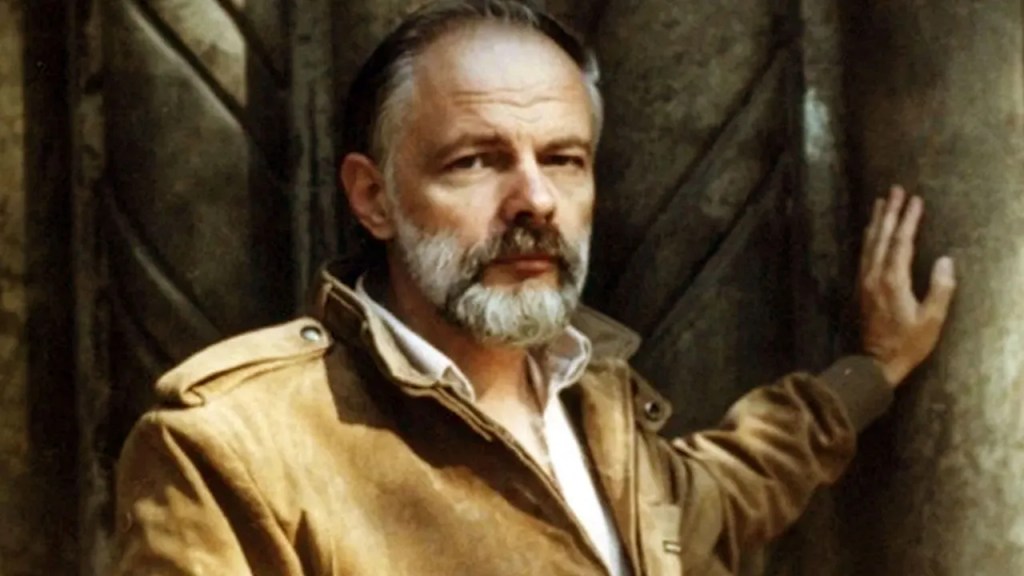
Welcome to Philip K. Dick’s dystopia

Nothing is private and no one is free

 (Credit: Alamy)

By David Samuels

Source: UnHerd

Philip K. Dick, whose novel Do Androids Dream of Electric Sheep? inspired the film Blade Runner, did not live to enjoy his Hollywood success. He died on March 2, 1982, three months before the film was released.

In the years since, the novelist once dismissed as a gutter pulp sci-fi weirdo has steadily climbed the ladder of posthumous literary reputation. The case for Dick’s genius has never rested on his dystopian vision of technology, which he shared in common with masters like HG Wells and Stanislaw Lem, and with hundreds of sci-fi writers since. Good science fiction — as opposed to fantasy novels set on other planets — is defined by a quasi-philosophical examination of interactions between men and machines and other products of modern science. It is part novel and part thought-experiment, centered on our idea of the human.

What made Dick a literary genius, then, was not any special talent for predicting hand-held personal devices or atom bombs the size of a shoe which might have led him to a job in Apple’s marketing department. His gift was for what might be called predictive psychology — how the altered worlds he imagined, whether futuristic or merely divergent from existing historical continuums, would feel to the people who inhabited them. Dick’s answer was, very often: “Not good.”

Dick’s dystopian-psychological approach marks him less as a conventional science fiction writer than as a member of the California anti-utopian school of the Sixties, whose best-known members include Robert Stone, Thomas Pynchon, Ken Kesey, Joan Didion and Hunter Thompson. Seen from this angle, Dick was perhaps the most powerfully and sweepingly paranoid of a group of writers whose stock-in-trade was conspiracy and paranoia, the hallmarks of a society marked — at that moment, and this one — by violent street crime, drug-induced psychosis, and visionary promises gone terribly wrong. Of his anti-utopian peers, Dick’s sci-fi genre background made him the only one who had any particular feel for the proposition that technology was inseparable from, and would therefore inevitably alter, our idea of the human.

Technology was and is perhaps the most Californian aspect of the American mythos. The idea that the universal constants of human nature were at war with the mutilating demands of technology-driven systems was a very Sixties Californian conceit, to which Dick’s fellow anti-utopians each adhered in their own way: In Kesey’s showdown between man and the castrating nanny-state; in Didion’s emphasis on the vanishing virtue of self-reliance; in Pynchon’s degenerate Ivy League Puritanism; in Thompson’s drug-addled primitivism; and in Stone’s Catholic idea of devotion to a God that might somehow salve the wounds of the survivors once the great American adventure goes bust.

What Dick saw, and what his fellow anti-utopians did not, was that human psychology and technology are not separate actors, and that whatever emerged from the other side of the future would be different to the human thing that entered it.

* * *

Seeing and describing how large numbers of people will perceive reality before anyone else does requires imagining states of consciousness that, in the moment, seem deeply strange. It is no accident that the greatest of works of speculative psychology were written by revolutionaries whose outlook was often bleak to the point of despair. The negative tone of these works often led future generations to describe their authors as conservatives, though artistically and psychologically speaking, they are radicals. Or rather, in their rejection of the dominant order, they are radicals and reactionaries at the same time.

The anti-utopian tradition emerged in earnest in 19th-century Russia. The Russian pioneers of the genre were superior to their rivals in England and elsewhere because the latter’s visions were constrained by attachments to a settled society, which one can argue never really existed in Russia — and because the ideas of revolution and violent reaction have always been so closely allied in the Russian psyche. Fyodor’s Dostoyevsky’s Notes From Underground struck many of its initial readers as a kind of artless mental vomit, before revealing itself as a Rosetta Stone for the century of Adolf Hitler and Lee Harvey Oswald. Yevgeny Zamyatin’s We is probably the greatest of at least a dozen weirdly prophetic novels written in the years immediately after the Bolshevik Revolution. In We, Zamyatin predicted what a surveillance society run by engineers would feel like to its inhabitants with a nauseating accuracy that did not become fully apparent until the rise of the modern tech surveillance complex.

The Dick novel that directly predicted our information-addicted, socially-networked 21st-century society, A Scanner Darkly, was both a prophecy of future psychological states and a half-veiled memoir of Dick’s own experiences in the California drug culture. Published in 1977, the book was a detective noir set in a druggy future in which large portions of the population appear to spend their lives scheming and snitching on each other to feed their addictions to a drug called Substance D — the “D” standing for Death, of course.

A Scanner Darkly, a reference to the line in Corinthians in which men at first see God “as in a glass, darkly”, is Dick’s rawest book and the one that reads least like science fiction. The book’s protagonist is simultaneously a narcotics agent known to his peers as Fred and a Substance D addict named Bob Arctor. Fred/Arctor lives in a house — his former marital abode — with two fellow addicts, and is in love with another addict named Donna, who comes to visit him there. Donna helps Arctor obtain Substance D, which he consumes, while Fred uses Donna to attempt to climb higher on the drug distribution ladder. At the end of the novel, Donna turns out to be a drug agent, who is spying on Bob Arctor.

What’s so striking about the book is not Dick’s heartfelt, if futuristically bent, portrayal of the evils of Sixties drug culture. For that, read Stone, who was a master of connecting the physical, mental and moral corruption of drug dealing and dependency, and the fantasies those pursuits inevitably engender to the deeper corruption of man’s nature.

What Dick uniquely captured was something else: The degenerative effects of the split-screen existence of a human brain ceaselessly spying on and doubting and implicating itself while at the same time being spied on by others, all of whom are embedded within machine systems that record everything for reasons that humans cannot understand. Over the course of this machine-and-chemical fed process of human self-contradiction and self-destruction, of which Fred/Arctor is only intermittently aware, we see his thoughts and perceptions being short-circuited and reduced to gibberish.

Drug-induced paranoia aside, the psychology of Dick’s addicts and narcs is as good a description as exists of the spreading incoherence of today’s information ecosystem, which none of us are able to fully see or understand. As a thought experiment, it doesn’t matter that Dick chose a drug rather than the stories we tell about ourselves and our world. It’s not the technology; it’s the psychology. What Dick saw was that the process of splitting ourselves in two — into subject and narc — was a brutal assault on the idea of being human and would make thoughts and communication impossible.

“What does a scanner see?” Arctor wonders, after examining the surveillance apparatus that has been planted, with his knowledge, in his own home. “I mean, really see? Into the head? Down into the heart? Does a passive infra-red holographic scanner like they used to use, or a cube-type holo-scanner like they use these days, the latest thing, see into me – into us – clearly or darkly? I hope it does, see clearly,” Arctor continues, “because I can’t any longer these days see into myself. I see only murk. Murk outside; murk inside. I hope, for everyone’s sake, the scanners do better.” They don’t.

* * *

Jeremy Bentham’s panopticon, which the English philosopher sketched out in a series of letters between 1786 and 1788 while visiting  the Mogilev district of the Russian Empire, was an architectural system of control in which all inmates of an institution could be made visible to a single guard. Bentham’s utopian-utilitarian idea was widely applied in Victorian England to a range of public and private spaces including prisons, asylums, hospitals, factories and even schools. The unique horror of the Benthamite set-up was not the power imbalance inherent in places like prisons and factories, whose existence is obvious to guards and prisoners alike. It was the attempt to eliminate privacy, which is a necessary precondition for being human.

Over the last decade, Bentham’s architecture of unfreedom has been replaced by the architecture of machines. This has created a new social reality where everyone is at once inmate and guard; a panopticon where nothing is private and no one is free. The invisible operations of the machines and programmes we use every day to buy books or food or communicate, which are linked to each other and to the surveillance operations of large government agencies in a single net, induces in most sentient beings a kind of free-floating paranoia of the type that destroys the inhabitants of A Scanner Darkly. On the one hand, everyone knows that everyone is being watched. On the other, it is necessary to deny that knowledge in order to appear to be functioning normally.

One of the most unpleasant characteristics of the weird split-screen mentality of our times is how people must routinely speak against themselves — deny what they see, hear, feel and believe  — in order to maintain the appearance of sanity. It is now routine, for example, to hear Americans on the Left and the Right deride their political opponents for believing in far-reaching conspiracy theories — while in the next breath revealing their own.

No doubt both sides are at least half right. During lockdowns, it became normal for public officials in Western countries to issue draconian edicts in the name of “science” for the supposed good of large numbers of people, only to violate those edicts themselves. The meaning of “science”, it turned out, had nothing to do with the “common good”, or with demonstrating a theory through evidence; it was “one rule for me and another for thee”.

The flagrant doublespeak that is nurtured in the surveillance societies of the West, which have sprung up around us unnoticed, is characteristic of totalitarian societies and mental asylums. The difference is that both totalitarian societies and asylums allow for nonthreatening zones of privacy in order to make life easier for the guards. What we live in today is something else, a set of mirrors into which we are encouraged to look so that our reflections can be distorted and then returned to us. As Bob Arctor puts it, reflecting on the words of Corinthians: “it is not through glass but reflected back by a glass. And that reflection that returns to you: it is you, it is your face, but it isn’t.”

Powerful people in Western societies have lately become convinced of their ability to accomplish great feats of moral and social engineering by controlling these mirrors, altering our reflections and selling them back to us, while undermining our ability to think coherently. The mirrors are not meant to help anyone think; they are systems of control. They are mechanisms of profit, which foster dependence. They are used to mete out punishment, and spy on us.

What’s alarming is that the people who delight in their mastery of these devices seem not to have thought very hard about the damage they are doing to the people who shoot up, a category that includes those who shoot up schools and malls. None of them seem to calculate what creating a miasma of nonsensical conspiracy theories will do to the psyches of their own children, who will inherit “the murk”. They appear to believe that people with minds that have been permanently broken by their gibberish machines will make the perfect workers on their farm. Let’s see how that turns out for them.

This Is of Course Insane

By Charles Hugh Smith

Source: Of Two Minds

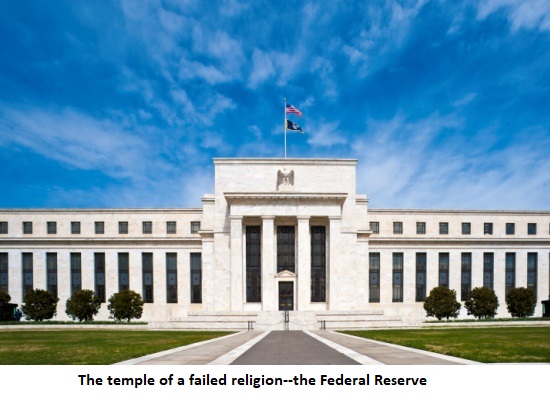
Greed is a powerful motivation to be an ardent believer in the central banking cult.

The ideal cult convinces its followers that it isn’t a cult, it’s simply the natural order of things. In current terms, this normalizes insane behaviors and beliefs. Sacrificing youth to appease the gods isn’t a cult; it’s simply the natural order of things. If we don’t sacrifice youth, bad things will happen, so we have to follow the natural order of things.

Despite the lofty claims made by our rational mind, we want to hear and obey the voices of the gods. This non-rational desire is the root of cults and episodes of mass hysteria, i.e. the madness of crowds.

Humanity is in the grip of the secular cult of central banking. The cult’s seers and prophets periodically emerge with arcane signs and readings, offering divinations to guide the followers.

The motivation to believe the cult is the natural order of things is powerful: greed. Those who heed the oracles of the cult enrich themselves, unbelievers impoverish themselves.

Rationalists outside the cult discern the structure of the cult and its core beliefs. The cult creates credit and “money” out of thin air and distributes it to the few extremely wealthy to further expand their wealth. These few do not improve productivity or the well-being of the many; they use the cult’s gifts to exploit the cult’s rigged casino of speculation to maximize their private gains.

In other words, the cult benefits the few at the expense of the many while proclaiming it benefits everyone. This is of course insane. The cult’s core beliefs are: 1) enriching the already-rich magically trickles down benefits to the masses, and 2) this vast enrichment of the already-wealthy is cost-free. The economy prospers with no downside or consequences other than the glorious expansion of wealth at the top and the trickle-down of sweet goodness to the masses.

This is of course insane. The costs are borne by the masses and by the socio-economic system, which is now in thrall to a cult that has made the economy dependent on an ever-expanding credit bubble which feeds an ever-expanding asset bubble, which then enables a further expansion of credit which then fuels ever-higher assets prices.

And so on, forever, because the cult and its ever-expanding bubble are the natural order of things. If we don’t sacrifice the many to benefit the few, the sun will stop rising and the Earth will be cast into endless shadow.

This is of course insane, but greed is a powerful motivation to be an ardent believer in the central banking cult. Expanding credit based on the expanding collateral of asset bubbles, each feeding the other, is held up not as insane but as a financial perpetual-motion machine, overseen and managed by the seers and prophets of the central bank cult. Followers heeding the cult’s oracles become rich, non-believers and skeptics become impoverished.

Alas, cults and bubbles both come to an inglorious end. What seemed self-evidently true for the ages is revealed as a brief moment of self-serving delusion, supported by the immense powers of greed and the madness of crowds.

Do you hear the voices of the gods? Yes, yes, oh yes.

THE WILL TO PURPOSE – ACTIVATING OUR INNER DRIVE & INTENTIONALITY

By Kingsley L. Dennis

Source: Waking Times

‘A sincere reflection on human behavior is enough to convince us that the power of choice plays much less part in the life of man than we think.’ ~J.G. Bennett

We are familiar with the concept that a person has no real choice, and we generally regard this in relation to our commercial choices. That is, what we choose to buy is generally a decision based on a selection of limited choice. This has also been referred to as ‘curated needs.’ What we think or believe we want, or need, is conditioned into us – or ‘curated’ – so that we are merely responding to managed external stimuli to acquire certain goods. Whilst this is valid, and is indeed an operative modality, it remains within the material realm. In the opening citation, the thinker and author J.G. Bennett was referring to a form of choice beyond that of a material one. He was relating to the lack of choice within the inner world of the human being – that is, the presence of human will. Bennett was speaking and writing from the 1940s to the 1970s, yet what he said then is as relevant for today as he was not speaking about things that are relative to historical time or place but to an almost timeless situation – the human condition. The lack of genuine inner will of the human being has been made starker in modern times due to the lens of psychology and similar sciences.

Professor Mattias Desmet has recently popularised the concept of mass formation and false solidarity, which refer to how crowd psychology is established and sustained.[i] In his recent book (The Psychology of Totalitarianism), Desmet points out that what we call totalitarianism has only been with us for the past 120 years, since the beginning of the twentieth century. Two previous examples that he gives are the Stalinist regime that came to power on the back of the Russian Revolution, and the National Socialist (Nazi) regime in Germany. Most recently, he says, the world is experiencing the rise of a global form of totalitarianism under the guise, or ideology, of technocracy. The one thing that totalitarianism has in common is that it is based on ideology rather than brute power. Further, that the populace is persuaded (or programmed) into obeyance through propaganda and social-cultural conditioning, rather than forced through fear (as is the case with dictatorships). The mass formation of willing obedience is a symbol for our times. With the availability of global communications, a largely digitally ‘plugged-in’ world population, the widespread influence of controlled media, and the pervasive presence of mind-influencing technologies, the human species has never been in a more pressing moment in its collective history.

Modern day humanity may not only be suffering from a lack of genuine choice; more importantly, it may be experiencing the dilemma of a lack of connection with internal will power. It is this dominant state of the human psyche – we may even go so far as to call it a widespread psychosis – that lies at the root of much of our present ills with its sense of apathy and pessimism. Some readers will be familiar with German philosopher Friedrich Nietzsche’s concept of the will to power; lesser known is the English philosopher Colin Wilson and his notion of the will to perceive. For Wilson, the question of freedom and choice is not a social problem – it is an internal one for it requires an ‘intensity of will.’[ii] In other words, it is a personal struggle to achieve a form of self-awakening, or triggering, to arouse oneself from the torpidity and apathy of life. The issue is that for most people they don’t consider the fragility of life’s situation. The general masses, at least in the western world, consider themselves to be already free. They exist within the belief structure that they are protected and looked after by their governments and social institutions and that, give or take a few things, they have most essential needs provided for. Such people, I would posit, live on the outside of themselves – they are skin-dwellers. They live through their personalities and are most likely to adhere to mass consensus narratives. They are to be swayed by the rollercoaster ride of external events and react as anticipated by the governing elites who manipulate finances, food supply, energy supply, and more. This mass of people will only recognize the loss of freedom when it is threatened in relation to external events. It is a manufactured sense of freedom for once the threat has vanished – or seemingly made to vanish – then the meaning of freedom dissipates for the danger is no longer perceived. That is, it is an exterior crisis or danger that triggers people into action and as the perceived threat fades, they slip back once again into apathy and mass obedience. There is a lack of internal stimulation.

The stimulation of the human will requires that a person has the will to acquire insight. This they must choose for themselves, for no other agency shall give it to them. On the contrary, many social systems are designed to deteriorate a person’s will by compelling them to give away their dependency and authority onto external systems. Consistency, commitment, and the intention to will, are human aspects severely undermined by the deliberate constraint of material structures and social systems. Such critical observations and the power of intention are also being increasingly undermined by the rise of what I would call ‘lazy spirituality.’ This is the type of Instagram positive thinking or commercial well-beingness that online ‘spiritual celebrities’ are all too eager to promote (and sell). Behind such on-demand spiritual well-being-positive-thinking packages is a passivity or laziness to critically engage in inner work and to gain perceptive cognition to recognize the fallacy inherent within the material domain.

It is one thing to be positively-orientated and having ‘oneness’ for all creation; it is another matter to have the perceptive capacity to recognize that there are forces in play in the world that are active in nullifying metaphysical values and realities in order to replace them with an ever-deepening materialism. It would seem that there is an increasing form of cultural laziness and indecision, especially in this current time when people chiefly wish for things to be made easy for them. Instead of a person having faith and hope that they can change by making real effort, they are usually entertained with illusions that then take away from them the impulse to make any real change within themselves. In today’s world, a person who seeks to develop inner awareness and to raise their perceptive capacity often find themselves at odds with their cultural milieu. Those with ‘spiritual seriousness,’ so to say, are what Colin Wilson referred to as the Outsider.[iii] Such individuals have an intangible need to be more than just a ‘happy, well-fed animal.’ Again, Wilson referred to this state as being that of the robot; he said that we all have a robot within us that is eager to come out and take over all our daily duties for us. The Greek-Armenian mystic G.I. Gurdjieff called this the state of the ‘man machine.’ I have referred to this as the robosapien.[iv]

Within such automated states the individual experiences the world through a narrowed lens of awareness. Wilson, for example, recognized that such limited awareness almost lulled a person into a ‘state of permanent drowsiness, like being half-anesthetized’ so that a broader vision of life is restricted. And this is how what we call ordinary, everyday life affects us. Whether it be through external impacts, stimulants, distractions, information, technological entanglement, energetic haze, and more, the environment of everyday life pacifies us by closing down our perceptual horizons. In response to this, Colin Wilson noted that ‘it is as impossible to exercise freedom in an unreal world as it is to jump while you are falling.’[v] Freedom is not only related to physical mobility and access to human rights; it is also a question of an inner ‘intensity of mind’ that can pull a person out of the collective of mass formation (as Desmet would call it). The modern life can be regarded as a cause of spiritual decay because it seeks to demolish any recognition of a metaphysical reality. And through this, many people are unknowingly suffering a form of ‘reality deficiency.’ There have been people who, over the years, have strived to point this out to us, from wisdom teachers, mystics, and philosophers (like Colin Wilson). This deficiency prevents people from receiving inner nourishment; over time, this acts to deprive human cognition by literally starving it of nutrients (perception). We are in a time right now of great ‘reality deficiency’ as the dominant consensus narratives peddle their lies, manipulations, and programming.

Each age has its own form of reality and/or metaphysical suppression, from the physically overt (Spanish Inquisition) to the covert (technocracy). Within each specific era, there are calculated forces that act to impinge upon the individuals’ own evolutionary drive toward not only self-attainment but, more importantly, a connection with a transcendental impulse (what some may call as Source). The historian Arnold Toynbee believed that civilizations (and its individuals) progress by overcoming struggles; by moving through ‘challenge points,’ so to speak. If the crisis is too great, the civilization succumbs and collapses. If the challenge is not great enough, the civilization overcomes and becomes complacent, slides into greater decadence and eventually collapses. The challenge must be just right – the ‘Goldilocks’ zone, as Gary Lachman calls it. Challenges bring out the best in individuals too, yet they must be able to grow and develop through the crisis – and this is often down to an inner will or drive.  Toynbee believed that a civilization needs to produce a ‘creative minority’ to meet such a challenge of its time. It would seem that we are amidst such a ‘challenge point’ right now; and it is not only a physical crisis but also an existential one. I would go further and suggest that human civilization cannot survive indefinitely without some inborn sense of a transcendental purpose – otherwise it is like a hollow shell that becomes increasingly brittle over time. British philosopher and historian Nicholas Hagger, whose monumental work The Fire and the Stones examines the sacred impulse (the ‘Fire/Light’) within twenty-five civilizations, likewise has shown how civilizations are inspired by the transcendental impulse and decay when such an impulse is forgotten or dismissed.[vi]

What is required is for us, our communities and cultures, to become more conscious of our participation in reality. Further, that what we take to be reality is a merger between the physical and the metaphysical. As such, humanity is a being ‘of spirit’ that is manifesting through the intermediary of a physical body. To take this even further, we need to come to recognize that all existence is consciousness primarily, and that physical phenomena is an energetic state that manifests from a source of consciousness. What is required of humanity to survive beyond this existential crisis and challenge point is to become more conscious. Is this possible? Colin Wilson was not so sure. Wilson believed, and stated as such, that the majority of people cannot accept the burden of becoming more conscious. He felt that the ‘masses’ were both consciously and subconsciously choosing the more comfortable ‘mediocracy of life.’ I would even question what this term means any more – what is the ‘mediocracy of life’ when we can no longer be sure what reality is? Abstractions have now replaced realities to create an enveloping world of pseudo-reality and a ‘theatre of the absurd.’ As I talked about in my book Bardo Times,[vii] life has become a simulation – a simulacra as the French theorist Jean Baudrillard would say – and the notion of what is ‘real’ appears to have dissolved into what is the latest consensus narrative. What is important to acknowledge in these challenging times is that as the chaos whirls around us, humanity stands on the threshold of a higher form of life.

This is the other point that perceptive individuals have been attempting to point out to us (not least of them has been the Indian sage Sri Aurobindo). And this threshold becomes more apparent and urgent whenever a civilization begins either its decline or its necessary transition to a different epoch and modality. This is the challenge that civilization must face – either to raise/adjust its level of consciousness and perceptive capacity or stagnate and then collapse. Human civilization necessarily reflects the state of perception of its inhabitants. As that indwelling perception expands, so too does the physical environment develop in alignment. If perceptive capacity is restricted or even being deliberately reduced, as is the case right now, then entropic or atrophying forces begin to dominate. This is why we must resist, at great effort, to submit to a programming of conformity and perceptive limitation that is likely to come about through increased technocratic forms of social management and control. This is where Colin Wilson’s notion of the will to perceive comes in. Due to the external environment, human consciousness is generally conditioned into a dulled state so that higher insights or perceptions are not ‘allowed’ to get through. We need to seek to ‘widen’ (expand) our consciousness beyond such limiting influences so that greater perceptive insights can be achieved. Most people, however, are reflections of their surroundings and, as such, require external inputs to motivate or trigger them into action. Chaos and crises can function as such triggering impacts. The ‘will to perceive’ also activates a will to purpose. Behind the human developmental impulse there is a push, I would say, to increase our intentionality. Without the ‘will to purpose’ there is a lack of conscious participation. It is the will to purpose that distinguishes the human being from the machine – the ‘robosapien.’ Modern life, with its technocratic pull, is encouraging people not to think but to allow automation to take over duties and responsibilities. On the contrary, we need to be ‘pulling ourselves up by the bootstraps’ and intentionally driving ourselves across the threshold. What could this threshold be?

Humanity is moving towards a stage in its evolutionary path whereby it becomes cognizant of its role as a fusion (a bridge or merger) between spirit/consciousness and physicality/matter. We are, in these times, the forward ground crew sent ahead to prepare the groundwork. Sometime in the future – it could be ten, twenty, thirty years or more – human understanding and the sciences will come to recognize the primary role of consciousness behind all existence. And when this occurs, human life will alter drastically. We shall understand that human existence is a merging of non-physical intelligence with physical forces. The very notion of life and reality will be greatly expanded beyond current conceptions. We shall be propelled beyond the confines of the physical robot – the robosapien – and shall utilize presently unknown organs of perception. But we are not at that threshold yet. And this is partly why we are seeing a contestation of forces in play. There are forces that do not wish for humanity to reach, and pass, this threshold for we shall then no longer be their passive robots to manage and control. The present control hierarchies will be demolished. And there is a small contingency that wish to cut humanity off from this transcendental impulse, to isolate us from receiving such developmental forces, and to push us back into our perceptual prisons of the ‘everyday mundane.’ Such forces aim to increase the programming and technologies of cognitive influence to hypnotize the mass of humanity into accepting an ‘upside-down’ reality that the robosapien seems the most suited to. Our will to purpose now is about having the inner drive and intentionality to move us beyond this current predicament and modern state of alienation, and forward into a state of heightened cognition and expanded perceptual awareness.

It is my view that the ‘teething pains’ that we are presently experiencing represent the birthing, or arrival, of a new form of consciousness coming to manifestation through the human species. That is, a mergence with an expanded field of consciousness. And for this to emerge, the individual is called upon to ‘meet it’ halfway, so to speak. Social forces will attempt to continue to hold back the individual by mental, emotional, and physical/biological interventions. And yet, against these artificial constrictions, I am confident that if enough of us (we don’t need to be a majority) can strive for cognitive freedom, perceptive clarity, and inner awareness, we can become the early wave – the evolutionary outsider – to make the initial steps across the threshold. Just enough of us need to act as the ‘antennae of the race’[viii] to pass the baton onto our descendants. And that, I would say, gives us enough reason to activate our will to purpose.

About the Author

Kingsley L. Dennis is the author of The Phoenix Generation: A New Era of Connection, Compassion, and Consciousnessand The Sacred Revival: Magic, Mind & Meaning in a Technological Age, available at Amazon. Visit him on the web at http://www.kingsleydennis.com/.

[i] See my previous essay: ‘The Establishment of Mass Psychology & False Solidarity’ – https://kingsleydennis.com/the-establishment-of-mass-psychology-false-solidarity/

[ii] For an in-depth study of Wilson’s life and thought, I would recommend the excellent biography by Gary Lachman – Beyond the Robot: The Life and Work of Colin Wilson (2016)

[iii] See Colin Wilson’s book The Outsider (originally published in 1956)

[iv] See my book Hijacking Reality: The Reprogramming and Reorganization of Human Life (2021)

[v] Wilson, Colin (1982) The Outsider. Los Angeles: Jeremy P. Tarcher, p39

[vi] Hagger, Nicholas (1991) The Fire and the Stones. Dorset: Element Books.

[vii] Bardo Times: hyperreality, high-velocity, simulation, automation, mutation – a hoax? (2018)

[viii] A phrase coined by the poet Ezra Pound.

LA VOLUNTAD DE PROPÓSITO: Cruzar el umbral venidero de la humanidad

THE EIGHTFOLD PATH OF GOOD CHARACTER

By Gary Z McGee

Source: Waking Times

“Watch your thoughts, they become words. Watch your words, they become actions. Watch your actions, they become habits. Watch your habits, they become character. Watch your character, for it becomes your destiny.” ~Frank Outlaw

A robust character hinges on eight core virtues: courage, curiosity, temperance, humility, liberty, honor, wisdom, and humor. These virtues are vital rungs on the ladder toward achieving wholeness in character.

Courage frees character, curiosity grows character, temperance balances character, humility grounds character, liberty stabilizes character, honor unifies character, wisdom guides character, and humor overcomes character. Let’s break it down.

1.) Courage:

“Without courage you can’t practice any other virtue consistently.” ~Maya Angelou

Courage is the bedrock of human excellence. Before any other virtue can be realized, courage must be self-actualized. There must first come a courageous deviation or there is no “first.” Period. Therefore, it is of the utmost importance that you live a courage-based lifestyle over a comfort-based lifestyle.

Without the initial leap of courage there is no freedom, no excellence. Without courage, one is merely restricted to the conventional, inhibited by the whims of others, imprisoned inside the box of the status quo, and hampered by outdated reasoning. Without courage, the third eye remains calcified, rigid, blind.

With the leap of courage, however, one is emancipated. The world unlocks. The mind unbolts. The soul unfastens. Inhibitions dissolve, and serendipity, adaptability, and improvisation manifest. Boundaries transform into horizons. Comfort zones stretch into adventure. You split the smoke. You shatter the mirrors. And the glory of the path is revealed.

2.) Curiosity:

“If you are not living in awe, you are not paying attention.” ~Rumi

Curiosity is essential. It is the fuel that launches us beyond faith. It is the cure for the disease of certainty.

True curiosity is deep, primal, absorbing, imaginative and ravenous for updated knowledge that has the potential to put outdated knowledge to rest.

Curiosity is the ultimate existential leveling mechanism. It forces our thoughts outside the box, stretches our comfort zone, shatters entrenched mental paradigms, keeps us ahead of the curve, and pushes the envelope of all the things we’ve taken for granted.

Curiosity is on the edge of tomorrow, laughing into the abyss, shirking the tiny-minded perspective of our parochial past, and gaping in astonishment and wild wonder into the mysterium tremendum et fascinans of the Great Mystery.

3.) Temperance:

“The best amount of property to have is that which is enough to keep us from poverty, and which yet is not far removed from it.” ~Seneca

Luckily, health is a benchmark for temperance. It’s the core of universal law. Unluckily, this benchmark is hidden in a ‘language older than words,’ which can sometimes seem impossible to decode. Moderation is Health’s secret decoder ring.

Although some things must be moderated more than others, extremism in anything is the bane of health. We can breathe too much oxygen. We can drink too much water. We can even live too much in the moment. Through moderation we discover health. And through health we are free to practice temperance. We maintain our personal health through moderation so that health in general can manifest. As Gandhi wisely suggested, “Live simply so that others may simply live.”

A good rule of thumb, then, is this: moderation in all things, to include moderation. This way we are proactively injecting balance into the cosmos, while at the same time enjoying life. The key is to accept responsibility for the consequences of both our moderate and immoderate choices. Tricky, but that’s where humility comes into play.

4.) Humility:

“After the ecstasy, the laundry.” ~Jack Kornfield

Research suggests that a healthy dose of humility helps protect against extremism, polarization, and bias. When we are humble, we can admit that we are fallible, imperfect, and uncertain. It gives us the courage to admit when we are wrong.

Without humility we are more likely to fall victim to cognitive dissonance. Without humility we are blinded by faith and stuck in hand-me-down ideologies and outdated traditions. Without humility we are more likely to be clouded by pride. Without humility self-pity outmaneuvers self-empowerment and the Ego reigns supreme as it edges out Soul.

Humility brings us back down to earth. It unravels the roots, uncovers the bones, strikes at the core of the human condition. It reveals the wizard behind the curtain was always us. It forces our head over the edge of the abyss. It exposes our halos as mortal coils. It gets us out of our own way.

That Serbian Proverb said it best, “Be humble for you are made of earth. Be noble for you are made of stars.”

5.) Liberty:

“Seek freedom and become captive of your desires. Seek discipline and find your liberty.” ~Frank Herbert

Freedom is not a given. It must be earned. It must be cultivated, practiced, and acted upon daily. The moment freedom is taken for granted is the moment it is lost.

Freedom is always a rebellion. What it rebels against is anything seeking to fetter the progressive and healthy evolution of the human spirit. In the crashing plane of an unfree world, a free human is someone who puts the oxygen mask on themselves first in order to be there for those who are incapable or who are ignorant of the fact that they are not free.

As Jean Piaget said, “We organize our worlds by first organizing ourselves.” And so self-organization (self-discipline) is the first step toward freedom. Liberty, then, is a culmination of earning freedom through self-discipline, and then holding the world accountable.

6.) Honor:

“Nearly all men can stand adversity, but if you want to test a man’s character, give him power.” ~Abraham Lincoln

The core of honor is self-honesty. We cannot be honorable without self-honesty. Where honesty puts character into perspective, honor unifies character. True honor is being responsible with our power.

Foremost, honor is responsibility. If we are not responsible with our power, then we become a pawn to it. Being a pawn to power is dangerous because power causes us to believe we are always right. When we are responsible with our power, however, we are more likely to admit we could be wrong. And since the fallible and imperfect human condition tends to be wrong about a great many things, it behooves us all to take responsibility with our power so as not to become a pawn to it.

If we lord our power over others, we are being dishonorable. If we use our power to help others flourish, we are being honorable. If we hoard power at the expense of others, we are being dishonorable. If we expiate power to empower others, we are not only being honorable we are being prestigious.

7.) Wisdom:

“We are not provided with wisdom, we must discover it for ourselves, after a journey through the wilderness which no one else can take for us.” ~Marcel Proust

Wisdom cannot be taught. Knowledge can be taught, skills can be taught, but not wisdom. We can discover wisdom, we can live it through experience, we can dip in and out of it in Flow States, we can do wonders with it with our creative powers thereafter, but we cannot teach it.

Wisdom is likewise just as undefinable. It is mystical, numinous, and transcendent. It can even be foolish, eccentric, and outlandish. There’s a childlike element to it that humbles mastery, just as there’s a maturity to it that towers over naivete.

Most of all wisdom is a heightened state of clarity. It’s a crispness of elevated spirit. It’s a three-eyed owl on a high branch. It’s a profound sense of humor that’s undeterred by the knowledge, experience, and tribulations that birthed it. Most of all, Wisdom has the wherewithal to get out of its own way.

As Lao Tzu wisely stated, “To attain knowledge, add things every day. To attain wisdom, remove things every day.”

8.) Humor:

“The individual is more completely revealed in play than in any one other way, and play has a greater shaping power over the character and nature of man than has any one other activity.” ~Luther Gulick

Humor is the only virtue that is transcendent. It sees how character is just that: a character caught within a tragicomedy, strutting itself across an all-too-mortal stage. It sees the character’s feet of clay. But it also sees the character’s wings. It honors both through a laughter born out of levity.

Such levity creates a powerful gravity. The self becomes magnetic. When you are flexible in humor you attract the world to yourself. You’re able to have a soulful laugh at all the ego seriousness. Pettiness falls away from you like water off a duck’s back. You become transcendent, detached, unconquerable.

Having a good sense of humor is the crowning achievement of good character, and the soul is the crown. It’s the golden crown chakra of character, sparking in the eternal night, a beacon of hope in the dark, a beacon of darkness in the blinding light, a symbol of recycled mastery that honors the Great Mystery despite our all too mortal angst.

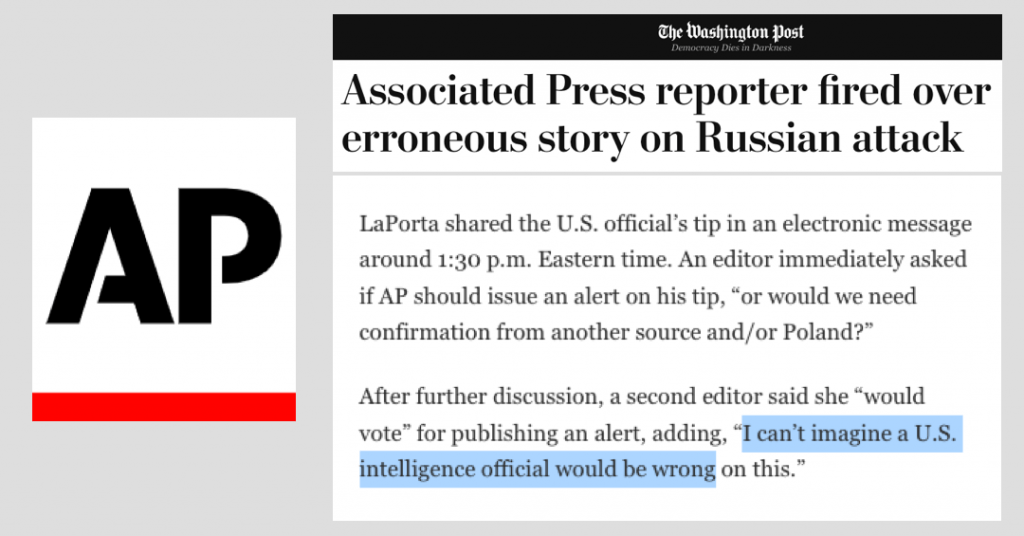
AP Editor Said She “Can’t Imagine” A US Intelligence Official Being Wrong

By Caitlin Johnstone

Source: CaitlinJohnstone.com

The Associated Press journalist who reported a US intelligence official’s false claim that Russia had launched missiles at Poland last week has been fired.

As we discussed previously, AP’s anonymously sourced report which said “A senior U.S. intelligence official says Russian missiles crossed into NATO member Poland, killing two people” went viral because of the massive implications of direct hot warfare erupting between Russia and the NATO alliance. AP subsequently retracted its story as the mainstream political/media class came to accept that it was in fact a Ukrainian missile that had struck Poland.

AP’s firing of reporter James LaPorta looks at this time to be the end point of any accountability for the circulation of this extremely dangerous falsehood. AP spokesperson Lauren Easton says no disciplinary action will be taken against the editors who waved the bogus story through, and to this day the public has been kept in the dark about the identity of the US official who fed such extremely egregious misinformation/disinformation to the public through the mainstream press.

It is utterly inexcusable for AP to continue to protect the anonymity of a government official who fed them such a profoundly significant falsehood. This didn’t just affect AP staff, it affected the whole world; we deserve to know what happened and who was responsible, and AP has no business obstructing that knowledge from us.

LaPorta’s firing looks like this is yet another instance where the least powerful person involved in a debacle is being made to take the fall for it. A powerful intelligence official will suffer no consequences for feeding false information to the press — thereby ensuring that it will happen again — and no disciplinary action will be taken against LaPorta’s superiors, despite the absolute buffoonery that subsequent reporting has revealed on their part.

In an article titled “Associated Press reporter fired over erroneous story on Russian attack,” The Washington Post reports the following (emphasis added):

Internal AP communications viewed by The Post show some confusion and misunderstanding during the preparations of the erroneous report.

LaPorta shared the U.S. official’s tip in an electronic message around 1:30 p.m. Eastern time. An editor immediately asked if AP should issue an alert on his tip, “or would we need confirmation from another source and/or Poland?”

After further discussion, a second editor said she “would vote” for publishing an alert, adding, “I can’t imagine a U.S. intelligence official would be wrong on this.”

“I can’t imagine a US intelligence official would be wrong on this.”

Can you imagine not being able to imagine a US intelligence official being wrong? This would be an unacceptable position for any educated adult to hold, much less a journalist, still less an editor, and still less an editor of one of the most influential news agencies on earth.

These are the people who publish the news reports we read to find out what’s happening in the world. This is the baby-brained level of thinking these people are serving the public interest with.

Antiwar commentator Daniel Larison writes the following of the AP editor’s shocking quote:

Skepticism about official claims should always be the watchword for journalists and analysts. These are claims that need more scrutiny than usual rather than less. If you can’t imagine that an intelligence official could get something important wrong, whether by accident or on purpose, you are taking far too many things for granted that need to be questioned and checked out first.

Intelligence officials of many governments feed information to journalists and have done so practically ever since there was a popular press to feed information to, and that information certainly should not be trusted just because an official source hands it over. It is also always possible for intelligence officials to just get things wrong, whether it is because they are relying on faulty information or because they were too hasty in reaching conclusions about what they think they know.

Whether the AP’s source was feeding them a line or was simply mistaken, a claim as provocative and serious as this one should have been checked out much more thoroughly before it got anywhere near publication. The AP report in this case seems to have been a combination of a story that was “too good to check” and a culture of deference to official sources in which the editors didn’t feel compelled to make the effort to check.

Indeed, the only reason the press receive such explicit protections in the US Constitution is because they are supposed to hold the powerful to account. If the editors of a wildly influential news agency will just unquestioningly parrot whatever they are fed by government officials while simultaneously protecting those officials with anonymity, they are not holding the powerful to account, and are in fact not meaningfully different from state propagandists.

They are state propagandists. Which is probably why they are sipping lattes in the AP newsroom while Julian Assange languishes in prison.

As Jacobin’s Branko Marcetic observed, this is far from the first time AP has given the cover of anonymity to US government officials circulating bogus claims of potentially dangerous consequence, like the time it reported an official’s evidence-free assertion which later proved false that Iran had carried out an attack on four oil tankers off the coast of the United Arab Emirates, or the time it let another one anonymously claim that “Iran may try to take advantage of America’s troop withdrawals from Iraq and Afghanistan.”

So to recap  —

  • Powerful government official who fed AP a false story: Zero accountability
  • AP editor who asked if a report should immediately be published upon receipt of the story: Zero accountability
  • Second AP editor who says she can’t imagine a U.S. intelligence official would be wrong:  Zero accountability
  • Journalist who wrote the story: Singular accountability

In a sane society, power and responsibility would go hand in hand. A disaster would be blamed on the most powerful people involved in its occurrence. In our society it’s generally the exact opposite, with the rank-and-file taking all of the responsibility and none of the power.

Our rulers lie to us, propagandize us, endanger us, impoverish us, destroy journalism, start wars, kill our biosphere and make our world dark and confusing, and they suffer no consequences for it. We cannot allow them to continue holding all of the power and none of the responsibility. This is backwards and must end.

IN THE CULTURE OF HUNGRY GHOSTS

By Dylan Charles

Source: Waking Times

“No society can understand itself without looking at its shadow side.” ― Gabor Maté, In the Realm of Hungry Ghosts: Close Encounters with Addiction

Something wicked bubbles just beneath the surface of the collective conscience. Our society is rife with corruption, predation, perversion, over-consumption, violence, addiction and so much more. Somehow enough is never enough, as if the driving force behind human existence is pure want.

This is not true, though, for we know that spiritually well beings are content beings, looking no further than the present moment’s blessings for satisfaction. We don’t have an inherent need for want. Want is a symptom, not the condition. It’s something that enters when the spirit is untended to.

It must then be a spiritual illness which plagues society. Something secretly driving so many of us mad with insatiable desire for sensation and objects. Unforgiving cravings that manifest in any way imaginable, from sex, to money, to food, to power and even in the need to be perfect. It’s a war against the self, waged unconsciously by the self. A below subconscious campaign of self-annihilation.

There are no contemporary metaphors to understand this kind of emptiness. The void just is. And since the void is so rarely acknowledged and so rarely looked at deeply, it sits in the shadows driving us mad, steering with impulse.

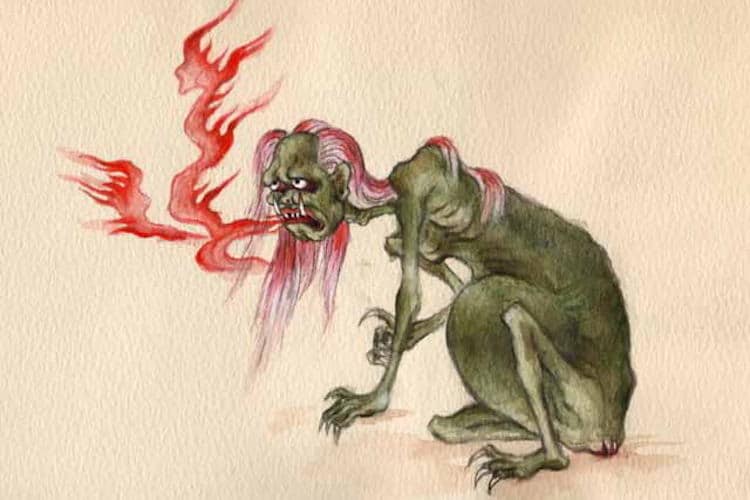
In Chinese Buddhist philosophy, though, there is a story that fits. The hungry ghost.

“In Chinese Buddhist teachings, “hungry ghosts are unable to take in or assimilate what they desperately need. The problem lies in their constricted throats — which cannot open for nourishment. They wander aimlessly in search of relief that is not forthcoming.”” [Source]

Interestingly, according to some of its origin myths, the hungry ghost was born out an act of cruelty. In many of the stories, it is a wealthy man’s wife who did some terrible thing to a monk, and when she eventually dies her spirit takes the form of the hungry ghost, forever lurking in purgatory, unable to ever fill its distorted belly and therefore always needing and wanting more.

The hungry ghost, then, is an expression of karma.

Hungry ghosts are the demon-like creatures described in Buddhist, Taoist, Hindu, Sikh, and Jain texts as the remnants of the dead who are afflicted with insatiable desire, hunger or thirst as a result of bad deeds or evil intent carried out in their life times. [Source]

In the realm of hungry ghosts, a deep drama between the ego and the ghost plays out ad infinitum. It’s an interplay that feeds the ego just enough for it to survive, so that in turn the ego can feed the hungry ghost. A dead-end cul-de-sac of sorts. A looping projection of one of our worst human vulnerabilities.

“The work of the ghost does not want to completely destroy its prey. Having fed off the other through dissociative trajectories of turbulence, the ego again becomes more robust. The hungry ghost now has, as companion and source of nurture, a replenished ego on which internal feeding may resume inside the space of erasure until the plenitude of the ghost-within again permeates the intersubjective.” ~  Nick Totton, Psychoanalysis and the Paranormal: Lands of Darkness

Spiritually healthy people understand their cravings for what they, expressions of innumerable forms of pain. Manifestations of the suffering caused by disconnection from the self, and from nature. And the self is nature. There really is no distinction between the two. The illusion is of separateness.

The ghosts are there to remind us that our real work is transmuting our suffering and cruelty into resilience and compassion. It’s not enough to numb the pain, it must be used to our advantage, for our growth, to serve as a catalyst for transformation, and to provide a chrysalis in which the transformation can take place.

“We are social beings. When we feel disconnected or alienated, we experience pain. Addiction, depression, anger, and violence are different ways we react to pain. To heal our society we must heal the emotional wounds.” ~Chris Agnos

Few understand this more clearly than Dr. Gabor Maté, whose work with drug addicts has transformed our understanding of what it means to be stuck in the realm of hungry ghosts.

BE YOUR OWN SAVIOR WHILE YOU STILL CAN

By Gary Z McGee

Source: Waking Times

“Stop drifting—sprint to the finish. Write off your hopes, and if your well-being matters to you, be your own savior while you can.” ~Marcus Aurelius

In a world on fire, it’s on you to be water. It’s on you to put out the flames. It’s on you to become the savior you’ve been waiting for. Idleness makes you mere kindling; boldness makes you a force of nature to contend with.

If, as Steve Jobs advised, “remembering that you are going to die is the best way I know to avoid the trap of thinking you have something to lose,” then it stands to reason that you use death as a guide for redeeming your life.

Because you are going to die. Maybe not today. Maybe not tomorrow. But someday you will be pushing up daisies along with every other human being who has ever existed.

The question is: will it be death by boredom and banality pining for a savior, or death by passion and curiosity becoming your own savior?

You have from this day until the day you die to live the life you want to live. You might as well make it a healthy life. You might as well make it a heroic life.

You had an eternity before you existed to do nothing. You’ll have an eternity after you exist to do nothing. Now is your time to actually do something, to find something you love to do and then use it to save your life.

Place the oxygen mask on yourself before assisting others:

“Once you fall in love with yourself, their game is over.” ~Alamir Guard

Focus on you until the focus is on you, then focus on the world.

The best way to do this is to imagine your life as a crashing plane. In the crashing plane that is your life, you must be capable of putting the oxygen mask (health) on yourself before assisting others. Once you have your mask set right, you can begin attempting to set the world right.

If you attempt to set the world right without your oxygen mask on, you risk not being able to help because you can’t function. You risk ill-health and incompetence. You risk death before your time.

With your oxygen mask secure, however, you will have the health and confidence needed to engage the world with strength and vitality. You will be a force to be reckoned with. Such a force can bring balance to an otherwise imbalanced world. Such a force can even prevent the plane from crashing before its time.

Seen in this light, you can see how there is a virtue in selfishness. For it is selfishness with good intent. The selfishness of putting the oxygen mask on yourself leads to the selflessness of helping others do the same.

Pride up; ego down. Confidence up; conceit down. Chin up; foot down. Self-esteem leads to prestige when you use it toward the wellbeing of others and to ground the world in health.

Be counteractive with answers and proactive with questions:

“Be a free thinker and don’t accept everything you hear as truth. Be critical and evaluate what you believe in.” ~Aristotle

Sometimes saving yourself means freeing yourself from what has been preventing you from flourishing. Often what prevents you from flourishing is not so obvious. It can be as simple as an outdated law or as complex as a limited worldview. Paradoxically, the only way to know for sure of what’s preventing you from flourishing is to not be sure.

Ironically, when you’re not sure of anything, you free yourself to be sure of what’s possible and what’s not. This is because when you sacrifice certainty, you resurrect curiosity. You get out in front of what you think you know so that what you don’t know can at least potentially become knowable.

This requires a questioning disposition. It requires the ability to face an “answer” with credulity and circumspection; to, as Aristotle suggested, “entertain a thought without accepting it.” It requires the fortitude to cut through orthodoxy with an unorthodox sword.

In the spirit of becoming your own savior, there is perhaps nothing more powerful than questioning the answers that came before you. Nothing is more powerful than an unorthodox question mark planted over an orthodox period.

The questioner is the redeemer. For what must be redeemed is the Truth Quest itself, and it is redeemed from the trap of the so-called “truth.”

In a world full of toxic positivity be authentic chaos:

“In each one of you there is a call, a will, an impulse of nature, an impulse toward the future, the new, the higher. Let it mature, let it resound, nurture it! Your future, your hard dangerous path is this: to mature and to find God in yourselves.” ~Hermann Hesse

What does it mean to be authentic chaos in a world full of toxic positivity? It means recognizing when comfort has become a prison and acting in such a way that you break free and stretch your comfort zone. It means recognizing when a lifejacket has become a limitation to swimming. It means casting security aside so that courage can be self-actualized. It means realizing that there’s more happiness in a spoonful of hard-earned self-improvement than in an ocean-full of easy self-affirmation.

Authentic chaos is introducing a little strategic disorder into the current order to alchemize a higher order. It’s controlled anarchy like the native American concept of counting coup. It’s the personification of a social leveling mechanism that levels the playing field of all finite games while introducing the higher perspective of the Infinite Game of life.

More importantly, authentic chaos is a deep reconnecting to our primal nature. It’s a vital hard reset into sacred alignment. It’s becoming a force of nature first and a person second. Written laws shrivel into nothingness beneath the primacy of the unwritten law of the interconnected cosmos. Self-as-world and world-as-self becomes the supreme perspective. Egocentrism is trumped by eco-centrism. One-dimensional independence is subsumed by multidimensional interdependence.

The world opens, the fountainhead overflows, the Philosopher’s Stone reveals itself, as the authentic chaos of the individuated cuts through toxic positivity like a hot blade through cold butter.

Practice Fait Sur Mesure:

“The spiritual journey is individual, highly personal. It can’t be organized or regulated. It isn’t true that everyone should follow one path. Listen to your own truth.” ~Ram Dass

One powerful way to listen to your own truth is to practice fait sur mesure. Which is French for ‘made to your measure.’ A huge part of becoming your own savior is realizing when what your culture has given you is not to your measure and then having the courage to create a way of living that is to your measure.

This means accepting that you are the only benchmark for your life. You are the measure. Nobody else can determine what is or is not to your measure. Only you have the power to either remain a culturally conditioned cog or to become a courageously reconditioned catalyst.

Don’t fall into the trap of following someone else’s plan. Deconstruct, analyze, and scrutinize their plan, then improvise it. Stand on the shoulders of giants. Customize your life to your own fitting. Take this piece from this ideology and that piece from that ideology, but then connect it all to your own unique imagination. Be creative. Think outside the box. Push your culturally-prescribed comfort zone as far as it will go. It’s all yours for the making.

Understand: In the Matrix of the world, you are “the one.” Just don’t get a big head about it. Because everyone is “the one.” It’s just that not everyone has the capacity to act on it. It is your responsibility alone to gain the capacity to act on it. It is your responsibility alone to create your own destiny.

So, existentially crush out. No holds barred. Go full frontal boss mode on living life to the fullest. Dive into the cosmic ocean with Death for a lifejacket. Become your own savior before it’s too late.