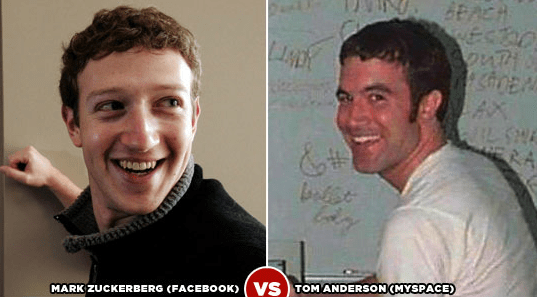
My MySpace profile was abandoned when, at the ripe age of 18, I decided it was just a little too juvenile — the glittering GIFs affixed to every page, the garish customized designs, the pressure on maintaining your top 8. By 2006, Facebook offered a cleaner social experience; by 2009, Twitter offered a more casual one. MySpace was a complete relic by this point, even though only a few years had passed since its launch.
Back in 2005, though, long before MySpace burned out, its founder, Tom Anderson — whose grinning face greeted every new user as their first “friend” — sold the site for $580 million to Rupert Murdoch’s News Corporation. While his site was becoming a punchline during the rise of Facebook, Twitter, Instagram, and the other social media networks we now use everyday, Anderson disappeared entirely from the tech scene. Now, he travels the world, documenting his visits to exotic locations.
Contrast that with what’s currently happening to Facebook’s Mark Zuckerberg, who’s on day two of being grilled by a Senate committee for Facebook’s role in haphazardly collecting all of our personal data, and possibly swinging the 2016 presidential election toward Donald Trump. What was supposed to be a basic networking tool has now become one of the chief mediators of how people interact with each other and the world around them, and how information is absorbed and disseminated on the internet. It’s now apparent that Facebook and Zuckerberg didn’t really consider any of this when aggressively pursuing growth, and now we’re all screwed as we try to untangle the consequences.
MySpace Tom? His most recent Instagram post from seven days ago is a giveaway for a stay at an Iceland hotel. He doesn’t have to issue any terse statements about his company’s commitment to fostering a healthy society; he doesn’t have to sit on a booster seat for seven hours and take dipshit questions from a procession of Senate ghouls. He isn’t worth as much money as Zuckerberg, of course, but unless you’re an oil baron, $580 million is enough to tide you over for the length of your lifetime, and your children’s lifetime, and your children’s children’s lifetime, and so on. (Even after taxes!) And yes, yes, being that rich is good for nobody, but without getting into an argument about the perils of capitalism, we can agree that personally speaking, Anderson is having a much better go of things.
It puts MySpace’s failure to evolve in a new light, as perhaps the healthy thing is for a platform to die and for everyone to move on. Its aesthetic and form, back when everyone had emo bangs and listened to Hawthorne Heights, couldn’t change without altering the meaning of the site altogether, and by that time, everyone was gone. Had Facebook not gotten too good at inserting itself between human users, there’s no way it would’ve run into their current problems at such a wide scope. The suspicious CEO is not the one who cashes out; it’s the one who sticks around and creates a behemoth.
Zuckerberg could have sold off his share and avoided becoming literally one of the most disliked people in the present moment. I never thought we’d declare MySpace the winner over Facebook, but then again, I never thought a lot of things about the moment we’re in.
Since late 2016, the New York Times, working together with the US intelligence agencies and the Democratic Party, has been engaged in a campaign to promote internet censorship in the guise of targeting “fake news” and “Russian propaganda.”
In waging this campaign, the Times’ motives are both political and pecuniary. Speaking for a ruling elite that sees the growth of social opposition on all sides and expects far worse, the Times has promoted censorship to remove opportunities for the working class to organize outside the framework of official politics.
In addition, the Times, for the most part a clearinghouse for staid and predigested state propaganda, is seeking to carve back market share it has lost to online publications that carry out genuine investigative journalism and oppose the lies peddled by the US government and media.
In recent months, this campaign has entered a new and malignant phase. Increasingly dropping the pretext of “Russian meddling,” the Times is now directly attacking its main target: the fact that the internet, and in particular social media, helps empower the population to access oppositional sources of news and have their voices heard in public.
Among the Times’ latest broadsides against freedom of expression is an article by its “State of the Art” columnist Farhad Manjoo headlined “For Two Months, I Got My News From Print Newspapers. Here’s What I Learned.” The piece, supposedly written as a first-hand account of a journalist turning off social media and only reading the news from print newspapers, is—in an unusually literal sense—a piece of lying propaganda from beginning to end.
As the Columbia Journalism Review pointed out, during the period in which he supposedly stopped using social media, Manjoo managed to post on Twitter virtually every day. “Manjoo remained a daily, active Twitter user throughout the two months he claims to have gone cold turkey, tweeting many hundreds of times, perhaps more than 1,000,” the Review pointed out.
Manjoo’s blatant falsifying of his own social media use is hardly the most sinister aspect of his piece. However, it expresses something essential about the Times’ notion of “reporting”: its writers feel they can say anything and get away with it, so long as their claims conform to the dictates of the establishment and the intelligence agencies whose interests determine what is and what is not reported in the US media.
The columnist’s dishonesty about his own activities provides much needed context for his article as a whole, which is little more than a long-form denunciation of a reading public that feels compelled to obtain its news from sources not massaged by the CIA-vetted hacks at the New York Times. In the process, Manjoo gives his unqualified blessings to the pronouncements of his own publication and castigates anyone who would question them as a member of an ignorant “herd,” whose opinions ought to be suppressed.
During his pretended sojourn into the desert of print media, Manjoo said he learned to value having the news spoon-fed to him by “professionals,” without having to worry about whether what he was reading was true or false.
As he puts it, “It takes professionals time to figure out what happened, and how it fits into context… This was the surprise blessing of the newspaper. I was getting news a day old, but in the delay between when the news happened and when it showed up on my front door, hundreds of experienced professionals had done the hard work for me.”
He continues, “Now I was left with the simple, disconnected and ritualistic experience of reading the news, mostly free from the cognitive load of wondering whether the thing I was reading was possibly a blatant lie.”
Here, we assume, the reader is supposed to heave a sigh of relief. How soothing not to have to think for oneself! The author’s surrender of his critical faculties supposedly did wonders for his health and general well being. Not only did he become “less anxious,” but he had the time to “take up pottery” and “became a more attentive husband and father”! Wonderful! And so much more wonderful if he hadn’t actually made up the story about his abstinence from social media.
Manjoo’s condemnation of critical thinking aside, the real core of the piece is a scathing denunciation of the public, which he describes as a “herd” and a “crowd,” and which, moreover, is empowered to express its rotten opinions by the sinister power of social media.
“Avoid social [media],” he declares. “Technology allows us to burrow into echo chambers, exacerbating misinformation and polarization and softening up society for propaganda.”
The statements posted by the “online hordes” are not “quite news, and more like a never-ending stream of commentary, one that does more to distort your understanding of the world than illuminate it,” Manjoo adds. “On social networks … People don’t just post stories—they post their takes on stories, often quoting key parts of a story to underscore how it proves them right.”
People are posting “their takes on stories!” The horror! Instead of just consuming the news as worked over by the Times, complete with big lies (“weapons of mass destruction”) and small ones (its technology columnist giving up Twitter for two months), social media allows users to critically examine the stories they read. In other words, the internet allows the public to bypass the monopoly of “professional” falsifiers and “gatekeepers” like Manjoo, Judith Miller, Thomas Friedman and the like.
The author’s only hope is that “the government” and “Facebook” will soon “fix” this problem. The clear implication is that once social media is “fixed,” the “herd,” “crowd,” and “hordes” will no longer be allowed to pollute cyberspace by questioning the pronouncements of the New York Times. Manjoo’s self-righteous pontifications, worthy of Polonius (if Polonius were also a liar), would be comical if they were not so ominous. Faced with a growing wave of social struggles, the ruling elite is preparing censorship on a massive scale. Having succeeded in dramatically reducing traffic to left-wing web sites, the technology giants and intelligence agencies are proceeding to the next phase: censoring all expressions of social opposition, in particular by the working class, on social media.
At the dark heart of corporate consumer culture lie the social programs that mass-produce conformity, obedience, acquiescence and consent for the matrix.
The cult of celebrity is the royal monarch of these schemes, the ace in the hole for mass mind control and the disempowerment of the individual. This is the anointed paradigm of idol worship and idol sacrifice, a vampire’s feast on our individual and collective dreams. Who do you love? Who do you hate? Who do want to be like?
Combine this paradigm with the technology of social media, and the individual is flung into oblivion, never fully understanding the importance and value of their own life, instead always comparing themselves to phony ideals and well-designed, well-funded marketing campaigns.
‘The camera has created a culture of celebrity; the computer is creating a culture of connectivity. As the two technologies converge – broadband tipping the Web from text to image; social-networking sites spreading the mesh of interconnection ever wider – the two cultures betray a common impulse. Celebrity and connectivity are both ways of becoming known. This is what the contemporary self wants. It wants to be recognized, wants to be connected: It wants to be visible. If not to the millions, on Survivor or Oprah, then hundreds, on Twitter or Facebook. This is the quality that validates us, this is how we become real to ourselves – by being seen by others. The great contemporary terror is anonymity.’ ~William Deresiewicz
Marketeers and propagandists are skilled at leveraging human psychology to exploit human nature. They utilize the study of the psyche to gain inroads into your behavior, and they employ this science as a tool for stoking insecurities and triggering urges.
They may be selling an idea, a lifestyle, a product, or a war, but, the pitch is the same: a false idol rises from the wastelands of the American dream, and is presented to the hordes as a well-packaged product. The celebrity’s life is a projection of a niche fantasy, and a following is built up around this fantasy, and the cult followers are steered toward whatever point of purchase.
And that’s what a cult is: “a system of religious veneration and devotion directed toward a particular figure or object.”
This kind of externalized validation serves as a power transfer. Your personal power is extracted and foisted onto a manufactured image in the matrix, and without realizing it, you’ve forfeited your power to influence the direction of your own life.
“The Fantasy of celebrity culture is not designed simply to entertain. It is designed to drain us emotionally, confuse us about our identity, make us blame ourselves for our predicament, condition us to chase illusions of fame and happiness, and keep us from fighting back.” – Chris Hedges
This is about usurping individuality in order to foster groupthink and hive consciousness. It’s also about creating a barrier between what you believe is possible for yourself and what chances you are willing to take in order to manifest a unique vision for your life.
You see, human beings are energetic creations, partly made of matter and partly made of spirit, but wholly malleable to the direction of the mind. We are affected by subtle energies, body language, electromagnetic energy, frequencies of light that we cannot see, sounds that we cannot hear, and a thousand other hidden cues. We are beings of energy, and much like a battery, we can can give or receive energy.
But the mind is at the center of it all. Whatever the mind entertains, the being creates.
When the mind fixes on an external idol, this innate power to form ourselves is transferred outside of our own locus of control, and where the mind could be centered on creating and expanding the self, it is instead focused on the fantasy of achieving an impossible ideal.
As journalist Jon Rappoport notes:
“If perception and thought can be channeled, directed, reduced, and weakened, then it doesn’t matter what humans do to resist other types of control. They will always go down the wrong path. They will always operate within limited and bounded territory. They will always ignore their own authentic power.” ~Jon Rappoport
The end game here is to keep us from accepting ourselves as worthy and perfect divine beings, and to disconnect us from our own potential. This is deep stuff, reaching far beyond the push to convert us into greedy, materialistic consumers. In a metaphysical sense it is a transfer of energy, and where once we were strong and full of promise, we are now helpless and content to observe as the world flits by.
What’s most dangerous to any system of control is for the individual to know their own strength and to speak their own language, as Chris Hedges puts it.
“That’s why I don’t own a television… and I work as hard as I can to distance myself from popular culture so that I can speak in my own language, not the one they give me.” ~Chris Hedges
(Editor’s note: on this 36th anniversary of the passing of Philip K. Dick, it seems an appropriate time to note the relevance of his work to our current dystopia as Henry Farrell does in the following essay. Unfortunately the author is less astute regarding the ways in which the dystopias of Orwell and Huxley are equally relevant to our current milieu.)
This is not the dystopia we were promised. We are not learning to love Big Brother, who lives, if he lives at all, on a cluster of server farms, cooled by environmentally friendly technologies. Nor have we been lulled by Soma and subliminal brain programming into a hazy acquiescence to pervasive social hierarchies.
Dystopias tend toward fantasies of absolute control, in which the system sees all, knows all, and controls all. And our world is indeed one of ubiquitous surveillance. Phones and household devices produce trails of data, like particles in a cloud chamber, indicating our wants and behaviors to companies such as Facebook, Amazon, and Google. Yet the information thus produced is imperfect and classified by machine-learning algorithms that themselves make mistakes. The efforts of these businesses to manipulate our wants leads to further complexity. It is becoming ever harder for companies to distinguish the behavior which they want to analyze from their own and others’ manipulations.
This does not look like totalitarianism unless you squint very hard indeed. As the sociologist Kieran Healy has suggested, sweeping political critiques of new technology often bear a strong family resemblance to the arguments of Silicon Valley boosters. Both assume that the technology works as advertised, which is not necessarily true at all.
Standard utopias and standard dystopias are each perfect after their own particular fashion. We live somewhere queasier—a world in which technology is developing in ways that make it increasingly hard to distinguish human beings from artificial things. The world that the Internet and social media have created is less a system than an ecology, a proliferation of unexpected niches, and entities created and adapted to exploit them in deceptive ways. Vast commercial architectures are being colonized by quasi-autonomous parasites. Scammers have built algorithms to write fake books from scratch to sell on Amazon, compiling and modifying text from other books and online sources such as Wikipedia, to fool buyers or to take advantage of loopholes in Amazon’s compensation structure. Much of the world’s financial system is made out of bots—automated systems designed to continually probe markets for fleeting arbitrage opportunities. Less sophisticated programs plague online commerce systems such as eBay and Amazon, occasionally with extraordinary consequences, as when two warring bots bid the price of a biology book up to $23,698,655.93 (plus $3.99 shipping).
In other words, we live in Philip K. Dick’s future, not George Orwell’s or Aldous Huxley’s. Dick was no better a prophet of technology than any science fiction writer, and was arguably worse than most. His imagined worlds jam together odd bits of fifties’ and sixties’ California with rocket ships, drugs, and social speculation. Dick usually wrote in a hurry and for money, and sometimes under the influence of drugs or a recent and urgent personal religious revelation.
Still, what he captured with genius was the ontological unease of a world in which the human and the abhuman, the real and the fake, blur together. As Dick described his work (in the opening essay to his 1985 collection, I Hope I Shall Arrive Soon):
The two basic topics which fascinate me are “What is reality?” and “What constitutes the authentic human being?” Over the twenty-seven years in which I have published novels and stories I have investigated these two interrelated topics over and over again.
These obsessions had some of their roots in Dick’s complex and ever-evolving personal mythology (in which it was perfectly plausible that the “real” world was a fake, and that we were all living in Palestine sometime in the first century AD). Yet they were also based on a keen interest in the processes through which reality is socially constructed. Dick believed that we all live in a world where “spurious realities are manufactured by the media, by governments, by big corporations, by religious groups, political groups—and the electronic hardware exists by which to deliver these pseudo-worlds right into heads of the reader.” He argued:
the bombardment of pseudo-realities begins to produce inauthentic humans very quickly, spurious humans—as fake as the data pressing at them from all sides. My two topics are really one topic; they unite at this point. Fake realities will create fake humans. Or, fake humans will generate fake realities and then sell them to other humans, turning them, eventually, into forgeries of themselves. So we wind up with fake humans inventing fake realities and then peddling them to other fake humans.
In Dick’s books, the real and the unreal infect each other, so that it becomes increasingly impossible to tell the difference between them. The worlds of the dead and the living merge in Ubik (1969), the experiences of a disturbed child infect the world around him in Martian Time-Slip (1964), and consensual drug-based hallucinations become the vector for an invasive alien intelligence in The Three Stigmata of Palmer Eldritch (1965). Humans are impersonated by malign androids in Do Androids Dream of Electric Sheep? (1968) and “Second Variety” (1953); by aliens in “The Hanging Stranger” (1953) and “The Father-Thing” (1954); and by mutants in “The Golden Man” (1954).
This concern with unreal worlds and unreal people led to a consequent worry about an increasing difficulty of distinguishing between them. Factories pump out fake Americana in The Man in the High Castle (1962), mirroring the problem of living in a world that is not, in fact, the real one. Entrepreneurs build increasingly human-like androids in Do Androids Dream of Electric Sheep?, reasoning that if they do not, then their competitors will. Figuring out what is real and what is not is not easy. Scientific tools such as the famous Voight-Kampff test in Do Androids Dream of Electric Sheep? (and Blade Runner, Ridley Scott’s 1982 movie based loosely on it) do not work very well, leaving us with little more than hope in some mystical force—the I Ching, God in a spray can, a Martian water-witch—to guide us back toward the real.
We live in Dick’s world—but with little hope of divine intervention or invasion. The world where we communicate and interact at a distance is increasingly filled with algorithms that appear human, but are not—fake people generated by fake realities. When Ashley Madison, a dating site for people who want to cheat on their spouses, was hacked, it turned out that tens of thousands of the women on the site were fake “fembots” programmed to send millions of chatty messages to male customers, so as to delude them into thinking that they were surrounded by vast numbers of potential sexual partners.
These problems are only likely to get worse as the physical world and the world of information become increasingly interpenetrated in an Internet of (badly functioning) Things. Many of the aspects of Joe Chip’s future world in Ubik look horrendously dated to modern eyes: the archaic role of women, the assumption that nearly everyone smokes. Yet the door to Joe’s apartment—which argues with him and refuses to open because he has not paid it the obligatory tip—sounds ominously plausible. Someone, somewhere, is pitching this as a viable business plan to Y Combinator or the venture capitalists in Menlo Park.
This invasion of the real by the unreal has had consequences for politics. The hallucinatory realities in Dick’s worlds—the empathetic religion of Do Androids Dream of Electric Sheep?, the drug-produced worlds of The Three Stigmata of Palmer Eldritch, the quasi–Tibetan Buddhist death realm of Ubik—are usually experienced by many people, like the television shows of Dick’s America. But as network television has given way to the Internet, it has become easy for people to create their own idiosyncratic mix of sources. The imposed media consensus that Dick detested has shattered into a myriad of different realities, each with its own partially shared assumptions and facts. Sometimes this creates tragedy or near-tragedy. The deluded gunman who stormed into Washington, D.C.’s Comet Ping Pong pizzeria had been convinced by online conspiracy sites that it was the coordinating center for Hillary Clinton’s child–sex trafficking ring [likewise, the masses may have been convinced by mainstream media that a real child-sex trafficking ring never existed].
Such fractured worlds are more vulnerable to invasion by the non-human. Many Twitter accounts are bots, often with the names and stolen photographs of implausibly beautiful young women, looking to pitch this or that product (one recent academic study found that between 9 and 15 percent of all Twitter accounts are likely fake). Twitterbots vary in sophistication from automated accounts that do no more than retweet what other bots have said, to sophisticated algorithms deploying so-called “Sybil attacks,” creating fake identities in peer-to-peer networks to invade specific organizations or degrade particular kinds of conversation.
Twitter has failed to become a true mass medium, but remains extraordinarily important to politics, since it is where many politicians, journalists, and other elites turn to get their news. One research project suggests that around 20 percent of the measurable political discussion around the last presidential election came from bots. Humans appear to be no better at detecting bots than we are, in Dick’s novel, at detecting replicant androids: people are about as likely to retweet a bot’s message as the message of another human being. Most notoriously, the current U.S. president recently retweeted a flattering message that appears to have come from a bot densely connected to a network of other bots, which some believe to be controlled by the Russian government and used for propaganda purposes.
In his novels Dick was interested in seeing how people react when their reality starts to break down. A world in which the real commingles with the fake, so that no one can tell where the one ends and the other begins, is ripe for paranoia. The most toxic consequence of social media manipulation, whether by the Russian government or others, may have nothing to do with its success as propaganda. Instead, it is that it sows an existential distrust. People simply do not know what or who to believe anymore. Rumors that are spread by Twitterbots merge into other rumors about the ubiquity of Twitterbots, and whether this or that trend is being driven by malign algorithms rather than real human beings.
Such widespread falsehood is especially explosive when combined with our fragmented politics. Liberals’ favorite term for the right-wing propaganda machine, “fake news,” has been turned back on them by conservatives, who treat conventional news as propaganda, and hence ignore it. On the obverse, it may be easier for many people on the liberal left to blame Russian propaganda for the last presidential election than to accept that many voters had a very different understanding of America than they do.
Dick had other obsessions—most notably the politics of Richard Nixon and the Cold War. It is not hard to imagine him writing a novel combining an immature and predatory tycoon (half Arnie Kott, half Jory Miller) who becomes the president of the United States, secret Russian political manipulation, an invasion of empathy-free robotic intelligences masquerading as human beings, and a breakdown in our shared understanding of what is real and what is fake.
These different elements probably would not cohere particularly well, but as in Dick’s best novels, the whole might still work, somehow. Indeed, it is in the incongruities of Dick’s novels that salvation is to be found (even at his battiest, he retains a sense of humor). Obviously, it is less easy to see the joke when one is living through it. Dystopias may sometimes be grimly funny—but rarely from the inside.
The abolition of net neutrality and the use of algorithms by Facebook, Google, YouTube and Twitter to divert readers and viewers from progressive, left-wing and anti-war sites, along with demonizing as foreign agents the journalists who expose the crimes of corporate capitalism and imperialism, have given the corporate state the power to destroy freedom of speech. Any state that accrues this kind of power will use it. And for that reason I traveled last week to Detroit to join David North, the chairperson of the international editorial board of the World Socialist Web Site, in a live-stream event calling for the formation of a broad front to block an escalating censorship while we still have a voice.
“The future of humanity is the struggle between humans that control machines and machines that control humans,” Julian Assange, the founder of WikiLeaks, said in a statement issued in support of the event. “Between the democratization of communication and usurpation of communication by artificial intelligence. While the Internet has brought about a revolution in people’s ability to educate themselves and others, the resulting democratic phenomena has shaken existing establishments to their core. Google, Facebook and their Chinese equivalents, who are socially, logistically and financially integrated with existing elites, have moved to re-establish discourse control. This is not simply a corrective action. Undetectable mass social influence powered by artificial intelligence is an existential threat to humanity. While still in its infancy, the trends are clear and of a geometric nature. The phenomena differs in traditional attempts to shape cultural and political phenomena by operating at scale, speed and increasingly at a subtlety that eclipses human capacities.”
In late April and early May the World Socialist Web Site, which identifies itself as a Trotskyite group that focuses on the crimes of capitalism, the plight of the working class and imperialism, began to see a steep decline in readership. The decline persisted into June. Search traffic to the World Socialist Web Site has been reduced by 75 percent overall. And the site is not alone. AlterNet’s search traffic is down 71 percent, Consortium News’ traffic is down 72 percent. And the situation appears to be growing worse.
The reductions coincided with the introduction of algorithms imposed by Google to fight “fake news.” Google said the algorithms are designed to elevate “more authoritative content” and marginalize “blatantly misleading, low quality, offensive or downright false information.” It soon became apparent, however, that in the name of combating “fake news,” Google, Facebook, YouTube and Twitter are censoring left-wing, progressive and anti-war sites. The 150 most popular search terms that brought readers to the World Socialist Web Site, including “socialism,” “Russian Revolution” and “inequality,” today elicit little or no traffic.
Monika Bickert, head of global policy management at Facebook, told the U.S. Senate Committee on Commerce, Science, and Transportation in a hearing Wednesday that Facebook employs a security team of 10,000—7,500 of whom “assess potentially violating content”—and that “by the end of 2018 we will more than double” it to over 20,000. Social media companies are intertwined with and often work for U.S. intelligence agencies. This army of censors is our Thought Police.
The group, Bickert said, includes “a dedicated counterterrorism team” of “former intelligence and law-enforcement officials and prosecutors who worked in the area of counterterrorism.” She testified that artificial intelligence automatically flags questionable content. Facebook, she said, does not “wait for these … bad actors to upload content to Facebook before placing it into our detection systems.” The “propaganda” that Facebook blocks, she said, “is content that we identify ourselves before anybody” else can see it. Facebook, she said, along with over a dozen other social media companies has created a blacklist of 50,000 “unique digital fingerprints” that can prevent content from being posted.
“We believe that a key part of combating extremism is preventing recruitment by disrupting the underlying ideologies that drive people to commit acts of violence,” she told the committee. “That’s why we support a variety of counterspeech efforts.”
Eric Schmidt, who is stepping down this month as the executive chairman of Google’s parent company, Alphabet, has acknowledged that Google is creating algorithms to “de-rank” Russian-based news websites RT and Sputnik from its Google News services, effectively blocking them. The U.S. Department of Justice forced RT America, on which I host a show, “On Contact,” that gives a voice to anti-imperialist and anti-capitalist voices, to register as a “foreign agent.” Google removed RT from its “preferred” channels on YouTube. Twitter has blocked the Russian news service agencies RT and Sputnik from advertising.
This censorship is global. The German government’s Network Enforcement Act fines social media companies for allegedly objectionable content. French President Emmanuel Macron has vowed to remove “fake news” from the internet. Facebook and Instagram erased the accounts of Ramzan Kadyrov, the dictator of the Chechen Republic, because he is on a U.S. sanctions list. Kadyrov is certainly repugnant, but this ban, as the American Civil Liberties Union points out, empowers the U.S. government to effectively censor content. Facebook, working with the Israeli government, has removed over 100 accounts of Palestinian activists. This is an ominous march to an Orwellian world of Thought Police, “Newspeak” and “thought-crime” or, as Facebook likes to call it, “de-ranking” and “counterspeech.”
The censorship, justified in the name of combating terrorism by blocking the content of extremist groups, is also designed to prevent a distressed public from accessing the language and ideas needed to understand corporate oppression, imperialism and socialism.
“Don’t you see that the whole aim of Newspeak is to narrow the range of thought?” Orwell wrote in “1984.” “In the end we shall make thought-crime literally impossible, because there will be no words in which to express it. Every concept that can ever be needed will be expressed by exactly one word, with its meaning rigidly defined and all its subsidiary meanings rubbed out and forgotten. … Every year fewer and fewer words, and the range of consciousness always a little smaller. …”
Corporate capitalism, and the ideology that justifies it—neoliberalism, the free market, globalization—no longer has any credibility. All of the utopian promises of globalization have been exposed as lies. Allowing banks and corporations to determine how we should order human society and govern ourselves did not spread global wealth, raise the living standards of workers or implant democracy across the globe. The ideology, preached in business schools and by pliant politicians, was a thin cover for the rapacious greed of the elites, elites who now control most of the world’s wealth.
The ruling elites know they are in trouble. The Republican and Democratic parties’ abject subservience to corporate power is transparent. The insurgencies in the two parties that saw Bernie Sanders nearly defeat the seemingly preordained Democratic nominee, Hillary Clinton, and the election of Donald Trump terrify the elites. The elites, by attacking critics and dissidents as foreign agents for Russia, are seeking to deflect attention from the cause of these insurgencies—massive social inequality. Critics of the corporate state and imperialism, already pushed to the margins, are now dangerous because the elites no longer have a viable counterargument. And so these dissidents must be silenced.
“What’s so specifically important about this is that in a period of growing political radicalization among young people, among workers, they start to look for oppositional information, they become interested in socialism, revolution, terms like ‘equality,’ those terms which previously would bring thousands of readers to the World Socialist Web Site, now were bringing no readers to the World Socialist Web Site,” North said. “In other words, they were setting up a quarantine between those who may be interested in our site and the WSWS. From being a bridge, Google was becoming a barrier, a guard preventing access to our site.”
The internet, with its ability to reach across international boundaries, is a potent tool for connecting workers across the earth who are fighting the same enemy—corporate capitalism. And control of the internet, the elites know, is vital to suppress information and consciousness.
“There is no national solution to the problems of American capitalism,” North said. “The effort of the United States is to overcome this through a policy of war. Because what, ultimately, is imperialism? The inability to solve the problems of the nation-state within national borders drives the policy of war and conquest. That is what is emerging. Under conditions of war, the threat of war, conditions of growing and immeasurable inequality, democracy cannot survive. The tendency now is the suppression of democracy. And just as there is no national solution for capitalism, there is no national solution for the working class.”
“War is not an expression of the strength of the system,” North said. “It is an expression of profound and deep crisis. Trotsky said in the Transitional Program: ‘The ruling elites toboggan with eyes closed toward catastrophe.’ In 1939, they went to war, as in 1914, aware of the potentially disastrous consequences. Certainly, in 1939, they knew what the consequences of war were: War brings revolution. But they could not see a way out. The global problems which exist can only be solved in one of two ways: the capitalist, imperialist solution is war and […] fascism. The working-class solution is socialist revolution. This is, I think, the alternative we’re confronted with. So, the question that has come up, in the broadest sense, [is] what is the answer to the problems we face? Building a revolutionary party.”
“There is going to be, and there is already unfolding, massive social struggles,” North said. “The question of social revolution is not utopian. It is a process that emerges objectively out of the contradictions of capitalism. I think the argument can be made—and I think we made this argument—that really, since 2008, we have been witnessing an acceleration of crisis. It has never been solved, and, indeed, the massive levels of social inequality are themselves not the expression of a healthy but [instead] a deeply diseased socioeconomic order. It is fueling, at every level, social opposition. Of course, the great problem, then, is overcoming the legacy of political confusion, produced, as a matter of fact, by the defeats and the betrayals of the 20th century: the betrayal of the Russian Revolution by Stalinism; the betrayals of the working class by social democracy; the subordination of the working class in the United States to the Democratic Party. These are the critical issues and lessons that have to be learned. The education of the working class in these issues, and the development of perspective, is the most critical point … the basic problem is not an absence of courage. It is not an absence of the desire to fight. It is an absence of understanding.”
“Socialist consciousness must be brought into the working class,” North said. “There is a working class. That working class is open now and receptive to revolutionary ideas. Our challenge is to create the conditions. The workers will not learn this in the universities. The Marxist movement, the Trotskyist movement, must provide the working class with the intellectual, cultural tools that it requires, so that it understands what must be done. It will provide the force, it will provide the determination, the emotional and passionate fuel of every revolutionary movement is present. But what it requires is understanding. And we will, and we are seeking to defend internet freedom because we want to make use of this medium, along with others, to create the conditions for this education and revival of revolutionary consciousness to take place.”
While NATO was busy setting up a vast network with which to accuse Russia of perpetuating propaganda from the Soviet era, Washington was suddenly swamped by a wave of hysteria. In an attempt to discredit the new US President, the dominant media accuse him of talking rubbish – in response, the President accuses them of propagating fake news. This cacophony is amplified by the swift development of the social media, which had once been intended for use as weapons of the State Department against nationalist regimes, but which today are popular forums used to combat abuse by all kinds of elites – with Washington at the top of the list.
As soon as the announcement of his surprise election was made public, and even before he had access to the White House, the immense majority of US and NATO media began screaming about the negligence and insanity of President Trump. Battle was joined between the media class and the new President, with each side accusing the other of propagating fake news.
Almost everywhere in the NATO countries – and only in these countries – political representatives began denouncing fake news. This was intended to reveal the supposed influence of Russian propaganda within the « Western democracies ». The State which has been the most seriously impacted by this campaign is France, whose President Emmanuel Macron recently announced the drafting of a law specifically aimed at fighting these « attacks on democracy », but only during « an electoral period ».
The fact that the English expression fake news is maintained in all the languages of the NATO countries attests to the Anglo-Saxon origin of the problem, when in fact the phrase designates a phenomenon as old as the world – false information.
At the origin of the campaign against « fake news » – NATO
In 2009, at the NATO summit in Strasbourg-Kehl, President Obama announçed his intention of creating an Alliance « Strategic Communication » service [1]. It took six years to implement, using elements of the 77th Brigade of the British Land Army and the 361st Civil Affairs Brigade of the United States Land Army (based in Germany and Italy).
At first, their mission was to counter communications accusing the US deep state of having itself organised the attacks of 9/11, then those accusing the Anglo-Saxons of having planned the « Arab Springs » and the war against Syria — such communications were termed « conspiracy theories ». However, the situation evolved rapidly in such a way as to convince the populations of the Alliance that Russia was continuing to apply propaganda from the Soviet era – and thus that NATO was still useful.
Finally, in April 2015, the European Union created a « Work Group for Strategic Communications – East » (East StratCom Task Force). Every week, this group addresses a report on Russian propaganda to thousands of journalists. For example, its last edition (dated 11 January 2018) accuses Sputnik of pretending that the Copenhagen zoo feeds its predators with abandoned household pets. Lord help us, the « democracies » are under attack ! Clearly, it is difficult for these specialists to find meaningful examples of Russian interference. In August of the same year, NATO inaugurated its « Centre for Strategic Communication » in Riga (Latvia). The following year, the US State Department created a Global Engagement Center which works on the same principles.
How Facebook, Hillary Clinton’s pet obsession, turned against her
In 2009, Secretary of State Hillary Clinton, at the instigation of Jared Cohen (leading member of the Policy Planning Staff ), persuaded herself that it was possible to overthrow the Islamic Republic of Iran by manipulating the social media. This theory did not have the desired affect. However, two years later, in 2011, the same Jared Cohen — since become the the CEO of Google Ideas — managed to mobilise the youth of Cairo. Although the « revolution » of Tahrir Square had not swayed the opinion of the Egyptian people, the myth of the extension of the American way of life via Facebook was born. As a result, the State Department sponsored a number of associations and assemblies to promote Facebook.
However, the US Presidential election of 2016 was a shock. An outsider, real estate promoter Donald Trump, eliminated all his rivals one by one, including Hillary Clinton, and was swept into the White House, having benefited from the advice of Facebook. For the first time, the dream of the Muse of professional politicians became reality, but worked against her. Overnight, Facebook was demonised by the dominant Press.
It became evident on this occasion that it is possible to artificially create crowd movements with the social media, but that after a few days, media users regain their senses. This is the constant fact for all systems of information manipulation — they are fleeting. The only form of lie which makes it possible to create long-term behaviour patterns supposes that one has forced the citizens into a form of minor engagement, in other words, that one has brainwashed them [2].
Indeed, Facebook understood this very well, creating its « Politics & Government Outreach Program » and handing it over to the care of Katie Harbath. It was intended to create collective emotions in favour of one client or another, but does not seek to organise lasting campaigns [3]. This is why President Macron proposes to legislate the social media only during electoral periods. He was himself elected thanks to a brief disorder created jointly by a weekly newspaper and Facebook against his rival François Fillon — an operation orchestrated by Jean-Pierre Jouyet [4]. Furthermore, Emmanuel Macron’s fear that next time the social media may be used against him fits with NATO’s desire to demonstrate the continuity of USSR-Russia propaganda. As an example of manipulation, Macron therefore cites an interview with Sputnik concerning his private life and the publishing of an allegation concerning a foreign bank account.
The Christopher Steele Report
During the US Presidential campaign, Hillary Clinton’s team ordered an inquiry on Donald Trump from an ex-agent of the British Secret Services, Christopher Steele. Ex-chief of MI6’s « Russia House », he was known for his scandalous and always unverifiable allegations. After having accused Vladimir Putin, without proof, of having commanded the poisoning of Alexander Litvinenko by Polonium 210, he accused him of having caught Donald Trump in a sex trap and blackmailing him. The Steele Report was then discretely handed to various journalists, politicians and master spies, and finally published [5].
This is the source of the hypothesis according to which, seeking to get his puppet elected and hamper the election of Hillary Clinton, the lord of the Kremlin had ordered « his » media to buy publicity on Facebook and spread lies about the ex-Secretary of State – a hypothesis which may be supported by a conversation between the Australian ambassador in London with one of Donald trump’s advisors [6]. It doesn’t matter that Russia Today and Sputnik only spent a total of a few thousand dollars for publicity which rarely concerned Mrs. Clinton, the US ruling class is persuaded that they turned back the popular tide in favour of the Democrat candidate and her 1.2 billion dollar campaign. In Washington, people persist in believing that technological inventions can be used to manipulate the human race.
It is no longer a question of noting that Donald Trump and his partisans ran their campaign on Facebook because the totality of the written and audiovisual Press was hostile to them, but pretending that Facebook was manipulated by Russia in order to prevent the election of the Muse of Washington.
The legal privilege of Google, Facebook and Twitter
By seeking to prove the interference of Moscow, the US Press underlined the exorbitant privilege enjoyed by Google, Facebook and Twitter — these three companies are not considered responsible for their content. From the point of view of US law, they are no more than transporters of information (common carrier).
The experiments carried out by Facebook, which demonstrated the possibility of creating collective emotions on one hand, and the legal non-responsibility of this company on the other, attest to an anomaly in the system.
Particularly since the privilege enjoyed by Google, Facebook and Twitter is clearly undue. Indeed, these three companies act in at least two different ways to modify the content they transport. First of all, they unilaterally censor certain messages, either via the direct intervention of their personnel, or mechanically, via hidden algorithms. Then they promote their vision of the truth to the detriment of other points of view (fact-checking).
For example, in 2012, Qatar ordered from Google Ideas, already directed by Jared Cohen, the creation of software which would make it possible to follow the progression of defections in the Syrian Arab Army. The point was to show that Syria was indeed a dictatorship, and that the people were beginning to revolt. But it very quickly became clear that this vision of affairs was false. The number of soldiers who defected never rose above 25,000 in an army of 450,000 men. This is why, after having promoted the software, Google discretely retired it.
Conversely, for seven years, Google promoted articles which relayed communiqués from the Syrian Observatory for Human Rights (SOHD). Day after day, they gave the exact count of the number of victims in both camps. Of course, these figures are imaginary – it is impossible for anyone to count them. Never, in a time of war, has a state been able to determine, on a daily basis, the number of soldiers killed in combat and the civilians killed behind the lines. And yet, in the United Kingdom, the SOHD claims to know what the people who live there, in Syria, cannot know.
Far from being just the common carriers, Google, Facebook and Twitter are the forgers of the information they transport, and as such, they ought to be counted legally responsible for their content.
The rules of the freedom of expression
Let’s imagine that the efforts of NATO and those of President Macron against Russia in terms of audiovisual Internet traffic meet with failure. It is nonetheless necessary to enter these new medias into general law.
The principles which regulate the freedom of expression are only legitimate if they are identical for all citizens and for all media. This is not the case today. While the general law applies, there is no specific rule concerning denial or the right to reply for the messages on Internet and the social media.
As always in the history of information, the old medias attempt to sabotage the new. Thus I remember the violent editorial that the French daily Le Monde dedicated in 2002 to my work on the Internet concerning the responsibility for the attacks of 9/11. What shocked the newspaper just as much as my conclusions was that the Voltaire Network was free from the financial obligations of which it felt prisoner [7]. This is the same corporatist attitude that it demonstrates again, fifteen years later, with its service, Le Decodex. Rather than developing a critique of the articles or videos of the new medias, Le Monde proposes to note the reliability of its rival Internet sites. Of course, only the sites issued by their paper colleagues find grace in their eyes, all the others are judged less trustworthy.
To shore up the campaign against the social media, the Fondation Jean-Jaures (that is to say the foundation of the Socialist Party linked to the National Endowment for Democracy) has published an imaginary poll [8]. With a display of numbers, it aims to demonstrate that unsophisticated people – the working classes and the partisans of the National Front – are gullible. It claims that 79 % of French people believe in one conspiracy theory or another. As proof of their naïveté, it points out that 9 % of them are convinced that the Earth is flat.
However, neither myself nor any of my French friends consulted by Internet have ever met any of our compatriots who believe that the Earth is flat. The figure is obviously invented and discredits the entire study. As it happens, although it is linked to the Socialist Party, the Fondation Jean-Jaures still has Gerard Collomb as its general secretary – Collomb has since become President Macron’s Minister for the Interior. This same foundation had already published, two years ago, a study aimed at discrediting the political opponents of the system that it already qualified as « conspiracy theorists » [9].
Principles of goodness together with the golden seed of social justice – sharing – need to be the guiding ideals of a radically redesigned socio-economic paradigm.
The pressures of modern life are colossal; for young people – those under 25 years of age – they are perhaps greater than at any other time. Competition in virtually every aspect of contemporary life, a culture obsessed with image and material success, and the ever-increasing cost of living are creating a cocktail of anxiety and self-doubt that drives some people to take their own lives and many more to self-abuse of one kind or another.
Amongst this age group today, suicide constitutes the second highest cause of death after road/traffic accidents, and is the most common cause of death in female adolescents aged 15–19 years. This fact is an appalling reflection on our society and the materialistic values driven into the minds of children throughout the world.
The World Health Organization (WHO) estimates that in total “close to 800,000 people die due to suicide every year, which is one person every 40 seconds. Many more attempt suicide,” and those who have attempted suicide are the ones at greatest risk of trying again. Whilst these figures are startling, WHO acknowledges that suicide is widely under-reported. In some countries (throughout Sub-Saharan Africa, for example) where stigma still attaches to suicide, it is not always recorded as the cause of death when in fact it should be, meaning the overall suicide figures are without doubt a great deal higher.
Unless there is fundamental change in the underlying factors that cause suicide, the WHO forecasts that by 2020 – a mere three years away, someone, somewhere will take their own life every 20 seconds. This worldwide issue, WHO states, is increasing year on year; it is a symptom of a certain approach to living – a divisive approach that believes humanity is inherently greedy and selfish and has both created, and is perpetuated by, an unjust socio-economic system which is at the root of many of our problems.
Sliding into despair
Suicide is a global matter and is something that can no longer be dismissed, nor its societal causes ignored. It is the final act in a painful journey of anguish; it signifies a desperate attempt by the victim to be free of the pain they feel, and which, to them, is no longer bearable. It is an attempt to escape inner conflict and emotional agony, persecution or intimidation. It may follow a pattern of self-harm, alcohol or drug abuse, and, is in many cases, but not all, related to depression, which blights the lives of more than 300 million people worldwide, is debilitating and deeply painful. As William Styron states in Darkness Invisible, “The pain of severe depression is quite unimaginable to those who have not suffered it, and it kills in many instances because its anguish can no longer be borne. The prevention of many suicides will continue to be hindered until there is a general awareness of the nature of this pain.”
Any suicide is a tragedy and a source of great sadness, particularly if the victim is a teenager, or someone in there twenties, who had their whole life ahead of them, but for some reason or another could not face it. As with all age groups, mental illness amongst young people is cited as the principle reason for, or an impelling cause of suicide, as well as for people suffering from an untreated illness such as anxiety anorexia or bulimia; alcohol and drug abuse are also regularly mentioned, as well as isolation.
All of these factors are effects, the result of the environment in which people – young and not so young – are living: family life, the immediate society, the broader national and world society. The values and codes of behavior that these encourage, and, flowing from this environment, the manner in which people treat one another together with their prevailing attitudes. It must be here that, setting aside any individual pre-disposition, the underlying causes leading to mental illness or alcohol/drug dependency in the first place are rooted.
Unsurprisingly young people who are unemployed for a long time; who have been subjected to physical or sexual abuse; who come from broken families in which there is continuous anxiety due to job insecurity and low wages are at heightened risk of suicide, as are homeless people, young gay and bi-sexual men and those locked up in prison or young offenders institutions. In addition, WHO states that, “Experiencing conflict, […] loss and a sense of isolation are strongly associated with suicidal behavior.”
Lack of hope is another key factor. Absence of hope leads to despair, and from despair flows all manner of negative thoughts and destructive actions, including suicide. In Japan, where suicide is the leading cause of death among people aged between 15 and 39 (death by suicide in Japan is around twice that of America, France and Canada, and three times that of Germany and the U.K.), the BBC reports that, “young people are killing themselves because they have lost hope and are incapable of seeking help.” Suicides began to increase dramatically in Japan in 1988 after the Asian financial crisis and climbed again after the 2008 worldwide economic crash. Economic insecurity is thought to be the cause, driven by “the practice of employing young people on short-term contracts.”
Hope is extremely important, hope that life will improve, that circumstances will change, that people will be kinder and that life will be gentler. That one’s life has meaning. Interestingly, in the aftermath of Princess Diana’s death in 1997, suicides in Britain increased by almost 20 per cent, and cases of self-harm rose by 44 per cent. To many people she was a symbol of compassion and warmth in a brittle, hostile world, and somehow engendered hope.
The list of those most vulnerable to suicide is general and no doubt incomplete; suicide is an individual act and flows from specific circumstances and a particular state of mind. Generalizations miss the subtleties of each desperate cry. Some suicides are spontaneous acts, spur of the moment decisions (as is often the case in Asian countries, where poison is the most common method of suicide), others may be drawn out over years, in the case of the alcoholic for example, punctuated perhaps by times of relief and optimism, only to collapse under the weight of life’s intense demands once more.
It is these constant pressures that are often the principle causes of the slide into despair and the desire to escape the agony of daily life. They are all pervasive, hard to resist, impossible, apparently, to escape. Firstly, we are all faced with the practical demands of earning a living, paying the rent or mortgage, buying food, and covering the energy bills etc. Secondly, there are the more subtle pressures, closely related to our ability to meet the practical demands of the day: the pressure to succeed, to make something of one’s life, to be strong – particularly of you’re a young man, to be sexually active, to be popular, to know what you want and have the strength to get it; to have the confidence to dream and the determination to fulfill your dreams. And if you don’t know what you want, if you don’t have ‘dreams’ in a world of dreamers, this is seen as weakness, which will inevitably result in ‘failure’. And by failure, is meant material inadequacy as well as unfulfilled potential and perhaps loneliness, because who would want to be with a ‘failure’?
These and other expectations and pressures constitute the relentless demands faced by us all, practical and psychological, and our ability to meet them colours the way we see ourselves and determines, to a degree, how others see us. The images of what we should be, how we should behave, what we should think and aspire too, the values we should adopt and the belief system we should accept are thrust into the minds of everyone from birth. They are narrow, inhibiting, prescribed and deeply unhealthy.
The principle tool of this process of psychological and sociological conditioning is the media, as well as parents and peers, all of whom have themselves fallen foul of the same methodology, and education.
Beyond reward and punishment
Step outside the so-called norm, stand out as someone different, and risk being persecuted, bullied and socially excluded. The notion of individuality has been outwardly championed but systematically and institutionally denied. Our education systems are commonly built on two interconnected foundations – conformity and competition – and reinforced through methods, subtle and crude, of reward and punishment. All of which stifles true individuality, which needs a quiet, loving space, free from judgment in which to flower. For the most sensitive, vulnerable and uncertain, the pressure to conform, to compete and succeed, is often too much to bear. Depression, self-doubt, anxiety, self-harm, addiction and, for some, suicide, are the dire consequences.
There are many initiatives aimed at preventing suicide amongst young people – alcohol/drug services, mental health treatment, reducing access to the means of suicide – and these are of tremendous value. However if the trend of increased suicides among young people is to be reversed it is necessary to dramatically reduce the pressures on them and inculcate altogether more inclusive values. This means changing the environments in which life is lived, most notably the socio-economic environment that infects all areas of society. Worldwide, life is dominated by the neoliberal economic system, an extreme form of capitalism that has infiltrated every area of life. Under this decrepit unjust model everything is classed as a commodity, everyone as a consumer, inequality guaranteed with wealth and power concentrated in the hands of a tiny percentage of the population – 1% of 1%, or less in fact. All facets of life have become commercialized, from health care to the supply of water and electricity, and the schooling of our children. The educational environment has become poisoned by the divisive values of the market place, with competition at the forefront, and competition has no place in schools and universities, except perhaps on the sports field: streaming and selection should be vetoed totally and testing, until final exams (that should be coursework based), scrapped.
All that divides within our societies should be called out and rejected, cooperation inculcated instead of competition in every area of human endeavor, including crucially the political-economic sphere; tolerance encouraged, unity built in all areas of society, local, national and global. These principles of goodness together with the golden seed of social justice – sharing – need to be the guiding ideals of a radically redesigned socio-economic paradigm, one that meets the needs of all to live dignified, fulfilled lives, promotes compassion, and, dare I say, cultivates love. Only then, will the fundamental causes of suicide, amongst young people in particular, but men and women of all ages, be eradicated.
The year 2018 has opened with an international campaign to censor the Internet. Throughout the world, technology giants are responding to the political demands of governments by cracking down on freedom of speech, which is inscribed in the US Bill of Rights, the European Convention on Human Rights, and countless international agreements.
Bloomberg, the financial news service, published a blog post titled “Welcome to 2018, the Year of Censored Social Media,” which began with the observation, “This year, don’t count on the social networks to provide its core service: an uncensored platform for every imaginable view. The censorship has already begun, and it’ll only get heavier.”
Developments over the past week include:
On January 1, the German government began implementation of its “Network Enforcement Law,” which threatens social media companies with fines of up to €50 million if they do not immediately remove content deemed objectionable. Both German trade groups and the United Nations have warned that the law will incentivize technology companies to ban protected speech.
On January 3, French President Emmanuel Macron vowed to introduce a ban during election cycles on what he called “fake news” in a further crackdown on free speech on top of the draconian measures implemented under the state of emergency. The moves by France and Germany have led to renewed calls for a censorship law applying to the entire European Union.
On December 28, the New York Times reported that Facebook had deleted the account of Ramzan Kadyrov, the head of the Chechen Republic, nominally because he had been added to a US sanctions list. As the American Civil Liberties Union pointed out, this creates a precedent for giving the US government essentially free rein to block freedom of expression all over the world simply by putting individuals on an economic sanctions list.
This week, Iranian authorities blocked social media networks, including Instagram, which were being used to organize demonstrations against inequality and unemployment.
Facebook has continued its crackdown on Palestinian Facebook accounts, removing over 100 accounts at the request of Israeli officials.
These moves come in the wake of the decision by the Trump administration to abolish net neutrality, giving technology companies license to censor and block access to websites and services.
In August, the WorldSocialistWeb Site first reported that Google was censoring left-wing, anti-war, and progressive websites. When it implemented changes to its search algorithms, Google claimed they were politically neutral, aimed only at elevating “more authoritative content” and demoting “blatantly misleading, low quality, offensive or downright false information.”
Now, no one can claim that the major technology giants are not carrying out a widespread and systematic campaign of online censorship, in close and active coordination with powerful states and intelligence agencies.
In the five months since the WSWS released its findings, Google’s censorship of left-wing, anti-war, and progressive web sites has only intensified.
Even though the World Socialist Web Site‘s readership from direct entries and other websites has increased, Google’s effort to isolate the WSWS through the systematic removal of its articles from search results has continued to depress its search traffic. Search traffic to the WSWS, which fell more than any other left-wing site, has continued to trend down, with a total reduction of 75 percent, compared to a 67 percent decline in August.
Alternet.org’s search traffic is now down 71 percent, compared to 63 percent in August. Consortium News’s search traffic is down 72 percent, compared to 47 percent in August. Other sites, including Global Research and Truthdig, continue to see significantly depressed levels of search traffic.
In its statement to commemorate the beginning of the new year, the World Socialist Web Site noted, “The year 2018—the bicentenary of Marx’s birth—will be characterized, above all, by an immense intensification of… class conflict around the world.” This prediction has been confirmed in the form of mass demonstrations in Iran, the wildcat strike by auto workers in Romania and growing labour militancy throughout Europe and the Middle East.
The ruling elites all over the world are meeting this resurgence of class struggle with an attempt to stifle and suppress freedom of expression on the Internet, under the false pretence of fighting “fake news” and “foreign propaganda.”
The effort to muzzle social opposition by the working class must be resisted.
On January 16, 2018, the World Socialist Web Site will host a live video discussion on Internet censorship, featuring journalist and Truthdig contributor Chris Hedges and WSWS International Editorial Board Chairperson David North.
The discussion will explore the political context of the efforts to censor the Internet and abolish net neutrality, examine the pretexts used to justify the suppression of free speech (i.e., “fake news”), and discuss political strategies to defend democratic rights. Hedges and North will also field questions from on-line listeners.
We urge all of our readers to register to participate in this immensely important discussion, and to help publicize it to friends and co-workers.
The webinar will be streamed live by the WSWS on YouTube and Facebook on Tuesday, January 16 at 7:00 pm(EST).For more information, time zone conversions and to register, clickhere.
Fight Google’s censorship!
Google is blocking the World Socialist Web Site from search results.
To fight this blacklisting:
Share this article with friends and coworkers





 After the Crash