Alex Jones and the Rise of Corporate Censorship

By Brendan O’Neill

Source: Strategic Culture Foundation

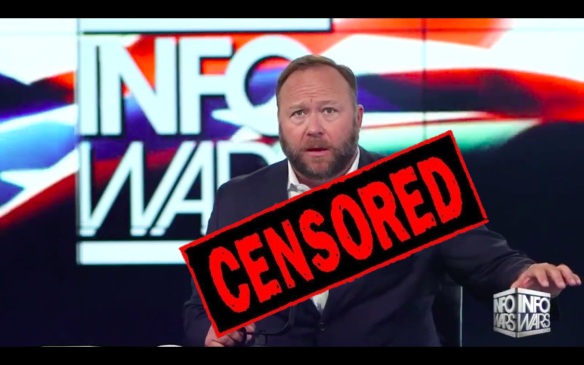
So we’re now trusting the capitalist class, massive, unaccountable corporations, to decide on our behalf what we may listen to and talk about? This is the take-home message, the terrible take-home message, of the expulsion of Alex Jones’ Infowars network from Apple, Facebook and Spotify and of the wild whoops of delight that this summary banning generated among so-called liberals: that people are now okay with allowing global capitalism to govern the public sphere and to decree what is sayable and what is unsayable. Corporate censorship, liberals’ new favourite thing – how bizarre.

We live in strange times. On one hand it is fashionable to hate capitalism these days. No middle-class home is complete without a Naomi Klein tome; making memes of Marx is every twentysomething Corbynistas’ favourite pastime. But on the other hand we seem content to trust Silicon Valley, the new frontier in corporate power, to make moral judgements about what kind of content people should be able to see online. Radicals and liberals declared themselves ‘very glad’ that these business elites enforced censorship against Jones and Infowars. We should be ‘celebrating the move’, said Vox, because ‘it represents a crucial step forward in the fight against fake news’. Liberals for capitalist censorship! The world just got that bit odder, and less free.

Over the past 24 hours, Jones and much of his Infowars channel has been ‘summarily banned’ – in the excitable words of Vox – from Apple, Facebook, Spotify and YouTube. Initially, Facebook and YouTube had taken only selective measures against Jones. In response to a Twitterstorm about his presence on these platforms, they took down some of his videos. But then Apple decided to ban Jones entirely – removing all episodes of his podcast from its platform – and the other online giants followed suit. Or as the thrilled liberal commentary put it: ‘The dominoes started to fall.’ Despite having millions of subscribers, despite there being a public interest in what he has to say, Jones has been cast out of the world of social media, which is essentially the public square of the 21st century, on the basis that what he says is wicked.

This is censorship. There will of course be apologists for the corporate control of speech, on both the left and right, who will say, ‘It’s only censorship when the government does it!’. They are so wrong. When enormous companies that have arguably become the facilitators of public debate expel someone and his ideas because they find them morally repugnant, that is censorship. Powerful people have deprived an individual and his network of a key space in which they might propagate their beliefs. Aka censorship.

It doesn’t matter what you think of Jones. It doesn’t matter if you think he is mad, eccentric, and given to embracing crackpot theories about school shootings being faked. You should still be worried about what has happened to him because it confirms we have moved into a new era of outsourced censorship. It shows that what was once done by the state is now done by corporations. The illiberal, intolerant cleansing from public life of ideas judged to be offensive or dangerous has shifted from being the state’s thing to being the business elite’s thing. Witness how many campaigners for censorship now seek to marshal capitalist power to the end of erasing voices they don’t like – from the Dump Farage campaign that wants corporations to withdraw their advertising from LBC until it dumps Nigel Farage as a presenter to the calling on Silicon Valley to deprive the oxygen of publicity to offensive broadcasters.

In essence, so-called liberals and sections of the political class now want corporations to do their dirty work for them. They want the capitalist elites to do what it has become somewhat unfashionable for the state to do: ban controversial political speech. What an extraordinary folly this is. To empower global capitalism to act as judge, jury and executioner on what may be said on social-media platforms, in the new public square, is to sign the death warrant of freedom of speech. What if these bosses decide next that Marxist speech is unacceptable? Or that Zionist speech is dangerous? In green-lighting the censorship of Jones, we grant corporate suits the moral authority to censor pretty much anything else, too.

People on both the liberal left and the libertarian right argue that what has been done to Jones is acceptable because this is simply a case of businesses deciding freely who they should associate with or provide platforms to. This is disingenuous. This was not a clean, independent business decision – it was a rash act of silencing carried out under pressure from a moralised mob that insisted Jones’ words are too wicked for public life. This isn’t the free market in action – it’s the bending of capitalist power to the end of enforcing moral controls on speech. There is one very interesting thing that will spring from this incident: we will witness the severe limitations of right-wing libertarianism. Libertarians’ obsession with the state, their belief that things are only bad if the state does them, means they are incapable of arguing against capitalist authoritarianism, and in fact even support it on the basis that this is the free market being the free market (even though it isn’t). Libertarianism is devastatingly ill-prepared for the new authoritarianism, for tackling the rise of outsourced censorship and informal intolerance.

For good or ill, the social-media sphere is the new public sphere. The expulsion of people from these platforms is to 2018 what a state ban on the publication or sale of certain books was to 1618. How can we convince the owners of social media to permit the freest speech possible and to trust their users to negotiate the world of ideas for themselves? This is the question we should be asking ourselves, rather than concocting more ways to encourage these corporate overlords to censor and blacklist.

The Utility of the RussiaGate Conspiracy

New McCarthyism allows corporate media to tighten grip, Democrats to ignore their own failings

By Alan MacLeod

Source: FAIR

To the shock of many, Donald Trump won the 2016 presidential elections, becoming the 45th president of the United States. Not least shocked were corporate media, and the political establishment more generally; the Princeton Election Consortium confidently predicted an over 99 percent chance of a Clinton victory, while MSNBC’s Rachel Maddow (10/17/16) said it could be a “Goldwater-style landslide.”

Indeed, Hillary Clinton and her team actively attempted to secure a Trump primary victory, assured that he would be the easiest candidate to beat. The Podesta emails show that her team considered even before the primaries that associating Trump with Vladimir Putin and Russia would be a winning strategy and employed the tactic throughout 2016 and beyond.

With Clinton claiming, “Putin would rather have a puppet as president,” Russia was by far the most discussed topic during the presidential debates (FAIR.org, 10/13/16), easily eclipsing healthcare, terrorism, poverty and inequality. Media seized upon the theme, with Paul Krugman (New York Times, 7/22/16) asserting Trump would be a “Siberian candidate,” while ex-CIA Director Michael Hayden (Washington Post, 5/16/16) claimed Trump would be Russia’s “useful fool.”

The day after the election, Jonathan Allen’s book Shattered detailed, Clinton’s team decided that the proliferation of Russian-sponsored “fake news” online was the primary reason for their loss.

Within weeks, the Washington Post (11/24/16) was publicizing the website PropOrNot.com, which purports to help users differentiate sources as fake or genuine, as an invaluable tool in the battle against fake news (FAIR.org, 12/1/16, 12/8/16). The website soberly informs its readers that you see news sources critiquing the “mainstream media,” the EU, NATO, Obama, Clinton, Angela Merkel or other centrists are a telltale sign of Russian propaganda. It also claims that when news sources argue against foreign intervention and war with Russia, that’s evidence that you are reading Kremlin-penned fake news.

PropOrNot claims it has identified over 200 popular websites that “routinely peddle…Russian propaganda.” Included in the list were Wikileaks, Trump-supporting right-wing websites like InfoWars and the Drudge Report, libertarian outlets like the Ron Paul Institute and Antiwar.com, and award-winning anti-Trump (but also Clinton-critical) left-wing sites like TruthDig and Naked Capitalism. Thus it was uniquely news sources that did not lie in the fairway between Clinton Democrats and moderate Republicans that were tarred as propaganda.

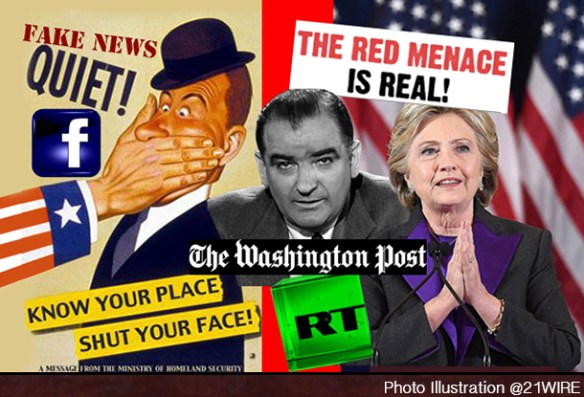
PropOrNot calls for an FBI investigation into the news sources listed. Even its creators see the resemblance to a new McCarthyism, as it appears as a frequently asked question on their website. (They say it is not McCarthyism, because “we are not accusing anyone of lawbreaking, treason, or ‘being a member of the Communist Party.’”) However, this new McCarthyism does not stem from the conservative right like before, but from the establishment center.

That the list is so evidently flawed and its creators refuse to reveal their identities or funding did not stop the issue becoming one of the most discussed in mainstream circles. Media talk of fake news sparked organizations like Google, Facebook, Bing and YouTube to change their algorithms, ostensibly to combat it.

However, one major effect of the change has been to hammer progressive outlets that challenge the status quo. The Intercept reported a 19 percent reduction in Google search traffic, AlterNet 63 percent and Democracy Now! 36 percent. Reddit and Twitter deleted thousands of accounts, while in what came to be called the “AdPocalypse,” YouTube began demonetizing videos from independent creators like Majority Report and the Jimmy Dore Show on controversial political topics like environmental protests, war and mass shootings. (In contrast, corporate outlets like CNN did not have their content on those subjects demonetized.) Journalists that questioned aspects of the Russia narrative, like Glenn Greenwald and Aaron Maté, were accused of being agents of the Kremlin (Shadowproof, 7/9/18).

The effect has been to pull away the financial underpinnings of alternative media that question the corporate state and capitalism in general, and to reassert corporate control over communication, something that had been loosened during the election in particular. It also impels liberal journalists to prove their loyalty by employing sufficiently bellicose and anti-Russian rhetoric, lest they also be tarred as Kremlin agents.

When it was reported in February that 13 Russian trolls had been indicted by a US grand jury for sharing and promoting pro-Trump and anti-Clinton memes on Facebook, the response was a general uproar. Multiple senior political figures declared it an “act of war.” Clinton herself described Russian interference as a “cyber 9/11,” while Thomas Friedman said that it was a “Pearl Harbor–scale event.” Morgan Freeman’s viral video, produced by Rob Reiner’s Committee to Investigate Russia, summed up the outrage:  “We have been attacked,” the actor declared; “We are at war with Russia.” Liberals declared Trump’s refusal to react in a sufficiently aggressive manner further proof he was Putin’s puppet.

The McCarthyist wave swept over other politicians that challenged the liberal center. Green Party presidential candidate Jill Stein refused to endorse the Russia narrative, leading mainstream figures like Rachel Maddow to insinuate she was a Kremlin stooge as well. After news broke that Stein’s connection to Russia was being officially investigated, top Clinton staffer Zac Petkanas announced:

Jill Stein is a Russian agent.

Jill Stein is a Russian agent.

Jill Stein is a Russian agent.

Jill Stein is a Russian agent.

Jill Stein is a Russian agent.

Jill Stein is a Russian agent.

Jill Stein is a Russian agent.

Jill Stein is a Russian agent.

“Commentary” that succinctly summed up the political atmosphere.

In contrast, Bernie Sanders has consistently and explicitly endorsed the RussiaGate theory, claiming it is “clear to everyone (except Donald Trump) that Russia was deeply involved in the 2016 election and intends to be involved in 2018.” Despite his stance, Sanders has also been constantly presented as another Russian agent, with the Washington Post (11/12/17) asking its readers, “When Russia interferes with the 2020 election on behalf of Democratic nominee Bernie Sanders, how will liberals respond?” The message is clear: The progressive wave rising across America is and will be a consequence of Russia, not of the failures of the system, nor of the Democrats.

It is not just politicians who have been smeared as Russian agents, witting or unwitting; virtually every major progressive movement challenging the system is increasingly dismissed in the same way. Multiple media outlets, including CNN (6/29/18), Slate (5/11/18), Vox (4/11/18) and the New York Times (2/16/18), have produced articles linking Black Lives Matter to the Kremlin, insinuating the outrage over racist police brutality is another Russian psyop. Others claimed Russia funded the riots in Ferguson and that Russian trolls promoted the Standing Rock environmental protests.

Meanwhile, Democratic insider Neera Tanden retweeted a description of Chelsea Manning as a “Russian stooge,” writing off her campaign for the Senate as “the Kremlin paying the extreme left to swing elections. Remember that.” Thus corporate media are promoting the idea that any challenge to the establishment is likely a Kremlin-funded astroturf effort.

The tactic has spread to Europe as well. After the poisoning of Russian double agent Sergei Skripal, the UK government immediately blamed Russia and imposed sanctions (without publicly presenting evidence). Jeremy Corbyn, the pacifist, leftist leader of the Labour Party, was uncharacteristically bellicose, asserting, “The Russian authorities must be held to account on the basis of the evidence and our response must be both decisive and proportionate.”

The British press was outraged—at Corbyn’s insufficient jingoism. The Sun‘s front page (3/15/18) attacked him as “Putin’s Puppet,” while the Daily Mail (3/15/18) went with “Corbyn the Kremlin Stooge.” As with Sanders, the fact that Corbyn endorsed the official narrative didn’t keep him from being attacked, showing that the conspiratorial mindset seeing Russia behind everything has little to do with evidence-based reality, and is increasingly a tool to demonize the establishment’s political enemies.

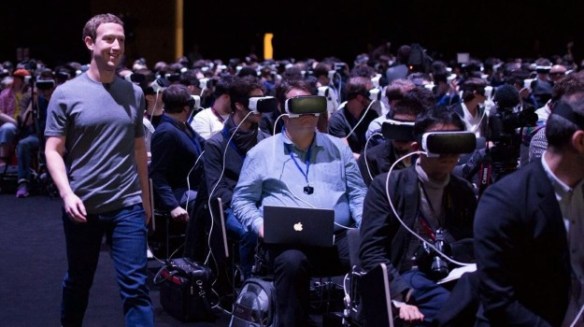
The Atlantic Council published a report claiming Greek political parties Syriza and Golden Dawn were not expressions of popular frustration and disillusionment, but “the Kremlin’s Trojan horses,” undermining democracy in its birthplace. Providing scant evidence, the report went on to link virtually every major European political party challenging the center, from right or left, to Putin. From Britian’s UKIP to Spain’s Podemos to Italy’s Five Star Movement, all are charged with being under one man’s control. It is this council that Facebook announced it was partnering with to help promote “trustworthy” news and weed out “untrustworthy” sources (FAIR.org, 5/21/18), as its CEO Mark Zuckerberg met with representatives from some of the largest corporate outlets, like the New York Times, CNN and News Corp, to help develop a system to control what content we see on the website.

The utility of this wave of suspicion is captured in Freeman’s aforementioned video. After asserting that “for 241 years, our democracy has been a shining example to the world of what we can all aspire to”—a tally that would count nearly a century of chattel slavery and almost another hundred years of de jure racial disenfranchisement—the actor explains that “Putin uses social media to spread propaganda and false information, he convinces people in democratic societies to distrust their media, their political process.”

The obvious implication is that the political process and media ought to be trusted, and would be trusted were it not for Putin’s propaganda. It was not the failures of capitalism and the deep inequalities it created that led to widespread popular resentment and movements on both left and right pressing for radical change across Europe and America, but Vladimir Putin himself. In other words, “America is already great.”

For the Democrats, Russiagate allows them to ignore calls for change and not scrutinize why they lost to the most unpopular presidential candidate in history. Since Russia hacked the election, there is no need for introspection, and certainly no need to accommodate the Sanders wing or to engage with progressive challenges from activists on the left, who are Putin’s puppets anyway. The party can continue on the same course, painting over the deep cracks in American society. Similarly, for centrists in Europe, under threat from both left and right, the Russia narrative allows them to sow distrust among the public for any movement challenging the dominant order.

For the state, Russiagate has encouraged liberals to forego their faculties and develop a state-worshiping, conspiratorial mindset in the face of a common, manufactured enemy. Liberal trust in institutions like the FBI has markedly increased since 2016, while liberals also now espouse a neocon foreign policy in Syria, Ukraine and other regions, with many supporting the vast increases in the US military budget and attacking Trump from the right.

For corporate media, too, the disciplining effect of the Russia narrative is highly useful, allowing them to reassert control over the means of communication under the guise of preventing a Russian “fake news” infiltration. News sources that challenge the establishment are censored, defunded or deranked, as corporate sources stoke mistrust of them. Meanwhile, it allows them to portray themselves as arbiters of truth. This strategy has had some success, with Democrats’ trust in media increasing since the election.

None of this is to say that Russia does not strive to influence other countries’ elections, a tactic that the United States has employed even more frequently (NPR, 12/22/16). Yet the extent to which the story has dominated the US media to the detriment of other issues is a remarkable testament to its utility for those in power.

In A Corporatist System Of Government, Corporate Censorship Is State Censorship

By Caitlin Johnstone

Source: CaitlinJohnstone.com

Last year, representatives of Facebook, Twitter, and Google were instructed on the US Senate floor that it is their responsibility to “quell information rebellions” and adopt a “mission statement” expressing their commitment to “prevent the fomenting of discord.”

“Civil wars don’t start with gunshots, they start with words,” the representatives were told. “America’s war with itself has already begun. We all must act now on the social media battlefield to quell information rebellions that can quickly lead to violent confrontations and easily transform us into the Divided States of America.”

Yes, this really happened.

Today [8/7] Twitter has silenced three important anti-war voices on its platform: it has suspended Daniel McAdams, the executive director of the Ron Paul Institute, suspended Scott Horton of the Scott Horton Show, and completely removed the account of prominent Antiwar.com writer Peter Van Buren.

I’m about to talk about the censorship of Alex Jones and Infowars now, so let me get the “blah blah I don’t like Alex Jones” thing out of the way so that my social media notifications aren’t inundated with people saying “Caitlin didn’t say the ‘blah blah I don’t like Alex Jones’ thing!” I shouldn’t have to, because this isn’t actually about Alex Jones, but here it is:

I don’t like Alex Jones. He’s made millions saying the things disgruntled right-wingers want to hear instead of telling the truth; he throws in disinfo with his info, which is the same as lying all the time. He’s made countless false predictions and his sudden sycophantic support for a US president has helped lull the populist right into complacency when they should be holding Trump to his non-interventionist campaign pledges, making him even more worthless than he was prior to 2016.

But this isn’t about defending Alex Jones. He just happens to be the thinnest edge of the wedge.

As of this writing, Infowars has been censored from Facebook, Youtube (which is part of Google), Apple, Spotify, and now even Pinterest, all within hours of each other. This happens to have occurred at the same time Infowars was circulating a petition with tens of thousands of signatures calling on President Trump to pardon WikiLeaks editor-in-chief Julian Assange, who poses a much greater threat to establishment narratives than Alex Jones ever has. Assange’s mother also reports that this mass removal of Infowars’ audience occurred less than 48 hours after she was approached to do an interview by an Infowars producer.

In a corporatist system of government, wherein there is no meaningful separation between corporate power and state power, corporate censorship is state censorship. Because legalized bribery in the form of corporate lobbying and campaign donations has given wealthy Americans the ability to control the US government’s policy and behavior while ordinary Americans have no effective influence whatsoever, the US unquestionably has a corporatist system of government. Large, influential corporations are inseparable from the state, so their use of censorship is inseparable from state censorship.

This is especially true of the vast megacorporations of Silicon Valley, whose extensive ties to US intelligence agencies are well-documented. Once you’re assisting with the construction of the US military’s drone program, receiving grants from the CIA and NSA for mass surveillance, or having your site’s content regulated by NATO’s propaganda arm, you don’t get to pretend you’re a private, independent corporation that is separate from government power. It is possible in the current system to have a normal business worth a few million dollars, but if you want to get to billions of dollars in wealth control in a system where money translates directly to political power, you need to work with existing power structures like the CIA and the Pentagon, or else they’ll work with your competitors instead of you.

And yet every time I point to the dangers of a few Silicon Valley plutocrats controlling all new media political discourse with an iron fist, Democratic Party loyalists all turn into a bunch of hardline free market Ayn Rands. “It’s not censorship!” they exclaim. “It’s a private company and can do whatever it wants with its property!”

They do this because they know their mainstream, plutocrat-friendly “centrist” views will never be censored. Everyone else is on the chopping block, however. Leftist sites have already had their views slashed by a manipulation of Google’s algorithms, and it won’t be long before movements like BDS and Antifa and skeptics of the establishment Syria and Russia narratives can be made to face mass de-platforming on the same exact pretext as Infowars.

This is a setup. Hit the soft target so your oligarch-friendly censorship doesn’t look like what it is, then once you’ve manufactured consent, go on to shut down the rest of dissenting media bit by bit.

Don’t believe that’s the plan? Let’s ask sitting US Senator Chris Murphy:

“Infowars is the tip of a giant iceberg of hate and lies that uses sites like Facebook and YouTube to tear our nation apart,” Murphy tweeted in response to the news. “These companies must do more than take down one website. The survival of our democracy depends on it.”

That sure sounds an awful lot like the warnings issued to the Silicon Valley representatives on the Senate floor at the beginning of this article, no? This is headed somewhere dark.

We’re going to have to find a way to keep the oligarchs from having their cake and eating it too. Either (A) corporations are indeed private organizations separate from the government, in which case the people need to get money out of politics and government agencies out of Silicon Valley so they can start acting like it, and insist that their owners can’t be dragged out on to the Senate floor and instructed on what they can and can’t do with their business, or (B) these new media platforms get treated like the government agencies they function as, and the people get all the First Amendment protection that comes with it. Right now the social engineers are double-dipping in a way that will eventually give the alliance of corporate plutocrats and secretive government agencies the ability to fully control the public’s access to ideas and information.

If they accomplish that, it’s game over for humanity. Any hope of the public empowering itself over the will of a few sociopathic, ecocidal, omnicidal oligarchs will have been successfully quashed. We are playing for all the chips right now. We have to fight this. We have no choice.

The Bizarre Facebook Path to Corporate Fascism

By Glen Ford

Source: Black Agenda Report

“The Facebook intervention is a qualitative escalation of the McCarthyite offensive.”

Facebook has assumed additional political police powers, disrupting a planned counter-demonstration against white supremacists, set for August 12th in Washington, on the grounds that it was initiated and inspired by “Russians” as part of a Kremlin campaign to “sow dissention” in the U.S. The Facebook intervention is a qualitative escalation of the McCarthyite offensive launched by the Democrat Party and elements of the national security state, and backed by most of the corporate media, initially to blame Hillary Clinton’s 2016 defeat on “collusion” between Wikileaks, “the Russians” and the Trump campaign to steal and publicize embarrassing Clinton campaign emails.

After failing to produce one shred of hard evidence to support their conspiracy theory, the anti-Russia hysteria mongers switched gears, focusing on the alleged purchase of about $100,000 in Facebook ads by the Internet Research Agency (IRA), a St. Petersburg-based Russian company, over a multi-year period. The problem was, most of the ads had no direct connection to the presidential contest, or were posted after the election was over, and many had no political content, at all. The messages were all over the place, politically, with the alleged Russian operatives posing as Christian activists, pro- and anti-immigration activists, and supporters of the Black Lives Matter Movement. Special prosecutor Robert Mueller was forced to flip the scriptindicting 13 Russians for promoting general “discord” and undermining “public confidence in democracy” in the United States – thus creating a political crime that has not previously been codified in the United States.

In doubling down on an unraveling conspiracy tale, the Mueller probe empowered itself to tar and feather all controversial speech that can be associated with utterances by “Russians,” even if the alleged “Russians” are, in fact, mimicking the normal speech of left- or right-wing Americans — a descent, not into Orwell’s world, but that of Kafka (Beyond the Law) and Heller (Catch-22).

Facebook this week announced that it had taken down 32 pages and accounts that had engaged in “coordinated and inauthentic behavior” in promoting the August 12 counter-demonstration against the same white supremacists that staged the fatal “Unite the Right” demonstrations in Charlottesville, Virginia, a year ago. Hundreds of anti-racists had indicated their intention to rally against “Unite the Right 2.0” under the banner of Shut It Down DC, which includes D.C. Antifascist Collective, Black Lives Matter D.C., Hoods4Justice, Resist This, and other local groups.

Facebook did not contend that these anti-racists’ behavior was “inauthentic,” but that the first ad for the event was purchased by a group calling itself “Resisters” that Facebook believes were behaving much like the Internet Research Agency. “At this point in our investigation, we do not have enough technical evidence to state definitively who is behind it,” said Nathaniel Gleicher, Facebook’s head of cybersecurity policy . “But we can say that these accounts engaged in some similar activity and have connected with known I.R.A accounts.”

Chelsea Manning, whose prison sentence for sending secret documents to Wikileaks was commuted by President Obama, said the counter-protest was “organic and authentic”and that activists had begun organizing several months ago. “Folks from D.C. and Charlottesville have been talking about this since at least February,” Manning told The New York Times.

“This was a legitimate Facebook event that was being organized by Washington, D.C. locals,” says Dylan Petrohilos, of Resist This. Petrohilos was one of the defendants in the Trump inauguration “riot” prosecutions. He protested Facebook’s disruption of legitimate free speech and assembly. “DC organizers had controlled the messaging on the no UTR fb page and now FB made it harder for grassroots people to organize,” he tweeted. The organizers insist the August 12 counter-demonstration — “No Unite the Right 2 – DC” — is still a go, as is the white supremacist rally.

Whoever was first to buy a Facebook ad — the suspected Russian “Resisters,” or Workers Against Racism, who told the Daily Beast they decided to host their own anti-“Unite the Right 2.0” event because they thought “Resisters” was an “inexperienced liberal organizer” – there was no doubt whatsoever that the white supremacists would be confronted by much larger numbers of counter-demonstrators, in Washington. Nobody in Russia needed to tell U.S. anti-racists to shut the white supremacists down, or vice versa. The Russians didn’t invent American white supremacy, or the native opposition to it. Even if Mueller, Facebook, the Democratic Party and the howling corporate media mob are to be believed, the “Russians” are simply mimicking U.S. political rhetoric and sloganeeriing – and weakly, at that. The Workers Against Racism thought the “Resisters” weren’t worth partnering with, but that the racist rally must be countered. The Shut It Down DC coalition didn’t need the “Resisters” to crystallize their thinking on white supremacism.

The Democratic Party and corporate media, speaking for most of the U.S. ruling class — and actually bullying one of its top oligarchs, Mark Zuckerberg — is on its own bizarre and twisted road to fascism. (Donald Trump’s proto-fascism is the old fashioned, all-American type that the white supremacists want to celebrate on August 12.) With former FBI Director Robert Mueller at the head of the pack, they have created a pseudo legal doctrine whereby “Russians” (or U.S. spooks pretending to be Russians) can be indicted for launching a #MeToo campaign of mimicry, echoing the rhetoric and memes indigenous to U.S. political struggles, while the genuine, “authentic” American political voices — the people who are being mimicked — are labeled co-conspirators in a foreign-based “plot,” and their rights to speech and assembly are trashed.

That’s truly crazy, but devilishly clever, too. If “Russian” mimics (or cloaked spooks) can reproduce the vocabulary and political program of U.S. dissent, then all of us actual U.S. lefties can be dismissed as “dupes of the Russians” or “co-conspirators” in the speech crimes of our mimics — for sounding like ourselves.


BAR executive editor Glen Ford can be contacted at Glen.Ford@BlackAgendaReport.com.

Another Reason Young Americans Don’t Revolt Against Being Screwed

By

Source: CounterPunch

8 Reasons Young Americans Don’t Fight Back: How the US Crushed Youth Resistance” was originally published in 2011, then republished on several Internet sites, and has become one of my most viewed articles. The eight reasons include: student-loan debt; various pacifying effects of standard schooling; the psychopathologizing and medicating of noncompliance; surveillance; television; and fundamentalist religion and fundamentalist consumerism. Over the last seven years, many young people have told me that they appreciate that article, but they have urged me to detail a hugely important pacifying source which I had not included.

First, to be clear, not all young people are completely broken. The general state of acquiescence by young people was recently interrupted by their short-lived burst of dissent in the form of large rallies for gun control, in reaction to fears of being murdered in their classrooms. But that was an exception to the general rule of resignation to eating shit.

A longer period of dissent occurred during Occupy, in which many young people protested against their financial subjugation by the 1%. However, one lesson that young people learned from Occupy is that their rulers only pay lip service to democracy—and so mere dissent has little impact. Young people today are correct to recognize the impotence of mere dissent if it is unaccompanied by a withdrawal of cooperation with the ruling class’s capacity to turn a profit. But because young people have been broken in so many ways, decreasing numbers of them have the individual strength, class consciousness, and group cohesiveness that is required to move beyond dissent to the kind of constructive disobedience (for example, a labor strike) that can create greater justice for them.

It’s not that young people in the United States are ignorant of the reality that they are being financially screwed; they know they have been screwed, they expect to be screwed even worse, and most of them passively accept this reality.

Young people are not ignorant of their increasingly crippling student-loan debt. At last look, 70% of college students graduate with significant debt; the average student-loan debt at $37,172, and the average monthly payment at $393 (and this doesn’t include their credit card debt). Add this to the reality that many young people with student-loan debt never even graduate college; and even among those who do graduate, many of them find only low-paying jobs.

The majority of young people feel so beaten down that they have also passively accepted that they will get screwed out of Social Security benefits. A 2015 Gallup poll asked “Do you think the Social Security system will be able to pay you a benefit when you retire?” Among those 18 to 29 years of age, 64% said no. Yet, most are resigned to having money deducted from their paychecks for benefits that they believe they will never receive.

Since my 2011 article was published, many millennials have informed me that they are being broken by something that I hadn’t originally included: the Internet, which many of them tell me is the most important aspect of their lives. From these young people, I have learned how the Internet creates fears, lowers self-esteem, and divides them—all of which weakens their capacity to resist injustices.

Fear is a great way to break people, and the Internet—similar to other areas that I had previously detailed—creates fear. Facebook, Twitter, Instagram, Tumblr, Snapchat, and other so-called “social media” create the fear of permanent shame and shunning. Millennials repeatedly see how a single error in judgment on social media will not be forgotten and can haunt forever—and destroy lives. While many young students voice concern about a shooting in their school, my experience is that they are more viscerally terrified of something being posted on social media by them or about them that can damage their attractiveness to their peers or to future employers. For young people, denial over their life being ruined on social media is impossible—most never unplug from it.

The Internet heightens a fear-based consciousness. People have different private fears and, as George Orwell detailed, their greatest fears can be exploited to break them. For many young people, their greatest fear is being “doxxed”—having private information about them published on the Internet so as to hurt them. For other young people, their greatest fear is “FoMo”—the fear of missing out—which is intensified on social media where they are constantly bombarded with images of others doing “cool” stuff. One young woman recently told me, “You don’t know how crazy we are. I saw a party on Instagram that looked really cool, and I had FoMo over it, even though I know the guy who posted it always makes parties look cooler than they really are.”

Many young people tell me that the constant barrage of their peers’ self-promotions on social media makes them feel inferior; and low self-esteem—like fear—debilitates the strength to resist. One young man recently explained to me that millennials are always aware of their “digital selves” which can be measured in metrics such as “likes”; and that comparing themselves to others routinely results in low self-esteem. Of course, some young people do attempt rebellion, but effective rebellion, they tell me, requires completely extricating from social media, which would be an extremely radical action.

Not only does the Internet create fear and low self-esteem but also divides, which of course allows the 1% to more easily conquer the 99%. The Gilded Age robber barron Jay Gould reportedly bragged, “I can hire one half of the working class to kill the other half.” Millenials have educated me on the various divides among the 99% that have been created and perpetuated on the Internet.

Every millennial young man tells be about the Internet war between “social justice warriors” and “red pillers.” Young people who care about justice for historically oppressed groups (such as women, people of color, and LGBT folks) are mocked as social justice warriors by those who call themselves red pillers who feel that, today, white males are the oppressed group. In an Internet world absent of face-to-face contact, there is only mutual venom. Absent is a mutual grasping that each side is in the 99%, that each side cares about injustice, and that the financial hell for all of them has been created by the 1%—not by each other.

Screen addiction subverts the in-person contact necessary for face-to-face dialogue and solidarity, and the Internet is even more addictive than television, as young people are virtually never away from their smart phones, laptops, or other screens. Walk into any coffee shop, and you’ll often see many young people in close proximity with one another but locked into their own screens and not looking at each other.

Several of my millennial young male informants tell me that they are afraid to risk face-to-face contact, afraid to be seen as violating a woman’s privacy, afraid to be viewed as a creep. I joked with one young guy, “Are you afraid that if you walk over to some pretty young woman in a coffee shop and tell her that you like her shoes, then you’ll be accused of ‘rape-staring’ and have your life ruined on the Internet, and end up being falsely labeled all over the Internet as a sex offender?” The young man laughed and said, “I know that you are exaggerating, but that’s the kind of shit that many of us millennial guys think about, as we have become pathetic.”

Having young men and young women in the 99% being afraid of one another may be even more of a coup for the 1% than their historical successes at getting ethnic and racial groups to hate one another. With this fear and hate among the 99%, it is impossible to have the solidarity and strength necessary to effectively revolt in an organized way against the 1%.

The Internet technology need not necessarily be a pacifying force as, for example, the Internet was effectively utilized during the Arab spring to foment rebellion and organize resistance. Similarly, some of the other pacifying forces that I originally detailed need not be pacifying. Teachers could inspire resistance against illegitimate authorities rather than indoctrinate compliance to any and all authorities. And my fellow mental health professionals could embrace liberation psychology rather than pathologize and medicate rebellion.

My experience is that young people, in general, are becoming increasingly pained and weakened by multiple oppressive forces, and older people who give a damn about them can help. The 1% will always attempt to seize powerful technologies and institutions to pacify all of us—especially young people. To manage these technologies and institutions, the 1% needs technocrats, administrators, and guards; thus, what would help is what Howard Zinn called a “revolt of the guards.” However, if technicians, teachers, mental health professionals, and other guards never even admit to ourselves our societal role—as guards who maintain the status quo—then we guards will never consider a revolt. Many older people are guards, and they can choose to revolt and help young people gain the strength necessary to resist injustices.


Bruce E. Levine, a practicing clinical psychologist often at odds with the mainstream of his profession, writes and speaks about how society, culture, politics and psychology intersect. His most recent book is Resisting Illegitimate Authority: A Thinking Person’s Guide to Being an Anti-Authoritarian―Strategies, Tools, and Models(AK Press, September, 2018). His Web site is brucelevine.net

No Need To Wait – Dystopia Is Almost Upon Us

Source: TruePublica

Microsoft’s CEO has warned the technology industry against creating a dystopian future, the likes of which have been predicted by authors including George Orwell and Aldous Huxley. Satya Nadella kicked off the the company’s 2017 Build conference with a keynote that was as unexpected as it was powerful. He told the developers in attendance that they have a huge responsibility, and that the choices they make could have enormous implications.

They won’t listen of course. The collection of big data along with management, selling and distribution and the systems architecture to control it is now worth exactly double global military defence expenditure. In fact, this year, the big data industry overtook the worlds most valuable traded commodity – oil.

The truth is that the tech giants have already captured us all. We are already living in the beginnings of a truly dystopian world.

Leaving aside the endemic surveillance society our government has chosen on our behalf with no debate, politically or otherwise, we already have proof of the now and where it is leading. With fingerprint scanning, facial recognition, various virtual wallets to pay for deliveries, some would say your identity is as good as stolen. If it isn’t, it soon will be. That’s because the hacking industry, already worth a mind blowing $1trillion annually is expected to reach $2.1 trillion in just 14 months time.

The reality of not being able to take public transportation, hire a car, buy a book, or a coffee – requiring full personal identification is almost upon us. Britain even had an intention to be completely cashless by 2025 – postponed only by the impact of Brexit.

Alexa, the Amazon home assistant listens to everything said in the house. It is known to record conversations. Recently, police in Arkansas, USA demanded that Amazon turn over information collected from a murder suspect’s Echo — the speaker that controls Alexa, because they already knew what information could be extracted from it.

32M is the first company in the US that provides a human chip, allowing employees “to make purchases in their break-room micro market, open doors, login to computers, use the copy machine.” 3M also confirmed what the chip could really do – telling employees to “use it as your passport, public transit and all purchasing opportunities.”

Various Apps now locate people you may know and your own location can be shared amongst others without your knowledge and we’ve known for years that governments and private corporations have access to this data, whether you like it not.

Other countries are providing even scarier technologies.  Hypebeast Magazine reports that  Aadhaar is a 12-digit identity number issued to all Indian residents based on their biometric and demographic data. “This data must be linked to their bank account or else they’ll face the risk of losing access to their account. Folks have until the end of the year to do this, with phone numbers soon to be connected through the 12 digits by February. Failure to do so will deactivate the service. ” The technology has the ability to refuse access to state supplied services such as healthcare.

Our article “Insurance Industry Leads The Way in Social Credit Systems” also highlights what the fusion of technology and data is likely to end up doing for us. An astonishing 96 per cent of insurers think that ecosystems or applications made by autonomous organisations are having a major impact on the insurance industry. The use of social credit mechanisms is being developed, some already implemented, which will determine our future behaviour, which will affect us all – both individually and negatively.”

The Chinese government plans to launch its Social Credit System in 2020. Already being piloted on 12 million of its citizens, the aim is to judge the trustworthiness – or otherwise – of its 1.3 billion residents. Something as innocuous as a person’s shopping habits become a measure of character. But the system not only investigates behaviour – it shapes it. It “nudges” citizens away from purchases and behaviours the government does not like. Friends are considered as well and individual credit scores fall depending on their trustworthiness. It’s not possible to imagine how far this will go in the end.

However to get us all there, to that situation, we need to be distracted from what is going on in the background. Some, are already concerned.


Distraction – detaching us from truth and reality

The Guardian wrote an interesting piece recently which highlighted some of the concerns of those with expert insider knowledge of the tech industry. For instance, Justin Rosenstein, the former Google and Facebook engineer who helped build the ‘like’ button –  is concerned. He believes there is a case for state regulation of smartphone technology because it is “psychologically manipulative advertising”, saying the moral impetus is comparable to taking action against fossil fuel or tobacco companies.

If we only care about profit maximisation,” he says, “we will go rapidly into dystopia.” Rosenstien also makes the observation that after Brexit and the election of Trump, digital forces have completely upended the political system and, left unchecked, could render democracy as we know it obsolete.

Carole Cadwalladre’s recent Exposé in the Observer/Guardian proved beyond doubt that democracy has already departed.  Here we learn about a shadowy global operation involving big data and billionaires who influenced the result of the EU referendum. Britain’s future place in the world has been altered by technology.

Nir Eyal 39, the author of Hooked: How to Build Habit-Forming Products writes: “The technologies we use have turned into compulsions, if not full-fledged addictions.” Eyal continues: “It’s the impulse to check a message notification. It’s the pull to visit YouTube, Facebook, or Twitter for just a few minutes, only to find yourself still tapping and scrolling an hour later.” None of this is an accident, he writes. It is all “just as their designers intended”.

Eyal feels the threat and protects his own family by cutting off the internet completely at a set time every day. “The idea is to remember that we are not powerless,” he said. “We are in control.”

The truth is we are no longer in control and have not been since we learned that our government was lying to us with the Snowden revelations back in 2013.

Tristan Harris, a 33-year-old former Google employee turned vocal critic of the tech industry agrees about the lack of control. “All of us are jacked into this system,” he says. “All of our minds can be hijacked. Our choices are not as free as we think they are.” Harris insists that billions of people have little choice over whether they use these now ubiquitous technologies, and are largely unaware of the invisible ways in which a small number of people in Silicon Valley are shaping their lives.

Harris is a tech whistleblower. He is lifting the lid on the vast powers accumulated by technology companies and the ways they are abusing the influence they have at their fingertips – literally.

“A handful of people, working at a handful of technology companies, through their choices will steer what a billion people are thinking today.”

The techniques these companies use such as social reciprocity, autoplay and the like are not always generic: they can be algorithmically tailored to each person. An internal Facebook report leaked this year, ultimately revealed that the company can identify when teenagers feel “worthless or “insecure.” Harris adds, that this is “a perfect model of what buttons you can push in a particular person”.

Chris Marcellino, 33, a former Apple engineer is now in the final stages of retraining to be a neurosurgeon and notes that these types of technologies can affect the same neurological pathways as gambling and drug use. “These are the same circuits that make people seek out food, comfort, heat, sex,” he says.

Roger McNamee, a venture capitalist who benefited from hugely profitable investments in Google and Facebook, has grown disenchanted with both of the tech giants. “Facebook and Google assert with merit that they are giving users what they want,” McNamee says. “The same can be said about tobacco companies and drug dealers.”

James Williams ex-Google strategist who built the metrics system for the company’s global search advertising business, says Google now has the “largest, most standardised and most centralised form of attentional control in human history”. “Eighty-seven percent of people wake up and go to sleep with their smartphones,” he says. The entire world now has a new prism through which to understand politics, and Williams worries the consequences are profound.

Williams also takes the view that if the attention economy erodes our ability to remember, to reason, to make decisions for ourselves – faculties that are essential to self-governance – what hope is there for democracy itself?

“The dynamics of the attention economy are structurally set up to undermine the human will,” he says. “If politics is an expression of our human will, on individual and collective levels, then the attention economy is directly undermining the assumptions that democracy rests on. If Apple, Facebook, Google, Twitter, Instagram and Snapchat are gradually chipping away at our ability to control our own minds, could there come a point, I ask, at which democracy no longer functions?”

“Will we be able to recognise it, if and when it happens?” Williams says. “And if we can’t, then how do we know it hasn’t happened already?”


The dystopian arrival

Within ten years, some are speculating that many of us will be wearing eye lenses. Coupled with social media, we’ll be able to identify strangers and work out that a particular individual, in say a bar, has a low friend compatibility, and data shows you will likely not have a fruitful conversation. This idea is literally scratching the surface of the information overload en-route right now.

It is not at all foolish to think that in that same bar a patron is shouting at the bartender, who refuses to serve him another drink because the glass he was holding measured his blood-alcohol level through the sweat in his fingers. He’ll have to wait at least 45 minutes before he’ll be permitted to order another scotch. You might even think that is a good idea – it isn’t.

Google’s Quantum Artificial Intelligence  Lab, already works with other organisations associated with NASA. Google’s boss sits on the Board of the Pentagon with links plugged directly into the surveillance architecture of the NSA in the USA and GCHQ in Britain. This world, where artificial intelligence makes its mark, as Williams mentions earlier, will deliberately undermine the ability to think for yourself.

In the scenario of the eye lenses, you might even have the ability to command your eyewear to shut down. But when you do, suddenly you are confronted with an un-Googled world. It appears drab and colourless in comparison. The people before you are bland, washed out and unattractive. The art, plants, wall paint, lighting and decorations had all been shaped by your own preferences, and without the distortion field your wearable eyewear provided, the world appears as a grey, lifeless template.

You find it difficult to last without the assistance of your self imposed augmented life, and accompanied by nervous laughter you switch it back on. The world you view through the prism of your computer eyewear has become your default setting. You know you have free will, but don’t feel like you need it. As Marcellino says the same neurological pathways as gambling and drug use drive how you choose to see the world.

This type of technology will be available and these types of scenario’s will become real, sooner than you think.

Our governments, allied with the tech giants are coercing us into a place of withering obedience with the use of 360 degree state surveillance. New technology, which is somehow seen as the road to liberty, contentment and prosperity, is really our future being shaped by a system that will destroy our civil liberties, crush our human rights and it will eventually ensnare and trap us all. This much they are already attempting in China and Japan with social credit mechanisms and pre-crime technology which is a truly frightening prospect. Without debate or our knowledge, here in western democracies, these technologies are already in use.


Social Media Behemoths Sweep Alternative News into the Memory Hole

By Kurt Nimmo

Source: Another Day in the Empire

The squabbling between self-identified progressives and conservatives continues as social media transforms itself into a news, information, and opinion gatekeeper.

All information that contradicts the establishment narrative will either be downgraded into obscurity or excluded outright on social media.

Take for instance ThinkProgress, the Soros-financed news website, a project of the Center for American Progress Action Fund welded to the infrastructure of the Democrat party. On May 2, it complained that a bias study at Facebook will be run by conservatives, that is to say establishment Republicans, notably former Arizona Congress critter Jon Kyl.

ThinkProgress believes there is no such thing as bias aimed at conservatives—it’s the liberals who are routinely downgraded at Facebook while so-called conservatives are free to post what progressives characterize as an evil and poisonous ideology.

According to Libby Watson at Splinter News, conservatives are involved in “grift,” flimflamming poor Mark Zuckerberg with untrue claims of bias against the likes of Breitbart News.

It’s all part of a never ending and hugely counterproductive “culture war” that has raged between the ostensible right and left going on thirty years now. Ms. Watson manages to squeeze identity politics into her screed.

“The conservative movement has done a remarkable job over the last half century to bellow and bully its way into having its most ridiculous and reality-divorced concerns taken seriously,” she writes. “It lies about and distorts everything: about tax cuts, about Benghazi and her emails, about immigration, about healthcare, about Diamond and Silk. The further Facebook descends down the path of letting that screaming white face of faux outrage dictate how they run their platform, the harder it’s going to be for them to get away from them.”

The progressive news website Common Dreams complains it has weathered “significant drops in traffic since Google and Facebook began changing algorithms and talking openly about their new attempts to control the kind of news content users see. According to internal data and Google Analytics, traffic to Common Dreams from Google searches fell by 34 percent after the powerful search giant unveiled its new search protocol in April 2017.”

Meanwhile, on the other side of the yawning divide, Brent Bozell, founder of the Media Research Center, rallied around 60 conservatives and fired off an open letter to the social media giants demanding transparency, clarity on the definition of hate speech, equality for conservatives, and respect for the First Amendment.

“Social media censorship and online restriction of conservatives and their organizations have reached a crisis level,” the open letter states. “Facebook CEO Mark Zuckerberg’s hearings on Capitol Hill only served to draw attention to how widespread this problem has become. Conservative leaders now have banded together to call for equal treatment on tech and social media.”

Both liberals and conservatives are missing the point.

Facebook and Google will continue and enlarge the effort to gatekeep information that does not jive with the establishment narrative, be it from the right or left.

The internet and web upended the establishment’s carefully constructed propaganda machine—the CIA’s “Mighty Wurlitzer” under its Operation Mockingbird beginning in the early 1950s—deeply embedded within corporate media.

Beginning with Friendster, MySpace, and like projects in the early 2000s and eventually morphing into the corporate behemoths Facebook, YouTube, and Twitter, social media platforms have extended the reach of alternative media, much to the displeasure of the establishment. Its preferred propaganda conduits have withered and this has seriously hampered its ability to control the narrative.

Both the right and left need to nurture their own social media platforms and drive traffic there.

Of course, this will not be as effective as plugging into the massive matrix of social connectivity provided by the corporate tech giants, but the alternative is to be marginalized and eventually swept into the memory hole as the context of “extremism” narrows and constricts expression, excluding all but the most token disagreement with the establishment narrative.

However, I’m not sure we’re up to it.

The elite has done a remarkable job of using the time tested divide and conquer concept, endlessly pitting the so-called right against the amorphously defined left and vice versa. Liberals and conservatives continue to fight over frivolous ideological points as the funny money asset-driven economy prepares to implode and the mission of infinity war expands to the point where it endangers life on planet Earth.

Disarming the Weapons of Mass Distraction

By Madeleine Bunting

Source: Rise Up Times

“Are you paying attention?” The phrase still resonates with a particular sharpness in my mind. It takes me straight back to my boarding school, aged thirteen, when my eyes would drift out the window to the woods beyond the classroom. The voice was that of the math teacher, the very dedicated but dull Miss Ploughman, whose furrowed grimace I can still picture.

We’re taught early that attention is a currency—we “pay” attention—and much of the discipline of the classroom is aimed at marshaling the attention of children, with very mixed results. We all have a history here, of how we did or did not learn to pay attention and all the praise or blame that came with that. It used to be that such patterns of childhood experience faded into irrelevance. As we reached adulthood, how we paid attention, and to what, was a personal matter and akin to breathing—as if it were automatic.

Today, though, as we grapple with a pervasive new digital culture, attention has become an issue of pressing social concern. Technology provides us with new tools to grab people’s attention. These innovations are dismantling traditional boundaries of private and public, home and office, work and leisure. Emails and tweets can reach us almost anywhere, anytime. There are no cracks left in which the mind can idle, rest, and recuperate. A taxi ad offers free wifi so that you can remain “productive” on a cab journey.

Even those spare moments of time in our day—waiting for a bus, standing in a queue at the supermarket—can now be “harvested,” says the writer Tim Wu in his book The Attention Merchants. In this quest to pursue “those slivers of our unharvested awareness,” digital technology has provided consumer capitalism with its most powerful tools yet. And our attention fuels it. As Matthew Crawford notes in The World Beyond Your Head, “when some people treat the minds of other people as a resource, this is not ‘creating wealth,’ it is transferring it.”

There’s a whiff of panic around the subject: the story that our attention spans are now shorter than a goldfish’s attracted millions of readers on the web; it’s still frequently cited, despite its questionable veracity. Rates of diagnosis attention deficit hyperactivity disorder in children have soared, creating an $11 billion global market for pharmaceutical companies. Every glance of our eyes is now tracked for commercial gain as ever more ingenious ways are devised to capture our attention, if only momentarily. Our eyeballs are now described as capitalism’s most valuable real estate. Both our attention and its deficits are turned into lucrative markets.

There is also a domestic economy of attention; within every family, some get it and some give it. We’re all born needing the attention of others—our parents’, especially—and from the outset, our social skills are honed to attract the attention we need for our care. Attention is woven into all forms of human encounter from the most brief and transitory to the most intimate. It also becomes deeply political: who pays attention to whom?

Social psychologists have researched how the powerful tend to tune out the less powerful. One study with college students showed that even in five minutes of friendly chat, wealthier students showed fewer signs of engagement when in conversation with their less wealthy counterparts: less eye contact, fewer nods, and more checking the time, doodling, and fidgeting. Discrimination of race and gender, too, plays out through attention. Anyone who’s spent any time in an organization will be aware of how attention is at the heart of office politics. A suggestion is ignored in a meeting, but is then seized upon as a brilliant solution when repeated by another person.

What is political is also ethical. Matthew Crawford argues that this is the essential characteristic of urban living: a basic recognition of others.

And then there’s an even more fundamental dimension to the politics of attention. At a primary level, all interactions in public space require a very minimal form of attention, an awareness of the presence and movement of others. Without it, we would bump into each other, frequently.

I had a vivid demonstration of this point on a recent commute: I live in East London and regularly use the narrow canal paths for cycling. It was the canal rush hour—lots of walkers with dogs, families with children, joggers as well as cyclists heading home. We were all sharing the towpath with the usual mixture of give and take, slowing to allow passing, swerving around and between each other. Only this time, a woman was walking down the center of the path with her eyes glued to her phone, impervious to all around her. This went well beyond a moment of distraction. Everyone had to duck and weave to avoid her. She’d abandoned the unspoken contract that avoiding collision is a mutual obligation.

This scene is now a daily occurrence for many of us, in shopping centers, station concourses, or on busy streets. Attention is the essential lubricant of urban life, and without it, we’re denying our co-existence in that moment and place. The novelist and philosopher, Iris Murdoch, writes that the most basic requirement for being good is that a person “must know certain things about his surroundings, most obviously the existence of other people and their claims.”

Attention is what draws us out of ourselves to experience and engage in the world. The word is often accompanied by a verb—attention needs to be grabbed, captured, mobilized, attracted, or galvanized. Reflected in such language is an acknowledgement of how attention is the essential precursor to action. The founding father of psychology William James provided what is still one of the best working definitions:

It is the taking possession by the mind, in clear and vivid form, of one out of what seem several simultaneously possible objects or trains of thought. Focalization, concentration, of consciousness are of its essence. It implies withdrawal from some things in order to deal effectively with others.

Attention is a limited resource and has to be allocated: to pay attention to one thing requires us to withdraw it from others. There are two well-known dimensions to attention, explains Willem Kuyken, a professor of psychology at Oxford. The first is “alerting”— an automatic form of attention, hardwired into our brains, that warns us of threats to our survival. Think of when you’re driving a car in a busy city: you’re aware of the movement of other cars, pedestrians, cyclists, and road signs, while advertising tries to grab any spare morsel of your attention. Notice how quickly you can swerve or brake when you spot a car suddenly emerging from a side street. There’s no time for a complicated cognitive process of decision making. This attention is beyond voluntary control.

The second form of attention is known as “executive”—the process by which our brain selects what to foreground and focus on, so that there can be other information in the background—such as music when you’re cooking—but one can still accomplish a complex task. Crucially, our capacity for executive attention is limited. Contrary to what some people claim, none of us can multitask complex activities effectively. The next time you write an email while talking on the phone, notice how many typing mistakes you make or how much you remember from the call. Executive attention can be trained, and needs to be for any complex activity. This was the point James made when he wrote: “there is no such thing as voluntary attention sustained for more than a few seconds at a time… what is called sustained voluntary attention is a repetition of successive efforts which bring back the topic to the mind.”

Attention is a complex interaction between memory and perception, in which we continually select what to notice, thus finding the material which correlates in some way with past experience. In this way, patterns develop in the mind. We are always making meaning from the overwhelming raw data. As James put it, “my experience is what I agree to attend to. Only those items which I notice shape my mind—without selective interest, experience is an utter chaos.”

And we are constantly engaged in organizing that chaos, as we interpret our experience. This is clear in the famous Gorilla Experiment in which viewers were told to watch a video of two teams of students passing a ball between them. They had to count the number of passes made by the team in white shirts and ignore those of the team in black shirts. The experiment is deceptively complex because it involves three forms of attention: first, scanning the whole group; second, ignoring the black T-shirt team to keep focus on the white T-shirt team (a form of inhibiting attention); and third, remembering to count. In the middle of the experiment, someone in a gorilla suit ambles through the group. Afterward, half the viewers when asked hadn’t spotted the gorilla and couldn’t even believe it had been there. We can be blind not only to the obvious, but to our blindness.

There is another point in this experiment which is less often emphasized. Ignoring something—such as the black T-shirt team in this experiment—requires a form of attention. It costs us attention to ignore something. Many of us live and work in environments that require us to ignore a huge amount of information—that flashing advert, a bouncing icon or pop-up.

In another famous psychology experiment, Walter Mischel’s Marshmallow Test, four-year-olds had a choice of eating a marshmallow immediately or two in fifteen minutes. While filmed, each child was put in a room alone in front of the plate with a marshmallow. They squirmed and fidgeted, poked the marshmallow and stared at the ceiling. A third of the children couldn’t resist the marshmallow and gobbled it up, a third nibbled cautiously, but the last third figured out how to distract themselves. They looked under the table, sang… did anything but look at the sweet. It’s a demonstration of the capacity to reallocate attention. In a follow-up study some years later, those who’d been able to wait for the second marshmallow had better life outcomes, such as academic achievement and health. One New Zealand study of 1,000 children found that this form of self-regulation was a more reliable predictor of future success and wellbeing than even a good IQ or comfortable economic status.

What, then, are the implications of how digital technologies are transforming our patterns of attention? In the current political anxiety about social mobility and inequality, more weight needs to be put on this most crucial and basic skill: sustaining attention.

*

I learned to concentrate as a child. Being a bookworm helped. I’d be completely absorbed in my reading as the noise of my busy family swirled around me. It was good training for working in newsrooms; when I started as a journalist, they were very noisy places with the clatter of keyboards, telephones ringing and fascinating conversations on every side. What has proved much harder to block out is email and text messages.

The digital tech companies know a lot about this widespread habit; many of them have built a business model around it. They’ve drawn on the work of the psychologist B.F. Skinner who identified back in the Thirties how, in animal behavior, an action can be encouraged with a positive consequence and discouraged by a negative one. In one experiment, he gave a pigeon a food pellet whenever it pecked at a button and the result, as predicted, was that the pigeon kept pecking. Subsequent research established that the most effective way to keep the pigeon pecking was “variable-ratio reinforcement.” Give the pigeon a food pellet sometimes, and you have it well and truly hooked.

We’re just like the pigeon pecking at the button when we check our email or phone. It’s a humiliating thought. Variable reinforcement ensures that the customer will keep coming back. It’s the principle behind one of the most lucrative US industries: slot machines, which generate more profit than baseball, films, and theme parks combined. Gambling was once tightly restricted for its addictive potential, but most of us now have the attentional equivalent of a slot machine in our pocket, beside our plate at mealtimes, and by our pillow at night. Even during a meal out, a play at the theater, a film, or a tennis match. Almost nothing is now experienced uninterrupted.

Anxiety about the exponential rise of our gadget addiction and how it is fragmenting our attention is sometimes dismissed as a Luddite reaction to a technological revolution. But that misses the point. The problem is not the technology per se, but the commercial imperatives that drive the new technologies and, unrestrained, colonize our attention by fundamentally changing our experience of time and space, saturating both in information.

In much public space, wherever your eye lands—from the back of the toilet door, to the handrail on the escalator, or the hotel key card—an ad is trying to grab your attention, and does so by triggering the oldest instincts of the human mind: fear, sex, and food. Public places become dominated by people trying to sell you something. In his tirade against this commercialization, Crawford cites advertisements on the backs of school report cards and on debit machines where you swipe your card. Before you enter your PIN, that gap of a few seconds is now used to show adverts. He describes silence and ad-free experience as “luxury goods” that only the wealthy can afford. Crawford has invented the concept of the “attentional commons,” free public spaces that allow us to choose where to place our attention. He draws the analogy with environmental goods that belong to all of us, such as clean air or clean water.

Some legal theorists are beginning to conceive of our own attention as a human right. One former Google employee warned that “there are a thousand people on the other side of the screen whose job it is to break down the self-regulation you have.” They use the insights into human behavior derived from social psychology—the need for approval, the need to reciprocate others’ gestures, the fear of missing out. Your attention ceases to be your own, pulled and pushed by algorithms. Attention is referred to as the real currency of the future.

*

In 2013, I embarked on a risky experiment in attention: I left my job. In the previous two years, it had crept up on me. I could no longer read beyond a few paragraphs. My eyes would glaze over and, even more disastrously for someone who had spent their career writing, I seemed unable to string together my thoughts, let alone write anything longer than a few sentences. When I try to explain the impact, I can only offer a metaphor: it felt like my imagination and use of language were vacuum packed, like a slab of meat coated in plastic. I had lost the ability to turn ideas around, see them from different perspectives. I could no longer draw connections between disparate ideas.

At the time, I was working in media strategy. It was a culture of back-to-back meetings from 8:30 AM to 6 PM, and there were plenty of advantages to be gained from continuing late into the evening if you had the stamina. Commitment was measured by emails with a pertinent weblink. Meetings were sometimes as brief as thirty minutes and frequently ran through lunch. Meanwhile, everyone was sneaking time to battle with the constant emails, eyes flickering to their phone screens in every conversation. The result was a kind of crazy fog, a mishmash of inconclusive discussions.

At first, it was exhilarating, like being on those crazy rides in a theme park. By the end, the effect was disastrous. I was almost continuously ill, battling migraines and unidentifiable viruses. When I finally made the drastic decision to leave, my income collapsed to a fraction of its previous level and my family’s lifestyle had to change accordingly. I had no idea what I was going to do; I had lost all faith in my ability to write. I told friends I would have to return the advance I’d received to write a book. I had to try to get back to the skills of reflection and focus that had once been ingrained in me.

The first step was to teach myself to read again. I sometimes went to a café, leaving my phone and computer behind. I had to slow down the racing incoherence of my mind so that it could settle on the text and its gradual development of an argument or narrative thread. The turning point in my recovery was a five weeks’ research trip to the Scottish Outer Hebrides. On the journey north of Glasgow, my mobile phone lost its Internet connection. I had cut myself loose with only the occasional text or call to family back home. Somewhere on the long Atlantic beaches of these wild and dramatic islands, I rediscovered my ability to write.

I attribute that in part to a stunning exhibition I came across in the small harbor town of Lochboisdale, on the island of South Uist. Vija Celmins is an acclaimed Latvian-American artist whose work is famous for its astonishing patience. She can take a year or more to make a woodcut that portrays in minute detail the surface of the sea. A postcard of her work now sits above my desk, a reminder of the power of slow thinking.

Just as we’ve had a slow eating movement, we need a slow thinking campaign. Its manifesto could be the German poet Rainer Maria Rilke’s beautiful “Letters to a Young Poet”:

To let every impression and the germ of every feeling come to completion inside, in the dark, in the unsayable, the unconscious, in what is unattainable to one’s own intellect, and to wait with deep humility and patience for the hour when a new clarity is delivered.

Many great thinkers attest that they have their best insights in moments of relaxation, the proverbial brainwave in the bath. We actually need what we most fear: boredom.

When I left my job (and I was lucky that I could), friends and colleagues were bewildered. Why give up a good job? But I felt that here was an experiment worth trying. Crawford frames it well as “intellectual biodiversity.” At a time of crisis, we need people thinking in different ways. If we all jump to the tune of Facebook or Instagram and allow ourselves to be primed by Twitter, the danger is that we lose the “trained powers of concentration” that allow us, in Crawford’s words, “to recognize that independence of thought and feeling is a fragile thing, and requires certain conditions.”

I also took to heart the insights of the historian Timothy Snyder, who concluded from his studies of twentieth-century European totalitarianism that the way to fend off tyranny is to read books, make an effort to separate yourself from the Internet, and “be kind to our language… Think up your own way of speaking.” Dropping out and going offline enabled me to get back to reading, voraciously, and to writing; beyond that, it’s too early to announce the results of my experiment with attention. As Rilke said, “These things cannot be measured by time, a year has no meaning, and ten years are nothing.”

*

A recent column in The New Yorker cheekily suggests that all the fuss about the impact of digital technologies on our attention is nothing more than writers’ worrying about their own working habits. Is all this anxiety about our fragmenting minds a moral panic akin to those that swept Victorian Britain about sexual behavior? Patterns of attention are changing, but perhaps it doesn’t much matter?

My teenage children read much less than I did. One son used to play chess online with a friend, text on his phone, and do his homework all at the same time. I was horrified, but he got a place at Oxford. At his interview, he met a third-year history undergraduate who told him he hadn’t yet read any books in his time at university. But my kids are considerably more knowledgeable about a vast range of subjects than I was at their age. There’s a small voice suggesting that the forms of attention I was brought up with could be a thing of the past; the sustained concentration required to read a whole book will become an obscure niche hobby.

And yet, I’m haunted by a reflection: the magnificent illuminations of the eighth-century Book of Kells has intricate patterning that no one has ever been able to copy, such is the fineness of the tight spirals. Lines are a millimeter apart. They indicate a steadiness of hand and mind—a capability most of us have long since lost. Could we be trading in capacities for focus in exchange for a breadth of reference? Some might argue that’s not a bad trade. But we would lose depth: artist Paul Klee wrote that he would spend a day in silent contemplation of something before he painted it. Paul Cézanne was similarly known for his trance like attention on his subject. Madame Cézanne recollected how her husband would gaze at the landscape, and told her, “The landscape thinks itself in me, and I am its consciousness.” The philosopher Maurice Merleau-Ponty describes a contemplative attention in which one steps outside of oneself and immerses oneself in the object of attention.

It’s not just artists who require such depth of attention. Nearly two decades ago, a doctor teaching medical students at Yale was frustrated at their inability to distinguish between types of skin lesions. Their gaze seemed restless and careless. He took his students to an art gallery and told them to look at a picture for fifteen minutes. The program is now used in dozens of US medical schools.

Some argue that losing the capacity for deep attention presages catastrophe. It is the building block of “intimacy, wisdom, and cultural progress,” argues Maggie Jackson in her book Distracted, in which she warns that “as our attentional skills are squandered, we are plunging into a culture of mistrust, skimming, and a dehumanizing merging between man and machine.” Significantly, her research began with a curiosity about why so many Americans were deeply dissatisfied with life. She argues that losing the capacity for deep attention makes it harder to make sense of experience and to find meaning—from which comes wonder and fulfillment. She fears a new “dark age” in which we forget what makes us truly happy.

Strikingly, the epicenter of this wave of anxiety over our attention is the US. All the authors I’ve cited are American. It’s been argued that this debate represents an existential crisis for America because it exposes the flawed nature of its greatest ideal, individual freedom. The commonly accepted notion is that to be free is to make choices, and no one can challenge that expression of autonomy. But if our choices are actually engineered by thousands of very clever, well-paid digital developers, are we free? The former Google employee Tristan Harris confessed in an article in 2016 that technology “gives people the illusion of free choice while architecting the menu so that [tech giants] win, no matter what you choose.”

Despite my children’s multitasking, I maintain that vital human capacities—depth of insight, emotional connection, and creativity—are at risk. I’m intrigued as to what the resistance might look like. There are stirrings of protest with the recent establishment of initiatives such as the Time Well Spent movement, founded by tech industry insiders who have become alarmed at the efforts invested in keeping people hooked. But collective action is elusive; the emphasis is repeatedly on the individual to develop the necessary self-regulation, but if that is precisely what is being eroded, we could be caught in a self-reinforcing loop.

One of the most interesting responses to our distraction epidemic is mindfulness. Its popularity is evidence that people are trying to find a way to protect and nourish their minds. Jon Kabat-Zinn, who pioneered the development of secular mindfulness, draws an analogy with jogging: just as keeping your body fit is now well understood, people will come to realize the importance of looking after their minds.

I’ve meditated regularly for twenty years, but curious as to how this is becoming mainstream, I went to an event in the heart of high-tech Shoreditch in London. In a hipster workspaces with funky architecture, excellent coffee, and an impressive range of beards, a soft-spoken retired Oxford professor of psychology, Mark Williams, was talking about how multitasking has a switching cost in focus and concentration. Our unique human ability to remember the past and to think ahead brings a cost; we lose the present. To counter this, he advocated a daily practice of mindfulness: bringing attention back to the body—the physical sensations of the breath, the hands, the feet. Williams explained how fear and anxiety inhibit creativity. In time, the practice of mindfulness enables you to acknowledge fear calmly and even to investigate it with curiosity. You learn to place your attention in the moment, noticing details such as the sunlight or the taste of the coffee.

On a recent retreat, I was beside a river early one morning and a rower passed. I watched the boat slip by and enjoyed the beauty in a radically new way. The moment was sufficient; there was nothing I wanted to add or take away—no thought of how I wanted to do this every day, or how I wanted to learn to row, or how I wished I was in the boat. Nothing but the pleasure of witnessing it. The busy-ness of the mind had stilled. Mindfulness can be a remarkable bid to reclaim our attention and to claim real freedom, the freedom from our habitual reactivity that makes us easy prey for manipulation.

But I worry that the integrity of mindfulness is fragile, vulnerable both to commercialization by employers who see it as a form of mental performance enhancement and to consumer commodification, rather than contributing to the formation of ethical character. Mindfulness as a meditation practice originates in Buddhism, and without that tradition’s ethics, there is a high risk of it being hijacked and misrepresented.

Back in the Sixties, the countercultural psychologist Timothy Leary rebelled against the conformity of the new mass media age and called for, in Crawford’s words, an “attentional revolution.” Leary urged people to take control of the media they consumed as a crucial act of self-determination; pay attention to where you place your attention, he declared. The social critic Herbert Marcuse believed Leary was fighting the struggle for the ultimate form of freedom, which Marcuse defined as the ability “to live without anxiety.” These were radical prophets whose words have an uncanny resonance today. Distraction has become a commercial and political strategy, and it amounts to a form of emotional violence that cripples people, leaving them unable to gather their thoughts and overwhelmed by a sense of inadequacy. It’s a powerful form of oppression dressed up in the language of individual choice.

The stakes could hardly be higher, as William James knew a century ago: “The faculty of voluntarily bringing back a wandering attention, over and over again, is the very root of judgment, character, and will.” And what are we humans without these three?